WO2024248105A1 - 二次電池 - Google Patents
二次電池 Download PDFInfo
- Publication number
- WO2024248105A1 WO2024248105A1 PCT/JP2024/019929 JP2024019929W WO2024248105A1 WO 2024248105 A1 WO2024248105 A1 WO 2024248105A1 JP 2024019929 W JP2024019929 W JP 2024019929W WO 2024248105 A1 WO2024248105 A1 WO 2024248105A1
- Authority
- WO
- WIPO (PCT)
- Prior art keywords
- negative electrode
- active material
- electrode active
- material layer
- current collector
- Prior art date
- Legal status (The legal status is an assumption and is not a legal conclusion. Google has not performed a legal analysis and makes no representation as to the accuracy of the status listed.)
- Ceased
Links
Images

Classifications
-
- H—ELECTRICITY
- H01—ELECTRIC ELEMENTS
- H01M—PROCESSES OR MEANS, e.g. BATTERIES, FOR THE DIRECT CONVERSION OF CHEMICAL ENERGY INTO ELECTRICAL ENERGY
- H01M10/00—Secondary cells; Manufacture thereof
- H01M10/05—Accumulators with non-aqueous electrolyte
- H01M10/058—Construction or manufacture
- H01M10/0587—Construction or manufacture of accumulators having only wound construction elements, i.e. wound positive electrodes, wound negative electrodes and wound separators
-
- H—ELECTRICITY
- H01—ELECTRIC ELEMENTS
- H01M—PROCESSES OR MEANS, e.g. BATTERIES, FOR THE DIRECT CONVERSION OF CHEMICAL ENERGY INTO ELECTRICAL ENERGY
- H01M10/00—Secondary cells; Manufacture thereof
- H01M10/05—Accumulators with non-aqueous electrolyte
- H01M10/052—Li-accumulators
- H01M10/0525—Rocking-chair batteries, i.e. batteries with lithium insertion or intercalation in both electrodes; Lithium-ion batteries
-
- H—ELECTRICITY
- H01—ELECTRIC ELEMENTS
- H01M—PROCESSES OR MEANS, e.g. BATTERIES, FOR THE DIRECT CONVERSION OF CHEMICAL ENERGY INTO ELECTRICAL ENERGY
- H01M4/00—Electrodes
- H01M4/02—Electrodes composed of, or comprising, active material
- H01M4/04—Processes of manufacture in general
- H01M4/0402—Methods of deposition of the material
- H01M4/0404—Methods of deposition of the material by coating on electrode collectors
-
- H—ELECTRICITY
- H01—ELECTRIC ELEMENTS
- H01M—PROCESSES OR MEANS, e.g. BATTERIES, FOR THE DIRECT CONVERSION OF CHEMICAL ENERGY INTO ELECTRICAL ENERGY
- H01M4/00—Electrodes
- H01M4/02—Electrodes composed of, or comprising, active material
- H01M4/13—Electrodes for accumulators with non-aqueous electrolyte, e.g. for lithium-accumulators; Processes of manufacture thereof
- H01M4/134—Electrodes based on metals, Si or alloys
-
- H—ELECTRICITY
- H01—ELECTRIC ELEMENTS
- H01M—PROCESSES OR MEANS, e.g. BATTERIES, FOR THE DIRECT CONVERSION OF CHEMICAL ENERGY INTO ELECTRICAL ENERGY
- H01M4/00—Electrodes
- H01M4/02—Electrodes composed of, or comprising, active material
- H01M4/36—Selection of substances as active materials, active masses, active liquids
- H01M4/38—Selection of substances as active materials, active masses, active liquids of elements or alloys
- H01M4/386—Silicon or alloys based on silicon
-
- H—ELECTRICITY
- H01—ELECTRIC ELEMENTS
- H01M—PROCESSES OR MEANS, e.g. BATTERIES, FOR THE DIRECT CONVERSION OF CHEMICAL ENERGY INTO ELECTRICAL ENERGY
- H01M4/00—Electrodes
- H01M4/02—Electrodes composed of, or comprising, active material
- H01M2004/021—Physical characteristics, e.g. porosity, surface area
-
- H—ELECTRICITY
- H01—ELECTRIC ELEMENTS
- H01M—PROCESSES OR MEANS, e.g. BATTERIES, FOR THE DIRECT CONVERSION OF CHEMICAL ENERGY INTO ELECTRICAL ENERGY
- H01M4/00—Electrodes
- H01M4/02—Electrodes composed of, or comprising, active material
- H01M2004/026—Electrodes composed of, or comprising, active material characterised by the polarity
- H01M2004/027—Negative electrodes
-
- Y—GENERAL TAGGING OF NEW TECHNOLOGICAL DEVELOPMENTS; GENERAL TAGGING OF CROSS-SECTIONAL TECHNOLOGIES SPANNING OVER SEVERAL SECTIONS OF THE IPC; TECHNICAL SUBJECTS COVERED BY FORMER USPC CROSS-REFERENCE ART COLLECTIONS [XRACs] AND DIGESTS
- Y02—TECHNOLOGIES OR APPLICATIONS FOR MITIGATION OR ADAPTATION AGAINST CLIMATE CHANGE
- Y02E—REDUCTION OF GREENHOUSE GAS [GHG] EMISSIONS, RELATED TO ENERGY GENERATION, TRANSMISSION OR DISTRIBUTION
- Y02E60/00—Enabling technologies; Technologies with a potential or indirect contribution to GHG emissions mitigation
- Y02E60/10—Energy storage using batteries
-
- Y—GENERAL TAGGING OF NEW TECHNOLOGICAL DEVELOPMENTS; GENERAL TAGGING OF CROSS-SECTIONAL TECHNOLOGIES SPANNING OVER SEVERAL SECTIONS OF THE IPC; TECHNICAL SUBJECTS COVERED BY FORMER USPC CROSS-REFERENCE ART COLLECTIONS [XRACs] AND DIGESTS
- Y02—TECHNOLOGIES OR APPLICATIONS FOR MITIGATION OR ADAPTATION AGAINST CLIMATE CHANGE
- Y02P—CLIMATE CHANGE MITIGATION TECHNOLOGIES IN THE PRODUCTION OR PROCESSING OF GOODS
- Y02P70/00—Climate change mitigation technologies in the production process for final industrial or consumer products
- Y02P70/50—Manufacturing or production processes characterised by the final manufactured product
Definitions
- This disclosure relates to secondary batteries.
- a negative electrode active material capable of absorbing and releasing lithium ions is used in the negative electrode of secondary batteries, such as lithium-ion secondary batteries, and graphite is generally used as such a negative electrode active material.
- graphite is generally used as such a negative electrode active material.
- composite materials containing silicon, which have a higher capacity density than graphite, have been considered as negative electrode active materials.
- Materials containing silicon are promising as high-capacity negative electrode materials for secondary batteries. However, materials containing silicon expand and contract significantly during charging and discharging, which means that the negative electrode is prone to expanding during charging.
- Patent Document 1 discloses a nonaqueous electrolyte secondary battery having an electrode body in which a positive electrode and a negative electrode are wound with a separator interposed therebetween, in which the negative electrode includes a first negative electrode active material and a second negative electrode active material having a larger expansion rate during charging than the first negative electrode active material, and in which, when the ratio of the mass of the second negative electrode active material to the total mass of the first negative electrode active material and the second negative electrode active material is defined as the second negative electrode active material ratio, the ratio of the second negative electrode active material on the inner end side of the winding is smaller than the second negative electrode active material on the outer end side of the winding.
- Patent Document 1 proposes that this configuration can suppress the occurrence of internal short circuits near the inner end side of the electrode body.
- the surface pressure at the center of the electrode body in the axial direction of winding tends to be higher than the surface pressure at the top and bottom ends in the axial direction of winding. This can result in deformation of the electrode group, causing a short circuit.
- One aspect of the present disclosure relates to a secondary battery comprising: a positive electrode; a negative electrode having a negative electrode current collector and a negative electrode active material layer provided on the surface of the negative electrode current collector; a separator interposed between the positive electrode and the negative electrode; an electrode group formed by winding the positive electrode and the negative electrode with the separator interposed therebetween; an electrolyte; and a battery case that contains the electrode group and the electrolyte, wherein the outermost periphery of the electrode group is the negative electrode, and the outermost periphery has a current collector exposed portion where the negative electrode current collector is exposed, and the expansion rate of the negative electrode active material layer due to charging and discharging of the negative electrode is greater at the ends in the width direction parallel to the winding axis of the negative electrode than at the center in the width direction.
- the difference in surface pressure between the center and the upper and lower ends of the electrode group is reduced, making it possible to suppress short circuits caused by deformation of the electrode group.
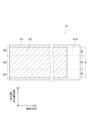
- FIG. 2 is a schematic diagram illustrating an example of a negative electrode used in a secondary battery according to an embodiment of the present disclosure.
- FIG. 1 is a schematic vertical cross-sectional view of a secondary battery according to an embodiment of the present disclosure.
- any of the exemplified lower limits and any of the exemplified upper limits can be arbitrarily combined, as long as the lower limit is not equal to or greater than the upper limit.
- one of the materials may be selected and used alone, or two or more of the materials may be used in combination.
- the present disclosure encompasses a combination of the features of two or more claims arbitrarily selected from the multiple claims set forth in the appended claims.
- the features of two or more claims arbitrarily selected from the multiple claims set forth in the appended claims may be combined, provided that no technical contradiction arises.
- a secondary battery includes a positive electrode, a negative electrode, a separator interposed between the positive electrode and the negative electrode, an electrode group formed by winding the positive electrode and the negative electrode with the separator interposed therebetween, an electrolyte, and a battery case that contains the electrode group and the electrolyte.
- the negative electrode has a negative electrode current collector and a negative electrode active material layer provided on the surface of the negative electrode current collector.
- the positive electrode can be configured to have a positive electrode current collector and a positive electrode active material layer provided on the surface of the positive electrode active material layer.
- the negative electrode active material contained in the negative electrode active material layer expands, causing the negative electrode active material layer to swell. If the expansion rate of the negative electrode active material layer is the same at the ends and center in the width direction parallel to the winding axis of the negative electrode, a greater surface pressure is usually applied to the center than to the ends. As a result, the electrode group may be deformed such that the center protrudes outward in the radial direction perpendicular to the winding axis (for example, the outer shape of the electrode group may change from a cylindrical shape to a barrel shape). This may result in an internal short circuit or poor current collection at the upper and lower ends.
- electrolyte is pushed from the center, where the surface pressure is high, to the ends, where the surface pressure is low, resulting in less electrolyte in the center.
- This imbalance in electrolyte distribution can result in uneven charge and discharge reactions along the winding axis, which can degrade battery characteristics such as cycle characteristics.
- the expansion rate of the negative electrode active material layer is greater at the ends in the width direction parallel to the winding axis of the negative electrode than at the center in the width direction.
- the thickness T C is obtained by disassembling a secondary battery in a fully charged state, taking out the negative electrode, measuring the thickness of the negative electrode after washing with an organic solvent using a contact-type constant pressure thickness gauge, and subtracting the thickness of the negative electrode current collector.
- the thickness T D is obtained by disassembling a secondary battery in a discharged state, taking out the negative electrode, measuring the thickness of the negative electrode after washing with an organic solvent using a constant pressure thickness gauge, and subtracting the thickness of the negative electrode current collector.
- the central portion of the negative electrode active material layer includes a position W/2 from one end in the width direction of the negative electrode active material layer, and includes, for example, a region of the negative electrode active material layer whose distance from one end in the width direction is in the range of 0.4 W to 0.6 W.
- an area where the negative electrode current collector is exposed may be provided, but the portion at the end of the negative electrode where the negative electrode active material layer is not provided is not included in the width W.
- the width in the width direction of the central portion of the negative electrode active material layer may be 20% to 60% of the width W at which the negative electrode active material layer is provided in the negative electrode.
- the ends of the negative electrode active material layer include one end (upper end) and the other end (lower end) in the width direction of the region in the negative electrode where the negative electrode active material layer is provided, and preferably include regions each having a width of 0.1 W from the upper end and the lower end, for example.
- the negative electrode may be disposed on the outer periphery side of the positive electrode.
- the outermost periphery of the electrode group is the negative electrode, and at the outermost periphery of the electrode group, the negative electrode has an exposed current collector portion where the negative electrode current collector is exposed.
- the exposed current collector portion of the negative electrode can be in surface contact with the battery case. This improves current collection and reduces internal resistance, improving output characteristics especially under high load.
- the negative electrode active material layer swells during charging, and the electrode group deforms, and the center may swell and protrude radially outward. Due to this deformation, the contact between the exposed part of the current collector and the battery case becomes linear or point contact via the center of the electrode group, and the upper and lower ends of the electrode group no longer make contact with the battery case. As a result, internal resistance increases, and it is thought that high output characteristics cannot be maintained.
- the swelling rate of the negative electrode active material layer at the ends in the width direction parallel to the winding axis is made greater than the swelling rate at the center, thereby reducing the difference in surface pressure between the center and ends. This suppresses deformation of the electrode group during charging, allowing the contact between the exposed part of the current collector and the battery case to be maintained as surface contact, and high output characteristics can be maintained.
- the outer surface of the outermost negative electrode of the electrode group may have an exposed current collector portion in which 50% or more of the negative electrode current collector is exposed by area, and 70% or more of the current collector may be exposed.
- the swelling ratio of the negative electrode active material layer at the center is B1 .
- the swelling ratio of the negative electrode active material layer at the end is B2 ( B1 ⁇ B2 ).
- the ratio B1 / B2 is less than 1 and is preferably 0.985 or more (98.5% or more).
- B 1 is relative to B 2 , the more the surface pressure in the center is reduced, so that deformation of the electrode group during charging is suppressed, and good surface contact can be maintained between the current collector exposed portion and the battery case.
- the electrolyte is suppressed from being pushed out from the center to the end portion, and the deterioration of the battery characteristics, such as the cycle characteristics, is suppressed.
- B 1 is excessively small relative to B 2 , the surface pressure in the center becomes too low, and the end portion of the electrode portion is easily deformed to protrude from the center portion during charging, and the contact between the current collector exposed portion and the battery case may be linear or point contact via the upper and lower ends of the electrode group.
- the electrolyte may remain in the center, and the electrolyte present at the end portion may be reduced, resulting in the deterioration of the battery characteristics not being suppressed.
- the swelling rate B 1 is 98.5% or more of the swelling rate B 2 , deformation of the electrode group during charging is significantly suppressed, and good surface contact can be maintained between the current collector exposed portion and the battery case.
- the effect of suppressing the deterioration of the battery characteristics is enhanced.
- the swelling ratio B means the ratio of the thickness of the negative electrode active material layer in a fully charged state to the thickness in a discharged state in a specified region. Therefore, when the thickness of the negative electrode active material layer is the same at the center and the end in the discharged state, the swelling ratio ratio B1 / B2 is equal to the ratio of the thickness at the center of the negative electrode active material layer in the fully charged state to the thickness at the end of the negative electrode active material layer in the fully charged state.
- the expansion rate of the negative electrode active material layer depends on the expansion rate of the materials (particularly the negative electrode active material) contained in the negative electrode active material layer during charging.
- materials containing silicon as negative electrode active materials have a large theoretical capacity, but are known to expand greatly during charging.
- the negative electrode active material layer may contain a silicon-containing material as the negative electrode active material.
- the swelling ratio B2 of the negative electrode active material layer at the end portion larger than the swelling ratio B1 of the negative electrode active material layer at the center portion, the difference in surface pressure between the end portion and the center portion of the negative electrode active material layer can be reduced, and short circuits and deterioration of battery characteristics due to deformation of the electrode group can be suppressed.
- the expansion ratios B1 and B2 can be controlled by adjusting the content ratio of the negative electrode active material in the negative electrode active material layer. For example, when a negative electrode active material containing a silicon-containing material is used, the content ratio of the silicon-containing material in the negative electrode active material layer at the end may be greater than the content ratio of the silicon-containing material in the negative electrode active material layer at the center. When a combination of multiple types of negative electrode active materials is contained in the negative electrode active material layer, the content ratios of the multiple types of negative electrode active materials may be different between the end and the center. This results in a negative electrode having a negative electrode active material layer in which the expansion ratio B2 at the end is greater than the expansion ratio B1 at the center.
- the secondary battery may be a non-aqueous electrolyte secondary battery.
- a non-aqueous electrolyte secondary battery is a secondary battery that has a liquid, gel, or solid non-aqueous electrolyte, and includes lithium ion secondary batteries, lithium secondary batteries (lithium metal secondary batteries), and all-solid-state secondary batteries.
- FIG. 1 is a schematic diagram showing an example of a negative electrode used in a secondary battery according to an embodiment of the present disclosure, showing the state of the negative electrode before it is wound with a positive electrode and a separator to form an electrode group.
- the negative electrode 16 is strip-shaped with a length (width) in the winding direction D1 that is longer than the length in the direction D2 parallel to the winding axis.
- the winding direction D1 is perpendicular to the winding axis.
- the direction D2 parallel to the winding axis is also referred to as the "width direction D2" below.
- the negative electrode 16 includes a negative electrode current collector 161 and a negative electrode active material layer 162 formed on the negative electrode current collector 161.
- the negative electrode 16 has a central portion 16A located in the center of the width direction D2, and end portions 16B and 16C adjacent to the central portion 16A.
- the end portions 16B and 16C are the end portions (upper end and lower end) of the negative electrode 16 in the width direction D2, and are located opposite each other with the central portion 16A in between.
- the expansion ratio B2 of the negative electrode active material layer 162 provided at the ends 16B and 16C is larger than the expansion ratio B1 of the negative electrode active material layer 162 provided at the center portion 16A.
- the end located on the outer periphery of the winding does not have the negative electrode active material layer 162 formed thereon, and has an exposed portion 161A where the negative electrode current collector 161 is exposed.
- the exposed portion 161A of the negative electrode current collector 161 forms the surface exposed on the outermost periphery of the electrode group. At least in a secondary battery in a charged state, the exposed portion 161A comes into surface contact with the inner surface of the battery case and is electrically connected.
- the width of the negative electrode active material layer 162 in the width direction D2 is defined as W.
- the width W1 in the width direction D2 of the central portion 16A is in the range of, for example, 0.2 W to 0.9 W or 0.2 W to 0.6 W.
- the width W2 in the width direction D1 of the end portions 16B and 16C is in the range of, for example, 0.05 W to 0.4 W or 0.05 W to 0.2 W.
- FIG. 2 is a schematic longitudinal sectional view of a secondary battery according to one embodiment of the present disclosure.
- the secondary battery (hereinafter battery) 10 is cylindrical and includes an electrode group 18, a non-aqueous electrolyte (not shown), and a battery case (battery can) 22 that contains them.
- the electrode group 18 is formed by winding a positive electrode 15 and a negative electrode 16 with a separator 17 interposed therebetween.
- An annular groove portion 22a is formed near the open end of the battery can 22.
- the opening of the battery can 22 is sealed with a sealing body 11 having a gasket 21 on the periphery.
- the sealing body 11 has a valve body 12, a metal plate 13, and an annular insulating member 14 interposed between the outer periphery of the valve body 12 and the outer periphery of the metal plate 13.
- the valve body 12 and the metal plate 13 are connected to each other at their respective centers.
- a positive electrode lead 15L derived from the positive electrode 15 is connected to the metal plate 13.
- the valve body 12 functions as an external terminal of the positive electrode.
- a negative electrode lead 16L derived from the negative electrode 16 is connected (welded) to the inner surface of the bottom of the battery can 22.
- a first insulating plate 24 is disposed between one end face of the electrode group 18 and the bottom of the battery can 22.
- a second insulating plate 23 is disposed between the sealing body 11 and the other end face of the electrode group 18.
- the structure of the secondary battery may be cylindrical, coin, button, or the like, with a metal battery case, or may be a laminated battery with a battery case made of a laminate sheet that is a laminate of a barrier layer and a resin sheet.
- the type, shape, etc. of the secondary battery are not particularly limited.
- the secondary battery includes, for example, a positive electrode, a negative electrode, an electrolyte (non-aqueous electrolyte), and a separator as described below.
- the positive electrode includes, for example, a positive electrode current collector and a positive electrode active material layer (positive electrode mixture layer) formed on the surface of the positive electrode current collector and containing a positive electrode active material.
- the positive electrode mixture layer can be formed by applying a positive electrode slurry in which the positive electrode mixture is dispersed in a dispersion medium to the surface of the positive electrode current collector and drying it. The coating film after drying may be rolled as necessary.
- the positive electrode mixture layer may be formed on one surface of the positive electrode current collector or on both surfaces.
- the positive electrode mixture includes a positive electrode active material as an essential component, and may include a binder, a thickener, and the like as optional components.
- the positive electrode active material may be any material that can be used as a positive electrode active material for a non-aqueous electrolyte secondary battery (particularly a lithium ion secondary battery), but from the viewpoint of increasing capacity, it is preferable that the positive electrode active material contains a lithium transition metal complex oxide (complex oxide N) that contains at least nickel as a transition metal.
- the proportion of complex oxide N in the positive electrode active material is, for example, 70% by mass or more, or may be 90% by mass or more, or may be 95% by mass or more.
- the complex oxide N may be, for example, a lithium transition metal complex oxide having a layered rock salt structure and containing Ni and at least one selected from the group consisting of Co, Mn, and Al.
- a lithium transition metal complex oxide having a layered rock salt structure and containing Ni and at least one selected from the group consisting of Co, Mn, and Al, and in which the proportion of Ni in the metal elements other than Li is 80 atomic % or more, is also referred to as a "complex oxide HN".
- the proportion of the complex oxide HN in the complex oxide N used as the positive electrode active material is, for example, 90 mass % or more, may be 95 mass % or more, or may be 100%. The higher the proportion of Ni, the more lithium ions can be extracted from the complex oxide HN during charging, and the capacity can be increased.
- Co, Mn, and Al contribute to stabilizing the crystal structure of the complex oxide HN with a high Ni content.
- the composite oxide HN is represented by, for example, the formula: Li ⁇ Ni (1-x1-x2-y-z) Co x1 Mn x2 Al y M z O 2+ ⁇ .
- the element M is an element other than Li, Ni, Co, Mn, Al, and oxygen.
- Mn contributes to stabilizing the crystal structure of the composite oxide HN, and containing inexpensive Mn in the composite oxide HN is advantageous for cost reduction.
- Al contributes to stabilizing the crystal structure of the composite oxide HN.
- ⁇ which indicates the atomic ratio of lithium
- ⁇ increases and decreases due to charging and discharging.
- the above range of ⁇ indicates the value in the discharged state.
- (2+ ⁇ ) which indicates the atomic ratio of oxygen, ⁇ satisfies -0.05 ⁇ 0.05.
- the atomic ratio of Co, x1, is, for example, 0.1 or less (0 ⁇ x1 ⁇ 0.1)
- the atomic ratio of Mn, x2 is, for example, 0.1 or less (0 ⁇ x2 ⁇ 0.1)
- the atomic ratio of Al, y is, for example, 0.1 or less (0 ⁇ y ⁇ 0.1)
- the atomic ratio of element M, z is, for example, 0 ⁇ z ⁇ 0.10.
- the element M may be at least one selected from the group consisting of Ti, Zr, Nb, Mo, W, Fe, Zn, B, Si, Mg, Ca, Sr, Sc, and Y.
- the surface structure of the complex oxide HN is stabilized, the resistance is reduced, and metal elution is further suppressed. It is more effective if the element M is unevenly distributed near the particle surface of the complex oxide HN.
- the content of each metal element contained in the lithium-containing composite oxide is measured, for example, by inductively coupled plasma (ICP) atomic emission spectrometry.
- ICP inductively coupled plasma
- binder for the positive electrode for example, a resin material is used.
- the binder include fluororesin, polyolefin resin, polyamide resin, polyimide resin, acrylic resin, vinyl resin, etc.
- One type of binder may be used alone, or two or more types may be used in combination.
- Conductive materials include carbon nanotubes (CNTs), carbon fibers other than CNTs, and conductive particles (e.g., carbon black and graphite).
- CNTs carbon nanotubes
- conductive particles e.g., carbon black and graphite
- the dispersion medium used for the positive electrode slurry is not particularly limited, but examples include water, alcohol, N-methyl-2-pyrrolidone (NMP), and mixed solvents thereof.
- the positive electrode current collector may be, for example, a metal foil.
- the positive electrode current collector may be porous. Examples of porous current collectors include nets, punched sheets, and expanded metals. Examples of the material of the positive electrode current collector include stainless steel, aluminum, aluminum alloys, and titanium.
- the thickness of the positive electrode current collector is not particularly limited, but may be, for example, 1 to 50 ⁇ m, and may be 5 to 30 ⁇ m.
- the negative electrode comprises, for example, a negative electrode current collector and a negative electrode active material layer formed on the surface of the negative electrode current collector.
- the negative electrode current collector is composed of a sheet-like conductive material.
- the negative electrode active material layer is supported on one or both surfaces of the negative electrode current collector.
- the negative electrode active material layer is usually a layer or film composed of a negative electrode mixture.
- the thickness of the negative electrode active material is, for example, 10 ⁇ m to 150 ⁇ m per one side of the negative electrode current collector.
- the negative electrode active material layer can be formed, for example, by applying a negative electrode slurry in which the negative electrode mixture is dispersed in a dispersion medium to the surface of the negative electrode current collector and then drying the applied layer. The coating film after drying may be rolled as necessary.
- the negative electrode active material layer may be formed on one surface of the negative electrode current collector or on both surfaces.
- the negative electrode mixture contains a negative electrode active material as an essential component, and may contain optional components such as a binder, a conductive agent, and a thickener.
- the negative electrode active material contains a material that electrochemically absorbs and releases lithium ions. Examples of materials that electrochemically absorb and release lithium ions include carbon materials and Si-containing materials. Examples of Si-containing materials include silicon oxide (SiOx: 0.5 ⁇ x ⁇ 1.5) and composite materials that contain a silicate phase and silicon particles dispersed within the silicate phase.
- carbon materials examples include graphite, easily graphitized carbon (soft carbon), and non-graphitizable carbon (hard carbon). Of these, graphite is preferred because of its excellent charge/discharge stability and low irreversible capacity.
- Graphite refers to materials that have a graphite-type crystal structure, and includes natural graphite, artificial graphite, and graphitized mesophase carbon particles. Carbon materials may be used alone or in combination of two or more types.
- composite materials containing a silicate phase and silicon particles dispersed within the silicate phase are more likely to achieve high capacity because the content of silicon particles can be selected arbitrarily.
- the silicate phase is a composite oxide phase containing silicon, oxygen, alkali metals, etc.
- composite materials in which the silicate phase is a lithium silicate phase containing silicon, oxygen, and lithium will also be referred to as "LSX.”
- LSX absorbs lithium ions by alloying silicon with lithium. By increasing the content of silicon particles, a high capacity can be expected.
- the crystallite size of the silicon particles dispersed within the lithium silicate phase is, for example, 5 nm or more.
- the silicon particles have a particulate phase of simple silicon (Si).
- Si simple silicon
- the crystallite size of the silicon particles is calculated using the Scherrer formula from the half-width of the diffraction peak assigned to the Si (111) plane in the X-ray diffraction (XRD) pattern of the silicon particles.
- LSX and a carbon material may be used in combination. Since LSX expands and contracts in volume with charging and discharging, if its proportion in the negative electrode active material increases, poor contact between the negative electrode active material and the negative electrode current collector is likely to occur with charging and discharging. On the other hand, by using LSX and a carbon material in combination, it is possible to achieve excellent cycle characteristics while imparting the high capacity of silicon particles to the negative electrode.
- the proportion of LSX in the total of LSX and carbon material is preferably, for example, 3 to 30 mass%. This makes it easier to achieve both high capacity and improved cycle characteristics.
- the negative electrode includes a central portion and an end portion, and the expansion rate of the negative electrode active material layer at the end portion is greater than that of the negative electrode active material layer at the central portion.
- the negative electrode active material layers with different expansion rates can be formed, for example, by applying a negative electrode slurry in which a negative electrode mixture containing a first negative electrode active material is dispersed in a dispersion medium to the central portion in the width direction of the negative electrode current collector, applying a negative electrode slurry in which a negative electrode mixture containing a second negative electrode active material having a larger expansion rate during charging than the first negative electrode active material is dispersed in a dispersion medium to the end portions in the width direction of the negative electrode current collector, and then drying.
- the first negative electrode active material and the second negative electrode active material may each be a mixture of multiple types of active materials with different expansion rates.
- the first negative electrode active material and the second negative electrode active material may have different mixing ratios of multiple types of active materials.
- the first negative electrode active material and the second negative electrode active material may each be a mixture of a first material and a second material having a larger expansion rate during charging than the first material, and the content ratio of the second material to the total of the first and second materials in the second negative electrode active material may be higher than the content ratio of the second material to the total of the first and second materials in the first negative electrode active material.
- the first material may be, for example, a graphite material.
- the second material may be, for example, a silicon-containing material.
- the negative electrode current collector may be, for example, a metal foil.
- the negative electrode current collector may be porous.
- Examples of the material of the negative electrode current collector include stainless steel, nickel, nickel alloy, copper, and copper alloy.
- the thickness of the negative electrode current collector is not particularly limited, but may be, for example, 1 to 50 ⁇ m, and may be 5 to 30 ⁇ m.
- binder for the negative electrode for example, a resin material is used.
- binders include fluororesin, polyolefin resin, polyamide resin, polyimide resin, acrylic resin, vinyl resin, and rubber-like materials (for example, styrene butadiene copolymer (SBR)).
- SBR styrene butadiene copolymer
- One type of binder may be used alone, or two or more types may be used in combination.
- Thickeners include, for example, cellulose derivatives such as cellulose ether.
- cellulose derivatives include carboxymethylcellulose (CMC) and its modified forms, methylcellulose, etc.
- CMC carboxymethylcellulose
- One type of thickener may be used alone, or two or more types may be used in combination.
- Conductive materials include carbon nanotubes (CNTs), carbon fibers other than CNTs, and conductive particles (e.g., carbon black and graphite).
- CNTs carbon nanotubes
- conductive particles e.g., carbon black and graphite
- the dispersion medium used in the negative electrode slurry is not particularly limited, but examples include water, alcohol, N-methyl-2-pyrrolidone (NMP), and mixed solvents thereof.
- the non-aqueous electrolyte includes a non-aqueous solvent and a solute dissolved in the non-aqueous solvent.
- the solute includes, for example, a lithium salt.
- the components of the non-aqueous electrolyte other than the non-aqueous solvent and the solute are additives.
- the non-aqueous electrolyte includes the above-mentioned sulfur-containing compound as an additive.
- non-aqueous solvents examples include cyclic carbonates, chain carbonates, cyclic carboxylates, and chain carboxylates.
- cyclic carbonates examples include propylene carbonate (PC), ethylene carbonate (EC), and vinylene carbonate (VC).
- chain carbonates include diethyl carbonate (DEC), ethyl methyl carbonate (EMC), and dimethyl carbonate (DMC).
- cyclic carboxylates include ⁇ -butyrolactone (GBL), and ⁇ -valerolactone (GVL).
- chain carboxylates examples include methyl acetate, ethyl acetate, propyl acetate, methyl propionate (MP), and ethyl propionate (EP).
- the non-aqueous solvents may be used alone or in combination of two or more.
- lithium salts of chlorine-containing acids LiClO4 , LiAlCl4 , LiB10Cl10 , etc.
- lithium salts of fluorine-containing acids LiPF6 , LiPF2O2 , LiBF4 , LiSbF6 , LiAsF6 , LiCF3SO3 , LiCF3CO2 , etc.
- lithium salts of fluorine-containing acid imides LiN( FSO2 ) 2 , LiN( CF3SO2 ) 2 , LiN ( CF3SO2 ) (C4F9SO2 ), LiN( C2F5SO2 ) 2 , etc. )
- lithium halides LiCl, LiBr, LiI, etc.
- the lithium salt may be used alone or in combination of two or more kinds.
- the concentration of the lithium salt in the non-aqueous electrolyte may be 1 mol/L or more and 2 mol/L or less, or 1 mol/L or more and 1.5 mol/L or less.
- the lithium salt concentration is not limited to the above.
- the separator has high ion permeability and has appropriate mechanical strength and insulation properties.
- a microporous thin film, a woven fabric, a nonwoven fabric, etc. can be used.
- polyolefin such as polypropylene and polyethylene is preferable.
- a positive electrode and a negative electrode having a negative electrode current collector and a negative electrode active material layer provided on a surface of the negative electrode active material layer; a separator interposed between the positive electrode and the negative electrode; an electrode group formed by winding the positive electrode and the negative electrode with the separator interposed therebetween; An electrolyte; a battery case that accommodates the electrode group and the electrolyte,
- the negative electrode is disposed on an outer periphery side of the positive electrode, the outermost periphery of the electrode group is the negative electrode, and the negative electrode has a current collector exposed portion where the negative electrode current collector is exposed, a swelling rate of the negative electrode active material layer caused by charging and discharging the negative electrode is greater at the ends in a width direction parallel to a winding axis of the negative electrode than at a central portion in the width direction.
- the surface pressure applied to the electrode group due to the expansion of the negative electrode was calculated by stress simulation.
- the analysis software used was ADVENTURECluster from SCSK Corporation. The configuration of the electrode group used in the analysis is shown below.
- Positive electrode Length in winding direction D1: 700 mm Thickness: 0.200 mm (when discharging) Number of turns: 18.1 turns Young's modulus: 1.5 GPa Poisson's ratio: 0.35
- Negative electrode Length in winding direction D1: 800 mm Thickness: 0.200 mm (when discharging, the thickness of the negative electrode active material layer is 0.190 mm) Number of turns: 21.6 turns Young's modulus: 1.0 GPa Poisson's ratio: 0.35
- Separator Length in winding direction D1: 780 mm (inner circumference side), 810 mm (outer circumference side) Thickness: 0.0135 mm (when discharging) Battery case: Young's modulus: 190 GPa Poisson's ratio: 0.3
- the negative electrode was divided into three equal parts in the width direction D2, and into three regions consisting of a central portion 16A having a width W/3 and end portions 16B and 16C each having a width W/3 and adjacent to the central portion 16A.
- the expansion ratio B2 of the negative electrode active material layer at the end portions 16B and 16C was kept constant, and the expansion ratio B1 of the negative electrode active material layer at the central portion 16A was changed to determine the distribution of surface pressure within the electrode group in a charged state.
- the radial position where the surface pressure was maximum in the electrode group was obtained.
- the surface pressure was maximum at a position where the distance from the innermost peripheral surface of the electrode group was 20 to 35% of (R 1 -R 2 )/2.
- the distribution of the surface pressure in the width direction D2 applied to the negative electrode at the radial position where the surface pressure was maximum was obtained.
- the surface pressure P 1 at the position in the width direction D2 where the height from the bottom surface of the electrode group was W/2 (the center position of the central portion 16A) and the surface pressure P 2 at the position in the width direction D2 where the height from the bottom surface of the electrode group was W/3 (the boundary position between the central portion 16A and the end portion 16C) were obtained, and the ratio P 1 to P 2 , P 1 /P 2, was evaluated as the surface pressure ratio.
- Table 1 shows the relationship between the ratio B1 / B2 of the expansion rate B2 to the expansion rate B1 of the negative electrode active material layer and the surface pressure ratio P1 / P2 .
- Table 2 shows the relationship between the ratio B1 / B2 of the expansion rate B2 to the expansion rate B1 of the negative electrode active material layer and the surface pressure ratio P1 / P2 .
- the ratio B1 / B2 is reduced from 1, the surface pressure ratio P1 / P2 is reduced and the surface pressure difference between the central portion 16A and the ends 16B and 16C is reduced.
- the ratio B1 / B2 is 0.985 or more and less than 1
- the surface pressure ratio P1 / P2 is a positive value close to 1, and the surface pressure difference can be reduced.
- a secondary battery including a negative electrode having the above swelling ratios B1 and B2 is produced, for example, by the following production method.
- Si powder and SiO2 powder are mixed in a molar ratio of 1:1, and SiO is produced by sublimation reaction at 1300 ° C under reduced pressure.
- the produced SiO is pulverized with a jet mill so that the average particle size (D50) is 6 ⁇ m, and SiO powder is obtained.
- the SiO powder is carbon-coated (C-coated) at 850 ° C by thermal CVD using a mixed gas of argon and propane as the carbon source.
- the first negative electrode mixture slurry is applied to the surface of the center of the copper foil that serves as the negative electrode current collector, and after the coating is dried, the second negative electrode mixture slurry is applied to the surface of the end of the copper foil, and the coating is dried.
- the coating is compressed to a specified thickness using a rolling roller, resulting in a negative electrode in which a negative electrode active material layer is formed on both sides of the negative electrode current collector.
- LiNi 0.8 Co 0.15 Al 0.05 O 2 (NCA) as a positive electrode active material, acetylene black (AB), and polyvinylidene fluoride (PVDF) are mixed in a mass ratio of 94:5:1, and an appropriate amount of N-methyl-2-pyrrolidone (NMP) is added to prepare a positive electrode mixture slurry.
- NMP N-methyl-2-pyrrolidone
- this positive electrode mixture slurry is applied to both surfaces of a positive electrode current collector made of aluminum foil, and the coating is dried to form a positive electrode mixture layer.
- the coating is compressed to a predetermined thickness by a rolling roller to obtain a positive electrode in which a positive electrode active material layer is formed on both sides of the positive electrode current collector.
- An electrolyte solution is prepared by adding LiPF6 as a lithium salt to a mixed solvent containing ethylene carbonate (EC), ethyl methyl carbonate (EMC), and dimethyl carbonate (DMC) in a volume ratio of 3:3:4.
- the concentration of LiPF6 in the nonaqueous electrolyte solution is 1.2 mol/L.
- the positive and negative electrodes are wound around a core with a separator made of a microporous polyethylene film interposed therebetween to obtain a cylindrical wound electrode body.
- An aluminum positive electrode lead is welded to the exposed part of the positive electrode current collector, and a nickel negative electrode lead is welded to the exposed part of the negative electrode current collector.
- the electrode body is housed in a cylindrical outer can with a bottom, and the positive electrode lead is welded to a sealing member and the negative electrode lead is welded to the inner bottom surface of the outer can.
- the opening of the outer can is sealed with a sealing member to prepare a nonaqueous electrolyte secondary battery (height 70 mm, diameter 18 mm). This results in a secondary battery equipped with a negative electrode having a swelling ratio B1 / B2 of 0.99.
- the content of SiO powder in the first negative electrode mixture slurry is changed to 3.5 parts by mass relative to 96.5 parts by mass of graphite powder, thereby obtaining a secondary battery equipped with a negative electrode having an expansion ratio B 1 /B 2 of 0.985.
- the content of SiO powder in the first negative electrode mixture slurry is changed to 3 parts by mass relative to 97 parts by mass of graphite powder, thereby obtaining a secondary battery equipped with a negative electrode having an expansion ratio B 1 /B 2 of 0.98.
- the content ratio of SiO powder in the first negative electrode mixture slurry is changed to 5 parts by mass (the same as that of the second negative electrode mixture slurry) per 95 parts by mass of graphite powder, thereby obtaining a secondary battery equipped with a negative electrode having an expansion ratio ratio B1 / B2 of 1.
- the secondary battery disclosed herein is useful as a main power source for mobile communication devices, portable electronic devices, electric vehicles, etc.
- 10 nonaqueous electrolyte secondary battery
- 11 sealing body
- 12 valve body
- 13 metal plate
- 14 insulating member
- 15 positive electrode
- 15L positive electrode lead
- 16 negative electrode
- 16L negative electrode lead
- 17 separator
- 18 electrode group
- 21 gasket
- 22 battery can
- 22a annular groove portion
- 23 second insulating plate
- 24 first insulating plate
- 161 negative electrode current collector
- 162 negative electrode active material layer
Landscapes
- Chemical & Material Sciences (AREA)
- Engineering & Computer Science (AREA)
- Chemical Kinetics & Catalysis (AREA)
- Electrochemistry (AREA)
- General Chemical & Material Sciences (AREA)
- Manufacturing & Machinery (AREA)
- Materials Engineering (AREA)
- Secondary Cells (AREA)
- Battery Electrode And Active Subsutance (AREA)
Priority Applications (2)
| Application Number | Priority Date | Filing Date | Title |
|---|---|---|---|
| JP2025524887A JPWO2024248105A1 (https=) | 2023-05-31 | 2024-05-30 | |
| EP24815585.5A EP4723187A1 (en) | 2023-05-31 | 2024-05-30 | Secondary battery |
Applications Claiming Priority (2)
| Application Number | Priority Date | Filing Date | Title |
|---|---|---|---|
| JP2023090228 | 2023-05-31 | ||
| JP2023-090228 | 2023-05-31 |
Publications (1)
| Publication Number | Publication Date |
|---|---|
| WO2024248105A1 true WO2024248105A1 (ja) | 2024-12-05 |
Family
ID=93657628
Family Applications (1)
| Application Number | Title | Priority Date | Filing Date |
|---|---|---|---|
| PCT/JP2024/019929 Ceased WO2024248105A1 (ja) | 2023-05-31 | 2024-05-30 | 二次電池 |
Country Status (3)
| Country | Link |
|---|---|
| EP (1) | EP4723187A1 (https=) |
| JP (1) | JPWO2024248105A1 (https=) |
| WO (1) | WO2024248105A1 (https=) |
Citations (6)
| Publication number | Priority date | Publication date | Assignee | Title |
|---|---|---|---|---|
| JP2007220450A (ja) * | 2006-02-16 | 2007-08-30 | Matsushita Electric Ind Co Ltd | リチウム二次電池用負極板、およびそれを用いたリチウム二次電池 |
| JP2015191879A (ja) * | 2014-03-31 | 2015-11-02 | 株式会社日立製作所 | 捲回型二次電池 |
| JP2018106903A (ja) * | 2016-12-26 | 2018-07-05 | トヨタ自動車株式会社 | リチウムイオン二次電池 |
| WO2019244818A1 (ja) * | 2018-06-20 | 2019-12-26 | 三洋電機株式会社 | 非水電解質二次電池 |
| WO2022024712A1 (ja) | 2020-07-31 | 2022-02-03 | 三洋電機株式会社 | 非水電解質二次電池 |
| WO2023032445A1 (ja) * | 2021-08-30 | 2023-03-09 | 三洋電機株式会社 | 非水電解液二次電池 |
-
2024
- 2024-05-30 EP EP24815585.5A patent/EP4723187A1/en active Pending
- 2024-05-30 JP JP2025524887A patent/JPWO2024248105A1/ja active Pending
- 2024-05-30 WO PCT/JP2024/019929 patent/WO2024248105A1/ja not_active Ceased
Patent Citations (6)
| Publication number | Priority date | Publication date | Assignee | Title |
|---|---|---|---|---|
| JP2007220450A (ja) * | 2006-02-16 | 2007-08-30 | Matsushita Electric Ind Co Ltd | リチウム二次電池用負極板、およびそれを用いたリチウム二次電池 |
| JP2015191879A (ja) * | 2014-03-31 | 2015-11-02 | 株式会社日立製作所 | 捲回型二次電池 |
| JP2018106903A (ja) * | 2016-12-26 | 2018-07-05 | トヨタ自動車株式会社 | リチウムイオン二次電池 |
| WO2019244818A1 (ja) * | 2018-06-20 | 2019-12-26 | 三洋電機株式会社 | 非水電解質二次電池 |
| WO2022024712A1 (ja) | 2020-07-31 | 2022-02-03 | 三洋電機株式会社 | 非水電解質二次電池 |
| WO2023032445A1 (ja) * | 2021-08-30 | 2023-03-09 | 三洋電機株式会社 | 非水電解液二次電池 |
Also Published As
| Publication number | Publication date |
|---|---|
| JPWO2024248105A1 (https=) | 2024-12-05 |
| EP4723187A1 (en) | 2026-04-08 |
Similar Documents
| Publication | Publication Date | Title |
|---|---|---|
| JP4878687B2 (ja) | リチウム二次電池 | |
| JP7697988B2 (ja) | リチウム二次電池用正極、その製造方法、及びそれを含むリチウム二次電池 | |
| JP6531652B2 (ja) | 非水電解質二次電池用負極 | |
| JP6903260B2 (ja) | リチウムイオン二次電池用負極及びリチウムイオン二次電池 | |
| JP7556779B2 (ja) | 負極活物質、負極、及び二次電池 | |
| JP5884039B2 (ja) | 非水電解質二次電池 | |
| JP6542755B2 (ja) | リチウムイオン二次電池用黒鉛系活物質材料、リチウムイオン二次電池用負極及びリチウムイオン二次電池 | |
| KR102914058B1 (ko) | 음극 및 이를 포함하는 이차전지 | |
| US20030068555A1 (en) | Non-aqueous electrolyte secondary battery | |
| JP7198600B2 (ja) | 正極活物質粒子 | |
| JP3580209B2 (ja) | リチウムイオン二次電池 | |
| JP6168356B2 (ja) | リチウムイオン二次電池 | |
| JP5526368B2 (ja) | 非水電解質二次電池 | |
| JP7003775B2 (ja) | リチウムイオン二次電池 | |
| JP2006294482A (ja) | リチウムイオン二次電池 | |
| JP2024060967A (ja) | 正極活物質、正極および非水電解質二次電池 | |
| JP2018160379A (ja) | リチウムイオン二次電池用負極およびリチウムイオン二次電池 | |
| WO2023053626A1 (ja) | 非水電解質二次電池 | |
| JP7821191B2 (ja) | 非水電解質二次電池 | |
| JP2025518058A (ja) | 二次電池及びその製造方法と電力消費装置 | |
| WO2024248105A1 (ja) | 二次電池 | |
| WO2023145506A1 (ja) | 非水電解質二次電池 | |
| JP7017108B2 (ja) | 活物質、電極及びリチウムイオン二次電池 | |
| JP2010176973A (ja) | 非水電解質二次電池 | |
| JP2022153190A (ja) | リチウムイオン二次電池用電極およびリチウムイオン二次電池 |
Legal Events
| Date | Code | Title | Description |
|---|---|---|---|
| 121 | Ep: the epo has been informed by wipo that ep was designated in this application |
Ref document number: 24815585 Country of ref document: EP Kind code of ref document: A1 |
|
| ENP | Entry into the national phase |
Ref document number: 2025524887 Country of ref document: JP Kind code of ref document: A |
|
| NENP | Non-entry into the national phase |
Ref country code: DE |
|
| WWE | Wipo information: entry into national phase |
Ref document number: 2024815585 Country of ref document: EP |
|
| ENP | Entry into the national phase |
Ref document number: 2024815585 Country of ref document: EP Effective date: 20260102 |
|
| ENP | Entry into the national phase |
Ref document number: 2024815585 Country of ref document: EP Effective date: 20260102 |
|
| ENP | Entry into the national phase |
Ref document number: 2024815585 Country of ref document: EP Effective date: 20260102 |
|
| ENP | Entry into the national phase |
Ref document number: 2024815585 Country of ref document: EP Effective date: 20260102 |
|
| ENP | Entry into the national phase |
Ref document number: 2024815585 Country of ref document: EP Effective date: 20260102 |
|
| ENP | Entry into the national phase |
Ref document number: 2024815585 Country of ref document: EP Effective date: 20260102 |
|
| WWP | Wipo information: published in national office |
Ref document number: 2024815585 Country of ref document: EP |