WO2024247725A1 - 接続システム、コネクタ、および、配線構造の製造方法 - Google Patents
接続システム、コネクタ、および、配線構造の製造方法 Download PDFInfo
- Publication number
- WO2024247725A1 WO2024247725A1 PCT/JP2024/017909 JP2024017909W WO2024247725A1 WO 2024247725 A1 WO2024247725 A1 WO 2024247725A1 JP 2024017909 W JP2024017909 W JP 2024017909W WO 2024247725 A1 WO2024247725 A1 WO 2024247725A1
- Authority
- WO
- WIPO (PCT)
- Prior art keywords
- female
- male
- housing
- connector
- terminal
- Prior art date
- Legal status (The legal status is an assumption and is not a legal conclusion. Google has not performed a legal analysis and makes no representation as to the accuracy of the status listed.)
- Ceased
Links
Images



Classifications
-
- H—ELECTRICITY
- H01—ELECTRIC ELEMENTS
- H01R—ELECTRICALLY-CONDUCTIVE CONNECTIONS; STRUCTURAL ASSOCIATIONS OF A PLURALITY OF MUTUALLY-INSULATED ELECTRICAL CONNECTING ELEMENTS; COUPLING DEVICES; CURRENT COLLECTORS
- H01R13/00—Details of coupling devices of the kinds covered by groups H01R12/70 or H01R24/00 - H01R33/00
- H01R13/64—Means for preventing incorrect coupling
-
- H—ELECTRICITY
- H01—ELECTRIC ELEMENTS
- H01R—ELECTRICALLY-CONDUCTIVE CONNECTIONS; STRUCTURAL ASSOCIATIONS OF A PLURALITY OF MUTUALLY-INSULATED ELECTRICAL CONNECTING ELEMENTS; COUPLING DEVICES; CURRENT COLLECTORS
- H01R43/00—Apparatus or processes specially adapted for manufacturing, assembling, maintaining, or repairing of line connectors or current collectors or for joining electric conductors
Definitions
- the present disclosure relates to connection systems, connectors, and methods for manufacturing wiring structures.
- the connector has a configuration in which a terminal (terminal fitting) provided at the end of an electric wire is housed in a cavity provided in a connector housing (for example, Patent Document 1).
- various devices mounted on the vehicle may be connected to devices on the vehicle body via connectors.
- the on-board device for example, when a new version of the device is released due to the addition of new device functions after the purchase of the vehicle, and the old version of the device is replaced with the new version
- the connector is replaced.
- the connector it is required that the contact resistance between the terminals be kept low without increasing, even after the replacement.
- the present disclosure therefore aims to provide technology that can prevent an increase in contact resistance between terminals when a connector is replaced.
- connection system disclosed herein comprises a male connector having a male terminal and a male housing in which the male terminal is housed, a first female connector having a first female terminal and a first female housing in which the first female terminal is housed, and a second female connector having a second female terminal and a second female housing in which the second female terminal is housed, in which, when the first female connector is connected to the male connector, the first female terminal comes into contact with a first contact area of the male terminal, and, when the second female connector is connected to the male connector, the second female terminal comes into contact with a second contact area of the male terminal that is offset from the first contact area.
- the connector disclosed herein is a connector that includes a female terminal and a female housing in which the female terminal is housed, and the female housing includes a regulating surface that contacts a male housing and regulates the connection position of the female housing relative to the male housing, and the connection position is regulated by the regulating surface, so that the area of the male terminal housed in the male housing with which the female terminal comes into contact is shifted from the area with which the female terminal would come into contact if the connection position were not regulated by the regulating surface.
- the manufacturing method of the wiring structure disclosed herein includes a removal step of removing a first female connector including a first female terminal and a first female housing in which the first female terminal is housed from a male connector including a male terminal and a male housing in which the male terminal is housed, and a connection step of connecting a second female connector including a second female terminal and a second female housing in which the second female terminal is housed to the male connector from which the first female connector has been removed, and contacting the second female terminal with a second contact area of the male terminal that is positioned offset from the first contact area with which the first female terminal was in contact.
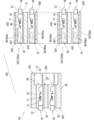
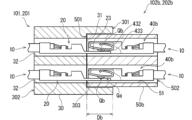
- FIG. 1 is a perspective view showing a connection system according to a first embodiment.
- FIG. 2 is a side cross-sectional view of the connection system.
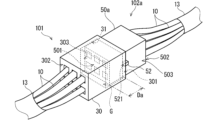
- FIG. 3 is a perspective view showing a state in which the first female connector is connected to the male connector.
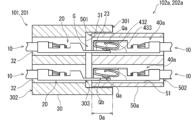
- FIG. 4 is a side cross-sectional view showing a state in which the first female connector is connected to the male connector.
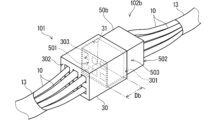
- FIG. 5 is a perspective view showing a state in which the second female connector is connected to the male connector.
- FIG. 6 is a side cross-sectional view showing a state in which the second female connector is connected to the male connector.
- FIG. 7 is a perspective view showing a connection system according to the second embodiment.
- FIG. 8 is a perspective view showing a state in which the first female connector is connected to the male connector.
- FIG. 9 is a perspective view showing a state in which the second female connector is connected to the male connector.
- FIG. 10 is a perspective view showing a connection system according to a modified example.
- connection system disclosed herein is as follows:
- a connection system comprising: a male connector having a male terminal and a male housing in which the male terminal is housed; a first female connector having a first female terminal and a first female housing in which the first female terminal is housed; and a second female connector having a second female terminal and a second female housing in which the second female terminal is housed; when the first female connector is connected to the male connector, the first female terminal comes into contact with a first contact area of the male terminal, and when the second female connector is connected to the male connector, the second female terminal comes into contact with a second contact area of the male terminal that is offset from the first contact area.
- the connector that is connected to the male connector is replaced, for example, from a first female connector to a second female connector, even if the plating on the first contact area has peeled off, the second female terminal is more likely to be able to contact the male terminal in an area where the plating has not peeled off. Therefore, when the connector is replaced, an increase in contact resistance between the terminals is suppressed.
- the second contact area may be located closer to the base end of the male terminal than the first contact area.
- the connector to be connected to the male connector is replaced, for example, from a first female connector to a second female connector, even if the plating of the area of the male terminal closer to the tip end than the first contact area has peeled off, the second female terminal is more likely to be able to contact the male terminal in the area where the plating has not peeled off. Therefore, when the connector is replaced, the contact resistance between the terminals is not particularly likely to increase.
- the second contact area may be an area that does not entirely overlap with the first contact area.
- the second female terminal is likely to be able to contact the male terminal in an area where the plating has not peeled off. Therefore, when the connector is replaced, the contact resistance between the terminals is not particularly likely to increase.
- the first female housing may have a restricting surface that contacts the male housing and restricts the connection position of the first female housing to the male housing to a position shifted from the connection position of the second female housing to the male housing.
- the first contact area and the second contact area can be shifted with a simple configuration.
- the first female terminal and the second female terminal may have the same shape.
- the first female terminal and the second female terminal can be formed from a common part, so that the number of types of parts used in the entire connection system can be reduced.
- the first female housing may be provided with a protrusion having the regulating surface.
- the connection position of the first female housing relative to the male housing can be regulated without complicating the shape of the first female housing.
- the regulating surface may contact the end face of the male housing on the side into which the first female housing is inserted. In this case, the connection position of the first female housing relative to the male housing can be regulated without complicating the shape of the male housing.
- the male housing may have a groove
- the protrusion may be accommodated in the groove
- the regulating surface may contact an end face in the extending direction of the groove. Since the connection between the male housing and the first female housing is permitted only when the position of the groove corresponds to the position of the protrusion, connection errors are unlikely to occur.
- the first female housing may have a first regulating surface that contacts the male housing to regulate the connection position of the first female housing relative to the male housing to a first position
- the second female housing may have a second regulating surface that contacts the male housing to regulate the connection position of the second female housing relative to the male housing to a second position shifted from the first position.
- the positions of the first contact area and the second contact area can be defined independently.
- connection systems (1) to (9) when the first female housing is inserted into the recess of the male housing and the first female connector is connected to the male connector, a gap may be provided between the innermost surface of the recess and the opposing end surface of the first female housing. By providing such a gap, the first contact area can be shifted toward the tip of the male terminal by the size of the gap.
- the connector disclosed herein is a connector including a female terminal and a female housing in which the female terminal is accommodated, the female housing includes a regulating surface that contacts a male housing and regulates the connection position of the female housing relative to the male housing, and the connection position is regulated by the regulating surface, so that the area of the male terminal housed in the male housing with which the female terminal comes into contact is shifted from the area with which the female terminal would come into contact if the connection position were not regulated by the regulating surface.
- the method for manufacturing a wiring structure disclosed herein includes a removal step of removing a first female connector including a first female terminal and a first female housing in which the first female terminal is housed from a male connector including a male terminal and a male housing in which the male terminal is housed, and a connection step of connecting a second female connector including a second female terminal and a second female housing in which the second female terminal is housed to the male connector from which the first female connector has been removed, and contacting the second female terminal with a second contact area of the male terminal that is positioned offset from the first contact area with which the first female terminal was in contact.
- the second female connector When the second female connector is connected to the male connector, even if the plating on the first contact area has peeled off, the second female terminal is more likely to be able to contact the male terminal in an area where the plating has not peeled off. Therefore, in a wiring structure manufactured by replacing the connectors, an increase in contact resistance between the terminals is suppressed.
- connection system [Details of the embodiment of the present disclosure] Specific examples of the connection system, connector, and method of manufacturing the wiring structure of the present disclosure will be described below with reference to the drawings. Note that the present disclosure is not limited to these examples, but is defined by the claims, and is intended to include all modifications within the meaning and scope of the claims.
- Fig. 1 is a perspective view that shows a schematic view of the connection system 100.
- Fig. 2 is a side cross-sectional view that shows a schematic view of the connection system 100.
- connection system 100 is a system that electrically connects various devices together, and includes a male connector 101, a first female connector 102a, and a second female connector 102b. In the following, when there is no need to distinguish between the first female connector 102a and the second female connector 102b, they will simply be referred to as "female connector 102.”
- the male connector 101 includes a terminal (male terminal) 20 provided at the end of the electric wire 10, and a connector housing (male housing) 30 in which the male terminal 20 is accommodated.
- the female connector 102 includes a terminal (female terminal) 40 provided at the end of the electric wire 10, and a connector housing (female housing) 50 in which the female terminal 40 is accommodated.
- the electric wire 10 and the terminals 20, 40 provided at its end are sometimes called a terminal-attached electric wire.
- the terminal-attached electric wire and the connector housings 30, 50 in which the terminals 20, 40 are accommodated are sometimes called a connector-attached electric wire, a wire harness, or the like.
- the electric wire 10 is, for example, an insulated electric wire, and is configured to include a core wire 11 and an insulating coating 12 surrounding the core wire 11.
- the core wire 11 is a conductive member (conductor) and is made of various conductive materials (e.g., copper, copper alloy, aluminum, aluminum alloy, etc.).
- the insulating coating 12 is a non-conductive, flexible coating and is made of various synthetic resin materials (e.g., polyvinyl chloride (PVC), polypropylene (PP), polyethylene (PE), cross-linked polyethylene (XLPE), etc.).
- Both the male terminal (male terminal fitting) 20 and the female terminal (female terminal fitting) 40 are conductive members and are configured to include a base portion and a plating (plating layer) covering the base portion.
- the base portion is formed of, for example, copper, brass, copper alloy, etc.
- the plating is formed of, for example, tin (Sn), tin alloy (for example, tin alloy with silver, copper, bismuth, etc. added to tin), precious metal (for example, gold, silver), etc.
- a coating connection portion 21 and a core wire connection portion 22 are provided at one end (base end) of the male terminal 20.
- a coating connection portion 41 and a core wire connection portion 42 are provided at one end (base end) of the female terminal 40.
- the coating connection portions 21, 41 are mechanically connected to the ends of the insulating coating 12.
- the connection between the coating connection portions 21, 41 and the insulating coating 12 is achieved by an appropriate method (e.g., crimping, etc.).
- the core wire 11 extends from the end of the insulating coating 12 by a certain length (i.e., the insulating coating 12 is peeled off from around the core wire 11 by a certain length to expose the core wire 11), and the core wire connection portions 22, 42 are mechanically and electrically connected to this extending core wire 11.
- the connection between the core wire connection parts 22, 42 and the core wire 11 is achieved by an appropriate method (e.g., crimping, ultrasonic welding, resistance welding, soldering, etc.).
- the other end (tip) of the male terminal 20 is provided with a contact portion 23 that is electrically connected to the mating terminal.
- the contact portion 23 of the male terminal 20 has an elongated shape (e.g., rod-like, tab-like, pin-like, etc.).
- the other end (tip) of the female terminal 40 is provided with a contact portion 43 that is electrically connected to the mating terminal.
- the contact portion 43 of the female terminal 40 includes, for example, a cylindrical portion 431 and a spring piece 432 having a spring structure formed inside it.
- the underside of the spring piece 432 is provided with, for example, a protrusion 433.
- the male housing 30 is a housing made of an insulating material such as resin, and is formed, for example, by mold molding.
- the male housing 30 has, for example, a rectangular parallelepiped shape, and a recess 31 is provided on one end face (inserted face) 301.
- the male housing 30 is also provided with one or more terminal accommodating chambers (cavities) 32 (six in the illustrated example) that penetrate from the other end face (back face) 302 to the inner face 303 of the recess 31.
- Each terminal accommodating chamber 32 accommodates a male terminal 20 individually.
- the male terminal 20 is, for example, inserted into the terminal accommodating chamber 32 from the back face 302, and is fixed (for example, fixed by locking) to the terminal accommodating chamber 32 with the coating connection portion 21 and the core wire connection portion 22 accommodated in the terminal accommodating chamber 32 and the contact portion 23 extending into the recess 31.
- Each electric wire 10 extending from the back face 302 may be tied with a tie 13 formed of an adhesive tape, a cable tie, or the like.
- the female housing 50 is a housing made of an insulating material such as resin, similar to the male housing 30, and is formed, for example, by mold molding.
- the female housing 50 has, for example, a rectangular parallelepiped outer shape, and is provided with one or more terminal accommodating chambers (cavities) 51 (six in the example shown in the figure) that penetrate from one end face (insertion face) 501 to the other end face (back face) 502.
- Each terminal accommodating chamber 51 individually accommodates a female terminal 40.
- the female terminal 40 is, for example, inserted into the terminal accommodating chamber 51 from the back face 502, and is fixed (for example, fixed by locking) to the terminal accommodating chamber 51 in a state where the entire female terminal 40 is accommodated in the terminal accommodating chamber 51.
- Each electric wire 10 extending from the back face 502 may be tied with a tie 13 formed of an adhesive tape, a cable tie, or the like.
- the connection system 100 includes two female connectors 102 (i.e., the first female connector 102a and the second female connector 102b).
- the first female connector 102a and the second female connector 102b differ in the presence or absence of a protrusion 52. That is, a protrusion 52 is provided on a surface (side surface) 503 intersecting with an insertion surface 501 in the female housing 50 of the first female connector 102a (hereinafter also referred to as the "first female housing 50a").
- no protrusion 52 is provided on a side surface 503 of the female housing 50 of the second female connector 102b (hereinafter also referred to as the "second female housing 50b").
- the first female connector 102a and the second female connector 102b are the same except for the presence or absence of a protrusion 52. That is, the female terminal 40 of the first female connector 102a (hereinafter also referred to as the "first female terminal 40a") and the female terminal 40 of the second female connector 102b (hereinafter also referred to as the "second female terminal 40b") are the same shape. Furthermore, the first female housing 50a and the second female housing 50b are the same shape except for the presence or absence of a protrusion 52. Furthermore, the position (accommodated position) of the first female terminal 40a relative to the first female housing 50a and the position of the second female terminal 40b relative to the second female housing 50b are the same.
- Fig. 3 is a perspective view showing the state in which the first female connector 102a is connected to the male connector 101.
- Fig. 4 is a side cross-sectional view showing the state in which the first female connector 102a is connected to the male connector 101.
- the plugged surface 301 of the male housing 30 and the plugging surface 501 of the first female housing 50a are first arranged to face each other. Then, the first female housing 50a is moved relatively to the male housing 30, and the first female housing 50a is inserted (pushed) into the recess 31 from the plugged surface 301 side of the male housing 30.
- the protrusion 52 specifically, the side surface (regulating surface) 521 on the plugging surface 501 side of the protrusion 52
- the first female connector 102a When the first female connector 102a is connected to the male connector 101, the inner surface 303 of the recess 31 of the male housing 30 and the opposing insertion surface 501 of the first female housing 50a are not yet in contact with each other, and a gap G is provided between the two surfaces 303, 501. Furthermore, when the first female connector 102a is connected to the male connector 101, the first female terminal 40a contacts the first contact area Qa of the male terminal 20. Specifically, the spring piece 432 of the first female terminal 40a is elastically biased downward, so that the protruding end of the convex portion 433 provided on the lower surface of the spring piece 432 contacts the first contact area Qa of the contact portion 23. This electrically connects the male terminal 20 and the first female terminal 40a.
- Fig. 5 is a perspective view showing the state in which the second female connector 102b is connected to the male connector 101.
- Fig. 6 is a side cross-sectional view showing the state in which the second female connector 102b is connected to the male connector 101.
- the plugged surface 301 of the male housing 30 and the plugging surface 501 of the second female housing 50b are positioned so as to face each other. Then, the second female housing 50b is moved relatively to the male housing 30, and the second female housing 50b is inserted into the recess 31 from the plugged surface 301 side of the male housing 30. Since the second female housing 50b does not have a protrusion 52, the second female housing 50b is inserted into the recess 31 more than the first insertion amount Da (deeper).
- the plugging surface 501 abuts (contacts) the innermost surface 303 of the recess 31, and the second female housing 50b is not inserted any deeper.
- the connection between the male connector 101 and the second female connector 102b is complete.
- the second female terminal 40b contacts the second contact area Qb of the male terminal 20.
- the spring piece 432 of the second female terminal 40b is elastically biased downward, so that the protruding end of the convex portion 433 provided on the underside of the spring piece 432 contacts the second contact area Qb of the contact portion 23.
- the second contact area Qb is in a position shifted from the first contact area Qa.
- the regulating surface 521 provided on the first female housing 50a contacts the insertion surface 301, so that the connection position of the first female housing 50a to the male housing 30 is regulated to a position shifted from the connection position of the second female housing 50b to the male housing 30 (specifically, a position with a relatively small (shallow) insertion amount). Therefore, the second contact area Qb is offset from the first contact area Qa. Specifically, at least a portion of the second contact area Qb is closer to the base end of the male terminal 20 (the end of the contact portion 23 that is connected to the core wire connection portion 22) than the first contact area Qa.
- connection system 100 is used, for example, in a vehicle such as an automobile, to connect a device mounted on the vehicle (a device mounted on the vehicle) to a device on the vehicle body side.
- a male connector 101 is used as a connector for the device on the vehicle body side (i.e., a connector provided at an end of the electric wire 10 extending from the device on the vehicle body side)
- a female connector 102 is used as a connector for the device on the vehicle side (i.e., a connector provided at an end of the electric wire 10 extending from the device on the vehicle side).
- In-vehicle equipment may be replaced.
- the equipment installed in the vehicle at the time of shipment (old version equipment) is replaced with the new version of the equipment.
- old equipment may be replaced with new equipment during maintenance.
- the first female connector 102a is used as the connector of the equipment before replacement
- the second female connector 102b is used as the connector of the replaced equipment.
- the first female connector 102a is used as the connector of the equipment expected to be replaced with new equipment in the future
- the second female connector 102b is used as the connector of the new equipment that will replace the existing equipment.
- the equipment before replacement is installed in the vehicle.
- the first female connector 102a is connected to the male connector 101, electrically connecting the equipment before replacement and the equipment on the vehicle body side.
- a wiring structure including the first female connector 102a and the male connector 101 connected thereto is formed ( Figures 3 and 4).
- the connector connected to the male connector 101 is replaced from the first female connector 102a to the second female connector 102b.
- the first female connector 102a is removed from the male connector 101 (removal process).
- the second female connector 102b is connected to the male connector 101 from which the first female connector 102a has been removed (connection process).
- a wiring structure (the wiring structure after device replacement) is formed that includes the second female connector 102b and the male connector 101 connected to it ( Figures 5 and 6).
- the first female terminal 40a when the first female connector 102a is connected to the male connector 101, the first female terminal 40a is in contact with the first contact area Qa of the male terminal 20 ( Figure 4). If the first female connector 102a remains connected to the male connector 101 for a relatively long time (e.g., several years), the male terminal 20 and the first female terminal 40a may become fixed to each other. If the fixed terminals 20 and 40a are forcibly pulled apart when the first female connector 102a is removed from the male connector 101, the plating of the first contact area Qa may peel off. In addition, when the first female connector 102a is removed from the male connector 101, the spring piece 432 of the first female terminal 40a moves toward the tip side of the male terminal 20 while being elastically biased by the male terminal 20.
- the first contact area Qa and the area further forward than this are subject to friction (adhesion friction force, digging friction force), and the plating in this area may peel off (disappear due to wear).
- the first female connector 102a is connected to the male connector 101
- the first female terminal 40a may repeatedly slide slightly against the male terminal 20 due to vibrations while the vehicle is running, external impacts, thermal expansion and contraction due to temperature changes, etc., and this may cause the plating in the first contact area Qa to peel off (disappear due to wear).
- the plating of the first contact area Qa has peeled off when the first female connector 102a is removed from the male connector 101, when a new connector is connected to the male connector 101 (i.e., in the wiring structure after the update), there is a risk of an increase in contact resistance between the terminals if the terminal of the new connector comes into contact with the area of the male terminal 20 where the plating has peeled off.
- an oxide film may be formed at that location, and the contact resistance between the terminals may increase.
- the second female terminal 40b contacts the second contact area Qb of the male terminal 20, which is located at a position shifted from the first contact area Qa ( Figure 6). Therefore, even if the plating of the first contact area Qa has peeled off, the second female terminal 40b is likely to be able to contact the male terminal 20 in the area where the plating has not peeled off.
- the second female terminal 40b is likely to be able to contact the male terminal 20 in the area where the plating has not peeled off.
- the second female terminal 40b contacts the male terminal 20 in an area where the plating has not peeled off, thereby preventing an increase in contact resistance between the terminals 20 and 40b.
- the connection system 100 configured as above includes a male connector 101, a first female connector 102a, and a second female connector 102b.
- the first female connector 102a When the first female connector 102a is connected to the male connector 101, the first female terminal 40a contacts the first contact area Qa of the male terminal 20, and when the second female connector 102b is connected to the male connector 101, the second female terminal 40b contacts the second contact area Qb of the male terminal 20, which is located at a position shifted from the first contact area Qa.
- the second female terminal 40b is more likely to be able to contact the male terminal 20 in the area where the plating has not peeled off. Therefore, when the connectors are replaced, an increase in contact resistance between the terminals 20 and 40b is suppressed.
- connection system 100 at least a portion of the second contact area Qb is located closer to the base end of the male terminal 20 than the first contact area Qa.
- the second female terminal 40b is more likely to be able to contact the male terminal 20 in the area where the plating has not peeled off. Therefore, when the connectors are replaced, the contact resistance between the terminals 20, 40b is not particularly likely to increase.
- the second contact area Qb may be an area that does not entirely overlap with the first contact area Qa, or an area that does not entirely overlap with the first contact area Qa (i.e., an area that overlaps with the first contact area Qa in part, but does not overlap with the first contact area Qa in the remaining part).
- the second contact area Qb is an area that does not entirely overlap with the first contact area Qa
- the second female terminal 40b is likely to be able to contact the male terminal 20 in the area where the plating has not peeled off. Therefore, when the connector is replaced, the contact resistance between the terminals 20 and 40b is not particularly likely to increase.
- the connection system 100 also includes a regulating surface 521 where the first female housing 50a comes into contact with the male housing 30 and regulates the connection position of the first female housing 50a relative to the male housing 30 to a position shifted from the connection position of the second female housing 50b relative to the male housing 30.
- the first contact area Qa and the second contact area Qb can be shifted with a simple configuration.
- the amount of shift between the first contact area Qa and the second contact area Qb can be easily adjusted by the position of the regulating surface 521.
- the first female terminal 40a and the second female terminal 40b have the same shape.
- the first female terminal 40a and the second female terminal 40b can be formed from common parts, so the number of types of parts used in the entire connection system 100 can be reduced. This makes the manufacturing process of the connection system 100 more efficient and reduces the manufacturing cost of the connection system 100.
- the first female housing 50a is provided with a protrusion 52 having a regulating surface 521.
- the connection position of the first female housing 50a relative to the male housing 30 can be regulated without complicating the shape of the first female housing 50a.
- the first female housing 50a and the second female housing 50b can be made to have the same shape. By sharing most of the shape, most of the design of one female housing 50a can be reused in the design of the other female housing 50b. This makes the manufacturing process of the connection system 100 more efficient and reduces the manufacturing cost of the connection system 100.
- connection system 100 the regulating surface 521 comes into contact with the end face (insertion surface) 501 of the male housing 30 on the side where the first female housing 50a is inserted.
- the connection position of the first female housing 50a relative to the male housing 30 can be regulated without complicating the shape of the male housing 30.
- connection system 100 when the first female housing 50a is inserted into the recess 31 of the male housing 30 and the first female connector 102a is connected to the male connector 101, a gap G is provided between the inner surface 303 of the recess 31 and the opposing end surface (insertion surface) 501 of the first female housing 50a.
- a gap G By providing such a gap G, the first contact area Qa can be shifted toward the tip side of the male terminal 20 by the size of the gap G.
- the first female housing 50a of the first female connector 102a has a restriction surface 521 that contacts the male housing 30 and restricts the connection position of the first female housing 50a relative to the male housing 30, and by restricting the connection position by the restriction surface 521, the region (first region) Qa with which the first female terminal 40a of the male terminal 20 accommodated in the male housing 30 contacts is shifted from the region (second region) Qb with which the first female terminal 40a contacts when the connection position is not restricted by the restriction surface 521.
- the method for manufacturing a wiring structure using the connection system 100 includes a removal step of removing the first female connector 102a from the male connector 101, and a connection step of connecting the second female connector 102b to the male connector 101 from which the first female connector 102a has been removed, and contacting the second female terminal 40b with the second contact area Qb of the male terminal 20, which is positioned offset from the first contact area Qa with which the first female terminal 40a was in contact. Therefore, in a wiring structure manufactured by replacing the connector (e.g., a wiring structure after an update), an increase in contact resistance between the terminals 20, 40b is suppressed.
- Fig. 7 is a perspective view showing a schematic view of the connection system 200.
- the same reference numerals are used for the elements described in the first embodiment, and the description thereof will be omitted.
- the connection system 200 is a system that electrically connects various devices together, and includes a male connector 201, a first female connector 202a, and a second female connector 202b.
- the male connector 201 comprises a male terminal 20 provided at the end of the electric wire 10, and a male housing 30 in which the male terminal 20 is housed.
- a groove 33 is provided on the inner wall surface of the recess 31 of the male housing 30, extending from the insertion surface 301 toward the back of the recess 31.
- the first female connector 202a comprises a first female terminal 40a provided at the end of the electric wire 10 and a first female housing 50a in which the first female terminal 40a is housed.
- a rib-shaped protrusion (first protrusion) 53a extending from the back surface 502 toward the insertion surface 501 is provided on the side surface 503 of the first female housing 50a at a position corresponding to the groove 33.
- the second female connector 202b comprises a second female terminal 40b provided at the end of the electric wire 10 and a second female housing 50b in which the second female terminal 40b is housed.
- a rib-shaped protrusion (second protrusion) 53b extending from the back surface 502 toward the insertion surface 501 is provided on the side surface 503 of the second female housing 50b at a position corresponding to the groove 33.
- the first female connector 202a and the second female connector 202b differ in the length of the protrusions 53a, 53b.
- the second protrusion 53b is shorter than the first protrusion 53a in the extension direction.
- the distance Lb from the insertion surface 501 of the second female housing 50b to the end face (the end face on the insertion surface 501 side) 531b in the extension direction of the second protrusion 53b is greater than the distance La from the insertion surface 501 of the first female housing 50a to the end face 531a in the extension direction of the first protrusion 53a.
- the first female connector 202a and the second female connector 202b are the same except for the length of the protrusions 53a, 53b (i.e. the positions of the tip surfaces 531a, 531b).
- the first female terminal 40a and the second female terminal 40b have the same shape.
- the first female housing 50a and the second female housing 50b have the same shape except for the protrusions 53a, 53b.
- the position of the first female terminal 40a relative to the first female housing 50a and the position of the second female terminal 40b relative to the second female housing 50b are the same.
- Fig. 8 is a perspective view showing a state in which first female connector 202a is connected to male connector 201.
- Fig. 4 is a side cross-sectional view showing a state in which first female connector 202a is connected to male connector 201.
- the plugged surface 301 of the male housing 30 and the plugging surface 501 of the first female housing 50a are first positioned to face each other.
- the first female housing 50a is then moved relatively to the male housing 30, and the first female housing 50a is inserted into the recess 31 from the plugged surface 301 side of the male housing 30.
- one end side in the extension direction of the first protrusion 53a provided on the side surface 503 of the first female housing 50a moves in the extension direction while being accommodated in the groove 33 provided on the inner wall surface of the recess 31.
- the tip surface (first restriction surface) 531a in the extension direction of the first protrusion 53a abuts (contacts) the end surface (the surface at the back of the groove 33) 331 in the extension direction of the groove 33, and the first female housing 50a is not inserted any deeper.
- the connection between the male connector 201 and the first female connector 202a is completed.
- the first female connector 202a When the first female connector 202a is connected to the male connector 201, the inner surface 303 of the recess 31 of the male housing 30 and the opposing insertion surface 501 of the first female housing 50a are not yet in contact, and a gap G is provided between the two surfaces 303, 501. Furthermore, when the first female connector 202a is connected to the male connector 101, the first female terminal 40a comes into contact with the first contact area Qa of the male terminal 20. This electrically connects the male terminal 20 and the first female terminal 40a.
- FIG. 9 is a perspective view showing a state in which second female connector 202b is connected to male connector 201.
- Fig. 6 is a side cross-sectional view showing a state in which second female connector 202b is connected to male connector 201.
- the second female housing 50b When connecting the second female connector 202b to the male connector 201, first the plugged surface 301 of the male housing 30 and the plugging surface 501 of the second female housing 50b are positioned to face each other. The second female housing 50b is then moved relatively to the male housing 30, and the second female housing 50b is inserted into the recess 31 from the plugged surface 301 side of the male housing 30. At this time, one end side in the extension direction of the second protrusion 53b provided on the side surface 503 of the second female housing 50b moves in the extension direction while being accommodated in the groove 33 provided on the inner wall surface of the recess 31.
- the end surface (second restriction surface) 531b in the extension direction of the second protrusion 53b abuts (contacts) the end surface (the surface at the back of the groove 33) 331 in the extension direction of the groove 33, and the second female housing 50b is not inserted any deeper.
- the connection between the male connector 201 and the first female connector 202a is completed.
- the back surface 303 of the recess 31 of the male housing 30 and the opposing insertion surface 501 of the second female housing 50b may or may not abut.
- the second female terminal 40b contacts the second contact area Qb of the male terminal 20. This electrically connects the male terminal 20 and the second female terminal 40b.
- the second contact area Qb is offset from the first contact area Qa. That is, as described above, the first regulating surface 531a provided on the first female housing 50a contacts the end face 331 of the groove 33 provided on the male housing 30, thereby restricting the connection position of the first female housing 50a to the male housing 30 to the first position P1 (FIG. 8).
- the second regulating surface 531b provided on the second female housing 50b contacts the end face 331 of the groove 33 provided on the male housing 30, thereby restricting the connection position of the second female housing 50b to the male housing 30 to the second position P2 (FIG. 9). Because the distance La from the insertion surface 501 to the first restriction surface 531a is smaller than the distance Lb from the insertion surface 501 to the second restriction surface 531b, the first position P1 is shifted from the second position P2 (specifically, a position where the insertion amount is relatively small (shallow)). Therefore, the second contact area Qb is shifted from the first contact area Qa. Specifically, at least a portion of the second contact area Qb is located closer to the base end of the male terminal 20 than the first contact area Qa.
- connection system 200 configured as described above, as in the connection system 100 of embodiment 1, when the connector connected to the male connector 201 is replaced, for example, from the first female connector 202a to the second female connector 202b, an increase in contact resistance between the terminals 20, 40b is suppressed.
- the male housing 30 has a groove 33, the first protrusion 53a is accommodated in the groove 33, and the first restricting surface 531a contacts the end face 331 in the extending direction of the groove 33. Since connection between the male housing 30 and the first female housing 50a is permitted only when the position of the groove 33 corresponds to the position of the first protrusion 53a, connection errors are unlikely to occur.
- the first female housing 50a has a first regulating surface 531a that contacts the male housing 30 and regulates the connection position of the first female housing 50a relative to the male housing 30 to a first position P1
- the second female housing 50b has a second regulating surface 531b that contacts the male housing 30 and regulates the connection position of the second female housing 50b relative to the male housing 30 to a second position P2 that is shifted from the first position P1.
- the positions of the first contact area Qa and the second contact area Qb can be determined independently.
- connection systems 100 and 200 according to the first and second embodiments, the manner in which the first contact area Qa and the second contact area Qb are positioned offset from each other is not limited to the above-mentioned example.
- the protrusion 52 is provided on the side surface 503 of the first female housing 50a, but as in the connection system 300 illustrated in FIG. 10, the protrusion 54 may be provided on the insertion surface 501 of the first female housing 50a.
- the protrusion 54 specifically, the end surface (regulating surface) 541 on the protruding side of the protrusion 54
- the connection between the male connector 101 and the first female connector 102a is completed.
- the connection position of the first female housing 50a relative to the male housing 30 is regulated by the contact of the restricting surface 541 with the inner surface 303 of the recess 31.
- two grooves may be provided in the male housing 30.
- the first protrusion 53a of the first female housing 50a may be provided at a position corresponding to one of the grooves
- the second protrusion 53b of the second female housing 50b may be provided at a position corresponding to the other groove.
- At least one of the lengths of the protrusions 53a and 53b (i.e., the positions of the regulating surfaces 531a and 531b) and the lengths of the two grooves (i.e., the positions of the end faces of the grooves) is made different from each other, so that the connection position of the first female housing 50a to the male housing 30 and the connection position of the second female housing 50b to the male housing 30 are shifted from each other. As a result, the first contact area Qa and the second contact area Qb are shifted from each other.
- the female housings 50a, 50b are provided with a convex structure (rib-shaped protrusions 53a, 53b) and the male housing 30 is provided with a concave structure (groove 33), but the female housings 50a, 50b may each be provided with a concave structure and the male housing 30 may each be provided with a convex structure.
- the convex structure e.g., rib-shaped protrusions
- the concave structure e.g., groove
- the position (accommodated position) of the first female terminal 40a relative to the first female housing 50a and the position of the second female terminal 40b relative to the second female housing 50b may be different from each other, so that the first contact area Qa and the second contact area Qb are offset from each other.
- the tip position of the second female terminal 40b relative to the second female housing 50b may be closer to the insertion surface 501 than the tip position of the first female terminal 40a relative to the first female housing 50a.
- the second contact area Qb is offset toward the base end of the male terminal 20 from the first contact area Qa.
- the first and second female terminals 40a and 40b may have different shapes, so that the first and second contact regions Qa and Qb are offset from each other.
- the length of the contact portion 43 of the first female terminal 40a in the extension direction may be shorter than the length of the contact portion 43 of the second female terminal 40b in the extension direction.
- the position of the protrusion 433 relative to the spring piece 432 of the first female terminal 40a may be offset toward the base end of the contact portion 43 from the position of the protrusion 433 relative to the spring piece 432 of the second female terminal 40b.
- the second contact region Qb is offset toward the base end of the male terminal 20 from the first contact region Qa.
- the second contact area Qb may be shifted in any direction relative to the first contact area Qa.
- at least a portion of the second contact area Qb may be located closer to the tip of the male terminal 20 than the first contact area Qa.
- the connector first connected to the male connector 101 may be the first female connector 102a, 202a or the second female connector 102b, 202b. That is, the connector connected to the male connector 101 may be replaced from the first female connector 102a, 202a to the second female connector 102b, 202b, or from the second female connector 102b, 202b to the first female connector 102a, 202a. In either case, when the connector is replaced, an increase in contact resistance between the terminals is suppressed.
- connection systems 100 and 200 may be used to connect devices mounted on a vehicle, or may be used to connect various other devices.
Landscapes
- Engineering & Computer Science (AREA)
- Manufacturing & Machinery (AREA)
- Connector Housings Or Holding Contact Members (AREA)
- Details Of Connecting Devices For Male And Female Coupling (AREA)
- Manufacturing Of Electrical Connectors (AREA)
Priority Applications (1)
| Application Number | Priority Date | Filing Date | Title |
|---|---|---|---|
| CN202480031625.6A CN121175887A (zh) | 2023-05-31 | 2024-05-15 | 连接系统、连接器以及布线结构的制造方法 |
Applications Claiming Priority (2)
| Application Number | Priority Date | Filing Date | Title |
|---|---|---|---|
| JP2023089786A JP2024172220A (ja) | 2023-05-31 | 2023-05-31 | 接続システム、コネクタ、および、配線構造の製造方法 |
| JP2023-089786 | 2023-05-31 |
Publications (1)
| Publication Number | Publication Date |
|---|---|
| WO2024247725A1 true WO2024247725A1 (ja) | 2024-12-05 |
Family
ID=93657732
Family Applications (1)
| Application Number | Title | Priority Date | Filing Date |
|---|---|---|---|
| PCT/JP2024/017909 Ceased WO2024247725A1 (ja) | 2023-05-31 | 2024-05-15 | 接続システム、コネクタ、および、配線構造の製造方法 |
Country Status (3)
| Country | Link |
|---|---|
| JP (1) | JP2024172220A (https=) |
| CN (1) | CN121175887A (https=) |
| WO (1) | WO2024247725A1 (https=) |
Citations (2)
| Publication number | Priority date | Publication date | Assignee | Title |
|---|---|---|---|---|
| JP2000012175A (ja) * | 1998-06-24 | 2000-01-14 | Komatsu Ltd | コネクタおよびこのコネクタを用いた操作パターン変更装置およびデータ変更装置および故障箇所判定装置 |
| US6149469A (en) * | 1998-09-26 | 2000-11-21 | Samsung Electronics Co., Ltd. | Connector assembly |
-
2023
- 2023-05-31 JP JP2023089786A patent/JP2024172220A/ja active Pending
-
2024
- 2024-05-15 CN CN202480031625.6A patent/CN121175887A/zh active Pending
- 2024-05-15 WO PCT/JP2024/017909 patent/WO2024247725A1/ja not_active Ceased
Patent Citations (2)
| Publication number | Priority date | Publication date | Assignee | Title |
|---|---|---|---|---|
| JP2000012175A (ja) * | 1998-06-24 | 2000-01-14 | Komatsu Ltd | コネクタおよびこのコネクタを用いた操作パターン変更装置およびデータ変更装置および故障箇所判定装置 |
| US6149469A (en) * | 1998-09-26 | 2000-11-21 | Samsung Electronics Co., Ltd. | Connector assembly |
Also Published As
| Publication number | Publication date |
|---|---|
| CN121175887A (zh) | 2025-12-19 |
| JP2024172220A (ja) | 2024-12-12 |
Similar Documents
| Publication | Publication Date | Title |
|---|---|---|
| US7374432B2 (en) | Connector | |
| US7211731B2 (en) | Cable with waterproof plug, connector cable with waterproof plug, manufacturing method of cable with waterproof plug, and connection structure between cable with waterproof plug and terminal | |
| JP7118675B2 (ja) | コンタクトキャリア、電気コンタクトユニット、および既製のケーブルを作製する方法 | |
| US6840804B2 (en) | Fitting structure of waterproof plug | |
| JP5193888B2 (ja) | コネクタ | |
| US6695632B2 (en) | Shield connector | |
| CN103403975A (zh) | 具有小壳体的连接器 | |
| TW202019028A (zh) | 連接器及連接器總成 | |
| CN113196585A (zh) | 连接器及连接器结构体 | |
| EP0874419A1 (en) | Connector plug | |
| US7458148B2 (en) | Joint connector and method assembling the same | |
| CN102265467A (zh) | 防水插头和具有该防水插头的线束 | |
| JP2008176977A (ja) | 防水コネクタおよびその製造方法ならびにコネクタの防水構造 | |
| CN101588004B (zh) | 连接器 | |
| US20180294629A1 (en) | Device and method for splicing shielded wire cables | |
| JPH065327A (ja) | 防水コネクタ | |
| JPH0423388B2 (https=) | ||
| JP2001291547A (ja) | 電気コネクタ | |
| WO2024247725A1 (ja) | 接続システム、コネクタ、および、配線構造の製造方法 | |
| US20080045066A1 (en) | Seal for Flexible Flat Cable (Ffc), Fpc and Other Flat Cables With and Without Round Conductors | |
| JP3770460B2 (ja) | ドレイン線を含む多芯線型シールドケーブルの接続構造 | |
| JP2011060426A (ja) | コネクタ | |
| JP2001357944A (ja) | プラグコネクタ | |
| JPH0822870A (ja) | フラットケーブルの端末防水構造 | |
| JP2006261121A (ja) | 電気プラグコネクタ及びその製造方法 |
Legal Events
| Date | Code | Title | Description |
|---|---|---|---|
| 121 | Ep: the epo has been informed by wipo that ep was designated in this application |
Ref document number: 24815209 Country of ref document: EP Kind code of ref document: A1 |
|
| NENP | Non-entry into the national phase |
Ref country code: DE |