WO2024242054A1 - スネアワイヤ構造体 - Google Patents
スネアワイヤ構造体 Download PDFInfo
- Publication number
- WO2024242054A1 WO2024242054A1 PCT/JP2024/018350 JP2024018350W WO2024242054A1 WO 2024242054 A1 WO2024242054 A1 WO 2024242054A1 JP 2024018350 W JP2024018350 W JP 2024018350W WO 2024242054 A1 WO2024242054 A1 WO 2024242054A1
- Authority
- WO
- WIPO (PCT)
- Prior art keywords
- snare
- pair
- portions
- snare loop
- base end
- Prior art date
- Legal status (The legal status is an assumption and is not a legal conclusion. Google has not performed a legal analysis and makes no representation as to the accuracy of the status listed.)
- Ceased
Links
Images

Classifications
-
- A—HUMAN NECESSITIES
- A61—MEDICAL OR VETERINARY SCIENCE; HYGIENE
- A61B—DIAGNOSIS; SURGERY; IDENTIFICATION
- A61B17/00—Surgical instruments, devices or methods
- A61B17/32—Surgical cutting instruments
Definitions
- the present invention relates to an endoscopic snare that is used while being inserted into a treatment tool passage inside an endoscope, and in particular to a snare wire structure that constitutes the endoscopic snare.
- endoscopic snares are known as endoscopic treatment tools that are inserted through a treatment tool insertion port, such as the forceps port, of an endoscope to remove lesions such as polyps.
- Endoscopic snares are equipped with a snare wire structure having a control wire inserted into the internal space of a tubular sheath and a snare loop made of a loop-shaped or annular snare wire that is continuous with the tip of the control wire, and have the function of constricting (clamping) and removing the lesion with the snare loop (see, for example, Patent Document 1).
- a known treatment using an endoscopic snare is the so-called hot snare (hot polypectomy), in which a high-frequency current is passed through a snare loop to cauterize the affected area.
- hot polypectomy in which a high-frequency current is passed through a snare loop to cauterize the affected area.
- CSP cold polypectomy
- EMR snares are often used, and unlike EMR, they do not use electricity and are a blunt (physical) resection, so they are very dull and require piecemeal resection, which can make accurate pathological diagnosis difficult and can lead to misaligned resection lines, resulting in positive resection margins and leaving tumor behind (Hirose R and Yoshida N et al. Dig Endosc 2017;29:594-601). This is a drawback of CSP in the current clinical setting.
- the present invention aims to provide a snare wire structure that constitutes an endoscopic snare suitable for cold snares (cold polypectomy).
- the snare wire structure of the present invention comprises: A snare wire structure including: an operation wire that is inserted into a through-path of a sheath that constitutes an endoscope snare; and a snare loop that is formed in a loop shape and has both ends connected to distal ends of the operation wire,
- the second strand that constitutes the operating wire has a larger diameter than the first strand that constitutes the snare loop. This allows the operating wire to have appropriate rigidity and/or strength from the standpoint of efficiently applying the traction force of the operating wire to the snare loop as a force that draws the snare loop into the hollow space of the sheath. As a result, the sharpness of the snare loop at the lesion is further improved.
- the ratio of the length of the first portion along the centre line to the length of the snare loop along the centre line is in the range of 0.11 to 0.37.
- the snare loop is formed by bending or curving inwardly at an intermediate portion of each of the pair of second portions.
- the snare loop is bent or curved inwardly at the intermediate portion of each of the pair of second portions (relative to the straight line connecting the continuous portion of each of the first and second portions with the continuous portion of the pair of second portions).
- the snare loop is formed such that the width of the snare loop (the distance in the direction perpendicular to the center line of the snare loop) decreases relatively abruptly from the continuous portion of each of the first and second portions to the continuous portion of the pair of second portions until the intermediate portion, and then decreases relatively gradually from the intermediate portion onward.
- the gripping force of the lesion is improved by the curved portion or the bent portion, and the traction force of the operating wire can be efficiently converted into the strangulation force of the snare loop, improving the sharpness of the snare loop.
- the snare loop is formed so as to be bent or curved inwardly at a middle portion of each of the pair of base end portions.
- the snare loop is formed by bending or curving inward (relative to the straight line connecting the continuous part of the tip of the operating wire and each of the base end parts and the continuous part of each of the base end parts and each of the first parts) at the intermediate part of each of the pair of base end parts.
- the snare loop is formed so that the width of the snare loop (the distance in the direction perpendicular to the center line of the snare loop) increases relatively gradually from the continuous part of the pair of base end parts to the tip of the operating wire to the continuous part of each of the pair of base end parts and each of the pair of first parts, and then increases relatively suddenly halfway.
- FIG. 2 is a plan view of a snare wire structure according to one embodiment of the present invention.
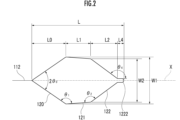
- FIG. 2 is a plan view of a snare loop according to one embodiment of the present invention.
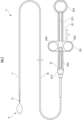
- 1 is a plan view of an endoscopic snare having a snare wire structure.
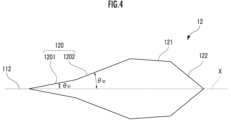
- FIG. 4 is a plan view of a snare loop according to another embodiment of the present invention.
- a snare wire structure 1 according to one embodiment of the present invention has a manipulation wire 11 and a snare loop 12 formed in a loop shape.
- the manipulation wire 11 is inserted through a through passage of a sheath 20 constituting an endoscope snare 2, as will be described later.
- a rear end 110 of the manipulation wire 11 is fixed to a slider 222 constituting an operation mechanism 22 of the endoscope snare 2, as will be described later. Both ends of the snare loop 12 are connected to a tip end 112 of the manipulation wire 11.
- the snare loop 12 is formed in a generally hexagonal shape that is symmetrical with respect to a center line X (see dashed line) that passes through a connecting point with the tip 112 of the operating wire 11.
- the snare loop 12 has a pair of base end portions 120, a pair of first portions 121, and a pair of second portions 122.
- ⁇ 0 is "34.5°”.
- the ratio (L 0 /L) of the length L 0 of the base end portion 120 along the center line X to the length L of the snare loop 12 along the center line X is within the range of 0.32 to 0.45.
- the pair of base end portions 120 of the snare loop 12 (or a pair of wires extending from the respective base ends of the pair of base end portions 120) is inserted together with the operation wire 11 into a stainless steel tubular member provided at the distal end portion 112 of the operation wire 11, and connected by crimping, brazing or welding.
- ⁇ 1 is, for example, "141°” ( ⁇ 1 is, for example, "4.5°”).
- the ratio (L 1 /L) of the length L 1 of the first portion 121 along the center line X to the length L of the snare loop 12 along the center line X is within the range of 0.11 to 0.37 or 0.23 to 0.37.
- ⁇ 2 is, for example, 147° ( ⁇ 2 is, for example, 6°).
- the ratio (L 2 /L) of the length L 2 of the second portion 122 along the center line X to the length L of the snare loop 12 along the center line X is within the range of 0.24 to 0.34.
- ⁇ 4 is, for example, 143° ( ⁇ 4 is, for example, "0.5°").
- the distal end part 1222 of each of the pair of second parts 122 after the intermediate part extends into a substantially semi-elliptical or semi-elliptical shape as a whole by continuing on the center line X.
- the distal end part 1222 of the pair of second parts 122 may be formed into various shapes such as a substantially semicircular shape or a substantially isosceles triangle shape or a substantially isosceles triangle shape with the opposite side slightly bulging outward as a whole.
- the first strand is composed of N 1 (e.g., 3) wires made of stainless steel (e.g., SUS304) having a diameter of 0.06-0.18 mm, and the diameter is, for example, 0.33 mm.
- the second strand is composed of N 2 (e.g., 7) wires made of stainless steel having a diameter of 0.18-0.45 mm, and the diameter is, for example, 0.80 mm.
- the diameter of the operation wire 11 is configured to be slightly smaller than the inner diameter of the sheath 20 through which the operation wire 11 is inserted.
- the snare wire structure 1 shown in Fig. 1 constitutes an endoscopic snare 2 shown in Fig. 3.
- the endoscopic snare 2 includes a sheath 20 and an operating mechanism 22.
- the endoscopic snare 2 is inserted from an opening of a treatment instrument channel such as a forceps port of an endoscope and passes through the treatment instrument channel.
- the sheath 20 is a flexible tubular member that flexes flexibly together with the endoscope and has a sliding property (low friction) on the inner surface that allows the operating wire 11 passed through its hollow space to move smoothly forward and backward.
- the sheath 20 is made of, for example, polytetrafluoroethylene (PTFE), a type of fluororesin that has flexibility and sliding properties, high density polyethylene (HDPE), which is harder than PTFE, PTFA, ETFE, FEP, PVDF, PCFFE, or ECTFE, or other synthetic resins.
- PTFE polytetrafluoroethylene
- HDPE high density polyethylene
- the operating mechanism 22 includes a base 221 to which the sheath 20 is connected, and a slider 222 to which the operating wire 11 is connected.
- the base 221 and the slider 222 are made of a synthetic resin having sufficient strength, such as polycarbonate (PC).
- the base 221 has a base groove 2211 extending in the longitudinal direction of the base 221 for accommodating the operating wire 11.
- the base groove 2211 gives the base 221 a generally U-shaped cross section.
- the slider 222 is loosely fitted around the outer periphery of the base 221 and is supported so as to be slidable in the longitudinal direction or the front-rear direction of the base 221.
- the rear end of the sheath 20 is connected to the tip of the base 221, and the rear end 110 of the operating wire 11 is connected to the slider 222. Therefore, by moving the slider 222 relative to the base 221, the operating wire 11 is driven forward and backward relative to the sheath 20, making it possible to change the amount of protrusion of the snare loop 12 from the sheath 20.
- a substantially cylindrical stopper member 2222 made of PTFE is disposed between the slider 222 and the cap 2212 in the base groove 2211, and the rear end 110 of the operating wire 11 is inserted into the hollow space of the stopper member 2222 and fixed therein.
- the stopper member 2222 is pushed by the slider 222 and comes into contact with the cap 2212, thereby setting the most distal position of the movable range of the slider 222, thereby setting the maximum protrusion amount of the snare loop 12.
- the base 221 is provided with a first operating ring 2210 at the end opposite the snare loop, into which the user inserts his or her thumb.
- the slider 222 is also provided with two second operating rings 2220 on both sides in a direction perpendicular to the longitudinal direction of the base 221, into which the user inserts, for example, the index finger and middle finger. This allows the operating mechanism 22 to be operated with one hand.
- the first operating ring 2210 is abutted by the slider 222 when the snare loop 12 is housed in the sheath 20, and determines the limit at which the snare loop 12 can be retracted into the sheath 20, and also functions as a retainer for the slider 222 to come out.
- the ratio (L 1 /L) of the length L 1 of the first portion 121 along the center line X to the length L of the snare loop 12 along the center line X is within the range of 0.11 to 0.37 or 0.23 to 0.37.
- This realizes a snare loop 12 having a shape, particularly a length of the first portion 121, appropriate from the viewpoint of preventing the snare loop 12 from jumping up or shifting from the target strangulation point of the lesion during the process in which the snare loop 12 is gradually drawn into the hollow space of the sheath 20 from its pair of base end portions 120.
- the sharpness of the snare loop 12 in cutting the lesion is further improved.
- the snare loop 12 is formed by bending or curving inward at the intermediate portion of each of the pair of second portions 122 (see FIG. 2). That is, the snare loop 12 is formed so that the width of the snare loop 12 (the distance in the direction perpendicular to the center line X of the snare loop 12) decreases relatively abruptly from the continuous portion of each of the first portions 121 and each of the second portions 122 to the continuous portion of the pair of second portions 122, and decreases relatively gradually at the distal end portion 1222 beyond the intermediate portion.
- the gripping force of the lesion is improved by the curved or bent portion, and the traction force of the operating wire 11 can be efficiently converted into the strangulation force of the snare loop 12, thereby improving the sharpness of the snare loop 12.
- the snare loop 12 is formed such that each of the pair of second portions 122 is bent (or curved) inward at the specified outer angle ⁇ 4 at the intermediate portion (relative to a straight line connecting the continuous points of each of the pair of first portions 121 and each of the pair of second portions 122 and the continuous points of the distal end portions 1222 of each of the pair of second portions 122).
- each of the pair of second portions 122 may be formed so as to extend generally along the straight line.
- the snare loop 12 may be formed by bending (or curving) inward at the intermediate portion of each of the pair of base end portions 120.
- the base end portion 120 may be composed of a first base end portion 1201 and a second base end portion 1202 that is continuous with the end of the first base end portion 1201 so as to bend at an obtuse external angle.
- the first base end portion 1201 is continuous with the center line X at an angle ⁇ 01 from a point where the first base end portion 1201 is continuous with the tip end portion 112 of the operation wire 11.
- the second base end portion 1202 is continuous with the center line X at an angle ⁇ 02 ( ⁇ 01 ⁇ ⁇ 02 ) from a point where the second base end portion 1202 is continuous with the center line X at a point where the second base end portion 1202 is continuous with the tip end portion 112 of the operation wire 11.
- the snare loop 12 is formed by bending inward (relative to the straight line connecting the continuous portion of the tip 112 of the operating wire 11 and each base end portion 120 with the continuous portion of each base end portion 120 and each first portion 121) at the intermediate portion of each of the pair of base end portions 120.
- the snare loop 12 is formed so that the width of the snare loop (the distance in the direction perpendicular to the center line of the snare loop) increases relatively gradually in the first base end portion 1201 from the continuous portion of the pair of base end portions 120 to the continuous portion of each of the pair of base end portions 120 and each of the pair of first portions 121, and then increases relatively suddenly in the second base end portion 1202 from the middle. This reduces the resistance when the pair of base end portions 120, particularly the first base end portion 1201 whose width increases gradually, are drawn into the hollow space of the sheath 20.
- the snare loop 12 is prevented from shifting (jumping up) from the target constriction point of the lesion, and the pulling force of the operating wire 11 can be efficiently converted into a constriction force of the snare loop 12, improving the sharpness of the snare loop 12.
Landscapes
- Health & Medical Sciences (AREA)
- Life Sciences & Earth Sciences (AREA)
- Surgery (AREA)
- Heart & Thoracic Surgery (AREA)
- Engineering & Computer Science (AREA)
- Biomedical Technology (AREA)
- Nuclear Medicine, Radiotherapy & Molecular Imaging (AREA)
- Medical Informatics (AREA)
- Molecular Biology (AREA)
- Animal Behavior & Ethology (AREA)
- General Health & Medical Sciences (AREA)
- Public Health (AREA)
- Veterinary Medicine (AREA)
- Surgical Instruments (AREA)
Priority Applications (1)
| Application Number | Priority Date | Filing Date | Title |
|---|---|---|---|
| JP2025522384A JPWO2024242054A1 (https=) | 2023-05-19 | 2024-05-17 |
Applications Claiming Priority (2)
| Application Number | Priority Date | Filing Date | Title |
|---|---|---|---|
| JP2023083504 | 2023-05-19 | ||
| JP2023-083504 | 2023-05-19 |
Publications (1)
| Publication Number | Publication Date |
|---|---|
| WO2024242054A1 true WO2024242054A1 (ja) | 2024-11-28 |
Family
ID=93589412
Family Applications (1)
| Application Number | Title | Priority Date | Filing Date |
|---|---|---|---|
| PCT/JP2024/018350 Ceased WO2024242054A1 (ja) | 2023-05-19 | 2024-05-17 | スネアワイヤ構造体 |
Country Status (3)
| Country | Link |
|---|---|
| JP (1) | JPWO2024242054A1 (https=) |
| TW (1) | TW202506076A (https=) |
| WO (1) | WO2024242054A1 (https=) |
Citations (4)
| Publication number | Priority date | Publication date | Assignee | Title |
|---|---|---|---|---|
| JPH08299349A (ja) * | 1995-05-12 | 1996-11-19 | Olympus Optical Co Ltd | 内視鏡用処置具 |
| JP2012157378A (ja) * | 2011-01-28 | 2012-08-23 | Olympus Corp | 処置具用ワイヤーおよび処置具 |
| JP2019000215A (ja) * | 2017-06-13 | 2019-01-10 | オリンパス株式会社 | 内視鏡用処置具 |
| JP2021171316A (ja) * | 2020-04-24 | 2021-11-01 | 株式会社トップ | 内視鏡用スネア |
-
2024
- 2024-05-17 JP JP2025522384A patent/JPWO2024242054A1/ja active Pending
- 2024-05-17 TW TW113118458A patent/TW202506076A/zh unknown
- 2024-05-17 WO PCT/JP2024/018350 patent/WO2024242054A1/ja not_active Ceased
Patent Citations (4)
| Publication number | Priority date | Publication date | Assignee | Title |
|---|---|---|---|---|
| JPH08299349A (ja) * | 1995-05-12 | 1996-11-19 | Olympus Optical Co Ltd | 内視鏡用処置具 |
| JP2012157378A (ja) * | 2011-01-28 | 2012-08-23 | Olympus Corp | 処置具用ワイヤーおよび処置具 |
| JP2019000215A (ja) * | 2017-06-13 | 2019-01-10 | オリンパス株式会社 | 内視鏡用処置具 |
| JP2021171316A (ja) * | 2020-04-24 | 2021-11-01 | 株式会社トップ | 内視鏡用スネア |
Also Published As
| Publication number | Publication date |
|---|---|
| TW202506076A (zh) | 2025-02-16 |
| JPWO2024242054A1 (https=) | 2024-11-28 |
Similar Documents
| Publication | Publication Date | Title |
|---|---|---|
| US11596434B2 (en) | Endoscopic snare device | |
| US8608670B2 (en) | Guidewire | |
| EP1772167B1 (en) | A medical guide wire | |
| US20180263650A1 (en) | Connection structure and connection method | |
| US8622932B2 (en) | Guidewire | |
| US20100318001A1 (en) | Medical guidewire | |
| US20060184198A1 (en) | End effector for surgical instrument, surgical instrument, and method for forming the end effector | |
| EP2111806B1 (en) | Endoscope treatment instrument | |
| KR20220079979A (ko) | 필라멘트 절단 기기 | |
| JP2009101153A (ja) | 内視鏡用処置具および内視鏡用処置具の製造方法 | |
| JPWO2016166830A1 (ja) | 屈曲処置具用ヒンジ部材及びこのヒンジ部材を組み込んだ屈曲処置具 | |
| WO2024242054A1 (ja) | スネアワイヤ構造体 | |
| EP2540211B1 (en) | Endoscope device | |
| JPWO2019150627A1 (ja) | 内視鏡 | |
| US20210169309A1 (en) | Endoscope treatment tool | |
| JP7545630B2 (ja) | 内視鏡用スネア | |
| JP6637991B2 (ja) | 医療機器 | |
| CN102762158A (zh) | 内窥镜用处理器具 | |
| WO2018070119A1 (ja) | 屈曲処置具 | |
| JP4512723B2 (ja) | 内視鏡用スネア | |
| JP4043456B2 (ja) | 高周波切開具 | |
| JPS6219173B2 (https=) | ||
| CN101160101B (zh) | 内窥镜用处置器具 | |
| JP6482051B2 (ja) | 屈曲処置具用ヒンジ部材及びこのヒンジ部材を組み込んだ屈曲処置具 | |
| JP2024150265A (ja) | 内視鏡用スネア |
Legal Events
| Date | Code | Title | Description |
|---|---|---|---|
| 121 | Ep: the epo has been informed by wipo that ep was designated in this application |
Ref document number: 24811061 Country of ref document: EP Kind code of ref document: A1 |
|
| ENP | Entry into the national phase |
Ref document number: 2025522384 Country of ref document: JP Kind code of ref document: A |
|
| WWE | Wipo information: entry into national phase |
Ref document number: 2025522384 Country of ref document: JP |
|
| NENP | Non-entry into the national phase |
Ref country code: DE |