WO2024241928A1 - レンズ装置、制御方法、撮像システム - Google Patents
レンズ装置、制御方法、撮像システム Download PDFInfo
- Publication number
- WO2024241928A1 WO2024241928A1 PCT/JP2024/017565 JP2024017565W WO2024241928A1 WO 2024241928 A1 WO2024241928 A1 WO 2024241928A1 JP 2024017565 W JP2024017565 W JP 2024017565W WO 2024241928 A1 WO2024241928 A1 WO 2024241928A1
- Authority
- WO
- WIPO (PCT)
- Prior art keywords
- lens
- zoom lens
- zoom
- movement
- amount
- Prior art date
- Legal status (The legal status is an assumption and is not a legal conclusion. Google has not performed a legal analysis and makes no representation as to the accuracy of the status listed.)
- Ceased
Links
Images





Classifications
-
- G—PHYSICS
- G02—OPTICS
- G02B—OPTICAL ELEMENTS, SYSTEMS OR APPARATUS
- G02B7/00—Mountings, adjusting means, or light-tight connections, for optical elements
- G02B7/02—Mountings, adjusting means, or light-tight connections, for optical elements for lenses
- G02B7/04—Mountings, adjusting means, or light-tight connections, for optical elements for lenses with mechanism for focusing or varying magnification
-
- G—PHYSICS
- G02—OPTICS
- G02B—OPTICAL ELEMENTS, SYSTEMS OR APPARATUS
- G02B7/00—Mountings, adjusting means, or light-tight connections, for optical elements
- G02B7/02—Mountings, adjusting means, or light-tight connections, for optical elements for lenses
- G02B7/04—Mountings, adjusting means, or light-tight connections, for optical elements for lenses with mechanism for focusing or varying magnification
- G02B7/08—Mountings, adjusting means, or light-tight connections, for optical elements for lenses with mechanism for focusing or varying magnification adapted to co-operate with a remote control mechanism
Definitions
- This technology relates to lens devices, control methods, and imaging systems, and in particular to technology for controlling the drive of focus lenses.
- zoom tracking is performed to move the focus lens in accordance with the movement of the zoom lens in order to change the image magnification while maintaining the focal position (for example, Patent Document 1).
- FIG. 1 is a diagram showing a configuration of an imaging system according to the present technology.
- FIG. 2 is a block diagram showing the internal configuration of the imaging system.
- 3 is a diagram illustrating a configuration of a zoom lens position detection unit that detects the zoom lens position.
- FIG. 2A to 2C are diagrams for explaining a subject position, a subject distance, a focal position, a focusing distance, a focus lens position, a zoom lens position, and a focal length.
- FIG. 4 is a diagram illustrating a cam curve.
- 11A and 11B are diagrams illustrating a settling priority mode and a following priority mode.
- 11 is a flowchart showing the flow of a zoom tracking process during an AF process.
- 11A and 11B are diagrams for explaining mode switching when switching modes in response to movement of a zoom lens as a comparative example.
- 11A and 11B are diagrams illustrating mode switching when switching modes depending on whether the amount of movement of the zoom lens is equal to or greater than a threshold value.
- 11A and 11B are diagrams illustrating mode switching when switching modes depending on whether the amount of movement of the zoom lens is equal to or greater than a threshold value.
- 11A and 11B are diagrams illustrating mode switching when switching modes depending on whether the amount of movement of the zoom lens is equal to or greater than a threshold value.
- FIG. 1 is a diagram showing a configuration of an imaging system 1 according to the present technology.
- the imaging system 1 is configured as a digital camera device in which an interchangeable lens 3 is detachably attached to an imaging device (body) 2.
- the imaging system 1 has not only a function for capturing still images, but also a function for capturing moving images.
- the imaging system 1 includes an image sensor 55 that captures an image of a subject incident through an interchangeable lens 3, a display unit 61 that can display an image obtained by the image sensor 55 and GUIs such as various operation screens, and an operation unit 65 that allows a user to input various operations.
- the imaging system 1 also includes, for example, a configuration for recording images captured by the imaging element 55, a configuration for performing image signal processing on the images captured by the imaging element 55, and a configuration for communicating with the interchangeable lens 3.
- the interchangeable lens 3 is a lens unit in which various lenses such as the zoom lens 13 and the focus lens 16 shown in FIG. 2 are provided.
- the interchangeable lens 3 also includes a drive unit that drives these lenses, a control unit that outputs drive signals to the drive unit, and a mount unit that has a connection function and a communication function with the imaging device 2.
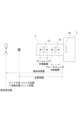
- FIG. 2 is a block diagram showing the internal configuration of the imaging system 1.
- the interchangeable lens 3 includes a mount portion 11 that is detachably attached to a mount portion 51 of the imaging device 2.
- the mount portion 11 has a plurality of terminals for electrically connecting to the imaging device 2.
- the interchangeable lens 3 also includes a lens side control unit 12 , a zoom lens 13 , an image stabilization lens 14 , an aperture 15 , a focus lens 16 , and a detection unit 17 . Furthermore, the interchangeable lens 3 includes a zoom ring 21 , a camera shake control unit 22 , an aperture control unit 23 , a focus lens driving unit 24 , an operation unit 31 , a memory 32 , and a power supply control unit 33 .
- the lens side control unit 12 is configured with a microcomputer having, for example, a CPU (Central Processing Unit), a ROM (Read Only Memory), and a RAM (Random Access Memory), and the CPU reads out programs stored in a specific storage device such as the ROM or memory 32 into the RAM and executes them, thereby performing overall control of the interchangeable lens 3.
- a microcomputer having, for example, a CPU (Central Processing Unit), a ROM (Read Only Memory), and a RAM (Random Access Memory), and the CPU reads out programs stored in a specific storage device such as the ROM or memory 32 into the RAM and executes them, thereby performing overall control of the interchangeable lens 3.
- the lens side control unit 12 executes various controls in response to instructions from the imaging device (body) 3 supplied via a specific communication terminal of the mount unit 11 and user operations received by the zoom ring 21 and operation unit 31.
- lens-side control unit 12 controls image stabilization lens 14 to correct camera shake. Specifically, lens-side control unit 12 determines drive conditions (drive direction, drive amount, drive speed, etc.) of image stabilization lens 14 in a direction that cancels the amount of camera shake based on the amount of camera shake detected by a camera shake detection sensor in detection unit 17, and outputs the determined drive conditions to image stabilization control unit 22 together with a movement command.
- the camera shake detection sensor in the detection unit 17 is composed of, for example, a gyro sensor and/or a three-axis acceleration sensor. The gyro sensor is used to detect deviation (shake) in a direction corresponding to pitch or yaw as the correction direction of the camera shake correction lens 14.
- the lens-side control unit 12 also controls the aperture 15 (aperture diameter) in response to instructions from the imaging device 2 supplied via a specified communication terminal of the mount unit 11. Specifically, the lens-side control unit 12 acquires the aperture diameter of the aperture 15 detected by the aperture detection sensor in the detection unit 17, and issues a command to the aperture control unit 23 to drive the aperture 15 so that the F-number is set as specified by the imaging device 2. The aperture control unit 23 drives the aperture 15 so that the aperture diameter is set as specified by the lens-side control unit 12.
- the lens side control unit 12 controls the position of the focus lens 16 based on instructions from the imaging device 2 supplied via a specified communication terminal of the mount unit 11, the current position of the focus lens 16 from the detection unit 17, etc. Specifically, the lens side control unit 12 acquires the current position of the focus lens 16 from the detection unit 17, determines drive conditions for moving the focus lens 16 to a specified position based on the acquired results, and outputs the determined drive conditions together with a movement command to the focus lens drive unit 24. The focus lens drive unit 24 moves the focus lens 16 in the optical axis direction so as to achieve the instructed drive conditions.
- the focus lens 16 is configured as a "focus lens group” including one or more optical elements.
- the focus lens group includes multiple optical elements, these optical elements are displaced together in association with focus adjustment.
- the zoom lens 13 is configured as a "zoom lens group” including one or more optical elements, and when the zoom lens group includes multiple optical elements, these optical elements are displaced together in association with zoom adjustment.
- the lens-side control unit 12 also performs processing to transmit the position of the zoom lens 13 (hereinafter referred to as the "zoom lens position") and the position of the focus lens 16 (hereinafter referred to as the "focus lens position") detected by the detection unit 17 to the imaging device 2 (body-side control unit 52).
- the detection unit 17 comprehensively represents the configuration for detecting the state of the interchangeable lens 3, such as the positions of the zoom lens 13, the image stabilization lens 14, and the focus lens 16, and the aperture diameter of the diaphragm 15.
- the detection of the lens position can be performed, for example, by a magnetic sensor, a photodiode array, a potentiometer, a reflective encoder, etc.
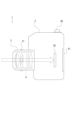
- FIG. 3 is a diagram explaining the configuration of the zoom lens position detection unit 44, which detects the zoom lens position. Note that FIG. 3 illustrates only those parts of the interchangeable lens 3 that are necessary for explaining the configuration of the zoom lens position detection unit 44.
- the zoom lens position detection unit 44 is one of the detection units 17.
- the zoom lens 13 is fixed to a presser ring 41 inside the interchangeable lens 3.
- Cam pins 42 are attached to the presser ring 41 so as to protrude from the outer circumferential surface side.
- the cam pins 42 are attached at equal intervals in the circumferential direction of the presser ring 41, for example, three in number, and are inserted into cam grooves 43a formed in the cam ring 43.
- the interchangeable lens 3 also rotatably houses a cam ring 43, and has a zoom ring 21 (see FIG. 1) for manually setting the zoom magnification arranged rotatably along the outer circumferential surface.
- the zoom lens 13 is held by a cam ring 43 via a press ring 41 and a cam pin 42.
- the cam ring 43 provided inside the interchangeable lens 3 rotates.
- the zoom lens 13 moves in the optical axis direction.
- the zoom lens position detection unit 44 is a reflective absolute linear optical encoder, and is composed of an encoder module 44a having a light emitting portion and a light receiving portion, and a pattern seal 44b on which the pattern shown in FIG. 3B is formed.
- the encoder module 44a is fixed at a predetermined position on the interchangeable lens 3.
- the pattern sticker 44b is affixed to the outer circumferential surface of the press ring 41 at a position facing the encoder module 44a.
- the pattern sticker 44b is attached to the press ring 41 so that the left-right direction in FIG. 3B is aligned with the optical axis direction of the zoom lens 13.
- the pattern sticker 44b has different scale patterns formed in a direction perpendicular to the optical axis direction (the up-down direction in FIG. 3B).
- the scale pattern 45 formed on the upper side in FIG. 3B is a pattern for detecting the absolute position of the zoom lens 13, and patterns having different widths and intervals are formed in the optical axis direction.
- the scale pattern 46 formed on the lower side in FIG. 3B is a pattern for detecting the relative position of the zoom lens 13, and patterns of the same width are formed at equal intervals in the optical axis direction.
- the encoder module 44a uses a light-emitting unit to irradiate light toward the pattern sticker 44b, and receives the light that is reflected by the pattern sticker 44b and returned by a light-receiving unit, thereby optically reading the pattern of the pattern sticker 44b. The encoder module 44a then detects the position (absolute value and relative position) of the zoom lens 13 based on the read pattern.
- the interchangeable lens 3 it is also possible to indirectly detect the position of the zoom lens 13 by detecting the position of the cam ring 43 connected via the cam pin 42, for example. In such a case, there is a risk that it will be difficult to accurately detect the position of the zoom lens 13 due to play between the cam pin 42 and the cam groove 43a, etc.
- the position of the zoom lens 13 can be directly detected by using the zoom lens position detection unit 44.
- direct detection means that the position of the zoom lens 13 is detected directly without going through other connection mechanisms (e.g., the cam pin 42 and the cam ring 43).
- the interchangeable lens 3 is able to accurately detect the position of the zoom lens 13 using the zoom lens position detection unit 44.
- the focus lens drive unit 24 can be configured to have, as a lens drive source, for example, an ultrasonic motor, a DC motor, a linear actuator, a stepping motor, a piezoelectric element, etc.
- a lens drive source for example, an ultrasonic motor, a DC motor, a linear actuator, a stepping motor, a piezoelectric element, etc.
- the operation unit 31 corresponds to a focus ring that manually sets the focus lens 16, accepts manual operations by the user, and supplies an operation signal corresponding to the accepted operation to the lens side control unit 12.
- the zoom ring 21 is also one of the operation units 31.
- the memory 32 is configured by a non-volatile memory such as an EEPROM (Electrically Erasable Programmable) and can be used to store the operating programs of the lens side control unit 12 and various data.
- EEPROM Electrically Erasable Programmable
- the memory 32 stores cam curve data, which will be explained later.
- the power supply control unit 33 detects the amount of power supplied from the imaging device 2, and based on the detected amount of power, optimally allocates the amount of power to each section (lens side control unit 12 and various drive sections) within the interchangeable lens 3 and supplies power.
- the imaging device 2 which is the body side, is provided with a mount section 51 to which the interchangeable lens 3 is detachably attached.
- the mount section 51 has a plurality of terminals for electrically connecting to the mount section 11 of the interchangeable lens 3.
- corresponding terminals are electrically and physically connected between the mount section 51 and the mount section 11 of the interchangeable lens 3.
- the terminals to be connected include, for example, a terminal for supplying power (power supply terminal), a terminal for transmitting commands and data (communication terminal), a terminal for transmitting a synchronization signal (synchronization signal terminal), and the like.
- the imaging device 2 further includes a body side control unit 52, a shutter 53, a shutter control unit 54, an image sensor 55, an ADC (Analog to Digital Converter) 56, a frame memory 57, an image signal processing unit 58, a recording unit 59, a recording medium 60, a display unit 61, a memory 62, a power control unit 63, a power supply unit 64, an operation unit 65, and a communication unit 66.
- a body side control unit 52 a shutter 53, a shutter control unit 54, an image sensor 55, an ADC (Analog to Digital Converter) 56, a frame memory 57, an image signal processing unit 58, a recording unit 59, a recording medium 60, a display unit 61, a memory 62, a power control unit 63, a power supply unit 64, an operation unit 65, and a communication unit 66.
- ADC Analog to Digital Converter
- the body side control unit 52 is configured with a microcomputer having a CPU, ROM, RAM, etc., and performs overall control of the imaging device 2 and the interchangeable lens 3 by the CPU reading out a program stored in a specific storage device such as the ROM or memory 62 into the RAM and executing it.
- the memory 62 is composed of a non-volatile memory such as an EEPROM, and can be used to store the operating programs and various data of the body side control unit 52.
- the body-side control unit 52 executes imaging processing by the image sensor 55 based on an operation signal representing a user operation supplied from the operation unit 65. Furthermore, the body-side control unit 52 transmits a predetermined command to the interchangeable lens 3 side via the mount unit 51, and drives the focus lens 16, etc.
- the body side control unit 52 can also obtain information indicating, for example, the zoom lens position and the focus lens position from the interchangeable lens 3.
- the imaging element 55 is configured as an image sensor such as a charge coupled device (CCD) sensor or a complementary metal oxide semiconductor (CMOS) sensor, and outputs a light reception signal obtained by capturing an image of a subject.
- CCD charge coupled device
- CMOS complementary metal oxide semiconductor
- an electronic shutter can be used, and therefore it is possible to omit the shutter 53.
- the shutter control unit 54 used to control the shutter 53 is also omitted.
- the image sensor 55 has pixels for capturing images (RGB pixels) and pixels for acquiring detection information by an image plane phase difference method, i.e., phase difference detection pixels for acquiring phase difference information between a pair of images (phase difference information between a pair of images formed by pupil division).
- the phase difference detection pixels are discretely arranged on a pixel array surface in which RGB pixels are two-dimensionally arranged in a predetermined array pattern such as a Bayer array.
- the light receiving signals obtained by photoelectric conversion of the RGB pixels in the image sensor 55 are converted into digital signals by the ADC 56 and temporarily stored in a frame memory 57 , and then input to an image signal processing unit 58 .
- the captured image signal obtained by digitally converting the light receiving signals of the RGB pixels as described above is represented as a "captured image signal Si.”
- the light receiving signal obtained by photoelectric conversion of the phase difference detection pixel in the image sensor 55 is converted into a digital signal by the ADC 56 and supplied to the body side control unit 52 .
- the signal obtained by digitally converting the light receiving signal of the phase difference detection pixel is represented as a "phase difference pixel signal Sp.”
- the image signal processing unit 58 performs predetermined image signal processing on the captured image input via the frame memory 57. Examples of the image signal processing here include demosaic processing, white balance (WB) adjustment, gamma correction, and the like.
- the image signal processing unit 58 performs image signal processing on the captured image as a RAW image input via the frame memory 57, converts it into image data in a predetermined file format, and records it on a recording medium 60 via the recording unit 59. Furthermore, the image signal processing unit 58 converts the captured image after image signal processing into an image signal in accordance with a predetermined display format, and supplies the image signal to the display unit 61, which displays the captured image.
- the recording medium 60 is composed of a non-volatile memory, and the recording unit 59 is configured to be able to write data to the recording medium 60 and read data recorded on the recording medium 60.
- the recording medium 60 may be detachable from the imaging device 2.
- the display unit 61 is configured with a panel-type display device such as a liquid crystal panel or an organic EL panel, and is capable of displaying images.
- the display unit 61 is mounted on the rear side of the imaging device 2, opposite the front side where the mount unit 51 is located, and can display so-called through images, images read out from the recording medium 60, and GUIs such as various operation screens, etc.
- the power supply control unit 63 supplies power from the power supply unit 64 to each unit of the imaging device 2, including the body side control unit 52.
- the power supply control unit 63 also calculates the amount of power supply that can be supplied to the interchangeable lens 3 based on the operating state of the imaging device 2, and supplies power to the interchangeable lens 3 via the mount unit 51.
- the power supply unit 64 is configured to include a secondary battery such as a NiCd battery, a NiMH battery, a Li battery, etc.
- the power supply unit 64 may also be configured to receive power from a commercial AC power source via an AC adapter or the like.
- the operation unit 65 collectively represents operators that allow the user to input operations to the imaging device 2, such as various hardware keys such as a shutter button, a mode dial, and a zoom button, and a touch panel that is configured to detect touch operations on the display screen of the display unit 61.
- the operation unit 65 accepts operations by the user and supplies an operation signal corresponding to the operation to the body side control unit 52 .
- the communication unit 66 performs wired or wireless communication with, for example, an external device.
- Fig. 4 is a diagram for explaining the subject position, subject distance, focal position, focal distance, focus lens position, and zoom lens position. 4, the "subject position” literally indicates the position where the subject is present, and the “subject distance” indicates the distance from the imaging system 1 to the subject.
- the "subject distance” corresponds to the distance from the focal point of the interchangeable lens 3 to the "subject position.”
- the “focus position” refers to the position where the image is in focus, and can be said to be another way of saying “focused position.”
- the “focus distance” refers to the distance from the imaging system 1 to the focus position.
- the subject distance and the focal distance are the distance to a position outside the interchangeable lens 3, and are values expressed as actual distances, for example, 2 m, 3 m, 4 m, . . .
- “Focus lens position” refers to the position of the focus lens 16 within the movable range of the focus lens 16 within the interchangeable lens 3 as shown in FIG. 4, and “zoom lens position” refers to the position of the zoom lens 13 within the movable range of the zoom lens 13 within the interchangeable lens 3.
- the defocus amount DF calculated by the image plane phase difference method represents the amount of deviation between the "subject position” and the "focus position” if the "subject position" in FIG. 4 is the position of the object to be focused.
- the defocus amount DF in this case does not directly represent the amount of error in the focus lens position.
- the "zoom lens position” is not necessarily limited to information that directly indicates the position of the zoom lens 13, and it is also possible to use information that correlates with the position of the zoom lens 13 and can be uniquely converted to information on the position of the zoom lens 13.
- the "subject distance” is not necessarily limited to information that directly indicates the distance to the subject distance, and it is also possible to use information that correlates with the distance to the subject distance and that can be uniquely converted into information on the distance to the subject distance.
- the cam curve used in the focus-related processing will be described.
- 5 is a diagram for explaining the cam curve.
- the cam curve is data showing the correspondence between the zoom lens position and the focus lens position for a plurality of focusing distances, and is stored in the memory 32 of the interchangeable lens 3.
- the cam curve data stored in the memory 32 is transmitted to the imaging device 2 and stored in the memory 62. This makes it possible for both the imaging device 2 and the interchangeable lens 3 to hold the same cam curve. Note that it is sufficient for both the imaging device 2 and the interchangeable lens 3 to be able to hold the same cam curve, and the same cam curve may be stored in advance in the memory 32 and the memory 62.
- the graph in Figure 5 shows the zoom lens position (wide side to telephoto side) on the horizontal axis and the focus lens position (image sensor side to subject side) on the vertical axis, and shows the zoom lens positions and focus lens positions corresponding to multiple focusing distances (1m, 3m, 5m, 7m, infinity (inf)).
- the focus lens position for focusing on the subject is Fc1. Furthermore, even if the focal distance is the same at 7 m, when the zoom lens position is changed to Zm2, the focus lens position for focusing on the subject changes to Fc2. Even if the zoom lens position does not change at Zm1, when the subject distance changes from 7 m to 10 m, the focus lens position for focusing on the subject changes from Fc1 to Fc3.
- Focus-related processing includes AF processing and zoom tracking processing.
- the focus-related processing may include processing other than the AF processing and zoom tracking processing.
- AF processing is a process that moves the focus lens 16 in the optical axis direction in order to automatically focus on a given subject, and is executed, for example, when the shutter button is pressed halfway. This makes it possible to always focus on a given subject while the shutter button is pressed halfway, even if the subject moves.
- the zoom tracking process is a process in which the focus lens 16 moves in the optical axis direction in response to the movement of the zoom lens 13 in order to change the magnification of the image while maintaining the in-focus state.
- a plurality of modes are provided for controlling the driving of the focus lens 16 when performing focus-related processes (AF process, zoom tracking process).
- one of a plurality of modes is set, and the focus lens 16 is driven and controlled based on parameters defined for the set mode.
- the parameters indicate values and conditions necessary for determining the drive conditions (drive direction, drive amount, drive speed, etc.) of the focus lens 16 for driving and controlling the focus lens 16.
- a settling priority mode and a following priority mode are provided as the multiple modes.
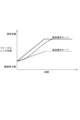
- FIG. 6 is a diagram explaining the settling priority mode and the tracking priority mode.
- the target focus position in the settling priority mode is shown by a thick solid line
- the movement trajectory of the focus lens 16 during control in the settling priority mode is shown by a thick dashed dotted line.
- the target focus position in the tracking priority mode is shown by a thin solid line
- the movement trajectory of the focus lens 16 during control in the tracking priority mode is shown by a thin dashed dotted line.
- the settling priority mode is a mode in which the focus lens 16 is moved toward a target focus lens position (hereinafter, referred to as a target focus lens position) that is not dependent on the control cycle of the lens side control unit 12.
- the settling priority mode is a mode in which it is sufficient for the focus lens 16 to reach the target focus lens position. 6 in the settling priority mode, the delay requirement during driving is low and the movement locus of the focus lens 16 deviates to some extent from the target focus position, but the maximum speed is set high. However, in the settling priority mode, the requirement for overshooting is high.
- the settling priority mode is set mainly during AF processing.
- a target focus lens position is specified for each control cycle by the lens side control unit 12, and the focus lens 16 is moved to the specified target focus lens position within that control cycle.
- the focus lens 16 is caused to track the target focus lens position specified for each control cycle as needed. Therefore, as shown in Fig. 6, in the tracking priority mode, there is a high delay requirement during driving, and the focus lens 16 is caused to track the target focus lens position with almost no delay, but the maximum speed that is set is low.
- the tracking priority mode is mainly set during zoom tracking processing, although, as will be described in detail later, during zoom tracking processing, the settling priority mode may also be set under certain conditions.
- the lens-side control unit 12 transmits information on the zoom lens position and focus lens position detected by the detection unit 17 to the imaging device 2 at any time.
- the body-side control unit 52 acquires the information on the zoom lens position and focus lens position, it calculates the focusing distance by referring to the cam curve based on the zoom lens position and the focus lens position. For example, in the example of FIG. 5, if the zoom lens position is Zm1 and the focus lens position is Fc1, the body-side control unit 52 calculates the focusing distance to be 7 m.
- the body-side control unit 52 also analyzes the phase difference between the pair of images based on the phase difference pixel signal Sp supplied via the ADC 56 at predetermined intervals to calculate the defocus amount DF.
- the body side control unit 52 calculates the distance to the object to be focused (subject distance) as the target focus distance by adding the calculated focus distance and the defocus amount DF.
- the body side control unit 52 transmits information indicating the target focusing distance to the imaging device 2.
- the lens side control unit 12 receives the information indicating the target focusing distance transmitted from the imaging device 2.
- the lens side control unit 12 acquires the current zoom lens position and focus lens position detected by the detection unit 17 .
- the lens side control unit 12 calculates a target focus lens position for focusing on a focusing object by referring to a cam curve, based on the current zoom lens position and the target focusing distance received from the interchangeable lens 3. For example, in the example of Fig. 5, if the zoom lens position is Zm1 and the target focusing distance is 3 m, the lens side control unit 12 calculates Fc3 as the target focus position.
- the lens side control unit 12 determines the drive conditions for moving the focus lens 16 to the target focus lens position based on the current focus lens position and the target focus lens position. The lens side control unit 12 then outputs the determined drive conditions to the focus lens drive unit 24 together with a movement command.
- the focus lens 16 is driven so that the focus lens position coincides with the target focus lens position, achieving autofocus.
- the process of determining the target focus distance from the defocus amount DF is performed on the imaging device 2 side, and the process of determining the target focus lens position from the target focus distance is performed on the interchangeable lens 3 side.
- these processes may be performed by either the imaging device 2 or the interchangeable lens 3.
- the process of determining the target focus lens position from the defocus amount DF may be performed by only one of the imaging device 2 or the interchangeable lens 3.
- zoom tracking processing in tracking priority mode Next, the zoom tracking process in the tracking priority mode will be described.
- the drive control of the focus lens 16 is mainly performed based on parameters according to the above-mentioned tracking priority mode.
- the lens-side control unit 12 transmits information on the zoom lens position and focus lens position detected by the detection unit 17 to the imaging device 2 at any time.
- the body-side control unit 52 acquires the information on the zoom lens position and focus lens position, it calculates the focusing distance by referring to the cam curve based on the zoom lens position and the focus lens position. For example, in the example of FIG. 5, if the zoom lens position is Zm1 and the focus lens position is Fc1, the body-side control unit 52 calculates the focusing distance to be 7 m.
- the body side control unit 52 calculates the distance to the subject to be focused (subject distance) as the target focus distance by adding the calculated focus distance and the defocus amount DF.
- the body-side control unit 52 calculates, for each control cycle of the lens-side control unit 12, a target position to which the focus lens 16 should be moved in that control cycle.
- the target position is calculated to minimize the amount of delay during the drive of the focus lens 16 (for example, 0.5 depth or less).
- the body side control unit 52 transmits information indicating the target position to the imaging device 2.
- the lens side control unit 12 receives the information indicating the target position transmitted from the imaging device 2. Furthermore, the lens side control unit 12 acquires the current zoom lens position and focus lens position detected by the detection unit 17 for each control cycle. Then, for each control cycle, the lens side control unit 12 calculates a target focus lens position for focusing on the target position by referring to a cam curve based on the current zoom lens position and the target position received from the interchangeable lens 3.
- the lens side control unit 12 determines the drive conditions for moving the focus lens 16 to the target focus lens position for each control cycle based on the current focus lens position and the target focus lens position. The lens side control unit 12 then outputs the determined drive conditions to the focus lens drive unit 24 together with a movement command.
- the zoom lens 13 is held by the cam ring 43 via the presser ring 41 and the cam pins 42, and a clearance is formed between the cam pins 42 and the cam grooves 43a. Therefore, when the user moves the imaging system 1, for example, upward or downward, and the attitude of the imaging system 1 changes, the zoom lens 13 may move slightly due to rattling caused by the clearance between the cam pin 42 and the cam groove 43a.
- the mode is switched based on the amount of movement of the zoom lens 13 .
- FIG. 7 is a flowchart showing the flow of the zoom tracking process during the AF process.
- the settling priority mode is set as the mode, and the drive control of the focus lens 16 is performed based on the parameters of the settling priority mode.
- step S1 when the zoom tracking process during the AF process is started, in step S1, the lens side control unit 12 acquires the current zoom lens position detected by the zoom lens position detection unit 44. Then, the lens side control unit 12 compares the acquired current zoom lens position with the previously acquired zoom lens position to determine whether the zoom lens 13 has moved.
- the determination is simply as to whether the zoom lens 13 is moving or not, the determination is made without distinguishing between movement of the zoom lens 13 based on operation of the zoom ring 21 and movement of the zoom lens 13 due to a change in posture.
- step S2 the lens side control unit 12 stores the zoom lens position as the zoom lens base position.
- step S3 the lens side control unit 12 sets the settling priority mode. In other words, it maintains the parameters of the settling priority mode.
- step S4 the lens side control unit 12 calculates the absolute value of the difference between the current zoom lens position detected by the zoom lens position detection unit 44 and the zoom lens base position as the amount of movement of the zoom lens 13.
- step S5 the lens side control unit 12 determines whether the amount of movement of the zoom lens 13 is equal to or greater than a predetermined threshold value.
- the threshold value is set to the maximum amount of movement of the zoom lens 13 that occurs due to mechanical tolerances of the components that hold the zoom lens 13. Therefore, when the zoom lens 13 moves due to a change in the posture of the imaging system 1, the amount of movement of the zoom lens 13 will not exceed the threshold value. Therefore, in step S5, it can be said that a determination is made as to whether the movement of the zoom lens 13 is based on the operation of the zoom ring 21 or the movement of the zoom lens 13 is due to a change in posture.
- step S5 If the amount of movement of the zoom lens 13 is less than the threshold value (No in step S5), i.e., if the movement of the zoom lens 13 is due to a change in posture, the lens side control unit 12 skips step S6 to maintain the current mode (stabilization priority mode).
- the lens side control unit 12 switches from the settling priority mode to the tracking priority mode in step S6. In other words, it switches to the parameters of the tracking priority mode.
- the lens side control unit 12 also notifies the imaging device 2 that the mode has been switched.
- step S7 the lens side control unit 12 performs zoom tracking to drive and control the zoom lens 13 based on the parameters of the currently set mode (settling priority mode or tracking priority mode). Therefore, while the settling priority mode is set, the same AF processing as in the settling priority mode described above is performed even if the zoom lens 13 moves slightly. Also, when the mode is switched to the tracking priority mode, the same processing as the zoom tracking processing in the tracking priority mode described above is performed.
- the tracking priority mode is maintained until the zoom lens 13 stops (until step S1 returns No). This makes it possible to maintain the tracking priority mode even when the rotation speed of the zoom ring 21 changes.
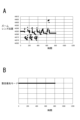
- Fig. 8 is a diagram for explaining, as a comparative example, mode switching when switching modes in response to the movement of the zoom lens 13.
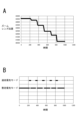
- Figs. 9 to 11 are diagrams for explaining mode switching when switching modes in response to whether the amount of movement of the zoom lens 13 is equal to or greater than a threshold value.
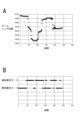
- 8A, 9A, 10A, and 11A are diagrams showing the movement of the zoom lens 13.
- Fig. 8B, 9B, 10B, and 11B are diagrams showing mode switching based on the movement of the zoom lens 13.
- the mode is switched depending on whether the amount of movement of the zoom lens 13 is equal to or greater than a threshold value.
- a threshold value a threshold value
- a case where the mode is switched when the zoom lens 13 moves will be described.
- the mode is frequently switched from the settling priority mode to the tracking priority mode, as shown in Fig. 8B.
- different drive controls are performed, which generates noise and vibrations.
- the mode cannot be switched until the amount of movement of the zoom lens 13 reaches or exceeds a threshold value. Therefore, even if the zoom lens 13 moves slightly due to a change in the posture of the imaging system 1 as shown in FIG. 9A, the mode will not be switched as shown in FIG. 9B. This makes it possible to reduce the generation of noise and vibration.
- the mode is switched when the amount of movement of the zoom lens 13 from a stopped state reaches or exceeds a threshold value, it is possible to avoid a situation in which the mode cannot be switched even when the zoom ring 21 is operated slowly, as shown in FIG. 11.
- the embodiment is not limited to the specific example described above, and various modified configurations may be adopted.
- the mode is switched when the amount of movement of the zoom lens 13 is equal to or greater than a threshold value in the zoom tracking process during AF processing.
- the mode may be switched when the amount of movement of the zoom lens 13 is equal to or greater than a threshold value in the zoom tracking process not during AF processing.
- the mode may be switched in the same way as in the zoom tracking process during AF processing described above.
- the threshold value is set to the maximum amount of movement of the zoom lens 13 that occurs based on the mechanical tolerances of the components that hold the zoom lens 13. In other words, the mode is not switched when the zoom lens 13 moves due to a change in posture, but the mode is switched when the zoom lens 13 moves based on the operation of the zoom ring 21.
- the threshold value is not limited to this.
- the threshold value may be set so as not to switch modes when the amount of movement of the zoom lens 13 based on the operation of the zoom ring 21 is small.
- the lens device (interchangeable lens 3) of the embodiment includes a zoom lens 13, a focus lens 16, a detection unit (zoom lens position detection unit 44) that directly detects the position of the zoom lens 13, and a control unit (lens side control unit 12) that maintains parameters for driving and controlling the focus lens 16 when the amount of movement of the zoom lens 13 based on the detection result of the detection unit is less than a predetermined threshold, and switches the parameters when the amount of movement of the zoom lens 13 is equal to or greater than the threshold, and drives and controls the focus lens 16 based on the maintained or switched parameters.
- a number of modes (settlement priority mode, tracking priority mode) with defined parameters are provided, and the mode is maintained when the amount of movement of the zoom lens 13 is less than a threshold, and the mode is switched when the amount of movement of the zoom lens 13 is equal to or greater than a predetermined threshold.
- the optimal mode is set for the interchangeable lens 3 according to the amount of movement of the zoom lens 13, and the zoom lens 13 can be driven and controlled with parameters according to the set mode.
- the interchangeable lens 3 can switch modes and perform zoom tracking with parameters of the tracking priority mode when the zoom lens 13 moves to a certain extent due to the operation of the zoom ring 21, etc. Therefore, the interchangeable lens 3 can achieve high-precision zoom tracking with little delay in the focus lens 16 when the zoom lens 13 moves to a certain extent due to the operation of the zoom ring 21, etc.
- the amount of movement is the amount of change from the position where the zoom lens 13 was stopped.
- the interchangeable lens 3 can switch parameters and perform zoom tracking if the amount of movement (amount of change) of the zoom lens 13 is equal to or greater than a threshold value. In other words, the interchangeable lens 3 can detect a zoom operation regardless of the operation speed of the zoom ring 21.
- the parameters after the switching are maintained during the period from when the movement amount of the zoom lens 13 becomes equal to or greater than the threshold value until the zoom lens 13 stops.
- the interchangeable lens 3 maintains the parameters as long as the zoom lens 13 does not stop once the movement amount of the zoom lens 13 reaches or exceeds the threshold value, so that the parameters are maintained even if the zoom speed changes during zoom operation, and high-precision zoom tracking with little delay in the focus lens 16 can be continued.
- the control unit (lens side control unit 12) switches the parameters when the amount of movement of the zoom lens 13 is equal to or greater than a predetermined threshold during autofocus to focus on a predetermined subject.
- a predetermined threshold during autofocus to focus on a predetermined subject.
- the first mode is set during autofocusing to focus on a predetermined subject
- the second mode is set when the amount of movement of the zoom lens 13 during autofocusing is equal to or greater than a predetermined threshold value.
- the detection section (zoom lens position detection section 44 ) is capable of detecting the absolute position and the relative position of the zoom lens 13 . This allows the interchangeable lens 3 to detect the position of the zoom lens 13 with high accuracy.
- the threshold value is set to the maximum amount of movement of the zoom lens 13 that occurs based on the mechanical tolerances of the parts that hold the zoom lens 13 (the presser ring 41, the cam pins 42, and the cam ring 43). This makes it possible to keep the amount of movement of the zoom lens 13 caused by a change in the attitude of the imaging system 1 below the threshold value, thereby preventing parameter (mode) switching.
- the control method of the lens device maintains the parameters for driving and controlling the focus lens 16 when the amount of movement of the zoom lens 13 based on the detection result of a detection unit that directly detects the position of the zoom lens 13 is less than a predetermined threshold, and switches the parameters when the amount of movement of the zoom lens 13 is equal to or greater than the threshold, and drives and controls the focus lens 16 based on the maintained or switched parameters.
- the imaging system 1 is an imaging system 1 including a lens device (interchangeable lens 3) and an imaging device 2, the lens device including a zoom lens 13, a focus lens 16, a detection unit that directly detects the position of the zoom lens 13, and a control unit that maintains parameters for driving and controlling the focus lens 16 when the amount of movement of the zoom lens 13 based on the detection result of the detection unit is less than a predetermined threshold value, and switches the parameters when the amount of movement of the zoom lens 13 is equal to or greater than the threshold value, and drives and controls the focus lens 16 based on the maintained or switched parameters
- the imaging device includes an image sensor that captures a subject image incident through the lens device.
- the present technology can also be configured as follows.
- a lens device comprising: (2) A plurality of modes are provided in which the parameters are defined, The lens device according to (1), wherein the mode is maintained when the amount of movement of the zoom lens is less than the threshold, and the mode is switched when the amount of movement of the zoom lens is equal to or greater than the threshold.
- a first mode is provided in which a target position independent of a control period is specified, and a second mode is provided in which a target position for each control period is specified,
- the lens device according to (2) wherein the first mode is maintained when the amount of movement of the zoom lens is less than the threshold, and the second mode is switched to when the amount of movement of the zoom lens is equal to or greater than the threshold.
- the lens device according to any one of (1) to (3) wherein the movement amount is a change amount from a position where the zoom lens was stopped.
- the control unit is The lens device according to any one of (1) to (4), wherein the parameter after switching is maintained during a period from when the amount of movement of the zoom lens becomes equal to or greater than the threshold value until the zoom lens stops.
- the control unit is The lens device according to any one of (1) to (5), wherein the parameter is switched when the amount of movement of the zoom lens is equal to or greater than the threshold during autofocus for focusing on a predetermined subject.
- the detection unit is capable of detecting an absolute position and a relative position of the zoom lens.
- the threshold value is set to a maximum value of a movement amount of the zoom lens that occurs based on a mechanical tolerance of each part that holds the zoom lens.
- (10) maintain a parameter for driving and controlling the focus lens when a movement amount of the zoom lens based on a detection result of a detection unit that directly detects a position of the zoom lens is less than a predetermined threshold value; When the amount of movement of the zoom lens is equal to or greater than the threshold, the parameter is switched; and controlling the driving of the focus lens based on the maintained or switched parameters.
- An imaging system including a lens device and an imaging device,
- the lens device comprises: A zoom lens and A focus lens; a detection unit that directly detects the position of the zoom lens; a control unit that maintains a parameter for controlling the drive of the focus lens when the amount of movement of the zoom lens based on a detection result of the detection unit is less than a predetermined threshold, and switches the parameter when the amount of movement of the zoom lens is equal to or greater than the threshold, and controls the drive of the focus lens based on the maintained or switched parameter;
- the imaging device includes: an imaging system comprising an imaging element configured to capture an image of a subject incident through the lens device;
- Imaging element 1 Reference Signs List 1 Imaging system 2 Imaging device 3 Interchangeable lens 12 Lens side control unit 13 Zoom lens 16 Focus lens 24 Focus lens driving unit 55 Imaging element
Landscapes
- Physics & Mathematics (AREA)
- General Physics & Mathematics (AREA)
- Optics & Photonics (AREA)
- Lens Barrels (AREA)
- Studio Devices (AREA)
Priority Applications (3)
| Application Number | Priority Date | Filing Date | Title |
|---|---|---|---|
| CN202480032539.7A CN121241289A (zh) | 2023-05-22 | 2024-05-13 | 透镜设备、控制方法和成像系统 |
| EP24810935.7A EP4718135A1 (en) | 2023-05-22 | 2024-05-13 | Lens device, control method, and imaging system |
| JP2025522315A JPWO2024241928A1 (https=) | 2023-05-22 | 2024-05-13 |
Applications Claiming Priority (2)
| Application Number | Priority Date | Filing Date | Title |
|---|---|---|---|
| JP2023-083801 | 2023-05-22 | ||
| JP2023083801 | 2023-05-22 |
Publications (1)
| Publication Number | Publication Date |
|---|---|
| WO2024241928A1 true WO2024241928A1 (ja) | 2024-11-28 |
Family
ID=93589807
Family Applications (1)
| Application Number | Title | Priority Date | Filing Date |
|---|---|---|---|
| PCT/JP2024/017565 Ceased WO2024241928A1 (ja) | 2023-05-22 | 2024-05-13 | レンズ装置、制御方法、撮像システム |
Country Status (4)
| Country | Link |
|---|---|
| EP (1) | EP4718135A1 (https=) |
| JP (1) | JPWO2024241928A1 (https=) |
| CN (1) | CN121241289A (https=) |
| WO (1) | WO2024241928A1 (https=) |
Citations (6)
| Publication number | Priority date | Publication date | Assignee | Title |
|---|---|---|---|---|
| JP2010266701A (ja) * | 2009-05-15 | 2010-11-25 | Sanyo Electric Co Ltd | 電子カメラ |
| JP2015043557A (ja) * | 2013-07-24 | 2015-03-05 | キヤノン株式会社 | 撮像装置、撮像装置の制御方法、撮像装置の制御プログラムおよび記憶媒体 |
| JP2015052737A (ja) * | 2013-09-09 | 2015-03-19 | オリンパス株式会社 | 光学機器 |
| WO2015146420A1 (ja) * | 2014-03-28 | 2015-10-01 | 富士フイルム株式会社 | レンズ装置および焦点位置調整方法 |
| KR20160139304A (ko) * | 2015-05-27 | 2016-12-07 | 한화테크윈 주식회사 | 줌 트래킹 방법 |
| JP2018124498A (ja) | 2017-02-03 | 2018-08-09 | キヤノン株式会社 | ズームレンズ装置及びそれを有する撮像装置 |
-
2024
- 2024-05-13 JP JP2025522315A patent/JPWO2024241928A1/ja active Pending
- 2024-05-13 WO PCT/JP2024/017565 patent/WO2024241928A1/ja not_active Ceased
- 2024-05-13 EP EP24810935.7A patent/EP4718135A1/en active Pending
- 2024-05-13 CN CN202480032539.7A patent/CN121241289A/zh active Pending
Patent Citations (6)
| Publication number | Priority date | Publication date | Assignee | Title |
|---|---|---|---|---|
| JP2010266701A (ja) * | 2009-05-15 | 2010-11-25 | Sanyo Electric Co Ltd | 電子カメラ |
| JP2015043557A (ja) * | 2013-07-24 | 2015-03-05 | キヤノン株式会社 | 撮像装置、撮像装置の制御方法、撮像装置の制御プログラムおよび記憶媒体 |
| JP2015052737A (ja) * | 2013-09-09 | 2015-03-19 | オリンパス株式会社 | 光学機器 |
| WO2015146420A1 (ja) * | 2014-03-28 | 2015-10-01 | 富士フイルム株式会社 | レンズ装置および焦点位置調整方法 |
| KR20160139304A (ko) * | 2015-05-27 | 2016-12-07 | 한화테크윈 주식회사 | 줌 트래킹 방법 |
| JP2018124498A (ja) | 2017-02-03 | 2018-08-09 | キヤノン株式会社 | ズームレンズ装置及びそれを有する撮像装置 |
Also Published As
| Publication number | Publication date |
|---|---|
| CN121241289A (zh) | 2025-12-30 |
| JPWO2024241928A1 (https=) | 2024-11-28 |
| EP4718135A1 (en) | 2026-04-01 |
Similar Documents
| Publication | Publication Date | Title |
|---|---|---|
| US6226459B1 (en) | Apparatus having a driven member and a drive controller therefor | |
| US20060133786A1 (en) | Driving mechanism, driving system, anti-shake unit, and image sensing apparatus | |
| US7286163B2 (en) | Image taking device with bent optical system | |
| EP1607792A2 (en) | Optical apparatus | |
| US8081223B2 (en) | Imaging apparatus | |
| JP3829773B2 (ja) | 撮像装置およびセンタリング情報取得方法 | |
| US9998668B2 (en) | Imaging apparatus | |
| JP2009075441A (ja) | 交換レンズおよび光学機器 | |
| JP2011124622A (ja) | 雲台撮影システム | |
| JP2006079007A (ja) | デジタルカメラ | |
| US7869703B2 (en) | Optical apparatus | |
| JP2008271372A (ja) | 撮像装置 | |
| US20250301223A1 (en) | Device including a plurality of optical elements and apparatus | |
| JP2021021844A (ja) | レンズ装置および撮像装置 | |
| JP2009139877A (ja) | 撮像装置及びこの撮像装置の製造方法 | |
| WO2024241928A1 (ja) | レンズ装置、制御方法、撮像システム | |
| JPH08248464A (ja) | 像振れ防止装置 | |
| JP2010081243A (ja) | 手振れ補正装置、撮像装置 | |
| JP5458521B2 (ja) | レンズ鏡筒、レンズ鏡筒の調整方法、光学装置、および光学装置の調整方法 | |
| JP2005352043A (ja) | 撮像装置及び合焦制御方法 | |
| JP4865275B2 (ja) | 焦点検出装置及び撮像装置 | |
| JP2016008995A (ja) | レンズ鏡筒および撮像装置 | |
| JP2005351925A (ja) | 撮像装置及び合焦制御方法 | |
| US20230185163A1 (en) | Interchangeable lens device, imaging device, imaging system, method, and program | |
| JP2009175241A (ja) | 光学装置およびその調整方法 |
Legal Events
| Date | Code | Title | Description |
|---|---|---|---|
| 121 | Ep: the epo has been informed by wipo that ep was designated in this application |
Ref document number: 24810935 Country of ref document: EP Kind code of ref document: A1 |
|
| ENP | Entry into the national phase |
Ref document number: 2025522315 Country of ref document: JP Kind code of ref document: A |
|
| WWE | Wipo information: entry into national phase |
Ref document number: 2025522315 Country of ref document: JP |
|
| ENP | Entry into the national phase |
Ref document number: 2024810935 Country of ref document: EP Effective date: 20251222 |
|
| WWE | Wipo information: entry into national phase |
Ref document number: 2024810935 Country of ref document: EP |
|
| NENP | Non-entry into the national phase |
Ref country code: DE |
|
| ENP | Entry into the national phase |
Ref document number: 2024810935 Country of ref document: EP Effective date: 20251222 |
|
| ENP | Entry into the national phase |
Ref document number: 2024810935 Country of ref document: EP Effective date: 20251222 |
|
| ENP | Entry into the national phase |
Ref document number: 2024810935 Country of ref document: EP Effective date: 20251222 |
|
| ENP | Entry into the national phase |
Ref document number: 2024810935 Country of ref document: EP Effective date: 20251222 |
|
| ENP | Entry into the national phase |
Ref document number: 2024810935 Country of ref document: EP Effective date: 20251222 |
|
| ENP | Entry into the national phase |
Ref document number: 2024810935 Country of ref document: EP Effective date: 20251222 |
|
| ENP | Entry into the national phase |
Ref document number: 2024810935 Country of ref document: EP Effective date: 20251222 |
|
| WWP | Wipo information: published in national office |
Ref document number: 2024810935 Country of ref document: EP |