WO2024236644A1 - 防滴カバーおよびインバータ装置 - Google Patents
防滴カバーおよびインバータ装置 Download PDFInfo
- Publication number
- WO2024236644A1 WO2024236644A1 PCT/JP2023/017935 JP2023017935W WO2024236644A1 WO 2024236644 A1 WO2024236644 A1 WO 2024236644A1 JP 2023017935 W JP2023017935 W JP 2023017935W WO 2024236644 A1 WO2024236644 A1 WO 2024236644A1
- Authority
- WO
- WIPO (PCT)
- Prior art keywords
- cover
- drip
- inverter
- top surface
- proof cover
- Prior art date
- Legal status (The legal status is an assumption and is not a legal conclusion. Google has not performed a legal analysis and makes no representation as to the accuracy of the status listed.)
- Ceased
Links
Images






Classifications
-
- H—ELECTRICITY
- H02—GENERATION; CONVERSION OR DISTRIBUTION OF ELECTRIC POWER
- H02M—APPARATUS FOR CONVERSION BETWEEN AC AND AC, BETWEEN AC AND DC, OR BETWEEN DC AND DC, AND FOR USE WITH MAINS OR SIMILAR POWER SUPPLY SYSTEMS; CONVERSION OF DC OR AC INPUT POWER INTO SURGE OUTPUT POWER; CONTROL OR REGULATION THEREOF
- H02M7/00—Conversion of AC power input into DC power output; Conversion of DC power input into AC power output
- H02M7/42—Conversion of DC power input into AC power output without possibility of reversal
- H02M7/44—Conversion of DC power input into AC power output without possibility of reversal by static converters
- H02M7/48—Conversion of DC power input into AC power output without possibility of reversal by static converters using discharge tubes with control electrode or semiconductor devices with control electrode
Definitions
- This disclosure relates to a drip-proof cover for an inverter device that dissipates heat generated by a heating element using a heat sink attached to the back of the main body, and to the inverter device itself.
- Inverter units are devices that convert the frequency and current value of the input current and output it. When power conversion occurs, power loss occurs internally and heat is generated. Inverter units are equipped with multiple components such as semiconductor elements and electronic parts. If the temperature of a component exceeds the heat resistance temperature of that component during power conversion, that component will be damaged. If a component is damaged, the power conversion function of the inverter unit will be impaired. For this reason, inverter units need to be able to properly dissipate the generated heat and cool down.
- the density of the air heated by the heat-generating equipment decreases, creating an upward air current in the opposite direction to gravity. For this reason, an opening is formed in the top surface of the main body case of the inverter unit, allowing the air heated by the heat-generating equipment to be discharged to the outside of the main body case, ensuring the necessary heat dissipation performance.
- inverter units are general-purpose electronic devices and are used in a variety of environments.
- inverter units when inverter units are used in heating and cooling air conditioning equipment, they may be used in environments where water droplets are generated due to condensation. In such cases, the inverter unit needs to have drip-proof performance that allows it to function normally even when it receives water droplets from vertically above. If water droplets penetrate the inside of the inverter unit and adhere across multiple conductive parts, a short circuit will occur between the conductive parts, causing a current greater than expected to flow through the components, resulting in damage to the components.
- a drip-proof cover is placed over the inverter unit to provide it with drip-proof performance.
- the top surface of the drip-proof cover blocks the rising air currents that are generated inside the drip-proof cover due to heat dissipation from the heat sink.
- the ventilation efficiency inside the drip-proof cover decreases, which may lead to a decrease in the heat dissipation performance of the heat sink.
- Patent document 1 discloses a cover for an electronic device that has an opening formed on the side.
- the present disclosure has been made in consideration of the above, and aims to provide a drip-proof cover that provides drip-proof performance to an inverter unit equipped with a heat sink that dissipates heat from the inverter, and that can prevent a decrease in the heat dissipation performance of the heat sink.
- the drip-proof cover disclosed herein is a drip-proof cover that protects an inverter unit having a heat sink on the back surface of the inverter main body.
- the drip-proof cover includes a cover top surface portion that covers the top surface of the inverter unit with a first gap from the top surface of the inverter unit, a cover side surface portion that covers the side surface of the inverter unit with a second gap from the side surface of the inverter unit, and a cover front surface portion that covers the front surface of the inverter unit.
- an air vent is formed at a position corresponding to the heat sink.
- the present disclosure has the effect of providing a drip-proof cover that provides drip-proof performance to an inverter unit equipped with a heat sink that dissipates heat from an inverter and prevents a decrease in the heat dissipation performance of the heat sink.
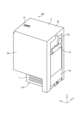
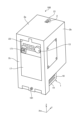
- FIG. 1 is a front perspective view of an inverter device according to a first embodiment
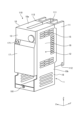
- FIG. 2 is a front perspective view of an inverter unit included in the inverter device shown in FIG. 1 .
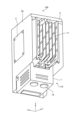
- FIG. 2 is a perspective view of an inverter unit included in the inverter device shown in FIG. 1, seen from the rear.
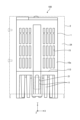
- FIG. 2 is a top view of an inverter unit included in the inverter device shown in FIG. 1;
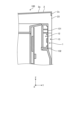
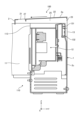
- FIG. 2 is a vertical cross-sectional view taken along a side surface of the inverter device shown in FIG. 1 .
- FIG. 2 is a first longitudinal sectional view of the inverter device shown in FIG. 1 as viewed from the front side;
- FIG. 1 is a front perspective view of an inverter device according to a first embodiment
- FIG. 2 is a front perspective view of an inverter unit included in the inverter device shown in FIG. 1 .
- FIG. 2 is a perspective view of an inverter unit included in the invert
- FIG. 2 is a second vertical cross-sectional view of the inverter device shown in FIG. 1 when viewed from the front side;
- FIG. 2 is a perspective view of the inverter device shown in FIG. 1 as seen from the rear.
- FIG. 2 is an enlarged cross-sectional view of an operation unit of the inverter device shown in FIG.
- FIG. 2 is a vertical cross-sectional view showing a state in which a visor is provided on the drip-proof cover of the inverter device shown in FIG.
- FIG. 2 is a vertical cross-sectional view showing a state in which a wall portion is provided on the cover top surface of the drip-proof cover of the inverter device shown in FIG.
- FIG. 2 is a plan view of the drip-proof cover of the inverter device shown in FIG.
- FIG. 1 is a perspective view illustrating a fixing method of a drip-proof cover according to a first embodiment
- FIG. 1 is a perspective view of an inverter device according to a first embodiment, as viewed from the front.
- FIG. 2 is a perspective view of an inverter unit included in the inverter device shown in FIG. 1, as viewed from the front.
- FIG. 3 is a perspective view of the inverter unit included in the inverter device shown in FIG. 1, as viewed from the rear.
- FIG. 4 is a top view of the inverter unit included in the inverter device shown in FIG. 1, as viewed from above.
- FIGS. 2 and 3 show the inverter unit before a drip-proof cover 2 is attached in the inverter device 100. In FIG. 4, the position of the drip-proof cover 2 is also shown by a two-dot chain line.
- FIG. 5 is a vertical cross-sectional view along the side of the inverter device shown in FIG. 1.
- the inverter device 100 includes an inverter unit 110 and a drip-proof cover 2.
- the inverter unit 110 includes an inverter main body 1 and a heat sink 11.
- the inverter device 100 is positioned so that its rear side faces the control panel of the facility or a wall surface close to the device to be controlled.
- the width direction of the inverter device 100 corresponds to the direction from the upper right to the lower left in FIG. 1, which corresponds to the X-axis direction in FIG. 1.
- the depth direction of the inverter device 100 corresponds to the direction from the lower right to the upper left in FIG. 1, which corresponds to the Y-axis direction in FIG. 1.
- the height direction of the inverter device 100 corresponds to the up-down direction in FIG. 1, which corresponds to the Z-axis direction in FIG. 1.
- the front and front side of the inverter device 100 corresponds to the direction toward the lower right in FIG. 1 along the depth direction of the inverter device 100.
- the rear and back side of the inverter device 100 corresponds to the direction toward the upper left in FIG. 1 along the depth direction of the inverter device 100.
- the inverter body 1 is a device that converts the frequency and current value of the input current and outputs it, and has a rectangular parallelepiped outer shell.
- the inverter body 1 includes a main body case 10, an electronic component section 12, an operation section 13, and an external input/output section 14.
- the electronic component section 12 is electrically configured inside the main body case 10 and includes electronic components such as semiconductor elements, capacitors, and resistors, which are heat-generating components, multiple boards on which the electronic components are mounted, and wiring and connectors between the multiple boards.
- electronic components such as semiconductor elements, capacitors, and resistors, which are heat-generating components, multiple boards on which the electronic components are mounted, and wiring and connectors between the multiple boards.
- the adhesion of water droplets to two or more of the following locations can cause a short circuit: multiple wires on a board and between the wires, multiple terminals on a board and between the terminals, multiple electronic components and between electronic components, or wiring, terminals, and electronic components.
- the electronic component section 12 needs to be protected from water droplets entering the inverter main body 1.
- the electronic component section 12 is therefore subject to drip-proof protection by the drip-proof cover 2.
- the side surface 10b of the main body case 10 is provided with multiple openings 15 for dissipating heat.
- the openings 15 may also be provided on the top surface 10a of the main body case 10. The size of each opening 15 is made small enough to prevent fingers or tools from accidentally getting inside.
- the electronic component section 12 is provided on the front side of the inverter main body 1, opposite the wall surface, with the heat sink 11 in between.
- the operation unit 13 is a user interface and has buttons used by the user to configure the inverter main body 1 and devices that display various parameters of the inverter main body 1. If water droplets get into the operation unit 13, a short circuit will occur in the internal electrical components, resulting in malfunction. For this reason, the operation unit 13 is subject to drip-proof protection by the drip-proof cover 2.
- the external input/output unit 14 is provided at the bottom of the inverter main body 1, and performs electrical input/output with devices external to the inverter main body 1.
- the external input/output unit 14 is connected to wiring used for input from the power supply device of the inverter main body 1, and wiring used for output to the controlled device of the inverter main body 1. If water adheres to the terminal connection part of the external input/output unit 14, a short circuit will occur, resulting in malfunction.
- the external input/output unit 14 at the bottom of the inverter main body 1, it can be protected from water droplets from above the inverter main body 1. For this reason, the external input/output unit 14 is not subject to drip-proof protection by the drip-proof cover 2.
- the heat sink 11 has multiple fins and is fixed to the inverter main body 1 while in contact with the rear surface of the inverter main body 1, and dissipates heat generated in the inverter main body 1 to the outside of the inverter unit 110. In other words, the heat sink 11 dissipates heat generated when the electronic component section 12 inside the inverter main body 1 converts power to the outside of the inverter unit 110.
- the heat sink 11 has an upper mounting section 111 that is attached to a wall surface close to the control panel of the equipment or the device to be controlled, and a lower mounting section 112 that is attached to a wall surface close to the control panel of the equipment or the device to be controlled.
- the heat sink 11 is a heat sink that does not cause problems even if water drops fall on it.
- the upper surface of the heat sink 11 is parallel to the horizontal plane when the inverter unit 110 is installed.
- the heat sink 11 is manufactured by processes such as die casting, machining, and extrusion.
- the heat sink 11 is made of a material with relatively high thermal conductivity among materials, and conducts heat generated by heat-generating components such as semiconductor elements in the electronic component section 12, releasing it into the air outside the inverter unit 110.
- materials with relatively high thermal conductivity include aluminum, magnesium, and various alloys including alloys of these.
- the heat sink 11 is not affected by water droplets adhering to it, except for the boundary section 113 between the electronic component section 12 and the heat sink 11. For this reason, the heat sink 11 is not subject to drip-proof protection by the drip-proof cover 2.
- the drip-proof cover 2 covers the top, sides and front of the inverter unit 110 to protect the inverter unit 110 and to prevent water droplets from entering the inside of the inverter main body 1.
- the drip-proof cover 2 has an air vent 21 only on the cover top surface 2a, which is the top surface of the drip-proof cover 2 that is positioned above the heat sink 11.
- the drip-proof cover 2 exhausts the air inside the drip-proof cover 2 that has been warmed by the heat released from the heat sink 11 and the air inside the drip-proof cover 2 that has been warmed by the heat radiated from the surface of the electronic component section 12, from the air vent 21 on the cover top surface 2a of the drip-proof cover 2 to the outside of the drip-proof cover 2.
- the ventilation hole 21 is formed at a position corresponding to the heat sink 11 in the horizontal plane, i.e., above the heat sink 11, when the top side of the inverter unit 110 is covered, i.e., when the top of the inverter unit 110 is covered.
- water droplets that adhere to the drip-proof cover 2 and infiltrate the inside of the drip-proof cover 2 through the ventilation hole 21 may drip onto the electronic component section 12 and penetrate into the electronic component section 12.
- the ventilation hole 21 is provided at a position corresponding to the heat sink 11 in the horizontal plane on the cover top surface section 2a of the drip-proof cover 2 when the top side of the inverter unit 110 is covered.
- the ventilation hole 21 is formed in the cover top surface 2a of the drip-proof cover 2, above a location on the heat sink 11 where there is no shape that would allow water droplets that drip onto the heat sink 11 to reach the electronic component section 12.
- the cover top surface 2a which is the top surface of the drip-proof cover 2 is preferably an inclined surface that slopes downward toward the rear side of the inverter device 100, as in the inclined portion 22 shown in FIG. 5.
- the rear side of the inverter device 100 can be said to be the rear side of the inverter unit 110.
- the cover top surface 2a of the drip-proof cover 2 is formed as an inclined portion 22 that is an inclined surface that slopes downward toward the rear side of the inverter device 100, so that water droplets adhering to the inclined portion 22 fall toward the rear wall side of the inverter device 100. If the cover top surface 2a of the drip-proof cover 2 is not inclined, and if the cover top surface 2a of the drip-proof cover 2 is inclined downward toward the front of the inverter device 100, water droplets adhering to the cover top surface 2a of the drip-proof cover 2 may move along the back side of the cover top surface 2a of the drip-proof cover 2.
- the water droplets move in the direction in which the slope of the cover top surface 2a of the drip-proof cover 2 decreases and may drip onto the electronic component section 12. Even if the cover top surface 2a of the drip-proof cover 2 is not inclined, the water droplets may move to a position above the electronic component section 12 and drip onto the electronic component section 12.
- the rear side of the inverter device 100 can be said to be the rear side of the inverter unit 110.
- water droplets may adhere to the underside of the cover top surface 2a of the drip-proof cover 2 when, for example, the water droplets move around the cover top surface 2a of the drip-proof cover 2 from the ventilation hole 21 to the underside of the cover top surface 2a of the drip-proof cover 2, or when the water droplets pass through the ventilation hole 21 from the top of the cover top surface 2a of the drip-proof cover 2 and bounce off the heat sink 11 and adhere to the underside of the cover top surface 2a of the drip-proof cover 2.
- Water droplets moving over the cover top surface 2a of the drip-proof cover 2 includes, for example, when multiple water droplets join together on the cover top surface 2a of the drip-proof cover 2 to become larger, or when water droplets move over the cover top surface 2a of the drip-proof cover 2 due to some factor such as vibration or wind.
- the drip-proof cover 2 is configured so that at least the edges where the cover top surface 2a and the cover side surface 2b of the drip-proof cover 2 are connected without any gaps, as shown in FIG. 1, to cover the inverter unit 110.
- FIG. 6 is a first vertical cross-sectional view of the inverter device shown in FIG. 1 when viewed from the front side.
- FIG. 6 shows the temperature distribution inside and around the inverter device 100.
- the circles and squares inside the inverter main body 1 in FIG. 6 represent the electronic components of the inverter main body 1.
- the air temperature is indicated by hatching. It can be seen from FIG. 6 that the air temperature is higher toward the inside of the inverter main body 1 and decreases toward the outside of the inverter main body 1.
- the inverter device 100 has a first gap 24 between the inverter unit 110 and the drip-proof cover 2 in the width direction. That is, the inverter device 100 has a first gap 24 between the side surface 10b of the inverter main body 1 and the cover side surface portion 2b of the drip-proof cover 2. The side surface 10b of the inverter main body 1 and the cover side surface portion 2b of the drip-proof cover 2 are parallel. The first gap 24 also includes the gap between the heat sink 11 and the cover side surface portion 2b of the drip-proof cover 2 in the width direction.
- the inverter device 100 has a first gap 24 between the side surface 10b of the inverter body 1 and the cover side surface portion 2b of the drip-proof cover 2, and as a result, the air that is heated inside the inverter body 1 and exhausted to the outside of the inverter body 1 from the opening 15 of the side surface 10b of the inverter body 1 is circulated toward the cover top surface portion 2a of the drip-proof cover 2, thereby achieving a heat dissipation effect.
- first gap 24 In order to obtain the heat dissipation effect by convection in the first gap 24, it is necessary to provide a first gap 24 of at least 1 mm in the horizontal direction, and in order to ensure sufficient air flow, it is preferable to provide a first gap 24 of about 10 mm.
- a second gap 25 is provided between the top surface 10a of the inverter body 1 and the cover top surface 2a of the drip-proof cover 2.
- the top surface 10a of the inverter body 1 and the cover top surface 2a of the drip-proof cover 2 are parallel to each other.
- the inverter device 100 can obtain a heat dissipation effect by convection between the air that is heated inside the inverter body 1 and exhausted to the outside of the inverter body 1 from the opening 15 of the side surface 10b of the inverter body 1, and the air above the inverter body 1 that is heated inside the inverter body 1 and heated by heat dissipation from the top surface 10a of the inverter body 1.
- the second gap 25 In order to obtain the heat dissipation effect by convection in the second gap 25, it is necessary to provide a second gap 25 of at least 1 mm in the height direction of the inverter device 100, and in order to ensure sufficient air flow, it is preferable to provide a second gap 25 of about 10 mm.
- the inverter device 100 can circulate air between the inverter body 1 and the drip-proof cover 2, forming a flow of air that flows from the lower end of the drip-proof cover 2 to the outside of the drip-proof cover 2, thereby improving the heat dissipation effect of the inverter body 1.
- FIG. 7 is a second vertical cross-sectional view of the inverter device shown in FIG. 1 when viewed from the front side.
- FIG. 7 shows the temperature distribution around the heat sink 11 in a cross section passing through the heat sink 11.
- the high and low air temperatures are indicated by hatching. From FIG. 7, it can be seen that the air temperature is higher near the periphery of the heat sink 11, and the air temperature decreases toward the outside of the heat sink 11.
- the inverter device 100 has a second gap 25 between the inverter unit 110 and the drip-proof cover 2 in the height direction. That is, the inverter device 100 has a second gap 25 between the heat sink 11 and the cover top surface 2a of the drip-proof cover 2.
- the second gap 25 also includes the gap between the inverter main body 1 and the cover top surface 2a of the drip-proof cover 2 in the height direction.
- FIG. 8 is a perspective view of the inverter device shown in FIG. 1, seen from the rear. As shown in FIG. 8, the cover side portion 2b of the drip-proof cover 2 is partially formed of a transparent cover 3.
- the transparent cover 3 allows the inside of the drip-proof cover 2 to be seen from the outside of the drip-proof cover 2.
- the cover side portion 2b of the drip-proof cover 2 is formed by the transparent cover 3, for example, the information displayed on the device information display unit 16 provided on the inverter main body 1 shown in FIG. 2 can be confirmed without removing the drip-proof cover 2.
- the information displayed on the device information display unit 16 includes information on the inverter unit 110 and the inverter main body 1, such as the nameplate, the device configuration of the inverter unit 110, and the operating status of the devices in the inverter main body 1.
- the inverter device 100 by making part of the cover side portion 2b of the drip-proof cover 2 transparent, the information displayed on the inverter main body 1 can be confirmed without removing the drip-proof cover 2. This makes it unnecessary to add information such as standard certification marks to the drip-proof cover 2 in the inverter device 100.
- part of the cover side portion 2b of the drip-proof cover 2 is made into a transparent cover 3, but it is also possible to make the nameplate portion of the inverter main body 1 waterproof, and use the transparent cover 3 not as a cover but as an opening in the cover side portion 2b of the drip-proof cover 2, and to seal off water between the drip-proof cover 2 and the inverter main body 1 with a gasket or labyrinth structure.
- the information displayed on the inverter main body 1 can be confirmed without removing the drip-proof cover 2, as in the above case, and there is an effect of eliminating the need to add additional information to the drip-proof cover 2.
- the above effect can be achieved by forming at least one of the cover top surface 2a, cover side surface 2b, and cover front surface 2c with a transparent cover, so that the inside of the drip-proof cover 2 can be seen from the outside of the drip-proof cover 2.
- FIG. 9 is an enlarged cross-sectional view of the operation unit of the inverter device shown in FIG. 1.
- FIG. 9 shows the waterproof operation unit 13 exposed from an opening 23 formed in the cover front portion 2c.
- the operation unit 13 uses sheet buttons and a labyrinth structure for the button portion 131 and the joints 132 between the parts, so that water droplets do not penetrate to the electronic component portion 12 inside the inverter main body 1.
- the operation unit 13 is not subject to the drip-proof protection provided by the drip-proof cover 2. This provides the effect that the user can operate the operation unit 13 from outside the inverter device 100 even when the drip-proof cover 2 is attached.
- FIG. 10 is a vertical cross-sectional view showing a state where a visor portion is provided on the drip-proof cover of the inverter device shown in FIG. 1.
- the drip-proof cover 2 covers the top surface of the inverter unit 110 with the end of the cover top surface portion 2a of the drip-proof cover 2 protruding forward in the depth direction from the position of the cover front surface portion 2c of the drip-proof cover 2. That is, in FIG. 10, a visor portion 26 protruding forward is provided on the front end of the cover top surface portion 2a of the drip-proof cover 2.
- Fig. 11 is a vertical cross-sectional view showing a state in which a wall portion is provided on the cover top surface of the drip-proof cover of the inverter device shown in Fig. 1.
- a wall portion 27 protruding downward is provided on the opening end located on the front side of the opening end of the ventilation hole 21 on the cover top surface 2a of the drip-proof cover 2.
- the wall portion 27 is provided so as to protrude downward from the opening end located on the front side of the opening end of the ventilation hole 21 in the cover top surface portion 2a of the drip-proof cover 2.
- the wall portion 27 guides downward water droplets that move from the cover top surface portion 2a of the drip-proof cover 2 from the front side to the rear side and drip from the ventilation hole 21.
- the wall portion 27 prevents water droplets that move from the cover top surface portion 2a of the drip-proof cover 2 from the front side to the rear side and drip from the ventilation hole 21 from adhering to the rear surface of the cover top surface portion 2a.
- water droplets that move from the front side to the rear side on the cover top surface portion 2a and drip from the ventilation opening 21 drip from the cover top surface portion 2a along the wall portion 27.
- the cover top surface 2a of the drip-proof cover 2 is an inclined portion 22 that is an inclined surface that slopes downward toward the rear side of the inverter device 100.
- the wall portion 27 is provided to protrude vertically downward from the opening end of the ventilation hole 21 in the inclined portion 22 that is located on the front side. Water droplets that move along the inclined portion 22 from the front side to the rear side and drip from the ventilation hole 21 drip downward from the inclined portion 22 along the wall portion 27. This prevents water droplets that move along the inclined portion 22 from the front side to the rear side and drip from the ventilation hole 21 from adhering to the back side of the cover top surface 2a of the drip-proof cover 2. As a result, in the inverter device 100 shown in FIG.
- the wall portion 27 may protrude downward from the opening end of the vent 21 located on the front side of the opening end of the cover top surface portion 2a.
- the wall portion 27 may be provided with a slope that slopes backward as it extends downward from the opening end of the vent 21 located on the front side of the opening end.
- FIG. 12 is a plan view of the drip-proof cover of the inverter device shown in FIG. 1 before the sheet metal bending process.
- FIG. 13 is a front view of the drip-proof cover of the inverter device shown in FIG. 12 after the sheet metal bending process.
- FIG. 12 shows the sheet metal material 200 of the drip-proof cover 2 before the sheet metal bending process.
- the sheet metal material 200 is made of a single seamless sheet metal including a front sheet metal portion 201 which becomes the cover front portion 2c of the drip-proof cover 2, a top sheet metal portion 202 which becomes the cover top portion 2a of the drip-proof cover 2, and side sheet metal portions 203, 204 which become the cover side portions 2b of the drip-proof cover 2.
- the drip-proof cover 2 can be made of a sheet metal product that is a one-piece part manufactured by bending sheet metal.
- the drip-proof cover 2 can also be made of a resin molded product that is a one-piece part manufactured by resin molding.
- FIG. 14 is a perspective view explaining a method for fixing the drip-proof cover according to the first embodiment. At least one of the top cover portion 2a, the side cover portion 2b, and the front cover portion 2c of the drip-proof cover 2 can be fixed to the inverter unit 110 by sharing the screw fixing portion of the inverter unit 110.
- the drip-proof cover 2 has a cover-side screw fixing portion (not shown) formed at a position corresponding to the screw fixing portion 181 of the wiring cover 18 of the inverter main body 1, and is screwed to the inverter main body 1 using the screw fixing portion 181 of the wiring cover 18 and the cover-side screw fixing portion.
- the drip-proof cover 2 is provided with a fixing portion that can be fixed to the inverter main body 1 by sharing the screw fixing portion 181 of the wiring cover 18 of the inverter main body 1, so that the drip-proof cover 2 can be attached to the inverter main body 1 without removing the inverter main body 1 from the installation surface of the inverter device 100.
- the drip-proof cover 2 may also have a cover-side screw fixing portion formed at a position corresponding to the screw fixing portion 171 of the front cover 17 of the inverter main body 1.
- the inverter main body 1 when constructing the inverter device 100, the inverter main body 1 can be installed on a wall without the drip-proof cover 2 attached, and wiring and setting work can be carried out. As a result, the workability of the external input/output unit 14 and the operation unit 13 is improved, and effects such as reducing wiring errors, reducing setting errors for various settings, and shortening work time are obtained.
- the drip-proof cover 2 can provide good heat dissipation and drip-proof properties while maintaining the design freedom for the position of the ventilation hole 21 in the main body case of the inverter unit 110.
- the air heated by the heat sink 11 provided on the back of the inverter unit 110 creates an ascending air current and is discharged to the outside of the drip-proof cover 2 through the ventilation holes 21 on the cover top surface 2a of the drip-proof cover 2. This prevents the heated air from stagnating inside the drip-proof cover 2 and improves the flow rate of the air flowing between the fins of the heat sink 11, thereby improving the heat dissipation performance of the inverter unit 110.
- the inverter device 100 can freely provide openings on the side surface 10b and top surface 10a of the inverter main body 1.
- the heat of the inverter main body 1 is dissipated by convection inside the drip-proof cover 2 of the air exhausted from inside the inverter main body 1, thereby improving the heat dissipation performance of the inverter main body 1 from sources other than the heat sink 11.
- the inverter device 100 improves the heat dissipation performance of the inverter main body 1, which results in the following effects: no fan, reduced size of the inverter main body 1, increased upper limit of the operating environment temperature, and increased upper limit of the output of the inverter main body 1.
Landscapes
- Engineering & Computer Science (AREA)
- Power Engineering (AREA)
- Inverter Devices (AREA)
Priority Applications (3)
| Application Number | Priority Date | Filing Date | Title |
|---|---|---|---|
| CN202380084560.7A CN121100469A (zh) | 2023-05-12 | 2023-05-12 | 防滴罩及逆变器装置 |
| JP2023556575A JP7415095B1 (ja) | 2023-05-12 | 2023-05-12 | 防滴カバーおよびインバータ装置 |
| PCT/JP2023/017935 WO2024236644A1 (ja) | 2023-05-12 | 2023-05-12 | 防滴カバーおよびインバータ装置 |
Applications Claiming Priority (1)
| Application Number | Priority Date | Filing Date | Title |
|---|---|---|---|
| PCT/JP2023/017935 WO2024236644A1 (ja) | 2023-05-12 | 2023-05-12 | 防滴カバーおよびインバータ装置 |
Publications (1)
| Publication Number | Publication Date |
|---|---|
| WO2024236644A1 true WO2024236644A1 (ja) | 2024-11-21 |
Family
ID=89534348
Family Applications (1)
| Application Number | Title | Priority Date | Filing Date |
|---|---|---|---|
| PCT/JP2023/017935 Ceased WO2024236644A1 (ja) | 2023-05-12 | 2023-05-12 | 防滴カバーおよびインバータ装置 |
Country Status (3)
| Country | Link |
|---|---|
| JP (1) | JP7415095B1 (https=) |
| CN (1) | CN121100469A (https=) |
| WO (1) | WO2024236644A1 (https=) |
Citations (6)
| Publication number | Priority date | Publication date | Assignee | Title |
|---|---|---|---|---|
| JP2002119059A (ja) * | 2000-10-04 | 2002-04-19 | Toshiba Corp | 電力変換装置 |
| JP2004353256A (ja) * | 2003-05-28 | 2004-12-16 | Asahi Rubber Kk | 排気防水塔及び建築構造物 |
| JP2005079295A (ja) * | 2003-08-29 | 2005-03-24 | Sharp Corp | 電子機器の筐体 |
| JP2011253482A (ja) * | 2010-06-04 | 2011-12-15 | Panasonic Corp | 電子部品の防滴構造 |
| JP2022024574A (ja) * | 2020-07-28 | 2022-02-09 | 富士電機株式会社 | 電力変換装置 |
| WO2022049778A1 (ja) * | 2020-09-07 | 2022-03-10 | 三菱電機株式会社 | 電力変換装置、航空機用電力システム及び電力変換装置の制御方法 |
Family Cites Families (1)
| Publication number | Priority date | Publication date | Assignee | Title |
|---|---|---|---|---|
| CN209299149U (zh) * | 2018-11-28 | 2019-08-23 | 武汉江南电子技术开发有限公司 | 一种用于细纱机变频器的防水结构 |
-
2023
- 2023-05-12 JP JP2023556575A patent/JP7415095B1/ja active Active
- 2023-05-12 WO PCT/JP2023/017935 patent/WO2024236644A1/ja not_active Ceased
- 2023-05-12 CN CN202380084560.7A patent/CN121100469A/zh active Pending
Patent Citations (6)
| Publication number | Priority date | Publication date | Assignee | Title |
|---|---|---|---|---|
| JP2002119059A (ja) * | 2000-10-04 | 2002-04-19 | Toshiba Corp | 電力変換装置 |
| JP2004353256A (ja) * | 2003-05-28 | 2004-12-16 | Asahi Rubber Kk | 排気防水塔及び建築構造物 |
| JP2005079295A (ja) * | 2003-08-29 | 2005-03-24 | Sharp Corp | 電子機器の筐体 |
| JP2011253482A (ja) * | 2010-06-04 | 2011-12-15 | Panasonic Corp | 電子部品の防滴構造 |
| JP2022024574A (ja) * | 2020-07-28 | 2022-02-09 | 富士電機株式会社 | 電力変換装置 |
| WO2022049778A1 (ja) * | 2020-09-07 | 2022-03-10 | 三菱電機株式会社 | 電力変換装置、航空機用電力システム及び電力変換装置の制御方法 |
Also Published As
| Publication number | Publication date |
|---|---|
| CN121100469A (zh) | 2025-12-09 |
| JPWO2024236644A1 (https=) | 2024-11-21 |
| JP7415095B1 (ja) | 2024-01-16 |
Similar Documents
| Publication | Publication Date | Title |
|---|---|---|
| JP7549469B2 (ja) | 電子制御装置 | |
| EP2301314B1 (en) | Enclosure with integrated heat wick | |
| KR100997012B1 (ko) | 전력 변환 장치 | |
| JP7339075B2 (ja) | 電気機器、電子制御装置 | |
| CN204231851U (zh) | 马达驱动装置 | |
| CN113597823B (zh) | 电子控制装置 | |
| WO2018155693A1 (ja) | ロボットコントローラ | |
| CN103037652A (zh) | 外壳 | |
| JP5041548B2 (ja) | 電力制御装置 | |
| JP6941005B2 (ja) | 電気機器 | |
| KR101360730B1 (ko) | 방열 장치 및 이를 포함하는 전기 장치 | |
| WO2024236644A1 (ja) | 防滴カバーおよびインバータ装置 | |
| CN204629835U (zh) | 半导体元件的保护构造以及空调机的室外机 | |
| WO2017115627A1 (ja) | インバータ | |
| CN112889352A (zh) | 电路结构体及电连接箱 | |
| JP7192004B2 (ja) | ロボットコントローラ | |
| CN102960079B (zh) | 具有由成型材料构成的壳体的电子设备 | |
| JPH1126969A (ja) | 携帯機器 | |
| JP2006100419A (ja) | プリント回路板ユニット | |
| JPS6034839B2 (ja) | 電気機器の冷却構造 | |
| JP7852449B2 (ja) | ヒートシンク、電子機器および電力変換器 | |
| JP6258119B2 (ja) | 電子機器 | |
| JP2005289243A (ja) | 自動車空調機用風量制御モジュール | |
| JP7672823B2 (ja) | 放熱器及び電子部品モジュール | |
| JP7703256B1 (ja) | 放熱機構を備えた電子デバイス |
Legal Events
| Date | Code | Title | Description |
|---|---|---|---|
| WWE | Wipo information: entry into national phase |
Ref document number: 2023556575 Country of ref document: JP |
|
| 121 | Ep: the epo has been informed by wipo that ep was designated in this application |
Ref document number: 23937391 Country of ref document: EP Kind code of ref document: A1 |
|
| NENP | Non-entry into the national phase |
Ref country code: DE |