WO2024236616A1 - アンテナユニット、および冷凍サイクル装置 - Google Patents
アンテナユニット、および冷凍サイクル装置 Download PDFInfo
- Publication number
- WO2024236616A1 WO2024236616A1 PCT/JP2023/017842 JP2023017842W WO2024236616A1 WO 2024236616 A1 WO2024236616 A1 WO 2024236616A1 JP 2023017842 W JP2023017842 W JP 2023017842W WO 2024236616 A1 WO2024236616 A1 WO 2024236616A1
- Authority
- WO
- WIPO (PCT)
- Prior art keywords
- thread
- central axis
- axial direction
- support
- housing
- Prior art date
- Legal status (The legal status is an assumption and is not a legal conclusion. Google has not performed a legal analysis and makes no representation as to the accuracy of the status listed.)
- Ceased
Links
Images





Classifications
-
- F—MECHANICAL ENGINEERING; LIGHTING; HEATING; WEAPONS; BLASTING
- F24—HEATING; RANGES; VENTILATING
- F24F—AIR-CONDITIONING; AIR-HUMIDIFICATION; VENTILATION; USE OF AIR CURRENTS FOR SCREENING
- F24F1/00—Room units for air-conditioning, e.g. separate or self-contained units or units receiving primary air from a central station
- F24F1/06—Separate outdoor units, e.g. outdoor unit to be linked to a separate room comprising a compressor and a heat exchanger
- F24F1/20—Electric components for separate outdoor units
- F24F1/22—Arrangement or mounting thereof
-
- F—MECHANICAL ENGINEERING; LIGHTING; HEATING; WEAPONS; BLASTING
- F24—HEATING; RANGES; VENTILATING
- F24F—AIR-CONDITIONING; AIR-HUMIDIFICATION; VENTILATION; USE OF AIR CURRENTS FOR SCREENING
- F24F11/00—Control or safety arrangements
- F24F11/89—Arrangement or mounting of control or safety devices
Definitions
- This disclosure relates to an antenna unit and a refrigeration cycle device.
- Patent Document 1 discloses an air conditioner in which an antenna unit is attached to the housing of the outdoor unit and wireless communication with the base station is performed by the antenna unit.
- a magnet is provided on the back of the antenna unit, allowing the antenna unit to be attached to any position on the housing.
- part of the cable connecting the antenna unit and the outdoor unit is exposed to the outside, which impairs the aesthetic design of the outdoor unit and makes the cable susceptible to deterioration due to exposure to rainwater and sunlight.
- one of the objectives of this disclosure is to provide an antenna unit that reduces the exposure of cables, and a refrigeration cycle device equipped with such an antenna unit.
- One aspect of the antenna unit according to the present disclosure is an antenna unit attached to a plate constituting a part of the housing of an outdoor unit of a refrigeration cycle device, and includes a fixing part having a support member and a nut member and fixed to the plate, a case disposed outside the housing and fixed to the fixing part, an antenna board disposed within the case, and a cable connected to the antenna board, the support member being a cylindrical support part centered on a central axis and inserted into a mounting hole of the plate, and a cable extending radially outward from the support cylindrical part relative to the central axis and contacting the inner surface of the plate.
- the nut member has a first female thread provided on its inner circumferential surface and contacts the outer surface of the plate body
- the support tube has a first male thread provided on its outer circumferential surface and engages with the first female thread
- a second female thread provided on its inner circumferential surface and contacts the outer surface of the plate body
- the case has an opposing plate portion that faces the plate body, and a fixed tube portion that is cylindrical and protrudes from the opposing plate portion toward the plate body and has a second male thread provided on its outer circumferential surface that engages with the second female thread
- the cable is led into the housing through the inside of the fixed tube portion and the mounting hole.
- One embodiment of the refrigeration cycle device includes the antenna unit described above, the outdoor unit to which the antenna unit is attached, an indoor unit, and a circulation path section that circulates the refrigerant between the outdoor unit and the indoor unit.
- the present disclosure provides an antenna unit that reduces the exposure of cables, and a refrigeration cycle device that includes such an antenna unit.
- FIG. 1 is a schematic diagram showing a schematic configuration of a refrigeration cycle device according to an embodiment
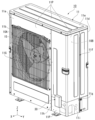
- FIG. 2 is a perspective view of an antenna unit according to an embodiment
- 2 is an exploded oblique view of a second machine chamber cover and an antenna unit according to an embodiment of the present invention.
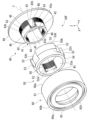
- FIG. FIG. 2 is an exploded perspective view of a support member, a nut member, and a seal bush according to an embodiment.
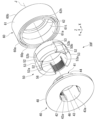
- FIG. 2 is an exploded perspective view of a support member, a nut member, and a seal bush according to an embodiment.
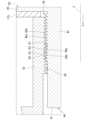
- 1 is a cross-sectional view of an antenna unit according to an embodiment of the present invention.
- FIG. 7 is an enlarged view of region VII in FIG.
- FIG. 6 is a cross-sectional view showing the first male thread portion and the first female thread portion of the embodiment.
- FIG. 8 is an enlarged view of an area VIII in FIG. 6, and is a cross-sectional view showing a second male thread portion and a second female thread portion of the embodiment.
- 13 is a cross-sectional view showing a first male thread portion and a first female thread portion of Modification 1.
- FIG. 13 is a cross-sectional view showing a second male thread portion and a second female thread portion of Modification 2.
- FIG. FIG. 13 is a perspective view of a support member according to a third modified example.
- the drawings also show an X-axis, a Y-axis, and a Z-axis as appropriate.
- the X-axis shows the front-rear direction of the outdoor unit in the following embodiment.
- the Y-axis shows the width direction of the outdoor unit perpendicular to the front-rear direction.
- the Z-axis shows the vertical direction.
- the front-rear direction, width direction, and vertical direction are mutually perpendicular directions.
- the width direction is the left-right direction of the outdoor unit.
- the left-right direction is the left-right direction when the outdoor unit in the following embodiment is viewed from the front side (+X side).
- the side (+Y side) of the left-right direction to which the Y-axis arrow points is the right side
- the side (-Y side) opposite to the side to which the Y-axis arrow points is the left side.
- the side in the vertical direction toward which the Z-axis arrow points (+Z side) is the upper side
- the opposite side in the vertical direction to the side toward which the Z-axis arrow points (-Z side) is the lower side.
- the surface facing forward of each part may be simply referred to as the front surface
- the surface facing backward may be referred to as the rear surface.
- FIG. 1 is a schematic diagram showing the general configuration of a refrigeration cycle device 100 in an embodiment.
- the refrigeration cycle device 100 is an air conditioner.
- the refrigeration cycle device 100 includes an outdoor unit 10, an indoor unit 20, a circulation path section 18, and an antenna unit 30.
- the outdoor unit 10 is disposed outdoors.
- the indoor unit 20 is disposed indoors.
- the outdoor unit 10 and the indoor unit 20 are connected to each other by the circulation path section 18 through which a refrigerant 19 circulates.
- the refrigeration cycle device 100 can adjust the temperature of the air in the room by exchanging heat between the refrigerant 19 flowing in the circulation path section 18 and the air in the room in which the indoor unit 20 is located.
- the refrigerant 19 include fluorine-based refrigerants or hydrocarbon-based refrigerants with low global warming potential (GWP).
- GWP global warming potential
- Examples of the refrigerant 19 include a single refrigerant selected from R1234yf, R1234ze, R32, and R290, or a mixture of two or more of these, or a mixture of any of these with another refrigerant.
- Examples of the refrigerant 19 include a mixed refrigerant containing R1132(E), or a mixed refrigerant containing R1123.
- refrigerant 19 examples include mixed refrigerants of R516A, R445A, R444A, R454C, R444B, R454A, R455A, R457A, R459B, R452B, R454B, R447B, R447A, R446A, and R459A.
- the outdoor unit 10 has a housing 11, a compressor 12, a heat exchanger 13, a flow control valve 14, a blower fan 15, a four-way valve 16, and a control unit 17.
- the housing 11 houses the compressor 12, the heat exchanger 13, the flow control valve 14, the blower fan 15, the four-way valve 16, and the control unit 17.
- the compressor 12, heat exchanger 13, flow rate control valve 14, and four-way valve 16 are provided in a portion of the circulation path 18 that is located inside the housing 11.
- the compressor 12, heat exchanger 13, flow rate control valve 14, and four-way valve 16 are connected by a portion of the circulation path 18 that is located inside the housing 11.
- the four-way valve 16 is provided in a portion of the circulation path section 18 that is connected to the discharge side of the compressor 12.
- the four-way valve 16 can reverse the direction of the refrigerant 19 flowing through the circulation path section 18 by switching a portion of the path of the circulation path section 18.
- the path connected by the four-way valve 16 is the path shown by the solid line on the four-way valve 16 in FIG. 1
- the refrigerant 19 flows through the circulation path section 18 in the direction shown by the solid arrow in FIG. 1.
- the path connected by the four-way valve 16 is the path shown by the dashed line on the four-way valve 16 in FIG. 1, the refrigerant 19 flows through the circulation path section 18 in the direction shown by the dashed arrow in FIG. 1.
- the indoor unit 20 has a housing 21, a heat exchanger 22, a blower fan 23, and a control device 24.
- the heat exchanger 22, the blower fan 23, and the control device 24 are housed inside the housing 21.
- the indoor unit 20 is capable of cooling operation to cool the air in the room in which the indoor unit 20 is located, and heating operation to warm the air in the room in which the indoor unit 20 is located.
- the refrigerant 19 flowing in the circulation path 18 flows in the direction shown by the solid arrow in Figure 1.
- the refrigerant 19 flowing in the circulation path 18 circulates through the compressor 12, the heat exchanger 13 of the outdoor unit 10, the flow control valve 14, and the heat exchanger 22 of the indoor unit 20, in that order, before returning to the compressor 12.
- the heat exchanger 13 in the outdoor unit 10 functions as a condenser
- the heat exchanger 22 in the indoor unit 20 functions as an evaporator.
- the refrigerant 19 flowing in the circulation path portion 18 flows in the direction shown by the dashed line in Figure 1.
- the refrigerant 19 flowing in the circulation path portion 18 circulates through the compressor 12, the heat exchanger 22 of the indoor unit 20, the flow control valve 14, and the heat exchanger 13 of the outdoor unit 10, in that order, before returning to the compressor 12.
- the heat exchanger 13 in the outdoor unit 10 functions as an evaporator
- the heat exchanger 22 in the indoor unit 20 functions as a condenser.
- ⁇ Outdoor unit> 2 is a perspective view of the outdoor unit 10 and the antenna unit 30 attached to the outdoor unit 10.
- the housing 11 of the outdoor unit 10 is a substantially rectangular box shape composed of a plurality of panels 11P. Inside the housing 11, there are provided a fan chamber 10A in which the blower fan 15 and the like are arranged, and a machine chamber 10B in which the compressor 12, the control unit 17 and the like are accommodated.
- the machine chamber 10B is arranged on the right side (+Y side) of the fan chamber 10A.
- the multiple panels 11P include a front panel 11a, a rear panel 11d, a top panel 11e, a first machine room cover 11f, and a second machine room cover 11g.
- the front panel 11a covers the fan room 10A from the front side.
- the rear panel 11d covers the fan room 10A and the machine room 10B from the rear side.
- the top panel 11e covers the fan room 10A and the machine room 10B from above.
- the front panel 11a has an opening 11b.
- a fan grill 11G that covers the opening 11b is attached to the front panel 11a.
- the blower fan 15 is disposed opposite the opening 11b and sends air from the opening 11b toward the front side of the housing 11.
- the first machine room cover 11f and the second machine room cover 11g are located on the right side (+Y side) of the front panel 11a.
- the first machine room cover 11f and the second machine room cover 11g cover the machine room 10B from the front and right sides.
- the first machine room cover 11f and the second machine room cover 11g are each composed of a plate body perpendicular to the front-rear direction and a plate body perpendicular to the left-right direction.
- the first machine room cover 11f has a larger vertical dimension than the second machine room cover 11g.
- the first machine room cover 11f is located above the second machine room cover 11g.
- the worker installing the outdoor unit 10 connects the piping to the compressor 12 and the wiring to the control unit 17 with the first machine room cover 11f open.
- the second machine room cover 11g is located below the first machine room cover 11f and at the lower end of the housing 11.
- the antenna unit 30 is fixed to the second machine room cover 11g.
- the second machine room cover 11g has a first plate 11h and a second plate 11i that are connected to each other.
- the first plate 11h is perpendicular to the front-rear direction.
- the second plate 11i is perpendicular to the left-right direction.
- the right end of the first plate 11h and the front end of the second plate 11i are connected to each other.
- the first plate 11h and the second plate 11i are formed by bending a single plate material into an L-shape.
- the pair of faces of the first plate 11h the face facing the inside of the housing 11 (-X side) is called the inner side 11p, and the face facing the outside of the housing 11 (+X side) is called the outer side 11q.
- FIG. 3 is an exploded perspective view of the second machine room cover 11g and the antenna unit 30.
- the first plate 11h and the second plate 11i are each provided with a plurality of slits 11j, 11k.
- the plurality of slits 11j, 11k include a slit for piping 11j and a slit for wiring 11k.
- the slit for piping 11j is provided for punching out to form a hole for passing piping.
- the slit for wiring 11k is provided for punching out to form a hole for passing wiring.
- the second machine room cover 11g is provided with a plurality of slits for piping 11j and a plurality of slits for wiring 11k. The installer selects one of the plurality of slits for piping 11j and the plurality of slits for wiring 11k, and passes the piping and wiring through the hole formed by punching out the selected slit.
- the antenna unit 30 transmits and receives wireless signals.
- the antenna unit 30 transmits information such as the operating state of the refrigeration cycle apparatus 100 to an external base station.
- the antenna unit 30 also receives a signal for remotely operating the refrigeration cycle apparatus 100 transmitted from the external base station.
- the antenna unit 30 of this embodiment is attached to the outdoor unit 10.
- the antenna unit 30 is fixed to a mounting hole 11t formed by punching one of the multiple wiring slits 11k.
- the antenna unit 30 of this embodiment no special structure is required to attach the antenna unit 30 to the outdoor unit 10. This allows the structure of the housing 11 of the outdoor unit 10 to be simplified, and the refrigeration cycle device 100 can be provided at low cost. Furthermore, the structure of the housing 11 to which the antenna unit 30 is attached can be made common with the structure of the housing of other products that do not have the antenna unit 30, allowing for product cost reduction.
- the wiring slits 11k are provided on various surfaces of the housing 11 so that the direction of the wiring can be appropriately selected depending on the installation situation of the outdoor unit 10.
- the antenna unit 30 can be installed facing the base station by appropriately selecting the wiring slits 11k to which the antenna unit 30 is attached. This makes it possible to perform wireless communication between the antenna unit 30 and the base station smoothly.
- the mounting hole 11t to which the antenna unit 30 is attached is provided in the first plate 11h that is perpendicular to the front-rear direction.
- the mounting hole 11t to which the antenna unit 30 is attached may be provided in a plate (e.g., the second plate 11i) that is perpendicular to the left-right direction.
- the mounting hole 11t to which the antenna unit 30 is attached may be provided in a plate (e.g., the top panel 11e in FIG. 2) that is perpendicular to the up-down direction.
- the antenna unit 30 has a fixing part 30F, a seal bushing 60, a case 70, an antenna board 31, and a cable 32.
- the fixing part 30F also has a support member 40 and a nut member 50.
- the antenna board 31 is connected to the control unit 17 of the outdoor unit 10 via a cable 32.
- the antenna board 31 is controlled by the control unit 17 of the outdoor unit 10.
- the antenna board 31 transmits and receives wireless signals to and from an external base station.
- a radiator (not shown) made of a copper foil pattern that transmits or receives radio waves is provided on the surface of the antenna board 31.
- the antenna board 31 is disposed inside the case 70.
- the antenna board 31 is disposed parallel to the plate surface of the first plate 11h to which the antenna unit 30 is attached.
- the cable 32 connects the antenna board 31 and the control unit 17 of the outdoor unit 10.
- the cable 32 is connected to the antenna board 31 inside the case 70.
- the cable 32 is also connected to the control unit 17 inside the housing 11.
- the cable 32 is led from inside the case 70 to inside the housing 11 through the mounting hole 11t.
- FIGS. 4 and 5 are exploded perspective views of the support member 40, the nut member 50, and the seal bushing 60.
- FIG. 6 is a cross-sectional view of the antenna unit 30. Note that in FIG. 6, the structure of the connection portion between the antenna board 31 and the cable 32 is illustrated in a schematic manner.
- the support member 40, the nut member 50, and the seal bushing 60 are cylindrical and centered on a common central axis J.
- the axial direction of the central axis J may be simply referred to as the "axial direction”
- the radial direction about the central axis J may be simply referred to as the "radial direction”
- the circumferential direction around the central axis J may be simply referred to as the "circumferential direction”.
- the axial direction coincides with the front-rear direction (X-axis direction).
- the front side (+X side) of the axial direction may be referred to as one axial side
- the rear side (-X side) may be referred to as the other axial side.
- the one axial side is the direction away from the housing 11
- the other axial side is the direction toward the housing 11.
- the nut member 50 has a cylindrical shape centered on the central axis J.
- the nut member 50 has a plurality of first elastic pieces 52, a plurality of first support pillars 53, and a first annular portion 54.
- the first elastic pieces 52 and the first support pillars 53 are arranged alternately in the circumferential direction to form a cylindrical shape.
- the nut member 50 of this embodiment has three first elastic pieces 52 and three first support pillars 53.
- the circumferential dimension of each of the first support pillars 53 is sufficiently larger than the circumferential dimension of each of the first elastic pieces 52.
- the first annular portion 54 is located on one axial side (+X side) of the first elastic pieces 52 and the first support pillars 53.
- the first support column 53 is a plate-like member extending in the axial direction with a cross-sectional shape that is substantially arc-shaped about the central axis J.
- the first support columns 53 are arranged at intervals in the circumferential direction.
- a first elastic piece 52 is arranged between the first support columns 53 arranged in the circumferential direction.
- the end of the first support column 53 on one axial side (+X side) is connected to the first annular portion 54.
- the first support column 53 has an inner surface 53a facing radially inward and an outer surface 53b facing radially outward.
- a tapered portion 53t is provided at the end of the outer surface 53b on one axial side (+X side).
- the outer surface 53b has a diameter that decreases toward the one axial side (+X side) at the tapered portion 53t.
- the first elastic piece 52 is a plate-like shape extending in the axial direction with a cross-sectional shape of an approximately arc centered on the central axis J.
- a first support portion 53 is arranged on each of both circumferential sides of the first elastic piece 52.
- An end portion on one axial side (+X side) of the first elastic piece 52 is connected to the first annular portion 54.
- the first elastic piece 52 is cantilevered by the first annular portion 54 at one axial end. When the first elastic piece 52 receives a force directed radially outward, it can elastically deform in a direction that moves the end portion on the other axial side (-X side) radially outward.
- the first elastic piece 52 has an inner surface 52a facing radially inward and an outer surface 52b facing radially outward.
- a first female thread portion 56 extending in a spiral shape centered on the central axis J is provided at the end portion on one axial side (+X side) of the inner surface 52a. That is, the inner peripheral surface of the nut member 50 is provided with a first female thread portion 56.
- the spiral shape of the first female thread portion 56 provided on each of the first elastic pieces 52 arranged in the circumferential direction is formed along the same spiral curve.
- the diameter of the valley portion of the first female thread portion 56 is equal to or smaller than the inner diameter of the support tube portion 41 in the diameter than the inner surface 53a of the first support portion 53. Therefore, when the first female thread portion 56 is screwed to the first male thread portion 45 described later, the inner surface 53a of the first support portion 53 can be prevented from contacting the first male thread portion 45.
- the radial thickness of the first elastic piece 52 is smaller than the thickness of the first support section 53. Therefore, the radial rigidity of the first elastic piece 52 is lower than the radial rigidity of the first support section 53. That is, the first elastic piece 52 is easily elastically deformed in the radial direction.
- the outer surface 42b of the first elastic piece 52 is located radially inward of the outer surface 43b of the first support section 53. Therefore, a space is provided between the circumferentially adjacent first support sections 53 and radially outward of the first elastic piece 52 to allow the first elasticity of the first elastic piece 52 to move radially outward.
- the first annular portion 54 is annular about the central axis J.
- the first annular portion 54 is located at the end of one axial side (+X side) of the nut member 50.
- the first annular portion 54 connects the multiple first support pillars 53 that are lined up in the circumferential direction.
- the support member 40 has a cylindrical support tube portion 41 centered on the central axis J, and a flange portion 48 connected to the end of the support tube portion 41 on the other axial side (-X side).
- the support tube portion 41 has a plurality of second elastic pieces 42, a plurality of second support portions 43, and a second annular portion 44.
- the second elastic pieces 42 and the second support portions 43 are arranged alternately in the circumferential direction to form a cylindrical shape.
- the support member 40 of this embodiment has three second elastic pieces 42 and three second support portions 43.
- the circumferential dimension of each second support portion 43 is sufficiently larger than the circumferential dimension of each second elastic piece 42.
- the second annular portion 44 is located on one axial side of the second elastic pieces 42 and the second support portions 43.
- the second support portion 43 is a plate-like member extending in the axial direction with a cross-sectional shape that is approximately an arc centered on the central axis J.
- the second support portions 43 are arranged at intervals in the circumferential direction.
- a second elastic piece 42 is arranged between the second support portions 43 arranged in the circumferential direction.
- the end portion on one axial side (+X side) of the second support portion 43 is connected to the second annular portion 44.
- the end portion on the other axial side (-X side) of the second support portion 43 is connected to the flange portion 48.
- the second support portion 43 has an inner surface 43a facing radially inward and an outer surface 43b facing radially outward.
- the end portion on the other axial side (-X side) of the inner surface 43a is provided with a first male screw portion 45 that extends in a spiral shape centered on the central axis J. That is, the first male screw portion 45 is provided on the outer circumferential surface of the support tube portion 41.
- the helical shape of the first male threads 45 provided on each of the multiple second support columns 43 arranged in the circumferential direction is formed along the same helical curve.
- the second elastic piece 42 is a plate-like shape extending in the axial direction with a cross-sectional shape of an approximately arc centered on the central axis J.
- the second support portion 43 is arranged on both circumferential sides of the second elastic piece 42.
- the end portion on one axial side (+X side) of the second elastic piece 42 faces the second annular portion 44 in the axial direction via a gap.
- the end portion on the other axial side (-X side) of the second elastic piece 42 is connected to the flange portion 48.
- the second elastic piece 42 is cantilever-supported by the flange portion 48 at one axial end.
- the second elastic piece 42 When the second elastic piece 42 receives a force directed radially outward, it can elastically deform in a direction that moves the end portion on one axial side (+X side) radially outward.
- the second elastic piece 42 has an inner surface 42a facing radially inward and an outer surface 42b facing radially outward.
- a second female screw portion 46 is provided at the end of the inner surface 42a on one axial side (+X side) and extends in a spiral shape around the central axis J. That is, the second female screw portion 46 is provided on the inner peripheral surface of the support tube portion 41.
- the spiral shapes of the second female screw portions 46 provided on the multiple second elastic pieces 42 arranged in the circumferential direction are formed along the same spiral curve.
- the diameter of the valley of the second female screw portion 46 is the same as or smaller than the inner diameter of the support tube portion 41 on the inner surface 43a of the second support portion 43. Therefore, when the second female screw portion 46 is screwed to the second male screw portion 77 (see FIG. 6) described later, the inner surface 43a of the second support portion 43 can be prevented from contacting the second male screw portion 77.
- the radial thickness dimension of the second elastic piece 42 is smaller than the thickness dimension of the second support portion 43.
- the outer surface 42b of the second elastic piece 42 is located radially inward of the outer surface 43b of the second support portion 43. Therefore, a space is provided between the circumferentially adjacent second support portions 43 and radially outward of the second elastic piece 42 to allow elastic deformation of the second elastic piece 42.
- the second annular portion 44 is annular about the central axis J.
- the second annular portion 44 is located at the end of one axial side (+X side) of the support tube portion 41.
- the second annular portion 44 connects the multiple second support pillar portions 43 that are lined up in the circumferential direction.
- the flange portion 48 is plate-shaped and perpendicular to the central axis J.
- the flange portion 48 is disk-shaped and centered on the central axis J.
- the flange portion 48 extends radially outward from the outer circumferential surface of the support tube portion 41.
- the support member 40 is inserted into the mounting hole 11t of the first plate 11h from the inside A1 side of the housing 11.
- the outer diameter of the support tube 41 is smaller than the diameter of the mounting hole 11t.
- the outer diameter of the flange 48 is larger than the diameter of the mounting hole 11t.
- the support tube 41 is disposed inside the mounting hole 11t.
- the end of the support tube 41 on one axial side (+X side) is disposed on the outside A2 of the housing 11.
- the end of the support tube 41 on the other axial side (-X side) and the flange 48 are disposed inside A1 of the housing 11.
- the surface of the flange 48 facing one axial side (+X side) comes into contact with the inner surface 11p of the first plate 11h.
- the nut member 50 is attached to the support member 40 from the exterior A2 side of the housing 11.
- a first female thread 56 provided on the inner peripheral surface of the nut member 50 meshes with a first male thread 45 provided on the outer peripheral surface of the support tube portion 41.
- the end face 50b on the other axial side (-Y side) of the nut member 50 comes into contact with the outer surface 11q of the first plate body 11h.
- the nut member 50 and the flange portion 48 sandwich the first plate body 11h from both sides in the axial direction, and the support member 40 and the nut member 50 are fixed to the first plate body 11h.
- the seal bushing 60 has a cylindrical bushing body 61 centered on the central axis J, and a bottom 62 that protrudes radially inward from an end on one axial side (+X side) of the bushing body 61.
- the seal bushing 60 is made of an elastic material such as rubber or elastomer resin.
- the seal bushing 60 surrounds the nut member 50 from the radial outside.
- the seal bushing 60 surrounds the outer circumferential surface of the cable 32.
- a tapered portion 61t is provided at the end of one axial side (+X side) of the inner circumferential surface 61a of the bushing main body 61.
- the diameter of the inner circumferential surface 61a decreases toward one axial side (+X side) at the tapered portion 53t.
- the radial thickness of the bushing main body 61 is increased at the portion of the inner circumferential surface 61a where the tapered portion 61t is provided.
- the tapered portion 61t of the bushing main body 61 faces the tapered portion 53t of the nut member 50.
- the bottom 62 is plate-shaped and centered on the central axis J.
- the bottom 62 is provided with a circular bottom hole 62h centered on the central axis J.
- the cable 32 is passed through the bottom hole 62h.
- the bottom 62 covers the end face of one axial side (+X side) of the nut member 50.
- the bottom 62 is disposed between the nut member 50 and the case 70.
- the seal bush 60 has a first end face 60a facing the other axial side (-X side) and a second end face 60b facing one axial side (+X side).
- the first end face 60a contacts the outer surface 11q of the first plate 11h.
- the second end face 60b contacts the case 70.
- the first end face 60a is an annular surface centered on the central axis J.
- the first end face 60a is provided with a first groove portion 60p extending annularly around the central axis J.
- the second end face 60b is an annular surface centered on the central axis J.
- the second end face 60b is provided with a second groove portion 60q extending annularly around the central axis J.
- the case 70 is disposed on the exterior A2 of the housing 11.
- the antenna board 31 is housed inside the case 70.
- the case 70 has a support plate member 71 and a cover member 79 that are connected to each other.
- the support plate member 71 supports the antenna board 31 from the other axial side (-X side).
- the cover member 79 covers the antenna board 31 from one axial side (+X side).
- the support plate member 71 has an opposing plate portion 72 that faces the first plate body 11h in the axial direction, an engagement rib 75 and multiple support boss portions 76 that protrude from the opposing plate portion 72 to one axial side (+X side), and a fixed tube portion 73 and a guard tube portion 74 that protrude from the opposing plate portion 72 to the other axial side (-X side).
- the opposing plate portion 72 is in the form of a plate extending perpendicular to the central axis J.
- the opposing plate portion 72 is provided with an insertion hole 72h that penetrates the opposing plate portion 72 in the axial direction.
- the insertion hole 72h is circular and centered on the central axis J.
- the opposing plate portion 72 has an opposing surface 72a that faces the other axial side (-X side) and faces the outer surface 11q of the first plate body 11h across a gap.
- the cable 32 is passed through the insertion hole 72h.
- the cable 32 is pulled out from the case 70 to the outside through the insertion hole 72h.
- the mating rib 75 extends along the outer edge of the opposing plate portion 72.
- the mating rib 75 is provided over the entire length of the outer edge of the opposing plate portion 72.
- the lid member 79 fits onto the outer surface of the mating rib 75.
- the outer surface of the mating rib 75 and the inner surface of the lid member 79 are joined by a joining means such as adhesive, welding, or screwing.
- the support boss portion 76 is cylindrical and extends in the axial direction.
- the antenna board 31 is mounted on the end face of the support boss portion 76 on one axial side (+X side).
- the antenna board 31 is fixed to the end face of the support boss portion 76 by a screw (not shown).
- the antenna board 31 may be fixed to the support boss portion 76 by a means such as heat crimping.
- the fixed tube portion 73 is cylindrical and centered on the central axis J.
- the fixed tube portion 73 extends in the axial direction from the inner edge of the insertion hole 72h.
- the cable 32 is passed inside the fixed tube portion 73.
- a second male thread portion 77 is provided on the outer circumferential surface of the fixed tube portion 73.
- the second male thread portion 77 meshes with the second female thread portion 46. This fixes the fixed tube portion 73 to the support tube portion 41.
- the case 70 is fixed to the fixed portion 30F at the outside A2 of the housing 11.
- the opposing plate portion 72 moves in a direction approaching the first plate body 11h. This reduces the distance between the opposing surface 72a of the opposing plate portion 72 and the outer surface 11q of the first plate body 11h, and the seal bushing 60 is compressed in the axial direction. In addition, the bottom portion 62 of the seal bushing 60 is compressed between the opposing surface 72a of the opposing plate portion 72 and the end face of the nut member 50 on one axial side (+X side).
- the guard tube portion 74 is cylindrical and centered on the central axis J.
- the guard tube portion 74 surrounds the fixed tube portion 73 from the radial outside.
- the guard tube portion 74 also surrounds the seal bushing 60 from the radial outside. In this way, the guard tube portion 74 protects the seal bushing 60 from sunlight, wind, and rain, and suppresses deterioration of the seal bushing 60.
- FIG. 7 is an enlarged view of region VII in FIG.
- the first male thread portion 45 provided on the outer circumferential surface of the support cylinder portion 41 and the first female thread portion 56 provided on the inner circumferential surface of the nut member 50 mesh with each other.
- the cross-sectional shape of the thread of the first male thread portion 45 is approximately a right-angled triangle.
- the thread of the first male thread portion 45 has a first thread surface 45a and a second thread surface 45b that face opposite each other in the axial direction.
- the first thread surface 45a faces one axial side (+X side).
- the second thread surface 45b faces the other axial side (-X side).
- the first thread surface 45a and the second thread surface 45b approach each other toward the tip side of the thread (i.e., the radially outward side).
- the first thread surface 45a In a cross section passing through the central axis J, the first thread surface 45a inclines toward the other axial side as it faces radially outward.
- the second thread surface 45b is perpendicular to the central axis J.
- the cross-sectional shape of the thread of the first female thread portion 56 is approximately a right-angled triangle.
- the thread of the first female thread portion 56 has a third thread surface 56a and a fourth thread surface 56b that face opposite each other in the axial direction.
- the third thread surface 56a faces the other axial side (-X side).
- the fourth thread surface 56b faces one axial side (+X side).
- the third thread surface 56a and the fourth thread surface 56b approach each other toward the tip side of the thread (i.e., the radially inner side).
- the third thread surface 56a In a cross section passing through the central axis J, the third thread surface 56a inclines toward one axial side as it faces the radially inner side.
- the second thread surface 45b is perpendicular to the central axis J.
- the first thread surface 45a and the third thread surface 56a face each other.
- the first thread surface 45a and the third thread surface 56a come into contact with each other and exert axial reaction forces on each other.
- the first thread surface 45a inclines toward a radially outward position as it moves in the axial direction toward the direction in which it receives force from the third thread surface 56a (-X side).
- the third thread surface 56a inclines toward a radially inward position as it moves in the axial direction toward the direction in which it receives force from the first thread surface 45a (+X side).
- the first thread surface 45a and the third thread surface 56a are pressed against each other in the axial direction, so that they receive forces on opposite radial sides. That is, the second support column 43 of the support tube 41 on which the first thread surface 45a is provided receives a radially inward force from the third thread surface 56a. Also, the first elastic piece 52 on which the third thread surface 56a is provided receives a radially outward force from the first thread surface 45a.
- the first elastic piece 52 has a lower rigidity than the second support column 43 and is easily elastically deformed radially outward.
- the installer moves the nut member 50 to the other axial side (-X side) relative to the support tube 41, the first elastic piece 52 elastically deforms radially outward, and the first female thread portion 56 overcomes the first male thread portion 45. Also, the first female thread portion 56 and the first male thread portion 45 can be engaged with each other without rotating the nut member 50.
- the procedure for attaching the nut member 50 to the support member 40 during the installation work of the antenna unit 30 to the outdoor unit 10 can be simplified. After the nut member 50 is attached to the support member 40, the nut member 50 and the support member 40 can be rotated relative to each other to fasten the support member 40 and the nut member 50 together, sandwiching the first plate 11h. This allows the support member 40 to be firmly fixed to the first plate 11h.
- the first elastic piece 52 is provided on the nut member 50.
- the first elastic piece 52 is provided with a first female thread 56, which elastically deforms radially outward when the nut member 50 is attached to the support member 40.
- the first elastic piece may be provided on the support tube.
- the first elastic piece is provided with a first male thread, which elastically deforms radially inward when the nut member is attached to the support member. That is, it is sufficient that either the support tube or the nut member has a plurality of first elastic pieces that are cantilevered at one end in the axial direction so as to be elastically deformable and are spaced apart in the circumferential direction of the central axis J. Furthermore, it is sufficient that either the first male thread or the first female thread is provided on a surface of the first elastic piece facing one radial side.
- the second thread surface 45b and the fourth thread surface 56b face each other.
- the second thread surface 45b and the fourth thread surface 56b come into contact with each other and exert an axial reaction force on each other.
- the second thread surface 45b and the fourth thread surface 56b are perpendicular to the central axis J in a cross section passing through the central axis J. Therefore, the axial force is not converted to the radial direction, and the first elastic piece 52 is unlikely to elastically deform radially outward.
- the nut member 50 can be prevented from easily coming off the support member 40. The installation worker rotates the nut member 50 and the support member 40 relative to each other to come off the nut member 50 from the support member 40.
- the inclination angles of the first thread surface 45a, the second thread surface 45b, the third thread surface 56a, and the fourth thread surface 56b with respect to the central axis J in a cross section passing through the central axis J are the first inclination angle ⁇ 1, the second inclination angle ⁇ 2, the third inclination angle ⁇ 3, and the fourth inclination angle ⁇ 4, respectively.
- the first inclination angle ⁇ 1 and the third inclination angle ⁇ 3 in this embodiment are smaller than 90°.
- the second inclination angle ⁇ 2 and the fourth inclination angle ⁇ 4 in this embodiment are each 90°. Therefore, the first inclination angle ⁇ 1 is smaller than the second inclination angle ⁇ 2.
- the third inclination angle ⁇ 3 is smaller than the fourth inclination angle ⁇ 4.
- the first male thread portion 45 and the first female thread portion 56 contact each other at surfaces with relatively small inclination angles when the support tube portion 41 is inserted into the nut member 50, so that the first elastic piece 52 is easily elastically deformed in the radial direction.
- the first male thread portion 45 and the first female thread portion 56 come into contact with each other at surfaces with a relatively large inclination angle, making it difficult to elastically deform the first elastic piece 52.
- the nut member 50 can be easily attached to the support member 40 while preventing the nut member 50 from easily coming off the support member 40.
- the first inclination angle ⁇ 1 and the third inclination angle ⁇ 3 are equal to each other. Therefore, the first thread surface 45a and the third thread surface 56a come into surface contact and slide against each other, allowing the first elastic piece 52 to be smoothly elastically deformed.
- the first inclination angle ⁇ 1 and the third inclination angle ⁇ 3 do not necessarily have to be equal to each other.
- FIG. 8 is an enlarged view of region VIII of FIG.
- the second male thread portion 77 provided on the outer circumferential surface of the fixed cylinder portion 73 and the second female thread portion 46 provided on the inner circumferential surface of the support cylinder portion 41 mesh with each other.
- the cross-sectional shape of the thread of the second male thread portion 77 is a substantially right-angled triangle.
- the thread of the second male thread portion 77 has a fifth thread surface 77a and a sixth thread surface 77b that face opposite each other in the axial direction.
- the fifth thread surface 77a faces the other axial side (-X side).
- the sixth thread surface 77b faces one axial side (+X side).
- the fifth thread surface 77a and the sixth thread surface 77b approach each other toward the tip side of the thread (i.e., radially outward).
- the fifth thread surface 77a inclines toward one axial side as it faces radially outward.
- the sixth thread surface 77b is perpendicular to the central axis J.
- the cross-sectional shape of the thread of the second female thread portion 46 is approximately a right-angled triangle.
- the thread of the second female thread portion 46 has a seventh thread surface 46a and an eighth thread surface 46b that face opposite each other in the axial direction.
- the seventh thread surface 46a faces one axial side (+X side).
- the eighth thread surface 46b faces the other axial side (-X side).
- the seventh thread surface 46a and the eighth thread surface 46b approach each other toward the tip side of the thread (i.e., the radially inner side).
- the seventh thread surface 46a In a cross section passing through the central axis J, the seventh thread surface 46a inclines toward the other axial side as it faces the radially inner side.
- the sixth thread surface 77b is perpendicular to the central axis J.
- the fifth thread surface 77a and the seventh thread surface 46a face each other.
- the fifth thread surface 77a and the seventh thread surface 46a come into contact with each other and exert a reaction force on each other in the axial direction.
- the fifth thread surface 77a inclines in a direction toward the radially outward side as it moves toward the direction in which it receives force from the seventh thread surface 46a in the axial direction (+X side).
- the seventh thread surface 46a inclines in a direction toward the radially inward side as it moves toward the direction in which it receives force from the fifth thread surface 77a in the axial direction (-X side).
- the fifth thread surface 77a and the seventh thread surface 46a are pressed against each other in the axial direction, so that they receive forces on opposite radial sides. That is, the fixed tube portion 73 on which the fifth thread surface 77a is provided receives a radially inward force from the seventh thread surface 46a. In addition, the second elastic piece 42 on which the seventh thread surface 46a is provided receives a radially outward force from the fifth thread surface 77a.
- the second elastic piece 42 has a lower rigidity than the fixed cylinder portion 73 and is easily elastically deformed radially outward.
- the installer moves the fixed cylinder portion 73 to the other axial side (-X side) relative to the fixed cylinder portion 73
- the second elastic piece 42 elastically deforms radially outward
- the second female screw portion 46 overcomes the second male screw portion 77.
- the second female screw portion 46 and the second male screw portion 77 can be engaged without rotating the fixed cylinder portion 73.
- the procedure for mounting the fixed cylinder portion 73 to the support member 40 during the installation work of the antenna unit 30 to the outdoor unit 10 can be simplified.
- the fixed cylinder portion 73 and the support member 40 can be rotated relative to each other to compress the seal bush 60 in the axial direction. This allows the first end surface 60a of the seal bushing 60 to be in close contact with the first plate 11h, and the second end surface 60b of the seal bushing 60 to be in close contact with the opposing plate portion 72, as shown in FIG. 6.
- the first end face 60a of the seal bushing 60 surrounds the mounting hole 11t when viewed from the axial direction.
- the second end face 60b of the seal bushing 60 surrounds the insertion hole 72h when viewed from the axial direction.
- the first end face 60a and the second end face 60b are in close contact with the first plate 11h and the opposing plate portion 72, respectively, so that it is possible to prevent moisture from entering the inside of the seal bushing 60. This makes it possible to prevent moisture from reaching the inside of the mounting hole 11t and the insertion hole 72h. It is also possible to prevent moisture from adhering to the cable 32 passing inside the seal bushing 60, thereby preventing deterioration of the cable 32.
- the first groove portion 60p provided on the first end face 60a of the seal bush 60 is annular and surrounds the mounting hole 11t when viewed in the axial direction.
- the second groove portion 60q provided on the second end face 60b of the seal bush 60 is annular and surrounds the insertion hole 72h when viewed in the axial direction. That is, the first groove portion 60p and the second groove portion 60q each surround the cable 32 when viewed in the axial direction.
- the outer surface 11q of the first plate 11h and the opposing surface 72a of the opposing plate portion 72 each have fine irregularities.
- the second groove portion 60q in the second end face 60b moisture infiltrating toward the inside in the radial direction through a fine gap between the second end face 60b and the opposing surface 72a can be captured in the second groove portion 60q.
- the first groove portion 60p and the second groove portion 60q in the seal bush 60 it is possible to suppress moisture from infiltrating into the inside of the seal bush 60, and it is possible to protect the cable 32 from moisture.
- the amount of moisture trapped in the first groove portion 60p and the second groove portion 60q is so small that it evaporates and is discharged as gas outside the grooves.
- the second elastic piece 42 is provided on the fixed tube portion 73.
- the second elastic piece 42 is provided with a second female thread portion 46, which elastically deforms radially outward when the fixed tube portion 73 is attached to the support member 40.
- the second elastic piece 42 may be provided on the fixed tube portion.
- the second elastic piece 42 is provided with a first male thread portion, which elastically deforms radially inward when the fixed tube portion is attached to the support member. That is, it is sufficient that either the support tube portion or the fixed tube portion has a plurality of second elastic pieces 42 that are cantilevered at one end in the axial direction so as to be elastically deformable and are spaced apart in the circumferential direction of the central axis J. Furthermore, it is sufficient that either the second male thread portion or the second female thread portion is provided on a surface of the second elastic piece 42 facing one radial side.
- the first elastic piece 52 is provided on the nut member 50 on which the first female thread 56 is provided among the first male thread 45 and the first female thread 56 that mesh with each other.
- the second elastic piece 42 is provided on the support tube portion 41 on which the second female thread 46 is provided among the second male thread 77 and the second female thread 46 that mesh with each other. That is, in this embodiment, an elastic piece is provided on the female thread side in either engagement.
- an elastic piece may be provided on the male thread side in one engagement, and an elastic piece may be provided on the female thread side in the other engagement.
- an elastic piece may be provided on the male thread side in either engagement.
- the first elastic piece 52 and the second elastic piece 42 are provided on different members, but they may be provided on the same member, the support tube portion 41.
- the first elastic piece 52 and the second elastic piece 42 are provided on different members, it is possible to prevent the strength of the member on which the elastic pieces are provided from decreasing drastically compared to when they are provided on the same member.
- the sixth thread surface 77b and the eighth thread surface 46b face each other.
- the fixed tube portion 73 is attached to the support tube portion 41 and then pulled out from the support tube portion 41, the sixth thread surface 77b and the eighth thread surface 46b come into contact with each other and exert axial reaction forces on each other.
- the sixth thread surface 77b and the eighth thread surface 46b are perpendicular to the central axis J in a cross section passing through the central axis J. Therefore, the axial force is not converted to the radial direction, and the second elastic piece 42 is unlikely to elastically deform radially outward.
- the fixed tube portion 73 can be prevented from easily coming off the support member 40. The installation worker rotates the fixed tube portion 73 and the support member 40 relative to each other to come off the fixed tube portion 73 from the support member 40.
- the sixth thread surface 77b and the eighth thread surface 46b are perpendicular to the central axis J in a cross section passing through the central axis J.
- the sixth thread surface 77b and the eighth thread surface 46b are inclined at an angle close to 90° with respect to the central axis J, the effect of suppressing elastic deformation of the second elastic piece 42 when the fixed tube portion 73 is pulled out from the fixed tube portion 73 can be obtained.
- the inclination angles of the fifth thread surface 77a, the sixth thread surface 77b, the seventh thread surface 46a, and the eighth thread surface 46b with respect to the central axis J in a cross section passing through the central axis J are the fifth inclination angle ⁇ 5, the sixth inclination angle ⁇ 6, the seventh inclination angle ⁇ 7, and the eighth inclination angle ⁇ 8, respectively.
- the fifth inclination angle ⁇ 5 and the seventh inclination angle ⁇ 7 in this embodiment are smaller than 90°.
- the sixth inclination angle ⁇ 6 and the eighth inclination angle ⁇ 8 in this embodiment are each 90°. Therefore, the fifth inclination angle ⁇ 5 is smaller than the sixth inclination angle ⁇ 6.
- the seventh inclination angle ⁇ 7 is smaller than the eighth inclination angle ⁇ 8.
- the second male thread portion 77 and the second female thread portion 46 come into contact with each other at surfaces with relatively small inclination angles, and therefore the second elastic piece 42 is easily elastically deformed in the radial direction.
- the fixed tube portion 73 is pulled out from the fixed tube portion 73, the second male thread portion 77 and the second female thread portion 46 come into contact with each other at surfaces with a relatively large inclination angle, making it difficult to elastically deform the second elastic piece 42.
- the circumferential dimension of the first elastic piece 52 is the first dimension W1.
- the dimension between the second support portions 43 arranged in the circumferential direction is the second dimension W2.
- the first dimension W1 is larger than the second dimension W2.
- the first female thread portion 56 provided on the inner surface 52a of the first elastic piece 52 engages with the first male thread portion 45 provided on the outer surface 43b of the second support portion 43.
- the first male thread portion 45 is also discontinued between the second support portions 43 arranged in the circumferential direction. Therefore, when the second dimension W2 between the second support portions 43 is larger than the first dimension W1 of the first elastic piece 52, the first elastic piece 52 is arranged between the second support portions 43 arranged in the circumferential direction.
- the first elastic piece 52 is fitted to the radial outside of the second elastic piece 42, and since the outer surface 42b of the second elastic piece 42 does not have a thread, the first female screw portion 56 of the first elastic piece 52 does not mesh with the first male screw portion 45.
- the first dimension W1 is greater than the second dimension W2. Therefore, no matter what rotational position the nut member 50 is placed in relative to the support tube portion 41, at least a part of the first elastic piece 52 overlaps with the second support portion 43 in the radial direction. This ensures that the first female screw portion 56 of the first elastic piece 52 and the first male screw portion 45 of the second support portion 43 mesh with each other regardless of the rotational position of the nut member 50. As a result, the nut member 50 can be securely screwed to the support member 40, and the fixing portion 30F can be reliably fixed to the first plate body 11h.
- the antenna unit 30 of this embodiment is attached to the second machine room cover 11g of the housing 11.
- the installer attaches the antenna unit 30 to the second machine room cover 11g in a state in which the second machine room cover 11g is removed from the outdoor unit 10, and then attaches the second machine room cover 11g to the outdoor unit 10.
- the case 70 is assembled. At this time, the cable 32 is connected and the antenna board 31 is housed in the case 70. In addition, the cable 32 is drawn out to the outside of the case 70 through an insertion hole 72h of the case 70 (see Fig. 6).
- the installation process for the antenna unit 30 includes a first fixing process for fixing the support member 40 to the first plate body 11h of the second machine room cover 11g, a seal bushing installation process for attaching the seal bushing 60 to the support member 40, and a second fixing process for fixing the case 70 to the support member 40.
- the installer first inserts the support tube portion 41 of the support member 40 into the mounting hole 11t of the first plate 11h from the inside of the housing 11, and brings the flange portion 48 into contact with the inner surface 11p.
- the installer attaches the nut member 50 to the support tube portion 41 that protrudes toward the outer surface 11q of the first plate 11h through the mounting hole 11t.
- the installer inserts the tip of the support tube portion 41 into the inside of the nut member 50, and further pushes the nut member 50 toward the first plate 11h, moving the nut member 50 to the other axial side (-X side).
- the first elastic piece 52 of the nut member 50 elastically deforms intermittently, and the first female thread portion 56 overcomes the first male thread portion 45, and the nut member 50 is attached to the support member 40.
- the installer further rotates the nut member 50 to tighten the first female thread portion 56 into the first male thread portion 45.
- the end face 50b on the other axial side (-X side) of the nut member 50 comes into contact with the outer surface 11q of the first plate 11h, and the first plate 11h is sandwiched between the flange portion 48 of the support member 40 and the nut member 50.
- the support member 40 is fixed to the first plate 11h.
- the installer installs the seal bushing 60 onto the nut member 50 by placing the seal bushing 60 over the nut member 50. This places the seal bushing 60 in a state where it is supported by the support member 40.
- the installer first passes the cable 32 extending from the case 70 through the support tube portion 41. This passes the cable 32 through the mounting hole 11t.
- the fixed tube portion 73 of the case 70 is fixed to the support tube portion 41.
- the installer inserts the tip of the fixed tube portion 73 inside the support tube portion 41, and further pushes the case 70 toward the first plate body 11h, moving the fixed tube portion 73 to the other axial side (-X side).
- This causes the second elastic piece 42 of the support tube portion 41 to elastically deform intermittently, causing the second female thread portion 46 to overcome the second male thread portion 77, and the case 70 to be attached to the support member 40.
- the installer further rotates the support member 40 and the case 70 relatively to tighten the second male thread portion 77 into the second female thread portion 46. This sandwiches and compresses the seal bushing 60 between the opposing surface 72a of the case 70 and the outer surface 11q of the first plate 11h.
- the case 70 is fixed to the support member 40. This fixes the antenna unit 30 to the first plate 11h.
- the installer attaches the first plate 11h to which the antenna unit 30 is fixed, to the outdoor unit 10. Furthermore, the installer opens the first machine room cover 11f and connects the cable 32 to the control unit 17 (see Figure 1) of the outdoor unit 10. By going through the above steps, the installation of the antenna unit 30 to the outdoor unit 10 is completed.
- a first male thread portion 145 and a first female thread portion 156 according to a first modified example that can be used in the above-described embodiment will be described with reference to Fig. 9. Note that components that are the same as those in the above-described embodiment are given the same reference numerals and descriptions thereof will be omitted.
- the first male thread portion 145 is provided on the outer peripheral surface of the support tube portion 41.
- the first female thread portion 156 is provided on the inner peripheral surface of the nut member 50.
- the first female thread portion 156 is also provided on the first elastic piece 52 provided on the nut member 50.
- the first male thread portion 145 and the first female thread portion 156 mesh with each other.
- the cross-sectional shape of the thread of the first male thread portion 145 of this modified example is an isosceles triangle.
- the thread of the first male thread portion 145 has a first thread surface 145a and a second thread surface 145b that face in opposite directions in the axial direction.
- the first thread surface 145a faces one axial side (+X side).
- the second thread surface 145b faces the other axial side (-X side).
- the first thread surface 145a inclines in a direction toward the other axial side as it moves radially outward.
- the second thread surface 145b inclines in a direction toward the one axial side as it moves radially outward. That is, in a cross section passing through the central axis J, the first thread surface 145a and the second thread surface 145b are inclined in a direction toward each other in the axial direction as they move radially outward.
- the cross-sectional shape of the thread of the first female thread portion 156 in this modified example is an isosceles triangle.
- the thread of the first female thread portion 156 has a third thread surface 156a and a fourth thread surface 156b that face opposite each other in the axial direction.
- the third thread surface 156a faces the other axial side (-X side).
- the fourth thread surface 156b faces one axial side (+X side).
- the third thread surface 156a inclines in a direction toward one axial side as it moves radially inward.
- it inclines in a direction toward the other axial side as it moves radially inward. That is, in a cross section passing through the central axis J, the third thread surface 156a and the fourth thread surface 156b are each inclined in a direction toward each other in the axial direction as it moves radially outward.
- the inclination angles of the first thread surface 145a, the second thread surface 145b, the third thread surface 156a, and the fourth thread surface 156b with respect to the central axis J are the first inclination angle ⁇ 11, the second inclination angle ⁇ 12, the third inclination angle ⁇ 13, and the fourth inclination angle ⁇ 14, respectively.
- the first inclination angle ⁇ 11, the second inclination angle ⁇ 12, the third inclination angle ⁇ 13, and the fourth inclination angle ⁇ 14 are equal to each other.
- the first male thread portion 145 and the first female thread portion 156 of this modified example come into contact with the first thread surface 145a and the third thread surface 156a, and they receive forces on opposite radial sides.
- the first male thread portion 145 and the first female thread portion 156 of this modified example come into contact with the second thread surface 145b and the fourth thread surface 156b, and they receive forces on opposite radial sides.
- the first elastic piece 52 This causes the first elastic piece 52 to elastically deform radially outward, and the first female thread portion 156 climbs over the first male thread portion 145.
- the first elastic piece 52 is easily elastically deformed in the radial direction when inserting the support tube portion 41 into the nut member 50 and when pulling the nut member 50 out of the support tube portion 41. According to this modification, it is possible to easily attach and detach the nut member 50 to and from the support member 40.
- the first inclination angle ⁇ 11 and the second inclination angle ⁇ 12 are equal to each other.
- the third inclination angle ⁇ 13 and the fourth inclination angle ⁇ 14 are equal to each other. Therefore, the reaction force received by the installer from the nut member 50 is equal when inserting the support tube portion 41 into the nut member 50 and when pulling the nut member 50 out of the support tube portion 41.
- the first inclination angle ⁇ 11 and the second inclination angle ⁇ 12 may be different angles
- the third inclination angle ⁇ 13 and the fourth inclination angle ⁇ 14 may be different angles.
- the reaction force when inserting the support tube portion 41 into the nut member 50 is reduced.
- the second inclination angle ⁇ 12 and the fourth inclination angle ⁇ 14 the reaction force when the nut member 50 is pulled out of the support tube portion 41 is reduced.
- the second male thread portion 177 is provided on the outer peripheral surface of the fixed tube portion 73.
- the second female thread portion 146 is provided on the inner peripheral surface of the support tube portion 41.
- the second female thread portion 146 is also provided on the second elastic piece 42 provided on the support tube portion 41.
- the second male thread portion 177 and the second female thread portion 146 mesh with each other.
- the cross-sectional shape of the thread of the second male thread portion 177 in this modified example is an isosceles triangle.
- the thread of the second male thread portion 177 has a fifth thread surface 177a and a sixth thread surface 177b that face in opposite directions in the axial direction.
- the fifth thread surface 177a faces one axial side (+X side).
- the sixth thread surface 177b faces the other axial side (-X side).
- the fifth thread surface 177a inclines in a direction toward one axial side as it moves radially outward.
- the sixth thread surface 177b inclines in a direction toward the other axial side as it moves radially outward. That is, in a cross section passing through the central axis J, the fifth thread surface 177a and the sixth thread surface 177b are inclined in a direction toward each other in the axial direction as they move radially outward.
- the cross-sectional shape of the thread of the second female thread portion 146 in this modified example is an isosceles triangle.
- the thread of the second female thread portion 146 has a seventh thread surface 146a and an eighth thread surface 146b that face opposite each other in the axial direction.
- the seventh thread surface 146a faces the other axial side (-X side).
- the eighth thread surface 146b faces one axial side (+X side).
- the seventh thread surface 146a inclines in a direction toward the other axial side as it moves radially inward.
- it inclines in a direction toward the one axial side as it moves radially inward. That is, in a cross section passing through the central axis J, the seventh thread surface 146a and the eighth thread surface 146b are inclined in a direction toward each other in the axial direction as they move radially outward.
- the inclination angles of the fifth thread surface 177a, the sixth thread surface 177b, the seventh thread surface 146a, and the eighth thread surface 146b with respect to the central axis J are the fifth inclination angle ⁇ 15, the sixth inclination angle ⁇ 16, the seventh inclination angle ⁇ 17, and the eighth inclination angle ⁇ 18, respectively.
- the fifth inclination angle ⁇ 15, the sixth inclination angle ⁇ 16, the seventh inclination angle ⁇ 17, and the eighth inclination angle ⁇ 18 are equal to each other.
- the second male thread portion 177 and the second female thread portion 146 of this modified example come into contact with the fifth thread surface 177a and the seventh thread surface 146a, and they receive forces on opposite radial sides.
- the second male thread portion 177 and the second female thread portion 146 of this modified example come into contact with the sixth thread surface 177b and the eighth thread surface 146b, and they receive forces on opposite radial sides.
- the fifth inclination angle ⁇ 15 and the sixth inclination angle ⁇ 16 are equal to each other.
- the seventh inclination angle ⁇ 17 and the eighth inclination angle ⁇ 18 are equal to each other. Therefore, the reaction force received by the installer from the support tube 41 is equal when inserting the fixed tube 73 into the support tube 41 and when pulling the support tube 41 out of the fixed tube 73.
- the fifth inclination angle ⁇ 15 and the sixth inclination angle ⁇ 16 may be different angles
- the seventh inclination angle ⁇ 17 and the eighth inclination angle ⁇ 18 may be different angles.
- the reaction force when inserting the fixed tube 73 into the support tube 41 is reduced.
- the sixth inclination angle ⁇ 16 and the eighth inclination angle ⁇ 18 the reaction force when pulling the fixed cylinder portion 73 out of the support cylinder portion 41 is reduced.
- ⁇ Modification 3> 11 is a perspective view of a support member 240 according to a third modified example that can be used in the above-described embodiment.
- the same components as those in the above-described embodiment are given the same reference numerals, and the description thereof will be omitted.
- the support member 240 has a support tube portion 41 centered on the central axis J, and a flange portion 48 connected to the end of the support tube portion 41 on the other axial side (-X side).
- two protrusions 249 are provided on the surface of the flange portion 48 facing the other axial side (-X side).
- the two protrusions 249 are plate-shaped and extend radially.
- the protrusions 249 are provided on the flange portion 48, so that the installer can pinch the protrusions 249 to rotate the support member 240, improving the workability of the installation work.
- protrusions 249 may protrude from the surface of the flange portion 48 facing the other axial side (-X side) in the other axial direction and be arranged side by side in the circumferential direction centered on the central axis J.
- the antenna unit 30 of the above embodiment is attached to a first plate 11h constituting a part of the housing 11 of the outdoor unit 10 of the refrigeration cycle device 100.
- the antenna unit 30 has a fixing portion 30F, a case 70, an antenna board 31, the case 70, and a cable 32.
- the fixing portion 30F has a support member 40 and a nut member 50, and is fixed to the first plate 11h.
- the case 70 is disposed on the outside A2 of the housing 11 and is fixed to the fixing portion 30F.
- the antenna board 31 is disposed in the case 70.
- the cable 32 is connected to the antenna board 31.
- the support member 40 has a cylindrical support tube portion 41 centered on the central axis J and inserted into the mounting hole 11t of the first plate 11h, and a flange portion 48 extending radially outward from the support tube portion 41 and contacting the inner surface 11p of the first plate 11h.
- the nut member 50 has a first female screw portion 56 provided on the inner peripheral surface and contacts the outer surface 11q of the first plate 11h.
- the support tube portion 41 has a first male screw portion 45 provided on the outer peripheral surface and meshing with the first female screw portion 56, and a second female screw portion 46 provided on the inner peripheral surface.
- the case has an opposing plate portion 72 and a fixed tube portion 73. The opposing plate portion 72 faces the first plate 11h.
- the fixed tube portion 73 is cylindrical and protrudes from the opposing plate portion 72 toward the first plate 11h, and a second male screw portion 77 that meshes with the second female screw portion 46 is provided on the outer peripheral surface.
- the cable 32 is led to the inside A1 of the housing 11 through the inside of the fixed tube portion 73 and the mounting hole 11t.
- the case 70 can be fixed to the first plate 11h via the fixing portion 30F.
- the fixing part 30F is attached to the first plate 11h, and the case 70 is attached to the fixing part 30F by screws. Therefore, the fixing process of the antenna unit 30 to the outdoor unit 10 can be simplified. Furthermore, according to this configuration, the antenna unit 30 can be directly fixed to the mounting hole 11t.
- the cable 32 can be directly led to the mounting hole 11t through the fixing tube part 73 of the case 70, and the cable 32 is unlikely to be exposed to the outside. Therefore, it is possible to prevent the design of the exterior of the outdoor unit 10 to which the antenna unit 30 is attached from being impaired by the exposure of the cable 32. Furthermore, the cable 32 can be protected from sunlight and wind and rain, and deterioration of the cable 32 can be suppressed, thereby improving the reliability of the antenna unit 30.
- one of the support tube portion 41 or the nut member 50 has a plurality of first elastic pieces 52 that are cantilevered at one end in the axial direction and spaced apart in the circumferential direction.
- a first male thread portion 45 or a first female thread portion 56 is provided on a surface of the plurality of first elastic pieces 52 facing one radial side.
- the first elastic piece 52 is provided on the nut member 50, and the "surface facing one radial side of the first elastic piece” is the inner surface 52a of the first elastic piece 52.
- the first female thread portion 56 is provided on the inner surface 52a.
- one of the support tube portion 41 or the nut member 50 has a plurality of first support portions 53 arranged between the first elastic pieces 52 in the circumferential direction.
- the surface of the first elastic piece 52 facing the other radial side is located on one radial side of the surface of the first support portion 53 facing the other radial side.
- the thread of the first male thread portion 45 has a first thread surface 45a facing the outside (+X side) of the housing 11 in the axial direction, and a second thread surface 45b facing the inside (-X side) of the housing in the axial direction.
- the thread of the first female thread portion 56 has a third thread surface 56a facing the inside (-X side) of the housing 11 in the axial direction, and a fourth thread surface 56b facing the outside (+X side) of the housing 11 in the axial direction.
- the first inclination angle ⁇ 1 of the first thread surface 45a relative to the central axis J is smaller than the second inclination angle ⁇ 2 of the second thread surface 45b relative to the central axis J.
- the third inclination angle ⁇ 3 of the third thread surface 56a with respect to the central axis J is smaller than the fourth inclination angle ⁇ 4 of the fourth thread surface 56b with respect to the central axis J.
- the first male thread portion 45 and the first female thread portion 56 come into contact with each other at surfaces with a relatively small inclination angle, so that the first elastic piece 52 is easily elastically deformed in the radial direction.
- the first male thread portion 45 and the first female thread portion 56 come into contact with each other at surfaces with a relatively large inclination angle, so that the first elastic piece 52 is not easily elastically deformed. Therefore, according to this configuration, while the nut member 50 is easily attached to the support member 40, the nut member 50 can be prevented from easily coming off from the support member 40.
- an antenna unit 30 that facilitates installation work while preventing easy detachment and improving crime prevention performance. It is also possible to adopt a configuration in which the magnitude relationship between the first inclination angle ⁇ 1 and the second inclination angle ⁇ 2 is reversed, and the magnitude relationship between the third inclination angle ⁇ 3 and the fourth inclination angle ⁇ 4 is reversed. In this case, while rotation of the nut member 50 is essential when fixing the nut member 50 to the support member 40, the nut member 50 can be removed from the support member 40 by pulling out the nut member 50.
- the thread of the first male thread portion 145 has a first thread surface 145a facing the outside (+X side) of the housing 11 in the axial direction, and a second thread surface 145b facing the inside (-X side) of the housing 11 in the axial direction.
- the thread of the first female thread portion 156 has a third thread surface 156a facing the inside (-X side) of the housing in the axial direction, and a fourth thread surface 156b facing the outside (+X side) of the housing 11 in the axial direction.
- the first thread surface 145a and the second thread surface 145b are each inclined in the axial direction toward each other as they move radially outward.
- the third thread surface 156a and the fourth thread surface 156b are each inclined in the axial direction toward each other as they move radially inward. According to this configuration, when the first male thread portion 145 and the first female thread portion 156 contact each other at the first thread surface 145a and the third thread surface 156a, and when the second thread surface 145b and the fourth thread surface 156b contact each other, they exert a reaction force on the opposite radial side.
- the first elastic piece 52 can be elastically deformed in the radial direction, and the nut member 50 can be easily attached to and detached from the support member 40.
- one of the fixed tube portion 73 or the support tube portion 41 has a plurality of second elastic pieces 42 that are cantilevered at one end in the axial direction and spaced apart in the circumferential direction of the central axis J.
- a second male thread portion 77 or a second female thread portion 46 is provided on a surface facing one radial side of the plurality of second elastic pieces 42.
- the second elastic piece 42 is provided on the support tube portion 41, and the "surface facing one radial side of the second elastic piece” is the inner surface 42a of the second elastic piece 42.
- the inner surface 42a is provided with the second female screw portion 46.
- one of the fixed tube portion 73 or the support tube portion 41 has a plurality of second support portions 43 arranged between the second elastic pieces 42 in the circumferential direction.
- the surface of the second elastic piece 42 facing the other radial side is located on one radial side of the surface of the second support portion 43 facing the other radial side.
- the thread of the second male thread portion 77 has a fifth thread surface 77a facing the inside (-X side) of the housing 11 in the axial direction, and a sixth thread surface 77b facing the outside (+X side) of the housing 11 in the axial direction.
- the thread of the second female thread portion 46 has a seventh thread surface 46a facing the outside (+X side) of the housing 11 in the axial direction, and an eighth thread surface 46b facing the inside (-X side) of the housing 11 in the axial direction.
- the fifth inclination angle ⁇ 5 of the fifth thread surface 77a relative to the central axis J is smaller than the sixth inclination angle ⁇ 6 of the sixth thread surface 77b relative to the central axis J.
- the seventh inclination angle ⁇ 7 of the seventh thread surface 46a with respect to the central axis J is smaller than the eighth inclination angle ⁇ 8 of the eighth thread surface 46b with respect to the central axis J.
- the thread of the second male thread portion 177 has a fifth thread surface 177a facing the inside (-X side) of the housing 11 in the axial direction, and a sixth thread surface 177b facing the outside (+X side) of the housing 11 in the axial direction.
- the thread of the second female thread portion 146 has a seventh thread surface 146a facing the outside (+X side) of the housing 11 in the axial direction, and an eighth thread surface 146b facing the inside (-X side) of the housing 11 in the axial direction.
- the fifth thread surface 177a and the sixth thread surface 177b are inclined in the axial direction toward each other as they move radially outward.
- the seventh thread surface 146a and the eighth thread surface 146b are inclined in the axial direction toward each other as they move radially inward. According to this configuration, when the second male thread portion 177 and the second female thread portion 146 contact each other at the fifth thread surface 177a and the seventh thread surface 146a, and when the sixth thread surface 177b and the eighth thread surface 146b contact each other, they exert a reaction force on the opposite radial side.
- the first elastic piece 52 can be elastically deformed in the radial direction, and the case 70 can be easily attached to and detached from the support member 40.
- the nut member 50 has a plurality of first elastic pieces 52 that are cantilevered at one end in the axial direction and spaced apart in the circumferential direction of the central axis J.
- the support tube portion 41 has a plurality of second support pillar portions 43 that are spaced apart in the circumferential direction of the central axis J, and a plurality of second elastic pieces 42 that are arranged between the second support pillar portions 43 and cantilevered at one end in the axial direction.
- the first female thread portion 56 is provided on a surface of the first elastic piece 52 that faces radially inward.
- the first male thread portion 45 is provided on a surface of the second support pillar portion 43 that faces radially outward.
- the first circumferential dimension W1 of the first elastic piece 52 is greater than the second dimension W2 between the second support pillar portions 43 that are aligned in the circumferential direction.
- the antenna unit 30 of the above-described embodiment includes a cylindrical seal bush 60 that surrounds the outer circumferential surface of the cable 32 and is sandwiched between the first plate 11h and the opposing plate portion 72.
- the seal bush 60 can prevent moisture from reaching the outer circumferential surface of the cable 32, thereby preventing deterioration of the cable 32 due to moisture.
- the seal bushing 60 has a first end surface 60a that contacts the first plate 11h and a second end surface 60b that contacts the opposing plate portion 72.
- the first end surface 60a is provided with a first annular groove portion 60p that surrounds the cable 32 when viewed from the axial direction.
- the second end surface 60b is provided with a second annular groove portion 60q that surrounds the cable 32 when viewed from the axial direction.
- the case 70 has a guard tube portion 74 that protrudes from the opposing plate portion 72 toward the first plate body 11h.
- the guard tube portion 74 surrounds the seal bushing 60 from the radial outside. With this configuration, the guard tube portion 74 protects the seal bushing 60 from sunlight, wind, and rain, and can suppress deterioration of the seal bushing 60.
- the refrigeration cycle device 100 of the above embodiment includes the above antenna unit 30, an outdoor unit 10 to which the antenna unit 30 is attached, an indoor unit 20, and a circulation path section 18 that circulates the refrigerant between the outdoor unit 10 and the indoor unit 20. With this configuration, it is possible to provide a refrigeration cycle device 100 that performs wireless communication with an external base station.
- the present disclosure is not limited to the configurations of the above-mentioned embodiments.
- the antenna unit is attached to the front surface of the outdoor unit, but the antenna unit may be attached to other surfaces such as the side, back, or top surface of the outdoor unit.
- the cross-sectional shape of each thread is described as triangular, but the cross-sectional shape of the thread may also be trapezoidal.
- the flange portion extends radially outward from the entire circumference of the support tube portion, but the flange portion may extend radially outward from multiple points spaced apart from the circumferential direction of the support tube portion.
- the number of first elastic pieces and the number of second elastic pieces are both three and are the same, but it is sufficient that multiple first elastic pieces and second elastic pieces are provided, and the numbers may be different from each other.
- flange portion 50... nut member, 52... first elastic piece, 53... first support portion, 56, 156... first female thread portion, 56a, 156a... third thread surface, 56b, 156b... fourth thread surface, 60... seal bush, 60a... first end face, 60b... second end face, 60p... first groove portion, 60q... second groove portion, 70... case, 72... opposing plate portion, 73... fixed cylinder portion, 74... guard cylinder portion, 77, 177... second male thread portion, 77a, 177a... fifth thread surface, 77b, 177b... sixth thread surface, 100... refrigeration cycle device, A1... inside, A2... outside, J... central axis
Landscapes
- Engineering & Computer Science (AREA)
- Chemical & Material Sciences (AREA)
- Combustion & Propulsion (AREA)
- Mechanical Engineering (AREA)
- General Engineering & Computer Science (AREA)
- Support Of Aerials (AREA)
Priority Applications (2)
| Application Number | Priority Date | Filing Date | Title |
|---|---|---|---|
| PCT/JP2023/017842 WO2024236616A1 (ja) | 2023-05-12 | 2023-05-12 | アンテナユニット、および冷凍サイクル装置 |
| JP2025520204A JPWO2024236616A1 (https=) | 2023-05-12 | 2023-05-12 |
Applications Claiming Priority (1)
| Application Number | Priority Date | Filing Date | Title |
|---|---|---|---|
| PCT/JP2023/017842 WO2024236616A1 (ja) | 2023-05-12 | 2023-05-12 | アンテナユニット、および冷凍サイクル装置 |
Publications (1)
| Publication Number | Publication Date |
|---|---|
| WO2024236616A1 true WO2024236616A1 (ja) | 2024-11-21 |
Family
ID=93518793
Family Applications (1)
| Application Number | Title | Priority Date | Filing Date |
|---|---|---|---|
| PCT/JP2023/017842 Ceased WO2024236616A1 (ja) | 2023-05-12 | 2023-05-12 | アンテナユニット、および冷凍サイクル装置 |
Country Status (2)
| Country | Link |
|---|---|
| JP (1) | JPWO2024236616A1 (https=) |
| WO (1) | WO2024236616A1 (https=) |
Citations (5)
| Publication number | Priority date | Publication date | Assignee | Title |
|---|---|---|---|---|
| JPS5721815U (https=) * | 1980-07-15 | 1982-02-04 | ||
| JP2018007340A (ja) * | 2016-06-28 | 2018-01-11 | 星和電機株式会社 | ケーブルグランド |
| JP2018152941A (ja) * | 2017-03-10 | 2018-09-27 | オーム電機株式会社 | ケーブルクランプ |
| JP2020008261A (ja) * | 2018-07-12 | 2020-01-16 | ダイキン工業株式会社 | 空調機の通信システム及び空調機 |
| WO2022230044A1 (ja) * | 2021-04-27 | 2022-11-03 | 三菱電機株式会社 | 室外機、および空気調和装置 |
-
2023
- 2023-05-12 JP JP2025520204A patent/JPWO2024236616A1/ja active Pending
- 2023-05-12 WO PCT/JP2023/017842 patent/WO2024236616A1/ja not_active Ceased
Patent Citations (5)
| Publication number | Priority date | Publication date | Assignee | Title |
|---|---|---|---|---|
| JPS5721815U (https=) * | 1980-07-15 | 1982-02-04 | ||
| JP2018007340A (ja) * | 2016-06-28 | 2018-01-11 | 星和電機株式会社 | ケーブルグランド |
| JP2018152941A (ja) * | 2017-03-10 | 2018-09-27 | オーム電機株式会社 | ケーブルクランプ |
| JP2020008261A (ja) * | 2018-07-12 | 2020-01-16 | ダイキン工業株式会社 | 空調機の通信システム及び空調機 |
| WO2022230044A1 (ja) * | 2021-04-27 | 2022-11-03 | 三菱電機株式会社 | 室外機、および空気調和装置 |
Also Published As
| Publication number | Publication date |
|---|---|
| JPWO2024236616A1 (https=) | 2024-11-21 |
Similar Documents
| Publication | Publication Date | Title |
|---|---|---|
| US9273895B2 (en) | Outdoor unit of air-conditioning apparatus | |
| CN104422105B (zh) | 空调 | |
| HK1048657A1 (zh) | 分離式空調機的室外機 | |
| CN104729046B (zh) | 室内机以及空调机 | |
| WO2024236616A1 (ja) | アンテナユニット、および冷凍サイクル装置 | |
| US20110214445A1 (en) | Pipe connection unit and air conditioner having the same | |
| CN1322274C (zh) | 空气调节装置的电绝缘装置及具备该装置的空气调节装置 | |
| JP5056694B2 (ja) | 曲げ配管、曲げ配管接合体および給湯装置 | |
| JP5173403B2 (ja) | 空気調和機の室内機 | |
| US12565946B2 (en) | Pipe support member | |
| CN216620359U (zh) | 换热器及具有其的空调室内机 | |
| EP3572735B1 (en) | Outdoor unit of air conditioner and method for manufacturing outdoor unit of air conditioner | |
| EP3101354B1 (en) | Outdoor unit | |
| CN100515812C (zh) | 用于车辆用空调装置的防尘盖 | |
| CN114111117A (zh) | 换热器及具有其的空调室内机 | |
| JPH10122586A (ja) | 空気調和機 | |
| JP2004156890A (ja) | 空気調和機の熱交換器 | |
| JP3157358B2 (ja) | 配管設置装置 | |
| JPH09310890A (ja) | 空気調和装置の室外機 | |
| JP3427799B2 (ja) | 空気調和装置のレシーバ取付構造、及び該取付構造を備えた空気調和装置 | |
| CN222670206U (zh) | 一种边板组件及其空调内机 | |
| CN218936483U (zh) | 空调器室内机 | |
| CN115823661B (zh) | 一种空调器 | |
| WO2024161578A1 (ja) | 室内機、および空気調和機 | |
| JP3122043U (ja) | モーター |
Legal Events
| Date | Code | Title | Description |
|---|---|---|---|
| 121 | Ep: the epo has been informed by wipo that ep was designated in this application |
Ref document number: 23937364 Country of ref document: EP Kind code of ref document: A1 |
|
| WWE | Wipo information: entry into national phase |
Ref document number: 2025520204 Country of ref document: JP |
|
| NENP | Non-entry into the national phase |
Ref country code: DE |