WO2024232129A1 - 活性線硬化型インクジェットインク組成物、絶縁膜形成方法、絶縁膜およびプリント配線基板 - Google Patents
活性線硬化型インクジェットインク組成物、絶縁膜形成方法、絶縁膜およびプリント配線基板 Download PDFInfo
- Publication number
- WO2024232129A1 WO2024232129A1 PCT/JP2024/001986 JP2024001986W WO2024232129A1 WO 2024232129 A1 WO2024232129 A1 WO 2024232129A1 JP 2024001986 W JP2024001986 W JP 2024001986W WO 2024232129 A1 WO2024232129 A1 WO 2024232129A1
- Authority
- WO
- WIPO (PCT)
- Prior art keywords
- ink composition
- insulating film
- actinic radiation
- inkjet ink
- curable inkjet
- Prior art date
- Legal status (The legal status is an assumption and is not a legal conclusion. Google has not performed a legal analysis and makes no representation as to the accuracy of the status listed.)
- Ceased
Links
Classifications
-
- H—ELECTRICITY
- H05—ELECTRIC TECHNIQUES NOT OTHERWISE PROVIDED FOR
- H05K—PRINTED CIRCUITS; CASINGS OR CONSTRUCTIONAL DETAILS OF ELECTRIC APPARATUS; MANUFACTURE OF ASSEMBLAGES OF ELECTRICAL COMPONENTS
- H05K3/00—Apparatus or processes for manufacturing printed circuits
- H05K3/22—Secondary treatment of printed circuits
- H05K3/28—Applying non-metallic protective coatings
- H05K3/285—Permanent coating compositions
- H05K3/287—Photosensitive compositions
-
- C—CHEMISTRY; METALLURGY
- C09—DYES; PAINTS; POLISHES; NATURAL RESINS; ADHESIVES; COMPOSITIONS NOT OTHERWISE PROVIDED FOR; APPLICATIONS OF MATERIALS NOT OTHERWISE PROVIDED FOR
- C09D—COATING COMPOSITIONS, e.g. PAINTS, VARNISHES OR LACQUERS; FILLING PASTES; CHEMICAL PAINT OR INK REMOVERS; INKS; CORRECTING FLUIDS; WOODSTAINS; PASTES OR SOLIDS FOR COLOURING OR PRINTING; USE OF MATERIALS THEREFOR
- C09D11/00—Inks
- C09D11/02—Printing inks
- C09D11/10—Printing inks based on artificial resins
- C09D11/101—Inks specially adapted for printing processes involving curing by wave energy or particle radiation, e.g. with UV-curing following the printing
-
- C—CHEMISTRY; METALLURGY
- C09—DYES; PAINTS; POLISHES; NATURAL RESINS; ADHESIVES; COMPOSITIONS NOT OTHERWISE PROVIDED FOR; APPLICATIONS OF MATERIALS NOT OTHERWISE PROVIDED FOR
- C09D—COATING COMPOSITIONS, e.g. PAINTS, VARNISHES OR LACQUERS; FILLING PASTES; CHEMICAL PAINT OR INK REMOVERS; INKS; CORRECTING FLUIDS; WOODSTAINS; PASTES OR SOLIDS FOR COLOURING OR PRINTING; USE OF MATERIALS THEREFOR
- C09D11/00—Inks
- C09D11/30—Inkjet printing inks
- C09D11/32—Inkjet printing inks characterised by colouring agents
- C09D11/322—Pigment inks
-
- C—CHEMISTRY; METALLURGY
- C09—DYES; PAINTS; POLISHES; NATURAL RESINS; ADHESIVES; COMPOSITIONS NOT OTHERWISE PROVIDED FOR; APPLICATIONS OF MATERIALS NOT OTHERWISE PROVIDED FOR
- C09D—COATING COMPOSITIONS, e.g. PAINTS, VARNISHES OR LACQUERS; FILLING PASTES; CHEMICAL PAINT OR INK REMOVERS; INKS; CORRECTING FLUIDS; WOODSTAINS; PASTES OR SOLIDS FOR COLOURING OR PRINTING; USE OF MATERIALS THEREFOR
- C09D11/00—Inks
- C09D11/30—Inkjet printing inks
- C09D11/38—Inkjet printing inks characterised by non-macromolecular additives other than solvents, pigments or dyes
-
- H—ELECTRICITY
- H05—ELECTRIC TECHNIQUES NOT OTHERWISE PROVIDED FOR
- H05K—PRINTED CIRCUITS; CASINGS OR CONSTRUCTIONAL DETAILS OF ELECTRIC APPARATUS; MANUFACTURE OF ASSEMBLAGES OF ELECTRICAL COMPONENTS
- H05K3/00—Apparatus or processes for manufacturing printed circuits
- H05K3/22—Secondary treatment of printed circuits
- H05K3/28—Applying non-metallic protective coatings
-
- H—ELECTRICITY
- H05—ELECTRIC TECHNIQUES NOT OTHERWISE PROVIDED FOR
- H05K—PRINTED CIRCUITS; CASINGS OR CONSTRUCTIONAL DETAILS OF ELECTRIC APPARATUS; MANUFACTURE OF ASSEMBLAGES OF ELECTRICAL COMPONENTS
- H05K3/00—Apparatus or processes for manufacturing printed circuits
- H05K3/22—Secondary treatment of printed circuits
- H05K3/28—Applying non-metallic protective coatings
- H05K3/285—Permanent coating compositions
-
- H—ELECTRICITY
- H05—ELECTRIC TECHNIQUES NOT OTHERWISE PROVIDED FOR
- H05K—PRINTED CIRCUITS; CASINGS OR CONSTRUCTIONAL DETAILS OF ELECTRIC APPARATUS; MANUFACTURE OF ASSEMBLAGES OF ELECTRICAL COMPONENTS
- H05K3/00—Apparatus or processes for manufacturing printed circuits
- H05K3/30—Assembling printed circuits with electric components, e.g. with resistors
- H05K3/32—Assembling printed circuits with electric components, e.g. with resistors electrically connecting electric components or wires to printed circuits
- H05K3/34—Assembling printed circuits with electric components, e.g. with resistors electrically connecting electric components or wires to printed circuits by soldering
- H05K3/3452—Solder masks
Definitions
- the present invention relates to an actinic radiation-curable inkjet ink composition, an insulating film forming method, an insulating film, and a printed wiring board.
- Actinic ray curable inks containing actinic ray polymerizable compounds are known as inkjet inks.
- actinic ray curable inks When actinic ray curable inks are irradiated with actinic rays, the actinic ray polymerizable compound is polymerized to cure and form a cured film.
- actinic ray curable inkjet inks can be used to form insulating films on electronic components. The insulating film covers the surface of the metal parts of the electronic components through which current flows, suppressing short circuits between electrodes, etc.
- Patent Document 1 discloses a curable composition for inkjet that contains a polyfunctional compound having two or more (meth)acryloyl groups in the molecule, a photopolymerization initiator, and a compound having a cyclic ether group, the molecular weight of the photopolymerization initiator being 500 or more and 1500 or less. Patent Document 1 states that the cured product obtained by curing the composition has good heat resistance and insulating properties after a humidification test.
- Patent Document 2 discloses a photosensitive resin composition for inkjet use, which contains (A) a (meth)acrylic compound having a weight-average molecular weight of 500 or more, (B) a (meth)acrylic compound having a weight-average molecular weight of less than 500, (C) a phosphorus-containing flame retardant, (D) an amine-modified (meth)acrylic compound, and (E) a photopolymerization initiator.
- Patent Document 2 states that the cured product of the above composition has excellent flame retardancy and resistance to gold plating without impairing insulation properties.
- Actinic radiation-curable inkjet ink compositions capable of forming insulating films with excellent insulating properties are known, as disclosed in Patent Documents 1 and 2.
- Inks used to form insulating films on electronic components are required to have high adhesion so that the insulating film does not peel off from the metal surface.
- the insulating film formed by the actinic radiation-curable inkjet ink composition described in Patent Documents 1 and 2 does not have sufficiently high adhesion.
- the present invention has been made in consideration of the above problems, and aims to provide an actinic radiation-curable inkjet ink composition capable of forming an insulating film that has sufficiently high adhesion to the metal surface of an electronic component and is resistant to deterioration in insulating properties in a high humidity environment, an insulating film forming method, an insulating film, and a printed wiring board.
- an actinic radiation-curable ink-jet ink composition as set forth in the following items [1] to [13].
- An actinic radiation-curable inkjet ink composition comprising an actinic radiation-polymerizable compound, the actinic radiation polymerizable compound includes an actinic radiation polymerizable compound having a carboxyl group and an amine-modified oligomer not having a carboxyl group, Used to form insulating films for electronic components, An actinic radiation curable inkjet ink composition.
- another aspect of the present invention relates to the insulating film forming method according to the following items [7] and [8].
- [7] A step of applying the actinic radiation curable inkjet ink composition according to any one of [1] to [6] to an electronic member; irradiating the applied ink-jet ink composition with actinic radiation to cure the ink-jet ink composition; having An insulating film forming method.
- the method for forming an insulating film according to [7] further comprising a step of heating the ink-jet ink composition that has been irradiated with actinic rays.
- Another aspect of the present invention for achieving the above object relates to an insulating film as set forth in [9] below.
- Another aspect of the present invention for achieving the above object relates to a printed wiring board as set forth in [10] below.
- [10] A printed wiring board having the insulating film according to [9].
- the present invention provides an actinic radiation-curable inkjet ink composition capable of forming an insulating film that has sufficiently high adhesion to the metal surface of an electronic component and is resistant to deterioration in insulating properties in a high humidity environment, an insulating film forming method, an insulating film, and a printed wiring board.
- Actinic ray curable inkjet ink composition contains an actinic ray polymerizable compound, and is used for forming an insulating film on an electronic member.
- forming an insulating film on an electronic member refers to forming an insulating film that covers an exposed metal surface included in the electronic member.
- the actinic radiation polymerizable compound includes an actinic radiation polymerizable compound having a carboxyl group and an amine-modified oligomer having no carboxyl group.
- the actinic radiation-curable inkjet ink composition can form an insulating film that has sufficiently high adhesion to the metal surface of an electronic component, and that is resistant to deterioration in insulating properties in a high humidity environment.
- Carboxyl groups easily interact with metals. Therefore, among the carboxyl groups contained in the polymer of the actinic radiation-polymerizable compound, those present near the metal surface covered by the insulating film can interact with the metal surface, sufficiently increasing adhesion.
- carboxyl groups are hydrophilic, so carboxyl groups that do not interact with the metal surface (free carboxyl groups) make the insulating film more likely to absorb water. Therefore, when a voltage is applied to a metal on which an insulating film is formed in a high-humidity environment, ion migration is likely to occur, leading to poor insulation.
- the amine-modified portion of the amine-modified oligomer reacts with the free carboxyl group, reducing the amount of free carboxyl groups.
- This makes it possible to suppress water absorption by the insulating film due to the presence of carboxyl groups that do not interact with the metal surface. Therefore, even in a high humidity environment, the occurrence of ion migration can be suppressed, and insulation defects of the insulating film can be suppressed.
- the term "insulating film” refers to a cured film formed by irradiating the actinic radiation-curable inkjet ink composition with actinic radiation, the cured film having an electrical resistance value of 1.0 x 10 8 ⁇ or more.
- the electrical resistance value can be measured by a method in accordance with the electrical performance test of JIS C5012:1993.
- the insulating film can be formed by reducing the amount of impurities (conductive substances and ionic impurities) in the ink composition.
- the amount of impurities in the ink composition can be reduced by neutralizing the actinic radiation polymerizable compound with water and performing a filtration process, or, when the ink composition contains a pigment, by purifying the pigment (e.g., by performing a water washing process) and adjusting the pigment content.
- Actinic ray polymerizable compound contained in the ink according to this embodiment is a compound that polymerizes and crosslinks when irradiated with actinic rays.
- the actinic ray polymerizable compound may be a compound that further polymerizes and crosslinks when heated after being irradiated with actinic rays.
- actinic rays include electron beams, ultraviolet rays, alpha rays, gamma rays, and X-rays. Of these, ultraviolet rays and electron beams are preferred, with ultraviolet rays being more preferred.
- the actinic radiation polymerizable compound may be a cationic polymerizable compound or a radically polymerizable compound, but is preferably a radically polymerizable compound.
- a radically polymerizable compound is a compound that has an ethylenically unsaturated bond capable of radical polymerization.
- actinic radiation polymerizable compounds include actinic radiation polymerizable compounds having a carboxyl group and amine-modified oligomers having no carboxyl group.
- Carboxylic acid polymerizable compound The carboxyl group-containing actinic ray polymerizable compound is preferably a radical polymerizable compound.
- the ink may contain only one type of radical polymerizable compound, or two or more types of radical polymerizable compounds in combination.
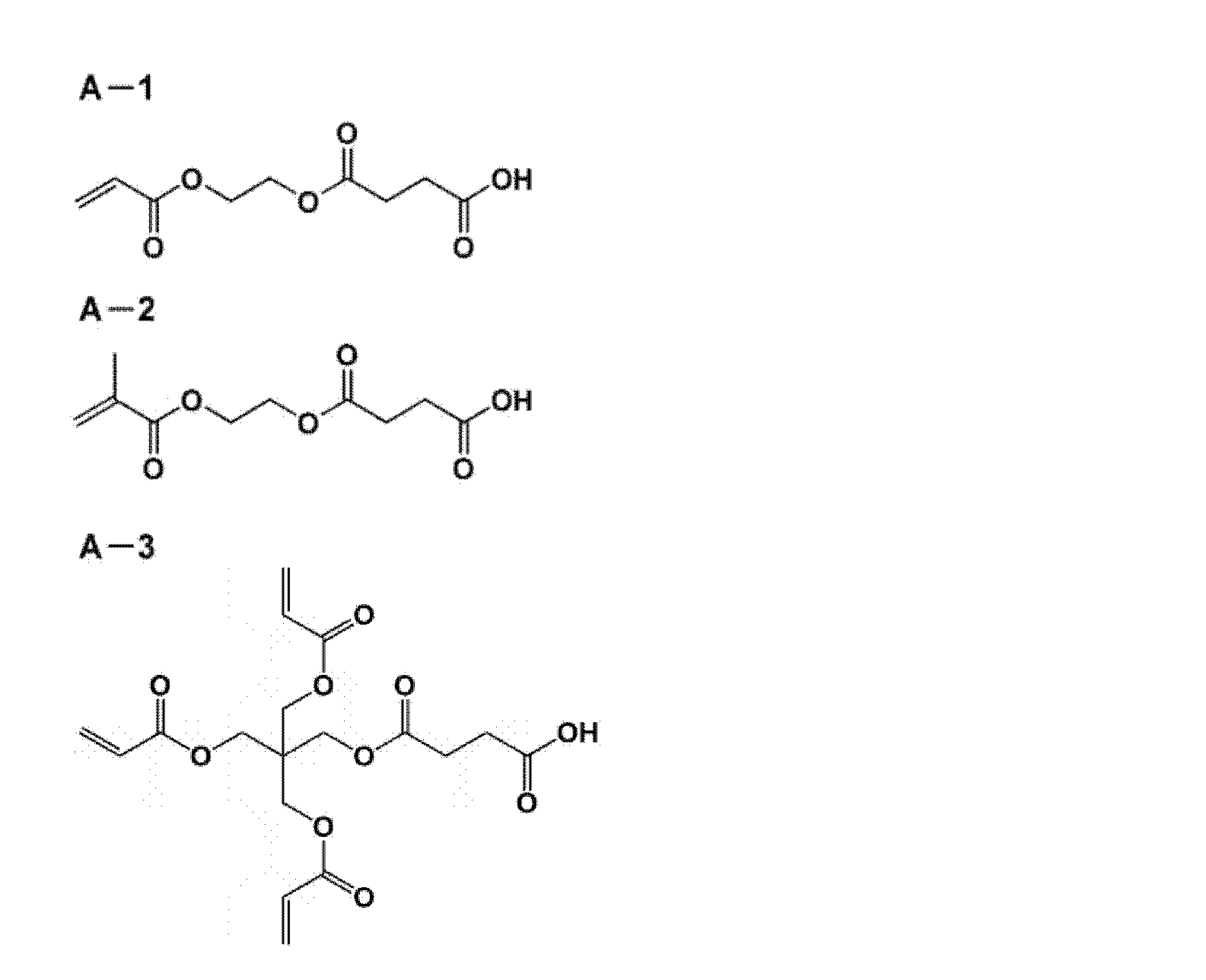
- actinic radiation polymerizable compounds having a carboxyl group examples include (meth)acrylic acid, carboxyethyl (meth)acrylate, 2-acryloyloxyethyl-phthalic acid, 2-acryloyloxyethylhexahydrophthalic acid, etc.
- the radical polymerizable compounds are preferably (meth)acrylic acid and carboxyethyl (meth)acrylate.
- (meth)acrylate means acrylate or methacrylate
- (meth)acrylic means acrylic or methacrylic.
- the actinic radiation polymerizable compound having a carboxyl group may be monofunctional or polyfunctional. From the viewpoint of preventing a decrease in adhesion due to cure shrinkage of the insulating film, it is preferable that the actinic radiation polymerizable compound having a carboxyl group is a compound having five or fewer functionalities.
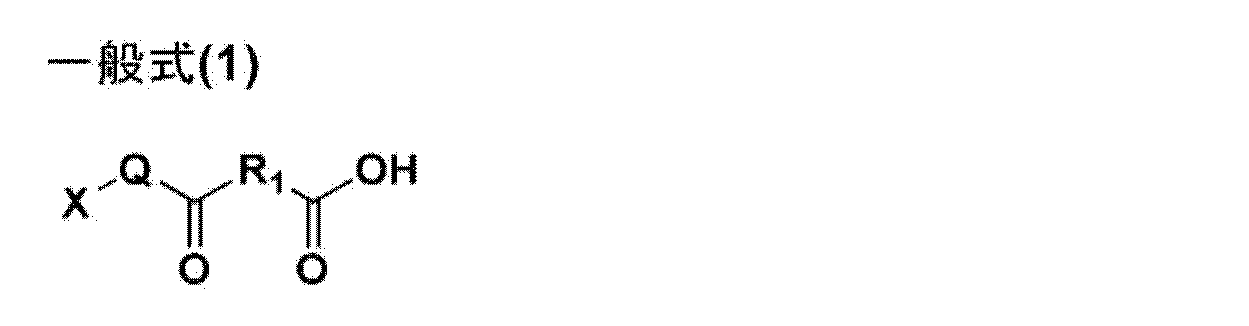
- the actinic radiation polymerizable compound having a carboxyl group is preferably a compound represented by general formula (1).
- R1 represents an unsubstituted alkylene group having 1 to 6 carbon atoms
- Q represents an oxygen atom or NR2
- R2 represents a hydrogen atom, a substituted or unsubstituted alkyl group, or a substituted or unsubstituted aryl group
- X represents a structure derived from an alcohol or an amine and containing at least one polymerizable group selected from the group consisting of a (meth)acryloyl group, an aryl group, and a vinyl group at its terminal.
- R 1 is preferably an unsubstituted alkylene group having 1 to 4 carbon atoms, and from the viewpoint of further enhancing the adhesion, R 1 is preferably an unsubstituted alkylene group having 1 or 2 carbon atoms.
- Q is preferably an oxygen atom.
- the polymerizable group at the end of X is preferably a (meth)acryloyl group.
- the (meth)acryloyl group is highly reactive and therefore easily polymerized and incorporated into the coating film. Therefore, a compound having a (meth)acryloyl group as a polymerizable group can fully exert the effect of improving adhesion due to the carboxyl group.
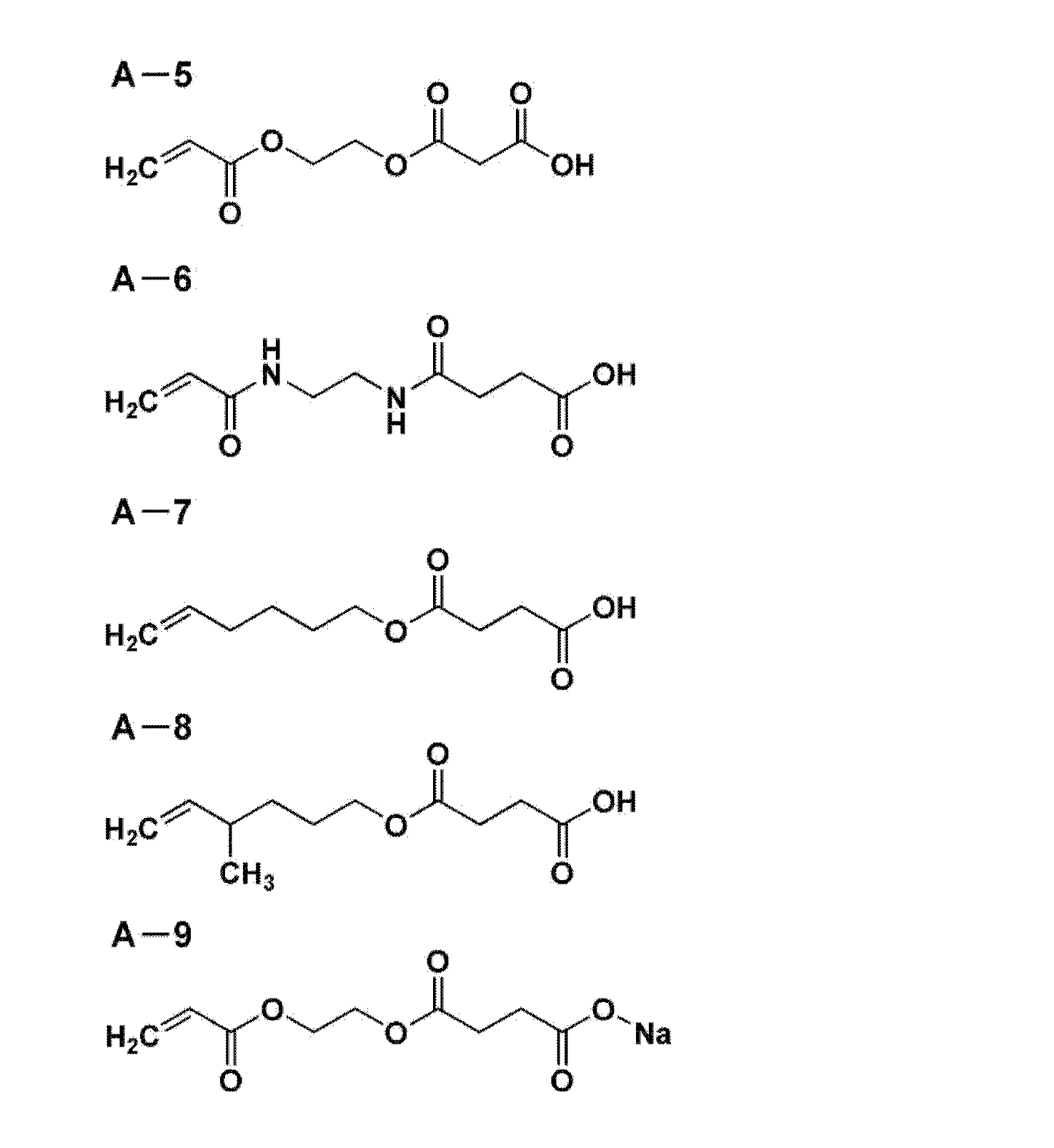
- Examples of compounds represented by general formula (1) include the compounds shown below.
- the actinic radiation polymerizable compound having a carboxyl group may be either a monomer or an oligomer, but is preferably a monomer.
- the term "monomer” refers to an actinic radiation polymerizable compound that is a monomer having a molecular weight of less than 700. The molecular weight can be measured by gel permeation chromatography.
- the content of the actinic radiation-polymerizable compound having a carboxyl group is preferably 1% by mass or more and 50% by mass or less, and more preferably 3% by mass or more and 20% by mass or less, based on the total mass of the actinic radiation-curable inkjet ink composition.
- the content of 1% by mass or more it is possible to more sufficiently increase the adhesion of the insulating film to the metal surface.
- oligomer refers to an actinic radiation polymerizable compound having a molecular weight of 700 to 10,000 and being a dimer or trimer or more.
- the molecular weight of the amine-modified oligomer is preferably 800 to 5,000. The molecular weight can be measured by gel permeation chromatography.
- the amine-modified oligomer is preferably a radically polymerizable compound.
- examples of the amine-modified oligomer as a radically polymerizable compound include amine-modified (meth)acrylates.
- the content of the amine-modified oligomer is preferably 10% by mass or more and 100% by mass or less, and more preferably 20% by mass or more and 75% by mass or less, based on the total mass of the actinic radiation-polymerizable compound having a carboxyl group. If it is 25% by mass or more, the water absorption of the insulating film can be further suppressed, and insulation failure of the insulating film in a high-humidity environment can be further suppressed. If it is 100% by mass or less, the decrease in the content of the actinic radiation-polymerizable compound having a carboxyl group can be suppressed, and adhesion can be more sufficiently increased.
- the actinic ray polymerizable compound may contain other actinic ray polymerizable compounds in addition to the actinic ray polymerizable compound having a carboxyl group and the amine-modified oligomer.
- actinic radiation polymerizable compounds include radically polymerizable compounds and cationic polymerizable compounds. Of these, it is preferable that the actinic radiation polymerizable compound is a radically polymerizable compound.
- radically polymerizable compounds examples include unsaturated carboxylic acid esters and (meth)acrylates. Of these, (meth)acrylates are preferred.
- the (meth)acrylates may be monofunctional or polyfunctional.
- Examples of monofunctional (meth)acrylates include isoamyl acrylate, stearyl acrylate, lauryl acrylate, octyl acrylate, decyl acrylate, isomyristyl acrylate, isostearyl acrylate, 2-ethylhexyl-diglycol acrylate, butoxyethyl acrylate, ethoxydiethylene glycol acrylate, methoxydiethylene glycol acrylate, methoxypolyethylene glycol acrylate, methoxypropylene glycol acrylate, phenoxyethyl acrylate, o-phenylphenol acrylate, nonylphenol acrylate, 2-hydroxy-3-phenoxypropyl acrylate, cumylphenoxylethyl acrylate, tetrahydrofurfuryl acrylate, isobornyl acrylate, 2-hydroxyethyl acrylate, 2-hydroxypropyl acrylate, 2-hydroxybutyl acryl
- bifunctional (meth)acrylates include triethylene glycol di(meth)acrylate, tetraethylene glycol di(meth)acrylate, polyethylene glycol di(meth)acrylate, dipropylene glycol di(meth)acrylate, tripropylene glycol di(meth)acrylate, polypropylene glycol di(meth)acrylate, 1,4-butanediol di(meth)acrylate, 1,6-hexanediol di(meth)acrylate, 1,9-nonanediol di(meth)acrylate, neopentyl glycol di(meth)acrylate, bisphenol A PO adduct di(meth)acrylate, hydroxypivalic acid neopentyl glycol di(meth)acrylate, polytetramethylene glycol di(meth)acrylate, and tricyclodecane dimethanol di(meth)acrylate.
- trifunctional or higher (meth)acrylates examples include trimethylolpropane tri(meth)acrylate, pentaerythritol tri(meth)acrylate, pentaerythritol tetra(meth)acrylate, dipentaerythritol hexa(meth)acrylate, ditrimethylolpropane tetra(meth)acrylate, glycerin propoxy tri(meth)acrylate, and pentaerythritol ethoxy tetra(meth)acrylate.
- the (meth)acrylate may be, for example, modified with an alkylene oxide such as ethylene oxide (EO) or propylene oxide (PO), or with caprolactone (modified (meth)acrylate).
- modified (meth)acrylates include o-phenylphenol EO-modified (meth)acrylate, EO-modified trimethylolpropane tri(meth)acrylate, EO-modified pentaerythritol tetra(meth)acrylate, EO-modified hexanediol di(meth)acrylate, PO-modified trimethylolpropane tri(meth)acrylate, PO-modified pentaerythritol tetra(meth)acrylate, nonylphenol PO-modified (meth)acrylate, propoxylated neopentyl glycol di(meth)acrylate, propoxylated trimethylolpropane tri(meth)acrylate, caprolactone-modified
- Examples of cationic polymerizable compounds include epoxy compounds, vinyl ether compounds, and oxetane compounds.
- epoxy compounds examples include 3,4-epoxycyclohexylmethyl-3',4'-epoxycyclohexanecarboxylate, bis(3,4-epoxycyclohexylmethyl)adipate, vinylcyclohexene monoepoxide, ⁇ -caprolactone-modified 3,4-epoxycyclohexylmethyl-3',4'-epoxycyclohexanecarboxylate, 1-methyl-4-(2-methyloxiranyl)-7-oxabicyclo[4,1,0]heptane, 2-(3,4-epoxycyclohexyl-5,5-spiro-3 ,4-epoxy)cyclohexanone-meta-dioxane and bis(2,3-epoxycyclopentyl)ether, diglycidyl ether of 1,4-butanediol, diglycidyl ether of 1,6-hexanediol, triglycidyl ether
- vinyl ether compounds include monovinyl ether compounds such as ethyl vinyl ether, n-butyl vinyl ether, isobutyl vinyl ether, octadecyl vinyl ether, cyclohexyl vinyl ether, hydroxybutyl vinyl ether, 2-ethylhexyl vinyl ether, cyclohexanedimethanol monovinyl ether, n-propyl vinyl ether, isopropyl vinyl ether, isopropenyl ether-o-propylene carbonate, dodecyl vinyl ether, diethylene glycol monovinyl ether, and octadecyl vinyl ether, as well as di- or trivinyl ether compounds such as ethylene glycol divinyl ether, diethylene glycol divinyl ether, triethylene glycol divinyl ether, propylene glycol divinyl ether, dipropylene glycol divinyl ether, butanediol diviny
- oxetane compounds include 3-hydroxymethyl-3-methyloxetane, 3-hydroxymethyl-3-ethyloxetane, 3-hydroxymethyl-3-propyloxetane, 3-hydroxymethyl-3-n-butyloxetane, 3-hydroxymethyl-3-phenyloxetane, 3-hydroxymethyl-3-benzyloxetane, 3-hydroxyethyl-3-methyloxetane, 3-hydroxyethyl-3-ethyloxetane, 3-hydroxyethyl-3-propyloxetane, 3-hydroxyethyl These include 1,4-bis ⁇ [(3-ethyl-3-oxetanyl)methoxy]methyl ⁇ benzene, 3-ethyl-3-(2-ethylhexyloxymethyl)oxetane, and di[1-ethyl(3-oxetanyl)]methyl ether.
- the content of other actinic radiation polymerizable compounds is preferably 50% by mass or more and 90% by mass or less based on the total mass of the actinic radiation curable inkjet ink composition.
- the actinic ray curable inkjet ink composition may contain a polymerization initiator.
- the polymerization initiator is a compound that initiates polymerization and crosslinking of the actinic radiation polymerizable compound by irradiation with actinic radiation. Note that when the ink is cured by irradiation with electron beams, for example, polymerization and crosslinking of the actinic radiation polymerizable compound can be initiated without a polymerization initiator, in which case the ink does not need to contain a polymerization initiator.
- the polymerization initiator can be a radical polymerization initiator when the ink contains a radically polymerizable compound, and a cationic polymerization initiator when the ink contains a cationic polymerizable compound.
- radical polymerization initiators include intramolecular bond cleavage type radical polymerization initiators and intramolecular hydrogen abstraction type radical polymerization initiators.
- intramolecular bond cleavage type radical polymerization initiators include acetophenone-based initiators such as diethoxyacetophenone, 2-hydroxy-2-methyl-1-phenylpropan-1-one, benzyl dimethyl ketal, 1-(4-isopropylphenyl)-2-hydroxy-2-methylpropan-1-one, 4-(2-hydroxyethoxy)phenyl-(2-hydroxy-2-propyl)ketone, 1-hydroxycyclohexyl-phenyl ketone, 2-methyl-2-morpholino(4-methylthiophenyl)propan-1-one, and 2-benzyl-2-dimethylamino-1-(4-morpholinophenyl)-butanone; benzoin-based initiators such as benzoin, benzoin methyl ether, and benzoin isopropyl ether; acylphosphine oxide-based initiators such as bis-2,4,6-trimethylbenzoin diphenylphosphine oxide, benzyl,
- intramolecular hydrogen abstraction type radical polymerization initiators include benzophenone-based initiators such as benzophenone, o-benzoylmethylbenzoate, 4-phenylbenzophenone, 4,4'-dichlorobenzophenone, hydroxybenzophenone, 4-benzoyl-4'-methyl-diphenyl sulfide, acrylated benzophenone, 3,3',4,4'-tetra(t-butylperoxycarbonyl)benzophenone, and 3,3'-dimethyl-4-methoxybenzophenone; thioxanthone-based initiators such as 2-isopropylthioxanthone, 2,4-dimethylthioxanthone, 2,4-diethylthioxanthone, and 2,4-dichlorothioxanthone; aminobenzophenone-based initiators such as Michler's ketone and 4,4'-diethylaminobenzophenone; 10-butyl-2-ch
- Examples of the cationic polymerization initiator include photoacid generators, such as B(C 6 F 5 ) 4 ⁇ , PF 6 ⁇ , AsF 6 ⁇ , SbF 6 ⁇ , and CF 3 SO 3 ⁇ salts of aromatic onium compounds including diazonium, ammonium, iodonium , sulfonium, and phosphonium, sulfonates that generate sulfonic acid, halides that photogenerate hydrogen halide, and iron - allene complexes.
- photoacid generators such as B(C 6 F 5 ) 4 ⁇ , PF 6 ⁇ , AsF 6 ⁇ , SbF 6 ⁇ , and CF 3 SO 3 ⁇ salts of aromatic onium compounds including diazonium, ammonium, iodonium , sulfonium, and phosphonium, sulfonates that generate sulfonic acid, halides that photogenerate hydrogen halide
- the content of the polymerization initiator is preferably 1% by mass or more and 10% by mass or less, and more preferably 2% by mass or more and 8% by mass or less, based on the total mass of the actinic radiation curable inkjet ink composition.
- the actinic ray curable inkjet ink composition may contain a gelling agent.
- the gelling agent causes the ink to become a sol when heated and gel when it is close to room temperature. This allows the ink to be ejected from the inkjet head after being heated and turned into a sol, and then the ink can be temporarily solidified by landing on a recording medium and cooling it, improving the pinning ability of the ink. This prevents the ink from wetting and spreading, making it less likely for adjacent dots to be identical, allowing for the formation of more precise patterns.
- the actinic radiation curable ink composition contains a gelling agent, the hydrophobicity of the insulating film formed is increased, which further suppresses water absorption by the insulating film. This further suppresses the occurrence of ion migration in a high humidity environment, and sufficiently suppresses the deterioration of insulating properties.
- the gelling agent is preferably a compound that dissolves in the actinic radiation polymerizable compound contained in the ink at a temperature higher than the gelling temperature of the ink, and crystallizes in the ink at a temperature lower than the gelling temperature of the ink.
- gelling temperature means the temperature at which the ink undergoes a phase transition from sol to gel and the viscosity of the ink suddenly changes when the ink, which has been solated or liquefied by heating, is cooled.
- the solated or liquefied ink is cooled while its viscosity is measured with a rheometer (e.g., MCR300, manufactured by Anton Paar), and the temperature at which the viscosity suddenly increases can be determined as the gelling temperature of the ink.
- a rheometer e.g., MCR300, manufactured by Anton Paar
- the gelling agent preferably crystallizes in the ink at a temperature below the gelling temperature of the ink, forming a structure in which the radical polymerizable compound is encapsulated in a three-dimensional space formed by the gelling agent that has crystallized into a plate shape (such a structure will be referred to as a "house of cards structure” hereinafter).
- a structure in which the radical polymerizable compound is encapsulated in a three-dimensional space formed by the gelling agent that has crystallized into a plate shape (such a structure will be referred to as a "house of cards structure" hereinafter).
- the liquid actinic radiation polymerizable compound is retained within the space, making it more difficult for the dots formed by the ink adhering to the recording medium to wet and spread, and improving the pinning ability of the ink. This makes it more difficult for the dots formed by the ink adhering to the recording medium to coalesce with each other.
- aliphatic ketones examples include dilignoceryl ketone, dibehenyl ketone, distearyl ketone, dieicosyl ketone, dipalmityl ketone, dilauryl ketone, dimyristyl ketone, myristyl palmityl ketone and palmityl stearyl ketone.
- fatty esters examples include fatty acid esters of monoalcohols such as behenyl behenate, icosanoic acid ethyl ester, stearyl stearate, palmityl stearate, myristyl myristate, cetyl myristate, and oleyl palmitate; and fatty acid esters of polyhydric alcohols such as glycerin fatty acid esters, sorbitan fatty acid esters, propylene glycol fatty acid esters, ethylene glycol fatty acid esters, and polyoxyethylene fatty acid esters.
- monoalcohols such as behenyl behenate, icosanoic acid ethyl ester, stearyl stearate, palmityl stearate, myristyl myristate, cetyl myristate, and oleyl palmitate
- fatty acid esters of polyhydric alcohols such as glycerin fatty acid esters, sorbit
- EMALEX is a registered trademark of the company
- Rikemal is a registered trademark of the company
- Poem manufactured by Riken Vitamin Co., Ltd.
- higher fatty acids examples include behenic acid, arachidic acid, stearic acid, palmitic acid, myristic acid, lauric acid, oleic acid, and erucic acid.
- higher alcohols examples include stearyl alcohol and behenyl alcohol.
- the gelling agent is preferably an aliphatic ketone, an aliphatic ester, a higher fatty acid, or a higher alcohol, and more preferably an aliphatic ketone represented by the following general formula (G1) or an aliphatic ester represented by the following general formula (G2). Only one type of gelling agent may be included, or two or more types may be included in combination.
- R a and R b independently represent a linear hydrocarbon group having 12 to 26 carbon atoms which may have a branched chain
- R c and R d independently represent a linear hydrocarbon group having 12 to 26 carbon atoms which may have a branched chain
- Examples of aliphatic ketones represented by general formula (G1) include dilignoceryl ketone (carbon number: 23-24), dibehenyl ketone (carbon number: 21-22), distearyl ketone (carbon number: 17-18), dieicosyl ketone (carbon number: 19-20), dipalmityl ketone (carbon number: 15-16), dimyristyl ketone (carbon number: 13-14), dilauryl ketone (carbon number: 11-12), lauric acid ketone (carbon number: 13-14 ...
- ketones examples include myristyl myristyl ketone (carbon number: 11-14), lauryl palmityl ketone (11-16), myristyl palmityl ketone (13-16), myristyl stearyl ketone (13-18), myristyl behenyl ketone (13-22), palmityl stearyl ketone (15-18), palmityl behenyl ketone (15-22) and stearyl behenyl ketone (17-22).
- the number of carbon atoms in the parentheses above indicates the number of carbon atoms in each of the two hydrocarbon groups separated by the carbonyl group.
- G1 Commercially available examples of the compound represented by general formula (G1) include 18-Pentatriacontanon and Hentriacontan-16-on (both manufactured by Alfa Aeser), and Kaowax T1 (manufactured by Kao Corporation).
- Examples of aliphatic esters represented by general formula (G2) include behenyl behenate (carbon number: 21-22), icosanoic acid icosyl (carbon number: 19-20), stearyl stearate (carbon number: 17-18), palmityl stearate (carbon number: 17-16), lauryl stearate (carbon number: 17-12), cetyl palmitate (carbon number: 15-16), stearyl palmitate (carbon number: 15-18), myrisol, These include myristyl myristate (carbon number: 13-14), cetyl myristate (carbon number: 13-16), octyldodecyl myristate (carbon number: 13-20), stearyl oleate (carbon number: 17-18), stearyl erucate (carbon number: 21-18), stearyl linoleate (carbon number: 17-18), behenyl oleate (carbon number: 18-22), and arachidyl linoleate (carbon number:
- aliphatic esters represented by general formula (G2) include Unistar M-2222SL,sperm Acetate, Nissan Elector WEP-2 and Nissan Elector WEP-3 (all manufactured by NOF Corporation, "Unistar” and “Nissan Elector” are registered trademarks of the company), Exepar SS and Exepar MY-M (both manufactured by Kao Corporation, “Exepar” is a registered trademark of the company), EMALEX CC-18 and EMALEX CC-10 (manufactured by Nippon Emulsion Co., Ltd., "EMALEX” is a registered trademark of the company), and Amureps PC (manufactured by Kokyu Alcohol Kogyo Co., Ltd., "Amureps” is a registered trademark of the company). These commercially available products are often mixtures of two or more types, so they may be separated and purified as necessary before being added to the ink.
- the content of the gelling agent is preferably 1% by mass or more and 10% by mass or less, and more preferably 1% by mass or more and 5% by mass or less, relative to the total mass of the ink.
- the content is 1% by mass or more, water absorption by the insulating film can be further suppressed, and deterioration of insulating properties in high humidity environments can be further suppressed.
- the content is 10% by mass or less, the solubility of the gelling agent in the actinic radiation polymerizable compound can be further increased.
- the actinic ray curable inkjet ink composition according to this embodiment may further contain other components such as a colorant, a surfactant, a polymerization inhibitor, and a moisturizer, as long as the effects of the present invention are achieved.
- the colorant may be a dye or a pigment, with pigments being preferred since they have good dispersibility in the components of the ink and are weather resistant.
- the pigment may be selected from, for example, yellow pigments, red pigments, blue pigments, black pigments, and white pigments depending on the color of the image to be formed.
- yellow pigments examples include Pigment Yellow (PY) 1, 3, 12, 13, 14, 17, 34, 35, 37, 55, 74, 81, 83, 93, 94, 95, 97, 108, 109, 110, 137, 138, 139, 153, 154, 155, 157, 166, 167, 168, 180, 185, and 193.
- PY185 and PY150 are preferred from the viewpoint of further reducing the amount of impurities in the ink composition and further increasing the electrical resistance value of the insulating film.
- red pigments examples include Pigment Red (PR) 3, 5, 19, 22, 31, 38, 43, 48:1, 48:2, 48:3, 48:4, 48:5, 49:1, 53:1, 57:1, 57:2, 58:4, 63:1, 81, 81:1, 81:2, 81:3, 81:4, 88, 104, 108, 112, 122, 123 , 144, 146, 149, 166, 168, 169, 170, 177, 178, 179, 184, 185, 208, 216, 226, 257, Pigment Violet (PV) 3, 19, 23, 29, 30, 37, 50, 88, Pigment Orange (PO) 13, 16, 20, 36, etc.
- PR122 and PV19 are preferred from the viewpoint of further reducing the amount of impurities in the ink composition and further increasing the electrical resistance value of the insulating film.
- blue pigments examples include Pigment Blue (PB) 1, 15, 15:1, 15:2, 15:3, 15:4, 15:6, 16, 17:1, 22, 27, 28, 29, 36, and 60.
- PB15:3 and PB15:4 are preferred from the viewpoint of further reducing the amount of impurities in the ink composition and further increasing the electrical resistance value of the insulating film.
- green pigments examples include C.I. Pigment Green (hereinafter simply referred to as "PG") 7, PG 26, PG 36, and PG 50.
- black pigments examples include C.I. Pigment Black (hereinafter simply referred to as "PBk”) 7, PBk26, and PBk28.
- the white pigment may be any pigment that imparts a white color to the cured film formed by curing the white ink.
- white pigments include inorganic pigments such as titanium oxide, zinc oxide, calcium carbonate, barium sulfate, and aluminum hydroxide. Of these, titanium oxide is preferred.
- the crystal form of the titanium oxide may be any of rutile, anatase, and brookite types, but from the viewpoint of making it easier to make the white pigment into a smaller particle size, the anatase type, which has a low specific gravity, is preferred, and from the viewpoint of further increasing the concealment of the image formed, the rutile type, which has a large refractive index in the visible light range, is preferred.
- the content of the colorant is preferably 0.1% by mass or more and 10% by mass or less, and more preferably 1% by mass or more and 5% by mass or less, relative to the total mass of the ink composition.
- the content of the pigment is preferably 20% by mass or less, and more preferably 10% by mass or less, relative to the total mass of the ink composition.
- the ink composition may contain a pigment dispersant.
- pigment dispersants include carboxylate esters with hydroxyl groups, salts of long-chain polyaminoamides and high molecular weight acid esters, salts of high molecular weight polycarboxylic acids, salts of long-chain polyaminoamides and polar acid esters, high molecular weight unsaturated acid esters, polymer copolymers, modified polyurethanes, modified polyacrylates, polyether ester-type anionic surfactants, naphthalenesulfonic acid formalin condensate salts, aromatic sulfonic acid formalin condensate salts, polyoxyethylene alkyl phosphate esters, polyoxyethylene nonylphenyl ether, and stearylamine acetate.
- examples of commercially available dispersants include the Solsperse (registered trademark) series manufactured by Avecia and the PB series manufactured by Ajinomoto Fine-Techno Co., Ltd.
- the content of the pigment dispersant is preferably 1% by mass or more and 50% by mass or less relative to the mass of the pigment.
- surfactant examples include anionic surfactants such as dialkyl sulfosuccinates, alkyl naphthalene sulfonates, and fatty acid salts; nonionic surfactants such as polyoxyethylene alkyl ethers, polyoxyethylene alkyl allyl ethers, acetylene glycols, and polyoxyethylene-polyoxypropylene block copolymers; cationic surfactants such as alkylamine salts and quaternary ammonium salts; and silicone-based and fluorine-based surfactants.
- anionic surfactants such as dialkyl sulfosuccinates, alkyl naphthalene sulfonates, and fatty acid salts
- nonionic surfactants such as polyoxyethylene alkyl ethers, polyoxyethylene alkyl allyl ethers, acetylene glycols, and polyoxyethylene-polyoxypropylene block copolymers
- cationic surfactants
- silicone surfactants include Tego Rad 2250 (Evonik), KF-351A, KF-352A, KF-642 and X-22-4272 (Shin-Etsu Chemical Co., Ltd.), BYK307, BYK345, BYK347 and BYK348 (BYK-Chemie ("BYK” is a registered trademark of the company)), and TSF4452 (Momentive Performance Materials).
- fluorosurfactants include Megafac F (manufactured by DIC Corporation ("Megafac” is a registered trademark of the company)), Surflon (manufactured by AGC Sei Chemical Co., Ltd. ("Surflon” is a registered trademark of the company)), Fluorad FC (manufactured by 3M Corporation (“Fluorad” is a registered trademark of the company)), Monflor (manufactured by Imperial Chemical Industries Co., Ltd.), Zonyls (manufactured by E.I. DuPont Nemelas and Company), Licowet VPF (manufactured by Lubewerke Hoechst), and FTERGENT (manufactured by Neos Corporation (“FTERGENT” is a registered trademark of the company)).
- Megafac F manufactured by DIC Corporation
- Surflon manufactured by AGC Sei Chemical Co., Ltd.
- Fluorad FC manufactured by 3M Corporation
- Monflor manufactured by Imperial Chemical
- the amount of surfactant contained in the ink relative to the total mass is not particularly limited as long as the effects of the present invention are achieved, but it can be, for example, 0.001% by mass or more and less than 1.0% by mass.
- polymerization inhibitor examples include N-oxyl-based polymerization inhibitors, phenol-based polymerization inhibitors, quinone-based polymerization inhibitors, amine-based polymerization inhibitors, copper dithiocarbamate-based polymerization inhibitors, etc.
- the polymerization inhibitor may be contained in the ink alone or in combination of two or more types.
- N-oxyl polymerization inhibitors examples include 4-hydroxy-2,2,6,6-tetramethylpiperidine-N-oxyl (TEMPO), 4-hydroxy-2,2,6,6-tetramethyl-piperidine-N-oxyl, 4-oxo-2,2,6,6-tetramethyl-piperidine-N-oxyl, 4-methoxy-2,2,6,6-tetramethyl-piperidine-N-oxyl, and 4-acetoxy-2,2,6,6-tetramethyl-piperidine-N-oxyl.
- TEMPO 4-hydroxy-2,2,6,6-tetramethylpiperidine-N-oxyl
- 4-oxo-2,2,6,6-tetramethyl-piperidine-N-oxyl 4-methoxy-2,2,6,6-tetramethyl-piperidine-N-oxyl
- 4-acetoxy-2,2,6,6-tetramethyl-piperidine-N-oxyl examples include 4-acetoxy-2,2,6,6-tetramethyl-piperidine-N-oxyl (
- phenolic polymerization inhibitors examples include 2,6-di-tert-butylphenol, 2,4-di-tert-butylphenol, 2-tert-butyl-4,6-dimethylphenol, 2,6-di-tert-butyl-4-methylphenol, 2,4,6-tri-tert-butylphenol, 2,6-di-t-butyl-p-cresol (butylated hydroxytoluene: BHT), 4-methoxyphenol, and 2-methoxy-4-methylphenol.
- BHT butylated hydroxytoluene
- quinone polymerization inhibitors examples include hydroquinone, methoxyhydroquinone, benzoquinone, 1,4-naphthoquinone, p-tert-butylcatechol, etc.
- amine polymerization inhibitors examples include alkylated diphenylamines, N,N'-diphenyl-p-phenylenediamine, and phenothiazine.
- copper dithiocarbamate polymerization inhibitors examples include copper dimethyldithiocarbamate, copper diethyldithiocarbamate, copper dibutyldithiocarbamate, etc.
- the content of the polymerization inhibitor is not particularly limited as long as the effects of the present invention are achieved, but for example, it is preferably from 0.01% by mass to 1% by mass, and more preferably from 0.05% by mass to 0.5% by mass, relative to the total mass of the actinic radiation curable inkjet ink composition.
- the viscosity of the ink composition at 40° C. is preferably 7 mPa ⁇ s or more and 15 mPa ⁇ s or less, and more preferably 8 mPa ⁇ s or more and 13 mPa ⁇ s or less.
- the viscosity is in the above range, the ejection stability of the ink can be further improved.
- the viscosity of the ink composition at 80°C is preferably 3 mPa ⁇ s or more and 20 mPa ⁇ s or less, and more preferably 7 mPa ⁇ s or more and 9 mPa ⁇ s or less.
- the ink composition contains a gelling agent
- the gelling temperature of the ink composition is also preferably 40°C or higher and 70°C or lower.
- the gelling temperature of the ink composition is 40°C or higher, the ink quickly gels after landing on the recording medium, resulting in higher pinning properties.
- the gelling temperature of the ink is 70°C or lower, the ink is less likely to gel when ejected from an inkjet head, where the ink temperature is usually around 80°C, and therefore the ink can be ejected more stably.
- the viscosity at 40°C, the viscosity at 80°C, and the gelling temperature of the inkjet ink can be determined by measuring the temperature change of the dynamic viscoelasticity of the ink using a rheometer (e.g., a stress-controlled rheometer, Physica MCR series, manufactured by Anton Paar). Specifically, the ink is heated to 100°C and cooled to 25°C under conditions of a shear rate of 11.7 (1/s) and a cooling rate of 0.1°C/s, and a viscosity temperature change curve is obtained.
- the viscosities at 40°C and 80°C can be determined by reading the viscosities at 40°C and 80°C, respectively, on the viscosity temperature change curve.
- the gelling temperature can be determined as the temperature at which the viscosity becomes 200 mPa ⁇ s on the viscosity temperature change curve.
- the ink according to this embodiment can be prepared by mixing the above-mentioned components. At this time, it is preferable to mix the components while heating them in order to increase the solubility of each component.
- a pigment dispersion containing the pigment and the pigment dispersant may be prepared in advance, and the remaining components may be added and mixed to this.
- the pigment can be dispersed using, for example, a ball mill, sand mill, attritor, roll mill, agitator, Henschel mixer, colloid mill, ultrasonic homogenizer, pearl mill, wet jet mill, paint shaker, etc.
- the actinic radiation-curable inkjet ink composition according to this embodiment can be used to form an insulating film for electronic components. Therefore, the ink composition can be used, for example, as a solder resist ink for forming an insulating film on a printed wiring board, an ink for forming an insulating film on a semiconductor/IC package and an RFID antenna, an ink for a semiconductor sealant, an ink for an underfill material, an ink for a die bonding material, an ink for a black matrix of an LED or an image display device, an ink for a multilayer board prepreg, and the like.
- a solder resist ink for forming an insulating film on a printed wiring board
- an ink for forming an insulating film on a semiconductor/IC package and an RFID antenna an ink for a semiconductor sealant
- an ink for an underfill material an ink for a die bonding material
- an ink for a black matrix of an LED or an image display device an ink for
- the insulating film forming method includes the steps of applying the actinic ray curable inkjet ink composition to a metal surface of an electronic member, and irradiating the applied ink composition with actinic rays to cure the ink composition.
- the ejection method from the inkjet head may be either an on-demand method or a continuous method.
- On-demand inkjet heads may be of the electro-mechanical conversion type, such as the single cavity type, double cavity type, bender type, piston type, shear mode type, and shared wall type, or of the electro-thermal conversion type, such as the thermal inkjet type and bubble jet type ("Bubble Jet" is a registered trademark of Canon Inc.).
- the temperature of the ink when it is filled into the inkjet head is set to 40°C or higher and 100°C or lower, and it is even more preferable to set it to 40°C or higher and 90°C or lower.
- the ink droplets are ejected from the inkjet head in a heated, solvated state, so it is preferable to set the temperature of the ink when filled into the inkjet head to the gelling temperature of the ink + 10°C or higher and the gelling temperature + 30°C or lower. If the temperature of the actinic radiation curable ink in the inkjet head is the gelling temperature + 10°C or higher, the ink is less likely to gel inside the inkjet head or on the nozzle surface, resulting in a decrease in ejection performance. On the other hand, if the temperature of the ink in the inkjet head is the gelling temperature + 30°C or lower, the components are less likely to deteriorate due to high temperatures.
- At least one of the ink supply system such as the ink tank that constitutes the head carriage, the supply pipe, and the anterior ink tank immediately before the head, the piping with a filter, and the piezo head, can be heated by a panel heater, ribbon heater, or heated water.
- the amount of ink droplets ejected is preferably 3.0 pL or more and 9.0 pL or less, from the viewpoint of increasing the pattern formation speed while forming finer patterns.
- Examples of electronic components include printed wiring boards, semiconductor/IC packages, mini micro LEDs, etc.
- Examples of the types of metals in the above metal surfaces include copper, nickel, aluminum, etc.
- Actinic Ray Irradiation Step the ink applied to the metal surface is irradiated with actinic rays to cure the ink.
- the actinic radiation can be selected from, for example, electron beams, ultraviolet rays, alpha rays, gamma rays, and X-rays, but is preferably ultraviolet rays or electron beams.
- the ultraviolet rays are preferably light having a peak wavelength of 360 nm or more and 410 nm or less.
- the ultraviolet rays are preferably irradiated from an LED light source. LEDs emit less radiant heat compared to conventional light sources (such as metal halide lamps), so by using LEDs, the ink is less likely to melt when exposed to actinic radiation, and uneven gloss is less likely to occur.
- the insulating film forming method according to this embodiment may further include a step of heating the ink composition irradiated with actinic radiation. This can further promote the reaction between the carboxyl group of the actinic radiation-polymerizable compound having a carboxyl group that does not interact with the metal and the amine-modified site of the amine-modified oligomer. As a result, the insulating film becomes less likely to absorb water, and the insulating properties of the insulating film are less likely to deteriorate in a high-humidity environment.
- the actinic radiation-curable inkjet ink composition contains a gelling agent
- carrying out this process increases the fluidity of the insulating film when heated. This increases the frequency of contact between the carboxyl groups that do not interact with the metal and the amine-modified sites of the amine-modified oligomer, further promoting these reactions. As a result, the insulating film becomes even less susceptible to water absorption, and the insulating properties of the insulating film are even less likely to deteriorate in a high-humidity environment.
- the heating temperature of the ink is not particularly limited as long as the amine-modified oligomer and the free carboxyl group can react with each other, but it is preferably 140°C or higher and 180°C or lower.
- the heating time of the ink is preferably 30 minutes or higher and 120 minutes or lower, and more preferably 30 minutes or higher and 60 minutes or lower.
- the insulating film according to this embodiment is formed by irradiating the actinic ray-curable inkjet ink composition with actinic rays.
- the insulating film can be formed by the insulating film forming method described above.
- the electrical resistance value of the insulating film is 1.0 ⁇ 10 8 ⁇ or more, preferably 1.0 ⁇ 10 8 ⁇ or more and 1.0 ⁇ 10 18 ⁇ or less, more preferably 1.0 ⁇ 10 10 ⁇ or more and 1.0 ⁇ 10 18 ⁇ or less, and even more preferably 1.0 ⁇ 10 11 ⁇ or more and 1.0 ⁇ 10 18 ⁇ or less.
- the printed wiring board according to this embodiment has the insulating film described above on a substrate.
- the substrate on which the insulating film is formed can be a base substrate with a conductive film such as copper foil formed on it.
- Base substrates include rigid substrates and flexible substrates.
- rigid substrates examples include paper phenolic substrates, paper epoxy substrates, glass epoxy substrates, glass polyimide substrates, Teflon (registered trademark) substrates, PPO substrates, composite substrate epoxy substrates, etc.
- Examples of flexible substrate materials include PET film and polyimide film.
- Amine-modified oligomer 1 (non-carboxyl group-containing, molecular weight 1000, EBECRYL80, manufactured by Daicel Allnex Corporation)
- Amine-modified oligomer 2 (non-carboxyl group-containing, molecular weight 1600, CN371, manufactured by Sartomer Corporation)
- the molecular weight of the above amine-modified oligomer was determined using a GPC apparatus equipped with an "HLC-8120" (manufactured by Tosoh Corporation) and a “TSKguard column + TSKgel Super HZM-M triple column” (manufactured by Tosoh Corporation) as columns, and a calibration curve determined from a standard polystyrene sample.
- DPGDA Dipropylene glycol diacrylate
- TMP(PO)3TA Trimethylolpropane PO modified triacrylate
- Gelling agent Stearyl stearate (Excepar SS, manufactured by Kao Corporation)
- Initiator 1 Polymerization initiator Initiator 1 (Omnirad 907, manufactured by IGM Resins B.V.) Initiator 2 (Omnirad 819, manufactured by IGM Resins B.V.) Initiator 3 (Speedcure ITX, manufactured by Sartomer Corporation)
- Polymerization inhibitor Irgastab UV-10 (manufactured by BASF)
- Preparation of pigment dispersion (Preparation of yellow pigment dispersion Y) The following materials were placed in a stainless steel beaker, heated on a hot plate at 65° C. for 1 hour while stirring and dissolving, and then cooled to room temperature, after which 15.0 parts by mass of yellow pigment PY185 (Paliotol Yellow D1155, manufactured by BASF) was added to the stainless steel beaker. The mixture in the stainless steel beaker and 200 g of zirconia beads (diameter 0.5 mm) were then placed in a glass bottle and sealed. This was dispersed in a paint shaker (5400, manufactured by Red Devil) until the desired particle size was reached, and the zirconia beads were removed to prepare yellow pigment dispersion Y.
- PY185 Pigment Yellow D1155, manufactured by BASF
- Pigment dispersant 1 (EFKA PX4701, manufactured by BASF) 11.2 parts by mass Pigment dispersant 2 (Solsperse 22000, manufactured by Lubrizol) 3.0 parts by mass Dispersion medium: dipropylene glycol diacrylate 70.8 parts by mass
- Cyan pigment dispersion C was prepared in the same manner as yellow pigment dispersion Y, except that the type and amount of dispersant used and the amount of dispersion medium were changed as shown below, and the pigment added was changed to 23.0 parts by mass of cyan pigment PB15:4 (Chromofine Blue 6332JC, manufactured by Dainichiseika Color & Chemicals Mfg. Co., Ltd.).
- Pigment dispersant 1 PX4701, manufactured by BASF
- the yellow and cyan pigments mentioned above have been subjected to a water washing process to reduce the amount of impurities (conductive substances and ionic impurities).
- Inkjet Ink (Inkjet Ink 1) 4.67 parts by mass of the yellow pigment dispersion Y and 2.17 parts by mass of the cyan pigment dispersion C were mixed, and the following materials were added to the resulting mixture while stirring, to prepare an ink composition.
- ⁇ Active radiation polymerizable compound Compound A-3 10.0 parts by mass Amine-modified oligomer 1 5.0 parts by mass Dipropylene glycol diacrylate (DPGDA) 45.7 parts by mass Trimethylolpropane PO-modified triacrylate (TMP(PO)3TA) 30.0 parts by mass ⁇ Polymerization initiator> Initiator 1 3.0 parts by mass Initiator 2 3.0 parts by mass Initiator 3 2.0 parts by mass ⁇ Polymerization inhibitor> Irgastab UV-10 (manufactured by BASF) 0.1 parts by mass
- the resulting ink composition was filtered through a 3.0 ⁇ m membrane filter (manufactured by ADVANTECH) to obtain inkjet ink 1.
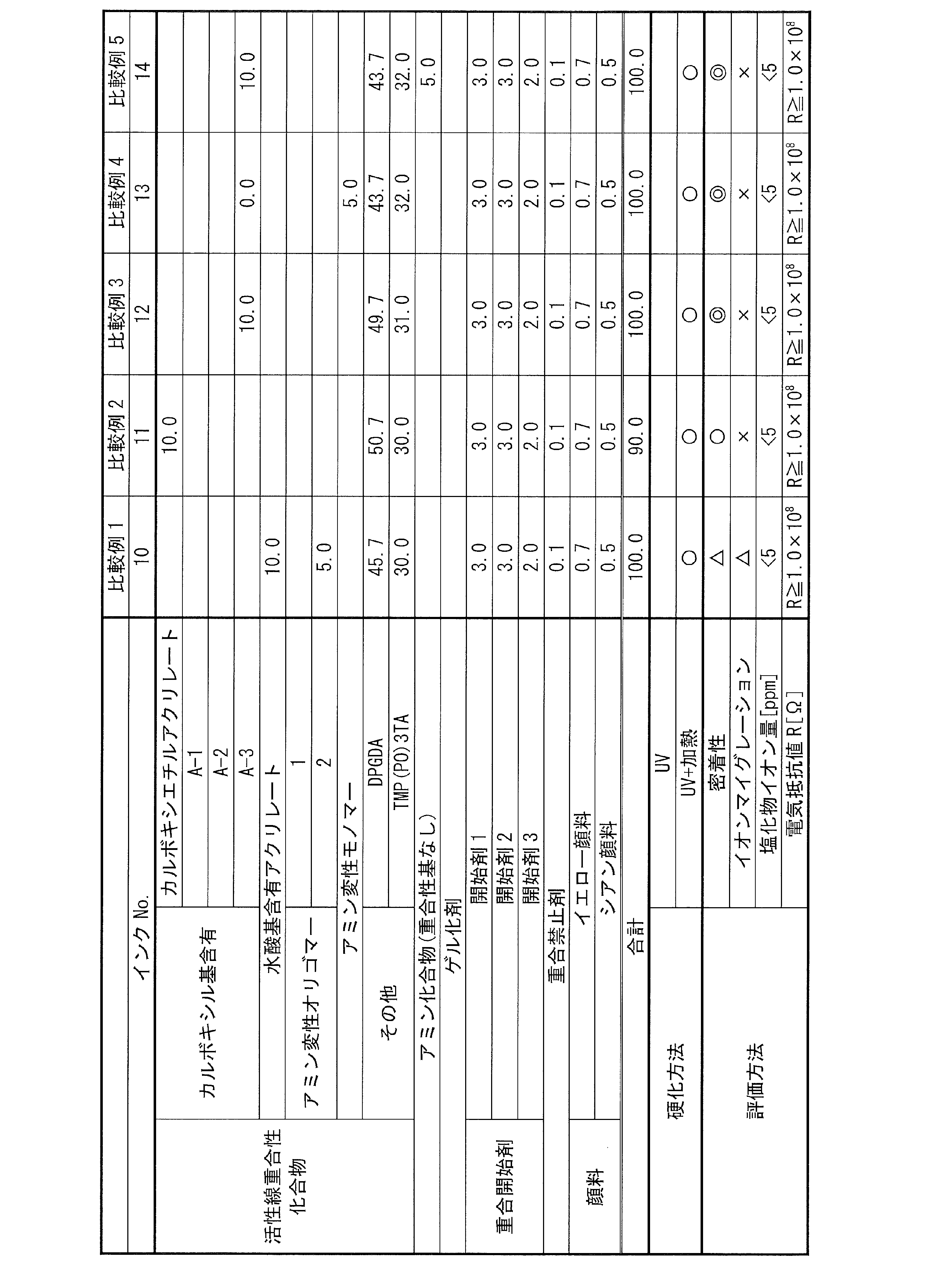
- Inkjet inks 2 to 14 were obtained in the same manner as inkjet ink 1, except that the materials and amounts used were changed to obtain the ink compositions shown in Tables 1 and 2.
- the printed pattern was irradiated with ultraviolet light using an LED lamp (Fire JetTM FJ100, manufactured by Phoseon Technology, wavelength 395 nm) at an intensity of 500 mJ/ cm2 to cure the ink layer.
- LED lamp Fiber JetTM FJ100, manufactured by Phoseon Technology, wavelength 395 nm
- the copper-clad laminate on which the pattern was formed was placed in an oven set at 150° C. and heated for 60 minutes to further cure the ink layer.
- the obtained solid pattern cured product was cut into a checkerboard pattern according to the cross-cut method of JIS K5600-5-6:1999, and adhesive tape was applied.
- the adhesive tape was peeled off, and the cured film peeled from the substrate was observed to determine the adhesion residual rate.
- the adhesion residual rate refers to the ratio of the number of squares in which the cured film remains after the tape is peeled off to the number of squares created by the above-mentioned cuts.
- the adhesion was evaluated according to the following evaluation criteria. ⁇ The adhesion residual rate is 100%.
- the adhesion residual rate is 80% or more and less than 100%.
- the adhesion residual rate is 60% or more and less than 80%.
- the adhesion residual rate is less than 60%.
- the electrical resistance value is 1.0 ⁇ 10 10 ⁇ or more and less than 1.0 ⁇ 10 11 ⁇ .
- the electrical resistance value is 1.0 ⁇ 10 8 ⁇ or more and less than 1.0 ⁇ 10 10 ⁇ .
- the electrical resistance value is less than 1.0 ⁇ 10 8 ⁇ .
- the electrical resistance value R of the solid pattern cured product obtained was measured by a method based on the electrical performance test of JIS C 5012:1993.
- Examples 1 to 9 show that an ink composition containing an actinic radiation-polymerizable compound with a carboxyl group and an amine-modified oligomer has high adhesion to a copper substrate and prevents deterioration of insulation due to ion migration.
- the ink composition contains a gelling agent, the deterioration of insulation properties due to ion migration is further suppressed.
- the actinic ray-curable ink-jet ink composition of the present invention can form an insulating film that can sufficiently improve adhesion to metals and suppress deterioration of insulating properties in a high-humidity environment, and is therefore useful for electronic components (e.g., circuit boards, etc.).
Landscapes
- Engineering & Computer Science (AREA)
- Chemical & Material Sciences (AREA)
- Manufacturing & Machinery (AREA)
- Microelectronics & Electronic Packaging (AREA)
- Life Sciences & Earth Sciences (AREA)
- Materials Engineering (AREA)
- Wood Science & Technology (AREA)
- Organic Chemistry (AREA)
- Ink Jet Recording Methods And Recording Media Thereof (AREA)
- Inks, Pencil-Leads, Or Crayons (AREA)
Abstract
Description
[1]活性線重合性化合物を含む活性線硬化型インクジェットインク組成物であって、
前記活性線重合性化合物は、カルボキシル基を有する活性線重合性化合物と、カルボキシル基を有さないアミン変性オリゴマーとを含み、
電子部材用の絶縁膜を形成するために用いられる、
活性線硬化型インクジェットインク組成物。
[2]ゲル化剤をさらに含む、[1]に記載の活性線硬化型インクジェットインク組成物。
[3]前記カルボキシル基を有する重合性化合物は、一般式(1)で表される化合物である、[1]または[2]に記載の活性線硬化型インクジェットインク組成物。

[4]前記一般式(1)において、Xは、末端に、(メタ)アクリロイル基を含む、[3]に記載の活性線硬化型インクジェットインク組成物。
[5]前記一般式(1)において、Qは酸素原子を表す、[3]または[4]に記載の活性線硬化型インクジェットインク組成物。
[6]前記一般式(1)において、R1は、炭素数1または2の無置換のアルキレン基を表す、[3]~[5]のいずれかに記載の活性線硬化型インクジェットインク組成物。
[7][1]~[6]のいずれかに記載の活性線硬化型インクジェットインク組成物を、電子部材に付与する工程と、
前記付与された前記インクジェットインク組成物に活性線を照射して、前記インクジェットインク組成物を硬化させる工程と、
を有する、
絶縁膜形成方法。
[8]前記活性線を照射された前記インクジェットインク組成物を加熱する工程をさらに有する、[7]に記載の絶縁膜形成方法。
[9][1]~[6]のいずれかに記載の活性線硬化型インクジェットインク組成物に活性線を照射して形成された絶縁膜。
[10][9]に記載の絶縁膜を有するプリント配線基板。
本実施形態に係る活性線硬化型インクジェットインク組成物は、活性線重合性化合物を含み、電子部材に絶縁膜を形成するために用いられる。本明細書において「電子部材に絶縁膜を形成する」とは、電子部材に含まれる、露出した金属表面を被覆する絶縁膜を形成することをいう。
本実施形態に係るインクに含まれる活性線重合性化合物は、活性線の照射により重合および架橋する化合物である。本実施形態において、活性線重合性化合物は、活性線の照射後に加熱されることにより、さらに重合および架橋する化合物であってもよい。
カルボキシル基を有する活性線重合性化合物は、ラジカル重合性化合物であることが好ましい。ラジカル重合性化合物は、インク中に1種のみ含まれてもよいし、2種以上が組み合わされて含まれてもよい。

本実施形態において、アミン変性オリゴマーはカルボキシル基を有さない。また、本明細書において、「オリゴマー」は、分子量が700以上10000以下であるの2量体または3量体以上の活性線重合性化合物のことをいう。アミン変性オリゴマーの分子量は、800以上5000以下であることが好ましい。上記分子量は、ゲルパーミエーションクロマトグラフィにより測定できる。
活性線重合性化合物は、カルボキシル基を有する活性線重合性化合物およびアミン変性オリゴマー以外の、他の活性線重合性化合物を含んでもよい。
本実施形態において、活性線硬化型インクジェットインク組成物は重合開始剤を含んでもよい。
本実施形態において、活性線硬化型インクジェットインク組成物は、ゲル化剤を含んでもよい。
一般式(G2):Rc-COO-Rd
本実施形態に係る活性線硬化型インクジェットインク組成物は、本発明の効果を奏する範囲において、着色剤、界面活性剤、重合禁止剤、および保湿剤などのその他の成分をさらに含有してもよい。
着色剤は、染料または顔料であるが、インクの構成成分に対して良好な分散性を有し、かつ対候性に優れることから、顔料が好ましい。顔料は、形成すべき画像の色彩などに応じて、たとえば、黄(イエロー)顔料、赤色顔料、青色顔料、黒顔料および白色顔料から選択することができる。
活性線硬化型インクジェットインク組成物が顔料を含むとき、上記インク組成物は顔料分散剤を含んでもよい。
界面活性剤の例には、ジアルキルスルホコハク酸塩類、アルキルナフタレンスルホン酸塩類、および脂肪酸塩類などのアニオン性界面活性剤、ポリオキシエチレンアルキルエーテル類、ポリオキシエチレンアルキルアリルエーテル類、アセチレングリコール類およびポリオキシエチレン・ポリオキシプロピレンブロックコポリマー類などのノニオン性界面活性剤、アルキルアミン塩類、および第四級アンモニウム塩類等のカチオン性界面活性剤、ならびにシリコーン系やフッ素系の界面活性剤などが含まれる。
重合禁止剤の例には、N-オキシル系重合禁止剤、フェノール系重合禁止剤、キノン系重合禁止剤、アミン系重合禁止剤、ジチオカルバミン酸銅系重合禁止剤などが含まれる。重合禁止剤は、インク中に1種のみ含まれてもよいし、2種以上が組み合わされて含まれてもよい。
活性線硬化型インクジェットインク組成物がゲル化剤を含まないとき、上記インク組成物の40℃における粘度は、7mPa・s以上15mPa・s以下であることが好ましく、8mPa・s以上13mPa・s以下であることがより好ましい。上記粘度が上記範囲にあることで、インクの射出安定性をより向上させることができる。
本実施形態に係るインクは、上述した各成分を混合して、調製することができる。このとき、各成分の溶解性を高めるため、加熱しながら混合することが好ましい。
本実施形態に係る活性線硬化型インクジェットインク組成物は、電子部材用の絶縁膜を形成に用いることができる。そのため、上記インク組成物は、例えば、プリント配線基板に絶縁膜を形成するためのソルダーレジスト用インク、半導体・ICパッケージおよびRFIDアンテナなどに絶縁膜を形成するためのインク、半導体封止剤用インク、アンダーフィル材用インク、ダイボンディング材用インク、LEDや画像表示装置のブラックマトリックス用インク、多層基板プリプレグ用インクなどとして用いることができる。
本実施形態に係る絶縁膜形成方法は、上述の活性線硬化型インクジェットインク組成物を、電子部材の金属表面に付与する工程と、上記付与された上記インク組成物に活性線を照射して、上記インク組成物を硬化させる工程と、を有する、
本工程では、上述の活性線硬化型インクジェットインク組成物(以下、単に「インク」とも称する。)を、インクジェット法により、電子部材の金属部分に付与する。
本工程では、上記金属表面に付与されたインクに、活性線を照射して上記インクを硬化させる。
本実施形態に係る絶縁膜形成方法は、活性線を照射された上記インク組成物を加熱する工程をさらに含んでもよい。これにより、カルボキシル基を有する活性線重合性化合物の、金属と相互作用していないカルボキシル基と、アミン変性オリゴマーのアミン変性された部位との反応をより促進させることができる。その結果、絶縁膜がより吸水しにくくなり、高湿環境下における絶縁膜の絶縁性の低下がより生じにくくなる。
本実施形態に係る絶縁膜は、上述した活性線硬化型インクジェットインク組成物に活性線を照射させて形成される。上記絶縁膜は、上述した絶縁膜形成方法により形成することができる。
本実施形態に係るプリント配線基板は、基板上に上述した絶縁膜を有する。
1-1.活性線重合性化合物
(カルボキシル基を有する活性線重合性化合物)
・カルボキシエチルアクリレート
・下記化合物A-1
・下記化合物A-2
・下記化合物A-3
・4-ヒドロキシブチルアクリレート
・アミン変性オリゴマー1(カルボキシル基非含有、分子量1000、EBECRYL80、ダイセルオルネクス株式会社製)
・アミン変性オリゴマー2(カルボキシル基非含有、分子量1600、CN371、サートマー社製)
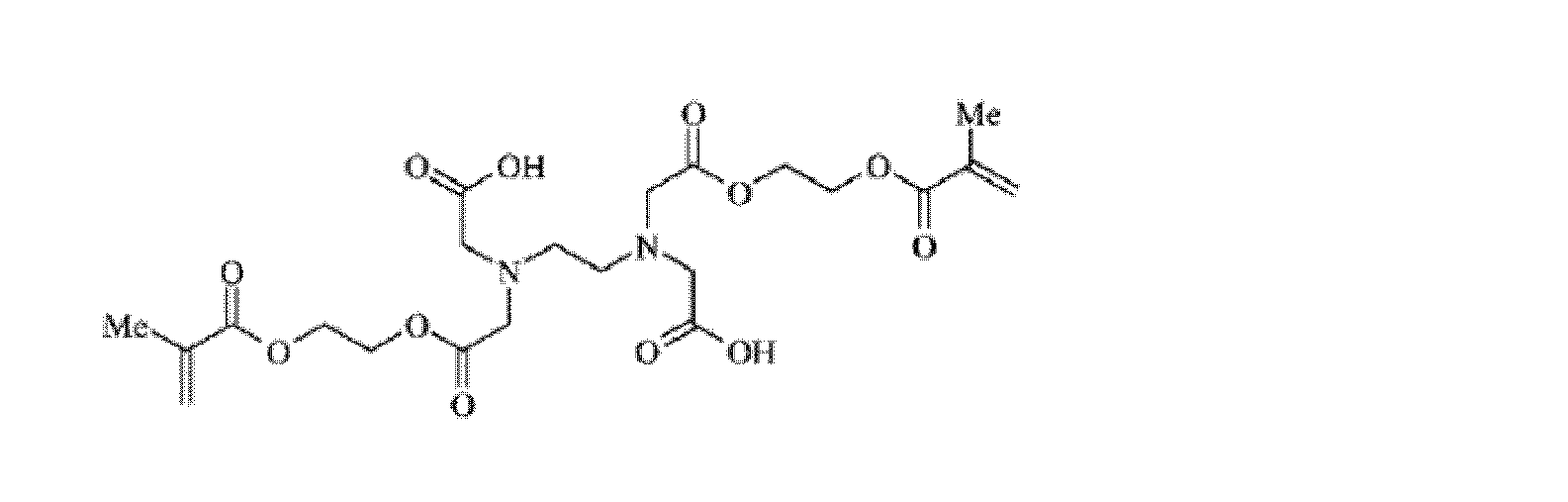
下記化合物を用いた。
・ジプロピレングリコールジアクリレート(DPGDA)
・トリメチロールプロパンPO変性トリアクリレート(TMP(PO)3TA)
・N,N-ジメチルアミノ-p-安息香酸エチルエステル
・ステアリン酸ステアリル(エキセパールSS、花王株式会社製)
・開始剤1(Omnirad907、IGM Resins B.V.社製)
・開始剤2(Omnirad819、IGM Resins B.V.社製)
・開始剤3(Speedcure ITX、サートマー社製)
・Irgastab UV-10(BASF社製)
(イエロー顔料分散液Yの調製)
下記材料をステンレスビーカーに入れ、65℃のホットプレート上で加熱しながら1時間加熱撹拌溶解し、室温まで冷却した後、ステンレスビーカー内に15.0質量部のイエロー顔料PY185(パリオトールイエローD1155、BASF社製)を加えた。その後、ステンレスビーカー内の混合液と、200gのジルコニアビーズ(直径0.5mm)とをガラス瓶に入れ、密栓した。これをペイントシェーカー(5400、Red Devil社製)にて、所望の粒径になるまで分散処理した後、ジルコニアビーズを除去して、イエロー顔料分散液Yを調製した。
顔料分散剤1(EFKA PX4701、BASF社製) 11.2質量部
顔料分散剤2(Solsperse22000、Lubrizol社製)3.0質量部
分散媒:ジプロピレングリコールジアクリレート 70.8質量部
用いる分散剤の種類および量、ならびに分散媒の量を下記の通りに変更し、添加する顔料を23.0質量部のシアン顔料PB15:4(クロモファインブルー6332JC、大日精化工業株式会社製)に変更した以外は、イエロー顔料分散液Yと同様にして、シアン顔料分散液Cを調製した。
顔料分散剤1(PX4701、BASF社製) 7.0質量部
分散媒:ジプロピレングリコールジアクリレート 70.0質量部
(インクジェットインク1)
4.67質量部のイエロー顔料分散液Yと、2.17質量部のシアン顔料分散液Cとを混合し、得られた混合液を撹拌しながら下記材料を添加し、インク組成物を作製した。
<活性線重合性化合物>
・化合物A-3 10.0質量部
・アミン変性オリゴマー1 5.0質量部
・ジプロピレングリコールジアクリレート(DPGDA) 45.7質量部
・トリメチロールプロパンPO変性トリアクリレート(TMP(PO)3TA)
30.0質量部
<重合開始剤>
・開始剤1 3.0質量部
・開始剤2 3.0質量部
・開始剤3 2.0質量部
<重合禁止剤>
・Irgastab UV-10(BASF社製) 0.1質量部
調製した各インクを、ピエゾ型インクジェットノズルを備えたインクジェット記録ヘッドを有するインクジェット記録装置に装填した。次いで、インクジェット記録ヘッドに、液滴吐出量が6.0pLとなるように電圧を印加し、プリント配線板用銅張積層板(FR-4 厚さ1.6mm、大きさ150mm×95mm)上に20mm×50mm、厚さ30μmのベタパターン、および、ラインアンドスペースが100μm、厚さ30μmの櫛歯状の細線パターンをそれぞれ形成した。パターン形成の際、インクジェット記録ヘッド内のインクが80℃になるように、記録ヘッドの内蔵ヒーターで加熱した。
(密着性)
得られたベタパターンの硬化物に、JIS K5600-5-6:1999のクロスカット法に準じて、碁盤目状の切れ込みを入れ、粘着テープを貼り付けた。この粘着テープを引き剥がし、硬化膜の基板からの剥離状体を観察し、付着残留率を求めた。ここで、付着残留率は、上記切れ込みを入れて作成したマス目の数に対する、テープ剥がし後に硬化膜が残留しているマス目の数の割合のことをいう。付着残留率を基に、以下の評価基準に沿って密着性の評価を行った。
◎ 付着残留率が100%である
○ 付着残留率が80%以上100%未満である
△ 付着残留率が60%以上80%未満である
× 付着残留率が60%未満である
得られた細線パターンの硬化物に対して、温度85℃、相対湿度85%の環境下で、絶縁抵抗測定器(ECM-100、J-RAS株式会社製)を用いて直流電圧50Vの電圧を印加し、500時間放置した。その後、上記絶縁抵抗測定器の値を読み取り、硬化物の電気抵抗値(Ω)を測定した。測定された電気抵抗値に基づき、以下の基準に沿って、イオンマイグレーションの評価を行った。
◎◎ 電気抵抗値が1.0×10¹²Ω以上である
◎ 電気抵抗値が1.0×10¹¹Ω以上1.0×10¹²Ω未満である
○ 電気抵抗値が1.0×10¹⁰Ω以上1.0×10¹¹Ω未満である
△ 電気抵抗値が1.0×10⁸Ω以上1.0×10¹⁰Ω未満である
× 電気抵抗値が1.0×10⁸Ω未満である
各インクジェットインクを燃焼フラスコに投入して、インク試料を燃焼させた。発生したガスを過酸化水素水に吸収させ、この吸収液についてイオンクロマトグラフィを用いて分析し、塩化物イオン含有量[ppm]を求めた。
得られたベタパターンの硬化物について、JISC 5012:1993の電気的性能試験に準じた方法で、電気抵抗値Rを測定した。

Claims (10)
- 活性線重合性化合物を含む活性線硬化型インクジェットインク組成物であって、
前記活性線重合性化合物は、カルボキシル基を有する活性線重合性化合物と、カルボキシル基を有さないアミン変性オリゴマーとを含み、
電子部材に絶縁膜を形成するために用いられる、
活性線硬化型インクジェットインク組成物。 - ゲル化剤をさらに含む、請求項1に記載の活性線硬化型インクジェットインク組成物。
- 前記カルボキシル基を有する重合性化合物は、一般式(1)で表される化合物である、請求項1に記載の活性線硬化型インクジェットインク組成物。

- 前記一般式(1)において、Xは、末端に、(メタ)アクリロイル基を含む、請求項3に記載の活性線硬化型インクジェットインク組成物。
- 前記一般式(1)において、Qは酸素原子を表す、請求項3に記載の活性線硬化型インクジェットインク組成物。
- 前記一般式(1)において、R1は、炭素数1または2の無置換のアルキレン基を表す、請求項3に記載の活性線硬化型インクジェットインク組成物。
- 請求項1~6のいずれか一項に記載の活性線硬化型インクジェットインク組成物を、電子部材の金属表面に付与する工程と、
前記付与された前記インクジェットインク組成物に活性線を照射して、前記インクジェットインク組成物を硬化させる工程と、
を有する、
絶縁膜形成方法。 - 前記活性線を照射された前記インクジェットインク組成物を加熱する工程をさらに有する、請求項7に記載の絶縁膜形成方法。
- 請求項1~6のいずれか一項に記載の活性線硬化型インクジェットインク組成物に活性線を照射し、任意に活性線の照射後に加熱して形成された絶縁膜。
- 請求項9に記載の絶縁膜を有するプリント配線基板。
Priority Applications (3)
| Application Number | Priority Date | Filing Date | Title |
|---|---|---|---|
| JP2025519318A JPWO2024232129A1 (ja) | 2023-05-09 | 2024-01-24 | |
| EP24803244.3A EP4711426A1 (en) | 2023-05-09 | 2024-01-24 | Active ray-curable inkjet ink composition, method for forming insulating film, insulating film, and printed wiring board |
| CN202480029359.3A CN121039242A (zh) | 2023-05-09 | 2024-01-24 | 活性射线固化型喷墨油墨组合物、绝缘膜形成方法、绝缘膜和印刷线路板 |
Applications Claiming Priority (2)
| Application Number | Priority Date | Filing Date | Title |
|---|---|---|---|
| JP2023077161 | 2023-05-09 | ||
| JP2023-077161 | 2023-05-09 |
Publications (1)
| Publication Number | Publication Date |
|---|---|
| WO2024232129A1 true WO2024232129A1 (ja) | 2024-11-14 |
Family
ID=93430118
Family Applications (1)
| Application Number | Title | Priority Date | Filing Date |
|---|---|---|---|
| PCT/JP2024/001986 Ceased WO2024232129A1 (ja) | 2023-05-09 | 2024-01-24 | 活性線硬化型インクジェットインク組成物、絶縁膜形成方法、絶縁膜およびプリント配線基板 |
Country Status (4)
| Country | Link |
|---|---|
| EP (1) | EP4711426A1 (ja) |
| JP (1) | JPWO2024232129A1 (ja) |
| CN (1) | CN121039242A (ja) |
| WO (1) | WO2024232129A1 (ja) |
Citations (9)
| Publication number | Priority date | Publication date | Assignee | Title |
|---|---|---|---|---|
| JPH02133417A (ja) * | 1988-11-15 | 1990-05-22 | Toagosei Chem Ind Co Ltd | 硬化性組成物 |
| JP2003327873A (ja) * | 2002-05-07 | 2003-11-19 | Konica Minolta Holdings Inc | 活性光線硬化性インクジェットインク組成物およびインクジェット記録方法 |
| JP2010006933A (ja) * | 2008-06-26 | 2010-01-14 | Chisso Corp | インクジェット用インク |
| JP2012087298A (ja) | 2010-09-24 | 2012-05-10 | Sekisui Chem Co Ltd | インクジェット用硬化性組成物及び電子部品の製造方法 |
| JP2018188581A (ja) * | 2017-05-10 | 2018-11-29 | コニカミノルタ株式会社 | 活性光線硬化型インクジェットインク |
| JP2019061105A (ja) * | 2017-09-27 | 2019-04-18 | 株式会社タムラ製作所 | 感光性樹脂組成物 |
| JP2020037645A (ja) * | 2018-09-04 | 2020-03-12 | コニカミノルタ株式会社 | レジスト用インクジェットインク |
| JP2022052593A (ja) | 2020-09-23 | 2022-04-04 | 株式会社タムラ製作所 | 感光性樹脂組成物 |
| JP2023077161A (ja) | 2021-11-24 | 2023-06-05 | 住友ゴム工業株式会社 | タイヤ用ゴム組成物及びタイヤ |
-
2024
- 2024-01-24 JP JP2025519318A patent/JPWO2024232129A1/ja active Pending
- 2024-01-24 WO PCT/JP2024/001986 patent/WO2024232129A1/ja not_active Ceased
- 2024-01-24 CN CN202480029359.3A patent/CN121039242A/zh active Pending
- 2024-01-24 EP EP24803244.3A patent/EP4711426A1/en active Pending
Patent Citations (9)
| Publication number | Priority date | Publication date | Assignee | Title |
|---|---|---|---|---|
| JPH02133417A (ja) * | 1988-11-15 | 1990-05-22 | Toagosei Chem Ind Co Ltd | 硬化性組成物 |
| JP2003327873A (ja) * | 2002-05-07 | 2003-11-19 | Konica Minolta Holdings Inc | 活性光線硬化性インクジェットインク組成物およびインクジェット記録方法 |
| JP2010006933A (ja) * | 2008-06-26 | 2010-01-14 | Chisso Corp | インクジェット用インク |
| JP2012087298A (ja) | 2010-09-24 | 2012-05-10 | Sekisui Chem Co Ltd | インクジェット用硬化性組成物及び電子部品の製造方法 |
| JP2018188581A (ja) * | 2017-05-10 | 2018-11-29 | コニカミノルタ株式会社 | 活性光線硬化型インクジェットインク |
| JP2019061105A (ja) * | 2017-09-27 | 2019-04-18 | 株式会社タムラ製作所 | 感光性樹脂組成物 |
| JP2020037645A (ja) * | 2018-09-04 | 2020-03-12 | コニカミノルタ株式会社 | レジスト用インクジェットインク |
| JP2022052593A (ja) | 2020-09-23 | 2022-04-04 | 株式会社タムラ製作所 | 感光性樹脂組成物 |
| JP2023077161A (ja) | 2021-11-24 | 2023-06-05 | 住友ゴム工業株式会社 | タイヤ用ゴム組成物及びタイヤ |
Non-Patent Citations (1)
| Title |
|---|
| See also references of EP4711426A1 |
Also Published As
| Publication number | Publication date |
|---|---|
| CN121039242A (zh) | 2025-11-28 |
| EP4711426A1 (en) | 2026-03-18 |
| JPWO2024232129A1 (ja) | 2024-11-14 |
Similar Documents
| Publication | Publication Date | Title |
|---|---|---|
| JP6405397B2 (ja) | エネルギー線硬化型インクジェットインク組成物 | |
| JP6819298B2 (ja) | インクジェットインクおよび画像形成方法 | |
| JP6950257B2 (ja) | 活性光線硬化型インクジェットインク | |
| CN117460796A (zh) | 活性能量射线固化型喷墨用油墨组合物 | |
| EP3569667B1 (en) | Inkjet ink composition and image formation method | |
| EP4245817B1 (en) | Inkjet ink composition, recorded matter, inkjet recording method, and inkjet recording system | |
| JP2015036241A (ja) | インクジェット記録方法、及び、印刷物 | |
| WO2017056860A1 (ja) | インクセット及び画像形成方法 | |
| JP2020093442A (ja) | 画像形成方法 | |
| US20240417580A1 (en) | Inkjet ink and method for producing cured film | |
| JP2007231082A (ja) | 紫外線硬化型インクジェット記録用インク組成物 | |
| JP7107376B2 (ja) | 印刷物の製造方法 | |
| WO2024232129A1 (ja) | 活性線硬化型インクジェットインク組成物、絶縁膜形成方法、絶縁膜およびプリント配線基板 | |
| JP7772081B2 (ja) | 隔壁形成用インクジェットインク、及びledデバイス | |
| JP6627782B2 (ja) | インクセットおよび画像形成方法 | |
| JP6075429B2 (ja) | 紫外線硬化型インクジェット用インク組成物 | |
| WO2026004224A1 (ja) | インクジェット用硬化性組成物、ソルダーレジスト及びインクジェット記録方法 | |
| JP2025058848A (ja) | 金属含有基材用インクジェット用硬化性組成物、ソルダーレジスト及びインクジェット記録方法 | |
| WO2023233894A1 (ja) | 活性線硬化型インクジェットレジストインク、硬化膜形成方法、硬化膜、プリント配線基板、および電子機器 | |
| US20250101247A1 (en) | Curable composition for inkjet for metal-containing base material, solder resist, and inkjet recording method | |
| JP2025041294A (ja) | インクジェットインクおよび画像形成方法 | |
| WO2025220342A1 (ja) | 塗膜形成方法、プリント配線板製造方法及び塗膜形成システム | |
| JP2025041523A (ja) | インクジェットインクおよび画像形成方法 | |
| WO2024134920A1 (ja) | インクジェットインク組成物、記録物、インクジェット記録方法及びインクジェット記録システム | |
| JP2026036497A (ja) | インク、インクジェット記録方法及びインクジェット記録システム |
Legal Events
| Date | Code | Title | Description |
|---|---|---|---|
| 121 | Ep: the epo has been informed by wipo that ep was designated in this application |
Ref document number: 24803244 Country of ref document: EP Kind code of ref document: A1 |
|
| ENP | Entry into the national phase |
Ref document number: 2025519318 Country of ref document: JP Kind code of ref document: A |
|
| WWE | Wipo information: entry into national phase |
Ref document number: 2025519318 Country of ref document: JP |
|
| WWE | Wipo information: entry into national phase |
Ref document number: 2024803244 Country of ref document: EP |
|
| NENP | Non-entry into the national phase |
Ref country code: DE |
|
| ENP | Entry into the national phase |
Ref document number: 2024803244 Country of ref document: EP Effective date: 20251209 |
|
| ENP | Entry into the national phase |
Ref document number: 2024803244 Country of ref document: EP Effective date: 20251209 |
|
| ENP | Entry into the national phase |
Ref document number: 2024803244 Country of ref document: EP Effective date: 20251209 |
|
| ENP | Entry into the national phase |
Ref document number: 2024803244 Country of ref document: EP Effective date: 20251209 |
|
| ENP | Entry into the national phase |
Ref document number: 2024803244 Country of ref document: EP Effective date: 20251209 |
|
| ENP | Entry into the national phase |
Ref document number: 2024803244 Country of ref document: EP Effective date: 20251209 |
|
| ENP | Entry into the national phase |
Ref document number: 2024803244 Country of ref document: EP Effective date: 20251209 |
|
| ENP | Entry into the national phase |
Ref document number: 2024803244 Country of ref document: EP Effective date: 20251209 |
|
| ENP | Entry into the national phase |
Ref document number: 2024803244 Country of ref document: EP Effective date: 20251209 |
|
| WWP | Wipo information: published in national office |
Ref document number: 2024803244 Country of ref document: EP |