WO2024225313A1 - R-t-b系焼結磁石 - Google Patents
R-t-b系焼結磁石 Download PDFInfo
- Publication number
- WO2024225313A1 WO2024225313A1 PCT/JP2024/016059 JP2024016059W WO2024225313A1 WO 2024225313 A1 WO2024225313 A1 WO 2024225313A1 JP 2024016059 W JP2024016059 W JP 2024016059W WO 2024225313 A1 WO2024225313 A1 WO 2024225313A1
- Authority
- WO
- WIPO (PCT)
- Prior art keywords
- mass
- less
- alloy
- sintered
- sintered magnet
- Prior art date
- Legal status (The legal status is an assumption and is not a legal conclusion. Google has not performed a legal analysis and makes no representation as to the accuracy of the status listed.)
- Ceased
Links
Images
Classifications
-
- H—ELECTRICITY
- H01—ELECTRIC ELEMENTS
- H01F—MAGNETS; INDUCTANCES; TRANSFORMERS; SELECTION OF MATERIALS FOR THEIR MAGNETIC PROPERTIES
- H01F1/00—Magnets or magnetic bodies characterised by the magnetic materials therefor; Selection of materials for their magnetic properties
- H01F1/01—Magnets or magnetic bodies characterised by the magnetic materials therefor; Selection of materials for their magnetic properties of inorganic materials
- H01F1/03—Magnets or magnetic bodies characterised by the magnetic materials therefor; Selection of materials for their magnetic properties of inorganic materials characterised by their coercivity
- H01F1/032—Magnets or magnetic bodies characterised by the magnetic materials therefor; Selection of materials for their magnetic properties of inorganic materials characterised by their coercivity of hard-magnetic materials
- H01F1/04—Magnets or magnetic bodies characterised by the magnetic materials therefor; Selection of materials for their magnetic properties of inorganic materials characterised by their coercivity of hard-magnetic materials metals or alloys
- H01F1/047—Alloys characterised by their composition
- H01F1/053—Alloys characterised by their composition containing rare earth metals
- H01F1/055—Alloys characterised by their composition containing rare earth metals and magnetic transition metals, e.g. SmCo5
- H01F1/057—Alloys characterised by their composition containing rare earth metals and magnetic transition metals, e.g. SmCo5 and IIIa elements, e.g. Nd2Fe14B
- H01F1/0571—Alloys characterised by their composition containing rare earth metals and magnetic transition metals, e.g. SmCo5 and IIIa elements, e.g. Nd2Fe14B in the form of particles, e.g. rapid quenched powders or ribbon flakes
- H01F1/0575—Alloys characterised by their composition containing rare earth metals and magnetic transition metals, e.g. SmCo5 and IIIa elements, e.g. Nd2Fe14B in the form of particles, e.g. rapid quenched powders or ribbon flakes pressed, sintered or bonded together
- H01F1/0577—Alloys characterised by their composition containing rare earth metals and magnetic transition metals, e.g. SmCo5 and IIIa elements, e.g. Nd2Fe14B in the form of particles, e.g. rapid quenched powders or ribbon flakes pressed, sintered or bonded together sintered
-
- C—CHEMISTRY; METALLURGY
- C22—METALLURGY; FERROUS OR NON-FERROUS ALLOYS; TREATMENT OF ALLOYS OR NON-FERROUS METALS
- C22C—ALLOYS
- C22C38/00—Ferrous alloys, e.g. steel alloys
- C22C38/002—Ferrous alloys, e.g. steel alloys containing In, Mg, or other elements not provided for in one single group C22C38/001 - C22C38/60
-
- C—CHEMISTRY; METALLURGY
- C22—METALLURGY; FERROUS OR NON-FERROUS ALLOYS; TREATMENT OF ALLOYS OR NON-FERROUS METALS
- C22C—ALLOYS
- C22C38/00—Ferrous alloys, e.g. steel alloys
- C22C38/005—Ferrous alloys, e.g. steel alloys containing rare earths, i.e. Sc, Y, Lanthanides
-
- C—CHEMISTRY; METALLURGY
- C22—METALLURGY; FERROUS OR NON-FERROUS ALLOYS; TREATMENT OF ALLOYS OR NON-FERROUS METALS
- C22C—ALLOYS
- C22C38/00—Ferrous alloys, e.g. steel alloys
- C22C38/06—Ferrous alloys, e.g. steel alloys containing aluminium
-
- C—CHEMISTRY; METALLURGY
- C22—METALLURGY; FERROUS OR NON-FERROUS ALLOYS; TREATMENT OF ALLOYS OR NON-FERROUS METALS
- C22C—ALLOYS
- C22C38/00—Ferrous alloys, e.g. steel alloys
- C22C38/10—Ferrous alloys, e.g. steel alloys containing cobalt
-
- C—CHEMISTRY; METALLURGY
- C22—METALLURGY; FERROUS OR NON-FERROUS ALLOYS; TREATMENT OF ALLOYS OR NON-FERROUS METALS
- C22C—ALLOYS
- C22C38/00—Ferrous alloys, e.g. steel alloys
- C22C38/14—Ferrous alloys, e.g. steel alloys containing titanium or zirconium
-
- C—CHEMISTRY; METALLURGY
- C22—METALLURGY; FERROUS OR NON-FERROUS ALLOYS; TREATMENT OF ALLOYS OR NON-FERROUS METALS
- C22C—ALLOYS
- C22C38/00—Ferrous alloys, e.g. steel alloys
- C22C38/16—Ferrous alloys, e.g. steel alloys containing copper
-
- H—ELECTRICITY
- H01—ELECTRIC ELEMENTS
- H01F—MAGNETS; INDUCTANCES; TRANSFORMERS; SELECTION OF MATERIALS FOR THEIR MAGNETIC PROPERTIES
- H01F1/00—Magnets or magnetic bodies characterised by the magnetic materials therefor; Selection of materials for their magnetic properties
- H01F1/01—Magnets or magnetic bodies characterised by the magnetic materials therefor; Selection of materials for their magnetic properties of inorganic materials
- H01F1/03—Magnets or magnetic bodies characterised by the magnetic materials therefor; Selection of materials for their magnetic properties of inorganic materials characterised by their coercivity
- H01F1/032—Magnets or magnetic bodies characterised by the magnetic materials therefor; Selection of materials for their magnetic properties of inorganic materials characterised by their coercivity of hard-magnetic materials
- H01F1/04—Magnets or magnetic bodies characterised by the magnetic materials therefor; Selection of materials for their magnetic properties of inorganic materials characterised by their coercivity of hard-magnetic materials metals or alloys
- H01F1/047—Alloys characterised by their composition
- H01F1/053—Alloys characterised by their composition containing rare earth metals
- H01F1/055—Alloys characterised by their composition containing rare earth metals and magnetic transition metals, e.g. SmCo5
- H01F1/057—Alloys characterised by their composition containing rare earth metals and magnetic transition metals, e.g. SmCo5 and IIIa elements, e.g. Nd2Fe14B
-
- Y—GENERAL TAGGING OF NEW TECHNOLOGICAL DEVELOPMENTS; GENERAL TAGGING OF CROSS-SECTIONAL TECHNOLOGIES SPANNING OVER SEVERAL SECTIONS OF THE IPC; TECHNICAL SUBJECTS COVERED BY FORMER USPC CROSS-REFERENCE ART COLLECTIONS [XRACs] AND DIGESTS
- Y02—TECHNOLOGIES OR APPLICATIONS FOR MITIGATION OR ADAPTATION AGAINST CLIMATE CHANGE
- Y02T—CLIMATE CHANGE MITIGATION TECHNOLOGIES RELATED TO TRANSPORTATION
- Y02T10/00—Road transport of goods or passengers
- Y02T10/60—Other road transportation technologies with climate change mitigation effect
- Y02T10/64—Electric machine technologies in electromobility
Definitions
- This disclosure relates to R-T-B based sintered magnets.
- R-T-B sintered magnets (R is at least one of the rare earth elements, T is Fe or Fe and Co, and B is boron) are known as the most high-performance permanent magnets. For this reason, R-T-B sintered magnets are used in a variety of motors in the automotive field, such as electric vehicles (EV, HV, PHV), renewable energy fields such as wind power generation, home appliances, and industrial fields. R-T-B sintered magnets are an essential material for making these motors smaller and lighter, more efficient, and more energy-efficient (improved energy efficiency).
- R-T-B sintered magnets are also used in the drive motors of electric vehicles, and by replacing internal combustion engine vehicles with electric vehicles, they also contribute to preventing global warming by reducing greenhouse gases such as carbon dioxide (reducing fuel and exhaust gas). In this way, R-T-B sintered magnets are making a significant contribution to the realization of a clean energy society.
- R-T-B based sintered magnets are composed mainly of crystal grains made of R 2 T 14 B type compounds and a grain boundary phase located at the grain boundaries of these crystal grains (for example, Patent Document 1).
- Patent Document 1 discloses a rare earth sintered magnet that includes R 2 T 14 B main phase crystal grains and a two-particle grain boundary phase between two adjacent R 2 T 14 B main phase crystal grains, the thickness of the two-particle grain boundary phase being 5 nm to 500 nm and being composed of a phase having a magnetic property different from that of a ferromagnetic material.
- the R 2 T 14 B type compound that constitutes the crystal grains is a ferromagnetic material with high saturation magnetization and anisotropic magnetic field, and determines the characteristics of the RTB based sintered magnet.
- R-T-B based sintered magnets have the problem that their coercivity H cJ (hereinafter simply referred to as "H cJ ”) decreases at high temperatures, causing irreversible thermal demagnetization. For this reason, R-T-B based sintered magnets used in particular for electric vehicle motors are required to have a high H cJ even at high temperatures, that is, a higher H cJ at room temperature.
- H cJ coercJ
- the rare earth sintered magnet disclosed in Patent Document 1 is said to be capable of suppressing the decrease in HcJ at high temperatures while reducing the amount of heavy rare earth elements RH such as Tb used, but its magnetic properties ( Br and HcJ ) are inferior to those of sintered magnets containing heavy rare earth elements RH.
- RH heavy rare earth elements
- Br and HcJ magnetic properties
- an object of one embodiment of the present invention is to provide an RTB based sintered magnet that can further improve B r and H cJ while reducing the amount of heavy rare earth element RH such as Tb used.
- Aspect 1 of the present invention is R: 26.5% by mass or more and 31.5% by mass or less (R is a rare earth element, including one or two selected from the group consisting of Nd and Pr); M: 0.40% by mass or more and 1.50% by mass or less (M is at least one selected from the group consisting of Ga, Cu, Zn, Al, and Si, and must contain Cu); B: 0.85 mass% or more and 0.94 mass% or less; and T: 61.5 mass% or more (T is Fe and Co, and 90% or more of T is Fe in terms of mass ratio), O: 0.05% by mass or more and 0.30% by mass or less, Tb: 0.20% by mass or less; and Dy: 0.30% by mass or less; and satisfies the following formula (1):
- the R-T-B based sintered magnet has, within a range from the surface to a depth of 200 ⁇ m, the concentrations of one or two elements selected from the group consisting of Nd and Pr, and the concentration of Cu, which gradually decrease
- Aspect 2 of the present invention is The R-T-B based sintered magnet according to Aspect 1, in which M necessarily contains Ga, the Ga content is 0.3 mass % or more, and the Ga concentration does not decrease gradually within a range from the surface to a depth of 200 ⁇ m.
- an RTB based sintered magnet with improved B r and H cJ while reducing the amount of heavy rare earth element RH such as Tb used.
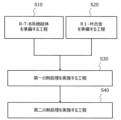
- FIG. 1 is a flow chart showing an example of steps in a method for producing a sintered RTB based magnet according to an embodiment of the present invention.
- the present inventors have conducted extensive research to improve the magnetic properties (particularly B r and H cJ ) of R-T-B based sintered magnets while reducing the amount of heavy rare earth used. They have found that the effect of improving the magnetic properties due to the grain boundary diffusion of rare earth element R and metal element M is enhanced when the B content of the R-T-B based sintered magnet is a "low boron" composition lower than the stoichiometric composition of the R 2 T 14 B compound. They have also found that the same effect can be obtained even if a part of B is replaced by carbon (C) in the R 2 T 14 B compound.
- R-O-C compounds include R-O compounds (rare earth oxides) and R-C compounds (rare earth carbides).
- the inventors assumed that when diffusing rare earth element R or metal element M from the surface to the inside of a low-boron R-T-B sintered body, the thickness and structure of the grain boundaries must be controlled to optimize the effect of improving magnetic properties due to diffusion, and that for this the contents of R, O, and C must satisfy an appropriate relationship. Furthermore, the inventors assumed that R controlled to an appropriate content enhances the effect of improving magnetic properties due to grain boundary diffusion of R and M in a low-boron R-T-B sintered magnet.
- an R-T-B sintered magnet with excellent magnetic properties can be obtained by introducing R (Nd and Pr) and Cu by diffusion from the magnet surface into an R-T-B sintered magnet with a specific component composition that satisfies the formula (1) described below and in which the contents of B and M (Ga, Cu, Zn, Al, and Si) are appropriately controlled, and thus the invention relating to the embodiment of the present application was completed.
- the R sintered magnet (hereinafter sometimes simply referred to as "sintered magnet") according to the embodiment will be described in detail below.
- R-T-B based sintered magnets are R: 26.5% by mass or more and 31.5% by mass or less (R is a rare earth element, including one or two selected from the group consisting of Nd and Pr); M: 0.40% by mass or more and 1.50% by mass or less (M is at least one selected from the group consisting of Ga, Cu, Zn, Al, and Si, and must contain Cu); B: 0.85 mass% or more and 0.94 mass% or less, and T: 61.5 mass% or more (T is Fe and Co, and 90% or more of T is Fe in terms of mass ratio). , O: 0.05% by mass or more and 0.30% by mass or less, Tb: 0.20 mass % or less, and Dy: 0.30 mass % or less.
- the content of the heavy rare earth elements RH (particularly Tb and Dy) contained in the sintered magnet is smaller than that of the conventional sintered magnet.
- the sintered magnet does not necessarily have to contain RH.
- the lower limit of the RH content in the sintered magnet is 0 mass%.
- the Tb content is preferably limited to 0.10 mass % or less.
- the Dy content is preferably limited to 0.20 mass % or less.
- the sintered magnet satisfies the following formula (1). 26.0 mass% ⁇ ([Nd]+[Pr]+[Ce]+[La]+[Dy]+[Tb])-12([O]+[C]) ⁇ 27.7 mass% (1)
- [Nd], [Pr], [Ce], [La], [Dy], [Tb], [O] and [C] are the contents, expressed in mass %, of Nd, Pr, Ce, La, Dy, Tb, O and C, respectively.
- the sintered magnet does not contain one or more of Nd, Pr, Ce, La, Dy, Tb, O and C, the content of the absent element is regarded as "0 mass %" and is substituted into formula (1).
- the content of C (carbon) in the sintered magnet is preferably 0.05% by mass or more and 0.18% by mass or less.
- the content of C can be adjusted by the amount of lubricant added during grinding and molding.
- the content of formula (1) is 26.0 mass % or more and 27.5 mass % or less, more preferably 26.3 mass % or more and 27.4 mass % or less, and particularly preferably 27.0 mass % or more and 27.4 mass % or less, so that high B r and H cJ can be obtained while further reducing the amount of heavy rare earth element RH such as Tb used.
- R is a rare earth element, and includes one or two elements selected from the group consisting of Nd and Pr.
- the content of R is 26.5 mass% or more and 31.5 mass% or less. If it is less than 26.5 mass %, it may be difficult to achieve densification during sintering, and if it exceeds 31.5 mass %, the main phase ratio may decrease, resulting in a decrease in Br .
- the content of R is preferably 26.8 mass % or more and 30.0 mass % or less. When R is in such a range, a higher B r can be obtained.
- M is at least one selected from the group consisting of Ga, Cu, Zn, Al and Si, and must contain Cu.
- the content of M (the total content of Ga, Cu, Zn, Al and Si) is , 0.40 mass % or more and 1.50 mass % or less. When M is in this range, a high HcJ can be achieved.
- a sintered magnet necessarily contains Cu as M, but preferably also contains Ga, which can further improve HcJ .
- the present inventors have newly discovered that, compared to a sintered magnet produced by diffusing one or two elements selected from the group consisting of Nd and Pr, Cu, and a part or all of Ga in a diffusion process, a significantly higher HcJ can be achieved by making the sintered body contain 0.3 mass% or more of Ga, producing the sintered body with all of the Ga derived from the raw material (i.e., contained in the alloy for sintered magnets ), and then diffusing one or two elements selected from the group consisting of Nd and Pr and Cu.
- the sintered magnet of the present disclosure necessarily contains Cu and Ga as M, the Ga content is 0.3 mass% or more, and the Ga concentration does not gradually decrease from the surface in the depth direction within a range from the surface to a depth of 200 ⁇ m.
- the fact that the Ga concentration does not gradually decrease from the surface in the depth direction indicates that a process of diffusing from the magnet surface toward the inside of the magnet is not performed using a diffusion source containing Ga.
- Cu is preferably derived from Cu diffused from the surface of the sintered body in the diffusion step performed after the sintering step, and can improve HcJ . All of the Cu contained in the sintered magnet may be derived from diffusion, but a portion of the Cu may be derived from the raw materials.
- Ga more than 0.3% by mass and not more than 0.80% by mass
- Cu more than 0.1% by mass and not more than 0.70% by mass
- Zn 0% by mass or more and 0.2% by mass or less
- Al 0% by mass or more and 0.8% by mass or less
- Si 0% by mass or more and 0.2% by mass or less.
- B 0.85% by mass or more and 0.94% by mass or less
- the content of B is 0.85 mass % or more and 0.94 mass % or less.
- the sintered magnet contains B within the range of the present disclosure, it can achieve a high HcJ . % or more and 0.90% or less by mass is preferable, and 0.87% or more and 0.88% or less by mass is more preferable, in which case HcJ can be further improved.
- the content of O is from 0.05% by mass to 0.30% by mass.
- the sintered magnet contains O within the range of the present disclosure, it can achieve a high HcJ .
- Tb 0.20% by mass or less
- the Tb content is 0.20 mass % or less, and preferably 0.10 mass % or less.
- the Dy content is 0.30% by mass or less, and preferably 0.20% by mass or less.
- Dy may not be contained (i.e., the Dy content may be 0% by mass).
- the inclusion of Dy can improve the Hcj of the sintered magnet, but an excessive amount of Dy decreases the Br .
- T is Fe and Co
- 90% or more of T is Fe in terms of mass ratio.
- the content of T in the sintered magnet is 61.5 mass % or more, which can improve Br .
- the balance is T and unavoidable impurities.
- the balance of R, M, B, O, and C is T. and unavoidable impurities.
- Co may be contained as a part of T to improve corrosion resistance, but if the ratio of the Co content to the T content exceeds 10%, high Br may not be obtained. There is a gender.
- the sintered magnet may contain Cr, Mn, La, Ce, Sm, Ca, Mg, etc. as inevitable impurities that are usually contained in didymium alloys (Nd-Pr), electrolytic iron, ferroboron, etc. Furthermore, an example of an inevitable impurity that is contained during the manufacturing process is N (nitrogen), etc.
- the sintered magnet according to the embodiment may also contain one or more other elements (optional added elements). For example, such elements may contain small amounts (about 0.1 mass% each) of Ag, In, Sn, Ti, Ge, Y, H, F, P, S, V, Ni, Mo, Hf, Ta, W, Nb, Zr, Pb, Bi, etc. Such elements may be contained in a total amount of, for example, about 1.0 mass%. This amount is sufficient to obtain an R-T-B based sintered magnet having a high HcJ at high temperatures.
- the concentration of one or two elements selected from the group consisting of Nd and Pr gradually decreases from the surface to a depth of 200 ⁇ m from the surface.
- the concentration of Cu also gradually decreases from the surface to a depth of 200 ⁇ m from the surface.
- a sintered magnet having such a concentration distribution can be obtained by carrying out a process of diffusing one or two elements selected from the group consisting of Nd and Pr and Cu from the magnet surface to the inside of the magnet during the production of the sintered magnet.
- the magnetic properties of the resulting sintered magnet can be improved.
- the Ga concentration does not decrease gradually from the surface to a depth of 200 ⁇ m, that is, it is preferable that a step of diffusing using a diffusion source containing Ga is not performed.
- the concentrations of Nd, Pr and Cu in the range from the surface to a depth of 200 ⁇ m can be confirmed by line analysis (line analysis) using energy dispersive X-ray spectroscopy (EDX) in the cross section of the sintered magnet, from the magnet surface toward the center of the magnet to a depth of 200 ⁇ m. It is preferable to measure in a direction perpendicular to the surface and at a cross section at a distance of 200 ⁇ m or more from the edge of the surface.
- line analysis line analysis
- EDX energy dispersive X-ray spectroscopy
- the measurement is performed in a direction perpendicular to the surface (the outer periphery of the measured cross section) in a region at a distance of 200 ⁇ m or more from the edge of the measured cross section, so as not to measure a range within 200 ⁇ m from the outer periphery of the measured cross section.
- the Ga concentration can also be confirmed by similar measurement.
- the manufacturing method in this embodiment may include step S10 of preparing an R-T-B based sintered body, step S20 of preparing an R1-M alloy, step S30 of carrying out a first heat treatment, and step S40 of carrying out a second heat treatment.
- Step S30 is a step (diffusion step) of bringing at least a part of the R1-M alloy into contact with at least a part of the surface of the R-T-B based sintered body, and carrying out a first heat treatment at a temperature of 700°C or higher and 950°C or lower in a vacuum or inert gas atmosphere, thereby diffusing R1 and M into the magnet.
- Step S40 is a step of carrying out a second heat treatment on the R-T-B based sintered magnet that has been subjected to the first heat treatment, at a temperature of 400°C or higher and 750°C or lower in a vacuum or inert gas atmosphere, which is lower than the first heat treatment temperature.
- Step of preparing R-T-B based sintered body First, the composition of the RTB based sintered body (hereinafter sometimes simply referred to as "sintered body") will be described.
- One of the features of the sintered body used in this embodiment is that the R, oxygen, carbon, etc. contained in the sintered body are adjusted to produce a sintered magnet that ultimately satisfies the above-mentioned formula (1). For this reason, it is preferable to prepare a sintered body that satisfies the following relationships: 0.85 mass% ⁇ [B] ⁇ 0.94 mass%, 25.8 mass% ⁇ ([Nd]+[Pr]+[Ce]+[La]+[Dy]+[Tb]-12([O]+[C]) ⁇ 27.5 mass%, 0.05 mass% ⁇ [O] ⁇ 0.30 mass%.
- the sintered body prepared in this step has, for example, the following composition: R: 26.3 mass% or more and 31.3 mass% or less (R is a rare earth element and includes one or two selected from the group consisting of Nd and Pr); B: 0.85% by mass or more and 0.94% by mass or less, T: 61.5 mass% or more (T is Fe and Co, and 90% or more of T is Fe in terms of mass ratio); M: 0.40% by mass or more and 1.50% by mass or less (M is at least one selected from the group consisting of Ga, Cu, Zn, Al, and Si, and must contain Cu); Tb: 0.20 mass% or less, and Dy: 0.30 mass% or less.
- the balance consists of T and unavoidable impurities.
- an R-T-B sintered magnet alloy (hereinafter sometimes simply referred to as "sintered magnet alloy") is prepared, and then this alloy is roughly crushed, for example, by a hydrogen crushing method.
- An alloy ingot can be obtained by ingot casting, in which a metal or alloy previously prepared to have the above-mentioned composition is melted and poured into a mold to solidify.
- the alloy can also be produced by strip casting, in which a molten metal or alloy previously prepared to have the above-mentioned composition is brought into contact with a single roll, twin rolls, rotating disk, or rotating cylindrical mold, etc., and rapidly cooled to produce a rapidly solidified alloy.
- Flake-shaped alloys can also be produced by other rapid cooling methods, such as centrifugal casting.
- alloys manufactured by either the ingot method or the quenching method can be used, but it is preferable to use alloys manufactured by a quenching method such as a strip casting method.
- the thickness of an alloy manufactured by the quenching method is usually in the range of 0.03 mm to 1 mm, and it is in a flake shape.
- the molten alloy starts to solidify from the surface that comes into contact with the cooling roll (roll contact surface), and crystals grow columnarly from the roll contact surface in the thickness direction.
- the quenched alloy is cooled in a short time compared to an alloy (ingot alloy) manufactured by the conventional ingot casting method (mold casting method), so the structure is finer and the crystal grain size is smaller.
- the area of the grain boundary is large. Since the R-rich phase spreads widely within the grain boundary, the quenching method has excellent dispersibility of the R-rich phase. Therefore, it is easy to break at the grain boundary by the hydrogen crushing method.
- the size of the hydrogen crushed powder can be reduced to, for example, 1.0 mm or less.
- the coarsely crushed powder obtained in this way is crushed, for example, by a jet mill.
- the pulverization conditions are adjusted so that the oxygen content of the final sintered magnet falls within a specific range (0.05% by mass or more and 0.30% by mass or less).
- the pulverization is performed in an inert atmosphere such as nitrogen.
- the pulverization may be performed, for example, by jet mill pulverization in a humidified atmosphere.
- the powder particles are made small (average particle size d50 is 2.0 ⁇ m to 10.0 ⁇ m, more preferably d50 is 2.0 ⁇ m to 8.0 ⁇ m, even more preferably average particle size is 2.0 ⁇ m to 4.5 ⁇ m, even more preferably average particle size is 2.0 ⁇ m to 3.5 ⁇ m). By making the powder particles small, a high HcJ can be obtained.
- the average particle size (d50) can be measured by an airflow dispersion laser diffraction method (based on JIS Z 8825: 2013 revised edition).
- the average particle size means the particle size (median diameter) at which the cumulative particle size distribution (volume basis) from the small particle size side is 50%.
- the fine powder used to make the sintered body may be made from one type of raw material alloy (single raw material alloy), or it may be made by using two or more types of raw material alloys and mixing them (blending method).
- a powder compact is produced from the above fine powder by pressing in a magnetic field, and then this powder compact is sintered to obtain an R-T-B-based sintered body.
- the powder compact is preferably sintered at a temperature in the range of 950°C to 1150°C.
- residual gas in the atmosphere may be replaced with an inert gas such as helium or argon.
- the resulting sintered body may be subjected to a heat treatment.
- Known conditions may be used for the heat treatment, such as the heat treatment temperature and time.
- the sintered body may be prepared without molding using a known method such as the PLP (Press-Less Process) method described in JP-A-2006-19521.
- PLP Pressure-Less Process
- R1 and M are diffused from the surface to the inside of the sintered body.
- an alloy containing these elements to be diffused hereinafter referred to as an "R1-M alloy" is prepared.
- R1 in the R1-M alloy is a rare earth, and is one or two elements selected from the group consisting of Nd and Pr.
- the content of R1 is preferably 65% by mass to 95% by mass, and more preferably 70% by mass to 95% by mass, of the entire R1-M alloy.
- M in the R1-M alloy is at least one element selected from the group consisting of Ga, Cu, Zn, Al, and Si, and must contain Cu.
- M is at least one element selected from the group consisting of Cu, Zn, and Si, and must contain Cu.
- the content of M is preferably 5% by mass to 35% by mass, and more preferably 5% by mass to 30% by mass, of the entire R1-M alloy.
- the shape and size of the R1-M alloy are not particularly limited and can be any shape.
- the R1-M alloy can be in the form of a film, foil, powder, block, particle, etc.
- the R1-M alloy can be prepared using a raw alloy manufacturing method that is commonly used in the manufacture of sintered magnets, such as die casting, strip casting, single roll rapid cooling (melt spinning), or atomization.
- the R1-M alloy may also be prepared by pulverizing the alloy obtained by the above method using a known pulverizing method such as a pin mill.
- Step of carrying out first heat treatment At least a part of the R1-M alloy is brought into contact with at least a part of the surface of the sintered body prepared by the above-mentioned method, and a first heat treatment is carried out in a vacuum or inert gas atmosphere at a temperature (first heat treatment temperature) of 700° C. to 950° C.
- the first heat treatment is a process for diffusing R1 and M into the interior of the sintered body (i.e., a diffusion process), in which a liquid phase containing R1 and M is generated from the R1-M alloy by the heat treatment, and the elements forming the liquid phase are diffused and introduced into the interior of the sintered body from the surface of the sintered body via the grain boundaries in the sintered body.
- the first heat treatment temperature is less than 700°C, the amount of liquid phase containing R1 and M is too small to obtain a high HcJ .
- the temperature exceeds 950°C, the HcJ may decrease.
- the first heat treatment temperature is preferably 850°C or more and 950°C or less, and a higher HcJ can be obtained.
- the sintered body subjected to the first heat treatment (700°C or more and 950°C or less) is cooled from the first heat treatment temperature to 300°C at a cooling rate of 5°C/min or more, and a higher HcJ can be obtained. More preferably, the cooling rate is 15°C/min or more.
- the first heat treatment can be performed by disposing an R1-M alloy of any shape on the surface of the sintered body and using a known heat treatment device.
- the surface of the sintered body can be covered with a powder layer of the R1-M alloy and then the first heat treatment can be performed.
- a slurry in which the R1-M alloy is dispersed in a dispersion medium can be applied to the surface of the sintered body, and then the dispersion medium can be evaporated to bring the R1-M alloy layer into contact with the sintered body, and then the first heat treatment can be performed.
- the dispersion medium include alcohol (ethanol, etc.), aldehydes, and ketones.
- an R1-M alloy film can be formed on the surface of the sintered body using a known sputtering device, and then the first heat treatment can be performed.
- a heavy rare earth element RH when introducing a heavy rare earth element RH into the sintered body, not only a method using an R1-M alloy containing RH, but also a fluoride, oxide, acid fluoride, etc. of the heavy rare earth element RH can be disposed on the surface of the sintered body together with the R1-M alloy, and the first heat treatment can be performed.
- the fluorides, oxides, and oxyfluorides of the heavy rare earth element RH include TbF3, DyF3, Tb2O3, Dy2O3 , TbOF , and DyOF .
- the placement position of the R1-M alloy is not particularly important, as long as at least a portion of the R1-M alloy is in contact with at least a portion of the sintered body.
- Step of carrying out second heat treatment The sintered body that has been subjected to the first heat treatment is subjected to heat treatment in a vacuum or inert gas atmosphere at a temperature of 400° C. or more and 750° C. or less, and at a temperature lower than the first heat treatment temperature.
- this heat treatment is referred to as the second heat treatment.
- a high HcJ can be obtained. If the temperature at which the second heat treatment is performed (the second heat treatment temperature) is higher than the first heat treatment temperature, or if the second heat treatment temperature is lower than 400° C. or exceeds 750° C., a high HcJ may not be obtained.
- the raw materials of each element were weighed so that the R-T-B sintered body had the composition shown in Table 1, No. A to H, and alloys were produced by strip casting.
- the obtained alloys were coarsely pulverized by hydrogen pulverization to obtain coarsely pulverized powder.
- zinc stearate was added as a lubricant to the obtained coarsely pulverized powder and mixed, after which it was dry-pulverized in a nitrogen gas stream using an airflow pulverizer (jet mill device) to obtain finely pulverized powder (alloy powder) with an average particle size d50 of 3 ⁇ m.
- Zinc stearate was added as a lubricant to the finely pulverized powder, mixed, and molded in a magnetic field to obtain a powder compact.
- the molding device used was a so-called perpendicular magnetic field molding device (horizontal magnetic field molding device) in which the magnetic field application direction and the pressure direction are perpendicular to each other.
- the obtained powder compact was sintered in a vacuum at 1000°C to 1090°C (a temperature at which densification by sintering is sufficiently caused was selected for each sample) for 4 hours to obtain an R-T-B system sintered body.
- the density of the obtained R-T-B system sintered body was 7.5 Mg/m3 or more .
- the composition of the obtained R-T-B system sintered body is shown in Table 1.
- Each component in Table 1 was measured using high-frequency inductively coupled plasma optical emission spectroscopy (ICP-OES).
- the O (oxygen) content was measured using a gas analyzer using the gas fusion-infrared absorption method, and the C (carbon) content was measured using a gas analyzer using the combustion-infrared absorption method.
- the composition of the R1-M alloy (Table 2) was also measured using the same measurement method.
- the raw materials of each element were weighed so that the R1-M alloy had the composition shown in Table 2, No. a., and the raw materials were melted and a ribbon or flake-shaped alloy was obtained by single-roll ultra-quenching (melt spinning).
- the obtained alloy was crushed in an argon gas atmosphere using a mortar, and then passed through a sieve with 425 ⁇ m openings to prepare the R1-M alloy.
- the composition of the obtained R1-M gold is shown in Table 2.
- the R-T-B system sintered compacts No. A to H in Table 1 were cut and ground to form cubes of 7.4 mm x 7.4 mm x 7.4 mm.
- 3 mass % of the R1-M alloy (No. a) was scattered over the entire surfaces of the R-T-B system sintered compacts No. A to H, relative to 100 mass % of the R-T-B system sintered compact.
- the R-T-B system sintered magnet No. 1 shown in Table 3 was produced by carrying out a diffusion process using the R-T-B system sintered compact No. A in Table 1 and the R1-M alloy No. a in Table 2. Nos. 2 to 8 are similarly described. Thereafter, heat treatment (first heat treatment) was performed at 900° C.
- Table 3 shows the composition of the obtained R-T-B sintered magnet and the value of the middle part of formula (1 (i.e., [Nd] + [Pr] + [Ce] + [La] + [Dy] + [Tb]) - 12 ([O] + [C]).
- Each component in Table 3 was measured using inductively coupled plasma optical emission spectroscopy (ICP-OES).
- the O (oxygen) content was measured using a gas analyzer that uses the gas fusion-infrared absorption method, and the C (carbon) content was measured using a gas analyzer that uses the combustion-infrared absorption method.
- compositions in Table 3 are as follows. Since the contents of Ce, La, Dy, and Tb were below the detection limit, the R content was calculated by adding up the Nd content and the Pr content. Since the contents of Zn and Si were below the detection limit, the M content was calculated as the sum of the Cu content, the Ga content, and the Al content. Even if it is assumed that the sintered body contains up to 1 mass% of other elements, including Zr, the balance T (Fe, Co) exceeded 61.5 mass%.
- the obtained R-T-B based sintered magnets were machined to obtain magnet samples of 7 mm x 7 mm x 7 mm, and the magnetic properties (B r and H cJ ) were measured using a BH tracer.
- the measurement results are shown in Table 3.
- line analysis was performed using EDX from the magnet surface to near the center of the magnet in the cross section of magnets No. 1 to 8. It was confirmed that the Pr concentration and Cu concentration of each of No. 1 to 8 gradually decreased (gradually decreased) from the surface to the depth direction (from the magnet surface to the magnet center direction) in the range from the magnet surface to a depth of 200 ⁇ m. It was also confirmed that the Ga concentration of each of No. 1 to 8 did not gradually decrease from the surface to the depth direction in the range from the magnet surface to a depth of 200 ⁇ m.
- B r residual magnetic flux density
- H cJ coercive force
Landscapes
- Chemical & Material Sciences (AREA)
- Engineering & Computer Science (AREA)
- Mechanical Engineering (AREA)
- Materials Engineering (AREA)
- Metallurgy (AREA)
- Organic Chemistry (AREA)
- Inorganic Chemistry (AREA)
- Power Engineering (AREA)
- Crystallography & Structural Chemistry (AREA)
- Hard Magnetic Materials (AREA)
- Powder Metallurgy (AREA)
- Manufacturing Cores, Coils, And Magnets (AREA)
- Continuous Casting (AREA)
- Manufacture Of Metal Powder And Suspensions Thereof (AREA)
Priority Applications (4)
| Application Number | Priority Date | Filing Date | Title |
|---|---|---|---|
| EP24797059.3A EP4704121A1 (en) | 2023-04-28 | 2024-04-24 | R-t-b sintered magnet |
| CN202480028168.5A CN121014087A (zh) | 2023-04-28 | 2024-04-24 | R-t-b系烧结磁体 |
| JP2024571366A JPWO2024225313A1 (https=) | 2023-04-28 | 2024-04-24 | |
| JP2025153732A JP2025183376A (ja) | 2023-04-28 | 2025-09-17 | R-t-b系焼結磁石 |
Applications Claiming Priority (2)
| Application Number | Priority Date | Filing Date | Title |
|---|---|---|---|
| JP2023-074816 | 2023-04-28 | ||
| JP2023074816 | 2023-04-28 |
Publications (1)
| Publication Number | Publication Date |
|---|---|
| WO2024225313A1 true WO2024225313A1 (ja) | 2024-10-31 |
Family
ID=93256499
Family Applications (1)
| Application Number | Title | Priority Date | Filing Date |
|---|---|---|---|
| PCT/JP2024/016059 Ceased WO2024225313A1 (ja) | 2023-04-28 | 2024-04-24 | R-t-b系焼結磁石 |
Country Status (4)
| Country | Link |
|---|---|
| EP (1) | EP4704121A1 (https=) |
| JP (2) | JPWO2024225313A1 (https=) |
| CN (1) | CN121014087A (https=) |
| WO (1) | WO2024225313A1 (https=) |
Citations (6)
| Publication number | Priority date | Publication date | Assignee | Title |
|---|---|---|---|---|
| JP2006019521A (ja) | 2004-07-01 | 2006-01-19 | Inter Metallics Kk | 磁気異方性希土類焼結磁石の製造方法及び製造装置 |
| JP2014209546A (ja) | 2013-03-28 | 2014-11-06 | Tdk株式会社 | 希土類磁石 |
| JP2020092122A (ja) * | 2018-12-03 | 2020-06-11 | Tdk株式会社 | R‐t‐b系永久磁石 |
| JP7044218B1 (ja) * | 2020-09-23 | 2022-03-30 | 日立金属株式会社 | R-t-b系焼結磁石 |
| JP7248169B1 (ja) * | 2022-03-22 | 2023-03-29 | 株式会社プロテリアル | R-t-b系焼結磁石 |
| JP2023074816A (ja) | 2021-11-18 | 2023-05-30 | ダイハツ工業株式会社 | 車両のドア取付け方法およびドア取付け構造 |
Family Cites Families (1)
| Publication number | Priority date | Publication date | Assignee | Title |
|---|---|---|---|---|
| JP2024093967A (ja) * | 2022-12-27 | 2024-07-09 | 株式会社プロテリアル | R-t-b系焼結磁石 |
-
2024
- 2024-04-24 JP JP2024571366A patent/JPWO2024225313A1/ja active Pending
- 2024-04-24 CN CN202480028168.5A patent/CN121014087A/zh active Pending
- 2024-04-24 WO PCT/JP2024/016059 patent/WO2024225313A1/ja not_active Ceased
- 2024-04-24 EP EP24797059.3A patent/EP4704121A1/en active Pending
-
2025
- 2025-09-17 JP JP2025153732A patent/JP2025183376A/ja active Pending
Patent Citations (6)
| Publication number | Priority date | Publication date | Assignee | Title |
|---|---|---|---|---|
| JP2006019521A (ja) | 2004-07-01 | 2006-01-19 | Inter Metallics Kk | 磁気異方性希土類焼結磁石の製造方法及び製造装置 |
| JP2014209546A (ja) | 2013-03-28 | 2014-11-06 | Tdk株式会社 | 希土類磁石 |
| JP2020092122A (ja) * | 2018-12-03 | 2020-06-11 | Tdk株式会社 | R‐t‐b系永久磁石 |
| JP7044218B1 (ja) * | 2020-09-23 | 2022-03-30 | 日立金属株式会社 | R-t-b系焼結磁石 |
| JP2023074816A (ja) | 2021-11-18 | 2023-05-30 | ダイハツ工業株式会社 | 車両のドア取付け方法およびドア取付け構造 |
| JP7248169B1 (ja) * | 2022-03-22 | 2023-03-29 | 株式会社プロテリアル | R-t-b系焼結磁石 |
Non-Patent Citations (1)
| Title |
|---|
| See also references of EP4704121A1 |
Also Published As
| Publication number | Publication date |
|---|---|
| CN121014087A (zh) | 2025-11-25 |
| EP4704121A1 (en) | 2026-03-04 |
| JPWO2024225313A1 (https=) | 2024-10-31 |
| JP2025183376A (ja) | 2025-12-16 |
Similar Documents
| Publication | Publication Date | Title |
|---|---|---|
| CN105453195B (zh) | R-t-b系烧结磁体及r-t-b系烧结磁体的制造方法 | |
| JP6051892B2 (ja) | R−t−b系焼結磁石の製造方法 | |
| JP6221233B2 (ja) | R−t−b系焼結磁石およびその製造方法 | |
| WO2016133071A1 (ja) | R-t-b系焼結磁石の製造方法 | |
| CN116368585B (zh) | R-t-b系烧结磁体 | |
| US20240212895A1 (en) | Sintered r-t-b based magnet | |
| JP7810162B2 (ja) | R-Fe-B系焼結磁石 | |
| JP7537536B2 (ja) | R-t-b系焼結磁石 | |
| JP7059995B2 (ja) | R-t-b系焼結磁石 | |
| JP7248169B1 (ja) | R-t-b系焼結磁石 | |
| JP7687167B2 (ja) | R-t-b系焼結磁石の製造方法 | |
| JP6221246B2 (ja) | R−t−b系焼結磁石およびその製造方法 | |
| WO2021117672A1 (ja) | 希土類焼結磁石 | |
| JP7687267B2 (ja) | 希土類焼結磁石及び希土類焼結磁石の製造方法 | |
| JP7476601B2 (ja) | R-t-b系焼結磁石の製造方法 | |
| WO2024225313A1 (ja) | R-t-b系焼結磁石 | |
| JP7831045B2 (ja) | R-t-b系焼結磁石 | |
| JP2024159586A (ja) | R-t-b系焼結磁石 | |
| US20240363272A1 (en) | R-t-b based sintered magnet | |
| JP7567558B2 (ja) | R-t-b系焼結磁石の製造方法 | |
| JP7600531B2 (ja) | R-t-b系焼結磁石の製造方法 | |
| WO2025248990A1 (ja) | 希土類焼結磁石及びその製造方法 | |
| JP2024072521A (ja) | R-t-b系焼結磁石 | |
| WO2024257745A1 (ja) | 希土類焼結磁石 | |
| JP2021153148A (ja) | R−t−b系焼結磁石の製造方法及び拡散用合金 |
Legal Events
| Date | Code | Title | Description |
|---|---|---|---|
| WWE | Wipo information: entry into national phase |
Ref document number: 2024571366 Country of ref document: JP |
|
| 121 | Ep: the epo has been informed by wipo that ep was designated in this application |
Ref document number: 24797059 Country of ref document: EP Kind code of ref document: A1 |
|
| WWE | Wipo information: entry into national phase |
Ref document number: 2024797059 Country of ref document: EP |
|
| NENP | Non-entry into the national phase |
Ref country code: DE |
|
| ENP | Entry into the national phase |
Ref document number: 2024797059 Country of ref document: EP Effective date: 20251128 |
|
| ENP | Entry into the national phase |
Ref document number: 2024797059 Country of ref document: EP Effective date: 20251128 |
|
| ENP | Entry into the national phase |
Ref document number: 2024797059 Country of ref document: EP Effective date: 20251128 |
|
| ENP | Entry into the national phase |
Ref document number: 2024797059 Country of ref document: EP Effective date: 20251128 |
|
| ENP | Entry into the national phase |
Ref document number: 2024797059 Country of ref document: EP Effective date: 20251128 |
|
| ENP | Entry into the national phase |
Ref document number: 2024797059 Country of ref document: EP Effective date: 20251128 |
|
| ENP | Entry into the national phase |
Ref document number: 2024797059 Country of ref document: EP Effective date: 20251128 |
|
| ENP | Entry into the national phase |
Ref document number: 2024797059 Country of ref document: EP Effective date: 20251128 |
|
| ENP | Entry into the national phase |
Ref document number: 2024797059 Country of ref document: EP Effective date: 20251128 |
|
| WWP | Wipo information: published in national office |
Ref document number: 2024797059 Country of ref document: EP |