WO2024224761A1 - 飛行体用回転支持装置 - Google Patents
飛行体用回転支持装置 Download PDFInfo
- Publication number
- WO2024224761A1 WO2024224761A1 PCT/JP2024/005274 JP2024005274W WO2024224761A1 WO 2024224761 A1 WO2024224761 A1 WO 2024224761A1 JP 2024005274 W JP2024005274 W JP 2024005274W WO 2024224761 A1 WO2024224761 A1 WO 2024224761A1
- Authority
- WO
- WIPO (PCT)
- Prior art keywords
- propeller
- rotating
- stationary
- inner ring
- support device
- Prior art date
- Legal status (The legal status is an assumption and is not a legal conclusion. Google has not performed a legal analysis and makes no representation as to the accuracy of the status listed.)
- Ceased
Links
Images


Classifications
-
- B—PERFORMING OPERATIONS; TRANSPORTING
- B64—AIRCRAFT; AVIATION; COSMONAUTICS
- B64C—AEROPLANES; HELICOPTERS
- B64C11/00—Propellers, e.g. of ducted type; Features common to propellers and rotors for rotorcraft
- B64C11/02—Hub construction
-
- B—PERFORMING OPERATIONS; TRANSPORTING
- B64—AIRCRAFT; AVIATION; COSMONAUTICS
- B64D—EQUIPMENT FOR FITTING IN OR TO AIRCRAFT; FLIGHT SUITS; PARACHUTES; ARRANGEMENT OR MOUNTING OF POWER PLANTS OR PROPULSION TRANSMISSIONS IN AIRCRAFT
- B64D27/00—Arrangement or mounting of power plants in aircraft; Aircraft characterised by the type or position of power plants
- B64D27/02—Aircraft characterised by the type or position of power plants
- B64D27/24—Aircraft characterised by the type or position of power plants using steam or spring force
-
- F—MECHANICAL ENGINEERING; LIGHTING; HEATING; WEAPONS; BLASTING
- F16—ENGINEERING ELEMENTS AND UNITS; GENERAL MEASURES FOR PRODUCING AND MAINTAINING EFFECTIVE FUNCTIONING OF MACHINES OR INSTALLATIONS; THERMAL INSULATION IN GENERAL
- F16C—SHAFTS; FLEXIBLE SHAFTS; ELEMENTS OR CRANKSHAFT MECHANISMS; ROTARY BODIES OTHER THAN GEARING ELEMENTS; BEARINGS
- F16C19/00—Bearings with rolling contact, for exclusively rotary movement
- F16C19/02—Bearings with rolling contact, for exclusively rotary movement with bearing balls essentially of the same size in one or more circular rows
- F16C19/14—Bearings with rolling contact, for exclusively rotary movement with bearing balls essentially of the same size in one or more circular rows for both radial and axial load
- F16C19/18—Bearings with rolling contact, for exclusively rotary movement with bearing balls essentially of the same size in one or more circular rows for both radial and axial load with two or more rows of balls
-
- F—MECHANICAL ENGINEERING; LIGHTING; HEATING; WEAPONS; BLASTING
- F16—ENGINEERING ELEMENTS AND UNITS; GENERAL MEASURES FOR PRODUCING AND MAINTAINING EFFECTIVE FUNCTIONING OF MACHINES OR INSTALLATIONS; THERMAL INSULATION IN GENERAL
- F16C—SHAFTS; FLEXIBLE SHAFTS; ELEMENTS OR CRANKSHAFT MECHANISMS; ROTARY BODIES OTHER THAN GEARING ELEMENTS; BEARINGS
- F16C33/00—Parts of bearings; Special methods for making bearings or parts thereof
- F16C33/30—Parts of ball or roller bearings
- F16C33/58—Raceways; Race rings
-
- H—ELECTRICITY
- H02—GENERATION; CONVERSION OR DISTRIBUTION OF ELECTRIC POWER
- H02K—DYNAMO-ELECTRIC MACHINES
- H02K7/00—Arrangements for handling mechanical energy structurally associated with dynamo-electric machines, e.g. structural association with mechanical driving motors or auxiliary dynamo-electric machines
- H02K7/08—Structural association with bearings
-
- H—ELECTRICITY
- H02—GENERATION; CONVERSION OR DISTRIBUTION OF ELECTRIC POWER
- H02K—DYNAMO-ELECTRIC MACHINES
- H02K7/00—Arrangements for handling mechanical energy structurally associated with dynamo-electric machines, e.g. structural association with mechanical driving motors or auxiliary dynamo-electric machines
- H02K7/14—Structural association with mechanical loads, e.g. with hand-held machine tools or fans
Definitions
- This disclosure relates to a rotational support device for an aircraft for supporting the propeller and drive motor of the aircraft.
- An aircraft such as a drone is equipped with an aircraft frame, a propeller for generating upward lift, and an aircraft rotation drive device that rotatably supports the propeller on the aircraft frame and drives the propeller to rotate.
- the rotary drive device for an aircraft includes a rotary support device for an aircraft that rotatably supports a propeller on an aircraft frame, and a drive motor that generates a rotational force for rotating the propeller.
- the rotating support device for an aircraft comprises a stationary body that is attached to the aircraft frame, a rotating body that supports a propeller and rotates integrally with the propeller, and a number of rolling bodies that support the rotating body rotatably relative to the stationary body.
- the drive motor has a motor stator attached to a stationary body and a motor rotor attached to a rotating body so as to face the motor stator.
- electricity is applied to the motor stator, an electromagnetic force is generated that rotates the motor rotor relative to the motor stator.
- JP 2020-72530 A discloses a structure in which the stationary body is configured by combining a cylindrical stationary side support member with a pair of outer rings each having an outer ring raceway on its inner circumferential surface, and the rotating body is configured by combining a rotating side support member configured as a simple cylindrical rotating shaft with a pair of inner rings each having an inner ring raceway on its outer circumferential surface.
- the pair of outer rings are fitted to the stationary support member while being spaced apart in the axial direction, and the stationary body has a double row outer ring raceway formed on the inner peripheral surface of the pair of outer rings and arranged in the axial direction.
- the pair of inner rings are fitted to the rotating support member while being spaced apart in the axial direction, and the rotating body has a double row inner ring raceway formed on the outer peripheral surface of the pair of inner rings and arranged in the axial direction.
- a plurality of balls which are a plurality of rolling elements, are arranged between the double row outer ring raceway and the double row inner ring raceway.
- the axial half of the rotating support member protrudes farther to one side than the stationary support member, and the motor rotor is fitted and supported on the other axial half of the rotating support member.
- the motor stator which faces the motor rotor, is fitted and supported on the stationary support member.
- the rotating side support member does not have a structure for directly attaching a propeller to the one axial end of the rotating side support member. Therefore, the propeller is attached to the one axial end of the rotating side support member via a separate part.
- a propeller is attached to a rotating body including a rotating support member via a separate part, as in conventional structures, it may be difficult to ensure sufficient concentricity of the propeller with respect to the rotating body due to manufacturing errors or assembly errors of the separate part. If the concentricity of the propeller with respect to the rotating body decreases, problems may arise such as increased vibration and noise generated when the propeller rotates. On the other hand, it is also possible to fit the propeller onto the rotating support member of the rotating body and fix it there, but in this case it is difficult to ensure the support strength of the propeller with respect to the rotating body.
- the present disclosure aims to provide a rotational support device for an aircraft that can easily ensure the coaxiality of a propeller with respect to a rotating body while ensuring the support strength for the rotating body.
- the rotational support device for an aircraft includes a stationary body, a rotating body, and a number of rolling bodies.
- the stationary body has a double row outer ring raceway on its inner circumferential surface and is capable of supporting the motor stator.
- the rotating body has a double row inner ring raceway on its outer circumferential surface and is capable of supporting a motor rotor and a propeller.
- the plurality of rolling elements are arranged between the double row outer ring raceway and the double row inner ring raceway.
- a propeller attachment portion to which the propeller can be directly attached is formed in a portion of the rotating body that is located on one axial side of the stationary body.
- the propeller attachment portion can be formed at an end portion on one axial side of the rotating body.
- the propeller mounting portion has a propeller fitting portion for fitting the propeller to the outside, and a propeller abutment portion for abutting the propeller in the axial direction.
- the rotating body has a small diameter shaft portion at one axial end, and a stepped surface facing one axial end at the other axial end of the outer circumferential surface of the small diameter shaft portion, the propeller fitting portion being formed by the outer circumferential surface of the small diameter shaft portion, and the propeller abutment portion being formed by the stepped surface.
- the rotating body can have screw holes recessed in the axial direction from multiple points around the circumferential surface of the propeller abutment portion. The screw holes can be used to screw in connecting members such as bolts for connecting and fixing the propeller to the rotating shaft.
- the double-row outer ring raceway can be formed directly on the inner circumferential surface of the stationary body.
- the stationary body includes a pair of outer rings fitted inside the stationary body, the inner circumferential surface of the stationary body includes the inner circumferential surfaces of the pair of outer rings, and the double row outer ring tracks can be formed on the inner circumferential surfaces of the pair of outer rings.
- the rotating body includes an inner ring fitted onto a portion of the rotating body that is positioned radially inward of the stationary body, the outer peripheral surface of the rotating body includes the outer peripheral surface of the inner ring, and the inner ring raceway on one axial side of the double row inner ring raceway is formed directly on the outer peripheral surface of the rotating body, and the inner ring raceway on the other axial side of the double row inner ring raceway can be formed on the outer peripheral surface of the inner ring.
- the rotating body includes a pair of inner rings that are fitted onto a portion of the rotating body that is positioned radially inward of the stationary body, the outer circumferential surface of the rotating body includes the outer circumferential surfaces of the pair of inner rings, and the double row inner ring tracks can be formed on the outer circumferential surfaces of the pair of inner rings.
- the rotating body can have a crimping portion that presses down on the other axial end face of the inner ring or the inner ring of the pair of inner rings on which the other axial inner ring raceway is formed.
- the stationary body may have a stationary flange that protrudes radially outward from an axial portion for connecting the stationary body to the aircraft frame of the aircraft.
- the stationary flange may be formed at the other axial end of the stationary body.
- the stationary flange may have support holes that penetrate the stationary body in the axial direction at multiple locations in the circumferential direction. The support holes may be used to screw or insert connecting members such as bolts for supporting and fixing the stationary body to the aircraft frame.
- a rotor attachment section to which the motor rotor can be directly attached can be formed in a portion of the rotating body that is located on one axial side of the stationary body and on the other axial side of the propeller attachment section.
- the rotor mounting portion has a rotor fitting portion for fitting the motor rotor to the outside, and a rotor abutment portion for abutting the motor rotor in the axial direction.
- the rotating body has a rotating flange that protrudes radially outward at a portion located on one axial side of the stationary body and on the other axial side of the propeller mounting portion, and the rotor fitting portion is formed by the outer circumferential surface of a portion of the rotating body adjacent to one axial side of the rotating flange, or the outer circumferential surface of the rotating flange, and the rotor abutment portion can be formed by a side surface on one axial side of the rotating flange.
- the rotating flange can have mounting holes that penetrate in the axial direction at multiple locations in the circumferential direction. The mounting holes can be used to screw or insert a connecting member such as a bolt for connecting and fixing the motor rotor to the rotating flange.
- the stationary body and the rotating body can each be made of steel.
- the multiple rolling bodies can be made of steel or ceramic.
- the rotating support device for an aircraft disclosed herein can be implemented by appropriately combining each of the above-mentioned aspects to the extent that no contradictions arise.
- This disclosure makes it possible to provide a rotational support device for an aircraft that can easily ensure the coaxiality of a propeller relative to a rotating body while ensuring the support strength for the rotating body.
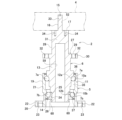
- FIG. 1 is a cross-sectional view of a rotational drive device including a rotational support device for an aircraft according to a first embodiment of the present disclosure.
- FIG. 2 is a side view of the rotary drive device including the rotary support device for an aircraft of the first example, as viewed from the horizontal direction.
- FIG. 3 is a view of the rotary drive device including the rotary support device for an aircraft of the first example, as viewed from one axial side.
- FIG. 4 is a view of the rotary drive device including the rotary support device for an aircraft of the first example, as viewed from the other axial side.
- FIG. 5 is a cross-sectional view of the first example of the rotational support device for an aircraft.
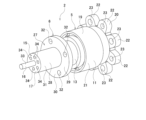
- FIG. 6 is a perspective view of the first example of the rotational support device for an aircraft, as viewed from one axial side.
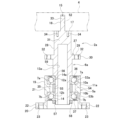
- FIG. 7 is a cross-sectional view of a rotational support device for an aircraft according to a second embodiment of the present disclosure.
- First Example 1 to 6 show a rotational support device for an aircraft according to a first embodiment of the present disclosure.
- An aircraft to which the rotating support device for an aircraft of the present disclosure can be applied includes an aircraft frame, a propeller for generating upward lift, and an aircraft rotation drive device that rotatably supports the propeller on the aircraft frame and drives the propeller to rotate.
- the aircraft may be a large aircraft such as a helicopter, or a small aircraft such as a drone.
- the rotary drive device 1 for an aircraft is composed of the rotary support device 2 for an aircraft in this example and a drive motor 3.
- the rotating support device 2 for the aircraft supports the drive motor 3 and propeller 4 on the aircraft frame (not shown).
- the drive motor 3 includes a motor stator 8 and a motor rotor 9, and generates a rotational force to drive the propeller 4.
- the rotating support device 2 for an aircraft in this example includes a stationary body 5, a rotating body 6, and multiple rolling bodies 7a, 7b.
- one axial side is the side on which the propeller 4 is positioned when the aircraft is assembled, and is the upper side in Figures 1, 2, and 5.
- the stationary body 5 has double-row outer ring raceways 10a, 10b on its inner circumferential surface and is capable of supporting the motor stator 8.
- the stationary body 5 is supported and fixed to the aircraft frame and does not rotate even when the propeller 4 rotates.
- the stationary body 5 can be made of steel or a light alloy such as an aluminum alloy. In this example, the stationary body 5 is made of steel.
- the stationary body 5 includes at least a stationary side support member 11 that is configured to be generally cylindrical. In this example, the stationary body 5 is composed only of the stationary side support member 11.
- the double row outer ring raceways 10a, 10b can be formed directly on the inner circumferential surface of the stationary body 5, or can be formed on the inner circumferential surface of a pair of outer rings that are fitted inside the stationary body.
- the double row outer ring raceways 10a, 10b are formed directly on the inner peripheral surface of the stationary body 5. Specifically, the double row outer ring raceways 10a, 10b are formed on the inner peripheral surface of the stationary side support member 11 that constitutes the stationary body 5.
- the double row outer ring raceways 10a, 10b are each angular type. Specifically, each of the double row outer ring raceways 10a, 10b has an arc-shaped cross-sectional shape.
- the stationary side support member 11 has a groove shoulder on its inner circumferential surface, adjacent to the other axial side of the outer ring raceway 10a on one axial side, with a smaller inner diameter than the portion adjacent to the one axial side of the outer ring raceway 10a.
- the stationary side support member 11 has a groove shoulder on its inner circumferential surface, adjacent to the one axial side of the outer ring raceway 10b on the other axial side, with a smaller inner diameter than the portion adjacent to the other axial side of the outer ring raceway 10b.
- the double row outer ring raceways 10a, 10b are formed on the inner peripheral surfaces of a pair of outer rings fitted into a stationary body, more specifically, the pair of outer rings are fitted into the stationary side support member of the stationary body, the inner peripheral surface of the stationary body includes the inner peripheral surfaces of the pair of outer rings, and the double row outer ring raceways are formed on the inner peripheral surfaces of the pair of outer rings.
- the outer ring is made of steel.
- the rotating body 6 has double-row inner ring raceways 12a, 12b on its outer circumferential surface and is capable of supporting the motor rotor 9 and propeller 4.
- the rotating body 6 can be made of steel or a light alloy such as an aluminum alloy. In this example, the rotating body 6 is made of steel.
- the rotating body 6 is arranged radially inside the stationary body 5 and coaxially with the stationary body 5.
- At least the inner ring raceway 12a on one axial side can be formed directly on the outer circumferential surface of the rotating body 6.
- Both of the double row inner ring raceways 12a, 12b can also be formed on the outer circumferential surfaces of a pair of inner rings fitted inside the rotating body.
- the rotating body 6 has an inner ring 14 fitted onto the portion of the rotating body 6 that is positioned radially inward of the stationary body 5, the outer peripheral surface of the rotating body 6 includes the outer peripheral surface of the inner ring 14, and the inner ring raceway 12a on one axial side of the double row inner ring raceways 12a, 12b is formed directly on the outer peripheral surface of the rotating body 6, and the inner ring raceway 12b on the other axial side is formed on the outer peripheral surface of the inner ring 14.
- the inner ring 14 is made of steel.
- the rotating body 6 is composed of a shaft-shaped rotating side support member 13 that includes a portion located on one axial side of the stationary body 5 and a portion located radially inward of the stationary body 5, and an inner ring 14 that is fitted onto the portion of the rotating side support member 13 that is located radially inward of the stationary body 5.
- the outer peripheral surface of the rotating body 6 is composed of the outer peripheral surface of the rotating side support member 13 and the outer peripheral surface of the inner ring 14.
- the inner ring raceway 12a on one axial side is formed directly on the outer peripheral surface of the portion of the rotating support member 13 that is positioned radially inward of the stationary body 5, and the inner ring raceway 12b on the other axial side is formed on the outer peripheral surface of the inner ring 14.
- the double row inner ring raceways 12a, 12b are each angular type. Specifically, each of the double row inner ring raceways 12a, 12b has an arc-shaped cross-sectional shape.
- the rotating side support member 13 has a groove shoulder on its outer circumferential surface, adjacent to one axial side of the inner ring raceway 12a on one axial side, that has a larger outer diameter than the portion adjacent to the other axial side of the inner ring raceway 12a.
- the inner ring 14 has a groove shoulder on its outer circumferential surface, adjacent to the other axial side of the inner ring raceway 12b on the other axial side, that has a larger outer diameter than the portion adjacent to one axial side of the inner ring raceway 12b.
- a crimping portion 26 is provided at the end of the other axial side of the rotating body 6, which protrudes radially outward and presses down the other axial end face of the inner ring 14, and a preload is applied to the rolling elements 7a and 7b by the crimping portion 26.
- the rotating side support member 13 has an inner ring fitting portion 24, which has a smaller outer diameter than the inner ring raceway 12a on one axial side and is cylindrical in shape and onto which the inner ring 14 is fitted, at a portion located on the other axial side of the inner ring raceway 12a on one axial side. Furthermore, the rotating side support member 13 has a step surface 25 facing the other axial side at the end on one axial side of the inner ring fitting portion 24, and has a crimping portion 26 protruding radially outward from the end on the other axial side of the inner ring fitting portion 24.
- the rotating body 6 is constructed by fitting the inner ring 14 onto the inner ring fitting portion 24 of the rotating support member 13, and clamping the inner ring 14 between the stepped surface 25 and the crimping portion 26 of the rotating support member 13 from both axial sides, thereby connecting and fixing the rotating support member 13 and the inner ring 14.
- the crimping portion 26 is composed of multiple crimping pieces 60 (four in the illustrated example) spaced apart in the circumferential direction. Therefore, the processing force required to form the crimping portion 26 can be kept small compared to when a crimping portion that is connected all around is used. Alternatively, a crimping portion that is connected all around can be used.
- the multiple rolling elements 7a, 7b are arranged between the double row outer ring raceways 10a, 10b and the double row inner ring raceways 12a, 12b.
- the multiple rolling elements 7a, 7b are made of steel or ceramic.
- the rolling elements 7a, 7b can be balls or tapered rollers.
- the rolling elements 7a, 7b are made of balls.
- a back-to-back type (DB type) contact angle and preload are applied to the rolling elements 7a, 7b in both rows.
- the rolling elements 7a, 7b in each row are held in a freely rolling manner by a cage (not shown).
- a predetermined amount of preload is applied to the rolling elements 7a, 7b. More specifically, an appropriate preload is applied to the rolling elements 7a, 7b by regulating the force with which the end faces on the other axial side of the inner ring 14 are pressed by the respective crimping portions 26.
- the double row outer ring raceways 10a, 10b are formed directly on the inner peripheral surface of the stationary support member 11 on which the motor stator 8 is supported, and the inner ring raceway 12a on one axial side of the double row inner ring raceways 12a, 12b is formed directly on the outer peripheral surface of the rotating support member 13 on which the motor rotor 9 and the propeller 4 are supported.
- the build-up of tolerances due to the combination of parts can be mitigated compared to a structure in which the double row outer ring raceways 10a, 10b are formed on the inner peripheral surfaces of a pair of outer rings fitted inside the stationary support member, and the inner ring raceway 12a on one axial side is formed on the outer peripheral surface of an inner ring fitted outside the rotating support member. Therefore, it is easy to ensure the coaxiality between the rotor 6 and the propeller 4, and between the motor stator 8 and the motor rotor 9.
- a structure can be adopted in which the double-row outer ring raceways 10a, 10b are formed on the inner peripheral surface of a pair of outer rings fitted inside the stationary support member, and the inner ring raceway 12a on one axial side is formed on the outer peripheral surface of an inner ring fitted outside the rotating support member, or a structure can be adopted in which the double-row outer ring raceways 10a, 10b are formed directly on the inner peripheral surface of the stationary support member, and both of the double-row inner ring raceways 12a, 12b are formed on the inner ring fitted outside the rotating support member.
- a propeller mounting portion 15 to which the propeller 4 can be directly attached is formed in a portion of the rotating body 6 that is located on one side of the stationary body 5 in the axial direction.
- the propeller mounting portion 15 is formed at one axial end of the rotating body 6, i.e., at one axial end of the rotating side support member 13.
- the propeller mounting portion 15 has a propeller fitting portion 16 for fitting the propeller 4 to the outside, and a propeller abutment portion 17 for abutting the propeller 4 in the axial direction.
- the rotating side support member 13 has a cylindrical small diameter shaft portion 33 at one axial end, and has a stepped surface facing one axial side at the other axial end of the outer circumferential surface of the small diameter shaft portion 33.
- the propeller fitting portion 16 is formed by the outer circumferential surface of the small diameter shaft portion 33, and the propeller abutment portion 17 is formed by the stepped surface.
- a central hole 52 extending in the axial direction is provided in the radial center of the propeller 4, and the central hole 52 of the propeller 4 is fitted onto the propeller fitting portion 16 without any radial rattle.
- the other axial side of the radial inner end of the propeller 4 is abutted against the propeller abutment portion 17, making it possible for the propeller 4 to be fixedly connected to the rotor 6 while being positioned radially and axially relative to the rotor 6.
- the central hole 52 is open only on the other axial side.
- the propeller 4 is fixed to the rotor 6 with the propeller fitting portion 16 and the propeller abutment portion 17 of the rotor 6 positioning the propeller 4 radially and axially relative to the rotor 6, so it is easier to ensure the support strength of the propeller 4 relative to the rotor 6 compared to when the propeller 4 is simply fitted onto the rotor 6.
- the rotating side support member 13 has threaded holes 34 that recess axially from multiple circumferential locations of the propeller abutment portion 17 as connecting holes for connecting the propeller 4.
- the threaded holes 34 are used to connect and fix the propeller 4 to the rotating side support member 13. More specifically, the propeller 4 is connected and fixed to the rotating body 6 by screwing bolts, which are connecting members, inserted through through holes provided at multiple circumferential locations on the radially inner end of the propeller 4 into the threaded holes 34 of the rotating body 6.
- a press-fit hole can be provided as a connection hole for connecting the propeller 4 to the rotating support member 13, and a stud bolt, which is a connection member, can be pressed into the press-fit hole and inserted into the through hole of the propeller.
- the propeller 4 can then be connected and fixed to the rotating body 6 by screwing a nut, which is a connection member, onto the tip of the stud bolt.
- an anti-loosening structure may be provided, such as a structure for crimping a portion of the rotor or propeller to a bolt or nut for connecting and fixing the propeller to the rotor.
- the propeller 4 can be attached directly to the propeller attachment portion 15 formed on the rotating body 6. This reduces the build-up of tolerances caused by combining parts compared to when the propeller 4 is attached to the rotating body 6 via a separate part such as the motor rotor 9, making it easier to ensure the concentricity of the propeller 4 with respect to the rotating body 6. As a result, it is easier to keep vibrations and noise generated when the propeller 4 rotates low.
- the propeller 4 and the motor rotor 9 can be arranged with a gap between them.
- the stationary support member 11 constituting the stationary body 5 has a stationary flange 20 for connecting to the aircraft frame of the flying vehicle.
- the stationary flange 20 can be used to support and fix the stationary body 5 to the aircraft frame.
- the stationary flange 20 is provided so as to protrude radially outward from a portion of the stationary side support member 11 in the axial direction. More specifically, the stationary flange 20 is disposed on a portion of the other axial side of the stationary side support member 11. In this example, the stationary flange 20 is formed on the other axial end of the stationary side support member 11.
- the stationary flange 20 has support holes 23 penetrating in the axial direction at multiple locations around the circumference.
- the support holes 23 are used to support and fix the stationary body 5 to the aircraft frame.
- the number and arrangement of the support holes 23 are arbitrary as long as they can support and fix the stationary body 5 to the aircraft frame, but it is preferable to arrange them evenly around the circumference at 4 to 10 locations. In this example, the support holes 23 are arranged evenly around the circumference at 8 locations.
- the support holes 23 are used to screw or insert connecting members such as bolts for supporting and fixing the stationary body 5 to the aircraft frame. Therefore, the support holes 23 can be configured as threaded holes that penetrate the stationary flange 20 at multiple points in the circumferential direction (including the case where part of the through hole is configured as a threaded hole), threaded holes that recess in the axial direction from multiple points in the circumferential direction of the stationary flange 20, or through holes that penetrate the stationary flange 20 at multiple points in the circumferential direction.
- the support hole 23 is configured as a screw hole.
- the stationary body 5 is supported and fixed to the aircraft frame by threading a bolt, which is a connecting member that is inserted through a through hole provided in the aircraft frame, into the support hole 23 of the stationary flange 20 from the other axial side.
- the stationary body 5 can be supported and fixed to the aircraft frame by inserting a bolt through the support hole 23 and screwing it into a screw hole provided in the aircraft frame, by passing the bolt through a through hole provided in the aircraft frame and screwing it into a nut, or by using a rivet as a connecting member.
- the shape and structure of the stationary flange 20 can be any shape and structure as long as it allows the stationary body 5 to be connected to the aircraft frame, but can be determined from the viewpoint of reducing the weight while maintaining the rigidity of the rotating support device 2 for an aircraft.
- the stationary flange 20 can be configured with a structure in which the entire circumference is connected, or with multiple stationary flange pieces 22 spaced apart in the circumferential direction.
- the number and arrangement of the stationary flange pieces 22 can be the same as the support holes 23, or, for example, a structure in which multiple support holes 23 are provided in one stationary flange piece 22 can be adopted.
- the stationary flange 20 is composed of eight stationary flange pieces 22 spaced apart in the circumferential direction, and each stationary flange piece 22 is provided with one support hole 23.
- the radially outer portion of each stationary flange piece 22 has a semicircular arc shape centered on the central axis of the support hole 23 when viewed from the axial direction.
- the stationary body 5 is connected to the aircraft frame using the stationary flange 20, so it is easier to ensure the support rigidity of the stationary body 5 relative to the aircraft frame compared to when the stationary body is simply fitted into the aircraft frame and connected.
- the rotating support device 2 for an aircraft in this example further includes, as an optional component, an annular member 18 that is fitted onto the stationary body 5.
- the stationary support member 11 has a stationary fitting portion 19 on its outer circumferential surface for fitting the annular member 18 onto the outer circumferential surface.
- the stationary fitting portion 19 is formed by a cylindrical surface provided on the outer peripheral surface of the stationary side tubular portion 21, of which the double row outer ring raceways 10a, 10b of the stationary side support member 11 are formed on the inner peripheral surface. More specifically, the stationary fitting portion 19 is formed on one axial half of the outer peripheral surface of the stationary side tubular portion 21.
- the stationary fitting portion 19 and the stationary flange 20 can be arranged adjacent to each other in the axial direction, but in this example, the stationary fitting portion 19 and the stationary flange 20 are arranged spaced apart in the axial direction.
- the portion of the outer peripheral surface of the stationary side tubular portion 21 that is located between the stationary fitting portion 19 and the stationary flange 20 in the axial direction is formed of a cylindrical surface with a smaller diameter than the stationary fitting portion 19. This ensures that the outer diameter dimension of the stationary flange 20 is small while ensuring a large radial width dimension of the stationary flange 20.
- the outer diameter of the stationary flange 20, i.e., the diameter of the circumscribing circle of the multiple stationary flange pieces 22, is smaller than the outer diameter of the annular member 18 and larger than the outer diameter of the stationary fitting portion 19.
- a rotor mounting portion 27 to which the motor rotor 9 can be directly attached is formed in a portion of the rotating body 6 that is located on one axial side of the stationary body 5 and on the other axial side of the propeller mounting portion 15.
- the rotor mounting portion 27 has a rotor fitting portion 28 for fitting the motor rotor 9 to the outside, and a rotor abutment portion 29 for abutting the motor rotor 9 in the axial direction.
- the rotating side support member 13 has a rotating flange 30 that protrudes radially outward in the axial middle of a portion located on one axial side of the stationary body 5 and on the other axial side of the propeller mounting portion 15.
- a cylindrical large diameter shaft portion 31 is provided in a portion adjacent to the other axial side of the propeller mounting portion 15 and adjacent to one axial side of the rotating flange 30.
- the large diameter shaft portion 31 has an outer diameter larger than that of the small diameter shaft portion 33 that constitutes the propeller mounting portion 15, which has an outer diameter smaller than that of the rotating flange 30.
- the step surface that constitutes the propeller abutment portion 17 of the propeller mounting portion 15 is constituted by the end face on one axial side of the large diameter shaft portion 31, more specifically, the end face facing one axial side that connects the outer circumferential surface of the large diameter shaft portion 31 and the outer circumferential surface of the small diameter shaft portion 33.
- the rotor fitting portion 28 is formed by the outer peripheral surface of the large diameter shaft portion 31, and the rotor abutment portion 29 is formed by the side surface on one axial side of the rotating flange 30. This ensures a large radial width dimension of the rotor fitting portion 28 onto which the motor rotor 9 is fitted, while keeping the radial width dimension of the rotating flange 30 small.
- the large diameter shaft portion 31 can be omitted and the rotor fitting portion 28 can be formed by the outer peripheral surface of the rotating flange 30.
- the shape and structure of the rotating flange 30 can be any shape as long as it can connect the motor rotor 9 to the rotating body 6, but in this example, the rotating flange 30 has a hollow circular plate shape, taking into account the outer diameter of the rotating flange 30 and the supporting rigidity of the motor rotor 9.
- the rotating flange 30 can also be configured with multiple rotating flange pieces spaced apart in the circumferential direction.
- the outer diameter of the rotating flange 30 is equal to or smaller than the outer diameter of the stationary fitting portion 19. More specifically, the outer diameter of the rotating flange 30 is slightly smaller than the outer diameter of the stationary fitting portion 19. Therefore, after assembling the rotating support device 2 for an aircraft, the annular member 18 can be fitted from one axial side to the stationary fitting portion 19. Alternatively, the outer diameter of the rotating flange 30 can be made larger than the outer diameter of the stationary fitting portion 19. In this case, before assembling the rotating support device for an aircraft, the annular member 18 can be fitted from one axial side to the stationary fitting portion 19.
- the rotating flange 30 has mounting holes 32 that penetrate in the axial direction at multiple locations around the circumference.
- the mounting holes 32 are used to connect and fix the motor rotor 9 to the rotating flange 30.
- the number and arrangement of the mounting holes 32 can be arbitrary as long as the motor rotor 9 can be supported and fixed to the rotating flange 30, but it is preferable to arrange the mounting holes 32 evenly in the circumferential direction at three to eight locations. In this example, the mounting holes 32 are arranged in four locations evenly in the circumferential direction.
- the mounting holes 32 can be configured as threaded holes (including cases where some of the through holes are configured as threaded holes) that penetrate the rotating flange 30 at multiple points in the circumferential direction, threaded holes that recess in the axial direction from multiple points in the circumferential direction of the rotating flange 30, or through holes or press-fit holes that penetrate the rotating flange 30 at multiple points in the circumferential direction.
- the mounting holes 32 are configured as threaded holes.
- the rotating side support member 13 has a central hole 59 extending in the axial direction in the radial center. Only the end of the central hole 59 on the other axial side is open. In this example, by providing the central hole 59 in the rotating side support member 13, the weight of the rotating side support member 13 is reduced. However, it is also possible to omit the central hole in the rotating side support member.
- the rotary support device 2 for an aircraft in this example has a different diameter PCD type structure in which the pitch circle diameter of the rolling elements 7a in one axial row is larger than the pitch circle diameter of the rolling elements 7b in the other axial row. This makes it easier to ensure the moment rigidity of the rotary support device 2 for an aircraft while keeping the outer diameter of the stationary body 5 small.
- a different diameter PCD type structure in which the pitch circle diameter of the rolling elements in one axial row is smaller than the pitch circle diameter of the rolling elements in the other axial row, or an equal diameter PCD type structure in which the pitch circle diameters of the rolling elements in both rows are equal to each other can be adopted.
- the stationary body 5 and the rotating body 6 are both made of steel, and the rolling bodies 7a, 7b are made of steel or ceramic, so that the overall rigidity of the rotary support device 2 for an aircraft is excellent.
- the crimped portion 26 of the rotating support member 13 presses down the other axial end face of the inner ring 14, thereby applying an appropriate preload to the rolling bodies 7a, 7b, so that the overall rigidity of the rotary support device 2 for an aircraft is excellent.
- the stationary body 5 is supported and fixed to the aircraft frame using the stationary flange 20, so that the support rigidity of the stationary body 5 relative to the aircraft frame is superior compared to when the stationary body is simply fitted inside the aircraft frame. Therefore, the support rigidity of the drive motor 3 and the propeller 4 relative to the aircraft frame is excellent.
- the rotating support device 2 for an aircraft in this example further includes a one-side seal device 36 that closes the opening on one axial side of the rolling body installation space 35 that exists between the inner circumferential surface of the stationary body 5 and the outer circumferential surface of the rotating body 6, and a other-side seal device 37 that closes the end on the other axial side of the rolling body installation space 35.
- a one-side seal device 36 that closes the opening on one axial side of the rolling body installation space 35 that exists between the inner circumferential surface of the stationary body 5 and the outer circumferential surface of the rotating body 6, and a other-side seal device 37 that closes the end on the other axial side of the rolling body installation space 35.
- the one-side seal device 36 and the other-side seal device 37 can be configured, for example, as a sliding seal ring that is supported and fixed to the stationary body 5 and has a seal lip whose tip is in sliding contact with the entire circumference of the surface of the rotating body 6.
- the one-side seal device 36 and the other-side seal device 37 can also be further provided with a sliding ring that is supported and fixed to the rotating body 6 and has the tip of the seal lip in sliding contact with its surface.
- the annular member 18 functions as a base to keep the radial width dimension of the motor stator 8 small while ensuring a large outer diameter dimension of the motor stator 8.
- the motor stator 8 is fitted onto the stationary body 5 via the annular member 18. Therefore, compared to when the motor stator 8 is directly fitted onto the stationary body 5, it is possible to ensure a large outer diameter dimension of the motor stator 8 while keeping the radial width dimension of the motor stator 8 small. In this example, by ensuring a large outer diameter dimension of the motor stator 8, it is possible to ensure a large output from the drive motor 3, specifically, the electromagnetic force that rotates the motor rotor 9 relative to the motor stator 8.
- the annular member 18 also functions as a heat exchange member, efficiently receiving heat from the adjacent motor stator 8 and exchanging heat with the surrounding air to facilitate cooling of the drive motor 3.
- the annular member 18 is made of a light alloy such as an aluminum alloy, which is a material with high thermal conductivity.
- the annular member 18 has a structure that makes it easy to ensure a contact area with the surrounding air, specifically, a structure that includes multiple ventilation passages, each of which allows air to pass through in the axial direction.
- the annular member 18 includes an inner diameter side tube portion 38, an outer diameter side tube portion 39, and a connecting portion 40.
- the inner diameter side tube portion 38 has a cylindrical shape.
- the outer diameter side tube portion 39 has a cylindrical shape and is arranged coaxially radially outward of the inner diameter side tube portion 38.
- the axial dimension of the outer diameter side tube portion 39 is greater than the axial dimension of the inner diameter side tube portion 38
- the end portion on one axial side of the outer diameter side tube portion 39 is arranged in the same axial position as the end portion on one axial side of the inner diameter side tube portion 38
- the end portion on the other axial side of the outer diameter side tube portion 39 is arranged on the other axial side of the end portion on the other axial side of the inner diameter side tube portion 38.
- the connecting portion 40 is configured as a hollow circular plate with an axial width dimension smaller than that of the inner diameter side cylinder portion 38.
- the radial inner end of the connecting portion 40 is connected to the outer peripheral surface of the other axial half of the inner diameter side cylinder portion 38, and the radial outer end of the connecting portion 40 is connected to the inner peripheral surface of the axial middle portion of the outer diameter side cylinder portion 39.
- the connecting portion 40 has air flow paths 41 at multiple circumferential positions on the radial outer portion, each of which is composed of a fan-shaped through hole when viewed from the axial direction.
- the annular member 18 further includes a hollow circular plate-shaped axial cover portion 42 that extends radially outward from the other axial end of the outer diameter side tube portion 39, and a cylindrical radial cover portion 43 that extends axially to one side from the radial outer end of the axial cover portion 42.
- the axial cover portion 42 has multiple circumferential and radial air vents 44 that each extend circumferentially and penetrate axially.
- the radial cover portion 43 has multiple circumferentially extending ventilation holes 45 that penetrate radially.
- the annular member 18 is fixed to the stationary body 5 by being press-fitted into the stationary fitting portion 19 of the stationary body 5.
- various fixing methods can be used to fix the annular member fitted into the stationary fitting portion of the stationary body to the stationary body, such as connecting and fixing using a bolt, key press-fitting, pin press-fitting, serration press-fitting, or adhesive.
- each ventilation passage 41 of the annular member 18 is disposed radially outward of the stationary flange 20 of the stationary body 5.
- the number of ventilation passages 41 is arbitrary, but in this example, 16 ventilation passages 41 are disposed in the circumferential direction. If the number of ventilation passages 41 of the annular member 18 is increased from this example to increase the contact area with the surrounding air, the function of the annular member 18 as a heat exchange member can be improved.
- the number, shape, size, and other configurations of the ventilation passages 41 are appropriately determined taking into consideration both the function of the annular member 18 to support and fix the motor stator 8 and its function as a heat exchange member.
- the annular member can be made of a non-metallic material with low thermal conductivity, for example, a synthetic resin such as fiber-reinforced plastic. Furthermore, it is also possible to adopt an annular member that does not have an axial ventilation passage.
- the motor stator 8 includes a core made of a magnetic material (not shown) and a coil wound around the core, and is configured as a ring shape as a whole, with magnetic poles at multiple locations on the outer circumferential surface that are equally spaced apart in the circumferential direction.
- the motor stator 8 is fixed to the outer circumferential surface of the annular member 18 by press-fitting or the like.
- the motor rotor 9 comprises a hollow disk-shaped side plate portion 46, a cylindrical tube portion 47 with one axial end portion fitted and fixed to the radial outer end portion of the side plate portion 46, and permanent magnets 48 fixed by adhesive or the like to a plurality of equally spaced circumferential positions on the inner peripheral surface of the tube portion 47.
- the side plate portion 46 is made of a light alloy such as an aluminum alloy to reduce weight.
- the tube portion 47 is made of a magnetic material such as an iron alloy to form a magnetic circuit.
- the side plate portion 46 has rotor recesses 49 at multiple circumferential locations (in this example, six locations equally spaced circumferentially) that open to the other axial side and to the radially outward side.
- the rotor recesses 49 are used to generate airflow around the motor rotor 9 when it rotates.
- the motor rotor 9 is radially and axially positioned relative to the rotor 6 by fitting the side plate portion 46 onto the rotor fitting portion 28 without any radial rattle, and abutting the other axial side surface of the radial inner end of the side plate portion 46 against the rotor abutment portion 29. Then, the motor rotor 9 is fixed to the rotating flange 30 by screwing the bolts 51, which are connecting members, through holes 50 provided at multiple locations around the circumference of the radial inner end of the side plate portion 46 into the mounting holes 32 of the rotating flange 30.
- the multiple permanent magnets 48 provided on the motor rotor 9 are radially closely opposed to the multiple magnetic poles provided on the outer peripheral surface of the motor stator 8.
- the radially inner portions of the multiple rotor recesses 49 provided on the motor rotor 9 are positioned in positions axially opposed to the multiple air flow passages 41 provided on the annular member 18.
- the motor rotor 9 is fixed to the rotating body 6 with the rotor fitting portion 28 and rotor abutment portion 29 of the rotating body 6 positioning the motor rotor 9 radially and axially relative to the rotating body 6, so it is easier to ensure the support strength of the motor rotor 9 relative to the rotating body 6 compared to when the motor rotor 9 is simply fitted onto the rotating body 6.
- each rotor recess 49 of the motor rotor 9 When the motor rotor 9 rotates together with the rotor 6 and the propeller 4, the air present inside each rotor recess 49 of the motor rotor 9 is pushed radially outward by the action of centrifugal force.
- the motor rotor 9, which has multiple rotor recesses 49, has a pump function that creates an air flow around it.
- the air flowing in the directions of the arrows ⁇ and ⁇ efficiently dissipates heat from the annular member 18, thereby efficiently cooling the drive motor 3.
- the motor rotor has a pump function, and the rotor recess 49 of the motor rotor 9 can be omitted.
- FIG. 7 illustrates a rotational support device for an aircraft according to a second embodiment of the present disclosure.
- the stationary body 5a is provided with a pair of outer rings 53a, 53b that are fitted inside the stationary body 5a. More specifically, the pair of outer rings 53a, 53b are attached by fitting inside the cylindrical stationary side support member 11a that constitutes the stationary body 5a.
- the double-row outer ring raceways 10a, 10b are formed on the inner peripheral surface of a pair of outer rings 53a, 53b. That is, the outer ring raceway 10a on one axial side is formed on the inner peripheral surface of the outer ring 53a on one axial side, and the outer ring raceway 10b on the other axial side is formed on the inner peripheral surface of the outer ring 53b on the other axial side.
- Each of the outer rings 53a, 53b is made of steel.
- the pair of outer rings 53a, 53b are spaced apart in the axial direction to increase the axial spacing between the double row outer ring raceways 10a, 10b and make it easier to ensure the moment rigidity (tilt rigidity) of the aircraft rotation support device 2a.
- the inward flange-shaped protrusion 54 provided in the axial middle of the stationary support member 11a is sandwiched between the pair of outer rings 53a, 53b from both axial sides.
- the pair of outer rings 53a, 53b can also be positioned adjacent to each other in the axial direction.
- the rotating body 6a has a pair of inner rings 14, 14a fitted onto a portion of the rotating body 6a located radially inward of the stationary body 5. More specifically, the pair of inner rings 14, 14a are attached by fitting onto the shaft-shaped rotating side support member 13a that constitutes the rotating body 6a. That is, in this example, in addition to the inner ring 14 in the first example, an inner ring 14a is fitted onto a portion of the rotating side support member 13a that is located on one axial side of the inner ring 14.
- the inner ring raceway 12a on one axial side is formed on the outer peripheral surface of the inner ring 14a, not on the outer peripheral surface of the rotating side support member 13a.
- the inner ring 14a is made of steel.
- the pair of inner rings 14, 14a are spaced apart in the axial direction to increase the axial spacing between the double row inner ring raceways 12a, 12b and make it easier to ensure the moment rigidity of the aircraft rotation support device 2a.
- the rotating body 6a further includes a cylindrical spacer 55.
- the spacer 55 is sandwiched between the pair of inner rings 14, 14a from both axial sides.
- the pair of inner rings 14, 14a can also be positioned adjacent to each other in the axial direction.
- the rotating body 6a further includes a nut 58 that is screwed onto a male threaded portion 57 provided on the outer peripheral surface of the end portion of the rotating side support member 13a on the other axial direction, and the nut 58 presses down the end face of the inner ring 14 on the other axial direction.
- a predetermined amount of preload is applied to the rolling bodies 7a, 7b when the aircraft rotation support device 2a is assembled.
- a crimped portion can be formed on the rotating side support member 13a, and the crimped portion can be used to press down the end face of the inner ring 14 on the other axial direction, thereby applying preload to the rolling bodies 7a, 7b.
- the rotating support device 2a for an aircraft in this example employs an equal diameter PCD type structure in which the pitch circle diameters of the rolling elements 7a, 7b in both rows are equal to each other.
- a different diameter PCD type structure in which the pitch circle diameters of the rolling elements 7a, 7b in both rows are different to each other can be employed.
- the double row outer ring raceways 10a, 10b are not formed on the inner peripheral surface of the stationary support member 11a, the shape of the stationary support member 11a is simplified, and the processing costs of the stationary support member 11a can be reduced. Also, since the double row inner ring raceways 12a, 12b are not formed on the outer peripheral surface of the rotating support member 13a, the shape of the rotating support member 13a is simplified, and the processing costs of the rotating support member 13a can be reduced.
- the rolling bearing on one axial side which includes the outer ring 53a, the inner ring 14a, and a number of rolling elements 7a
- the rolling bearing on the other axial side which includes the outer ring 53b, the inner ring 14, and a number of rolling elements 7b
- the rolling bearings on both the one axial side and the other axial side are both deep groove ball bearings.
- the rotating support device for an aircraft disclosed herein can be implemented by appropriately combining the structures of each of the above-mentioned embodiments to the extent that no contradictions arise.
Landscapes
- Engineering & Computer Science (AREA)
- General Engineering & Computer Science (AREA)
- Power Engineering (AREA)
- Mechanical Engineering (AREA)
- Aviation & Aerospace Engineering (AREA)
- Rolling Contact Bearings (AREA)
Priority Applications (2)
| Application Number | Priority Date | Filing Date | Title |
|---|---|---|---|
| JP2025516541A JPWO2024224761A1 (https=) | 2023-04-28 | 2024-02-15 | |
| CN202480021531.0A CN121013810A (zh) | 2023-04-28 | 2024-02-15 | 飞行体用旋转支撑装置 |
Applications Claiming Priority (2)
| Application Number | Priority Date | Filing Date | Title |
|---|---|---|---|
| JP2023-074082 | 2023-04-28 | ||
| JP2023074082 | 2023-04-28 |
Publications (1)
| Publication Number | Publication Date |
|---|---|
| WO2024224761A1 true WO2024224761A1 (ja) | 2024-10-31 |
Family
ID=93255936
Family Applications (1)
| Application Number | Title | Priority Date | Filing Date |
|---|---|---|---|
| PCT/JP2024/005274 Ceased WO2024224761A1 (ja) | 2023-04-28 | 2024-02-15 | 飛行体用回転支持装置 |
Country Status (3)
| Country | Link |
|---|---|
| JP (1) | JPWO2024224761A1 (https=) |
| CN (1) | CN121013810A (https=) |
| WO (1) | WO2024224761A1 (https=) |
Citations (4)
| Publication number | Priority date | Publication date | Assignee | Title |
|---|---|---|---|---|
| WO2018139661A1 (ja) * | 2017-01-30 | 2018-08-02 | 日本電産株式会社 | 無人飛行体 |
| JP2020072530A (ja) * | 2018-10-30 | 2020-05-07 | 日本電産株式会社 | アウターロータ型モータ |
| JP2020167806A (ja) * | 2019-03-28 | 2020-10-08 | 日本電産株式会社 | モータ、回転翼装置、および無人飛行体 |
| JP2023040693A (ja) * | 2021-09-10 | 2023-03-23 | 国立大学法人北陸先端科学技術大学院大学 | ドローン及びドローンの制御装置 |
-
2024
- 2024-02-15 JP JP2025516541A patent/JPWO2024224761A1/ja active Pending
- 2024-02-15 CN CN202480021531.0A patent/CN121013810A/zh active Pending
- 2024-02-15 WO PCT/JP2024/005274 patent/WO2024224761A1/ja not_active Ceased
Patent Citations (4)
| Publication number | Priority date | Publication date | Assignee | Title |
|---|---|---|---|---|
| WO2018139661A1 (ja) * | 2017-01-30 | 2018-08-02 | 日本電産株式会社 | 無人飛行体 |
| JP2020072530A (ja) * | 2018-10-30 | 2020-05-07 | 日本電産株式会社 | アウターロータ型モータ |
| JP2020167806A (ja) * | 2019-03-28 | 2020-10-08 | 日本電産株式会社 | モータ、回転翼装置、および無人飛行体 |
| JP2023040693A (ja) * | 2021-09-10 | 2023-03-23 | 国立大学法人北陸先端科学技術大学院大学 | ドローン及びドローンの制御装置 |
Also Published As
| Publication number | Publication date |
|---|---|
| JPWO2024224761A1 (https=) | 2024-10-31 |
| CN121013810A (zh) | 2025-11-25 |
Similar Documents
| Publication | Publication Date | Title |
|---|---|---|
| CN106089985B (zh) | 轴承单元—轮毂凸缘的组装过程 | |
| CN104350670B (zh) | 具有至少一个盘式电动机转子的装置和装配方法 | |
| US20160233738A1 (en) | In-wheel motor and in-wheel motor driving device | |
| JPH0720362B2 (ja) | ハードディスク駆動用電動モータ | |
| CN106089991B (zh) | 用于预加载轮毂轴承单元的方法 | |
| JP5278935B2 (ja) | 車輪用軸受装置 | |
| EP0910080A2 (en) | A spindle motor and motor bearing seal therefor | |
| JPH02190609A (ja) | ラジアル・スラスト複合軸受 | |
| EP2233789A1 (en) | Ball screw device | |
| WO2024224761A1 (ja) | 飛行体用回転支持装置 | |
| KR101795395B1 (ko) | 구동모터용 베어링 유닛 | |
| JP2000074052A (ja) | 複合軸受装置および同軸受装置を備えるスピンドルモータならびにハードディスクドライブ装置用スイングアームアセンブリ | |
| JP2008031941A (ja) | 風力発電機の回転軸支持構造 | |
| KR20160106423A (ko) | 구동 휠 베어링장치 | |
| JP2025177454A (ja) | 飛行体用回転支持装置 | |
| WO2024224742A1 (ja) | 飛行体用回転支持装置およびその製造方法 | |
| WO2024166592A1 (ja) | 飛行体用回転支持装置 | |
| JP2003148458A (ja) | ピニオン軸支持用軸受ユニット | |
| CN112659812B (zh) | 带发电机的轮毂单元轴承 | |
| JP2024013116A (ja) | ハブユニット軸受 | |
| JP2025177455A (ja) | 飛行体用回転支持装置 | |
| JP2002187404A (ja) | 車輪用軸受装置 | |
| JP2003148459A (ja) | ピニオン軸支持用軸受装置 | |
| JP2007069746A (ja) | 軸受ユニット | |
| JP3064441B2 (ja) | 軸受構造体及びスピンドルモータ |
Legal Events
| Date | Code | Title | Description |
|---|---|---|---|
| 121 | Ep: the epo has been informed by wipo that ep was designated in this application |
Ref document number: 24796520 Country of ref document: EP Kind code of ref document: A1 |
|
| ENP | Entry into the national phase |
Ref document number: 2025516541 Country of ref document: JP Kind code of ref document: A |
|
| WWE | Wipo information: entry into national phase |
Ref document number: 2025516541 Country of ref document: JP |
|
| NENP | Non-entry into the national phase |
Ref country code: DE |