WO2024219039A1 - 位相変調モジュール - Google Patents
位相変調モジュール Download PDFInfo
- Publication number
- WO2024219039A1 WO2024219039A1 PCT/JP2024/002436 JP2024002436W WO2024219039A1 WO 2024219039 A1 WO2024219039 A1 WO 2024219039A1 JP 2024002436 W JP2024002436 W JP 2024002436W WO 2024219039 A1 WO2024219039 A1 WO 2024219039A1
- Authority
- WO
- WIPO (PCT)
- Prior art keywords
- phase modulation
- modulation element
- holding portion
- protrusion
- potting material
- Prior art date
- Legal status (The legal status is an assumption and is not a legal conclusion. Google has not performed a legal analysis and makes no representation as to the accuracy of the status listed.)
- Ceased
Links
Images



Classifications
-
- G—PHYSICS
- G02—OPTICS
- G02F—OPTICAL DEVICES OR ARRANGEMENTS FOR THE CONTROL OF LIGHT BY MODIFICATION OF THE OPTICAL PROPERTIES OF THE MEDIA OF THE ELEMENTS INVOLVED THEREIN; NON-LINEAR OPTICS; FREQUENCY-CHANGING OF LIGHT; OPTICAL LOGIC ELEMENTS; OPTICAL ANALOGUE/DIGITAL CONVERTERS
- G02F1/00—Devices or arrangements for the control of the intensity, colour, phase, polarisation or direction of light arriving from an independent light source, e.g. switching, gating or modulating; Non-linear optics
- G02F1/01—Devices or arrangements for the control of the intensity, colour, phase, polarisation or direction of light arriving from an independent light source, e.g. switching, gating or modulating; Non-linear optics for the control of the intensity, phase, polarisation or colour
- G02F1/13—Devices or arrangements for the control of the intensity, colour, phase, polarisation or direction of light arriving from an independent light source, e.g. switching, gating or modulating; Non-linear optics for the control of the intensity, phase, polarisation or colour based on liquid crystals, e.g. single liquid crystal display cells
- G02F1/133—Constructional arrangements; Operation of liquid crystal cells; Circuit arrangements
- G02F1/1333—Constructional arrangements; Manufacturing methods
- G02F1/133308—Support structures for LCD panels, e.g. frames or bezels
-
- G—PHYSICS
- G02—OPTICS
- G02F—OPTICAL DEVICES OR ARRANGEMENTS FOR THE CONTROL OF LIGHT BY MODIFICATION OF THE OPTICAL PROPERTIES OF THE MEDIA OF THE ELEMENTS INVOLVED THEREIN; NON-LINEAR OPTICS; FREQUENCY-CHANGING OF LIGHT; OPTICAL LOGIC ELEMENTS; OPTICAL ANALOGUE/DIGITAL CONVERTERS
- G02F1/00—Devices or arrangements for the control of the intensity, colour, phase, polarisation or direction of light arriving from an independent light source, e.g. switching, gating or modulating; Non-linear optics
- G02F1/01—Devices or arrangements for the control of the intensity, colour, phase, polarisation or direction of light arriving from an independent light source, e.g. switching, gating or modulating; Non-linear optics for the control of the intensity, phase, polarisation or colour
- G02F1/13—Devices or arrangements for the control of the intensity, colour, phase, polarisation or direction of light arriving from an independent light source, e.g. switching, gating or modulating; Non-linear optics for the control of the intensity, phase, polarisation or colour based on liquid crystals, e.g. single liquid crystal display cells
- G02F1/133—Constructional arrangements; Operation of liquid crystal cells; Circuit arrangements
- G02F1/1333—Constructional arrangements; Manufacturing methods
-
- G—PHYSICS
- G02—OPTICS
- G02F—OPTICAL DEVICES OR ARRANGEMENTS FOR THE CONTROL OF LIGHT BY MODIFICATION OF THE OPTICAL PROPERTIES OF THE MEDIA OF THE ELEMENTS INVOLVED THEREIN; NON-LINEAR OPTICS; FREQUENCY-CHANGING OF LIGHT; OPTICAL LOGIC ELEMENTS; OPTICAL ANALOGUE/DIGITAL CONVERTERS
- G02F1/00—Devices or arrangements for the control of the intensity, colour, phase, polarisation or direction of light arriving from an independent light source, e.g. switching, gating or modulating; Non-linear optics
- G02F1/01—Devices or arrangements for the control of the intensity, colour, phase, polarisation or direction of light arriving from an independent light source, e.g. switching, gating or modulating; Non-linear optics for the control of the intensity, phase, polarisation or colour
- G02F1/13—Devices or arrangements for the control of the intensity, colour, phase, polarisation or direction of light arriving from an independent light source, e.g. switching, gating or modulating; Non-linear optics for the control of the intensity, phase, polarisation or colour based on liquid crystals, e.g. single liquid crystal display cells
- G02F1/133—Constructional arrangements; Operation of liquid crystal cells; Circuit arrangements
- G02F1/1333—Constructional arrangements; Manufacturing methods
- G02F1/1345—Conductors connecting electrodes to cell terminals
-
- G—PHYSICS
- G02—OPTICS
- G02F—OPTICAL DEVICES OR ARRANGEMENTS FOR THE CONTROL OF LIGHT BY MODIFICATION OF THE OPTICAL PROPERTIES OF THE MEDIA OF THE ELEMENTS INVOLVED THEREIN; NON-LINEAR OPTICS; FREQUENCY-CHANGING OF LIGHT; OPTICAL LOGIC ELEMENTS; OPTICAL ANALOGUE/DIGITAL CONVERTERS
- G02F2202/00—Materials and properties
- G02F2202/28—Adhesive materials or arrangements
-
- G—PHYSICS
- G02—OPTICS
- G02F—OPTICAL DEVICES OR ARRANGEMENTS FOR THE CONTROL OF LIGHT BY MODIFICATION OF THE OPTICAL PROPERTIES OF THE MEDIA OF THE ELEMENTS INVOLVED THEREIN; NON-LINEAR OPTICS; FREQUENCY-CHANGING OF LIGHT; OPTICAL LOGIC ELEMENTS; OPTICAL ANALOGUE/DIGITAL CONVERTERS
- G02F2203/00—Function characteristic
- G02F2203/02—Function characteristic reflective
-
- G—PHYSICS
- G02—OPTICS
- G02F—OPTICAL DEVICES OR ARRANGEMENTS FOR THE CONTROL OF LIGHT BY MODIFICATION OF THE OPTICAL PROPERTIES OF THE MEDIA OF THE ELEMENTS INVOLVED THEREIN; NON-LINEAR OPTICS; FREQUENCY-CHANGING OF LIGHT; OPTICAL LOGIC ELEMENTS; OPTICAL ANALOGUE/DIGITAL CONVERTERS
- G02F2203/00—Function characteristic
- G02F2203/50—Phase-only modulation
Definitions
- One aspect of the present disclosure relates to a phase modulation module.
- the optical element package described in Patent Document 1 includes a housing formed by a bottom plate and side plates, and a reflective optical element housed in the housing.
- the gap between the optical element and the housing is filled with sealing resin, and the side and back surfaces of the optical element are covered with the sealing resin.
- the potting material (sealing resin) will overflow into the effective area of the surface of the optical element during manufacturing, transportation, use, etc.
- the optical element is a phase modulation element
- the amount of heat generated increases, and there is a risk that characteristics will change or damage will occur due to temperature rise (for example, decomposition or carbonization of liquid crystal).
- a rise in temperature may change the surface shape of the phase modulation element, and distortion may occur to an extent that cannot be corrected by the phase pattern input to the phase modulation element. For this reason, there is a demand for improved heat dissipation (light resistance).
- one aspect of the present disclosure aims to provide a phase modulation module that can suppress the potting material from spilling into the active area of the phase modulation element and can improve heat dissipation.
- a phase modulation module is, [1] "a base portion, a reflective phase modulation element disposed on the base portion, a first retaining portion and a second retaining portion disposed on the base portion such that the phase modulation element is located between them when viewed from a predetermined direction, and a potting material that connects the phase modulation element and the first retaining portion to each other and also connects the phase modulation element and the second retaining portion to each other, and when the side on which the phase modulation element is located relative to the base portion in the predetermined direction is defined as a first side and the side opposite to the first side is defined as a second side, the phase modulation element is a circuit board disposed on the base portion, a liquid crystal layer disposed on the first side relative to the circuit board, and a potting material formed in a plate shape from a light-transmitting material and disposed on the first side relative to the liquid crystal layer.
- the first holding part has a first side wall part facing a first side of the phase modulation element and a first protrusion part extending from the first side wall part toward the phase modulation element;
- the second holding part has a second side wall part facing a second side of the phase modulation element opposite the first side, an end face of the first protrusion part faces the phase modulation element;
- the potting material connects the end face of the first protrusion part and the first side in a first space formed by the first side of the phase modulation element and the first side wall part and the first protrusion part of the first holding part; and air is disposed in at least a part of the first space that overlaps with the first protrusion part when viewed from the predetermined direction.
- the first holding part has a first protrusion extending from the first side wall part toward the phase modulation element
- the potting material connects the end face of the first protrusion and the first side of the phase modulation element in the first space
- air is disposed in at least a part of the part of the first space that overlaps with the first protrusion when viewed from a predetermined direction.
- the first holding part has a first protrusion, so that a wide space for disposing air between the first protrusion and the base part can be secured, and spilling out of the potting material into the effective area of the phase modulation element can be effectively prevented.
- the potting material connects the end face of the first protrusion of the first holding part and the first side of the phase modulation element in the first space, and air is disposed in at least a part of the part of the first space that overlaps with the first protrusion when viewed from a predetermined direction.
- phase modulation module of [1] it is possible to suppress the potting material from spilling out into the effective area of the phase modulation element and to improve heat dissipation.
- a phase modulation module is [2] "comprising a base portion, a reflective phase modulation element disposed on the base portion, a first holding portion and a second holding portion disposed on the base portion such that the phase modulation element is located between them when viewed from a predetermined direction, and a potting material that connects the phase modulation element and the first holding portion to each other and also connects the phase modulation element and the second holding portion to each other, and when the side on which the phase modulation element is located relative to the base portion in the predetermined direction is defined as a first side and the side opposite to the first side is defined as a second side, the phase modulation element has a circuit board disposed on the base portion, a liquid crystal layer disposed on the first side relative to the circuit board, and a cover member formed in a plate shape from a light-transmitting material and disposed on the first side relative to the liquid crystal layer, and the first holding portion faces a first side of the phase modulation element.
- the cover member having a first protrusion protruding from the circuit board when viewed from the predetermined direction, an end face of the first protrusion facing the first holding portion, the potting material connecting the end face of the first protrusion and the first holding portion in a first space formed by the first side surface of the phase modulation element and the first side wall portion of the first holding portion, air being disposed in at least a portion of the overlapping portion of the first space that overlaps with the first protrusion when viewed from the predetermined direction, and the second side edge of the opening of the overlapping portion at a position corresponding to the end face of the first protrusion is located on the second side with respect to the surface of the first side of the circuit board.
- the cover member has a first protrusion protruding from the circuit board, the potting material connects the end face of the first protrusion and the first holding part in the first space, and air is disposed in at least a part of the overlapping part that overlaps with the first protrusion when viewed from a predetermined direction in the first space.
- the cover member has a first protrusion, so that a wide space for disposing air between the first protrusion and the base part can be secured, and spilling out of the potting material into the effective area of the phase modulation element can be effectively prevented.
- the edge of the second side of the opening of the overlapping portion at the position corresponding to the end face of the first protrusion is located on the second side with respect to the surface of the first side of the circuit board. This makes it possible to ensure a wide length of the opening of the overlapping portion in a predetermined direction.
- the potting material easily enters the overlapping portion, and the potting material can be more effectively prevented from spilling out into the effective area of the phase modulation element.
- the potting material connects the end face of the first protrusion and the first holding portion to each other in the first space, and air is disposed in at least a part of the overlapping portion that overlaps with the first protrusion when viewed from a predetermined direction in the first space. This makes it possible to form a heat path via the potting material in a location where the distance between the first holding portion and the phase modulation element is short, and the heat generated in the phase modulation element can be efficiently transferred to the holding portion via the potting material. Therefore, according to the phase modulation module of [2], it is possible to suppress the potting material from spilling out into the effective area of the phase modulation element and to improve heat dissipation.
- the phase modulation module according to one aspect of the present disclosure may be [3] "the phase modulation module according to [1] or [2] in which the air is disposed between the potting material and the base portion, thereby separating the potting material from the base portion.”
- the above-mentioned effect of forming a heat path via the potting material in a location where the distance between the first holding portion and the phase modulation element is short is effectively achieved.
- the phase modulation module according to one aspect of the present disclosure may be [4] "the phase modulation module according to any one of [1] to [3], in which the air is in contact with the first side surface of the phase modulation element and the first side wall portion of the first holding portion.”
- the above-mentioned effect of forming a heat path via a potting material in a location where the distance between the first holding portion and the phase modulation element is short is effectively achieved.
- the phase modulation module according to one aspect of the present disclosure may be [5] "a phase modulation module according to any one of [1] to [4], in which the thermal conductivity of the potting material is 0.5 W/(m ⁇ K) or more.” In this case, the heat generated in the phase modulation element can be transferred to the holding part more efficiently.
- the phase modulation module according to one aspect of the present disclosure may be [6] "the phase modulation module according to any one of [1] to [5], in which the first holding portion and the second holding portion are formed of a metal material.” In this case, the heat transferred to the holding portion can be efficiently transferred to the base portion.
- the phase modulation module according to one aspect of the present disclosure may be [7] "a phase modulation module according to any one of [1] to [6], in which the first holding portion and the second holding portion are connected to each other by a top wall portion that defines an opening that overlaps with at least a portion of the phase modulation element when viewed from the predetermined direction.”
- the amount of potting material can be limited by limiting the arrangement space of the potting material with the top wall portion, and heat generated in the phase modulation element can be efficiently transferred to the holding portion via a small amount of potting material.
- the phase modulation module according to one aspect of the present disclosure may be [8] "the phase modulation module according to any one of [1] to [7], in which the potting material is in contact with at least the circuit board in the first space.” In this case, heat generated in the liquid crystal layer and transferred to the circuit board can be transferred to the retaining portion via the potting material.
- the phase modulation module according to one aspect of the present disclosure may be [9] "a phase modulation module according to any one of [1] to [8], in which the volume of the air in the first space is greater than the volume of the potting material.” In this case, it is possible to more effectively prevent the potting material from spilling out into the effective area of the phase modulation element. In addition, the above-mentioned effect of being able to form a heat path via the potting material in a location where the distance between the first holding portion and the phase modulation element is short is effectively achieved.
- the phase modulation module according to one aspect of the present disclosure may be the phase modulation module according to [1], in which the second holding part further has a second protrusion extending from the second side wall part toward the phase modulation element, an end face of the second protrusion faces the phase modulation element, the potting material connects the end face of the second protrusion and the second side face in a second space formed by the second side face of the phase modulation element and the second side wall part and the second protrusion of the second holding part, and air is disposed in at least a part of the part of the second space that overlaps with the second protrusion when viewed from the predetermined direction.
- a heat path via the potting material can be formed in a place where the distance between the second holding part and the phase modulation element is short, and heat generated in the phase modulation element can be efficiently transferred to the holding part via the potting material.
- the phase modulation module may be the phase modulation module described in [1] or [10], in which the cover member has a protruding portion protruding from the circuit board when viewed from the predetermined direction, an end face of the protruding portion of the cover member faces the first holding portion, and the potting material connects the end face of the first protruding portion and the end face of the protruding portion of the cover member to each other in the first space.
- the distance between the first holding portion and the phase modulation element can be further shortened. Then, by forming a heat path via the potting material at that location, heat generated in the phase modulation element can be transferred more efficiently to the holding portion via the potting material.
- the phase modulation module according to one aspect of the present disclosure may be [12] "a phase modulation module according to any one of [1], [10], and [11], in which, when a portion of the first space that overlaps with the first protrusion when viewed from the predetermined direction is defined as an overlapping portion, the second side edge of the opening of the overlapping portion at a position corresponding to the end face of the first protrusion is located on the second side with respect to the first side surface of the circuit board.”
- the length of the opening of the overlapping portion in the predetermined direction can be ensured to be wide.
- the potting material can easily enter the overlapping portion, and the overflow of the potting material into the effective area of the phase modulation element can be more effectively suppressed.
- the phase modulation module may be the phase modulation module described in [2], in which [13] "the cover member further has a second protruding portion protruding from the circuit board when viewed from the predetermined direction, an end face of the second protruding portion faces the second holding portion, the potting material connects the end face of the second protruding portion and the second holding portion to each other in a second space formed by the second side surface of the phase modulation element and the second side wall portion of the second holding portion, and air is disposed in at least a part of the portion of the second space that overlaps with the second protruding portion when viewed from the predetermined direction.”
- a heat path via the potting material can be formed in a portion where the distance between the second holding portion and the phase modulation element is short, and heat generated in the phase modulation element can be efficiently transferred to the holding portion via the
- the phase modulation module according to one aspect of the present disclosure may be [14] "the phase modulation module according to [2] or [13], in which the first holding part further has a protrusion extending from the first side wall part toward the phase modulation element, an end face of the protrusion of the first holding part faces the phase modulation element, and the potting material connects the end face of the first protrusion and the end face of the protrusion of the first holding part to each other in the first space.”
- the distance between the first holding part and the phase modulation element can be further shortened. Then, by forming a heat path via the potting material at that location, heat generated in the phase modulation element can be transferred more efficiently to the holding part via the potting material.
- the phase modulation module according to one aspect of the present disclosure may be [15] "a phase modulation module according to any one of [2], [13], and [14], in which the length of the opening of the overlapping portion in the predetermined direction is at least half the maximum length of the overlapping portion in the predetermined direction.”
- the potting material can more easily enter the overlapping portion, and the potting material can be more effectively prevented from spilling out into the effective area of the phase modulation element.
- a phase modulation module is [16] "a base portion, a reflective phase modulation element arranged on the base portion, a first holding portion and a second holding portion arranged on the base portion such that the phase modulation element is located between them when viewed from a predetermined direction, and a potting material that connects the phase modulation element and the first holding portion to each other and connects the phase modulation element and the second holding portion to each other, and in the predetermined direction, when a side on which the phase modulation element is located with respect to the base portion in a first direction is defined as a first side and an opposite side to the first side is defined as a second side, the phase modulation element has a circuit board arranged on the base portion, a liquid crystal layer arranged on the first side with respect to the circuit board, and a cover member formed in a plate shape from a light-transmitting material and arranged on the first side with respect to the liquid crystal layer, and has a configuration of (a) or (b) below.
- the first holding portion has a first side wall portion facing a first side surface of the phase modulation element and a first protrusion portion extending from the first side wall portion toward the phase modulation element
- the second holding portion has a second side wall portion facing a second side surface of the phase modulation element opposite the first side surface
- an end face of the first protrusion portion faces the phase modulation element
- the potting material is disposed in a first space formed by the first side surface of the phase modulation element and the first side wall portion and the first protrusion portion of the first holding portion, and connects the end face of the first protrusion portion and the first side surface to each other in the first space
- air is disposed in at least a portion of the first space that overlaps with the first protrusion portion when viewed from the predetermined direction.
- phase modulation module in which the first holding portion has a first side wall portion facing a first side surface of the phase modulation element, the second holding portion has a second side wall portion facing a second side surface of the phase modulation element opposite the first side surface, the cover member has a first protrusion portion protruding toward the circuit board when viewed from the predetermined direction, an end face of the first protrusion portion faces the first holding portion, the potting material is disposed in a first space formed by the first side surface of the phase modulation element and the first side wall portion of the first holding portion and connects the end face of the first protrusion portion and the first holding portion to each other in the first space, air is disposed in at least a part of an overlapping portion of the first space that overlaps with the first protrusion portion when viewed from the predetermined direction, and an edge on the second side of an opening of the overlapping portion at a position corresponding to the end face of the first protrusion portion is located on the second side with respect to the surface of the first side of
- phase modulation module that can suppress the potting material from spilling into the active area of the phase modulation element and can improve heat dissipation.
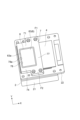
- FIG. 2 is a perspective view of a phase modulation module according to an embodiment.
- FIG. 2 is a perspective view of the device shown in FIG. 1 with a housing unit removed.
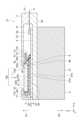
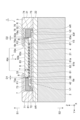
- FIG. 2 is a cross-sectional view taken along line III-III in FIG.
- FIG. 2 is a cross-sectional view taken along line IV-IV in FIG.
- 5A is a partial enlarged view of FIG. 4 showing the first space
- FIG. 5B is a partial enlarged view of FIG. 4 showing the second space.
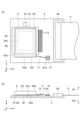
- FIG. 6A is a plan view of the wiring board and the phase modulation element
- FIG. 6B is a side view of the wiring board and the phase modulation element.
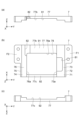
- 7(a) is a side view of the holding portion as viewed from above in FIG. 7(b), FIG.
- FIG. 7(b) is a bottom view of the holding portion
- FIG. 7(c) is a side view of the holding portion as viewed from below in FIG. 7(b).
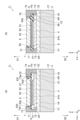
- FIG. 8A is a cross-sectional view of a phase modulation module according to a first modified example
- FIG. 8B is a cross-sectional view of a phase modulation module according to a second modified example.
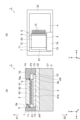
- FIG. 9A is a cross-sectional view of a phase modulation module of a third modified example
- FIG. 9B is a plan view of the phase modulation module of the third modified example.
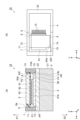
- FIG. 10A is a cross-sectional view of a phase modulation module of a fourth modified example
- FIG. 10B is a plan view of the phase modulation module of the fourth modified example.
- FIG. 11(a) is a plan view of a phase modulation module of a fifth modified example
- FIG. 11(b) is a plan view of a phase modulation module of a sixth modified example
- FIG. 11(c) is a plan view of a phase modulation module of a seventh modified example.
- the phase modulation module 1 includes a base 2, a housing 3 (outer cover), a first wiring board 4, a second wiring board 5, a phase modulation element 6, a holding part 7 (inner cover), and a potting material 8.
- the phase modulation element 6 includes a circuit board 61, a liquid crystal layer 62, and a cover member 63.
- the laser light L is incident on the phase modulation element 6 and reflected. At this time, the phase of the laser light L is modulated by the liquid crystal layer 62.
- the description will be made with reference to the X direction, Y direction (direction perpendicular to the X direction), and Z direction (direction perpendicular to the X direction and Y direction) (predetermined direction) shown in each figure.
- the side where the phase modulation element 6 is located relative to the base 2 (upper side in Fig. 3) is the first side S1
- the opposite side to the first side S1 (lower side in Fig. 3) is the second side S2.
- the second wiring board 5 and the like are omitted in Figs. 1 and 2.
- the base portion 2 has a heat sink 21 and a base wall portion 22.
- the heat sink 21 is a heat dissipation member formed in a rectangular parallelepiped shape from, for example, a metal material.
- the heat sink 21 is water-cooled and is cooled by flowing a refrigerant through a flow path formed inside.
- the temperature of the heat sink 21 during use is about 25°C.
- the thickness of the heat sink 21 in the Z direction is thicker than the thickness of the phase modulation element 6 in the Z direction.
- the base wall portion 22 is formed in a substantially rectangular plate shape from a metal material such as aluminum.
- the base wall portion 22 is disposed on the heat sink 21 and is located on the first side S1 relative to the heat sink 21.
- one side of the base wall portion 22 in the X direction (the left side in FIG. 3) is in contact with the heat sink 21, and the other side of the base wall portion 22 in the X direction is not in contact with the heat sink 21.
- the entire base wall portion 22 is in contact with the heat sink 21.
- the housing 3 is formed of a metal material such as aluminum.
- the housing 3 has a side wall 31 (housing side wall) and a top wall 32 (housing top wall).
- the side wall 31 is formed in a rectangular frame shape in a plan view (when viewed from the Z direction).
- the side wall 31 is disposed on the base wall 22, and surrounds the phase modulation element 6 and the holding portion 7 in a plan view.
- the side wall 31 has an opening for pulling the second wiring board 5 out of the housing 3.
- the top wall portion 32 is connected to the side wall portion 31 and is formed in a rectangular plate shape.
- the top wall portion 32 faces the base wall portion 22 in the Z direction.
- the top wall portion 32 and the base wall portion 22 extend parallel to each other and perpendicular to the Z direction.
- the base wall portion 22, the side wall portion 31, and the top wall portion 32 define an accommodation space R that accommodates the phase modulation element 6 and the holding portion 7.
- the top wall 32 has an opening 33 (housing opening) through which the laser light L incident on the phase modulation element 6 and the laser light L reflected by the phase modulation element 6 pass.
- the opening 33 has, for example, a rectangular shape that is elongated in the Y direction.
- the opening 33 overlaps with a part of the center side of the phase modulation element 6 in a planar view.
- the edge 33a of the opening 33 is located inside the outer edge 63a of the cover member 63 in a planar view.
- the inner surface (edge 33a) of the opening 33 has an inclined surface that is inclined (tapered) in the Z direction so as to move toward the center side of the phase modulation element 6 as it moves toward the second side S2.
- the thickness of at least a part (all of it in this example) of the top wall 32 in the Z direction is thinner than the thickness of each of the base wall 22 and the phase modulation element 6 in the Z direction.
- the first wiring board 4 is a rectangular ceramic board made of, for example, ceramic (aluminum nitride) and is arranged in the accommodation space R.
- the first wiring board 4 is arranged directly on the base wall 22.
- the first wiring board 4 being arranged directly on the base wall 22 includes the case where the first wiring board 4 is connected to the base wall 22 via adhesive, tape, or the like.
- the entire first wiring board 4 is arranged inside the side wall 31 in a plan view.
- a part of the first wiring board 4 is located between the first side wall 72 and the second side wall 75 of the holding part 7 described later in a plan view.
- the first wiring board 4 may be arranged so that the entire first wiring board 4 does not overlap the holding part 7 in a plan view (for example, inside the opening 33).
- connection member 41 is disposed on the first wiring board 4.
- the connection member 41 is formed, for example, in a substantially rectangular parallelepiped shape and has a predetermined height in the Z direction.
- the height of the connection member 41 is set to be approximately the same as the height of a surface 63c of the second side S2 of the cover member 63 described later.
- the heights of the connection member 41 and the surface 63c of the cover member 63 are heights from the surface of the first wiring board 4.
- An electrode pad 41a electrically connected to the first wiring board 4 is formed on the connection member 41.
- a wire 11 for electrical connection to an electrode layer 67 described later is electrically connected to the electrode pad 41a.
- the connection member 41 is disposed so as to be located between the phase modulation element 6 and the second wiring board 5 in the X direction, for example.
- a temperature monitoring element 42 for monitoring (detecting) the temperature of the phase modulation element 6 is provided on the first wiring board 4.
- the temperature monitoring element 42 is, for example, a temperature sensor such as a thermistor.
- the temperature monitoring element 42 is disposed adjacent to (facing) the phase modulation element 6 in, for example, the Y direction.
- the second wiring board 5 is electrically connected to the first wiring board 4.
- the second wiring board 5 is, for example, a flexible circuit board having flexibility, and is electrically connected to the first wiring board 4 via a connection portion 5a. More specifically, the second wiring board 5 is connected to one side of the first wiring board 4 in the X direction (the right side in FIG. 3) within the storage space R. Predetermined wiring, electronic components, etc. may be provided on the second wiring board 5.
- the second wiring board 5 is, for example, pulled out to the outside of the storage space R from an opening formed in the side wall portion 31 described above.
- the phase modulation element 6 is disposed within the accommodation space R, and the entire phase modulation element 6 is located inside the side wall portion 31 in a plan view.
- the phase modulation element 6 is disposed offset in the X direction to the opposite side to the second wiring board 5 (left side in FIG. 3) with respect to the center of the accommodation space R.
- a circuit board 61, a liquid crystal layer 62, and a cover member 63 are stacked in this order in the Z direction. That is, the liquid crystal layer 62 is formed on the circuit board 61, and the cover member 63 is formed on the liquid crystal layer 62.
- the phase modulation element 6 is a reflective spatial light modulator.
- the phase modulation element 6 is an LCOS-SLM (Liquid Crystal on Silicon-Spatial Light Modulator).
- Laser light L is incident on the phase modulation element 6 from the cover member 63 side along the Z direction (thickness direction of the phase modulation element 6), for example.
- the laser light L incident from the cover member 63 enters the liquid crystal layer 62, and the phase of the laser light L is modulated as it travels through the liquid crystal layer 62. More specifically, the tilt of the liquid crystal molecules in the liquid crystal layer 62 is controlled for each pixel by the voltage applied from the circuit board 61, and the phase of the laser light L incident on each pixel is controlled by changing the refractive index of the liquid crystal.
- the laser light L incident on the liquid crystal layer 62 is reflected by the circuit board 61.
- the circuit board 61 is a rectangular plate-shaped CMOS chip made of silicon, for example. For example, pixel electrodes are arranged two-dimensionally on the CMOS chip.
- the circuit board 61 is arranged directly on the first wiring board 4, and arranged on the base wall portion 22 via the first wiring board 4.
- the circuit board 61 being arranged directly on the first wiring board 4 includes the case where the circuit board 61 is connected to the first wiring board 4 via an adhesive, tape, or the like.
- the circuit board 61 is electrically connected to the first wiring board 4 by, for example, a wire 12.
- the circuit board 61 protrudes from the cover member 63 on both sides in the short side direction (X direction) of the cover member 63, which is rectangular in plan view.
- the wire 12 is connected to the protruding portion of the circuit board 61.
- the thickness of the CMOS chip constituting the circuit board 61 may be thinner than the thickness T (FIG. 4) of the cover member 63.
- the circuit board 61 has an effective pixel area 61a in the center.
- the effective pixel area 61a is, for example, a rectangular area, and has dimensions of 12.8 mm (X direction) x 16 mm (Y direction), for example.
- the effective area RN on the surface 63b of the first side S1 of the cover member 63 is defined by the effective pixel area 61a.
- the effective area RN is an area that overlaps with the effective pixel area 61a in a planar view.
- the wire 12 is covered with a protective material 13.
- the protective material 13 is made of a resin material different from the potting material 8.
- the material of the protective material 13 is, for example, liquid rubber, and may be a rubber or resin with a higher viscosity than the potting material 8.
- the protective material 13 may be made of a hardening resin that is not gel-like or putty-like.
- the liquid crystal layer 62 is formed on the circuit board 61 and is disposed on the first side S1 with respect to the circuit board 61.
- the cover member 63 is formed on the liquid crystal layer 62 so as to cover the entire liquid crystal layer 62 and is disposed on the first side S1 with respect to the liquid crystal layer 62.
- the thickness of the liquid crystal layer 62 may be thinner than the thickness T of the cover member 63.
- a sealing resin 66 having a rectangular frame shape in a plan view is provided around the liquid crystal layer 62, and the periphery of the liquid crystal layer 62 is sealed by this sealing resin 66.
- the width of one side of the sealing resin 66 in a plan view (the width in the direction perpendicular to the side) is, for example, about 1 mm.
- the sealing resin 66 can be considered to be part of the liquid crystal layer 62.
- the sealing resin 66 is formed, for example, from a UV-cured resin, and is bonded to the circuit board 61 and the cover member
- the cover member 63 is formed, for example, in a rectangular plate shape from a light-transmitting material that is transparent to the laser light L.
- the cover member 63 is a sapphire substrate made of sapphire.
- the cover member 63 functions as a light entrance portion in the phase modulation element 6.
- the cover member 63 also functions as a reference potential for the voltage application by the circuit board 61.
- the size of the cover member 63 in plan view is, for example, approximately 18 mm (X direction) ⁇ 25 mm (Y direction).
- the thickness T (length in the Z direction) of the cover member 63 is 0.5 mm or more, for example 3 mm. That is, the cover member 63 is formed in a rectangular shape in plan view, and has a long side direction and a short side direction. In this embodiment, the cover member 63 is arranged so that the long side direction is parallel to the Y direction.
- the thickness T of the cover member 63 may be thicker than the thicknesses of the circuit board 61, the liquid crystal layer 62, the first wiring board 4, the second wiring board 5, and the base wall portion 22.
- An electrode layer 67 is formed on the surface 63c of the second side S2 of the cover member 63 (FIGS. 4 and 6(b)).
- the electrode layer 67 is, for example, a transparent electrode made of ITO (Indium Tin Oxide).
- the electrode layer 67 is formed on the entire surface 63c and is located between the liquid crystal layer 62 and the cover member 63.
- the cover member 63 has a protrusion 63e that protrudes to one side in the Y direction relative to the circuit board 61 and the liquid crystal layer 62.
- An end face 63f of the protrusion 63e is, for example, a flat surface perpendicular to the Y direction, and faces a second protrusion 76 of a second holding portion 74 of the holding portion 7, which will be described later.
- the electrode layer 67 is also formed on the protrusion 63e, and the above-mentioned wire 11 is electrically connected to the electrode layer 67 on the protrusion 63e.
- a reference voltage is applied to the electrode layer 67 via the wire 11.
- the length of the protrusion 63e in the Y direction is greater than the thickness in the Z direction of each of the cover member 63, the liquid crystal layer 62, the circuit board 61, and the first wiring board 4.
- the holding portion 7 is formed of a metal material such as aluminum. By forming the holding portion 7 from a metal material, heat in the phase modulation element 6 can be quickly dissipated to the base portion 2 through the holding portion 7.
- the holding portion 7 is fixed to the base wall portion 22 of the base portion 2.
- the holding portion 7 is fixed to the base portion and the housing portion 3 is fixed to the base portion 2 by, for example, screws.
- the fixing is not limited to screws, and may be performed by, for example, adhesive or tape. As shown in FIG. 2 and FIG.
- a first fixing portion F1 having a screw hole for fixing to the base portion 2 is formed on the opposite side of the top wall portion 77 in the Y direction of the first side wall portion 72 (one side in the Y direction of the holding portion 7) (first holding portion 71), and a second fixing portion F2 having a screw hole for fixing to the base portion 2 is formed on the opposite side of the top wall portion 77 in the Y direction of the second side wall portion 75 (the other side in the Y direction of the holding portion 7) (second holding portion 74).
- the holding part 7 and the base part 2 may be integrally formed with each other, and the holding part 7 and the housing part 3 may be integrally formed with each other.
- the holding part 7 and the base part 2, or the holding part 7 and the housing part 3 may be integrally formed with each other by metal processing.
- the holding portion 7 has a first holding portion 71, a second holding portion 74, and a top wall portion 77.
- the first holding portion 71, the second holding portion 74, and the top wall portion 77 are integrally formed with one another.
- the first holding portion 71 and the second holding portion 74 are arranged so that the phase modulation element 6 is located between them in a plan view (so that they sandwich the phase modulation element 6 in the Y direction).
- the first holding portion 71 has a first side wall portion 72 and a first protrusion portion 73.
- the first side wall portion 72 is formed, for example, in a rectangular plate shape and extends perpendicular to the Y direction.
- the first side wall portion 72 is disposed directly on the base wall portion 22.
- the first protrusion portion 73 is formed, for example, in a substantially rectangular plate shape and extends perpendicular to the Z direction.
- the first protrusion portion 73 extends from the end of the first side S1 of the first side wall portion 72 to one side in the Y direction toward the phase modulation element 6.
- the end face 73a of the first protrusion portion 73 faces the phase modulation element 6 in the Y direction.
- the end face 73a is a flat surface perpendicular to the Y direction and faces the side faces of the liquid crystal layer 62 and the cover member 63.
- the thickness of at least a part of the first protrusion 73 in the Z direction is greater than the thicknesses of the cover member 63, the liquid crystal layer 62, the circuit board 61, the first wiring board 4, and the base wall 22 in the Z direction. This allows the mechanical strength of the first protrusion 73 to be sufficiently ensured. Even if a recess 81 (described later) is formed in the first protrusion 73 as in this embodiment, the mechanical strength can be sufficiently ensured.
- the length of the first protrusion 73 in the Y direction is greater than the thicknesses of the cover member 63, the liquid crystal layer 62, the circuit board 61, the first wiring board 4, and the base wall 22 in the Z direction. This allows a sufficient space to be secured between the first protrusion 73 and the base 2, and the flow of the potting material 8 into the effective region RN of the cover member 63 can be further suppressed.
- the length of the first protrusion 73 in the X direction may be greater than the length of the cover member 63 in the X direction. This ensures that there is sufficient space between the first protrusion 73 and the base portion 2, further preventing the potting material 8 from flowing into the effective region RN.
- the second holding portion 74 has a second side wall portion 75 and a second protrusion portion 76.
- the second side wall portion 75 is formed, for example, in a rectangular plate shape and extends perpendicular to the Y direction.
- the second side wall portion 75 is disposed directly on the base wall portion 22.
- the first side wall portion 72 and the second side wall portion 75 face each other in the Y direction, sandwiching the first wiring board 4 and the circuit board 61 therebetween. That is, the first wiring board 4 and the phase modulation element 6 are disposed between the first side wall portion 72 and the second side wall portion 75 in a plan view.
- the second protrusion portion 76 is formed, for example, in a substantially rectangular plate shape and extends perpendicular to the Z direction.
- the second protrusion portion 76 extends from the end of the first side S1 of the second side wall portion 75 to the other side in the Y direction toward the phase modulation element 6.
- the end face 76a of the second protrusion portion 76 faces the phase modulation element 6 in the Y direction.
- the end surface 76a is a flat surface perpendicular to the Y direction and faces the side surfaces of the liquid crystal layer 62 and the cover member 63.
- the thickness of at least a part of the second protrusion 76 in the Z direction is greater than the thicknesses of the cover member 63, the liquid crystal layer 62, the circuit board 61, and the first wiring board 4 in the Z direction.
- the length of the second protrusion 76 in the Y direction is greater than the thicknesses of the cover member 63, the liquid crystal layer 62, the circuit board 61, the first wiring board 4, and the base wall 22 in the Z direction. This allows a sufficient space to be secured between the second protrusion 76 and the base portion 2, and the flow of the potting material 8 into the effective region RN can be further suppressed.
- the length of the second protrusion 76 in the X direction may be greater than the length of the cover member 63 in the X direction. This ensures that there is sufficient space between the second protrusion 76 and the base portion 2, further preventing the potting material 8 from flowing into the effective region RN.
- the first side wall portion 72 faces the first side surface 6a of the phase modulation element 6.
- the first side surface 6a is a side surface on one side in the Y direction of the phase modulation element 6 (the left side in FIG. 4), and is constituted by the side surfaces of the circuit board 61, the liquid crystal layer 62, and the cover member 63.
- the first side wall portion 72 faces the side surface of the circuit board 61.
- the second side wall portion 75 faces the second side surface 6b of the phase modulation element 6.
- the second side surface 6b is a side surface opposite the first side surface 6a of the phase modulation element 6, and is constituted by the side surfaces of the circuit board 61, the liquid crystal layer 62, and the cover member 63.
- the second side wall portion 75 faces the side surface of the circuit board 61.
- the top wall portion 77 is connected to the first side wall portion 72 and the second side wall portion 75, and is formed in a substantially rectangular plate shape.
- the top wall portion 77 extends perpendicular to the Z direction, and faces the base wall portion 22 and the first wiring board 4 in the Z direction.
- the thickness of at least a portion (in this example, the entirety) of the top wall portion 77 in the Z direction is thicker than the thickness of the top wall portion 32 (housing top wall portion) in the Z direction.
- the top wall portion 77 has an opening 78 through which the laser light L incident on the phase modulation element 6 and the laser light L reflected by the phase modulation element 6 pass.
- the opening 78 has a rectangular shape that is elongated in the Y direction.
- the opening 78 overlaps with the phase modulation element 6 in a planar view. More specifically, a part of the phase modulation element 6 (in this example, the cover member 63) is disposed within the opening 78, and in a planar view, the edge 78a of the opening 78 is located outside the outer edge 63a of the cover member 63. In other words, the opening 78 is formed to a size that allows the cover member 63 to be disposed inside.
- the opening 78 overlaps with the entire opening 33 formed in the top wall portion 32 of the housing unit 3.
- the opening 78 is formed one size larger than the opening 33, and the edge 78a of the opening 78 is located outside the edge 33a of the opening 33 in a planar view. This allows the laser light L that has passed through the opening 33 to be reliably incident on the effective area RN of the cover member 63.
- the size of the opening 78 is, for example, 19 mm (X direction) x 26.5 mm (Y direction).
- the distance D1 (shortest distance) between the end face 73a of the first protrusion 73 and the phase modulation element 6 (liquid crystal layer 62 and cover member 63) in the Y direction is smaller than the thickness T of the cover member 63.
- the distance D2 (shortest distance) between the end face 76a of the second protrusion 76 and the phase modulation element 6 (circuit board 61, liquid crystal layer 62, and cover member 63) in the Y direction is smaller than the thickness T of the cover member 63.
- the distances D1 and D2 between the end faces 73a and 76a and the phase modulation element 6 are, for example, 5 mm or less, preferably 3 mm or less, and more preferably 1 mm or less.
- they are about 1 mm. If the distances D1 and D2 are made small, the amount of potting material 8 placed between the cover member 63 and the end faces 73a and 76a is limited, so that the heat generated in the phase modulation element 6 can be efficiently transferred to the holding portion 7 via the potting material 8.
- the phase modulation element 6 is disposed inside the holding portion 7 so that a portion of the first side S1 of the cover member 63 protrudes from the opening 78 to the first side S1. Therefore, the surface 63b of the first side S1 of the cover member 63 is located on the first side S1 relative to the surface 77a of the first side S1 of the top wall portion 77 (protrudes).
- the amount by which the surface 63b of the first side S1 of the cover member 63 protrudes from the surface 77a of the first side S1 of the top wall portion 77 in the Z direction is, for example, approximately 0.1 mm.
- the holding portion 7 is configured to define a first opening 91 facing the third side surface 6c of the phase modulation element 6 and a second opening 92 facing the fourth side surface 6d of the phase modulation element 6.
- the third side surface 6c is a side surface on one side in the X direction (the right side in FIG. 3) of the phase modulation element 6, and is constituted by the side surfaces of the circuit board 61, the liquid crystal layer 62, and the cover member 63.
- the fourth side surface 6d is a side surface on the opposite side of the third side surface 6c of the phase modulation element 6, and is constituted by the side surfaces of the circuit board 61, the liquid crystal layer 62, and the cover member 63.
- the top wall portion 77 of the holding portion 7 faces the third side surface 6c and the fourth side surface 6d of the phase modulation element 6 in the X direction. This makes it possible to prevent the potting material 8 from flowing out onto the surface 63b of the cover member 63.
- the holding portion 7 does not have a sidewall on one side in the X direction, and is open on one side in the X direction.
- a first opening 91 is formed on one side in the X direction.
- a recess 77b is formed in the top wall portion 77 at a portion located on one side in the X direction with respect to the phase modulation element 6 (FIGS. 7(a) and 7(b)).
- the recess 77b is formed so as to open to the inside and outside of the holding portion 7.
- the first opening 91 is also formed by this recess 77b.
- the holding portion 7 does not have a sidewall on the other side in the X direction, and is open on the other side in the X direction.
- a second opening 92 is formed on the other side in the X direction.
- a recess 77c is formed in the top wall portion 77 at a portion located on the other side in the X direction with respect to the phase modulation element 6 (FIGS. 7(b) and 7(c)).
- the recess 77c is formed so as to open to the inside and outside of the holding portion 7.
- the second opening 92 is also formed by this recess 77c.
- the first opening 91 has the wire 12 and protective material 13 disposed therein. That is, the first opening 91 functions as a space for disposing the wire 12.
- the potting material 8 described later is disposed between the top wall portion 77 and the third side surface 6c of the phase modulation element 6, while the potting material 8 is not disposed in the first opening 91. That is, air is disposed in the first opening 91.
- the potting material 8 is disposed between the top wall portion 77 and the fourth side surface 6d of the phase modulation element 6, while the potting material 8 is not disposed in the second opening 92. That is, air is disposed in the second opening 92.
- the width of the first opening 91 in the X direction is greater than the thicknesses of the cover member 63, the liquid crystal layer 62, the circuit board 61, the first wiring board 4, and the base wall portion 22 in the Z direction. This allows the arrangement space of the wire 12 to be secured while the escape space of the potting material 8 is secured, and the flow of the potting material 8 into the effective region RN can be further suppressed.
- the holding portion 7 also has a recess 81 formed therein for disposing the temperature monitor element 42 described above (FIGS. 4 and 7(b)).
- the temperature monitor element 42 is disposed so as to overlap the first protrusion 73 of the top wall portion 77 in a plan view, and a recess 81 is formed in the first protrusion 73.
- a portion of the first side S1 of the temperature monitor element 42 is disposed within the recess 81, thereby preventing interference between the temperature monitor element 42 and the holding portion 7.
- the holding portion 7 is also formed with a recess 82 for arranging the wire 11 described above, that is, the wire 11 that electrically connects the first wiring board 4 and the electrode layer 67 on the surface 63c of the second side S2 of the cover member 63 (FIGS. 7(a) and 7(b)).
- the wire 11 is pulled out from the cover member 63 to one side in the X direction (the right side in FIG. 5), so that a recess 82 is formed in one portion of the top wall portion 77 in the X direction.
- the recess 82 is connected to the recess 77b described above.
- the potting material 8 is disposed between the phase modulation element 6 and the holding portion 7 and is held by the holding portion 7. As shown in FIG. 4, the potting material 8 is disposed in each of a first space P1 formed on one side of the phase modulation element 6 in the Y direction and a second space P2 formed on the other side of the phase modulation element 6 in the Y direction.
- the first space P1 is formed by the first side 6a of the phase modulation element 6, the first side wall 72 and the first protrusion 73 of the first holding portion 71, the base wall 22, and the first wiring board 4, and the second space P2 is formed by the second side 6b of the phase modulation element 6, the second side wall 75 and the second protrusion 76 of the second holding portion 74, the base wall 22, and the first wiring board 4.
- the potting material 8 connects the phase modulation element 6 and the first holding portion 71 to each other.
- the potting material 8 is disposed between the end face 73a of the first protrusion 73 and the first side face 6a of the phase modulation element 6 (in this example, the side faces of the liquid crystal layer 62 and the cover member 63), and connects the end face 73a and the first side face 6a to each other.
- the potting material 8 is in contact with the end face 73a and the first side face 6a.
- the potting material 8 is not placed in the first space P1 except the portion between the end surface 73a and the first side surface 6a, and air AR (air layer) is placed therein. Therefore, air AR is placed in the entire overlapping portion V1 of the first space P1 that overlaps with the first protrusion 73 in a planar view.
- the overlapping portion V1 is a partial space formed by the first side wall portion 72, the first protrusion 73, the base wall portion 22, and the first wiring board 4, and is the space between the first protrusion 73 and the base wall portion 22 and the first wiring board 4.
- the air AR may be any gas, for example, the atmosphere present around the phase modulation module 1.
- the overlapping portion V1 (first space P1) is connected to the space outside the holding portion 7 and the space outside the housing portion 3 (phase modulation module 1), but may be sealed.
- the air AR may be arranged in layers, or may be arranged in gaps (voids) in the potting material 8 at the overlapping portions V1 to V4.
- the air AR may be concentrated in one portion, or may be arranged in multiple portions (discontinuously).
- the edge V1b of the second side S2 of the opening V1a of the overlapping portion V1 at the position corresponding to the end face 73a of the first protrusion 73 (the position overlapping with the end face 73a in a plan view) is located on the second side S2 with respect to the surface 61b of the first side S1 of the circuit board 61. That is, in FIG. 5(a), the overlapping portion V1 opens to the side of the phase modulation element 6 at the opening V1a, and the lower edge V1b of the opening V1a is located below the upper surface 61b of the circuit board 61.
- the length of the opening V1a in the Z direction is, for example, about 2 mm.
- the length of the opening V1a in the Z direction is greater than the thickness of each of the liquid crystal layer 62, the circuit board 61, and the first wiring board 4. This makes it easier for the potting material 8 to enter the overlapping portion V1, and the potting material 8 can be more effectively prevented from spilling out into the effective region RN of the phase modulation element 6.
- the length of the opening V1a in the Z direction is greater than the distance D1 in the Y direction between the end surface 73a of the first protrusion 73 and the phase modulation element 6. This makes it easier for the potting material 8 to enter the overlapping portion V1, and more effectively prevents the potting material 8 from spilling out into the effective region RN of the phase modulation element 6.
- air AR is disposed between the potting material 8 and the base wall portion 22 and the first wiring board 4, so that the potting material 8 is separated from the base wall portion 22 and the first wiring board 4.
- the air AR is in contact with the first side surface 6a of the phase modulation element 6 (in this example, the side surface of the circuit board 61 and the liquid crystal layer 62) and the first side wall portion 72.
- the volume of the air AR is larger than the volume of the potting material 8.
- the potting material 8 connects the phase modulation element 6 and the second holding portion 74 to each other.
- the potting material 8 is disposed between the end face 76a of the second protrusion 76 and the second side surface 6b of the phase modulation element 6, connecting the end face 76a to the second side surface 6b to each other.
- the potting material 8 is disposed between the end face 63f of the protrusion 63e of the cover member 63 constituting the second side surface 6b and the end face 76a of the second protrusion 76, connecting the end face 63f to the end face 76a to each other. That is, the potting material 8 is in contact with the end face 63f and the end face 76a.
- the potting material 8 is not disposed in the second space P2 except in the portion between the end face 63f and the end face 76a, and air AR (air layer) is disposed therein. Therefore, air AR is disposed in the entire overlapping portion V2 of the second space P2 that overlaps with the second protrusion 76 in a plan view.
- the overlapping portion V2 is a partial space formed by the second side wall portion 75, the second protrusion 76, the base wall portion 22, and the first wiring board 4, and is the space between the second protrusion 76 and the base wall portion 22 and the first wiring board 4.
- the overlapping portion V2 (second space P2) is connected to the space outside the holding portion 7 and the space outside the housing portion 3 (phase modulation module 1), but may be sealed.
- the edge V2b of the second side S2 of the opening V2a of the overlapping portion V2 at a position corresponding to the end face 76a of the second protrusion 76 is located on the second side S2 with respect to the surface 61b of the first side S1 of the circuit board 61. That is, in FIG. 5(b), the overlapping portion V2 opens on the side of the phase modulation element 6 at the opening V2a, and the lower edge V2b of the opening V2a is located below the upper surface 61b of the circuit board 61.
- the length of the opening V2a in the Z direction is, for example, about 0.5 mm.
- air AR is disposed in the entire overlapping portion V3 of the second space P2 that overlaps with the protruding portion 63e of the cover member 63 in a plan view.
- the overlapping portion V3 is a partial space formed by the protruding portion 63e, the circuit board 61, the liquid crystal layer 62, and the first wiring board 4, and is the space between the protruding portion 63e and the first wiring board 4.
- the edge V3b of the second side S2 of the opening V3a of the overlapping portion V3 at a position corresponding to the end face 63f of the protrusion 63e (a position overlapping with the end face 63f in a plan view) is located on the second side S2 with respect to the surface 61b of the first side S1 of the circuit board 61. That is, in FIG. 5(b), the overlapping portion V3 opens to the side of the second retaining portion 74 at the opening V3a, and the lower edge V3b of the opening V3a is located lower than the upper surface 61b of the circuit board 61.
- the length L3a of the opening V3a in the Z direction is equal to or greater than 1/2 the maximum length of the overlapping portion V3 in the Z direction. In this example, the length L3a is equal to the maximum length of the overlapping portion V3 in the Z direction.
- the length L3a of the opening V3a in the Z direction is, for example, about 2 mm.
- the length L3a of the opening V3a in the Z direction is greater than the thickness of each of the liquid crystal layer 62, the circuit board 61, and the first wiring board 4. This makes it easier for the potting material 8 to enter the overlapping portion V3, and more effectively prevents the potting material 8 from spilling out into the effective region RN of the phase modulation element 6.
- the length L3a of the opening V3a in the Z direction is greater than the distance D2 between the end face 76a of the second protrusion 76 and the phase modulation element 6 in the Y direction. This makes it easier for the potting material 8 to enter the overlapping portion V3, and more effectively prevents the potting material 8 from spilling out into the effective region RN of the phase modulation element 6.
- air AR is also disposed between the potting material 8 and the base wall portion 22 and the first wiring board 4, so that the potting material 8 is separated from the base wall portion 22 and the first wiring board 4.
- the air AR is in contact with the second side surface 6b of the phase modulation element 6 (in this example, the side surface of the circuit board 61 and the liquid crystal layer 62) and the second side wall portion 75.
- the volume of the air AR is larger than the volume of the potting material 8.
- the potting material 8 is made of a resin material such as silicone, and has a high viscosity.
- the potting material 8 may be, for example, a non-silicone resin material, silver paste, a heat dissipating adhesive, liquid rubber, or the like.
- the potting material 8 is gel-like or clay-like (putty-like) and is not hardened.
- the potting material 8 has a flow rate of, for example, 10 g/min to 60 g/min.
- This flow rate is a value measured by measuring how many grams of flow rate per minute when a sample is pushed out at a pressure of 0.6 MPa using a syringe with a diameter of 2.54 mm and a capacity of 30 cc, and the smaller the flow rate, the higher the viscosity.
- the potting material 8 has a viscosity of, for example, 100 to 15,000 Pa ⁇ s.
- the thermal conductivity of the potting material 8 is 0.5 W/(m ⁇ K) or more, for example, about 5.0 W/(m ⁇ K).
- the thermal conductivity of the potting material 8 is greater than that of the air AR and less than that of the cover member 63 and the holding portion 7.
- the thermal conductivity of the air AR is, for example, 0.0257 W/(m ⁇ K). If the cover member 63 is made of sapphire, the thermal conductivity of the cover member 63 is 42 W/(m ⁇ K). If the holding portion 7 is made of aluminum, the thermal conductivity of the holding portion 7 is 237 W/(m ⁇ K).
- the potting material 8 is, for example, injected into gaps between the first holding portion 71 and the second holding portion 74 and the phase modulation element 6 after the phase modulation element 6 and the holding portion 7 are fixed to the base wall portion 22.
- the potting material 8 may be disposed between the first holding portion 71 and the second holding portion 74 and the phase modulation element 6 by bringing the holding portion 7 to which the potting material 8 has been applied in advance closer to the phase modulation element 6 fixed to the base wall portion 22. In either case, the amount of the potting material 8 can be adjusted to dispose air AR in the overlapping portions V1 to V3. [Action and Effects]
- the first holding portion 71 has a first protrusion 73 extending from the first side wall portion 72 toward the phase modulation element 6, the potting material 8 connects the end face 73a of the first protrusion 73 and the first side surface 6a of the phase modulation element 6 in the first space P1, and air AR is arranged in an overlapping portion V1 of the first space P1 that overlaps with the first protrusion 73 in a plan view (when viewed from the Z direction).
- the air AR functions as a buffer for the potting material 8, and compared to a case in which the potting material 8 is arranged in the entire first space P1, for example, the potting material 8 can be prevented from protruding (moving) into the effective region RN of the phase modulation element 6 during manufacturing, transportation, use, etc.
- the amount of the potting material 8 applied during manufacturing (assembly) of the phase modulation module 1 varies, it is possible to suppress the potting material 8 from spilling out into the effective region RN of the phase modulation element 6.
- the phase modulation module 1 vibrates during transportation or use, or when the phase modulation module 1 is used (mounted) at an angle at which the potting material 8 can move toward the effective region RN, it is possible to suppress the potting material 8 from spilling out into the effective region RN of the phase modulation element 6.
- the first holding portion 71 has the first protruding portion 73, so that a wide space (air reservoir) for arranging the air AR between the first protruding portion 73 and the base portion 2 (first wiring board 4) can be secured, and spilling out of the potting material 8 into the effective region RN of the phase modulation element 6 can be effectively suppressed.
- the potting material 8 connects the end surface 73a of the first protruding portion 73 of the first holding portion 71 and the first side surface 6a of the phase modulation element 6 to each other in the first space P1, and air AR is disposed in the overlapping portion V1. This allows a heat path to be formed through the potting material 8 in a portion where the distance between the first holding portion 71 and the phase modulation element 6 is short, and the heat generated in the phase modulation element 6 can be efficiently transferred to the holding portion 7 through the potting material 8.
- the phase modulation module 1 can prevent the potting material 8 from spilling out into the effective area RN of the phase modulation element 6, and can also improve heat dissipation.
- the potting material 8 By disposing air AR between the potting material 8 and the base portion 2, the potting material 8 is separated from the base portion 2.
- the air AR is in contact with the first side surface 6a of the phase modulation element 6 and the first side wall portion 72 of the first holding portion 71.
- the thermal conductivity of the potting material 8 is 0.5 W/(m ⁇ K) or more. This allows the heat generated in the phase modulation element 6 to be transferred to the holding portion 7 more efficiently.
- the first holding portion 71 and the second holding portion 74 are formed from a metal material. This allows the heat transferred to the holding portion 7 to be efficiently transferred to the base portion 2.
- the first retaining portion 71 and the second retaining portion 74 are connected to each other by a top wall portion 77 that defines an opening 78 that overlaps with a portion of the phase modulation element 6 in a plan view.
- the volume of the air AR is larger than the volume of the potting material 8. This makes it possible to more effectively prevent the potting material 8 from spilling out into the effective region RN of the phase modulation element 6.
- the above-mentioned effect of forming a heat path via the potting material 8 in a location where the distance between the first holding portion 71 and the phase modulation element 6 is short is effectively achieved.
- the potting material 8 connects the end face 76a and the second side surface 6b of the second protrusion 76 to each other in the second space P2, and air AR is arranged in the overlapping portion V2 of the second space P2 that overlaps with the second protrusion 76 in a planar view.
- a heat path via the potting material 8 can be formed in a location where the distance between the second holding portion 74 and the phase modulation element 6 is short, and heat generated in the phase modulation element 6 can be efficiently transferred to the holding portion 7 via the potting material 8.
- the cover member 63 has a protrusion 63e that protrudes from the circuit board 61 in a plan view, and the potting material 8 connects the end face 76a of the second protrusion 76 to the end face 63f of the protrusion 63e in the second space P2. This makes it possible to further shorten the distance between the second holding portion 74 and the phase modulation element 6. Then, by forming a heat path via the potting material 8 at that location, the heat generated in the phase modulation element 6 can be transferred more efficiently to the holding portion 7 via the potting material 8.
- the edge V1b of the second side S2 of the opening V1a of the overlapping portion V1 at a position corresponding to the end face 73a of the first protrusion 73 is located on the second side S2 with respect to the surface 61b of the first side S1 of the circuit board 61. This ensures a wide length (height) of the opening V1a of the overlapping portion V1 in the Z direction. As a result, the potting material 8 can easily enter the overlapping portion V1, and the potting material 8 can be more effectively prevented from spilling out into the effective region RN of the phase modulation element 6.
- the length L3a of the opening V3a in the Z direction is equal to or greater than half the maximum length of the overlapping portion V3 in the Z direction. This makes it easier for the potting material 8 to enter the overlapping portion V3, and makes it possible to more effectively prevent the potting material 8 from spilling out into the effective region RN of the phase modulation element 6.
- the cover member 63 has a protrusion 63e (second protrusion) that protrudes to one side in the Y direction relative to the circuit board 61 in a plan view, as well as a protrusion 63g (first protrusion) that protrudes to the other side in the Y direction relative to the circuit board 61 in a plan view.
- the end face 63h of the protrusion 63g is, for example, a flat surface perpendicular to the Y direction, and faces the first protrusion 73 of the first holding part 71.
- the potting material 8 connects the end face 73a of the first protrusion 73 and the end face 63h of the protrusion 63g to each other.
- potting material 8 is placed in a portion of overlapping portion V1 that overlaps with first protrusion 73 in plan view, and air AR is placed in the remaining portion.
- potting material 8 is placed in a portion of overlapping portion V2 that overlaps with second protrusion 76 in plan view, a portion of overlapping portion V3 that overlaps with protrusion 63e, and a portion of overlapping portion V4 that overlaps with protrusion 63g in plan view, and air AR is placed in the remaining portion.
- air AR is placed in at least a portion of overlapping portion V1
- potting material 8 may be placed in the remaining portion of overlapping portion V1.
- the housing portion 3 may be omitted.
- the first modified example can also suppress the potting material 8 from spilling out into the effective region RN of the phase modulation element 6 and improve heat dissipation.
- the cover member 63 further has a protrusion 63g that protrudes from the circuit board 61 in a plan view, and the potting material 8 connects the end face 73a of the first protrusion 73 and the end face 63h of the protrusion 63g in the first space P1. This can further shorten the distance between the first holding portion 71 and the phase modulation element 6. Then, by forming a heat path via the potting material 8 at that location, the heat generated in the phase modulation element 6 can be transferred more efficiently to the holding portion 7 via the potting material 8.
- the potting material 8 contacts the entire first side surface 6a of the phase modulation element 6 in the first space P1. That is, the potting material 8 contacts the sides of the circuit board 61, the liquid crystal layer 62, and the cover member 63. The potting material 8 also contacts the entire second side surface 6b of the phase modulation element 6 (the sides of the circuit board 61, the liquid crystal layer 62, and the cover member 63) in the second space P2. In this example, the potting material 8 is filled in the entire overlapping portion V3, and no air AR is disposed in the overlapping portion V3.
- air AR is also disposed in the overlapping portions V1 and V2, so similar to the above embodiment, it is possible to prevent the potting material 8 from spilling out into the effective area RN of the phase modulation element 6 and improve heat dissipation.
- the potting material 8 is in contact with the circuit board 61, heat generated in the liquid crystal layer 62 and transferred to the circuit board 61 can be transferred to the holding portion 7 via the potting material 8.
- the holding portion 7 does not have a top wall portion 77.
- the first holding portion 71 and the second holding portion 74 are configured separately.
- the first side wall portion 72 does not have the first protrusion portion 73, and has only the first side wall portion 72.
- the cover member 63 does not have a protrusion portion 63e that protrudes from the circuit board 61 in a plan view.
- the potting material 8 connects the first side wall portion 72 and the first side surface 6a of the phase modulation element 6 to each other.
- the potting material 8 connects the end surface 76a of the second protrusion portion 76 and the second side surface 6b of the phase modulation element 6 to each other.
- air AR is arranged in the overlapping portion V2, so that, as in the above embodiment, it is possible to suppress the potting material 8 from spilling out into the effective region RN of the phase modulation element 6 and improve heat dissipation.
- the holding portion 7 does not have a top wall portion 77. Furthermore, the first side wall portion 72 does not have a first protrusion portion 73 but only has the first side wall portion 72, and the second side wall portion 75 does not have a second protrusion portion 76 but only has the second side wall portion 75.
- the fourth modified example it is possible to suppress the potting material 8 from spilling into the effective region RN of the phase modulation element 6 and improve heat dissipation, as described below.
- the cover member 63 has a protruding portion 63e that protrudes relative to the circuit board 61, the potting material 8 connects the end face 63f of the protruding portion 63e to the second holding portion 74 in the second space P2, and air AR is arranged in an overlapping portion V3 of the second space P2 that overlaps with the protruding portion 63e in a planar view.
- the air AR functions as a buffer for the potting material 8, and compared to a case in which the potting material 8 is arranged in the entire second space P2, for example, it is possible to prevent the potting material 8 from spilling out into the effective region RN of the phase modulation element 6 during manufacture, transportation, use, etc.
- the cover member 63 has the protrusion 63e, so that a space (air reservoir) for arranging the air AR between the protrusion 63e and the base portion 2 (first wiring board 4) can be secured widely, and the potting material 8 can be effectively prevented from spilling out into the effective region RN of the phase modulation element 6.
- the edge V3b of the second side S2 of the opening V3a of the overlapping portion V3 at a position corresponding to the end face 63f of the protrusion 63e is located on the second side S2 with respect to the surface 61b of the first side S1 of the circuit board 61.
- the potting material 8 is easily introduced into the overlapping portion V3, and the potting material 8 can be more effectively prevented from spilling out into the effective region RN of the phase modulation element 6.
- the length of the opening V3a in the Z direction is, for example, about 2 mm.
- the potting material 8 connects the end surface 63f of the protrusion 63e and the second holding portion 74 to each other in the second space P2, and air AR is arranged in the overlapping portion V3.
- phase modulation module 1A it is possible to suppress the potting material 8 from spilling out into the effective region RN of the phase modulation element 6, and to improve heat dissipation.
- FIG. 11(a), 11(b) and 11(c) are plan views of the phase modulation module 1 of the fifth, sixth and seventh modified examples, respectively.
- the seventh modified example corresponds to the phase modulation module 1 of the above embodiment.
- the first holding portion 71 and the second holding portion 74 may be arranged to sandwich the phase modulation element 6 in the X direction.
- the first holding portion 71 and the second holding portion 74 may be formed with a notch or an opening to avoid interference with the wire 12, the first wiring board 4, etc.
- the first holding portion 71 and the second holding portion 74 may be connected by a top wall portion 77 extending along the Y direction.
- the holding portion 7 is formed in an approximately U-shape in a plan view.
- the first holding portion 71 and the second holding portion 74 may be connected by a pair of top walls 77 extending along the Y direction.
- the holding portion 7 is formed in a rectangular frame shape in a plan view.
- first and second in the names of components are for convenience and may be interpreted as appropriate.
- first retaining portion 71 may be interpreted as the second retaining portion
- second retaining portion 74 may be interpreted as the first retaining portion.
- the materials and shapes of each component are not limited to those described above, and various materials and shapes can be adopted.
- air AR is arranged in at least a part of the overlapping portion V1, and the arrangement of the air AR and the potting material 8 in the overlapping portion V1 is not limited to the above example.
- the potting material 8 may be in contact with the base wall portion 22 (base portion 2).
- the air AR may not be in contact with the side (first side 6a or second side 6b) of the phase modulation element 6.
- the air AR may not be in contact with the first side wall portion 72 or the second side wall portion 75.
- the volume of the air AR may be equal to or smaller than the volume of the potting material 8.
- the thermal conductivity of the potting material 8 may be smaller than 0.5 W/(m ⁇ K).
- the potting material 8 may be in contact with the surface 63b in areas other than the effective area RN (the non-effective area on the periphery).
- the cover member 63 may be a diamond substrate made of diamond. In this case, the thermal conductivity of the cover member 63 can be increased.
- the cover member 63 may be made of a material other than sapphire and diamond (e.g., quartz).
- the first wiring board 4 is not limited to a ceramic board, and may be, for example, a flexible circuit board. The first wiring board 4 may be omitted. In this case, the circuit board 61 (phase modulation element 6) may be directly disposed on the base wall portion 22.
- the first wiring board 4 may be disposed on the base wall portion 22 so that at least a portion of the first wiring board 4 is located between the first side wall portion 72 and the second side wall portion 75 in a plan view, or may be disposed outside the first side wall portion 72 and the second side wall portion 75 in a plan view.
- the second wiring board 5 may be omitted.
- the base portion 2 does not necessarily have to have a heat sink 21, and may be formed, for example, by only the base wall portion 22.
- the surface 63b of the first side S1 of the cover member 63 may be located on the second side S2 relative to the surface 77a of the first side S1 of the top wall portion 77, and may be located on the same plane as the surface 77a of the top wall portion 77.
- the holding portion 7 may not have at least one of the first opening 91 and the second opening 92, and may further have, for example, a side wall portion facing the third side surface 6c of the phase modulation element 6 and a side wall portion facing the fourth side surface 6d of the phase modulation element 6.
- the holding portion 7 may have a side wall portion formed in a frame shape so as to surround the phase modulation element 6.
- the holding portion 7 may be formed of a material other than metal.
- the distance D1 between the end face 73a of the first protrusion 73 and the phase modulation element 6, and the distance D2 between the end face 76a of the second protrusion 76 and the phase modulation element 6 may be greater than or equal to the thickness T of the cover member 63.
- the housing 3 may be omitted.
- the edge 33a of the opening 33 formed in the top wall 32 of the housing 3 may coincide with the outer edge 63a of the cover member 63 in a plan view, or may be located outside the outer edge 63a.
- the temperature monitor element 42 may be omitted. At least one of the recesses 81, 82 may be omitted.
- the connecting member 41 may be omitted.
- the opening 78 which is a hole, is formed in the top wall portion 77, and the entire circumference of the opening 78 is surrounded by the top wall portion 77, but the opening 78 formed in the top wall portion 77 may be a notch.
- the top wall portion 77 may be formed in a substantially U-shape in a plan view, and the opening 78 may be open to the side at one side of the top wall portion 77 (e.g., one side in the X direction) (e.g., the sixth modified example in FIG. 11(b)).
- the end face 73a of the first protrusion 73 faces the phase modulation element 6, and only a part of the end face 73a faces the phase modulation element 6. It is sufficient that at least a part of the end face 76a of the second protrusion 76 faces the phase modulation element 6, and only a part of the end face 76a faces the phase modulation element 6.
- the end faces 73a and 76a may be inclined surfaces inclined with respect to the Z direction, for example.
Landscapes
- Physics & Mathematics (AREA)
- Nonlinear Science (AREA)
- Mathematical Physics (AREA)
- Chemical & Material Sciences (AREA)
- Crystallography & Structural Chemistry (AREA)
- General Physics & Mathematics (AREA)
- Optics & Photonics (AREA)
- Liquid Crystal (AREA)
- Optical Modulation, Optical Deflection, Nonlinear Optics, Optical Demodulation, Optical Logic Elements (AREA)
Priority Applications (4)
| Application Number | Priority Date | Filing Date | Title |
|---|---|---|---|
| KR1020257031031A KR20250173488A (ko) | 2023-04-21 | 2024-01-26 | 위상 변조 모듈 |
| EP24792315.4A EP4668005A1 (en) | 2023-04-21 | 2024-01-26 | Phase modulation module |
| CN202480026933.XA CN121057975A (zh) | 2023-04-21 | 2024-01-26 | 相位调制模块 |
| JP2025515056A JPWO2024219039A1 (https=) | 2023-04-21 | 2024-01-26 |
Applications Claiming Priority (6)
| Application Number | Priority Date | Filing Date | Title |
|---|---|---|---|
| JP2023-069885 | 2023-04-21 | ||
| JP2023069885 | 2023-04-21 | ||
| JP2023118048 | 2023-07-20 | ||
| JP2023-118048 | 2023-07-20 | ||
| JP2023-201573 | 2023-11-29 | ||
| JP2023201573 | 2023-11-29 |
Publications (1)
| Publication Number | Publication Date |
|---|---|
| WO2024219039A1 true WO2024219039A1 (ja) | 2024-10-24 |
Family
ID=93152270
Family Applications (1)
| Application Number | Title | Priority Date | Filing Date |
|---|---|---|---|
| PCT/JP2024/002436 Ceased WO2024219039A1 (ja) | 2023-04-21 | 2024-01-26 | 位相変調モジュール |
Country Status (6)
| Country | Link |
|---|---|
| EP (1) | EP4668005A1 (https=) |
| JP (1) | JPWO2024219039A1 (https=) |
| KR (1) | KR20250173488A (https=) |
| CN (1) | CN121057975A (https=) |
| TW (1) | TW202443260A (https=) |
| WO (1) | WO2024219039A1 (https=) |
Citations (3)
| Publication number | Priority date | Publication date | Assignee | Title |
|---|---|---|---|---|
| JP2005134567A (ja) * | 2003-10-29 | 2005-05-26 | Sony Corp | 反射型液晶表示素子および画像投影装置 |
| JP2010256656A (ja) * | 2009-04-27 | 2010-11-11 | Seiko Epson Corp | 電気光学装置及び電子機器 |
| JP2017116735A (ja) | 2015-12-24 | 2017-06-29 | 株式会社フジクラ | 光学素子パッケージ |
-
2024
- 2024-01-26 JP JP2025515056A patent/JPWO2024219039A1/ja active Pending
- 2024-01-26 EP EP24792315.4A patent/EP4668005A1/en active Pending
- 2024-01-26 KR KR1020257031031A patent/KR20250173488A/ko active Pending
- 2024-01-26 TW TW113103073A patent/TW202443260A/zh unknown
- 2024-01-26 WO PCT/JP2024/002436 patent/WO2024219039A1/ja not_active Ceased
- 2024-01-26 CN CN202480026933.XA patent/CN121057975A/zh active Pending
Patent Citations (3)
| Publication number | Priority date | Publication date | Assignee | Title |
|---|---|---|---|---|
| JP2005134567A (ja) * | 2003-10-29 | 2005-05-26 | Sony Corp | 反射型液晶表示素子および画像投影装置 |
| JP2010256656A (ja) * | 2009-04-27 | 2010-11-11 | Seiko Epson Corp | 電気光学装置及び電子機器 |
| JP2017116735A (ja) | 2015-12-24 | 2017-06-29 | 株式会社フジクラ | 光学素子パッケージ |
Non-Patent Citations (1)
| Title |
|---|
| See also references of EP4668005A1 |
Also Published As
| Publication number | Publication date |
|---|---|
| KR20250173488A (ko) | 2025-12-10 |
| TW202443260A (zh) | 2024-11-01 |
| EP4668005A1 (en) | 2025-12-24 |
| JPWO2024219039A1 (https=) | 2024-10-24 |
| CN121057975A (zh) | 2025-12-02 |
Similar Documents
| Publication | Publication Date | Title |
|---|---|---|
| CN113049100B (zh) | 光检测装置 | |
| JP6564206B2 (ja) | 発光装置 | |
| CN103996674B (zh) | 电子组件 | |
| JP7583347B2 (ja) | 発光モジュールの製造方法、発光モジュール及びプロジェクタ | |
| TWI881850B (zh) | 發光模組之製造方法、發光模組及投影機 | |
| JP4107347B2 (ja) | 赤外線センサおよび赤外線センサの製造方法 | |
| CN107251344B (zh) | 光学模块 | |
| CN101418938A (zh) | 光源模块 | |
| CN102738250B (zh) | 光学传感器及光学传感器的制造方法 | |
| CN101175978B (zh) | 红外线传感器及其制造方法 | |
| WO2020255611A1 (ja) | レーザモジュール | |
| US12164175B2 (en) | Mounting package for an optical element with inclined transmission film and flat mirror | |
| CN102148611A (zh) | 压电振动器及使用该压电振动器的振荡器 | |
| WO2024219039A1 (ja) | 位相変調モジュール | |
| CN100360991C (zh) | 投影仪用液晶显示装置 | |
| WO2024219038A1 (ja) | 位相変調モジュール | |
| JP7174230B2 (ja) | 光源装置 | |
| TWI824143B (zh) | 半導體結構及半導體結構製造方法 | |
| EP4668004A1 (en) | Phase modulation module, phase modulation device, and method for manufacturing phase modulation module | |
| US20240396521A1 (en) | Piezoelectric vibration device | |
| JP4288995B2 (ja) | 電気光学機器、電気光学パネル及び電気光学機器の製造方法 | |
| CN120035353A (zh) | 显示面板和显示装置 | |
| CN104303303B (zh) | 固体摄像装置 | |
| JP2024131646A (ja) | 光モジュール | |
| JP2014150099A (ja) | 光学素子収納用パッケージ、光学フィルターデバイス、光学モジュール、および電子機器 |
Legal Events
| Date | Code | Title | Description |
|---|---|---|---|
| 121 | Ep: the epo has been informed by wipo that ep was designated in this application |
Ref document number: 24792315 Country of ref document: EP Kind code of ref document: A1 |
|
| ENP | Entry into the national phase |
Ref document number: 2025515056 Country of ref document: JP Kind code of ref document: A |
|
| WWE | Wipo information: entry into national phase |
Ref document number: 2025515056 Country of ref document: JP |
|
| ENP | Entry into the national phase |
Ref document number: 1020257031031 Country of ref document: KR Free format text: ST27 STATUS EVENT CODE: A-0-1-A10-A15-NAP-PA0105 (AS PROVIDED BY THE NATIONAL OFFICE) |
|
| WWE | Wipo information: entry into national phase |
Ref document number: 2024792315 Country of ref document: EP |
|
| ENP | Entry into the national phase |
Ref document number: 2024792315 Country of ref document: EP Effective date: 20250918 |
|
| NENP | Non-entry into the national phase |
Ref country code: DE |
|
| WWP | Wipo information: published in national office |
Ref document number: 2024792315 Country of ref document: EP |