WO2024214743A1 - ジヒドロキシビフェニル化合物、ビスホスファイト化合物、触媒、触媒組成物、アルデヒドの製造方法及びアルコールの製造方法 - Google Patents
ジヒドロキシビフェニル化合物、ビスホスファイト化合物、触媒、触媒組成物、アルデヒドの製造方法及びアルコールの製造方法 Download PDFInfo
- Publication number
- WO2024214743A1 WO2024214743A1 PCT/JP2024/014557 JP2024014557W WO2024214743A1 WO 2024214743 A1 WO2024214743 A1 WO 2024214743A1 JP 2024014557 W JP2024014557 W JP 2024014557W WO 2024214743 A1 WO2024214743 A1 WO 2024214743A1
- Authority
- WO
- WIPO (PCT)
- Prior art keywords
- group
- carbon atoms
- compound
- formula
- bisphosphite
- Prior art date
- Legal status (The legal status is an assumption and is not a legal conclusion. Google has not performed a legal analysis and makes no representation as to the accuracy of the status listed.)
- Ceased
Links
Images
Classifications
-
- B—PERFORMING OPERATIONS; TRANSPORTING
- B01—PHYSICAL OR CHEMICAL PROCESSES OR APPARATUS IN GENERAL
- B01J—CHEMICAL OR PHYSICAL PROCESSES, e.g. CATALYSIS OR COLLOID CHEMISTRY; THEIR RELEVANT APPARATUS
- B01J31/00—Catalysts comprising hydrides, coordination complexes or organic compounds
- B01J31/16—Catalysts comprising hydrides, coordination complexes or organic compounds containing coordination complexes
- B01J31/22—Organic complexes
-
- C—CHEMISTRY; METALLURGY
- C07—ORGANIC CHEMISTRY
- C07C—ACYCLIC OR CARBOCYCLIC COMPOUNDS
- C07C39/00—Compounds having at least one hydroxy or O-metal group bound to a carbon atom of a six-membered aromatic ring
- C07C39/12—Compounds having at least one hydroxy or O-metal group bound to a carbon atom of a six-membered aromatic ring polycyclic with no unsaturation outside the aromatic rings
- C07C39/15—Compounds having at least one hydroxy or O-metal group bound to a carbon atom of a six-membered aromatic ring polycyclic with no unsaturation outside the aromatic rings with all hydroxy groups on non-condensed rings, e.g. phenylphenol
-
- C—CHEMISTRY; METALLURGY
- C07—ORGANIC CHEMISTRY
- C07C—ACYCLIC OR CARBOCYCLIC COMPOUNDS
- C07C45/00—Preparation of compounds having >C = O groups bound only to carbon or hydrogen atoms; Preparation of chelates of such compounds
- C07C45/49—Preparation of compounds having >C = O groups bound only to carbon or hydrogen atoms; Preparation of chelates of such compounds by reaction with carbon monoxide
- C07C45/50—Preparation of compounds having >C = O groups bound only to carbon or hydrogen atoms; Preparation of chelates of such compounds by reaction with carbon monoxide by oxo-reactions
-
- C—CHEMISTRY; METALLURGY
- C07—ORGANIC CHEMISTRY
- C07C—ACYCLIC OR CARBOCYCLIC COMPOUNDS
- C07C47/00—Compounds having —CHO groups
- C07C47/02—Saturated compounds having —CHO groups bound to acyclic carbon atoms or to hydrogen
-
- C—CHEMISTRY; METALLURGY
- C07—ORGANIC CHEMISTRY
- C07F—ACYCLIC, CARBOCYCLIC OR HETEROCYCLIC COMPOUNDS CONTAINING ELEMENTS OTHER THAN CARBON, HYDROGEN, HALOGEN, OXYGEN, NITROGEN, SULFUR, SELENIUM OR TELLURIUM
- C07F9/00—Compounds containing elements of Groups 5 or 15 of the Periodic Table
- C07F9/02—Phosphorus compounds
- C07F9/06—Phosphorus compounds without P—C bonds
- C07F9/08—Esters of oxyacids of phosphorus
- C07F9/141—Esters of phosphorous acids
- C07F9/145—Esters of phosphorous acids with hydroxyaryl compounds
-
- C—CHEMISTRY; METALLURGY
- C07—ORGANIC CHEMISTRY
- C07B—GENERAL METHODS OF ORGANIC CHEMISTRY; APPARATUS THEREFOR
- C07B61/00—Other general methods
Definitions
- the present invention relates to a novel dihydroxybiphenyl compound and a novel bisphosphite compound which is a derivative thereof. Furthermore, the present invention relates to catalysts and catalyst compositions containing said bisphosphite compounds. Furthermore, the present invention relates to a method for producing an aldehyde and a method for producing an alcohol using the bisphosphite compound or the catalyst.
- hydroformylation method The method of producing aldehydes or their hydrogenated products, alcohols, by reacting olefinic compounds with synthesis gas (a mixture of carbon monoxide and hydrogen) in the presence of a catalyst is known as the hydroformylation method (reaction).
- Catalysts used in hydroformylation reactions are usually soluble complexes of long-form Group 8 metals in the periodic table with organophosphorus compounds as ligands.
- the ligands used together with the metal component of the catalyst have a significant effect on the catalytic reaction. It is widely known that the activity and selectivity of the hydroformylation reaction also vary greatly depending on the ligands. To carry out the hydroformylation reaction industrially and profitably, it is important to improve the selectivity of linear aldehyde isomers while maintaining good reaction activity, and the design of ligands for this purpose is being actively pursued.
- phosphite compounds are known as a group of phosphorus compounds used as ligands in hydroformylation reactions.
- simple monophosphites such as trialkyl phosphites and triaryl phosphites
- polyphosphites that have multiple coordinating phosphorus atoms in the molecule have been proposed as various phosphite compounds.
- bisphosphite compounds have been reported as polyphosphite compounds having multiple coordinating phosphorus atoms in the molecule, which have bulky substituents in the ring structure and are made from dihydroxybiphenyl compounds having an asymmetric structure (Patent Document 1).
- Such bisphosphite compounds are known to provide extremely excellent selectivity for linear aldehyde isomers in hydroformylation reactions.
- the present invention has been made in consideration of the problems of the conventional technology described above, and aims to provide a novel dihydroxybiphenyl compound that has a bulky substituent in the ring structure, has an asymmetric structure, and can be used as a raw material for a bisphosphite compound that provides excellent linear aldehyde isomer selectivity in the hydroformylation reaction of an olefin compound.
- a further object of the present invention is to provide a novel bisphosphite compound which, in the hydroformylation reaction of an olefin compound, gives an extremely excellent selectivity for a straight-chain aldehyde isomer and which is produced from the above-mentioned novel bisphosphite compound as a raw material.
- a further object of the present invention is to provide a catalyst and a catalyst composition containing the bisphosphite compound.
- a further object of the present invention is to provide a method for producing an aldehyde, which comprises reacting an olefin compound with carbon monoxide and hydrogen using the bisphosphite compound or the catalyst to obtain an aldehyde.
- a further object of the present invention is to provide a method for producing an alcohol, comprising producing an alcohol by using the aldehyde obtained by the method for producing an aldehyde.
- the gist of the present invention is as follows:
- X is an alkylene group having 4 to 20 carbon atoms
- R 1 and R 11 each independently represent a group selected from the group consisting of a hydrogen atom, an alkyl group having 1 to 20 carbon atoms, and a cycloalkyl group having 3 to 20 carbon atoms, and R 1 and X-R 11 are different from each other.
- R 2 and R 12 each independently represent a group selected from the group consisting of a hydrogen atom, an alkyl group having 1 to 20 carbon atoms, an alkoxy group having 1 to 20 carbon atoms, a cycloalkyl group having 3 to 20 carbon atoms, a cycloalkoxy group having 3 to 20 carbon atoms, a dialkylamino group having 2 to 20 carbon atoms, an aryl group having 6 to 20 carbon atoms, an aryloxy group having 6 to 20 carbon atoms, an alkylaryl group having 7 to 20 carbon atoms, an alkylaryloxy group having 7 to 20 carbon atoms, an arylalkyl group having 7 to 20 carbon atoms, an arylalkoxy group having 7 to 20 carbon atoms, a cyano group, a hydroxyl group, and a halogen atom; R 3 and R 13 each independently represent a group selected from the group consisting of a hydrogen atom, an alkyl group having 1 to
- R 1 and R 11 are each independently a tertiary alkyl group having 4 to 20 carbon atoms
- R2 and R12 are hydrogen atoms
- R 3 and R 13 are each independently a tertiary alkyl group having 4 to 20 carbon atoms
- R 1 , R 11 , R 3 and R 13 are each independently a tertiary alkyl group having 4 to 7 carbon atoms;
- X is an alkylene group having 4 to 20 carbon atoms; R 1 and R 11 each independently represent a group selected from the group consisting of a hydrogen atom, an alkyl group having 1 to 20 carbon atoms, and a cycloalkyl group having 3 to 20 carbon atoms, and R 1 and X-R 11 are different from each other.
- R 2 and R 12 each independently represent a group selected from the group consisting of a hydrogen atom, an alkyl group having 1 to 20 carbon atoms, an alkoxy group having 1 to 20 carbon atoms, a cycloalkyl group having 3 to 20 carbon atoms, a cycloalkoxy group having 3 to 20 carbon atoms, a dialkylamino group having 2 to 20 carbon atoms, an aryl group having 6 to 20 carbon atoms, an aryloxy group having 6 to 20 carbon atoms, an alkylaryl group having 7 to 20 carbon atoms, an alkylaryloxy group having 7 to 20 carbon atoms, an arylalkyl group having 7 to 20 carbon atoms, an arylalkoxy group having 7 to 20 carbon atoms, a cyano group, a hydroxyl group, and a halogen atom; R 3 and R 13 each independently represent a group selected from the group consisting of a hydrogen atom, an alkyl group having 1 to
- Z 1 to Z 4 each independently represent an aryl group having 6 to 20 carbon atoms, and may have a substituent, and the substituents may be bonded to each other to form a ring .
- Z 2 , and Z 3 and Z 4 may not be bonded to each other, or may be bonded to each other to form a ring structure.
- R 1 and R 11 are each independently a tertiary alkyl group having 4 to 20 carbon atoms;
- R 2 and R 12 are hydrogen atoms,
- R 3 and R 13 are each independently a tertiary alkyl group having 4 to 20 carbon atoms,
- R 1 , R 11 , R 3 and R 13 each independently represent a tertiary alkyl group having 4 to 7 carbon atoms;
- a catalyst comprising a complex of a bisphosphite compound according to any one of [8] to [16] and a metal of Groups 8 to 10.
- a catalyst composition comprising a bisphosphite compound represented by the following general formula (3) and a bisphosphite compound according to any one of [8] to [16].
- R 1 , R 2 and R 12 , R 3 and R 13 , R 4 and R 14 , and Z 1 to Z 4 are respectively defined as R 1 , R 2 and R 12 , R 3 and R 13 , R 4 and R 14 , and Z 1 to Z 4 in the general formula (2).
- [25] A method for producing an alcohol by producing an aldehyde by the method for producing an aldehyde described in [23] or [24], and then reacting the aldehyde with hydrogen.
- the present invention provides a novel dihydroxybiphenyl compound that has a bulky substituent in the ring structure, has an asymmetric structure, and can be used as a bisphosphite compound that provides extremely excellent linear aldehyde isomer selectivity in the hydroformylation reaction of olefin compounds.
- the catalyst and catalyst composition using the bisphosphite compound of the present invention which is made from the dihydroxybiphenyl compound of the present invention as a raw material, as a ligand together with a metal component, can obtain extremely excellent selectivity for linear aldehyde isomers while maintaining good reaction activity in the hydroformylation reaction of olefin compounds. Therefore, according to the present invention, it is possible to provide a bisphosphite compound which can provide extremely excellent selectivity for a straight-chain aldehyde isomer in the hydroformylation reaction of an olefin compound.
- a method for producing an aldehyde which comprises reacting an olefin compound with carbon monoxide and hydrogen using the bisphosphite compound or the catalyst to obtain an aldehyde with excellent linear aldehyde isomer selectivity. Furthermore, according to the present invention, there can be provided a method for producing an alcohol, which comprises using the aldehyde obtained by the method for producing an aldehyde.
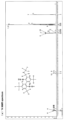
- Fig. 1(a) is a 1 H-NMR spectrum of the compound A produced in Experimental Example 1.
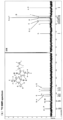
- Fig. 1(b) is a 13 C-NMR spectrum of the compound A.
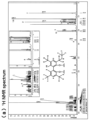
- Fig. 2(a) is a 1 H-NMR spectrum of the compound B produced in Experimental Example 2.
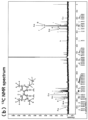
- Fig. 2(b) is a 13 C-NMR spectrum of the compound B.
- a numerical range expressed using “ ⁇ ” means a range that includes the numerical values written before and after “ ⁇ ” as the lower and upper limits.
- “A ⁇ B” means greater than or equal to A and less than or equal to B.
- GC area % refers to the composition ratio of each component measured using a gas chromatogram (GC) measuring device and a gas chromatography total area method, and is calculated as the area content ratio (unit: GC area %) of each peak component when the total area of the GC peaks of all products on the gas chromatogram is taken as 100%. Details of the GC measurement conditions will be explained in the experimental examples described later.
- LC area % refers to the composition ratio of each component measured using a liquid chromatogram (LC) measuring device and a liquid chromatography (LC method) total area method, and is calculated as the area content ratio (unit: LC area %) of each peak component when the total area of the LC peaks of all products on the liquid chromatogram is taken as 100%. Details of the LC measurement conditions will be explained in the experimental examples described later.
- mass % indicates the content ratio of a specific component contained in a total amount of 100 mass %. Moreover, “mass %” and “weight %” have the same meaning. As used herein, “optional” or “optionally” means that the subsequently described situation may or may not occur, and thus the description includes both the occurrence and non-occurrence of the situation.
- the term "about” can mean 20% above or below the stated value.
- a temperature of about 75°C relative to 0°C Celsius encompasses the range of 60°C to 90°C. All steps described herein can be performed in any suitable order unless otherwise indicated herein or clearly contradicted by context.
- a catalyst using a bisphosphite compound made from the dihydroxybiphenyl compound of the present invention as a ligand together with a metal component has excellent linear aldehyde isomer selectivity in a hydroformylation reaction
- a metal component has excellent linear aldehyde isomer selectivity in a hydroformylation reaction
- the dihydroxybiphenyl compounds of the present invention are novel dihydroxybiphenyl compounds each represented by the following general formula (1).
- X is an alkylene group having 4 to 20 carbon atoms
- R 1 and R 11 each independently represent a group selected from the group consisting of a hydrogen atom, an alkyl group having 1 to 20 carbon atoms, and a cycloalkyl group having 3 to 20 carbon atoms, and R 1 and X-R 11 are different from each other.
- R 2 and R 12 each independently represent a group selected from the group consisting of a hydrogen atom, an alkyl group having 1 to 20 carbon atoms, an alkoxy group having 1 to 20 carbon atoms, a cycloalkyl group having 3 to 20 carbon atoms, a cycloalkoxy group having 3 to 20 carbon atoms, a dialkylamino group having 2 to 20 carbon atoms, an aryl group having 6 to 20 carbon atoms, an aryloxy group having 6 to 20 carbon atoms, an alkylaryl group having 7 to 20 carbon atoms, an alkylaryloxy group having 7 to 20 carbon atoms, an arylalkyl group having 7 to 20 carbon atoms, an arylalkoxy group having 7 to 20 carbon atoms, a cyano group, a hydroxyl group, and a halogen atom; R 3 and R 13 each independently represent a group selected from the group consisting of a hydrogen atom, an alkyl group having 1 to
- the dihydroxybiphenyl compound of the present invention has a biphenyl skeleton in the molecule and different substituents, -R 1 and -X-R 11 , at the 5-position and 5'-position of the biphenyl skeleton (ortho positions relative to the hydroxyl groups substituted at the 6-position and 6'-position), giving it an asymmetric structure.
- the dihydroxybiphenyl compound has a structural feature in which one of the substituents, -X-R 11 , is a bulky substituent. Since the dihydroxybiphenyl compound of the present invention has such structural features, it can provide the following effects.
- the asymmetric structure and bulky substituent (-X-R 11 ) provide a stabilizing effect against hydrolysis to the bisphosphite compound of the present invention, which is to be described later and which is synthesized using the dihydroxybiphenyl compound as a precursor.
- This asymmetric structure and the bulky substituent (-X-R 11 ) provide a stabilizing effect against hydrolysis even in the catalyst using the bisphosphite compound, and the bulky substituent (-X-R 11 ) controls the coordination direction when the olefin compound coordinates to a metal, thereby providing extremely excellent selectivity for straight-chain aldehyde isomers.
- X is an alkylene group having 4 to 20 carbon atoms.
- X is an alkylene group having from 4 to 20 carbon atoms, including a quaternary carbon atom.
- a quaternary carbon atom means a carbon atom in which all of the bonds of the carbon atom are bonded to other carbon atoms.
- X is not particularly limited, and examples of X include an alkylene group represented by the following general formula (11).
- a, b, c, and d are integers satisfying 1 ⁇ a, 1 ⁇ b, 1 ⁇ c, 0 ⁇ d, and 3 ⁇ a+b+c+d ⁇ 19.
- R11 is R11 in formula (1).
- Benz is a benzene ring in formula (1) to which X is bonded.
- X is an alkylene group having a structural unit represented by the following formula (1X), from the viewpoint of obtaining excellent aldehyde isomer selectivity. -C( CH3 ) 2 - CH2- (1X)
- X is preferably an alkylene group having 4 to 20 carbon atoms including a quaternary carbon atom, more preferably an alkylene group having 4 to 10 carbon atoms including a quaternary carbon atom, still more preferably an alkylene group having 4 to 5 carbon atoms including a quaternary carbon atom, and particularly preferably an alkylene group represented by the following general formula (12), i.e., a 1,1-dimethylethylene group. (Benz)-C( CH3 ) 2 - CH2- ( R11 ) (12) In formula (12), R 11 is R 11 in formula (1) above. Benz is the benzene ring in formula (1) above to which X is bonded.
- R1 and R11 each independently represent a group selected from the group consisting of a hydrogen atom, an alkyl group having 1 to 20 carbon atoms, and a cycloalkyl group having 3 to 20 carbon atoms.
- alkyl group having 1 to 20 carbon atoms examples include linear or branched alkyl groups such as methyl, ethyl, n-propyl, i-propyl, s-butyl, t-butyl, isopentyl, neopentyl, t-pentyl, t-hexyl, and 1,1,2-trimethylpropyl.
- alkyl group having 1 to 20 carbon atoms include linear or branched alkyl groups such as methyl, ethyl, n-propyl, i-propyl, s-butyl, t-butyl, isopentyl, neopentyl, t-pentyl, t-hexyl, and 1,1,2-trimethylpropyl.
- those having 3 to 20 carbon atoms are preferred, those having 4 to 20 carbon atoms are more preferred, and those having 4 to 10 carbon atoms are particularly preferred.
- cycloalkyl groups having 3 to 20 carbon atoms include cyclohexyl, cyclooctyl, and adamantyl groups. Among these, cycloalkyl groups having 6 to 14 carbon atoms are preferred, and cycloalkyl groups having 6 to 10 carbon atoms are more preferred.
- R 1 and R 11 are preferably a tertiary alkyl group having 4 to 20 carbon atoms, more preferably a tertiary alkyl group having 4 to 7 carbon atoms, and particularly preferably a t-butyl group.
- R 1 and R 11 may be the same or different.
- R 1 and R 11 are t-butyl groups
- the compound represented by general formula (1) can be easily synthesized by reacting an inexpensive raw material such as isobutylene gas or t-butyl alcohol with a phenol such as phenol or cresol, which is the raw material for the compound.
- R 1 and R 11 are t-butyl groups
- the bulkiness of the t-butyl group provides a sufficient stabilizing effect against hydrolysis of the bisphosphite compound represented by general formula (2) described below.
- R 1 and R 11 are particularly preferably t-butyl groups.
- -X-R 11 From the viewpoint of achieving better aldehyde isomer selectivity, a more specific embodiment of -X-R 11 includes groups represented by formulae (a), (a'), and (b) to (g) in the following Table 1. In the following formulae (a), (a'), and (b) to (g), "*" indicates the bonding site of X in the above formula (1) to the benzene ring.
- R2 and R12 each independently represent a group selected from the group consisting of a hydrogen atom, an alkyl group and an alkoxy group having 1 to 20 carbon atoms, a cycloalkyl group and a cycloalkoxy group having 3 to 20 carbon atoms, a dialkylamino group having 2 to 20 carbon atoms, an aryl group and an aryloxy group having 6 to 20 carbon atoms, an alkylaryl group, an alkylaryloxy group, an arylalkyl group and an arylalkoxy group having 7 to 20 carbon atoms, a cyano group, a hydroxy group, and a halogen atom.
- alkyl group having 1 to 20 carbon atoms examples include linear or branched alkyl groups such as methyl, ethyl, n-propyl, i-propyl, n-butyl, s-butyl, t-butyl, n-pentyl, isopentyl, neopentyl, t-pentyl, and t-hexyl groups.
- cycloalkyl group having 3 to 20 carbon atoms examples include a cyclohexyl group, a cyclooctyl group, and an adamantyl group.
- alkoxy groups having 1 to 20 carbon atoms include linear or branched alkoxy groups such as methoxy, ethoxy, isopropoxy, t-butoxy, etc. Among these, alkoxy groups having 1 to 12 carbon atoms are preferred.
- Examples of the cycloalkoxy group having 3 to 20 carbon atoms include a cyclopentyloxy group.
- Examples of the dialkylamino group having 2 to 20 carbon atoms include a dimethylamino group and a diethylamino group.
- Examples of the aryl group having 6 to 20 carbon atoms include a phenyl group and a naphthyl group.
- Examples of the aryloxy group having 6 to 20 carbon atoms include a phenoxy group and a naphthoxy group.
- Examples of the alkylaryl group having 7 to 20 carbon atoms include a p-tolyl group and an o-tolyl group.
- Examples of the alkylaryloxy group having 7 to 20 carbon atoms include a 2,3-xylenoxy group.
- An example of the arylalkyl group having 7 to 20 carbon atoms is a benzyl group.
- Examples of the arylalkoxy group having 7 to 20 carbon atoms include a 2-(2-naphthyl)ethoxy group.
- Examples of the halogen atom include a fluorine atom, a chlorine atom, a bromine atom, and an iodine atom.
- R2 and R12 may be the same or different.
- R2 and R12 are preferably hydrogen atoms. Substituents at these positions have little effect on improving the reactivity in the hydroformylation reaction or on stabilizing the bisphosphite compound itself represented by the general formula (2) described below. Therefore, from the viewpoint of reducing the production cost of the compound, hydrogen atoms, which are the simplest substituents, are preferred.
- R3 and R13 each represent a member selected from the group consisting of a hydrogen atom, an alkyl group having 1 to 20 carbon atoms, a cycloalkyl group having 3 to 20 carbon atoms, an aryl group having 6 to 20 carbon atoms, and an alkylaryl group and an arylalkyl group having 7 to 20 carbon atoms.
- alkyl groups having 1 to 20 carbon atoms include straight-chain or branched-chain alkyl groups such as methyl, ethyl, n-propyl, i-propyl, s-butyl, t-butyl, isopentyl, neopentyl, t-pentyl, and t-hexyl.
- those having 4 to 20 carbon atoms are preferred, and those having 4 to 10 carbon atoms are particularly preferred.
- those in which the carbon atom bonded to the aromatic ring is tertiary are preferred, and examples thereof include t-butyl, t-pentyl, and t-hexyl.
- Examples of cycloalkyl groups having 3 to 20 carbon atoms include a cyclohexyl group, a cyclooctyl group, an adamantyl group, etc. Among these, a cycloalkyl group having 6 to 14 carbon atoms is preferred, and a cycloalkyl group having 6 to 10 carbon atoms is more preferred.
- Examples of the aryl group having 6 to 20 carbon atoms include a phenyl group and a naphthyl group.
- Examples of the alkylaryl group having 7 to 20 carbon atoms include a p-tolyl group and an o-tolyl group.
- An example of the arylalkyl group having 7 to 20 carbon atoms is a benzyl group.
- R 3 and R 13 are preferably a tertiary alkyl group having 4 to 20 carbon atoms, more preferably a tertiary alkyl group having 4 to 7 carbon atoms, and particularly preferably a t-butyl group.
- R3 and R13 may be the same or different.
- R3 and R13 are particularly preferably t-butyl groups.
- the dihydroxybiphenyl compound represented by the general formula (1) can be easily synthesized by reacting a phenol such as phenol or cresol, which is a raw material of the dihydroxybiphenyl compound, with an inexpensive raw material such as isobutylene gas or t-butyl alcohol.
- R4 and R14 each independently represent a group selected from the group consisting of a hydrogen atom, an alkyl group having 1 to 12 carbon atoms, a cycloalkyl group having 3 to 12 carbon atoms, an alkoxy group having 1 to 12 carbon atoms, a silyl group, a siloxy group, and a halogen atom.
- alkyl group having 1 to 12 carbon atoms examples include straight-chain or branched-chain alkyl groups such as methyl, ethyl, n-propyl, isopropyl, t-butyl, and decyl groups.
- cycloalkyl groups having 3 to 12 carbon atoms examples include cyclopropyl and cyclohexyl groups.
- alkoxy groups having 1 to 12 carbon atoms include straight-chain or branched-chain alkoxy groups such as methoxy, ethoxy, and t-butoxy groups.
- silyl group is a trimethylsilyl group.
- siloxy group examples include a siloxy group and a trimethylsiloxy group.
- halogen atom examples include a fluorine atom, a chlorine atom, a bromine atom, and an iodine atom.
- R 4 and R 14 may be the same or different.
- R 4 and R 14 are each independently preferably a hydrogen atom, an alkyl group having 1 to 3 carbon atoms such as a methyl group or an ethyl group, an alkoxy group having 1 to 3 carbon atoms such as a methoxy group or an ethoxy group, or a halogen atom, more preferably an alkyl group having 1 to 3 carbon atoms, and particularly preferably both of them are a methyl group.
- R4 and R14 The reason why a small group such as an alkyl group having 1 to 3 carbon atoms, particularly a methyl group, is preferred as R4 and R14 is that it allows the coupling reaction described below to proceed smoothly while improving the stability of the bisphosphite compound represented by general formula (2) described below.
- the dihydroxybiphenyl compound represented by the general formula (1) is Preferred is a dihydroxybiphenyl compound in which X is an alkylene group having 4 to 5 carbon atoms including a quaternary carbon atom, R 1 and R 11 are each independently a tertiary alkyl group having 4 to 20 carbon atoms, R 2 and R 12 are a hydrogen atom, R 3 and R 13 are each independently a tertiary alkyl group having 4 to 20 carbon atoms, and R 4 and R 14 are each independently selected from the group consisting of a hydrogen atom, an alkyl group having 1 to 3 carbon atoms, an alkoxy group having 1 to 3 carbon atoms, and a halogen atom.
- the dihydroxybiphenyl compound represented by the general formula (1) is More preferred is a dihydroxybiphenyl compound in which X is an alkylene group having a structural unit represented by formula (1X), R 1 and R 11 , R 3 and R 13 are each independently a tertiary alkyl group having 4 to 7 carbon atoms, R 2 and R 12 are hydrogen atoms, and R 4 and R 14 are each independently an alkyl group having 1 to 3 carbon atoms.
- the dihydroxybiphenyl compound represented by the general formula (1) is Particularly preferred are dihydroxybiphenyl compounds in which X is a 1,1-dimethylethylene group, R 1 , R 11 , R 3 and R 13 are t-butyl groups, R 2 and R 12 are hydrogen atoms, and R 4 and R 14 are methyl groups.
- dihydroxybiphenyl compounds are not particularly limited.
- the compounds exemplified as specific embodiments of the bisphosphite compound of the present invention shown below may be those in which the phosphate ester group is replaced with a hydroxyl group.
- the method for producing the dihydroxybiphenyl compound of the present invention represented by the general formula (1) is not particularly limited.
- the compound can be synthesized by applying the Suzuki-Miyaura cross-coupling reaction. That is, the compound can be synthesized by using a palladium catalyst having a phosphine ligand in the presence of a basic compound such as sodium carbonate from a boronic acid derivative of a corresponding phenol compound and a halide of the corresponding phenol compound.
- X, R 1 to R 4 , and R 11 to R 14 are respectively defined as X, R 1 to R 4, and R 11 to R 14 in general formula (1), B represents a boron atom, and Br represents a bromine atom.
- the dihydroxybiphenyl compound of the present invention represented by the general formula (1) can also be synthesized by an oxidative coupling reaction using a copper catalyst in the presence of methanol and air.
- the method for producing a dihydroxybiphenyl compound of the present invention is not limited to these explanations.
- a person skilled in the art can use well-known techniques to make appropriate modifications within the scope of the present invention to produce compound A and dihydroxybiphenyl compounds other than compound A.
- a method for producing a compound (AR) having a phenol structure on the right side of compound A represented by formula (A) will be described.
- a phenolic compound having no substitution at the ortho- and para-positions of the hydroxyl group is used as a starting material, and this is alkylated with isobutene to introduce tert-butyl groups into the ortho- and para-positions of the hydroxyl group.
- This alkylation reaction of phenols can generally be carried out using the Friedel-Crafts reaction in the presence of an acid catalyst.
- diisobutene-a 2,4,4-trimethyl-1-pentene
- diisobutene-b 2,4,4-trimethyl-2-pentene
- the mixture obtained by the above-mentioned operation can be purified or separated by a known purification method or a known separation method to obtain diisobutene-a.
- m-cresol is used as a starting material and is alkylated with diisobutene-a to introduce diisobutene groups into only the ortho-position, only the para-position, or both the ortho-position and the para-position of the hydroxyl group.
- This alkylation reaction of phenols can generally be carried out using the Friedel-Crafts reaction in the presence of an acid catalyst.
- phenol-b 4-(1,1,3,3-tetramethylbutyl)-m-cresol
- phenol-c 6-(1,1,3,3-tetramethylbutyl)-m-cresol
- phenol-d 4,6-di-(1,1,3,3-tetramethylbutyl)-m-cresol
- the mixture obtained by the above-mentioned procedure can be purified or separated using a known purification method or a known separation method to obtain phenol-c.
- phenol-c is used as the starting material and is alkylated with isobutene to introduce an isobutene group into the para-position of the hydroxyl group.
- This alkylation reaction of phenol-c can generally be carried out using the Friedel-Crafts reaction in the presence of an acid catalyst.
- phenol-c and isobutene can be subjected to a Friedel-Crafts reaction to produce 4-tert-butyl-6-(1,1,3,3-tetramethylbutyl)-m-cresol (hereinafter referred to as "phenol-e"), which is the compound (A-L) (Reaction Scheme 4).
- Compound A which is one embodiment of the dihydroxybiphenyl compound of the present invention, can be produced by subjecting phenol-a (compound (A-R)) and phenol-e (compound (A-L)) to an oxidative coupling reaction.
- the oxidative coupling reaction can be carried out by optimizing the method described in The Journal of Organic Chemistry 1984, 49(23), 4456-4459 or The Journal of Organic Chemistry 1983, 48(25), 4948-4950 as appropriate based on well-known techniques by a person skilled in the art.
- the phenol-a and the phenol-e can be subjected to an oxidative coupling reaction in the presence of a copper chloride-tetramethylethylenediamine catalyst while blowing in air to produce a mixture containing 3,3',5,5'-tetra-tert-butyl-6,6'-dimethyl-1,1'-biphenyl-2,2'-diol (hereinafter referred to as "biphenol-a"), 3-(1,1,3,3-tetramethylbutyl)-3'-tert-butyl-5,5'-di-tert-butyl-6,6'-dimethyl-1,1'-biphenyl-2,2'-diol (corresponding to the compound A), and 3,3'-di-(1,1,3,3-tetramethylbutyl)-5,5'-di-tert-butyl-6,6'-dimethyl-1,1'-biphenyl-2,2'-diol (corresponding to
- the mixture obtained by the above-mentioned operation can be purified or separated using a known purification method such as recrystallization or column purification, or a known separation method, to obtain Compound A, which is a dihydroxybiphenyl compound of the present invention.
- another method for producing compound A may be as follows. That is, when phenol-a is produced according to the above reaction formula-1, a small amount of phenol-e or 4-(1,1,3,3-tetramethylbutyl)-6-tert-butyl-m-cresol (hereinafter referred to as "phenol-f") shown below may be produced as an impurity. As described above, the produced phenol-e can be subjected to an oxidative coupling reaction with the above phenol-a to produce compound A.
- phenol-f 4-(1,1,3,3-tetramethylbutyl)-6-tert-butyl-m-cresol
- biphenol-g 3,3'-di-tert-butyl-5-(1,1,3,3-tetramethylbutyl)-5'-tert-butyl-6,6'-dimethyl-1,1'-biphenyl-2,2'-diol
- the bisphosphite compound of the present invention is a novel bisphosphite compound represented by the following general formula (2).
- X, R 1 to R 4 , and R 11 to R 14 are respectively defined as X, R 1 to R 4 , and R 11 to R 14 in the above formula (1).
- R 1 and X-R 11 are different from each other.
- Z 1 to Z 4 each independently represent an aryl group having 6 to 20 carbon atoms, and may have a substituent, and the substituents may be bonded to each other to form a ring .
- Z 2 , and Z 3 and Z 4 may not be bonded to each other, or may be bonded to each other to form a ring structure.
- Z 1 to Z 4 are each independently an aryl group having 6 to 20 carbon atoms, and the aryl group may have a substituent. The substituents may be bonded to each other to form a ring. Z 1 and Z 2 , and Z 3 and Z 4 may not be bonded to each other, or may be bonded to each other to form a ring structure containing -O-P-O-.
- Z 1 to Z 4 each independently have no substituent on the aromatic ring carbon atom adjacent to the carbon atom bonded to the oxygen atom, or even if the aromatic ring carbon atom has a substituent, the substituent has a carbon atom number of 0 to 2.
- Z 1 to Z 4 have a substituent, it is preferable that the substituent be located at the m-position or p-position relative to the carbon atom bonded to the oxygen atom.
- the substituent is preferably selected from the group consisting of an alkyl group having 1 to 2 carbon atoms, such as a methyl group and an ethyl group, a trifluoromethyl group, a cyano group, a nitro group, and a halogen atom, such as a chlorine atom and a fluorine atom.
- Z 1 to Z 4 have a substituent at a position other than the aromatic ring carbon atom adjacent to the carbon atom bonded to the oxygen atom
- substituents include linear or branched alkyl groups having 1 to 12, preferably 1 to 8, carbon atoms, such as methyl, ethyl, n-propyl, i-propyl, n-butyl, s-butyl, t-butyl, n-pentyl, isopentyl, neopentyl, and t-pentyl groups, linear or branched alkoxy groups having 1 to 12, preferably 1 to 8, carbon atoms, such as methoxy and ethoxy groups, and aryl groups having 6 to 18, preferably 6 to 10, carbon atoms, such as phenyl and naphthyl groups.
- substituents include halogen atoms, cyano, nitro, trifluoromethyl, hydroxyl, amino, acyl, carbonyloxy, oxycarbonyl, amide, sulfonyl, sulfinyl, silyl, and thionyl groups.
- Each of Z 1 to Z 4 may have 1 to 5 of these substituents. Adjacent substituents may be bonded together to form a ring, such as a saturated hydrocarbon ring condensed with an aromatic ring of Z 1 to Z 4 .
- Z 1 to Z 4 include a phenyl group, a 1-naphthyl group, a 2-naphthyl group, a p-trifluoromethylphenyl group, a 2-ethylphenyl group, a 2-methylphenyl group, a 3-methylphenyl group, a 4-methylphenyl group, a 2,3-dimethylphenyl group, a 2,4-dimethylphenyl group, a 2,5-dimethylphenyl group, a 3,4-dimethylphenyl group, a 3,5-dimethylphenyl group, a 2-chlorophenyl group, a 3-chlorophenyl group, a 4-chlorophenyl group, a 2,3-dichlorophenyl group, a 2,4-dichlorophenyl group, a 2,5-dichlorophenyl group, a 3,4-dichlorophenyl group, Examples of the alkyl
- suitable examples include a 1,1'-biphenyl-2,2'-diyl group, a 1,1'-binaphthyl-2,2'-diyl group, and the like.
- Z 1 to Z 4 are each preferably independently a 1-naphthyl group or a 2-naphthyl group from the viewpoints of improving the thermal stability of the ligand and improving the selectivity of linear aldehyde production when producing an aldehyde by hydroformylation reaction.
- Z 1 to Z 4 may be the same or different. As described later, from the viewpoint of ease of synthesis, it is preferable that Z 1 and Z 2 , Z 3 and Z 4 are the same, and it is more preferable that Z 1 to Z 4 are all the same.
- the bisphosphite compound represented by the general formula (2) is preferably a bisphosphite compound in which X is an alkylene group having 4 to 5 carbon atoms including a quaternary carbon atom, R 1 and R 11 are each independently a tertiary alkyl group having 4 to 20 carbon atoms, R 1 and X-R 11 are different from each other, R 2 and R 12 are hydrogen atoms, R 3 and R 13 are each independently a tertiary alkyl group having 4 to 20 carbon atoms, and R 4 and R 14 are each independently selected from the group consisting of a hydrogen atom, an alkyl group having 1 to 3 carbon atoms, an alkoxy group having 1 to 3 carbon atoms, and a halogen atom.
- Z 1 to Z 4 each independently have no substituent on an aromatic ring carbon atom adjacent to a carbon atom bonded to an oxygen atom, or have a substituent having 1 to 2 carbon atoms on the aromatic ring carbon atom, and none of Z 1 to Z 4 are bonded to each other.
- a bisphosphite compound represented by the general formula (2) a bisphosphite compound in which X is an alkylene group having a structural unit represented by the above formula (1X), R 1 , R 11 , R 3 and R 13 are each independently a tertiary alkyl group having 4 to 7 carbon atoms, R 1 and X-R 11 are different from each other, R 2 and R 12 are a hydrogen atom, and R 4 and R 14 are each independently an alkyl group having 1 to 3 carbon atoms is more preferable.
- a bisphosphite compound in which Z 1 to Z 4 are each independently a 1-naphthyl group or a 2-naphthyl group is more preferred, and a bisphosphite compound in which X is a 1,1-dimethylethylene group, R 1 , R 11 , R 3 and R 13 are t-butyl groups, R 2 and R 12 are hydrogen atoms, R 4 and R 14 are methyl groups, and Z 1 to Z 4 are each independently a 1-naphthyl group or a 2-naphthyl group is particularly preferred.
- Specific embodiments of the bisphosphite compound of the present invention include compounds represented by the following formulas (L-1-x) to (L-80-x), but are not limited to these compounds.
- the symbol "x" in the formulae (L-1-x) to (L-80-x) is any one of the formulae (a), (a'), (b) to (g) shown in Table 1 above.
- the compound of the following formula (L-1-a) means that in the bisphosphite compound represented by the general formula (2), the substituent corresponding to -X-R 11 is the substituent represented by formula (a) in Table 1.
- x can be replaced with one selected from the group consisting of a, a', and b to g.
- x can be replaced with one selected from the group consisting of a, a', and b to g.
- x can be replaced with one selected from the group consisting of a, a', and b to g.
- substituents represented by formulas (a') and (c) to (g) can be replaced in the same manner.
- the structural formula of a compound in which "-a” in the compound of the following formula (L-1-a) is replaced with "-a'", "-b", “-c", "-d", "-e” and "-f” is shown below.
- the method for producing the bisphosphite compound of the present invention represented by the general formula (2) is not particularly limited, and the compound can be synthesized by reacting an alkali metal salt or alkaline earth metal salt of a dihydroxybiphenyl compound represented by the following general formula (4) with a phosphorus compound represented by the following general formula (5A) and/or (5B) (bidentate phosphite synthesis method 1).
- X, R 1 to R 4 , and R 11 to R 14 are respectively defined as X, R 1 to R 4, and R 11 to R 14 in general formula (2).
- M is an alkali metal or an alkaline earth metal.
- Z 1 to Z 4 are respectively defined as Z 1 to Z 4 in general formula (2).
- the bisphosphite compound of the present invention represented by the general formula (2) can be synthesized by reacting an alkali metal salt or alkaline earth metal salt of a dihydroxybiphenyl compound represented by the general formula (4) with a bis(dialkylamino)chlorophosphine represented by the following general formula (6) to obtain a biphenyldioxy intermediate having two bis(dialkylamino)phosphino groups, which is then reacted with hydrogen chloride to obtain a biphenyldioxy intermediate having two dichlorophosphino groups, which is then reacted with a phenol in the presence of a base catalyst (bidentate phosphite synthesis method 2).
- R 20 represents a linear or branched alkyl group having 1 to 5 carbon atoms, such as a methyl group, an ethyl group, an n-propyl group, or an i-propyl group.
- bidentate phosphite synthesis method 1 The following provides a detailed explanation of bidentate phosphite synthesis method 1. Details of bidentate phosphite synthesis method 2 are described in JP 2000-53688 A.
- the alkali metal salt or alkaline earth metal salt of the dihydroxybiphenyl compound represented by the above general formula (4) can be synthesized by reacting the dihydroxybiphenyl compound of the present invention represented by the above general formula (1) with an alkali metal compound such as n-BuLi (normal butyl lithium), Na, NaH or KH, or an alkaline earth metal compound such as methylmagnesium bromide or ethylmagnesium bromide, in a solvent, preferably in an inert gas atmosphere such as nitrogen.
- an alkali metal compound such as n-BuLi (normal butyl lithium), Na, NaH or KH
- an alkaline earth metal compound such as methylmagnesium bromide or ethylmagnesium bromide
- the amount of the alkali metal compound or alkaline earth metal compound used is usually 2 moles per mole of the dihydroxybiphenyl compound represented by general formula (1), but more may be used if desired.
- ethers such as tetrahydrofuran and diethyl ether, hydrocarbons such as hexane and toluene, nitrogen-containing compounds such as pyridine, triethylamine and N,N,N',N'-tetramethylethylenediamine, and mixtures thereof are preferably used.
- the reaction temperature can be appropriately selected within the range of ⁇ 70° C. to the boiling point of the solvent.
- a method can also be adopted in which the reaction is started at a low temperature, for example, between ⁇ 30° C. and 10° C., and then gradually increased to the boiling point of the solvent. From the viewpoint of reaction operation, it is preferable to carry out the reaction using n-BuLi or NaH and tetrahydrofuran as a solvent.
- the reaction time can usually be selected within the range of 1 minute to 48 hours, and is preferably about 10 minutes to 4 hours.
- the reaction solution may be used in the next step as it is without any particular purification.
- the compound may be used in the next step after previously carrying out a treatment such as washing with a poor solvent or isolation by a recrystallization operation.
- the phosphorus compound represented by the general formula (5A) or (5B) can be synthesized by reacting phosphorus trichloride (PCl 3 ) with a phenol represented by Z 1 -OH, Z 2 -OH, Z 3 -OH or Z 4 -OH (wherein Z 1 to Z 4 have the same meaning as Z 1 to Z 4 in the general formula (2)) in the presence or absence of a base, preferably in an inert gas atmosphere such as nitrogen, in a solvent or without a solvent.
- a phosphorus compound in which Z1 and Z2 or Z3 and Z4 are the same is preferred because it can be easily synthesized. Therefore, it is preferred that Z1 and Z2 , and Z3 and Z4 are both the same, and it is particularly preferred that Z1 to Z4 are all the same.
- examples of the base include nitrogen-containing bases such as pyridine, triethylamine, and diethylamine, and inorganic bases such as sodium carbonate and potassium carbonate.
- nitrogen-containing bases are preferably used because of the ease of reaction operation.
- the amount of base used is usually 2 moles per mole of PCl 3. If the amount of base is too large or too small, it is not preferable because it increases the amount of unnecessary phosphites such as P(OZ 1 ) 2 (OZ 2 ), P(OZ 1 ) (OZ 2 ) 2 , P(OZ 1 ) 3 , and P(OZ 2 ) 3 and dichloro compounds such as Cl 2 P ( OZ 1 ).
- the reaction temperature can be selected arbitrarily. For example, when a nitrogen-containing base is used as the base, the reaction is preferably carried out at a temperature of 0 to 5°C.
- the reaction time can be selected within the range of 1 minute to 48 hours. For example, a reaction time of about 5 minutes to 10 hours is preferred.
- the by-product of the reaction When the reaction is carried out in the presence of a base, the by-product of the reaction, a salt of hydrogen chloride and a base, is usually present as a solid in the reaction solution.
- the by-product of the salt of hydrogen chloride and a base can be removed from the reaction system by filtration or other methods, preferably under an inert gas atmosphere such as nitrogen.
- the by-product of hydrogen chloride can be removed from the reaction system by bubbling an inert gas such as nitrogen gas or argon gas into the reaction system.
- the phosphorus compound represented by the general formula (5A) or (5B) may be obtained as a mixture with the unnecessary phosphites and dichloro compounds. These may be used in the next step without being separated.
- Methods for separating the phosphorus compound represented by the general formula (5A) or (5B) from these by-products include recrystallization using an aliphatic hydrocarbon solvent such as hexane or heptane, and distillation.
- the bisphosphite compound of the present invention represented by the general formula (2) can be synthesized by contacting the compound represented by the general formula (4) with the compound represented by the general formula (5A) and/or (5B) in a solvent or without a solvent at a temperature of 20°C or less for 1 minute or more.
- the above contact is preferably carried out under an inert gas atmosphere such as nitrogen, and the target bisphosphite compound can be synthesized by mixing the compound represented by the general formula (4) with the compound represented by the general formula (5A) and/or (5B) at a temperature of preferably 0°C or lower, more preferably -30°C or lower, and most preferably -50°C or lower, maintaining that temperature for 1 minute or more, preferably 3 to 60 minutes, and then gradually increasing the temperature.
- an inert gas atmosphere such as nitrogen
- the rate of temperature increase can be selected appropriately between 0.1 and 20°C/min. A rate of temperature increase between 0.5 and 10°C/min is preferable.
- the solvent may be ethers such as tetrahydrofuran, diethyl ether, and dioxane, hydrocarbons such as hexane and toluene, nitrogen-containing compounds such as pyridine, triethylamine, and N,N,N',N'-tetramethylethylenediamine, or mixtures thereof.
- ethers such as tetrahydrofuran, diethyl ether, and dioxane
- hydrocarbons such as hexane and toluene
- nitrogen-containing compounds such as pyridine, triethylamine, and N,N,N',N'-tetramethylethylenediamine, or mixtures thereof.
- the amount of solvent used should be the minimum necessary to dissolve the product, but more than this amount may be used.
- Methods for purifying the bisphosphite compound of the present invention represented by the general formula (2) include a column chromatography method, a suspension washing method, and a recrystallization method.
- Examples of the column development method include a method using silica gel, alumina, or the like as a packing material.
- Examples of the developing solution for the column include ethers such as tetrahydrofuran and dioxane, aliphatic hydrocarbons such as hexane and heptane, aromatic hydrocarbons such as toluene and xylene, esters such as ethyl acetate and methyl acetate, and halogenated hydrocarbons such as chloroform and dichloromethane.
- ethers such as tetrahydrofuran and dioxane
- aliphatic hydrocarbons such as hexane and heptane
- aromatic hydrocarbons such as toluene and xylene
- esters such as ethyl acetate and methyl acetate
- halogenated hydrocarbons such as chloroform and dichloromethane.
- An example of the suspension washing method is a method in which, after completion of the synthesis reaction of the bisphosphite compound, by-produced metal chlorides (MCl or MCl2 : M is an alkali metal or alkaline earth metal) are removed from the reaction solution by filtration or with a polar solvent such as water, the solution is evaporated to dryness, and the residue is stirred in a solvent such as acetonitrile, aliphatic hydrocarbons such as hexane and heptane, ketones such as acetone and diethyl ketone, or alcohols such as methanol and ethanol.
- a solvent such as acetonitrile, aliphatic hydrocarbons such as hexane and heptane, ketones such as acetone and diethyl ketone, or alcohols such as methanol and ethanol.
- Examples of the recrystallization method include a method in which, after the completion of the synthesis reaction of the bisphosphite compound, the by-produced metal chloride is removed from the reaction solution by filtration or with a polar solvent such as water, the solution is evaporated to dryness, and the residue is dissolved in the minimum amount of solvent that can dissolve it, and then cooled, or a method in which the residue is dissolved in the minimum amount of solvent that can dissolve it, a solvent in which the target bisphosphite compound is insoluble or poorly soluble is added, and cooling is performed as desired to precipitate a solid, which is then separated by a method such as filtration, and further washed with an insoluble solvent.
- solvents in which the bisphosphite compound is soluble include aromatic hydrocarbons such as benzene, toluene, and xylene, and ethers such as tetrahydrofuran and dioxane.
- solvents in which the bisphosphite compound is insoluble or poorly soluble include, in addition to acetonitrile, aliphatic hydrocarbons such as hexane and heptane, ketones such as acetone and diethyl ketone, and alcohols such as methanol and ethanol.
- compositions containing the bisphosphite compound of the present invention such as mixtures of the novel bisphosphite compound of the present invention with other bisphosphite compounds, are included in the embodiments of the present invention.
- the mixing ratio is not particularly limited. Examples of such mixtures include mixtures of the bisphosphite compound of the present invention with the bisphosphite compounds shown below that are by-produced during the production of the dihydroxybiphenyl compound (A) of the present invention and are derived from the crosslinked structure of the above-mentioned (biphenol-a) or (biphenol-g).
- the catalyst of the present invention contains a complex of the bisphosphite compound of the present invention and a metal of Groups 8 to 10.
- the catalyst of the present invention is useful as a catalyst for producing an aldehyde by reacting an olefin compound with carbon monoxide and hydrogen. Examples of the olefin include those described in the section on the production method of aldehyde described below.
- the complex containing the bisphosphite compound of the present invention and a Group 8-10 metal can be easily prepared from a Group 8-10 metal compound and the bisphosphite compound of the present invention by a known complex formation method.
- Examples of the Group 8 to 10 metal compound used in the production of the complex include hydrides, halides, organic acid salts, inorganic acid salts, oxides, carbonyl compounds, amine compounds, olefin coordination compounds, phosphine coordination compounds, and phosphite coordination compounds of Group 8 to 10 metals.
- ruthenium compounds such as ruthenium trichloride, dichloro(p-cymene)ruthenium dimer, and dichlorotris(triphenylphosphine)ruthenium; palladium compounds such as palladium acetate and palladium chloride; osmium compounds such as osmium trichloride; iridium compounds such as iridium trichloride and iridium carbonyl; platinum compounds such as platinic acid, sodium hexachloroplatinate, and potassium platinic acid; cobalt compounds such as dicobalt octacarbonyl and cobalt stearate; rhodium trichloride, rhodium nitrate, rhodium acetate, Rh(acac)(CO) 2 , [Rh(OAc)(cod)] 2 , Rh4 (CO) 12 , Rh6 (CO) 16 , HRh(CO( PPh
- the molar ratio of the bisphosphite compound to the Group 8 to 10 metal is preferably 0.00004 to 500, more preferably 0.0002 to 100, even more preferably 0.001 to 50, and particularly preferably 0.01 to 30. If the molar ratio of the bisphosphite compound to the Group 8 to 10 metal is within the above range, an excellent balance between catalyst cost and reaction efficiency improvement effect is achieved.
- the catalyst composition of the present invention is one embodiment of a catalyst composition utilizing the bisphosphite compound of the present invention, and contains a bisphosphite compound represented by the following general formula (3) and the bisphosphite compound of the present invention represented by the general formula (2).
- the catalyst composition of the present invention is useful as a catalyst composition for the production of aldehydes by reacting olefinic compounds with carbon monoxide and hydrogen.
- R 1 , R 2 and R 12 , R 3 and R 13 , R 4 and R 14 , and Z 1 to Z 4 are respectively defined as R 1 , R 2 and R 12 , R 3 and R 13 , R 4 and R 14 , and Z 1 to Z 4 in the general formula (2).
- olefin examples include those described in the section on the method for producing aldehydes below.
- examples of the catalyst composition of the present invention include a catalyst composition containing a complex of a bisphosphite compound of the present invention represented by the general formula (3) and a metal of Groups 8 to 10, and a complex of a bisphosphite compound of the present invention represented by the formula (2) and a metal of Groups 8 to 10.
- the catalyst composition of the present invention can be easily prepared from a Group 8 to 10 metal compound, a bisphosphite compound represented by the general formula (3) above, and a bisphosphite compound of the present invention represented by the formula (2) above, by a known complex formation method.
- the Group 8 to 10 metal compound used in the production of the catalyst composition of the present invention is synonymous with the Group 8 to 10 metal compound in the catalyst of the present invention.
- the molar ratio of the bisphosphite compound of the present invention represented by the above formula (2) to the Group 8 to 10 metal is synonymous with the molar ratio of the bisphosphite compound of the present invention to the Group 8 to 10 metal compound in the catalyst of the present invention.
- the molar ratio of the bisphosphite compound represented by the general formula (3) to the Group 8 to 10 metal is synonymous with the molar ratio of the bisphosphite compound represented by the general formula (3) to the Group 8 to 10 metal compound in the catalyst of the present invention.
- the lower limit of the content of the bisphosphite compound represented by the general formula (3) in the catalyst composition of the present invention is not particularly limited, but is preferably 100% by mass of the catalyst composition. It can be 80.00% by mass or more, More preferably 90.00% by mass or more, More preferably, the content is 95.00% by mass or more. It is particularly preferably 98.00% by mass or more. More preferably, the content is 99.00% by mass or more. It is even more preferable that the content is 99.40% by mass or more.
- the lower limit of the content of the bisphosphite compound represented by the general formula (3) in the catalyst composition of the present invention is not particularly limited, but is preferably 100% by mass of the catalyst composition.
- the content of the bisphosphite compound represented by the general formula (3) in the catalyst composition of the present invention is not particularly limited, but may be, for example, 100% by mass of the catalyst composition.
- the content can be 80.00% by mass or more and 99.99% by mass or less, More preferably, the content is 90.00% by mass or more and 99.98% by mass or less.
- the content is 95.00% by mass or more and 99.97% by mass or less. Particularly preferably 98.00% by mass or more and 99.95% by mass or less, Particularly preferably from 99.00% by mass to 99.90% by mass, The most preferred range is 99.40% by mass or more and 99.85% by mass or less.
- the lower limit of the content of the bisphosphite compound of the present invention represented by the formula (2) in the catalyst composition of the present invention is not particularly limited, but is preferably 100% by mass of the catalyst composition. It can be 0.01% by mass or more, More preferably, it is 0.02% by mass or more. More preferably, the content is 0.03% by mass or more. It is particularly preferably 0.05 mass % or more. Particularly preferably 0.10% by mass or more, It is most preferably 0.15 mass % or more.
- the lower limit of the content of the bisphosphite compound of the present invention represented by the formula (2) in the catalyst composition of the present invention is not particularly limited, but is preferably 100% by mass of the catalyst composition.
- the content of the bisphosphite compound of the present invention represented by the formula (2) in the catalyst composition of the present invention is not particularly limited, but may be, for example, 100% by mass of the total catalyst composition.
- the content can be 0.01% by mass or more and 20.00% by mass or less, More preferably, the content is 0.02% by mass or more and 10.00% by mass or less.
- the content is 0.03% by mass or more and 5.00% by mass or less. Particularly preferably, the content is 0.05% by mass or more and 2.00% by mass or less. Particularly preferably, the content is 0.10% by mass or more and 1.00% by mass or less. The most preferred range is 0.15 mass % or more and 0.60 mass % or less.
- the catalyst and catalyst composition of the present invention are used, for example, in the production of aldehydes from olefins, as shown below.
- the method for producing an aldehyde of the present invention is characterized by reacting an olefin compound with carbon monoxide and hydrogen in the presence of a Group 8 to 10 metal compound and the bisphosphite compound of the present invention.
- the method for producing an aldehyde of the present invention is characterized by reacting an olefin compound with carbon monoxide and hydrogen in the presence of the above-mentioned catalyst of the present invention.
- the above olefin compounds can be used to carry out a hydroformylation reaction to produce the corresponding aldehydes.
- the production ratio (L/B) of the linear aldehyde (L form) and branched aldehyde (B form) obtained is preferably 1 or more, more preferably 5 or more, and even more preferably 10 or more.
- the Group 8 to 10 metal compound used as a catalyst or a precursor thereof may be a hydride, a halide, an organic acid salt, an inorganic acid salt, an oxide, a carbonyl compound, an amine compound, an olefin coordination compound, a phosphine coordination compound, or a phosphite coordination compound of a Group 8 to 10 metal.
- the method for producing an aldehyde of the present invention can be carried out in the presence of a catalyst containing a complex formed in advance between the bisphosphite compound of the present invention and the above-mentioned Group 8 to 10 metal.
- the Group 8 to 10 metal complex containing the bisphosphite compound of the present invention can be easily prepared from a Group 8 to 10 metal compound and the bisphosphite compound by a known complex formation method.
- the Group 8 to 10 metal compound and the bisphosphite compound may be fed to the hydroformylation reaction zone to form a complex within the hydroformylation reaction system.
- the molar ratio of the bisphosphite compound to the Group 8-10 metal is preferably 0.00004 to 500, more preferably 0.0002 to 100, even more preferably 0.001 to 50, and particularly preferably 0.01 to 30.
- the concentration of the catalyst, Group 8 to 10 metal is too low, there is a concern that sufficient reactivity will not be achieved. If the concentration of the Group 8 to 10 metal is too high, there is a concern that the cost of the catalyst will be too high. In addition, if too little bisphosphite compound is used, there is a concern that sufficient reactivity will not be achieved. If too much bisphosphite compound is used, there is a concern that the cost of the bisphosphite compound will be too high.
- the concentration of the catalyst, a Group 8 to 10 metal is too low, there is a concern that sufficient reactivity will not be achieved. If the concentration of the Group 8 to 10 metal is too high, there is a concern that the cost of the catalyst will be too high.
- a reaction solvent is not essential, but a solvent inert to the hydroformylation reaction can be present, if necessary.
- preferred solvents include aromatic hydrocarbons such as toluene, xylene, and todecylbenzene; ketones such as acetone, diethyl ketone, and methyl ethyl ketone; ethers such as tetrahydrofuran and dioxane; esters such as ethyl acetate and di-n-octyl phthalate; high-boiling point components by-produced during the hydroformylation reaction, such as aldehyde condensates; and olefin compounds which are reaction raw materials.
- reaction conditions for carrying out the aldehyde production method of the present invention are similar to those commonly used in the past, and the reaction temperature is usually selected from the range of 15 to 200°C, preferably 50 to 150°C.
- the carbon monoxide partial pressure and hydrogen partial pressure are usually selected from the range of 0.0001 to 20 MPaG, preferably 0.01 to 10 MPaG, and particularly preferably 0.1 to 5 MPaG.
- the molar ratio of carbon monoxide to hydrogen is usually selected from the range of 10/1 to 1/10, preferably 3/1 to 1/3.
- the reaction can be carried out in a stirred reactor or a bubble column reactor either continuously or batchwise.
- the remaining reaction liquid after separating some or all of the aldehyde produced can be continuously circulated to the hydroformylation reaction tank as a catalyst liquid.
- the alcohol production method of the present invention is a method for producing an alcohol, which comprises producing an aldehyde by the aldehyde production method of the present invention and producing a corresponding alcohol from the aldehyde.
- the method for producing the alcohol corresponding to the aldehyde is not particularly limited and can be carried out according to a conventional method.
- the aldehyde obtained by the aldehyde production method of the present invention can be directly subjected to a known hydrogenation reaction, or the obtained aldehyde can be dimerized and then subjected to a known hydrogenation reaction to produce an alcohol.
- the hydrogenation catalyst used in the hydrogenation reaction may be a known solid catalyst in which a metal such as Ru, Ni, Cr, Cu, etc. is supported on a carrier.
- a Ru-based catalyst is preferred.
- the conditions for the hydrogenation reaction are usually a temperature of 60 to 200° C. and a hydrogen pressure of about 0.1 to 20 MPaG.
- IR Measurement of Compound B> The isolated compound B was subjected to infrared spectroscopy (IR) measurement by an attenuated total reflection (ATR) method under the following measurement conditions using an infrared microscope (device name: Nicolet iN10MX, manufactured by Thermo Fisher Scientific Co., Ltd.) equipped with an FT-IR module (product name: iZ10, manufactured by Thermo Fisher Scientific Co., Ltd.). (Measurement conditions) ATR: Gladi ATR vision Diamond Crystal (PIKE) Resolution: 4cm -1 Number of times: 64
- Example 1 Production of dihydroxybiphenyl compound of the present invention (compound A)]
- DBMC composition a composition containing DBMC
- the composition of the DBMC composition was analyzed using a gas chromatogram (GC) measurement device and a gas chromatography total area method under the following GC measurement conditions.
- GC gas chromatogram
- the DBMC composition contained 97.5 GC area % of DBMC and 0.8 GC area % of a compound represented by the following formula (E) (the above-mentioned "phenol-e”).
- the composition ratio of each component in the gas chromatography total area method was calculated as the area content ratio (unit: GC area%) of each peak component when the total area of the GC peaks of all products on the gas chromatogram was taken as 100%.
- GC measurement conditions > GC device: GC-2025 (high-performance general-purpose gas chromatograph, manufactured by Shimadzu Corporation) Detector: Flame ionization detector (FID) Carrier gas: nitrogen gas (column flow rate 4.07 mL/min) Column: Capillary column BPX5 (manufactured by SGE Analytical Science, size: length 60 m x inner diameter 0.32 mm, film thickness 0.25 ⁇ m) Column temperature: 50°C (holding time 5 minutes) ⁇ heating at 10°C/min ⁇ 300°C (holding time 10 minutes) Inlet temperature: 300°C Detector temperature: 300°C Sample volume: 0.5 ⁇ L (split ratio: 1/20)
- the white solid (1) When the obtained white solid (1) was analyzed by gas chromatography, it was found that the white solid (1) contained 88.6 GC area % of 3,3',5,5'-tetra-tert-butyl-6,6'-dimethyl-1,1'-biphenyl-2,2'-diol (the above-mentioned biphenol-a, hereinafter referred to as "biphenol-a") and 3.3 GC area % of compound A presumed to have a structure represented by the following formula (A).
- the resulting filtrate was dried, and then tetrahydrofuran (6.2 g) was added to the dried filtrate (2.9 g), which was then placed in a glass reaction vessel and heated to 60°C while stirring in an oil bath to dissolve the dried product. Methanol was then added dropwise, and the stirring speed was reduced and the solution in the reaction vessel was cooled to 2°C, yielding a slurry-like solution. The resulting slurry solution was filtered while being suspended and washed, and the filtrate was collected. The resulting filtrate was analyzed by gas chromatography and found to contain 27.6 GC area % biphenol-a and 19.6 GC area % estimated compound A.
- the filtrate was dried to obtain 1.2 g of a white solid.
- the white solid (2) was dissolved in acetonitrile, and then an eluate containing Compound A was separated using preparative liquid chromatography (preparative LC) under the following preparative LC conditions. Next, the separated eluate was concentrated using an evaporator and then dried under reduced pressure to obtain compound A.
- HMQC and HMBC measurement results The results of the HMQC and HMBC measurements are shown in Table 2 below.
- Example 2 Production of the bisphosphite compound of the present invention (compound B)]
- a tetrahydrofuran solution (12 mL) of compound A (1.08 g, 2.18 mmol) obtained in Example 1 was prepared and placed in a glass reactor, and while stirring at 0° C. under a nitrogen atmosphere, 0.466 g (5.067 mmol as sodium) of a commercially available metallic sodium mineral oil dispersion (product name: SD Super Fine TM (Sodium 25 wt% dispersion in mineral Oil), manufactured by Tokyo Chemical Industry Co., Ltd.) was added dropwise. Thereafter, the contents of the reactor were heated for 4 hours using an oil bath set at 65° C.
- the obtained toluene solution containing the aminophosphinated compound A was placed in a separately prepared glass reactor, and while stirring under a nitrogen atmosphere at 0°C, 6.03 g (27.25 mmol as hydrochloric acid gas) of a 1,4-dioxane hydrochloric acid solution (4 mol/L) was added dropwise, resulting in the formation of a precipitate of an amine hydrochloride.
- the precipitate was filtered off, and the filtrate was subjected to reduced pressure to remove excess hydrochloric acid gas and 1,4-dioxane, yielding a toluene solution containing a chlorophosphinated compound A.
- a toluene solution containing the obtained chlorophosphine derivative of Compound A was stirred under a nitrogen atmosphere at 0°C, and a toluene solution (6.6 mL) of 1-naphthol (1.257 g, 8.72 mmol) and triethylamine (0.889 g, 8.78 mmol) was added dropwise thereto, and the mixture was allowed to stand at room temperature for three days, resulting in the formation of a precipitate of amine hydrochloride.
- the filtrate of the toluene solution obtained by filtering off the precipitate was washed three times with 50 mL of pure water, and the toluene phase was dehydrated using magnesium sulfate, after which the magnesium sulfate was filtered off using a filtration method.
- the toluene phase obtained after the dehydration process was then concentrated using an evaporator, and dried under reduced pressure to obtain 1.04 g of a white powder (3).
- the eluents from the 16th to 22nd tubes were combined and analyzed by liquid chromatography, and the eluent contained compound B in an amount of 89.6 LC area %.
- the eluent was concentrated using an evaporator, and then dried under reduced pressure to obtain 0.63 g of a white solid (4) containing compound B.
- the white solid (4) was dissolved in acetonitrile, and then an eluate containing Compound B was separated using preparative liquid chromatography (preparative LC) under the following preparative LC conditions. Next, the separated eluate was concentrated using an evaporator and then dried under reduced pressure to obtain compound B.
- HMQ, CHMBC and 1H - 1H COSY measurement results The results of the measurements of HMQ, CHMBC and 1 H- 1 H COSY are shown in Table 3 below.
- IR measurement results (IR measurement results, unit: cm ⁇ 1 ) The IR measurement results were as follows: 567 (w), 594 (w), 702 (w), 729 (w), 766 (s), 793 (s), 872 (m), 891 (m), 906 (w), 1012 (s), 1026 (m), 1039 (m), 1078 (m), 1153 (w), 1169 (w), 1225 (s), 125 7(s), 1360(w), 1388(s), 1444(w), 1460(m), 1506(w), 1574(m), 1595(w), 1745(m), 2870(m), 2951(m), 3051(w)
- compound B obtained in Example 2 is a novel bisphosphite compound represented by the following formula (1B), which has a bulky substituent in the ring structure and an asymmetric structure.
- Example 3 Production of aldehyde
- a hydroformylation reaction was carried out using propylene as a raw material in the following manner, and aldehyde production was evaluated.
- the catalyst solution was then injected into the autoclave using purified nitrogen gas, and the autoclave was then sealed.
- the concentration of the hydroformylation catalyst in the catalyst solution was 122 mg/L in terms of Rh.
- the autoclave was replaced with nitrogen gas three times using nitrogen gas so that the internal pressure of the nitrogen gas was 2.0 MPaG, and then the nitrogen gas was released and 1.5 g of propylene gas was injected into the autoclave.
- the oxo gas consumed in the hydroformylation reaction was automatically replenished from the pressure accumulator into the autoclave via the secondary pressure regulator, and the reaction was carried out so that the pressure in the autoclave was always maintained at 1.0 MPaG.
- the temperature inside the autoclave was cooled to room temperature (25° C.), and the gas phase and liquid phase recovered from the autoclave were subjected to component analysis by gas chromatography.
- the reaction rate constant (k) was 2.8 h -1
- the total selectivity of n-butyraldehyde and i-butyraldehyde was 97.8%
- the molar ratio of n-butyraldehyde to i-butyraldehyde (n/i) was 75.1.
- the reaction rate constant (k) was 2.8 h ⁇ 1
- the total selectivity of n-butyraldehyde and i-butyraldehyde was 98.5%
- the molar ratio of n-butyraldehyde to i-butyraldehyde (n/i ratio) was 70.4.
- Examples 4-5 and Comparative Examples 2-3 Production of aldehydes
- a hydroformylation reaction was carried out under the same conditions as in Example 3, except that the type of the bisphosphite compound, the L/Rh ratio, the reaction temperature, the reaction pressure, and the reaction time were changed as shown in Table 4, to produce an aldehyde.
- the results of evaluation performed in the same manner as in Example 3 are shown in Table 4.
- Example 6 An aldehyde was produced by carrying out a hydroformylation reaction under the same conditions as in Example 3, except that compound B was changed to a mixture of compound B and phosphite ligand A (molar ratio: 50/50). The results of evaluation performed in the same manner as in Example 3 are shown in Table 4.
- Thermal Stability Test The following thermal stability test was carried out to examine the thermal stability of the ligand assuming a series of steps in which the aldehyde produced after the hydroformylation reaction is separated by distillation and the catalyst liquid containing the ligand (bisphosphite compound) is recycled to the reactor.
- Example 7 Thermal stability test of the bisphosphite compound of the present invention.
- the thermal stability of the bisphosphite compound of the present invention was evaluated according to the following procedure.
- the inside of the autoclave was then replaced with nitrogen three times so that the internal pressure of the nitrogen gas was 0.5 MPaG, thereby replacing the oxo gas in the reaction solution and the oxo gas in the gas phase in the autoclave with nitrogen gas, and nitrogen gas was then injected into the autoclave so that the internal pressure was 0.1 MPaG.
- the temperature in the autoclave was raised to 130°C, and heating and stirring were performed while maintaining this temperature.
- the temperature in the autoclave was cooled to room temperature (25°C), the nitrogen gas in the autoclave was purged, and an analysis sample was taken from the autoclave under a nitrogen atmosphere.
- nitrogen gas was injected into the autoclave so that the internal pressure was 0.1 MPaG, and then the temperature in the autoclave was raised to 130°C, and heating and stirring were performed for a predetermined time while maintaining this temperature.
- the obtained analytical sample was subjected to liquid chromatography under the liquid chromatogram measurement conditions described below to measure the decomposition rate of compound B.
- the decomposition rates of compound B after 88 hours, 183 hours, and 231 hours were 11.7 LC area %, 21.4 LC area %, and 26.6 LC area %, respectively.
- the decomposition rate of compound B is the reduction rate (unit: area %) of the peak area of compound B in the liquid chromatogram of the sample obtained after 88 hours, 183 hours, and 231 hours, relative to the peak area of compound B in the liquid chromatogram of the initial sample.
- High-performance liquid chromatogram measuring device LC-20A (device name, manufactured by Shimadzu Corporation)
- Degassing Online degasser Analytical column: Inertsil ODS-2 Non-polar stationary phase (product name, column size: inner diameter 4.6 mm ⁇ column length: 250 mm, film thickness: 5 ⁇ m, manufactured by GL Sciences Inc.)
- Eluent: toluene:acetonitrile 10:90 (weight ratio)
- Detector UV-visible absorbance detector (detection wavelength: 290 nm) Sample injection volume: 5 ⁇ L
- the thermal decomposition rate of the bisphosphite compound was evaluated under the same conditions as in Example 7, except that 0.151 g of compound B in Example 7 was changed to 0.143 g (0.134 mmol) of phosphite ligand A.
- the decomposition rates of the bisphosphite compound after 88 hours, 183 hours and 231 hours were 14.3 LC area %, 30.9 LC area % and 39.0 LC area %, respectively.
- Example 7 The results of Example 7 and Comparative Example 4 are summarized in Table 5 below.
- the above evaluation results show that a catalyst using the novel bisphosphite compound of the present invention as a catalytic ligand in a hydroformylation reaction has excellent thermal decomposition resistance.
- the bisphosphite compound of the present invention can exist stably, making it an industrially excellent ligand.
- a novel dihydroxybiphenyl compound having a bulky substituent in the ring structure and an asymmetric structure.
Landscapes
- Chemical & Material Sciences (AREA)
- Organic Chemistry (AREA)
- Chemical Kinetics & Catalysis (AREA)
- Biochemistry (AREA)
- General Health & Medical Sciences (AREA)
- Molecular Biology (AREA)
- Health & Medical Sciences (AREA)
- Life Sciences & Earth Sciences (AREA)
- Inorganic Chemistry (AREA)
- Engineering & Computer Science (AREA)
- Materials Engineering (AREA)
- Organic Low-Molecular-Weight Compounds And Preparation Thereof (AREA)
- Low-Molecular Organic Synthesis Reactions Using Catalysts (AREA)
Abstract
下記一般式(1)で表されるジヒドロキシビフェニル化合物。 (Xは、4~20個の炭素原子を有するアルキレン基。R1、R11、R3及びR13は、4~7個の炭素原子を有する第3級アルキル基等であり、好ましくはt-ブチル基。R2及びR12は水素原子等。R4及びR14は、1~3個の炭素原子を有するアルキル基等であり、好ましくはメチル基。R1とX-R11とは互いに異なる。)
Description
本発明は、新規なジヒドロキシビフェニル化合物及びその誘導体である新規なビスホスファイト化合物に関する。
さらに、本発明は、前記ビスホスファイト化合物を含む触媒と触媒組成物に関する。
さらに、本発明は、前記ビスホスファイト化合物又は前記触媒を用いたアルデヒドの製造方法及びアルコールの製造方法に関する。
さらに、本発明は、前記ビスホスファイト化合物を含む触媒と触媒組成物に関する。
さらに、本発明は、前記ビスホスファイト化合物又は前記触媒を用いたアルデヒドの製造方法及びアルコールの製造方法に関する。
オレフィン系化合物を触媒の存在下に合成ガス(一酸化炭素と水素の混合ガス)と反応させて、アルデヒド類又はその水素化物であるアルコール類を製造する方法は、ヒドロホルミル化方法(反応)として周知である。ヒドロホルミル化反応の触媒としては通常有機リン化合物を配位子とする長周期型周期表第8族金属の可溶性錯体が用いられている。
一般に、触媒の金属成分と共に用いられる配位子は触媒反応に重大な影響を及ぼす。ヒドロホルミル化反応においても配位子により反応の活性及び選択性が大きく変化することが広く知られている。ヒドロホルミル化反応を工業的に有利に実施するためには、反応活性を良好に維持しつつ、直鎖型のアルデヒド異性体の選択性を向上させることが重要な課題であり、そのための配位子の設計が盛んに行なわれている。
ヒドロホルミル化反応の配位子として利用されるリン化合物の一群としては種々のホスファイト化合物が知られている。種々のホスファイト化合物としては、これまでにもトリアルキルホスファイトやトリアリールホスファイトの様な単純なモノホスファイト類の他に、分子中に複数の配位性リン原子を有するポリホスファイト類等が提案されている。
近年、分子中に複数の配位性リン原子を有するポリホスファイト系化合物として、環構造中に嵩高い置換基を有し、かつ、非対称構造を有するジヒドロキシビフェニル化合物を原料とするビスホスファイト化合物が報告されている(特許文献1)。このようなビスホスファイト化合物は、ヒドロホルミル化反応において、極めて優れた直鎖型のアルデヒド異性体選択性が得られることが知られている。
このような背景技術のもと、環構造中に嵩高い置換基を有し、かつ、非対称構造を有する、新規なジヒドロキシビフェニル化合物が得られれば、該ジヒドロキシビフェニル化合物を原料とするビスホスファイト化合物を配位子として、金属成分と共に用いた触媒は、ヒドロホルミル化反応において、極めて優れた直鎖型のアルデヒド異性体選択性が得られると期待される。
本発明は、上記従来技術の課題に鑑みてなされたものであり、環構造中に嵩高い置換基を有し、かつ、非対称構造を有し、オレフィン化合物のヒドロホルミル化反応において、優れた直鎖型のアルデヒド異性体選択性が得られるビスホスファイト化合物の原料として使用できる、新規なジヒドロキシビフェニル化合物を提供することを課題とする。
さらに本発明は、オレフィン化合物のヒドロホルミル化反応において、極めて優れた直鎖型のアルデヒド異性体選択性が得られる、前記新規ビスホスファイト化合物を原料とする、新規なビスホスファイト化合物を提供することを課題とする。
さらに本発明は、前記ビスホスファイト化合物を含む触媒及び触媒組成物を提供することを課題とする。
さらに本発明は、前記ビスホスファイト化合物又は前記触媒を用いて、オレフィン化合物を一酸化炭素及び水素と反応させてアルデヒドを得る、アルデヒドの製造方法を提供することを課題とする。
さらに本発明は、前記アルデヒドの製造方法により得られたアルデヒドを用いて、アルコールを製造する、アルコールの製造方法を提供することを課題とする。
さらに本発明は、前記ビスホスファイト化合物を含む触媒及び触媒組成物を提供することを課題とする。
さらに本発明は、前記ビスホスファイト化合物又は前記触媒を用いて、オレフィン化合物を一酸化炭素及び水素と反応させてアルデヒドを得る、アルデヒドの製造方法を提供することを課題とする。
さらに本発明は、前記アルデヒドの製造方法により得られたアルデヒドを用いて、アルコールを製造する、アルコールの製造方法を提供することを課題とする。
本発明者は、上記課題を解決すべく検討を重ねた結果、新規のジヒドロキシビフェニル化合物の合成に成功し、本発明を完成させた。即ち、本発明は以下を要旨とする。
[1] 下記一般式(1)で表されるジヒドロキシビフェニル化合物。
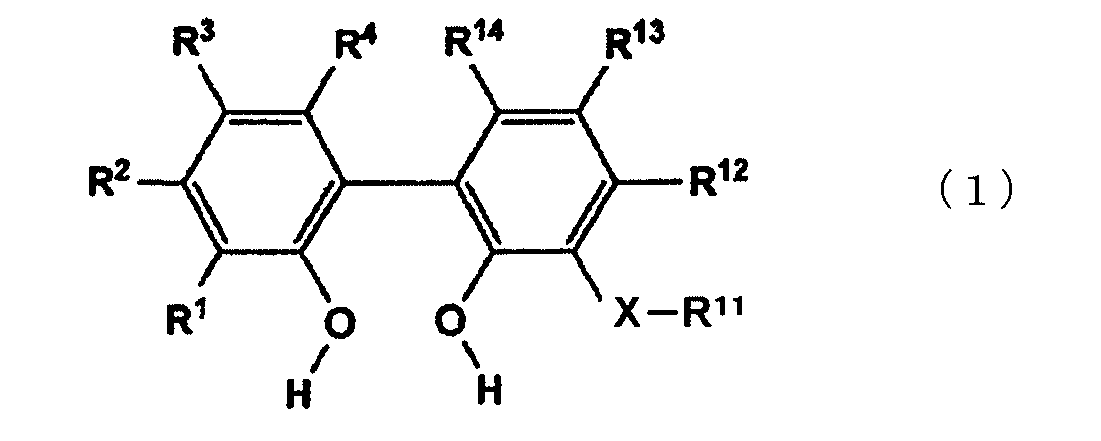
(式(1)中、
Xは、4~20個の炭素原子を有するアルキレン基であり、
R1及びR11は、それぞれ独立に、水素原子、1~20個の炭素原子を有するアルキル基及び3~20個の炭素原子を有するシクロアルキル基からなる群から選ばれるものを表し、R1とX-R11とは互いに異なる。
R2及びR12は、それぞれ独立に、水素原子、1~20個の炭素原子を有するアルキル基、1~20個の炭素原子を有するアルコキシ基、3~20個の炭素原子を有するシクロアルキル基、3~20個の炭素原子を有するシクロアルコキシ基、2~20個の炭素原子を有するジアルキルアミノ基、6~20個の炭素原子を有するアリール基、6~20個の炭素原子を有するアリールオキシ基、7~20個の炭素原子を有するアルキルアリール基、7~20個の炭素原子を有するアルキルアリールオキシ基、7~20個の炭素原子を有するアリールアルキル基、7~20個の炭素原子を有するアリールアルコキシ基、シアノ基、ヒドロキシ基及びハロゲン原子からなる群から選ばれるものを表し、
R3及びR13は、それぞれ独立に、水素原子、1~20個の炭素原子を有するアルキル基、3~20個の炭素原子を有するシクロアルキル基、6~20個の炭素原子を有するアリール基、7~20個の炭素原子を有するアルキルアリール基及び7~20個の炭素原子を有するアリールアルキル基からなる群から選ばれるものを表し、
R4及びR14は、それぞれ独立に、水素原子、1~12個の炭素原子を有するアルキル基、3~12個の炭素原子を有するシクロアルキル基、1~12個の炭素原子を有するアルコキシ基、シリル基、シロキシ基及びハロゲン原子からなる群から選ばれるものを表す。)
[2] 前記一般式(1)において、Xは、第4級炭素原子を含む4~20個の炭素原子を有するアルキレン基である、[1]に記載のジヒドロキシビフェニル化合物。
[3] 前記Xが、第4級炭素原子を含む4~5個の炭素原子を有するアルキレン基である、[2]に記載のジヒドロキシビフェニル化合物。
[4] 前記Xが、下記式(1X)で表される構造単位を有するアルキレン基である、[3]に記載のジヒドロキシビフェニル化合物。
-C(CH3)2-CH2- (1X)
-C(CH3)2-CH2- (1X)
[5] 前記R1及びR11が、それぞれ独立に、4~20個の炭素原子を有する第3級アルキル基であり、
前記R2及びR12が水素原子であり、
前記R3及びR13が、それぞれ独立に、4~20個の炭素原子を有する第3級アルキル基であり、
前記R4及びR14が、それぞれ独立に、水素原子、1~3個の炭素原子を有するアルキル基、1~3個の炭素原子を有するアルコキシ基及びハロゲン原子からなる群から選ばれるものである、[1]~[4]のいずれかに記載のジヒドロキシビフェニル化合物。
前記R2及びR12が水素原子であり、
前記R3及びR13が、それぞれ独立に、4~20個の炭素原子を有する第3級アルキル基であり、
前記R4及びR14が、それぞれ独立に、水素原子、1~3個の炭素原子を有するアルキル基、1~3個の炭素原子を有するアルコキシ基及びハロゲン原子からなる群から選ばれるものである、[1]~[4]のいずれかに記載のジヒドロキシビフェニル化合物。
[6] 前記R1、R11、R3及びR13が、それぞれ独立に、4~7個の炭素原子を有する第3級アルキル基であり、
前記R4及びR14が、それぞれ独立に、1~3個の炭素原子を有するアルキル基である、[5]に記載のジヒドロキシビフェニル化合物。
前記R4及びR14が、それぞれ独立に、1~3個の炭素原子を有するアルキル基である、[5]に記載のジヒドロキシビフェニル化合物。
[7] 前記R1、R11、R3及びR13がt-ブチル基であり、 前記R4及びR14がメチル基である、[6]に記載のジヒドロキシビフェニル化合物。
[8] 下記一般式(2)で表されるビスホスファイト化合物。
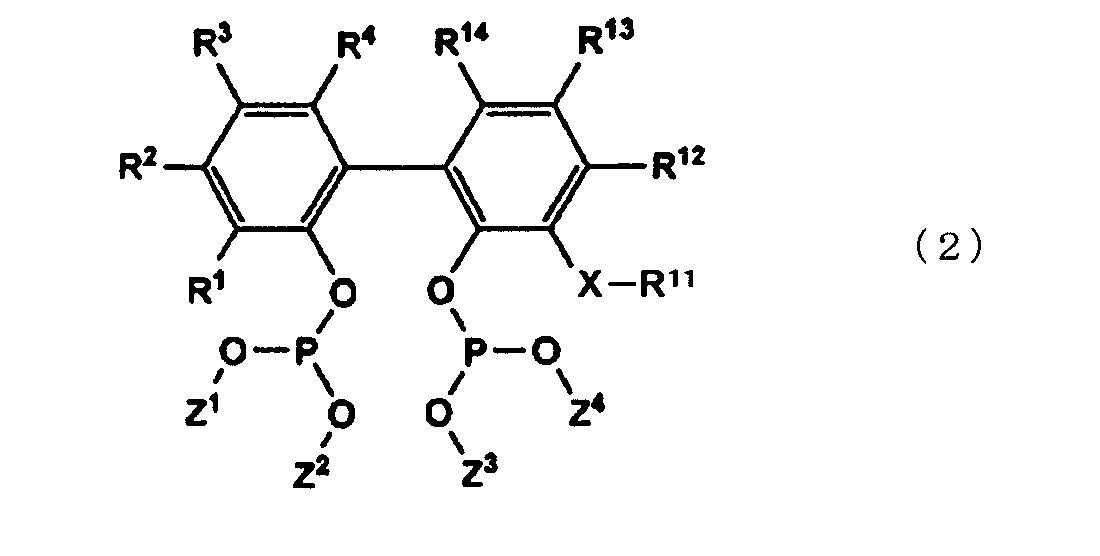
(式(2)中、
Xは、4~20個の炭素原子を有するアルキレン基であり、
R1及びR11は、それぞれ独立に、水素原子、1~20個の炭素原子を有するアルキル基及び3~20個の炭素原子を有するシクロアルキル基からなる群から選ばれるものを表し、R1とX-R11とは互いに異なる。
R2及びR12は、それぞれ独立に、水素原子、1~20個の炭素原子を有するアルキル基、1~20個の炭素原子を有するアルコキシ基、3~20個の炭素原子を有するシクロアルキル基、3~20個の炭素原子を有するシクロアルコキシ基、2~20個の炭素原子を有するジアルキルアミノ基、6~20個の炭素原子を有するアリール基、6~20個の炭素原子を有するアリールオキシ基、7~20個の炭素原子を有するアルキルアリール基、7~20個の炭素原子を有するアルキルアリールオキシ基、7~20個の炭素原子を有するアリールアルキル基、7~20個の炭素原子を有するアリールアルコキシ基、シアノ基、ヒドロキシ基及びハロゲン原子からなる群から選ばれるものを表し、
R3及びR13は、それぞれ独立に、水素原子、1~20個の炭素原子を有するアルキル基、3~20個の炭素原子を有するシクロアルキル基、6~20個の炭素原子を有するアリール基、7~20個の炭素原子を有するアルキルアリール基及び7~20個の炭素原子を有するアリールアルキル基からなる群から選ばれるものを表し、
R4及びR14は、それぞれ独立に、水素原子、1~12個の炭素原子を有するアルキル基、3~12個の炭素原子を有するシクロアルキル基、1~12個の炭素原子を有するアルコキシ基、シリル基、シロキシ基及びハロゲン原子からなる群から選ばれるものを表す。
Z1~Z4は、それぞれ独立に、6~20個の炭素原子を有するアリール基を表し、置換基を有していてもよく、該置換基同士が結合して環を形成していてもよい。また、Z1
とZ2、並びに、Z3とZ4は、いずれも互いに結合していなくてもよいし、互いに結合して環構造を形成してもよい。)
[9] 前記Xが、第4級炭素原子を含む4~20個の炭素原子を有するアルキレン基である、[8]に記載のビスホスファイト化合物。
[10] 前記Xが、第4級炭素原子を含む4~5個の炭素原子を有するアルキレン基である、[9]に記載のビスホスファイト化合物。
[11] 前記Xが、下記式(1X)で表される構造単位を有するアルキレン基である、[10]に記載のビスホスファイト化合物。
-C(CH3)2-CH2- (1X)
-C(CH3)2-CH2- (1X)
[12] 前記R1及びR11が、それぞれ独立に、4~20個の炭素原子を有する第3級アルキル基であり、
前記R2及びR12が水素原子であり、 前記R3及びR13が、それぞれ独立に、4~20個の炭素原子を有する第3級アルキル基であり、
前記R4及びR14が、それぞれ独立に、水素原子、1~3個の炭素原子を有するアルキル基、1~3個の炭素原子を有するアルコキシ基及びハロゲン原子からなる群から選ばれるものである、[8]~[11]のいずれかに記載のビスホスファイト化合物。
前記R2及びR12が水素原子であり、 前記R3及びR13が、それぞれ独立に、4~20個の炭素原子を有する第3級アルキル基であり、
前記R4及びR14が、それぞれ独立に、水素原子、1~3個の炭素原子を有するアルキル基、1~3個の炭素原子を有するアルコキシ基及びハロゲン原子からなる群から選ばれるものである、[8]~[11]のいずれかに記載のビスホスファイト化合物。
[13] 前記Z1~Z4が、それぞれ独立に、酸素原子と結合する炭素原子に隣接する芳香環炭素原子に置換基を有さないか、又は該芳香環炭素原子に、0~2個の炭素原子を有する置換基を有する、[8]~[12]のいずれかに記載のビスホスファイト化合物。
[14] 前記R1、R11、R3及びR13が、それぞれ独立に、4~7個の炭素原子を有する第3級アルキル基であり、
前記R4及びR14が、それぞれ独立に、1~3個の炭素原子を有するアルキル基である、[12]又は[13]に記載のビスホスファイト化合物。
前記R4及びR14が、それぞれ独立に、1~3個の炭素原子を有するアルキル基である、[12]又は[13]に記載のビスホスファイト化合物。
[15] 前記Z1~Z4が、それぞれ独立に、1-ナフチル基又は2-ナフチル基である、[8]~[14]のいずれかに記載のビスホスファイト化合物。
[16] 前記R1、R11、R3及びR13がt-ブチル基であり、前記R4及びR14がメチル基である、[14]又は[15]に記載のビスホスファイト化合物。
[17] [8]~[16]のいずれかに記載のビスホスファイト化合物と第8~10族金属との錯体を含む触媒。
[18] 前記第8~10族金属に対する前記ビスホスファイト化合物のモル比が、0.00004~500である、[17]に記載の触媒。
[19] 前記第8~10族金属に対する前記ビスホスファイト化合物のモル比が、0.0002~100である、[18]に記載の触媒。
[20] 前記第8~10族金属に対する前記ビスホスファイト化合物のモル比が、0.001~50である、[19]に記載の触媒。
[21] 下記一般式(3)で表されるビスホスファイト化合物、及び、[8]~[16]のいずれか一項に記載のビスホスファイト化合物を含む触媒組成物。
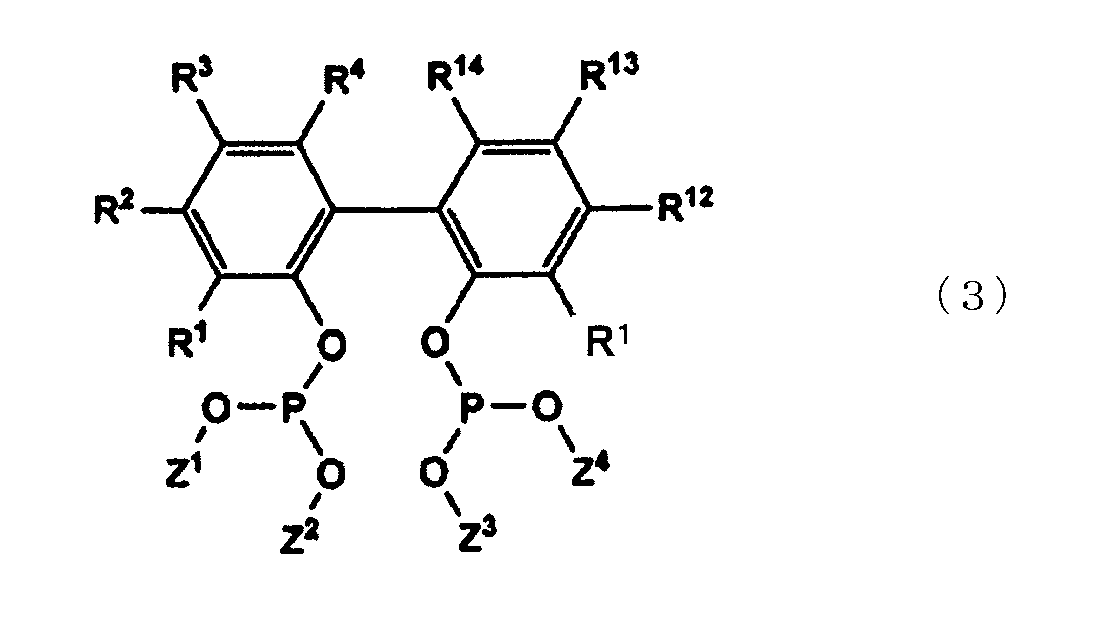
(式(3)中、
R1、R2及びR12、R3及びR13、R4及びR14、Z1~Z4は、それぞれ、前記一般式(2)におけるR1、R2及びR12、R3及びR13、R4及びR14、Z1~Z4と同義である。)
R1、R2及びR12、R3及びR13、R4及びR14、Z1~Z4は、それぞれ、前記一般式(2)におけるR1、R2及びR12、R3及びR13、R4及びR14、Z1~Z4と同義である。)
[22] 前記一般式(3)で表されるビスホスファイト化合物の含有割合が、80.0質量%以上で、[8]~[16]のいずれかに記載のビスホスファイト化合物の含有割合が0.01質量%以上である、[21]に記載の触媒組成物。
[23] 第8~10族金属化合物及び[8]~[16]のいずれかに記載のビスホスファイト化合物の存在下で、オレフィン化合物を一酸化炭素及び水素と反応させるアルデヒドの製造方法。
[24] 前記第8~10族金属化合物の反応液中の濃度が金属原子換算で0.05~5000mg/Lである、[23]に記載のアルデヒドの製造方法。
[25] [23]又は[24]に記載のアルデヒドの製造方法によりアルデヒドを製造した後、該アルデヒドを水素と反応させるアルコールの製造方法。
[26] [17]~[20]のいずれかに記載の触媒の存在下で、オレフィン化合物を一酸化炭素及び水素と反応させるアルデヒドの製造方法。
[27] [26]に記載のアルデヒドの製造方法によりアルデヒドを製造した後、該アルデヒドを水素と反応させるアルコールの製造方法。
本発明によれば、環構造中に嵩高い置換基を有し、かつ、非対称構造を有し、オレフィン化合物のヒドロホルミル化反応において、極めて優れた直鎖型のアルデヒド異性体選択性が得られるビスホスファイト化合物として使用できる、新規なジヒドロキシビフェニル化合物を提供することができる。
本発明のジヒドロキシビフェニル化合物を原料とする本発明のビスホスファイト化合物を配位子として、金属成分と共に用いた触媒及び触媒組成物は、オレフィン化合物のヒドロホルミル化反応において、反応活性を良好に維持しつつ、極めて優れた直鎖型のアルデヒド異性体選択性を得ることができる。
よって、本発明によれば、オレフィン化合物のヒドロホルミル化反応において、極めて優れた直鎖型のアルデヒド異性体選択性が得られるビスホスファイト化合物を提供することができる。
よって、本発明によれば、オレフィン化合物のヒドロホルミル化反応において、極めて優れた直鎖型のアルデヒド異性体選択性が得られるビスホスファイト化合物を提供することができる。
さらに本発明によれば、前記ビスホスファイト化合物又は前記触媒を用いて、オレフィン化合物を一酸化炭素及び水素と反応させて、優れた直鎖型のアルデヒド異性体選択性でアルデヒドを得る、アルデヒドの製造方法を提供することができる。
さらに本発明によれば、前記アルデヒドの製造方法により得られたアルデヒドを用いて、アルコールを製造する、アルコールの製造方法を提供することができる。
さらに本発明によれば、前記アルデヒドの製造方法により得られたアルデヒドを用いて、アルコールを製造する、アルコールの製造方法を提供することができる。
以下、本発明の実施形態について詳細に説明する。本発明は以下の説明に限定されるものではなく、本発明の要旨を逸脱しない範囲において、任意に変形して実施することができる。
本明細書において「~」を用いて表される数値範囲は、特に断りのない限り、「~」の前後に記載された数値を下限値及び上限値として含む範囲を意味する。「A~B」は、A以上B以下であることを意味する。
本明細書において、「A又はBを含む」とは、特に断りのない限り、「Aを含む」、「Bを含む」及び「A及びBを含む」ことを意味する。
本明細書において、「GC面積%」は、ガスクロマトグラム(GC)測定装置とガスクロマトグラフィー総面積法を用いて測定される各成分の組成割合を示し、ガスクロマトグラム上の全生成物質のGCピークの総面積を100%としたときの各ピーク成分の面積含有割合(単位:GC面積%)として算出される。GC測定条件の詳細は後述する実験例において説明する。
本明細書において、「LC面積%」は、液体クロマトグラム(LC)測定装置と液体クロマトグラフィー(LC法)総面積法を用いて測定される各成分の組成割合を示し、液体クロマトグラム上の全生成物質のLCピークの総面積を100%としたときの各ピーク成分の面積含有割合(単位:LC面積%)として算出される。LC測定条件の詳細は後述する実験例において説明する。
本明細書において、「LC面積%」は、液体クロマトグラム(LC)測定装置と液体クロマトグラフィー(LC法)総面積法を用いて測定される各成分の組成割合を示し、液体クロマトグラム上の全生成物質のLCピークの総面積を100%としたときの各ピーク成分の面積含有割合(単位:LC面積%)として算出される。LC測定条件の詳細は後述する実験例において説明する。
本明細書において、「質量%」は全体量100質量%中に含まれる所定の成分の含有割合を示す。また、「質量%」と「重量%」とは、それぞれ同義である。
本明細書において、「任意の」又は「任意に」とは、続いて説明される状況が発生しても発生しなくてもよいことを意味する。そのため、該説明には、該状況が発生した場合と発生しない場合とが含まれる。
本明細書において、「任意の」又は「任意に」とは、続いて説明される状況が発生しても発生しなくてもよいことを意味する。そのため、該説明には、該状況が発生した場合と発生しない場合とが含まれる。
本明細書で使用される「約」という用語は、表示値の上下20%を意味することができる。例えば、摂氏0℃を基準とする温度約75℃は、60℃~90℃の範囲を包含する。
本明細書に記載の全ての工程は、本明細書に特に記載がない限り、又は文脈によって明らかに矛盾しない限り、好適ないずれの順序でも行うことができる。
本明細書に記載の全ての工程は、本明細書に特に記載がない限り、又は文脈によって明らかに矛盾しない限り、好適ないずれの順序でも行うことができる。
以下、本発明の実施の形態について詳細に説明する。以下に記載する構成要件の説明は、本発明の実施態様の一例であり、本発明はこれらの内容に限定されるものではない。
以下、「本発明のジヒドロキシビフェニル化合物を原料とするビスホスファイト化合物を配位子として、金属成分と共に用いた触媒は、ヒドロホルミル化反応において、直鎖型のアルデヒド異性体選択性が優れる」ことを、単に「アルデヒド異性体選択性が優れる」と略す場合がある。
[ジヒドロキシビフェニル化合物]
本発明のジヒドロキシビフェニル化合物は、各々下記一般式(1)で表される新規なジヒドロキシビフェニル化合物である。
本発明のジヒドロキシビフェニル化合物は、各々下記一般式(1)で表される新規なジヒドロキシビフェニル化合物である。

(式(1)中、
Xは、4~20個の炭素原子を有するアルキレン基であり、
R1及びR11は、それぞれ独立に、水素原子、1~20個の炭素原子を有するアルキル基及び3~20個の炭素原子を有するシクロアルキル基からなる群から選ばれるものを表し、R1とX-R11とは互いに異なる。
R2及びR12は、それぞれ独立に、水素原子、1~20個の炭素原子を有するアルキル基、1~20個の炭素原子を有するアルコキシ基、3~20個の炭素原子を有するシクロアルキル基、3~20個の炭素原子を有するシクロアルコキシ基、2~20個の炭素原子を有するジアルキルアミノ基、6~20個の炭素原子を有するアリール基、6~20個の炭素原子を有するアリールオキシ基、7~20個の炭素原子を有するアルキルアリール基、7~20個の炭素原子を有するアルキルアリールオキシ基、7~20個の炭素原子を有するアリールアルキル基、7~20個の炭素原子を有するアリールアルコキシ基、シアノ基、ヒドロキシ基及びハロゲン原子からなる群から選ばれるものを表し、
R3及びR13は、それぞれ独立に、水素原子、1~20個の炭素原子を有するアルキル基、3~20個の炭素原子を有するシクロアルキル基、6~20個の炭素原子を有するアリール基、7~20個の炭素原子を有するアルキルアリール基及び7~20個の炭素原子を有するアリールアルキル基からなる群から選ばれるものを表し、
R4及びR14は、それぞれ独立に、水素原子、1~12個の炭素原子を有するアルキル基、3~12個の炭素原子を有するシクロアルキル基、1~12個の炭素原子を有するアルコキシ基、シリル基、シロキシ基及びハロゲン原子からなる群から選ばれるものを表す。)
Xは、4~20個の炭素原子を有するアルキレン基であり、
R1及びR11は、それぞれ独立に、水素原子、1~20個の炭素原子を有するアルキル基及び3~20個の炭素原子を有するシクロアルキル基からなる群から選ばれるものを表し、R1とX-R11とは互いに異なる。
R2及びR12は、それぞれ独立に、水素原子、1~20個の炭素原子を有するアルキル基、1~20個の炭素原子を有するアルコキシ基、3~20個の炭素原子を有するシクロアルキル基、3~20個の炭素原子を有するシクロアルコキシ基、2~20個の炭素原子を有するジアルキルアミノ基、6~20個の炭素原子を有するアリール基、6~20個の炭素原子を有するアリールオキシ基、7~20個の炭素原子を有するアルキルアリール基、7~20個の炭素原子を有するアルキルアリールオキシ基、7~20個の炭素原子を有するアリールアルキル基、7~20個の炭素原子を有するアリールアルコキシ基、シアノ基、ヒドロキシ基及びハロゲン原子からなる群から選ばれるものを表し、
R3及びR13は、それぞれ独立に、水素原子、1~20個の炭素原子を有するアルキル基、3~20個の炭素原子を有するシクロアルキル基、6~20個の炭素原子を有するアリール基、7~20個の炭素原子を有するアルキルアリール基及び7~20個の炭素原子を有するアリールアルキル基からなる群から選ばれるものを表し、
R4及びR14は、それぞれ独立に、水素原子、1~12個の炭素原子を有するアルキル基、3~12個の炭素原子を有するシクロアルキル基、1~12個の炭素原子を有するアルコキシ基、シリル基、シロキシ基及びハロゲン原子からなる群から選ばれるものを表す。)
<構造的特徴>
本発明のジヒドロキシビフェニル化合物は、上記一般式(1)に示されるように、分子内にビフェニル骨格を有し、該ビフェニル骨格の5位と5’位(6位と6’位に置換したヒドロキシル基に対してオルト位の位置)に、-R1と-X-R11という異なる置換基を有することにより、非対称構造となっている。また、一方の置換基:-X-R11が嵩高い置換基であるという構造的特徴を有する。
本発明のジヒドロキシビフェニル化合物は、このような構造的特徴を有することから、次のような効果を得ることができる。
(1) 非対称構造と嵩高い置換基(-X-R11)は、該ジヒドロキシビフェニル化合物を前駆体として合成された後述の本発明のビスホスファイト化合物に、加水分解に対する安定化効果をもたらす。
(2) この非対称構造と嵩高い置換基(-X-R11)は、該ビスホスファイト化合物を用いた触媒においても、加水分解に対する安定化効果をもたらすとともに、嵩高い置換基(-X-R11)により、オレフィン系化合物が金属に配位する際の配位の向きが制御されるので、極めて優れた直鎖型のアルデヒド異性体選択性が得られる。
<X>
一般式(1)中、Xは、4~20個の炭素原子を有するアルキレン基である。
Xは、第4級炭素原子を含む4~20個の炭素原子を有するアルキレン基であることが好ましい。
本発明において、第4級炭素原子とは、当該炭素原子の結合手のすべてが他の炭素原子と結合している炭素原子を意味する。
一般式(1)中、Xは、4~20個の炭素原子を有するアルキレン基である。
Xは、第4級炭素原子を含む4~20個の炭素原子を有するアルキレン基であることが好ましい。
本発明において、第4級炭素原子とは、当該炭素原子の結合手のすべてが他の炭素原子と結合している炭素原子を意味する。
Xは、特に限定されるものではなく、下記一般式(11)で表されるアルキレン基が挙げられる。
(Benz)-(CH2)d-C(CaH2a+1)(CbH2b+1)-(CH2)c-(R11) (11)
式(11)中、a,b,c,及びdは、1≦a、1≦b、1≦c、0≦d、3≦a+b+c+d≦19を満たす整数である。R11は、前記式(1)におけるR11である。Benzは、前記式(1)において、Xが結合しているベンゼン環である。
上記式(11)において、a=1、b=1であることが好ましく、特にXは、下記式(1X)で表される構造単位を有するアルキレン基であることが、優れたアルデヒド異性体選択性が得られる観点から好ましい。
-C(CH3)2-CH2- (1X)
(Benz)-(CH2)d-C(CaH2a+1)(CbH2b+1)-(CH2)c-(R11) (11)
式(11)中、a,b,c,及びdは、1≦a、1≦b、1≦c、0≦d、3≦a+b+c+d≦19を満たす整数である。R11は、前記式(1)におけるR11である。Benzは、前記式(1)において、Xが結合しているベンゼン環である。
上記式(11)において、a=1、b=1であることが好ましく、特にXは、下記式(1X)で表される構造単位を有するアルキレン基であることが、優れたアルデヒド異性体選択性が得られる観点から好ましい。
-C(CH3)2-CH2- (1X)
また、Xは、アルデヒド異性体選択性がより優れたものとなる観点から、第4級炭素原子を含む4~20個の炭素原子を有するアルキレン基が好ましく、第4級炭素原子を含む4~10個の炭素原子を有するアルキレン基がより好ましく、第4級炭素原子を含む4~5個の炭素原子を有するアルキレン基がさらに好ましく、下記一般式(12)で表されるアルキレン基、即ち、1,1-ジメチルエチレン基が特に好ましい。
(Benz)-C(CH3)2-CH2-(R11) (12)
式(12)中、R11は、前記式(1)におけるR11である。Benzは、前記式(1)における、Xが結合しているベンゼン環である。
(Benz)-C(CH3)2-CH2-(R11) (12)
式(12)中、R11は、前記式(1)におけるR11である。Benzは、前記式(1)における、Xが結合しているベンゼン環である。
<R1及びR11>
R1及びR11は、それぞれ独立に、水素原子、1~20個の炭素原子を有するアルキル基及び3~20個の炭素原子を有するシクロアルキル基からなる群から選ばれるものを表す。
R1及びR11は、それぞれ独立に、水素原子、1~20個の炭素原子を有するアルキル基及び3~20個の炭素原子を有するシクロアルキル基からなる群から選ばれるものを表す。
1~20個の炭素原子を有するアルキル基としては、例えばメチル基、エチル基、n-プロピル基、i-プロピル基、s-ブチル基、t-ブチル基、イソペンチル基、ネオペンチル基、t-ペンチル基、t-ヘキシル基、1,1,2-トリメチルプロピル基等の直鎖又は分岐鎖のアルキル基が挙げられる。中でも3~20個の炭素原子を有するものが好ましく、4~20個の炭素原子を有するものがより好ましく、4~10個の炭素原子を有するものが特に好ましい。更に、式(1)中のX(R11の場合)又はベンゼン環(R1の場合)と結合する炭素原子が第3級のものが好ましく、このようなアルキル基としては、t-ブチル基、t-ペンチル基、t-ヘキシル基等が例示される。
また、3~20個の炭素原子を有するシクロアルキル基としては、例えばシクロヘキシル基、シクロオクチル基、アダマンチル基等が挙げられる。それらの中でも、6~14個の炭素原子を有するシクロアルキル基が好ましく、6~10個の炭素原子を有するシクロアルキル基がより好ましい。
R1及びR11としては、4~20個の炭素原子を有する第3級アルキル基が好ましく、4~7個の炭素原子を有する第3級アルキル基がより好ましく、t-ブチル基が特に好ましい。
R1及びR11はそれぞれ同一でも異なっていてもよい。
R1及びR11がt-ブチル基であれば、一般式(1)で表される化合物の原料となるフェノールやクレゾール等のフェノール類に、イソブチレンガスやt-ブチルアルコールといった安価な原料を反応させることで容易に該化合物が合成できる。また、R1及びR11がt-ブチル基であれば、t-ブチル基の嵩高さにより、後述の一般式(2)で表されるビスホスファイト化合物の加水分解に対する安定化効果が十分に得られる。
以上の理由より、R1及びR11はt-ブチル基が特に好ましい。
以上の理由より、R1及びR11はt-ブチル基が特に好ましい。
<-X-R11>
-X-R11のより具体的な一実施形態としては、アルデヒド異性体選択性がより優れたものとなる観点から、下記表1中の式(a)、(a’)、(b)~(g)で表される基が挙げられる。下記式(a)、(a’)、(b)~(g)中、「*」は、前記式(1)におけるXのベンゼン環への結合部を示す。
-X-R11のより具体的な一実施形態としては、アルデヒド異性体選択性がより優れたものとなる観点から、下記表1中の式(a)、(a’)、(b)~(g)で表される基が挙げられる。下記式(a)、(a’)、(b)~(g)中、「*」は、前記式(1)におけるXのベンゼン環への結合部を示す。

<R2及びR12>
R2及びR12は、それぞれ独立に、水素原子、1~20個の炭素原子を有するアルキル基及びアルコキシ基、3~20個の炭素原子を有するシクロアルキル基及びシクロアルコキシ基、2~20個の炭素原子を有するジアルキルアミノ基、6~20個の炭素原子を有するアリール基及びアリールオキシ基、7~20個の炭素原子を有するアルキルアリール基、アルキルアリールオキシ基、アリールアルキル基及びアリールアルコキシ基、シアノ基、ヒドロキシ基並びにハロゲン原子からなる群から選ばれるものを表す。
R2及びR12は、それぞれ独立に、水素原子、1~20個の炭素原子を有するアルキル基及びアルコキシ基、3~20個の炭素原子を有するシクロアルキル基及びシクロアルコキシ基、2~20個の炭素原子を有するジアルキルアミノ基、6~20個の炭素原子を有するアリール基及びアリールオキシ基、7~20個の炭素原子を有するアルキルアリール基、アルキルアリールオキシ基、アリールアルキル基及びアリールアルコキシ基、シアノ基、ヒドロキシ基並びにハロゲン原子からなる群から選ばれるものを表す。
1~20個の炭素原子を有するアルキル基としては、例えばメチル基、エチル基、n-プロピル基、i-プロピル基、n-ブチル基、s-ブチル基、t-ブチル基、n-ペンチル基、イソペンチル基、ネオペンチル基、t-ペンチル基、t-ヘキシル基等の直鎖又は分岐鎖のアルキル基が挙げられる。
3~20個の炭素原子を有するシクロアルキル基としては、例えばシクロヘキシル基、シクロオクチル基、アダマンチル基等が挙げられる。
3~20個の炭素原子を有するシクロアルキル基としては、例えばシクロヘキシル基、シクロオクチル基、アダマンチル基等が挙げられる。
1~20の炭素原子を有するアルコキシ基としては、例えばメトキシ基、エトキシ基、イソプロポキシ基、t-ブトキシ基等の直鎖又は分岐鎖のアルコキシ基が挙げられる。それらの中でも、1~12個の炭素原子を有するアルコキシ基が好ましい。
3~20個の炭素原子を有するシクロアルコキシ基としては、例えばシクロペンチルオキシ基等が挙げられる。
3~20個の炭素原子を有するシクロアルコキシ基としては、例えばシクロペンチルオキシ基等が挙げられる。
2~20個の炭素原子を有するジアルキルアミノ基としては、例えばジメチルアミノ基、ジエチルアミノ基等が挙げられる。
6~20個の炭素原子を有するアリール基としては、例えばフェニル基、ナフチル基等が挙げられる。
6~20個の炭素原子を有するアリールオキシ基としては、例えばフェノキシ基、ナフトキシ基等が挙げられる。
7~20個の炭素原子を有するアルキルアリール基としては、例えばp-トリル基、o-トリル基等が挙げられる。
6~20個の炭素原子を有するアリール基としては、例えばフェニル基、ナフチル基等が挙げられる。
6~20個の炭素原子を有するアリールオキシ基としては、例えばフェノキシ基、ナフトキシ基等が挙げられる。
7~20個の炭素原子を有するアルキルアリール基としては、例えばp-トリル基、o-トリル基等が挙げられる。
7~20個の炭素原子を有するアルキルアリールオキシ基としては、例えば2,3-キシレノキシ基等が挙げられる。
7~20個の炭素原子を有するアリールアルキル基としては、例えばベンジル基等が挙げられる。
7~20個の炭素原子を有するアリールアルコキシ基としては、例えば2-(2-ナフチル)エトキシ基等が挙げられる。
ハロゲン原子としては、例えばフッ素原子、塩素原子、臭素原子及びヨウ素原子等が挙げられる。
7~20個の炭素原子を有するアリールアルキル基としては、例えばベンジル基等が挙げられる。
7~20個の炭素原子を有するアリールアルコキシ基としては、例えば2-(2-ナフチル)エトキシ基等が挙げられる。
ハロゲン原子としては、例えばフッ素原子、塩素原子、臭素原子及びヨウ素原子等が挙げられる。
R2及びR12はそれぞれ同一でも異なっていてもよい。
R2及びR12は、水素原子であることが好ましい。この位置における置換基は、ヒドロホルミル化反応に対する反応性の改善効果や後述の一般式(2)で表されるビスホスファイト化合物自体の安定化効果に対する寄与が小さい。そのため、該化合物の製造コストを抑える観点から、最も単純な置換基である水素原子であることが好ましい。
<R3及びR13>
R3及びR13は、水素原子、1~20個の炭素原子を有するアルキル基、3~20個の炭素原子を有するシクロアルキル基、6~20個の炭素原子を有するアリール基並びに7~20個の炭素原子を有するアルキルアリール基及びアリールアルキル基からなる群から選ばれるものを表す。
R3及びR13は、水素原子、1~20個の炭素原子を有するアルキル基、3~20個の炭素原子を有するシクロアルキル基、6~20個の炭素原子を有するアリール基並びに7~20個の炭素原子を有するアルキルアリール基及びアリールアルキル基からなる群から選ばれるものを表す。
1~20個の炭素原子を有するアルキル基としては、例えばメチル基、エチル基、n-プロピル基、i-プロピル基、s-ブチル基、t-ブチル基、イソペンチル基、ネオペンチル基、t-ペンチル基、t-ヘキシル基等の直鎖又は分岐鎖のアルキル基が挙げられる。中でも4~20個の炭素原子を有するものが好ましく、4~10個の炭素原子を有するものが特に好ましい。更に芳香環と結合する炭素原子が第3級のものが好ましく、t-ブチル基、t-ペンチル基、t-ヘキシル基等が例示される。
3~20個の炭素原子を有するシクロアルキル基としては、例えばシクロヘキシル基、シクロオクチル基、アダマンチル基等が挙げられる。それらの中でも、6~14個の炭素原子を有するシクロアルキル基が好ましく、6~10個の炭素原子を有するシクロアルキル基がより好ましい。
6~20個の炭素原子数を有するアリール基としては、例えばフェニル基、ナフチル基等が挙げられる。
7~20個の炭素原子数を有するアルキルアリール基としては、例えばp-トリル基、o-トリル基等が挙げられる。
7~20個の炭素原子数を有するアリールアルキル基としては、例えばベンジル基等が挙げられる。
6~20個の炭素原子数を有するアリール基としては、例えばフェニル基、ナフチル基等が挙げられる。
7~20個の炭素原子数を有するアルキルアリール基としては、例えばp-トリル基、o-トリル基等が挙げられる。
7~20個の炭素原子数を有するアリールアルキル基としては、例えばベンジル基等が挙げられる。
R3及びR13は、4~20個の炭素原子を有する第3級アルキル基であることが好ましく、4~7個の炭素原子を有する第3級アルキル基であることがより好ましく、t-ブチル基であることが特に好ましい。
R3及びR13はそれぞれ同一でも異なっていてもよい。
R3及びR13がt-ブチル基であることが特に好ましい理由としては、一般式(1)で表されるジヒドロキシビフェニル化合物の原料となるフェノールやクレゾール等のフェノール類にイソブチレンガスやt-ブチルアルコールといった安価な原料を反応させることで容易に該ジヒドロキシビフェニル化合物が合成できる点などが挙げられる。
<R4及びR14>
R4及びR14は、それぞれ独立に、水素原子、1~12個の炭素原子を有するアルキル基、3~12個の炭素原子を有するシクロアルキル基、1~12個の炭素原子を有するアルコキシ基、シリル基、シロキシ基及びハロゲン原子からなる群から選ばれるものを表す。
R4及びR14は、それぞれ独立に、水素原子、1~12個の炭素原子を有するアルキル基、3~12個の炭素原子を有するシクロアルキル基、1~12個の炭素原子を有するアルコキシ基、シリル基、シロキシ基及びハロゲン原子からなる群から選ばれるものを表す。
1~12個の炭素原子を有するアルキル基としては、例えばメチル基、エチル基、n-プロピル基、イソプロピル基、t-ブチル基、デシル基のような直鎖又は分岐鎖のアルキル基等が挙げられる。
3~12個の炭素原子を有するシクロアルキル基としては、例えばシクロプロピル基及びシクロヘキシル基等が挙げられる。
1~12個の炭素原子を有するアルコキシ基としては、例えばメトキシ基、エトキシ基、t-ブトキシ基等の直鎖又は分岐鎖のアルコキシ基が挙げられる。
3~12個の炭素原子を有するシクロアルキル基としては、例えばシクロプロピル基及びシクロヘキシル基等が挙げられる。
1~12個の炭素原子を有するアルコキシ基としては、例えばメトキシ基、エトキシ基、t-ブトキシ基等の直鎖又は分岐鎖のアルコキシ基が挙げられる。
シリル基としては、例えばトリメチルシリル基等が挙げられる。
シロキシ基としては、例えばシロキシ基及びトリメチルシロキシ基等が挙げられる。
ハロゲン原子としては、例えばフッ素原子、塩素原子、臭素原子及びヨウ素原子等が挙げられる。
シロキシ基としては、例えばシロキシ基及びトリメチルシロキシ基等が挙げられる。
ハロゲン原子としては、例えばフッ素原子、塩素原子、臭素原子及びヨウ素原子等が挙げられる。
R4及びR14はそれぞれ同一でも異なっていてもよい。
これらの内、R4及びR14は、それぞれ独立に、水素原子、メチル基、エチル基のような1~3個の炭素原子を有するアルキル基、メトキシ基やエトキシ基のような1~3個の炭素原子を有するアルコキシ基、ハロゲン原子が好ましく、1~3個の炭素原子を有するアルキル基であることがより好ましく、共にメチル基であることが特に好ましい。
R4及びR14として1~3個の炭素原子を有するアルキル基といった小さな基、特にメチル基が好ましい理由としては、後述するカップリング反応をスムーズに進行させることと、後述の一般式(2)で表されるビスホスファイト化合物の安定性向上とを両立できる点が挙げられる。
<好適態様>
一般式(1)で表されるジヒドロキシビフェニル化合物としては、
Xが第4級炭素原子を含む4~5個の炭素原子を有するアルキレン基であり、R1及びR11が、それぞれ独立に、4~20個の炭素原子を有する第3級アルキル基であり、R2及びR12が水素原子であり、R3及びR13が、それぞれ独立に、4~20個の炭素原子を有する第3級アルキル基であり、R4及びR14が、それぞれ独立に、水素原子、1~3個の炭素原子を有するアルキル基、1~3個の炭素原子を有するアルコキシ基及びハロゲン原子からなる群から選ばれるものであるジヒドロキシビフェニル化合物
が好ましい。
一般式(1)で表されるジヒドロキシビフェニル化合物としては、
Xが前記式(1X)で表される構造単位を有するアルキレン基であり、R1及びR11、R3及びR13が、それぞれ独立に、4~7個の炭素原子を有する第3級アルキル基であり、R2及びR12が水素原子であり、R4及びR14が、それぞれ独立に、1~3個の炭素原子を有するアルキル基であるジヒドロキシビフェニル化合物
がより好ましい。
一般式(1)で表されるジヒドロキシビフェニル化合物としては、
Xが1,1-ジメチルエチレン基であり、R1、R11、R3及びR13がt-ブチル基であり、R2及びR12が水素原子であり、R4及びR14がメチル基であるジヒドロキシビフェニル化合物
が特に好ましい。
一般式(1)で表されるジヒドロキシビフェニル化合物としては、
Xが第4級炭素原子を含む4~5個の炭素原子を有するアルキレン基であり、R1及びR11が、それぞれ独立に、4~20個の炭素原子を有する第3級アルキル基であり、R2及びR12が水素原子であり、R3及びR13が、それぞれ独立に、4~20個の炭素原子を有する第3級アルキル基であり、R4及びR14が、それぞれ独立に、水素原子、1~3個の炭素原子を有するアルキル基、1~3個の炭素原子を有するアルコキシ基及びハロゲン原子からなる群から選ばれるものであるジヒドロキシビフェニル化合物
が好ましい。
一般式(1)で表されるジヒドロキシビフェニル化合物としては、
Xが前記式(1X)で表される構造単位を有するアルキレン基であり、R1及びR11、R3及びR13が、それぞれ独立に、4~7個の炭素原子を有する第3級アルキル基であり、R2及びR12が水素原子であり、R4及びR14が、それぞれ独立に、1~3個の炭素原子を有するアルキル基であるジヒドロキシビフェニル化合物
がより好ましい。
一般式(1)で表されるジヒドロキシビフェニル化合物としては、
Xが1,1-ジメチルエチレン基であり、R1、R11、R3及びR13がt-ブチル基であり、R2及びR12が水素原子であり、R4及びR14がメチル基であるジヒドロキシビフェニル化合物
が特に好ましい。
<ジヒドロキシビフェニル化合物の具体例>
本発明のジヒドロキシビフェニル化合物の具体的な実施態様としては、特に制限されるものではない。例えば、後掲の本発明のビスホスファイト化合物の具体的な実施態様として例示した化合物において、リン酸エステル基部分をヒドロキシル基に置き換えたものが挙げられる。
本発明のジヒドロキシビフェニル化合物の具体的な実施態様としては、特に制限されるものではない。例えば、後掲の本発明のビスホスファイト化合物の具体的な実施態様として例示した化合物において、リン酸エステル基部分をヒドロキシル基に置き換えたものが挙げられる。
<ジヒドロキシビフェニル化合物の製造方法>
前記一般式(1)で表される本発明のジヒドロキシビフェニル化合物の製造方法は、特に限定されるものではない。例えば、下記反応式(X)のように、鈴木-宮浦クロスカップリング反応を応用することで合成できる。すなわち、対応するフェノール化合物のボロン酸誘導体と対応するフェノール化合物のハロゲン化物とを、炭酸ナトリウムのような塩基性化合物の存在下、ホスフィン配位子を有するパラジウム触媒を用いて合成することができる。
前記一般式(1)で表される本発明のジヒドロキシビフェニル化合物の製造方法は、特に限定されるものではない。例えば、下記反応式(X)のように、鈴木-宮浦クロスカップリング反応を応用することで合成できる。すなわち、対応するフェノール化合物のボロン酸誘導体と対応するフェノール化合物のハロゲン化物とを、炭酸ナトリウムのような塩基性化合物の存在下、ホスフィン配位子を有するパラジウム触媒を用いて合成することができる。
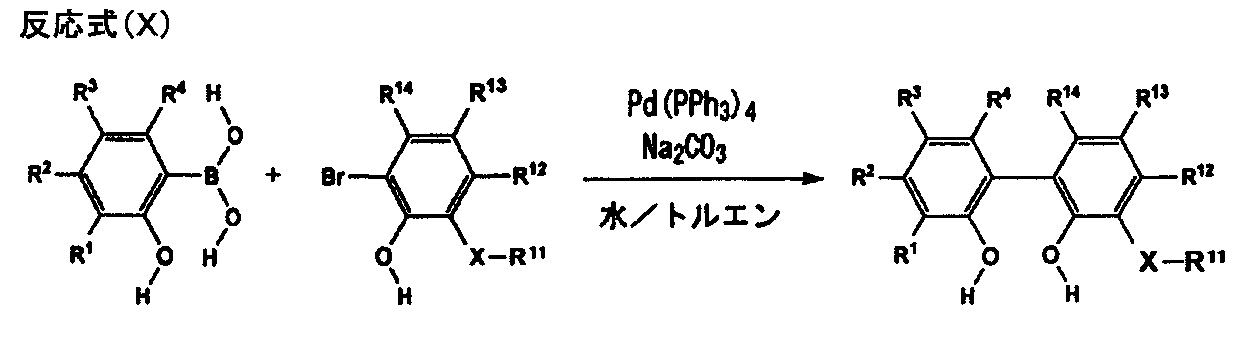
なお、上記反応式(X)中、X並びにR1~R4及びR11~R14はそれぞれ一般式(1)中のX並びにR1~R4及びR11~R14と同義である。また、Bはホウ素原子、Brは臭素原子を表す。
また、前記一般式(1)で表される本発明のジヒドロキシビフェニル化合物は、メタノール及び空気存在下、銅触媒を用いた酸化カップリング反応により合成することもできる。
以下に、本発明のジヒドロキシビフェニル化合物の一実施形態である、下記式(A)で表される化合物Aの製造例を用いて、本発明のジヒドロキシビフェニル化合物の製造方法の一例について説明する。
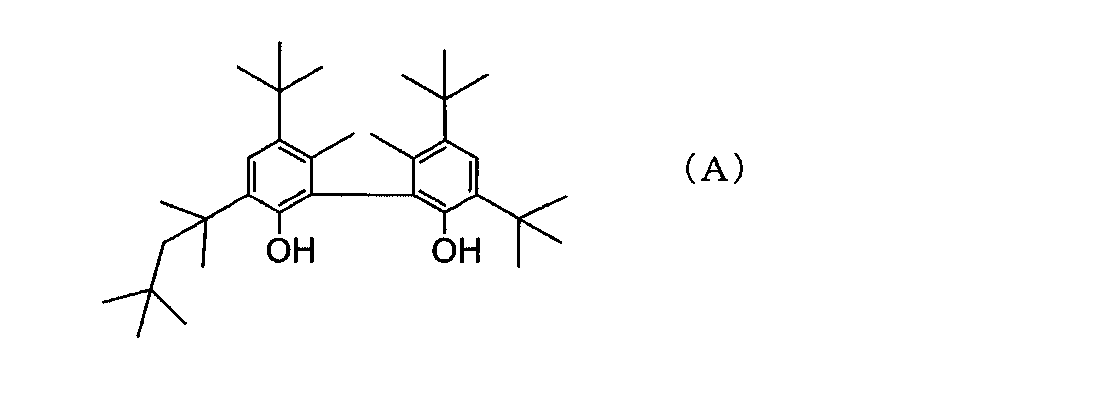
本発明のジヒドロキシビフェニル化合物の製造方法は、これらの説明に拘束されることはない。以下の例示以外についても、当業者が周知技術を用いて、本発明の趣旨を損なわない範囲で適宜変更し、化合物A及び化合物A以外のジヒドロキシビフェニル化合物を製造することができる。
まず、式(A)で表される化合物Aの右側のフェノール構造を有する化合物(A-R)の製造方法について説明する。
まず、ヒドロキシ基のオルト位及びパラ位が無置換のフェノール系化合物を出発物質として、これを、イソブテンを用いてアルキル化することにより、ヒドロキシ基のオルト位及びパラ位にtert-ブチル基を導入する。このフェノール類のアルキル化反応は、一般に酸触媒の存在下、Friedel-Crafts反応を用いて行うことができる。例えば、特開昭55-81829号公報に記載されたように、m-クレゾールとイソブテンを70%過塩素酸及び85%リン酸触媒の存在下で反応させて、4,6-ジ-tert-ブチル-m-クレゾール(以下、「フェノール-a」という。)を製造できる。これを前記化合物(A-R)とする(反応式-1)。
まず、ヒドロキシ基のオルト位及びパラ位が無置換のフェノール系化合物を出発物質として、これを、イソブテンを用いてアルキル化することにより、ヒドロキシ基のオルト位及びパラ位にtert-ブチル基を導入する。このフェノール類のアルキル化反応は、一般に酸触媒の存在下、Friedel-Crafts反応を用いて行うことができる。例えば、特開昭55-81829号公報に記載されたように、m-クレゾールとイソブテンを70%過塩素酸及び85%リン酸触媒の存在下で反応させて、4,6-ジ-tert-ブチル-m-クレゾール(以下、「フェノール-a」という。)を製造できる。これを前記化合物(A-R)とする(反応式-1)。
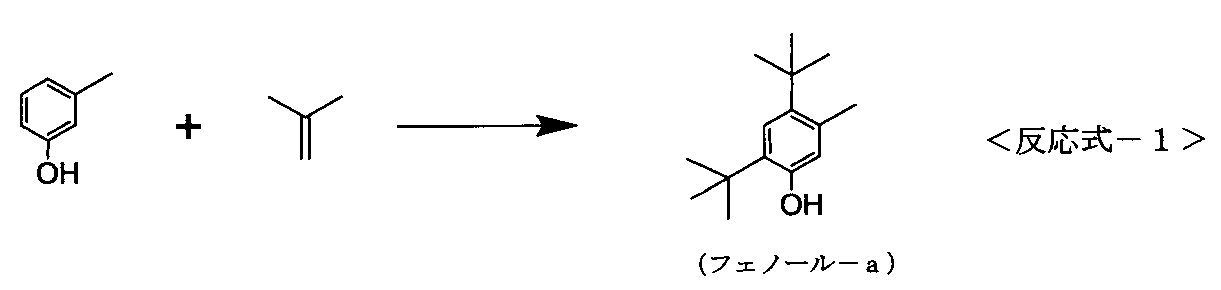
次に、式(A)で表される化合物Aの左側のフェノール構造を有する化合物(A-L)の製造方法について説明する。
まず、化合物(A-L)のヒドロキシ基のオルト位に付加している1,1,3,3-テトラメチルブチル基の元となる2,4,4-トリメチル-1-ペンテンの製造について示す。
2,4,4-トリメチル-1-ペンテンの製造にはイソブテンの二量化反応を用いることができる。例えば、独国特許出願公開第3542171号明細書に記載のようにビスマス又は鉛が添加されたゼオライト触媒上でイソブテンを高温で反応させることにより、下記式で表される2,4,4-トリメチル-1-ペンテン(以下、「ジイソブテン-a」という。)及び2,4,4-トリメチル-2-ペンテン(以下、「ジイソブテン-b」という。)を含む混合物を製造できる(反応式-2)。
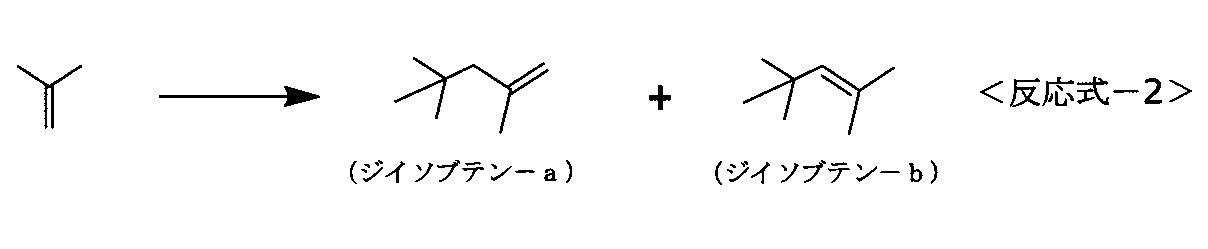
前述の操作で得られた前記混合物を、公知の精製方法又は公知の分離方法を用いて、精製又は分離することにより、ジイソブテン-aを得ることができる。
次いで、m-クレゾールを出発物質として、これを、ジイソブテン-aを用いてアルキル化することにより、ヒドロキシ基のオルト位のみ、パラ位のみ、並びに、オルト位及びパラ位の両方にジイソブテン基を導入する。このフェノール類のアルキル化反応は、一般に酸触媒の存在下、Friedel-Crafts反応を用いて行うことができる。例えば、m-クレゾールとジイソブテン-aを、Friedel-Crafts反応させて、4-(1,1,3,3-テトラメチルブチル)-m-クレゾール(以下、「フェノール-b」という。)及び6-(1,1,3,3-テトラメチルブチル)-m-クレゾール(以下、「フェノール-c」という。)、4,6-ジ-(1,1,3,3-テトラメチルブチル)-m-クレゾール(以下、「フェノール-d」という。)を含む混合物を製造できる(反応式-3)。
次いで、m-クレゾールを出発物質として、これを、ジイソブテン-aを用いてアルキル化することにより、ヒドロキシ基のオルト位のみ、パラ位のみ、並びに、オルト位及びパラ位の両方にジイソブテン基を導入する。このフェノール類のアルキル化反応は、一般に酸触媒の存在下、Friedel-Crafts反応を用いて行うことができる。例えば、m-クレゾールとジイソブテン-aを、Friedel-Crafts反応させて、4-(1,1,3,3-テトラメチルブチル)-m-クレゾール(以下、「フェノール-b」という。)及び6-(1,1,3,3-テトラメチルブチル)-m-クレゾール(以下、「フェノール-c」という。)、4,6-ジ-(1,1,3,3-テトラメチルブチル)-m-クレゾール(以下、「フェノール-d」という。)を含む混合物を製造できる(反応式-3)。
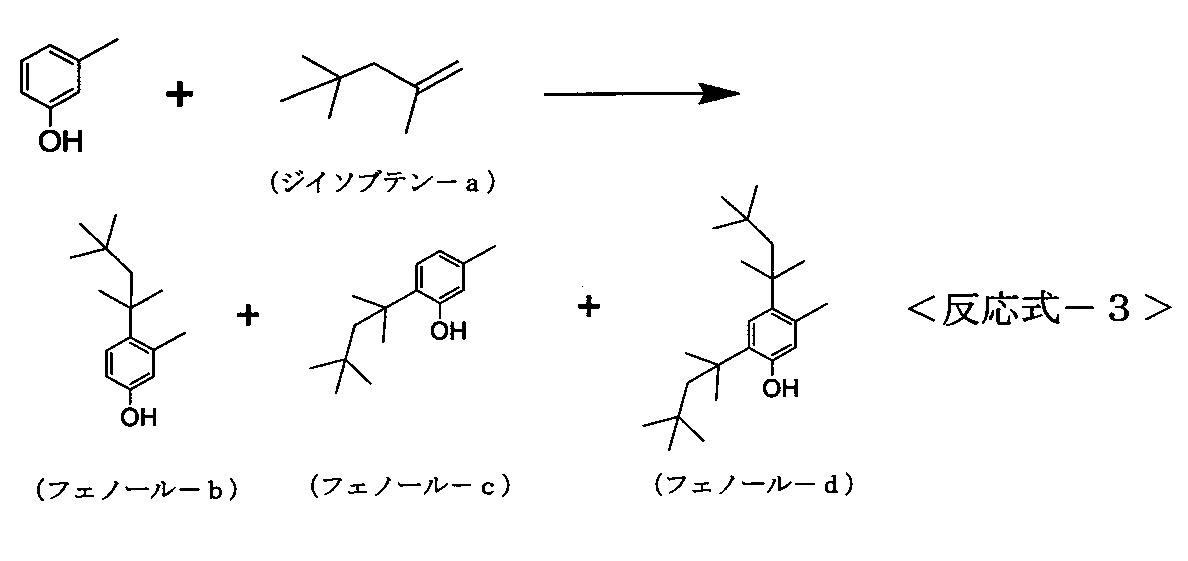
前述の操作で得られた混合物を、公知の精製方法又は公知の分離方法を用いて、精製又は分離することにより、フェノール-cを得ることができる。
次いで、フェノール-cを出発物質として、これを、イソブテンを用いてアルキル化することにより、ヒドロキシ基のパラ位にイソブテン基を導入する。このフェノール-cのアルキル化反応は、一般に酸触媒の存在下、Friedel-Crafts反応を用いて行うことができる。例えば、フェノール-cとイソブテンを、Friedel-Crafts反応させて、4-tert-ブチル-6-(1,1,3,3-テトラメチルブチル)-m-クレゾール(以下、「フェノール-e」という。)を製造でき、これを前記化合物(A-L)とする(反応式-4)。
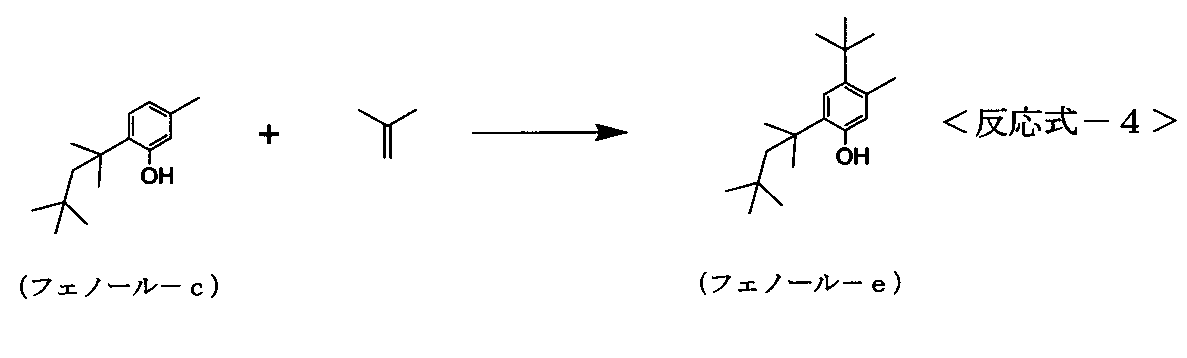
本発明のジヒドロキシビフェニル化合物の一実施形態である化合物Aは、フェノール-a(化合物(A-R))とフェノール-e(化合物(A-L))を、酸化カップリング反応させることにより製造することができる。前記酸化カップリング反応は、The Journal of Organic Chemistry 1984,49(23),4456-4459や、The Journal of Organic Chemistry 1983、48(25),4948-4950に記載された方法を、この分野の当業者が周知技術に基づき適宜最適化して用いることができる。
例えば、前記フェノール-aと前記フェノール-eを、塩化銅-テトラメチルエチレンジアミン触媒の存在下、空気を吹き込みながら、酸化カップリング反応させて、3,3’,5,5’-テトラ-tert-ブチル-6,6’-ジメチル-1,1’-ビフェニル-2,2’-ジオール(以下、「ビフェノール-a」という。)、3-(1,1,3,3-テトラメチルブチル)-3’-tert-ブチル-5,5’-ジ-tert-ブチル-6,6’-ジメチル-1,1’-ビフェニル-2,2’-ジオール(前記化合物Aに相当する。)、及び、3,3’-ジ-(1,1,3,3-テトラメチルブチル)-5,5’-ジ-tert-ブチル-6,6’-ジメチル-1,1’-ビフェニル-2,2’-ジオール(以下、「ビフェノール-b」という。)を含む混合物を製造できる(反応式-5)。
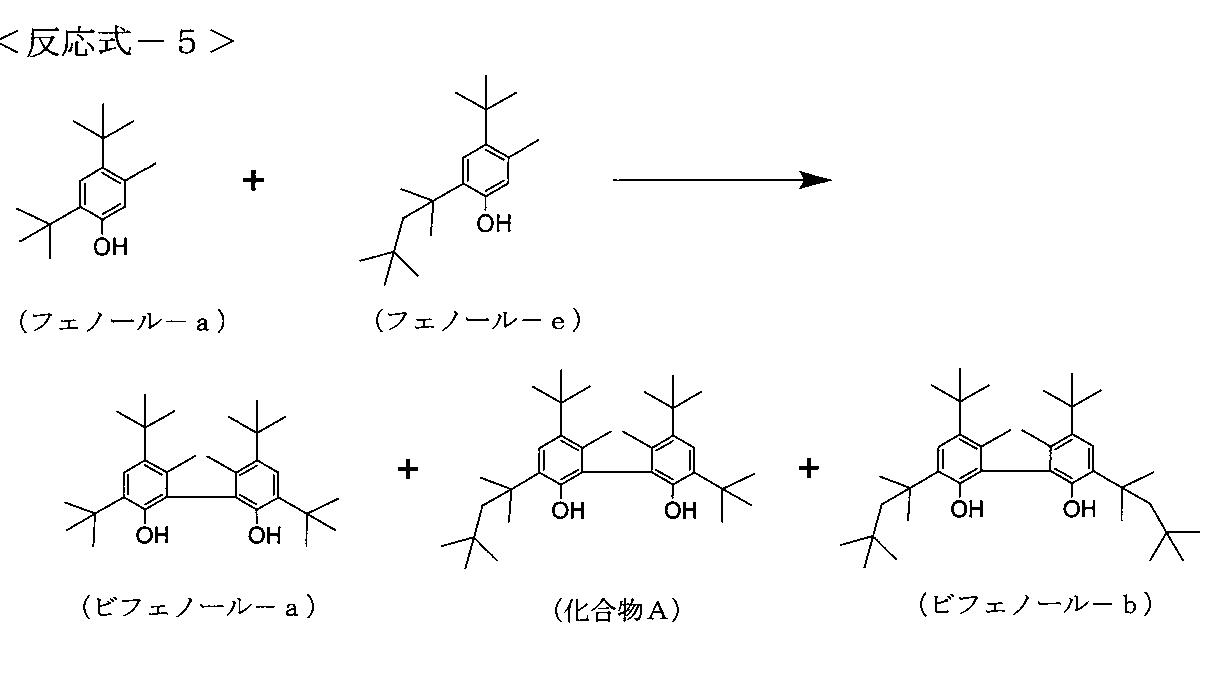
前述の操作で得られた混合物を、再結晶及びカラム精製等の公知の精製方法又は公知の分離方法を用いて、精製又は分離することにより、本発明のジヒドロキシビフェニル化合物である化合物Aを得ることができる。
或いは又、化合物Aの他の製造法として、次のような方法が挙げられる。
即ち、前記反応式-1に従いフェノール-aを製造する際に、不純物としてフェノール-e又は以下に示す4-(1,1,3,3-テトラメチルブチル)-6-tert-ブチル-m-クレゾール(以下、「フェノール-f」という。)が少量生成することがある。生成したフェノール-eは、前述の通り、前記フェノール-aと酸化カップリング反応させて化合物Aを製造することができる。また、フェノール-fが含まれる場合、フェノールfから、以下に示す3,3’-ジ-tert-ブチル-5-(1,1,3,3-テトラメチルブチル)-5’-tert-ブチル-6,6’-ジメチル-1,1’-ビフェニル-2,2’-ジオール(以下、「ビフェノール-g」という。)が少量生成することがある。
即ち、前記反応式-1に従いフェノール-aを製造する際に、不純物としてフェノール-e又は以下に示す4-(1,1,3,3-テトラメチルブチル)-6-tert-ブチル-m-クレゾール(以下、「フェノール-f」という。)が少量生成することがある。生成したフェノール-eは、前述の通り、前記フェノール-aと酸化カップリング反応させて化合物Aを製造することができる。また、フェノール-fが含まれる場合、フェノールfから、以下に示す3,3’-ジ-tert-ブチル-5-(1,1,3,3-テトラメチルブチル)-5’-tert-ブチル-6,6’-ジメチル-1,1’-ビフェニル-2,2’-ジオール(以下、「ビフェノール-g」という。)が少量生成することがある。
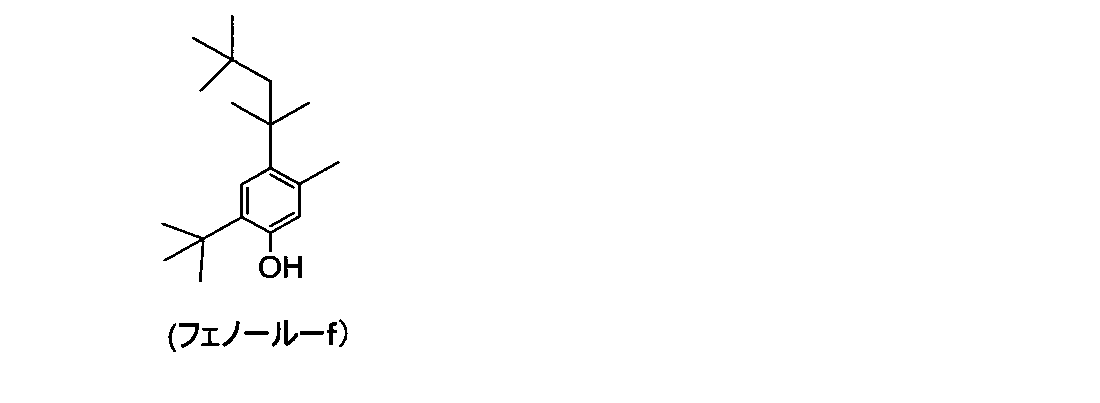
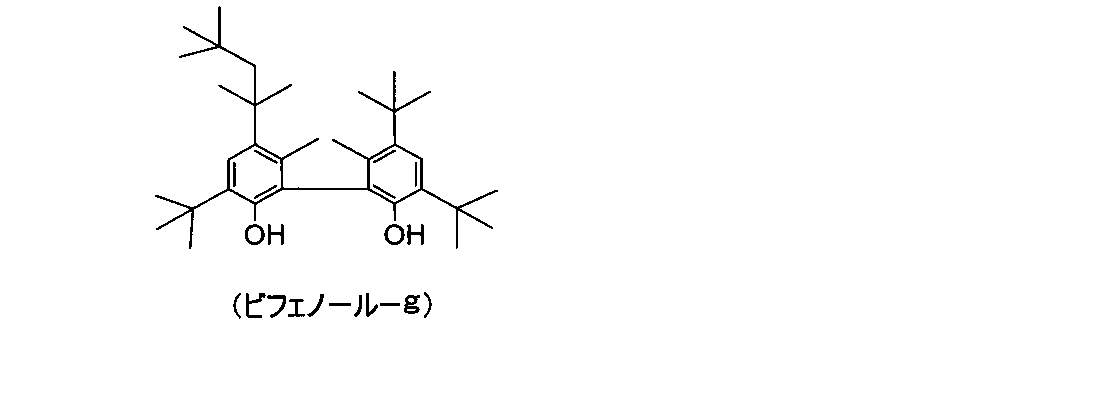
[ビスホスファイト化合物]
本発明のビスホスファイト化合物は、下記一般式(2)で表される新規なビスホスファイト化合物である。
本発明のビスホスファイト化合物は、下記一般式(2)で表される新規なビスホスファイト化合物である。
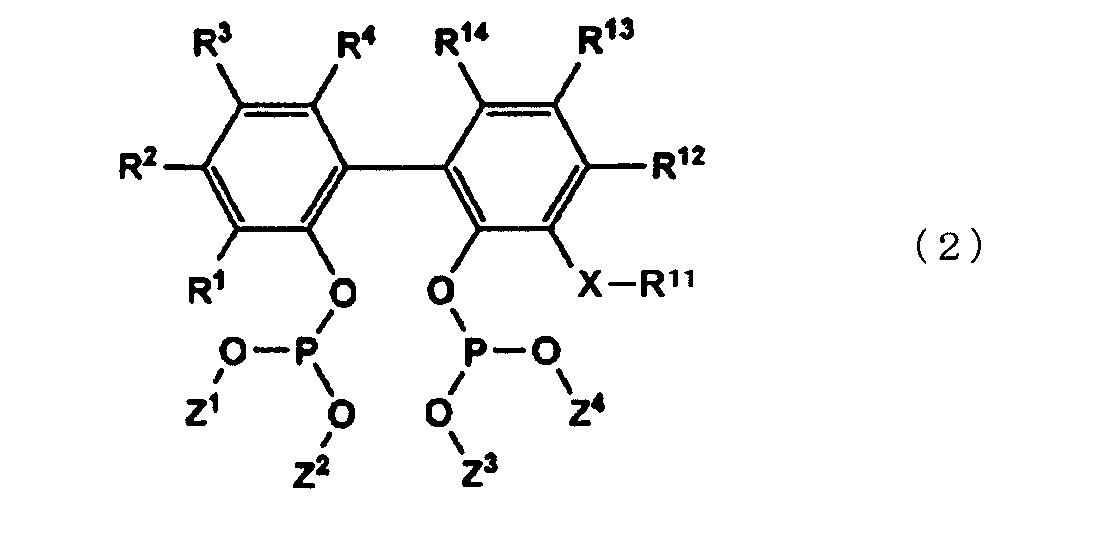
(上記式(2)中、X並びにR1~R4及びR11~R14は、それぞれ前記式(1)におけるX並びにR1~R4及びR11~R14と同義である。R1とX-R11とは互いに異なる。
Z1~Z4は、それぞれ独立に、6~20個の炭素原子を有するアリール基を表し、置換基を有していてもよく、該置換基同士が結合して環を形成していてもよい。また、Z1
とZ2、並びに、Z3とZ4は、いずれも互いに結合していなくてもよいし、互いに結合して環構造を形成してもよい。)
Z1~Z4は、それぞれ独立に、6~20個の炭素原子を有するアリール基を表し、置換基を有していてもよく、該置換基同士が結合して環を形成していてもよい。また、Z1
とZ2、並びに、Z3とZ4は、いずれも互いに結合していなくてもよいし、互いに結合して環構造を形成してもよい。)
<Z1~Z4>
Z1~Z4は、それぞれ独立に、6~20個の炭素原子を有するアリール基であって、該アリール基は置換基を有していてもよい。該置換基同士が結合して環を形成していてもよい。なお、Z1とZ2及びZ3とZ4のいずれも、互いに結合していなくてもよいし、互いに結合して-O-P-O-を含む環構造を形成してもよい。
Z1~Z4は、それぞれ独立に、6~20個の炭素原子を有するアリール基であって、該アリール基は置換基を有していてもよい。該置換基同士が結合して環を形成していてもよい。なお、Z1とZ2及びZ3とZ4のいずれも、互いに結合していなくてもよいし、互いに結合して-O-P-O-を含む環構造を形成してもよい。
特に、Z1~Z4としては、それぞれ独立に、酸素原子と結合する炭素原子に隣接する芳香環炭素原子に置換基を有さないか、又は該芳香環炭素原子に置換基を有していても、該置換基の炭素原子数が0~2個であるものが好ましい。Z1~Z4が置換基を有する場合、酸素原子と結合する炭素原子に対してm位又はp位に置換基を有することが好ましい。
Z1~Z4が、酸素原子と結合する炭素原子に隣接する芳香環炭素原子に置換基を有する場合、該置換基は、それぞれメチル基及びエチル基等の1~2個の炭素原子を有するアルキル基、トリフルオロメチル基、シアノ基及びニトロ基並びに塩素原子及びフッ素原子等のハロゲン原子等からなる群から選ばれることが好ましい。
Z1~Z4が上記の酸素原子と結合する炭素原子に隣接する芳香環炭素原子以外の他の位置に置換基を有する場合、該置換基としては、メチル基、エチル基、n-プロピル基、i-プロピル基、n-ブチル基、s-ブチル基、t-ブチル基、n-ペンチル基、イソペンチル基、ネオペンチル基、t-ペンチル基等の炭素数1~12、好ましくは1~8の直鎖又は分岐鎖のアルキル基、メトキシ基、エトキシ基等の炭素数1~12、好ましくは1~8の直鎖又は分岐鎖のアルコキシ基、フェニル基、ナフチル基等の炭素数6~18、好ましくは6~10のアリール基等が挙げられる。該置換基としては、他に、ハロゲン原子、シアノ基、ニトロ基、トリフルオルメチル基、ヒドロキシル基、アミノ基、アシル基、カルボニルオキシ基、オキシカルボニル基、アミド基、スルホニル基、スルフィニル基、シリル基、チオニル基等が挙げられる。Z1~Z4はそれぞれ、これらの置換基を1~5個有してもよい。
また、これらの置換基は隣接する置換基同士で環を形成していてもよい。このようなものとしては、例えば、Z1~Z4の芳香環に縮合する飽和炭化水素環が挙げられる。
また、これらの置換基は隣接する置換基同士で環を形成していてもよい。このようなものとしては、例えば、Z1~Z4の芳香環に縮合する飽和炭化水素環が挙げられる。
Z1~Z4として好適なものとしては、フェニル基、1-ナフチル基、2-ナフチル基、p-トリフルオロメチルフェニル基、2-エチルフェニル基、2-メチルフェニル基、3-メチルフェニル基、4-メチルフェニル基、2,3-ジメチルフェニル基、2,4-ジメチルフェニル基、2,5-ジメチルフェニル基、3,4-ジメチルフェニル基、3,5-ジメチルフェニル基、2-クロロフェニル基、3-クロロフェニル基、4-クロロフェニル基、2,3-ジクロロフェニル基、2,4-ジクロロフェニル基、2,5-ジクロロフェニル基、3,4-ジクロロフェニル基、3,5-ジクロロフェニル基、2-メトキシフェニル基、3-メトキシフェニル基、4-メトキシフェニル基、2,3-ジメトキシフェニル基、3,4-ジメトキシフェニル基、3,5-ジメトキシフェニル基、4-シアノフェニル基、4-ニトロフェニル基、4-フェニルフェニル基、5,6,7,8-テトラヒドロ-1-ナフチル基、5,6,7,8-テトラヒドロ-2-ナフチル基、2-メチル-1-ナフチル基、4-クロロ-1-ナフチル基、2-ニトロ-1-ナフチル基、7-メトキシ-2-ナフチル基、が挙げられる。
Z1とZ2、及びZ3とZ4が互いに結合して-O-P-O-を含む環構造を形成している場合の好適なものとしては、1,1’-ビフェニル-2,2’-ジイル基、1,1’-ビナフチル-2,2’-ジイル基等が挙げられる。
Z1とZ2、及びZ3とZ4が互いに結合して-O-P-O-を含む環構造を形成している場合の好適なものとしては、1,1’-ビフェニル-2,2’-ジイル基、1,1’-ビナフチル-2,2’-ジイル基等が挙げられる。
中でも、Z1~Z4としては、それぞれ独立に、1-ナフチル基又は2-ナフチル基が、配位子の熱的安定性の向上及びヒドロホルミル化反応によってアルデヒドを製造する際の直鎖型アルデヒド製造の選択率向上という観点で好ましい。
Z1~Z4は同一であってもよく、異なるものであってもよい。後述の通り、合成上の容易性の観点から、Z1とZ2、Z3とZ4がそれぞれ同一であることが好ましく、Z1~Z4が全て同一であることがより好ましい。
<好適態様>
一般式(2)で表されるビスホスファイト化合物としては、Xが第4級炭素原子を含む4~5個の炭素原子を有するアルキレン基であり、R1及びR11が、それぞれ独立に、4~20個の炭素原子を有する第3級アルキル基であり、R1とX-R11とは互いに異なり、R2及びR12が水素原子であり、R3及びR13が、それぞれ独立に、4~20個の炭素原子を有する第3級アルキル基であり、R4及びR14が、それぞれ独立に、水素原子、1~3個の炭素原子を有するアルキル基、1~3個の炭素原子を有するアルコキシ基及びハロゲン原子からなる群から選ばれるものであるビスホスファイト化合物が好ましい。
一般式(2)で表されるビスホスファイト化合物としては、その中でも、Z1~Z4が、それぞれ独立に、酸素原子と結合する炭素原子に隣接する芳香環炭素原子に置換基を有さないか、又は該芳香環炭素原子に、1~2個の炭素原子を有する置換基を有し、かつ、Z1~Z4のいずれもが互いに結合していないビスホスファイト化合物が好ましい。
更に一般式(2)で表されるビスホスファイト化合物としては、Xが前記式(1X)で表される構造単位を有するアルキレン基であり、R1、R11、R3及びR13が、それぞれ独立に、4~7個の炭素原子を有する第3級アルキル基であり、R1とX-R11とは互いに異なり、R2及びR12が水素原子であり、R4及びR14が、それぞれ独立に、1~3個の炭素原子を有するアルキル基であるビスホスファイト化合物がより好ましい。
一般式(2)で表されるビスホスファイト化合物としては、その中でもZ1~Z4が、それぞれ独立に、1-ナフチル基又は2-ナフチル基であるビスホスファイト化合物がより好ましく、Xが1,1-ジメチルエチレン基であり、R1、R11、R3及びR13がt-ブチル基であり、R2及びR12が水素原子であり、R4及びR14がメチル基であり、Z1~Z4が、それぞれ独立に、1-ナフチル基又は2-ナフチル基であるビスホスファイト化合物が特に好ましい。
一般式(2)で表されるビスホスファイト化合物としては、その中でもZ1~Z4が、それぞれ独立に、1-ナフチル基又は2-ナフチル基であるビスホスファイト化合物がより好ましく、Xが1,1-ジメチルエチレン基であり、R1、R11、R3及びR13がt-ブチル基であり、R2及びR12が水素原子であり、R4及びR14がメチル基であり、Z1~Z4が、それぞれ独立に、1-ナフチル基又は2-ナフチル基であるビスホスファイト化合物が特に好ましい。
<ビスホスファイト化合物の具体例>
本発明のビスホスファイト化合物の具体的な実施態様としては、下記式(L-1-x)~(L-80-x)で表される化合物が挙げられるが、これらの化合物に限定されるものではない。
式(L-1-x)~(L-80-x)における符号「x」は、前記表1に記載した式(a)、(a’)、(b)~(g)のいずれかである。
本発明のビスホスファイト化合物の具体的な実施態様としては、下記式(L-1-x)~(L-80-x)で表される化合物が挙げられるが、これらの化合物に限定されるものではない。
式(L-1-x)~(L-80-x)における符号「x」は、前記表1に記載した式(a)、(a’)、(b)~(g)のいずれかである。
例えば、下記式(L-1-a)の化合物は、前記一般式(2)で表されるビスホスファイト化合物において、-X-R11に相当する置換基が、前記表1中の式(a)で表される置換基であることを意味する。
下記式(L-1-x)~(L-80-x)(xは、a、a’、b~g)で表される化合物において、xはa、a’、b~gからなる群より選ばれる1つに置き換えることができる。
例えば、式(L-1-a)の化合物において、「-a」を「-b」に置き換え、前記一般式(2)で表されるビスホスファイト化合物の-X-R11に相当する置換基を、前掲の表1の式(a)で表される置換基から、式(b)で表される置換基に置き換えることができる。式(a’)、(c)~(g)で表される他の置換基についても同様に置き換えることができる。
例えば、下記式(L-1-a)の化合物において、「-a」を、「-a’」、「-b」、「-c」、「-d」、「-e」及び「-f」に置き換えた化合物の構造式を以下に示す。
例えば、式(L-1-a)の化合物において、「-a」を「-b」に置き換え、前記一般式(2)で表されるビスホスファイト化合物の-X-R11に相当する置換基を、前掲の表1の式(a)で表される置換基から、式(b)で表される置換基に置き換えることができる。式(a’)、(c)~(g)で表される他の置換基についても同様に置き換えることができる。
例えば、下記式(L-1-a)の化合物において、「-a」を、「-a’」、「-b」、「-c」、「-d」、「-e」及び「-f」に置き換えた化合物の構造式を以下に示す。
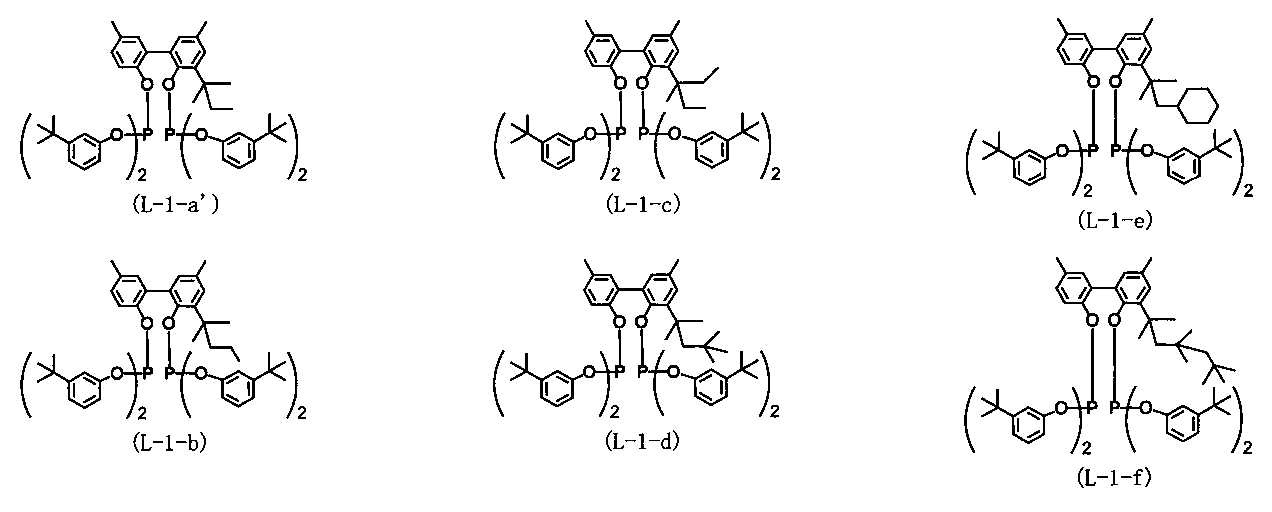
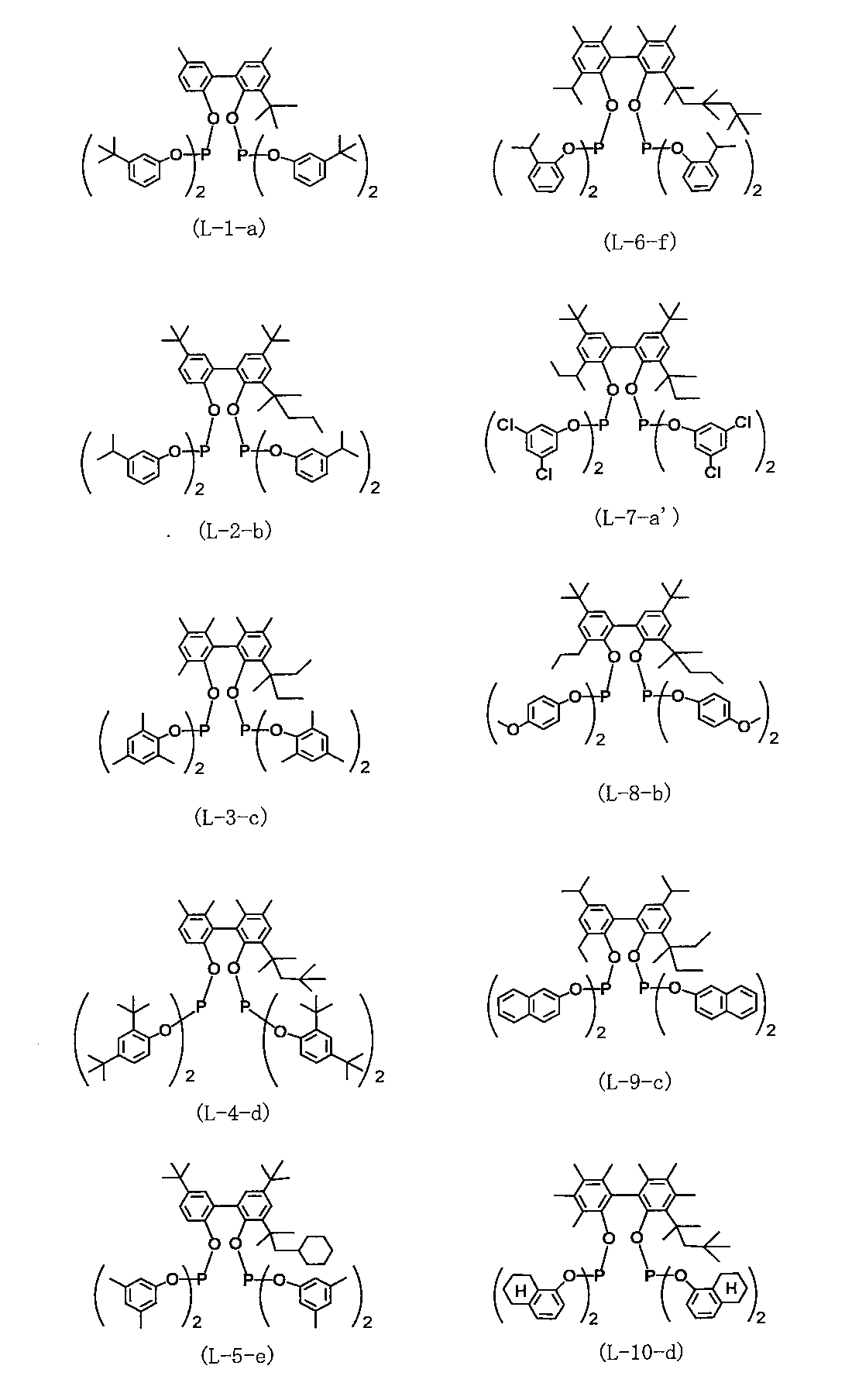
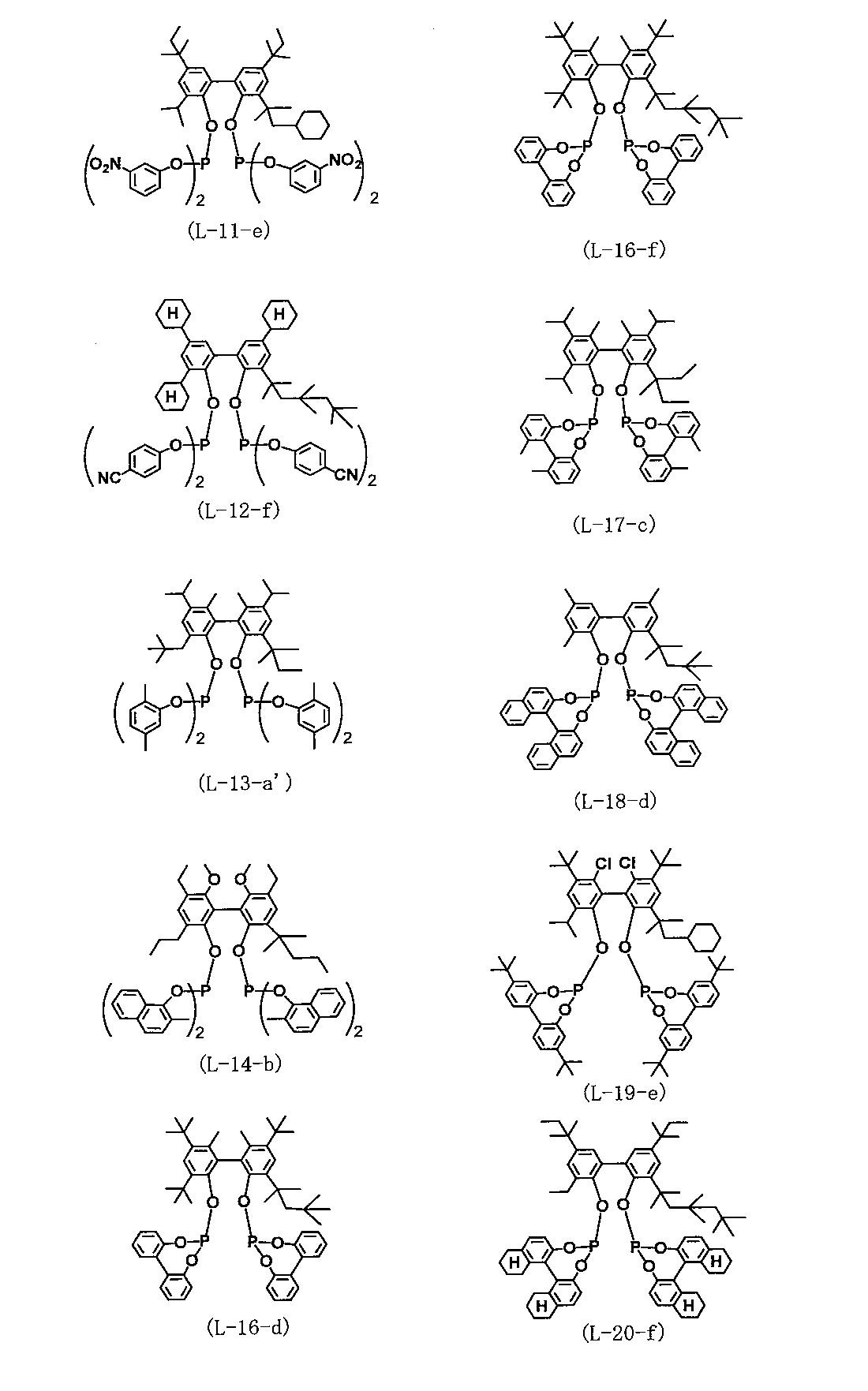

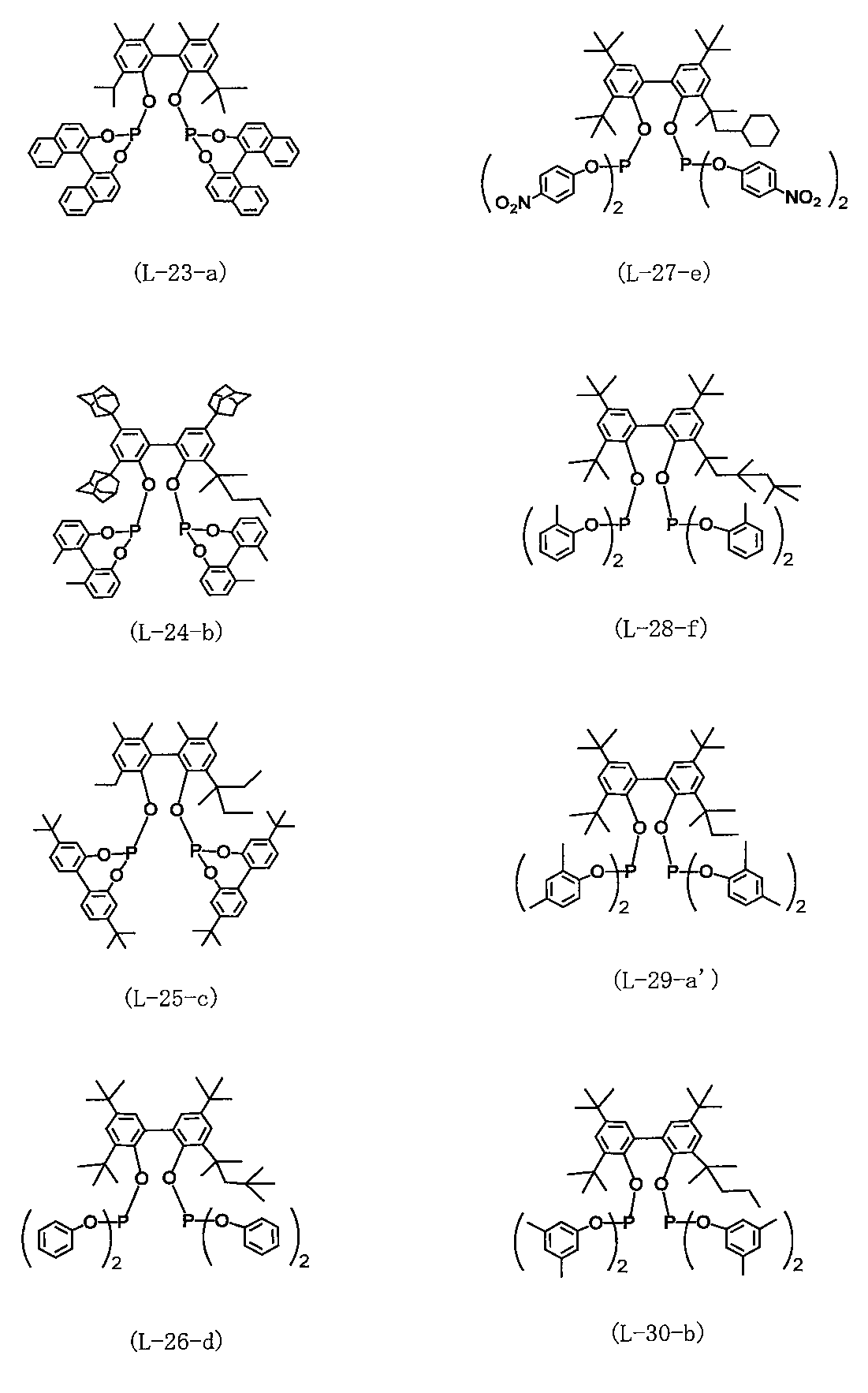

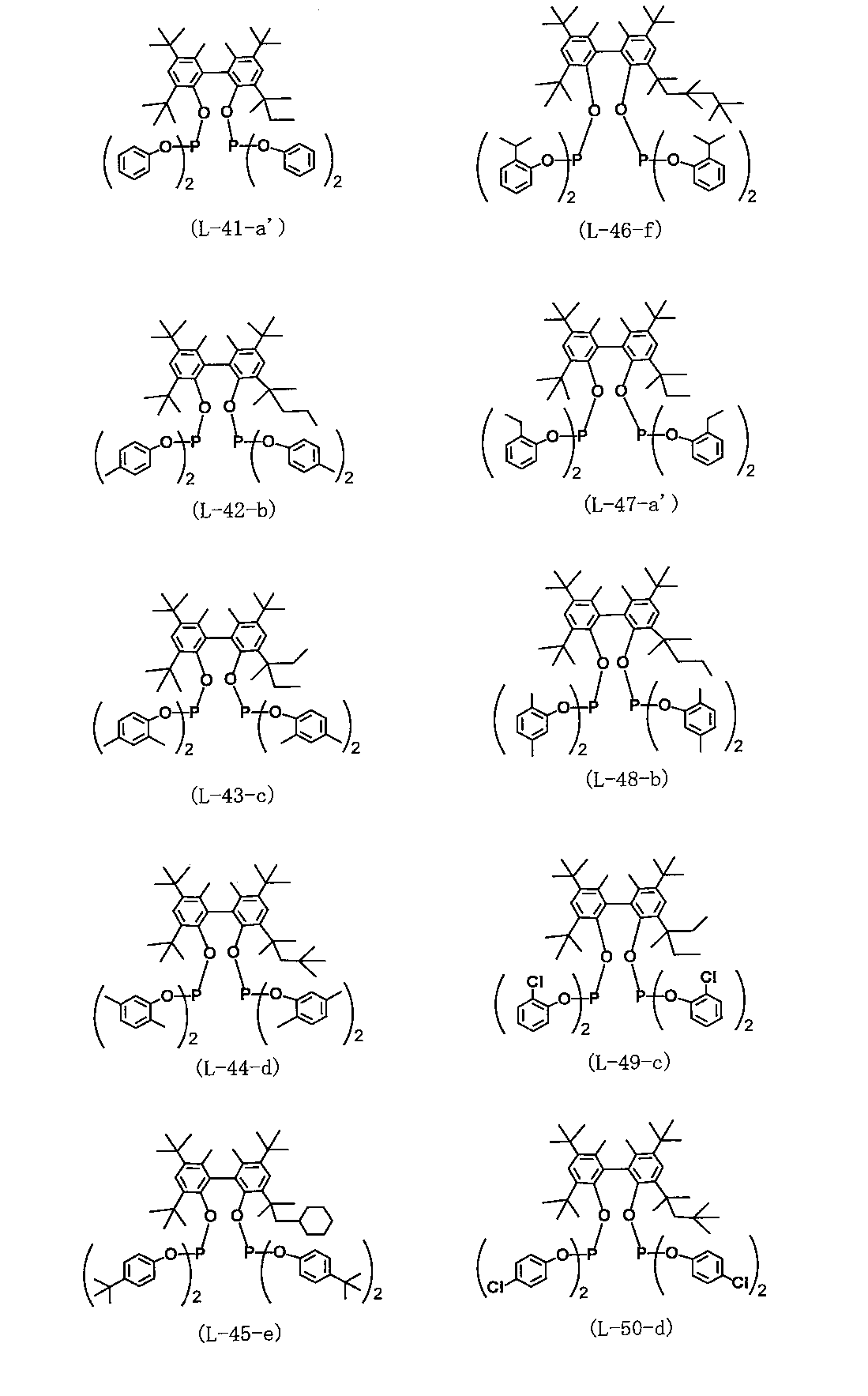


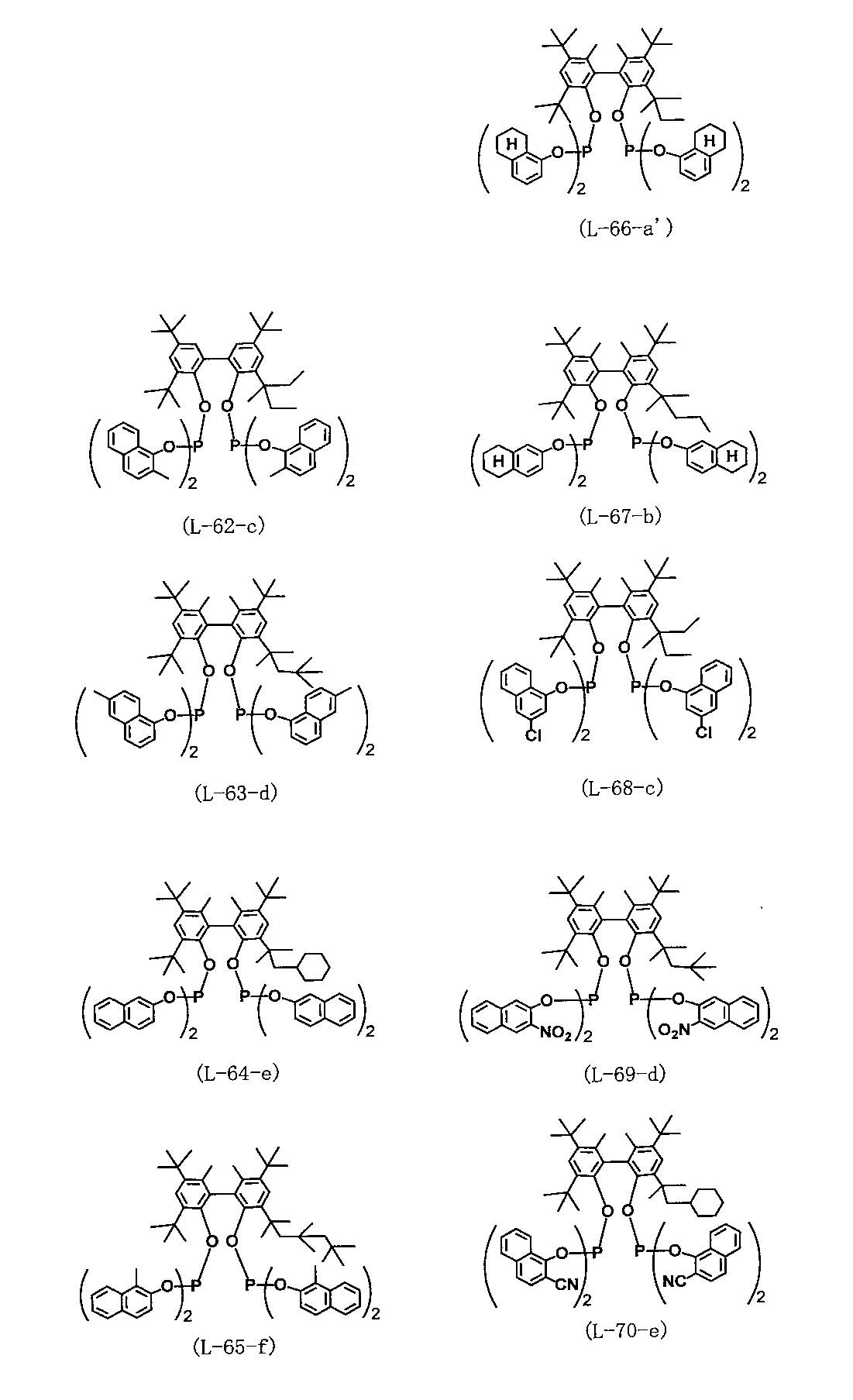
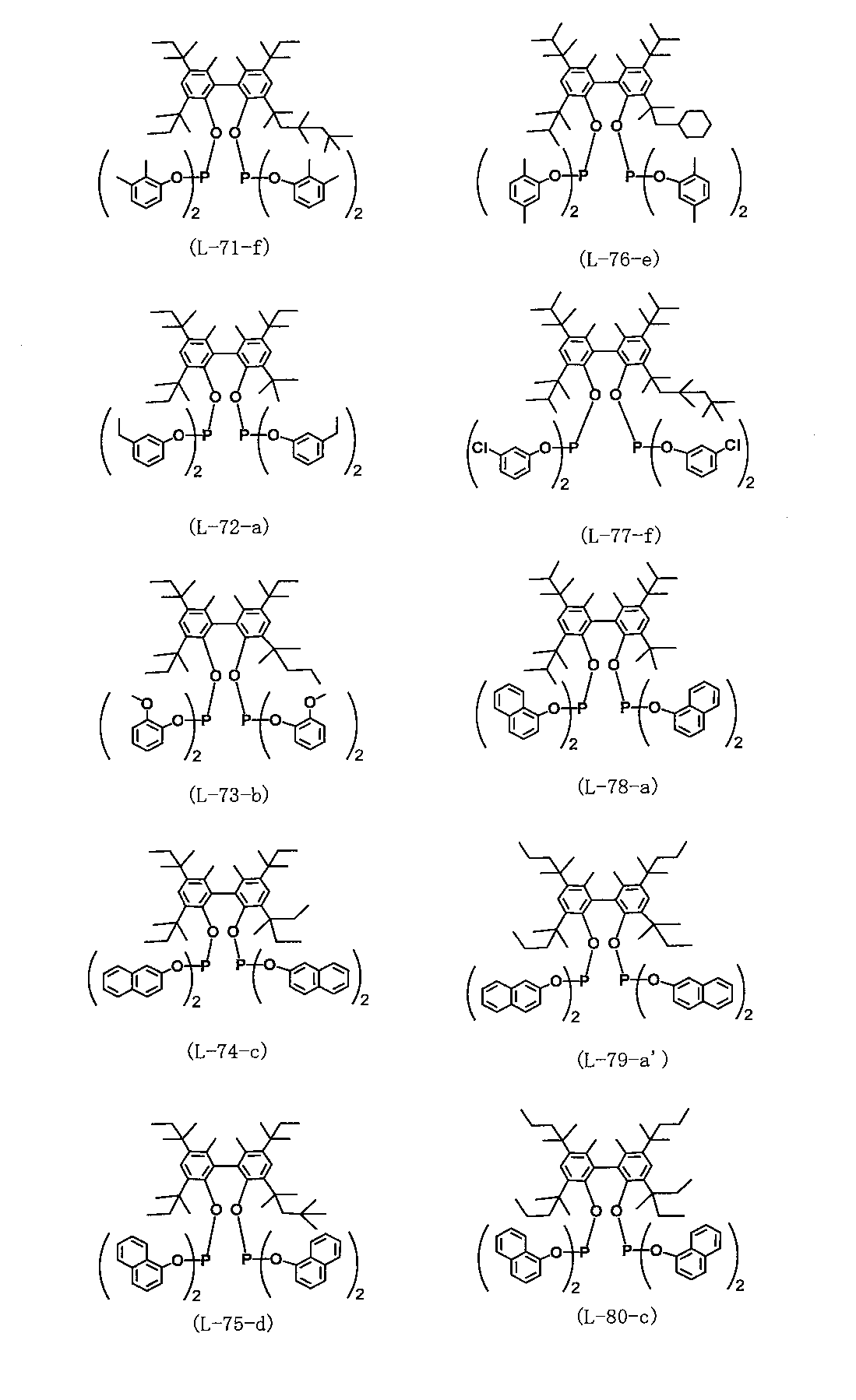
<ビスホスファイト化合物の製造方法>
前記一般式(2)で表される本発明のビスホスファイト化合物の製造方法は、特に限定されるものではなく、下記一般式(4)で表されるジヒドロキシビフェニル化合物のアルカリ金属塩又はアルカリ土類金属塩と、下記一般式(5A)及び/又は(5B)で表されるリン化合物とを、反応させることにより合成することができる(二座ホスファイト合成法1)。
なお、一般式(4)中の、X、R1~R4及びR11~R14は、それぞれ一般式(2)中のX、R1~R4及びR11~R14と同義である。また、Mはアルカリ金属又はアルカリ土類金属である。また、一般式(5A)、(5B)中、Z1~Z4は一般式(2)のZ1~Z4とそれぞれ同義である。
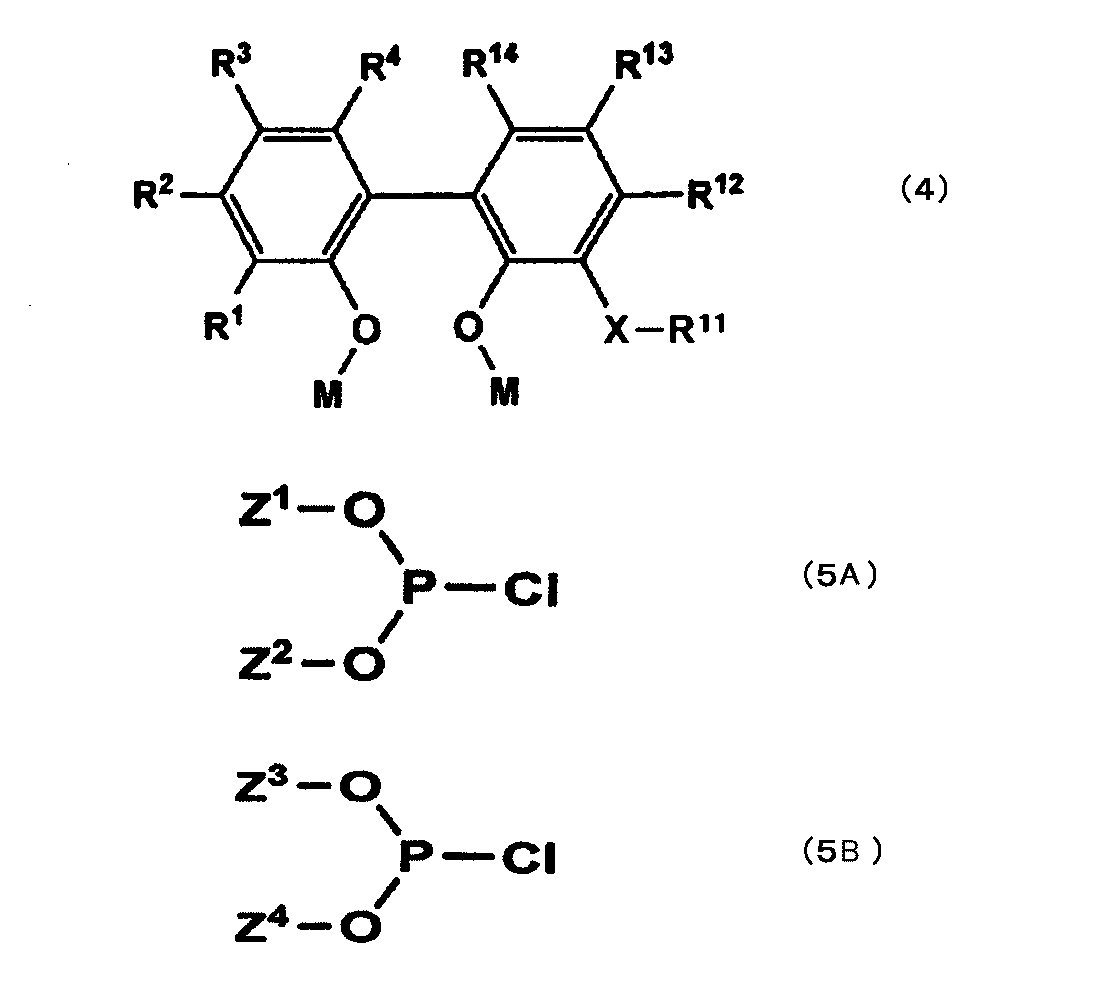
或いは又、前記一般式(2)で表される本発明のビスホスファイト化合物は、上記一般式(4)で表される、ジヒドロキシビフェニル化合物のアルカリ金属塩又はアルカリ土類金属塩と、下記一般式(6)で表されるビス(ジアルキルアミノ)クロロホスフィンとを反応させることにより、ビス(ジアルキルアミノ)ホスフィノ基を2つ有するビフェニルジオキシ中間体を得た後、塩化水素との反応でジクロロホスフィノ基を2つ有するビフェニルジオキシ中間体を得て、更に塩基触媒の存在下、フェノール類と反応させることで合成することができる(二座ホスファイト合成法2)。
一般式(6)中の、R20は、メチル基、エチル基、n-プロピル基、i-プロピル基のような炭素数1~5の直鎖又は分岐鎖のアルキル基を表す。
一般式(6)中の、R20は、メチル基、エチル基、n-プロピル基、i-プロピル基のような炭素数1~5の直鎖又は分岐鎖のアルキル基を表す。
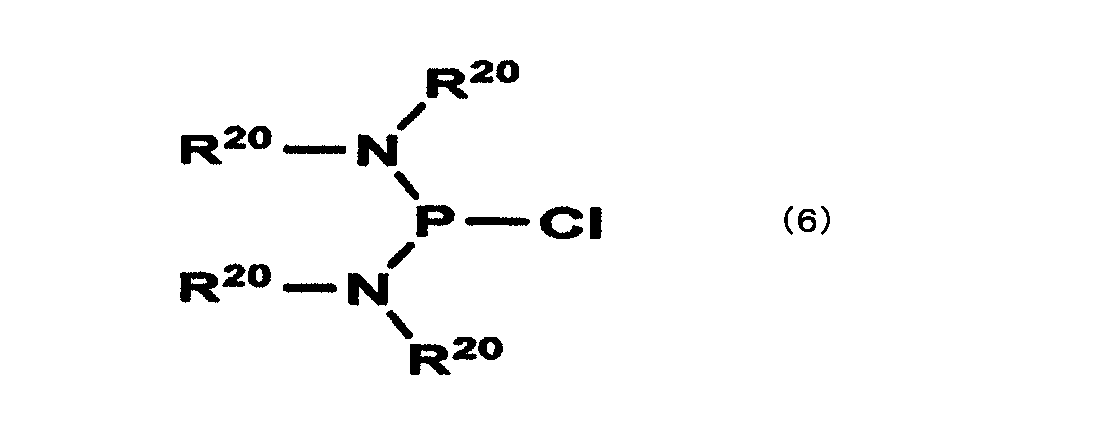
以下に、二座ホスファイト合成法1に関して詳細を説明する。二座ホスファイト合成法2に関しては、特開2000-53688号公報に詳細が記載されている。
上記一般式(4)で表されるジヒドロキシビフェニル化合物のアルカリ金属塩又はアルカリ土類金属塩は、前記一般式(1)で表される本発明のジヒドロキシビフェニル化合物と、n-BuLi(ノルマルブチルリチウム)、Na、NaHもしくはKH等のアルカリ金属化合物又は臭化メチルマグネシウムもしくは臭化エチルマグネシウム等のアルカリ土類金属化合物とを、溶媒中、好ましくは窒素等の不活性ガス雰囲気下で反応させることにより合成することができる。
該アルカリ金属化合物又はアルカリ土類金属化合物の使用量は、一般式(1)で表されるジヒドロキシビフェニル化合物1モルに対して通常2モルあれば充分であるが、所望によりそれ以上用いてもよい。
溶媒としては、テトラヒドロフラン及びジエチルエーテル等のエーテル類、ヘキサン及びトルエン等の炭化水素類、ピリジン、トリエチルアミン及びN,N,N’,N’-テトラメチルエチレンジアミン等の含窒素化合物並びにこれらの混合物が好適に用いられる。
反応温度は、-70℃~溶媒沸点の範囲で適宜選択することができる。反応の開始時は、低めの例えば-30℃~10℃の間で行い、その後徐々に溶媒の沸点まで上げるといった方法を採用することもできる。
反応操作の点からは、n-BuLi又はNaHを用い、溶媒としてはテトラヒドロフランを用いて、反応を行なうことが好ましい。
反応操作の点からは、n-BuLi又はNaHを用い、溶媒としてはテトラヒドロフランを用いて、反応を行なうことが好ましい。
反応時間は通常1分~48時間の範囲を選択することができるが、10分~4時間程度が好ましい。
一般式(4)で表されるジヒドロキシビフェニル化合物のアルカリ金属塩又はアルカリ土類金属塩を合成した後、該化合物は、特に精製することなく反応液をそのまま次の工程に用いてもかまわない。一般式(4)で表されるジヒドロキシビフェニル化合物のアルカリ金属塩又はアルカリ土類金属塩を合成した後、予め貧溶媒による洗浄や再結晶操作による単離等の処理を行った後、次の工程に用いてもよい。
一般式(4)で表されるジヒドロキシビフェニル化合物のアルカリ金属塩又はアルカリ土類金属塩を合成した後、該化合物は、特に精製することなく反応液をそのまま次の工程に用いてもかまわない。一般式(4)で表されるジヒドロキシビフェニル化合物のアルカリ金属塩又はアルカリ土類金属塩を合成した後、予め貧溶媒による洗浄や再結晶操作による単離等の処理を行った後、次の工程に用いてもよい。
前記一般式(5A)又は(5B)で表されるリン化合物は、通常三塩化リン(PCl3)とZ1-OH、Z2-OH、Z3-OH又はZ4-OH(式中、Z1~Z4は前記一般式(2)のZ1~Z4と同義である。)で表されるフェノール類を塩基の存在下又は不在下、好ましくは窒素等の不活性ガス雰囲気下、溶媒中又は無溶媒で反応させることにより合成することができる。
Z1とZ2又はZ3とZ4が同一であるリン化合物は容易に合成できるので好ましい。従ってZ1とZ2、Z3とZ4の双方がそれぞれに同一である場合が好ましく、特に、Z1~Z4が全て同一である場合が好ましい。
塩基を用いる場合、塩基としては、ピリジン、トリエチルアミン及びジエチルアミン等の含窒素塩基、炭酸ナトリウム及び炭酸カリウム等の無機塩基が例示される。中でも、反応操作の容易さから含窒素塩基が好適に用いられる。塩基の使用量は、PCl31モルに対して2モル用いるのが普通である。塩基の量が多すぎたり少なすぎたりすると不必要なP(OZ1)2(OZ2)、P(OZ1)(OZ2)2、P(OZ1)3、P(OZ2)3等のホスファイト類やCl2P(OZ1)等のジクロロ化合物の副生量が増えるため好ましくない。
反応温度は任意の温度を選択することができる。例えば塩基として含窒素塩基を用いる場合では0~5℃の温度で行うことが好ましい。
反応時間は1分~48時間の範囲を選択することができる。例えば、5分~10時間程度の反応時間が好ましい。
反応時間は1分~48時間の範囲を選択することができる。例えば、5分~10時間程度の反応時間が好ましい。
塩基の存在下で反応を行う場合、反応の進行に伴い副生する塩化水素と塩基との塩は、通常固体として反応溶液中に存在する。副生する塩化水素と塩基との塩は、好ましくは窒素等の不活性ガス雰囲気下で、濾過する等の方法で反応系から除去することができる。塩基の不在下で反応を行う場合、窒素ガスやアルゴンガスのような不活性ガスを反応系中にバブルすることにより、副生する塩化水素を反応系から除去することができる。
前記一般式(5A)又は(5B)で表されるリン化合物は、上記の不必要なホスファイト類及びジクロロ化合物との混合物として得られる場合がある。これらは特に分離することなく次の工程に進んでもかまわない。前記一般式(5A)又は(5B)で表されるリン化合物を、これらの副生物から分離する方法としては、ヘキサン、ヘプタン等の脂肪族炭化水素溶媒を用いた再結晶化による方法及び蒸留等が挙げられる。
前記一般式(2)で表される本発明のビスホスファイト化合物は、前記一般式(4)で表される化合物と、前記一般式(5A)及び/又は(5B)で表される化合物とを、溶媒中又は無溶媒下、20℃以下の温度で1分以上接触させることにより合成することができる。
上記接触は窒素等の不活性ガス雰囲気下で行うのが好ましく、前記一般式(4)で表される化合物と、前記一般式(5A)及び/又は(5B)で表される化合物とを、好ましくは0℃以下、更に好ましくは-30℃以下、最も好ましくは-50℃以下の温度で混合し、1分以上、好ましくは3~60分間その温度を維持した後、徐々に温度を上げていく方法により、目的のビスホスファイト化合物を合成することができる。
温度の上昇速度としては、0.1~20℃/分の間で適宜選択することができる。温度の上昇速度は、0.5~10℃/分の速度が好ましい。
溶媒を用いる場合、溶媒としては、テトラヒドロフラン、ジエチルエーテル及びジオキサン等のエーテル類、ヘキサン及びトルエン等の炭化水素類、ピリジン、トリエチルアミン及びN,N,N’,N’-テトラメチルエチレンジアミン等の含窒素化合物類並びにこれらの混合物を使用することができる。
溶媒の量は、生成する目的物の溶解に必要な最少量を用いるのが望ましいが、それ以上の量を用いても差し支えない。
前記一般式(2)で表される本発明のビスホスファイト化合物の精製方法としては、カラム展開(クロマトグラフィー)による方法、懸洗(懸濁洗浄)による方法及び再結晶化による方法等が挙げられる。
カラム展開による方法としては、充填剤としてシリカゲル、アルミナ等を用いる方法が挙げられる。
カラムの展開溶液としては、テトラヒドロフラン及びジオキサン等のエーテル類、ヘキサン及びヘプタン等の脂肪族炭化水素類、トルエン及びキシレン等の芳香族炭化水素類、酢酸エチル及び酢酸メチル等のエステル類、クロロホルム及びジクロロメタン等のハロゲン化炭化水素類が挙げられる。これらの展開溶液は目的物の精製に適するよう、単一溶媒又は2種類以上の溶媒と混合して用いられる。
カラムの展開溶液としては、テトラヒドロフラン及びジオキサン等のエーテル類、ヘキサン及びヘプタン等の脂肪族炭化水素類、トルエン及びキシレン等の芳香族炭化水素類、酢酸エチル及び酢酸メチル等のエステル類、クロロホルム及びジクロロメタン等のハロゲン化炭化水素類が挙げられる。これらの展開溶液は目的物の精製に適するよう、単一溶媒又は2種類以上の溶媒と混合して用いられる。
懸洗による方法としては、ビスホスファイト化合物の合成反応の終了後、濾別、或いは水等の極性溶媒により副生した金属塩化物(MCl又はMCl2:Mはアルカリ金属又はアルカリ土類金属)を反応溶液から除去した後、溶液を蒸発乾涸し、残留物をアセトニトリル、ヘキサン、ヘプタン等の脂肪族炭化水素類、アセトン、ジエチルケトン等のケトン類、メタノール、エタノール等のアルコール類等の溶媒中で撹拌する方法が挙げられる。このように、目的物をこれらの溶媒に溶解させることなく、不要物を溶媒に溶解させる方法により目的物を精製することができる。
再結晶化による方法としては、ビスホスファイト化合物の合成反応の終了後、濾別、或いは水等の極性溶媒により副生した金属塩化物を反応溶液から除去した後、溶液を蒸発乾涸し、残留物を溶解し得る最少量の溶媒に溶解させた後、冷却することによる方法、又は残留物を溶解し得る最少量の溶媒に溶解させた後、目的物のビスホスファイト化合物が不溶もしくは難溶の溶媒を添加し、所望により冷却することによる方法等により固体を析出させ、固体を濾過等の方法により分離し、さらに固体を不溶の溶媒で洗浄する方法等が挙げられる。
ビスホスファイト化合物が可溶な溶媒としては、ベンゼン、トルエン及びキシレン等の芳香族炭化水素類、テトラヒドロフラン及びジオキサン等のエーテル類が挙げられる。
ビスホスファイト化合物が不溶又は難溶な溶媒としては、アセトニトリルの他、ヘキサン及びヘプタン等の脂肪族炭化水素類、アセトン及びジエチルケトン等のケトン類並びにメタノール及びエタノール等のアルコール類が挙げられる。
ビスホスファイト化合物が不溶又は難溶な溶媒としては、アセトニトリルの他、ヘキサン及びヘプタン等の脂肪族炭化水素類、アセトン及びジエチルケトン等のケトン類並びにメタノール及びエタノール等のアルコール類が挙げられる。
本発明においては、前述した新規なビスホスファイト化合物を用いて、ヒドロホルミル化反応を行うことで、優れた目的生成物の選択性を達成することが可能となる。
本発明の新規なビスホスファイト化合物と他のビスホスファイト化合物の混合物のような、本発明のビスホスファイト化合物を含む組成物は、本発明の実施態様に含まれる。この場合、混合比は特に限定されない。該混合物としては、例えば、本発明のビスホスファイト化合物と、本発明のジヒドロキシビフェニル化合物(A)製造時に副生する、前述の(ビフェノール-a)又は(ビフェノール-g)の架橋構造より誘導される下記に示すビスホスファイト化合物との混合物が挙げられる。
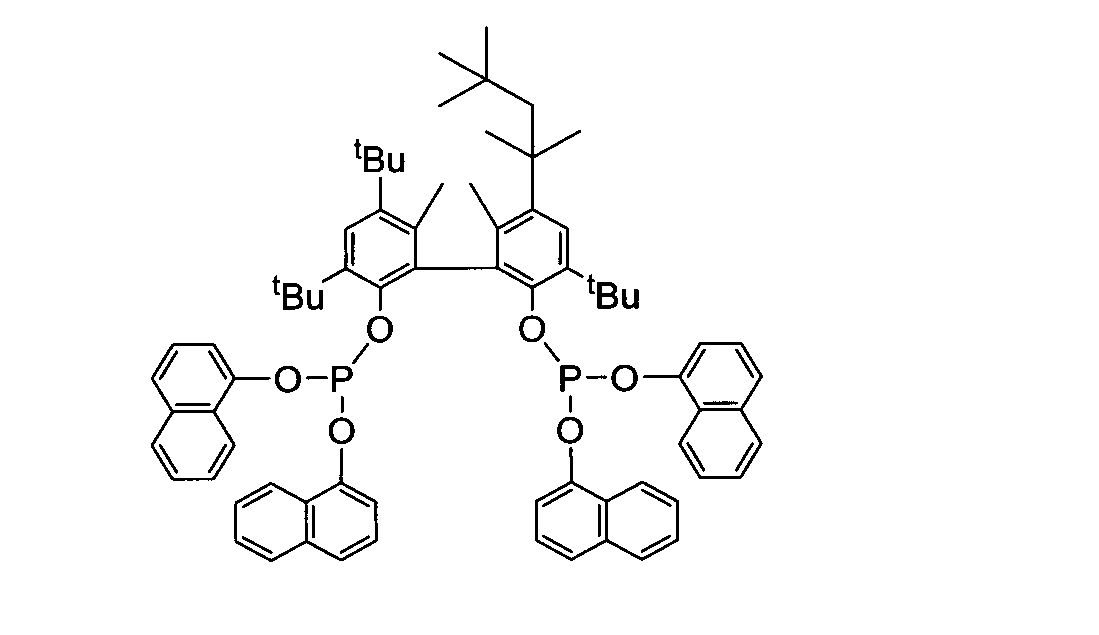
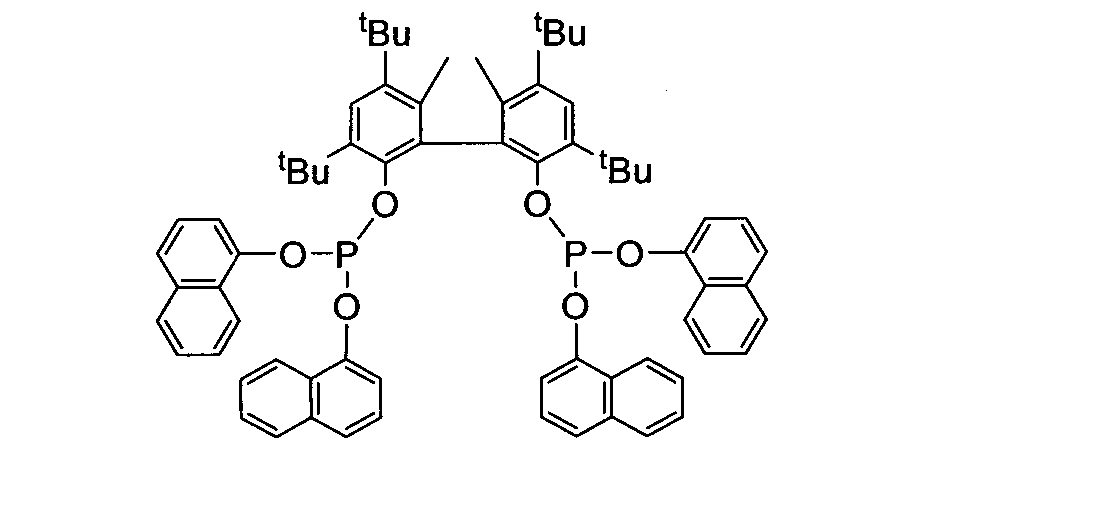
[触媒]
本発明の触媒は、本発明のビスホスファイト化合物と第8~10族金属との錯体を含むものである。本発明の触媒は、オレフィン化合物を一酸化炭素及び水素と反応させてアルデヒドを製造するための触媒として有用である。
該オレフィンとしては、後述のアルデヒドの製造方法の項に記載のものが挙げられる。
本発明の触媒は、本発明のビスホスファイト化合物と第8~10族金属との錯体を含むものである。本発明の触媒は、オレフィン化合物を一酸化炭素及び水素と反応させてアルデヒドを製造するための触媒として有用である。
該オレフィンとしては、後述のアルデヒドの製造方法の項に記載のものが挙げられる。
本発明のビスホスファイト化合物と第8~10族金属とを含む錯体は、第8~10族金属化合物と本発明のビスホスファイト化合物とから、公知の錯体形成方法により容易に調製することができる。
該錯体の製造に用いられる第8~10族金属化合物としては、第8~10族金属の水素化物、ハロゲン化物、有機酸塩、無機酸塩、酸化物、カルボニル化合物、アミン化合物、オレフィン配位化合物、ホスフィン配位化合物又はホスファイト配位化合物等が挙げられる。例えば、三塩化ルテニウム、ジクロロ(p-シメン)ルテニウムダイマー及びジクロロトリス(トリフェニルホスフィン)ルテニウム等のルテニウム化合物、酢酸パラジウム及び塩化パラジウム等のパラジウム化合物、三塩化オスミウム等のオスミウム化合物、三塩化イリジウム及びイリジウムカルボニル等のイリジウム化合物、白金酸、ヘキサクロロ白金酸ナトリウム及び第二白金酸カリウム等の白金化合物、ジコバルトオクタカルボニル及びステアリン酸コバルト等のコバルト化合物、三塩化ロジウム、硝酸ロジウム、酢酸ロジウム、Rh(acac)(CO)2、〔Rh(OAc)(cod)〕2、Rh4(CO)12、Rh6(CO)16、HRh(CO(PPh3)3、〔Rh(OAc)(CO)2〕2、〔Rh(μ-S(t-Bu))(CO)2〕2及び〔RhCl(cod)〕2等のロジウム化合物(本明細書中、acacはアセチルアセトナト基を、OAcはアセチル基を、codは1,5-シクロオクタジエンを、Phはフェニル基を、t-Buはt-ブチル基をそれぞれ表す。)が挙げられる。ただし、必ずしもこれらに限定されるものではない。これらは1種のみを用いてもよく、2種以上を混合して用いてもよい。
これらの内、コバルト、ロジウム又はルテニウムの化合物が好ましく、ロジウム化合物が特に好ましい。
これらの内、コバルト、ロジウム又はルテニウムの化合物が好ましく、ロジウム化合物が特に好ましい。
本発明の触媒において、第8~10族金属に対するビスホスファイト化合物のモル比は0.00004~500であることが好ましく、0.0002~100であることがより好ましく、0.001~50であることが更に好ましく、0.01~30であることが特に好ましい。第8~10族金属に対するビスホスファイト化合物のモル比が上記範囲内であれば、触媒コストと反応効率向上効果のバランスに優れる。
[触媒組成物]
本発明の触媒組成物は、本発明のビスホスファイト化合物を利用した触媒組成物の一実施形態であり、下記一般式(3)で表されるビスホスファイト化合物、及び、前記一般式(2)で表される本発明のビスホスファイト化合物を含むものである。
本発明の触媒組成物は、オレフィン化合物を一酸化炭素及び水素と反応させてアルデヒドを製造するための触媒組成物として有用である。
本発明の触媒組成物は、本発明のビスホスファイト化合物を利用した触媒組成物の一実施形態であり、下記一般式(3)で表されるビスホスファイト化合物、及び、前記一般式(2)で表される本発明のビスホスファイト化合物を含むものである。
本発明の触媒組成物は、オレフィン化合物を一酸化炭素及び水素と反応させてアルデヒドを製造するための触媒組成物として有用である。
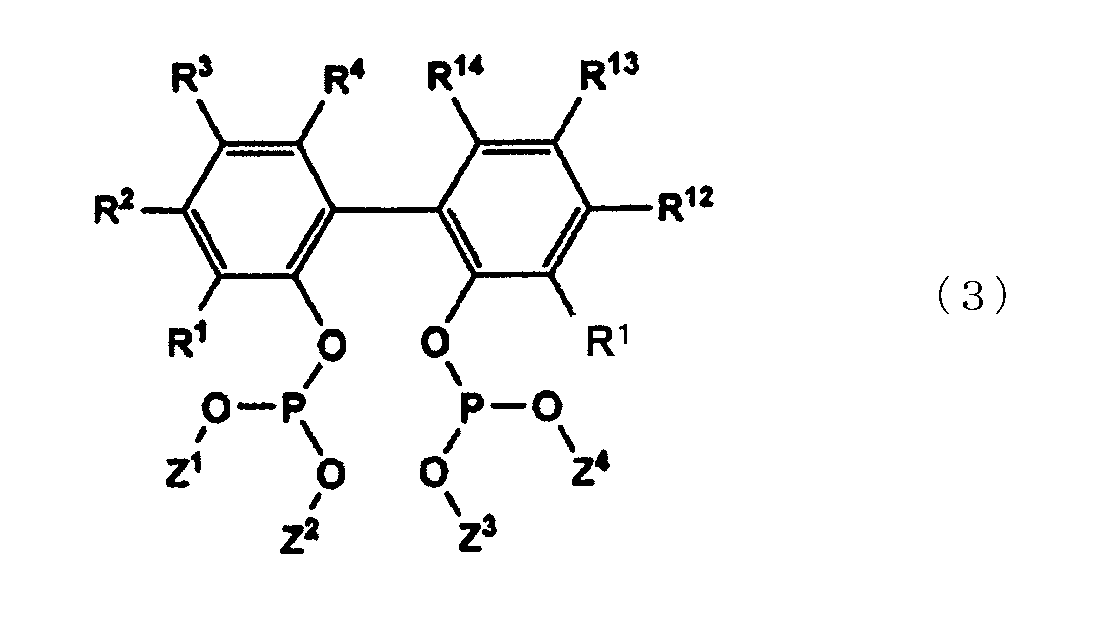
(式(3)中、
R1、R2及びR12、R3及びR13、R4及びR14、Z1~Z4は、それぞれ、前記一般式(2)におけるR1、R2及びR12、R3及びR13、R4及びR14、Z1~Z4と同義である。)
R1、R2及びR12、R3及びR13、R4及びR14、Z1~Z4は、それぞれ、前記一般式(2)におけるR1、R2及びR12、R3及びR13、R4及びR14、Z1~Z4と同義である。)
前記オレフィンとしては、後述のアルデヒドの製造方法の項に記載のものが挙げられる。
本発明の触媒組成物として、より具体的には、前記一般式(3)で表されるビスホスファイト化合物と第8~10族金属との錯体、並びに、前記式(2)で表される本発明のビスホスファイト化合物と第8~10族金属との錯体を含む触媒組成物が挙げられる。
本発明の触媒組成物は、第8~10族金属化合物、前記一般式(3)で表されるビスホスファイト化合物、及び、前記式(2)で表される本発明のビスホスファイト化合物から、公知の錯体形成方法により容易に調製することができる。
本発明の触媒組成物の製造に用いられる第8~10族金属化合物は、本発明の触媒における第8~10族金属化合物と同義である。
本発明の触媒組成物において、第8~10族金属に対する前記式(2)で表される本発明のビスホスファイト化合物のモル比は、本発明の触媒における第8~10族金属化合物に対する本発明のビスホスファイト化合物のモル比と同義である。
また、本発明の触媒組成物において、第8~10族金属に対する前記一般式(3)で表されるビスホスファイト化合物のモル比は、本発明の触媒における第8~10族金属化合物に対する前記一般式(3)で表されるビスホスファイト化合物のモル比と同義である。
また、本発明の触媒組成物において、第8~10族金属に対する前記一般式(3)で表されるビスホスファイト化合物のモル比は、本発明の触媒における第8~10族金属化合物に対する前記一般式(3)で表されるビスホスファイト化合物のモル比と同義である。
本発明の触媒組成物中の、前記一般式(3)で表されるビスホスファイト化合物の含有割合の下限は、特に限定されるものではないが、該触媒組成物の総質量100%に対して、
80.00質量%以上とすることができ、
90.00質量%以上がより好ましく、
95.00質量%以上がさらに好ましく、
98.00質量%以上が特に好ましく。
99.00質量%以上が一層好ましく、
99.40質量%以上がより一層好ましい。
一方、本発明の触媒組成物中の、前記一般式(3)で表されるビスホスファイト化合物の含有割合の下限は、特に限定されるものではないが、該触媒組成物の総質量100%に対して、
99.99質量%以下とすることができ、
99.98質量%以下がより好ましく、
99.97質量%以下がさらに好ましく、
99.95質量%以下が特に好ましく、
99.90質量%以下がとりわけ好ましく、
99.85質量%以下が最も好ましい。
上記の上限下限は任意に組み合わせることができる。例えば、本発明の触媒組成物中の、前記一般式(3)で表されるビスホスファイト化合物の含有割合は、特に限定されるものではないが、該触媒組成物の総質量100%に対して、
80.00質量%以上99.99質量%以下とすることができ、
90.00質量%以上99.98質量%以下がより好ましく、
95.00質量%以上99.97質量%以下がさらに好ましく、
98.00質量%以上99.95質量%以下が特に好ましく、
99.00質量%以上99.90質量%以下がとりわけ好ましく、
99.40質量%以上99.85質量%以下が最も好ましい。
本発明の触媒組成物中の、前記式(2)で表される本発明のビスホスファイト化合物の含有割合の下限は、特に限定されるものではないが、該触媒組成物の総質量100%に対して、
0.01質量%以上とすることができ、
0.02質量%以上がより好ましく、
0.03質量%以上がさらに好ましく、
0.05質量%以上が特に好ましく。
0.10質量%以上がとりわけ好ましく、
0.15質量%以上が最も好ましい。
一方、本発明の触媒組成物中の、前記式(2)で表される本発明のビスホスファイト化合物の含有割合の下限は、特に限定されるものではないが、該触媒組成物の総質量100%に対して、
20.00質量%以下とすることができ、
10.00質量%以下がより好ましく、
5.00質量%以下がさらに好ましく、
2.00質量%以下が特に好ましく、
1.00質量%以下がとりわけ好ましく、
0.60質量%以下が最も好ましい。
上記の上限下限は任意に組み合わせることができる。例えば、本発明の触媒組成物中の、前記式(2)で表される本発明のビスホスファイト化合物の含有割合は、特に限定されるものではないが、該触媒組成物の総質量100%に対して、
0.01質量%以上20.00質量%以下とすることができ、
0.02質量%以上10.00質量%以下がより好ましく、
0.03質量%以上5.00質量%以下がさらに好ましく、
0.05質量%以上2.00質量%以下が特に好ましく、
0.10質量%以上1.00質量%以下がとりわけ好ましく、
0.15質量%以上0.60質量%以下が最も好ましい。
本発明の触媒及び本発明の触媒組成物は、例えば、以下に示す通り、オレフィンからのアルデヒドの製造に用いられる。
[アルデヒドの製造方法]
本発明のアルデヒドの製造方法は、第8~10族金属化合物及び本発明のビスホスファイト化合物の存在下で、オレフィン化合物を一酸化炭素及び水素と反応させることを特徴とする。
或いは、本発明のアルデヒドの製造方法は、前述の本発明の触媒の存在下で、オレフィン化合物を一酸化炭素及び水素と反応させることを特徴とする。
本発明のアルデヒドの製造方法は、第8~10族金属化合物及び本発明のビスホスファイト化合物の存在下で、オレフィン化合物を一酸化炭素及び水素と反応させることを特徴とする。
或いは、本発明のアルデヒドの製造方法は、前述の本発明の触媒の存在下で、オレフィン化合物を一酸化炭素及び水素と反応させることを特徴とする。
オレフィン化合物としては、分子内にオレフィン性二重結合を少なくとも1つ有する有機化合物であれば特に制限はない。具体的には、エチレン、プロピレン、ブテン、ブタジエン、ペンテン、ヘキセン、ヘキサジエン、オクテン、オクタジエン、デセン、ヘキサデセン、オクタデセン、イコセン、ドコセン、スチレン、α-メチルスチレン、シクロヘキセン、並びに、プロピレンとブテンの混合物、1-ブテンと2-ブテンとイソブチレンの混合物、1-ブテンと2-ブテンとイソブチレンとブタジエンの混合物等の低級オレフィン混合物、プロピレン、n-ブテン及びイソブチレン等の低級オレフィンの2量体、3量体及び4量体のようなオレフィンオリゴマー異性体混合物、アクリロニトリル、アリルアルコール、1-ヒドロキシ-2,7-オクタジエン、3-ヒドロキシ-1,7-オクタジエン、オレイルアルコール、1-メトキシ-2,7-オクタジエン、アクリル酸メチル、メタアクリル酸メチル及びオレイン酸メチル等の極性基置換オレフィン類等が挙げられる。
上記のオレフィン化合物を用いてヒドロホルミル化反応を実施することで、対応するアルデヒドを製造することができる。通常、得られたアルデヒドの直鎖体(L体)と分岐体(B体)の生成比(L体/B体)は1以上であることが好ましく、5以上であることがより好ましく、10以上であることが更に好ましい。
本発明のアルデヒドの製造方法において、触媒又はその前駆体として用いる第8~10族金属化合物としては、第8~10族金属の水素化物、ハロゲン化物、有機酸塩、無機酸塩、酸化物、カルボニル化合物、アミン化合物、オレフィン配位化合物、ホスフィン配位化合物又はホスファイト配位化合物等が使用可能である。例えば、三塩化ルテニウム、ジクロロ(p-シメン)ルテニウムダイマー及びジクロロトリス(トリフェニルホスフィン)ルテニウム等のルテニウム化合物、酢酸パラジウム及び塩化パラジウム等のパラジウム化合物、三塩化オスミウム等のオスミウム化合物、三塩化イリジウム及びイリジウムカルボニル等のイリジウム化合物、白金酸、ヘキサクロロ白金酸ナトリウム及び第二白金酸カリウム等の白金化合物、ジコバルトオクタカルボニル及びステアリン酸コバルト等のコバルト化合物、三塩化ロジウム、硝酸ロジウム、酢酸ロジウム、Rh(acac)(CO)2、〔Rh(OAc)(cod)〕2、Rh4(CO)12、Rh6(CO)16、HRh(CO(PPh3)3、〔Rh(OAc)(CO)2〕2、〔Rh(μ-S(t-Bu))(CO)2〕2及び〔RhCl(cod)〕2等のロジウム化合物(本明細書中、acacはアセチルアセトナト基を、OAcはアセチル基を、codは1,5-シクロオクタジエンを、Phはフェニル基を、t-Buはt-ブチル基をそれぞれ表す。)が挙げられるが、必ずしもこれらに限定されるものではない。これらの内、コバルト、ロジウム又はルテニウムの化合物が好ましく、ロジウム化合物が特に好ましい。
本発明のアルデヒドの製造方法は、本発明のビスホスファイト化合物を予め上記の第8~10族金属と錯体を形成させて、該錯体を含む触媒の存在下で実施することができる。本発明のビスホスファイト化合物を含む第8~10族金属錯体は、第8~10族金属化合物と該ビスホスファイト化合物とから、公知の錯体形成方法により容易に調製することができる。
また、場合によっては、第8~10族金属化合物と前記ビスホスファイト化合物とをヒドロホルミル化反応帯域に供給し、ヒドロホルミル化反応系内で錯体を形成させて用いることもできる。
また、場合によっては、第8~10族金属化合物と前記ビスホスファイト化合物とをヒドロホルミル化反応帯域に供給し、ヒドロホルミル化反応系内で錯体を形成させて用いることもできる。
予めビスホスファイト化合物と第8~10族金属との錯体を形成させて、該錯体を含む触媒の存在下で本発明のアルデヒドの製造方法を実施する場合、前述の本発明の触媒における第8~10族金属に対するビスホスファイト化合物のモル比と同様の理由から、第8~10族金属に対するビスホスファイト化合物のモル比は0.00004~500であることが好ましく、0.0002~100であることがより好ましく、0.001~50であることが更に好ましく、0.01~30であることが特に好ましい。
本発明のアルデヒドの製造方法において、該錯体の使用量は、特に限定されるものではなく、触媒活性及び経済性等から考慮される限界があるが、通常ヒドロホルミル化反応帯域における反応液中の第8~10族金属の濃度が、金属原子換算で、好ましくは0.05~5000mg/L、より好ましくは0.5~1000mg/L、更に好ましくは5~500mg/Lとなるように、反応帯域へ供給すればよい。
触媒となる第8~10族金属の濃度が低すぎると十分な反応性が発現しないことが懸念される。第8~10族金属の濃度が高すぎると触媒のコストが高くなりすぎる懸念がある。また、ビスホスファイト化合物の使用量が少なすぎると十分な反応性が得られないことが懸念される。ビスホスファイト化合物の使用量が多すぎるとビスホスファイト化合物のコストが高くなりすぎる懸念がある。
第8~10族金属化合物とビスホスファイト化合物とをヒドロホルミル化反応帯域に供給してそこで錯体を形成させて用いる場合も同様に、第8~10族金属化合物の使用量は、特に限定されるものではなく、触媒活性及び経済性等から考慮される限界があるが、本発明においては、通常ヒドロホルミル化反応帯域における反応液中の第8~10族金属化合物の濃度は、金属原子換算で、好ましくは0.05~5000mg/L、より好ましくは0.5~1000mg/L、更に好ましくは5~500mg/Lである。
触媒となる第8~10族金属の濃度が低すぎると十分な反応性が発現しないことが懸念される。第8~10族金属の濃度が高すぎると触媒のコストが高くなりすぎる懸念がある。
ビスホスファイト化合物の使用量は特に制限されるものではなく、触媒の活性、選択性に対して望ましい結果が得られるように適宜設定される。通常は第8~10族金属1モル当たり0.00004~500モル、好ましくは0.0002~100モル、更に好ましくは0.001~50モル、最も好ましくは0.01~30モルである。ビスホスファイト化合物の使用量が少なすぎると十分な反応性が得られないことが懸念される。ビスホスファイト化合物の使用量が多すぎるとビスホスファイト化合物のコストが高くなりすぎる懸念がある。
本発明のアルデヒドの製造方法において、反応溶媒の使用は必須ではないが、必要に応じてヒドロホルミル化反応に不活性な溶媒を存在させることができる。
好ましい溶媒の具体例としては、トルエン、キシレン及びトデシルベンゼン等の芳香族炭化水素類、アセトン、ジエチルケトン及びメチルエチルケトン等のケトン類、テトラヒドロフラン及びジオキサン等のエーテル類、酢酸エチル及びジ-n-オクチルフタレート等のエステル類、アルデヒド縮合体等のヒドロホルミル化反応時に副生する高沸点成分、並びに反応原料であるオレフィン化合物等が挙げられる。
好ましい溶媒の具体例としては、トルエン、キシレン及びトデシルベンゼン等の芳香族炭化水素類、アセトン、ジエチルケトン及びメチルエチルケトン等のケトン類、テトラヒドロフラン及びジオキサン等のエーテル類、酢酸エチル及びジ-n-オクチルフタレート等のエステル類、アルデヒド縮合体等のヒドロホルミル化反応時に副生する高沸点成分、並びに反応原料であるオレフィン化合物等が挙げられる。
本発明のアルデヒドの製造方法を行なうための反応条件は、従来通常に用いられたものと同様であり、反応温度は、通常、15~200℃、好ましくは50~150℃の範囲から選ばれる。一酸化炭素分圧及び水素分圧は通常、0.0001~20MPaG、好ましくは0.01~10MPaG、特に好ましくは0.1~5MPaGの範囲から選ばれる。
一酸化炭素と水素とのモル比(H2/CO)は通常、10/1~1/10、好ましくは3/1~1/3の範囲から選ばれる。
反応方式としては、撹拌型反応槽または気泡塔型反応槽中で連続方式または回分方式のいずれでも行なうことができる。
反応方式としては、撹拌型反応槽または気泡塔型反応槽中で連続方式または回分方式のいずれでも行なうことができる。
反応時間としては、基本的に目的とするアルデヒドの製造が十分に達成される時間であれば特に制限されることはなく、触媒濃度、反応条件、反応器の大きさ等の条件に基づいて適宜選定することができる。一般的な反応時間としては、1分~100時間、好ましくは5分~20時間、より好ましくは20分~10時間である。
本発明のアルデヒドの製造方法において、生成したアルデヒドを蒸留等の方法により分離した後に、第8~10族金属及びビスホスファイト化合物を含む回収液を用いて、再びオレフィン化合物のヒドロホルミル化反応を行うことができる。
更に、連続的にオレフィン化合物をアルデヒドに転化する際に、生成するアルデヒドの一部または全部を分離した残りの反応液を、触媒液として連続的にヒドロホルミル化反応槽に循環させることもできる。
[アルコールの製造方法]
本発明のアルコールの製造方法は、本発明のアルデヒドの製造方法によりアルデヒドを製造し、該アルデヒドから対応するアルコールを製造する、アルコールの製造方法である。
本発明のアルコールの製造方法は、本発明のアルデヒドの製造方法によりアルデヒドを製造し、該アルデヒドから対応するアルコールを製造する、アルコールの製造方法である。
前記アルデヒドに対応するアルコールを製造する方法は、特に限定されるものでなく、常法に従って行うことができる。例えば、特開2001-10999号公報に記載された方法に従い、本発明のアルデヒドの製造方法により得られたアルデヒドをそのまま公知の水素添加反応に供するか、又は得られたアルデヒドを二量化した後に公知の水素添加反応に供することにより、アルコールを製造することができる。
前記水素添加反応に用いる水素化触媒は、Ru、Ni、Cr、Cu等の金属を担体に担持させた公知の固体触媒が使用できる。水素化触媒としては、Ru系触媒が好ましい。
前記水素添加反応の条件は、通常、温度が60~200℃、水素圧力が0.1~20MPaG程度である。
前記水素添加反応の条件は、通常、温度が60~200℃、水素圧力が0.1~20MPaG程度である。
以下に実施例に代わる実験例を挙げて、本発明をより具体的に説明する。本発明はこれらの実験例に限定されるものではない。
以下の実験例は単なる例示であり、本明細書に記載される実施形態のいずれかを限定することを意図するものではない。以下の実験例は、本発明を何ら限定するものではない。
以下の実験例における各種の製造条件や評価結果の値は、本発明の実施態様における上限又は下限の好ましい値としての意味をもつものであり、好ましい範囲は前記した上限又は下限の値と、下記実験例の値又は実験例同士の値との組み合わせで規定される範囲であってもよい。
以下の実験例は単なる例示であり、本明細書に記載される実施形態のいずれかを限定することを意図するものではない。以下の実験例は、本発明を何ら限定するものではない。
以下の実験例における各種の製造条件や評価結果の値は、本発明の実施態様における上限又は下限の好ましい値としての意味をもつものであり、好ましい範囲は前記した上限又は下限の値と、下記実験例の値又は実験例同士の値との組み合わせで規定される範囲であってもよい。
[原材料]
実験例で使用した化合物の略称は以下のとおりである。
DBMC:4,6-ジ-t-ブチル-m-クレゾール
[Rh(OAc)(cod)]2:(1,5-シクロオクタジエン)アセテートロジウムダイマー (商品名:Rh2(cod)2(OAc)2、エヌ・イー・ケムキャット株式会社製製)
ホスファイト配位子A:特許第3812046号公報の実施例-11に記載の方法にて製造した、下記構造式で表される、ホスファイト置換基のo-位にt-Bu基のみを有する対称型ビスホスファイト化合物
実験例で使用した化合物の略称は以下のとおりである。
DBMC:4,6-ジ-t-ブチル-m-クレゾール
[Rh(OAc)(cod)]2:(1,5-シクロオクタジエン)アセテートロジウムダイマー (商品名:Rh2(cod)2(OAc)2、エヌ・イー・ケムキャット株式会社製製)
ホスファイト配位子A:特許第3812046号公報の実施例-11に記載の方法にて製造した、下記構造式で表される、ホスファイト置換基のo-位にt-Bu基のみを有する対称型ビスホスファイト化合物
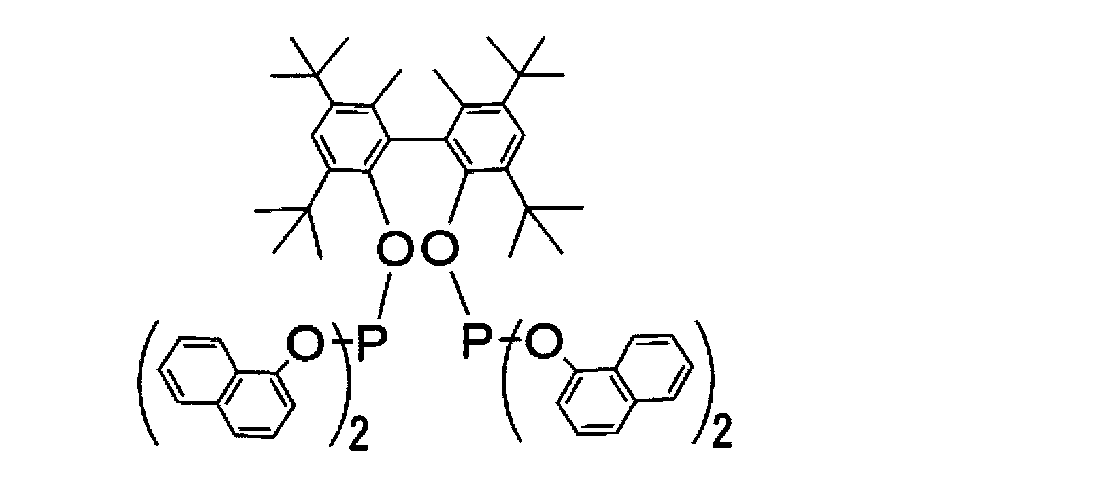
[評価方法]
以下の実験例においては、下記の方法により各種物性を測定した。
以下の実験例においては、下記の方法により各種物性を測定した。
<化合物Aの分子量測定>
化合物Aの分子量を、高速液体クロマトグラフィー質量分析法(LC/MS法)を用いて、以下の測定条件で測定した。
(LC測定条件)
高速液体クロマトグラム装置:Agilent 1260(装置名、アジレント・テクノロジー株式会社製)
分析カラム:CAPCELLPAK C18 MGIII(商品名、株式会社大阪ソーダ製、サイズ:内径4.6mm×長さ75mm、膜厚3μm)
溶離液:アセトニトリル
流速:1.0mL/min
検出器:UV検出器(波長210nm)
注入量:2μL
(MS測定条件)
質量分析装置:Agilent LC/MS 6130(装置名、アジレント・テクノロジー株式会社製)
イオン源:エレクトロスプレーイオン化(ESI)法(Positive/Negative;AJSプローブ使用)
なお、イオン化助剤として、ポストカラムに20mMギ酸アンモニウム水溶液を0.1mL/minで添加した。
<化合物Aの構造解析>
核磁気共鳴スペクトル測定装置(装置名:JNM-ECS400型装置、日本電子株式会社製、共鳴周波数(1H):400MHz、プローブ:H5XAT/FG2(インバース))を用いて、以下の手順により、化合物Aの構造解析を実施した。
単離した化合物Aを、テトラメチルシラン(TMS)を少量添加した重クロロホルム(CDCl3)に溶解させ、これをNMR測定用試料とした。
(1H-NMR測定)
得られたNMR測定試料について、核磁気共鳴スペクトル測定装置を用いて、測定温度25℃、積算回数128回の条件で、1H-NMR測定を行った。
(13C-NMR測定)
得られたNMR測定試料について、核磁気共鳴スペクトル測定装置を用いて、測定温度25℃及び以下の測定条件で、13C-NMR(積算回数:3000回)、DEPT(フリップ角度:135°、積算回数:3000回)、HMQC(積算回数:16回)、及びHMBC(積算回数:8回)の測定を行った。
<化合物Bの精密質量測定>
単離した化合物Bについて、液体クロマトグラフ/飛行時間型質量分析装置(LC/ToFMS)を用いて、以下の測定条件により精密質量を測定した。
(測定条件)
高速液体クロマトグラム測定装置:Waters Acquity H-Class(装置名、日本ウォーターズ株式会社製)
分析カラム:ACQUITY UPLC BEH C8(商品名、カラムサイズ:内径:2.1mm×カラム長:100mmL、膜厚:1.7μm、日本ウォーターズ株式会社製)
溶離液:アセトニトリル
溶離液の流速:0.4mL/min
質量分析装置:四重極-飛行時間型質量分析装置 Waters Xevo G2-XS Qtof(装置名、日本ウォーターズ株式会社製)
イオン化法:エレクトロスプレーイオン(ESI)法 (Positive Mode)
質量校正物質:ロイシンエンケファリン(RE)
<化合物Bの構造解析>
核磁気共鳴スペクトル測定装置(装置名:Bruker AVANCE NEO 600型装置、ブルカー株式会社製、共鳴周波数(1H):600MHz、プローブ:5mmBBO Cryo)を用いて、以下の手順により、化合物Bの構造解析を実施した。
単離した化合物Bを、テトラメチルシラン(TMS)を少量添加した重クロロホルム(CDCl3)に溶解させ、これをNMR測定用試料とした。
(1H-NMR測定)
得られたNMR測定試料について、核磁気共鳴スペクトル測定装置を用いて、測定温度25℃、積算回数16回の条件で、1H-NMR測定を行った。
(13C-NMR測定)
得られたNMR測定試料について、核磁気共鳴スペクトル測定装置を用いて、測定温度25℃及び以下の測定条件で、13C-NMR(積算回数:256回)、DEPT(フリップ角度:135°、積算回数:128回)、HSQC(積算回数:16回)、HMBC(積算回数:2回)、1H-1H COSY(積算回数:2回)の測定を行った。
<化合物BのIR測定>
単離した化合物Bについて、FT-IR用モジュール(商品名:iZ10、サーモフィッシャーサイエンティフィック株式会社製)を備えた赤外顕微鏡(装置名:Nicolet iN10MX、サーモフィッシャーサイエンティフィック株式会社製)を用いて、以下の測定条件により全反射測定(ATR)法による赤外分光(IR)測定を行った。
(測定条件)
ATR:Gladi ATR vision ダイヤモンドクリスタル(PIKE社製)
分解能:4cm―1
積算回数:64回
単離した化合物Bについて、FT-IR用モジュール(商品名:iZ10、サーモフィッシャーサイエンティフィック株式会社製)を備えた赤外顕微鏡(装置名:Nicolet iN10MX、サーモフィッシャーサイエンティフィック株式会社製)を用いて、以下の測定条件により全反射測定(ATR)法による赤外分光(IR)測定を行った。
(測定条件)
ATR:Gladi ATR vision ダイヤモンドクリスタル(PIKE社製)
分解能:4cm―1
積算回数:64回
[実施例1:本発明のジヒドロキシビフェニル化合物(化合物A)の製造]
ジヒドロキシビフェニル化合物(化合物A)の製造において、DBMCを含有する組成物(DBMC組成物)を出発物質として用いた。前記DBMC組成物の組成を、ガスクロマトグラム(GC)測定装置とガスクロマトグラフィー総面積法を用いて、下記のGC測定条件で分析した結果、該DBMC組成物は、DBMCを97.5GC面積%、下記式(E)で表される化合物(前述の「フェノール-e」)を0.8GC面積%含んでいた。
なお、ガスクロマトグラフィー総面積法における各成分の組成割合は、ガスクロマトグラム上の全生成物質のGCピークの総面積を100%としたときの各ピーク成分の面積含有割合(単位:GC面積%)として算出した。
ジヒドロキシビフェニル化合物(化合物A)の製造において、DBMCを含有する組成物(DBMC組成物)を出発物質として用いた。前記DBMC組成物の組成を、ガスクロマトグラム(GC)測定装置とガスクロマトグラフィー総面積法を用いて、下記のGC測定条件で分析した結果、該DBMC組成物は、DBMCを97.5GC面積%、下記式(E)で表される化合物(前述の「フェノール-e」)を0.8GC面積%含んでいた。
なお、ガスクロマトグラフィー総面積法における各成分の組成割合は、ガスクロマトグラム上の全生成物質のGCピークの総面積を100%としたときの各ピーク成分の面積含有割合(単位:GC面積%)として算出した。
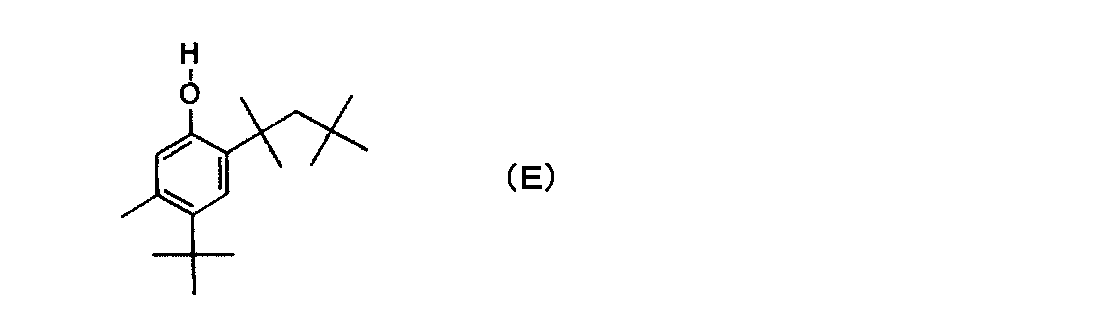
<GC測定条件>
GC装置:GC-2025(高性能 汎用ガスクロマトグラフ、株式会社島津製作所製)
検出器:水素炎イオン化検出器(FID)
キャリアガス:窒素ガス(カラム流量4.07mL/分)
カラム:キャピラリーカラム BPX5(SGE Analytical Science社製、サイズ:長さ60m×内径0.32mm、膜厚0.25μm)
カラム温度:50℃(保持時間5分)→10℃/分で昇温→300℃(保持時間10分)
注入口温度:300℃
検出器温度:300℃
サンプル量:0.5μL(スプリット比:1/20)
GC装置:GC-2025(高性能 汎用ガスクロマトグラフ、株式会社島津製作所製)
検出器:水素炎イオン化検出器(FID)
キャリアガス:窒素ガス(カラム流量4.07mL/分)
カラム:キャピラリーカラム BPX5(SGE Analytical Science社製、サイズ:長さ60m×内径0.32mm、膜厚0.25μm)
カラム温度:50℃(保持時間5分)→10℃/分で昇温→300℃(保持時間10分)
注入口温度:300℃
検出器温度:300℃
サンプル量:0.5μL(スプリット比:1/20)
上記DBMC組成物約200gをガラス製単蒸留装置に仕込み、3mmHgの減圧下、約140℃に設定したオイルバスを用いて、前記DBMC組成物の主成分であるDBMCを160g留去した。前記蒸留装置内の残留分を取り出し、空気吹込みパイプを備えたガラス製反応器に移し、塩化銅(II)二水和物0.74gとN,N,N’,N’-テトラメチルエチレンジアミン0.67g及びメタノール87.0gを添加した。以下、反応器内の内容物を、単に「反応液」という。次いで、反応液を攪拌速度450rpmで撹拌しながら、前記反応液の温度が50℃となるまで昇温した後、反応液の温度を50℃に維持しながら、空気を24mL/minで24時間吹込み、スラリー状の溶液を得た。このスラリー溶液を懸洗しながら濾過し、濾過物として、白色固体(1)17.9gを得た。
得られた白色固体(1)をガスクロマトグラフィーで分析したところ、前記白色固体(1)は、3,3’,5,5’-テトラ-tert-ブチル-6,6’-ジメチル-1,1’-ビフェニル-2,2’-ジオール(前述のビフェノール-a。以下、「ビフェノール-a」と称す。)を88.6GC面積%、下記式(A)で表される構造を有すると推定される化合物Aを3.3GC面積%含有していた。

<白色固体(1)からの化合物Aの分離>
以下の操作を行い、得られた白色固体(1)から化合物Aを分離した。
得られた白色固体(1)(17.9g)にテトラヒドロフラン溶液(39.9g)を添加した後、ガラス製反応容器に仕込み、オイルバスを用いて、攪拌速度200rpmで撹拌しながら、反応容器内の溶液温度が60℃となるまで昇温して、前記白色固体(1)を溶解させた。次いで、メタノール54gを滴下速度5mL/minで、反応容器内に滴下した後、撹拌速度を50rpmに低減し、反応容器内の溶液温度が2℃になるまる降温速度0.8℃/minで冷却し、さらに2時間撹拌して、スラリー状の溶液を得た。
得られたスラリー溶液を懸洗しながら濾過し、濾液を回収した。得られた濾液をガスクロマトグラフィーで分析したところ、前記濾液は、ビフェノール-aを58.4GC面積%、推定化合物Aを12.7GC面積%含有していた。
得られた濾液を乾固した後、濾液の乾固物(2.9g)にテトラヒドロフラン(6.2g)を添加した後、ガラス製反応容器に仕込み、オイルバスを用いて、撹拌しながら60℃まで昇温して、前記乾固物を溶解させた。次いで、メタノールを滴下した後、撹拌速度を低減し、反応容器内の溶液温度が2℃になるまで冷却し、スラリー状の溶液を得た。得られたスラリー溶液を懸洗しながら濾過し、濾液を回収した。得られた濾液をガスクロマトグラフィーで分析したところ、前記濾液は、ビフェノール-aを27.6GC面積%、推定化合物Aを19.6GC面積%含有していた。
得られた濾液を乾固して、白色固体1.2gを得た。得られた白色固体(1.2g)をトルエン(0.5g)溶解した後、シリカゲル(商品名:ワコーゲルC-200、富士フィルム和光純薬株式会社製)を充填したクロマト管(内径:3.3cm、シリカゲルの充填長:40cm)に、溶離液としてヘキサン/トルエン=100/1を用いて、オープンカラム精製を行い、クロマト管の溶離液を100mL毎に分取した。17本目の溶離液をガスクロマトグラフィーを用いて分析したところ、該溶離液には、ビフェノール-aは検出されず、推定化合物Aが70.7GC面積%含まれていた。該溶離液を、エバポレーターを用いて濃縮した後、減圧乾燥して乾固させ、前記推定化合物Aを含む白色固体(2)0.06gを得た。
<白色固体(2)からの化合物Aの単離>
得られた白色固体(2)から、液体クロマトグラフィー(LC法)を用いて、以下の条件により、化合物Aを約6.4mg単離した。
得られた白色固体(2)から、液体クロマトグラフィー(LC法)を用いて、以下の条件により、化合物Aを約6.4mg単離した。
前記白色固体(2)をアセトニトリルに溶解した後、分取液体クロマトグラフィー(分取LC)を用いて、以下の分取LC条件により、化合物Aを含む溶離液を分取した。
次いで、分取した溶離液を、エバポレーターを用いて濃縮した後、減圧乾燥して乾固させ、化合物Aを得た。
(分取LC条件)
装置:LC-10A(装置名、株式会社島津製作所製)
分取カラム:CAPCELLPAK C18(商品名、株式会社大阪ソーダ製、サイズ:内径20mm×長さ150mm、膜厚5μm)
分析温度:40℃
溶離液:アセトニトリル
流速:15mL/min
検出器:UV検出器(波長210nm)
注入量:1000μL/回で、7回実施
次いで、分取した溶離液を、エバポレーターを用いて濃縮した後、減圧乾燥して乾固させ、化合物Aを得た。
(分取LC条件)
装置:LC-10A(装置名、株式会社島津製作所製)
分取カラム:CAPCELLPAK C18(商品名、株式会社大阪ソーダ製、サイズ:内径20mm×長さ150mm、膜厚5μm)
分析温度:40℃
溶離液:アセトニトリル
流速:15mL/min
検出器:UV検出器(波長210nm)
注入量:1000μL/回で、7回実施
<化合物Aの構造同定>
単離した化合物Aについて、前記液体クロマトグラフィー質量分析法(LC/MS法)を用いた分子量測定、及び、各種NMR測定(1H-NMR、13C-NMR、DEPT、HMQC、HMBC)を行った。化合物Aの1H-NMRスペクトルを図1(a)に、13C-NMRスペクトルを図1(b)に示す。
化合物Aの分析結果は次の通りであった。
単離した化合物Aについて、前記液体クロマトグラフィー質量分析法(LC/MS法)を用いた分子量測定、及び、各種NMR測定(1H-NMR、13C-NMR、DEPT、HMQC、HMBC)を行った。化合物Aの1H-NMRスペクトルを図1(a)に、13C-NMRスペクトルを図1(b)に示す。
化合物Aの分析結果は次の通りであった。
(分子量測定結果)
液体クロマトグラフィー質量分析法(LC/MS法)において、ポジティブモード494([M]+)、ネガティブモード493([M-H]-)を観測したことにより、化合物Aの分子量は494であると判断した。
液体クロマトグラフィー質量分析法(LC/MS法)において、ポジティブモード494([M]+)、ネガティブモード493([M-H]-)を観測したことにより、化合物Aの分子量は494であると判断した。
(1H-NMR測定結果)
下記式(α)で表される構造式に基づき、1H-NMRスペクトル上に観察されたピークを同定した。
δ0.77(9H,s,式(α)の7のシグナル),δ1.40(9H,s,式(α)の2のシグナル),δ1.43(18H,s,式(α)の1及び6のシグナル),δ1.45(6H,d,J=5.95Hz,式(α)の9のシグナル),δ1.89(2H,dd,J=14.4Hz,54.3Hz,式(α)の8のシグナル),δ2.01(3H,s,式(α)の10のシグナル),δ2.02(3H,s,式(α)の3のシグナル),δ4.70(1H,s,式(α)の5のシグナル),δ4.81(1H,s,式(α)の12のシグナル),δ7.38(1H,s,式(α)の4のシグナル),δ7.41(1H,s,式(α)の11のシグナル)
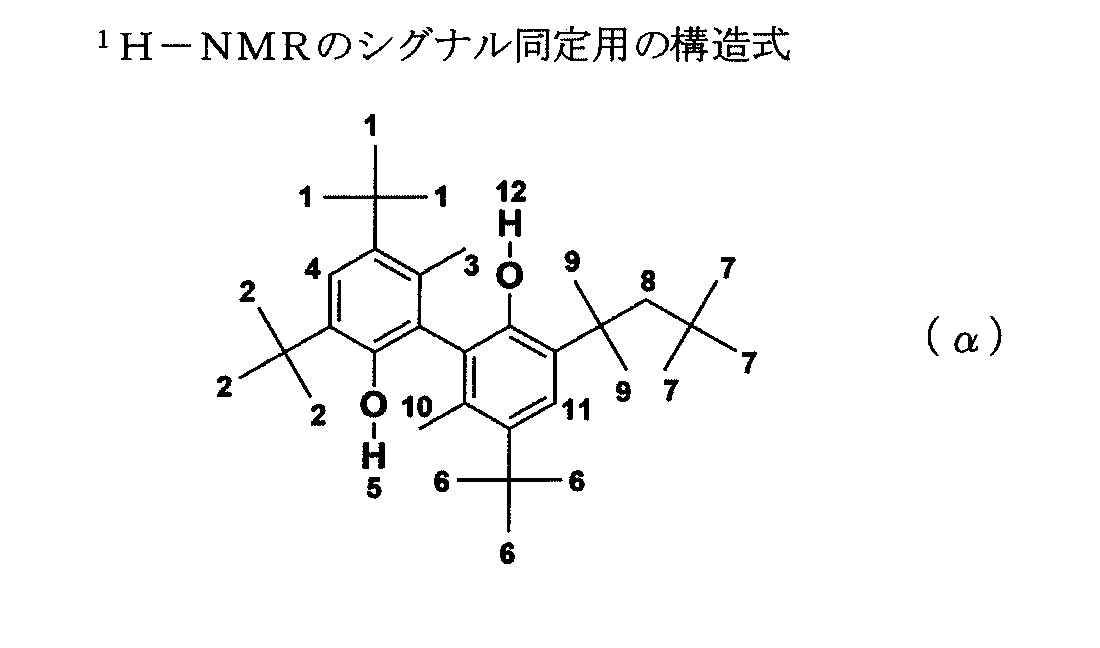
(13C-NMR測定結果)
下記式(β)で表される構造式に基づき、13C-NMRスペクトル上に観察されたピークを同定した。
δ18.82(式(β)のC及びcのシグナル),δ29.65(式(β)のBのシグナル),δ31.03,31.14(式(β)のiのシグナル),δ31.53(式(β)のfのシグナル),δ31.59(式(β)のaのシグナル),δ31.69(式(β)のAのシグナル),δ32.56(式(β)のgのシグナル),δ35.06(式(β)のEのシグナル),δ35.91(式(β)のdのシグナル),δ35.94(式(β)のDのシグナル),δ39.17(式(β)のjのシグナル),δ52.42(式(β)のhのシグナル),δ123.35(式(β)のOのシグナル),δ123.37(式(β)のoのシグナル),δ125.43(式(β)のLのシグナル),δ126.73(式(β)のlのシグナル),δ131.32(式(β)のkのシグナル),δ132.50(式(β)のKのシグナル),δ133.94(式(β)のNのシグナル),δ133.97(式(β)のnのシグナル),δ140.07(式(β)のMのシグナル),δ140.30(式(β)のmのシグナル),149.85(式(β)のPのシグナル),150.19(式(β)のpのシグナル)
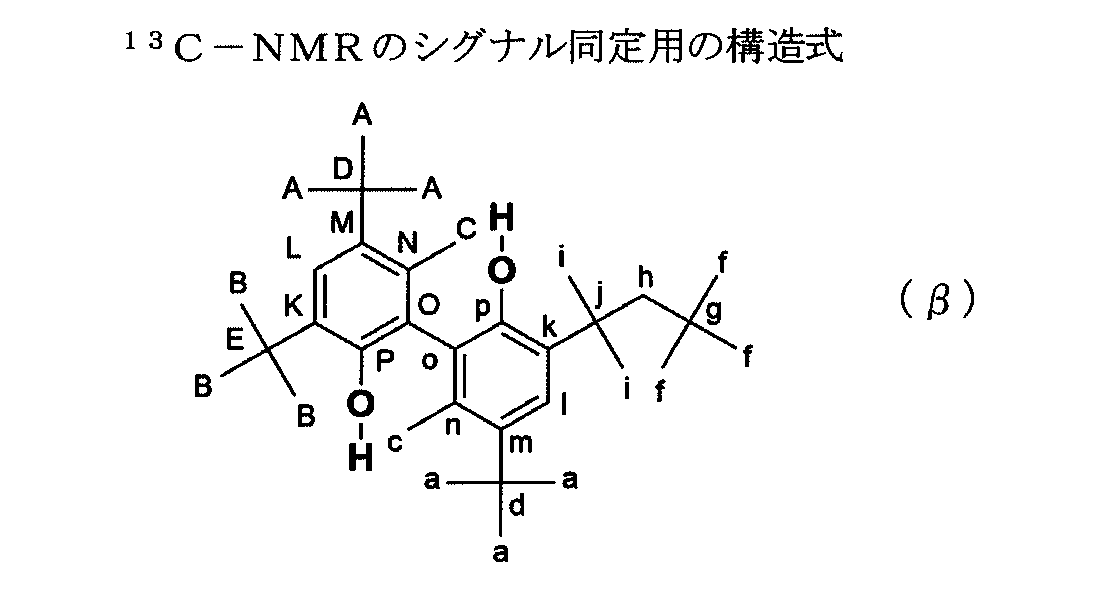
(DEPT測定結果)
前記13C-NMRスペクトルにおける、D、d、E、g、j、K、k、M、m、N、n、O、o、P、pのシグナルが消失し、hのシグナルが逆向きに出現することを確認した。
前記13C-NMRスペクトルにおける、D、d、E、g、j、K、k、M、m、N、n、O、o、P、pのシグナルが消失し、hのシグナルが逆向きに出現することを確認した。
(HMQC及びHMBC測定結果)
HMQC及びHMBC測定結果を下記表2に示す。
HMQC及びHMBC測定結果を下記表2に示す。
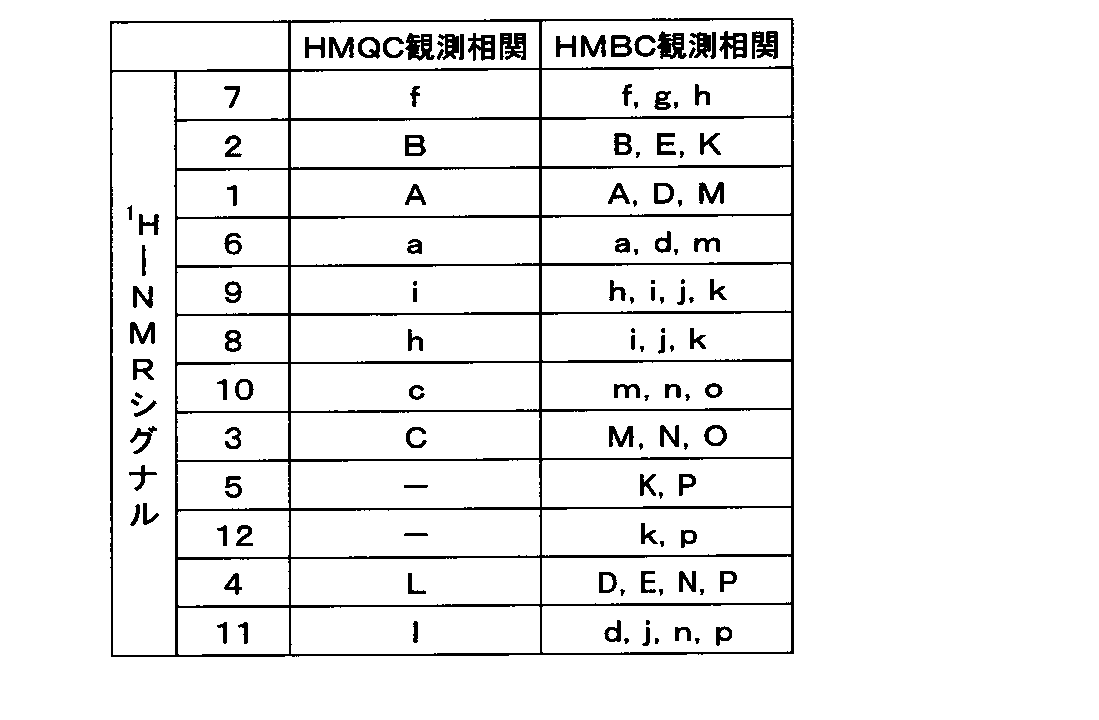
以上の分析結果から、実験例1で得られた化合物Aは、下記式(1A)で表される、環構造中に嵩高い置換基を有し、かつ、非対称構造を有する新規なジヒドロキシビフェニル化合物であることを確認した。
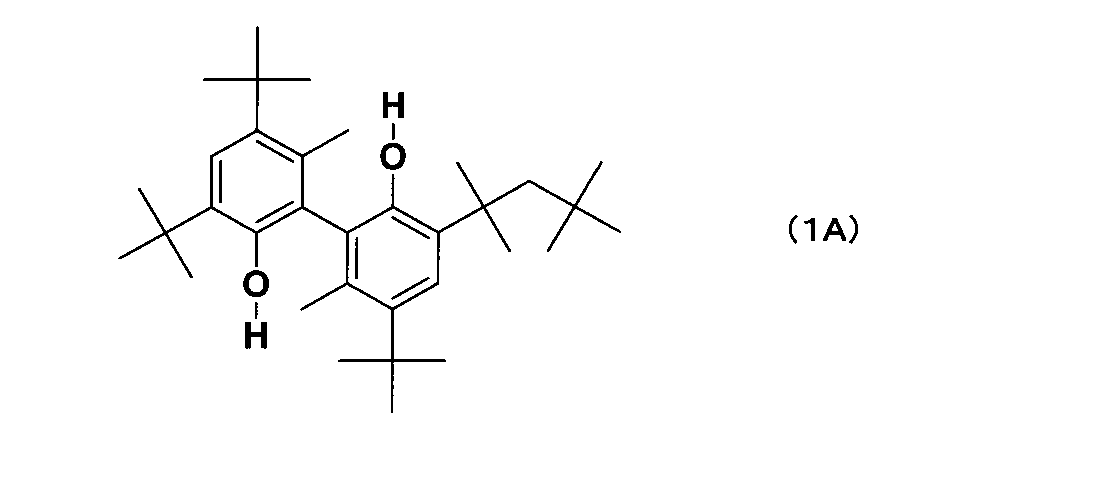
[実施例2:本発明のビスホスファイト化合物(化合物B)の製造]
実施例1において得られた化合物A(1.08g、2.18mmol)のテトラヒドロフラン溶液(12mL)を調製し、ガラス製反応器に仕込み、窒素雰囲気下、0℃にて撹拌しつつ、市販の金属ナトリウム鉱油分散体(商品名:SD Super FineTM(Sodium 25wt% dispersion in mineral Oil)、東京化成工業株式会社株式会社製)0.466g(ナトリウムとして5.067mmol))を滴下した。その後、65℃に設定したオイルバスを用いて、前記反応器の内容物を4時間加熱して、化合物Aのナトリウム体を含むテトラヒドロフラン溶液を得た。
次に、ビスジエチルアミノクロロホスフィン(1.08g、5.126mmol)のトルエン溶液(14mL)を別に用意したガラス製反応器に仕込み、窒素雰囲気下、温度0℃で撹拌しつつ、得られた化合物Aのナトリウム体を含むテトラヒドロフラン溶液を滴下した。滴下後に、前記反応器の内容物に含まれているテトラヒドロフラン12mLを留去して、化合物Aのアミノホスフィン化体を含むトルエン溶液を得た。
次いで、得られた化合物Aのアミノホスフィン化体を含むトルエン溶液を、別に用意したガラス製反応器に仕込み、窒素雰囲気下、温度0℃で撹拌しつつ、1,4-ジオキサンの塩酸溶液(4mol/L)を6.03g(塩酸ガスとして27.25mmol)滴下したところ、アミン塩酸塩の沈殿物が生成した。前記沈殿物を濾別して得られた濾液を、減圧下にて、余剰の塩酸ガス及び1,4-ジオキサンを留去し、化合物Aのクロロホスフィン化体を含むトルエン溶液を得た。
さらに、得られた化合物Aのクロロホスフィン化体を含むトルエン溶液を、窒素雰囲気下、温度0℃で撹拌しつつ、1-ナフトール(1.257g、8.72mmol)及びトリエチルアミン(0.889g、8.78mmol)のトルエン溶液(6.6mL)を、滴下した後、室温下で3日間静置したところ、アミン塩酸塩の沈殿物が生成した。前記沈殿物を濾別して得られたトルエン溶液の濾液を、50mLの純水を用いて3回水洗した後、硫酸マグネシウムを用いてトルエン相の脱水処理を行った後、濾過法を用いて硫酸マグネシウムを濾別した。次いで、脱水処理後に得られたトルエン相を、エバポレーターを用いて濃縮した後、減圧乾燥して乾固させ、白色粉末(3)1.04gを得た。
<白色固体(3)からの化合物Bの分離>
得られた白色固体(3)(1.04g)をトルエン(4mL)に溶解した後、シリカゲル(商品名:ワコーゲルC-200、富士フィルム和光純薬株式会社製)を充填したクロマト管(内径:3.3cm、シリカゲルの充填長:30cm)に、溶離液としてヘキサン/トルエン=5/1を用いて、オープンカラム精製を行い、クロマト管の溶離液を100mL毎に分取した。16~22本目の溶離液を合わせて、液体クロマトグラフィーを用いて分析したところ、該溶離液には、化合物Bが89.6LC面積%含まれていた。該溶離液を、エバポレーターを用いて濃縮した後、減圧乾燥して乾固させ、化合物Bを含む白色固体(4)0.63gを得た。
得られた白色固体(3)(1.04g)をトルエン(4mL)に溶解した後、シリカゲル(商品名:ワコーゲルC-200、富士フィルム和光純薬株式会社製)を充填したクロマト管(内径:3.3cm、シリカゲルの充填長:30cm)に、溶離液としてヘキサン/トルエン=5/1を用いて、オープンカラム精製を行い、クロマト管の溶離液を100mL毎に分取した。16~22本目の溶離液を合わせて、液体クロマトグラフィーを用いて分析したところ、該溶離液には、化合物Bが89.6LC面積%含まれていた。該溶離液を、エバポレーターを用いて濃縮した後、減圧乾燥して乾固させ、化合物Bを含む白色固体(4)0.63gを得た。
<白色固体(4)からの化合物Bの単離>
得られた化合物Bを含む白色固体(4)から、液体クロマトグラフィー(LC法)を用いて、以下の条件により化合物Bを単離した。
得られた化合物Bを含む白色固体(4)から、液体クロマトグラフィー(LC法)を用いて、以下の条件により化合物Bを単離した。
前記白色固体(4)をアセトニトリルに溶解した後、分取液体クロマトグラフィー(分取LC)を用いて、以下の分取LC条件により、化合物Bを含む溶離液を分取した。
次いで、分取した溶離液を、エバポレーターを用いて濃縮した後、減圧乾燥して乾固させ、化合物Bを得た。
(分取LC条件)
装置:LC-10A(装置名、株式会社島津製作所製)
分取カラム:CAPCELLPAK C18(商品名、株式会社大阪ソーダ製、サイズ:内径20mm×長さ150mm、膜厚5μm)
分析温度:40℃
溶離液:イソプロパノール/アセトニトリル(20/80)
流速:15mL/min
検出器:UV検出器(波長290nm)
注入量:1000μL/回で、11回実施
次いで、分取した溶離液を、エバポレーターを用いて濃縮した後、減圧乾燥して乾固させ、化合物Bを得た。
(分取LC条件)
装置:LC-10A(装置名、株式会社島津製作所製)
分取カラム:CAPCELLPAK C18(商品名、株式会社大阪ソーダ製、サイズ:内径20mm×長さ150mm、膜厚5μm)
分析温度:40℃
溶離液:イソプロパノール/アセトニトリル(20/80)
流速:15mL/min
検出器:UV検出器(波長290nm)
注入量:1000μL/回で、11回実施
<化合物Bの構造同定>
単離した化合物Bについて、液体クロマトグラフ/時間型質量分析装置(LC/TofMS)を用いた分子量及び精密質量測定、及び、各種NMR分析(1H-NMR,13C-NMR、DEPT、HSQC、HMBC、1H-1H COSY)を行った。化合物Bの1H-NMRスペクトルを図2(a)に、13C-NMRスペクトルを図2(b)に示す。
化合物Bの分析結果は次の通りであった。
単離した化合物Bについて、液体クロマトグラフ/時間型質量分析装置(LC/TofMS)を用いた分子量及び精密質量測定、及び、各種NMR分析(1H-NMR,13C-NMR、DEPT、HSQC、HMBC、1H-1H COSY)を行った。化合物Bの1H-NMRスペクトルを図2(a)に、13C-NMRスペクトルを図2(b)に示す。
化合物Bの分析結果は次の通りであった。
(分子量測定及び精密質量測定の結果)
液体クロマトグラフ/時間型質量分析装置(LC/ToFMS)を用いて、ポジティブモードにおいて、m/z=1127.5507([M+H]+)のイオンピークを観測したことより、化合物Bの分子量は1127.5であると判断した。また、このイオンピークに関する精密質量測定の結果は1127.5508であり、理論値との誤差が-0.1mDa、-0.1ppmの範囲内に収まっていたことから、化合物Bの組成式は、C74H80O6P2と推定した。
液体クロマトグラフ/時間型質量分析装置(LC/ToFMS)を用いて、ポジティブモードにおいて、m/z=1127.5507([M+H]+)のイオンピークを観測したことより、化合物Bの分子量は1127.5であると判断した。また、このイオンピークに関する精密質量測定の結果は1127.5508であり、理論値との誤差が-0.1mDa、-0.1ppmの範囲内に収まっていたことから、化合物Bの組成式は、C74H80O6P2と推定した。
(1H-NMR測定結果(CDCl3,TMS))
下記式(γ)で表される構造式に基づき、1H-NMRスペクトル上に観察されたピークを同定した。
δ0.75(9H,s,式(γ)の6のシグナル),δ1.17(18H,s,式(γ)の1と5のシグナル),δ1.34(3H,s,式(γ)の8のシグナル),δ1.40(9H,s,式(γ)の2のシグナル),δ1.43(2H,s,式(γ)の8のシグナル),δ1.50(1H,d,J=14.9Hz,式(γ)の7のシグナル),δ2.03(3H,s,式(γ)の3のシグナル),δ2.10(3H,s,式(γ)の9のシグナル),δ2.71(1H,d,J=14.6Hz,式(γ)の7のシグナル),δ6.88(1H,d,J=7.80Hz,式(γ)の12のシグナル),δ6.95(1H,d,J=7.96Hz,式(γ)の12のシグナル),δ7.02(1H,d,J=7.80Hz,式(γ)の11のシグナル),δ7.06-7.34(14H,m,式(γ)の11,12,13,15,16のシグナル),δ7.38(1H,d,J=8.29,式(γ)の13のシグナル),δ7.51(1H,s,式(γ)の4のシグナル),δ7.52(1H,s,式(γ)の10のシグナル),δ7.58(1H,d,J=7.96,式(γ)の14のシグナル),δ7.61(1H,d,J=7.96,式(γ)の14のシグナル),δ7.64(1H,d,J=7.96,14のシグナル),δ7.65(1H,d,J=7.96,式(γ)の14のシグナル),δ7.76(1H,d,J=8.29,式(γ)の17のシグナル),δ7.82(1H,d,J=8.29,式(γ)の17のシグナル),δ7.84(1H,d,J=8.29,式(γ)の17のシグナル),δ7.88(1H,d,J=8.29,式(γ)の17のシグナル)
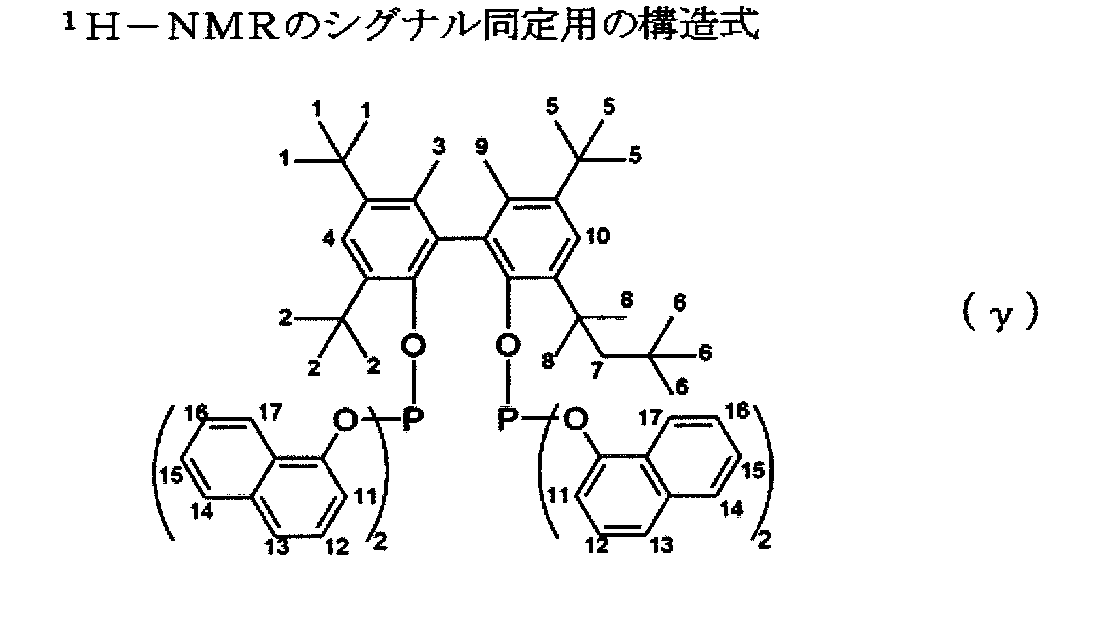
(13C-NMR測定結果)
下記式(ε)で表される構造式に基づき、13C-NMRスペクトル上に観察されたピークを同定した。
δ19.87,19.91(式(ε)のCのシグナル),δ19.94,19.97(式(ε)のcのシグナル),δ30.65(式(ε)のBのシグナル),30.73(式(ε)のiのシグナル),δ31.00(式(ε)のfのシグナル),δ31.11(式(ε)のAのシグナル),δ31.87(式(ε)のaのシグナル),δ31.92(式(ε)のiのシグナル),δ32.51(式(ε)のgのシグナル),δ35.34(式(ε)のEのシグナル),δ35.81(式(ε)のdのシグナル),δ35.88(式(ε)のDのシグナル),δ39.73(式(ε)のjのシグナル),δ53.25(式(ε)のhのシグナル),δ112.99,δ113.09,δ113.26,δ113.37,δ113.46,δ113.56,δ113.65,δ113.74(式(ε)のRのシグナル),δ122.45(式(ε)のY,Tのシグナル),δ122.49(式(ε)のTのシグナル),δ122.53(式(ε)のYのシグナル),δ122.61(式(ε)のY,Tのシグナル),δ122.65(式(ε)のYのシグナル),δ124.86,δ124.96,δ125.03,δ125.08(式(ε)のXのシグナル),δ125.10,δ125.18,δ125.23,δ125.31(式(ε)のSのシグナル),δ125.83,δ125.97,δ126.04(式(ε)のWのシグナル),δ126.26(式(ε)のlのシグナル),δ126.52,126.68,126.82(式(ε)のZのシグナル),δ127.08,δ127.11,δ127.18(式(ε)のVのシグナル),δ127.52(式(ε)のLのシグナル),δ131.72(式(ε)のoのシグナル),δ131.87(式(ε)のOのシグナル),δ134.46,δ134.56,δ134.60(式(ε)のUのシグナル),δ135.71(式(ε)のnのシグナル),δ135.99(式(ε)のNのシグナル),δ136.31(式(ε)のkのシグナル),δ137.17(式(ε)のKのシグナル),δ143.38(式(ε)のmのシグナル),δ143.57(式(ε)のMのシグナル),δ148.13,δ148.20(式(ε)のQのシグナル),δ149.73(式(ε)のpのシグナル),δ149.81(式(ε)のPのシグナル)
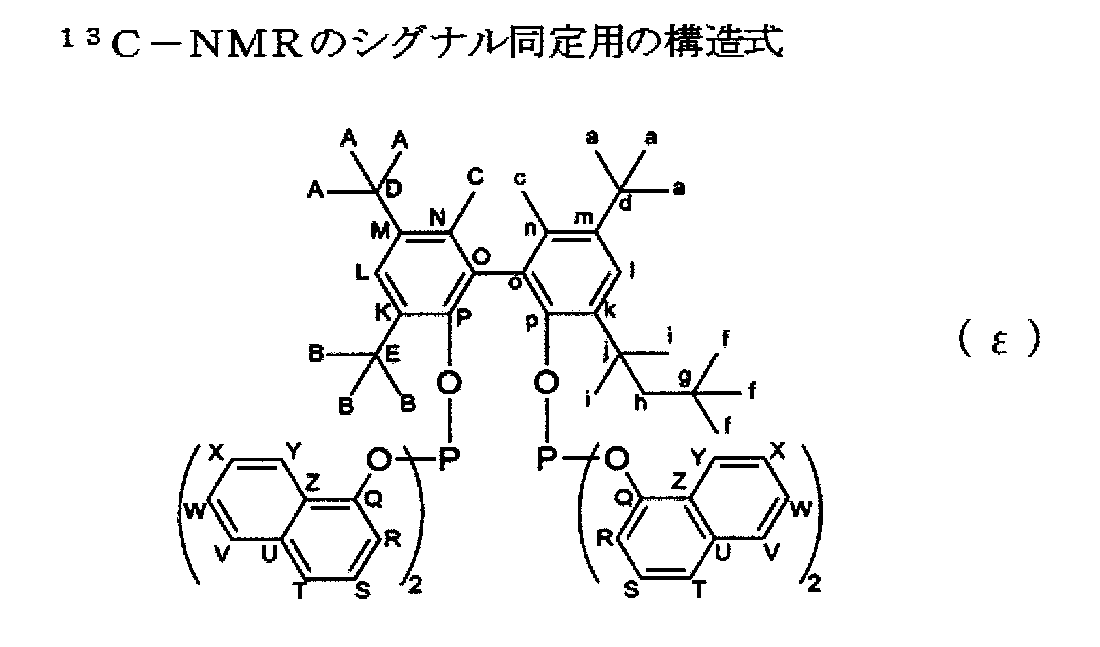
(DEPT測定結果)
前記13C-NMRスペクトルにおける、D,E,g,j,K,k,M,m,N,n,O,o,P,p,Q,U,Zのシグナルが消失し、hのシグナルが逆向きに出現することを確認した。
前記13C-NMRスペクトルにおける、D,E,g,j,K,k,M,m,N,n,O,o,P,p,Q,U,Zのシグナルが消失し、hのシグナルが逆向きに出現することを確認した。
(HMQ、CHMBC及び1H-1H COSY測定結果)
HMQ、CHMBC及び1H-1H COSYの測定結果を下記表3に示す。
HMQ、CHMBC及び1H-1H COSYの測定結果を下記表3に示す。
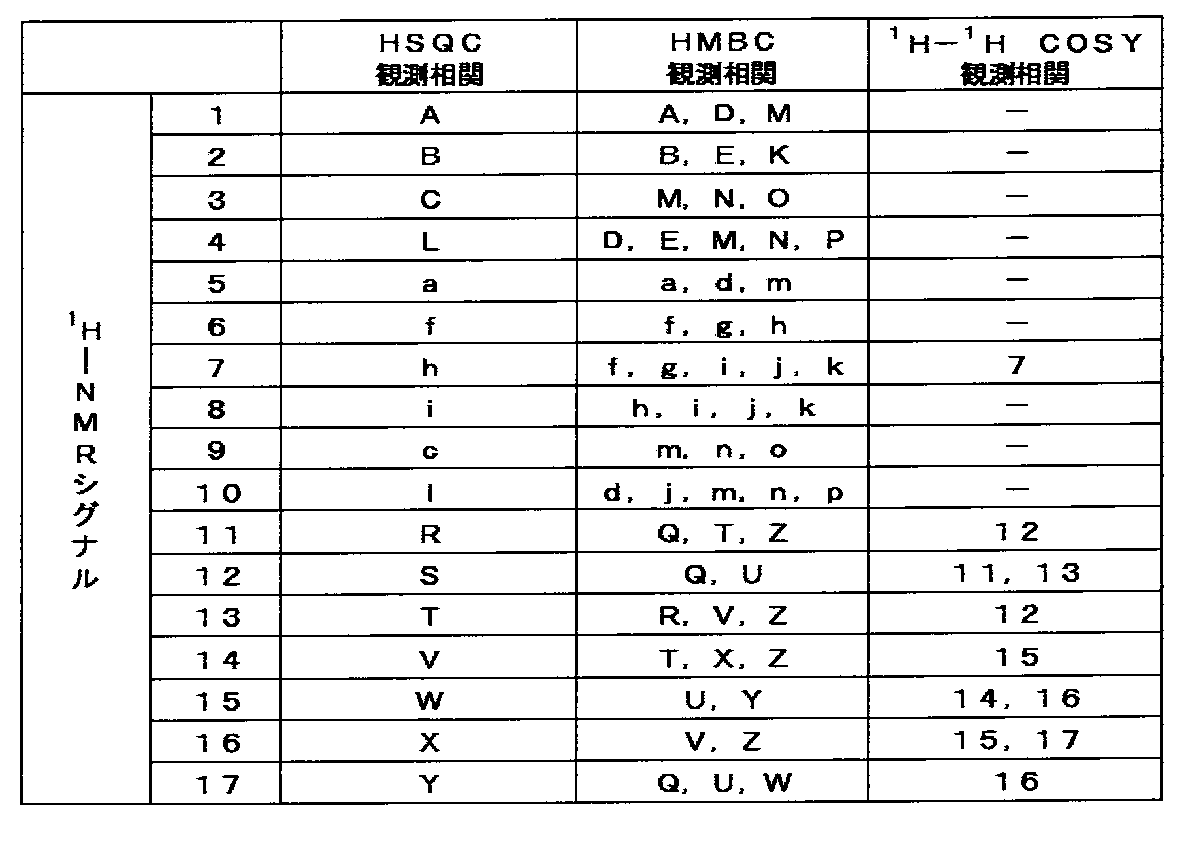
(IR測定結果、単位:cm-1)
IR測定結果は以下の通りであった。
567(w),594(w),702(w),729(w),766(s),793(s),872(m),891(m),906(w),1012(s),1026(m),1039(m),1078(m),1153(w),1169(w),1225(s),1257(s),1360(w),1388(s),1444(w),1460(m),1506(w),1574(m),1595(w),1745(m),2870(m),2951(m),3051(w)
IR測定結果は以下の通りであった。
567(w),594(w),702(w),729(w),766(s),793(s),872(m),891(m),906(w),1012(s),1026(m),1039(m),1078(m),1153(w),1169(w),1225(s),1257(s),1360(w),1388(s),1444(w),1460(m),1506(w),1574(m),1595(w),1745(m),2870(m),2951(m),3051(w)
以上の分析結果から、実施例2で得られた化合物Bは、下記式(1B)で表される、環構造中に嵩高い置換基を有し、かつ、非対称構造を有する新規なビスホスファイト化合物であることを確認した。
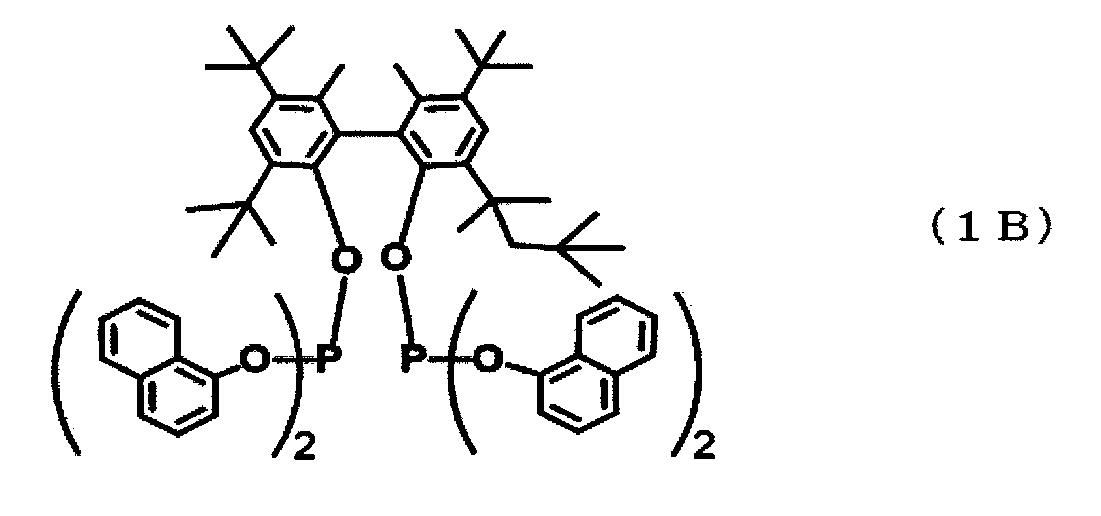
[実施例3:アルデヒドの製造]
本発明のビスホスファイト化合物を用いて、以下の手順に従い、プロピレンを原料としてヒドロホルミル化反応を行い、アルデヒドの製造評価を行った。
本発明のビスホスファイト化合物を用いて、以下の手順に従い、プロピレンを原料としてヒドロホルミル化反応を行い、アルデヒドの製造評価を行った。
内容積50mLのステンレス鋼製誘導撹拌型オートクレーブの内部を十分に乾燥した後、該オートクレーブ内の窒素置換を3回行った。
別途用意したガラス製容器に、窒素雰囲気下で、ヒドロホルミル化反応触媒のRh源として[Rh(OAc)(cod)]2を4.84mg(Rhとして0.0179mmol)、及び、ヒドロホルミル化反応触媒の配位子として、本発明のビスホスファイト化合物である実施例2で製造した化合物Bを80.4mg(0.0713mmol、Rhに対する配位子Lのモル比率(L/Rh比率)=4)加え、更に、溶媒としてトルエンを14.0mL(12.040g)、及び、ガスクロマトグラフィーの内部標準物質としてn-ドデカンを1.0mL(0.750g)加えた後、撹拌して、触媒液を調製した。
別途用意したガラス製容器に、窒素雰囲気下で、ヒドロホルミル化反応触媒のRh源として[Rh(OAc)(cod)]2を4.84mg(Rhとして0.0179mmol)、及び、ヒドロホルミル化反応触媒の配位子として、本発明のビスホスファイト化合物である実施例2で製造した化合物Bを80.4mg(0.0713mmol、Rhに対する配位子Lのモル比率(L/Rh比率)=4)加え、更に、溶媒としてトルエンを14.0mL(12.040g)、及び、ガスクロマトグラフィーの内部標準物質としてn-ドデカンを1.0mL(0.750g)加えた後、撹拌して、触媒液を調製した。
次いで、前記オートクレーブ内に精製窒素ガスを用いて上記の触媒液を圧入した後、オートクレーブを密閉した。なお、触媒液中のヒドロホルミル化反応触媒の濃度は、Rh換算濃度として122mg/Lであった。
窒素ガスを用いて、前記オートクレーブ内を、窒素ガスの内圧が2.0MPaGとなるようにして3回窒素置換した後、窒素ガスを放圧し、オートクレーブ内にプロピレンガスを1.5g圧入した。次いで、オートクレーブ内における反応温度が70℃となるまで昇温し、さらに、オキソガス(H2/CO=1/1、反応初期のオキソガス分圧として0.6MPaG)をオートクレーブ内における反応圧力がプロピレンの自圧を含めて1.0MPaGとなるように圧入した後、この圧力及び温度を維持て、ヒドロホルミル化反応を1.5時間行った。なお、ヒドロホルミル化反応で消費された分のオキソガスは、二次圧力調整器を介して蓄圧器からオートクレーブ内に自動的に補給され、常にオートクレーブ内の圧力が1.0MPaGを維持するように反応を実施した。
窒素ガスを用いて、前記オートクレーブ内を、窒素ガスの内圧が2.0MPaGとなるようにして3回窒素置換した後、窒素ガスを放圧し、オートクレーブ内にプロピレンガスを1.5g圧入した。次いで、オートクレーブ内における反応温度が70℃となるまで昇温し、さらに、オキソガス(H2/CO=1/1、反応初期のオキソガス分圧として0.6MPaG)をオートクレーブ内における反応圧力がプロピレンの自圧を含めて1.0MPaGとなるように圧入した後、この圧力及び温度を維持て、ヒドロホルミル化反応を1.5時間行った。なお、ヒドロホルミル化反応で消費された分のオキソガスは、二次圧力調整器を介して蓄圧器からオートクレーブ内に自動的に補給され、常にオートクレーブ内の圧力が1.0MPaGを維持するように反応を実施した。
ヒドロホルミル化反応終了後、オートクレーブ内の温度が室温(25℃)となるまで冷却し、オートクレーブ内から回収した気相及び液相について、ガスクロマトグラフィーを用いて成分分析を行なった。
分析の結果、反応速度定数(k)は2.8h-1、n-ブチルアルデヒドとi-ブチルアルデヒドの合計の選択率は97.8%、n-ブチルアルデヒドとi-ブチルアルデヒドとのモル比率(n/i)は75.1であった。
分析の結果、反応速度定数(k)は2.8h-1、n-ブチルアルデヒドとi-ブチルアルデヒドの合計の選択率は97.8%、n-ブチルアルデヒドとi-ブチルアルデヒドとのモル比率(n/i)は75.1であった。
[比較例1:アルデヒドの製造]
比較例として、ホスファイト置換基のo-位にt-Bu基のみを有する対称型ビスホスファイト化合物を用いて、以下の手順に従い、プロピレンを原料としてヒドロホルミル化反応を行い、アルデヒドの製造評価を行った。
比較例として、ホスファイト置換基のo-位にt-Bu基のみを有する対称型ビスホスファイト化合物を用いて、以下の手順に従い、プロピレンを原料としてヒドロホルミル化反応を行い、アルデヒドの製造評価を行った。
実施例3において、化合物B 80.4mgを、前記ホスファイト配位子A 76.4mg(0.0713mmol、Rhに対する配位子Lの比率=4)に変更した以外は、実施例3と同様の条件でヒドロホルミル化反応を行ない、アルデヒドを製造した。
実施例3と同様の方法により評価した結果、反応速度定数(k)は2.8h-1、n-ブチルアルデヒドとi-ブチルアルデヒドの合計の選択率は98.5%、n-ブチルアルデヒドとi-ブチルアルデヒドとのモル比率(n/i比)は70.4であった。
[実施例4~5、比較例2~3:アルデヒドの製造]
実施例3において、ビスホスファイト化合物の種類や、L/Rh比率、反応温度、反応圧力、反応時間を表4記載のとおりに変更した以外は、実施例3と同様の条件でヒドロホルミル化反応を行ない、アルデヒドを製造した。
実施例3と同様の方法により評価した結果を、表4に示した。
実施例3において、ビスホスファイト化合物の種類や、L/Rh比率、反応温度、反応圧力、反応時間を表4記載のとおりに変更した以外は、実施例3と同様の条件でヒドロホルミル化反応を行ない、アルデヒドを製造した。
実施例3と同様の方法により評価した結果を、表4に示した。
[実施例6]
実施例3において、化合物Bを、化合物Bとホスファイト配位子Aの混合物(モル比:50/50)に変更した以外は、実施例3と同様の条件でヒドロホルミル化反応を行ない、アルデヒドを製造した。
実施例3と同様の方法により評価した結果を、表4に示した。
実施例3において、化合物Bを、化合物Bとホスファイト配位子Aの混合物(モル比:50/50)に変更した以外は、実施例3と同様の条件でヒドロホルミル化反応を行ない、アルデヒドを製造した。
実施例3と同様の方法により評価した結果を、表4に示した。
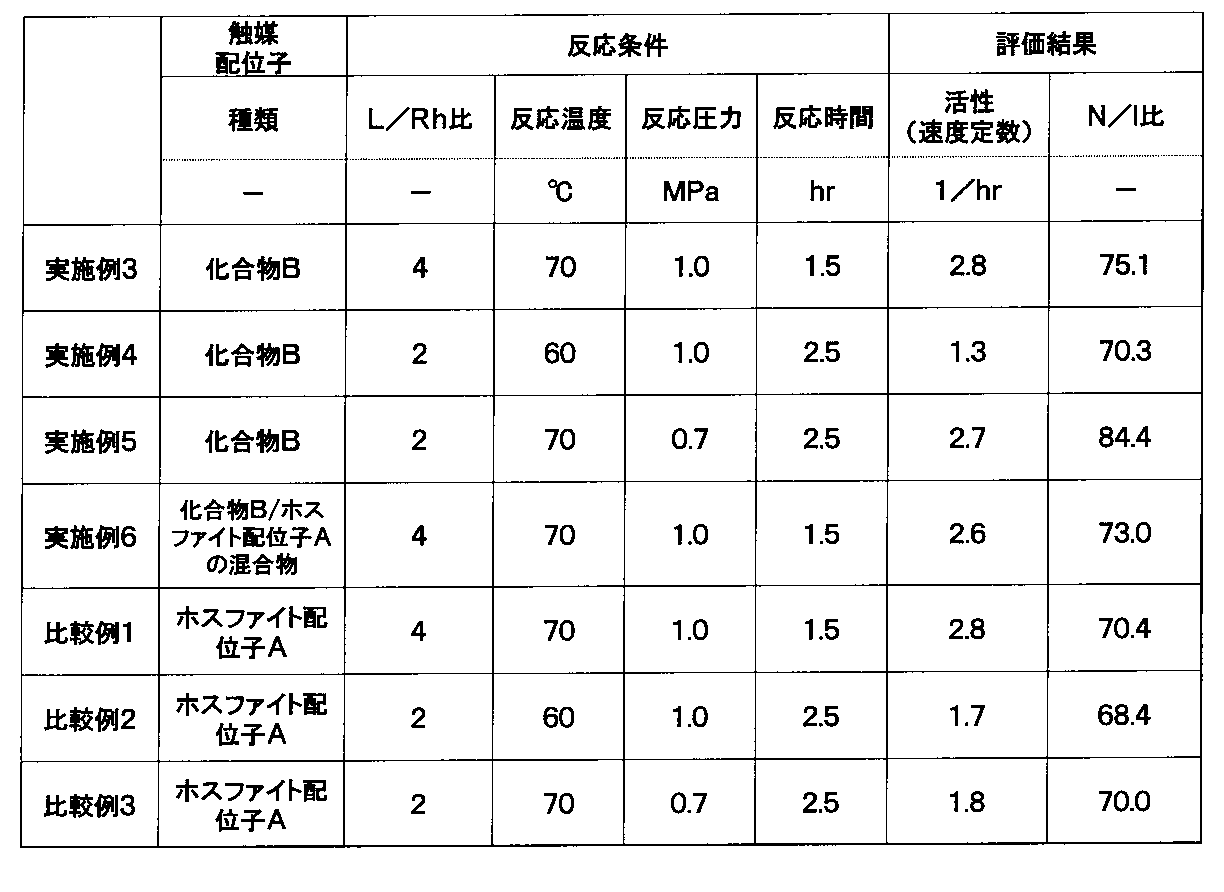
以上の評価結果から、本発明の新規ビスホスファイト化合物を、ヒドロホルミル化反応における触媒の配位子として用いた場合、ヒドロホルミル化反応の反応活性を良好に維持しつつ、直鎖型のアルデヒドを効率的に製造できることが分かる。
(熱安定性試験)
以下の熱安定性試験は、ヒドロホルミル化反応後に生成したアルデヒドを蒸留分離し、配位子(ビスホスファイト化合物)を含む触媒液を反応器にリサイクルする一連の工程を想定し、配位子の熱安定性を調べたものである。
以下の熱安定性試験は、ヒドロホルミル化反応後に生成したアルデヒドを蒸留分離し、配位子(ビスホスファイト化合物)を含む触媒液を反応器にリサイクルする一連の工程を想定し、配位子の熱安定性を調べたものである。
[実施例7:本発明のビスホスファイト化合物の熱安定性試験]
本発明のビスホスファイト化合物について、以下の手順に従い、熱安定性評価を行った。
本発明のビスホスファイト化合物について、以下の手順に従い、熱安定性評価を行った。
内容積100mLのステンレス鋼製誘導撹拌型オートクレーブの内部を十分に乾燥した後、該オートクレーブ内の窒素置換を3回行った。
別途用意したガラス製容器に、窒素雰囲気下で、40mLのn-ブチルアルデヒド(溶媒)、及び、ヒドロホルミル化反応触媒のRh源として[Rh(OAc)(cod)]2 18.0mg(Rhとして0.067mmol)と、ヒドロホルミル化反応触媒の配位子として、実施例2で製造した化合物B 0.151g(0.134mmol、Rhに対する配位子中のリン原子のモル比率(P/Rh比率)=2.01)の触媒混合溶液を調製した。次いで、前記オートクレーブ内に精製窒素ガスを用いて上記の触媒混合溶液を圧入した後、オートクレーブを密閉した。
別途用意したガラス製容器に、窒素雰囲気下で、40mLのn-ブチルアルデヒド(溶媒)、及び、ヒドロホルミル化反応触媒のRh源として[Rh(OAc)(cod)]2 18.0mg(Rhとして0.067mmol)と、ヒドロホルミル化反応触媒の配位子として、実施例2で製造した化合物B 0.151g(0.134mmol、Rhに対する配位子中のリン原子のモル比率(P/Rh比率)=2.01)の触媒混合溶液を調製した。次いで、前記オートクレーブ内に精製窒素ガスを用いて上記の触媒混合溶液を圧入した後、オートクレーブを密閉した。
次いで、前記オートクレーブ内の内容物を攪拌しながら、オキソガス(H2/CO=1/1)を、オートクレーブの内圧が0.1MPaGとなるように圧入した後、オートクレーブ内の内部温度を70℃まで昇温し、この温度を維持しながら30分間撹拌した。
次いで、オートクレーブ内の温度を室温(25℃)まで冷却し、オートクレーブ内のオキソガスをパージした後、窒素雰囲気下でオートクレーブ内から分析用の初期サンプルを採取した。次いで、オートクレーブ内を、窒素ガスの内圧が0.5MPaGとなるようにして3回窒素置換することにより、オートクレーブ内の反応溶液中のオキソガスと気相中のオキソガスを窒素ガスに置換した後、オートクレーブ内に内圧が0.1MPaGとなるように窒素ガスを圧入した。
次いで、オートクレーブ内の温度を室温(25℃)まで冷却し、オートクレーブ内のオキソガスをパージした後、窒素雰囲気下でオートクレーブ内から分析用の初期サンプルを採取した。次いで、オートクレーブ内を、窒素ガスの内圧が0.5MPaGとなるようにして3回窒素置換することにより、オートクレーブ内の反応溶液中のオキソガスと気相中のオキソガスを窒素ガスに置換した後、オートクレーブ内に内圧が0.1MPaGとなるように窒素ガスを圧入した。
次いで、オートクレーブ内の温度を130℃まで昇温し、この温度を維持しながら、加熱撹拌を行った。前記温度が130℃に到達してから、88時間後、183時間後、231時間後に、それぞれオートクレーブ内の温度を室温(25℃)まで冷却し、オートクレーブ内の窒素ガスをパージした後、窒素雰囲気下でオートクレーブ内から分析用のサンプルを採取した。分析用サンプルの採取後、オートクレーブ内に内圧が0.1MPaGとなるように窒素ガスを圧入した後、オートクレーブ内の温度を130℃まで昇温し、この温度を維持しながら所定の時間まで、加熱撹拌を行った。
取得した分析用のサンプルについて、液体クロマトグラフィーを用いて、下記の液体クロマトグラム測定条件により、化合物Bの分解率を測定した結果、88時間後、183時間後、231時間後の化合物Bの分解率は、それぞれ11.7LC面積%、21.4LC面積%、26.6LC面積%であった。
尚、化合物Bの分解率は、前記初期サンプルの液体クロマトグラムにおける化合物Bのピーク面積に対する、88時間後、183時間後、231時間後に取得したサンプルの液体クロマトグラムにおける化合物Bのピーク面積の減少割合(単位:面積%)である。
取得した分析用のサンプルについて、液体クロマトグラフィーを用いて、下記の液体クロマトグラム測定条件により、化合物Bの分解率を測定した結果、88時間後、183時間後、231時間後の化合物Bの分解率は、それぞれ11.7LC面積%、21.4LC面積%、26.6LC面積%であった。
尚、化合物Bの分解率は、前記初期サンプルの液体クロマトグラムにおける化合物Bのピーク面積に対する、88時間後、183時間後、231時間後に取得したサンプルの液体クロマトグラムにおける化合物Bのピーク面積の減少割合(単位:面積%)である。
(液体クロマトグラム測定条件)
高速液体クロマトグラム測定装置:LC-20A(装置名、株式会社島津製作所製)
脱気:オンラインデガッサー
分析カラム:Inertsil ODS-2
非極性固定相(商品名、カラムサイズ:内径4.6mm×カラム長:250mm、膜厚:5μm、ジーエルサイエンス株式会社製)
カラム温度:40℃
溶離液:トルエン:アセトニトリル=10:90(重量比)
溶離液の流速:0.85mL/min
検出器:紫外可視吸光度検出器(検出波長:290nm)
試料注入量:5μL
高速液体クロマトグラム測定装置:LC-20A(装置名、株式会社島津製作所製)
脱気:オンラインデガッサー
分析カラム:Inertsil ODS-2
非極性固定相(商品名、カラムサイズ:内径4.6mm×カラム長:250mm、膜厚:5μm、ジーエルサイエンス株式会社製)
カラム温度:40℃
溶離液:トルエン:アセトニトリル=10:90(重量比)
溶離液の流速:0.85mL/min
検出器:紫外可視吸光度検出器(検出波長:290nm)
試料注入量:5μL
[比較例4:ホスファイト配位子Aの熱安定性試験]
比較例として、ホスファイト置換基のo-位にt-Bu基のみを有する対称型ビスホスファイト化合物について、以下の手順に従い、熱安定性評価を行った。
比較例として、ホスファイト置換基のo-位にt-Bu基のみを有する対称型ビスホスファイト化合物について、以下の手順に従い、熱安定性評価を行った。
実施例7において、化合物B 0.151gを、ホスファイト配位子A 0.143g(0.134mmol)に変更したこと以外は、実施例7と同様の条件を用いて、ビスホスファイト化合物の熱分解率を評価した。
その結果、88時間後、183時間後、231時間後のビスホスファイト化合物の分解率は、それぞれ14.3LC面積%、30.9LC面積%、39.0LC面積%であった。
その結果、88時間後、183時間後、231時間後のビスホスファイト化合物の分解率は、それぞれ14.3LC面積%、30.9LC面積%、39.0LC面積%であった。
実施例7及び比較例4の結果を下記表5にまとめて示す。

以上の評価結果から、本発明の新規ビスホスファイト化合物を、ヒドロホルミル化反応における触媒の配位子として用いた触媒は、耐熱分解性に優れていることが分かる。加熱条件に晒されるアルデヒドの蒸留工程や、触媒や触媒配位子をヒドロホルミル化反応にリサイクルする工程を有しているプロセスにおいて、本発明のビスホスファイト化合物は、安定に存在できることから、工業的に優れた配位子であることが分かる。
本発明を詳細にまた特定の実施態様を参照して説明したが、本発明の精神と範囲を逸脱することなく様々な変更や修正を加えることができることは当業者にとって明らかである。
本出願は、2023年4月12日付で出願された日本特許出願2023-065067及び、2024年2月2日付で出願された日本特許出願2024-015052に基づいており、その全体が引用により援用される。
本出願は、2023年4月12日付で出願された日本特許出願2023-065067及び、2024年2月2日付で出願された日本特許出願2024-015052に基づいており、その全体が引用により援用される。
本発明によれば、環構造中に嵩高い置換基を有し、かつ、非対称構造を有する新規なジヒドロキシビフェニル化合物を提供できる。
本発明のジヒドロキシビフェニル化合物を原料にして製造されるビスホスファイト化合物を配位子として金属成分と共に用いた触媒を用いることにより、ヒドロホルミル化反応において、極めて優れた直鎖型のアルデヒド異性体選択性を得ることができる。
本発明のジヒドロキシビフェニル化合物を原料にして製造されるビスホスファイト化合物を配位子として金属成分と共に用いた触媒を用いることにより、ヒドロホルミル化反応において、極めて優れた直鎖型のアルデヒド異性体選択性を得ることができる。
Claims (27)
- 下記一般式(1)で表されるジヒドロキシビフェニル化合物。

Xは、4~20個の炭素原子を有するアルキレン基であり、
R1及びR11は、それぞれ独立に、水素原子、1~20個の炭素原子を有するアルキル基及び3~20個の炭素原子を有するシクロアルキル基からなる群から選ばれるものを表し、R1とX-R11とは互いに異なる。
R2及びR12は、それぞれ独立に、水素原子、1~20個の炭素原子を有するアルキル基、1~20個の炭素原子を有するアルコキシ基、3~20個の炭素原子を有するシクロアルキル基、3~20個の炭素原子を有するシクロアルコキシ基、2~20個の炭素原子を有するジアルキルアミノ基、6~20個の炭素原子を有するアリール基、6~20個の炭素原子を有するアリールオキシ基、7~20個の炭素原子を有するアルキルアリール基、7~20個の炭素原子を有するアルキルアリールオキシ基、7~20個の炭素原子を有するアリールアルキル基、7~20個の炭素原子を有するアリールアルコキシ基、シアノ基、ヒドロキシ基及びハロゲン原子からなる群から選ばれるものを表し、
R3及びR13は、それぞれ独立に、水素原子、1~20個の炭素原子を有するアルキル基、3~20個の炭素原子を有するシクロアルキル基、6~20個の炭素原子を有するアリール基、7~20個の炭素原子を有するアルキルアリール基及び7~20個の炭素原子を有するアリールアルキル基からなる群から選ばれるものを表し、
R4及びR14は、それぞれ独立に、水素原子、1~12個の炭素原子を有するアルキル基、3~12個の炭素原子を有するシクロアルキル基、1~12個の炭素原子を有するアルコキシ基、シリル基、シロキシ基及びハロゲン原子からなる群から選ばれるものを表す。) - 前記Xが、第4級炭素原子を含む4~20個の炭素原子を有するアルキレン基である、請求項1に記載のジヒドロキシビフェニル化合物。
- 前記Xが、第4級炭素原子を含む4~5個の炭素原子を有するアルキレン基である、請求項2に記載のジヒドロキシビフェニル化合物。
- 前記Xが、下記式(1X)で表される構造単位を有するアルキレン基である、請求項3に記載のジヒドロキシビフェニル化合物。
-C(CH3)2-CH2- (1X) - 前記R1及びR11が、それぞれ独立に、4~20個の炭素原子を有する第3級アルキル基であり、
前記R2及びR12が水素原子であり、 前記R3及びR13が、それぞれ独立に、4~20個の炭素原子を有する第3級アルキル基であり、
前記R4及びR14が、それぞれ独立に、水素原子、1~3個の炭素原子を有するアルキル基、1~3個の炭素原子を有するアルコキシ基及びハロゲン原子からなる群から選ばれるものである、請求項1~4のいずれか一項に記載のジヒドロキシビフェニル化合物。 - 前記R1、R11、R3及びR13が、それぞれ独立に、4~7個の炭素原子を有する第3級アルキル基であり、
前記R4及びR14が、それぞれ独立に、1~3個の炭素原子を有するアルキル基である、請求項5に記載のジヒドロキシビフェニル化合物。 - 前記R1、R11、R3及びR13がt-ブチル基であり、 前記R4及びR14がメチル基である、請求項6に記載のジヒドロキシビフェニル化合物。
- 下記一般式(2)で表されるビスホスファイト化合物。
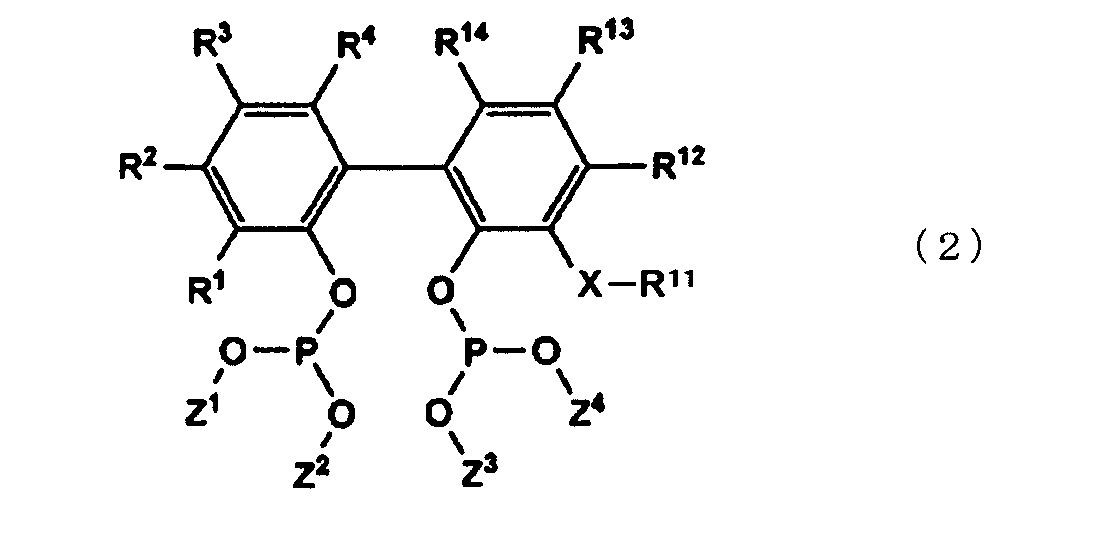
Xは、4~20個の炭素原子を有するアルキレン基であり、
R1及びR11は、それぞれ独立に、水素原子、1~20個の炭素原子を有するアルキル基及び3~20個の炭素原子を有するシクロアルキル基からなる群から選ばれるものを表し、R1とX-R11とは互いに異なる。
R2及びR12は、それぞれ独立に、水素原子、1~20個の炭素原子を有するアルキル基、1~20個の炭素原子を有するアルコキシ基、3~20個の炭素原子を有するシクロアルキル基、3~20個の炭素原子を有するシクロアルコキシ基、2~20個の炭素原子を有するジアルキルアミノ基、6~20個の炭素原子を有するアリール基、6~20個の炭素原子を有するアリールオキシ基、7~20個の炭素原子を有するアルキルアリール基、7~20個の炭素原子を有するアルキルアリールオキシ基、7~20個の炭素原子を有するアリールアルキル基、7~20個の炭素原子を有するアリールアルコキシ基、シアノ基、ヒドロキシ基及びハロゲン原子からなる群から選ばれるものを表し、
R3及びR13は、それぞれ独立に、水素原子、1~20個の炭素原子を有するアルキル基、3~20個の炭素原子を有するシクロアルキル基、6~20個の炭素原子を有するアリール基、7~20個の炭素原子を有するアルキルアリール基及び7~20個の炭素原子を有するアリールアルキル基からなる群から選ばれるものを表し、
R4及びR14は、それぞれ独立に、水素原子、1~12個の炭素原子を有するアルキル基、3~12個の炭素原子を有するシクロアルキル基、1~12個の炭素原子を有するアルコキシ基、シリル基、シロキシ基及びハロゲン原子からなる群から選ばれるものを表す。
Z1~Z4は、それぞれ独立に、6~20個の炭素原子を有するアリール基を表し、置換基を有していてもよく、該置換基同士が結合して環を形成していてもよい。また、Z1
とZ2、並びに、Z3とZ4は、いずれも互いに結合していなくてもよいし、互いに結合して環構造を形成してもよい。) - 前記Xが、第4級炭素原子を含む4~20個の炭素原子を有するアルキレン基である、請求項8に記載のビスホスファイト化合物。
- 前記Xが、第4級炭素原子を含む4~5個の炭素原子を有するアルキレン基である、請求項9に記載のビスホスファイト化合物。
- 前記Xが、下記式(1X)で表される構造単位を有するアルキレン基である、請求項10に記載のビスホスファイト化合物。
-C(CH3)2-CH2- (1X) - 前記R1及びR11が、それぞれ独立に、4~20個の炭素原子を有する第3級アルキル基であり、
前記R2及びR12が水素原子であり、前記R3及びR13が、それぞれ独立に、4~20個の炭素原子を有する第3級アルキル基であり、
前記R4及びR14が、それぞれ独立に、水素原子、1~3個の炭素原子を有するアルキル基、1~3個の炭素原子を有するアルコキシ基及びハロゲン原子からなる群から選ばれるものである、請求項8~11のいずれか一項に記載のビスホスファイト化合物。 - 前記Z1~Z4が、それぞれ独立に、酸素原子と結合する炭素原子に隣接する芳香環炭素原子に置換基を有さないか、又は該芳香環炭素原子に、0~2個の炭素原子を有する置換基を有する、請求項8~11のいずれか一項に記載のビスホスファイト化合物。
- 前記R1、R11、R3及びR13が、それぞれ独立に、4~7個の炭素原子を有する第3級アルキル基であり、
前記R4及びR14が、それぞれ独立に、1~3個の炭素原子を有するアルキル基である、請求項12に記載のビスホスファイト化合物。 - 前記Z1~Z4が、それぞれ独立に、1-ナフチル基又は2-ナフチル基である、請求項8~11のいずれか一項に記載のビスホスファイト化合物。
- 前記R1、R11、R3及びR13がt-ブチル基であり、前記R4及びR14がメチル基である、請求項14に記載のビスホスファイト化合物。
- 請求項8~11のいずれか一項に記載のビスホスファイト化合物と第8~10族金属との錯体を含む触媒。
- 前記第8~10族金属に対する前記ビスホスファイト化合物のモル比が、0.00004~500である、請求項17に記載の触媒。
- 前記第8~10族金属に対する前記ビスホスファイト化合物のモル比が、0.0002~100である、請求項18に記載の触媒。
- 前記第8~10族金属に対する前記ビスホスファイト化合物のモル比が、0.001~50である、請求項19に記載の触媒。
- 下記一般式(3)で表されるビスホスファイト化合物、及び、請求項8~11のいずれかに記載のビスホスファイト化合物を含む触媒組成物。
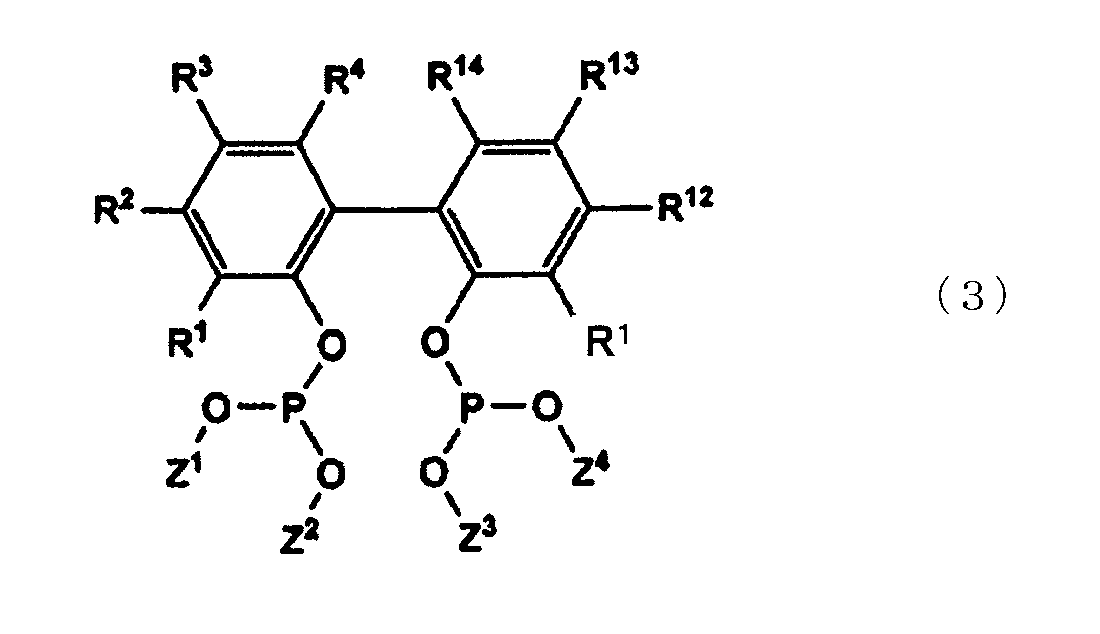
R1、R2及びR12、R3及びR13、R4及びR14、Z1~Z4は、それぞれ、前記一般式(2)におけるR1、R2及びR12、R3及びR13、R4及びR14、Z1~Z4と同義である。) - 前記一般式(3)で表されるビスホスファイト化合物の含有割合が、80.0質量%以上で、請求項8~11のいずれかに記載のビスホスファイト化合物の含有割合が0.01質量%以上である、請求項21に記載の触媒組成物。
- 第8~10族金属化合物及び請求項8~11のいずれかに記載のビスホスファイト化合物の存在下で、オレフィン化合物を一酸化炭素及び水素と反応させるアルデヒドの製造方法。
- 前記第8~10族金属化合物の反応液中の濃度が金属原子換算で0.05~5000mg/Lである、請求項23に記載のアルデヒドの製造方法。
- 請求項23に記載のアルデヒドの製造方法によりアルデヒドを製造した後、該アルデヒドを水素と反応させるアルコールの製造方法。
- 請求項17に記載の触媒の存在下で、オレフィン化合物を一酸化炭素及び水素と反応させるアルデヒドの製造方法。
- 請求項26に記載のアルデヒドの製造方法によりアルデヒドを製造した後、該アルデヒドを水素と反応させるアルコールの製造方法。
Priority Applications (1)
| Application Number | Priority Date | Filing Date | Title |
|---|---|---|---|
| JP2024522144A JP7761142B2 (ja) | 2023-04-12 | 2024-04-10 | ジヒドロキシビフェニル化合物、ビスホスファイト化合物、触媒、触媒組成物、アルデヒドの製造方法及びアルコールの製造方法 |
Applications Claiming Priority (4)
| Application Number | Priority Date | Filing Date | Title |
|---|---|---|---|
| JP2023-065067 | 2023-04-12 | ||
| JP2023065067 | 2023-04-12 | ||
| JP2024-015052 | 2024-02-02 | ||
| JP2024015052 | 2024-02-02 |
Publications (1)
| Publication Number | Publication Date |
|---|---|
| WO2024214743A1 true WO2024214743A1 (ja) | 2024-10-17 |
Family
ID=93059658
Family Applications (1)
| Application Number | Title | Priority Date | Filing Date |
|---|---|---|---|
| PCT/JP2024/014557 Ceased WO2024214743A1 (ja) | 2023-04-12 | 2024-04-10 | ジヒドロキシビフェニル化合物、ビスホスファイト化合物、触媒、触媒組成物、アルデヒドの製造方法及びアルコールの製造方法 |
Country Status (2)
| Country | Link |
|---|---|
| JP (1) | JP7761142B2 (ja) |
| WO (1) | WO2024214743A1 (ja) |
Citations (6)
| Publication number | Priority date | Publication date | Assignee | Title |
|---|---|---|---|---|
| JPS61281239A (ja) * | 1985-06-06 | 1986-12-11 | Konishiroku Photo Ind Co Ltd | ハロゲン化銀カラ−写真感光材料 |
| JPH09114036A (ja) * | 1995-09-19 | 1997-05-02 | Imation Corp | ヒドロキサム酸現像剤を含有する光熱写真成分 |
| US6307108B1 (en) * | 2000-03-15 | 2001-10-23 | Union Carbide Chemicals & Plastics Technology Corporation | Metal-ligand complex catalyzed processes |
| JP2002500620A (ja) * | 1996-04-24 | 2002-01-08 | ユニオン カーバイド ケミカルズ アンド プラスティックス テクノロジー コーポレイション | ヒドロキシアルデヒド類の製造法 |
| JP2015182992A (ja) * | 2014-03-26 | 2015-10-22 | 三井化学株式会社 | 遷移金属化合物、オレフィン重合用触媒、および、オレフィン系重合体の製造方法 |
| WO2019039565A1 (ja) * | 2017-08-24 | 2019-02-28 | 三菱ケミカル株式会社 | ジヒドロキシビフェニル化合物、ビスホスファイト化合物、触媒、アルデヒド類の製造方法及びアルコールの製造方法 |
Family Cites Families (1)
| Publication number | Priority date | Publication date | Assignee | Title |
|---|---|---|---|---|
| EP3029048B1 (de) | 2014-12-04 | 2017-04-12 | Evonik Degussa GmbH | Bisphosphite die einen unsymmetrischen Biphenol-Flügel-Baustein aufweisen |
-
2024
- 2024-04-10 WO PCT/JP2024/014557 patent/WO2024214743A1/ja not_active Ceased
- 2024-04-10 JP JP2024522144A patent/JP7761142B2/ja active Active
Patent Citations (6)
| Publication number | Priority date | Publication date | Assignee | Title |
|---|---|---|---|---|
| JPS61281239A (ja) * | 1985-06-06 | 1986-12-11 | Konishiroku Photo Ind Co Ltd | ハロゲン化銀カラ−写真感光材料 |
| JPH09114036A (ja) * | 1995-09-19 | 1997-05-02 | Imation Corp | ヒドロキサム酸現像剤を含有する光熱写真成分 |
| JP2002500620A (ja) * | 1996-04-24 | 2002-01-08 | ユニオン カーバイド ケミカルズ アンド プラスティックス テクノロジー コーポレイション | ヒドロキシアルデヒド類の製造法 |
| US6307108B1 (en) * | 2000-03-15 | 2001-10-23 | Union Carbide Chemicals & Plastics Technology Corporation | Metal-ligand complex catalyzed processes |
| JP2015182992A (ja) * | 2014-03-26 | 2015-10-22 | 三井化学株式会社 | 遷移金属化合物、オレフィン重合用触媒、および、オレフィン系重合体の製造方法 |
| WO2019039565A1 (ja) * | 2017-08-24 | 2019-02-28 | 三菱ケミカル株式会社 | ジヒドロキシビフェニル化合物、ビスホスファイト化合物、触媒、アルデヒド類の製造方法及びアルコールの製造方法 |
Non-Patent Citations (1)
| Title |
|---|
| INGO LEUPOLD, HANS MUSSO, JAROSLAV VIČAR: "Über Signalverschiebungen in den NMR-Spektren von tert.-Butyl-, tert.-Butyloxy- und Nitro-tert.-butyl-benzolderivaten durch aromatische Lösungsmittel", CHEMISCHE BERICHTE, vol. 104, no. 1, 1 January 1971 (1971-01-01), pages 40 - 49, XP055215155, ISSN: 0009-2940, DOI: 10.1002/cber.19711040107 * |
Also Published As
| Publication number | Publication date |
|---|---|
| JPWO2024214743A1 (ja) | 2024-10-17 |
| JP7761142B2 (ja) | 2025-10-28 |
Similar Documents
| Publication | Publication Date | Title |
|---|---|---|
| TWI432411B (zh) | 用於氫甲醯化方法之杯芳烴雙亞磷酸酯配體 | |
| JP5180819B2 (ja) | ビスホスファイトおよび第8〜10族金属化合物を用いたアルデヒドの製造方法、並びに該ビスホスファイト | |
| US4742178A (en) | Low pressure hydroformylation of dienes | |
| JP6335905B2 (ja) | ビスホスフィットの混合物及びヒドロホルミル化における触媒混合物としてのその使用 | |
| CA3001157C (en) | Improved production of 2-propylheptanol | |
| CN102741210B (zh) | 控制混合配体加氢甲酰化工艺中的正构∶异构醛比率 | |
| CN109641824A (zh) | 用于制备高正/异构比醛产物的稳定的加氢甲酰基化催化剂 | |
| CN118946574A (zh) | 吲哚官能化的双亚磷酰胺、其制备方法和铑-配体复合物 | |
| JP2650699B2 (ja) | 低圧ヒドロホルミル化触媒用キレートリガンドおよびこれを用いた工程 | |
| US10793497B2 (en) | Dihydroxybiphenyl compound, bisphosphite compound, catalyst, production method of aldehydes, and production method of alcohol | |
| JP7761142B2 (ja) | ジヒドロキシビフェニル化合物、ビスホスファイト化合物、触媒、触媒組成物、アルデヒドの製造方法及びアルコールの製造方法 | |
| JP3846020B2 (ja) | ビスホスファイト化合物及び該化合物を用いたアルデヒド類の製造方法 | |
| US7964743B2 (en) | Catalyst for asymmetric synthesis, ligand for use therein, and process for producing optically active compound through asymmetric synthesis reaction using them | |
| JP6830477B2 (ja) | ビスホスファイトおよびそれを用いた1,9−ノナンジアールの製造方法 | |
| RU2827809C2 (ru) | Дигидроксибифенильное соединение, бисфосфитное соединение, катализатор, способ получения альдегидов и способ получения спирта | |
| TW202334072A (zh) | 4-羥基丁醛的製造方法、γ丁內酯的製造方法、N-甲基-2-吡咯烷酮的製造方法及化合物 | |
| KR20220022455A (ko) | 6,6'-([1,1'-비페닐]-2,3'-디일비스(옥시))디디벤조[d,f][1,3,2]디옥사포스페핀 | |
| WO2005090369A1 (ja) | ビスホスファイトおよび該ビスホスファイトを用いたアルデヒド化合物の製造方法 | |
| JPWO1998043935A1 (ja) | アルデヒド類の製造方法 | |
| Kranenburg et al. | Leeuwen | |
| KR20080006776A (ko) | 인 화합물을 포함하는 촉매 조성물 및 이를 이용한히드로포르밀화 반응 |
Legal Events
| Date | Code | Title | Description |
|---|---|---|---|
| WWE | Wipo information: entry into national phase |
Ref document number: 2024522144 Country of ref document: JP |
|
| 121 | Ep: the epo has been informed by wipo that ep was designated in this application |
Ref document number: 24788767 Country of ref document: EP Kind code of ref document: A1 |
|
| NENP | Non-entry into the national phase |
Ref country code: DE |
|
| 122 | Ep: pct application non-entry in european phase |
Ref document number: 24788767 Country of ref document: EP Kind code of ref document: A1 |