WO2024214629A1 - ポリエステルエーテルの製造方法及び成形体の製造方法 - Google Patents
ポリエステルエーテルの製造方法及び成形体の製造方法 Download PDFInfo
- Publication number
- WO2024214629A1 WO2024214629A1 PCT/JP2024/013925 JP2024013925W WO2024214629A1 WO 2024214629 A1 WO2024214629 A1 WO 2024214629A1 JP 2024013925 W JP2024013925 W JP 2024013925W WO 2024214629 A1 WO2024214629 A1 WO 2024214629A1
- Authority
- WO
- WIPO (PCT)
- Prior art keywords
- polyester ether
- compound
- alkylene oxide
- producing
- mass
- Prior art date
- Legal status (The legal status is an assumption and is not a legal conclusion. Google has not performed a legal analysis and makes no representation as to the accuracy of the status listed.)
- Ceased
Links
Classifications
-
- C—CHEMISTRY; METALLURGY
- C08—ORGANIC MACROMOLECULAR COMPOUNDS; THEIR PREPARATION OR CHEMICAL WORKING-UP; COMPOSITIONS BASED THEREON
- C08G—MACROMOLECULAR COMPOUNDS OBTAINED OTHERWISE THAN BY REACTIONS ONLY INVOLVING UNSATURATED CARBON-TO-CARBON BONDS
- C08G63/00—Macromolecular compounds obtained by reactions forming a carboxylic ester link in the main chain of the macromolecule
- C08G63/02—Polyesters derived from hydroxycarboxylic acids or from polycarboxylic acids and polyhydroxy compounds
- C08G63/06—Polyesters derived from hydroxycarboxylic acids or from polycarboxylic acids and polyhydroxy compounds derived from hydroxycarboxylic acids
- C08G63/08—Lactones or lactides
Definitions
- the present invention relates to a method for producing polyester ether and a method for producing a molded product.
- polyester ether poly(mono)ol has conventionally been produced by ring-opening addition polymerization (copolymerization) of an alkylene oxide and a compound having an oxygen-containing heterocyclic structure to an initiator having a hydroxyl group in the presence of a composite metal cyanide complex catalyst (hereinafter also referred to as a "DMC catalyst") (see, for example, Patent Document 2).
- DMC catalyst composite metal cyanide complex catalyst
- polyether polyols have conventionally been produced by ring-opening addition polymerization of an alkylene oxide to an initiator in the presence of a DMC catalyst and an organic solvent (see, for example, Patent Document 3).
- the polyester ether polyol described in Patent Document 1 has a small molecular weight of 300 to 5,000, and has a problem in that it is necessary to increase the molecular weight with isocyanate in order to mold it into a resin.
- the polyester ether poly(mono)ol produced by the method described in Patent Document 2 has a problem in that it cannot be used as a resin as it is for molding.
- the polyether polyol produced by the method described in Patent Document 3 has a problem in that it is liquid and does not become a solid resin, and therefore does not exhibit moldability. Under these circumstances, there has been a demand for the development of polyester ethers which can be molded without increasing the molecular weight with isocyanates or the like.
- the present invention has been made to solve these problems, and provides a method for producing a polyester ether that can produce a moldable polyester ether without increasing the molecular weight with isocyanates or the like, and a method for producing a molded body by molding the polyester ether.
- the present inventors have conducted intensive research to solve the above-mentioned problems, and as a result have found that the above-mentioned problems can be solved by copolymerizing a specific compound (hereinafter also referred to as an "initiator compound") with a specific alkylene oxide and a compound having an oxygen-containing heterocyclic structure other than the alkylene oxide having an ester bond in the presence of a DMC catalyst and a predetermined amount of a specific organic solvent, thereby completing the present invention.
- a specific compound hereinafter also referred to as an "initiator compound”
- the present invention includes the following items [1] to [10].
- a method for producing a polyester ether comprising copolymerizing an alkylene oxide having 2 to 20 carbon atoms and an epoxy ring with a compound having at least one active hydrogen atom per molecule, in the presence of a double metal cyanide complex catalyst and an organic solvent, to obtain a polyester ether having a weight average molecular weight of 40,000 or more, wherein the organic solvent has a relative dielectric constant of 18.0 or less, and 10 to 400 parts by mass of the organic solvent is used per 100 parts by mass of the polyester ether.
- the present invention provides a method for producing a polyester ether that can produce a moldable polyester ether without increasing the molecular weight with isocyanates or the like, and a method for producing a molded article that produces a molded article by molding the polyester ether.
- alkylene oxide means "a compound in which the unsaturated group of a monoalkene is epoxidized.”
- dielectric constant of an organic solvent is a value obtained by rounding off the first decimal place of the dielectric constant value described in "Chemical Handbook, Basic Edition, Revised 5th Edition, edited by the Chemical Society of Japan, I-770 to I-777".
- a numerical range expressed as "to” means a numerical range having the numerical values before and after "to” as the lower and upper limits.
- the lower limit and upper limit described in stages for the preferred numerical range (e.g., the range of the content, etc.) can be independently combined.
- alkylene oxide having 2 to 20 carbon atoms and an epoxy ring may be simply referred to as “alkylene oxide”.
- the method for producing a polyester ether of the present invention comprises copolymerizing an alkylene oxide having 2 to 20 carbon atoms and an epoxy ring with a compound having at least one active hydrogen atom per molecule in the presence of a composite metal cyanide complex catalyst and an organic solvent, and a compound having an oxygen-containing heterocyclic structure other than the alkylene oxide and an ester bond to obtain a polyester ether having a weight average molecular weight of 40,000 or more, wherein the organic solvent has a relative dielectric constant of 18.0 or less, and 10 to 400 parts by mass of the organic solvent is used per 100 parts by mass of the polyester ether.
- the method for producing a polyester ether makes it possible to produce a polyester ether that can be molded without increasing the molecular weight with isocyanate or the like.
- the polyester ether produced by the production method of the present invention is obtained by copolymerizing an initiator compound with a compound having an oxygen-containing heterocyclic structure containing a specific alkylene oxide in the presence of a DMC catalyst and a specific organic solvent, and is not particularly limited as long as the weight average molecular weight (Mw) is 40,000 or more, and usually has an ether bond and an ester bond, and is preferably biodegradable.
- Mw weight average molecular weight
- Biodegradability refers to the property of being decomposed by the action of microorganisms present in nature, and specifically, the biodegradability in the present invention is preferably one that shows a decomposition rate of 60% or more in 28 days in the evaluation of OECD TG301C.
- the weight average molecular weight (Mw) of the polyester ether is not particularly limited as long as it is 40,000 or more, but from the viewpoint of deterioration resistance, it is preferably 40,000 to 200,000, more preferably 40,000 to 90,000, and particularly preferably 40,000 to 70,000.
- the weight average molecular weight (Mw) is measured by the method described in the Examples.
- the molecular weight distribution (Mw/Mn) of the polyester ether is not particularly limited, but from the viewpoint of achieving a uniform melting point, it is preferably from 1.0 to 3.5, more preferably from 1.2 to 3.2, and particularly preferably from 1.4 to 2.9.
- the molecular weight distribution (Mw/Mn) is measured by the method described in the Examples.
- the glass transition temperature of the polyester ether is not particularly limited, but from the viewpoint of ensuring flexibility, it is preferably ⁇ 10° C. or lower, more preferably ⁇ 70 to ⁇ 20° C., and particularly preferably ⁇ 70 to ⁇ 50° C.
- the glass transition temperature was measured by the method described in the Examples.
- the melting point of the polyester ether is not particularly limited, but from the viewpoint of moldability, it is preferably 50°C or higher, more preferably 50 to 230°C, and particularly preferably 50 to 200°C.
- the melting point was measured by the method described in the Examples.
- the product produced by the production method of the present invention is only required to contain a polyester ether, and may contain polyethers other than polyester ethers.
- the content of polyester ether in the product produced by the production method of the present invention is not particularly limited, but is preferably 40% by mass or more, more preferably 50% by mass or more, even more preferably 70% by mass or more, and particularly preferably 80% by mass or more.
- the double metal cyanide complex catalyst used in the production method of the present invention is not particularly limited as long as it is a DMC catalyst that is commonly used in the production of polyester ethers.
- a compound represented by the following general formula (1) can be mentioned.
- M 1 to M 3 represent metals
- X represents a halogen atom
- L represents an organic ligand
- a, b, c, d, e, f, g, h, and i represent the substituents of the metal.
- the numbers indicate the amounts that can change depending on the valence of the atom and the coordination number of the organic ligand.
- the metals represented by M1 and M3 are preferably metals selected from the group consisting of Zn(II), Fe(II), Fe(III), Co(II), Ni(II), Mo(IV), Mo(VI), Al(III), V(V), Sr(II), W(IV), W(VI), Mn(II), Cr(III), Cu(II), Sn(II), and Pb(II), and more preferably Zn(II) or Fe(II).
- the metal represented by M2 is preferably a metal selected from Fe(II), Fe(III), Co(II), Co(III), Cr(II), Cr(III), Mn(II), Mn(III), Ni(II), V(IV), and V(V), and more preferably Co(III) or Fe(III).
- M1 and M3 may be the same or different, but are preferably the same.
- L representing an organic ligand is preferably at least one compound selected from the group consisting of alcohols, ethers, ketones, esters, amines, and amides.
- water-soluble organic ligands such as tert-butyl alcohol, n-butyl alcohol, sec-butyl alcohol, iso-butyl alcohol, tert-pentyl alcohol, iso-pentyl alcohol, N,N-dimethylacetamide, ethylene glycol dimethyl ether (also called glyme), diethylene glycol dimethyl ether (also called diglyme), triethylene glycol dimethyl ether (also called triglyme), ethylene glycol mono-tert-butyl ether, isopropyl alcohol, and dioxane are more preferred.
- dioxane either 1,4-dioxane or 1,3-dioxane may be used, with 1,4-dioxane being preferred.
- organic ligands L are tert-butyl alcohol alone or a combination of tert-butyl alcohol and the above-mentioned compounds.
- tert-butyl alcohol alone and a combination of tert-butyl alcohol and ethylene glycol mono-tert-butyl ether are particularly preferred.
- DMC catalysts having such organic ligands exhibit high catalytic activity in the copolymerization reaction (ring-opening addition polymerization reaction) of alkylene oxides and the like with the initiator compound used in the manufacturing method of the present invention, and can produce polyester ethers with narrow molecular weight distribution and low viscosity.
- the DMC catalyst used in the manufacturing method of the present invention can be manufactured by a conventionally known manufacturing method. There is no particular restriction on the conventionally known manufacturing method, and any manufacturing method can be used for manufacturing. As a manufacturing method of a DMC catalyst having an organic ligand that is preferably used in the present invention, for example, the method described in JP-A-2003-117403 can be used.
- the metal constituting the cyanometalate of the alkali metal cyanometalate used in producing the DMC catalyst is preferably one or more metals selected from the group consisting of Fe(II), Fe(III), Co(II), Co(III), Cr(II), Cr(III), Mn(II), Mn(III), Ni(II), V(IV) and V(V), more preferably Co(III) or Fe(III), and particularly preferably Co(III).
- the cyanometallate acid and alkali metal cyanometallate used as raw materials for producing the DMC catalyst are preferably H3 [Co(CN) 6 ], Na3 [Co(CN) 6 ], or K3 [Co(CN) 6 ], and more preferably Na3 [Co(CN) 6 ] or K3 [Co(CN) 6 ].
- a polyether compound in the method for producing a DMC catalyst, can be mixed with a liquid in which solid components are dispersed in an aqueous organic ligand solution before the cake is filtered and separated, and water and excess organic ligands can be distilled off from the resulting mixed liquid to prepare a slurry-like DMC catalyst mixture in which the DMC catalyst is dispersed in the polyether compound (hereinafter also referred to as "slurry-like DMC catalyst").
- the polyether compound used to prepare the slurry DMC catalyst can be separated from the DMC catalyst during the production of polyester ether, and the separated DMC catalyst can be used in the production of polyester ether.
- this polyether compound is used as part or all of the initiator compound described below.
- This polyether compound is copolymerized with an alkylene oxide having 2 to 20 carbon atoms and an epoxy ring, and a compound having an oxygen-containing heterocyclic structure other than the alkylene oxide and an ester bond, to obtain the desired polyester ether.
- the polyether compound used for this purpose is preferably one having 1 to 8 hydroxyl groups and a number average molecular weight (Mn) of 300 to 5,000. This is preferable because it increases the catalytic activity of the DMC catalyst, does not increase the viscosity of the slurry DMC catalyst, and makes it easy to handle.
- the amount of DMC catalyst added is not particularly limited, but from the viewpoint of narrowing the molecular weight distribution, it is preferably 10 to 500 ppm by mass, more preferably 20 to 300 ppm by mass, and even more preferably 30 to 200 ppm by mass, relative to 100% by mass of the polyester ether produced by the production method of the present invention.
- Organic solvent used in the production method of the present invention is not particularly limited as long as the dielectric constant is 18.0 or less, but an organic solvent having a dielectric constant of 1.0 to 8.0 is preferred, an organic solvent having a dielectric constant of 1.5 to 8.0 is more preferred, and an organic solvent having a dielectric constant of 1.7 to 3.0 is even more preferred.
- the dielectric constant is 18.0 or less, a high molecular weight polyester ether can be produced.
- the lower limit of the dielectric constant of the organic solvent is not particularly limited, but is usually 1.0 or more.
- the organic solvent does not deactivate the DMC catalyst and does not inhibit the copolymerization reaction between an alkylene oxide having 2 to 20 carbon atoms and an epoxy ring and a compound having an oxygen-containing heterocyclic structure other than the alkylene oxide having an ester bond, so that it is presumed that a preferred polyester ether can be produced.
- the amount of organic solvent used is expressed as a mass ratio relative to 100 parts by mass of the polyester ether produced. Since the total mass of the polyester ether produced is equal to the total mass of the initiator compound, the alkylene oxide, and the cyclic ester and acid anhydride in the compound having an oxygen-containing heterocyclic structure, this mass ratio is the same as the mass ratio relative to a total of 100 parts by mass of the initiator compound, the alkylene oxide, and the cyclic ester and acid anhydride in the compound having an oxygen-containing heterocyclic structure.
- organic solvents and their dielectric constants include hexane (1.9), octane (1.9), 1,4-dioxane (2.2), carbon tetrachloride (2.2), toluene (2.4), diethyl ether (4.2), ethyl acetate (6.0), acetic acid (6.2), tetrahydrofuran (7.6), dichloromethane (8.9), cyclohexanol (15.0), 1-butanol (17.5), and the like.
- hexane, toluene and tetrahydrofuran are preferred in view of their suitability as organic solvents that do not react with the initiator compound, the alkylene oxide and the compound having an oxygen-containing heterocyclic structure, their odor, environmental load and boiling point.
- polyester ether is used as a raw material for products such as urethane prepolymers and modified silicone polymers without removing the organic solvent, it is preferable to use the organic solvent used in the product in the production of the polyester ether.
- the amount of organic solvent used is not particularly limited as long as it is 10 to 400 parts by mass per 100 parts by mass of polyester ether produced, but 15 to 300 parts by mass is preferred, 20 to 150 parts by mass is more preferred, 25 to 130 parts by mass is even more preferred, and 30 to 110 parts by mass is particularly preferred. If it is equal to or above the lower limit of the preferred range, it is preferred in that a polyester ether with a low viscosity can be produced. Also, if it is equal to or below the upper limit of the preferred range, it is preferred in that a polyester ether with a very high molecular weight can be easily produced.
- the organic solvent can be removed by degassing under reduced pressure, but it is also possible to leave it alone or to leave a necessary amount of the organic solvent behind.
- the organic solvent in the polyester ether when it is used as a raw material for urethane prepolymers or modified silicone polymers, it is easy to handle due to its low viscosity, and the organic solvent can be used as it is as a raw material for manufacturing the products.
- the organic solvent When the organic solvent is to be sufficiently removed, it is preferable to use 10 to 150 parts by mass of the organic solvent per 100 parts by mass of the polyester ether produced.
- the initiator compound used in the production method of the present invention is a compound having at least one active hydrogen atom in one molecule.
- a compound having an active hydrogen atom a compound having a hydroxyl group is preferable in that it does not inhibit the activity of the DMC catalyst, and more specifically, a compound having 1 to 12 hydroxyl groups and a weight average molecular weight (Mw) of 18 to 30,000 is preferable.
- Mw weight average molecular weight
- initiator compounds include monohydric alcohols such as methanol, ethanol, 2-propanol, n-butanol, iso-butanol, 2-ethylhexanol, decyl alcohol, lauryl alcohol, tridecanol, cetyl alcohol, stearyl alcohol, and oleyl alcohol; water; ethylene glycol, diethylene glycol, propylene glycol, dipropylene glycol, 1,3-propanediol, 1,4-cyclohexanediol, 1,3-butanediol, 1,4-butanediol, 1,6-hexanediol, 1,4-cyclohexanediol, polyethylene
- dihydric alcohols such as propylene glycol, polypropylene glycol, polycarbonate diol, and polytetramethylene glycol
- trihydric or higher polyhydric alcohols such as glycerin, diglycerin, trifluor acid,
- polyester ethers obtained by polymerizing these compounds with alkylene oxides having 2 to 20 carbon atoms and an epoxy ring and a compound having an oxygen-containing heterocyclic structure other than alkylene oxides having an ester bond by a known method can also be used as initiator compounds.
- the weight average molecular weight (Mw) of these polyester ethers is not particularly limited, but from the viewpoint of not requiring further molecular weight increase using isocyanate, it is preferably 10,000 to 30,000, more preferably 15,000 to 30,000, and particularly preferably 20,000 to 25,000.
- the number of hydroxyl groups per molecule of these polyols is not particularly limited, but is preferably 1 to 12, more preferably 1 to 8, and particularly preferably 1 to 6.
- the molecular weight distribution of the obtained polyester ether tends to be narrow.
- the average number of hydroxyl groups per molecule is preferably 1 to 12, more preferably 1 to 8, and particularly preferably 1 to 4.
- the weight average molecular weight (Mw) of the initiator compound is not particularly limited, and is preferably 18 to 30,000, more preferably 400 to 25,000, and particularly preferably 700 to 20,000.
- an initiator compound having a weight average molecular weight (Mw) of 400 or more the time until the initial process using alkylene oxide in the presence of a DMC catalyst begins can be shortened.
- an initiator compound having a weight average molecular weight (Mw) of 20,000 or less is used, the viscosity is not too high when the initiator compound is charged into a reactor, which is preferable.
- the molecular weight distribution (weight average molecular weight (Mw)/number average molecular weight (Mn)) of the initiator compound is not particularly limited, and from the viewpoint of uniforming the melting point, it is preferably from 1.000 to 2.000, more preferably from 1.100 to 1.700, and particularly preferably from 1.200 to 1.500.
- the molecular weight calculated from the chemical formula is the weight average molecular weight (Mw).
- the weight average molecular weight (Mw) of the initiator compound is lower than the weight average molecular weight (Mw) of the polyester ether obtained by using it.
- the difference between the weight average molecular weight of the initiator compound and the weight average molecular weight of the polyester ether obtained by using it i.e., the amount of units in which an alkylene oxide having 2 to 20 carbon atoms and an epoxy ring and a compound having an oxygen-containing heterocyclic structure other than the alkylene oxide having an ester bond are ring-opened
- the difference in weight average molecular weight is 5000 or more, the amount of polymerization in the presence of a DMC catalyst increases, so that the merit of polymerization in the presence of a DMC catalyst is easily obtained.
- the apparent mass increases by reacting with the organic solvent, so that the reaction is less restricted by the stirring device and cooling device in the stirrer. Therefore, even if the difference between the weight average molecular weight of the initiator compound and the polyester ether is large, production is possible compared to the case where no organic solvent is used.
- the number of hydroxyl groups in the polyester ether is preferably 1 to 12, more preferably 2 to 8, and particularly preferably 2 to 6. Therefore, the number of hydroxyl groups in the initiator compound for producing such polyester ether is preferably 1 to 12, more preferably 2 to 8, and particularly preferably 2 to 6. When two or more types of initiator compounds are used, the average number of hydroxyl groups in the initiator compounds is preferably 1.5 to 8, more preferably 1.8 to 6, and particularly preferably 1.8 to 3.
- the amount of initiator compound added is preferably 1 to 30 volume % of the reactor volume, more preferably 5 to 20 volume %, and even more preferably 6 to 15 volume %. If the amount of initiator compound charged is small, an organic solvent with a relative dielectric constant of 18.0 or less can also be used in combination.
- the compound to be copolymerized with the initiator compound is an alkylene oxide having 2 to 20 carbon atoms and an epoxy ring, and a compound having an oxygen-containing heterocyclic structure other than the alkylene oxide and having an ester bond.
- the term "compound having an oxygen-containing heterocyclic structure” generally means a compound having an oxygen-containing heterocyclic structure composed of two or more carbon atoms and one or more oxygen atoms.
- the compound having an oxygen-containing heterocyclic structure used in the production method of the present invention contains a component derived from an ester bond such as a cyclic ester, an acid anhydride, etc.
- the compound having an oxygen-containing heterocyclic structure include a cyclic ester, an acid anhydride, and a cyclic carbonate.
- the compound having an oxygen-containing heterocyclic structure used in the production method of the present invention is preferably a cyclic ester or an acid anhydride.
- specific examples of the method of using an alkylene oxide having 2 to 20 carbon atoms and an epoxy ring in combination with a compound having an oxygen-containing heterocyclic structure other than an alkylene oxide having an ester bond include a method of reacting a mixture of an alkylene oxide having 2 to 20 carbon atoms and an epoxy ring with a compound having an oxygen-containing heterocyclic structure other than an alkylene oxide having an ester bond with an initiator compound, and a method of reacting the two separately.
- the compound having an oxygen-containing heterocyclic structure other than an alkylene oxide having an ester bond is a compound that is difficult to copolymerize alone (such as a carboxylic acid anhydride), it is preferable to use it in a mixture with an alkylene oxide having 2 to 20 carbon atoms and an epoxy ring.
- alkylene oxide having 2 to 20 carbon atoms and having an epoxy ring>> The number of carbon atoms in the alkylene oxide having an epoxy ring and 2 to 20 carbon atoms is not particularly limited as long as it is 2 to 20, and 2 to 6 carbon atoms is preferred.
- alkylene oxides having 2 to 20 carbon atoms and an epoxy ring include ethylene oxide (hereinafter referred to as "EO”), propylene oxide (hereinafter referred to as "PO”), 1,2-butene oxide, 2,3-butene oxide, and epoxidized products of ⁇ -olefins having 5 to 12 carbon atoms.
- alkylene oxides having 2 to 20 carbon atoms and an epoxy ring to be reacted with the initiator compound may be used. When two or more types are used, they may be reacted as a mixture or separately.
- EO and PO are particularly preferred. EO and PO can be reacted alone, or a mixture thereof can be reacted, or they can be reacted separately.
- the amount of alkylene oxide having an epoxy ring and 2 to 20 carbon atoms to be added is not particularly limited, but from the viewpoint of ensuring biodegradability, it is preferably 10 to 95 parts by mass, more preferably 15 to 85 parts by mass, and even more preferably 20 to 75 parts by mass, per 100 parts by mass of the polyester ether of the present invention.
- compounds having an oxygen-containing heterocyclic structure other than alkylene oxides having an ester bond include cyclic esters, acid anhydrides, cyclic carbonates, etc. These may be used alone or in combination of two or more.
- the number of ester bonds in one molecule of the compound having an oxygen-containing heterocyclic structure other than an alkylene oxide having an ester bond is not particularly limited as long as it is one or more, but is preferably 1 to 4, more preferably 1 to 3, and particularly preferably 1.
- the cyclic ester is not particularly limited, and examples thereof include cyclic ester compounds having 3 to 9 carbon atoms, so-called lactones.
- the cyclic ester compound is not particularly limited, and examples thereof include ⁇ -propiolactone, ⁇ -butyrolactone, ⁇ -valerolactone, ⁇ -caprolactone, methyl- ⁇ -caprolactone, ⁇ -methyl- ⁇ -propiolactone, ⁇ -methyl- ⁇ -propiolactone, methoxy- ⁇ -caprolactone, methoxy- ⁇ -caprolactone, ethoxy- ⁇ -caprolactone, glycolide, and the like. These may be used alone or in combination of two or more. Among these, ⁇ -caprolactone, ⁇ -valerolactone, and ⁇ -butyrolactone are preferred, and ⁇ -caprolactone is more preferred.
- the acid anhydride is not particularly limited and may be, for example, a polycarboxylic acid anhydride. Among these, a dicarboxylic acid anhydride is preferred.
- the dicarboxylic anhydride is not particularly limited, and examples thereof include aliphatic dicarboxylic anhydrides such as maleic anhydride, succinic anhydride, dodecenyl succinic anhydride, and octadecenyl succinic anhydride; aromatic dicarboxylic anhydrides such as phthalic anhydride; alicyclic dicarboxylic anhydrides such as hexahydrophthalic anhydride, tetrahydrophthalic anhydride, 3-methyl-hexahydrophthalic anhydride, 4-methyl-hexahydrophthalic anhydride, 3-methyl-1,2,3,6-tetrahydrophthalic anhydride, and 4-methyl-1,2,3,6-tetrahydrophthalic anhydride; and the like
- maleic anhydride, phthalic anhydride, and tetrahydrophthalic anhydride are preferred, and phthalic anhydride and tetrahydrophthalic anhydride are more preferred.
- Cyclic polycarboxylic anhydrides do not undergo ring-opening addition reactions on their own, but form polyester chains by alternating polymerization with cyclic ethers. Therefore, cyclic polycarboxylic anhydrides are used in combination with an equimolar or greater amount of cyclic ether, and the mixture is used as a compound having an alkylene oxide having 2 to 20 carbon atoms and an epoxy ring, and an oxygen-containing heterocyclic structure other than the alkylene oxide having an ester bond. In this case, cyclic ethers in an amount exceeding an equimolar amount relative to the cyclic polycarboxylic anhydride polymerize with themselves to form ether bonds.
- the cyclic carbonate is not particularly limited, and examples thereof include ethylene carbonate, propylene carbonate, trimethylene carbonate, and substituted derivatives thereof.
- the amount of the compound having an oxygen-containing heterocyclic structure to be added is not particularly limited, but from the viewpoint of ensuring biodegradability, it is preferably 5 to 90 parts by mass, more preferably 15 to 85 parts by mass, and even more preferably 25 to 80 parts by mass, per 100 parts by mass of the polyester ether of the present invention.
- the mass ratio of the alkylene oxide having 2 to 20 carbon atoms and an epoxy ring to the compound having an oxygen-containing heterocyclic structure other than the alkylene oxide and having an ester bond is not particularly limited, but is preferably 1:99 to 99:1, more preferably 20:80 to 80:20, and particularly preferably 30:70 to 70:30.
- the polyester ether obtained by the production method of the present invention may contain an additive selected from hindered phenol-based or hindered amine-based antioxidants, benzotriazole-based non-ferrous corrosion inhibitors, triazole-based or benzophenone-based ultraviolet absorbers, boron compound-based reducing agents, etc.
- Others, for adjusting pH include mineral acids such as phosphoric acid, phosphorous acid, hypophosphorous acid, pyrophosphoric acid, hydrochloric acid, sulfuric acid, and sulfurous acid; organic acids such as formic acid, oxalic acid, succinic acid, acetic acid, maleic acid, benzoic acid, paratoluenesulfonic acid, and dodecylbenzenesulfonic acid; alkali metal hydroxides or alkaline earth metal hydroxides such as sodium hydroxide, potassium hydroxide, lithium hydroxide, rubidium hydroxide, cesium hydroxide, magnesium hydroxide, calcium hydroxide, strontium hydroxide, and barium hydroxide; alkali metal carbonates or alkaline earth metal carbonates such as lithium carbonate, sodium carbonate, potassium carbonate, rubidium carbonate, cesium carbonate, magnesium carbonate, calcium carbonate, and barium carbonate; carbonates Compounds selected from the following can be added: alkali metal hydrogen carbonates or al
- a preferred method for producing the polyester ether of the present invention is a method having an initial step (a) in which a part of the alkylene oxide to be copolymerized with the initiator compound (hereinafter, sometimes referred to as alkylene oxide for initial step) is supplied to a reaction liquid containing an initiator compound, a DMC catalyst, and a compound having an oxygen-containing heterocyclic structure, preferably in an amount of 5 to 20 parts by mass per 100 parts by mass of the initiator compound contained in the reaction liquid, and reacted, and a polymerization step (b) in which additional alkylene oxide is supplied after the initial step (a) and copolymerized.
- an initial step (a) in which a part of the alkylene oxide to be copolymerized with the initiator compound (hereinafter, sometimes referred to as alkylene oxide for initial step) is supplied to a reaction liquid containing an initiator compound, a DMC catalyst, and a compound having an oxygen-containing heterocyclic structure, preferably in an amount of
- the organic solvent may be added at any step in the production process of the polyester ether. If necessary, the organic solvent may be charged into a reaction vessel prior to the initial step and dehydrated by degassing.
- the present method is preferably carried out as a batch process, but may also be a continuous process. Specifically, it can be carried out as follows.
- the mixing means in the initial step (a) of the production method of the present invention is not particularly limited as long as it is a means capable of sufficiently mixing the initiator compound, the DMC catalyst, and the compound having an oxygen-containing heterocyclic structure (including components added as necessary).
- a stirring means is usually used.
- the stirring power of the stirring means is preferably 4 to 500 kW/m 3 , more preferably 8 to 500 kW/m 3 , and particularly preferably 12 to 500 kW/m 3.
- the stirring power is a value calculated from a known value, and this value is the required power per unit liquid amount of the contents calculated from the volume and viscosity of the contents in the pressure-resistant reaction vessel, the shape of the reaction vessel, and the shape and rotation speed of the stirring blade.
- the above reaction liquid corresponds to the contents in the pressure-resistant reaction vessel.
- stirring means in the initial step (a) of the manufacturing method of the present invention include stirring blades, bubbling with an inert gas such as nitrogen gas, stirring by electromagnetic waves, ultrasonic waves, etc., but stirring by a stirring blade is preferred.
- a preferred example of a stirring blade is the stirring blade described in JP 2003-342361 A. Large-sized blades are particularly preferred, and large blades such as FULLZONE (registered trademark) blades manufactured by Kobe Steel Pantech Co., Ltd. and MAXBLEND (registered trademark) blades manufactured by Sumitomo Heavy Industries, Ltd. can be used. Paddle blades, pitch paddle blades, turbine blades, and propeller blades can also be used.
- the radius of the stirring blade relative to the inner diameter (inner radius) of the pressure-resistant reaction vessel is preferably 20 to 99%, more preferably 30 to 90%, and particularly preferably 40 to 80%.
- the shape and material of the pressure-resistant reaction vessel used in the initial step (a) of the present invention are not particularly important, but a heat-resistant glass or metal vessel is preferred.
- an alkylene oxide supply means for discharging alkylene oxide into two or more locations in the liquid may be provided.
- the pressure-resistant reaction vessel is preferably purged with nitrogen. This removes oxygen from the reaction liquid.
- the amount of oxygen in the reaction liquid is preferably 1% by mass or less relative to the amount of nitrogen.
- the pressure in the pressure-resistant reaction vessel in the initial step (a) of the present invention is preferably 1.020 MPaA or less in absolute pressure. An absolute pressure of 1.015 MPaA or less is more preferable, and an absolute pressure of 1.010 MPaA or less is particularly preferable. If the absolute pressure exceeds 1.020 MPaA, the pressure rises sharply due to the reduction in the volume of space in the pressure-resistant reaction vessel accompanying polymerization, which is not preferable. Note that venting the pressure-resistant reaction vessel does not improve the activity of the catalyst, but may be performed if necessary for the process when the initiator compound contains too much moisture.
- the reaction liquid is heated with stirring to raise the temperature, and then, with the temperature of the reaction liquid at a predetermined initial temperature, an alkylene oxide for the initial step is supplied and reacted.
- the initial temperature refers to the temperature of the reaction liquid when the supply of the alkylene oxide for the initial step begins.
- the initial temperature of the reaction liquid is 120 to 165°C, preferably 125 to 150°C, and more preferably 130 to 140°C. If the initial temperature is equal to or higher than the lower limit of the above range, the catalytic activity is significantly improved, and if it is equal to or lower than the upper limit of the above range, there is no need to worry about thermal decomposition of the components themselves contained in the reaction liquid.
- the reaction liquid it is preferable to heat the reaction liquid to the initial temperature while stirring, and to start the supply of alkylene oxide while the temperature of the reaction liquid is maintained. For example, heating is stopped when the reaction liquid reaches a predetermined initial temperature, and the supply of alkylene oxide is started before the temperature of the reaction liquid starts to drop.
- the heating time for heating the reaction liquid to the predetermined temperature is preferably 10 minutes to 24 hours, and particularly preferably 15 minutes to 2 hours. If the heating time is equal to or greater than the lower limit of the above range, the reaction liquid can be heated uniformly, and if it is equal to or less than the upper limit of the above range, it is efficient in terms of time.
- the alkylene oxide for the initial step is an alkylene oxide that is polymerized with an initiator compound in the production of polyester ether. If the amount of alkylene oxide for the initial step supplied is too small, the activation of the DMC catalyst will be insufficient, and if it is too large, a runaway reaction will occur. Therefore, the amount of alkylene oxide for the initial step supplied is preferably 5 to 20 parts by mass, more preferably 8 to 15 parts by mass, and particularly preferably 10 to 12 parts by mass, per 100 parts by mass of the initiator compound contained in the reaction liquid.
- the alkylene oxide for the initial step is supplied while the pressure-resistant reaction vessel is sealed.
- the alkylene oxide is supplied to the reaction liquid, the internal pressure of the pressure-resistant reaction vessel rises immediately thereafter due to the vaporization of the unreacted alkylene oxide.
- the DMC catalyst is initially activated, the alkylene oxide reacts with the initiator compound, and the internal pressure of the pressure-resistant reaction vessel begins to decrease, while the temperature of the reaction liquid increases due to the heat of reaction.
- the internal pressure of the pressure-resistant reaction vessel drops to the same level as before the supply, and the temperature of the reaction liquid due to the heat of reaction disappears.
- the initial step (a) refers to the process from the start of the supply of the alkylene oxide for the initial step to the end of the reaction of the alkylene oxide.
- the end of the reaction of the alkylene oxide for the initial step can be confirmed by a drop in the internal pressure of the pressure-resistant reaction vessel. That is, the end of the initial step (a) refers to the time when the internal pressure of the pressure-resistant reaction vessel has decreased to the same level as before the alkylene oxide was supplied.
- the initial step is preferably for 10 minutes to 24 hours, more preferably for 15 minutes to 3 hours. If it is equal to or greater than the lower limit of the above range, the DMC catalyst can be activated, and if it is equal to or less than the upper limit of the above range, it is efficient in terms of time.
- alkylene oxide is newly supplied to the reaction system, the temperature of the reaction liquid is adjusted to a predetermined polymerization temperature, and the copolymerization reaction is carried out with stirring to obtain the desired polyester ether.
- a pressure-resistant autoclave vessel is preferably used, but if the boiling points of the alkylene oxide, the compound having an oxygen-containing heterocyclic structure, the organic solvent, etc. are high, the vessel does not have to be pressure-resistant. There is no particular restriction on the material.
- the vessel used in the initial step (a) can be used as it is as the reaction vessel.
- the reaction liquid is preferably stirred using a stirring power of preferably 4 to 500 kW/m 3 , more preferably 8 to 500 kW/m 3 , particularly preferably 12 to 500 kW/m 3 , as in the above initial step (a).
- a propeller blade, a paddle blade, a Max Blend blade, or a disk turbine can be used, and a large blade is preferable for uniformly mixing the inside of the reaction vessel.
- a disper, a homomixer, a colloid mill, a Nauta mixer, etc. used for emulsification and dispersion can also be used.
- ultrasonic mixing may be used without using a stirring blade. These stirring methods may be used in combination.
- the polymerization method in the polymerization step (b) of the present invention can be a batch method or a continuous method, with the batch method being preferred from the viewpoint of ease of control to obtain the desired molecular weight.
- the continuous method is a method in which the addition of a mixture containing alkylene oxide, the product of the initial step (a) above, and a DMC catalyst and the withdrawal of polyester ether, which is the product of the polymerization step (b), are carried out simultaneously.
- the viscosity of the entire system can be reduced, and therefore the continuous method increases productivity when the number average molecular weight per hydroxyl group of the initiator compound is 500 to 10,000.
- the temperature of the reaction liquid (polymerization temperature) when reacting the polyester ether in the polymerization step (b) is preferably 125 to 180°C, more preferably 125 to 160°C. If the polymerization temperature is equal to or higher than the lower limit of the above range, a good reaction rate can be obtained and the amount of unreacted material remaining in the final product can be reduced. Furthermore, if the polymerization temperature is equal to or lower than the upper limit of the above range, the high activity of the DMC catalyst can be well maintained and the molecular weight distribution can be narrowed. After the reaction of the alkylene oxide in the polymerization step (b) is completed, it is preferable to cool the reaction liquid and purify the reaction product.
- the supply rate of the alkylene oxide in the polymerization step (b) is preferably as slow as possible because this narrows the molecular weight distribution of the resulting polymer, but because this reduces production efficiency, it is preferable to determine this rate by comparing these two.
- a specific supply rate is preferably 1 to 200 mass%/hour based on the total mass of the polyester ether intended as the final product. The supply rate may be changed gradually during the copolymerization reaction.
- the reaction time in the polymerization step (b) of the present invention is preferably 10 minutes to 40 hours, and more preferably 30 minutes to 24 hours. If the reaction time is equal to or greater than the lower limit of the above range, the reaction can be controlled, but if the reaction time is equal to or less than the upper limit of the above range, it is preferable in terms of efficiency.
- the pressure in the pressure-resistant reaction vessel in the polymerization step (b) of the present invention is preferably 2 MPaA or less, particularly preferably 1.8 MPaA or less, in terms of ease of operation and equipment.
- the polyester ether obtained by polymerization using the DMC catalyst as described above may be copolymerized with an alkylene oxide and a compound having an oxygen-containing heterocyclic structure using a polymerization catalyst other than the DMC catalyst to obtain the final polyester ether.
- the copolymerization reaction may be carried out by a known method using an alkali metal catalyst such as potassium hydroxide as the polymerization catalyst.
- the polyester ether obtained by the manufacturing method of the present invention may be subjected to a treatment for removing the DMC catalyst and a treatment for deactivating the DMC catalyst, if necessary.
- methods that can be used include an adsorption method using an adsorbent selected from synthetic silicates (magnesium silicate, aluminum silicate, etc.), ion exchange resins, and activated clay, a neutralization method using organic acids and their salts such as amines, alkali metal hydroxides, phosphoric acid, lactic acid, succinic acid, adipic acid, and acetic acid, or inorganic acids such as sulfuric acid, nitric acid, and hydrochloric acid, and a method that combines a neutralization method and an adsorption method.
- the alkali metal catalyst can be deactivated and removed in the same manner.
- a stabilizer may be added to the polyethers thus obtained to prevent deterioration during long-term storage.
- stabilizers include 2,6-di-t-butyl-4-cresol (BHT); Irganox 1010 (BASF product name: pentaerythritol tetrakis [3-(3,5-di-t-butyl-4-hydroxyphenyl)propionate]), Irganox 1076 (BASF product name: 3-(3,5-di-t-butyl-4-hydroxyphenyl)propionate stearyl), and Irganox 1135 (BASF product name: octyl-3,5-di-t-butyl-4-hydroxy-hydrogenated tert-butyl ester).
- the amount added is preferably 50 to 5,000 ppm by mass, more preferably 500 to 4,000 ppm by mass, relative to the obtained polyether polyol.
- Methods for supplying the alkylene oxide and the compound having an oxygen-containing heterocyclic structure include, for example, a method for adding the compound having an oxygen-containing heterocyclic structure all at once, a method for adding the compound having an oxygen-containing heterocyclic structure in portions at once, and a method for adding the alkylene oxide and the compound having an oxygen-containing heterocyclic structure mixed in a pipe (pipe mixing method).
- the initiator compound and the compound having an oxygen-containing heterocyclic structure are charged into a reaction vessel, and the alkylene oxide is added through an alkylene oxide supply means equipped with a flow control valve or the like in advance.
- the compound having an oxygen-containing heterocyclic structure is charged in its entirety in one go, and then the alkylene oxide is added.
- the compound having an oxygen-containing heterocyclic structure is added multiple times, and the alkylene oxide is added multiple times.
- a piping for supplying the alkylene oxide and the compound having an oxygen-containing heterocyclic structure is provided, which is equipped with a flow control valve or the like beforehand and leads to a reactor, and the alkylene oxide and the compound having an oxygen-containing heterocyclic structure are fed into the reactor with their respective flow rates controlled.
- the alkylene oxide and the compound having an oxygen-containing heterocyclic structure may be fed into the reactor independently, and the two liquids may be mixed by collision during the process. To improve the mixability, they may be mixed via a static mixer or dynamic mixer.
- the polyester ether of the present invention is thermoplastic, and can be molded by a general molding method for plastic resins. Specifically, molding methods such as injection molding, extrusion molding, blow molding, compression molding, calendar molding, and thermoforming can be exemplified. Among these, injection molding is preferred, and hydraulic injection molding is more preferred.
- the temperature is preferably 80 to 200° C., and more preferably 100 to 150° C.
- the pressure is preferably 1 to 10 MPaG, and more preferably 2 to 8 MPaG
- the pressing time is preferably 1 to 10 minutes, and more preferably 1 to 5 minutes.
- the polyester ether of the present invention is made into a molded article by the above-mentioned molding method.
- the molded article means any article that can be molded by the above-mentioned molding method, and examples thereof include membranous products such as sheets and films.
- the thickness of the molded article is preferably 10 to 1000 ⁇ m, more preferably 20 to 500 ⁇ m, in the case of a membranous product.
- the maximum cohesive strength of the molded body is not particularly limited, but from the viewpoint of the toughness of the material, it is preferably 5.0 N/mm 2 or more, more preferably 5.5 N/mm 2 or more, and particularly preferably 6.0 N/mm 2 or more.
- the maximum point cohesive strength was measured by the method described in the Examples.
- the maximum elongation of the molded body is not particularly limited, but from the viewpoint of the elongation resistance of the material, it is preferably 5% or more, more preferably 6% or more, and particularly preferably 7% or more. The maximum elongation was measured according to the method described in the Examples.
- the polyester ether obtained by the production method of the present invention can be suitably used for biodegradable agricultural and civil engineering materials, biodegradable soft packaging films, biodegradable food containers, coating materials for biodegradable coated fertilizers, biodegradable polymer beads for cosmetics, etc.
- Tmax ⁇ Maximum point cohesion (Tmax) and maximum point elongation (Emax)>
- the pressed sample used in the formability evaluation was aged at 23°C for 1 day, and then punched into a dumbbell-shaped No. 3 test piece in accordance with JIS K6251:2017.
- the test pieces (thickness 0.1 mm) were subjected to a tensile test using a Tensilon tester (temperature 23° C., tensile speed 300 mm/min) to measure the maximum point cohesive strength (Tmax) [N/mm 2 ] and maximum point elongation (Emax) [%].
- Tmax maximum point cohesive strength
- Emax maximum point elongation
- DMC catalyst obtained by the method described in Example 3 of JP-A-2003-190808 was used. That is, a mixture of 80 g of tert-butyl alcohol, 1 g of polyoxypropylene glycol (also called " PPG1 ") having a number average molecular weight of 1,500, a hydroxyl value of 75 mgKOH/g, and two hydroxyl groups, and 80 g of water was added to the reaction solution obtained by reacting zinc chloride with K 3 [Co(CN) 6 ], and the temperature was raised to 60° C. After stirring for 1 hour, the mixture was filtered (first filtration). was carried out to obtain a cake containing the composite metal cyanide complex catalyst organic phase.
- PPG1 polyoxypropylene glycol
- the cake containing the organic phase of the composite metal cyanide complex catalyst obtained by this filtration operation was dried at 80°C until no mass change occurred, and then pulverized to obtain a powdered composite metal cyanide complex catalyst (also referred to as "DMC catalyst A").
- EO Ethylene oxide Polypropylene glycol (molecular weight 700, EXCENOL 720 manufactured by AGC Inc.) Polyethylene glycol (molecular weight 600, NOF Corporation PEG #600) ⁇ -caprolactone (manufactured by Daicel Corporation, product name: Plaxel M) - Phthalic anhydride (manufactured by Air Water Performance Chemicals Inc.) Toluene (manufactured by Fujifilm Wako Pure Chemical Industries, Ltd., special grade reagent, relative dielectric constant: 2.3) ⁇ Irganox 1076 (manufactured by BASF Japan Ltd.) Methyl ethyl ketone (manufactured by Junsei Chemical Co., Ltd., special grade reagent
- polyester ether (A) which is an ethylene oxide/ ⁇ -caprolactone copolymer of polyethylene glycol with ⁇ -caprolactone charged all at once
- a 10 L reactor equipped with a stirrer, a stirring blade, a heating jacket, a cooling coil, a nitrogen inlet pipe, and a pressure reduction pipe
- 1,143 g of polyethylene glycol (PEG #600) was added, followed by addition of 0.4 g of the above-mentioned DMC catalyst A, followed by replacement with nitrogen gas.
- the temperature was then raised to 130° C., and mixing treatment was carried out for 1 hour under reduced pressure of ⁇ 0.1 MPaG and stirring at 200 rpm.
- the inside of the reactor was pressurized to 0.1 MPaG with nitrogen gas, the temperature was lowered to 80°C, the pressure inside the reactor was set to 0 MPaG, 1,429 g of ⁇ -caprolactone was charged, and the temperature was raised to 130°C.
- 114 g of EO was fed for initial activation at 130°C.
- 1,314 g of EO was fed at 130°C over 4 hours.
- the pressure inside the reactor was reduced to -0.1 MPaG, and it was confirmed that there was no unreacted EO or ⁇ -caprolactone.
- Example 2 Synthesis of polyester ether (B) which is an ethylene oxide/ ⁇ -caprolactone copolymer of polyethylene glycol with ⁇ -caprolactone charged all at once.
- 1,161 g of polyester ether (A) which is an ethylene oxide/ ⁇ -caprolactone copolymer of polyethylene glycol described in Example 1 0.72 g of the above DMC catalyst A, 2,420 g of ⁇ -caprolactone, and 1,200 g of toluene were added to a 10 L reactor equipped with a stirrer, stirring blade, heating jacket, cooling coil, nitrogen introduction piping, and pressure reduction piping, and then the atmosphere was replaced with nitrogen gas and the temperature was raised to 130° C.
- polyester ether (B) which is an ethylene oxide/ ⁇ -caprolactone copolymer of polyethylene glycol.
- polyester ether (C) which is an ethylene oxide/ ⁇ -caprolactone copolymer of polyethylene glycol with ⁇ -caprolactone charged all at once
- 1,905 g including 317 g of toluene
- polyester ether (B) which is an ethylene oxide/ ⁇ -caprolactone copolymer of polyethylene glycol with toluene described in Example 2
- 0.54 g of the above DMC catalyst A, 1,706 g of ⁇ -caprolactone, and 1,683 g of toluene were added, and then the mixture was substituted with nitrogen gas and heated to 130 ° C.
- polyester ether (C) which is an ethylene oxide/ ⁇ -caprolactone copolymer of polyethylene glycol.
- polyester ether (D) which is an ethylene oxide/ ⁇ -caprolactone copolymer of polyethylene glycol charged in one go 914 g (containing 152 g of toluene) of polyester ether B which is an ethylene oxide/ ⁇ -caprolactone copolymer of polyethylene glycol containing toluene described in Example 2, 0.32 g of the above DMC catalyst A, 1,619 g of ⁇ -caprolactone, and 3,848 g of toluene were added to a 10 L reactor equipped with a stirrer, stirring blade, heating jacket, cooling coil, nitrogen introduction piping, and pressure reduction piping, and then the mixture was substituted with nitrogen gas and heated to 130°C.
- polyester ether (D) which is an ethylene oxide/ ⁇ -caprolactone copolymer of polyethylene glycol.
- polyester ether (E) which is an ethylene oxide/ ⁇ -caprolactone copolymer of polyethylene glycol, by mixing EO (50% by mass) and caprolactone (50% by mass) in a feed pipe.
- 914 g (including 152 g of toluene) of polyester ether (B), which is an ethylene oxide/ ⁇ -caprolactone copolymer of polyethylene glycol containing toluene described in Example 2, 0.32 g of the DMC catalyst A, and 3,848 g of toluene were added to a 10 L reactor equipped with a stirrer, stirring blade, heating jacket, cooling coil, nitrogen introduction pipe, and pressure reduction pipe, and then the mixture was replaced with nitrogen gas and heated to 130 ° C.
- polyester ether (E) which is an ethylene oxide/ ⁇ -caprolactone copolymer of polyethylene glycol.
- polyester ether (F) which is an ethylene oxide/ ⁇ -caprolactone copolymer of polyethylene glycol obtained by mixing EO (35% by mass) and caprolactone (65% by mass) in a feed pipe.
- 1,286 g of polyethylene glycol (PEG #600) was added to a 10 L reactor equipped with a stirrer, stirring blade, heating jacket, cooling coil, nitrogen introduction pipe, and pressure reduction pipe, and then 0.45 g of the above DMC catalyst A was added thereto. After replacing with nitrogen gas, the temperature was raised to 130 ° C., and mixing treatment was performed for 1 hour under reduced pressure of -0.1 MPaG and stirring conditions of 200 rpm.
- polyester ether (G) which is an ethylene oxide/ ⁇ -caprolactone copolymer of polyethylene glycol, by mixing EO (35% by mass) and caprolactone (65% by mass) in a feed pipe.
- 857 g of polyester ether F which is an ethylene oxide/ ⁇ -caprolactone copolymer of polyethylene glycol described in Example 6, 0.36 g of the above DMC catalyst A, and 900 g of toluene were added to a 10 L reactor equipped with a stirrer, stirring blade, heating jacket, cooling coil, nitrogen introduction pipe, and pressure reduction pipe, and then the mixture was replaced with nitrogen gas and heated to 130°C.
- polyester ether (G) which is an ethylene oxide/ ⁇ -caprolactone copolymer of polyethylene glycol.
- polyester ether (H) which is an ethylene oxide/ ⁇ -caprolactone copolymer of polyethylene glycol obtained by mixing EO (35% by mass) and caprolactone (65% by mass) in a feed pipe.
- 914 g of polyester ether G (containing 152 g of toluene), which is an ethylene oxide/ ⁇ -caprolactone copolymer of polyethylene glycol containing toluene described in Example 7, 0.32 g of the above DMC catalyst A, and 3,848 g of toluene were added to a 10 L reactor equipped with a stirrer, stirring blade, heating jacket, cooling coil, nitrogen introduction pipe, and pressure reduction pipe, and then the mixture was replaced with nitrogen gas and heated to 130°C.
- polyester ether (H) which is an ethylene oxide/ ⁇ -caprolactone copolymer of polyethylene glycol.
- polyester ether (I) which is an ethylene oxide/ ⁇ -caprolactone copolymer of polyethylene glycol, by mixing EO (50% by mass) and caprolactone (50% by mass) in a feed pipe under reduced solvent conditions.
- polyester ether B which is an ethylene oxide/ ⁇ -caprolactone copolymer of polyethylene glycol containing toluene described in Example 2, 0.32 g of the DMC catalyst A, and 1,448 g of toluene were added to a 10 L reactor equipped with a stirrer, stirring blade, heating jacket, cooling coil, nitrogen introduction pipe, and pressure reduction pipe, and then the mixture was substituted with nitrogen gas and heated to 130° C. After feeding 141 g of ⁇ -caprolactone at 130° C., 76 g of EO was fed for initial activity.
- polyester ether (J) which is an ethylene oxide/ ⁇ -caprolactone copolymer of polyethylene glycol, by mixing EO (35% by mass) and caprolactone (65% by mass) in a feed pipe under conditions of further reducing the solvent.
- 914 g (containing 152 g of toluene) of polyester ether B, which is an ethylene oxide/ ⁇ -caprolactone copolymer of polyethylene glycol containing toluene described in Example 2 and 0.32 g of the above DMC catalyst A were added to a 10 L reactor equipped with a stirrer, stirring blade, heating jacket, cooling coil, nitrogen introduction pipe, and pressure reduction pipe, and then the atmosphere was replaced with nitrogen gas and the temperature was raised to 130° C.
- Example 11 Synthesis of Polyester Ether (K), which is an Ethylene Oxide/ ⁇ -Caprolactone Copolymer of Polyethylene Glycol by Loading ⁇ -Caprolactone in One Batch, Using Methyl Ethyl Ketone as the Solvent The synthesis and removal of the solvent in a flask were carried out under the same conditions as in Example 2, except that the solvent used was changed from toluene to methyl ethyl ketone, to obtain a product (polyester ether (K)).
- polyester ether (L) which is an ethylene oxide/ ⁇ -caprolactone copolymer of polyethylene glycol, in which ⁇ -caprolactone was charged all at once under the condition that the solvent was dimethyl sulfoxide.
- polyester ether L which is an ethylene oxide/ ⁇ -caprolactone copolymer of polyethylene glycol described in Example 1, 0.72 g of the above DMC catalyst A, 2,420 g of ⁇ -caprolactone, and 1,200 g of dimethyl sulfoxide were added to a 10 L reactor equipped with a stirrer, stirring blade, heating jacket, cooling coil, nitrogen introduction piping, and pressure reduction piping, and then the mixture was replaced with nitrogen gas and heated to 130 ° C.
- EO 116 g was fed for initial activity at 130 ° C., but no decrease in internal pressure was confirmed even after 3 hours, and it was determined that the DMC catalyst had been deactivated and the synthesis was discontinued.
- Polyester Ether which is an ethylene oxide/ ⁇ -caprolactone copolymer of polyethylene glycol, obtained by mixing EO (50% by mass) and caprolactone (50% by mass) in a feed pipe using tetrahydrofuran as a solvent. Synthesis and removal of the solvent in a flask were performed under the same conditions as in Example 5, except that the solvent used was changed from toluene to tetrahydrofuran, to obtain a product (polyester ether (M)).
- polyester ether (N) which is an ethylene oxide/phthalic anhydride copolymer of polypropylene glycol using toluene as a solvent and phthalic anhydride charged all at once.
- 1,333 g of polypropylene glycol (EL-720) was added to a 10 L reactor equipped with a stirrer, a stirring blade, a heating jacket, a cooling coil, a nitrogen inlet pipe, and a pressure reduction pipe, and then 0.8 g of the above-mentioned DMC catalyst A was added thereto. After replacement with nitrogen gas, the temperature was raised to 130° C. and mixing treatment was carried out for 1 hour under reduced pressure of ⁇ 0.1 MPaG and stirring at 200 rpm.
- the inside of the reactor was pressurized to 0.1 MPaG with nitrogen gas, the temperature was lowered to 80°C, and the pressure inside the reactor was set to 0 MPaG. Then, 1,333 g of phthalic anhydride and 400 g of toluene were charged and the temperature was raised to 130°C. 67 g of EO was fed for initial activation at 130°C. After confirming that initial activation had occurred due to a drop in internal pressure, 1,267 g of EO was fed over 4 hours at 130°C.
- polyester ether which is an ethylene oxide/phthalic anhydride copolymer of polypropylene glycol
- polyester ether (O) which is an ethylene oxide/phthalic anhydride copolymer of polypropylene glycol, using toluene as a solvent and charging phthalic anhydride all at once.
- polyester ether (N) which is a toluene solution of ethylene oxide/phthalic anhydride copolymer of polypropylene glycol described in Example 14, 0.65 g of the above DMC catalyst A, 1,619 g of phthalic anhydride, and 3,924 g of toluene were added to a 10 L reactor equipped with a stirrer, stirring blade, heating jacket, cooling coil, nitrogen introduction piping, and pressure reduction piping, and then substituted with nitrogen gas and heated to 130 ° C.
- polyester ether (O) which is an ethylene oxide/phthalic anhydride copolymer of polypropylene glycol.
- polyester ether (P) which is an ethylene oxide/phthalic anhydride copolymer of polypropylene glycol, using toluene as a solvent and charging phthalic anhydride all at once.
- 1,495 g of polyester ether (O) which is a toluene solution of ethylene oxide/phthalic anhydride copolymer of polypropylene glycol described in Example 15, 0.65 g of the above DMC catalyst A, 1,619 g of phthalic anhydride, and 3,267 g of toluene were added to a 10 L reactor equipped with a stirrer, stirring blade, heating jacket, cooling coil, nitrogen introduction piping, and pressure reduction piping, and then the mixture was substituted with nitrogen gas and heated to 130 ° C.
- polyester ether (P) which is an ethylene oxide/phthalic anhydride copolymer of polypropylene glycol.
- Example 1 In Examples 1, 2, 6, 7, 14 and 15, the weight average molecular weight of the polyester ether was small, and the moldability was unacceptable. In Example 10, the amount of the solvent used was small, and polyester ether could not be synthesized.
- Example 11 is an example in which the relative dielectric constant of the solvent is higher than that of Example 2, and the molecular weight does not increase and low molecular weight compounds are produced, so that the weight average molecular weight value is small and the molecular weight distribution is large, and therefore it is unsuitable.
- Example 12 the relative dielectric constant of the solvent was higher than that of Example 2, and the behavior after the addition of EO for initial activation was significantly different, the DMC catalyst was deactivated, and polyester ether could not be synthesized.
- polyester ethers were moldable without polymerizing using toxic isocyanates or the like, and were able to exhibit the physical properties (maximum point cohesive strength (Tmax) and maximum point elongation (Emax)).
- Tmax maximum point cohesive strength
- Emax maximum point elongation
- the polyester ethers that were moldable were biodegradable.
- polyester ethers produced by the polyester ether production method of the present invention can be suitably used for agricultural and civil engineering materials, flexible packaging films, food containers, coating materials for biodegradable coated fertilizers, etc.
Landscapes
- Chemical & Material Sciences (AREA)
- Health & Medical Sciences (AREA)
- Chemical Kinetics & Catalysis (AREA)
- Medicinal Chemistry (AREA)
- Polymers & Plastics (AREA)
- Organic Chemistry (AREA)
- Polyesters Or Polycarbonates (AREA)
- Manufacture Of Macromolecular Shaped Articles (AREA)
Abstract
イソシアネート等で高分子量化することなく成形可能なポリエステルエーテルを製造できるポリエステルエーテルの製造方法、及び該ポリエステルエーテルを成形して成形体を製造する成形体の製造方法の提供。複合金属シアン化物錯体触媒及び有機溶媒の存在下、1分子中に少なくとも1個の活性水素原子を有する化合物に、エポキシ環を有する炭素数2~20のアルキレンオキシドと、エステル結合を有する前記アルキレンオキシド以外の含酸素ヘテロ環構造を有する化合物とを共重合させて、重量平均分子量が40,000以上のポリエステルエーテルを得るポリエステルエーテルの製造方法であって、前記有機溶媒の比誘電率が18.0以下であり、前記有機溶媒を前記ポリエステルエーテル100質量部に対して10~400質量部使用する、ポリエステルエーテルの製造方法。
Description
本発明は、ポリエステルエーテルの製造方法及び成形体の製造方法に関する。
ポリエステルエーテルポリオールとイソシアネートとを反応させてフィルムを成形することが従来より行われている(例えば、特許文献1参照)。
また、複合金属シアン化物錯体触媒(以下、「DMC触媒」とも記す。)の存在下で、水酸基を有する開始剤に、アルキレンオキシドと含酸素ヘテロ環構造を有する化合物とを開環付加重合(共重合)することで、ポリエステルエーテルポリ(モノ)オールを製造することが従来より行われている(例えば、特許文献2参照)。
さらに、DMC触媒及び有機溶媒の存在下で、開始剤にアルキレンオキシドを開環付加重合することで、ポリエーテルポリオールを製造することが従来より行われている(例えば、特許文献3参照)。
また、複合金属シアン化物錯体触媒(以下、「DMC触媒」とも記す。)の存在下で、水酸基を有する開始剤に、アルキレンオキシドと含酸素ヘテロ環構造を有する化合物とを開環付加重合(共重合)することで、ポリエステルエーテルポリ(モノ)オールを製造することが従来より行われている(例えば、特許文献2参照)。
さらに、DMC触媒及び有機溶媒の存在下で、開始剤にアルキレンオキシドを開環付加重合することで、ポリエーテルポリオールを製造することが従来より行われている(例えば、特許文献3参照)。
しかしながら、特許文献1に記載されているポリエステルエーテルポリオールは、分子量が300~5,000と小さく、樹脂として成形するためにイソシアネートにより高分子量化を行う必要があるという問題がある。また、特許文献2に記載されている製法により製造されたポリエステルエーテルポリ(モノ)オールは、そのまま樹脂として使用して成形することができないという問題があった。さらに、特許文献3に記載されている製法により製造されたポリエーテルポリオールは、液体で固体樹脂にならないので、成形性が発現されないという問題があった。
このような状況において、イソシアネート等で高分子量化することなく成形可能なポリエステルエーテルの開発が望まれていた。
このような状況において、イソシアネート等で高分子量化することなく成形可能なポリエステルエーテルの開発が望まれていた。
本発明は、このような課題を解決するためになされたものであり、イソシアネート等で高分子量化することなく成形可能なポリエステルエーテルを製造できるポリエステルエーテルの製造方法、及び該ポリエステルエーテルを成形して成形体を製造する成形体の製造方法を提供するものである。
本発明者らは、上記課題を解決するために鋭意検討を行った結果、DMC触媒及び所定量の特定有機溶媒の存在下、特定の化合物(以下、「開始剤化合物」とも記す。)に、特定のアルキレンオキシドと、エステル結合を有する前記アルキレンオキシド以外の含酸素ヘテロ環構造を有する化合物とを共重合することで、上記課題を解決し得ることを見出し、本発明を完成させた。
本発明は、下記[1]~[10]である。
[1]複合金属シアン化物錯体触媒及び有機溶媒の存在下、1分子中に少なくとも1個の活性水素原子を有する化合物に、エポキシ環を有する炭素数2~20のアルキレンオキシドと、エステル結合を有する前記アルキレンオキシド以外の含酸素ヘテロ環構造を有する化合物とを共重合させて、重量平均分子量が40,000以上のポリエステルエーテルを得るポリエステルエーテルの製造方法であって、前記有機溶媒の比誘電率が18.0以下であり、前記有機溶媒を前記ポリエステルエーテル100質量部に対して10~400質量部使用する、ポリエステルエーテルの製造方法。
[2]前記有機溶媒を前記ポリエステルエーテル100質量部に対して20~150質量部を使用する、上記[1]に記載のポリエステルエーテルの製造方法。
[3]前記含酸素ヘテロ環構造を有する化合物が環状エステル又は酸無水物である、上記[1]又は[2]に記載のポリエステルエーテルの製造方法。
[4]前記アルキレンオキシドがエチレンオキシド及びプロピレンオキシドからなる群より選択された少なくとも1種である、上記[1]~[3]のいずれかに記載のポリエステルエーテルの製造方法。
[5]前記アルキレンオキシドと前記含酸素ヘテロ環構造を有する化合物との質量比(アルキレンオキシド:含酸素ヘテロ環構造を有する化合物)が20:80~99:1である、上記[1]~[4]のいずれかに記載のポリエステルエーテルの製造方法。
[6]前記ポリエステルエーテルのガラス転移温度が-50℃以下である、上記[1]~[5]のいずれかに記載のポリエステルエーテルの製造方法。
[7]前記ポリエステルエーテルの融点が50℃以上である、上記[1]~[6]のいずれかに記載のポリエステルエーテルの製造方法。
[8]前記ポリエステルエーテルが生分解性を有する、上記[1]~[7]のいずれかに記載のポリエステルエーテルの製造方法。
[9]上記[1]又は[2]に記載の製造方法で得られたポリエステルエーテルを成形して成形体を製造する方法。
[10]前記成形体の最大点凝集力が5.0N/mm2以上である、上記[9]に記載の成形体の製造方法。
[11]前記成形体の最大点伸びが5%以上である、上記[9]に記載の成形体の製造方法。
本発明は、下記[1]~[10]である。
[1]複合金属シアン化物錯体触媒及び有機溶媒の存在下、1分子中に少なくとも1個の活性水素原子を有する化合物に、エポキシ環を有する炭素数2~20のアルキレンオキシドと、エステル結合を有する前記アルキレンオキシド以外の含酸素ヘテロ環構造を有する化合物とを共重合させて、重量平均分子量が40,000以上のポリエステルエーテルを得るポリエステルエーテルの製造方法であって、前記有機溶媒の比誘電率が18.0以下であり、前記有機溶媒を前記ポリエステルエーテル100質量部に対して10~400質量部使用する、ポリエステルエーテルの製造方法。
[2]前記有機溶媒を前記ポリエステルエーテル100質量部に対して20~150質量部を使用する、上記[1]に記載のポリエステルエーテルの製造方法。
[3]前記含酸素ヘテロ環構造を有する化合物が環状エステル又は酸無水物である、上記[1]又は[2]に記載のポリエステルエーテルの製造方法。
[4]前記アルキレンオキシドがエチレンオキシド及びプロピレンオキシドからなる群より選択された少なくとも1種である、上記[1]~[3]のいずれかに記載のポリエステルエーテルの製造方法。
[5]前記アルキレンオキシドと前記含酸素ヘテロ環構造を有する化合物との質量比(アルキレンオキシド:含酸素ヘテロ環構造を有する化合物)が20:80~99:1である、上記[1]~[4]のいずれかに記載のポリエステルエーテルの製造方法。
[6]前記ポリエステルエーテルのガラス転移温度が-50℃以下である、上記[1]~[5]のいずれかに記載のポリエステルエーテルの製造方法。
[7]前記ポリエステルエーテルの融点が50℃以上である、上記[1]~[6]のいずれかに記載のポリエステルエーテルの製造方法。
[8]前記ポリエステルエーテルが生分解性を有する、上記[1]~[7]のいずれかに記載のポリエステルエーテルの製造方法。
[9]上記[1]又は[2]に記載の製造方法で得られたポリエステルエーテルを成形して成形体を製造する方法。
[10]前記成形体の最大点凝集力が5.0N/mm2以上である、上記[9]に記載の成形体の製造方法。
[11]前記成形体の最大点伸びが5%以上である、上記[9]に記載の成形体の製造方法。
本発明によれば、イソシアネート等で高分子量化することなく成形可能なポリエステルエーテルを製造できるポリエステルエーテルの製造方法、及び該ポリエステルエーテルを成形して成形体を製造する成形体の製造方法が提供される。
本明細書における用語の意味及び定義は以下のとおりである。
本明細書において、「アルキレンオキシド」とは、「モノアルケンの不飽和基がエポキシ化された化合物」を意味する。
本明細書において、「有機溶媒の比誘電率」は、「化学便覧 基礎編 改訂5版 日本化学会編 I-770~777に記載された比誘電率値の小数点第2位を四捨五入した数値」である。
本明細書において、「~」で表される数値範囲は、「~」の前後の数値を下限値及び上限値とする数値範囲を意味する。
本明細書において、好ましい数値範囲(例えば、含有量等の範囲)について、段階的に記載された下限値及び上限値は、それぞれ独立して組み合わせることができる。例えば、「好ましくは10~90、より好ましくは30~60」という記載から、「好ましい下限値(10)」と「より好ましい上限値(60)」とを組み合わせて、「10~60」とすることもできる。
本明細書において、「エポキシ環を有する炭素数2~20のアルキレンオキシド」を単に「アルキレンオキシド」ということもある。
本明細書における「エステル結合を有する(前記)アルキレンオキシド以外の含酸素ヘテロ環構造を有する化合物」との記載において、エステル結合を有しているのは、「アルキレンオキシド」ではなく、「含酸素ヘテロ環構造を有する化合物」である。また、本明細書において、「エステル結合を有する(前記)アルキレンオキシド以外の含酸素ヘテロ環構造を有する化合物」を単に「含酸素ヘテロ環構造を有する化合物」ということもある。
本明細書において、「アルキレンオキシド」とは、「モノアルケンの不飽和基がエポキシ化された化合物」を意味する。
本明細書において、「有機溶媒の比誘電率」は、「化学便覧 基礎編 改訂5版 日本化学会編 I-770~777に記載された比誘電率値の小数点第2位を四捨五入した数値」である。
本明細書において、「~」で表される数値範囲は、「~」の前後の数値を下限値及び上限値とする数値範囲を意味する。
本明細書において、好ましい数値範囲(例えば、含有量等の範囲)について、段階的に記載された下限値及び上限値は、それぞれ独立して組み合わせることができる。例えば、「好ましくは10~90、より好ましくは30~60」という記載から、「好ましい下限値(10)」と「より好ましい上限値(60)」とを組み合わせて、「10~60」とすることもできる。
本明細書において、「エポキシ環を有する炭素数2~20のアルキレンオキシド」を単に「アルキレンオキシド」ということもある。
本明細書における「エステル結合を有する(前記)アルキレンオキシド以外の含酸素ヘテロ環構造を有する化合物」との記載において、エステル結合を有しているのは、「アルキレンオキシド」ではなく、「含酸素ヘテロ環構造を有する化合物」である。また、本明細書において、「エステル結合を有する(前記)アルキレンオキシド以外の含酸素ヘテロ環構造を有する化合物」を単に「含酸素ヘテロ環構造を有する化合物」ということもある。
[ポリエステルエーテルの製造方法]
本発明のポリエステルエーテルの製造方法は、複合金属シアン化物錯体触媒及び有機溶媒の存在下、1分子中に少なくとも1個の活性水素原子を有する化合物に、エポキシ環を有する炭素数2~20のアルキレンオキシドと、エステル結合を有する前記アルキレンオキシド以外の含酸素ヘテロ環構造を有する化合物とを共重合させて、重量平均分子量が40,000以上のポリエステルエーテルを得るポリエステルエーテルの製造方法であって、前記有機溶媒の比誘電率が18.0以下であり、前記有機溶媒を前記ポリエステルエーテル100質量部に対して10~400質量部使用する。当該ポリエステルエーテルの製造方法により、イソシアネート等で高分子量化することなく成形可能なポリエステルエーテルを製造できる。
本発明のポリエステルエーテルの製造方法は、複合金属シアン化物錯体触媒及び有機溶媒の存在下、1分子中に少なくとも1個の活性水素原子を有する化合物に、エポキシ環を有する炭素数2~20のアルキレンオキシドと、エステル結合を有する前記アルキレンオキシド以外の含酸素ヘテロ環構造を有する化合物とを共重合させて、重量平均分子量が40,000以上のポリエステルエーテルを得るポリエステルエーテルの製造方法であって、前記有機溶媒の比誘電率が18.0以下であり、前記有機溶媒を前記ポリエステルエーテル100質量部に対して10~400質量部使用する。当該ポリエステルエーテルの製造方法により、イソシアネート等で高分子量化することなく成形可能なポリエステルエーテルを製造できる。
<ポリエステルエーテル>
本発明の製造方法により製造されるポリエステルエーテルとしては、DMC触媒及び特定の有機溶媒の存在下、開始剤化合物に、特定のアルキレンオキシドを含む含酸素ヘテロ環構造を有する化合物を共重合させて得られ、重量平均分子量(Mw)が40,000以上である限リ、特に制限はなく、通常、エーテル結合とエステル結合を有し、好ましくは、生分解性を有する。生分解性とは自然界に存在する微生物の働きで分解される性質を示し、本発明における生分解性としては、具体的には、OECD TG301Cの評価において28日間で60%以上の分解度を示すことが好ましい。
本発明の製造方法により製造されるポリエステルエーテルとしては、DMC触媒及び特定の有機溶媒の存在下、開始剤化合物に、特定のアルキレンオキシドを含む含酸素ヘテロ環構造を有する化合物を共重合させて得られ、重量平均分子量(Mw)が40,000以上である限リ、特に制限はなく、通常、エーテル結合とエステル結合を有し、好ましくは、生分解性を有する。生分解性とは自然界に存在する微生物の働きで分解される性質を示し、本発明における生分解性としては、具体的には、OECD TG301Cの評価において28日間で60%以上の分解度を示すことが好ましい。
ポリエステルエーテルの重量平均分子量(Mw)としては、40,000以上である限り、特に制限はないが、劣化耐性の観点から、40,000~200,000が好ましく、40,000~90,000がより好ましく、40,000~70,000が特に好ましい。
なお、重量平均分子量(Mw)の測定方法は実施例に記載の方法による。
なお、重量平均分子量(Mw)の測定方法は実施例に記載の方法による。
ポリエステルエーテルの分子量分布(Mw/Mn)としては、特に制限はないが、融点均一化の観点から、1.0~3.5が好ましく、1.2~3.2がより好ましく、1.4~2.9が特に好ましい。
なお、分子量分布(Mw/Mn)の測定方法は実施例に記載の方法による。
なお、分子量分布(Mw/Mn)の測定方法は実施例に記載の方法による。
ポリエステルエーテルのガラス転移温度としては、特に制限はないが、柔軟性担保の観点から、-10℃以下が好ましく、-70~-20℃がより好ましく、-70~-50℃が特に好ましい。
なお、ガラス転移温度の測定方法は実施例に記載の方法による。
なお、ガラス転移温度の測定方法は実施例に記載の方法による。
ポリエステルエーテルの融点としては、特に制限はないが、成形性の観点から、50℃以上が好ましく、50~230℃がより好ましく、50~200℃が特に好ましい。
なお、融点の測定方法は実施例に記載の方法による。
なお、融点の測定方法は実施例に記載の方法による。
本発明の製造方法により製造される生成物としては、ポリエステルエーテルを含んでいればよく、ポリエステルエーテル以外のポリエーテル類を含んでいてもよい。
本発明の製造方法により製造される生成物におけるポリエステルエーテルの含有量としては、特に制限はないが、40質量%以上が好ましく、50質量%以上がより好ましく、70質量%以上がさらに好ましく、80質量%以上が特に好ましい。
本発明の製造方法により製造される生成物におけるポリエステルエーテルの含有量としては、特に制限はないが、40質量%以上が好ましく、50質量%以上がより好ましく、70質量%以上がさらに好ましく、80質量%以上が特に好ましい。
<複合金属シアン化物錯体触媒(DMC触媒)>
本発明の製造方法に用いる複合金属シアン化物錯体触媒としては、ポリエステルエーテルの製造に通常用いられるDMC触媒である限り、特に制限はないが、例えば、下記一般式(1)で表される化合物が挙げられる。
本発明の製造方法に用いる複合金属シアン化物錯体触媒としては、ポリエステルエーテルの製造に通常用いられるDMC触媒である限り、特に制限はないが、例えば、下記一般式(1)で表される化合物が挙げられる。
M1
a[M2
b(CN)c]de(M3
fXg)h(H2O)i(L)・・・(1)
(式(1)中、M1~M3は金属を、Xはハロゲン原子を、Lは有機配位子を、a、b、c、d、e、f、g、h、iは金属の原子価や有機配位子の配位数などにより変わり得る数を、それぞれ示す。)
(式(1)中、M1~M3は金属を、Xはハロゲン原子を、Lは有機配位子を、a、b、c、d、e、f、g、h、iは金属の原子価や有機配位子の配位数などにより変わり得る数を、それぞれ示す。)
上記一般式(1)中、M1及びM3で表わされる金属としては、それぞれ、Zn(II)、Fe(II)、Fe(III)、Co(II)、Ni(II)、Mo(IV)、Mo(VI)、Al(III)、V(V)、Sr(II)、W(IV)、W(VI)、Mn(II)、Cr(III)、Cu(II)、Sn(II)、及びPb(II)からなる群より選ばれる金属が好ましく、Zn(II)又はFe(II)がより好ましい。
上記一般式(1)中、M2で表わされる金属としては、Fe(II)、Fe(III)、Co(II)、Co(III)、Cr(II)、Cr(III)、Mn(II)、Mn(III)、Ni(II)、V(IV)、及びV(V)から選ばれる金属が好ましく、Co(III)又はFe(III)がより好ましい。
なお、金属の元素記号の後に続く括弧内のII、III、IV、V等のローマ数字は原子価を示す。
上記一般式(1)中、M1とM3は互いに同じでもよく、異なっていてもよいが、互いに同じであることが好ましい。
上記一般式(1)中、M2で表わされる金属としては、Fe(II)、Fe(III)、Co(II)、Co(III)、Cr(II)、Cr(III)、Mn(II)、Mn(III)、Ni(II)、V(IV)、及びV(V)から選ばれる金属が好ましく、Co(III)又はFe(III)がより好ましい。
なお、金属の元素記号の後に続く括弧内のII、III、IV、V等のローマ数字は原子価を示す。
上記一般式(1)中、M1とM3は互いに同じでもよく、異なっていてもよいが、互いに同じであることが好ましい。
上記一般式(1)中、有機配位子を表すLとしては、アルコール、エーテル、ケトン、エステル、アミン、及びアミドからなる群から選ばれる少なくとも一種の化合物が好ましい。これらの中でも、tert-ブチルアルコール、n-ブチルアルコール、sec-ブチルアルコール、iso-ブチルアルコール、tert-ペンチルアルコール、iso-ペンチルアルコール、N,N-ジメチルアセトアミド、エチレングリコールジメチルエーテル(グライムともいう。)、ジエチレングリコールジメチルエーテル(ジグライムともいう。)、トリエチレングリコールジメチルエーテル(トリグライムともいう。)、エチレングリコールモノ-tert-ブチルエーテル、iso-プロピルアルコール、ジオキサン等の水溶性有機配位子がより好ましい。ジオキサンとしては、1,4-ジオキサン、1,3-ジオキサンのいずれでもよいが、1,4-ジオキサンが好ましい。
本発明の製造方法に用いるDMC触媒において、さらに好ましい有機配位子Lとしては、tert-ブチルアルコール単独か、又はtert-ブチルアルコールと上記例示した化合物との組み合わせである。これらの中でも、tert-ブチルアルコール単独、tert-ブチルアルコールとエチレングリコールモノ-tert-ブチルエーテルの組み合わせが特に好ましい。このような有機配位子を有するDMC触媒は、本発明の製造方法に用いる開始剤化合物に対するアルキレンオキシド等の共重合反応(開環付加重合反応)に高い触媒活性を示し、分子量分布が狭く低粘度のポリエステルエーテルを得ることができる。
本発明の製造方法に用いる上記DMC触媒は、従来公知の製造方法により製造可能である。なお、従来公知の製造方法においては、特に制限はなく、任意の製造方法を用いて製造することができる。本発明に好ましく用いられる有機配位子を有するDMC触媒の製造方法としては、例えば、特開2003-117403号公報に記載されている方法を用いることができる。より具体的には、(i)ハロゲン化金属塩と、シアノメタレート酸及び/又はアルカリ金属シアノメタレートとを水溶液中で反応させて得られる反応生成物に有機配位子を配位させ、次いで、生成した固体成分を分離し、分離した固体成分をさらに有機配位子水溶液で洗浄する方法、又は(ii)有機配位子水溶液中でハロゲン化金属塩と、シアノメタレート酸及び/又はアルカリ金属シアノメタレートとを反応させ、得られる反応生成物(固体成分)を分離し、その分離した固体成分をさらに有機配位子水溶液で洗浄する方法、によって得られるケーキ(固体成分)をろ過分離し、さらに乾燥させる方法を挙げることができる。
DMC触媒を製造する場合に用いる上記アルカリ金属シアノメタレートのシアノメタレ-トを構成する金属は、Fe(II)、Fe(III)、Co(II)、Co(III)、Cr(II)、Cr(III)、Mn(II)、Mn(III)、Ni(II)、V(IV)及びV(V)からなる群より選ばれる1種以上の金属であることが好ましく、Co(III)又はFe(III)であることがさらに好ましく、Co(III)であることが特に好ましい。
DMC触媒の製造原料として用いるシアノメタレート酸及びアルカリ金属シアノメタレートとしては、H3[Co(CN)6]、Na3[Co(CN)6]、又はK3[Co(CN)6]が好ましく、Na3[Co(CN)6]又はK3[Co(CN)6]がより好ましい。
さらに、DMC触媒の製造方法において、ケーキをろ過分離する前の段階で、有機配位子水溶液に固体成分を分散させた液に、ポリエーテル化合物を混合し、得られた混合液から水及び過剰な有機配位子を留去することによって、DMC触媒がポリエーテル化合物中に分散したスラリー状のDMC触媒混合物(以下、「スラリー状DMC触媒」とも記す。)を調製することもできる。
スラリー状DMC触媒を調製するために用いるポリエーテル化合物は、ポリエステルエーテルの製造に際してDMC触媒と分離し、分離されたDMC触媒をポリエステルエーテルの製造に使用することもできる。しかし、このポリエーテル化合物は、後述の開始剤化合物の一部ないし全部として使用されることが好ましい。このポリエーテル化合物には、エポキシ環を有する炭素数2~20のアルキレンオキシド及びエステル結合を有する前記アルキレンオキシド以外の含酸素ヘテロ環構造を有する化合物が共重合して、目的とするポリエステルエーテルが得られる。この目的に用いるポリエーテル化合物は、水酸基数が1~8であり、数平均分子量(Mn)が300~5,000のものが好ましい。DMC触媒の触媒活性を高くし、かつスラリー状DMC触媒の粘度が高くならず、取り扱いが容易となることから好ましい。
DMC触媒の添加量としては、特に制限はないが、分子量分布が狭くなる観点から、本発明の製造方法により製造されるポリエステルエーテル100質量%に対して、10~500質量ppmが好ましく、20~300質量ppmがより好ましく、30~200質量ppmがさらに好ましい。
<有機溶媒>
本発明の製造方法に用いる有機溶媒としては、比誘電率が18.0以下である限り、特に制限はないが、比誘電率が1.0~8.0である有機溶媒が好ましく、比誘電率が1.5~8.0である有機溶媒がより好ましく、1.7~3.0である有機溶媒がさらに好ましい。比誘電率が18.0以下であると、高分子量のポリエステルエーテルを製造することができる。有機溶媒の比誘電率の下限値としては、特に制限はないが、通常、1.0以上である。比誘電率が好ましい範囲内であると、有機溶媒がDMC触媒を失活させることがなく、エポキシ環を有する炭素数2~20のアルキレンオキシドと、エステル結合を有する前記アルキレンオキシド以外の含酸素ヘテロ環構造を有する化合物との共重合反応を阻害しないため、好ましいポリエステルエーテルが製造できると推測される。
本発明の製造方法に用いる有機溶媒としては、比誘電率が18.0以下である限り、特に制限はないが、比誘電率が1.0~8.0である有機溶媒が好ましく、比誘電率が1.5~8.0である有機溶媒がより好ましく、1.7~3.0である有機溶媒がさらに好ましい。比誘電率が18.0以下であると、高分子量のポリエステルエーテルを製造することができる。有機溶媒の比誘電率の下限値としては、特に制限はないが、通常、1.0以上である。比誘電率が好ましい範囲内であると、有機溶媒がDMC触媒を失活させることがなく、エポキシ環を有する炭素数2~20のアルキレンオキシドと、エステル結合を有する前記アルキレンオキシド以外の含酸素ヘテロ環構造を有する化合物との共重合反応を阻害しないため、好ましいポリエステルエーテルが製造できると推測される。
本発明において、有機溶媒の使用量は、製造されるポリエステルエーテル100質量部に対する質量比で表す。製造されるポリエステルエーテルの全質量は、開始剤化合物、アルキレンオキシド、並びに含酸素ヘテロ環構造を有する化合物における環状エステル及び酸無水物の合計質量に等しいことより、この質量比は、開始剤化合物、アルキレンオキシド、並びに含酸素ヘテロ環構造を有する化合物における環状エステル及び酸無水物の合計100質量部に対する質量比と同一である。
このような有機溶媒とその比誘電率(カッコ内の数字で示す)の具体的な例としては、ヘキサン(1.9)、オクタン(1.9)、1,4-ジオキサン(2.2)、四塩化炭素(2.2)、トルエン(2.4)、ジエチルエーテル(4.2)、酢酸エチル(6.0)、酢酸(6.2)、テトラヒドロフラン(7.6)、ジクロロメタン(8.9)、シクロヘキサノール(15.0)、1-ブタノール(17.5)等が挙げられる。
これらの中でも、開始剤化合物、アルキレンオキシド、及び含酸素ヘテロ環構造を有する化合物と反応しない有機溶媒としての適性、臭気や環境負荷及び沸点から、ヘキサン、トルエン、テトラヒドロフランが好ましい。
これらの中でも、開始剤化合物、アルキレンオキシド、及び含酸素ヘテロ環構造を有する化合物と反応しない有機溶媒としての適性、臭気や環境負荷及び沸点から、ヘキサン、トルエン、テトラヒドロフランが好ましい。
また、有機溶媒を除去せずに、ポリエステルエーテルをウレタンプレポリマーや変性シリコーンポリマーなどの製品の原料として用いる場合は、当該製品で用いられる有機溶媒をポリエステルエーテルの製造において用いることが好ましい。
有機溶媒の使用量は、製造されるポリエステルエーテル100質量部に対して、10~400質量部である限り、特に制限はないが、15~300質量部が好ましく、20~150質量部がより好ましく、25~130質量部がさらに好ましく、30~110質量部が特に好ましい。好ましい範囲の下限値以上であると、低粘度のポリエステルエーテルが製造できる点で好ましい。また、好ましい範囲の上限値以下であると非常に高分子量のポリエステルエーテルが製造容易である点で好ましい。
有機溶媒は、共重合反応が終了した後、減圧脱気などにより除去することができるが、除去しないか、又は、有機溶媒を必要量残してもよい。有機溶媒をポリエステルエーテルに残すことにより、ウレタンプレポリマーや変性シリコーンポリマーの原料として用いる場合に、低粘度であるため取り扱いが容易であり、また当該製品の製造原料として有機溶媒をそのまま用いることができる。
有機溶媒を充分に除去する場合には、有機溶媒の使用量は、製造されるポリエステルエーテル100質量部に対して10~150質量部とするのが好ましい。
<開始剤化合物>
本発明の製造方法に用いる開始剤化合物は、1分子中に少なくとも1個の活性水素原子を有する化合物である。活性水素原子を有する化合物としてはDMC触媒の活性を阻害しない点で、水酸基を有する化合物が好ましく、より具体的には水酸基1~12個の水酸基を有し、かつ重量平均分子量(Mw)が18~30,000の化合物が好ましい。開始剤化合物が1個の水酸基を有すると、ポリエステルエーテルモノオールなどの水酸基を1個有するポリエステルエーテルが得られる。開始剤化合物が2個以上の水酸基を有すると、ポリエステルエーテルポリオールなどの水酸基を2個以上有するポリエステルエーテルが得られる。
本発明の製造方法に用いる開始剤化合物は、1分子中に少なくとも1個の活性水素原子を有する化合物である。活性水素原子を有する化合物としてはDMC触媒の活性を阻害しない点で、水酸基を有する化合物が好ましく、より具体的には水酸基1~12個の水酸基を有し、かつ重量平均分子量(Mw)が18~30,000の化合物が好ましい。開始剤化合物が1個の水酸基を有すると、ポリエステルエーテルモノオールなどの水酸基を1個有するポリエステルエーテルが得られる。開始剤化合物が2個以上の水酸基を有すると、ポリエステルエーテルポリオールなどの水酸基を2個以上有するポリエステルエーテルが得られる。
開始剤化合物の具体例としては、メタノール、エタノール、2-プロパノール、n-ブタノール、iso-ブタノール、2-エチルヘキサノール、デシルアルコール、ラウリルアルコール、トリデカノール、セチルアルコール、ステアリルアルコール、オレイルアルコール等の1価アルコール類;水;エチレングリコール、ジエチレングリコール、プロピレングリコール、ジプロピレングリコール、1,3-プロパンジオール、1,4-シクロヘキサンジオール、1,3-ブタンジオール、1,4-ブタンジオール、1,6-ヘキサンジオール、1,4-シクロヘキサンジオール、ポリエチレングリコール、ポリプロピレングリコール、ポリカーボネートジオール、ポリテトラメチレングリコール等の2価アルコール類;グリセリン、ジグリセリン、トリメチロールプロパン、ペンタエリスリトール、ジペンタエリスリトール、トリペンタエリスリトール等の3価以上の多価アルコール類;グルコース、ソルビトール、デキストロース、フラクトース、ショ糖、メチルグルコシド等の糖類又はその誘導体;ビスフェノールA、ビスフェノールF、ビスフェノールS、ノボラック、レゾール、レゾルシン等のフェノール類;ポリカプロラクトン、ポリ乳酸等のエステル類;などが挙げられる。これらの化合物は1種のみ用いることも、2種以上を併用することもできる。
また、これらの化合物にエポキシ環を有する炭素数2~20のアルキレンオキシド及びエステル結合を有するアルキレンオキシド以外の含酸素ヘテロ環構造を有する化合物を公知の方法で重合させて得られるポリエステルエーテルも開始剤化合物として使用できる。
これらのポリエステルエーテルの重量平均分子量(Mw)としては、特に制限はないが、イソシアネートを用いた更なる高分子量化を必要としないことの観点から、10,000~30,000が好ましく、15,000~30,000がより好ましく、20,000~25,000が特に好ましい。
これらのポリオールの1分子当たりの水酸基数としては、特に制限はないが、1~12個が好ましく、1~8個がより好ましく、1~6個が特に好ましい。水酸基数が上記上限値以下の開始剤化合物を用いると、得られるポリエステルエーテルの分子量分布が狭くなりやすい。開始剤化合物として2種以上の化合物を併用する場合、その1分子当たりの平均水酸基数としては、1~12が好ましく、1~8がより好ましく、1~4が特に好ましい。
これらのポリエステルエーテルの重量平均分子量(Mw)としては、特に制限はないが、イソシアネートを用いた更なる高分子量化を必要としないことの観点から、10,000~30,000が好ましく、15,000~30,000がより好ましく、20,000~25,000が特に好ましい。
これらのポリオールの1分子当たりの水酸基数としては、特に制限はないが、1~12個が好ましく、1~8個がより好ましく、1~6個が特に好ましい。水酸基数が上記上限値以下の開始剤化合物を用いると、得られるポリエステルエーテルの分子量分布が狭くなりやすい。開始剤化合物として2種以上の化合物を併用する場合、その1分子当たりの平均水酸基数としては、1~12が好ましく、1~8がより好ましく、1~4が特に好ましい。
開始剤化合物の重量平均分子量(Mw)としては、特に制限はなく、18~30,000が好ましく、400~25,000がより好ましく、700~20,000が特に好ましい。重量平均分子量(Mw)が400以上の開始剤化合物を用いることにより、DMC触媒存在下におけるアルキレンオキシドによる初期工程が開始するまでの時間を短くできる。重量平均分子量(Mw)が20,000以下の開始剤化合物を用いると、開始剤化合物を反応器に仕込む際に粘度が高すぎず、好適である。
開始剤化合物の分子量分布(重量平均分子量(Mw)/数平均分子量(Mn))としては、特に制限はなく、融点の均一化の観点から、1.000~2.000が好ましく、1.100~1.700がより好ましく、1.200~1.500が特に好ましい。
開始剤化合物の分子量分布(重量平均分子量(Mw)/数平均分子量(Mn))としては、特に制限はなく、融点の均一化の観点から、1.000~2.000が好ましく、1.100~1.700がより好ましく、1.200~1.500が特に好ましい。
なお、開始剤化合物としての低分子アルコールなど、同じ分子量の分子のみから構成されている場合は、化学式から求められる分子量を重量平均分子量(Mw)とする。開始剤化合物の重量平均分子量(Mw)は、それを使用して得られるポリエステルエーテルの重量平均分子量(Mw)よりも低い。開始剤化合物の重量平均分子量とそれを使用して得られるポリエステルエーテルの重量平均分子量との差(すなわち、エポキシ環を有する炭素数2~20のアルキレンオキシド及びエステル結合を有する前記アルキレンオキシド以外の含酸素ヘテロ環構造を有する化合物が開環した単位の量)は、5000以上が好ましく、10,000以上が特に好ましい。重量平均分子量の差が5000以上であると、DMC触媒存在下での重合量が多くなるため、DMC触媒存在下で重合することによるメリットが得られやすい。
また本発明の製造方法においては、開始剤化合物が少量であっても有機溶媒と共に反応することで見かけ上の質量が増えるため、撹拌器における撹拌装置や冷却装置の制約を受けにくい。そのため開始剤化合物とポリエステルエーテルの重量平均分子量との差が大きい場合であっても、有機溶媒を用いない場合よりも製造が可能である。
また本発明の製造方法においては、開始剤化合物が少量であっても有機溶媒と共に反応することで見かけ上の質量が増えるため、撹拌器における撹拌装置や冷却装置の制約を受けにくい。そのため開始剤化合物とポリエステルエーテルの重量平均分子量との差が大きい場合であっても、有機溶媒を用いない場合よりも製造が可能である。
得られるポリエステルエーテルをポリウレタン等の樹脂や変性シリコーンの原料として使用する場合、ポリエステルエーテルの水酸基数としては、1~12個が好ましく、2~8個がより好ましく、2~6個が特に好ましい。したがって、そのようなポリエステルエーテルを製造するための開始剤化合物の水酸基数としては、1~12個が好ましく、2~8個がより好ましく、2~6個が特に好ましい。2種以上の開始剤化合物を使用する場合、開始剤化合物の平均水酸基数としては1.5~8が好ましく、1.8~6がより好ましく、1.8~3が特に好ましい。
開始剤化合物の添加量としては、特に制限はないが、撹拌を十分に行う観点及び反応容器の空き容量を可能な限り共重合反応に活用する観点から、反応機容積の1~30体積%が好ましく、5~20体積%がより好ましく、6~15体積%がさらに好ましい。仕込み開始剤化合物が少ない場合には、比誘電率18.0以下の有機溶媒を併用することもできる。
<アルキレンオキシド、含酸素ヘテロ環構造を有する化合物>
本発明の製造方法において、開始剤化合物に共重合する化合物は、エポキシ環を有する炭素数2~20のアルキレンオキシドと、エステル結合を有する前記アルキレンオキシド以外の含酸素ヘテロ環構造を有する化合物である。
「含酸素ヘテロ環構造を有する化合物」とは、一般的には、2個以上の炭素原子と1個以上の酸素原子から構成される含酸素ヘテロ環構造を有する化合物を意味する。
本発明の製造方法は、ポリエステルエーテルの製造方法であるため、本発明の製造方法に用いられる含酸素ヘテロ環構造を有する化合物は、環状エステル及び酸無水物等のエステル結合由来成分を含有する。含酸素ヘテロ環構造を有する化合物としては、環状エステル、酸無水物、又は環状カーボネート等が挙げられる。
本発明の製造方法に用いられる含酸素ヘテロ環構造を有する化合物は、環状エステル又は酸無水物であることが好ましい。
本発明の製造方法において、開始剤化合物に共重合する化合物は、エポキシ環を有する炭素数2~20のアルキレンオキシドと、エステル結合を有する前記アルキレンオキシド以外の含酸素ヘテロ環構造を有する化合物である。
「含酸素ヘテロ環構造を有する化合物」とは、一般的には、2個以上の炭素原子と1個以上の酸素原子から構成される含酸素ヘテロ環構造を有する化合物を意味する。
本発明の製造方法は、ポリエステルエーテルの製造方法であるため、本発明の製造方法に用いられる含酸素ヘテロ環構造を有する化合物は、環状エステル及び酸無水物等のエステル結合由来成分を含有する。含酸素ヘテロ環構造を有する化合物としては、環状エステル、酸無水物、又は環状カーボネート等が挙げられる。
本発明の製造方法に用いられる含酸素ヘテロ環構造を有する化合物は、環状エステル又は酸無水物であることが好ましい。
本発明の製造方法において、エポキシ環を有する炭素数2~20のアルキレンオキシドと、エステル結合を有するアルキレンオキシド以外の含酸素ヘテロ環構造を有する化合物を併用する方法として、具体的には、エポキシ環を有する炭素数2~20のアルキレンオキシドと、エステル結合を有するアルキレンオキシド以外の含酸素ヘテロ環構造を有する化合物との混合物を開始剤化合物に反応させる方法や、また両者を別々に反応させる方法等が挙げられる。エステル結合を有するアルキレンオキシド以外の含酸素ヘテロ環構造を有する化合物が単独では共重合しがたい化合物(カルボン酸無水物など)の場合は、エポキシ環を有する炭素数2~20のアルキレンオキシドと混合して使用することが好ましい。
<<エポキシ環を有する炭素数2~20のアルキレンオキシド>>
エポキシ環を有する炭素数2~20のアルキレンオキシドの炭素数は、2~20である限り、特に制限はなく、2~6が好ましい。
エポキシ環を有する炭素数2~20のアルキレンオキシドとしては、例えば、エチレンオキシド(以下、「EO」と記す。)、プロピレンオキシド(以下、「PO」と記す。)、1,2-ブテンオキシド、2,3-ブテンオキシド、5~12のα-オレフィンのエポキシ化物、などが挙げられる。開始剤化合物に反応させるエポキシ環を有する炭素数2~20のアルキレンオキシドは2種以上であってもよい。2種以上使用する場合、それらの混合物を反応させてもよく、別々に反応させてもよい。
本発明の製造方法に用いるエポキシ環を有する炭素数2~20のアルキレンオキシドとしては、EO、POが特に好ましい。EOとPOは単独で反応させることができ、またそれらの混合物を反応させてもよく、それらを別々に反応させてもよい。
エポキシ環を有する炭素数2~20のアルキレンオキシドの炭素数は、2~20である限り、特に制限はなく、2~6が好ましい。
エポキシ環を有する炭素数2~20のアルキレンオキシドとしては、例えば、エチレンオキシド(以下、「EO」と記す。)、プロピレンオキシド(以下、「PO」と記す。)、1,2-ブテンオキシド、2,3-ブテンオキシド、5~12のα-オレフィンのエポキシ化物、などが挙げられる。開始剤化合物に反応させるエポキシ環を有する炭素数2~20のアルキレンオキシドは2種以上であってもよい。2種以上使用する場合、それらの混合物を反応させてもよく、別々に反応させてもよい。
本発明の製造方法に用いるエポキシ環を有する炭素数2~20のアルキレンオキシドとしては、EO、POが特に好ましい。EOとPOは単独で反応させることができ、またそれらの混合物を反応させてもよく、それらを別々に反応させてもよい。
エポキシ環を有する炭素数2~20のアルキレンオキシドの添加量としては、特に制限はないが、生分解性を担保する観点から、本発明のポリエステルエーテル100質量部に対して、10~95質量部が好ましく、15~85質量部がより好ましく、20~75質量部がさらに好ましい。
<<エステル結合を有するアルキレンオキシド以外の含酸素ヘテロ環構造を有する化合物>>
エステル結合を有するアルキレンオキシド以外の含酸素ヘテロ環構造を有する化合物としては、例えば、環状エステル、酸無水物、環状カーボネート、などが挙げられる。これらは、1種を単独で用いてもよく、2種以上を併用してもよい。
エステル結合を有するアルキレンオキシド以外の含酸素ヘテロ環構造を有する化合物1分子におけるエステル結合の個数としては、1個以上であれば、特に制限はないが、好ましくは1~4個、より好ましくは1~3個、特に好ましくは1個である。
エステル結合を有するアルキレンオキシド以外の含酸素ヘテロ環構造を有する化合物としては、例えば、環状エステル、酸無水物、環状カーボネート、などが挙げられる。これらは、1種を単独で用いてもよく、2種以上を併用してもよい。
エステル結合を有するアルキレンオキシド以外の含酸素ヘテロ環構造を有する化合物1分子におけるエステル結合の個数としては、1個以上であれば、特に制限はないが、好ましくは1~4個、より好ましくは1~3個、特に好ましくは1個である。
(環状エステル)
環状エステルとしては、特に制限はなく、例えば、炭素数3~9の環状エステル化合物、いわゆるラクトン類が挙げられる。
環状エステル化合物としては、特に制限はなく、例えば、β-プロピオラクトン、γ-ブチロラクトン、δ-バレロラクトン、ε-カプロラクトン、メチル-ε-カプロラクトン、α-メチル-β-プロピオラクトン、β-メチル-β-プロピオラクトン、メトキシ-ε-カプロラクトン、メトキシ-ε-カプロラクトン、エトキシ-ε-カプロラクトン、グリコリド、などが挙げられる。これらは、1種を単独で用いてもよく、2種以上を併用してもよい。これらの中でも、ε-カプロラクトン、δ-バレロラクトン、γ-ブチロラクトンが好ましく、ε-カプロラクトンがより好ましい。
環状エステルとしては、特に制限はなく、例えば、炭素数3~9の環状エステル化合物、いわゆるラクトン類が挙げられる。
環状エステル化合物としては、特に制限はなく、例えば、β-プロピオラクトン、γ-ブチロラクトン、δ-バレロラクトン、ε-カプロラクトン、メチル-ε-カプロラクトン、α-メチル-β-プロピオラクトン、β-メチル-β-プロピオラクトン、メトキシ-ε-カプロラクトン、メトキシ-ε-カプロラクトン、エトキシ-ε-カプロラクトン、グリコリド、などが挙げられる。これらは、1種を単独で用いてもよく、2種以上を併用してもよい。これらの中でも、ε-カプロラクトン、δ-バレロラクトン、γ-ブチロラクトンが好ましく、ε-カプロラクトンがより好ましい。
(酸無水物)
酸無水物としては、特に制限はなく、例えば、ポリカルボン酸無水物が挙げられる。これらの中でも、ジカルボン酸無水物が好ましい。
ジカルボン酸無水物としては、特に制限はなく、例えば、無水マレイン酸、無水コハク酸、ドデセニル無水コハク酸、オクタデセニル無水コハク酸等の脂肪族ジカルボン酸無水物;無水フタル酸等の芳香族ジカルボン酸無水物;ヘキサヒドロフタル酸無水物、テトラヒドロフタル酸無水物、3-メチル-ヘキサヒドロ無水フタル酸、4-メチル-ヘキサヒドロ無水フタル酸、3-メチル-1,2,3,6-テトラヒドロ無水フタル酸、4-メチル-1,2,3,6-テトラヒドロ無水フタル酸等の脂環族ジカルボン酸無水物;などが挙げられる。これらは、1種を単独で用いてもよく、2種以上を併用してもよい。これらの中でも、無水マレイン酸、無水フタル酸、無水テトラヒドロフタル酸が好ましく、無水フタル酸、無水テトラヒドロフタル酸がより好ましい。
酸無水物としては、特に制限はなく、例えば、ポリカルボン酸無水物が挙げられる。これらの中でも、ジカルボン酸無水物が好ましい。
ジカルボン酸無水物としては、特に制限はなく、例えば、無水マレイン酸、無水コハク酸、ドデセニル無水コハク酸、オクタデセニル無水コハク酸等の脂肪族ジカルボン酸無水物;無水フタル酸等の芳香族ジカルボン酸無水物;ヘキサヒドロフタル酸無水物、テトラヒドロフタル酸無水物、3-メチル-ヘキサヒドロ無水フタル酸、4-メチル-ヘキサヒドロ無水フタル酸、3-メチル-1,2,3,6-テトラヒドロ無水フタル酸、4-メチル-1,2,3,6-テトラヒドロ無水フタル酸等の脂環族ジカルボン酸無水物;などが挙げられる。これらは、1種を単独で用いてもよく、2種以上を併用してもよい。これらの中でも、無水マレイン酸、無水フタル酸、無水テトラヒドロフタル酸が好ましく、無水フタル酸、無水テトラヒドロフタル酸がより好ましい。
環状ポリカルボン酸無水物は単独では開環付加反応せず、環状エーテルと交互重合することによりポリエステル鎖を形成する。したがって、環状ポリカルボン酸無水物はそれと等モル以上の環状エーテルと混合して使用され、その混合物がエポキシ環を有する炭素数2~20のアルキレンオキシド及びエステル結合を有する前記アルキレンオキシド以外の含酸素ヘテロ環構造を有する化合物として使用される。その場合、環状ポリカルボン酸無水物に対して等モルを越えた量の環状エーテルは、それ自身で重合してエーテル結合を形成する。
(環状カーボネート)
環状カーボネートとしては、特に制限はなく、例えば、エチレンカーボネート、プロピレンカーボネート、トリメチレンカーボネート及びその置換体等が挙げられる。
環状カーボネートとしては、特に制限はなく、例えば、エチレンカーボネート、プロピレンカーボネート、トリメチレンカーボネート及びその置換体等が挙げられる。
含酸素ヘテロ環構造を有する化合物の添加量としては、特に制限はないが、生分解性を担保する観点から、本発明のポリエステルエーテル100質量部に対して、5~90質量部が好ましく、15~85質量部がより好ましく、25~80質量部がさらに好ましい。
<エポキシ環を有する炭素数2~20のアルキレンオキシドと、エステル結合を有する前記アルキレンオキシド以外の含酸素ヘテロ環構造を有する化合物との質量比>
エポキシ環を有する炭素数2~20のアルキレンオキシドと、エステル結合を有する前記アルキレンオキシド以外の含酸素ヘテロ環構造を有する化合物との質量比(アルキレンオキシド:含酸素ヘテロ環構造を有する化合物)としては、特に制限はないが、1:99~99:1が好ましく、20:80~80:20がより好ましく、30:70~70:30が特に好ましい。
エポキシ環を有する炭素数2~20のアルキレンオキシドと、エステル結合を有する前記アルキレンオキシド以外の含酸素ヘテロ環構造を有する化合物との質量比(アルキレンオキシド:含酸素ヘテロ環構造を有する化合物)としては、特に制限はないが、1:99~99:1が好ましく、20:80~80:20がより好ましく、30:70~70:30が特に好ましい。
<その他の添加物>
本発明の製造方法により得られるポリエステルエーテルには、その後の使用までの、長期間の貯蔵時における劣化を防止するために、ヒンダードフェノール系やヒンダードアミン系の酸化防止剤、ベンゾトリアゾール系非鉄防食剤、トリアゾール系やベンゾフェノン系紫外線吸収剤、及びホウ素化合物系還元剤などから選択される添加剤を添加することができる。
本発明の製造方法により得られるポリエステルエーテルには、その後の使用までの、長期間の貯蔵時における劣化を防止するために、ヒンダードフェノール系やヒンダードアミン系の酸化防止剤、ベンゾトリアゾール系非鉄防食剤、トリアゾール系やベンゾフェノン系紫外線吸収剤、及びホウ素化合物系還元剤などから選択される添加剤を添加することができる。
その他に、pH調整のために、リン酸、亜リン酸、次亜リン酸、ピロリン酸、塩酸、硫酸、亜硫酸等の鉱酸;ギ酸、シュウ酸、コハク酸、酢酸、マレイン酸、安息香酸、パラトルエンスルホン酸、ドデシルベンゼンスルホン酸等の有機酸;水酸化ナトリウム、水酸化カリウム、水酸化リチウム、水酸化ルビジウム、水酸化セシウム、水酸化マグネシウム、水酸化カルシウム、水酸化ストロンチウム、水酸化バリウム等のアルカリ金属水酸化物又はアルカリ土類金属水酸化物;炭酸リチウム、炭酸ナトリウム、炭酸カリウム、炭酸ルビジウム、炭酸セシウム、炭酸マグネシウム、炭酸カルシウム、炭酸バリウム等のアルカリ金属炭酸塩又はアルカリ土類金属炭酸塩;炭酸水素リチウム、炭酸水素カリウム、炭酸水素ナトリウム、炭酸水素セシウム等の、アルカリ金属の炭酸水素塩又はアルカリ土類金属炭酸水素塩;リン酸二リチウム、リン酸二水素ナトリウム、リン酸二水素カリウム、リン酸一水素リチウム、リン酸一水素ナトリウム、リン酸一水素カリウム、酸性ピロリン酸ナトリウム等のリン酸塩;硫酸水素リチウム、硫酸水素ナトリウム、硫酸水素カリウム等の硫酸水素塩;エチレンジアミン、ジエチレントリアミン、ヘキサメチレンジアミン等の脂肪酸アミン類;トリレンジアミン、ジフェニルメタンジアミン等の芳香族アミン類;アルカノールアミン等の有機アルカリ性化合物;から選択される化合物を添加することができる。
<ポリエステルエーテルの製造方法>
以下、開始剤化合物と、アルキレンオキシドと、含酸素ヘテロ環構造を有する化合物とを原料としてポリエステルエーテルを製造する方法について説明する。
本発明のポリエステルエーテルの好ましい製造方法は、開始剤化合物とDMC触媒と含酸素ヘテロ環構造を有する化合物とを含む反応液に、開始剤化合物に共重合反応させるアルキレンオキシドの一部(以下、初期工程用アルキレンオキシドということもある。)を、前記反応液に含まれる開始剤化合物の100質量部に対して好ましくは5~20質量部となるように供給して反応させる初期工程(a)と、初期工程(a)の後に、アルキレンオキシドを追加供給して共重合反応させる重合工程(b)とを有する方法である。有機溶媒は、ポリエステルエーテルの製造工程のどの工程で投入してもよい。
また必要に応じて、初期工程の前に前記有機溶媒を反応容器に投入して脱気することにより脱水してもよい。
本方法は、バッチ式で行うことが好ましいが、連続法でもよい。具体的には以下のように実施できる。
以下、開始剤化合物と、アルキレンオキシドと、含酸素ヘテロ環構造を有する化合物とを原料としてポリエステルエーテルを製造する方法について説明する。
本発明のポリエステルエーテルの好ましい製造方法は、開始剤化合物とDMC触媒と含酸素ヘテロ環構造を有する化合物とを含む反応液に、開始剤化合物に共重合反応させるアルキレンオキシドの一部(以下、初期工程用アルキレンオキシドということもある。)を、前記反応液に含まれる開始剤化合物の100質量部に対して好ましくは5~20質量部となるように供給して反応させる初期工程(a)と、初期工程(a)の後に、アルキレンオキシドを追加供給して共重合反応させる重合工程(b)とを有する方法である。有機溶媒は、ポリエステルエーテルの製造工程のどの工程で投入してもよい。
また必要に応じて、初期工程の前に前記有機溶媒を反応容器に投入して脱気することにより脱水してもよい。
本方法は、バッチ式で行うことが好ましいが、連続法でもよい。具体的には以下のように実施できる。
本発明の製造方法の初期工程(a)における混合手段としては、開始剤化合物とDMC触媒と含酸素ヘテロ環構造を有する化合物と(必要に応じて添加される成分を含む)を充分に混合できる手段であれば特に制限されない。混合手段として、通常は、撹拌手段を用いる。撹拌手段の撹拌動力としては、4~500kW/m3が好ましく、8~500kW/m3がより好ましく、12~500kW/m3が特に好ましい。ここで、撹拌動力は公知の値から算出される値のことであり、この値は耐圧反応容器内の内容物の容量及び粘度、反応容器の形状、ならびに撹拌翼の形状及び回転数などから算出される、内容物の単位液量あたりの所要動力である。本発明においては、上記反応液が耐圧反応容器内の内容物に該当する。
本発明の製造方法の初期工程(a)における撹拌手段としては、具体的には、撹拌翼、窒素ガス等の不活性ガスによるバブリング、電磁波、超音波等による撹拌が挙げられるが、撹拌翼による撹拌が好ましい。撹拌翼の好ましい例としては、特開2003-342361号公報に記載されている撹拌翼を挙げることができる。撹拌翼は特に大型翼が好ましく、神鋼パンテック社製FULLZONE(登録商標)翼、住友重機械工業社製MAXBLEND(登録商標)翼、などの大型翼を用いることができる。また、パドル翼、ピッチパドル翼、タービン翼、及びプロペラ翼などを用いることもできる。その際、耐圧反応容器の内径(内側の半径)に対して撹拌翼半径は、20~99%が好ましく、30~90%がより好ましく、40~80%が特に好ましい。
本発明の初期工程(a)に用いる耐圧反応容器の形状、材質は特に問わないが、材質は耐熱性のガラス又は金属製容器が好ましい。
反応容器内にアルキレンオキシドを供給する手段として、液中に2箇所以上にアルキレンオキシドを吐出するアルキレンオキシド供給手段を設けてもよい。
次に、好ましくは耐圧反応容器内を窒素置換する。これにより反応液中の酸素が除去される。反応液中の酸素量としては対窒素量で1質量%以下が好ましい。本発明の初期工程(a)における耐圧反応容器内の圧力は、絶対圧力で1.020MPaA以下が好ましい。絶対圧力で1.015MPaA以下がより好ましく、絶対圧力で1.010MPaA以下が特に好ましい。絶対圧力で1.020MPaAを超える場合は、重合に伴う耐圧反応容器内の空間容積の低下に伴う圧力上昇が激しくなるため好ましくない。なお、耐圧反応容器内の排気は、触媒の活性向上効果にはならないが、開始剤化合物の水分が多すぎる場合に工程上必要な場合は、行ってもよい。
次いで、反応液を撹拌しながら加熱して昇温した後、該反応液の温度が所定の初期温度にある状態で、初期工程用アルキレンオキシドを供給して反応させる。本明細書における初期温度とは、初期工程用アルキレンオキシドの供給開始の際の反応液の温度をいう。反応液の初期温度は120~165℃であり、125~150℃が好ましく、130~140℃がより好ましい。初期温度が上記範囲の下限値以上であると触媒活性が格段に良くなり、上記範囲の上限値以下であると反応液に含まれる成分自身の熱分解が起こる心配がない。
具体的には、反応液を撹拌しながら初期温度まで昇温し、該反応液の温度が維持された状態でアルキレンオキシドの供給を開始することが好ましい。例えば、反応液が所定の初期温度に達したら加熱を止め、反応液の温度が降下しはじめる前にアルキレンオキシドの供給を開始する。加熱を止めてからアルキレンオキシドの供給開始までの時間は特に問わないが、効率の点から、1時間以内が好ましい。反応液を所定温度まで昇温させるための昇温時間は10分間~24時間が好ましく、15分間~2時間が特に好ましい。昇温時間が上記範囲の下限値以上であると反応液を均一に昇温することができ、上記範囲の上限値以下であると時間的に効率がよい。
初期工程用アルキレンオキシドは、ポリエステルエーテルの製造において、開始剤化合物に重合させるアルキレンオキシドである。初期工程用アルキレンオキシドの供給量は、少なすぎるとDMC触媒の活性化が不充分となり、多すぎると暴走反応が起こる。したがって、初期工程用アルキレンオキシドの供給量としては、反応液に含まれる開始剤化合物の100質量部に対して5~20質量部が好ましく、8~15質量部がより好ましく、10~12質量部が特に好ましい。
初期工程用アルキレンオキシドの供給は、耐圧反応容器を密閉した状態で行う。反応液にアルキレンオキシドが供給されると、その直後は、未反応のアルキレンオキシドの気化に伴って耐圧反応容器の内圧が上昇する。次いで、DMC触媒が初期活性化されるとアルキレンオキシドと開始剤化合物との反応が生じ、耐圧反応容器の内圧が低下しはじめると同時に反応熱により反応液の温度が上昇する。供給されたアルキレンオキシドの全量が反応し終えると、耐圧反応容器の内圧は供給前と同程度にまで低下し反応熱による反応液の温度上昇はなくなる。有機溶媒の量によっては、反応熱による反応液の温度上昇がほとんどみられず、内圧の上昇が見られる場合もある。本明細書における初期工程(a)とは、初期工程用アルキレンオキシドの供給を開始してから、該アルキレンオキシドの反応終了までの工程をいう。初期工程用アルキレンオキシドの反応終了は耐圧反応容器の内圧低下によって確認できる。すなわち、初期工程(a)の終了とは、耐圧反応容器の内圧がアルキレンオキシド供給前と同程度まで低下した時をいう。初期工程は10分間~24時間が好ましく、15分間~3時間がより好ましい。上記範囲の下限値以上であると、DMC触媒を活性化することができ、上記範囲の上限値以下であると時間的に効率がよい。
初期工程終了後、反応系にアルキレンオキシドを新たに供給するとともに、反応液の温度を所定の重合温度に調整し、撹拌しながら共重合反応させることにより、目的のポリエステルエーテルを得る。
本発明の製造方法の重合工程(b)に用いる耐熱反応容器としては、耐圧製オートクレーブ容器を用いるのがよいが、アルキレンオキシド、含酸素ヘテロ環構造を有する化合物、有機溶媒等の沸点が高い場合は耐高圧でなくてもよい。材質は特に問わない。なお、反応容器は、上記初期工程(a)で用いた容器をそのまま用いることが可能である。
本発明の製造方法の重合工程(b)に用いる耐熱反応容器としては、耐圧製オートクレーブ容器を用いるのがよいが、アルキレンオキシド、含酸素ヘテロ環構造を有する化合物、有機溶媒等の沸点が高い場合は耐高圧でなくてもよい。材質は特に問わない。なお、反応容器は、上記初期工程(a)で用いた容器をそのまま用いることが可能である。
本発明の製造方法の重合工程(b)において、DMC触媒存在下、初期工程(a)の生成物(開始剤化合物にアルキレンオキシド及び含酸素ヘテロ環構造を有する化合物が反応した化合物)とアルキレンオキシド及び任意の含酸素ヘテロ環構造を有する化合物の反応時においては、反応液を、上記初期工程(a)と同様、好ましくは4~500kW/m3、より好ましくは8~500kW/m3、特に好ましくは12~500kW/m3の撹拌動力を用いて撹拌することが好ましい。撹拌翼については、プロペラ翼、パドル翼、マックスブレンド翼、ディスクタービンが使用でき、反応容器内を均一に混合するためには大型翼が好ましい。その他として、乳化や分散に使用されるディスパー、ホモミキサー、コロイドミル、ナウターミキサーなども使用できる。また、撹拌翼を用いず超音波による混合を用いてもよい。これらの撹拌方法は組み合わせて使用してもよい。一般的な撹拌翼を使用する撹拌法を用いる場合は、反応液に反応器の気相部のガスが多量に取り込まれて撹拌効率が低下することがない範囲で撹拌翼の回転速度をできるだけ速くすることが好ましい。
本発明の重合工程(b)における重合方法としては、バッチ法と連続法があり、所望の分子量を得るための制御がしやすい観点から、バッチ法が好ましい。連続法はアルキレンオキシド及び上記初期工程(a)の生成物とDMC触媒とを含む混合物の添加と重合工程(b)の生成物であるポリエステルエーテルの抜き出しを同時に行う方法である。特に、有機溶媒を使用する際には、系全体が低粘度化できることから開始剤化合物の水酸基1個あたりの数平均分子量が500~10,000の場合は、連続法により生産性が高くなる。
重合工程(b)においてポリエステルエーテルを反応させる際の反応液の温度(重合温度)としては、125~180℃が好ましく、125~160℃がより好ましい。重合温度が上記範囲の下限値以上であると、良好な反応速度が得られ、最終生成物における未反応物の残存量を低くできる。また、上記範囲の上限値以下であるとDMC触媒の高い活性が良好に保たれ、分子量分布を狭くできる。重合工程(b)におけるアルキレンオキシドの反応が終了した後、反応液を冷却し、反応生成物の精製を行うことが好ましい。
重合工程(b)におけるアルキレンオキシドの供給速度は、得られる重合体の分子量分布を狭くできることから、できるだけ遅くすることが好ましいが、生産効率が低下するため、これらを比較して定めることが好ましい。具体的な供給速度としては、最終生成物として予定しているポリエステルエーテルの全質量に対して1~200質量%/時間が好ましい。なお、共重合反応途中での供給速度を遂次変えてもよい。
本発明の重合工程(b)における反応時間としては、10分間~40時間が好ましく、30分間~24時間がより好ましい。反応時間が上記範囲の下限値以上であると反応の制御が可能であるが、上記範囲の上限値以下であると、効率の点で好ましい。
本発明の重合工程(b)における耐圧反応容器内の圧力は、操作や設備が容易である点で、絶対圧力で2MPaA以下が好ましく、1.8MPaA以下が特に好ましい。
上記のようにDMC触媒を用いた重合を行って得られたポリエステルエーテルに、さらにDMC触媒以外の重合触媒を用いて、アルキレンオキシド及び含酸素ヘテロ環構造を有する化合物を共重合反応させたものを最終のポリエステルエーテルとしてもよい。該共重合反応は、重合触媒として例えば水酸化カリウム等、アルカリ金属触媒を好適に用いて公知の手法で行うことができる。
上記のようにDMC触媒を用いた重合を行って得られたポリエステルエーテルに、さらにDMC触媒以外の重合触媒を用いて、アルキレンオキシド及び含酸素ヘテロ環構造を有する化合物を共重合反応させたものを最終のポリエステルエーテルとしてもよい。該共重合反応は、重合触媒として例えば水酸化カリウム等、アルカリ金属触媒を好適に用いて公知の手法で行うことができる。
なお、本発明の製造方法により得られるポリエステルエーテルから、必要に応じて、DMC触媒の除去処理及びDMC触媒の失活処理を行ってもよい。その方法としては、例えば、合成珪酸塩(マグネシウムシリケート、アルミニウムシリケートなど)、イオン交換樹脂、及び活性白土などから選択される吸着剤を用いた吸着法や、アミン、水酸化アルカリ金属、リン酸、乳酸、コハク酸、アジピン酸、酢酸などの有機酸及びその塩、又は硫酸、硝酸、塩酸等の無機酸による中和法、中和法と吸着法を併用する方法などを用いることができる。前記アルカリ金属触媒を使用した1級水酸基化を行った場合も、同様にアルカリ金属触媒を失活化し除去できる。
こうして得られたポリエーテル類には、長期間の貯蔵時における劣化を防止するために、必要に応じて安定化剤を添加してもよい。安定化剤としては、例えば、2,6-ジ-t-ブチル-4-クレゾール(BHT);Irganox1010(BASF社製品名、ペンタエリトリトールテトラキス[3-(3,5-ジ-t-ブチル-4-ヒドロキシフェニル)プロピオナート])、Irganox1076(BASF社製品名、3-(3,5-ジ-t-ブチル-4-ヒドロキシフェニル)プロピオン酸ステアリル)、Irganox1135(BASF社製品名、オクチル-3,5-ジ-t-ブチル-4-ヒドロキシ-ヒドロ肉桂酸)等のヒンダードフェノール系酸化防止剤;Tinuvin765(BASF社製品名、セバシン酸ビス(1,2,2,6,6-ペンタメチル-4-ピペリジル))、ノンフレックスDCD(セイコーケミカル社製品名、4,4’-ビス(α,α-ジメチルベンジル)ジフェニルアミン)等のヒンダードアミン系酸化防止剤、ベンゾトリアゾール系非鉄防食剤、トリアゾール系やベンゾフェノン系紫外線吸収剤、およびホウ素化合物系還元剤などから選択される添加剤を添加することができる。酸化防止剤を添加する場合の添加量は、得られたポリエーテルポリオールに対して50~5000質量ppmが好ましく、500~4000質量ppmがより好ましい。
アルキレンオキシドと含酸素ヘテロ環構造を有する化合物との供給方法としては、例えば、含酸素ヘテロ環構造を有する化合物一括添加法、含酸素ヘテロ環構造を有する化合物分割添加法、配管内でのアルキレンオキシドと含酸素ヘテロ環構造を有する化合物との混合添加法(配管混合法)、などが挙げられる。
含酸素ヘテロ環構造を有する化合物一括あるいは分割添加法においては、反応容器内に開始剤化合物と含酸素ヘテロ環構造を有する化合物を仕込んでおき、あらかじめ流量制御バルブ等が設けられたアルキレンオキシド供給手段を通じて、アルキレンオキシドを投入する。一括添加法においては、含酸素ヘテロ環構造を有する化合物を1回で全量仕込み、アルキレンオキシドを投入する。分割添加法においては、複数回の含酸素ヘテロ環構造を有する化合物の投入と、複数回のアルキレンオキシドの投入を行う。
配管混合法においては、反応器へ向かうあらかじめ流量制御バルブ等が設けられたアルキレンオキシド及び含酸素ヘテロ環構造を有する化合物供給用配管が設けられ、アルキレンオキシド及び含酸素ヘテロ環構造を有する化合物の流量が各々制御された状態で反応器に投入される。アルキレンオキシド及び含酸素ヘテロ環構造を有する化合物はそれぞれ独立に反応器へ投入されてもよく、その途中で両液を衝突混合させてもよい。混合性を良化させるため、スタティックミキサーあるいはダイナミックミキサーを介して混合させてもよい。
[成形体の製造方法]
<ポリエステルエーテルの成形方法>
本発明のポリエステルエーテルは熱可塑性であり、一般的なプラスチック樹脂の成形方法が適用できる。具体的には、射出成形、押出成形、中空成形、圧縮成形、カレンダー成形、熱成形等の成形方法が例示できる。これらの中でも、射出成形が好ましく、油圧射出成形がより好ましい。
油圧射出成形の成形条件としては、温度は80~200℃が好ましく、100~150℃がより好ましい。圧力は1~10MPaGが好ましく、2~8MPaGがより好ましい。プレス時間としては1~10分間が好ましく、1~5分間がより好ましい。
<ポリエステルエーテルの成形方法>
本発明のポリエステルエーテルは熱可塑性であり、一般的なプラスチック樹脂の成形方法が適用できる。具体的には、射出成形、押出成形、中空成形、圧縮成形、カレンダー成形、熱成形等の成形方法が例示できる。これらの中でも、射出成形が好ましく、油圧射出成形がより好ましい。
油圧射出成形の成形条件としては、温度は80~200℃が好ましく、100~150℃がより好ましい。圧力は1~10MPaGが好ましく、2~8MPaGがより好ましい。プレス時間としては1~10分間が好ましく、1~5分間がより好ましい。
<成形体>
本発明のポリエステルエーテルは、前記の成形方法により成形体となる。成形体としては、前記の成形方法によって成形されうるあらゆる物品を意味するが、シートやフィルムである膜状物が例示される。成形品の厚みとして、膜状物であれば10~1000μmが好ましく、20~500μmがより好ましい。
本発明のポリエステルエーテルは、前記の成形方法により成形体となる。成形体としては、前記の成形方法によって成形されうるあらゆる物品を意味するが、シートやフィルムである膜状物が例示される。成形品の厚みとして、膜状物であれば10~1000μmが好ましく、20~500μmがより好ましい。
成形体の最大点凝集力としては、特に制限はないが、材料の強靭さの観点から、5.0N/mm2以上が好ましく、5.5N/mm2以上がより好ましく、6.0N/mm2以上が特に好ましい。
なお、最大点凝集力の測定方法は実施例に記載の方法による。
なお、最大点凝集力の測定方法は実施例に記載の方法による。
成形体の最大点伸びとしては、特に制限はないが、材料の伸び耐性の観点から、5%以上が好ましく、6%以上がより好ましく、7%以上が特に好ましい。
なお、最大点伸びの測定方法は実施例に記載の方法による。
なお、最大点伸びの測定方法は実施例に記載の方法による。
<用途>
本発明の製造方法で得られるポリエステルエーテルは、生分解性農業・土木資材、生分解性軟包装フィルム、生分解性食品容器、生分解性被覆肥料用被覆材、化粧品用生分解性ポリマービーズなどに好適に使用できる。
本発明の製造方法で得られるポリエステルエーテルは、生分解性農業・土木資材、生分解性軟包装フィルム、生分解性食品容器、生分解性被覆肥料用被覆材、化粧品用生分解性ポリマービーズなどに好適に使用できる。
以下、実施例により本発明をより詳細に説明するが、本発明はこれらの実施例に限定されない。
[評価方法及び測定方法]
<数平均分子量(Mn)及び重量平均分子量(Mw)>
ポリエステルエーテル等の重合体の数平均分子量(Mn)、重量平均分子量(Mw)、分子量分布(Mw/Mn)は、分子量既知の標準ポリスチレン試料を用いて作成した検量線を用い、以下の条件にてゲルパーミエーションクロマトグラフィー(GPC)で測定することによって得られた、ポリスチレン換算分子量である。測定結果を表2に示す。
<<GPC測定条件>>
使用機種:HLC-8320GPC(東ソー株式会社製)
使用カラム:TSG gel SuperHZ 4000×2本、2500×2本(東ソー株式会社製)
カラム温度:40℃
検出器:RI
溶媒:テトラヒドロフラン
流速:0.35ml/分
試料濃度:0.5%
注入量:20μL
検量線作成用標準サンプル:ポリスチレン(ポリマーラボラトリー社製;〔EasiCal〕PS-2〔ポリスチレン標準〕)
<数平均分子量(Mn)及び重量平均分子量(Mw)>
ポリエステルエーテル等の重合体の数平均分子量(Mn)、重量平均分子量(Mw)、分子量分布(Mw/Mn)は、分子量既知の標準ポリスチレン試料を用いて作成した検量線を用い、以下の条件にてゲルパーミエーションクロマトグラフィー(GPC)で測定することによって得られた、ポリスチレン換算分子量である。測定結果を表2に示す。
<<GPC測定条件>>
使用機種:HLC-8320GPC(東ソー株式会社製)
使用カラム:TSG gel SuperHZ 4000×2本、2500×2本(東ソー株式会社製)
カラム温度:40℃
検出器:RI
溶媒:テトラヒドロフラン
流速:0.35ml/分
試料濃度:0.5%
注入量:20μL
検量線作成用標準サンプル:ポリスチレン(ポリマーラボラトリー社製;〔EasiCal〕PS-2〔ポリスチレン標準〕)
<ガラス転移温度(Tg)、融点(Tm)>
ガラス転移温度(Tg)及び融点(Tm)は合成したサンプルのDSC分析にて測定した。測定結果を表2に示す。
<<DSC測定条件>>
使用機種:DSC 3500 Sirius(NETZSCH社製)
サンプル使用量:10mg程度
測定条件:22℃(開始)、-100℃へ降温後(降温速度10℃/分)、150℃へ昇温(昇温速度:10℃/分)
-100℃から150℃への昇温時に測定される2つのピークをガラス転移温度及び融点とした。
-70℃~50℃付近のピーク温度:ガラス転移温度(Tg、℃)
50℃~70℃付近のピーク温度:融点(Tm、℃)
ガラス転移温度(Tg)及び融点(Tm)は合成したサンプルのDSC分析にて測定した。測定結果を表2に示す。
<<DSC測定条件>>
使用機種:DSC 3500 Sirius(NETZSCH社製)
サンプル使用量:10mg程度
測定条件:22℃(開始)、-100℃へ降温後(降温速度10℃/分)、150℃へ昇温(昇温速度:10℃/分)
-100℃から150℃への昇温時に測定される2つのピークをガラス転移温度及び融点とした。
-70℃~50℃付近のピーク温度:ガラス転移温度(Tg、℃)
50℃~70℃付近のピーク温度:融点(Tm、℃)
<成形性>
下記に記載した油圧成型条件に従って作製した離形PET2枚に挟まれたダンベル状3号形試験片を離形PETフィルムから取り外した際に、試験片がその形状を維持可能か否か、目視確認し、合格・不合格を判定した。成形試料が形状維持できた場合を合格とし、離形PETに試料が付着して一部が欠けたりするなど、成形試料が形状維持できなかった場合を不合格とした。評価結果を表2に示す。
<<油圧成形条件>>
サンプル10gを0.1mmの型枠スペーサー金属板と共に、離形PETフィルム2枚で挟み込み、130℃の油圧成形装置(株式会社岩城工業製、最大出力:50ton、最高圧力:200kg/cm2)にて5MPaG条件下、2分間プレスした。
下記に記載した油圧成型条件に従って作製した離形PET2枚に挟まれたダンベル状3号形試験片を離形PETフィルムから取り外した際に、試験片がその形状を維持可能か否か、目視確認し、合格・不合格を判定した。成形試料が形状維持できた場合を合格とし、離形PETに試料が付着して一部が欠けたりするなど、成形試料が形状維持できなかった場合を不合格とした。評価結果を表2に示す。
<<油圧成形条件>>
サンプル10gを0.1mmの型枠スペーサー金属板と共に、離形PETフィルム2枚で挟み込み、130℃の油圧成形装置(株式会社岩城工業製、最大出力:50ton、最高圧力:200kg/cm2)にて5MPaG条件下、2分間プレスした。
<最大点凝集力(Tmax)及び最大点伸び(Emax)>
成形性評価で用いたプレス後サンプルを23℃で1日養生後、JIS K6251:2017に準拠して、ダンベル状3号形を打ち抜いて試験片を得た。
前記試験片(厚み0.1mm)について、テンシロン試験機(温度23℃、引張速度300mm/分)にて、引張試験を行い、最大点凝集力(Tmax)[N/mm2]、最大点伸び(Emax)[%]を測定した。測定結果を表2に示す。
成形性評価で用いたプレス後サンプルを23℃で1日養生後、JIS K6251:2017に準拠して、ダンベル状3号形を打ち抜いて試験片を得た。
前記試験片(厚み0.1mm)について、テンシロン試験機(温度23℃、引張速度300mm/分)にて、引張試験を行い、最大点凝集力(Tmax)[N/mm2]、最大点伸び(Emax)[%]を測定した。測定結果を表2に示す。
<土壌分解性(生分解性)試験>
成形性評価で用いたプレス後サンプルを2cm×2cmに切り出した後、プランターに敷き詰めた土(園芸培養土:刀川平和農園製)に完全に埋没するよう仕込んだ。25℃条件下、8週間後に取り出し、フィルムの外観変化を目視で確認し、以下の評価基準で評価した。評価結果を表2に示す。
<<評価基準>>
A:分解
B:分解せず
成形性評価で用いたプレス後サンプルを2cm×2cmに切り出した後、プランターに敷き詰めた土(園芸培養土:刀川平和農園製)に完全に埋没するよう仕込んだ。25℃条件下、8週間後に取り出し、フィルムの外観変化を目視で確認し、以下の評価基準で評価した。評価結果を表2に示す。
<<評価基準>>
A:分解
B:分解せず
<DMC触媒Aの調製>
特開2003-190808号公報の例3に記載の方法により得られたDMC触媒を用いた。
即ち、塩化亜鉛とK3[Co(CN)6]とを反応させて得られた反応溶液に、tert-ブチルアルコールの80g、数平均分子量1,500、水酸基価75mgKOH/g、水酸基数2のポリオキシプロピレングリコール(「PPG1」ともいう)1g、及び水80gの混合物を添加し、60℃に昇温させた。1時間撹拌後、濾過操作(1回目濾過)
を行い、複合金属シアン化物錯体触媒有機相を含むケーキを得た。
次いで、この複合金属シアン化物錯体触媒有機相を含むケーキにtert-ブチルアルコール40g、「PPG1」1g、及び水70gの混合物を添加し、30分間撹拌した後、濾過操作(2回目濾過)を行った。この濾過操作により得られた複合金属シアン化物錯体触媒有機相を含むケーキに、さらにtert-ブチルアルコール80g、「PPG1」1g、及び水10gの混合物を添加して撹拌し、濾過操作(3回目濾過)を行った。この濾過操作により得られた複合金属シアン化物錯体触媒有機相を含むケーキを、80℃で質量変化がなくなるまで乾燥させた後、粉砕して粉体状の複合金属シアン化物錯体触媒(「DMC触媒A」ともいう)を得た。
特開2003-190808号公報の例3に記載の方法により得られたDMC触媒を用いた。
即ち、塩化亜鉛とK3[Co(CN)6]とを反応させて得られた反応溶液に、tert-ブチルアルコールの80g、数平均分子量1,500、水酸基価75mgKOH/g、水酸基数2のポリオキシプロピレングリコール(「PPG1」ともいう)1g、及び水80gの混合物を添加し、60℃に昇温させた。1時間撹拌後、濾過操作(1回目濾過)
を行い、複合金属シアン化物錯体触媒有機相を含むケーキを得た。
次いで、この複合金属シアン化物錯体触媒有機相を含むケーキにtert-ブチルアルコール40g、「PPG1」1g、及び水70gの混合物を添加し、30分間撹拌した後、濾過操作(2回目濾過)を行った。この濾過操作により得られた複合金属シアン化物錯体触媒有機相を含むケーキに、さらにtert-ブチルアルコール80g、「PPG1」1g、及び水10gの混合物を添加して撹拌し、濾過操作(3回目濾過)を行った。この濾過操作により得られた複合金属シアン化物錯体触媒有機相を含むケーキを、80℃で質量変化がなくなるまで乾燥させた後、粉砕して粉体状の複合金属シアン化物錯体触媒(「DMC触媒A」ともいう)を得た。
<製造例>
例1、2、6、7、10~12、14、15が比較例、例3~5、8、9、13、16が実施例である。
[使用物質]
下記合成例で使用した各種物質の詳細を以下に示す。
・EO:エチレンオキシド
・ポリプロピレングリコール(分子量700、AGC株式会社製EXCENOL 720)
・ポリエチレングリコール(分子量600、日油株式会社製PEG#600)
・ε-カプロラクトン(株式会社ダイセル製、商品名:プラクセルM)
・無水フタル酸(エア・ウォーター・パフォーマンスケミカル株式会社製)
・トルエン(富士フィルム和光純薬株式会社製、試薬特級、比誘電率:2.3)
・イルガノックス1076(BASFジャパン株式会社製)
・メチルエチルケトン(純正化学株式会社製、試薬特級、比誘電率18.5)
・ジメチルスルホキシド(富士フィルム和光純薬株式会社製、試薬特級、比誘電率:46.5)
・テトラヒドロフラン(富士フィルム和光純薬株式会社製、試薬特級、比誘電率:7.6)
例1、2、6、7、10~12、14、15が比較例、例3~5、8、9、13、16が実施例である。
[使用物質]
下記合成例で使用した各種物質の詳細を以下に示す。
・EO:エチレンオキシド
・ポリプロピレングリコール(分子量700、AGC株式会社製EXCENOL 720)
・ポリエチレングリコール(分子量600、日油株式会社製PEG#600)
・ε-カプロラクトン(株式会社ダイセル製、商品名:プラクセルM)
・無水フタル酸(エア・ウォーター・パフォーマンスケミカル株式会社製)
・トルエン(富士フィルム和光純薬株式会社製、試薬特級、比誘電率:2.3)
・イルガノックス1076(BASFジャパン株式会社製)
・メチルエチルケトン(純正化学株式会社製、試薬特級、比誘電率18.5)
・ジメチルスルホキシド(富士フィルム和光純薬株式会社製、試薬特級、比誘電率:46.5)
・テトラヒドロフラン(富士フィルム和光純薬株式会社製、試薬特級、比誘電率:7.6)
(例1)ε-カプロラクトンを一括仕込みしたポリエチレングリコールのエチレンオキシド/ε-カプロラクトン共重合体であるポリエステルエーテル(A)の合成
撹拌機、撹拌翼、加熱用ジャケット、冷却用コイル、窒素導入配管、及び減圧用配管を備えた10L反応器に、ポリエチレングリコール(PEG#600)1,143g、次いで、これに上記DMC触媒A0.4gを添加後、窒素ガスで置換を行った後、130℃に昇温し、-0.1MPaGの減圧下、200rpmの撹拌条件で、1時間混合処理を行った。
上記前処理終了後、反応器内を0.1MPaGまで窒素ガスで加圧し、80℃まで降温、槽内圧力を0MPaGとした後、ε-カプロラクトン1,429gを仕込み、130℃まで昇温した。
130℃にて初期活性用にEO 114gをフィードした。内圧低下により初期活性が起こったことを確認した後、EO 1,314gを130℃で4時間かけてフィードした。130℃で1時間熟成時間をおいた後、反応器内を-0.1MPaGまで減圧し、未反応のEOとε-カプロラクトンがないことを確認した。その後、これに酸化防止剤としてイルガノックス1076 4.0gを添加した後、生成物としてポリエチレングリコールのエチレンオキシド/ε-カプロラクトン共重合体であるポリエステルエーテル(A)を取り出した。
取り出した生成物について、GPC測定、DSC測定、並びに、最大点凝集力(Tmax)及び最大点伸び(Emax)を上記方法により測定し、成形性、土壌分解性を上記方法により評価した。測定結果及び評価結果を表1及び表2に示す。以下の例も同様に評価し、表1及び表2に示す。
撹拌機、撹拌翼、加熱用ジャケット、冷却用コイル、窒素導入配管、及び減圧用配管を備えた10L反応器に、ポリエチレングリコール(PEG#600)1,143g、次いで、これに上記DMC触媒A0.4gを添加後、窒素ガスで置換を行った後、130℃に昇温し、-0.1MPaGの減圧下、200rpmの撹拌条件で、1時間混合処理を行った。
上記前処理終了後、反応器内を0.1MPaGまで窒素ガスで加圧し、80℃まで降温、槽内圧力を0MPaGとした後、ε-カプロラクトン1,429gを仕込み、130℃まで昇温した。
130℃にて初期活性用にEO 114gをフィードした。内圧低下により初期活性が起こったことを確認した後、EO 1,314gを130℃で4時間かけてフィードした。130℃で1時間熟成時間をおいた後、反応器内を-0.1MPaGまで減圧し、未反応のEOとε-カプロラクトンがないことを確認した。その後、これに酸化防止剤としてイルガノックス1076 4.0gを添加した後、生成物としてポリエチレングリコールのエチレンオキシド/ε-カプロラクトン共重合体であるポリエステルエーテル(A)を取り出した。
取り出した生成物について、GPC測定、DSC測定、並びに、最大点凝集力(Tmax)及び最大点伸び(Emax)を上記方法により測定し、成形性、土壌分解性を上記方法により評価した。測定結果及び評価結果を表1及び表2に示す。以下の例も同様に評価し、表1及び表2に示す。
(例2)ε-カプロラクトンを一括仕込みしたポリエチレングリコールのエチレンオキシド/ε-カプロラクトン共重合体であるポリエステルエーテル(B)の合成
撹拌機、撹拌翼、加熱用ジャケット、冷却用コイル、窒素導入配管、及び減圧用配管を備えた10L反応器に、例1で記載したポリエチレングリコールのエチレンオキシド/ε-カプロラクトン共重合体であるポリエステルエーテル(A)1,161g、上記DMC触媒A0.72g、ε-カプロラクトン2,420g、及びトルエン1,200gを添加後、窒素ガスで置換を行った後、130℃へ昇温した。130℃にて初期活性用にEO116gをフィードした。内圧低下により初期活性が起こったことを確認した後、EO2,304gを130℃で4.5時間かけてフィードした。130℃で1時間熟成時間をおいた後、酸化防止剤としてイルガノックス1076 6.0gを添加した後、生成物としてポリエチレングリコールのエチレンオキシド/ε-カプロラクトン共重合体であるポリエステルエーテルのトルエン溶液を取り出した。取り出したサンプル1,000gを2Lフラスコにて、130℃、-0.1MPaGの減圧条件下、4時間トルエンを留去し、ポリエチレングリコールのエチレンオキシド/ε-カプロラクトン共重合体であるポリエステルエーテル(B)を得た。
撹拌機、撹拌翼、加熱用ジャケット、冷却用コイル、窒素導入配管、及び減圧用配管を備えた10L反応器に、例1で記載したポリエチレングリコールのエチレンオキシド/ε-カプロラクトン共重合体であるポリエステルエーテル(A)1,161g、上記DMC触媒A0.72g、ε-カプロラクトン2,420g、及びトルエン1,200gを添加後、窒素ガスで置換を行った後、130℃へ昇温した。130℃にて初期活性用にEO116gをフィードした。内圧低下により初期活性が起こったことを確認した後、EO2,304gを130℃で4.5時間かけてフィードした。130℃で1時間熟成時間をおいた後、酸化防止剤としてイルガノックス1076 6.0gを添加した後、生成物としてポリエチレングリコールのエチレンオキシド/ε-カプロラクトン共重合体であるポリエステルエーテルのトルエン溶液を取り出した。取り出したサンプル1,000gを2Lフラスコにて、130℃、-0.1MPaGの減圧条件下、4時間トルエンを留去し、ポリエチレングリコールのエチレンオキシド/ε-カプロラクトン共重合体であるポリエステルエーテル(B)を得た。
(例3)ε-カプロラクトンを一括仕込みしたポリエチレングリコールのエチレンオキシド/ε-カプロラクトン共重合体であるポリエステルエーテル(C)の合成
撹拌機、撹拌翼、加熱用ジャケット、冷却用コイル、窒素導入配管、及び減圧用配管を備えた10L反応器に、例2で記載したトルエン入りポリエチレングリコールのエチレンオキシド/ε-カプロラクトン共重合体であるポリエステルエーテル(B)1,905g(トルエン317gを含む)、上記DMC触媒A0.54g、ε-カプロラクトン1,706g、及びトルエン1,683gを添加後、窒素ガスで置換を行った後、130℃へ昇温した。130℃にて初期活性用にEO159gをフィードした。内圧低下により初期活性が起こったことを確認した後、EO1,548gを130℃で3.5時間かけてフィードした。130℃で1時間熟成時間をおいた後、酸化防止剤としてイルガノックス1076 5.0gを添加した後、生成物としてポリエチレングリコールのエチレンオキシド/ε-カプロラクトン共重合体であるポリエステルエーテルのトルエン溶液を取り出した。取り出したサンプル1,000gを2Lフラスコにて、130℃、-0.1MPaGの減圧条件下、4時間トルエンを留去し、ポリエチレングリコールのエチレンオキシド/ε-カプロラクトン共重合体であるポリエステルエーテル(C)を得た。
撹拌機、撹拌翼、加熱用ジャケット、冷却用コイル、窒素導入配管、及び減圧用配管を備えた10L反応器に、例2で記載したトルエン入りポリエチレングリコールのエチレンオキシド/ε-カプロラクトン共重合体であるポリエステルエーテル(B)1,905g(トルエン317gを含む)、上記DMC触媒A0.54g、ε-カプロラクトン1,706g、及びトルエン1,683gを添加後、窒素ガスで置換を行った後、130℃へ昇温した。130℃にて初期活性用にEO159gをフィードした。内圧低下により初期活性が起こったことを確認した後、EO1,548gを130℃で3.5時間かけてフィードした。130℃で1時間熟成時間をおいた後、酸化防止剤としてイルガノックス1076 5.0gを添加した後、生成物としてポリエチレングリコールのエチレンオキシド/ε-カプロラクトン共重合体であるポリエステルエーテルのトルエン溶液を取り出した。取り出したサンプル1,000gを2Lフラスコにて、130℃、-0.1MPaGの減圧条件下、4時間トルエンを留去し、ポリエチレングリコールのエチレンオキシド/ε-カプロラクトン共重合体であるポリエステルエーテル(C)を得た。
(例4)ε-カプロラクトンを一括仕込みしたポリエチレングリコールのエチレンオキシド/ε-カプロラクトン共重合体であるポリエステルエーテル(D)の合成
撹拌機、撹拌翼、加熱用ジャケット、冷却用コイル、窒素導入配管、及び減圧用配管を備えた10L反応器に、例2で記載したトルエン入りポリエチレングリコールのエチレンオキシド/ε-カプロラクトン共重合体であるポリエステルエーテルB914g(トルエン152gを含む)、上記DMC触媒A0.32g、ε-カプロラクトン1,619g、及びトルエン3,848gを添加後、窒素ガスで置換を行った後、130℃へ昇温した。130℃にて初期活性用にEO76gをフィードした。内圧低下により初期活性が起こったことを確認した後、EO1,543gを130℃で4.5時間かけてフィードした。130℃で1時間熟成時間をおいた後、酸化防止剤としてイルガノックス1076 4.0gを添加した後、生成物としてポリエチレングリコールのエチレンオキシド/ε-カプロラクトン共重合体であるポリエステルエーテルのトルエン溶液を取り出した。取り出したサンプルの1,000gを2Lフラスコにて、130℃、-0.1MPaGの減圧条件下
、4時間トルエンを留去し、ポリエチレングリコールのエチレンオキシド/ε-カプロラクトン共重合体であるポリエステルエーテル(D)を得た。
撹拌機、撹拌翼、加熱用ジャケット、冷却用コイル、窒素導入配管、及び減圧用配管を備えた10L反応器に、例2で記載したトルエン入りポリエチレングリコールのエチレンオキシド/ε-カプロラクトン共重合体であるポリエステルエーテルB914g(トルエン152gを含む)、上記DMC触媒A0.32g、ε-カプロラクトン1,619g、及びトルエン3,848gを添加後、窒素ガスで置換を行った後、130℃へ昇温した。130℃にて初期活性用にEO76gをフィードした。内圧低下により初期活性が起こったことを確認した後、EO1,543gを130℃で4.5時間かけてフィードした。130℃で1時間熟成時間をおいた後、酸化防止剤としてイルガノックス1076 4.0gを添加した後、生成物としてポリエチレングリコールのエチレンオキシド/ε-カプロラクトン共重合体であるポリエステルエーテルのトルエン溶液を取り出した。取り出したサンプルの1,000gを2Lフラスコにて、130℃、-0.1MPaGの減圧条件下
、4時間トルエンを留去し、ポリエチレングリコールのエチレンオキシド/ε-カプロラクトン共重合体であるポリエステルエーテル(D)を得た。
(例5)EO(50質量%)とカプロラクトン(50質量%)とをフィード配管内で混合したポリエチレングリコールのエチレンオキシド/ε-カプロラクトン共重合体であるポリエステルエーテル(E)の合成
撹拌機、撹拌翼、加熱用ジャケット、冷却用コイル、窒素導入配管、及び減圧用配管を備えた10L反応器に、例2で記載したトルエン入りポリエチレングリコールのエチレンオキシド/ε-カプロラクトン共重合体であるポリエステルエーテル(B)914g(トルエン152gを含む)、上記DMC触媒A0.32g、及びトルエン3,848gを添加後、窒素ガスで置換を行った後、130℃へ昇温した。130℃にて初期活性用にEO76gをフィードした。内圧低下により初期活性が起こったことを確認した後、EO1,543g、及びε-カプロラクトン1,543gをフィード配管内で混合させながら、130℃で4.5時間かけてフィードした。130℃で1時間熟成時間をおいた後、酸化防止剤としてイルガノックス1076 4.0gを添加した後、生成物としてポリエチレングリコールのエチレンオキシド/ε-カプロラクトン共重合体であるポリエステルエーテルのトルエン溶液を取り出した。取り出したサンプル1,000gを2Lフラスコにて、130℃、-0.1MPaGの減圧条件下、4時間トルエンを留去し、ポリエチレングリコールのエチレンオキシド/ε-カプロラクトン共重合体であるポリエステルエーテル(E)を得た。
撹拌機、撹拌翼、加熱用ジャケット、冷却用コイル、窒素導入配管、及び減圧用配管を備えた10L反応器に、例2で記載したトルエン入りポリエチレングリコールのエチレンオキシド/ε-カプロラクトン共重合体であるポリエステルエーテル(B)914g(トルエン152gを含む)、上記DMC触媒A0.32g、及びトルエン3,848gを添加後、窒素ガスで置換を行った後、130℃へ昇温した。130℃にて初期活性用にEO76gをフィードした。内圧低下により初期活性が起こったことを確認した後、EO1,543g、及びε-カプロラクトン1,543gをフィード配管内で混合させながら、130℃で4.5時間かけてフィードした。130℃で1時間熟成時間をおいた後、酸化防止剤としてイルガノックス1076 4.0gを添加した後、生成物としてポリエチレングリコールのエチレンオキシド/ε-カプロラクトン共重合体であるポリエステルエーテルのトルエン溶液を取り出した。取り出したサンプル1,000gを2Lフラスコにて、130℃、-0.1MPaGの減圧条件下、4時間トルエンを留去し、ポリエチレングリコールのエチレンオキシド/ε-カプロラクトン共重合体であるポリエステルエーテル(E)を得た。
(例6)EO(35質量%)とカプロラクトン(65質量%)とをフィード配管内で混合したポリエチレングリコールのエチレンオキシド/ε-カプロラクトン共重合体であるポリエステルエーテル(F)の合成
撹拌機、撹拌翼、加熱用ジャケット、冷却用コイル、窒素導入配管、及び減圧用配管を備えた10L反応器に、ポリエチレングリコール(PEG#600)1,286g、次いで、これに上記DMC触媒A0.45gを添加後、窒素ガスで置換を行った後、130℃に昇温し、-0.1MPaGの減圧下、200rpmの撹拌条件で、1時間混合処理を行った。窒素ガスで反応器圧力を0.03MPaGとした後、130℃にてε-カプロラクトン239gをフィードした後、初期活性用にEO129gをフィードした。内圧低下により初期活性が起こったことを確認した後、EO996g、及びε-カプロラクトン1,851gをフィード配管内で混合させながら、130℃で6.5時間かけてフィードした。130℃で1時間熟成時間をおいた後、酸化防止剤としてイルガノックス1076 4.5gを添加した後、生成物としてポリエチレングリコールのエチレンオキシド/ε-カプロラクトン共重合体であるポリエステルエーテル(F)を取り出した。
撹拌機、撹拌翼、加熱用ジャケット、冷却用コイル、窒素導入配管、及び減圧用配管を備えた10L反応器に、ポリエチレングリコール(PEG#600)1,286g、次いで、これに上記DMC触媒A0.45gを添加後、窒素ガスで置換を行った後、130℃に昇温し、-0.1MPaGの減圧下、200rpmの撹拌条件で、1時間混合処理を行った。窒素ガスで反応器圧力を0.03MPaGとした後、130℃にてε-カプロラクトン239gをフィードした後、初期活性用にEO129gをフィードした。内圧低下により初期活性が起こったことを確認した後、EO996g、及びε-カプロラクトン1,851gをフィード配管内で混合させながら、130℃で6.5時間かけてフィードした。130℃で1時間熟成時間をおいた後、酸化防止剤としてイルガノックス1076 4.5gを添加した後、生成物としてポリエチレングリコールのエチレンオキシド/ε-カプロラクトン共重合体であるポリエステルエーテル(F)を取り出した。
(例7)EO(35質量%)とカプロラクトン(65質量%)とをフィード配管内で混合したポリエチレングリコールのエチレンオキシド/ε-カプロラクトン共重合体であるポリエステルエーテル(G)の合成
撹拌機、撹拌翼、加熱用ジャケット、冷却用コイル、窒素導入配管、及び減圧用配管を備えた10L反応器に、例6で記載したポリエチレングリコールのエチレンオキシド/ε-カプロラクトン共重合体であるポリエステルエーテルF857g、上記DMC触媒A0.36g、及びトルエン900gを添加後、窒素ガスで置換を行った後、130℃へ昇温した。130℃にてε-カプロラクトン159gをフィードした後、初期活性用にEO86gをフィードした。内圧低下により初期活性が起こったことを確認した後、EO1,189g、及びε-カプロラクトン2,209gをフィード配管内で混合させながら、130℃で8.0時間かけてフィードした。130℃で1時間熟成時間をおいた後、酸化防止剤としてイルガノックス1076 4.5gを添加した後、生成物としてポリエチレングリコールのエチレンオキシド/ε-カプロラクトン共重合体であるポリエステルエーテルのトルエン溶液を取り出した。取り出したサンプルの1,000gを2Lフラスコにて、130℃、-0.1MPaGの減圧条件下、4時間トルエンを留去し、ポリエチレングリコールのエチレンオキシド/ε-カプロラクトン共重合体であるポリエステルエーテル(G)を得た。
撹拌機、撹拌翼、加熱用ジャケット、冷却用コイル、窒素導入配管、及び減圧用配管を備えた10L反応器に、例6で記載したポリエチレングリコールのエチレンオキシド/ε-カプロラクトン共重合体であるポリエステルエーテルF857g、上記DMC触媒A0.36g、及びトルエン900gを添加後、窒素ガスで置換を行った後、130℃へ昇温した。130℃にてε-カプロラクトン159gをフィードした後、初期活性用にEO86gをフィードした。内圧低下により初期活性が起こったことを確認した後、EO1,189g、及びε-カプロラクトン2,209gをフィード配管内で混合させながら、130℃で8.0時間かけてフィードした。130℃で1時間熟成時間をおいた後、酸化防止剤としてイルガノックス1076 4.5gを添加した後、生成物としてポリエチレングリコールのエチレンオキシド/ε-カプロラクトン共重合体であるポリエステルエーテルのトルエン溶液を取り出した。取り出したサンプルの1,000gを2Lフラスコにて、130℃、-0.1MPaGの減圧条件下、4時間トルエンを留去し、ポリエチレングリコールのエチレンオキシド/ε-カプロラクトン共重合体であるポリエステルエーテル(G)を得た。
(例8)EO(35質量%)とカプロラクトン(65質量%)とをフィード配管内で混合したポリエチレングリコールのエチレンオキシド/ε-カプロラクトン共重合体であるポリエステルエーテル(H)の合成
撹拌機、撹拌翼、加熱用ジャケット、冷却用コイル、窒素導入配管、及び減圧用配管を備えた10L反応器に、例7で記載したトルエン入りポリエチレングリコールのエチレンオキシド/ε-カプロラクトン共重合体であるポリエステルエーテルG914g(トルエン152gを含む)、上記DMC触媒A0.32g、及びトルエン3,848gを添加後、窒素ガスで置換を行った後、130℃へ昇温した。130℃にてε-カプロラクトン141gをフィードした後、初期活性用にEO76gをフィードした。内圧低下により初期活性が起こったことを確認した後、EO1,057g、及びε-カプロラクトン1,963gをフィード配管内で混合させながら、130℃で8.0時間かけてフィードした。130℃で1時間熟成時間をおいた後、酸化防止剤としてイルガノックス1076 4.0gを添加した後、生成物としてポリエチレングリコールのエチレンオキシド/ε-カプロラクトン共重合体であるポリエステルエーテルのトルエン溶液を取り出した。取り出したサンプル1,000gを2Lフラスコにて、130℃、-0.1MPaGの減圧条件下、4時間トルエンを留去し、ポリエチレングリコールのエチレンオキシド/ε-カプロラクトン共重合体であるポリエステルエーテル(H)を得た。
撹拌機、撹拌翼、加熱用ジャケット、冷却用コイル、窒素導入配管、及び減圧用配管を備えた10L反応器に、例7で記載したトルエン入りポリエチレングリコールのエチレンオキシド/ε-カプロラクトン共重合体であるポリエステルエーテルG914g(トルエン152gを含む)、上記DMC触媒A0.32g、及びトルエン3,848gを添加後、窒素ガスで置換を行った後、130℃へ昇温した。130℃にてε-カプロラクトン141gをフィードした後、初期活性用にEO76gをフィードした。内圧低下により初期活性が起こったことを確認した後、EO1,057g、及びε-カプロラクトン1,963gをフィード配管内で混合させながら、130℃で8.0時間かけてフィードした。130℃で1時間熟成時間をおいた後、酸化防止剤としてイルガノックス1076 4.0gを添加した後、生成物としてポリエチレングリコールのエチレンオキシド/ε-カプロラクトン共重合体であるポリエステルエーテルのトルエン溶液を取り出した。取り出したサンプル1,000gを2Lフラスコにて、130℃、-0.1MPaGの減圧条件下、4時間トルエンを留去し、ポリエチレングリコールのエチレンオキシド/ε-カプロラクトン共重合体であるポリエステルエーテル(H)を得た。
(例9)溶媒を減らした条件下で、EO(50質量%)とカプロラクトン(50質量%)とをフィード配管内で混合したポリエチレングリコールのエチレンオキシド/ε-カプロラクトン共重合体であるポリエステルエーテル(I)の合成
撹拌機、撹拌翼、加熱用ジャケット、冷却用コイル、窒素導入配管、及び減圧用配管を備えた10L反応器に、例2で記載したトルエン入りポリエチレングリコールのエチレンオキシド/ε-カプロラクトン共重合体であるポリエステルエーテルB914g(トルエン152gを含む)、上記DMC触媒A0.32g及びトルエン1,448gを添加後、窒素ガスで置換を行った後、130℃へ昇温した。130℃にてε-カプロラクトン141gをフィードした後、初期活性用にEO76gをフィードした。内圧低下により初期活性が起こったことを確認した後、EO1,543g、及びε-カプロラクトン1,478gをフィード配管内で混合させながら、130℃で8.0時間かけてフィードした。130℃で1時間熟成時間をおいた後、酸化防止剤としてイルガノックス1076 4.0gを添加した後、生成物としてポリエチレングリコールのエチレンオキシド/ε-カプロラクトン共重合体であるポリエステルエーテルのトルエン溶液を取り出した。取り出したサンプルの1,000gを2Lフラスコにて、130℃、-0.1MPaGの減圧条件下、4時間トルエンを留去し、ポリエチレングリコールのエチレンオキシド/ε-カプロラクトン共重合体であるポリエステルエーテル(I)を得た。
撹拌機、撹拌翼、加熱用ジャケット、冷却用コイル、窒素導入配管、及び減圧用配管を備えた10L反応器に、例2で記載したトルエン入りポリエチレングリコールのエチレンオキシド/ε-カプロラクトン共重合体であるポリエステルエーテルB914g(トルエン152gを含む)、上記DMC触媒A0.32g及びトルエン1,448gを添加後、窒素ガスで置換を行った後、130℃へ昇温した。130℃にてε-カプロラクトン141gをフィードした後、初期活性用にEO76gをフィードした。内圧低下により初期活性が起こったことを確認した後、EO1,543g、及びε-カプロラクトン1,478gをフィード配管内で混合させながら、130℃で8.0時間かけてフィードした。130℃で1時間熟成時間をおいた後、酸化防止剤としてイルガノックス1076 4.0gを添加した後、生成物としてポリエチレングリコールのエチレンオキシド/ε-カプロラクトン共重合体であるポリエステルエーテルのトルエン溶液を取り出した。取り出したサンプルの1,000gを2Lフラスコにて、130℃、-0.1MPaGの減圧条件下、4時間トルエンを留去し、ポリエチレングリコールのエチレンオキシド/ε-カプロラクトン共重合体であるポリエステルエーテル(I)を得た。
(例10)さらに溶媒を減らした条件下で、EO(35質量%)とカプロラクトン(65質量%)とをフィード配管内で混合したポリエチレングリコールのエチレンオキシド/ε-カプロラクトン共重合体であるポリエステルエーテル(J)の合成
撹拌機、撹拌翼、加熱用ジャケット、冷却用コイル、窒素導入配管、及び減圧用配管を備えた10L反応器に、例2で記載したトルエン入りポリエチレングリコールのエチレンオキシド/ε-カプロラクトン共重合体であるポリエステルエーテルB914g(トルエン152gを含む)、上記DMC触媒A0.32gを添加後、窒素ガスで置換を行った後、130℃へ昇温した。130℃にてε-カプロラクトン141gをフィードした後、初期活性用にEO76gをフィードした。内圧低下により初期活性が起こったことを確認した後、EO1,057g、及びε-カプロラクトン1,963gをフィード配管内で混合させながら、130℃で8.0時間かけてフィードしようとしたが、重合途中で撹拌機が系内増粘に伴う過負荷により停止し、重合を中止した。
撹拌機、撹拌翼、加熱用ジャケット、冷却用コイル、窒素導入配管、及び減圧用配管を備えた10L反応器に、例2で記載したトルエン入りポリエチレングリコールのエチレンオキシド/ε-カプロラクトン共重合体であるポリエステルエーテルB914g(トルエン152gを含む)、上記DMC触媒A0.32gを添加後、窒素ガスで置換を行った後、130℃へ昇温した。130℃にてε-カプロラクトン141gをフィードした後、初期活性用にEO76gをフィードした。内圧低下により初期活性が起こったことを確認した後、EO1,057g、及びε-カプロラクトン1,963gをフィード配管内で混合させながら、130℃で8.0時間かけてフィードしようとしたが、重合途中で撹拌機が系内増粘に伴う過負荷により停止し、重合を中止した。
(例11)溶媒をメチルエチルケトンとした条件で、ε-カプロラクトンを一括仕込みしたポリエチレングリコールのエチレンオキシド/ε-カプロラクトン共重合体であるポリエステルエーテル(K)の合成
例2の条件において、使用する溶媒をトルエンからメチルエチルケトンに変更した以外は、同一の条件にて合成及びフラスコでの脱溶媒を行い、生成物(ポリエステルエーテル(K))を得た。
例2の条件において、使用する溶媒をトルエンからメチルエチルケトンに変更した以外は、同一の条件にて合成及びフラスコでの脱溶媒を行い、生成物(ポリエステルエーテル(K))を得た。
(例12)溶媒をジメチルスルホキシドとした条件で、ε-カプロラクトンを一括仕込みしたポリエチレングリコールのエチレンオキシド/ε-カプロラクトン共重合体であるポリエステルエーテル(L)の合成
撹拌機、撹拌翼、加熱用ジャケット、冷却用コイル、窒素導入配管、及び減圧用配管を備えた10L反応器に、例1で記載したポリエチレングリコールのエチレンオキシド/ε-カプロラクトン共重合体であるポリエステルエーテルL1,161g、上記DMC触媒A0.72g、ε-カプロラクトン2,420g、及びジメチルスルホキシド1,200gを添加後、窒素ガスで置換を行った後、130℃へ昇温した。130℃にて初期活性用にEO116gをフィードしたが、3時間を経過しても内圧低下は確認されず、DMC触媒が失活したと判断し合成を中止した。
撹拌機、撹拌翼、加熱用ジャケット、冷却用コイル、窒素導入配管、及び減圧用配管を備えた10L反応器に、例1で記載したポリエチレングリコールのエチレンオキシド/ε-カプロラクトン共重合体であるポリエステルエーテルL1,161g、上記DMC触媒A0.72g、ε-カプロラクトン2,420g、及びジメチルスルホキシド1,200gを添加後、窒素ガスで置換を行った後、130℃へ昇温した。130℃にて初期活性用にEO116gをフィードしたが、3時間を経過しても内圧低下は確認されず、DMC触媒が失活したと判断し合成を中止した。
(例13)溶媒をテトラヒドロフランとした条件で、EO(50質量%)とカプロラクトン(50質量%)とをフィード配管内で混合したポリエチレングリコールのエチレンオキシド/ε-カプロラクトン共重合体であるポリエステルエーテル(M)の合成
例5の条件において、使用する溶媒をトルエンからテトラヒドロフランに変更した以外は、同一の条件にて合成及びフラスコでの脱溶媒を行い、生成物(ポリエステルエーテル(M))を得た。
例5の条件において、使用する溶媒をトルエンからテトラヒドロフランに変更した以外は、同一の条件にて合成及びフラスコでの脱溶媒を行い、生成物(ポリエステルエーテル(M))を得た。
(例14)溶媒としてトルエンを使用し、無水フタル酸を一括仕込みしたポリプロピレングリコールのエチレンオキシド/無水フタル酸共重合体であるポリエステルエーテル(N)の合成
撹拌機、撹拌翼、加熱用ジャケット、冷却用コイル、窒素導入配管、及び減圧用配管を備えた10L反応器に、ポリプロピレングリコール(EL-720)1,333g、次いで、これに上記DMC触媒A0.8gを添加後、窒素ガスで置換を行った後、130℃に昇温し、-0.1MPaGの減圧下、200rpmの撹拌条件で、1時間混合処理を行った。
上記前処理終了後、反応器内を0.1MPaGまで窒素ガスで加圧し、80℃まで降温、槽内圧力を0MPaGとした後、無水フタル酸1,333gとトルエン400gを仕込み、130℃まで昇温した。
130℃にて初期活性用にEO 67gをフィードした。内圧低下により初期活性が起こったことを確認した後、EO 1,267gを130℃で4時間かけてフィードした。130℃で1時間熟成時間をおいた後、酸化防止剤としてイルガノックス1076 4.0gを添加した後、生成物としてポリプロピレングリコールのエチレンオキシド/無水フタル酸共重合体であるポリエステルエーテルのトルエン溶液を取り出した。取り出したサンプル1,000gを2Lフラスコにて、130℃、-0.1MPaGの減圧条件下、4時間トルエンを留去し、ポリプロピレングリコールのエチレンオキシド/無水フタル酸共重合体であるポリエステルエーテル(N)を得た。
撹拌機、撹拌翼、加熱用ジャケット、冷却用コイル、窒素導入配管、及び減圧用配管を備えた10L反応器に、ポリプロピレングリコール(EL-720)1,333g、次いで、これに上記DMC触媒A0.8gを添加後、窒素ガスで置換を行った後、130℃に昇温し、-0.1MPaGの減圧下、200rpmの撹拌条件で、1時間混合処理を行った。
上記前処理終了後、反応器内を0.1MPaGまで窒素ガスで加圧し、80℃まで降温、槽内圧力を0MPaGとした後、無水フタル酸1,333gとトルエン400gを仕込み、130℃まで昇温した。
130℃にて初期活性用にEO 67gをフィードした。内圧低下により初期活性が起こったことを確認した後、EO 1,267gを130℃で4時間かけてフィードした。130℃で1時間熟成時間をおいた後、酸化防止剤としてイルガノックス1076 4.0gを添加した後、生成物としてポリプロピレングリコールのエチレンオキシド/無水フタル酸共重合体であるポリエステルエーテルのトルエン溶液を取り出した。取り出したサンプル1,000gを2Lフラスコにて、130℃、-0.1MPaGの減圧条件下、4時間トルエンを留去し、ポリプロピレングリコールのエチレンオキシド/無水フタル酸共重合体であるポリエステルエーテル(N)を得た。
(例15)溶媒としてトルエンを使用し、無水フタル酸を一括仕込みしたポリプロピレングリコールのエチレンオキシド/無水フタル酸共重合体であるポリエステルエーテル(O)の合成
撹拌機、撹拌翼、加熱用ジャケット、冷却用コイル、窒素導入配管、及び減圧用配管を備えた10L反応器に、例14で記載したポリプロピレングリコールのエチレンオキシド/無水フタル酸共重合体のトルエン溶液であるポリエステルエーテル(N)838g、上記DMC触媒A0.65g、無水フタル酸1,619g、及びトルエン3,924gを添加後、窒素ガスで置換を行った後、130℃へ昇温した。130℃にて初期活性用にEO38gをフィードした。内圧低下により初期活性が起こったことを確認した後、EO1,581gを130℃で4.5時間かけてフィードした。130℃で1時間熟成時間をおいた後、酸化防止剤としてイルガノックス1076 4.0gを添加した後、生成物としてポリプロピレングリコールのエチレンオキシド/無水フタル酸共重合体であるポリエステルエーテルのトルエン溶液を取り出した。取り出したサンプル1,000gを2Lフラスコにて、130℃、-0.1MPaGの減圧条件下、4時間トルエンを留去し、ポリプロピレングリコールのエチレンオキシド/無水フタル酸共重合体であるポリエステルエーテル(O)を得た。
撹拌機、撹拌翼、加熱用ジャケット、冷却用コイル、窒素導入配管、及び減圧用配管を備えた10L反応器に、例14で記載したポリプロピレングリコールのエチレンオキシド/無水フタル酸共重合体のトルエン溶液であるポリエステルエーテル(N)838g、上記DMC触媒A0.65g、無水フタル酸1,619g、及びトルエン3,924gを添加後、窒素ガスで置換を行った後、130℃へ昇温した。130℃にて初期活性用にEO38gをフィードした。内圧低下により初期活性が起こったことを確認した後、EO1,581gを130℃で4.5時間かけてフィードした。130℃で1時間熟成時間をおいた後、酸化防止剤としてイルガノックス1076 4.0gを添加した後、生成物としてポリプロピレングリコールのエチレンオキシド/無水フタル酸共重合体であるポリエステルエーテルのトルエン溶液を取り出した。取り出したサンプル1,000gを2Lフラスコにて、130℃、-0.1MPaGの減圧条件下、4時間トルエンを留去し、ポリプロピレングリコールのエチレンオキシド/無水フタル酸共重合体であるポリエステルエーテル(O)を得た。
(例16)溶媒としてトルエンを使用し、無水フタル酸を一括仕込みしたポリプロピレングリコールのエチレンオキシド/無水フタル酸共重合体であるポリエステルエーテル(P)の合成
撹拌機、撹拌翼、加熱用ジャケット、冷却用コイル、窒素導入配管、及び減圧用配管を備えた10L反応器に、例15で記載したポリプロピレングリコールのエチレンオキシド/無水フタル酸共重合体のトルエン溶液であるポリエステルエーテル(O)1,495g、上記DMC触媒A0.65g、無水フタル酸1,619g、及びトルエン3,267gを添加後、窒素ガスで置換を行った後、130℃へ昇温した。130℃にて初期活性用にEO38gをフィードした。内圧低下により初期活性が起こったことを確認した後、EO1,581gを130℃で4.5時間かけてフィードした。130℃で1時間熟成時間をおいた後、酸化防止剤としてイルガノックス1076 4.0gを添加した後、生成物としてポリプロピレングリコールのエチレンオキシド/無水フタル酸共重合体であるポリエステルエーテルのトルエン溶液を取り出した。取り出したサンプル1,000gを2Lフラスコにて、130℃、-0.1MPaGの減圧条件下、4時間トルエンを留去し、ポリプロピレングリコールのエチレンオキシド/無水フタル酸共重合体であるポリエステルエーテル(P)を得た。
撹拌機、撹拌翼、加熱用ジャケット、冷却用コイル、窒素導入配管、及び減圧用配管を備えた10L反応器に、例15で記載したポリプロピレングリコールのエチレンオキシド/無水フタル酸共重合体のトルエン溶液であるポリエステルエーテル(O)1,495g、上記DMC触媒A0.65g、無水フタル酸1,619g、及びトルエン3,267gを添加後、窒素ガスで置換を行った後、130℃へ昇温した。130℃にて初期活性用にEO38gをフィードした。内圧低下により初期活性が起こったことを確認した後、EO1,581gを130℃で4.5時間かけてフィードした。130℃で1時間熟成時間をおいた後、酸化防止剤としてイルガノックス1076 4.0gを添加した後、生成物としてポリプロピレングリコールのエチレンオキシド/無水フタル酸共重合体であるポリエステルエーテルのトルエン溶液を取り出した。取り出したサンプル1,000gを2Lフラスコにて、130℃、-0.1MPaGの減圧条件下、4時間トルエンを留去し、ポリプロピレングリコールのエチレンオキシド/無水フタル酸共重合体であるポリエステルエーテル(P)を得た。

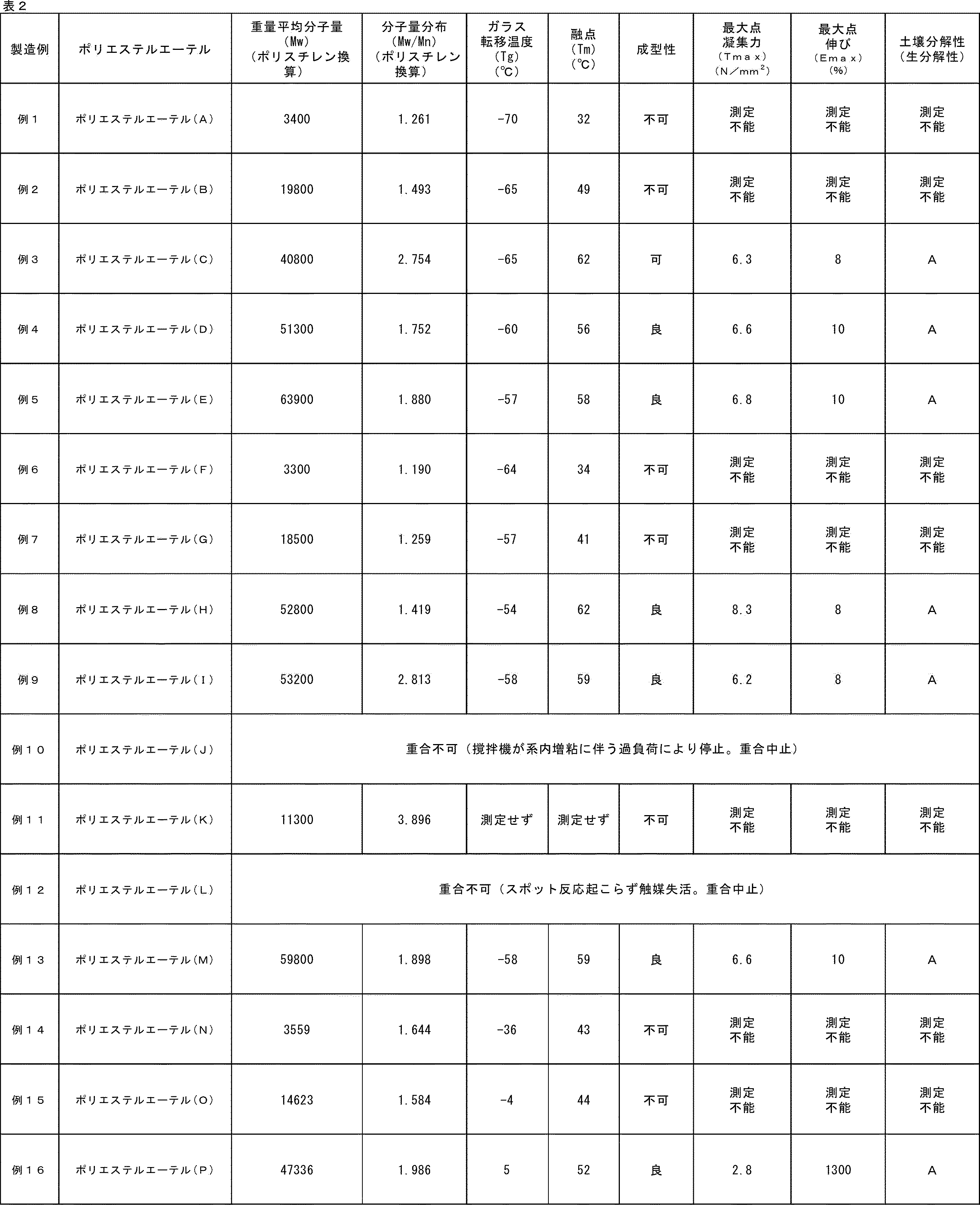
(評価結果)
例1、2、6、7、14,15はポリエステルエーテルの重量平均分子量が小さく成形性が不合格となった。
例10は、溶媒使用量が少ない場合であり、ポリエステルエーテルを合成することができなかった。
例11は、例2と比較して溶媒の比誘電率が高い例であり、分子量が伸びず低分子化合物が生じたため、重量平均分子量の値が小さく、分子量分布が大きくなっており、不適であった。
例12は、例2と比較して溶媒の比誘電率が高い例であり、初期活性用のEO添加後の挙動が大きく異なり、DMC触媒が失活し、ポリエステルエーテルを合成することができなかった。
一方、例3~5、8、9、13、16は、毒性のあるイソシネート等を用いた高分子量化を行うことなく成形可能であり、物性(最大点凝集力(Tmax)及び最大点伸び(Emax))を発現可能であった。また、成形可能であったポリエステルエーテルは、生分解性を有した。
例1、2、6、7、14,15はポリエステルエーテルの重量平均分子量が小さく成形性が不合格となった。
例10は、溶媒使用量が少ない場合であり、ポリエステルエーテルを合成することができなかった。
例11は、例2と比較して溶媒の比誘電率が高い例であり、分子量が伸びず低分子化合物が生じたため、重量平均分子量の値が小さく、分子量分布が大きくなっており、不適であった。
例12は、例2と比較して溶媒の比誘電率が高い例であり、初期活性用のEO添加後の挙動が大きく異なり、DMC触媒が失活し、ポリエステルエーテルを合成することができなかった。
一方、例3~5、8、9、13、16は、毒性のあるイソシネート等を用いた高分子量化を行うことなく成形可能であり、物性(最大点凝集力(Tmax)及び最大点伸び(Emax))を発現可能であった。また、成形可能であったポリエステルエーテルは、生分解性を有した。
本発明のポリエステルエーテルの製造方法により製造されたポリエステルエーテルは、農業・土木資材、軟包装フィルム、食品容器、生分解性被覆肥料用被覆材、などに好適に使用できる。
Claims (11)
- 複合金属シアン化物錯体触媒及び有機溶媒の存在下、1分子中に少なくとも1個の活性水素原子を有する化合物、エポキシ環を有する炭素数2~20のアルキレンオキシドと、エステル結合を有する前記アルキレンオキシド以外の含酸素ヘテロ環構造を有する化合物とを共重合させて、重量平均分子量が40,000以上のポリエステルエーテルを得るポリエステルエーテルの製造方法であって、
前記有機溶媒の比誘電率が18.0以下であり、前記有機溶媒を前記ポリエステルエーテル100質量部に対して10~400質量部使用する、ポリエステルエーテルの製造方法。 - 前記有機溶媒を前記ポリエステルエーテル100質量部に対して20~150質量部を使用する、請求項1に記載のポリエステルエーテルの製造方法。
- 前記含酸素ヘテロ環構造を有する化合物が環状エステル又は酸無水物である、請求項1又は2に記載のポリエステルエーテルの製造方法。
- 前記アルキレンオキシドがエチレンオキシド及びプロピレンオキシドからなる群より選択された少なくとも1種である、請求項1又は2に記載のポリエステルエーテルの製造方法。
- 前記アルキレンオキシドと前記含酸素ヘテロ環構造を有する化合物との質量比(アルキレンオキシド:含酸素ヘテロ環構造を有する化合物)が20:80~99:1である、請求項1又は2に記載のポリエステルエーテルの製造方法。
- 前記ポリエステルエーテルのガラス転移温度が-50℃以下である、請求項1又は2に記載のポリエステルエーテルの製造方法。
- 前記ポリエステルエーテルの融点が50℃以上である、請求項1又は2に記載のポリエステルエーテルの製造方法。
- 前記ポリエステルエーテルが生分解性を有する、請求項1又は2に記載のポリエステルエーテルの製造方法。
- 請求項1又は2に記載の製造方法で得られたポリエステルエーテルを成形して成形体を製造する、成形体の製造方法。
- 前記成形体の最大点凝集力が5.0N/mm2以上である、請求項9に記載の成形体の製造方法。
- 前記成形体の最大点伸びが5%以上である、請求項9に記載の成形体の製造方法。
Applications Claiming Priority (2)
| Application Number | Priority Date | Filing Date | Title |
|---|---|---|---|
| JP2023065841 | 2023-04-13 | ||
| JP2023-065841 | 2023-04-13 |
Publications (1)
| Publication Number | Publication Date |
|---|---|
| WO2024214629A1 true WO2024214629A1 (ja) | 2024-10-17 |
Family
ID=93059301
Family Applications (1)
| Application Number | Title | Priority Date | Filing Date |
|---|---|---|---|
| PCT/JP2024/013925 Ceased WO2024214629A1 (ja) | 2023-04-13 | 2024-04-04 | ポリエステルエーテルの製造方法及び成形体の製造方法 |
Country Status (1)
| Country | Link |
|---|---|
| WO (1) | WO2024214629A1 (ja) |
Citations (7)
| Publication number | Priority date | Publication date | Assignee | Title |
|---|---|---|---|---|
| US5032671A (en) * | 1990-09-04 | 1991-07-16 | Arco Chemical Technology, Inc. | Preparation of lactone polymers using double metal cyanide catalysts |
| JPH04359014A (ja) * | 1991-06-05 | 1992-12-11 | Asahi Glass Co Ltd | ラクチド系重合体の製造方法 |
| JPH08226082A (ja) * | 1994-11-24 | 1996-09-03 | Takemoto Oil & Fat Co Ltd | ポリオレフィン系繊維用耐久親水処理剤及びこれを用いるポリオレフィン系繊維への耐久親水性付与方法 |
| JPH1135655A (ja) * | 1997-07-17 | 1999-02-09 | Dainippon Ink & Chem Inc | 高分子量乳酸系ポリエーテル共重合体の製造方法 |
| WO2007020879A1 (ja) * | 2005-08-17 | 2007-02-22 | Asahi Glass Company, Limited | ポリエステルエーテルポリ(モノ)オールの製造方法 |
| JP2007077312A (ja) * | 2005-09-15 | 2007-03-29 | Asahi Glass Co Ltd | 生分解性を有する潤滑油組成物 |
| JP2013536286A (ja) * | 2010-08-20 | 2013-09-19 | ビーエーエスエフ ソシエタス・ヨーロピア | ポリエーテルエステルポリオールの製造方法 |
-
2024
- 2024-04-04 WO PCT/JP2024/013925 patent/WO2024214629A1/ja not_active Ceased
Patent Citations (7)
| Publication number | Priority date | Publication date | Assignee | Title |
|---|---|---|---|---|
| US5032671A (en) * | 1990-09-04 | 1991-07-16 | Arco Chemical Technology, Inc. | Preparation of lactone polymers using double metal cyanide catalysts |
| JPH04359014A (ja) * | 1991-06-05 | 1992-12-11 | Asahi Glass Co Ltd | ラクチド系重合体の製造方法 |
| JPH08226082A (ja) * | 1994-11-24 | 1996-09-03 | Takemoto Oil & Fat Co Ltd | ポリオレフィン系繊維用耐久親水処理剤及びこれを用いるポリオレフィン系繊維への耐久親水性付与方法 |
| JPH1135655A (ja) * | 1997-07-17 | 1999-02-09 | Dainippon Ink & Chem Inc | 高分子量乳酸系ポリエーテル共重合体の製造方法 |
| WO2007020879A1 (ja) * | 2005-08-17 | 2007-02-22 | Asahi Glass Company, Limited | ポリエステルエーテルポリ(モノ)オールの製造方法 |
| JP2007077312A (ja) * | 2005-09-15 | 2007-03-29 | Asahi Glass Co Ltd | 生分解性を有する潤滑油組成物 |
| JP2013536286A (ja) * | 2010-08-20 | 2013-09-19 | ビーエーエスエフ ソシエタス・ヨーロピア | ポリエーテルエステルポリオールの製造方法 |
Similar Documents
| Publication | Publication Date | Title |
|---|---|---|
| KR101760965B1 (ko) | 폴리에스테르 혼합물의 연속 제조 방법 | |
| EP4206257B1 (en) | Semiaromatic polyester, and preparation method and application thereof | |
| CN111372971A (zh) | 制备脂族聚酯的连续方法 | |
| KR101650923B1 (ko) | 폴리유산 수지 및 공중합 폴리에스테르 수지 블렌드 및 이를 이용한 성형제품 | |
| EP3328915B1 (en) | New high molecular weight polymers from waste raw materials | |
| CN102574999A (zh) | 聚醚类的制造方法 | |
| MX2010011149A (es) | Metodo para la produccion continua de poliesteres biodegradables. | |
| KR20200085337A (ko) | 지방족 폴리에스테르의 정제 방법 | |
| CN103154084A (zh) | 制备聚醚酯多元醇的方法 | |
| MX2007006078A (es) | Procedimiento para la preparacion de polioleteres. | |
| CN113717356A (zh) | 一种半芳香族聚酯及其制备方法和应用 | |
| CN115806659B (zh) | 半芳香族聚醚酯及其制备方法和应用 | |
| JP5223347B2 (ja) | 樹脂組成物及びその製造方法、並びに共重合体 | |
| EP1633799B1 (de) | Herstellung von polyetheralkoholen unter verwendung der dmc-katalyse | |
| EP0684270B1 (en) | Aliphatic polyester carbonate and process for producing the same | |
| EP2746318A1 (en) | Process for preparing PLA stereocomplex | |
| JPH08301993A (ja) | 低ラクタイド含有乳酸系ポリエステルの製造方法 | |
| CN117946504A (zh) | 聚乳酸树脂组合物、聚乳酸树脂发泡体及其制造方法 | |
| JP3458911B2 (ja) | ラクタイド系共重合体の連続製造方法 | |
| EP3649177B1 (en) | Process for preparing polyesters by using an additive | |
| CN118159578A (zh) | 制备聚氧化烯聚酯多元醇的方法 | |
| CN102234368B (zh) | 聚对苯二甲酸亚丙基酯的制造方法及制造装置 | |
| JP5050610B2 (ja) | 低温特性に優れた樹脂組成物の成型体 | |
| CN113493598B (zh) | 一种生物降解聚酯及其制备方法 | |
| JP2025090977A (ja) | 被覆材及びその製造方法、被覆粒状肥料、被覆粒状農薬、並びに被覆種子 |
Legal Events
| Date | Code | Title | Description |
|---|---|---|---|
| 121 | Ep: the epo has been informed by wipo that ep was designated in this application |
Ref document number: 24788654 Country of ref document: EP Kind code of ref document: A1 |
|
| NENP | Non-entry into the national phase |
Ref country code: DE |
|
| 122 | Ep: pct application non-entry in european phase |
Ref document number: 24788654 Country of ref document: EP Kind code of ref document: A1 |