WO2024214176A1 - コンテンツ提供装置 - Google Patents
コンテンツ提供装置 Download PDFInfo
- Publication number
- WO2024214176A1 WO2024214176A1 PCT/JP2023/014687 JP2023014687W WO2024214176A1 WO 2024214176 A1 WO2024214176 A1 WO 2024214176A1 JP 2023014687 W JP2023014687 W JP 2023014687W WO 2024214176 A1 WO2024214176 A1 WO 2024214176A1
- Authority
- WO
- WIPO (PCT)
- Prior art keywords
- content
- unit
- list
- providing device
- personal information
- Prior art date
- Legal status (The legal status is an assumption and is not a legal conclusion. Google has not performed a legal analysis and makes no representation as to the accuracy of the status listed.)
- Ceased
Links
Images




Classifications
-
- G—PHYSICS
- G06—COMPUTING OR CALCULATING; COUNTING
- G06F—ELECTRIC DIGITAL DATA PROCESSING
- G06F3/00—Input arrangements for transferring data to be processed into a form capable of being handled by the computer; Output arrangements for transferring data from processing unit to output unit, e.g. interface arrangements
- G06F3/01—Input arrangements or combined input and output arrangements for interaction between user and computer
-
- G—PHYSICS
- G06—COMPUTING OR CALCULATING; COUNTING
- G06F—ELECTRIC DIGITAL DATA PROCESSING
- G06F3/00—Input arrangements for transferring data to be processed into a form capable of being handled by the computer; Output arrangements for transferring data from processing unit to output unit, e.g. interface arrangements
- G06F3/01—Input arrangements or combined input and output arrangements for interaction between user and computer
- G06F3/048—Interaction techniques based on graphical user interfaces [GUI]
- G06F3/0481—Interaction techniques based on graphical user interfaces [GUI] based on specific properties of the displayed interaction object or a metaphor-based environment, e.g. interaction with desktop elements like windows or icons, or assisted by a cursor's changing behaviour or appearance
- G06F3/0482—Interaction with lists of selectable items, e.g. menus
Definitions
- the present invention relates to a content providing device that provides content to be played.
- One known technology of this type is one that proposes playing content that has attributes that correspond to the vehicle's driving conditions (see Patent Document 1).
- the content providing device provides content selected based on personal information of people in a specified space as content to be played in the space, and includes a personal information acquiring unit that acquires personal information of each of the people in the space, a first list creating unit that selects multiple pieces of content based on a playlist as the personal information of each person in the space and creates a first list that includes the selected multiple pieces of content, and a second list creating unit that creates a second list in which content not included in each person's playlist is inserted at a predetermined number position in the first list, and provides the content selected based on the second list as content to be played in the space.
- the present invention makes it possible to provide appropriate content to recipients in a space.
- FIG. 1 is a schematic diagram showing an example of a system including a content providing device.
- FIG. 4 is a schematic diagram showing an example of a steering operation member.
- FIG. 11 is a schematic diagram showing another example of the operation member.
- FIG. 2 is a block diagram illustrating a configuration of a main part of a content providing device.
- FIG. 2 is a block diagram illustrating a configuration of a main part of a terminal.
- FIG. 2 is a block diagram illustrating the main configuration of a vehicle sensor group and an in-space camera.
- FIG. 2 is a block diagram illustrating a configuration of a main part of an operation member and an output device.
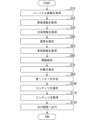
- 11 is a flowchart illustrating the flow of a content providing process by a program.
- 10 is a flowchart illustrating the flow of a content providing process according to the first modification.
- a content providing device provides content to people in a space, such as the cabin of a moving body such as an automobile.
- the content to be provided is content that can be played back as audio and/or video by a playback device (which may also be called an output device) provided in the space.
- the content providing device acquires personal information about each person from a wireless communication terminal (hereinafter simply referred to as a terminal) such as a smartphone used by each person, and provides content selected based on the acquired personal information.
- a terminal such as a smartphone used by each person
- personal information is, for example, the title of content that has been played on each person's terminal more frequently than a predetermined value, the genre of content that has been played more frequently than a predetermined value, or a playlist of content stored on the terminal. If it is not possible to acquire titles, genres, or playlists from the terminal, the age and gender of each person, etc., stored on the terminal may be acquired as personal information.
- the content providing device of the embodiment selects and provides content that can be enjoyed by as many people as possible in a space. It is also configured so that the driver can easily switch between contents. This content providing device will be described in more detail below.
- ⁇ System configuration example> 1 is a schematic diagram showing an example of a system including a content providing device.
- the content providing system includes a content providing device 20, a group of vehicle sensors 12 of a vehicle 100 as a moving body, a display unit 51, a projection unit 52, and an audio playback unit 53 constituting an output device 50 provided in the vehicle 100, an operation member 11 for steering a steering device (not shown) provided in the vehicle 100, an in-space camera 13 (a front seat camera 131 and a rear seat camera 132) provided in the vehicle 100, a wireless terminal 2A used by a front seat passenger, and a wireless terminal 2B used by a rear seat passenger.
- the content providing device 20 and the terminals 2A and 2B are configured to be capable of wireless communication.
- the content providing device 20, the output device 50, the operation member 11, the vehicle sensor group 12, and the in-space camera 13 are configured to be capable of wired communication via a controller area network (CAN) or the like.
- CAN controller area network
- Terminals 2A and 2B are each configured as a smartphone or the like used by each person. 2A and 2B may each be held in a holder (not shown) installed on the seat where each person sits. Two terminals 2A and 2B are shown as terminals used by the occupants, but the actual number of terminals is four when there are four occupants. The number of cameras that make up the in-space camera 13 may also be changed as appropriate depending on the number of occupants.
- FIG. 2A is a schematic diagram showing an example of an operating member 11 for steering.
- the operating member 11 of a steering device (not shown) of the vehicle 100 also serves as an operating member for instructing the content providing device 20 to change the content to be played back.
- the operating member 11 is normally used for steering, but when the vehicle 100 is in an autonomous driving mode or when the vehicle 100 is parked, it functions as an operating member for instructing a change in content.
- the operation member 11 in Fig. 2A includes an operation detection unit 111 (Fig. 3D) and a light emitting unit 112.
- the area in which the light emitting unit 112 is provided between the right grip RG and the left grip LG in the operation member 11 is a touch operation receiving portion of the operation member 11.
- the light emitting unit 112 is composed of a plurality of light emitting bodies arranged in the touch operation receiving portion.
- the operation detection unit 111 detects the touch position on the touch operation receiving portion by, for example, a capacitance sensor.
- the operation detection unit 111 outputs detection information indicating the length of the detected contact time, the length of the movement distance of the contact position, or the like to the vehicle information acquisition unit 206.
- an occupant can instruct the currently played content in the playlist to be switched to the next content by sliding the touch position on the operation detection unit 111 to the right.
- the content selection unit 214 may select the content to be played by associating the length of the contact time or the length of the movement distance of the contact position acquired by the vehicle information acquisition unit 206 with the similarity to the content being played. For example, if the contact time or the movement distance of the contact position is short, content with high similarity is selected, and if the contact time or the movement distance of the contact position is long, content with low similarity is selected.
- the light-emitting unit 112 illuminates the light-emitting element (e.g., the light-emitting element closest to the touch position) that is located at the touch position detected by the operation detection unit 111.
- the operation detection unit 111 no longer detects a touch operation at the position corresponding to the illuminated light-emitting element, the light-emitting unit 112 turns off the light-emitting element at that position.
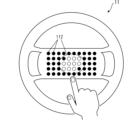
- FIG. 2B is a schematic diagram showing another example of the operation member 11.
- a touch operation receiving portion is provided in the center of the rotatably supported circular operation member 11.
- the operation member 11 in FIG. 2B also includes an operation detection unit 111 and a light-emitting unit 112.
- the operation member 11 in FIG. 2B has a larger touch operation receiving area than that in FIG. 2A, and therefore a plurality of light emitters constituting the light emitting unit 112 are arranged in a matrix.
- a front seat passenger can instruct a switch from the playlist containing the currently played content to the next playlist by sliding the touch position on the operation detection unit 111 downward during content playback. Conversely, a front seat passenger can instruct a switch from the playlist containing the currently played content to the previous playlist by sliding the touch position on the operation detection unit 111 upward during content playback. Also, while playing content, it is possible to instruct the content currently being played in the current playlist to be switched to the next content in the current playlist by sliding the touch position on the operation detection unit 111 to the right. Conversely, while playing content, it is possible to instruct the content currently being played in the current playlist to be switched to the previous content in the current playlist by sliding the touch position on the operation detection unit 111 to the left.
- the content selection unit 214 may select the content to be played by associating the length of the contact time or the length of the movement distance of the contact position acquired by the vehicle information acquisition unit 206 with the similarity to the content being played. For example, if the contact time or the movement distance of the contact position is short, content with high similarity is selected, and if the contact time or the movement distance of the contact position is long, content with low similarity is selected. Also, if the area of the contact range surrounded by the movement of the contact position is larger than a predetermined area, content with low similarity may be selected.
- the operation detection unit 111 may detect the amount of rotation of the circular operation member 11. The content selection unit 214 may further select content with high similarity when the amount of rotation of the circular operation member 11 is small, and select content with low similarity when the amount of rotation of the circular operation member 11 is large.
- the light-emitting unit 112 in FIG. 2B illuminates the light-emitting element (e.g., the light-emitting element closest to the touch position) that is located at the touch position detected by the operation detection unit 111. Furthermore, when a touch operation is performed so as to draw a closed loop within the touch operation reception area, the light-emitting unit 112 further illuminates the light-emitting element at a position corresponding to the inside of the closed loop for a predetermined period of time.
- the light-emitting element e.g., the light-emitting element closest to the touch position
- FIG. 1 An example of the configuration of each unit in FIG. 1 will be described with reference to block diagrams 3A to 3D.
- ⁇ Content Providing Device> 3A is a block diagram illustrating an example of a main configuration of the content providing device 20.
- the content providing device 20 includes an arithmetic processing unit such as an MPU (Micro Processing Unit) (not shown), and performs various information processing, control processing, and the like required by the content providing device 20 by reading and executing a predetermined program stored in a storage unit (not shown).
- MPU Micro Processing Unit
- the content providing device 20 includes, as its functional configuration, a personal information acquisition unit 201, a relationship information acquisition unit 202, a content acquisition unit 203, a biometric information acquisition unit 204, an emotion estimation unit 205, a vehicle information acquisition unit 206, a gaze detection unit 207, a target estimation unit 208, a first list creation unit 209, a second list creation unit 210, a personal information exclusion unit 211, an analysis unit 212, an evaluation unit 213, a content selection unit 214, and a communication unit 215.
- a personal information acquisition unit 201 includes, as its functional configuration, a personal information acquisition unit 201, a relationship information acquisition unit 202, a content acquisition unit 203, a biometric information acquisition unit 204, an emotion estimation unit 205, a vehicle information acquisition unit 206, a gaze detection unit 207, a target estimation unit 208, a first list creation unit 209, a second list creation unit 210, a personal information exclusion unit 211, an analysis unit 212, an
- the personal information acquisition unit 201 acquires personal information of each person from the terminals 2A and 2B used by the multiple people in the space, via the communication unit 215.
- the personal information is the titles of frequently played content on the terminals 2A and 2B of each person (e.g., the top 20 titles), the genres of frequently played content (e.g., the top 10 genres), or a playlist of content stored on the terminals 2A and 2B.
- the relationship information acquisition unit 202 acquires relationship information of each person from the terminals 2A and 2B used by the multiple people in the space via the communication unit 215.
- the relationship information is information indicating the degree of intimacy between each person in the space.
- the degree of intimacy is expressed, for example, in three stages (high, normal, low) based on the call history between the terminals 2A and 2B during a predetermined period (for example, the last 30 days) or the usage history of a message app used between the terminals 2A and 2B.
- the content acquisition unit 203 acquires content from the terminals 2A and 2B used by the multiple people in the space, via the communication unit 215.
- the content acquisition unit 203 may acquire content not only from the terminals 2A and 2B, but also from an external content management server via a communication network (not shown).
- the content acquisition unit 203 acquires the content provided by the content providing device 20 from the terminal 2A, 2B, etc. each time. In general, a certain time is required for the communication unit 215 to establish communication with the terminal 2A or 2B.
- the communication unit 215 when playing a piece of music M1 as content acquired from the terminal 2A and then playing a piece of music M2 as content acquired from the terminal 2B, the communication unit 215 is configured to establish communication between the terminal 2B and the communication unit 215 before the playback of the piece of music M1 ends, and to promptly start playing the piece of music M2 when the playback of the piece of music M1 ends.
- the communication unit 215 acquires a piece of music as content from an external content management server.
- the biometric information acquisition unit 204 acquires biometric information from the terminals 2A and 2B used by the multiple people in the space, respectively, via the communication unit 215.
- the biometric information includes, for example, heart rate information acquired by a heart rate sensor that acquires the heart rate of each person, respiration rate information acquired by a respiration sensor that acquires the respiration rate, blood flow velocity information acquired by a blood flow velocity sensor that acquires the blood flow velocity, and electrical skin resistance value information acquired by an electrical skin resistance sensor that acquires the electrical skin resistance value.
- the biometric information acquisition unit 204 also acquires image information of the upper body of each person from the in-space camera 13 (front seat camera 131, rear seat camera 132) that captures images of the upper body of each person in the space, via the communication unit 215.
- the image information of the upper body can be used to identify facial expressions by cutting out an image of the face. It can also be used to identify pupil size and gaze direction by enlarging and detecting the iris part of the eye. It can also be used to identify posture based on the center of gravity of the image and the shape of the upper body.
- the emotion estimation unit 205 estimates the emotion of each occupant in the space by using a predetermined learning process based on the biometric information acquired by the biometric information acquisition unit 204.
- a predetermined learning process an algorithm selected from, for example, SVM (Support Vector Machines), decision trees, k-nearest neighbor method, etc. is used.
- the emotion estimation unit 205 detects the pleasantness and unpleasantness of each person based on the image information captured by the in-space camera 13 (front seat camera 131, rear seat camera 132) acquired by the biometric information acquisition unit 204. For example, a master image in which facial expressions are ranked in descending order of pleasantness is prepared in advance, and pleasantness is assigned according to the ranking. In this way, the pleasantness of each person is detected by comparing the image information of the upper body of each person with the master image. Since the degree of comfort is correlated with the number of changes in gaze direction, the number of changes in posture, and the pupil diameter, in addition to the facial expression, the degree of comfort may be corrected based on the number of changes in gaze direction, the number of changes in posture, and the pupil diameter.
- the emotion estimation unit 205 detects the activity level and inactivity level based on the biometric information (heart rate) acquired by the biometric information acquisition unit 204. For example, the higher the heart rate, the higher the activity level, and the lower the heart rate, the lower the activity level, so the activity level of each person is determined based on the heart rate. Since the activity level is correlated with the respiratory rate, blood flow velocity, and skin electrical resistance value in addition to the heart rate, the activity level may be corrected by these respiratory rate, blood flow velocity, and skin electrical resistance value.
- the emotion estimation unit 205 further uses a known method to represent all emotions (mental states) of each person on a two-axis plane (Russell's emotion circumplex model) with a horizontal axis representing pleasant/unpleasant and a vertical axis representing active/inactive, and estimates each person's emotion.
- the emotion estimation unit 205 may estimate the emotion of each person toward the person appearing in the projected image based on the reaction of each person to the projected image of the face of each person in the space projected by the projection unit 52.
- the vehicle information acquisition unit 206 acquires vehicle information of the vehicle 100, such as vehicle speed information, position information, and image information capturing an image of the outside of the vehicle, from the vehicle sensor group 12 via the communication unit 215.
- the vehicle information acquisition unit 206 also acquires detection information detected by the operation detection unit 111 of the operation member 11.
- the gaze detection unit 207 detects the gaze of each person based on image information from the in-space cameras 13 (front seat camera 131, rear seat camera 132) acquired by the biometric information acquisition unit 204. For example, the gaze detection unit 207 finds a stationary part (reference point) and a moving part (moving point) of each person's eye from the image, and detects the gaze based on the position of the moving point relative to the reference point.
- the target estimation unit 208 estimates an object in the line of sight of each person detected by the line of sight detection unit 207.
- the target estimation unit 208 estimates at least the occupant that each person is looking at.
- the direction of the terminals 2A and 2B as seen from the communication unit 215 is detected by the communication unit 215 using a direction detection function provided in a wireless communication method called Bluetooth (registered trademark), for example.
- the direction of the line of sight of each person detected by the line of sight detection unit 207 is compared. For example, when an occupant using terminal 2B is looking at an occupant using terminal 2A, the line of sight direction of the occupant using terminal 2B intersects with the direction of terminal 2A as seen from the communication unit 215.
- a first list creation unit 209 creates a first playlist (hereinafter referred to as the first list) of content to be provided to people in the space, based on the personal information of each person in the space acquired by the personal information acquisition unit 201. Details will be described later.
- the second list creation unit 210 creates a second playlist (hereinafter referred to as the second list) of content to be provided to people in the space, based on the first list created by the first list creation unit 209. Details will be described later.
- the personal information exclusion section 211 excludes the personal information of at least one person in the space from the personal information of each person in the space acquired by the personal information acquisition section 201. Details will be described later.
- the analysis unit 212 analyzes the similarity of the personal information of each person in the space acquired by the personal information acquisition unit 201. For example, if the title, genre, or artist who created the content included in each person's playlist as personal information is the same, it is determined that the personal information is similar. In addition, the melody of a song as content may be analyzed using a known program, and whether the personal information is similar or not may be determined based on the characteristics of the song, such as the beat and balance. In addition, when only the age and sex of each person are acquired as the personal information of each person, it may be determined that the personal information is similar if the ages are close (for example, within ⁇ 2).
- the evaluation unit 213 evaluates the popularity of the content included in the first list created by the first list creation unit 209. For example, the evaluation value is calculated as the percentage of the content included in the first list that is included in the top (e.g., 300) of the play count ranking of the published content.
- Information on the play count ranking may be stored in a storage unit (not shown) in the evaluation unit 213 as ranking information periodically acquired by the communication unit 215 from an external ranking information management server via a communication network (not shown), or the communication unit 215 may acquire the information from the ranking information management server each time.
- the content selection unit 214 selects contents based on the second list when the second list has been created by the second list creation unit 210, and when the second list has not been created, based on the first list created by the first list creation unit 209. For example, the contents may be selected from each list in descending order, ascending order, or random order.
- the content selection unit 214 may select the content to be played by associating the length of contact time, the length of the movement distance of the contact position, or the area of the contact range surrounded by the movement of the contact position detected by the operation detection unit 111 with the similarity to the selected content.
- the communication unit 215 includes a short-range wireless communication module (not shown) that performs wireless communication with the terminals 2A and 2B, and a wired communication module (not shown) that performs wired communication via a CAN or the like.
- the short-range wireless communication module employs a wireless communication method having the above-mentioned direction detection function.
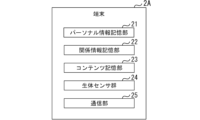
- ⁇ Device> 3B is a block diagram illustrating an example of the main configuration of terminal 2A.
- the configuration of terminal 2B is also omitted from the illustration because it is similar to that of terminal 2A.
- Terminal 2A includes an arithmetic processing unit such as an MPU (not shown), and performs various information processing, control processing, etc. required for the functional configuration described below by reading and executing a predetermined program (which may be called an application) stored in a storage unit (not shown).
- Terminal 2A includes, as functional components, a personal information storage unit 21, a relationship information storage unit 22, a content storage unit 23, a biosensor group 24, and a communication unit 25.
- a smartphone is equipped with a display unit, an input unit, an audio playback unit, a camera, a position detection unit, and the like, but illustrations and descriptions of these are omitted.
- the personal information storage unit 21 stores personal information of the occupant who uses the terminal 2A.
- the personal information may be the titles of frequently played content on the terminal 2A (e.g., the top 20 titles), the genres of frequently played content (e.g., the top 10 genres), or a playlist of content stored on the terminal 2A.
- the relationship information storage unit 22 acquires relationship information of the occupant who uses the terminal 2A.
- the relationship information is information indicating the degree of intimacy with other occupants, and is divided into, for example, three levels (high, normal, low) based on the call history of the terminal 2A during a predetermined period or the usage history of a message app used on the terminal 2A.
- the content storage unit 23 stores the content collected by the occupant using the terminal 2A.
- the biosensor group 24 includes a heart rate sensor that acquires a heart rate, a breathing sensor that acquires a breathing rate, a blood flow velocity sensor that acquires a blood flow velocity, and a skin electrical resistance sensor that acquires a skin electrical resistance value (all not shown).
- the communication unit 25 includes a short-range wireless communication module (not shown) that performs wireless communication with the content providing device 20, and a wired communication module (not shown) that performs wired communication via a CAN or the like.
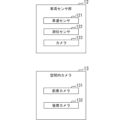
- FIG. 3C is a block diagram illustrating the configuration of the main parts of the vehicle sensor group 12 and the intra-space camera 13 of the vehicle 100.
- the vehicle sensor group 12 includes a vehicle speed sensor 121, a positioning sensor 122, and a camera 123.
- the vehicle 100 is equipped with sensors such as an acceleration sensor and a radar, but these will not be shown or described.
- the vehicle speed sensor 121 detects the speed of the vehicle 100 and outputs the vehicle speed information to the vehicle information acquisition unit 206 .
- the positioning sensor 122 detects the current position of the vehicle 100 based on positioning signals from GPS (Global Positioning System) satellites, quasi-zenith satellites, etc.
- the positioning sensor 122 outputs a signal indicating the current position to the vehicle information acquisition unit 206 as position information.
- GPS Global Positioning System
- the camera 123 captures an image of the surroundings of the vehicle 100.
- the camera 123 outputs data of a subject image as image information to the vehicle information acquisition unit 206.
- the camera 123 is capable of capturing both still images and moving images.
- the intra-space camera 13 includes a front seat camera 131 and a rear seat camera 132.
- the front seat camera 131 captures an image of the upper body of an occupant sitting in the front seat, and outputs the subject image data as image information to the biometric information acquisition unit 204.
- the rear seat camera 132 captures an image of the upper body of an occupant sitting in the rear seat, and outputs the subject image data as image information to the biometric information acquisition unit 204.
- FIG. 3D is a block diagram illustrating the configuration of the main parts of the operation member 11 and the output device 50 of the vehicle 100.
- the operation member 11 includes an operation detection unit 111 and a light emitting unit 112.
- the vehicle 100 is provided with a wide variety of operation members such as a power-on switch, a lighting switch, a wiper switch, a brake pedal, an accelerator pedal, etc., but illustrations and descriptions of these will be omitted.
- the light-emitting unit 112 includes a plurality of light-emitting bodies provided in the touch operation receiving portion, and a light-emitting control unit (not shown) that individually controls the turning on and off of these light-emitting bodies. As described above, the light-emitting unit 112 causes the light-emitting body closest to the touch position detected by the operation detection unit 111 to emit light. When the operation detection unit 111 no longer detects a touch operation at a position corresponding to the light-emitting body that has been turned on, the light-emitting unit 112 turns off the light-emitting body at that position.
- the output device 50 includes a display unit 51 , a projection unit 52 , and an audio playback unit 53 .
- the display unit 51 has a screen such as a liquid crystal display, and displays images (moving images, still images, text display, icon display, graphic display, etc.) based on a display signal output from the content providing device 20 .
- the projection unit 52 is configured, for example, by a head-up display (HUD) that is projected onto the windshield, and projects images (videos, still images, text displays, icon displays, graphic displays, etc.) based on a projection signal output from the content providing device 20.
- HUD head-up display
- the audio playback unit 53 is configured as a speaker that plays and outputs audio and the like, and plays content based on a playback signal output from the content providing device 20. Note that an audio output unit that outputs a content playback signal to headphones (not shown) or the like may also be provided.
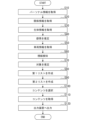
- Flowchart> 4 is a flowchart illustrating the flow of a content providing process according to a program executed by the MPU of the content providing device 20.
- the MPU of the content providing device 20 executes a program for performing the process shown in FIG.
- step S10 of FIG. 4 the content providing device 20 acquires personal information from the terminals 2A and 2B used by the multiple people in the space using the personal information acquisition unit 201, and then proceeds to step S20.
- step S20 the content providing device 20 acquires, via the related information acquisition unit 202, related information from the terminals 2A and 2B used by the multiple people in the space, and then proceeds to step S30.
- step S30 the content providing device 20 acquires biometric information from the terminals 2A and 2B used by the multiple people in the space, using the biometric information acquiring unit 204.
- the biometric information acquiring unit 204 also acquires image information of the upper body of each person from the in-space camera 13 that captures the upper body of each person in the space, as biometric information, and proceeds to step S40.
- step S40 the content providing device 20 uses the emotion estimation unit 205 to estimate the emotion of each occupant in the space based on the biometric information acquired by the biometric information acquisition unit 204, and proceeds to step S50.
- step S50 the content providing device 20 acquires vehicle information, such as vehicle speed information, position information, and image information capturing an image of the outside of the vehicle, via the vehicle information acquisition unit 206, and proceeds to step S60.
- vehicle information such as vehicle speed information, position information, and image information capturing an image of the outside of the vehicle
- step S60 the content providing device 20 detects the gaze of each occupant in the space using the gaze detection unit 207 based on the image information from the in-space camera 13 acquired by the biometric information acquisition unit 204, and then proceeds to step S70.
- step S70 the content providing device 20 uses the object estimation unit 208 to estimate the object in the line of sight of each person detected by the line of sight detection unit 207, and proceeds to step S80.
- step S80 the content providing device 20 causes the first list creation unit 209 to create a first list.
- the first list creation unit 209 selects a plurality of contents based on the playlist as personal information of each person in the space, and creates a first list including the selected plurality of contents.
- a predetermined number of contents can be selected from playlists serving as personal information of all people in the space, and a first list containing the selected predetermined number of contents can be created.
- the content providing device 20 proceeds to step S90.
- step S90 the content providing device 20 causes the second list creating unit 210 to create a second list.
- the second list creation unit 210 excludes a playlist as personal information of at least one of the multiple people in the space using the personal information exclusion unit 211, selects multiple contents based on the playlists of the multiple people not excluded by the personal information exclusion unit 211, and creates a second list containing the selected multiple contents.
- the personal information exclusion unit 211 excludes the personal information of at least one person when the evaluation value (evaluated by the evaluation unit 213) of the multiple contents included in the first list exceeds a predetermined value.
- the personal information exclusion unit 211 changes the number of people whose personal information is to be excluded according to the evaluation value by the evaluation unit 213. For example, the larger the evaluation value, the more people to be excluded, and the smaller the evaluation value, the less people to be excluded.
- the second list creation unit 210 may create a second list in step S90 as a second example of the second list by inserting content that is not included in each person's playlist at a predetermined number position of the second example of the first list created in step S80.
- the second list is created so that content other than music (such as rakugo) is provided between a plurality of songs.
- the second list creation unit 210 may determine the content to be inserted as a third example of the second list created in step S90 based on the melody of the songs as the predetermined number-1 and predetermined number content in the second example of the first list created in step S80.
- the content to be inserted at the predetermined number is determined so that the melody of the music as the content changes continuously between the music before the insertion (predetermined number - 1), the music to be inserted, and the music after the insertion (predetermined number + 1).
- the second list creation unit 210 may determine, as the content to be inserted, content that has common characteristics with the content included in the playlists of each person in the space. For example, if the title, genre, artist who created the content, or the year in which the content was created is the same as the content to be inserted, that content is determined as the content to be inserted.
- the second list creation unit 210 may determine, as the content to be inserted, a first song that has different characteristics from the songs included in the playlists of each person in the space. For example, if the first song has a different title, genre, artist who composed the song, or was composed in a different era, the first song is determined as the content to be inserted.
- the second list creation unit 210 may determine that the first song, which has a different tune from these similar tunes, is to be inserted as the content.
- the second list creation unit 210 may determine, as a sixth example of the second list created in step S90, content to be inserted that includes a phrase that is commonly included in the songs that are the specified number-1 and specified number contents in the second example of the first list created in step S80. For example, if the lyrics of the songs as the contents at the predetermined number minus 1 and the predetermined number include "shiba", the title of the Rakugo content "Shibahama" containing "shiba” is determined as the content to be inserted. By including the common point "shiba" in the title of the content, the content is made easier to listen to.
- the second list creation unit 210 may determine, as the content to be inserted, content related to the location to which the vehicle 100, as a moving body having space, is moving. For example, a title including the name of the place to which the user moves, or a title related to the place to which the user moves, is determined as the content to be inserted.
- the content providing device 20 proceeds to step S100.
- step S100 the content providing device 20 selects content using the content selection unit 214.
- the content selection unit 214 selects content based on the second list as a first example of content selection, and if a second list is not created, the content selection unit 214 selects content based on the first list.
- the content selection unit 214 may select content to be provided to people in the space based on any one of the second to seventh examples of the second list created in step S90.
- the process proceeds to step S110.
- step S110 the content providing device 20 acquires the content selected in step S100 via the content acquisition unit 203, and proceeds to step S120.
- step S120 the content providing device 20 outputs the content to the output device 50, and the process in FIG. 4 ends.
- the output device 50 plays the content from at least one of the display unit 51, the projection unit 52, and the audio playback unit 53, depending on the content acquired by the content acquisition unit 203.
- a content providing device 20 that provides content selected based on personal information of people in a cabin of a vehicle 100, which is a specified space, as content to be played in the cabin includes a personal information acquisition unit 201 that acquires personal information of each of multiple occupants in the cabin, a first list creation unit 209 that selects multiple pieces of content based on a playlist as personal information of each person in the cabin and creates a first list containing the selected multiple pieces of content, and a second list creation unit 210 that creates a second list in which content not included in each person's playlist is inserted at a specified number position in the first list, and provides the content selected based on the second list as content to be played in the cabin.
- a personal information acquisition unit 201 that acquires personal information of each of multiple occupants in the cabin
- a first list creation unit 209 that selects multiple pieces of content based on a playlist as personal information of each person in the cabin and creates a first list containing the selected multiple pieces of content
- the second list creation section 210 determines the content to be inserted based on the tunes of the music pieces as the predetermined number-1 and predetermined number contents in the first list. With this configuration, for example, it is possible to create the second list by inserting music pieces whose tunes change continuously between songs, so that people in the cabin do not feel uncomfortable.
- the second list creating unit 210 determines, as the content to be inserted, the content that has characteristics in common with the content included in the playlists of each person in the cabin. This allows a second list to be created, populated with content that is familiar to everyone in the cabin.
- the second list creation unit 210 determines, as the content to be inserted, a first song that has characteristics different from those of the songs included in the playlists of each person in the cabin as the content. In this way, it is possible to create a second list by inserting a new first piece of music that is unfamiliar to everyone in the cabin.
- the second list creation unit 210 determines the first song as the content to be inserted if the melody of the songs as the content (a predetermined number minus 1) in the first list and the content (a predetermined number) are similar.
- the second list creation unit 210 determines, as the content to be inserted, a content that includes a phrase that is commonly included in the songs that are the specified number-1 and specified number contents in the first list. This configuration makes it possible to make the inserted content easier for people inside the cabin to hear.
- the specified cabin is a cabin in a moving object
- the second list creation unit 210 determines, as the content to be inserted, content related to the location to which the moving object is traveling. With this configuration, it is possible to create a second list into which content related to the local area is inserted.
- the content providing device 20 as a content selection device that selects content to be played in the cabin of a moving body includes a second list creation unit 210 as a playback list acquisition unit that acquires a list of content candidates for playback, a vehicle information acquisition unit 206 that acquires detection information from an operation detection unit 111 that detects the contact state of the operating member 11 of the device that steers the moving body, and a content selection unit 214 that selects content to be played from the second list as a playback list based on the detection information acquired by the vehicle information acquisition unit 206.
- the passenger in the cabin can instruct the content to be played back from the second list to be switched simply by performing a touch operation on the operating member 11 that is close to the passenger.
- the operation detection unit 111 detects the contact time and contact position on the operating member 11, and the content selection unit 214 selects content to be played by associating the length of contact time, the length of the movement distance of the contact position, or the width of the contact range surrounded by the movement of the contact position detected by the operation detection unit 111 with the similarity to the selected content.
- the passenger in the cabin can instruct the switching of the content to be played back from the second list by intuitively touching the operating member 11 that is familiar to them.
- the operation detection unit 111 detects multiple contacts and the contact intervals on the operating member 11, and the content selection unit 214 selects the content to be played based on the length of the contact interval detected by the operation detection unit 111.
- the passenger in the cabin can instruct the switching of the content to be played back from the second list by intuitively touching the operating member 11 that is familiar to them.
- the operation detection unit 111 detects a contact state with the operating member 11 without affecting steering by a steering device.
- the vehicle 100 is in an autonomous driving mode or when the vehicle 100 is parked, it becomes possible to instruct the switching of the content being played from the second list by an intuitive touch operation on the operating member 11.
- the operating member 11 includes an light-emitting unit 112 that illuminates the contact position, the operation detection unit 111 detects the contact position on the operating member 11, and the light-emitting unit 112 illuminates an area corresponding to the contact position detected by the operation detection unit 111. With this configuration, the passenger in the cabin can visually confirm the position where the operating member 11 has been touched.
- the operation member 11 of the device for steering the moving object is a steering wheel or a handlebar.
- the content providing device 20 which functions as a content selection device that selects content to be played in the cabin of a moving body, includes a vehicle information acquisition unit 206 that acquires detection information from an operation detection unit 111 that detects the amount of rotation of a steering wheel, which serves as an operating member 11 of a device that steers the moving body, and a content selection unit 214 that selects content to be played in accordance with the amount of rotation indicated by the detection information acquired by the vehicle information acquisition unit 206.
- the passenger in the cabin can instruct the switching of the content being played back using the operating member 11 that is close to him or her.
- a content providing device 20 that provides content selected based on personal information of a person in a specific cabin as content to be played in the cabin includes a first list creation unit 209 that selects multiple pieces of content based on a playlist as personal information of each person in the cabin and creates a first list containing the selected multiple pieces of content, an evaluation unit 213 that evaluates the popularity of the multiple pieces of content to be included in the first list, a personal information exclusion unit 211 that excludes the playlist of at least one of the multiple people in the cabin if the evaluation value by the evaluation unit 213 exceeds a predetermined value, and a second list creation unit 210 that selects multiple pieces of content based on the playlists of the multiple people not excluded by the personal information exclusion unit 211 and creates a second list containing the selected multiple pieces of content, and provides the content selected based on the second list if the second list is created, or provides the content selected based on the first list if the second list is not created, as content to be played in the cabin.
- the content providing device 20 selects a plurality of pieces of content based on the personal information of the person who has not been excluded by the personal information exclusion unit 211, and creates a first list including the selected plurality of pieces of content.
- FIG. 5 is a flowchart explaining the flow of content provision processing of a program executed by the MPU of the content provision device 20 according to the first modified example.
- the MPU of the content provision device 20 executes a program that performs the processing shown in FIG. 5. This differs from the flowchart of FIG. 4 in that the processing of steps S80 to S100 in FIG. 4 is changed to the processing of steps S80' and S100' in FIG. 5, and the following explanation will focus on these differences.
- step S80' in FIG. 5 the content providing device 20 causes the first list creating unit 209 to create a first list.
- the first list creation unit 209 selects a plurality of contents based on the personal information of the person who has not been excluded by the personal information exclusion unit 211, and creates a first list including the selected plurality of contents.
- the personal information exclusion unit 211 may exclude personal information of people who are unable to view the content because they are asleep, etc., based on the state of each person in the space detected by the terminals 2A and 2B as biometric information detection units and the in-space camera 13 (changes in posture, changes in gaze direction, heart rate, respiratory rate, etc.).
- the personal information exclusion unit 211 may exclude all but one of the similar pieces of personal information based on the similarity of the personal information analyzed by the analysis unit 212.
- the personal information exclusion unit 211 may further exclude the personal information of at least one person based on relationship information indicating the relationship between multiple people in a space acquired by the relationship information acquisition unit 202.
- the personal information exclusion unit 211 may change the personal information to be excluded after a predetermined time has elapsed.
- the personal information exclusion unit 211 may exclude personal information of people whose emotions are distant or not distant, estimated by the emotion estimation unit 205, based on the state of each person in the space detected by terminals 2A, 2B as biometric information detection units and the in-space camera 13.
- the emotion estimation unit 205 may estimate the emotion of each person in the space toward the person reflected in the projected image, based on the reaction (such as a change in the state of each person) to the projected image including the face of each person in the space projected by the projection unit 52.
- the personal information exclusion unit 211 may exclude the personal information of a person in the line of sight estimated by the target estimation unit 208 and detected by the line of sight detection unit 207. Alternatively, the personal information may not be excluded.
- the personal information exclusion unit 211 may exclude personal information based on the gaze movement of the driver of the vehicle 100 detected by the gaze detection unit 207.
- step S100' the content providing device 20 selects content based on the first list using the content selection unit 214.
- the content selection unit 214 may select content having high similarity from the personal information of a plurality of people not excluded by the personal information exclusion unit 211 . For example, songs that have common content, songs in a common genre, or songs with similar musical structures such as rhythm and tempo are selected.
- the content selection unit 214 may select content based on the state of each person in the space (changes in posture, changes in gaze direction, heart rate, respiratory rate, etc.) detected by the terminals 2A and 2B as biometric information detection units and the in-space camera 13.
- the content selection unit 214 may select content based on the position or speed of the vehicle 100 as a moving body. For example, if the movement time between positions is short, in other words, the movement speed is fast, a song with a fast tempo is selected, and if the movement time between positions is long, in other words, the movement speed is slow, a song with a slow tempo is selected.
- step S110 When the content selection unit 214 selects content using any of the above examples, the process proceeds to step S110. The process thereafter is the same as in FIG. 4.
- a content providing device 20 that provides content selected based on personal information of people in a cabin of a vehicle 100, which is a specified space, as content to be played in the cabin includes a personal information acquisition unit 201 that acquires personal information of each of the multiple people in the cabin, a personal information exclusion unit 211 that excludes personal information of at least one person in the cabin, a first list creation unit 209 that selects multiple pieces of content based on the personal information of people not excluded by the personal information exclusion unit 211 and creates a first list containing the selected multiple pieces of content, and a content selection unit 214 that selects content based on the first list, and provides the content selected by the content selection unit 214 as content to be played in the cabin.
- the content providing device 20 of (1) above further includes a biometric information acquiring unit 204 that acquires biometric information from terminals 2A and 2B as a biometric information detecting unit that detects the status of the people in the cabin, and the personal information exclusion unit 211 excludes the personal information of people who cannot view the content based on the status of each person in the cabin acquired by the biometric information acquiring unit 204.
- a biometric information acquiring unit 204 that acquires biometric information from terminals 2A and 2B as a biometric information detecting unit that detects the status of the people in the cabin
- the personal information exclusion unit 211 excludes the personal information of people who cannot view the content based on the status of each person in the cabin acquired by the biometric information acquiring unit 204.
- the content providing device 20 of (1) above further includes an analysis unit 212 that analyzes the similarities in the personal information of multiple people, and the personal information exclusion unit 211 excludes all but one of the similar personal information based on the analysis results by the analysis unit 212.
- This configuration makes it possible to reduce personal information that includes similar content, making it possible to provide a wide range of content to people in the cabin without bias.
- the content selecting unit 214 selects highly similar content from the personal information of a plurality of people that has not been excluded by the personal information excluding unit 211 .
- This configuration makes it possible to select content that suits the tastes of the many people in the cabin (for example, songs with common content, songs in a common genre, or songs with similar musical structures such as rhythm and tempo).
- the content providing device 20 of (1) above further includes a relationship information acquisition unit 202 that acquires relationship information indicating the relationships between multiple people in the cabin, and the personal information exclusion unit 211 excludes personal information of at least one person based on the relationship information.
- a relationship information acquisition unit 202 that acquires relationship information indicating the relationships between multiple people in the cabin
- the personal information exclusion unit 211 excludes personal information of at least one person based on the relationship information.
- the personal information excluding unit 211 changes the personal information to be excluded after a predetermined time has elapsed. With this configuration, it becomes possible to provide various contents based on various personal information to people in the cabin.
- the content providing device 20 of (1) above further includes a biometric information acquisition unit 204 that acquires biometric information from terminals 2A and 2B as a biometric information detection unit that detects the status of people in the cabin, and the content selection unit 214 selects content based on the status of each person in the cabin acquired by the biometric information acquisition unit 204.
- a biometric information acquisition unit 204 that acquires biometric information from terminals 2A and 2B as a biometric information detection unit that detects the status of people in the cabin
- the content selection unit 214 selects content based on the status of each person in the cabin acquired by the biometric information acquisition unit 204.
- the content providing device 20 of (7) above further includes an emotion estimation unit 205 that estimates the emotion of each person based on the state of each person acquired by the biometric information acquisition unit 204, and the personal information exclusion unit 211 excludes personal information of people whose emotions estimated by the emotion estimation unit 205 are distant or not distant.
- the personal information exclusion unit 211 excludes personal information of people whose emotions estimated by the emotion estimation unit 205 are distant or not distant.
- the content providing device 20 of (8) above further includes a projection unit 52 as a projection device that projects an image of a person in the cabin into the cabin, and the emotion estimation unit 205 further estimates the emotion of the person in the cabin toward the person appearing in the projected image based on the person's reaction to the image projected by the projection unit 52.
- This configuration makes it possible to estimate emotions toward a person while taking social considerations into account, compared to when emotions toward a person are estimated based on the reaction to seeing the person's face directly.
- the projection unit 52 projects images of multiple people in the cabin into the cabin. This configuration makes it possible to estimate emotions toward a person while taking social considerations into account, compared to when emotions toward a person are estimated based on the reaction to seeing the person's face directly.
- the content providing device 20 of (1) above further includes a gaze detection unit 207 that detects the gaze of a person in the cabin, and a target estimation unit 208 that estimates the person in the direction of the gaze detected by the gaze detection unit 207, and the personal information exclusion unit 211 excludes or does not exclude the personal information of the person estimated by the target estimation unit 208.
- a gaze detection unit 207 that detects the gaze of a person in the cabin
- a target estimation unit 208 that estimates the person in the direction of the gaze detected by the gaze detection unit 207
- the personal information exclusion unit 211 excludes or does not exclude the personal information of the person estimated by the target estimation unit 208.
- the predetermined space is a cabin inside a vehicle 100 serving as a moving body. With this configuration, it is possible to provide unique content that meets the preferences of people inside the moving vehicle 100.
- the content providing device 20 of (12) above further includes a gaze detection unit 207 that detects the gaze of the driver of the vehicle 100, and the personal information exclusion unit 211 excludes personal information based on the gaze movement detected by the gaze detection unit 207.
- the driver can instruct the exclusion of personal information of a specific person while taking social considerations into account.
- the content providing device 20 of (12) above further includes a vehicle information acquiring unit 206 that acquires information indicating the position or speed of the vehicle 100, and the content selecting unit 214 selects content based on the position or speed of the vehicle 100. With this configuration, it becomes possible to provide content according to the driving conditions of the vehicle 100 to people inside the cabin.
- the cabin of a vehicle 100 as a moving body is given as an example of a space in which content is provided by the content providing device 20, but the space may be a space other than the above-described cabin as long as it is a space that can accommodate multiple people.
Landscapes
- Engineering & Computer Science (AREA)
- General Engineering & Computer Science (AREA)
- Theoretical Computer Science (AREA)
- Human Computer Interaction (AREA)
- Physics & Mathematics (AREA)
- General Physics & Mathematics (AREA)
- Two-Way Televisions, Distribution Of Moving Picture Or The Like (AREA)
- User Interface Of Digital Computer (AREA)
Priority Applications (3)
| Application Number | Priority Date | Filing Date | Title |
|---|---|---|---|
| JP2025513537A JPWO2024214176A1 (https=) | 2023-04-11 | 2023-04-11 | |
| CN202380097039.7A CN120958409A (zh) | 2023-04-11 | 2023-04-11 | 内容提供装置 |
| PCT/JP2023/014687 WO2024214176A1 (ja) | 2023-04-11 | 2023-04-11 | コンテンツ提供装置 |
Applications Claiming Priority (1)
| Application Number | Priority Date | Filing Date | Title |
|---|---|---|---|
| PCT/JP2023/014687 WO2024214176A1 (ja) | 2023-04-11 | 2023-04-11 | コンテンツ提供装置 |
Publications (1)
| Publication Number | Publication Date |
|---|---|
| WO2024214176A1 true WO2024214176A1 (ja) | 2024-10-17 |
Family
ID=93058937
Family Applications (1)
| Application Number | Title | Priority Date | Filing Date |
|---|---|---|---|
| PCT/JP2023/014687 Ceased WO2024214176A1 (ja) | 2023-04-11 | 2023-04-11 | コンテンツ提供装置 |
Country Status (3)
| Country | Link |
|---|---|
| JP (1) | JPWO2024214176A1 (https=) |
| CN (1) | CN120958409A (https=) |
| WO (1) | WO2024214176A1 (https=) |
Citations (6)
| Publication number | Priority date | Publication date | Assignee | Title |
|---|---|---|---|---|
| JP2006287379A (ja) * | 2005-03-31 | 2006-10-19 | Kenwood Corp | 楽曲処理装置、楽曲処理方法及びプログラム |
| JP2008304774A (ja) * | 2007-06-08 | 2008-12-18 | Fujitsu Ltd | 音楽再生装置、音楽再生システム、音楽再生方法及び音楽再生プログラム |
| JP2011149993A (ja) * | 2010-01-19 | 2011-08-04 | Kddi Corp | 再生順序決定装置、再生順序決定方法および再生順序決定プログラム |
| JP2014202893A (ja) * | 2013-04-04 | 2014-10-27 | パイオニア株式会社 | プレイリスト作成装置、音響機器装置、プレイリスト作成方法、及びプログラム |
| JP2019504353A (ja) * | 2016-01-04 | 2019-02-14 | グレースノート インコーポレイテッド | 関連した雰囲気を持つ音楽およびストーリを有するプレイリストの生成および配信 |
| US10692109B1 (en) * | 2017-02-06 | 2020-06-23 | Wells Fargo Bank, N.A. | Providing incentives for consuming sponsored media content |
-
2023
- 2023-04-11 WO PCT/JP2023/014687 patent/WO2024214176A1/ja not_active Ceased
- 2023-04-11 CN CN202380097039.7A patent/CN120958409A/zh active Pending
- 2023-04-11 JP JP2025513537A patent/JPWO2024214176A1/ja active Pending
Patent Citations (6)
| Publication number | Priority date | Publication date | Assignee | Title |
|---|---|---|---|---|
| JP2006287379A (ja) * | 2005-03-31 | 2006-10-19 | Kenwood Corp | 楽曲処理装置、楽曲処理方法及びプログラム |
| JP2008304774A (ja) * | 2007-06-08 | 2008-12-18 | Fujitsu Ltd | 音楽再生装置、音楽再生システム、音楽再生方法及び音楽再生プログラム |
| JP2011149993A (ja) * | 2010-01-19 | 2011-08-04 | Kddi Corp | 再生順序決定装置、再生順序決定方法および再生順序決定プログラム |
| JP2014202893A (ja) * | 2013-04-04 | 2014-10-27 | パイオニア株式会社 | プレイリスト作成装置、音響機器装置、プレイリスト作成方法、及びプログラム |
| JP2019504353A (ja) * | 2016-01-04 | 2019-02-14 | グレースノート インコーポレイテッド | 関連した雰囲気を持つ音楽およびストーリを有するプレイリストの生成および配信 |
| US10692109B1 (en) * | 2017-02-06 | 2020-06-23 | Wells Fargo Bank, N.A. | Providing incentives for consuming sponsored media content |
Also Published As
| Publication number | Publication date |
|---|---|
| JPWO2024214176A1 (https=) | 2024-10-17 |
| CN120958409A (zh) | 2025-11-14 |
Similar Documents
| Publication | Publication Date | Title |
|---|---|---|
| US12187120B2 (en) | Control system and method using in-vehicle gesture input | |
| US12056939B2 (en) | Control system using in-vehicle gesture input | |
| JP5019145B2 (ja) | 運転者情報収集装置 | |
| US20230186878A1 (en) | Vehicle systems and related methods | |
| JP2001056225A (ja) | エージェント装置 | |
| JP2014167438A (ja) | 情報通知装置 | |
| JP6213489B2 (ja) | 車両用乗員感情対応制御装置 | |
| JP6115577B2 (ja) | 車両用乗員感情対応制御装置 | |
| JP6083441B2 (ja) | 車両用乗員感情対応制御装置 | |
| CN112297842A (zh) | 具有多种显示模式的自动驾驶车辆 | |
| JP2016137200A (ja) | 車両用乗員感情対応制御装置 | |
| JP4253918B2 (ja) | エージェント装置 | |
| JP6722347B2 (ja) | 行動支援システム、行動支援装置、行動支援方法およびプログラム | |
| US12561103B2 (en) | Content presentation system | |
| JP6213488B2 (ja) | 車両用乗員感情対応制御装置 | |
| JP2000186942A (ja) | エ―ジェントメンタルモデル作成装置、及びエ―ジェント装置 | |
| WO2024214176A1 (ja) | コンテンツ提供装置 | |
| WO2024214174A1 (ja) | コンテンツ提供装置 | |
| WO2024214175A1 (ja) | コンテンツ選択装置 | |
| CN118790185B (zh) | 车辆座舱调整方法 | |
| JP2003106846A (ja) | エージェント装置 | |
| JP2016137202A (ja) | 車両用乗員感情対応制御装置 | |
| JP2007108134A (ja) | コンテンツデータ再生装置 | |
| JP4586443B2 (ja) | 情報提供装置 | |
| US20240176818A1 (en) | Content playback system, information processing apparatus, and content playback controlling application |
Legal Events
| Date | Code | Title | Description |
|---|---|---|---|
| 121 | Ep: the epo has been informed by wipo that ep was designated in this application |
Ref document number: 23932956 Country of ref document: EP Kind code of ref document: A1 |
|
| ENP | Entry into the national phase |
Ref document number: 2025513537 Country of ref document: JP Kind code of ref document: A |
|
| WWE | Wipo information: entry into national phase |
Ref document number: 2025513537 Country of ref document: JP |
|
| NENP | Non-entry into the national phase |
Ref country code: DE |
|
| 122 | Ep: pct application non-entry in european phase |
Ref document number: 23932956 Country of ref document: EP Kind code of ref document: A1 |