WO2024204069A1 - オイルポンプ - Google Patents
オイルポンプ Download PDFInfo
- Publication number
- WO2024204069A1 WO2024204069A1 PCT/JP2024/011709 JP2024011709W WO2024204069A1 WO 2024204069 A1 WO2024204069 A1 WO 2024204069A1 JP 2024011709 W JP2024011709 W JP 2024011709W WO 2024204069 A1 WO2024204069 A1 WO 2024204069A1
- Authority
- WO
- WIPO (PCT)
- Prior art keywords
- oil
- drive shaft
- pump
- pump drive
- rotor
- Prior art date
- Legal status (The legal status is an assumption and is not a legal conclusion. Google has not performed a legal analysis and makes no representation as to the accuracy of the status listed.)
- Ceased
Links
Images




Classifications
-
- F—MECHANICAL ENGINEERING; LIGHTING; HEATING; WEAPONS; BLASTING
- F04—POSITIVE - DISPLACEMENT MACHINES FOR LIQUIDS; PUMPS FOR LIQUIDS OR ELASTIC FLUIDS
- F04C—ROTARY-PISTON, OR OSCILLATING-PISTON, POSITIVE-DISPLACEMENT MACHINES FOR LIQUIDS; ROTARY-PISTON, OR OSCILLATING-PISTON, POSITIVE-DISPLACEMENT PUMPS
- F04C15/00—Component parts, details or accessories of machines, pumps or pumping installations, not provided for in groups F04C2/00 - F04C14/00
-
- F—MECHANICAL ENGINEERING; LIGHTING; HEATING; WEAPONS; BLASTING
- F04—POSITIVE - DISPLACEMENT MACHINES FOR LIQUIDS; PUMPS FOR LIQUIDS OR ELASTIC FLUIDS
- F04C—ROTARY-PISTON, OR OSCILLATING-PISTON, POSITIVE-DISPLACEMENT MACHINES FOR LIQUIDS; ROTARY-PISTON, OR OSCILLATING-PISTON, POSITIVE-DISPLACEMENT PUMPS
- F04C2/00—Rotary-piston machines or pumps
- F04C2/08—Rotary-piston machines or pumps of intermeshing-engagement type, i.e. with engagement of co-operating members similar to that of toothed gearing
- F04C2/10—Rotary-piston machines or pumps of intermeshing-engagement type, i.e. with engagement of co-operating members similar to that of toothed gearing of internal-axis type with the outer member having more teeth or tooth-equivalents, e.g. rollers, than the inner member
Definitions
- This invention relates to an engine oil pump.
- Some vehicle engines such as automobiles, are equipped with a trochoid oil pump that serves as a lubricating oil supply source that sends engine oil to various parts inside the engine.
- the pump drive shaft is fixed to the outer periphery of the engine's crankshaft (drive shaft), an inner rotor is fixed to the outer periphery of the pump drive shaft, and an outer rotor that meshes with the inner rotor.
- the above-mentioned trochoid type oil pump may be mounted inside the chain case that covers the engine's timing chain so as to be integrated with the chain case.
- a pump cover having a bearing portion through which the pump drive shaft passes is disposed inside the chain case, and the inner rotor and outer rotor (hereinafter collectively referred to as "pump rotors") are housed in the annular rotor housing portion formed by the chain case and pump cover.
- pump rotors an oil pump mounted so as to be integrated with the chain case in this way will be referred to as a "chain case-integrated oil pump”.
- Patent Document 1 proposes making the side clearance of the inner rotor smaller than the side clearance of the outer rotor, thereby reducing the amount of oil leakage while suppressing friction of the outer rotor.
- the objective of this invention is to suppress oil leakage and prevent air from entering the oil pump.
- the oil pump of the present invention has a pump drive shaft fixed to the outer periphery of the engine crankshaft, a rotor fixed to the outer periphery of the pump drive shaft, and a pump cover forming a rotor housing section in which the rotor is housed, the pump cover being formed by an opening through which the pump drive shaft is inserted and having a bearing section which rotatably supports the pump drive shaft, and the bearing section having an oil retention section in which oil retains between the bearing section and the pump drive shaft and extending over the entire circumference of the bearing section (Configuration 1).
- the oil retention section can be formed by providing a partition protruding toward the pump drive shaft on the side of the bearing section opposite the rotor housing section (configuration 2).
- the partition has a first surface extending from the bearing portion toward the pump drive shaft and a second surface extending from the first surface along the outer periphery of the pump drive shaft, and the boundary portion between the bearing portion and the first surface is formed in a concave R shape (Configuration 3).
- the boundary portion can be formed such that the radius of curvature of the concave R shape is smaller in the oil suction side region of the bearing portion than in the oil discharge side region in the circumferential direction (Configuration 4).
- the pump drive shaft has a tapered portion at the end on the rotor storage section side where the diameter of the pump drive shaft is reduced, and the first surface is formed on the rotor storage section side of the tapered portion (configuration 5).
- the oil retention portion is formed so that its axial dimension in the pump drive shaft is larger than its radial dimension in the pump drive shaft (configuration 6).
- this invention can suppress oil leakage and prevent air from entering the oil pump.
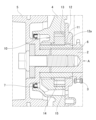
- FIG. 1 is a cross-sectional view showing an assembled state of an oil pump according to an embodiment of the present invention
- FIG. 2 is an enlarged cross-sectional view of the oil pump of FIG. 1
- FIG. 3 is a view taken from the direction of the arrow A in FIG. 2 (without the timing chain and sprockets)
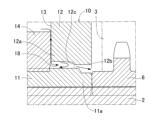
- FIG. 3 is an enlarged cross-sectional view of a main part of FIG. 2 .
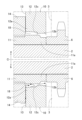
- FIG. 2 is an explanatory diagram of the oil leakage suppression effect of the oil pump of FIG. Illustration of oil leakage from a conventional oil pump
- FIG. 2 is a cross-sectional view showing a modified example of the partition shape of the oil pump shown in FIG.
- An oil pump 10 of this embodiment is attached to an engine 1 as shown in Figures 1 and 2.
- the engine 1 has a cylinder block in which a number of cylinders are formed, pistons 8 provided in each of the cylinders, a crankshaft 2 extending in the direction in which the cylinders are arranged, and a connecting rod 9 connecting the pistons 8 and the crankshaft 2.
- a timing chain 3 is provided on the outside of the cylinder block in the direction in which the cylinders are arranged (the side of the cylinder block).
- a chain case 4 is attached to the side of the cylinder block, and the timing chain 3 is stored between the side of the cylinder block and the chain case 4.
- the oil pump 10 of this embodiment is a chain case-integrated oil pump attached to the surface of the chain case 4 facing the cylinder block.
- the oil pump 10 includes a pump drive shaft 11 that is rotated by the rotation of the crankshaft 2, a pump cover 12 that is attached to the cylinder block side surface of the chain case 4, an inner rotor 14 that is stored in a rotor storage section 13 that is a space formed between the chain case 4 and the pump cover 12 and that is rotated by the rotation of the pump drive shaft 11, and an outer rotor 15 that is stored in the rotor storage section 13 so as to be located radially outside the inner rotor 14 and meshes with the inner rotor 14.
- the inner rotor 14 and the outer rotor 15 constitute the "rotor" in the claims.
- the pump drive shaft 11 is fixed to the outer periphery of the crankshaft 2.
- the pump cover 12 has an opening through which the pump drive shaft 11 is inserted, and the inner surface of this opening (the surface facing the pump drive shaft 11) becomes a bearing portion 12a that rotatably supports the pump drive shaft 11.
- the chain case 4 has a recess that is recessed on the side opposite the cylinder block, and the pump cover 12 has a recess that is recessed on the cylinder block side.
- the recesses in the chain case 4 and the pump cover 12 form a rotor storage portion 13.
- the inner rotor 14 is fixed to the outer periphery of the pump drive shaft 11, and the outer rotor 15 is located within the rotor storage portion 13.
- crankshaft 2 is fitted with, in order from its tip, a crank pulley 5, a pump drive shaft 11, and a sprocket 6 around which the timing chain 3 is wound.
- the reciprocating motion of the pistons 8 of the engine 1 is converted into rotational motion by the connecting rod 9 and transmitted to the crankshaft 2, where the rotation is transmitted to the auxiliary equipment via a belt (not shown) wrapped around the crank pulley 5, and drives the oil pump 10 and timing chain 3.
- the oil pump 10 is divided into an oil suction side area a with a suction port 16 on one side (right side in Figure 3) and an oil discharge side area b with a discharge port 17 on the other side (left side in Figure 3), with the center line C in the lateral (radial) direction of the pump drive shaft 11 as a boundary.
- the crankshaft 2 When driven by the crankshaft 2, the oil sucked in from the suction port 16 is discharged from the discharge port 17.
- the pump cover 12 of this oil pump 10 is provided with a partition 12b that protrudes toward the pump drive shaft 11 on the side of the bearing portion 12a opposite the rotor housing portion 13 (the side opposite the chain case 4, i.e. the cylinder block side).
- the partition 12b has a first surface 12c that rises from the bearing portion 12a toward the pump drive shaft 11, and a second surface 12d that extends from the pump drive shaft 11 side end of the first surface 12c in the axial direction of the pump drive shaft 11 to the end of the pump cover 12 opposite the rotor storage portion 13 side.
- the partition 12b is provided around the entire circumferential circumference of the bearing portion 12a.
- oil retention section 18 By providing the oil retention section 18 as described above, oil leaking from between the pump cover 12 and the inner rotor 14 (side clearance) is retained in the oil retention section 18, preventing oil from leaking from between the bearing section 12a and the pump drive shaft 11 and preventing air from being sucked into the oil pump 10 from between the bearing section 12a and the pump drive shaft 11.
- the pump drive shaft 11 has a tapered portion 11a formed at its tip on the cylinder block side.
- the pump drive shaft 11 is inserted into the bearing portion 12a from the chain case 4 side toward the cylinder block side.
- the tapered portion 11a is formed by a step portion 11b extending toward the central axis of the pump drive shaft 11 and the cylinder block side so that the diameter of the pump drive shaft 11 becomes smaller, and an extension portion 11c extending from the tip of the step portion 11b along the central axis of the pump drive shaft 11.
- a first surface 12c on the rotor storage section 13 side of the partition 12b is formed closer to the rotor storage section 13 than the tapered portion 11a of the pump drive shaft 11.
- the first surface 12c is located closer to the chain case 4 than the step portion 11b. This ensures that the width (seal width) S of the gap between the pump drive shaft 11 and the bearing portion 12a of the pump cover 12 is smaller than the oil retention portion 18, preventing oil from escaping from the tapered portion 11a of the pump drive shaft 11.
- the oil retention portion 18 is formed so that the dimension L2 in the axial direction of the pump drive shaft 11 is larger than the dimension L1 in the radial direction of the pump drive shaft 11. This ensures sufficient sealing length LS of the side clearance to ensure sealing performance, thereby reducing the amount of oil leaking from the side clearance and ensuring a size of the oil retention portion 18 that makes it easy for oil to remain.
- the boundary between the first surface 12c and the surface of the bearing portion 12a (the surface where the partition 12b is not provided) is formed with a concave R shape, which also makes it easier for oil to accumulate in the oil accumulation portion 18, as described below.
- the oil pump 10 of this embodiment has the above-mentioned configuration, and its sealing performance will now be explained in comparison with that of a conventional structure based on Figures 5A and 5B.
- Figure 5A shows the oil pump 10 of the above-mentioned configuration
- Figure 5B shows an oil pump 20 of a conventional structure.
- the oil pump 20 of the conventional structure differs from the oil pump 10 of the embodiment only in that the bearing portion 12a does not have a partition 12b.
- the partition 12b prevents oil leaking through the gap between the bearing 12a and the pump drive shaft 11 from flying toward the piston 8 and hitting the timing chain 3, thereby preventing an increase in friction.
- the rotor housing section 13 becomes negative pressure, so in the oil pump 20 with a conventional structure, air inside the engine 1 is easily sucked in through a route opposite to the oil leakage described above and mixed into the oil.
- the oil that has accumulated in the oil retention section 18 in the oil discharge side area b flows into the oil retention section 18 in the oil suction side area a, and the oil that has accumulated in the oil retention section 18 suppresses the intake of air, so that air can be prevented from mixing with the oil in the rotor storage section 13.
- the oil pump 10 of the embodiment has a partition 12b on the side of the bearing portion 12a of the pump cover 12 opposite the rotor housing portion 13, and an oil retention portion 18 is formed between the rotor housing portion 13 side of the bearing portion 12a of the pump cover 12 and the pump drive shaft 11.
- this reduces oil leakage in the oil discharge side area b, improves discharge efficiency, and suppresses air intake in the oil suction side area a, preventing air from mixing with the oil.
- the oil pump 10 is an oil pump with an integrated chain case, it is possible to prevent the oil from hitting the timing chain 3 and suppress an increase in friction.
- the boundary between the first surface 12c of the partition 12b and the surface of the bearing portion 12a is formed into a constant concave R shape around the entire circumference of the bearing portion 12a, but as a modified example, the radius of curvature of the concave R shape in the oil suction side area a may be smaller than the concave R shape in the oil discharge side area b.
- the boundary between the first surface 12c of the partition 12b in the oil suction side area a and the surface of the bearing portion 12a is formed at a substantially right angle.
- the position of the end of the first surface 12c on the pump drive shaft 11 side (the position in the axial direction of the pump drive shaft 11) is set to the same position in the oil suction side area a and the oil discharge side area b.
- the concave R portion of the boundary between the first surface 12c and the surface of the bearing portion 12a in the oil suction side area a is smaller than in the above example, and the volume of the oil retention portion 18 is increased accordingly, so that the effect of suppressing the intake of air and preventing air from mixing into the oil can be improved.
- the concave R portion at the boundary between the first surface 12c and the surface of the bearing portion 12a is sufficiently secured, making it easy for oil to accumulate.
- the pump cover may be formed by forming the pump cover body and the partition as one unit by casting or the like, or the partition may be attached to the pump cover body as a separate piece.
- an intermediate product with a bearing part having a constant inner diameter in the axial direction may be produced by casting or the like, and the oil retention part may be formed by cutting the rotor housing part 13 side part of the bearing part of the intermediate product.
- the oil retention part 18 may also be formed by a recess formed in the axial middle part of the pump drive shaft 11 in the bearing part 12a.
Landscapes
- Engineering & Computer Science (AREA)
- Mechanical Engineering (AREA)
- General Engineering & Computer Science (AREA)
- Rotary Pumps (AREA)
Priority Applications (1)
| Application Number | Priority Date | Filing Date | Title |
|---|---|---|---|
| JP2025510859A JPWO2024204069A1 (https=) | 2023-03-31 | 2024-03-25 |
Applications Claiming Priority (2)
| Application Number | Priority Date | Filing Date | Title |
|---|---|---|---|
| JP2023-058269 | 2023-03-31 | ||
| JP2023058269 | 2023-03-31 |
Publications (1)
| Publication Number | Publication Date |
|---|---|
| WO2024204069A1 true WO2024204069A1 (ja) | 2024-10-03 |
Family
ID=92905222
Family Applications (1)
| Application Number | Title | Priority Date | Filing Date |
|---|---|---|---|
| PCT/JP2024/011709 Ceased WO2024204069A1 (ja) | 2023-03-31 | 2024-03-25 | オイルポンプ |
Country Status (2)
| Country | Link |
|---|---|
| JP (1) | JPWO2024204069A1 (https=) |
| WO (1) | WO2024204069A1 (https=) |
Citations (4)
| Publication number | Priority date | Publication date | Assignee | Title |
|---|---|---|---|---|
| JPH0193388U (https=) * | 1987-12-10 | 1989-06-20 | ||
| JPH0676668U (ja) * | 1993-04-13 | 1994-10-28 | トーヨーエイテック株式会社 | オイルポンプ |
| JPH08338217A (ja) * | 1995-06-08 | 1996-12-24 | Toyota Motor Corp | オイルポンプの油リリーフ構造 |
| JP2017020434A (ja) * | 2015-07-13 | 2017-01-26 | 本田技研工業株式会社 | 内燃機関のオイルポンプ |
-
2024
- 2024-03-25 WO PCT/JP2024/011709 patent/WO2024204069A1/ja not_active Ceased
- 2024-03-25 JP JP2025510859A patent/JPWO2024204069A1/ja active Pending
Patent Citations (4)
| Publication number | Priority date | Publication date | Assignee | Title |
|---|---|---|---|---|
| JPH0193388U (https=) * | 1987-12-10 | 1989-06-20 | ||
| JPH0676668U (ja) * | 1993-04-13 | 1994-10-28 | トーヨーエイテック株式会社 | オイルポンプ |
| JPH08338217A (ja) * | 1995-06-08 | 1996-12-24 | Toyota Motor Corp | オイルポンプの油リリーフ構造 |
| JP2017020434A (ja) * | 2015-07-13 | 2017-01-26 | 本田技研工業株式会社 | 内燃機関のオイルポンプ |
Also Published As
| Publication number | Publication date |
|---|---|
| JPWO2024204069A1 (https=) | 2024-10-03 |
Similar Documents
| Publication | Publication Date | Title |
|---|---|---|
| EP2995804B1 (en) | Support structure for crankshaft | |
| US7686717B2 (en) | Hydraulic tensioner | |
| JP3754572B2 (ja) | 内燃機関におけるオイルシールの潤滑装置 | |
| WO2024204069A1 (ja) | オイルポンプ | |
| KR20200067558A (ko) | 왕복동 압축기 | |
| WO2018084107A1 (ja) | ベーンポンプ | |
| US7013860B2 (en) | Dry-sump, four-stroke engine lubrication device | |
| JP7349265B2 (ja) | 自動車用のウォータポンプ一体式内燃機関 | |
| JP2001173634A (ja) | オイルフィルタを備えたクランク軸 | |
| JP4397263B2 (ja) | クランク軸を備える機械 | |
| JP6413420B2 (ja) | オイルポンプユニット | |
| JP6383094B2 (ja) | 内燃機関 | |
| JP4334007B2 (ja) | オイルフィルタ装置を備える内燃機関 | |
| KR102192746B1 (ko) | 과급기 | |
| WO2018084105A1 (ja) | ベーンポンプ | |
| JP7393446B2 (ja) | 内燃機関 | |
| JP6029705B2 (ja) | 内燃機関におけるクランク室からのオイル排出構造 | |
| JP6487958B2 (ja) | 内燃機関のコンロッド大端部潤滑構造 | |
| JP2008031900A (ja) | エンジン用オイルポンプ | |
| JP2574282Y2 (ja) | 内接型オイルポンプ | |
| JP7010786B2 (ja) | 圧縮機 | |
| JP4895486B2 (ja) | オイルポンプ | |
| JP2020101173A (ja) | ターボ過給機 | |
| WO2018084045A1 (ja) | 内燃機関のバランサ装置 | |
| JPWO2024204069A5 (https=) |
Legal Events
| Date | Code | Title | Description |
|---|---|---|---|
| 121 | Ep: the epo has been informed by wipo that ep was designated in this application |
Ref document number: 24780187 Country of ref document: EP Kind code of ref document: A1 |
|
| DPE2 | Request for preliminary examination filed before expiration of 19th month from priority date (pct application filed from 20040101) | ||
| ENP | Entry into the national phase |
Ref document number: 2025510859 Country of ref document: JP Kind code of ref document: A |
|
| WWE | Wipo information: entry into national phase |
Ref document number: 2025510859 Country of ref document: JP |
|
| NENP | Non-entry into the national phase |
Ref country code: DE |
|
| 122 | Ep: pct application non-entry in european phase |
Ref document number: 24780187 Country of ref document: EP Kind code of ref document: A1 |