WO2024203271A1 - 含フッ素エラストマーの製造方法および含フッ素エラストマー - Google Patents
含フッ素エラストマーの製造方法および含フッ素エラストマー Download PDFInfo
- Publication number
- WO2024203271A1 WO2024203271A1 PCT/JP2024/009508 JP2024009508W WO2024203271A1 WO 2024203271 A1 WO2024203271 A1 WO 2024203271A1 JP 2024009508 W JP2024009508 W JP 2024009508W WO 2024203271 A1 WO2024203271 A1 WO 2024203271A1
- Authority
- WO
- WIPO (PCT)
- Prior art keywords
- fluorine
- diiodo compound
- containing elastomer
- fluoromonomer
- monomer
- Prior art date
- Legal status (The legal status is an assumption and is not a legal conclusion. Google has not performed a legal analysis and makes no representation as to the accuracy of the status listed.)
- Ceased
Links
Classifications
-
- C—CHEMISTRY; METALLURGY
- C08—ORGANIC MACROMOLECULAR COMPOUNDS; THEIR PREPARATION OR CHEMICAL WORKING-UP; COMPOSITIONS BASED THEREON
- C08F—MACROMOLECULAR COMPOUNDS OBTAINED BY REACTIONS ONLY INVOLVING CARBON-TO-CARBON UNSATURATED BONDS
- C08F214/00—Copolymers of compounds having one or more unsaturated aliphatic radicals, each having only one carbon-to-carbon double bond, and at least one being terminated by a halogen
- C08F214/18—Monomers containing fluorine
- C08F214/22—Vinylidene fluoride
-
- C—CHEMISTRY; METALLURGY
- C08—ORGANIC MACROMOLECULAR COMPOUNDS; THEIR PREPARATION OR CHEMICAL WORKING-UP; COMPOSITIONS BASED THEREON
- C08F—MACROMOLECULAR COMPOUNDS OBTAINED BY REACTIONS ONLY INVOLVING CARBON-TO-CARBON UNSATURATED BONDS
- C08F2/00—Processes of polymerisation
- C08F2/38—Polymerisation using regulators, e.g. chain terminating agents, e.g. telomerisation
-
- C—CHEMISTRY; METALLURGY
- C08—ORGANIC MACROMOLECULAR COMPOUNDS; THEIR PREPARATION OR CHEMICAL WORKING-UP; COMPOSITIONS BASED THEREON
- C08F—MACROMOLECULAR COMPOUNDS OBTAINED BY REACTIONS ONLY INVOLVING CARBON-TO-CARBON UNSATURATED BONDS
- C08F214/00—Copolymers of compounds having one or more unsaturated aliphatic radicals, each having only one carbon-to-carbon double bond, and at least one being terminated by a halogen
- C08F214/18—Monomers containing fluorine
- C08F214/26—Tetrafluoroethene
-
- C—CHEMISTRY; METALLURGY
- C08—ORGANIC MACROMOLECULAR COMPOUNDS; THEIR PREPARATION OR CHEMICAL WORKING-UP; COMPOSITIONS BASED THEREON
- C08F—MACROMOLECULAR COMPOUNDS OBTAINED BY REACTIONS ONLY INVOLVING CARBON-TO-CARBON UNSATURATED BONDS
- C08F214/00—Copolymers of compounds having one or more unsaturated aliphatic radicals, each having only one carbon-to-carbon double bond, and at least one being terminated by a halogen
- C08F214/18—Monomers containing fluorine
- C08F214/28—Hexyfluoropropene
-
- C—CHEMISTRY; METALLURGY
- C08—ORGANIC MACROMOLECULAR COMPOUNDS; THEIR PREPARATION OR CHEMICAL WORKING-UP; COMPOSITIONS BASED THEREON
- C08J—WORKING-UP; GENERAL PROCESSES OF COMPOUNDING; AFTER-TREATMENT NOT COVERED BY SUBCLASSES C08B, C08C, C08F, C08G or C08H
- C08J3/00—Processes of treating or compounding macromolecular substances
- C08J3/24—Crosslinking, e.g. vulcanising, of macromolecules
-
- C—CHEMISTRY; METALLURGY
- C08—ORGANIC MACROMOLECULAR COMPOUNDS; THEIR PREPARATION OR CHEMICAL WORKING-UP; COMPOSITIONS BASED THEREON
- C08L—COMPOSITIONS OF MACROMOLECULAR COMPOUNDS
- C08L27/00—Compositions of homopolymers or copolymers of compounds having one or more unsaturated aliphatic radicals, each having only one carbon-to-carbon double bond, and at least one being terminated by a halogen; Compositions of derivatives of such polymers
- C08L27/02—Compositions of homopolymers or copolymers of compounds having one or more unsaturated aliphatic radicals, each having only one carbon-to-carbon double bond, and at least one being terminated by a halogen; Compositions of derivatives of such polymers not modified by chemical after-treatment
- C08L27/12—Compositions of homopolymers or copolymers of compounds having one or more unsaturated aliphatic radicals, each having only one carbon-to-carbon double bond, and at least one being terminated by a halogen; Compositions of derivatives of such polymers not modified by chemical after-treatment containing fluorine atoms
-
- C—CHEMISTRY; METALLURGY
- C08—ORGANIC MACROMOLECULAR COMPOUNDS; THEIR PREPARATION OR CHEMICAL WORKING-UP; COMPOSITIONS BASED THEREON
- C08L—COMPOSITIONS OF MACROMOLECULAR COMPOUNDS
- C08L27/00—Compositions of homopolymers or copolymers of compounds having one or more unsaturated aliphatic radicals, each having only one carbon-to-carbon double bond, and at least one being terminated by a halogen; Compositions of derivatives of such polymers
- C08L27/02—Compositions of homopolymers or copolymers of compounds having one or more unsaturated aliphatic radicals, each having only one carbon-to-carbon double bond, and at least one being terminated by a halogen; Compositions of derivatives of such polymers not modified by chemical after-treatment
- C08L27/12—Compositions of homopolymers or copolymers of compounds having one or more unsaturated aliphatic radicals, each having only one carbon-to-carbon double bond, and at least one being terminated by a halogen; Compositions of derivatives of such polymers not modified by chemical after-treatment containing fluorine atoms
- C08L27/16—Homopolymers or copolymers or vinylidene fluoride
-
- C—CHEMISTRY; METALLURGY
- C08—ORGANIC MACROMOLECULAR COMPOUNDS; THEIR PREPARATION OR CHEMICAL WORKING-UP; COMPOSITIONS BASED THEREON
- C08J—WORKING-UP; GENERAL PROCESSES OF COMPOUNDING; AFTER-TREATMENT NOT COVERED BY SUBCLASSES C08B, C08C, C08F, C08G or C08H
- C08J2327/00—Characterised by the use of homopolymers or copolymers of compounds having one or more unsaturated aliphatic radicals, each having only one carbon-to-carbon double bond, and at least one being terminated by a halogen; Derivatives of such polymers
- C08J2327/02—Characterised by the use of homopolymers or copolymers of compounds having one or more unsaturated aliphatic radicals, each having only one carbon-to-carbon double bond, and at least one being terminated by a halogen; Derivatives of such polymers not modified by chemical after-treatment
- C08J2327/12—Characterised by the use of homopolymers or copolymers of compounds having one or more unsaturated aliphatic radicals, each having only one carbon-to-carbon double bond, and at least one being terminated by a halogen; Derivatives of such polymers not modified by chemical after-treatment containing fluorine atoms
- C08J2327/16—Homopolymers or copolymers of vinylidene fluoride
-
- C—CHEMISTRY; METALLURGY
- C08—ORGANIC MACROMOLECULAR COMPOUNDS; THEIR PREPARATION OR CHEMICAL WORKING-UP; COMPOSITIONS BASED THEREON
- C08K—Use of inorganic or non-macromolecular organic substances as compounding ingredients
- C08K5/00—Use of organic ingredients
- C08K5/04—Oxygen-containing compounds
- C08K5/14—Peroxides
Definitions
- This disclosure relates to a method for producing a fluorine-containing elastomer, a fluorine-containing elastomer, a crosslinkable composition, and a molded article.
- Patent Document 1 describes a copolymer that does not contain bromine and/or iodine, which is obtained by copolymerizing a specific type of fluorine-containing vinyl compound with a specific type of alkenyl isocyanurate and/or alkenyl cyanurate, has reactive double bonds as side chains, and is essentially a non-crosslinked copolymer that can be crosslinked by free radicals under mild conditions.
- Patent document 2 describes a method for producing liquid fluororubber that can be pumped at least at slightly elevated temperatures (60-120°C) and processed in conventional thermoplastic processing machines, in which a) vinylidene fluoride and optionally further fluorine-containing and/or fluorine-free monomers are polymerized by a free radical mechanism in the presence of b) at least one compound or a mixture thereof selected from the group consisting of diiodomethane, 1,2-diiodo-1,1-difluoroethane, 1-iodo-2-bromo-1,1-difluoroethane, 1-bromo-2-iodo-1,1-difluoroethane, 1,2-dibromo-1,1-difluoroethane, and in the presence of an initiator or further auxiliary or both, at a temperature of 0°C to 70°C.
- the objective of this disclosure is to provide a new method for producing a fluorine-containing elastomer and a new fluorine-containing elastomer.
- the present disclosure provides a method for producing a fluorine-containing elastomer by polymerizing a fluoromonomer and a polyfunctional non-fluorine-containing monomer in the presence of a diiodo compound to obtain a fluorine-containing elastomer.
- the present disclosure provides a novel method for producing a fluorine-containing elastomer and a novel fluorine-containing elastomer.
- the first manufacturing method of the present disclosure has such a configuration, and therefore can produce a fluorine-containing elastomer that can be crosslinked by peroxide crosslinking and that can be easily removed from a mold when a molded product is produced using the mold.
- Patent Document 1 when a fluorine-containing elastomer is produced using a specific type of fluorine-containing vinyl compound and a specific type of alkenyl isocyanurate and/or alkenyl cyanurate, there is a problem in that it is difficult to produce a fluorine-containing elastomer that has sufficient crosslinking properties and gives a molded article with excellent compression set resistance.
- Patent Document 2 when a fluorine-containing elastomer is produced using diiodomethane, there is a problem in that it is difficult to produce a fluorine-containing elastomer that gives a molded article with excellent demolding properties and compression set resistance.
- Patent Document 3 when a fluoroelastomer is produced using a fluorovinyl ether containing a halogen atom, a fluoroelastomer with excellent properties can be produced.
- the fluorovinyl ether described in Patent Document 3 has the problem that it is laborious to produce and expensive.
- a method for producing a fluorine-containing elastomer it has been found that the problems of the prior art can be successfully solved by polymerizing a fluoromonomer and a polyfunctional fluorine-free monomer in the presence of a diiodo compound.
- the fluorine-containing elastomer obtained by the first production method of the present disclosure can be crosslinked by peroxide crosslinking.
- molded articles obtained by crosslinking the fluorine-containing elastomer obtained by the first production method of the present disclosure have excellent release properties, so that they can be produced with high productivity and also have excellent heat resistance and compression set resistance properties.
- the diiodo compound used in the first production method may be a fluorine-containing diiodo compound (11) or a fluorine-free diiodo compound (12).
- a diiodo compound iodine atoms can be introduced into the polymer terminals of a fluorine-containing elastomer.
- crosslinkable iodine atoms By introducing crosslinkable iodine atoms into the polymer terminals, a fluorine-containing elastomer that can be efficiently crosslinked by peroxide crosslinking can be produced.
- the fluorine-containing diiodo compound (11) is a compound having a fluorine atom and two iodine atoms.
- Examples of the fluorine-containing diiodo compound (11) include 1,3-diiodoperfluoropropane, 1,4-diiodoperfluoro-n-butane, 1,3-diiodo-2-chloroperfluoropropane, 1,5-diiodo-2,4-dichloroperfluoro-n-pentane, 1,7-diiodoperfluoro-n-octane, 1,2-di(iododifluoromethyl)perfluorocyclobutane, 1,6-diiodoperfluorohexane, 1,8-diiodoperfluorooctane, 1,12-diiodoperfluorododecane, and 1,16-diio
- fluorine-containing diiodo compound (11) a fluorine-containing diiodo compound having two or more carbon atoms is preferred, and 1,4-diiodoperfluoro-n-butane is more preferred.
- the fluorine-free diiodo compound (12) is a compound that does not contain a fluorine atom and has two iodine atoms.
- Examples of the fluorine-free diiodo compound (12) include diiodomethane, 1,2-diiodoethane, 1,3-diiodo-n-propane, and 1,2-diiodo-1,1-difluoroethane.
- non-fluorine-containing diiodo compound (12) a non-fluorine-containing diiodo compound having one carbon atom is preferable, and diiodomethane is more preferable.
- a non-fluorine-containing diiodo compound having a small carbon atom number is preferable, and the production cost of the fluorine-containing elastomer can be reduced.
- both the fluorine-containing diiodo compound (11) and the fluorine-free diiodo compound (12) are used. This allows the fluorine-containing elastomer to be produced more cheaply than a manufacturing method that uses only a fluorine-containing diiodo compound as a chain transfer agent.
- a fluoromonomer is polymerized in the presence of a diiodo compound (1), and then the fluoromonomer is polymerized in the presence of a non-fluorine-containing diiodo compound (12).
- the diiodo compound (1) may be added all at once or continuously.
- the timing of adding the diiodo compound (1) is not particularly limited, but it is preferable to add at least a portion of the diiodo compound (1) until a mass of the fluorine-containing elastomer equivalent to 10 mass% of the mass of the finally obtained fluorine-containing elastomer is produced.
- the non-fluorine-containing diiodo compound (12) may be added all at once or continuously.
- the timing of adding the non-fluorine-containing diiodo compound (12) is not particularly limited, but it is preferable to add at least a portion of the non-fluorine-containing diiodo compound (12) after a mass of the fluorine-containing elastomer equivalent to 30 to 90 mass% of the mass of the finally obtained fluorine-containing elastomer is produced.
- a fluoromonomer is polymerized in the presence of diiodo compound (1) until a mass of fluoroelastomer equivalent to 30 to 90 mass% of the mass of the finally obtained fluoroelastomer is produced, and then the fluoromonomer is polymerized in the presence of non-fluorine-containing diiodo compound (12).
- the polymerization of the fluoromonomer in the presence of the diiodo compound (1) is carried out until a mass of the fluoroelastomer corresponding to preferably 30 to 90 mass%, more preferably 40 mass% or more, and more preferably 80 mass% or less is produced, based on the mass of the final fluoroelastomer.
- a fluoromonomer is polymerized in the presence of a fluorine-containing diiodo compound (11), and then the fluoromonomer is polymerized in the presence of a fluorine-free diiodo compound (12).
- diiodomethane is known as a chain transfer agent used in the production method of a fluorine-containing elastomer, as described in Patent Document 2.
- the reaction rate is low, especially in the early stage of the polymerization reaction, and it is difficult to produce the fluorine-containing elastomer with high productivity.
- the amount of initiator is significantly increased to increase productivity, the iodine group at the polymer end is replaced by the initiator end, and the compression set resistance property is reduced.
- a fluorine-containing diiodo compound (11) By polymerizing a fluoromonomer in the presence of a fluorine-containing diiodo compound (11), and then polymerizing the fluoromonomer in the presence of a fluorine-free diiodo compound (12), a fluorine-containing elastomer that can be crosslinked by peroxide crosslinking can be produced with high productivity, and the fluorine-containing elastomer can be produced more cheaply than a production method that uses only a fluorine-containing diiodo compound as a chain transfer agent.
- a fluoromonomer is polymerized in the presence of a fluorine-containing diiodo compound (11) until a mass of a fluoroelastomer equivalent to 30 to 90 mass% of the mass of the finally obtained fluoroelastomer is produced, and then the fluoromonomer is polymerized in the presence of a fluorine-free diiodo compound (12).
- a fluoroelastomer that can be crosslinked by peroxide crosslinking with higher productivity, and also makes it possible to produce a fluoroelastomer at a lower cost than a production method that uses only a fluorine-containing diiodo compound as a chain transfer agent.
- the polymerization of the fluoromonomer in the presence of the fluorine-containing diiodo compound (11) is carried out until a mass of the fluoroelastomer corresponding to preferably 30 to 90 mass%, more preferably 40 mass% or more, more preferably 80 mass% or less is produced, based on the mass of the final fluoroelastomer.
- the amount of the diiodo compound (when both a fluorine-containing diiodo compound and a fluorine-free diiodo compound are used, the total amount of these) is preferably 0.2 ⁇ 10 ⁇ 3 to 2 mol %, more preferably 1.0 ⁇ 10 ⁇ 3 mol % or more, and more preferably 1 mol % or less, based on the total amount of monomers used in the polymerization.
- the amount of the fluorine-containing diiodo compound (11) is preferably 0.2 ⁇ 10 ⁇ 3 to 2 mol %, more preferably 1.0 ⁇ 10 ⁇ 3 mol % or more, and more preferably 1 mol % or less, based on the total amount of monomers used in the polymerization.
- the amount of the fluorine-free diiodo compound (12) is preferably 0.2 ⁇ 10 ⁇ 3 to 2 mol %, more preferably 1.0 ⁇ 10 ⁇ 3 mol % or more, and more preferably 1 mol % or less, based on the total amount of monomers used in the polymerization.
- the polyfunctional fluorine-free monomer used in the first manufacturing method is a monomer having two or more functional groups and not containing a fluorine atom.
- a polyfunctional fluorine-free monomer unit can be introduced into the fluorine-containing elastomer.
- the polyfunctional fluorine-free monomer unit in the fluorine-containing elastomer gives the fluorine-containing elastomer a branched structure or functions as a site that can be crosslinked by peroxide crosslinking.
- the polyfunctional non-fluorine-containing monomer has two or more functional groups.
- the number of functional groups in the polyfunctional non-fluorine-containing monomer is preferably 2 to 6, more preferably 3 or more, more preferably 5 or less, and even more preferably 4 or less.
- the number of functional groups in the polyfunctional non-fluorine-containing monomer is particularly preferably 3.
- the polyfunctional non-fluorine-containing monomer preferably has an unsaturated functional group.
- the unsaturated functional group is a functional group having an unsaturated bond such as a carbon-carbon double bond.
- the unsaturated functional group is preferably at least one selected from the group consisting of a vinyl group, an isopropenyl group, an allyl group, and a methallyl group, and more preferably at least one selected from the group consisting of an allyl group and a methallyl group.
- the polyfunctional non-fluorine-containing monomer preferably has a nitrogen-containing heterocycle.
- the number of members of the nitrogen-containing heterocycle is preferably 4 to 10, and more preferably 6.
- the number of nitrogen atoms forming the nitrogen-containing heterocycle is preferably 1 to 5, and more preferably 3.
- the nitrogen-containing heterocycle is preferably a 6-membered ring formed by three carbon atoms and three nitrogen atoms, and more preferably a 1,3,5-triazine ring.
- polyfunctional non-fluorine-containing monomers examples include triallyl cyanurate, triallyl isocyanurate (TAIC), trimethallyl isocyanurate, tris(diallylamine-s-triazine), triallyl phosphite, N,N-diallyl acrylamide, hexaallyl phosphoramide, N,N,N',N'-tetraallyl tetraphthalamide, N,N,N',N'-tetraallyl malonamide, trivinyl isocyanurate, 2,4,6-trivinylmethyltrisiloxane, and tri(5-norbornene-2-methylene) cyanurate.
- TAIC triallyl isocyanurate
- trimethallyl isocyanurate trimethallyl isocyanurate
- triallyl phosphite examples include triallyl cyanurate, triallyl is
- polyfunctional non-fluorine-containing monomer at least one selected from the group consisting of triallyl isocyanurate and trimethallyl isocyanurate is preferred.
- the polyfunctional non-fluorine-containing monomer may be added all at once or continuously.
- the timing of adding the polyfunctional non-fluorine-containing monomer is not particularly limited. In the case of polymerizing a fluoromonomer in the presence of a diiodo compound (1) and then polymerizing the fluoromonomer in the presence of a fluorine-free diiodo compound (12), it is preferable to add at least a part of the polyfunctional non-fluorine-containing monomer when polymerizing the fluoromonomer in the presence of the diiodo compound (1), and it is more preferable to add the polyfunctional non-fluorine-containing monomer after adding the diiodo compound (1) to the polymerization system. This makes it easy to produce a fluorine-containing elastomer having excellent mold releasability and excellent moldability.
- the amount of polyfunctional non-fluorine-containing monomer is preferably 0.005 to 0.2 mol %, more preferably 0.01 mol % or more, and more preferably 0.1 mol % or less, based on the total amount of monomers used in the polymerization.
- the molar ratio of the amount of the polyfunctional non-fluorine-containing monomer to the amount of the diiodo compound (polyfunctional non-fluorine-containing monomer/diiodo compound) is preferably 0.01 to 1.0, more preferably 0.05 or more, and more preferably 0.5 or less. If the amount of the polyfunctional non-fluorine-containing monomer used is too large compared to the amount of the diiodo compound used, the resulting fluorine-containing elastomer tends to gel. In addition, when the resulting fluorine-containing elastomer is crosslinked to produce a crosslinked sheet, the crosslinked sheet tends to warp, making it difficult to produce a molded product having the desired shape.
- the fluoromonomer used in the first production method is a monomer containing a fluorine atom.
- PMVE perfluoro(methyl vinyl ether)
- PEVE perfluoro(ethyl vinyl ether)
- PPVE perfluoro(propyl vinyl ether)
- a perfluorovinyl ether represented by the formula: CF 2 ⁇ CFOCF 2 ORf c (wherein Rf c is a linear or branched perfluoroalkyl group having 1 to 6 carbon atoms, a cyclic perfluoroalkyl group having 5 to 6 carbon atoms, or a linear or branched perfluorooxyalkyl group having 2 to 6 carbon atoms and containing 1 to 3 oxygen atoms).
- Rf c is a linear or branched perfluoroalkyl group having 1 to 6 carbon atoms, a cyclic perfluoroalkyl group having 5 to 6 carbon atoms, or a linear or branched perfluorooxyalkyl group having 2 to 6 carbon atoms and containing 1 to 3 oxygen atoms.
- Rf c is a linear or branched perfluoroalkyl group having 1 to 6 carbon atoms, a cyclic perfluoroalkyl group having 5
- Rf 31 is a linear fluoroalkyl group
- Rf 31 is a linear perfluoroalkyl group
- Rf 31 preferably has 1 to 6 carbon atoms.
- Examples of the fluoromonomer ( 2) include CH 2 ⁇ CFCF 3 , CH 2 ⁇ CFCF 2 CF 3 , CH 2 ⁇ CFCF 2 CF 2 CF 3 , CHF ⁇ CHCF 3 (1,3,3,3-tetrafluoropropene), CHF ⁇ CHCF 3 (E form), and CHF ⁇ CHCF 3 (Z form), and among these, 2,3,3,3 - tetrafluoropropylene represented by CH 2 ⁇ CFCF 3 is preferred.
- the fluoromonomer used in the first manufacturing method preferably contains at least one selected from the group consisting of vinylidene fluoride and tetrafluoroethylene, and more preferably contains vinylidene fluoride.
- the polymerization in the first production method can be carried out, for example, by charging a surfactant and an aqueous medium into a pressure-resistant polymerization tank equipped with a stirrer, deoxidizing, charging a monomer, bringing the temperature to a predetermined level, adding a polymerization initiator to start the reaction, and charging a diiodo compound during the polymerization reaction. Since the pressure decreases as the reaction proceeds, additional monomer is continuously or intermittently supplied to maintain the initial pressure, and when a predetermined amount of monomer has been supplied, the supply is stopped, the monomer in the reaction tank is purged, and the temperature is returned to room temperature to terminate the reaction.
- the polymerization in the first manufacturing method can be carried out in the presence of a polymerization initiator.
- the polymerization initiator include radical polymerization initiators.
- radical polymerization initiators There are no particular limitations on the polymerization initiator as long as it can generate radicals at the polymerization temperature, and oil-soluble polymerization initiators, water-soluble polymerization initiators, etc. can be used, with water-soluble polymerization initiators being preferred.
- the polymerization initiator may also be used as a redox initiator in combination with a reducing agent, etc.
- the amount of polymerization initiator is appropriately determined depending on the type of monomer, the molecular weight of the desired fluorine-containing elastomer, and the reaction rate.
- the amount of polymerization initiator is appropriately determined depending on the molecular weight of the desired fluorine-containing elastomer and the polymerization reaction rate, but is preferably 0.00001 to 10 mass%, and more preferably 0.0001 to 1 mass%, relative to 100 mass% of the total amount of monomers.
- an oil-soluble radical polymerization initiator a water-soluble radical polymerization initiator, or an azo compound can be used.
- the oil-soluble radical polymerization initiator may be a known oil-soluble peroxide, for example, dialkyl peroxycarbonates such as diisopropyl peroxydicarbonate and disec-butyl peroxydicarbonate, peroxyesters such as t-butyl peroxyisobutyrate and t-butyl peroxypivalate, dialkyl peroxides such as di-t-butyl peroxide, and also di( ⁇ -hydro-dodecafluoroheptanoyl) peroxide, di( ⁇ -hydro-tetradecafluorooctanoyl) peroxide, di( ⁇ -hydro-hexadecafluorononanoyl) peroxide, di(perfluorobutyryl) peroxide, di(perfluorovaleryl) peroxide, di(perfluorohexanoyl) peroxide, di(perfluoroheptanoyl) peroxide, di(per
- Azo compounds include azodicarboxylate, azodicarboxyldiamide, 2,2'-azobisisobutyronitrile, 2,2'-azobis2,4-dimethylvaleronitrile, 2,2'-azobis(2-methylpropionamidine) dihydrochloride, and 4,4'-azobis(4-cyanovaleric acid).
- the water-soluble radical polymerization initiator may be a known water-soluble peroxide, such as ammonium, potassium, or sodium salts of persulfuric acid, perboric acid, perchloric acid, perphosphoric acid, or percarbonic acid; organic peroxides such as disuccinic acid peroxide or diglutaric acid peroxide; t-butyl permaleate; or t-butyl hydroperoxide.
- a reducing agent such as sulfites may also be included, and the amount used may be 0.1 to 20 times the amount of the peroxide.
- a salt of persulfuric acid is preferable because the amount of radicals generated can be easily adjusted.
- Potassium persulfate (K 2 S 2 O 8 ), ammonium persulfate ((NH 4 ) 2 S 2 O 8 ), and sodium persulfate (Na 2 S 2 O 8 ) are preferable, and ammonium persulfate is most preferable.
- a redox initiator that combines an oxidizing agent and a reducing agent as the polymerization initiator.
- Oxidizing agents include persulfates, organic peroxides, potassium permanganate, manganese triacetate, cerium ammonium nitrate, bromates, etc.
- Reducing agents include sulfites, bisulfites, bromates, diimines, oxalic acid, and metal sulfinates.
- Persulfates include ammonium persulfate, potassium persulfate, and sodium persulfate.
- Sulfites include sodium sulfite and ammonium sulfite.
- a copper salt or an iron salt to the combination of redox initiators.
- copper salt copper(II) sulfate
- iron salt iron(II) sulfate
- a chelating agent is disodium ethylenediaminetetraacetate dihydrate.
- redox initiators include potassium permanganate/oxalic acid, ammonium persulfate/bisulfite/iron(II) sulfate, ammonium persulfate/sulfite/iron(II) sulfate, ammonium persulfate/sulfite, ammonium persulfate/iron(II) sulfate, manganese triacetate/oxalic acid, cerium ammonium nitrate/oxalic acid, bromate/sulfite, bromate/bisulfite, ammonium persulfate/sodium hydroxymethanesulfinate dihydrate, and hydrogen peroxide/ascorbic acid (described in JP-A-55-102615), with ammonium persulfate/sodium hydroxymethanesulfinate dihydrate being preferred.
- either the oxidizing agent or the reducing agent may be charged in advance to the polymerization tank, and then the other may be added continuously or intermittently to initiate polymerization.
- the oxidizing agent or the reducing agent may be charged in advance to the polymerization tank, and then the other may be added continuously or intermittently to initiate polymerization.
- ammonium persulfate/sodium hydroxymethanesulfinate dihydrate it is preferable to charge ammonium persulfate in the polymerization tank and continuously add sodium hydroxymethanesulfinate dihydrate to it.
- the amount of persulfate used in the redox initiator is preferably 0.001 to 2.0% by mass, more preferably 0.01 to 1.5% by mass, and particularly preferably 0.05 to 1.0% by mass, based on the aqueous medium used in the polymerization.
- the amount of the reducing agent used is preferably 0.01 to 30% by mass, more preferably 0.05 to 10% by mass, and particularly preferably 0.1 to 5% by mass, relative to the aqueous medium used in the polymerization.
- the amount of the third component (the copper salt, iron salt, etc.) used is preferably 0.001 to 0.5% by mass, more preferably 0.005 to 0.4% by mass, and particularly preferably 0.01 to 0.3% by mass, based on the aqueous medium used in the polymerization.
- the polymerization in the first manufacturing method can be carried out in the presence of a surfactant.
- the surfactant may be either a reactive surfactant or a non-reactive surfactant.
- the surfactant may also be either a fluorine-containing surfactant or a non-fluorine-containing surfactant.
- the surfactant may also be either an anionic surfactant, a cationic surfactant, a nonionic surfactant, or an amphoteric surfactant.
- the polymerization in the first manufacturing method can also be carried out in the absence of a surfactant, as described in WO 2007/129735.
- the polymerization in the first production method can be carried out in an aqueous medium.
- the aqueous medium means a liquid containing water.
- the aqueous medium is not particularly limited as long as it contains water, and may contain water and, for example, a fluorine-free organic solvent such as an alcohol, ether, or ketone, and/or a fluorine-containing organic solvent having a boiling point of 40°C or less.
- the polymerization temperature in the first manufacturing method is preferably 10 to 120°C.
- the polymerization pressure in the first manufacturing method is preferably 0.5 to 10 MPaG.
- the first manufacturing method provides a fluorine-containing elastomer.
- the fluorine-containing elastomer provided by the first manufacturing method has a multimodal molecular weight distribution.
- the fluorine-containing elastomer provided by the first manufacturing method has a bimodal molecular weight distribution. It is preferable that the fluorine-containing elastomer has a bimodal molecular weight distribution in which the ratio ((A)/(B)) of the area of the peak on the high molecular weight side appearing in the GPC curve (A) to the area of the peak on the low molecular weight side (B) is 90/10 to 30/70.
- the fluorine-containing elastomer has such a molecular weight distribution, it is possible to obtain a molded product having excellent releasability, heat resistance, and compression set resistance, and the moldability of the fluorine-containing elastomer is improved.
- the ratio ((A)/(B)) of the fluorine-containing elastomer obtained by the first production method is preferably 90/10 to 30/70, more preferably 80/20 or less, and more preferably 40/60 or more.
- an aqueous dispersion containing a fluorine-containing elastomer is usually obtained.
- the aqueous dispersion of the fluorine-containing elastomer may be subjected to treatments such as coagulation and heating.
- the coagulation can be carried out by adding alkaline earth and earth metal salts to the aqueous dispersion.
- alkaline earth and earth metal salts include sulfates, nitrates, hydrochlorides, and acetates of calcium, magnesium, aluminum, etc.
- the coagulated fluorine-containing elastomer may be washed with water to remove small amounts of impurities such as buffer solutions and salts present in the fluorine-containing elastomer, and then the washed fluorine-containing elastomer may be dried.
- the drying temperature is preferably 40 to 200°C, more preferably 60 to 180°C, and even more preferably 80 to 150°C.
- the form of the fluorine-containing elastomer obtained after coagulation is not particularly limited, but may be gum, crumb, powder, pellets, etc., and is preferably gum or crumb.
- Gum is a small granular mass of fluorine-containing elastomer
- crumb is an amorphous mass formed when the fluorine-containing elastomer cannot maintain its small granular shape as a gum at room temperature and melts together.
- Gum or crumb is preferably obtained by coagulating, drying, etc., the aqueous dispersion obtained by the manufacturing method disclosed herein using a conventional method.
- a fluorine-containing elastomer According to the first production method, a fluorine-containing elastomer can be obtained.
- the fluorine-containing elastomer has an iodine content of 0.1 to 1.0 mass % and contains a fluoromonomer unit and a polyfunctional non-fluorine-containing monomer unit.
- the fluorine-containing elastomer according to one embodiment of the present disclosure has such a configuration, it can be crosslinked by peroxide crosslinking to obtain a molded article, and furthermore, when a molded article is produced using a mold, it can be easily removed from the mold. Therefore, by using the fluorine-containing elastomer of the present disclosure, beautiful molded articles can be produced with high productivity. Furthermore, molded articles obtained from the fluorine-containing elastomer of the present disclosure also have excellent heat resistance and compression set resistance properties.
- the iodine content in the fluorine-containing elastomer is 0.05 to 2.0% by mass, preferably 0.1% by mass or more, more preferably 0.2% by mass or more, and preferably 1.5% by mass or less, more preferably 1.0% by mass or less.
- the iodine content in fluorine-containing elastomers can be measured by elemental analysis.
- the polyfunctional non-fluorine-containing monomer unit in the fluorine-containing elastomer is a repeating unit based on a polyfunctional non-fluorine-containing monomer.
- Examples of the polyfunctional non-fluorine-containing monomer include the polyfunctional non-fluorine-containing monomer used in the first production method, and similar ones are preferred.
- the content of the polyfunctional non-fluorine-containing monomer units is preferably 0.005 to 0.2 mol %, more preferably 0.01 mol % or more, and more preferably 0.1 mol % or less, based on the total monomer units.
- the fluorine-containing elastomer may be obtained by polymerizing a polyfunctional non-fluorine-containing monomer in an amount corresponding to preferably 0.005 to 0.2 mol %, more preferably 0.01 mol % or more, more preferably 0.1 mol % or less, based on the total monomer units of the fluorine-containing elastomer.
- the content of polyfunctional non-fluorine-containing monomer units in a fluorine-containing elastomer can be calculated by appropriately combining NMR, FT-IR, elemental analysis, and X-ray fluorescence analysis depending on the type of monomer.
- the fluoromonomer units in the fluorine-containing elastomer are repeating units based on a fluoromonomer.
- Examples of the fluoromonomer include the fluoromonomers used in the first production method, and similar ones are preferred.
- the fluorine-containing elastomer has a multimodal molecular weight distribution. In another embodiment, the fluorine-containing elastomer has a bimodal molecular weight distribution. It is preferable that the fluorine-containing elastomer has a bimodal molecular weight distribution in which the ratio ((A)/(B)) of the area of the peak on the high molecular weight side appearing in the GPC curve (A) to the area of the peak on the low molecular weight side (B) is 90/10 to 30/70.
- the fluorine-containing elastomer has such a molecular weight distribution, it is possible to obtain a molded product having excellent releasability, heat resistance, and compression set resistance, and the moldability of the fluorine-containing elastomer is improved.
- the ratio of the fluorine-containing elastomers ((A)/(B)) is preferably 90/10 to 30/70, more preferably 80/20 or less, and more preferably 40/60 or more.
- the fluorine-containing elastomer may be a fully fluorinated elastomer or a partially fluorinated elastomer. In one embodiment, the fluorine-containing elastomer is a partially fluorinated elastomer.
- a partially fluorinated elastomer is a fluoropolymer that contains fluoromonomer units and has a perfluoromonomer unit content of less than 90 mol% relative to the total monomer units, has a glass transition temperature of 20°C or less, and has a melting peak ( ⁇ H) magnitude of 4.5 J/g or less.
- a perfluoromonomer is a monomer that does not contain a carbon atom-hydrogen atom bond in the molecule.
- perfluoromonomers may be monomers in which some of the fluorine atoms bonded to carbon atoms have been replaced with chlorine atoms, and may also have nitrogen atoms, oxygen atoms, sulfur atoms, phosphorus atoms, boron atoms, or silicon atoms in addition to carbon atoms.
- a perfluoromonomer is preferably a monomer in which all hydrogen atoms have been replaced with fluorine atoms. Perfluoromonomers do not include monomers that provide crosslinkable groups.
- the fluorine-containing elastomer preferably contains a monomer unit based on at least one monomer selected from the group consisting of tetrafluoroethylene (TFE), vinylidene fluoride (VdF), and a perfluoroethylenically unsaturated compound represented by the general formula: CF 2 ⁇ CF-Rf a (wherein Rf a is -CF 3 or -ORf b (Rf b is a perfluoroalkyl group having 1 to 5 carbon atoms)) (e.g., hexafluoropropylene (HFP), perfluoro(alkyl vinyl ether) (PAVE) etc.).
- the fluorine-containing elastomer preferably contains a VdF unit or a TFE unit, and more preferably contains a VDF unit.
- fluorine-containing elastomers include VdF-based fluorine-containing elastomers, TFE/propylene (Pr)-based fluorine-containing elastomers, TFE/Pr/VdF-based fluorine-containing elastomers, ethylene (Et)/HFP-based fluorine-containing elastomers, Et/HFP/VdF-based fluorine-containing elastomers, Et/HFP/TFE-based fluorine-containing elastomers, and Et/TFE/PAVE-based fluorine-containing elastomers.
- VdF-based fluorine-containing elastomers are more preferred in terms of good heat aging resistance and oil resistance.
- the VdF-based fluorine-containing elastomer is a fluorine-containing elastomer having VdF units.
- the content of VdF units in the fluorine-containing elastomer is preferably 20 mol% or more, more preferably 40 mol% or more, even more preferably 50 mol% or more, and particularly preferably 60 mol% or more, based on the total number of monomer units.
- the VdF units preferably account for 20 mol% or more and 90 mol% or less of the total number of moles of VdF units and monomer units based on other monomers, more preferably 40 mol% or more and 85 mol% or less, even more preferably 45 mol% or more and 80 mol% or less, and particularly preferably 50 mol% or more and 80 mol% or less.
- the other monomers in the VdF-based fluorine-containing elastomer are not particularly limited as long as they are copolymerizable with VdF, and for example, the fluoromonomers mentioned above can be used.
- the VdF-based fluorine-containing elastomer is preferably at least one copolymer selected from the group consisting of VdF/HFP copolymer, VdF/TFE/HFP copolymer, VdF/CTFE copolymer, VdF/CTFE/TFE copolymer, VdF/PAVE copolymer, VdF/TFE/PAVE copolymer, VdF/HFP/PAVE copolymer, VdF/HFP/TFE/PAVE copolymer, VdF/TFE/Pr copolymer, VdF/Et/HFP copolymer, and VdF/fluoromonomer (2) copolymer.
- the fluoromonomer other than VdF has at least one fluoromonomer selected from the group consisting of TFE, HFP, and PAVE.
- the VdF-based fluorine-containing elastomer is preferably at least one copolymer selected from the group consisting of VdF/HFP copolymer, VdF/TFE/HFP copolymer, VdF/fluoromonomer (2) copolymer, VdF/PAVE copolymer, VdF/TFE/PAVE copolymer, VdF/HFP/PAVE copolymer, and VdF/HFP/TFE/PAVE copolymer, and more preferably at least one copolymer selected from the group consisting of VdF/HFP copolymer, VdF/HFP/TFE copolymer, VdF/fluoromonomer (2) copolymer, and VdF/PAVE copolymer.
- the VdF/PAVE copolymer preferably has a VdF/PAVE composition of (65 to 90)/(35 to 10) (mol %). In addition, it is also one of the preferred embodiments that the VdF/PAVE composition is (50 to 78)/(50 to 22) (mol %).
- VdF/TFE/PAVE copolymer one having a VdF/TFE/PAVE composition of (40-80)/(3-40)/(15-35) (mol%) is preferred.
- VdF/HFP/PAVE copolymer one having a VdF/HFP/PAVE composition of (65-90)/(3-25)/(3-25) (mol%) is preferred.
- VdF/HFP/TFE/PAVE copolymer one having a VdF/HFP/TFE/PAVE composition of (40-90)/(0-25)/(0-40)/(3-35) (mol%) is preferred, and one having a VdF/HFP/TFE/PAVE composition of (40-80)/(3-25)/(3-40)/(3-25) (mol%) is more preferred.
- VdF/fluoromonomer (2) As a copolymer of VdF/fluoromonomer (2), it is preferable that the VdF/fluoromonomer (2) units are (85-20)/(15-80) (mol%) and that monomer units other than VdF and fluoromonomer (2) account for 0-50 mol% of the total monomer units, and it is more preferable that the molar ratio of VdF/fluoromonomer (2) units is (80-20)/(20-80). In addition, one preferred embodiment is that the composition of VdF/fluoromonomer (2) units is (78-50)/(22-50) (mol%).
- VdF/fluoromonomer (2) one in which the VdF/fluoromonomer (2) units are (85-50)/(15-50) (mol%) and the other monomer units other than VdF and fluoromonomer (2) are 1-50 mol% of the total monomer units is also preferred.
- VdF and fluoromonomer (2) preferred are the monomers exemplified as other monomers in the VdF-based fluorine-containing elastomer, such as TFE, HFP, PMVE, perfluoroethyl vinyl ether (PEVE), PPVE, CTFE, trifluoroethylene, hexafluoroisobutene, vinyl fluoride, Et, Pr, alkyl vinyl ether, and monomers that provide crosslinkable groups, and among these, PMVE, CTFE, HFP, and TFE are more preferred.
- TFE/Pr-based fluorine-containing elastomer refers to a fluorine-containing copolymer consisting of 45-70 mol% TFE and 55-30 mol% Pr. In addition to these two components, it may contain a specific third component.
- the specific third component may include, for example, fluoromonomers such as fluorine-containing olefins other than TFE (e.g., VdF, HFP, CTFE, perfluoro(butyl ethylene), etc.), fluorine-containing vinyl ethers (perfluoro(propyl vinyl ether), perfluoro(methyl vinyl ether), etc.); hydrocarbon monomers such as ⁇ -olefins (ethylene, 1-butene, etc.), vinyl ethers (ethyl vinyl ether, butyl vinyl ether, hydroxybutyl vinyl ether, etc.), and vinyl esters (vinyl acetate, vinyl benzoate, vinyl crotonate, vinyl methacrylate, etc.); and the like.
- the specific third component may be one type, or two or more types may be used in combination.
- TFE/Pr-based fluorine-containing elastomers preferably contain VdF, and among TFE/Pr-based fluorine-containing elastomers, elastomers consisting of TFE, Pr, and VdF are called TFE/Pr/VdF-based fluorine-containing elastomers.
- the TFE/Pr/VdF-based fluorine-containing elastomer may further contain the specific third component other than VdF.
- the specific third component may be one type or a combination of two or more types.
- the total content of the third components in the TFE/Pr-based fluorine-containing elastomer is preferably 35 mol% or less, more preferably 33 mol% or less, and even more preferably 31 mol% or less.
- the Et/HFP copolymer preferably has an Et/HFP composition of (35-80)/(65-20) (mol%), and more preferably has an Et/HFP composition of (40-75)/(60-25) (mol%).
- the Et/HFP/TFE copolymer preferably has an Et/HFP/TFE composition of (35-75)/(25-50)/(0-15) (mol%), and more preferably has an Et/HFP/TFE composition of (45-75)/(25-45)/(0-10) (mol%).
- the Et/TFE/PAVE copolymer preferably has a composition of Et/TFE/PAVE of (10-40)/(32-60)/(20-40) (mol%), and more preferably (20-40)/(40-50)/(20-30) (mol%). PMVE is preferred as the PAVE.
- a fluorine-containing elastomer containing VdF units is preferred, a VdF/HFP copolymer or a VdF/HFP/TFE copolymer is more preferred, and a VdF/HFP/TFE composition of (32-85)/(10-34)/(0-40) (mol%) is particularly preferred.
- the VdF/HFP/TFE composition is more preferably (32-85)/(15-34)/(0-34) (mol%), and even more preferably (47-81)/(17-32)/(0-28) (mol%).
- the VdF/HFP composition is preferably (45-85)/(15-55) (mol%), more preferably (50-83)/(17-50) (mol%), even more preferably (55-81)/(19-45) (mol%), and particularly preferably (60-80)/(20-40) (mol%).
- the above-mentioned structure is the structure of the main monomer of the fluorine-containing elastomer, and does not include the content of polyfunctional non-fluorine-containing monomer units.
- a monomer that provides a crosslinkable group (excluding polyfunctional non-fluorine-containing monomers) may be copolymerized.
- the monomer that provides a crosslinkable group may be any monomer that can introduce an appropriate crosslinkable group into the fluorine-containing elastomer depending on the production method and crosslinking system, and examples of such monomers include known polymerizable compounds that include crosslinkable groups such as iodine atoms, bromine atoms, carbon-carbon double bonds, cyano groups, carboxyl groups, hydroxyl groups, amino groups, and ester groups.
- R f 3 is a linear or branched fluorine-containing alkylene group which may have one or more ether-bonded oxygen atoms and in which some or all of the hydrogen atoms are substituted with fluorine atoms, i.e., a linear or branched fluorine-containing alkylene group in which some or all of the hydrogen atoms are substituted with fluorine atoms, a linear or branched fluorine-containing oxyalkylene group in which some or all of the hydrogen atoms are substituted with fluorine atoms, or a linear or branched fluorine-containing polyoxyalkylene group in which some or all of the hydrogen atoms are substituted with fluorine atoms; R 1 is
- CF 2 CFCF 2 R f 4 -X 1 (6)
- R 4 is -(OCF 2 ) n - or -(OCF(CF 3 )) n -, where n is an integer of 0 to 5.
- CF 2 CFCF 2 (OCF(CF 3 )CF 2 ) m (OCH 2 CF 2 CF 2 ) n OCH 2 CF 2 -X 1 (7)
- m is an integer from 0 to 5, and n is an integer from 0 to 5).
- CF 2 CFCF 2 (OCH 2 CF 2 CF 2 ) m (OCF(CF 3 )CF 2 ) n OCF(CF 3 )-X 1 (8) (In the formula, m is an integer from 0 to 5, and n is an integer from 0 to 5).
- CF 2 CF (OCF 2 CF (CF 3 )) m O (CF 2 ) n ⁇ X 1 (9) (wherein m is an integer from 0 to 5, and n is an integer from 1 to 8).
- CF 2 CF (OCF 2 CF (CF 3 )) m ⁇ X 1 (10) (wherein m is an integer from 1 to 5).
- CF 2 CFOCF 2 (CF(CF 3 )OCF 2 ) n CF(-X 1 )CF 3 (11) (wherein n is an integer from 1 to 4).
- CF 2 CFO(CF 2 ) n OCF(CF 3 )-X 1 (12) (wherein n is an integer from 2 to 5).
- CF 2 CFO(CF 2 ) n -(C 6 H 4 )-X 1 (13) (wherein n is an integer from 1 to 6)
- CF 2 CF(OCF 2 CF(CF 3 )) n OCF 2 CF(CF 3 ) ⁇ X 1 (14) (wherein n is an integer of 1 to 2).
- CH2 CFCF2OCF ( CF3 )OCF( CF3 ) -X1 (17)
- CH2 CFCF2OCH2CF2 - X1 ( 18 )
- CF 2 CFO(CF 2 CF (CF 3 )O) m CF 2 CF (CF 3 )-X 1 (19) (In the formula, m is an integer of 0 or more).
- CF 2 CFOCF(CF 3 )CF 2 O(CF 2 ) n ⁇ X 1 (20) (In the formula, n is an integer of 1 or more).
- CF 2 CFOCF 2 OCF 2 CF(CF 3 )OCF 2 -X 1 (21)
- CH 2 CH-(CF 2 ) n X 1 (22) (wherein n is an integer from 2 to 8).
- X1 is the same as above.
- the iodine- or bromine-containing monomer represented by the general formula (4) may be a monomer represented by the general formula (23): (wherein m is an integer from 1 to 5, and n is an integer from 0 to 3).
- Preferred examples of the iodine-containing fluorinated vinyl ethers include those represented by the following formula: Among these, ICH 2 CF 2 CF 2 OCF ⁇ CF2 is preferred.
- preferred examples of the iodine- or bromine-containing monomer represented by the general formula (5) include ICF 2 CF 2 CF ⁇ CH 2 and I(CF 2 CF 2 ) 2 CF ⁇ CH 2 .
- a more specific example of the iodine- or bromine-containing monomer represented by the general formula (9) is I(CF 2 CF 2 ) 2 OCF ⁇ CF 2 .
- preferred examples of the iodine- or bromine-containing monomer represented by the general formula (22) include CH 2 ⁇ CHCF 2 CF 2 I and I(CF 2 CF 2 ) 2 CH ⁇ CH 2 .
- R 2 R 3 C ⁇ CR 4 -Z—CR 5 ⁇ CR 6 R 7 (wherein R 2 , R 3 , R 4 , R 5 , R 6 and R 7 are the same or different and all are H or an alkyl group having 1 to 5 carbon atoms; Z is a linear or branched alkylene or cycloalkylene group which may contain an oxygen atom and is preferably at least partially fluorinated having 1 to 18 carbon atoms, or a (per)fluoropolyoxyalkylene group) is also preferred as a monomer which provides a crosslinkable group.
- the term "(per)fluoropolyoxyalkylene group” means "fluoropolyoxyalkylene group or perfluoropolyoxyalkylene group”.
- Z is preferably a (per)fluoroalkylene group having 4 to 12 carbon atoms, and R 2 , R 3 , R 4 , R 5 , R 6 and R 7 are preferably hydrogen atoms.
- Z is a (per)fluoropolyoxyalkylene group, the formula: -(Q) p -CF 2 O-(CF 2 CF 2 O) m -(CF 2 O) n -CF 2 -(Q) p - (wherein Q is an alkylene group having 1 to 10 carbon atoms or an oxyalkylene group having 2 to 10 carbon atoms, p is 0 or 1, and m and n are integers such that the m/n ratio is 0.2 to 5 and the molecular weight of the (per)fluoropolyoxyalkylene group is in the range of 500 to 10,000, preferably 1,000 to 4,000.)
- the number average molecular weight Mn of the fluorine-containing elastomer is preferably 1,000 to 1,000,000, more preferably 10,000 to 500,000, and particularly preferably 20,000 to 300,000.
- the fluorine-containing elastomer preferably has a fluorine content of 50% by mass or more, more preferably 55% by mass or more, and even more preferably 60% by mass or more.
- the upper limit of the fluorine content is preferably 75% by mass or less, and more preferably 73% by mass or less.
- the fluorine content is calculated based on values measured by 19 F-NMR, 1 H-NMR, elemental analysis, etc.
- the Mooney viscosity (ML1+10(121°C)) of the fluorine-containing elastomer at 121°C is preferably 1 or more, more preferably 3 or more, even more preferably 5 or more, and particularly preferably 10 or more. It is also preferably 200 or less, more preferably 170 or less, even more preferably 150 or less, even more preferably 130 or less, and particularly preferably 100 or less. Mooney viscosity is measured in accordance with ASTM D1646 and JIS K6300-1.
- the number average molecular weight of the fluorine-containing elastomer is preferably 1,000 to 300,000, and more preferably 10,000 to 200,000.
- the number average molecular weight is measured by gel permeation chromatography (GPC).
- the weight average molecular weight of the fluorine-containing elastomer is preferably 1,500 to 450,000, and more preferably 15,000 to 300,000.
- the weight average molecular weight is measured by gel permeation chromatography (GPC).
- the glass transition temperature of the fluorine-containing elastomer is preferably -50 to 0°C.
- the glass transition temperature is more preferably -2°C or lower, and even more preferably -3°C or lower.
- the glass transition temperature is more preferably -45°C or higher, and even more preferably -40°C or higher.
- the glass transition temperature may be -10°C or higher, or may be -9°C or higher.
- the glass transition temperature can be determined from the DSC differential curve by heating 10 mg of a sample at 20°C/min using a differential scanning calorimeter (e.g., X-DSC7000 manufactured by Hitachi High-Tech Science Corporation).
- a fluoromonomer is polymerized in the presence of a fluorine-containing diiodo compound (11), and then the fluoromonomer is polymerized in the presence of a fluorine-free diiodo compound (12) to obtain a fluorine-containing elastomer.
- Diiodomethane has been known as a chain transfer agent used in the production method of fluorine-containing elastomers, as described in Patent Document 2.
- fluorine-containing elastomers are produced using diiodomethane, there is a problem that the reaction rate is low, particularly in the early stages of the polymerization reaction, making it difficult to produce fluorine-containing elastomers with high productivity.
- fluorine-containing elastomers that give molded articles with excellent compression set resistance.
- the second manufacturing method of the present disclosure has the above-mentioned configuration, and therefore can produce a fluorine-containing elastomer that can be crosslinked by peroxide crosslinking with high productivity, and can produce a fluorine-containing elastomer more cheaply than a manufacturing method that uses only a fluorine-containing diiodo compound as a chain transfer agent. Furthermore, the molded article obtained by crosslinking the fluorine-containing elastomer obtained by the first manufacturing method of the present disclosure also has excellent heat resistance and compression set resistance.
- the fluorine-containing diiodo compound (11) used in the second manufacturing method is a compound having a fluorine atom and two iodine atoms.
- Examples of the fluorine-containing diiodo compound (11) include the fluorine-containing diiodo compound (11) used in the first manufacturing method, and similar compounds are preferred.
- the fluorine-containing diiodo compound (11) may be added all at once or continuously.
- the timing of adding the fluorine-containing diiodo compound (11) is not particularly limited, but it is preferable to add at least a portion of the fluorine-containing diiodo compound (11) until a mass of the fluorine-containing elastomer equivalent to 10 mass% of the mass of the finally obtained fluorine-containing elastomer is produced.
- the fluorine-free diiodo compound (12) used in the second manufacturing method is a compound that does not contain a fluorine atom and has two iodine atoms.
- Examples of the fluorine-free diiodo compound (12) include the fluorine-free diiodo compound (12) used in the first manufacturing method, and similar compounds are preferred.
- the non-fluorine-containing diiodo compound (12) may be added all at once or continuously.
- the timing of adding the non-fluorine-containing diiodo compound (12) is not particularly limited, but it is preferable to add at least a portion of the non-fluorine-containing diiodo compound (12) after a mass of the fluorine-containing elastomer equivalent to 30 to 90 mass% of the mass of the finally obtained fluorine-containing elastomer is produced.
- a fluoromonomer is polymerized in the presence of a fluorine-containing diiodo compound (11) until a mass of a fluoroelastomer corresponding to 30 to 90 mass% of the mass of the finally obtained fluoroelastomer is produced, and then the fluoromonomer is polymerized in the presence of a fluorine-free diiodo compound (12).
- a fluoroelastomer that can be crosslinked by peroxide crosslinking with higher productivity, and also makes it possible to produce a fluoroelastomer at a lower cost than a production method that uses only a fluorine-containing diiodo compound as a chain transfer agent.
- the polymerization of the fluoromonomer in the presence of the fluorine-containing diiodo compound (11) is carried out until a mass of the fluoroelastomer corresponding to preferably 30 to 90 mass%, more preferably 40 mass% or more, and more preferably 80 mass% or less is produced, based on the mass of the final fluoroelastomer.
- the amount of the fluorine-containing diiodo compound (11) is preferably 0.2 ⁇ 10 ⁇ 3 to 2 mol %, more preferably 1.0 ⁇ 10 ⁇ 3 mol % or more, and more preferably 1 mol % or less, based on the total amount of monomers used in the polymerization.
- the amount of the fluorine-free diiodo compound (12) is preferably 0.2 ⁇ 10 ⁇ 3 to 2 mol %, more preferably 1.0 ⁇ 10 ⁇ 3 mol % or more, and more preferably 1 mol % or less, based on the total amount of monomers used in the polymerization.
- a polyfunctional non-fluorine-containing monomer may be further polymerized in addition to the fluoromonomer.
- a polyfunctional non-fluorine-containing monomer By using a polyfunctional non-fluorine-containing monomer, a polyfunctional non-fluorine-containing monomer unit can be introduced into the fluoroelastomer.
- the polyfunctional non-fluorine-containing monomer unit in the fluoroelastomer gives the fluoroelastomer a branched structure or functions as a site that can be crosslinked by peroxide crosslinking.
- the polyfunctional non-fluorine-containing monomer used in the second manufacturing method is a monomer that has two or more functional groups and does not contain a fluorine atom.
- Examples of the polyfunctional non-fluorine-containing monomer include the polyfunctional non-fluorine-containing monomer used in the first manufacturing method, and the same ones are preferable and can be used in the same amounts.
- the fluoromonomer used in the second manufacturing method is a monomer containing a fluorine atom.
- Examples of the fluoromonomer include the fluoromonomer used in the first manufacturing method, and the same ones are preferable and can be used in the same amounts.
- polymerization can be carried out, for example, by charging a surfactant and an aqueous medium into a pressure-resistant polymerization tank equipped with an agitator, deoxidizing, charging the monomer, bringing the temperature to a predetermined level, adding a polymerization initiator to start the reaction, and charging a diiodo compound during the polymerization reaction.
- a pressure-resistant polymerization tank equipped with an agitator
- deoxidizing charging the monomer
- bringing the temperature to a predetermined level adding a polymerization initiator to start the reaction
- charging a diiodo compound during the polymerization reaction.
- additional monomer is continuously or intermittently supplied to maintain the initial pressure, and when a predetermined amount of monomer has been supplied, the supply is stopped, the monomer in the reaction vessel is purged, and the temperature is returned to room temperature to terminate the reaction.
- the polymerization in the second manufacturing method can be carried out in the presence of a polymerization initiator.
- a polymerization initiator examples include the polymerization initiator used in the first manufacturing method, and the same initiators are preferable and can be used in the same amounts.
- the polymerization in the second manufacturing method can be carried out in the presence of a surfactant.
- a surfactant examples include those used in the first manufacturing method, and the same surfactants are preferable.
- the polymerization in the second manufacturing method can be carried out in an aqueous medium.
- the aqueous medium include the aqueous medium used in the first manufacturing method, and the same is preferable.
- the polymerization temperature in the second manufacturing method is preferably 10 to 120°C.
- the polymerization pressure in the first manufacturing method is preferably 0.5 to 10 MPaG.
- the second production method produces a fluorine-containing elastomer.
- the fluorine-containing elastomer produced by the second production method has a multimodal molecular weight distribution.
- the fluorine-containing elastomer produced by the second production method has a bimodal molecular weight distribution. It is preferable that the fluorine-containing elastomer has a bimodal molecular weight distribution in which the ratio ((A)/(B)) of the area of the peak on the high molecular weight side appearing in the GPC curve (A) to the area of the peak on the low molecular weight side (B) is 90/10 to 30/70.
- the fluorine-containing elastomer has such a molecular weight distribution, it is possible to produce a molded product having excellent heat resistance and compression set resistance, and the moldability of the fluorine-containing elastomer is improved.
- the ratio ((A)/(B)) of the fluorine-containing elastomer obtained by the second production method is preferably 90/10 to 30/70, more preferably 80/20 or less, and more preferably 40/60 or more.
- the fluorine-containing elastomer obtained by the second manufacturing method may have the same structure as the fluorine-containing elastomer obtained by the first manufacturing method, except that the inclusion of polyfunctional non-fluorine-containing monomer units is optional.
- a crosslinkable composition can be produced by adding a crosslinking agent or the like to the fluorine-containing elastomer obtained by the first production method, the fluorine-containing elastomer according to one embodiment of the present disclosure, or the fluorine-containing elastomer obtained by the second production method.
- a molded article can be obtained by crosslinking the crosslinkable composition containing the fluorine-containing elastomer and the peroxide crosslinking agent.
- the type and amount of the crosslinking agent are not particularly limited and may be within the known range.
- a peroxide crosslinking agent is preferred, and an organic peroxide is more preferred.
- the organic peroxide may be any organic peroxide that can easily generate peroxy radicals in the presence of heat or an oxidation-reduction system, such as 1,1-bis(t-butylperoxy)-3,5,5-trimethylcyclohexane, 2,5-dimethylhexane-2,5-dihydroperoxide, di-t-butyl peroxide, t-butylcumyl peroxide, dicumyl peroxide, ⁇ , ⁇ -bis(t-butylperoxy)-p-diisopropylbenzene, 2,5-dimethyl-2,5-di(t-butylperoxy)hexane, 2,5-dimethyl-2,5-di(t-butylperoxy)-hexyne-3, benzoyl peroxide, t-butylperoxybenzene, t-butylperoxymaleic acid, t-butylperoxyisopropylcarbonate, and t-
- the amount of organic peroxide to be blended is preferably 0.1 to 15 parts by mass, and more preferably 0.3 to 5 parts by mass, per 100 parts by mass of the fluorine-containing elastomer.
- the crosslinkable composition further contains a crosslinking aid.
- crosslinking aids include triallyl cyanurate, triallyl isocyanurate (TAIC), triacrylformal, triallyl trimellitate, N,N'-m-phenylene bismaleimide, dipropargyl terephthalate, diallyl phthalate, tetraallyl terephthalate amide, triallyl phosphate, bismaleimide, fluorinated triallyl isocyanurate (1,3,5-tris(2,3,3-trifluoro-2-propenyl)-1,3,5-triazine-2,4,6-tetramethylphenyl)propanediol, and tetramethylphenyl ether.
- lion tris(diallylamine)-S-triazine, N,N-diallylacrylamide, 1,6-divinyldodecafluorohexane, hexaallyl phosphoramide, N,N,N',N'-tetraallylphthalamide, N,N,N',N'-tetraallylmalonamide, trivinyl isocyanurate, 2,4,6-trivinylmethyltrisiloxane, tri(5-norbornene-2-methylene) cyanurate, triallyl phosphite, trimethallyl isocyanurate, etc.
- triallyl isocyanurate (TAIC) is preferred because of its excellent crosslinkability, mechanical properties, and flexibility.
- the amount of cross-linking aid is preferably 0.01 to 10 parts by mass, more preferably 0.01 to 7.0 parts by mass, and even more preferably 0.1 to 5.0 parts by mass, per 100 parts by mass of fluorine-containing elastomer. If the amount of cross-linking aid is less than 0.01 parts by mass, the mechanical properties and flexibility will decrease. If the amount exceeds 10 parts by mass, the heat resistance will be poor and the durability of the molded product will also tend to decrease.
- the crosslinkable composition may contain various additives, such as typical additives that are blended into elastomers as necessary, such as fillers (carbon black, barium sulfate, etc.), processing aids (wax, etc.), plasticizers, colorants, stabilizers, tackifiers (coumarone resin, coumarone-indene resin, etc.), release agents, electrical conductivity agents, thermal conductivity agents, surface non-tackifiers, flexibility agents, heat resistance improvers, and flame retardants, and may also contain one or more commonly used crosslinking agents and crosslinking accelerators other than those mentioned above.
- additives such as typical additives that are blended into elastomers as necessary, such as fillers (carbon black, barium sulfate, etc.), processing aids (wax, etc.), plasticizers, colorants, stabilizers, tackifiers (coumarone resin, coumarone-indene resin, etc.), release agents, electrical conductivity agents, thermal conductivity agents, surface non
- the content of the filler such as carbon black is not particularly limited, but is preferably 0 to 300 parts by mass, more preferably 1 to 150 parts by mass, even more preferably 2 to 100 parts by mass, and particularly preferably 2 to 75 parts by mass, per 100 parts by mass of the fluorine-containing elastomer.
- the content of processing aids such as wax is preferably 0 to 10 parts by mass, and more preferably 0 to 5 parts by mass, per 100 parts by mass of the fluoroelastomer.
- processing aids, plasticizers, and release agents tends to reduce the mechanical properties and sealing properties of the resulting molded product, so it is necessary to adjust the content of these agents within a range that allows for the desired properties of the resulting molded product.
- the method for preparing the crosslinkable composition there are no particular limitations on the method for preparing the crosslinkable composition, so long as it is a method that can uniformly mix the fluorine-containing elastomer and the crosslinking agent.
- a method can be used in which a powder of the fluorine-containing elastomer coagulated alone is kneaded with other additives and compounding agents, if necessary, in a kneader such as an open roll.
- a molded article can be obtained by crosslinking the crosslinkable composition.
- a molded article can also be obtained by molding and crosslinking the composition.
- the composition can be molded by a conventionally known method.
- the molding and crosslinking methods and conditions may be within the range of known methods and conditions for the molding and crosslinking employed.
- the order of molding and crosslinking is not limited, and molding may be followed by crosslinking, crosslinking may be followed by molding, or molding and crosslinking may be performed simultaneously.
- molding methods include, but are not limited to, compression molding, casting, injection molding, extrusion molding, and roto-cure molding.
- cross-linking methods that can be used include steam cross-linking, heat cross-linking, and radiation cross-linking, with steam cross-linking and heat cross-linking being preferred.
- Specific cross-linking conditions which are not limited to, are usually within a temperature range of 140 to 250°C and a cross-linking time of 1 minute to 24 hours, and can be determined appropriately depending on the types of cross-linking accelerator, cross-linking agent, and acid acceptor.
- Specific crosslinking conditions which are not limited, are usually in the temperature range of 140 to 300°C and in the range of 30 minutes to 72 hours, and can be appropriately determined depending on the type of crosslinking agent, etc.
- the obtained molded products can be used as various parts in various fields such as the automotive industry, the aircraft industry, and the semiconductor industry.
- the molded products can be used for applications similar to those of the crosslinked rubber molded products described in JP 2013-216915 A and the fluororubber molded products described in JP 2019-94430 A, such as sealing materials, sliding parts, and non-adhesive parts.
- Examples of uses for the molded products include various sealing materials and packings such as rings, packings, gaskets, diaphragms, oil seals, and bearing seals.
- As a sealing material it can be used in applications that require excellent non-stickiness and low friction. It is particularly suitable for use as various sealing materials in the automotive industry, etc.
- tubes can also be used for tubes, hoses, rolls, various rubber rolls, flexible joints, rubber sheets, coatings, belts, dampers, valves, valve seats, valve bodies, chemical-resistant coating materials, laminating materials, lining materials, etc.
- the present invention provides a method for producing a fluorine-containing elastomer, comprising polymerizing a fluoromonomer and a polyfunctional non-fluorine-containing monomer in the presence of a diiodo compound to obtain a fluorine-containing elastomer.
- the fluoromonomer comprises at least one selected from the group consisting of vinylidene fluoride and tetrafluoroethylene.
- a process according to the first or second aspect wherein the polyfunctional fluorine-free monomer has from 2 to 6 functional groups.
- the polyfunctional fluorine-free monomer has an unsaturated functional group.
- the polyfunctional fluorine-free monomer has at least one unsaturated functional group selected from the group consisting of a vinyl group, an isopropenyl group, an allyl group and a methallyl group.
- a production method according to any one of the first to fifth aspects, in which the polyfunctional fluorine-free monomer has a nitrogen-containing heterocycle.
- the polyfunctional fluorine-free monomer is at least one selected from the group consisting of triallyl isocyanurate and trimethallyl isocyanurate.
- the diiodo compound is both a fluorine-containing diiodo compound and a fluorine-free diiodo compound.
- the diiodo compound is both a fluorine-containing diiodo compound having two or more carbon atoms and a fluorine-free diiodo compound having one carbon atom.
- a production method according to any one of the first to ninth aspects, wherein the diiodo compound is both 1,4-diiodoperfluoro-n-butane and diiodomethane.
- the diiodo compound is both 1,4-diiodoperfluoro-n-butane and diiodomethane.
- a production process according to any of the first to tenth aspects, in which a fluoromonomer is polymerized in the presence of a diiodo compound (1), and then the fluoromonomer is polymerized in the presence of a fluorine-free diiodo compound (12), thereby obtaining a fluorine-containing elastomer.
- a fluoromonomer is polymerized in the presence of a diiodo compound (1) until a fluoroelastomer is produced in an amount corresponding to 30 to 90 mass% of the mass of the finally obtained fluoroelastomer, and then the fluoromonomer is polymerized in the presence of a fluorine-free diiodo compound (12), thereby obtaining a fluoroelastomer.
- a production method according to any of the first to twelfth aspects, in which the molar ratio of the amount of the polyfunctional non-fluorine-containing monomer to the amount of the diiodo compound (polyfunctional non-fluorine-containing monomer/diiodo compound) is 0.05 to 0.5.
- the iodine content is 0.1 to 1.0% by mass, A fluorine-containing elastomer containing a fluoromonomer unit and a polyfunctional fluorine-free monomer unit is provided.
- a fluorine-containing elastomer wherein the content of the polyfunctional non-fluorine-containing monomer unit is 0.01 to 0.2 mol % based on the total monomer units.
- a fluorine-containing elastomer wherein the fluoromonomer comprises at least one selected from the group consisting of vinylidene fluoride and tetrafluoroethylene.
- a fluorine-containing elastomer wherein the polyfunctional fluorine-free monomer has 2 to 6 functional groups.
- a fluorine-containing elastomer according to any of the fourteenth to seventeenth aspects, wherein the polyfunctional non-fluorine-containing monomer has an unsaturated functional group.
- a fluorine-containing elastomer according to any of the fourteenth to eighteenth aspects, wherein the polyfunctional fluorine-free monomer has at least one unsaturated functional group selected from the group consisting of a vinyl group, an isopropenyl group, an allyl group and a methallyl group.
- the polyfunctional fluorine-free monomer has at least one unsaturated functional group selected from the group consisting of a vinyl group, an isopropenyl group, an allyl group and a methallyl group.
- a fluorine-containing elastomer wherein the polyfunctional fluorine-free monomer is at least one selected from the group consisting of triallyl isocyanurate and trimethallyl isocyanurate.
- the fluorine-containing elastomer according to any one of the fourteenth to twenty-first aspects, which has a multimodal molecular weight distribution.
- a fluorine-containing elastomer according to any of the fourteenth to twenty-second aspects, which has a bimodal molecular weight distribution, and in which the ratio ((A)/(B)) of the area of a peak on the high molecular weight side appearing in a GPC curve to the area (B) of a peak on the low molecular weight side is 90/10 to 30/70.
- a crosslinkable composition comprising the fluorine-containing elastomer and a peroxide crosslinking agent.
- a molded article obtainable by crosslinking the crosslinkable composition.
- a process for producing a fluorine-containing elastomer which comprises polymerizing a fluoromonomer in the presence of a fluorine-containing diiodo compound (11), and then polymerizing the fluoromonomer in the presence of a fluorine-free diiodo compound (12), thereby obtaining a fluorine-containing elastomer.
- the twenty-sixth or twenty-seventh aspect of the present invention provides a production method in which the fluorine-containing diiodo compound (11) is 1,4-diiodoperfluoro-n-butane.
- ⁇ 29> According to a twenty-ninth aspect of the present disclosure, The production method according to any one of the twenty-sixth to twenty-eighth aspects is provided, wherein the fluorine-free diiodo compound (12) has one carbon atom. ⁇ 30> According to a thirtieth aspect of the present disclosure, The production method according to any one of the twenty-sixth to twenty-ninth aspects is provided, wherein the fluorine-free diiodo compound (12) is diiodomethane.
- a thirty-first aspect of the present disclosure there is provided a production process according to any of the twenty-sixth to thirtieth aspects, in which a fluoromonomer is polymerized in the presence of a fluorine-containing diiodo compound (11) until a fluoroelastomer having a mass corresponding to 30 to 90 mass% of the mass of the finally obtained fluoroelastomer is produced, and then the fluoromonomer is polymerized in the presence of a fluorine-free diiodo compound (12), thereby obtaining a fluoroelastomer.
- a fluoromonomer is polymerized in the presence of a fluorine-containing diiodo compound (11) until a fluoroelastomer having a mass corresponding to 30 to 90 mass% of the mass of the finally obtained fluoroelastomer is produced, and then the fluoromonomer is polymerized in the presence of a fluorine-free diiodo compound
- ⁇ 32> According to a thirty-second aspect of the present disclosure, The production process according to any of the twenty-sixth to thirty-first aspects is provided, wherein the finally obtained fluorine-containing elastomer has a bimodal molecular weight distribution, and the ratio ((A)/(B)) of the area of the peak on the high molecular weight side appearing in a GPC curve to the area (B) of the peak on the low molecular weight side is 90/10 to 30/70.
- a thirty-third aspect of the present disclosure There is provided a production method according to any one of the twenty-sixth to thirty-second aspects, in which a polyfunctional non-fluorine-containing monomer is further polymerized in addition to the fluoromonomer.
- TAIC unit content> The TAIC used for copolymerization was dissolved uniformly in acetone to give concentrations of 0.02 mol%, 0.04 mol%, and 0.06 mol% in the polymer A obtained in Comparative Experimental Example 1 in which TAIC was not copolymerized, and the solution was applied to an aluminum cup, and the acetone was dried in an electric furnace at 90°C until a constant weight was reached. Each sample obtained was measured in the ATR mode of an infrared spectrophotometer.
- HLC-8320 manufactured by Tosoh Corporation
- GPC KF-806M x 2 GPC KF-801 x 1
- GPC KF-802 x 1 Detector: differential refractometer
- Developing solvent tetrahydrofuran Temperature: 40°C
- Sample concentration 0.2% by weight
- APS ammonium persulfate
- DI 1,4-diiodoperfluoro-n-butane
- the iodine content was 0.37% by weight by the combustion ion method, and the copolymerization amount of TAIC was 0.022 mol% by IR.
- the number average molecular weight Mn and Mw measured by GPC were 65600 and 128700, respectively, and the Mooney viscosity ML 121°C measured at 121°C was 23.0.
- Experimental Example 2 Polymerization was carried out in the same manner as in Experimental Example 1, except that the amount of TAIC added was changed to 0.067 g. The amount of the obtained emulsion was 3012 g, and the solid content of this emulsion was 26.8%. The time required for polymerization was 10 hours and 41 minutes.
- the iodine content was 0.54% by weight by the combustion ion method, and the amount of copolymerization of TAIC measured by IR was 0.036 mol%. GPC could not be measured because it was insoluble in the solvent, but the Mooney viscosity ML 121°C measured at 121°C was 12.7.
- Experimental Example 3 Polymerization was carried out in the same manner as in Experimental Example 1, except that the amount of TAIC added was changed to 1.005 g. The amount of the obtained emulsion was 3039 g, and the solid content of this emulsion was 27.1%. The time required for polymerization was 13 hours and 40 minutes.
- the iodine content was 0.53% by weight by the combustion ion method, and the amount of copolymerization of TAIC measured by IR was 0.057 mol%. GPC could not be measured because it was insoluble in the solvent, but the Mooney viscosity ML 121°C measured at 121°C was 22.8.
- Experimental Example 4 Polymerization was carried out in the same manner as in Experimental Example 1, except that the amount of TAIC added was changed to 1.340 g. The amount of the obtained emulsion was 3076 g, and the solid content of this emulsion was 26.8%. The time required for polymerization was 10 hours and 41 minutes.
- the iodine content was 0.49% by weight by the combustion ion method, and the amount of copolymerization of TAIC measured by IR was 0.060 mol%. GPC could not be measured because it was insoluble in the solvent, but the Mooney viscosity ML 121°C measured at 121°C was 23.4.
- Experimental Example 5 Polymerization was carried out in the same manner as in Experimental Example 1, except that 7.392 g of DI was changed to 3.490 g of CH 2 I 2 and the method of feeding the initiator APS after feeding CH 2 I 2 was changed as follows. When the amount of mixed gas B fed reached 16 g, 3.490 g of CH 2 I 2 was fed, and the polymerization behavior was observed to temporarily stop, and 10 g of a 0.45% aqueous solution of the initiator APS was added. Thereafter, the same amount of a 0.45% aqueous solution of the initiator APS was fed every hour until the polymerization rate recovered. In this polymerization, the polymerization rate recovered after 12 feedings, so the method of feeding APS described in Experimental Example 1 was used again thereafter.
- the amount of the obtained emulsion was 2984 g, and the solid content of this emulsion was 27.0%.
- the time required for polymerization was 9 hours and 28 minutes.
- the iodine content was 0.39% by weight as determined by the combustion ion method, and the copolymerization amount of TAIC was 0.025 mol% as measured by IR.
- the number average molecular weight Mn and weight average molecular weight Mw were measured by GPC as 60,500 and 156,600, respectively, and the Mooney viscosity ML 121°C measured at 121° C was 26.0.
- DI 1,4-diiodoperfluoro-n-butane
- the iodine content was 0.57% by weight by the combustion ion method, and the copolymerization amount of TAIC measured by IR was 0.041 mol%.
- the number average molecular weight Mn measured by GPC was 53,700, the weight average molecular weight Mw was 177,800, and the Mooney viscosity ML 121° C. measured at 121° C. was 28.4.
- Experimental Example 7 Polymerization was carried out in the same manner as in Experimental Example 6, except that TAIC was not charged when the amount of mixed gas B charged reached 553 g. The amount of the obtained emulsion was 3072 g, and the solid content of this emulsion was 27.2%. The time required for polymerization was 11 hours and 58 minutes.
- the iodine content was 0.52% by weight by the combustion ion method, and the copolymerization amount of TAIC measured by IR was 0.021 mol%.
- the number average molecular weight Mn measured by GPC was 47300, the weight average molecular weight Mw was 161100, and the Mooney viscosity ML 121°C measured at 121°C was 22.0.
- Experimental Example 8 Polymerization was carried out in the same manner as in Experimental Example 6, except that 2.867 g of DI was charged when the amount of mixed gas B was 16 g, but was changed to 1.701 g of CH 2 I 2 .
- CH 2 I 2 was charged twice, and the method of charging the initiator APS after charging CH 2 I 2 described in Experimental Example 5 was carried out each time. After the first charging, five charges of the initiator were carried out, and after the second charging, four charges of the initiator were carried out.
- the obtained emulsion was 3152 g, and the solid content of this emulsion was 26.6%.
- the time required for polymerization was 14 hours and 6 minutes.
- the iodine content was 0.52% by weight as measured by the combustion ion method, and the amount of copolymerization of TAIC was 0.030 mol% as measured by IR.
- the number average molecular weight Mn was 54,900 and the weight average molecular weight Mw was 184,700 as measured by GPC, and the Mooney viscosity ML 121°C was 33.8 as measured at 121°C.
- Comparative Example 1 In a stainless steel reaction tank with an internal volume of 3.0 L, 2012 ml of pure water, 4.457 g of C 5 F 11 CHOONH 4 as an emulsifier, and 0.224 g of 2,3,3,3-tetrafluoro-2-[1,1,2,3,3,3-hexafluoro-2-(1,1,2-trifluoroallyloxy)propoxy]propionic acid ammonium salt were placed, and the internal space was fully replaced with nitrogen gas, after which a mixed gas A with a molar ratio of VdF/TFE/HFP of 19/11/70 was charged, and the reaction tank temperature was raised to 80° C. under stirring, and then the pressure was adjusted to 2.0 MPa.
- Comparative Experimental Example 2 Polymerization was carried out in the same manner as in Comparative Experimental Example 1, except that the amount of DI charged was changed to 4.332 g. The amount of the obtained emulsion was 3079 g, and the solid content of this emulsion was 26.7%. The time required for polymerization was 7 hours and 24 minutes.
- the number average molecular weight Mn measured by GPC was 62700, the weight average molecular weight Mw was 102200, and the Mooney viscosity ML 121°C measured at 121°C was 22.0.
- Comparative Example 3 Polymerization was carried out in the same manner as in Comparative Experimental Example 1, except that 7.392 g of DI was replaced by 3.514 g of CH 2 I 2 , and the method of feeding APS described in Experimental Example 5 was adopted after the feeding of CH 2 I 2. In this polymerization, APS was charged 10 times until the polymerization rate recovered. The obtained emulsion was 3217 g, and the solid content of this emulsion was 25.9%. The time required for polymerization was 16 hours and 52 minutes.
- the number average molecular weight Mn measured by GPC was 49800, the weight average molecular weight Mw was 95100, and the Mooney viscosity ML 121°C measured at 121°C was 13.0.
- Comparative Example 4 Polymerization was carried out in the same manner as in Experimental Example 6, except that TAIC was not charged twice during polymerization. In this polymerization, APS was charged four times after CH 2 I 2 was charged. The obtained emulsion was 3037 g, and the solid content of this emulsion was 27.1%. The time required for polymerization was 8 hours and 59 minutes.
- the number average molecular weight Mn measured by GPC was 42100, the weight average molecular weight Mw was 83300, and the Mooney viscosity ML 121°C measured at 121°C was 11.6.
- Comparative Experimental Example 5 Polymerization was carried out in the same manner as in Experimental Example 8, except that TAIC was not charged during polymerization. In this polymerization, APS was charged 9 times after the first charge of CH 2 I 2 , and 3 times after the second charge. The obtained emulsion was 3142 g, and the solid content of this emulsion was 26.0%. The time required for polymerization was 14 hours and 22 minutes.
- the number average molecular weight Mn measured by GPC was 35043
- the weight average molecular weight Mw was 66900
- the crosslinking curve of the crosslinkable composition at 170°C was obtained using a rheometer (Premier MDR, manufactured by Alpha Technology Co., Ltd.), and the minimum viscosity minimum torque (ML), maximum degree of vulcanization torque (MH), induction time (T10) and optimum crosslinking time (T90) were determined.
- a rheometer Premier MDR, manufactured by Alpha Technology Co., Ltd.
- ML minimum viscosity minimum torque
- MH maximum degree of vulcanization torque
- T10 induction time
- T90 optimum crosslinking time
- Modulus (M100)> The crosslinkable composition was subjected to primary press crosslinking and secondary oven crosslinking under the above-mentioned crosslinking conditions to prepare a sheet having a thickness of 2 mm, and the 100% modulus at 23° C. of the obtained sheet was measured in accordance with JIS-K6251.
- Tb tensile strength at break
- Eb tensile elongation at break
- CS Compression set
- the crosslinkable composition was subjected to primary press crosslinking and secondary oven crosslinking under the above-mentioned crosslinking conditions to prepare a JIS block, and the compression set (CS) was measured in accordance with JIS-K6301 (the JIS block was held at 200°C for 72 hours under 25% compression and then left in a thermostatic chamber at 25°C for 30 minutes, and then the measurement was performed).
- the crosslinkable composition was subjected to primary press crosslinking and secondary oven crosslinking under the above-mentioned crosslinking conditions to prepare a sheet having a thickness of 2 mm, and the obtained sheet was left for 30 minutes in a thermostatic chamber at 25° C. After leaving the sheet, the four corners of the sheet were visually observed and evaluated according to the following criteria. Yes: The four corners of the sheet are warped. No: The four corners of the sheet are not warped.
Landscapes
- Chemical & Material Sciences (AREA)
- Health & Medical Sciences (AREA)
- Chemical Kinetics & Catalysis (AREA)
- Medicinal Chemistry (AREA)
- Polymers & Plastics (AREA)
- Organic Chemistry (AREA)
- Addition Polymer Or Copolymer, Post-Treatments, Or Chemical Modifications (AREA)
Abstract
ジヨード化合物の存在下に、フルオロモノマーおよび多官能性フッ素非含有モノマーを重合することにより、含フッ素エラストマーを得る含フッ素エラストマーの製造方法を提供する。
Description
本開示は、含フッ素エラストマーの製造方法、含フッ素エラストマー、架橋性組成物および成形品に関する。
特許文献1には、臭素および/またはヨウ素を含有しない共重合体として、特定の型のフッ素含有ビニル化合物と特定の型のイソシアヌル酸アルケニルおよび/またはシアヌル酸アルケニルとを共重合させて得られる、反応性二重結合を側鎖として有し、遊離基により温和な条件下で架橋され得る基本的には非架橋の共重合体が記載されている。
特許文献2には、少なくとも僅かに高い温度(60-120℃)でポンプ輸送可能で通常の熱可塑材加工機で加工可能な液状のフルオロゴムの製造方法として、a)フッ化ビニリデンおよび任意にさらなるフッ素含有モノマー類および/またはフッ素を含まないモノマー類を、フリーラジカル機構で、b)ジヨードメタン、1,2-ジヨード-1,1-ジフルオロエタン、1-ヨード-2-ブロモ-1,1-ジフルオロエタン、1-ブロモ-2-ヨード-1,1-ジフルオロエタン、1,2-ジブロモ-1,1-ジフルオロエタンから成る群から選択される少なくとも1種の化合物またはそれらの混合物の存在下、および開始剤もしくはさらなる助剤または両方の存在下、0℃から70℃の温度で重合させる方法が記載されている。
特許文献3には、式:XCH2CF2CF2(OCH2CF2CF2)m-(OCFYCF2)nOCF=CF2[式中、Xは水素またはハロゲン、Yはフッ素またはトリフルオロメチル基、mは0~5の整数、およびnは0~2の整数を表す。]で示されるフルオロビニルエーテルから誘導された繰り返し単位から成る共重合体が記載されている。
本開示では、含フッ素エラストマーの新規な製造方法および新規な含フッ素エラストマーを提供することを目的とする。
本開示によれば、ジヨード化合物の存在下に、フルオロモノマーおよび多官能性フッ素非含有モノマーを重合することにより、含フッ素エラストマーを得る含フッ素エラストマーの製造方法が提供される。
本開示によれば、含フッ素エラストマーの新規な製造方法および新規な含フッ素エラストマーを提供することができる。
以下、本開示の具体的な実施形態について詳細に説明するが、本開示は、以下の実施形態に限定されるものではない。
(第1の製造方法)
本開示の第1の製造方法においては、ジヨード化合物の存在下に、フルオロモノマーおよび多官能性フッ素非含有モノマーを重合することにより、含フッ素エラストマーを得る。
本開示の第1の製造方法においては、ジヨード化合物の存在下に、フルオロモノマーおよび多官能性フッ素非含有モノマーを重合することにより、含フッ素エラストマーを得る。
本開示の第1の製造方法は、このような構成を有していることから、パーオキサイド架橋により架橋可能な含フッ素エラストマーであって、金型を用いて成形品を作製する際に、金型から容易に取り出すことができる含フッ素エラストマーを製造することができる。
従来、含フッ素エラストマーの製造方法としては、特許文献1~3に記載されているような製造方法が知られている。
しかしながら、特許文献1に記載されているように、特定の型のフッ素含有ビニル化合物と特定の型のイソシアヌル酸アルケニルおよび/またはシアヌル酸アルケニルを用いて含フッ素エラストマーを製造した場合、十分な架橋性を有しており、耐圧縮永久歪み特性に優れる成形品を与える含フッ素エラストマーを製造することが困難であるという問題がある。
また、特許文献2に記載されているように、ジヨードメタンを用いて含フッ素エラストマーを製造した場合、離型性および耐圧縮永久歪み特性に優れる成形品を与える含フッ素エラストマーを製造することが困難であるという問題がある。
また、特許文献3に記載されているように、ハロゲン原子を含有するフルオロビニルエーテルを用いて含フッ素エラストマーを製造した場合、優れた特性を有する含フッ素エラストマーを製造することができるが、特許文献3に記載されているフルオロビニルエーテルは、製造に手間がかかる上に高価であるという問題がある。
含フッ素エラストマーの製造方法において、ジヨード化合物の存在下に、フルオロモノマーおよび多官能性フッ素非含有モノマーを重合することにより、従来技術の問題が見事に解決することが見出された。本開示の第1の製造方法により得られる含フッ素エラストマーは、パーオキサイド架橋により架橋させることができる。さらに、本開示の第1の製造方法により得られる含フッ素エラストマーを架橋させることにより得られる成形品は、離型性に優れることから、高い生産性で製造できるとともに、耐熱性および耐圧縮永久歪み特性にも優れている。
(ジヨード化合物)
第1の製造方法において用いるジヨード化合物は、フッ素含有ジヨード化合物(11)であってもよいし、フッ素非含有ジヨード化合物(12)であってもよい。ジヨード化合物を用いることにより、含フッ素エラストマーのポリマー末端にヨウ素原子を導入することができる。ポリマー末端に架橋可能なヨウ素原子を導入することによって、パーオキサイド架橋により効率的に架橋可能な含フッ素エラストマーを製造することができる。
第1の製造方法において用いるジヨード化合物は、フッ素含有ジヨード化合物(11)であってもよいし、フッ素非含有ジヨード化合物(12)であってもよい。ジヨード化合物を用いることにより、含フッ素エラストマーのポリマー末端にヨウ素原子を導入することができる。ポリマー末端に架橋可能なヨウ素原子を導入することによって、パーオキサイド架橋により効率的に架橋可能な含フッ素エラストマーを製造することができる。
フッ素含有ジヨード化合物(11)は、フッ素原子および2つのヨウ素原子を有する化合物である。フッ素含有ジヨード化合物(11)としては、1,3-ジヨードパーフルオロプロパン、1,4-ジヨードパーフルオロ-n-ブタン、1,3-ジヨード-2-クロロパーフルオロプロパン、1,5-ジヨード-2,4-ジクロロパーフルオロ-n-ペンタン、1,7-ジヨードパーフルオロ-n-オクタン、1,2-ジ(ヨードジフルオロメチル)パーフルオロシクロブタン、1,6-ジヨードパーフルオロヘキサン、1,8-ジヨードパーフルオロオクタン、1,12-ジヨードパーフルオロドデカン、1,16-ジヨードパーフルオロヘキサデカンなどが挙げられる。
フッ素含有ジヨード化合物(11)としては、なかでも、炭素数2以上のフッ素含有ジヨード化合物が好ましく、1,4-ジヨードパーフルオロ-n-ブタンがより好ましい。
フッ素非含有ジヨード化合物(12)は、フッ素原子を含有しておらず、2つのヨウ素原子を有する化合物である。フッ素非含有ジヨード化合物(12)としては、ジヨードメタン、1,2-ジヨードエタン、1,3-ジヨード-n-プロパン、1,2-ジヨード-1,1-ジフルオロエタンなどが挙げられる。
フッ素非含有ジヨード化合物(12)としては、なかでも、炭素数1のフッ素非含有ジヨード化合物が好ましく、ジヨードメタンがより好ましい。フッ素非含有ジヨード化合物(12)として、炭素数の小さいフッ素非含有ジヨード化合物を用いることにより、含フッ素エラストマーの製造コストを低下させることができる。
第1の製造方法の一実施形態においては、フッ素含有ジヨード化合物(11)およびフッ素非含有ジヨード化合物(12)の両方を用いる。これによって、連鎖移動剤としてフッ素含有ジヨード化合物のみを用いる製造方法よりも安価に含フッ素エラストマーを製造することができる。
第1の製造方法の一実施形態においては、ジヨード化合物(1)の存在下に、フルオロモノマーを重合した後、フッ素非含有ジヨード化合物(12)の存在下に、フルオロモノマーを重合する。これによって、連鎖移動剤としてフッ素含有ジヨード化合物のみを用いる製造方法よりも安価に含フッ素エラストマーを製造することができる。
ジヨード化合物(1)は、一括して添加してもよいし、連続的に添加してもよい。ジヨード化合物(1)の添加の時機は特に限定されないが、最終的に得られる含フッ素エラストマーの質量に対して、10質量%に相当する質量の含フッ素エラストマーが生成するまでに、少なくとも一部の量のジヨード化合物(1)を添加することが好ましい。
フッ素非含有ジヨード化合物(12)は、一括して添加してもよいし、連続的に添加してもよい。フッ素非含有ジヨード化合物(12)の添加の時機は特に限定されないが、最終的に得られる含フッ素エラストマーの質量に対して、30~90質量%に相当する質量の含フッ素エラストマーが生成した後に、少なくとも一部の量のフッ素非含有ジヨード化合物(12)を添加することが好ましい。
第1の製造方法の一実施形態においては、最終的に得られる含フッ素エラストマーの質量に対して、30~90質量%に相当する質量の含フッ素エラストマーが生成するまで、ジヨード化合物(1)の存在下に、フルオロモノマーを重合した後、フッ素非含有ジヨード化合物(12)の存在下に、フルオロモノマーを重合する。これによって、連鎖移動剤としてフッ素含有ジヨード化合物のみを用いる製造方法よりも安価に含フッ素エラストマーを製造することができる。
ジヨード化合物(1)の存在下のフルオロモノマーの重合は、最終的に得られる含フッ素エラストマーの質量に対して、好ましくは30~90質量%、より好ましくは40質量%以上、より好ましくは80質量%以下に相当する質量の含フッ素エラストマーが生成するまで行う。
第1の製造方法の一実施形態においては、フッ素含有ジヨード化合物(11)の存在下に、フルオロモノマーを重合した後、フッ素非含有ジヨード化合物(12)の存在下に、フルオロモノマーを重合する。従来、含フッ素エラストマーの製造方法において用いられる連鎖移動剤としては、特許文献2に記載されているように、ジヨードメタンが知られている。しかしながら、ジヨードメタンを用いて含フッ素エラストマーを製造した場合、特に重合反応の初期における反応速度が低く、高い生産性で含フッ素エラストマーを製造することが困難であるという問題がある。一方、生産性を上げるために開始剤を大幅に増量するとポリマー末端のヨウ素基が開始剤末端に置き換わってしまい、耐圧縮永久歪み特性が低下してしまう。フッ素含有ジヨード化合物(11)の存在下に、フルオロモノマーを重合した後、フッ素非含有ジヨード化合物(12)の存在下に、フルオロモノマーを重合することによって、パーオキサイド架橋により架橋可能な含フッ素エラストマーを高い生産性で製造することができ、なおかつ、連鎖移動剤としてフッ素含有ジヨード化合物のみを用いる製造方法よりも安価に含フッ素エラストマーを製造することができる。
第1の製造方法の一実施形態においては、最終的に得られる含フッ素エラストマーの質量に対して、30~90質量%に相当する質量の含フッ素エラストマーが生成するまで、フッ素含有ジヨード化合物(11)の存在下に、フルオロモノマーを重合した後、フッ素非含有ジヨード化合物(12)の存在下に、フルオロモノマーを重合する。これによって、パーオキサイド架橋により架橋可能な含フッ素エラストマーを一層高い生産性で製造することができ、なおかつ、連鎖移動剤としてフッ素含有ジヨード化合物のみを用いる製造方法よりも一層安価に含フッ素エラストマーを製造することができる。
フッ素含有ジヨード化合物(11)の存在下のフルオロモノマーの重合は、最終的に得られる含フッ素エラストマーの質量に対して、好ましくは30~90質量%、より好ましくは40質量%以上、より好ましくは80質量%以下に相当する質量の含フッ素エラストマーが生成するまで行う。
ジヨード化合物の量(フッ素含有ジヨード化合物およびフッ素非含有ジヨード化合物の両方を用いる場合はこれらの総量)は、重合で使用されるモノマー全量に対して、好ましくは0.2×10⁻³~2モル%であり、より好ましくは1.0×10⁻³モル%以上であり、より好ましくは1モル%以下である。
フッ素含有ジヨード化合物(11)の量は、重合で使用されるモノマー全量に対して、好ましくは0.2×10⁻³~2モル%であり、より好ましくは1.0×10⁻³モル%以上であり、より好ましくは1モル%以下である。
フッ素非含有ジヨード化合物(12)の量は、重合で使用されるモノマー全量に対して、好ましくは0.2×10⁻³~2モル%であり、より好ましくは1.0×10⁻³モル%以上であり、より好ましくは1モル%以下である。
(多官能性フッ素非含有モノマー)
第1の製造方法において用いる多官能性フッ素非含有モノマーは、2以上の官能基を有しており、フッ素原子を含有しないモノマーである。多官能性フッ素非含有モノマー用いることにより、含フッ素エラストマーに多官能性フッ素非含有モノマー単位を導入することができる。含フッ素エラストマー中の多官能性フッ素非含有モノマー単位は、含フッ素エラストマーに分岐構造を与えたり、パーオキサイド架橋により架橋可能な部位として機能する。したがって、本開示の第1の製造方法により得られる含フッ素エラストマーを架橋させることにより、耐熱性および耐圧縮永久歪み特性を有する成形品を得ることができる。さらに、含フッ素エラストマー中にヨウ素原子および多官能性フッ素非含有モノマー単位導入することによって、含フッ素エラストマーの離型性が向上することが今や判明した。
第1の製造方法において用いる多官能性フッ素非含有モノマーは、2以上の官能基を有しており、フッ素原子を含有しないモノマーである。多官能性フッ素非含有モノマー用いることにより、含フッ素エラストマーに多官能性フッ素非含有モノマー単位を導入することができる。含フッ素エラストマー中の多官能性フッ素非含有モノマー単位は、含フッ素エラストマーに分岐構造を与えたり、パーオキサイド架橋により架橋可能な部位として機能する。したがって、本開示の第1の製造方法により得られる含フッ素エラストマーを架橋させることにより、耐熱性および耐圧縮永久歪み特性を有する成形品を得ることができる。さらに、含フッ素エラストマー中にヨウ素原子および多官能性フッ素非含有モノマー単位導入することによって、含フッ素エラストマーの離型性が向上することが今や判明した。
多官能性フッ素非含有モノマーは、2以上の官能基を有している。多官能性フッ素非含有モノマーの官能基数は、好ましくは2~6であり、より好ましくは3以上であり、より好ましくは5以下であり、さらに好ましくは4以下である。多官能性フッ素非含有モノマーの官能基数は、特に好ましくは3である。
多官能性フッ素非含有モノマーは、不飽和官能基を有することが好ましい。不飽和官能基は、炭素-炭素二重結合などの不飽和結合を有する官能基である。不飽和官能基としては、ビニル基、イソプロペニル基、アリル基およびメタアリル基からなる群より選択される少なくとも1種が好ましく、アリル基およびメタアリル基からなる群より選択される少なくとも1種がより好ましい。
多官能性フッ素非含有モノマーは、含窒素複素環を有することが好ましい。含窒素複素環の員数は、好ましくは4~10であり、好ましくは6である。含窒素複素環を形成する窒素原子の数は、好ましくは1~5であり、より好ましくは3である。含窒素複素環としては、3つの炭素原子と3つの窒素原子とにより形成された6員環が好ましく、1,3,5-トリアジン環がより好ましい。
多官能性フッ素非含有モノマーとしては、トリアリルシアヌレート、トリアリルイソシアヌレート(TAIC)、トリメタリルイソシアヌレート、トリス(ジアリルアミン-s-トリアジン)、トリアリルホスファイト、N,N-ジアリルアクリルアミド、ヘキサアリルホスホルアミド、N,N,N’,N’-テトラアリルテトラフタルアミド、N,N,N’,N’-テトラアリルマロンアミド、トリビニルイソシアヌレート、2,4,6-トリビニルメチルトリシロキサン、トリ(5-ノルボルネン-2-メチレン)シアヌレートなどが挙げられる。
多官能性フッ素非含有モノマーとしては、なかでも、トリアリルイソシアヌレートおよびトリメタリルイソシアヌレートからなる群より選択される少なくとも1種が好ましい。
多官能性フッ素非含有モノマーは、一括して添加してもよいし、連続的に添加してもよい。多官能性フッ素非含有モノマーの添加の時機は特に限定されない。ジヨード化合物(1)の存在下に、フルオロモノマーを重合した後、フッ素非含有ジヨード化合物(12)の存在下に、フルオロモノマーを重合する場合には、ジヨード化合物(1)の存在下にフルオロモノマーを重合する際に、少なくとも一部の量の多官能性フッ素非含有モノマーを添加することが好ましく、ジヨード化合物(1)を重合系に添加した後、多官能性フッ素非含有モノマーを添加することがより好ましい。これによって、優れた離型性と優れた成形性とを有する含フッ素エラストマーを製造することが容易になる。
多官能性フッ素非含有モノマーの量は、重合で使用されるモノマー全量に対して、好ましくは0.005~0.2モル%であり、より好ましくは0.01モル%以上であり、より好ましくは0.1モル%以下である。
多官能性フッ素非含有モノマーの量とジヨード化合物の量とのモル比(多官能性フッ素非含有モノマー/ジヨード化合物)は、好ましくは0.01~1.0であり、より好ましくは0.05以上であり、より好ましくは0.5以下である。多官能性フッ素非含有モノマーの使用量が、ジヨード化合物の使用量に対して多すぎると、得られる含フッ素エラストマーがゲル化しやすくなる。また、得られる含フッ素エラストマーを架橋して架橋シートを作製した場合に、架橋シートが反りやすくなるなど、所望の形状を有する成形品の作製が困難なる。
(フルオロモノマー)
第1の製造方法において用いるフルオロモノマーは、フッ素原子を含有するモノマーである。
第1の製造方法において用いるフルオロモノマーは、フッ素原子を含有するモノマーである。
フルオロモノマーとしては、フッ化ビニリデン(ビニリデンフルオライド)(VdF)、テトラフルオロエチレン(TFE)、ヘキサフルオロプロピレン(HFP)、パーフルオロ(アルキルビニルエーテル)(PAVE)、クロロトリフルオロエチレン(CTFE)、トリフルオロエチレン、トリフルオロプロピレン、テトラフルオロプロピレン、ペンタフルオロプロピレン、トリフルオロブテン、テトラフルオロイソブテン、ヘキサフルオロイソブテン、フッ化ビニル、ヨウ素含有フッ素化ビニルエーテル、一般式(2):
CHX31=CX32Rf31 (2)
(式中、X31およびX32は、一方がHであり、他方がFであり、Rf31は炭素数1~12の直鎖または分岐したフルオロアルキル基)で表されるフルオロモノマー(2)などのフッ素含有単量体が挙げられる。
CHX31=CX32Rf31 (2)
(式中、X31およびX32は、一方がHであり、他方がFであり、Rf31は炭素数1~12の直鎖または分岐したフルオロアルキル基)で表されるフルオロモノマー(2)などのフッ素含有単量体が挙げられる。
PAVEとしては、パーフルオロ(メチルビニルエーテル)(PMVE)、パーフルオロ(エチルビニルエーテル)(PEVE)、パーフルオロ(プロピルビニルエーテル)(PPVE)がより好ましく、特にPMVEが好ましい。
また、PAVEとしては、式:CF2=CFOCF2ORfc(式中、Rfcは、炭素数1~6の直鎖または分岐鎖状パーフルオロアルキル基、炭素数5~6の環式パーフルオロアルキル基、又は、1~3個の酸素原子を含む炭素数2~6の直鎖または分岐鎖状パーフルオロオキシアルキル基である)で表されるパーフルオロビニルエーテルを用いることもできる。PAVEとしては、例えば、CF2=CFOCF2OCF3、CF2=CFOCF2OCF2CF3またはCF2=CFOCF2OCF2CF2OCF3が好ましい。
フルオロモノマー(2)としては、Rf31が直鎖のフルオロアルキル基である単量体が好ましく、Rf31が直鎖のパーフルオロアルキル基である単量体がより好ましい。Rf31の炭素数は1~6であることが好ましい。
フルオロモノマー(2)としては、CH2=CFCF3、CH2=CFCF2CF3、CH2=CFCF2CF2CF3、CH2=CFCF2CF2CF2CF3、CHF=CHCF3(1,3,3,3-テトラフルオロプロペン)、CHF=CHCF3(E体)、CHF=CHCF3(Z体)などが挙げられ、なかでも、CH2=CFCF3で示される2,3,3,3-テトラフルオロプロピレンが好ましい。
第1の製造方法において用いるフルオロモノマーは、ビニリデンフルオライドおよびテトラフルオロエチレンからなる群より選択される少なくとも1種を含むことが好ましく、ビニリデンフルオライドを含むことがより好ましい。
(その他の材料)
第1の製造方法における重合は、たとえば、攪拌機を備えた耐圧の重合槽に、界面活性剤および水性媒体を仕込み、脱酸素後、モノマーを仕込み、所定の温度にし、重合開始剤を添加して、反応を開始し、重合反応中にジヨード化合物を仕込むことによって行うことができる。反応の進行とともに圧力が低下するので、初期圧力を維持するように、追加のモノマーを連続的又は間欠的に追加供給し、所定量のモノマーを供給した時点で、供給を停止し、反応容器内のモノマーをパージし、温度を室温に戻して反応を終了させる。
第1の製造方法における重合は、たとえば、攪拌機を備えた耐圧の重合槽に、界面活性剤および水性媒体を仕込み、脱酸素後、モノマーを仕込み、所定の温度にし、重合開始剤を添加して、反応を開始し、重合反応中にジヨード化合物を仕込むことによって行うことができる。反応の進行とともに圧力が低下するので、初期圧力を維持するように、追加のモノマーを連続的又は間欠的に追加供給し、所定量のモノマーを供給した時点で、供給を停止し、反応容器内のモノマーをパージし、温度を室温に戻して反応を終了させる。
第1の製造方法における重合は、重合開始剤の存在下に行うことができる。重合開始剤としては、ラジカル重合開始剤が挙げられる。重合開始剤としては、重合する温度において、ラジカルを発生しうるものであれば特に限定されず、油溶性重合開始剤、水溶性重合開始剤などを使用することができるが、水溶性重合開始剤が好ましい。また、重合開始剤を、還元剤などと組み合わせて、レドックス開始剤として用いてもよい。
重合開始剤の量は、モノマーの種類、目的とする含フッ素エラストマーの分子量、反応速度によって適宜決定される。重合開始剤の量は、目的とする含フッ素エラストマーの分子量や、重合反応速度によって適宜決定されるが、モノマー全量100質量%に対して、好ましくは0.00001~10質量%であり、より好ましくは0.0001~1質量%である。
重合開始剤としては、油溶性ラジカル重合開始剤、水溶性ラジカル重合開始剤、またはアゾ化合物を使用できる。
油溶性ラジカル重合開始剤としては、公知の油溶性の過酸化物であってよく、たとえばジイソプロピルパーオキシジカーボネート、ジsec-ブチルパーオキシジカーボネートなどのジアルキルパーオキシカーボネート類、t-ブチルパーオキシイソブチレート、t-ブチルパーオキシピバレートなどのパーオキシエステル類、ジt-ブチルパーオキサイドなどのジアルキルパーオキサイド類などが、また、ジ(ω-ハイドロ-ドデカフルオロヘプタノイル)パーオキサイド、ジ(ω-ハイドロ-テトラデカフルオロオクタノイル)パーオキサイド、ジ(ω-ハイドロ-ヘキサデカフルオロノナノイル)パーオキサイド、ジ(パーフルオロブチリル)パーオキサイド、ジ(パーフルオロバレリル)パーオキサイド、ジ(パーフルオロヘキサノイル)パーオキサイド、ジ(パーフルオロヘプタノイル)パーオキサイド、ジ(パーフルオロオクタノイル)パーオキサイド、ジ(パーフルオロノナノイル)パーオキサイド、ジ(ω-クロロ-ヘキサフルオロブチリル)パーオキサイド、ジ(ω-クロロ-デカフルオロヘキサノイル)パーオキサイド、ジ(ω-クロロ-テトラデカフルオロオクタノイル)パーオキサイド、ω-ハイドロ-ドデカフルオロヘプタノイル-ω-ハイドロヘキサデカフルオロノナノイル-パーオキサイド、ω-クロロ-ヘキサフルオロブチリル-ω-クロロ-デカフルオロヘキサノイル-パーオキサイド、ω-ハイドロドデカフルオロヘプタノイル-パーフルオロブチリル-パーオキサイド、ジ(ジクロロペンタフルオロブタノイル)パーオキサイド、ジ(トリクロロオクタフルオロヘキサノイル)パーオキサイド、ジ(テトラクロロウンデカフルオロオクタノイル)パーオキサイド、ジ(ペンタクロロテトラデカフルオロデカノイル)パーオキサイド、ジ(ウンデカクロロドトリアコンタフルオロドコサノイル)パーオキサイドなどのジ[パーフロロ(またはフルオロクロロ)アシル]パーオキサイド類などが代表的なものとしてあげられる。
アゾ化合物としては、アゾジカルボキシレ-ト、アゾジカルボキシルジアミド、2,2’-アゾビスイソブチロニトリル、2,2’-アゾビス2,4-ジメチルバレロニトリル、2,2’-アゾビス(2-メチルプロピオンアミジン)二塩酸塩、4,4’-アゾビス(4-シアノ吉草酸)が挙げられる。
水溶性ラジカル重合開始剤としては、公知の水溶性過酸化物であってよく、たとえば、過硫酸、過ホウ酸、過塩素酸、過リン酸、過炭酸などのアンモニウム塩、カリウム塩、ナトリウム塩、ジコハク酸パーオキシド、ジグルタル酸パーオキシド等の有機過酸化物、t-ブチルパーマレエート、t-ブチルハイドロパーオキサイドなどがあげられる。亜硫酸塩類のような還元剤も併せて含んでもよく、その使用量は過酸化物に対して0.1~20倍であってよい。
水溶性過酸化物としては、発生ラジカル量の調整が容易であることから、過硫酸の塩が好ましく、過硫酸カリウム(K2S2O8)、過硫酸アンモニウム((NH4)2S2O8)、過硫酸ナトリウム(Na2S2O8)が好ましく、過硫酸アンモニウムが最も好ましい。
重合温度が45℃以上で水溶性過酸化物を用いて重合を実施する場合には、還元剤を用いずに、重合することが好ましい。
例えば、60℃以下の低温で重合を実施する場合等では、重合開始剤として、酸化剤と還元剤を組み合わせるレドックス開始剤を用いるのが好ましい。すなわち、重合をレドックス開始剤の存在下で行なうことが好ましい。
酸化剤としては、過硫酸塩、有機過酸化物、過マンガン酸カリウム、三酢酸マンガン、セリウム硝酸アンモニウム、臭素酸塩等が挙げられる。還元剤としては、亜硫酸塩、重亜硫酸塩、臭素酸塩、ジイミン、シュウ酸、スルフィン酸金属塩等が挙げられる。過硫酸塩としては、過硫酸アンモニウム、過硫酸カリウム、過硫酸ナトリウムが挙げられる。亜硫酸塩としては、亜硫酸ナトリウム、亜硫酸アンモニウムが挙げられる。開始剤の分解速度を上げるため、レドックス開始剤の組み合わせには、銅塩、鉄塩を加えることも好ましい。銅塩としては、硫酸銅(II)、鉄塩としては硫酸鉄(II)が挙げられる。また、銅塩、鉄塩を用いる場合、キレート剤を加えることが特に好ましい。キレート剤としては、エチレンジアミン四酢酸二ナトリウム塩2水和物が好ましい。
レドックス開始剤としては、例えば、過マンガン酸カリウム/シュウ酸、過硫酸アンモニウム/重亜硫酸塩/硫酸鉄(II)、過硫酸アンモニウム/亜硫酸塩/硫酸鉄(II)、過硫酸アンモニウム/亜硫酸塩、過硫酸アンモニウム/硫酸鉄(II)、三酢酸マンガン/シュウ酸、セリウム硝酸アンモニウム/シュウ酸、臭素酸塩/亜硫酸塩、臭素酸塩/重亜硫酸塩、過硫酸アンモニウム/ヒドロキシメタンスルフィン酸ナトリウム2水和物、過酸化水素/アスコルビン酸(特開昭55-102615号公報)記載)等が挙げられ、過硫酸アンモニウム/ヒドロキシメタンスルフィン酸ナトリウム2水和物が好ましい。
レドックス開始剤を用いる場合は、酸化剤又は還元剤のいずれかをあらかじめ重合槽に仕込み、ついでもう一方を連続的又は断続的に加えて重合を開始させてもよい。例えば、過硫酸アンモニウム/ヒドロキシメタンスルフィン酸ナトリウム2水和物を用いる場合、重合槽に過硫酸アンモニウムを仕込み、そこへヒドロキシメタンスルフィン酸ナトリウム2水和物を連続的に添加することが好ましい。
レドックス開始剤における、過硫酸塩の使用量は、重合に用いる上記水性媒体に対して、0.001~2.0質量%が好ましく、0.01~1.5質量%がより好ましく、0.05~1.0質量%が特に好ましい。
還元剤の使用量は、重合に用いる上記水性媒体に対して、0.01~30質量%が好ましく、0.05~10質量%がより好ましく、0.1~5質量%が特に好ましい。
また、第三成分(上記銅塩、鉄塩等)の使用量は、重合に用いる上記水性媒体に対して、0.001~0.5質量%が好ましく、0.005~0.4質量%がより好ましく、0.01~0.3質量%が特に好ましい。
第1の製造方法における重合は、界面活性剤の存在下に行うことができる。界面活性剤は、反応性界面活性剤および非反応性界面活性剤のいずれであってもよい。また、界面活性剤は、フッ素含有界面活性剤およびフッ素非含有界面活性剤のいずれであってもよい。界面活性剤は、アニオン性界面活性剤、カチオン性界面活性剤、非イオン性界面活性剤および両性界面活性剤のいずれであってもよい。第1の製造方法における重合を、国際公開第2007/129735号公報に記載のように、界面活性剤の非存在下に行うこともできる。
第1の製造方法における重合は、水性媒体中で行うことができる。水性媒体は、水を含む液体を意味する。水性媒体は、水を含むものであれば特に限定されず、水と、例えば、アルコール、エーテル、ケトン等のフッ素非含有有機溶媒、及び/又は、沸点が40℃以下であるフッ素含有有機溶媒とを含むものであってもよい。
第1の製造方法における重合の温度は、好ましくは10~120℃である。第1の製造方法における重合の圧力は、好ましは0.5~10MPaGである。
第1の製造方法によれば、含フッ素エラストマーが得られる。一実施形態において、第1の製造方法により得られる含フッ素エラストマーは、多峰性の分子量分布を有する。別の一実施形態において、第1の製造方法により得られる含フッ素エラストマーは、二峰性の分子量分布を有する。含フッ素エラストマーは、GPC曲線に現れる高分子量側のピークの面積(A)と、低分子量側のピークの面積(B)との比((A)/(B))が、90/10~30/70となるような二峰性の分子量分布を有していることが好ましい。含フッ素エラストマーがこのような分子量分布を有することによって、離型性、耐熱性および耐圧縮永久歪み特性に優れる成形品を得ることができるとともに、含フッ素エラストマーの成形性が向上する。
第1の製造方法により得られる含フッ素エラストマーの比((A)/(B))は、好ましくは90/10~30/70であり、より好ましくは80/20以下であり、より好ましくは40/60以上である。
重合により、通常は含フッ素エラストマーを含有する水性分散液が得られる。含フッ素エラストマーの水性分散液に対して、凝析、加熱などの処理を行ってもよい。
上記凝析は、アルカリ土類および土類金属塩を、水性分散液に添加することにより、行うことができる。アルカリ土類および土類金属塩としては、カルシウム、マグネシウム、アルミニウムなどの硫酸塩、硝酸塩、塩酸塩、酢酸塩などが挙げられる。
凝析された含フッ素エラストマーを水で洗浄し、含フッ素エラストマー内に存在する少量の緩衝液や塩等の不純物を除去した後、洗浄した含フッ素エラストマーを乾燥させてもよい。乾燥温度は、好ましくは40~200℃であり、より好ましくは60~180℃であり、さらに好ましくは80~150℃である。
凝析後に得られる含フッ素エラストマーの形態は、特に限定されないが、ガム(gum)、クラム(crumb)、粉末、ペレットなどであってよく、ガムまたはクラムであることが好ましい。ガム(gum)は、含フッ素エラストマーからなる粒状の小さな塊であり、クラム(crumb)とは、含フッ素エラストマーが、室温でガムとして小粒状の形を保つことができず互いに融着した結果、不定形な塊状の形態となったものである。ガムまたはクラムは、好適には、本開示の製造方法により得られる水性分散液から従来公知の方法で凝析、乾燥等することにより得られる。
(含フッ素エラストマー)
第1の製造方法によれば、含フッ素エラストマーが得られる。一実施形態において、含フッ素エラストマーは、ヨウ素含有量が0.1~1.0質量%であり、フルオロモノマー単位および多官能性フッ素非含有モノマー単位を含有する。
第1の製造方法によれば、含フッ素エラストマーが得られる。一実施形態において、含フッ素エラストマーは、ヨウ素含有量が0.1~1.0質量%であり、フルオロモノマー単位および多官能性フッ素非含有モノマー単位を含有する。
本開示の一実施形態に係る含フッ素エラストマーは、このような構成を有していることから、パーオキサイド架橋により架橋させて成形品を得ることができ、さらには、金型を用いて成形品を作製する際に、金型から容易に取り出すことができる。したがって、本開示の含フッ素エラストマーを用いることにより、美麗な成形品を高い生産性で製造することができる。また、本開示の含フッ素エラストマーから得られる成形品は、耐熱性および耐圧縮永久歪み特性にも優れている。
含フッ素エラストマー中のヨウ素含有量は、0.05~2.0質量%であり、好ましくは0.1質量%以上であり、より好ましくは0.2質量%以上であり、好ましくは1.5質量%以下であり、より好ましくは1.0質量%以下である。
含フッ素エラストマー中のヨウ素含有量は、元素分析により測定することができる。
含フッ素エラストマー中の多官能性フッ素非含有モノマー単位は、多官能性フッ素非含有モノマーに基づく繰り返し単位である。多官能性フッ素非含有モノマーとしては、第1の製造方法において用いる多官能性フッ素非含有モノマーが挙げられ、同様のものが好ましい。
多官能性フッ素非含有モノマー単位の含有量は、全モノマー単位に対して、好ましくは0.005~0.2モル%であり、より好ましくは0.01モル%以上であり、より好ましくは0.1モル%以下である。
含フッ素エラストマーは、含フッ素エラストマーの全モノマー単位に対して、好ましくは0.005~0.2モル%、より好ましくは0.01モル%以上、より好ましくは0.1モル%以下に相当する量の多官能性フッ素非含有モノマーを重合することにより得られるものであってよい。
含フッ素エラストマー中の多官能性フッ素非含有モノマー単位の含有量は、NMR、FT-IR、元素分析、蛍光X線分析をモノマーの種類によって適宜組み合わせることで算出できる。
含フッ素エラストマー中のフルオロモノマー単位は、フルオロモノマーに基づく繰り返し単位である。フルオロモノマーとしては、第1の製造方法において用いるフルオロモノマーが挙げられ、同様のものが好ましい。
一実施形態において、含フッ素エラストマーは、多峰性の分子量分布を有する。別の一実施形態において、含フッ素エラストマーは、二峰性の分子量分布を有する。含フッ素エラストマーは、GPC曲線に現れる高分子量側のピークの面積(A)と、低分子量側のピークの面積(B)との比((A)/(B))が、90/10~30/70となるような二峰性の分子量分布を有していることが好ましい。含フッ素エラストマーがこのような分子量分布を有することによって、離型性、耐熱性および耐圧縮永久歪み特性に優れる成形品を得ることができるとともに、含フッ素エラストマーの成形性が向上する。
含フッ素エラストマーの比((A)/(B))は、好ましくは90/10~30/70であり、より好ましくは80/20以下であり、より好ましくは40/60以上である。
含フッ素エラストマーは、完全フッ素化エラストマーであってもよいし、部分フッ素化エラストマーであってもよい。一実施形態において、含フッ素エラストマーは、部分フッ素化エラストマーである。部分フッ素化エラストマーとは、フルオロモノマー単位を含み、全モノマー単位に対するパーフルオロモノマー単位の含有量が90モル%未満のフルオロポリマーであって、20℃以下のガラス転移温度を有し、4.5J/g以下の融解ピーク(ΔH)の大きさを有するフルオロポリマーである。
本開示において、パーフルオロモノマーとは、分子中に炭素原子-水素原子結合を含まないモノマーである。パーフルオロモノマーは、炭素原子及びフッ素原子の他、炭素原子に結合しているフッ素原子のいくつかが塩素原子で置換されたモノマーであってもよく、炭素原子の他、窒素原子、酸素原子、硫黄原子、燐原子、硼素原子又は珪素原子を有するものであってもよい。パーフルオロモノマーとしては、全ての水素原子がフッ素原子に置換されたモノマーであることが好ましい。パーフルオロモノマーには、架橋性基を与える単量体は含まれない。
含フッ素エラストマーとしては、たとえばテトラフルオロエチレン(TFE)、フッ化ビニリデン(VdF)および一般式:CF2=CF-Rfa(式中、Rfaは-CF3または-ORfb(Rfbは炭素数1~5のパーフルオロアルキル基))で表されるパーフルオロエチレン性不飽和化合物(たとえばヘキサフルオロプロピレン(HFP)、パーフルオロ(アルキルビニルエーテル)(PAVE)など)からなる群より選ばれる少なくとも1種のモノマーに基づくモノマー単位を含有することが好ましい。含フッ素エラストマーは、なかでも、VdF単位またはTFE単位を含有することが好ましく、VDF単位を含有することがより好ましい。
含フッ素エラストマーとしてより具体的には、VdF系含フッ素エラストマー、TFE/プロピレン(Pr)系含フッ素エラストマー、TFE/Pr/VdF系含フッ素エラストマー、エチレン(Et)/HFP系含フッ素エラストマー、Et/HFP/VdF系含フッ素エラストマー、Et/HFP/TFE系含フッ素エラストマー、Et/TFE/PAVE系含フッ素エラストマーなどが挙げられる。これらの中でも、VdF系含フッ素エラストマー、TFE/Pr系含フッ素エラストマー、TFE/Pr/VdF系含フッ素エラストマー又はEt/TFE/PAVE系含フッ素エラストマーが、耐熱老化性、耐油性が良好な点からより好適である。
VdF系含フッ素エラストマーは、VdF単位を有する含フッ素エラストマーである。含フッ素エラストマー中のVdF単位の含有量は、全モノマー単位に対して、好ましくは20モル%以上であり、より好ましくは40モル%以上であり、さらに好ましくは50モル%以上であり、特に好ましくは60モル%以上である。VdF系含フッ素エラストマーは、VdF単位が、VdF単位とその他のモノマーに基づくモノマー単位との合計モル数の20モル%以上、90モル%以下が好ましく、40モル%以上、85モル%以下がより好ましく、45モル%以上、80モル%以下が更に好ましく、50モル%以上、80モル%以下が特に好ましい。
VdF系含フッ素エラストマーにおけるその他のモノマーとしては、VdFと共重合可能なモノマーであれば特に限定されず、たとえば、上述したフルオロモノマーを使用することができる。
VdF系含フッ素エラストマーとしては、VdF/HFP共重合体、VdF/TFE/HFP共重合体、VdF/CTFE共重合体、VdF/CTFE/TFE共重合体、VdF/PAVE共重合体、VdF/TFE/PAVE共重合体、VdF/HFP/PAVE共重合体、VdF/HFP/TFE/PAVE共重合体、VdF/TFE/Pr共重合体、VdF/Et/HFP共重合体及びVdF/フルオロモノマー(2)の共重合体からなる群より選択される少なくとも1種の共重合体が好ましい。また、VdF以外の他のフルオロモノマーとして、TFE、HFP及びPAVEからなる群より選択される少なくとも1種のフルオロモノマーを有するものであることがより好ましい。
VdF系含フッ素エラストマーとしては、これらのなかでも、VdF/HFP共重合体、VdF/TFE/HFP共重合体、VdF/フルオロモノマー(2)の共重合体、VdF/PAVE共重合体、VdF/TFE/PAVE共重合体、VdF/HFP/PAVE共重合体及びVdF/HFP/TFE/PAVE共重合体からなる群より選択される少なくとも1種の共重合体が好ましく、VdF/HFP共重合体、VdF/HFP/TFE共重合体、VdF/フルオロモノマー(2)の共重合体及びVdF/PAVE共重合体からなる群より選択される少なくとも1種の共重合体がより好ましい。
VdF/PAVE共重合体としては、VdF/PAVEの組成が(65~90)/(35~10)(モル%)のものが好ましい。
また、VdF/PAVEの組成は、(50~78)/(50~22)(モル%)であることも好ましい形態の一つである。
また、VdF/PAVEの組成は、(50~78)/(50~22)(モル%)であることも好ましい形態の一つである。
VdF/TFE/PAVE共重合体としては、VdF/TFE/PAVEの組成が(40~80)/(3~40)/(15~35)(モル%)のものが好ましい。
VdF/HFP/PAVE共重合体としては、VdF/HFP/PAVEの組成が(65~90)/(3~25)/(3~25)(モル%)のものが好ましい。
VdF/HFP/TFE/PAVE共重合体としては、VdF/HFP/TFE/PAVEの組成が(40~90)/(0~25)/(0~40)/(3~35)(モル%)のものが好ましく、(40~80)/(3~25)/(3~40)/(3~25)(モル%)のものがより好ましい。
VdF/フルオロモノマー(2)の共重合体としては、VdF/フルオロモノマー(2)単位が(85~20)/(15~80)(モル%)であり、VdFおよびフルオロモノマー(2)以外の他のモノマー単位が全モノマー単位の0~50モル%のものが好ましく、VdF/フルオロモノマー(2)単位のモル%比が(80~20)/(20~80)であることがより好ましい。また、VdF/フルオロモノマー(2)単位の組成は、(78~50)/(22~50)(モル%)であることも好ましい形態の一つである。
また、VdF/フルオロモノマー(2)の共重合体としては、VdF/フルオロモノマー(2)単位が(85~50)/(15~50)(モル%)であり、VdFおよびフルオロモノマー(2)以外他のモノマー単位が全モノマー単位の1~50モル%であるものも好ましい。VdFおよびフルオロモノマー(2)以外の他のモノマーとしては、TFE、HFP、PMVE、パーフルオロエチルビニルエーテル(PEVE)、PPVE、CTFE、トリフルオロエチレン、ヘキサフルオロイソブテン、フッ化ビニル、Et、Pr、アルキルビニルエーテル、架橋性基を与える単量体などのVdF系含フッ素エラストマーにおけるその他のモノマーとして例示したモノマーが好ましく、なかでもPMVE、CTFE、HFP、TFEであることがより好ましい。
TFE/Pr系含フッ素エラストマーは、TFE45~70モル%、Pr55~30モル%からなる含フッ素共重合体をいう。これら2成分に加えて、特定の第3成分を含んでいてもよい。
特定の第3成分としては、例えばTFE以外の含フッ素オレフィン(例えば、VdF、HFP、CTFE、パーフルオロ(ブチルエチレン)等)、含フッ素ビニルエーテル(パーフルオロ(プロピルビニルエーテル)、パーフルオロ(メチルビニルエーテル)等)等のフルオロモノマー;α-オレフィン(エチレン、1-ブテン等)、ビニルエーテル類(エチルビニルエーテル、ブチルビニルエーテル、ヒドロキシブチルビニルエーテル等)、ビニルエステル類(酢酸ビニル、安息香酸ビニル、クロトン酸ビニル、メタクリル酸ビニル等)の炭化水素系モノマー;等を含んでいてもよい。上記特定の第3成分は、1種でもよく、2種以上を組み合わせて用いてもよい。
TFE/Pr系含フッ素エラストマーは、VdFを含むことが好ましく、TFE/Pr系含フッ素エラストマーの中で、TFEとPrとVdFとからなるエラストマーを、TFE/Pr/VdF系含フッ素エラストマーという。
TFE/Pr/VdF系含フッ素エラストマーは、更に、VdF以外の上記特定の第3成分を含んでいてもよい。上記特定の第3成分は、1種でもよく、2種以上を組み合わせて用いてもよい。TFE/Pr系含フッ素エラストマーにおける、第3成分の合計の含有量は、35モル%以下が好ましく、33モル%以下がより好ましく、31モル%以下が更に好ましい。
Et/HFP共重合体としては、Et/HFPの組成が、(35~80)/(65~20)(モル%)であるものが好ましく、(40~75)/(60~25)(モル%)であるものがより好ましい。
Et/HFP/TFE共重合体は、Et/HFP/TFEの組成が、(35~75)/(25~50)/(0~15)(モル%)であるものが好ましく、(45~75)/(25~45)/(0~10)(モル%)であるものがより好ましい。
Et/TFE/PAVE共重合体は、Et/TFE/PAVEの組成が、(10~40)/(32~60)/(20~40)(モル%)であることが好ましく、(20~40)/(40~50)/(20~30)(モル%)であることがより好ましい。PAVEとしてはPMVEが好ましい。
含フッ素エラストマーとしては、VdF単位を含む含フッ素エラストマーが好ましく、VdF/HFP共重合体またはVdF/HFP/TFE共重合体がより好ましく、VdF/HFP/TFEの組成が(32~85)/(10~34)/(0~40)(モル%)であるものが特に好ましい。VdF/HFP/TFEの組成としては、(32~85)/(15~34)/(0~34)(モル%)がより好ましく、(47~81)/(17~32)/(0~28)(モル%)が更に好ましい。
例えば、上記VdF/HFP共重合体において、VdF/HFPの組成としては、好ましくは(45~85)/(15~55)(モル%)であり、より好ましくは(50~83)/(17~50)(モル%)であり、さらに好ましくは(55~81)/(19~45)(モル%)であり、特に好ましくは(60~80)/(20~40)(モル%)である。
上述した構成は、含フッ素エラストマーの主モノマーの構成であり、上述した構成に多官能性フッ素非含有モノマー単位の含有量は含まれない。また、主モノマーに加えて、架橋性基を与える単量体(ただし、多官能性フッ素非含有モノマーを除く)を共重合してもよい。架橋性基を与える単量体としては、製造法や架橋系に応じて適切な架橋性基を含フッ素エラストマー中に導入できるものであればよく、たとえばヨウ素原子、臭素原子、炭素-炭素二重結合、シアノ基、カルボキシル基、水酸基、アミノ基、エステル基などの架橋性基を含む公知の重合性化合物が挙げられる。
好ましい架橋性基を与える単量体としては、一般式(3):
CY1 2=CY2Rf 2X1 (3)
(式中、Y1、Y2はフッ素原子、水素原子または-CH3;Rf 2は1個以上のエーテル結合性酸素原子を有していてもよく、芳香族環を有していてもよい、水素原子の一部または全部がフッ素原子で置換された直鎖状または分岐鎖状の含フッ素アルキレン基;X1はヨウ素原子または臭素原子)
で示される化合物が挙げられる。
CY1 2=CY2Rf 2X1 (3)
(式中、Y1、Y2はフッ素原子、水素原子または-CH3;Rf 2は1個以上のエーテル結合性酸素原子を有していてもよく、芳香族環を有していてもよい、水素原子の一部または全部がフッ素原子で置換された直鎖状または分岐鎖状の含フッ素アルキレン基;X1はヨウ素原子または臭素原子)
で示される化合物が挙げられる。
架橋性基を与える単量体としては、具体的には、たとえば、一般式(4):
CY1 2=CY2Rf 3CHR1-X1 (4)
(式中、Y1、Y2、X1は前記同様であり、Rf 3は1個以上のエーテル結合性酸素原子を有していてもよく水素原子の一部または全部がフッ素原子で置換された直鎖状または分岐鎖状の含フッ素アルキレン基、すなわち水素原子の一部または全部がフッ素原子で置換された直鎖状または分岐鎖状の含フッ素アルキレン基、水素原子の一部または全部がフッ素原子で置換された直鎖状または分岐鎖状の含フッ素オキシアルキレン基、または水素原子の一部または全部がフッ素原子で置換された直鎖状または分岐鎖状の含フッ素ポリオキシアルキレン基;R1は水素原子またはメチル基)
で示されるヨウ素または臭素含有単量体、一般式(5)~(22):
CY4 2=CY4(CF2)n-X1 (5)
(式中、Y4は、同一又は異なり、水素原子またはフッ素原子、nは1~8の整数)
CF2=CFCF2Rf 4-X1 (6)
(式中、R4は、-(OCF2)n-または-(OCF(CF3))n-であり、nは0~5の整数)
CF2=CFCF2(OCF(CF3)CF2)m(OCH2CF2CF2)nOCH2CF2-X1 (7)
(式中、mは0~5の整数、nは0~5の整数)
CF2=CFCF2(OCH2CF2CF2)m(OCF(CF3)CF2)nOCF(CF3)-X1 (8)
(式中、mは0~5の整数、nは0~5の整数)
CF2=CF(OCF2CF(CF3))mO(CF2)n-X1 (9)
(式中、mは0~5の整数、nは1~8の整数)
CF2=CF(OCF2CF(CF3))m-X1 (10)
(式中、mは1~5の整数)
CF2=CFOCF2(CF(CF3)OCF2)nCF(-X1)CF3 (11)
(式中、nは1~4の整数)
CF2=CFO(CF2)nOCF(CF3)-X1 (12)
(式中、nは2~5の整数)
CF2=CFO(CF2)n-(C6H4)-X1 (13)
(式中、nは1~6の整数)
CF2=CF(OCF2CF(CF3))nOCF2CF(CF3)-X1 (14)
(式中、nは1~2の整数)
CH2=CFCF2O(CF(CF3)CF2O)nCF(CF3)-X1 (15)
(式中、nは0~5の整数)、
CF2=CFO(CF2CF(CF3)O)m(CF2)n-X1 (16)
(式中、mは0~5の整数、nは1~3の整数)
CH2=CFCF2OCF(CF3)OCF(CF3)-X1 (17)
CH2=CFCF2OCH2CF2-X1 (18)
CF2=CFO(CF2CF(CF3)O)mCF2CF(CF3)-X1 (19)
(式中、mは0以上の整数)
CF2=CFOCF(CF3)CF2O(CF2)n-X1 (20)
(式中、nは1以上の整数)
CF2=CFOCF2OCF2CF(CF3)OCF2-X1 (21)
CH2=CH-(CF2)nX1 (22)
(式中、nは2~8の整数)
(一般式(5)~(22)中、X1は前記と同様)
で表されるヨウ素または臭素含有単量体などが挙げられ、これらをそれぞれ単独で、または任意に組合わせて用いることができる。
CY1 2=CY2Rf 3CHR1-X1 (4)
(式中、Y1、Y2、X1は前記同様であり、Rf 3は1個以上のエーテル結合性酸素原子を有していてもよく水素原子の一部または全部がフッ素原子で置換された直鎖状または分岐鎖状の含フッ素アルキレン基、すなわち水素原子の一部または全部がフッ素原子で置換された直鎖状または分岐鎖状の含フッ素アルキレン基、水素原子の一部または全部がフッ素原子で置換された直鎖状または分岐鎖状の含フッ素オキシアルキレン基、または水素原子の一部または全部がフッ素原子で置換された直鎖状または分岐鎖状の含フッ素ポリオキシアルキレン基;R1は水素原子またはメチル基)
で示されるヨウ素または臭素含有単量体、一般式(5)~(22):
CY4 2=CY4(CF2)n-X1 (5)
(式中、Y4は、同一又は異なり、水素原子またはフッ素原子、nは1~8の整数)
CF2=CFCF2Rf 4-X1 (6)
(式中、R4は、-(OCF2)n-または-(OCF(CF3))n-であり、nは0~5の整数)
CF2=CFCF2(OCF(CF3)CF2)m(OCH2CF2CF2)nOCH2CF2-X1 (7)
(式中、mは0~5の整数、nは0~5の整数)
CF2=CFCF2(OCH2CF2CF2)m(OCF(CF3)CF2)nOCF(CF3)-X1 (8)
(式中、mは0~5の整数、nは0~5の整数)
CF2=CF(OCF2CF(CF3))mO(CF2)n-X1 (9)
(式中、mは0~5の整数、nは1~8の整数)
CF2=CF(OCF2CF(CF3))m-X1 (10)
(式中、mは1~5の整数)
CF2=CFOCF2(CF(CF3)OCF2)nCF(-X1)CF3 (11)
(式中、nは1~4の整数)
CF2=CFO(CF2)nOCF(CF3)-X1 (12)
(式中、nは2~5の整数)
CF2=CFO(CF2)n-(C6H4)-X1 (13)
(式中、nは1~6の整数)
CF2=CF(OCF2CF(CF3))nOCF2CF(CF3)-X1 (14)
(式中、nは1~2の整数)
CH2=CFCF2O(CF(CF3)CF2O)nCF(CF3)-X1 (15)
(式中、nは0~5の整数)、
CF2=CFO(CF2CF(CF3)O)m(CF2)n-X1 (16)
(式中、mは0~5の整数、nは1~3の整数)
CH2=CFCF2OCF(CF3)OCF(CF3)-X1 (17)
CH2=CFCF2OCH2CF2-X1 (18)
CF2=CFO(CF2CF(CF3)O)mCF2CF(CF3)-X1 (19)
(式中、mは0以上の整数)
CF2=CFOCF(CF3)CF2O(CF2)n-X1 (20)
(式中、nは1以上の整数)
CF2=CFOCF2OCF2CF(CF3)OCF2-X1 (21)
CH2=CH-(CF2)nX1 (22)
(式中、nは2~8の整数)
(一般式(5)~(22)中、X1は前記と同様)
で表されるヨウ素または臭素含有単量体などが挙げられ、これらをそれぞれ単独で、または任意に組合わせて用いることができる。
一般式(4)で示されるヨウ素または臭素含有単量体としては、一般式(23):

(式中、mは1~5の整数であり、nは0~3の整数)
で表されるヨウ素含有フッ素化ビニルエーテルが好ましく挙げられ、より具体的には、
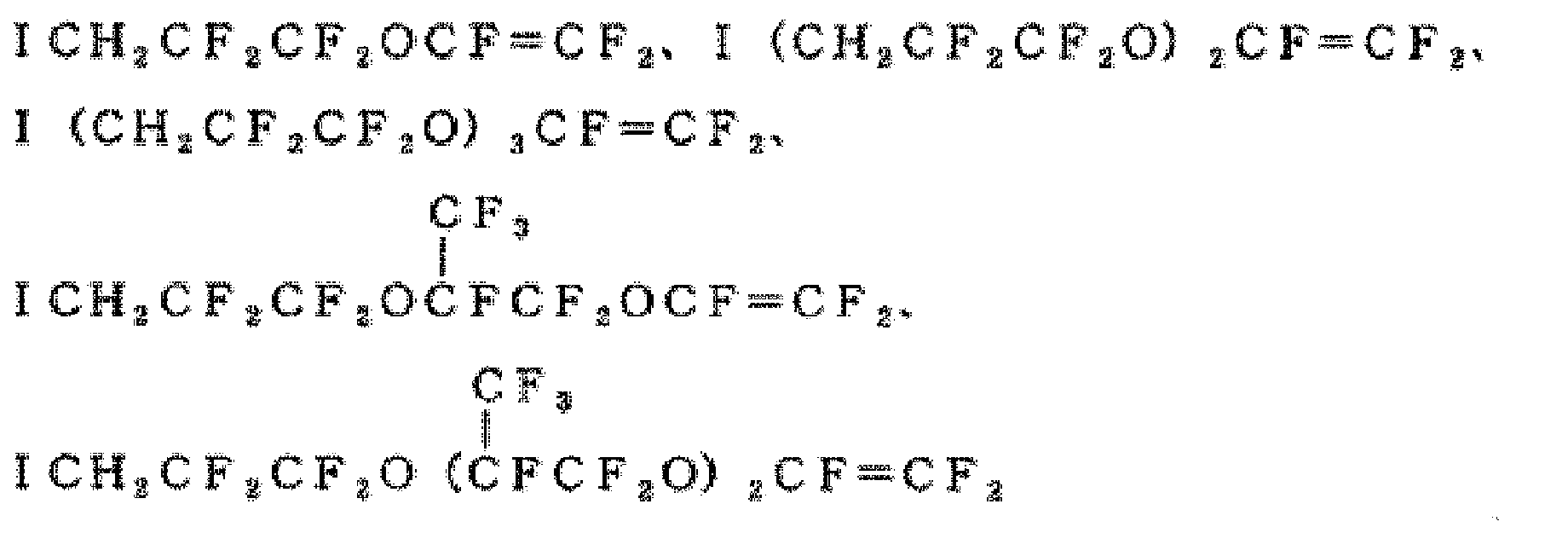
などが挙げられるが、これらの中でも、ICH2CF2CF2OCF=CF2が好ましい。
で表されるヨウ素含有フッ素化ビニルエーテルが好ましく挙げられ、より具体的には、
一般式(5)で示されるヨウ素または臭素含有単量体としてより具体的には、ICF2CF2CF=CH2、I(CF2CF2)2CF=CH2が好ましく挙げられる。
一般式(9)で示されるヨウ素または臭素含有単量体としてより具体的には、I(CF2CF2)2OCF=CF2が好ましく挙げられる。
一般式(22)で示されるヨウ素または臭素含有単量体としてより具体的には、CH2=CHCF2CF2I、I(CF2CF2)2CH=CH2が好ましく挙げられる。
また、式:R2R3C=CR4-Z-CR5=CR6R7
(式中、R2、R3、R4、R5、R6およびR7は同じかまたは異なり、いずれもH、または炭素数1~5のアルキル基;Zは、直鎖もしくは分岐鎖状の、酸素原子を含んでいてもよい、好ましくは少なくとも部分的にフッ素化された炭素数1~18のアルキレンもしくはシクロアルキレン基、または(パー)フルオロポリオキシアルキレン基)で示されるビスオレフィン化合物も架橋性基を与える単量体として好ましい。なお、本開示において、「(パー)フルオロポリオキシアルキレン基」とは、「フルオロポリオキシアルキレン基又はパーフルオロポリオキシアルキレン基」を意味する。
(式中、R2、R3、R4、R5、R6およびR7は同じかまたは異なり、いずれもH、または炭素数1~5のアルキル基;Zは、直鎖もしくは分岐鎖状の、酸素原子を含んでいてもよい、好ましくは少なくとも部分的にフッ素化された炭素数1~18のアルキレンもしくはシクロアルキレン基、または(パー)フルオロポリオキシアルキレン基)で示されるビスオレフィン化合物も架橋性基を与える単量体として好ましい。なお、本開示において、「(パー)フルオロポリオキシアルキレン基」とは、「フルオロポリオキシアルキレン基又はパーフルオロポリオキシアルキレン基」を意味する。
Zは好ましくは炭素数4~12の(パー)フルオロアルキレン基であり、R2、R3、R4、R5、R6およびR7は好ましくは水素原子である。
Zが(パー)フルオロポリオキシアルキレン基である場合、式:
-(Q)p-CF2O-(CF2CF2O)m-(CF2O)n-CF2-(Q)p-
(式中、Qは炭素数1~10のアルキレン基または炭素数2~10のオキシアルキレン基であり、pは0または1であり、m及びnはm/n比が0.2~5となり且つ該(パー)フルオロポリオキシアルキレン基の分子量が500~10000、好ましくは1000~4000の範囲となるような整数である。)で表される(パー)フルオロポリオキシアルキレン基であることが好ましい。この式において、Qは好ましくは、-CH2OCH2-及び-CH2O(CH2CH2O)sCH2-(s=1~3)の中から選ばれる。
-(Q)p-CF2O-(CF2CF2O)m-(CF2O)n-CF2-(Q)p-
(式中、Qは炭素数1~10のアルキレン基または炭素数2~10のオキシアルキレン基であり、pは0または1であり、m及びnはm/n比が0.2~5となり且つ該(パー)フルオロポリオキシアルキレン基の分子量が500~10000、好ましくは1000~4000の範囲となるような整数である。)で表される(パー)フルオロポリオキシアルキレン基であることが好ましい。この式において、Qは好ましくは、-CH2OCH2-及び-CH2O(CH2CH2O)sCH2-(s=1~3)の中から選ばれる。
好ましいビスオレフィンは、
CH2=CH-(CF2)2-CH=CH2、
CH2=CH-(CF2)4-CH=CH2、
CH2=CH-(CF2)6-CH=CH2、
式:CH2=CH-Z1-CH=CH2
(式中、Z1は-CH2OCH2-CF2O-(CF2CF2O)m-(CF2O)n-CF2-CH2OCH2-(m/nは0.5)、分子量が好ましくは2000である)
などが挙げられる。
CH2=CH-(CF2)2-CH=CH2、
CH2=CH-(CF2)4-CH=CH2、
CH2=CH-(CF2)6-CH=CH2、
式:CH2=CH-Z1-CH=CH2
(式中、Z1は-CH2OCH2-CF2O-(CF2CF2O)m-(CF2O)n-CF2-CH2OCH2-(m/nは0.5)、分子量が好ましくは2000である)
などが挙げられる。
なかでも、CH2=CH-(CF2)6-CH=CH2で示される3,3,4,4,5,5,6,6,7,7,8,8-ドデカフルオロ-1,9-デカジエンが好ましい。
含フッ素エラストマーの数平均分子量Mnは、1000~1000000が好ましく、10000~500000が更に好ましく、特に20000~300000が好ましい。
含フッ素エラストマーは、フッ素含有率が50質量%以上であることが好ましく、55質量%以上であることがより好ましく、60質量%以上であることが更に好ましい。フッ素含有率の上限は、75質量%以下であることが好ましく、73質量%以下であることがより好ましい。フッ素含有率は、19F-NMRと1H-NMR、元素分析などでの測定値を元に算出する。
含フッ素エラストマーの121℃におけるムーニー粘度(ML1+10(121℃))は、1以上であることが好ましく、3以上であることがより好ましく、5以上であることがさらに好ましく、10以上であることが特に好ましい。また、200以下であることが好ましく、170以下であることがより好ましく、150以下であることがさらに好ましく、130以下であることがよりさらに好ましく、100以下であることが特に好ましい。ムーニー粘度は、ASTM D1646およびJIS K6300-1に準拠して測定する。
含フッ素エラストマーの数平均分子量は、1,000~300,000であることが好ましく、10,000~200,000であることがより好ましい。数平均分子量は、ゲルパーミエーションクロマトグラフィー(GPC)により測定する。
含フッ素エラストマーの重量平均分子量は、1,500~450,000であることが好ましく、15,000~300,000であることがより好ましい。重量平均分子量は、ゲルパーミエーションクロマトグラフィー(GPC)により測定する。
含フッ素エラストマーのガラス転移温度は、-50~0℃であることが好ましい。上記ガラス転移温度は-2℃以下がより好ましく、-3℃以下が更に好ましい。また、上記ガラス転移温度は、-45℃以上がより好ましく、-40℃以上が更に好ましい。上記ガラス転移温度は、-10℃以上であってよく、-9℃以上であってもよい。ここで、ガラス転移温度は、示差走査熱量計(例えば、日立ハイテクサイエンス社製X-DSC7000)を用い、試料10mgを20℃/minで昇温することによりDSC曲線を得て、JISK6240:2011に従い、DSC微分曲線からガラス転移温度を求めることができる。
(第2の製造方法)
本開示の第2の製造方法においては、フッ素含有ジヨード化合物(11)の存在下に、フルオロモノマーを重合した後、フッ素非含有ジヨード化合物(12)の存在下に、フルオロモノマーを重合することにより、含フッ素エラストマーを得る。
本開示の第2の製造方法においては、フッ素含有ジヨード化合物(11)の存在下に、フルオロモノマーを重合した後、フッ素非含有ジヨード化合物(12)の存在下に、フルオロモノマーを重合することにより、含フッ素エラストマーを得る。
従来、含フッ素エラストマーの製造方法において用いられる連鎖移動剤としては、特許文献2に記載されているように、ジヨードメタンが知られている。しかしながら、ジヨードメタンを用いて含フッ素エラストマーを製造した場合、特に重合反応の初期における反応速度が低く、高い生産性で含フッ素エラストマーを製造することが困難であるという問題がある。さらには、耐圧縮永久歪み特性に優れる成形品を与える含フッ素エラストマーを製造することが困難であるという問題もある。
本開示の第2の製造方法は、上記した構成を有していることから、パーオキサイド架橋により架橋可能な含フッ素エラストマーを高い生産性で製造することができ、なおかつ、連鎖移動剤としてフッ素含有ジヨード化合物のみを用いる製造方法よりも安価に含フッ素エラストマーを製造することができる。さらに、本開示の第1の製造方法により得られる含フッ素エラストマーを架橋させることにより得られる成形品は、耐熱性および耐圧縮永久歪み特性にも優れている。
第2の製造方法において用いるフッ素含有ジヨード化合物(11)は、フッ素原子および2つのヨウ素原子を有する化合物である。フッ素含有ジヨード化合物(11)としては、第1の製造方法において用いるフッ素含有ジヨード化合物(11)が挙げられ、同様のものが好ましい。
フッ素含有ジヨード化合物(11)は、一括して添加してもよいし、連続的に添加してもよい。フッ素含有ジヨード化合物(11)の添加の時機は特に限定されないが、最終的に得られる含フッ素エラストマーの質量に対して、10質量%に相当する質量の含フッ素エラストマーが生成するまでに、少なくとも一部の量のフッ素含有ジヨード化合物(11)を添加することが好ましい。
第2の製造方法において用いるフッ素非含有ジヨード化合物(12)は、フッ素原子を含有しておらず、2つのヨウ素原子を有する化合物である。フッ素非含有ジヨード化合物(12)としては、第1の製造方法において用いるフッ素非含有ジヨード化合物(12)が挙げられ、同様のものが好ましい。
フッ素非含有ジヨード化合物(12)は、一括して添加してもよいし、連続的に添加してもよい。フッ素非含有ジヨード化合物(12)の添加の時機は特に限定されないが、最終的に得られる含フッ素エラストマーの質量に対して、30~90質量%に相当する質量の含フッ素エラストマーが生成した後に、少なくとも一部の量のフッ素非含有ジヨード化合物(12)を添加することが好ましい。
第2の製造方法の一実施形態においては、最終的に得られる含フッ素エラストマーの質量に対して、30~90質量%に相当する質量の含フッ素エラストマーが生成するまで、フッ素含有ジヨード化合物(11)の存在下に、フルオロモノマーを重合した後、フッ素非含有ジヨード化合物(12)の存在下に、フルオロモノマーを重合する。これによって、パーオキサイド架橋により架橋可能な含フッ素エラストマーを一層高い生産性で製造することができ、なおかつ、連鎖移動剤としてフッ素含有ジヨード化合物のみを用いる製造方法よりも一層安価に含フッ素エラストマーを製造することができる。
フッ素含有ジヨード化合物(11)の存在下のフルオロモノマーの重合は、最終的に得られる含フッ素エラストマーの質量に対して、好ましくは30~90質量%、より好ましくは40質量%以上、より好ましくは80質量%以下に相当する質量の含フッ素エラストマーが生成するまで行う。
フッ素含有ジヨード化合物(11)の量は、重合で使用されるモノマー全量に対して、好ましくは0.2×10⁻³~2モル%であり、より好ましくは1.0×10⁻³モル%以上であり、より好ましくは1モル%以下である。
フッ素非含有ジヨード化合物(12)の量は、重合で使用されるモノマー全量に対して、好ましくは0.2×10⁻³~2モル%であり、より好ましくは1.0×10⁻³モル%以上であり、より好ましくは1モル%以下である。
第2の製造方法において、フルオロモノマーに加えて、多官能性フッ素非含有モノマーをさらに重合してもよい。多官能性フッ素非含有モノマー用いることにより、含フッ素エラストマーに多官能性フッ素非含有モノマー単位を導入することができる。含フッ素エラストマー中の多官能性フッ素非含有モノマー単位は、含フッ素エラストマーに分岐構造を与えたり、パーオキサイド架橋により架橋可能な部位として機能する。したがって、フルオロモノマーに加えて、多官能性フッ素非含有モノマーをさらに重合することにより得られる含フッ素エラストマーを架橋させることにより、一層優れた耐熱性および耐圧縮永久歪み特性を有する成形品を得ることができる。さらに、含フッ素エラストマー中にヨウ素原子および多官能性フッ素非含有モノマー単位導入することによって、含フッ素エラストマーの離型性が向上する。
第2の製造方法において用いる多官能性フッ素非含有モノマーは、2以上の官能基を有しており、フッ素原子を含有しないモノマーである。多官能性フッ素非含有モノマーとしては、第1の製造方法において用いる多官能性フッ素非含有モノマーが挙げられ、同様のものが好ましく、同様の量で用いることができる。
第2の製造方法において用いるフルオロモノマーは、フッ素原子を含有するモノマーである。フルオロモノマーとしては、第1の製造方法において用いるフルオロモノマーが挙げられ、同様のものが好ましく、同様の量で用いることができる。
第2の製造方法における重合は、たとえば、攪拌機を備えた耐圧の重合槽に、界面活性剤および水性媒体を仕込み、脱酸素後、モノマーを仕込み、所定の温度にし、重合開始剤を添加して、反応を開始し、重合反応中にジヨード化合物を仕込むことによって行うことができる。反応の進行とともに圧力が低下するので、初期圧力を維持するように、追加のモノマーを連続的又は間欠的に追加供給し、所定量のモノマーを供給した時点で、供給を停止し、反応容器内のモノマーをパージし、温度を室温に戻して反応を終了させる。
第2の製造方法における重合は、重合開始剤の存在下に行うことができる。重合開始剤としては、第1の製造方法において用いる重合開始剤が挙げられ、同様のものが好ましく、同様の量で用いることができる。
第2の製造方法における重合は、界面活性剤の存在下に行うことができる。界面活性剤としては、第1の製造方法において用いる界面活性剤が挙げられ、同様のものが好ましい。
第2の製造方法における重合は、水性媒体中で行うことができる。水性媒体としては、第1の製造方法において用いる水性媒体が挙げられ、同様のものが好ましい。
第2の製造方法における重合の温度は、好ましくは10~120℃である。第1の製造方法における重合の圧力は、好ましは0.5~10MPaGである。
第2の製造方法によれば、含フッ素エラストマーが得られる。一実施形態において、第2の製造方法により得られる含フッ素エラストマーは、多峰性の分子量分布を有する。別の一実施形態において、第2の製造方法により得られる含フッ素エラストマーは、二峰性の分子量分布を有する。含フッ素エラストマーは、GPC曲線に現れる高分子量側のピークの面積(A)と、低分子量側のピークの面積(B)との比((A)/(B))が、90/10~30/70となるような二峰性の分子量分布を有していることが好ましい。含フッ素エラストマーがこのような分子量分布を有することによって、耐熱性および耐圧縮永久歪み特性に優れる成形品を得ることができるとともに、含フッ素エラストマーの成形性が向上する。
第2の製造方法により得られる含フッ素エラストマーの比((A)/(B))は、好ましくは90/10~30/70であり、より好ましくは80/20以下であり、より好ましくは40/60以上である。
第2の製造方法により得られる含フッ素エラストマーは、多官能性フッ素非含有モノマー単位の含有が任意である点を除き、第1の製造方法により得られる含フッ素エラストマーと同様の構成を有し得る。
(架橋性組成物)
第1の製造方法により得られる含フッ素エラストマー、本開示の一実施形態に係る含フッ素エラストマーまたは第2の製造方法により得られる含フッ素エラストマーに対して、架橋剤等を加えることによって、架橋性組成物を製造することができる。含フッ素エラストマーおよびパーオキサイド架橋剤を含有する架橋性組成物を架橋することにより、成形品を得ることができる。
第1の製造方法により得られる含フッ素エラストマー、本開示の一実施形態に係る含フッ素エラストマーまたは第2の製造方法により得られる含フッ素エラストマーに対して、架橋剤等を加えることによって、架橋性組成物を製造することができる。含フッ素エラストマーおよびパーオキサイド架橋剤を含有する架橋性組成物を架橋することにより、成形品を得ることができる。
架橋剤の種類及び量は特に限定されず、公知の範囲で使用することができる。架橋剤としては、パーオキサイド架橋剤が好ましく、有機過酸化物がより好ましい。
有機過酸化物としては、熱や酸化還元系の存在下で容易にパーオキシラジカルを発生し得る有機過酸化物であればよく、例えば1,1-ビス(t-ブチルパーオキシ)-3,5,5-トリメチルシクロヘキサン、2,5-ジメチルヘキサン-2,5-ジヒドロパーオキサイド、ジ-t-ブチルパーオキサイド、t-ブチルクミルパーオキサイド、ジクミルパーオキサイド、α,α-ビス(t-ブチルパーオキシ)-p-ジイソプロピルベンゼン、2,5-ジメチル-2,5-ジ(t-ブチルパーオキシ)ヘキサン、2,5-ジメチル-2,5-ジ(t-ブチルパーオキシ)-ヘキシン-3、ベンゾイルパーオキサイド、t-ブチルパーオキシベンゼン、t-ブチルパーオキシマレイン酸、t-ブチルパーオキシイソプロピルカーボネート、t-ブチルパーオキシベンゾエイトなどをあげることができる。これらの中でも、2,5-ジメチル-2,5-ジ(t-ブチルパーオキシ)ヘキサン、2,5-ジメチル-2,5-ジ(t-ブチルパーオキシ)-ヘキシン-3が好ましい。
有機過酸化物の配合量は、含フッ素エラストマー100質量部に対して0.1~15質量部が好ましく、より好ましくは0.3~5質量部である。
架橋性組成物は、さらに、架橋助剤を含むことが好ましい。架橋助剤としては、例えば、トリアリルシアヌレート、トリアリルイソシアヌレート(TAIC)、トリアクリルホルマール、トリアリルトリメリテート、N,N’-m-フェニレンビスマレイミド、ジプロパギルテレフタレート、ジアリルフタレート、テトラアリルテレフタレートアミド、トリアリルホスフェート、ビスマレイミド、フッ素化トリアリルイソシアヌレート(1,3,5-トリス(2,3,3-トリフルオロ-2-プロペニル)-1,3,5-トリアジン-2,4,6-トリオン)、トリス(ジアリルアミン)-S-トリアジン、N,N-ジアリルアクリルアミド、1,6-ジビニルドデカフルオロヘキサン、ヘキサアリルホスホルアミド、N,N,N’,N’-テトラアリルフタルアミド、N,N,N’,N’-テトラアリルマロンアミド、トリビニルイソシアヌレート、2,4,6-トリビニルメチルトリシロキサン、トリ(5-ノルボルネン-2-メチレン)シアヌレート、トリアリルホスファイト、トリメタアリルイソシアヌレートなどが挙げられる。これらの中でも、架橋性及び機械物性、柔軟性が優れる点から、トリアリルイソシアヌレート(TAIC)が好ましい。
架橋助剤の配合量は、含フッ素エラストマー100質量部に対して0.01~10質量部であることが好ましく、0.01~7.0質量部であることがより好ましく、更に好ましくは0.1~5.0質量部である。架橋助剤が、0.01質量部より少ないと、機械物性が低下したり、柔軟性が低下したりする。10質量部をこえると、耐熱性に劣り、成形品の耐久性も低下する傾向がある。
架橋性組成物は、必要に応じてエラストマー中に配合される通常の添加剤、たとえば充填剤(カーボンブラック、硫酸バリウム等)、加工助剤(ワックス等)、可塑剤、着色剤、安定剤、粘着性付与剤(クマロン樹脂、クマロン・インデン樹脂等)、離型剤、導電性付与剤、熱伝導性付与剤、表面非粘着剤、柔軟性付与剤、耐熱性改善剤、難燃剤などの各種添加剤を配合することができ、前記のものとは異なる常用の架橋剤、架橋促進剤を1種またはそれ以上配合してもよい。
カーボンブラックなどの充填剤の含有量としては、特に限定されるものではないが、含フッ素エラストマー100質量部に対して0~300質量部であることが好ましく、1~150質量部であることがより好ましく、2~100質量部であることが更に好ましく、2~75質量部であることが特に好ましい。
ワックス等の加工助剤の含有量としては、含フッ素エラストマー100質量部に対して0~10質量部であることが好ましく、0~5質量部であることが更に好ましい。加工助剤、可塑剤や離型剤を使用すると、得られる成形品の機械物性やシール性が下がる傾向があるので、目的とする得られる成形品の特性が許容される範囲でこれらの含有量を調整する必要がある。
架橋性組成物を調製する方法は、含フッ素エラストマーと、架橋剤とを均一に混合できる方法を用いれば特に制限はない。例えば、含フッ素エラストマーを単独で凝析した粉末と必要に応じて他の添加剤や配合剤とをオープンロール等の混練機で混練する方法が挙げられる。
(成形品)
架橋性組成物を架橋することにより、成形品を得ることができる。また、組成物を成形し、架橋することによっても、成形品を得ることができる。組成物は、従来公知の方法で成形することができる。成形および架橋の方法および条件としては、採用する成形および架橋において公知の方法および条件の範囲内でよい。成形および架橋の順序は限定されず、成形した後架橋してもよいし、架橋した後成形してもよいし、成形と架橋とを同時に行ってもよい。
架橋性組成物を架橋することにより、成形品を得ることができる。また、組成物を成形し、架橋することによっても、成形品を得ることができる。組成物は、従来公知の方法で成形することができる。成形および架橋の方法および条件としては、採用する成形および架橋において公知の方法および条件の範囲内でよい。成形および架橋の順序は限定されず、成形した後架橋してもよいし、架橋した後成形してもよいし、成形と架橋とを同時に行ってもよい。
成形方法としては、圧縮成形法、注入成形法、インジェクション成形法、押出し成形法、ロートキュアーによる成形法などが例示できるが、これらに限定されるものではない。架橋方法としては、スチーム架橋法、加熱による架橋法、放射線架橋法等が採用でき、なかでも、スチーム架橋法、加熱による架橋法が好ましい。限定されない具体的な架橋条件としては、通常、140~250℃の温度範囲、1分間~24時間の架橋時間内で、架橋促進剤、架橋剤および受酸剤などの種類により適宜決めればよい。
また得られた成形品をオーブン等により加熱することで、機械物性および高温での圧縮永久歪み特性などを向上させることができる。限定されない具体的な架橋条件としては、通常、140~300℃の温度範囲、30分間~72時間の範囲で、架橋剤などの種類により適宜決めればよい。
得られる成形品は、自動車産業、航空機産業、半導体産業等の各分野において各種部品として使用することができる。成形品は、たとえば、シール材、摺動部材、非粘着性部材など、特開2013-216915号公報に記載の架橋ゴム成形品、特開2019-94430号公報に記載のフッ素ゴム成形体と同様の用途に用いることができる。
成形品の使用形態としては、例えば、リング、パッキン、ガスケット、ダイアフラム、オイルシール、ベアリングシール等の各種シール材やパッキンなどが挙げられる。シール材としては、優れた非粘着性及び低摩擦性が要求される用途に用いることができる。特に、自動車産業等における各種シール材に好適に用いることができる。
また、チューブ、ホース、ロール、各種ゴムロール、フレキシブルジョイント、ゴム板、コーティング、ベルト、ダンパー、バルブ、バルブシート、バルブの弁体、耐薬品用コーティング材料、ラミネート用材料、ライニング用材料などとしても使用できる。
以上、実施形態を説明したが、特許請求の範囲の趣旨および範囲から逸脱することなく、形態や詳細の多様な変更が可能なことが理解されるであろう。
<1> 本開示の第1の観点によれば、
ジヨード化合物の存在下に、フルオロモノマーおよび多官能性フッ素非含有モノマーを重合することにより、含フッ素エラストマーを得る含フッ素エラストマーの製造方法が提供される。
<2> 本開示の第2の観点によれば、
フルオロモノマーが、ビニリデンフルオライドおよびテトラフルオロエチレンからなる群より選択される少なくとも1種を含む第1の観点による製造方法が提供される。
<3> 本開示の第3の観点によれば、
多官能性フッ素非含有モノマーが、2~6個の官能基を有する第1または第2の観点による製造方法が提供される。
<4> 本開示の第4の観点によれば、
多官能性フッ素非含有モノマーが、不飽和官能基を有する第1~第3のいずれかの観点による製造方法が提供される。
<5> 本開示の第5の観点によれば、
多官能性フッ素非含有モノマーが、ビニル基、イソプロペニル基、アリル基およびメタアリル基からなる群より選択される少なくとも1種の不飽和官能基を有する第1~第4のいずれかの観点による記載の製造方法が提供される。
<6> 本開示の第6の観点によれば、
多官能性フッ素非含有モノマーが、含窒素複素環を有する第1~第5のいずれかの観点による製造方法が提供される。
<7> 本開示の第7の観点によれば、
多官能性フッ素非含有モノマーが、トリアリルイソシアヌレートおよびトリメタリルイソシアヌレートからなる群より選択される少なくとも1種である第1~第6のいずれかの観点による製造方法が提供される。
<8> 本開示の第8の観点によれば、
ジヨード化合物が、フッ素含有ジヨード化合物およびフッ素非含有ジヨード化合物の両方である第1~第7のいずれかの観点による製造方法が提供される。
<9> 本開示の第9の観点によれば、
ジヨード化合物が、炭素数2以上のフッ素含有ジヨード化合物および炭素数1のフッ素非含有ジヨード化合物の両方である第1~第8のいずれかの観点による製造方法が提供される。
<10> 本開示の第10の観点によれば、
ジヨード化合物が、1,4-ジヨードパーフルオロ-n-ブタンおよびジヨードメタンの両方である第1~第9のいずれかの観点による製造方法が提供される。
<11> 本開示の第11の観点によれば、
ジヨード化合物(1)の存在下に、フルオロモノマーを重合した後、フッ素非含有ジヨード化合物(12)の存在下に、フルオロモノマーを重合することにより、含フッ素エラストマーを得る第1~第10のいずれかの観点による製造方法が提供される。
<12> 本開示の第12の観点によれば、
最終的に得られる含フッ素エラストマーの質量に対して、30~90質量%に相当する質量の含フッ素エラストマーが生成するまで、ジヨード化合物(1)の存在下に、フルオロモノマーを重合した後、フッ素非含有ジヨード化合物(12)の存在下に、フルオロモノマーを重合することにより、含フッ素エラストマーを得る第1~第11のいずれかの観点による製造方法が提供される。
<13> 本開示の第13の観点によれば、
多官能性フッ素非含有モノマーの量とジヨード化合物の量とのモル比(多官能性フッ素非含有モノマー/ジヨード化合物)が、0.05~0.5である第1~第12のいずれかの観点による製造方法が提供される。
<14> 本開示の第14の観点によれば、
ヨウ素含有量が0.1~1.0質量%であり、
フルオロモノマー単位および多官能性フッ素非含有モノマー単位を含有する
含フッ素エラストマーが提供される。
<15> 本開示の第15の観点によれば、
多官能性フッ素非含有モノマー単位の含有量が、全モノマー単位に対して、0.01~0.2モル%である第14の観点による含フッ素エラストマーが提供される。
<16> 本開示の第16の観点によれば、
フルオロモノマーが、ビニリデンフルオライドおよびテトラフルオロエチレンからなる群より選択される少なくとも1種を含む第14または第15の観点による含フッ素エラストマーが提供される。
<17> 本開示の第17の観点によれば、
多官能性フッ素非含有モノマーが、2~6個の官能基を有する第14~第16のいずれかの観点による含フッ素エラストマーが提供される。
<18> 本開示の第18の観点によれば、
多官能性フッ素非含有モノマーが、不飽和官能基を有する第14~第17のいずれかの観点による含フッ素エラストマーが提供される。
<19> 本開示の第19の観点によれば、
多官能性フッ素非含有モノマーが、ビニル基、イソプロペニル基、アリル基およびメタアリル基からなる群より選択される少なくとも1種の不飽和官能基を有する第14~第18のいずれかの観点による含フッ素エラストマーが提供される。
<20> 本開示の第20の観点によれば、
多官能性フッ素非含有モノマーが、含窒素複素環を有する第14~第19のいずれかの観点による含フッ素エラストマーが提供される。
<21> 本開示の第21の観点によれば、
多官能性フッ素非含有モノマーが、トリアリルイソシアヌレートおよびトリメタリルイソシアヌレートからなる群より選択される少なくとも1種である第14~第20のいずれかの観点による含フッ素エラストマーが提供される。
<22> 本開示の第22の観点によれば、
多峰性の分子量分布を有する第14~第21のいずれかの観点による含フッ素エラストマーが提供される。
<23> 本開示の第23の観点によれば、
二峰性の分子量分布を有しており、GPC曲線に現れる高分子量側のピークの面積(A)と、低分子量側のピークの面積(B)との比((A)/(B))が、90/10~30/70である第14~第22のいずれかの観点による含フッ素エラストマーが提供される。
<24> 本開示の第24の観点によれば、
第14~第23のいずれかの観点による含フッ素エラストマーおよびパーオキサイド架橋剤を含有する架橋性組成物が提供される。
<25> 本開示の第25の観点によれば、
第24の観点による架橋性組成物を架橋して得られる成形品が提供される。
<25> 本開示の第26の観点によれば、
フッ素含有ジヨード化合物(11)の存在下に、フルオロモノマーを重合した後、フッ素非含有ジヨード化合物(12)の存在下に、フルオロモノマーを重合することにより、含フッ素エラストマーを得る含フッ素エラストマーの製造方法が提供される。
<27> 本開示の第27の観点によれば、
フッ素含有ジヨード化合物(11)の炭素数が2以上である第26の観点による製造方法が提供される。
<28> 本開示の第28の観点によれば、
フッ素含有ジヨード化合物(11)が、1,4-ジヨードパーフルオロ-n-ブタンである第26または第27の観点による製造方法が提供される。
<29> 本開示の第29の観点によれば、
フッ素非含有ジヨード化合物(12)の炭素数が1である第26~第28のいずれかの観点による製造方法が提供される。
<30> 本開示の第30の観点によれば、
フッ素非含有ジヨード化合物(12)が、ジヨードメタンである第26~第29のいずれかの観点による製造方法が提供される。
<31> 本開示の第31の観点によれば、
最終的に得られる含フッ素エラストマーの質量に対して、30~90質量%に相当する質量の含フッ素エラストマーが生成するまで、フッ素含有ジヨード化合物(11)の存在下に、フルオロモノマーを重合した後、フッ素非含有ジヨード化合物(12)の存在下に、フルオロモノマーを重合することにより、含フッ素エラストマーを得る第26~第30のいずれかの観点による製造方法が提供される。
<32> 本開示の第32の観点によれば、
最終的に得られる含フッ素エラストマーが、二峰性の分子量分布を有しておりGPC曲線に現れる高分子量側のピークの面積(A)と、低分子量側のピークの面積(B)との比((A)/(B))が、90/10~30/70である第26~第31のいずれかの観点による製造方法が提供される。
<33> 本開示の第33の観点によれば、
フルオロモノマーに加えて、多官能性フッ素非含有モノマーをさらに重合する第26~第32のいずれかの観点による製造方法が提供される。
ジヨード化合物の存在下に、フルオロモノマーおよび多官能性フッ素非含有モノマーを重合することにより、含フッ素エラストマーを得る含フッ素エラストマーの製造方法が提供される。
<2> 本開示の第2の観点によれば、
フルオロモノマーが、ビニリデンフルオライドおよびテトラフルオロエチレンからなる群より選択される少なくとも1種を含む第1の観点による製造方法が提供される。
<3> 本開示の第3の観点によれば、
多官能性フッ素非含有モノマーが、2~6個の官能基を有する第1または第2の観点による製造方法が提供される。
<4> 本開示の第4の観点によれば、
多官能性フッ素非含有モノマーが、不飽和官能基を有する第1~第3のいずれかの観点による製造方法が提供される。
<5> 本開示の第5の観点によれば、
多官能性フッ素非含有モノマーが、ビニル基、イソプロペニル基、アリル基およびメタアリル基からなる群より選択される少なくとも1種の不飽和官能基を有する第1~第4のいずれかの観点による記載の製造方法が提供される。
<6> 本開示の第6の観点によれば、
多官能性フッ素非含有モノマーが、含窒素複素環を有する第1~第5のいずれかの観点による製造方法が提供される。
<7> 本開示の第7の観点によれば、
多官能性フッ素非含有モノマーが、トリアリルイソシアヌレートおよびトリメタリルイソシアヌレートからなる群より選択される少なくとも1種である第1~第6のいずれかの観点による製造方法が提供される。
<8> 本開示の第8の観点によれば、
ジヨード化合物が、フッ素含有ジヨード化合物およびフッ素非含有ジヨード化合物の両方である第1~第7のいずれかの観点による製造方法が提供される。
<9> 本開示の第9の観点によれば、
ジヨード化合物が、炭素数2以上のフッ素含有ジヨード化合物および炭素数1のフッ素非含有ジヨード化合物の両方である第1~第8のいずれかの観点による製造方法が提供される。
<10> 本開示の第10の観点によれば、
ジヨード化合物が、1,4-ジヨードパーフルオロ-n-ブタンおよびジヨードメタンの両方である第1~第9のいずれかの観点による製造方法が提供される。
<11> 本開示の第11の観点によれば、
ジヨード化合物(1)の存在下に、フルオロモノマーを重合した後、フッ素非含有ジヨード化合物(12)の存在下に、フルオロモノマーを重合することにより、含フッ素エラストマーを得る第1~第10のいずれかの観点による製造方法が提供される。
<12> 本開示の第12の観点によれば、
最終的に得られる含フッ素エラストマーの質量に対して、30~90質量%に相当する質量の含フッ素エラストマーが生成するまで、ジヨード化合物(1)の存在下に、フルオロモノマーを重合した後、フッ素非含有ジヨード化合物(12)の存在下に、フルオロモノマーを重合することにより、含フッ素エラストマーを得る第1~第11のいずれかの観点による製造方法が提供される。
<13> 本開示の第13の観点によれば、
多官能性フッ素非含有モノマーの量とジヨード化合物の量とのモル比(多官能性フッ素非含有モノマー/ジヨード化合物)が、0.05~0.5である第1~第12のいずれかの観点による製造方法が提供される。
<14> 本開示の第14の観点によれば、
ヨウ素含有量が0.1~1.0質量%であり、
フルオロモノマー単位および多官能性フッ素非含有モノマー単位を含有する
含フッ素エラストマーが提供される。
<15> 本開示の第15の観点によれば、
多官能性フッ素非含有モノマー単位の含有量が、全モノマー単位に対して、0.01~0.2モル%である第14の観点による含フッ素エラストマーが提供される。
<16> 本開示の第16の観点によれば、
フルオロモノマーが、ビニリデンフルオライドおよびテトラフルオロエチレンからなる群より選択される少なくとも1種を含む第14または第15の観点による含フッ素エラストマーが提供される。
<17> 本開示の第17の観点によれば、
多官能性フッ素非含有モノマーが、2~6個の官能基を有する第14~第16のいずれかの観点による含フッ素エラストマーが提供される。
<18> 本開示の第18の観点によれば、
多官能性フッ素非含有モノマーが、不飽和官能基を有する第14~第17のいずれかの観点による含フッ素エラストマーが提供される。
<19> 本開示の第19の観点によれば、
多官能性フッ素非含有モノマーが、ビニル基、イソプロペニル基、アリル基およびメタアリル基からなる群より選択される少なくとも1種の不飽和官能基を有する第14~第18のいずれかの観点による含フッ素エラストマーが提供される。
<20> 本開示の第20の観点によれば、
多官能性フッ素非含有モノマーが、含窒素複素環を有する第14~第19のいずれかの観点による含フッ素エラストマーが提供される。
<21> 本開示の第21の観点によれば、
多官能性フッ素非含有モノマーが、トリアリルイソシアヌレートおよびトリメタリルイソシアヌレートからなる群より選択される少なくとも1種である第14~第20のいずれかの観点による含フッ素エラストマーが提供される。
<22> 本開示の第22の観点によれば、
多峰性の分子量分布を有する第14~第21のいずれかの観点による含フッ素エラストマーが提供される。
<23> 本開示の第23の観点によれば、
二峰性の分子量分布を有しており、GPC曲線に現れる高分子量側のピークの面積(A)と、低分子量側のピークの面積(B)との比((A)/(B))が、90/10~30/70である第14~第22のいずれかの観点による含フッ素エラストマーが提供される。
<24> 本開示の第24の観点によれば、
第14~第23のいずれかの観点による含フッ素エラストマーおよびパーオキサイド架橋剤を含有する架橋性組成物が提供される。
<25> 本開示の第25の観点によれば、
第24の観点による架橋性組成物を架橋して得られる成形品が提供される。
<25> 本開示の第26の観点によれば、
フッ素含有ジヨード化合物(11)の存在下に、フルオロモノマーを重合した後、フッ素非含有ジヨード化合物(12)の存在下に、フルオロモノマーを重合することにより、含フッ素エラストマーを得る含フッ素エラストマーの製造方法が提供される。
<27> 本開示の第27の観点によれば、
フッ素含有ジヨード化合物(11)の炭素数が2以上である第26の観点による製造方法が提供される。
<28> 本開示の第28の観点によれば、
フッ素含有ジヨード化合物(11)が、1,4-ジヨードパーフルオロ-n-ブタンである第26または第27の観点による製造方法が提供される。
<29> 本開示の第29の観点によれば、
フッ素非含有ジヨード化合物(12)の炭素数が1である第26~第28のいずれかの観点による製造方法が提供される。
<30> 本開示の第30の観点によれば、
フッ素非含有ジヨード化合物(12)が、ジヨードメタンである第26~第29のいずれかの観点による製造方法が提供される。
<31> 本開示の第31の観点によれば、
最終的に得られる含フッ素エラストマーの質量に対して、30~90質量%に相当する質量の含フッ素エラストマーが生成するまで、フッ素含有ジヨード化合物(11)の存在下に、フルオロモノマーを重合した後、フッ素非含有ジヨード化合物(12)の存在下に、フルオロモノマーを重合することにより、含フッ素エラストマーを得る第26~第30のいずれかの観点による製造方法が提供される。
<32> 本開示の第32の観点によれば、
最終的に得られる含フッ素エラストマーが、二峰性の分子量分布を有しておりGPC曲線に現れる高分子量側のピークの面積(A)と、低分子量側のピークの面積(B)との比((A)/(B))が、90/10~30/70である第26~第31のいずれかの観点による製造方法が提供される。
<33> 本開示の第33の観点によれば、
フルオロモノマーに加えて、多官能性フッ素非含有モノマーをさらに重合する第26~第32のいずれかの観点による製造方法が提供される。
つぎに本開示の実施形態について実験例をあげて説明するが、本開示はかかる実験例のみに限定されるものではない。
実験例の各数値は以下の方法により測定した。
<組成分析>
19F-NMR(Bruker社製AC300P型)を用いて測定した。ただし、TAIC単位は、後述する方法により測定した。
19F-NMR(Bruker社製AC300P型)を用いて測定した。ただし、TAIC単位は、後述する方法により測定した。
<ヨウ素含有量>
横河ヒューレットパッカード社G2350A型を用いて測定する。
横河ヒューレットパッカード社G2350A型を用いて測定する。
<TAIC単位の含有量>
共重合に用いたTAICを、TAICを共重合していない比較実験例1で得られたポリマーAに0.02モル%、0.04モル%、0.06モル%の各濃度になるようにアセトンに均一に溶解させ、この溶液をアルミニウムカップに塗布して電気炉の中で90℃で恒量になるまでアセトンを乾燥させた。得られた各サンプルを赤外分光光度計のATRモードで測定した。1700~1715cm-1のTAICのカルボニル基(-C=O)に由来するピークの高さと主ピークである1180cm-1のフッ素ゴムのC-F基に由来するピークの高さの比率に基づいて検量線を作成する。この検量線を用いて試験サンプルのTAIC共重合量を算出した。なお測定は各サンプルについて3か所で行い、それらの平均値を共重合量として用いた。また、TAICのカルボニル基(-C=O)に由来するピークの高さとして、1700~1715cm-1の範囲内に現れるIRスペクトルの高さの平均値を採用した。
共重合に用いたTAICを、TAICを共重合していない比較実験例1で得られたポリマーAに0.02モル%、0.04モル%、0.06モル%の各濃度になるようにアセトンに均一に溶解させ、この溶液をアルミニウムカップに塗布して電気炉の中で90℃で恒量になるまでアセトンを乾燥させた。得られた各サンプルを赤外分光光度計のATRモードで測定した。1700~1715cm-1のTAICのカルボニル基(-C=O)に由来するピークの高さと主ピークである1180cm-1のフッ素ゴムのC-F基に由来するピークの高さの比率に基づいて検量線を作成する。この検量線を用いて試験サンプルのTAIC共重合量を算出した。なお測定は各サンプルについて3か所で行い、それらの平均値を共重合量として用いた。また、TAICのカルボニル基(-C=O)に由来するピークの高さとして、1700~1715cm-1の範囲内に現れるIRスペクトルの高さの平均値を採用した。
<重量平均分子量(Mw)および数平均分子量(Mn)>
装置:HLC-8320(東ソー(株)製)
カラム:GPC KF-806M 2本
GPC KF-801 1本
GPC KF-802 1本
検出器:示差屈折率計
展開溶媒:テトラヒドロフラン
温度:40℃
試料濃度:0.2重量%
標準試料:単分散ポリスチレン各種((Mw/Mn)=1.14(Max))、TSK standard POLYSTYRENE(東ソー(株)製)
装置:HLC-8320(東ソー(株)製)
カラム:GPC KF-806M 2本
GPC KF-801 1本
GPC KF-802 1本
検出器:示差屈折率計
展開溶媒:テトラヒドロフラン
温度:40℃
試料濃度:0.2重量%
標準試料:単分散ポリスチレン各種((Mw/Mn)=1.14(Max))、TSK standard POLYSTYRENE(東ソー(株)製)
<ムーニー粘度>
ASTM-D1646およびJIS K6300-1に準拠して測定する。
測定機器:(株)上島製作所製の自動ムーニー粘度計
ローター回転数:2rpm
測定温度:121℃
ASTM-D1646およびJIS K6300-1に準拠して測定する。
測定機器:(株)上島製作所製の自動ムーニー粘度計
ローター回転数:2rpm
測定温度:121℃
実験例1
内容積3.0Lのステンレス反応槽に純水2200ml、乳化剤としてC5F11CHOONH4 4.456g、2,3,3,3-テトラフルオロ-2-[1,1,2,3,3,3-ヘキサフルオロ-2-(1,1,2-トリフルオロアリルオキシ)プロポキシ]プロピオン酸アンモニウム塩0.224gを入れて、内部空間を窒素ガスで充分置換した後、VdF/TFE/HFPが19/11/70のモル比の混合ガスAを仕込み、撹拌下に反応槽温度を80℃まで上げた後に、圧力2.0MPaに調整した。その後、過硫酸アンモニウム(以下APSと略す)の0.45%水溶液を10gを注入し重合を開始させた。その後圧力の降下が起こり1.9MPaに落ちた時点でTFE/VDF/HFP=27/49/24の混合ガスBで2.0MPaまで昇圧することを繰り返した。混合ガスBの仕込み量が16gになったところで1,4-ジヨードパーフルオロ-n-ブタン(以後DIと略す) 5.544gを注入し、重合を継続した。重合開始から3時間毎に上記と同じ濃度のAPS水溶液を10gを重合が終わるまで継続的に追加した。混合ガスBの仕込み量が166gになったところでTAIC 0.447gを注入した。その後、混合ガスBの仕込み量が828gになったところで重合槽内のモノマーをブローし冷却することで重合を停止し乳化液2987gが得られた。この乳化液の固形分は27.0%であった。なお、重合に要した時間は9時間28分であった。乳化液の一部を取り5%の硫酸アルミニウム水溶液を添加しポリマーを凝析させ、洗浄、乾燥して得られたポリマーの組成はF-NMRより、VDF/TFE/HFP=50.5/27.8/21.7であった。燃焼イオン法によりヨウ素含有量は0.37重量%であり、IRで測定したTAICの共重合量は0.022モル%であった。GPCで測定した数平均分子量Mnは65600、Mwは128700であり121℃で測定したムーニー粘度ML121℃は23.0であった。
内容積3.0Lのステンレス反応槽に純水2200ml、乳化剤としてC5F11CHOONH4 4.456g、2,3,3,3-テトラフルオロ-2-[1,1,2,3,3,3-ヘキサフルオロ-2-(1,1,2-トリフルオロアリルオキシ)プロポキシ]プロピオン酸アンモニウム塩0.224gを入れて、内部空間を窒素ガスで充分置換した後、VdF/TFE/HFPが19/11/70のモル比の混合ガスAを仕込み、撹拌下に反応槽温度を80℃まで上げた後に、圧力2.0MPaに調整した。その後、過硫酸アンモニウム(以下APSと略す)の0.45%水溶液を10gを注入し重合を開始させた。その後圧力の降下が起こり1.9MPaに落ちた時点でTFE/VDF/HFP=27/49/24の混合ガスBで2.0MPaまで昇圧することを繰り返した。混合ガスBの仕込み量が16gになったところで1,4-ジヨードパーフルオロ-n-ブタン(以後DIと略す) 5.544gを注入し、重合を継続した。重合開始から3時間毎に上記と同じ濃度のAPS水溶液を10gを重合が終わるまで継続的に追加した。混合ガスBの仕込み量が166gになったところでTAIC 0.447gを注入した。その後、混合ガスBの仕込み量が828gになったところで重合槽内のモノマーをブローし冷却することで重合を停止し乳化液2987gが得られた。この乳化液の固形分は27.0%であった。なお、重合に要した時間は9時間28分であった。乳化液の一部を取り5%の硫酸アルミニウム水溶液を添加しポリマーを凝析させ、洗浄、乾燥して得られたポリマーの組成はF-NMRより、VDF/TFE/HFP=50.5/27.8/21.7であった。燃焼イオン法によりヨウ素含有量は0.37重量%であり、IRで測定したTAICの共重合量は0.022モル%であった。GPCで測定した数平均分子量Mnは65600、Mwは128700であり121℃で測定したムーニー粘度ML121℃は23.0であった。
実験例2
TAICの添加量を0.067gと変更する以外は実験例1と同様の方法で重合を行った。得られた乳化液は3012gであり、この乳化液の固形分は26.8%であった。なお、重合に要した時間は10時間41分であった。実験例1と同様にして得られたポリマー2の組成はF-NMRより、VDF/TFE/HFP=51.0/27.9/21.1であった。燃焼イオン法によりヨウ素含有量は0.54重量%であり、IRで測定したTAICの共重合量は0.036モル%であった。GPCは溶媒に不溶であったため測定できなかったが121℃で測定したムーニー粘度ML121℃は12.7であった。
TAICの添加量を0.067gと変更する以外は実験例1と同様の方法で重合を行った。得られた乳化液は3012gであり、この乳化液の固形分は26.8%であった。なお、重合に要した時間は10時間41分であった。実験例1と同様にして得られたポリマー2の組成はF-NMRより、VDF/TFE/HFP=51.0/27.9/21.1であった。燃焼イオン法によりヨウ素含有量は0.54重量%であり、IRで測定したTAICの共重合量は0.036モル%であった。GPCは溶媒に不溶であったため測定できなかったが121℃で測定したムーニー粘度ML121℃は12.7であった。
実験例3
TAICの添加量を1.005g と変更する以外は実験例1と同様の方法で重合を行った。得られた乳化液は3039gであり、この乳化液の固形分は27.1%であった。なお、重合に要した時間は13時間40分であった。実験例1と同様にして得られたポリマー3の組成はF-NMRより、VDF/TFE/HFP=50.1/27.5/22.4であった。燃焼イオン法によりヨウ素含有量は0.53重量%であり、IRで測定したTAICの共重合量は0.057モル%であった。GPCは溶媒に不溶であったため測定できなかったが121℃で測定したムーニー粘度ML121℃は22.8であった。
TAICの添加量を1.005g と変更する以外は実験例1と同様の方法で重合を行った。得られた乳化液は3039gであり、この乳化液の固形分は27.1%であった。なお、重合に要した時間は13時間40分であった。実験例1と同様にして得られたポリマー3の組成はF-NMRより、VDF/TFE/HFP=50.1/27.5/22.4であった。燃焼イオン法によりヨウ素含有量は0.53重量%であり、IRで測定したTAICの共重合量は0.057モル%であった。GPCは溶媒に不溶であったため測定できなかったが121℃で測定したムーニー粘度ML121℃は22.8であった。
実験例4
TAICの添加量を1.340gと変更する以外は実験例1と同様の方法で重合を行った。得られた乳化液は3076gであり、この乳化液の固形分は26.8%であった。なお、重合に要した時間は10時間41分であった。実験例1と同様にして得られたポリマー4の組成はF-NMRより、VDF/TFE/HFP=50.7/27.4/22.0であった。燃焼イオン法によりヨウ素含有量は0.49重量%であり、IRで測定したTAICの共重合量は0.060モル%であった。GPCは溶媒に不溶であったため測定できなかったが121℃で測定したムーニー粘度ML121℃は23.4であった。
TAICの添加量を1.340gと変更する以外は実験例1と同様の方法で重合を行った。得られた乳化液は3076gであり、この乳化液の固形分は26.8%であった。なお、重合に要した時間は10時間41分であった。実験例1と同様にして得られたポリマー4の組成はF-NMRより、VDF/TFE/HFP=50.7/27.4/22.0であった。燃焼イオン法によりヨウ素含有量は0.49重量%であり、IRで測定したTAICの共重合量は0.060モル%であった。GPCは溶媒に不溶であったため測定できなかったが121℃で測定したムーニー粘度ML121℃は23.4であった。
実験例5
DI 7.392gを添加するのをCH2I2 3.490gに変更すること、およびCH2I2仕込み後の開始剤APSの仕込み方を下記の通り変える以外は実験例1と同様にして重合を行った。混合ガスBの仕込み量が16gになったところでCH2I2 3.490gを仕込むと重合が一時的に止まる挙動が見られ、開始剤APSの0.45%水溶液を10gを添加する。その後、重合速度が回復するまで1時間毎に同量の開始剤APSの0.45%水溶液を仕込む。本重合では12回の仕込み後に重合速度が回復したのでそれ以降は実験例1記載のAPSの仕込み方法に戻した。得られた乳化液は2984gであり、この乳化液の固形分は27.0%であった。なお、重合に要した時間は9時間28分であった。実験例1と同様にして得られたポリマー5の組成はF-NMRより、VDF/TFE/HFP=50.6/26.9/22.5であった。燃焼イオン法によりヨウ素含有量は0.39重量%であり、IRで測定したTAICの共重合量は0.025モル%であった。GPCで測定した数平均分子量Mnは60500、重量平均分子量Mwは156600であり121℃で測定したムーニー粘度ML121℃は26.0であった。
DI 7.392gを添加するのをCH2I2 3.490gに変更すること、およびCH2I2仕込み後の開始剤APSの仕込み方を下記の通り変える以外は実験例1と同様にして重合を行った。混合ガスBの仕込み量が16gになったところでCH2I2 3.490gを仕込むと重合が一時的に止まる挙動が見られ、開始剤APSの0.45%水溶液を10gを添加する。その後、重合速度が回復するまで1時間毎に同量の開始剤APSの0.45%水溶液を仕込む。本重合では12回の仕込み後に重合速度が回復したのでそれ以降は実験例1記載のAPSの仕込み方法に戻した。得られた乳化液は2984gであり、この乳化液の固形分は27.0%であった。なお、重合に要した時間は9時間28分であった。実験例1と同様にして得られたポリマー5の組成はF-NMRより、VDF/TFE/HFP=50.6/26.9/22.5であった。燃焼イオン法によりヨウ素含有量は0.39重量%であり、IRで測定したTAICの共重合量は0.025モル%であった。GPCで測定した数平均分子量Mnは60500、重量平均分子量Mwは156600であり121℃で測定したムーニー粘度ML121℃は26.0であった。
実験例6
内容積3.0Lのステンレス反応槽に純水2200ml、乳化剤としてC5F11CHOONH4 を4.457g、2,3,3,3-テトラフルオロ-2-[1,1,2,3,3,3-ヘキサフルオロ-2-(1,1,2-トリフルオロアリルオキシ)プロポキシ]プロピオン酸アンモニウム塩を0.224gを入れて、内部空間を窒素ガスで充分置換した後、VdF/TFE/HFPが19/11/70のモル比の混合ガスAを仕込み、撹拌下に反応槽温度を80℃まで上げた後に、圧力2.0MPaに調整し、APSの0.45%水溶液を10gを注入し重合を開始させた。その後圧力の降下が起こり1.9MPaに落ちた時点でTFE/VDF/HFP=27/49/24の混合ガスBで2.0MPaまで昇圧することを繰り返した。混合ガスBの仕込み量が16gになったところで1,4-ジヨードパーフルオロ-n-ブタン(以後DIと略す) 2.867gを注入し、重合を継続した。重合開始から3時間毎に上記と同じ濃度のAPS水溶液を10gをCH2I2 を仕込むまで継続的に追加した。混合ガスBの仕込み量が166gになったところでTAIC 0.392gを注入、同じく497gになったところでCH2I2 3.241gを追加したが実験例5と同様に重合が一時的に止まる挙動が見られ、実験例5に記載の開始剤APS仕込み方法を重合速度が回復するまで行った。本重合では8回の仕込み後に重合速度が回復したのでそれ以降は実験例1記載のAPSの仕込み方法に戻した。その後、混合ガスBの仕込み量が553gになったところでTAIC 0.789gを追加し、混合ガスBの仕込み量が828gになったところで重合槽内のモノマーをブローし冷却することで重合を停止し乳化液3103gが得られた。この乳化液の固形分は27.3%であった。なお、重合に要した時間は11時間58分であった。乳化液の一部を取り5%の硫酸アルミニウム水溶液を添加しポリマーを凝析させ、洗浄、乾燥して得られたポリマー6の組成はF-NMRより、VDF/TFE/HFP=51.0/27.4/21.6であった。燃焼イオン法によりヨウ素含有量は0.57重量%であり、IRで測定したTAICの共重合量は0.041モル%であった。GPCで測定した数平均分子量Mnは53700、重量平均分子量Mwは177800であり121℃で測定したムーニー粘度ML121℃は28.4であった。
内容積3.0Lのステンレス反応槽に純水2200ml、乳化剤としてC5F11CHOONH4 を4.457g、2,3,3,3-テトラフルオロ-2-[1,1,2,3,3,3-ヘキサフルオロ-2-(1,1,2-トリフルオロアリルオキシ)プロポキシ]プロピオン酸アンモニウム塩を0.224gを入れて、内部空間を窒素ガスで充分置換した後、VdF/TFE/HFPが19/11/70のモル比の混合ガスAを仕込み、撹拌下に反応槽温度を80℃まで上げた後に、圧力2.0MPaに調整し、APSの0.45%水溶液を10gを注入し重合を開始させた。その後圧力の降下が起こり1.9MPaに落ちた時点でTFE/VDF/HFP=27/49/24の混合ガスBで2.0MPaまで昇圧することを繰り返した。混合ガスBの仕込み量が16gになったところで1,4-ジヨードパーフルオロ-n-ブタン(以後DIと略す) 2.867gを注入し、重合を継続した。重合開始から3時間毎に上記と同じ濃度のAPS水溶液を10gをCH2I2 を仕込むまで継続的に追加した。混合ガスBの仕込み量が166gになったところでTAIC 0.392gを注入、同じく497gになったところでCH2I2 3.241gを追加したが実験例5と同様に重合が一時的に止まる挙動が見られ、実験例5に記載の開始剤APS仕込み方法を重合速度が回復するまで行った。本重合では8回の仕込み後に重合速度が回復したのでそれ以降は実験例1記載のAPSの仕込み方法に戻した。その後、混合ガスBの仕込み量が553gになったところでTAIC 0.789gを追加し、混合ガスBの仕込み量が828gになったところで重合槽内のモノマーをブローし冷却することで重合を停止し乳化液3103gが得られた。この乳化液の固形分は27.3%であった。なお、重合に要した時間は11時間58分であった。乳化液の一部を取り5%の硫酸アルミニウム水溶液を添加しポリマーを凝析させ、洗浄、乾燥して得られたポリマー6の組成はF-NMRより、VDF/TFE/HFP=51.0/27.4/21.6であった。燃焼イオン法によりヨウ素含有量は0.57重量%であり、IRで測定したTAICの共重合量は0.041モル%であった。GPCで測定した数平均分子量Mnは53700、重量平均分子量Mwは177800であり121℃で測定したムーニー粘度ML121℃は28.4であった。
実験例7
混合ガスBの仕込み量が553gになった時にTAICの仕込みをしなかったこと以外は実験例6と同様にして重合を行った。得られた乳化液は3072gであり、この乳化液の固形分は27.2%であった。なお、重合に要した時間は11時間58分であった。実験例1と同様にして得られたポリマー7の組成はF-NMRより、VDF/TFE/HFP=51.0/27.4/21.6であった。燃焼イオン法によりヨウ素含有量は0.52重量%であり、IRで測定したTAICの共重合量は0.021モル%であった。GPCで測定した数平均分子量Mnは47300、重量平均分子量Mwは161100であり121℃で測定したムーニー粘度ML121℃は22.0であった。
混合ガスBの仕込み量が553gになった時にTAICの仕込みをしなかったこと以外は実験例6と同様にして重合を行った。得られた乳化液は3072gであり、この乳化液の固形分は27.2%であった。なお、重合に要した時間は11時間58分であった。実験例1と同様にして得られたポリマー7の組成はF-NMRより、VDF/TFE/HFP=51.0/27.4/21.6であった。燃焼イオン法によりヨウ素含有量は0.52重量%であり、IRで測定したTAICの共重合量は0.021モル%であった。GPCで測定した数平均分子量Mnは47300、重量平均分子量Mwは161100であり121℃で測定したムーニー粘度ML121℃は22.0であった。
実験例8
混合ガスBの仕込み量が16gになった時にDI 2.867gを仕込んでいたのをCH2I2 1.701gに変更すること以外は実験例6と同様に重合を行った。本重合ではCH2I2 を2回仕込むのでその度に実験例5に記載のCH2I2仕込み後の開始剤APSの仕込み方法を行った。1回目の仕込み後は5回の開始剤の仕込みを行い、2回目の仕込み後は4回の開始剤の仕込みを行った。得られた乳化液は3152gであり、この乳化液の固形分は26.6%であった。なお、重合に要した時間は14時間6分であった。実験例1と同様にして得られたポリマー8の組成はF-NMRより、VDF/TFE/HFP=51.3/25.9/22.8であった。燃焼イオン法によりヨウ素含有量は0.52重量%であり、IRで測定したTAICの共重合量は0.030モル%であった。GPCで測定した数平均分子量Mnは54900、重量平均分子量Mwは184700であり121℃で測定したムーニー粘度ML121℃は33.8であった。
混合ガスBの仕込み量が16gになった時にDI 2.867gを仕込んでいたのをCH2I2 1.701gに変更すること以外は実験例6と同様に重合を行った。本重合ではCH2I2 を2回仕込むのでその度に実験例5に記載のCH2I2仕込み後の開始剤APSの仕込み方法を行った。1回目の仕込み後は5回の開始剤の仕込みを行い、2回目の仕込み後は4回の開始剤の仕込みを行った。得られた乳化液は3152gであり、この乳化液の固形分は26.6%であった。なお、重合に要した時間は14時間6分であった。実験例1と同様にして得られたポリマー8の組成はF-NMRより、VDF/TFE/HFP=51.3/25.9/22.8であった。燃焼イオン法によりヨウ素含有量は0.52重量%であり、IRで測定したTAICの共重合量は0.030モル%であった。GPCで測定した数平均分子量Mnは54900、重量平均分子量Mwは184700であり121℃で測定したムーニー粘度ML121℃は33.8であった。
比較実験例1
内容積3.0Lのステンレス反応槽に純水2012ml、乳化剤としてC5F11CHOONH4 を4.457g、2,3,3,3-テトラフルオロ-2-[1,1,2,3,3,3-ヘキサフルオロ-2-(1,1,2-トリフルオロアリルオキシ)プロポキシ]プロピオン酸アンモニウム塩を0.224gを入れて、内部空間を窒素ガスで充分置換した後、VdF/TFE/HFPが19/11/70のモル比の混合ガスAを仕込み、撹拌下に反応槽温度を80℃まで上げた後に、圧力2.0MPaに調整した。その後、過硫酸アンモニウム(以下APSと略す)の0.45%水溶液を10gを注入し重合を開始させた。その後圧力の降下が起こり1.9MPaに落ちた時点でTFE/VDF/HFP=27/49/24の混合ガスBで2.0MPaまで昇圧することを繰り返した。混合ガスBの仕込み量が16gになったところでDI 7.392gを注入し、重合を継続した。重合開始から3時間毎に上記と同じAPS水溶液を10gを重合が終わるまで継続的に追加した。混合ガスBの仕込み量が828gになったところで重合槽内のモノマーをブローし冷却することで重合を停止し乳化液2947gが得られた。この乳化液の固形分は27.0%であった。なお、重合に要した時間は7時間48分であった。乳化液の一部を取り5%の硫酸アルミニウム水溶液を添加しポリマーを凝析させ、洗浄、乾燥して得られたポリマーAの組成はF-NMRより、VDF/TFE/HFP=50.6/27.9/21.5であった。燃焼イオン法によりヨウ素含有量は0.52重量%であった。GPCで測定した数平均分子量Mnは41300、重量平均分子量Mwは59900であり121℃で測定したムーニー粘度ML121℃は3.6であった。
内容積3.0Lのステンレス反応槽に純水2012ml、乳化剤としてC5F11CHOONH4 を4.457g、2,3,3,3-テトラフルオロ-2-[1,1,2,3,3,3-ヘキサフルオロ-2-(1,1,2-トリフルオロアリルオキシ)プロポキシ]プロピオン酸アンモニウム塩を0.224gを入れて、内部空間を窒素ガスで充分置換した後、VdF/TFE/HFPが19/11/70のモル比の混合ガスAを仕込み、撹拌下に反応槽温度を80℃まで上げた後に、圧力2.0MPaに調整した。その後、過硫酸アンモニウム(以下APSと略す)の0.45%水溶液を10gを注入し重合を開始させた。その後圧力の降下が起こり1.9MPaに落ちた時点でTFE/VDF/HFP=27/49/24の混合ガスBで2.0MPaまで昇圧することを繰り返した。混合ガスBの仕込み量が16gになったところでDI 7.392gを注入し、重合を継続した。重合開始から3時間毎に上記と同じAPS水溶液を10gを重合が終わるまで継続的に追加した。混合ガスBの仕込み量が828gになったところで重合槽内のモノマーをブローし冷却することで重合を停止し乳化液2947gが得られた。この乳化液の固形分は27.0%であった。なお、重合に要した時間は7時間48分であった。乳化液の一部を取り5%の硫酸アルミニウム水溶液を添加しポリマーを凝析させ、洗浄、乾燥して得られたポリマーAの組成はF-NMRより、VDF/TFE/HFP=50.6/27.9/21.5であった。燃焼イオン法によりヨウ素含有量は0.52重量%であった。GPCで測定した数平均分子量Mnは41300、重量平均分子量Mwは59900であり121℃で測定したムーニー粘度ML121℃は3.6であった。
比較実験例2
DIの仕込み量を4.332gに変更する以外は比較実験例1と同様に重合を行った。得られた乳化液は3079gであり、この乳化液の固形分は26.7%であった。なお、重合に要した時間は7時間24分であった。実験例1と同様にして得られたポリマーBの組成はF-NMRより、VDF/TFE/HFP=51.2/26.0/22.8であった。燃焼イオン法によりヨウ素含有量は0.25重量%であった。GPCで測定した数平均分子量Mnは62700、重量平均分子量Mwは102200であり121℃で測定したムーニー粘度ML121℃は22.0であった。
DIの仕込み量を4.332gに変更する以外は比較実験例1と同様に重合を行った。得られた乳化液は3079gであり、この乳化液の固形分は26.7%であった。なお、重合に要した時間は7時間24分であった。実験例1と同様にして得られたポリマーBの組成はF-NMRより、VDF/TFE/HFP=51.2/26.0/22.8であった。燃焼イオン法によりヨウ素含有量は0.25重量%であった。GPCで測定した数平均分子量Mnは62700、重量平均分子量Mwは102200であり121℃で測定したムーニー粘度ML121℃は22.0であった。
比較実験例3
DI 7.392gを注入したのをCH2I2 3.514gに変更すること、およびCH2I2の仕込み後に実験例5に記載のAPSの仕込み方法を採用する以外は比較実験例1と同様に重合を行った。本重合では重合速度が回復するまでに10回のAPSの仕込みを行った。得られた乳化液は3217gであり、この乳化液の固形分は25.9%であった。なお、重合に要した時間は16時間52分であった。実験例1と同様にして得られたポリマーCの組成はF-NMRより、VDF/TFE/HFP=50.5/27.3/22.3であった。燃焼イオン法によりヨウ素含有量は0.37重量%であった。GPCで測定した数平均分子量Mnは49800、重量平均分子量Mwは95100であり121℃で測定したムーニー粘度ML121℃は13.0であった。
DI 7.392gを注入したのをCH2I2 3.514gに変更すること、およびCH2I2の仕込み後に実験例5に記載のAPSの仕込み方法を採用する以外は比較実験例1と同様に重合を行った。本重合では重合速度が回復するまでに10回のAPSの仕込みを行った。得られた乳化液は3217gであり、この乳化液の固形分は25.9%であった。なお、重合に要した時間は16時間52分であった。実験例1と同様にして得られたポリマーCの組成はF-NMRより、VDF/TFE/HFP=50.5/27.3/22.3であった。燃焼イオン法によりヨウ素含有量は0.37重量%であった。GPCで測定した数平均分子量Mnは49800、重量平均分子量Mwは95100であり121℃で測定したムーニー粘度ML121℃は13.0であった。
比較実験例4
重合中に2回行うTAICの仕込みをいずれもしないこと以外は実験例6と同様に重合を行った。本重合におけるCH2I2仕込み後のAPSの仕込みは4回であった。得られた乳化液は3037gであり、この乳化液の固形分は27.1%であった。なお、重合に要した時間は8時間59分であった。実験例1と同様にして得られたポリマーDの組成はF-NMRより、VDF/TFE/HFP=51.4/27.4/21.2であった。燃焼イオン法によりヨウ素含有量は0.55重量%であった。GPCで測定した数平均分子量Mnは42100、重量平均分子量Mwは83300であり121℃で測定したムーニー粘度ML121℃は11.6であった。
重合中に2回行うTAICの仕込みをいずれもしないこと以外は実験例6と同様に重合を行った。本重合におけるCH2I2仕込み後のAPSの仕込みは4回であった。得られた乳化液は3037gであり、この乳化液の固形分は27.1%であった。なお、重合に要した時間は8時間59分であった。実験例1と同様にして得られたポリマーDの組成はF-NMRより、VDF/TFE/HFP=51.4/27.4/21.2であった。燃焼イオン法によりヨウ素含有量は0.55重量%であった。GPCで測定した数平均分子量Mnは42100、重量平均分子量Mwは83300であり121℃で測定したムーニー粘度ML121℃は11.6であった。
比較実験例5
重合中に行うTAICの仕込みをしないこと以外は実験例8と同様に重合を行った。本重合におけるCH2I2仕込み後のAPSの仕込みは1回目の後は9回、2回目のあとは3回であった。得られた乳化液は3142gであり、この乳化液の固形分は26.0%であった。なお、重合に要した時間は14時間22分であった。実験例1と同様にして得られたポリマーEの組成はF-NMRより、VDF/TFE/HFP=50.9/27.4/21.6であった。燃焼イオン法によりヨウ素含有量は0.55重量%であった。GPCで測定した数平均分子量Mnは35043、重量平均分子量Mwは66900であり121℃で測定したムーニー粘度ML121℃は9.3であった。
重合中に行うTAICの仕込みをしないこと以外は実験例8と同様に重合を行った。本重合におけるCH2I2仕込み後のAPSの仕込みは1回目の後は9回、2回目のあとは3回であった。得られた乳化液は3142gであり、この乳化液の固形分は26.0%であった。なお、重合に要した時間は14時間22分であった。実験例1と同様にして得られたポリマーEの組成はF-NMRより、VDF/TFE/HFP=50.9/27.4/21.6であった。燃焼イオン法によりヨウ素含有量は0.55重量%であった。GPCで測定した数平均分子量Mnは35043、重量平均分子量Mwは66900であり121℃で測定したムーニー粘度ML121℃は9.3であった。
実験例9~16、比較実験例6~10
これらの実験例では、上記した実験例および比較実験例で得られたポリマー(含フッ素エラストマー)を用いて、以下の方法により架橋性組成物を調製した。得られた架橋性組成物を用いて、各種物性を測定した。結果を表1および表2に示す。
これらの実験例では、上記した実験例および比較実験例で得られたポリマー(含フッ素エラストマー)を用いて、以下の方法により架橋性組成物を調製した。得られた架橋性組成物を用いて、各種物性を測定した。結果を表1および表2に示す。
(架橋性組成物の配合)
含フッ素エラストマー 100質量部
カーボンブラックMT-C 20質量部
トリアリルイソシアヌレート(TAIC) 4質量部
パーヘキサ25B(商品名、日油社製)(PO) 1.5質量部
含フッ素エラストマー 100質量部
カーボンブラックMT-C 20質量部
トリアリルイソシアヌレート(TAIC) 4質量部
パーヘキサ25B(商品名、日油社製)(PO) 1.5質量部
(架橋条件)
混練方法 :ロール練り
プレス架橋 :160℃で10分
オーブン架橋:180℃で4時間
混練方法 :ロール練り
プレス架橋 :160℃で10分
オーブン架橋:180℃で4時間
<架橋特性>
レオメータ―(アルファテクノロジー社製、Premier MDR)を用いて170℃における架橋性組成物の架橋曲線を求め、最低粘度最低トルク(ML)、加硫度最高トルク(MH)、誘導時間(T10)および最適架橋時間(T90)を求めた。
レオメータ―(アルファテクノロジー社製、Premier MDR)を用いて170℃における架橋性組成物の架橋曲線を求め、最低粘度最低トルク(ML)、加硫度最高トルク(MH)、誘導時間(T10)および最適架橋時間(T90)を求めた。
<100%モジュラス(M100)>
架橋性組成物を上記した架橋条件で1次プレス架橋および2次オーブン架橋して厚さ2mmのシートを作製し、JIS-K6251に準じて、得られたシートの23℃における100%モジュラスを測定した。
架橋性組成物を上記した架橋条件で1次プレス架橋および2次オーブン架橋して厚さ2mmのシートを作製し、JIS-K6251に準じて、得られたシートの23℃における100%モジュラスを測定した。
<引張破断強度(Tb)および引張破断伸び(Eb)>
架橋性組成物を上記した架橋条件で1次プレス架橋および2次オーブン架橋して厚さ2mmのシートを作製し、JIS-K6251に準じて、得られたシートの23℃における引張破断強度(Tb)および引張破断伸び(Eb)を測定した。
架橋性組成物を上記した架橋条件で1次プレス架橋および2次オーブン架橋して厚さ2mmのシートを作製し、JIS-K6251に準じて、得られたシートの23℃における引張破断強度(Tb)および引張破断伸び(Eb)を測定した。
<硬度(Hs)>
架橋性組成物を上記した架橋条件で1次プレス架橋および2次オーブン架橋して厚さ2mmのシートを作製し、JIS-K6253に準じて、得られたシートの23℃における硬度(Hs:タイプAデュロメーター、ピーク値)を測定した。
架橋性組成物を上記した架橋条件で1次プレス架橋および2次オーブン架橋して厚さ2mmのシートを作製し、JIS-K6253に準じて、得られたシートの23℃における硬度(Hs:タイプAデュロメーター、ピーク値)を測定した。
<耐熱性>
架橋性組成物を上記した架橋条件で1次プレス架橋および2次オーブン架橋して厚さ2mmのシートを作製し、得られたシートを250℃で72時間熱処理した後、上記した方法で、100%モジュラス(M100)、熱処理後の引張破断強度(Tb)、引張破断伸び(Eb)および硬度(Hs)を測定した。そして、これらの物性について、熱処理前後の測定値の変化率を以下の式に従って算出した。
ΔX=(X-X0)/X0×100
ΔX:変化率(%)
X0:熱処理前の測定値
X:熱処理後の測定値
架橋性組成物を上記した架橋条件で1次プレス架橋および2次オーブン架橋して厚さ2mmのシートを作製し、得られたシートを250℃で72時間熱処理した後、上記した方法で、100%モジュラス(M100)、熱処理後の引張破断強度(Tb)、引張破断伸び(Eb)および硬度(Hs)を測定した。そして、これらの物性について、熱処理前後の測定値の変化率を以下の式に従って算出した。
ΔX=(X-X0)/X0×100
ΔX:変化率(%)
X0:熱処理前の測定値
X:熱処理後の測定値
<圧縮永久歪み(CS)>
架橋性組成物を上記した架橋条件で1次プレス架橋および2次オーブン架橋してJISブロックを作製し、JIS-K6301に準じて、圧縮永久歪み(CS)を測定した(25%加圧圧縮下に200℃で72時間保持したのち25℃の恒温室内に30分間放置したJISブロックを測定)。
架橋性組成物を上記した架橋条件で1次プレス架橋および2次オーブン架橋してJISブロックを作製し、JIS-K6301に準じて、圧縮永久歪み(CS)を測定した(25%加圧圧縮下に200℃で72時間保持したのち25℃の恒温室内に30分間放置したJISブロックを測定)。
<シートの反り>
架橋性組成物を上記した架橋条件で1次プレス架橋および2次オーブン架橋して厚さ2mmのシートを作製し、得られたシートを25℃の恒温室内に30分間放置した。放置後のシートの四隅を目視で観察して、以下の基準で評価した。
有り:シートの四隅に反りがある
なし:シートの四隅に反りがない
架橋性組成物を上記した架橋条件で1次プレス架橋および2次オーブン架橋して厚さ2mmのシートを作製し、得られたシートを25℃の恒温室内に30分間放置した。放置後のシートの四隅を目視で観察して、以下の基準で評価した。
有り:シートの四隅に反りがある
なし:シートの四隅に反りがない
<離型性>
20個のO-リングが成型できる金型を用いて、離型剤を塗布せずに、170℃で5分間の条件で1次プレス架橋し、得られたO-リングを金型から手動で取り出した。この操作で金型への粘着が大きく離型が困難なO-リング、あるいは割れや窪みがあるO-リングの数を離型不良数とした。この操作を5回繰り返した後、1回の操作当たりのO-リングの離型不良数の平均数を算出し、以下の評価基準で評価した。
Excellent: 3個以下
Good:4~7個
Fair:8~11個
Poor:12~15個
Very Poor:16個以上
20個のO-リングが成型できる金型を用いて、離型剤を塗布せずに、170℃で5分間の条件で1次プレス架橋し、得られたO-リングを金型から手動で取り出した。この操作で金型への粘着が大きく離型が困難なO-リング、あるいは割れや窪みがあるO-リングの数を離型不良数とした。この操作を5回繰り返した後、1回の操作当たりのO-リングの離型不良数の平均数を算出し、以下の評価基準で評価した。
Excellent: 3個以下
Good:4~7個
Fair:8~11個
Poor:12~15個
Very Poor:16個以上


Claims (33)
- ジヨード化合物の存在下に、フルオロモノマーおよび多官能性フッ素非含有モノマーを重合することにより、含フッ素エラストマーを得る含フッ素エラストマーの製造方法。
- フルオロモノマーが、ビニリデンフルオライドおよびテトラフルオロエチレンからなる群より選択される少なくとも1種を含む請求項1に記載の製造方法。
- 多官能性フッ素非含有モノマーが、2~6個の官能基を有する請求項1または2に記載の製造方法。
- 多官能性フッ素非含有モノマーが、不飽和官能基を有する請求項1~3のいずれかに記載の製造方法。
- 多官能性フッ素非含有モノマーが、ビニル基、イソプロペニル基、アリル基およびメタアリル基からなる群より選択される少なくとも1種の不飽和官能基を有する請求項1~4のいずれかに記載の製造方法。
- 多官能性フッ素非含有モノマーが、含窒素複素環を有する請求項1~5のいずれかに記載の製造方法。
- 多官能性フッ素非含有モノマーが、トリアリルイソシアヌレートおよびトリメタリルイソシアヌレートからなる群より選択される少なくとも1種である請求項1~6のいずれかに記載の製造方法。
- ジヨード化合物が、フッ素含有ジヨード化合物およびフッ素非含有ジヨード化合物の両方である請求項1~7のいずれかに記載の製造方法。
- ジヨード化合物が、炭素数2以上のフッ素含有ジヨード化合物および炭素数1のフッ素非含有ジヨード化合物の両方である請求項1~8のいずれかに記載の製造方法。
- ジヨード化合物が、1,4-ジヨードパーフルオロ-n-ブタンおよびジヨードメタンの両方である請求項1~9のいずれかに記載の製造方法。
- ジヨード化合物(1)の存在下に、フルオロモノマーを重合した後、フッ素非含有ジヨード化合物(12)の存在下に、フルオロモノマーを重合することにより、含フッ素エラストマーを得る請求項1~10のいずれかに記載の製造方法。
- 最終的に得られる含フッ素エラストマーの質量に対して、30~90質量%に相当する質量の含フッ素エラストマーが生成するまで、ジヨード化合物(1)の存在下に、フルオロモノマーを重合した後、フッ素非含有ジヨード化合物(12)の存在下に、フルオロモノマーを重合することにより、含フッ素エラストマーを得る請求項1~11のいずれかに記載の製造方法。
- 多官能性フッ素非含有モノマーの量とジヨード化合物の量とのモル比(多官能性フッ素非含有モノマー/ジヨード化合物)が、0.05~0.5である請求項1~12のいずれかに記載の製造方法。
- ヨウ素含有量が0.1~1.0質量%であり、
フルオロモノマー単位および多官能性フッ素非含有モノマー単位を含有する
含フッ素エラストマー。 - 多官能性フッ素非含有モノマー単位の含有量が、全モノマー単位に対して、0.01~0.2モル%である請求項14に記載の含フッ素エラストマー。
- フルオロモノマーが、ビニリデンフルオライドおよびテトラフルオロエチレンからなる群より選択される少なくとも1種を含む請求項14または15に記載の含フッ素エラストマー。
- 多官能性フッ素非含有モノマーが、2~6個の官能基を有する請求項14~16のいずれかに記載の含フッ素エラストマー。
- 多官能性フッ素非含有モノマーが、不飽和官能基を有する請求項14~17のいずれかに記載の含フッ素エラストマー。
- 多官能性フッ素非含有モノマーが、ビニル基、イソプロペニル基、アリル基およびメタアリル基からなる群より選択される少なくとも1種の不飽和官能基を有する請求項14~18のいずれかに記載の含フッ素エラストマー。
- 多官能性フッ素非含有モノマーが、含窒素複素環を有する請求項14~19のいずれかに記載の含フッ素エラストマー。
- 多官能性フッ素非含有モノマーが、トリアリルイソシアヌレートおよびトリメタリルイソシアヌレートからなる群より選択される少なくとも1種である請求項14~20のいずれかに記載の含フッ素エラストマー。
- 多峰性の分子量分布を有する請求項14~21のいずれかに記載の含フッ素エラストマー。
- 二峰性の分子量分布を有しており、GPC曲線に現れる高分子量側のピークの面積(A)と、低分子量側のピークの面積(B)との比((A)/(B))が、90/10~30/70である請求項14~22のいずれかに記載の含フッ素エラストマー。
- 請求項14~23のいずれかに記載の含フッ素エラストマーおよびパーオキサイド架橋剤を含有する架橋性組成物。
- 請求項24に記載の架橋性組成物を架橋して得られる成形品。
- フッ素含有ジヨード化合物(11)の存在下に、フルオロモノマーを重合した後、フッ素非含有ジヨード化合物(12)の存在下に、フルオロモノマーを重合することにより、含フッ素エラストマーを得る含フッ素エラストマーの製造方法。
- フッ素含有ジヨード化合物(11)の炭素数が2以上である請求項26に記載の製造方法。
- フッ素含有ジヨード化合物(11)が、1,4-ジヨードパーフルオロ-n-ブタンである請求項26または27に記載の製造方法。
- フッ素非含有ジヨード化合物(12)の炭素数が1である請求項26~28のいずれかに記載の製造方法。
- フッ素非含有ジヨード化合物(12)が、ジヨードメタンである請求項26~29のいずれかに記載の製造方法。
- 最終的に得られる含フッ素エラストマーの質量に対して、30~90質量%に相当する質量の含フッ素エラストマーが生成するまで、フッ素含有ジヨード化合物(11)の存在下に、フルオロモノマーを重合した後、フッ素非含有ジヨード化合物(12)の存在下に、フルオロモノマーを重合することにより、含フッ素エラストマーを得る請求項26~30のいずれかに記載の製造方法。
- 最終的に得られる含フッ素エラストマーが、二峰性の分子量分布を有しておりGPC曲線に現れる高分子量側のピークの面積(A)と、低分子量側のピークの面積(B)との比((A)/(B))が、90/10~30/70である請求項26~31のいずれかに記載の製造方法。
- フルオロモノマーに加えて、多官能性フッ素非含有モノマーをさらに重合する請求項26~32のいずれかに記載の製造方法。
Priority Applications (2)
| Application Number | Priority Date | Filing Date | Title |
|---|---|---|---|
| JP2024516983A JP7759004B2 (ja) | 2023-03-30 | 2024-03-12 | 含フッ素エラストマーの製造方法および含フッ素エラストマー |
| CN202480021288.2A CN120958043A (zh) | 2023-03-30 | 2024-03-12 | 含氟弹性体的制造方法和含氟弹性体 |
Applications Claiming Priority (2)
| Application Number | Priority Date | Filing Date | Title |
|---|---|---|---|
| CN202310328505.XA CN118725177A (zh) | 2023-03-30 | 2023-03-30 | 含氟弹性体的制造方法和含氟弹性体 |
| CN202310328505.X | 2023-03-30 |
Publications (1)
| Publication Number | Publication Date |
|---|---|
| WO2024203271A1 true WO2024203271A1 (ja) | 2024-10-03 |
Family
ID=92851902
Family Applications (1)
| Application Number | Title | Priority Date | Filing Date |
|---|---|---|---|
| PCT/JP2024/009508 Ceased WO2024203271A1 (ja) | 2023-03-30 | 2024-03-12 | 含フッ素エラストマーの製造方法および含フッ素エラストマー |
Country Status (3)
| Country | Link |
|---|---|
| JP (1) | JP7759004B2 (ja) |
| CN (2) | CN118725177A (ja) |
| WO (1) | WO2024203271A1 (ja) |
Citations (4)
| Publication number | Priority date | Publication date | Assignee | Title |
|---|---|---|---|---|
| JPS63304009A (ja) * | 1987-06-04 | 1988-12-12 | Nippon Mektron Ltd | パ−オキサイド加硫可能な含フッ素エラストマ−の製造方法 |
| JP2001233918A (ja) * | 2000-02-22 | 2001-08-28 | Daikin Ind Ltd | 加硫性が改善された含フッ素エラストマーおよび加硫成形体 |
| WO2016072397A1 (ja) * | 2014-11-07 | 2016-05-12 | 旭硝子株式会社 | 含フッ素エラストマー、含フッ素エラストマー組成物、含フッ素エラストマー架橋物品 |
| JP2019534372A (ja) * | 2016-11-09 | 2019-11-28 | スリーエム イノベイティブ プロパティズ カンパニー | 過酸化物硬化性部分フッ素化ポリマー |
-
2023
- 2023-03-30 CN CN202310328505.XA patent/CN118725177A/zh active Pending
-
2024
- 2024-03-12 CN CN202480021288.2A patent/CN120958043A/zh active Pending
- 2024-03-12 WO PCT/JP2024/009508 patent/WO2024203271A1/ja not_active Ceased
- 2024-03-12 JP JP2024516983A patent/JP7759004B2/ja active Active
Patent Citations (4)
| Publication number | Priority date | Publication date | Assignee | Title |
|---|---|---|---|---|
| JPS63304009A (ja) * | 1987-06-04 | 1988-12-12 | Nippon Mektron Ltd | パ−オキサイド加硫可能な含フッ素エラストマ−の製造方法 |
| JP2001233918A (ja) * | 2000-02-22 | 2001-08-28 | Daikin Ind Ltd | 加硫性が改善された含フッ素エラストマーおよび加硫成形体 |
| WO2016072397A1 (ja) * | 2014-11-07 | 2016-05-12 | 旭硝子株式会社 | 含フッ素エラストマー、含フッ素エラストマー組成物、含フッ素エラストマー架橋物品 |
| JP2019534372A (ja) * | 2016-11-09 | 2019-11-28 | スリーエム イノベイティブ プロパティズ カンパニー | 過酸化物硬化性部分フッ素化ポリマー |
Also Published As
| Publication number | Publication date |
|---|---|
| JP7759004B2 (ja) | 2025-10-23 |
| JPWO2024203271A1 (ja) | 2024-10-03 |
| CN120958043A (zh) | 2025-11-14 |
| CN118725177A (zh) | 2024-10-01 |
Similar Documents
| Publication | Publication Date | Title |
|---|---|---|
| JP4795685B2 (ja) | 過酸化物硬化性フルオロエラストマー | |
| JP5808893B2 (ja) | 窒素含有硬化部位を有するフルオロプラスチックポリマー | |
| CN101981116B (zh) | 过氧化物交联类含氟弹性体组合物 | |
| CN110191919B (zh) | 氟化嵌段共聚物 | |
| CN110214155B (zh) | 衍生自腈固化位点单体的氟化嵌段共聚物 | |
| JP5131198B2 (ja) | 含フッ素エラストマーの製造方法および該製造方法により得られる含フッ素エラストマー | |
| WO1997024381A1 (en) | Fluorine-containing elastic copolymers, curable composition containing the same and sealant made therefrom | |
| CN103038266A (zh) | 包含改性剂和碘或溴端基的可过氧化物固化的含氟弹性体 | |
| JPH0157126B2 (ja) | ||
| JPWO1999024484A1 (ja) | 成形用材料 | |
| WO2010053056A1 (ja) | 含フッ素弾性共重合体、その製造方法および架橋ゴム | |
| JP5353880B2 (ja) | 燃料低透過性ブロック共重合体 | |
| JP7464882B2 (ja) | 含フッ素エラストマー水性分散液の製造方法、含フッ素エラストマーおよび水性分散液 | |
| JP2009256658A (ja) | 燃料低透過性ブロック共重合体 | |
| JP7623604B2 (ja) | フルオロポリマー、水性分散液、組成物および架橋物 | |
| JP6708290B2 (ja) | 含フッ素ポリマーを含有する組成物および成形品 | |
| JP7759004B2 (ja) | 含フッ素エラストマーの製造方法および含フッ素エラストマー | |
| JP7712573B2 (ja) | 含フッ素エラストマー水性分散液の製造方法、含フッ素エラストマーおよび組成物 | |
| CN107690452A (zh) | 包含*唑的全氟弹性体组合物 | |
| WO2024147336A1 (ja) | ポリマーブレンド、架橋性組成物および物品 | |
| JP7485984B2 (ja) | 含フッ素エラストマー水性分散液の製造方法および含フッ素エラストマー水性分散液 | |
| JP2002114824A (ja) | 含フッ素エラストマー | |
| JP7636695B2 (ja) | 含フッ素エラストマー水性分散液の製造方法 | |
| JP7513915B2 (ja) | 含フッ素エラストマー水性分散液の製造方法、含フッ素エラストマーおよび水性分散液 | |
| WO2026063536A1 (ja) | 含フッ素エラストマー水性分散液の製造方法 |
Legal Events
| Date | Code | Title | Description |
|---|---|---|---|
| WWE | Wipo information: entry into national phase |
Ref document number: 2024516983 Country of ref document: JP |
|
| 121 | Ep: the epo has been informed by wipo that ep was designated in this application |
Ref document number: 24779401 Country of ref document: EP Kind code of ref document: A1 |
|
| NENP | Non-entry into the national phase |
Ref country code: DE |
|
| 122 | Ep: pct application non-entry in european phase |
Ref document number: 24779401 Country of ref document: EP Kind code of ref document: A1 |