WO2024202947A1 - 印刷装置、印刷システム及び印刷方法 - Google Patents
印刷装置、印刷システム及び印刷方法 Download PDFInfo
- Publication number
- WO2024202947A1 WO2024202947A1 PCT/JP2024/007910 JP2024007910W WO2024202947A1 WO 2024202947 A1 WO2024202947 A1 WO 2024202947A1 JP 2024007910 W JP2024007910 W JP 2024007910W WO 2024202947 A1 WO2024202947 A1 WO 2024202947A1
- Authority
- WO
- WIPO (PCT)
- Prior art keywords
- peeling
- transport
- drive
- media
- unit
- Prior art date
- Legal status (The legal status is an assumption and is not a legal conclusion. Google has not performed a legal analysis and makes no representation as to the accuracy of the status listed.)
- Ceased
Links
Images


Classifications
-
- B—PERFORMING OPERATIONS; TRANSPORTING
- B41—PRINTING; LINING MACHINES; TYPEWRITERS; STAMPS
- B41J—TYPEWRITERS; SELECTIVE PRINTING MECHANISMS, i.e. MECHANISMS PRINTING OTHERWISE THAN FROM A FORME; CORRECTION OF TYPOGRAPHICAL ERRORS
- B41J15/00—Devices or arrangements of selective printing mechanisms, e.g. ink-jet printers or thermal printers, specially adapted for supporting or handling copy material in continuous form, e.g. webs
- B41J15/16—Means for tensioning or winding the web
- B41J15/165—Means for tensioning or winding the web for tensioning continuous copy material by use of redirecting rollers or redirecting nonrevolving guides
-
- B—PERFORMING OPERATIONS; TRANSPORTING
- B41—PRINTING; LINING MACHINES; TYPEWRITERS; STAMPS
- B41J—TYPEWRITERS; SELECTIVE PRINTING MECHANISMS, i.e. MECHANISMS PRINTING OTHERWISE THAN FROM A FORME; CORRECTION OF TYPOGRAPHICAL ERRORS
- B41J11/00—Devices or arrangements of selective printing mechanisms, e.g. ink-jet printers or thermal printers, for supporting or handling copy material in sheet or web form
- B41J11/0015—Devices or arrangements of selective printing mechanisms, e.g. ink-jet printers or thermal printers, for supporting or handling copy material in sheet or web form for treating before, during or after printing or for uniform coating or laminating the copy material before or after printing
- B41J11/002—Curing or drying the ink on the copy materials, e.g. by heating or irradiating
-
- B—PERFORMING OPERATIONS; TRANSPORTING
- B65—CONVEYING; PACKING; STORING; HANDLING THIN OR FILAMENTARY MATERIAL
- B65H—HANDLING THIN OR FILAMENTARY MATERIAL, e.g. SHEETS, WEBS, CABLES
- B65H23/00—Registering, tensioning, smoothing or guiding webs
- B65H23/02—Registering, tensioning, smoothing or guiding webs transversely
- B65H23/022—Registering, tensioning, smoothing or guiding webs transversely by tentering devices
- B65H23/025—Registering, tensioning, smoothing or guiding webs transversely by tentering devices by rollers
-
- B—PERFORMING OPERATIONS; TRANSPORTING
- B41—PRINTING; LINING MACHINES; TYPEWRITERS; STAMPS
- B41J—TYPEWRITERS; SELECTIVE PRINTING MECHANISMS, i.e. MECHANISMS PRINTING OTHERWISE THAN FROM A FORME; CORRECTION OF TYPOGRAPHICAL ERRORS
- B41J15/00—Devices or arrangements of selective printing mechanisms, e.g. ink-jet printers or thermal printers, specially adapted for supporting or handling copy material in continuous form, e.g. webs
- B41J15/04—Supporting, feeding, or guiding devices; Mountings for web rolls or spindles
- B41J15/048—Conveyor belts or like feeding devices
-
- B—PERFORMING OPERATIONS; TRANSPORTING
- B41—PRINTING; LINING MACHINES; TYPEWRITERS; STAMPS
- B41J—TYPEWRITERS; SELECTIVE PRINTING MECHANISMS, i.e. MECHANISMS PRINTING OTHERWISE THAN FROM A FORME; CORRECTION OF TYPOGRAPHICAL ERRORS
- B41J3/00—Typewriters or selective printing or marking mechanisms characterised by the purpose for which they are constructed
- B41J3/407—Typewriters or selective printing or marking mechanisms characterised by the purpose for which they are constructed for marking on special material
- B41J3/4078—Printing on textile
Definitions
- the present invention relates to a printing device, a printing system, and a printing method.
- Patent Document 1 discloses the application of an inkjet printing device to a textile printing system.
- the printing device includes a transport belt, which is a transport member for transporting a print medium such as a fabric, and an inkjet head for ejecting ink from above onto the print medium on the transport belt.
- the print medium is transported in accordance with the circular movement of the transport belt.
- the textile printing system the print medium after printing in the printing device is introduced into a dryer via rollers in the drying section, where the ink is dried. The rollers in the drying section peel off the print medium, which is in close contact with the transport belt of the printing device, from the transport belt and introduce it into the dryer.
- a printing device includes a transport member capable of transporting the print medium located on the surface in a transport direction, an ink unit capable of depositing ink on the print medium, a peeling member located downstream of the transport member in the transport direction and capable of peeling the print medium from the transport member, a transport drive unit capable of driving the transport member, and a peeling drive unit that can be controlled independently of the transport drive unit and can drive the peeling member.
- a printing system includes the printing device described above, and a drying device into which the print medium peeled off from the transport member by the peeling member in the printing device is introduced and capable of drying the introduced print medium.
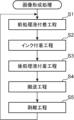
- a printing method includes a transport step of transporting the print medium in a transport direction by a transport member, an ink application step of applying ink to the print medium, and a peeling step of peeling the print medium from the transport member by a peeling member located downstream of the transport member in the transport direction, independently of the transport of the print medium by the transport member.
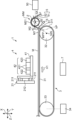
- FIG. 1 is a side view showing a schematic configuration of a printing system to which a printing apparatus according to an embodiment of the present invention is applied.
- FIG. 2 is a side view that illustrates a schematic configuration of the printing apparatus.
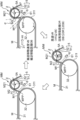
- FIG. 3 is a diagram for explaining the relationship between the transport member and the peeling member in the printing device.
- FIG. 4 is a timing chart illustrating the operation of the printing device.
- FIG. 5 is a flowchart showing the process flow of the printing method.
- the print medium when the print medium is peeled off from the conveyor belt by the rollers of the drying section, the print medium may be sent to the dryer downstream in the conveying direction while being subjected to tension caused by peeling off from the conveyor belt.
- the print medium if the print medium is a fabric, it may be dried in a stretched state, which may cause deformation of the image formed on the print medium and reduce print quality.
- the print medium when the print medium is peeled off from the conveyor belt by the rollers of the drying section, it is difficult to adjust the position of the peel start point of the print medium relative to the conveyor belt.
- the printing system 100 shown in FIG. 1 comprises a printing device 1 and a drying device 10.
- the printing device 1 is a device equipped with an ink unit capable of applying ink to media M, which is a wide and long printing medium.
- the printing device 1 prints an image by applying ink to the media M using the ink unit.
- the drying device 10 is positioned downstream of the printing device 1.
- the drying device 10 is a device capable of drying the media M on which an image has been printed by the printing device 1.
- the printing device 1 may be a screen printing device or an inkjet device.
- the ink unit includes a screen plate with multiple openings and a squeegee.
- the ink unit applies ink to the medium M through the openings in the screen plate by moving the ink along the screen plate in accordance with the movement of the squeegee.
- the printing device 1 is an inkjet device
- the ink unit applies ink to the medium M by ejecting ink onto the medium M.
- the printing device 1 is an inkjet device will be described in detail below.
- the inkjet printing device 1 is suitable for digital textile printing, which prints images such as letters and patterns on a medium M, which is a cloth member made of fabric such as woven or knitted fabric.
- the medium M is a long cloth member that extends between the printing device 1 and the drying device 10.
- the cloth member includes multiple types of fabric with different elasticity.
- the printing device 1 can also be used to print various images on printing media such as paper sheets and resin sheets.
- the printing device 1 includes a transport unit 3, a printing unit 4, a peeling member 5, a peeling drive unit 50, a detection unit 6, and a control unit 7.
- the transport unit 3 is a unit for transporting the media M in the Y direction.
- the transport unit 3 has a transport member 31, a first transport roller 32, a second transport roller 33, and a transport drive unit 34.
- the transport member 31 is a member capable of transporting media M located on its surface.
- the transport member 31 is an endless belt that has a width in the X direction and extends in the Y direction.
- the transport member 31, which is made of an endless belt, is capable of circular movement. By circular movement along the Y direction, the transport member 31 is capable of transporting media M in contact with the surface of the transport member 31 in a transport direction H1 from one side of the Y direction to the other.
- An adhesive layer made of an adhesive that adheres the media M is formed on the surface of the transport member 31 in order to hold the media M in contact with the surface of the transport member 31.
- the first transport roller 32 is a cylindrical roller extending in the X direction, around which the transport member 31 is wrapped at the most downstream position in the transport direction H1 of the media M on the transport member 31.
- the first transport roller 32 is rotated in response to the circular movement of the transport member 31.
- the second transport roller 33 is a cylindrical roller extending in the X direction, around which the transport member 31 is wrapped at the most upstream position in the transport direction H1 of the media M on the transport member 31.
- the transport member 31 is stretched between the first transport roller 32 and the second transport roller 33 so that the portion of its surface between the first transport roller 32 and the second transport roller 33 is widened in the X and Y directions and horizontal.
- the printing unit 4 is a unit for printing an image on the media M in contact with the surface of the transport member 31.
- the printing unit 4 is a unit in which an inkjet head 42 having an ink head 421, a pretreatment liquid head 422, and a posttreatment liquid head 423 is mounted on a carriage 41.
- the printing unit 4 is disposed above the transport member 31 in the Z direction.
- the printing device 1 is a so-called serial printer that performs printing processing on the media M by a serial printing method.
- an ejection operation in which various liquids are ejected from the inkjet head 42 while the carriage 41 is moved back and forth in the X direction perpendicular to the Y direction, which is the transport direction H1 of the media M, on the horizontal plane, and an operation of transporting the media M by the transport member 31 are repeatedly performed.
- the carriage 41 is fixed to a timing belt 212 that is attached to a flat carriage guide 21 that has a guide rail 211 extending in the X direction.
- the timing belt 212 is an endless belt that is attached to the carriage guide 21 so that it can move in circles in the X direction.
- the carriage 41 can move back and forth in the X direction along the carriage guide 21 while being guided by the guide rail 211 as the timing belt 212 moves in circles in the X direction.
- the post-treatment liquid head 423 is mounted on the carriage 41 so as to be disposed downstream of the ink head 421 in the transport direction H1 of the media M by the transport member 31.
- the post-treatment liquid head 423 is a post-treatment liquid unit capable of applying the post-treatment liquid to the media M on the transport member 31 after the ink by ejecting the post-treatment liquid.
- the post-treatment liquid head 423 includes a number of nozzles that eject the post-treatment liquid by an ejection method such as a piezo method using a piezo element or a thermal method using a heating element, a post-treatment liquid flow path that guides the post-treatment liquid to the nozzles, and a wiring board for controlling the ejection operation of the post-treatment liquid.
- the post-treatment liquid is a treatment liquid that comes into contact with the ink in a non-dried state on the media M, and is a non-coloring treatment liquid that does not develop color even when attached to the media M.
- the post-treatment liquid has a function of increasing the fixability of the ink on the media M.
- a treatment liquid containing silicone oil or the like can be used as such a post-treatment liquid.
- the post-processing liquid unit that applies the post-processing liquid to the media M on the transport member 31 is not limited to a head structure such as the post-processing liquid head 423, but may have a spray type structure that sprays the post-processing liquid.
- a liquid ejection operation is performed on the media M in contact with the surface of the transport member 31, in which pretreatment liquid is ejected from the pretreatment liquid head 422, ink is ejected from the ink head 421, and, if necessary, posttreatment liquid is ejected from the posttreatment liquid head 423.
- This causes an image to be printed on the media M. That is, on the media M on the transport member 31, the pretreatment liquid ejected from the pretreatment liquid head 422 adheres to the media M, and then the ink ejected from the ink head 421 adheres to the media M, and then, if necessary, the posttreatment liquid ejected from the posttreatment liquid head 423 adheres to the media M.
- the pretreatment liquid ejected from the pretreatment liquid head 422 is a treatment liquid containing an aqueous solvent whose main component is water and a cationic resin that is positively charged.
- the ink ejected from the ink head 421 is a pigment ink that contains a pigment as a coloring material.
- the pigment ink is an ink that contains an aqueous medium whose main component is water, a pigment, and a binder resin.
- the pigment may be an anionic pigment.
- the anionic pigment electrically reacts and aggregates with the cationic resin contained in the pretreatment liquid ejected from the pretreatment liquid head 422 on the medium M, so that the binder resin contained in the pigment ink can be prevented from penetrating into the medium M. This makes it possible to reduce the penetration of the binder resin into the gaps between the fibers and the binding of the fibers together when the medium M is a cloth material. This makes it possible to improve the texture, such as the feel of the cloth material.
- the peeling member 5 is a member located downstream of the conveying member 31 in the conveying direction H1. Specifically, the peeling member 5 is installed at a position above and downstream of the downstream end portion 311 located at the downstream end of the conveying member 31 in the conveying direction H1.
- the downstream end portion 311 is a portion of the conveying member 31 that is wrapped around the first conveying roller 32.
- the peeling member 5 is installed so that a portion of the peeling member 5 overlaps with the downstream end portion 311 when viewed in each of the Y direction and the Z direction.
- the peeling member 5 is located above the extension line of the conveying direction H1 of the media M on the conveying member 31.
- the peeling member 5 is capable of peeling the media M from the conveying member 31 when in contact with the surface of the conveying member 31.
- the peeling member 5 is a cylindrical roller extending in the X direction.
- the peeling member 5 made of a roller is provided to be rotatable around an axis extending in the X direction.
- a predetermined area MM of the media M in the transport direction H1 extending between the printing device 1 and the drying device 10 is wrapped around the outer peripheral surface 5A of the peeling member 5 from the upper side in the Z direction.
- the media M that is in contact with the surface of the transport member 31 and has the predetermined area MM wrapped around the peeling member 5 is peeled upward from the transport member 31 with the peeling start point MPP as the boundary with respect to the contact portion M1 that is in contact with the surface of the transport member 31.
- the peeling member 5 rotates with the predetermined area MM of the media M attached to the outer peripheral surface 5A from the upper side, thereby making it possible to peel off from the transport member 31 the portion of the media M that is in contact with the surface of the transport member 31 that is upstream of the predetermined area MM in the transport direction H1.
- the rotation direction of the peeling member 5 when peeling the media M from the transport member 31 coincides with the rotation direction of the first transport roller 32 when transporting the media M in the transport direction H1 by the circular movement of the transport member 31.
- the peeling member 5 rotates to peel the media M from the conveying member 31 based on the frictional force between the wrapped portion M21 and the outer peripheral surface 5A, and sends the media M downstream toward the drying device 10.
- tension associated with peeling from the conveying member 31 is applied to the area located between the downstream end portion 311 of the conveying member 31 and the outer peripheral surface 5A of the peeling member 5, but no tension is applied to the area downstream of the peeling member 5.
- the media M peeled off from the transport member 31 by the peeling member 5 is curved downward in the Z direction between the peeling member 5 and the drying device 10 and introduced into the drying device 10. This more reliably prevents the media M introduced into the drying device 10 from being dried in a stretched state.
- the peeling member 5 has a base 51 and a surface layer 52 that is provided on the base 51 and forms the outer circumferential surface 5A.
- the surface layer 52 is made of a rubber material. Since the surface layer 52 that forms the outer circumferential surface 5A of the peeling member 5 is made of a rubber material, the frictional force between the outer circumferential surface 5A and the wrapped portion M21 of the media M that wraps around the outer circumferential surface 5A can be increased. This allows the peeling member 5 to more reliably peel the media M from the conveying member 31 based on the frictional force.
- the rubber material forming the surface layer 52 of the peeling member 5 may be a foamed rubber material.
- the surface layer 52 made of a foamed rubber material has a plurality of pores. In this case, even if ink on the media M is transferred to the outer peripheral surface 5A of the peeling member 5 when the media M is wrapped around the outer peripheral surface 5A, the transferred ink can be captured in the pores of the surface layer 52. This makes it possible to prevent the outer peripheral surface 5A from becoming slippery due to the transfer of ink to the outer peripheral surface 5A of the peeling member 5.
- a member having an abrasive surface may be used for the surface layer 52 of the peeling member 5.
- the abrasive grains are more likely to catch on the media M and are less likely to slip, so the media M can be peeled off more reliably.
- Sandpaper of #40 to #240 can be used as the abrasive surface, with #100 to #150 being more preferable.
- An example of a member having an abrasive surface is abrasive paper with adhesive, and the abrasive grains can be silicon carbide grains.
- the position of the peeling start point MPP of the media M relative to the transport member 31 changes in accordance with the circular movement of the transport member 31 and also changes in accordance with the rotation of the peeling member 5.
- the position of the peeling start point MPP of the media M changes within the range of the downstream end portion 311 wrapped around the first transport roller 32 of the transport member 31.
- the position of the peeling start point MPP of the media M changes within the range of the downstream end portion 311 to the downstream side in the rotation direction of the first transport roller 32 in accordance with the circular movement of the transport member 31, and changes to the upstream side in the rotation direction of the first transport roller 32 in accordance with the rotation of the peeling member 5.
- the printing device 1 is therefore provided with a peeling drive unit 50 that can be controlled independently of the transport drive unit 34 that moves the transport member 31 in a circular motion and that can drive the peeling member 5.
- the peeling drive unit 50 is a drive motor that can generate a driving force to rotate the peeling member 5.
- the peeling drive unit 50 can rotate the peeling member 5 independently of the circular motion of the transport member 31 driven by the transport drive unit 34. This makes it possible to accurately adjust the position of the peeling start point MPP of the media M relative to the transport member 31.
- the peeling angle ⁇ indicates the angle between the peeled portion M2 of the media M that is peeled off from the conveying member 31 and located in the area between the conveying member 31 and the peeling member 5, and the contact portion M1 of the media M that is in contact with the surface of the conveying member 31.
- the winding angle ⁇ is expressed as the central angle of the arc of the wound portion M21 along the outer circumferential surface 5A of the peeling member 5.
- the peeling angle ⁇ becomes smaller and the winding angle ⁇ becomes larger.
- the peeling angle ⁇ becomes larger and the winding angle ⁇ becomes smaller.
- the detection unit 6 is disposed below the peeling member 5.
- the detection unit 6 is a sensor capable of detecting peeled portion M2 of the media M peeled off from the transport member 31 and located in the area between the transport member 31 and the peeling member 5.
- the peeled portion M2 of the media M to be detected by the detection unit 6 is a portion of the media M peeled off from the transport member 31 and located in the area between the part of the transport member 31 corresponding to the downstream end of the transport direction H1 of the carriage 41 on which the inkjet head 42 is mounted and the outer peripheral surface 5A of the peeling member 5.
- the peeled portion M2 of the media M to be detected by the detection unit 6 is a portion of the media M peeled off from the transport member 31 and located in the area between the downstream end portion 311 wound around the first transport roller 32 of the transport member 31 and the outer peripheral surface 5A of the peeling member 5.
- the detection unit 6 is, for example, a photoelectric sensor capable of adjusting the detection range 61.
- the detection unit 6, which is made up of a photoelectric sensor, emits detection light from a light projecting unit and receives the light reflected by the peeled portion M2 of the media M with a light receiving unit, thereby being able to detect the peeled portion M2.
- the detection unit 6 is capable of adjusting a detection range 61 on the optical path through which the detection light passes.
- the detection unit 6 has a detection range 61 set as a predetermined range on the optical path perpendicular to a plane VP extending in the X direction that includes the center 32S of the first transport roller 32 and the center 5S of the peeling member 5 within the area between the downstream end portion 311 of the transport member 31 and the outer circumferential surface 5A of the peeling member 5.
- the detection unit 6 is in the ON state when the peeled portion M2 of the media M is located within the detection range 61, and is in the OFF state when the peeled portion M2 of the media M is located outside the detection range 61.
- the detection result of the detection unit 6 is referenced by the control unit 7 described below.
- the control unit 7 is a personal computer having a CPU (Central Processing Unit), a storage area such as a HDD (Hard Disk Drive) or flash memory for storing processing programs, and a RAM (Random Access Memory) used as a working area for the CPU.
- the control unit 7 executes the processing of each step of the printing method using the printing device 1 by the CPU executing the processing programs stored in the HDD or flash memory. The processing of each step of the printing method executed by the control unit 7 will be described with reference to Figures 3, 4, and 5.
- the control unit 7 performs each process of the printing process, which includes a pretreatment liquid application process S1, an ink application process S2, and a posttreatment liquid application process S3, a transport process S4, and a peeling process S5.
- control unit 7 performs a transport drive process that drives the transport drive unit 34 in response to each of the deposition processes of the pre-treatment liquid deposition process, the ink deposition process, and the post-treatment liquid deposition process.
- the control unit 7 moves the transport member 31 in a circular motion in response to the driving of the transport drive unit 34 in the transport drive process, thereby transporting the media M in contact with the surface of the transport member 31 in the transport direction H1.
- the control unit 7 is not limited to performing the transport drive process.
- the transport drive process may be performed by the transport drive unit 34.
- the control unit 7 performs a peeling drive process that drives the peeling drive unit 50.
- the control unit 7 rotates the peeling member 5 in response to the driving of the peeling drive unit 50 in the peeling drive process, thereby peeling the media M in contact with the surface of the transport member 31 from the transport member 31.
- the control unit 7 rotates the peeling member 5 in response to the driving of the peeling drive unit 50, independently of the circular movement of the transport member 31 driven by the transport drive unit 34. This makes it possible to accurately adjust the position of the peeling start point MPP of the media M relative to the transport member 31, compared to when the peeling member 5 is rotated in synchronization with the circular movement of the transport member 31.
- the pretreatment liquid application process in the pretreatment liquid application process S1, the ink application process in the ink application process S2, the posttreatment liquid application process in the posttreatment liquid application process S3, the transport drive process in the transport process S4, and the peeling drive process in the peeling process S5, which are performed by the control unit 7, will be described in more detail with reference to Figures 3 and 4.
- the ink head 421, the pretreatment liquid head 422, and the posttreatment liquid head 423 will be collectively referred to as the "inkjet head 42”
- the ink, pretreatment liquid, and posttreatment liquid will be collectively referred to as the "liquid”
- the ink application process, pretreatment liquid application process, and posttreatment liquid application process will be collectively referred to as the "liquid application process”.
- the control unit 7 repeatedly performs a liquid attachment process in which the carriage 41 on which the inkjet head 42 is mounted is moved in the X direction at a predetermined head scanning period HSC to eject liquid from the inkjet head 42, and a transport drive process in which the transport drive unit 34 is driven in response to the liquid attachment process.
- control unit 7 When the control unit 7 is in the "ON” state in which liquid is ejected from the inkjet head 42 in the liquid attachment process, it sets the transport drive unit 34 to the "OFF” state in which it stops driving the transport drive unit 34 in the transport drive process, and when the control unit 7 is in the "OFF” state in which it stops ejecting liquid from the inkjet head 42 in the liquid attachment process, it sets the transport drive unit 34 to the "ON” state in which it drives the transport drive unit 34 in the transport drive process.
- the control unit 7 switches between driving and stopping the transport drive unit 34 in the transport drive process in response to switching between ejecting and stopping ejection of liquid by the inkjet head 42 in the liquid attachment process.
- the liquid attachment process and the transport drive process are repeatedly performed by the control unit 7, and an image is printed on the media M in contact with the surface of the transport member 31.
- the control unit 7 drives the transport drive unit 34 in the transport drive process so that the speed of the circular movement of the transport member 31 in response to the drive of the transport drive unit 34 becomes a predetermined transport movement speed VB, and the movement distance of the circular movement of the transport member 31 in response to the drive of the transport drive unit 34 becomes a predetermined transport movement distance DB.
- the media M in contact with the surface of the transport member 31 is transported in the transport direction H1 by a transport length equivalent to the transport movement distance DB of the transport member 31 at a transport speed equivalent to the transport movement speed VB of the transport member 31 with each transport drive process by the control unit 7.
- the detection unit 6 is turned ON when the peeling angle ⁇ between the contact portion M1 and the peeling portion M2 of the media M is less than 90 degrees and the peeling portion M2 is located within the detection range 61.
- the position of the peeling start point MPP of the media M changes downstream in the rotation direction of the first conveying roller 32 in accordance with the rotational movement of the conveying member 31, and the detection unit 6 is turned ON when the peeling angle ⁇ decreases to less than 90 degrees.
- the first sensor switching timing TS1 indicating the timing when the detection unit 6 switches from the OFF state to the ON state coincides with the timing when the peeling angle ⁇ of the media M becomes less than 90 degrees.
- the winding angle ⁇ of the wrapped portion M21 of the media M with respect to the peeling member 5 is large enough that the frictional force between the outer circumferential surface 5A of the peeling member 5 and the wrapped portion M21 is large enough to peel the media M from the conveying member 31.
- the control unit 7 performs a peeling drive process for driving the peeling drive unit 50 in response to detection by the detection unit 6 for each transport drive process.
- the control unit 7 sets the peeling drive unit 50 to an "ON" state, which drives the peeling drive unit 50.
- the control unit 7 drives the peeling drive unit 50 so that the peeling member 5 rotates at a predetermined circumferential speed VR in response to the drive of the peeling drive unit 50, and the movement distance along the rotational direction of the outer circumferential surface 5A of the peeling member 5 in response to the drive of the peeling drive unit 50 is a predetermined rotational movement distance DR.
- the media M in contact with the surface of the transport member 31 is peeled off at a peeling speed equivalent to the circumferential speed VR of the peeling member 5, by a peeling length equivalent to the rotational movement distance DR of the peeling member 5.
- the position of the peeling start point MPP of the media M relative to the transport member 31 changes upstream in the rotation direction of the first transport roller 32 in response to the rotation of the peeling member 5, within the range of the downstream end portion 311 wrapped around the first transport roller 32 of the transport member 31.
- the peeling angle ⁇ of the media M changes to become larger, and the winding angle ⁇ of the wound portion M21 of the media M wrapped around the peeling member 5 changes to become smaller.
- the peeled portion M2 of the media M is positioned outside the detection range 61 and the detection unit 6 is turned OFF.
- the second sensor switching timing TS2 which indicates the timing at which the detection unit 6 switches from the ON state to the OFF state, coincides with the timing at which the peeling angle ⁇ of the media M changes from less than 90 degrees to 90 degrees or more.
- control unit 7 drives the peeling drive unit 50 in response to detection by the detection unit 6, thereby rotating the peeling member 5 independently of the circular movement of the transport member 31 driven by the transport drive unit 34. This makes it possible to prevent the media M from being sent downstream with tension applied thereto due to peeling from the transport member 31 when the media M is peeled from the transport member 31 in response to the rotation of the peeling member 5, and to accurately adjust the position of the peeling start point MPP of the media M relative to the transport member 31.
- the control unit 7 switches the drive of the peeling drive unit 50 from a stopped state to a driven state after a predetermined first delay time DT1 has elapsed from the first sensor switching timing TS1 at which the detection unit 6 switches from an OFF state to an ON state. That is, the control unit 7 switches the drive of the peeling drive unit 50 from a stopped state to a driven state at the first drive switching timing TM1 after the first delay time DT1 has elapsed from the first sensor switching timing TS1.
- the control unit 7 switches the drive of the peeling drive unit 50 from a driven state to a stopped state after a predetermined second delay time DT2 has elapsed from the second sensor switching timing TS2 at which the detection unit 6 switches from an ON state to an OFF state. That is, the control unit 7 switches the drive of the peeling drive unit 50 from a driven state to a stopped state at the second drive switching timing TM2 after the second delay time DT2 has elapsed from the second sensor switching timing TS2.
- first and second drive switching timings TM1 and TM2 By setting the first and second drive switching timings TM1 and TM2 to the timings after the first and second delay times DT1 and DT2 have elapsed for the first and second sensor switching timings TS1 and TS2, respectively, it is possible to prevent the occurrence of a chattering phenomenon in which the ON and OFF states of the detection unit 6 are repeatedly switched at high speed. This makes it possible to prevent the occurrence of a phenomenon in which the peeling drive unit 50 abnormally repeats a driven state and a stopped state due to chattering of the detection unit 6.
- the control unit 7 drives the peeling drive unit 50 so that the rotational movement distance DR of the peeling member 5 falls within a predetermined tolerance range based on the transport movement distance DB of the transport member 31.
- the lower limit of the tolerance range is set to the same value as the transport movement distance DB
- the upper limit of the tolerance range is set to a value twice the transport movement distance DB. That is, the control unit 7 drives the peeling drive unit 50 so that the rotational movement distance DR of the peeling member 5 is equal to or greater than the transport movement distance DB and equal to or less than twice the transport movement distance DB (DB ⁇ DR ⁇ 2DB) in response to the detection unit 6 being in the ON state.
- the peeling drive unit 50 By driving the peeling drive unit 50 so that the rotational movement distance DR of the peeling member 5 is equal to or greater than the transport movement distance DB, it is possible to prevent the position of the peeling start point MPP of the media M relative to the transport member 31 from being too far downstream in the rotation direction of the first transport roller 32 when the media M is peeled off from the transport member 31 in response to the rotation of the peeling member 5 driven by the peeling drive unit 50. This prevents the printed surfaces of the contact portion M1 and the peeled portion M2 of the media M from coming into contact with each other between the downstream end portion 311 of the transport member 31 and the outer peripheral surface 5A of the peeling member 5.
- the peeling drive unit 50 by driving the peeling drive unit 50 so that the rotational movement distance DR of the peeling member 5 is less than twice the transport movement distance DB, it is possible to prevent the position of the peeling start point MPP of the media M relative to the transport member 31 from being too far upstream in the rotation direction of the first transport roller 32 when the media M is peeled off from the transport member 31 in response to the rotation of the peeling member 5 driven by the peeling drive unit 50. This prevents the portion of the media M to which the liquid is to be applied by the inkjet head 42 from being peeled off from the transport member 31.
- the control unit 7 drives the peeling drive unit 50 so that the peripheral speed VR of the rotation of the peeling member 5 in response to the drive of the peeling drive unit 50 is equal to or lower than the transport movement speed VB of the circular movement of the transport member 31 in response to the drive of the transport drive unit 34 (VR ⁇ VB).
- VR ⁇ VB transport movement speed of the circular movement of the transport member 31 in response to the drive of the transport drive unit 34
Landscapes
- Ink Jet (AREA)
Priority Applications (3)
| Application Number | Priority Date | Filing Date | Title |
|---|---|---|---|
| EP24779085.0A EP4613495A4 (en) | 2023-03-29 | 2024-03-01 | PRINTING DEVICE, PRINTING SYSTEM AND PRINTING PROCESS |
| JP2025510083A JPWO2024202947A1 (https=) | 2023-03-29 | 2024-03-01 | |
| CN202480006186.3A CN120379842A (zh) | 2023-03-29 | 2024-03-01 | 印刷装置、印刷系统以及印刷方法 |
Applications Claiming Priority (2)
| Application Number | Priority Date | Filing Date | Title |
|---|---|---|---|
| JP2023053284 | 2023-03-29 | ||
| JP2023-053284 | 2023-03-29 |
Publications (1)
| Publication Number | Publication Date |
|---|---|
| WO2024202947A1 true WO2024202947A1 (ja) | 2024-10-03 |
Family
ID=92905613
Family Applications (1)
| Application Number | Title | Priority Date | Filing Date |
|---|---|---|---|
| PCT/JP2024/007910 Ceased WO2024202947A1 (ja) | 2023-03-29 | 2024-03-01 | 印刷装置、印刷システム及び印刷方法 |
Country Status (4)
| Country | Link |
|---|---|
| EP (1) | EP4613495A4 (https=) |
| JP (1) | JPWO2024202947A1 (https=) |
| CN (1) | CN120379842A (https=) |
| WO (1) | WO2024202947A1 (https=) |
Citations (5)
| Publication number | Priority date | Publication date | Assignee | Title |
|---|---|---|---|---|
| JPS6087068A (ja) * | 1983-10-20 | 1985-05-16 | Ricoh Co Ltd | 熱転写記録装置 |
| JP2011031418A (ja) * | 2009-07-30 | 2011-02-17 | Seiren Co Ltd | インクジェット記録装置およびインクジェット記録方法 |
| JP2015058575A (ja) * | 2013-09-17 | 2015-03-30 | セイコーエプソン株式会社 | 記録装置及び記録方法 |
| JP2017226081A (ja) | 2016-06-20 | 2017-12-28 | パナソニックIpマネジメント株式会社 | インクジェット装置および染色システム |
| WO2018110630A1 (ja) * | 2016-12-16 | 2018-06-21 | コニカミノルタ株式会社 | 画像記録装置 |
Family Cites Families (3)
| Publication number | Priority date | Publication date | Assignee | Title |
|---|---|---|---|---|
| JP3168118B2 (ja) * | 1994-07-21 | 2001-05-21 | キヤノン株式会社 | 画像形成装置 |
| JP6244966B2 (ja) * | 2014-02-18 | 2017-12-13 | セイコーエプソン株式会社 | 記録装置及び記録方法 |
| JP6301156B2 (ja) * | 2014-02-25 | 2018-03-28 | セーレン株式会社 | 記録装置 |
-
2024
- 2024-03-01 JP JP2025510083A patent/JPWO2024202947A1/ja active Pending
- 2024-03-01 EP EP24779085.0A patent/EP4613495A4/en active Pending
- 2024-03-01 WO PCT/JP2024/007910 patent/WO2024202947A1/ja not_active Ceased
- 2024-03-01 CN CN202480006186.3A patent/CN120379842A/zh active Pending
Patent Citations (5)
| Publication number | Priority date | Publication date | Assignee | Title |
|---|---|---|---|---|
| JPS6087068A (ja) * | 1983-10-20 | 1985-05-16 | Ricoh Co Ltd | 熱転写記録装置 |
| JP2011031418A (ja) * | 2009-07-30 | 2011-02-17 | Seiren Co Ltd | インクジェット記録装置およびインクジェット記録方法 |
| JP2015058575A (ja) * | 2013-09-17 | 2015-03-30 | セイコーエプソン株式会社 | 記録装置及び記録方法 |
| JP2017226081A (ja) | 2016-06-20 | 2017-12-28 | パナソニックIpマネジメント株式会社 | インクジェット装置および染色システム |
| WO2018110630A1 (ja) * | 2016-12-16 | 2018-06-21 | コニカミノルタ株式会社 | 画像記録装置 |
Non-Patent Citations (1)
| Title |
|---|
| See also references of EP4613495A4 |
Also Published As
| Publication number | Publication date |
|---|---|
| JPWO2024202947A1 (https=) | 2024-10-03 |
| EP4613495A1 (en) | 2025-09-10 |
| EP4613495A4 (en) | 2026-02-25 |
| CN120379842A (zh) | 2025-07-25 |
Similar Documents
| Publication | Publication Date | Title |
|---|---|---|
| JP5362286B2 (ja) | インクジェット記録方法及び装置 | |
| EP0719721B1 (en) | Sheet convey apparatus and printer having same | |
| US8337008B2 (en) | Inkjet recording apparatus and inkjet recording method | |
| US20090244237A1 (en) | Inkjet recording apparatus and inkjet recording method | |
| JP5037325B2 (ja) | 画像形成装置及び中間転写体のクリーニング方法 | |
| EP2213464B1 (en) | Inkjet recording apparatus and method | |
| JP5377188B2 (ja) | 液体吐出ヘッド清掃装置およびインクジェット記録装置 | |
| US8702189B2 (en) | Liquid ejection apparatus, control apparatus, and storage medium storing program | |
| JP2010105389A (ja) | 記録装置 | |
| JP6948133B2 (ja) | 液吸収装置、記録装置、記録方法および製造方法 | |
| JP5031626B2 (ja) | 液体塗布装置及び方法並びに画像形成装置 | |
| JP7095464B2 (ja) | 処理液塗布装置および画像形成システム | |
| CN110091624B (zh) | 喷墨记录装置 | |
| WO2024202947A1 (ja) | 印刷装置、印刷システム及び印刷方法 | |
| JP7380173B2 (ja) | 印刷装置 | |
| JP7400393B2 (ja) | インク吐出ヘッドのメンテナンス装置、インクジェット記録装置及びインク吐出ヘッドのメンテナンス方法 | |
| JP7009872B2 (ja) | 液滴吐出ヘッドのノズル面払拭装置及び液滴吐出装置 | |
| WO2026070461A1 (ja) | 印刷装置、印刷システム及び印刷方法 | |
| US10464355B2 (en) | Printing apparatus, printing method, and control apparatus | |
| JP2010082492A (ja) | 処理液塗布装置、及び画像形成装置 | |
| US20090241832A1 (en) | Coating mechanism and droplet jetting device | |
| US10639921B2 (en) | Transfer printing | |
| WO2014156887A1 (ja) | インクジェット記録装置 | |
| JP7314604B2 (ja) | インクジェット画像形成装置および転写制御方法 | |
| JP7363119B2 (ja) | インクジェット画像形成装置および膜厚検査方法 |
Legal Events
| Date | Code | Title | Description |
|---|---|---|---|
| 121 | Ep: the epo has been informed by wipo that ep was designated in this application |
Ref document number: 24779085 Country of ref document: EP Kind code of ref document: A1 |
|
| WWE | Wipo information: entry into national phase |
Ref document number: 2025510083 Country of ref document: JP |
|
| WWE | Wipo information: entry into national phase |
Ref document number: 2024779085 Country of ref document: EP |
|
| ENP | Entry into the national phase |
Ref document number: 2024779085 Country of ref document: EP Effective date: 20250604 |
|
| WWE | Wipo information: entry into national phase |
Ref document number: 202480006186.3 Country of ref document: CN |
|
| WWP | Wipo information: published in national office |
Ref document number: 202480006186.3 Country of ref document: CN |
|
| WWP | Wipo information: published in national office |
Ref document number: 2024779085 Country of ref document: EP |
|
| NENP | Non-entry into the national phase |
Ref country code: DE |