WO2024202704A1 - ゲーム装置及びプログラム - Google Patents
ゲーム装置及びプログラム Download PDFInfo
- Publication number
- WO2024202704A1 WO2024202704A1 PCT/JP2024/005881 JP2024005881W WO2024202704A1 WO 2024202704 A1 WO2024202704 A1 WO 2024202704A1 JP 2024005881 W JP2024005881 W JP 2024005881W WO 2024202704 A1 WO2024202704 A1 WO 2024202704A1
- Authority
- WO
- WIPO (PCT)
- Prior art keywords
- item
- user
- game device
- game
- display
- Prior art date
- Legal status (The legal status is an assumption and is not a legal conclusion. Google has not performed a legal analysis and makes no representation as to the accuracy of the status listed.)
- Ceased
Links
Images





Classifications
-
- A—HUMAN NECESSITIES
- A63—SPORTS; GAMES; AMUSEMENTS
- A63F—CARD, BOARD, OR ROULETTE GAMES; INDOOR GAMES USING SMALL MOVING PLAYING BODIES; VIDEO GAMES; GAMES NOT OTHERWISE PROVIDED FOR
- A63F13/00—Video games, i.e. games using an electronically generated display having two or more dimensions
- A63F13/70—Game security or game management aspects
- A63F13/79—Game security or game management aspects involving player-related data, e.g. identities, accounts, preferences or play histories
- A63F13/792—Game security or game management aspects involving player-related data, e.g. identities, accounts, preferences or play histories for payment purposes, e.g. monthly subscriptions
-
- A—HUMAN NECESSITIES
- A63—SPORTS; GAMES; AMUSEMENTS
- A63F—CARD, BOARD, OR ROULETTE GAMES; INDOOR GAMES USING SMALL MOVING PLAYING BODIES; VIDEO GAMES; GAMES NOT OTHERWISE PROVIDED FOR
- A63F13/00—Video games, i.e. games using an electronically generated display having two or more dimensions
- A63F13/50—Controlling the output signals based on the game progress
- A63F13/52—Controlling the output signals based on the game progress involving aspects of the displayed game scene
Definitions
- the present invention relates to a game device and program, and in particular to an electronic game that involves the display of characters.
- Patent Document 1 There are services that allow users to customize the appearance of their associated character (avatar) to their liking by equipping it with a variety of items. However, because each user's sense is required to create a suitable appearance, the service in Patent Document 1 has a function that displays other users' avatars and provides a reference for coordinating outfits.
- the present invention aims to provide a game device and program that guarantees the opportunity to obtain items included in a presented outfit.
- a game device for executing a game in which a character appears, and includes a management means for managing items that can be worn by a character associated with a user in the game and that are owned by the user, a display control means for displaying an item set that combines a number of items on a display means in the game, and a purchase means for accepting a purchase request for the item set displayed on the display means, and the management means manages the items included in the item set that is the subject of the purchase request as owned by the user, on condition that the purchase request has been accepted.
- FIG. 1 is a diagram illustrating a configuration of a game system according to an embodiment and a modification of the present invention.
- FIG. 1 is a diagram illustrating a hardware configuration of a game device 100 according to an embodiment and a modification of the present invention.
- FIG. 2 is a diagram illustrating a hardware configuration of a server 200 according to an embodiment and a modification of the present invention.
- FIG. 1 is a diagram for explaining an exchange game according to an embodiment and a modification of the present invention; A flowchart illustrating a sales process executed by the game device 100 according to an embodiment and a modification of the present invention.
- FIG. 13 is a diagram illustrating an example of the data structure of various information used in the game system according to the embodiment and the modified example of the present invention.
- FIG. 1 is a diagram illustrating a configuration of a game system according to an embodiment and a modification of the present invention.
- FIG. 1 is a diagram illustrating a hardware configuration of a game device 100 according to an embodiment and a modification of the
- FIG. 13 is another diagram for explaining an exchange game according to an embodiment and a modification of the present invention.
- FIG. 1 is a diagram illustrating a sales form of an item set according to an embodiment and a modified example of the present invention
- FIG. 1 is a diagram illustrating a special shop according to an embodiment and a modification of the present invention
- FIG. 13 is a diagram illustrating an example of an explanation display for an item set according to an embodiment and a modification of the present invention
- FIG. 1 is a diagram illustrating a list of items related to an item set according to an embodiment and a modification of the present invention.
- FIG. 13 is a diagram illustrating a purchase confirmation display for an item set according to an embodiment and a modification of the present invention.
- the embodiment described below is an example of the application of the present invention to a game device capable of playing a game in which characters are trained (hereinafter referred to as a training game), as an example of a game device.
- a training game a game device capable of playing a game in which characters are trained
- the present invention can be applied to any device that has a communication function and is capable of playing a game in which characters appear.
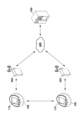
- FIG. 1 is a diagram showing the configuration of a game system according to an embodiment of the present invention.
- a game device 100 is configured to be able to wirelessly communicate with other game devices 100 and a server 200.
- the game device 100 is configured to be able to communicate using two types of communication methods, and transmits and receives information using different communication methods when communicating with other game devices 100 and when communicating with the server 200.
- communication between the game device 100 and the server 200 is performed via an access point (AP) 300 and a network 400, which differs from communication performed directly between game devices 100.
- the network 400 is described as a wide area network (WAN) such as the Internet in order to realize interaction between users in various regions, but in another embodiment it may be a LAN.
- WAN wide area network
- FIG. 2 is a block diagram illustrating the hardware configuration of the game device 100.
- the control unit 101 is a processor such as a CPU, and performs various controls including operational control of each piece of hardware equipped in the game device 100. Specifically, the control unit 101 performs the relevant controls by, for example, reading out a necessary program stored in the storage device 102, expanding it into the memory 103, and executing it.
- the storage device 102 is a device capable of permanently storing information, such as a non-volatile memory.
- the storage device 102 stores programs related to the operation of the game device 100 and programs for the training game executed in the game device 100, as well as parameter information required to realize various controls.
- the storage device 102 also functions as a database of various data related to the training game (character DB 121 and item DB 122).
- the memory 103 is a storage device used for temporary data storage, such as a volatile memory.
- the memory 103 may be used not only as an area for expanding each program, but also as a storage area for temporarily storing data output during the operation of various hardware and various controls.
- the character DB 121 is a database that manages, as records, information (character information) about characters that can be trained in the training game.
- information character information
- the user can train a character that grows through multiple growth stages.
- the character is configured so that its appearance changes as the growth stage changes.
- the character DB 121 manages, as records, various information about each appearance that a character can have at each growth stage. As shown in FIG.
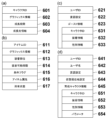
- the character information for one record is associated with a character ID 601 that uniquely identifies the character (its appearance), and includes graphics information 602 for drawing the appearance of the character, a growth stage 603 indicating the growth stage at which the character will have that appearance, and growth destination information 604 indicating the appearance to which the character can grow from that appearance.
- the growth destination information 604 may store information about the corresponding character ID 601.
- the item DB 122 is a database that manages information (item information) about items that can be worn by a character in a training game as records.
- items can be worn by a character being trained.
- the items may be available in the training game, for example, or may be available in the form of DLC or the like by purchasing a specific product.
- the appearance of a character changes at each growth stage, and the number of items that can be worn increases as the growth stage progresses. As shown in FIG.
- the item information for one record of the item DB 122 includes graphics information 612 for drawing the appearance of the item in association with an item ID 611 that uniquely identifies the item, a wearing part 613 that indicates the part of the character that can wear the item, a wearable stage 614 that indicates the growth stage at which the item can be worn, a condition flag 615 that indicates whether a purchase condition is set for the item, an item attribute 616 that indicates the attribute attached to the item, and an ownership status 617 that indicates whether the user owns the item.
- the item attributes 616 may include information on whether the item is paid DLC that is provided on the condition of payment of real currency, information indicating the residence in the training game where the item can be obtained, and association information indicating the season or event related to the item.
- the GPU 104 is a drawing device that executes various drawing processes related to the generation of display screens related to the game device 100.
- the GPU 104 includes a GPU memory (not shown), and expands various graphics data read from the storage device 102, and performs predetermined calculations to generate various images (screens) related to the training game.
- the screens and images generated by the GPU 104 are presented to the user by being displayed, for example, on a display 110 provided in the game device 100.
- the display 110 is a device provided in the game device 100 that displays information, such as a liquid crystal display.
- the operation I/F 105 is a user interface provided in the game device 100 that accepts operation input. When the operation I/F 105 detects that an operation input has been made, it outputs a control signal corresponding to the operation input to the control unit 101.
- the operation I/F 105 includes operation members such as buttons provided on the exterior of the game device 100, various sensors, etc.
- the operation I/F 105 includes a touch input detection sensor provided on the display 110.
- the communication I/F 106 is a communication interface with an external device that the game device 100 has.
- the game device 100 of this embodiment performs wireless information communication with other devices using two types of communication methods.
- One communication method is ad-hoc mode communication (hereinafter referred to as ad-hoc communication) as a first communication method according to the present invention, in which the game device 100 and another game device 100 directly transmit and receive information between the devices, with one of the game device 100 and another game device 100 acting as a host and the other connected to it, without the condition that the game device 100 is connected to the AP 300.
- ad-hoc communication ad-hoc mode communication
- the other communication method is infrastructure mode communication (hereinafter referred to as infrastructure communication) as a second communication method according to the present invention, in which each game device 100 connects to an associated AP 300, and information is transmitted and received between the game device 100 and the server 200 via the AP 300 and the network 400.
- infrastructure communication infrastructure mode communication
- the two types of communication methods that the communication I/F 106 can use are described as ad-hoc communication and infrastructure communication, but it goes without saying that the implementation of the present invention is not limited to this and may include other types of communication.
- Figure 3 is a block diagram showing the hardware configuration of the server 200 according to this embodiment. Note that in the following explanation, the hardware configuration that realizes the same functions as the game device 100 will be prefixed with "server” to clearly distinguish it from the configuration of the game device 100.
- the server control unit 201 is a processor such as a CPU, and performs operation control of each piece of hardware equipped in the server 200, and control related to the realization of various functions including user management and exchange functions related to the training game. Specifically, the server control unit 201 performs the relevant control by, for example, reading out necessary programs stored in the server storage device 202, expanding them into the server memory 203, and executing them.
- the server storage device 202 is a device capable of permanently storing information, such as a non-volatile memory or HDD.
- the server storage device 202 stores an operating system for operating the server 200 and a program related to matching, as well as parameter information and various necessary data required to realize various controls.
- the server storage device 202 also functions as a database of various data related to users who use the game device 100.
- the server memory 203 is a storage device used for temporary data storage, such as a volatile memory.
- the server memory 203 may be used not only as an area for developing each program, but also as a storage area for temporarily storing data output during the operation of various hardware and various controls.
- the user DB 211 is a database that manages information (user information) relating to users who use the game device 100 as records.
- the server 200 manages the progress of the training game on the game device 100 used by each user, and is configured to be shareable with other game devices 100.
- the user information relating to one record of the user DB 211 is associated with a user ID 621 that uniquely identifies the user, and includes a language setting 622 set on the game device 100 used by the user, and ghost information 623 relating to the character being trained by the user on the game device 100.
- the user ID 621 can be unique information such as the individual identification number of the game device 100 used by the user.
- the information on characters being developed on each game device 100 managed in user DB 211 indicates the state of the character being developed on the game device 100 at the time the information is received, and it is possible that the character being developed on the game device 100 may be different in a strict sense at the time the information is used on the server 200, etc.
- the information on characters managed in user DB 211 is expressed as "ghosts" to refer to the appearance of a character being developed at a certain point in time, and is managed as ghost information 623.
- ghost information 623 may include, for the character being developed, a character ID 631 indicating the appearance of the character, attachment information 632 indicating the attachment status of items to the character, and gender information 633 indicating the gender of the character.
- the server communication I/F 204 is a communication interface with an external device provided to the server 200.
- Information communication between the server communication I/F 204 and the external device may be performed via a wide area network (WAN) such as the Internet, or via a LAN or the like.
- Information communication performed by the server communication I/F 204 may be performed either wired or wirelessly.
- the game is described as a character development game that provides elements of character development, communication between the user and the character, and interaction between characters as entertainment elements.
- a development game is merely one type of game in which characters appear, and the implementation of the present invention is not limited to this.
- the present invention is applicable to any game in which a character appears whose movements are controlled in response to operational inputs made by the user.
- movement control is not limited to a user directly controlling a character, but also includes indirect changes in a character's actions and behavior in response to changes in parameters or the environment as a result of an evaluation of an operational input made by the user.
- a breeding game the user can breed a character by performing operational inputs related to caring for the character.
- a breeding game starts, for example, with hatching an egg, and the character progresses through stages of growth by sequentially performing operational inputs related to the necessary care, presenting the character's growth as it changes appearance.
- Characters are configured to be able to wear items, and users can equip their characters with items acquired in the training game to add decoration to the character's appearance.
- the number of parts on which items can be worn increases as the growth stage progresses, and parts on which items can be worn are limited until a certain growth stage is reached.
- Parts on which items can be worn include, for example, the character's head, back, and hands.
- characters are configured to be able to wear two types of items on their heads (hats, hair accessories, glasses, ear accessories, etc.), one type on their backs (capes, feathers, etc.), and one type on their hands (umbrellas, canes, tools, etc.).
- characters can be equipped with up to four types of items.
- the training game is configured to be able to introduce characters trained by other users by communicating with an external device. For this reason, the game device 100 obtains information about characters being trained by other users via the communication I/F 106.
- the communication I/F 106 is capable of communicating information using two types of communication methods, and can obtain information about characters using each of them. More specifically, the communication I/F 106 obtains information about characters being trained on other game devices 100 via ad-hoc communication from the other game devices 100. The communication I/F 106 also obtains information about characters being trained on any game device 100 that has previously been connected to the server 200 via infrastructure communication from the server 200.
- a character being developed in the game device 100 is referred to as a "own character”
- a character being developed in another game device 100 about which information is acquired from the other game device 100 through ad-hoc communication is referred to as a "friend character”
- a character being developed in any game device 100 connected to the server 200 about which information is acquired from the server 200 through infrastructure communication is referred to as a "other user character” to make a clear distinction between the two.
- the own character is a character whose movement is controlled in response to operation input by the user of the game device 100 in the development game executed in the game device 100.
- the friend character is a character whose movement is controlled in response to operation input by the user of the game device 100 in the development game executed in the other game device 100 connected through ad-hoc communication.
- the other user character is a character whose movement is controlled in response to operation input by the user of the game device 100 in the development game executed in any game device 100 connected to the server 200 through communication.
- each game device 100 is configured to periodically connect to the server 200 via infrastructure communication, for example at a specified time, and upload information about the player's character being developed.
- the uploaded information about the player's character is used to update the ghost information 623 of the user information managed for the relevant user. Therefore, the game device 100 is configured to periodically upload to the server 200 the user information as well as the user ID, language setting, and information about the player's character (character ID, wearing information, gender information).
- the owner information may be configured to include a user name 642 indicating the nickname set by the user in association with a user ID 641 that uniquely identifies the user, a language setting 643 indicating the display language set in the game device 100, a virtual residence setting 644 indicating the residence of the player's character in the game, and training character information 645 indicating information about the player's character, and may be stored in the storage device 102.
- the training character information 645 includes a character ID 651 indicating the appearance of the player's character, attachment information 652 indicating items attached to the player's character, gender information 653 indicating the gender of the player's character, and parameters 654 of the player's character that may change depending on the training status.
- each game device 100 When uploading information about the player's character, each game device 100 acquires information about other users' characters from the server 200 for use in the social game described below.
- the server 200 receives information about the player's character from each game device 100, it randomly selects a predetermined number (e.g., a fixed number equal to or greater than 10) from the user information of users other than the user of that game device 100 that is managed in the user DB 211.
- the server 200 transmits the language settings 622 and ghost information 623 of the selected number of pieces of user information to that game device 100 as information about other users' characters.
- the control unit 101 registers these in the other user list, which serves as a second list according to the present invention.
- the other user list is a list that manages information for displaying other user characters in the social game, and is stored, for example, in the storage device 102.
- information about the friend character is acquired from the other game device 100 on the condition that the user has performed an operation input on the game device 100 to communicate with the other game device 100.
- the game device 100 also transmits information about the player's character to the other game device 100 with which it is communicating.
- the user with whom ghost information is shared in infrastructure communication is not necessarily an acquaintance or friend of the user who is developing the character related to the ghost information, so sharing information that can lead to the identification of the individual user, such as a nickname, is not preferable.
- the information about other user characters transmitted from the server 200 does not include information that can lead to the identification of the individual user (user ID 641, user name 642).
- ad-hoc communication basically transmits and receives information directly between game devices 100 in a state in which they can communicate with each other at the same time, so it is assumed that the user of the game device 100 and the user of the other game devices 100 are acquaintances or friends.
- the information about the characters transmitted and received between the game devices 100 in ad-hoc communication (information about friend characters/information about the player's own character) is configured differently from the information about other user characters acquired by each game device 100 in infrastructure communication. That is, in order to provide an interesting element that can be enjoyed between acquaintances and friends, the information exchanged in ad-hoc communication includes information such as the user's nickname. More specifically, the information about the characters transmitted and received in ad-hoc communication includes, for example, the user ID 641, user name 642, game device language setting 643, virtual residence setting 644, and character information 645 of the owner information managed by each game device 100.
- the control unit 101 registers the information together with information about the date and time of reception in a friend list, which is the first list according to the present invention.
- the friend list is a list that manages information for displaying friend characters in a social game, and is stored, for example, in the storage device 102.
- the friend list and the other user list have different update conditions.
- the friend list is configured to be able to manage information about friend characters related to up to eight users who communicated by ad-hoc communication.
- the control unit 101 judges whether or not information about the same friend character has already been registered in the friend list. This judgment can be made, for example, by checking whether or not information having the same user ID has been registered in the friend list based on the user ID included in the received information. If information about the same friend character has already been registered, the control unit 101 updates the information about the same friend character registered in the friend list with the newly received information.
- control unit 101 This allows a user who has previously performed ad-hoc communication to update information about a character (friend character) being trained to the latest state. If information about the same friend character has not been registered, the control unit 101 additionally registers the newly received information in the friend list. At this time, if information about up to eight friend characters has already been registered in the friend list, the control unit 101 replaces the information that was registered oldest in the friend list with the newly received information, thereby registering the friend character in the friend list.
- the other user list is configured to be able to manage information relating to a predetermined number of other user characters received from the server 200.
- the control unit 101 receives information relating to a predetermined number of other user characters through infrastructure communication, it registers the information in the other user list by replacing all information currently registered with that information. That is, in the game device 100 of this embodiment, all information in the other user list is updated every time infrastructure communication is performed. This is because, unlike friend characters, other user characters are not characters related to acquaintances, friends, etc. and therefore do not need to be retained for a long period of time, and frequent updates can provide the user with the excitement of playing a game with many users.
- the other user list is also referenced when the social game described below is executed, and the information is used to display other user characters in the social game.
- the information registered in the other user list does not need to be updated if the social game is not executed. Therefore, in one aspect, in order to reduce the amount of information sent and received in infrastructure communication and to reduce the amount of power consumed in communication, information regarding other user characters may be obtained from the server 200 on the condition that other user characters are displayed in the social game based on the information registered in the other user list. This control may be achieved by not making a request from the game device 100 to send information regarding other user characters.
- the game device 100 of this embodiment can execute a communication game in which a friend character being developed is displayed on the communication partner game device 100, and the friend character interacts with the player's character.
- This communication game can therefore be used to marry the player's character and the friend character, unlocking the element of developing a new generation of characters.
- the interest factor associated with such a communication game requires that the owner of the other communication partner game device 100 is nearby.
- the characters that can be married are limited to those developed by close acquaintances or friends, the types of characters that can be born may be limited.
- the game device 100 of this embodiment has a function for executing an exchange game to provide elements of exchange with various characters, including marriage with other characters.
- the exchange game is configured to feature characters (friend characters, other user characters) whose information is registered in a friend list and other user list stored in advance, so that the game can be played even in offline situations.
- the friend characters and other user characters displayed in the exchange game are limited to characters that have reached a predetermined growth stage.
- the exchange game is configured to be playable on the condition that the player's own character has reached the predetermined growth stage.
- the interaction game is played out using an interaction area as shown in FIG. 4.
- the interaction area is composed of five areas, and different areas are displayed in sequence by inputting an operation related to area movement (area 401 ⁇ area 402 ⁇ area 403 ⁇ area 404 ⁇ area 405 ⁇ area 401 ⁇ ).
- areas 401 ⁇ area 402 ⁇ area 403 ⁇ area 404 ⁇ area 405 ⁇ area 401 ⁇ characters selected from among friend characters whose information is registered in the friend list and other user characters whose information is registered in the other user list are placed separately in each area.
- the selected character is placed in one of the areas, and is configured to be able to interact with the player's character in that area.
- area 401 is provided with an entrance gate to the social area, and area 401 is controlled to be displayed at the start of the social game, and as shown in FIG. 7, the player's character 701 is first displayed in area 401 together with friend characters and other user characters placed in that area. If the user wishes to move the player's character 701 to another area, the user can perform an operation input related to area movement to move and display the player's character 701 in the next area in the display order (area 402 is next after area 401).
- the actions of friend characters and other user characters placed in the interaction area are controlled without being based on operational input from the user using the game device 100.
- the actions performed by friend characters and other user characters placed in the interaction area include actions accompanied by a greeting performance toward the player's character.
- the greeting performance is displayed differently based on the language setting information associated with the friend character or other user character in order to convey to the user the interest of interacting with users from various countries. For example, for other user characters associated with an English language setting, a greeting performance including a speech bubble displaying "Hi! is displayed, and for other user characters associated with a French language setting, a greeting performance including a speech bubble displaying "Salut! is displayed.
- the number of characters to be placed in the interaction area is predetermined, and in this embodiment, one friend character and ten other user characters are placed.
- the control unit 101 may, for example, select one piece of information by lottery from among the pieces of information registered in the friend list, and place one friend character corresponding to that information in a designated area.
- the control unit 101 may, for example, select ten pieces of information by lottery from among the pieces of information registered in the other user list, and place ten other user characters corresponding to that information in a designated area.
- the game device 100 and the server 200 are configured to communicate information basically once a day using the automatic update function. More specifically, the game device 100 is configured to perform automatic updates on the condition that the game device 100 is in a predetermined time period and the state of the player's character is in a sleeping state.
- the predetermined time period for automatic updates (hereinafter referred to as the update time period) can be set to occur on a daily cycle, for example, from 9 p.m. to 6:59 a.m. the next morning. This is because the user is unlikely to operate the game device 100 during this time period, and various information is unlikely to change.
- the game device 100 when the player's character is in a sleeping state, the game device 100 is controlled so as not to accept operation input related to the player's character. Therefore, by configuring the game device 100 to perform automatic updates using this timing, it is possible to avoid a situation in which the latest information is not managed by the server 200 due to changes in the state or parameters of the player's character caused by user operation input. In addition, when the game device 100 performs information updates or main unit updates based on information received from the server 200, it is possible to avoid situations in which the user's input operations are interrupted or the update work is not performed properly.
- a state in which the player's character is asleep is defined as, for example, a state in which the current time has reached the bedtime set by the user, and the setting to the sleeping state has been completed through effects related to preparing for bed and going to sleep.
- the player's character is managed as being asleep.
- control unit 101 will not execute the automatic update function, but will wait until the conditions for execution are met. In the example of this embodiment, the control unit 101 will wait to execute the automatic update function until the player's character has completely entered a sleeping state.
- the control unit 101 controls the game device 100 to a state in which it can communicate with the server 200 via the communication I/F 106. Since communication between the game device 100 and the server 200 is performed by infrastructure communication, this function is assumed to have information set for the AP 300 with which to communicate.
- the automatic update function sends and receives the following information:
- Information relating to the player's character is transmitted from the game device 100 to the server 200.
- the information relating to the player's character is composed of the user ID 641, language setting 643, and character development information 645, which are part of the owner information managed by the game device 100.
- the information relating to the player's character is transmitted primarily for the purpose of updating the ghost information of the player's character.
- the server 200 transmits information about other user characters that are candidates for display in the social game to the game device 100.
- the transmitted information is composed of a predetermined number of pieces of ghost information selected by the server control unit 201 each time information is transmitted to and received from the game device 100.
- the information about other user characters is composed of the language settings and ghost information of the user who has trained each other user character, as described above.
- the server 200 also transmits update data for the firmware of the game device 100 to the game device 100. Some of the addition of functions and correction of defects of the game device 100 are performed by updating the main firmware. In addition, functions are also added by transmitting additional content data (new event data and new downloadable content (DLC) data) of the game content (training game) executed by the game device 100 from the server 200 to the game device 100, and changing the data referenced during the execution of the training game in the game device 100.
- the new DLC data may include data for selling the newly added content and data for drawing. Therefore, the server 200 also transmits these additional content data to the game device 100.
- various new information from the game system operator side such as announcement information, which does not directly affect the processing of the training game, is also transmitted from the server 200 to the game device 100.
- the game device 100 transmits information about the player's character, receives main body update data for the game device 100, receives new information, receives additional content data, and receives information about characters corresponding to other game devices while connected to the server 200 for communication.
- the automatic update function only requires that at least one of the above information transmissions and receptions be performed. In this way, the amount of data communication performed by the game device 100 can be reduced, and battery consumption can be suppressed.
- One shop is a normal shop serving as a second shop according to the present invention, which sells items for which no purchase conditions are set and which any user can purchase by paying a set amount of in-game currency as a price.
- an item for which no purchase conditions are set is an item for which the condition flag 615 in the item information managed in item DB 122 is false.
- Items are sold in normal shops in the form of individual items (single item sales), allowing users to select and purchase the items they desire.
- the number of items displayed in a normal shop is predetermined, and the shop may be configured to change the lineup of items displayed, for example, every time the day changes.
- the other shop is a special shop as the first shop according to the present invention.
- the sales format of the special shop is different from that of the normal shop, in that it sells item sets (set sales) that combine multiple items.
- the sale of item sets in the special shop is carried out by displaying a mannequin having a generic character shape with the items included in the item set attached to it, that is, in the same manner as when the item set is attached to a character, as shown in FIG. 8. A predetermined number of such mannequins are displayed, and a user can select and purchase an item set related to a desired mannequin in the special shop, thereby owning all of the items included in the item set at once.
- the user can individually equip the local items included in the set on the user's character. Therefore, the items equipped to other users' characters may include local items associated with any region. In other words, other users' equipment sets sold at special shops may also include local items associated with a residence other than the residence set for the user's character. Therefore, the user can obtain local items associated with a residence other than the residence of the user's character at the special shop via other users' equipment sets. By configuring in this way, the user may be given the opportunity to obtain some items (local items) for which purchase conditions are set, depending on the information received about other users' characters.
- paid items some items that can only be obtained by paying real currency, such as paid DLC (hereinafter referred to as paid items), are displayed in the communication area as decorations for other users' characters, but should not be displayed in special shops as other users' equipment sets. This is because fairness between users would not be guaranteed if paid items that a user has made available for use by paying for them were also available for free to other users who have not made the payment. Therefore, among the item sets related to other users' characters whose information is managed in the other users' list, item sets that include paid items are excluded from the selection candidates for other users' equipment sets.
- the item set selected for display is placed in the shop equipped to a mannequin.
- the user can move the player's character 901 in front of each mannequin as shown in FIG. 9 by performing operation input related to movement.
- the player's character 901 is basically displayed with the set items equipped while the social game is being played, but in the special shop, the player's character is displayed without any items equipped in order to focus the user's attention on the item set being displayed.
- the explanatory display 1002 includes information related to the local set, i.e., the place of residence of the player's character, as shown in FIG. 10(b).
- the local set i.e., the place of residence of the player's character
- FIG. 10(b) the explanatory display 1002 includes information related to the local set, i.e., the place of residence of the player's character, as shown in FIG. 10(b).
- "Tama North America" indicates the place of residence related to the local set, i.e., the place of residence associated with the local items that make up the item set.
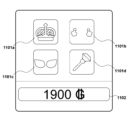
- the item list includes images of each of the items included in the item set worn by the mannequin in the selected state as shown in FIG. 11, displayed alone and unworn.
- the items are displayed in a manner in which they overlap or are blocked by the mannequin, so the user can check the items included in the item set in more detail using the item list.
- the item list includes images 1101a to 1101d of four types of items.
- an item set can be composed of a combination of two or more items, so the item list may be configured to display images of up to four types of items.
- a purchase confirmation display as shown in FIG. 12 is displayed, for example, in response to any operation input.
- the user can decide whether or not to purchase the item set attached to the selected mannequin.
- the purchase confirmation display includes a button 1201 for accepting a purchase and a button 1202 for accepting a cancellation of the purchase.
- the control unit 101 subtracts the amount shown in the amount display 1102 from the in-game currency held by the user, and updates the information in the item DB 122 so that the items included in the target item set are owned by the user.
- the control unit 101 also controls the mannequin related to the target item set to be displayed as out of stock.
- the control unit 101 determines the other user wearing sets from among the item sets sold in the special shop. In this embodiment, the control unit 101 selects two characters from the other user list of 10 characters whose information is managed in the other user list by a lottery process whose wearing information 652 does not include information on paid items. The control unit 101 then determines two other user wearing sets based on the wearing information 652 of the information on the two selected other user characters.
- control unit 101 determines a local set from among the item sets to be sold in the special shop.
- control unit 101 selects and determines a local set of two items according to a predetermined rule from among local set candidates that have been configured in advance using local items.
- the control unit 101 places the item set determined in S502 and S503 in the area relating to the special shop (hereinafter referred to as the in-store area) in a manner that the mannequin is wearing the item set, and displays an effect in which the player's character enters the area (a store visit effect).
- the mannequins wearing the item sets are placed in a predetermined arrangement order in the special shop, and after displaying the store visit effect, the control unit 101 places and displays the player's character in front of the first item set in the arrangement order.
- control unit 101 determines whether or not an operational input related to the movement of the player's character has been made. If the control unit 101 determines that an operational input related to the movement of the player's character has been made, the process proceeds to S506, and if it determines that an operational input related to the movement of the player's character has not been made, the process proceeds to S507.
- control unit 101 displays an effect in which the player's character is moved to the front of the next item set in the placement order, based on the operation input related to the movement of the player's character.
- the control unit 101 determines whether or not an operational input related to checking details of an item set has been made. More specifically, the control unit 101 determines whether or not an operational input related to checking details has been made when the player's character is placed in front of one of the item sets. If the control unit 101 determines that an operational input related to checking details has been made, it moves the process to S508, and if it determines that an operational input related to checking details has not been made, it returns the process to S505.
- control unit 101 sets the item set attached to the mannequin placed at the position of the player character (the mannequin in front of the player character) to a selected state.
- control unit 101 controls the display of an explanation display and an item list for the item set that was selected in S508.
- the control unit 101 also controls the display of a purchase confirmation display in response to any operation input.
- the control unit 101 determines whether the operation input made to the purchase confirmation display is an operation input related to making a purchase or an operation input related to canceling a purchase. If the control unit 101 determines that the operation input made to the purchase confirmation display is an operation input related to making a purchase, it moves the process to S511. If the control unit 101 determines that the operation input made to the purchase confirmation display is an operation input related to canceling a purchase, it ends the purchase confirmation display, cancels the selection state of the item set, and returns the process to S505.
- the control unit 101 executes a process for purchasing the selected item set.
- the process for purchasing an item set includes a process for consuming the in-game currency related to the item set, and a process for changing the user's ownership status of each item included in the item set.
- the control unit 101 also ends the purchase confirmation display, cancels the selection of the item set, and returns the process to S505.
- the control unit 101 displays an effect in which the purchased item set is out of stock in the special shop.
- the game device of this embodiment can guarantee the opportunity to obtain items included in the presented coordination (item set).
- the other user equipment sets sold at the special shop are described as being determined based on other user characters randomly selected by lottery processing from the other user list, but the implementation of the present invention is not limited to this. If an item set to be sold as a other user equipment set is determined randomly, for example, even if a user notices that a other user character wearing a local item is placed in the communication area in a social game, they may not be able to obtain the local item. In addition, for example, if a other user character wearing an item related to an event currently being held in a social game is placed in the communication area, the user may wish to obtain the item.
- control when selecting another user's equipment set, control may be performed so that item sets including items with specified attributes are preferentially selected from among item sets related to other user characters displayed as visiting characters.
- items with specified attributes are not limited to items with set purchase conditions such as local items, but may also include items that are configured to be easily obtained when developing a specific type of character, for example.
- an item set may be selected that includes items that are conditioned to be sold at that event or season (information specifying the relevant event, etc. is specified in item attribute 616 of the item information).
- control unit 101 may be configured to sell an item set selected based on certain rules from among the item sets related to default characters that have been registered in advance in the storage device 102 as the other user's wearing set.
- Variation 2 described above describes a mode in which an item set including items that satisfy specific attributes or conditions is selected as the other user's wearing set, but the implementation of the present invention is not limited to this. For example, if information about an item set that simply includes information about an item that the user does not yet own is registered in the other user list, the control unit 101 may perform control so as to preferentially select that item set as the other user's wearing set.
- the item set for sale is reselected when the time comes to change the item set for sale at the special shop or when one of the item sets has been purchased, but the implementation of the present invention is not limited to this.
- the selection of the item set for sale may be performed, for example, when an operational input relating to moving to the special shop is detected, that is, each time the special shop is displayed. In this way, the lineup of item sets for sale at the special shop will be changed frequently, increasing the interest of the training game.
- a game device for executing a game in which a character appears, the game device comprising: a management means for managing items that can be worn by a character associated with a user in the game and that are owned by the user; a display control means for displaying an item set that combines a number of items on a display means in the game; and a purchase means for accepting a purchase request for the item set displayed on the display means, the management means managing items included in the item set that is the subject of the purchase request as owned by the user, on the condition that the purchase request has been accepted.
- a game device as described in (1) that includes a selection means for selecting a predetermined number of item sets to be displayed on the display means from among the candidate item sets for display, and the display control means causes the display means to display the predetermined number of item sets selected by the selection means.
- a game device as described in (2) or (3) in which the game provides an opportunity for the user to obtain in-game currency that can be used by the user, and the selection means preferentially selects, from among the displayed candidate item sets, an item set that can be purchased with the in-game currency held by the user.
- a game device according to any one of (2) to (5), wherein the selection means preferentially selects, from among the display candidate item sets, an item set that includes an item that is not owned by the user.
- a game device according to any one of (2) to (6), wherein the selection means selects an item set from among the display candidate item sets, excluding an item set that has already been purchased.
- a game device according to any one of (2) to (7), wherein the selection means selects an item set from among the candidate item sets for display, excluding an item set that has already been displayed on the display means.
- a game device according to any one of (2) to (8), further comprising an acquisition means for acquiring information on characters related to one or more other users, and the selection means includes a first item set equipped to the characters related to the other users in the predetermined number of item sets.
- a game device according to any one of (9) to (12), wherein the selection means selects, from the first item set, an item set that includes a condition item for which a purchase condition in the game is set.
- the selection means includes a second item set, which is made up of the condition items for which the character related to the user satisfies a purchase condition, in the predetermined number of item sets.
- condition items included in the first item set include an item associated with a region different from the region set for the character associated with the user.
- a game device according to any one of (13) to (16), wherein the display control means causes the display means to display, in an identifiable manner, an item set that includes the condition item from among the selected predetermined number of item sets.
- a game device according to any one of (13) to (17), in which the game includes a first shop where item sets can be purchased and a second shop where items can be purchased individually.
- a game device according to any one of (18) to (20), wherein the first shop is provided in a predetermined area of the game, and the display control means causes the display means to place in the predetermined area a character related to the other user equipped with the same item set as the first item set displayed in the first shop.
Landscapes
- Engineering & Computer Science (AREA)
- Multimedia (AREA)
- Business, Economics & Management (AREA)
- Computer Security & Cryptography (AREA)
- General Business, Economics & Management (AREA)
- Management, Administration, Business Operations System, And Electronic Commerce (AREA)
Applications Claiming Priority (2)
| Application Number | Priority Date | Filing Date | Title |
|---|---|---|---|
| JP2023055385A JP7357816B1 (ja) | 2023-03-30 | 2023-03-30 | ゲーム装置及びプログラム |
| JP2023-055385 | 2023-03-30 |
Publications (1)
| Publication Number | Publication Date |
|---|---|
| WO2024202704A1 true WO2024202704A1 (ja) | 2024-10-03 |
Family
ID=88205098
Family Applications (1)
| Application Number | Title | Priority Date | Filing Date |
|---|---|---|---|
| PCT/JP2024/005881 Ceased WO2024202704A1 (ja) | 2023-03-30 | 2024-02-19 | ゲーム装置及びプログラム |
Country Status (3)
| Country | Link |
|---|---|
| JP (2) | JP7357816B1 (https=) |
| CN (1) | CN117861227A (https=) |
| WO (1) | WO2024202704A1 (https=) |
Families Citing this family (4)
| Publication number | Priority date | Publication date | Assignee | Title |
|---|---|---|---|---|
| JP7822442B1 (ja) * | 2024-10-16 | 2026-03-02 | 株式会社バンダイ | 玩具 |
| JP7739580B1 (ja) * | 2024-12-27 | 2025-09-16 | 株式会社バンダイ | ゲーム装置及びプログラム |
| JP7738783B1 (ja) * | 2025-02-05 | 2025-09-12 | 株式会社バンダイ | プログラム、ゲーム装置、表示媒体及びゲームシステム |
| JP7738784B1 (ja) * | 2025-02-05 | 2025-09-12 | 株式会社バンダイ | プログラム及びゲーム装置 |
Citations (5)
| Publication number | Priority date | Publication date | Assignee | Title |
|---|---|---|---|---|
| JP2008071271A (ja) * | 2006-09-15 | 2008-03-27 | Square Enix Co Ltd | 服飾コーディネート支援処理サーバ、服飾コーディネート支援処理方法、服飾コーディネート支援処理プログラム、および服飾コーディネート支援処理システム |
| JP2013137603A (ja) * | 2011-12-28 | 2013-07-11 | Nintendo Co Ltd | 情報処理システム、情報処理装置、情報処理プログラム、および情報処理方法 |
| JP2013208144A (ja) * | 2012-03-30 | 2013-10-10 | Konami Digital Entertainment Co Ltd | ゲーム管理装置、ゲームシステム、ゲーム管理方法及びプログラム |
| JP2014068781A (ja) * | 2012-09-28 | 2014-04-21 | Nintendo Co Ltd | 情報処理システム、プログラム、サーバ、情報処理装置、及び情報処理方法 |
| JP2022121585A (ja) * | 2020-10-27 | 2022-08-19 | 有限会社小山直樹一級建築士事務所 | 建築物設計支援システム |
-
2023
- 2023-03-30 JP JP2023055385A patent/JP7357816B1/ja active Active
- 2023-09-22 JP JP2023158472A patent/JP2024144016A/ja active Pending
-
2024
- 2024-01-29 CN CN202410116441.1A patent/CN117861227A/zh active Pending
- 2024-02-19 WO PCT/JP2024/005881 patent/WO2024202704A1/ja not_active Ceased
Patent Citations (5)
| Publication number | Priority date | Publication date | Assignee | Title |
|---|---|---|---|---|
| JP2008071271A (ja) * | 2006-09-15 | 2008-03-27 | Square Enix Co Ltd | 服飾コーディネート支援処理サーバ、服飾コーディネート支援処理方法、服飾コーディネート支援処理プログラム、および服飾コーディネート支援処理システム |
| JP2013137603A (ja) * | 2011-12-28 | 2013-07-11 | Nintendo Co Ltd | 情報処理システム、情報処理装置、情報処理プログラム、および情報処理方法 |
| JP2013208144A (ja) * | 2012-03-30 | 2013-10-10 | Konami Digital Entertainment Co Ltd | ゲーム管理装置、ゲームシステム、ゲーム管理方法及びプログラム |
| JP2014068781A (ja) * | 2012-09-28 | 2014-04-21 | Nintendo Co Ltd | 情報処理システム、プログラム、サーバ、情報処理装置、及び情報処理方法 |
| JP2022121585A (ja) * | 2020-10-27 | 2022-08-19 | 有限会社小山直樹一級建築士事務所 | 建築物設計支援システム |
Also Published As
| Publication number | Publication date |
|---|---|
| JP2024142958A (ja) | 2024-10-11 |
| JP2024144016A (ja) | 2024-10-11 |
| CN117861227A (zh) | 2024-04-12 |
| JP7357816B1 (ja) | 2023-10-06 |
Similar Documents
| Publication | Publication Date | Title |
|---|---|---|
| JP7357816B1 (ja) | ゲーム装置及びプログラム | |
| JP7330407B1 (ja) | ゲーム装置及びプログラム | |
| US8423892B1 (en) | System and method for monitoring player interactions with branded virtual objects in a virtual environment | |
| US10084644B2 (en) | Portable universal personal storage, entertainment, and communication device | |
| JP7535202B1 (ja) | ゲーム装置、プログラム及びゲームシステム | |
| JP2008217142A (ja) | プログラムおよびコンピュータシステム | |
| JP7301912B2 (ja) | 情報処理システム、情報処理方法、情報処理プログラム、および情報処理装置 | |
| JP2022095357A (ja) | サービス提供システムおよびサービス提供方法 | |
| JP5701438B1 (ja) | ゲーム装置、ゲームシステム及びプログラム | |
| JP5511130B2 (ja) | 宝物式ゲーム内広告システム | |
| JP7486750B2 (ja) | 情報処理システム、情報処理方法、及びプログラム | |
| JP7331280B1 (ja) | ゲーム装置及びプログラム | |
| JP7334031B2 (ja) | サーバシステム、ゲームシステム、プログラム及びゲーム提供方法 | |
| TWI786897B (zh) | 遊戲系統、資訊通信終端、及程式 | |
| JP7494368B1 (ja) | ゲーム装置、プログラム及びゲームシステム | |
| JP6389439B2 (ja) | ゲームシステム及びプログラム | |
| WO2025229943A1 (ja) | ゲーム装置、及び制御プログラム |
Legal Events
| Date | Code | Title | Description |
|---|---|---|---|
| 121 | Ep: the epo has been informed by wipo that ep was designated in this application |
Ref document number: 24778848 Country of ref document: EP Kind code of ref document: A1 |
|
| NENP | Non-entry into the national phase |
Ref country code: DE |
|
| 122 | Ep: pct application non-entry in european phase |
Ref document number: 24778848 Country of ref document: EP Kind code of ref document: A1 |