WO2024195655A1 - 車輌用灯具 - Google Patents
車輌用灯具 Download PDFInfo
- Publication number
- WO2024195655A1 WO2024195655A1 PCT/JP2024/009813 JP2024009813W WO2024195655A1 WO 2024195655 A1 WO2024195655 A1 WO 2024195655A1 JP 2024009813 W JP2024009813 W JP 2024009813W WO 2024195655 A1 WO2024195655 A1 WO 2024195655A1
- Authority
- WO
- WIPO (PCT)
- Prior art keywords
- light
- emitted
- incident
- reflected
- path
- Prior art date
- Legal status (The legal status is an assumption and is not a legal conclusion. Google has not performed a legal analysis and makes no representation as to the accuracy of the status listed.)
- Ceased
Links
Images


Classifications
-
- F—MECHANICAL ENGINEERING; LIGHTING; HEATING; WEAPONS; BLASTING
- F21—LIGHTING
- F21S—NON-PORTABLE LIGHTING DEVICES; SYSTEMS THEREOF; VEHICLE LIGHTING DEVICES SPECIALLY ADAPTED FOR VEHICLE EXTERIORS
- F21S43/00—Signalling devices specially adapted for vehicle exteriors, e.g. brake lamps, direction indicator lights or reversing lights
- F21S43/20—Signalling devices specially adapted for vehicle exteriors, e.g. brake lamps, direction indicator lights or reversing lights characterised by refractors, transparent cover plates, light guides or filters
- F21S43/235—Light guides
- F21S43/236—Light guides characterised by the shape of the light guide
- F21S43/241—Light guides characterised by the shape of the light guide of complex shape
-
- F—MECHANICAL ENGINEERING; LIGHTING; HEATING; WEAPONS; BLASTING
- F21—LIGHTING
- F21S—NON-PORTABLE LIGHTING DEVICES; SYSTEMS THEREOF; VEHICLE LIGHTING DEVICES SPECIALLY ADAPTED FOR VEHICLE EXTERIORS
- F21S43/00—Signalling devices specially adapted for vehicle exteriors, e.g. brake lamps, direction indicator lights or reversing lights
- F21S43/20—Signalling devices specially adapted for vehicle exteriors, e.g. brake lamps, direction indicator lights or reversing lights characterised by refractors, transparent cover plates, light guides or filters
- F21S43/235—Light guides
- F21S43/242—Light guides characterised by the emission area
- F21S43/245—Light guides characterised by the emission area emitting light from one or more of its major surfaces
-
- F—MECHANICAL ENGINEERING; LIGHTING; HEATING; WEAPONS; BLASTING
- F21—LIGHTING
- F21S—NON-PORTABLE LIGHTING DEVICES; SYSTEMS THEREOF; VEHICLE LIGHTING DEVICES SPECIALLY ADAPTED FOR VEHICLE EXTERIORS
- F21S43/00—Signalling devices specially adapted for vehicle exteriors, e.g. brake lamps, direction indicator lights or reversing lights
- F21S43/30—Signalling devices specially adapted for vehicle exteriors, e.g. brake lamps, direction indicator lights or reversing lights characterised by reflectors
- F21S43/31—Optical layout thereof
-
- F—MECHANICAL ENGINEERING; LIGHTING; HEATING; WEAPONS; BLASTING
- F21—LIGHTING
- F21W—INDEXING SCHEME ASSOCIATED WITH SUBCLASSES F21K, F21L, F21S and F21V, RELATING TO USES OR APPLICATIONS OF LIGHTING DEVICES OR SYSTEMS
- F21W2103/00—Exterior vehicle lighting devices for signalling purposes
- F21W2103/20—Direction indicator lights
-
- F—MECHANICAL ENGINEERING; LIGHTING; HEATING; WEAPONS; BLASTING
- F21—LIGHTING
- F21W—INDEXING SCHEME ASSOCIATED WITH SUBCLASSES F21K, F21L, F21S and F21V, RELATING TO USES OR APPLICATIONS OF LIGHTING DEVICES OR SYSTEMS
- F21W2103/00—Exterior vehicle lighting devices for signalling purposes
- F21W2103/35—Brake lights
-
- F—MECHANICAL ENGINEERING; LIGHTING; HEATING; WEAPONS; BLASTING
- F21—LIGHTING
- F21Y—INDEXING SCHEME ASSOCIATED WITH SUBCLASSES F21K, F21L, F21S and F21V, RELATING TO THE FORM OR THE KIND OF THE LIGHT SOURCES OR OF THE COLOUR OF THE LIGHT EMITTED
- F21Y2115/00—Light-generating elements of semiconductor light sources
- F21Y2115/10—Light-emitting diodes [LED]
Definitions
- the present invention relates to the technical field of vehicle lighting in which light emitted from a light source is controlled and irradiated by a control lens.
- Some vehicle lamps have a light source that emits light inside the lamp outer casing, which is made up of a cover and a lamp housing, and the light emitted from the light source is controlled by a control lens (inner lens) and directed toward the outside (see, for example, Patent Document 1).
- a control lens inner lens
- the light emitted from the light source is irradiated in different directions, increasing the range of light irradiation and improving visibility.
- the vehicle lamp of the present invention aims to increase the light-emitting area of the light that is radiated to the outside and to achieve uniformity.
- the vehicle lamp according to the present invention comprises a light source that emits light, and a control lens into which the light emitted from the light source is incident, the control lens is provided with a control protrusion having a diffusion step formed thereon, at least a portion of the light incident on the control lens is reflected multiple times, and the light that has been reflected multiple times is emitted from the control protrusion.
- At least a portion of the light emitted from the light source is reflected multiple times and emitted in a diffused state by the control protrusion, making it possible for the light to travel in a desired direction and area through multiple reflections, while the control protrusion reduces uneven brightness, making it possible to increase the light-emitting area of the light irradiated to the outside and achieve uniformity.
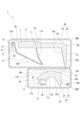
- FIG. 2 to 6 show an embodiment of the vehicle lamp of the present invention, and this figure is a schematic front view of the vehicle lamp.
- FIG. 2 is a cross-sectional view of a vehicle lamp.
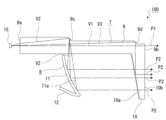
- FIG. 2 is a diagram showing a path of light in a first optical system.
- FIG. 4 is a diagram showing a path of light in a second optical system.
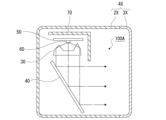
- FIG. 13 is a diagram showing a configuration of another first optical system.
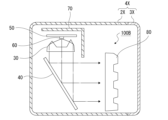
- FIG. 13 is a diagram showing a configuration of yet another first optical system.
- a vehicle marker lamp that is attached to the rear end of a vehicle.
- the direction of light emission from the vehicle lamp is considered to be rearward, and the directions of front, back, up, down, left and right are indicated. Note that the directions of front, back, up, down, left and right shown below are for the convenience of explanation, and the implementation of this invention is not limited to these directions.
- the vehicle lamp 1 has a first unit 90X and a second unit 90Y arranged, for example, one above the other (see Figures 1 and 2).
- the first unit 90X has a lamp housing 2X with an opening at its rear end and a cover 3X that closes the opening of the lamp housing 2X.
- the lamp housing 2X and the cover 3X form a lamp outer casing 4X, and the internal space of the lamp outer casing 4X is formed as a lamp chamber 5X.
- the second unit 90Y has a lamp housing 2Y with an opening at its rear end and a cover 3Y that closes the opening of the lamp housing 2Y.
- the lamp housing 2Y and the cover 3Y form a lamp outer casing 4Y, and the internal space of the lamp outer casing 4Y is formed as a lamp chamber 5Y.
- a first optical system 100 is disposed in the lamp chamber 5X, and a second optical system 200 is disposed in the lamp chamber 5Y (see FIG. 2).
- the first optical system 100 emits light rearward from a first region A
- the second optical system 200 emits light rearward from a second region B (see FIG. 1).
- the first area A is an area above the second area B, and is, for example, an area onto which light as a turn signal lamp is irradiated.
- the upper area A1 of the first area A (the area above the dotted line in FIG. 1) is an area onto which light with a higher brightness is irradiated than the lower area A2 (the area below the dotted line in FIG. 1), with the main light irradiated from area A1 and the secondary light irradiated from area A2.
- the main light irradiated from area A1 satisfies the necessary and sufficient light brightness required as a turn signal lamp, and the secondary light irradiated from area A2 improves the design as well as improves visibility by expanding the irradiation area as a turn signal lamp.
- the second region B is an area whose vertical width is narrower than that of the first region A, and is, for example, an area onto which light as a stop lamp is irradiated.
- the upper region B1 of the second region B (the region above the dotted line shown in FIG. 1) is an area onto which light with a higher brightness is irradiated than the lower region B2 (the region below the dotted line shown in FIG. 1), with the main light irradiated from region B1 and the secondary light irradiated from region B2.
- the main light irradiated from region B1 satisfies the necessary and sufficient light brightness required as a stop lamp, and the secondary light irradiated from region B2 improves the design as well as improves visibility by expanding the irradiated area as a stop lamp.
- other areas may be formed where other light such as a tail lamp is irradiated.
- an optical system other than the first optical system 100 and the second optical system 200 is disposed in at least one of the lamp chambers 5X and 5Y, and light is irradiated rearward from the other areas by the other optical system.
- the first optical system 100 has a first control lens 7 and a reflector 8 (see Figure 2).
- the first control lens 7 is made of a transparent material and has a base portion 9 whose thickness direction is in the up-down direction and a control protrusion 10 that protrudes downward from the rear end of the base portion 9.
- a part of the front surface of the base portion 9 is formed as an incident surface 9a, which functions as a light collecting surface that collects incident light.
- the rear surface of the base portion 9 is formed as a first exit surface 9b, and the first exit surface 9b has, for example, a diffusion step formed thereon.
- a first internal reflection surface 9c and a second internal reflection surface 9d are formed on the upper surface of the base portion 9, with the first internal reflection surface 9c being located approximately in the center in the front-to-rear direction and the second internal reflection surface 9d being located toward the rear end.
- the first control lens 7 has multiple entrance surfaces 9a, for example, three entrance surfaces 9a, spaced apart on the left and right.
- the control protrusion 10 protrudes downward from the rear end of the base portion 9, with the front surface formed as the light entrance surface 10a and the rear surface formed as the second exit surface 10b.
- a diffusion step is formed on the light entrance surface 10a.
- the vertical widths of the light entrance surface 10a and the second exit surface 10b are greater than the vertical width of the first exit surface 9b. Note that in the first control lens 7, the diffusion step may be formed on the second exit surface 10b instead of the light entrance surface 10a.
- the reflector 8 is formed in a dark color, for example black, and is positioned forward of the control protrusion 10.
- the reflector 8 has a reflective portion 11 positioned at the frontmost side, a connecting surface portion 12 connected to the lower end of the reflective portion 11, and a vertical wall surface portion 13 protruding upward from the front end of the connecting surface portion 12.
- the reflecting portion 11 is formed in a gently curved, forward-convex shape, with the rear surface formed as a light-reflecting surface 11a.
- the reflecting portion 11 is disposed in a position where the light-reflecting surface 11a faces the light-receiving surface 10a of the control protrusion 10. It is sufficient that at least the light-reflecting surface 11a of the reflector 8 is formed in a dark color.
- the connecting surface portion 12 is, for example, inclined downward toward the rear and positioned below the base portion 9.
- the vertical wall surface portion 13 faces approximately in the front-to-rear direction and has light transmission holes 13a.
- the light transmission holes 13a of the vertical wall surface portion 13 are positioned directly in front of the incident surface 9a.
- the light transmission holes 13a of the vertical wall surface portion 13 are formed spaced apart on the left and right sides, and the number of the light transmission holes 13a is the same as the number of the incident surfaces 9a.
- a first board 14 facing the front-rear direction is arranged in the lamp chamber 5X, and a first light source 15 is mounted on the rear surface of the first board 14.
- a first light source 15 is mounted on the rear surface of the first board 14.
- a light emitting diode (LED) is used as the first light source 15.
- the first light sources 15 are mounted on the first board 14 in a number equal to the number of incident surfaces 9a, spaced apart on the left and right, and positioned facing the incident surfaces 9a via the light transmission holes 13a.
- the emitted light When light is emitted from the first light source 15, the emitted light is transmitted through the light transmission hole 13a and is focused from the incident surface 9a and enters the first control lens 7 (see FIG. 3). At this time, the vertical wall surface portion 13 blocks unnecessary light from the light emitted from the first light source 15, preventing the occurrence of light leakage.
- a portion of the light emitted from the first light source 15 and incident on the first control lens 7 travels straight on the second path V2, is internally reflected (total reflection) by the first internal reflection surface 9c formed on the base portion 9, is emitted downward from the base portion 9, and travels along the second path V2 toward the light reflection surface 11a of the reflector 8 (see FIG. 3).
- the light that travels toward the light reflection surface 11a of the reflector 8 is internally reflected by the first internal reflection surface 9c, spreads in a certain state, reaches the light reflection surface 11a, and is reflected again by each part of the light reflection surface 11a.
- the light reflected by the light reflection surface 11a is incident on the control protrusion 10 from the light entrance surface 10a.
- the light that is incident on the control protrusion 10 travels straight, is emitted from the second exit surface 10b, is transmitted through the cover 3X, and is irradiated toward the outside. At this time, the light is diffused by the diffusion step formed on the light entrance surface 10a and is emitted as a secondary light ray P2 from the lower area A2 (see FIG. 1) of the first area A.
- a part of the light emitted from the first light source 15 and incident on the first control lens 7 may travel straight along the third path V3, be internally reflected (total reflected) by the second internal reflection surface 9d formed on the base portion 9, be internally reflected by the light entrance surface 10a, and be emitted from the second exit surface 10b.
- the first optical system 100 As described above, in the first optical system 100, light reflected by the light reflecting surface 11a formed on the dark reflector 8 is transmitted through the control protrusion 10 and the cover 3X and irradiated toward the outside, so that the dark reflector 8 is visible from the outside through the first control lens 7 when the light is off. Therefore, when the vehicle lamp 1 is viewed from the outside when the light is off, the first control lens 7 formed from a transparent material is difficult to see, and the lamp chamber 5X appears to be dark in color, resulting in a so-called blackout appearance, which improves visibility.
- the second optical system 200 has a second control lens 16 (see Figure 2).
- the second control lens 16 is made of a transparent material and has a light entrance portion 17 that is inclined downward toward the front, a base portion 18 whose thickness direction is in the up-down direction, and a control protrusion 19 that protrudes downward from the rear end portion of the base portion 18.
- a part of the lower surface of the light entrance portion 17 is formed as a first incident surface 17a, which functions as a light collecting surface that collects the incident light.
- a first internal reflection surface 17b is formed on the light entrance portion 17 directly above the first incident surface 17a.
- a second incident surface 17c is formed on the lower end of the light entrance portion 17, facing approximately forward and continuing from the first incident surface 17a.
- a second internal reflection surface 17d is formed on the lower end of the light entrance portion 17 behind the second incident surface 17c.
- the second control lens 16 has a plurality of first entrance surfaces 17a and a plurality of second entrance surfaces 17c formed on the left and right sides, spaced apart from each other.
- the rear surface of the base portion 18 is formed as a first exit surface 18a, and the first exit surface 18a has, for example, a diffusion step formed thereon.
- a third internal reflection surface 18b and a fourth internal reflection surface 18c are formed at the upper end of the base portion 18 and spaced apart from each other in the front and rear directions.
- the front surface of the control protrusion 19 is formed as a fifth internal reflection surface 19a, and the rear surface is formed as a second emission surface 19b.
- a diffusion step is formed on the second emission surface 19b.
- a second board 20 facing the vertical direction is arranged in the lamp chamber 5Y, and a second light source 21 is mounted on the upper surface of the second board 20.
- a light emitting diode LED
- the second light sources 21 are mounted on the second board 20 in a state spaced apart on the left and right sides, the same number as the number of first incident surfaces 17a, and are positioned opposite the first incident surfaces 17a.
- the emitted light is incident on the second control lens 16 from the first entrance surface 17a and the first exit surface 18a (see FIG. 4). At this time, the light incident on the first entrance surface 17a is focused by the first entrance surface 17a and then incident on the second control lens 16.
- the light incident on the second control lens 16 from the first entrance surface 17a is internally reflected by the first internal reflection surface 17b on the first path W1, is emitted from the first exit surface 18a, is transmitted through the cover 3Y, and is irradiated toward the outside. At this time, the light is diffused by the diffusion step formed on the first exit surface 18a, and is irradiated as the chief ray Q1 from the upper area B1 (see FIG. 1) in the second area B.
- the light emitted from the second light source 21 and incident on the second control lens 16 from the second entrance surface 17c is internally reflected by the second internal reflection surface 17d in the second path W2 and travels upward (see FIG. 4).
- the light that is internally reflected by the second internal reflection surface 17d and travels upward is internally reflected by the third internal reflection surface 18b and the fourth internal reflection surface 18c formed on the base portion 18 in order to spread out in a certain state toward the control protrusion 19, and is internally reflected by the fifth internal reflection surface 19a formed on the control protrusion 19.
- the light that is internally reflected by the fifth internal reflection surface 19a is emitted from the second exit surface 19b, passes through the cover 3Y, and is irradiated toward the outside. At this time, the light is diffused by the diffusion step formed on the second exit surface 19b, and is irradiated as a secondary ray Q2 from the lower area B2 (see FIG. 1) in the second area B.
- the light S emitted from the second light source 21 may enter the control protrusion 19 from the fifth internal reflection surface 19a as leakage light (light shown by dotted lines in FIG. 4).
- the light S is diffused by the diffusion steps formed on the second exit surface 19b and exits from the second exit surface 19b, so that so-called point light that appears bright locally is unlikely to occur, and the uniformity of the light exiting from the second exit surface 19b is ensured, and visibility can be improved.
- the light S incident from the fifth internal reflection surface 19a is exited from the second exit surface 19b, so that the brightness of the light exiting from the second exit surface 19b and irradiated to the outside from the region B2 can be improved.
- the first control lens 7 is provided with a control protrusion 10 having a diffusion step formed thereon, and at least a portion of the light incident on the first control lens 7 is reflected multiple times, and the light that has been reflected multiple times is emitted from the control protrusion 10.
- the control protrusion 10 suppresses uneven brightness, making it possible to increase the light-emitting area of the light irradiated to the outside and to achieve uniformity.
- a control protrusion 19 having a diffusion step formed thereon is provided on the second control lens 16, and at least a portion of the light incident on the second control lens 16 is reflected multiple times, and the light reflected multiple times is emitted from the control protrusion 19.
- the control protrusion 19 suppresses uneven brightness, making it possible to increase the light-emitting area of the light irradiated to the outside and to achieve uniformity.
- a reflector 8 is provided in which at least the light reflecting surface 11a is formed in a dark color, and light incident from the entrance surface 9a, which functions as a light collecting surface, is reflected by the first internal reflection surface 9c and the light reflecting surface 11a, and the light reflected by the light reflecting surface 11a is emitted in a state controlled by the control protrusion 10.
- the concentrated light is reflected by the reflector 8, which is formed in a dark color, and this not only increases the reflection efficiency at the reflector 8, but also increases the amount of light directed toward the reflector 8, ensuring proper light irradiation conditions and improving visibility when the lamp is not lit.
- the light emitted from the first light source 15 is emitted from the first exit surface 9b in the first path V1 and is emitted from the second exit surface 10b in the second path V2, and the number of times the light is reflected in the second path V2 is greater than the number of times the light is reflected in the first path V1.
- the optical path length of the first path V1 and the optical path length of the second path V2 different, and it is also possible to emit light from the same first light source 15 from different positions, so that light with different luminances can be irradiated from different areas, increasing the freedom of light distribution and improving the design.
- the second optical system 200 all reflections of the light emitted from the second light source 21 are performed as internal reflections in the second control lens 16.
- the light emitted from the second light source 21 is emitted from the first exit surface 18a in the first path W1 and is emitted from the second exit surface 19b in the second path W2, and the number of times the light is reflected in the second path W2 is greater than the number of times the light is reflected in the first path W1.
- the optical path length of the first path W1 and the optical path length of the second path W2 different, and it is also possible to emit light from the same second light source 21 from different positions, so that light with different luminances can be irradiated from different areas, increasing the freedom of light distribution and improving the design.
- the vehicle lamp 1 it is also possible to use the first optical system 100A and the first optical system 100B as described below (see Figures 5 and 6).
- the first optical system 100A is disposed in the lamp chamber 5X, which is the internal space of the lamp outer casing 4X formed by the lamp housing 2X and the cover 3X, and has a control lens 30 and a reflector 40. Light emitted from a light source 60 mounted on a substrate 50 is incident on the control lens 30 (see FIG. 5).
- the control lens 30 is disposed in a position other than in front of or behind the reflector 40, for example, above the reflector 40.
- the reflector 40 is formed in a dark color.
- a light shielding plate 70 is disposed in the lamp chamber 5X, extending from the top of the substrate 50 to the rear of the control lens 30. The light shielding plate 70 can block leaking light emitted from the light source 60 and leaking light that may be emitted from the control lens 30.
- the light emitted from the light source 60 and incident on the control lens 30 is reflected internally by the control lens 30 and focused toward the reflector 40, where it is reflected, for example, in a perpendicular direction and transmitted through the cover 3X before being irradiated toward the outside.
- the light is reflected multiple times, allowing it to be emitted from a large light-emitting area, and the concentrated light is reflected by the reflector 40, increasing the reflection efficiency at the reflector 40.
- the reflector 40 is dark in color, when the vehicle lamp 1 is viewed from the outside when it is not lit, the lamp chamber 5X appears to be dark in color, improving visibility.
- the control lens 30 is not located behind the reflector 40 but is located above the reflector 40, it is possible to easily shield the control lens 30 and the substrate 50 with an extension or the like, further improving visibility.
- the first optical system 100B has the same configuration as the first optical system 100A, but with a design lens 80 disposed between the reflector 40 and the cover 3X.
- the design lens 80 is formed with, for example, a predetermined lens step or uneven shape. When the design lens 80 is viewed from the outside while not lit, the lens step and uneven shape cause the design lens 80 to appear three-dimensional or have an uneven shape.
- the design lens 80 can improve visibility when the light is not turned on.
- first optical system 100 and the second optical system 200 are provided in one vehicle lamp 1, but the first optical system 100 and the second optical system 200 may be provided independently in each vehicle lamp.
Landscapes
- Engineering & Computer Science (AREA)
- General Engineering & Computer Science (AREA)
- Non-Portable Lighting Devices Or Systems Thereof (AREA)
Priority Applications (1)
| Application Number | Priority Date | Filing Date | Title |
|---|---|---|---|
| JP2025508357A JPWO2024195655A1 (https=) | 2023-03-17 | 2024-03-13 |
Applications Claiming Priority (2)
| Application Number | Priority Date | Filing Date | Title |
|---|---|---|---|
| JP2023-042763 | 2023-03-17 | ||
| JP2023042763 | 2023-03-17 |
Publications (1)
| Publication Number | Publication Date |
|---|---|
| WO2024195655A1 true WO2024195655A1 (ja) | 2024-09-26 |
Family
ID=92841547
Family Applications (1)
| Application Number | Title | Priority Date | Filing Date |
|---|---|---|---|
| PCT/JP2024/009813 Ceased WO2024195655A1 (ja) | 2023-03-17 | 2024-03-13 | 車輌用灯具 |
Country Status (2)
| Country | Link |
|---|---|
| JP (1) | JPWO2024195655A1 (https=) |
| WO (1) | WO2024195655A1 (https=) |
Citations (6)
| Publication number | Priority date | Publication date | Assignee | Title |
|---|---|---|---|---|
| JP2005327649A (ja) * | 2004-05-17 | 2005-11-24 | Koito Mfg Co Ltd | 車両用灯具ユニットおよび車両用灯具 |
| EP2354637A2 (de) * | 2010-01-30 | 2011-08-10 | Hella KGaA Hueck & Co. | Beleuchtungsvorrichtung für Fahrzeuge |
| JP2011175817A (ja) * | 2010-02-24 | 2011-09-08 | Stanley Electric Co Ltd | 車両用灯具 |
| JP2017062914A (ja) * | 2015-09-24 | 2017-03-30 | スタンレー電気株式会社 | 車両用灯具 |
| JP2018032487A (ja) * | 2016-08-23 | 2018-03-01 | 株式会社小糸製作所 | 車輌用灯具 |
| JP2018195467A (ja) * | 2017-05-18 | 2018-12-06 | スタンレー電気株式会社 | 車両用灯具 |
-
2024
- 2024-03-13 JP JP2025508357A patent/JPWO2024195655A1/ja active Pending
- 2024-03-13 WO PCT/JP2024/009813 patent/WO2024195655A1/ja not_active Ceased
Patent Citations (6)
| Publication number | Priority date | Publication date | Assignee | Title |
|---|---|---|---|---|
| JP2005327649A (ja) * | 2004-05-17 | 2005-11-24 | Koito Mfg Co Ltd | 車両用灯具ユニットおよび車両用灯具 |
| EP2354637A2 (de) * | 2010-01-30 | 2011-08-10 | Hella KGaA Hueck & Co. | Beleuchtungsvorrichtung für Fahrzeuge |
| JP2011175817A (ja) * | 2010-02-24 | 2011-09-08 | Stanley Electric Co Ltd | 車両用灯具 |
| JP2017062914A (ja) * | 2015-09-24 | 2017-03-30 | スタンレー電気株式会社 | 車両用灯具 |
| JP2018032487A (ja) * | 2016-08-23 | 2018-03-01 | 株式会社小糸製作所 | 車輌用灯具 |
| JP2018195467A (ja) * | 2017-05-18 | 2018-12-06 | スタンレー電気株式会社 | 車両用灯具 |
Also Published As
| Publication number | Publication date |
|---|---|
| JPWO2024195655A1 (https=) | 2024-09-26 |
Similar Documents
| Publication | Publication Date | Title |
|---|---|---|
| JP2022509576A (ja) | 発光機構及びバックライトモジュール | |
| JPWO2020240664A5 (https=) | ||
| JP6264789B2 (ja) | 車両用灯具 | |
| JP2008171719A (ja) | 面状照明装置 | |
| WO2014156668A1 (ja) | 車輌用灯具 | |
| KR20060046432A (ko) | 직하식 백라이트 모듈 | |
| WO2022110570A1 (zh) | 远光光学元件、远光照明单元和车辆 | |
| WO2023210678A1 (ja) | 車両用灯具 | |
| JP2003203508A (ja) | 車両用前照灯 | |
| JP2018026192A (ja) | 車両用灯具 | |
| JP2023148497A (ja) | 灯火器 | |
| WO2024195655A1 (ja) | 車輌用灯具 | |
| JP6648428B2 (ja) | 車両用灯具 | |
| CN105650561B (zh) | 用于前照灯的激光光学系统 | |
| JP2018113133A (ja) | ライトガイド、及び、灯具 | |
| JP7633136B2 (ja) | 車両用灯具 | |
| JP2019212429A (ja) | 車両用灯具 | |
| JP2025073700A (ja) | 車輌用灯具 | |
| JP7523011B2 (ja) | 車両用灯具 | |
| JP2024127412A (ja) | 車輌用灯具 | |
| CN223294663U (zh) | 一种光型调节部件及光学模组 | |
| JP7818470B2 (ja) | 車両用灯具 | |
| JP7702370B2 (ja) | 車両用灯具 | |
| JP7753957B2 (ja) | 車両用前照灯 | |
| JP7756044B2 (ja) | 車両用灯具 |
Legal Events
| Date | Code | Title | Description |
|---|---|---|---|
| 121 | Ep: the epo has been informed by wipo that ep was designated in this application |
Ref document number: 24774793 Country of ref document: EP Kind code of ref document: A1 |
|
| WWE | Wipo information: entry into national phase |
Ref document number: 2025508357 Country of ref document: JP |
|
| NENP | Non-entry into the national phase |
Ref country code: DE |
|
| 122 | Ep: pct application non-entry in european phase |
Ref document number: 24774793 Country of ref document: EP Kind code of ref document: A1 |