WO2024195605A1 - 窒化ケイ素仮焼体及びその製造方法、並びに、窒化ケイ素粉末の製造方法 - Google Patents
窒化ケイ素仮焼体及びその製造方法、並びに、窒化ケイ素粉末の製造方法 Download PDFInfo
- Publication number
- WO2024195605A1 WO2024195605A1 PCT/JP2024/009323 JP2024009323W WO2024195605A1 WO 2024195605 A1 WO2024195605 A1 WO 2024195605A1 JP 2024009323 W JP2024009323 W JP 2024009323W WO 2024195605 A1 WO2024195605 A1 WO 2024195605A1
- Authority
- WO
- WIPO (PCT)
- Prior art keywords
- silicon nitride
- powder
- raw material
- material powder
- calcined
- Prior art date
- Legal status (The legal status is an assumption and is not a legal conclusion. Google has not performed a legal analysis and makes no representation as to the accuracy of the status listed.)
- Ceased
Links
Images



Classifications
-
- C—CHEMISTRY; METALLURGY
- C01—INORGANIC CHEMISTRY
- C01B—NON-METALLIC ELEMENTS; COMPOUNDS THEREOF; METALLOIDS OR COMPOUNDS THEREOF NOT COVERED BY SUBCLASS C01C
- C01B21/00—Nitrogen; Compounds thereof
- C01B21/06—Binary compounds of nitrogen with metals, with silicon, or with boron, or with carbon, i.e. nitrides; Compounds of nitrogen with more than one metal, silicon or boron
- C01B21/068—Binary compounds of nitrogen with metals, with silicon, or with boron, or with carbon, i.e. nitrides; Compounds of nitrogen with more than one metal, silicon or boron with silicon
-
- C—CHEMISTRY; METALLURGY
- C04—CEMENTS; CONCRETE; ARTIFICIAL STONE; CERAMICS; REFRACTORIES
- C04B—LIME, MAGNESIA; SLAG; CEMENTS; COMPOSITIONS THEREOF, e.g. MORTARS, CONCRETE OR LIKE BUILDING MATERIALS; ARTIFICIAL STONE; CERAMICS; REFRACTORIES; TREATMENT OF NATURAL STONE
- C04B35/00—Shaped ceramic products characterised by their composition; Ceramics compositions; Processing powders of inorganic compounds preparatory to the manufacturing of ceramic products
- C04B35/515—Shaped ceramic products characterised by their composition; Ceramics compositions; Processing powders of inorganic compounds preparatory to the manufacturing of ceramic products based on non-oxide ceramics
- C04B35/58—Shaped ceramic products characterised by their composition; Ceramics compositions; Processing powders of inorganic compounds preparatory to the manufacturing of ceramic products based on non-oxide ceramics based on borides, nitrides, i.e. nitrides, oxynitrides, carbonitrides or oxycarbonitrides or silicides
- C04B35/584—Shaped ceramic products characterised by their composition; Ceramics compositions; Processing powders of inorganic compounds preparatory to the manufacturing of ceramic products based on non-oxide ceramics based on borides, nitrides, i.e. nitrides, oxynitrides, carbonitrides or oxycarbonitrides or silicides based on silicon nitride
- C04B35/591—Shaped ceramic products characterised by their composition; Ceramics compositions; Processing powders of inorganic compounds preparatory to the manufacturing of ceramic products based on non-oxide ceramics based on borides, nitrides, i.e. nitrides, oxynitrides, carbonitrides or oxycarbonitrides or silicides based on silicon nitride obtained by reaction sintering
-
- C—CHEMISTRY; METALLURGY
- C04—CEMENTS; CONCRETE; ARTIFICIAL STONE; CERAMICS; REFRACTORIES
- C04B—LIME, MAGNESIA; SLAG; CEMENTS; COMPOSITIONS THEREOF, e.g. MORTARS, CONCRETE OR LIKE BUILDING MATERIALS; ARTIFICIAL STONE; CERAMICS; REFRACTORIES; TREATMENT OF NATURAL STONE
- C04B35/00—Shaped ceramic products characterised by their composition; Ceramics compositions; Processing powders of inorganic compounds preparatory to the manufacturing of ceramic products
- C04B35/622—Forming processes; Processing powders of inorganic compounds preparatory to the manufacturing of ceramic products
- C04B35/626—Preparing or treating the powders individually or as batches ; preparing or treating macroscopic reinforcing agents for ceramic products, e.g. fibres; mechanical aspects section B
Definitions
- Sintered bodies containing silicon nitride are materials with excellent strength, hardness, toughness, heat resistance, corrosion resistance, and thermal shock resistance, and are therefore used in various industrial parts such as die-casting machines and melting furnaces, as well as insulating substrates for automobile parts.
- silicon nitride powder with a high alpha conversion rate is used as the raw material for the sintered bodies.
- a known method for producing such silicon nitride powder is the direct nitridation method of metallic silicon.
- Patent Document 1 attempts to produce silicon nitride powder with a high alpha conversion rate by direct nitriding using a tunnel pusher furnace. This patent document suggests that in a tunnel pusher furnace, the temperature inside the furnace differs considerably from the actual temperature of the metallic silicon powder inside the furnace, and therefore suggests selecting operating conditions so that the temperature of the nitriding reaction is 1410°C or lower.
- the present disclosure therefore provides a method for producing a silicon nitride calcined body that reduces variation in the alpha conversion rate and has excellent crushability while using a continuous furnace to improve production efficiency. It also provides a silicon nitride calcined body that sufficiently reduces variation in the alpha conversion rate and has excellent crushability. It also provides a method for producing silicon nitride powder in which variation in the alpha conversion rate is sufficiently reduced by using such a silicon nitride calcined body.
- One aspect of the present disclosure provides the following methods for producing silicon nitride powder: [1] and [2].
- a process for producing a silicon nitride calcined body by heating a raw material powder containing a metal silicon powder in an atmosphere containing nitrogen gas using a continuous furnace A method for producing a silicon nitride calcined body, wherein RT m is an average rate of temperature rise of the raw material powder in the range from when the furnace temperature exceeds 1100°C to when it reaches 1200°C, and RT h is an average rate of temperature rise of the raw material powder in the range from when the furnace temperature exceeds 1200°C to when it reaches a position where the furnace temperature is maximum, and RT m ⁇ RT h is satisfied.
- the exothermic reaction is most active in the range from when the furnace temperature exceeds 1100° C. to when it reaches 1200° C. For this reason, if the heating rate in this temperature range is increased, ⁇ -type silicon nitride is generated locally, and the ⁇ -conversion rate varies widely. Therefore, if the average heating rate RT m of the raw material powder in the range from when the furnace temperature exceeds 1100° C. to when it reaches 1200° C. is reduced, the local temperature increase due to the exothermic reaction can be suppressed, and the generation of ⁇ -type silicon nitride and excessive grain growth can be suppressed.
- the manufacturing method [1] above makes it possible to sufficiently reduce the variation in the alpha conversion rate of the silicon nitride calcined body while improving production efficiency using a continuous furnace.
- the generation of ⁇ -type silicon nitride and excessive grain growth can be suppressed, a silicon nitride calcined body with excellent pulverizability can be obtained.
- the advantage of using a continuous furnace can be utilized to improve production efficiency. That is, the manufacturing method [2] above can sufficiently reduce the variation in the alpha conversion rate of the calcined silicon nitride body while improving production efficiency using a continuous furnace. In addition, since the generation of ⁇ -type silicon nitride and excessive grain growth can be suppressed, a calcined silicon nitride body with excellent pulverizability can be obtained.
- the manufacturing methods of the above [1] and [2] may be any of the following [3] to [6].
- the manufacturing method described above in [4] can sufficiently shorten the time required to manufacture the silicon nitride calcined body. Therefore, the production efficiency of the silicon nitride calcined body can be further improved.
- Direct nitridation proceeds through a reaction between the metal silicon component and the nitrogen contained in the firing atmosphere.
- the raw material is in powder form and the filling height of the raw material powder in the container is 40 mm or less, so the nitridation reaction proceeds smoothly. This makes it possible to obtain a calcined silicon nitride body that has a high alpha conversion rate and sufficiently reduced variation in the alpha conversion rate.
- the use of multiple containers can further improve the production efficiency of the calcined silicon nitride body.
- the multiple containers are stacked in two or more tiers and introduced into the continuous furnace. This makes it possible to further improve production efficiency while maintaining the quality of the silicon nitride calcined body, compared to when the containers are not stacked.
- One aspect of the present disclosure provides a method for producing a silicon nitride powder as described below in [7].
- a method for producing silicon nitride powder comprising a step of pulverizing a calcined silicon nitride body obtained by any one of the production methods described above in [1] to [6].
- the method for producing silicon nitride powder described above in [7] includes a step of pulverizing the calcined silicon nitride body in which the variation in the alpha conversion rate has been sufficiently reduced. This makes it possible to obtain silicon nitride powder in which the variation in the alpha conversion rate has been sufficiently reduced. If such silicon nitride powder is used to produce a sintered body, it is possible to obtain a silicon nitride sintered body with sufficiently excellent compositional uniformity.
- One aspect of the present disclosure provides a silicon nitride calcined body as described below in [8].
- the silicon nitride calcined body of [8] above has a high average alpha silicon nitride rate and a small maximum thickness.
- the nitriding reaction proceeds with sufficiently high uniformity, so there is little variation in the alpha silicon nitride rate.
- the small amount of beta silicon nitride makes it easy to crush. Therefore, the above calcined silicon nitride body is suitable for producing silicon nitride powder.
- calcined silicon nitride body may be the following [9].
- the silicon nitride calcined body of [9] above has even less variation in the alpha conversion rate.
- silicon nitride calcined body By using such a silicon nitride calcined body, it is possible to obtain silicon nitride powder with even less variation in the alpha conversion rate.
- One aspect of the present disclosure provides a method for producing a silicon nitride powder as set forth in [10] below.
- a method for producing silicon nitride powder comprising a step of pulverizing the silicon nitride calcined body according to [8] or [9] above.
- the manufacturing method [10] uses the above-mentioned silicon nitride calcined body, making it possible to smoothly obtain silicon nitride powder with sufficiently reduced variation in the alpha conversion rate.
- FIG. 2 is a perspective view of a calcined silicon nitride body.
- FIG. 2 is a diagram showing an example of the temperature of a continuous furnace (temperature inside the furnace) and the temperature of the raw material powder over time when the raw material powder is heated in the continuous furnace.
- FIG. 2 is a diagram showing an example of a temperature profile of raw material powder (container) in a continuous furnace.
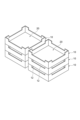
- FIG. 2 is a perspective view showing a state in which containers having container portions for accommodating raw material powder are stacked in three tiers. 1 is a cross-sectional view of three stacked containers containing raw powder cut along the height direction.
- FIG. 1 is a cross-sectional view of three stacked containers containing raw powder cut along the height direction.
- the numerical ranges exemplified in the format of "a-b" are numerical ranges inclusive of a and b, with a lower limit being a and an upper limit being b.
- the present disclosure also includes numerical ranges in which the upper or lower limit of each numerical range is replaced with the numerical value of any of the examples, and numerical ranges in which the upper or lower limit is replaced with the upper or lower limit of another numerical range.
- the silicon nitride calcined body contains silicon nitride (silicon nitride component) as a main component.
- the silicon nitride content in the silicon nitride calcined body may be 90% by mass or more, 95% by mass or more, 98% by mass or more, or 99% by mass or more.
- the silicon nitride content in the silicon nitride calcined body can be measured using a commercially available X-ray diffraction device.
- the silicon nitride calcined body may contain metal components such as Fe, Cr, Ni, or metal compounds containing these as constituent elements as auxiliary components.
- metal components such as Fe, Cr, Ni, or metal compounds containing these as constituent elements as auxiliary components.
- a sintering aid component oxide-based sintering aid. This can further improve the crushability.
- the total content of Y 2 O 3 , MgO, and Al 2 O 3, which are known as oxide-based sintering aids may be 0.1 mass% or less.
- the average alpha-conversion rate of silicon nitride contained in the silicon nitride calcined body is 90% or more.
- Such silicon nitride calcined bodies have a sufficiently high alpha-conversion rate compared to ordinary silicon nitride calcined bodies, and therefore have excellent crushability.
- the average alpha-conversion rate of silicon nitride may be 91% or more, 92% or more, or 93% or more.
- the average alpha-conversion rate is determined as follows. The alpha-conversion rate is measured at five or more arbitrarily selected positions in the silicon nitride calcined body. The average alpha-conversion rate can be determined by taking the arithmetic average of the five or more measured values measured in this way.
- the standard deviation of the alpha-phase rate of silicon nitride contained in the silicon nitride calcined body may be 1.0% or less, 0.9% or less, 0.8% or less, or 0.7% or less. Such a silicon nitride calcined body has an even smaller variation in the alpha-phase rate of silicon nitride.
- the standard deviation of the alpha-phase rate can be determined using five or more measured values used in determining the average value of the alpha-phase rate described above. From the viewpoint of ease of manufacturing the silicon nitride calcined body, the standard deviation of the alpha-phase rate may be 0.2% or more, or 0.3% or more. An example of the range of the standard deviation of the alpha-phase rate is 0.1 to 1.0%.
- the alpha-phase conversion rate is measured at five points including the four corners E on one side and the center C. In this way, the reproducibility of the average value and standard deviation of the alpha-phase conversion rate can be sufficiently high.
- the silicon nitride calcined body is disk-shaped, the alpha-phase conversion rate may be measured at four or more points on the periphery that are equally spaced apart from the center. In this way, the measurement points for the alpha-phase conversion rate can be arbitrarily selected depending on the shape of the silicon nitride calcined body.
- the alpha-phase conversion rate can be measured by the method described in the Examples.
- the bulk density of the silicon nitride calcined body may be 1.4 to 2.0 g/cm 3. Such a silicon nitride calcined body can achieve both sufficiently high purity and sufficiently excellent crushability. From the viewpoint of further increasing the purity of silicon nitride, the lower limit of the bulk density may be 1.5 g/cm 3 or 1.6 g/cm 3. From the viewpoint of further improving the crushability of the silicon nitride calcined body, the upper limit of the bulk density may be 1.9 g/cm 3 or 1.8 g/cm 3 .
- the thickness of the silicon nitride calcined body may be less than 45 mm, less than 40 mm, less than 35 mm, or less than 30 mm.
- the crushability is improved.
- the thinner the silicon nitride calcined body the more likely it is that the nitriding reaction will proceed with sufficiently high uniformity. For this reason, the smaller the thickness, the less variation there is in the alpha conversion rate.
- the thickness of the silicon nitride calcined body may be 5 mm or more, 10 mm or more, or 15 mm or more.
- the silicon nitride powder may be obtained by carrying out a step of pulverizing the above-mentioned silicon nitride calcined body.
- the pulverization may be carried out using a coarse pulverizer, a wet attritor, a ball mill, a vibrating mill, or the like.
- the silicon nitride contained as the main component of the silicon nitride calcined body has a high alpha phase ratio and a reduced beta phase, so that the silicon nitride can be pulverized smoothly. This makes it possible to smoothly obtain silicon nitride powder with a further reduced variation in the alpha phase ratio.
- silicon nitride powder with a reduced variation in the alpha phase ratio in this way, a silicon nitride sintered body with a highly uniform composition and excellent reliability can be obtained.
- the use of silicon nitride powder is not limited to the production of silicon nitride sintered bodies, and it may be mixed with other types of powders (for example, ceramic powders such as boron nitride) to produce a composite.
- the silicon nitride powder (Si 3 N 4 powder) thus obtained contains, for example, silicon nitride having an alpha conversion rate of 90.0% or more.
- the silicon nitride (purity) content in the silicon nitride powder may be 90% by mass or more, 95% by mass or more, 98% by mass or more, or 99% by mass or more.
- the silicon nitride content in the silicon nitride powder can be measured using a commercially available X-ray diffraction device.
- the D50 of the silicon nitride powder may be 0.5 to 2.0 ⁇ m.
- Such silicon nitride powder has sufficiently excellent sinterability and can sufficiently suppress abnormal grain growth during sintering.
- the upper limit of D50 of the silicon nitride powder may be 1.6 ⁇ m, 1.4 ⁇ m, 1.2 ⁇ m, or 1.0 ⁇ m. This can further suppress abnormal grain growth during sintering.
- the lower limit of D50 of the silicon nitride powder may be 0.6 ⁇ m or 0.7 ⁇ m. This can further increase the sinterability.
- the silicon nitride powder may have a D90 of 1.0 to 3.0 ⁇ m. Such silicon nitride powder has sufficiently excellent sinterability and can sufficiently suppress abnormal grain growth during sintering.
- the upper limit of the D90 of the silicon nitride powder may be 2.8 ⁇ m, 2.6 ⁇ m, or 2.4 ⁇ m. This can further suppress abnormal grain growth during sintering.
- the lower limit of the D90 of the silicon nitride powder may be 1.2 ⁇ m, 1.4 ⁇ m, or 1.6 ⁇ m.
- the D50 and D90 of each powder in this specification are determined based on the method described in JIS Z 8825:2013 "Particle size analysis - laser diffraction and scattering method".
- the particle size distribution (cumulative distribution) measured based on the above method, with the horizontal axis being the particle size [ ⁇ m] on a logarithmic scale and the vertical axis being the frequency [volume %]
- the particle size when the cumulative value from the small particle size reaches 50% of the total is D50 (average particle size, median diameter), and the particle size when it reaches 90% of the total is D90.
- the measuring device described in the examples can be used.
- the D50 and D90 of silicon nitride powder can be adjusted by changing the particle size of the raw material powder, the heating rate, firing temperature and firing time when producing silicon nitride powder, and the conditions when crushing the silicon nitride calcined body.
- the BET specific surface area of the silicon nitride powder may be 5 to 15 m 2 /g. Such silicon nitride powder has sufficiently excellent sinterability and can sufficiently suppress abnormal grain growth.
- the upper limit of the BET specific surface area of the silicon nitride powder may be 14 m 2 /g or 13 m 2 /g. This can further suppress abnormal grain growth during sintering.
- the lower limit of the BET specific surface area of the silicon nitride powder may be 6 m 2 /g or 7 m 2 /g. This can further increase the sinterability.
- the BET specific surface area of each powder in this specification is a value measured by the BET single-point method using nitrogen gas in accordance with the method described in JIS Z 8830:2013 "Method for measuring specific surface area of powder (solid) by gas adsorption.”
- the BET specific surface area of silicon nitride powder can be adjusted by changing the particle size of the raw material powder, the heating rate, firing temperature and firing time when producing silicon nitride powder, and the conditions when crushing the silicon nitride calcined body.
- the method for producing a silicon nitride calcined body includes a step of heating a raw material powder containing metal silicon powder using a continuous furnace having a temperature gradient in an atmosphere containing nitrogen gas to obtain a silicon nitride calcined body.
- the silicon nitride calcined body described above may be produced by this production method. Therefore, the description of the silicon nitride calcined body also applies to this production method.
- the metal silicon powder may be made by crushing metal silicon particles (or lumps).
- a crushing device a hammer mill, a pin mill, a ball mill, a vibration mill, a bead mill, a jet mill, or the like may be used.
- the average particle diameter (median diameter, D50) of the metal silicon powder may be 15 to 30 ⁇ m. From the viewpoint of smoothly progressing the nitriding, the average particle diameter of the metal silicon powder may be 28 ⁇ m or less, 26 ⁇ m or less, or 24 ⁇ m or less. If the raw material is nitrided in a powder state, excessive heat may be generated.
- the average particle diameter of the metal silicon powder may be 16 ⁇ m or more, or 18 ⁇ m or more.
- the average particle diameter of the metal silicon powder may be measured by the same method as that of the silicon nitride powder.
- the purity of the metal silicon powder may be 98% by mass or more, or 99% by mass or more.
- the metal silicon powder may also contain impurities that are mixed in during pulverization using a pulverizer.
- the metal silicon powder may be used as it is as the raw material powder, or the raw material powder may be prepared by blending the metal silicon powder with other components.
- the content of the metal silicon component in the raw material powder may be 95% by mass or more, 97% by mass or more, or 98% by mass or more.
- the content of the metal silicon component in the raw material powder can be measured using a commercially available X-ray fluorescence analyzer.
- the raw material powder may contain fluorite to promote nitridation of the metal silicon.
- the content of fluorite per 100 parts by mass of the metal silicon powder may be 0.2 to 3 parts by mass. From the viewpoint of sufficiently promoting the nitridation of the metal silicon, the content of fluorite per 100 parts by mass of the metal silicon powder may be 0.5 parts by mass or more, or 0.8 parts by mass or more. From the viewpoint of reducing the Ca and F contents in the obtained silicon nitride powder, the content of fluorite per 100 parts by mass of the metal silicon powder may be 2 parts by mass or less, or 1.5 parts by mass or more.
- the raw material powder may contain components other than the metallic silicon component and fluorite. Such raw material powder can be prepared at low cost, which can reduce the manufacturing costs of silicon nitride and silicon nitride powder.
- the raw material powder is heated using a continuous furnace to obtain a silicon nitride calcined body.
- continuous furnaces include those that use a transported container, such as a tunnel-type pusher furnace or a roller hearth kiln.
- Such continuous furnaces may have a temperature gradient within the furnace. In other words, they may have a heating zone in which the temperature gradually increases from the furnace entrance to the furnace exit.
- the raw material powder (container) introduced into the heating zone of such a continuous furnace is gradually heated as it moves through the continuous furnace.
- Figure 2 shows an example of the change over time in the internal temperature (furnace temperature) of a continuous furnace when the raw material powder (container) is heated in the furnace, and in the temperature of the raw material powder in the container.
- the solid line 1 in Figure 2 is the temperature of the raw material powder
- the dotted line 2 is the internal temperature (furnace temperature).
- the furnace temperature is in the range of 1100°C to 1200°C, the nitriding reaction becomes active and the raw material powder generates significant heat.
- RT m is the average value of the heating rate in the range from the position where the raw material powder (container) exceeds 1100° C. (furnace temperature) to the position where it reaches 1200° C. (furnace temperature).
- RT h is the average value of the heating rate from the position where the raw material powder (container) exceeds 1200° C. (furnace temperature) to the position where it reaches the maximum temperature (furnace temperature).
- RT m may be, for example, 5 to 20° C./hour.
- RT m may be 7° C./hour or more, or 9° C./hour or more. This shortens the time required to heat the raw material powder, thereby further improving production efficiency. From the same viewpoint, RT h may be 10° C./hour or more, 13° C./hour or more, 14° C./hour or more, or 18° C./hour or more.
- RT m may be 19°C/hour or less, 17°C/hour or less, 12°C/hour or less, or 10°C/hour or less. This can further reduce the variation in the alpha conversion rate and further improve the crushability of the silicon nitride calcined body.
- a temperature range exceeding 1200°C the exothermic reaction due to the nitriding reaction is not as active as in the temperature range of 1100 to 1200°C, but if RT h becomes too large, there is a concern that the amount of ⁇ -type silicon nitride ( ⁇ phase) produced will increase and excessive grain growth of silicon nitride particles will occur due to the exothermic reaction. Therefore, RT h may be 50°C/hour or less, 45°C/hour or less, 40°C/hour or less, or 35°C/hour or less. An example of the range of RT h is 10 to 50°C/hour.
- the maximum temperature in the furnace is, for example, 1300 to 1500°C. This allows the metallic silicon contained in the raw material powder to be sufficiently nitrided.
- the holding time at the maximum furnace temperature may be 0.1 hours or more, 0.5 hours or more, or 1 hour or more, from the viewpoint of sufficiently progressing the nitriding reaction.
- the holding time at the maximum furnace temperature may be 5 hours or less, 4 hours or less, 3 hours or less, or 2 hours or less, from the viewpoint of improving the productivity of the silicon nitride calcined body.
- An example of the holding time at the maximum furnace temperature is 0.1 to 5 hours.
- RT 1 In the continuous furnace, when the average value of the heating rate in the range from the start of heating the raw material powder to the furnace temperature reaching the position of 1100 ° C. is RT 1 , RT 1 > RT m may be satisfied.
- RT 1 may be, for example, 40 ° C. / hour or more, 60 ° C. / hour or more, or 80 ° C. / hour or more. This can shorten the time required for manufacturing the silicon nitride calcined body and further improve the production efficiency.
- RT 1 may be 300 ° C. / hour or less, or 250 ° C. / hour or less from the viewpoint of the equipment constraints of the continuous furnace.
- An example of the temperature range of RT 1 is 40 to 300 ° C. / hour.
- RT 1 > RT h may be satisfied. This can further reduce the variation in the alpha conversion rate of the silicon nitride calcined body while sufficiently increasing the production efficiency and the crushability of the silicon nitride calcined body.
- FIG. 3 shows an example of the relationship between the heating time of the raw material powder (container) and the temperature inside the furnace.
- the horizontal axis shows the time (heating time) from the start of heating the raw material powder (container), and the vertical axis shows the temperature inside the furnace at the position where the raw material powder (container) passes during the heating time.
- RT 1 , RT m , and RT h are about 98° C./hour, 10° C./hour, and about 29° C./hour, respectively.
- the heating rate does not have to be linear as shown in FIG. 3, and may be, for example, raised in a stepwise or curved manner. There may be a time period during which the temperature is maintained at a constant temperature.
- RT h /RT m may be 1.1 to 4.0.
- the lower limit of RT h /RT m may be 1.2, 1.5, 1.8, or 2.0.
- the upper limit of RT h /RT m may be 3.5 or 3.0.
- RT l /RT h may be 2.0 to 10.0.
- the lower limit of RT l /RT h may be 2.5, 3.0, 3.5, or 4.0.
- the upper limit of RT 1 /RT h may be 8.0, 7.0, or 5.5.
- the heating rate in the present disclosure is determined based on the internal temperature (furnace temperature) of the continuous furnace in which the raw material powder (container) is located.
- the heating rate (and RTl , RTm , and RTh ) can be adjusted by changing the temperature gradient in the continuous furnace.
- the heating rate can also be adjusted by changing the moving speed of the container containing the raw material powder in the continuous furnace.
- the furnace temperature can be measured using a thermocouple installed in the furnace.
- the time required from the start of heating the raw powder (container) in a continuous furnace until the temperature inside the furnace reaches its maximum temperature may be less than 40 hours, or less than 35 hours, or less than 32 hours. This makes it possible to fully utilize the advantages of the continuous furnace and further improve the production efficiency of the silicon nitride calcined body. From the viewpoint of sufficiently progressing the nitriding reaction, the above-mentioned required time may be 21 hours or more, or 25 hours or more.
- the container to be filled with the raw material powder can be made of a material that does not change in quality even at temperatures of about 1500°C in an inert atmosphere.
- the container can be made of, for example, carbon, alumina, or boron nitride.
- There are no particular restrictions on the structure of the container and it can be one that has a storage section for storing the raw material powder.
- the container can be one that has a container body with a recess and a lid that covers the recess in the main body. Also, multiple containers can be stacked, with the upper container used as the lid for the lower container.
- Figure 4 shows three containers 10, each having a storage section 20 for storing raw material powder, stacked in layers.
- Raw material powder is not shown in the storage section 20 in Figure 4.
- the storage section 20 of each container 10 is filled with raw material powder 22 as shown in Figure 5.
- the containers 10 are then stacked as shown in Figures 4 and 5 and introduced into the continuous furnace.
- silicon nitride calcined bodies can be produced with high production efficiency.
- the lower and middle containers 10 are provided with vents 12. This allows sufficient contact between the metallic silicon contained in the raw material powder 22 and the nitrogen gas contained in the atmosphere.
- the filling height H of the raw material powder 22 in each of the containers 10 may be 40 mm or less, 35 mm or less, 30 mm or less, 25 mm or less, or 20 mm or less.
- the filling height H may be 5 mm or more, 10 mm or more, or 15 mm or more. If the surface of the raw material powder 22 filled in the container 10 is uneven, the maximum value of the filling height of the raw material powder 22 is taken as the filling height H.
- the atmosphere during firing may contain nitrogen gas and hydrogen gas. From the viewpoint of promoting nitridation of metal silicon, the ratio of nitrogen gas in the firing atmosphere may be 95.1 vol% or more, or may be 96.0 vol% or more. From the viewpoint of reducing oxides such as SiO 2 contained in the raw material powder and promoting nitridation, the ratio of hydrogen gas in the firing atmosphere may be 2.0 vol% or more, 3.0 vol% or more, or 4.0 vol% or more. An example of the ratio of nitrogen gas in the firing atmosphere is 95.1 to 98.0 vol%. An example of the ratio of hydrogen gas in the firing atmosphere is 2.0 to 4.9 vol%.
- the atmosphere during firing may contain gases other than nitrogen gas and hydrogen gas. Examples of such gases include argon gas.
- the ratio (vol%) of each gas in this specification is a value in standard state (0 ° C, 1 atm).
- the continuous furnace may be equipped with a heating zone for heating the raw material powder (container) and a cooling zone for cooling the product (calcined silicon nitride) produced by firing.
- the raw material powder (container) may be moved through the heating zone to the position where the temperature inside the furnace is at its highest, and then moved to the cooling zone.
- the cooling rate There is no particular limit to the cooling rate, and for example, the raw material powder may be cooled at a temperature drop rate of 5 to 200°C/hour in the above atmosphere. When the temperature drops to approximately 300°C or less, the raw material powder may be cooled in the air. In this way, a calcined silicon nitride body can be obtained.
- the raw material powder is fired as a powder without being molded, so that the nitriding reaction proceeds efficiently.
- This allows a calcined silicon nitride body to be obtained in a short time.
- the silicon nitride contained in such a calcined silicon nitride body has a high alpha conversion rate, and therefore has excellent pulverizability.
- the average value and standard deviation of the alpha conversion rate are as described above.
- silicon nitride powder By carrying out a step of pulverizing the silicon nitride calcined body obtained by the above-mentioned firing, silicon nitride powder can be obtained.
- the composition, properties, particle size, etc. of the silicon nitride powder are as described above.
- the pulverization may be carried out, for example, using a coarse pulverizer, a wet attritor, a ball mill, a vibrating mill, etc.
- the silicon nitride contained as the main component in the silicon nitride calcined body has a high alpha conversion rate and the generation of the beta phase is suppressed, so the silicon nitride calcined body can be pulverized smoothly.
- a treatment step may be carried out as necessary.
- the ground silicon nitride may be mixed with hydrofluoric acid having a hydrogen fluoride concentration of 10 to 40% by mass to reduce impurities.
- silicon nitride powder may be dispersed in hydrofluoric acid for treatment.
- the hydrogen fluoride concentration in the hydrofluoric acid may be 15 to 30% by mass.
- the temperature of the hydrofluoric acid in the treatment step is, for example, 40 to 80°C.
- the time for immersing the silicon nitride powder in hydrofluoric acid is, for example, 1 to 10 hours.
- the silicon nitride powder may be for use in a silicon nitride sintered body.
- the silicon nitride sintered body can have sufficiently small quality variations by using silicon nitride powder with small variations in the alpha conversion rate as a raw material.
- a sintering aid may be used as a raw material.
- the sintering aid include oxide-based sintering aids such as Y 2 O 3 , MgO, and Al 2 O 3.
- the content of the component derived from the sintering aid in the silicon nitride sintered body may be, for example, 3 to 10 mass %.
- the present disclosure is not limited to the above-described embodiments.
- the number of tiers is not particularly limited.
- the shape of the container there is no particular limit to the container.
- the topmost container may be covered with a lid.
- Example 1 Preparation and Evaluation of Metallic Silicon Powder> A metal silicon chunk having a particle size of 10 to 50 mm was prepared. The metal silicon chunk was coarsely crushed using a crushing device (device name: jaw crusher, manufactured by Makino Co., Ltd.), and then finely crushed using a crushing device (device name: vibration mill, manufactured by Chuo Kakoki Co., Ltd.) to obtain a metal silicon powder having a particle size of 20.3 ⁇ m.
- the metal silicon powder was mixed with fluorite, chromium oxide powder (Cr 2 O 3 ), and nickel oxide powder (NiO) to prepare a raw material powder.
- the amount of fluorite based on the metal silicon powder was 1 mass %, the amount of chromium oxide powder was 200 mass ppm, and the amount of nickel oxide was 60 mass ppm.
- ⁇ Preparation of silicon nitride powder> A plurality of graphite containers were prepared as shown in Fig. 4 and Fig. 5. The size of the container was 300 mm x 300 mm x 70 mm (length x width x height). Raw material powder was filled into each of the recesses of the plurality of containers. Each container was filled with 1.4 kg of raw material powder. The filling height H of the raw material powder in the recess was 30 mm. The containers filled with raw material powder were stacked in three stages and introduced into a continuous furnace with a container conveying system. The inlet temperature of the continuous furnace (the temperature when heating was started) was 20°C.
- the container was introduced into the heating zone of the continuous furnace while supplying a mixed gas containing nitrogen gas and hydrogen gas (nitrogen gas: 96.0 vol.%, hydrogen gas: 4.0 vol.%) to the continuous furnace.
- a mixed gas containing nitrogen gas and hydrogen gas nitrogen gas: 96.0 vol.%, hydrogen gas: 4.0 vol.%
- the time required for the temperature inside the furnace to move from the inlet (20°C) of the heating zone of the continuous furnace to a position of 1100°C was 10.8 hours. Therefore, the average temperature rise rate RT1 in the range from the start of heating the raw material powder in the continuous furnace to the time when the temperature inside the furnace reached 1100°C was 100°C/hour.
- the time required for the furnace temperature to move from a position exceeding 1100°C to a position of 1200°C was 6.1 hours. Therefore, the average temperature rise rate RT m in the range from when the furnace temperature exceeded 1100°C to when it reached 1200°C was 16.3°C/hour.
- the time required for the furnace temperature to reach a position of 1400°C (maximum temperature) from a position exceeding 1200°C was 9.9 hours. Therefore, the average temperature rise rate RT h in the range from when the furnace temperature exceeded 1200°C to when it reached 1400°C (maximum temperature) was 20.3°C/hour.
- the time required for the container to reach a position of 1400°C (maximum temperature) from the entrance of the continuous furnace was 26.8 hours.
- Each calcined body was pulverized using a pulverizer (apparatus name: jaw crusher, manufactured by Makino Co., Ltd.) and a pulverizer (apparatus name: roll crusher, manufactured by Makino Co., Ltd.), and then further pulverized with a wet pulverizer (apparatus name: wet attritor, manufactured by Nippon Coke & Co., Ltd.) to obtain a pulverized product.
- a pulverizer apparatus name: jaw crusher, manufactured by Makino Co., Ltd.
- a pulverizer apparatus name: roll crusher, manufactured by Makino Co., Ltd.
- a wet pulverizer apparatus name: wet attritor, manufactured by Nippon Coke & Co., Ltd.
- water was used as a solvent, and the pulverization time was set to 10 hours.
- the pulverized product obtained by the wet pulverization was immersed in hydrofluoric acid (hydrofluoric acid concentration: 30 mass%) at a temperature of 70 ° C. for 2 hours to perform an acid treatment. Then, the pulverized product was removed from the hydrofluoric acid, washed with water, and dried under a nitrogen atmosphere. In this way, a silicon nitride powder was obtained.
- hydrofluoric acid hydrofluoric acid concentration: 30 mass%
- the alpha-phase ratio of silicon nitride powder was measured by the following procedure. Using an X-ray diffractometer (manufactured by Rigaku Corporation, device name: Ultima IV), X-ray diffraction measurements were performed on silicon nitride powder obtained from each of the five calcined bodies divided using CuK ⁇ radiation.
- the alpha phase was represented by the diffraction line intensity I a102 of the (102) plane and the diffraction line intensity I a210 of the (210) plane.
- the beta phase was represented by the diffraction line intensity I b101 of the (101) plane and the diffraction line intensity I b210 of the (210) plane. Using these diffraction line intensities, the alpha-phase ratio was calculated by the following formula.
- Alpha conversion rate (%) (I a102 +I a210 )/(I a102 +I a210 +I b101 +I b210 ) ⁇ 100
- the crushability of the silicon nitride calcined body was evaluated by the average value of D90 of the silicon nitride powder obtained from each of the five divided calcined bodies.
- the particle size distribution of the silicon nitride powder was measured by a laser diffraction/scattering method. Specifically, the measurement was performed in accordance with the method described in JIS Z 8825:2013 "Particle size analysis - laser diffraction/scattering method". The measurement of the particle size distribution was performed by weighing 60 mg of silicon nitride powder into a 500 mL container. This was mixed with a 20% aqueous solution of sodium hexametaphosphate (2 mL) and water (200 g) as dispersants.
- This container was set in an ultrasonic disperser manufactured by Sharp Corporation so that the entire portion containing the dispersion was immersed, and ultrasonic dispersion was performed for 1 minute.
- the above-mentioned particle size distribution measurement was performed using the sample after ultrasonic dispersion.
- an LS13 320 (device name, manufactured by Beckman Coulter, Inc.) was used.
- the cumulative 90% value in the obtained volume-based particle size distribution curve was taken as D90.
- the crushability of the calcined silicon nitride body was evaluated according to the following criteria. The results are shown in Table 1.
- Example 2 A plate-shaped silicon nitride calcined body was obtained by heating and cooling in the same manner as in Example 1, except that the temperature gradient in the continuous furnace was adjusted and at least one of the average heating rates RTl , RTm , and RTh was changed as shown in Table 1.
- the silicon nitride calcined body obtained in the same manner as in Example 1 was then evaluated. The evaluation results are shown in Table 1.
- Example 6 Heating and cooling were performed in the same manner as in Example 1 to obtain a plate-shaped calcined silicon nitride body, except that the ratio of nitrogen gas to hydrogen gas in the mixed gas supplied to the continuous furnace and the average temperature rise rate RT m were changed as shown in Table 2.
- the component of the mixed gas other than hydrogen gas was nitrogen gas.
- the calcined silicon nitride body obtained in the same manner as in Example 1 was then evaluated. The evaluation results are shown in Table 2.
- Example 8 The maximum temperature in the continuous furnace was changed as shown in Table 2.
- RT m and the time required for the container to reach the position of the maximum temperature from the inlet of the continuous furnace were set as shown in Table 2. Heating and cooling were performed under the same firing conditions as in Example 1 other than the above, to obtain a plate-shaped silicon nitride calcined body. The silicon nitride calcined body obtained by the same procedure as in Example 1 was then evaluated. The evaluation results are shown in Table 2.
- Example 10 Comparative Example 1 Heating and cooling were carried out in the same manner as in Example 1 to obtain a plate-shaped calcined silicon nitride body, except that the moving speed of the container moving through the continuous furnace was adjusted and at least one of the average temperature rise rates RTl, RTm, and RTh was changed as shown in Table 3.
- the calcined silicon nitride body obtained in the same manner as in Example 1 was then evaluated. The evaluation results are shown in Table 3.
- Example 11 and 12 A plate-shaped calcined silicon nitride body was obtained by heating and cooling in the same manner as in Example 1, except that the filling height H of the raw material powder in the recess of the container and the average temperature rise rate RTm were changed as shown in Table 3. The calcined silicon nitride body obtained in the same manner as in Example 1 was then evaluated. The evaluation results are shown in Table 3.
- the silicon nitride calcined bodies of Examples 1 to 12 had a sufficiently high average alpha conversion rate and a sufficiently small variation in the alpha conversion rate. They also had excellent crushability.
- the silicon nitride calcined body of Comparative Example 1 had a low average alpha conversion rate and a large variation in the alpha conversion rate. They also had poor crushability. This is thought to be due to an excessive exothermic reaction that occurred during heating, resulting in the production of a large amount of ⁇ -type silicon nitride.
Landscapes
- Chemical & Material Sciences (AREA)
- Engineering & Computer Science (AREA)
- Ceramic Engineering (AREA)
- Organic Chemistry (AREA)
- Manufacturing & Machinery (AREA)
- Materials Engineering (AREA)
- Structural Engineering (AREA)
- Inorganic Chemistry (AREA)
- Chemical Kinetics & Catalysis (AREA)
- Ceramic Products (AREA)
Priority Applications (2)
| Application Number | Priority Date | Filing Date | Title |
|---|---|---|---|
| CN202480017880.5A CN120835866A (zh) | 2023-03-22 | 2024-03-11 | 氮化硅预烧体以及其制造方法、氮化硅粉末的制造方法 |
| JP2025508326A JPWO2024195605A1 (https=) | 2023-03-22 | 2024-03-11 |
Applications Claiming Priority (2)
| Application Number | Priority Date | Filing Date | Title |
|---|---|---|---|
| JP2023-045294 | 2023-03-22 | ||
| JP2023045294 | 2023-03-22 |
Publications (1)
| Publication Number | Publication Date |
|---|---|
| WO2024195605A1 true WO2024195605A1 (ja) | 2024-09-26 |
Family
ID=92842079
Family Applications (1)
| Application Number | Title | Priority Date | Filing Date |
|---|---|---|---|
| PCT/JP2024/009323 Ceased WO2024195605A1 (ja) | 2023-03-22 | 2024-03-11 | 窒化ケイ素仮焼体及びその製造方法、並びに、窒化ケイ素粉末の製造方法 |
Country Status (3)
| Country | Link |
|---|---|
| JP (1) | JPWO2024195605A1 (https=) |
| CN (1) | CN120835866A (https=) |
| WO (1) | WO2024195605A1 (https=) |
Citations (7)
| Publication number | Priority date | Publication date | Assignee | Title |
|---|---|---|---|---|
| JPH01201012A (ja) * | 1987-10-02 | 1989-08-14 | Japan Metals & Chem Co Ltd | 窒化珪素粉末の製造方法 |
| JPH04114907A (ja) * | 1990-09-03 | 1992-04-15 | Shin Etsu Chem Co Ltd | α型窒化ケイ素粉末の製造方法 |
| JPH07109110A (ja) * | 1993-10-15 | 1995-04-25 | Denki Kagaku Kogyo Kk | 窒化ケイ素の製造方法 |
| JPH0948670A (ja) * | 1995-07-31 | 1997-02-18 | Chichibu Onoda Cement Corp | 窒化珪素粉末及びその製造方法 |
| JP2021167276A (ja) * | 2020-09-01 | 2021-10-21 | 日立金属株式会社 | 堆積体 |
| JP2023119264A (ja) * | 2022-02-16 | 2023-08-28 | 株式会社Maruwa | 窒化ケイ素粉末、および、窒化ケイ素粉末の製造方法 |
| WO2023176893A1 (ja) * | 2022-03-18 | 2023-09-21 | Ube株式会社 | 窒化ケイ素粉末、および窒化ケイ素質焼結体の製造方法 |
-
2024
- 2024-03-11 WO PCT/JP2024/009323 patent/WO2024195605A1/ja not_active Ceased
- 2024-03-11 JP JP2025508326A patent/JPWO2024195605A1/ja active Pending
- 2024-03-11 CN CN202480017880.5A patent/CN120835866A/zh active Pending
Patent Citations (7)
| Publication number | Priority date | Publication date | Assignee | Title |
|---|---|---|---|---|
| JPH01201012A (ja) * | 1987-10-02 | 1989-08-14 | Japan Metals & Chem Co Ltd | 窒化珪素粉末の製造方法 |
| JPH04114907A (ja) * | 1990-09-03 | 1992-04-15 | Shin Etsu Chem Co Ltd | α型窒化ケイ素粉末の製造方法 |
| JPH07109110A (ja) * | 1993-10-15 | 1995-04-25 | Denki Kagaku Kogyo Kk | 窒化ケイ素の製造方法 |
| JPH0948670A (ja) * | 1995-07-31 | 1997-02-18 | Chichibu Onoda Cement Corp | 窒化珪素粉末及びその製造方法 |
| JP2021167276A (ja) * | 2020-09-01 | 2021-10-21 | 日立金属株式会社 | 堆積体 |
| JP2023119264A (ja) * | 2022-02-16 | 2023-08-28 | 株式会社Maruwa | 窒化ケイ素粉末、および、窒化ケイ素粉末の製造方法 |
| WO2023176893A1 (ja) * | 2022-03-18 | 2023-09-21 | Ube株式会社 | 窒化ケイ素粉末、および窒化ケイ素質焼結体の製造方法 |
Also Published As
| Publication number | Publication date |
|---|---|
| CN120835866A (zh) | 2025-10-24 |
| JPWO2024195605A1 (https=) | 2024-09-26 |
Similar Documents
| Publication | Publication Date | Title |
|---|---|---|
| JP7358331B2 (ja) | 窒化ケイ素粉末の製造方法 | |
| JP6292306B2 (ja) | 窒化ケイ素粉末、窒化ケイ素焼結体及び回路基板、ならびに窒化ケイ素粉末の製造方法 | |
| TWI573757B (zh) | A silicon nitride powder manufacturing method and a silicon nitride powder, and a silicon nitride sintered body and a circuit board using the same | |
| US8273291B2 (en) | Silicon alloy, alloy powder thereof, manufacturing apparatus, manufacturing process and sintered alloy thereof | |
| TW201829299A (zh) | 高純度氮化矽粉末之製造方法 | |
| Lu et al. | Single-source-precursor synthesis of dense monolithic SiC/(Ti0. 25Zr0. 25Hf0. 25Ta0. 25) C ceramic nanocomposite with excellent high-temperature oxidation resistance | |
| EP4495065A1 (en) | Silicon nitride powder and method for producing silicon nitride sintered body | |
| US20240425383A1 (en) | Halide material producing method and halide material | |
| WO2024195605A1 (ja) | 窒化ケイ素仮焼体及びその製造方法、並びに、窒化ケイ素粉末の製造方法 | |
| US20250087746A1 (en) | Solid electrolyte material and method for producing the same | |
| JP7623955B2 (ja) | 金属窒化物の製造方法 | |
| WO2024195299A1 (ja) | 窒化ケイ素粉末の製造方法、及び、窒化ケイ素焼結体の製造方法 | |
| WO2024195609A1 (ja) | 窒化ケイ素粉末及びその製造方法、並びに、窒化ケイ素焼結体及びその製造方法 | |
| JP3997596B2 (ja) | 窒化ケイ素粉末 | |
| US20250096314A1 (en) | Solid electrolyte material and method for producing the same | |
| Shamshirgar et al. | Rapid and scalable combustion synthesis of (Mo2/3Y1/3) 2AlC i-MAX as the precursor for vacancy-ordered MXene | |
| JPH10316469A (ja) | 珪窒化マグネシウム粉末及びその製造方法 | |
| WO2025258653A1 (ja) | 結晶質窒化ケイ素粉末、該粉末を含む窒化ケイ素焼結体、窒化ケイ素焼結体の製造方法、該焼結体を含む物品、および車両 | |
| JP2025154787A (ja) | 窒化ケイ素粉末 | |
| WO2025205632A1 (ja) | 窒化ケイ素粉末、及びその製造方法 | |
| WO2021112146A1 (ja) | 金属窒化物の製造方法 | |
| WO2023190525A1 (ja) | 窒化ホウ素焼結体及びその製造方法、セッター、並びに容器 | |
| TW202448794A (zh) | 氮化鎵的粉末及其製造方法 | |
| JP2025018537A (ja) | 窒化ケイ素粉末、及び窒化ケイ素焼結体の製造方法 | |
| JPH061665A (ja) | 窒化ケイ素焼結体の製造方法 |
Legal Events
| Date | Code | Title | Description |
|---|---|---|---|
| 121 | Ep: the epo has been informed by wipo that ep was designated in this application |
Ref document number: 24774744 Country of ref document: EP Kind code of ref document: A1 |
|
| WWE | Wipo information: entry into national phase |
Ref document number: 202480017880.5 Country of ref document: CN |
|
| ENP | Entry into the national phase |
Ref document number: 2025508326 Country of ref document: JP Kind code of ref document: A |
|
| WWE | Wipo information: entry into national phase |
Ref document number: 2025508326 Country of ref document: JP |
|
| NENP | Non-entry into the national phase |
Ref country code: DE |
|
| WWP | Wipo information: published in national office |
Ref document number: 202480017880.5 Country of ref document: CN |
|
| 122 | Ep: pct application non-entry in european phase |
Ref document number: 24774744 Country of ref document: EP Kind code of ref document: A1 |