WO2024190440A1 - 正極合材、正極合材の製造方法及びリチウムイオン電池 - Google Patents
正極合材、正極合材の製造方法及びリチウムイオン電池 Download PDFInfo
- Publication number
- WO2024190440A1 WO2024190440A1 PCT/JP2024/007584 JP2024007584W WO2024190440A1 WO 2024190440 A1 WO2024190440 A1 WO 2024190440A1 JP 2024007584 W JP2024007584 W JP 2024007584W WO 2024190440 A1 WO2024190440 A1 WO 2024190440A1
- Authority
- WO
- WIPO (PCT)
- Prior art keywords
- positive electrode
- sulfur
- solid electrolyte
- electrode mixture
- sulfide solid
- Prior art date
- Legal status (The legal status is an assumption and is not a legal conclusion. Google has not performed a legal analysis and makes no representation as to the accuracy of the status listed.)
- Ceased
Links
Images
Classifications
-
- H—ELECTRICITY
- H01—ELECTRIC ELEMENTS
- H01M—PROCESSES OR MEANS, e.g. BATTERIES, FOR THE DIRECT CONVERSION OF CHEMICAL ENERGY INTO ELECTRICAL ENERGY
- H01M4/00—Electrodes
- H01M4/02—Electrodes composed of, or comprising, active material
- H01M4/13—Electrodes for accumulators with non-aqueous electrolyte, e.g. for lithium-accumulators; Processes of manufacture thereof
- H01M4/136—Electrodes based on inorganic compounds other than oxides or hydroxides, e.g. sulfides, selenides, tellurides, halogenides or LiCoFy
-
- H—ELECTRICITY
- H01—ELECTRIC ELEMENTS
- H01M—PROCESSES OR MEANS, e.g. BATTERIES, FOR THE DIRECT CONVERSION OF CHEMICAL ENERGY INTO ELECTRICAL ENERGY
- H01M10/00—Secondary cells; Manufacture thereof
- H01M10/05—Accumulators with non-aqueous electrolyte
- H01M10/052—Li-accumulators
-
- H—ELECTRICITY
- H01—ELECTRIC ELEMENTS
- H01M—PROCESSES OR MEANS, e.g. BATTERIES, FOR THE DIRECT CONVERSION OF CHEMICAL ENERGY INTO ELECTRICAL ENERGY
- H01M10/00—Secondary cells; Manufacture thereof
- H01M10/05—Accumulators with non-aqueous electrolyte
- H01M10/056—Accumulators with non-aqueous electrolyte characterised by the materials used as electrolytes, e.g. mixed inorganic/organic electrolytes
- H01M10/0561—Accumulators with non-aqueous electrolyte characterised by the materials used as electrolytes, e.g. mixed inorganic/organic electrolytes the electrolyte being constituted of inorganic materials only
- H01M10/0562—Solid materials
-
- H—ELECTRICITY
- H01—ELECTRIC ELEMENTS
- H01M—PROCESSES OR MEANS, e.g. BATTERIES, FOR THE DIRECT CONVERSION OF CHEMICAL ENERGY INTO ELECTRICAL ENERGY
- H01M4/00—Electrodes
- H01M4/02—Electrodes composed of, or comprising, active material
- H01M4/13—Electrodes for accumulators with non-aqueous electrolyte, e.g. for lithium-accumulators; Processes of manufacture thereof
- H01M4/139—Processes of manufacture
- H01M4/1397—Processes of manufacture of electrodes based on inorganic compounds other than oxides or hydroxides, e.g. sulfides, selenides, tellurides, halogenides or LiCoFy
-
- H—ELECTRICITY
- H01—ELECTRIC ELEMENTS
- H01M—PROCESSES OR MEANS, e.g. BATTERIES, FOR THE DIRECT CONVERSION OF CHEMICAL ENERGY INTO ELECTRICAL ENERGY
- H01M4/00—Electrodes
- H01M4/02—Electrodes composed of, or comprising, active material
- H01M4/36—Selection of substances as active materials, active masses, active liquids
-
- H—ELECTRICITY
- H01—ELECTRIC ELEMENTS
- H01M—PROCESSES OR MEANS, e.g. BATTERIES, FOR THE DIRECT CONVERSION OF CHEMICAL ENERGY INTO ELECTRICAL ENERGY
- H01M4/00—Electrodes
- H01M4/02—Electrodes composed of, or comprising, active material
- H01M4/36—Selection of substances as active materials, active masses, active liquids
- H01M4/362—Composites
-
- H—ELECTRICITY
- H01—ELECTRIC ELEMENTS
- H01M—PROCESSES OR MEANS, e.g. BATTERIES, FOR THE DIRECT CONVERSION OF CHEMICAL ENERGY INTO ELECTRICAL ENERGY
- H01M4/00—Electrodes
- H01M4/02—Electrodes composed of, or comprising, active material
- H01M4/36—Selection of substances as active materials, active masses, active liquids
- H01M4/38—Selection of substances as active materials, active masses, active liquids of elements or alloys
-
- H—ELECTRICITY
- H01—ELECTRIC ELEMENTS
- H01M—PROCESSES OR MEANS, e.g. BATTERIES, FOR THE DIRECT CONVERSION OF CHEMICAL ENERGY INTO ELECTRICAL ENERGY
- H01M4/00—Electrodes
- H01M4/02—Electrodes composed of, or comprising, active material
- H01M4/36—Selection of substances as active materials, active masses, active liquids
- H01M4/58—Selection of substances as active materials, active masses, active liquids of inorganic compounds other than oxides or hydroxides, e.g. sulfides, selenides, tellurides, halogenides or LiCoFy; of polyanionic structures, e.g. phosphates, silicates or borates
-
- H—ELECTRICITY
- H01—ELECTRIC ELEMENTS
- H01M—PROCESSES OR MEANS, e.g. BATTERIES, FOR THE DIRECT CONVERSION OF CHEMICAL ENERGY INTO ELECTRICAL ENERGY
- H01M4/00—Electrodes
- H01M4/02—Electrodes composed of, or comprising, active material
- H01M4/36—Selection of substances as active materials, active masses, active liquids
- H01M4/58—Selection of substances as active materials, active masses, active liquids of inorganic compounds other than oxides or hydroxides, e.g. sulfides, selenides, tellurides, halogenides or LiCoFy; of polyanionic structures, e.g. phosphates, silicates or borates
- H01M4/583—Carbonaceous material, e.g. graphite-intercalation compounds or CFx
- H01M4/587—Carbonaceous material, e.g. graphite-intercalation compounds or CFx for inserting or intercalating light metals
-
- H—ELECTRICITY
- H01—ELECTRIC ELEMENTS
- H01M—PROCESSES OR MEANS, e.g. BATTERIES, FOR THE DIRECT CONVERSION OF CHEMICAL ENERGY INTO ELECTRICAL ENERGY
- H01M4/00—Electrodes
- H01M4/02—Electrodes composed of, or comprising, active material
- H01M4/62—Selection of inactive substances as ingredients for active masses, e.g. binders, fillers
-
- H—ELECTRICITY
- H01—ELECTRIC ELEMENTS
- H01M—PROCESSES OR MEANS, e.g. BATTERIES, FOR THE DIRECT CONVERSION OF CHEMICAL ENERGY INTO ELECTRICAL ENERGY
- H01M4/00—Electrodes
- H01M4/02—Electrodes composed of, or comprising, active material
- H01M2004/021—Physical characteristics, e.g. porosity, surface area
-
- H—ELECTRICITY
- H01—ELECTRIC ELEMENTS
- H01M—PROCESSES OR MEANS, e.g. BATTERIES, FOR THE DIRECT CONVERSION OF CHEMICAL ENERGY INTO ELECTRICAL ENERGY
- H01M4/00—Electrodes
- H01M4/02—Electrodes composed of, or comprising, active material
- H01M2004/026—Electrodes composed of, or comprising, active material characterised by the polarity
- H01M2004/028—Positive electrodes
-
- H—ELECTRICITY
- H01—ELECTRIC ELEMENTS
- H01M—PROCESSES OR MEANS, e.g. BATTERIES, FOR THE DIRECT CONVERSION OF CHEMICAL ENERGY INTO ELECTRICAL ENERGY
- H01M2300/00—Electrolytes
- H01M2300/0017—Non-aqueous electrolytes
- H01M2300/0065—Solid electrolytes
- H01M2300/0068—Solid electrolytes inorganic
- H01M2300/008—Halides
-
- Y—GENERAL TAGGING OF NEW TECHNOLOGICAL DEVELOPMENTS; GENERAL TAGGING OF CROSS-SECTIONAL TECHNOLOGIES SPANNING OVER SEVERAL SECTIONS OF THE IPC; TECHNICAL SUBJECTS COVERED BY FORMER USPC CROSS-REFERENCE ART COLLECTIONS [XRACs] AND DIGESTS
- Y02—TECHNOLOGIES OR APPLICATIONS FOR MITIGATION OR ADAPTATION AGAINST CLIMATE CHANGE
- Y02E—REDUCTION OF GREENHOUSE GAS [GHG] EMISSIONS, RELATED TO ENERGY GENERATION, TRANSMISSION OR DISTRIBUTION
- Y02E60/00—Enabling technologies; Technologies with a potential or indirect contribution to GHG emissions mitigation
- Y02E60/10—Energy storage using batteries
Definitions
- the present invention relates to a positive electrode composite, a method for producing the positive electrode composite, and a lithium-ion battery.
- Patent Documents 1 to 3 Composite materials of sulfur-based active materials and carbon materials have been proposed as high-capacity positive electrode mixtures for use in all-solid-state lithium-ion batteries (Patent Documents 1 to 3, Non-Patent Documents 1 and 2).
- Patent Documents 1 to 3 Non-Patent Documents 1 and 2.
- An object of the present invention is to provide a positive electrode mixture that allows for a thicker positive electrode film and suppresses deterioration of cycle characteristics.
- the present inventors have investigated the relationship between the dispersion state of sulfur and the particle size of the carbon material in a positive electrode mixture using a composite material of sulfur and a carbon material and a sulfide solid electrolyte. As a result, they estimated that if the particle size of the carbon material forming the composite material is large, the amount of sulfur held in the pores of the carbon material increases, and the expansion and contraction during charging and discharging increases. They concluded that the expansion and contraction during charging and discharging destroys the conductive path in the positive electrode, causing a decrease in cycle characteristics. The inventors also found that when the recovered specific surface area calculated by removing sulfur from the composite material is large, a positive electrode mixture capable of suppressing deterioration in cycle characteristics can be obtained.
- a positive electrode mixture comprising a carbon-sulfur composite and a sulfide solid electrolyte
- a positive electrode mixture wherein a recovered specific surface area of a treated product obtained by removing the sulfur and the sulfide solid electrolyte from the positive electrode mixture is 1100 m 2 /g or more.
- the positive electrode mixture according to 2 wherein the sulfide solid electrolyte contains two or more types of halogen atoms. 4.
- the positive electrode mixture according to 2 wherein a mass ratio of the phosphorus atom (P) in the sulfide solid electrolyte (P/sulfide solid electrolyte) is less than 0.20. 5. The positive electrode mixture according to any one of 1 to 4, wherein the total mass (S) of the sulfur and the sulfur discharge product is 20 mass% or more. 6.
- a positive electrode comprising the positive electrode mixture according to any one of 1 to 5 and 10.
- the positive electrode according to 11 having a thickness of 35 ⁇ m or more.
- a positive electrode, wherein the recovered specific surface area of a treated material from which sulfur and a sulfide solid electrolyte have been removed is 1100 m 2 /g or more.
- a lithium ion battery comprising the positive electrode according to any one of 11 to 13.
- the present invention makes it possible to thicken the positive electrode film and provide a positive electrode composite that suppresses the deterioration of cycle characteristics.
- a positive electrode mixture according to one embodiment of the present invention includes a carbon-sulfur composite and a sulfide solid electrolyte.
- the positive electrode mixture is characterized in that the treated product obtained by removing sulfur and the sulfide solid electrolyte from the positive electrode mixture has a recovered specific surface area of 1100 m 2 /g or more.
- a recovered specific surface area of 1100 m 2 /g or more indicates that the particle size of the carbon material contained in the positive electrode mixture is sufficiently small, and that the amount of elemental sulfur and discharge products of elemental sulfur held by the carbon material is appropriate.
- expansion and contraction during charging and discharging can be suppressed, making it possible to form a thick positive electrode film, and obtaining a battery with little deterioration in cycle characteristics.
- the recovered specific surface area is the specific surface area of a treated product (mainly a carbon material) obtained by removing the solid electrolyte and sulfur from the positive electrode mixture by the following process.
- the specific process will be described in the Examples.
- (1) Solid Electrolyte Removal Step The solid electrolyte is removed from the positive electrode mixture by dispersing the positive electrode mixture in an excess amount of a solvent, such as ethanol.
- (2) Sulfur Removal Step The precipitate recovered in the above step (1) is heated and dried to remove the solvent and sulfur from the precipitate.
- the specific surface area of the product treated in the above steps (1) and (2) is defined as the recovered specific surface area.
- the particle size of the carbon material is large, the sulfur that has penetrated deep into the carbon material is not removed and remains in the carbon material, resulting in a small recovery specific surface area. On the other hand, if the particle size of the carbon material is small, most of the sulfur held in the carbon material is removed, resulting in a large recovery specific surface area.
- the recovered specific surface area is preferably 1200 m 2 /g or more, more preferably 1300 m 2 /g or more.
- the upper limit is not particularly limited, but is 2000 m 2 /g or less.
- the recovered specific surface area of the treated product will not be greater than the specific surface area of the carbon material that is the starting material.
- the specific surface area can be measured by the Brenauer-Emmet-Telle (BET) method or the BJH method (Barrett-Joyner-Halenda method). Specifically, it can be determined using a nitrogen adsorption isotherm obtained by adsorbing nitrogen gas to a sample at liquid nitrogen temperature. The measurement can be performed using, for example, a specific surface area/pore distribution measuring device (Autosorb-3) manufactured by Quantacrome.
- BET Brenauer-Emmet-Telle
- BJH method Barrett-Joyner-Halenda method
- the positive electrode composite of this embodiment can be manufactured, for example, by the manufacturing method of the present invention described below.
- a method for producing a positive electrode mix according to one embodiment of the present invention includes the following steps (A) and (B).
- a carbon material and sulfur are composited to obtain a carbon-sulfur composite.
- the carbon material may be a material that has electronic conductivity, a specific surface area of 2300 m 2 /g or more, and can be composited with sulfur.
- a porous carbon material having a plurality of pores is preferable. Examples of the porous carbon material include carbon black, mesoporous carbon, carbon nanotubes, acetylene black, furnace black, carbon nanohorns, fullerenes, graphene, graphite, amorphous carbon, carbon fibers, natural graphite, artificial graphite, and activated carbon, etc. These may be used alone or in combination of two or more.
- the specific surface area is preferably 2500 m 2 /g or more, particularly preferably 2700 m 2 /g or more. There is no particular upper limit to the specific surface area, but it is preferably less than 6000 m 2 /g. If it is 6000 m 2 /g or more, the bulk density may become extremely small, making it difficult to handle.
- the elemental sulfur is not particularly limited, but preferably has a purity of 95% by mass or more, more preferably 96% by mass or more, and particularly preferably 97% by mass or more.
- Examples of the crystal system of elemental sulfur include ⁇ -sulfur (orthorhombic system), ⁇ -sulfur (monoclinic system), ⁇ -sulfur (monoclinic system), and amorphous sulfur. These may be used alone or in combination of two or more. Elemental sulfur becomes molten liquid when heated.
- the carbon material and sulfur are combined to form a carbon-sulfur composite.
- the carbon material and elemental sulfur are mixed and sealed, and then the mixture is heated to melt the elemental sulfur and impregnate the elemental sulfur into the pores, thereby producing a carbon-sulfur composite.
- the amount of elemental sulfur in relation to the total amount of carbon material and elemental sulfur is preferably 30% by mass or more. To increase the battery capacity, the more the amount of elemental sulfur, the better, but if it is too much, the electronic conductivity of the positive electrode decreases.
- the amount of elemental sulfur is more preferably 50% by mass or more, and even more preferably 70% by mass or more.
- the amount of elemental sulfur is preferably 90% by mass or less.
- the mixture of the carbon material and elemental sulfur is heated in a sealed state at a temperature equal to or higher than the melting point of elemental sulfur (about 115° C.).
- the heating temperature is adjusted according to the carbon material and elemental sulfur, but is preferably equal to or higher than 130° C., and more preferably equal to or higher than 150° C.
- the upper limit of the heating temperature is equal to or lower than the boiling point of elemental sulfur (about 445° C.).
- the heating time is preferably 0.1 to 24 hours.
- the carbon-sulfur composite is obtained by cooling after heating. If necessary, a crushing step may be carried out after cooling.
- the carbon-sulfur composite holds elemental sulfur and discharge products of elemental sulfur on the surface and/or pores of the carbon material.
- the carbon material keeps the particle size of these elements small, which not only provides a smooth supply of electrons and ions, but also facilitates electronic conductivity to the entire positive electrode due to the high electronic conductivity of the carbon material.
- the elemental sulfur is impregnated into the pores of the carbon material.
- the elemental sulfur that is not impregnated into the pores is present so as to cover some or all of the carbon material. Whether or not sulfur is impregnated into the pores of the carbon material can be confirmed by analyzing the particle cross-sections of the carbon material using an analytical method capable of elemental mapping, such as SEM-EDS or TEM-EDX, and evaluating the overlap of elements derived from the carbon material and sulfur elements.
- the positive electrode composite contains a large amount of elemental sulfur, so that elemental sulfur is also present outside the pores of the carbon material.
- the composite of elemental sulfur and the carbon material becomes a pellet-like lump, but it can be turned into powder by mechanically crushing it.
- step (B) the carbon-sulfur composite and the sulfide solid electrolyte are mixed and pulverized to obtain a positive electrode composite.
- step B the positive electrode composite is treated to remove the carbon-sulfur composite and the sulfide solid electrolyte, and the treated product is adjusted so that the recovered specific surface area is 1100 m 2 /g or more.
- step (B) for example, the carbon-sulfur composite and the sulfide solid electrolyte are mixed and pulverized by applying a mechanical stress.
- applying a mechanical stress means mechanically applying a shear force, an impact force, or the like.
- means for applying the mechanical stress include a pulverizer such as a planetary ball mill, a vibration mill, or a tumbling mill, and a kneader.
- the carbon-sulfur composite and the sulfide solid electrolyte may be partially pulverized by this step.
- the content of the sulfide solid electrolyte is preferably 5 to 200 parts by mass, and more preferably 10 to 120 parts by mass, based on 100 parts by mass of the carbon-sulfur composite. If the content of the solid electrolyte is 5 parts by mass or less, it becomes difficult to obtain sufficient ionic conduction, and if it is 200 parts by mass or more, the content of the active material decreases, making it difficult to improve the energy density.
- the content of elemental sulfur relative to the total of the carbon-sulfur composite and the sulfide solid electrolyte is 20% by mass or more.
- the content of elemental sulfur is preferably 30% by mass or more, and more preferably 40% by mass or more.
- a high content of elemental sulfur increases the battery capacity, but decreases the electronic conductivity at the positive electrode.
- the upper limit of the content of elemental sulfur is 80% by mass or less.
- the specific surface area and average particle size of the carbon material and the processing conditions of the pulverizer may be adjusted.
- the average particle size ( D50 ) of the carbon material as the raw material is preferably 50 ⁇ m or less.
- the average particle size of the carbon material may be 40 ⁇ m or less, or may be 10 ⁇ m or less.
- the lower limit of the average particle size is not particularly limited, but is usually 0.1 ⁇ m.
- the average particle size ( D50 ) is the particle size at which the particle size distribution cumulative curve is accumulated from the smallest particle size to the 50% of the total.
- the volume distribution can be measured, for example, using a laser diffraction/scattering type particle size distribution measuring device.
- the type of grinding media, processing time, and rotation speed are controlled taking into consideration the average particle size of the raw carbon material.
- the particle size of the carbon-sulfur composite in the final positive electrode mixture can be uniformly reduced by performing the grinding process for as long as possible and with as much energy as possible under conditions that do not cause deterioration of the material. This makes it possible to remove the solid electrolyte and sulfur even to the inside of the composite particles, and increases the recovered specific surface area.
- the rotation speed of the planetary ball mill is preferably 100 rpm or more and 600 rpm or less, and more preferably 150 rpm or more and 400 rpm or less.
- balls serving as grinding media for example, zirconia balls, their diameter is preferably 0.2 to 20 mm.
- the positive electrode mixture is heated after the step of mixing the carbon-sulfur composite and the sulfide solid electrolyte.
- the solid electrolyte whose crystallinity has decreased in the mixing step, can be recrystallized or heated to form an interface, thereby improving the ionic conductivity and improving the battery characteristics.
- the sulfide solid electrolyte used in the present embodiment is a solid electrolyte that contains at least sulfur atoms and exhibits ionic conductivity due to the contained metal atoms, and contains, in addition to sulfur atoms, preferably lithium atoms and phosphorus atoms, more preferably lithium atoms, phosphorus atoms and halogen atoms, and has ionic conductivity due to lithium atoms.
- the sulfide solid electrolyte may be an amorphous sulfide solid electrolyte or a crystalline sulfide solid electrolyte.
- the amorphous sulfide solid electrolyte can be used without any particular limitation as long as it contains at least sulfur atoms and exhibits ionic conductivity due to the contained metal atoms.
- Solid electrolytes containing sulfur atoms, lithium atoms, and phosphorus atoms which are composed of lithium sulfide and phosphorus sulfide, such as Li 2 S-P 2 S 5 -LiI and Li 2 S- Solid electrolytes composed of lithium sulfide, phosphorus sulfide and lithium halide, such as P 2 S 5 -LiCl, Li 2 S-P 2 S 5 -LiBr and Li 2 S-P 2 S 5 -LiI-LiBr; Further containing other elements such as oxygen and silicon, for example, Li 2 S—P 2 S 5 —Li 2 O—LiI, Li 2 S—SiS 2 —P 2 S 5 In order to obtain a higher ionic conductivity, preferred examples of the solid electrolyte include Li 2 S—P 2 S 5 —LiI, Li 2 S—P 2 S 5 —LiCl, and Li 2 S—P 2 S A solid electrolyte composed
- the molar ratio of Li 2 S to P 2 S 5 is preferably 30 to 85:15 to 70, more preferably 40 to 80:20 to 60, and even more preferably 45 to 78:22 to 55, from the viewpoint of obtaining high chemical stability and higher ionic conductivity.
- the amorphous sulfide solid electrolyte is, for example, Li 2 S-P 2 S 5 -LiI-LiBr
- the total content of lithium sulfide and diphosphorus pentasulfide is preferably 30 to 95 mol%, more preferably 35 to 90 mol%, and even more preferably 40 to 85 mol%.
- the ratio of lithium bromide to the total of lithium bromide and lithium iodide is preferably 1 to 99 mol%, more preferably 20 to 90 mol%, even more preferably 40 to 80 mol%, and particularly preferably 50 to 70 mol%.
- the compounding ratio (molar ratio) of these atoms is preferably 1.0 to 1.8: 1.0 to 2.0: 0.1 to 0.8: 0.01 to 0.6, more preferably 1.1 to 1.7: 1.2 to 1.8: 0.2 to 0.6: 0.05 to 0.5, and even more preferably 1.2 to 1.6: 1.3 to 1.7: 0.25 to 0.5: 0.08 to 0.4.
- the compounding ratio (molar ratio) of lithium atoms, sulfur atoms, phosphorus atoms, bromine atoms, and iodine atoms is preferably 1.0 to 1.8: 1.0 to 2.0: 0.1 to 0.8: 0.01 to 0.3: 0.01 to 0.3, more preferably 1.1 to 1.7: 1.2 to 1.8: 0.2 to 0.6: 0.02 to 0.25: 0.02 to 0.25, more preferably 1.2 to 1.6: 1.3 to 1.7: 0.25 to 0.5: 0.03 to 0.2: 0.03 to 0.2, and even more preferably 1.35 to 1.45: 1.4 to 1.7: 0.3 to 0.45: 0.04 to 0.18: 0.04 to 0.18.
- the shape of the amorphous sulfide solid electrolyte is not particularly limited, but may be, for example, particulate.
- the average particle size (D 50 ) of the particulate amorphous sulfide solid electrolyte may be, for example, within a range of 0.01 ⁇ m to 500 ⁇ m, or 0.1 to 200 ⁇ m.
- the crystalline sulfide solid electrolyte may be, for example, a so-called glass ceramic obtained by heating the above-mentioned amorphous sulfide solid electrolyte to a crystallization temperature or higher, and may be a sulfide solid electrolyte having the following crystal structure: may be adopted.
- Examples of the crystal structure that the crystalline sulfide solid electrolyte containing lithium atoms, sulfur atoms, and phosphorus atoms may have include a Li 3 PS 4 crystal structure, a Li 4 P 2 S 6 crystal structure, a Li 7 PS 6 crystal structure, and a Li 7
- Examples of the crystal structure that the crystalline sulfide solid electrolyte containing lithium atoms, sulfur atoms, phosphorus atoms, and halogen atoms may have include a Li 4-x Ge 1-x P x S 4 thio-LISICON Region II type crystal structure (see Kanno et al., Journal of the Electrochemical Society, 148(7)A742-746(2001)), and a crystal structure similar to the Li 4-x Ge 1-x P x S 4 thio-LISICON Region II type (see Solid State Ionics, 177(2006), 2721-2725).
- thio-LISICON Region II type crystal structure refers to either a Li4 -xGe1 -xPxS4 - based thio-LISICON Region II type crystal structure or a crystal structure similar to the Li4 -xGe1 - xPxS4- based thio-LISICON Region II type.
- the diffraction peaks of the Li 4-x Ge 1-x P The diffraction peaks of the Li4 - xGe1-xPxS4-type thio-LISI
- the crystal structure of the crystalline sulfide solid electrolyte also includes an argyrodite crystal structure.
- the argyrodite crystal structure include a Li 7 PS 6 crystal structure, a crystal structure represented by the composition formula Li 7 -x P 1 -y Si y S 6 and Li 7+x P 1-y Si y S 6 (x is ⁇ 0.6 to 0.6, y is 0.1 to 0.6) having a Li 7 PS 6 structural skeleton, a crystal structure represented by Li 7-x-2y PS 6-x-y Cl x (0.8 ⁇ x ⁇ 1.7, 0 ⁇ y ⁇ 0.25x+0.5), and a crystal structure represented by Li 7-x PS 6-x Ha x (Ha is Cl or Br, x is preferably 0.2 to 1.8).
- the crystal structure of the crystalline sulfide solid electrolyte is preferably a Li 3 PS 4 crystal structure, a thiolicon region II type crystal structure, or an argyrodite type crystal structure.
- the shape of the crystalline sulfide solid electrolyte is not particularly limited, but may be, for example, particulate.
- the average particle size (D 50 ) of the particulate crystalline sulfide solid electrolyte may be, for example, within the range of 0.01 ⁇ m to 500 ⁇ m, or 0.1 to 200 ⁇ m, similar to the average particle size (D 50 ) of the amorphous sulfide solid electrolyte described above.
- the sulfide solid electrolyte may contain halogen atoms, and preferably the sulfide solid electrolyte may contain two or more types of halogen atoms. It is also preferable that the sulfide solid electrolyte has a thiolithicomregion II type crystal structure. It is also preferable that the mass ratio of phosphorus atoms in the sulfide solid electrolyte (P/sulfide solid electrolyte) is less than 0.20. It is particularly preferable that it is less than 0.15, and even more preferable that it is less than 0.13. This reduces the decrease in ion conductivity even when mixed and crushed with a carbon-sulfur composite.
- the sulfide solid electrolyte itself reacts during discharge, so the effects of deterioration and expansion are reduced. This maintains the conduction paths of electrons and lithium in the positive electrode composite, and high cycle characteristics can be expected.
- the above-mentioned positive electrode composite of the present invention and the positive electrode composite obtained by the manufacturing method of the present invention may or may not contain other components other than the carbon material, sulfur, sulfur discharge products, and sulfide solid electrolyte.
- the other components are not particularly limited, but examples thereof include a binder, a solvent, and a dispersant.
- the elemental sulfur is partially or entirely converted into a discharge product during the battery reaction. Therefore, in one embodiment, a discharge product of elemental sulfur is present in the positive electrode mixture (positive electrode). When a discharge product is present, the amount of sulfur contained in the positive electrode mixture is the total amount of elemental sulfur and sulfur contained in the discharge product.
- discharge products of elemental sulfur include Li 2 S in a fully discharged state and lithium polysulfides in the intermediate stages thereof, such as Li 2 S 2 , Li 2 S 4 , Li 2 S 6 , and Li 2 S 8 .
- the total mass (S) of elemental sulfur and sulfur in the discharge product of elemental sulfur is 20 mass% or more.
- the total mass (S) is preferably 30 mass% or more, and more preferably 40 mass% or more. If the total mass (S) is large, the battery capacity increases, but the electronic conductivity at the positive electrode decreases.
- the upper limit of the total mass (S) is 80 mass% or less.
- a positive electrode according to one embodiment of the present invention contains the above-described positive electrode mixture of the present invention.
- the recovered specific surface area of the treated product obtained by removing sulfur and the sulfide solid electrolyte from the positive electrode is 1100 m2 /g or more.
- the positive electrode of this embodiment can be made thicker, and a battery with little deterioration in cycle characteristics can be obtained.
- the recovered specific surface area is the same as that of the positive electrode composite of the present invention described above.
- the thickness of the positive electrode can be 35 ⁇ m or more, and can also be 40 ⁇ m or more, and is usually 500 ⁇ m or less.
- a lithium ion battery according to one embodiment of the present invention includes the above-described positive electrode composite or positive electrode of the present invention.
- an all-solid-state lithium ion battery can be manufactured by using a solid electrolyte instead of a liquid electrolyte.
- an all-solid-state lithium ion battery with good rate characteristics can be manufactured.
- An all-solid-state lithium ion battery mainly consists of a positive electrode layer, a negative electrode layer, and an electrolyte layer, and the positive electrode mixture of the present invention is suitable as a constituent material of the positive electrode layer.
- the negative electrode layer and the electrolyte layer can be manufactured by a known method.
- a current collector In addition to the positive electrode layer, the negative electrode layer, and the electrolyte layer, it is preferable to use a current collector, and a known current collector is also used.
- the solid electrolyte is not particularly limited, but examples thereof include the above-mentioned sulfide solid electrolytes.
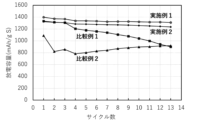
- Example 1 (1) Preparation of carbon-sulfur composite Activated carbon (MSF-A30M, manufactured by Kansai Thermochemical Co., Ltd., average particle size (D 50 ) 36 ⁇ m, specific surface area 3100 m 2 /g, fibrous form) and sulfur were placed in a glass bottle in a mass ratio of 3:7, and the bottle was sealed in a SUS tube container. The bottle was heated in an electric furnace at 150° C. for 6 hours and at 300° C. for 2.75 hours to obtain a powder of activated carbon-element sulfur composite.
- MSF-A30M manufactured by Kansai Thermochemical Co., Ltd., average particle size (D 50 ) 36 ⁇ m, specific surface area 3100 m 2 /g, fibrous form
- Example 2 A positive electrode composite powder was obtained in the same manner as in Example 1, except that the activated carbon (MSF-A30M) in Example 1 was changed to MSC30-SSS (manufactured by Kansai Thermochemical Industry Co., Ltd., average particle size (D 50 ) 3.2 ⁇ m, specific surface area 3016 m 2 /g). An all-solid-state battery was produced in the same manner as in Example 1, except that the obtained positive electrode composite powder was used.
- MSC30-SSS manufactured by Kansai Thermochemical Industry Co., Ltd., average particle size (D 50 ) 3.2 ⁇ m, specific surface area 3016 m 2 /g.
- Example 1 A positive electrode composite powder was obtained in the same manner as in Example 1, except that the activated carbon (MSF-A30M) in Example 1 was changed to MSC30 (manufactured by Kansai Thermochemical Industry Co., Ltd., average particle size (D 50 ) 56 ⁇ m, specific surface area 3200 m 2 /g). An all-solid-state battery was produced in the same manner as in Example 1, except that the obtained positive electrode composite powder was used.
- MSC30 manufactured by Kansai Thermochemical Industry Co., Ltd., average particle size (D 50 ) 56 ⁇ m, specific surface area 3200 m 2 /g.
- the positive electrode composite of the present invention is suitable for use as a positive electrode in a lithium ion battery.
- the lithium ion battery of the present invention is also suitable for use as a battery in, for example, information-related devices and communication devices such as personal computers, video cameras, and mobile phones, and in vehicles such as electric cars.
Landscapes
- Chemical & Material Sciences (AREA)
- General Chemical & Material Sciences (AREA)
- Chemical Kinetics & Catalysis (AREA)
- Electrochemistry (AREA)
- Engineering & Computer Science (AREA)
- Inorganic Chemistry (AREA)
- Manufacturing & Machinery (AREA)
- Materials Engineering (AREA)
- Physics & Mathematics (AREA)
- Condensed Matter Physics & Semiconductors (AREA)
- General Physics & Mathematics (AREA)
- Composite Materials (AREA)
- Secondary Cells (AREA)
Priority Applications (3)
| Application Number | Priority Date | Filing Date | Title |
|---|---|---|---|
| CN202480015894.3A CN120814064A (zh) | 2023-03-10 | 2024-02-29 | 正极复合材料、正极复合材料的制造方法及锂离子电池 |
| KR1020257028854A KR20250158752A (ko) | 2023-03-10 | 2024-02-29 | 정극 합재, 정극 합재의 제조 방법 및 리튬 이온 전지 |
| JP2025506701A JPWO2024190440A1 (https=) | 2023-03-10 | 2024-02-29 |
Applications Claiming Priority (2)
| Application Number | Priority Date | Filing Date | Title |
|---|---|---|---|
| JP2023037941 | 2023-03-10 | ||
| JP2023-037941 | 2023-03-10 |
Publications (1)
| Publication Number | Publication Date |
|---|---|
| WO2024190440A1 true WO2024190440A1 (ja) | 2024-09-19 |
Family
ID=92754944
Family Applications (1)
| Application Number | Title | Priority Date | Filing Date |
|---|---|---|---|
| PCT/JP2024/007584 Ceased WO2024190440A1 (ja) | 2023-03-10 | 2024-02-29 | 正極合材、正極合材の製造方法及びリチウムイオン電池 |
Country Status (4)
| Country | Link |
|---|---|
| JP (1) | JPWO2024190440A1 (https=) |
| KR (1) | KR20250158752A (https=) |
| CN (1) | CN120814064A (https=) |
| WO (1) | WO2024190440A1 (https=) |
Cited By (1)
| Publication number | Priority date | Publication date | Assignee | Title |
|---|---|---|---|---|
| CN119943901A (zh) * | 2025-01-10 | 2025-05-06 | 浙江大学 | 利用硫化物-卤化物复合电解质球壳封装的复合硫正极的制备方法及应用 |
Citations (3)
| Publication number | Priority date | Publication date | Assignee | Title |
|---|---|---|---|---|
| JP2014017240A (ja) * | 2012-06-13 | 2014-01-30 | Nagase Chemtex Corp | 薄膜硫黄被覆導電性カーボン、正極合材及び全固体型リチウム硫黄電池 |
| JP2015072781A (ja) * | 2013-10-02 | 2015-04-16 | ナガセケムテックス株式会社 | 正極合材及び全固体型リチウム硫黄電池 |
| WO2022075471A1 (ja) * | 2020-10-09 | 2022-04-14 | 出光興産株式会社 | 硫化物固体電解質ガラスセラミクス及びその製造方法 |
Family Cites Families (3)
| Publication number | Priority date | Publication date | Assignee | Title |
|---|---|---|---|---|
| EP2745340A4 (en) | 2011-08-19 | 2015-03-18 | Basf Se | ELECTRODE MATERIAL FOR RECHARGEABLE ELECTROCELLS WITH ACTIVE CARBON FIBERS |
| JP6243103B2 (ja) | 2012-06-29 | 2017-12-06 | 出光興産株式会社 | 正極合材 |
| EP4329008A4 (en) | 2021-06-09 | 2025-05-14 | GS Yuasa International Ltd. | ELECTROCHEMICAL SOLID-STATE ELEMENT AND SULFUR-CARBON COMPLEX |
-
2024
- 2024-02-29 JP JP2025506701A patent/JPWO2024190440A1/ja active Pending
- 2024-02-29 KR KR1020257028854A patent/KR20250158752A/ko active Pending
- 2024-02-29 WO PCT/JP2024/007584 patent/WO2024190440A1/ja not_active Ceased
- 2024-02-29 CN CN202480015894.3A patent/CN120814064A/zh active Pending
Patent Citations (3)
| Publication number | Priority date | Publication date | Assignee | Title |
|---|---|---|---|---|
| JP2014017240A (ja) * | 2012-06-13 | 2014-01-30 | Nagase Chemtex Corp | 薄膜硫黄被覆導電性カーボン、正極合材及び全固体型リチウム硫黄電池 |
| JP2015072781A (ja) * | 2013-10-02 | 2015-04-16 | ナガセケムテックス株式会社 | 正極合材及び全固体型リチウム硫黄電池 |
| WO2022075471A1 (ja) * | 2020-10-09 | 2022-04-14 | 出光興産株式会社 | 硫化物固体電解質ガラスセラミクス及びその製造方法 |
Cited By (1)
| Publication number | Priority date | Publication date | Assignee | Title |
|---|---|---|---|---|
| CN119943901A (zh) * | 2025-01-10 | 2025-05-06 | 浙江大学 | 利用硫化物-卤化物复合电解质球壳封装的复合硫正极的制备方法及应用 |
Also Published As
| Publication number | Publication date |
|---|---|
| CN120814064A (zh) | 2025-10-17 |
| JPWO2024190440A1 (https=) | 2024-09-19 |
| KR20250158752A (ko) | 2025-11-06 |
Similar Documents
| Publication | Publication Date | Title |
|---|---|---|
| CN109417194B (zh) | 锂二次电池用硫化物系固体电解质 | |
| CN111448702A (zh) | 硫化物系化合物颗粒、固体电解质和锂二次电池 | |
| CN111446492B (zh) | 硫化物固体电解质粒子及其制造方法和全固体电池 | |
| KR20190016904A (ko) | 정극합재 및 그 제조방법 | |
| Tong et al. | Porous Co3O4@ TiO2 core-shell nanofibers as advanced anodes for lithium ion batteries | |
| JP2020126760A (ja) | 固体電解質 | |
| CN110556572A (zh) | 正极合剂及其制造方法 | |
| JP2020119783A (ja) | 固体電解質、リチウムイオン蓄電素子、及びこれらの製造方法 | |
| JP2020173992A (ja) | 硫化物固体電解質、硫化物固体電解質の製造方法、電極体および全固体電池 | |
| WO2021117383A1 (ja) | 固体電解質、リチウムイオン蓄電素子、及び蓄電装置 | |
| JP7816365B2 (ja) | 硫化物系固体電解質の製造方法 | |
| TW202243992A (zh) | 固體電解質及其製造方法 | |
| JP7505135B2 (ja) | 複合材料及びその製造方法 | |
| TW202124266A (zh) | 固體電解質、及使用其之電極合劑、固體電解質層、固體電池 | |
| KR20150078068A (ko) | 리튬 이차전지용 음극 활물질의 제조방법 및 리튬 이차전지 | |
| WO2024190440A1 (ja) | 正極合材、正極合材の製造方法及びリチウムイオン電池 | |
| CN118020188A (zh) | 硫化物系固体电解质 | |
| WO2019131863A1 (ja) | リチウムイオン二次電池用負極材 | |
| JP7558188B2 (ja) | 硫化物固体電解質、及びそれを用いた電極合剤、固体電解質層、固体電池 | |
| WO2024048476A1 (ja) | 複合材料の製造方法及び複合材料 | |
| WO2024185669A1 (ja) | 正極合材の製造方法、正極合材及びリチウムイオン電池 | |
| JP7839050B2 (ja) | 正極合材及びリチウムイオン電池 | |
| Monajjemi et al. | Solid-State Lithium-Ion Batteries Based on Using Ionics Conductivity Polymers Interfaces during Interaction between Solid Electrolytes with Both Electrodes | |
| WO2025204328A1 (ja) | 硫黄系活物質-電子伝導性物質複合体の製造方法 | |
| WO2025258566A1 (ja) | 炭素-硫化リチウム複合体 |
Legal Events
| Date | Code | Title | Description |
|---|---|---|---|
| 121 | Ep: the epo has been informed by wipo that ep was designated in this application |
Ref document number: 24770551 Country of ref document: EP Kind code of ref document: A1 |
|
| WWE | Wipo information: entry into national phase |
Ref document number: 2025506701 Country of ref document: JP |
|
| ENP | Entry into the national phase |
Ref document number: 1020257028854 Country of ref document: KR Free format text: ST27 STATUS EVENT CODE: A-0-1-A10-A15-NAP-PA0105 (AS PROVIDED BY THE NATIONAL OFFICE) |
|
| WWE | Wipo information: entry into national phase |
Ref document number: 202480015894.3 Country of ref document: CN |
|
| NENP | Non-entry into the national phase |
Ref country code: DE |
|
| WWP | Wipo information: published in national office |
Ref document number: 202480015894.3 Country of ref document: CN |
|
| 122 | Ep: pct application non-entry in european phase |
Ref document number: 24770551 Country of ref document: EP Kind code of ref document: A1 |