WO2024185669A1 - 正極合材の製造方法、正極合材及びリチウムイオン電池 - Google Patents
正極合材の製造方法、正極合材及びリチウムイオン電池 Download PDFInfo
- Publication number
- WO2024185669A1 WO2024185669A1 PCT/JP2024/007707 JP2024007707W WO2024185669A1 WO 2024185669 A1 WO2024185669 A1 WO 2024185669A1 JP 2024007707 W JP2024007707 W JP 2024007707W WO 2024185669 A1 WO2024185669 A1 WO 2024185669A1
- Authority
- WO
- WIPO (PCT)
- Prior art keywords
- sulfur
- positive electrode
- lithium
- solid electrolyte
- carbon
- Prior art date
- Legal status (The legal status is an assumption and is not a legal conclusion. Google has not performed a legal analysis and makes no representation as to the accuracy of the status listed.)
- Ceased
Links
Images


Classifications
-
- H—ELECTRICITY
- H01—ELECTRIC ELEMENTS
- H01M—PROCESSES OR MEANS, e.g. BATTERIES, FOR THE DIRECT CONVERSION OF CHEMICAL ENERGY INTO ELECTRICAL ENERGY
- H01M4/00—Electrodes
- H01M4/02—Electrodes composed of, or comprising, active material
- H01M4/13—Electrodes for accumulators with non-aqueous electrolyte, e.g. for lithium-accumulators; Processes of manufacture thereof
- H01M4/139—Processes of manufacture
- H01M4/1397—Processes of manufacture of electrodes based on inorganic compounds other than oxides or hydroxides, e.g. sulfides, selenides, tellurides, halogenides or LiCoFy
-
- H—ELECTRICITY
- H01—ELECTRIC ELEMENTS
- H01M—PROCESSES OR MEANS, e.g. BATTERIES, FOR THE DIRECT CONVERSION OF CHEMICAL ENERGY INTO ELECTRICAL ENERGY
- H01M10/00—Secondary cells; Manufacture thereof
- H01M10/05—Accumulators with non-aqueous electrolyte
- H01M10/052—Li-accumulators
-
- H—ELECTRICITY
- H01—ELECTRIC ELEMENTS
- H01M—PROCESSES OR MEANS, e.g. BATTERIES, FOR THE DIRECT CONVERSION OF CHEMICAL ENERGY INTO ELECTRICAL ENERGY
- H01M10/00—Secondary cells; Manufacture thereof
- H01M10/05—Accumulators with non-aqueous electrolyte
- H01M10/056—Accumulators with non-aqueous electrolyte characterised by the materials used as electrolytes, e.g. mixed inorganic/organic electrolytes
- H01M10/0561—Accumulators with non-aqueous electrolyte characterised by the materials used as electrolytes, e.g. mixed inorganic/organic electrolytes the electrolyte being constituted of inorganic materials only
- H01M10/0562—Solid materials
-
- H—ELECTRICITY
- H01—ELECTRIC ELEMENTS
- H01M—PROCESSES OR MEANS, e.g. BATTERIES, FOR THE DIRECT CONVERSION OF CHEMICAL ENERGY INTO ELECTRICAL ENERGY
- H01M4/00—Electrodes
- H01M4/02—Electrodes composed of, or comprising, active material
- H01M4/13—Electrodes for accumulators with non-aqueous electrolyte, e.g. for lithium-accumulators; Processes of manufacture thereof
- H01M4/136—Electrodes based on inorganic compounds other than oxides or hydroxides, e.g. sulfides, selenides, tellurides, halogenides or LiCoFy
-
- H—ELECTRICITY
- H01—ELECTRIC ELEMENTS
- H01M—PROCESSES OR MEANS, e.g. BATTERIES, FOR THE DIRECT CONVERSION OF CHEMICAL ENERGY INTO ELECTRICAL ENERGY
- H01M4/00—Electrodes
- H01M4/02—Electrodes composed of, or comprising, active material
- H01M4/36—Selection of substances as active materials, active masses, active liquids
-
- H—ELECTRICITY
- H01—ELECTRIC ELEMENTS
- H01M—PROCESSES OR MEANS, e.g. BATTERIES, FOR THE DIRECT CONVERSION OF CHEMICAL ENERGY INTO ELECTRICAL ENERGY
- H01M4/00—Electrodes
- H01M4/02—Electrodes composed of, or comprising, active material
- H01M4/36—Selection of substances as active materials, active masses, active liquids
- H01M4/362—Composites
-
- H—ELECTRICITY
- H01—ELECTRIC ELEMENTS
- H01M—PROCESSES OR MEANS, e.g. BATTERIES, FOR THE DIRECT CONVERSION OF CHEMICAL ENERGY INTO ELECTRICAL ENERGY
- H01M4/00—Electrodes
- H01M4/02—Electrodes composed of, or comprising, active material
- H01M4/36—Selection of substances as active materials, active masses, active liquids
- H01M4/58—Selection of substances as active materials, active masses, active liquids of inorganic compounds other than oxides or hydroxides, e.g. sulfides, selenides, tellurides, halogenides or LiCoFy; of polyanionic structures, e.g. phosphates, silicates or borates
-
- H—ELECTRICITY
- H01—ELECTRIC ELEMENTS
- H01M—PROCESSES OR MEANS, e.g. BATTERIES, FOR THE DIRECT CONVERSION OF CHEMICAL ENERGY INTO ELECTRICAL ENERGY
- H01M4/00—Electrodes
- H01M4/02—Electrodes composed of, or comprising, active material
- H01M4/36—Selection of substances as active materials, active masses, active liquids
- H01M4/58—Selection of substances as active materials, active masses, active liquids of inorganic compounds other than oxides or hydroxides, e.g. sulfides, selenides, tellurides, halogenides or LiCoFy; of polyanionic structures, e.g. phosphates, silicates or borates
- H01M4/581—Chalcogenides or intercalation compounds thereof
- H01M4/5815—Sulfides
-
- H—ELECTRICITY
- H01—ELECTRIC ELEMENTS
- H01M—PROCESSES OR MEANS, e.g. BATTERIES, FOR THE DIRECT CONVERSION OF CHEMICAL ENERGY INTO ELECTRICAL ENERGY
- H01M4/00—Electrodes
- H01M4/02—Electrodes composed of, or comprising, active material
- H01M4/36—Selection of substances as active materials, active masses, active liquids
- H01M4/58—Selection of substances as active materials, active masses, active liquids of inorganic compounds other than oxides or hydroxides, e.g. sulfides, selenides, tellurides, halogenides or LiCoFy; of polyanionic structures, e.g. phosphates, silicates or borates
- H01M4/583—Carbonaceous material, e.g. graphite-intercalation compounds or CFx
- H01M4/587—Carbonaceous material, e.g. graphite-intercalation compounds or CFx for inserting or intercalating light metals
-
- H—ELECTRICITY
- H01—ELECTRIC ELEMENTS
- H01M—PROCESSES OR MEANS, e.g. BATTERIES, FOR THE DIRECT CONVERSION OF CHEMICAL ENERGY INTO ELECTRICAL ENERGY
- H01M4/00—Electrodes
- H01M4/02—Electrodes composed of, or comprising, active material
- H01M4/62—Selection of inactive substances as ingredients for active masses, e.g. binders, fillers
-
- H—ELECTRICITY
- H01—ELECTRIC ELEMENTS
- H01M—PROCESSES OR MEANS, e.g. BATTERIES, FOR THE DIRECT CONVERSION OF CHEMICAL ENERGY INTO ELECTRICAL ENERGY
- H01M4/00—Electrodes
- H01M4/02—Electrodes composed of, or comprising, active material
- H01M2004/021—Physical characteristics, e.g. porosity, surface area
-
- H—ELECTRICITY
- H01—ELECTRIC ELEMENTS
- H01M—PROCESSES OR MEANS, e.g. BATTERIES, FOR THE DIRECT CONVERSION OF CHEMICAL ENERGY INTO ELECTRICAL ENERGY
- H01M4/00—Electrodes
- H01M4/02—Electrodes composed of, or comprising, active material
- H01M2004/026—Electrodes composed of, or comprising, active material characterised by the polarity
- H01M2004/028—Positive electrodes
-
- H—ELECTRICITY
- H01—ELECTRIC ELEMENTS
- H01M—PROCESSES OR MEANS, e.g. BATTERIES, FOR THE DIRECT CONVERSION OF CHEMICAL ENERGY INTO ELECTRICAL ENERGY
- H01M2300/00—Electrolytes
- H01M2300/0017—Non-aqueous electrolytes
- H01M2300/0065—Solid electrolytes
- H01M2300/0068—Solid electrolytes inorganic
- H01M2300/008—Halides
-
- Y—GENERAL TAGGING OF NEW TECHNOLOGICAL DEVELOPMENTS; GENERAL TAGGING OF CROSS-SECTIONAL TECHNOLOGIES SPANNING OVER SEVERAL SECTIONS OF THE IPC; TECHNICAL SUBJECTS COVERED BY FORMER USPC CROSS-REFERENCE ART COLLECTIONS [XRACs] AND DIGESTS
- Y02—TECHNOLOGIES OR APPLICATIONS FOR MITIGATION OR ADAPTATION AGAINST CLIMATE CHANGE
- Y02E—REDUCTION OF GREENHOUSE GAS [GHG] EMISSIONS, RELATED TO ENERGY GENERATION, TRANSMISSION OR DISTRIBUTION
- Y02E60/00—Enabling technologies; Technologies with a potential or indirect contribution to GHG emissions mitigation
- Y02E60/10—Energy storage using batteries
Definitions
- the present invention relates to a method for producing a positive electrode composite, a positive electrode composite, and a lithium-ion battery.
- a composite material of a sulfur-based active material and a carbon material has been proposed as a high-capacity positive electrode composite material for use in an all-solid-state lithium-ion battery.
- S 8 elemental sulfur
- the positive electrode does not have a lithium element (a source of lithium ions that move between electrodes), so when the battery is produced, the negative electrode must contain a lithium element, i.e., be in a charged state. Therefore, care must be taken to prevent the electrodes from short-circuiting and discharging during the production of the battery.
- Li 2 S lithium sulfide
- Li 2 S-KB composite material a method for producing a Li 2 S-KB composite material in which sulfur and a reductive lithium compound (lithium triethylborohydride, etc.) are reacted in a tetrahydrofuran solvent in the presence of Ketjen Black (KB) (Patent Document 1).
- a reductive lithium compound lithium triethylborohydride, etc.
- KB Ketjen Black
- Patent Document 2 a technology has been disclosed in which a composite material consisting of sulfur, activated carbon, and solid electrolyte is placed in a zirconia pot, and the pot is vigorously rotated and orbited to cause a reaction between the sulfur and lithium metal (Patent Document 2).
- Patent Document 2 a technology has been disclosed in which a composite material consisting of sulfur, activated carbon, and solid electrolyte is placed in a zirconia pot, and the pot is vigorously rotated and orbited to cause a reaction between the sulfur and lithium metal.
- Patent documents 3-5 disclose a technique for mixing a material that can be doped with lithium with lithium metal in a solvent.
- PAHs polycyclic aromatic hydrocarbons
- One of the objectives of the present invention is to provide a method for safely producing a sulfur-carbon composite material (cathode mixture) containing lithium element.
- a method for producing a positive electrode mixture comprising step B of mixing a sulfur-carbon composite material, lithium metal, and a solvent to produce a lithium compound. 2. The method according to 1, further comprising a step A of mixing sulfur with a carbon material to produce the sulfur-carbon composite material. 3. The method according to 2, further comprising the step of mixing a solid electrolyte after the step B. 4. The method according to 2, wherein a solid electrolyte is mixed in the step A. 5. The method according to any one of 1 to 4, wherein the positive electrode mixture contains lithium sulfide. 6. The method according to any one of 2 to 5, wherein the specific surface area of the carbon material is 50 m 2 /g or more. 7.
- the carbon material is one or more selected from carbon black, mesoporous carbon, carbon nanotubes, carbon nanohorns, fullerene, amorphous carbon, carbon fiber, natural graphite, artificial graphite, and activated carbon.
- a molar ratio of the lithium metal to the sulfur, Li/S is 0.1 to 5.
- the solid electrolyte is a sulfide solid electrolyte.
- the sulfide solid electrolyte contains lithium, phosphorus, sulfur, and a halogen element.
- a positive electrode mixture obtained by the manufacturing method according to any one of 1 to 10.
- a positive electrode comprising the positive electrode mixture according to 11.
- a lithium ion battery comprising the positive electrode according to 12.
- the present invention provides a method for safely producing a positive electrode mixture containing lithium element.
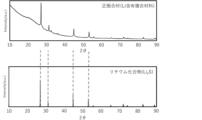
- Example 2 shows X-ray diffraction (XRD) patterns of the positive electrode mixture and Li 2 S produced in Example 1.
- 1 shows XRD patterns of the positive electrode mixture and Li 2 S produced in Example 2.
- 1 shows XRD patterns of a solid electrolyte-containing positive electrode mixture, a sulfide solid electrolyte, and Li 2 S produced in Example 2.
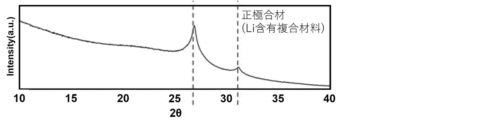
- 13 is an XRD pattern of the positive electrode composite produced in Example 27.
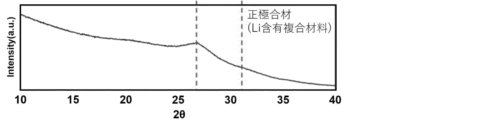
- Example 28 is an XRD pattern of the positive electrode composite produced in Example 28.
- x to y represents a numerical range of "not less than x and not more than y.”
- the upper and lower limit values described in relation to the numerical ranges can be combined in any combination.
- composite means that the carbon material, sulfur (elemental sulfur), and lithium compound are physically or chemically bonded to each other. This can be confirmed by observing the element distribution using an electron microscope or the like.
- the method for producing a cathode mix according to one embodiment of the present invention includes a step B of mixing a sulfur-carbon composite material, lithium metal, and a solvent to produce a lithium compound.
- a step B of mixing a sulfur-carbon composite material, lithium metal, and a solvent to produce a lithium compound By mixing the sulfur-carbon composite material and lithium metal in the presence of a solvent, the solvent dissipates heat generated by mixing, reaction, etc., by evaporation, etc. This can eliminate the risk of fire, etc.
- a dense composite of the sulfur-carbon composite material and the lithium compound can be formed. Even if sulfur that does not have electronic conductivity is contained, a cathode mix with uniform electronic conductivity can be obtained. This can increase the sulfur content in the cathode mix while improving the rate characteristics of the battery.
- the sulfur-carbon composite material used in this embodiment is obtained by mixing sulfur and a carbon material.
- a production method includes a step A of mixing sulfur and a carbon material to produce a sulfur-carbon composite material as a pre-step of the step B.
- step A for example, a carbon material and elemental sulfur are mixed and sealed, and then the mixture is heated to melt the elemental sulfur and impregnate the elemental sulfur into the pores, thereby producing a sulfur-carbon composite material.
- the carbon material is not particularly limited as long as it has electronic conductivity and can be composited with sulfur, but it is preferably a porous carbon material having a plurality of pores.
- examples of the carbon material include carbon black, mesoporous carbon, carbon nanotubes, carbon nanohorns, fullerenes, amorphous carbon, carbon fibers, natural graphite, artificial graphite, and activated carbon. Of these, activated carbon is preferred. These may be used alone or in combination of two or more.
- the carbon material has a BET specific surface area of 50 m 2 /g or more, which allows a wide contact interface to be formed between the carbon material and elemental sulfur, thereby improving the utilization rate of sulfur.
- the BET specific surface area is preferably 70 m 2 /g or more, more preferably 100 m 2 /g or more. Although there is no particular upper limit to the BET specific surface area, it is preferably 5000 m 2 /g or less, more preferably 4000 m 2 /g or less.
- the specific surface area can be measured by the Brenauer-Emmet-Telle (BET) method or the BJH method (Barrett-Joyner-Halenda method).
- BET Brenauer-Emmet-Telle
- BJH Barrett-Joyner-Halenda method
- the nitrogen adsorption isotherm can be obtained by adsorbing nitrogen gas to a carbon material at liquid nitrogen temperature.
- the measurement can be performed using, for example, a specific surface area/pore distribution measuring device (Autosorb-3) manufactured by Quantacrome.
- the elemental sulfur is not particularly limited, but preferably has a purity of 95% by mass or more, more preferably 96% by mass or more, and particularly preferably 97% by mass or more.
- Examples of the crystal system of elemental sulfur include ⁇ -sulfur (orthorhombic system), ⁇ -sulfur (monoclinic system), ⁇ -sulfur (monoclinic system), and amorphous sulfur. These may be used alone or in combination of two or more. Elemental sulfur becomes molten liquid when heated.
- the mixing ratio of elemental sulfur and carbon material can be adjusted appropriately according to the materials used.
- the mass ratio (S/C) of elemental sulfur and carbon material in the sulfur-carbon composite material is 0.5 or more.
- S/C mass ratio of elemental sulfur and carbon material in the sulfur-carbon composite material
- the mixture of elemental sulfur and carbon material is heated in a sealed state at a temperature equal to or higher than the melting point of elemental sulfur (about 115° C.).
- the heating temperature is adjusted according to the carbon material and elemental sulfur, but is preferably equal to or higher than 130° C., and more preferably equal to or higher than 150° C.
- the upper limit of the heating temperature is equal to or lower than the boiling point of elemental sulfur (about 445° C.).
- the heating time is preferably 0.1 to 24 hours.
- the sulfur-carbon composite material is obtained by cooling after heating. If necessary, a crushing step may be carried out after cooling.
- Sulfur-carbon composite materials retain elemental sulfur or discharge products of elemental sulfur on the surface and/or in the pores of the carbon material. Increasing the contact area between the elemental sulfur or its discharge products and the carbon material not only provides a smooth supply of electrons and ions, but also facilitates electronic conductivity to the entire positive electrode due to the high electronic conductivity of the carbon material.
- the elemental sulfur is partially or entirely converted into a discharge product during the battery reaction. Therefore, in one embodiment, the discharge product of elemental sulfur is present in the positive electrode mixture (positive electrode).
- discharge products of elemental sulfur include Li 2 S in a fully discharged state and lithium polysulfides in the intermediate stages thereof, such as Li 2 S 2 , Li 2 S 4 , Li 2 S 6 , and Li 2 S 8 .
- the elemental sulfur is partially or entirely impregnated into the pores of the carbon material.
- the elemental sulfur that is not impregnated into the pores is present so as to cover a part or the whole of the carbon material.
- Whether or not the pores of the carbon material are impregnated with sulfur can be confirmed by analyzing the particle cross section of the carbon material using an analytical method capable of elemental mapping, such as SEM-EDX or TEM-EDX, and evaluating the overlap of elements derived from the carbon material and sulfur elements.
- the degree of compositing of the sulfur-carbon composite material such as mixing or impregnation, observed by the above-mentioned SEM-EDX measurement, it is preferable that sulfur (elemental sulfur and discharge products of sulfur) and the carbon material are mixed (composited) at the nano level.
- the sulfur-carbon composite material contains a large amount of elemental sulfur, so elemental sulfur is also present outside the pores of the carbon material.
- the composite of elemental sulfur and carbon material may become pellet-like lumps depending on the raw material properties and manufacturing conditions, but in this case it can be turned into powder by mechanically crushing it.
- lithium metal The form of lithium metal is not particularly limited.
- lithium metal in the form of a lump, foil, powder, granule, or fiber can be used.
- the thickness of the lithium metal foil is preferably 1 ⁇ m to 4000 ⁇ m, more preferably 5 ⁇ m to 1000 ⁇ m, and particularly preferably 10 ⁇ m to 200 ⁇ m.
- the average particle size (D 50 ) is preferably 1 ⁇ m to 1000 ⁇ m, more preferably 5 ⁇ m to 500 ⁇ m, and particularly preferably 10 ⁇ m to 100 ⁇ m.
- the solvent is used during mixing of the sulfur-carbon composite material with the lithium metal.
- the solvent is used during mixing of the sulfur-carbon composite material, the lithium metal and the solid electrolyte.
- the solvent is preferably one that does not dissolve or react with any of the sulfur-carbon composite material, lithium metal, and solid electrolyte.
- the solvent is preferably one that does not dissolve sulfur and its discharge products (lithium polysulfide, lithium sulfide).
- the solvent is preferably one that evaporates easily at room temperature or when a drying step is added to the manufacturing process.
- the solvent is preferably an organic solvent.
- the organic solvent may be a polar organic solvent or a non-polar organic solvent.
- the polar organic solvent include acetone, carbonates, ethers such as dibutyl ether, methyl tertiary butyl ether (MTBE), diisopropyl ether, THF (tetrahydrofuran), and dioxane, and nitriles such as acetonitrile, propionitrile, and isobutylnitrile.
- non-polar organic solvent examples include toluene, xylene, ethylbenzene, pentane, hexane, heptane, octane, tridecane, cyclohexane, methylcyclohexane, petroleum ether, chloroform, carbon tetrachloride, trichloroethane, etc.
- Preferred are pentane, hexane, heptane, octane, tridecane, diisopropyl ether, MTBE, and isobutylnitrile.
- the organic solvent is preferably a hydrocarbon.
- the hydrocarbon include, but are not limited to, butane, pentane, hexane, heptane, octane, nonane, decane, undecane, dodecane, tridecane, tetradecane, pentadecane, hexadecane, heptadecane, octadecane, nonadecane, and eicosane.
- the hydrocarbon may be a group containing a ring structure in a part thereof.
- the hydrocarbon may be linear or branched.
- the organic solvent preferably has 4 to 20 carbon atoms, and more preferably has 4 to 12 carbon atoms.
- the water content of the solvent is preferable for the water content of the solvent to be low.
- the water content of the solvent can be confirmed by measuring with a Karl Fischer moisture meter.
- the water content in the solvent is preferably 1000 ppm or less, more preferably 500 ppm or less, and particularly preferably 200 ppm or less.
- the above-mentioned sulfur-carbon composite material, lithium metal, and a solvent are mixed.
- the mixing method include a method of adding a solvent and lithium metal to a sulfur-carbon composite material and mixing them, a method of mixing a sulfur-carbon composite material and a solvent, then adding lithium metal and further mixing, and a method of mixing lithium metal and a solvent, then adding a sulfur-carbon composite material and further mixing.
- the presence of the solvent absorbs heat generated when the sulfur-carbon composite material and lithium metal come into contact with each other and produce a lithium compound by a chemical reaction, and heat generated during the mixing process. Therefore, unlike a production method using dry mixing, the positive electrode mixture can be safely produced without sparks due to heat generation or ignition of the composite material, lithium metal, etc.
- the sulfur-carbon composite material and lithium metal are preferably mixed together such that the molar ratio (Li/S) of lithium element (Li) to sulfur element (S) is 0.1 to 5.
- the molar ratio (Li/S) is more preferably 0.3 to 4, further preferably 0.5 to 3, and particularly preferably 1 to 2.5.
- the lithium metal may be added in its entirety at once, or may be added in several portions.
- the amount of the solvent added during mixing is not particularly limited. However, taking into consideration the heat dissipation and the process of removing the solvent after mixing, the amount of the solvent is about 30 to 100,000 parts by mass per 100 parts by mass of the sulfur-carbon composite material and lithium metal in total.
- the solvent may be added during mixing.
- the lithium metal changes into a lithium compound when mixed, and loses its metallic luster. Therefore, the mixing time can be adjusted according to the mixing method and conditions by observing the lithium metal.
- the lithium compounds produced by the above mixing include lithium sulfide compounds (Li x S y ) having various molar ratios. The presence of the lithium compounds can be confirmed by X-ray diffraction measurement (XRD).
- the lithium sulfide compounds (Li x S y ) include Li 2 S and its intermediate products, such as lithium polysulfides Li 2 S 2 , Li 2 S 4 , Li 2 S 6 , and Li 2 S 8 .
- the lithium compound produced is preferably Li 2 S.
- Examples of the mixing method in step B include manual mixing means such as mixing in a mortar, wet mixers such as a planetary mixer, a thin film rotary type high-speed mixer, a kneader, and a stirring tank, grinders such as a bead mill, a planetary ball mill, a vibration mill, a tumbling mill, and a mechanofusion device, and kneaders.
- the sulfur-carbon composite material and the lithium compound may be partially pulverized by the mixing. After mixing, the solvent is removed to produce a positive electrode mixture. If necessary, a drying step may be performed.
- the above-mentioned step A may be performed before the step B.
- the sulfur-carbon composite material and the solid electrolyte may be mixed.
- step C of mixing a solid electrolyte may be carried out after step B.
- the solid electrolyte is preferably mixed after the above step B. This further improves the rate characteristics of the resulting lithium ion battery.
- the solid electrolyte may be mixed in the above steps A and C by, for example, applying mechanical stress to the raw material mixture.
- applying mechanical stress means mechanically applying shear force, impact force, etc.
- examples of the means for applying mechanical stress include manual mixing means such as mortar mixing, wet mixers such as planetary mixers, thin film rotary high-speed mixers, kneaders, and stirring tanks, crushers such as beads mills, planetary ball mills, vibration mills, rolling mills, and mechanofusion equipment, and kneaders.
- the raw material mixture in step A contains a sulfur-carbon composite material and a solid electrolyte.
- the raw material mixture in step C contains the positive electrode mixture produced in step B and a solid electrolyte.
- the amount of solid electrolyte is preferably 5 to 250 parts by mass, more preferably 10 to 150 parts by mass, and even more preferably 10 to 100 parts by mass, per 100 parts by mass of the sulfur-carbon composite material or the positive electrode mixture produced in step B. If the amount is within the above range, sufficient ionic conductivity can be imparted to the positive electrode mixture, and a battery with high energy density can be obtained due to the high content of active material.
- the rotation speed may be several tens to several hundreds of revolutions per minute, and the processing may be performed for 0.5 to 100 hours. More specifically, in the case of the planetary ball mill (manufactured by Fritsch: model number P-5) used in the examples of the present application, the rotation speed of the planetary ball mill is preferably 100 rpm or more and 600 rpm or less, and more preferably 150 rpm or more and 400 rpm or less.
- balls serving as grinding media are used, for example, zirconia balls, their diameter is preferably 0.2 to 20 mm.
- the processing may be carried out for 1 second to 10 minutes at a peripheral speed of 1 to 200 m/sec.
- the peripheral speed is preferably in the range of 10 to 100 m/sec, more preferably 20 to 60 m/sec, and the processing time is preferably 10 seconds to 5 minutes.
- Mixing may be achieved by a combination of several means.
- the produced positive electrode mixture may be heated. Heating may recrystallize the solid electrolyte, the crystallinity of which was reduced during the mixing process, thereby further improving the battery characteristics.
- the solid electrolyte is a sulfide solid electrolyte.
- the sulfide solid electrolyte is a solid electrolyte that contains at least sulfur atoms and exhibits ionic conductivity due to the metal atoms contained therein, and contains, in addition to sulfur atoms, preferably lithium atoms and phosphorus atoms, more preferably lithium atoms, phosphorus atoms and halogen atoms, and has ionic conductivity due to lithium atoms.
- the sulfide solid electrolyte may be an amorphous sulfide solid electrolyte or a crystalline sulfide solid electrolyte.
- the amorphous sulfide solid electrolyte can be used without any particular limitation as long as it contains at least sulfur atoms and exhibits ionic conductivity due to the contained metal atoms.
- Solid electrolytes containing sulfur atoms, lithium atoms, and phosphorus atoms which are composed of lithium sulfide and phosphorus sulfide, such as Li 2 S-P 2 S 5 -LiI , Li 2 S- Solid electrolytes composed of lithium sulfide, phosphorus sulfide and lithium halide, such as P 2 S 5 -LiCl, Li 2 S-P 2 S 5 -LiBr and Li 2 S-P 2 S 5 -LiI-LiBr; Further containing other elements such as oxygen and silicon, for example, Li 2 S—P 2 S 5 —Li 2 O—LiI, Li 2 S—SiS 2 —P 2 S 5 In order to obtain a higher ionic conductivity, preferred examples of the solid electrolyte include Li 2 S—P 2 S 5 —LiI, Li 2 S—P 2 S 5 —LiCl, and Li 2 S—P 2 S A solid
- the molar ratio of Li 2 S to P 2 S 5 is preferably 30 to 85:15 to 70, more preferably 40 to 80:20 to 60, and even more preferably 45 to 78:22 to 55, from the viewpoint of obtaining high chemical stability and higher ionic conductivity.
- the amorphous sulfide solid electrolyte is, for example, Li 2 S-P 2 S 5 -LiI-LiBr
- the total content of lithium sulfide and diphosphorus pentasulfide is preferably 30 to 95 mol%, more preferably 35 to 90 mol%, and even more preferably 40 to 85 mol%.
- the ratio of lithium bromide to the total of lithium bromide and lithium iodide is preferably 1 to 99 mol%, more preferably 20 to 90 mol%, even more preferably 40 to 80 mol%, and particularly preferably 50 to 70 mol%.
- the compounding ratio (molar ratio) of these atoms is preferably 1.0 to 1.8: 1.0 to 2.0: 0.1 to 0.8: 0.01 to 0.6, more preferably 1.1 to 1.7: 1.2 to 1.8: 0.2 to 0.6: 0.05 to 0.5, and even more preferably 1.2 to 1.6: 1.3 to 1.7: 0.25 to 0.5: 0.08 to 0.4.
- the compounding ratio (molar ratio) of lithium atoms, sulfur atoms, phosphorus atoms, bromine atoms, and iodine atoms is preferably 1.0 to 1.8: 1.0 to 2.0: 0.1 to 0.8: 0.01 to 0.3: 0.01 to 0.3, more preferably 1.1 to 1.7: 1.2 to 1.8: 0.2 to 0.6: 0.02 to 0.25: 0.02 to 0.25, more preferably 1.2 to 1.6: 1.3 to 1.7: 0.25 to 0.5: 0.03 to 0.2: 0.03 to 0.2, and even more preferably 1.35 to 1.45: 1.4 to 1.7: 0.3 to 0.45: 0.04 to 0.18: 0.04 to 0.18.
- the shape of the amorphous sulfide solid electrolyte is not particularly limited, but may be, for example, particulate.
- the average particle size (D 50 ) of the particulate amorphous sulfide solid electrolyte may be, for example, within a range of 0.01 ⁇ m to 500 ⁇ m, or 0.1 to 200 ⁇ m.
- the average particle size ( D50 ) is the particle size that reaches 50% of the total when the particle size distribution cumulative curve is drawn, starting from the smallest particle, and the volume distribution is the average particle size that can be measured using, for example, a laser diffraction/scattering type particle size distribution measuring device.
- the crystalline sulfide solid electrolyte may be, for example, a so-called glass ceramic obtained by heating the above-mentioned amorphous sulfide solid electrolyte to a crystallization temperature or higher, and may be a sulfide solid electrolyte having the following crystal structure: may be adopted.
- Examples of the crystal structure that the crystalline sulfide solid electrolyte containing lithium atoms, sulfur atoms, and phosphorus atoms may have include a Li 3 PS 4 crystal structure, a Li 4 P 2 S 6 crystal structure, a Li 7 PS 6 crystal structure, and a Li 7
- Examples of the crystal structure that the crystalline sulfide solid electrolyte containing lithium atoms, sulfur atoms, phosphorus atoms, and halogen atoms may have include a Li 4-x Ge 1-x P x S 4 thio-LISICON Region II type crystal structure (see Kanno et al., Journal of the Electrochemical Society, 148(7)A742-746(2001)), and a crystal structure similar to the Li 4-x Ge 1-x P x S 4 thio-LISICON Region II type (see Solid State Ionics, 177(2006), 2721-2725).
- thio-LISICON Region II type crystal structure refers to either a Li4 -xGe1 -xPxS4 - based thio-LISICON Region II type crystal structure or a crystal structure similar to the Li4 -xGe1 - xPxS4 - based thio-LISICON Region II type.
- the diffraction peaks of the Li 4-x Ge 1-x P The diffraction peaks of the Li4- xGe1- xPxS4 -type thio-LIS
- the crystal structure of the crystalline sulfide solid electrolyte also includes an argyrodite crystal structure.
- the argyrodite crystal structure include a Li 7 PS 6 crystal structure, a crystal structure represented by the composition formula Li 7 -x P 1 -y Si y S 6 and Li 7+x P 1-y Si y S 6 (x is ⁇ 0.6 to 0.6, y is 0.1 to 0.6) having a Li 7 PS 6 structural skeleton, a crystal structure represented by Li 7-x-2y PS 6-x-y Cl x (0.8 ⁇ x ⁇ 1.7, 0 ⁇ y ⁇ 0.25x+0.5), and a crystal structure represented by Li 7-x PS 6-x Ha x (Ha is Cl or Br, x is preferably 0.2 to 1.8).
- the crystal structure of the crystalline sulfide solid electrolyte is preferably a Li 3 PS 4 crystal structure, a thiolicon region II type crystal structure, or an argyrodite type crystal structure.
- the shape of the crystalline sulfide solid electrolyte is not particularly limited, but may be, for example, particulate.
- the average particle size (D 50 ) of the particulate crystalline sulfide solid electrolyte may be, for example, within the range of 0.01 ⁇ m to 500 ⁇ m, or 0.1 to 200 ⁇ m, similar to the average particle size (D 50 ) of the amorphous sulfide solid electrolyte described above.
- Positive electrode composite The positive electrode composite of the present embodiment can be produced, for example, by the above-mentioned production method. Note that the positive electrode composite obtained by the above-mentioned production method is a complex composite, and therefore it is impossible or almost impractical to directly identify it by its structure or properties.
- the positive electrode mixture may or may not contain components other than the sulfur-carbon composite material, lithium metal, lithium compound, and solid electrolyte.
- the other components are not particularly limited, but may include, for example, a binder, a solvent, and a dispersant.
- the lithium ion battery according to one embodiment of the present invention includes the positive electrode composite produced by the above-mentioned production method.
- a solid electrolyte can be used instead of a liquid electrolyte to produce an all-solid-state lithium ion battery.
- the positive electrode composite of the present invention an all-solid-state lithium ion battery with good rate characteristics can be produced.
- the positive electrode composite can be used in a lithium ion battery using an electrolytic solution by using a known technique.
- An all-solid-state lithium ion battery mainly consists of a positive electrode layer, a negative electrode layer, and an electrolyte layer, and the positive electrode mixture of the present invention is suitable as a constituent material of the positive electrode layer.
- the negative electrode layer and the electrolyte layer can be manufactured by a known method.
- a current collector In addition to the positive electrode layer, the negative electrode layer, and the electrolyte layer, it is preferable to use a current collector, and a known current collector is also used.
- the solid electrolyte is not particularly limited, but examples thereof include the above-mentioned sulfide solid electrolytes.
- the present invention will be specifically described below based on examples.
- the present invention is not limited to the examples.
- the specific surface area and X-ray diffraction measurements of the carbon material were carried out as follows.
- the specific surface area was measured using a specific surface area and pore distribution measuring device (Autosorb-3) manufactured by Quantacrome, Inc.
- the specific surface area was calculated by the Brenauer-Emmet-Telle (BET) multipoint method using a nitrogen adsorption isotherm obtained by adsorbing nitrogen gas to the carbon material at liquid nitrogen temperature.
- XRD equipment Rigaku Corporation SmartLab Tube voltage: 45 kV Tube current: 200mA
- X-ray wavelength Cu-K ⁇ ray (1.5418 ⁇ )
- Optical system Parallel method Slit configuration: (Input side) PSA open, Soller slit 4° (Light receiving side) Longitudinal limiting slit 10 mm, IS (equivalent to divergence slit) 1 mm, K ⁇ filter and air scatter screen not used
- Li 2 S During the synthesis reaction of Li 2 S, the solid was dispersed in the toluene and stirred, and no water was separated from the toluene. Thereafter, the hydrogen sulfide was replaced with nitrogen, which was then passed at 100 L/min for 1 hour. The resulting solid was filtered and dried to obtain a white powder, Li 2 S.
- the D 50 of Li 2 S was 412 ⁇ m.
- the Li 2 S obtained above was pulverized in a pin mill (100UPZ, manufactured by Hosokawa Micron Corporation) equipped with a constant-volume feeder under a nitrogen atmosphere. The feeding rate was 80 g/min, and the rotation speed of the disk was 18,000 rpm.
- the D50 of the Li 2 S after the pulverization treatment was 7.7 ⁇ m.
- the rotation speed was set to 370 rpm in a planetary ball mill (manufactured by Fritsch: model number P-7), and the mixture was treated (mechanical milling) for 40 hours to obtain a powdered sulfide solid electrolyte LPSI.
- X-ray diffraction (XRD) measurement confirmed that the sulfide solid electrolyte LPSI was an amorphous solid electrolyte.
- Example 1 (1) Preparation of sulfur-carbon composite material Activated carbon (MSC-30 manufactured by Kansai Thermochemical Co., Ltd.: specific surface area 3200 m2 /g) and sulfur were placed in a glass bottle in a mass ratio of 3:7, and the bottle was sealed in a SUS tube container. The bottle was heated in an electric furnace at 150°C for 6 hours and at 300°C for 2.75 hours to obtain a powder of the sulfur-carbon composite material.
- MSC-30 manufactured by Kansai Thermochemical Co., Ltd.: specific surface area 3200 m2 /g
- lithium metal foil new lithium metal foil was added after the metallic luster disappeared due to mixing.
- the total amount of lithium metal foil was 0.0154 g, and the total amount of hexane was 7.676 g.
- the molar ratio of lithium element to sulfur element (Li/S) was 1.
- FIG. 1 is a diagram showing the XRD patterns of the positive electrode mixture (Li-containing composite material) and Li 2 S in comparison. From the comparison, it can be confirmed that there is a peak derived from Li 2 S in the positive electrode mixture. This shows that lithium metal reacted with sulfur in the sulfur-carbon composite material to generate Li 2 S.
- Example 2 Except for adjusting the amount of lithium metal foil used so that the molar ratio of lithium element to sulfur element (Li/S) was 2 and changing the total amount of hexane to 16.03 g, a positive electrode composite, a solid electrolyte-containing positive electrode composite, and an all-solid-state lithium ion battery were produced and evaluated in the same manner as in Example 1. The results are shown in Table 1.
- Fig. 2 shows the XRD patterns of the positive electrode mixture (Li-containing composite material) and Li 2 S. It is shown that the positive electrode mixture (Li-containing composite material) has a peak due to Li 2 S, and it was confirmed that lithium metal reacted with sulfur in the sulfur-carbon composite material to generate a lithium compound (Li 2 S).
- the charging capacity of the electrochemical cell was 1000mAh/g, and it was quantitatively confirmed that a lithium compound was compounded with the sulfur-carbon composite material, which was the starting material, for the positive electrode mixture of Example 2.
- the discharge capacity was 1106mAh/g. In this way, it was confirmed that a secondary battery capable of being charged and discharged could be obtained.
- Example 3 Except for adjusting the amount of lithium metal foil used so that the molar ratio of lithium element to sulfur element (Li/S) was 2.5 and the total amount of hexane was 20.00 g, a Li-containing composite material, a solid electrolyte-containing positive electrode mixture, and an all-solid-state lithium ion battery were produced and evaluated in the same manner as in Example 1. The results are shown in Table 1. XRD measurements confirmed the presence of Li 2 S in both the Li-containing composite material and the solid electrolyte-containing cathode composite. The charge capacity of the electrochemical cell was 1307 mAh/g and the discharge capacity was 578 mAh/g.
- Example 4 0.45 g of the Li-containing composite material prepared in the same manner as in Example 2 and 0.45 g of the sulfide solid electrolyte LPSBr were placed in a 45 mL zirconia pot together with 10 zirconia balls having a diameter of 10 mm and sealed.
- a planetary ball mill (Fritsch, model P-7, Classic Line) was used to mix (mechanical mill) at room temperature for 20 hours at a rotation speed of 370 rpm to prepare a solid electrolyte-containing positive electrode composite. It was confirmed by XRD that the solid electrolyte-containing positive electrode composite contained Li 2 S. Except for using the solid electrolyte-containing positive electrode composite obtained by the above steps, an all-solid-state lithium ion battery was fabricated and evaluated in the same manner as in Example 1. The evaluation results are shown in Table 1.
- Examples 5-8 A solid electrolyte-containing positive electrode composite was prepared in the same manner as in Example 4, except that the ball mill mixing time was changed as shown in Table 1. It was confirmed by XRD that all the solid electrolyte-containing positive electrode composites contained Li 2 S. Except for using the obtained solid electrolyte-containing positive electrode mixture, an all-solid-state lithium ion battery was produced and evaluated in the same manner as in Example 1. The evaluation results are shown in Table 1.
- Example 9 Except for using the sulfide solid electrolyte LPSI prepared in Production Example 1 instead of the sulfide solid electrolyte LPSBr, a solid electrolyte-containing positive electrode composite and an all-solid-state lithium ion battery were prepared and evaluated in the same manner as in Example 2. The evaluation results are shown in Table 1. It was confirmed by XRD measurement that the solid electrolyte-containing positive electrode mixture contained Li 2 S.
- Example 10 Except for using the sulfide solid electrolyte LPSI prepared in Production Example 1 instead of the sulfide solid electrolyte LPSBr, a solid electrolyte-containing positive electrode composite and an all-solid-state lithium ion battery were prepared and evaluated in the same manner as in Example 4. The evaluation results are shown in Table 1. It was confirmed by XRD measurement that the solid electrolyte-containing positive electrode mixture contained Li 2 S.
- Examples 11-14 A solid electrolyte-containing positive electrode mixture and an all-solid-state lithium ion battery were produced and evaluated in the same manner as in Example 10, except that the mixing time was changed as shown in Table 1. The evaluation results are shown in Table 1. It was confirmed by XRD measurement that all of the solid electrolyte-containing positive electrode mixtures contained Li 2 S.
- Example 15 (1) Preparation of sulfur-carbon (activated carbon)-solid electrolyte composite material 0.45 g of the sulfur-carbon composite material obtained in Example 1(1) and 0.45 g of the sulfide solid electrolyte LPSBr were placed in a 45 mL zirconia pot together with 10 zirconia balls having a diameter of 10 mm, and the pot was sealed. The mixture was mixed at room temperature for 20 hours at a rotation speed of 370 rpm using a planetary ball mill (Fritsch, model P-7) to obtain a sulfur-carbon-solid electrolyte composite material.
- a planetary ball mill Fritsch, model P-7
- Examples 16-20 A positive electrode composite and an all-solid-state lithium ion battery were produced and evaluated in the same manner as in Example 15, except that the molar ratio of lithium element to sulfur element (Li/S) was changed as shown in Table 1. The evaluation results are shown in Table 1. It was confirmed by XRD that the positive electrode composite had a peak derived from Li 2 S.
- Comparative Example 1 Except for not using hexane, the sulfur-carbon composite material and lithium metal foil fragments were mixed and kneaded in the same manner as in Example 1. However, sparks were generated during the kneading, so further work was deemed dangerous and discontinued.
- the manufacturing method of the positive electrode composite of the present invention can safely manufacture the positive electrode composite, since the sulfur-carbon composite material and lithium metal are mixed in the presence of a solvent, as compared with the manufacturing method by dry mixing according to Comparative Example 1. It is also found that the electrochemical cells (Examples 1 to 14) using the positive electrode composite obtained by the manufacturing method in which the Li-containing composite material and the solid electrolyte are mixed in the step subsequent to step B have superior battery characteristics compared to the electrochemical cells (Examples 15 to 20) using the positive electrode composite obtained by the manufacturing method in which the sulfur-carbon composite material and the solid electrolyte are mixed in the step prior to step B.
- Example 21 An all-solid-state lithium-ion battery was produced in which the negative electrode did not contain lithium metal during manufacturing. About 150 mg of sulfide solid electrolyte LPSBr was put into a cylinder made by Macol with a diameter of 10 mm and pressure molded. 20.1 mg of the solid electrolyte-containing positive electrode composite material prepared in Example 6 was put into the pressurized surface and pressure molded again. 77.7 mg of the negative electrode composite material was put into the pressurized surface opposite to the positive electrode composite material and pressurized to prepare an electrochemical cell (all-solid-state lithium ion battery).
- the negative electrode mixture was prepared by mixing graphite (MCMB, manufactured by Osaka Gas Co., Ltd.) and the sulfide solid electrolyte LPSBr in a mass ratio of 50:50 in a mortar.
- the charge capacity measured under the following conditions was 1653 mAh/g, and the discharge capacity was 918 mAh/g.
- Charging conditions The battery was charged at a current rate of 0.01 C up to 4 V, and then the current was adjusted so that the voltage remained constant at 4 V. Thereafter, the charging test was terminated when the current reached 0.005 C (CC-CV conditions).
- Discharge conditions Discharged at a current rate of 0.01 C until the voltage reached 1.3 V (CC conditions).
- Examples 22-26 Preparation of a cathode composite containing sulfide solid electrolyte LPSBr (a solid electrolyte-containing cathode composite)
- a solid electrolyte-containing cathode composite was prepared in the same manner as in Example 6, except that the solvent used in preparing the Li-containing composite material was changed from hexane to the solvents shown in Table 2. It was confirmed by XRD that all of the solid electrolyte-containing cathode composites contained Li 2 S.
- Example 27 Preparation of sulfur-carbon composite material 18 g of sulfur powder (Kanto Chemical) and 3 g of polyacrylonitrile (Sigma-Aldrich) were mixed in a mortar for 20 minutes, and then the entire mixture was placed in a high-pressure reactor and reacted at 300° C. for 4 hours. To remove unreacted sulfur, the product was crushed in a mortar, then placed in a glass tube oven and vacuum dried for 3 hours at 250° C. This procedure was repeated until no more sulfur was evaporated, and finally the product was crushed in a mortar to produce a sulfur-carbon composite material (hereinafter referred to as SPAN). Elemental analysis showed that the sulfur content of SPAN was 35.8%.
- SPAN sulfur-carbon composite material
- Fig. 5 shows the XRD pattern of the positive electrode composite (Li-containing composite material) of Example 28. A peak derived from Li2S was observed, and it was confirmed that the SPAN was doped with lithium.
- the positive electrode composite produced by the manufacturing method of the present invention is suitable as a structural material for lithium ion batteries.
- lithium ion batteries containing the positive electrode composite produced by the manufacturing method of the present invention are suitable for use in, for example, information-related devices and communication devices such as personal computers, video cameras, and mobile phones, and in vehicles such as electric cars.
Landscapes
- Chemical & Material Sciences (AREA)
- Electrochemistry (AREA)
- General Chemical & Material Sciences (AREA)
- Chemical Kinetics & Catalysis (AREA)
- Inorganic Chemistry (AREA)
- Engineering & Computer Science (AREA)
- Manufacturing & Machinery (AREA)
- Materials Engineering (AREA)
- Physics & Mathematics (AREA)
- Condensed Matter Physics & Semiconductors (AREA)
- General Physics & Mathematics (AREA)
- Composite Materials (AREA)
- Secondary Cells (AREA)
Priority Applications (2)
| Application Number | Priority Date | Filing Date | Title |
|---|---|---|---|
| KR1020257024890A KR20250156698A (ko) | 2023-03-03 | 2024-03-01 | 정극 합재의 제조 방법, 정극 합재 및 리튬 이온 전지 |
| JP2025505285A JPWO2024185669A1 (https=) | 2023-03-03 | 2024-03-01 |
Applications Claiming Priority (2)
| Application Number | Priority Date | Filing Date | Title |
|---|---|---|---|
| JP2023032716 | 2023-03-03 | ||
| JP2023-032716 | 2023-03-03 |
Publications (1)
| Publication Number | Publication Date |
|---|---|
| WO2024185669A1 true WO2024185669A1 (ja) | 2024-09-12 |
Family
ID=92675022
Family Applications (1)
| Application Number | Title | Priority Date | Filing Date |
|---|---|---|---|
| PCT/JP2024/007707 Ceased WO2024185669A1 (ja) | 2023-03-03 | 2024-03-01 | 正極合材の製造方法、正極合材及びリチウムイオン電池 |
Country Status (3)
| Country | Link |
|---|---|
| JP (1) | JPWO2024185669A1 (https=) |
| KR (1) | KR20250156698A (https=) |
| WO (1) | WO2024185669A1 (https=) |
Citations (4)
| Publication number | Priority date | Publication date | Assignee | Title |
|---|---|---|---|---|
| WO2012102037A1 (ja) * | 2011-01-27 | 2012-08-02 | 出光興産株式会社 | アルカリ金属硫化物と導電剤の複合材料 |
| JP2012204306A (ja) * | 2011-03-28 | 2012-10-22 | Kri Inc | リチウムのプリドープ方法及びこの方法を用いた電極、蓄電デバイス |
| CN105609742A (zh) * | 2016-03-04 | 2016-05-25 | 河北工业大学 | 一种硫基锂离子电池正极材料及其制备方法和应用 |
| WO2020170833A1 (ja) * | 2019-02-19 | 2020-08-27 | 株式会社Adeka | 電解質用組成物、非水電解質及び非水電解質二次電池 |
Family Cites Families (3)
| Publication number | Priority date | Publication date | Assignee | Title |
|---|---|---|---|---|
| WO2011001880A1 (en) | 2009-06-30 | 2011-01-06 | Semiconductor Energy Laboratory Co., Ltd. | Method for manufacturing semiconductor device |
| JP5714262B2 (ja) | 2010-08-11 | 2015-05-07 | 株式会社Kri | リチウムのプリドープ方法、電極の製造方法及びこれら方法を用いた蓄電デバイス |
| JP2012204310A (ja) | 2011-03-28 | 2012-10-22 | Kri Inc | リチウムのプリドープ方法、電極の製造方法及びこれら方法を用いた蓄電デバイス |
-
2024
- 2024-03-01 WO PCT/JP2024/007707 patent/WO2024185669A1/ja not_active Ceased
- 2024-03-01 KR KR1020257024890A patent/KR20250156698A/ko active Pending
- 2024-03-01 JP JP2025505285A patent/JPWO2024185669A1/ja active Pending
Patent Citations (4)
| Publication number | Priority date | Publication date | Assignee | Title |
|---|---|---|---|---|
| WO2012102037A1 (ja) * | 2011-01-27 | 2012-08-02 | 出光興産株式会社 | アルカリ金属硫化物と導電剤の複合材料 |
| JP2012204306A (ja) * | 2011-03-28 | 2012-10-22 | Kri Inc | リチウムのプリドープ方法及びこの方法を用いた電極、蓄電デバイス |
| CN105609742A (zh) * | 2016-03-04 | 2016-05-25 | 河北工业大学 | 一种硫基锂离子电池正极材料及其制备方法和应用 |
| WO2020170833A1 (ja) * | 2019-02-19 | 2020-08-27 | 株式会社Adeka | 電解質用組成物、非水電解質及び非水電解質二次電池 |
Also Published As
| Publication number | Publication date |
|---|---|
| JPWO2024185669A1 (https=) | 2024-09-12 |
| KR20250156698A (ko) | 2025-11-03 |
Similar Documents
| Publication | Publication Date | Title |
|---|---|---|
| Li et al. | Cu 3 P as a novel cathode material for rechargeable aluminum-ion batteries | |
| CN109417194B (zh) | 锂二次电池用硫化物系固体电解质 | |
| JP4948659B1 (ja) | リチウムイオン電池固体電解質材料用硫化リチウムの製造方法 | |
| JP7185669B2 (ja) | 二次電池 | |
| Sun et al. | Hierarchical waxberry-like LiNi 0.5 Mn 1.5 O 4 as an advanced cathode material for lithium-ion batteries with a superior rate capability and long-term cyclability | |
| CN111446492B (zh) | 硫化物固体电解质粒子及其制造方法和全固体电池 | |
| EP2983231A1 (en) | Composite material | |
| JP2013143298A (ja) | 電極材料、電極及びそれを用いた電池 | |
| CN116057009A (zh) | 活性物质及其制造方法、电极合剂以及电池 | |
| JP7505135B2 (ja) | 複合材料及びその製造方法 | |
| CN105390686A (zh) | 钠离子电池用负极活性物质和钠离子电池 | |
| WO2013076958A1 (ja) | 非水電解質二次電池用正極材料、非水電解質二次電池、および非水電解質二次電池用正極材料の製造方法 | |
| CN115335322B (zh) | 固体硫化物电解质 | |
| Nam et al. | Silicon disulfide for high-performance Li-ion batteries and solid-state electrolytes | |
| CN103715453B (zh) | 钠离子电池系统、钠离子电池的使用方法、钠离子电池的制造方法 | |
| CN118020188A (zh) | 硫化物系固体电解质 | |
| WO2024190440A1 (ja) | 正極合材、正極合材の製造方法及びリチウムイオン電池 | |
| Zhang et al. | Li 2+ x MnSi 1− x Al x O 4/C nanoparticles for high capacity lithium-ion battery cathode applications | |
| WO2024185669A1 (ja) | 正極合材の製造方法、正極合材及びリチウムイオン電池 | |
| WO2024166908A1 (ja) | 活物質、固体電解質、電極合剤並びに電池 | |
| Yamashita et al. | Enhanced Energy Density of Li2MnSiO4/C Cathode Materials for Lithium-ion Batteries through Mn/Co Substitution | |
| JP7839050B2 (ja) | 正極合材及びリチウムイオン電池 | |
| JP7095795B1 (ja) | 硫化物系固体電解質粉末の製造方法 | |
| JP2014078350A (ja) | ナトリウムイオン電池用負極活物質およびナトリウムイオン電池 | |
| Liu et al. | Grinding-sol-gel synthesis and electrochemical performance of mesoporous Li3V2 (PO4) 3 cathode materials |
Legal Events
| Date | Code | Title | Description |
|---|---|---|---|
| 121 | Ep: the epo has been informed by wipo that ep was designated in this application |
Ref document number: 24767038 Country of ref document: EP Kind code of ref document: A1 |
|
| WWE | Wipo information: entry into national phase |
Ref document number: 2025505285 Country of ref document: JP |
|
| ENP | Entry into the national phase |
Ref document number: 1020257024890 Country of ref document: KR Free format text: ST27 STATUS EVENT CODE: A-0-1-A10-A15-NAP-PA0105 (AS PROVIDED BY THE NATIONAL OFFICE) |
|
| NENP | Non-entry into the national phase |
Ref country code: DE |
|
| 122 | Ep: pct application non-entry in european phase |
Ref document number: 24767038 Country of ref document: EP Kind code of ref document: A1 |