WO2024185316A1 - 正極材料、正極および電池 - Google Patents
正極材料、正極および電池 Download PDFInfo
- Publication number
- WO2024185316A1 WO2024185316A1 PCT/JP2024/001656 JP2024001656W WO2024185316A1 WO 2024185316 A1 WO2024185316 A1 WO 2024185316A1 JP 2024001656 W JP2024001656 W JP 2024001656W WO 2024185316 A1 WO2024185316 A1 WO 2024185316A1
- Authority
- WO
- WIPO (PCT)
- Prior art keywords
- solid electrolyte
- positive electrode
- active material
- battery
- electrode active
- Prior art date
- Legal status (The legal status is an assumption and is not a legal conclusion. Google has not performed a legal analysis and makes no representation as to the accuracy of the status listed.)
- Ceased
Links
Images

Classifications
-
- H—ELECTRICITY
- H01—ELECTRIC ELEMENTS
- H01M—PROCESSES OR MEANS, e.g. BATTERIES, FOR THE DIRECT CONVERSION OF CHEMICAL ENERGY INTO ELECTRICAL ENERGY
- H01M10/00—Secondary cells; Manufacture thereof
- H01M10/05—Accumulators with non-aqueous electrolyte
- H01M10/056—Accumulators with non-aqueous electrolyte characterised by the materials used as electrolytes, e.g. mixed inorganic/organic electrolytes
- H01M10/0561—Accumulators with non-aqueous electrolyte characterised by the materials used as electrolytes, e.g. mixed inorganic/organic electrolytes the electrolyte being constituted of inorganic materials only
- H01M10/0562—Solid materials
-
- C—CHEMISTRY; METALLURGY
- C01—INORGANIC CHEMISTRY
- C01G—COMPOUNDS CONTAINING METALS NOT COVERED BY SUBCLASSES C01D OR C01F
- C01G51/00—Compounds of cobalt
- C01G51/40—Complex oxides containing cobalt and at least one other metal element
- C01G51/42—Complex oxides containing cobalt and at least one other metal element containing alkali metals, e.g. LiCoO2
-
- C—CHEMISTRY; METALLURGY
- C01—INORGANIC CHEMISTRY
- C01G—COMPOUNDS CONTAINING METALS NOT COVERED BY SUBCLASSES C01D OR C01F
- C01G53/00—Compounds of nickel
- C01G53/40—Complex oxides containing nickel and at least one other metal element
- C01G53/42—Complex oxides containing nickel and at least one other metal element containing alkali metals, e.g. LiNiO2
-
- H—ELECTRICITY
- H01—ELECTRIC ELEMENTS
- H01M—PROCESSES OR MEANS, e.g. BATTERIES, FOR THE DIRECT CONVERSION OF CHEMICAL ENERGY INTO ELECTRICAL ENERGY
- H01M10/00—Secondary cells; Manufacture thereof
- H01M10/05—Accumulators with non-aqueous electrolyte
- H01M10/052—Li-accumulators
-
- H—ELECTRICITY
- H01—ELECTRIC ELEMENTS
- H01M—PROCESSES OR MEANS, e.g. BATTERIES, FOR THE DIRECT CONVERSION OF CHEMICAL ENERGY INTO ELECTRICAL ENERGY
- H01M10/00—Secondary cells; Manufacture thereof
- H01M10/05—Accumulators with non-aqueous electrolyte
- H01M10/052—Li-accumulators
- H01M10/0525—Rocking-chair batteries, i.e. batteries with lithium insertion or intercalation in both electrodes; Lithium-ion batteries
-
- H—ELECTRICITY
- H01—ELECTRIC ELEMENTS
- H01M—PROCESSES OR MEANS, e.g. BATTERIES, FOR THE DIRECT CONVERSION OF CHEMICAL ENERGY INTO ELECTRICAL ENERGY
- H01M4/00—Electrodes
- H01M4/02—Electrodes composed of, or comprising, active material
- H01M4/13—Electrodes for accumulators with non-aqueous electrolyte, e.g. for lithium-accumulators; Processes of manufacture thereof
-
- H—ELECTRICITY
- H01—ELECTRIC ELEMENTS
- H01M—PROCESSES OR MEANS, e.g. BATTERIES, FOR THE DIRECT CONVERSION OF CHEMICAL ENERGY INTO ELECTRICAL ENERGY
- H01M4/00—Electrodes
- H01M4/02—Electrodes composed of, or comprising, active material
- H01M4/13—Electrodes for accumulators with non-aqueous electrolyte, e.g. for lithium-accumulators; Processes of manufacture thereof
- H01M4/131—Electrodes based on mixed oxides or hydroxides, or on mixtures of oxides or hydroxides, e.g. LiCoOx
-
- H—ELECTRICITY
- H01—ELECTRIC ELEMENTS
- H01M—PROCESSES OR MEANS, e.g. BATTERIES, FOR THE DIRECT CONVERSION OF CHEMICAL ENERGY INTO ELECTRICAL ENERGY
- H01M4/00—Electrodes
- H01M4/02—Electrodes composed of, or comprising, active material
- H01M4/36—Selection of substances as active materials, active masses, active liquids
-
- H—ELECTRICITY
- H01—ELECTRIC ELEMENTS
- H01M—PROCESSES OR MEANS, e.g. BATTERIES, FOR THE DIRECT CONVERSION OF CHEMICAL ENERGY INTO ELECTRICAL ENERGY
- H01M4/00—Electrodes
- H01M4/02—Electrodes composed of, or comprising, active material
- H01M4/36—Selection of substances as active materials, active masses, active liquids
- H01M4/362—Composites
- H01M4/366—Composites as layered products
-
- H—ELECTRICITY
- H01—ELECTRIC ELEMENTS
- H01M—PROCESSES OR MEANS, e.g. BATTERIES, FOR THE DIRECT CONVERSION OF CHEMICAL ENERGY INTO ELECTRICAL ENERGY
- H01M4/00—Electrodes
- H01M4/02—Electrodes composed of, or comprising, active material
- H01M4/36—Selection of substances as active materials, active masses, active liquids
- H01M4/48—Selection of substances as active materials, active masses, active liquids of inorganic oxides or hydroxides
- H01M4/52—Selection of substances as active materials, active masses, active liquids of inorganic oxides or hydroxides of nickel, cobalt or iron
- H01M4/525—Selection of substances as active materials, active masses, active liquids of inorganic oxides or hydroxides of nickel, cobalt or iron of mixed oxides or hydroxides containing iron, cobalt or nickel for inserting or intercalating light metals, e.g. LiNiO2, LiCoO2 or LiCoOxFy
-
- H—ELECTRICITY
- H01—ELECTRIC ELEMENTS
- H01M—PROCESSES OR MEANS, e.g. BATTERIES, FOR THE DIRECT CONVERSION OF CHEMICAL ENERGY INTO ELECTRICAL ENERGY
- H01M4/00—Electrodes
- H01M4/02—Electrodes composed of, or comprising, active material
- H01M4/62—Selection of inactive substances as ingredients for active masses, e.g. binders, fillers
-
- H—ELECTRICITY
- H01—ELECTRIC ELEMENTS
- H01B—CABLES; CONDUCTORS; INSULATORS; SELECTION OF MATERIALS FOR THEIR CONDUCTIVE, INSULATING OR DIELECTRIC PROPERTIES
- H01B1/00—Conductors or conductive bodies characterised by the conductive materials; Selection of materials as conductors
- H01B1/06—Conductors or conductive bodies characterised by the conductive materials; Selection of materials as conductors mainly consisting of other non-metallic substances
-
- H—ELECTRICITY
- H01—ELECTRIC ELEMENTS
- H01B—CABLES; CONDUCTORS; INSULATORS; SELECTION OF MATERIALS FOR THEIR CONDUCTIVE, INSULATING OR DIELECTRIC PROPERTIES
- H01B1/00—Conductors or conductive bodies characterised by the conductive materials; Selection of materials as conductors
- H01B1/06—Conductors or conductive bodies characterised by the conductive materials; Selection of materials as conductors mainly consisting of other non-metallic substances
- H01B1/08—Conductors or conductive bodies characterised by the conductive materials; Selection of materials as conductors mainly consisting of other non-metallic substances oxides
-
- H—ELECTRICITY
- H01—ELECTRIC ELEMENTS
- H01M—PROCESSES OR MEANS, e.g. BATTERIES, FOR THE DIRECT CONVERSION OF CHEMICAL ENERGY INTO ELECTRICAL ENERGY
- H01M4/00—Electrodes
- H01M4/02—Electrodes composed of, or comprising, active material
- H01M2004/026—Electrodes composed of, or comprising, active material characterised by the polarity
- H01M2004/028—Positive electrodes
-
- H—ELECTRICITY
- H01—ELECTRIC ELEMENTS
- H01M—PROCESSES OR MEANS, e.g. BATTERIES, FOR THE DIRECT CONVERSION OF CHEMICAL ENERGY INTO ELECTRICAL ENERGY
- H01M2300/00—Electrolytes
- H01M2300/0017—Non-aqueous electrolytes
- H01M2300/0065—Solid electrolytes
- H01M2300/0068—Solid electrolytes inorganic
-
- Y—GENERAL TAGGING OF NEW TECHNOLOGICAL DEVELOPMENTS; GENERAL TAGGING OF CROSS-SECTIONAL TECHNOLOGIES SPANNING OVER SEVERAL SECTIONS OF THE IPC; TECHNICAL SUBJECTS COVERED BY FORMER USPC CROSS-REFERENCE ART COLLECTIONS [XRACs] AND DIGESTS
- Y02—TECHNOLOGIES OR APPLICATIONS FOR MITIGATION OR ADAPTATION AGAINST CLIMATE CHANGE
- Y02E—REDUCTION OF GREENHOUSE GAS [GHG] EMISSIONS, RELATED TO ENERGY GENERATION, TRANSMISSION OR DISTRIBUTION
- Y02E60/00—Enabling technologies; Technologies with a potential or indirect contribution to GHG emissions mitigation
- Y02E60/10—Energy storage using batteries
Definitions
- This disclosure relates to positive electrode materials, positive electrodes and batteries.
- Patent Document 1 describes a method for producing a composite active material by coating a positive electrode active material with an oxide solid electrolyte and then coating it with a sulfide solid electrolyte.
- the present disclosure relates to a coated active material including a positive electrode active material and a first solid electrolyte and including a coating layer that coats at least a portion of a surface of the positive electrode active material;
- a second solid electrolyte; Equipped with The first solid electrolyte comprises Li, Ti, M, and X;
- the M is at least one selected from the group consisting of metal elements and metalloid elements other than Li and Ti,
- X is at least one selected from the group consisting of F, Cl, Br, and I;
- the second solid electrolyte contains Li and S, a ratio of the mass of the first solid electrolyte to the total mass of the positive electrode active material and the first solid electrolyte is 1.00% or more and 4.10% or less;
- a positive electrode material is provided.
- the technology disclosed herein can suppress an increase in the battery's internal resistance.
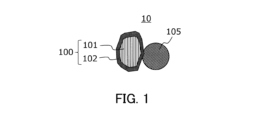
- FIG. 1 is a cross-sectional view showing a schematic configuration of a positive electrode material according to the first embodiment.
- FIG. 2 is a cross-sectional view showing a schematic configuration of a battery according to the second embodiment.
- FIG. 1 is a cross-sectional view showing a schematic configuration of a cathode material according to the first embodiment.
- the cathode material 10 has a coated active material 100 and a second solid electrolyte 105.
- the coated active material 100 is composed of a cathode active material 101 and a coating layer 102.
- the coating layer 102 includes a first solid electrolyte.
- the coating layer 102 coats at least a portion of the surface of the cathode active material 101.
- the coating layer 102 may coat only a portion of the surface of the cathode active material 101, or may uniformly coat the surface of the cathode active material 101.
- the second solid electrolyte 105 includes Li and S.
- the first solid electrolyte contains Li, Ti, M, and X.
- M is at least one selected from the group consisting of metal elements and semimetal elements other than Li and Ti.
- X is at least one selected from the group consisting of F, Cl, Br, and I.
- the ratio of the mass of the first solid electrolyte to the total mass of the positive electrode active material 101 and the first solid electrolyte is 1.00% or more and 4.10% or less.
- the ratio of the mass of the first solid electrolyte to the total mass of the positive electrode active material 101 and the first solid electrolyte may be referred to as the "ratio MA1/MAt".
- Si-metallic elements include B, Si, Ge, As, Sb, and Te.
- Metal elements includes all elements in Groups 1 to 12 of the periodic table except hydrogen, and all elements in Groups 13 to 16 of the periodic table except B, Si, Ge, As, Sb, Te, C, N, P, O, S, and Se. In other words, metal elements are a group of elements that can become cations when forming inorganic compounds with halogen elements.
- the first solid electrolyte can be a solid electrolyte containing a halogen, a so-called halide solid electrolyte.
- Halide solid electrolytes have excellent oxidation resistance. Therefore, by covering the positive electrode active material 101 with the first solid electrolyte, it is possible to suppress oxidation of the second solid electrolyte 105. This makes it possible to suppress an increase in the internal resistance of a battery using the positive electrode material 10, suppressing deterioration of the battery, and ultimately improving the cycle characteristics of a battery using the positive electrode material 10.
- the ratio MA1/MAt may be 1.00% or more and 4.01% or less, 1.10% or more and 4.01% or less, 1.10% or more and 3.80% or less, 1.10% or more and 3.60% or less, 1.30% or more and 3.70% or less, or 1.60% or more and 3.60% or less. In some cases, the ratio MA1/MAt may be 1.10% or more and 4.10% or less, 1.30% or more and 4.10% or less, or 1.60% or more and 4.01% or less.
- the total mass MAt of the positive electrode active material 101 and the first solid electrolyte is the sum of the mass MA2 of the positive electrode active material 101 and the mass MA1 of the first solid electrolyte.
- the mass MA1 of the first solid electrolyte is the total mass of the first solid electrolyte in the powder of the positive electrode material 10.
- the mass MA2 of the positive electrode active material 101 is the total mass of the positive electrode active material 101 in the powder of the positive electrode material 10.
- the ratio MA1/MAt is a value determined from the entirety of a certain amount of the powder of the positive electrode material 10.
- the above ratio MA1/MAt can be calculated from the amounts of materials charged, or by the method described below.
- a positive electrode using the positive electrode material 10 is analyzed by high-frequency inductively coupled plasma atomic emission spectroscopy, and elements contained in the positive electrode active material 101 but not contained in the first solid electrolyte and elements contained in the first solid electrolyte but not contained in the positive electrode active material 101 are quantitatively analyzed to analyze the mass ratio of the positive electrode active material 101 and the first solid electrolyte, making it possible to calculate the ratio MA1/MAt.
- the ratio MA1/MAt can also be calculated from the composition ratio of particle cross sections analyzed by energy dispersive X-ray spectroscopy using a scanning electron microscope.
- the second solid electrolyte 105 and the coated active material 100 may be in contact with each other.
- the coating layer 102 and the second solid electrolyte 105 are in contact with each other.
- the positive electrode material 10 may include a plurality of particles of the second solid electrolyte 105 and a plurality of particles of the coated active material 100.
- the positive electrode active material 101 includes a material having a property of absorbing and releasing metal ions (e.g., lithium ions).
- a lithium-containing transition metal oxide, a transition metal fluoride, a polyanion material, a fluorinated polyanion material, a transition metal sulfide, a transition metal oxysulfide, a transition metal oxynitride, or the like can be used.
- the manufacturing cost of the battery can be reduced and the average discharge voltage can be increased.
- the lithium-containing transition metal oxide include Li(NiCoAl)O 2 , Li(NiCoMn)O 2 , and LiCoO 2 .
- the positive electrode active material 101 has, for example, a particle shape.
- the particle shape of the positive electrode active material 101 is not particularly limited.
- the particle shape of the positive electrode active material 101 can be spherical, oval spherical, scaly, or fibrous.
- the median diameter of the coated active material 100 may be 0.1 ⁇ m or more and 100 ⁇ m or less.
- the coated active material 100 and the second solid electrolyte 105 can form a good dispersion state in the positive electrode material 10. As a result, the charge/discharge characteristics of the battery are improved.
- the median diameter of the coated active material 100 is 100 ⁇ m or less, the diffusion speed of lithium inside the coated active material 100 is sufficiently ensured. Therefore, the battery can operate at high output.
- the median diameter of the coated active material 100 may be larger than the median diameter of the second solid electrolyte 105. This allows the positive electrode active material 101 and the second solid electrolyte 105 to form a good dispersion state.
- volume diameter refers to the particle size when the cumulative volume in the volume-based particle size distribution is equal to 50%.
- the volume-based particle size distribution is measured, for example, by a laser diffraction measuring device or an image analyzer.
- the specific surface area of the coated active material 100 may be 0.60 m2 /g or more and 1.40 m2 /g or less, 0.60 m2 /g or more and 1.30 m2 /g or less, 0.60 m2 /g or more and 1.20 m2 /g or less, 0.68 m2 /g or more and 1.16 m2 /g or less, or 0.68 m2 /g or more and 1.15 m2 /g or less.
- the specific surface area of the coated active material 100 may be 0.80 m 2 /g or more and 1.40 m 2 /g or less, 0.80 m 2 /g or more and 1.30 m 2 /g or less, 0.80 m 2 /g or more and 1.20 m 2 /g or less, 0.80 m 2 /g or more and 1.16 m 2 /g or less, 0.80 m 2 /g or more and 1.20 m 2 /g or less, or 0.81 m 2 /g or more and 1.15 m 2 /g or less.
- the specific surface area is a BET specific surface area that can be measured by the BET method.
- the coating layer 102 includes a first solid electrolyte.
- the first solid electrolyte has ion conductivity.
- the ion conductivity is typically lithium ion conductivity.
- the coating layer 102 is provided on the surface of the positive electrode active material 101.
- the coating layer 102 may include the first solid electrolyte as a main component, or may include only the first solid electrolyte.
- Main component means a component that is included most in mass ratio.
- “Includes only the first solid electrolyte” means that, except for inevitable impurities, materials other than the first solid electrolyte are not intentionally added.
- the ratio of the mass of the inevitable impurities to the total mass of the coating layer 102 may be 5% or less, 3% or less, 1% or less, or 0.5% or less.
- the first solid electrolyte is a material containing Li, Ti, M, and X. M and X are as described above. Such a material has excellent ionic conductivity and oxidation resistance. Therefore, the positive electrode material 10 having the coating layer 102 containing the first solid electrolyte improves the charge/discharge efficiency and thermal stability of the battery.
- M may contain at least one selected from the group consisting of Ca, Mg, Al, Y, Ni, Fe, Cr, and Zr. M may contain at least one selected from the group consisting of Ca, Mg, Al, Y, and Zr. With this configuration, the halide solid electrolyte exhibits high ionic conductivity.
- composition formula (1) The halide solid electrolyte as the first solid electrolyte is represented, for example, by the following composition formula (1):
- ⁇ , ⁇ , ⁇ , and ⁇ are each independently a value greater than 0.
- the halide solid electrolyte represented by formula (1) has a higher ionic conductivity than a halide solid electrolyte such as LiI, which is composed only of Li and halogen elements. Therefore, when the halide solid electrolyte represented by formula (1) is used in a battery, the charge and discharge efficiency of the battery can be improved.
- M in composition formula (1) may be Al.
- the halide solid electrolyte as the first solid electrolyte may be represented by the following composition formula (2):
- M2 is at least one selected from the group consisting of Zr, Ni, Fe, and Cr
- m is the valence of M2, and 0.1 ⁇ x ⁇ 0.9, 0 ⁇ y ⁇ 0.1, 0 ⁇ z ⁇ 0.1, and 0.8 ⁇ b ⁇ 1.2 are satisfied.
- m is the total value of the product of the composition ratio of each element and the valence of the element.
- M2 contains the element Me1 and the element Me2
- the composition ratio of the element Me1 is a1 and the valence is m1
- the composition ratio of the element Me2 is a2 and the valence of the element Me2 is m2
- m is expressed as m1a1+m2a2.
- the halide solid electrolyte may consist essentially of Li, Ti, Al, and X.
- the halide solid electrolyte consists essentially of Li, Ti, Al, and X
- the molar ratio (i.e., molar fraction) of the sum of the amounts of substance of Li, Ti, Al, and X to the sum of the amounts of substance of all elements constituting the halide solid electrolyte is 90% or more.
- the molar ratio (i.e., molar fraction) may be 95% or more.
- the halide solid electrolyte may consist only of Li, Ti, Al, and X.
- the ratio of the amount of Li to the sum of the amounts of Ti and Al may be 1.12 or more and 5.07 or less.
- the halide solid electrolyte as the first solid electrolyte may be represented by the following composition formula (3): In composition formula (3), 0 ⁇ x ⁇ 1 and 0 ⁇ b ⁇ 1.5 are satisfied. Li 6-(4-x)b (Ti 1-x Al x ) b F 6 ...Composition formula (3)
- Halide solid electrolytes with such compositions have high ionic conductivity.
- the upper and lower limits of the range of x in composition formula (3) can be defined by any combination selected from the numerical values of 0.1, 0.3, 0.4, 0.5, 0.6, 0.67, 0.7, 0.8, and 0.9.
- composition formula (3) In order to increase the ionic conductivity of the first solid electrolyte, 0.8 ⁇ b ⁇ 1.2 may be satisfied in composition formula (3).
- the halide solid electrolyte may be crystalline or amorphous.
- the shape of the halide solid electrolyte is not limited. Examples of the shape are needle-like, spherical, or elliptical.
- the halide solid electrolyte may be particulate.
- the solid electrolyte When the halide solid electrolyte has a particulate (e.g., spherical) shape, the solid electrolyte may have a median diameter of 0.01 ⁇ m or more and 100 ⁇ m or less.
- the halide solid electrolyte may be a solid electrolyte that does not contain sulfur. In this case, it is possible to prevent the solid electrolyte from generating sulfur-containing gases such as hydrogen sulfide gas.
- a sulfur-free solid electrolyte means a solid electrolyte that is expressed by a composition formula that does not contain elemental sulfur. Therefore, a solid electrolyte that contains a very small amount of sulfur, for example a solid electrolyte with a sulfur content of 0.1 mass% or less, belongs to the category of solid electrolytes that do not contain sulfur.
- the halide solid electrolyte may further contain oxygen as an anion other than the halogen element.
- the thickness of the coating layer 102 is, for example, 1 nm or more and 500 nm or less. If the thickness of the coating layer 102 is appropriately adjusted, contact between the positive electrode active material 101 and the second solid electrolyte 105 can be sufficiently suppressed.
- the thickness of the coating layer 102 can be determined by slicing the coated active material by a method such as ion milling and observing the cross section of the coated active material with a transmission electron microscope. The average value of thicknesses measured at any number of positions (for example, five points) can be regarded as the thickness of the coating layer 102.
- the halide solid electrolyte can be produced, for example, by the following method.
- a method for producing the halide solid electrolyte represented by composition formula (1) will be exemplified.
- Raw material powders are prepared and mixed to obtain the desired composition.
- the raw material powders may be, for example, halides.
- the target composition is Li2.7Ti0.3Al0.7F6
- LiF , TiF4 , and AlF3 are mixed in a molar ratio of about 2.7:0.3: 0.7 .
- the raw material powders may be mixed in a pre-adjusted molar ratio to offset composition changes that may occur in the synthesis process.
- the raw powders are reacted with each other mechanochemically (i.e., using a mechanochemical milling method) in a mixing device such as a planetary ball mill to obtain a reactant.
- the reactant may be fired in a vacuum or in an inert atmosphere.
- a mixture of the raw powders may be fired in a vacuum or in an inert atmosphere to obtain a reactant.
- the firing is carried out, for example, at a temperature of 100°C or higher and 400°C or lower for 1 hour or more.
- the raw powders may be fired in a closed container such as a quartz tube.
- the second solid electrolyte 105 contains Li and S.
- the second solid electrolyte 105 contains a sulfide solid electrolyte.
- the sulfide solid electrolyte has high ionic conductivity and can improve the charge/discharge efficiency of the battery.
- the sulfide solid electrolyte has poor oxidation resistance, but the application of the technology of the present disclosure can provide a high effect.
- the second solid electrolyte 105 may be in contact with the positive electrode active material 101 via the coating layer 102.
- Li2S - P2S5 Li2S - SiS2 , Li2S - B2S3 , Li2S - GeS2 , Li3.25Ge0.25P0.75S4 , and Li10GeP2S12 .
- LiX, Li2O , MOq , and LipMOq may be added to these.
- X in “LiX” is at least one selected from the group consisting of F , Cl, Br, and I.
- the element M in “ MOq " and “LipMOq " is at least one selected from the group consisting of P, Si, Ge, B, Al, Ga, In, Fe, and Zn.
- MO q and " Lip MO q ", p and q are each independent natural numbers.
- the second solid electrolyte 105 may contain another solid electrolyte in addition to the sulfide solid electrolyte.
- the second solid electrolyte 105 may contain a sulfide solid electrolyte and at least one selected from the group consisting of an oxide solid electrolyte, a polymer solid electrolyte, and a complex hydride solid electrolyte.
- the oxide solid electrolyte is a solid electrolyte that contains oxygen.
- the oxide solid electrolyte may further contain anions other than sulfur and halogen elements as anions other than oxygen.
- oxide solid electrolytes examples include NASICON-type solid electrolytes such as LiTi2 ( PO4 ) 3 and its elemental substitution products, (LaLi) TiO3 -based perovskite -type solid electrolytes, LISICON-type solid electrolytes such as Li14ZnGe4O16 , Li4SiO4 , LiGeO4 and their elemental substitution products, garnet -type solid electrolytes such as Li7La3Zr2O12 and its elemental substitution products , Li3PO4 and its N-substitution products, and glasses or glass ceramics containing a base material containing Li - B -O compounds such as LiBO2 and Li3BO3 to which materials such as Li2SO4 and Li2CO3 have been added.
- NASICON-type solid electrolytes such as LiTi2 ( PO4 ) 3 and its elemental substitution products
- (LaLi) TiO3 -based perovskite -type solid electrolytes LISICON-type solid electro
- the complex hydride solid electrolyte for example, LiBH 4 --LiI, LiBH 4 --P 2 S 5 , etc. can be used.
- the second solid electrolyte 105 may have a lithium ion conductivity higher than the lithium ion conductivity of the first solid electrolyte.
- the second solid electrolyte 105 may contain unavoidable impurities such as starting materials, by-products, and decomposition products used in synthesizing the solid electrolyte. This also applies to the first solid electrolyte.
- the positive electrode material 10 may contain a binder for the purpose of improving the adhesion between particles.
- the binder is used to improve the binding property of the material constituting the positive electrode.
- the binder include polyvinylidene fluoride, polytetrafluoroethylene, polyethylene, polypropylene, aramid resin, polyamide, polyimide, polyamideimide, polyacrylonitrile, polyacrylic acid, polyacrylic acid methyl ester, polyacrylic acid ethyl ester, polyacrylic acid hexyl ester, polymethacrylic acid, polymethacrylic acid methyl ester, polymethacrylic acid ethyl ester, polymethacrylic acid hexyl ester, polyvinyl acetate, polyvinylpyrrolidone, polyether, polycarbonate, polyethersulfone, polyetherketone, polyetheretherketone, polyphenylene sulfide, hexafluoropolypropylene,
- One selected from these may be used alone, or two or more may be used in combination.
- the binder may be an elastomer because of its excellent binding properties.
- An elastomer is a polymer that has rubber elasticity.
- the elastomer used as the binder may be a thermoplastic elastomer or a thermosetting elastomer.
- the binder may contain a thermoplastic elastomer.
- thermoplastic elastomers examples include styrene-ethylene-butylene-styrene (SEBS), styrene-ethylene-propylene-styrene (SEPS), styrene-ethylene-ethylene-propylene-styrene (SEEPS), butylene rubber (BR), isoprene rubber (IR), chloroprene rubber (CR), acrylonitrile-butadiene rubber (NBR), styrene-butylene rubber (SBR), styrene-butadiene-styrene (SBS), styrene-isoprene-styrene (SIS), hydrogenated isoprene rubber (HIR), hydrogenated butyl rubber (HIIR), hydrogenated nitrile rubber (HNBR), hydrogenated styrene-butylene rubber (HSBR), polyvinylidene fluoride (PVdF), polytetrafluoroethylene (PTFE), etc.
- the positive electrode material 10 may contain a conductive assistant for the purpose of increasing electronic conductivity.
- conductive assistants that can be used include graphites such as natural graphite or artificial graphite, carbon blacks such as acetylene black and ketjen black, conductive fibers such as carbon fibers or metal fibers, metal powders such as carbon fluoride and aluminum, conductive whiskers such as zinc oxide or potassium titanate, conductive metal oxides such as titanium oxide, and conductive polymer compounds such as polyaniline, polypyrrole, and polythiophene.
- the coating layer 102 may contain the above-mentioned conductive additives to increase electronic conductivity.
- the coated active material 100 can be produced by the following method.
- a powder of the positive electrode active material 101 and a powder of the first solid electrolyte are mixed in an appropriate ratio to obtain a mixture.
- the mixture is milled to impart mechanical energy to the mixture.
- a mixing device such as a ball mill can be used for the milling process.
- the milling process may be performed in a dry and inert atmosphere to suppress oxidation of the materials.
- the coated active material 100 may be manufactured by a dry particle composite method.
- the treatment by the dry particle composite method includes applying at least one mechanical energy selected from the group consisting of impact, compression, and shear to the positive electrode active material 101 and the first solid electrolyte.
- the positive electrode active material 101 and the first solid electrolyte are mixed in an appropriate ratio.
- the device used in the manufacture of the coated active material 100 is not particularly limited, and may be a device capable of applying mechanical energy of impact, compression, and shear to the mixture of the positive electrode active material 101 and the first solid electrolyte.
- devices capable of applying mechanical energy include ball mills, and compression shear processing devices (particle composite devices) such as "Mechanofusion” (manufactured by Hosokawa Micron Corporation) and "Nobilta” (manufactured by Hosokawa Micron Corporation).
- Mechanism is a particle compounding device that uses a dry mechanical compounding technology by applying strong mechanical energy to multiple different raw material powders.
- mechanofusion the raw material powders fed between a rotating container and a press head are subjected to compression, shear, and friction mechanical energy. This causes the particles to compound.
- Nobilta is a particle compounding device that uses dry mechanical compounding technology, an advanced form of particle compounding technology, to compound nanoparticles as raw materials. Nobilta produces composite particles by applying mechanical energy in the form of impact, compression, and shear to multiple types of raw powders.
- Nobilta a rotor arranged to have a specified gap between itself and the inner wall of a horizontal cylindrical mixing vessel rotates at high speed, and the process of forcing the raw material powder to pass through the gap is repeated multiple times. This applies impact, compression, and shear forces to the mixture, making it possible to produce composite particles of the positive electrode active material 101 and the first solid electrolyte.
- the coated active material 100 may be produced by mixing the positive electrode active material 101 and the first solid electrolyte using a mortar, mixer, or the like.
- the first solid electrolyte may be deposited on the surface of the positive electrode active material 101 by various methods such as a spray method, a spray dry coating method, an electrodeposition method, an immersion method, or a mechanical mixing method using a disperser.
- the positive electrode material 10 is obtained by mixing the coated active material 100 and the second solid electrolyte 105.
- the method for mixing the coated active material 100 and the second solid electrolyte 105 is not particularly limited.
- the coated active material 100 and the second solid electrolyte 105 may be mixed using a tool such as a mortar, or the coated active material 100 and the second solid electrolyte 105 may be mixed using a mixing device such as a ball mill.
- (Embodiment 2) 2 is a cross-sectional view showing a schematic configuration of a battery according to embodiment 2.
- Battery 200 includes a positive electrode 201, a separator layer 202, and a negative electrode 203. Separator layer 202 is disposed between positive electrode 201 and negative electrode 203.
- Positive electrode 201 includes positive electrode material 10 described in embodiment 1. With such a configuration, an increase in the internal resistance of battery 200 can be suppressed.
- each of the positive electrode 201 and the negative electrode 203 may be 10 ⁇ m or more and 500 ⁇ m or less. If the thickness of the positive electrode 201 and the negative electrode 203 is 10 ⁇ m or more, sufficient energy density of the battery can be ensured. If the thickness of the positive electrode 201 and the negative electrode 203 is 500 ⁇ m or less, high-power operation of the battery 200 can be achieved.
- the separator layer 202 is a layer containing an electrolyte material.
- the separator layer 202 may contain at least one solid electrolyte selected from the group consisting of a sulfide solid electrolyte, an oxide solid electrolyte, a halide solid electrolyte, a polymer solid electrolyte, and a complex hydride solid electrolyte. Details of each solid electrolyte are as described in the first embodiment.
- the thickness of the separator layer 202 may be 1 ⁇ m or more and 300 ⁇ m or less. When the thickness of the separator layer 202 is 1 ⁇ m or more, the positive electrode 201 and the negative electrode 203 can be more reliably separated. When the thickness of the separator layer 202 is 300 ⁇ m or less, the battery 200 can be operated at high power.
- the negative electrode 203 contains a material as the negative electrode active material that has the property of absorbing and releasing metal ions (e.g., lithium ions).
- metal ions e.g., lithium ions
- metal materials, carbon materials, oxides, nitrides, tin compounds, silicon compounds, etc. can be used as the negative electrode active material.
- the metal material may be a single metal.
- the metal material may be an alloy.
- Examples of the metal material include lithium metal and lithium alloys.
- Examples of the carbon material include natural graphite, coke, partially graphitized carbon, carbon fiber, spherical carbon, artificial graphite, and amorphous carbon. From the viewpoint of capacity density, silicon (Si), tin (Sn), silicon compounds, tin compounds, etc. can be preferably used.
- the median diameter of the particles of the negative electrode active material may be 0.1 ⁇ m or more and 100 ⁇ m or less.
- the negative electrode 203 may contain other materials, such as a solid electrolyte.
- the material described in embodiment 1 can be used as the solid electrolyte.
- a coated active material including a positive electrode active material and a first solid electrolyte and including a coating layer that coats at least a portion of a surface of the positive electrode active material;
- a second solid electrolyte; Equipped with The first solid electrolyte comprises Li, Ti, M, and X;
- the M is at least one selected from the group consisting of metal elements and metalloid elements other than Li and Ti,
- X is at least one selected from the group consisting of F, Cl, Br, and I;
- the second solid electrolyte contains Li and S, a ratio of the mass of the first solid electrolyte to the total mass of the positive electrode active material and the first solid electrolyte is 1.00% or more and 4.10% or less; Positive electrode material.
- This configuration makes it possible to suppress an increase in the battery's internal resistance.
- the first solid electrolyte is represented by the following composition formula (1): Li ⁇ Ti ⁇ M ⁇ X ⁇ ...Composition formula (1)
- ⁇ , ⁇ , ⁇ , and ⁇ are each independently a value greater than 0.
- the first solid electrolyte is represented by the following composition formula (2): Li 6-(4-x-my)b (Ti 1-xy Al x M2 y ) b F 6-2z O z... Composition formula (2)
- M2 is at least one selected from the group consisting of Zr, Ni, Fe, and Cr
- m is the valence of M2
- 0.1 ⁇ x ⁇ 0.9, 0 ⁇ y ⁇ 0.1, 0 ⁇ z ⁇ 0.1, and 0.8 ⁇ b ⁇ 1.2 are satisfied. According to such a configuration, the output characteristics of the battery can be improved.
- Example 1 [Preparation of first solid electrolyte]
- the first solid electrolyte of Example 1 had a composition represented by Li 2.5 Ti 0.5 Al 0.5 F 6 (hereinafter referred to as "LTAF").
- NCA Li(NiCoAl)O 2
- a coating layer made of LTAF was formed on the surface of the NCA.
- the coating layer was formed by shearing using a particle mixer (BALANCE GRAN, manufactured by Freund Turbo). Specifically, NCA and LTAF were weighed to have a mass ratio of 98.9:1.1, and treated under the conditions of a rotation speed of 3100 rpm and a treatment time of 1 hour. This resulted in the coated active material of Example 1.
- the specific surface area of the coated active material of Example 1 was 0.68 m 2 /g.
- Example 2 Except for changing the mass ratio of NCA to LTAF to 98.39:1.61, a coated active material of Example 2 was obtained in the same manner as in Example 1.
- the specific surface area of the coated active material of Example 2 was 0.81 m 2 /g.
- the positive electrode material of Example 2 was obtained in the same manner as in Example 1 using the coated active material of Example 2.
- Example 3 Except for changing the mass ratio of NCA to LTAF to 97.55:2.45, a coated active material of Example 3 was obtained in the same manner as in Example 1.
- the specific surface area of the coated active material of Example 3 was 1.10 m 2 /g.
- the positive electrode material of Example 3 was obtained in the same manner as in Example 1 using the coated active material of Example 3.
- Example 4 Except for changing the mass ratio of NCA to LTAF to 96.42:3.58, a coated active material of Example 4 was obtained in the same manner as in Example 1.
- the specific surface area of the coated active material of Example 4 was 1.15 m 2 /g.
- the positive electrode material of Example 4 was obtained in the same manner as in Example 1 using the coated active material of Example 4.
- Example 5 Except for changing the mass ratio of NCA to LTAF to 95.99:4.01, a coated active material of Example 5 was obtained in the same manner as in Example 1.
- the specific surface area of the coated active material of Example 5 was 1.16 m 2 /g.
- the positive electrode material of Example 5 was obtained in the same manner as in Example 1 using the coated active material of Example 5.
- NCA not coated with LTAF was used as the active material of Comparative Example 1.
- the specific surface area of the active material of Comparative Example 1 was 0.55 m 2 /g.
- the ratio of the mass of LTAF to the total mass of NCA and LTAF was expressed as a percentage and was as shown in Table 1.
- the "ratio of the mass of LTAF to the total mass of NCA and LTAF” is expressed as "LTAF/(LTAF+NCA) (mass %)".
- the positive electrode material was weighed so that it contained 14 mg of NCA.
- the LPS and the positive electrode material were laminated in this order in an insulating outer cylinder.
- the obtained laminate was pressure-molded at a pressure of 720 MPa.
- metallic lithium was placed so as to be in contact with the LPS layer, and pressure-molded again at a pressure of 40 MPa.
- stainless steel current collectors were placed on the top and bottom of the laminate. Current collector leads were attached to each current collector.
- the inside of the outer cylinder was sealed using an insulating ferrule to isolate the inside of the outer cylinder from the outside atmosphere.
- the internal temperature of the thermostatic chamber was changed to 80°C, and the battery was stored for one week in a charged state at 4.1 V.
- the internal temperature of the thermostatic chamber was returned to 25°C, and the battery was charged at a constant current of 147 ⁇ A, which is a 0.05C rate (20 hour rate) for the theoretical capacity of the battery, until the voltage reached 4.3V.
- the battery was then discharged at a constant current of 147 ⁇ A, which is a 0.05C rate (20 hour rate) for the theoretical capacity of the battery, until the voltage reached 3.7V.
- the battery was then discharged at a constant current of 0.136A for 0.1 seconds, which is a 46.4C rate for the theoretical capacity of the battery, and the resistance value of the battery after the storage test was calculated from the voltage drop at that time.
- the "resistance increase rate” is a value calculated by the formula: 100 x (resistance value after storage test) / (resistance value before storage test).
- the halide solid electrolyte exhibits the same level of ionic conductivity even when at least one element selected from the group consisting of metal elements and semimetal elements other than Li and Ti, such as Ca, Mg, Al, Y, or Zr, is used instead of Al (for example, Japanese Patent Application No. 2020-048461 by the present applicant). Therefore, a halide solid electrolyte containing at least one element selected from the group consisting of these elements can be used in place of Al or together with Al. Even in this case, the battery can be charged and discharged, and the effect of suppressing the oxidation reaction of the sulfide solid electrolyte and suppressing an increase in resistance can be obtained.
- oxidation of the sulfide solid electrolyte occurs mainly when the sulfide solid electrolyte comes into contact with the positive electrode active material and electrons are extracted from the sulfide solid electrolyte. Therefore, according to the technology disclosed herein, the effect of suppressing oxidation of the sulfide solid electrolyte can be obtained even when an active material other than NCA is used.
- the technology disclosed herein is useful, for example, in all-solid-state lithium secondary batteries.
Landscapes
- Chemical & Material Sciences (AREA)
- Chemical Kinetics & Catalysis (AREA)
- Electrochemistry (AREA)
- General Chemical & Material Sciences (AREA)
- Engineering & Computer Science (AREA)
- Organic Chemistry (AREA)
- Inorganic Chemistry (AREA)
- Manufacturing & Machinery (AREA)
- Materials Engineering (AREA)
- Physics & Mathematics (AREA)
- Condensed Matter Physics & Semiconductors (AREA)
- General Physics & Mathematics (AREA)
- Composite Materials (AREA)
- Secondary Cells (AREA)
- Battery Electrode And Active Subsutance (AREA)
Priority Applications (3)
| Application Number | Priority Date | Filing Date | Title |
|---|---|---|---|
| JP2025505107A JPWO2024185316A1 (https=) | 2023-03-07 | 2024-01-22 | |
| CN202480015165.8A CN120858467A (zh) | 2023-03-07 | 2024-01-22 | 正极材料、正极和电池 |
| US19/317,972 US20260005294A1 (en) | 2023-03-07 | 2025-09-03 | Positive electrode material, positive electrode, and battery |
Applications Claiming Priority (2)
| Application Number | Priority Date | Filing Date | Title |
|---|---|---|---|
| JP2023034948 | 2023-03-07 | ||
| JP2023-034948 | 2023-03-07 |
Related Child Applications (1)
| Application Number | Title | Priority Date | Filing Date |
|---|---|---|---|
| US19/317,972 Continuation US20260005294A1 (en) | 2023-03-07 | 2025-09-03 | Positive electrode material, positive electrode, and battery |
Publications (1)
| Publication Number | Publication Date |
|---|---|
| WO2024185316A1 true WO2024185316A1 (ja) | 2024-09-12 |
Family
ID=92674813
Family Applications (1)
| Application Number | Title | Priority Date | Filing Date |
|---|---|---|---|
| PCT/JP2024/001656 Ceased WO2024185316A1 (ja) | 2023-03-07 | 2024-01-22 | 正極材料、正極および電池 |
Country Status (4)
| Country | Link |
|---|---|
| US (1) | US20260005294A1 (https=) |
| JP (1) | JPWO2024185316A1 (https=) |
| CN (1) | CN120858467A (https=) |
| WO (1) | WO2024185316A1 (https=) |
Citations (8)
| Publication number | Priority date | Publication date | Assignee | Title |
|---|---|---|---|---|
| WO2021205821A1 (ja) * | 2020-04-09 | 2021-10-14 | パナソニックIpマネジメント株式会社 | 正極材料および電池 |
| WO2022004397A1 (ja) * | 2020-06-29 | 2022-01-06 | パナソニックIpマネジメント株式会社 | 正極材料および電池 |
| WO2022209686A1 (ja) * | 2021-03-30 | 2022-10-06 | パナソニックIpマネジメント株式会社 | 被覆正極活物質、正極材料、電池、および被覆正極活物質の製造方法 |
| WO2022224505A1 (ja) * | 2021-04-20 | 2022-10-27 | パナソニックIpマネジメント株式会社 | 正極材料および電池 |
| WO2022255003A1 (ja) * | 2021-06-03 | 2022-12-08 | パナソニックIpマネジメント株式会社 | 電池 |
| WO2022255002A1 (ja) * | 2021-06-03 | 2022-12-08 | パナソニックIpマネジメント株式会社 | 電池 |
| WO2022254985A1 (ja) * | 2021-05-31 | 2022-12-08 | パナソニックIpマネジメント株式会社 | 被覆活物質、正極材料、正極および電池 |
| WO2022255026A1 (ja) * | 2021-05-31 | 2022-12-08 | パナソニックIpマネジメント株式会社 | 被覆活物質、正極材料、正極および電池 |
-
2024
- 2024-01-22 JP JP2025505107A patent/JPWO2024185316A1/ja active Pending
- 2024-01-22 WO PCT/JP2024/001656 patent/WO2024185316A1/ja not_active Ceased
- 2024-01-22 CN CN202480015165.8A patent/CN120858467A/zh active Pending
-
2025
- 2025-09-03 US US19/317,972 patent/US20260005294A1/en active Pending
Patent Citations (8)
| Publication number | Priority date | Publication date | Assignee | Title |
|---|---|---|---|---|
| WO2021205821A1 (ja) * | 2020-04-09 | 2021-10-14 | パナソニックIpマネジメント株式会社 | 正極材料および電池 |
| WO2022004397A1 (ja) * | 2020-06-29 | 2022-01-06 | パナソニックIpマネジメント株式会社 | 正極材料および電池 |
| WO2022209686A1 (ja) * | 2021-03-30 | 2022-10-06 | パナソニックIpマネジメント株式会社 | 被覆正極活物質、正極材料、電池、および被覆正極活物質の製造方法 |
| WO2022224505A1 (ja) * | 2021-04-20 | 2022-10-27 | パナソニックIpマネジメント株式会社 | 正極材料および電池 |
| WO2022254985A1 (ja) * | 2021-05-31 | 2022-12-08 | パナソニックIpマネジメント株式会社 | 被覆活物質、正極材料、正極および電池 |
| WO2022255026A1 (ja) * | 2021-05-31 | 2022-12-08 | パナソニックIpマネジメント株式会社 | 被覆活物質、正極材料、正極および電池 |
| WO2022255003A1 (ja) * | 2021-06-03 | 2022-12-08 | パナソニックIpマネジメント株式会社 | 電池 |
| WO2022255002A1 (ja) * | 2021-06-03 | 2022-12-08 | パナソニックIpマネジメント株式会社 | 電池 |
Also Published As
| Publication number | Publication date |
|---|---|
| CN120858467A (zh) | 2025-10-28 |
| JPWO2024185316A1 (https=) | 2024-09-12 |
| US20260005294A1 (en) | 2026-01-01 |
Similar Documents
| Publication | Publication Date | Title |
|---|---|---|
| US20240405202A1 (en) | Coated active material, electrode material, and battery | |
| US20240194862A1 (en) | Positive electrode material, positive electrode, and battery | |
| JP7796340B2 (ja) | 被覆活物質、正極材料、正極および電池 | |
| US20240204247A1 (en) | Positive electrode material, positive electrode, and battery | |
| WO2022255027A1 (ja) | 被覆活物質、正極材料、正極および電池 | |
| WO2022255026A1 (ja) | 被覆活物質、正極材料、正極および電池 | |
| WO2023037815A1 (ja) | 被覆活物質、電極材料および電池 | |
| WO2023037816A1 (ja) | 被覆活物質、電極材料および電池 | |
| WO2023037756A1 (ja) | 正極材料、正極および電池 | |
| WO2024185316A1 (ja) | 正極材料、正極および電池 | |
| US20260128324A1 (en) | Coated active material, positive electrode material, positive electrode, and battery | |
| WO2024262185A1 (ja) | 被覆活物質、正極材料、正極、および電池 | |
| JP7825185B2 (ja) | 正極材料、正極および電池 | |
| US20260088344A1 (en) | Cathode material, cathode, and battery | |
| US20260106151A1 (en) | Electrode material and battery | |
| US20260088345A1 (en) | Cathode material, cathode, and battery | |
| WO2024262182A1 (ja) | 被覆活物質、正極材料、および電池 | |
| WO2024262183A1 (ja) | 被覆活物質、正極材料、および電池 | |
| WO2025253965A1 (ja) | 電極材料、および電池 | |
| WO2025253964A1 (ja) | 被覆活物質、電極材料、および電池 | |
| EP4734183A1 (en) | Coated active material, positive electrode material, positive electrode, and battery |
Legal Events
| Date | Code | Title | Description |
|---|---|---|---|
| 121 | Ep: the epo has been informed by wipo that ep was designated in this application |
Ref document number: 24766691 Country of ref document: EP Kind code of ref document: A1 |
|
| WWE | Wipo information: entry into national phase |
Ref document number: 202480015165.8 Country of ref document: CN |
|
| ENP | Entry into the national phase |
Ref document number: 2025505107 Country of ref document: JP Kind code of ref document: A |
|
| WWE | Wipo information: entry into national phase |
Ref document number: 2025505107 Country of ref document: JP |
|
| NENP | Non-entry into the national phase |
Ref country code: DE |
|
| WWP | Wipo information: published in national office |
Ref document number: 202480015165.8 Country of ref document: CN |
|
| 122 | Ep: pct application non-entry in european phase |
Ref document number: 24766691 Country of ref document: EP Kind code of ref document: A1 |