WO2024176863A1 - 偏光素子 - Google Patents
偏光素子 Download PDFInfo
- Publication number
- WO2024176863A1 WO2024176863A1 PCT/JP2024/004355 JP2024004355W WO2024176863A1 WO 2024176863 A1 WO2024176863 A1 WO 2024176863A1 JP 2024004355 W JP2024004355 W JP 2024004355W WO 2024176863 A1 WO2024176863 A1 WO 2024176863A1
- Authority
- WO
- WIPO (PCT)
- Prior art keywords
- liquid crystal
- polarizing element
- polymer liquid
- light
- element according
- Prior art date
- Legal status (The legal status is an assumption and is not a legal conclusion. Google has not performed a legal analysis and makes no representation as to the accuracy of the status listed.)
- Ceased
Links
Images

Classifications
-
- G—PHYSICS
- G02—OPTICS
- G02B—OPTICAL ELEMENTS, SYSTEMS OR APPARATUS
- G02B5/00—Optical elements other than lenses
- G02B5/30—Polarising elements
- G02B5/3016—Polarising elements involving passive liquid crystal elements
-
- C—CHEMISTRY; METALLURGY
- C08—ORGANIC MACROMOLECULAR COMPOUNDS; THEIR PREPARATION OR CHEMICAL WORKING-UP; COMPOSITIONS BASED THEREON
- C08F—MACROMOLECULAR COMPOUNDS OBTAINED BY REACTIONS ONLY INVOLVING CARBON-TO-CARBON UNSATURATED BONDS
- C08F20/00—Homopolymers and copolymers of compounds having one or more unsaturated aliphatic radicals, each having only one carbon-to-carbon double bond, and only one being terminated by only one carboxyl radical or a salt, anhydride, ester, amide, imide or nitrile thereof
- C08F20/02—Monocarboxylic acids having less than ten carbon atoms, Derivatives thereof
- C08F20/10—Esters
-
- C—CHEMISTRY; METALLURGY
- C09—DYES; PAINTS; POLISHES; NATURAL RESINS; ADHESIVES; COMPOSITIONS NOT OTHERWISE PROVIDED FOR; APPLICATIONS OF MATERIALS NOT OTHERWISE PROVIDED FOR
- C09K—MATERIALS FOR MISCELLANEOUS APPLICATIONS, NOT PROVIDED FOR ELSEWHERE
- C09K19/00—Liquid crystal materials
- C09K19/04—Liquid crystal materials characterised by the chemical structure of the liquid crystal components, e.g. by a specific unit
- C09K19/38—Polymers
-
- C—CHEMISTRY; METALLURGY
- C09—DYES; PAINTS; POLISHES; NATURAL RESINS; ADHESIVES; COMPOSITIONS NOT OTHERWISE PROVIDED FOR; APPLICATIONS OF MATERIALS NOT OTHERWISE PROVIDED FOR
- C09K—MATERIALS FOR MISCELLANEOUS APPLICATIONS, NOT PROVIDED FOR ELSEWHERE
- C09K19/00—Liquid crystal materials
- C09K19/04—Liquid crystal materials characterised by the chemical structure of the liquid crystal components, e.g. by a specific unit
- C09K19/38—Polymers
- C09K19/3833—Polymers with mesogenic groups in the side chain
- C09K19/3842—Polyvinyl derivatives
- C09K19/3852—Poly(meth)acrylate derivatives
-
- G—PHYSICS
- G02—OPTICS
- G02B—OPTICAL ELEMENTS, SYSTEMS OR APPARATUS
- G02B1/00—Optical elements characterised by the material of which they are made; Optical coatings for optical elements
- G02B1/10—Optical coatings produced by application to, or surface treatment of, optical elements
- G02B1/11—Anti-reflection coatings
-
- G—PHYSICS
- G02—OPTICS
- G02B—OPTICAL ELEMENTS, SYSTEMS OR APPARATUS
- G02B5/00—Optical elements other than lenses
- G02B5/18—Diffraction gratings
-
- G—PHYSICS
- G02—OPTICS
- G02B—OPTICAL ELEMENTS, SYSTEMS OR APPARATUS
- G02B5/00—Optical elements other than lenses
- G02B5/30—Polarising elements
-
- C—CHEMISTRY; METALLURGY
- C08—ORGANIC MACROMOLECULAR COMPOUNDS; THEIR PREPARATION OR CHEMICAL WORKING-UP; COMPOSITIONS BASED THEREON
- C08L—COMPOSITIONS OF MACROMOLECULAR COMPOUNDS
- C08L33/00—Compositions of homopolymers or copolymers of compounds having one or more unsaturated aliphatic radicals, each having only one carbon-to-carbon double bond, and only one being terminated by only one carboxyl radical, or of salts, anhydrides, esters, amides, imides or nitriles thereof; Compositions of derivatives of such polymers
- C08L33/04—Homopolymers or copolymers of esters
- C08L33/06—Homopolymers or copolymers of esters of esters containing only carbon, hydrogen and oxygen, which oxygen atoms are present only as part of the carboxyl radical
- C08L33/08—Homopolymers or copolymers of acrylic acid esters
Definitions
- the present invention relates to a polarizing element.
- a device called a waveplate is conventionally used to control the polarization of light emitted from a light source.
- WSS Wavelength Selective Switch
- Wavelength selective switches require a waveplate that controls the polarization of multiple optical signals arranged in parallel.
- Patent Document 1 discloses a wave plate in which birefringent zones, in which the polarization of incident light is rotated, and non-birefringent zones, in which the polarization of incident light is not rotated, are alternately stacked.
- the wave plate in Patent Document 1 has the problem that it requires processing to create fine irregularities.
- the present invention was devised in consideration of the above-mentioned conventional situation, and aims to provide a polarizing element that does not require processing to create fine irregularities.
- the present invention provides a polarizing element comprising a first planar member that is transparent to light, a plurality of polymer liquid crystal members arranged on the surface of the first planar member so as to extend in one direction at regular intervals along the surface of the first planar member, and an isotropic member arranged on the surface of the first planar member so as to include the plurality of polymer liquid crystal members, wherein the aspect ratio, which is the ratio of the thickness of the isotropic member to 1/2 the distance between two adjacent polymer liquid crystal members, is less than 1.
- the present invention makes it possible to provide a polarizing element that does not require processing to create fine irregularities.
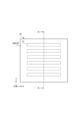
- FIG. 1 is a diagram illustrating an example of a polarizing element according to an embodiment.
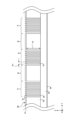
- FIG. 2 is a cross-sectional view of the polarizing element taken along the line AA.
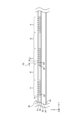
- FIG. 3 is a diagram showing an example of a first polarizing element for comparison.
- FIG. 4 is a diagram showing an example of a second polarizing element for comparison.
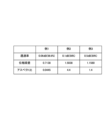
- FIG. 5 is a diagram showing the transmittance, phase difference, and aspect ratio of the polarizing elements of Examples 1 to 3.
- a transmittance of, for example, 90% or more for a particular wavelength range means that the transmittance is not below 90% throughout the entire wavelength range, i.e., the minimum transmittance in that wavelength range is 90% or more.
- the refractive index refers to the refractive index for light with a wavelength of 1550 nm at 25°C.
- Transmittance can be calculated from the ratio of the intensity of incident light to the intensity of transmitted light.
- the range of values " ⁇ " includes the upper and lower limits.
- FIG. 1 shows an example of a polarizing element 10 according to an embodiment.
- An example of the configuration of the polarizing element 10 according to an embodiment of the present invention will be described with reference to the drawing.
- the polarizing element 10 of one embodiment of the present invention is a transmissive polarizing element.
- the shape of the polarizing element 10 is, for example, a flat plate shape.
- the shape of the surface of the polarizing element 10 may be any shape, such as a rectangle, a circle, an ellipse, etc.
- the surface of the polarizing element 10 is the surface through which light enters or passes. Below, an example in which the shape of the surface of the polarizing element 10 of one embodiment is a rectangle is described, but the polarizing element of the present invention is not limited to this example and can have any shape depending on its application, function, etc.
- the polarizing element 10 of one embodiment of the present invention is used, for example, as a polarization rotation element that rotates the polarization of incident light.
- the polarizing element 10 rotates, for example, the direction of polarization of incident light by 90°.
- the polarization of the incident light is, for example, S-polarized or P-polarized light. Note that the angle by which the polarization of the polarizing element 10 is rotated is not limited to 90° and can be set to any angle depending on the application.
- the polarizing element 10 of one embodiment of the present invention is used, for example, in a wavelength selective switch.
- a wavelength selective switch for example, LCOS (Liquid Crystal On Silicon) is used for optical switching, but since LCOS has a strong polarization dependency, it is necessary to align the polarization of the light incident on the LCOS.
- LCOS Liquid Crystal On Silicon
- the polarizing element 10 is an element that is, for example, several millimeters to several tens of centimeters square. The size of the polarizing element 10 can be changed depending on the application.
- the surface of the polarizing element 10 is covered with a transparent anti-reflection film 22A.
- transparent means that the transmittance of light of wavelength ⁇ in the band of use is high, for example, that the transmittance of the light is 70% or more.
- the wavelength ⁇ of the band of use in the polarizing element 10 according to one embodiment is preferably, for example, 1525 nm to 1630 nm.
- the band of 1525 nm to 1570 nm will be referred to as this band of use.
- the anti-reflection film 22 is a thin film that prevents the reflection of light incident on the polarizing element 10. In other words, the anti-reflection film 22 suppresses the reflection loss of the incident light.
- the anti-reflection film 22 prevents the reflection of light with wavelengths of 1525 nm to 1630 nm, which is the band used by the polarizing element 10.
- the anti-reflection film 22 can be a single layer made of a material with a lower refractive index than the glass substrate.
- the anti-reflection film 22 can achieve lower reflectivity by alternately laminating high-refractive index films and low-refractive index films.
- the high-refractive index film here is a film with a refractive index of 1.9 or more at a wavelength of 550 nm
- the low-refractive index film is a film with a refractive index of 1.6 or less at a wavelength of 550 nm.
- materials for the high-refractive index film include titanium oxide, niobium oxide, and tantalum oxide
- examples of low-refractive index materials include silicon oxide, aluminum oxide, and magnesium oxide.
- the polarizing element 10 contains multiple polymer liquid crystal members 21 inside.
- the shape of the polymer liquid crystal member 21 shown in FIG. 1 is a rectangular parallelepiped.
- the axis extending in the longitudinal direction of the polymer liquid crystal member 21 at the side of the polarizing element 10 as shown in FIG. 1 is the X-axis.
- the axis perpendicular to the X-axis and parallel to the direction in which the multiple polymer liquid crystal members 21 are arranged is the Y-axis.
- the axis perpendicular to the X-axis and Y-axis is the Z-axis.
- the multiple polymer liquid crystal members 21 are each arranged so that their longitudinal direction is parallel to the X-axis. In addition, the multiple polymer liquid crystal members 21 are arranged at a predetermined interval in the Y-axis direction.
- the shape of the polymer liquid crystal member 21 shown in FIG. 1 is a rectangular parallelepiped that is long in the X-axis direction, but is not limited to a rectangular parallelepiped, and may be any shape that has a predetermined thickness in the Z-axis direction.
- the number of polymer liquid crystal members 21 shown in FIG. 1 is six, but is not limited to six and may be any number depending on the application.
- Figure 2 is an A-A cross-sectional view of the polarizing element 10.
- FIG. 2 shows the A-A cross section of the polarizing element 10 shown in FIG. 1.
- the polarizing element 10 includes a polymer liquid crystal member 21, anti-reflection films 22A and 22B, deterioration prevention materials 23A and 23B, and an isotropic material 24.
- the anti-reflection films 22A and 22B are thin films provided on the light incidence surface and transmission surface of the polarizing element 10.
- the anti-reflection film 22A is formed on the outer surface of the anti-deterioration material 23A.
- the anti-reflection film 22A may be read as a second anti-reflection film.
- the anti-reflection film 22B is formed on the outer surface of the anti-deterioration material 23B.
- the anti-reflection film 22B may be read as a first anti-reflection film.
- the anti-reflection films 22A and 22B are formed by a vacuum deposition method, a sputtering method, or the like.
- the film thickness of the anti-reflection films 22A and 22B is, for example, about 0.5 ⁇ m.
- the thickness of the anti-reflection films 22A and 22B is not limited to 0.5 ⁇ m.
- the anti-reflection film 22 is an isotropic material.
- the anti-reflection films 22A and 22B may be provided on either the light incident surface or the light transmitting surface of the polarizing element 10, or may be omitted from the polarizing element 10, but it is preferable to provide them on both surfaces to achieve high transmittance for the target light.
- the deterioration prevention materials 23A and 23B are formed of a transparent isotropic material such as quartz.
- the deterioration prevention materials 23A and 23B are used to ensure durability against high temperature or high humidity environments.
- the deterioration prevention material 23A is provided in contact with the first surface 27 of the isotropic material 24.
- the first surface 27 is the surface on the side closer to the transmission surface of the isotropic material 24.
- the deterioration prevention material 23A may be read as a second planar member.
- the deterioration prevention material 23B is provided in contact with the second surface 28 including the polymer liquid crystal member 21 and the isotropic material 24.
- the second surface 28 is the surface on the side closer to the incidence surface of the polymer liquid crystal member 21 and the isotropic material 24.
- the deterioration prevention material 23B may be read as a first planar member.
- the deterioration prevention materials 23A and 23B are formed, for example, by applying a resist to the polymer liquid crystal constituting the polymer liquid crystal member 21, sintering it, and irradiating it with ultraviolet light. From the viewpoint of productivity, the thickness of the deterioration prevention materials 23A and 23B is preferably several hundred ⁇ m to several mm. The thickness of the deterioration prevention materials 23A and 23B may be set appropriately depending on the productivity or application, etc.
- the polymer liquid crystal member 21 is formed, for example, by forming a film on a substrate and then using a photolithography method, a dry etching method, or a double spin method.
- the substrate is, for example, a deterioration prevention material 23.
- the polymer liquid crystal constituting the polymer liquid crystal member 21 has optical anisotropy and the incident light generates birefringence.
- the polymer liquid crystal constituting the polymer liquid crystal member 21 has two different refractive indices with respect to the polarization direction with respect to the optical axis of the incident light.
- the refractive index with respect to the slow axis of the polymer liquid crystal constituting the polymer liquid crystal member 21 is n e and the refractive index with respect to the fast axis is n o .
- n o is 1.5258
- n e is 1.6251.
- the difference ⁇ n between n e and n o rotates the polarization direction of the light transmitted through the polymer liquid crystal member 21.
- the polymer liquid crystal member 21 functions as a (1/2) ⁇ plate that rotates the polarization direction of the transmitted light by 90°.
- the angle and height d of the slow axis and fast axis with respect to the optical axis of the incident light are set in the polymer liquid crystal member 21 so that the polarization direction of the transmitted light rotates by 90°.
- the polymer liquid crystal constituting the polymer liquid crystal member 21 is an optically anisotropic material having a ⁇ n value of 0.03 to 0.12 at 1550 nm, and preferably has a value of 0.05 to 0.11, since the phase difference can be made smaller.
- the height d of the polymer liquid crystal member 21 is 2 ⁇ m to 10 ⁇ m depending on the value of ⁇ n.
- the polymer liquid crystal members 21 are arranged at equal intervals on the surface of the deterioration prevention material 23B at a predetermined pitch P.
- the pitch P is the spacing between the multiple polymer liquid crystal members 21 arranged in the Y direction of the polarizing element 10.
- the pitch P is preferably 100 ⁇ m to 1000 ⁇ m to prevent deterioration of productivity due to microfabrication.
- the aspect ratio of the polymer liquid crystal member 21 is calculated by dividing the height d by the value obtained by dividing the pitch P by 2. For example, if the height d of the polymer liquid crystal member 21 is 8.9 ⁇ m and the pitch P is 400 ⁇ m, the aspect ratio is 0.0445.
- the larger the aspect ratio the larger the height d and the smaller the pitch P.
- the larger the aspect ratio the more elongated each polymer liquid crystal member 21 is in the Z-axis direction, and the polymer liquid crystal member 21 portion of the polarizing element 10 has a fine structure.
- the smaller the aspect ratio the smaller the height d and the larger the pitch P.
- the smaller the aspect ratio the longer each polymer liquid crystal member 21 is in the Y-axis direction, and the polymer liquid crystal member 21 portion of the polarizing element 10 has a structure that does not require fine processing.
- the aspect ratio is 0.01 to 0.2, depending on the range of values of the height d and the pitch P.
- the polymer liquid crystal member 21 is a polymer liquid crystal having a high transmittance in the band of use.
- High transmittance means, for example, that the transmittance of light of the wavelength in the band of use is 90% or more.
- the polymer liquid crystal constituting the polymer liquid crystal member 21 may be, for example, a composite polymer liquid crystal to which a crosslinking agent has been added to ensure durability in high temperature and/or high humidity environments.
- high reliability means that the polarized light rotates with high precision and has high transmittance.
- the polymer liquid crystal constituting the polymer liquid crystal member 21 is obtained, for example, by polymerizing a liquid crystal composition containing a polymerizable liquid crystal.
- the content of the polymerizable liquid crystal in the liquid crystal composition is, for example, 75% by mass or more.
- the polymerizable liquid crystal is a compound having both polymerizability and liquid crystallinity, for example, a compound having a structure that exhibits liquid crystal function (also called a mesogenic group or mesogenic skeleton).
- the polymer liquid crystal constituting the polymer liquid crystal member 21 is preferably a compound represented by the following formula (1) (see Japanese Patent No.
- the structure that exhibits liquid crystal function in the compound represented by formula (1) is a structure in which the four ring groups E1 to E4 below are directly bonded.
- CH 2 CR1-COO-(L) k -E1-E2-E3-E4-R2...(1)
- R1 a hydrogen atom or a methyl group.
- R2 an alkyl group having 1 to 8 carbon atoms or a fluorine atom.
- k 0 or 1.
- L -(CH 2 ) p O- or -(CH 2 ) q - (wherein p and q each independently represent an integer of 2 to 8).
- E1 a 1,4-phenylene group.
- E2, E3, and E4 each independently represent a 1,4-phenylene group or a trans-1,4-cyclohexylene group, and at least one of E2 and E3 is a trans-1,4-cyclohexylene group.
- a hydrogen atom bonded to a carbon atom in the group may be substituted with a fluorine atom, a chlorine atom or a methyl group.
- the isotropic material 24 is provided by filling the spaces between the polymer liquid crystal members 21 arranged at equal intervals.
- the isotropic material 24 is a transparent isotropic material.
- the isotropic material 24 is, for example, an ultraviolet-curing adhesive, a multifunctional reactive adhesive, a heat-curing adhesive, etc. From the viewpoint of productivity, the thickness of the isotropic material 24 is preferably equal to or greater than the height d of the polymer liquid crystal member 21 (for example, 20 ⁇ m, etc.). Note that the isotropic material 24 may be read as an isotropic member.
- the refractive index of the isotropic material 24 is preferably 1.45 to 1.73 at 1550 nm in order to suppress the phase step, which is the difference in optical distance between the light transmitted through the polymer liquid crystal member 21 and the light transmitted through the isotropic material 24.
- the phase step can be calculated by the formula
- the optical distance is the value obtained by multiplying the refractive index of the medium through which the light travels by the distance. If the phase step is large, the coupling efficiency to the fiber of the light transmitted through the polymer liquid crystal member 21 and the light transmitted through the isotropic material 24 may differ, resulting in a decrease in the signal level.
- the phase step between the polymer liquid crystal member 21 and the isotropic material 24 of the polarizing element 10 according to one embodiment of the present invention is 0.710 to 0.716 ⁇ m at a height d of 8.9 ⁇ m, and the wavelength dependency is also small.
- the polarizing element 10 is used by transmitting light whose optical axis is perpendicular to the anti-reflection film 22B from the negative direction of the Z axis to the positive direction.
- the polarizing element 10 may also transmit light from the positive direction of the Z axis to the negative direction.
- region A the region where the polymer liquid crystal member 21 is present in the light passing through the polarizing element 10
- region B the region where the polymer liquid crystal member 21 is not present.
- Region A is a region that controls polarization.
- the region that controls polarization is referred to as a polarization controlled region.
- Region B is a region that does not control polarization.
- the region that does not control polarization is referred to as a polarization uncontrolled region.
- the light that passes through region A of the polarizing element 10 passes through the anti-reflection film 22B, the anti-degradation material 23B, the polymer liquid crystal member 21, the isotropic material 24, the anti-degradation material 23A, and the anti-reflection film 22A in that order.
- light passing through region B of the polarizing element 10 passes through anti-reflection film 22B, anti-degradation material 23B, isotropic material 24, anti-degradation material 23A, and anti-reflection film 22A in that order.
- the polarizing element 10 it is the polymer liquid crystal member 21 that rotates the polarization of the transmitted light.
- the polarization of the light that passes through region A which contains the polymer liquid crystal member 21, is rotated by 90 degrees.
- the polarization of the light that passes through region B, which does not contain the polymer liquid crystal member 21, is not rotated.
- the light that passes through region B has the same polarization direction as the incident light.
- light L1 passing through area A is polarized in the Y-axis direction.
- the polarization rotates by 90 degrees and it becomes light polarized in the X-axis direction.
- light L2 that passes through region B is polarized in the X-axis direction.
- the polarization direction of light L2 does not change even when it passes through region B.
- light L2 that passes through region B is polarized in the X-axis direction.
- the polarizing element 10 when light in which P-polarized light and S-polarized light are alternately arranged is incident on the polarizing element 10, so that P-polarized light is incident on region A and S-polarized light is incident on region B, the polarization state of the light after transmission is uniformly S-polarized.
- the polarizing element 10 can align two types of polarization directions that differ by 90 degrees into one direction.
- the polarizing element 10 is used after light is separated into two orthogonal linearly polarized lights by, for example, a polarization separation element, and aligns the two orthogonal linearly polarized lights into light polarized in one direction.
- the linearly polarized light is, for example, P-polarized light and S-polarized light.
- the difference in optical path between the light passing through region A and the light passing through region B is 1 ⁇ m or less.
- a first planar member that is transparent to light; a plurality of polymer liquid crystal members provided on a surface of the first planar member so as to extend in one direction at regular intervals along the surface of the first planar member; an isotropic member provided on a surface of the first planar member so as to include the plurality of polymer liquid crystal members; an aspect ratio, which is a ratio of a thickness of the isotropic member to 1 ⁇ 2 of the interval between two adjacent polymer liquid crystal members, is smaller than 1; Polarizing element. [2] The aspect ratio is 0.2 or less. The polarizing element according to [1].
- the polymer liquid crystal member and the isotropic member are configured such that the polarization of light passing through the polymer liquid crystal member is rotated by 90 degrees, and the polarization of light passing through the isotropic member without passing through the polymer liquid crystal member is not rotated.
- the polarizing element according to [1] or [2].
- the thickness of the polymer liquid crystal member is 2 ⁇ m to 10 ⁇ m, and the interval between the polymer liquid crystal members is 100 ⁇ m to 1000 ⁇ m.
- the polarizing element according to any one of [1] to [3].
- the difference ⁇ n between the refractive index of the slow axis and the refractive index of the fast axis of the polymer liquid crystal member is 0.03 to 0.12 at 1550 nm.
- the polarizing element according to any one of [1] to [4].
- the difference ⁇ n between the refractive index of the slow axis and the refractive index of the fast axis of the polymer liquid crystal member is 0.05 to 0.11 at 1550 nm.
- a difference in optical path between light passing through the polymer liquid crystal member and light passing through the isotropic member without passing through the polymer liquid crystal member is 1 ⁇ m or less.
- the polarizing element according to any one of [1] to [6].
- a second planar member that is transparent to light and is provided on a surface of the isotropic member that is farther from the first planar member; a first anti-reflection film that prevents reflection of light and is provided on a surface of the first planar member that is farther from the isotropic member;
- the optical fiber further includes a second anti-reflection film provided on a surface of the second planar member that is farther from the isotropic member, the second anti-reflection film preventing reflection of light.
- the polarizing element according to any one of [1] to [7].
- the wavelength of the light is 1525 nm to 1630 nm.
- R1 a hydrogen atom or a methyl group.
- R2 an alkyl group having 1 to 8 carbon atoms or a fluorine atom.
- k 0 or 1.
- E1 a 1,4-phenylene group.
- E2, E3, and E4 each independently represent a 1,4-phenylene group or a trans-1,4-cyclohexylene group, and at least one of E2 and E3 is a trans-1,4-cyclohexylene group.
- a hydrogen atom bonded to a carbon atom in the group may be substituted with a fluorine atom, a chlorine atom or a methyl group.
- the first planar member and the second planar member are made of quartz.
- the polarizing element according to any one of [1] to [10].
- Example 1 shown below is an example, and Examples 2 and 3 are comparative examples.
- the transmittance was calculated using the ratio of incident light intensity to transmitted light intensity.
- the phase step is the difference in optical distance between light passing through the polarization-controlled region and light passing through the polarization-uncontrolled region.
- the optical distance is the product of the refractive index of the medium through which the light travels and the distance.
- the aspect ratio is the aspect ratio of the structure of the polarization-controlled region.
- the refractive index is the refractive index at a wavelength of 1550 nm.
- Example 1 A polarizing element of Example 1 having a structure similar to that of the polarizing element 10 shown in FIG. 1 was formed.
- An alignment film was formed on the surface of the deterioration prevention material 23B by a rubbing method, and liquid crystal was injected onto the deterioration prevention material 23B to form a polymer liquid crystal film.
- the formed polymer liquid crystal film was patterned by a photolithography method to form a polymer liquid crystal member 21 having a height d arranged at equal intervals with a pitch P, similar to the structure of the polarizing element 10 shown in FIG. 1.
- an isotropic material 24 was filled.
- a deterioration prevention material 23A was formed on the surface of the isotropic material 24, and the surface was coated with antireflection films 22A and 22B.
- the pitch P of the polymer liquid crystal member 21 at 1550 nm is 400 ⁇ m, and the height d is 8.9 ⁇ m.
- the refractive index of the polymer liquid crystal member 21 with respect to the fast axis is 1.5257, and the refractive index with respect to the slow axis is 1.6249.
- the refractive index of the isotropic material 24 is 1.4951. In this manner, a polarizing element of Example 1 was obtained.
- FIG. 3 is a diagram showing an example of a first polarizing element for comparison.
- a polarizing element of Example 2 having a structure similar to that of the polarizing element 30 shown in FIG. 3 was formed.
- a space layer 32 of Ta2O5 was formed on the surface of a substrate 33 of SiO2 .
- An index matching layer 31 of SiO2 was formed on the surface of the space layer 32.
- the index matching layer 31 and the space layer 32 in region A were subjected to the grating processing shown in FIG. 3.
- An anti-reflection film 34 was evaporated and coated on the surface of the substrate 33 opposite to the surface that abuts against the space layer 32.
- region A is a polarization controlled region
- region B is a polarization uncontrolled region.
- the gratings G1 of the grating-processed space layer 32 shown in FIG. 3 are aligned at equal intervals with a pitch P1 in the Y-axis direction.
- the pitch P1 is 0.7 ⁇ m.
- the height d1 of the grating G1 is 1.54 ⁇ m.
- the refractive index of the space layer 32 is 2.089.
- the refractive index of the index matching layer 31 is 1.451. In this manner, a polarizing element of Example 2 was obtained.
- FIG. 4 is a diagram showing an example of a second polarizing element for comparison.
- a polarizing element of Example 3 having a structure similar to that of the polarizing element 40 shown in FIG. 4 was formed.
- An etching stop layer 43 of Al 2 O 3 was formed on the surface of a substrate 44 of SiO 2.
- a space layer 42 of Si was formed on the surface of the etching stop layer 43.
- An index matching layer 41 of Ta 2 O 5 was formed on the surface of the space layer 42.
- the grating process shown in FIG. 4 was applied to the space layer 42 and the index matching layer 41 in the region A.
- An anti-reflection film 45 was evaporated and coated on the surface of the substrate 44 opposite to the surface that abuts against the etching stop layer 43.
- the region A is a polarization control region
- the region B is a polarization uncontrolled region.
- the gratings G2 of the grating-processed space layer 42 shown in FIG. 4 are aligned at equal intervals with a pitch P2 in the Y-axis direction.
- the pitch P2 is 0.7 ⁇ m.
- the height d2 of the grating G2 is 0.49 ⁇ m.
- the refractive index of the index matching layer 41 is 2.089.
- the refractive index of the space layer 42 is 3.47.
- the refractive index of the etching stop layer 43 is 1.750. In this manner, a polarizing element of Example 3 was obtained.
- FIG. 5 is a diagram showing the transmittance, phase step, and aspect ratio of the polarizing elements of Examples 1 to 3.
- the polarizing element of Example 1 has a transmittance of 98.6%, which is higher than the polarizing elements of Examples 2 and 3, and has a high transmittance. Since the polymer liquid crystal member 21 in the polarization control region of the polarizing element of Example 1 has a solid structure, a multi-layer AR film can be formed on the surface of the polarizing element of Example 1 without an air interface. This gives the polarizing element of Example 1 high transmittance. This makes the polarizing element of Example 1 a highly reliable polarizing element that prevents deterioration of incident light and has high transmission performance.
- the phase step of the polarizing element of Example 1 is 0.7138.
- the phase step of the polarizing element of Example 2 is 1.5038, and the phase step of the polarizing element of Example 3 is 1.1580.
- the phase step of the polarizing element of Example 1 is smaller than the polarizing elements of Examples 2 and 3. If the phase step is large, the coupling efficiency of the light transmitted through the polarization control area and the light transmitted through the polarization uncontrolled area to the fiber may differ, which may lead to a decrease in the signal level. Therefore, the polarizing element of Example 1 can equalize the coupling efficiency of the light transmitted through the polarization control area and the light transmitted through the polarization uncontrolled area to the fiber.
- the polarizing element of Example 1 when used in a wavelength selection switch, the insertion loss of the element arranged after the polarizing element of Example 1 in the optical path can be suppressed.
- the element arranged after the polarizing element of Example 1 is, for example, LCOS.
- the aspect ratio of the polarizing element in Example 1 is 0.0445.
- the aspect ratio of the polarizing element in Example 2 is 4.4, and the aspect ratio of the polarizing element in Example 3 is 1.4.
- the larger the aspect ratio the finer the structure becomes and the more difficult it is to process.
- the aspect ratio of the polarizing element in Example 1 is smaller than the aspect ratios of the polarizing elements in Examples 2 and 3.
- the polarizing element in Example 1 is a polarizing element that does not require fine processing because a small aspect ratio was achieved.
- the polarizing element of Example 1 is able to achieve high transmittance, equalize the coupling efficiency to the fiber between the light transmitted through the polarization-controlled region and the light transmitted through the polarization-uncontrolled region, and is easy to process.
- the technology of the present invention is useful as a polarizing element that does not require processing of fine irregularities.
- Polarizing element 21 Polymer liquid crystal member 22, 22A, 22B, 34, 45 Anti-reflection film 23A, 23B Deterioration prevention material 24 Isotropic material 27 First surface 28 Second surface 31, 41 Index matching layer 32, 42 Space layer 33, 44 Substrate 43 Etching stop layer G1, G2 Grating L1, L2 Light P, P1, P2 Pitch d, d1, d2 Height
Landscapes
- Chemical & Material Sciences (AREA)
- Physics & Mathematics (AREA)
- Crystallography & Structural Chemistry (AREA)
- General Physics & Mathematics (AREA)
- Optics & Photonics (AREA)
- Organic Chemistry (AREA)
- Materials Engineering (AREA)
- Engineering & Computer Science (AREA)
- Health & Medical Sciences (AREA)
- Chemical Kinetics & Catalysis (AREA)
- Medicinal Chemistry (AREA)
- Polymers & Plastics (AREA)
- Polarising Elements (AREA)
Priority Applications (3)
| Application Number | Priority Date | Filing Date | Title |
|---|---|---|---|
| JP2025502272A JPWO2024176863A1 (https=) | 2023-02-24 | 2024-02-08 | |
| CN202480013826.3A CN120787323A (zh) | 2023-02-24 | 2024-02-08 | 偏振元件 |
| US19/303,619 US20250383491A1 (en) | 2023-02-24 | 2025-08-19 | Polarizing element |
Applications Claiming Priority (2)
| Application Number | Priority Date | Filing Date | Title |
|---|---|---|---|
| JP2023027569 | 2023-02-24 | ||
| JP2023-027569 | 2023-02-24 |
Related Child Applications (1)
| Application Number | Title | Priority Date | Filing Date |
|---|---|---|---|
| US19/303,619 Continuation US20250383491A1 (en) | 2023-02-24 | 2025-08-19 | Polarizing element |
Publications (1)
| Publication Number | Publication Date |
|---|---|
| WO2024176863A1 true WO2024176863A1 (ja) | 2024-08-29 |
Family
ID=92500834
Family Applications (1)
| Application Number | Title | Priority Date | Filing Date |
|---|---|---|---|
| PCT/JP2024/004355 Ceased WO2024176863A1 (ja) | 2023-02-24 | 2024-02-08 | 偏光素子 |
Country Status (4)
| Country | Link |
|---|---|
| US (1) | US20250383491A1 (https=) |
| JP (1) | JPWO2024176863A1 (https=) |
| CN (1) | CN120787323A (https=) |
| WO (1) | WO2024176863A1 (https=) |
Citations (8)
| Publication number | Priority date | Publication date | Assignee | Title |
|---|---|---|---|---|
| JP2001344800A (ja) * | 2000-05-30 | 2001-12-14 | Asahi Glass Co Ltd | 光ヘッド装置 |
| JP2003014916A (ja) * | 2001-07-03 | 2003-01-15 | Asahi Glass Co Ltd | 回折素子および光ヘッド装置 |
| JP2003066232A (ja) * | 2001-08-24 | 2003-03-05 | Asahi Glass Co Ltd | 複層回折型偏光子および複合型液晶素子 |
| JP2003279717A (ja) * | 2002-03-25 | 2003-10-02 | Asahi Glass Co Ltd | 高分子液晶を用いてなる回折素子 |
| WO2005064368A1 (ja) * | 2003-12-26 | 2005-07-14 | Asahi Glass Company, Limited | 偏光性回折素子および光ヘッド装置 |
| JP2011054273A (ja) * | 2010-10-28 | 2011-03-17 | Asahi Glass Co Ltd | 偏光性回折素子 |
| JP2015011295A (ja) * | 2013-07-02 | 2015-01-19 | 旭硝子株式会社 | 偏光変換素子 |
| US10436947B2 (en) * | 2015-07-14 | 2019-10-08 | Lumentum Operations Llc | Zoned optical waveplate |
-
2024
- 2024-02-08 JP JP2025502272A patent/JPWO2024176863A1/ja active Pending
- 2024-02-08 WO PCT/JP2024/004355 patent/WO2024176863A1/ja not_active Ceased
- 2024-02-08 CN CN202480013826.3A patent/CN120787323A/zh active Pending
-
2025
- 2025-08-19 US US19/303,619 patent/US20250383491A1/en active Pending
Patent Citations (8)
| Publication number | Priority date | Publication date | Assignee | Title |
|---|---|---|---|---|
| JP2001344800A (ja) * | 2000-05-30 | 2001-12-14 | Asahi Glass Co Ltd | 光ヘッド装置 |
| JP2003014916A (ja) * | 2001-07-03 | 2003-01-15 | Asahi Glass Co Ltd | 回折素子および光ヘッド装置 |
| JP2003066232A (ja) * | 2001-08-24 | 2003-03-05 | Asahi Glass Co Ltd | 複層回折型偏光子および複合型液晶素子 |
| JP2003279717A (ja) * | 2002-03-25 | 2003-10-02 | Asahi Glass Co Ltd | 高分子液晶を用いてなる回折素子 |
| WO2005064368A1 (ja) * | 2003-12-26 | 2005-07-14 | Asahi Glass Company, Limited | 偏光性回折素子および光ヘッド装置 |
| JP2011054273A (ja) * | 2010-10-28 | 2011-03-17 | Asahi Glass Co Ltd | 偏光性回折素子 |
| JP2015011295A (ja) * | 2013-07-02 | 2015-01-19 | 旭硝子株式会社 | 偏光変換素子 |
| US10436947B2 (en) * | 2015-07-14 | 2019-10-08 | Lumentum Operations Llc | Zoned optical waveplate |
Also Published As
| Publication number | Publication date |
|---|---|
| CN120787323A (zh) | 2025-10-14 |
| JPWO2024176863A1 (https=) | 2024-08-29 |
| US20250383491A1 (en) | 2025-12-18 |
Similar Documents
| Publication | Publication Date | Title |
|---|---|---|
| US7079202B2 (en) | Multi-layer diffraction type polarizer and liquid crystal element | |
| US7623291B2 (en) | Polarized diffractive filter and layered polarized diffractive filter | |
| US7050233B2 (en) | Precision phase retardation devices and method of making same | |
| EP1862829B1 (en) | Thin-film design for positive and/or negative c-plate | |
| JP4187616B2 (ja) | 積層位相差光学素子、その製造方法及び液晶表示装置 | |
| CN108227061B (zh) | 相位差补偿元件、液晶显示装置和投射型图像显示装置 | |
| US20020036735A1 (en) | Collimator and backlight system | |
| US7012747B2 (en) | Polarizing beam splitter and polarizer using the same | |
| JP2003315552A (ja) | 集積型光学素子 | |
| JP2007188060A5 (https=) | ||
| JPH05289027A (ja) | 偏光子、偏光子付光学素子及びそれらの製造方法 | |
| JP4106981B2 (ja) | 光減衰器 | |
| WO2024176863A1 (ja) | 偏光素子 | |
| JP4975162B2 (ja) | 紫外線用自己クローニングフォトニック結晶 | |
| JP3320507B2 (ja) | 回折格子型偏光子とその製造方法 | |
| JPH08110406A (ja) | 光学多層膜 | |
| JP2004145268A (ja) | 位相差光学素子及びその製造方法、並びに位相差光学素子を備えた偏光素子及び液晶表示装置 | |
| KR100968208B1 (ko) | 원편광 변환 소자 및 휘도 향상 소자와 그 제작 방법 | |
| JP7141353B2 (ja) | 位相差補償素子の製造方法 | |
| JP2003344808A (ja) | 偏光無依存型光アイソレータ及び光サーキュレータ | |
| JPH02156205A (ja) | 複屈折回折格子型偏光子およびその製造方法 | |
| JP5010837B2 (ja) | 偏光フィルタ、及び偏光照射装置 | |
| CN121909413A (zh) | 光学器件及头戴式显示器 | |
| JP2020144291A (ja) | 位相差素子およびその製造方法 | |
| WO2024190775A1 (ja) | 偏光干渉素子、および、フィルター |
Legal Events
| Date | Code | Title | Description |
|---|---|---|---|
| 121 | Ep: the epo has been informed by wipo that ep was designated in this application |
Ref document number: 24760165 Country of ref document: EP Kind code of ref document: A1 |
|
| ENP | Entry into the national phase |
Ref document number: 2025502272 Country of ref document: JP Kind code of ref document: A |
|
| WWE | Wipo information: entry into national phase |
Ref document number: 2025502272 Country of ref document: JP |
|
| WWE | Wipo information: entry into national phase |
Ref document number: 202480013826.3 Country of ref document: CN |
|
| NENP | Non-entry into the national phase |
Ref country code: DE |
|
| WWP | Wipo information: published in national office |
Ref document number: 202480013826.3 Country of ref document: CN |
|
| 122 | Ep: pct application non-entry in european phase |
Ref document number: 24760165 Country of ref document: EP Kind code of ref document: A1 |