WO2024176835A1 - ヒートパイプ、電子機器、器具、及びヒートパイプの製造方法 - Google Patents
ヒートパイプ、電子機器、器具、及びヒートパイプの製造方法 Download PDFInfo
- Publication number
- WO2024176835A1 WO2024176835A1 PCT/JP2024/004171 JP2024004171W WO2024176835A1 WO 2024176835 A1 WO2024176835 A1 WO 2024176835A1 JP 2024004171 W JP2024004171 W JP 2024004171W WO 2024176835 A1 WO2024176835 A1 WO 2024176835A1
- Authority
- WO
- WIPO (PCT)
- Prior art keywords
- tube
- heat pipe
- section
- thickness
- thick
- Prior art date
- Legal status (The legal status is an assumption and is not a legal conclusion. Google has not performed a legal analysis and makes no representation as to the accuracy of the status listed.)
- Ceased
Links
Images





Classifications
-
- F—MECHANICAL ENGINEERING; LIGHTING; HEATING; WEAPONS; BLASTING
- F28—HEAT EXCHANGE IN GENERAL
- F28D—HEAT-EXCHANGE APPARATUS, NOT PROVIDED FOR IN ANOTHER SUBCLASS, IN WHICH THE HEAT-EXCHANGE MEDIA DO NOT COME INTO DIRECT CONTACT
- F28D15/00—Heat-exchange apparatus with the intermediate heat-transfer medium in closed tubes passing into or through the conduit walls ; Heat-exchange apparatus employing intermediate heat-transfer medium or bodies
- F28D15/02—Heat-exchange apparatus with the intermediate heat-transfer medium in closed tubes passing into or through the conduit walls ; Heat-exchange apparatus employing intermediate heat-transfer medium or bodies in which the medium condenses and evaporates, e.g. heat pipes
-
- B—PERFORMING OPERATIONS; TRANSPORTING
- B22—CASTING; POWDER METALLURGY
- B22F—WORKING METALLIC POWDER; MANUFACTURE OF ARTICLES FROM METALLIC POWDER; MAKING METALLIC POWDER; APPARATUS OR DEVICES SPECIALLY ADAPTED FOR METALLIC POWDER
- B22F5/00—Manufacture of workpieces or articles from metallic powder characterised by the special shape of the product
- B22F5/10—Manufacture of workpieces or articles from metallic powder characterised by the special shape of the product of articles with cavities or holes, not otherwise provided for in the preceding subgroups
- B22F5/106—Tube or ring forms
-
- B—PERFORMING OPERATIONS; TRANSPORTING
- B22—CASTING; POWDER METALLURGY
- B22F—WORKING METALLIC POWDER; MANUFACTURE OF ARTICLES FROM METALLIC POWDER; MAKING METALLIC POWDER; APPARATUS OR DEVICES SPECIALLY ADAPTED FOR METALLIC POWDER
- B22F7/00—Manufacture of composite layers, workpieces, or articles, comprising metallic powder, by sintering the powder, with or without compacting wherein at least one part is obtained by sintering or compression
- B22F7/02—Manufacture of composite layers, workpieces, or articles, comprising metallic powder, by sintering the powder, with or without compacting wherein at least one part is obtained by sintering or compression of composite layers
- B22F7/04—Manufacture of composite layers, workpieces, or articles, comprising metallic powder, by sintering the powder, with or without compacting wherein at least one part is obtained by sintering or compression of composite layers with one or more layers not made from powder, e.g. made from solid metal
-
- B—PERFORMING OPERATIONS; TRANSPORTING
- B22—CASTING; POWDER METALLURGY
- B22F—WORKING METALLIC POWDER; MANUFACTURE OF ARTICLES FROM METALLIC POWDER; MAKING METALLIC POWDER; APPARATUS OR DEVICES SPECIALLY ADAPTED FOR METALLIC POWDER
- B22F7/00—Manufacture of composite layers, workpieces, or articles, comprising metallic powder, by sintering the powder, with or without compacting wherein at least one part is obtained by sintering or compression
- B22F7/06—Manufacture of composite layers, workpieces, or articles, comprising metallic powder, by sintering the powder, with or without compacting wherein at least one part is obtained by sintering or compression of composite workpieces or articles from parts, e.g. to form tipped tools
- B22F7/062—Manufacture of composite layers, workpieces, or articles, comprising metallic powder, by sintering the powder, with or without compacting wherein at least one part is obtained by sintering or compression of composite workpieces or articles from parts, e.g. to form tipped tools involving the connection or repairing of preformed parts
- B22F7/064—Manufacture of composite layers, workpieces, or articles, comprising metallic powder, by sintering the powder, with or without compacting wherein at least one part is obtained by sintering or compression of composite workpieces or articles from parts, e.g. to form tipped tools involving the connection or repairing of preformed parts using an intermediate powder layer
-
- F—MECHANICAL ENGINEERING; LIGHTING; HEATING; WEAPONS; BLASTING
- F28—HEAT EXCHANGE IN GENERAL
- F28D—HEAT-EXCHANGE APPARATUS, NOT PROVIDED FOR IN ANOTHER SUBCLASS, IN WHICH THE HEAT-EXCHANGE MEDIA DO NOT COME INTO DIRECT CONTACT
- F28D15/00—Heat-exchange apparatus with the intermediate heat-transfer medium in closed tubes passing into or through the conduit walls ; Heat-exchange apparatus employing intermediate heat-transfer medium or bodies
- F28D15/02—Heat-exchange apparatus with the intermediate heat-transfer medium in closed tubes passing into or through the conduit walls ; Heat-exchange apparatus employing intermediate heat-transfer medium or bodies in which the medium condenses and evaporates, e.g. heat pipes
- F28D15/0233—Heat-exchange apparatus with the intermediate heat-transfer medium in closed tubes passing into or through the conduit walls ; Heat-exchange apparatus employing intermediate heat-transfer medium or bodies in which the medium condenses and evaporates, e.g. heat pipes the conduits having a particular shape, e.g. non-circular cross-section, annular
-
- F—MECHANICAL ENGINEERING; LIGHTING; HEATING; WEAPONS; BLASTING
- F28—HEAT EXCHANGE IN GENERAL
- F28D—HEAT-EXCHANGE APPARATUS, NOT PROVIDED FOR IN ANOTHER SUBCLASS, IN WHICH THE HEAT-EXCHANGE MEDIA DO NOT COME INTO DIRECT CONTACT
- F28D15/00—Heat-exchange apparatus with the intermediate heat-transfer medium in closed tubes passing into or through the conduit walls ; Heat-exchange apparatus employing intermediate heat-transfer medium or bodies
- F28D15/02—Heat-exchange apparatus with the intermediate heat-transfer medium in closed tubes passing into or through the conduit walls ; Heat-exchange apparatus employing intermediate heat-transfer medium or bodies in which the medium condenses and evaporates, e.g. heat pipes
- F28D15/0275—Arrangements for coupling heat-pipes together or with other structures, e.g. with base blocks; Heat pipe cores
-
- F—MECHANICAL ENGINEERING; LIGHTING; HEATING; WEAPONS; BLASTING
- F28—HEAT EXCHANGE IN GENERAL
- F28D—HEAT-EXCHANGE APPARATUS, NOT PROVIDED FOR IN ANOTHER SUBCLASS, IN WHICH THE HEAT-EXCHANGE MEDIA DO NOT COME INTO DIRECT CONTACT
- F28D15/00—Heat-exchange apparatus with the intermediate heat-transfer medium in closed tubes passing into or through the conduit walls ; Heat-exchange apparatus employing intermediate heat-transfer medium or bodies
- F28D15/02—Heat-exchange apparatus with the intermediate heat-transfer medium in closed tubes passing into or through the conduit walls ; Heat-exchange apparatus employing intermediate heat-transfer medium or bodies in which the medium condenses and evaporates, e.g. heat pipes
- F28D15/04—Heat-exchange apparatus with the intermediate heat-transfer medium in closed tubes passing into or through the conduit walls ; Heat-exchange apparatus employing intermediate heat-transfer medium or bodies in which the medium condenses and evaporates, e.g. heat pipes with tubes having a capillary structure
- F28D15/043—Heat-exchange apparatus with the intermediate heat-transfer medium in closed tubes passing into or through the conduit walls ; Heat-exchange apparatus employing intermediate heat-transfer medium or bodies in which the medium condenses and evaporates, e.g. heat pipes with tubes having a capillary structure forming loops, e.g. capillary pumped loops
-
- F—MECHANICAL ENGINEERING; LIGHTING; HEATING; WEAPONS; BLASTING
- F28—HEAT EXCHANGE IN GENERAL
- F28D—HEAT-EXCHANGE APPARATUS, NOT PROVIDED FOR IN ANOTHER SUBCLASS, IN WHICH THE HEAT-EXCHANGE MEDIA DO NOT COME INTO DIRECT CONTACT
- F28D15/00—Heat-exchange apparatus with the intermediate heat-transfer medium in closed tubes passing into or through the conduit walls ; Heat-exchange apparatus employing intermediate heat-transfer medium or bodies
- F28D15/02—Heat-exchange apparatus with the intermediate heat-transfer medium in closed tubes passing into or through the conduit walls ; Heat-exchange apparatus employing intermediate heat-transfer medium or bodies in which the medium condenses and evaporates, e.g. heat pipes
- F28D15/04—Heat-exchange apparatus with the intermediate heat-transfer medium in closed tubes passing into or through the conduit walls ; Heat-exchange apparatus employing intermediate heat-transfer medium or bodies in which the medium condenses and evaporates, e.g. heat pipes with tubes having a capillary structure
- F28D15/046—Heat-exchange apparatus with the intermediate heat-transfer medium in closed tubes passing into or through the conduit walls ; Heat-exchange apparatus employing intermediate heat-transfer medium or bodies in which the medium condenses and evaporates, e.g. heat pipes with tubes having a capillary structure characterised by the material or the construction of the capillary structure
-
- H—ELECTRICITY
- H05—ELECTRIC TECHNIQUES NOT OTHERWISE PROVIDED FOR
- H05K—PRINTED CIRCUITS; CASINGS OR CONSTRUCTIONAL DETAILS OF ELECTRIC APPARATUS; MANUFACTURE OF ASSEMBLAGES OF ELECTRICAL COMPONENTS
- H05K7/00—Constructional details common to different types of electric apparatus
- H05K7/20—Modifications to facilitate cooling, ventilating, or heating
- H05K7/2029—Modifications to facilitate cooling, ventilating, or heating using a liquid coolant with phase change in electronic enclosures
- H05K7/20336—Heat pipes, e.g. wicks or capillary pumps
-
- H—ELECTRICITY
- H10—SEMICONDUCTOR DEVICES; ELECTRIC SOLID-STATE DEVICES NOT OTHERWISE PROVIDED FOR
- H10W—GENERIC PACKAGES, INTERCONNECTIONS, CONNECTORS OR OTHER CONSTRUCTIONAL DETAILS OF DEVICES COVERED BY CLASS H10
- H10W40/00—Arrangements for thermal protection or thermal control
- H10W40/70—Fillings or auxiliary members in containers or in encapsulations for thermal protection or control
- H10W40/73—Fillings or auxiliary members in containers or in encapsulations for thermal protection or control for cooling by change of state
-
- B—PERFORMING OPERATIONS; TRANSPORTING
- B22—CASTING; POWDER METALLURGY
- B22F—WORKING METALLIC POWDER; MANUFACTURE OF ARTICLES FROM METALLIC POWDER; MAKING METALLIC POWDER; APPARATUS OR DEVICES SPECIALLY ADAPTED FOR METALLIC POWDER
- B22F5/00—Manufacture of workpieces or articles from metallic powder characterised by the special shape of the product
- B22F5/10—Manufacture of workpieces or articles from metallic powder characterised by the special shape of the product of articles with cavities or holes, not otherwise provided for in the preceding subgroups
- B22F2005/103—Cavity made by removal of insert
-
- B—PERFORMING OPERATIONS; TRANSPORTING
- B22—CASTING; POWDER METALLURGY
- B22F—WORKING METALLIC POWDER; MANUFACTURE OF ARTICLES FROM METALLIC POWDER; MAKING METALLIC POWDER; APPARATUS OR DEVICES SPECIALLY ADAPTED FOR METALLIC POWDER
- B22F7/00—Manufacture of composite layers, workpieces, or articles, comprising metallic powder, by sintering the powder, with or without compacting wherein at least one part is obtained by sintering or compression
- B22F7/06—Manufacture of composite layers, workpieces, or articles, comprising metallic powder, by sintering the powder, with or without compacting wherein at least one part is obtained by sintering or compression of composite workpieces or articles from parts, e.g. to form tipped tools
- B22F7/08—Manufacture of composite layers, workpieces, or articles, comprising metallic powder, by sintering the powder, with or without compacting wherein at least one part is obtained by sintering or compression of composite workpieces or articles from parts, e.g. to form tipped tools with one or more parts not made from powder
-
- F—MECHANICAL ENGINEERING; LIGHTING; HEATING; WEAPONS; BLASTING
- F28—HEAT EXCHANGE IN GENERAL
- F28F—DETAILS OF HEAT-EXCHANGE AND HEAT-TRANSFER APPARATUS, OF GENERAL APPLICATION
- F28F2255/00—Heat exchanger elements made of materials having special features or resulting from particular manufacturing processes
- F28F2255/18—Heat exchanger elements made of materials having special features or resulting from particular manufacturing processes sintered
Definitions
- This disclosure relates to heat pipes, electronic devices, appliances, and methods for manufacturing heat pipes.
- Patent Document 1 electronic devices such as game devices, personal computers, and server computers are equipped inside with cooling fans, heat sinks, heat pipes, and other components that cool heat-generating components on a circuit board.
- a wick made of sintered metal powder is provided on the inner wall of the heat pipe. The working fluid sealed in the heat pipe circulates by utilizing the capillary phenomenon in the wick.
- the working fluid enclosed in the heat pipe is affected by gravity, and the efficiency of circulation may change depending on the position of use. Therefore, there is a demand for a heat pipe that can maintain the efficiency of heat circulation regardless of the position of use.
- the purpose of this disclosure is to provide a heat pipe, electronic device, appliance, and method for manufacturing a heat pipe that can circulate heat efficiently regardless of the position of use.
- the heat pipe proposed in this disclosure is a heat pipe including a tube that encloses a working fluid and a sintered layer formed by sintering metal powder on the inner wall surface of the tube, and includes an evaporation section where the working fluid evaporates, a condensation section where the working fluid condenses, and an intermediate section located between the evaporation section and the condensation section, and at least the intermediate section includes a first thick section having a first thickness and a second thick section having a second thickness in a cross section cut in a direction intersecting the extension direction of the heat pipe, the second thickness being thicker than the first thickness, at least a portion of the first thick section and the second thick section in the intermediate section face each other via the center of the tube in the cross section, and the second thick section is made of a combination of the tube and the sintered layer.
- the electronic device proposed in this disclosure is an electronic device that houses in a housing a heat pipe including a heat generating component, a heat dissipating component, a tube that encloses a working fluid, and a sintered body layer formed by sintering metal powder on the inner wall surface of the tube, and the heat pipe includes an evaporation section where the working fluid evaporates due to heat from the heat generating component, a condensation section where the working fluid condenses due to the heat dissipation effect of the heat dissipation component, and an intermediate section located between the evaporation section and the condensation section, and at least the intermediate section includes a first thick section that is a first thickness and a second thick section that is a second thickness in a cross section cut in a direction intersecting the extension direction of the heat pipe, and the second thickness is thicker than the first thickness, and at least a portion of the first thick section and the second thick section in the intermediate section face each other via the center of the tube in the cross section, and the second thick section is made
- the device proposed in this disclosure is a device used for forming a sintered body layer in a heat pipe including a tube that encloses a working fluid and a sintered body layer formed by sintering metal powder onto the inner wall surface of the tube, and includes a first extension portion that extends in the direction in which the tube extends, and a second extension portion that extends from an end of the first extension portion in the direction in which the tube extends, and the length from the center of the second extension portion to the outer wall surface in a cut surface cut in a direction intersecting the extension direction of the second extension portion is shorter than the length from the center of the first extension portion to the outer wall surface in a cut surface cut in a direction intersecting the extension direction of the first extension portion, and the length from the center of the first extension portion to the outer wall surface of the cut surface cut in a direction intersecting the extension direction of the first extension portion is partially shorter.
- the method for manufacturing a heat pipe proposed in this disclosure is a method for manufacturing a heat pipe including a tube that encloses a working fluid and a sintered body layer formed by sintering metal powder onto the inner wall surface of the tube, and includes the steps of inserting a tool extending in the extension direction of the tube into the tube, filling a gap between the inner wall surface of the tube and the outer wall surface of the tool with metal powder, and forming the sintered body layer in the gap by sintering the metal powder, the gap including a first filling region and a second filling region, the second filling region being wider in the thickness direction of the tube than the first filling region, and the first filling region including a region that is partially wider in the thickness direction of the tube.
- FIG. 2 is a perspective view showing an example of an electronic device in a vertical position.
- FIG. 2 is a perspective view showing an example of an electronic device in a horizontal position.
- FIG. 2 is a plan view showing components arranged in a housing of the device body.
- 1 is a cross-sectional view showing a schematic diagram of a heat pipe and its peripheral components when the electronic device is in a vertical position;
- 1 is a cross-sectional view showing a schematic diagram of a heat pipe and its peripheral components when the electronic device is in a horizontal position;
- 4 is a cross-sectional view showing a cross section of the heat pipe taken along the line IV-IV shown in FIG. 3B and FIG. 6.
- FIG. 3C is a cross-sectional view showing a cross section of the heat pipe taken along the VV cutting line shown in FIG. 3B.
- FIG. 11 is a cross-sectional view showing a schematic example of a modified heat pipe.
- FIG. 11 is a cross-sectional view showing a schematic diagram of another example of a modified heat pipe.
- FIG. 2 is a perspective view showing a tool used for forming a sintered body layer.
- FIG. 2 is a diagram showing a schematic view of a state in which metal powder is filled.
- FIG. 4 is a cross-sectional view showing a state in which a tube is filled with metal powder.
- FIG. 1A is a perspective view showing an example of an electronic device in a vertical position.
- FIG. 1B is a perspective view showing an example of an electronic device in a horizontal position.
- FIG. 2 is a plan view showing components arranged within a housing of the device body.
- the arrow G shown in each figure indicates the direction in which gravity acts (hereinafter referred to as the gravity direction G).
- the side of the gravity direction G is the lower side, and the opposite side is the upper side.
- the electronic device according to the present embodiment may be a game device, a personal computer, a server computer, or the like.
- Figures 1A and 1B show a game device as an example of an electronic device.
- the electronic device 10 may have a device body 11, and a first cover 12 and a second cover 13 that cover the device body 11.
- the first cover 12 and the second cover 13 may have a size that covers the entire device body 11, or may have a size that covers only a part of the device body 11.
- the electronic device 10 may be usable in at least two usage positions.
- the usage position is the position of the electronic device 10 when used by a user.
- the electronic device 10 may be arranged in a vertical position shown in FIG. 1A and a horizontal position shown in FIG. 1B.
- the vertical position refers to a position in which at least a portion of the tube 21 of the heat pipe 20 described below extends generally along the direction of gravity G, with the evaporator section 201 located on the lower side and the condenser section 202 located on the upper side.
- the horizontal position refers to a position in which at least a portion of the tube 21 of the heat pipe 20 extends in a direction intersecting the direction of gravity G (generally horizontal). In the horizontal position, the electronic device 10 is positioned so that the second cover 13 is on the lower side.
- the electronic device 10 When the electronic device 10 is in a horizontal position, it may be directly placed on a surface (placement surface) such as a desk or floor and be stably supported, or it may be attached to a stand member (not shown) so that it is stably supported on the placement surface. Similarly, when the electronic device 10 is in a vertical position, it may be directly placed on a placement surface and be stably supported, or it may be attached to a stand member (not shown) so that it is stably supported on the placement surface.
- a surface such as a desk or floor and be stably supported, or it may be attached to a stand member (not shown) so that it is stably supported on the placement surface.
- the device body 11 has a housing 11a. As shown in Fig. 2, the housing 11a accommodates the heat pipe 20, the cooling fan 50, the power supply unit 60, and heat sinks 71, 72, and 73, which are heat dissipation components. The housing 11a also accommodates a circuit board (not shown). An electronic component that is a heat generating component (a heat generating component 80 shown in Fig. 3A, etc., described later) is mounted on the circuit board.
- the electronic component that is a heat generating component may be a CPU (Central Processing Unit), a GPU (Graphical Processing Unit), or the like.
- the power supply unit 60 uses current supplied from an external power source to supply drive power to various components of the device body 11, such as the CPU.
- the power supply unit 60 has a case 61. Inside the case 61, a circuit board having a transformer, a rectifier circuit, etc. is housed.
- the heat sinks 71, 72, and 73 are directly connected to heat generating components such as a CPU, or are thermally connected to the heat generating components via a heat receiving block or a heat pipe 20.
- the heat sinks 71, 72, and 73 may have a shape including multiple heat dissipation fins, for example.
- the cooling fan 50 creates an air flow that passes through the inside of the case 61 of the power supply unit 60 and through the heat sinks 71, 72, and 73.
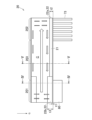
- Figure 3A is a cross-sectional view showing a schematic diagram of the heat pipe and its peripheral components when the electronic device is in a vertical position.
- Figure 3B is a cross-sectional view showing a schematic diagram of the heat pipe and its peripheral components when the electronic device is in a horizontal position.
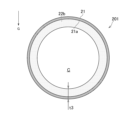
- Figure 4 is a cross-sectional view showing a cut surface of the heat pipe taken along the IV-IV cutting line shown in Figure 3B.
- Figure 5 is a cross-sectional view showing a cut surface of the heat pipe taken along the V-V cutting line shown in Figure 3B.
- the arrows shown in the tube 21 in Figures 3A and 3B indicate the state in which the working fluid sealed in the tube 21 circulates.
- the heat pipe 20 includes a tube 21 that encloses a working fluid, and a sintered layer 22 that is formed by sintering metal powder onto the inner wall surface 21a of the tube 21.
- Sintering refers to baking a solidified powdered metal at a high temperature that is lower than the melting point.
- the material of the tube body 21 is not particularly limited, but it is preferable that the tube body 21 is made of a metal with high thermal conductivity.
- the working fluid may be selected appropriately depending on the material of the tube body 21, and is preferably water, for example.
- the tube 21 is arranged so as to be generally aligned with the direction of gravity when the electronic device 10 is in a vertical position.
- the tube 21 is shown as extending straight in one direction, but this is not limited thereto, and a portion of the tube 21 may be bent or twisted.
- the sintered body layer 22 may be formed, for example, by sintering copper powder.
- the sintered body layer will be denoted by the reference numerals "22a” or “22b” depending on the part where it is formed, but will simply be referred to as “sintered body layer 22" unless there is a need to distinguish between them.
- the heat pipe 20 includes an evaporator section 201, a condenser section 202, and an intermediate section 203. Note that the evaporator section 201, the condenser section 202, and the intermediate section 203 indicate parts of the heat pipe 20, and are preferably configured as a continuous connection rather than being physically separate.
- the evaporation section 201 is a section in which at least a portion of the outer surface is placed in contact with the heat generating component 80, and in which the working fluid evaporates due to the heat of the heat generating component 80. Note that the evaporation section 201 is not limited to a section in which the tube body 21 is placed in direct contact with the heat generating component 80, but may be placed in such a way that the working fluid sealed in the tube body 21 evaporates due to at least the heat from the heat generating component 80.
- the condensation section 202 is a section in which at least a portion of the outer surface is arranged in contact with the heat sink 73, and in which the working fluid condenses due to the heat dissipation effect of the heat sink 73. Note that the condensation section 202 is not limited to a section in which the tube 21 is arranged in direct contact with the heat sink 73, but may be arranged so that the working fluid enclosed in the tube 21 condenses at least due to the heat dissipation effect of the heat sink 73.
- the intermediate section 203 is a section disposed between the evaporator section 201 and the condenser section 202. That is, one end of the heat pipe 20 is the evaporator section 201, the other end is the condenser section 202, and the intermediate section 203 is between the evaporator section 201 and the condenser section 202.
- the working fluid present in the evaporation section 201 is heated by the heat of the heat generating component 80 and vaporizes.
- the vaporized working fluid moves to the condensation section 202 through the intermediate section 203.
- the inside of the tube body 21 and the sintered layer 22 is hollow (hereinafter referred to as hollow section C). Hollow section C becomes the flow path through which the vaporized working fluid moves.
- the working fluid that moves to the condensation section 202 condenses and liquefies due to the heat dissipation effect of the heat sink 73.
- the liquefied working fluid then moves along the inner wall of the heat pipe 20 and moves to the evaporation section 201 through the intermediate section 203.
- the working fluid that moves to the evaporation section 201 is heated by the heat from the heat-generating component 80 and vaporizes. In this way, in the heat pipe 20, the working fluid is circulated within the tube body 21 to carry heat from the evaporation section 201 to the condensation section 202, suppressing the temperature rise of the heat-generating component 80.
- a sintered body layer 22 is formed on the inner wall surface 21a of the tube body 21 in order to move the liquefied working fluid from the condenser section 202 to the evaporator section 201.
- the sintered body layer 22 has a large number of voids formed according to the shape and particle size of the metal powder to be sintered.
- the liquefied working fluid can move within the sintered body layer 22 due to the capillary force of the sintered body layer 22. In other words, the liquefied working fluid can move from the condenser section 202 to the evaporator section 201 through the voids in the sintered body layer 22.
- the direction of movement of the working fluid from the condenser 202 to the evaporator 201 coincides with the direction of gravity G, and so the working fluid can move smoothly due to the influence of gravity in addition to the capillary force mentioned above.
- the direction of movement from the condenser 202 to the evaporator 201 differs from the direction of gravity G, and so the working fluid moves less easily than when the electronic device 10 is in a vertical position.
- the movement of the vaporized working fluid from the evaporation section 201 to the condensation section 202 and the movement of the liquefied working fluid from the condensation section 202 to the evaporation section 201 occur in parallel.
- the movement of the vaporized working fluid from the evaporation section 201 to the condensation section 202 and the movement of the liquefied working fluid from the condensation section 202 to the evaporation section 201 are counterflows. Therefore, the vaporized working fluid generates a force that acts as resistance to the movement of the liquefied working fluid. Therefore, the circulation of the working fluid may be affected depending on the flow rate of the vaporized working fluid.
- the middle portion 203 includes a first thick portion having a first thickness t1 and a second thick portion having a second thickness t2 in a cross section cut in a direction perpendicular to (intersecting) the extension direction of the tube body 21.
- the thickness of the tube body 21 may be the same regardless of its location.
- the second thick portion is a portion consisting of a combination of the tube body 21 and the sintered body layer 22a.
- the thickness t2 is the sum of the thickness of the tube body 21 and the thickness of the sintered body layer 22a.
- the first thick portion is a portion consisting of only the tube body 21.
- the thickness t1 is the thickness of the tube body 21 itself. Therefore, the second thickness t2 of the second thick portion is thicker than the first thickness t1 of the first thick portion.
- the intermediate portion 203 has the sintered body layer 22 formed on a predetermined portion of the inner wall surface 21a.
- the intermediate portion 203 includes a portion of the inner wall surface 21a where the sintered body layer 22 is not formed.
- the inner diameter of the hollow portion C in the intermediate portion 203 is relatively wide.
- the flow path in the intermediate portion 203 is wider than in a configuration in which the sintered body layer 22 is formed around the entire circumference of the inner wall surface 21a. Therefore, the flow rate of the vaporized working fluid in the intermediate portion 203 is slower than in a configuration in which the sintered body layer 22 is formed around the entire circumference.
- the sintered layer 22a is formed so as to be located only at the bottom of the middle portion 203.
- the working fluid liquefied in the condenser section 202 moves to the bottom of the heat pipe 20 due to the effect of gravity. Therefore, the working fluid moves to the evaporator section 201 due to the capillary force of the sintered layer 22a formed at the bottom of the intermediate section 203.
- FIG. 5 shows an example in which the sintered body layer 22a is formed at the bottom of the intermediate portion 203 with a predetermined width in the circumferential direction, but the shape of the sintered body layer 22a is not limited to this. It is preferable that at least a portion of the sintered body layer 22a is formed at the bottom of the inner wall surface 21a of the tube 21 at the intermediate portion 203 when the electronic device 10 is in a horizontal position. In other words, it is preferable that the second thick portion with thickness t2 is provided to include at least the bottom part of the tube 21 at the intermediate portion 203 when the electronic device 10 is in a horizontal position.
- the sintered body layer 22a is preferably formed so as to be located below the center O1 of the tube 21 when the electronic device 10 is in a horizontal position.
- the second thick portion having a thickness t2 is preferably formed so as to be located below the center O1 (see FIG. 5) of the tube 21 in a cross section cut in a direction perpendicular to the extension direction of the tube 21 when the electronic device 10 is in a horizontal position.
- the sintered body layer 22a is preferably formed, for example, in a tube 21 having a circular cross section, in a range in which the central angle ⁇ shown in FIG. 5 is 120° or more and less than 180°.
- the condenser section 202 preferably includes a first thick section having a first thickness t1 and a second thick section having a second thickness t2 in a cross section cut in a direction perpendicular to the extension direction of the tube body 21.
- the second thick section of the intermediate section 203 may be connected to the second thick section of the condenser section 202.
- the sintered body layer 22a of the intermediate section 203 and the sintered body layer 22a of the condenser section 202 may be formed substantially flush with each other without having any steps in the extension direction. In this way, by making the thickness of the condenser section 202 the same as that of the intermediate section 203, the flow path of the working fluid can be widened.
- the sintered body layer 22b formed on the inner wall surface 21a of the evaporation section 201 is preferably formed over the entire circumference on a cut surface cut in a direction perpendicular to the extension direction of the tube body 21. Also, as shown in FIG. 3A and FIG. 3B, the sintered body layer 22b formed on the inner wall surface 21a of the evaporation section 201 is preferably formed over the entire length of the evaporation section 201 in the extension direction of the tube body 21. Also, the evaporation section 201 is preferably provided with a third thick portion having a third thickness t3.
- the third thick portion is formed by a combination of the tube body 21 and the sintered body layer 22b, and is a portion that is thicker than the second thick portion having the second thickness t2.
- the thickness of the sintered body layer 22b formed on the inner wall surface 21a of the tube body 21 in the evaporation section 201 is preferably thicker than the thickness of the sintered body layer 22a formed on the inner wall surface 21a of the tube body 21 in the intermediate portion 203.
- the shape of the sintered body layer 22b formed on the inner wall surface 21a of the tube body 21 in the evaporation section 201 is not limited to the example shown in the figure, and the sintered body layer 22b may be formed only on the lower part of the evaporation section 201 when the electronic device 10 is in a horizontal position.
- intermediate portion 203 includes a third thick portion of third thickness t3 in at least a portion on the evaporation portion 201 side. Furthermore, it is preferable that the third thick portion of intermediate portion 203 is connected to the third thick portion of evaporation portion 201. In other words, the third thick portion is not limited to evaporation portion 201, and it is preferable that a portion of the third thick portion is also provided in intermediate portion 203. In this way, by forming sintered body layer 22 thick in an area that is likely to receive resistance from the vaporized working fluid, it becomes easier for the liquefied working fluid to return to evaporation portion 201. As a result, the circulation of the working fluid becomes smoother.
- the first thick portion and the second thick portion in the intermediate portion 203 should at least partially face each other via the center O1 of the tube body 21.
- the cross-sectional shape of the intermediate portion 203 should be asymmetric with respect to the center O1 of the tube body 21.
- the heat pipe 20 is provided in the electronic device 10 that is used in a vertical or horizontal position, but this is not limited to this.
- the heat pipe 20 may be provided in an electronic device that is used in one usage position.
- the usage position of the electronic device may be the horizontal position described in this embodiment.
- the tube body 21 having a circular cross-sectional shape has been described as an example, but this is not limited to this.
- the cross-sectional shape of the tube body 21 may be elliptical or rectangular.
- the inner wall surface 21a of the tube 21 in each of the evaporation section 201, the condensation section 202, and the intermediate section 203 has a plurality of grooves formed thereon extending in the extension direction of the tube 21. It is also preferable that the sintered body layer 22 is formed on the plurality of grooves formed on the inner wall surface 21a of the tube 21. Capillary forces can also be generated in the plurality of grooves, allowing the liquefied working fluid to move more smoothly.
- the flow path of the working fluid can be relatively widened without increasing the diameter of the tube 21 itself. Therefore, the flow rate of the vaporized working fluid moving from the evaporator 201 to the condenser 202 can be relatively slowed.
- the sintered body layer 22 is formed on the lower part of the tube 21 when the electronic device 10 is in a horizontal position, the working fluid is easily moved by capillary force even when the electronic device 10 is in a horizontal position. Therefore, the liquefied working fluid can be smoothly moved from the condenser 202 to the evaporator 201. As a result, heat circulation can be efficiently performed regardless of the position of the electronic device 10.
- the amount of metal powder used to form the sintered body layer 22 can be reduced compared to a configuration in which the sintered body layer 22 is formed around the entire inner wall surface 21a of the tube body 21. This allows the manufacturing cost to be reduced.
- FIG. 6 is a schematic diagram showing an example of a modified heat pipe
- Fig. 7 is a schematic diagram showing another example of a modified heat pipe.
- 3A and other figures relating to this embodiment show an example in which the position and thickness of the sintered body layer 22 in the condensation section 202 are the same as those in the intermediate section 203.
- the sintered body layer 22 may not be formed in a part of the condensation section 202.
- a sintered body layer having a thickness thinner than the sintered body layer 22a formed in the intermediate section 203 may be formed in the condensation section 202. That is, the thickness of the combination of the tube body 21 and the sintered body layer 22 may be gradually thinner from the evaporation section 201 side to the condensation section 202 side. With this configuration, the flow path of the vaporized working fluid can be made wider.
- the flow of the vaporized working fluid can be slowed down, and the movement of the liquefied working fluid can be made smooth.
- the amount of metal powder used to form the sintered body layer 22 can be reduced, thereby reducing manufacturing costs.
- the sintered body layer 22a may be formed on the entire circumference of the tube body 21 in the intermediate portion 203 in the circumferential direction. That is, the first thick portion having the first thickness t1 in the intermediate portion 203 may be composed of the tube body 21 and the sintered body layer 22a. That is, the sintered body layer 22a may be formed on the entire circumference of the intermediate portion 203 and may be formed to have a thickness that is partially different in the circumferential direction, so as to include a portion that is thinner than other portions.
- the first thick portion and the second thick portion in the intermediate portion 203 may face each other through the center of the tube body 21. That is, the cross-sectional shape in the intermediate portion 203 may be asymmetric with the center of the tube body 21 as the center of symmetry.
- the second thick portion having the second thickness t2 is preferably disposed downward when the electronic device 10 is in a horizontal position. This configuration allows the flow path of the vaporized working fluid to be relatively wide, and allows the capillary force of the sintered body layer 22 to be generated around the entire circumference of the tube body 21. This allows for efficient heat circulation.
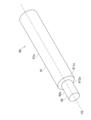
- Figure 8A is a perspective view showing an apparatus used for forming a sintered body layer.
- Figure 8B is a schematic diagram showing how metal powder is filled.
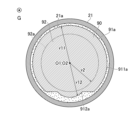
- Figure 8C is a diagram showing how the tube is filled with metal powder, and is a IIX-IIX cross section shown in Figure 8B.
- the dashed line shown in Figure 8C is an imaginary line showing a second extension portion 92, which will be described later.
- a tool 90 shown in FIG. 8A is used to form the sintered body layer 22.
- the tool 90 is used as a mold when forming the sintered body layer 22.
- the tool 90 has a shape that extends in the extension direction of the tube 21, and is preferably large enough to be inserted into the tube 21.
- the instrument 90 includes a first extension portion 91 and a cylindrical second extension portion 92.
- the first extension portion 91 has a shape that extends in the same direction as the tube body 21.
- the second extension portion 92 has a shape that extends from the end of the first extension portion 91 in the same direction as the first extension portion 91, and is a portion with a smaller diameter than the first extension portion 91. That is, as shown in FIG. 8C, the length r2 from the center O2 of the instrument 90 to the outer wall surface 92a of the second extension portion 92 is shorter than the lengths r11 and r12 from the center O2 of the instrument 90 to the outer wall surface 91a on a cut surface cut in a direction intersecting the extension direction of the instrument 90.
- the first extension portion 91 includes a portion where the length from the center O2 of the instrument 90 to the outer wall surface 91a of the cut surface taken in a direction perpendicular to the extension direction of the instrument 90 is partially short. Specifically, as shown in FIG. 8C, the length from the center O2 of the first extension portion 91 to the outer wall surface 91a is r11 in some parts, and is r12, which is shorter than r11, in other parts.
- the outer wall surface 91a of the first extension portion 91 has a shape including a first outer peripheral surface 911a having a radius of r11 and a second outer peripheral surface 912a having a radius of r12, and the radius (second radius) of the second outer peripheral surface 912a is smaller than the radius (first radius) of the first outer peripheral surface 911a.
- the tool 90 is inserted into the tube 21.
- the tool 90 is preferably inserted so that its center O2 coincides with the center O1 of the tube 21.
- a gap is formed between the tube 21 and the tool 90.
- a first filling region F1 filled with metal powder is formed between the inner wall surface 21a of the tube 21 and the outer wall surface 91a of the first extension 91.
- a second filling region F2 filled with metal powder is formed between the inner wall surface 21a of the tube 21 and the outer wall surface 92a of the second extension 92.
- the second filling region F2 has a width in the thickness direction of the tube 21 that is wider than the first filling region F1.
- the first filling region F1 includes a region that is partially wider in the thickness direction of the tube 21.
- the first filling area F1 is an area for forming the sintered body layer 22 in the entire condenser section 202 and part of the intermediate section 203 of the heat pipe.
- the second filling area F2 is an area for forming the sintered body layer 22 in the entire evaporator section 201 and part of the intermediate section 203 of the heat pipe.
- the instrument 90 may be inserted into the tube 21 such that the first extension 91 is located lower than the second extension 92 in the direction of gravity G.
- the tube 21 and the instrument 90 may be fixed so that their relative positions do not change when the instrument 90 is inserted into the tube 21.
- the lower end of the tube 21 in the direction of gravity may be terminally treated, for example, by swaging.
- metal powder is filled into the first filling area F1 and the second filling area F2.
- the arrows in Figure 8B indicate the direction in which the metal powder moves when it is filled. That is, in the example shown in Figure 8B, the metal powder is shown being poured from the second extension section 92 side in the extension direction of the tool 90. The metal powder is first filled into the first filling area F1, and then into the second filling area F2. Then, the filling can be completed by applying vibration to the entire area, for example.
- the fixture 90 is sintered together to form the sintered body layer 22. After sintering, the fixture 90 can be pulled out from inside the tube 21. As a result, the metal powder filled in the first filling region F1 becomes the sintered body layer 22a in the first thick portion and the second thick portion. The metal powder filled in the second filling region F2 becomes the sintered body layer 22b in the third thick portion.
- the shape and size of the fixture 90 are not limited to those shown in FIG. 8A.
- the diameter of the portion of the first extension portion 91 of the fixture 90 that forms the first thick portion is the same as the diameter of the inner wall surface 21a of the tube body 21.
- the length r11 from the center O2 of the first extension portion 91 to the outer wall surface 91a is the same as the inner diameter of the tube body 21.
- the fixture 90 is not limited to being made of one member, but may be made of multiple members that form the first filling area F1 and the second filling area F2.
- the heat pipe, the electronic device, the appliance, and the method for manufacturing the heat pipe may be configured as follows.
- the first thick portion is formed by a combination of the tubular body and the sintered body layer.
- the first thick portion consists of the tubular body only.
- the third thick portion of the intermediate portion is connected to the third thick portion of the evaporation portion.
- the sintered layer formed on the inner wall surface of the evaporation section is formed around the entire circumference on a cut surface cut in a direction intersecting the extension direction of the tubular body.
- the sintered layer formed on the inner wall surface of the evaporation section is formed over the entire length of the evaporation section in the extension direction of the tubular body.
- the thickness of the combination of the tube body and the sintered layer is gradually reduced from the evaporator side to the condenser side.
- An electronic device that accommodates within a housing a heat-generating component, a heat-dissipating component, a heat pipe including a tube that encloses a working fluid, and a sintered body layer formed by sintering a metal powder on an inner wall surface of the tube, wherein the heat pipe includes an evaporation section in which the working fluid evaporates due to heat from the heat-generating component, a condensation section in which the working fluid condenses due to the heat dissipation effect of the heat-dissipating component, and an intermediate section located between the evaporation section and the condensation section, wherein at least the intermediate section includes a first thick-walled section having a first thickness and a second thick-walled section having a second thickness, in a cross section cut in a direction intersecting an extension direction of the heat pipe, the second thickness being thicker than the first thickness, at least a portion of the first thick-walled section and the second thick-walled section in the intermediate section are opposed to each other via the center
- An apparatus used to form a sintered body layer in a heat pipe including a tube that seals a working fluid and a sintered body layer formed by sintering metal powder onto an inner wall surface of the tube, the apparatus including a first extension portion extending in the extension direction of the tube and a second extension portion extending from an end of the first extension portion in the extension direction of the tube, wherein a length from a center of the second extension portion to an outer wall surface in a cut surface cut in a direction intersecting the extension direction of the second extension portion is shorter than a length from the center of the first extension portion to the outer wall surface in a cut surface cut in a direction intersecting the extension direction of the first extension portion, and the first extension portion has a length from the center of the first extension portion to the outer wall surface of the cut surface cut in the direction intersecting the extension direction of the first extension portion that is partially shorter.
- the second extension portion is cylindrical, the outer wall surface of the first extension portion has a shape including a first outer peripheral surface having a first radius and a second outer peripheral surface having a second radius, and the second radius is smaller than the first radius.
- a method for manufacturing a heat pipe including a tubular body that seals a working fluid and a sintered body layer formed by sintering metal powder onto an inner wall surface of the tubular body including the steps of: inserting an appliance extending in the extension direction of the tubular body into the tubular body; filling a gap between the inner wall surface of the tubular body and an outer wall surface of the appliance with metal powder; and forming the sintered body layer in the gap by sintering the metal powder, wherein the gap includes a first filling region and a second filling region, the second filling region has a width in the thickness direction of the tubular body wider than the first filling region, and the first filling region includes a region that is partially wider in the thickness direction of the tubular body.
Landscapes
- Engineering & Computer Science (AREA)
- Mechanical Engineering (AREA)
- Thermal Sciences (AREA)
- Physics & Mathematics (AREA)
- Life Sciences & Earth Sciences (AREA)
- Sustainable Development (AREA)
- General Engineering & Computer Science (AREA)
- Manufacturing & Machinery (AREA)
- Microelectronics & Electronic Packaging (AREA)
- Chemical & Material Sciences (AREA)
- Composite Materials (AREA)
- Materials Engineering (AREA)
- Cooling Or The Like Of Semiconductors Or Solid State Devices (AREA)
- Cooling Or The Like Of Electrical Apparatus (AREA)
Priority Applications (3)
| Application Number | Priority Date | Filing Date | Title |
|---|---|---|---|
| JP2025502257A JPWO2024176835A1 (https=) | 2023-02-21 | 2024-02-07 | |
| CN202480012674.5A CN120641716A (zh) | 2023-02-21 | 2024-02-07 | 热管、电子装置、仪器及制造热管的方法 |
| EP24760137.0A EP4671661A4 (en) | 2023-02-21 | 2024-02-07 | HEAT PIPE, ELECTRONIC DEVICE, INSTRUMENT AND HEAT PIPE MANUFACTURING METHOD |
Applications Claiming Priority (2)
| Application Number | Priority Date | Filing Date | Title |
|---|---|---|---|
| JP2023-025494 | 2023-02-21 | ||
| JP2023025494 | 2023-02-21 |
Publications (1)
| Publication Number | Publication Date |
|---|---|
| WO2024176835A1 true WO2024176835A1 (ja) | 2024-08-29 |
Family
ID=92501027
Family Applications (1)
| Application Number | Title | Priority Date | Filing Date |
|---|---|---|---|
| PCT/JP2024/004171 Ceased WO2024176835A1 (ja) | 2023-02-21 | 2024-02-07 | ヒートパイプ、電子機器、器具、及びヒートパイプの製造方法 |
Country Status (4)
| Country | Link |
|---|---|
| EP (1) | EP4671661A4 (https=) |
| JP (1) | JPWO2024176835A1 (https=) |
| CN (1) | CN120641716A (https=) |
| WO (1) | WO2024176835A1 (https=) |
Citations (9)
| Publication number | Priority date | Publication date | Assignee | Title |
|---|---|---|---|---|
| JP2002318085A (ja) | 2001-04-18 | 2002-10-31 | Hitachi Cable Ltd | ヒートパイプ及びその製造方法 |
| US6899165B1 (en) * | 2004-06-15 | 2005-05-31 | Hua Yin Electric Co., Ltd. | Structure of a heat-pipe cooler |
| CN201885615U (zh) * | 2010-08-19 | 2011-06-29 | 燿佳科技股份有限公司 | 热管 |
| US20110174464A1 (en) * | 2010-01-15 | 2011-07-21 | Furui Precise Component (Kunshan) Co., Ltd. | Flat heat pipe and method for manufacturing the same |
| CN202024639U (zh) * | 2011-01-26 | 2011-11-02 | 燿佳科技股份有限公司 | 热管 |
| US20110297269A1 (en) * | 2009-02-23 | 2011-12-08 | Metafoam Technologies Inc. | Metal tube with porous metal liner |
| US20130126128A1 (en) * | 2011-11-17 | 2013-05-23 | Wei-Cheng Chou | Heat pipe and method of manufacturing heat pipe |
| CN103123235A (zh) * | 2011-11-21 | 2013-05-29 | 古河奇宏电子(苏州)有限公司 | 散热器用多段烧结管 |
| WO2021193879A1 (ja) | 2020-03-27 | 2021-09-30 | 株式会社ソニー・インタラクティブエンタテインメント | 電子機器 |
Family Cites Families (4)
| Publication number | Priority date | Publication date | Assignee | Title |
|---|---|---|---|---|
| CN100529641C (zh) * | 2006-05-19 | 2009-08-19 | 富准精密工业(深圳)有限公司 | 复合式热管及其制造方法 |
| TWI407070B (zh) * | 2010-04-26 | 2013-09-01 | Asia Vital Components Co Ltd | 平板式熱管之製造方法 |
| CN102466421B (zh) * | 2010-11-08 | 2015-11-25 | 富瑞精密组件(昆山)有限公司 | 扁平热导管及其制造方法 |
| TWI680274B (zh) * | 2019-01-31 | 2019-12-21 | 雙鴻科技股份有限公司 | 複合式熱管 |
-
2024
- 2024-02-07 JP JP2025502257A patent/JPWO2024176835A1/ja active Pending
- 2024-02-07 EP EP24760137.0A patent/EP4671661A4/en active Pending
- 2024-02-07 CN CN202480012674.5A patent/CN120641716A/zh active Pending
- 2024-02-07 WO PCT/JP2024/004171 patent/WO2024176835A1/ja not_active Ceased
Patent Citations (9)
| Publication number | Priority date | Publication date | Assignee | Title |
|---|---|---|---|---|
| JP2002318085A (ja) | 2001-04-18 | 2002-10-31 | Hitachi Cable Ltd | ヒートパイプ及びその製造方法 |
| US6899165B1 (en) * | 2004-06-15 | 2005-05-31 | Hua Yin Electric Co., Ltd. | Structure of a heat-pipe cooler |
| US20110297269A1 (en) * | 2009-02-23 | 2011-12-08 | Metafoam Technologies Inc. | Metal tube with porous metal liner |
| US20110174464A1 (en) * | 2010-01-15 | 2011-07-21 | Furui Precise Component (Kunshan) Co., Ltd. | Flat heat pipe and method for manufacturing the same |
| CN201885615U (zh) * | 2010-08-19 | 2011-06-29 | 燿佳科技股份有限公司 | 热管 |
| CN202024639U (zh) * | 2011-01-26 | 2011-11-02 | 燿佳科技股份有限公司 | 热管 |
| US20130126128A1 (en) * | 2011-11-17 | 2013-05-23 | Wei-Cheng Chou | Heat pipe and method of manufacturing heat pipe |
| CN103123235A (zh) * | 2011-11-21 | 2013-05-29 | 古河奇宏电子(苏州)有限公司 | 散热器用多段烧结管 |
| WO2021193879A1 (ja) | 2020-03-27 | 2021-09-30 | 株式会社ソニー・インタラクティブエンタテインメント | 電子機器 |
Non-Patent Citations (1)
| Title |
|---|
| See also references of EP4671661A1 |
Also Published As
| Publication number | Publication date |
|---|---|
| EP4671661A4 (en) | 2026-04-29 |
| CN120641716A (zh) | 2025-09-12 |
| JPWO2024176835A1 (https=) | 2024-08-29 |
| EP4671661A1 (en) | 2025-12-31 |
Similar Documents
| Publication | Publication Date | Title |
|---|---|---|
| TWI748294B (zh) | 散熱裝置 | |
| JP4427445B2 (ja) | マルチウィック構造をもつ蒸気増強ヒートシンク | |
| JP4095674B2 (ja) | 薄い平面の熱拡散装置 | |
| TWI394927B (zh) | Flat type heat pipe and its manufacturing method | |
| CN101040162B (zh) | 带有具有沸腾增强作用的多重毛细结构的蒸汽室 | |
| TWI778292B (zh) | 冷卻裝置及使用冷卻裝置之冷卻系統 | |
| US20120227934A1 (en) | Heat pipe having a composite wick structure and method for making the same | |
| US20050135062A1 (en) | Heat sink, assembly, and method of making | |
| WO2014157147A1 (ja) | 冷却装置 | |
| JP5323614B2 (ja) | ヒートパイプおよびその製造方法 | |
| TW202037872A (zh) | 冷卻裝置 | |
| EP2437023A2 (en) | Heat dissipation device | |
| JP2009188329A (ja) | ヒートシンク、冷却モジュールおよび冷却可能な電子基板 | |
| JP2014143417A (ja) | 一体化した薄膜蒸発式熱拡散器および平面ヒートパイプヒートシンク | |
| WO2020213463A1 (ja) | ヒートシンク | |
| JP2015166667A (ja) | 小型放熱冷却装置、 | |
| WO2024176835A1 (ja) | ヒートパイプ、電子機器、器具、及びヒートパイプの製造方法 | |
| JP4177337B2 (ja) | ヒートパイプ付ヒートシンク | |
| JP2021188886A (ja) | 伝熱部材および伝熱部材を有する冷却デバイス | |
| JP5624771B2 (ja) | ヒートパイプおよびヒートパイプ付ヒートシンク | |
| JP2012013277A (ja) | ヒートシンク | |
| KR102112124B1 (ko) | 전기, 전자 기기 냉각용 열전도 시스템 | |
| CN222263416U (zh) | 散热器 | |
| TWI305570B (en) | Heat dissipation device with heat pipes and its method | |
| KR20110033596A (ko) | 전자부품용 냉각장치 |
Legal Events
| Date | Code | Title | Description |
|---|---|---|---|
| 121 | Ep: the epo has been informed by wipo that ep was designated in this application |
Ref document number: 24760137 Country of ref document: EP Kind code of ref document: A1 |
|
| WWE | Wipo information: entry into national phase |
Ref document number: 202480012674.5 Country of ref document: CN |
|
| ENP | Entry into the national phase |
Ref document number: 2025502257 Country of ref document: JP Kind code of ref document: A |
|
| WWE | Wipo information: entry into national phase |
Ref document number: 2025502257 Country of ref document: JP |
|
| WWP | Wipo information: published in national office |
Ref document number: 202480012674.5 Country of ref document: CN |
|
| WWE | Wipo information: entry into national phase |
Ref document number: 2024760137 Country of ref document: EP |
|
| NENP | Non-entry into the national phase |
Ref country code: DE |
|
| ENP | Entry into the national phase |
Ref document number: 2024760137 Country of ref document: EP Effective date: 20250922 |
|
| ENP | Entry into the national phase |
Ref document number: 2024760137 Country of ref document: EP Effective date: 20250922 |
|
| WWP | Wipo information: published in national office |
Ref document number: 2024760137 Country of ref document: EP |