WO2024162423A1 - 硬化性組成物、及び熱伝導性部材 - Google Patents
硬化性組成物、及び熱伝導性部材 Download PDFInfo
- Publication number
- WO2024162423A1 WO2024162423A1 PCT/JP2024/003193 JP2024003193W WO2024162423A1 WO 2024162423 A1 WO2024162423 A1 WO 2024162423A1 JP 2024003193 W JP2024003193 W JP 2024003193W WO 2024162423 A1 WO2024162423 A1 WO 2024162423A1
- Authority
- WO
- WIPO (PCT)
- Prior art keywords
- curable composition
- less
- amine compound
- mass
- epoxy resin
- Prior art date
- Legal status (The legal status is an assumption and is not a legal conclusion. Google has not performed a legal analysis and makes no representation as to the accuracy of the status listed.)
- Ceased
Links
Images



Classifications
-
- C—CHEMISTRY; METALLURGY
- C09—DYES; PAINTS; POLISHES; NATURAL RESINS; ADHESIVES; COMPOSITIONS NOT OTHERWISE PROVIDED FOR; APPLICATIONS OF MATERIALS NOT OTHERWISE PROVIDED FOR
- C09K—MATERIALS FOR MISCELLANEOUS APPLICATIONS, NOT PROVIDED FOR ELSEWHERE
- C09K5/00—Heat-transfer, heat-exchange or heat-storage materials, e.g. refrigerants; Materials for the production of heat or cold by chemical reactions other than by combustion
- C09K5/08—Materials not undergoing a change of physical state when used
- C09K5/14—Solid materials, e.g. powdery or granular
-
- C—CHEMISTRY; METALLURGY
- C08—ORGANIC MACROMOLECULAR COMPOUNDS; THEIR PREPARATION OR CHEMICAL WORKING-UP; COMPOSITIONS BASED THEREON
- C08G—MACROMOLECULAR COMPOUNDS OBTAINED OTHERWISE THAN BY REACTIONS ONLY INVOLVING UNSATURATED CARBON-TO-CARBON BONDS
- C08G59/00—Polycondensates containing more than one epoxy group per molecule; Macromolecules obtained by polymerising compounds containing more than one epoxy group per molecule using curing agents or catalysts which react with the epoxy groups
- C08G59/18—Macromolecules obtained by polymerising compounds containing more than one epoxy group per molecule using curing agents or catalysts which react with the epoxy groups ; e.g. general methods of curing
- C08G59/20—Macromolecules obtained by polymerising compounds containing more than one epoxy group per molecule using curing agents or catalysts which react with the epoxy groups ; e.g. general methods of curing characterised by the epoxy compounds used
- C08G59/22—Di-epoxy compounds
- C08G59/223—Di-epoxy compounds together with monoepoxy compounds
-
- C—CHEMISTRY; METALLURGY
- C08—ORGANIC MACROMOLECULAR COMPOUNDS; THEIR PREPARATION OR CHEMICAL WORKING-UP; COMPOSITIONS BASED THEREON
- C08G—MACROMOLECULAR COMPOUNDS OBTAINED OTHERWISE THAN BY REACTIONS ONLY INVOLVING UNSATURATED CARBON-TO-CARBON BONDS
- C08G59/00—Polycondensates containing more than one epoxy group per molecule; Macromolecules obtained by polymerising compounds containing more than one epoxy group per molecule using curing agents or catalysts which react with the epoxy groups
- C08G59/18—Macromolecules obtained by polymerising compounds containing more than one epoxy group per molecule using curing agents or catalysts which react with the epoxy groups ; e.g. general methods of curing
- C08G59/40—Macromolecules obtained by polymerising compounds containing more than one epoxy group per molecule using curing agents or catalysts which react with the epoxy groups ; e.g. general methods of curing characterised by the curing agents used
- C08G59/50—Amines
- C08G59/5026—Amines cycloaliphatic
-
- C—CHEMISTRY; METALLURGY
- C09—DYES; PAINTS; POLISHES; NATURAL RESINS; ADHESIVES; COMPOSITIONS NOT OTHERWISE PROVIDED FOR; APPLICATIONS OF MATERIALS NOT OTHERWISE PROVIDED FOR
- C09J—ADHESIVES; NON-MECHANICAL ASPECTS OF ADHESIVE PROCESSES IN GENERAL; ADHESIVE PROCESSES NOT PROVIDED FOR ELSEWHERE; USE OF MATERIALS AS ADHESIVES
- C09J11/00—Features of adhesives not provided for in group C09J9/00, e.g. additives
- C09J11/02—Non-macromolecular additives
- C09J11/04—Non-macromolecular additives inorganic
-
- C—CHEMISTRY; METALLURGY
- C09—DYES; PAINTS; POLISHES; NATURAL RESINS; ADHESIVES; COMPOSITIONS NOT OTHERWISE PROVIDED FOR; APPLICATIONS OF MATERIALS NOT OTHERWISE PROVIDED FOR
- C09J—ADHESIVES; NON-MECHANICAL ASPECTS OF ADHESIVE PROCESSES IN GENERAL; ADHESIVE PROCESSES NOT PROVIDED FOR ELSEWHERE; USE OF MATERIALS AS ADHESIVES
- C09J9/00—Adhesives characterised by their physical nature or the effects produced, e.g. glue sticks
-
- H—ELECTRICITY
- H01—ELECTRIC ELEMENTS
- H01M—PROCESSES OR MEANS, e.g. BATTERIES, FOR THE DIRECT CONVERSION OF CHEMICAL ENERGY INTO ELECTRICAL ENERGY
- H01M10/00—Secondary cells; Manufacture thereof
- H01M10/60—Heating or cooling; Temperature control
- H01M10/65—Means for temperature control structurally associated with the cells
- H01M10/653—Means for temperature control structurally associated with the cells characterised by electrically insulating or thermally conductive materials
-
- C—CHEMISTRY; METALLURGY
- C08—ORGANIC MACROMOLECULAR COMPOUNDS; THEIR PREPARATION OR CHEMICAL WORKING-UP; COMPOSITIONS BASED THEREON
- C08K—Use of inorganic or non-macromolecular organic substances as compounding ingredients
- C08K3/00—Use of inorganic substances as compounding ingredients
- C08K3/18—Oxygen-containing compounds, e.g. metal carbonyls
- C08K3/20—Oxides; Hydroxides
- C08K3/22—Oxides; Hydroxides of metals
- C08K2003/2227—Oxides; Hydroxides of metals of aluminium
-
- C—CHEMISTRY; METALLURGY
- C09—DYES; PAINTS; POLISHES; NATURAL RESINS; ADHESIVES; COMPOSITIONS NOT OTHERWISE PROVIDED FOR; APPLICATIONS OF MATERIALS NOT OTHERWISE PROVIDED FOR
- C09J—ADHESIVES; NON-MECHANICAL ASPECTS OF ADHESIVE PROCESSES IN GENERAL; ADHESIVE PROCESSES NOT PROVIDED FOR ELSEWHERE; USE OF MATERIALS AS ADHESIVES
- C09J2203/00—Applications of adhesives in processes or use of adhesives in the form of films or foils
- C09J2203/33—Applications of adhesives in processes or use of adhesives in the form of films or foils for batteries or fuel cells
-
- C—CHEMISTRY; METALLURGY
- C09—DYES; PAINTS; POLISHES; NATURAL RESINS; ADHESIVES; COMPOSITIONS NOT OTHERWISE PROVIDED FOR; APPLICATIONS OF MATERIALS NOT OTHERWISE PROVIDED FOR
- C09J—ADHESIVES; NON-MECHANICAL ASPECTS OF ADHESIVE PROCESSES IN GENERAL; ADHESIVE PROCESSES NOT PROVIDED FOR ELSEWHERE; USE OF MATERIALS AS ADHESIVES
- C09J2463/00—Presence of epoxy resin
-
- Y—GENERAL TAGGING OF NEW TECHNOLOGICAL DEVELOPMENTS; GENERAL TAGGING OF CROSS-SECTIONAL TECHNOLOGIES SPANNING OVER SEVERAL SECTIONS OF THE IPC; TECHNICAL SUBJECTS COVERED BY FORMER USPC CROSS-REFERENCE ART COLLECTIONS [XRACs] AND DIGESTS
- Y02—TECHNOLOGIES OR APPLICATIONS FOR MITIGATION OR ADAPTATION AGAINST CLIMATE CHANGE
- Y02E—REDUCTION OF GREENHOUSE GAS [GHG] EMISSIONS, RELATED TO ENERGY GENERATION, TRANSMISSION OR DISTRIBUTION
- Y02E60/00—Enabling technologies; Technologies with a potential or indirect contribution to GHG emissions mitigation
- Y02E60/10—Energy storage using batteries
Definitions
- the present invention relates to a curable composition and a thermally conductive member for use in electronic devices such as battery assemblies.
- Thermally conductive compositions are used, for example, by filling between a heating element and a heat sink to transmit heat generated by the heating element and dissipate it from the heat sink.
- Thermally conductive compositions are generally made of curable compositions that have curing properties, and are often used in the cured form after filling. Curable compositions play an important role in many electronic applications, such as battery assemblies such as lithium-ion battery (LiB) assemblies for electric vehicles (EVs), power electronic devices, electronic packaging, LEDs, solar cells, and electrical grids.
- LiB lithium-ion battery
- EVs electric vehicles
- Patent Document 1 discloses a curable composition that includes an epoxy resin, a polyamide composition that includes a polyamide that includes a tertiary amide in the main chain and is amine-terminated, an amino-functional compound that includes 2 to 20 carbon atoms, a polyfunctional (meth)acrylate, and an inorganic filler, and that can be suitably used in electronic device applications such as battery assemblies.
- the curable composition is required to have a moderately low compression load in order to shorten the time required for battery assembly, and is required to maintain a low compression load for a long period of time and extend the usable time.
- the curable composition when dispensing the curable composition using a dispenser or the like, it is also required to have a low viscosity in terms of workability.
- rapid curing at room temperature after assembly and specifically, rapid curing is required to cure in a short time so as to have an adhesive strength sufficient for temporary bonding.
- the curable composition disclosed in Patent Document 1 is disclosed to have sufficient green strength after being cured at room temperature in about 10 minutes or less, and is considered to have sufficient fast curing properties.
- the curable composition of Patent Document 1 contains a large amount of polyamide while containing a small amount of amine compound, so that the viscosity before curing becomes high due to interactions between polyamides, and it is also difficult to extend the usable time.
- the present invention aims to provide a curable composition that has low viscosity, fast curing properties, and a long pot life.
- the present inventors have found that the above-mentioned problems can be solved by using a specific amount of a specific amine compound (X) in a curable composition containing an epoxy resin, a thermally conductive filler, an amine compound (X) containing two or more amino groups, and a polyfunctional acrylate compound, or by adding a specific amount of water to the curable composition, and have completed the present invention as described below. That is, the present invention provides the following [1] to [18].
- a composition comprising an epoxy resin, a thermally conductive filler, an amine compound (X) containing two or more amino groups, and a polyfunctional acrylate compound; the amine compound (X) has a viscosity of 20 Pa ⁇ s or less at 25° C. and 10 rpm as measured with an E-type viscometer, or has an oxyalkylene structure; The content of the amine compound (X) is 15% by mass or more and 55% by mass or less based on the total resin components of the curable composition.
- a composition comprising an epoxy resin, a thermally conductive filler, an amine compound (X) containing two or more amino groups, and a polyfunctional acrylate compound; the amine compound (X) has a viscosity of 20 Pa ⁇ s or less at 25° C.
- a thermally conductive member comprising a cured product of the curable composition according to any one of [1] to [13] and [15] above.
- a battery assembly comprising the thermally conductive member according to [16] above.
- the present invention provides a curable composition that has low viscosity, fast curing properties, and a long pot life.
- FIG. 2 is a schematic diagram showing a container set according to one embodiment.
- FIG. 2 is a schematic diagram showing a container set according to one embodiment.
- 1 is a perspective view showing a representative configuration of a battery module according to the present invention;
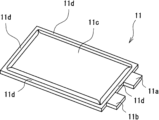
- FIG. 2 is a perspective view showing a typical configuration of a battery cell included in a battery module.
- FIG. 1 is a perspective view showing a battery assembly having a cell-to-pack structure.
- the curable composition according to the first embodiment of the present invention contains an epoxy resin, a thermally conductive filler, an amine compound (X) containing two or more amino groups, and a polyfunctional acrylate compound.
- the curable composition according to the present embodiment includes an epoxy resin.
- the epoxy resin may be a compound having one or more epoxy groups.
- the epoxy resin may be a multifunctional epoxy resin having two or more epoxy groups, or a monofunctional epoxy resin having one epoxy group.
- the curable composition according to the present embodiment preferably contains at least a polyfunctional epoxy resin.
- the curable composition can appropriately form crosslinks, and the adhesive strength can be easily increased.
- the curable composition further contains a monofunctional epoxy resin in addition to the polyfunctional epoxy resin.
- the curable composition can prevent the crosslink density after curing from becoming too high, and can easily increase the elongation.
- the viscosity of the curable composition before curing can be easily reduced.
- the mass ratio of the monofunctional epoxy resin to the polyfunctional epoxy resin is preferably 10/90 or more and 90/10 or less, more preferably 15/85 or more and 75/25 or less, even more preferably 20/80 or more and 70/30 or less, and even more preferably 25/75 or more and 55/45 or less.
- the polyfunctional epoxy resin may be bifunctional or trifunctional, and preferably bifunctional epoxy resin is used.
- Specific examples of the polyfunctional epoxy resin include, but are not limited to, phenol novolac type epoxy resin, resorcinol type epoxy resin, epoxy resin having a bisphenol skeleton, epoxy resin having a naphthalene skeleton, epoxy resin having a fluorene skeleton, epoxy resin having a biphenyl skeleton, epoxy resin having a bi(glycidyloxyphenyl)methane skeleton, epoxy resin having a xanthene skeleton, epoxy resin having an anthracene skeleton, epoxy resin having a pyrene skeleton, and other epoxy resins having aromatic rings.
- epoxy resins having an alicyclic skeleton such as epoxy resins having a dicyclopentadiene skeleton and epoxy resins having an adamantane skeleton.
- Further examples include aliphatic epoxy resins such as butanediol diglycidyl ether, neopentyl glycol diglycidyl ether, glycerol polyglycidyl ether, and trimethylolpropane polyglycidyl ether.
- hydrogenated or modified products of the above-listed epoxy resins can also be used as the epoxy resin.
- Examples of the epoxy resin having a bisphenol skeleton include epoxy resins having a bisphenol skeleton of bisphenol A type, bisphenol F type, or bisphenol S type.
- the resorcinol type epoxy resin may, for example, be resorcinol diglycidyl ether.
- Examples of the epoxy resin having a naphthalene skeleton include 1,2-diglycidylnaphthalene, 1,5-diglycidylnaphthalene, 1,6-diglycidylnaphthalene, 1,7-diglycidylnaphthalene, 2,7-diglycidylnaphthalene, triglycidylnaphthalene, and 1,2,5,6-tetraglycidylnaphthalene.
- Examples of the epoxy resin having a fluorene skeleton include 9,9-bis(4-glycidyloxyphenyl)fluorene, 9,9-bis(4-glycidyloxy-3-methylphenyl)fluorene, 9,9-bis(4-glycidyloxy-3-chlorophenyl)fluorene, 9,9-bis(4-glycidyloxy-3-bromophenyl)fluorene, 9,9-bis(4-glycidyloxy-3-fluorophenyl)fluorene, 9,9-bis(4-glycidyloxy-3-methoxyphenyl)fluorene, 9,9-bis(4-glycidyloxy-3,5-dimethylphenyl)fluorene, 9,9-bis(4-glycidyloxy-3,5-dichlorophenyl)fluorene, and 9,9-bis(4-glycidyloxy-3,5-dibromophen
- epoxy resins having the above-mentioned biphenyl skeleton examples include 4,4'-diglycidylbiphenyl and 4,4'-diglycidyl-3,3',5,5'-tetramethylbiphenyl.
- epoxy resins having a bi(glycidyloxyphenyl)methane skeleton include 1,1'-bi(2,7-glycidyloxynaphthyl)methane, 1,8'-bi(2,7-glycidyloxynaphthyl)methane, 1,1'-bi(3,7-glycidyloxynaphthyl)methane, 1,8'-bi(3,7-glycidyloxynaphthyl)methane, 1,1'-bi(3,5-glycidyloxynaphthyl)methane, 1,8'-bi(3,5-glycidyloxynaphthyl)methane, 1,2'-bi(2,7-glycidyloxynaphthyl)methane, 1,2'-bi(3,7-glycidyloxynaphthyl)methane, and 1,2'-
- Examples of epoxy resins having a xanthene skeleton include 1,3,4,5,6,8-hexamethyl-2,7-bis-glycidylmethoxy-9-phenyl-9H-xanthene.
- Examples of epoxy resins having an anthracene skeleton include those having one or more anthracene skeletons and two or more epoxy groups or glycidyl groups in one molecule.
- the epoxy resin having a pyrene skeleton includes those having one or more pyrene skeletons and two or more epoxy groups or glycidyl groups in one molecule.
- Examples of the epoxy resin having a dicyclopentadiene skeleton include dicyclopentadiene dioxide and phenol novolac epoxy resin having a dicyclopentadiene skeleton.
- Examples of the epoxy resin having an adamantane skeleton include 1,3-bis(4-glycidyloxyphenyl)adamantane and 2,2-bis(4-glycidyloxyphenyl)adamantane.
- polyfunctional epoxy resins from the viewpoint of improving adhesive strength and mechanical strength, preferred are epoxy resins having an aromatic ring, more preferred are epoxy resins having a phenyl group, and even more preferred are bisphenol-type epoxy resins, which are epoxy resins having a bisphenol skeleton.
- the polyfunctional epoxy resins may be used alone or in combination of two or more kinds.
- monofunctional epoxy resins include phenyl glycidyl ethers such as alkylphenyl glycidyl ethers, such as phenyl glycidyl ether, 4-t-butylphenyl glycidyl ether, cresyl glycidyl ether, and nonylphenyl glycidyl ether, and monofunctional epoxy resins having an aromatic ring, such as 1-glycidylnaphthalene and 2-glycidylnaphthalene.
- phenyl glycidyl ethers such as alkylphenyl glycidyl ethers, such as phenyl glycidyl ether, 4-t-butylphenyl glycidyl ether, cresyl glycidyl ether, and nonylphenyl glycidyl ether
- monofunctional epoxy resins having an aromatic ring such as 1-glycidylnaphthal
- the monofunctional epoxy resin from the viewpoint of high safety of the raw material, aliphatic monofunctional epoxy resins are also preferred, and specifically, glycidyl ethers of aliphatic alcohols and the like can be mentioned.
- the aliphatic alcohol may be one having a branched structure or one having a straight chain structure, but from the viewpoint of improving elongation, it is preferable that it is a straight chain structure.
- the aliphatic alcohol may have, for example, about 4 to 24 carbon atoms, but from the viewpoint of improving elongation, it is preferable that it has 10 to 20 carbon atoms.
- saturated aliphatic alcohols are preferable.
- glycidyl ethers of aliphatic alcohols include butyl glycidyl ether, decyl glycidyl ether, lauryl glycidyl ether, myristyl glycidyl ether, cetyl glycidyl ether, and stearyl glycidyl ether.
- the monofunctional epoxy resin may be other than the above, and examples thereof include monofunctional epoxy resins having a glycidyl group but not having an ether group, such as 1,2-epoxybutane and propylene oxide.
- the monofunctional epoxy resin from the viewpoint of improving elongation, it is preferable to use an aliphatic monofunctional epoxy resin, and among them, it is preferable to use a glycidyl ether of an aliphatic alcohol.
- the monofunctional epoxy resin may be used alone or in combination of two or more kinds.
- the epoxy resin preferably contains an epoxy resin having an aromatic ring, particularly a phenyl group.
- the epoxy resin having an aromatic ring such as a phenyl group may be a monofunctional epoxy resin or a polyfunctional epoxy resin.
- the aromatic ring, particularly the phenyl group forms a stacking structure due to ⁇ - ⁇ interactions after curing, making it easier for the epoxy resin to form a pseudo-crosslinked structure in the cured product. This makes it easier to increase the mechanical strength and the adhesive strength.
- the epoxy resin preferably contains a polyfunctional epoxy resin, and the polyfunctional epoxy resin preferably has an aromatic ring, particularly a phenyl group.
- the epoxy resin to be used may have a molecular weight of, for example, 2000 or less, preferably 1000 or less, and more preferably 500 or less.
- the molecular weight of the epoxy resin is, for example, 100 or more, preferably 150 or more, more preferably 200 or more, and even more preferably 250 or more.
- the epoxy resin should be liquid at room temperature (25°C).
- the epoxy equivalent of the epoxy resin is preferably 1000 g/eq or less, more preferably 500 g/eq or less, even more preferably 375 g/eq or less, and is preferably 100 g/eq or more, more preferably 125 g/eq or more, even more preferably 140 g/eq or more.
- the epoxy resin is preferably liquid at room temperature (25° C.). From the viewpoint of low viscosity, the lower the viscosity of the epoxy resin at 25° C., the better, for example, 50 Pa ⁇ s or less, preferably 10 Pa ⁇ s or less.
- the viscosity of the epoxy resin at 25° C. is not particularly limited, but may be, for example, 0.5 mPa ⁇ s or more, or 1 mPa ⁇ s or more.
- the viscosity of the polyfunctional epoxy resin at 25°C may be, for example, 50 Pa ⁇ s or less, preferably 10 Pa ⁇ s or less, and may be 1 mPa ⁇ s or more, but for practical purposes it is preferably 10 mPa ⁇ s or more, and more preferably 100 mPa ⁇ s or more.
- the viscosity of the monofunctional epoxy resin at 25° C. may be, for example, 10 Pa ⁇ s or less, preferably 1 Pa ⁇ s or less, more preferably 100 mPa ⁇ s or less, and may be, for example, 0.5 mPa ⁇ s or more, 1 mPa ⁇ s or more, or 3 mPa ⁇ s or more.
- the epoxy resin contains both a polyfunctional epoxy resin and a monofunctional epoxy resin, it is preferable that the viscosity of the monofunctional epoxy resin is lower than the viscosity of the polyfunctional epoxy resin.
- the viscosities of the epoxy resin and the amine compound described below are values measured using an E-type viscometer at 10 rpm and 25°C.
- the content of the epoxy resin in the curable composition is, for example, 15% by mass or more and 80% by mass or less based on the total resin components. When the content of the epoxy resin is 15% by mass or more, it is easy to increase the adhesive strength and elongation at the time of full curing. When the content of the epoxy resin is 80% by mass or less, uncured epoxy resin components are unlikely to exist, and it is possible to prevent the uncured components from hindering adhesion or reducing elongation.
- the content of the epoxy resin is preferably 20% by mass or more and 70% by mass or less, more preferably 25% by mass or more and 60% by mass or less, and further preferably 30% by mass or more and 53% by mass or less.
- total resin components refers to the total amount of a curing agent and a base agent that can be cured by a curing agent, which will be described later, and more specifically, refers to the total amount of an amine compound (X), a curing agent other than the amine compound (X), an epoxy resin, a polyfunctional acrylate compound, and a base agent that can be cured by a curing agent other than an epoxy resin and a polyfunctional acrylate compound, which will be described later.
- the amine compound (X) is a compound containing two or more amino groups.
- the amine compound (X) has a viscosity of 20 Pa ⁇ s or less at 25° C. and 10 rpm measured with an E-type viscometer, or has an oxyalkylene structure.
- amine compound (X1) by using the above specific amine compound (hereinafter sometimes referred to as amine compound (X1)), the initial curing proceeds immediately and has fast curing properties, while the compression load in the early curing stage is moderately low and the compression load can be maintained at a low state for a relatively long time, and the usable time can be extended.
- the principle is unclear, but is presumed as follows.
- the amine compound (X) and the polyfunctional acrylate compound are preferentially cured, and fast curing properties are expressed, while the reaction between the amine compound (X) and the epoxy resin is suppressed, so that the compression load in the early curing stage is maintained low.
- the initial viscosity of the composition is reduced, and the compressive load at the beginning of curing is also reduced accordingly, so that it is estimated that the compressive load is maintained at a low state for a relatively long period of time, and the pot life is also extended.
- the compressive load is appropriately reduced after the reaction of the amine compound (X) due to its chemical structure, and thus the pot life is extended.
- the oxyalkylene structure has the effect of reducing the compressive load derived from the above chemical structure, so that it is considered that the pot life is extended even if the viscosity exceeds 20 Pa ⁇ s.
- the amine compound (X) can react appropriately with the epoxy resin and cure by having two or more amino groups.
- the number of amino groups is not particularly limited, but is, for example, 10 or less, preferably 6 or less, and more preferably 4 or less. By keeping the number of amino groups below a certain level as described above, the curing reaction can be prevented from proceeding too quickly, making it easier to extend the usable time. From the viewpoint of rapid curing, the number of amino groups is preferably 3 or more.
- the amino group in the amine compound (X) may be a primary amino group or a secondary amino group, but from the viewpoint of reactivity and curing speed, it is preferable that the amine compound (X) has a primary amino group.
- the amine compound (X) preferably has one or more primary amino groups in one molecule, more preferably has two or more, and even more preferably has three or more. When the amine compound (X) has many primary amino groups, fast curing properties can be achieved.
- the number of primary amino groups in one molecule of the amine compound (X) is, for example, 6 or less, preferably 5 or less, and more preferably 4 or less.
- the amine compound (X) has a viscosity of 20 Pa ⁇ s or less. If the viscosity is greater than 20 Pa ⁇ s, the viscosity before curing tends to be high, and it is difficult to extend the pot life. From the viewpoint of lowering the viscosity before curing and easily extending the pot life, the viscosity of the amine compound (X) is preferably 15 Pa ⁇ s or less, more preferably 12 Pa ⁇ s or less, even more preferably 5 Pa ⁇ s or less, and even more preferably 2 Pa ⁇ s or less.
- the viscosity of the amine compound (X) is not particularly limited, but is, for example, 0.01 Pa ⁇ s or more, preferably 0.05 Pa ⁇ s or more, more preferably 0.1 Pa ⁇ s or more, and even more preferably 0.5 Pa ⁇ s or more.
- the amine compound (X) has an oxyalkylene structure.
- an oxyalkylene structure When an oxyalkylene structure is used, the molecular structure makes it easy to maintain the compressive load at a moderately low level in the early stage of curing and to maintain the low compressive load for a relatively long time, thereby making it easy to extend the pot life.
- the amine compound (X) having an oxyalkylene structure may have a viscosity of 20 Pa ⁇ s or less, and the suitable viscosity value in this case is as described above. By having a viscosity of 20 Pa ⁇ s or less and an oxyalkylene structure, the amine compound (X) can maintain a low compressive load for a relatively long period of time, making it easier to extend the pot life.
- an amine compound having a viscosity of more than 20 Pa ⁇ s can also be used as the amine compound (X) having an oxyalkylene structure.
- the oxyalkylene structure preferably has an oxyalkylene structure having about 2 to 5 carbon atoms, and more preferably has an oxypropylene structure.
- Examples of the oxyalkylene structure include a polyoxyalkylene structure having two or more consecutive oxyalkylene structures, and specific examples include a polyoxyethylene structure, a polyoxypropylene structure, a polyoxybutylene structure, a polyoxytetramethylene structure, an oxyethylene-oxypropylene copolymer structure, and an oxypropylene-oxybutylene copolymer structure.
- the amine compound (X) preferably has a polyoxypropylene structure, an oxyethylene-oxypropylene copolymer structure, and an oxypropylene-oxybutylene copolymer structure, and among these, a polyoxypropylene structure is preferred.
- the amine compound (X) having an oxyalkylene structure typically includes aliphatic amines, specifically polyoxyalkylene polyamines such as polyoxyethylene diamine, poly(oxyethylene/oxypropylene) diamine, poly(oxypropylene) diamine, poly(oxybutylene/oxypropylene) diamine, polyethylene glycol bis(propylamine), trimethylolpropane poly(oxypropylene) triamine, and glyceryl poly(oxypropylene) triamine.
- polyoxyalkylene polyamines such as polyoxyethylene diamine, poly(oxyethylene/oxypropylene) diamine, poly(oxypropylene) diamine, poly(oxybutylene/oxypropylene) diamine, polyethylene glycol bis(propylamine), trimethylolpropane poly(oxypropylene) triamine, and glyceryl poly(oxypropylene) triamine.
- poly(oxypropylene) diamine, glyceryl poly(oxypropylene) triamine, and trimethylolpropane poly(oxypropylene) triamine are preferred, and trimethylolpropane poly(oxypropylene) triamine is more preferred.
- the amine compound (X) not having an oxyalkylene structure may be an aliphatic amine, an aromatic ring-containing amine, or an amidoamine.
- the aliphatic amine include, but are not limited to, branched or straight-chain alkanediamines such as 1,3-diaminopropane, 2-methyl-1,5-diaminopentane, trimethylhexamethylenediamine, 2-methylpentamethylenediamine, and diethylaminopropylamine, and alicyclic polyamines such as 1,3-bis(aminomethyl)cyclohexane, 1,4-bis(aminomethyl)cyclohexane, cyclohexanediamine, methylcyclohexanediamine, and isophoronediamine.
- the aromatic ring-containing amine may be an amine in which the amino group is not directly bonded to the aromatic ring, such as m-xylylenediamine or a reaction product of m-xylylenediamine and styrene, or an aromatic amine in which the amino group is directly bonded to the aromatic ring.
- the amine compound (X) not having an oxyalkylene structure in order to appropriately increase the curing rate and to provide a certain compressive load in the initial stage of curing, it is preferable to use an aromatic ring-containing amine in which the amino group is not directly bonded to the aromatic ring, such as a reaction product of m-xylylenediamine and styrene, or an aliphatic diamine.
- an aromatic ring-containing amine in which the amino group is not directly bonded to the aromatic ring, such as a reaction product of m-xylylenediamine and styrene, or an aliphatic diamine.
- aliphatic amines and aromatic ring-containing amines in which the amino group is not directly bonded to the aromatic ring are preferred, and among these, polyoxyalkylene polyamines are more preferred.
- the amine compound (X) may be used alone or in combination of two or more kinds.
- the molecular weight of the amine compound (X) is not particularly limited, and may be, for example, 5000 or less, preferably 3000 or less, more preferably 1000 or less, and further preferably 600 or less.
- an amine compound (X) having a molecular weight of a certain value or less the viscosity of the curable composition can be reduced, and it is also possible to highly fill the thermally conductive filler.
- the molecular weight of the amine compound (X) is preferably 100 or more, more preferably 110 or more, more preferably 200 or more, and even more preferably 300 or more.
- the compressive load at the initial stage of curing is appropriately low, and the crosslinking density can be prevented from becoming higher than necessary, making it easier to improve the elongation and adhesive strength.
- the amine compound (X) is preferably liquid at room temperature (25°C).
- the molecular weight of the amine compound (X) and the above-mentioned epoxy resin can be measured, for example, by a mass spectrometer (GC-MS or LC-MS).
- the active hydrogen equivalent of the amine compound (X) is not particularly limited, but is, for example, 15 g/eq or more, preferably 25 g/eq or more, more preferably 40 g/eq or more, and is, for example, 1000 g/eq or less, preferably 600 g/eq or less, more preferably 300 g/eq or less, and even more preferably 150 g/eq or less.
- At least one of the amine compound (X) and the epoxy resin preferably has a phenyl group.
- a pseudo-crosslinked structure is formed, which makes it easier to increase the mechanical strength and adhesive strength of the curable composition.
- the content of the amine compound (X) in the curable composition is 15% by mass or more and 55% by mass or less based on the total resin components. If the content of the amine compound (X) is less than 15% by mass, the reaction between the multifunctional acrylate compound and the amine compound (X) does not proceed quickly, making it difficult to impart fast curing properties. This is simply because the amount of amine is too small, and therefore the amount of amine that can be sufficiently cured is not guaranteed, and adhesive strength cannot be expressed.
- the content of the amine compound (X) exceeds 55 mass%, the amine compound (X) reacts not only with the polyfunctional acrylate compound but also with the epoxy resin in a relatively large amount, so that the compressive load becomes relatively large at an early stage of the start of curing, and the pot life cannot be extended.
- the content of the amine compound (X) is preferably from 25% by mass to 52% by mass, more preferably from 30% by mass to 50% by mass, and even more preferably from 35% by mass to 48% by mass, based on the total resin components.
- the content of the amine compound (X) means the content of the above-mentioned amine compound (X1).
- the amine compound (X) may have three or more amino groups.
- the proportion of the amine compound having three or more amino groups in the amine compound (X) in the entire curable composition may be 50% by mass or more, preferably 70% by mass or more and 100% by mass or less, and more preferably 80% by mass or more and 100% by mass or less.
- the content of the amine compound (X) in the curable composition is 15% by mass or more and 70% by mass or less based on the total resin components in the second aspect of the first embodiment.
- the amine compound (X) used may be one having two amino groups.
- the reaction between the polyfunctional acrylate compound and the amine compound (X) does not proceed quickly, making it difficult to impart fast curing properties.
- the content of the amine compound (X) exceeds 70% by mass, the amine compound (X) reacts relatively largely not only with the polyfunctional acrylate compound but also with the epoxy resin, so that the compressive load becomes relatively large at an early stage of the start of curing, and the pot life cannot be extended.
- the content of the amine compound (X) in the second embodiment is preferably 25% by mass or more and 65% by mass or less, more preferably 35% by mass or more and 64% by mass or less, and even more preferably 40% by mass or more and 63% by mass or less, based on the total resin components.
- the ratio of the amine compound having two amino groups to the amine compound (X) in the entire curable composition may be more than 50% by mass, is preferably from 70 to 100% by mass, is more preferably from 80 to 100% by mass, and is most preferably 100% by mass.
- the curable composition of the present invention may contain a curing agent other than the above-mentioned amine compound (X1) as long as the effect of the present invention is not impaired.
- a curing agent other than the above-mentioned amine compound (X1) as long as the effect of the present invention is not impaired.
- an amine compound having a viscosity of more than 20 Pa ⁇ s and containing two or more amino groups without an oxyalkylene structure hereinafter, sometimes referred to as "amine compound (X2)" and an amine compound containing only one amino group can be mentioned.
- Examples of the amine compound (X2) include amine compounds that do not have an oxyalkylene structure and are solid at 25°C.
- Specific examples of the amines include aromatic ring-containing amines such as m-phenylenediamine, p-phenylenediamine, p-xylylenediamine, tolylene-2,4-diamine, tolylene-2,6-diamine, mesitylene-2,4-diamine, mesitylene-2,6-diamine, 3,5-diethyltolylene-2,4-diamine, 3,5-diethyltolylene-2,6-diamine, biphenylenediamine, 4,4-diaminodiphenylmethane, 2,5-naphthylenediamine, and 2,6-naphthylenediamine, and 1,6-hexanediamine.
- aliphatic amines such as 1,8-octanediamine, 1,9-nonanediamine, 1,10-decanediamine, 1,11-undecanediamine, 1,12-dodecanediamine, 1,14-tetradecanediamine, 1,16-hexadecanediamine, 1,18-octadecanediamine, 1,20-eicosanediamine, 2-methyl-1,8-octanediamine, 2-methyl-1,9-nonanediamine, and 2,7-dimethyl-1,8-octanediamine, polyamide amines, and ester amines.
- polyamidoamines include those obtained by reacting aliphatic dicarboxylic acids such as succinic acid, glutaric acid, adipic acid, pimelic acid, suberic acid, and azelaic acid, or carboxylic acid compounds such as fatty acids and dimer acids, with aliphatic polyamines or polyamines having a polyoxyalkylene chain, etc.
- esteramines include 1,5-bis[1,2-bis(ethoxycarbonyl)ethylamino]-2-methylpentane, and an example of a commercially available product is "Daitoclar E-6347" manufactured by Daito Sangyo.
- the curable composition may contain monoamines having only one amino group as a curing agent capable of reacting with the above-mentioned epoxy resin and the polyfunctional acrylate compound described below, so long as the effect of the present invention is not impaired.
- a curing agent capable of reacting with the above-mentioned epoxy resin and the polyfunctional acrylate compound described below.
- Specific examples include, but are not limited to, methoxypoly(oxyethylene/oxypropylene)-2-propylamine, diglycolamine, N-methylethanolamine, 3-butoxypropanolamine, ethylene glycolamine, propylene glycolamine, polyamidoamine, and the like.
- the curable composition may contain a curing agent other than the amine compound, so long as the effect of the present invention is not impaired.
- the polyfunctional acrylate compound is a compound having a number of functional groups (i.e., the number of (meth)acryloyl groups) of 2 or more.
- the curable composition contains a polyfunctional acrylate compound, which reacts rapidly with the amine compound (X), has fast curing properties, and imparts a certain level of adhesive strength at the initial stage of curing.
- the polyfunctional acrylate compound various (meth)acrylates can be used, and an ester of a polyfunctional diol and (meth)acrylic acid is preferred.
- (meth)acryloyl group means either an acryloyl group or a methacryloyl group
- (meth)acrylate means either an acrylate or a methacrylate, and similar terms.
- bifunctional polyfunctional acrylate compounds include 1,3-butanediol di(meth)acrylate, 1,4-butanediol di(meth)acrylate, 1,6-hexanediol di(meth)acrylate, 1,9-nonanediol di(meth)acrylate, 1,10-decanediol di(meth)acrylate, 2-n-butyl-2-ethyl-1,3-propanediol di(meth)acrylate, dimethyloltricyclodecane di(meth)acrylate, ethylene glycol di(meth)acrylate, neopentyl glycol di(meth)acrylate, diethylene glycol di(meth)acrylate, tetraethylene glycol di(meth)acrylate, polyethylene glycol di(meth)acrylate, dipropylene glycol di(meth)acrylate, and triplyl glycol di(meth)acrylate.
- di(meth)acrylates examples include pyrene glycol di(meth)acrylate, polypropylene glycol di(meth)acrylate, ethylene oxide-added bisphenol A di(meth)acrylate, propylene oxide-added bisphenol A di(meth)acrylate, ethylene oxide-added bisphenol F di(meth)acrylate, dimethylol dicyclopentadienyl di(meth)acrylate, ethylene oxide-modified isocyanuric acid di(meth)acrylate, 2-hydroxy-3-(meth)acryloyloxypropyl (meth)acrylate, carbonate diol di(meth)acrylate, polyether diol di(meth)acrylate, polyester diol di(meth)acrylate, polycaprolactone diol di(meth)acrylate, and polybutadiene diol di(meth)acrylate.
- examples of polyfunctional acrylate compounds having three or more functional groups include alkylene oxide-added trimethylolpropane tri(meth)acrylates such as trimethylolpropane tri(meth)acrylate, glycerin tri(meth)acrylate, pentaerythritol tetra(meth)acrylate, ethylene oxide-added trimethylolpropane tri(meth)acrylate, propylene oxide-added trimethylolpropane tri(meth)acrylate, caprolactone-modified trimethylolpropane tri(meth)acrylate, and ethylene oxide-added isocyanuric acid tri(meth).
- alkylene oxide-added trimethylolpropane tri(meth)acrylates such as trimethylolpropane tri(meth)acrylate, glycerin tri(meth)acrylate, pentaerythritol tetra(meth)acrylate, ethylene oxide-added trimethylolpropan
- meth)acrylate propylene oxide-added glycerin tri(meth)acrylate, ditrimethylolpropane tetra(meth)acrylate, alkylene oxide-added pentaerythritol tetra(meth)acrylate, dipentaerythritol penta(meth)acrylate, dipentaerythritol hexa(meth)acrylate, tripentaerythritol octa(meth)acrylate, tetrapentaerythritol deca(meth)acrylate, tripentaerythritol hepta(meth)acrylate, and tetrapentaerythritol nona(meth)acrylate.
- the number of functional groups of the multifunctional acrylate compound is preferably 3 or more, more preferably 4 or more, and even more preferably 6 or more. As the number of functional groups of the multifunctional acrylate compound increases, the rapid curing property is improved, and the adhesive strength at the initial stage of curing tends to increase.
- the upper limit of the number of functional groups of the multifunctional acrylate compound is not particularly limited, but may be, for example, 10 or less, or 8 or less.
- the molecular weight of the polyfunctional acrylate compound is preferably a certain value or less from the viewpoint of increasing the fast curing property and reducing the viscosity of the curable composition before curing.
- the specific molecular weight of the polyfunctional acrylate compound may be, for example, 5000 or less, but is preferably 3000 or less, more preferably 1000 or less, and even more preferably 700 or less.
- the molecular weight of the polyfunctional acrylate compound is, for example, 150 or more, preferably 200 or more, more preferably 250 or more, and even more preferably 450 or more.
- the polyfunctional acrylate compound is preferably a liquid at room temperature (25° C.) from the viewpoint of easily lowering the viscosity of the curable composition before curing.
- the functional group equivalent of the polyfunctional acrylate compound is not particularly limited, but is preferably 500 g/eq or less, more preferably 300 g/eq or less, even more preferably 150 g/eq or less, and is preferably 75 g/eq or more, more preferably 80 g/eq or more, even more preferably 85 g/eq or more.
- the ratio of the number of functional groups of the polyfunctional acrylate compound to the number of functional groups of the epoxy resin may be about 0.1 or more and 2.5 or less, but is preferably 0.3 or more and 1.5 or less, more preferably 0.6 or more and 1.2 or less, and even more preferably 0.75 or more and 1.1 or less.
- the ratio of the number of functional groups of the polyfunctional acrylate compound is within a predetermined range, the amine compound (X) and the polyfunctional acrylate compound are cured preferentially in the initial stage, and fast curing properties are exhibited, while the reaction between the amine compound (X) and the epoxy resin is suppressed, so that the compressive load in the initial stage of curing is kept low and the usable time can be extended.
- the content of the polyfunctional acrylate compound is, for example, 26% by mass or less, but preferably 20% by mass or less, based on the total resin components.
- the content of the polyfunctional acrylate compound is more preferably 18% by mass or less, and even more preferably 17% by mass or less.
- the content of the polyfunctional acrylate compound should be a certain amount or more, and is, for example, 3 mass% or more relative to the total resin components, but is preferably 5 mass% or more, more preferably 10 mass% or more, and even more preferably 12 mass% or more.
- the curable composition may contain a compound other than the above-mentioned epoxy resin and polyfunctional acrylate compound as a base agent that can be cured by a curing agent.
- base agents other than epoxy resins and polyfunctional acrylate compounds include monofunctional acrylate compounds.
- Monofunctional acrylate compounds are (meth)acrylates that have only one (meth)acryloyl group.
- A is the number of active hydrogens of the amino groups contained in the amine compound in the curable composition
- B is the number of epoxy groups contained in the epoxy resin
- C is the number of (meth)acryloyl groups contained in the acrylate compound.
- the equivalent ratio of the functional groups is more preferably 1.3 or more, further preferably 1.35 or more, even more preferably 1.4 or more, and is more preferably 2.6 or less, further preferably 2.1 or less, even more preferably 1.8 or less.
- the above equivalent ratio can be determined by calculating the equivalent of the epoxy group, the equivalent of the active hydrogen of the amino group, and the equivalent of the (meth)acryloyl group as follows.
- the epoxy group equivalent can be obtained by dividing the content (g) of the epoxy resin contained in the curable composition by the epoxy equivalent (g/eq). However, when two or more epoxy resins are contained, the epoxy group equivalent can be obtained by summing the values obtained by dividing the content (g) of each epoxy resin by the epoxy equivalent (g/eq).
- the equivalent weight of active hydrogen of the amino group can be obtained by dividing the content (g) of the amine in the curable composition by the active hydrogen equivalent (g/eq) of the amine, provided that when two or more amines are contained, the equivalent weight can be obtained by summing values obtained by dividing the content (g) of each amine by its active hydrogen equivalent (g/eq). Furthermore, the equivalent weight of the (meth)acryloyl group can be obtained by dividing the content (g) of the acrylate compound contained in the curable composition by the (meth)acryloyl equivalent weight (g/eq).
- the equivalent weight can be obtained by summing values obtained by dividing the content (g) of each acrylate compound by the (meth)acryloyl equivalent weight (g/eq).
- the epoxy equivalent (g/eq) can be obtained by dividing the molecular weight of the epoxy resin by the number of epoxy groups per molecule.
- the active hydrogen equivalent (g/eq) can be obtained by dividing the molecular weight of the amine by the number of active hydrogens per molecule.
- the (meth)acryloyl equivalent (g/eq) can be obtained by dividing the molecular weight of the acrylate compound by the number of (meth)acryloyl groups per molecule.
- the molecular weight, the number of epoxy groups, the number of active hydrogens, and the number of (meth)acryloyl groups can be measured by a mass spectrometer (GC-MS or LC-MS).
- a mass spectrometer GC-MS or LC-MS
- the number of epoxy groups and the number of active hydrogens per molecule can be determined by NMR (1H NMR, etc.).
- NMR 1H NMR, etc.
- the molecular weight and the number of epoxy groups are the molecular weight and the number of epoxy groups of the epoxy resin that can be calculated from the structural formula.
- the molecular weight and the number of active hydrogens are the molecular weight and the number of active hydrogens of the amine that can be calculated from the structural formula.
- the number of active hydrogens in the amine is 1 for NHR2 (secondary amino group) and 2 for NH2R (primary amino group) (wherein R in NHR2 and NH2R is a functional group other than active hydrogen, i.e., a part of the amine other than the NH or NH2 ).
- the content of the resin component in the curable composition is preferably 8% by volume or more and 65% by volume or less, based on the total volume of the curable composition. If it is equal to or more than the lower limit, the thermally conductive filler can be appropriately dispersed in the thermally conductive member and the curable composition. It is also possible to prevent the viscosity of the curable composition from becoming higher than necessary. If it is equal to or less than the upper limit, it becomes easier to include a certain amount or more of the thermally conductive filler in the curable composition.
- the content of the resin component in the curable composition is more preferably 15% by volume or more and 55% by volume or less, and even more preferably 18% by volume or more and 45% by volume or less.
- the curable composition in the present embodiment may contain water.
- the water functions as a catalyst to promote the reaction of the amine compound (X) with the epoxy resin and the polyfunctional acrylate compound, particularly the reaction of the amine compound (X) with the polyfunctional acrylate compound, making it easier to obtain fast curing properties.
- the content of water is preferably 0.3% by mass or more and 2.0% by mass or less based on the total amount of the curable composition. When the content of water is 0.3% by mass or more, the reaction between the amine compound (X) and the polyfunctional acrylate compound can be appropriately promoted by water.
- the water content is preferably from 0.5% by mass to 1.5% by mass, and more preferably from 0.7% by mass to 1.2% by mass.
- the water content in the curable composition can be determined by measurement using the Karl Fischer method.
- the content of the polyfunctional acrylate compound may be adjusted to be equal to or less than the upper limit value described above, but may also be further reduced, for example, to 10 mass% or less.
- the curable composition according to the present embodiment contains a thermally conductive filler.
- the thermal conductivity of the thermally conductive member formed from the curable composition is improved.
- the thermally conductive filler include metals, metal oxides, metal nitrides, metal hydroxides, carbon materials, oxides, nitrides, carbides, etc.
- the shape of the thermally conductive filler includes spherical and amorphous powders.
- examples of metals include aluminum, copper, nickel, etc.
- examples of metal oxides include aluminum oxide, magnesium oxide, zinc oxide, etc., such as alumina
- examples of metal nitrides include aluminum nitride.
- examples of metal hydroxides include aluminum hydroxide.
- examples of carbon materials include spherical graphite.
- oxides, nitrides, and carbides other than metals include quartz, boron nitride, and silicon carbide.
- aluminum oxide is preferred from the viewpoint of improving the heat dissipation property of the thermally conductive member, and aluminum hydroxide is preferred when it is desired to increase flame retardancy.
- the thermally conductive filler may be used alone or in combination of two or more of the above.
- the average particle size of the thermally conductive filler is preferably 0.1 ⁇ m or more and 200 ⁇ m or less, more preferably 0.5 ⁇ m or more and 150 ⁇ m or less, and even more preferably 1 ⁇ m or more and 110 ⁇ m or less. It is preferable to use a small-particle-size thermally conductive filler having an average particle size of 0.1 ⁇ m or more and 5 ⁇ m or less in combination with a large-particle-size thermally conductive filler having an average particle size of more than 5 ⁇ m and 200 ⁇ m or less in combination as the thermally conductive filler. By using thermally conductive fillers with different average particle sizes, the filling rate can be increased.
- the average particle size of the thermally conductive filler can be measured by observation with an electron microscope, etc. More specifically, for example, the particle sizes of 50 arbitrary thermally conductive fillers can be measured using an electron microscope or an optical microscope, and the average value (arithmetic mean value) can be used as the average particle size.
- the content of the thermally conductive filler in the curable composition is preferably 30% by volume or more and 90% by volume or less with respect to the total volume of the curable composition. If it is equal to or more than the above lower limit, a certain thermal conductivity can be imparted to the curable composition. In addition, by making the content of the thermally conductive filler equal to or less than the above upper limit, the thermally conductive filler can be appropriately dispersed in the curable composition, and the viscosity of the curable composition can be prevented from becoming higher than necessary. In the present invention, the content of the thermally conductive filler is easily increased by lowering the viscosity of the curable composition.
- the content of the thermally conductive filler in the curable composition is more preferably 40% by volume or more and 80% by volume or less, and even more preferably 50% by volume or more and 75% by volume or less.
- the content of the thermally conductive filler in the curable composition, expressed in parts by mass, is preferably 150 parts by mass or more and 3,000 parts by mass or less, more preferably 200 parts by mass or more and 2,000 parts by mass or less, and even more preferably 300 parts by mass or more and 1,000 parts by mass or less, relative to 100 parts by mass of the resin component.
- the curable composition of the present invention may contain additives other than those described above.
- additives include dispersants, curing catalysts that promote the reaction between the base agent other than water and the curing agent, reaction rate control agents (reaction retarders) that suppress the reaction between the base agent and the curing agent, thixotropy-imparting agents, flame retardants, plasticizers, antioxidants, colorants, and the like.
- the curable composition of the present invention may contain a dispersant.
- the dispersant include polymeric dispersants.
- the polymeric dispersants include polymeric compounds having functional groups.
- the polymeric compounds include acrylic, vinyl, polyester, polyurethane, polyether, epoxy, polystyrene, amino, and silicone compounds.
- the functional groups include carboxyl groups, phosphoric acid groups, sulfonic acid groups, carboxylate groups, phosphoric acid ester groups, sulfonic acid ester groups, hydroxyl groups, amino groups, quaternary ammonium bases, and amide groups.
- the dispersant may be other than polymeric dispersants, and may be, for example, an alkoxysilane compound.
- the content of the dispersant in the curable composition is preferably 0.01 parts by mass or more and 5 parts by mass or less, more preferably 0.05 parts by mass or more and 3 parts by mass or less, and even more preferably 0.07 parts by mass or more and 2 parts by mass or less, relative to 100 parts by mass of the resin component.
- the curable composition of the present invention preferably has a viscosity of 300 Pa ⁇ s or less.
- the viscosity is measured using a rheometer by adjusting the temperature of the sample to 25° C. with a Peltier plate, using parallel plates of ⁇ 25 mm, and continuously changing the shear rate in the range of 0.0001 to 100 (1/s), and is the value at a shear rate of 3.16 (1/s).
- a rheometer for example, an "MCR-302e" rheometer manufactured by Anton Paar is used.
- the curing speed may be too fast to perform a highly accurate evaluation. Therefore, it is better to measure and evaluate the viscosity of the first and second parts before mixing.
- the sample is placed in the rheometer and allowed to stand for 10 minutes before measuring the viscosity.
- the curable composition By setting the viscosity of the curable composition to 300 Pa ⁇ s or less, the curable composition can be easily applied to the adherend, improving workability. In addition, the curable composition can be easily filled into narrow gaps.
- the above viscosity is more preferably 250 Pa ⁇ s or less, and even more preferably 200 Pa ⁇ s or less. In addition, the above viscosity may be, for example, 10 Pa ⁇ s or more, but from the viewpoint of filling a certain amount or more of thermally conductive filler to prevent dripping, etc., a viscosity of 30 Pa ⁇ s or more is preferable, and 50 Pa ⁇ s or more is more preferable.
- the curable composition of the present invention can ensure high adhesive strength by increasing the adhesive strength after curing. Therefore, the higher the adhesive strength of the curable composition after curing, the better, for example, 1 MPa or more, preferably 1.5 MPa or more, more preferably 2 MPa or more. The higher the adhesive strength of the curable composition after curing, the better, but in practical use, it is, for example, 25 MPa or less. In addition, by making the elongation at maximum load after curing of the curable composition of the present invention a certain value or more, flexibility can be ensured and reliability can be easily improved.
- the elongation at maximum load of the curable composition of the present invention after curing is, for example, 0.4 mm or more, preferably 0.5 mm or more, more preferably 0.6 mm or more.
- the elongation at maximum load is not particularly limited, but is, for example, 3 mm or less, preferably 2 mm or less, from the viewpoint of imparting a certain adhesive strength.
- the curable composition of the present invention preferably has an adhesive strength (also called “process adhesive strength") of a certain value or more when left for 1 hour in an environment of 18°C and 20% RH.
- the process adhesive strength indicates the adhesive strength at the beginning of curing, and the higher the value, the better the rapid curing property tends to be.
- the process adhesive strength is preferably 0.05 MPa or more, more preferably 0.1 MPa or more, and even more preferably 0.25 MPa or more.
- the adhesive strength and elongation at maximum load of the curable composition after curing can be measured by the following test method. First, two PET plates of 25 mm x 100 mm and 2 mm thick are prepared. Then, the ends of the two prepared plates are overlapped with each other via the curable composition, and the curable composition is cured to bond the ends of the plates to obtain a measurement sample. The ends of the plates are bonded with a cured product of the curable composition of 25 mm x 5 mm and 1 mm thick. The maximum load when the obtained measurement sample is pulled in the length direction by a tensile tester is taken as the adhesive strength, and the elongation of the cured product at the maximum load is taken as the elongation at the maximum load.
- the pulling speed is preferably 10 mm/sec.
- the curable composition may be fully cured between PET plates. Specifically, for example, in the case of a two-liquid type, the first and second agents may be mixed and applied between the PET plates, and then the mixture may be left at room temperature (25° C.) for 168 hours.
- the process adhesive strength may be measured in the same manner as in the measurement of adhesive strength, except that an aluminum plate having a size of 25 mm ⁇ 100 mm and a thickness of 2 mm and a glass fiber reinforced PET substrate are used as the substrate instead of the PET plate, and the curable composition is cured by leaving it in an environment of 18°C and 20% RH for 1 hour.
- the curable composition of the present invention preferably has a thermal conductivity of 1.3 W/(m ⁇ K) or more, more preferably 1.5 W/(m ⁇ K) or more, and even more preferably 1.7 W/(m ⁇ K) or more.
- the thermal conductivity of the curable composition is improved by making the thermal conductivity of the cured product equal to or greater than these lower limits. Therefore, for example, when used in a battery cell assembly, the heat generated from the battery cell can be efficiently transferred to the module housing or the battery pack via the cured product (thermally conductive member) of the curable composition, and an excessive increase in the temperature of the battery cell can be suppressed.
- the thermal conductivity can be measured by a method in accordance with ASTM D5470-06. Specifically, the curable composition is placed so as to cover the measurement die on the heating element side in a thickness larger than that at the time of measurement, and then sandwiched between heat sinks and compressed under a load of 30 psi until the thickness of the curable composition becomes 1.0 mm, 1.5 mm, and 2.0 mm, and the thermal resistance of each thickness is measured. The thickness can be adjusted with a spacer.
- a graph is created with the horizontal axis being the thickness and the vertical axis being the thermal resistance value, and an approximate straight line of the three points is obtained by the least squares method. The slope of the approximate straight line is then taken as the thermal conductivity.
- the curable composition preferably has a compression load of 1500N or less when cured at 35°C for 10 minutes, more preferably 1000N or less, and even more preferably 800N or less.
- the lower limit of the compression load is not particularly limited, but is, for example, 100N from the viewpoint of easily obtaining a certain adhesive force during temporary adhesion.
- the compression load is a predetermined value or less, the curable composition has a certain flexibility in the early stage of curing, making it easier to perform temporary adhesion.
- the low compression load also makes it easier to extend the usable time.
- the compression load is the load when a jig is pressed against the curable composition cured under the above conditions under the specified conditions described in the Examples.
- the curable composition of the present embodiment may be in the form of a one-component type or a two-component type comprising a first part and a second part in combination. From the viewpoint of storage stability, the two-component type is preferred.
- the mass ratio of the first agent to the second agent is preferably 1 or a value close to 1, specifically, preferably 0.9 or more and 1.1 or less, and more preferably 0.95 or more and 1.05 or less. In this way, by setting the mass ratio of the first agent to the second agent to a value of 1 or a value close to 1, the preparation of the curable composition becomes easy.
- the first and second agents are both liquid at room temperature (25° C.), and it is preferable that the viscosities of the first and second agents are the same, or if they are different, the difference in viscosity is small. In this way, by making the viscosities of the first and second agents the same or close to each other, the curable composition can be easily mixed uniformly.
- the difference in viscosity between the first agent (Pa ⁇ s) and the second agent (Pa ⁇ s) is preferably 150 Pa ⁇ s or less, more preferably 100 Pa ⁇ s or less, and even more preferably 50 Pa ⁇ s or less.
- the difference in viscosity may be 0 Pa ⁇ s or more.
- the viscosity of the first and second agents is not particularly limited, but is preferably 10 Pa ⁇ s or more and 300 Pa ⁇ s or less, more preferably 30 Pa ⁇ s or more and 250 Pa ⁇ s or less, and even more preferably 40 Pa ⁇ s or more and 200 Pa ⁇ s or less.
- the viscosity of the first and second agents can be measured using a rheometer (for example, an Anton Paar rheometer "MCR-302e") by adjusting the temperature of the sample to 25°C using a Peltier plate, placing the sample on a ⁇ 25 mm parallel plate, leaving it to stand for 10 minutes, and then continuously changing the shear rate within a range of 0.0001 to 100 (1/sec).
- the viscosity value is the value when the shear viscosity is 3.16 (1/sec).
- the first part of the two-part curable composition may contain a base agent that is cured by a curing agent, such as an epoxy resin and a polyfunctional acrylate compound, and the second part may contain a curing agent, such as an amine compound (X).
- a curing agent such as an epoxy resin and a polyfunctional acrylate compound
- a curing agent such as an amine compound (X).
- the first part contains a base agent (i.e., an epoxy resin and a polyfunctional acrylate compound) but does not need to contain a curing agent (i.e., an amine compound (X)).
- the second agent contains a curing agent (i.e., an amine compound (X)).
- the second agent may also contain a curing catalyst as necessary. For example, when water is used as a catalyst, the second agent may contain water.
- the second agent may not contain the main agent (i.e., an epoxy resin and a polyfunctional acrylate compound). However, the second agent may contain a part of the main agent (i.e., an epoxy resin and a polyfunctional acrylate compound) as long as it does not react with the curing agent.
- the thermally conductive filler is contained in at least one of the first agent and the second agent, but is preferably contained in both the first agent and the second agent. Therefore, it is preferable that the first agent contains a base agent (i.e., an epoxy resin and a polyfunctional acrylate compound) and a thermally conductive filler, and the second agent contains a curing agent (i.e., an amine compound) and a thermally conductive filler. It is more preferable that the first agent does not contain a curing agent such as an amine compound, and the second agent does not contain a base agent. It is more preferable that the base agent of the curable composition is entirely contained in the first agent, and the curing agent of the curable composition is entirely contained in the second agent.
- a base agent i.e., an epoxy resin and a polyfunctional acrylate compound
- a curing agent i.e., an amine compound
- the thermally conductive filler is preferably contained in both the first and second agents, but more preferably is contained approximately equally in the first and second agents.
- the ratio (mass ratio) of the content of the thermally conductive filler in the second agent to the content of the thermally conductive filler in the first agent is preferably 0.67 to 1.5, more preferably 0.83 to 1.2, and even more preferably 0.91 to 1.1.
- the difference in viscosity between the first and second agents can also be adjusted by the viscosity of the epoxy resin, polyfunctional acrylate compound, and amine compound used.
- a low-viscosity epoxy resin can be used or the content of the low-viscosity epoxy resin can be increased.
- the viscosity of the first agent can be adjusted by the type and amount of the acrylate compound.
- the viscosity can be adjusted to be lower by adding a dispersant or plasticizer.
- the densities of the first and second agents may be closer to each other, making them easier to mix, and it is preferable that the difference between these densities is smaller.
- the ratio of the density of the first agent to the density of the second agent (also called the density ratio) is preferably 0.7 to 1.4, more preferably 0.8 to 1.2, and even more preferably 0.9 to 1.1.
- the content of the thermally conductive filler in the first and second agents may be adjusted within the above range.
- the dispersant and other additives may be contained in one or both of the first and second parts as necessary. For example, when the thermally conductive filler is contained in both the first and second parts, the dispersant may be contained in both the first and second parts.
- the ratio of the functional group concentration (mol/g) of the second agent to the functional group concentration (mol/g) of the first agent is preferably 1.1 or more and 2.9 or less.
- the functional group concentrations of the first agent and the second agent within the above range, when the first agent and the second agent are mixed at a volume ratio of 1:1, the main agent and the curing agent react at an appropriate equivalent ratio, and while having fast curing properties, the usable time is also easily extended.
- the curable composition is easily cured so that the three-dimensional crosslinking is not too dense and has an appropriate elastic modulus while maintaining an appropriate adhesive strength.
- the functional group concentration ratio is more preferably 1.3 or more, further preferably 1.35 or more, even more preferably 1.4 or more, and more preferably 2.6 or less, further preferably 2.1 or less, even more preferably 1.8 or less.
- Functional group concentration refers to the concentration of active hydrogen in epoxy groups, (meth)acryloyl groups, and amino groups contained in the first or second agent.
- the epoxy groups and (meth)acryloyl groups are functional groups, and the total number of epoxy groups and (meth)acryloyl groups per unit amount (g) is the functional group concentration.
- the active hydrogen in amino groups is functional groups, and the number of active hydrogen in amino groups per unit amount (g) is the functional group concentration.
- the first and second agents are preferably filled in separate containers, specifically, the first agent is filled in the first container and the second agent is filled in the second container.
- the first and second containers may be separate or integrated. By integrating the first and second containers, it becomes easier to supply them as a container set to the demand destination.
- the first container filled with the first agent and the second container filled with the second agent may be collectively referred to as a container set.
- Containers include, but are not limited to, syringes, cartridges, pails, drums, etc.
- a two-liquid parallel type syringe As shown in FIG. 1, a two-liquid parallel type syringe 30 is an integrated unit in which a first syringe 31 constituting a first container and a second syringe 32 constituting a second container are arranged in parallel.
- the first agent 35 and the second agent 36 filled in the syringes 31 and 32 are preferably discharged from the syringes as a dispenser and mixed.
- the container set consists of a first cartridge constituting the first container and a second cartridge constituting the second container, and these cartridges may be integrated.
- the cartridges are usually set in syringes (e.g., a first syringe and a second syringe), and the first agent delivered from the first cartridge and the second agent delivered from the second cartridge are preferably mixed by being discharged from the respective outlets of the first syringe and the second syringe using each syringe as a dispenser.
- the first and second agents may be mixed in a mixer such as a static mixer.
- the static mixer 38 may be connected to the outlet 31A of the first syringe 31 and the outlet 32A of the second syringe 32, as shown in FIG. 1, and the first agent 35 and the second agent 36 discharged from the respective outlets 31A and 32A may be mixed inside the mixer 38.
- the mixture (curable composition) obtained by mixing in the mixer 38 may be discharged from the outlet 39 of the mixer 38.
- Each of the syringes 31, 32 may have a structure in which the openings of the barrels 33A, 34A, into which the first agent 35 and the second agent 36 are respectively filled, are closed by lids 33B, 34B.
- the first agent 35 and the second agent 36 may be ejected from each of the ejection ports 31A, 32A by being pushed out by pistons (not shown) inserted from the openings after the lids 33B, 34B are removed.
- the container set may include a first pail 41 that constitutes the first container and is filled with a first agent 45, and a second pail 42 that constitutes the second container and is filled with a second agent 46, as shown in FIG. 2.
- Each pail 41, 42 includes, for example, a container body 43A, 44A that is filled with the first agent 45 and the second agent 46 and has an opening, and a lid 43B, 44B that closes the opening of each container body 43A, 44B.
- the first agent and the second agent may be obtained by mixing the components constituting the first agent and the second agent, respectively.
- the components constituting the curable composition may be obtained by mixing them.
- the method of mixing each component is not particularly limited, but for example, it is preferable to add a thermally conductive filler, which is mixed as necessary, and additives such as a dispersant, which is mixed as necessary, to the main agent or curing agent, and then stir or knead to prepare the composition.
- the thermally conductive filler may be surface-treated with a dispersant before being mixed with the base agent or the curing agent.
- the thermally conductive filler is surface-modified in advance by being surface-treated with a dispersant in advance.
- the first agent or the second agent may be prepared by mixing the thermally conductive filler that has been surface-modified in advance with the base agent and the curing agent.
- the method of pre-treating the surface with a dispersant is not particularly limited, and may be a known method, for example, a wet treatment method, a dry treatment method, etc. may be used.
- a thermally conductive filler is added and mixed in a treatment liquid in which a dispersant is dispersed or dissolved in a solvent, and then the dispersant is bonded or attached to the surface of the thermally conductive filler by drying, heat treatment, washing, etc.
- the dry treatment method is a method of surface treatment without using a dispersion medium, and specifically, a dispersant is mixed with a thermally conductive filler, stirred with a mixer, etc., and then heat treated to bond or attach the dispersant to the surface of the thermally conductive filler.
- the curable composition according to the second embodiment of the present invention contains an epoxy resin, a thermally conductive filler, an amine compound (X) containing two or more amino groups, a polyfunctional acrylate compound, and water.
- an epoxy resin a thermally conductive filler
- an amine compound (X) containing two or more amino groups
- a polyfunctional acrylate compound a polyfunctional acrylate compound
- the content of water in the second embodiment is 0.3% by mass or more and 2% by mass or less based on the total amount of the curable composition.
- the content of water is less than 0.3% by mass, it becomes difficult to maintain a moderately low compressive load for a long time while accelerating the initial curing, and it becomes difficult to extend the pot life while maintaining fast curing.
- the content of water exceeds 2.0% by mass, problems such as the physical properties of the cured product of the curable composition being reduced by water, or the pot life being shortened due to excessive curing by water are likely to occur.
- the content of water is preferably 0.5 mass % or more and 1.5 mass % or less, and more preferably 0.7 mass % or more and 1.2 mass % or less, based on the total amount of the curable composition.
- the amine compound (X) containing two or more amino groups has a viscosity of 20 Pa ⁇ s or less at 25° C. and 10 rpm, or has an oxyalkylene structure (X1).
- the amine compound (X) containing two or more amino groups may be the amine compound (X1), but does not have to be the amine compound (X1), and may be an amine compound (X2) other than the amine compound (X1), or may be a combination of the amine compound (X1) and the amine compound (X2).
- the details of the amine compound (X1) and the amine compound (X2) are as described above, and therefore the description thereof will be omitted.
- the content of the amine compound (X) is preferably 15% by mass or more and 55% by mass or less, more preferably 25% by mass or more and 50% by mass or less, and more preferably 30% by mass or more and 48% by mass or less, based on the total resin components, as in the first embodiment.
- the content of the amine compound (X) means the total content of the amine compound (X1) and the amine compound (X2).
- the content of the amine compound (X) may be outside the above range, for example, about 10% by mass or more and 65% by mass or less.
- the configuration other than the amine compound (X) is the same as in the first embodiment, so the description thereof will be omitted. That is, in the second embodiment, the details of the epoxy resin, the thermally conductive filler, the polyfunctional acrylate compound, other additives, viscosity, adhesive strength, process adhesive strength, thermal conductivity, compressive load, supply form, and preparation method are as described in the first embodiment above, so the description thereof will be omitted.
- the curable composition of the present invention may be used as a thermally conductive member.
- the curable composition of the present invention becomes a thermally conductive member by curing.
- the thermally conductive member of the present invention is a cured product of the curable composition, and includes a polymer matrix and a thermally conductive filler.
- the polymer matrix is made of an epoxy resin cured product obtained by curing a resin component including an epoxy resin, a polyfunctional acrylate compound, and an amine compound (X), and the thermally conductive filler is dispersed in the polymer matrix and held by the polymer matrix.
- the thermally conductive member may be used by being disposed between two members such as a heat generating body and a heat dissipating body.
- the heat generating body may be an electronic component that generates heat, such as a battery.
- the heat dissipating body may be a cooling member such as a housing, a heat sink, or a cooling plate.
- the curable composition and thermally conductive member of the present invention can be used in various applications, for example, in various electronic device applications such as battery assemblies such as lithium ion battery (LiB) assemblies, power electronic devices, electronic packaging, LEDs, solar cells, and electric grids.
- battery assemblies such as lithium ion battery (LiB) assemblies
- the curable composition and thermally conductive member are preferably used in battery assemblies, and more preferably used in LiB assemblies. Therefore, in a preferred embodiment of the present invention, a battery assembly including the above-mentioned thermally conductive member is provided.
- the battery assemblies such as LiB assemblies can be preferably used for automobiles.
- the curable composition and thermally conductive member of the present invention are preferably used as a gap material in a battery assembly.
- the curable composition and thermally conductive member of the present invention are preferably used in a battery module, and more preferably used as a gap material in a battery module.
- the thermally conductive member of the present invention is applied to a battery module is described.
- the battery module comprises a gap material made of a thermally conductive material, a plurality of battery cells, and a module housing that stores the plurality of battery cells, and the gap material is disposed inside the module housing.
- the gap material made of a thermally conductive material is filled between the battery cells and between the battery cells and the module housing, and the filled gap material is in close contact with the battery cells and the module housing.
- the gap material between the battery cells has the function of maintaining the separation between the battery cells.
- the gap material between the battery cells and the module housing is in close contact with both the battery cells and the module housing, and has the function of transferring heat generated in the battery cells to the module housing.
- FIG 3 shows the specific configuration of the battery module.
- Figure 4 shows the specific configuration of each battery cell.
- multiple battery cells 11 are arranged inside the battery module 10.
- Each battery cell 11 is laminated and enclosed in a flexible exterior film, and its overall shape is a flat body that is thin compared to its height and width.
- the positive electrode 11a and negative electrode 11b of such a battery cell 11 are exposed to the outside, and the central part 11c of the flat surface is formed to be thicker than the crimped end part 11d.
- the battery cells 11 are arranged so that their flat surfaces face each other.
- the gap material 13 is not filled so as to entirely cover the multiple battery cells 11 stored inside the module housing 12.
- the gap material 13 is filled so as to fill the gaps that exist in a portion (bottom portion) of the interior of the module housing 12.
- the gap material 13 is filled between the battery cells 11 and between the battery cells 11 and the module housing 12, and is in close contact with the surfaces of the battery cells 11 in these portions and the inner surface of the module housing 12.
- the gap material 13 filled between the battery cells 11 is adhered to the surfaces of both battery cells 11, and the gap material 13 itself has appropriate elasticity and flexibility, so that even if an external force is applied that displaces the gap between the battery cells 11, it can mitigate distortion and deformation caused by the external force. Therefore, the gap material 13 has the function of maintaining the separation state between the battery cells 11.
- the gap material 13 filled in the gap between the battery cell 11 and the inner surface of the module housing 12 is also tightly bonded to the surface of the battery cell 11 and the inner surface of the module housing 12. As a result, heat generated inside the battery cell 11 is transferred via the gap material 13 bonded to the surface of the battery cell 11 to the inner surface of the module housing 12 which is in close contact with the other surface of the gap material 13.
- the gap material 13 may be formed in the battery module 10 by applying a liquid curable composition using a general dispenser and then curing the liquid curable composition.
- the curable composition of the present invention has a low viscosity, and therefore the workability during the formation of the gap material 13 is improved.
- the two-part type is easy to store, and if mixed immediately before use, it is difficult to harden when applied with a dispenser, and can be quickly hardened after application.
- Application with a dispenser is also preferable in that the liquid curable composition can be filled relatively deep inside the housing 12 of the battery module 10.
- the gap material 13 that covers the battery cells 11 preferably covers 20 to 40% of each battery cell 11 on one side of the battery cell 11. By covering 20% or more, the battery cells 11 can be stably held. In addition, by sufficiently covering the battery cells that generate a large amount of heat, heat dissipation efficiency is improved. On the other hand, by covering 40% or less, heat generated from the battery cells 11 can be efficiently dissipated, and weight increase and deterioration of workability can be prevented. In order to improve heat dissipation efficiency, it is preferable to cover the side of the battery cells 11 where the electrodes 11a and 11b are located with the gap material 13, and it is more preferable to cover the entire electrodes 11a and 11b with the gap material 13. As described above, the battery module 10 can dissipate heat generated from the battery cells 11 to the module housing 12 via the gap material 13.
- the gap material 13 is also preferably used in a battery pack that has multiple battery modules 10 inside.
- a battery pack generally comprises multiple battery modules 10 and a battery pack housing that houses the multiple battery modules 10.
- the gap material 13 can be provided between the battery modules 10 and the battery pack housing. This allows the heat dissipated to the module housing 12 as described above to be further dissipated to the battery pack housing, enabling effective heat dissipation.
- examples of the battery assembly are described as a battery module or a battery pack including a battery module, but the battery assembly may also be applied to a battery assembly that does not have a battery module, and it is also preferable to apply the battery assembly to a battery assembly having a cell-to-pack structure, for example.
- FIG. 5 A schematic diagram of a battery assembly having a cell-to-pack structure is shown in FIG. 5.
- the battery assembly 20 having a cell-to-pack structure includes a plurality of battery cells 21 and a battery pack housing.
- the plurality of battery cells 21 are bonded to a base member 25 constituting the battery pack housing via a gap material 23 made of a thermally conductive member (cured product of the curable composition).
- the base member 25 may be a cooling plate or the like.
- the gap material 23 in the battery assembly 20 may be formed in the same manner as the gap material 13 in the battery module described above, for example, using a general dispenser.
- the curable composition of the present invention has a low viscosity, so that the workability when forming the gap material 23 is also good.
- the curable composition of the present invention has a fast curing property, but can reduce the compression load in the early stage of curing and can extend the usable time, so that the battery cell 21 can be bonded to the base member 25 with high workability even in a battery assembly having a cell-to-pack structure.
- Viscosity of each component The viscosities of the epoxy resin, amine compound and acrylate compound were measured using an E-type viscometer at 10 rpm and 25° C. As the E-type viscometer, a TV-22 model manufactured by Toki Sangyo Co., Ltd. or the like was used.
- the adhesive strength of the cured product of the curable composition at 25°C was measured by the following method. First, two PET plates (trade name "PET-6010", manufactured by Takiron CI Co., Ltd.) with a width of 25 mm, a length of 100 mm, and a thickness of 2 mm were prepared as substrates. Then, the curable composition was applied to the longitudinal end of one of the substrates so that the thickness after curing was 1 mm over a length of 5 mm over the entire width of the plate. Thereafter, the longitudinal end of the other substrate was overlapped on the applied curable composition, and the curable composition was cured by leaving it in this state under a 25°C, 50% RH environment for 168 hours to obtain a measurement sample.
- the measurement sample was formed by overlapping two PET plates over the entire width by a length of 5 mm, and bonding the PET plates together at the overlapping portion via a cured product of the curable composition (size: 25 mm x 5 mm, thickness 1 mm), and had a size of 25 mm wide and 195 mm long.
- the obtained measurement sample was subjected to a tensile test in which the measurement sample was pulled in the longitudinal direction at a tensile speed of 10 mm/sec in an environment of 25° C. and 50% RH until breakage, and the maximum load was taken as the adhesive strength.
- B 1.00 MPa or more and less than 1.5 MPa
- C less than 1.00 MPa
- the thermal conductivity of the first and second parts of the curable composition was determined by a method for measuring thermal resistance using a measuring device in accordance with ASTM D5470-06. Specifically, the curable composition was placed in a thickness larger than that at the time of measurement so as to cover the measurement die on the heating element side, and then sandwiched between heat sinks and compressed under a load of 30 psi until the thickness of the curable composition became 1.0 mm, 1.5 mm, and 2.0 mm, and the thermal resistance of each thickness was measured. The thickness can be adjusted with a spacer.
- a graph was created with the thickness on the horizontal axis and the thermal resistance value on the vertical axis, and an approximate straight line of the three points was obtained by the least squares method.
- the slope of the approximate straight line is the thermal conductivity.
- the thermal resistance was measured at 80° C. using an LW-9389 manufactured by Long Win Science and Technology Corporation. The area of the measurement die was 1 inch ⁇ 1 inch.
- the first and second agent samples were each measured using a rheometer (e.g., Anton Paar's MCR-302e rheometer) by adjusting the temperature of the sample to 25°C using a Peltier plate, and using a ⁇ 25 mm parallel plate, the sample was placed and immediately measured while continuously changing the shear rate within the range of 0.0001 to 100 (1/s). The viscosity value was measured at a shear rate of 3.16 (1/s). The viscosity of each sample was measured after placing the sample and leaving it to stand for 10 minutes, and evaluated according to the following evaluation criteria. A: 50 Pa.s or less B: More than 50 Pa.s and less than 300 Pa.s C: 300 Pa.s or more
- the obtained compression load value was used to evaluate the composition on the following four-point scale:
- the compression load indicates the compression load at the initial stage of curing, and the lower the value, the easier the temporary adhesion and the longer the pot life.
- a first agent and a second agent were prepared by mixing the respective components according to the formulation in Table 2.
- a curable composition was obtained by mixing the prepared first and second agents at room temperature in the mass ratio (A:B) shown in Table 2. The obtained curable composition was subjected to physical property measurement and evaluation test.
- the components other than the resin component were as follows.
- Dispersant Polymeric dispersant (acidic group-containing copolymer)
- Thermal conductive filler Aluminum hydroxide 1: average particle size 1 ⁇ m
- Aluminum hydroxide 2 average particle size 10 ⁇ m
- Aluminum hydroxide 3 average particle size 50 ⁇ m
- Aluminum hydroxide 4 average particle size 105 ⁇ m
- the content of functional groups is the sum of the number of epoxy groups contained in the epoxy resin and the number of (meth)acryloyl groups contained in the acrylate compound per unit amount (g) for the first agent.
- For the second agent it is the number of active hydrogens in the amino groups contained in the amine.
- the equivalent ratio is the ratio of the number of active hydrogens in the amino groups contained in the amine to the total number of epoxy groups and (meth)acryloyl groups contained in the epoxy resin and acrylate compound in the curable composition obtained by mixing the first and second parts in a mass ratio of 1:1.
- Table 2 the compositions of the first and second agents are listed so that the total amount is 100 parts by mass.
- a specific amine compound was used in a predetermined amount in the curable composition having an epoxy resin, a thermally conductive filler, an amine compound, and a polyfunctional acrylate compound, or a predetermined amount of water was added. Therefore, the composition has a certain level of adhesive strength (process adhesive strength) after a short time has passed since application, and has good fast curing properties, while the compressive load is low and the usable time can be extended. Furthermore, the viscosity of the curable composition of each example before curing can be reduced.
- each Comparative Example contained an epoxy resin, a thermally conductive filler, an amine compound, and a polyfunctional acrylate compound, but did not use a specific amine compound, and did not contain the specific amine compound in a specific amount, so that the compressive load was high and the pot life could not be extended.
Landscapes
- Chemical & Material Sciences (AREA)
- Organic Chemistry (AREA)
- Chemical Kinetics & Catalysis (AREA)
- Engineering & Computer Science (AREA)
- Polymers & Plastics (AREA)
- Medicinal Chemistry (AREA)
- Health & Medical Sciences (AREA)
- Electrochemistry (AREA)
- Thermal Sciences (AREA)
- Materials Engineering (AREA)
- Combustion & Propulsion (AREA)
- Physics & Mathematics (AREA)
- General Chemical & Material Sciences (AREA)
- Manufacturing & Machinery (AREA)
- Inorganic Chemistry (AREA)
- Epoxy Resins (AREA)
- Compositions Of Macromolecular Compounds (AREA)
Priority Applications (3)
| Application Number | Priority Date | Filing Date | Title |
|---|---|---|---|
| EP24750372.5A EP4660243A1 (en) | 2023-01-31 | 2024-01-31 | Curable composition and thermally conductive member |
| JP2024574991A JPWO2024162423A1 (https=) | 2023-01-31 | 2024-01-31 | |
| CN202480010084.9A CN120641489A (zh) | 2023-01-31 | 2024-01-31 | 固化性组合物及导热部件 |
Applications Claiming Priority (10)
| Application Number | Priority Date | Filing Date | Title |
|---|---|---|---|
| JP2023-013584 | 2023-01-31 | ||
| JP2023013583 | 2023-01-31 | ||
| JP2023013584 | 2023-01-31 | ||
| JP2023-013583 | 2023-01-31 | ||
| JP2023035923 | 2023-03-08 | ||
| JP2023-035923 | 2023-03-08 | ||
| JP2023059573 | 2023-03-31 | ||
| JP2023-059573 | 2023-03-31 | ||
| JP2023059531 | 2023-03-31 | ||
| JP2023-059531 | 2023-03-31 |
Publications (1)
| Publication Number | Publication Date |
|---|---|
| WO2024162423A1 true WO2024162423A1 (ja) | 2024-08-08 |
Family
ID=92146650
Family Applications (3)
| Application Number | Title | Priority Date | Filing Date |
|---|---|---|---|
| PCT/JP2024/003193 Ceased WO2024162423A1 (ja) | 2023-01-31 | 2024-01-31 | 硬化性組成物、及び熱伝導性部材 |
| PCT/JP2024/003187 Ceased WO2024162420A1 (ja) | 2023-01-31 | 2024-01-31 | 熱伝導性樹脂組成物、及び熱伝導性部材 |
| PCT/JP2024/003177 Ceased WO2024162414A1 (ja) | 2023-01-31 | 2024-01-31 | 熱伝導性樹脂組成物、及び熱伝導性部材 |
Family Applications After (2)
| Application Number | Title | Priority Date | Filing Date |
|---|---|---|---|
| PCT/JP2024/003187 Ceased WO2024162420A1 (ja) | 2023-01-31 | 2024-01-31 | 熱伝導性樹脂組成物、及び熱伝導性部材 |
| PCT/JP2024/003177 Ceased WO2024162414A1 (ja) | 2023-01-31 | 2024-01-31 | 熱伝導性樹脂組成物、及び熱伝導性部材 |
Country Status (4)
| Country | Link |
|---|---|
| EP (3) | EP4660241A1 (https=) |
| JP (3) | JPWO2024162423A1 (https=) |
| CN (3) | CN120603895A (https=) |
| WO (3) | WO2024162423A1 (https=) |
Citations (7)
| Publication number | Priority date | Publication date | Assignee | Title |
|---|---|---|---|---|
| JP2001261722A (ja) * | 2000-03-22 | 2001-09-26 | Jsr Corp | 熱伝導性シート用硬化性組成物、半硬化熱伝導性シートおよびその製造方法 |
| JP2002179769A (ja) * | 2000-12-12 | 2002-06-26 | Hitachi Chem Co Ltd | 樹脂ペースト組成物及びこれを用いた半導体装置 |
| JP2011195673A (ja) * | 2010-03-18 | 2011-10-06 | Sekisui Chem Co Ltd | 樹脂組成物、樹脂シート、樹脂シートの製造方法及び積層構造体 |
| JP2015021118A (ja) * | 2013-07-23 | 2015-02-02 | スリーエム イノベイティブ プロパティズ カンパニー | 2液型ポッティング組成物 |
| JP2015135805A (ja) * | 2013-12-16 | 2015-07-27 | 日立化成株式会社 | 樹脂ペースト組成物及び半導体装置 |
| WO2018079533A1 (ja) * | 2016-10-31 | 2018-05-03 | 住友ベークライト株式会社 | 熱伝導性ペーストおよび電子装置 |
| JP2021512990A (ja) | 2018-02-12 | 2021-05-20 | スリーエム イノベイティブ プロパティズ カンパニー | 硬化性組成物、それから製造された物品、並びにその製造方法及び使用 |
Family Cites Families (6)
| Publication number | Priority date | Publication date | Assignee | Title |
|---|---|---|---|---|
| FR530E (fr) | 1902-05-01 | 1903-02-03 | Clement Adolphe | Dispositif pour le controle d'allumage et la mise en marche automatique des moteurs à explosion |
| JP6134089B2 (ja) * | 2011-02-22 | 2017-05-24 | 積水化学工業株式会社 | 絶縁材料及び積層構造体 |
| JP5913884B2 (ja) * | 2011-09-27 | 2016-04-27 | 積水化学工業株式会社 | 絶縁材料及び積層構造体 |
| WO2020077333A1 (en) * | 2018-10-12 | 2020-04-16 | Ppg Industries Ohio, Inc. | Compositions containing thermally conductive fillers |
| KR102391491B1 (ko) * | 2019-11-20 | 2022-04-27 | 주식회사 엘지화학 | 경화성 조성물 |
| JP2022116587A (ja) | 2021-01-29 | 2022-08-10 | デクセリアルズ株式会社 | 熱伝導性組成物及びこれを用いた電子機器 |
-
2024
- 2024-01-31 CN CN202480009825.1A patent/CN120603895A/zh active Pending
- 2024-01-31 CN CN202480010003.5A patent/CN120548341A/zh active Pending
- 2024-01-31 WO PCT/JP2024/003193 patent/WO2024162423A1/ja not_active Ceased
- 2024-01-31 WO PCT/JP2024/003187 patent/WO2024162420A1/ja not_active Ceased
- 2024-01-31 JP JP2024574991A patent/JPWO2024162423A1/ja active Pending
- 2024-01-31 EP EP24750363.4A patent/EP4660241A1/en active Pending
- 2024-01-31 CN CN202480010084.9A patent/CN120641489A/zh active Pending
- 2024-01-31 WO PCT/JP2024/003177 patent/WO2024162414A1/ja not_active Ceased
- 2024-01-31 JP JP2024512990A patent/JPWO2024162414A1/ja active Pending
- 2024-01-31 EP EP24750369.1A patent/EP4660242A1/en active Pending
- 2024-01-31 EP EP24750372.5A patent/EP4660243A1/en active Pending
- 2024-01-31 JP JP2024510440A patent/JPWO2024162420A1/ja active Pending
Patent Citations (7)
| Publication number | Priority date | Publication date | Assignee | Title |
|---|---|---|---|---|
| JP2001261722A (ja) * | 2000-03-22 | 2001-09-26 | Jsr Corp | 熱伝導性シート用硬化性組成物、半硬化熱伝導性シートおよびその製造方法 |
| JP2002179769A (ja) * | 2000-12-12 | 2002-06-26 | Hitachi Chem Co Ltd | 樹脂ペースト組成物及びこれを用いた半導体装置 |
| JP2011195673A (ja) * | 2010-03-18 | 2011-10-06 | Sekisui Chem Co Ltd | 樹脂組成物、樹脂シート、樹脂シートの製造方法及び積層構造体 |
| JP2015021118A (ja) * | 2013-07-23 | 2015-02-02 | スリーエム イノベイティブ プロパティズ カンパニー | 2液型ポッティング組成物 |
| JP2015135805A (ja) * | 2013-12-16 | 2015-07-27 | 日立化成株式会社 | 樹脂ペースト組成物及び半導体装置 |
| WO2018079533A1 (ja) * | 2016-10-31 | 2018-05-03 | 住友ベークライト株式会社 | 熱伝導性ペーストおよび電子装置 |
| JP2021512990A (ja) | 2018-02-12 | 2021-05-20 | スリーエム イノベイティブ プロパティズ カンパニー | 硬化性組成物、それから製造された物品、並びにその製造方法及び使用 |
Non-Patent Citations (1)
| Title |
|---|
| See also references of EP4660243A1 |
Also Published As
| Publication number | Publication date |
|---|---|
| CN120641489A (zh) | 2025-09-12 |
| CN120548341A (zh) | 2025-08-26 |
| EP4660243A1 (en) | 2025-12-10 |
| EP4660242A1 (en) | 2025-12-10 |
| WO2024162414A1 (ja) | 2024-08-08 |
| JPWO2024162414A1 (https=) | 2024-08-08 |
| JPWO2024162420A1 (https=) | 2024-08-08 |
| CN120603895A (zh) | 2025-09-05 |
| EP4660241A1 (en) | 2025-12-10 |
| JPWO2024162423A1 (https=) | 2024-08-08 |
| WO2024162420A1 (ja) | 2024-08-08 |
Similar Documents
| Publication | Publication Date | Title |
|---|---|---|
| JP7055404B2 (ja) | バッテリモジュール | |
| US20150079401A1 (en) | Curable resin composition, method for manufacturing the same, high thermal conductive resin composition, and high thermal conductive laminated substrate | |
| CN1239560C (zh) | 环氧树脂用潜在性固化剂和固化性环氧树脂组合物 | |
| TWI600743B (zh) | 導體元件接著用樹脂糊組成物以及半導體裝置 | |
| WO2020191579A1 (en) | Curable compositions, articles therefrom, and methods of making and using same | |
| US20210189212A1 (en) | Control cure thermally-conductive gap filler materials | |
| JP2025098283A (ja) | 硬化性熱伝導性接着剤、及びその供給形態 | |
| KR20240095196A (ko) | 열전도성 조성물 및 열전도성 부재 | |
| WO2022181134A1 (ja) | 熱伝導性組成物、熱伝導性部材、バッテリモジュール | |
| EP4077460A1 (en) | Polymeric material including a uretdione-containing material and inorganic filler, two-part compositions, products, and methods | |
| EP4502102A1 (en) | Thermally-conductive composition, two-part thermally-conductive material, delivery form of thermally-conductive composition, thermally-conductive member, battery module, and method for manufacturing delivery form of thermally-conductive composition | |
| WO2024162423A1 (ja) | 硬化性組成物、及び熱伝導性部材 | |
| JP7698806B2 (ja) | 熱伝導性組成物、2液硬化型熱伝導性材料、2液硬化型熱伝導性材料の供給形態、及びバッテリモジュール | |
| US20250223439A1 (en) | Thermally conductive polymer composition, material for forming thermally conductive polymer composition, and thermally conductive polymer | |
| CN119013341A (zh) | 导热性聚合物组合物、导热性聚合物组合物形成材料及导热性聚合物 | |
| TW201245377A (en) | Resin paste composition for bonding semiconductor element, and semiconductor device | |
| JP7235048B2 (ja) | 硬化性組成物、硬化性組成物セット、蓄熱材、及び物品 | |
| WO2007034628A1 (ja) | 燃料電池用セパレータ材とその製造方法 | |
| CN121057786A (zh) | 导热性构件、导热性组合物、结构体及结构体的再利用方法 | |
| JP2023027752A (ja) | 熱伝導性樹脂組成物 | |
| CN119317667A (zh) | 导电性树脂组合物及其固化物 | |
| JP2022506386A (ja) | 酸硬化性組成物 | |
| JP2020198450A (ja) | 中空構造電子部品 |
Legal Events
| Date | Code | Title | Description |
|---|---|---|---|
| 121 | Ep: the epo has been informed by wipo that ep was designated in this application |
Ref document number: 24750372 Country of ref document: EP Kind code of ref document: A1 |
|
| DPE1 | Request for preliminary examination filed after expiration of 19th month from priority date (pct application filed from 20040101) | ||
| ENP | Entry into the national phase |
Ref document number: 2024574991 Country of ref document: JP Kind code of ref document: A |
|
| WWE | Wipo information: entry into national phase |
Ref document number: 2024574991 Country of ref document: JP |
|
| WWE | Wipo information: entry into national phase |
Ref document number: 202480010084.9 Country of ref document: CN |
|
| NENP | Non-entry into the national phase |
Ref country code: DE |
|
| WWP | Wipo information: published in national office |
Ref document number: 202480010084.9 Country of ref document: CN |
|
| WWP | Wipo information: published in national office |
Ref document number: 2024750372 Country of ref document: EP |