WO2024162118A1 - 蓄電装置 - Google Patents
蓄電装置 Download PDFInfo
- Publication number
- WO2024162118A1 WO2024162118A1 PCT/JP2024/001961 JP2024001961W WO2024162118A1 WO 2024162118 A1 WO2024162118 A1 WO 2024162118A1 JP 2024001961 W JP2024001961 W JP 2024001961W WO 2024162118 A1 WO2024162118 A1 WO 2024162118A1
- Authority
- WO
- WIPO (PCT)
- Prior art keywords
- storage device
- negative electrode
- current collector
- plate
- joint
- Prior art date
- Legal status (The legal status is an assumption and is not a legal conclusion. Google has not performed a legal analysis and makes no representation as to the accuracy of the status listed.)
- Ceased
Links
Images


Classifications
-
- H—ELECTRICITY
- H01—ELECTRIC ELEMENTS
- H01M—PROCESSES OR MEANS, e.g. BATTERIES, FOR THE DIRECT CONVERSION OF CHEMICAL ENERGY INTO ELECTRICAL ENERGY
- H01M50/00—Constructional details or processes of manufacture of the non-active parts of electrochemical cells other than fuel cells, e.g. hybrid cells
- H01M50/50—Current conducting connections for cells or batteries
- H01M50/531—Electrode connections inside a battery casing
- H01M50/533—Electrode connections inside a battery casing characterised by the shape of the leads or tabs
-
- H—ELECTRICITY
- H01—ELECTRIC ELEMENTS
- H01M—PROCESSES OR MEANS, e.g. BATTERIES, FOR THE DIRECT CONVERSION OF CHEMICAL ENERGY INTO ELECTRICAL ENERGY
- H01M50/00—Constructional details or processes of manufacture of the non-active parts of electrochemical cells other than fuel cells, e.g. hybrid cells
- H01M50/50—Current conducting connections for cells or batteries
- H01M50/531—Electrode connections inside a battery casing
- H01M50/536—Electrode connections inside a battery casing characterised by the method of fixing the leads to the electrodes, e.g. by welding
-
- H—ELECTRICITY
- H01—ELECTRIC ELEMENTS
- H01M—PROCESSES OR MEANS, e.g. BATTERIES, FOR THE DIRECT CONVERSION OF CHEMICAL ENERGY INTO ELECTRICAL ENERGY
- H01M10/00—Secondary cells; Manufacture thereof
- H01M10/04—Construction or manufacture in general
- H01M10/0431—Cells with wound or folded electrodes
-
- H—ELECTRICITY
- H01—ELECTRIC ELEMENTS
- H01M—PROCESSES OR MEANS, e.g. BATTERIES, FOR THE DIRECT CONVERSION OF CHEMICAL ENERGY INTO ELECTRICAL ENERGY
- H01M50/00—Constructional details or processes of manufacture of the non-active parts of electrochemical cells other than fuel cells, e.g. hybrid cells
- H01M50/10—Primary casings; Jackets or wrappings
- H01M50/102—Primary casings; Jackets or wrappings characterised by their shape or physical structure
- H01M50/107—Primary casings; Jackets or wrappings characterised by their shape or physical structure having curved cross-section, e.g. round or elliptic
-
- Y—GENERAL TAGGING OF NEW TECHNOLOGICAL DEVELOPMENTS; GENERAL TAGGING OF CROSS-SECTIONAL TECHNOLOGIES SPANNING OVER SEVERAL SECTIONS OF THE IPC; TECHNICAL SUBJECTS COVERED BY FORMER USPC CROSS-REFERENCE ART COLLECTIONS [XRACs] AND DIGESTS
- Y02—TECHNOLOGIES OR APPLICATIONS FOR MITIGATION OR ADAPTATION AGAINST CLIMATE CHANGE
- Y02E—REDUCTION OF GREENHOUSE GAS [GHG] EMISSIONS, RELATED TO ENERGY GENERATION, TRANSMISSION OR DISTRIBUTION
- Y02E60/00—Enabling technologies; Technologies with a potential or indirect contribution to GHG emissions mitigation
- Y02E60/10—Energy storage using batteries
-
- Y—GENERAL TAGGING OF NEW TECHNOLOGICAL DEVELOPMENTS; GENERAL TAGGING OF CROSS-SECTIONAL TECHNOLOGIES SPANNING OVER SEVERAL SECTIONS OF THE IPC; TECHNICAL SUBJECTS COVERED BY FORMER USPC CROSS-REFERENCE ART COLLECTIONS [XRACs] AND DIGESTS
- Y02—TECHNOLOGIES OR APPLICATIONS FOR MITIGATION OR ADAPTATION AGAINST CLIMATE CHANGE
- Y02P—CLIMATE CHANGE MITIGATION TECHNOLOGIES IN THE PRODUCTION OR PROCESSING OF GOODS
- Y02P70/00—Climate change mitigation technologies in the production process for final industrial or consumer products
- Y02P70/50—Manufacturing or production processes characterised by the final manufactured product
Definitions
- This disclosure relates to a collector plate for a power storage device.
- Cylindrical batteries which are one type of energy storage device, have a wound electrode body in which a positive electrode plate and a negative electrode plate are wound with a separator interposed between them.
- Large-diameter cylindrical batteries may also have a structure in which a negative electrode current collector plate is joined to the exposed part of the negative electrode core material protruding from the wound electrode body (hereinafter, referred to as an end-face current collector structure) (for example, Patent Document 1).
- the present disclosure therefore aims to provide an energy storage device that can improve reliability.
- the energy storage device is an energy storage device including an electrode body in which a first electrode plate and a second electrode plate are stacked with a separator interposed therebetween, and a current collector plate arranged at one end side in the axial direction of the electrode body, the current collector plate having a joint portion that extends along the stacking direction of the first electrode plate and the second electrode plate and is joined to the second electrode plate by welding, and a melt suppression portion is formed at the end of the joint portion in the welding direction.
- the energy storage device disclosed herein can improve reliability.
- FIG. 1 is a schematic cross-sectional view showing an example of an electricity storage device according to an embodiment
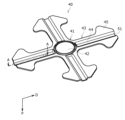
- FIG. 2 is a perspective view showing a negative electrode current collector plate according to an embodiment, as viewed from below.
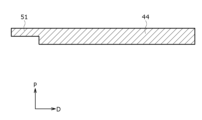
- FIG. 3 is a cross-sectional view taken along the line AA in FIG. 2 .
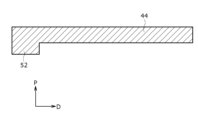
- FIG. 2 is a cross-sectional view taken along line AA of a negative electrode current collector plate according to another embodiment.
- FIG. 2 is a cross-sectional view taken along line AA of a negative electrode current collector plate according to another embodiment.
- the power storage device 10 is used, for example, as a power source for an electric vehicle.
- the power storage device of the present disclosure is not limited to being used as a power source for electric vehicles, and may be used, for example, as a power source for motor-driven electric devices such as power tools, power-assisted bicycles, electric motorcycles, electric wheelchairs, electric tricycles, and electric carts.
- the power storage device of the present disclosure may also be used as a power source for various electric devices used indoors and outdoors, such as cleaners, radios, lighting devices, digital cameras, and video cameras.
- the energy storage device 10 includes a wound electrode body 14 in which a positive electrode plate 11 as a first electrode plate and a negative electrode plate 12 as a second electrode plate are wound with a separator 13 interposed therebetween, an outer can 20 that houses the electrode body 14, and a sealing body 30 that closes the opening of the outer can 20.
- the outer can 20 houses an electrolyte together with the electrode body 14.
- the electrolyte in this embodiment is a non-aqueous electrolyte, but may be an aqueous electrolyte.
- the energy storage device 10 may be a capacitor.
- each member may be described using the axial direction P, the circumferential direction R, and the radial direction D.
- the side in the axial direction P where the sealing body 30 is provided may be described as the upper side
- the side where the bottom 20B of the outer can 20 is formed may be described as the lower side.
- the positive electrode plate 11, the negative electrode plate 12, and the separator 13 are all long strips wound in a spiral shape. At this time, the positive electrode plate 11 and the negative electrode plate 12 are stacked in a shifted manner so that they protrude to opposite sides in the axial direction P (height direction of the storage device 10).
- the composite layer of the negative electrode plate 12 may be formed to be one size larger than the composite layer of the positive electrode plate 11 in order to prevent lithium precipitation. In other words, the composite layer of the negative electrode plate 12 may be formed to be longer in the longitudinal direction and width direction (short direction) than the composite layer of the positive electrode plate 11.
- the separator 13 is formed to be at least one size larger than the positive electrode plate 11, and for example, two separators 13 are arranged to sandwich the positive electrode plate 11. Note that the electrode body 14 does not necessarily have to be configured in a state in which the positive electrode plate 11 and the negative electrode plate 12 are wound. For example, the electrode body 14 may be configured by alternately stacking multiple positive electrode plates 11 and multiple negative electrode plates 12.
- the positive electrode plate 11 has a positive electrode core and a positive electrode mixture layer formed on at least one surface of the core.
- a foil of a metal that is stable in the potential range of the positive electrode plate 11, such as aluminum or an aluminum alloy, or a film with the metal disposed on the surface layer is used.
- the positive electrode mixture layer contains, for example, a positive electrode active material, a conductive agent such as acetylene black, and a binder such as polyvinylidene fluoride, and is preferably formed on both sides of the positive electrode core.
- a lithium transition metal complex oxide is used as the positive electrode active material.
- the negative electrode plate 12 has a negative electrode core and a negative electrode mixture layer formed on at least one surface of the core.
- a foil of a metal that is stable in the potential range of the negative electrode plate 12, such as copper or a copper alloy, or a film with the metal disposed on the surface layer can be used.
- the negative electrode mixture layer preferably contains, for example, a negative electrode active material and a binder such as styrene-butadiene rubber (SBR), and is formed on both sides of the negative electrode core.
- SBR styrene-butadiene rubber
- graphite, a silicon-containing compound, etc. are used as the negative electrode active material.
- the non-aqueous electrolyte contained in the exterior can 20 includes a non-aqueous solvent and an electrolyte salt dissolved in the non-aqueous solvent.
- a non-aqueous solvent for example, esters, ethers, nitriles, amides, or a mixed solvent of two or more of these is used as the non-aqueous solvent.
- the non-aqueous solvent may contain a halogen-substituted body in which at least a part of the hydrogen of these solvents is replaced with a halogen atom such as fluorine.
- the non-aqueous solvent include ethylene carbonate (EC), ethyl methyl carbonate (EMC), dimethyl carbonate (DMC), and a mixed solvent of these.
- a lithium salt such as LiPF 6 is used as the electrolyte salt.
- the non-aqueous electrolyte may be a gel electrolyte, a solid electrolyte, or the like, instead of an electrolytic
- a positive electrode lead 15 extending from the upper end of the electrode body 14 in the axial direction P and connecting the positive electrode plate 11 constituting the electrode body 14 and the current collector plate 32 of the sealing body 30, and an upper insulating plate 16 disposed between the electrode body 14 and the sealing body 30.
- the positive electrode lead 15 electrically connects the positive electrode plate 11 and the sealing body 30. Therefore, the positive electrode cap 31 of the sealing body 30 functions as the first electrode external terminal (positive electrode external terminal).
- the upper insulating plate 16 prevents the positive electrode plate 11 and the positive electrode lead 15 from touching the outer can 20, and also prevents the positive electrode lead 15 from touching the negative electrode plate 12 of the electrode body 14.
- a negative electrode current collector 40 is provided below the electrode body 14.
- a negative electrode core material exposed portion (not shown) where no negative electrode mixture layer is provided in the negative electrode core material protrudes below the axial direction P of the negative electrode plate 12.
- the negative electrode core material exposed portion is formed from the end at the start of winding to the end at the end of winding in the longitudinal direction (circumferential direction R) of the long negative electrode plate 12.
- the negative electrode core material exposed portion is bonded to the negative electrode current collector 40, and the negative electrode plate 12 and the negative electrode current collector 40 are electrically connected.
- the negative electrode current collector 40 is bonded to the inner surface of the bottom 20B of the outer can 20, and the negative electrode current collector 40 and the outer can 20 are electrically connected.
- the outer can 20 is a cylindrical metal container with a bottom that is open at the top end in the axial direction P.
- the outer can 20 is generally made of a metal whose main component is iron, but when the positive electrode plate 11 is connected, it may be made of a metal whose main component is aluminum or the like.
- the outer can 20 has a cylindrical tube portion 20A, a circular bottom portion 20B when viewed from the bottom, a shoulder portion 20C that is formed in an annular shape along the circumferential direction R of the outer can 20 at the open end of the tube portion 20A, and a groove portion 20D that is formed along the circumferential direction R of the tube portion 20A.
- the outer can 20 is also provided with a negative electrode cap 21 as a second electrode external terminal (negative electrode external terminal).
- the groove portion 20D is formed at a position a predetermined length away from the shoulder portion 20C near the opening of the outer can 20.
- the groove portion 20D is a portion of the tubular portion 20A that protrudes inwardly of the outer can 20, and is formed, for example, by spinning the tubular portion 20A from the outside.
- the outer can 20 is reduced in diameter, and a thin groove is formed on the outer peripheral surface of the tubular portion 20A.
- the groove portion 20D has a generally U-shaped cross section, and is preferably formed in a ring shape over the entire length of the tubular portion 20A in the circumferential direction R.
- the negative electrode cap 21 is electrically connected to the negative electrode plate 12 via the outer can 20 and functions as a negative electrode external terminal.
- the negative electrode cap 21 is formed in a ring shape with an opening in the center in the radial direction D.
- the negative electrode cap 21 is welded to the cylindrical portion 20A of the outer can 20 and is electrically connected to the outer can 20.
- the sealing body 30 is formed in a disk shape overall, and includes a positive electrode cap 31, a current collector plate 32, a gasket 33, and an insulating member 34.
- the sealing body 30 is placed on the groove portion 20D of the outer can 20, and is fixed to the upper end of the outer can 20. More specifically, the shoulder portion 20C of the outer can 20 is bent inward in the radial direction D and crimped against the sealing body 30, and the sealing body 30 is fixed to the upper end of the outer can 20 by the shoulder portion 20C and the groove portion 20D of the outer can 20, and the sealing body 30 closes the opening of the outer can 20.
- the positive electrode cap 31 is electrically connected to the positive electrode plate 11 via the positive electrode lead 15 and the current collector plate 32, and functions as a positive electrode external terminal.
- the positive electrode cap 31 is a disk-shaped metal member, and has a protruding portion 31A whose central portion in the radial direction D protrudes outside the energy storage device 10, and a flange portion 31B formed around the protruding portion 31A.
- the positive electrode cap 31 is disposed on the upper surface side of the sealing body 30, and is exposed to the outside of the exterior can 20 to form the top surface of the energy storage device 10.
- a positive electrode tab or the like of the current collector member of the energy storage module is joined to the protruding portion 31A by welding.
- the current collector 32 is electrically connected to the positive electrode plate 11 via the positive electrode lead 15, and functions as a positive electrode current collector.
- the current collector 32 is a metal member having a diameter similar to that of the positive electrode cap 31.
- the current collector 32 is formed in a ring shape with an opening in the center in the radial direction D.
- the current collector 32 is disposed closer to the electrode body 14 than the positive electrode cap 31.
- the current collector 32 is welded to the positive electrode cap 31, for example, at a position closer to the outer periphery than the center in the radial direction D of the positive electrode cap 31.
- the gasket 33 is a rubber or resin member that prevents contact between the positive electrode cap 31 and the current collector plate 32 and the outer can 20, and ensures electrical insulation between the outer can 20 and the sealing body 30.
- the gasket 33 also seals the gap between the outer can 20 and the sealing body 30, sealing the inside of the energy storage device 10.
- the gasket 33 is provided between the outer periphery of the stack of the positive electrode cap 31 and the current collector plate 32 and the outer can 20.
- the gasket 33 covers the upper surface of the flange portion 31B of the positive electrode cap 31, the side surfaces of the positive electrode cap 31 and the current collector plate 32, and the lower surface of the current collector plate 32 at the outer periphery of the stack.
- the insulating member 34 is a rubber or resin member that prevents contact between the positive electrode cap 31 and the negative electrode cap 21 and ensures electrical insulation between the positive electrode cap 31 and the negative electrode cap 21.
- the insulating member 34 is formed in a ring shape with an opening in the center in the radial direction D.
- the negative electrode current collector plate 40 as one example of the embodiment will be described with reference to FIG. 2 and FIG.
- the negative electrode current collector 40 which serves as a current collector, is joined to the exposed portion of the negative electrode core material protruding from the lower side of the electrode body 14 in the axial direction P.
- the negative electrode current collector 40 is also joined to the bottom 20B of the outer can 20, causing the outer can 20 to function as a negative electrode external terminal (see FIG. 1).
- the negative electrode current collector 40 can improve reliability, as will be described in detail later.
- the negative electrode current collector 40 is preferably made of a metal, such as copper, a copper alloy, nickel or a nickel alloy, or an iron material with a nickel-plated surface.
- the negative electrode current collector 40 is provided below the electrode body 14 in the axial direction P, and is housed in the exterior can 20 together with the electrode body 14. In other words, the negative electrode current collector 40 is disposed between the electrode body 14 and the bottom 20B of the exterior can 20 (see FIG. 1).
- the negative electrode current collector 40 has a central portion 41 provided in the center of the radial direction D, and an extension portion 43 extending from the central portion 41 along the radial direction D, each of which will be described in detail later.
- the central portion 41 has a can bottom joint portion 42 surrounded by a circular groove.
- the can bottom joint portion 42 is joined to the bottom portion 20B of the outer can 20 by welding.
- the multiple extension portions 43 extend from the central portion 41 along the radial direction D (the stacking direction of the positive electrode plates 11 and the negative electrode plates 12).
- the multiple extension portions 43 are arranged at intervals in the circumferential direction R. In the example shown in FIG. 3, four extension portions 43 are arranged radially from the central portion 41 at 90° intervals. Note that, although the extension portions 43 are configured to extend in four directions in this embodiment, they may be configured to extend in one direction, two directions, three directions, or five or more directions.
- the extension portion 43 has a flat joint portion 44 extending along the radial direction D, and edge portions 45 formed at both ends of the joint portion 44 in the circumferential direction R, as will be described in detail later. Note that the edge portions 45 may be provided at both ends of one joint portion 44, but may also be formed at only one end in the circumferential direction R.
- the joint 44 is a portion that is joined to the exposed portion of the negative electrode core material by welding. More specifically, the exposed portion of the negative electrode core material is joined to the upper surface of the joint 44 in the axial direction P by welding.
- the joint 44 extends along the radial direction D, and is formed in a portion that corresponds to the bottom of the concave shape when viewed from the radial direction D.
- a suppression section 51 which will be described in detail later, is formed at the outer end of the joint 44 in the radial direction D.
- suppression section 51 which is a melting suppression section, is a section that suppresses excessive melting of joint 44. As will be described in detail later, suppression section 51 can suppress the occurrence of spatter by suppressing excessive melting. This can improve the reliability of the energy storage device 10.
- the suppression portion 51 is formed at the end of the joint 44 in the welding direction.
- the joint 44 is joined by welding from the inside to the outside in the radial direction D, so the suppression portion 51 is formed at the end of the joint 44 on the outer periphery side in the stacking direction of the positive electrode plate 11 and the negative electrode plate 12 (the outer end in the radial direction D).
- the suppression portion 51 may be formed at the end of the joint 44 on the inner periphery side in the stacking direction of the electrode body 14 (the inner end in the radial direction D).
- the suppression portion 51 is formed at the outer end of the joint portion 44 in the radial direction D. It is preferable that the length of the suppression portion 51 in the radial direction D is 0.05 or more and 0.1 or less when the length of the joint portion 44 in the radial direction D is 1.0.
- the suppression section 51 is formed thinner than the other parts of the joint 44 other than the suppression section 51. More specifically, it is preferable that the thickness of the suppression section 51 is 0.2 or more and 0.7 or less when the thickness of the other parts of the joint 44 other than the suppression section 51 is 1.
- the suppression portion 51 is formed so that the upper surface side of the joint 44 is flat, but this is not limited to the above.
- the suppression portion 51 may be formed so that the upper surface side of the joint 44 is flat.
- a step may be formed between the suppression portion 51 and the upper and lower surfaces of the joint 44.
- the laser When welding the joint 44 of the negative current collector 40 and the exposed part of the negative core material, the laser is moved from the inside to the outside in the radial direction D to perform the welding. At this time, heat accumulates in the base material (joint 44 of the negative current collector 40) at the outer end of the radial direction D (end end in the welding direction), causing an excessive molten pool and spattering. If the spatter is scattered between the negative current collector 40 and the electrode body 14 and adheres to the composite material of the electrode body 14, it may cause a voltage failure of the energy storage device 10.
- the suppression portion 51 is formed thinner than the other portions, so that heat is less likely to accumulate in the suppression portion 51 during welding, and since the amount of base material is smaller than that of the remaining portion, it is possible to avoid an excessive molten pool. This makes it possible to suppress the occurrence of spatter, and to prevent voltage failure of the energy storage device 10 from occurring if the spatter is scattered between the negative electrode current collector 40 and the electrode body 14 and adheres to the composite material of the electrode body 14. This in turn makes it possible to improve the reliability of the energy storage device 10.
- a suppression unit 52 as another example of the embodiment will be described with reference to Fig. 4. Below, configurations different from the suppression unit 51 described above will be described, and descriptions of configurations and effects similar to those of the suppression unit 51 described above will be omitted.
- the suppression section 52 is formed thicker than the other parts of the joint 44 other than the suppression section 51. More specifically, the thickness of the suppression section 51 is preferably 1.5 or more and 3.0 or less when the thickness of the other parts of the joint 44 other than the suppression section 51 is 1.0.
- the suppression portion 52 is formed so that the upper surface side of the joint 44 is flat, but this is not limited to the above.
- the suppression portion 52 may be formed so that the upper surface side of the joint 44 is flat.
- a step may be formed between the suppression portion 52 and the upper and lower surfaces of the joint 44.
- the suppression portion 52 is formed thicker than the other portions, so that the heat capacity of the suppression portion 52 is greater than the heat capacity of the other portions, and the amount of heat accumulated per unit volume in the suppression portion 52 during welding can be reduced, and an excessive molten pool can be avoided. This makes it possible to suppress the occurrence of spatter, and prevents voltage failure of the energy storage device 10 from occurring if the spatter is scattered between the negative electrode current collector 40 and the electrode body 14 and adheres to the composite material of the electrode body 14. This in turn makes it possible to improve the reliability of the energy storage device 10.
- the suppression unit 53 which is another example of an embodiment, will be described using FIG. 5.
- the suppression portion 53 is formed so as to be inclined away from the electrode body 14 as it moves toward the outer periphery. More specifically, the suppression portion 53 is formed so as to be inclined downward in the axial direction P as it moves toward the outside in the radial direction D.
- the suppression portion 53 is formed so as to be inclined downward in the axial direction P as it moves outward in the radial direction D, so that a space is formed between the suppression portion 53 and the electrode body 14 through which the molten pool can escape during welding, and it is possible to prevent spatters generated in the molten pool from scattering between the negative electrode current collector 40 and the electrode body 14 and adhering to the composite material of the electrode body 14, which can cause voltage defects in the storage device 10. As a result, the reliability of the storage device 10 can be improved.
- the suppression portion 53 is formed by bending the end of the joint 44, but this is not limited to this, and the surface of the suppression portion 53 facing the electrode body 14 may be inclined so that the thickness of the joint 44 becomes thinner toward the welding end side. This configuration can prevent the height of the laser irradiation surface of the suppression portion 53 from becoming uneven.
- the present disclosure is not limited to the above-described embodiment and its modified examples, and various modifications and improvements are possible within the scope of the matters described in the claims of the present application.
- the configuration of the current collector plate used in the energy storage device of the present disclosure has been described as a negative current collector plate, but the current collector plate of the present disclosure may also be a positive current collector plate.
Landscapes
- Chemical & Material Sciences (AREA)
- Chemical Kinetics & Catalysis (AREA)
- Electrochemistry (AREA)
- General Chemical & Material Sciences (AREA)
- Connection Of Batteries Or Terminals (AREA)
Priority Applications (3)
| Application Number | Priority Date | Filing Date | Title |
|---|---|---|---|
| CN202480007350.2A CN120530523A (zh) | 2023-01-31 | 2024-01-24 | 蓄电装置 |
| EP24750068.9A EP4661195A4 (en) | 2023-01-31 | 2024-01-24 | ENERGY STORAGE DEVICE |
| JP2024574480A JPWO2024162118A1 (https=) | 2023-01-31 | 2024-01-24 |
Applications Claiming Priority (2)
| Application Number | Priority Date | Filing Date | Title |
|---|---|---|---|
| JP2023013413 | 2023-01-31 | ||
| JP2023-013413 | 2023-01-31 |
Publications (1)
| Publication Number | Publication Date |
|---|---|
| WO2024162118A1 true WO2024162118A1 (ja) | 2024-08-08 |
Family
ID=92146528
Family Applications (1)
| Application Number | Title | Priority Date | Filing Date |
|---|---|---|---|
| PCT/JP2024/001961 Ceased WO2024162118A1 (ja) | 2023-01-31 | 2024-01-24 | 蓄電装置 |
Country Status (4)
| Country | Link |
|---|---|
| EP (1) | EP4661195A4 (https=) |
| JP (1) | JPWO2024162118A1 (https=) |
| CN (1) | CN120530523A (https=) |
| WO (1) | WO2024162118A1 (https=) |
Citations (4)
| Publication number | Priority date | Publication date | Assignee | Title |
|---|---|---|---|---|
| JP2003533853A (ja) * | 2000-05-05 | 2003-11-11 | ホーカー・エナジー・プロダクツ,インコーポレイテッド | 高性能バッテリおよびこれのための集電器 |
| JP2005203374A (ja) | 2004-01-16 | 2005-07-28 | Samsung Sdi Co Ltd | 二次電池 |
| WO2013001821A1 (ja) * | 2011-06-28 | 2013-01-03 | 日本ケミコン株式会社 | 蓄電デバイスおよび蓄電デバイスの製造方法 |
| US20220231345A1 (en) * | 2021-01-19 | 2022-07-21 | Lg Energy Solution, Ltd. | Battery, and battery pack and vehicle including the same |
Family Cites Families (5)
| Publication number | Priority date | Publication date | Assignee | Title |
|---|---|---|---|---|
| JP2001068379A (ja) * | 1999-08-24 | 2001-03-16 | Honda Motor Co Ltd | 電気二重層コンデンサ |
| JP5006603B2 (ja) * | 2006-09-06 | 2012-08-22 | 株式会社日立製作所 | 非水電解質二次電池 |
| JP2009110751A (ja) * | 2007-10-29 | 2009-05-21 | Panasonic Corp | 二次電池 |
| JP5866772B2 (ja) * | 2011-02-22 | 2016-02-17 | 日本ケミコン株式会社 | コンデンサ及びその端子接続方法 |
| EP4372899A4 (en) * | 2021-07-16 | 2024-11-06 | Panasonic Holdings Corporation | COLLECTOR PLATE AND ENERGY STORAGE DEVICE |
-
2024
- 2024-01-24 WO PCT/JP2024/001961 patent/WO2024162118A1/ja not_active Ceased
- 2024-01-24 JP JP2024574480A patent/JPWO2024162118A1/ja active Pending
- 2024-01-24 EP EP24750068.9A patent/EP4661195A4/en active Pending
- 2024-01-24 CN CN202480007350.2A patent/CN120530523A/zh active Pending
Patent Citations (4)
| Publication number | Priority date | Publication date | Assignee | Title |
|---|---|---|---|---|
| JP2003533853A (ja) * | 2000-05-05 | 2003-11-11 | ホーカー・エナジー・プロダクツ,インコーポレイテッド | 高性能バッテリおよびこれのための集電器 |
| JP2005203374A (ja) | 2004-01-16 | 2005-07-28 | Samsung Sdi Co Ltd | 二次電池 |
| WO2013001821A1 (ja) * | 2011-06-28 | 2013-01-03 | 日本ケミコン株式会社 | 蓄電デバイスおよび蓄電デバイスの製造方法 |
| US20220231345A1 (en) * | 2021-01-19 | 2022-07-21 | Lg Energy Solution, Ltd. | Battery, and battery pack and vehicle including the same |
Non-Patent Citations (1)
| Title |
|---|
| See also references of EP4661195A1 |
Also Published As
| Publication number | Publication date |
|---|---|
| JPWO2024162118A1 (https=) | 2024-08-08 |
| EP4661195A4 (en) | 2026-04-29 |
| EP4661195A1 (en) | 2025-12-10 |
| CN120530523A (zh) | 2025-08-22 |
Similar Documents
| Publication | Publication Date | Title |
|---|---|---|
| JP4416770B2 (ja) | 組電池 | |
| CN102214811B (zh) | 二次电池及其制造方法 | |
| US20250201936A1 (en) | Electrode for secondary batteries | |
| US20250055040A1 (en) | Power storage device | |
| WO2024143319A1 (ja) | 蓄電装置および蓄電モジュール | |
| JP2009181899A (ja) | 積層式電池 | |
| WO2024162134A1 (ja) | 蓄電装置 | |
| WO2024095902A1 (ja) | 蓄電装置 | |
| WO2024162118A1 (ja) | 蓄電装置 | |
| WO2023189939A1 (ja) | 蓄電装置 | |
| WO2024162159A1 (ja) | 蓄電装置 | |
| WO2023127565A1 (ja) | 集電板および蓄電装置 | |
| WO2024203729A1 (ja) | 蓄電装置 | |
| CN119731870A (zh) | 蓄电装置 | |
| WO2024162017A1 (ja) | 蓄電装置 | |
| EP4675724A1 (en) | Cylindrical battery | |
| WO2024161920A1 (ja) | 円筒形電池 | |
| WO2025229947A1 (ja) | 非水電解質二次電池 | |
| WO2025047154A1 (ja) | 円筒形電池 | |
| WO2024224957A1 (ja) | 円筒形電池及びその製造方法 | |
| WO2025116021A1 (ja) | 蓄電装置 | |
| WO2026048779A1 (ja) | 蓄電装置および蓄電装置の製造方法 | |
| WO2026070869A1 (ja) | 二次電池及び二次電池用正極 | |
| WO2023145830A1 (ja) | 蓄電装置 | |
| CN120752787A (zh) | 蓄电装置 |
Legal Events
| Date | Code | Title | Description |
|---|---|---|---|
| 121 | Ep: the epo has been informed by wipo that ep was designated in this application |
Ref document number: 24750068 Country of ref document: EP Kind code of ref document: A1 |
|
| ENP | Entry into the national phase |
Ref document number: 2024574480 Country of ref document: JP Kind code of ref document: A |
|
| WWE | Wipo information: entry into national phase |
Ref document number: 2024574480 Country of ref document: JP |
|
| WWE | Wipo information: entry into national phase |
Ref document number: 202480007350.2 Country of ref document: CN |
|
| WWP | Wipo information: published in national office |
Ref document number: 202480007350.2 Country of ref document: CN |
|
| NENP | Non-entry into the national phase |
Ref country code: DE |
|
| WWP | Wipo information: published in national office |
Ref document number: 2024750068 Country of ref document: EP |