WO2024157871A1 - 化学気相成長法用成膜助剤、化学気相成長法用塗工液、金属酸化物膜、および金属酸化物膜の成膜方法 - Google Patents
化学気相成長法用成膜助剤、化学気相成長法用塗工液、金属酸化物膜、および金属酸化物膜の成膜方法 Download PDFInfo
- Publication number
- WO2024157871A1 WO2024157871A1 PCT/JP2024/001261 JP2024001261W WO2024157871A1 WO 2024157871 A1 WO2024157871 A1 WO 2024157871A1 JP 2024001261 W JP2024001261 W JP 2024001261W WO 2024157871 A1 WO2024157871 A1 WO 2024157871A1
- Authority
- WO
- WIPO (PCT)
- Prior art keywords
- film
- vapor deposition
- chemical vapor
- forming
- metal oxide
- Prior art date
- Legal status (The legal status is an assumption and is not a legal conclusion. Google has not performed a legal analysis and makes no representation as to the accuracy of the status listed.)
- Ceased
Links
Images


Classifications
-
- C—CHEMISTRY; METALLURGY
- C23—COATING METALLIC MATERIAL; COATING MATERIAL WITH METALLIC MATERIAL; CHEMICAL SURFACE TREATMENT; DIFFUSION TREATMENT OF METALLIC MATERIAL; COATING BY VACUUM EVAPORATION, BY SPUTTERING, BY ION IMPLANTATION OR BY CHEMICAL VAPOUR DEPOSITION, IN GENERAL; INHIBITING CORROSION OF METALLIC MATERIAL OR INCRUSTATION IN GENERAL
- C23C—COATING METALLIC MATERIAL; COATING MATERIAL WITH METALLIC MATERIAL; SURFACE TREATMENT OF METALLIC MATERIAL BY DIFFUSION INTO THE SURFACE, BY CHEMICAL CONVERSION OR SUBSTITUTION; COATING BY VACUUM EVAPORATION, BY SPUTTERING, BY ION IMPLANTATION OR BY CHEMICAL VAPOUR DEPOSITION, IN GENERAL
- C23C16/00—Chemical coating by decomposition of gaseous compounds, without leaving reaction products of surface material in the coating, i.e. chemical vapour deposition [CVD] processes
- C23C16/44—Chemical coating by decomposition of gaseous compounds, without leaving reaction products of surface material in the coating, i.e. chemical vapour deposition [CVD] processes characterised by the method of coating
- C23C16/455—Chemical coating by decomposition of gaseous compounds, without leaving reaction products of surface material in the coating, i.e. chemical vapour deposition [CVD] processes characterised by the method of coating characterised by the method used for introducing gases into reaction chamber or for modifying gas flows in reaction chamber
- C23C16/45523—Pulsed gas flow or change of composition over time
- C23C16/45525—Atomic layer deposition [ALD]
- C23C16/45527—Atomic layer deposition [ALD] characterized by the ALD cycle, e.g. different flows or temperatures during half-reactions, unusual pulsing sequence, use of precursor mixtures or auxiliary reactants or activations
- C23C16/45536—Use of plasma, radiation or electromagnetic fields
-
- H—ELECTRICITY
- H10—SEMICONDUCTOR DEVICES; ELECTRIC SOLID-STATE DEVICES NOT OTHERWISE PROVIDED FOR
- H10P—GENERIC PROCESSES OR APPARATUS FOR THE MANUFACTURE OR TREATMENT OF DEVICES COVERED BY CLASS H10
- H10P14/00—Formation of materials, e.g. in the shape of layers or pillars
- H10P14/60—Formation of materials, e.g. in the shape of layers or pillars of insulating materials
- H10P14/63—Formation of materials, e.g. in the shape of layers or pillars of insulating materials characterised by the formation processes
- H10P14/6326—Deposition processes
- H10P14/6328—Deposition from the gas or vapour phase
- H10P14/6334—Deposition from the gas or vapour phase using decomposition or reaction of gaseous or vapour phase compounds, i.e. chemical vapour deposition
-
- C—CHEMISTRY; METALLURGY
- C23—COATING METALLIC MATERIAL; COATING MATERIAL WITH METALLIC MATERIAL; CHEMICAL SURFACE TREATMENT; DIFFUSION TREATMENT OF METALLIC MATERIAL; COATING BY VACUUM EVAPORATION, BY SPUTTERING, BY ION IMPLANTATION OR BY CHEMICAL VAPOUR DEPOSITION, IN GENERAL; INHIBITING CORROSION OF METALLIC MATERIAL OR INCRUSTATION IN GENERAL
- C23C—COATING METALLIC MATERIAL; COATING MATERIAL WITH METALLIC MATERIAL; SURFACE TREATMENT OF METALLIC MATERIAL BY DIFFUSION INTO THE SURFACE, BY CHEMICAL CONVERSION OR SUBSTITUTION; COATING BY VACUUM EVAPORATION, BY SPUTTERING, BY ION IMPLANTATION OR BY CHEMICAL VAPOUR DEPOSITION, IN GENERAL
- C23C16/00—Chemical coating by decomposition of gaseous compounds, without leaving reaction products of surface material in the coating, i.e. chemical vapour deposition [CVD] processes
- C23C16/22—Chemical coating by decomposition of gaseous compounds, without leaving reaction products of surface material in the coating, i.e. chemical vapour deposition [CVD] processes characterised by the deposition of inorganic material, other than metallic material
- C23C16/30—Deposition of compounds, mixtures or solid solutions, e.g. borides, carbides, nitrides
- C23C16/40—Oxides
-
- C—CHEMISTRY; METALLURGY
- C23—COATING METALLIC MATERIAL; COATING MATERIAL WITH METALLIC MATERIAL; CHEMICAL SURFACE TREATMENT; DIFFUSION TREATMENT OF METALLIC MATERIAL; COATING BY VACUUM EVAPORATION, BY SPUTTERING, BY ION IMPLANTATION OR BY CHEMICAL VAPOUR DEPOSITION, IN GENERAL; INHIBITING CORROSION OF METALLIC MATERIAL OR INCRUSTATION IN GENERAL
- C23C—COATING METALLIC MATERIAL; COATING MATERIAL WITH METALLIC MATERIAL; SURFACE TREATMENT OF METALLIC MATERIAL BY DIFFUSION INTO THE SURFACE, BY CHEMICAL CONVERSION OR SUBSTITUTION; COATING BY VACUUM EVAPORATION, BY SPUTTERING, BY ION IMPLANTATION OR BY CHEMICAL VAPOUR DEPOSITION, IN GENERAL
- C23C16/00—Chemical coating by decomposition of gaseous compounds, without leaving reaction products of surface material in the coating, i.e. chemical vapour deposition [CVD] processes
- C23C16/44—Chemical coating by decomposition of gaseous compounds, without leaving reaction products of surface material in the coating, i.e. chemical vapour deposition [CVD] processes characterised by the method of coating
- C23C16/448—Chemical coating by decomposition of gaseous compounds, without leaving reaction products of surface material in the coating, i.e. chemical vapour deposition [CVD] processes characterised by the method of coating characterised by the method used for generating reactive gas streams, e.g. by evaporation or sublimation of precursor materials
- C23C16/4486—Chemical coating by decomposition of gaseous compounds, without leaving reaction products of surface material in the coating, i.e. chemical vapour deposition [CVD] processes characterised by the method of coating characterised by the method used for generating reactive gas streams, e.g. by evaporation or sublimation of precursor materials by producing an aerosol and subsequent evaporation of the droplets or particles
-
- C—CHEMISTRY; METALLURGY
- C23—COATING METALLIC MATERIAL; COATING MATERIAL WITH METALLIC MATERIAL; CHEMICAL SURFACE TREATMENT; DIFFUSION TREATMENT OF METALLIC MATERIAL; COATING BY VACUUM EVAPORATION, BY SPUTTERING, BY ION IMPLANTATION OR BY CHEMICAL VAPOUR DEPOSITION, IN GENERAL; INHIBITING CORROSION OF METALLIC MATERIAL OR INCRUSTATION IN GENERAL
- C23C—COATING METALLIC MATERIAL; COATING MATERIAL WITH METALLIC MATERIAL; SURFACE TREATMENT OF METALLIC MATERIAL BY DIFFUSION INTO THE SURFACE, BY CHEMICAL CONVERSION OR SUBSTITUTION; COATING BY VACUUM EVAPORATION, BY SPUTTERING, BY ION IMPLANTATION OR BY CHEMICAL VAPOUR DEPOSITION, IN GENERAL
- C23C16/00—Chemical coating by decomposition of gaseous compounds, without leaving reaction products of surface material in the coating, i.e. chemical vapour deposition [CVD] processes
- C23C16/44—Chemical coating by decomposition of gaseous compounds, without leaving reaction products of surface material in the coating, i.e. chemical vapour deposition [CVD] processes characterised by the method of coating
- C23C16/52—Controlling or regulating the coating process
-
- H—ELECTRICITY
- H10—SEMICONDUCTOR DEVICES; ELECTRIC SOLID-STATE DEVICES NOT OTHERWISE PROVIDED FOR
- H10P—GENERIC PROCESSES OR APPARATUS FOR THE MANUFACTURE OR TREATMENT OF DEVICES COVERED BY CLASS H10
- H10P14/00—Formation of materials, e.g. in the shape of layers or pillars
- H10P14/60—Formation of materials, e.g. in the shape of layers or pillars of insulating materials
-
- H—ELECTRICITY
- H10—SEMICONDUCTOR DEVICES; ELECTRIC SOLID-STATE DEVICES NOT OTHERWISE PROVIDED FOR
- H10P—GENERIC PROCESSES OR APPARATUS FOR THE MANUFACTURE OR TREATMENT OF DEVICES COVERED BY CLASS H10
- H10P14/00—Formation of materials, e.g. in the shape of layers or pillars
- H10P14/60—Formation of materials, e.g. in the shape of layers or pillars of insulating materials
- H10P14/69—Inorganic materials
- H10P14/692—Inorganic materials composed of oxides, glassy oxides or oxide-based glasses
- H10P14/6938—Inorganic materials composed of oxides, glassy oxides or oxide-based glasses the material containing at least one metal element, e.g. metal oxides, metal oxynitrides or metal oxycarbides
Definitions
- the present invention relates to a film-forming aid for chemical vapor deposition, a coating liquid for chemical vapor deposition, a metal oxide film, and a method for forming a metal oxide film.
- Chemical vapor deposition is a film formation method that uses reactions of raw materials in the gas phase or chemical reactions on a substrate. It is suitable for mass production because it does not require a high vacuum.
- Known methods include plasma enhanced CVD, atomic layer deposition (ALD), and metal organic CVD.
- mist CVD Another known CVD method is mist CVD, in which a solution containing metal atoms is converted into a mist of droplets with a diameter of 500 ⁇ m or less by ultrasonic waves or the like, and then reacted on a substrate heated to 500°C or less to form a metal oxide (see, for example, Patent Documents 1-3).
- Mist CVD is a particularly preferred film formation method, since it can form films under atmospheric pressure and uses a mist of finely atomized solution, allowing a uniform and dense film to be formed on the substrate.
- Patent Document 3 discloses a film formation method in which a solution of a metal salt or complex containing a metal element and ethylenediamine as a film formation assistant is turned into a mist, and then the mist is supplied to a heated substrate to form a metal oxide film on the substrate.
- a solution of a metal salt or complex containing a metal element and ethylenediamine as a film formation assistant is turned into a mist, and then the mist is supplied to a heated substrate to form a metal oxide film on the substrate.
- the present invention was made in consideration of the above-mentioned circumstances, and aims to provide a film-forming additive for chemical vapor deposition that is effective in improving the film-forming speed while also producing a metal oxide film with low surface roughness.
- the present invention also aims to provide a coating fluid for chemical vapor deposition that contains the above-mentioned film-forming aid for chemical vapor deposition, a metal oxide film formed from the coating fluid, and a method for forming the metal oxide film.
- the present invention relates to a film-forming auxiliary for chemical vapor deposition, which contains a compound represented by general formula (1): R 1 R 2 NCONH 2 (wherein R 1 and R 2 are each independently a hydrogen atom, a hydrocarbon group having 1 to 22 carbon atoms, an amino group, or a hydroxyl group).
- the present invention also relates to a coating liquid for chemical vapor deposition that contains a solution of the film-forming aid for chemical vapor deposition and a solution of a metal salt or complex.
- the present invention also relates to a metal oxide film having a thickness of 0.1 ⁇ m or more and 20 ⁇ m or less, which is formed from a solution of the film-forming assistant for chemical vapor deposition and a solution of a metal salt or complex.
- the present invention also relates to a method for forming a metal oxide film, which includes a step (a1) of separately forming a mist from a solution of the film-forming assistant for chemical vapor deposition and a solution of a metal salt or complex, and a step (b1) of simultaneously supplying each mist to a heated substrate surface.
- the present invention also relates to a method for forming a metal oxide film, which includes a step (a2) of misting the coating liquid for chemical vapor deposition and a step (b2) of supplying the mist obtained to a heated substrate surface.
- the film-forming auxiliary for chemical vapor deposition of the present invention contains a compound represented by general formula (1): R 1 R 2 NCONH 2 (wherein R 1 and R 2 are each independently a hydrogen atom, a hydrocarbon group having 1 to 22 carbon atoms, an amino group, or a hydroxyl group), which promotes the formation of a metal oxide film, thereby enabling the production of a metal oxide film having a high film-forming rate and low surface roughness.
- 1 is a schematic diagram of a metal oxide film forming apparatus in a metal oxide film manufacturing method according to one embodiment of the present invention.
- 1 is a schematic diagram of a metal oxide film forming apparatus in a metal oxide film manufacturing method according to one embodiment of the present invention.
- 1 is a schematic diagram of an atomizer in a metal oxide film forming apparatus in a method for producing a metal oxide film according to one embodiment of the present invention.
- 1 is a schematic diagram of a mixing tank in a metal oxide film forming apparatus in a metal oxide film manufacturing method according to one embodiment of the present invention.
- 1 is a schematic diagram of a film forming section in a metal oxide film forming apparatus in a metal oxide film manufacturing method according to one embodiment of the present invention.
- the film-forming aid for chemical vapor deposition, the coating liquid for chemical vapor deposition, the metal oxide film, and the method for forming the metal oxide film according to one embodiment of the present invention will be explained with reference to figures as necessary.
- the film-forming assistant for chemical vapor deposition contains a compound represented by the general formula (1): R 1 R 2 NCONH 2 (wherein R 1 and R 2 are each independently a hydrogen atom, a hydrocarbon group having 1 to 22 carbon atoms, an amino group, or a hydroxyl group).
- R 1 and R 2 are preferably each independently a hydrogen atom from the viewpoint of improving the film formation rate and reducing the surface roughness.
- examples of the hydrocarbon group include linear alkyl groups, branched alkyl groups, and aralkyl groups, and among these, linear alkyl groups and branched alkyl groups are preferred from the viewpoint of improving the film formation rate.
- the number of carbon atoms is preferably 1 to 10, and more preferably 1 to 5.
- both R 1 and R 2 are hydrogen atoms.
- a clathrate compound in which hydrogen peroxide or the like is included can also be used.
- the film-forming assistant for chemical vapor deposition is preferably a solution of the film-forming assistant for chemical vapor deposition, containing a compound represented by the general formula (1) and a solvent.
- the solvent may be any solvent capable of dissolving the compound represented by the general formula (1), but from the viewpoint of mist generation efficiency, a solvent having a boiling point of 40° C. or more and 150° C. or less and a viscosity at 25° C.
- examples of the solvent include polar solvents such as lower alcohols such as methanol, nitrile-based solvents such as acetonitrile, and water, and non-polar solvents such as aromatic solvents such as toluene. Two or more of these solvents may be mixed and used.
- the coating liquid contains water, since this makes it easy to handle and prevents the atomized coating liquid from catching fire.
- the oxidation source is a source of oxygen atoms for converting a metal salt or complex described below into a metal oxide.
- the compound represented by the above-mentioned general formula (1) is preferably present in the film-forming aid for chemical vapor deposition at a concentration of 0.1% by weight or more and 20% by weight or less, and more preferably at a concentration of 0.5% by weight or more and 10% by weight or less.
- the metal element constituting the metal salt or metal complex may be any metal element that can form an oxide film by chemical vapor deposition, but the metal element is preferably one or more selected from group 13 elements, group 14 elements, and transition metal elements.
- Group 13 elements include Al, Ga, In, etc.
- group 14 elements include Si, Ge, Sn, Pb, etc.
- transition metal elements include D-block elements. From the viewpoint of availability, Al, Si, Zr, and Y are more preferable metal elements.
- the salt or complex of the metal element may be any salt or complex that can form an oxide film by chemical vapor deposition, but examples include salts or complexes of metals such as aluminum tris(acetylacetonate), polysilazane, zirconium tetra(acetylacetonate), and yttrium(acetylacetonate).
- the metal salt or complex is preferably a solution of a metal salt or complex containing a metal salt or complex and a solvent.
- the solvent may be any solvent that can dissolve a compound that is a metal salt or complex, but from the viewpoint of mist generation efficiency, a solvent having a boiling point of 40°C or more and 150°C or less is preferable, and a solvent having a boiling point of 50°C or more and 125°C or less is more preferable.
- a solvent having a viscosity of 1.3 mPa ⁇ sec or less at 25°C is preferable, a solvent having a viscosity of 0.1 mPa ⁇ sec or more and 1.0 mPa ⁇ sec or less is more preferable, and a solvent having a viscosity of 0.2 mPa ⁇ sec or more and 0.8 mPa ⁇ sec or less is even more preferable.
- examples of the solvent include polar solvents such as lower alcohols such as methanol, nitrile solvents such as acetonitrile, and water, and non-polar solvents such as aromatic solvents such as toluene. Two or more of these solvents may be mixed and used.
- the solution of the film-forming assistant for chemical vapor deposition does not contain a solvent acting as an oxidation source
- lower alcohol or water is more preferable as a solvent for metal salts or complexes, in that the effect of the present invention can be obtained more fully.
- a non-polar solvent is used, a miscible lower alcohol may be used, or only water may be made into a mist and introduced into a mixer.
- the solution of the metal salt or complex contains the metal salt or complex and the solvent, and preferably contains 0.2% by weight or more and 20% by weight or less of the metal salt or complex. If the metal salt or complex is less than 0.2% by weight, the film formation speed decreases, and if it is more than 20% by weight, the surface roughness of the metal oxide layer may increase.
- the coating liquid for chemical vapor deposition contains a solution of the film-forming auxiliary for chemical vapor deposition and a solution of the metal salt or complex.
- the coating liquid for chemical vapor deposition may contain the film-forming auxiliary for chemical vapor deposition, the metal salt or complex, and the respective solvents.
- the method for forming the metal oxide film may be any chemical vapor deposition method, and mist chemical vapor deposition (hereinafter also referred to as "mCVD”) is preferred from the viewpoint of excellent film formation speed and film formation uniformity.
- mCVD mist chemical vapor deposition
- Examples of mCVD include a method for forming a metal oxide film having a step (a1) of separately misting a solution of the film-forming aid for chemical vapor deposition and a solution of the metal salt or complex, and a step (b1) of simultaneously supplying each mist to a heated substrate surface, and a method for forming a metal oxide film having a step (a2) of misting the coating liquid for chemical vapor deposition and a step (b2) of supplying the mist to a heated substrate surface. More specifically, the fine particles obtained by misting the raw material are supplied to the substrate surface with a carrier gas, and the fine particles are then reacted in an atmosphere at a temperature of 200°C to 500°C. By reacting the raw material as fine particles, a metal oxide film with a high film-forming speed and small surface roughness can be obtained.
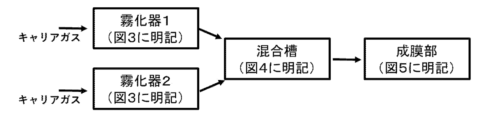
- Figure 1 shows a schematic diagram of a film-forming apparatus (1) in a method for forming a metal oxide film, which includes a step (a1) of separately misting the solution of the film-forming assistant for chemical vapor deposition and the solution of the metal salt or complex.
- the film-forming apparatus (1) is composed of two atomizers (mist-forming devices), a mixing tank, and a film-forming machine (film-forming section) connected by piping.
- Figure 2 shows a schematic diagram of a film-forming apparatus (2) in a method for forming a metal oxide film, which includes a step (a2) of misting the coating liquid for chemical vapor deposition and a step (b2) of supplying the mist obtained to a heated substrate surface.
- the film-forming apparatus (2) is composed of an atomizer (mist-forming device) and a film-forming machine (film-forming section) connected by piping.
- FIG. 3 shows a schematic diagram of the mist generator in a metal oxide film forming apparatus.
- the mist generator consists of a container for containing raw materials and an ultrasonic generator equipped with an ultrasonic vibrator.
- the container is a glass cylinder with a Teflon (registered trademark) lid and a bottom made of polypropylene or a film made of tetrafluoroethylene-hexafluoropropylene copolymer.
- Two glass pipes are provided to pass through the lid.
- the first pipe is provided to send carrier gas (nitrogen) for transporting the mist into the container, and the second pipe is provided to send the mist generated in the container and carrier gas to the film forming machine.
- the container is placed in the ultrasonic generator together with water, and the ultrasonic waves generated by the ultrasonic vibrator are transmitted to the raw materials via the water and the film made of polypropylene or the like, turning the raw materials into mist.
- FIG 4 shows a schematic diagram of a mixing tank in a metal oxide film forming apparatus.
- the mixing tank is a glass container equipped with a Teflon (registered trademark) lid.
- Three glass pipes are provided to pass through the lid. Of the three pipes, two are connected to two mist generators via piping, and the central pipe is connected to the film forming section via piping.
- the mist generated in the mist generator is transported to the film forming section via the mixing tank.
- This mixing tank is mainly used to mix the mists generated in the separate mist generators.
- Figure 5 shows a schematic diagram of the film formation section in a metal oxide film formation device.
- the film formation section consists of a metal jig and hot plate connected to the mist generator or mixing tank.
- the jig is connected to the mist generator or mixing tank with a silicone tube and is provided to heat the mist and substrate. When the heated mist passes over the substrate, a chemical reaction occurs on the substrate to form a metal oxide film.
- a jig with a large internal space is used as in Figure 5, it is possible to form a film not only on plate-shaped substrates but also on substrates with three-dimensional shapes.
- the hot plate mentioned above is provided to heat the jig.
- an inert gas that does not contain more than 10,000 ppm (by volume) of oxygen is preferable to use as the carrier gas.
- Examples of the material of the substrate include aluminum, stainless steel, zinc, copper, silicon, graphite, glass, etc.
- the shape of the substrate is not particularly limited, and may be plate-like or block-like, but plate-like shapes such as aluminum plates, glass plates, silicon wafers, and graphite sheets are preferred.
- a metal oxide layer by thermally reacting a mist of raw material on a substrate in an atmosphere at a temperature of 200°C to 500°C, and it is even more preferable to form the film at a temperature of 300°C to 410°C.
- the metal salt or complex is (A), the compound represented by general formula (1) is (B), and water is (C).
- the molar ratio of (A) to (B) ((B)/(A)) is preferably 0.01 to 17, more preferably 0.3 to 10, and even more preferably 0.5 to 5.
- the molar ratio of (B) to (C) ((C)/(B)) is preferably 1 to 250, more preferably 60 to 180, and even more preferably 100 to 180.
- the (A) is 1.7 parts by weight or more and 90 parts by weight or less, more preferably 1.7 parts by weight or more and 50 parts by weight or less
- the (B) component is preferably 0.2 parts by weight or more and 65 parts by weight or less, more preferably 1.2 parts by weight or more and 65 parts by weight or less
- the (C) is preferably 5 parts by weight or more and 96 parts by weight or less, in a total weight of 100 parts by weight of the (A), (B) and (C).
- the amount of the solvent is preferably 100 parts by weight or more and 1400 parts by weight or less, more preferably 100 parts by weight or more and 1000 parts by weight or less, and even more preferably 100 parts by weight or more and 800 parts by weight or less, in total, in a total weight of 100 parts by weight of the (A), (B) and (C).
- the metal oxide film is formed from a solution of the film-forming aid for chemical vapor deposition and a solution of the metal salt or complex, and has a thickness of 0.1 ⁇ m or more and 20 ⁇ m or less.
- Al(acac)3 is aluminum tris(acetylacetonate) ("Aluminum Chelate A", manufactured by Kawaken Fine Chemicals Co., Ltd.); Y(acac)3 is yttrium tris(acetylacetonate) trihydrate (manufactured by Mitsuwa Pharmaceutical Chemicals Co., Ltd.); Zr(acac)4 is zirconium tetrakis(acetylacetonate) (Tokyo Chemical Industry Co., Ltd.); The polysilazane is Tresmile ANN120-20 (manufactured by Sanwa Chemical Co., Ltd.).
- b-1 represents urea (general formula (1) in which R 1 and R 2 are hydrogen atoms); b-2 is urea (general formula (1), in which R 1 and R 2 are hydrogen atoms) (an inclusion compound with hydrogen peroxide); b-3 is ethyl urea (in general formula (1), R 1 is CH 3 CH 2 and R 2 is a hydrogen atom); b-4 is 1-decyl urea (in the general formula (1), R 1 is CH 3 C 9 H 18 and R 2 is a hydrogen atom); b-5 is semicarbazide (in the general formula (1), R 1 is an amino group and R 2 is a hydrogen atom); b-6 is hydroxyurea (in general formula (1), R 1 is a hydroxyl group and R 2 is a hydrogen atom); b-7 represents 1,1-dimethylurea (in the general formula (1), R 1 is CH 3 and R 2 is CH 3 ).
- Example 1 ⁇ Formation of metal oxide film on substrate> ⁇ Equipment preparation> A metal oxide film was formed on a substrate by the following method using a film-forming apparatus (mist CVD apparatus) shown in Figs. 1 and 3 to 5. A polypropylene or tetrafluoroethylene-hexafluoroethylene copolymer film was fixed with an O-ring and a caulking agent at a position 1 cm from the bottom of a glass cylinder (diameter 13 cm, height 15 cm). A Teflon (registered trademark) lid was provided on the top of the cylinder, and two holes were drilled in the lid, into which glass pipes for supplying nitrogen gas and transporting mist were inserted.
- a film-forming apparatus shown in Figs. 1 and 3 to 5.
- a polypropylene or tetrafluoroethylene-hexafluoroethylene copolymer film was fixed with an O-ring and a caulking agent at a position 1 cm from the bottom of a glass
- the cylinder was immersed in a water bath, and three ultrasonic vibrators (ultrasonic mist-forming unit HMC-2401; manufactured by Nissan Electronics Co., Ltd.) were installed directly below the polypropylene or tetrafluoroethylene-hexafluoroethylene copolymer.
- Two mist-forming devices were prepared as described above.
- a Teflon (registered trademark) lid was provided on a glass cylindrical container, and three holes were drilled in the lid, into which glass pipes for connecting the mist-forming device (two pipes) and for connecting the film-forming unit were inserted.
- the above was used as a mixing tank, and was connected to two mist generators with a 1.5 m silicone tube.
- the above was used as a film formation section, and was connected to the mixing tank with a 1.5 m silicone tube.
- 200 mL of metal salt or complex solution A-1 was injected into mist generator 1
- 100 mL of CVD film formation assistant solution B-1 was injected into mist generator 2
- nitrogen gas oxygen concentration 1 ppm or less
- the metal material was heated on a hot plate until the temperature reached 360 ° C. After confirming that the substrate temperature had stabilized at 360°C, the ultrasonic vibrators of mist generator 1 and mist generator 2 were operated to mist the metal salt or complex solution and the CVD film-forming assistant solution for 20 minutes, thereby forming a metal oxide film.
- the ultrasonic vibrator was operated at a frequency of 2.4 MHz, and the power supply was a direct current voltage of 24 V and a current of 0.6 A.
- the metal salt or complex solution, CVD film-forming assistant solution, and substrate used are shown in Table 4.
- Examples 2-13 and Comparative Examples 1-9 samples were prepared in the same manner as in Example 1, except that the conditions for forming the metal oxide film in Example 1 were changed to those shown in Tables 4 and 5 (substrate, metal salt or complex solution, CVD film-forming assistant solution, film-forming temperature). Note that in Comparative Examples 1, 2, and 4-9, only water was used without containing a CVD film-forming assistant.
- Example 14 and Comparative Examples 10 to 12 a solution of a metal salt or complex and a solution of a film-forming assistant for CVD were mixed in advance by the following procedure to prepare a coating liquid for chemical vapor deposition, and this was used to form a film.
- a metal oxide film was formed on a substrate by the following method using a film-forming apparatus (mist CVD apparatus) shown in Figs. 2, 3 and 5.
- a polypropylene or tetrafluoroethylene-hexafluoroethylene copolymer film was fixed with an O-ring and caulking agent at a position 1 cm from the bottom of a glass cylinder (diameter 13 cm, height 15 cm).
- a Teflon (registered trademark) lid was provided on the top of the cylinder, and two holes were drilled in the lid to insert glass pipes for supplying nitrogen gas and transporting mist.
- the cylinder was immersed in a water bath, and three ultrasonic vibrators (ultrasonic mist-forming unit HMC-2401; manufactured by Nissan Electronics Co., Ltd.) were installed directly below the polypropylene or tetrafluoroethylene-hexafluoroethylene copolymer.
- the above was used as a mist-forming device, and one unit was prepared.
- a substrate (30 x 30 x 0.5 mm) was set on a hot plate in the film-forming section. The above was used as a film-forming section, and was connected to the mist-forming device with a 1.5 m silicone tube.
- coating solution D-1 200 mL of coating solution D-1 was poured into the mist generator, and nitrogen gas (oxygen concentration 1 ppm or less) was flowed from the nitrogen gas supply pipe of the mist generator to the exhaust hole of the film formation section at 5.5 L/min for 20 minutes. After that, the metal material was heated on a hot plate until the temperature reached 360° C. After confirming that the substrate temperature was stabilized at 360° C., the ultrasonic vibrator of the mist generator was operated to mist the coating solution for 20 minutes to form a metal oxide film.
- nitrogen gas oxygen concentration 1 ppm or less
- the ultrasonic vibrator was operated at a vibration frequency of 2.4 MHz, and the power supply was a direct current voltage of 24 V and a current of 0.6 A.
- the coating liquid and substrate used are shown in Table 6.
- the thickness of the metal oxide film was measured by forming each metal oxide film on chrome glass instead of the metal material in Example 1, and measuring it with a reflection spectroscopic film thickness meter (F20; Filmetrics, Inc.). It was assumed that each metal oxide film was formed with the same film thickness on the chrome glass and the metal substrate. In addition, in order to obtain an accurate film thickness, it is necessary to calculate the film thickness based on the refractive index data. The refractive index was calculated by observing the same sample in advance with an ellipsometer (UVISEL Plus; Horiba, Ltd.).
- the film formation rate improvement effect was evaluated by dividing the film thickness ( ⁇ m) obtained from the film thickness measurement by the time (min) required for film formation, calculating the relative film formation rate based on the film formation rate of the system not containing the compound represented by the general formula (1), and evaluating the relative film formation rate as follows: 2 or more is " ⁇ ", less than 2 and 1.5 or more is " ⁇ ", less than 1.5 and 1.1 or more is " ⁇ ", and less than 1.1 is " ⁇ ".
- Examples 1-10 and Comparative Examples 2-3 were evaluated based on Comparative Example 1 (for example, film formation rate of Example 1/film formation rate of Comparative Example 1), Examples 11 and Comparative Example 5 were evaluated based on Comparative Example 4, Examples 12 and Comparative Example 7 were evaluated based on Comparative Example 6, Examples 13 and Comparative Example 9 were evaluated based on Comparative Example 8, and Examples 14 and Comparative Example 11 were evaluated based on Comparative Example 10. Examples 15 and 16 were evaluated based on Comparative Example 12.
- the surface roughness (Ra) (unit: ⁇ ) of the metal oxide film was measured using a contact surface roughness meter (DektakXT-S; manufactured by Bruker Japan Co., Ltd.). The center of the substrate was measured at 0.5 mm, and the surface roughness (arithmetic mean roughness) and the standard deviation of the surface roughness were calculated.
- the surface roughness reduction effect of the film was calculated from these values as the surface roughness magnification and the standard deviation of the surface roughness magnification based on the values (surface roughness and standard deviation of the surface roughness) of a system not containing the compound represented by general formula (1), and the surface roughness magnification was evaluated as " ⁇ " for less than 0.8, " ⁇ " for 0.8 or more and less than 1.0, " ⁇ " for 1.0 or more and less than 1.2, and " ⁇ " for 1.2 or more.
- the standard deviation of the surface roughness magnification was also evaluated according to the above criteria.
- Examples 1-10 and Comparative Examples 2-3 were evaluated based on Comparative Example 1 (e.g., surface roughness of Example 1/surface roughness of Comparative Example 1), Example 11 and Comparative Example 5 were evaluated based on Comparative Example 4, Example 12 and Comparative Example 7 were evaluated based on Comparative Example 6, Example 13 and Comparative Example 9 were evaluated based on Comparative Example 8, and Example 14 and Comparative Example 11 were evaluated based on Comparative Example 10. Examples 15 and 16 were evaluated based on Comparative Example 12.
- Comparative Example 1 e.g., surface roughness of Example 1/surface roughness of Comparative Example 1
- Example 11 and Comparative Example 5 were evaluated based on Comparative Example 4
- Example 12 and Comparative Example 7 were evaluated based on Comparative Example 6
- Example 13 and Comparative Example 9 were evaluated based on Comparative Example 8
- Example 14 and Comparative Example 11 were evaluated based on Comparative Example 10.
- Examples 15 and 16 were evaluated based on Comparative Example 12.
- Table 4-6 shows surface roughness ( ⁇ )/film thickness ( ⁇ m) and standard deviation of surface roughness/film thickness ( ⁇ m).
- Example 1-10 the compound represented by the general formula (1) was added to form the film, and the film formation speed was improved and the surface roughness was good compared to Comparative Example 1, which did not contain the compound. This was due to the effect of the CVD film formation assistant containing the compound represented by the general formula (1).
- the film was formed using a compound represented by the general formula (1) with a higher concentration than in Example 1.
- Example 5 the metal oxide film was formed using a different solvent type, but the film formation speed was similar to that of Example 1.
- Example 6 the metal oxide film was formed using a solution of the metal salt or complex with a high concentration, but the film formation speed was similar to that of Example 1.
- Examples 7-10 the compound represented by the general formula (1) with various structures was used to form the film, and the film formation speed and surface roughness were good, similar to that of Example 1.
- Comparative Example 2 in which the film was formed at a higher temperature than Comparative Example 1, showed a slightly improved film formation speed, but the surface roughness deteriorated.
- Comparative Example 3 in which ethylenediamine was used as the CVD film formation aid, showed a worsening of the film formation speed and surface roughness.
- Example 11-13 the compound represented by general formula (1) was added to form the film, and as a result, the film formation speed was improved and the surface roughness was better than in Comparative Examples 4, 6, and 8, which did not contain this compound.
- Example 14 a film was formed using a solution of a film-forming assistant for chemical vapor deposition containing a compound represented by general formula (1) and a coating liquid for chemical vapor deposition containing a solution of a metal salt or complex, and therefore the film-forming speed was improved and the surface roughness was good compared to Comparative Example 10, which did not contain a compound represented by general formula (1).
- Comparative Example 11 in which a film was formed at a higher temperature than Comparative Example 10, showed a slightly improved film-forming speed but a worsened surface roughness.
- Examples 15-16 a film was formed using a solution of a film-forming assistant for chemical vapor deposition that contains a compound represented by general formula (1) and a coating liquid for chemical vapor deposition that contains a solution of a metal salt or complex. As a result, the film-forming speed was improved and the surface roughness was improved compared to Comparative Example 12, which does not contain a compound represented by general formula (1).
Landscapes
- Chemical & Material Sciences (AREA)
- Engineering & Computer Science (AREA)
- Mechanical Engineering (AREA)
- Chemical Kinetics & Catalysis (AREA)
- General Chemical & Material Sciences (AREA)
- Materials Engineering (AREA)
- Metallurgy (AREA)
- Organic Chemistry (AREA)
- Inorganic Chemistry (AREA)
- Dispersion Chemistry (AREA)
- Physics & Mathematics (AREA)
- Electromagnetism (AREA)
- Plasma & Fusion (AREA)
- Chemical Vapour Deposition (AREA)
Priority Applications (4)
| Application Number | Priority Date | Filing Date | Title |
|---|---|---|---|
| CN202480003739.XA CN119677894A (zh) | 2023-01-24 | 2024-01-18 | 化学气相沉积法用成膜助剂、化学气相沉积法用涂布液、金属氧化物膜及金属氧化物膜的成膜方法 |
| JP2024573009A JPWO2024157871A1 (https=) | 2023-01-24 | 2024-01-18 | |
| EP24747200.4A EP4656769A1 (en) | 2023-01-24 | 2024-01-18 | Film-forming auxiliary agent for chemical vapor deposition, coating solution for chemical vapor deposition, metal oxide film, and film-forming method for metal oxide film |
| KR1020257009292A KR20250137562A (ko) | 2023-01-24 | 2024-01-18 | 화학 기상 성장법용 성막 보조제, 화학 기상 성장법용 도공액, 금속 산화물막, 및 금속 산화물막의 성막 방법 |
Applications Claiming Priority (2)
| Application Number | Priority Date | Filing Date | Title |
|---|---|---|---|
| JP2023-008576 | 2023-01-24 | ||
| JP2023008576 | 2023-01-24 |
Publications (1)
| Publication Number | Publication Date |
|---|---|
| WO2024157871A1 true WO2024157871A1 (ja) | 2024-08-02 |
Family
ID=91970563
Family Applications (1)
| Application Number | Title | Priority Date | Filing Date |
|---|---|---|---|
| PCT/JP2024/001261 Ceased WO2024157871A1 (ja) | 2023-01-24 | 2024-01-18 | 化学気相成長法用成膜助剤、化学気相成長法用塗工液、金属酸化物膜、および金属酸化物膜の成膜方法 |
Country Status (6)
| Country | Link |
|---|---|
| EP (1) | EP4656769A1 (https=) |
| JP (1) | JPWO2024157871A1 (https=) |
| KR (1) | KR20250137562A (https=) |
| CN (1) | CN119677894A (https=) |
| TW (1) | TW202449210A (https=) |
| WO (1) | WO2024157871A1 (https=) |
Citations (5)
| Publication number | Priority date | Publication date | Assignee | Title |
|---|---|---|---|---|
| WO2011027425A1 (ja) | 2009-09-02 | 2011-03-10 | 東芝三菱電機産業システム株式会社 | 金属酸化膜の成膜方法、金属酸化膜および金属酸化膜の成膜装置 |
| WO2017145915A1 (ja) * | 2016-02-25 | 2017-08-31 | 株式会社豊田中央研究所 | 金属酸化物膜およびその製造方法 |
| JP2018140914A (ja) * | 2017-02-28 | 2018-09-13 | 国立大学法人 熊本大学 | 積層構造体及び発光ダイオード |
| JP2018140352A (ja) | 2017-02-28 | 2018-09-13 | 株式会社Flosfia | 処理方法 |
| JP2018172793A (ja) | 2017-03-31 | 2018-11-08 | 株式会社Flosfia | 成膜方法 |
-
2024
- 2024-01-18 JP JP2024573009A patent/JPWO2024157871A1/ja active Pending
- 2024-01-18 KR KR1020257009292A patent/KR20250137562A/ko active Pending
- 2024-01-18 WO PCT/JP2024/001261 patent/WO2024157871A1/ja not_active Ceased
- 2024-01-18 TW TW113101963A patent/TW202449210A/zh unknown
- 2024-01-18 EP EP24747200.4A patent/EP4656769A1/en active Pending
- 2024-01-18 CN CN202480003739.XA patent/CN119677894A/zh active Pending
Patent Citations (5)
| Publication number | Priority date | Publication date | Assignee | Title |
|---|---|---|---|---|
| WO2011027425A1 (ja) | 2009-09-02 | 2011-03-10 | 東芝三菱電機産業システム株式会社 | 金属酸化膜の成膜方法、金属酸化膜および金属酸化膜の成膜装置 |
| WO2017145915A1 (ja) * | 2016-02-25 | 2017-08-31 | 株式会社豊田中央研究所 | 金属酸化物膜およびその製造方法 |
| JP2018140914A (ja) * | 2017-02-28 | 2018-09-13 | 国立大学法人 熊本大学 | 積層構造体及び発光ダイオード |
| JP2018140352A (ja) | 2017-02-28 | 2018-09-13 | 株式会社Flosfia | 処理方法 |
| JP2018172793A (ja) | 2017-03-31 | 2018-11-08 | 株式会社Flosfia | 成膜方法 |
Non-Patent Citations (2)
| Title |
|---|
| KAWAI YUKI, SAKAI MASARU, HARA KAZUHIKO, KOUNO TETSUYA: "Selectively enhanced microarea crystal growth of ZnO nano- and microwires on GaN on sapphire substrates by mist chemical vapor deposition", CERAMIC SOCIETY OF JAPAN. JOURNAL, NIPPON SERAMIKKUSU KYOKAI, TOKYO, JP, vol. 130, no. 10, 1 October 2022 (2022-10-01), Tokyo, JP , pages 857 - 860, XP093195212, ISSN: 1882-0743, DOI: 10.2109/jcersj2.22060 * |
| See also references of EP4656769A1 |
Also Published As
| Publication number | Publication date |
|---|---|
| TW202449210A (zh) | 2024-12-16 |
| KR20250137562A (ko) | 2025-09-18 |
| JPWO2024157871A1 (https=) | 2024-08-02 |
| CN119677894A (zh) | 2025-03-21 |
| EP4656769A1 (en) | 2025-12-03 |
Similar Documents
| Publication | Publication Date | Title |
|---|---|---|
| TWI652278B (zh) | 有機胺基矽烷的製備方法 | |
| TWI516497B (zh) | 烷氧基胺基矽烷化合物及其應用 | |
| JP5175157B2 (ja) | 原子層堆積法用薬剤及び原子層薄膜堆積法 | |
| TWI491760B (zh) | 有機胺基矽烷前驅物及其膜的沉積方法 | |
| US7615250B2 (en) | Organoaluminum precursor compounds | |
| TW201536946A (zh) | 用於沉積氧化矽膜的組合物及方法 | |
| US20060193984A1 (en) | Organoaluminum precursor compounds | |
| JP7436054B2 (ja) | シリコン前駆体化合物、製造方法、及びこれを利用するシリコン含有膜の形成方法 | |
| JP7153094B2 (ja) | 化合物及びリチウム含有膜の製造方法 | |
| WO2024157871A1 (ja) | 化学気相成長法用成膜助剤、化学気相成長法用塗工液、金属酸化物膜、および金属酸化物膜の成膜方法 | |
| US11377359B2 (en) | Process for producing liquid polysilanes and isomer enriched higher silanes | |
| CN101155640A (zh) | 有机铝前体化合物 | |
| JP6694704B2 (ja) | チタン含有膜形成用前駆体、及びチタン含有膜の形成方法 | |
| JP2026016978A (ja) | 成膜用助剤、成膜用塗工液、積層体、および成膜方法 | |
| JP7113136B2 (ja) | 液体ポリシラン及び異性体エンリッチド高級シランを製造するためのプロセス | |
| JP2014043640A (ja) | ケイ素含有薄膜の製造方法及びケイ素含有薄膜 | |
| JP2026016969A (ja) | 成膜用助剤、成膜用塗工液、積層体、および成膜方法 | |
| TW202535892A (zh) | 用於原子層沉積(ald)應用之第13族金屬化合物 | |
| JP2023545734A (ja) | 熱的に安定したルテニウム前駆体組成物及びルテニウム含有膜の形成方法 | |
| JP2026514156A (ja) | クロロシリル置換シラシクロアルカン、及びケイ素と酸素とを含む膜の形成のためのその使用 | |
| CN117677729A (zh) | 用于形成含硅膜的方法及由此形成的含硅膜 | |
| CN118786132A (zh) | 用于cvd及ald应用的具有磷基配体的金属羰基配合物 | |
| JP2008007471A (ja) | 有機金属化学蒸着法用原料及び該原料を用いたシリコン含有膜の製造方法 |
Legal Events
| Date | Code | Title | Description |
|---|---|---|---|
| 121 | Ep: the epo has been informed by wipo that ep was designated in this application |
Ref document number: 24747200 Country of ref document: EP Kind code of ref document: A1 |
|
| WWE | Wipo information: entry into national phase |
Ref document number: 2024573009 Country of ref document: JP |
|
| WWE | Wipo information: entry into national phase |
Ref document number: 202480003739.X Country of ref document: CN |
|
| WWP | Wipo information: published in national office |
Ref document number: 202480003739.X Country of ref document: CN |
|
| NENP | Non-entry into the national phase |
Ref country code: DE |
|
| WWP | Wipo information: published in national office |
Ref document number: 2024747200 Country of ref document: EP |