WO2024143296A1 - 積層体およびディスプレイ - Google Patents
積層体およびディスプレイ Download PDFInfo
- Publication number
- WO2024143296A1 WO2024143296A1 PCT/JP2023/046495 JP2023046495W WO2024143296A1 WO 2024143296 A1 WO2024143296 A1 WO 2024143296A1 JP 2023046495 W JP2023046495 W JP 2023046495W WO 2024143296 A1 WO2024143296 A1 WO 2024143296A1
- Authority
- WO
- WIPO (PCT)
- Prior art keywords
- resin
- transparent film
- film
- bis
- hard coat
- Prior art date
- Legal status (The legal status is an assumption and is not a legal conclusion. Google has not performed a legal analysis and makes no representation as to the accuracy of the status listed.)
- Ceased
Links
Images
Classifications
-
- B—PERFORMING OPERATIONS; TRANSPORTING
- B32—LAYERED PRODUCTS
- B32B—LAYERED PRODUCTS, i.e. PRODUCTS BUILT-UP OF STRATA OF FLAT OR NON-FLAT, e.g. CELLULAR OR HONEYCOMB, FORM
- B32B27/00—Layered products comprising a layer of synthetic resin
- B32B27/34—Layered products comprising a layer of synthetic resin comprising polyamides
-
- C—CHEMISTRY; METALLURGY
- C08—ORGANIC MACROMOLECULAR COMPOUNDS; THEIR PREPARATION OR CHEMICAL WORKING-UP; COMPOSITIONS BASED THEREON
- C08G—MACROMOLECULAR COMPOUNDS OBTAINED OTHERWISE THAN BY REACTIONS ONLY INVOLVING UNSATURATED CARBON-TO-CARBON BONDS
- C08G73/00—Macromolecular compounds obtained by reactions forming a linkage containing nitrogen with or without oxygen or carbon in the main chain of the macromolecule, not provided for in groups C08G12/00 - C08G71/00
- C08G73/06—Polycondensates having nitrogen-containing heterocyclic rings in the main chain of the macromolecule
- C08G73/10—Polyimides; Polyester-imides; Polyamide-imides; Polyamide acids or similar polyimide precursors
-
- C—CHEMISTRY; METALLURGY
- C08—ORGANIC MACROMOLECULAR COMPOUNDS; THEIR PREPARATION OR CHEMICAL WORKING-UP; COMPOSITIONS BASED THEREON
- C08J—WORKING-UP; GENERAL PROCESSES OF COMPOUNDING; AFTER-TREATMENT NOT COVERED BY SUBCLASSES C08B, C08C, C08F, C08G or C08H
- C08J5/00—Manufacture of articles or shaped materials containing macromolecular substances
- C08J5/18—Manufacture of films or sheets
-
- C—CHEMISTRY; METALLURGY
- C08—ORGANIC MACROMOLECULAR COMPOUNDS; THEIR PREPARATION OR CHEMICAL WORKING-UP; COMPOSITIONS BASED THEREON
- C08J—WORKING-UP; GENERAL PROCESSES OF COMPOUNDING; AFTER-TREATMENT NOT COVERED BY SUBCLASSES C08B, C08C, C08F, C08G or C08H
- C08J7/00—Chemical treatment or coating of shaped articles made of macromolecular substances
- C08J7/04—Coating
- C08J7/046—Forming abrasion-resistant coatings; Forming surface-hardening coatings
-
- C—CHEMISTRY; METALLURGY
- C08—ORGANIC MACROMOLECULAR COMPOUNDS; THEIR PREPARATION OR CHEMICAL WORKING-UP; COMPOSITIONS BASED THEREON
- C08L—COMPOSITIONS OF MACROMOLECULAR COMPOUNDS
- C08L79/00—Compositions of macromolecular compounds obtained by reactions forming in the main chain of the macromolecule a linkage containing nitrogen with or without oxygen or carbon only, not provided for in groups C08L61/00 - C08L77/00
- C08L79/04—Polycondensates having nitrogen-containing heterocyclic rings in the main chain; Polyhydrazides; Polyamide acids or similar polyimide precursors
- C08L79/08—Polyimides; Polyester-imides; Polyamide-imides; Polyamide acids or similar polyimide precursors
Definitions
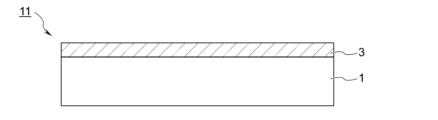
- FIG. 2 is a cross-sectional view of a laminate according to one embodiment.
- the polyimide resin used in this embodiment preferably contains an alicyclic tetracarboxylic dianhydride as an acid dianhydride component.
- the acid dianhydride component has an alicyclic structure, which tends to improve the compatibility of the polyimide resin with other resins.
- the alicyclic tetracarboxylic dianhydride may have at least one alicyclic structure, and may have both an alicyclic ring and an aromatic ring in one molecule.
- the alicyclic ring may be polycyclic or may have a spiro structure.
- fluorine-containing aromatic tetracarboxylic acid dianhydrides examples include 2,2-bis(3,4-dicarboxyphenyl)-1,1,1,3,3,3-hexafluoropropane dianhydride, 2,2-bis ⁇ 4-[4-(1,2-dicarboxy)phenoxy]phenyl ⁇ -1,1,1,3,3,3-hexafluoropropane dianhydride, etc.
- acid dianhydrides other than those mentioned above include ethylene tetracarboxylic dianhydride, butane tetracarboxylic dianhydride, 3,3',4,4'-benzophenone tetracarboxylic dianhydride, 2,2',3,3'-benzophenone tetracarboxylic dianhydride, 2,2',3,3'-biphenyl tetracarboxylic dianhydride, pyromellitic dianhydride, 3,3',4,4'-biphenyl tetracarboxylic dianhydride, 2,2-bis(3,4-dicarboxyphenyl)propane dianhydride, 2,2-bis(2,3-dicarboxyphenyl)propane dianhydride, bis(3,4-dicarboxyphenyl)ether dianhydride, bis(3,4-dicarboxyphenyl)sulfone dianhydride, 1,1-bis(2,3-dicarbox
- aromatic dicarboxylic acids and alicyclic dicarboxylic acids are preferred as dicarboxylic acids, with aromatic dicarboxylic acids being particularly preferred.
- aromatic dicarboxylic acids terephthalic acid, isophthalic acid, 4,4'-biphenyldicarboxylic acid, and 4,4'-oxybisbenzoic acid are preferred, with terephthalic acid and isophthalic acid being particularly preferred, with terephthalic acid being particularly preferred.
- the polyimide resin As described above, by adjusting the composition of the polyimide resin, i.e., the type and ratio of the acid dianhydride and diamine, the polyimide resin has transparency and solubility in organic solvents, and is compatible with other resins.
- the acrylic resin From the viewpoints of transparency, compatibility with polyimide resins, and mechanical strength, it is preferable for the acrylic resin to have methyl methacrylate as the main structural unit.
- the amount of methyl methacrylate relative to the total amount of monomer components in the acrylic resin is preferably 60% by weight or more, and may be 70% by weight or more, 80% by weight or more, 85% by weight or more, 90% by weight or more, or 95% by weight or more.
- the acrylic resin may be a homopolymer of methyl methacrylate.
- the acrylic resin may also be an acrylic polymer having a methyl methacrylate content in the above range, into which a glutarimide structure or a lactone ring structure has been introduced.
- the total light transmittance of the transparent film is preferably 90.3% or more, more preferably 90.5% or more, and may be 91.0% or more or 91.5% or more.
- the yellowness index (YI) of the transparent film is preferably 3.0 or less, more preferably 2.0 or less, and may be 1.0 or less.
- the YI of a film containing a polyimide resin is generally greater than 0. The smaller the YI, the less yellowish coloring there is, and the greater the tendency for visibility to be excellent.
- a mixed resin system of polyimide resin and other resins As described above, by adopting a mixed resin system of polyimide resin and other resins, light absorption (especially light absorption in the short wavelength region of visible light) is reduced compared to when polyimide resin is used alone, and a transparent film with high total light transmittance and low YI is obtained.
- a mixed resin system of polyimide resin and other resins has high light resistance compared to polyimide resin alone, making it possible to reduce the amount of ultraviolet absorber used. The smaller the content of ultraviolet absorber, the smaller the light absorption in the short wavelength region of visible light and the smaller the YI of the transparent film tends to be.
- the transparent film preferably has an increase in YI, ⁇ YI, of 5.0 or less when irradiated with ultraviolet light for 48 hours from a carbon arc light source at an irradiation intensity of 500 W/ m2 and a black panel temperature of 63° C.
- the ⁇ YI of the transparent film is more preferably 4.0 or less, further preferably 2.0 or less, and particularly preferably 1.0 or less.
- the increase in YI due to UV exposure is mainly due to photodegradation of polyimide resins. Therefore, in mixed resin systems containing polyimide resins and other resins, the smaller the ratio of polyimide resin, the smaller the YI and the better the transparency, and the smaller the ⁇ YI and the better the light resistance. If the transparent film contains a UV absorber, the UV absorber absorbs UV light, reducing the amount of UV light absorbed by the polyimide resin, and the ⁇ YI tends to be smaller.
- the light resistance improves and ⁇ YI tends to decrease as the content of the ultraviolet absorber in the transparent film increases, but the YI (yellowness index YI 0 before ultraviolet irradiation) of the transparent film tends to increase with an increase in the content of the ultraviolet absorber.
- ⁇ YI when ultraviolet light is irradiated from the side where the concentration of the ultraviolet absorber is relatively high tends to be smaller than ⁇ YI when ultraviolet light is irradiated from the side where the concentration of the ultraviolet absorber is relatively low.
- the refractive index of the transparent film is preferably 1.60 or less.
- the refractive index of the transparent film is more preferably 1.58 or less, even more preferably 1.56 or less, particularly preferably 1.54 or less, and may be 1.52 or less.
- the refractive index of a film containing only polyimide-based resin as a resin component is generally higher than 1.60, and light is reflected a lot (high reflectance) due to the difference in refractive index between the air interface and the interface with other components, so the light transmittance is low.
- a mixed resin system of polyimide-based resin and other resins has a lower refractive index than the case of polyimide-based resin alone, so light reflection at the interface is reduced and the total light transmittance is high.
- acrylic resins have a low refractive index
- the refractive index of the transparent film tends to be low and the total light transmittance tends to be high.
- a mixed resin system of polyimide-based resin and low refractive index resin such as acrylic resin, it is possible to adjust the refractive index of the transparent film to 1.60 or less and increase the total light transmittance without using low refractive index particles such as silica (or with a low content).
- the bluing agent has high heat resistance.
- the 1% weight loss temperature of the bluing agent is preferably 200°C or higher, more preferably 220°C or higher, and even more preferably 240°C or higher.
- Bluing agents include inorganic pigments such as cobalt blue and Prussian blue; anthraquinone compounds having an anthraquinone ring structure; phthalocyanine compounds, indigo compounds, methine compounds, etc. From the viewpoint of solubility and dispersibility in resins and solvents, anthraquinone compounds, phthalocyanine compounds, and indigo compounds are preferred as bluing agents, and among them, anthraquinone compounds are particularly preferred from the viewpoint of heat resistance and light resistance.
- An example of a commercially available anthraquinone bluing agent is "Plast Blue" manufactured by Arimoto Chemical Industry Co., Ltd. A single type of bluing agent may be used, or two or more types may be used in combination.
- polyimide has optical absorption in the short wavelength region of visible light, so films containing polyimide resins are colored slightly yellow, and generally have a YI greater than 0.
- a functional layer 3 containing a bluing agent on the transparent film 1, optical absorption in the long wavelength region of visible light increases, reducing the YI of the transmitted light and reflected light of the laminate 11 and neutralizing the hue.
- transparent film 1 is a mixed resin film of polyimide resin and other resins, and is less colored (has a smaller YI) than a film made of polyimide resin alone. Therefore, a smaller amount of bluing agent is required to neutralize the hue (bring YI closer to 0), which suppresses the decrease in total light transmittance and improves the visibility of the display.
- the functional layer 3 is preferably a resin matrix in which a bluing agent is dispersed or dissolved.
- the resin material of the functional layer may be selected according to the function to be added to the functional layer.
- the thickness of the functional layer 3 and the amount of the bluing agent contained in the functional layer 3 may be set according to the YI of the transparent film 1 and the hue required for the laminate 11, and the greater the amount of bluing agent contained in the functional layer 3 and the greater the thickness of the functional layer, the smaller the YI of the laminate tends to be.
- the concentration of the bluing agent in the entire laminate is A (ppm) and the total thickness of all layers of the laminate is B ( ⁇ m)
- the product of A and B (A x B) is preferably 5000 or less, more preferably 3000 or less, even more preferably 2500 or less, and may be 1500 or less.
- a x B within the above range, the total light transmittance can be maintained high.
- the concentration A of the bluing agent is the ratio of the total amount of bluing agent contained in the laminate to the total mass of the laminate, and if the transparent film 1 contains a bluing agent in addition to the functional layer 3, the concentration A is calculated including the amount of bluing agent contained in the transparent film 1.
- the functional layer 3 may add a function to the transparent film in addition to its function as a hue adjusting layer.
- various functions can be added to the functional layer by adjusting the composition of the resin component.
- the functional layer 3 may be, for example, a hard coat layer, an ultraviolet absorbing layer, an adhesive layer, a refractive index adjusting layer, an easy-adhesion layer, etc.
- the functional layer 3 is a hard coat layer containing a cured product of a curable resin.
- the curable resin material constituting the hard coat layer is not particularly limited as long as it has the function of preventing the occurrence of scratches, and examples thereof include polyester-based, acrylic-based, urethane-based, amide-based, siloxane-based, and epoxy-based resins.
- an acrylic hard coat layer which is a cured product of an acrylic hard coat resin composition, or a siloxane hard coat layer which is a cured product of a siloxane hard coat resin composition is preferred from the viewpoint of preventing the occurrence of scratches.
- the acrylic hard coat material contains a monomer or oligomer having a (meth)acryloyl group in the molecule as a curable resin component.
- the molecular weight of the acrylic monomer or oligomer is, for example, about 200 to 10,000.
- the acrylic hard coat material can control hardness, scratch resistance, bending resistance, optical properties, etc. by combining multiple types of monomers or oligomers having a (meth)acryloyl group. From the viewpoint of curing by photoradical polymerization, the hard coat material preferably has an acryloyl group.
- Examples of compounds having three or more (meth)acryloyl groups in one molecule include glycerin tri(meth)acrylate, trimethylolpropane tri(meth)acrylate, ditrimethylolpropane tetra(meth)acrylate, pentaerythritol tri(meth)acrylate, pentaerythritol tetra(meth)acrylate, dipentaerythritol tetra(meth)acrylate, dipentaerythritol penta(meth)acrylate, and dipentaerythritol hexa(meth)acrylate.
- the acrylic hard coat material contains a polyfunctional (meth)acrylate having three or more functional groups.
- the functional group equivalent of the (meth)acryloyl group of the polyfunctional (meth)acrylate i.e., the molecular weight per (meth)acryloyl group, is preferably 80 to 150 g/eq.
- dipentaerythritol hexa(meth)acrylate is particularly preferable.
- the siloxane-based hard coat material contains a curable compound having a siloxane bond as a curable resin component.
- the siloxane-based curable compound is preferably one having an epoxy group as a polymerizable functional group, and among them, a polyorganosiloxane compound containing an alicyclic epoxy group is preferable.
- Such siloxane-based hard coat materials are disclosed in WO2014/204010, WO2018/096729, WO2020/040209, etc., and the descriptions therein can be referred to and incorporated by reference.
- Siloxane-based hard coat materials that have alicyclic epoxy groups as polymerizable functional groups have little shrinkage when cured, so curling or cracking is unlikely to occur even if the hard coat layer is made thick.
- the polyorganosiloxane compound having an alicyclic epoxy group can be obtained by condensation of a silane compound represented by the general formula (1). [Y-Si( OR1 ) xR23 - x ] (1)
- R1 is a hydrogen atom or an alkyl group having 1 to 10 carbon atoms.
- the alkyl group include a methyl group, an ethyl group, a propyl group, a butyl group, a pentyl group, a hexyl group, a heptyl group, an octyl group, a nonyl group, a decyl group, an isopropyl group, an isobutyl group, a cyclohexyl group, and an ethylhexyl group.
- the silane compound represented by the general formula (1) has two or three (-OR 1 ) in one molecule. Since Si-OR 1 is hydrolyzable, a polyorganosiloxane compound is obtained by condensation of the silane compound. From the viewpoint of hydrolysis, it is preferable that the carbon number of R 1 is 3 or less, and it is particularly preferable that R 1 is a methyl group.
- R2 is a hydrogen atom or a monovalent hydrocarbon group selected from the group consisting of an alkyl group having 1 to 10 carbon atoms, an aryl group having 6 to 25 carbon atoms, and an aralkyl group having 7 to 12 carbon atoms.
- hydrocarbon group examples include a methyl group, an ethyl group, a propyl group, a butyl group, a pentyl group, a hexyl group, a heptyl group, an octyl group, a nonyl group, a decyl group, an isopropyl group, an isobutyl group, a cyclohexyl group, an ethylhexyl group, a benzyl group, a phenyl group, a tolyl group, a xylyl group, a naphthyl group, and a phenethyl group.
- alkyl groups having an alicyclic epoxy group as a substituent include (3,4-epoxycyclohexyl)methyl group, 2-(3,4-epoxycyclohexyl)ethyl group, 3-(3,4-epoxycyclohexyl)propyl group, 4-(3,4-epoxycyclohexyl)butyl group, 5-(3,4-epoxycyclohexyl)pentyl group, 6-(3,4-epoxycyclohexyl)hexyl group, 7-(3,4-epoxycyclohexyl)heptyl group, 8-(3,4-epoxycyclohexyl)octyl group, 9-(3,4-epoxycyclohexyl)nonyl group, 10-(3,4-epoxycyclohexyl)decyl group, 11-(3,4-epoxycyclohexyl)undecyl group, and 12-(
- the polyorganosiloxane compound as the condensate of the silane compound may be a condensate of the silane compound of the general formula (1) with another silane compound.
- a hard coat composition containing a bluing agent is applied onto the transparent film 1, and the solvent is dried and removed as necessary, followed by curing to form a hard coat layer as the functional layer 3.
- Methods for applying the hard coat composition include roll coating such as bar coating, gravure coating, and comma coating, die coating such as slot die coating and fountain die coating, spin coating, spray coating, and dip coating.
- the surface of the transparent film 1 may be subjected to a surface treatment such as a corona treatment or a plasma treatment.
- an easy-adhesion layer or the like may be provided on the surface of the transparent film 1.
- the curable resin composition contains a photopolymerization initiator and is cured by irradiation with active energy rays.
- active energy rays irradiated during photocuring include visible light, ultraviolet light, infrared light, X-rays, alpha rays, beta rays, gamma rays, and electron beams.
- the thickness of the hard coat layer is 1 to 50 ⁇ m, preferably 3 to 40 ⁇ m, and may be 5 to 30 ⁇ m or 10 to 25 ⁇ m.
- the functional layer may be provided on only one side of the transparent film, or on both sides of the transparent film.
- the transparent film 1 contains an ultraviolet absorber and has a concentration distribution of the ultraviolet absorber in the thickness direction
- by providing the functional layer 3 on the side where the concentration of the ultraviolet absorber is relatively high photodegradation of the transparent film 1 when the laminate 11 is irradiated with ultraviolet light from the functional layer 3 side tends to be suppressed, and light resistance tends to be improved.
- the laminate having the functional layer 3 on the transparent film 1 has a total light transmittance of 90.3% or more, and a yellowness index (YI) of -1.0 or more and 1.0 or less.
- a high total light transmittance can improve the white luminance of a display, and a YI close to 0 neutralizes the hue.
- the total light transmittance of the laminate is more preferably 90.5% or more, and more preferably 91.0% or more.
- the YI of the laminate is more preferably -0.6 to 0.8, and even more preferably -0.5 to 0.5.
- the YI of the mixed resin transparent film 1 is lower than the YI of a film made of polyimide resin alone, it is possible to bring the YI closer to 0 (adjust it to 1.0 or less) with a small amount of bluing agent, and the decrease in total light transmittance caused by the light absorption of the bluing agent can be suppressed.
- the increase in YI ⁇ YI when the laminate is irradiated with ultraviolet light for 48 hours from a carbon arc light source at an irradiation intensity of 500 W/ m2 and a black panel temperature of 63°C is preferably 5.0 or less, more preferably 4.0 or less, even more preferably 2.0 or less, and particularly preferably 1.0 or less.
- the increase in YI when irradiated with ultraviolet light in the laminate of the transparent film 1 and the functional layer 3 is mostly due to photodegradation of the resin contained in the transparent film 1, and the ⁇ YI of the transparent film 1 and the ⁇ YI of the laminate 11 are approximately equal.
- the pencil hardness of the surface of the laminate 11 on which the functional layer 3 is formed is preferably 3H or more, more preferably 4H or more, and may be 5H or more or 6H or more.
- the laminate is used as a material for a flexible display, it is preferable that the laminate has excellent bending resistance and can be repeatedly bent 100,000 times or more at a radius of 1.5 mm.
- the laminate 11 having the functional layer 3 on the transparent film 1 has high total light transmittance and little coloring, and can therefore be used as a display material, and can be used as a cover window provided on the surface of an image display panel, a transparent substrate for a display, a transparent substrate for a touch panel, etc.
- the functional layer 3 is a hard coat layer, it has excellent scratch resistance and can therefore be suitably used as a cover window material.
- the flow direction during application is defined as the MD direction
- the direction perpendicular to the MD direction is defined as the TD direction.
- DMF Dimethylformamide
- tetracarboxylic dianhydride were added thereto in the ratios (mol%) shown in Table 1, and the mixture was reacted by stirring under a nitrogen atmosphere for 5 to 10 hours to obtain a polyamic acid solution with a solid content of 18% by weight.
- This solution was applied onto an alkali-free glass plate, and heated and dried in air at 60 ° C. for 15 minutes, 90 ° C. for 15 minutes, 120 ° C. for 15 minutes, 150 ° C. for 15 minutes, and 180 ° C. for 15 minutes. Thereafter, the film was peeled off from the alkali-free glass plate.
- the surface that was in contact with the non-alkali glass plate during coating and drying of the film may be referred to as the "support surface".
- Polyimide resin 2 (PI2) was dissolved in methylene chloride to prepare a solution with a solid concentration of 10% by weight, and 2.0 parts by weight of a triazine-based ultraviolet absorber ("Tinuvin 477" manufactured by BASF) was added to 100 parts by weight of the solid content of the resin and stirred.
- This solution was applied to a non-alkali glass plate and dried by heating in an air atmosphere at 40°C for 60 minutes, 80°C for 30 minutes, 150°C for 30 minutes, 170°C for 30 minutes, and 200°C for 60 minutes to obtain a film 3 with a thickness of 50 ⁇ m.
- ⁇ Siloxane-based hard coat composition In a reaction vessel equipped with a thermometer, a stirrer, and a reflux condenser, 66.5 g (270 mmol) of 2-(3,4-epoxycyclohexyl)ethyltrimethoxysilane ("SILQUEST A-186" manufactured by Momentive Performance Materials) and 16.5 g of 1-methoxy-2-propanol (PGME) were charged and stirred uniformly. A solution of 0.039 g (0.405 mmol) of magnesium chloride as a catalyst dissolved in a mixture of 9.7 g (539 mmol) of water and 5.8 g of methanol was dropped into this mixture over 5 minutes and stirred until it became uniform.
- SILQUEST A-186 2-(3,4-epoxycyclohexyl)ethyltrimethoxysilane
- PGME 1-methoxy-2-propanol
- the weight average molecular weight in terms of polystyrene measured using a Tosoh GPC apparatus "HLC-8220GPC" (columns: TSKgel GMH XL ⁇ 2, TSKgel G3000H XL , TSKgel G2000H XL ) was 3000.
- the residual rate of epoxy groups calculated from the 1 H-NMR spectrum measured using a Bruker 400 MHz-NMR with deuterated acetone as a solvent was 95% or more.
Landscapes
- Chemical & Material Sciences (AREA)
- Health & Medical Sciences (AREA)
- Chemical Kinetics & Catalysis (AREA)
- Medicinal Chemistry (AREA)
- Polymers & Plastics (AREA)
- Organic Chemistry (AREA)
- Engineering & Computer Science (AREA)
- Manufacturing & Machinery (AREA)
- Materials Engineering (AREA)
- Macromolecular Compounds Obtained By Forming Nitrogen-Containing Linkages In General (AREA)
- Laminated Bodies (AREA)
Priority Applications (2)
| Application Number | Priority Date | Filing Date | Title |
|---|---|---|---|
| JP2024567817A JPWO2024143296A1 (https=) | 2022-12-27 | 2023-12-25 | |
| CN202380089171.3A CN120418334A (zh) | 2022-12-27 | 2023-12-25 | 层叠体及显示器 |
Applications Claiming Priority (2)
| Application Number | Priority Date | Filing Date | Title |
|---|---|---|---|
| JP2022-209683 | 2022-12-27 | ||
| JP2022209683 | 2022-12-27 |
Publications (1)
| Publication Number | Publication Date |
|---|---|
| WO2024143296A1 true WO2024143296A1 (ja) | 2024-07-04 |
Family
ID=91717957
Family Applications (1)
| Application Number | Title | Priority Date | Filing Date |
|---|---|---|---|
| PCT/JP2023/046495 Ceased WO2024143296A1 (ja) | 2022-12-27 | 2023-12-25 | 積層体およびディスプレイ |
Country Status (3)
| Country | Link |
|---|---|
| JP (1) | JPWO2024143296A1 (https=) |
| CN (1) | CN120418334A (https=) |
| WO (1) | WO2024143296A1 (https=) |
Citations (6)
| Publication number | Priority date | Publication date | Assignee | Title |
|---|---|---|---|---|
| JP2016072246A (ja) * | 2014-09-30 | 2016-05-09 | 東レ株式会社 | ディスプレイ用支持基板、それを用いたカラーフィルターおよびその製造方法、有機el素子およびその製造方法、ならびにフレキシブル有機elディスプレイ |
| KR20160097638A (ko) * | 2015-02-09 | 2016-08-18 | 주식회사 엘지화학 | 단일층 고분자 필름 |
| WO2018135433A1 (ja) * | 2017-01-20 | 2018-07-26 | 住友化学株式会社 | 光学フィルム及び光学フィルムの製造方法 |
| JP2018123319A (ja) * | 2017-02-01 | 2018-08-09 | 住友化学株式会社 | ポリイミドフィルム |
| JP2020098337A (ja) * | 2019-12-25 | 2020-06-25 | 住友化学株式会社 | 光学積層体、フレキシブル表示装置及び光学積層体の製造方法 |
| JP2021073506A (ja) * | 2016-07-22 | 2021-05-13 | 東友ファインケム株式会社Dongwoo Fine−Chem Co., Ltd. | ハードコーティングフィルム及びこれを備えたタッチセンサーを含むフレキシブルディスプレイウィンドウ |
-
2023
- 2023-12-25 CN CN202380089171.3A patent/CN120418334A/zh active Pending
- 2023-12-25 WO PCT/JP2023/046495 patent/WO2024143296A1/ja not_active Ceased
- 2023-12-25 JP JP2024567817A patent/JPWO2024143296A1/ja active Pending
Patent Citations (6)
| Publication number | Priority date | Publication date | Assignee | Title |
|---|---|---|---|---|
| JP2016072246A (ja) * | 2014-09-30 | 2016-05-09 | 東レ株式会社 | ディスプレイ用支持基板、それを用いたカラーフィルターおよびその製造方法、有機el素子およびその製造方法、ならびにフレキシブル有機elディスプレイ |
| KR20160097638A (ko) * | 2015-02-09 | 2016-08-18 | 주식회사 엘지화학 | 단일층 고분자 필름 |
| JP2021073506A (ja) * | 2016-07-22 | 2021-05-13 | 東友ファインケム株式会社Dongwoo Fine−Chem Co., Ltd. | ハードコーティングフィルム及びこれを備えたタッチセンサーを含むフレキシブルディスプレイウィンドウ |
| WO2018135433A1 (ja) * | 2017-01-20 | 2018-07-26 | 住友化学株式会社 | 光学フィルム及び光学フィルムの製造方法 |
| JP2018123319A (ja) * | 2017-02-01 | 2018-08-09 | 住友化学株式会社 | ポリイミドフィルム |
| JP2020098337A (ja) * | 2019-12-25 | 2020-06-25 | 住友化学株式会社 | 光学積層体、フレキシブル表示装置及び光学積層体の製造方法 |
Also Published As
| Publication number | Publication date |
|---|---|
| JPWO2024143296A1 (https=) | 2024-07-04 |
| CN120418334A (zh) | 2025-08-01 |
Similar Documents
| Publication | Publication Date | Title |
|---|---|---|
| TWI907394B (zh) | 顯示裝置用構件、光學積層體及顯示裝置 | |
| KR20190109481A (ko) | 폴리이미드계 필름 및 적층체 | |
| CN110967786B (zh) | 光学膜 | |
| JP7817817B2 (ja) | 樹脂組成物およびフィルム | |
| JP2020056989A (ja) | 光学フィルム | |
| CN112339378A (zh) | 层叠体 | |
| CN110039866A (zh) | 层叠体及其制造方法 | |
| US20250320338A1 (en) | Transparent film, hard coat film, and display | |
| CN110039867B (zh) | 层叠体及其制造方法 | |
| JP2021109437A (ja) | ガラス積層体 | |
| JP7645622B2 (ja) | ドライフィルムおよび積層体 | |
| WO2024071314A1 (ja) | ハードコートフィルムおよびディスプレイ | |
| JPWO2019054412A1 (ja) | 硬化性組成物 | |
| CN110969941B (zh) | 光学膜 | |
| WO2025063230A1 (ja) | ポリイミド、樹脂組成物、成形体およびフィルム | |
| WO2024143296A1 (ja) | 積層体およびディスプレイ | |
| JP2024116015A (ja) | 保護フィルム積層体 | |
| CN110967780A (zh) | 光学膜 | |
| WO2024172021A1 (ja) | ハードコートフィルムおよびその製造方法、ならびにディスプレイ | |
| US20250346020A1 (en) | Laminate and display | |
| JP2024115449A (ja) | 積層体およびディスプレイ | |
| WO2024166911A1 (ja) | 積層体およびディスプレイ | |
| JP2026029250A (ja) | 積層体およびディスプレイ | |
| WO2026023547A1 (ja) | 積層体およびディスプレイ | |
| JP2024115450A (ja) | 樹脂組成物、成形体および樹脂フィルム、並びに樹脂フィルムの製造方法 |
Legal Events
| Date | Code | Title | Description |
|---|---|---|---|
| 121 | Ep: the epo has been informed by wipo that ep was designated in this application |
Ref document number: 23912075 Country of ref document: EP Kind code of ref document: A1 |
|
| WWE | Wipo information: entry into national phase |
Ref document number: 2024567817 Country of ref document: JP |
|
| WWE | Wipo information: entry into national phase |
Ref document number: 202380089171.3 Country of ref document: CN |
|
| NENP | Non-entry into the national phase |
Ref country code: DE |
|
| WWP | Wipo information: published in national office |
Ref document number: 202380089171.3 Country of ref document: CN |
|
| 122 | Ep: pct application non-entry in european phase |
Ref document number: 23912075 Country of ref document: EP Kind code of ref document: A1 |