WO2024142825A1 - 非水電解質二次電池 - Google Patents
非水電解質二次電池 Download PDFInfo
- Publication number
- WO2024142825A1 WO2024142825A1 PCT/JP2023/043789 JP2023043789W WO2024142825A1 WO 2024142825 A1 WO2024142825 A1 WO 2024142825A1 JP 2023043789 W JP2023043789 W JP 2023043789W WO 2024142825 A1 WO2024142825 A1 WO 2024142825A1
- Authority
- WO
- WIPO (PCT)
- Prior art keywords
- positive electrode
- active material
- electrode active
- mixture layer
- particle size
- Prior art date
- Legal status (The legal status is an assumption and is not a legal conclusion. Google has not performed a legal analysis and makes no representation as to the accuracy of the status listed.)
- Ceased
Links
Images
Classifications
-
- H—ELECTRICITY
- H01—ELECTRIC ELEMENTS
- H01M—PROCESSES OR MEANS, e.g. BATTERIES, FOR THE DIRECT CONVERSION OF CHEMICAL ENERGY INTO ELECTRICAL ENERGY
- H01M4/00—Electrodes
- H01M4/02—Electrodes composed of, or comprising, active material
- H01M4/13—Electrodes for accumulators with non-aqueous electrolyte, e.g. for lithium-accumulators; Processes of manufacture thereof
-
- H—ELECTRICITY
- H01—ELECTRIC ELEMENTS
- H01M—PROCESSES OR MEANS, e.g. BATTERIES, FOR THE DIRECT CONVERSION OF CHEMICAL ENERGY INTO ELECTRICAL ENERGY
- H01M4/00—Electrodes
- H01M4/02—Electrodes composed of, or comprising, active material
- H01M4/36—Selection of substances as active materials, active masses, active liquids
-
- H—ELECTRICITY
- H01—ELECTRIC ELEMENTS
- H01M—PROCESSES OR MEANS, e.g. BATTERIES, FOR THE DIRECT CONVERSION OF CHEMICAL ENERGY INTO ELECTRICAL ENERGY
- H01M4/00—Electrodes
- H01M4/02—Electrodes composed of, or comprising, active material
- H01M4/36—Selection of substances as active materials, active masses, active liquids
- H01M4/48—Selection of substances as active materials, active masses, active liquids of inorganic oxides or hydroxides
- H01M4/50—Selection of substances as active materials, active masses, active liquids of inorganic oxides or hydroxides of manganese
- H01M4/505—Selection of substances as active materials, active masses, active liquids of inorganic oxides or hydroxides of manganese of mixed oxides or hydroxides containing manganese for inserting or intercalating light metals, e.g. LiMn2O4 or LiMn2OxFy
-
- H—ELECTRICITY
- H01—ELECTRIC ELEMENTS
- H01M—PROCESSES OR MEANS, e.g. BATTERIES, FOR THE DIRECT CONVERSION OF CHEMICAL ENERGY INTO ELECTRICAL ENERGY
- H01M4/00—Electrodes
- H01M4/02—Electrodes composed of, or comprising, active material
- H01M4/36—Selection of substances as active materials, active masses, active liquids
- H01M4/48—Selection of substances as active materials, active masses, active liquids of inorganic oxides or hydroxides
- H01M4/52—Selection of substances as active materials, active masses, active liquids of inorganic oxides or hydroxides of nickel, cobalt or iron
- H01M4/525—Selection of substances as active materials, active masses, active liquids of inorganic oxides or hydroxides of nickel, cobalt or iron of mixed oxides or hydroxides containing iron, cobalt or nickel for inserting or intercalating light metals, e.g. LiNiO2, LiCoO2 or LiCoOxFy
-
- Y—GENERAL TAGGING OF NEW TECHNOLOGICAL DEVELOPMENTS; GENERAL TAGGING OF CROSS-SECTIONAL TECHNOLOGIES SPANNING OVER SEVERAL SECTIONS OF THE IPC; TECHNICAL SUBJECTS COVERED BY FORMER USPC CROSS-REFERENCE ART COLLECTIONS [XRACs] AND DIGESTS
- Y02—TECHNOLOGIES OR APPLICATIONS FOR MITIGATION OR ADAPTATION AGAINST CLIMATE CHANGE
- Y02E—REDUCTION OF GREENHOUSE GAS [GHG] EMISSIONS, RELATED TO ENERGY GENERATION, TRANSMISSION OR DISTRIBUTION
- Y02E60/00—Enabling technologies; Technologies with a potential or indirect contribution to GHG emissions mitigation
- Y02E60/10—Energy storage using batteries
Definitions
- This disclosure relates to a non-aqueous electrolyte secondary battery.
- Patent Document 1 discloses a technology for improving battery capacity and rate characteristics by using a positive electrode active material in which two lithium cobalt oxides with different compositions and average particle sizes are mixed in a specified volume ratio.
- Patent Document 1 does not consider peeling of the positive electrode mixture layer, and there is still room for improvement.
- the objective of this disclosure is to provide a non-aqueous electrolyte secondary battery that has a high capacity and suppresses peeling of the positive electrode mixture layer.
- a volume ratio V1/V2 of a volume V1 of the first positive electrode active material to a volume V2 of the second positive electrode active material is 3 or more and 15 or less.
- the density of the positive electrode mixture layer is 3.35 g/ cm3 or more and 3.70 g/ cm3 or less.
- the nonaqueous electrolyte secondary battery disclosed herein has a high capacity and excellent adhesion of the positive electrode mixture layer.
- the exterior body may be a pouch type composed of a laminate sheet including a metal layer and a resin layer.
- numerical value (A) to numerical value (B) means that the value is equal to or greater than numerical value (A) and equal to or less than numerical value (B).
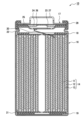
- the positive electrode 11, negative electrode 12, and separator 13 constituting the electrode body 14 are all long strip-shaped bodies, and are alternately stacked in the radial direction of the electrode body 14 by being wound in a spiral shape.
- the separator 13 isolates the positive electrode 11 and the negative electrode 12 from each other.
- the negative electrode 12 is formed to be slightly larger than the positive electrode 11 in order to prevent lithium precipitation. That is, the negative electrode 12 is formed to be longer in the longitudinal direction and width direction (short direction) than the positive electrode 11.
- the two separators 13 are formed to be at least slightly larger than the positive electrode 11, and are arranged to sandwich the positive electrode 11, for example.
- the electrode body 14 includes a positive electrode lead 20 connected to the positive electrode 11 by welding or the like, and a negative electrode lead 21 connected to the negative electrode 12 by welding or the like.
- Insulating plates 18, 19 are arranged above and below the electrode body 14.
- the positive electrode lead 20 passes through a through hole in the insulating plate 18 and extends toward the sealing body 17, and the negative electrode lead 21 passes outside the insulating plate 19 and extends toward the bottom side of the outer can 16.
- the positive electrode lead 20 is connected to the underside of the internal terminal plate 23 of the sealing body 17 by welding or the like, and the cap 27, which is the top plate of the sealing body 17 and is electrically connected to the internal terminal plate 23, serves as the positive electrode terminal.
- the negative electrode lead 21 is connected to the inner bottom inner surface of the outer can 16 by welding or the like, and the outer can 16 serves as the negative electrode terminal.
- the positive electrode active material contained in the positive electrode mixture layer is, for example, a lithium transition metal composite oxide.
- the lithium transition metal composite oxide may have, for example, a layered structure belonging to space group R-3m, a layered structure belonging to space group C2/m, etc. Among these, a layered structure belonging to space group R-3m is preferable in terms of high capacity and stability of crystal structure.
- the layered structure of the lithium transition metal composite oxide may include a transition metal layer, a Li layer, and an oxygen layer.
- the particle size distribution of the secondary particles of the lithium transition metal complex oxide can be measured using a laser diffraction type particle size distribution measuring device (e.g., MT3000II manufactured by Microtrack Bell Co., Ltd.) with water as the dispersion medium.
- the average particle diameter R1 is, for example, 1 ⁇ m to 50 ⁇ m
- the average particle diameter R2 is, for example, 0.2 ⁇ m to 10 ⁇ m.
- the negative electrode active material contained in the negative electrode mixture layer is not particularly limited as long as it can reversibly absorb and release Li ions, and generally, carbon materials such as graphite are used.
- the graphite may be any of natural graphite such as scaly graphite, lump graphite, and earthy graphite, lump artificial graphite, and artificial graphite such as graphitized mesophase carbon microbeads.
- metals that are alloyed with Li such as Si and Sn, metal compounds containing Si and Sn, and lithium titanium composite oxides may be used as the negative electrode active material.
- a porous sheet having ion permeability and insulation is used for the separator 13.
- the porous sheet include a microporous thin film, a woven fabric, and a nonwoven fabric.
- the separator is preferably made of an olefin resin such as polyethylene or polypropylene, or cellulose.
- the separator 13 may be a laminate having a cellulose fiber layer and a thermoplastic resin fiber layer such as an olefin resin.
- the separator 13 may also be a multi-layer separator including a polyethylene layer and a polypropylene layer, and may have a material such as an aramid resin or ceramic applied to the surface of the separator 13.
- ethers examples include 1,3-dioxolane, 4-methyl-1,3-dioxolane, tetrahydrofuran, 2-methyltetrahydrofuran, propylene oxide, 1,2-butylene oxide, 1,3-dioxane, 1,4-dioxane, 1,3,5-trioxane, furan, 2-methylfuran, 1,8-cineole, cyclic ethers such as crown ethers, 1,2-dimethoxyethane, diethyl ether, dipropyl ether, diisopropyl ether, dibutyl ether, dihexyl ether, ethyl vinyl ether, butyl vinyl ether, methyl phenyl ether, Examples of such chain ethers include ethyl phenyl ether, butyl phenyl ether, pentyl phenyl ether, methoxytoluene, benzyl ethyl ether,
- a fluorinated cyclic carbonate such as fluoroethylene carbonate (FEC), a fluorinated chain carbonate, a fluorinated chain carboxylate such as methyl fluoropropionate (FMP), or the like.
- FEC fluoroethylene carbonate
- FMP fluorinated chain carboxylate
- FEC fluoroethylene carbonate
- FMP fluorinated chain carboxylate
- the electrolyte salt is preferably a lithium salt.
- lithium salts include LiBF 4 , LiClO 4 , LiPF 6 , LiAsF 6 , LiSbF 6 , LiAlCl 4 , LiSCN, LiCF 3 SO 3 , LiCF 3 CO 2 , Li(P(C 2 O 4 )F 4 ), LiPF 6-x (C n F 2n+1 ) x (1 ⁇ x ⁇ 6, n is 1 or 2), LiB 10 Cl 10 , LiCl, LiBr, LiI, lithium chloroborane, lithium lower aliphatic carboxylates, borates such as Li 2 B 4 O 7 and Li(B(C 2 O 4 )F 2 ), LiN(SO 2 CF 3 ) 2 , LiN(C 1 F 2l+1 SO 2 )(C m F 2m+1 SO 2 ) (l and m are integers of 1 or more) and other imide salts.
- the lithium salt may be used alone or in combination. Of these
- This positive electrode active material, carbon black, and polyvinylidene fluoride (PVDF) were mixed in a mass ratio of 100:0.5:0.7, and an appropriate amount of N-methyl-2-pyrrolidone (NMP) was added as a dispersion medium to prepare a positive electrode mixture slurry.
- NMP N-methyl-2-pyrrolidone
- this positive electrode mixture slurry was applied to both sides of a positive electrode current collector made of aluminum foil, the coating film was dried, rolled, and cut into a predetermined electrode size to prepare a positive electrode in which a positive electrode mixture layer was formed on both sides of the positive electrode current collector.
- the density of the positive electrode mixture layer was 3.50 g/cm 3. An exposed portion in which the surface of the positive electrode current collector was exposed was provided in a part of the positive electrode.
- a mixed solvent was prepared by mixing ethylene carbonate (EC) and ethyl methyl carbonate (EMC) in a volume ratio of 3:7. Lithium hexafluorophosphate (LiPF 6 ) was dissolved in this mixed solvent to a concentration of 1 mol/L to prepare a nonaqueous electrolyte.
- EC ethylene carbonate
- EMC ethyl methyl carbonate
- LiPF 6 Lithium hexafluorophosphate
- a positive electrode lead made of aluminum was attached to the exposed part of the positive electrode, and a negative electrode lead made of nickel was attached to the exposed part of the negative electrode, and the positive electrode and the negative electrode were spirally wound through a polyethylene microporous membrane separator to prepare a wound electrode body.
- This electrode body was housed in a cylindrical outer can with a bottom, the negative electrode lead was welded to the inner bottom surface of the outer can, and the positive electrode lead was welded to the internal terminal plate of the sealing body. Then, the nonaqueous electrolyte was injected into the outer can, and the open end of the outer can was crimped and fixed to the sealing body to prepare a cylindrical test cell.
- the positive electrode was cut to prepare a test piece having a width of 15 mm and a length of 80 mm.
- a double-sided tape (manufactured by Nitto Denko Corporation) was attached to the positive electrode mixture layer on one side of the test piece, and the test piece was fixed to a stainless steel substrate having a smooth surface. The stainless steel substrate to which the test piece was fixed was placed so as to be horizontal.
- One end of the positive electrode current collector in the longitudinal direction of the test piece was fixed to a movable jig of a tensile tester (trade name: Tensilon universal tester RTC1210, manufactured by A&D Co., Ltd.), and the positive electrode current collector was set to be peeled off in a direction of 90° with respect to the substrate surface of the stainless steel substrate. Then, the movable jig was moved, and the positive electrode mixture layer of the test piece and the positive electrode current collector were peeled off at a speed of 20 mm/min. At that time, the tensile direction was always maintained at 90° with respect to the substrate surface of the stainless steel substrate to which the test piece was fixed. When 30 mm or more of the test piece was peeled off, the stable tensile strength value was read and defined as the peel strength (N/m) of the positive electrode mixture layer from the positive electrode current collector.
- a tensile tester trade name: Tensilon universal tester RTC1210, manufactured by A&D
- the test cell was charged at a constant current of 1 C in a temperature environment of 25° C. until the battery voltage reached 4.2 V, and then charged at a constant voltage of 4.2 V until the current value reached 0.02 C. Thereafter, the cell was discharged at a constant current of 1 C until the battery voltage reached 2.5 V, and the discharge capacity at this time was taken as the cell discharge capacity.
- Example 1-2 In the preparation of the positive electrode, the first positive electrode active material and the second positive electrode active material were mixed so that the volume ratio V1/V2 was 6.1. Except for this, a positive electrode and a test cell were prepared and evaluated in the same manner as in Example 1-1.
- Example 1-3 In the preparation of the positive electrode, the first positive electrode active material and the second positive electrode active material were mixed so that the volume ratio V1/V2 was 12.2. Except for this, a positive electrode and a test cell were prepared and evaluated in the same manner as in Example 1-1.
- Example 1-4 In the preparation of the positive electrode, except that the linear pressure when rolling the coating film was lowered, a positive electrode and a test cell were prepared and evaluated in the same manner as in Example 1-1.
- the density of the positive electrode mixture layer was 3.45 g/ cm3 .
- Example 1-5 In the preparation of the positive electrode, except that the linear pressure when rolling the coating film was increased, a positive electrode and a test cell were prepared and evaluated in the same manner as in Example 1-1.
- the density of the positive electrode mixture layer was 3.55 g/ cm3 .
- Example 1-1 In the preparation of the positive electrode, a test cell was prepared in the same manner as in Example 1-1, except that only the first positive electrode active material was used as the positive electrode active material, and an evaluation was performed.
- ⁇ Comparative Example 1-2> In preparing the positive electrode, a lithium transition metal composite oxide having an average particle size of 1.0 ⁇ m and a composition represented by LiNi 0.88 Co 0.07 Al 0.05 O 2 was used as the second positive electrode active material, and the first positive electrode active material and the second positive electrode active material were mixed so that the volume ratio V1/V2 was 7.2. Except for this, a test cell was prepared and evaluated in the same manner as in Example 1-1.
- Examples 2-1 to 2-5 Comparative Examples 2-1 to 2-4>
- the amount of PVDF mixed was changed to 0.4 parts by mass relative to 100 parts by mass of the positive electrode active material. Except for this, positive electrodes and test cells were prepared and evaluated in the same manner as in Examples 1-1 to 1-5 and Comparative Examples 1-1 to 1-4.
- Table 1 The evaluation results of the test cells of the examples and comparative examples are shown in Table 1.
- Table 1 the peel strength and discharge capacity results of Examples 1-1 to 1-5, 2-1 to 2-5, and Comparative Examples 1-2 to 1-4, 2-1 to 2-4 are shown as relative values when the peel strength and discharge capacity of the test cell of Comparative Example 1-1 are each set to 100.
- test cells of the examples are better than the test cells of Comparative Example 1-1 in both peel strength and discharge capacity, and show excellent adhesion of the positive electrode mixture layer.
- Example 2-1 even when the amount of PVDF, which is the binder, is reduced to 0.5 parts by mass, the peel strength is significantly improved compared to Comparative Example 1-1.
- a non-aqueous electrolyte secondary battery comprising a positive electrode, a negative electrode, and a non-aqueous electrolyte
- the positive electrode has a positive electrode current collector and a positive electrode mixture layer formed on a surface of the positive electrode current collector, the positive electrode mixture layer includes a first positive electrode active material and a second positive electrode active material having an average particle size smaller than that of the first positive electrode active material, a particle size ratio R1/R2 of an average particle size R1 of the first positive electrode active material to an average particle size R2 of the second positive electrode active material is 3 or more and 9 or less, a volume ratio V1/V2 of a volume V1 of the first positive electrode active material to a volume V2 of the second positive electrode active material is 3 or more and 15 or less,
- the positive electrode mixture layer has a density of 3.35 g/cm 3 or more and 3.70 g/cm 3 or less.
Landscapes
- Chemical & Material Sciences (AREA)
- Chemical Kinetics & Catalysis (AREA)
- Electrochemistry (AREA)
- General Chemical & Material Sciences (AREA)
- Inorganic Chemistry (AREA)
- Engineering & Computer Science (AREA)
- Materials Engineering (AREA)
- Battery Electrode And Active Subsutance (AREA)
- Secondary Cells (AREA)
Priority Applications (2)
| Application Number | Priority Date | Filing Date | Title |
|---|---|---|---|
| JP2024567388A JPWO2024142825A1 (https=) | 2022-12-27 | 2023-12-07 | |
| CN202380087364.5A CN120380602A (zh) | 2022-12-27 | 2023-12-07 | 非水电解质二次电池 |
Applications Claiming Priority (2)
| Application Number | Priority Date | Filing Date | Title |
|---|---|---|---|
| JP2022-209765 | 2022-12-27 | ||
| JP2022209765 | 2022-12-27 |
Publications (1)
| Publication Number | Publication Date |
|---|---|
| WO2024142825A1 true WO2024142825A1 (ja) | 2024-07-04 |
Family
ID=91717416
Family Applications (1)
| Application Number | Title | Priority Date | Filing Date |
|---|---|---|---|
| PCT/JP2023/043789 Ceased WO2024142825A1 (ja) | 2022-12-27 | 2023-12-07 | 非水電解質二次電池 |
Country Status (3)
| Country | Link |
|---|---|
| JP (1) | JPWO2024142825A1 (https=) |
| CN (1) | CN120380602A (https=) |
| WO (1) | WO2024142825A1 (https=) |
Citations (9)
| Publication number | Priority date | Publication date | Assignee | Title |
|---|---|---|---|---|
| KR20120114811A (ko) * | 2011-04-08 | 2012-10-17 | 주식회사 엘지화학 | 개선된 특성의 리튬 코발트계 산화물의 이차전지용 양극 활물질 및 이를 포함하는 리튬 이차전지 |
| JP2013131425A (ja) * | 2011-12-22 | 2013-07-04 | Panasonic Corp | 非水電解質二次電池用正極ならびに非水電解質二次電池およびその製造方法 |
| WO2015056759A1 (ja) * | 2013-10-17 | 2015-04-23 | 日本ケミコン株式会社 | 導電性カーボン、このカーボンを含む電極材料、この電極材料を用いた電極及びこの電極を備えた蓄電デバイス |
| WO2015056760A1 (ja) * | 2013-10-17 | 2015-04-23 | 日本ケミコン株式会社 | 導電性カーボン、このカーボンを含む電極材料、この電極材料を用いた電極及びこの電極を備えた蓄電デバイス |
| JP2017107727A (ja) * | 2015-12-09 | 2017-06-15 | ソニー株式会社 | 正極活物質、正極、電池、電池パック、電子機器、電動車両、蓄電装置および電力システム |
| JP2018116817A (ja) * | 2017-01-17 | 2018-07-26 | 日立金属株式会社 | リチウムイオン二次電池用正極活物質およびその製造方法ならびにリチウムイオン二次電池 |
| US20210126242A1 (en) * | 2018-12-29 | 2021-04-29 | Contemporary Amperex Technology Co., Limited | High-compacted-density positive electrode material and electrochemical energy storage apparatus |
| JP2023088317A (ja) * | 2021-12-14 | 2023-06-26 | 三星エスディアイ株式会社 | 電極、それを含むリチウム電池及びその製造方法 |
| JP2023100298A (ja) * | 2022-01-06 | 2023-07-19 | 三星エスディアイ株式会社 | 固体二次電池用正極及び固体二次電池 |
-
2023
- 2023-12-07 JP JP2024567388A patent/JPWO2024142825A1/ja active Pending
- 2023-12-07 WO PCT/JP2023/043789 patent/WO2024142825A1/ja not_active Ceased
- 2023-12-07 CN CN202380087364.5A patent/CN120380602A/zh active Pending
Patent Citations (9)
| Publication number | Priority date | Publication date | Assignee | Title |
|---|---|---|---|---|
| KR20120114811A (ko) * | 2011-04-08 | 2012-10-17 | 주식회사 엘지화학 | 개선된 특성의 리튬 코발트계 산화물의 이차전지용 양극 활물질 및 이를 포함하는 리튬 이차전지 |
| JP2013131425A (ja) * | 2011-12-22 | 2013-07-04 | Panasonic Corp | 非水電解質二次電池用正極ならびに非水電解質二次電池およびその製造方法 |
| WO2015056759A1 (ja) * | 2013-10-17 | 2015-04-23 | 日本ケミコン株式会社 | 導電性カーボン、このカーボンを含む電極材料、この電極材料を用いた電極及びこの電極を備えた蓄電デバイス |
| WO2015056760A1 (ja) * | 2013-10-17 | 2015-04-23 | 日本ケミコン株式会社 | 導電性カーボン、このカーボンを含む電極材料、この電極材料を用いた電極及びこの電極を備えた蓄電デバイス |
| JP2017107727A (ja) * | 2015-12-09 | 2017-06-15 | ソニー株式会社 | 正極活物質、正極、電池、電池パック、電子機器、電動車両、蓄電装置および電力システム |
| JP2018116817A (ja) * | 2017-01-17 | 2018-07-26 | 日立金属株式会社 | リチウムイオン二次電池用正極活物質およびその製造方法ならびにリチウムイオン二次電池 |
| US20210126242A1 (en) * | 2018-12-29 | 2021-04-29 | Contemporary Amperex Technology Co., Limited | High-compacted-density positive electrode material and electrochemical energy storage apparatus |
| JP2023088317A (ja) * | 2021-12-14 | 2023-06-26 | 三星エスディアイ株式会社 | 電極、それを含むリチウム電池及びその製造方法 |
| JP2023100298A (ja) * | 2022-01-06 | 2023-07-19 | 三星エスディアイ株式会社 | 固体二次電池用正極及び固体二次電池 |
Also Published As
| Publication number | Publication date |
|---|---|
| CN120380602A (zh) | 2025-07-25 |
| JPWO2024142825A1 (https=) | 2024-07-04 |
Similar Documents
| Publication | Publication Date | Title |
|---|---|---|
| JP7319265B2 (ja) | 非水電解質二次電池 | |
| JP7621243B2 (ja) | 非水電解質二次電池 | |
| JPWO2011162169A1 (ja) | リチウムイオン二次電池 | |
| JP7665528B2 (ja) | 非水電解液二次電池 | |
| CN113097446B (zh) | 非水电解质二次电池用负极和非水电解质二次电池 | |
| JP7572967B2 (ja) | 非水電解液二次電池 | |
| CN106463767A (zh) | 锂离子二次电池 | |
| JP7766273B2 (ja) | 二次電池用負極及び二次電池 | |
| JP7562561B2 (ja) | 非水電解液二次電池 | |
| WO2021117748A1 (ja) | 非水電解質二次電池 | |
| CN114730862A (zh) | 非水电解质二次电池 | |
| WO2020110691A1 (ja) | 非水電解質二次電池用負極及び非水電解質二次電池 | |
| WO2020110690A1 (ja) | 非水電解質二次電池用負極及び非水電解質二次電池 | |
| CN113097447B (zh) | 非水电解质二次电池用负极和非水电解质二次电池 | |
| JP7738484B2 (ja) | 非水電解質二次電池 | |
| WO2023053626A1 (ja) | 非水電解質二次電池 | |
| WO2022202361A1 (ja) | 非水電解質二次電池用正極、非水電解質二次電池用正極の製造方法、及び非水電解質二次電池 | |
| JP7665440B2 (ja) | 非水電解質二次電池 | |
| JP7783200B2 (ja) | 非水電解質二次電池 | |
| JP7821191B2 (ja) | 非水電解質二次電池 | |
| WO2019171761A1 (ja) | 二次電池用正極、二次電池用正極集電体、及び二次電池 | |
| WO2023157746A1 (ja) | 非水電解質二次電池 | |
| WO2024142825A1 (ja) | 非水電解質二次電池 | |
| WO2021106727A1 (ja) | 非水電解質二次電池用負極、非水電解質二次電池、及び非水電解質二次電池用負極の製造方法 | |
| JP7734326B2 (ja) | 非水電解質二次電池 |
Legal Events
| Date | Code | Title | Description |
|---|---|---|---|
| 121 | Ep: the epo has been informed by wipo that ep was designated in this application |
Ref document number: 23911606 Country of ref document: EP Kind code of ref document: A1 |
|
| WWE | Wipo information: entry into national phase |
Ref document number: 2024567388 Country of ref document: JP |
|
| WWE | Wipo information: entry into national phase |
Ref document number: 202380087364.5 Country of ref document: CN |
|
| WWP | Wipo information: published in national office |
Ref document number: 202380087364.5 Country of ref document: CN |
|
| NENP | Non-entry into the national phase |
Ref country code: DE |
|
| 122 | Ep: pct application non-entry in european phase |
Ref document number: 23911606 Country of ref document: EP Kind code of ref document: A1 |