WO2024135813A1 - 硬化性組成物、シリコーンハイドロゲル、シリコーンハイドロゲルの製造方法及びコンタクトレンズの製造方法 - Google Patents
硬化性組成物、シリコーンハイドロゲル、シリコーンハイドロゲルの製造方法及びコンタクトレンズの製造方法 Download PDFInfo
- Publication number
- WO2024135813A1 WO2024135813A1 PCT/JP2023/046098 JP2023046098W WO2024135813A1 WO 2024135813 A1 WO2024135813 A1 WO 2024135813A1 JP 2023046098 W JP2023046098 W JP 2023046098W WO 2024135813 A1 WO2024135813 A1 WO 2024135813A1
- Authority
- WO
- WIPO (PCT)
- Prior art keywords
- group
- curable composition
- surfactant
- silicone hydrogel
- fatty acid
- Prior art date
- Legal status (The legal status is an assumption and is not a legal conclusion. Google has not performed a legal analysis and makes no representation as to the accuracy of the status listed.)
- Ceased
Links
Images
Classifications
-
- C—CHEMISTRY; METALLURGY
- C08—ORGANIC MACROMOLECULAR COMPOUNDS; THEIR PREPARATION OR CHEMICAL WORKING-UP; COMPOSITIONS BASED THEREON
- C08L—COMPOSITIONS OF MACROMOLECULAR COMPOUNDS
- C08L51/00—Compositions of graft polymers in which the grafted component is obtained by reactions only involving carbon-to-carbon unsaturated bonds; Compositions of derivatives of such polymers
- C08L51/08—Compositions of graft polymers in which the grafted component is obtained by reactions only involving carbon-to-carbon unsaturated bonds; Compositions of derivatives of such polymers grafted on to macromolecular compounds obtained otherwise than by reactions only involving unsaturated carbon-to-carbon bonds
- C08L51/085—Compositions of graft polymers in which the grafted component is obtained by reactions only involving carbon-to-carbon unsaturated bonds; Compositions of derivatives of such polymers grafted on to macromolecular compounds obtained otherwise than by reactions only involving unsaturated carbon-to-carbon bonds on to polysiloxanes
-
- B—PERFORMING OPERATIONS; TRANSPORTING
- B29—WORKING OF PLASTICS; WORKING OF SUBSTANCES IN A PLASTIC STATE IN GENERAL
- B29D—PRODUCING PARTICULAR ARTICLES FROM PLASTICS OR FROM SUBSTANCES IN A PLASTIC STATE
- B29D11/00—Producing optical elements, e.g. lenses or prisms
- B29D11/00009—Production of simple or compound lenses
- B29D11/00038—Production of contact lenses
- B29D11/00125—Auxiliary operations, e.g. removing oxygen from the mould, conveying moulds from a storage to the production line in an inert atmosphere
-
- B—PERFORMING OPERATIONS; TRANSPORTING
- B29—WORKING OF PLASTICS; WORKING OF SUBSTANCES IN A PLASTIC STATE IN GENERAL
- B29D—PRODUCING PARTICULAR ARTICLES FROM PLASTICS OR FROM SUBSTANCES IN A PLASTIC STATE
- B29D11/00—Producing optical elements, e.g. lenses or prisms
- B29D11/00009—Production of simple or compound lenses
- B29D11/00038—Production of contact lenses
-
- C—CHEMISTRY; METALLURGY
- C08—ORGANIC MACROMOLECULAR COMPOUNDS; THEIR PREPARATION OR CHEMICAL WORKING-UP; COMPOSITIONS BASED THEREON
- C08F—MACROMOLECULAR COMPOUNDS OBTAINED BY REACTIONS ONLY INVOLVING CARBON-TO-CARBON UNSATURATED BONDS
- C08F2/00—Processes of polymerisation
- C08F2/12—Polymerisation in non-solvents
- C08F2/16—Aqueous medium
- C08F2/22—Emulsion polymerisation
- C08F2/24—Emulsion polymerisation with the aid of emulsifying agents
- C08F2/30—Emulsion polymerisation with the aid of emulsifying agents non-ionic
-
- C—CHEMISTRY; METALLURGY
- C08—ORGANIC MACROMOLECULAR COMPOUNDS; THEIR PREPARATION OR CHEMICAL WORKING-UP; COMPOSITIONS BASED THEREON
- C08F—MACROMOLECULAR COMPOUNDS OBTAINED BY REACTIONS ONLY INVOLVING CARBON-TO-CARBON UNSATURATED BONDS
- C08F2/00—Processes of polymerisation
- C08F2/44—Polymerisation in the presence of compounding ingredients, e.g. plasticisers, dyestuffs, fillers
-
- C—CHEMISTRY; METALLURGY
- C08—ORGANIC MACROMOLECULAR COMPOUNDS; THEIR PREPARATION OR CHEMICAL WORKING-UP; COMPOSITIONS BASED THEREON
- C08F—MACROMOLECULAR COMPOUNDS OBTAINED BY REACTIONS ONLY INVOLVING CARBON-TO-CARBON UNSATURATED BONDS
- C08F290/00—Macromolecular compounds obtained by polymerising monomers on to polymers modified by introduction of aliphatic unsaturated end or side groups
- C08F290/02—Macromolecular compounds obtained by polymerising monomers on to polymers modified by introduction of aliphatic unsaturated end or side groups on to polymers modified by introduction of unsaturated end groups
- C08F290/06—Polymers provided for in subclass C08G
- C08F290/068—Polysiloxanes
-
- C—CHEMISTRY; METALLURGY
- C08—ORGANIC MACROMOLECULAR COMPOUNDS; THEIR PREPARATION OR CHEMICAL WORKING-UP; COMPOSITIONS BASED THEREON
- C08L—COMPOSITIONS OF MACROMOLECULAR COMPOUNDS
- C08L33/00—Compositions of homopolymers or copolymers of compounds having one or more unsaturated aliphatic radicals, each having only one carbon-to-carbon double bond, and only one being terminated by only one carboxyl radical, or of salts, anhydrides, esters, amides, imides or nitriles thereof; Compositions of derivatives of such polymers
- C08L33/04—Homopolymers or copolymers of esters
-
- G—PHYSICS
- G02—OPTICS
- G02B—OPTICAL ELEMENTS, SYSTEMS OR APPARATUS
- G02B1/00—Optical elements characterised by the material of which they are made; Optical coatings for optical elements
- G02B1/04—Optical elements characterised by the material of which they are made; Optical coatings for optical elements made of organic materials, e.g. plastics
- G02B1/041—Lenses
- G02B1/043—Contact lenses
-
- G—PHYSICS
- G02—OPTICS
- G02C—SPECTACLES; SUNGLASSES OR GOGGLES INSOFAR AS THEY HAVE THE SAME FEATURES AS SPECTACLES; CONTACT LENSES
- G02C7/00—Optical parts
- G02C7/02—Lenses; Lens systems ; Methods of designing lenses
- G02C7/04—Contact lenses for the eyes
-
- B—PERFORMING OPERATIONS; TRANSPORTING
- B29—WORKING OF PLASTICS; WORKING OF SUBSTANCES IN A PLASTIC STATE IN GENERAL
- B29K—INDEXING SCHEME ASSOCIATED WITH SUBCLASSES B29B, B29C OR B29D, RELATING TO MOULDING MATERIALS OR TO MATERIALS FOR MOULDS, REINFORCEMENTS, FILLERS OR PREFORMED PARTS, e.g. INSERTS
- B29K2083/00—Use of polymers having silicon, with or without sulfur, nitrogen, oxygen, or carbon only, in the main chain, as moulding material
Definitions
- the present invention relates to a curable composition used in the production of a silicone hydrogel having excellent surface hydrophilicity and transparency that are stable over a long period of time, a silicone hydrogel that is a cured product of the curable composition, a method for producing the silicone hydrogel, and a method for producing a contact lens.
- This application claims priority based on Japanese Patent Application No. 2022-205020 filed in Japan on December 22, 2022, Japanese Patent Application No. 2023-017456 filed in Japan on February 8, 2023, and Japanese Patent Application No. 2023-110081 filed in Japan on July 4, 2023, the contents of which are incorporated herein by reference.
- Silicone hydrogels are used as materials for contact lenses, intraocular lenses, etc. because of their high oxygen permeability.
- soft contact lenses are manufactured by the cast molding method, which often uses a mold made of polypropylene.
- polypropylene is hydrophobic, the silicone monomer is polymerized in a state where it is oriented on the mold surface, which tends to reduce the hydrophilicity of the lens surface. If the lens surface is not hydrophilic enough, lipids and proteins will easily adhere to it, which may cause the lens to become cloudy or lead to eye diseases. It may also cause the tear membrane to break, which can lead to discomfort such as dry eyes and friction, or even diseases such as blepharitis.
- Patent Document 1 proposes a method in which a hydrophilic monomer is vaporized, followed by generation of plasma to form a hydrophilic polymer film on the lens surface.
- Patent Document 2 proposes a method in which a molded contact lens is immersed in a storage solution containing a surfactant and a hydrophilic polymer, thereby adhering the surfactant to the surface of the contact lens.
- Patent Document 3 proposes a method of improving hydrophilicity by adding a polymerizable amphiphilic substance and curing it to expose hydrophilic groups on the surface.
- Patent Document 4 proposes a method for forming a stable hydrophilic surface on a contact lens by using a monomer having a specific structure that strongly interacts with some surfactants.
- the plasma treatment proposed in Patent Document 1 has problems such as requiring an extremely large-scale apparatus and complicated conditions for forming the coating.
- the method proposed in Patent Document 2 has the problem that the water wettability and surface lubricity of the contact lens cannot be maintained for a long period of time.
- the amphiphilic substance is copolymerized with other raw materials of the contact lens, which affects the water content and mechanical properties of the contact lens, making it difficult to maintain physical properties suitable for the contact lens.
- the method proposed in Patent Document 4 has the problem that the hydrophilicity of the contact lens surface decreases due to release of the surfactant caused by long-term storage or friction or replacement of lacrimal fluid when the contact lens is worn on the eye.
- a method for producing a silicone hydrogel comprising the following steps (1) to (3): Step (1): preparing a curable composition containing a silicone-based (meth)acrylate (A), a hydrophilic monomer (B), and a surfactant (C); Step (2): A step of molding the curable composition in a hydrophobic mold to obtain a cured product; Step (3): A step of washing the cured product.
- Step (1) preparing a curable composition containing a silicone-based (meth)acrylate (A), a hydrophilic monomer (B), and a surfactant (C);
- Step (2) A step of molding the curable composition in a hydrophobic mold to obtain a cured product;
- Step (3) A step of washing the cured product.
- the method for producing a silicone hydrogel according to [1] wherein the silicone-based (meth)acrylate (A) is a monomer having a siloxanyl group in the molecule.
- hydrophilic monomer (B) is at least one selected from monomers having, in the molecule, one or more groups selected from a hydroxyl group, an amino group, a carboxyl group, an ionic group, a pyrrolidone group, an amide structure, and a polyalkylene oxide group.
- a curable composition comprising: a silicone-based (meth)acrylate (A); a hydrophilic monomer (B); and a surfactant (C).
- a silicone-based (meth)acrylate (A) is a monomer having a siloxanyl group in the molecule.
- the hydrophilic monomer (B) is at least one selected from monomers having, in the molecule, one or more selected from a hydroxyl group, an amino group, a carboxyl group, an ionic group, a pyrrolidone group, an amide structure, and a polyalkylene oxide group.
- a content of the surfactant (C) in the curable composition is 1 mass% or more, based on a total mass of the curable composition.
- at least one of the two or more surfactants (C) is a sugar fatty acid ester (C2), and the other is a surfactant other than the sugar fatty acid ester (C2).
- a silicone hydrogel which is a cured product of the curable composition according to any one of [13] to [25].
- the silicone hydrogel according to [26] having a haze of 0.1 or more and 7 or less, as measured in accordance with JIS K7136:2000.
- a silicone hydrogel obtained by curing the curable composition according to any one of [13] to [25] has a haze of 0.1 to 7 as measured in accordance with JIS K7136:2000.
- a curable composition comprising a silicone-based (meth)acrylate (A), a hydrophilic monomer (B), and two or more surfactants (C).
- a curable composition according to [29] wherein at least one of the two or more surfactants (C) is a sugar fatty acid ester (C2).
- the curable composition according to [30] wherein the HLB value of the sugar fatty acid ester (C2) is 5 or more.
- the curable composition according to [34], wherein the surfactant having a polyoxyethylene group is any one of polyoxyethylene hydrogenated castor oils, polyoxyethylene castor oil, polyoxyethylene glycerin fatty acid ester, and polyoxyethylene alkylene ether.
- the silicone-based (meth)acrylate (A) is a monomer having a siloxanyl group in the molecule.
- a method for producing a silicone hydrogel comprising the following steps (1) to (3): Step (1): preparing a curable composition comprising a silicone-based (meth)acrylate (A), a hydrophilic monomer (B), and two or more surfactants (C); Step (2): A step of molding the curable composition in a hydrophobic mold to obtain a cured product; Step (3): A step of washing the cured product.
- Step (1) preparing a curable composition comprising a silicone-based (meth)acrylate (A), a hydrophilic monomer (B), and two or more surfactants (C);
- Step (2) A step of molding the curable composition in a hydrophobic mold to obtain a cured product;
- Step (3) A step of washing the cured product.
- the method for producing a silicone hydrogel according to [40] wherein at least one of the two or more surfactants (C) is a sugar fatty acid ester (C2).
- a silicone hydrogel having excellent surface hydrophilicity and transparency that is stable for a long period of time can be obtained without surface treatment such as plasma treatment.
- a contact lens having excellent surface hydrophilicity and transparency which are stable for a long period of time can be obtained.
- the curable composition of the present invention provides a silicone hydrogel that is stable over a long period of time and has excellent surface hydrophilicity and transparency.
- the silicone hydrogel of the present invention has excellent surface hydrophilicity and transparency, and is therefore particularly useful as an ophthalmic device such as a contact lens, an intraocular lens, or an artificial cornea.
- the curable composition of the present invention can provide a silicone hydrogel that is stable over a long period of time and has excellent surface hydrophilicity and transparency. According to the method for producing a silicone hydrogel of the present invention, even when a hydrophobic mold made of polypropylene or the like is used, a silicone hydrogel having excellent surface hydrophilicity and transparency that is stable for a long period of time can be obtained without surface treatment such as plasma treatment. According to the method for producing a contact lens of the present invention, a contact lens having excellent surface hydrophilicity and transparency which are stable for a long period of time can be obtained.
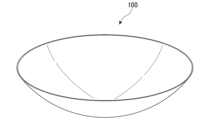
- FIG. 1 is a perspective view showing an example of a contact lens.
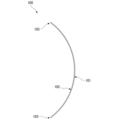
- FIG. 1 is a cross-sectional view showing an example of a contact lens.
- (meth)acrylate is a general term for acrylate and methacrylate.
- non-polymerizable means that, in the polymerization reaction during curing, the silicone-based (meth)acrylate (A) and the hydrophilic monomer (B) in the curable composition are not chemically bonded to the monomer components and other components to be fixed in the cured product.
- the curable composition of the present invention contains a silicone-based (meth)acrylate (A), a hydrophilic monomer (B), and a surfactant (C). Each component constituting the curable composition will be described below.
- the silicone-based (meth)acrylate (A) used in the present invention is a component that contributes to the oxygen permeability, transparency, mechanical strength, hydrophilicity, etc. of the silicone hydrogel.
- the silicone-based (meth)acrylate (A) preferably has a siloxanyl group in the molecule.
- the silicone-based (meth)acrylate (A) may be any one of a monomer, a macromonomer, and a prepolymer.
- silicone-based (meth)acrylates include trimethylsiloxydimethylsilylmethyl (meth)acrylate, trimethylsiloxydimethylsilylpropyl (meth)acrylate, methylbis(trimethylsiloxy)silylpropyl (meth)acrylate, tris(trimethylsiloxy)silylpropyl (meth)acrylate, mono[methylbis(trimethylsiloxy)siloxy]bis(trimethylsiloxy)silylpropyl (meth)acrylate, tris[methylbis(trimethylsiloxy)siloxy]silylpropyl (meth)acrylate, methylbis(trimethylsiloxy)silylpropyl glyceryl (meth)acrylate, tris(trimethylsiloxy)silylpropyl mono[methylbis(trimethylsiloxy)siloxy]bis(trimethylsiloxy)silylpropyl glyceryl(meth)acrylate, trimethylsilyleth
- silicone-based (meth)acrylate (A) examples include compound (A1) and compound (A2) described below.
- the compound (A1) is a silicone-based (meth)acrylate represented by the following formula (1).
- R 1 represents a hydrogen atom or a methyl group.
- R 2 to R 7 each independently represent an alkyl group, an alkoxy group, or an alkoxyalkyl group which may have a substituent.
- j is a natural number from 1 to 10
- k is a natural number from 1 to 30, and
- l is a natural number from 1 to 3.
- l 1, multiple R 2 's may be the same or different, and when l is 2 or more, multiple R 3 to R 7 's may be the same or different.
- R 3's and R 4 's may be the same or different.
- R 1 is preferably a methyl group because of its ready availability.
- the alkyl group for R 2 to R 7 may be a branched or linear alkyl group having 1 to 22 carbon atoms, and specific examples thereof include a methyl group, an ethyl group, an n-propyl group, an i-propyl group, an n-butyl group, a t-butyl group, an i-butyl group, a pentyl group (amyl group), an i-pentyl group, a hexyl group, a heptyl group, a 2-ethylhexyl group, an octyl group, an i-octyl group, a nonyl group, an i-nonyl group, a decyl group, an i-decyl group, an undecyl group, a dodecyl group (lauryl group), a tridecyl group, a tetradecyl group, a pentade
- the alkoxy groups of R 2 to R 7 include branched or linear alkoxy groups having 1 to 22 carbon atoms, and specific examples thereof include a methoxy group, an ethoxy group, a propoxy group, and a butoxy group.
- Examples of the alkoxyalkyl group for R 2 to R 7 include branched or linear alkoxyalkyl groups having 1 to 22 carbon atoms, and specific examples thereof include a methoxymethyl group, a methoxyethyl group, a methoxypropyl group, a methoxybutyl group, an ethoxymethyl group, an ethoxyethyl group, an ethoxypropyl group, an ethoxybutyl group, a propoxymethyl group, a propoxyethyl group, a propoxypropyl group, a propoxybutyl group, a butoxymethyl group, a butoxyethyl group, a butoxypropyl group, and a butoxybutyl
- R 2 to R 7 may be a halogenated alkyl group, and the halogen includes fluorine, chlorine, bromine, iodine, and the like.
- R2 is preferably an unsubstituted or substituted alkyl group, more preferably a methyl group, an ethyl group, an n-propyl group, an i-propyl group, an n-butyl group, a t-butyl group, or an i-butyl group, and still more preferably a methyl group.
- R 3 to R 7 are preferably an alkyl group or a halogenated alkyl group, and more preferably a methyl group, ethyl group, n-propyl group, i-propyl group, n-butyl group, t-butyl group, i-butyl group, fluoromethyl group, difluoromethyl group, trifluoromethyl group, 1-fluoroethyl group, 2-fluoroethyl group, 1,1-difluoroethyl group, 1,2-difluoroethyl group, 2,2-difluoroethyl group, 2,2,2-trifluoroethyl group, 3,3,3-trifluoropropyl group, or 1-trifluoromethylethyl group.
- At least one of R 3 to R 7 is a halogenated alkyl group, and more preferably a fluorinated alkyl group.
- j is a natural number of 1 to 10, and preferably 1 to 5.
- k is a natural number of 1 to 30, and preferably 1 to 20.
- the compound (A1) may be a mixture of a plurality of compounds having different k.
- l is a natural number of 1 to 3, and is preferably 1 or 2.
- compound (A1) A compound in which R 1 to R 6 in formula (1) are methyl groups, R 7 is an n-butyl group, j is 3, and l is 1 ("Silaplane (registered trademark) FM-0711", “Silaplane (registered trademark) FM-0721", and “Silaplane (registered trademark) FM-0725” manufactured by JNC Corporation, and "MCR-M07” and "MCR-M11” manufactured by Gelest) A compound in which R 1 , R 2 , R 4 and R 6 in the formula (1) are methyl groups, R 3 and R 5 are 3,3,3-trifluoropropyl groups, R 7 is an n-butyl group, j is 3 and l is 1 ("MFR-M15" manufactured by Gelest).
- MCS-MX11 manufactured by Gelest
- the compound (A2) is a silicone-based (meth)acrylate represented by the following formula (2).
- R8 represents a hydrogen atom or a methyl group
- R9 represents a single bond or an alkylene group, an alkylene oxide group, a polyalkylene oxide group, or an alkylene-oxy-alkylene group which may have a substituent
- R 10 to R 13 each independently represent an alkyl group, an alkoxy group, or an alkoxyalkyl group which may have a substituent.
- m is a natural number from 1 to 10
- n is a natural number from 1 to 3. When n is 1, multiple R 10 's may be the same or different. When n is 2 or more, multiple R 11 to R 13 may be the same or different.
- R 8 is preferably a methyl group because of its ready availability.
- the alkylene group, alkylene oxide group, polyalkylene oxide group, and alkylene-oxy-alkylene group in R 9 are those in which the same alkyl group, alkoxy group, and alkoxyalkyl group as explained for R 2 to R 7 in the above formula (1) are substituted as a divalent substituent.
- R 9 is preferably a single bond, an unsubstituted or substituted alkylene oxide group, or an alkylene-oxy-alkylene group, and more preferably a single bond, or an unsubstituted or substituted alkylene oxide group.
- R 10 to R 13 are the same as those explained for R 2 to R 7 in the above formula (1).
- R 10 to R 13 may also be a halogenated alkyl group, and the halogen includes fluorine, chlorine, bromine, iodine, etc.
- R 10 to R 13 are preferably an unsubstituted or substituted alkyl group, more preferably a methyl group, an ethyl group, an n-propyl group, an i-propyl group, an n-butyl group, a t-butyl group or an i-butyl group, and further preferably a methyl group.
- n is a natural number of 1 to 10, and preferably 1 to 5. Furthermore, n is a natural number from 1 to 3, and is preferably 2 or 3 because this improves the surface hydrophilicity and transparency of the silicone hydrogel.
- the compound (A2) at least one of the following compounds is preferable.
- the silicone-based (meth)acrylate (A) may be used alone or in combination of two or more kinds. Of these, from the viewpoint of improving the surface hydrophilicity, transparency, and flexibility of the silicone hydrogel, it is preferable to use the compounds (A1) and (A2) in combination.
- the hydrophilic monomer (B) used in the present invention is a component that contributes to the hydrophilicity of the silicone hydrogel.
- the hydrophilic monomer (B) is preferably at least one selected from monomers having, in the molecule, one or more selected from a hydroxyl group, an amino group, a carboxyl group, an ionic group, an amide structure, and an alkyleneoxy structure.
- the hydrophilic monomer (B) may be any one of a monomer, a macromonomer, and a prepolymer.
- hydrophilic monomer (B) examples include monomers having a hydroxyl group such as 2-hydroxyethyl (meth)acrylate, 2,3-dihydroxypropyl (meth)acrylate, 2-hydroxypropyl (meth)acrylate, 3-hydroxypropyl (meth)acrylate, 2-hydroxybutyl (meth)acrylate, 3-hydroxybutyl (meth)acrylate, and 4-hydroxybutyl (meth)acrylate; monomers having an amino group such as N,N-dimethylaminoethyl (meth)acrylate; monomers having a carboxyl group such as (meth)acryloxyethyl succinic acid; (3-(meth)acrylamidopropyl)trimethylammonium chloride, (meth)acryloxyethyldimethylbenzylammonium chloride, and 3-((meth)acrylamidopropyl)trimethylammonium chloride.
- hydroxyl group such as 2-hydroxyethyl (meth)acrylate,
- Monomers having an ionic group such as (meth)propyldimethylbenzylammonium chloride, (meth)acryloylcholine chloride, and 2-(meth)acryloyloxyethyl phosphorylcholine; monomers having a pyrrolidone group such as N-vinyl-2-pyrrolidone; monomers having an amide structure such as N-hydroxymethyl(meth)acrylamide, N-(2-hydroxyethyl)(meth)acrylamide, (meth)acrylamide, N-vinylacetamide, N,N-dimethyl(meth)acrylamide, N,N-diethyl(meth)acrylamide, N-isopropyl(meth)acrylamide, 4-(meth)acryloylmorpholine, and (meth)acrylamide; and monomers having a polyalkylene oxide group such as polyethylene glycol (meth)acrylate.
- a polyalkylene oxide group such as polyethylene glycol (meth)acrylate.
- the hydrophilic monomers (B) monomers (B1) having an amide structure are preferred because they enhance the wettability and lubricity of the silicone hydrogel surface.
- the amide structure is preferably a divalent group having a carboxyl group bonded to the nitrogen atom of a linear or cyclic amino compound, without including a lactam structure.
- the monomer (B1) having an amide structure include acrylamide, N-substituted acrylamides such as N,N-dimethylacrylamide, N,N-diethylacrylamide, N-(2-hydroxyethyl)acrylamide, N-isopropylacrylamide, and acryloylmorpholine, and N-vinylacetamide.
- the total number of carbon atoms of the substituents on the nitrogen in the N-substituted acrylamide is preferably 0 to 6, more preferably 2 to 6, and even more preferably 2 to 4.
- the monomer (B1) having an amide structure may be used alone or in combination of two or more kinds.
- the surfactant (C) used in the present invention has the effect of artificially hydrophilizing the hydrophobic mold used when curing the silicone hydrogel and suppressing segregation of the hydrophobic silicone-based (meth)acrylate (A) onto the silicone hydrogel surface, thereby increasing the hydrophilicity of the silicone hydrogel surface.
- the HLB of the surfactant (C) is preferably 3 to 19, more preferably 5 to 18, and even more preferably 10 to 17.
- the surfactant (C) preferably contains a non-polymerizable surfactant.
- the surfactant (C) may be one type of surfactant, but from the viewpoint of stabilizing the interface, it is more preferable that it is made up of two or more types of surfactants, and it is even more preferable that at least one of them is a sugar fatty acid ester (C2).
- the sugar fatty acid ester (C2) is a surfactant in which a sugar and a fatty acid are ester-bonded, and examples thereof include monosaccharide fatty acid esters and disaccharide fatty acid esters.
- monosaccharide fatty acid esters include sorbitan fatty acid esters and xylitol fatty acid esters.
- disaccharide fatty acid esters include sucrose fatty acid esters, glucose fatty acid esters, trehalose fatty acid esters, maltose fatty acid esters, cellobiose fatty acid esters, and lactose fatty acid esters.
- disaccharide fatty acid esters are preferred because the hydrophilic sugar unit is bulky and when the fatty acid group is adsorbed on a hydrophobic surface, it is easier to create a hydrophilic surface.
- the "disaccharide fatty acid ester” is a compound in which the sugar structure is derived from a disaccharide consisting of two monosaccharide molecules and a fatty acid is ester-bonded to the disaccharide.
- sucrose fatty acid esters and trehalose fatty acid esters are preferred because the greater the hydrophilicity of the sugar unit and the higher the crystallinity, the easier it is to create a denser hydrophilic surface.
- the sugar fatty acid ester (C2) is more hydrophilic and more soluble in water the higher the HLB value, so it is preferable for it to have an HLB value of 5 to 19, more preferably an HLB value of 11 to 19, and even more preferably an HLB value of 15 to 19.
- the HLB value is an index that indicates the balance between the hydrophilic and lipophilic groups of an emulsifier, and is expressed as a value between 0 and 20. The higher the value, the greater the hydrophilicity.
- SV indicates the saponification value of the ester
- NV indicates the neutralization value of the fatty acid (see, for example, "Polyglycerin Ester” published by Sakamoto Yakuhin Kogyo Co., Ltd.).
- sorbitan fatty acid esters having an HLB value of 5 or more include sorbitan fatty acid esters having a constituent fatty acid having 8 to 22 carbon atoms.
- the fatty acid preferably has 12 to 22 carbon atoms, and more preferably has 12 to 18 carbon atoms.
- the surfactant (C) may be either nonionic or ionic, but it is preferable that the HLB value be 3 to 19 in order to provide surface hydrophilization and to avoid dissolution during washing of the silicone hydrogel.
- the lower limit of the HLB value is more preferably 5 or more.
- the surfactant (C) may contain a surfactant other than the sugar fatty acid ester (C2).
- Preferred surfactants other than the sugar fatty acid ester (C2) include surfactants having a polyoxyethylene group, sugar-based surfactants, and surfactants derived from biological materials.
- Surfactants having a polyoxyethylene group include, for example, polyoxyethylene hydrogenated castor oils, polyoxyethylene castor oil, polyoxyethylene glycerin fatty acid esters, polyoxyethylene lauryl ether, polyoxyethylene oleyl ether and other polyoxyethylene alkyl ethers; polyoxyethylene polyoxypropylene copolymers, polyoxyethylene polysiloxane ether block copolymers, polyoxyethylene polyoxypropylene ethylenediamines, polyoxyethylene polyoxypropylene alkyl ethers, polyoxyethylene sorbitan monooleate (e.g.
- polysorbate 80 and other polyoxyethylene sorbitan fatty acid esters (polysorbates), polyoxyethylene sorbit fatty acid esters, polyoxyethylene alkyl phenyl ethers, tyloxapol and other polyoxyethylene alkyl phenyl ether formaldehyde condensates, polyoxyethylene sterols, polyoxyethylene hydrogenated sterols, polyoxyethylene fatty acid esters such as polyethylene glycol monostearate, polyoxyethylene lanolin alcohols, polyoxyethylene alkylamines, polyoxyethylene alkylamides, and polyoxyethylene alkyl ether phosphates.
- polysorbate 80 and other polyoxyethylene sorbitan fatty acid esters (polysorbates), polyoxyethylene sorbit fatty acid esters, polyoxyethylene alkyl phenyl ethers, tyloxapol and other polyoxyethylene alkyl phenyl ether formaldehyde condensates, polyoxyethylene sterols, polyoxyethylene hydrogenated
- Sugar-based surfactants are non-ionic surfactants that have sugar as the hydrophilic group.
- sugar-based surfactants include sugar fatty acid esters formed by ester bonds between sugar and fatty acids, and alkyl glycosides formed by glycosidic bonds between sugar and higher alcohols, with sugar fatty acid esters being preferred.
- the fatty acid of the sugar fatty acid ester is preferably a fatty acid.
- sugar fatty acid esters examples include sucrose fatty acid esters, sorbitan fatty acid esters, and glucose esters, with sucrose fatty acid esters being preferred.
- the number of carbon atoms of the constituent fatty acid of the sugar fatty acid ester is not particularly limited, but is preferably 8 to 22, and more preferably 12 to 18.
- the fatty acid may be a saturated fatty acid, an unsaturated fatty acid, or a mixture thereof.
- Examples of fatty acids having 8 to 22 carbon atoms include caprylic acid (8), capric acid (10), lauric acid (12), myristic acid (14), pentadecylic acid (15), palmitic acid (16), margaric acid (17), stearic acid (18), oleic acid (18), and behenic acid (22).
- the numbers in parentheses indicate the carbon number of each fatty acid.
- the HLB value of the sorbitan fatty acid ester is 5 or more, preferably 11 or more, and more preferably in the range of 15-18. When the HLB value is equal to or higher than the lower limit, the hydrophilicity of the silicone hydrogel surface can be increased.
- the HLB value of the sorbitan fatty acid ester can be adjusted by the number of carbon atoms of the fatty acid constituting the sorbitan fatty acid ester and the number of fatty acid ester groups.
- the sorbitan fatty acid ester has 1 to 4 fatty acid ester groups.
- the sorbitan fatty acid ester may contain a polyoxyethylene group, if necessary, in order to adjust the HLB value.
- sucrose fatty acid esters having an HLB value of 5 or more include sucrose fatty acid esters having a fatty acid of 8 to 22 carbon atoms as a constituent fatty acid.
- the fatty acid preferably has 12 to 22 carbon atoms, and more preferably has 12 to 18 carbon atoms.
- Specific examples of fatty acids having 8 to 22 carbon atoms are the same as those described in the section on sorbitan fatty acid esters.
- the HLB value of the sucrose fatty acid ester may be 5 or more, preferably 11 or more, and more preferably in the range of 15-18. When the HLB value is equal to or higher than the lower limit, the hydrophilicity of the silicone hydrogel surface can be increased.
- the HLB value of the sucrose fatty acid ester can be adjusted by the number of carbon atoms of the fatty acid constituting the sucrose fatty acid ester and the number of fatty acid ester groups.
- the sucrose fatty acid ester has 1 to 8 fatty acid ester groups.
- glucose fatty acid esters having an HLB value of 5 or more include glucose fatty acid esters having a constituent fatty acid having 8 to 22 carbon atoms.
- the fatty acid preferably has 12 to 22 carbon atoms, and more preferably has 12 to 18 carbon atoms.
- Specific examples of fatty acids having 8 to 22 carbon atoms are the same as those described in the section on sorbitan fatty acid esters.
- the HLB value of the glucose fatty acid ester may be 5 or more, preferably 11 or more, and more preferably in the range of 15-18. When the HLB value is equal to or higher than the lower limit, the hydrophilicity of the silicone hydrogel surface can be increased.
- Examples of trehalose fatty acid esters having an HLB value of 5 or more include glucose fatty acid esters having a fatty acid of 8 to 22 carbon atoms as a constituent fatty acid.
- the fatty acid preferably has 8 to 18 carbon atoms, and more preferably has 8 to 16 carbon atoms.
- Specific examples of fatty acids having 8 to 22 carbon atoms are the same as those described in the section on sorbitan fatty acid esters.
- the HLB value of the trehalose fatty acid ester may be 5 or more, preferably 11 or more, and more preferably in the range of 15-18. When the HLB value is equal to or higher than the lower limit, the hydrophilicity of the silicone hydrogel surface can be increased.
- the sugar fatty acid ester (C2) is preferably a sucrose fatty acid ester or trehalose fatty acid ester with an HLB value of 11 or more, more preferably a sucrose fatty acid ester or trehalose fatty acid ester with an HLB value of 15 or more, and even more preferably a sucrose fatty acid ester or trehalose fatty acid ester with an HLB value of 16 or more.
- the sucrose fatty acid ester preferably has a fatty acid with 12 carbon atoms (lauric acid) and an HLB value of 13 or more, a fatty acid with 14 carbon atoms (myristic acid) and an HLB value of 13 or more, or a fatty acid with 16 carbon atoms (palmitic acid) and an HLB value of 13 or more. More preferably, the fatty acid has 12 carbon atoms (lauric acid) and an HLB value of 13 or more, and the fatty acid has 14 carbon atoms (myristic acid) and an HLB value of 13 or more. More preferably, the fatty acid has 12 carbon atoms (lauric acid) and an HLB value of 13 or more.
- sucrose fatty acid esters include, for example, Ryoto Sugar Esters (product name, manufactured by Mitsubishi Chemical Corporation), including L-1695 (HLB value 16, lauric acid), M-1695 (HLB value 16, myristic acid), P-1570 (HLB value 15, palmitic acid), P-1670 (HLB value 16, palmitic acid), S-1570 (HLB value 15, stearic acid), and S-1670 (HLB value 16, stearic acid).
- Ryoto Sugar Esters product name, manufactured by Mitsubishi Chemical Corporation
- the number of fatty acid ester groups in a sugar fatty acid ester varies depending on the number of hydroxyl groups capable of forming an ester bond in the molecular structure of the sugar, which is a hydrophilic group; for example, 1 to 8 for sucrose fatty acid esters and 2 to 4 for sorbitan fatty acid esters.
- the HLB value of the sugar fatty acid ester can be adjusted by the number of fatty acid ester groups.
- Surfactants derived from biological materials are surfactants that use biological materials such as hyaluronic acid and vitamins as raw materials.
- examples of surfactants derived from biological materials include hyaluronic acid derivatives in which hydrophobic groups are added via a glycerin skeleton to some of the hydrophilic groups of low molecular weight hyaluronic acid obtained by hydrolyzing high molecular weight hyaluronic acid, such as hydrolyzed alkyl (C12-13) hyaluronate glyceryl; vitamin C derivatives such as L-ascorbyl paramitate, L-ascorbyl stearate, 2,6-dibutyryl-L-ascorbic acid, and 2-O- ⁇ -D-glucopyranosyl-L-ascorbic acid; and vitamin E derivatives such as DL- ⁇ -tocopherol acetate, sodium DL- ⁇ -tocopheryl phosphate, and D- ⁇ -tocopherol succinate.
- the surfactant (C) may be used alone or in combination of two or more types.
- the curable composition of the present invention may further contain optional components in addition to the silicone-based (meth)acrylate (A), the hydrophilic monomer (B), and the surfactant (C).
- the optional components include a crosslinking agent (D), a polymerization initiator (E), and other components.
- the curable composition of the present invention may contain a crosslinking agent (D) for the purposes of improving the solvent resistance of the resulting silicone hydrogel and adjusting the elastic modulus, water content, etc.
- the crosslinking agent (D) preferably has two or more polymerizable unsaturated groups.
- crosslinking agent (D) examples include (meth)acrylate-based crosslinking agents such as ethylene glycol di(meth)acrylate, diethylene glycol di(meth)acrylate, triethylene glycol di(meth)acrylate, tetraethylene glycol di(meth)acrylate, polyethylene glycol di(meth)acrylate, allyl methacrylate, trimethylolpropane tri(meth)acrylate, (2-allyloxy)ethyl methacrylate, and 2-(2-vinyloxyethoxy)ethyl (meth)acrylate; vinyl ether-based crosslinking agents such as ethylene glycol divinyl ether, diethylene glycol divinyl ether, and triethylene glycol divinyl ether; allyl ether-based crosslinking agents such as triethylene glycol diallyl ether and tetraethylene glycol diallyl ether; and methylene bisacrylamide.
- (meth)acrylate-based crosslinking agents such as ethylene glycol di
- crosslinking agents (D) (meth)acrylate-based crosslinking agents are preferred, and ethylene glycol di(meth)acrylate and polyethylene glycol di(meth)acrylate are more preferred.
- the crosslinking agent (D) may be used alone or in combination of two or more kinds.
- the content of the crosslinking agent (D) relative to the total mass of the curable composition is preferably 0.1 to 10 mass%, more preferably 0.5 to 5 mass%, in order to obtain a silicone hydrogel having good moldability and solvent resistance.
- the curable composition of the present invention may contain a polymerization initiator (E) in order to effectively proceed with the polymerization reaction.
- the polymerization initiator may be a known photopolymerization initiator or a known thermal polymerization initiator.
- photopolymerization initiator examples include benzil, benzophenone and derivatives thereof, thioxanthones, benzil dimethyl ketals, ⁇ -hydroxyalkylphenones, ⁇ -hydroxyacetophenones, hydroxyketones, aminoalkylphenones, acylphosphine oxides, and oxime ester compounds.
- ⁇ -hydroxyalkylphenones are preferred because they are less likely to yellow when cured and give transparent cured products.
- Thermal polymerization initiators include known organic peroxides and azo compounds.
- the polymerization initiator (E) may be used alone or in combination of two or more kinds.
- the amount of the polymerization initiator (E) added in the curable composition is preferably 0.1 to 3 parts by mass, more preferably 0.1 to 2 parts by mass, and even more preferably 0.2 to 1 part by mass, relative to 100 parts by mass of the total amount of the monomer components in the curable composition.
- the amount of the polymerization initiator (E) added is 0.1 to 3 parts by mass, the polymerization rate is high and decomposition products derived from the polymerization initiator (E) are less likely to remain.
- the curable composition of the present invention can contain other monomers (monomers other than the silicone-based (meth)acrylate (A) and other than the hydrophilic monomer (B)), a polymerizable ultraviolet absorber, a polymerizable dye (colorant), and the like, as long as the object of the present invention is not impaired.
- the monomer components in the cured composition are silicone-based (meth)acrylate (A), hydrophilic monomer (B), optional crosslinking agent (D), other monomers described in other components, etc., and surfactant (C) and water are not included in the monomer components.
- the content of silicone-based (meth)acrylate (A) is preferably 4 to 70 mass%, more preferably 10 to 50 mass%, based on the total mass of the cured composition. If it is within the above range, the surface hydrophilicity, transparency, and oxygen permeability of the silicone hydrogel will be good.
- the content of compound (A1) is preferably 2 to 40 mass%, more preferably 5 to 30 mass%, based on the total mass of the cured composition.
- the content of compound (A2) is preferably 2 to 68 mass%, more preferably 5 to 40 mass%, based on the total mass of the cured composition.
- the combined content of compound (A1) and compound (A2) is preferably 4 to 70 mass%, more preferably 10 to 50 mass%, based on the total mass of the cured composition.
- the combined content of compound (A1) and compound (A2) relative to the total mass of silicone-based (meth)acrylate (A) is preferably 0 to 100 mass%, and more preferably 30 to 100 mass%.
- the mass ratio represented by [compound (A1)]/[compound (A2)] is preferably 0.1 or more, and more preferably 0.3 or more.
- the content of hydrophilic monomer (B) relative to the total mass of the cured composition is preferably 5 to 95 mass%, more preferably 20 to 90 mass%. If it is within the above range, the surface hydrophilicity and transparency of the silicone hydrogel will be good.
- the content of the surfactant (C) is preferably from 1 to 30% by mass, more preferably from 2 to 20% by mass, and even more preferably from 3 to 10% by mass, based on the total mass of the curable composition.
- the silicone hydrogel will have good moldability and solvent resistance.
- the hydrophilicity of the molded silicone hydrogel is sufficient, and when the content is equal to or lower than the upper limit, the silicone hydrogel does not become cloudy.
- the content of the sugar fatty acid ester (C2) is preferably 0.1 to 30 mass%, more preferably 1 to 25 mass%, and even more preferably 5 to 20 mass%, relative to the total mass of the cured composition.
- the content of the surfactant other than the sugar fatty acid ester (C2) is preferably 0.1 to 20 mass%, more preferably 1 to 15 mass%, and even more preferably 3 to 10 mass%, relative to the total mass of the cured composition.
- the surfactant (C) contains a sugar fatty acid ester (C2) and a surfactant having a polyoxyethylene group
- the total content of the sugar fatty acid ester (C2) and the surfactant having a polyoxyethylene group relative to the total mass of the cured composition is preferably 0.1 to 30 mass%, more preferably 1 to 20 mass%, and even more preferably 3 to 10 mass%.
- the content of the nonionic surfactant relative to the total mass of the cured composition is preferably 0.1 to 30 mass%, more preferably 1 to 20 mass%, and even more preferably 3 to 10 mass%.
- the blending amount of the two or more kinds of surfactants (C) is preferably 2 to 20 parts by mass, and more preferably 5 to 10 parts by mass, per 100 parts by mass of the above-mentioned monomer component.
- the blended amount of two or more types of surfactants (C) is equal to or greater than the above lower limit, the molded silicone hydrogel will have sufficient hydrophilicity, and when the blended amount is equal to or less than the above upper limit, the silicone hydrogel will not become cloudy.
- the water content is preferably 0 to 10% by mass, more preferably 0 to 5% by mass, and even more preferably 0 to 1% by mass, based on the total mass of the cured composition.
- the curable composition of the present invention can be prepared, for example, by charging each component in a stirring (mixing) device in any order or all at once, and stirring (mixing) at a temperature of 10 to 50° C. until it becomes uniform.
- Step (1) of the present invention is a step of preparing a curable composition containing a silicone-based (meth)acrylate (A), a hydrophilic monomer (B), and two or more types of surfactants (C).
- the silicone-based (meth)acrylate (A), the hydrophilic monomer (B), and the two or more surfactants (C) are as described above.
- the curable composition of the present invention can be prepared, for example, by charging each component in a stirring (mixing) device in any order or all at once, and stirring (mixing) at a temperature of 10 to 50° C. until it becomes uniform.
- Step (2) in the method for producing a silicone hydrogel of the present invention is a step of molding the above-mentioned curable composition in a hydrophobic mold to obtain a cured product.
- the hydrophobic mold is a mold used when filling the curable composition to allow the polymerization reaction to proceed, and is a mold having a hydrophobic surface.
- the hydrophobic mold is preferably a mold made of polyolefin, more preferably a mold made of polypropylene.
- a cured product can be obtained by filling a hydrophobic mold with the curable composition and carrying out a polymerization reaction.
- the polymerization reaction can be advanced by irradiating the curable composition with active energy rays or by heating the curable composition.
- examples of the active energy rays include ultraviolet rays and electron beams.
- the ultraviolet light source may be, for example, a high-pressure mercury lamp.
- the ultraviolet light energy amount is preferably about 0.1 to 10 J/ cm2 .
- the temperature and heating time are not particularly limited, but a temperature of 60 to 140°C and a time of 0.1 to 24 hours are preferable.
- the polymerization reaction may be carried out in air, but may also be carried out in an inert gas atmosphere such as nitrogen or argon in order to improve the polymerization rate of the monomer.
- the cured product can be removed in a dry state by deforming the hydrophobic mold.
- the cured material may be immersed together with the hydrophobic mold in a solvent (e.g., water, methanol, ethanol, 1-propanol, 2-propanol, a mixture or a solution of these) to cause the cured material to swell and be removed from the hydrophobic mold.
- a solvent e.g., water, methanol, ethanol, 1-propanol, 2-propanol, a mixture or a solution of these
- Step (3) in the method for producing a silicone hydrogel of the present invention is a step of washing the cured product.
- the obtained cured product may be a mixture of the surfactant (C), unreacted monomer components (unreacted materials), residues of each component, by-products, etc. Therefore, after solvation, the product is washed by an operation such as repeatedly replacing the solvent with new solvent.
- the solvent used for washing include water, methanol, ethanol, 1-propanol, 2-propanol, mixtures thereof, and solutions thereof.
- the washing procedure in step (3) is not particularly limited. As an example, the operation of washing five times with water at 90° C., which will be described later, may be carried out here as the washing operation of step (3).
- Another example is a method in which a solvent prepared by mixing equal amounts of 2-propanol and phosphate buffer in a volume ratio is heated to 60°C, in which the cured product is immersed for 10 minutes or more, and then the cured product is transferred to 60°C phosphate buffer and immersed for 10 minutes or more.
- the cured product is hydrated and converted into a hydrogel to obtain a silicone hydrogel.
- the hydration is preferably carried out by immersing the cured product in water or physiological saline at a temperature of 10 to 90° C. for 10 minutes or more.
- the cured product after hydration i.e., silicone hydrogel, may be sterilized under high temperature and pressure, for example, in an autoclave at 121° C. and 2 atm for 20 minutes.
- the silicone hydrogel of the present invention is a cured product of the curable composition of the present invention, and is a gel obtained by the method for producing a silicone hydrogel of the present invention, which includes the above steps (1) to (3).
- the silicone hydrogel of the present invention preferably has a contact angle of 90° or less, more preferably 80° or less, and even more preferably 70° or less, after being washed five times with water at 90° C.
- the procedure for washing with water at 90° C. is not particularly limited, but for example, the silicone hydrogel may be placed in a water tank containing water at 90° C., left therein for a desired period of time, and then removed.
- the 90° C. water in the water bath is replaced and the above operation is carried out four more times. In this way, the surfactant (C) and other substances contained in the silicone hydrogel can be discharged to the outside.
- the contact angle of the silicone hydrogel is less than 90° after being washed five times with water at 90° C.
- the contact angle of the silicone hydrogel means the contact angle between the silicone hydrogel and a water droplet.
- the total light transmittance of the silicone hydrogel is preferably 90% or more, more preferably 92% or more, and even more preferably 93% or more.
- the higher the total light transmittance, the more preferable, and the upper limit may be 100% or less.
- the silicone hydrogel of the present invention preferably has a haze of 0.1 to 7, more preferably 0.1 to 6, and even more preferably 0.1 to 5, measured in accordance with JIS K7136:2000 "Determination of haze for plastics - transparent materials.” If the haze is equal to or greater than the lower limit, the material has excellent handleability, and if the haze is equal to or less than the upper limit, the material has excellent transparency.
- the water content of the silicone hydrogel of the present invention is preferably 10 to 80% by mass, more preferably 20 to 75% by mass, and even more preferably 30 to 70% by mass, based on the total mass of the silicone hydrogel.
- the method for producing a silicone hydrogel of the present invention uses the curable composition of the present invention, which contains a silicone-based (meth)acrylate (A), a hydrophilic monomer (B), and a surfactant (C), and the surfactant (C) pseudo-hydrophilizes the surface (inner wall surface) of a hydrophobic mold, causing the hydrophilic monomer (B) to be unevenly distributed on the surface of the silicone hydrogel, thereby making it possible to produce a silicone hydrogel that has a highly hydrophilic surface even after the surfactant (C) is removed in a washing step.
- a silicone-based (meth)acrylate A
- B hydrophilic monomer
- C surfactant
- the silicone hydrogel of the present invention is characterized in that it is not subjected to surface treatment for hydrophilization, such as plasma treatment, as has been practiced in the prior art.
- the silicone hydrogel of the present invention has excellent surface hydrophilicity and transparency. Therefore, the silicone hydrogel of the present invention is particularly useful as an ophthalmic device such as a contact lens, an intraocular lens, or an artificial cornea.
- FIG. 1 is a perspective view showing an example of a contact lens using the silicone hydrogel of the present invention.
- FIG. 2 is a cross-sectional view showing an example of a contact lens using the silicone hydrogel of the present invention.
- 101 is a convex portion
- 102 is a concave portion
- 103 is a peripheral portion.
- the thickness of the silicone hydrogel is preferably 0.01 to 4 mm, more preferably 0.01 to 3 mm, even more preferably 0.02 to 2 mm, and particularly preferably 0.03 to 1 mm.
- C-1 Polyoxyethylene/polyoxypropylene ternary block copolymer ("Pluronic (registered trademark) P-85” manufactured by Adeka Corporation, HLB value is 10 (Griffin method calculated value).
- C-2) Polyoxyethylene phytosterol (Nikkol (registered trademark) BPS-30, manufactured by Nikko Chemicals Co., Ltd., HLB value is 18.
- C-3) Polyoxyethylene hydrogenated castor oil (manufactured by Nikko Chemicals Co., Ltd., "Nikkol (registered trademark) HCO-60", HLB value is 14.
- C-4) Polyoxyethylene lauryl ether sulfate sodium salt (“Nissantrax (registered trademark) K-40" manufactured by NOF Corporation, HLB value is 13 (Griffin method calculated value).
- the silicone-based (meth)acrylate (A) As the silicone-based (meth)acrylate (A), the compound (A1) and the compound (A2) were used in combination.
- compound (A1) a silicone macromonomer (“MFR-M15” manufactured by Gelest) was used, and as compound (A2), siloxanyl acrylate (“BX-SiGMMA” (methyldi(trimethylsiloxy)silylpropylglyceryl methacrylate) manufactured by Bimax) was used.
- MFR-M15 silicone macromonomer
- BX-SiGMMA siloxanyl acrylate
- N,N-dimethylacrylamide was used as the hydrophilic monomer (B)
- ethylene glycol dimethacrylate was used as the crosslinking agent (D)
- 2-hydroxy-2-methylpropiophenone was used as the polymerization initiator (E), and these were stirred at room temperature to obtain a monomer mixture.
- the polymerization initiator (E) was used in an amount of 1 part per 100 parts of the total of the components (A), (B) and (D).
- Surfactant (C-1) was used as the surfactant (C) and added to the monomer mixture in the proportions shown in Table 1, followed by stirring at room temperature to obtain a curable composition.
- the surfactant (C-1) was mixed uniformly, and a colorless, transparent, liquid curable composition was obtained.
- the obtained curable composition was poured into a general-purpose polypropylene mold, covered with a transparent release PET film, and irradiated multiple times using a UV irradiator (Ushio Inc., UVC-501/10S4A) so that the cumulative irradiation amount was 2.7 J/ cm2 , to obtain a cured product.
- a general-purpose polypropylene mold was used as the hydrophobic mold.
- the cured product was then removed from the hydrophobic mold in a dry state without using any solvent.
- the cured product was taken out and immersed in water to allow it to swell sufficiently, yielding a silicone hydrogel.
- the silicone hydrogel was immersed in distilled water in an amount at least 1000 times the dry weight of the silicone hydrogel at 90° C. for 30 minutes and washed. The distilled water was exchanged and this washing procedure was carried out five times.
- the obtained silicone hydrogel was evaluated for its film thickness, contact angle, and transparency.
- the film thickness was 0.8 mm.
- the evaluation results of the contact angle and transparency are shown in Table 1.
- Example 2A A silicone hydrogel was obtained in the same manner as in Example 1A, except that surfactant (C-2) was used as the surfactant (C) and added in the ratio shown in Table 1.
- the film thickness was 0.8 mm.
- the evaluation results of the contact angle and transparency are shown in Table 1.
- Example 3A A silicone hydrogel was obtained in the same manner as in Example 1A, except that surfactant (C-3) was used as surfactant (C) and added in the ratio shown in Table 1.
- the film thickness was 0.8 mm.
- the evaluation results of the contact angle and transparency are shown in Table 1A.
- Example 4A A silicone hydrogel was obtained in the same manner as in Example 1A, except that surfactant (C-4) was used as the surfactant (C) and added in the ratio shown in Table 1A.
- the film thickness was 0.8 mm.
- the evaluation results of the contact angle and transparency are shown in Table 1A.
- Example 5A A silicone hydrogel was obtained in the same manner as in Example 1A, except that surfactant (C-3) was used as the surfactant (C) and added in the formulation shown in Table 1A.
- the film thickness was 0.8 mm.
- the evaluation results of the contact angle and transparency are shown in Table 1.
- Example 6A A silicone hydrogel was obtained in the same manner as in Example 1A, except that surfactant (C-3) was used as the surfactant (C) and a monomer mixture containing a large amount of silicone-based (meth)acrylate (A) was prepared as shown in Table 1A.
- the film thickness was 0.8 mm.
- the evaluation results of the contact angle and transparency are shown in Table 1A.
- Example 1A A silicone hydrogel was obtained in the same manner as in Example 1A, except that the surfactant (C) was not used.
- the film thickness was 0.8 mm.
- the evaluation results of the contact angle and transparency are shown in Table 1A.
- Example 2A A silicone hydrogel was obtained in the same manner as in Example 1A, except that no surfactant (C) was used and a monomer mixture containing a large amount of silicone-based (meth)acrylate (A) was prepared as shown in Table 1A.
- the film thickness was 0.8 mm.
- the evaluation results of the contact angle and transparency are shown in Table 1A.
- Example 3A A silicone hydrogel was obtained in the same manner as in Example 1A, except that surfactant (C-4) was used as the surfactant (C) and added in the formulation shown in Table 1A.
- the film thickness was 0.8 mm.
- the evaluation results of the contact angle and transparency are shown in Table 1A.
- the silicone hydrogels of Examples 1A to 6A had contact angles of 90° or less after being washed five times with water at 90° C., confirming that the surface hydrophilicity was maintained at a high level even after thorough washing with water.
- the silicone hydrogels of Examples 1A to 6A also had high total light transmittance and good transparency.
- the silicone hydrogels of Comparative Examples 1A to 3A were found to have good transparency but insufficient surface hydrophilicity even after thorough washing with water.
- silicone-based (meth)acrylate (A) silicone-based (meth)acrylate (A)
- siloxanyl acrylate (SIGMA manufactured by Bimax Corporation under the trade name "BX-SiGMMA”
- TMS 3-[tris(trimethylsilyloxy)silyl]propyl methacrylate
- SIM6487.6 ⁇ -butyl- ⁇ -(3-methacryloxypropyl)polydimethylsiloxane
- hydrophilic monomers (B) N,N-dimethylacrylamide (DMA, manufactured by Tokyo Chemical Industry Co., Ltd.), hydroxyethyl methacrylate (HEMA, manufactured by Tokyo Chemical Industry Co., Ltd.), and N-vinyl-2-pyrrolidone (NVP, manufactured by Tokyo Chemical Industry Co., Ltd.) were used.
- DMA N,N-dimethylacrylamide
- HEMA hydroxyethyl methacrylate
- N-vinyl-2-pyrrolidone N-vinyl-2-pyrrolidone
- the other monomer used was 2-methoxyethyl acrylate (2-MTA, manufactured by Tokyo Chemical Industry Co., Ltd.).
- Ethylene glycol dimethacrylate (EDMA, manufactured by Tokyo Chemical Industry Co., Ltd.) was used as the crosslinking agent (D), and 2,2'-azobis(isobutyronitrile) (AIBN, manufactured by Tokyo Chemical Industry Co., Ltd.) was used as the polymerization initiator (E), and these were stirred at room temperature to obtain a monomer mixture.
- the polymerization initiator (E) was used in an amount of 1 part per 100 parts of the total of the components (A), (B) and (D).
- Example 8A to 17A The components (A), (B), (C), and (D) of the monomer mixture were added in a total amount of 100 parts in the formulation shown in Table 2, and 1 part of a polymerization initiator (E) was added thereto, followed by stirring at room temperature to obtain a curable composition.
- the resulting curable composition was poured into a general-purpose polypropylene mold and thermally cured in an oven at 90°C for 4 hours to obtain a cured product.
- the cured product was then removed from the hydrophobic mold in a dry state without using any solvent.
- a washing solvent isopropyl alcohol and a phosphate buffer solution were mixed in a volume ratio of 1:1.
- the removed cured product was immersed in the above-mentioned cleaning solvent to allow it to swell sufficiently, and then soaked for 1 hour at 60° C.
- the cured product was then removed from the cleaning solvent and immersed in a new phosphate buffer solution for 1 hour at 60° C.
- the cured product was removed from the cleaning solvent and immersed in a new phosphate buffer solution to obtain a silicone hydrogel.
- the obtained silicone hydrogel was evaluated for its film thickness, water content, contact angle, and transparency.
- the film thickness was 0.2 mm.
- the evaluation results of the contact angle, water content and transparency are shown in Table 2A.
- the silicone hydrogels of Examples 7A to 11A had good contact angles of 80 degrees or less after washing, and it was confirmed that the surface hydrophilicity was maintained at a high level even after thorough washing. In contrast, it was confirmed that the silicone hydrogels of Comparative Examples 4A to 8A had insufficient surface hydrophilicity after washing.
- Comparative Examples 4A and 5A are inferior in transparency and surface hydrophilicity, and it has been confirmed that the incorporation of silicone monomers reduces the transparency and surface hydrophilicity of the gel.
- Examples 7A and 8A have the same monomer composition as Comparative Example 4A, and although the gel has the same water content, its transparency and surface hydrophilicity are improved.
- Examples 9A to 11A have the same monomer composition as Comparative Example 5A, and although the gel has the same water content, its transparency and surface hydrophilicity are improved.
- Comparative Example 8A has the same monomer composition as Comparative Example 7A, and although the hydrophilicity is improved, it is not sufficient.
- NVP has a certain effect as a hydrophilic monomer (B), but the effect is inferior. Even in this case, as shown in Example 12A, it can be seen that the hydrophilicity improvement effect can be enhanced by using two types of surfactants, but the effect was inferior compared to Example 8A. From these results, the usefulness of incorporation of a surfactant in improving transparency and surface hydrophilicity was confirmed.
- the silicone hydrogels of Examples 13A to 17A had good contact angles of 78 degrees or less after washing, and it was confirmed that the surface hydrophilicity was maintained at a high level even after thorough washing. In contrast, it was confirmed that the silicone hydrogels of Comparative Examples 9A to 10A had insufficient surface hydrophilicity after washing.
- Examples 13A to 15A have the same monomer composition as Comparative Example 9A, and the surface hydrophilicity was improved despite the gel having a similar water content.
- Examples 16A and 17A have the same monomer composition as Comparative Example 10A, and the surface hydrophilicity was improved despite the gel having a similar water content.
- the silicone-based (meth)acrylate (A) As the silicone-based (meth)acrylate (A), the compound (A1) and the compound (A2) were used in combination.
- compound (A1) a silicone macromonomer (“MFR-M15” manufactured by Gelest) was used, and as compound (A2), siloxanyl acrylate (“BX-SiGMMA” (methyldi(trimethylsiloxy)silylpropylglyceryl methacrylate) manufactured by Bimax) was used.
- MFR-M15 silicone macromonomer
- BX-SiGMMA siloxanyl acrylate
- N,N-dimethylacrylamide was used as the hydrophilic monomer (B)
- polyethylene glycol (PEG200) dimethacrylate was used as the crosslinking agent (D)
- Darocur 1173 was used as the polymerization initiator (E), and these were stirred at room temperature to obtain a monomer mixture.
- the polymerization initiator (E) was used in an amount of 1 part per 100 parts of the total of the components (A), (B) and (D).
- Surfactants (C1) and (C2-1) were used as the two or more types of surfactants (C), and were added in the proportions shown in Table 1B to 100 parts in total of the components (A), (B), and (D) of the monomer mixture, followed by stirring at room temperature to obtain a curable composition.
- the surfactants (C1) and (C2-1) were mixed uniformly to obtain a colorless, transparent, liquid curable composition.
- the obtained curable composition was placed in a general-purpose polypropylene mold and irradiated multiple times with a UV irradiator (Ushio Inc., UVC-501/10S4A) so that the cumulative irradiation dose was 2.7 J/ cm2 , to obtain a cured product.
- a UV irradiator Ushio Inc., UVC-501/10S4A
- the cured product was then removed from the hydrophobic mold in a dry state without using any solvent.
- the cured product was taken out and immersed in water to allow it to swell sufficiently, yielding a silicone hydrogel.
- the silicone hydrogel was immersed in at least 1,000 times the dry weight of the silicone hydrogel in distilled water at 90° C. for 30 minutes and washed. The distilled water was exchanged and this washing procedure was carried out five times.
- the obtained silicone hydrogel was evaluated for its film thickness, contact angle, and transparency.
- the film thickness was 0.6 mm.
- the evaluation results of the contact angle and transparency are shown in Table 1B.
- Examples 2B to 10B, Comparative Example 1B A silicone hydrogel was obtained in the same manner as in Example 1B, except that the types and amounts of the surfactants shown in Table 1 were used as the two or more surfactants (C).
- the film thickness was 0.6 mm.
- the evaluation results of the contact angle and transparency are shown in Table 1B.
- Example 11B As shown in Table 2, a silicone hydrogel was obtained in the same manner as in Example 1B, except that a monomer mixture containing a large amount of silicone-based (meth)acrylate (A) was prepared. The film thickness was 0.6 mm. The evaluation results of the contact angle and transparency are shown in Table 2B.
- Example 12B to 16B Comparative Example 2B
- a silicone hydrogel was obtained in the same manner as in Example 11B, except that the types and amounts of the surfactants listed in Table 2B were used as the two or more surfactants (C).
- the film thickness was 0.6 mm.
- the evaluation results of the contact angle and transparency are shown in Table 2B.
- the silicone hydrogels of Examples 1B to 7B had contact angles of 65 degrees or less after washing five times with water at 90° C., which is the standard for a good contact angle, and it was confirmed that the surface hydrophilicity was maintained at a high level even after thorough washing with water.
- the contact angles after washing five times with water at 90° C. were 55 degrees or less, which is the standard for a good contact angle, and it was confirmed that by using a combination of a sugar-based surfactant and a non-sugar-based surfactant, the surface hydrophilicity was maintained at a high level even after thorough washing with water.
- the silicone hydrogels of Examples 1B to 7B had high total light transmittance and good transparency.
- the silicone hydrogels of Examples 8B to 10B and Comparative Example 1B had good transparency, but were found to have insufficient surface hydrophilicity even after thorough washing with water, confirming the usefulness of using two or more types of surfactants (C).
- the silicone hydrogels of Examples 11B to 14B had contact angles of 75 degrees or less after being washed five times with water at 90°C, confirming that the surface hydrophilicity was maintained at a high level even after thorough washing with water.
- Example 11B even with a high silicone content, satisfied the standard for a good contact angle of 65 degrees or less, confirming that the shorter the carbon chain of the sugar fatty acid ester, the more effective it was.
- the silicone hydrogels of Examples 11B to 14B had high total light transmittance and good transparency.
- silicone hydrogels of Examples 15B to 16B and Comparative Example 2B had good transparency, but were found to have insufficient surface hydrophilicity even after thorough washing with water, confirming the usefulness of using two or more types of surfactants (C) in improving wettability even when the silicone content is high.
- a silicone hydrogel having excellent surface hydrophilicity and transparency that is stable for a long period of time can be obtained without surface treatment such as plasma treatment.
- a contact lens having excellent surface hydrophilicity and transparency which are stable for a long period of time can be obtained.
- the curable composition of the present invention provides a silicone hydrogel that is stable over a long period of time and has excellent surface hydrophilicity and transparency.
- the silicone hydrogel of the present invention has excellent surface hydrophilicity and transparency, and is therefore particularly useful as an ophthalmic device such as a contact lens, an intraocular lens, or an artificial cornea.
- the curable composition of the present invention can provide a silicone hydrogel that is stable over a long period of time and has excellent surface hydrophilicity and transparency. According to the method for producing a silicone hydrogel of the present invention, even when a hydrophobic mold made of polypropylene or the like is used, a silicone hydrogel having excellent surface hydrophilicity and transparency that is stable for a long period of time can be obtained without surface treatment such as plasma treatment. According to the method for producing a contact lens of the present invention, a contact lens having excellent surface hydrophilicity and transparency which are stable for a long period of time can be obtained.
Landscapes
- Health & Medical Sciences (AREA)
- Chemical & Material Sciences (AREA)
- Engineering & Computer Science (AREA)
- Chemical Kinetics & Catalysis (AREA)
- Medicinal Chemistry (AREA)
- Polymers & Plastics (AREA)
- Organic Chemistry (AREA)
- Ophthalmology & Optometry (AREA)
- Physics & Mathematics (AREA)
- Manufacturing & Machinery (AREA)
- Mechanical Engineering (AREA)
- General Physics & Mathematics (AREA)
- Optics & Photonics (AREA)
- General Health & Medical Sciences (AREA)
- Eyeglasses (AREA)
- Casting Or Compression Moulding Of Plastics Or The Like (AREA)
- Compositions Of Macromolecular Compounds (AREA)
Priority Applications (3)
| Application Number | Priority Date | Filing Date | Title |
|---|---|---|---|
| EP23907173.1A EP4640720A4 (en) | 2022-12-22 | 2023-12-22 | HARDENING COMPOSITION, SILICONE HYDROGEL, PROCESS FOR PRODUCING SILICONE HYDROGEL AND PROCESS FOR PRODUCING CONTACT LENSES |
| JP2024566158A JPWO2024135813A1 (cg-RX-API-DMAC7.html) | 2022-12-22 | 2023-12-22 | |
| US19/241,714 US20250313694A1 (en) | 2022-12-22 | 2025-06-18 | Curable composition, silicone hydrogel, method for producing silicone hydrogel, and method for producing contact lens |
Applications Claiming Priority (6)
| Application Number | Priority Date | Filing Date | Title |
|---|---|---|---|
| JP2022205020 | 2022-12-22 | ||
| JP2022-205020 | 2022-12-22 | ||
| JP2023017456 | 2023-02-08 | ||
| JP2023-017456 | 2023-02-08 | ||
| JP2023-110081 | 2023-07-04 | ||
| JP2023110081 | 2023-07-04 |
Related Child Applications (1)
| Application Number | Title | Priority Date | Filing Date |
|---|---|---|---|
| US19/241,714 Continuation US20250313694A1 (en) | 2022-12-22 | 2025-06-18 | Curable composition, silicone hydrogel, method for producing silicone hydrogel, and method for producing contact lens |
Publications (1)
| Publication Number | Publication Date |
|---|---|
| WO2024135813A1 true WO2024135813A1 (ja) | 2024-06-27 |
Family
ID=91588813
Family Applications (1)
| Application Number | Title | Priority Date | Filing Date |
|---|---|---|---|
| PCT/JP2023/046098 Ceased WO2024135813A1 (ja) | 2022-12-22 | 2023-12-22 | 硬化性組成物、シリコーンハイドロゲル、シリコーンハイドロゲルの製造方法及びコンタクトレンズの製造方法 |
Country Status (5)
| Country | Link |
|---|---|
| US (1) | US20250313694A1 (cg-RX-API-DMAC7.html) |
| EP (1) | EP4640720A4 (cg-RX-API-DMAC7.html) |
| JP (1) | JPWO2024135813A1 (cg-RX-API-DMAC7.html) |
| TW (1) | TW202432642A (cg-RX-API-DMAC7.html) |
| WO (1) | WO2024135813A1 (cg-RX-API-DMAC7.html) |
Cited By (2)
| Publication number | Priority date | Publication date | Assignee | Title |
|---|---|---|---|---|
| WO2025009589A1 (ja) * | 2023-07-04 | 2025-01-09 | 三菱ケミカル株式会社 | シリコーンハイドロゲル、コンタクトレンズ、シリコーンハイドロゲルの製造方法、及びコンタクトレンズの製造方法 |
| WO2026110600A1 (ja) * | 2024-11-25 | 2026-05-28 | 第一工業製薬株式会社 | 光学材料用組成物、樹脂組成物および樹脂成形体 |
Citations (11)
| Publication number | Priority date | Publication date | Assignee | Title |
|---|---|---|---|---|
| JPS58216222A (ja) | 1982-06-11 | 1983-12-15 | Nippon Contact Lens Seizo Kk | 透明性及び親水性に優れたコンタクトレンズの製造法 |
| JPS6169023A (ja) | 1984-08-20 | 1986-04-09 | シヤーマン・ラボラトリイズ・インコーポレイテツド | 防腐剤を含有するソフトコンタクトレンズ湿潤用及び眼内鎮静用溶液と方法 |
| JPH06503373A (ja) | 1990-11-27 | 1994-04-14 | ボシュ アンド ロム インコーポレイテッド | ポリマー物質の表面改変 |
| JP2004010732A (ja) * | 2002-06-05 | 2004-01-15 | Kyoeisha Chem Co Ltd | シリコーンアクリル樹脂組成物及びその製造方法 |
| JP2008525847A (ja) * | 2004-12-22 | 2008-07-17 | ボシュ・アンド・ロム・インコーポレイテッド | 重合可能な界面活性剤、および器具形成コモノマーとしてのその利用 |
| JP2010006870A (ja) * | 2008-06-24 | 2010-01-14 | Fujifilm Corp | ナノインプリント用硬化性組成物、硬化物およびその製造方法 |
| JP2011219513A (ja) * | 2010-04-02 | 2011-11-04 | Menicon Co Ltd | ポリマー材料、眼用レンズ及びコンタクトレンズ |
| JP2011219512A (ja) * | 2010-04-02 | 2011-11-04 | Menicon Co Ltd | 重合性組成物、ポリマー材料、眼用レンズ及びコンタクトレンズ |
| JP2014040598A (ja) | 2013-10-03 | 2014-03-06 | Menicon Co Ltd | ポリマー材料、眼用レンズ及びコンタクトレンズ |
| JP2023017456A (ja) | 2021-07-26 | 2023-02-07 | 市光工業株式会社 | 車両用ランプユニット装置、車両用ランプ装置、車両用ランプ制御装置 |
| JP2023110081A (ja) | 2021-07-30 | 2023-08-08 | Toto株式会社 | 水洗大便器 |
-
2023
- 2023-12-22 WO PCT/JP2023/046098 patent/WO2024135813A1/ja not_active Ceased
- 2023-12-22 TW TW112150389A patent/TW202432642A/zh unknown
- 2023-12-22 EP EP23907173.1A patent/EP4640720A4/en active Pending
- 2023-12-22 JP JP2024566158A patent/JPWO2024135813A1/ja active Pending
-
2025
- 2025-06-18 US US19/241,714 patent/US20250313694A1/en active Pending
Patent Citations (11)
| Publication number | Priority date | Publication date | Assignee | Title |
|---|---|---|---|---|
| JPS58216222A (ja) | 1982-06-11 | 1983-12-15 | Nippon Contact Lens Seizo Kk | 透明性及び親水性に優れたコンタクトレンズの製造法 |
| JPS6169023A (ja) | 1984-08-20 | 1986-04-09 | シヤーマン・ラボラトリイズ・インコーポレイテツド | 防腐剤を含有するソフトコンタクトレンズ湿潤用及び眼内鎮静用溶液と方法 |
| JPH06503373A (ja) | 1990-11-27 | 1994-04-14 | ボシュ アンド ロム インコーポレイテッド | ポリマー物質の表面改変 |
| JP2004010732A (ja) * | 2002-06-05 | 2004-01-15 | Kyoeisha Chem Co Ltd | シリコーンアクリル樹脂組成物及びその製造方法 |
| JP2008525847A (ja) * | 2004-12-22 | 2008-07-17 | ボシュ・アンド・ロム・インコーポレイテッド | 重合可能な界面活性剤、および器具形成コモノマーとしてのその利用 |
| JP2010006870A (ja) * | 2008-06-24 | 2010-01-14 | Fujifilm Corp | ナノインプリント用硬化性組成物、硬化物およびその製造方法 |
| JP2011219513A (ja) * | 2010-04-02 | 2011-11-04 | Menicon Co Ltd | ポリマー材料、眼用レンズ及びコンタクトレンズ |
| JP2011219512A (ja) * | 2010-04-02 | 2011-11-04 | Menicon Co Ltd | 重合性組成物、ポリマー材料、眼用レンズ及びコンタクトレンズ |
| JP2014040598A (ja) | 2013-10-03 | 2014-03-06 | Menicon Co Ltd | ポリマー材料、眼用レンズ及びコンタクトレンズ |
| JP2023017456A (ja) | 2021-07-26 | 2023-02-07 | 市光工業株式会社 | 車両用ランプユニット装置、車両用ランプ装置、車両用ランプ制御装置 |
| JP2023110081A (ja) | 2021-07-30 | 2023-08-08 | Toto株式会社 | 水洗大便器 |
Non-Patent Citations (1)
| Title |
|---|
| See also references of EP4640720A1 |
Cited By (2)
| Publication number | Priority date | Publication date | Assignee | Title |
|---|---|---|---|---|
| WO2025009589A1 (ja) * | 2023-07-04 | 2025-01-09 | 三菱ケミカル株式会社 | シリコーンハイドロゲル、コンタクトレンズ、シリコーンハイドロゲルの製造方法、及びコンタクトレンズの製造方法 |
| WO2026110600A1 (ja) * | 2024-11-25 | 2026-05-28 | 第一工業製薬株式会社 | 光学材料用組成物、樹脂組成物および樹脂成形体 |
Also Published As
| Publication number | Publication date |
|---|---|
| JPWO2024135813A1 (cg-RX-API-DMAC7.html) | 2024-06-27 |
| US20250313694A1 (en) | 2025-10-09 |
| TW202432642A (zh) | 2024-08-16 |
| EP4640720A4 (en) | 2026-05-27 |
| EP4640720A1 (en) | 2025-10-29 |
Similar Documents
| Publication | Publication Date | Title |
|---|---|---|
| KR101918645B1 (ko) | 습윤성 표면을 가지는 실리콘 하이드로겔 소프트 콘택트 렌즈 | |
| TWI786051B (zh) | 包含n-烷基甲基丙烯醯胺之聚矽氧水凝膠及其製得之隱形眼鏡與製造隱形眼鏡之方法 | |
| EP1243960B1 (en) | Soft contact lens capable of being worn for a long period | |
| JP5473219B2 (ja) | シリコーンヒドロゲルコンタクトレンズ | |
| KR101983981B1 (ko) | 균질한 전하 밀도를 갖는 의료 장치 및 이의 제조 방법 | |
| JP6974425B2 (ja) | 高濃度のポリアミドを含むシリコーンヒドロゲル | |
| EP2091585B1 (en) | Surface treatment of biomedical devices | |
| ES2338681T3 (es) | Surfactantes polimerizables y su utilizacion como comonomeros en la formacion de dispositivos polimericos. | |
| KR102452750B1 (ko) | 삼중블록 예비중합체 및 실리콘 하이드로겔에서의 그의 용도 | |
| AU2017306270A1 (en) | Polymer compositions containing grafted polymeric networks and processes for their preparation and use | |
| KR101954054B1 (ko) | 개선된 경화 속도 및 기타 특성을 갖는 실리콘 하이드로겔 | |
| US20250313694A1 (en) | Curable composition, silicone hydrogel, method for producing silicone hydrogel, and method for producing contact lens | |
| KR20190028462A (ko) | 폴리아미드를 포함하는 실리콘 하이드로겔 | |
| JPS62294201A (ja) | レンズ組成物、物品及びその製法 | |
| TW201125915A (en) | Wettable hydrogel materials for use in ophthalmic applications and methods | |
| HK1200859A1 (en) | Silicone polymers comprising sulfonic acid groups | |
| TWI904221B (zh) | 眼用透鏡 | |
| JP2011219513A (ja) | ポリマー材料、眼用レンズ及びコンタクトレンズ | |
| JP4772939B2 (ja) | 重合性単量体組成物およびコンタクトレンズ | |
| KR20190025704A (ko) | 난시 교정을 위한 소프트 콘택트 렌즈 내의 증가된 강직도의 중심 광학부 | |
| CA3277365A1 (en) | Curable composition, silicone hydrogel, method for producing silicone hydrogel, and method for producing contact lens | |
| JP7652185B2 (ja) | コンタクトレンズ用モノマー組成物およびコンタクトレンズ用重合体 | |
| US20260132238A1 (en) | Silicone hydrogel, contact lens, method for producing silicone hydrogel, and method for producing contact lens | |
| JP7859323B2 (ja) | 眼科デバイス用改質剤 | |
| WO2024143214A1 (ja) | 硬化性組成物、成形体、シリコーンハイドロゲル及びその製造方法 |
Legal Events
| Date | Code | Title | Description |
|---|---|---|---|
| 121 | Ep: the epo has been informed by wipo that ep was designated in this application |
Ref document number: 23907173 Country of ref document: EP Kind code of ref document: A1 |
|
| WWE | Wipo information: entry into national phase |
Ref document number: 2024566158 Country of ref document: JP |
|
| WWE | Wipo information: entry into national phase |
Ref document number: 2023907173 Country of ref document: EP |
|
| NENP | Non-entry into the national phase |
Ref country code: DE |
|
| ENP | Entry into the national phase |
Ref document number: 2023907173 Country of ref document: EP Effective date: 20250722 |
|
| ENP | Entry into the national phase |
Ref document number: 2023907173 Country of ref document: EP Effective date: 20250722 |
|
| ENP | Entry into the national phase |
Ref document number: 2023907173 Country of ref document: EP Effective date: 20250722 |
|
| WWP | Wipo information: published in national office |
Ref document number: 2023907173 Country of ref document: EP |