WO2024122408A1 - 磁性体コア、コイル付き磁性体コア、回転電気機械及びブラシレスモータ - Google Patents
磁性体コア、コイル付き磁性体コア、回転電気機械及びブラシレスモータ Download PDFInfo
- Publication number
- WO2024122408A1 WO2024122408A1 PCT/JP2023/042586 JP2023042586W WO2024122408A1 WO 2024122408 A1 WO2024122408 A1 WO 2024122408A1 JP 2023042586 W JP2023042586 W JP 2023042586W WO 2024122408 A1 WO2024122408 A1 WO 2024122408A1
- Authority
- WO
- WIPO (PCT)
- Prior art keywords
- contact surface
- coil
- magnetic core
- convex angle
- contact
- Prior art date
- Legal status (The legal status is an assumption and is not a legal conclusion. Google has not performed a legal analysis and makes no representation as to the accuracy of the status listed.)
- Ceased
Links
Images








Classifications
-
- H—ELECTRICITY
- H02—GENERATION; CONVERSION OR DISTRIBUTION OF ELECTRIC POWER
- H02K—DYNAMO-ELECTRIC MACHINES
- H02K1/00—Details of the magnetic circuit
- H02K1/06—Details of the magnetic circuit characterised by the shape, form or construction
- H02K1/12—Stationary parts of the magnetic circuit
- H02K1/16—Stator cores with slots for windings
- H02K1/165—Shape, form or location of the slots
-
- H—ELECTRICITY
- H02—GENERATION; CONVERSION OR DISTRIBUTION OF ELECTRIC POWER
- H02K—DYNAMO-ELECTRIC MACHINES
- H02K1/00—Details of the magnetic circuit
- H02K1/06—Details of the magnetic circuit characterised by the shape, form or construction
- H02K1/12—Stationary parts of the magnetic circuit
- H02K1/14—Stator cores with salient poles
-
- H—ELECTRICITY
- H02—GENERATION; CONVERSION OR DISTRIBUTION OF ELECTRIC POWER
- H02K—DYNAMO-ELECTRIC MACHINES
- H02K1/00—Details of the magnetic circuit
- H02K1/06—Details of the magnetic circuit characterised by the shape, form or construction
- H02K1/12—Stationary parts of the magnetic circuit
- H02K1/14—Stator cores with salient poles
- H02K1/146—Stator cores with salient poles consisting of a generally annular yoke with salient poles
- H02K1/148—Sectional cores
Definitions
- the present invention relates to a magnetic core, a magnetic core with a coil, a rotating electric machine, and a brushless motor.
- a known example of a conventional invention relating to a magnetic core is the magnetic core described in Patent Document 1.
- the magnetic core described in Patent Document 1 has teeth. Coils are wound around the teeth. An insulating coating is formed on the surface of the coil. The teeth have a rectangular shape when viewed in the direction in which the teeth extend. When the coils are wound around the teeth, the insulating coating formed on the surface of the coil contacts the four vertices of the teeth.
- the object of the present invention is to provide a magnetic core, a magnetic core with a coil, a rotating electric machine, and a brushless motor that can prevent the deterioration of electrical insulation between the magnetic core and the coil due to damage to the insulating coating formed on the surface of the coil.
- the inventors of the present application considered cases in which the electrical insulation between the magnetic core and the coil is reduced due to damage to the insulating coating formed on the surface of the coil, and realized that in the magnetic core described in Patent Document 1, it would be sufficient to make the shape of the teeth elliptical or circular when viewed in the direction in which the teeth extend.
- the teeth do not have vertices. This is because the bending angle of each part of the coil can be made larger than 90 degrees, and stress concentration in part of the insulating coating formed on the surface of the coil can be mitigated.
- the inventors of the present application have considered a method for manufacturing teeth that are elliptical or circular when viewed in the direction in which the teeth extend.
- the shape of the lower end face of punch 201 hereinafter referred to as the upper punch
- the shape of the upper end face of punch 202 hereinafter referred to as the lower punch
- Patent Document 1 a semi-elliptical or semi-circular shape that curves so as to protrude downward.
- a magnetic core includes: A magnetic core for use in a rotating electrical machine, comprising: The rotor includes a teeth portion having a shape extending in a first direction, The teeth portion includes a wound portion around which a coil is wound, The wound portion is a first convex angle through which the coil passes during the winding process of the coil; a first contact surface that comes into contact with the coil before the coil passes through the first convex angle, the first contact surface having a curved shape that protrudes in a second direction when viewed in the first direction; a first non-contact surface that is not in contact with the coil, the first non-contact surface having a boundary with the first contact surface that is the first convex angle; a second contact surface with which the coil comes into contact after passing through the first convex angle, the second contact surface having a curved shape protruding in a third direction different from the second direction when viewed in the first direction; has.
- a magnetic core includes: A magnetic core for use in a rotating electrical machine, comprising: The rotor includes a teeth portion having a shape extending in a first direction, The teeth portion includes a wound portion around which a coil is wound, The wound portion is a first convex angle through which the coil passes during the winding process of the coil; a first contact surface that comes into contact with the coil before the coil passes through the first convex angle, the first contact surface having a curved shape that protrudes in a second direction when viewed in the first direction; a second contact surface that the coil comes into contact with after passing the first salient corner; a first non-contact surface provided between the first contact surface and the second contact surface and not in contact with the coil, the first non-contact surface having a boundary with the second contact surface that is the first convex angle; a second salient angle that is different from the first salient angle and through which the coil passes after passing the second contact surface; a third contact surface with which the coil comes into contact after passing through the
- the present invention provides a magnetic core, a magnetic core with a coil, a rotating electric machine, and a brushless motor that can prevent the deterioration of electrical insulation between the magnetic core and the coil due to damage to the insulating coating formed on the surface of the coil.
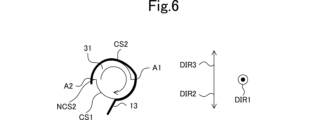
- FIG. 6 is a cross-sectional view of the magnetic core 1, showing the process of winding the coil 13 around the tooth main body portion 31, as viewed from the first direction DIR1.
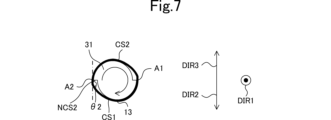
- FIG. 7 is a cross-sectional view of the magnetic core 1, showing the process of winding the coil 13 around the tooth main body portion 31, as viewed from the first direction DIR1.
- FIG. 8 is a perspective view showing the appearance of a brushless motor 100 in which the magnetic core 1 is used.
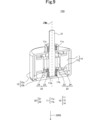
- FIG. 9 is an exploded perspective schematic view of a brushless motor 100 in which the magnetic core 1 is used.
- FIG. 10 is a cross-sectional view of a magnetic core 6 according to the comparative example, showing a process in which a coil 13 is wound around a tooth main body portion 31, as viewed from a first direction DIR1.
- FIG. 10 is a cross-sectional view of a magnetic core 6 according to the comparative example, showing a process in which a coil 13 is wound around a tooth main body portion 31, as viewed from a first direction
- FIG. 11 is a cross-sectional view of the magnetic core 1a as viewed in the first direction DIR1.
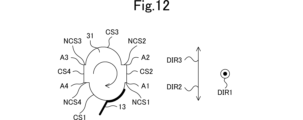
- FIG. 12 is a cross-sectional view of the magnetic core 1a, showing the process of winding the coil 13 around the tooth main body portion 31, as viewed from the first direction DIR1.
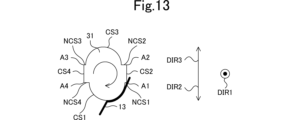
- FIG. 13 is a cross-sectional view of the magnetic core 1a, showing the process of winding the coil 13 around the tooth main body portion 31, as viewed from the first direction DIR1.
- FIG. 14 is a cross-sectional view of the magnetic core 1a, showing the process of winding the coil 13 around the tooth main body portion 31, as viewed from the first direction DIR1.
- FIG. 12 is a cross-sectional view of the magnetic core 1a, showing the process of winding the coil 13 around the tooth main body portion 31, as viewed from the first direction DIR1.
- FIG. 13 is a cross-sectional view of the magnetic core 1a, showing the process of winding the coil 13 around the tooth main body portion 31, as viewed from the first direction
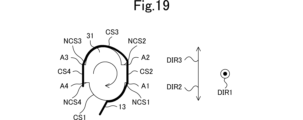
- FIG. 19 is a cross-sectional view of the magnetic core 1a, showing the process of winding the coil 13 around the tooth main body portion 31, as viewed from the first direction DIR1.
- FIG. 20 is a cross-sectional view of the magnetic core 1a, showing the process of winding the coil 13 around the tooth main body portion 31, as viewed from the first direction DIR1.
- FIG. 21 is a cross-sectional view of magnetic core 1b as viewed in first direction DIR1.
- the magnetic core 1 of this embodiment is used in a brushless motor 100 (an example of the "rotating electric machine" of the present invention; see FIGS. 8 and 9) described later.
- a brushless motor 100 an example of the "rotating electric machine” of the present invention; see FIGS. 8 and 9) described later.
- the first direction DIR1 faces in the opposite radial direction centered on the rotation axis of the brushless motor 100. A specific description will be given below.
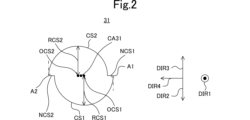
- FIG. 2 is a cross-sectional view of the magnetic core 1 as viewed from the first direction DIR1.
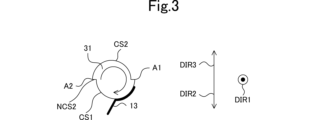
- FIG. 3 is a cross-sectional view of the magnetic core 1 as viewed from the first direction DIR1, showing the process of winding the coil 13 around the teeth main body 31.
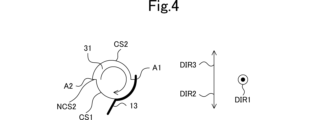
- FIG. 4 is a cross-sectional view of the magnetic core 1 as viewed from the first direction DIR1, showing the process of winding the coil 13 around the teeth main body 31.
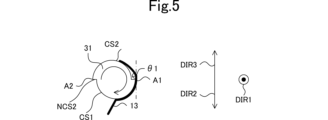
- FIG. 5 is a cross-sectional view of the magnetic core 1 as viewed from the first direction DIR1, showing the process of winding the coil 13 around the teeth main body 31.
- FIG. 6 is a cross-sectional view of the magnetic core 1 as viewed from the first direction DIR1, showing the process of winding the coil 13 around the teeth main body 31.
- FIG. 7 is a cross-sectional view of the magnetic core 1 as viewed from the first direction DIR1, showing the process of winding the coil 13 around the teeth main body 31.
- the magnetic core 1 is a soft magnetic material. When an external magnetic field is applied to the soft magnetic material, it becomes magnetized. When the application of the magnetic field is then stopped, the soft magnetic material loses its magnetization.
- An example of the material of such a soft magnetic material is iron.
- the magnetic core 1 is a molded body made of soft magnetic powder. That is, each of the core back portion 2 and the teeth portion 3 is a molded body made of soft magnetic powder.
- the material of the soft magnetic powder includes, for example, iron and a binder.
- the binder is, for example, resin.
- the soft magnetic powder is, for example, a mixture of iron powder and epoxy resin, which is an example of a binder.
- Such a magnetic core 1 is produced, for example, by press molding. Furthermore, an insulating treatment is applied to the outer surface of the magnetic core 1, which comes into contact with another member when the magnetic core 1 is incorporated into the brushless motor 100.
- the core back portion 2 has a first main surface S1 and a second main surface S2 aligned in the first direction DIR1.
- the second main surface S2 is located further in the first direction DIR1 than the first main surface S1.
- each of the first main surface S1 and the second main surface S2 has a rectangular shape when viewed in the first direction DIR1.
- the tooth body portion 31 extends from the second main surface S2 of the core back portion 2 in the first direction DIR1.
- the teeth main body portion 31 has a first contact surface CS1, a first convex angle A1, a first non-contact surface NCS1, a second contact surface CS2, a second convex angle A2, and a second non-contact surface NCS2.
- the first contact surface CS1 has a curved shape that protrudes in the second direction DIR2. More specifically, the first contact surface CS1 has a semi-elliptical shape when viewed in the first direction DIR1. The semicircular shape is included in the semi-elliptical shape. In this embodiment, the first contact surface CS1 has a semi-circular shape when viewed in the first direction DIR1. Therefore, the first contact surface CS1 is part of a circle of radius RCS1 centered on the center OCS1 when viewed in the first direction DIR1.
- the second direction DIR2 is perpendicular to the first direction DIR1.
- the second direction DIR2 is a direction along the rotation axis of the brushless motor 100 when the magnetic core 1 is assembled in the brushless motor 100.
- the first non-contact surface NCS1 is a plane facing the third direction DIR3.
- the normal direction of the first non-contact surface NCS1 is the third direction DIR3.
- the third direction DIR3 is a direction perpendicular to the first direction DIR1 and different from the second direction DIR2.
- the third direction DIR3 is the opposite direction to the second direction DIR2.
- the first convex angle A1 is an angle between the first contact surface CS1 and a tangent to the first non-contact surface NCS1 at the first convex angle A1 as seen in the first direction DIR1, as shown in FIG. 2. More specifically, the first convex angle A1 protrudes in a radial direction centered on the central axis CA31 of the teeth main body portion 31 as seen in the first direction DIR1. Therefore, the boundary between the first non-contact surface NCS1 and the first contact surface CS1 is the first convex angle A1.
- the first convex angle A1 is located on the first contact surface CS1.
- the central axis CA31 of the teeth main body portion 31 is a line connecting the centers of the cross sections of the teeth main body portion 31 perpendicular to the first direction DIR1. In this embodiment, the first convex angle A1 is 90 degrees.
- the second contact surface CS2 is located in the third direction DIR3 from the first contact surface CS1. Furthermore, the second contact surface CS2 has a curved shape that protrudes in the third direction DIR3 when viewed in the first direction DIR1. More specifically, the second contact surface CS2 has a semi-elliptical shape when viewed in the first direction DIR1. Note that a semicircular shape is included in the semi-elliptical shape. In this embodiment, the second contact surface CS2 has a semicircular shape when viewed in the first direction DIR1. Therefore, the second contact surface CS2 is part of a circle of radius RCS2 centered at the center OCS2 when viewed in the first direction DIR1.
- the radius RCS2 of the second contact surface CS2 is equal to the radius RCS1 of the first contact surface CS1.
- the position of the fourth direction DIR4 perpendicular to the first direction DIR1 and the second direction DIR2 of the center OCS2 is different from the position of the fourth direction DIR4 of the center OCS1.
- the second non-contact surface NCS2 is a plane facing the second direction DIR2, as shown in FIG. 2.
- the normal direction of the second non-contact surface NCS2 is the second direction DIR2.
- the second convex angle A2 is a convex angle different from the first convex angle A1. More specifically, in this embodiment, the second convex angle A2 is an angle between the second contact surface CS2 and a tangent to the second non-contact surface NCS2 at the second convex angle A2 when viewed in the first direction DIR1. More specifically, the second convex angle A2 protrudes in a radial direction centered on the central axis CA31 of the tooth main body portion 31 when viewed in the first direction DIR1. Therefore, the boundary between the second non-contact surface NCS2 and the second contact surface CS2 is the second convex angle A2. In addition, the second convex angle A2 is located on the second contact surface CS2. In this embodiment, the second convex angle A2 is 90 degrees.
- the tooth body portion 31 has a point-symmetric shape when viewed in the first direction DIR1.
- the coil 13 is wound around the tooth main body 31 as shown in Figures 3 to 7.
- the coil 13 is made of a conductive material such as copper.
- the coil 13 has a structure in which the surface of the copper wire is covered with an insulating coating. Since the surface of the copper wire is covered with an insulating coating, the coil 13 and the magnetic core 1 are electrically insulated. When the coil 13 is incorporated into the brushless motor 100, a magnetic field is generated by current flowing through the coil 13.
- the coil 13 comes into contact with the first contact surface CS1 as shown in FIG. 3. That is, the coil 13 comes into contact with the first contact surface CS1 before the coil 13 passes through the first convex angle A1.
- the coil 13 passes through the first convex angle A1, as shown in FIG. 4. That is, the coil 13 comes into contact with the first convex angle A1.
- the coil 13 contacts the second contact surface CS2, as shown in FIG. 5. That is, the coil 13 contacts the second contact surface CS2 after passing the first convex angle A1. The coil 13 does not contact the first non-contact surface NCS1.
- the bending angle ⁇ 1 of the coil 13 between the first convex angle A1 and the second contact surface CS2 is greater than 90 degrees.
- the coil 13 passes through the second convex angle A2, as shown in FIG. 6. That is, the coil 13 passes through the second convex angle A2 after passing through the second contact surface CS2. The coil 13 also comes into contact with the second convex angle A2.
- the coil 13 contacts the first contact surface CS1 as shown in FIG. 7. That is, after passing through the second convex angle A2, the coil 13 contacts the first contact surface CS1 again. Moreover, the coil 13 does not contact the second non-contact surface NCS2. Moreover, the bending angle ⁇ 2 of the coil 13 between the first contact surface CS1 and the second convex angle A2 is greater than 90 degrees.
- the coil 13 is wound around the tooth main body 31.
- the tooth tip portion 32 also has a third principal surface S3 and a fourth principal surface S4 aligned in the first direction DIR1.
- the fourth principal surface S4 is located further in the first direction DIR1 than the third principal surface S3.
- each of the third principal surface S3 and the fourth principal surface S4 has a rectangular shape when viewed in the first direction DIR1.
- the outer edge O2 of the core back portion 2 as viewed in the first direction DIR1 surrounds the outer edge O31 of the tooth main body portion 31 as viewed in the first direction DIR1.
- the outer edge O32 of the tooth tip portion 32 as viewed in the first direction DIR1 surrounds the outer edge O31 of the tooth main body portion 31 as viewed in the first direction DIR1.
- Fig. 8 is an external perspective view of the brushless motor 100 using a magnetic core 1.
- Fig. 9 is an exploded perspective schematic view of the brushless motor 100 using a magnetic core 1. Note that in Fig. 9, reference symbols are given only to representative magnetic cores 1, coils 13, and coil-equipped magnetic cores 14 among the multiple magnetic cores 1, multiple coils 13, and multiple coil-equipped magnetic cores 14.
- the brushless motor 100 includes a rotor 20 and a stator assembly 10. As shown in FIG. 9, the stator assembly 10 is disposed around the rotor 20 when viewed in the second direction DIR2. In other words, the brushless motor 100 is an inner rotor type.
- the rotor 20 includes a shaft 21 and a rotor member 22.
- the shaft 21 has a shape that extends in the second direction DIR2. More specifically, the shaft 21 is cylindrical.
- the rotor member 22 is cylindrical.
- the central axes of the shaft 21 and the rotor member 22 are the Z-axis. In other words, the rotation axis of the brushless motor 100 is the Z-axis. Therefore, the second direction DIR2 is a direction along the Z-axis.
- the rotor member 22 includes a soft magnetic body 23 and a hard magnetic body 24.
- the rotor member 22 is attached to the outer peripheral surface of the shaft 21 in the radial direction centered on the Z axis.
- the soft magnetic body 23 is attached to the outer peripheral surface of the shaft 21 in the radial direction centered on the Z axis.
- the hard magnetic body 24 is attached to the outer peripheral surface of the soft magnetic body 23 in the radial direction centered on the Z axis.
- the soft magnetic body 23 is a soft magnetic body.
- the hard magnetic body 24 is a hard magnetic body. When a magnetic field is applied from the outside, the hard magnetic body is magnetized. Even if the application of the magnetic field is then stopped, the hard magnetic body does not lose its magnetization. Such hard magnetic material is a magnet.
- the stator assembly 10 includes a bearing 11, a housing 12, and multiple magnetic cores 14 with coils.
- Each of the multiple magnetic cores 14 with coils has a magnetic core 1 and a coil 13.
- the brushless motor 100 includes a magnetic core 1.
- the bearing 11 supports the shaft 21 so that it can rotate in the circumferential direction around the Z-axis. More specifically, as shown in FIG. 9, the bearing 11 has a first bearing 11a and a second bearing 11b. Each of the first bearing 11a and the second bearing 11b is, for example, a ball bearing. Each of the first bearing 11a and the second bearing 11b is cylindrical. The central axis of each of the first bearing 11a and the second bearing 11b is the Z-axis. In other words, the central axis of each of the first bearing 11a and the second bearing 11b coincides with the central axis of the shaft 21.
- the second bearing 11b is located further in the second direction DIR2 than the first bearing 11a.
- the first bearing 11a is also located in the opposite direction of the second direction DIR2 than the rotor member 22.
- the second bearing 11b is located further in the second direction DIR2 than the rotor member 22.
- the second bearing 11b supports the end of the shaft 21 in the second direction DIR2.
- the housing 12 has a first housing 12a and a second housing 12b.
- the first housing 12a is cylindrical.
- the central axis of the first housing 12a is the Z-axis.
- the first housing 12a is located in the opposite direction of the second direction DIR2 from the second housing 12b.
- the first housing 12a also has an opening OP.
- the end of the shaft 21 opposite the second direction DIR2 protrudes from the opening OP in the opposite direction of the second direction DIR2.
- the brushless motor 100 is a single-shaft type.
- the first housing 12a supports the first bearing 11a, the multiple magnetic cores 1, and the multiple coils 13.
- the second housing 12b supports the second bearing 11b.
- the materials of the first housing 12a and the second housing 12b are, for example, a highly rigid material such as SUS.
- the number of coiled magnetic cores 14 is nine.
- the nine coiled magnetic cores 14 are arranged in a circumferential direction centered on the Z-axis.
- the nine coiled magnetic cores 14 are arranged around the hard magnetic material 24 with a gap between them.
- the magnetic core 1 is magnetized by both the magnetic field generated by the hard magnetic material 24 and the magnetic field generated by the coil 13, which will be described later. Note that, as shown in FIG. 9, there is an air gap between the magnetic core 1 and the rotor member 22.
- a current is supplied to the coil 13 from a power source (not shown).
- the rotation of the rotor 20 is controlled by controlling this current.
- the magnetic core 1 has a first contact surface CS1 having a curved shape protruding in a second direction DIR2 when viewed in a first direction DIR1 in which the teeth portion 3 extends, a first convex angle A1 through which the coil 13 passes, a first non-contact surface NCS1 whose boundary with the first contact surface CS1 is the first convex angle A1, and a second contact surface CS2 having a curved shape protruding in a third direction DIR3 different from the second direction DIR2 when viewed in the first direction DIR1 in which the teeth portion 3 extends.
- the coil 13 does not contact the first non-contact surface NCS1.
- the bending angle ⁇ 1 of the coil 13 between the first convex angle A1 and the second contact surface CS2 is greater than 90 degrees. Therefore, it is possible to alleviate stress concentration on a portion of the insulating coating formed on the surface of the coil 13 and suppress damage to the insulating coating.
- the magnetic core 1 can suppress a decrease in electrical insulation between the magnetic core and the coil due to damage to the insulating coating formed on the surface of the coil.
- the surface area of the outer surface of the magnetic core 1 to be insulated can be reduced. More specifically, the first non-contact surface NCS1 does not come into contact with the coil 13. Therefore, the first non-contact surface NCS1 does not need to be insulated. Therefore, with the magnetic core 1, the surface area of the outer surface of the magnetic core 1 to be insulated can be reduced. Furthermore, damage to the insulating coating formed on the surface of the coil 13 can be suppressed, making it possible to eliminate the need to insulate the entire outer surface of the magnetic core 1.
- the magnetic core 1 can further suppress the deterioration of the electrical insulation between the magnetic core and the coil. More specifically, the first non-contact surface NCS1 does not contact the coil 13. Therefore, the contact area between the magnetic core 1 and the coil 13 can be reduced. As a result, the magnetic core 1 can further suppress the deterioration of the electrical insulation between the magnetic core and the coil.
- the magnetic core 1 can further suppress the deterioration of the electrical insulation between the magnetic core and the coil due to damage to the insulating coating formed on the surface of the coil. More specifically, the magnetic core 1 further has a second convex angle A2 through which the coil 13 passes after passing the second contact surface CS2, and a second non-contact surface NCS2 whose boundary with the second contact surface CS2 is the second convex angle A2. The coil 13 does not contact the second non-contact surface NCS2. As a result, the bending angle ⁇ 2 of the coil 13 between the second convex angle A2 and the first contact surface CS1 is greater than 90 degrees.
- the magnetic core 1 can suppress the deterioration of the electrical insulation between the magnetic core and the coil due to damage to the insulating coating formed on the surface of the coil.
- FIG. 10 is a cross-sectional view of the process of winding the coil 13 around the tooth main body 31 in the magnetic core 6 according to the comparative example, viewed from the first direction DIR1. Note that the shape of the magnetic core 6 according to the comparative example is the same as the shape of the magnetic core 1.
- the magnetic core 6 according to the comparative example when the coil 13 is wound around the tooth body 31, the coil 13 contacts the first contact surface CS1, the second convex angle A2, the second contact surface CS2, the first convex angle A1, and the first contact surface CS1 in that order. That is, the magnetic core 6 according to the comparative example differs from the magnetic core 1 in that the winding direction of the coil 13 is opposite to the winding direction of the coil 13 in the magnetic core 1. In the case of the magnetic core 6 according to the comparative example, when the coil 13 moves from the first contact surface CS1 to the second convex angle A2, as shown in FIG. 10, the coil 13 comes into contact with the second convex angle A2, which may damage the insulating coating of the coil 13.
- the coil 13 moves from the second contact surface CS2 to the first convex angle A1, the coil 13 comes into contact with the first convex angle A1, which may damage the insulating coating of the coil 13. Therefore, according to the magnetic core 1, when the coil 13 is wound around the tooth main body 31, the coil 13 contacts the first contact surface CS1, the first convex angle A1, the second contact surface CS2, the second convex angle A2, and the first contact surface CS1 in this order.
- the first convex angle A1 is located on the first contact surface CS1.
- the magnetic core 1 can prevent the electrical insulation between the magnetic core and the coil from deteriorating due to damage to the insulating coating formed on the surface of the coil.
- the magnetic core 1 makes it easier to wind the coil 13 around the tooth main body 31. More specifically, the coil 13 contacts the first contact surface CS1 and the second contact surface CS2.
- the first contact surface CS1 and the second contact surface CS2 each have a semi-elliptical shape when viewed in the first direction DIR1. Furthermore, during the process of winding the coil 13, the coil 13 only passes through the first convex angle A1 and the second convex angle A2. Therefore, the magnetic core 1 makes it easier to wind the coil 13 around the tooth main body 31.
- the teeth main body can be produced by using an upper punch and a lower punch having end faces of the same shape. More specifically, the radius RCS2 of the second contact surface CS2 is equal to the radius RCS1 of the first contact surface CS1. As a result, the radius of the semi-elliptical portion of the end face in the third direction DIR3 of the punch located in the second direction DIR2 from the teeth main body 31 is equal to the radius of the semi-elliptical portion of the end face in the second direction DIR2 of the punch located in the third direction DIR3 from the teeth main body 31. Therefore, when the magnetic core 1 is produced by press molding, the teeth main body can be produced by using an upper punch and a lower punch having end faces of the same shape.
- the teeth main body can be produced by using an upper punch and a lower punch that have the same shape. More specifically, the teeth main body 31 has a point-symmetric shape when viewed in the first direction DIR1. As a result, the end face in the third direction DIR3 of the punch located in the second direction DIR2 further from the teeth main body 31 and the end face in the second direction DIR2 of the punch located in the third direction DIR3 further from the teeth main body 31 have a point-symmetric shape when viewed in the first direction DIR1. Therefore, when the magnetic core 1 is produced by press molding, the teeth main body can be produced by using an upper punch and a lower punch that have the same shape.
- FIG. 11 is a cross-sectional view of the magnetic core 1a viewed from the first direction DIR1.
- FIG. 12 is a cross-sectional view of the magnetic core 1a viewed from the first direction DIR1 showing the process of winding the coil 13 around the tooth main body 31.
- FIG. 13 is a cross-sectional view of the magnetic core 1a viewed from the first direction DIR1 showing the process of winding the coil 13 around the tooth main body 31.
- FIG. 14 is a cross-sectional view of the magnetic core 1a viewed from the first direction DIR1 showing the process of winding the coil 13 around the tooth main body 31.
- FIG. 15 is a cross-sectional view of the magnetic core 1a viewed from the first direction DIR1 showing the process of winding the coil 13 around the tooth main body 31.
- FIG. 16 is a cross-sectional view of the magnetic core 1a viewed from the first direction DIR1 showing the process of winding the coil 13 around the tooth main body 31.
- Fig. 17 is a cross-sectional view of the magnetic core 1a, showing the process of winding the coil 13 around the tooth main body 31, as viewed from the first direction DIR1.
- Fig. 18 is a cross-sectional view of the magnetic core 1a, showing the process of winding the coil 13 around the tooth main body 31, as viewed from the first direction DIR1.
- FIG. 19 is a cross-sectional view of the magnetic core 1a, showing the process of winding the coil 13 around the tooth main body 31, as viewed from the first direction DIR1.
- Fig. 20 is a cross-sectional view of the magnetic core 1a, showing the process of winding the coil 13 around the tooth main body 31, as viewed from the first direction DIR1. Note that, for the magnetic core 1a according to the second embodiment, only the parts different from the magnetic core 1 according to the first embodiment will be described, and the rest will be omitted.
- the teeth main body portion 31 has a first contact surface CS1, a first non-contact surface NCS1, a first convex angle A1, a second contact surface CS2, a second convex angle A2, a second non-contact surface NCS2, a third contact surface CS3, a third non-contact surface NCS3, a third convex angle A3, a fourth contact surface CS4, a fourth convex angle A4, and a fourth non-contact surface NCS4.
- the first contact surface CS1 has a curved shape when viewed in the first direction DIR1 so as to protrude in the second direction DIR2. More specifically, the first contact surface CS1 has a semi-elliptical shape when viewed in the first direction DIR1. Note that a semicircular shape is included in the category of a semi-elliptical shape. In this embodiment, the first contact surface CS1 has a semicircular shape when viewed in the first direction DIR1. Therefore, the first contact surface CS1 is part of a circle of radius RCS1 centered at center OCS1 when viewed in the first direction DIR1.
- the third contact surface CS3 is located in the third direction DIR3 from the first contact surface CS1. Also, the third contact surface CS3 has a curved shape that protrudes in the third direction DIR3 when viewed in the first direction DIR1. More specifically, the third contact surface CS3 has a semi-elliptical shape when viewed in the first direction DIR1. Note that a semicircular shape is included in the semi-elliptical shape. In this embodiment, the third contact surface CS3 has a semi-circular shape when viewed in the first direction DIR1. Therefore, the third contact surface CS3 is a part of a circle of radius RCS3 centered at the center OCS3 when viewed in the first direction DIR1.
- the radius RCS3 of the third contact surface CS3 is equal to the radius RCS3 of the first contact surface CS1. Note that the position of the center OCS3 in the fourth direction DIR4 is different from the position of the center OCS1 in the fourth direction DIR4.
- the second contact surface CS2 is provided between the first contact surface CS1 and the third contact surface CS3.
- the second contact surface CS2 is a plane facing in the opposite direction to the fourth direction DIR4.
- the normal direction of the second contact surface CS2 is in the opposite direction to the fourth direction DIR4.
- the second contact surface CS2 is located in the opposite direction to the fourth direction DIR4 from the first contact surface CS1, the third contact surface CS3, and the fourth contact surface CS4.
- the first non-contact surface NCS1 is provided between the first contact surface CS1 and the second contact surface CS2.
- the first non-contact surface NCS1 is a plane facing the second direction DIR2.
- the normal direction of the first non-contact surface NCS1 is the second direction DIR2.
- the first convex angle A1 is the angle between the first non-contact surface NCS1 and the second contact surface CS2 when viewed in the first direction DIR1, as shown in FIG. 11. More specifically, the first convex angle A1 protrudes in the radial direction centered on the central axis CA31 of the tooth main body portion 31 when viewed in the first direction DIR1. Therefore, the boundary between the first non-contact surface NCS1 and the second contact surface CS2 is the first convex angle A1. In this modified example, the first convex angle A1 is 90 degrees.
- the second non-contact surface NCS2 is located in the third direction DIR3 from the first non-contact surface NCS1. Therefore, the second non-contact surface NCS2 is a different non-contact surface from the first non-contact surface NCS1. More specifically, the second non-contact surface NCS2 is provided between the second contact surface CS2 and the third contact surface CS3. Furthermore, the second non-contact surface NCS2 is a plane facing the third direction DIR3. In other words, the normal direction of the second non-contact surface NCS2 is the third direction DIR3.
- the second convex angle A2 is a convex angle different from the first convex angle A1, as shown in FIG. 11. More specifically, the second convex angle A2 is the angle between the second contact surface CS2 and the second non-contact surface NCS2 when viewed in the first direction DIR1. More specifically, the second convex angle A2 protrudes in the radial direction centered on the central axis CA31 of the tooth main body portion 31 when viewed in the first direction DIR1. Therefore, the boundary between the second non-contact surface NCS2 and the second contact surface CS2 is the second convex angle A2. In this modified example, the second convex angle A2 is 90 degrees.
- the fourth contact surface CS4 is provided between the first contact surface CS1 and the third contact surface CS3.
- the fourth contact surface CS4 is a plane facing the fourth direction DIR4. In other words, the normal direction of the fourth contact surface CS4 is the fourth direction DIR4. Therefore, the fourth contact surface CS4 is parallel to the second contact surface CS2.
- the fourth contact surface CS4 is located further in the fourth direction DIR4 than the first contact surface CS1, the second contact surface CS2, and the third contact surface CS3.
- the third non-contact surface NCS3 is provided between the third contact surface CS3 and the fourth contact surface CS4.
- the third non-contact surface NCS3 is a plane facing the third direction DIR3. That is, the normal direction of the third non-contact surface NCS3 is the third direction DIR3.
- the position of the third non-contact surface NCS3 in the second direction DIR2 is equal to the position of the second non-contact surface NCS2 in the second direction DIR2.
- the third non-contact surface NCS3 is located further in the fourth direction DIR4 than the second non-contact surface NCS2.
- the third convex angle A3 is a convex angle different from each of the first convex angle A1 and the second convex angle A2, as shown in FIG. 11. More specifically, the third convex angle A3 is an angle formed between the third non-contact surface NCS3 and the fourth contact surface CS4 when viewed in the first direction DIR1. More specifically, the third convex angle A3 protrudes in a radial direction centered on the central axis CA31 of the tooth main body portion 31 when viewed in the first direction DIR1. Therefore, the boundary between the third non-contact surface NCS3 and the fourth contact surface CS4 is the third convex angle A3. In this modified example, the third convex angle A3 is 90 degrees.
- the fourth non-contact surface NCS4 is located in the second direction DIR2 from the third non-contact surface NCS3. Therefore, the fourth non-contact surface NCS4 is a different non-contact surface from the third non-contact surface NCS3. More specifically, the fourth non-contact surface NCS4 is provided between the fourth contact surface CS4 and the first contact surface CS1. Furthermore, the fourth non-contact surface NCS4 is a plane facing the second direction DIR2. In other words, the normal direction of the fourth non-contact surface NCS4 is the second direction DIR2. In this modified example, the position of the fourth non-contact surface NCS4 in the second direction DIR2 is equal to the position of the first non-contact surface NCS1 in the second direction DIR2. Furthermore, the fourth non-contact surface NCS4 is located in the fourth direction DIR4 from the first non-contact surface NCS1.
- the fourth convex angle A4 is a convex angle different from each of the first convex angle A1, the second convex angle A2, and the third convex angle A3, as shown in FIG. 11. More specifically, the fourth convex angle A4 is an angle formed between the fourth contact surface CS4 and the fourth non-contact surface NCS4 when viewed in the first direction DIR1. More specifically, the fourth convex angle A4 protrudes in the radial direction centered on the central axis CA31 of the tooth main body portion 31 when viewed in the first direction DIR1. Therefore, the boundary between the fourth non-contact surface NCS4 and the fourth contact surface CS4 is the fourth convex angle A4. In this modified example, the fourth convex angle A4 is 90 degrees.
- the tooth body portion 31 has a point-symmetric shape when viewed in the first direction DIR1.
- the coil 13 comes into contact with the first contact surface CS1, as shown in FIG. 12. That is, the coil 13 comes into contact with the first contact surface CS1 before the coil 13 passes through the first convex angle A1.
- the coil 13 passes through the first convex angle A1, as shown in FIG. 13. That is, the coil 13 comes into contact with the first convex angle A1.
- the coil 13 comes into contact with the second contact surface CS2, as shown in FIG. 14. That is, the coil 13 comes into contact with the second contact surface CS2 after passing through the first convex angle A1. Moreover, the coil 13 does not come into contact with the first non-contact surface NCS1. Moreover, the bending angle ⁇ 1 of the coil 13 at the first convex angle A1 is greater than 90 degrees.
- the coil 13 passes through the second convex angle A2, as shown in FIG. 15. That is, the coil 13 passes through the second contact surface CS2, and then passes through the second convex angle A2. The coil 13 also comes into contact with the second convex angle A2.
- the coil 13 contacts the third contact surface CS3 as shown in FIG. 16. That is, the coil 13 contacts the third contact surface CS3 after passing the second convex angle A2. The coil 13 does not contact the second non-contact surface NCS2.
- the bending angle ⁇ 2 of the coil 13 between the second convex angle A2 and the third contact surface CS3 is greater than 90 degrees. Note that, as shown in FIG. 14 and FIG. 16, the bending angle ⁇ 2 of the coil 13 between the second convex angle A2 and the third contact surface CS3 is smaller than the bending angle ⁇ 1 of the coil 13 at the first convex angle A1.
- the coil 13 passes through the third convex angle A3, as shown in FIG. 17. That is, the coil 13 passes through the third convex angle A3 after passing through the third contact surface CS3. The coil 13 also comes into contact with the third convex angle A3.
- the coil 13 comes into contact with the fourth contact surface CS4, as shown in FIG. 18. That is, the coil 13 comes into contact with the fourth contact surface CS4 after passing through the third convex angle A3. Moreover, the coil 13 does not come into contact with the third non-contact surface NCS3. Moreover, the bending angle ⁇ 3 of the coil 13 at the third convex angle A3 is greater than 90 degrees.
- the coil 13 passes through the fourth convex angle A4, as shown in FIG. 19. That is, the coil 13 passes through the fourth convex angle A4 after passing through the fourth contact surface CS4. The coil 13 also comes into contact with the fourth convex angle A4.
- the coil 13 contacts the first contact surface CS1 as shown in FIG. 20. That is, after passing through the fourth convex angle A4, the coil 13 again contacts the first contact surface CS1. Moreover, the coil 13 does not contact the fourth non-contact surface NCS4. Moreover, the bending angle ⁇ 4 of the coil 13 between the fourth convex angle A4 and the first contact surface CS1 is greater than 90 degrees.
- the coil 13 is wound around the tooth main body 31.
- the magnetic core 1a can prevent a decrease in electrical insulation between the magnetic core and the coil due to damage to the insulating coating formed on the surface of the coil. More specifically, the magnetic core 1a has a first contact surface CS1 having a curved shape protruding in a second direction DIR2 as viewed in a first direction DIR1 in which the teeth portion 3 extends, a first convex angle A1 through which the coil 13 passes, a second contact surface CS2 through which the coil 13 passes after passing the first convex angle A1, a first non-contact surface NCS1 having a boundary with the second contact surface CS2 as the first convex angle A1, a second convex angle A2 through which the coil 13 passes after passing the second contact surface CS2, a third contact surface CS3 having a curved shape protruding in a third direction DIR3 different from the second direction DIR2 as viewed in the first direction DIR1 in which the teeth portion 3 extends, and a second non-contact surface NCS2 having a
- the first non-contact surface NCS1 is provided between the first contact surface CS1 and the second contact surface CS2.
- the second non-contact surface NCS2 is provided between the second contact surface CS2 and the third contact surface CS3.
- the coil 13 does not contact the first non-contact surface NCS1 and the second non-contact surface NCS2.
- the bending angle ⁇ 1 of the coil 13 at the first convex angle A1 and the bending angle ⁇ 2 of the coil 13 between the second convex angle A2 and the third contact surface CS3 are both greater than 90 degrees. Therefore, stress concentration on a part of the insulating coating formed on the surface of the coil 13 can be alleviated, and damage to the insulating coating can be suppressed.
- the magnetic core 1a it is possible to suppress a decrease in electrical insulation between the magnetic core and the coil due to damage to the insulating coating formed on the surface of the coil.
- the stresses applied to the insulating coating formed on the surface of the coil 13 are large. Therefore, by making the bending angle ⁇ 1 of the coil 13 at the first convex angle A1 larger than the bending angle ⁇ 2 of the coil 13 between the second convex angle A2 and the third contact surface CS3, stress concentration can be further alleviated and damage to the insulating coating can be suppressed.
- the magnetic core 1a can further suppress the deterioration of the electrical insulation between the magnetic core and the coil due to damage to the insulating coating formed on the surface of the coil. More specifically, the magnetic core 1a further has a third convex angle A3 through which the coil 13 passes after passing the third contact surface CS3, a fourth contact surface CS4 through which the coil 13 passes after passing the third convex angle A3, a third non-contact surface NCS3 whose boundary with the fourth contact surface CS4 is the third convex angle A3, a fourth convex angle A4 through which the coil 13 passes after passing the fourth contact surface CS4, and a fourth non-contact surface NCS4 whose boundary with the fourth contact surface CS4 is the fourth convex angle A4.
- the coil 13 does not contact the third non-contact surface NCS3 and the fourth non-contact surface NCS4.
- the bending angle ⁇ 3 of the coil 13 at the third convex angle A3 and the bending angle ⁇ 4 of the coil 13 between the fourth convex angle A4 and the first contact surface CS1 are both greater than 90 degrees. This reduces stress concentration on a portion of the insulating coating formed on the surface of the coil 13, and suppresses damage to the insulating coating.
- the magnetic core 1a can suppress a decrease in electrical insulation between the magnetic core and the coil due to damage to the insulating coating formed on the surface of the coil.
- the magnetic core 1a makes it easier to wind the coil 13 around the tooth main body 31. More specifically, the coil 13 contacts the first contact surface CS1 and the third contact surface CS3.
- the first contact surface CS1 and the third contact surface CS3 each have a semi-elliptical shape when viewed in the first direction DIR1. Furthermore, during the process of winding the coil 13, the coil 13 only passes through the first convex angle A1, the second convex angle A2, the third convex angle A3, and the fourth convex angle A4. Therefore, the magnetic core 1a makes it easier to wind the coil 13 around the tooth main body 31.
- the teeth main body can be produced by using an upper punch and a lower punch having end faces of the same shape. More specifically, the radius RCS3 of the third contact surface CS3 is equal to the radius RCS1 of the first contact surface CS1. As a result, the radius of the semi-elliptical portion of the end face in the third direction DIR3 of the punch located in the second direction DIR2 from the teeth main body 31 is equal to the radius of the semi-elliptical portion of the end face in the second direction DIR2 of the punch located in the third direction DIR3 from the teeth main body 31. Therefore, when the magnetic core 1a is produced by press molding, the teeth main body can be produced by using an upper punch and a lower punch having end faces of the same shape.
- the teeth main body can be produced using an upper punch and a lower punch that have the same shape. More specifically, the teeth main body 31 has a point-symmetric shape when viewed in the first direction DIR1. As a result, the end face in the third direction DIR3 of the punch located in the second direction DIR2 further from the teeth main body 31 and the end face in the second direction DIR2 of the punch located in the third direction DIR3 further from the teeth main body 31 have a point-symmetric shape when viewed in the first direction DIR1. Therefore, when the magnetic core 1a is produced by press molding, the teeth main body can be produced using an upper punch and a lower punch that have the same shape.
- Fig. 21 is a cross-sectional view of the magnetic core 1b as viewed from the first direction DIR1. Note that, for the magnetic core 1b according to the first modified example, only the parts different from the magnetic core 1a according to the second embodiment will be described, and the rest will be omitted.
- magnetic core 1b differs from magnetic core 1a in that the second contact surface CS2 is connected to each of the first non-contact surface NCS1 and the second non-contact surface NCS2 via a notch surface, and the fourth contact surface CS4 is connected to each of the third non-contact surface NCS3 and the fourth non-contact surface NCS4 via a notch surface.
- the teeth main body portion 31 further has a first cutout surface NS1, a second cutout surface NS2, a third cutout surface NS3, and a fourth cutout surface NS4, as shown in FIG. 21.
- the first cutout surface NS1, the second cutout surface NS2, the third cutout surface NS3, and the fourth cutout surface NS4 each have a shape in which the first convex angle A1, the second convex angle A2, the third convex angle A3, and the fourth convex angle A4, respectively, are cut out.
- the first cutout surface NS1, the second cutout surface NS2, the third cutout surface NS3, and the fourth cutout surface NS4 each are flat surfaces.
- the first non-contact surface NCS1 is connected to the second contact surface CS2 via the first cutout surface NS1.
- the second non-contact surface NCS2 is connected to the second contact surface CS2 via the second cutout surface NS2.
- the third non-contact surface NCS3 is connected to the fourth contact surface CS4 via the third cutout surface NS3.
- the fourth non-contact surface NCS4 is connected to the fourth contact surface CS4 via the fourth cutout surface NS4.
- the magnetic core 1b can further suppress the deterioration of the electrical insulation between the magnetic core and the coil due to damage to the insulating coating formed on the surface of the coil.
- the second contact surface CS2 is connected to each of the first non-contact surface NCS1 and the second non-contact surface NCS2 via the notch surface. This makes it possible to increase the bending angle ⁇ 1 of the coil 13 at the first convex angle A1 and the bending angle ⁇ 2 of the coil 13 between the second convex angle A2 and the third contact surface CS3.
- the magnetic core 1b can suppress the deterioration of the electrical insulation between the magnetic core and the coil due to damage to the insulating coating formed on the surface of the coil.
- the magnetic core 1b can more effectively prevent the electrical insulation between the magnetic core and the coil from being deteriorated due to damage to the insulating coating formed on the surface of the coil.
- the fourth contact surface CS4 is connected to each of the third non-contact surface NCS3 and the fourth non-contact surface NCS4 via the notch surface. This allows the bending angle ⁇ 3 of the coil 13 at the third convex angle A3 and the bending angle ⁇ 4 of the coil 13 between the fourth convex angle A4 and the first contact surface CS1 to be increased.
- the magnetic core 1b can prevent the electrical insulation between the magnetic core and the coil from being deteriorated due to damage to the insulating coating formed on the surface of the coil.
- the magnetic core according to the present invention is not limited to the magnetic cores 1, 1a, and 1b, and may be modified within the scope of the present invention.
- the structures of the magnetic cores 1, 1a, and 1b may be arbitrarily combined.
- the rotating electric machine may have a structure in which the rotor is rotated by electricity, or a structure in which electricity is generated by the rotation of the rotor.
- the rotating electric machine may have at least one of the magnetic cores 1, 1a, and 1b, and may also have brushes.
- each of the first main surface S1 and the second main surface S2 of the core back portion 2 does not have to have a rectangular shape when viewed in the first direction DIR1.
- the tooth main body portion 31 does not have to have the second convex angle A2 and the second non-contact surface NCS2.
- each of the first contact surface CS1 and the second contact surface CS2 does not have to have a semi-elliptical shape when viewed in the first direction DIR1.
- the second direction DIR2 does not have to be perpendicular to the first direction DIR1. Furthermore, the second direction DIR2 does not have to be a direction along the rotation axis of the brushless motor 100 when the magnetic core 1 is assembled in the brushless motor 100.
- the first non-contact surface NCS1 does not have to be a plane facing the third direction DIR3. Therefore, the first non-contact surface NCS1 may be a plane facing a direction different from the third direction DIR3, or may be a curved surface.
- the third direction DIR3 does not have to be the opposite direction to the second direction DIR2.
- the first convex angle A1 does not have to be the angle between the first contact surface CS1 and the tangent at the first convex angle A1 of the first non-contact surface NCS1 when viewed in the first direction DIR1.
- each of the first convex angle A1, the second convex angle A2, the third convex angle A3, and the fourth convex angle A4 does not have to be 90 degrees.
- the radius RCS2 of the second contact surface CS2 may be different from the radius RCS1 of the first contact surface CS1.
- the second non-contact surface NCS2 does not have to be a plane facing the second direction DIR2. Therefore, the second non-contact surface NCS2 may be a plane facing a direction different from the second direction DIR2, or may be a curved surface.
- the second convex angle A2 does not have to be an angle between the second contact surface CS2 and the tangent at the second convex angle A2 of the second non-contact surface NCS2 when viewed in the first direction DIR1.
- the tooth body portion 31 does not have to have a point-symmetric shape when viewed in the first direction DIR1.
- each of the third principal surface S3 and the fourth principal surface S4 of the tooth tip portion 32 does not have to have a rectangular shape when viewed in the first direction DIR1.
- the outer edge O2 of the core back portion 2 as viewed in the first direction DIR1 does not have to surround the outer edge O31 of the tooth main body portion 31 as viewed in the first direction DIR1. Also, the outer edge O32 of the tooth tip portion 32 as viewed in the first direction DIR1 does not have to surround the outer edge O31 of the tooth main body portion 31 as viewed in the first direction DIR1.
- the brushless motor 100 may also be an outer rotor type.
- the brushless motor 100 is not limited to a single-shaft type.
- the brushless motor 100 may be, for example, a double-shaft type.
- first bearing 11a and the second bearing 11b are not limited to ball bearings.
- the materials for the first housing 12a and the second housing 12b may be any material that has high rigidity.
- the number of coil-equipped magnetic cores 14 is not limited to nine.
- the teeth main body portion 31 does not have to have the third convex angle A3, the fourth convex angle A4, the fourth contact surface CS4, the third non-contact surface NCS3, and the fourth non-contact surface NCS4.
- the first contact surface CS1 and the third contact surface CS3 do not have to have a semi-elliptical shape when viewed in the first direction DIR1.
- the radius RCS3 of the third contact surface CS3 may be different from the radius RCS1 of the first contact surface CS1.
- the second contact surface CS2 does not have to be a plane facing the opposite direction to the fourth direction DIR4. Therefore, the second contact surface CS2 may be a plane facing a direction other than the opposite direction to the fourth direction DIR4, or may be a curved surface.
- the first non-contact surface NCS1 does not have to be a plane facing the second direction DIR2. Therefore, the first non-contact surface NCS1 may be a plane facing a direction different from the second direction DIR2, or may be a curved surface.
- the first convex angle A1 does not have to be the angle between the first non-contact surface NCS1 and the second contact surface CS2 when viewed in the first direction DIR1.
- the second non-contact surface NCS2 does not have to be a plane facing the third direction DIR3. Therefore, the second non-contact surface NCS2 may be a plane facing a direction different from the third direction DIR3, or may be a curved surface.
- the second convex angle A2 does not have to be the angle between the second contact surface CS2 and the second non-contact surface NCS2 when viewed in the first direction DIR1.
- the fourth contact surface CS4 does not have to be a plane facing the fourth direction DIR4. Therefore, the fourth contact surface CS4 may be a plane facing a direction different from the fourth direction DIR4, or may be a curved surface.
- the third non-contact surface NCS3 does not have to be a plane facing the third direction DIR3. Therefore, the third non-contact surface NCS3 may be a plane facing a direction different from the third direction DIR3, or may be a curved surface.
- the position of the third non-contact surface NCS3 in the second direction DIR2 may be different from the position of the second non-contact surface NCS2 in the second direction DIR2.
- the third convex angle A3 does not have to be the angle between the third non-contact surface NCS3 and the fourth contact surface CS4 when viewed in the first direction DIR1.
- the fourth non-contact surface NCS4 does not have to be a plane facing the second direction DIR2. Therefore, the fourth non-contact surface NCS4 may be a plane facing a direction different from the second direction DIR2, or may be a curved surface.
- the position of the fourth non-contact surface NCS4 in the second direction DIR2 may be different from the position of the first non-contact surface NCS1 in the second direction DIR2.
- the fourth convex angle A4 does not have to be the angle between the fourth contact surface CS4 and the fourth non-contact surface NCS4 when viewed in the first direction DIR1.
- the bending angle ⁇ 2 of the coil 13 between the second convex angle A2 and the third contact surface CS3 does not have to be smaller than the bending angle ⁇ 1 of the coil 13 at the first convex angle A1.
- the first convex angle A1, the second convex angle A2, the third convex angle A3, or the fourth convex angle A4 may be chamfered.
- each of the first cutout surface NS1, the second cutout surface NS2, the third cutout surface NS3, and the fourth cutout surface NS4 may be a curved surface.
- the teeth main body portion 31 does not have to have the third cutout surface NS3 and the fourth cutout surface NS4.
- the fourth contact surface CS4 does not have to be connected to each of the third non-contact surface NCS3 and the fourth non-contact surface NCS4 via a cutout surface.
- the present invention has the following configuration.
- a magnetic core for use in a rotating electrical machine comprising:
- the rotor includes a teeth portion having a shape extending in a first direction,
- the teeth portion includes a wound portion around which a coil is wound,
- the wound portion is a first convex angle through which the coil passes during the winding process of the coil;
- a first contact surface that comes into contact with the coil before the coil passes through the first convex angle, the first contact surface having a curved shape that protrudes in a second direction when viewed in the first direction;
- the wound portion is a second salient angle that is different from the first salient angle and through which the coil passes after passing the second contact surface; a second non-contact surface that is not in contact with the coil, the boundary between the second non-contact surface and the second contact surface being the second convex angle; and the coil contacts the first contact surface again after passing the second salient corner;
- Each of the first contact surface and the second contact surface has a semi-elliptical shape when viewed in the first direction.
- the wound portion has a point-symmetric shape when viewed in the first direction.
- a magnetic core according to any one of (1) to (4).
- a magnetic core for use in a rotating electrical machine comprising:
- the rotor includes a teeth portion having a shape extending in a first direction,
- the teeth portion includes a wound portion around which a coil is wound,
- the wound portion is a first convex angle through which the coil passes during the winding process of the coil;
- a first contact surface that comes into contact with the coil before the coil passes through the first convex angle, the first contact surface having a curved shape that protrudes in a second direction when viewed in the first direction;
- a first non-contact surface provided between the first contact surface and the second contact surface and not in contact with the coil, the first non-contact surface having a boundary with the second contact surface that is the first convex angle;
- a second salient angle that is different from the first salient angle and through which the coil passes after passing the second contact surface;
- the wound portion is a third convex angle that is different from each of the first convex angle and the second convex angle and through which the coil passes after passing through the third contact surface; a fourth contact surface that the coil comes into contact with after passing the third salient corner; a third non-contact surface provided between the third contact surface and the fourth contact surface and not in contact with the coil, the third non-contact surface having a boundary with the fourth contact surface that is the third convex angle; a fourth convex angle that is different from each of the first convex angle, the second convex angle, and the third convex angle, and through which the coil passes after passing through the fourth contact surface; a fourth non-contact surface that is different from the third non-contact surface, that is provided between the fourth contact surface and the first contact surface, that is not in contact with the coil, and whose boundary with the fourth contact surface is the fourth convex angle; and the coil contacts the first contact surface again after passing the fourth convex corner;
- a magnetic core according to (6) A magnetic core according to
- Each of the first contact surface and the third contact surface has a semi-elliptical shape when viewed in the first direction.
- the wound portion has a point-symmetric shape when viewed in the first direction.
- a magnetic core according to any one of (6) to (9).
- the second contact surface is connected to each of the first non-contact surface and the second non-contact surface via a notch surface.
- a magnetic core according to any one of (6) to (10).
- the fourth contact surface is connected to each of the third non-contact surface and the fourth non-contact surface via a notch surface.
- the teeth portion is a molded body formed from soft magnetic powder.
- a magnetic core according to any one of (1) to (12).
- a magnetic core according to any one of (1) to (13);
- the coil Magnetic core with coil.
- a magnetic core according to any one of (1) to (13) is provided. Rotating electrical machines.
- a magnetic core according to any one of (1) to (13) is provided. Brushless motor.
- stator assembly 11 bearing 11a: first bearing 11b: second bearing 12: housing 12a: first housing 12b: second housing 13: coil 14: magnetic core with coil 20: rotor 21: shaft 22: rotor member 23: soft magnetic material 24: hard magnetic material 31: teeth main body portion 32: teeth tip portion 100: brushless motor A1: first convex angle A2: second convex angle A3: third convex angle A4: fourth convex angle CA31: central axis CS1: first contact surface CS2: second contact surface CS3: third Contact surface CS4: fourth contact surface DIR1: first direction DIR2: second direction DIR3: third direction DIR4: fourth direction NCS1: first non-contact surface NCS2: second non-contact surface NCS3: third non-contact surface NCS4: fourth non-contact surface NS1: first cut-out surface NS2: second cut-out surface NS3: third cut-out surface NS4
Landscapes
- Engineering & Computer Science (AREA)
- Power Engineering (AREA)
- Iron Core Of Rotating Electric Machines (AREA)
Priority Applications (3)
| Application Number | Priority Date | Filing Date | Title |
|---|---|---|---|
| JP2024562708A JPWO2024122408A1 (https=) | 2022-12-05 | 2023-11-28 | |
| CN202380061983.7A CN119768995A (zh) | 2022-12-05 | 2023-11-28 | 磁芯、带线圈的磁芯、旋转电气机械和无刷马达 |
| US19/081,342 US20250239898A1 (en) | 2022-12-05 | 2025-03-17 | Magnetic core, coil-equipped magnetic core, rotating electrical machine, and brushless motor |
Applications Claiming Priority (2)
| Application Number | Priority Date | Filing Date | Title |
|---|---|---|---|
| JP2022194083 | 2022-12-05 | ||
| JP2022-194083 | 2022-12-05 |
Related Child Applications (1)
| Application Number | Title | Priority Date | Filing Date |
|---|---|---|---|
| US19/081,342 Continuation US20250239898A1 (en) | 2022-12-05 | 2025-03-17 | Magnetic core, coil-equipped magnetic core, rotating electrical machine, and brushless motor |
Publications (1)
| Publication Number | Publication Date |
|---|---|
| WO2024122408A1 true WO2024122408A1 (ja) | 2024-06-13 |
Family
ID=91379308
Family Applications (1)
| Application Number | Title | Priority Date | Filing Date |
|---|---|---|---|
| PCT/JP2023/042586 Ceased WO2024122408A1 (ja) | 2022-12-05 | 2023-11-28 | 磁性体コア、コイル付き磁性体コア、回転電気機械及びブラシレスモータ |
Country Status (4)
| Country | Link |
|---|---|
| US (1) | US20250239898A1 (https=) |
| JP (1) | JPWO2024122408A1 (https=) |
| CN (1) | CN119768995A (https=) |
| WO (1) | WO2024122408A1 (https=) |
Citations (3)
| Publication number | Priority date | Publication date | Assignee | Title |
|---|---|---|---|---|
| WO2005107038A1 (ja) * | 2004-04-30 | 2005-11-10 | Sumitomo Electric Industries, Ltd. | 圧粉磁心およびその製造方法 |
| JP2007536889A (ja) * | 2004-05-11 | 2007-12-13 | ホガナス アクチボラゲット | 電気機械及び電気機械を製造するための方法 |
| JP2008118838A (ja) * | 2006-10-13 | 2008-05-22 | Mitsui High Tec Inc | 積層鉄心 |
-
2023
- 2023-11-28 WO PCT/JP2023/042586 patent/WO2024122408A1/ja not_active Ceased
- 2023-11-28 CN CN202380061983.7A patent/CN119768995A/zh active Pending
- 2023-11-28 JP JP2024562708A patent/JPWO2024122408A1/ja active Pending
-
2025
- 2025-03-17 US US19/081,342 patent/US20250239898A1/en active Pending
Patent Citations (3)
| Publication number | Priority date | Publication date | Assignee | Title |
|---|---|---|---|---|
| WO2005107038A1 (ja) * | 2004-04-30 | 2005-11-10 | Sumitomo Electric Industries, Ltd. | 圧粉磁心およびその製造方法 |
| JP2007536889A (ja) * | 2004-05-11 | 2007-12-13 | ホガナス アクチボラゲット | 電気機械及び電気機械を製造するための方法 |
| JP2008118838A (ja) * | 2006-10-13 | 2008-05-22 | Mitsui High Tec Inc | 積層鉄心 |
Also Published As
| Publication number | Publication date |
|---|---|
| CN119768995A (zh) | 2025-04-04 |
| US20250239898A1 (en) | 2025-07-24 |
| JPWO2024122408A1 (https=) | 2024-06-13 |
Similar Documents
| Publication | Publication Date | Title |
|---|---|---|
| CN100553073C (zh) | 旋转电机 | |
| JP2007014110A (ja) | 回転電機 | |
| JP2007028734A (ja) | 回転電機 | |
| US20250219477A1 (en) | Magnetic core, coil-equipped magnetic core, and rotary electric machine | |
| WO2024122408A1 (ja) | 磁性体コア、コイル付き磁性体コア、回転電気機械及びブラシレスモータ | |
| CN114465385A (zh) | 轴向间隙电机以及径向间隙电机 | |
| JP3358667B2 (ja) | ディスク回転用モータ | |
| JP2018160956A (ja) | ブラシレスモータ | |
| TW202418715A (zh) | 絕緣片及具備此絕緣片之定子、馬達 | |
| JP2007082282A (ja) | ステータコア、それを用いたモータ及びその製造方法 | |
| JP7852742B2 (ja) | 磁性体コア、ステータアッシー、回転電気機械及びブラシレスモータ | |
| WO2023189285A1 (ja) | 回転子及び電動機 | |
| WO2023053601A1 (ja) | ロータおよび回転電機 | |
| CN102804551A (zh) | 定子和旋转电机 | |
| WO2023053604A1 (ja) | ロータおよび回転電機 | |
| JP2024121489A (ja) | ステータ及び回転電気機械 | |
| JPWO2024122405A5 (https=) | ||
| JP4794555B2 (ja) | ステッピングモータ | |
| WO2024181096A1 (ja) | ステータ及び回転電気機械 | |
| WO2024122406A1 (ja) | 磁性体コア、回転電気機械及びブラシレスモータ | |
| WO2024122407A1 (ja) | 磁性体コア及び回転電気機械 | |
| JPH04312336A (ja) | 電動機の固定子 | |
| US20250219476A1 (en) | Rotating electric machine | |
| JP5016838B2 (ja) | モータ | |
| WO2024171937A1 (ja) | ステータ部材、回転電気機械及びステータ部材の製造方法 |
Legal Events
| Date | Code | Title | Description |
|---|---|---|---|
| 121 | Ep: the epo has been informed by wipo that ep was designated in this application |
Ref document number: 23900524 Country of ref document: EP Kind code of ref document: A1 |
|
| WWE | Wipo information: entry into national phase |
Ref document number: 202380061983.7 Country of ref document: CN |
|
| WWE | Wipo information: entry into national phase |
Ref document number: 2024562708 Country of ref document: JP |
|
| WWP | Wipo information: published in national office |
Ref document number: 202380061983.7 Country of ref document: CN |
|
| NENP | Non-entry into the national phase |
Ref country code: DE |
|
| 122 | Ep: pct application non-entry in european phase |
Ref document number: 23900524 Country of ref document: EP Kind code of ref document: A1 |