WO2024116915A1 - はく離シート付き粘着シート - Google Patents
はく離シート付き粘着シート Download PDFInfo
- Publication number
- WO2024116915A1 WO2024116915A1 PCT/JP2023/041515 JP2023041515W WO2024116915A1 WO 2024116915 A1 WO2024116915 A1 WO 2024116915A1 JP 2023041515 W JP2023041515 W JP 2023041515W WO 2024116915 A1 WO2024116915 A1 WO 2024116915A1
- Authority
- WO
- WIPO (PCT)
- Prior art keywords
- meth
- acrylate
- weight
- adhesive
- sheet
- Prior art date
- Legal status (The legal status is an assumption and is not a legal conclusion. Google has not performed a legal analysis and makes no representation as to the accuracy of the status listed.)
- Ceased
Links
Images
Classifications
-
- C—CHEMISTRY; METALLURGY
- C09—DYES; PAINTS; POLISHES; NATURAL RESINS; ADHESIVES; COMPOSITIONS NOT OTHERWISE PROVIDED FOR; APPLICATIONS OF MATERIALS NOT OTHERWISE PROVIDED FOR
- C09J—ADHESIVES; NON-MECHANICAL ASPECTS OF ADHESIVE PROCESSES IN GENERAL; ADHESIVE PROCESSES NOT PROVIDED FOR ELSEWHERE; USE OF MATERIALS AS ADHESIVES
- C09J7/00—Adhesives in the form of films or foils
- C09J7/30—Adhesives in the form of films or foils characterised by the adhesive composition
- C09J7/38—Pressure-sensitive adhesives [PSA]
- C09J7/381—Pressure-sensitive adhesives [PSA] based on macromolecular compounds obtained by reactions involving only carbon-to-carbon unsaturated bonds
- C09J7/385—Acrylic polymers
-
- C—CHEMISTRY; METALLURGY
- C09—DYES; PAINTS; POLISHES; NATURAL RESINS; ADHESIVES; COMPOSITIONS NOT OTHERWISE PROVIDED FOR; APPLICATIONS OF MATERIALS NOT OTHERWISE PROVIDED FOR
- C09J—ADHESIVES; NON-MECHANICAL ASPECTS OF ADHESIVE PROCESSES IN GENERAL; ADHESIVE PROCESSES NOT PROVIDED FOR ELSEWHERE; USE OF MATERIALS AS ADHESIVES
- C09J11/00—Features of adhesives not provided for in group C09J9/00, e.g. additives
- C09J11/02—Non-macromolecular additives
- C09J11/06—Non-macromolecular additives organic
-
- C—CHEMISTRY; METALLURGY
- C09—DYES; PAINTS; POLISHES; NATURAL RESINS; ADHESIVES; COMPOSITIONS NOT OTHERWISE PROVIDED FOR; APPLICATIONS OF MATERIALS NOT OTHERWISE PROVIDED FOR
- C09J—ADHESIVES; NON-MECHANICAL ASPECTS OF ADHESIVE PROCESSES IN GENERAL; ADHESIVE PROCESSES NOT PROVIDED FOR ELSEWHERE; USE OF MATERIALS AS ADHESIVES
- C09J133/00—Adhesives based on homopolymers or copolymers of compounds having one or more unsaturated aliphatic radicals, each having only one carbon-to-carbon double bond, and at least one being terminated by only one carboxyl radical, or of salts, anhydrides, esters, amides, imides, or nitriles thereof; Adhesives based on derivatives of such polymers
- C09J133/04—Homopolymers or copolymers of esters
-
- C—CHEMISTRY; METALLURGY
- C09—DYES; PAINTS; POLISHES; NATURAL RESINS; ADHESIVES; COMPOSITIONS NOT OTHERWISE PROVIDED FOR; APPLICATIONS OF MATERIALS NOT OTHERWISE PROVIDED FOR
- C09J—ADHESIVES; NON-MECHANICAL ASPECTS OF ADHESIVE PROCESSES IN GENERAL; ADHESIVE PROCESSES NOT PROVIDED FOR ELSEWHERE; USE OF MATERIALS AS ADHESIVES
- C09J133/00—Adhesives based on homopolymers or copolymers of compounds having one or more unsaturated aliphatic radicals, each having only one carbon-to-carbon double bond, and at least one being terminated by only one carboxyl radical, or of salts, anhydrides, esters, amides, imides, or nitriles thereof; Adhesives based on derivatives of such polymers
- C09J133/04—Homopolymers or copolymers of esters
- C09J133/06—Homopolymers or copolymers of esters of esters containing only carbon, hydrogen and oxygen, the oxygen atom being present only as part of the carboxyl radical
- C09J133/062—Copolymers with monomers not covered by C09J133/06
- C09J133/066—Copolymers with monomers not covered by C09J133/06 containing -OH groups
-
- C—CHEMISTRY; METALLURGY
- C09—DYES; PAINTS; POLISHES; NATURAL RESINS; ADHESIVES; COMPOSITIONS NOT OTHERWISE PROVIDED FOR; APPLICATIONS OF MATERIALS NOT OTHERWISE PROVIDED FOR
- C09J—ADHESIVES; NON-MECHANICAL ASPECTS OF ADHESIVE PROCESSES IN GENERAL; ADHESIVE PROCESSES NOT PROVIDED FOR ELSEWHERE; USE OF MATERIALS AS ADHESIVES
- C09J175/00—Adhesives based on polyureas or polyurethanes; Adhesives based on derivatives of such polymers
- C09J175/04—Polyurethanes
-
- C—CHEMISTRY; METALLURGY
- C09—DYES; PAINTS; POLISHES; NATURAL RESINS; ADHESIVES; COMPOSITIONS NOT OTHERWISE PROVIDED FOR; APPLICATIONS OF MATERIALS NOT OTHERWISE PROVIDED FOR
- C09J—ADHESIVES; NON-MECHANICAL ASPECTS OF ADHESIVE PROCESSES IN GENERAL; ADHESIVE PROCESSES NOT PROVIDED FOR ELSEWHERE; USE OF MATERIALS AS ADHESIVES
- C09J7/00—Adhesives in the form of films or foils
- C09J7/30—Adhesives in the form of films or foils characterised by the adhesive composition
- C09J7/38—Pressure-sensitive adhesives [PSA]
-
- C—CHEMISTRY; METALLURGY
- C09—DYES; PAINTS; POLISHES; NATURAL RESINS; ADHESIVES; COMPOSITIONS NOT OTHERWISE PROVIDED FOR; APPLICATIONS OF MATERIALS NOT OTHERWISE PROVIDED FOR
- C09J—ADHESIVES; NON-MECHANICAL ASPECTS OF ADHESIVE PROCESSES IN GENERAL; ADHESIVE PROCESSES NOT PROVIDED FOR ELSEWHERE; USE OF MATERIALS AS ADHESIVES
- C09J7/00—Adhesives in the form of films or foils
- C09J7/40—Adhesives in the form of films or foils characterised by release liners
-
- C—CHEMISTRY; METALLURGY
- C09—DYES; PAINTS; POLISHES; NATURAL RESINS; ADHESIVES; COMPOSITIONS NOT OTHERWISE PROVIDED FOR; APPLICATIONS OF MATERIALS NOT OTHERWISE PROVIDED FOR
- C09J—ADHESIVES; NON-MECHANICAL ASPECTS OF ADHESIVE PROCESSES IN GENERAL; ADHESIVE PROCESSES NOT PROVIDED FOR ELSEWHERE; USE OF MATERIALS AS ADHESIVES
- C09J7/00—Adhesives in the form of films or foils
- C09J7/40—Adhesives in the form of films or foils characterised by release liners
- C09J7/401—Adhesives in the form of films or foils characterised by release liners characterised by the release coating composition
Definitions
- the present invention relates to a pressure-sensitive adhesive sheet with a release sheet.
- adhesives also called pressure-sensitive adhesives; the same applies below
- adhesives are in a soft solid (viscoelastic) state at temperatures near room temperature and have the property of easily adhering to an adherend when pressure is applied.
- adhesives are widely used in the form of adhesive sheets for purposes such as joining parts and protecting surfaces.
- an adhesive sheet having an adhesive layer on one surface of a substrate is preferably used as a surface protection sheet to prevent damage to the surface (scratches, stains, corrosion, etc.) of various items when they are processed or transported. Before use, such adhesive sheets can be distributed, stored, and processed in a form in which the adhesive surface is protected by a release sheet.
- Patent Document 1 is an example of a prior art document that discloses this type of conventional technology.
- silicone-based release sheets with excellent light release properties are widely used (for example, Patent Document 1).
- the use of silicone-based release sheets may not be desirable.
- the silicone material contained in the silicone-based release sheet may be transferred from the release surface of the release sheet to the adhesive surface and even to the adherend, which may change the surface properties of the adherend surface after the adhesive sheet is peeled off and removed.
- the application location of the adhesive sheet such as inside a precision device, it may be desirable to avoid the use of silicone materials that may generate siloxane gas.
- non-silicone-based release sheets such as release sheets having a release treatment layer formed with a release treatment agent other than a silicone material (non-silicone-based release treatment agent) are used, but the non-silicone-based release sheets are less likely to achieve light release properties (release sheet releasability) from the adhesive surface compared to silicone-based release sheets, and tend to have reduced releasability.
- the present invention was created in consideration of the above circumstances, and aims to provide an adhesive sheet with a non-silicone release sheet that has release sheet releasability comparable to that of a silicone release sheet.
- an adhesive sheet with a release sheet which comprises an adhesive sheet having an adhesive layer, and a non-silicone release sheet disposed on the surface of the adhesive layer.
- the adhesive layer contains an acrylic polymer.
- the acrylic polymer is a polymer of a monomer component containing an alkyl (meth)acrylate (m1) having an alkyl group having 6 to 17 carbon atoms at the ester end.
- the alkyl group having 6 to 17 carbon atoms is a linear alkyl group or a branched alkyl group having one branch carbon atom.
- the alkyl (meth)acrylate (m1) includes at least one selected from n-heptyl acrylate and n-octyl acrylate.
- the effects of the technology disclosed herein are preferably exhibited.
- the monomer component includes a monomer (m2) having a hydroxyl group.
- a monomer having a hydroxyl group By using a monomer having a hydroxyl group, the side chain of the acrylic polymer has a hydroxyl group.
- a hydroxyl group can become a crosslinking point when using a crosslinking agent such as an isocyanate-based or epoxy-based crosslinking agent.
- the adhesive layer includes an isocyanate-based crosslinking agent.
- an isocyanate-based crosslinking agent is used as the crosslinking agent, the techniques disclosed herein are preferably implemented.
- the pressure-sensitive adhesive layer includes a zirconium-containing compound.
- a zirconium-containing compound as a catalyst, it is easy to achieve both the progress of aging (typically a crosslinking reaction) of the pressure-sensitive adhesive layer and a long pot life.
- the use of a zirconium-based catalyst is also desirable from the viewpoint of reducing the environmental load.
- a zirconium-containing compound as a catalyst, it is easy to form a colorless pressure-sensitive adhesive. This can be an advantageous feature when the pressure-sensitive adhesive sheet is used for optical applications.
- the non-silicone release sheet has a release sheet substrate and a non-silicone release treatment layer provided on at least one surface of the release sheet substrate.
- the non-silicone release treatment layer is formed from a material containing a long-chain alkyl release treatment agent.
- the desired light release properties can be preferably obtained.
- the pressure-sensitive adhesive sheet has a substrate and the pressure-sensitive adhesive layer disposed on at least one surface of the substrate.
- a substrate-attached pressure-sensitive adhesive sheet has excellent processability and handling properties, and can be preferably used, for example, as a surface protection film that is removed (peeled) from an adherend after use.
- the adhesive surface of the adhesive sheet disclosed herein is protected by a release sheet, so the adhesive surface is kept smooth and can be attached uniformly to the adherend. Furthermore, by using a non-silicone release sheet as the release sheet, contamination of the adherend with silicone materials does not occur. This can be an advantageous feature, for example, in optical applications that require specific optical properties. Therefore, the adhesive sheet disclosed herein is preferably used in optical applications, specifically, in a form in which it is attached to optical components.
- the adhesive sheet disclosed herein is also suitable, for example, as a surface protection film.
- a surface protection film After being attached to an object to be protected, a surface protection film is usually peeled off (re-peeled off) from the object to be protected once its protective purpose has been achieved. Since such a surface protection film is required not to alter the object to be protected before or after protection of the object, it can be advantageous to use an adhesive sheet with a non-silicone release sheet that does not cause contamination of the silicone material on the surface of the object to be protected after peeling and removal.
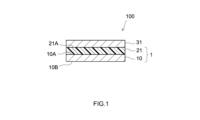
- FIG. 1 is a cross-sectional view showing a schematic configuration of a pressure-sensitive adhesive sheet with a release sheet according to one embodiment.
- the term "adhesive” refers to a material that exhibits a soft solid (viscoelastic) state in a temperature range near room temperature and has the property of easily adhering to an adherend by pressure, as described above.
- the adhesive referred to here may generally be a material that has a property of satisfying a complex tensile modulus E * (1Hz) ⁇ 107 dyne/ cm2 (typically, a material that has the above property at 25°C), as defined in "C. A. Dahlquist, "Adhesion: Fundamentals and Practice", McLaren & Sons (1966), p. 143".
- biomass-derived carbon means carbon (renewable carbon) derived from biomass materials, i.e., materials derived from renewable organic resources.
- biomass materials typically refer to materials derived from biological resources (typically plants that perform photosynthesis) that can be reproduced sustainably in the presence of sunlight, water, and carbon dioxide. Therefore, materials derived from fossil resources that are depleted through use after mining (fossil resource-based materials) are excluded from the concept of biomass materials here.
- the biomass carbon ratio of the adhesive (layer) and adhesive sheet i.e., the proportion of biomass-derived carbon in the total carbon contained in the adhesive (layer) and adhesive sheet, can be estimated from the carbon isotope content with mass number 14 measured in accordance with ASTM D6866.
- the adhesive sheet with release sheet disclosed herein comprises an adhesive sheet having an adhesive layer and a non-silicone-based release sheet disposed on the surface of the adhesive layer.
- the adhesive sheet may be an adhesive sheet with a substrate having the adhesive layer on one or both sides of a non-releasable substrate (support substrate), or may be an adhesive sheet without a substrate (i.e., an adhesive sheet without a non-releasable substrate) in which the adhesive layer is held by a release sheet.
- the support substrate may be simply referred to as a "substrate".
- the concept of the adhesive sheet here may include those called adhesive tapes, adhesive labels, adhesive films, etc.
- the adhesive sheet may be in the form of a roll or a sheet. It may also be an adhesive sheet processed into various shapes.
- This adhesive sheet with a release sheet 100 includes an adhesive sheet 1 having an adhesive layer 21, and a release sheet 31 laminated on the surface (adhesive surface) 21A of the adhesive layer 21.
- the adhesive sheet 1 is configured as a single-sided adhesive sheet with a substrate, comprising a sheet-like support substrate (e.g., a resin film) 10 having a first surface 10A and a second surface 10B, and an adhesive layer 21 provided on the first surface 10A side.
- the adhesive layer 21 is fixedly provided on the first surface 10A side of the support substrate 10, i.e., without the intention of separating the adhesive layer 21 from the support substrate 10.
- Such a single-sided adhesive sheet 1 is suitable as a surface protection film that is used by attaching its adhesive surface to the surface of an adherend (a protection target, for example, an optical member such as a polarizing plate).
- the adhesive sheet 1 Before use, the adhesive sheet 1 has the form of an adhesive sheet 100 with a release sheet, and the surface (adhesive surface) 21A of the adhesive layer 21 is protected by a release sheet 31, at least the side facing the adhesive layer 21 being the release surface.
- the adhesive layer disclosed herein contains an acrylic polymer.
- the adhesive layer is typically an adhesive layer having an acrylic polymer as a base polymer.
- Such an adhesive layer is also called an acrylic adhesive layer.
- the base polymer refers to the main component of a rubber-like polymer (a polymer that exhibits rubber elasticity in a temperature range around room temperature) contained in the adhesive layer.
- the term "main component” refers to a component that is contained in an amount of more than 50% by weight, unless otherwise specified.
- the following description of the adhesive and the components that may be contained in the adhesive layer can also be applied to the adhesive composition used to form the adhesive (layer) unless otherwise specified.
- acrylic polymer refers to a polymer derived from a monomer component containing more than 50% by weight of a (meth)acrylic monomer.
- the content of the (meth)acrylic monomer in the monomer component is preferably 70% by weight or more, and may be 80% by weight or more. In some embodiments, the content of the (meth)acrylic monomer in the monomer component may be 90% by weight or more, 95% by weight or more, or 100% by weight.
- the proportion of the (meth)acrylic monomer in the entire monomer component may be, for example, less than 99% by weight, less than 95% by weight, or less than 93% by weight.
- (meth)acrylic monomer refers to a monomer having at least one (meth)acryloyl group in one molecule.
- (meth)acryloyl refers collectively to acryloyl and methacryloyl.
- (meth)acrylate refers collectively to acrylate and methacrylate, and “(meth)acrylic” refers collectively to acrylic and methacrylic. Therefore, the concept of (meth)acrylic monomer here can include both monomers having an acryloyl group (acrylic monomer) and monomers having a methacryloyl group (methacrylic monomer).
- the acrylic polymer typically, a polymer of a monomer raw material containing one or more types of linear alkyl (meth)acrylate as a main monomer and which may further contain one or more types of secondary monomers copolymerizable with the main monomer is used.
- the main monomer refers to a component that accounts for more than 50% by weight of the entire monomer component.
- the linear alkyl (meth)acrylate refers to an alkyl (meth)acrylate having a linear alkyl group at the ester end.
- the linear alkyl group is a concept that includes linear and branched alkyl groups, and does not include cyclic alkyl groups called alicyclic.
- the secondary monomer refers to a monomer component other than the linear alkyl (meth)acrylate used as the main monomer, and includes functional group-containing monomers such as hydroxyl group-containing monomers and carboxy group-containing monomers described later, and other copolymerizable monomers.
- the secondary monomer refers to a monomer component other than the alkyl (meth)acrylate (m1) and other linear alkyl (meth)acrylates among the monomer components.
- the acrylic polymer used in the technology disclosed herein contains an alkyl(meth)acrylate (m1) having a specific chemical structure as a monomer component.
- the alkyl(meth)acrylate (m1) has an alkyl group having 6 to 17 carbon atoms at the ester end, and the alkyl group having 6 to 17 carbon atoms is either a linear alkyl group or an alkyl (meth)acrylate having a branched alkyl group with one carbon atom in the branch (also called a branch or a branching group).
- the acrylic polymer synthesized using the alkyl(meth)acrylate (m1) as a monomer component has a relatively long linear or low-branched alkyl group in the side chain of the acrylic polymer. It is believed that such side chain alkyl group contributes to realizing the light release property of the non-silicone release sheet.
- the alkyl (meth)acrylate (m1) is contained as at least a part of the main monomer (chain alkyl (meth)acrylate) in the monomer component of the acrylic polymer.
- a chain alkyl (meth)acrylate having a chain alkyl group with X carbon atoms at the ester terminal may be referred to as a C X alkyl (meth)acrylate (for example, a chain alkyl (meth)acrylate having a chain alkyl group with 6 to 17 carbon atoms at the ester terminal may be referred to as a C 6-17 alkyl (meth)acrylate).
- the alkyl (meth)acrylate (m1) can also be represented by the following formula (1).
- CH2 C( R1 ) COOR2 (1)
- R 1 in the above formula (1) is a hydrogen atom or a methyl group.
- R 2 is an alkyl group having 6 to 17 carbon atoms, and is either a linear alkyl group or a branched alkyl group having one carbon atom in the branch.
- the number of carbon atoms in the alkyl group of the alkyl (meth)acrylate (m1) is preferably 7 or more, may be 8 or more, may be 9 or more, may be 10 or more, or may be 12 or more, from the viewpoint of easy releasability to non-silicone-based release sheets.
- the number of carbon atoms is preferably 14 or less, more preferably 12 or less, even more preferably 10 or less, and particularly preferably 8 or less (for example, 7 or 8) from the viewpoint of adhesive formability, adhesive properties, aging speed, etc.
- C6-17 linear alkyl (meth)acrylates used as the alkyl (meth)acrylate (m1) include n-hexyl (meth)acrylate, n-heptyl (meth)acrylate, n-octyl (meth)acrylate, n-nonyl (meth)acrylate, n-decyl (meth)acrylate, n-undecyl (meth)acrylate, n-dodecyl (meth)acrylate, n-tridecyl (meth)acrylate, n-tetradecyl (meth)acrylate, n-pentadecyl (meth)acrylate, n-hexadecyl (meth)acrylate, and n-heptadecyl (meth)acrylate.
- alkyl (meth)acrylate examples include methylheptyl (meth)acrylate, such as 2-octyl (meth)acrylate and isooctyl acrylate, methyloctyl (meth)acrylate, methylnonyl (meth)acrylate, methyldecyl (meth)acrylate, methyldodecyl (meth)acrylate, methyltridecyl (meth)acrylate, methyltetradecyl (meth)acrylate, methylpenta(meth)acrylate, and methylhexadecyl (meth)acrylate.
- the alkyl (meth)acrylate (m1) can be used alone or in combination of two or more. Although not particularly limited, in some embodiments, alkyl acrylate is preferably used as the alkyl (meth)acrylate (m1).
- a C6-17 linear alkyl (meth)acrylate is preferably used.
- alkyl (meth)acrylate (m1) n-heptyl (meth)acrylate, n-octyl (meth)acrylate, n-nonyl (meth)acrylate, and n-dodecyl (meth)acrylate are more preferable, and n-heptyl (meth)acrylate and n-octyl (meth)acrylate are even more preferable.
- the C6-17 branched alkyl (meth)acrylate either an isoalkyl (meth)acrylate having an isoalkyl group in which a methyl group is branched at the carbon immediately before the end of the branched alkyl group, or a branched alkyl (meth)acrylate having a non-isobranched alkyl group in which a methyl group is branched at two or more carbons before the end of the branched alkyl group, such as 2-octyl (meth)acrylate, can be used, but in some embodiments, a branched alkyl (meth)acrylate having a non-isobranched alkyl group in which the side chain terminal of the acrylic polymer is a relatively long linear alkyl group, is preferred.
- the proportion of alkyl (meth)acrylate (m1) in the entire monomer components is set according to the purpose of use, required properties, etc.
- the proportion of alkyl (meth)acrylate (m1) in the entire monomer components may be, for example, 10% by weight or more, and 30% by weight or more is appropriate. In some preferred embodiments, it is 50% by weight or more (e.g., more than 50% by weight), more preferably 70% by weight or more, even more preferably 80% by weight or more, 85% by weight or more, particularly preferably 90% by weight or more, 92% by weight or more, or 95% by weight or more.
- the proportion of alkyl (meth)acrylate (m1) in the entire monomer components may be, for example, less than 99% by weight, less than 98% by weight, or less than 97% by weight.
- the upper limit of the proportion of alkyl (meth)acrylate (m1) in the entire monomer components may be 95% by weight or less, 75% by weight or less, 60% by weight or less, or 50% by weight or less (e.g., less than 50% by weight) from the viewpoint of obtaining the effect of using other monomers.
- the proportion of alkyl (meth)acrylate (m1) in the total chain alkyl (meth)acrylate contained in the monomer component of the acrylic polymer may be, for example, 10% by weight or more, and 30% by weight or more is appropriate in some embodiments, and in some preferred embodiments, it is 50% by weight or more (e.g., more than 50% by weight), more preferably 70% by weight or more, even more preferably 80% by weight or more, particularly preferably 90% by weight or more, and may be 95% by weight or more, or may be 99% by weight or more.
- the properties based on the alkyl (meth)acrylate (m1) can be effectively expressed.
- an acrylic polymer having a monomer composition containing only alkyl (meth)acrylate (m1) is used as the chain alkyl (meth)acrylate. Therefore, the upper limit of the proportion of alkyl (meth)acrylate (m1) in the total chain alkyl (meth)acrylate is 100% by weight.
- the proportion of the alkyl (meth)acrylate (m1) in the total chain alkyl (meth)acrylate may be 95% by weight or less, 75% by weight or less, 60% by weight or less, or 50% by weight or less (e.g., less than 50% by weight) from the viewpoint of obtaining the effect of using the chain alkyl (meth)acrylate other than the alkyl (meth)acrylate (m1).
- a C 7-12 linear alkyl (meth)acrylate is used as the alkyl (meth)acrylate (m1). Of these, the use of a C 7-8 linear alkyl (meth)acrylate is more preferred.
- the proportion of the C 7-12 linear alkyl (meth)acrylate (more preferably, a C 7-8 linear alkyl (meth)acrylate) in the total monomer components may be, for example, 10% by weight or more, suitably 30% by weight or more, and in some preferred embodiments, 50% by weight or more (e.g., more than 50% by weight), more preferably 70% by weight or more, even more preferably 80% by weight or more, or may be 85% by weight or more, particularly preferably 90% by weight or more, or may be 92% by weight or more, or may be 95% by weight or more.
- the proportion of the C 7-12 linear alkyl (meth)acrylate (more preferably, C 7-8 linear alkyl (meth)acrylate) in the entire monomer components may be, for example, less than 99% by weight, less than 98% by weight, or less than 97% by weight.
- the upper limit of the proportion of the C 7-12 linear alkyl (meth)acrylate (more preferably, C 7-8 linear alkyl (meth)acrylate) in the entire monomer components may be 95% by weight or less, 75% by weight or less, 60% by weight or less, or 50% by weight or less (for example, less than 50% by weight), from the viewpoint of obtaining the effect of using other monomers.
- n-heptyl (meth)acrylate is used as the alkyl (meth)acrylate (m1).
- n-heptyl (meth)acrylate the effects of the technology disclosed herein can be particularly favorably exhibited.
- n-heptyl acrylate is particularly preferred from the viewpoint of adhesive properties.
- the proportion of n-heptyl (meth)acrylate in the entire monomer components is set according to the purpose of use, required properties, etc.
- the proportion of n-heptyl (meth)acrylate in the entire monomer components may be, for example, 10% by weight or more, and 30% by weight or more is appropriate. In some preferred embodiments, it is 50% by weight or more (e.g., more than 50% by weight), more preferably 70% by weight or more, even more preferably 80% by weight or more, or 85% by weight or more, particularly preferably 90% by weight or more, or 92% by weight or more, or 95% by weight or more.
- the proportion of n-heptyl (meth)acrylate in the entire monomer components may be, for example, less than 99% by weight, less than 98% by weight, or less than 97% by weight.
- the proportion of n-heptyl (meth)acrylate in the total monomer components may be 95% by weight or less, 75% by weight or less, 60% by weight or less, or 50% by weight or less (e.g., less than 50% by weight) from the viewpoint of obtaining the effect of using various monomers other than n-heptyl (meth)acrylate.
- the proportion of n-heptyl (meth)acrylate in the total chain alkyl (meth)acrylate contained in the monomer component of the acrylic polymer may be, for example, 10% by weight or more in some embodiments, and 30% by weight or more is appropriate. In some preferred embodiments, it is 50% by weight or more (for example, more than 50% by weight), more preferably 70% by weight or more, even more preferably 80% by weight or more, and particularly preferably 90% by weight or more, and may be 95% by weight or more, or may be 99% by weight or more.
- the technology disclosed herein can be preferably implemented in an embodiment using an acrylic polymer having a monomer composition containing only n-heptyl (meth)acrylate as the chain alkyl (meth)acrylate. Therefore, the upper limit of the proportion of n-heptyl (meth)acrylate in the total chain alkyl (meth)acrylate is 100% by weight.
- the proportion of n-heptyl (meth)acrylate in the total amount of the chain alkyl (meth)acrylate may be 95% by weight or less, 75% by weight or less, 60% by weight or less, or 50% by weight or less (e.g., less than 50% by weight) from the viewpoint of obtaining the effect of using other chain alkyl (meth)acrylates.
- the monomer components constituting the acrylic polymer may contain a chain alkyl (meth)acrylate that does not fall under the category of alkyl (meth)acrylate (m1) as long as the effects of the invention are not significantly impaired.
- Examples of the chain alkyl (meth)acrylate other than the alkyl (meth)acrylate (m1) include C 1-5 alkyl (meth)acrylate, C 18+ alkyl (meth)acrylate in which the alkyl group has 18 or more carbon atoms, and C 6-17 branched alkyl (meth)acrylate in which the branched group in the alkyl group has 2 or more carbon atoms. These may be used alone or in combination of two or more.
- C 1-5 alkyl (meth)acrylates include methyl (meth)acrylate, ethyl (meth)acrylate, propyl (meth)acrylate, isopropyl (meth)acrylate, n-butyl (meth)acrylate, isobutyl (meth)acrylate, s-butyl (meth)acrylate, t-butyl (meth)acrylate, pentyl (meth)acrylate, and isopentyl (meth)acrylate.
- Specific examples of C 18+ alkyl (meth)acrylates include octadecyl (meth)acrylate, nonadecyl (meth)acrylate, and eicosyl (meth)acrylate.
- Specific examples of the C 6-17 branched alkyl (meth)acrylates include 2-ethylhexyl (meth)acrylate.
- the proportion of the linear alkyl (meth)acrylate other than the alkyl (meth)acrylate (m1) in the monomer component is not particularly limited, but may be, for example, approximately 50% by weight or less (e.g., less than 50% by weight), 30% by weight or less, 10% by weight or less, or 1% by weight or less.
- the technology disclosed herein can be preferably implemented in an embodiment in which the monomer component does not substantially contain linear alkyl (meth)acrylate other than the alkyl (meth)acrylate (m1).
- the proportion of the linear alkyl (meth)acrylate other than the alkyl (meth)acrylate (m1) in the monomer component may be, for example, 1% by weight or more, 10% by weight or more, or 30% by weight or more.
- the monomer component is substantially free of monomer A (e.g., a chain alkyl (meth)acrylate other than the above alkyl (meth)acrylate (m1))
- monomer A e.g., a chain alkyl (meth)acrylate other than the above alkyl (meth)acrylate (m1)
- the monomer component may contain, as the linear alkyl (meth)acrylate, an alkyl (meth)acrylate having an alkyl group derived from biomass at the ester end (hereinafter also referred to as "biomass linear alkyl (meth)acrylate").
- biomass linear alkyl (meth)acrylate an alkyl (meth)acrylate having an alkyl group derived from biomass at the ester end
- the biomass linear alkyl (meth)acrylate is not particularly limited, and may be, for example, an ester of a biomass-derived alkanol and a biomass-derived or non-biomass-derived (meth)acrylic acid.
- biomass-derived alkanols include biomass ethanol, alkanols derived from plant materials such as palm oil, palm kernel oil, coconut oil, and castor oil.
- the biomass-derived alkanol may be linear or branched.
- an ester of a biomass-derived alkanol and a non-biomass-derived (meth)acrylic acid is used as the biomass linear alkyl (meth)acrylate used in the synthesis of an acrylic polymer.
- the greater the number of carbon atoms of the alkanol the higher the ratio of the number of biomass-derived carbons to the total number of carbons contained in the biomass linear alkyl (meth)acrylate, i.e., the biomass carbon ratio of the linear alkyl (meth)acrylate.
- the linear alkyl group derived from biomass has a large number of carbon atoms in terms of reducing the dependency on fossil resource-based materials.
- the linear alkyl group constituting the linear alkyl (meth)acrylate has too many carbon atoms, it tends to be difficult to obtain adhesive properties such as adhesive strength, and it may also be disadvantageous in terms of productivity such as synthesis, handling, and cost.
- an ester of a biomass-derived alkanol and a non-biomass-derived (meth)acrylic acid is used as the biomass linear alkyl (meth)acrylate
- a biomass linear alkyl (meth)acrylate can be used for either the above-mentioned alkyl (meth)acrylate (m1) or the linear alkyl (meth)acrylate other than alkyl (meth)acrylate (m1).
- two or more compounds are used as the linear alkyl (meth)acrylate used in the synthesis of an acrylic polymer, at least a portion of them (e.g., one or two types, or all, i.e., all types) can be biomass linear alkyl (meth)acrylate.
- a biomass linear alkyl (meth)acrylate as the alkyl (meth)acrylate (m1), the effect of the technology disclosed herein can be preferably realized while reducing the dependency on fossil resource-based materials.
- the number of carbon atoms in the alkyl group of the biomass linear alkyl (meth)acrylate is preferably 14 or less, more preferably 12 or less, even more preferably 10 or less, and particularly preferably 8 or less (e.g., 7 or 8) from the viewpoints of adhesive formability, adhesive properties, and aging speed.
- the number of carbon atoms is preferably 7 or more.
- the biomass carbon ratio of the synthesized acrylic polymer can be increased by increasing the number of carbon atoms in the alkyl group.
- biomass heptyl (meth)acrylate having an n-heptyl group derived from biomass
- biomass heptyl (meth)acrylate is used as the alkyl (meth)acrylate (m1).
- biomass heptyl (meth)acrylate the effects of the technology disclosed herein can be particularly favorably exhibited while reducing the dependency on fossil resource-based materials.
- biomass heptyl acrylate is particularly preferred from the viewpoint of adhesive properties.
- the proportion of biomass linear alkyl (meth)acrylate (e.g., biomass n-heptyl (meth)acrylate) in the total linear alkyl (meth)acrylate used as a monomer component of the acrylic polymer may be, for example, 1% by weight or more in some embodiments, with 10% by weight or more being appropriate, and preferably 30% by weight or more, more preferably 50% by weight or more (e.g., more than 50% by weight), and may be 70% by weight or more, 80% by weight or more, 90% by weight or more, 95% by weight or more, or 99% by weight or more.
- biomass linear alkyl (meth)acrylate By increasing the proportion of biomass linear alkyl (meth)acrylate used, the biomass carbon ratio of the acrylic polymer can be improved while effectively exerting the effect of its use.
- the technology disclosed herein can be preferably implemented in an embodiment in which an acrylic polymer having a monomer composition containing only biomass linear alkyl (meth)acrylate as the linear alkyl (meth)acrylate is used. Therefore, the upper limit of the proportion of the biomass linear alkyl (meth)acrylate in the total linear alkyl (meth)acrylate is 100% by weight. In some other embodiments, the proportion of the biomass linear alkyl (meth)acrylate in the total linear alkyl (meth)acrylate may be 95% by weight or less, 70% by weight or less, 50% by weight or less (e.g., less than 50% by weight), 30% by weight or less, 10% by weight or less, or 1% by weight or less.
- the monomer component of the acrylic polymer preferably contains a monomer (m2) having a hydroxyl group.
- the hydroxyl-containing monomer (m2) is included in the monomer component as the above-mentioned secondary monomer.
- the side chain of the acrylic polymer has a hydroxyl group.
- Such a hydroxyl group can become a crosslinking point when using a crosslinking agent such as an isocyanate-based or epoxy-based crosslinking agent.
- the hydroxyl-containing monomer (m2) can be used alone or in combination of two or more types.
- the length of the side chain having a hydroxyl group is not particularly limited.
- the number of carbon atoms in the hydroxyl-containing side chain of the hydroxyl-containing monomer (m2) may be, for example, 2 or more, and preferably 3 or more.
- the side chain having a hydroxyl group in the hydroxyl-containing monomer (m2) refers to a chain structure bonded to a (meth)acryloyl group, for example, in the case of a hydroxyl-containing (meth)acrylic monomer.
- a hydroxyl-containing monomer (m2) having a hydroxyl group in a side chain with a relatively long carbon number By using a hydroxyl-containing monomer (m2) having a hydroxyl group in a side chain with a relatively long carbon number, the hydroxyl group serving as the crosslinking point and the crosslinking agent are close to each other, and it is considered that aging (crosslinking reaction) proceeds quickly.
- the crosslinking reaction can be appropriately controlled, and thus the progress of the crosslinking reaction and a practical pot life can be favorably achieved at the same time.
- the hydroxyl-containing monomer (m2) may be derived from biomass or may be derived from non-biomass.
- Hydroxyl group-containing (meth)acrylic monomers are preferably used as the hydroxyl group-containing monomer (m2).
- Specific examples of the hydroxyl group-containing (meth)acrylic monomer include hydroxyalkyl (meth)acrylates such as 2-hydroxyethyl (meth)acrylate, 2-hydroxypropyl (meth)acrylate, 3-hydroxypropyl (meth)acrylate, 2-hydroxybutyl (meth)acrylate, 4-hydroxybutyl (meth)acrylate, 6-hydroxyhexyl (meth)acrylate, 8-hydroxyoctyl (meth)acrylate, 10-hydroxydecyl (meth)acrylate, and 12-hydroxylauryl (meth)acrylate; and hydroxyalkyl (meth)acrylamides such as N-hydroxypropyl (meth)acrylamide and N-hydroxybutyl (meth)acrylamide.
- hydroxyalkyl (meth)acrylates are preferred, and 4-hydroxybutyl (meth)acrylate is more preferred.
- a (meth)acrylic monomer having a hydroxyalkyl group with 3 or more carbon atoms is used as the hydroxyl group-containing (meth)acrylic monomer.
- hydroxyalkyl (meth)acrylates having a hydroxyalkyl group with 3 or more carbon atoms at the ester terminal are more preferred, and among these, compounds in which the alkyl group constituting the hydroxyalkyl group is linear are even more preferred.
- the number of carbon atoms in the hydroxyalkyl group of the hydroxyalkyl (meth)acrylate is, for example, 3 to 10, preferably 4 to 10, and may be 4 to 8 or 4 to 6.
- the content of the hydroxyl group-containing monomer (m2) in the monomer component can be appropriately set according to the purpose of use, the required properties, and the like.
- the content of the hydroxyl group-containing monomer (m2) is, for example, 0.01% by weight or more of the entire monomer component, may be 0.1% by weight or more, and is suitably more than 0.5% by weight, and in some preferred embodiments, may be 1% by weight or more (e.g., more than 1% by weight), may be 2% by weight or more, or may be 3% by weight or more.
- the content of the hydroxyl group-containing monomer (m2) in the entire monomer component may be, for example, less than 15% by weight, and is suitably 10% by weight or less, and in some preferred embodiments, may be 8% by weight or less, may be 6% by weight or less, or may be 5% by weight or less.
- the proportion of the hydroxyl group-containing monomer (m2) in the secondary monomers used as monomer components of the acrylic polymer is appropriately 30% by weight or more, preferably 50% by weight or more, more preferably 70% by weight or more, even more preferably 80% by weight or more, and particularly preferably 90% by weight or more, for example, 95% by weight or more, 97% by weight or more, 98% by weight or more, or 99% by weight or more (for example, 99.9% by weight or more), from the viewpoint of effectively exerting the effect of copolymerizing the hydroxyl group-containing monomer (m2).
- the upper limit of the proportion of the hydroxyl group-containing monomer (m2) in the total copolymerizable monomers is 100% by weight, and may be, for example, 95% by weight or less.
- the monomer component of the acrylic polymer may contain a monomer having a carboxy group as a secondary monomer.
- a carboxy group-containing monomer By using a carboxy group-containing monomer, the side chain of the acrylic polymer has a carboxy group.
- Such a carboxy group can be a crosslinking point, for example, when a crosslinking agent such as an epoxy crosslinking agent is used.
- a carboxy group-containing monomer it is easy to obtain a pressure-sensitive adhesive having an appropriate cohesive strength.
- the carboxy group-containing monomer can be used alone or in combination of two or more types.
- carboxy group-containing monomers include ethylenically unsaturated monocarboxylic acids such as acrylic acid, methacrylic acid, carboxyethyl (meth)acrylate, carboxypentyl (meth)acrylate, 2-(meth)acryloyloxyethylhexahydrophthalic acid, 2-(meth)acryloyloxypropylhexahydrophthalic acid, 2-(meth)acryloyloxyethylphthalic acid, 2-(meth)acryloyloxyethylsuccinic acid, 2-(meth)acryloyloxyethyl-2-hydroxyethylphthalic acid, 2-(meth)acryloyloxyethylmaleic acid, carboxypolycaprolactone mono(meth)acrylate, 2-(meth)acryloyloxyethyltetrahydrophthalic acid, crotonic acid, and isocrotonic acid; and ethylenically unsaturated dicarbox
- the carboxy group-containing monomer may also be a monomer having a metal salt (e.g., an alkali metal salt) of a carboxy group.
- a carboxy group-containing (meth)acrylic monomer is preferably used as the carboxy group-containing monomer.
- the above carboxy group-containing (meth)acrylic monomers can be used alone or in combination of two or more.
- the length of the side chain having a carboxyl group in the monomer is not particularly limited.
- the number of carbon atoms in the carboxyl group-containing side chain of the carboxyl group-containing monomer may be, for example, 1 or more, 2 or more, and preferably 3 or more.
- one or more (meth)acrylic monomers having a carboxyl group with 3 or more carbon atoms can be selected and used from the Light Ester series and Light Acrylate series available from Kyoeisha Chemical Co., Ltd.
- the amount of carboxyl group-containing monomer used in the monomer components forming the acrylic polymer is, for example, less than 10% by weight, and may be less than 8% by weight, less than 5% by weight, less than 3% by weight, less than 1% by weight, less than 0.5% by weight, less than 0.3% by weight, or less than 0.1% by weight.
- the technology disclosed herein may be preferably implemented in an embodiment in which the monomer components are substantially free of carboxyl group-containing monomer.
- the monomer components forming the acrylic polymer may contain other copolymerizable monomers that are copolymerizable with the alkyl (meth)acrylate (m1).
- the other copolymerizable monomers are defined as copolymerizable monomers that are different from the alkyl (meth)acrylate (m1), the chain alkyl (meth)acrylate other than the alkyl (meth)acrylate (m1), the hydroxyl group-containing monomer (m2), and the carboxyl group-containing monomer.
- Non-limiting examples of other copolymerizable monomers include functional group-containing monomers such as acid anhydride group-containing monomers, monomers containing sulfonic acid groups or phosphoric acid groups, epoxy group-containing monomers, cyano group-containing monomers, amide group-containing monomers such as (meth)acrylamide and N,N-dimethyl(meth)acrylamide, amino group-containing monomers such as aminoethyl(meth)acrylate and N,N-dimethylaminoethyl(meth)acrylate, monomers having nitrogen atom-containing rings such as N-vinyl-2-pyrrolidone and N-(meth)acryloylmorpholine, imide group-containing monomers, and vinyl ester monomers such as vinyl acetate, aromatic vinyl compounds such as styrene, cyclohexyl(meth)acrylate, cyclopentyl(meth)acrylate, isopropyl alcohol, etc.
- functional group-containing monomers such
- copolymerizable monomer examples include cycloalkyl (meth)acrylates such as bornyl (meth)acrylate; aromatic ring-containing (meth)acrylates such as aryl (meth)acrylates (e.g., phenyl (meth)acrylate), aryloxyalkyl (meth)acrylates (e.g., phenoxyethyl (meth)acrylate), and arylalkyl (meth)acrylates (e.g., benzyl (meth)acrylate); olefin monomers; chlorine-containing monomers; isocyanate group-containing monomers such as 2-(meth)acryloyloxyethyl isocyanate; alkoxy group-containing monomers such as methoxyethyl (meth)acrylate and ethoxyethyl (meth)acrylate; vinyl ether monomers such as methyl vinyl ether and ethyl vinyl ether; and the like.
- the monomer components constituting the acrylic polymer may or may not contain the other copolymerizable monomers.
- the amount of the other copolymerizable monomers is not particularly limited and may be appropriately selected depending on the purpose and application.
- the content of the other copolymerizable monomers in the monomer components is, for example, appropriately less than 30% by weight, preferably less than 10% by weight, may be less than 8% by weight, more preferably less than 5% by weight, and may be less than 3% by weight (for example, less than 1% by weight).
- the technology disclosed herein can be preferably implemented in an embodiment in which the monomer components do not substantially contain other copolymerizable monomers.
- the biomass carbon ratio of the monomer components constituting the acrylic polymer may be, for example, 1% or more, with 10% or more being appropriate, preferably 30% or more, more preferably 50% or more (e.g., more than 50%), may be 70% or more, 80% or more, or may be 90% to 100%.
- the method for obtaining the acrylic polymer is not particularly limited, and various polymerization methods known as methods for synthesizing acrylic polymers, such as solution polymerization, emulsion polymerization, bulk polymerization, suspension polymerization, and photopolymerization, can be appropriately adopted.
- solution polymerization can be preferably adopted.
- the embodiment using solution polymerization can be advantageous from the viewpoint of transparency, adhesive performance, and the like.
- a monomer supply method when performing solution polymerization a lump-sum charging method in which all monomer raw materials are supplied at once, a continuous supply (dropping) method, a divided supply (dropping) method, and the like can be appropriately adopted.
- the polymerization temperature when performing solution polymerization can be appropriately selected depending on the type of monomer and solvent used, the type of polymerization initiator, and the like, and can be, for example, about 20°C to 170°C (typically about 40°C to 140°C).
- the solvent (polymerization solvent) used in the solution polymerization can be appropriately selected from conventionally known organic solvents (toluene, ethyl acetate, etc.).
- the initiator used in the polymerization can be appropriately selected from conventionally known polymerization initiators (for example, azo-based polymerization initiators such as 2,2'-azobisisobutyronitrile (AIBN), peroxide-based initiators, etc.) depending on the type of polymerization method.
- the amount of polymerization initiator used may be a normal amount, and can be selected, for example, from the range of about 0.005 to 1 part by weight (typically about 0.01 to 1 part by weight) per 100 parts by weight of the monomer component.
- the weight average molecular weight (Mw) of the acrylic polymer is usually about 10 ⁇ 10 4 or more. With an acrylic polymer of such Mw, a pressure-sensitive adhesive exhibiting good cohesiveness is easily obtained.
- the Mw of the acrylic polymer is, for example, 30 ⁇ 10 4 or more from the viewpoint of removably adhesive strength, cohesive strength, etc., preferably 50 ⁇ 10 4 or more, and may be 70 ⁇ 10 4 or more.
- the Mw of the acrylic polymer is usually about 500 ⁇ 10 4 or less, may be 300 ⁇ 10 4 or less, or may be 100 ⁇ 10 4 or less (for example, less than 100 ⁇ 10 4 ).
- the pressure-sensitive adhesive has a moderate fluidity and tends to easily obtain wettability (adhesion) to the adherend.
- the surface protection film does not peel off from the adherend during use, and can preferably fulfill its protective function.
- acrylic polymers obtained by solution polymerization it is particularly significant that their Mw is in the preferred range described above.
- the Mw of the acrylic polymer can be measured by gel permeation chromatography (GPC) and calculated as a standard polystyrene equivalent. Specifically, it can be measured under the following conditions using a GPC measuring device "HLC-8220GPC" (manufactured by Tosoh Corporation). The same applies to the examples described below.
- GPC measurement conditions Sample concentration: 0.2% by weight (tetrahydrofuran solution) Sample injection volume: 10 ⁇ L Eluent: tetrahydrofuran (THF) Flow rate (flow rate): 0.6 mL/min Column temperature (measurement temperature): 40° C.
- the adhesive layer includes a crosslinking agent.
- the crosslinking agent can be useful for increasing the cohesive strength of the adhesive.
- the crosslinking agent can be selected from various crosslinking agents known in the field of adhesives. Examples of such crosslinking agents include isocyanate-based crosslinking agents, epoxy-based crosslinking agents, oxazoline-based crosslinking agents, aziridine-based crosslinking agents, melamine-based crosslinking agents, peroxide-based crosslinking agents, urea-based crosslinking agents, metal alkoxide-based crosslinking agents, metal chelate-based crosslinking agents, metal salt-based crosslinking agents, carbodiimide-based crosslinking agents, amine-based crosslinking agents, and the like.
- the crosslinking agents can be used alone or in combination of two or more.
- the crosslinking agent may be derived from biomass or non-biomass.
- the amount of crosslinking agent used is not particularly limited.
- the amount of crosslinking agent used may be selected from the range of, for example, 0.1 to 20 parts by weight per 100 parts by weight of the acrylic polymer. From the viewpoint of achieving a good balance between improved cohesive strength and adhesion to the adherend, the amount of crosslinking agent used per 100 parts by weight of the acrylic polymer is usually preferably 10 parts by weight or less, may be 8 parts by weight or less, may be 6 parts by weight or less, and is suitably 0.5 parts by weight or more, and may be 1 part by weight or more.
- By setting the amount of crosslinking agent used within an appropriate range it is possible to increase the cohesive strength of the adhesive, prevent adhesive residue on the adherend, and obtain adhesion to the adherend.
- the adhesive layer preferably contains an isocyanate-based crosslinking agent.
- the isocyanate-based crosslinking agent may be used alone or in combination of two or more.
- the isocyanate-based crosslinking agent may be derived from biomass or may be derived from non-biomass.
- the isocyanate-based crosslinking agent may also be used in combination with other crosslinking agents, such as epoxy-based crosslinking agents.
- the isocyanate-based crosslinking agent a polyisocyanate-based crosslinking agent having two or more isocyanate groups per molecule is preferably used.
- the number of isocyanate groups per molecule of the polyisocyanate-based crosslinking agent is preferably 2 to 10, for example 2 to 4, typically 2 or 3.
- Examples of the polyisocyanate-based crosslinking agent include aromatic polyisocyanates such as tolylene diisocyanate and xylylene diisocyanate; alicyclic isocyanates such as isophorone diisocyanate; and aliphatic polyisocyanates such as hexamethylene diisocyanate.
- lower aliphatic polyisocyanates such as butylene diisocyanate, pentamethylene diisocyanate, and hexamethylene diisocyanate
- alicyclic polyisocyanates such as cyclopentylene diisocyanate, cyclohexylene diisocyanate, and isophorone diisocyanate
- aromatic diisocyanates such as 2,4-tolylene diisocyanate, 4,4'-diphenylmethane diisocyanate, xylylene diisocyanate, and polymethylene polyphenyl diisocyanate
- trimethylolpropane/tolylene diisocyanate trimer adduct manufactured by Tosoh Corporation, product name "Coronate L"
- Trimethylolpropane/hexyl diisocyanate and the like
- isocyanate adducts include isocyanate adducts such as a trimer ad
- aliphatic diisocyanates such as pentamethylene diisocyanate and hexamethylene diisocyanate
- isocyanurates of such aliphatic diisocyanates In embodiments in which an isocyanate-based crosslinking agent is used, the proportion of aliphatic polyisocyanates (aliphatic diisocyanates, isocyanurates of aliphatic diisocyanates, etc.) in the total amount of the isocyanate-based crosslinking agent is, for example, preferably greater than 50% by weight, may be 70% by weight or more, or may be 90% by weight or more (for example, 95 to 100% by weight).
- the amount of the isocyanate-based crosslinking agent used may be, for example, about 0.1 parts by weight or more, 0.5 parts by weight or more, 1.0 parts by weight or more, or more than 1.5 parts by weight, relative to 100 parts by weight of the acrylic polymer. From the viewpoint of obtaining a higher usage effect, in some preferred embodiments, the amount of the isocyanate-based crosslinking agent used relative to 100 parts by weight of the acrylic polymer is, for example, 2.0 parts by weight or more (e.g., more than 2.0 parts by weight), more preferably 2.5 parts by weight or more, 3.0 parts by weight or more, or 3.5 parts by weight or more.
- the amount of the isocyanate-based crosslinking agent used relative to 100 parts by weight of the acrylic polymer is usually appropriate to be 20 parts by weight or less, 10 parts by weight or less, 8 parts by weight or less, or 6 parts by weight or less. In some preferred embodiments, the amount of the isocyanate-based crosslinking agent used may be 5 parts by weight or less (e.g., less than 5 parts by weight), or 4.5 parts by weight or less (e.g., less than 4.0 parts by weight).
- the adhesive's cohesive strength can be increased, adhesive residue on the adherend can be prevented, and adhesion to the adherend can be obtained.
- it is easy to form a transparent adhesive by limiting the amount of isocyanate-based crosslinking agent used, it is easy to form a transparent adhesive.
- the technology disclosed herein can be preferably implemented in an embodiment having an adhesive layer containing an acrylic polymer and a crosslinking agent.
- the combined amount (total amount) of the acrylic polymer and crosslinking agent in the adhesive layer is suitably about 85% by weight or more and 100% by weight or less, and is preferably about 90% by weight or more (e.g., more than 90% by weight), may be about 95% by weight or more, may be about 98% by weight or more, or may be about 99% by weight or more (e.g., more than 99% by weight).
- the amount of optional additives used is limited. This is preferable from the viewpoint of preventing contamination of the adherend by optional additives (e.g., low molecular weight components).
- the adhesive layer preferably contains a catalyst.
- a catalyst By using a catalyst, the curing reaction of the adhesive composition (typically, the crosslinking reaction of the crosslinking agent described above) can be efficiently promoted, and stable adhesion can be easily achieved from an early stage after the preparation of the adhesive sheet.
- the catalyst is also called a crosslinking catalyst.
- the catalyst examples include tin (Sn)-containing compounds (tin-based catalysts), zirconium (Zr)-containing compounds (zirconium-based catalysts), titanium (Ti)-containing compounds (titanium-based catalysts), hafnium (Hf)-containing compounds (hafnium-based catalysts), iron (Fe)-containing compounds (iron-based catalysts), aluminum (Al)-containing compounds (aluminum-based catalysts), zinc (Zn)-containing compounds (zinc-based catalysts), and bismuth (Bi)-containing compounds (bismuth-based catalysts). These are typically organic compounds having a metal in the active center, and are also called organometallic catalysts. The catalyst can be used alone or in combination of two or more.
- a compound containing a group 4 element is used as a catalyst.
- a group 4 element-containing compound as a catalyst, rapid aging and sufficient pot life can be achieved.
- a good catalyst addition effect can be obtained without using a tin-based catalyst, which has been widely used due to its high catalytic activity, so that an adhesive that takes into consideration the impact on the environment and safety can be obtained.
- group 4 element-containing compounds tend to cause less hue change such as coloring compared to other catalysts such as iron-based catalysts. Therefore, for example, in a use mode in which the adhesive requires transparency and optical properties, it is preferable to use a group 4 element-containing compound as a catalyst.
- the group 4 element-containing compound can be used alone or in combination of two or more types.
- any of zirconium-containing compounds (zirconium-based catalyst), titanium-containing compounds (titanium-based catalyst), and hafnium-containing compounds (hafnium-based catalyst) can be used, and among them, zirconium-containing compounds are preferable.
- zirconium-containing compound an adhesive with excellent transparency can be preferably obtained.
- Zirconium-containing compounds (organic zirconium-containing compounds), which are suitable examples of catalysts, are not particularly limited and include, for example, zirconium tetraacetylacetonate, zirconium monoacetylacetonate, zirconium ethylacetoacetate, zirconium octylate compounds, etc.
- zirconium alkoxides such as tetraethoxyzirconium, tetra-n-propoxyzirconium, tetra-i-propoxyzirconium, tetra-n-butoxyzirconium (normal butyl zirconate), tetra-i-butoxyzirconium, tetra-sec-butoxyzirconium, and tetra-t-butoxyzirconium; triethoxy mono(acetylacetonate)zirconium, tri-n-propoxy mono(acetylacetonate)zirconium, tri-i-propoxy mono(acetylacetonate)zirconium, tri-n-butoxy mono(acetylacetonate)zirconium, tri-sec-butoxy mono(acetylacetonate)zirconium, tri-t-butoxy mono(acetylacetonate)zirconium, and diethoxy bis(acetylacet)
- Titanium-containing compounds are not particularly limited, and examples include tetraisopropyl titanate, tetra-n-butyl titanate, butyl titanate dimer, tetraoctyl titanate, titanium acetylacetonate, titanium tetraacetylacetonate, titanium ethylacetoacetate, etc.
- Hafnium-containing compounds are compounds in which the zirconium or titanium of the above zirconium-containing compounds and titanium-containing compounds is replaced with hafnium. Examples include hafnium tetraacetylacetonate; hafnium pentanedionate; hafnium alkoxides such as tetramethoxyhafnium, tetraethoxyhafnium, tetrabutoxyhafnium, and tetrapentoxyhafnium; and the like.
- the above hafnium-containing compounds can be used alone or in combination of two or more.
- catalysts include tin-containing compounds (organotin-containing compounds) such as dioctyltin dilaurate, dibutyltin dilaurate, dibutyltin diacetate, dibutyltin diacetylacetonate, tetra-n-butyltin, trimethyltin hydroxide, and butyltin oxide; aluminum-containing compounds (organoaluminum-containing compounds) such as aluminum sec-butoxide, aluminum trisacetylacetonate, aluminum bisethylacetoacetate, and aluminum trisethylacetoacetate; and iron-containing compounds (organic iron-containing compounds) such as ferric nursem.
- organotin-containing compounds such as dioctyltin dilaurate, dibutyltin dilaurate, dibutyltin diacetate, dibutyltin diacetylacetonate, tetra-n-butyltin, trimethyl
- the catalyst used in the adhesive layer does not contain a tin-containing compound.
- the technology disclosed herein does not exclude the use of tin-based catalysts, but it is possible to achieve the desired catalyst addition effect (fast aging and sufficient pot life) without using tin-based catalysts, which have been widely used due to their high catalytic activity. By refraining from using tin-based catalysts, it is possible to obtain an adhesive that takes into consideration the impact on the environment and safety.
- the amount of catalyst used is not particularly limited.
- the amount of catalyst used can be, for example, about 0.0001 parts by weight or more, preferably about 0.001 parts by weight or more, and may be about 0.005 parts by weight or more (for example, 0.01 parts by weight or more) relative to 100 parts by weight of the acrylic polymer.
- the amount of catalyst used relative to 100 parts by weight of the acrylic polymer is about 0.02 parts by weight or more, and may be about 0.03 parts by weight or more.
- the amount of catalyst used can be, for example, about 1 part by weight or less, and may be about 0.5 parts by weight or less, preferably about 0.1 parts by weight or less, and may be about 0.05 parts by weight or less, relative to 100 parts by weight of the acrylic polymer.
- the crosslinking reaction rate can be adjusted.
- the amount of catalyst used contamination of the adherend caused by the catalyst can be suppressed.
- the adhesive composition used for forming the adhesive layer may contain a compound that generates keto-enol tautomerism as a crosslinking retarder, if desired.
- a compound that generates keto-enol tautomerism may be preferably used in an adhesive composition containing an isocyanate-based crosslinking agent. This may provide an effect of extending the pot life of the adhesive composition.
- various ⁇ -dicarbonyl compounds may be used as the compound that generates keto-enol tautomerism.
- ⁇ -diketones such as acetylacetone and 2,4-hexanedione
- acetoacetate esters such as methyl acetoacetate and ethyl acetoacetate
- propionyl acetate esters such as ethyl propionyl acetate
- isobutyryl acetate esters such as ethyl isobutyryl acetate
- malonate esters such as methyl malonate and ethyl malonate
- acetylacetone and acetoacetate esters are particularly preferred.
- the compound that generates keto-enol tautomerism may be used alone or in combination of two or more.
- the adhesive layer may further contain various additives known in the art, if necessary.
- additives include surface lubricants, leveling agents, tackifier resins, release regulators (surfactants, etc.), plasticizers, softeners, fillers, colorants (pigments, dyes, etc.), antistatic agents, antioxidants, preservatives, light stabilizers, UV absorbers, polymerization inhibitors, silane coupling agents, etc.
- the content of these optional additives may be appropriately set according to the intended use.
- the amount of the optional additives used is, for example, less than 10 parts by weight, and is preferably about 3 parts by weight or less, relative to 100 parts by weight of the acrylic polymer.
- the amount is about 1 part by weight or less (for example, less than 1 part by weight), may be 0.5 parts by weight or less, may be 0.3 parts by weight or less, or may be 0.1 parts by weight or less (for example, less than 0.1 parts by weight).
- the amount of optional additives especially low molecular weight components such as release regulators and antistatic agents
- contamination of the adherend caused by the optional additives can be suppressed.
- the proportion of the acrylic polymer in the adhesive layer is suitably 80% by weight or more, preferably 85% by weight or more, more preferably 90% by weight or more (e.g., 90% by weight or more and 99.9% by weight or less), and may be 95% by weight or more.
- organic solvent contained in the solvent-based adhesive composition one or more organic solvents (toluene, ethyl acetate, etc.) that can be used in the above-mentioned solution polymerization can be used without particular limitation.
- the technology disclosed herein can be preferably implemented in an embodiment having an adhesive layer formed from a solvent-based adhesive composition from the viewpoint of adhesion properties, etc. In an embodiment having a solvent-based adhesive layer formed from a solvent-based adhesive composition, the effect of the technology disclosed herein is preferably realized.
- the formation of the adhesive (layer) from the adhesive composition can be carried out by a conventionally known method.
- a conventionally known method for example, in the case of a substrate-less double-sided adhesive sheet, an adhesive composition is applied to a surface (release surface) having releasability, and then the adhesive composition is cured to form an adhesive layer (a layer made of an adhesive) on the surface, thereby forming an adhesive sheet.
- a method (direct method) in which an adhesive composition is directly applied (typically coated) to the substrate and cured to form an adhesive layer can be preferably adopted.
- a method in which an adhesive composition is applied to a surface (release surface) having releasability and cured to form an adhesive layer on the surface, and the adhesive layer is transferred to a substrate can also be adopted.
- the release surface can be the surface of a release sheet, the back surface of a substrate that has been subjected to a release treatment, or the like.
- the adhesive composition can be cured by subjecting the adhesive composition to a curing treatment such as drying, crosslinking, polymerization, or cooling. Two or more types of curing treatments may be carried out simultaneously or stepwise.
- the pressure-sensitive adhesive composition can be applied using a known or commonly used coater such as a gravure roll coater, a reverse roll coater, a kiss roll coater, a dip roll coater, a die coater, a bar coater, a knife coater, a spray coater, etc.
- the pressure-sensitive adhesive composition may be applied by impregnation, a curtain coating method, or the like.
- the pressure-sensitive adhesive composition is preferably dried under heating.
- the drying temperature can be, for example, about 40 to 150° C., and is usually preferably about 60 to 130° C.
- aging may be further performed for the purpose of adjusting the component migration in the pressure-sensitive adhesive layer, advancing the crosslinking reaction, and relaxing distortion that may exist in the substrate or pressure-sensitive adhesive layer, etc.
- the gel fraction of the adhesive layer is preferably 70% or more.
- An adhesive having a gel fraction of 70% or more is unlikely to undergo deformation or damage such as dents due to external forces during production, and is unlikely to undergo changes in appearance.
- Such an adhesive is likely to become an adhesive sheet having a smooth surface, and is preferable because it enables high-precision inspection when, for example, forming a transparent adhesive sheet and inspecting an adherend through the adhesive sheet.
- by setting the gel fraction high an adhesive having excellent removability is likely to be formed.
- the gel fraction is more preferably more than 80%, and may be more than 85% (e.g., 90% or more), may be 92% or more, or may be 94% or more (e.g., 95% or more).
- the gel fraction may be 100%, but from the viewpoint of adhesion to the adherend, it may be, for example, less than 99% or less than 95% (e.g., 94% or less).
- the pressure-sensitive adhesive layer contains a biomass-derived material, and the biomass carbon ratio thereof may be a predetermined value or more.
- the biomass carbon ratio of the pressure-sensitive adhesive layer is, for example, 1% or more, and may be 10% or more, preferably 30% or more, and more preferably 50% or more.
- a high biomass carbon ratio of the pressure-sensitive adhesive means that the amount of fossil resource-based materials, such as petroleum, used is small. In this respect, the higher the biomass carbon ratio of the pressure-sensitive adhesive, the more preferable it is.
- the biomass carbon ratio of the pressure-sensitive adhesive layer may be 55% or more, 60% or more, 70% or more, 75% or more, 80% or more, or more than 80%.
- the upper limit of the biomass carbon ratio is 100% by definition, and may be 99% or less, and from the viewpoint of material availability, it may be 95% or less, or 90% or less. From the viewpoint of easily exerting good adhesive performance, in some embodiments, the biomass carbon ratio of the pressure-sensitive adhesive layer may be, for example, 90% or less, 85% or less, or 80% or less.
- the material of the support substrate used as the support of the adhesive sheet disclosed herein is not particularly limited, and for example, a resin film can be preferably adopted.
- the above-mentioned resin film can be a resin material formed into a film shape from various resin materials.
- the above-mentioned resin material is preferably one that can form a resin film excellent in one or more of the following properties: transparency, mechanical strength, thermal stability, moisture shielding property, isotropy, etc.
- polyesters such as polyethylene terephthalate (PET), polyethylene naphthalate (PEN), and polybutylene terephthalate
- celluloses such as diacetyl cellulose and triacetyl cellulose
- polycarbonates such as polycarbonates
- acrylic polymers such as polymethyl methacrylate; etc.
- the resin material constituting the resin film include those mainly composed of styrene-based polymers such as polystyrene and acrylonitrile-styrene copolymers; polyolefins, for example, polyethylene, polypropylene, polyolefins having a cyclic or norbornene structure, ethylene-propylene copolymers, etc.; polyvinyl chlorides; polyamides such as nylon 6, nylon 6,6, and aromatic polyamides; etc.
- styrene-based polymers such as polystyrene and acrylonitrile-styrene copolymers
- polyolefins for example, polyethylene, polypropylene, polyolefins having a cyclic or norbornene structure, ethylene-propylene copolymers, etc.
- polyvinyl chlorides polyamides such as nylon 6, nylon 6,6, and aromatic polyamides
- a resin film composed of a resin material mainly composed of polyimides, polysulfones, polyethersulfones, polyetheretherketones, polyphenylene sulfides, fluorine-based resins, polyvinyl alcohols, polyvinyl acetates, polyvinylidene chlorides, polyvinyl butyrals, polyarylates, polyoxymethylenes, epoxy resins, etc. may be used as the substrate.
- the resin material constituting the resin film may be a blend of two or more of these.
- resin film refers to a resin film that has a non-porous structure and typically contains substantially no air bubbles (void-free). Therefore, the above-mentioned resin film is a concept that is distinct from foam films, nonwoven fabrics, and woven fabrics.
- substrates include foam sheets made of foams such as polyurethane foam, polyethylene foam, polychloroprene foam, etc.; woven and nonwoven fabrics made by spinning alone or in combination with various fibrous materials (which may be natural fibers such as hemp and cotton, synthetic fibers such as polyester and vinylon, and semi-synthetic fibers such as acetate, etc.); papers such as Japanese paper, fine paper, craft paper, and crepe paper; metal foils such as aluminum foil and copper foil; and glass. Substrates having a composite structure of these may also be used. Examples of substrates with such a composite structure include substrates in which metal foil and the above-mentioned plastic film are laminated, and plastic sheets reinforced with inorganic fibers such as glass cloth.
- the substrate may be formed from a biomass-derived material or a non-biomass-derived material.
- a biomass-derived substrate material typically a resin film is preferably used.
- the substrate may also be formed using a recyclable material or a recycled material (also called a recycled material).
- a resin film is preferably used as such a recycled material. Since a resin film (e.g., a polyester film such as a PET film) is recyclable, it is possible to continuously reproduce the resin film after use, regardless of whether or not it uses a plant-derived material, and the environmental burden can be reduced. Such a recyclable resin film or recycled resin film is also called a recycled film.
- the recycled material e.g., a recycled film
- the substrate is a resin film (polyester resin film) formed from a resin (polyester resin) whose main component is polyester (a component contained in an amount of more than 50% by weight).
- a resin film in which the polyester is primarily PET (PET film), a resin film in which the polyester is primarily PEN (PEN film), etc. can be preferably used.
- the substrate may have a single layer structure or a multilayer structure. Therefore, the resin film that can be used as the substrate may also have a single layer structure or a multilayer structure of two or more layers (e.g., a three-layer structure). A resin film with a single layer structure can be preferably used as the substrate.
- the above-mentioned substrate may contain various additives such as antioxidants, antiaging agents, heat stabilizers, light stabilizers, UV absorbers, antistatic components, plasticizers, colorants (pigments, dyes, etc.), and fillers, as necessary.
- additives such as antioxidants, antiaging agents, heat stabilizers, light stabilizers, UV absorbers, antistatic components, plasticizers, colorants (pigments, dyes, etc.), and fillers, as necessary.
- the adhesive layer side surface of the substrate may be subjected to a surface treatment such as chromate treatment, ozone exposure, flame exposure, high-voltage shock exposure, ionizing radiation treatment, etc.
- a surface treatment may be, for example, a treatment for enhancing adhesion between the substrate and the adhesive layer.
- the adhesive layer side surface of the substrate may be subjected to a primer treatment.
- the back surface of the substrate may be subjected to a hard coat treatment. This improves the scratch resistance of the back surface of the substrate, and when the adhesive sheet is used as a protective sheet, it may exhibit better protective performance.
- the substrate may be subjected to an antistatic treatment in order to suppress the generation of static electricity.
- the substrate may also be subjected to various treatments such as antifouling, antifingerprinting, antiglare, and antireflection.
- the thickness of the substrate can be appropriately selected taking into consideration the application, purpose, and usage form of the adhesive sheet. From the viewpoint of workability such as strength and ease of handling, a substrate with a thickness of approximately 10 ⁇ m or more is appropriate, and the thickness is preferably approximately 20 ⁇ m or more, and more preferably approximately 30 ⁇ m or more (e.g., 35 ⁇ m or more). From the viewpoint of cost, etc., the thickness of the substrate is appropriate to be approximately 200 ⁇ m or less, and is preferably approximately 150 ⁇ m or less, more preferably approximately 100 ⁇ m or less, and even more preferably approximately 75 ⁇ m or less (e.g., 50 ⁇ m or less). Substrates having the above thicknesses are suitable as substrates for surface protection films, for example.
- the release sheet used in the adhesive sheet with release sheet disclosed herein is a non-silicone-based release sheet.
- the non-silicone-based release sheet is used to protect the adhesive surface during distribution, storage, processing, etc. of the adhesive sheet before use, and can also be used for forming an adhesive layer and producing an adhesive sheet.
- release sheet is also referred to as a release sheet, and includes those called release films and release liners.
- non-silicone-based release sheet refers to a release sheet in which at least the surface (release surface) on the adhesive sheet side is made of a material that does not contain a silicone material, and for example, the entire release sheet may be made of a material that does not contain a silicone material.
- non-silicone-based release sheets include release sheets having a release treatment layer formed with a release treatment agent other than a silicone material (non-silicone-based release treatment agent).
- Non-silicone release sheets include, for example, release sheets having a release treatment layer on the surface of a substrate such as a resin film or paper, fluorine-based release sheets having a single-layer or multi-layer structure made of fluorine-based polymers (polytetrafluoroethylene, polychlorotrifluoroethylene, polyvinyl fluoride, polyvinylidene fluoride, tetrafluoroethylene-hexafluoropropylene copolymer, chlorofluoroethylene-vinylidene fluoride copolymer, etc.), and polyolefin-based release sheets having a single-layer or multi-layer structure made of polyolefin-based resins (polyethylene, polypropylene, etc.).
- fluorine-based release sheets having a single-layer or multi-layer structure made of fluorine-based polymers (polytetrafluoroethylene, polychlorotrifluoroethylene, polyvinyl fluoride, polyviny
- the non-silicone-based release sheet has a release sheet substrate and a non-silicone-based release treatment layer provided on at least one surface of the release sheet substrate.
- release sheet substrate refers to a substrate used to form a release sheet, i.e., a substrate for a release sheet, and is used for the purpose of distinguishing it from the substrate for a pressure-sensitive adhesive sheet described above, and is not otherwise particularly limited.
- the release sheet substrate various plastic films can be used.
- a plastic film is typically a non-porous sheet, and is a concept that is distinguished from, for example, non-woven fabric (i.e., does not include non-woven fabric).
- a resin film that has a non-porous structure and typically does not substantially contain air bubbles (voidless) can be preferably used as the substrate.
- the resin film may be a single-layer structure, or may be a multi-layer structure of two or more layers (e.g., a three-layer structure).
- the materials for the plastic film include, for example, polyolefin resins such as polyethylene (PE), polypropylene (PP), ethylene-propylene copolymer, and ethylene-butene copolymer; polyester resins such as polyethylene terephthalate (PET) and polybutylene terephthalate (PBT); polyvinyl chloride resins; polyvinylidene chloride resins; polyvinyl alcohol resins; ethylene-vinyl acetate copolymer resins; ethylene-vinyl alcohol copolymer resins; cellulose resins such as triacetyl cellulose; acetate resins; polycarbonate resins; polyamide resins; and the like.
- polyolefin resins such as polyethylene (PE), polypropylene (PP), ethylene-propylene copolymer, and ethylene-butene copolymer
- polyester resins such as polyethylene terephthalate (PET) and polybutylene terephthalate (PBT
- a release sheet substrate formed from one or a mixture of two or more of these resins may be used.
- a polyester resin film e.g., a PET film
- a substrate formed from a biomass-derived material or a recycled material e.g., recycled film
- a recycled material e.g., recycled film
- the plastic film used as the release sheet substrate may be any of unstretched films, uniaxially stretched films, and biaxially stretched films.
- the plastic film may have a single layer structure or a multilayer structure including two or more sublayers.
- the plastic film may contain known additives that can be used in substrates, such as antioxidants, antiaging agents, heat stabilizers, light stabilizers, UV absorbers, colorants such as pigments and dyes, lubricants, fillers, plasticizers, antistatic agents, slip agents, antiblocking agents, and nucleating agents.
- each additive may be contained in all sublayers, or only in some of the sublayers.
- the non-silicone release treatment layer disposed on the release sheet substrate is a release treatment layer that does not contain a silicone material, and may be, for example, a release treatment layer formed from a non-silicone release treatment agent such as a long-chain alkyl release treatment agent, an aliphatic carboxylic acid ester release treatment agent, a fluorine-based release treatment agent, or a molybdenum sulfide release treatment agent.
- a non-silicone release treatment agent such as a long-chain alkyl release treatment agent, an aliphatic carboxylic acid ester release treatment agent, a fluorine-based release treatment agent, or a molybdenum sulfide release treatment agent.
- a release treatment layer formed from at least one selected from a long-chain alkyl release treatment agent and an aliphatic carboxylic acid ester release treatment agent is preferred as the non-silicone release treatment layer, since it is easy to form a release treatment layer without uneven application or whitening, and among these, a release treatment layer formed from a material containing a long-chain alkyl release treatment agent is particularly preferred, since it is easy to obtain excellent light release properties.
- the long-chain alkyl-based release agent one containing a long-chain alkyl group-containing compound having a linear or branched alkyl group having 6 or more carbon atoms is used.
- the number of carbon atoms of the alkyl group of the long-chain alkyl group-containing compound is preferably 8 or more, more preferably 12 or more.
- Examples of the alkyl group include octyl, decyl, lauryl, octadecyl, and behenyl groups.
- Examples of the long-chain alkyl group-containing compound include various long-chain alkyl group-containing polymer compounds, long-chain alkyl group-containing amine compounds, long-chain alkyl group-containing ether compounds, and long-chain alkyl group-containing quaternary ammonium salts. From the viewpoint of heat resistance and stain resistance, a long-chain alkyl group-containing polymer compound is preferred. Also, from the viewpoint of effectively obtaining water repellency with a small amount of use, a polymer compound having a long-chain alkyl group on the side chain is more preferred.
- the long-chain alkyl group-containing compound can be used alone or in combination of two or more types.
- polymeric compounds having a long-chain alkyl group on the side chain include acrylic polymers obtained by polymerizing a monomer component containing an alkyl (meth)acrylate having an alkyl group with 6 or more carbon atoms, and polymers obtained by reacting a polymer having a reactive group with an alkyl group-containing compound capable of reacting with the reactive group.
- the reactive group include hydroxyl groups, amino groups, carboxy groups, and acid anhydrides.
- polymers having these reactive groups include acrylic polymers, polyvinyl alcohol, butyral resins, ethylene-vinyl alcohol resins, polyethyleneimines, polyethyleneamines, reactive group-containing polyester resins, and reactive group-containing poly(meth)acrylic resins.
- acrylic polymers, polyvinyl alcohol, butyral resins, and ethylene-vinyl alcohol resins are preferably used as the polymers.
- long-chain alkyl group-containing isocyanates are preferred, and octadecyl isocyanate is particularly preferred.
- the amount of the alkyl group-containing compound that can react with the reactive group is preferably an appropriate amount that provides the desired releasability and does not transfer to the adhesive surface, thereby not contaminating the adherend.
- it is appropriate to react 100 parts by weight or more (e.g., 200 parts by weight or more, or even 300 parts by weight or more) of the alkyl group-containing compound with 100 parts by weight of the polymer having a reactive group. It is also appropriate to use an amount of 1000 parts by weight or less (e.g., 800 parts by weight or less, or even 700 parts by weight or less) of the alkyl group-containing compound with 100 parts by weight of the polymer having a reactive group.
- the aliphatic carboxylic acid ester that can be contained in the stripping agent is obtained by reacting an aliphatic carboxylic acid with an alcohol.
- an aliphatic carboxylic acid component mono- or di-carboxylic acids having 6 to 36 carbon atoms are preferred, and aliphatic saturated mono-carboxylic acids having 6 to 36 carbon atoms are more preferred.
- aliphatic carboxylic acids include palmitic acid, stearic acid, valeric acid, caproic acid, capric acid, lauric acid, arachic acid, behenic acid, lignoceric acid, cerotic acid, melissic acid, tetrameric acid, montanic acid, glutaric acid, adipic acid, and azelaic acid.
- the aliphatic carboxylic acids can be used alone or in combination of two or more.
- Examples of alcohols used to generate the aliphatic carboxylic acid ester include saturated or unsaturated monohydric or polyhydric alcohols. The alcohols may have a substituent such as a fluorine atom or an aryl group.
- saturated alcohols having 30 or less carbon atoms are preferred, and aliphatic saturated alcohols having 30 or less carbon atoms are more preferred.
- the aliphatic alcohols include alicyclic alcohols. Specific examples of the alcohol include octanol, decanol, dodecanol, stearyl alcohol, behenyl alcohol, ethylene glycol, diethylene glycol, glycerin, pentaerythritol, 2,2-dihydroxyperfluoropropanol, neopentylene glycol, ditrimethylolpropane, dipentaerythritol, etc.
- the alcohols can be used alone or in combination of two or more.
- aliphatic carboxylate esters include beeswax (a mixture mainly composed of myricyl palmitate), stearyl stearate, behenyl behenate, octyldodecyl behenate, glycerin monopalmitate, glycerin monostearate, glycerin distearate, glycerin tristearate, pentaerythritol monopalmitate, pentaerythritol monostearate, pentaerythritol distearate, pentaerythritol tristearate, pentaerythritol tetrastearate, etc.
- the aliphatic carboxylate esters can be used alone or in combination of two or more.
- the non-silicone release treatment layer typically contains 70% by weight or more of a release treatment agent such as the long-chain alkyl group-containing compound or aliphatic carboxylic acid ester, and the content of the release treatment agent in the release treatment layer may be 80% by weight or more, or may be 90% by weight or more.
- the upper limit of the content of the release treatment agent may be, for example, 99% by weight or less.
- the release treatment layer may optionally contain known additives such as antistatic agents, colorants, surfactants, plasticizers, tackifiers, low molecular weight polymers, surface lubricants, leveling agents, antioxidants, corrosion inhibitors, light stabilizers, UV absorbers, polymerization inhibitors, and fillers.
- additives such as antistatic agents, colorants, surfactants, plasticizers, tackifiers, low molecular weight polymers, surface lubricants, leveling agents, antioxidants, corrosion inhibitors, light stabilizers, UV absorbers, polymerization inhibitors, and fillers.
- Non-silicone release sheets can be produced by known methods, or commercially available non-silicone release sheets may be obtained and used.
- a release sheet having a non-silicone release treatment layer on a release sheet substrate can be produced by applying a solution containing a non-silicone release treatment agent (release treatment agent composition) to the surface of the release sheet substrate using an appropriate coater (gravure roll coater, etc.), removing the solvent, etc. by drying, etc., and appropriately curing the substrate.
- the thickness of the release treatment layer is not particularly limited, and is set to an appropriate thickness that provides the desired release properties.
- the thickness of the release treatment layer is, for example, 1 nm or more, preferably 5 nm or more, and more preferably 10 nm or more, and is, for example, approximately 200 nm or less, preferably 100 nm or less, and may be 50 nm or less.
- the thickness of the entire release sheet is not particularly limited, and from the viewpoint of the strength and dimensional stability of the release sheet, it is appropriate that it is 5 ⁇ m or more, preferably 10 ⁇ m or more, and may be 20 ⁇ m or more. By protecting the adhesive surface with a release sheet of sufficient thickness, the smoothness of the adhesive surface is likely to be maintained. Furthermore, from the viewpoint of the handleability of the release sheet (e.g., ease of rolling), etc., the thickness of the release sheet is appropriate to be 300 ⁇ m or less, preferably 200 ⁇ m or less, more preferably 100 ⁇ m or less, may be 75 ⁇ m or less, 50 ⁇ m or less, or may be 35 ⁇ m or less. By making the thickness of the release sheet a specified value or less, it is easier to peel it off from the adhesive sheet.
- the adhesive sheet with release sheet disclosed herein has a light release property in which the release force (release sheet release force) of the non-silicone release sheet of the adhesive sheet with release sheet when peeled off from the surface of the adhesive layer of the adhesive sheet is comparable to that of a silicone release sheet.
- the release sheet release force is, for example, less than 0.50 N/50 mm, and is suitably 0.30 N/50 mm or less, and may be 0.20 N/50 mm or less, or may be 0.10 N/50 mm or less. The lower the release sheet release force, the more the peeling workability tends to improve.
- the release sheet release force is less than 0.07 N/50 mm, more preferably 0.05 N/50 mm or less, and may be 0.04 N/50 mm or less, 0.03 N/50 mm or less, or may be 0.02 N/50 mm or less.
- the lower limit of the release sheet peel strength may be, for example, 0.01 N/50 mm or more.
- the adhesive strength of the adhesive sheet is not limited to a specific range, since it can be appropriately set according to the purpose of use and the application site.
- the adhesive sheet preferably a surface protection film
- the adhesive sheet preferably has an adhesive strength to a glass plate (initial adhesive strength to glass) of 2.0 N/25 mm or less, measured under conditions of a temperature of 23° C., a peeling angle of 180°, and a tensile speed of 0.3 m/min in an environment of 23° C. and 50% RH.
- An adhesive sheet (preferably a surface protection film) that satisfies this characteristic has a low peeling force when peeled from an adherend (e.g., an object to be protected), and is therefore easy to peel off.
- the initial adhesive strength to glass is more preferably 1.0 N/25 mm or less, even more preferably 0.5 N/25 mm or less, and particularly preferably 0.1 N/25 mm or less (e.g., less than 0.1 N/25 mm).
- the initial adhesive strength to glass is suitably 0.01 N/25 mm or more, may be 0.03 N/25 mm or more, or may be 0.05 N/25 mm or more.
- the initial adhesive strength to glass is measured by the method described in the examples below.
- the adhesive sheet preferably has a transparency of approximately 50% or more in total light transmittance.
- a transparent adhesive sheet having a total light transmittance of 80% or more (e.g., 85% or more) is more preferable.
- the upper limit of the total light transmittance may be approximately 99% or less (e.g., 95% or less) in applications where transparency is required.
- An adhesive sheet having such transparency is preferable because it enables high-precision inspection, for example, when inspecting an adherend through the adhesive sheet.
- Such an adhesive sheet is suitable as an optical surface protection film.
- the total light transmittance value can be a value measured in accordance with JIS K 7361-1.
- the adhesive sheet disclosed herein can be used for various applications.
- the adhesive sheet disclosed herein is suitable as a surface protection film that is attached to an object to be protected and then peeled off (re-peeled off) from the object to be protected after the object to be protected is protected. Since a surface protection film is usually required not to alter the object to be protected before and after the protection of the object to be protected, it may be advantageous to use a non-silicone release sheet-attached adhesive sheet that does not cause contamination of the object to be protected by silicone materials after peeling and removal.
- the object to be protected by the surface protection film is not particularly limited, and it can be used as a protective film for various products, components, etc.
- the non-silicone release sheet-attached adhesive sheet disclosed herein is particularly suitable for optical applications that require a certain optical property, since it does not cause contamination of the adherend by silicone materials.
- the adhesive sheet disclosed herein is particularly suitable as an optical surface protection film that protects the surface of an optical member (for example, an optical member used as a liquid crystal display panel component such as a polarizing plate or a wavelength plate) during processing or transportation of the optical member.
- the surface protective film is suitable for applications in which the optical members used as components of liquid crystal display panels, plasma display panels (PDPs), organic electroluminescence (EL) displays, etc. are protected during production, transportation, etc.
- the surface protective film is useful as a surface protective film applied to optical members such as polarizing plates (polarizing films, e.g., reflective polarizing films) for liquid crystal display panels, wave plates, retardation plates, optical compensation films, brightness enhancement films, light diffusion sheets, and reflective sheets.
- optical members such as polarizing plates (polarizing films, e.g., reflective polarizing films) for liquid crystal display panels, wave plates, retardation plates, optical compensation films, brightness enhancement films, light diffusion sheets, and reflective sheets.
- the adhesive disclosed herein may contain an acrylic polymer with a high biomass carbon ratio, and therefore may be used as a substitute for conventional acrylic adhesives in various applications where such adhesives are used (i.e., acrylic adhesives with a low biomass carbon ratio), thereby contributing to reducing dependency on fossil resource-based materials.
- the adhesive sheet disclosed herein may typically be preferably used as an adhesive sheet (e.g., a surface protection film) with reduced dependency on fossil resource-based materials.
- a pressure-sensitive adhesive sheet with a release sheet comprising: a pressure-sensitive adhesive sheet having a pressure-sensitive adhesive layer; and a non-silicone release sheet disposed on the surface of the pressure-sensitive adhesive layer,
- the pressure-sensitive adhesive layer contains an acrylic polymer
- the pressure-sensitive adhesive sheet with a release sheet wherein the acrylic polymer is a polymerization product of a monomer component containing an alkyl (meth)acrylate (m1) having an alkyl group having 6 to 17 carbon atoms at an ester terminal, wherein the alkyl group having 6 to 17 carbon atoms is a linear alkyl group or a branched alkyl group having one branch carbon atom.
- the non-silicone-based release sheet has a release sheet substrate and a non-silicone-based release treatment layer provided on at least one surface of the release sheet substrate, The pressure-sensitive adhesive sheet with a release sheet according to any one of the above [1] to [5], wherein the non-silicone release treatment layer is formed from a material containing a long-chain alkyl release treatment agent.
- the weight average molecular weight (Mw) of the obtained acrylic polymer (A1) was 760,000.
- the above HpA is a compound synthesized using heptyl alcohol derived from biomass and having a heptyl group derived from biomass at the ester end.
- Example 1 (Preparation of Pressure-Sensitive Adhesive Composition)
- the solution of the acrylic polymer (A1) obtained above was diluted with ethyl acetate to a solid content concentration of 30%, and to this solution, 3.5 parts (solid content) of an isocyanate crosslinking agent (product name "Coronate HX", an isocyanurate of hexamethylene diisocyanate, manufactured by Tosoh Corporation) and 0.035 parts (solid content) of a zirconium catalyst (product name "ZC-150", zirconium tetraacetylacetonate, manufactured by Matsumoto Fine Chemical Co., Ltd.) were added relative to 100 parts of the solid content of the solution, and acetylacetone was further added to the diluted polymer solution so that the amount was 8%, followed by stirring to obtain an acrylic pressure-sensitive adhesive composition according to this example.
- an isocyanate crosslinking agent product name "Coronate HX"
- the acrylic adhesive composition immediately after blending was applied onto a polyethylene terephthalate (PET) film (manufactured by Mitsubishi Chemical Corporation, product name "Diafoil T100C38", thickness 38 ⁇ m), and the solvent was removed by drying at 130 ° C for 20 seconds to form an adhesive layer (thickness 21 ⁇ m). Thereafter, the surface of the adhesive layer was covered with a non-silicone release sheet (manufactured by Mitsubishi Chemical Corporation, product name "Diafoil T100H25 [UH18]", thickness 25 ⁇ m), and left at room temperature (23 ° C) for 4 days to obtain an adhesive sheet with a release sheet according to this example.
- the non-silicone release sheet has a release treatment layer formed on the surface of a polyester film substrate by a release treatment agent containing pentaerythritol fatty acid ester and octadecyl isocyanate.
- Examples 2 to 12 and Comparative Examples 1 to 6> The adhesive sheets with release sheets for each example were obtained in the same manner as in Example 1, except that the type of acrylic polymer, the amount of crosslinking agent used (solid content), the type and amount of catalyst used (solid content), and the type of release sheet were changed as shown in Table 1.
- dioctyltin dilaurate manufactured by Tokyo Fine Chemical Co., Ltd., product name "Embilizer OL-1”
- acetylacetone was added to the diluted polymer solution so as to make up 3% of the solution.
- the silicone-based release sheet used was prepared by the following method. 3.3 parts of a silicone curing catalyst (manufactured by Shin-Etsu Chemical Co., Ltd., product name "CAT-PL-50T”) was added to 100 parts of a silicone-based release agent (manufactured by Shin-Etsu Chemical Co., Ltd., product name "KS-847T”), and diluted to a concentration of 0.3% with a mixed solvent containing toluene, normal hexane, and methyl ethyl ketone in a weight ratio of 1:2:1 to obtain a silicone-based release treatment composition.
- a silicone curing catalyst manufactured by Shin-Etsu Chemical Co., Ltd., product name "CAT-PL-50T
- KS-847T silicone-based release agent
- This release treatment composition was applied to a polyester film (manufactured by Mitsubishi Chemical Co., Ltd., product name "Diafoil T100-25") with a thickness of 25 ⁇ m, and dried at 130° C. for 1 minute to prepare a silicone-based release sheet having a silicone-based release treatment layer with a thickness of 20 nm on the polyester film.
- the adhesive sheet was cut to a size of 25 mm wide and 80 mm long, and was pressed against a clean soda glass plate that had been washed by rubbing it back and forth 10 times with a clean rag soaked in ethanol, using a 2 kg roller to roll it back and forth once to prepare a sample for adhesive strength evaluation.
- the above evaluation sample was left at room temperature for 30 minutes, and then measured for adhesive strength [N/25 mm] at a peel angle of 180° and a tensile speed of 0.3 m/min using a tensile tester (manufactured by Shimadzu Corporation, product name "Autograph AG-50NX”) in an environment of 23°C and 50% RH.
- the adherend surface (the surface of the glass plate from which the adhesive sheet had been removed) was visually observed under reflected fluorescent light in a dark room. If no change was observed in the surface condition of the adherend, it was judged to be acceptable.
- the adhesive sheet was pressed against a glass slide by rolling a 2 kg roller back and forth to prepare an evaluation sample. After leaving the evaluation sample at room temperature for 30 minutes, the adhesive sheet was peeled off from the glass slide at a certain angle and speed, and the water contact angle [°] of the glass slide surface was measured under an atmosphere of 23°C and 50% RH.
- the contact angle was measured by the droplet method ( ⁇ /2 method) using a contact angle meter (manufactured by Kyowa Interface Science Co., Ltd., product name "CA-X").
- a soda glass plate product number "S1214" manufactured by Matsunami Glass Co., Ltd. or an equivalent product was used.
- Examples 5 to 12 which used an adhesive containing an acrylic polymer synthesized using an alkyl (meth)acrylate (specifically, LA, n-OcA) in which the alkyl group has a carbon number of 6 to 17 and the alkyl group is either a linear alkyl group or a branched alkyl group with a branch carbon number of 1, as the monomer component, it was confirmed that the adhesive had good release sheet releasability.
- LA alkyl (meth)acrylate
- Example 1 When the water contact angle of the glass plate surface after peeling off the adhesive sheet was measured, it was 16° in Example 1, 41° in Comparative Example 1, 43° in Comparative Example 2, and 20° in Comparative Example 4. In Example 1, the water contact angle did not increase before and after application of the adhesive sheet. In addition, a comparison between Comparative Examples 1 and 2 and between Example 1 and Comparative Example 4 showed that in the example where a silicone-based release sheet was used, the water contact angle of the adherend surface increased after a short period of application compared to the case where a non-silicone-based release sheet was used. This is thought to be because the silicone material of the release sheet was transferred to the adherend.
- Adhesive sheet 10 Substrate (support substrate) 10A First surface 10B Second surface (rear surface) 21 Adhesive layer 21A Adhesive surface 31 Release sheet 100 Adhesive sheet with release sheet
Landscapes
- Chemical & Material Sciences (AREA)
- Organic Chemistry (AREA)
- Chemical Kinetics & Catalysis (AREA)
- Adhesive Tapes (AREA)
- Adhesives Or Adhesive Processes (AREA)
- Laminated Bodies (AREA)
Priority Applications (2)
| Application Number | Priority Date | Filing Date | Title |
|---|---|---|---|
| CN202380079361.7A CN120202272A (zh) | 2022-11-29 | 2023-11-17 | 带剥离片的粘合片 |
| KR1020257020861A KR20250116057A (ko) | 2022-11-29 | 2023-11-17 | 박리 시트 구비 점착 시트 |
Applications Claiming Priority (2)
| Application Number | Priority Date | Filing Date | Title |
|---|---|---|---|
| JP2022190773A JP7828876B2 (ja) | 2022-11-29 | 2022-11-29 | はく離シート付き粘着シート |
| JP2022-190773 | 2022-11-29 |
Publications (1)
| Publication Number | Publication Date |
|---|---|
| WO2024116915A1 true WO2024116915A1 (ja) | 2024-06-06 |
Family
ID=91323818
Family Applications (1)
| Application Number | Title | Priority Date | Filing Date |
|---|---|---|---|
| PCT/JP2023/041515 Ceased WO2024116915A1 (ja) | 2022-11-29 | 2023-11-17 | はく離シート付き粘着シート |
Country Status (5)
| Country | Link |
|---|---|
| JP (1) | JP7828876B2 (https=) |
| KR (1) | KR20250116057A (https=) |
| CN (1) | CN120202272A (https=) |
| TW (1) | TW202432763A (https=) |
| WO (1) | WO2024116915A1 (https=) |
Families Citing this family (1)
| Publication number | Priority date | Publication date | Assignee | Title |
|---|---|---|---|---|
| JP2024139312A (ja) * | 2023-03-27 | 2024-10-09 | 日東電工株式会社 | 補強用フィルム、光学部材および電子部材 |
Citations (4)
| Publication number | Priority date | Publication date | Assignee | Title |
|---|---|---|---|---|
| JPH10265741A (ja) * | 1997-03-26 | 1998-10-06 | Mitsui Chem Inc | 半導体ウエハ裏面研削用粘着フィルムおよび半導体ウエハの裏面研削方法 |
| JP2000239624A (ja) * | 1998-12-25 | 2000-09-05 | Nitto Denko Corp | 剥離ライナ及び感圧性接着シート |
| CN101591517A (zh) * | 2009-06-30 | 2009-12-02 | 番禺南沙殷田化工有限公司 | 一种光学粘合胶及其制备方法 |
| JP2012500325A (ja) * | 2008-08-19 | 2012-01-05 | スリーエム イノベイティブ プロパティズ カンパニー | 剥離物質 |
Family Cites Families (7)
| Publication number | Priority date | Publication date | Assignee | Title |
|---|---|---|---|---|
| KR100697583B1 (ko) * | 2001-07-12 | 2007-03-22 | 호도가야 가가쿠 고교 가부시키가이샤 | 박리처리제 및 박리처리제의 제조방법 |
| JP5683369B2 (ja) | 2011-04-22 | 2015-03-11 | 藤森工業株式会社 | 粘着剤組成物及び表面保護フィルム |
| JP6804843B2 (ja) * | 2015-01-30 | 2020-12-23 | 日東電工株式会社 | セパレータ付き光学用表面保護フィルム |
| JP6976063B2 (ja) * | 2017-02-17 | 2021-12-01 | 日東電工株式会社 | 積層シート |
| US20210079270A1 (en) * | 2017-12-28 | 2021-03-18 | Nitto Denko Corporation | Sheet body, electronic part case, method for testing moisture permeation of sheet body, method for measuring moisture permeability and moisture permeation testing device for sheet body |
| JP7271169B2 (ja) * | 2018-12-27 | 2023-05-11 | 日東電工株式会社 | 粘着シート |
| JP7624817B2 (ja) * | 2019-09-30 | 2025-01-31 | 日東電工株式会社 | 積層シート |
-
2022
- 2022-11-29 JP JP2022190773A patent/JP7828876B2/ja active Active
-
2023
- 2023-11-17 KR KR1020257020861A patent/KR20250116057A/ko active Pending
- 2023-11-17 CN CN202380079361.7A patent/CN120202272A/zh active Pending
- 2023-11-17 WO PCT/JP2023/041515 patent/WO2024116915A1/ja not_active Ceased
- 2023-11-24 TW TW112145566A patent/TW202432763A/zh unknown
Patent Citations (4)
| Publication number | Priority date | Publication date | Assignee | Title |
|---|---|---|---|---|
| JPH10265741A (ja) * | 1997-03-26 | 1998-10-06 | Mitsui Chem Inc | 半導体ウエハ裏面研削用粘着フィルムおよび半導体ウエハの裏面研削方法 |
| JP2000239624A (ja) * | 1998-12-25 | 2000-09-05 | Nitto Denko Corp | 剥離ライナ及び感圧性接着シート |
| JP2012500325A (ja) * | 2008-08-19 | 2012-01-05 | スリーエム イノベイティブ プロパティズ カンパニー | 剥離物質 |
| CN101591517A (zh) * | 2009-06-30 | 2009-12-02 | 番禺南沙殷田化工有限公司 | 一种光学粘合胶及其制备方法 |
Also Published As
| Publication number | Publication date |
|---|---|
| JP7828876B2 (ja) | 2026-03-12 |
| CN120202272A (zh) | 2025-06-24 |
| JP2024078310A (ja) | 2024-06-10 |
| KR20250116057A (ko) | 2025-07-31 |
| TW202432763A (zh) | 2024-08-16 |
Similar Documents
| Publication | Publication Date | Title |
|---|---|---|
| JP5546973B2 (ja) | 粘着剤組成物、および該粘着剤を用いた光学部材 | |
| JP6782071B2 (ja) | 両面粘着剤層付偏光フィルム、その製造方法および画像表示装置 | |
| JP2012229372A (ja) | 粘着剤組成物及び粘着シート | |
| TWI461499B (zh) | 丙烯酸系壓感性黏著組成物 | |
| JP2009126929A (ja) | 粘着剤組成物及び光学部材、表面保護シート | |
| JP5881738B2 (ja) | 偏光板用粘着剤組成物及びこれを含む偏光板 | |
| JP5424598B2 (ja) | 光学フィルム用粘着剤組成物、光学フィルム用粘着剤層、粘着型光学フィルムおよび画像表示装置 | |
| US20200307155A1 (en) | Double-sided pressure-sensitive-adhesive-layer-attached polarizing film, and image display device | |
| CN107523246B (zh) | 粘着剂组合物及抗静电表面保护膜 | |
| JP2011246700A (ja) | アクリル系樹脂溶液、アクリル系粘着剤組成物、アクリル系粘着剤、粘着シート、光学部材用アクリル系粘着剤、粘着剤層付き光学部材 | |
| JP2014047280A (ja) | 表面保護用シート | |
| CN117413037A (zh) | 粘合剂组合物、粘合剂及表面保护膜 | |
| JP2022151811A (ja) | 粘着フィルム、それを含む光学部材およびそれを含む光学表示装置 | |
| WO2024116915A1 (ja) | はく離シート付き粘着シート | |
| JP7328418B2 (ja) | 粘着フィルム、及び帯電防止表面保護フィルム | |
| JP2017115078A (ja) | 粘着剤組成物、これを架橋させてなる粘着剤、マスキングフィルム用粘着剤、耐熱粘着フィルム用粘着剤、マスキング用耐熱粘着フィルム | |
| KR102614889B1 (ko) | 표면 보호 필름 및 광학 부재 | |
| TW202328234A (zh) | 黏著劑組合物、黏著劑、黏著片材及表面保護膜 | |
| KR102040457B1 (ko) | 점착 필름의 제조방법 | |
| JP7132407B2 (ja) | 粘着フィルム | |
| WO2014034580A1 (ja) | 表面保護用シート | |
| JP2020012042A (ja) | マスキングシート | |
| TWI919871B (zh) | 黏合膜、光學構件和光學顯示裝置 | |
| JP2014047279A (ja) | 表面保護用シート | |
| JP2019135309A (ja) | 粘着剤組成物及び帯電防止表面保護フィルム |
Legal Events
| Date | Code | Title | Description |
|---|---|---|---|
| 121 | Ep: the epo has been informed by wipo that ep was designated in this application |
Ref document number: 23897565 Country of ref document: EP Kind code of ref document: A1 |
|
| WWE | Wipo information: entry into national phase |
Ref document number: 202380079361.7 Country of ref document: CN |
|
| WWP | Wipo information: published in national office |
Ref document number: 202380079361.7 Country of ref document: CN |
|
| NENP | Non-entry into the national phase |
Ref country code: DE |
|
| WWP | Wipo information: published in national office |
Ref document number: 1020257020861 Country of ref document: KR |
|
| 122 | Ep: pct application non-entry in european phase |
Ref document number: 23897565 Country of ref document: EP Kind code of ref document: A1 |