WO2024111636A1 - クロザピン誘発性流涎症改善剤 - Google Patents
クロザピン誘発性流涎症改善剤 Download PDFInfo
- Publication number
- WO2024111636A1 WO2024111636A1 PCT/JP2023/042038 JP2023042038W WO2024111636A1 WO 2024111636 A1 WO2024111636 A1 WO 2024111636A1 JP 2023042038 W JP2023042038 W JP 2023042038W WO 2024111636 A1 WO2024111636 A1 WO 2024111636A1
- Authority
- WO
- WIPO (PCT)
- Prior art keywords
- clozapine
- sialorrhea
- induced
- day
- improving
- Prior art date
- Legal status (The legal status is an assumption and is not a legal conclusion. Google has not performed a legal analysis and makes no representation as to the accuracy of the status listed.)
- Ceased
Links
Images




Classifications
-
- A—HUMAN NECESSITIES
- A61—MEDICAL OR VETERINARY SCIENCE; HYGIENE
- A61P—SPECIFIC THERAPEUTIC ACTIVITY OF CHEMICAL COMPOUNDS OR MEDICINAL PREPARATIONS
- A61P1/00—Drugs for disorders of the alimentary tract or the digestive system
- A61P1/02—Stomatological preparations, e.g. drugs for caries, aphtae, periodontitis
-
- A—HUMAN NECESSITIES
- A61—MEDICAL OR VETERINARY SCIENCE; HYGIENE
- A61K—PREPARATIONS FOR MEDICAL, DENTAL OR TOILETRY PURPOSES
- A61K31/00—Medicinal preparations containing organic active ingredients
- A61K31/33—Heterocyclic compounds
- A61K31/395—Heterocyclic compounds having nitrogen as a ring hetero atom, e.g. guanethidine or rifamycins
- A61K31/435—Heterocyclic compounds having nitrogen as a ring hetero atom, e.g. guanethidine or rifamycins having six-membered rings with one nitrogen as the only ring hetero atom
- A61K31/47—Quinolines; Isoquinolines
- A61K31/4748—Quinolines; Isoquinolines forming part of bridged ring systems
-
- A—HUMAN NECESSITIES
- A61—MEDICAL OR VETERINARY SCIENCE; HYGIENE
- A61K—PREPARATIONS FOR MEDICAL, DENTAL OR TOILETRY PURPOSES
- A61K31/00—Medicinal preparations containing organic active ingredients
- A61K31/33—Heterocyclic compounds
- A61K31/395—Heterocyclic compounds having nitrogen as a ring hetero atom, e.g. guanethidine or rifamycins
- A61K31/435—Heterocyclic compounds having nitrogen as a ring hetero atom, e.g. guanethidine or rifamycins having six-membered rings with one nitrogen as the only ring hetero atom
- A61K31/47—Quinolines; Isoquinolines
- A61K31/485—Morphinan derivatives, e.g. morphine, codeine
-
- A—HUMAN NECESSITIES
- A61—MEDICAL OR VETERINARY SCIENCE; HYGIENE
- A61K—PREPARATIONS FOR MEDICAL, DENTAL OR TOILETRY PURPOSES
- A61K31/00—Medicinal preparations containing organic active ingredients
- A61K31/33—Heterocyclic compounds
- A61K31/395—Heterocyclic compounds having nitrogen as a ring hetero atom, e.g. guanethidine or rifamycins
- A61K31/495—Heterocyclic compounds having nitrogen as a ring hetero atom, e.g. guanethidine or rifamycins having six-membered rings with two or more nitrogen atoms as the only ring heteroatoms, e.g. piperazine or tetrazines
Definitions
- the present invention relates to an agent for improving clozapine-induced hypocalcaemia.
- Clozapine the only antipsychotic approved for the treatment of treatment-resistant schizophrenia, is known to cause a side effect called "clozapine-induced sialorrhea (CIS),” which reduces the quality of life (QOL) of patients.
- CIS clozapine-induced sialorrhea
- QOL quality of life
- Patent Document 1 discloses a method for treating a central nervous system disease, comprising a step of administering a muscarinic activator together with a muscarinic inhibitor to a patient, for the purpose of providing a method of using a muscarinic agonist that can enable therapeutic effects associated with activation of muscarinic receptors with fewer side effects, and a medicine using such a muscarinic agonist, wherein the central nervous system disease is selected from schizophrenia, diseases related to schizophrenia, muscarinic diseases, movement disorders, mood disorders, cognitive disorders, attention disorders, and addictive disorders.
- anticholinergic drugs pirenzepine, trihexylphenidyl, biperiden
- ⁇ 2 agonists clonidine
- An object of the present invention is to provide an agent for improving clozapine-induced sialorrhea.
- the present inventors have found that dextromethorphan is effective in improving clozapine-induced sialorrhea.
- the present inventors have found that a compound having an antagonistic effect on NMDA-type glutamate receptors and a compound having an agonist effect on sigma-1 receptors are effective in improving clozapine-induced sialorrhea, and have thus completed the present invention.
- the present invention includes the following aspects.
- An agent for improving clozapine-induced sialorrhea comprising as an active ingredient a compound having an antagonistic effect on NMDA type glutamate receptors.
- the compound having an antagonistic effect against the NMDA type glutamate receptor is selected from the group consisting of minocycline, WIN 55,212-2, CP 55,940, CPP, aripiprazole, dizocilpine (MK-801), 3-methoxyphencyclidine (3-MeO-PCP), phencyclidine, methoxetamine, ketamine, esketamine, alketamine, norketamine, esnorketamine, alnorketamine, memantine, amantadine, acamprosate, methadone, levomethadone, esmethadone, latrepirdine, tiletamine, selfotel, aptiganel, besonprozil, delsemin, dizocilpine maleate,
- the agent for improving clozapine-induced sialorrhea which is at least one selected from the group consisting of acetaminophen, perzinfotel, remacemide hydrochloride, traxoprodil mesylate, D-(-)-2-amino-5-phosphonopentanoic acid (D-AP5), haloperidol, atomoxetine, oseltamivir, kynurenic acid, procaine, felbamate, mephenesin, huperzine A, linalool, orphenadrine, ifenprodil, pentazimine, dextrorphan, and dextromethorphan, a pharma- ceutically acceptable salt thereof, or a hydrate thereof.
- a clozapine-induced sialorrhea improving agent comprising, as an active ingredient, a compound having an agonistic effect on a sigma-1 receptor.
- the compound having an agonist action against the sigma-1 receptor is fluvoxamine, sertraline, S(+)-fluoxetine, ( ⁇ )-fluoxetine, citalopram, imipramine, paroxetine, desipramine, R(-)-fluoxetine, ( ⁇ )-norfluoxetine, donepezil, dextromethorphan, ifenprodil, SA4503, Dehydroepiandrosterone 3-sulfate (alias: DHEA-S), (+)-SKF10,047, (-)-SKF10,047, (+)-Pentazocine, (-)-Pentazocine, PPBP, Igmesine (alias: JO-1784), PRE-084, Eliprodil (alias: SL 82.0715), DTG203, pridopidine and
- a clozapine-induced sialorrhea improving agent comprising dextromethorphan, a pharma- ceutical acceptable salt thereof, or a hydrate thereof as an active ingredient.
- the agent for improving clozapine-induced sialorrhea according to ⁇ 5>, wherein the dose of dextromethorphan, a pharma- ceutical acceptable salt thereof, or a hydrate thereof is 0.2 mg/kg/day or more and 3.0 mg/kg/day or less.
- a method for improving clozapine-induced sialorrhea comprising administering an effective amount of a compound having an antagonistic effect on NMDA-type glutamate receptors, a pharma- ceutically acceptable salt thereof, or a hydrate of either.
- a method for improving clozapine-induced sialorrhea comprising administering an effective amount of a compound having an agonist action on a sigma-1 receptor, a pharma- ceutically acceptable salt thereof, or a hydrate of either.
- a method for improving clozapine-induced sialorrhea comprising administering dextromethorphan, a pharma- ceutically acceptable salt thereof, or a hydrate thereof.
- a compound having an antagonistic effect on NMDA-type glutamate receptors, a pharma- ceutically acceptable salt thereof, or a hydrate thereof for the manufacture of an agent for improving clozapine-induced sialorrhea.
- ⁇ 11> Use of a compound having an agonist action on a sigma-1 receptor, a pharma- ceutically acceptable salt thereof, or a hydrate of the compound or the salt for the manufacture of an agent for improving clozapine-induced sialorrhea.
- the present invention provides an agent for improving clozapine-induced sialorrhea.
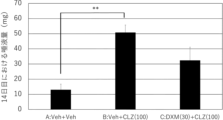
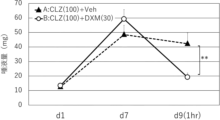
- FIG. 1-1 is a graph showing the results of Experiment 1.
- FIG. 1-2 is a graph showing the results of Experiment 1.
- FIG. 2 is a graph showing the results of Experiment 2.
- FIG. 3-1 is a graph showing the results of Experiment 3.
- FIG. 3-2 is a graph showing the results of Experiment 3.
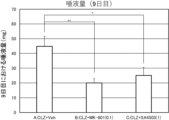
- FIG. 4 is a graph showing the results of Experiment 4.
- FIG. 5 is a graph showing the results of Experiment 5.
- a first embodiment of the agent for improving clozapine-induced sialorrhea of the present invention contains dextromethorphan, a pharma- ceutical acceptable salt thereof, or a hydrate of either of them as an active ingredient.
- a second embodiment of the agent for improving clozapine-induced sialorrhea of the present invention contains a compound having an antagonistic effect on NMDA type glutamate receptors as an active ingredient.
- sialorrhea may be caused by the activation of NMDA type glutamate receptors by clozapine, and that sialorrhea is improved by administering a compound having an antagonistic effect on NMDA type glutamate receptors.
- a third embodiment of the agent for improving clozapine-induced sialorrhea of the present invention contains a compound having an agonistic action on sigma-1 receptor as an active ingredient.
- a compound having an agonistic effect on the sigma-1 receptor is thought to be that sialorrhea may be caused by inactivation of the sigma-1 receptor by clozapine, and that sialorrhea is improved by administration of a compound having an agonistic effect on the sigma-1 receptor.
- the subject to which the agent for improving clozapine-induced sialorrhea is administered may be any mammalian animal as long as it is exhibiting clozapine-induced sialorrhea, and preferably includes any mammalian animal, including humans; non-human primates, including non-human primates such as chimpanzees, other apes, and monkey species; livestock, such as cows, sheep, pigs, goats, and horses; domesticated mammals, such as dogs and cats; and small or laboratory animals, including rodents, such as mice, rats, and guinea pigs. Of these, humans are preferred.
- Clozapine-induced sialorrhea is excessive salivation observed as a side effect of clozapine administration.
- the subjects to which the clozapine-induced sialorrhea improving agent of the present invention is administered are patients with treatment-resistant schizophrenia who are receiving treatment with clozapine and who are further experiencing clozapine-induced sialorrhea due to administration of clozapine.
- Clozapine has the following structure:
- Clozapine is a treatment for treatment-resistant schizophrenia, and is administered to patients with schizophrenia who are resistant to other antipsychotic treatments (patients who meet the criteria for non-responsiveness or intolerance).
- adults are usually given 12.5 mg of clozapine orally on the first day, 25 mg on the second day, and then increased by 25 mg per day depending on symptoms from the third day onwards, up to 200 mg per day over a period of three weeks in principle, but if the daily dose exceeds 50 mg, it is orally administered in two or three divided doses.
- the maintenance dose of clozapine is 200-400 mg per day orally administered in two or three divided doses, and the dose is increased or decreased as appropriate depending on symptoms.
- each dose increase must be at least four days apart, and the increase must not exceed 100 mg per day, with a maximum dose of 600 mg per day.
- Clozaril an oral medication whose active ingredient is clozapine, manufactured by Novartis Pharma
- clozapine-induced sialorrhea is a frequent side effect observed in 46.8% of users.
- NMDA-type glutamate receptor (hereinafter also referred to as "NMDA receptor") is a type of glutamate receptor, and unlike other glutamate receptor subtypes such as the AMPA receptor and the kainate receptor, NMDA (N-methyl-D-aspartate) selectively acts as an agonist.
- the compound having an antagonistic effect on the NMDA receptor may be a competitive inhibitor (selective antagonist), or may be a functional antagonist such as an open channel inhibitor, or may be an agonist, and is not particularly limited.
- the binding site of the selective antagonist is not particularly limited, and examples thereof include a PCP binding site.
- reference 1 Toshiya Inada, Hiroshi Endo, "Compounds acting on the excitatory amino acid nervous system", Clinical Psychopharmacology 23: 827-839, 2020, Seiwa Shoten
- an NMDA receptor antagonist includes minocycline, WIN 55,212-2, CP 55,940, CPP (3-[(3R)-3-carboxypiperazin-1-yl]propylphosphonic acid), aripiprazole, dizocilpine (MK-801), 3-methoxyphencyclidine (3-MeO-PCP), phencyclidine, methoxetamine, ketamine, esketamine, alketamine, norketamine, esnorketamine, alnorketamine, memantine, amantadine, acamprosate, methadone, levomethadone, ethoxyphencyclidine, methoxetamine ...
- the drug is at least one selected from the group consisting of smethadone, latrepirdine, tiletamine, selfotel, aptiganel, besonprodil, delsemin, dizocilpine maleate, gavestinel, lycostinel, neramexane mesylate, perzinfotel, remacemide hydrochloride, traxoprodil mesylate, D-(-)-2-amino-5-phosphonopentanoic acid (D-AP5), haloperidol, atomoxetine, oseltamivir, kynurenic acid, procaine, felbamate, mephenesin, huperzine A, linalool, orphenadrine, ifenprodil, pentazimine, dextrorphan, and dextromethorphan, or a pharma- ceutically acceptable salt thereof, or a hydrate thereof
- Sigma-1 receptors are chaperone proteins located in the endoplasmic reticulum (ER) and regulate calcium signaling via IP3 receptors.
- Sigma-1 receptors are transmembrane proteins expressed in many different tissue types, and have been reported to be highly expressed in specific regions of the central nervous system. Sigma-1 receptors are thought to be involved in diseases such as schizophrenia, depression, and dementia, but their endogenous ligands have not been fully identified.
- Sigma-1 receptor agonists include, for example, those described in Reference 2 (Narita N, Hashimoto K, Tomitaka S, Minabe Y. Interactions of selective serotonin reuptake inhibitors with subtypes of sigma receptors in rat brain. Eur J Pharmacol. 1996 Jun 20;307(1):117-9. PMID: 8831113 DOI: 10.1016/0014-2999(96)00254-3) and Reference 3 (Hashimoto K, Ishiwata K. Sigma receptor ligands: possible application of ication as therapeutic drugs and as radiopharmaceuticals. Curr Pharm Des.
- the antidepressants fluvoxamine, sertraline, S(+)-fluoxetine, ( ⁇ )-fluoxetine, citalopram, imipramine, paroxetine, and desipramine were R(-)-fluoxetine, ( ⁇ )-norfluoxetine; donepezil, an antidementia drug; dextromethorphan, an antitussive; SA4503, an experimental reagent that is a selective sigma-1 receptor agonist; dehydroepiandrosterone 3-sulfate (also known as DHEA-S), an endogenous substance; ifenprodil, (+)-SKF10,047, (-)-SKF10,047, (+)-P It is preferable that the compound is at least one selected from the group consisting of entazocine, (-)-pentazocine, PPBP, Igmesine (also known as JO-17
- the active ingredient of the clozapine-induced sialorrhea improving agent of the present invention is preferably at least one selected from the group consisting of dextromethorphan and its active metabolite dextrorphan, a pharma- ceutically acceptable salt thereof, or a hydrate thereof, and more preferably dextromethorphan, a pharma-ceutically acceptable salt thereof, or a hydrate thereof.
- Dextromethorphan has the following structure:
- R 1 is —CH 3 , —CH 2 D, —CHD 2 , or —CD 3
- R 2 is —CH 3 , —CH 2 D, —CHD 2 , or —CD 3. Note that D represents deuterium.
- Dextromethorphan is commercially available under the name of Mejicon, etc., and is used as a cough suppressant, etc.
- dextromethorphan and its pharma- ceutically acceptable salts are also included in over-the-counter drugs as ingredients of analgesics and cough suppressants, and are also used as analgesics or opioid enhancers. It is often used as dextromethorphan hydrobromide hydrate, but is not limited to this.
- dextromethorphan may be partially deuterated.
- Examples of pharma- ceutically acceptable salts include mineral acid salts such as hydrochloride, hydrobromide, hydroiodide, phosphate, sulfate, and nitrate; sulfonate salts such as methanesulfonate, ethanesulfonate, benzenesulfonate, p-toluenesulfonate, and trifluoromethanesulfonate; acid addition salts such as organic acid salts such as oxalate, tartrate, citrate, maleate, succinate, acetate, trifluoroacetate, benzoate, mandelate, ascorbate, lactate, gluconate, and malate; amino acid salts such as glycine salt, lysine salt, arginine salt, ornithine salt, glutamate, and aspartate; and base addition salts such as inorganic salts or ammonium salts such as lithium salt, sodium salt, potassium salt, calcium salt
- the exemplified NMDA receptor antagonists and sigma-1 receptor agonists may have an asymmetric center, in which case various optical isomers exist.
- the NMDA receptor antagonists and sigma-1 receptor agonists may exist as separate optically active forms (R) and (S) and as a racemic or (RS) mixture, so long as they have an antagonistic effect on the NMDA receptor and an agonistic effect on the sigma-1 receptor, respectively.
- R optically active forms
- S racemic or RS
- NMDA receptor antagonists and sigma-1 receptor agonists may be mixtures containing all of these forms in any ratio.
- diastereomers can be separated by methods well known to those skilled in the art, such as fractional crystallization, and optically active forms can be obtained by organic chemistry methods well known for this purpose.
- the NMDA receptor antagonists and sigma-1 receptor agonists exemplified above may have geometric isomers such as cis and trans isomers, and may further have tautomerism and exist in various tautomers.
- the compound of the present invention may be any of these isomers or a mixture containing these isomers in any ratio.
- the exemplified NMDA receptor antagonists and sigma-1 receptor agonists or salts thereof form hydrates or solvates, these are also included within the scope of the present invention.
- the active ingredient of the agent for improving clozapine-induced sialorrhea of the present invention is dextromethorphan, a pharma- ceutically acceptable salt thereof, or a hydrate thereof (hereinafter also referred to as dextromethorphan, etc.)
- the dose of dextromethorphan, etc., administered to a human is preferably 0.2 mg/kg/day or more and 3.0 mg/kg/day or less, more preferably 0.5 mg/kg/day or more, and even more preferably 1.0 mg/kg/day or more.
- the number of times dextromethorphan or the like is administered to a human per day is not particularly limited, but is preferably 1 to 5 times, more preferably 2 or more, even more preferably 3 or more, and preferably 4 or less.
- the daily dose of dextromethorphan or the like for humans is preferably 10 mg/day or more and 120 mg/day or less, more preferably 15 mg/day or more, more preferably 30 mg/day or more, and even more preferably 45 mg/day or more.
- the contained dextromethorphan, NMDA receptor antagonist or sigma-1 receptor agonist can be administered alone or together with a pharmaceutical or pharmaceutical acceptable additive.
- the additives may be a commonly used excipient or diluent, and if necessary, a commonly used binder, disintegrant, lubricant, coating agent, sugar coating agent, pH adjuster, dissolving agent, or aqueous or non-aqueous solvent.
- agent for improving clozapine-induced sialorrhea of the present invention commercially available preparations containing dextromethorphan, an NMDA receptor antagonist, or a sigma-1 receptor agonist, as well as preparations or combinations that will be commercially available in the future, may be used.
- preparations include an antitussive drug such as Mejicon, and a combination drug of deuterated dextromethorphan and quinidine, AVP-786, which is being developed by Otsuka Pharmaceutical Co., Ltd.
- the agent for ameliorating clozapine-induced sialorrhea according to the present invention may be in any form of a solid composition, a liquid composition or other composition, and the most suitable one can be selected according to the need.
- the clozapine-induced sialorrhea improving agent of the present invention can be prepared by adding the above-mentioned additives to dextromethorphan, an NMDA receptor antagonist, or a sigma-1 receptor agonist, and using conventional formulation techniques to prepare tablets, pills, capsules, granules, powders, liquids, emulsions, suspensions, injections, patches, etc.
- the clozapine-induced sialorrhea improving agent of the present invention can be formulated by forming an inclusion compound between dextromethorphan, an NMDA receptor antagonist or a sigma-1 receptor agonist and ⁇ -, ⁇ - or ⁇ -cyclodextrin or methylated cyclodextrin, etc.
- the agent for improving clozapine-induced sialorrhea of the present invention may be a single preparation (combined preparation) or a preparation of two or more kinds obtained by separately formulating a compound that can be used in combination with dextromethorphan, an NMDA receptor antagonist, or a sigma-1 receptor agonist (combined drug).
- Examples of the compound that can be used in combination include clozapine, an agent for improving other side effects of clozapine, a stabilizer for an NMDA receptor antagonist, etc.
- the individual preparations can be administered simultaneously or at a certain time interval. In this case, it does not matter which one is administered first.
- the two or more preparations can be administered at different times a day.
- the two or more preparations can also be administered by different routes.
- these compounds When these compounds are formulated separately to form two different preparations, they may be administered simultaneously or at a very short interval. For example, it is preferable to state in documents such as package inserts or sales pamphlets of commercially available pharmaceuticals that the respective preparations are used in combination. It is also preferable to formulate these active ingredients separately and provide a kit consisting of two types of formulations.
- Dextromethorphan, NMDA receptor antagonists, or sigma-1 receptor agonists may be administered orally as is.
- dextromethorphan, NMDA receptor antagonists, or sigma-1 receptor agonists may be administered orally as a preparation containing the active ingredient dextromethorphan, NMDA receptor antagonists, or sigma-1 receptor agonists.
- the dosage and administration schedule of dextromethorphan, NMDA receptor antagonists, or sigma-1 receptor agonists will vary depending on the subject, route of administration, symptoms, etc., but for example, when administered orally to an adult patient, the normal single dose is 0.1 mg to 1000 mg, preferably 1 mg to 200 mg, and this amount is preferably administered 1 to 5 times a day, or once every 2 to 3 days.
- CIS model animal was created based on previous research (Ishikawa S, J. Pharmacol. Exp. Ther., 2020, Nov; 375(2): 376-384).
- the experimental animals used were male Wistar rats (manufactured by Clea Japan) aged 6 to 8 weeks. Water and normal feed were freely available except for one hour before and after the measurement of saliva volume, which will be described later.
- Clozapine the drug administered, was prepared by dissolving 100 mg Clozaril tablets (manufactured by Novartis Pharma) in distilled water. Clozapine was orally administered once (1 mL/kg) to rats at 25 mg/kg/day, 50 mg/kg/day, or 100 mg/kg/day.
- Clozapine was orally administered (1 mL/kg) to rats once a day at 25 mg/kg/day, 50 mg/kg/day, and 100 mg/kg/day for 7 days, and the saliva volume was measured 24 hours after the final administration.
- the saliva volume did not increase in the 25 mg/kg/day administration group, but the saliva volume significantly increased from the 3rd day of administration in the 50 mg/kg/day administration group and the 100 mg/kg/day administration group.
- rats were used as CIS model animals, to which 100 mg/kg/day of clozapine was orally administered once a day (1 mL/kg) for 7 consecutive days.
- the method for measuring the amount of saliva is as follows. ⁇ Saliva volume measurement> Water and food were restricted one hour before the measurement of saliva volume. The saliva volume was measured by placing a small piece of cotton ball in the mouth of a restrained rat and swabbing for 10 seconds (allowing the cotton ball to absorb saliva). This was repeated three times, and the change in mass of the cotton ball was measured. The total amount of saliva collected in 30 seconds was measured.
- Experiment 1 Using the above-mentioned CIS model animal (CIS model rat), the dose and duration of administration of the NMDA receptor antagonist dextromethorphan (DXM) were examined.
- Experiment 1 was conducted as follows for CIS model rat groups A to C. ⁇ Days 1 to 7> Group A (control): Distilled water (DW) (1 mL/kg) was orally administered once a day. Groups B and C: Clozapine 100 mg/kg/day (1 mL/kg) was orally administered once a day (Days 8 to 14) Group A: Once a day, saline (1 mL/kg) was administered intraperitoneally and distilled water (DW) (1 mL/kg) was administered orally.
- DW Distilled water
- DW distilled water
- Group B Once a day, saline (1 mL/kg) was administered intraperitoneally and clozapine 100 mg/kg/day (1 mL/kg) was administered orally.
- Group C Once a day, DXM (30 mg/kg/day) was administered intraperitoneally and clozapine 100 mg/kg/day (1 mL/kg) was administered orally.
- Group A saline (1 mL/kg) was administered intraperitoneally once a day.
- Group B DXM (30 mg/kg/day) was administered intraperitoneally once a day.
- saliva volume was measured 1 hour after DXM administration.
- swabs were performed on the 5th and 6th days. ⁇ Days 8 to 9>
- Group A Physiological saline (1 mL/kg) was administered intraperitoneally 3 times in total.
- Group B Physiological saline (1 mL/kg) was administered intraperitoneally 3 times in total.
- Group C DXM (3 mg/kg) was administered intraperitoneally 3 times in total.
- Group D DXM (30 mg/kg) was administered intraperitoneally 3 times in total.
- Group E DXM (60 mg/kg) was administered intraperitoneally 3 times in total.
- the above doses of the drug were administered once in the morning and once in the afternoon on the 8th day, and once in the morning on the 9th day, for a total of 3 administrations.
- Saliva volume was measured 1 hour after the final administration.
- Intraperitoneal administration was performed once in the morning and once in the afternoon on the 8th day, and once in the morning on the 9th day, for a total of 3 administrations. Saliva volume was measured 1 hour after the final administration.
- Group A (control), Group B, Group C, Group D Clozapine 100 mg/kg/day (1 mL/kg) orally administered once a day (Days 8 to 9)
- Group A (control) One hour after oral administration of the solvent (5 mL/kg), physiological saline (1 mL/kg) was administered intraperitoneally. The above administration was performed three times in total.
- Group B One hour after oral administration of the solvent (5 mL/kg), MK-801 (0.1 mg/kg) was administered intraperitoneally. The above administration was performed three times in total.
- Group C One hour after oral administration of D-serine (900 mg/kg), MK-801 (0.1 mg/kg) was administered intraperitoneally.
- Group D One hour after oral administration of glycine (900 mg/kg), MK-801 (0.1 mg/kg) was administered intraperitoneally. The above administration was performed three times in total. The above administration was performed once in the morning and once in the afternoon on the 8th day, and once in the morning on the 9th day, for a total of three administrations. The saliva volume was measured one hour after the final administration.
- clozapine-induced sialorrhea a side effect of clozapine, a drug used to treat treatment-resistant schizophrenia
- dextromethorphan a compound having an inhibitory effect on NMDA-type glutamate receptors, or a compound having an agonist effect on sigma-1 receptors.
- Dextromethorphan is already used as an antitussive and the like, and its safety to the human body has been thoroughly evaluated.
- a highly safe agent for improving clozapine-induced cough syndrome is provided.
Landscapes
- Health & Medical Sciences (AREA)
- Chemical & Material Sciences (AREA)
- Medicinal Chemistry (AREA)
- Pharmacology & Pharmacy (AREA)
- Life Sciences & Earth Sciences (AREA)
- Animal Behavior & Ethology (AREA)
- General Health & Medical Sciences (AREA)
- Public Health (AREA)
- Veterinary Medicine (AREA)
- Epidemiology (AREA)
- Emergency Medicine (AREA)
- Engineering & Computer Science (AREA)
- Bioinformatics & Cheminformatics (AREA)
- Chemical Kinetics & Catalysis (AREA)
- General Chemical & Material Sciences (AREA)
- Nuclear Medicine, Radiotherapy & Molecular Imaging (AREA)
- Organic Chemistry (AREA)
- Pharmaceuticals Containing Other Organic And Inorganic Compounds (AREA)
- Acyclic And Carbocyclic Compounds In Medicinal Compositions (AREA)
- Medicines That Contain Protein Lipid Enzymes And Other Medicines (AREA)
Priority Applications (3)
| Application Number | Priority Date | Filing Date | Title |
|---|---|---|---|
| JP2024560190A JPWO2024111636A1 (https=) | 2022-11-24 | 2023-11-22 | |
| CN202380080815.2A CN120225223A (zh) | 2022-11-24 | 2023-11-22 | 氯氮平诱导性流涎症改善剂 |
| EP23894640.4A EP4623932A1 (en) | 2022-11-24 | 2023-11-22 | Agent for alleviating clozapine-induced sialorrhea |
Applications Claiming Priority (2)
| Application Number | Priority Date | Filing Date | Title |
|---|---|---|---|
| JP2022187772 | 2022-11-24 | ||
| JP2022-187772 | 2022-11-24 |
Publications (1)
| Publication Number | Publication Date |
|---|---|
| WO2024111636A1 true WO2024111636A1 (ja) | 2024-05-30 |
Family
ID=91195719
Family Applications (1)
| Application Number | Title | Priority Date | Filing Date |
|---|---|---|---|
| PCT/JP2023/042038 Ceased WO2024111636A1 (ja) | 2022-11-24 | 2023-11-22 | クロザピン誘発性流涎症改善剤 |
Country Status (4)
| Country | Link |
|---|---|
| EP (1) | EP4623932A1 (https=) |
| JP (1) | JPWO2024111636A1 (https=) |
| CN (1) | CN120225223A (https=) |
| WO (1) | WO2024111636A1 (https=) |
Cited By (1)
| Publication number | Priority date | Publication date | Assignee | Title |
|---|---|---|---|---|
| WO2025264845A1 (en) * | 2024-06-18 | 2025-12-26 | Anavex Life Sciences Corp. | Use of anavex3-71 for medical treatments |
Citations (3)
| Publication number | Priority date | Publication date | Assignee | Title |
|---|---|---|---|---|
| JP2009525343A (ja) * | 2006-02-03 | 2009-07-09 | アバニール・ファーマシューティカルズ | 鬱病、不安および神経変性疾患を治療するためのデキストロメトルファンおよびキニジンを含む薬剤組成物 |
| CN114569742A (zh) * | 2022-05-09 | 2022-06-03 | 北京剂泰医药科技有限公司 | 一种组合物及其制备方法和应用 |
| CN115245515A (zh) * | 2021-04-27 | 2022-10-28 | 杭州剂泰医药科技有限责任公司 | 一种组合物的医药用途 |
Family Cites Families (1)
| Publication number | Priority date | Publication date | Assignee | Title |
|---|---|---|---|---|
| PT3061821T (pt) | 2009-07-22 | 2019-09-05 | PureTech Health LLC | Composições para tratamento de distúrbios melhorados por ativação de recetores muscarínicos |
-
2023
- 2023-11-22 EP EP23894640.4A patent/EP4623932A1/en active Pending
- 2023-11-22 WO PCT/JP2023/042038 patent/WO2024111636A1/ja not_active Ceased
- 2023-11-22 CN CN202380080815.2A patent/CN120225223A/zh active Pending
- 2023-11-22 JP JP2024560190A patent/JPWO2024111636A1/ja active Pending
Patent Citations (3)
| Publication number | Priority date | Publication date | Assignee | Title |
|---|---|---|---|---|
| JP2009525343A (ja) * | 2006-02-03 | 2009-07-09 | アバニール・ファーマシューティカルズ | 鬱病、不安および神経変性疾患を治療するためのデキストロメトルファンおよびキニジンを含む薬剤組成物 |
| CN115245515A (zh) * | 2021-04-27 | 2022-10-28 | 杭州剂泰医药科技有限责任公司 | 一种组合物的医药用途 |
| CN114569742A (zh) * | 2022-05-09 | 2022-06-03 | 北京剂泰医药科技有限公司 | 一种组合物及其制备方法和应用 |
Non-Patent Citations (11)
| Title |
|---|
| BOGAR FFULOP LPENKE B.: "Novel Therapeutic Target for Prevention of Neurodegenerative Diseases: Modulation of Neuroinflammation with Sig-1R Ligands", BIOMOLECULES., vol. 12, no. 3, 25 February 2022 (2022-02-25), pages 363 |
| DAVID TAYLOR ET AL.: "The Maudsley Prescribing Guidelines", 5 October 2022, WILEY PUBLISHING |
| HASHIMOTO KISHIWATA K.: "Sigma receptor ligands: possible application as therapeutic drugs and as radiopharmaceuticals", CURR PHARM DES., vol. 12, no. 30, 2006, pages 3857 - 76, XP055107718, DOI: 10.2174/138161206778559614 |
| ISHIKAWA S, J., PHARMACOL. EXP. THER., vol. 375, no. 2, November 2020 (2020-11-01), pages 376 - 384 |
| MUBASLAT OMAR; LAMBERT TIM: "The effect of sublingual atropine sulfate on clozapine-induced hypersalivation: a multicentre, randomised placebo-controlled trial", PSYCHOPHARMACOLOGY, SPRINGER VERLAG, BERLIN., DE, vol. 237, no. 10, 2 September 2020 (2020-09-02), DE , pages 2905 - 2915, XP037257055, ISSN: 0033-3158, DOI: 10.1007/s00213-020-05627-4 * |
| NARITA NHASHIMOTO KTOMITAKA SMINABE Y.: "Interactions of selective serotonin reuptake inhibitors with subtypes of sigma receptors in rat brain.", EUR J PHARMACOL., vol. 307, no. 1, 20 June 1996 (1996-06-20), pages 117 - 9, XP000889637, DOI: 10.1016/0014-2999(96)00254-3 |
| NISHIMURA TISHIMA TIYO MHASHIMOTO K: "Potentiation of nerve growth factor-induced neurite outgrowth by fluvoxamine: role of sigma-1 receptors, IP3 receptors and cellular signaling pathways", PLOS ONE., vol. 3, no. 7, 2 July 2008 (2008-07-02), pages 2558, XP009119767, DOI: 10.1371/journal.pone.0002558 |
| ROGERS D P; SHRAMKO J K: "THERAPEUTIC OPTIONS IN THE TREATMENT OF CLOZAPINE-INDUCED SIALORRHEA", PHARMACOTHERAPY, WILEY-BLACKWELL, US, vol. 20, no. 9I, 1 January 2000 (2000-01-01), US , pages 1092 - 1095, XP009082797, ISSN: 0277-0008, DOI: 10.1592/phco.20.13.1092.35036 * |
| See also references of EP4623932A1 |
| SHIIGI YASUYUKI, CASEY DANIEL E: "Behavioral effects of ketamine, an NMDA glutamatergic antagonist, in non-human primates", PSYCHOPHARMACOLOGY, SPRINGER VERLAG, BERLIN., DE, vol. 146, no. 1, 3 September 1999 (1999-09-03), DE , pages 67 - 72, XP093174725, ISSN: 0033-3158, DOI: 10.1007/s002130051089 * |
| TOSHIYA INADAHIROSHI ENDO: "Clinical Psychopharmacology", vol. 23, 2020, SEIWA SHOTEN CO., article "Compounds that Act on the Excitatory Amino Acid Nervous System", pages: 827 - 839 |
Cited By (1)
| Publication number | Priority date | Publication date | Assignee | Title |
|---|---|---|---|---|
| WO2025264845A1 (en) * | 2024-06-18 | 2025-12-26 | Anavex Life Sciences Corp. | Use of anavex3-71 for medical treatments |
Also Published As
| Publication number | Publication date |
|---|---|
| EP4623932A1 (en) | 2025-10-01 |
| JPWO2024111636A1 (https=) | 2024-05-30 |
| CN120225223A (zh) | 2025-06-27 |
Similar Documents
| Publication | Publication Date | Title |
|---|---|---|
| KR102654569B1 (ko) | 외상 후 스트레스 장애의 치료를 위한 제제 | |
| JP4977297B2 (ja) | トラマドール物質及び抗痙攣薬を含んで成る組成物 | |
| JP6619744B2 (ja) | 神経障害の処置のためのバクロフェン、アカンプロセート、及び中鎖トリグリセライドの併用 | |
| JP2000507544A (ja) | 痛みの治療方法 | |
| CZ298298A3 (cs) | Kompozice pro léčení bolesti | |
| KR20110057144A (ko) | 3-(3-디메틸아미노-1-에틸-2-메틸-프로필)-페놀과 항간질제의 약제학적 병용물 | |
| JP6713523B2 (ja) | 不安障害患者の治療のためのナルメフェン | |
| MX2015003812A (es) | Combinacion de rasagilina y pridopidina para tratar trastornos neurodegenerativos, en particular enfermedad de huntington. | |
| US8906951B1 (en) | Use of NK-1 receptor antagonists in pruritus | |
| JP2005504782A (ja) | ガバペンチンまたはその類似体とα−アミノアミドとを含む薬剤組成物およびその鎮痛用途 | |
| JP2016527312A (ja) | ヒスタミンh4受容体を介してもたらされた掻痒状態を治療する方法 | |
| JP2025143406A (ja) | 自閉症スペクトラム障害を治療するためのカルバモイルシクロヘキサン誘導体 | |
| WO2024111636A1 (ja) | クロザピン誘発性流涎症改善剤 | |
| AU2019274870B2 (en) | Method of treating pain or interstitial cystitis using indole compound | |
| KR102266696B1 (ko) | 주의력 및 인지 장애, 및 신경 퇴행성 장애와 관련된 치매 치료용 신규 치료제 | |
| CZ20021116A3 (cs) | Synergické kombinace antagonisty receptoru NK1 a strukturálního analogu GABA | |
| RU2423981C2 (ru) | Фармацевтическая композиция для лечения болезни паркинсона | |
| WO2024102802A1 (en) | Zelatriazin for the treatment of depression | |
| US8637263B1 (en) | Assay for determination of compounds having anti-emetic activity | |
| JP2002503224A (ja) | 疼痛を処置するための組成物 | |
| US10646457B2 (en) | Emesis treatment | |
| Jordan et al. | Management of Chronic Pain in Cats | |
| RU2174391C1 (ru) | Фармацевтическая композиция с антидепрессантной активностью | |
| TW202010496A (zh) | 双那布扶林己二酸酯和乙醯胺酚的藥物製劑及治療疼痛的方法 | |
| BRPI0613281A2 (pt) | combinação terapêutica contendo um bloqueador de receptor nmda e uma substáncia analgésica e narcótica |
Legal Events
| Date | Code | Title | Description |
|---|---|---|---|
| 121 | Ep: the epo has been informed by wipo that ep was designated in this application |
Ref document number: 23894640 Country of ref document: EP Kind code of ref document: A1 |
|
| DPE2 | Request for preliminary examination filed before expiration of 19th month from priority date (pct application filed from 20040101) | ||
| WWE | Wipo information: entry into national phase |
Ref document number: 2024560190 Country of ref document: JP |
|
| WWE | Wipo information: entry into national phase |
Ref document number: 202380080815.2 Country of ref document: CN |
|
| WWE | Wipo information: entry into national phase |
Ref document number: 2023894640 Country of ref document: EP |
|
| NENP | Non-entry into the national phase |
Ref country code: DE |
|
| WWP | Wipo information: published in national office |
Ref document number: 202380080815.2 Country of ref document: CN |
|
| ENP | Entry into the national phase |
Ref document number: 2023894640 Country of ref document: EP Effective date: 20250624 |
|
| WWP | Wipo information: published in national office |
Ref document number: 2023894640 Country of ref document: EP |