WO2024111536A1 - 情報処理プログラム、情報処理方法および情報処理システム - Google Patents
情報処理プログラム、情報処理方法および情報処理システム Download PDFInfo
- Publication number
- WO2024111536A1 WO2024111536A1 PCT/JP2023/041589 JP2023041589W WO2024111536A1 WO 2024111536 A1 WO2024111536 A1 WO 2024111536A1 JP 2023041589 W JP2023041589 W JP 2023041589W WO 2024111536 A1 WO2024111536 A1 WO 2024111536A1
- Authority
- WO
- WIPO (PCT)
- Prior art keywords
- lottery
- player
- virtual camera
- virtual
- game
- Prior art date
- Legal status (The legal status is an assumption and is not a legal conclusion. Google has not performed a legal analysis and makes no representation as to the accuracy of the status listed.)
- Ceased
Links
Images




Classifications
-
- A—HUMAN NECESSITIES
- A63—SPORTS; GAMES; AMUSEMENTS
- A63F—CARD, BOARD, OR ROULETTE GAMES; INDOOR GAMES USING SMALL MOVING PLAYING BODIES; VIDEO GAMES; GAMES NOT OTHERWISE PROVIDED FOR
- A63F13/00—Video games, i.e. games using an electronically generated display having two or more dimensions
- A63F13/50—Controlling the output signals based on the game progress
- A63F13/52—Controlling the output signals based on the game progress involving aspects of the displayed game scene
- A63F13/525—Changing parameters of virtual cameras
-
- A—HUMAN NECESSITIES
- A63—SPORTS; GAMES; AMUSEMENTS
- A63F—CARD, BOARD, OR ROULETTE GAMES; INDOOR GAMES USING SMALL MOVING PLAYING BODIES; VIDEO GAMES; GAMES NOT OTHERWISE PROVIDED FOR
- A63F13/00—Video games, i.e. games using an electronically generated display having two or more dimensions
- A63F13/50—Controlling the output signals based on the game progress
- A63F13/52—Controlling the output signals based on the game progress involving aspects of the displayed game scene
-
- A—HUMAN NECESSITIES
- A63—SPORTS; GAMES; AMUSEMENTS
- A63F—CARD, BOARD, OR ROULETTE GAMES; INDOOR GAMES USING SMALL MOVING PLAYING BODIES; VIDEO GAMES; GAMES NOT OTHERWISE PROVIDED FOR
- A63F13/00—Video games, i.e. games using an electronically generated display having two or more dimensions
- A63F13/55—Controlling game characters or game objects based on the game progress
-
- A—HUMAN NECESSITIES
- A63—SPORTS; GAMES; AMUSEMENTS
- A63F—CARD, BOARD, OR ROULETTE GAMES; INDOOR GAMES USING SMALL MOVING PLAYING BODIES; VIDEO GAMES; GAMES NOT OTHERWISE PROVIDED FOR
- A63F13/00—Video games, i.e. games using an electronically generated display having two or more dimensions
- A63F13/60—Generating or modifying game content before or while executing the game program, e.g. authoring tools specially adapted for game development or game-integrated level editor
- A63F13/63—Generating or modifying game content before or while executing the game program, e.g. authoring tools specially adapted for game development or game-integrated level editor by the player, e.g. authoring using a level editor
-
- A—HUMAN NECESSITIES
- A63—SPORTS; GAMES; AMUSEMENTS
- A63F—CARD, BOARD, OR ROULETTE GAMES; INDOOR GAMES USING SMALL MOVING PLAYING BODIES; VIDEO GAMES; GAMES NOT OTHERWISE PROVIDED FOR
- A63F13/00—Video games, i.e. games using an electronically generated display having two or more dimensions
- A63F13/60—Generating or modifying game content before or while executing the game program, e.g. authoring tools specially adapted for game development or game-integrated level editor
- A63F13/69—Generating or modifying game content before or while executing the game program, e.g. authoring tools specially adapted for game development or game-integrated level editor by enabling or updating specific game elements, e.g. unlocking hidden features, items, levels or versions
Definitions
- the present invention relates to an information processing program, an information processing method, and an information processing system.
- Non-Patent Document 1 discloses that in such a lottery process, multiple lotteries can be held consecutively at one time, and that the player can select the number of lotteries to be held consecutively.
- Non-Patent Document 1 Although the player can arbitrarily specify the number of lotteries, there is no change in the lottery presentation according to the specified number of lotteries, which reduces the player's interest.
- the present invention aims to provide an information processing program, an information processing method, and an information processing system that can increase the interest of players.
- an information processing program includes: A process of accepting an operation by a player to specify an arbitrary number of times equal to or greater than two as the number of times the lottery object is to be drawn; A process of arranging a plurality of common objects, which are 3D models, at lottery result arrangement positions in a virtual space according to a predetermined arrangement standard based on the number of lotteries designated by a player; a process of changing a position of a virtual camera that is placed in the virtual space based on the number of lotteries designated by a player or the lottery result position at which the common object is placed; The computer is made to carry out the above steps.
- an upper limit is set for the number of lottery selections designated by the player;
- a virtual arrangement frame including a plurality of the lottery result arrangement positions is provided;
- the number of times of drawing is the upper limit number of times, the common object is arranged at all of the lottery result arrangement positions of the virtual arrangement frame;
- the process of changing the arrangement position of the virtual camera includes: When the number of lottery selections is the upper limit number of times, the virtual camera is positioned in accordance with the center position of the virtual placement frame; When the number of lottery draws is less than the upper limit number of draws, the virtual camera may be placed at a position shifted from the central position based on the number of lottery draws or the lottery result arrangement position at which the common object is arranged.
- the process of changing the arrangement position of the virtual camera includes: When the number of lottery draws is less than the upper limit number of times, the virtual camera may be positioned so as to be aligned with the center position of the virtual layout frame, and then the virtual camera may be positioned at the shifted position.
- the predetermined arrangement criterion is: dividing the plurality of common objects to be arranged in the virtual space into at least a first group and a second group, and aligning each of the first group and the second group in a line in a predetermined direction at the lottery result arrangement position;
- the process of changing the arrangement position of the virtual camera includes: The virtual camera may be positioned to coincide with the center of the first group and the center of the second group.
- an information processing method includes: 1. An information processing method performed by one or more computers, comprising: A process of accepting an operation by a player to specify an arbitrary number of times equal to or greater than two as the number of times the lottery object is to be drawn; A process of arranging a plurality of common objects, which are 3D models, at lottery result arrangement positions in a virtual space according to a predetermined arrangement standard based on the number of lotteries designated by a player; a process of changing a position of a virtual camera that is placed in the virtual space based on the number of lotteries designated by a player or the lottery result position at which the common object is placed; including.
- an information processing system includes: One or more computers; The computer, A process of accepting an operation by a player to specify an arbitrary number of times equal to or greater than two as the number of times the lottery object is to be drawn; A process of arranging a plurality of common objects, which are 3D models, at lottery result arrangement positions in a virtual space according to a predetermined arrangement standard based on the number of lotteries designated by a player; a process of changing a position of a virtual camera that is placed in the virtual space based on the number of lotteries designated by a player or the lottery result position at which the common object is placed; Carry out the following.
- the present invention can increase the interest of players.
- FIG. 1 is an explanatory diagram showing a schematic configuration of an information processing system.
- Fig. 2A is a diagram illustrating the hardware configuration of a player terminal
- Fig. 2B is a diagram illustrating the hardware configuration of a server.
- FIG. 3 is a diagram illustrating an example of the home screen.
- Fig. 4A is a diagram showing an example of a selection screen for a development game medium
- Fig. 4B is a diagram showing an example of a selection screen for a support game medium.
- FIG. 5 is a diagram showing an example of the lottery confirmation screen.
- FIG. 6 is a diagram showing an example of the presentation screen of the first phase of the lottery presentation.
- FIG. 7 is a first diagram showing how a 3DCG image is generated in the first phase of the lottery presentation.
- FIG. 8 is a second diagram showing how a 3DCG image is generated in the first phase of the lottery presentation.
- FIG. 9 is a diagram showing an example of the presentation screen of the second phase of the lottery presentation.
- FIG. 10 is a diagram showing how a 3DCG image is generated in the second phase of the lottery effect.
- FIG. 11 is a diagram showing an example of the effect screen of the third phase of the lottery effect.
- FIG. 12 is a diagram showing how a 3DCG image is generated in the third phase of the lottery effect according to this embodiment.
- FIG. 13 is a diagram showing how a 3DCG image is generated in the third phase of the lottery presentation according to the first modified example.
- FIG. 14 is a diagram showing how a 3DCG image is generated in the third phase of the lottery effect according to the second modified example.
- FIG. 15 is a diagram showing an example of the effect screen of the fourth phase of the lottery effect.
- FIG. 16 is a diagram showing how a 3DCG image is generated in the fourth phase of the lottery presentation.
- FIG. 17 is a diagram showing an example of the presentation screen of the fifth phase of the lottery presentation.
- FIG. 18 is a diagram showing an example of a lottery result screen.
- FIG. 19 is a diagram showing an example of a lottery result screen that changes depending on the number of lottery draws.
- FIG. 20 is a diagram showing an example of a presentation screen for a lottery presentation for a support game medium.
- FIG. 21 is a diagram for explaining the memory configuration and computer functions of the player terminal.
- FIG. 22 is a diagram for explaining the memory configuration of the server and its functions as a computer.
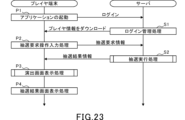
- FIG. 23 is a sequence diagram illustrating basic processing of the player terminal and the server.
- FIG. 24 is a flowchart illustrating an example of the lottery process in the server.
- FIG. 25 is a flowchart illustrating an example of the presentation screen display process according to this embodiment.
- FIG. 26 is a flowchart illustrating an example of the third phase rendering process according to this embodiment.
- FIG. 27 is a flowchart illustrating an example of the third phase effect processing according to the first modified example.
- FIG. 28 is a flowchart illustrating an example of the third phase effect processing according to the second modified example.
- (Overall configuration of information processing system S) 1 is an explanatory diagram showing a schematic configuration of an information processing system S.
- the information processing system S is a so-called client-server system including player terminals 1, a server 1000, and a communication network N having a communication base station Na.
- the player terminal 1 can establish communication with the server 1000 via the communication network N.
- the player terminal 1 broadly includes electronic devices that can establish a wireless or wired communication connection with the server 1000. Examples of the player terminal 1 include smartphones, mobile phones, tablet devices, personal computers, game devices, and the like. In this embodiment, a case will be described in which a smartphone is used as the player terminal 1.
- the server 1000 is connected for communication with multiple player terminals 1.
- the server 1000 accumulates various information (player information) for each player playing the game.
- the server 1000 also updates the accumulated information based on operations input from the player terminals 1.
- the communication base station Na is connected to the communication network N and transmits and receives information wirelessly to and from the player terminal 1.
- the communication network N is composed of a mobile phone network, the Internet network, a LAN (Local Area Network), a dedicated line, etc., and realizes a wireless or wired communication connection between the player terminal 1 and the server 1000.
- the player terminal 1 and the server 1000 function as the game device G.
- the player terminal 1 and the server 1000 are each assigned the role of controlling the progress of the game, and the game can progress through cooperation between the player terminal 1 and the server 1000.
- Fig. 2A is a diagram for explaining the hardware configuration of the player terminal 1.
- Fig. 2B is a diagram for explaining the hardware configuration of the server 1000.
- the player terminal 1 includes a CPU (Central Processing Unit) 10, a memory 12, a bus 14, an input/output interface 16, a storage unit 18, a communication unit 20, an input unit 22, and an output unit 24.
- CPU Central Processing Unit
- the server 1000 includes a CPU 1010, a memory 1012, a bus 1014, an input/output interface 1016, a storage unit 1018, a communication unit 1020, an input unit 1022, and an output unit 1024.
- the configurations and functions of the CPU 1010, memory 1012, bus 1014, input/output interface 1016, storage unit 1018, communication unit 1020, input unit 1022, and output unit 1024 of the server 1000 are substantially the same as the CPU 10, memory 12, bus 14, input/output interface 16, storage unit 18, communication unit 20, input unit 22, and output unit 24 of the player terminal 1, respectively. Therefore, the following describes the hardware configuration of the player terminal 1, and a description of the server 1000 is omitted.
- the CPU 10 runs the programs stored in the memory 12 and controls the progress of the game.
- the memory 12 is composed of a ROM (Read Only Memory) or a RAM (Random Access Memory), and stores the programs and various data required to control the progress of the game.
- the memory 12 is connected to the CPU 10 via a bus 14.
- An input/output interface 16 is connected to the bus 14.
- a memory unit 18, a communication unit 20, an input unit 22, and an output unit 24 are connected to the input/output interface 16.
- the storage unit 18 is composed of semiconductor memory such as DRAM (Dynamic Random Access Memory), and stores various programs and data.
- DRAM Dynamic Random Access Memory
- the programs and data stored in the storage unit 18 are loaded into the memory 12 (RAM) by the CPU 10.
- the communication unit 20 is wirelessly connected to the communication base station Na, and transmits and receives information such as various data and programs to and from the server 1000 via the communication network N.
- the programs and the like received from the server 1000 are stored in the memory 12 or the storage unit 18.
- the input unit 22 is composed of, for example, a touch panel, buttons, a keyboard, a mouse, a cross key, an analog controller, etc., through which the player's operations are input (which accepts operations).
- the input unit 22 may also be a dedicated controller provided in the player terminal 1, or connected (externally) to the player terminal 1.
- the input unit 22 may be composed of an acceleration sensor that detects the tilt or movement of the player terminal 1, or a microphone that detects the voice of the player.
- the input unit 22 broadly includes devices that can input the player's intentions in an identifiable manner.
- the output unit 24 includes a display device and a speaker.
- the output unit 24 may be a device that is connected (externally attached) to the player terminal 1.
- the player terminal 1 includes a touch panel 26 that functions as the input unit 22 and the output unit 24.
- Game Contents Next, the content of the game provided by the information processing system S (game device G) of this embodiment will be described using an example.
- the player downloads a dedicated application from the server 1000 to the player terminal 1 and registers the player ID in the server 1000.
- the player terminal 1 receives various information stored in the server 1000 and displays a game screen on the touch panel 26.
- FIG. 3 is a diagram illustrating an example of a home screen 100.
- the home screen 100 is displayed on the touch panel 26.
- a menu bar 102 is displayed at the bottom of the home screen 100.
- the menu bar 102 has a number of operation sections that can be operated (tapped) by the player.
- the menu bar 102 is provided with a home screen selection operation section 102a, an enhancement screen selection operation section 102b, a story screen selection operation section 102c, a race game selection operation section 102d, and a lottery screen selection operation section 102e.
- the operation section corresponding to the screen being displayed on the touch panel 26 is highlighted so that the screen being displayed on the touch panel 26 can be identified.
- the home screen selection operation section 102a is tapped, the home screen 100 shown in FIG. 3 is displayed on the touch panel 26.
- an strengthening screen (not shown) is displayed.
- the player can strengthen the training game medium (lottery object) and support game medium that the player possesses.
- the training game medium and support game medium are used in the training game.
- multiple types of training game media and support game media are provided by the administrator.
- the player can acquire the training game medium and support game medium by winning a lottery called gacha.
- the administrator may grant a specified training game medium and support game medium to the player free of charge.
- the player can possess the training game medium and support game medium acquired in the lottery, and the training game medium and support game medium granted by the administrator.
- the player can increase the levels set for the development game media and the support game media.
- Various parameters are set for the development game media and the support game media, and the parameters increase as the level increases.
- the player can develop development game media with stronger status in the development game.
- a development game medium ID is set for each development game medium.
- a support game medium ID is set for each support game medium.
- one game medium ID is always linked to the development game medium and the support game medium, i.e., the development game medium ID and the support game medium ID.
- a game medium ID is provided for each game medium.
- the game medium is a character, and one character is linked to the game medium ID. Therefore, it can be said that one character is always linked to the development game medium and the support game medium.
- the game medium may be referred to as a character.
- the development game medium owned by the player may be referred to as a possessed development game medium, and a character linked to a possessed development game medium may be referred to as a possessed character.
- the support game medium owned by the player may be referred to as a possessed support game medium, and a character linked to a possessed support game medium may be referred to as a possessed support character.
- a story screen (not shown) is displayed.
- a story image is provided for each character that appears in the game. The player can select a character and a story image on the story screen to view.
- a racing game selection screen (not shown) is displayed.
- various racing games are provided in which the training characters trained in the training games can race.
- the player can select the racing game in which the training characters will race on the racing game selection screen.
- Racing games include team competition games in which a team made up of multiple training characters competes against a team of other players selected by a computer. Team competition games have the gameplay of competing with other players for rankings.
- lottery screens 200A and 200B which will be described in detail later, are displayed.
- the player can consume in-game currency to enter a lottery.
- the player can obtain the development game media and support game media that are won in the lottery.
- a training game operation unit 104 is provided above the menu bar 102.
- a training game screen is displayed.
- the player can select one of the possessed characters as the character to be trained by selecting a possessed training game medium.
- the player can select a possessed support character as an auxiliary character that assists in training the character to be trained by selecting a possessed support game medium.
- the player trains the character to be trained with the assistance of the auxiliary character, and various parameters linked to the character to be trained are updated, and finally the training character is generated.
- the player can play the above-mentioned racing game, etc., using the training character generated in the training game.
- the content of the above game is merely an example.
- the technical matters described below are not limited to training games, but can be applied to any game genre, such as sports games, action games, shooting games, simulation games, RPGs (Roll Playing Games), and puzzle games.
- the game media that can be acquired by lottery are explained using training game media and support game media as examples, but this is not limited thereto, and the game media that can be acquired by lottery (lottery object) may be any lottery object that has a lottery performance, and may be, for example, an item, equipment, or costume.
- FIG. 4A is a diagram showing an example of a lottery screen 200A for the development game medium.
- FIG. 4B is a diagram showing an example of a lottery screen 200B for the support game medium.
- the lottery screen selection operation unit 102e is tapped, the lottery screen 200A shown in FIG. 4A is displayed.
- the lottery screen selection operation unit 102e is tapped, the lottery screen 200B shown in FIG. 4B may also be displayed.
- the lottery screen 200A is provided with a development game medium lottery identification unit 210, a support game medium lottery identification unit 220, and a switch selection operation unit 230.
- the development game medium lottery identification unit 210 allows the player to recognize that a development game medium can be acquired by lottery.
- the support game medium lottery identification unit 220 allows the player to recognize that a support game medium can be acquired by lottery.
- the switching selection operation unit 230 is an operation unit for switching between the development game medium lottery identification unit 210 and the support game medium lottery identification unit 220.
- the player can select either the development game medium lottery identification unit 210 or the support game medium lottery identification unit 220 by tapping the switching selection operation unit 230.
- the lottery screen 200A shown in FIG. 4A can be displayed on the display 26.
- the lottery screen 200B shown in FIG. 4B can be displayed on the display 26. In this way, the switching selection operation unit 230 switches between the lottery screen 200A for drawing a lottery for a development game medium and the lottery screen 200B for drawing a lottery for a support game medium.
- the lottery screen 200A for drawing lots for the development game medium includes a time-limited lottery selection operation section 212a, a variable lottery selection operation section 212b, and a set lottery selection operation section 212c.
- the player can select either the time-limited lottery selection operation unit 212a, the variable lottery selection operation unit 212b, or the set lottery selection operation unit 212c, and perform a tap operation to select the development game medium.
- the time-limited lottery selection operation unit 212a is an operation unit that can draw lots for development game media a predetermined number of times within a limited period of time (hereinafter also referred to as a time-limited development game media lottery).
- the period during which the time-limited development game media lottery can be conducted is one day, and the predetermined number of times that the time-limited development game media lottery can be conducted is, for example, one time.
- the player can obtain one development game medium that has been won in the lottery from among multiple development game media provided by the administrator.
- the player can tap the time-limited lottery selection operation unit 212a to draw a time-limited development game medium once a day.
- the number of times that the time-limited development game medium lottery can be drawn is reset at a predetermined time each day.
- the number of times that the time-limited development game medium lottery can be drawn is reset at 5:00 AM.
- the player can draw a time-limited development game medium lottery a predetermined number of times (e.g., once) from 5:00 AM on the current day until 4:59 AM the next day, and can draw a time-limited development game medium lottery a predetermined number of times (e.g., once) from 5:00 AM the next day until 4:59 AM the day after that.
- the time-limited development game media lottery can be held by spending in-game currency.
- In-game currency includes paid in-game currency and free in-game currency. Paid in-game currency is in-game currency that a player can purchase by spending their own assets. Free in-game currency is in-game currency that is given to a player by an administrator free of charge. Note that paid in-game currency and free in-game currency are the same in-game currency, and it is distinguished whether the player has acquired it for a fee or free of charge.
- the time-limited training game media lottery cannot be conducted by consuming free in-game currency, but can only be conducted by consuming paid in-game currency. However, since the time-limited training game media lottery can be conducted fewer times within a given period of time than the number-selection training game media lottery described below, the amount of paid in-game currency consumed is set to be less than that of the number-selection training game media lottery. For example, the amount of paid in-game currency consumed for the time-limited training game media lottery is "50", and the amount of paid in-game currency consumed for the number-selection training game media lottery is "150".
- the variable lottery selection operation unit 212b is an operation unit that can select the number of draws for the development game medium.
- the variable lottery selection operation unit 212b is configured to be able to select the number of draws for the development game medium within a predetermined number range.
- the player can draw a lottery for the development game medium selected within the predetermined number range (hereinafter also referred to as a number-selected development game medium draw).
- the player can select the number of draws for the development game medium within a predetermined number range by operating the variable lottery selection operation unit 212b.
- the predetermined number range is, for example, 1 time to 10 times.
- the player can select the number of draws for the development game medium within a range of 1 time to 10 times by operating the variable lottery selection operation unit 212b.
- the method of selecting the number of draws within a range of 1 time to 10 times will be explained in detail later using Figure 5, but the player can specify one draw or any number of draws greater than or equal to 2 by operation.
- the number-selection training game media lottery can be conducted by consuming either paid in-game currency, free in-game currency, or in-game items.
- the number-selection training game media lottery can be conducted by consuming 150 paid in-game currency, 150 free in-game currency, or 1 in-game item.
- the in-game item is what is known as a gacha ticket, and can be given to the player free of charge by the administrator, or can be acquired by the player by clearing specific missions in the game.
- Priority is set for paid in-game currency, free in-game currency, and in-game items.
- free in-game currency is set to have a higher priority than paid in-game currency
- in-game items are set to have a higher priority than free in-game currency. Therefore, if a number of selection development game media lottery can be held with any of paid in-game currency, free in-game currency, and in-game items, the in-game items are consumed preferentially to hold the number of selection development game media lottery. Also, if there is a shortage of in-game items and a number of selection development game media lottery can be held with either paid in-game currency or free in-game currency, the free in-game currency is consumed preferentially to hold the number of selection development game media lottery.
- the number-selection training game media lottery can be executed when the amount of paid in-game currency, free in-game currency, or in-game items owned by the player is equal to or greater than the amount of paid in-game currency, free in-game currency, or in-game items consumed according to the number of lotteries specified by the player.
- the variable lottery selection operation unit 212b is tapped, the lottery confirmation screen 240 is displayed on the display 26.
- FIG. 5 is a diagram showing an example of a lottery confirmation screen 240.
- the lottery confirmation screen 240 is provided with a lottery count confirmation section 240a, a plus operation section 240b, a minus operation section 240c, an execution operation section 240d, and a cancel operation section 240e.
- the lottery count confirmation unit 240a displays the number of lotteries for the number-selection development game media lottery specified by the player. In the example shown in FIG. 5, the lottery count confirmation unit 240a displays "7," and it can be confirmed that the number of lotteries specified by the player is 7.
- the number of in-game items possessed by the player is displayed at the bottom of the number of lottery draws confirmation section 240a.
- the in-game items are gacha tickets
- the number of gacha tickets possessed by the player is displayed at the bottom of the number of lottery draws confirmation section 240a.
- the number of gacha tickets possessed by the player is "20.”
- the number of gacha tickets remaining after the lottery is drawn is displayed.
- One gacha ticket is consumed for each lottery draw. Therefore, if the number of lottery draws designated by the player is seven, seven gacha tickets will be consumed. Therefore, in the example shown in Figure 5, the number of gacha tickets remaining after the lottery is drawn, "13," is displayed to the right of the number of gacha tickets the player possesses.
- the plus operation section 240b is enabled until the number displayed in the lottery count confirmation section 240a reaches "10,” at which point the operation is disabled.
- the number of lotteries can be increased by assuming that the free in-game currency or paid in-game currency possessed by the player is consumed.
- the value of the free in-game currency and paid in-game currency possessed by the player may be displayed at the bottom of the number of lotteries confirmation section 240a.
- the value of the free in-game currency and paid in-game currency remaining after the number of lotteries has been performed may be displayed at the bottom of the number of lotteries confirmation section 240a.
- the operation of the plus operation unit 240b is disabled if the number of draws selected by the player is a number that would not allow a draw even if the player consumed all of the gacha tickets, free in-game currency, and paid in-game currency possessed by the player. Note that the operation of the plus operation unit 240b may be disabled if the player selects a number of draws that is equal to or greater than the number of gacha tickets possessed by the player.
- the minus operation unit 240c is enabled until the number displayed in the lottery count confirmation unit 240a reaches "1", and is disabled when "1" is reached. Note that when the number of lottery draws is changed by the plus operation unit 240b and the minus operation unit 240c, the value of the consumption amount of in-game items and the number of executions are also changed according to the changed number of lottery draws in the text displayed on the lottery confirmation screen 240 shown in FIG. 5.
- the number displayed on the lottery count confirmation unit 240a is determined as the number of draws for the number-selection development game media lottery specified by the player.
- Information on the determined number of draws is transmitted to the server 1000, and the lottery process for the number-selection development game media lottery is executed on the server 1000 side for the determined number of draws.
- the cancel operation unit 240e When the cancel operation unit 240e is tapped, the number selection development game medium lottery is canceled and the lottery confirmation screen 240 is closed. In this case, the lottery screen 200A is displayed on the display 26.
- the set lottery selection operation unit 212c is an operation unit that can perform a lottery for development game media with a predetermined number of lotteries as one set (hereinafter referred to as a set development game media lottery).
- a lottery for development game media is performed with 10 lottery draws as one set.
- the player cannot select a number of draws other than the 10 lottery draws that make up one set.
- the lottery for a set of development game media can be entered by spending either paid in-game currency or free in-game currency.
- the lottery for a set of development game media can be entered by spending 1,500 paid in-game currency or 1,500 free in-game currency.
- the set development game media lottery can be executed when the amount of paid in-game currency or free in-game currency held by the player is equal to or greater than the amount of paid in-game currency or free in-game currency consumed.
- the lottery screen 200B for drawing lots for support game media has a time-limited lottery selection operation section 222a, a variable lottery selection operation section 222b, and a set lottery selection operation section 222c.
- the configurations of the time-limited lottery selection operation unit 222a, the variable lottery selection operation unit 222b, and the set lottery selection operation unit 222c are similar to those of the time-limited lottery selection operation unit 212a, the variable lottery selection operation unit 212b, and the set lottery selection operation unit 212c, so detailed explanations will be omitted.
- the player terminal 1 transmits information about the lottery selected by the player to the server 1000.
- the information about the lottery includes information about the type of lottery.
- the information about the type of lottery includes information indicating a lottery for a development game medium and information indicating a lottery for a support game medium as the type of lottery.
- the information about the type of lottery includes information indicating a time-limited development game medium lottery, information indicating a number-selection development game medium lottery, and information indicating a set development game medium lottery.
- the information regarding the lottery includes information regarding the number of draws to be made.
- the information regarding the number of draws to be made is, for example, "1" for a time-limited development game medium lottery, "10” for a set development game medium lottery, and the number of draws designated by the player for a number-selection development game medium lottery.
- the server 1000 When the server 1000 receives information about the lottery from the player terminal 1, it executes a lottery process based on the received information about the lottery and stores information about the lottery process results. The information about the lottery process results is stored in the server 1000 so that it can be received by the player terminal 1.
- the player terminal 1 When the player terminal 1 receives the lottery processing result, it displays on the display 26 a presentation screen on which a lottery presentation is performed based on the received lottery processing result.
- a presentation screen On which a lottery presentation is performed based on the received lottery processing result.
- the lottery presentation of the development game medium includes a plurality of phases.
- the lottery presentation includes a first phase, a second phase, a third phase, a fourth phase, and a fifth phase.
- the lottery presentation is executed in the order of the first phase, the second phase, the third phase, the fourth phase, and the fifth phase.
- FIG. 6 is a diagram showing an example of a presentation screen 300 in the first phase of a lottery presentation.
- the presentation screen 300 shown in FIG. 6 is displayed at the start of the lottery presentation, and is a screen displayed in the first phase of the lottery presentation.
- a three-dimensional computer graphics image (hereinafter referred to as a 3DCG image) is displayed on the presentation screen 300.
- a presentation in which a 3DCG image is displayed is also referred to as a 3DCG presentation.
- a door 310 and a guide character 320 are displayed on the presentation screen 300 in three-dimensional computer graphics (hereinafter referred to as 3DCG).
- 3DCG three-dimensional computer graphics
- the door 310 is closed, and the guide character 320 is waiting in front of the door 310.
- the guide character 320 then takes the action of opening the door 310, inviting the player to the lottery results that await beyond the door 310.
- Such a 3DCG image is generated by placing a 3D model and a virtual camera in a virtual space, and virtually capturing an image of the 3D model with the virtual camera.
- FIG. 7 is a first diagram showing how a 3DCG image is generated in the first phase of the lottery presentation.
- FIG. 8 is a second diagram showing how a 3DCG image is generated in the first phase of the lottery presentation.
- a door model 312 which is a 3D model that imitates a door 310
- a guide character model 322 which is a 3D model that imitates a guide character 320
- a virtual camera CA is arranged in the virtual space VS.
- the image virtually captured by the virtual camera CA becomes a 3DCG image.
- Door model 312 and guide character model 322 are set to be able to perform animation actions, and door model 312 is set with animation actions for opening and closing door 310. Also, guide character model 322 is set with animation actions such as moving the arms and legs of guide character 320.
- the positions of the door model 312, the guide character model 322, and the virtual camera CA arranged in the virtual space VS are each configured to be movable. As shown in FIG. 8, in the virtual space VS, the guide character model 322 and the virtual camera CA are moved in the direction of the arrow D1 toward the door model 312.
- the guide character model 322 When the guide character model 322 reaches the door model 312, it performs an animation action of moving the arms and legs of the guide character 320 as if pulling open the door 310.
- the door model 312 also performs an animation action of opening the door 310 in conjunction with the action of the guide character model 322. As a result, the door 310 is opened by the guide character 320, and a 3DCG image is generated that invites the player to the lottery results that await beyond the door 310.
- FIG. 9 is a diagram showing an example of a presentation screen 400 in the second phase of the lottery presentation.
- the presentation screen 400 shown in FIG. 9 is a screen that is displayed after the first phase and is displayed in the second phase of the lottery presentation.
- a 3DCG image of spectator seats 410 and gates 420 shown in 3DCG is displayed on the presentation screen 400.
- FIG. 10 is a diagram showing how a 3DCG image is generated in the second phase of the lottery presentation.
- a spectator seat model 412 which is a 3D model that imitates spectator seat 410
- a gate model (virtual placement frame) 422 which is a 3D model that imitates gate 420, and a virtual camera CA are placed.
- the virtual camera CA faces in the direction of arrow D2 toward the spectator seating model 412, and a 3DCG image with a close-up of the spectator seating 410 is generated.
- the viewpoint of the virtual camera CA is then moved in the direction of arrow D3 to generate a 3DCG image with an animation effect in which the viewpoint moves from the spectator seating 410 toward the gate 420.
- the virtual camera CA then faces in the direction of arrow D4 toward the gate 420, generating a 3DCG image.
- FIG. 11 is a diagram showing an example of the presentation screen 430 in the third phase of the lottery presentation.
- the presentation screen 430 shown in FIG. 11 is a screen that is displayed after the second phase and is displayed in the third phase of the lottery presentation.
- a 3DCG image is generated on the presentation screen 430, showing the gate 420 and a character silhouette (hereinafter referred to as the silhouette character) SC, which are represented in 3DCG.
- the silhouette character SC a character silhouette (hereinafter referred to as the silhouette character) SC, which are represented in 3DCG.
- an enlarged presentation is executed that displays the gate 420 and the silhouette character SC in close-up.
- FIG. 12 is a diagram showing how a 3DCG image is generated in the third phase of the lottery presentation according to this embodiment.
- a gate model 422 a silhouette character model (common object) 424 that resembles a silhouette character, and a virtual camera CA are arranged in the virtual space VS.
- the silhouette character model 424 is, for example, a 3D model that imitates a human form.
- the silhouette character model 424 may be a 3D model that imitates a creature or animal other than a human form, or a 3D model that imitates a specific breeding game medium.
- the silhouette character model 424 may be a character of the game medium painted black, or a dedicated model used only in the lottery performance.
- the silhouette character model 424 may not be a creature, but may be, for example, a model of a cylindrical three-dimensional object.
- the silhouette character model 424 is set to a color such as black or gray so that its entire appearance cannot be seen.
- a plurality of placement spaces (lottery result placement positions) 426 are provided at the rear of the gate model 422, in which the silhouette character model 424 can be placed.
- the placement spaces 426 include a first placement space 426a, a second placement space 426b, a third placement space 426c, a fourth placement space 426d, a fifth placement space 426e, a sixth placement space 426f, a seventh placement space 426g, an eighth placement space 426h, a ninth placement space 426i, and a tenth placement space 426j.
- the first placement space 426a to the tenth placement space 426j are collectively referred to as placement spaces 426.
- the number of placement spaces 426 provided corresponds to the maximum number of lottery draws. In this embodiment, the maximum number of lottery draws is "10.” Therefore, in this embodiment, ten placement spaces, the first placement space 426a through the tenth placement space 426j, are provided.
- the silhouette character models 424 are provided in a number corresponding to the number of draws specified by the player. For example, if the player selects a time-limited development game media draw, the number of draws is "1", so one silhouette character model 424 is placed. If the player selects a set development game media draw, the number of draws is "10", so ten silhouette character models 424 are placed. If the player selects a number-selection development game media draw, the silhouette character models 424 are placed in the number of draws specified by the player.
- the silhouette character models 424 are arranged according to the number of lotteries, so that the player can visually understand that the lottery results will be announced for the number of lotteries by knowing the number of silhouette character models 424.
- the number of draws specified by the player is "7", and seven silhouette character models 424 are arranged.
- the silhouette character models 424 are arranged in order from the first arrangement space 426a to the tenth arrangement space 426j.
- seven silhouette character models 424 are arranged in the first arrangement space 426a to the seventh arrangement space 426g.
- the silhouette character models 424 are arranged according to a predetermined standard so as to line up in a direction (predetermined direction) from the first arrangement space 426a to the tenth arrangement space 426j.
- the silhouette character models 424 may also be arranged so as to line up in a direction from the tenth arrangement space 426j to the first arrangement space 426a. They may also be arranged from the center toward both ends, or may be arranged randomly without a set order.
- Center line O is a line that passes through the center position of gate model 422, i.e., between the fifth placement space 426e and the sixth placement space 426f.
- Center line O' is a line that is parallel to center line O and passes through the center of the fourth placement space 426d.
- the virtual camera CA is placed at point P1 on the center line O'.
- the position at which the virtual camera CA is placed is determined based on the number of draws designated by the player, or the position of the silhouette character model 424, i.e., the position of the placement space 426 in which the silhouette character model 424 is placed.
- silhouette character models 424 are placed in all of the first placement spaces 426a to tenth placement spaces 426j of the placement spaces 426.
- the virtual camera CA is placed at point P1' on the center line O, in line with the center position of the gate model 422, that is, between the fifth placement space 426e and the sixth placement space 426f, which are the centers of the first placement spaces 426a to tenth placement spaces 426j.
- the number of lottery draws is "7", i.e., less than the upper limit, so the virtual camera CA is placed on the center line O' to align with the center position of the fourth placement space 426d, which is the center of the first placement space 426a to the seventh placement space 426g in which the silhouette character model 424 is placed.
- the virtual camera CA is placed on the center line of the placement space 426 in which the silhouette character model 424 is placed.
- point P1 which is the placement position of virtual camera CA
- point P1 is changed based on the number of draws specified by the player, or the position of placement space 426 in which silhouette character model 424 is placed.
- the offset amount between center line O, which is the center position of gate model 422, and center line O' is changed according to the number of draws specified by the player. Since the placement of virtual camera CA is controlled to change according to the number of draws selected by the player, the lottery presentation displayed on display 26 also changes. Therefore, by the player selecting the number of draws, it is possible to get the feeling that the player himself is selecting the lottery presentation, making it possible to enjoy the lottery in the game.
- the position of the virtual camera CA changes according to the number of draws specified by the player, so the lottery presentation can be changed according to the number of draws. Since the entire lottery presentation screen changes according to the number of draws, richer expressions can be achieved in lottery presentations using 3D models, and the interest of the player can be increased. In addition, since the focus is set according to the number of silhouette character models 424 that are placed according to the number of draws selected by the player himself, the player can grasp the overall lottery results and the number of draws at a glance, and a presentation with improved visibility can be provided to the player.
- the virtual camera CA is placed at point P1 on the center line O', and then moves to points P2 and P3 on the center line O' so as to approach the gate model 422.
- Point P1 is the initial position of the virtual camera CA, and is a position farther away than the position where the entire gate 420, which is the lottery result placement position, can be seen.
- Point P2 is a point between points P1 and P3, and in this embodiment, it is located on the point P3 side from the midpoint between points P1 and P3.
- Point P2 is a point where the non-placement space (placement space 426h in FIG.
- Point P3 is a position where the entire silhouette character model 424 representing the lottery object becomes clearly visible, and is a position where the entire silhouette character model 424 is visible filling the angle of view of the virtual camera CA. Point P3 is also the stopping position of virtual camera CA.
- the virtual camera CA is controlled to move from point P1 to point P2 at a first speed, and from point P2 to point P3 at a second speed slower than the first speed. That is, the virtual camera CA moves from point P1 to point P2 at a high speed, and moves from point P2 to point P3 at a low speed. Since the distance from point P1 to point P2 is longer than the distance from point P2 to point P3, moving the virtual camera CA at high speed from point P1 to point P2 can produce a powerful performance of rapidly approaching the gate model 422 and the silhouette character model 424. In addition, moving the virtual camera CA at low speed from point P2 to point P3 can slowly enlarge the rapidly approaching gate model 422 and the silhouette character model 424, producing a more powerful performance. In this embodiment, the speed and angle of view of the virtual camera CA are changed in two stages, but may be changed in one stage or three or more stages.
- the gate model 422 and the silhouette character model 424 can be zoomed in and enlarged (hereinafter referred to as an enlargement effect).
- an enlargement effect can be performed by moving the virtual camera CA from point P1 to point P2, and zooming the virtual camera CA from point P2 to point P3.
- An enlargement effect can be performed by zooming the virtual camera CA from point P1 to point P2, and moving the virtual camera CA from point P2 to point P3.
- the virtual camera CA moves along the center line O from point P1' ⁇ point P2' ⁇ point P3'.
- Points P1', P2', and P3' on the center line O correspond to points P1, P2, and P3 on the center line O'.
- Points P1 and P1', points P2 and P2', and points P3 and P3' are all at equal distances from the gate model 422.
- FIG. 13 is a diagram showing how a 3DCG image is generated in the third phase of the lottery presentation in the first modified example.
- differences from the above embodiment are described in detail, and explanations of the same parts as the above embodiment are omitted.
- the initial position of the virtual camera CA differs from that of the above embodiment.
- point P1' which is the initial position of the virtual camera CA, is located on the center line O.
- point P1 in the above embodiment and point P1' in the first modified example are both at the same distance from the gate model 422.
- Point P1 and point P1' are separated by an offset amount OV in the left-right direction in FIG. 13.
- the virtual camera CA is moved from point P1' on the center line O to point P2 on the center line O' to point P3 on the center line O'.
- the virtual camera CA is positioned to match the center position of the gate model 422, and then controlled to be positioned from the center position of the gate model 422 to the center position of the placement space 426 in which the silhouette character model 424 is placed.
- virtual camera CA moves by an offset amount OV in the left-right direction from point P1' to point P2. From point P1' to point P2, the offset amount of virtual camera CA is offset controlled by the formula OV x ((Tc-Ts)/(T1-Ts)).
- Ts is the time when virtual camera CA starts moving from point P1'.
- Tc is the current time.
- T1 is the target time for virtual camera CA to reach point P2, and is the offset end time.
- the virtual camera CA can be smoothly offset from point P1' to point P2 to perform an enlarged performance, and the lottery performance can be changed according to the number of lottery draws. Also, because the offset amount OV changes according to the number of lottery draws, the amount of change in the movement of the virtual camera CA can be made larger than in the above embodiment, and a more powerful performance can be performed. As a result, the interest of the player can be improved.
- FIG. 14 is a diagram showing how a 3DCG image is generated in the third phase of the lottery presentation in the second modified example.
- differences from the above embodiment are described in detail, and explanations of the same parts as the above embodiment are omitted.
- the gate model 460 according to the second modified example includes a first gate model 460a, a second gate model 460b, and a third gate model 460c.
- the first gate model 460a is spaced apart from the second gate model 460b in the left-right direction in FIG. 14.
- the second gate model 460b is spaced apart from the third gate model 460c in the left-right direction in FIG. 14.
- the first gate model 460a is shifted from the third gate model 460c in the left-right direction in FIG. 14.
- the first gate model 460a, the second gate model 460b, and the third gate model 460c are spaced apart from each other in the vertical direction (depth direction) in FIG. 14.
- a first placement space 426a, a second placement space 426b, and a third placement space 426c are provided behind the first gate model 460a.
- the fourth, fifth, and sixth placement spaces 426d, 426e, and 426f are provided at the rear of the second gate model 460b.
- the seventh, eighth, 426h, ninth, and tenth placement spaces 426i, 426j are provided at the rear of the third gate model 460c.
- the number of draws specified by the player is "7," and seven silhouette character models 424 are arranged.
- the silhouette character models 424 are arranged in order from the first arrangement space 426a to the tenth arrangement space 426j.
- the seven silhouette character models 424 are arranged in order from the first arrangement space 426a to the seventh arrangement space 426g.
- a silhouette character model 424 is placed in the first placement space 426a to the third placement space 426c provided at the rear of the first gate model 460a.
- a silhouette character model 424 is placed in the fourth to sixth placement spaces 426d to f provided at the rear of the second gate model 460b.
- a silhouette character model 424 is placed in the seventh placement space 426g provided at the rear of the third gate model 460c.
- the seven silhouette character models 424 are divided into a first group arranged in the first arrangement space 426a to the third arrangement space 426c, a second group arranged in the fourth arrangement space 426d to the sixth arrangement space 426f, and a third group arranged in the seventh arrangement space 426g.
- this is not limited to the above, and the multiple silhouette character models 424 only need to be divided into at least the first and second groups, and the number of divisions may be three or more.
- the three silhouette character models 424 in the first group are arranged in the first arrangement space 426a to the third arrangement space 426c in that order.
- the silhouette character models 424 are arranged according to a predetermined standard so as to line up in a row in the direction from the first arrangement space 426a to the third arrangement space 426c (predetermined direction).
- the three silhouette character models 424 in the second group are arranged in the fourth arrangement space 426d to the sixth arrangement space 426f in that order.
- the silhouette character models 424 are arranged according to a predetermined standard so as to line up in a row in the direction from the fourth arrangement space 426d to the sixth arrangement space 426f (predetermined direction).
- one silhouette character model 424 from the third group is placed in the seventh arrangement space 426g.
- the silhouette character models 424 are placed according to a predetermined standard so as to be aligned in a line in the direction from the seventh arrangement space 426g toward the tenth arrangement space 426j (predetermined direction).
- Center line O is a line that passes through the center positions of all gate models 460, including the first gate model 460a, the second gate model 460b, and the third gate model 460c, in the left-right direction in FIG. 14.
- center line O is a line that passes through the midpoint between the rightmost right end and the leftmost left end of the first gate model 460a, the second gate model 460b, and the third gate model 460c.
- Center line O1 is a line that is parallel to center line O and passes through the center position of the first gate model 460a and the center position of the second placement space 426b.
- Center line O2 is a line that is parallel to center line O and passes through the center position of the second gate model 460b and the center position of the fifth placement space 426e.
- Center line O3 is a line that is parallel to center line O and passes through the center position of the third gate model 460c and the center position of the seventh placement space 426g.
- the virtual camera CA is placed at point P1 on the center line O1, and then moves to point P2 on the center line O2 and to point P3 on the center line O3.
- the silhouette character model 424 is placed in the first placement space 426a to the third placement space 426c provided at the rear of the first gate model 460a. Therefore, in the second modified example, the virtual camera CA is placed on the center line O1 in line with the center of the first placement space 426a to the third placement space 426c, that is, the central position of the second placement space 426b, which is the center of the first group.
- the silhouette character model 424 is placed in the fourth placement space 426d to the sixth placement space 426f, which are provided at the rear of the second gate model 460b. Therefore, in the second modified example, the virtual camera CA is placed on the center line O2, aligned with the center of the fourth placement space 426d to the sixth placement space 426f, i.e., the center of the second group, the fifth placement space 426e.
- the silhouette character model 424 is placed in the seventh placement space 426g provided at the rear of the third gate model 460c. Therefore, in the second modified example, the virtual camera CA is placed on the center line O3 in line with the center of the seventh placement space 426g, i.e., the center of the third group, which is the center position of the seventh placement space 426g.
- an enlarged presentation can be performed by moving the virtual camera CA so that the viewpoint switches from point P1 to point P2 to point P3 according to the number of lotteries specified by the player, and the lottery presentation can be changed according to the number of lotteries.
- the virtual camera CA moves so as to switch to match the center of each group, the virtual camera CA can be moved more dynamically than in the above embodiment and the first modified example, and a more powerful presentation can be performed. As a result, the interest of the player can be improved.
- FIG. 15 is a diagram showing an example of a presentation screen 470 in the fourth phase of the lottery presentation.
- the presentation screen 470 shown in FIG. 15 is a screen that is displayed after the third phase and is displayed in the fourth phase of the lottery presentation.
- a 3DCG image is generated on the presentation screen 470, showing the close-up silhouette character SC and a portion of the gate 420.
- FIG. 16 is a diagram showing how a 3DCG image is generated in the fourth phase of the lottery presentation.
- a gate model 422, a silhouette character model 424, and a virtual camera CA are arranged in the virtual space VS.
- the silhouette character model 424 arranged in the virtual space VS in the fourth phase presentation may be the same as or different from the silhouette character model 424 arranged in the virtual space VS in the third phase presentation.
- the color of the silhouette character model 424 may be changed between the third and fourth phases.
- the color may be changed for each silhouette character model 424.
- the silhouette character model 424 may be based on one model or may be a plurality of models. When there is one base model, the color or effect may be changed for each model.
- the model may be replaced with a model of the game medium actually determined by lottery, and may be colored or have effects added to it.
- the first placement space 426a to the tenth placement space 426j are located at the rear of the gate model 422, and points P11 to P20 are located in front of the gate model 422, corresponding to the first placement space 426a to the tenth placement space 426j.
- Points P11 to P20 are aligned in a straight line in a specific direction.
- the direction in which points P11 to P20 are aligned is the same as the longitudinal direction of the gate model 422 and the direction in which the first placement space 426a to the tenth placement space 426j are aligned. In other words, points P11 to P20 are aligned along the longitudinal direction of the gate model 422 and the direction in which the first placement space 426a to the tenth placement space 426j are aligned.
- the virtual camera CA is moved in the following order: point P11 ⁇ point P12 ⁇ point P13 ⁇ point P14 ⁇ point P15 ⁇ point P16 ⁇ point P17 ⁇ point P18 ⁇ point P19 ⁇ point P20.
- the distances between points P11 and P20 are equal, and the speed at which the virtual camera CA moves is also constant. However, this is not limited to this, and the distances between points P11 and P20 may be different, and the moving speed of the virtual camera CA may also be variable.
- the configuration is such that an animation curve can be set for the amount of movement of the virtual camera CA.
- the animation curve is set differently depending on whether the number of lotteries is less than a predetermined number (e.g., 5 times) or is equal to or greater than the predetermined number (e.g., 5 times).
- the animation curve of the movement amount of the virtual camera CA when the number of lottery draws is 1 to 4 (i.e., less than 5) is different from the animation curve of the movement amount of the virtual camera CA when the number of lottery draws is 5 to 10 (5 or more).
- the virtual camera CA moves from point P11 to point P14.
- the movement amount (or speed) of the virtual camera CA becomes gradually smaller (slower) as it approaches point P14 from point P11.
- the number of lottery draws 10
- the virtual camera CA moves from point P11 to point P20.
- the movement amount (or speed) of the virtual camera CA becomes a constant animation curve from point P11 to point P20.
- the virtual camera CA moves so as to capture the silhouette character models 424 arranged in the first arrangement space 426a to the tenth arrangement space 426j in order through the gate.
- seven silhouette character models 424 are arranged in the first arrangement space 426a to the seventh arrangement space 426g. Therefore, the virtual camera CA moves so as to capture each silhouette character model 424 in order from point P11 to point P17, which correspond to the first arrangement space 426a to the seventh arrangement space 426g. This creates an animation effect in which the viewpoint moves so as to capture the silhouette character SC arranged inside the gate 420 in the horizontal direction through the gate 420.
- FIG. 17 is a diagram showing an example of a presentation screen 480 in the fifth phase of the lottery presentation.
- the presentation screen 480 shown in FIG. 17 is displayed after the fourth phase, and is the screen displayed in the fifth phase of the lottery presentation.
- a 3DCG image is generated on the performance screen 480, showing the lottery result character 482 and a part of the gate 420, both of which are shown in 3DCG.
- the lottery result character 482 is placed in the gate 420 in a silhouette state as a dedicated silhouette character ESC.
- the silhouette state is released and a result performance is performed in which the lottery result character 482, which is the lottery result, is revealed.
- This result performance is performed the number of times designated by the player.
- the result performance is performed by an animation performance in which the lottery result character 482 moves in a predetermined pattern. This animation performance is prepared in advance for each lottery result character 482.
- a result performance may be generated by placing a dedicated model of the lottery result character 482 in the virtual space VS and virtually capturing an image with a virtual camera CA.
- a dedicated silhouette character model of the lottery result character 482 is placed in the placement space 426 at the rear of the gate model 422.
- FIG. 18 is a diagram showing an example of a lottery result screen 500. As shown in FIG. 18, 2D images of lottery result characters 482 are displayed on the lottery result screen 500. Since there are as many lottery result characters 482 as the number of lottery draws specified by the player, the number of 2D images of lottery result characters 482 displayed on the lottery result screen 500 changes depending on the number of lottery draws.
- FIG. 19 is a diagram showing an example of a lottery result screen 500 that changes depending on the number of lottery draws. As shown in FIG. 19, when the number of lottery draws varies between 1 and 10, the number and arrangement of the 2D images of the lottery result characters 482 change.
- FIG. 20 is a diagram showing an example of a presentation screen 600 for a lottery presentation for a support game medium. As shown in FIG. 20, a book 610 and a bookmark 620 are displayed in 3DCG on the presentation screen 600.
- the maximum number of bookmarks 620 is set according to the maximum number of lottery draws. In this embodiment, the maximum number of lottery draws is "10.” Therefore, in this embodiment, it is possible to provide a maximum of "10" bookmarks 620.
- the number of bookmarks 620 provided corresponds to the number of lottery draws designated by the player. In the example shown in FIG. 20, the number of lottery draws designated by the player is “7.” Therefore, the number of bookmarks 620 provided is "7.”
- the number of bookmarks 620 is set according to the number of lotteries, so the player can visually grasp the number of lottery results by grasping the number of bookmarks 620.
- the lottery presentation for the support game medium is such that the pages of the book 610 are turned over, and the support game medium is displayed on the page between the bookmarks 620.
- the lottery presentation for the support game medium is such that a model of the book 610 is placed in the virtual space VS, and models of the bookmarks 620 are placed in order from the right side so as to be sandwiched between the book 610.
- a virtual camera CA may be placed at the center position of all the bookmarks 620 to perform an enlarged presentation.
- the lottery result screen for the lottery for the support game medium is similar to the lottery result screen 500 for the lottery for the development game medium (FIG. 19), so a detailed description is omitted.
- FIG. 21 is a diagram explaining the configuration of the memory 12 in the player terminal 1 and its function as a computer.
- the memory 12 is provided with a program storage area 12a and a data storage area 12b.
- the CPU 10 stores the terminal side control program (module) in the program storage area 12a.
- the terminal side control programs include a lottery request information transmission program 700, a virtual space generation program 702, and a virtual camera control program 704. Note that the above programs are only examples, and many other programs are stored in the program storage area 12a.
- the data memory area 12b is provided with a player information memory unit 720 as a memory unit for storing data.
- the player information memory unit 720 stores information indicating possessed development game media and possessed characters.
- the player information memory unit 720 also stores information indicating whether a development game media and support game media are possessed or not, and information indicating the levels of the development game media and support game media. Note that the above-mentioned memory units are only examples, and the data memory area 12b is provided with many other memory units.
- the memory unit also has many tables.
- the CPU 10 runs each program stored in the program memory area 12a and updates the data in each storage unit in the data memory area 12b.
- the CPU 10 runs each program stored in the program memory area 12a, causing the player terminal 1 (computer) to function as a terminal-side control unit 1A.
- the terminal-side control unit 1A includes a lottery request information transmission unit 700a, a virtual space generation unit 702a, and a virtual camera control unit 704a.
- the CPU 10 runs a lottery request information transmission program 700, causing the computer to function as a lottery request information transmission unit 700a.
- the CPU 10 runs a virtual space generation program 702 and a virtual camera control program 704, causing them to function as a virtual space generation unit 702a and a virtual camera control unit 704a, respectively.
- the lottery request information sending unit 700a When any of the time-limited lottery selection operation units 212a, 222a, the variable lottery selection operation units 212b (execution operation unit 240d), 222b, or the set lottery selection operation units 212c, 222c is tapped on the lottery screen 200A of the development game medium or the lottery screen 200B of the support game medium, the lottery request information sending unit 700a generates lottery request information and sends the generated lottery request information to the server 1000.
- the virtual space generation unit 702a When executing the lottery performance, the virtual space generation unit 702a generates a virtual space VS and performs processing to place a 3D model and a virtual camera within the virtual space VS.
- the virtual camera control unit 704a controls the virtual camera placed in the virtual space VS. Specifically, the virtual camera control unit 704a controls the position, movement, and enlargement of the virtual camera in the virtual space VS.
- FIG. 22 is a diagram explaining the configuration of the memory 1012 in the server 1000 and its functions as a computer.
- the memory 1012 is provided with a program storage area 1012a and a data storage area 1012b.
- the CPU 1010 stores the server-side control program (module) in the program storage area 1012a.
- the server-side control programs include a lottery request information receiving program 800 and a lottery control program 802. Note that the above programs are only examples, and many other programs are stored in the program storage area 1012a.
- the data memory area 1012b is provided with a player information memory unit 820 as a memory unit for storing data.
- the player information memory unit 820 stores information indicating whether a player owns or does not own a development game medium and a support game medium, and information indicating the level of the development game medium and the support game medium. Note that the above-mentioned memory units are only examples, and the data memory area 1012b is provided with many other memory units.
- the memory unit also has many tables.
- the CPU 1010 runs each program stored in the program memory area 1012a and updates the data in each storage unit in the data memory area 1012b.
- the CPU 1010 runs each program stored in the program memory area 1012a, causing the server 1000 (computer) to function as a server-side control unit 1000A.
- the server-side control unit 1000A includes a lottery request information receiving unit 800a and a lottery control unit 802a.
- the CPU 1010 runs the lottery request information receiving program 800, causing the computer to function as a lottery request information receiving unit 800a.
- the CPU 1010 runs the lottery control program 802, causing the computer to function as a lottery control unit 802a.
- the lottery request information receiving unit 800a receives lottery request information sent from the player terminal 1.
- the lottery control unit 802a determines the type of lottery and the number of lottery draws based on the lottery request information sent from the player terminal 1, and executes the lottery process based on the determined type of lottery and the number of lottery draws.
- (Communication Processing Between Player Terminal 1 and Server 1000) 23 is a sequence diagram for explaining basic processing of the player terminal 1 and the server 1000.
- processing performed by the player terminal 1 is indicated as Pn (n is any integer)
- processing performed by the server 1000 is indicated as Sn (n is any integer).
- the player terminal 1 When a player starts a game application on the player terminal 1 (P1), the player terminal 1 transmits information indicating logging in to the server 1000.
- the server 1000 receives the information indicating logging in, it identifies the player ID associated with the information and performs login management processing (S1).
- the server 1000 enables the player terminal 1 to download player information corresponding to the identified player ID from the player information storage unit 820.
- the player information includes information regarding multiple development game media IDs, support game media IDs, in-game currency, in-game items, etc. associated with the player ID.
- the lottery request information sending unit 700a of the player terminal 1 sends lottery request information to the server 1000 (P2).
- the lottery request information includes information regarding the type of lottery for the development game medium (i.e., information regarding whether the type is a time-limited development game medium lottery, a number-selection development game medium lottery, or a set development game medium lottery).
- the lottery request information also includes information regarding the number of lotteries (e.g., in the case of a number-selection development game medium lottery, the number of lotteries specified by the player).
- the lottery request information sending unit 700a of the player terminal 1 sends lottery request information to the server 1000 (P2).
- the lottery request information for the lottery for the support game medium includes information regarding the type of lottery for the support game medium and information regarding the number of lotteries, similar to the lottery request information for the lottery for the development game medium.
- the server 1000 When the server 1000 receives the lottery request information from the player terminal 1, it executes a lottery process to draw a lottery for a development game medium or a support game medium based on the lottery request information (S2).
- FIG. 24 is a flowchart explaining an example of the lottery process in the server 1000.
- the lottery control unit 802a determines the type of lottery and the number of lotteries to be performed based on the lottery request information sent from the player terminal 1 (S2-1).
- the lottery control unit 802a executes the lottery process based on the determined type of lottery and the number of lotteries (S2-2). At this time, the lottery control unit 802a executes a process of subtracting and updating the amount of in-game currency or in-game items consumed by the lottery process from the amount of in-game currency or in-game items possessed by the player.
- the lottery control unit 802a stores the training game medium ID or support game medium ID determined by the lottery process, and information regarding the amount of in-game currency or in-game items held by the player after the subtraction process, in association with the player ID in the player information storage unit 820 (S2-3).
- the server 1000 sets information regarding the development game medium ID or support game medium ID determined by the lottery process so that it can be received by the player terminal 1 as lottery result information indicating the lottery result of the lottery process.
- the player terminal 1 When the player terminal 1 receives the lottery result information, it executes a presentation screen display process to display a presentation screen on which the lottery presentation is performed on the display 26 (P3).
- FIG. 25 is a flowchart explaining an example of the presentation screen display process P3 according to this embodiment.
- the virtual space generation unit 702a sequentially performs the first phase presentation process (P3-1), the second phase presentation process (P3-2), the third phase presentation process (P3-3), the fourth phase presentation process (P3-4), and the fifth phase presentation process (P3-5).
- the first phase presentation process (P3-1), as described in detail in Figures 6 to 8, is a process that executes an animation presentation in which the guide character 320 performs an action to open the door 310, inviting the player beyond the door 310.
- the second phase performance process (P3-2) is a process that executes an animation performance in which the viewpoint moves from the spectator seats 410 to the gate 420, as described in detail in Figures 9 and 10.
- the third phase presentation process (P3-3) is a process for executing an enlarged presentation that displays the gate 420 and the silhouette character SC in close-up, as described in detail in Figures 11 to 14. The detailed flow of this third phase presentation process will be described later.
- the fourth phase performance process (P3-4), as described in detail in Figures 15 and 16, is a process that executes an animation performance in which the viewpoint is moved so that the silhouette character SC placed inside the gate 420 is projected horizontally through the gate 420.
- the fifth phase production process (P3-5), as described in detail in FIG. 17, is a process for executing a production in which the dedicated silhouette character ESC is released from the gate 420 to release the silhouette state and reveal the lottery result character 482, which is the lottery result.
- the dedicated silhouette character model of the dedicated silhouette character ESC used in the fifth phase production process is different from the silhouette character model 424 of the silhouette character SC used in the third phase production process.
- the dedicated silhouette character model used in the fifth phase production process is a dedicated black or grey silhouette character model that imitates the lottery result character 482.
- the silhouette character model 424 used in the third phase production process is a common silhouette character model 424 regardless of the lottery result.
- FIG. 26 is a flowchart illustrating an example of the third phase performance process P3-3 in this embodiment.
- the virtual space generation unit 702a generates a virtual space VS and performs a process of placing a 3D model and a virtual camera CA within the virtual space VS (P3-3-1).
- the virtual space generation unit 702a places multiple silhouette character models 424 in the placement space 426 according to a predetermined placement standard, based on the number of draws designated by the player.
- the virtual camera control unit 704a calculates an offset amount relative to the center line O, which is the placement position of the virtual camera CA, based on the number of draws specified by the player or the placement space 426 in which the silhouette character model 424 is placed (P3-3-2). If the number of draws specified by the player is the upper limit, the placement position of the virtual camera is placed on the center line O. Therefore, if the number of draws specified by the player is the upper limit, the offset amount relative to the center line O is 0.
- the virtual camera CA is placed in line with the center line passing through the center position of the placement space 426 in which the silhouette character model 424, which is set according to the number of draws, is placed.
- the virtual camera control unit 704a determines whether the calculated offset amount is 0 (P3-3-3). If the offset amount is 0, the virtual camera control unit 704a places the virtual camera at point P1' on the center line O as the initial position of the virtual camera (P3-3-4). After that, the virtual camera control unit 704a controls the movement of the virtual camera CA from point P1' ⁇ point P2' ⁇ point P3' so that the virtual camera CA approaches the gate model 422 along the center line O (P3-3-6).
- the virtual camera control unit 704a places the virtual camera CA at point P1 on the center line O' offset from the center line O as the initial position of the virtual camera CA (P3-3-5). After that, the virtual camera control unit 704a controls the movement of the virtual camera CA from point P1 to point P2 to point P3 along the center line O' so that the virtual camera CA approaches the gate model 422 (P3-3-6).
- the position of the virtual camera CA placed in the virtual space VS is controlled based on the calculated offset amount.
- the position of the virtual camera CA is changed to a position on the center line O' that is shifted from the center line O based on the number of draws or the placement space 426 in which the silhouette character model 424 is placed.
- FIG. 27 is a flowchart illustrating an example of the third phase performance process P3-3 according to the first modified example.
- the virtual space generation unit 702a generates a virtual space VS and performs a process of placing a 3D model and a virtual camera CA within the virtual space VS (P3-3-11).
- the virtual space generation unit 702a places multiple silhouette character models 424 in the placement space 426 according to a predetermined placement standard, based on the number of draws designated by the player.
- the virtual camera control unit 704a calculates the offset amount for the center line O, which is the placement position of the virtual camera CA, based on the number of draws specified by the player or the placement space 426 in which the silhouette character model 424 is placed (P3-3-12).
- the virtual camera control unit 704a places the virtual camera CA at point P1' on the center line O as the initial position of the virtual camera CA (P3-3-13). The virtual camera control unit 704a then determines whether the calculated offset amount is 0 (P3-3-14). If the offset amount is 0, the virtual camera control unit 704a controls the movement of the virtual camera CA from point P1' ⁇ point P2' ⁇ point P3' so that the virtual camera CA approaches the gate model 422 along the center line O (P3-3-15).
- the virtual camera control unit 704a controls the movement of the virtual camera CA so that the virtual camera CA moves from on the center line O toward on the center line O' and approaches the gate model 422 (P3-3-16). Specifically, as shown in FIG. 13, if the number of lottery draws designated by the player is less than the upper limit number, the virtual camera control unit 704a places the virtual camera at a position of point P1' on the center line O. Thereafter, from point P1' to point P2, the offset amount of the virtual camera CA is offset-controlled by the formula OV x ((Tc-Ts)/(T1-Ts)).
- the placement position of the virtual camera CA is controlled to be changed to the position of the center line O' that is shifted from the center line O. In this way, the placement position of the virtual camera CA placed in the virtual space VS is controlled based on the calculated offset amount.
- FIG. 28 is a flowchart illustrating an example of the third phase performance process P3-3 according to the second modified example.
- the virtual space generation unit 702a generates a virtual space VS and performs processing to place a 3D model and a virtual camera within the virtual space VS (P3-3-21).
- the virtual space generation unit 702a places multiple silhouette character models 424 in the placement space 426 according to a predetermined placement standard, based on the number of draws designated by the player.
- the virtual space generation unit 702a divides the multiple silhouette character models 424 to be placed in the virtual space VS into a first group arranged in the first placement space 426a to the third placement space 426c, a second group arranged in the fourth placement space 426d to the sixth placement space 426f, and a third group arranged in the seventh placement space 426g.
- the virtual space generation unit 702a arranges the first group according to a predetermined standard so that they are aligned in a line in the direction from the first arrangement space 426a to the third arrangement space 426c.
- the virtual space generation unit 702a also arranges the second group according to a predetermined standard so that they are aligned in a line in the direction from the fourth arrangement space 426d to the sixth arrangement space 426f.
- the virtual space generation unit 702a also arranges the third group according to a predetermined standard so that they are aligned in a line in the direction from the seventh arrangement space 426g to the tenth arrangement space 426j.
- the virtual camera control unit 704a calculates center lines O1, O2, and O3 that pass through the center positions of each group (P3-3-22). The virtual camera control unit 704a then calculates the offset amount of the center lines O1, O2, and O3 of each group relative to the center line O (P3-3-23).
- the virtual camera control unit 704a controls the position of the virtual camera CA placed in the virtual space VS based on the calculated offset amount (P3-3-24). Specifically, as described in FIG. 14, the virtual camera control unit 704a controls the virtual camera CA to be placed at a position of point P1 on a center line O1 offset from the center line O (i.e., the center of the first group). After that, the virtual camera CA is controlled to be placed at a position of point P2 on a center line O2 offset from the center line O (the center of the second group). After that, the virtual camera CA is controlled to be placed at a position of point P3 on a center line O3 offset from the center line O (the center of the third group).
- the player terminal 1 executes a lottery result screen display process to display a lottery result screen showing the lottery result of the lottery process on the display 26, as shown in FIG. 18 (P4).
- the game screen described above is merely an example, and the game screen described using the figures can be appropriately redesigned.
- an example was described in which a 3DCG effect is generated by virtually photographing a 3D model arranged in the virtual space VS with a virtual camera CA even in a phase of the lottery effect that is not affected by the number of lottery draws.
- the present invention is not limited to this, and in a phase of the lottery effect that is not affected by the number of lottery draws (the first and second phases in the above embodiment), the 3DCG effect may not be performed, and a pre-created animation video may be played.
- the present invention is not limited to this, and in a phase of the lottery effect that is not affected by the number of lottery draws, the 3DCG effect and a pre-created animation video may be combined and both may be performed. This can provide a richer lottery effect to the player.
- the processing related to the lottery effect is described as being executed in the player terminal 1.
- the processing related to the lottery effect may be executed in the server 1000, or may be executed in cooperation between the player terminal 1 and the server 1000.
- the information processing program may cause one or more computers to carry out the following processes:
- an upper limit is set for the number of lottery draws designated by the player, and a virtual placement frame (in the embodiment, as an example, gate model 422) that includes multiple lottery result placement positions is provided in the virtual space VS, and when the number of lottery draws is the upper limit, a common object may be placed at all of the lottery result placement positions in the virtual placement frame.
- the process of changing the placement position of the virtual camera CA may be such that, if the number of draws is the upper limit, the virtual camera CA is placed in alignment with the center position of the virtual placement frame, and, if the number of draws is less than the upper limit, the virtual camera CA is placed in a position shifted from the center position based on the number of draws or the lottery result placement position where the common object is placed.
- the process of changing the placement position of the virtual camera CA may first place the virtual camera CA in accordance with the center position of the virtual placement frame, and then place the virtual camera CA in a position shifted from the center position.
- the predetermined placement criterion is to divide the multiple common objects to be placed in the virtual space VS into at least a first group and a second group, and align each of the first group and the second group in a line in a predetermined direction at the lottery result placement position, and the process of changing the placement position of the virtual camera may place the virtual camera CA in accordance with the center of the first group and the center of the second group.
- the information processing program for implementing the game may be stored in a non-transitory storage medium that is readable by a computer.
- the above embodiment may be an information processing method for implementing each function and step shown in the flowchart.
Landscapes
- Engineering & Computer Science (AREA)
- Multimedia (AREA)
- Human Computer Interaction (AREA)
- Management, Administration, Business Operations System, And Electronic Commerce (AREA)
Priority Applications (3)
| Application Number | Priority Date | Filing Date | Title |
|---|---|---|---|
| KR1020257010440A KR20250057005A (ko) | 2022-11-25 | 2023-11-20 | 정보 처리 프로그램, 정보 처리 방법 및 정보 처리 시스템 |
| CN202380080701.8A CN120239626A (zh) | 2022-11-25 | 2023-11-20 | 信息处理程序、信息处理方法以及信息处理系统 |
| US19/169,525 US20250229177A1 (en) | 2022-11-25 | 2025-04-03 | Non-transitory computer readable medium, information processing method, and information processing system |
Applications Claiming Priority (2)
| Application Number | Priority Date | Filing Date | Title |
|---|---|---|---|
| JP2022188115A JP7443475B1 (ja) | 2022-11-25 | 2022-11-25 | 情報処理プログラム、情報処理方法および情報処理システム |
| JP2022-188115 | 2022-11-25 |
Related Child Applications (1)
| Application Number | Title | Priority Date | Filing Date |
|---|---|---|---|
| US19/169,525 Continuation US20250229177A1 (en) | 2022-11-25 | 2025-04-03 | Non-transitory computer readable medium, information processing method, and information processing system |
Publications (1)
| Publication Number | Publication Date |
|---|---|
| WO2024111536A1 true WO2024111536A1 (ja) | 2024-05-30 |
Family
ID=90096877
Family Applications (1)
| Application Number | Title | Priority Date | Filing Date |
|---|---|---|---|
| PCT/JP2023/041589 Ceased WO2024111536A1 (ja) | 2022-11-25 | 2023-11-20 | 情報処理プログラム、情報処理方法および情報処理システム |
Country Status (5)
| Country | Link |
|---|---|
| US (1) | US20250229177A1 (https=) |
| JP (2) | JP7443475B1 (https=) |
| KR (1) | KR20250057005A (https=) |
| CN (1) | CN120239626A (https=) |
| WO (1) | WO2024111536A1 (https=) |
Families Citing this family (1)
| Publication number | Priority date | Publication date | Assignee | Title |
|---|---|---|---|---|
| JP2025147158A (ja) * | 2024-03-22 | 2025-10-06 | 株式会社バンダイ | プログラム、ゲーム装置、及びゲーム要素提供装置 |
Citations (6)
| Publication number | Priority date | Publication date | Assignee | Title |
|---|---|---|---|---|
| JP2015138290A (ja) * | 2014-01-20 | 2015-07-30 | 株式会社 ディー・エヌ・エー | 表示画像を生成するためのシステム、プログラム及び方法 |
| JP2019198678A (ja) * | 2019-07-25 | 2019-11-21 | 株式会社セガゲームス | プログラム、ゲーム装置及びサーバシステム |
| JP2019198526A (ja) * | 2018-05-17 | 2019-11-21 | 株式会社カプコン | ゲームシステム、およびゲームプログラム |
| JP2021029469A (ja) * | 2019-08-21 | 2021-03-01 | 株式会社カプコン | ゲームプログラムおよびゲームシステム |
| JP2021153957A (ja) * | 2020-03-27 | 2021-10-07 | 株式会社スクウェア・エニックス | ビデオゲーム処理プログラム、及びビデオゲーム処理システム |
| JP2021186003A (ja) * | 2020-05-26 | 2021-12-13 | 株式会社コナミデジタルエンタテインメント | ゲームシステム、ゲームプログラム、及びゲームシステムの制御方法 |
-
2022
- 2022-11-25 JP JP2022188115A patent/JP7443475B1/ja active Active
-
2023
- 2023-11-20 CN CN202380080701.8A patent/CN120239626A/zh active Pending
- 2023-11-20 WO PCT/JP2023/041589 patent/WO2024111536A1/ja not_active Ceased
- 2023-11-20 KR KR1020257010440A patent/KR20250057005A/ko active Pending
-
2024
- 2024-02-21 JP JP2024024502A patent/JP2024077016A/ja active Pending
-
2025
- 2025-04-03 US US19/169,525 patent/US20250229177A1/en active Pending
Patent Citations (6)
| Publication number | Priority date | Publication date | Assignee | Title |
|---|---|---|---|---|
| JP2015138290A (ja) * | 2014-01-20 | 2015-07-30 | 株式会社 ディー・エヌ・エー | 表示画像を生成するためのシステム、プログラム及び方法 |
| JP2019198526A (ja) * | 2018-05-17 | 2019-11-21 | 株式会社カプコン | ゲームシステム、およびゲームプログラム |
| JP2019198678A (ja) * | 2019-07-25 | 2019-11-21 | 株式会社セガゲームス | プログラム、ゲーム装置及びサーバシステム |
| JP2021029469A (ja) * | 2019-08-21 | 2021-03-01 | 株式会社カプコン | ゲームプログラムおよびゲームシステム |
| JP2021153957A (ja) * | 2020-03-27 | 2021-10-07 | 株式会社スクウェア・エニックス | ビデオゲーム処理プログラム、及びビデオゲーム処理システム |
| JP2021186003A (ja) * | 2020-05-26 | 2021-12-13 | 株式会社コナミデジタルエンタテインメント | ゲームシステム、ゲームプログラム、及びゲームシステムの制御方法 |
Non-Patent Citations (1)
| Title |
|---|
| ANONYMOUS: "Weekly Manimo de Gacha Part 4! Online Robo Action RPG "Kotetsu Senki C21"", 27 May 2010 (2010-05-27), XP093174962, Retrieved from the Internet <URL:https://www.c21-online.jp/info/topic/9121> * |
Also Published As
| Publication number | Publication date |
|---|---|
| US20250229177A1 (en) | 2025-07-17 |
| KR20250057005A (ko) | 2025-04-28 |
| CN120239626A (zh) | 2025-07-01 |
| JP7443475B1 (ja) | 2024-03-05 |
| JP2024076537A (ja) | 2024-06-06 |
| JP2024077016A (ja) | 2024-06-06 |
Similar Documents
| Publication | Publication Date | Title |
|---|---|---|
| CN107812383B (zh) | 游戏系统、服务器及信息存储介质 | |
| JP5887458B1 (ja) | プレイヤの移動履歴に基づいてノンプレイヤキャラクタの経路探索を行うゲームシステム等 | |
| US9079104B2 (en) | Creation of game-based scenes | |
| JP6430116B2 (ja) | プログラムおよびサーバシステム | |
| US7084876B1 (en) | Method for presenting a virtual reality environment for an interaction | |
| JP7559014B2 (ja) | プログラム、端末、及びゲームシステム | |
| JP6366934B2 (ja) | プログラム及びサーバ | |
| KR102900165B1 (ko) | 정보 처리 프로그램, 정보 처리 방법 및 정보 처리 시스템 | |
| CN114307152A (zh) | 虚拟场景的显示方法、装置、电子设备及存储介质 | |
| JP7252408B1 (ja) | ゲームプログラム | |
| JP7256324B1 (ja) | ゲームプログラム | |
| US20250229177A1 (en) | Non-transitory computer readable medium, information processing method, and information processing system | |
| WO2024146246A1 (zh) | 虚拟场景的交互处理方法、装置、电子设备及计算机存储介质 | |
| JP6866651B2 (ja) | 情報処理装置およびゲームプログラム | |
| JP2018122139A (ja) | ゲームシステム、サーバ及びプログラム | |
| JP2021023348A (ja) | 情報処理プログラム、情報処理装置、情報処理システムおよび情報処理方法 | |
| HK40122898A (zh) | 信息处理程序、信息处理方法以及信息处理系统 | |
| JP7332521B2 (ja) | サーバシステム、ゲームシステム及びプログラム | |
| US10124263B2 (en) | Turn based game with backtracking | |
| JP2005192719A (ja) | 遊技機 | |
| JP2021145732A (ja) | ゲームを提供するためのシステム、方法、及びプログラム | |
| JP7808993B2 (ja) | ゲームを提供するためのシステム、方法、及びプログラム | |
| JP5386695B2 (ja) | ゲーム画面の画面表示制御方法及び画面表示制御プログラム | |
| JP2005118169A (ja) | プログラム、情報記憶媒体及びゲーム装置 | |
| JP2025106767A (ja) | プログラムおよびシステム |
Legal Events
| Date | Code | Title | Description |
|---|---|---|---|
| 121 | Ep: the epo has been informed by wipo that ep was designated in this application |
Ref document number: 23894544 Country of ref document: EP Kind code of ref document: A1 |
|
| ENP | Entry into the national phase |
Ref document number: 20257010440 Country of ref document: KR Kind code of ref document: A |
|
| WWP | Wipo information: published in national office |
Ref document number: 1020257010440 Country of ref document: KR |
|
| WWE | Wipo information: entry into national phase |
Ref document number: 202380080701.8 Country of ref document: CN |
|
| NENP | Non-entry into the national phase |
Ref country code: DE |
|
| WWP | Wipo information: published in national office |
Ref document number: 202380080701.8 Country of ref document: CN |
|
| 122 | Ep: pct application non-entry in european phase |
Ref document number: 23894544 Country of ref document: EP Kind code of ref document: A1 |