WO2024100764A1 - 感光性樹脂組成物、硬化物、及び半導体素子 - Google Patents
感光性樹脂組成物、硬化物、及び半導体素子 Download PDFInfo
- Publication number
- WO2024100764A1 WO2024100764A1 PCT/JP2022/041551 JP2022041551W WO2024100764A1 WO 2024100764 A1 WO2024100764 A1 WO 2024100764A1 JP 2022041551 W JP2022041551 W JP 2022041551W WO 2024100764 A1 WO2024100764 A1 WO 2024100764A1
- Authority
- WO
- WIPO (PCT)
- Prior art keywords
- resin composition
- photosensitive resin
- diamine
- composition according
- group
- Prior art date
- Legal status (The legal status is an assumption and is not a legal conclusion. Google has not performed a legal analysis and makes no representation as to the accuracy of the status listed.)
- Ceased
Links
Classifications
-
- G—PHYSICS
- G03—PHOTOGRAPHY; CINEMATOGRAPHY; ANALOGOUS TECHNIQUES USING WAVES OTHER THAN OPTICAL WAVES; ELECTROGRAPHY; HOLOGRAPHY
- G03F—PHOTOMECHANICAL PRODUCTION OF TEXTURED OR PATTERNED SURFACES, e.g. FOR PRINTING, FOR PROCESSING OF SEMICONDUCTOR DEVICES; MATERIALS THEREFOR; ORIGINALS THEREFOR; APPARATUS SPECIALLY ADAPTED THEREFOR
- G03F7/00—Photomechanical, e.g. photolithographic, production of textured or patterned surfaces, e.g. printing surfaces; Materials therefor, e.g. comprising photoresists; Apparatus specially adapted therefor
- G03F7/004—Photosensitive materials
- G03F7/027—Non-macromolecular photopolymerisable compounds having carbon-to-carbon double bonds, e.g. ethylenic compounds
-
- G—PHYSICS
- G03—PHOTOGRAPHY; CINEMATOGRAPHY; ANALOGOUS TECHNIQUES USING WAVES OTHER THAN OPTICAL WAVES; ELECTROGRAPHY; HOLOGRAPHY
- G03F—PHOTOMECHANICAL PRODUCTION OF TEXTURED OR PATTERNED SURFACES, e.g. FOR PRINTING, FOR PROCESSING OF SEMICONDUCTOR DEVICES; MATERIALS THEREFOR; ORIGINALS THEREFOR; APPARATUS SPECIALLY ADAPTED THEREFOR
- G03F7/00—Photomechanical, e.g. photolithographic, production of textured or patterned surfaces, e.g. printing surfaces; Materials therefor, e.g. comprising photoresists; Apparatus specially adapted therefor
- G03F7/004—Photosensitive materials
- G03F7/027—Non-macromolecular photopolymerisable compounds having carbon-to-carbon double bonds, e.g. ethylenic compounds
- G03F7/028—Non-macromolecular photopolymerisable compounds having carbon-to-carbon double bonds, e.g. ethylenic compounds with photosensitivity-increasing substances, e.g. photoinitiators
-
- C—CHEMISTRY; METALLURGY
- C08—ORGANIC MACROMOLECULAR COMPOUNDS; THEIR PREPARATION OR CHEMICAL WORKING-UP; COMPOSITIONS BASED THEREON
- C08G—MACROMOLECULAR COMPOUNDS OBTAINED OTHERWISE THAN BY REACTIONS ONLY INVOLVING UNSATURATED CARBON-TO-CARBON BONDS
- C08G73/00—Macromolecular compounds obtained by reactions forming a linkage containing nitrogen with or without oxygen or carbon in the main chain of the macromolecule, not provided for in groups C08G12/00 - C08G71/00
- C08G73/06—Polycondensates having nitrogen-containing heterocyclic rings in the main chain of the macromolecule
- C08G73/10—Polyimides; Polyester-imides; Polyamide-imides; Polyamide acids or similar polyimide precursors
- C08G73/14—Polyamide-imides
-
- G—PHYSICS
- G03—PHOTOGRAPHY; CINEMATOGRAPHY; ANALOGOUS TECHNIQUES USING WAVES OTHER THAN OPTICAL WAVES; ELECTROGRAPHY; HOLOGRAPHY
- G03F—PHOTOMECHANICAL PRODUCTION OF TEXTURED OR PATTERNED SURFACES, e.g. FOR PRINTING, FOR PROCESSING OF SEMICONDUCTOR DEVICES; MATERIALS THEREFOR; ORIGINALS THEREFOR; APPARATUS SPECIALLY ADAPTED THEREFOR
- G03F7/00—Photomechanical, e.g. photolithographic, production of textured or patterned surfaces, e.g. printing surfaces; Materials therefor, e.g. comprising photoresists; Apparatus specially adapted therefor
- G03F7/004—Photosensitive materials
- G03F7/027—Non-macromolecular photopolymerisable compounds having carbon-to-carbon double bonds, e.g. ethylenic compounds
- G03F7/032—Non-macromolecular photopolymerisable compounds having carbon-to-carbon double bonds, e.g. ethylenic compounds with binders
- G03F7/037—Non-macromolecular photopolymerisable compounds having carbon-to-carbon double bonds, e.g. ethylenic compounds with binders the binders being polyamides or polyimides
-
- H—ELECTRICITY
- H10—SEMICONDUCTOR DEVICES; ELECTRIC SOLID-STATE DEVICES NOT OTHERWISE PROVIDED FOR
- H10P—GENERIC PROCESSES OR APPARATUS FOR THE MANUFACTURE OR TREATMENT OF DEVICES COVERED BY CLASS H10
- H10P14/00—Formation of materials, e.g. in the shape of layers or pillars
- H10P14/60—Formation of materials, e.g. in the shape of layers or pillars of insulating materials
- H10P14/68—Organic materials, e.g. photoresists
- H10P14/683—Organic materials, e.g. photoresists carbon-based polymeric organic materials, e.g. polyimides, poly cyclobutene or PVC
-
- H—ELECTRICITY
- H10—SEMICONDUCTOR DEVICES; ELECTRIC SOLID-STATE DEVICES NOT OTHERWISE PROVIDED FOR
- H10W—GENERIC PACKAGES, INTERCONNECTIONS, CONNECTORS OR OTHER CONSTRUCTIONAL DETAILS OF DEVICES COVERED BY CLASS H10
- H10W20/00—Interconnections in chips, wafers or substrates
- H10W20/40—Interconnections external to wafers or substrates, e.g. back-end-of-line [BEOL] metallisations or vias connecting to gate electrodes
- H10W20/45—Interconnections external to wafers or substrates, e.g. back-end-of-line [BEOL] metallisations or vias connecting to gate electrodes characterised by their insulating parts
- H10W20/48—Insulating materials thereof
Definitions
- This disclosure relates to a photosensitive resin composition, a cured product, and a semiconductor device.
- photosensitive resin compositions containing alkali-soluble resins have been developed (see, for example, Patent Documents 1, 2, and 3). These photosensitive resin compositions are applied to a substrate and dried to form a resin film, which is then exposed to light and developed to obtain a patterned resin film (a resin film with a pattern formed thereon). The patterned resin film is then heated and cured to form a patterned cured film (a cured film with a pattern formed thereon), and the patterned cured film can be used as an insulating film.
- the photosensitive resin composition for forming the insulating film of the redistribution layer is required to form an insulating film having excellent photosensitive characteristics and low dielectric properties. Therefore, the present disclosure aims to provide a photosensitive resin composition capable of forming an insulating film having excellent photosensitive characteristics and low dielectric properties.
- One aspect of the present disclosure relates to the following photosensitive resin composition, cured product, and semiconductor device.
- a photosensitive resin composition comprising a base resin containing a maleimide compound, a crosslinking agent, and a photopolymerization initiator, wherein the maleimide compound is a reaction product of a tetracarboxylic dianhydride, a diamine, and maleic anhydride, and the diamine contains a dimer diamine and a second diamine other than the dimer diamine.
- the tetracarboxylic dianhydride comprises 1,3,3a,4,5,9b-hexahydro-5(tetrahydro-2,5-dioxo-3-furanyl)naphtho[1,2-C]furan-1,3-dione.
- the photosensitive resin composition according to the above [6], wherein the polymerizable crosslinking agent having a (meth)acryloyl group comprises at least one selected from the group consisting of tricyclodecane dimethanol di(meth)acrylate, tris-(2-(meth)acryloyloxyethyl)isocyanurate, and dioxane glycol di(meth)acrylate.
- the crosslinking agent comprises a polymerizable crosslinking agent having an allyl group or a vinyl group.
- the photosensitive resin composition according to the above [8], wherein the polymerizable crosslinking agent having an allyl group or a vinyl group includes at least one selected from the group consisting of 1,3,4,6-tetraallyl glycol uril, triallyl isocyanurate, diallyl isocyanurate, and a polyvinyl benzyl ether compound.
- a semiconductor device having a rewiring layer comprising a cured product of the photosensitive resin composition according to any one of [1] to [10] above.
- the present disclosure provides a photosensitive resin composition capable of forming an insulating film having excellent photosensitivity characteristics and low dielectric properties, a cured product of the photosensitive resin composition having low dielectric properties, and a semiconductor device having a redistribution layer including the cured product.
- a numerical range indicated using “ ⁇ ” indicates a range including the numerical values before and after " ⁇ " as the minimum and maximum values, respectively.
- the upper or lower limit of a numerical range in a certain stage can be arbitrarily combined with the upper or lower limit of a numerical range in another stage.
- the upper or lower limit of the numerical range may be replaced with a value shown in the examples.
- “A or B” may include either A or B, or may include both.
- the materials exemplified in this specification may be used alone or in combination of two or more types. When multiple substances corresponding to each component are present in the composition, the content of each component in the composition means the total amount of the multiple substances present in the composition, unless otherwise specified.
- the terms “layer” and “film” include structures that are formed over the entire surface when observed in a plan view, as well as structures that are formed on only a portion of the surface.
- process includes not only independent processes, but also processes that cannot be clearly distinguished from other processes, as long as the intended purpose of the process is achieved.
- (meth)acrylate means at least one of “acrylate” and its corresponding “methacrylate”, and the same applies to other similar expressions such as (meth)acrylic acid and (meth)acryloyl.
- solid content refers to the non-volatile content excluding volatile substances (water, solvent, etc.) contained in the photosensitive resin composition, and includes components that are liquid, syrup-like, or waxy at room temperature (around 25°C).
- the photosensitive resin composition according to the present embodiment contains a base resin containing a maleimide compound, a crosslinking agent, and a photopolymerization initiator as essential components.
- the photosensitive resin composition according to the present embodiment may further contain a thermal polymerization initiator, a coupling agent, a rust inhibitor, a polymerization inhibitor, etc., as necessary.
- the photosensitive resin composition according to the present embodiment is a negative type photosensitive resin composition, and the cured product of the photosensitive resin composition can be suitably used as an insulating film for a rewiring layer.
- each component used in the photosensitive resin composition of the present embodiment will be described in more detail.
- the base resin contains a maleimide compound (hereinafter also referred to as “component (A)”).
- the maleimide compound according to this embodiment is a reaction product of a tetracarboxylic dianhydride, a diamine, and maleic anhydride.
- the component (A) is a compound obtained by reacting a tetracarboxylic dianhydride (a1) (hereinafter also referred to as “component (a1)”), a diamine (a2) (hereinafter also referred to as “component (a2)”), and maleic anhydride (a3) (hereinafter also referred to as "component (a3)”).
- Examples of the (a1) component include pyromellitic anhydride, 4,4'-oxydiphthalic dianhydride, 4,4'-(hexafluoroisopropylidene)diphthalic anhydride, 1,2,3,4-butanetetracarboxylic dianhydride, 3,3',4,4'-diphenylsulfonetetracarboxylic dianhydride, 3,3',4,4'-biphenyltetracarboxylic dianhydride, 3,3',4,4'-benzophenonetetracarboxylic dianhydride, 4,4'-(4,4'-isopropylidenediphenoxy)diphthalic anhydride, 1,3,3a,4,5,9b-hexahydro-5(tetrahydro-2,5-dioxo-3-furanyl)naphtho[1,2-C]furan-1,3-dione, bis(1,3-dioxo-1,3-d
- component (a1) may contain at least one selected from the group consisting of 4,4'-(4,4'-isopropylidenediphenoxy)diphthalic anhydride (BPADA), 4,4'-oxydiphthalic anhydride (ODPA), and 1,3,3a,4,5,9b-hexahydro-5(tetrahydro-2,5-dioxo-3-furanyl)naphtho[1,2-C]furan-1,3-dione (TDA), and from the viewpoints of dielectric properties, photosensitive properties, and heat resistance, it is preferable to contain TDA.
- BPADA 4,4'-(4,4'-isopropylidenediphenoxy)diphthalic anhydride
- ODPA 4,4'-oxydiphthalic anhydride
- TDA 1,3,3a,4,5,9b-hexahydro-5(tetrahydro-2,5-dioxo-3-furanyl)naphtho[1,2-C]furan-1
- the (a2) component contains dimer diamine (first diamine) and a second diamine other than dimer diamine.
- dimer diamine dimer diamine
- a cured product with excellent dielectric properties can be obtained.
- the elastic modulus and Tg of the cured product will decrease.
- the elastic modulus and Tg of the cured product can be improved.
- Dimer diamine is a compound derived from dimer acid, which is a dimer of an unsaturated fatty acid such as oleic acid, as described in, for example, JP-A-9-12712.
- any known dimer diamine can be used without particular restrictions.
- the dimer diamine may be a branched aliphatic diamine.
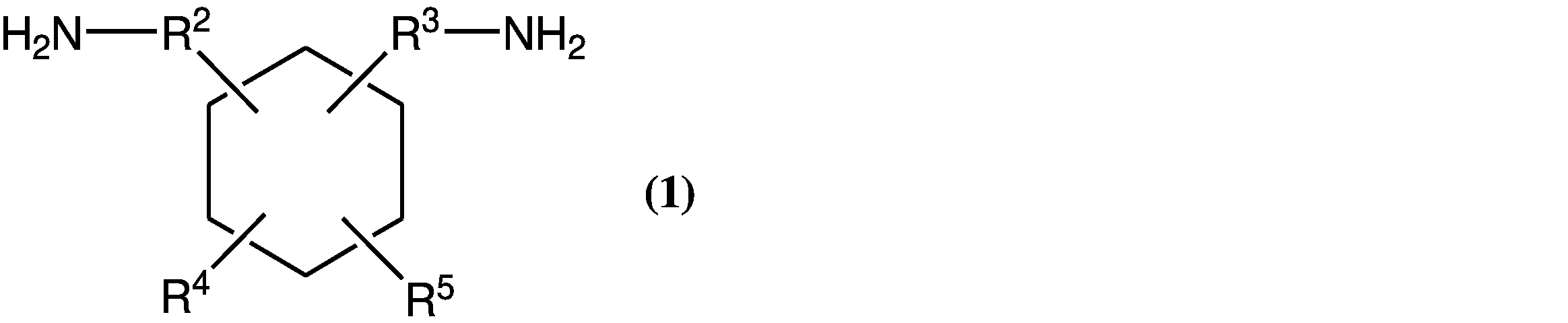
- dimer diamine a diamine represented by the following formula (1) may be used.
- R 2 and R 3 each independently represent an alkylene group having 4 to 50 carbon atoms
- R 4 represents an alkyl group having 4 to 50 carbon atoms
- R 5 represents an alkyl group having 2 to 50 carbon atoms.
- R 2 and R 3 are each preferably an alkylene group having 5 to 25 carbon atoms, more preferably an alkylene group having 6 to 10 carbon atoms, and even more preferably an alkylene group having 7 to 10 carbon atoms.
- R 4 is preferably an alkyl group having 5 to 25 carbon atoms, more preferably an alkyl group having 6 to 10 carbon atoms, and even more preferably an alkyl group having 7 to 10 carbon atoms.
- R 5 is preferably an alkyl group having 3 to 25 carbon atoms, more preferably an alkyl group having 4 to 10 carbon atoms, and even more preferably an alkyl group having 5 to 8 carbon atoms.
- dimer diamine products include, for example, PRIAMINE 1075 and PRIAMINE 1074 (both manufactured by Croda Japan Co., Ltd.).
- the second diamine is a diamine that does not fall under the category of the above-mentioned dimer diamines.
- the second diamine may be a linear diamine.
- the second diamine may be used alone or in combination of two or more types.
- Examples of the second diamine include 1,3-diaminopropane, norbornane diamine, metaxylylene diamine, 4,4'-diaminodiphenylmethane, 2,2-bis[4-(4-aminophenoxy)phenyl]propane, 1,3-bis[2-(4-aminophenyl)-2-propyl]benzene, 4,4'-diamino-2,2'-bis(trifluoromethyl)biphenyl, 2,2-bis[4-(4-aminophenoxy)phenyl]hexafluoropropane, 1,3-bis(aminomethyl)cyclohexane, 1,4-bis(aminomethyl)cyclohexane, bis(aminomethyl)norbornane, 4,4'-(hexafluoroisopropylidene)dianiline, 3(4),8(9)-bis(aminomethyl)tricyclohexane, Examples of such compounds include [
- the second diamine may contain at least one selected from the group consisting of norbornane diamine, metaxylylene diamine, 4,4'-diaminodiphenylmethane, and 2,2-bis[4-(4-aminophenoxy)phenyl]propane, and from the viewpoints of dielectric properties, photosensitive properties, and heat resistance, it is preferable that the second diamine contains norbornane diamine.
- the molar ratio of the second diamine may be 5-90 mol%, 10-85 mol%, 20-80 mol%, 25-75 mol%, 30-70 mol%, or 30-50 mol%. If this ratio is 5 mol% or more, it becomes easier to increase the elastic modulus and Tg of the cured product, and if it is 90 mol% or less, a cured product with lower dielectric properties can be formed.
- component (A) is not limited.
- Component (A) may be produced, for example, by reacting components (a1) and (a2) to synthesize an amine-terminated compound, and then reacting the amine-terminated compound with an excess of component (a3).
- Component (A) can be produced by various known methods. For example, first, component (a1) and component (a2) are subjected to a polyaddition reaction at a temperature of about 60 to 120°C, preferably 70 to 90°C, for usually about 0.1 to 2 hours, preferably 0.1 to 1.0 hour. Next, the obtained polyaddition product is subjected to an imidization reaction, i.e., a dehydration ring-closing reaction, at a temperature of about 80 to 250°C, preferably 100 to 200°C, for about 0.5 to 30 hours, preferably 0.5 to 10 hours.
- a polyaddition reaction i.e., a dehydration ring-closing reaction
- the product obtained by the dehydration ring-closing reaction is subjected to a maleimidization reaction, i.e., a dehydration ring-closing reaction, with component (a3) at a temperature of about 60 to 250°C, preferably 80 to 200°C, for about 0.5 to 30 hours, preferably 0.5 to 10 hours, to obtain the desired component (A).
- a maleimidization reaction i.e., a dehydration ring-closing reaction
- component (a3) at a temperature of about 60 to 250°C, preferably 80 to 200°C, for about 0.5 to 30 hours, preferably 0.5 to 10 hours, to obtain the desired component (A).
- reaction catalysts include aliphatic tertiary amines such as triethylamine, aromatic tertiary amines such as dimethylaniline, heterocyclic tertiary amines such as pyridine, picoline, isoquinoline, and organic acids such as methanesulfonic acid and paratoluenesulfonic acid monohydrate.
- the reaction catalysts can be used alone or in combination of two or more.
- dehydrating agents include aliphatic acid anhydrides such as acetic anhydride, and aromatic acid anhydrides such as benzoic anhydride.
- Organic solvents include, for example, aromatic hydrocarbons such as benzene, toluene, xylene, and mesitylene; alcohol-based solvents such as methanol, ethanol, isopropyl alcohol, butanol, pentanol, hexanol, propanediol, and phenol; ketone-based solvents such as acetone, methyl isobutyl ketone, methyl ethyl ketone, pentanone, hexanone, cyclopentanone, cyclohexanone, isophorone, and acetophenone; cellosolves such as methyl cellosolve and ethyl cellosolve, ester-based solvents such as methyl acetate, ethyl acetate, butyl acetate, methyl propionate, and butyl formate; ethylene glycol mono- Examples of the organic solvent include glycol ether solvents such as n-butyl ether,
- Component (A) can be purified by various known methods to increase its purity. For example, first, component (A) dissolved in an organic solvent and pure water are placed in a separatory funnel. The separatory funnel is then shaken and allowed to stand. After the aqueous layer and organic layer are separated, only the organic layer is collected, thereby purifying component (A).
- the molecular weight of the (A) component can be controlled by the number of moles of the (a1) component and the (a2) component, and the smaller the number of moles of the (a1) component is compared to the number of moles of the (a2) component, the smaller the molecular weight can be.
- the ratio of [number of moles of the (a1) component]/[number of moles of the (a2) component] is usually in the range of about 0.30 to 0.85, and preferably 0.50 to 0.80.
- the molecular weight of component (A) may be a weight average molecular weight (Mw) of 3,000 to 100,000, 4,000 to 80,000, 5,000 to 60,000, 6,000 to 40,000, or 7,000 to 20,000, from the viewpoints of solubility in solvents and heat resistance. Mw can be measured by gel permeation chromatography (GPC) and converted using a calibration curve of standard polystyrene.
- GPC gel permeation chromatography
- component (B) a polyfunctional compound having two or more polymerizable groups can be used.
- the crosslinking agent can crosslink not only with itself but also with component (A) during exposure of the photosensitive layer, for example.
- the crosslinking agent can crosslink with the polymerizable crosslinking agents during heating of the resin film after pattern formation, for example.
- Component (B) may be a polymerizable crosslinking agent.
- the polymerizable group may be a photopolymerizable group or a thermally polymerizable group. Examples of the polymerizable group include a (meth)acryloyl group, an allyl group, and a vinyl group.
- the crosslinking agent can be used alone or in combination of two or more types.
- the resin composition according to this embodiment may contain a polymerizable crosslinking agent having a (meth)acryloyl group as a crosslinking agent from the viewpoint of excellent dielectric properties.
- the polymerizable crosslinking agent having a (meth)acryloyl group can crosslink not only with itself but also with component (A) when the photosensitive layer is exposed to light.
- the polymerizable crosslinking agent having a (meth)acryloyl group may be an acrylate compound or a methacrylate compound.
- Component (B) may contain a methacrylate compound from the viewpoint of excellent dielectric properties.
- polymerizable crosslinking agents having a (meth)acryloyl group examples include tricyclodecane dimethanol di(meth)acrylate, tris-(2-(meth)acryloyloxyethyl)isocyanurate, dioxane glycol di(meth)acrylate, pentaerythritol tetra(meth)acrylate, 1,6-hexanediol di(meth)acrylate, 1,10-decanediol di(meth)acrylate, ethoxylated bisphenol A di(meth)acrylate, propoxylated ethoxylated bisphenol A (meth)acrylate, dipentaerythritol poly(meth)acrylate, ethoxylated isocyanuric acid tri(meth)acrylate, and polyethylene glycol di(meth)acrylate.
- the polymerizable crosslinking agent having a (meth)acryloyl group may contain at least one selected from the group consisting of tricyclodecane dimethanol di(meth)acrylate, tris-(2-(meth)acryloyloxyethyl)isocyanurate, and dioxane glycol di(meth)acrylate, from the viewpoint of excellent heat resistance, dielectric properties, and photosensitive properties, and may contain tricyclodecane dimethanol di(meth)acrylate from the viewpoint of excellent compatibility with component (A).
- the resin composition according to this embodiment may contain a polymerizable crosslinking agent having an allyl group or a vinyl group as a crosslinking agent from the viewpoint of dielectric properties and heat resistance.
- the polymerizable crosslinking agent having an allyl group or a vinyl group can crosslink with itself when the resin film is heated after pattern formation.
- polymerizable crosslinking agents having an allyl group examples include 1,3,4,6-tetraallyl glycoluril, triallyl isocyanurate, diallyl monoglycidyl isocyanurate, diallyl monomethyl isocyanurate, diallyl isocyanurate, triallyl trimellitate, and triallyl orthoformate.
- polymerizable crosslinking agents having vinyl groups examples include polyvinylbenzyl compounds and polyvinylbenzyl ether compounds.
- the polymerizable crosslinking agent having an allyl group or a vinyl group may contain at least one selected from the group consisting of 1,3,4,6-tetraallyl glycoluril, triallyl isocyanurate, diallyl isocyanurate, and polyvinyl benzyl ether compounds, from the viewpoint of dielectric properties and photosensitive properties.
- the content of component (B) is preferably less than 50 parts by mass when the total amount of components (A) and (B) is taken as 100 parts by mass, and may be 1 to 45 parts by mass, 5 to 40 parts by mass, 8 to 30 parts by mass, or 10 to 20 parts by mass.
- the photopolymerization initiator (hereinafter also referred to as “component (C)”) is not particularly limited as long as it is a compound that initiates polymerization upon irradiation with actinic rays (ultraviolet rays, etc.); examples of the photopolymerization initiator include alkylphenone-based photopolymerization initiators, acylphosphine oxide-based photopolymerization initiators, intramolecular hydrogen abstraction photopolymerization initiators, and oxime ester-based photopolymerization initiators.
- Alkylphenone-based photopolymerization initiators are available, for example, from IGM Resins B.V. as Omnirad 651, Omnirad 184, Omnirad 1173, Omnirad 2959, Omnirad 127, Omnirad 907, Omnirad 369, Omnirad 379EG, etc.
- Acylphosphine oxide-based photopolymerization initiators are available, for example, from IGM Resins B.V. as Omnirad 819, Omnirad TPO H, etc.
- Intramolecular hydrogen abstraction photopolymerization initiators are available, for example, from IGM Resins B.V. Omnirad MBF, Omnirad 754, etc. manufactured by BASF Japan Co., Ltd.
- Oxime ester photopolymerization initiators can be purchased, for example, as Irgacure OXE01, Irgacure OXE02, etc. manufactured by BASF Japan Co., Ltd.
- a titanocene photopolymerization initiator for example, Irgacure 784 manufactured by BASF Japan Co., Ltd.
- Irgacure 784 manufactured by BASF Japan Co., Ltd.
- the content of component (C) may be 0.1 to 10 parts by mass, 0.5 to 8 parts by mass, or 1 to 5 parts by mass per 100 parts by mass of the total amount of components (A) and (B), since this makes it easier to obtain excellent resolution.
- the photosensitive resin composition according to the present embodiment may further contain a thermal polymerization initiator as component (D) from the viewpoint of promoting the polymerization reaction of the thermally polymerizable crosslinking agent.
- a thermal polymerization initiator as component (D) from the viewpoint of promoting the polymerization reaction of the thermally polymerizable crosslinking agent.
- component (D) a compound that decomposes by heating during curing to generate radicals and promote the polymerization reaction of components (A) and (B) is preferable.
- component (D) for example, an organic peroxide can be mentioned.
- organic peroxides include methyl ethyl ketone peroxide, methylcyclohexanone peroxide, methyl acetoacetate peroxide, acetylacetone peroxide, 1,1-bis(t-butylperoxy)-3,3,5-trimethylcyclohexane, 1,1-bis(t-hexylperoxy)cyclohexane, 1,1-bis(t-hexylperoxy)-3,3,5-trimethylcyclohexane, 1,1-bis(t-butylperoxy)cyclohexane, 2,2-bis(4,4-di-t-butylperoxycyclohexyl)propane, 1,1-bis(t-butylperoxy)cyclododecane, n-butyl-4,4-bis(t-butylperoxy)valerate, 2,2-bis(t-butylperoxy)butane, 1,1-bis(t-butylperoxy)-2-
- hydroperoxide 1,1,3,3-tetramethylbutyl hydroperoxide, t-hexyl hydroperoxide, dicumyl peroxide, 2,5-dimethyl-2,5-bis(t-butylperoxy)hexane, ⁇ , ⁇ '-bis(t-butylperoxy)diisopropylbenzene, t-butylcumyl peroxide, di-t-butyl peroxide, 2,5-dimethyl-2,5-bis(t-butylperoxy)hexyne-3, isobutyryl peroxide, 3,5,5-trimethylhexanoyl peroxide, octanoyl peroxide, lauroyl peroxide, cinnamic acid peroxide, m-toluoyl peroxide, benzoyl peroxide, diisopropyl peroxydicarbonate, bis(4-t-butylcyclohexyl) peroxydi
- the amount of component (D) is not particularly limited, but may be 0.1 to 10.0 parts by mass, 0.5 to 5.0 parts by mass, or 0.7 to 3.0 parts by mass per 100 parts by mass of the total amount of components (A) and (B).
- the photosensitive resin composition according to the present embodiment may further contain a coupling agent from the viewpoint of improving the adhesion of the cured product of the photosensitive resin composition.
- the coupling agent may be a silane coupling agent.
- the silane coupling agent may have, for example, a vinyl group, an epoxy group, a styryl group, an acryloyl group, a methacryloyl group, an amino group, a ureido group, an isocyanate group, an isocyanurate group, a mercapto group, or the like.
- silane coupling agents having a vinyl group examples include KBM-1003 and KBE-1003 (product names manufactured by Shin-Etsu Chemical Co., Ltd.; the same applies below).
- Examples of silane coupling agents having an epoxy group include KBM-303, 402, 403, KBE-402, 403, X-12-981S, X-12-984S, etc.
- Examples of silane coupling agents having a styryl group include KBM-1403, etc.
- Examples of silane coupling agents having a methacryloyl group examples include KBM-502, 503, KBE-502, 503, etc.
- silane coupling agents having an acryloyl group examples include KBM-5103, X-12-1048, X-12-1050, etc.
- silane coupling agents having an amino group examples include KBM-602, 603, 903, 573, 575, KBE-903, 9103P, and X-12-972F.
- Examples of silane coupling agents having a ureido group include KBE-585.
- Examples of silane coupling agents having an isocyanate group include KBE-9007 and X-12-1159L.
- Examples of silane coupling agents having an isocyanurate group include KBM-9659.
- Examples of silane coupling agents having a mercapto group examples include KBM-802, 803, X-12-1154, and X-12-1156.
- the silane coupling agent may be a silane coupling agent having a methacryloyl group.
- the silane coupling agents may be used alone or in combination of two or more.
- the content of the silane coupling agent may be 0.01 to 10 parts by mass, 0.1 to 8 parts by mass, or 0.5 to 5 parts by mass, per 100 parts by mass of the total amount of components (A) and (B).
- the photosensitive resin composition according to the present embodiment may further contain a rust inhibitor from the viewpoint of suppressing corrosion or preventing discoloration of copper wiring.
- a rust inhibitor examples include triazole derivatives such as benzotriazole, and tetrazole derivatives.
- the rust inhibitor may be used alone or in combination of two or more.
- the content of the rust inhibitor may be 0.01 to 10 parts by mass, 0.1 to 5 parts by mass, or 0.5 to 3 parts by mass per 100 parts by mass of the total amount of components (A) and (B).
- the photosensitive resin composition according to the present embodiment may further contain a polymerization inhibitor. By using the polymerization inhibitor, the storage stability of the photosensitive resin composition can be ensured.
- polymerization inhibitors examples include 4-tert-butylcatechol, 4-hydroxy-2,2,6,6-tetramethylpiperidine-1-oxy radical, p-methoxyphenol, diphenyl-p-benzoquinone, benzoquinone, hydroquinone, pyrogallol, phenothiazine, resorcinol, orthodinitrobenzene, paradinitrobenzene, metadinitrobenzene, phenanthraquinone, N-phenyl-2-naphthylamine, cupferron, 2,5-toluquinone, tannic acid, parabenzylaminophenol, tris(4-tert-butyl-3-hydroxy-2,6-dimethylbenzyl)isocyanuric acid, and nitrosamines.
- Polymerization inhibitors may be used alone or in combination of two or more.
- the content of the polymerization inhibitor may be 0.01 to 10 parts by mass, 0.05 to 5 parts by mass, or 0.10 to 2 parts by mass per 100 parts by mass of the total amount of the (A) component and the (B) component.
- the photosensitive resin composition according to the present embodiment contains a solvent for dissolving and dispersing each component, which makes it easy to apply the composition to a substrate and forms a coating film of uniform thickness.
- the solvent may be used alone or in combination of two or more kinds.
- the solvent examples include ketones such as methyl ethyl ketone, cyclohexanone, and cyclopentanone; aromatic hydrocarbons such as toluene, xylene, mesitylene, and tetramethylbenzene; glycol ethers such as methyl cellosolve, butyl cellosolve, methyl carbitol, butyl carbitol, propylene glycol monomethyl ether, dipropylene glycol monoethyl ether, dipropylene glycol dimethyl ether, dipropylene glycol diethyl ether, and triethylene glycol monoethyl ether; esters such as ethyl acetate, butyl acetate, butyl cellosolve acetate, and carbitol acetate; and nitrogen-containing compounds such as N,N-dimethylformamide, N,N-dimethylacetamide, N-methyl-2-pyrrolidone, 3-methoxy-N,N-d
- the amount of solvent used is not particularly limited, but may be an amount that results in a solid content of 5 to 60 mass %, 10 to 50 mass %, or 15 to 40 mass % in the photosensitive resin composition.
- the means and conditions for preparing the photosensitive resin composition are not particularly limited.
- the main components are thoroughly and uniformly stirred and mixed in the prescribed amounts using a mixer or the like, and then kneaded using a mixing roll, extruder, kneader, roll, extruder, or the like.
- the kneading method is not particularly limited.
- the dielectric constant at 10 GHz of the cured product of the photosensitive resin composition according to this embodiment may be 2.80 or less, 2.70 or less, 2.65 or less, or 2.60 or less.
- the dielectric tangent at 10 GHz of the cured product of the photosensitive resin composition may be 0.0050 or less, 0.0045 or less, 0.004 or less, or 0.0030 or less.
- the dielectric constant and dielectric tangent can be measured by the method described in the examples using a cured film of the photosensitive resin composition.
- the photosensitive resin composition according to this embodiment is capable of forming a fine pattern.
- the photosensitive resin composition according to this embodiment is capable of forming an insulating film that exhibits low dielectric properties and has excellent insulating reliability.
- a semiconductor element having an interlayer insulating layer formed from the cured product of the above-mentioned photosensitive resin composition, and an electronic device including the semiconductor element can be produced.
- the semiconductor element can improve high-frequency characteristics by having a rewiring layer including the cured product of the photosensitive resin composition according to this embodiment.
- the semiconductor element may be, for example, a memory, a package, etc. having a multilayer wiring structure, a rewiring structure, etc. Examples of electronic devices include mobile phones, smartphones, tablet terminals, personal computers, and hard disk suspensions.
- the obtained maleimide compound was placed in a separatory funnel, 500 parts by mass of pure water was added, and the separatory funnel was shaken and allowed to stand. After standing, the aqueous layer and the organic layer were separated, and only the organic layer was collected.
- the collected organic layer was placed in a 1 L glass vessel equipped with a cooler, nitrogen inlet tube, thermocouple, stirrer, and vacuum pump, heated to 88-93°C, and the water was removed. The vessel was then heated to 100°C and the solvent was removed for 0.5 hours under a reduced pressure of 0.1 MPa from atmospheric pressure, yielding the maleimide compound (A-1) of component (A).
- the molecular weight of the maleimide compound (A-1) was measured by GPC.
- a sample was prepared by dissolving the maleimide compound in tetrahydrofuran (THF) to a concentration of 3% by mass, and 50 ⁇ L of the sample was injected into a column (GL-R420 (Hitachi High-Tech Fielding Corp.) x 1, GL-R430 (Hitachi High-Tech Fielding Corp.) x 1, GL-R440 (Hitachi High-Tech Fielding Corp.) x 1) heated to 30°C. Measurements were performed using THF as the developing solvent at a flow rate of 1.6 mL/min.
- the detector used was an L-3350 RI detector (Hitachi, Ltd.), and the weight average molecular weight (Mw) was calculated from the elution time using a molecular weight/elution time curve created using standard polystyrene (Tosoh Corp.).
- Mw weight average molecular weight
- A-DCP Tricyclodecane dimethanol diacrylate (product name, manufactured by Shin-Nakamura Chemical Co., Ltd.)
- A-DOG Dioxane glycol diacrylate (product name, manufactured by Shin-Nakamura Chemical Co., Ltd.)
- A-9300 Tris-(2-acryloyloxyethyl)isocyanurate (trade name, manufactured by Shin-Nakamura Chemical Co., Ltd.)
- DCP Tricyclodecane dimethanol dimethacrylate (product name, manufactured by Shin-Nakamura Chemical Co., Ltd.)
- TA-G 1,3,4,6-tetraarylglycoluril (trade name, manufactured by Shikoku Chemical Industry Co., Ltd.)
- TAIC Triallyl isocyanurate (product name, manufactured by Mitsubishi Chemical Corporation)
- L-DAIC Diallyl isocyanurate (product name, manufactured by Shikoku Chemical Industry Co., Ltd.) Polyvinyl benzyl
- component (C) Oxime ester photopolymerization initiator (manufactured by BASF Japan Ltd., product name "Irgacure OXE01")
- component (D) ⁇ , ⁇ '-bis(t-butylperoxy)diisopropylbenzene (manufactured by NOF Corporation, trade name "Perbutyl P")
- Coupling agent 3-methacryloxypropyltrimethoxysilane (manufactured by Shin-Etsu Chemical Co., Ltd., product name "KBM-503")
- Polymerization inhibitor 4-hydroxy-2,2,6,6-tetramethylpiperidine-1-oxyradical (TEMPOL) (manufactured by Tokyo Chemical Industry Co., Ltd.)
- Rust inhibitor 1,2,3-benzotriazole (manufactured by Johoku Chemical Industry Co., Ltd., product name "
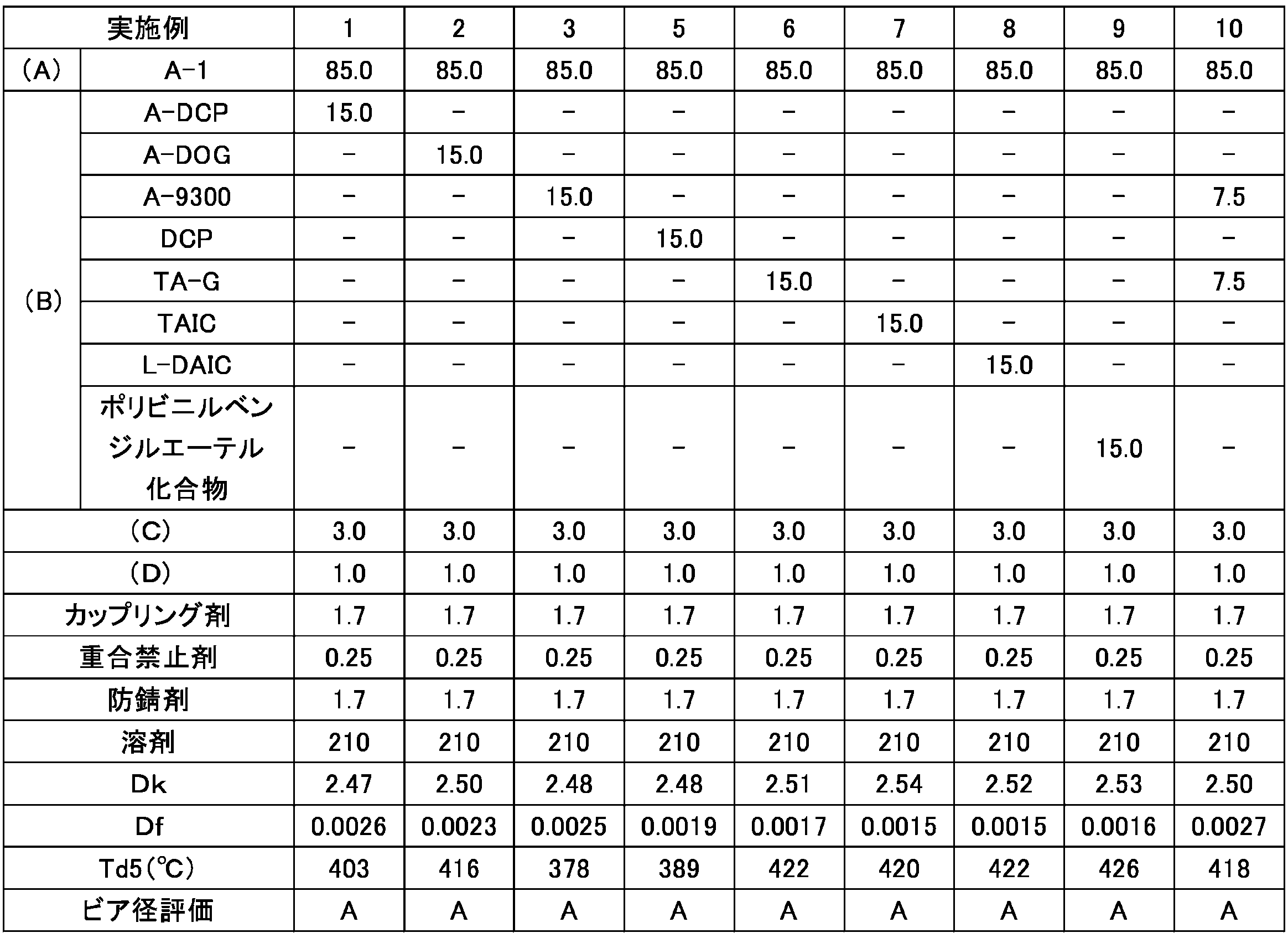
- the components were mixed in the amounts (parts by weight, solids) shown in Table 1, stirred at 25°C for at least 30 minutes, and then filtered through a #200 nylon mesh (mesh opening: 75 ⁇ m) to prepare a photosensitive resin composition.
- the photosensitive resin composition was applied onto copper foil using a knife coater, then air-dried for 15 minutes, and dried in a dryer at 90°C for 15 minutes to form a coating film.
- the coating film was exposed to light using a high-pressure mercury lamp (exposure amount: 1000 mJ/ cm2 ) and post-exposure baked on a hot plate (100°C, 1 minute) to form a resin film having a thickness of 100 ⁇ m.
- the resin film was then cured in a nitrogen atmosphere at 200°C for 2 hours using a clean oven.
- the copper foil was then dissolved and removed using ammonium persulfate to obtain a cured film.
- the cured film was cut into a length of 80 mm and a width of 80 mm to prepare an evaluation sample.
- the relative dielectric constant (Dk) and dielectric loss tangent (Df) of the evaluation sample at 10 GHz were measured at room temperature using a SPDR dielectric resonator (manufactured by QWED) and an analyzer (manufactured by Agilent Technologies, product name "PNA Network Analyzer N5227A").
- 5% weight loss temperature 6.0 to 10.0 mg of the cured film was weighed out and placed in an open sample container (Hitachi High-Tech Science Corporation, product name "GCA-0055"), and the 5% weight loss temperature (T d5 ) was measured under conditions of a nitrogen flow rate of 300 mL/min, a starting temperature of 40° C., and a heating rate of 10° C./min.
- the measurement device used was a NEXTA STA200RV (Hitachi High-Tech Science Corporation).
- a photosensitive resin composition was spin-coated on a silicon wafer, and dried by heating at 90 ° C. for 5 minutes using a hot plate to form a resin film with a thickness of 8 ⁇ m.
- the resin film was pattern-exposed using an i-line stepper exposure machine (manufactured by Therma Precision Co., Ltd., product name "Sc6k”) at an exposure dose of 300 mJ / cm 2 , and then heated at 100 ° C. for 1 minute using a hot plate. Then, it was immersed in a developer (a mixture of cyclopentanone and PGMEA) at 25 ° C. for 20 seconds and washed with PGMEA.
- a developer a mixture of cyclopentanone and PGMEA
- the peeling of the resin film from the silicon wafer after development, cracks in the resin film, the presence or absence of roughness at the pattern end, and the presence or absence of residue at the bottom of the pattern where the resin film was developed were confirmed with a metal microscope.
- the case where the minimum via diameter was 20 ⁇ m or less where these defects could not be confirmed was evaluated as "A”
- the case where the minimum via diameter was more than 20 ⁇ m was evaluated as "B”.
Landscapes
- Physics & Mathematics (AREA)
- Spectroscopy & Molecular Physics (AREA)
- General Physics & Mathematics (AREA)
- Chemical & Material Sciences (AREA)
- Health & Medical Sciences (AREA)
- Chemical Kinetics & Catalysis (AREA)
- Medicinal Chemistry (AREA)
- Polymers & Plastics (AREA)
- Organic Chemistry (AREA)
- Materials For Photolithography (AREA)
Abstract
Description
[2]前記テトラカルボン酸二無水物が、4,4’-(4,4’-イソプロピリデンジフェノキシ)ジフタル酸無水物、4,4’-オキシジフタル酸無水物、及び1,2,3,4-ブタンテトラカルボン酸二無水物からなる群より選ばれる少なくとも1種を含む、上記[1]に記載の感光性樹脂組成物。
[3]前記テトラカルボン酸二無水物が、1,3,3a,4,5,9b-ヘキサヒドロ-5(テトラヒドロ-2,5-ジオキソ-3-フラニル)ナフト[1,2-C]フラン-1,3-ジオンを含む、上記[1]に記載の感光性樹脂組成物。
[4]前記第2のジアミンが、メタキシリレンジアミン、4,4’-ジアミノジフェニルメタン、1,3-ジアミノプロパン、及び2,2-ビス[4-(4-アミノフェノキシ)フェニル]プロパンからなる群より選ばれる少なくとも1種を含む、上記[1]~[3]のいずれかに記載の感光性樹脂組成物。
[5]前記第2のジアミンが、ノルボルナンジアミンを含む、上記[1]~[3]のいずれかに記載の感光性樹脂組成物。
[6]前記架橋剤が、(メタ)アクリロイル基を有する重合性架橋剤を含む、上記[1]~[5]のいずれかに記載の感光性樹脂組成物。
[7]前記(メタ)アクリロイル基を有する重合性架橋剤が、トリシクロデカンジメタノールジ(メタ)アクリレート、トリス-(2-(メタ)アクリロイルオキシエチル)イソシアヌレート、及びジオキサングリコールジ(メタ)アクリレートからなる群より選ばれる少なくとも1種を含む、上記[6]に記載の感光性樹脂組成物。
[8]前記架橋剤が、アリル基又はビニル基を有する重合性架橋剤を含む、上記[1]~[6]のいずれかに記載の感光性樹脂組成物。
[9]前記アリル基又はビニル基を有する重合性架橋剤が、1,3,4,6-テトラアリルグリコールウリル、トリアリルイソシアヌレート、ジアリルイソシアヌレート、及びポリビニルベンジルエーテル化合物からなる群より選ばれる少なくとも1種を含む、上記[8]に記載の感光性樹脂組成物。
[10]熱重合開始剤を更に含有する、上記[1]~[9]のいずれかに記載の感光性樹脂組成物。
[11]上記[1]~[10]のいずれかに記載の感光性樹脂組成物の硬化物。
[12]上記[1]~[10]のいずれかに記載の感光性樹脂組成物の硬化物を含む再配線層を有する、半導体素子。
本実施形態に係る感光性樹脂組成物は、マレイミド化合物を含むベース樹脂と、架橋剤と、光重合開始剤とを必須成分として含有する。本実施形態に係る感光性樹脂組成物は、必要に応じて、熱重合開始剤、カップリング剤、防錆剤、重合禁止剤等を更に含有してもよい。本実施形態に係る感光性樹脂組成物は、ネガ型の感光性樹脂組成物であり、感光性樹脂組成物の硬化物は、再配線層用の絶縁膜として好適に用いることができる。以下、本実施形態の感光性樹脂組成物で用いられる各成分についてより詳細に説明する。
ベース樹脂は、マレイミド化合物(以下「(A)成分」ともいう。)を含む。本実施形態に係るマレイミド化合物は、テトラカルボン酸二無水物と、ジアミンと、無水マレイン酸との反応物である。(A)成分は、テトラカルボン酸二無水物(a1)(以下、「(a1)成分」ともいう。)、ジアミン(a2)(以下、「(a2)成分」ともいう。)、及び無水マレイン酸(a3)(以下、「(a3)成分」ともいう。)を反応させてなる化合物である。
架橋剤(以下「(B)成分」ともいう。)としては、重合性基を2以上有する多官能化合物を用いることができる。架橋剤は、例えば、感光層の露光時に架橋剤同士だけでなく、(A)成分とも架橋することができる。また、架橋剤は、例えば、パターン形成後の樹脂膜の加熱時に重合性架橋剤同士で架橋することができる。(B)成分は、重合性架橋剤であってよい。重合性基としては、光重合性基であってよく、熱重合性基であってよい。重合性基としては、例えば、(メタ)アクリロイル基、アリル基、及びビニル基が挙げられる。架橋剤は1種単独で又は2種以上を組み合わせて用いることができる。
光重合開始剤(以下「(C)成分」ともいう。)としては、活性光線(紫外線等)の照射によって重合を開始させる化合物であれば特に制限はないが、例えば、アルキルフェノン系光重合開始剤、アシルホスフィンオキサイド系光重合開始剤、分子内水素引き抜き型光重合開始剤、及びオキシムエステル系光重合開始剤が挙げられる。
本実施形態に係る感光性樹脂組成物は、熱重合性架橋剤の重合反応を促進する観点から、(D)成分として熱重合開始剤を更に含有してもよい。(D)成分としては、硬化時の加熱により分解してラジカルを発生し、(A)成分及び(B)成分の重合反応を促進する化合物が好ましい。(D)成分として、例えば、有機過酸化物が挙げられる。
本実施形態に係る感光性樹脂組成物は、感光性樹脂組成物の硬化物の密着性を向上する観点から、カップリング剤を更に含有してもよい。カップリング剤は、シランカップリング剤であってよい。シランカップリング剤は、例えば、ビニル基、エポキシ基、スチリル基、アクリロイル基、メタクリロイル基、アミノ基、ウレイド基、イソシアネート基、イソシアヌレート基、メルカプト基等の基を有していてよい。
本実施形態に係る感光性樹脂組成物は、銅配線の腐食を抑制又は変色を防止する観点から、防錆剤を更に含有してもよい。防錆剤としては、例えば、ベンゾトリアゾール等のトリアゾール誘導体、テトラゾール誘導体などが挙げられる。防錆剤は1種単独で用いてもよく、2種以上を組み合わせてもよい。
本実施形態に係る感光性樹脂組成物は、重合禁止剤を更に含有してもよい。重合禁止剤を用いることで、感光性樹脂組成物の保存安定性を確保することができる。
本実施形態に係る感光性樹脂組成物は、各成分を溶解・分散させるための溶剤を含有することにより、基板上への塗布を容易にし、均一な厚さの塗膜を形成できる。溶剤は1種単独で用いてもよく、2種以上を組み合わせてもよい。
冷却器、窒素導入管、熱伝対、及び攪拌機を備えた1Lのフラスコ容器に、1,3,3a,4,5,9b-ヘキサヒドロ-5(テトラヒドロ-2,5-ジオキソ-3-フラニル)ナフト[1,2-C]フラン-1,3-ジオン(新日本理化株式会社製、商品名「TDA-100」)24.35質量部、T-SOL100(ENEOS株式会社製、芳香族系高沸点溶剤)132.69質量部、及びソルミックスA-11(日本アルコール販売株式会社製、アルコール系溶剤)29.33質量部を投入した。投入後、80℃に昇温し、0.5時間保温し、ダイマージアミン(商品名「PRIAMINE 1075」、クローダジャパン株式会社製)40.68質量部を滴下した。滴下後、ノルボルナンジアミン(三井化学ファイン株式会社製)5.01質量部を添加した。添加後、メタンスルホン酸水溶液(BASF社製、商品名「Lutropur MSA」)2.08質量部を加え、160℃に昇温した。昇温後にトルエン(山一化学工業株式会社製)40.00質量部を添加し、160℃で1時間脱水閉環反応を行い、反応液中の水とアルコールを除去し、中間体のポリイミドを得た。続いて、得られたポリイミドを130℃に冷却し、無水マレイン酸(扶桑化学工業株式会社製)7.96質量部を加え、160℃に昇温し、160℃で4時間脱水閉環反応を行い、反応液中の水を除去し、マレイミド化合物を得た。
A-DCP:トリシクロデカンジメタノールジアクリレート(新中村化学工業株式会社製、商品名)
A-DOG:ジオキサングリコールジアクリレート(新中村化学工業株式会社製、商品名)
A-9300:トリス-(2-アクリロイルオキシエチル)イソシアヌレート(新中村化学工業株式会社製、商品名)
DCP:トリシクロデカンジメタノールジメタクリレート(新中村化学工業株式会社製、商品名)
TA-G:1,3,4,6-テトラアリルグリコールウリル(四国化成工業株式会社製、商品名)
TAIC:トリアリルイソシアヌレート(三菱ケミカル株式会社製、商品名)
L-DAIC:ジアリルイソシアヌレート(四国化成工業株式会社製、商品名)
ポリビニルベンジルエーテル化合物:合成例2で作製した化合物を用いた。
撹拌装置、温度計、還流管及びエアポンプを備えた500mLの反応容器に、フェノールアラルキル樹脂(エア・ウォータ-・パフォーマンスケミカル株式会社製、商品名「HE100C-30」、水酸基当量174g/eq)90質量部、クロロメチルスチレン(Linchuan Chemical社製、o-クロロメチレン17質量%及びp-クロロメチレン83質量%の混合物)83質量部、臭化テトラブチルホスホニウム(関東化学株式会社製)17質量部、純水6質量部、トルエン113質量部、及び2-プロパノール23質量部を投入し、流量50mL/分で空気を吹き込みながら、40℃で撹拌しながら混合した。次いで、70℃に昇温し、48質量%の水酸化ナトリウム水溶液(関東化学株式会社製)30質量部を20分間で滴下した。滴下後、70℃で4時間撹拌しながら反応を行い、反応液を25℃に冷却し、10質量%塩酸水溶液で中和した。中和後の反応液の有機層を純水で3回洗浄した後、有機層をメタノールに投入し、沈殿物を回収し、ポリビニルベンジルエーテル化合物を得た。ポリビニルベンジルエーテル化合物の赤外吸収(IR)スペクトルを測定することで、フェノールアラルキル樹脂が有するフェノール性水酸基が、ビニルベンジルエーテル基に置換された構造を有することを確認した。
(C)成分:オキシムエステル系光重合開始剤(BASFジャパン株式会社製、商品名「Irgacure OXE01」)
(D)成分:α,α’-ビス(t-ブチルパーオキシ)ジイソプロピルベンゼン(日油株式会社製、商品名「パーブチルP」)
カップリング剤:3-メタクリロキシプロピルトリメトキシシラン(信越化学工業株式会社社製、商品名「KBM-503」)
重合禁止剤:4-ヒドロキシ-2,2,6,6-テトラメチルピペリジン-1-オキシラジカル(TEMPOL)(東京化成工業株式会社製)
防錆剤:1,2,3-ベンゾトリアゾール(城北化学工業株式会社製、商品名「BT-120」)
溶剤:メシチレン(東洋合成株式会社製)
感光性樹脂組成物を銅箔上にナイフコーターを用いて塗工した後、15分風乾し、乾燥機で90℃、15分間乾燥して塗膜を形成した。塗膜に対して、高圧水銀灯で露光(露光量:1000mJ/cm2)及びホットプレートで露光後ベーク(100℃、1分間)を行い、100μmの厚みを有する樹脂膜を形成した。その後、樹脂膜を窒素雰囲気下、クリーンオーブンを用いて200℃で2時間硬化させた。続いて、銅箔を過硫酸アンモニウムにて溶解除去して硬化膜を得た。
硬化膜をオープン型試料容器(株式会社日立ハイテクサイエンス製、商品名「GCA-0055」)に6.0~10.0mg計りとり、窒素流量300mL/分、開始温度40℃、昇温速度10℃/分の条件で、5%重量減少温度(Td5)を測定した。測定装置は、NEXTA STA200RV(株式会社日立ハイテクサイエンス製)を使用した。
シリコンウェハ上に、感光性樹脂組成物をスピンコートして、ホットプレートを用いて90℃で5分加熱乾燥して、厚さ8μmの樹脂膜を形成した。次いで、i線ステッパ露光機(株式会社サーマプレシジョン製、商品名「Sc6k」)を用いて露光量300mJ/cm2の条件で樹脂膜をパターン露光した後、ホットプレートを用いて100℃で1分の条件で加熱した。その後、現像液(シクロペンタノン及びPGMEAの混合液)に25℃で20秒間浸漬し、PGMEAで洗浄した。現像後の樹脂膜のシリコンウェハからの剥離、樹脂膜のひび割れ、パターン端部の荒れの有無、及び、樹脂膜を現像したパターン底部の残渣の有無を金属顕微鏡で確認した。これらの不具合が確認できなかった最小のビア径が20μm以下の場合を「A」とし、最小のビア径が20μm超の場合を「B」として評価した。
Claims (12)
- マレイミド化合物を含むベース樹脂と、架橋剤と、光重合開始剤と、を含有し、
前記マレイミド化合物が、テトラカルボン酸二無水物と、ジアミンと、無水マレイン酸との反応物であり、前記ジアミンが、ダイマージアミンと、前記ダイマージアミン以外の第2のジアミンとを含む、感光性樹脂組成物。 - 前記テトラカルボン酸二無水物が、4,4’-(4,4’-イソプロピリデンジフェノキシ)ジフタル酸無水物、4,4’-オキシジフタル酸無水物、及び1,2,3,4-ブタンテトラカルボン酸二無水物からなる群より選ばれる少なくとも1種を含む、請求項1に記載の感光性樹脂組成物。
- 前記テトラカルボン酸二無水物が、1,3,3a,4,5,9b-ヘキサヒドロ-5(テトラヒドロ-2,5-ジオキソ-3-フラニル)ナフト[1,2-C]フラン-1,3-ジオンを含む、請求項1に記載の感光性樹脂組成物。
- 前記第2のジアミンが、メタキシリレンジアミン、4,4’-ジアミノジフェニルメタン、1,3-ジアミノプロパン、及び2,2-ビス[4-(4-アミノフェノキシ)フェニル]プロパンからなる群より選ばれる少なくとも1種を含む、請求項1~3のいずれか一項に記載の感光性樹脂組成物。
- 前記第2のジアミンが、ノルボルナンジアミンを含む、請求項1~3のいずれか一項に記載の感光性樹脂組成物。
- 前記架橋剤が、(メタ)アクリロイル基を有する重合性架橋剤を含む、請求項1~5のいずれか一項に記載の感光性樹脂組成物。
- 前記(メタ)アクリロイル基を有する重合性架橋剤が、トリシクロデカンジメタノールジ(メタ)アクリレート、トリス-(2-(メタ)アクリロイルオキシエチル)イソシアヌレート、及びジオキサングリコールジ(メタ)アクリレートからなる群より選ばれる少なくとも1種を含む、請求項6に記載の感光性樹脂組成物。
- 前記架橋剤が、アリル基又はビニル基を有する重合性架橋剤を含む、請求項1~6のいずれか一項に記載の感光性樹脂組成物。
- 前記アリル基又はビニル基を有する重合性架橋剤が、1,3,4,6-テトラアリルグリコールウリル、トリアリルイソシアヌレート、ジアリルイソシアヌレート、及びポリビニルベンジルエーテル化合物からなる群より選ばれる少なくとも1種を含む、請求項8に記載の感光性樹脂組成物。
- 熱重合開始剤を更に含有する、請求項1~9のいずれか一項に記載の感光性樹脂組成物。
- 請求項1~10のいずれか一項に記載の感光性樹脂組成物の硬化物。
- 請求項1~10のいずれか一項に記載の感光性樹脂組成物の硬化物を含む再配線層を有する、半導体素子。
Priority Applications (7)
| Application Number | Priority Date | Filing Date | Title |
|---|---|---|---|
| PCT/JP2022/041551 WO2024100764A1 (ja) | 2022-11-08 | 2022-11-08 | 感光性樹脂組成物、硬化物、及び半導体素子 |
| CN202380035607.0A CN119096199A (zh) | 2022-11-08 | 2023-11-07 | 感光性树脂组合物、固化物及半导体元件 |
| TW112142855A TW202421674A (zh) | 2022-11-08 | 2023-11-07 | 感光性樹脂組成物、固化物及半導體元件 |
| PCT/JP2023/040068 WO2024101358A1 (ja) | 2022-11-08 | 2023-11-07 | 感光性樹脂組成物、硬化物、及び半導体素子 |
| KR1020257013342A KR20250105374A (ko) | 2022-11-08 | 2023-11-07 | 감광성 수지 조성물, 경화물, 및 반도체 소자 |
| JP2024557424A JPWO2024101358A1 (ja) | 2022-11-08 | 2023-11-07 | |
| US18/859,427 US20250271757A1 (en) | 2022-11-08 | 2023-11-07 | Photosensitive resin composition, cured product, and semiconductor element |
Applications Claiming Priority (1)
| Application Number | Priority Date | Filing Date | Title |
|---|---|---|---|
| PCT/JP2022/041551 WO2024100764A1 (ja) | 2022-11-08 | 2022-11-08 | 感光性樹脂組成物、硬化物、及び半導体素子 |
Publications (1)
| Publication Number | Publication Date |
|---|---|
| WO2024100764A1 true WO2024100764A1 (ja) | 2024-05-16 |
Family
ID=91032351
Family Applications (2)
| Application Number | Title | Priority Date | Filing Date |
|---|---|---|---|
| PCT/JP2022/041551 Ceased WO2024100764A1 (ja) | 2022-11-08 | 2022-11-08 | 感光性樹脂組成物、硬化物、及び半導体素子 |
| PCT/JP2023/040068 Ceased WO2024101358A1 (ja) | 2022-11-08 | 2023-11-07 | 感光性樹脂組成物、硬化物、及び半導体素子 |
Family Applications After (1)
| Application Number | Title | Priority Date | Filing Date |
|---|---|---|---|
| PCT/JP2023/040068 Ceased WO2024101358A1 (ja) | 2022-11-08 | 2023-11-07 | 感光性樹脂組成物、硬化物、及び半導体素子 |
Country Status (6)
| Country | Link |
|---|---|
| US (1) | US20250271757A1 (ja) |
| JP (1) | JPWO2024101358A1 (ja) |
| KR (1) | KR20250105374A (ja) |
| CN (1) | CN119096199A (ja) |
| TW (1) | TW202421674A (ja) |
| WO (2) | WO2024100764A1 (ja) |
Cited By (3)
| Publication number | Priority date | Publication date | Assignee | Title |
|---|---|---|---|---|
| WO2025187616A1 (ja) * | 2024-03-08 | 2025-09-12 | 三菱瓦斯化学株式会社 | 樹脂組成物、硬化物、プリプレグ、金属箔張積層板、樹脂複合シート、プリント配線板、および、半導体装置 |
| WO2025187615A1 (ja) * | 2024-03-08 | 2025-09-12 | 三菱瓦斯化学株式会社 | 樹脂組成物、硬化物、プリプレグ、金属箔張積層板、樹脂複合シート、プリント配線板、および、半導体装置 |
| WO2025253919A1 (ja) * | 2024-06-07 | 2025-12-11 | 住友化学株式会社 | ポリイミド系樹脂、ポリアミック酸樹脂、ポリアミック酸樹脂組成物及びその硬化膜、並びに半導体パッケージ |
Families Citing this family (3)
| Publication number | Priority date | Publication date | Assignee | Title |
|---|---|---|---|---|
| WO2025100369A1 (ja) * | 2023-11-06 | 2025-05-15 | 株式会社レゾナック | マレイミド樹脂、樹脂組成物、硬化物、シート、積層体、及びプリント配線板 |
| JP2026020989A (ja) * | 2024-07-29 | 2026-02-10 | 株式会社レゾナック | 硬化性組成物の製造方法及び硬化性組成物用混合物 |
| JP2026020986A (ja) * | 2024-07-29 | 2026-02-10 | 株式会社レゾナック | 硬化性組成物及び硬化物 |
Citations (4)
| Publication number | Priority date | Publication date | Assignee | Title |
|---|---|---|---|---|
| WO2016147490A1 (ja) * | 2015-03-16 | 2016-09-22 | 太陽ホールディングス株式会社 | ポジ型感光性樹脂組成物、ドライフィルム、硬化物およびプリント配線板 |
| WO2021020344A1 (ja) * | 2019-08-01 | 2021-02-04 | 東レ株式会社 | 感光性樹脂組成物、感光性シート、硬化膜、硬化膜の製造方法、層間絶縁膜および電子部品 |
| WO2021187355A1 (ja) * | 2020-03-18 | 2021-09-23 | 東レ株式会社 | 感光性樹脂組成物、感光性シート、硬化膜、硬化膜の製造方法、電子部品、アンテナ素子、半導体パッケージおよび表示装置 |
| JP2022019406A (ja) * | 2020-07-17 | 2022-01-27 | 味の素株式会社 | 感光性樹脂組成物 |
Family Cites Families (6)
| Publication number | Priority date | Publication date | Assignee | Title |
|---|---|---|---|---|
| JP4640037B2 (ja) | 2005-08-22 | 2011-03-02 | Jsr株式会社 | ポジ型感光性絶縁樹脂組成物およびその硬化物 |
| JP5067028B2 (ja) | 2007-06-12 | 2012-11-07 | 日立化成工業株式会社 | ポジ型感光性樹脂組成物、レジストパターンの製造方法及び電子デバイス |
| KR101398754B1 (ko) | 2008-12-26 | 2014-05-27 | 히타치가세이가부시끼가이샤 | 포지티브형 감광성 수지 조성물, 레지스트 패턴의 제조 방법, 반도체 장치 및 전자 디바이스 |
| JP7066918B2 (ja) * | 2019-04-02 | 2022-05-13 | 日本化薬株式会社 | ビスマレイミド化合物、それを用いた感光性樹脂組成物、その硬化物及び半導体素子 |
| WO2021154898A2 (en) * | 2020-01-27 | 2021-08-05 | Designer Molecules, Inc | Uv-curable resin compositions suitable for redistribution layers |
| JPWO2023106104A1 (ja) * | 2021-12-09 | 2023-06-15 |
-
2022
- 2022-11-08 WO PCT/JP2022/041551 patent/WO2024100764A1/ja not_active Ceased
-
2023
- 2023-11-07 JP JP2024557424A patent/JPWO2024101358A1/ja active Pending
- 2023-11-07 TW TW112142855A patent/TW202421674A/zh unknown
- 2023-11-07 KR KR1020257013342A patent/KR20250105374A/ko active Pending
- 2023-11-07 US US18/859,427 patent/US20250271757A1/en active Pending
- 2023-11-07 CN CN202380035607.0A patent/CN119096199A/zh active Pending
- 2023-11-07 WO PCT/JP2023/040068 patent/WO2024101358A1/ja not_active Ceased
Patent Citations (4)
| Publication number | Priority date | Publication date | Assignee | Title |
|---|---|---|---|---|
| WO2016147490A1 (ja) * | 2015-03-16 | 2016-09-22 | 太陽ホールディングス株式会社 | ポジ型感光性樹脂組成物、ドライフィルム、硬化物およびプリント配線板 |
| WO2021020344A1 (ja) * | 2019-08-01 | 2021-02-04 | 東レ株式会社 | 感光性樹脂組成物、感光性シート、硬化膜、硬化膜の製造方法、層間絶縁膜および電子部品 |
| WO2021187355A1 (ja) * | 2020-03-18 | 2021-09-23 | 東レ株式会社 | 感光性樹脂組成物、感光性シート、硬化膜、硬化膜の製造方法、電子部品、アンテナ素子、半導体パッケージおよび表示装置 |
| JP2022019406A (ja) * | 2020-07-17 | 2022-01-27 | 味の素株式会社 | 感光性樹脂組成物 |
Cited By (3)
| Publication number | Priority date | Publication date | Assignee | Title |
|---|---|---|---|---|
| WO2025187616A1 (ja) * | 2024-03-08 | 2025-09-12 | 三菱瓦斯化学株式会社 | 樹脂組成物、硬化物、プリプレグ、金属箔張積層板、樹脂複合シート、プリント配線板、および、半導体装置 |
| WO2025187615A1 (ja) * | 2024-03-08 | 2025-09-12 | 三菱瓦斯化学株式会社 | 樹脂組成物、硬化物、プリプレグ、金属箔張積層板、樹脂複合シート、プリント配線板、および、半導体装置 |
| WO2025253919A1 (ja) * | 2024-06-07 | 2025-12-11 | 住友化学株式会社 | ポリイミド系樹脂、ポリアミック酸樹脂、ポリアミック酸樹脂組成物及びその硬化膜、並びに半導体パッケージ |
Also Published As
| Publication number | Publication date |
|---|---|
| US20250271757A1 (en) | 2025-08-28 |
| CN119096199A (zh) | 2024-12-06 |
| JPWO2024101358A1 (ja) | 2024-05-16 |
| KR20250105374A (ko) | 2025-07-08 |
| TW202421674A (zh) | 2024-06-01 |
| WO2024101358A1 (ja) | 2024-05-16 |
Similar Documents
| Publication | Publication Date | Title |
|---|---|---|
| WO2024101358A1 (ja) | 感光性樹脂組成物、硬化物、及び半導体素子 | |
| CN102162996B (zh) | 负型感光性树脂组合物、固化浮雕图案的制造方法 | |
| WO2019044874A1 (ja) | 感光性樹脂組成物 | |
| WO2023106104A1 (ja) | 感光性樹脂組成物 | |
| WO2024154780A1 (ja) | 感光性樹脂組成物、硬化物、及び半導体素子 | |
| WO2023106108A1 (ja) | 感光性樹脂組成物 | |
| TWI819110B (zh) | 感光性樹脂組成物、圖案硬化膜的製造方法、硬化膜、層間絕緣膜、覆蓋塗層、表面保護膜及電子零件 | |
| WO2024210133A1 (ja) | 感光性樹脂組成物、硬化物、及び半導体素子 | |
| JP2024147881A (ja) | 感光性樹脂組成物、硬化物、及び半導体素子 | |
| WO2024154779A1 (ja) | 感光性樹脂組成物、硬化物、及び半導体素子 | |
| WO2021029419A1 (ja) | 感光性樹脂組成物、パターン硬化膜の製造方法、硬化膜、層間絶縁膜、カバーコート層、表面保護膜及び電子部品 | |
| WO2025100368A1 (ja) | 感光性樹脂組成物、硬化物、及び半導体素子 | |
| WO2025159122A1 (ja) | 感光性樹脂組成物、硬化物、及び半導体素子 | |
| WO2025121288A1 (ja) | 絶縁膜の形成方法及び感光性樹脂組成物 | |
| WO2025134897A1 (ja) | 感光性樹脂組成物、硬化物及び半導体素子 | |
| WO2025121286A1 (ja) | 感光性樹脂組成物、硬化物、及び半導体素子 | |
| WO2025234333A1 (ja) | 感光性樹脂組成物、硬化物、及び半導体素子 | |
| WO2025100366A1 (ja) | マレイミド樹脂の製造方法 | |
| TW202615976A (zh) | 感光性樹脂組成物、固化物及半導體元件 | |
| JP7852394B2 (ja) | 感光性樹脂組成物、硬化物、パターン硬化物の製造方法、及び電子部品 | |
| JP2025120082A (ja) | 樹脂組成物、及びそれを用いた半導体パッケージ基板 | |
| WO2025220442A1 (ja) | 絶縁膜形成用感光性樹脂組成物 | |
| KR20250077509A (ko) | 수지 조성물 및 그 제조 방법, 및 수지 조성물의 경화물 |
Legal Events
| Date | Code | Title | Description |
|---|---|---|---|
| 121 | Ep: the epo has been informed by wipo that ep was designated in this application |
Ref document number: 22965090 Country of ref document: EP Kind code of ref document: A1 |
|
| WWE | Wipo information: entry into national phase |
Ref document number: 18850767 Country of ref document: US |
|
| NENP | Non-entry into the national phase |
Ref country code: DE |
|
| WWP | Wipo information: published in national office |
Ref document number: 18850767 Country of ref document: US |
|
| 122 | Ep: pct application non-entry in european phase |
Ref document number: 22965090 Country of ref document: EP Kind code of ref document: A1 |
|
| NENP | Non-entry into the national phase |
Ref country code: JP |