WO2024096064A1 - 虫よけ用経口組成物 - Google Patents
虫よけ用経口組成物 Download PDFInfo
- Publication number
- WO2024096064A1 WO2024096064A1 PCT/JP2023/039443 JP2023039443W WO2024096064A1 WO 2024096064 A1 WO2024096064 A1 WO 2024096064A1 JP 2023039443 W JP2023039443 W JP 2023039443W WO 2024096064 A1 WO2024096064 A1 WO 2024096064A1
- Authority
- WO
- WIPO (PCT)
- Prior art keywords
- citral
- composition
- weight
- salt
- content
- Prior art date
- Legal status (The legal status is an assumption and is not a legal conclusion. Google has not performed a legal analysis and makes no representation as to the accuracy of the status listed.)
- Ceased
Links
Images
Classifications
-
- A—HUMAN NECESSITIES
- A23—FOODS OR FOODSTUFFS; TREATMENT THEREOF, NOT COVERED BY OTHER CLASSES
- A23L—FOODS, FOODSTUFFS OR NON-ALCOHOLIC BEVERAGES, NOT OTHERWISE PROVIDED FOR; PREPARATION OR TREATMENT THEREOF
- A23L27/00—Spices; Flavouring agents or condiments; Artificial sweetening agents; Table salts; Dietetic salt substitutes; Preparation or treatment thereof
-
- A—HUMAN NECESSITIES
- A23—FOODS OR FOODSTUFFS; TREATMENT THEREOF, NOT COVERED BY OTHER CLASSES
- A23L—FOODS, FOODSTUFFS OR NON-ALCOHOLIC BEVERAGES, NOT OTHERWISE PROVIDED FOR; PREPARATION OR TREATMENT THEREOF
- A23L29/00—Foods or foodstuffs containing additives; Preparation or treatment thereof
-
- A—HUMAN NECESSITIES
- A23—FOODS OR FOODSTUFFS; TREATMENT THEREOF, NOT COVERED BY OTHER CLASSES
- A23L—FOODS, FOODSTUFFS OR NON-ALCOHOLIC BEVERAGES, NOT OTHERWISE PROVIDED FOR; PREPARATION OR TREATMENT THEREOF
- A23L35/00—Foods or foodstuffs not provided for in groups A23L5/00 - A23L33/00; Preparation or treatment thereof
-
- A—HUMAN NECESSITIES
- A23—FOODS OR FOODSTUFFS; TREATMENT THEREOF, NOT COVERED BY OTHER CLASSES
- A23L—FOODS, FOODSTUFFS OR NON-ALCOHOLIC BEVERAGES, NOT OTHERWISE PROVIDED FOR; PREPARATION OR TREATMENT THEREOF
- A23L5/00—Preparation or treatment of foods or foodstuffs, in general; Food or foodstuffs obtained thereby; Materials therefor
-
- A—HUMAN NECESSITIES
- A61—MEDICAL OR VETERINARY SCIENCE; HYGIENE
- A61K—PREPARATIONS FOR MEDICAL, DENTAL OR TOILETRY PURPOSES
- A61K31/00—Medicinal preparations containing organic active ingredients
- A61K31/11—Aldehydes
-
- A—HUMAN NECESSITIES
- A61—MEDICAL OR VETERINARY SCIENCE; HYGIENE
- A61K—PREPARATIONS FOR MEDICAL, DENTAL OR TOILETRY PURPOSES
- A61K47/00—Medicinal preparations characterised by the non-active ingredients used, e.g. carriers or inert additives; Targeting or modifying agents chemically bound to the active ingredient
- A61K47/06—Organic compounds, e.g. natural or synthetic hydrocarbons, polyolefins, mineral oil, petrolatum or ozokerite
- A61K47/08—Organic compounds, e.g. natural or synthetic hydrocarbons, polyolefins, mineral oil, petrolatum or ozokerite containing oxygen, e.g. ethers, acetals, ketones, quinones, aldehydes, peroxides
- A61K47/12—Carboxylic acids; Salts or anhydrides thereof
-
- A—HUMAN NECESSITIES
- A61—MEDICAL OR VETERINARY SCIENCE; HYGIENE
- A61K—PREPARATIONS FOR MEDICAL, DENTAL OR TOILETRY PURPOSES
- A61K47/00—Medicinal preparations characterised by the non-active ingredients used, e.g. carriers or inert additives; Targeting or modifying agents chemically bound to the active ingredient
- A61K47/06—Organic compounds, e.g. natural or synthetic hydrocarbons, polyolefins, mineral oil, petrolatum or ozokerite
- A61K47/16—Organic compounds, e.g. natural or synthetic hydrocarbons, polyolefins, mineral oil, petrolatum or ozokerite containing nitrogen, e.g. nitro-, nitroso-, azo-compounds, nitriles, cyanates
- A61K47/18—Amines; Amides; Ureas; Quaternary ammonium compounds; Amino acids; Oligopeptides having up to five amino acids
-
- A—HUMAN NECESSITIES
- A61—MEDICAL OR VETERINARY SCIENCE; HYGIENE
- A61K—PREPARATIONS FOR MEDICAL, DENTAL OR TOILETRY PURPOSES
- A61K47/00—Medicinal preparations characterised by the non-active ingredients used, e.g. carriers or inert additives; Targeting or modifying agents chemically bound to the active ingredient
- A61K47/06—Organic compounds, e.g. natural or synthetic hydrocarbons, polyolefins, mineral oil, petrolatum or ozokerite
- A61K47/22—Heterocyclic compounds, e.g. ascorbic acid, tocopherol or pyrrolidones
-
- A—HUMAN NECESSITIES
- A61—MEDICAL OR VETERINARY SCIENCE; HYGIENE
- A61K—PREPARATIONS FOR MEDICAL, DENTAL OR TOILETRY PURPOSES
- A61K47/00—Medicinal preparations characterised by the non-active ingredients used, e.g. carriers or inert additives; Targeting or modifying agents chemically bound to the active ingredient
- A61K47/06—Organic compounds, e.g. natural or synthetic hydrocarbons, polyolefins, mineral oil, petrolatum or ozokerite
- A61K47/26—Carbohydrates, e.g. sugar alcohols, amino sugars, nucleic acids, mono-, di- or oligo-saccharides; Derivatives thereof, e.g. polysorbates, sorbitan fatty acid esters or glycyrrhizin
-
- A—HUMAN NECESSITIES
- A61—MEDICAL OR VETERINARY SCIENCE; HYGIENE
- A61K—PREPARATIONS FOR MEDICAL, DENTAL OR TOILETRY PURPOSES
- A61K47/00—Medicinal preparations characterised by the non-active ingredients used, e.g. carriers or inert additives; Targeting or modifying agents chemically bound to the active ingredient
- A61K47/46—Ingredients of undetermined constitution or reaction products thereof, e.g. skin, bone, milk, cotton fibre, eggshell, oxgall or plant extracts
Definitions
- the present invention relates to an oral composition for insect repellency that contains citral and has a reduced unpleasant taste caused by citral when eaten.
- mosquito-borne infectious disease such as dengue fever, chikungunya fever, Zika virus infection, Japanese encephalitis, West Nile fever, yellow fever, or malaria.
- dengue fever chikungunya fever
- Zika virus infection Japanese encephalitis
- West Nile fever yellow fever
- malaria infectious diseases are particularly prevalent and pose a threat in tropical and subtropical regions, but due to recent global movements of people, they are also a problem for people in other regions.
- Patent Document 1 An insect repellent containing a mosquito repellent that uses citral as an active ingredient has been disclosed.
- citral has a distinctive bitter taste and an unpleasant taste to the tongue when ingested, making it unsuitable for consumption as is. Therefore, there is a need for an oral insect repellent composition containing citral that has a reduced unpleasant taste caused by citral and has an excellent balance of sweetness and sourness.
- the present invention aims to provide an oral composition for insect repellency that contains citral and has a good balance of sweetness and sourness, with a reduced unpleasant taste caused by citral when eaten.
- the present invention is as follows.
- An oral composition for repelling insects comprising 0.01% by weight to 1% by weight of citral, citric acid or a salt thereof, and a sweetener for aftersweetness or acesulfame K.
- the insect is a mosquito, a fly, a moth, a horsefly, a blackfly, a flea, a tick, a bee, an ant or a cockroach.
- composition according to any one of the above [1] to [8], wherein the insect is a mosquito.
- a method for repelling insects comprising administering citral in an amount of 0.001 mg/kg body weight or more and 0.5 mg/kg body weight or less per administration.
- a method for producing an oral composition containing 0.01% to 1% by weight of citral comprising the steps of adding citric acid or a salt thereof to the composition so that its content is 0.1% to 10% by weight, and adding an after-sweetener or acesulfame K to the composition so that its content is 0.01% to 10% by weight.
- a method for reducing an off-flavor caused by citral in an oral composition containing 0.01% by weight to 1% by weight of citral comprising a step of adding citric acid or a salt thereof to the composition so that its content in the composition is 0.1% by weight to 10% by weight, and adding a sweetener for aftersweetness or acesulfame K to the composition so that its content in the composition is 0.01% by weight to 10% by weight.
- the present invention provides an oral composition for insect repellency that contains citral and has a good balance of sweetness and sourness, while reducing the unpleasant taste caused by citral when eaten.
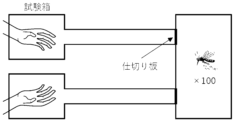
- FIG. 1 is a diagram showing how both arms are placed in a test box in Example 12.
- composition of the present invention provides an oral composition for repelling insects (hereinafter also referred to as the "composition of the present invention"), which contains 0.01% by weight to 1% by weight of citral, and also contains citric acid or a salt thereof, and a sweetener for aftersweetness or acesulfame K.
- citral used in the composition of the present invention may exist in the form of an adduct with water or various solvents, but in the present invention, these adducts are also referred to as citral.
- citral is an adduct with water or various solvents, the above content is expressed as the amount converted into a form without water or various solvents.
- the citral used in the composition of the present invention may be synthesized by a method known per se, or extracted from a plant such as lemongrass by a method known per se, isolated and purified, but commercially available products may also be used.
- the citral content is 0.01% to 1% by weight, preferably 0.01% to 0.5% by weight, and more preferably 0.02% to 0.1% by weight.
- the salts of citric acid used in the composition of the present invention include metal salts, ammonium salts, organic amine addition salts, amino acid addition salts, etc.
- metal salts include alkali metal salts such as sodium salts and potassium salts, alkaline earth metal salts such as magnesium salts and calcium salts, aluminum salts, zinc salts, etc.; examples of ammonium salts include ammonium salts and tetramethylammonium salts, etc.; examples of organic amine addition salts include addition salts of morpholine, piperidine, etc.; examples of amino acid addition salts include addition salts of glycine, phenylalanine, lysine, asparagine, glutamine, etc.
- citric acid When obtaining a salt of citric acid, if the citric acid is obtained in the form of a salt, it can be purified as is. If the citric acid is obtained in the free form, it can be isolated and purified by dissolving or suspending the citric acid in a suitable solvent and adding an acid or base.
- Citric acid or its salts may also exist in the form of adducts with water or various solvents, but in the present invention, these adducts are also referred to as citric acid or its salts.
- the citric acid or salt thereof used in the composition of the present invention may be synthesized by a method known per se, but a commercially available product may also be suitably used.
- the after-sweetening sweetener used in the composition of the present invention refers to a sweetener whose sweetness is expressed later than sucrose, and examples thereof include aspartame, advantame, sucralose, neotame, or salts thereof, thaumatin, stevia, licorice, etc.
- aspartame or a salt thereof, advantame or a salt thereof, sucralose or a salt thereof, or stevia are preferred, and aspartame or a salt thereof, or sucralose or a salt thereof are even more preferred.
- the timing at which sweetness appears can be evaluated using the Time-Intensity Method (TI method) (Kato Yoshiko, Ikawa Yoshiko, "Evaluation of sweetness characteristics using the Time-Intensity Method (TI method) -- for sucrose, xylitol, erythritol, and sorbitol," Yasuda Women's University Bulletin / Yasuda Women's University, Yasuda Women's Junior College, 2008, No. 36, pp. 169-173, etc.).
- TI method Time-Intensity Method
- Salts of aspartame, advantame, sucralose, neotame, etc. include acid addition salts, metal salts, ammonium salts, organic amine addition salts, amino acid addition salts, etc.
- Acid addition salts include inorganic acid salts such as hydrochloride, sulfate, hydrobromide, nitrate, phosphate, etc.; organic acid salts such as acetate, mesylate, succinate, maleate, fumarate, citrate, tartrate, etc.; metal salts include alkali metal salts such as sodium salt, potassium salt, etc.; alkaline earth metal salts such as magnesium salt, calcium salt, aluminum salt, zinc salt, etc.; ammonium salts include ammonium salt, tetramethylammonium salt, etc.; organic amine addition salts include addition salts of morpholine, piperidine, etc.; amino acid addition salts include addition salts of glycine, phenylalanine, lysine, asparagine, glutamine, aspartic acid, glutamic acid, etc.
- the sweeteners when obtained in the form of a salt, they can be purified as is. If they are obtained in the form of a free form, the free form can be dissolved or suspended in an appropriate solvent, and an acid or base can be added to isolate and purify the salts.
- after-sweetening sweeteners or acesulfame K may exist in the form of adducts with water or various solvents, but in the present invention, these adducts are also included and are referred to as after-sweetening sweeteners or acesulfame K.
- aftersweetener or acesulfame K may include embodiments that contain both an aftersweetener and acesulfame K, and “aftersweetener” may include multiple types of aftersweeteners.
- the after-sweetening sweetener or acesulfame K used in the composition of the present invention may be synthesized by a method known per se, or extracted from plants or animals by a method known per se, isolated and purified, or commercially available products may be suitably used.
- composition of the present invention may be various compositions such as pharmaceuticals, quasi-drugs, and foods (including beverages).
- the composition of the present invention is a food.
- the food may be provided as, for example, a health functional food, a food for specified health uses, a nutritional functional food, a dietary supplement, a nutritional supplement, a health supplement, a medical food, a medical food, etc.
- Insects that may be used in the "insect repellent composition of the present invention” include mosquitoes such as Aedes albopictus, Aedes aegypti, Culex pipiens, Culex mosquito, Anopheles, Aedes, and midges, as well as flies, moths, horseflies, blackflies, fleas, mites, bees, ants, cockroaches, lice, and stink bugs, with mosquitoes being preferred, and Aedes albopictus, Aedes aegypti, Culex pipiens, Culex mosquito, Anopheles, and Aedes mosquito being more preferred.
- mosquitoes such as Aedes albopictus, Aedes aegypti, Culex pipiens, Culex mosquito, Anopheles, and Aedes mosquito being more preferred.
- insect repellent in the “insect repellent composition of the present invention” broadly means preventing insects from harming the subject of administration of the composition of the present invention, and specifically includes, for example, keeping insects away, driving away insects, and preventing them from sucking blood, both indoors and outdoors.
- Subjects that may receive the composition of the present invention include humans, dogs, cats, rabbits, horses, cows, sheep, pigs, goats, chickens, mice, quails, etc., with humans being preferred.
- the present invention provides a composition of the present invention, in which citral is administered at 0.001 mg/kg body weight or more and 0.5 mg/kg body weight or less per dose.
- the amount of citral administered at a single dose is more preferably 0.005 mg/kg body weight or more and less than 0.1 mg/kg body weight, even more preferably 0.01 mg/kg body weight or more and less than 0.1 mg/kg body weight, and particularly preferably 0.01 mg/kg body weight or more and 0.05 mg/kg body weight or less.
- citral is an adduct with water or various solvents
- the above dose is expressed as the amount converted into a form without water or various solvents.
- the present invention provides a composition of the present invention, in which citric acid or a salt thereof is administered at a dose of 0.1 mg/kg body weight or more and 10 mg/kg body weight or less in citric acid equivalent per administration.
- the dose of citric acid or a salt thereof per administration is more preferably 0.2 mg/kg body weight or more and 5 mg/kg body weight or less, and even more preferably 0.3 mg/kg body weight or more and 1 mg/kg body weight or less, in citric acid equivalent.
- citric acid or a salt thereof is an adduct with water or various solvents, the above dose is expressed as the amount converted into a form without water or various solvents.
- the present invention provides a composition of the present invention, in which the aftersweetening sweetener or acesulfame K is administered at 0.01 mg/kg body weight or more and 5 mg/kg body weight or less per administration.
- the dosage of the aftersweetening sweetener or acesulfame K per administration is more preferably 0.03 mg/kg body weight or more and 3 mg/kg body weight or less, and even more preferably 0.05 mg/kg body weight or more and 2 mg/kg body weight or less.
- the aftersweetening sweetener is in the form of a salt, the dosage is expressed as the amount converted into the free form.
- the aftersweetening sweetener or acesulfame K is an adduct with water or various solvents, the dosage is expressed as the amount converted into the form without water or various solvents.
- the present invention provides a composition of the present invention, in which the ratio (W2/W1) of the content (W2) of citric acid or a salt thereof to the content (W1) of citral is 10 to 100.
- the ratio (W2/W1) of the content (W2) of citric acid or a salt thereof to the content (W1) of citral is more preferably 10 to 90, and even more preferably 15 to 80.
- the above ratio is expressed as the amount converted into a free form.
- the above ratio is expressed as the amount converted into a form without water or various solvents.
- the present invention provides a composition of the present invention, in which the ratio (W3/W1) of the content (W3) of the aftersweet sweetener or acesulfame K to the content (W1) of citral is 1 to 100.
- the ratio (W3/W1) of the content (W3) of the aftersweet sweetener or acesulfame K to the content (W1) of citral is more preferably 2 to 80, and even more preferably 3 to 60.
- the aftersweet sweetener or acesulfame K is in the form of a salt, the above ratio is expressed as the amount converted into the free form.
- the citral, aftersweet sweetener, or acesulfame K is an adduct with water or various solvents
- the above ratio is expressed as the amount converted into the form without water or various solvents.
- composition of the present invention include solid forms (tablets, chewable tablets, granules, powders, capsules, etc.), pastes, liquids, suspensions, emulsions, etc., but solid forms such as tablets are preferred.
- composition of the present invention may further contain other components to the extent that the effects of the present invention are not impaired.
- the other components can be appropriately selected depending on the form of the composition described above, and examples include diluents, excipients, disintegrants, lubricants, binders, surfactants, water, physiological saline, vegetable oil solubilizers, isotonicity agents, preservatives, antioxidants, etc.
- One or more types of other components can be contained as necessary.
- the other components can be contained in the composition of the present invention at a concentration of, for example, a total amount of 0.001% by weight to 30% by weight, preferably 0.01% by weight to 20% by weight, and more preferably 0.1% by weight to 10% by weight.
- composition of the present invention can be produced by adding other ingredients as necessary to 0.01% by weight to 1% by weight of citral, citric acid or a salt thereof, and an aftersweetener or acesulfame K, and mixing them as is, or by other manufacturing methods commonly used in the fields of pharmaceuticals, quasi-drugs, or food. There are no particular restrictions on the order in which these ingredients are added, and they can be set appropriately depending on the purpose of use.
- Insect repellent method provides an insect repellent method (hereinafter referred to as "insect repellent method"), which comprises administering citral in a single dose of 0.001 mg/kg body weight or more and 0.5 mg/kg body weight or less.
- the present invention also provides a method for producing a citral-containing oral composition (hereinafter referred to as "the production method of the present invention") and a method for reducing an off-flavor derived from citral in a citral-containing oral composition (hereinafter referred to as "the off-flavor reducing method of the present invention”), the method comprising the step of adding citric acid or a salt thereof to the composition so that its content in the composition is 0.1% by weight to 10% by weight, and adding an aftersweetener or acesulfame K to the composition so that its content in the composition is 0.01% by weight to 10% by weight, in producing an oral composition containing 0.01% by weight to 10% by weight of citral.
- off-flavor reduction refers to the reduction of the off-flavor characteristic of citral, which exhibits off-flavors such as a characteristic bitterness and irritation to the tongue when eaten.
- off-flavor characteristic of citral is reduced refers to any of the following states: (1) there is no off-flavor characteristic of citral and the sensory quality is favorable, (2) the off-flavor characteristic of citral is tolerable, or (3) the off-flavor characteristic of citral is strongly felt but tolerable.
- Reference Example 1 Measurement of Citral Evaporation from Skin
- Food additive grade citral (Citral-Natural, ⁇ 96%, FCC, FG, Sigma Aldrich) (3 mg) was dissolved in olive oil (AJINOMOTO Olive Oil, J-Oil Mills Co., Ltd.) (5 mL) (solution), and five subjects (60 kg or more and less than 100 kg) orally ingested the solution.
- olive oil AJINOMOTO Olive Oil, J-Oil Mills Co., Ltd.
- five subjects 60 kg or more and less than 100 kg orally ingested three tablets prepared in Example 7 described below. In this case, the subjects chewed and ingested each tablet.
- a skin gas collection bag was attached to one hand of the subject, and gas evaporated from the hand 0 to 1, 1 to 2, and 2 to 4 hours after oral administration of citral was collected in the bag.
- the collected gas was washed with 10 mL of 25% ethanol, and the amount of citral in the washing solution (citral evaporation amount) was measured by gas chromatography mass spectrometer.
- the conditions for gas chromatography mass spectrometry are as follows. Apparatus: GCMS-QP2020 (Shimadzu Corporation), Autosampler: AOC-6000Plus (Autosampler) Injection method: solid phase microextraction method, maintained at 60° C.
- Example 1 (Mosquito repellent effect when ingesting citral)
- Food additive grade citral (Citral-Natural, ⁇ 96%, FCC, FG, Sigma Aldrich) (3 mg) was dissolved in olive oil (AJINOMOTO Olive Oil, J-Oil Mills Co., Ltd.) (5 mL) and orally administered to three subjects (60 kg or more and less than 100 kg).
- olive oil AJINOMOTO Olive Oil, J-Oil Mills Co., Ltd.
- the left and right arms of each subject were inserted into a box containing 100 mosquitoes for 20 minutes.
- ingesting citral provided the same blood-sucking repellent rate as insect repellent sprays and aromatic sprays, confirming that ingesting citral has the same mosquito repellent effect as insect repellent sprays and aromatic sprays.
- Citral is mixed with higher aliphatic aldehydes, ketones, fatty acids, higher aliphatic alcohols, sugar, maltodextrin, starch sodium octenylsuccinate, propylene glycol, and mixed tocopherol to adjust the citral content in the mixture to 16%, and then powdered.
- tablets containing powdered citral, citric acid, and aspartame, acesulfame K, sucralose, or stevia as an after-sweetener or acesulfame K did not have the off-flavor specific to citral or had an acceptable range and had favorable sensory quality.
- Examples 7 to 9 and Comparative Example 8 sensor evaluation with different amounts of citric acid
- Each component including powdered citral was weighed, sieved, mixed, and compressed into tablets in the formulation shown in Table 5 to obtain tablets of 1 g each.
- a sensory evaluation for off-flavors was performed by four experienced evaluators through a discussion using the evaluation scale shown in Table 4. The results are shown in Table 5.
- Example 12 (Mosquito repellent effect when ingesting citral) Female mosquitoes (showing blood-sucking behavior) before egg laying were prepared at Mostop Co., Ltd., and 100 mosquitoes were placed in a box separated by a partition. The subjects (60 kg or more and less than 100 kg) placed both arms (up to the forearms) in the test box as shown in Figure 1 approximately 3 minutes before the start of the test, and bands were attached to the arms to prevent the mosquitoes from escaping. The partition was then removed to start the first test (before eating), and the number of mosquitoes entering the test box and the number of mosquitoes landing on the subjects were recorded every minute for 20 minutes.
- the first test After the first test was completed, the number of mosquitoes with blood pooled in their abdomens was counted and used as the number of blood-sucked mosquitoes. All 100 mosquitoes were collected, and the partition was installed again. 20 minutes after the end of the first test, the subjects were made to ingest three 1 g tablets prepared in Example 7. 100 mosquitoes were placed in the box with the partition again, and the second test (0-1 hour) was conducted for 20 minutes 20 minutes after the tablet intake in the same manner as the first test. After replacing the mosquitoes, the third test (1-2 hours) was conducted for 20 minutes 80 minutes after the tablet intake. After replacing the mosquitoes, the fourth test (3-4 hours) was conducted for 20 minutes 200 minutes after the tablet intake.
- Entry rate (%) 100 x average number of entries during each test / average number of entries during the first test.
- Landing rate (%) 100 x average number of landings during each test / average number of landings during the first test.
- Blood-sucking rate (%) 100 x average number of blood-sucked during each test / average number of blood-sucked during the first test.
- Blood-sucking ratio (%) 100 x average number of blood-sucked / average number of landings.
- the present invention can provide an oral composition for insect repellency containing citral that reduces the unpleasant taste caused by citral when eaten and has an excellent balance of sweetness and sourness. Therefore, the present invention is useful in the food industry.
Landscapes
- Health & Medical Sciences (AREA)
- Chemical & Material Sciences (AREA)
- Life Sciences & Earth Sciences (AREA)
- Engineering & Computer Science (AREA)
- Animal Behavior & Ethology (AREA)
- Veterinary Medicine (AREA)
- Public Health (AREA)
- General Health & Medical Sciences (AREA)
- Medicinal Chemistry (AREA)
- Pharmacology & Pharmacy (AREA)
- Epidemiology (AREA)
- General Chemical & Material Sciences (AREA)
- Oil, Petroleum & Natural Gas (AREA)
- Chemical Kinetics & Catalysis (AREA)
- Nutrition Science (AREA)
- Food Science & Technology (AREA)
- Polymers & Plastics (AREA)
- Proteomics, Peptides & Aminoacids (AREA)
- Biochemistry (AREA)
- Molecular Biology (AREA)
- Botany (AREA)
- Acyclic And Carbocyclic Compounds In Medicinal Compositions (AREA)
Priority Applications (1)
| Application Number | Priority Date | Filing Date | Title |
|---|---|---|---|
| JP2024554561A JPWO2024096064A1 (https=) | 2022-11-02 | 2023-11-01 |
Applications Claiming Priority (2)
| Application Number | Priority Date | Filing Date | Title |
|---|---|---|---|
| JP2022-176405 | 2022-11-02 | ||
| JP2022176405 | 2022-11-02 |
Publications (1)
| Publication Number | Publication Date |
|---|---|
| WO2024096064A1 true WO2024096064A1 (ja) | 2024-05-10 |
Family
ID=90930654
Family Applications (1)
| Application Number | Title | Priority Date | Filing Date |
|---|---|---|---|
| PCT/JP2023/039443 Ceased WO2024096064A1 (ja) | 2022-11-02 | 2023-11-01 | 虫よけ用経口組成物 |
Country Status (2)
| Country | Link |
|---|---|
| JP (1) | JPWO2024096064A1 (https=) |
| WO (1) | WO2024096064A1 (https=) |
Citations (6)
| Publication number | Priority date | Publication date | Assignee | Title |
|---|---|---|---|---|
| JPH06279269A (ja) * | 1993-03-30 | 1994-10-04 | Takeda Shokuhin Kogyo Kk | 発癌プロモーション抑制組成物 |
| JP2007039610A (ja) * | 2005-08-05 | 2007-02-15 | Asahi Breweries Ltd | レモンフレーバーの香気劣化抑制方法およびその飲料 |
| JP2010001285A (ja) * | 2008-05-21 | 2010-01-07 | Daiichi Sankyo Healthcare Co Ltd | 内服用虫よけ剤 |
| JP2014090676A (ja) * | 2012-10-31 | 2014-05-19 | Kirin Beverage Corp | トリテルペンまたはその配糖体の呈味改善剤 |
| WO2015053337A1 (ja) * | 2013-10-09 | 2015-04-16 | 味の素株式会社 | ヒスチジンを含有する食品およびその用途 |
| JP2022098308A (ja) * | 2020-12-21 | 2022-07-01 | 味の素株式会社 | アスパラギン酸又はその塩を主成分とする粉粒体経口組成物 |
-
2023
- 2023-11-01 JP JP2024554561A patent/JPWO2024096064A1/ja active Pending
- 2023-11-01 WO PCT/JP2023/039443 patent/WO2024096064A1/ja not_active Ceased
Patent Citations (6)
| Publication number | Priority date | Publication date | Assignee | Title |
|---|---|---|---|---|
| JPH06279269A (ja) * | 1993-03-30 | 1994-10-04 | Takeda Shokuhin Kogyo Kk | 発癌プロモーション抑制組成物 |
| JP2007039610A (ja) * | 2005-08-05 | 2007-02-15 | Asahi Breweries Ltd | レモンフレーバーの香気劣化抑制方法およびその飲料 |
| JP2010001285A (ja) * | 2008-05-21 | 2010-01-07 | Daiichi Sankyo Healthcare Co Ltd | 内服用虫よけ剤 |
| JP2014090676A (ja) * | 2012-10-31 | 2014-05-19 | Kirin Beverage Corp | トリテルペンまたはその配糖体の呈味改善剤 |
| WO2015053337A1 (ja) * | 2013-10-09 | 2015-04-16 | 味の素株式会社 | ヒスチジンを含有する食品およびその用途 |
| JP2022098308A (ja) * | 2020-12-21 | 2022-07-01 | 味の素株式会社 | アスパラギン酸又はその塩を主成分とする粉粒体経口組成物 |
Also Published As
| Publication number | Publication date |
|---|---|
| JPWO2024096064A1 (https=) | 2024-05-10 |
Similar Documents
| Publication | Publication Date | Title |
|---|---|---|
| EP2292224B1 (de) | Lactisolverbindungen zur Prävention oder Behandlung von Diabetes | |
| US20080214675A1 (en) | Hydroxybenzoic Acid Amides and the Use Thereof For Masking Bitter Taste | |
| US11612575B2 (en) | Combination therapies with disulfiram | |
| JP2002360188A (ja) | 苦味を遮蔽するためのヒドロキシフラバノン類の使用 | |
| JPH04228033A (ja) | フレーバー増強薬品味覚マスキング剤 | |
| JPH09194370A (ja) | 内服液剤 | |
| TW200918060A (en) | Medical composition containing rebamipide | |
| JP4045182B2 (ja) | 液体調味料 | |
| JPH09104625A (ja) | ビオチン含有内服液剤 | |
| JP4501024B2 (ja) | システイン類の苦味及び臭気が軽減された組成物 | |
| CN106659215A (zh) | 甜味受体拮抗剂组合物 | |
| JP5730980B2 (ja) | 内服用虫よけ剤 | |
| DE102012214560A1 (de) | Bestimmte Lignane und deren Verwendung als Geschmacksverbesserer | |
| US20180035675A1 (en) | Composition of a novel topical insect repellent powder formulation | |
| WO2024096064A1 (ja) | 虫よけ用経口組成物 | |
| JP4972719B2 (ja) | アスパラガス属植物の擬葉組織の乾燥粉末を製造する方法 | |
| US20210400960A1 (en) | Insect repellent composition | |
| JP4955287B2 (ja) | ペオニフロリン含有ゼリー製剤 | |
| JP2003192585A (ja) | 口腔用組成物 | |
| EP2046387A1 (de) | Geschmacksmaskierung von salzhaltigen zusammensetzungen | |
| EP3911172B1 (de) | Kombination von sättigungskomponenten mit arginin | |
| WO1999021425A1 (en) | Trigeminal sensory stimuli and animal repellents from plants | |
| JPWO2017068805A1 (ja) | 唾液分泌促進剤、これを含有する口腔用組成物及び飲料用組成物 | |
| JP4895422B2 (ja) | 呼気清涼化剤 | |
| JP2021505151A (ja) | 甘味料としてのトリプトファン誘導体 |
Legal Events
| Date | Code | Title | Description |
|---|---|---|---|
| 121 | Ep: the epo has been informed by wipo that ep was designated in this application |
Ref document number: 23885818 Country of ref document: EP Kind code of ref document: A1 |
|
| WWE | Wipo information: entry into national phase |
Ref document number: 2024554561 Country of ref document: JP |
|
| NENP | Non-entry into the national phase |
Ref country code: DE |
|
| REG | Reference to national code |
Ref country code: BR Ref legal event code: B01A Ref document number: 112025008657 Country of ref document: BR |
|
| 122 | Ep: pct application non-entry in european phase |
Ref document number: 23885818 Country of ref document: EP Kind code of ref document: A1 |
|
| ENP | Entry into the national phase |
Ref document number: 112025008657 Country of ref document: BR Kind code of ref document: A2 Effective date: 20250430 |