WO2024096003A1 - 芳香族アミン化合物、液晶組成物、液晶素子、表示装置および調光装置 - Google Patents
芳香族アミン化合物、液晶組成物、液晶素子、表示装置および調光装置 Download PDFInfo
- Publication number
- WO2024096003A1 WO2024096003A1 PCT/JP2023/039232 JP2023039232W WO2024096003A1 WO 2024096003 A1 WO2024096003 A1 WO 2024096003A1 JP 2023039232 W JP2023039232 W JP 2023039232W WO 2024096003 A1 WO2024096003 A1 WO 2024096003A1
- Authority
- WO
- WIPO (PCT)
- Prior art keywords
- group
- liquid crystal
- aromatic
- formula
- aromatic amine
- Prior art date
- Legal status (The legal status is an assumption and is not a legal conclusion. Google has not performed a legal analysis and makes no representation as to the accuracy of the status listed.)
- Ceased
Links
Images

Classifications
-
- C—CHEMISTRY; METALLURGY
- C07—ORGANIC CHEMISTRY
- C07D—HETEROCYCLIC COMPOUNDS
- C07D321/00—Heterocyclic compounds containing rings having two oxygen atoms as the only ring hetero atoms, not provided for by groups C07D317/00 - C07D319/00
-
- C—CHEMISTRY; METALLURGY
- C09—DYES; PAINTS; POLISHES; NATURAL RESINS; ADHESIVES; COMPOSITIONS NOT OTHERWISE PROVIDED FOR; APPLICATIONS OF MATERIALS NOT OTHERWISE PROVIDED FOR
- C09K—MATERIALS FOR MISCELLANEOUS APPLICATIONS, NOT PROVIDED FOR ELSEWHERE
- C09K19/00—Liquid crystal materials
- C09K19/52—Liquid crystal materials characterised by components which are not liquid crystals, e.g. additives with special physical aspect: solvents, solid particles
- C09K19/58—Dopants or charge transfer agents
- C09K19/586—Optically active dopants; chiral dopants
-
- C—CHEMISTRY; METALLURGY
- C09—DYES; PAINTS; POLISHES; NATURAL RESINS; ADHESIVES; COMPOSITIONS NOT OTHERWISE PROVIDED FOR; APPLICATIONS OF MATERIALS NOT OTHERWISE PROVIDED FOR
- C09K—MATERIALS FOR MISCELLANEOUS APPLICATIONS, NOT PROVIDED FOR ELSEWHERE
- C09K19/00—Liquid crystal materials
- C09K19/52—Liquid crystal materials characterised by components which are not liquid crystals, e.g. additives with special physical aspect: solvents, solid particles
- C09K19/58—Dopants or charge transfer agents
- C09K19/586—Optically active dopants; chiral dopants
- C09K19/588—Heterocyclic compounds
-
- G—PHYSICS
- G02—OPTICS
- G02F—OPTICAL DEVICES OR ARRANGEMENTS FOR THE CONTROL OF LIGHT BY MODIFICATION OF THE OPTICAL PROPERTIES OF THE MEDIA OF THE ELEMENTS INVOLVED THEREIN; NON-LINEAR OPTICS; FREQUENCY-CHANGING OF LIGHT; OPTICAL LOGIC ELEMENTS; OPTICAL ANALOGUE/DIGITAL CONVERTERS
- G02F1/00—Devices or arrangements for the control of the intensity, colour, phase, polarisation or direction of light arriving from an independent light source, e.g. switching, gating or modulating; Non-linear optics
- G02F1/01—Devices or arrangements for the control of the intensity, colour, phase, polarisation or direction of light arriving from an independent light source, e.g. switching, gating or modulating; Non-linear optics for the control of the intensity, phase, polarisation or colour
- G02F1/13—Devices or arrangements for the control of the intensity, colour, phase, polarisation or direction of light arriving from an independent light source, e.g. switching, gating or modulating; Non-linear optics for the control of the intensity, phase, polarisation or colour based on liquid crystals, e.g. single liquid crystal display cells
Definitions
- the present invention relates to an aromatic amine compound, a liquid crystal composition, a liquid crystal element, a display device, and a light control device.
- Liquid crystal display devices are used in a variety of places, including personal computers and televisions. Backlights are used in liquid crystal display devices, and they hold the key to further reducing the power consumption of devices.
- Cholesteric liquid crystals are liquid crystals that can selectively reflect light, and reflective displays using them are devices that can control light with low power consumption.
- JP 2019-151597 A and J. Am. Chem. Soc., 2018, 140, 10946 propose using a compound in which ferrocene is introduced as a redox site into a binaphthyl skeleton, which is a chiral site, as a chiral dopant to form a cholesteric liquid crystal.
- the reflection wavelength of the cholesteric liquid crystal can be controlled by applying a voltage to a liquid crystal composition layer containing a chiral dopant into which ferrocene has been introduced, using a redox reaction.
- One aspect of the present invention aims to provide an aromatic amine compound that can serve as a chiral dopant that can be stably oxidized and reduced in a liquid crystal composition.
- the first aspect is an aromatic amine compound represented by the following formula (1):
- a 1 independently represents a substituted or unsubstituted alkylene group or a substituted or unsubstituted divalent aromatic group.
- a 2 and A 3 independently represent a substituted or unsubstituted alkyl group or a substituted or unsubstituted aromatic group. At least one of A 1 , A 2 and A 3 represents an aromatic group.
- s and t independently represent an integer of 0 to 6.
- R 1 and R 2 independently represent a substituent.
- p + s and q + t independently represent an integer of 0 to 6.
- T independently represents a divalent linking group formed from at least one selected from the group consisting of a carbonyl group, an oxygen atom, an imino group and an alkylene group.
- Q represents a trivalent linking group composed of at least one selected from the group consisting of an oxygen atom, a nitrogen atom, a carbon atom, a phosphorus atom, a sulfur atom and a hydrogen atom.
- the second aspect is a liquid crystal composition containing the aromatic amine compound of the first aspect.
- the third aspect is a liquid crystal element comprising a liquid crystal layer containing the liquid crystal composition of the second aspect and a pair of electrodes for applying a voltage to the liquid crystal layer.
- the fourth aspect is a display device or light control device comprising the liquid crystal element of the third aspect.
- an aromatic amine compound that can serve as a chiral dopant that can be stably oxidized and reduced in a liquid crystal composition.
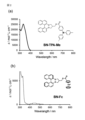
- 1A is an example of a cyclic voltammogram of the compound of Example 3 in terms of ferrocene standard
- FIG. 1B is an example of a cyclic voltammogram of the compound of Comparative Example 1 in terms of ferrocene standard
- 1A is an example of the absorption spectrum of the compound according to Example 3
- FIG. 1B is an example of the absorption spectrum of the compound according to Comparative Example 1.
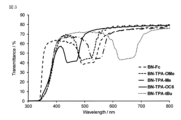
- 1 is an example of a transmission spectrum of a liquid crystal composition including compounds according to an example and a comparative example.
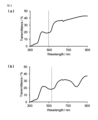
- 1A is an example of a transmission spectrum before application of a DC voltage
- FIG. 1B is an example of a transmission spectrum after application of a DC voltage.
- the term "process” includes not only independent processes, but also processes that cannot be clearly distinguished from other processes, as long as the intended purpose of the process is achieved.
- the content of each component in the composition means the total amount of the multiple substances present in the composition when multiple substances corresponding to each component are present in the composition, unless otherwise specified.
- the upper and lower limits of the numerical ranges described in this specification can be arbitrarily selected and combined from the numerical values exemplified as the numerical ranges. Below, the embodiments of the present invention are described in detail.
- the embodiments shown below are examples of aromatic amine compounds, liquid crystal compositions, liquid crystal elements, display devices, and light control devices for embodying the technical ideas of the present invention, and the present invention is not limited to the aromatic amine compounds, liquid crystal compositions, liquid crystal elements, display devices, and light control devices shown below.
- Aromatic amine compound The aromatic amine compound is represented by the following formula (1).
- the aromatic amine compound contains a binaphthyl skeleton as a chiral moiety and an aromatic amine skeleton as a redox moiety.
- the compound represented by the following formula (1) has an aromatic amine skeleton as a redox moiety, and thus can stably repeat an electrochemical redox reaction in the atmosphere, in a solution, in a liquid crystal composition, and the like. That is, the aromatic amine compound represented by formula (1) can reversibly express ionicity and nonionicity in response to an electric stimulus.
- such an optically active electric stimulus responsive compound can control the molecular arrangement of the helical structure of the cholesteric liquid crystal by an electric stimulus, for example, in a cholesteric liquid crystal.
- This allows the period (pitch) of the helical structure formed by the cholesteric liquid crystal to be controlled, and the wavelength of the circularly polarized light selectively reflected by the cholesteric liquid crystal to be controlled.
- the pitch of the helical structure is longer, light with a longer wavelength can be reflected, and if the pitch is shorter, light with a shorter wavelength can be reflected.
- the aromatic amine compound may be configured so as not to absorb in the visible light range. This allows, for example, a colorless liquid crystal composition that does not absorb in the visible light range to be formed. An aromatic amine compound that does not absorb in the visible light range can be obtained, for example, by appropriately selecting a substituent in the aromatic amine skeleton, a substituent in the binaphthyl skeleton, etc.
- a 1 each independently represents a substituted or unsubstituted alkylene group or a substituted or unsubstituted divalent aromatic group.
- a 2 and A 3 each independently represent a substituted or unsubstituted alkyl group or a substituted or unsubstituted aromatic group. At least one of A 1 , A 2 and A 3 represents an aromatic group.
- the alkylene group represented by A 1 may be linear, branched or cyclic, or may be a combination thereof.
- the number of carbon atoms of the alkylene group represented by A 1 may be, for example, 1 or more and 20 or less, preferably 1 or more or 10 or less.
- the divalent aromatic group represented by A 1 is formed by removing two hydrogen atoms from an aromatic hydrocarbon compound or an aromatic heterocyclic compound.
- the aromatic hydrocarbon compound may have 6 to 18 carbon atoms, preferably 6 carbon atoms.
- the aromatic hydrocarbon compound may contain at least one selected from the group consisting of benzene, naphthalene and anthracene.
- the aromatic heterocyclic compound may contain at least one selected from the group consisting of nitrogen atom, oxygen atom and sulfur atom as a heteroatom.
- the number of members of the aromatic heterocyclic compound may be, for example, 5 or more and 10 or less, preferably 6 or less.
- the aromatic heterocyclic compound may contain at least one selected from the group consisting of pyridine, furan and thiophene. When a plurality of alkylene groups or divalent aromatic groups represented by A 1 are present in the aromatic amine compound, they may be the same or different.
- the alkylene group or divalent aromatic group represented by A 1 may have a substituent.
- the substituent in A 1 may be at least one type of substituent selected from the group consisting of a substituted or unsubstituted hydrocarbon group, a nitro group, a cyano group, a halogen atom, a hydroxy group, an alkoxy group, an acyl group, an alkoxycarbonyl group, a carboxy group, an aliphatic amino group, and an aromatic amino group.
- the hydrocarbon group in the substituent may be an aliphatic group or an aromatic group.
- the aliphatic group may be a saturated aliphatic group or an unsaturated aliphatic group.
- the aliphatic group may be linear, branched, or cyclic, or may be a combination of these.
- the carbon number of the aliphatic group may be, for example, 1 to 20 carbon atoms, preferably 1 to 10 or 1 to 6.
- Examples of the substituent in the aliphatic group include a halogen atom, an aryl group, and an alkoxy group.
- the carbon number of the aromatic group may be, for example, 6 to 18, and preferably 6.
- Examples of the substituent in the aromatic group include a halogen atom, an aliphatic group having 1 to 20 carbon atoms, an alkoxy group, an acyl group, and an alkoxycarbonyl group.
- the halogen atoms in the substituents may include fluorine atoms, chlorine atoms, bromine atoms, etc.
- the alkoxy groups as the substituents may have an aliphatic group having 1 to 20 carbon atoms, preferably an aliphatic group having 1 to 10 carbon atoms.
- the acyl groups as the substituents may have an aliphatic group having 1 to 20 carbon atoms, preferably an aliphatic group having 1 to 6 carbon atoms.
- the alkoxycarbonyl groups as the substituents may have an aliphatic group having 1 to 20 carbon atoms, preferably an aliphatic group having 1 to 6 carbon atoms.
- the aliphatic group in the aliphatic amino group as a substituent may be a saturated aliphatic group or an unsaturated aliphatic group.
- the aliphatic group may be linear, branched, or cyclic, or may be a combination of these.
- the number of carbon atoms in the aliphatic group may be, for example, 1 to 20, preferably 1 to 10, or 1 to 6.
- the aliphatic amino group may be a mono-substituted aliphatic amino group having one aliphatic group, or a di-substituted aliphatic amino group having two aliphatic groups.
- the aliphatic amino group may further have a substituent in the aliphatic group portion.
- substituent in the aliphatic group examples include a halogen atom, an aryl group, an alkoxy group, an alkylamino group, and an arylamino group.
- the number of substitutions in the aliphatic group may be, for example, 0 to 20, preferably 10 or less.
- the aromatic group in the aromatic amino group as a substituent may be an aromatic hydrocarbon group or an aromatic heterocyclic group.
- the number of carbon atoms in the aromatic hydrocarbon group may be, for example, 6 to 18, and preferably 6 to 12.
- the aromatic hydrocarbon group may contain at least one selected from the group consisting of a phenyl group, a naphthyl group, and an anthracenyl group.
- the aromatic heterocyclic group may contain at least one heteroatom selected from the group consisting of a nitrogen atom, an oxygen atom, and a sulfur atom.
- the number of members in the aromatic heterocyclic group may be, for example, 5 to 10, and preferably 6 or less.
- the aromatic heterocyclic group may contain at least one selected from the group consisting of a pyridyl group, a furyl group, and a thienyl group.
- the aromatic amino group may be a mono-substituted aromatic amino group having one aromatic group, or a di-substituted aromatic amino group having two aromatic groups.
- the aromatic amino group may further have a substituent in the aromatic group portion. Examples of the substituent in the aromatic group include a halogen atom, an aryl group, an alkoxy group, an alkylamino group, an arylamino group, and an alkyl group.
- the number of substitutions in the aromatic group may be, for example, 0 to 8, preferably 5 or less.
- the number of substitutions in the alkylene group or divalent aromatic group represented by A 1 may be, for example, 0 or more and 20 or less, and preferably 4 or less.
- the alkyl group represented by A2 or A3 may be linear, branched or cyclic, or may be a combination of these.
- the number of carbon atoms of the alkyl group represented by A2 or A3 may be, for example, 1 or more and 20 or less, preferably 1 or more or 6 or less.
- the aromatic group represented by A2 or A3 is formed by removing one hydrogen atom from an aromatic hydrocarbon compound or an aromatic heterocyclic compound.
- the details of the aromatic hydrocarbon compound and the aromatic heterocyclic compound are the same as those of the aromatic hydrocarbon compound and the aromatic heterocyclic compound in A1 .
- when there are a plurality of alkyl groups or aromatic groups represented by A2 or A3 in the aromatic amine compound they may be the same or different.
- the alkyl group or aromatic group represented by A2 or A3 may have a substituent.
- the substituent in A2 or A3 is the same as the substituent in A1 .
- the number of substitutions in the alkyl group or aromatic group represented by A2 or A3 may be, for example, 0 to 20, and preferably 5 or less.
- At least one of the aromatic groups represented by A2 or A3 may have a substituent, and may have an aromatic amino group as a substituent.
- the aromatic amino group substituting the aromatic group represented by A2 or A3 may be a disubstituted aromatic amino group, and the aromatic group in the aromatic amino group may further have a substituent.
- the substituent in the aromatic group include a halogen atom, an aryl group, an alkoxy group, an alkylamino group, an arylamino group, and an alkyl group.
- the number of substitutions in the aromatic group may be, for example, 0 to 9, and preferably 1 to 5.
- At least one of A 1 , A 2 and A 3 represents an aromatic group, but preferably at least two may be aromatic groups, and more preferably three may be aromatic groups. In addition, among A 1 , A 2 and A 3 , at least A 1 may be an aromatic group, and at least one of A 2 and A 3 may be an aromatic group.
- s and t each independently represent an integer from 0 to 6.
- they may be an integer of 5 or less, or an integer of 2 or less, or may be an integer of 1 or more.
- p and q each independently represent an integer from 0 to 6.
- they may be an integer of 5 or less, or an integer of 2 or less, or may be an integer of 1 or more.
- p+s and q+t each independently represent an integer from 0 to 6.
- they may be an integer of 5 or less, or an integer of 2 or less, or may be an integer of 1 or more.
- R1 and R2 each independently represent a substituent.
- substituent represented by R1 or R2 include the same as the substituent in A1 .
- substituents represented by R1 or R2 may be the same or different.
- Each T independently represents a divalent linking group formed from at least one selected from the group consisting of a carbonyl group, an oxygen atom, an imino group, and an alkylene group.
- the imino group in T may be substituted with a hydrocarbon group.
- the hydrocarbon group substituting the imino group is the same as the hydrocarbon group in the substituent of A 1.
- the alkylene group in T may be linear, branched, or cyclic, or may be a combination thereof.
- the number of carbon atoms in the alkylene group in T may be, for example, 1 to 20, preferably 10 or less, or 6 or less.
- the divalent linking group represented by T may be a carbonyl group, an oxygen atom, an imino group, or an alkylene group, and may include, for example, an ester bond formed by the bonding of a carbonyl group and an oxygen atom, an amide bond, a urea bond, a urethane bond, or the like formed by the bonding of a carbonyl group and an imino group, or an ether bond formed by the bonding of an oxygen atom and an alkylene group.
- an aromatic amine compound when a plurality of divalent linking groups represented by T are present, they may be the same or different.
- the divalent linking group represented by T may be formed containing at least a carbonyl group.
- Specific examples of the divalent linking group represented by T include a carbonyl group, an oxygen atom, an imino group, an alkylene group, a carbonyloxy group, an oxycarbonyl group, an alkylenecarbonyloxy group, an alkyleneoxycarbonyl group, a carbonyloxyalkylene group, an oxycarbonylalkylene group, an iminocarbonyl group, an alkyleneiminocarbonyl group, a carbonylimino group, a carbonyliminoalkylene group, an alkyleneoxy group, an oxyalkylene group, an iminocarbonylimino group, an oxycarbonylimino group, an iminocarbonyloxy group, and the like.
- Preferred examples of the divalent linking group represented by T include a carbonyloxy group, an oxycarbonyl group, and an oxygen atom, and the like.
- Q represents a trivalent linking group composed of at least one atom selected from the group consisting of oxygen atoms, nitrogen atoms, carbon atoms, phosphorus atoms, sulfur atoms, and hydrogen atoms.
- Q may be, for example, a trivalent linking group represented by the following formula (2a) or (2b).
- X 1 , X 2 and X 3 each independently include at least one selected from the group consisting of an oxygen atom, a sulfur atom, -C(R 3 )(R 4 )- and -N(R 5 )-.
- R 3 , R 4 and R 5 each independently represent a hydrogen atom, a substituted or unsubstituted alkyl group, or a substituted or unsubstituted aromatic group.
- Y 1 and Y 2 each independently represent one selected from the group consisting of a substituted or unsubstituted alkanetriyl group, a nitrogen atom and -P( ⁇ O)(O-)-.
- the alkyl group represented by R3 , R4 or R5 may be linear, branched or cyclic, or may be a combination of these.
- the number of carbon atoms of the alkyl group represented by R3 , R4 or R5 may be, for example, 1 or more and 20 or less, preferably 6 or less.
- the aromatic group represented by R3 , R4 or R5 is formed by removing one hydrogen atom from an aromatic hydrocarbon compound or an aromatic heterocyclic compound.
- the aromatic hydrocarbon compound or aromatic heterocyclic compound is as described above.
- the substituent in R3 , R4 or R5 is the same as the substituent in A1 .
- the alkanetriyl group represented by Y1 or Y2 is formed by removing three hydrogen atoms from an alkane.
- the number of carbon atoms in the alkane forming the alkanetriyl group may be, for example, 1 to 20, and preferably 6 or less.
- the substituent in Y1 or Y2 is the same as the substituent in A1 .
- trivalent linking group represented by formula (2a) include the following linking groups, but the present invention is not limited thereto.
- X1 and X2 may be bonded to the binaphthyl moiety in formula (1), and Y1 may be bonded to T in formula (1).
- trivalent linking group represented by formula (2b) include the following linking groups, but the present invention is not limited thereto.
- X3 and Y2 may be bonded to the binaphthyl moiety in formula (1), and Y2 may be bonded to T in formula (1).
- the trivalent linking group represented by Q may be preferably represented by formula (2a), and more preferably, in formula (2a), X 1 and X 2 may be oxygen atoms, and Y 1 may be a propane-1,2,3-triyl group.
- the aromatic amine compound represented by formula (1) can be produced, for example, as follows. A dihaloalkane having a substituent is reacted with 1,1'-bi(2-naphthol) to introduce a trivalent linking group represented by Q, and an aromatic amine derivative is linked to the trivalent linking group represented by Q by a condensation reaction, substitution reaction, coupling reaction, or the like, to produce a compound represented by formula (1).
- an aromatic amine derivative can be linked to the naphthyl ring by using 1,1'-bi(2-naphthol) having an appropriate substituent on the naphthyl ring.
- the liquid crystal composition contains at least one aromatic amine compound represented by the above formula (1).
- the liquid crystal composition containing the aromatic amine compound represented by formula (1) can, for example, exhibit cholesteric liquid crystal.
- the liquid crystal composition exhibits selective reflection, and can change the selective reflection wavelength by an oxidation-reduction reaction caused by an electric field.
- the content of the compound represented by formula (1) in the liquid crystal composition may be, for example, 0.1 mol % or more and 10 mol % or less, and preferably 0.5 mol % or more and 5 mol % or less.
- the liquid crystal composition may contain the aromatic amine compound represented by the above formula (1) as a liquid crystal compound, or may contain a liquid crystal compound different from the aromatic amine compound represented by the above formula (1) as a host liquid crystal, and may contain the aromatic amine compound represented by the formula (1) as a chiral dopant.
- Liquid crystal compounds constituting the liquid crystal composition include liquid crystal compounds exhibiting a nematic phase and liquid crystal compounds exhibiting a smectic phase, and liquid crystal compounds exhibiting a nematic phase are preferred.
- Specific examples of liquid crystal compounds include azomethine compounds, cyanobiphenyl compounds, cyanophenyl ester compounds, fluorine-substituted phenyl ester compounds, cyclohexane carboxylic acid phenyl ester compounds, fluorine-substituted cyclohexane carboxylic acid phenyl ester compounds, cyanophenylcyclohexane compounds, fluorine-substituted phenylcyclohexane compounds, cyanophenylpyrimidine compounds, fluorine-substituted phenylpyrimidine compounds, alkoxyphenylpyrimidine compounds, fluorine-substituted alkoxyphenylpyrimidine compounds, phenyldi
- liquid crystal compounds For details of liquid crystal compounds, see, for example, the descriptions in Liquid Crystal Device Handbook, edited by the 142nd Committee of the Japan Society for the Promotion of Science, Nikkan Kogyo Shimbun, 1989, pages 154 to 192 and 715 to 722, etc.
- the liquid crystal composition may further contain an electrolyte.
- an electrolyte By including an electrolyte, the liquid crystal composition can be made conductive, and the redox reaction of the compound represented by formula (1) becomes easier.
- the electrolyte may be a supporting electrolyte constituting the liquid crystal composition, and may be selected from compounds having high solubility in the host liquid crystal.
- the electrolyte may be a supporting electrolyte generally used in electrochemistry (e.g., nBu 4 NPF 6 , nBu 4 NBF 4 , nBu 4 NClO 4 , etc.), an ionic liquid, etc.
- the ionic liquid examples include 1-ethyl-3-methylimidazolium triflate, 1-ethyl-3-methylimidazolium hexafluorophosphate, etc.
- the liquid crystal composition may contain only one type of electrolyte, or a combination of two or more types.
- the content of the electrolyte in the liquid crystal composition may be, for example, 0.1 mol% to 30 mol%, and preferably 0.5 mol% to 15 mol%.
- liquid crystal and non-liquid crystal compounds can be added to the liquid crystal composition in order to change the physical properties of the host liquid crystal (for example, the temperature range of the liquid crystal phase) to a desired range and to promote redox reactions.
- additives such as ultraviolet absorbers and antioxidants may be added.
- the liquid crystal composition may contain a chiral dopant other than the aromatic amine compound represented by formula (1).
- the liquid crystal element is configured to include a liquid crystal layer containing the above liquid crystal composition and a pair of electrodes for applying a voltage to the liquid crystal layer.
- the liquid crystal element can exhibit, for example, a reflected color due to the development of cholesteric liquid crystal.
- the reflected color can be changed.
- the liquid crystal element may include a liquid crystal layer, a pair of substrates that hold the liquid crystal layer, and an electrode disposed on at least one of the substrates that applies a voltage to the liquid crystal layer.
- the liquid crystal element may further include a black plate, an anti-reflection film, a brightness enhancement film, etc., as necessary.
- the substrate that constitutes the liquid crystal element may be made of glass, plastic, etc.
- plastics that can be used for the substrate include acrylic resin, polycarbonate resin, epoxy resin, polyester resin, polyamide resin, polyolefin resin, polyether resin, polysulfide resin, polysulfone resin, polyester sulfone resin, polyetherimide resin, polyimide resin, etc.
- At least one of the pair of substrates constituting the liquid crystal element may be light-transmitting.
- its haze value may be, for example, 3% or less, and preferably 2% or less, or 1% or less.
- the total light transmittance of the light-transmitting substrate may be, for example, 70% or more, and preferably 80% or more, or 90% or more.
- the substrate may be non-light-transmitting.
- a black substrate that does not have light reflectivity on the non-display side can be used.
- An example of a black substrate is a plastic substrate to which an inorganic pigment such as carbon black has been added.
- the electrodes need only be arranged so that a voltage can be applied to the liquid crystal layer.
- the electrodes may be arranged on each of a pair of substrates to sandwich the liquid crystal layer, or a pair of electrodes may be arranged on one of the substrates.
- the electrodes may be transparent or non-transparent.
- the electrodes provided on the light-transmitting substrate may be transparent electrodes.
- Materials for forming transparent electrodes include indium oxide, indium tin oxide (ITO), tin oxide, PEDOT-PSS, silver nanorods, carbon nanotubes, etc.
- Transparent electrodes can be formed by sputtering, sol-gel, or printing.
- the electrode layer used on the substrate that is paired with the substrate on which the transparent electrode is formed may be a transparent electrode or a non-transparent electrode.
- a non-transparent electrode for example, a GC electrode or the like can be used.
- the surface of the electrode layer of the liquid crystal element may be subjected to a rubbing treatment. This will further improve the alignment of the liquid crystal.
- a pair of substrates are arranged with a gap (cell gap) between them via a spacer or the like, and a liquid crystal composition is applied to the space to form a liquid crystal layer.
- a liquid crystal layer can also be disposed in the space between the substrates by coating or printing the liquid crystal composition onto the substrates.
- the liquid crystal element may also include other components, such as a barrier film, an ultraviolet absorbing layer, an anti-reflection layer, a hard coat layer, an anti-fouling layer, an organic interlayer insulating film, a metal reflector, a retardation film, and an alignment film. These may be used alone or in combination of two or more types.
- Liquid crystal elements can be driven using a simple matrix driving method or an active matrix driving method using thin film transistors (TFTs) etc.
- TFTs thin film transistors
- the absolute value of the driving voltage may be, for example, 0.1 V or more and 20 V or less, and preferably 0.3 V or more and 15 V or less, or 0.5 V or more and 1.0 V or less.
- a liquid crystal composition containing an aromatic amine compound represented by formula (1) as a chiral dopant, a supporting electrolyte, and a host liquid crystal is injected into the counter electrode cell.
- the counter electrode cell into which the liquid crystal composition has been injected exhibits selective reflection.
- color tuning is performed by applying a DC voltage equal to or higher than the redox potential of the chiral dopant to the counter electrode cell.
- the change in the selective reflection length can be controlled by changing the molecular structure or electronic state of the chiral dopant, or by changing the application time (adjusting the reaction amount of the chiral dopant), etc.
- a voltage in the opposite direction is applied. For example, if a voltage of 1.5 V is applied to change the selective reflection wavelength, a voltage of -1.5 V is applied to return the selective reflection wavelength to its original state. In this way, the selective reflection wavelength of the liquid crystal composition can be changed, and the color of the reflected light of the liquid crystal element can be adjusted.
- a display device includes the above-described liquid crystal element.
- a liquid crystal element configured to be capable of adjusting the color by a voltage applied to a liquid crystal layer
- a reflective display device driven by a simple matrix driving method or an active matrix driving method can be configured.
- a light control device includes the above-mentioned liquid crystal element.
- a liquid crystal element configured to be capable of adjusting the color by applying a voltage to the liquid crystal layer, it is possible to configure a light control device that exhibits a desired reflected light color or transmitted light color of circularly polarized light.
- the present invention may include the following aspects.
- a 1 independently represents a substituted or unsubstituted alkylene group or a substituted or unsubstituted divalent aromatic group
- a 2 and A 3 independently represent a substituted or unsubstituted alkyl group or a substituted or unsubstituted aromatic group
- at least one of A 1 , A 2 and A 3 represents an aromatic group.
- s and t independently represent an integer of 0 to 6.
- R 1 and R 2 independently represent a substituent.
- p + s and q + t independently represent an integer of 0 to 6.
- T independently represents a divalent linking group formed from at least one selected from the group consisting of a carbonyl group, an oxygen atom, an imino group and an alkylene group.
- Q represents a trivalent linking group composed of at least one selected from the group consisting of an oxygen atom, a nitrogen atom, a carbon atom, a phosphorus atom, a sulfur atom and a hydrogen atom.
- X 1 , X 2 and X 3 each independently include at least one selected from the group consisting of an oxygen atom, a sulfur atom, -C(R 3 )(R 4 )- and -N(R 5 )-, and R 3 , R 4 and R 5 each independently represent a hydrogen atom, a substituted or unsubstituted alkyl group, or a substituted or unsubstituted aromatic group.
- Y 1 and Y 2 each independently represent one selected from the group consisting of a substituted or unsubstituted alkanetriyl group, a nitrogen atom and -P( ⁇ O)(O-)-.
- each T in formula (1) independently represents a carbonyloxy group or an oxycarbonyl group.
- a liquid crystal element comprising a liquid crystal layer containing the liquid crystal composition described in [7] or [8] and a pair of electrodes for applying a voltage to the liquid crystal layer.
- a display device or light control device comprising the liquid crystal element described in [9].
- the present invention includes the use of an aromatic amine compound represented by formula (1) in the manufacture of a liquid crystal composition containing the aromatic amine compound, the use of an aromatic amine compound represented by formula (1) in the manufacture of a liquid crystal element containing the liquid crystal composition, and the use of an aromatic amine compound represented by formula (1) in the manufacture of a liquid crystal display device or light control device containing the liquid crystal element.
- the present invention includes an aromatic amine compound represented by formula (1) used in a liquid crystal composition containing the aromatic amine compound, and an aromatic amine compound represented by formula (1) used in a liquid crystal element, liquid crystal display device or light control device containing the liquid crystal composition.
- BN-OH was synthesized with reference to known methods (e.g., J. Am. Chem. Soc., 2018, 140, 10946.).
- reaction solution was slowly added to 250 mL of 1 M aqueous ammonia solution to stop the reaction.
- the mixture was then filtered through Celite and washed with toluene. After the aqueous layer was removed by separation, the organic layer was separated with saturated saline, dehydrated with magnesium sulfate, and then the solvent was removed using an evaporator. The mixture was then dried under reduced pressure to obtain a reddish-brown oily substance, TPA-OMe-COOMe.
- Oily TPA-OMe-COOMe was dissolved in 50 mL of THF (manufactured by FUJIFILM Wako Pure Chemical Industries, Ltd.) and 50 mL of ethanol (manufactured by FUJIFILM Wako Pure Chemical Industries, Ltd.), to which 50 mL of 2M potassium hydroxide aqueous solution was added, and the mixture was heated under reflux for 1 hour. After cooling, THF and ethanol were removed with an evaporator, 100 mL of ultrapure water was added, and 2M HCl aqueous solution was slowly added until the solution became acidic, generating a yellowish-white precipitate.
- the precursor TPA-OMe-COOH was synthesized in the same manner as the precursor TPA-OMe-COOH, except that bis[4-(hexyloxy)phenyl]amine (Tokyo Chemical Industry Co., Ltd.) was used instead of 4,4'-dimethoxydiphenylamine and methyl 4-bromobenzoate (Tokyo Chemical Industry Co., Ltd.) was used instead of methyl 4-iodobenzoate.
- the obtained precursor TPA-OC6-COOH was identified by 1H -NMR.
- the compound BN-TPA-OC6 was synthesized in the same manner as in the synthesis of the compound BN-TPA-OMe, except that the precursor TPA-OC6-COOH was used instead of the precursor TPA-OMe-COOH in the synthesis of the compound BN-TPA-OMe.
- Identification was performed using 1H -NMR and ESI-MS.
- precursor TPA-Me-COOH was synthesized in the same manner as in the synthesis of precursor TPA-OMe-COOH, except that p,p'-ditolylamine (manufactured by Tokyo Chemical Industry Co., Ltd.) was used instead of 4,4'-dimethoxydiphenylamine and 4-bromobenzoate (manufactured by Tokyo Chemical Industry Co., Ltd.) was used instead of methyl 4-iodobenzoate in the synthesis of precursor TPA-OMe-COOH. 1H -NMR was used for identification.
- the compound BN-TPA-Me was synthesized in the same manner as in the synthesis of the compound BN-TPA-OMe, except that the precursor TPA-Me-COOH was used instead of the precursor TPA-OMe-COOH in the synthesis of the compound BN-TPA-OMe.
- TPA-Me-COOH was used instead of the precursor TPA-OMe-COOH in the synthesis of the compound BN-TPA-OMe.
- 1H -NMR and ESI-MS were used.
- the precursor TPA-tBu-COOH was synthesized in the same manner as in the synthesis of the compound TPA-OMe-COOH, except that bis(4-tert-butylphenyl)amine (manufactured by Tokyo Chemical Industry Co., Ltd.) was used instead of 4,4'-dimethoxydiphenylamine in the synthesis of the precursor TPA-OMe-COOH, and methyl 4-bromobenzoate (manufactured by Tokyo Chemical Industry Co., Ltd.) was used instead of methyl 4-iodobenzoate. 1H -NMR was used for identification.
- the compound BN-TPA-tBu was synthesized in the same manner as in the synthesis of the compound BN-TPA-OMe, except that the precursor TPA-tBu-COOH was used instead of the precursor TPA-OMe-COOH in the synthesis of the compound BN-TPA-OMe.
- TPA-tBu-COOH was used instead of the precursor TPA-OMe-COOH in the synthesis of the compound BN-TPA-OMe.
- 1H -NMR and ESI-MS were used.
- reaction solution was slowly added to 250 mL of 1 M aqueous ammonia solution to stop the reaction.
- the mixture was then filtered through Celite and washed with toluene. After the aqueous layer was removed by separation, the organic layer was separated with saturated saline, dehydrated with magnesium sulfate, and then the solvent was removed using an evaporator. The mixture was then dried under reduced pressure to obtain a reddish-brown oily substance, N2-COOMe.
- Oily N2-COOMe was dissolved in 50 mL of THF (manufactured by FUJIFILM Wako Pure Chemical Industries, Ltd.) and 50 mL of ethanol (manufactured by FUJIFILM Wako Pure Chemical Industries, Ltd.), to which 50 mL of 2M potassium hydroxide aqueous solution was added, and the mixture was heated under reflux for 1 hour. After cooling, THF and ethanol were removed with an evaporator, 100 mL of ultrapure water was added, and 2M HCl aqueous solution was slowly added until the solution became acidic.
- the compound BN-N2 was synthesized in the same manner as in the synthesis of the compound BN-TPA-OMe, except that the precursor N2-COOH was used instead of the precursor TPA-OMe-COOH in the synthesis of the compound BN-TPA-OMe.
- N2-COOH was used instead of the precursor TPA-OMe-COOH in the synthesis of the compound BN-TPA-OMe.
- 1H -NMR and ESI-MS were used.
- the precursor N3-H was synthesized with reference to a known method (J. Mater. Chem. C. 2018, 6, 6429.).
- reaction solution was slowly added to 250 mL of 1 M aqueous ammonia solution to stop the reaction.
- the mixture was then filtered through Celite and washed with toluene. After the aqueous layer was removed by separation, the organic layer was separated with saturated saline, dehydrated with magnesium sulfate, and then the solvent was removed with an evaporator and dried under reduced pressure to obtain a reddish-brown oily substance, N3-COOMe.
- Oily N3-COOMe was dissolved in 50 mL of THF (manufactured by FUJIFILM Wako Pure Chemical Industries, Ltd.) and 50 mL of ethanol (manufactured by FUJIFILM Wako Pure Chemical Industries, Ltd.), to which 50 mL of 2M aqueous sodium hydroxide solution was added, and the mixture was heated under reflux for 1 hour. After cooling, THF and ethanol were removed with an evaporator, 100 mL of ultrapure water was added, and 2M aqueous HCl solution was slowly added until the solution became acidic.
- the compound BN-N3 was synthesized in the same manner as in the synthesis of the compound BN-TPA-OMe, except that the precursor N3-COOH was used instead of the precursor TPA-OMe-COOH in the synthesis of the compound BN-TPA-OMe.
- N3-COOH was used instead of the precursor TPA-OMe-COOH in the synthesis of the compound BN-TPA-OMe.
- 1H -NMR and ESI-MS were used.
- the prepared sample solution was subjected to CV measurement using an electrochemical measurement device (Model 660E; manufactured by BAS). Measurement was performed using a non-aqueous Ag/Ag + reference electrode RE-7 (manufactured by BAS) as a reference electrode, a GC electrode as a working electrode, and a platinum electrode as a counter electrode. CV measurement was performed at a sweep voltage of -0.2 to 1.3 V (vs. Ag/Ag + ), a sweep rate of 0.05 V/sec, and 10 sweeps.
- Figure 1 (a) shows a cyclic voltammogram of the compound BN-TPA-Me
- Figure 1 (b) shows a cyclic voltammogram of the comparative compound BN-Fc based on ferrocene.
- Table 1 also shows the oxidation-reduction potential of each compound and the evaluation results of the stability against oxidation-reduction reactions at 1 V (vs. Ag/Ag + ) or more.
- the stability was evaluated by the waveform change of the cyclic voltammogram in the CV measurement with 10 sweeps. Specifically, when no change was observed between the waveform after one sweep and the waveform after ten sweeps, the test was evaluated as "stable.”
- FIG. 2(a) shows the absorption spectrum of the compound BN-TPA-Me
- FIG. 2(b) shows the absorption spectrum of the comparative compound BN-Fc.
- Table 2 shows the absorption edge wavelength and the color tone of the liquid crystal composition. The color tone of the liquid crystal composition was evaluated by visual observation of a liquid crystal composition sample for measuring the transmission spectrum, which will be described later.
- the liquid crystal composition sample prepared above was introduced into a glass cell (manufactured by EHC) with a cell thickness of 5 ⁇ m and a rubbed polyimide alignment film, and cholesteric liquid crystal was expressed at room temperature, and the transmission spectrum was measured.
- the results are shown in FIG. 3 and Table 3. Note that the reflection wavelength in Table 3 is the median value, and the reflection color is evaluated by visual observation.
- FIG. 4 shows the results of a liquid crystal element using BN-TPA-OMe as a chiral dopant as a representative example.
- FIG. 4(a) shows the transmission spectrum before application of a direct current voltage (2 V)
- FIG. 4(b) shows the transmission spectrum after application of a direct current voltage (2 V).
- the reflection wavelength (median) in FIG. 4(a) was 499 nm and blue-green
- the reflection wavelength (median) in FIG. 4(b) was 535 nm and green.
Landscapes
- Chemical & Material Sciences (AREA)
- Organic Chemistry (AREA)
- Crystallography & Structural Chemistry (AREA)
- Engineering & Computer Science (AREA)
- Materials Engineering (AREA)
- Physics & Mathematics (AREA)
- Nonlinear Science (AREA)
- General Physics & Mathematics (AREA)
- Optics & Photonics (AREA)
- Organic Low-Molecular-Weight Compounds And Preparation Thereof (AREA)
Priority Applications (2)
| Application Number | Priority Date | Filing Date | Title |
|---|---|---|---|
| JP2024554521A JP7852738B2 (ja) | 2022-11-04 | 2023-10-31 | 芳香族アミン化合物、液晶組成物、液晶素子、表示装置および調光装置 |
| US19/179,508 US20250304857A1 (en) | 2022-11-04 | 2025-04-15 | Aromatic amine compound, liquid crystal composition, liquid crystal element, display apparatus, and light control apparatus |
Applications Claiming Priority (2)
| Application Number | Priority Date | Filing Date | Title |
|---|---|---|---|
| JP2022-177592 | 2022-11-04 | ||
| JP2022177592 | 2022-11-04 |
Related Child Applications (1)
| Application Number | Title | Priority Date | Filing Date |
|---|---|---|---|
| US19/179,508 Continuation US20250304857A1 (en) | 2022-11-04 | 2025-04-15 | Aromatic amine compound, liquid crystal composition, liquid crystal element, display apparatus, and light control apparatus |
Publications (1)
| Publication Number | Publication Date |
|---|---|
| WO2024096003A1 true WO2024096003A1 (ja) | 2024-05-10 |
Family
ID=90930516
Family Applications (1)
| Application Number | Title | Priority Date | Filing Date |
|---|---|---|---|
| PCT/JP2023/039232 Ceased WO2024096003A1 (ja) | 2022-11-04 | 2023-10-31 | 芳香族アミン化合物、液晶組成物、液晶素子、表示装置および調光装置 |
Country Status (3)
| Country | Link |
|---|---|
| US (1) | US20250304857A1 (https=) |
| JP (1) | JP7852738B2 (https=) |
| WO (1) | WO2024096003A1 (https=) |
Citations (5)
| Publication number | Priority date | Publication date | Assignee | Title |
|---|---|---|---|---|
| JP2005501003A (ja) * | 2001-05-21 | 2005-01-13 | メルク パテント ゲゼルシャフト ミット ベシュレンクテル ハフトング | キラルな化合物 |
| CN101073781A (zh) * | 2007-06-22 | 2007-11-21 | 天津大学 | 含联萘轴手性功能基的4-二甲胺基吡啶有机分子催化剂及其制备方法 |
| JP2008512504A (ja) * | 2004-09-06 | 2008-04-24 | メルク パテント ゲゼルシャフト ミット ベシュレンクテル ハフトング | 重合性液晶材料 |
| CN103030625A (zh) * | 2012-11-12 | 2013-04-10 | 石家庄诚志永华显示材料有限公司 | 联萘二酚手性化合物及其制备方法与应用 |
| WO2015129672A1 (ja) * | 2014-02-27 | 2015-09-03 | Dic株式会社 | 液晶表示装置 |
-
2023
- 2023-10-31 JP JP2024554521A patent/JP7852738B2/ja active Active
- 2023-10-31 WO PCT/JP2023/039232 patent/WO2024096003A1/ja not_active Ceased
-
2025
- 2025-04-15 US US19/179,508 patent/US20250304857A1/en active Pending
Patent Citations (5)
| Publication number | Priority date | Publication date | Assignee | Title |
|---|---|---|---|---|
| JP2005501003A (ja) * | 2001-05-21 | 2005-01-13 | メルク パテント ゲゼルシャフト ミット ベシュレンクテル ハフトング | キラルな化合物 |
| JP2008512504A (ja) * | 2004-09-06 | 2008-04-24 | メルク パテント ゲゼルシャフト ミット ベシュレンクテル ハフトング | 重合性液晶材料 |
| CN101073781A (zh) * | 2007-06-22 | 2007-11-21 | 天津大学 | 含联萘轴手性功能基的4-二甲胺基吡啶有机分子催化剂及其制备方法 |
| CN103030625A (zh) * | 2012-11-12 | 2013-04-10 | 石家庄诚志永华显示材料有限公司 | 联萘二酚手性化合物及其制备方法与应用 |
| WO2015129672A1 (ja) * | 2014-02-27 | 2015-09-03 | Dic株式会社 | 液晶表示装置 |
Non-Patent Citations (6)
| Title |
|---|
| IMRAN A. KHAN; ANIL K. SAXENA: "(R/S)‐BINOL‐α‐Phosphoryloxy Enecarbamate‐Mediated and (R/S)‐Titanium(IV) BINOLates‐Catalyzed Enantioselective Intramolecular Heck/Aza‐Diels–Alder Cycloaddition (IHADA): An Expedient Methodology", ADVANCED SYNTHESIS AND CATALYSIS, JOHN WILEY & SONS, INC., HOBOKEN, USA, vol. 355, no. 13, 10 September 2013 (2013-09-10), Hoboken, USA, pages 2617 - 2626, XP072352313, ISSN: 1615-4150, DOI: 10.1002/adsc.201300522 * |
| LUCA PIGNATARO; BENITA LYNIKAITE; JÁN CVENGROŠ; MATTIA MARCHINI; UMBERTO PIARULLI; CESARE GENNARI: "Combinations of Acidic and Basic Monodentate Binaphtholic Phosphites as Supramolecular Bidentate Ligands for Enantioselective Rh‐Catalyzed Hydrogenations", EUROPEAN JOURNAL OF ORGANIC CHEMISTRY, WILEY-VCH, DE, vol. 2009, no. 15, 8 April 2009 (2009-04-08), DE , pages 2539 - 2547, XP072111664, ISSN: 1434-193X, DOI: 10.1002/ejoc.200900158 * |
| LUCA PIGNATARO; MICHELE BOGHI; MONICA CIVERA; STEFANO CARBONI; UMBERTO PIARULLI; CESARE GENNARI: "Rhodium‐Catalyzed Asymmetric Hydrogenation of Olefins with PhthalaPhos, a New Class of Chiral Supramolecular Ligands", CHEMISTRY - A EUROPEAN JOURNAL, JOHN WILEY & SONS, INC, DE, vol. 18, no. 5, 28 December 2011 (2011-12-28), DE, pages 1383 - 1400, XP071836134, ISSN: 0947-6539, DOI: 10.1002/chem.201102018 * |
| MAREK CIG; JURAJ FILO; HENRIETA STANKOVIOV; ANTON GPLOVSK; MARTIN PUTALA;: "Spectral properties of binaphthalenecoumarins interconnected through hydrazone linkage", SPECTROCHIMICA ACTA PART A: MOLECULAR AND BIOMOLECULAR SPECTROSCOPY, ELSEVIER, AMSTERDAM, NL, vol. 89, 4 January 2012 (2012-01-04), AMSTERDAM, NL, pages 276 - 283, XP028455227, ISSN: 1386-1425, DOI: 10.1016/j.saa.2012.01.010 * |
| PAOLA MAGLIOLI: "Highly Diastereoselective Reduction and Addition of Nucleophiles to Binaphthol-protected Arylglyoxalsl", TETRAHEDRON: ASYMMETRY, vol. 3, no. 3, 1 January 1992 (1992-01-01), pages 365 - 366, XP093168804, DOI: 10.1016/S0957-4166(00)80276-1 * |
| VALLIANATOU KALLIOPI A., FRANK DOMINIK J., ANTONOPOULOU GEORGIA, GEORGAKOPOULOS SPYROS, SIAPI ELENI, ZERVOU MARIA, KOSTAS IOANNIS : "Rhodium-catalyzed asymmetric olefin hydrogenation by easily accessible aniline- and pyridine-derived chiral phosphites", TETRAHEDRON LETTERS, ELSEVIER, AMSTERDAM , NL, vol. 54, no. 5, 1 January 2013 (2013-01-01), Amsterdam , NL , pages 397 - 401, XP055867632, ISSN: 0040-4039, DOI: 10.1016/j.tetlet.2012.11.023 * |
Also Published As
| Publication number | Publication date |
|---|---|
| JP7852738B2 (ja) | 2026-04-28 |
| JPWO2024096003A1 (https=) | 2024-05-10 |
| US20250304857A1 (en) | 2025-10-02 |
Similar Documents
| Publication | Publication Date | Title |
|---|---|---|
| Chen et al. | Dual stimuli-responsive high-efficiency circularly polarized luminescence from light-emitting chiral nematic liquid crystals | |
| Sarkar et al. | Cholesterol-based dimeric liquid crystals: synthesis, mesomorphic behaviour of frustrated phases and DFT study | |
| US8540896B2 (en) | Chiral compound and liquid crystal composition containing the same | |
| CN102464985B (zh) | 液晶组合物及包含其的液晶显示器 | |
| Chern et al. | Substituents and resonance effects on the electrochemical stability of polyelectrochromic triarylamine-based polymers | |
| Li et al. | Peripherally modified tetraphenylethene: Emerging as a room-temperature luminescent disc-like nematic liquid crystal | |
| JP2005531663A (ja) | フォトクロミック液晶 | |
| Alaasar et al. | Cybotactic nematic phases with wide ranges in photoresponsive polycatenars | |
| JP4694492B2 (ja) | 液晶材料、液晶材料の製造方法及び液晶デバイス | |
| JP5585947B2 (ja) | 光学活性導電性ポリマーからなるフィルムまたはシート | |
| JP7852738B2 (ja) | 芳香族アミン化合物、液晶組成物、液晶素子、表示装置および調光装置 | |
| KR19980703349A (ko) | 다환식 화합물, 다환식 화합물로 된 액정 재료, 액정 재료로 된 액정 조성물 및 액정 소자 | |
| Wang et al. | Properties and structural coloured film preparation of some chiral dopants derived from D-Isosorbide | |
| US5151214A (en) | Ferroelectric liquid crystal device | |
| JP2008297210A (ja) | スピロ化合物、液晶組成物、及びそれを用いた液晶表示素子 | |
| US20120241326A1 (en) | Method of preparing conjugated polymer | |
| CN116554889B (zh) | 化合物和液晶组合物 | |
| JP2807357B2 (ja) | トランスエチレン誘導体化合物、液晶組成物及び液晶電気光学素子 | |
| WO2024219259A1 (ja) | 液晶素子、表示装置及び調光装置 | |
| Cui et al. | Ferroelectric liquid crystals with axially chiral 2, 2′-spirobiindan-1, 1′-dione cores | |
| JP2008518899A (ja) | 液晶装置に使用される化合物 | |
| JPH04279560A (ja) | ジフルオロシアノ化合物、液晶組成物及び液晶電気光学素子 | |
| WO2026018477A1 (ja) | ビナフチル誘導体、液晶組成物、液晶素子、表示装置および調光装置 | |
| JP3229007B2 (ja) | ジフルオロシアノ化合物、液晶組成物及び液晶電気光学素子 | |
| JP6631182B2 (ja) | 新規なアゾ系二色性色素、並びに、該アゾ系二色性色素を含有する液晶組成物及び液晶素子 |
Legal Events
| Date | Code | Title | Description |
|---|---|---|---|
| 121 | Ep: the epo has been informed by wipo that ep was designated in this application |
Ref document number: 23885757 Country of ref document: EP Kind code of ref document: A1 |
|
| WWE | Wipo information: entry into national phase |
Ref document number: 2024554521 Country of ref document: JP |
|
| NENP | Non-entry into the national phase |
Ref country code: DE |
|
| 122 | Ep: pct application non-entry in european phase |
Ref document number: 23885757 Country of ref document: EP Kind code of ref document: A1 |