WO2024095571A1 - インダクタ部品 - Google Patents
インダクタ部品 Download PDFInfo
- Publication number
- WO2024095571A1 WO2024095571A1 PCT/JP2023/030314 JP2023030314W WO2024095571A1 WO 2024095571 A1 WO2024095571 A1 WO 2024095571A1 JP 2023030314 W JP2023030314 W JP 2023030314W WO 2024095571 A1 WO2024095571 A1 WO 2024095571A1
- Authority
- WO
- WIPO (PCT)
- Prior art keywords
- wiring
- coil
- axis
- main surface
- inductor component
- Prior art date
- Legal status (The legal status is an assumption and is not a legal conclusion. Google has not performed a legal analysis and makes no representation as to the accuracy of the status listed.)
- Ceased
Links
Images









Classifications
-
- H—ELECTRICITY
- H01—ELECTRIC ELEMENTS
- H01F—MAGNETS; INDUCTANCES; TRANSFORMERS; SELECTION OF MATERIALS FOR THEIR MAGNETIC PROPERTIES
- H01F27/00—Details of transformers or inductances, in general
- H01F27/28—Coils; Windings; Conductive connections
- H01F27/29—Terminals; Tapping arrangements for signal inductances
- H01F27/292—Surface mounted devices
-
- H—ELECTRICITY
- H01—ELECTRIC ELEMENTS
- H01F—MAGNETS; INDUCTANCES; TRANSFORMERS; SELECTION OF MATERIALS FOR THEIR MAGNETIC PROPERTIES
- H01F17/00—Fixed inductances of the signal type
-
- H—ELECTRICITY
- H01—ELECTRIC ELEMENTS
- H01F—MAGNETS; INDUCTANCES; TRANSFORMERS; SELECTION OF MATERIALS FOR THEIR MAGNETIC PROPERTIES
- H01F17/00—Fixed inductances of the signal type
- H01F17/0006—Printed inductances
- H01F17/0013—Printed inductances with stacked layers
-
- H—ELECTRICITY
- H01—ELECTRIC ELEMENTS
- H01F—MAGNETS; INDUCTANCES; TRANSFORMERS; SELECTION OF MATERIALS FOR THEIR MAGNETIC PROPERTIES
- H01F27/00—Details of transformers or inductances, in general
- H01F27/28—Coils; Windings; Conductive connections
- H01F27/29—Terminals; Tapping arrangements for signal inductances
-
- H—ELECTRICITY
- H01—ELECTRIC ELEMENTS
- H01F—MAGNETS; INDUCTANCES; TRANSFORMERS; SELECTION OF MATERIALS FOR THEIR MAGNETIC PROPERTIES
- H01F17/00—Fixed inductances of the signal type
- H01F17/0006—Printed inductances
- H01F2017/0073—Printed inductances with a special conductive pattern, e.g. flat spiral
Definitions
- This disclosure relates to inductor components.
- the inductor component has an element body, a coil provided within the element body and wound along the axial direction, and a first external electrode and a second external electrode provided on the element body and electrically connected to the coil.
- the coil has multiple coil patterns stacked along the axis. Adjacent coil patterns in the axial direction are connected via conductive vias.
- the coil pattern has a wiring portion extending in a direction perpendicular to the axis, and a pad portion provided at the end of the wiring portion and connecting to the conductive via. The width of the pad portion is wider than the width of the wiring portion to improve the connectivity between the pad portion and the conductive via.
- the width of the pad portion is wider than the width of the wiring portion, so part of the pad portion is located radially inside the coil relative to the wiring portion. This makes the inner diameter of the coil smaller, and the efficiency of obtaining inductance is not necessarily high.
- the present disclosure therefore aims to provide an inductor component that can increase the efficiency of obtaining inductance.
- an inductor component comprises: an element body including a first main surface and a second main surface opposed to each other; a coil provided on the element body and wound helically along an axis; a first external electrode and a second external electrode provided on the element body and electrically connected to the coil;
- the axis of the coil is disposed parallel to the first major surface;
- the coil is a plurality of first coil wirings provided on the first main surface side with respect to the axis and arranged along the axis on a plane parallel to the first main surface; a plurality of second coil wirings provided on the second main surface side with respect to the axis and arranged along the axis on a plane parallel to the second main surface; a plurality of first through wires extending from the first coil wiring toward the second coil wiring and arranged along the axis; a plurality of second through wirings extending from the first coil wiring toward the second coil wiring, provided on an opposite side of the axis from the
- the axis refers to the intersection line between a first plane passing through the center between the first coil wiring and the second coil wiring, and a second plane passing through the center between the first through wiring and the second through wiring.
- the inner periphery facing the axis side refers to a region of the entire periphery of the first through wiring that is projected onto the axis when the first through wiring is projected toward the axis from a direction perpendicular to the axis.
- the outer periphery facing the opposite side to the axis refers to a region of the entire periphery of the first through wiring that is projected onto the imaginary line when a virtual line parallel to the axis is defined on the opposite side to the axis with respect to the first through wiring and the first through wiring is projected toward the imaginary line from a direction perpendicular to the axis.
- the region of the entire periphery of the first through wiring that is parallel to the direction perpendicular to the axis does not fall under the category of the inner periphery or the outer periphery.
- the external electrodes are provided on the element body specifically means that the external electrodes are provided on the outer surface side of the element body, including cases where the external electrodes are provided directly on the outer surface of the element body, cases where the external electrodes are provided on the outside of the element body via a separate member on the element body, and cases where the external electrodes are provided on the outer surface of the element body with part of them embedded in the element body.
- the coil includes a first coil wiring, a first through wiring, a second coil wiring, and a second through wiring, and the first coil wiring, the first through wiring, the second coil wiring, and the second through wiring are connected in this order to form at least a part of a spiral shape, so that the inner diameter of the coil can be increased and the efficiency of obtaining inductance can be increased. Also, by increasing the efficiency of obtaining inductance, the Q value can be increased. Furthermore, since the length of the inner edge of the first through wiring is longer than the length of the outer edge of the first through wiring, the surface area of the inner surface of the coil can be increased, the electrical resistance value at high frequencies is reduced, and the Q value at high frequencies is improved.
- an inductor component comprises: an element body including a first main surface and a second main surface opposed to each other; a coil provided on the element body and wound helically along an axis; a first external electrode and a second external electrode provided on the element body and electrically connected to the coil;
- the axis of the coil is disposed parallel to the first major surface;
- the coil is a plurality of first coil wirings provided on the first main surface side with respect to the axis and arranged along the axis on a plane parallel to the first main surface; a plurality of second coil wirings provided on the second main surface side with respect to the axis and arranged along the axis on a plane parallel to the second main surface; a plurality of first through wires extending from the first coil wiring toward the second coil wiring and arranged along the axis; a plurality of second through wirings extending from the first coil wiring toward the second coil wiring, provided on an opposite side of the axis from the
- the angle between the first coil wiring and the second coil wiring is the angle between the center line of the width of the first coil wiring and the center line of the width of the second coil wiring when viewed in a direction perpendicular to the first main surface.
- the inner periphery facing the bisector side refers to a region of the periphery of the entire circumference of the reference first through wiring that is projected onto the orthogonal line when the reference first through wiring is projected from a direction parallel to the bisector toward an orthogonal line perpendicular to the bisector.
- the outer periphery facing the opposite side to the bisector refers to a region of the periphery of the entire circumference of the reference first through wiring that is projected onto the imaginary line when a virtual line parallel to the orthogonal line is defined on the opposite side to the orthogonal line with respect to the reference first through wiring, and the reference first through wiring is projected from a direction parallel to the bisector toward the imaginary line.
- a region of the periphery of the entire circumference of the reference first through wiring where the direction perpendicular to the periphery faces the direction parallel to the bisector does not fall under the inner periphery or outer periphery.
- the coil includes a first coil wiring, a first through wiring, a second coil wiring, and a second through wiring, and the first coil wiring, the first through wiring, the second coil wiring, and the second through wiring are connected in this order to form at least a part of a spiral shape, so that the inner diameter of the coil can be increased and the efficiency of obtaining inductance can be increased. Also, by increasing the efficiency of obtaining inductance, the Q value can be increased. Furthermore, since the length of the inner edge of the reference first through wiring is longer than the length of the outer edge of the reference first through wiring, the surface area of the inner surface of the coil can be increased, the electrical resistance value at high frequencies is reduced, and the Q value at high frequencies is improved.
- an inductor component comprises: an element body including a first main surface and a second main surface opposed to each other; a coil provided on the element body and wound helically along an axis; a first external electrode and a second external electrode provided on the element body and electrically connected to the coil;
- the axis of the coil is disposed parallel to the first major surface;
- the coil is a plurality of first coil wirings provided on the first main surface side with respect to the axis and arranged along the axis on a plane parallel to the first main surface; a plurality of second coil wirings provided on the second main surface side with respect to the axis and arranged along the axis on a plane parallel to the second main surface; a plurality of first through wires extending from the first coil wiring toward the second coil wiring and arranged along the axis; a plurality of second through wirings extending from the first coil wiring toward the second coil wiring, provided on an opposite side of the axis from the
- the coil includes a first coil wiring, a first through wiring, a second coil wiring, and a second through wiring, and the first coil wiring, the first through wiring, the second coil wiring, and the second through wiring are connected in this order to form at least a part of a spiral shape, so that the inner diameter of the coil can be increased and the efficiency of obtaining inductance can be increased. Also, by increasing the efficiency of obtaining inductance, the Q value can be increased. Furthermore, since the length of the inner edge of the first through wiring is longer than the length of the outer edge of the first through wiring, the surface area of the inner surface of the coil can be increased, the electrical resistance value at high frequencies is reduced, and the Q value at high frequencies is improved.
- an inductor component comprises: an element body including a first main surface and a second main surface opposed to each other; a coil provided on the element body and wound helically along an axis; a first external electrode and a second external electrode provided on the element body and electrically connected to the coil;
- the axis of the coil is disposed parallel to the first major surface;
- the coil is a plurality of first coil wirings provided on the first main surface side with respect to the axis and arranged along the axis on a plane parallel to the first main surface; a plurality of second coil wirings provided on the second main surface side with respect to the axis and arranged along the axis on a plane parallel to the second main surface; a plurality of first through wires extending from the first coil wiring toward the second coil wiring and arranged along the axis; a plurality of second through wirings extending from the first coil wiring toward the second coil wiring, provided on an opposite side of the axis from the
- the angle between the first coil wiring and the second coil wiring is the angle between the center line of the width of the first coil wiring and the center line of the width of the second coil wiring when viewed from a direction perpendicular to the first main surface.
- the coil includes a first coil wiring, a first through wiring, a second coil wiring, and a second through wiring, and the first coil wiring, the first through wiring, the second coil wiring, and the second through wiring are connected in this order to form at least a part of a spiral shape, so that the inner diameter of the coil can be increased and the efficiency of obtaining inductance can be increased. Also, by increasing the efficiency of obtaining inductance, the Q value can be increased. Furthermore, since the length of the inner edge of the reference first through wiring is longer than the length of the outer edge of the reference first through wiring, the surface area of the inner surface of the coil can be increased, the electrical resistance value at high frequencies is reduced, and the Q value at high frequencies is improved.
- the body comprises SiO2 .
- the inner peripheral edge of the first through wiring has a curved portion that is a convex curve.
- the stress acting on the curved portion of the inner edge of the first through wiring can be dispersed.
- the plurality of first through-wires include two first through-wires in which the orientations of the curved portions of the inner periphery are different from each other.
- the direction of the curved portion refers to the direction connecting the midpoint of the curved portion and the center line of the first through wiring.
- the orientation of the curved portion of the first through wiring can be changed according to the arrangement of the first coil wiring and the second coil wiring.
- the length of the inner edge of the first through wiring is at least 1.5 times the length of the outer edge of the first through wiring.
- the length of the inner periphery of the first through wiring can be increased, and the electrical resistance value at high frequencies can be reduced.
- the inductor component when viewed from a direction perpendicular to the first main surface, the first end of the first coil wiring and the first end of the first through wiring are connected, and the outer shape of the coil at the first end of the first coil wiring follows the outer shape of the coil at the first end of the first through wiring.
- the shape of the first end of the first coil wiring can be made to correspond to the shape of the first end of the first through-wire, and the DC electrical resistance of the connection between the first coil wiring and the first through-wire can be reduced.
- the angle between the first coil wiring and the second coil wiring connected to the same first through wiring is greater than or equal to 5° and less than or equal to 45° when viewed from a direction perpendicular to the first main surface.
- the coil is tightly wound, improving inductance.
- the upper surface of the first coil wiring located on the opposite side to the axis has a convex shape that protrudes upward on the opposite side to the axis.
- the distance between the upper surfaces of two axially adjacent first coil wirings can be increased, reducing the parasitic capacitance between adjacent first coil wirings and increasing the self-resonant frequency of the inductor component.
- the first external electrode is disposed on the first coil wiring, and the upper surface of the first coil wiring faces the first external electrode.
- the distance between the first external electrode and the upper surface of the first coil wiring can be increased, the parasitic capacitance between the first external electrode and the first coil wiring can be reduced, and the self-resonant frequency of the inductor component can be increased.
- the first through-hole wiring and the second through-hole wiring are not parallel when viewed in a direction parallel to the axis.
- the distance between the first through-hole wiring and the second through-hole wiring can be increased, the inner diameter of the coil can be increased, and the Q value can be improved.
- the element body includes SiO2
- the first through wire includes SiO2 .
- the linear expansion coefficient of the first through-hole wiring can be matched to the linear expansion coefficient of the element body, thereby suppressing cracks between the first through-hole wiring and the element body.
- the first through wiring preferably includes a void portion or a resin portion.
- the stress caused by the difference in linear expansion coefficient between the first through wiring and the element body can be absorbed by the void portion or the resin portion, thereby alleviating the stress.
- the first through-hole wiring has a conductive layer located on the outer periphery when viewed from the direction in which the first through-hole wiring extends, and a non-conductive layer located inside the conductive layer.
- the current when used in the high frequency band, the current mainly flows through the surface of the first through-hole wiring due to the skin effect, so by providing a conductive layer on the outer periphery, the Q value is not lowered.
- the Q value when provided on the outer periphery, the Q value is not lowered.
- by providing a non-conductive layer on the inside stress can be alleviated, and manufacturing costs can be reduced by not using a conductor.
- the axial length of the coil is shorter than the inner diameter of the coil.
- the coil length is short and the coil inner diameter is large, which improves the Q value.
- the first through-hole wiring extends in a direction perpendicular to the first main surface, and the cross-sectional area of at least one of the two ends of the first through-hole wiring in the extension direction is larger than the cross-sectional area of the center of the first through-hole wiring in the extension direction.
- the cross-sectional area of the end of the first through wiring can be increased, improving the connectivity between the first through wiring and at least one of the first coil wiring and the second coil wiring.
- the cross-sectional area of the end of the first through wiring is large and the cross-sectional area of the center of the first through wiring is small, it is easy to form the first through wiring.
- the first external electrode and the second external electrode are preferably located inside the outer surface of the body when viewed in a direction perpendicular to the first main surface.
- the first external electrode and the second external electrode are not in contact with the outer surface of the element body, so that when the inductor components are singulated, the load on the first external electrode and the second external electrode can be reduced, and deformation and peeling of the first external electrode and the second external electrode can be suppressed. Therefore, even if the inductor component is made small, deformation and peeling of the first external electrode and the second external electrode can be prevented.
- the inductor component further comprises an organic insulator provided on the first main surface, the element body being an inorganic insulator, and the organic insulator being located inside the outer surface of the inorganic insulator when viewed in a direction perpendicular to the first main surface.
- the organic insulator since the organic insulator is included, the organic insulator is easily given fluidity, and when the first coil wiring is covered with the organic insulator, the organic insulator can be easily filled between adjacent first coil wirings, improving insulation. In addition, since the organic insulator is not in contact with the outer surface of the mechanical insulator, the load on the organic insulator can be reduced when singulating into individual inductor components, and deformation and peeling of the organic insulator can be suppressed.
- the inductor component according to one aspect of the present disclosure can improve the efficiency of obtaining inductance.
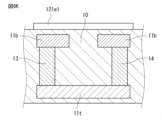
- FIG. 1 is a schematic perspective view of an inductor component according to a first embodiment, as viewed from the bottom side.
- FIG. This is a cross-sectional view of FIG.
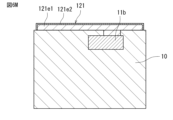
- FIG. 3 is a cross-sectional view taken along line III-III of FIG. 4 is an XY cross-sectional view of a first through wiring and a second through wiring;
- FIG. 2 is an enlarged view of a portion of FIG. 5A to 5C are schematic cross-sectional views illustrating a method for manufacturing an inductor component.
- 5A to 5C are schematic cross-sectional views illustrating a method for manufacturing an inductor component.
- 5A to 5C are schematic cross-sectional views illustrating a method for manufacturing an inductor component.
- 5A to 5C are schematic cross-sectional views illustrating a method for manufacturing an inductor component.
- 5A to 5C are schematic cross-sectional views illustrating a method for manufacturing an inductor component.
- 5A to 5C are schematic cross-sectional views illustrating a method for manufacturing an inductor component.
- 5A to 5C are schematic cross-sectional views illustrating a method for manufacturing an inductor component.
- 5A to 5C are schematic cross-sectional views illustrating a method for manufacturing an inductor component.
- 5A to 5C are schematic cross-sectional views illustrating a method for manufacturing an inductor component.
- 5A to 5C are schematic cross-sectional views illustrating a method for manufacturing an inductor component.
- 5A to 5C are schematic cross-sectional views illustrating a method for manufacturing an inductor component.
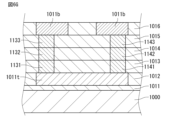
- FIG. 11 is a cross-sectional view showing a first modified example of an inductor component.
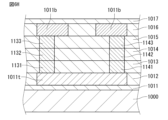
- FIG. 11 is a cross-sectional view showing a second modified example of the inductor component.
- FIG. 11 is a cross-sectional view showing a third modified example of the inductor component.
- FIG. 11 is a cross-sectional view showing a fourth modified example of the inductor component.
- FIG. 11 is a schematic perspective view of an inductor component according to a second embodiment, as viewed from the bottom side. IX-IX cross-sectional view of FIG. 8.
- FIG. 4 is a schematic bottom view of the coil as viewed from the bottom side. 4 is an XY cross-sectional view of a first through wiring and a second through wiring;
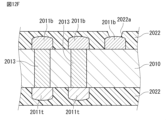
- FIG. 5A to 5C are schematic cross-sectional views illustrating a method for manufacturing an inductor component.
- 5A to 5C are schematic cross-sectional views illustrating a method for manufacturing an inductor component.
- 5A to 5C are schematic cross-sectional views illustrating a method for manufacturing an inductor component.
- 5A to 5C are schematic cross-sectional views illustrating a method for manufacturing an inductor component.
- 5A to 5C are schematic cross-sectional views illustrating a method for manufacturing an inductor component.
- 5A to 5C are schematic cross-sectional views illustrating a method for manufacturing an inductor component.
- 5A to 5C are schematic cross-sectional views illustrating a method for manufacturing an inductor component.
- 5A to 5C are schematic cross-sectional views illustrating a method for manufacturing an inductor component.
- 5A to 5C are schematic cross-sectional views illustrating a method for manufacturing an inductor component.
- FIG. 11 is a cross-sectional view showing a first modified example of an inductor component.
- FIG. 11 is a cross-sectional view showing a second modified example of the inductor component.
- FIG. 11 is a cross-sectional view showing a third modified example of the inductor component.
- FIG. 13 is an XY cross-sectional view of a first through wiring illustrating an inductor component according to a third embodiment.
- FIG. 13 is an XY cross-sectional view of a first through wiring illustrating an inductor component according to a fourth embodiment.
- FIG. 13 is an XY cross-sectional view of a first through wiring illustrating an inductor component according to a fourth embodiment.
- Fig. 1 is a schematic bottom view of the inductor component 1 as viewed from the bottom side.
- Fig. 2 is a cross-sectional view taken along line II-II in Fig. 1.
- Fig. 3 is a cross-sectional view taken along line III-III in Fig. 1.
- external electrodes are depicted by two-dot chain lines in Fig. 1.
- the element body 10 is depicted as transparent so that the structure can be easily understood, but it may be semi-transparent or opaque.
- the inductor component 1 is a surface mount type inductor component used, for example, in a high frequency signal transmission circuit. As shown in Figures 1, 2 and 3, the inductor component 1 includes an element body 10, a coil 110 provided on the element body 10 and wound in a spiral shape along an axis AX, and a first external electrode 121 and a second external electrode 122 provided on the element body 10 and electrically connected to the coil 110.
- the element body 10 has a length, width, and height.
- the element body 10 has a first end face 100e1 and a second end face 100e2 at both ends in the length direction, a first side face 100s1 and a second side face 100s2 at both ends in the width direction, and a bottom face 100b and a top face 100t at both ends in the height direction.
- the outer surface 100 of the element body 10 includes the first end face 100e1 and the second end face 100e2, the first side face 100s1 and the second side face 100s2, the bottom face 100b, and the top face 100t.
- the bottom face 100b corresponds to an example of a "first main face” as described in the claims
- the top face 100t corresponds to an example of a "second main face” as described in the claims.
- the length direction (longitudinal direction) of the element body 10, which is the direction from the first end face 100e1 to the second end face 100e2, is referred to as the X direction.
- the width direction of the element body 10, which is the direction from the first side face 100s1 to the second side face 100s2, is referred to as the Y direction.
- the height direction of the element body 10, which is the direction from the bottom face 100b to the top face 100t, is referred to as the Z direction.
- the X direction, Y direction, and Z direction are mutually perpendicular, and when arranged in the order X, Y, Z, they form a right-handed system.
- the "outer surface 100 of the element body” including the first end surface 100e1, the second end surface 100e2, the first side surface 100s1, the second side surface 100s2, the bottom surface 100b, and the top surface 100t of the element body 10 does not simply mean a surface facing the outer periphery of the element body 10, but a surface that is the boundary between the outside and the inside of the element body 10. Furthermore, “above the outer surface 100 of the element body 10” does not mean an absolute direction such as vertically upward as defined by the direction of gravity, but refers to a direction toward the outside of the outside and the inside with the outer surface 100 as a boundary, based on the outer surface 100. Therefore, "above the outer surface 100” is a relative direction determined by the orientation of the outer surface 100. Furthermore, "above” with respect to a certain element includes not only an upper side away from the element, that is, an upper position through another object on the element or an upper position with a space therebetween, but also a position directly above the element (on).
- the axis AX of the coil 110 is arranged parallel to the bottom surface 100b.
- the coil 110 includes a plurality of bottom surface wirings 11b arranged on the bottom surface 100b side with respect to the axis AX and arranged along the axis AX on a plane parallel to the bottom surface 100b, a plurality of top surface wirings 11t arranged on the top surface 100t side with respect to the axis AX and arranged along the axis AX on a plane parallel to the top surface 100t, a plurality of first through wirings 13 extending from the bottom surface wirings 11b toward the top surface wirings 11t and arranged along the axis AX, and a plurality of second through wirings 14 extending from the bottom surface wirings 11b toward the top surface wirings 11t, arranged on the opposite side of the first through wirings 13 with respect to the axis AX and arranged along the axis AX.
- the bottom wiring 11b corresponds to an example of the "first coil wiring” described in the claims
- the top wiring 11t corresponds to an example of the "second coil wiring” described in the claims.
- the axis AX is the intersection of a first plane passing through the center between the bottom wiring 11b and the top wiring 11t, and a second plane passing through the center between the first through wiring 13 and the second through wiring 14.
- the axis AX is a straight line passing through the center of the inner diameter portion of the coil 110.
- the axis AX of the coil 110 has no dimension in a direction perpendicular to the axis AX.
- the coil 110 includes the bottom wiring 11b, the first through wiring 13, the top wiring 11t, and the second through wiring 14.
- the bottom wiring 11b, the first through wiring 13, the top wiring 11t, and the second through wiring 14 are connected in this order to form at least a part of a spiral shape, so that the inner diameter of the coil 110 can be increased and the efficiency of obtaining inductance can be increased. Furthermore, by increasing the efficiency of obtaining inductance, the Q value can be increased.
- the pad portion of a conventional inductor component and the bottom wiring 11b and top wiring 11t of this embodiment are "receiving portions" for the wiring that penetrates the element body (the conductive vias of a conventional inductor component and the first through wiring 13 and second through wiring 14 of this embodiment), and therefore have a shape that extends perpendicularly in the direction that penetrates the element body.
- the pad portion extends in a direction perpendicular to the axis of the coil, and is likely to have a structure that blocks magnetic flux generated in the axial direction of the coil.
- the first through wiring 13 and the second through wiring 14 extend in a direction perpendicular to the axis AX of the coil 110, so the bottom wiring 11b and the top wiring 11t extend in a direction parallel to the axis AX of the coil 110. Therefore, the bottom wiring 11b and the top wiring 11t are unlikely to have a structure that blocks magnetic flux generated in the direction of the axis AX. In other words, with this embodiment, a structure that is unlikely to block magnetic flux can be achieved, improving the inductance acquisition efficiency and Q value.
- FIG. 4 is an XY cross-sectional view of the first through wiring 13 and the second through wiring 14.
- the first through wiring 13 in a cross section parallel to the bottom surface 100b and including the axis AX, the first through wiring 13 includes an inner peripheral edge 131 facing the axis AX side, an outer peripheral edge 132 facing the opposite side to the axis AX, and a side edge 133 parallel to a direction perpendicular to the axis AX.
- the length of the inner peripheral edge 131 is longer than the length of the outer peripheral edge 132.
- the inner peripheral edge 131 is shown by a dotted line
- the outer peripheral edge 132 is shown by a dashed line
- the side edge 133 is shown by a solid line.
- the inner periphery 131 is the region of the entire periphery of the first through wiring 13 that is projected onto the axis AX when the first through wiring 13 is projected toward the axis AX from a direction perpendicular to the axis AX.
- the outer periphery 132 is the region of the entire periphery of the first through wiring 13 that is projected onto the imaginary line BX when the first through wiring 13 is projected toward the imaginary line BX from a direction perpendicular to the axis AX, defining an imaginary line BX that is parallel to the axis AX on the opposite side of the axis AX with respect to the first through wiring 13.
- the length of the inner peripheral edge 131 is longer than the length of the outer peripheral edge 132, so the surface area of the inner surface of the first through wiring 13 can be increased.
- This allows the surface area of the inner surface of the coil 110 to be increased, lowering the electrical resistance at high frequencies and improving the Q value at high frequencies.
- the skin effect causes current to concentrate near the surface of the coil 110, but in this embodiment, the inner peripheral edge 131 of the first through wiring 13 where the high-frequency signal concentrates is relatively long, lowering the electrical resistance and improving the Q value at high frequencies.
- the second through wiring 14 has the same configuration as the first through wiring 13, and has the same effect as the first through wiring 13 described above.
- the second through wiring 14 includes an inner peripheral edge 141 facing the axis AX, an outer peripheral edge 142 facing the opposite side to the axis AX, and a side edge 143 parallel to the direction perpendicular to the axis AX.
- the length of the inner peripheral edge 141 is longer than the length of the outer peripheral edge 142. This allows the surface area of the inner surface of the second through wiring 14 to be increased, and the surface area of the inner surface of the coil 110 to be increased, resulting in a lower electrical resistance value at high frequencies and an improved Q value at high frequencies.
- the length of the inner peripheral edge 131 may be longer than the length of the outer peripheral edge 132, and in the second through wiring 14, the length of the inner peripheral edge 141 may be shorter than or the same as the length of the outer peripheral edge 142.
- the volume of the inductor component 1 is 0.08 mm3 or less, and the size of the long side of the inductor component 1 is 0.65 mm or less.
- the size of the long side of the inductor component 1 refers to the largest value among the length, width, and height of the inductor component 1, and in this embodiment, refers to the length in the X direction. According to the above configuration, the volume of the inductor component 1 is small and the long side of the inductor component 1 is short, so that the weight of the inductor component 1 is light. Therefore, even if the external electrodes 121 and 122 are small, the necessary mounting strength can be obtained.
- the thickness of the inductor component 1 is preferably 0.2 mm or less. This allows the inductor component 1 to be made thin.
- the size of the inductor component 1 (length (X direction) x width (Y direction) x height (Z direction)) is 0.6 mm x 0.3 mm x 0.3 mm, 0.4 mm x 0.2 mm x 0.2 mm, 0.25 mm x 0.125 mm x 0.120 mm, etc. Furthermore, the width and height do not have to be equal, and may be, for example, 0.4 mm x 0.2 mm x 0.3 mm.
- the element body 10 contains SiO2 , which can provide insulation and rigidity to the element body 10.
- the element body 10 is made of, for example, a sintered glass body.
- the sintered glass body may contain alumina, which can further increase the strength of the element body.
- the glass sintered body is formed, for example, by stacking multiple insulating layers containing glass.
- the stacking direction of the multiple insulating layers is the Z direction.
- the insulating layers are in a layered form having main surfaces extending in the XY plane. Note that, due to firing or the like, the interfaces between the multiple insulating layers of the element body 10 may not be clear.
- the element body 10 may be made of, for example, a glass substrate.
- the glass substrate may be a single-layer glass substrate, and since the majority of the element body is made of glass, losses such as eddy current losses at high frequencies can be suppressed.
- the coil 110 includes a plurality of bottom wirings 11b, a plurality of top wirings 11t, a plurality of first through wirings 13, and a plurality of second through wirings 14.
- the bottom wirings 11b, the first through wirings 13, the top wirings 11t, and the second through wirings 14 are connected in sequence to form at least a portion of the coil 110 wound in the axial direction AX.
- the coil 110 is a so-called helical-shaped coil 110, so that in a cross section perpendicular to the axis AX, the area in which the bottom wiring 11b, the top wiring 11t, the first through wiring 13, and the second through wiring 14 run parallel to the winding direction of the coil 110 can be reduced, thereby reducing the stray capacitance in the coil 110.
- a helical shape refers to a shape in which the number of turns in the entire coil is greater than one turn, and the number of turns in the coil in a cross section perpendicular to the axis is less than one turn.
- One turn or more refers to a state in which, in a cross section perpendicular to the axis, the coil wiring has parts that are adjacent in the radial direction when viewed from the axial direction and run parallel to the winding direction
- “less than one turn” refers to a state in which, in a cross section perpendicular to the axis, the coil wiring does not have parts that are adjacent in the radial direction when viewed from the axial direction and run parallel to the winding direction.
- the bottom wiring 11b extends in only one direction. Specifically, the bottom wiring 11b extends in the Y direction at a slight incline toward the X direction.
- the multiple bottom wirings 11b are arranged parallel to each other along the X direction.
- modified illumination such as annular illumination or dipole illumination
- the pattern resolution in a specific direction can be improved to form a finer pattern.
- fine bottom wiring 11b can be formed by using modified illumination in the photolithography process, for example, and the inductor component 1 can be made smaller.
- the top surface wiring 11t extends in only one direction. Specifically, the top surface wiring 11t extends in the Y direction. The multiple top surface wirings 11t are arranged in parallel along the X direction. With the above configuration, since the top surface wiring 11t extends in only one direction, by using, for example, modified illumination in the photolithography process, it is possible to form fine top surface wiring 11t and reduce the size of the inductor component 1.
- the bottom wiring 11b and the top wiring 11t are made of a good conductor material such as copper, silver, gold, or an alloy of these.
- the bottom wiring 11b and the top wiring 11t may be a metal film formed by plating, vapor deposition, sputtering, or the like, or may be a metal sintered body formed by applying and sintering a conductive paste.
- the bottom wiring 11b and the top wiring 11t may also be a multi-layer structure in which multiple metal layers are stacked.
- the thickness of the bottom wiring 11b and the top wiring 11t is preferably 5 ⁇ m or more and 50 ⁇ m or less.
- the first through wiring 13 is disposed on the first side surface 100s1 side of the axis AX within the through hole V of the element body 10, and the second through wiring 14 is disposed on the second side surface 100s2 side of the axis AX within the through hole V of the element body 10.
- the first through wiring 13 and the second through wiring 14 each extend in a direction perpendicular to the bottom surface 100b and the top surface 100t. This allows the lengths of the first through wiring 13 and the second through wiring 14 to be shortened, thereby suppressing the DC resistance (Rdc).
- the multiple first through wirings 13 and the multiple second through wirings 14 are each disposed in parallel along the X direction.
- the first through wiring 13 contains SiO 2. According to this, when the element body 10 contains SiO 2 , the linear expansion coefficient of the first through wiring 13 can be matched to the linear expansion coefficient of the element body 10, and cracks between the first through wiring 13 and the element body 10 can be suppressed.
- a conductive paste is used for the first through wiring 13.
- the conductive material is Ag, Cu, or the like.
- the second through wiring 14 similarly contains SiO 2 .
- the inner peripheral edge 131 of the first through wiring 13 has a curved portion that is a convex curve. This allows the stress applied to the curved portion of the inner peripheral edge 131 of the first through wiring 13 to be dispersed.
- the entire inner peripheral edge 131 is curved, but only a part of the inner peripheral edge 131 may be curved.
- the outer peripheral edge 132 of the first through wiring 13 is a straight line parallel to the axis AX, but may have a curved portion that is a convex curve, allowing the stress applied to the curved portion of the outer peripheral edge 132 of the first through wiring 13 to be dispersed.
- the side edge 133 of the first through wiring 13 is a straight line perpendicular to the axis AX.
- the inner peripheral edge 141 of the second through-hole wiring 14 also has a curved portion that is a convex curve. This allows the stress acting on the curved portion of the inner peripheral edge 141 of the second through-hole wiring 14 to be dispersed.
- the outer peripheral edge 142 of the second through-hole wiring 14 is a straight line parallel to the axis AX.
- the side edge 143 of the second through-hole wiring 14 is a straight line perpendicular to the axis AX.
- the length of the inner periphery 131 of the first through wiring 13 is 1.5 times or more the length of the outer periphery 132 of the first through wiring 13. This allows the length of the inner periphery 131 of the first through wiring 13 to be increased, and the electrical resistance value at high frequencies to be reduced. In other words, since the current flows in a spiral shape on the inner diameter side of the coil 110, the electrical resistance decreases as the length of the inner periphery 131 increases.
- the length of the inner periphery 131 is approximately 47 ⁇ m
- the outer periphery 132 is approximately 30 ⁇ m.
- the length is measured using WinRooF2018 manufactured by Mitani Shoji Co., Ltd., and the length of the periphery (inner periphery, outer periphery) of the through wiring can be obtained from the image of the cross section.
- the positions of the inner periphery and the outer periphery to be measured may be specified.
- the cross section to be measured is the cross section at the center in the extension direction of the first through wiring 13.
- the length of the inner peripheral edge 141 of the second through-hole wiring 14 is at least 1.5 times the length of the outer peripheral edge 142 of the second through-hole wiring 14. This allows the length of the inner peripheral edge 141 of the second through-hole wiring 14 to be increased, and the electrical resistance value at high frequencies to be reduced.
- the orientation of the curved portion of the inner periphery 131 of all the first through wirings 13 is the same.
- the orientation of the curved portion is a direction connecting the midpoint of the curved portion and the center line of the first through wiring 13.
- the center line of the first through wiring 13 is a line passing through the center of gravity of the first through wiring 13 in a cross section perpendicular to the extension direction of the first through wiring 13.
- the orientation of the curved portion is a direction connecting the midpoint of the inner periphery 131 and the center line of the first through wiring 13.
- the orientation of the curved portion is a direction perpendicular to the axis AX.
- the orientation of the curved portion of the inner periphery 131 of one first through wiring 13 and the orientation of the curved portion of the inner periphery 131 of the other first through wiring 13 may be different from each other. This allows the orientation of the curved portion of the first through wiring 13 to be changed depending on the arrangement of the bottom wiring 11b and the top wiring 11t.
- the direction of the curved portion of the inner periphery 141 of all second through wirings 14 is the same. Note that, in two second through wirings 14, the direction of the curved portion of the inner periphery 141 of one second through wiring 14 and the direction of the curved portion of the inner periphery 141 of the other second through wiring 14 may be different from each other.
- FIG. 5 is an enlarged view of a portion of FIG. 1.
- the first end 11b1 of the bottom wiring 11b and the first end 13a of the first through wiring 13 are connected, and the outer shape of the coil 110 of the first end 11b1 of the bottom wiring 11b preferably follows the outer shape of the coil 110 of the first end 13a of the first through wiring 13.
- the outer side of the coil 110 refers to the outer peripheral surface side of the coil 110.
- the outer shape of the first end 11b1 of the bottom wiring 11b follows the outer peripheral edge 132 and the side edge 133 of the first end 13a of the first through wiring 13.
- the shape of the first end 11b1 of the bottom wiring 11b can be made to correspond to the shape of the first end 13a of the first through wiring 13, and the DC electrical resistance of the connection portion between the bottom wiring 11b and the first through wiring 13 can be reduced.
- the first end 11b1 of the bottom wiring 11b is preferably larger than the first end 13a of the first through wiring 13. This ensures the connection between the bottom wiring 11b and the first through wiring 13 even if the bottom wiring 11b is misaligned.
- the second end 11b2 of the bottom wiring 11b and the first end 14a of the second through wiring 14 are connected, and the outer shape of the coil 110 of the second end 11b2 of the bottom wiring 11b follows the outer shape of the coil 110 of the first end 14a of the second through wiring 14.
- the outer shape of the second end 11b2 of the bottom wiring 11b follows the outer peripheral edge 142 and the side edge 143 of the first end 14a of the second through wiring 14.
- the shape of the second end 11b2 of the bottom wiring 11b can correspond to the shape of the first end 14a of the second through wiring 14, and the DC electrical resistance of the connection between the bottom wiring 11b and the second through wiring 14 can be reduced.
- the first end of the bottom wiring 11b and the first end of the top wiring 11t overlap when viewed from a direction perpendicular to the bottom surface 100b, and the angle ⁇ between the bottom wiring 11b and the top wiring 11t is an acute angle.
- the angle ⁇ is the angle between the center line of the width of the bottom wiring 11b (the dashed line in FIG. 2) and the center line of the width of the top wiring 11t (the dashed line in FIG. 2) when viewed from a direction perpendicular to the bottom surface 100b.
- the angle ⁇ between the bottom wiring 11b and the top wiring 11t connected to the same first through wiring 13 is 5° or more and 45° or less when viewed from a direction perpendicular to the bottom surface 100b.
- the angle ⁇ is the angle between the center line of the width of the bottom wiring 11b (the dashed line in FIG. 2) and the center line of the width of the top wiring 11t (the dashed line in FIG. 2) when viewed from a direction perpendicular to the bottom surface 100b.
- the coil 110 is wound tightly, so that the inductance can be improved. Since the angle ⁇ is 45° or less, the coil length is shortened, the leakage magnetic flux is reduced, and the Q value is increased.
- the coil length refers to the distance between the two ends located at the outermost positions in the axis AX direction among the bottom wiring 11b, the top wiring 11t, the first through wiring 13, and the second through wiring 14. Since the angle ⁇ is 5° or more, the possibility of contact between two adjacent first through wirings 13 in the axis AX direction is reduced, and the possibility of contact between two adjacent second through wirings 14 in the axis AX direction is reduced. Note that the angle ⁇ may be 5° or more and 45° or less in at least one pair of bottom wiring 11b and top wiring 11t among all the bottom wirings 11b and top wiring 11t.
- the angle ⁇ between the bottom surface wiring 11b and the top surface wiring 11t connected to the same second through wiring 14 is 5° or more and 45° or less. This allows the coil 110 to be wound tightly, improving the inductance.
- At least one of the bottom wiring 11b, top wiring 11t, first through wiring 13, and second through wiring 14 includes a void portion or a resin portion.
- a void portion or a resin portion This allows the stress caused by the difference in linear expansion coefficient between the wiring and the element body 10 to be absorbed by the void portion or resin portion, and the stress can be alleviated.
- a method for forming the void portion for example, a material that is burned away by sintering is used as the wiring material, and the void portion can be formed by sintering the wiring.
- a method for forming the resin portion for example, a conductive paste can be used as the wiring material to form the resin portion.
- At least one of the bottom surface wiring 11b and the top surface wiring 11t contains SiO 2.
- the linear expansion coefficient of the wiring can be matched to the linear expansion coefficient of the element body 10, and cracks between the wiring and the element body 10 can be suppressed.
- the first external electrode 121 is connected to a first end of the coil 110, and the second external electrode 122 is connected to a second end of the coil 110.
- the first external electrode 121 is provided on the first end face 100e1 side with respect to the center in the X direction of the element body 10 so as to be exposed from the outer surface 100 of the element body 10.
- the second external electrode 122 is provided on the second end face 100e2 side with respect to the center in the X direction of the element body 10 so as to be exposed from the outer surface 100 of the element body 10.
- the first external electrode 121 and the second external electrode 122 are located inside the outer surface 100 of the element body 10.
- the first external electrode 121 and the second external electrode 122 are located inside the first end surface 100e1, the second end surface 100e2, the first side surface 100s1, and the second side surface 100s2 of the element body 10.
- the first external electrode 121 and the second external electrode 122 are not in contact with the outer surface 100 of the element body 10, so when the inductor components are singulated, the load on the first external electrode 121 and the second external electrode 122 can be reduced, and deformation and peeling of the first external electrode 121 and the second external electrode 122 can be suppressed. Therefore, even if the inductor component is made small, deformation and peeling of the first external electrode 121 and the second external electrode 122 can be prevented.
- the first external electrode 121 may be provided continuously on the bottom surface 100b and the first end surface 100e1. In this way, since the first external electrode 121 is a so-called L-shaped electrode, a solder fillet can be formed on the first external electrode 121 when the inductor component 1 is mounted on a mounting board. Similarly, the second external electrode 122 may be provided continuously on the bottom surface 100b and the second end surface 100e2.
- the first external electrode 121 has a bottom surface portion 121b provided on the bottom surface 100b and a via portion 121v embedded in the bottom surface 100b.
- the via portion 121v is connected to the bottom surface portion 121b.
- the via portion 121v is connected to an end of the bottom surface wiring 11b located on the first end surface 100e1 side in the axis AX direction.
- the second external electrode 122 has a bottom surface portion 122b provided on the bottom surface 100b and a via portion 122v embedded in the bottom surface 100b.
- the via portion 122v is connected to the bottom surface portion 122b.
- the via portion 122v is connected to the end of the bottom surface wiring 11b located on the second end surface 100e2 side in the axis AX direction.
- the first external electrode 121 has an underlayer 121e1 and a plating layer 121e2 that covers the underlayer 121e1.
- the underlayer 121e1 includes a conductive material such as Ag or Cu.
- the plating layer 121e2 includes a conductive material such as Ni or Sn.
- a part of the bottom portion 121b and the via portion 121v are composed of the underlayer 121e1.
- Another part of the bottom portion 121b is composed of the plating layer 121e2.
- the second external electrode 122 has an underlayer and a plating layer that covers the underlayer.
- the first external electrode 121 and the second external electrode 122 may be composed of a single layer of conductive material.
- Figures 6A to 6H, 6K, and 6L are views corresponding to the cross section II-II of Figure 1.
- Figures 6I, 6J, and 6M are views corresponding to the cross section III-III of Figure 1.
- a first insulating layer 1011 is provided by printing on a base substrate 1000.
- the material of the base substrate 1000 is, for example, a glass substrate, a silicon substrate, an alumina substrate, etc.
- the material of the first insulating layer 1011 is, for example, a resin such as epoxy or polyimide, or an inorganic insulating film such as SiO or SiN, etc.
- the second insulating layer 1012 is provided on the first insulating layer 1011 by printing.
- a groove 1012a is provided in the second insulating layer 1012.
- the groove 1012a is formed, for example, by a photolithography process. Note that the groove may be formed from the beginning as a printing pattern.
- a top conductor layer 1011t is provided in the groove 1012a by printing.
- the material of the top conductor layer 1011t is, for example, Ag, Cu, Au, Al, an alloy containing at least one of these elements, solder paste, etc.
- the top conductor layer 1011t is formed as a printing pattern so that it remains only in the groove 1012a. Note that after the top conductor layer 1011t is printed on the second insulating layer 1012, a photolithography process may be used to make the top conductor layer 1011t remain only in the groove 1012a.
- a third insulating layer 1013 is provided on the second insulating layer 1012 by printing.
- a first groove 1013a and a second groove 1013b are provided in the third insulating layer 1013.
- the first groove 1013a and the second groove 1013b are formed in the same manner as in FIG. 6B.
- the first through conductor layer 1131 of the first layer is provided by printing in the first groove 1013a
- the second through conductor layer 1141 of the first layer is provided by printing in the second groove 1013b.
- the first through conductor layer 1131 of the first layer and the second through conductor layer 1141 of the first layer are formed in the same manner as in FIG. 6C.
- a fourth insulating layer 1014 is provided on the third insulating layer 1013, and a second-layer first penetrating conductor layer 1132 and a second-layer second penetrating conductor layer 1142 are provided in each of the two grooves provided in the fourth insulating layer 1014. Furthermore, a fifth insulating layer 1015 is provided on the fourth insulating layer 1014, and a third-layer first penetrating conductor layer 1133 and a third-layer second penetrating conductor layer 1143 are provided in each of the two grooves provided in the fifth insulating layer 1015.
- a sixth insulating layer 1016 is provided on the fifth insulating layer 1015, and a bottom conductor layer 1011b is provided in a groove provided in the sixth insulating layer 1016.
- the material of the bottom conductor layer 1011b is the same as the material of the top conductor layer 1011t.
- a seventh insulating layer 1017 is provided on the sixth insulating layer 1016.
- a groove 1017a is provided in the seventh insulating layer 1017 so that a portion of the bottom conductor layer 1011b is exposed.
- an underlying conductor layer 1121e1 is provided on the seventh insulating layer 1017 and in the groove 1017a.
- the material of the underlying conductor layer 1121e1 is, for example, a resin paste such as Ag or Cu.
- the entire laminate is sintered in a high-temperature (e.g., 500°C or higher) furnace.
- the first to seventh insulating layers 1011-1017 are sintered to form the base body 10
- the top conductor layer 1011t is sintered to form the top wiring 11t
- the bottom conductor layer 1011b is sintered to form the bottom wiring 11b
- the first through conductor layers 1131-1133 of the first to third layers are sintered to form the first through wiring 13
- the second through conductor layers 1141-1143 of the first to third layers are sintered to form the second through wiring 14
- the base conductor layer 1121e1 is sintered to form the base layer 121e1.
- the strength can be improved by sintering the insulating layers, and the conductor layers are sintered to volatilize unnecessary resin components contained in the conductor layers and fuse the conductor material contained in the conductor layers to achieve high conductivity.
- the base substrate 1000 may be peeled off by decomposing the surface during sintering, or may be mechanically removed by grinding or the like before or after sintering, or may be chemically removed by etching or the like before or after sintering.
- the chip is cut into individual pieces along cut lines C.
- a plating layer 121e2 is formed by barrel plating so as to cover the base layer 121e1, forming a first external electrode 121. This completes the manufacture of the inductor component 1, as shown in FIG. 2.
- Fig. 7A is a view showing a first modified example of an inductor component corresponding to the II-II cross section of Fig. 1.
- the first through wire 13 and the second through wire 14 are not parallel when viewed from a direction parallel to the axis AX of the coil 110. This makes it possible to increase the distance between the first through wire 13 and the second through wire 14, thereby making it possible to increase the inner diameter of the coil 110 and improve the Q value.
- the first through wiring 13 and the second through wiring 14 are bent at the center so that the distance between them becomes wider toward the center in the Z direction.
- the first through wiring 13 and the second through wiring 14 each have a shape that spreads outward in the radial direction of the coil 110 toward the center in the Z direction.
- the first through wiring 13 and the second through wiring 14 each have a stepped shape along the Z direction. According to the above configuration, when the first through wiring 13 and the second through wiring 14 are each formed by stacking multiple conductor layers, the first through wiring 13 and the second through wiring 14 can be easily formed in a stepped shape by stacking the conductor layers of each layer in a shifted manner.
- FIG. 7B is a view showing a second modified example of the inductor component, corresponding to the cross section taken along line II-II in Fig. 1.
- the first through wire 13 and the second through wire 14 are not parallel when viewed from a direction parallel to the axis AX of the coil 110. This makes it possible to increase the distance between the first through wire 13 and the second through wire 14, thereby making it possible to increase the inner diameter of the coil 110 and improve the Q value.
- the first through wiring 13 and the second through wiring 14 are inclined so that the distance between them becomes wider toward the top wiring 11t in the Z direction.
- the first through wiring 13 and the second through wiring 14 each have a shape that spreads outward in the radial direction of the coil 110 as far as the top wiring 11t in the Z direction.
- the coil 110 has a trapezoidal shape when viewed from the axis AX direction.
- FIG. 7C is a view showing a third modified example of an inductor component corresponding to the cross section taken along line II-II in Fig. 1.
- an inductor component 1C of the third modified example includes a first coil 110A and a second coil 110B, as compared with the inductor component 1A of the first modified example shown in Fig. 7A.
- the first through-wire 13 and the second through-wire 14 are not parallel when viewed from a direction parallel to the axis AX. This allows the distance between the first through-wire 13 and the second through-wire 14 to be increased, the inner diameter of the coil 110A to be increased, and the Q value to be improved.
- the first through wiring 13 has the same configuration as the first through wiring 13 of the inductor component 1A of the first modified example.
- the second through wiring 14 has a linear shape parallel to the Z direction. In other words, the first through wiring 13 is bent at the center so that the distance between the first through wiring 13 and the second through wiring 14 becomes wider toward the center in the Z direction.
- the first through wiring 13 has a stepped shape along the Z direction. According to the above configuration, when the first through wiring 13 is formed by stacking multiple conductor layers, the conductor layers of each layer are stacked with a shift, so that the first through wiring 13 can be easily formed in a stepped shape.
- the first through-wire 13 and the second through-wire 14 are not parallel when viewed from a direction parallel to the axis AX. This allows the distance between the first through-wire 13 and the second through-wire 14 to be increased, the inner diameter of the coil 110B to be increased, and the Q value to be improved.
- the second through wiring 14 has the same configuration as the second through wiring 14 of the inductor component 1A of the first modified example.
- the first through wiring 13 has a linear shape parallel to the Z direction.
- the second through wiring 14 is bent at the center so that the distance between the first through wiring 13 and the second through wiring 14 becomes wider toward the center in the Z direction.
- the second through wiring 14 has a stepped shape along the Z direction. According to the above configuration, when the second through wiring 14 is formed by stacking multiple conductor layers, the second through wiring 14 can be easily formed in a stepped shape by stacking the conductor layers of each layer in a shifted manner.
- FIG. 7D is a view showing a fourth modified example of an inductor component corresponding to the cross section taken along line II-II in Fig. 1.
- an inductor component 1D of the fourth modified example includes a first coil 110A and a second coil 110B, as compared with the inductor component 1B of the second modified example shown in Fig. 7B.
- the first through-wire 13 and the second through-wire 14 are not parallel when viewed from a direction parallel to the axis AX. This allows the distance between the first through-wire 13 and the second through-wire 14 to be increased, the inner diameter of the coil 110A to be increased, and the Q value to be improved.
- the first through wiring 13 has the same configuration as the first through wiring 13 of the inductor component 1B of the second modified example.
- the second through wiring 14 has a linear shape parallel to the Z direction. In other words, the first through wiring 13 is inclined so that the distance between the first through wiring 13 and the second through wiring 14 becomes wider in the Z direction toward the top surface wiring 11t side.
- the first through wiring 13 and the second through wiring 14 can be formed in a linear shape and shortened, thereby reducing the DC resistance of the first through wiring 13 and the second through wiring 14.
- the first through-wire 13 and the second through-wire 14 are not parallel when viewed from a direction parallel to the axis AX. This allows the distance between the first through-wire 13 and the second through-wire 14 to be increased, the inner diameter of the coil 110B to be increased, and the Q value to be improved.
- the second through wiring 14 has the same configuration as the second through wiring 14 of the inductor component 1B of the second modified example.
- the first through wiring 13 has a linear shape parallel to the Z direction.
- the second through wiring 14 is inclined so that the distance between the first through wiring 13 and the second through wiring 14 becomes wider in the Z direction toward the top surface wiring 11t.
- Second Embodiment Fig. 8 is a schematic bottom view showing the second embodiment of the inductor component as viewed from the bottom side.
- Fig. 9 is a cross-sectional view taken along line IX-IX of Fig. 8.
- the insulating layer is omitted, and the external electrodes are drawn with two-dot chain lines.
- the element body 10 is drawn transparently so that the structure can be easily understood.
- the second embodiment differs from the first embodiment mainly in the position of the coil axis, the direction of the through wiring, the material of the element body, and the provision of the insulating layer, and these different configurations will be mainly described below.
- the other configurations are the same as those of the first embodiment, and description thereof will be omitted.
- the axis AX of the coil 110 is perpendicular to the X direction. Specifically, the axis AX is parallel to the Y direction and passes through the center of the element body 10 in the X direction. This can reduce the interference with the magnetic flux of the coil 110 by the first external electrode 121 and the second external electrode 122, improving the efficiency of obtaining inductance.
- the length of coil 110 in the axial AX direction is shorter than the inner diameter of coil 110.
- the length of coil 110 in the axial AX direction is also called the coil length. This allows the Q value to be improved because the coil length is short and the coil inner diameter is large.
- the inner diameter of the coil refers to the equivalent diameter of a circle based on the minimum area of the region surrounded by coil 110 when viewed through the axial AX direction.
- the element body 10 is an inorganic insulator.
- the material of the element body 10 is preferably glass, which has high insulating properties and can suppress eddy currents and increase the Q value.
- the element body 10 preferably contains silicon, which provides high thermal stability of the element body 10 and therefore can suppress fluctuations in dimensions of the element body 10 due to heat and reduce variations in electrical characteristics.
- the element body 10 is preferably a single-layer glass plate. This ensures the strength of the element body 10. Furthermore, in the case of a single-layer glass plate, the dielectric loss is small, so the Q value at high frequencies can be increased. Furthermore, since there is no sintering process as in the case of sintered bodies, deformation of the element body 10 during sintering can be suppressed, which suppresses pattern misalignment, making it possible to provide an inductor component with a small inductance tolerance.
- the material of the single-layer glass plate is preferably a photosensitive glass plate such as Foturan II (registered trademark of Schott AG).
- the single-layer glass plate preferably contains cerium oxide (ceria: CeO 2 ), in which case the cerium oxide acts as a sensitizer, making processing by photolithography easier.
- the single-layer glass plate can be processed by mechanical processing such as drilling and sandblasting, dry/wet etching using a photoresist/metal mask, laser processing, etc., it may be a glass plate that does not have photosensitivity.
- the single-layer glass plate may be made by sintering a glass paste, or may be formed by a known method such as the float method.
- the inductor component 1E has an insulator 22.
- the insulator 22 covers both the bottom surface 100b and the top surface 100t of the element body 10. Note that the insulator 22 may be provided only on the bottom surface 100b out of the bottom surface 100b and the top surface 1100t.
- the insulator 22 is a member that covers the wiring (bottom wiring 11b, top wiring 11t) to protect the wiring from external forces, prevent damage to the wiring, and improve the insulation of the wiring.
- the insulator 22 is preferably an organic insulator.
- the insulator 22 may be a resin film such as epoxy or polyimide, which is easy to form.
- the insulator 22 is preferably made of a material with a low dielectric constant, which can reduce the stray capacitance formed between the coil 110 and the external electrodes 121 and 122 when the insulator 22 is present between the coil 110 and the external electrodes 121 and 122.
- the insulator 22 can be formed, for example, by laminating a resin film such as ABF GX-92 (manufactured by Ajinomoto Fine-Techno Co., Ltd.), or by applying a paste-like resin and thermally curing it.
- the insulator 22 may be an inorganic film such as an oxide, nitride, or oxynitride of silicon or hafnium, which has excellent insulation properties and can be made into a thin film.
- the organic insulator is located inside the outer surface 100 of the inorganic insulator when viewed from a direction perpendicular to the bottom surface 100b.
- the organic insulator is easily given fluidity, and when the wiring (bottom surface wiring 11b, top surface wiring 11t) is covered with the organic insulator, the organic insulator can be easily filled between adjacent wirings, improving insulation.
- the organic insulator since the organic insulator is not in contact with the outer surface of the mechanical insulator, the load on the organic insulator can be reduced when singulating into individual inductor components, and deformation and peeling of the organic insulator can be suppressed.
- the bottom wiring 11b extends in only one direction. Specifically, the bottom wiring 11b extends in the X direction. A plurality of bottom wirings 11b are arranged in parallel along the Y direction. The top wiring 11t extends in only one direction. Specifically, the top wiring 11t extends in the X direction at a slight incline toward the Y direction. A plurality of top wirings 11t are arranged in parallel along the Y direction.
- the first through wiring 13 is disposed on the first end face 100e1 side with respect to the axis AX within the through hole V of the element body 10
- the second through wiring 14 is disposed on the second end face 100e2 side with respect to the axis AX within the through hole V of the element body 10.
- the first through wiring 13 and the second through wiring 14 each extend in a direction perpendicular to the bottom surface 100b and the top surface 100t.
- the multiple first through wirings 13 and the multiple second through wirings 14 are each disposed in parallel along the Y direction.
- the top surface 11b3 of the bottom wiring 11b located on the side opposite the axis AX preferably has a convex shape that protrudes upward on the side opposite the axis AX. This makes it possible to increase the distance between the top surfaces 11b3 of two bottom wirings 11b adjacent to each other in the axis AX direction, thereby reducing the parasitic capacitance between the bottom wirings 11b adjacent to each other in the axis AX direction, and thereby increasing the self-resonant frequency of the inductor component 1E.
- the top surface 11t3 located on the opposite side of the axis AX of the top wiring 11t preferably has a convex shape that protrudes upward on the opposite side of the axis AX. This makes it possible to increase the distance between the top surfaces 11t3 of two top wirings 11t adjacent to each other in the axis AX direction, thereby reducing the parasitic capacitance between the top wirings 11t adjacent to each other in the axis AX direction, and increasing the self-resonant frequency of the inductor component 1E.
- the first external electrode 121 is disposed on the bottom wiring 11b, and the upper surface 11b3 of the bottom wiring 11b faces the first external electrode 121.
- the second external electrode 122 is similarly disposed on the bottom wiring 11b, and the upper surface 11b3 of the bottom wiring 11b faces the second external electrode 122.
- the first external electrode 121 and the second external electrode 122 do not have to be disposed directly above the bottom wiring 11b, and may be slightly separated from the bottom wiring 11b when viewed from a direction perpendicular to the bottom surface 100b. Even in this case, the parasitic capacitance between the first external electrode 121 and the second external electrode 122 and the bottom wiring 11b can be reduced.
- Figure 10 is a schematic bottom view of the coil 110 as viewed from the bottom surface 100b side.
- a bisector hereinafter referred to as the first bisector L1 of a first angle ⁇ 1 between the bottom surface wiring 11b connected to the reference first through-wire 13A, which is one of the first through-wires 13, and the top surface wiring 11t is defined.
- the reference first through wiring 13A includes an inner peripheral edge 131 facing the first bisector L1 side and an outer peripheral edge 132 facing the opposite side to the first bisector L1.
- the length of the inner peripheral edge 131 is longer than the length of the outer peripheral edge 132.
- the inner periphery 131 is the region of the entire periphery of the reference first through-hole wiring 13A that is projected onto the orthogonal line Lr when the reference first through-hole wiring 13A is projected from a direction parallel to the first bisector L1 toward the orthogonal line Lr that is orthogonal to the first bisector L1.
- the outer periphery 132 is the region of the entire periphery of the reference first through-hole wiring 13A that is projected onto the virtual line Lv when the reference first through-hole wiring 13A is projected from a direction parallel to the first bisector L1 toward the virtual line Lv by defining a virtual line Lv that is parallel to the orthogonal line Lr on the opposite side of the reference first through-hole wiring 13A from the orthogonal line Lr.
- the length of the inner peripheral edge 131 is longer than the length of the outer peripheral edge 132, so the surface area of the inner surface of the reference first through-wire 13A can be increased. This allows the surface area of the inner surface of the coil 110 to be increased, lowering the electrical resistance value at high frequencies and improving the Q value at high frequencies.
- all of the first through-wires 13 may have the same configuration as the reference first through-wire 13A.
- the bisector of the second angle ⁇ 2 between the bottom wiring 11b connected to the reference second through wiring 14A, which is one of the second through wirings 14, and the top wiring 11t is defined (hereinafter referred to as the second bisector L2).
- the reference second through wiring 14A in a cross section parallel to the bottom surface 100b and including the axis AX, includes an inner peripheral edge 131 facing the second bisector L2 and an outer peripheral edge 132 facing the opposite side to the second bisector L2.
- the length of the inner peripheral edge 131 is longer than the length of the outer peripheral edge 132. This allows the surface area of the inner surface of the reference second through wiring 14A to be increased, and the surface area of the inner surface of the coil 110 to be increased, resulting in a lower electrical resistance value at high frequencies and a higher Q value at high frequencies.
- all second through wirings 14 may have the same configuration as the reference second through wiring 14A.
- the direction of the curved portion of the inner periphery 131 of the reference first through wiring 13A coincides with the first bisector L1.
- the direction of the curved portion is the direction connecting the midpoint of the inner periphery 131 and the center line of the first through wiring 13.
- all first through wirings 13 may have the same configuration as the reference first through wiring 13A.
- the direction of the curved portion of the inner periphery 131 of the reference second through wiring 14A coincides with the second bisector L2.
- the direction of the curved portion is the direction connecting the midpoint of the inner periphery 131 and the center line of the second through wiring 14.
- all second through wirings 14 may have the same configuration as the reference second through wiring 14A.
- the angles between all bottom wirings 11b and top wirings 11t may be different, and in this case, all bisectors are not parallel.
- the directions of the curved portions of the inner edges 131 of all first through wirings 13 may be the same or different.
- the directions of the curved portions of the inner edges 141 of all second through wirings 14 may be the same or different.
- copper foil 2001 is provided by printing on a base substrate 2000.
- the material of the base substrate 2000 is the same as that of the base substrate 1000 in the first embodiment.
- a glass substrate 2010 that will become the element body 10 is provided on a base substrate 2000.
- the base substrate 2000 and the glass substrate 2010 are attached to each other using a jig such as conductive tape, pins, or a frame.
- the glass substrate 2010 has a through hole V.
- the glass substrate 2010 is, for example, a TGV (Through Glass Via) substrate.
- a TGV substrate is a substrate in which a through hole has been formed in advance by a laser, photolithography, or the like.
- the glass substrate 2010 may be, for example, a TSV (Through Silicon Via) substrate, or may be something else.
- Ti/Cu or other necessary conductive materials may be deposited in advance as a seed on the surface of the glass substrate 2010 by sputtering or the like.
- a first through conductor layer 2013 that will become the first through wiring 13 is formed in the through hole V of the glass substrate 2010.
- a second through conductor layer that will become the second through wiring 14 is similarly formed in the through hole V.
- electrolytic plating is performed in the through hole V of the glass substrate 2010 to form the first through conductor layer 2013.
- a seed layer may be formed on the surface of the glass substrate 2010 or the inner surface of the through hole V by sputtering or the like, and a through conductor layer may be formed by known methods such as filled plating, conformal plating, or a printing and filling method of a conductive paste. If there is unnecessary plating growth on the surface of the glass substrate 2010, the unnecessary portions are removed by polishing, CMP, wet etching (etch-back), or dry etching.
- the base substrate 2000 is peeled off from the glass substrate 2010.
- the base substrate 2000 may be removed mechanically by grinding or the like, or may be removed chemically by etching or the like.
- a bottom conductor layer 2011b that will become the bottom wiring 11b and a top conductor layer 2011t that will become the top wiring 11t are formed on a glass substrate 2010.
- a seed layer (not shown) is provided on the entire surface of the glass substrate 2010, and a patterned photoresist is formed on the seed layer.
- a copper layer is formed by electrolytic plating on the seed layer at the opening of the photoresist.
- the photoresist and the seed layer are removed by wet etching or dry etching. This forms the bottom conductor layer 2011b and the top conductor layer 2011t that are patterned into an arbitrary shape.
- the bottom conductor layer 2011b and the top conductor layer 2011t may be formed one by one, or both may be formed at the same time.
- the shape of the upper surface of the top wiring and the bottom wiring may be a convex curved surface by optimizing the stirring conditions of the additive and the electrolytic plating solution.
- insulating layers 2022 that become insulators 22 are provided on the top and bottom surfaces of glass substrate 2010 so as to cover the conductor layers.
- bottom-side insulating layer 2022 and top-side insulating layer 2022 may be formed one at a time, or both may be formed simultaneously.
- holes 2022a are provided on bottom conductor layer 2011b of bottom-side insulating layer 2022 using photolithography or laser processing.
- a first external electrode conductor layer 2121 that will become the first external electrode 121 is provided on the bottom insulating layer 2022.
- the first external electrode conductor layer 2121 is connected to the bottom conductor layer 2011b through the hole 2022a.
- a Pd catalyst (not shown) is provided on the bottom insulating layer 2022, and a Ni, Au plating layer is formed by electroless plating.
- a patterned photoresist is formed on the plating layer. The plating layer in the opening of the photoresist is removed by wet etching or dry etching. This forms the first external electrode conductor layer 2121 patterned into an arbitrary shape.
- a seed layer (not shown) is provided on the bottom insulating layer 2022, and a patterned photoresist is formed on the seed layer.
- the seed layer in the opening of the photoresist is removed by wet etching or dry etching.
- a Ni, Au plating layer may be formed on the remaining seed layer by electroless plating.
- a second external electrode conductor layer that will become the second external electrode 122 is similarly provided on the bottom insulating layer 2022.
- the first external electrode conductor layer 2121 is formed to follow the shape of the upper surface of the insulating layer 2022 on the bottom side, so that the upper surface of the first external electrode conductor layer 2121 has a depression in the area that overlaps with the hole 2022a. Note that the upper surface of the first external electrode conductor layer 2121 may be formed to be flat.
- the chip is cut into individual pieces along cut lines C. This produces inductor component 1E as shown in FIG. 9.
- Modification (First Modification) 13A is a diagram corresponding to the IX-IX cross section of FIG. 8 showing a first modified example of the inductor component.
- the first external electrode 121 is connected to the first through wire 13, not to the bottom wire 11b. That is, the first end of the first through wire 13 is connected to the first external electrode 121, and the second end of the first through wire 13 is connected to the top wire 11t. This makes it possible to easily connect the coil to the first external electrode 121 even if the number of turns of the coil is changed.
- the second external electrode 122 may be connected to the second through wire 14, not to the bottom wire 11b.
- FIG. 13B is a diagram showing a second modified example of the inductor component, corresponding to the IX-IX cross section of Fig. 8.
- the first through wiring 13 extends in a direction perpendicular to the bottom wiring 11b, and the cross-sectional area of each of the two end portions 13e in the extending direction of the first through wiring 13 is larger than the cross-sectional area of the central portion 13m in the extending direction of the first through wiring 13. That is, in the cross section along the extending direction of the first through wiring 13, the width in the direction perpendicular to the extending direction of the first through wiring 13 increases continuously from the central portion 13m toward the two end portions 13e.
- the cross-sectional area of one end 13e of the first through-hole wiring 13 may be larger than the cross-sectional area of the central portion 13m of the first through-hole wiring 13.
- the cross-sectional area of at least one end of the second through-hole wiring 14 may be larger than the cross-sectional area of the central portion 13m of the first through-hole wiring 13.
- Fig. 13C is a diagram showing a third modified example of an inductor component, corresponding to the IX-IX cross section of Fig. 8.
- the first through wiring 13 has a conductive layer 13s located on the outer periphery side as viewed from the extending direction of the first through wiring 13, and a non-conductive layer 13u located inside the conductive layer 13s.
- current mainly flows through the surface of the first through wiring 13 due to the skin effect, so that the Q value is not lowered by providing the conductive layer 13s on the outer periphery side.
- the non-conductive layer 13u on the inner side stress can be alleviated, and the manufacturing cost can be reduced by not using a conductor.
- a seed layer is provided on the inner surface of the through hole V of the element body 10 by sputtering or electroless plating. Then, a plating layer is formed on the seed layer by electrolytic plating. In this way, multiple conductive layers 13s such as Ti/Cu/electrolytic Cu or Pd/electroless Cu/electrolytic Cu can be formed on the outer periphery of the first through wiring 13. After that, the inside of the conductive layer 13s is sealed with resin by printing or heat pressing to form a non-conductive layer 13u made of resin. In this way, stress can be relieved by the non-conductive layer 13u inside the first through wiring 13 while current flows on the surface (conductive layer 13s) of the first through wiring 13.
- the second through-hole wiring 14 may have a conductive layer located on the outer periphery when viewed from the direction in which the second through-hole wiring 14 extends, and a non-conductive layer located inside the conductive layer.
- Third Embodiment 14 is an XY cross-sectional view of a first through-hole wiring showing a third embodiment of an inductor component.
- the third embodiment differs from the first embodiment (FIG. 4) in the inner and outer peripheries of the first through-hole wiring, and this different configuration will be described below.
- the other configurations are the same as those of the first embodiment, and the description thereof will be omitted.
- the first through wiring 13I in a cross section parallel to the bottom surface 100b and including the axis AX, the first through wiring 13I includes an inner peripheral edge 131 that is parallel to the axis AX and faces the axis AX side, and an outer peripheral edge 132 that is parallel to the axis AX and faces the opposite side to the axis AX.
- the length of the inner peripheral edge 131 is longer than the length of the outer peripheral edge 132.
- the surface area of the inner surface of the first through wiring 13I can be increased. Therefore, the surface area of the inner surface of the coil can be increased, the electrical resistance value at high frequencies is reduced, and the Q value at high frequencies is improved.
- the first through wiring 13I further includes a side edge 133 that connects the inner peripheral edge 131 and the outer peripheral edge 132.
- the side edge 133 is straight and inclined with respect to a direction perpendicular to the axis AX.
- the side edge 133 faces the opposite side to the axis AX.
- the distance between both side edges 133 becomes wider from the outer peripheral edge 132 toward the inner peripheral edge 131.
- the cross-sectional shape of the first through wiring 13I is a trapezoid. Note that the side edge 133 does not have to be straight, but may be curved.
- the second through-hole wiring may have the same configuration as the first through-hole wiring 13I and has the same effect as the first through-hole wiring 13I described above.
- Fourth Embodiment 15 is an XY cross-sectional view of a first through-hole wiring showing a fourth embodiment of an inductor component.
- the fourth embodiment is different from the second embodiment (FIG. 11) in the inner and outer peripheries of the reference first through-hole wiring, and this different configuration will be described below.
- the other configurations are the same as those of the second embodiment, and the description thereof will be omitted.
- the reference first through wiring 13A includes an inner peripheral edge 131 that is parallel to a direction perpendicular to the bisector L1 and faces the bisector L1 side, and an outer peripheral edge 132 that is parallel to a direction perpendicular to the bisector L1 and faces the opposite side to the bisector L1.
- the length of the inner peripheral edge 131 is longer than the length of the outer peripheral edge 132.
- the surface area of the inner surface of the reference first through wiring 13J can be increased. Therefore, the surface area of the inner surface of the coil can be increased, the electrical resistance value at high frequencies is reduced, and the Q value at high frequencies is improved.
- the reference first through wiring 13J further includes a side edge 133 that connects the inner peripheral edge 131 and the outer peripheral edge 132.
- the side edge 133 is straight and inclined with respect to the bisector L1.
- the side edge 133 faces the opposite side to the bisector L1.
- the distance between both side edges 133 becomes wider from the outer peripheral edge 132 toward the inner peripheral edge 131.
- the cross-sectional shape of the reference first through wiring 13J is a trapezoid. Note that the side edge 133 does not have to be straight, but may be curved.
- All of the first through-wires may have the same configuration as the reference first through-wire 13A.
- the reference second through-wire may also have the same configuration as the reference first through-wire 13J, and has the same effect as the reference first through-wire 13J described above. In this case, all of the second through-wires may have the same configuration as the reference second through-wire.
- the first through wiring includes an inner peripheral edge, an outer peripheral edge, and a side edge, but may include only the inner peripheral edge and the outer peripheral edge without including the side edges.
- the inner peripheral edge and the outer peripheral edge may be convex curves, and for example, the radius of curvature of the inner peripheral edge is greater than the radius of curvature of the outer peripheral edge.
- the inner peripheral edge and the outer peripheral edge may also be concave curves.
- the second through wiring may also be similar to the first through wiring.
- the present disclosure includes the following aspects. ⁇ 1> an element body including a first main surface and a second main surface opposed to each other; a coil provided on the element body and wound helically along an axis; a first external electrode and a second external electrode provided on the element body and electrically connected to the coil;
- the axis of the coil is disposed parallel to the first major surface;
- the coil is a plurality of first coil wirings provided on the first main surface side with respect to the axis and arranged along the axis on a plane parallel to the first main surface; a plurality of second coil wirings provided on the second main surface side with respect to the axis and arranged along the axis on a plane parallel to the second main surface; a plurality of first through wires extending from the first coil wiring toward the second coil wiring and arranged along the axis; a plurality of second through wirings extending from the first coil wiring toward the second coil wiring, provided on an opposite side of the axis from the first through wiring, and
- an element body including a first main surface and a second main surface opposed to each other; a coil provided on the element body and wound helically along an axis; a first external electrode and a second external electrode provided on the element and electrically connected to the coil; the axis of the coil is disposed parallel to the first major surface;
- the coil is a plurality of first coil wirings provided on the first main surface side with respect to the axis and arranged along the axis on a plane parallel to the first main surface; a plurality of second coil wirings provided on the second main surface side with respect to the axis and arranged along the axis on a plane parallel to the second main surface; a plurality of first through wires extending from the first coil wiring toward the second coil wiring and arranged along the axis; a plurality of second through wirings extending from the first coil wiring toward the second coil wiring, provided on an opposite side of the axis from the first through wiring, and arranged along the axis; the first coil wiring, the first coil
- an element body including a first main surface and a second main surface opposed to each other; a coil provided on the element body and wound helically along an axis; a first external electrode and a second external electrode provided on the element and electrically connected to the coil; the axis of the coil is disposed parallel to the first major surface;
- the coil is a plurality of first coil wirings provided on the first main surface side with respect to the axis and arranged along the axis on a plane parallel to the first main surface; a plurality of second coil wirings provided on the second main surface side with respect to the axis and arranged along the axis on a plane parallel to the second main surface; a plurality of first through wires extending from the first coil wiring toward the second coil wiring and arranged along the axis; a plurality of second through wirings extending from the first coil wiring toward the second coil wiring, provided on an opposite side of the axis from the first through wiring, and arranged along the axis; the first coil wiring, the first coil
- an element body including a first main surface and a second main surface opposed to each other; a coil provided on the element body and wound helically along an axis; a first external electrode and a second external electrode provided on the element and electrically connected to the coil; the axis of the coil is disposed parallel to the first major surface;
- the coil is a plurality of first coil wirings provided on the first main surface side with respect to the axis and arranged along the axis on a plane parallel to the first main surface; a plurality of second coil wirings provided on the second main surface side with respect to the axis and arranged along the axis on a plane parallel to the second main surface; a plurality of first through wires extending from the first coil wiring toward the second coil wiring and arranged along the axis; a plurality of second through wirings extending from the first coil wiring toward the second coil wiring, provided on an opposite side of the axis from the first through wiring, and arranged along the axis; the first coil wiring, the first coil
- ⁇ 5> The inductor component according to any one of ⁇ 1> to ⁇ 4>, wherein the element body contains SiO 2 .
- ⁇ 6> The inductor component according to ⁇ 1> or ⁇ 2>, wherein the inner periphery of the first through wiring has a curved portion that is a convex curve.
- the plurality of first through wirings include two first through wirings in which the directions of the curved portions of the inner periphery are different from each other.
- ⁇ 8> The inductor component according to any one of ⁇ 1> to ⁇ 7>, wherein the length of the inner edge of the first through wiring is 1.5 times or more the length of the outer edge of the first through wiring.
- ⁇ 9> An inductor component described in any one of ⁇ 1> to ⁇ 8>, wherein, when viewed from a direction perpendicular to the first main surface, a first end of the first coil wiring and a first end of the first through wiring are connected, and an outer shape of the coil at the first end of the first coil wiring follows the outer shape of the coil at the first end of the first through wiring.
- ⁇ 10> An inductor component described in any one of ⁇ 1> to ⁇ 9>, wherein, when viewed from a direction perpendicular to the first main surface, the angle between the first coil wiring and the second coil wiring connected to the same first through wiring is greater than or equal to 5° and less than 45°.
- ⁇ 11> An inductor component described in any one of ⁇ 1> to ⁇ 10>, wherein, in a cross section perpendicular to the extension direction of the first coil wiring, an upper surface located on the opposite side to the axis of the first coil wiring has a convex shape protruding upward on the opposite side to the axis.
- the first external electrode is disposed on the first coil wiring, The inductor component according to ⁇ 11>, wherein an upper surface of the first coil wiring faces the first external electrode.
- ⁇ 13> The inductor component according to any one of ⁇ 1> to ⁇ 12>, wherein the first through wiring and the second through wiring are not parallel to each other when viewed in a direction parallel to the axis.
- the body includes SiO2 , The inductor component according to any one of ⁇ 1> to ⁇ 13>, wherein the first through wiring contains SiO 2 .
- ⁇ 17> The inductor component according to any one of ⁇ 1> to ⁇ 16>, wherein an axial length of the coil is shorter than an inner diameter of the coil. ⁇ 18> the first through-hole wiring extends in a direction perpendicular to the first main surface, An inductor component according to any one of ⁇ 1> to ⁇ 17>, wherein a cross-sectional area of at least one of both ends in the extension direction of the first through wiring is larger than a cross-sectional area of a central portion in the extension direction of the first through wiring.
Landscapes
- Engineering & Computer Science (AREA)
- Power Engineering (AREA)
- Microelectronics & Electronic Packaging (AREA)
- Coils Or Transformers For Communication (AREA)
Priority Applications (3)
| Application Number | Priority Date | Filing Date | Title |
|---|---|---|---|
| JP2024554274A JPWO2024095571A1 (https=) | 2022-11-02 | 2023-08-23 | |
| CN202380076043.5A CN120153440A (zh) | 2022-11-02 | 2023-08-23 | 电感器部件 |
| US19/195,304 US20250259782A1 (en) | 2022-11-02 | 2025-04-30 | Inductor component |
Applications Claiming Priority (2)
| Application Number | Priority Date | Filing Date | Title |
|---|---|---|---|
| JP2022176448 | 2022-11-02 | ||
| JP2022-176448 | 2022-11-02 |
Related Child Applications (1)
| Application Number | Title | Priority Date | Filing Date |
|---|---|---|---|
| US19/195,304 Continuation US20250259782A1 (en) | 2022-11-02 | 2025-04-30 | Inductor component |
Publications (1)
| Publication Number | Publication Date |
|---|---|
| WO2024095571A1 true WO2024095571A1 (ja) | 2024-05-10 |
Family
ID=90930147
Family Applications (1)
| Application Number | Title | Priority Date | Filing Date |
|---|---|---|---|
| PCT/JP2023/030314 Ceased WO2024095571A1 (ja) | 2022-11-02 | 2023-08-23 | インダクタ部品 |
Country Status (4)
| Country | Link |
|---|---|
| US (1) | US20250259782A1 (https=) |
| JP (1) | JPWO2024095571A1 (https=) |
| CN (1) | CN120153440A (https=) |
| WO (1) | WO2024095571A1 (https=) |
Citations (9)
| Publication number | Priority date | Publication date | Assignee | Title |
|---|---|---|---|---|
| JPH0626216U (ja) * | 1992-08-31 | 1994-04-08 | 京セラ株式会社 | 積層型コイル部品 |
| JP2003059722A (ja) * | 2001-08-10 | 2003-02-28 | Murata Mfg Co Ltd | 積層型インダクタ及びその製造方法 |
| JP2003218525A (ja) * | 2002-01-18 | 2003-07-31 | Fujitsu Ltd | 回路基板及びその製造方法 |
| JP2007027649A (ja) * | 2005-07-21 | 2007-02-01 | Murata Mfg Co Ltd | 積層コイル部品及びその製造方法 |
| JP2008066592A (ja) * | 2006-09-08 | 2008-03-21 | Fuji Electric Holdings Co Ltd | 薄型磁気部品の製造方法 |
| JP2013527620A (ja) * | 2010-05-26 | 2013-06-27 | タイコ・エレクトロニクス・コーポレイション | 平面インダクタデバイス |
| WO2017212990A1 (ja) * | 2016-06-07 | 2017-12-14 | 株式会社村田製作所 | 電子部品、振動板、電子機器および電子部品の製造方法 |
| JP2018195766A (ja) * | 2017-05-19 | 2018-12-06 | 大日本印刷株式会社 | 配線基板及び実装基板 |
| JP2021118264A (ja) * | 2020-01-27 | 2021-08-10 | 株式会社村田製作所 | インダクタ部品 |
Family Cites Families (2)
| Publication number | Priority date | Publication date | Assignee | Title |
|---|---|---|---|---|
| JP2008010783A (ja) * | 2006-06-30 | 2008-01-17 | Tdk Corp | 薄膜デバイス |
| JP7834430B2 (ja) * | 2020-09-17 | 2026-03-24 | 株式会社村田製作所 | インダクタ部品 |
-
2023
- 2023-08-23 CN CN202380076043.5A patent/CN120153440A/zh active Pending
- 2023-08-23 WO PCT/JP2023/030314 patent/WO2024095571A1/ja not_active Ceased
- 2023-08-23 JP JP2024554274A patent/JPWO2024095571A1/ja active Pending
-
2025
- 2025-04-30 US US19/195,304 patent/US20250259782A1/en active Pending
Patent Citations (9)
| Publication number | Priority date | Publication date | Assignee | Title |
|---|---|---|---|---|
| JPH0626216U (ja) * | 1992-08-31 | 1994-04-08 | 京セラ株式会社 | 積層型コイル部品 |
| JP2003059722A (ja) * | 2001-08-10 | 2003-02-28 | Murata Mfg Co Ltd | 積層型インダクタ及びその製造方法 |
| JP2003218525A (ja) * | 2002-01-18 | 2003-07-31 | Fujitsu Ltd | 回路基板及びその製造方法 |
| JP2007027649A (ja) * | 2005-07-21 | 2007-02-01 | Murata Mfg Co Ltd | 積層コイル部品及びその製造方法 |
| JP2008066592A (ja) * | 2006-09-08 | 2008-03-21 | Fuji Electric Holdings Co Ltd | 薄型磁気部品の製造方法 |
| JP2013527620A (ja) * | 2010-05-26 | 2013-06-27 | タイコ・エレクトロニクス・コーポレイション | 平面インダクタデバイス |
| WO2017212990A1 (ja) * | 2016-06-07 | 2017-12-14 | 株式会社村田製作所 | 電子部品、振動板、電子機器および電子部品の製造方法 |
| JP2018195766A (ja) * | 2017-05-19 | 2018-12-06 | 大日本印刷株式会社 | 配線基板及び実装基板 |
| JP2021118264A (ja) * | 2020-01-27 | 2021-08-10 | 株式会社村田製作所 | インダクタ部品 |
Also Published As
| Publication number | Publication date |
|---|---|
| US20250259782A1 (en) | 2025-08-14 |
| CN120153440A (zh) | 2025-06-13 |
| JPWO2024095571A1 (https=) | 2024-05-10 |
Similar Documents
| Publication | Publication Date | Title |
|---|---|---|
| JP7287185B2 (ja) | 電子部品、電子部品実装基板及び電子部品の製造方法 | |
| CN114203413B (zh) | 电感部件 | |
| US12476041B2 (en) | Inductor component and mounting structure of inductor component | |
| JP7722537B2 (ja) | インダクタ部品 | |
| US12614660B2 (en) | Inductor component and mounting structure of inductor component | |
| JP7677238B2 (ja) | 受動部品、三次元デバイスおよび受動部品の製造方法 | |
| WO2024095571A1 (ja) | インダクタ部品 | |
| JP7831626B2 (ja) | インダクタ部品 | |
| JP7841617B2 (ja) | インダクタ部品 | |
| JP2026071306A (ja) | インダクタ部品 | |
| JP7816559B2 (ja) | インダクタ部品 | |
| JP7687538B2 (ja) | インダクタ部品 | |
| JP7533368B2 (ja) | インダクタ部品 | |
| WO2024095565A1 (ja) | インダクタ部品 | |
| JP7472856B2 (ja) | インダクタ部品 | |
| JP7677555B2 (ja) | 電子部品およびその製造方法 | |
| CN117377199A (zh) | 电子部件 | |
| KR20180046827A (ko) | 인덕터 및 그 제조방법 |
Legal Events
| Date | Code | Title | Description |
|---|---|---|---|
| 121 | Ep: the epo has been informed by wipo that ep was designated in this application |
Ref document number: 23885341 Country of ref document: EP Kind code of ref document: A1 |
|
| WWE | Wipo information: entry into national phase |
Ref document number: 2024554274 Country of ref document: JP |
|
| WWE | Wipo information: entry into national phase |
Ref document number: 202380076043.5 Country of ref document: CN |
|
| NENP | Non-entry into the national phase |
Ref country code: DE |
|
| WWP | Wipo information: published in national office |
Ref document number: 202380076043.5 Country of ref document: CN |
|
| 122 | Ep: pct application non-entry in european phase |
Ref document number: 23885341 Country of ref document: EP Kind code of ref document: A1 |