WO2024085171A1 - 光吸収フィルタ、光学フィルタ及びその製造方法、有機エレクトロルミネッセンス表示装置、無機エレクトロルミネッセンス表示装置及び液晶表示装置 - Google Patents
光吸収フィルタ、光学フィルタ及びその製造方法、有機エレクトロルミネッセンス表示装置、無機エレクトロルミネッセンス表示装置及び液晶表示装置 Download PDFInfo
- Publication number
- WO2024085171A1 WO2024085171A1 PCT/JP2023/037642 JP2023037642W WO2024085171A1 WO 2024085171 A1 WO2024085171 A1 WO 2024085171A1 JP 2023037642 W JP2023037642 W JP 2023037642W WO 2024085171 A1 WO2024085171 A1 WO 2024085171A1
- Authority
- WO
- WIPO (PCT)
- Prior art keywords
- group
- light
- compound
- dye
- absorbing filter
- Prior art date
- Legal status (The legal status is an assumption and is not a legal conclusion. Google has not performed a legal analysis and makes no representation as to the accuracy of the status listed.)
- Ceased
Links
Images

Classifications
-
- G—PHYSICS
- G02—OPTICS
- G02B—OPTICAL ELEMENTS, SYSTEMS OR APPARATUS
- G02B5/00—Optical elements other than lenses
- G02B5/20—Filters
- G02B5/22—Absorbing filters
- G02B5/223—Absorbing filters containing organic substances, e.g. dyes, inks or pigments
-
- G—PHYSICS
- G02—OPTICS
- G02B—OPTICAL ELEMENTS, SYSTEMS OR APPARATUS
- G02B5/00—Optical elements other than lenses
- G02B5/20—Filters
- G02B5/22—Absorbing filters
-
- G—PHYSICS
- G02—OPTICS
- G02F—OPTICAL DEVICES OR ARRANGEMENTS FOR THE CONTROL OF LIGHT BY MODIFICATION OF THE OPTICAL PROPERTIES OF THE MEDIA OF THE ELEMENTS INVOLVED THEREIN; NON-LINEAR OPTICS; FREQUENCY-CHANGING OF LIGHT; OPTICAL LOGIC ELEMENTS; OPTICAL ANALOGUE/DIGITAL CONVERTERS
- G02F1/00—Devices or arrangements for the control of the intensity, colour, phase, polarisation or direction of light arriving from an independent light source, e.g. switching, gating or modulating; Non-linear optics
- G02F1/01—Devices or arrangements for the control of the intensity, colour, phase, polarisation or direction of light arriving from an independent light source, e.g. switching, gating or modulating; Non-linear optics for the control of the intensity, phase, polarisation or colour
- G02F1/13—Devices or arrangements for the control of the intensity, colour, phase, polarisation or direction of light arriving from an independent light source, e.g. switching, gating or modulating; Non-linear optics for the control of the intensity, phase, polarisation or colour based on liquid crystals, e.g. single liquid crystal display cells
- G02F1/133—Constructional arrangements; Operation of liquid crystal cells; Circuit arrangements
- G02F1/1333—Constructional arrangements; Manufacturing methods
- G02F1/1335—Structural association of cells with optical devices, e.g. polarisers or reflectors
-
- G—PHYSICS
- G09—EDUCATION; CRYPTOGRAPHY; DISPLAY; ADVERTISING; SEALS
- G09F—DISPLAYING; ADVERTISING; SIGNS; LABELS OR NAME-PLATES; SEALS
- G09F9/00—Indicating arrangements for variable information in which the information is built-up on a support by selection or combination of individual elements
- G09F9/30—Indicating arrangements for variable information in which the information is built-up on a support by selection or combination of individual elements in which the desired character or characters are formed by combining individual elements
-
- H—ELECTRICITY
- H05—ELECTRIC TECHNIQUES NOT OTHERWISE PROVIDED FOR
- H05B—ELECTRIC HEATING; ELECTRIC LIGHT SOURCES NOT OTHERWISE PROVIDED FOR; CIRCUIT ARRANGEMENTS FOR ELECTRIC LIGHT SOURCES, IN GENERAL
- H05B33/00—Electroluminescent light sources
- H05B33/02—Details
-
- H—ELECTRICITY
- H05—ELECTRIC TECHNIQUES NOT OTHERWISE PROVIDED FOR
- H05B—ELECTRIC HEATING; ELECTRIC LIGHT SOURCES NOT OTHERWISE PROVIDED FOR; CIRCUIT ARRANGEMENTS FOR ELECTRIC LIGHT SOURCES, IN GENERAL
- H05B33/00—Electroluminescent light sources
- H05B33/12—Light sources with substantially two-dimensional [2D] radiating surfaces
-
- H—ELECTRICITY
- H05—ELECTRIC TECHNIQUES NOT OTHERWISE PROVIDED FOR
- H05B—ELECTRIC HEATING; ELECTRIC LIGHT SOURCES NOT OTHERWISE PROVIDED FOR; CIRCUIT ARRANGEMENTS FOR ELECTRIC LIGHT SOURCES, IN GENERAL
- H05B33/00—Electroluminescent light sources
- H05B33/12—Light sources with substantially two-dimensional [2D] radiating surfaces
- H05B33/14—Light sources with substantially two-dimensional [2D] radiating surfaces characterised by the chemical or physical composition or the arrangement of the electroluminescent material, or by the simultaneous addition of the electroluminescent material in or onto the light source
-
- H—ELECTRICITY
- H10—SEMICONDUCTOR DEVICES; ELECTRIC SOLID-STATE DEVICES NOT OTHERWISE PROVIDED FOR
- H10K—ORGANIC ELECTRIC SOLID-STATE DEVICES
- H10K50/00—Organic light-emitting devices
- H10K50/10—OLEDs or polymer light-emitting diodes [PLED]
-
- H—ELECTRICITY
- H10—SEMICONDUCTOR DEVICES; ELECTRIC SOLID-STATE DEVICES NOT OTHERWISE PROVIDED FOR
- H10K—ORGANIC ELECTRIC SOLID-STATE DEVICES
- H10K59/00—Integrated devices, or assemblies of multiple devices, comprising at least one organic light-emitting element covered by group H10K50/00
-
- H—ELECTRICITY
- H10—SEMICONDUCTOR DEVICES; ELECTRIC SOLID-STATE DEVICES NOT OTHERWISE PROVIDED FOR
- H10K—ORGANIC ELECTRIC SOLID-STATE DEVICES
- H10K59/00—Integrated devices, or assemblies of multiple devices, comprising at least one organic light-emitting element covered by group H10K50/00
- H10K59/10—OLED displays
-
- H—ELECTRICITY
- H10—SEMICONDUCTOR DEVICES; ELECTRIC SOLID-STATE DEVICES NOT OTHERWISE PROVIDED FOR
- H10K—ORGANIC ELECTRIC SOLID-STATE DEVICES
- H10K59/00—Integrated devices, or assemblies of multiple devices, comprising at least one organic light-emitting element covered by group H10K50/00
- H10K59/30—Devices specially adapted for multicolour light emission
- H10K59/38—Devices specially adapted for multicolour light emission comprising colour filters or colour changing media [CCM]
Definitions
- the present invention relates to a light absorbing filter, an optical filter and its manufacturing method, an organic electroluminescence display device, an inorganic electroluminescence display device, and a liquid crystal display device.
- OLED organic electroluminescence
- inorganic electroluminescence display devices inorganic EL display devices
- liquid crystal display devices etc.
- liquid crystal display devices are expanding year by year as space-saving image display devices with low power consumption. Because the liquid crystal panel that displays images is a non-emissive element that does not emit light, liquid crystal display devices are equipped with a backlight unit that is disposed behind the liquid crystal panel and supplies light to the liquid crystal panel.
- OLED display devices are devices that display images by utilizing the spontaneous emission of OLED elements. Therefore, compared to various display devices such as liquid crystal display devices and plasma display devices, they have advantages such as a high contrast ratio, high color reproducibility, a wide viewing angle, high-speed response, and the possibility of being thin and lightweight. In addition to these advantages, OLED display devices are being actively researched and developed as next-generation display devices because of their flexibility.
- An inorganic EL display device is a device that displays images by utilizing the spontaneous emission of inorganic EL elements as a fluorescent material instead of OLED elements in an OLED display device. Recent research has led to hopes that a display device superior to an OLED display device in terms of larger screen size and longer life may be realized.
- a technique of incorporating a light absorbing filter as a component is known.
- a white light emitting diode (LED) when used as a light source for a backlight unit, an attempt has been made to provide a light absorbing filter in order to block light of unnecessary wavelengths emitted from the white LED.
- an OLED display device an attempt has been made to provide a light absorbing filter from the viewpoint of suppressing external light reflection.
- light absorbing filter incorporated in an image display device As another form of light absorbing filter incorporated in an image display device, research is also being conducted on optical filters that have both light absorbing parts with light absorbing effects and parts where light absorption has been eliminated (hereinafter simply referred to as "light absorption eliminated parts”) by eliminating the light absorption in desired parts.
- light absorption eliminated parts For a form in which an optical filter is incorporated in an image display device and used, the light absorption eliminated parts in the optical filter are required to have light absorption characteristics that are close to colorless.
- Patent Document 1 describes a light-absorbing filter that contains a resin, a dye having a main absorption wavelength band at 400 to 700 nm, and a compound that generates radicals upon ultraviolet irradiation, the dye including a squaraine-based dye represented by general formula (1) or a benzylidene-based dye or a cinnamylidene-based dye represented by general formula (V) described in Patent Document 1.
- the light-absorbing filter described in Patent Document 1 is said to exhibit a high decolorization rate upon ultraviolet irradiation, and to have high decolorization properties with almost no absorption (hereinafter also referred to as "secondary absorption") derived from a new colored structure accompanying decomposition of the dye upon ultraviolet irradiation.
- an object of the present invention is to provide a light-absorbing filter which has light-absorbing sites and light-absorbent non-existent sites in desired positions, and which can provide an optical filter which exhibits a desired reflectance while reducing the total dye content, and in which change in the color of the reflected light in the light-absorbing sites is suppressed compared to when no dye is contained (hereinafter referred to as "the color of the reflected light is adjusted to be neutral").
- Another object of the present invention is to provide an optical filter using the above-mentioned light-absorbing filter, which has light-absorbing sites and light-absorbent sites at desired positions, exhibits a desired reflectance while reducing the total dye content, and suppresses change in the color of the reflected light at the light-absorbing sites compared to when no dye is contained (hereinafter referred to as "the color of the reflected light is adjusted to be neutral"), and a method for manufacturing the same, as well as an OLED display device, an inorganic electroluminescence display device, and a liquid crystal display device that are equipped with this optical filter.
- a light absorbing filter containing a resin, a dye having a main absorption wavelength band in the wavelength range of 400 to 700 nm, and a compound that generates radicals when irradiated with ultraviolet light A light-absorbing filter, wherein the dye includes at least two kinds of dyes whose hues are complementary to each other.
- the light absorption filter according to ⁇ 1>, wherein the compound that generates radicals when irradiated with ultraviolet light includes a combination of a compound A having an acid group and a compound B having a structure capable of forming a hydrogen bond with the acid group contained in the compound A.
- ⁇ 3> The light absorbing filter according to ⁇ 2>, wherein the compound A is chemically bonded to a polymer constituting the resin.
- ⁇ 4> The light absorbing filter according to any one of ⁇ 1> to ⁇ 3>, wherein the dye in the light absorbing filter undergoes a chemical change and is decolorized by irradiation with ultraviolet light.
- ⁇ 5> An optical filter obtained by exposing the light absorbing filter according to any one of ⁇ 1> to ⁇ 4> to ultraviolet light using a mask.
- ⁇ 6> An organic electroluminescence display device, an inorganic electroluminescence display device, or a liquid crystal display device, comprising the optical filter according to ⁇ 5>.
- a method for producing an optical filter comprising irradiating the light absorption filter according to any one of ⁇ 1> to ⁇ 4> with ultraviolet light and exposing the light absorption filter to ultraviolet light through a mask.
- substituents when there are a plurality of substituents or linking groups, etc., represented by a specific symbol or formula (hereinafter referred to as "substituents, etc.”), or when a plurality of substituents, etc., are specified at the same time, unless otherwise specified, the respective substituents, etc. may be the same or different from each other. This also applies to the definition of the number of substituents, etc.
- substituents, etc. when a plurality of substituents, etc., are adjacent to each other (particularly, when adjacent), they may be linked to each other to form a ring, unless otherwise specified.
- rings such as alicyclic rings, aromatic rings, and heterocyclic rings, may be further condensed to form a condensed ring.
- the components constituting the light-absorbing filter such as resin, dye, compound that generates radicals upon irradiation with ultraviolet light, and other components that may be appropriately contained
- the description of the light-absorbing filter of the present invention can be preferably applied to the optical filter of the present invention unless otherwise specified.
- the expression of a compound is used to mean not only the compound itself, but also its salts and ions. It also means that the compound includes those in which a part of the structure has been changed, as long as the effect of the present invention is not impaired.
- a numerical range expressed using "to” means a range including the numerical values before and after "to” as the lower and upper limits.
- the composition includes not only a mixture in which the component concentrations are constant (each component is uniformly dispersed) but also a mixture in which the component concentrations vary within a range that does not impair the intended function.
- having a main absorption wavelength band in the wavelength range of XX to YY nm means that a wavelength exhibiting maximum absorption (i.e., a maximum absorption wavelength) exists in the wavelength range of XX to YY nm. Therefore, if this maximum absorption wavelength is within the above wavelength range, the entire absorption band including this wavelength may be within the above wavelength range, or may extend outside the above wavelength range. Furthermore, if there are multiple maximum absorption wavelengths, it is sufficient that the maximum absorption wavelength exhibiting the greatest absorbance exists in the above wavelength range. In other words, the maximum absorption wavelengths other than the maximum absorption wavelength exhibiting the greatest absorbance may exist either inside or outside the above wavelength range of XX to YY nm.
- (meth)acrylate refers to either or both of acrylate and methacrylate
- (meth)acrylic acid refers to either or both of acrylic acid and methacrylic acid
- (meth)acryloyl refers to either or both of acryloyl and methacryloyl.
- the light-absorbing filter of the present invention has light-absorbing sites and light-absorbent non-existent sites at desired positions, and while reducing the total dye content, it is possible to obtain an optical filter that exhibits a desired reflectance and has a color of reflected light that is adjusted to be neutral. Furthermore, the optical filter of the present invention has light absorbing sites and light absorptive non-existent sites at desired positions, and exhibits a desired reflectance and a neutral color tone of reflected light while suppressing the total dye content.
- the OLED display device, inorganic electroluminescence display device and liquid crystal display device of the present invention are equipped with the optical filter of the present invention.
- the optical filter of the present invention can be preferably produced by the production method of the present invention.
- FIG. 1 is a schematic diagram showing an outline of one embodiment of a liquid crystal display device having an optical filter of the present invention.
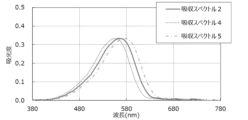
- FIG. 2 is a graph showing the waveforms of an absorption spectrum 2 using dye D-2, an absorption spectrum 4 using virtual dye-1, and an absorption spectrum 5 using virtual dye-2.
- the light-absorbing filter of the present invention contains a resin, a dye (hereinafter also simply referred to as "dye") having a main absorption wavelength band in the wavelength range of 400 to 700 nm, and a compound that generates radicals when irradiated with ultraviolet light, and the dye includes at least two types of dyes whose hues are complementary to each other.
- a dye hereinafter also simply referred to as "dye” having a main absorption wavelength band in the wavelength range of 400 to 700 nm
- the dye includes at least two types of dyes whose hues are complementary to each other.
- the main absorption wavelength band of the dye is the main absorption wavelength band of the dye measured in the state of a light-absorbing filter. Specifically, it is measured in the state of a light-absorbing filter with a substrate under the conditions described in the section on absorbance of the light-absorbing filter in the examples described later.
- the above-mentioned "dye” is dispersed (preferably dissolved) in the above-mentioned resin, thereby making the light absorbing filter into a layer exhibiting a specific absorption spectrum derived from the dye. This dispersion may be random, regular, or the like.
- the light absorbing filter of the present invention is a filter in which a compound that generates radicals when irradiated with ultraviolet light is dispersed (preferably dissolved) in a resin, so that when irradiated with ultraviolet light, it generates radicals, which react with a dye and cause the dye to undergo a chemical change, fading the dye and becoming decolorized.
- the dye has the property of undergoing a chemical change when irradiated with ultraviolet light, making it possible to decolorize it.
- the dye contained in the light-absorbing filter of the present invention includes at least two kinds of dyes whose hues are in a complementary relationship with each other.
- the light-absorbing filter of the present invention contains three or more kinds of dyes, it is sufficient that at least two kinds of dyes among the three or more kinds of dyes have mutually complementary hues.
- "hues are complementary to each other” means that in a chromaticity diagram of the CIE 1976 L * a * b * color space, the two dyes are present in quadrants opposite each other with respect to the origin, and the absolute value of the difference in the slope of the chromaticity diagram of the dyes defined by the following formula (A) is 1.2 or less.
- a * and b * in the following formula respectively mean the color shades (a * , b * ) of transmitted light, and are values measured and calculated by simulating the transmittance of a light-absorbing filter containing a single dye, using the method described in the Examples below.
- Formula (A) (slope on chromaticity diagram) (b * ) / (a * )
- the absolute value of the difference in slope on the chromaticity diagram is preferably 1.0 or less, more preferably 0.5 or less, and even more preferably 0.3 or less.
- At least two kinds of dyes contained in the light absorbing filter of the present invention are present in quadrants on opposite sides of the origin in the chromaticity diagram of the CIE 1976 L * a * b * color space, and the absolute value of the difference in slope on the chromaticity diagram is 1.2 or less, so that when an optical filter having a light absorbing portion and a light absorbing loss portion at a desired position is produced, the total amount of dye added required to show a desired reflectance and adjust the reflection color of the light absorbing portion to a neutral color can be kept low. Therefore, when the optical filter of the present invention is obtained from the light absorbing filter of the present invention, the effect of being able to decolorize the dye with a smaller amount of ultraviolet irradiation is expected in order to obtain a desired light absorbing loss portion.
- the compound that generates radicals by ultraviolet irradiation contains a compound A having an acid group and a compound B having a structure capable of forming a hydrogen bond with the acid group contained in the compound A, as described below, the efficiency of generating radical species by ultraviolet irradiation is improved compared to the case of using a commonly used photoradical generator such as a benzophenone compound. Therefore, even when ultraviolet irradiation is performed under mild temperature conditions such as room temperature, sufficient radical species are generated, and these radical species react directly or indirectly with the dye, causing the dye to decompose, resulting in fading and decolorization of the dye.
- the compound A having an acid group when the compound A having an acid group is bonded to a polymer constituting the resin, radicals are generated in the vicinity of the dye by irradiation with ultraviolet light, and the radicals have the effect of easily reacting with the dye.
- compound B having a structure capable of forming a hydrogen bond with the acid group contained in compound A forms a hydrogen bond with compound A and is dispersed (preferably dissolved) in the resin, or when compound A containing the acid group is bonded to a polymer constituting the resin, forms a hydrogen bond with compound A in the resin, and when irradiated with ultraviolet light, generates a radical, and the generated radical reacts with a nearby dye, so that the radical becomes more likely to react with the dye, and the dye can be faded and decolorized more efficiently.
- the at least two kinds of dyes which are included in the dye having a main absorption wavelength band in the wavelength range of 400 to 700 nm and have a complementary hue, preferably include at least one of an azo dye represented by any one of general formulas (i) to (iv) described later and an indoaniline dye represented by general formula (v) described later.
- the azo dye represented by general formula (i) described later is a dye having a main absorption wavelength band in the wavelength range of about 400 to 500 nm
- the azo dye represented by any one of general formulas (ii) to (iv) described later is a dye having a main absorption wavelength band in the wavelength range of about 450 to 600 nm
- the indoaniline dye represented by general formula (v) described later is a dye having a main absorption wavelength band in the wavelength range of about 580 to 700 nm.
- excellent decolorization properties can be exhibited even when irradiated with ultraviolet light in a mild environment at room temperature (meaning 10 to 30° C.).
- the azo dye represented by any of the general formulas (ii) to (iv) described below has a structure in which an electron-donating group (amino group) is substituted at one end of the chromophore and an electron-withdrawing group (thiazole group or isothiazole group) is substituted at the other end.
- an electron-donating group amino group
- thiazole group or isothiazole group an electron-withdrawing group
- the azo dye represented by any one of the general formulae (ii) to (iv) described below also easily generates radicals due to the above-mentioned "Captodative Effect", and is therefore considered to have an excellent decolorization rate when irradiated with ultraviolet light.
- the indoaniline dye represented by the general formula (v) described below also has a structure in which an electron-donating group (amino group) is substituted at one end of the chromophore and an electron-withdrawing group (carbonyl group) is substituted at the other end, and due to the above-mentioned "Captodative Effect", an excellent decolorization rate is obtained even when irradiated with ultraviolet light under mild temperature conditions such as room temperature.
- the azo dye represented by any one of the general formulae (ii) to (iv) described below and the indoaniline dye represented by the general formula (v) described below themselves are considered to have excellent decolorization properties because they hardly cause secondary absorption associated with the decomposition of the dye.
- the dyes having a main absorption wavelength band in the wavelength range of 400 to 700 nm described in Patent Document 1 the dyes having a main absorption wavelength band in the wavelength range of 400 to 700 nm described in Patent Document 1 is described as a dye having a main absorption wavelength band in the wavelength range of approximately 400 to 500 nm.
- the light absorption filter of the present invention contains an azo dye represented by the general formula (i) described later instead of the benzylidene dye or cinnamylidene dye represented by the general formula (V) described in Patent Document 1, it has a main absorption wavelength band in the wavelength range of approximately 400 to 500 nm, and can exhibit excellent decolorization property even when irradiated with ultraviolet light at room temperature (meaning 10 to 30° C.), which is a mild environment.
- the light-absorbing filter of the present invention contains an azo dye represented by any one of (ii) to (iv) below or an indoaniline dye represented by general formula (v) below, it has a main absorption wavelength band in a wavelength region of approximately 450 to 700 nm, and even when irradiated with ultraviolet light in a mild environment, that is, room temperature (meaning 10 to 30° C.), it can exhibit excellent decolorization properties comparable to those of a light-absorbing filter containing a squaraine dye represented by general formula (1) described in Patent Document 1.
- ⁇ Dye having main absorption wavelength band in wavelength range of 400 to 700 nm Specific examples of dyes having a main absorption wavelength band in the wavelength range of 400 to 700 nm for use in the present invention include tetraazaporphyrin (TAP)-based, squaraine (SQ)-based, cyanine (CY)-based, benzylidene-based, cinnamylidene-based, azo-based and indoaniline-based pigments (dyes).
- TAP tetraazaporphyrin
- SQ squaraine
- CY cyanine
- benzylidene-based benzylidene-based
- cinnamylidene-based cinnamylidene-based
- azo-based and indoaniline-based pigments indoaniline-based pigments
- the light absorbing filter of the present invention preferably contains at least one (preferably at least two) of an azo dye represented by any one of the following general formulas (i) to (iv) and an indoaniline dye represented by the following general formula (v) as the dye, from the viewpoint of the low generation of secondary colored structures due to the decomposition of the dye, and more preferably contains at least one (preferably at least two) of an azo dye represented by any one of the following general formulas (i), (ii) and (iv) and an indoaniline dye represented by the following general formula (v).
- a form containing a squaraine dye represented by the following general formula (1) as an optional component is also preferred.
- the part irradiated with ultraviolet light can be efficiently decolorized and colorless. That is, when at least one of an azo dye represented by any one of the following general formulas (i) to (iv) (preferably an azo dye represented by any one of the following general formulas (i), (ii) and (iv)) and an indoaniline dye represented by the following general formula (v) is used as the dye, and when a squaraine dye represented by the following general formula (1) is further used as an optional component, the optical filter of the present invention can be suitably produced by exposing the light-absorbing filter of the present invention to ultraviolet light through a mask.
- the color of the reflected light can be adjusted to be more neutral, which is preferable.
- Each of the azo dye represented by the following general formula (i), the azo dye represented by the following general formula (ii), the azo dye represented by the following general formula (iii), the azo dye represented by the following general formula (iv), and the indoaniline dye represented by the following general formula (v), which can be contained in the light-absorbing filter of the present invention may be one type or two or more types. Furthermore, in the case where the light absorbing filter of the present invention contains a squaraine dye represented by the following general formula (1), the squaraine dye represented by the following general formula (1) may be one type or two or more types.
- the light absorbing filter of the present invention may contain dyes other than the azo dye represented by any one of general formulas (i) to (iv), the indoaniline dye represented by general formula (v), and the squaraine dye represented by general formula (1).
- the cations are delocalized and multiple tautomer structures exist. Therefore, in the present invention, if at least one tautomer structure of a dye fits into each general formula, the dye is considered to be a dye represented by each general formula. Therefore, a dye represented by a specific general formula can also be said to be a dye whose at least one tautomer structure can be represented by a specific general formula. In the present invention, the dye represented by a general formula may have any tautomer structure as long as at least one of the tautomer structures fits into this general formula.
- R 17 and R 18 each independently represent a hydrogen atom or a monovalent substituent.
- R 19 represents a hydrogen atom, an aliphatic group, an aryl group, a heterocyclic group, a carbamoyl group, an alkoxycarbonyl group, an aryloxycarbonyl group, an acyl group, an alkylsulfonyl group, an arylsulfonyl group, or a sulfamoyl group.
- Q represents a residue of a diazo component.
- R 17 to R 19 and Q do not have a squaraine structure.
- the above-mentioned squaraine structure refers to the structure of a squaraine dye.
- a squaraine dye is a dye having a structure in which a skeleton derived from squaric acid is located at the center of a ⁇ -conjugated system.
- a squaraine dye represented by the general formula (1) described below can be mentioned.
- Examples of the monovalent substituent which may be taken as R 17 and R 18 include a halogen atom, an aliphatic group, an aryl group, a heterocyclic group, a cyano group, a carboxy group, a carbamoyl group, an aliphatic oxycarbonyl group, an aryloxycarbonyl group, an acyl group, a hydroxy group, an aliphatic oxy group, an aryloxy group, an acyloxy group, a carbamoyloxy group, a heterocyclic oxy group, an amino group (-NH 2 ), an aliphatic amino group, an arylamino group, a heterocyclic amino group, an acylamino group, a carbamoylamino group, a sulfamoylamino group, an aliphatic oxycarbonylamino group, an aryloxycarbonylamino group, an aliphatic sulfonylamino group, an
- an aliphatic group, an aryl group, a heterocyclic group, a cyano group, a carbamoyl group, an aliphatic oxycarbonyl group, an aryloxycarbonyl group, an acyl group, an aliphatic oxy group, an aryloxy group, an aliphatic amino group, or an arylamino group is preferred.
- the substituents which can be adopted as these R 17 and R 18 may be further substituted.
- the aliphatic groups which can be taken as R 17 to R 19 may further have a monovalent substituent, may be saturated or unsaturated, and may be cyclic. Specific examples include alkyl groups, substituted alkyl groups, alkenyl groups, substituted alkenyl groups, alkynyl groups, substituted alkynyl groups, aralkyl groups, and substituted aralkyl groups.
- the total number of carbon atoms in the aliphatic group is preferably 1 to 30, and more preferably 1 to 16.
- the aliphatic group examples include a methyl group, an ethyl group, a butyl group, an isopropyl group, a t-butyl group, a hydroxyethyl group, a methoxyethyl group, a cyanoethyl group, a trifluoromethyl group, a 3-sulfopropyl group, a 4-sulfobutyl group, a 2-(2-hydroxyethoxy)ethyl group, a 2-(2-(acetyloxy)ethoxy)ethyl group, a cyclohexyl group, a benzyl group, a 2-phenethyl group, a vinyl group, and an allyl group.
- examples of the monovalent substituent that may be possessed include the monovalent substituents that may be taken as R 17 and R 18 , and the same applies to the following explanation of the monovalent substituent that may be possessed.
- examples of the monovalent substituent that may be possessed are preferably an alkoxy group, an acyloxy group, a hydroxy group, etc.
- these substituents may further have a substituent, and examples of the preferred substituents include an alkoxy group, an acyloxy group, a hydroxy group, etc.
- the aryl group which can be taken as R 17 to R 19 may further have a monovalent substituent, and is preferably an aryl group having a total carbon number of 6 to 30, more preferably 6 to 16.
- the heterocyclic group which can be taken as R 17 to R 19 may be a saturated or unsaturated aliphatic ring group, or may be an aromatic ring group, and is preferably an aromatic heterocyclic group.
- ring-constituting atoms constituting the heterocyclic group include those containing at least one heteroatom such as a nitrogen atom, a sulfur atom, or an oxygen atom, and may further have a monovalent substituent.
- the heterocyclic group is preferably a heterocyclic group having a total of 1 to 30 carbon atoms, and more preferably a heterocyclic group having 1 to 15 carbon atoms. Specific examples include a 2-pyridyl group, a 2-thienyl group, a 2-thiazolyl group, a 2-benzothiazolyl group, a 2-benzoxazolyl group, and a 2-furyl group.
- the carbamoyl groups which can be represented by R 17 to R 19 include unsubstituted carbamoyl groups (—CONH 2 ) as well as carbamoyl groups substituted with an aliphatic group, an aryl group, or the like.
- the carbamoyl group which can be represented by R 17 to R 19 may further have a monovalent substituent and is preferably a carbamoyl group having a total of 1 to 30 carbon atoms, more preferably a carbamoyl group having 1 to 16 carbon atoms. Specific examples include a methylcarbamoyl group, a dimethylcarbamoyl group, a phenylcarbamoyl group, and an N-methyl-N-phenylcarbamoyl group.
- the aliphatic oxycarbonyl group which can be represented by R 17 and R 18 may further have a monovalent substituent, may be saturated or unsaturated, may be cyclic, and is preferably an aliphatic oxycarbonyl group having a total of 2 to 30 carbon atoms, more preferably an aliphatic oxycarbonyl group having a total of 2 to 16 carbon atoms. Specific examples include a methoxycarbonyl group, an ethoxycarbonyl group, and a 2-methoxyethoxycarbonyl group.
- the alkoxycarbonyl group which can be taken as R 19 may further have a monovalent substituent, may be saturated or unsaturated, may be cyclic, and is preferably an alkoxycarbonyl group having a total of 2 to 30 carbon atoms, more preferably an alkoxycarbonyl group having a total of 2 to 16 carbon atoms. Specific examples include a methoxycarbonyl group, an ethoxycarbonyl group, and a 2-methoxyethoxycarbonyl group.
- the aryloxycarbonyl group which can be represented by R 17 to R 19 may further have a monovalent substituent, and is preferably an aryloxycarbonyl group having a total of 7 to 30 carbon atoms, more preferably an aryloxycarbonyl group having 7 to 16 carbon atoms. Specific examples include a phenoxycarbonyl group, a 4-methylphenoxycarbonyl group, and a 3-chlorophenoxycarbonyl group.
- the acyl groups which can be taken as R 17 to R 19 include an aliphatic carbonyl group, an arylcarbonyl group, and a heterocyclic carbonyl group, and preferably have a total carbon number of 1 to 30, more preferably have a total carbon number of 1 to 16. Specific examples include an acetyl group, a methoxyacetyl group, a thienoyl group, and a benzoyl group.
- the aliphatic sulfonyl group which can be represented by R 17 and R 18 may further have a monovalent substituent, may be saturated or unsaturated, may be cyclic, and preferably has a total of 1 to 30 carbon atoms, more preferably has a total of 1 to 16 carbon atoms. Specific examples include a methanesulfonyl group, a methoxymethanesulfonyl group, and an ethoxyethanesulfonyl group.
- the alkylsulfonyl group which can be taken as R 19 may further have a monovalent substituent, may be saturated or unsaturated, may be cyclic, and preferably has a total of 1 to 30 carbon atoms, more preferably has a total of 1 to 16 carbon atoms.
- Specific examples include a methanesulfonyl group, a methoxymethanesulfonyl group, and an ethoxyethanesulfonyl group.
- the arylsulfonyl group which can be represented by R 17 to R 19 may further have a monovalent substituent and preferably has a total of 6 to 30 carbon atoms, more preferably has a total of 6 to 18 carbon atoms.
- Specific examples include benzenesulfonyl and toluenesulfonyl groups.
- Sulfamoyl groups which can be taken as R 17 to R 19 include, in addition to unsubstituted sulfamoyl groups (—SO 2 NH 2 ), carbamoyl groups substituted with an aliphatic group, an aryl group, or the like.
- the sulfamoyl group which can be represented by R 17 to R 19 may further have a monovalent substituent and preferably has a total of 0 to 30 carbon atoms, more preferably has a total of 0 to 16 carbon atoms. Specific examples include an unsubstituted sulfamoyl group, a dimethylsulfamoyl group, and a di-(2-hydroxyethyl)sulfamoyl group.
- the imido group which can be taken as R 17 and R 18 may further have a monovalent substituent, and is preferably a 5- or 6-membered ring imido group.
- the imido group preferably has a total of 4 to 30 carbon atoms, more preferably 4 to 20 carbon atoms. Specific examples include succinimide and phthalimide groups.
- aliphatic group in the aliphatic oxy group aliphatic amino group, aliphatic oxycarbonylamino group, aliphatic sulfonylamino group, and aliphatic thio group which can be taken as R 17 and R 18
- the descriptions of the aliphatic groups which can be taken as R 17 to R 19 can be applied.
- the aryl group in the aryloxy group arylamino group, aryloxycarbonylamino group, arylsulfonylamino group and arylthio group which can be taken as R 17 and R 18
- the descriptions of the aryl group which can be taken as R 17 to R 19 can be applied.
- the descriptions of the acyl group which can be taken as R 17 to R 19 can be applied.
- the carbamoyl group in the carbamoyloxy group and carbamoylamino group which can be taken as R 17 and R 18 the descriptions of the carbamoyl groups which can be taken as R 17 to R 19 can be applied.
- the heterocyclic group in the heterocyclic oxy group heterocyclic amino group and heterocyclic thio group which can be taken as R 17 and R 18
- the descriptions of the heterocyclic groups which can be taken as R 17 to R 19 can be applied.
- the sulfamoyl group in the sulfamoylamino group which can be taken as R 17 and R 18 the descriptions of the sulfamoyl groups which can be taken as R 17 to R 19 can be applied.
- the diazo component residue represented by Q means a residue of the diazo component "Q-NH 2 ".
- Q is preferably an aryl group or an aromatic heterocyclic group.
- the aromatic hydrocarbon ring constituting the aryl group that can be taken as Q may be a monocyclic ring or a condensed ring, and is preferably a monocyclic ring.
- An aryl group having a total carbon number of 6 to 30 is preferable, and an aryl group having a total carbon number of 6 to 16 is more preferable.
- a phenyl group is preferable.
- the aryl group that can be taken as Q may have a substituent, and preferable examples of the substituent that may be had include a sulfamoyl group (preferably an alkylsulfamoyl group or a dialkylsulfamoyl group), a sulfonyl group (preferably an alkylsulfonyl group), and a cyano group.
- a sulfamoyl group preferably an alkylsulfamoyl group or a dialkylsulfamoyl group
- a sulfonyl group preferably an alkylsulfonyl group
- cyano group cyano group
- the aromatic heterocyclic group that can be taken as Q is preferably an aromatic ring group containing at least one heteroatom such as a nitrogen atom, a sulfur atom, or an oxygen atom as a ring-constituting atom constituting the heterocyclic group, and is preferably constituted by a 5- to 6-membered ring.
- the number of carbon atoms in the aromatic heterocyclic group is preferably 1 to 25, more preferably 1 to 15.
- the aromatic heterocycle constituting the aromatic heterocyclic group may be a monocycle or a condensed ring, and is preferably a monocycle.
- aromatic heterocyclic group examples include a pyrazole group, a 1,2,4-triazole group, an isothiazole group, a benzoisothiazole group, a thiazole group, a benzothiazole group, an oxazole group, and a 1,2,4-thiadiazole group.
- Examples of the azo dye represented by the above general formula (i) include the following exemplary compounds (B-12) to (B-16), (B-18), and (B-19). However, the present invention is not limited to these.
- R 21 to R 24 , R 26 and R 27 each represent a hydrogen atom, a halogen atom, a cyano group, a nitro group, a carboxy group, a sulfo group, -OR 108 , -SR 109 , -NR 110 R 111 , -S( ⁇ O) 2 NR 112 R 113 , -C( ⁇ O)NR 114 R 115 , -NHC( ⁇ O)R 116 , -C( ⁇ O)OR 117 , -O(CH 2 CH 2 O) n R 118 , -O(CH 2 CH 2 S) n R 119 , -S(CH 2 CH 2 O) n R 120 and -S(CH 2 CH 2 S) n R 121 .
- R 108 to R 121 each represent a hydrogen atom, a non-cyclic hydrocarbon group, a monocyclic hydrocarbon group, a condensed polycyclic hydrocarbon group or a heterocyclic group, and n is a positive integer.
- the acyclic hydrocarbon group, the monocyclic hydrocarbon group, the condensed polycyclic hydrocarbon group and the heterocyclic group include a halogen atom, a cyano group, a nitro group, a carboxy group, a sulfo group, -OR 108 , -SR 109 , -NR 110 R 111 , -S( ⁇ O) 2 NR 112 R 113 , -C( ⁇ O)NR 114 R 115 , -NHC( ⁇ O)R 116 , -C( ⁇ O)OR 117 , -O(CH 2 CH 2 O) n R 118 , -O(CH 2 CH 2 S) n R 119 , -S(CH 2 CH 2 O) n R 120 and -S(CH 2 CH 2 S) n R 121
- the aryl group may have one or more of acyclic hydrocarbon groups, monocyclic hydrocarbon groups, condensed polycyclic hydrocarbon groups, and hetero
- the acyclic hydrocarbon group which can be taken as R 21 to R 24 , R 26 , R 27 and R 108 to R 121 means an acyclic alkyl group in which one hydrogen atom has been removed from an acyclic alkane.
- the acyclic alkyl group may have a ring structure as a substituent.
- the number of carbon atoms in the acyclic alkyl group is preferably 1 to 30, more preferably 1 to 20, still more preferably 1 to 12, particularly preferably 1 to 8, and of these, 1 to 6 is preferred.
- the monocyclic hydrocarbon group which may be taken as R 21 to R 24 , R 26 , R 27 and R to R 121 means a monocyclic cycloalkyl group, a monocyclic cycloalkenyl group, a monocyclic cycloalkynyl group or a monocyclic aryl group which is a group in which one hydrogen atom has been removed from a monocyclic aliphatic hydrocarbon ring (which may be any of a monocyclic cycloalkane, a monocyclic cycloalkene and a monocyclic cycloalkyne) or a monocyclic aromatic hydrocarbon ring.
- the number of carbon atoms in the monocyclic cycloalkyl group, monocyclic cycloalkenyl group, and monocyclic cycloalkynyl group is not particularly limited as long as it is structurally possible, but is more preferably 3 to 30, more preferably 3 to 20, and even more preferably 3 to 16.
- the number of carbon atoms in the monocyclic aryl group is more preferably 6 to 30, more preferably 6 to 20, and even more preferably 6 to 16.
- the fused polycyclic hydrocarbon group which may be taken as R 21 to R 24 , R 26 , R 27 and R to R 121 means a fused polycyclic cycloalkyl group, a fused polycyclic cycloalkenyl group, a fused polycyclic cycloalkynyl group or a fused polycyclic aryl group which is a group in which one hydrogen atom has been removed from a fused polycyclic aliphatic hydrocarbon ring (which may be any of a fused polycyclic cycloalkane, a fused polycyclic cycloalkene and a fused polycyclic cycloalkyne) or a fused polycyclic aromatic hydrocarbon ring.
- the number of carbon atoms in the fused polycyclic cycloalkyl group, the fused polycyclic cycloalkenyl group, and the fused polycyclic cycloalkynyl group is not particularly limited as long as it is structurally possible, but is more preferably 8 to 30, and more preferably 8 to 20.
- the number of carbon atoms in the fused polycyclic aryl group is more preferably 12 to 30, and more preferably 12 to 20.
- the heterocyclic groups which can be taken as R 21 to R 24 , R 26 , R 27 and R 108 to R 121 the descriptions of the heterocyclic groups which can be taken as R 17 to R 19 in the above general formula (i) can be applied.
- n is preferably an integer of 1 to 12, more preferably an integer of 1 to 6, and even more preferably an integer of 1 to 3.
- R 21 is preferably a cyano group, a nitro group, -OR 108 , an acyclic hydrocarbon group (preferably an acyclic alkyl group or an acyclic alkenyl group) or a heterocyclic group, more preferably a cyano group or a nitro group, or an acyclic alkyl group substituted with a halogen atom (preferably an alkyl group substituted with a fluorine atom), and further preferably a cyano group.
- an acyclic hydrocarbon group preferably an acyclic alkyl group or an acyclic alkenyl group
- a heterocyclic group more preferably a cyano group or a nitro group
- a halogen atom preferably an alkyl group substituted with a fluorine atom
- R 22 is preferably a hydrogen atom, a cyano group, an acyclic hydrocarbon group (preferably an acyclic alkyl group) or a monocyclic hydrocarbon group, more preferably a hydrogen atom, an alkyl group or an aryl group, and even more preferably an alkyl group or an aryl group. At least one of R 21 and R 22 is preferably a cyano group, a nitro group, or a non-cyclic alkyl group substituted with a halogen atom, a cyano group, or a nitro group.
- R 23 is preferably a hydrogen atom, -OR 108 , -SR 109 , -NR 110 R 111 , -C( ⁇ O)NR 114 R 115 , -NHC( ⁇ O)R 116 , -O(CH 2 CH 2 O) n R 118 , -O(CH 2 CH 2 S) n R 119 , -S(CH 2 CH 2 O) n R 120 , -S(CH 2 CH 2 S) n R 121 or an acyclic hydrocarbon group (preferably an acyclic alkyl group), more preferably a hydrogen atom, -OR 108 , -SR 109 , -NR 110 R 111 , -NHC( ⁇ O)R 116 or an acyclic alkyl group, and more preferably -NHC( ⁇ O)R More preferably, R 108 to R 111 , R 116 and R 118 to R 121 are each preferably acyclic alkyl groups .
- R 24 and R 27 are preferably a hydrogen atom.
- R 26 is preferably a hydrogen atom, -OR 108 , -SR 109 , -NR 110 R 111 , -NHC( ⁇ O)R 116 , -O(CH 2 CH 2 O) n R 118 , -O(CH 2 CH 2 S) n R 119 , -S(CH 2 CH 2 O) n R 120 , -S(CH 2 CH 2 S) n R 121 or an acyclic hydrocarbon group (preferably an acyclic alkyl group), more preferably a hydrogen atom, -OR 108 or -SR 109 , and even more preferably a hydrogen atom.
- R 108 to R 111 , R 116 and R 118 to R 121 are preferably acyclic alkyl groups.
- R 110 is preferably an acyclic alkyl group
- R 111 is preferably an acyclic alkyl group, more preferably an unsubstituted acyclic alkyl group, or an acyclic alkyl group having -OR 108 , a monocyclic hydrocarbon group or a condensed polycyclic hydrocarbon group as a substituent, wherein R 108 is preferably a hydrogen atom or an acyclic alkyl group.
- dye represented by formula (ii) include the compounds used in the examples described below, as well as the compounds described in paragraphs [0023] to [0034] of JP-A-5-257180, and the compounds described in paragraphs [0050] and [0052] of JP-A-2013-129712, compound D-18 described in paragraph [0055], and the compound described in paragraph [0056].
- the present invention is not limited to these.
- R 31 represents a hydrogen atom, an alkyl group, an alkoxy group, a cyano group, a carbonyl group (preferably an alkyloxycarbonyl group or an aryloxycarbonyl group), an aromatic group or a heterocyclic group.
- R 32 represents a hydrogen atom, an alkyl group, an alkoxy group, a cyano group, a nitro group, a carbonyl group (preferably an alkyloxycarbonyl group or an aryloxycarbonyl group), an aromatic group or a heterocyclic group.
- R 34 and R 35 each independently represent a hydrogen atom, an alkyl group or an aromatic group.
- R 37 represents a hydrogen atom, an alkyl group, an alkoxy group, a cyano group, a carbonyl group (preferably an alkyloxycarbonyl group or an aryloxycarbonyl group), an acylamino group or an aromatic group.
- R 34 and R 35 may be bonded to each other to form a ring.
- R 1 and R 2 in relation to the general formula (1) described in JP-A-2013-129712 can be directly applied to R 31 and R 32 , respectively, and the description of R 4 , R 5 and R 7 in relation to the general formula (3) described in JP-A-2013-129712 can be directly applied to R 34 , R 35 and R 37 , respectively.
- R 37 can be the following acylamino group in addition to the hydrogen atom, alkyl group, alkoxy group, cyano group, carbonyl group, and aromatic group that R 7 in the general formula (3) described in JP2013-129712A can be.
- the acylamino group which can be represented by R 37 preferably has 1 to 12 carbon atoms, and more preferably has 1 to 6 carbon atoms.
- the alkyl group which can be represented by R 31 , R 32 and R 37 preferably has 1 to 20 carbon atoms, more preferably 1 to 12 carbon atoms, and particularly preferably 1 to 6 carbon atoms.
- the alkoxy group which can be represented by R 31 , R 32 and R 37 preferably has 1 to 20 carbon atoms, more preferably 1 to 12 carbon atoms, and particularly preferably 1 to 6 carbon atoms.
- the alkyloxycarbonyl group which can be represented by R 31 , R 32 and R 37 preferably has 2 to 30 carbon atoms, more preferably 2 to 20 carbon atoms, further preferably 2 to 12 carbon atoms, and particularly preferably 2 to 7 carbon atoms.
- the alkyl group which can be represented by R 34 and R 35 preferably has 1 to 30 carbon atoms, more preferably 1 to 20 carbon atoms, and even more preferably 1 to 12 carbon atoms.
- R 31 is preferably an alkyl group or an aryl group, more preferably an alkyl group.
- R 32 is preferably an alkyl group or a cyano group, more preferably a cyano group.
- R 34 and R 35 are preferably a hydrogen atom or an alkyl group, more preferably an alkyl group.
- R 37 is preferably a hydrogen atom, an alkyl group, an acylamino group or an aromatic group, more preferably a hydrogen atom or an alkyl group, and even more preferably an alkyl group.
- R 41 to R 44 , R 46 and R 47 each represent a hydrogen atom, a halogen atom, a cyano group, a nitro group, a carboxy group, a sulfo group, -OR 208 , -SR 209 , -NR 210 R 211 , -S( ⁇ O) 2 NR 212 R 213 , -C( ⁇ O)NR 214 R 215 , -NHC( ⁇ O)R 216 , -C( ⁇ O)OR 217 , -O(CH 2 CH 2 O) n R 218 , -O(CH 2 CH 2 S) n R 219 , -S(CH 2 CH 2 O) n R 220 and -S(CH 2 CH 2 S) n R 221 .
- R 208 to R 221 each represent a hydrogen atom, a non-cyclic hydrocarbon group, a monocyclic hydrocarbon group, a condensed polycyclic hydrocarbon group or a heterocyclic group, and n is a positive integer.
- R 208 to R 211 , R 216 and R 218 to R 221 are preferably acyclic alkyl groups.
- R 210 is preferably an acyclic alkyl group
- R 211 is preferably an acyclic alkyl group, more preferably an unsubstituted acyclic alkyl group (including an acyclic alkyl group substituted with an acyclic alkyl group), or -OR 208 , an acyclic alkyl group having a monocyclic hydrocarbon group or a condensed polycyclic hydrocarbon group as a substituent.
- R 208 is preferably a hydrogen atom or an acyclic alkyl group.
- R 44 and/or R 46 in general formula (iv) may be bonded to R 210 and/or R 211 in -NR 210 R 211 located at the ortho position relative to R 44 and R 46 on the benzene ring to form a ring.
- the ring that may be formed is preferably a 5- or 6-membered ring, and may be saturated or unsaturated, and is preferably a saturated 6-membered ring.
- the ring that may be formed may further have a substituent, and preferably has, for example, an alkyl group.
- the ring is preferably formed by bonding R 46 to R 211 in --NR 210 R 211 located at the ortho position relative to R 44 and R 46 on the benzene ring to form a saturated 6-membered ring.
- Q1 represents a group of atoms necessary to form a 5- to 7-membered nitrogen-containing heterocycle together with the carbon atom to which it is bonded, including at least one nitrogen atom.
- R 51 represents an acyl group, an alkoxycarbonyl group, an aryloxycarbonyl group, an aminocarbonyl group or a sulfonyl group
- R 52 represents a hydrogen atom or an alkyl group
- R 53 to R 57 represent a hydrogen atom, an alkyl group, an alkoxy group, an acylamino group, an alkylsulfonylamino group or a halogen atom
- R 58 and R 59 represent a hydrogen atom, an alkyl group or an aryl group.
- R51 and R53 , R54 and R55 and/or R55 and R59 , or R58 and R59 may be bonded to each other to form a ring. That is, it means that R51 and R53 may be bonded to each other to form a ring, R54 and R55 and/or R55 and R59 may be bonded to each other to form a ring, or R58 and R59 may be bonded to each other to form a ring.
- R 1 to R 6 , R 8 , R 9 and Q 1 in general formula (I) described in JP-A-2-92686 can be directly applied to R 51 to R 56 , R 58 , R 59 and Q 1 , respectively, unless otherwise specified.
- R 53 to R 56 can be the following acylamino group and alkylsulfonylamino group in addition to the hydrogen atom, alkyl group, alkoxy group and halogen atom which R 3 to R 6 in the general formula (I) described in JP-A-2-92686 can be.
- the acylamino group which can be represented by R 53 to R 57 preferably has 1 to 12 carbon atoms, and more preferably has 1 to 6 carbon atoms.
- the alkylsulfonylamino group which can be represented by R 53 to R 57 preferably has 1 to 12 carbon atoms, and more preferably has 1 to 6 carbon atoms.
- R 16 represents a hydrogen atom, an alkyl group, an aryl group, or a heterocyclic group, and a hydrogen atom is preferred.
- the definition and preferred range of each substituent of R 16 are the same as those described in JP-A-2-92686 regarding R 16 in the general formula (I).
- R 51 is preferably an acyl group having 2 to 7 carbon atoms or an alkoxycarbonyl group having 2 to 7 carbon atoms.
- R 52 is preferably a hydrogen atom, and R 53 to R 56 are preferably hydrogen atoms.
- R 57 is preferably an alkoxy group, an acylamino group or an alkylsulfonylamino group, more preferably an alkoxy group or an acylamino group.
- R 58 and R 59 are preferably an alkyl group having 1 to 6 carbon atoms.
- indoaniline dye represented by the above general formula (v) is preferably represented by the following general formula (v-a):
- R 51 , R 53 , R 57 to R 59 and Q 2 have the same meanings as R 51 , R 53 , R 57 to R 59 and Q 2 in general formula (v) above.
- Q2 is preferably -CR 11 R 12 CR 13 R 14 -, -CR 11 R 12 - or -NR 11 -, and more preferably -CR 11 R 12 CR 13 R 14 -.
- R 11 to R 14 each represent a hydrogen atom or an alkyl group having 1 to 4 carbon atoms, and it is preferable that R 11 and R 12 are hydrogen atoms and R 13 and R 14 are alkyl groups having 1 to 4 carbon atoms.
- --CR 11 R 12 CR 13 R 14 -- is bonded to >C ⁇ O on the side of the carbon atom to which R 11 and R 12 are bonded.
- G represents a heterocyclic group which may have a substituent.
- each substituent in the general formula (1) may be directly applied to the descriptions of each substituent of the dye represented by the general formula (1) described in WO 2021/132674.
- the dyes represented by any of the general formulas (2) to (5) described in [0045] to [0070] of WO 2021/132674 and the specific examples thereof can be applied as they are.
- the present invention is not limited to these.
- specific examples of the dye represented by any of the general formulas (3) to (5) include the compounds described in [0071] to [0080] of WO 2021/132674.
- the present invention is not limited to these.
- the dye represented by the above general formula (1) the dye represented by any one of the general formulas (6) to (9) described in [0081] to [0095] of WO 2021/132674 and the specific examples thereof can be applied as they are.
- the present invention is not limited to these.
- the squaraine dye represented by the general formula (1) may be a quencher-containing dye in which the quencher moiety is covalently linked to the dye via a linking group.
- the quencher-containing dye may also be preferably used as the dye. That is, the quencher-containing dye is counted as the dye according to the wavelengths having the main absorption wavelength band.
- the above-mentioned quencher-containing dyes include an electron-donating quencher-containing dye in which the quencher moiety is an electron-donating quencher moiety, and an electron-accepting quencher moiety in which the quencher moiety is an electron-accepting quencher moiety.
- the electron-donating quencher moiety refers to a structural part which donates an electron to the SOMO (Singly Occupied Molecular Orbital) having a lower energy level of two SOMOs of the dye in an excited state, and then receives an electron from the SOMO having a higher energy level of the dye, thereby deactivating the dye in an excited state to the ground state.
- the electron-accepting quencher moiety refers to a structural part which accepts an electron from the SOMO having a higher energy level of two SOMOs of the dye in an excited state, and then donates an electron to the SOMO having a lower energy level of the dye, thereby deactivating the dye in an excited state to the ground state.
- Examples of the electron-donating quencher moiety include the ferrocenyl group in the substituent X that may be possessed by A, B, and G in the general formula (1) described in WO 2021/132674, and the quencher moiety in the quencher compound described in paragraphs [0199] to [0212] and paragraphs [0234] to [0287] of WO 2019/066043, and the ferrocenyl group in the substituent X that may be possessed by A, B, and G in the general formula (1) described in WO 2021/132674 is preferred.
- examples of the electron-accepting quencher moiety include the quencher moiety in the quencher compound described in paragraphs [0288] to [0310] of WO 2019/066043.
- the light-absorbing filter of the present invention preferably contains a dye having a main absorption wavelength band of 400 to 700 nm, and more preferably contains a squaraine dye represented by the following general formula (1A).
- G represents a heterocyclic group which may have a substituent.
- at least one of A and B includes an electron-donating quencher moiety.
- the dye represented by the above general formula (1A) is the same as the dye represented by the above general formula (1), except that at least one of A and B in the dye represented by the above general formula (1) contains an electron-donating quencher portion. Therefore, for the description of A, B, and G in the general formula (1A), the description of A, B, and G in the general formula (1) described in WO 2021/132674 can be applied.
- the description of the dye represented by the general formula (1A) in the description of the dye represented by any of the general formulas (2) to (9), which is a preferred embodiment of the dye represented by the above general formula (1), at least one of the structures corresponding to A and B in the general formula (1) is modified to include an electron-donating quencher portion.
- the electron-donating quencher moiety contained in at least one of A and B is preferably a ferrocenyl group in the substituent X that may be possessed by A, B, and G in the general formula (1) described in WO 2021/132674.
- squaraine dyes represented by general formula (1) that are quencher-containing dyes include the compounds described in paragraphs [0097] to [0114] of WO 2021/132674. However, the present invention is not limited to these.
- the total content of the dyes in the light absorbing filter of the present invention is preferably 0.10% by mass or more, more preferably 0.15% by mass or more, even more preferably 0.20% by mass or more, particularly preferably 0.25% by mass or more, and particularly preferably 0.30% by mass or more.
- the total content of the dyes in the light absorbing filter of the present invention is equal to or more than the above-mentioned preferable lower limit, good light absorption properties such as antireflection effect can be obtained.
- the total content of the above dyes in the light-absorbing filter of the present invention is usually 50% by mass or less, preferably 40% by mass or less, more preferably 30% by mass or less, even more preferably 15% by mass or less, and particularly preferably 10% by mass or less.
- the total content of the dyes in the light-absorbing filter of the present invention is preferably 0.10 to 50 mass%, more preferably 0.15 to 40 mass%, even more preferably 0.20 to 30 mass%, particularly preferably 0.25 to 15 mass%, and especially preferably 0.30 to 10 mass%.
- the total content of at least two types of dyes whose hues are complementary to each other is preferably 0.01 to 50 mass%, more preferably 0.1 to 40 mass%, even more preferably 0.25 to 30 mass%, particularly preferably 0.5 to 20 mass%, and especially preferably 0.5 to 10 mass%.
- all of the dyes may be composed of dyes whose hues are complementary to each other.
- the content of the azo dye represented by the general formula (i) in the light-absorbing filter of the present invention is preferably 0.01 to 30% by mass, more preferably 0.1 to 10% by mass.
- the content of each of the azo dye represented by the general formula (ii), the azo dye represented by the general formula (iii), the azo dye represented by the general formula (iv), and the indoaniline dye represented by the general formula (v) in the light-absorbing filter of the present invention is preferably 0.01 to 30% by mass, more preferably 0.1 to 10% by mass, similar to the content of the azo dye represented by the general formula (i).
- all of the dyes may be composed of at least one of the azo dye represented by any one of the general formulas (i) to (iv) and the indoaniline dye represented by the general formula (v).
- the content of the squaraine dye represented by the above general formula (1) in the light-absorbing filter of the present invention is preferably 0.01 to 30 mass %, more preferably 0.1 to 10 mass %.
- all of the dyes except for the azo dye represented by any one of the above general formulas (i) to (iv) and the indoaniline dye represented by the above general formula (v), may be squaraine dyes represented by the above general formula (1).
- the content of the quencher-containing dye in the light-absorbing filter of the present invention is preferably 0.10% by mass or more, more preferably 0.15% by mass or more, even more preferably 0.20% by mass or more, particularly preferably 0.25% by mass or more, and especially preferably 0.30% by mass or more, from the viewpoint of imparting light absorption properties such as anti-reflection effect.
- the upper limit is preferably 45% by mass or less, preferably 40% by mass or less, more preferably 30% by mass or less, even more preferably 15% by mass or less, and especially preferably 10% by mass or less. That is, the total content of the quencher-containing dye in the light-absorbing filter is preferably 0.10 to 45% by mass, more preferably 0.15 to 40% by mass, even more preferably 0.20 to 30% by mass, particularly preferably 0.25 to 15% by mass, and especially preferably 0.30 to 10% by mass.
- the light absorbing filter of the present invention contains a compound that generates radicals when irradiated with ultraviolet light (in the present invention, this is also simply referred to as a "radical generator").
- the radical generator is not particularly limited as long as it is a compound that generates radicals by irradiation with ultraviolet light and has the function of decolorizing the dye.
- a photoradical generator that may be used in combination with compound B described below can be used as the radical generator.
- the radical generator is a combination of two or more compounds, and the combination of two or more compounds in the light absorbing filter that generates radicals by ultraviolet irradiation as a result of interaction such as complex formation.
- the type of the compound to be combined may be two or more compounds that show different functions in the mechanism of generating radicals by ultraviolet irradiation, and two types are preferable.
- the combination of compound A having an acid group and compound B having a structure that can form hydrogen bonds with the acid group contained in compound A is preferable.
- the light absorbing filter of the present invention contains a compound A having an acid group and a compound B having a structure capable of forming a hydrogen bond with the acid group contained in the compound A, the efficiency of generating radical species by ultraviolet irradiation is improved compared to the case of using the photoradical generator. Therefore, even when ultraviolet irradiation is performed under mild temperature conditions such as room temperature, sufficient radical species are generated, and these radical species react directly or indirectly with the dye, and the dye is decomposed, so that the dye fades and becomes discolored.
- the azo dye represented by any of the general formulas (i), (ii) and (iv) described above, the indoaniline dye represented by the general formula (v) described above, and the squaraine dye represented by the general formula (1) described above that can be contained in the light absorbing filter of the present invention are discolored with almost no secondary absorption associated with the decomposition of the dye.
- Compound A having an acid group and compound B having a structure capable of forming a hydrogen bond with the acid group contained in compound A will be described in detail below.
- Compound A having an acid group The light absorbing filter of the present invention preferably contains, as the radical generator, a compound A having an acid group (in the present invention, also simply referred to as "compound A") together with a compound B having a structure capable of forming a hydrogen bond with the acid group contained in compound A described below.
- the acid group contained in compound A is preferably a proton dissociative group having a pKa of 12 or less.
- Compound A may be a low molecular weight compound or a high molecular weight compound (hereinafter also referred to as a "polymer”), and is preferably a polymer.
- Compound A being a polymer means that compound A is chemically bonded to a polymer constituting the resin contained in the light-absorbing filter of the present invention.
- the molecular weight of compound A is less than 5000, preferably 2000 or less, more preferably 1000 or less, even more preferably 500 or less, and particularly preferably 400 or less. There is no particular restriction on the lower limit, but 100 or more is practical, and 200 or more is preferable.
- the lower limit of the weight-average molecular weight of compound A is 5,000 or more, and from the viewpoint of the physical properties of the optical filter, it is preferably 10,000 or more, and more preferably 15,000 or more.
- the upper limit is not particularly limited, but from the viewpoint of solubility in a solvent, it is preferably 500,000 or less, more preferably 200,000 or less, and even more preferably 150,000 or less. That is, 5,000 to 500,000 is practical and preferable, 10,000 to 200,000 is more preferable, and 15,000 to 150,000 is more preferable.
- acid groups contained in compound A may or may not be anionized in the light absorbing filter, and in the present invention, both anionized and non-anionized acid groups are referred to as acid groups.
- compound A may or may not be anionized in the light absorbing filter.
- Compound A is preferably a compound having a carboxy group, in view of excellent film-forming properties of the light-absorbing filter.
- the compound having a carboxy group is preferably a monomer containing a carboxy group (hereinafter also referred to as a "carboxy group-containing monomer”) or a polymer containing a carboxy group (hereinafter also referred to as a "carboxy group-containing polymer”), and from the viewpoint of the film-forming property of the light-absorbing filter, it is more preferably a carboxy group-containing polymer.
- carboxy groups (-COOH) possessed by the carboxy group-containing monomer and the carboxy group-containing polymer may be anionized or not in the light-absorbing filter, and both anionized carboxy groups ( -COO- ) and non-anionized carboxy groups are referred to as carboxy groups.
- carboxy group-containing polymer may be either anionized or non-anionized in the light absorbing filter, and both anionized and non-anionized carboxy group-containing polymers are referred to as the carboxy group-containing polymer.
- the content of compound A in the light absorbing filter is preferably 1% by mass or more, more preferably 25% by mass or more, even more preferably 30% by mass or more, particularly preferably 45% by mass or more, and especially preferably 50% by mass or more.
- the upper limit of the content of compound A is preferably less than 100% by mass, more preferably 99% by mass or less, and even more preferably 97% by mass or less. That is, it is preferably 1% by mass or more and less than 100% by mass, more preferably 25 to 99% by mass, even more preferably 30 to 97% by mass, particularly preferably 45 to 97% by mass, and especially preferably 50 to 97% by mass.
- the content of compound A in the light absorbing filter is preferably 50% by mass or more and less than 100% by mass, more preferably 60% by mass or more and less than 100% by mass, and even more preferably 70% by mass or more and less than 100% by mass.
- the upper limit is also preferably 99% by mass or less, more preferably 97% by mass or less, even more preferably 95% by mass or less, and particularly preferably 90% by mass or less.
- the compound A may be used alone or in combination of two or more kinds.
- the carboxy group-containing monomer may be a polymerizable compound that contains a carboxy group and one or more (eg, 1 to 15) ethylenically unsaturated groups.
- the ethylenically unsaturated group include a (meth)acryloyl group, a vinyl group, and a styryl group, with a (meth)acryloyl group being preferred.
- the carbonyl bond in the (meth)acryloyl group and the carbonyl bond in the carboxy group may share one carbonyl bond.
- the carboxyl group-containing monomer is preferably a difunctional or higher functional monomer containing a carboxyl group.
- the difunctional or higher functional monomer means a polymerizable compound having two or more (e.g., 2 to 15) ethylenically unsaturated groups in one molecule.
- the number of carboxy groups contained in the carboxy group-containing monomer may be one or more, and for example, 1 to 8 is preferable, 1 to 4 is more preferable, and 1 or 2 is even more preferable.
- the carboxyl group-containing monomer may further have an acid group other than the carboxyl group. Examples of the acid group other than the carboxyl group include a phenolic hydroxyl group, a phosphoric acid group, and a sulfonic acid group.
- the di- or higher functional monomer containing a carboxy group is not particularly limited and can be appropriately selected from known compounds.
- Examples of bifunctional or higher functional monomers containing a carboxy group include trade names ARONIX M-520 and ARONIX M-510 (both manufactured by Toagosei Co., Ltd.).
- trifunctional or higher monomers containing a carboxy group it is also preferable to use a difunctional or higher monomer containing a carboxy group in combination from the viewpoint of better film-forming properties.
- difunctional or higher monomers containing a carboxy group and difunctional or higher monomers containing an acid group include the polymerizable compounds having an acid group described in paragraphs 0025 to 0030 of JP 2004-239942 A. The contents of this publication are incorporated herein by reference.
- the carboxyl group-containing polymer may further have an acid group other than the carboxyl group.
- the acid group other than the carboxyl group include a phenolic hydroxyl group, a phosphoric acid group, and a sulfonic acid group.
- the carboxy group-containing polymer is a copolymer
- the polymer structure may be a random polymer or a regular polymer such as a block polymer.
- the carboxy group-containing polymer preferably has a structural unit having a carboxy group.
- the structural unit having a carboxy group include structural units derived from (meth)acrylic acid, crotonic acid, itaconic acid, maleic acid, or fumaric acid. Among these, structural units derived from (meth)acrylic acid are preferred because of their excellent decolorization properties.
- the content of the structural unit having a carboxy group in the carboxy group-containing polymer is preferably 1 to 100 mol%, more preferably 3 to 65 mol%, still more preferably 5 to 60 mol%, particularly preferably 10 to 60 mol%, and of these, preferably 20 to 55 mol%, when the total of all structural units of the carboxy group-containing polymer is 100 mol%.
- the structural unit having a carboxy group may be used alone or in combination of two or more kinds.
- the carboxyl group-containing polymer preferably has a structural unit having an aromatic ring (preferably an aromatic hydrocarbon ring).
- a structural unit derived from a (meth)acrylate having an aromatic ring specifically, benzyl (meth)acrylate, phenethyl (meth)acrylate, or phenoxyethyl (meth)acrylate, etc. can be mentioned.
- the content of the structural unit having an aromatic ring is preferably 0 to 97 mol%, more preferably 0 to 95 mol%, and even more preferably 0 to 90 mol%, when the total of all structural units of the carboxy group-containing polymer is 100 mol%.
- the aromatic ring-containing structural unit may be used alone or in combination of two or more kinds.
- the carboxyl group-containing polymer also preferably has a structural unit having an alicyclic structure.
- alicyclic structures include a tricyclo[5.2.1.0 2,6 ]decane ring structure (also called tetrahydrodicyclopentadiene; the monovalent group is dicyclopentanyl), a tricyclo[5.2.1.0 2,6 ]decane-3-ene ring structure (also called 5,6-dihydrodicyclopentadiene; the monovalent group is dicyclopentenyl), an isobornane ring structure (the monovalent group is isobornyl), an adamantane ring structure (the monovalent group is adamantyl), and a cyclohexane ring structure (the monovalent group is cyclohexyl).
- Examples of structural units having an alicyclic structure include structural units derived from (meth)acrylates having an alicyclic structure (specifically, dicyclopentanyl (meth)acrylate, dicyclopentenyl (meth)acrylate, isobornyl (meth)acrylate, adamantyl (meth)acrylate, methyladamantyl (meth)acrylate, cyclohexyl (meth)acrylate, etc.).
- the content of the structural unit having an alicyclic structure is preferably 0 to 97 mol%, more preferably 0 to 95 mol%, and even more preferably 0 to 90 mol%, when the total of all structural units of the carboxy group-containing polymer is 100 mol%.
- the structural unit having an alicyclic structure may be used alone or in combination of two or more kinds.
- the carboxyl group-containing polymer may have other structural units in addition to the structural units described above.
- An example of the other structural unit is a structural unit derived from methyl (meth)acrylate.
- the content of the other structural units in the carboxy group-containing polymer is preferably 0 to 70 mol%, more preferably 0 to 50 mol%, and even more preferably 0 to 20 mol%, when the total of all structural units of the carboxy group-containing polymer is 100 mol%.
- the other structural units may be used alone or in combination of two or more kinds.
- the light absorbing filter of the present invention preferably contains, as the radical generator, compound B (also simply referred to as "compound B" in the present invention) having a structure capable of forming a hydrogen bond with an acid group contained in compound A, together with compound A described above.
- Compound B is preferably a compound having a structure in which basicity increases when it absorbs ultraviolet light and enters an excited state. When the basicity of compound B increases in the excited state, the acid group contained in compound A can form a complex with compound B through stronger interaction, thereby making it possible to increase the efficiency of generating radicals.
- the structure of compound B capable of forming a hydrogen bond with the acid group contained in compound A may be the entire structure of compound B or a partial structure constituting a part of compound B.
- Compound B may be a polymer compound (meaning a compound having a molecular weight of 5000 or more) or a low molecular compound (meaning a compound having a molecular weight of less than 5000), and is preferably a low molecular compound.
- the molecular weight of compound B, which is a low molecular weight compound is less than 5,000, preferably less than 1,000, more preferably 500 or less, and even more preferably 350 or less. There is no particular restriction on the lower limit, but it is preferably 65 or more, more preferably 75 or more.
- a preferred range for the molecular weight of compound B, which is a low molecular weight compound is, for example, 65 to 500, more preferably 75 to 350.
- Compound B is preferably an aromatic compound because it has a large molar absorption coefficient for ultraviolet light.
- the aromatic compound is a compound having one or more aromatic rings.
- the aromatic ring may be present in only one unit or in a plurality of units in the compound B. When a plurality of units is present, the aromatic ring may be present, for example, in a side chain of a polymer constituting the resin.
- the aromatic ring may be either an aromatic hydrocarbon ring or an aromatic heterocycle.
- an aromatic heterocycle also referred to as a heteroaromatic ring
- it is a compound having one or more (e.g., 1 to 4) heteroatoms (at least one of nitrogen atom, oxygen atom, sulfur atom, etc.) as ring member atoms (ring constituent atoms), and preferably has one or more (e.g., 1 to 4) nitrogen atoms as ring member atoms.
- unsubstituted aromatic hydrocarbons do not have a structure capable of forming hydrogen bonds with the acid groups contained in compound A, they do not have the function of generating radicals upon irradiation with ultraviolet light, and do not fall under compound B.
- an unsubstituted aromatic hydrocarbon ring in a form in which an unsubstituted aromatic hydrocarbon ring is bonded to a side chain of a polymer constituting a resin does not have a structure capable of forming hydrogen bonds with the acid groups contained in compound A, they do not have the function of generating radicals upon irradiation with ultraviolet light, and do not fall under compound B.
- the aromatic ring preferably has 5 to 15 ring atoms.
- aromatic ring examples include monocyclic aromatic rings such as a pyridine ring, a pyrazine ring, a pyrimidine ring, and a triazine ring; aromatic rings having two condensed rings such as a quinoline ring, an isoquinoline ring, a quinoxaline ring, and a quinazoline ring; and aromatic rings having three condensed rings such as an acridine ring, a phenanthridine ring, a phenanthroline ring, and a phenazine ring.
- monocyclic aromatic rings such as a pyridine ring, a pyrazine ring, a pyrimidine ring, and a triazine ring
- aromatic rings having two condensed rings such as a quinoline ring, an isoquinoline ring, a quinoxaline ring, and a quinazoline ring
- aromatic rings having three condensed rings such as an acrid
- the aromatic ring may have one or more (for example, 1 to 5) substituents, and examples of the substituents include an alkyl group, an aryl group, a halogen atom, an acyl group, an alkoxycarbonyl group, an arylcarbonyl group, a carbamoyl group, a hydroxy group, a cyano group, and a nitro group.
- substituents include an alkyl group, an aryl group, a halogen atom, an acyl group, an alkoxycarbonyl group, an arylcarbonyl group, a carbamoyl group, a hydroxy group, a cyano group, and a nitro group.
- the multiple substituents may be bonded to each other to form a non-aromatic ring.
- a series of aromatic ring structures in which the above-mentioned multiple aromatic rings are bonded through a structure selected from a single bond, a carbonyl bond, and a multiple bond does not fall under the above-mentioned unsubstituted aromatic hydrocarbon ring, nor does it fall under the unsubstituted aromatic hydrocarbon ring in a form in which an unsubstituted aromatic hydrocarbon ring is bonded to a side chain of a polymer constituting the resin.
- compound B include monocyclic aromatic compounds such as pyridine compounds (pyridine and pyridine derivatives), pyrazine compounds (pyrazine and pyrazine derivatives), pyrimidine compounds (pyrimidine and pyrimidine derivatives), and triazine compounds (triazine and triazine derivatives); compounds in which two rings are condensed to form an aromatic ring, such as quinoline compounds (quinoline and quinoline derivatives), isoquinoline compounds (isoquinoline and isoquinoline derivatives), quinoxaline compounds (quinoxaline and quinoxaline derivatives), and quinazoline compounds (quinazoline and quinazoline derivatives); and compounds in which three or more rings are condensed to form an aromatic ring, such as acridine compounds (acridine and acridine derivatives), phenanthridine compounds (phenanthridine and phenanthridine derivatives), phenanthroline compounds (phenanthroline and phenanthroline derivatives), and
- the term "compound” is used to mean not only the compound itself, but also a compound having a substituent (referred to as a "derivative"), including an unsubstituted compound whose structure has been partially changed within a range that does not impair the effects of the present invention. It is presumed that these compounds B form complexes with the aforementioned compound A, and when irradiated with ultraviolet light, generate two radical molecules through the following mechanism. 1) Compound B in an excited state is generated by absorbing ultraviolet light. 2) A hole moves from compound B in the excited state to compound A in the ground state (an electron from compound A moves to the lower energy orbital of the two half-occupied orbitals of compound B in the excited state).
- compound B is preferably at least one of quinoline compounds (quinoline and quinoline derivatives) and isoquinoline compounds (isoquinoline and isoquinoline derivatives).
- the substituents which these compounds may have are preferably an alkyl group, an aryl group, a halogen atom, an acyl group, an alkoxycarbonyl group, an arylcarbonyl group, a carbamoyl group, a hydroxy group, a cyano group, or a nitro group.
- compound B When compound B is a polymer, it may be a polymer in which the specific structure is bonded to the polymer main chain via a single bond or a linking group.
- Compound B, which is a polymer can be obtained, for example, by polymerizing a monomer having a heteroaromatic ring (specifically, a heteroaromatic ring having a vinyl group and/or a (meth)acrylate monomer having a specific structure (preferably a heteroaromatic ring). If necessary, it may be copolymerized with other monomers.
- compound B examples include quinoline, 2-methylquinoline, 4-methylquinoline, 2,4-dimethylquinoline, 2-methyl-4-phenylquinoline, isoquinoline, 1-methylisoquinoline, 3-methylisoquinoline, and 1-phenylisoquinoline.
- the content of compound B is preferably 0.1 to 50 mass %, more preferably 2.0 to 40 mass %, further preferably 4 to 35 mass %, and particularly preferably 8 to 30 mass %, relative to the total mass of the light absorbing filter.
- the pKaH (pKa of the conjugate acid), which is a measure of the basicity of compound B, is preferably from 2.0 to 7.0, more preferably from 3.0 to 6.0, and even more preferably from 4.3 to 5.5, from the viewpoint of achieving both the decolorization property of the ultraviolet irradiated portion and the durability of the dye of the ultraviolet non-irradiated portion.
- the compound B may be used alone or in combination of two or more kinds.
- the light absorbing filter of the present invention may contain a compound that generates radicals when irradiated with ultraviolet light (also referred to as a "photoradical generator" in the present invention) in addition to the compound B.
- the photoradical generator is not particularly limited as long as it is a compound that generates radicals when irradiated with ultraviolet light and has the function of decolorizing the dye.
- the radicals generated may be biradicals in addition to normal radicals.
- photoradical generator compounds commonly used as photoradical polymerization initiators or photoradical generators can be used without particular limitation, and examples thereof include acetophenone generators, benzoin generators, benzophenone generators, phosphine oxide generators, oxime generators, ketal generators, anthraquinone generators, thioxanthone generators, azo compound generators, peroxide generators, disulfide generators, lophine dimer generators, onium salt generators, borate salt generators, active ester generators, active halogen generators, inorganic complex generators, and coumarin generators.
- xx generator in the specific examples of the photoradical generators may be referred to as "xx compound” or "xx type”, and hereinafter will be referred to as "xx compound”.
- Specific examples, preferred forms, and commercially available products, etc. of the photoradical generator are described in paragraphs [0133] to [0151] of JP2009-098658A as specific examples, preferred forms, and commercially available products, etc. of the photoradical initiator, and these can also be suitably used in the present invention.
- the photoradical generator is preferably a compound that generates radicals by intramolecular cleavage, or a compound that generates radicals by abstracting a hydrogen atom from a nearby compound, and from the viewpoint of further improving the decolorization rate, it is more preferably a compound that generates radicals by abstracting a hydrogen atom from a nearby compound.
- the above-mentioned compound that generates radicals by intramolecular cleavage hereinafter also referred to as "intramolecular cleavage-type photoradical generator" means a compound that generates radicals by homolytic bond cleavage of a compound that absorbs light.
- Examples of the intramolecular cleavage type photoradical generator include acetophenone compounds, benzoin compounds, phosphine oxide compounds, oxime compounds, ketal compounds, azo compounds, peroxide compounds, disulfide compounds, onium salt compounds, borate salt compounds, active ester compounds, active halogen compounds, inorganic complex compounds and coumarin compounds.
- acetophenone compounds, benzoin compounds or phosphine oxide compounds, which are carbonyl compounds are preferred.
- the Norrish I type reaction is known as the photodecomposition reaction of intramolecular cleavage type carbonyl compounds, and this reaction can be referred to for the radical generation mechanism.
- the above-mentioned compound that generates radicals by abstracting hydrogen atoms from nearby compounds means a compound in which a carbonyl compound in an excited triplet state obtained by light absorption abstracts hydrogen atoms from nearby compounds, thereby generating radicals.
- Carbonyl compounds are known as hydrogen abstraction type photoradical generators, including benzophenone compounds, anthraquinone compounds, and thioxanthone compounds.
- the Norrish type II reaction is known as a photodecomposition reaction of hydrogen abstraction type carbonyl compounds, and this reaction can be referred to for the radical generation mechanism.
- Examples of compounds present in the vicinity include various components present in the light absorbing filter, such as resins, dyes, and radical generators.
- a nearby compound becomes a compound having a radical by having a hydrogen atom abstracted from it.
- a dye from which a hydrogen atom has been abstracted by a hydrogen abstraction-type photoradical generator becomes an active compound having a radical, and therefore fading or decolorization of the dye can occur due to reactions such as decomposition of the dye having the radical.
- a hydrogen abstraction type photoradical generator abstracts a hydrogen atom within a molecule, a biradical is generated.
- a benzophenone compound is preferred from the viewpoint of the quantum yield of the hydrogen abstraction reaction.
- the maximum absorption wavelength of ultraviolet light is preferably in the range of 250 to 400 nm, more preferably in the range of 240 to 400 nm, and even more preferably in the range of 270 to 400 nm.
- the wavelength of the absorption maximum attributable to the n- ⁇ * transition is preferably in the range of 260 to 400 nm, more preferably in the range of 285 to 345 nm.
- the wavelength of the absorption maximum attributable to the ⁇ - ⁇ * transition which is located on the second longest wavelength side, is preferably in the range of 240 to 380 nm, more preferably in the range of 270 to 330 nm.
- the absorption maximum wavelength in the above range, the light from a light source such as a metal halide lamp used during exposure is well absorbed, while the ultraviolet light entering from the outside when incorporated into a display device is less likely to be absorbed, making it possible to achieve both the light resistance of the unexposed part and the decolorization of the exposed part.
- a light source such as a metal halide lamp used during exposure
- examples of photoradical generators having absorption in the longer wavelength region include alkoxybenzophenone compounds.
- the maximum absorption wavelength of the ultraviolet light absorbed by the photoradical generator and the main absorption wavelength band of the dye having a main absorption wavelength band of 400 to 700 nm are usually preferably at least 30 nm apart. There is no particular upper limit.
- Examples of such compounds include “Kayacure DETX-S”, “Kayacure BP-100”, “Kayacure BDMK”, “Kayacure CTX”, “Kayacure BMS”, “Kayacure 2-EAQ”, “Kayacure ABQ”, “Kayacure CPTX”, “Kayacure EPD”, “Kayacure ITX”, “Kayacure QTX”, “Kayacure BTC” and “Kayacure MCA” manufactured by Nippon Kayaku Co., Ltd., and further include “Esacure (KIP100F, KB1, EB3, BP, X33, KTO46, KT37, KIP150 or TZT)” manufactured by Sartomer Corporation. Combinations of two or more of these compounds are also preferred examples.
- the content of the photoradical generator in the light absorption filter of the present invention is preferably 0.01 to 30 mass %, and more preferably 0.1 to 20 mass %.
- the amount of the radical generator in the light absorbing filter of the present invention is preferably 0.1 to 20 moles per mole of the dye having a main absorption wavelength band at 400 to 700 nm, from the viewpoint of further improving the decolorization rate.
- the lower limit is more preferably 0.25 moles or more, and even more preferably 0.50 moles or more.
- the upper limit is more preferably 17.5 moles or less, and even more preferably 15 moles or less.
- the amount of the radical generator referred to here means the amount of the photoradical generator or the amount of compound B, and does not include the amount of compound A.
- the light-absorbing filter of the present invention may contain one type of radical generator or may contain two or more types of radical generator.
- the resin (hereinafter also referred to as "matrix resin") contained in the light absorbing filter of the present invention is not particularly limited as long as it can disperse (preferably dissolve) the above-mentioned dye, can exert the decolorizing action of the dye by radicals generated from a compound that generates radicals upon irradiation with ultraviolet light (preferably a radical generator containing compound B hydrogen-bonded with an acid group contained in compound A), and has the desired light transmittance (in the visible region of wavelengths of 400 to 800 nm, the light transmittance is preferably 80% or more).
- the polymer constituting the above-mentioned resin various polymers can be used, but from the viewpoint of the molecular weight of the resin being unlikely to decrease due to ultraviolet irradiation, a polymer having an aromatic ring or an alicyclic structure in a side chain is preferred, and a (meth)acrylic polymer containing a structural unit having an aromatic ring or an alicyclic structure is more preferred.
- a (meth)acrylic polymer containing a structural unit having an alicyclic structure is even more preferred.
- the (meth)acrylic polymer refers to a polymer containing at least one of a constitutional unit derived from (meth)acrylic acid and a constitutional unit derived from a (meth)acrylic acid ester.
- the constitutional unit derived from (meth)acrylic acid becomes a constitutional unit having a carboxyl group as an acid group in the above-mentioned compound A, and corresponds to the above-mentioned polymer in which the above-mentioned compound A is chemically bonded to the polymer constituting the resin.
- the term "main chain” refers to the relatively longest bond chain in the molecule of a polymer compound
- the term “side chain” refers to an atomic group branched off from the main chain.
- Monomers that lead to structural units having an aromatic ring include benzyl acrylate, benzyl methacrylate, naphthyl acrylate, naphthyl methacrylate, naphthyl methyl acrylate, and naphthyl methyl methacrylate.
- the content of structural units having an aromatic ring is preferably 5 to 100% by mass, more preferably 10 to 100% by mass, and even more preferably 20 to 100% by mass, based on the total mass of the polymer.
- Examples of monomers which lead to structural units having an alicyclic structure include dicyclopentanyl (meth)acrylate, cyclohexyl (meth)acrylate, isobornyl (meth)acrylate, and adamantyl (meth)acrylate.
- the content of the structural unit having an alicyclic structure is preferably 1 to 90 mass%, more preferably 5 to 90 mass%, and even more preferably 5 to 80 mass%, relative to the total mass of the polymer.
- the polymer constituting the resin may contain a structural unit bonded to a compound A having an acid group.
- the structural unit bonded to a compound A having an acid group is preferably a structural unit derived from (meth)acrylic acid.
- the content of the structural unit derived from (meth)acrylic acid is preferably 1 to 70% by mass, more preferably 1 to 60% by mass, based on the total mass of the polymer. More preferably, the description of the content of the structural unit having a carboxy group in the carboxy group-containing polymer in the compound A described above is applied.
- the polymer constituting the resin contains a structural unit bonded to compound A having an acid group
- the contents of structural units bonded to compound A having an acid group, the content of structural units having an aromatic ring, and the content of structural units having an alicyclic structure in the carboxy group-containing polymer of compound A described above apply to the content of structural units bonded to compound A having an acid group, the content of structural units having an aromatic ring, and the content of structural units having an alicyclic structure.
- the polymer constituting the resin may contain a structural unit having an alkyl group having 1 to 14 carbon atoms from the viewpoint of adjusting the glass transition temperature, etc.
- structural units having an alkyl group having 1 to 14 carbon atoms include structural units derived from alkyl (meth)acrylates such as methyl (meth)acrylate, ethyl (meth)acrylate, n-propyl (meth)acrylate, isopropyl (meth)acrylate, n-butyl (meth)acrylate, t-butyl (meth)acrylate, sec-butyl (meth)acrylate, pentyl (meth)acrylate, 2-ethylhexyl (meth)acrylate, 2-ethylbutyl (meth)acrylate, n-octyl (meth)acrylate, isooctyl (meth)acrylate, isononyl (meth)acrylate, lauryl (meth)acrylate, and
- structural units having an alkyl group having 1 to 14 carbon atoms may be used alone, or two or more types may be used in combination.
- the content of structural units having an alkyl group with 1 to 14 carbon atoms is preferably 0 to 95% by mass relative to the total mass of the polymers that make up the resin.
- the weight average molecular weight (Mw) of the polymer constituting the resin is preferably 10,000 or more, more preferably 10,000 to 200,000, and even more preferably 15,000 to 150,000.
- the absorption filter of the present invention may contain, in addition to the above-mentioned dye, the above-mentioned compound that generates radicals upon irradiation with ultraviolet light, and the above-mentioned resin (matrix polymer), an anti-fading agent, a matting agent, a leveling agent (surfactant), and the like.
- the light absorbing filter of the present invention preferably contains an anti-fading agent to prevent the above-mentioned dye from fading.
- the anti-fading agent is preferably one that does not inhibit decolorization due to ultraviolet irradiation, while having the effect of suppressing decomposition of the dye due to visible light.
- the anti-fading agent used in the present invention may be the anti-fading agent described in paragraphs [0265] to [0280] of WO 2022/210444.
- the content of the anti-fading agent in the light-absorbing filter of the present invention is preferably 1 to 15 mass %, more preferably 5 to 15 mass %, even more preferably 5 to 12.5 mass %, and particularly preferably 10 to 12.5 mass %.
- the light resistance of the dye (pigment) can be improved without causing side effects such as discoloration.
- fine particles may be added to impart slipperiness and prevent blocking, within a range that does not impair the effects of the present invention.
- silica silicon dioxide, SiO 2
- fine particles such as titanium dioxide, aluminum oxide, zirconium oxide, calcium carbonate, talc, clay, calcined kaolin, calcined calcium silicate, hydrated calcium silicate, aluminum silicate, magnesium silicate, and calcium phosphate may be used.
- examples of commercially available fine particles include R972 and NX90S (both are product names manufactured by Nippon Aerosil Co., Ltd.).
- These fine particles function as a so-called matting agent, and the addition of the fine particles forms minute irregularities on the surface of the light-absorbing filter of the present invention, and these irregularities prevent the light-absorbing filters of the present invention or the light-absorbing filter of the present invention and other films, etc. from sticking to each other even when they are overlapped, and ensure slipperiness.
- the light-absorbing filter of the present invention contains a matting agent in the form of fine particles, the minute irregularities caused by protrusions of fine particles protruding from the filter surface have a particularly large effect of improving slip properties and blocking properties when the number of protrusions having a height of 30 nm or more is 104 / mm2 or more.
- the matting agent fine particles
- Methods for applying fine particles to the surface layer include means such as multilayer casting and coating.
- the content of the matting agent in the light-absorbing filter of the present invention is appropriately adjusted depending on the purpose.
- a gas barrier layer described below is provided in the light-absorbing filter of the present invention, it is preferable to provide the above-mentioned matting agent fine particles on the surface of the light-absorbing filter that is in contact with the gas barrier layer, within a range that does not impair the effects of the present invention.
- a leveling agent can be appropriately mixed into the light absorbing filter of the present invention.
- a leveling agent a commonly used compound can be used, and in particular, a fluorine-containing surfactant is preferable. Specific examples include the compounds described in paragraphs [0028] to [0056] of the specification of JP-A-2001-330725.
- the Megafac F (trade name) series manufactured by DIC Corporation can also be used.
- the content of the leveling agent in the light-absorbing filter of the present invention is appropriately adjusted depending on the purpose.
- the light absorbing filter of the present invention may contain, in addition to the above-mentioned components, a low molecular weight plasticizer, an oligomer-based plasticizer, a retardation regulator, a deterioration inhibitor, a peeling promoter, an infrared absorbing agent, an antioxidant, a filler, a compatibilizer, and the like.
- the light-absorbing filter of the present invention may contain a reaction accelerator or a reaction retarder as described in paragraphs [0020] and [0021] of JP-A-09-286979.
- the light-absorbing filter of the present invention can be produced by a conventional method such as a solution casting method, a melt extrusion method, or a method (coating method) of forming a coating layer on a substrate film (support film) by any method, and can also be combined with stretching as appropriate.
- the light-absorbing filter of the present invention is preferably produced by the coating method.
- the descriptions of the solution casting method and melt extrusion method in [0197] to [0203] of WO 2021/132674 can be applied as they are.
- a solution of the material of the light-absorbing filter is applied to the support film to form a coating layer.
- a release agent or the like may be applied to the surface of the support film in advance as appropriate in order to control adhesion with the coating layer.
- the coating layer may be formed on the support film via an arbitrary resin layer.
- the coating layer can be used by laminating it with other members via an adhesive layer in a later process, and then peeling off the support film. Any adhesive can be appropriately used as the adhesive constituting the adhesive layer.
- the support film can be appropriately stretched together with the support film in a state where the solution of the material of the light-absorbing filter is applied to the support film or the coating layer is laminated thereon.
- the solvent used in the solution of the light absorbing filter material can be appropriately selected from the viewpoints of being able to dissolve or disperse the light absorbing filter material, being able to easily form a uniform surface during the coating and drying processes, being able to ensure liquid preservation, having an appropriate saturated vapor pressure, etc.
- the timing of adding the dye and the radical generator to the material of the light-absorbing filter is not particularly limited as long as they are added at the time of film formation.For example, they may be added at the time of synthesis of the matrix polymer, or may be mixed with the material of the light-absorbing filter when preparing the coating solution of the material of the light-absorbing filter.
- the radical generator includes a combination of compound A and compound B, and compound A is bonded to the polymer constituting the resin, compound A is added when the polymer constituting the resin is added.
- the support film used to form the light-absorbing filter of the present invention by a coating method or the like preferably has a thickness of 5 to 100 ⁇ m, more preferably 10 to 75 ⁇ m, and even more preferably 15 to 55 ⁇ m.
- the film thickness is equal to or greater than the above-mentioned preferable lower limit, sufficient mechanical strength is easily ensured, and malfunctions such as curling, wrinkling, and buckling are unlikely to occur.
- the film thickness is equal to or less than the above-mentioned preferable upper limit, when the multilayer film of the light-absorbing filter of the present invention and the support film are stored, for example, in a long roll form, the surface pressure applied to the multilayer film is easily adjusted to an appropriate range, and adhesion malfunctions are unlikely to occur.
- the surface energy of the support film is not particularly limited, but the adhesive strength between the light absorbing filter of the present invention and the support film can be adjusted by adjusting the relationship between the surface energy of the material and coating solution of the light absorbing filter of the present invention and the surface energy of the support film on the side on which the light absorbing filter of the present invention is formed. If the difference in surface energy is reduced, the adhesive strength tends to increase, and if the difference in surface energy is increased, the adhesive strength tends to decrease, and can be set appropriately.
- the surface unevenness of the support film is not particularly limited, but can be adjusted for the purpose of preventing adhesion failure, for example, when a multilayer film of the light absorbing filter of the present invention and the support film is stored in a long roll form, depending on the relationship between the surface energy, hardness, and surface unevenness of the light absorbing filter of the present invention and the surface energy and hardness of the surface of the support film opposite to the side on which the light absorbing filter of the present invention is formed. Increasing the surface unevenness tends to suppress adhesion failure, while decreasing the surface unevenness tends to reduce the surface unevenness of the light absorbing filter of the present invention and the haze of the light absorbing filter of the present invention, and can be set appropriately.
- any material and film can be used as appropriate.
- Specific materials include polyester-based polymers (including polyethylene terephthalate-based), olefin-based polymers, cycloolefin-based polymers, (meth)acrylic polymers, cellulose-based polymers, polyamide-based polymers, and the like.
- appropriate surface treatments can be performed. For example, corona treatment, room temperature plasma treatment, saponification treatment, and the like can be performed to reduce the surface energy, and silicone treatment, fluorine treatment, olefin treatment, and the like can be performed to increase the surface energy.
- the film thickness of the light absorbing filter of the present invention is not particularly limited, but is preferably 1 to 18 ⁇ m, more preferably 1 to 12 ⁇ m, and even more preferably 2 to 8 ⁇ m. If it is equal to or less than the above-mentioned preferable upper limit, the decrease in the degree of polarization due to the fluorescence emitted by the dye (pigment) can be suppressed by adding the dye at a high concentration to a thin film. In addition, the effect of the quenching agent is easily manifested.
- a film thickness of 1 to 18 ⁇ m means that the thickness of the light-absorbing filter of the present invention is within the range of 1 to 18 ⁇ m no matter where it is measured. This also applies to film thicknesses of 1 to 12 ⁇ m and 2 to 8 ⁇ m.
- the film thickness can be measured using an electronic micrometer manufactured by Anritsu Corporation.
- the absorbance at the maximum absorption wavelength showing the largest absorbance in the wavelength range of 400 to 700 nm is preferably 0.3 or more, more preferably 0.5 or more, and even more preferably 0.7 or more.
- the absorbance of the light absorbing filter of the present invention can be adjusted by the type of dye, the amount of dye added, or the film thickness.
- the light-absorbing filter of the present invention preferably has a decolorization rate of 85% or more, more preferably 87% or more, and even more preferably 90% or more, when irradiated with ultraviolet light at 25° C.
- the ultraviolet irradiation test is performed by irradiating the light absorbing filter with ultraviolet light at an illuminance of 100 mW/ cm2 and an irradiation dose of 2000 mJ/ cm2 at room temperature (25°C) using an ultra-high pressure mercury lamp (manufactured by HOYA, product name: UL750) under atmospheric pressure (101.33 kPa).
- the absorbance, ultraviolet irradiation test and decolorization rate can be measured and calculated by the methods described in the Examples.
- the light-absorbing filter of the present invention hardly generates absorption (secondary absorption) originating from a new colored structure accompanying decomposition of the dye.
- absorption secondary absorption
- the presence or absence of absorption due to a new colored structure accompanying decomposition of the dye can be confirmed based on the ratio of absorbance at a specific wavelength to the above Ab( ⁇ max ).
- the specific wavelength is selected as a wavelength at which the dye shows almost no absorption before UV irradiation and at which new absorption due to decomposition of the dye is observed.
- the presence or absence of absorption due to a new colored structure accompanying decomposition of the dye can be confirmed based on the ratio of absorbance at a specific wavelength to the above Ab( ⁇ max ).
- the specific wavelength is selected as a wavelength at which the dye shows almost no absorption before UV irradiation and at which new absorption due to decomposition of the dye is observed.
- the presence or absence of absorption originating from a new colored structure accompanying decomposition of the dye can be confirmed based on the ratio of absorbance at a wavelength of 450 nm (hereinafter also simply referred to as "Ab(450)”) to the above Ab( ⁇ max ).
- this value is preferably less than 8.5%, more preferably 7.0% or less, and even more preferably 5.0% or less.
- the lower limit There is no particular restriction on the lower limit, but from the viewpoint of making the evaluation of the presence or absence of secondary absorption accompanying decomposition of the dye reasonable, -10% or more is practical, and -6% or more is preferable.
- the preferred range of the value obtained by subtracting the ratio of the following (III) from the ratio of the following (IV) is the same as the value obtained by subtracting the ratio of the above formula (I) from the ratio of the above formula (II).
- (III) (Ab(650) before ultraviolet irradiation/Ab( ⁇ max ) before ultraviolet irradiation) ⁇ 100%
- (IV) (Ab(650) after ultraviolet irradiation/Ab( ⁇ max ) before ultraviolet irradiation) ⁇ 100%
- the ultraviolet irradiation test can be preferably carried out in the same manner as described above for the extinction rate. The presence or absence of absorption due to a new colored structure accompanying the decomposition of the dye can be confirmed by measurement and calculation according to the method described in the Examples.
- the light absorbing filter of the present invention can exhibit excellent decolorization properties because the above-mentioned decolorization rate and the value confirming the presence or absence of absorption due to the new colored structure accompanying the decomposition of the dye both fall within the preferred range.
- the light absorbing portion having a light absorbing effect in the optical filter of the present invention satisfies the above description of Ab( ⁇ max ) for the light absorbing filter of the present invention.
- the light absorbing filter of the present invention may be subjected to hydrophilization treatment by any glow discharge treatment, corona discharge treatment, or alkaline saponification treatment, and corona discharge treatment is preferably used. It is also preferable to apply the methods disclosed in JP-A-6-94915 or JP-A-6-118232.
- the obtained film may be subjected to a heat treatment process, a superheated steam contact process, an organic solvent contact process, etc. as necessary. Surface treatment may also be performed as appropriate.
- a layer made of a pressure-sensitive adhesive composition having a base polymer such as a (meth)acrylic resin, a styrene resin, a silicone resin, or the like, to which a crosslinking agent such as an isocyanate compound, an epoxy compound, or an aziridine compound has been added can also be applied.
- a base polymer such as a (meth)acrylic resin, a styrene resin, a silicone resin, or the like
- a crosslinking agent such as an isocyanate compound, an epoxy compound, or an aziridine compound has been added
- the description of the adhesive layer in the OLED display device described later can be applied.
- the light-absorbing filter of the present invention may have a gas barrier layer on at least one side.
- the light-absorbing filter of the present invention can be a light-absorbing filter that realizes both excellent decolorization property and excellent light fastness, and can be suitably used for producing the optical filter described later.
- the material forming the gas barrier layer is not particularly limited, and examples thereof include organic materials (preferably crystalline resins) such as polyvinyl alcohol and polyvinylidene chloride, organic-inorganic hybrid materials such as sol-gel materials, and inorganic materials such as SiO 2 , SiO x , SiON, SiN x and Al 2 O 3.
- the gas barrier layer may be a single layer or a multilayer, and in the case of a multilayer, examples of the gas barrier layer include an inorganic dielectric multilayer film and a multilayer film in which organic materials and inorganic materials are alternately laminated.
- the light absorbing filter of the present invention has a gas barrier layer at least on the surface that comes into contact with air when the light absorbing filter of the present invention is used, and this makes it possible to suppress a decrease in the absorption intensity of the dye in the light absorbing filter of the present invention.
- the gas barrier layer may be provided on only one surface of the light absorbing filter of the present invention, or on both surfaces.
- the gas barrier layer when configured to contain a crystalline resin, it is preferable that the gas barrier layer contains a crystalline resin, has a layer thickness of 0.1 ⁇ m to 10 ⁇ m, and has an oxygen permeability of 60 cc/ m2 ⁇ day ⁇ atm or less.
- the "crystalline resin” is a resin that has a melting point at which it undergoes a phase transition from crystal to liquid when the temperature is increased, and is capable of imparting gas barrier properties related to oxygen gas to the gas barrier layer.
- gas barrier layer containing a crystalline resin having a layer thickness of 0.1 ⁇ m to 10 ⁇ m, and having an oxygen permeability of 60 cc/ m2 ⁇ day ⁇ atm or less
- gas barrier layer described in [0180] to [0184] of WO 2022/149510 is the same as the gas barrier layer described in [0180] to [0184] of WO 2022/149510, and these descriptions can be applied as they are.
- the method for forming the gas barrier layer is not particularly limited, but may be a conventional method, for example, in the case of an organic material, a casting method such as spin coating and slit coating may be used. In addition, a method of laminating a commercially available resin gas barrier film or a resin gas barrier film that has been previously prepared to the light absorbing filter of the present invention may be used. In the case of an inorganic material, a plasma enhanced chemical vapor deposition (CVD) method, a sputtering method, and a vapor deposition method may be used.
- CVD plasma enhanced chemical vapor deposition
- the above-mentioned gas barrier layer on the light-absorbing filter of the present invention for example, a method of directly forming the above-mentioned gas barrier layer on the light-absorbing filter of the present invention produced by the above-mentioned production method can be mentioned.
- any optically functional film described below it is also preferable to laminate the film via a pressure-sensitive adhesive layer.
- the light absorbing filter of the present invention may appropriately have the above-mentioned gas barrier layer or any optically functional film within the scope not impairing the effects of the present invention.
- the above-mentioned optional optical functional film is not particularly limited in terms of optical properties and materials, but a film containing (or having as its main component) at least one of cellulose ester resin, acrylic resin, cyclic olefin resin, and polyethylene terephthalate resin can be preferably used. Note that, either an optically isotropic film or an optically anisotropic retardation film can be used.
- the film containing an acrylic resin examples include an optical film containing a (meth)acrylic resin containing a styrene-based resin described in Japanese Patent No. 4,570,042, an optical film containing a (meth)acrylic resin having a glutarimide ring structure in the main chain described in Japanese Patent No. 5,041,532, an optical film containing a (meth)acrylic resin having a lactone ring structure described in Japanese Patent Laid-Open No.
- the optical filter of the present invention can be obtained by exposing the light absorbing filter of the present invention to ultraviolet light through a mask.
- the optical filter of the present invention has light-absorbing portions that have a light-absorbing effect and portions where the light-absorbency has been eliminated (light-absorbency-eliminated portions) according to a pattern of mask exposure (hereinafter also referred to as "mask pattern"). That is, by subjecting the light absorbing filter of the present invention to masked exposure with ultraviolet irradiation, the masked portions of the light absorbing filter of the present invention are not exposed and exist as light absorbing portions having a light absorbing effect, whereas the unmasked portions are exposed and become portions where light absorbency has disappeared.
- the light absorbing moiety can exhibit a desired absorbance. Furthermore, the light-absorbing filter of the present invention exhibits an excellent decolorization rate at the light-absorbency disappearance site, and furthermore, since secondary absorption accompanying decomposition of the dye hardly occurs, the light-absorbency disappearance site can exhibit optical properties that are nearly colorless.
- the optical filter of the present invention can be obtained by irradiating the light-absorbing filter of the present invention with ultraviolet light and exposing it through a mask.
- the mask pattern can be appropriately adjusted so as to obtain the optical filter of the present invention having a desired pattern composed of light-absorbing sites and light-absorbent non-sites.
- the conditions of ultraviolet irradiation can be appropriately adjusted so as to obtain the optical filter of the present invention having a light-absorption-disappearing portion.
- the pressure conditions can be atmospheric pressure (101.33 kPa)
- the temperature conditions can be mild temperature conditions such as room temperature (10 to 30°C) without heating
- the lamp output can be 10 to 320 W/cm
- the lamp used can be an air-cooled metal halide lamp, a mercury lamp such as an ultra-high pressure mercury lamp, or the like.
- the irradiation dose can be 200 to 5000 mJ/ cm2 .
- the optical filter of the present invention may have an optically functional film as described in the light-absorbing filter of the present invention.
- the optical filter of the present invention may have a layer containing an ultraviolet absorbing agent.
- the ultraviolet absorbing agent any commonly used compound can be used without any particular limitation, and for example, the ultraviolet absorbing agent in the ultraviolet absorbing layer described below can be mentioned.
- the resin constituting the layer containing an ultraviolet absorbing agent is also without any particular limitation, and for example, the resin in the ultraviolet absorbing layer described below can be mentioned.
- the content of the ultraviolet absorbing agent in the layer containing the ultraviolet absorbing agent is appropriately adjusted depending on the purpose.
- the organic electroluminescence display device of the present invention (also referred to as an organic EL (electroluminescence) display device or OLED (organic light emitting diode) display device, and in the present invention, also abbreviated as an OLED display device) includes the optical filter of the present invention.
- OLED display device of the present invention includes the optical filter of the present invention, other configurations may be the same as those of commonly used OLED display devices without any particular limitations.
- Examples of the configuration of the OLED display device of the present invention are not particularly limited, but include, for example, a display device including, in order from the side opposite to the outside light, glass, a layer including a TFT (thin film transistor), an OLED display element, a barrier film, a color filter, glass, an adhesive layer, the optical filter of the present invention, and a surface film.
- the OLED display element has a structure in which an anode electrode, a light-emitting layer, and a cathode electrode are laminated in this order.
- a hole injection layer, a hole transport layer, an electron transport layer, an electron injection layer, and the like are included between the anode electrode and the cathode electrode.
- JP-A-2014-132522 can also be referred to.
- a color filter in addition to a normal color filter, a color filter having quantum dots laminated thereon can also be used.
- a resin film may be used instead of the glass.
- the surface of the optical filter of the present invention facing the external light may be bonded to an optically functional film having an antireflection layer or the like, or a polarizing plate including a polarizer and a polarizing plate protective film, via an adhesive layer.
- the surface of the optical filter of the present invention facing the external light is preferably bonded to glass (substrate) via an adhesive layer.
- the adhesive layer the descriptions relating to the adhesive layer and the formation method in the OLED display device described in [0239] to [0290] of WO 2021/132674 can be applied as they are.
- the pressure-sensitive adhesive composition described in WO 2021/132674 preferably contains the above-mentioned ultraviolet absorber in terms of the light resistance of the optical filter.
- the optical filter of the present invention may be attached to an optically functional film via an adhesive layer on the surface facing the external light side, and is preferably attached to glass (substrate) via an adhesive layer on the surface facing the external light side.
- the method for forming the pressure-sensitive adhesive layer is not particularly limited, and examples of the method that can be used include a method in which an adhesive composition is applied to the light-absorbing filter or optical filter of the present invention by a conventional means such as a bar coater, followed by drying and curing; and a method in which an adhesive composition is first applied to the surface of a release substrate, dried, and then the pressure-sensitive adhesive layer is transferred to the light-absorbing filter of the present invention using the release substrate, followed by aging and curing.
- the release substrate is not particularly limited, and any release substrate can be used, for example the support film in the above-mentioned method for producing the light-absorbing filter of the present invention. Other conditions such as coating, drying, aging and curing can be appropriately adjusted based on conventional methods.
- the inorganic electroluminescence display device of the present invention (also referred to as an inorganic EL (electroluminescence) display device, and in the present invention, also abbreviated as inorganic EL display device) includes the optical filter of the present invention.
- the inorganic EL display device of the present invention includes the optical filter of the present invention, other configurations of inorganic EL display devices that are commonly used can be used without any particular limitations.
- the inorganic EL element and inorganic electroluminescence display device described in JP-A-2005-338640 can be preferably applied.
- the liquid crystal display device of the present invention includes the optical filter of the present invention.
- the optical filter of the present invention may be used as at least one of a polarizing plate protective film and a pressure-sensitive adhesive layer as described below, and may be included in a backlight unit used in a liquid crystal display device.
- the liquid crystal display device preferably includes the optical filter of the present invention, a polarizing plate including a polarizer and a polarizing plate protective film, an adhesive layer, and a liquid crystal cell, and the polarizing plate is preferably attached to the liquid crystal cell via the adhesive layer.
- the optical filter of the present invention may also serve as the polarizing plate protective film or the adhesive layer.
- the liquid crystal display device can be divided into a case where it includes a polarizing plate including a polarizer and the optical filter of the present invention (polarizing plate protective film), an adhesive layer, and a liquid crystal cell, and a case where it includes a polarizing plate including a polarizer and a polarizing plate protective film, the optical filter of the present invention (adhesive layer), and a liquid crystal cell.
- FIG. 1 is a schematic diagram showing an example of a liquid crystal display device of the present invention.
- the liquid crystal display device 10 comprises a liquid crystal cell having a liquid crystal layer 5 and a liquid crystal cell upper electrode substrate 3 and a liquid crystal cell lower electrode substrate 6 arranged above and below the liquid crystal layer 5, and an upper polarizing plate 1 and a lower polarizing plate 8 arranged on either side of the liquid crystal cell.
- a color filter layer may be laminated on the upper electrode substrate 3 or the lower electrode substrate 6.
- a backlight is arranged on the rear of the liquid crystal display device 10. The light source for the backlight can be one described above in relation to the backlight unit.
- the upper polarizing plate 1 and the lower polarizing plate 8 each have a structure in which a polarizer is sandwiched between two polarizing plate protective films, and it is preferable that in the liquid crystal display device 10, at least one of the polarizing plates is a polarizing plate including the optical filter of the present invention.
- the liquid crystal cell and the polarizing plate may be bonded together via an adhesive layer (not shown).
- the optical filter of the present invention may also serve as the adhesive layer.
- the liquid crystal display device 10 includes a direct image viewing type, an image projection type, and an optical modulation type.
- the present invention is effective for an active matrix liquid crystal display device using three-terminal or two-terminal semiconductor elements such as a thin film transistor (TFT) or a metal insulator metal (MIM).
- TFT thin film transistor
- MIM metal insulator metal
- the present invention is also effective for a passive matrix liquid crystal display device represented by a super twisted nematic (STN) mode, which is called time division driving.
- STN super twisted nematic
- the polarizing plate of the liquid crystal display device may be a normal polarizing plate (a polarizing plate not including the optical filter of the present invention) or a polarizing plate including the optical filter of the present invention
- the adhesive layer may be a normal adhesive layer (not including the optical filter of the present invention) or an adhesive layer including the optical filter of the present invention.
- the IPS (In Plane Switching) mode liquid crystal display device described in paragraphs 0128 to 0136 of JP 2010-102296 A is preferable as the liquid crystal display device of the present invention, except that it uses the optical filter of the present invention.
- the polarizing plate used in the present invention includes a polarizer and at least one polarizing plate protective film.
- the polarizing plate used in the present invention preferably has a polarizer and polarizing plate protective films on both sides of the polarizer, and preferably includes the optical filter of the present invention as a polarizing plate protective film on at least one side.
- the polarizer may have a normal polarizing plate protective film on the side opposite to the side having the optical filter of the present invention (polarizing plate protective film of the present invention).
- the thickness of the polarizing plate protective film is preferably 5 to 120 ⁇ m, more preferably 10 to 100 ⁇ m.
- a thinner film is preferable because it is less likely to cause display unevenness after aging at high temperature and high humidity when incorporated into a liquid crystal display device. On the other hand, if the film is too thin, it becomes difficult to transport the film stably during film production and polarizing plate production.
- the optical filter of the present invention also serves as a polarizing plate protective film, it is preferable that the thickness of the optical filter satisfies the above range.
- the polarizing plate used in the present invention the performance, shape, configuration, polarizer, lamination method of the polarizer and the polarizing plate protective film, and functionalization of the polarizing plate described in paragraphs [0299] to [0309] of WO 2021/132674 can be directly applied.
- the polarizing plate is preferably attached to the liquid crystal cell via an adhesive layer.
- the optical filter of the present invention may also serve as the adhesive layer.
- a normal adhesive layer can be used as the adhesive layer.
- the adhesive layer is not particularly limited as long as it can bond the polarizing plate and the liquid crystal cell, but for example, acrylic, urethane, polyisobutylene, etc. are preferred.
- this adhesive layer contains the dye and the base polymer, and further contains a crosslinking agent, a coupling agent, etc. to impart adhesiveness.
- the pressure-sensitive adhesive layer preferably contains the above-mentioned base polymer in an amount of 90 to 100% by mass, more preferably 95 to 100% by mass.
- the thickness of the pressure-sensitive adhesive layer is not particularly limited, but is preferably, for example, 1 to 50 ⁇ m, and more preferably 3 to 30 ⁇ m.
- the liquid crystal cell is not particularly limited, and a conventional one can be used.
- An organic electroluminescent display device, an inorganic electroluminescent display device, or a liquid crystal display device including the optical filter of the present invention preferably has a layer (hereinafter also referred to as an "ultraviolet absorbing layer") that inhibits light absorption (ultraviolet absorbing) of the compound that generates radicals by irradiation with ultraviolet light, on the viewer side of the optical filter of the present invention.
- a layer hereinafter also referred to as an "ultraviolet absorbing layer” that inhibits light absorption (ultraviolet absorbing) of the compound that generates radicals by irradiation with ultraviolet light, on the viewer side of the optical filter of the present invention.
- the ultraviolet absorbing layer usually contains a resin and an ultraviolet absorbing agent.
- ultraviolet absorbents preferably used in the present invention include hindered phenol compounds, benzophenone compounds such as hydroxybenzophenone compounds, benzotriazole compounds, salicylic acid ester compounds, cyanoacrylate compounds, and nickel complex compounds.
- hindered phenol compound examples include 2,6-di-tert-butyl-p-cresol, pentaerythrityl-tetrakis[3-(3,5-di-tert-butyl-4-hydroxyphenyl)propionate], N,N'-hexamethylenebis(3,5-di-tert-butyl-4-hydroxy-hydrocinnamide), 1,3,5-trimethyl-2,4,6-tris(3,5-di-tert-butyl-4-hydroxybenzyl)benzene, and tris-(3,5-di-tert-butyl-4-hydroxybenzyl)-isocyanurate.
- benzotriazole-based compounds examples include 2-(2'-hydroxy-5'-methylphenyl)benzotriazole, 2,2-methylenebis(4-(1,1,3,3-tetramethylbutyl)-6-(2H-benzotriazol-2-yl)phenol), 2,4-bis(n-octylthio)-6-(4-hydroxy-3,5-di-tert-butylanilino)-1,3,5-triazine, triethylene glycol-bis[3-(3-tert-butyl-5-methyl-4-hydroxyphenyl)propionate], N,N'-hexamethylenebis(3,5-di-tert-butyl) 1,3,5-trimethyl-2,4,6-tris(3,5-di-tert-butyl-4-hydroxybenzyl)benzene, 2-(2'-hydroxy-3',5'-di-tert-butylphenyl)-5-chlorobenzotriazole, 2-(2'-hydroxy-5
- compound (1) represented by the following formula (1) is particularly preferably used as an ultraviolet absorber from the viewpoint of further improving the light resistance of the optical filter of the present invention.
- the resin composition for forming the ultraviolet absorbing layer preferably contains a compound represented by formula (1) (hereinafter also referred to as compound (1)).
- R 1 and R 2 each independently represent an alkyl group, an aryl group, or a heterocyclic group.
- R3 and R6 each independently represent an alkoxy group, an acyloxy group, a carbamoyloxy group, or an alkoxycarbonyloxy group;
- R4 represents an alkyl group, an aryl group, an alkoxy group, an aryloxy group, an acyloxy group, an alkylamino group, an anilino group, an acylamino group, an alkylsulfonylamino group, an arylsulfonylamino group, an alkylthio group, or an arylthio group;
- R5 represents a hydrogen atom, an alkyl group, an aryl group, an alkoxy group, an aryloxy group, an acyloxy group, an alkylamino group, an anilino group, an acylamino group, an alkylsulfonylamin
- R1 and R2 may be bonded to each other to form a ring
- R3 and R4 may be bonded to each other to form a ring
- R4 and R5 may be bonded to each other to form a ring
- R5 and R6 may be bonded to each other to form a ring.
- These formed rings may or may not be aromatic.
- R3 and R6 are each independently an acyloxy group or a carbamoyloxy group
- at least one of R4 and R5 is an aryl group, an alkoxy group, an aryloxy group, an acyloxy group, an alkylamino group, an anilino group, an acylamino group, an alkylsulfonylamino group, an arylsulfonylamino group, an alkylthio group, or an arylthio group.
- R 1 and R 2 each independently represent an alkyl group, an aryl group, or a heterocyclic group, and are preferably an alkyl group or an aryl group. From the viewpoint of light resistance, R 1 and R 2 each independently represent an alkyl group. From the viewpoint of absorbency of ultraviolet light having a wavelength of about 400 nm, R 1 and R 2 each independently represent an aryl group.
- the number of carbon atoms of the alkyl group represented by R1 and R2 is preferably 1 to 30, more preferably 1 to 20, still more preferably 1 to 15, particularly preferably 1 to 10, and most preferably 1 to 8.
- the alkyl group may be linear, branched, or cyclic, and is preferably linear or branched.
- the alkyl group may have a substituent. Examples of the substituent include the groups explained in the below-mentioned substituent T, and preferred examples thereof include a halogen atom, an alkoxy group, an alkenyl group, and an aryl group.
- the number of carbon atoms of the aryl group represented by R1 and R2 is preferably 6 to 40, more preferably 6 to 30, even more preferably 6 to 20, particularly preferably 6 to 15, and most preferably 6 to 12.
- the aryl group is preferably a phenyl group or a naphthyl group, more preferably a phenyl group.
- the aryl group may have a substituent. Examples of the substituent include the groups explained in the below-mentioned substituent T, and a preferred example is an alkoxy group.
- the heterocyclic ring in the heterocyclic group represented by R 1 and R 2 preferably contains a 5- or 6-membered saturated or unsaturated heterocyclic ring.
- An aliphatic ring, an aromatic ring, or another heterocyclic ring may be condensed to the heterocyclic ring.
- heteroatoms constituting the heterocyclic ring include B, N, O, S, Se, and Te, and at least one of N, O, and S is preferable. It is preferable that the carbon atoms constituting the heterocyclic ring have a free valence (monovalent) (the heterocyclic group is bonded at a carbon atom).
- the number of carbon atoms in the preferred heterocyclic group is 1 to 40, more preferably 1 to 30, and even more preferably 1 to 20.
- saturated heterocyclic rings in the heterocyclic group include a pyrrolidine ring, a morpholine ring, a 2-bora-1,3-dioxolane ring, and a 1,3-thiazolidine ring.
- Examples of the unsaturated heterocyclic ring in the heterocyclic group include an imidazole ring, a thiazole ring, a benzothiazole ring, a benzoxazole ring, a benzotriazole ring, a benzoselenazole ring, a pyridine ring, a pyrimidine ring, and a quinoline ring.
- the heterocyclic group may have a substituent. Examples of the substituent include the groups described below for the substituent T.
- R1 and R2 may be bonded to each other to form a ring.
- the ring formed by bonding R1 and R2 is preferably a 5- or 6-membered ring, and preferably does not exhibit aromaticity.
- the ring formed by bonding R1 and R2 may have a substituent. Examples of the substituent include the groups described below for the substituent T.
- R 3 and R 6 each independently represent an alkoxy group, an acyloxy group, a carbamoyloxy group, or an alkoxycarbonyloxy group, and are preferably an alkoxy group or an acyloxy group. It is more preferable that at least one of R 3 and R 6 is an alkoxy group because it is easier to increase the absorbency of ultraviolet light at a wavelength of about 400 nm while suppressing coloration.
- R 3 and R 6 is an alkoxy group because it is easier to increase the absorbency of ultraviolet light at a wavelength of about 400 nm while suppressing coloration.
- the number of carbon atoms of the alkoxy group represented by R3 and R6 is preferably 1 to 30, more preferably 1 to 20, still more preferably 1 to 15, particularly preferably 1 to 10, and most preferably 1 to 8.
- the alkoxy group may be either linear or branched.
- the alkoxy group may have a substituent. Examples of the substituent include the groups explained in the below-mentioned substituent T.
- the number of carbon atoms in the acyloxy group represented by R3 and R6 is preferably 2 to 30, more preferably 2 to 20, still more preferably 2 to 15, and particularly preferably 2 to 10.
- the acyloxy group may have a substituent. Examples of the substituent include the groups explained in the substituent T described later.
- the number of carbon atoms of the carbamoyloxy group represented by R3 and R6 is preferably 2 to 30, more preferably 2 to 20, still more preferably 2 to 15, particularly preferably 2 to 10, and most preferably 2 to 8.
- the carbamoyloxy group may be either linear or branched.
- the carbamoyloxy group may have a substituent. Examples of the substituent include the groups explained in the below-mentioned substituent T.
- the number of carbon atoms of the alkoxycarbonyloxy group represented by R3 and R6 is preferably 2 to 30, more preferably 2 to 20, still more preferably 2 to 15, particularly preferably 2 to 10, and most preferably 2 to 8.
- the alkoxycarbonyloxy group may be either linear or branched.
- the alkoxycarbonyloxy group may have a substituent. Examples of the substituent include the groups explained in the below-mentioned substituent T.
- R4 represents an alkyl group, an aryl group, an alkoxy group, an aryloxy group, an acyloxy group, an alkylamino group, an anilino group, an acylamino group, an alkylsulfonylamino group, an arylsulfonylamino group, an alkylthio group, or an arylthio group; and R5 represents a hydrogen atom, an alkyl group, an aryl group, an alkoxy group, an aryloxy group, an acyloxy group, an alkylamino group, an anilino group, an acylamino group, an alkylsulfonylamino group, an arylsulfonylamino group, an alkylthio group, or an arylthio group.
- the number of carbon atoms of the alkyl group represented by R4 and R5 is preferably 1 to 30, more preferably 1 to 20, still more preferably 1 to 15, particularly preferably 1 to 10, and most preferably 1 to 8.
- the alkyl group may be linear, branched, or cyclic, and is preferably linear or branched.
- the alkyl group may have a substituent. Examples of the substituent include the groups explained in the below-mentioned substituent T, and a preferred example is an alkenyl group.
- the number of carbon atoms of the aryl group represented by R4 and R5 is preferably 6 to 40, more preferably 6 to 30, even more preferably 6 to 20, particularly preferably 6 to 15, and most preferably 6 to 12.
- the aryl group is preferably a phenyl group or a naphthyl group, and more preferably a phenyl group.
- the aryl group may have a substituent. Examples of the substituent include the groups explained in the below-mentioned substituent T.
- the number of carbon atoms of the alkoxy group represented by R4 and R5 is preferably 1 to 30, more preferably 1 to 20, still more preferably 1 to 15, particularly preferably 1 to 10, and most preferably 1 to 8.
- the alkoxy group may be either linear or branched.
- the alkoxy group may have a substituent. Examples of the substituent include the groups explained in the below-mentioned substituent T.
- the number of carbon atoms in the aryloxy group represented by R4 and R5 is preferably 6 to 40, more preferably 6 to 30, still more preferably 6 to 20, particularly preferably 6 to 15, and most preferably 6 to 12.
- the aryloxy group may have a substituent. Examples of the substituent include the groups explained in the substituent T described below.
- the number of carbon atoms in the acyloxy group represented by R4 and R5 is preferably 2 to 30, more preferably 2 to 20, still more preferably 2 to 15, and particularly preferably 2 to 10.
- the acyloxy group may have a substituent. Examples of the substituent include the groups explained in the substituent T described later.
- the number of carbon atoms of the alkylamino group represented by R4 and R5 is preferably 1 to 30, more preferably 1 to 20, still more preferably 1 to 15, particularly preferably 1 to 10, and most preferably 1 to 8.
- the alkyl portion of the alkylamino group may be either linear or branched.
- the alkylamino group may have a substituent. Examples of the substituent include the groups explained in the substituent T described below.
- the number of carbon atoms in the anilino group represented by R4 and R5 is preferably 6 to 40, more preferably 6 to 30, still more preferably 6 to 20, particularly preferably 6 to 15, and most preferably 6 to 12.
- the anilino group may have a substituent. Examples of the substituent include the groups explained for the substituent T described later, and a preferred example is an alkyl group.
- the number of carbon atoms in the acylamino group represented by R4 and R5 is preferably 2 to 30, more preferably 2 to 20, still more preferably 2 to 15, and particularly preferably 2 to 10.
- the acylamino group may have a substituent. Examples of the substituent include the groups explained in the substituent T described later.
- the number of carbon atoms of the alkylsulfonylamino group represented by R4 and R5 is preferably 2 to 30, more preferably 2 to 20, still more preferably 2 to 15, and particularly preferably 2 to 10.
- the alkylsulfonylamino group may have a substituent. Examples of the substituent include the groups explained in the substituent T described later.
- the number of carbon atoms of the arylsulfonylamino group represented by R4 and R5 is preferably 6 to 40, more preferably 6 to 30, still more preferably 6 to 20, particularly preferably 6 to 15, and most preferably 6 to 12.
- the arylsulfonylamino group may have a substituent. Examples of the substituent include the groups explained in the substituent T described later.
- the number of carbon atoms of the alkylthio group represented by R4 and R5 is preferably 1 to 30, more preferably 1 to 20, still more preferably 1 to 15, particularly preferably 1 to 10, and most preferably 1 to 8.
- the alkylthio group may be either linear or branched.
- the alkylthio group may have a substituent. Examples of the substituent include the groups explained in the below-mentioned substituent T.
- the number of carbon atoms of the arylthio group represented by R4 and R5 is preferably 6 to 40, more preferably 6 to 30, still more preferably 6 to 20, particularly preferably 6 to 15, and most preferably 6 to 12.
- the arylthio group may have a substituent. Examples of the substituent include the groups explained for the substituent T described later.
- R3 and R4 may be bonded to each other to form a ring
- R4 and R5 may be bonded to each other to form a ring
- R5 and R6 may be bonded to each other to form a ring.
- the ring formed by bonding these groups to each other is preferably a 5- or 6-membered ring.
- the ring formed by bonding these groups to each other may have a substituent. Examples of the substituent include the groups described below for the substituent T.
- R4 is an alkyl group, an aryl group, an alkoxy group, or an aryloxy group
- R5 is a hydrogen atom, an alkyl group, an aryl group, an alkoxy group, or an aryloxy group
- R4 is an alkyl group or an alkoxy group
- R5 is a hydrogen atom, an alkyl group, or an alkoxy group
- R4 is an alkyl group, an aryl group, an alkoxy group, or an aryloxy group
- R5 is a hydrogen atom
- R5 is a hydrogen atom
- R4 and R5 are each independently an alkyl group, an aryl group, an alkoxy group, or an aryloxy group, more preferably an alkyl group or an alkoxy group, and further preferably that both R4 and R5 are alkyl groups or both R4 and R5 are alkoxy groups.
- R4 and R5 are bonded to each other to form a ring.
- the compound represented by the above formula (1) is preferably a compound represented by the following formula (1a):
- R 1a and R 2a each independently represent an alkyl group.
- R 3a and R 6a each independently represent an alkoxy group or an acyloxy group;
- R4a represents an alkyl group or an alkoxy group;
- R 5a represents a hydrogen atom, an alkyl group or an alkoxy group.
- R 1a and R 2a may be bonded to each other to form a ring,
- R 3a and R 4a may be bonded to each other to form a ring,
- R 4a and R 5a may be bonded to each other to form a ring, and
- R 5a and R 6a may be bonded to each other to form a ring.
- R 3a and R 6a are acyloxy groups, at least one of R 4a and R 5a is an alkoxy group.
- the number of carbon atoms in the alkyl group represented by R 1a and R 2a is preferably 1 to 30, more preferably 1 to 20, still more preferably 1 to 15, particularly preferably 1 to 10, and most preferably 1 to 8.
- the alkyl group may be linear, branched, or cyclic, and is preferably linear or branched.
- the alkyl group may have a substituent. Examples of the substituent include the groups explained in the substituent T described below.
- R 1a and R 2a may be bonded to each other to form a ring.
- the ring formed by bonding R 1a and R 2a is preferably a 5- or 6-membered ring.
- the ring formed by bonding R 1a and R 2a may have a substituent. Examples of the substituent include the groups described below for the substituent T.
- R 3a and R 6a each independently represent an alkoxy group or an acyloxy group.
- R 3a and R 6a are alkoxy groups.
- the number of carbon atoms of the alkoxy group represented by R 3a and R 6a is preferably 1 to 30, more preferably 1 to 20, still more preferably 1 to 15, particularly preferably 1 to 10, and most preferably 1 to 8.
- the alkoxy group may be either linear or branched.
- the alkoxy group may have a substituent. Examples of the substituent include the groups explained in the below-mentioned substituent T.
- the number of carbon atoms in the acyloxy group represented by R 3a and R 6a is preferably 2 to 30, more preferably 2 to 20, still more preferably 2 to 15, and particularly preferably 2 to 10.
- the acyloxy group may have a substituent. Examples of the substituent include the groups explained in the substituent T described later.
- R 4a represents an alkyl group or an alkoxy group
- R 5a represents a hydrogen atom, an alkyl group or an alkoxy group
- the number of carbon atoms in the alkyl group represented by R 4a and R 5a is preferably 1 to 30, more preferably 1 to 20, still more preferably 1 to 15, particularly preferably 1 to 10, and most preferably 1 to 8.
- the alkyl group may be linear, branched, or cyclic, and is preferably linear or branched.
- the alkyl group may have a substituent. Examples of the substituent include the groups explained in the substituent T described below.
- the number of carbon atoms of the alkoxy group represented by R 4a and R 5a is preferably 1 to 30, more preferably 1 to 20, still more preferably 1 to 15, particularly preferably 1 to 10, and most preferably 1 to 8.
- the alkoxy group may be either linear or branched.
- the alkoxy group may have a substituent. Examples of the substituent include the groups explained in the below-mentioned substituent T.
- R 3a and R 4a may be bonded to each other to form a ring
- R 4a and R 5a may be bonded to each other to form a ring
- R 5a and R 6a may be bonded to each other to form a ring.
- the ring formed by bonding these groups together is preferably a 5- or 6-membered ring.
- the ring formed by bonding these groups together may have a substituent. Examples of the substituent include the groups described below for the substituent T.
- substituent T examples include the following groups.
- Halogen atoms e.g., chlorine, bromine, iodine atoms
- Alkyl group [linear, branched or cyclic alkyl group.
- linear or branched alkyl group preferably linear or branched alkyl group having 1 to 30 carbon atoms, such as methyl group, ethyl group, n-propyl group, isopropyl group, t-butyl group, n-octyl group, eicosyl group, 2-chloroethyl group, 2-cyanoethyl group, 2-ethylhexyl group), cycloalkyl group (preferably cycloalkyl group having 3 to 30 carbon atoms, such as cyclohexyl group, cyclopentyl group, 4-n-dodecylcyclohexyl group), bicycloalkyl group (preferably bicycloalkyl group having 5 to 30 carbon atoms, that is, a monovalent group obtained by removing one hydrogen atom from a bicycloalkane having 5 to 30 carbon atoms, such as a bicyclo[1,2,2]heptan-2-yl group
- alkyl groups in the substituents described below also represent alkyl groups of this concept.
- alkenyl group [linear, branched or cyclic alkenyl group. Specifically, it includes linear or branched alkenyl group (preferably linear or branched alkenyl group having 2 to 30 carbon atoms, for example, vinyl group, allyl group, prenyl group, geranyl group, oleyl group), cycloalkenyl group (preferably cycloalkenyl group having 3 to 30 carbon atoms. That is, it is a monovalent group obtained by removing one hydrogen atom from a cycloalkene having 3 to 30 carbon atoms.
- 2-cyclopenten-1-yl group, 2-cyclohexen-1-yl group), bicycloalkenyl group preferably bicycloalkenyl group having 5 to 30 carbon atoms. That is, it is a monovalent group obtained by removing one hydrogen atom from a bicycloalkene having one double bond.
- An alkynyl group preferably a linear or branched alkynyl group having 2 to 30 carbon atoms, for example, an ethynyl group or a propargyl group
- An aryl group (preferably an aryl group having 6 to 30 carbon atoms, for example, a phenyl group, a p-tolyl group, a naphthyl group, a m-chlorophenyl group, or an o-hexadecanoylaminophenyl group); Heterocyclic groups (preferably monovalent groups obtained by removing one hydrogen atom from a 5- or 6-membered aromatic or non-aromatic heterocyclic compound, more preferably 5- or 6-membered aromatic heterocyclic groups having 3 to 30 carbon atoms, for example, 2-furyl groups, 2-thienyl groups, 2-pyrimidinyl groups, and 2-benzothiazolyl groups); Cyano group; Hydroxy group; Nitro group; Carboxy group; an alkoxy group (preferably a linear or branched alkoxy group having 1 to 30 carbon atoms, for example, a methoxy group, an ethoxy group, an isopropoxy group, a t-
- a carbamoyloxy group (preferably a carbamoyloxy group having 1 to 30 carbon atoms, for example, an N,N-dimethylcarbamoyloxy group, an N,N-diethylcarbamoyloxy group, a morpholinocarbonyloxy group, an N,N-di-n-octylaminocarbonyloxy group, or an N-n-octylcarbamoyloxy group);
- An alkoxycarbonyloxy group (preferably an alkoxycarbonyloxy group having 2 to 30 carbon atoms, for example, a methoxycarbonyloxy group, an ethoxycarbonyloxy group, a t-butoxycarbonyloxy group, or an n-octylcarbonyloxy group); an aryloxycarbonyloxy group (preferably an aryloxycarbonyloxy group having 7 to 30 carbon atoms, for example, a phenoxycarbonyloxy group, a
- an unsubstituted amino group (—NH 2 ), a methylamino group, a dimethylamino group, an anilino group, an N-methyl-anilino group, or a diphenylamino group); acylamino group (preferably a formylamino group, an alkylcarbonylamino group having 2 to 30 carbon atoms, or an arylcarbonylamino group having 6 to 30 carbon atoms, for example, a formylamino group, an acetylamino group, a pivaloylamino group, a lauroylamino group, a benzoylamino group, or a 3,4,5-tri-n-octyloxyphenylcarbonylamino group);
- an aminocarbonylamino group (preferably an aminocarbonylamino group having 1 to 30 carbon atoms, for example, a carbamoylamino group, an N,N-dimethylaminocarbonylamino group, an N,N-diethylaminocarbonylamino group, or a morpholinocarbonylamino group);
- An alkoxycarbonylamino group (preferably an alkoxycarbonylamino group having 2 to 30 carbon atoms, for example, a methoxycarbonylamino group, an ethoxycarbonylamino group, a t-butoxycarbonylamino group, an n-octadecyloxycarbonylamino group, or an N-methylmethoxycarbonylamino group); an aryloxycarbonylamino group (preferably an aryloxycarbonylamino group having 7 to 30 carbon atoms, for example, a phenoxycarbonylamino group, a p-ch
- Sulfamoyl groups (preferably sulfamoyl groups having 0 to 30 carbon atoms, for example, N-ethylsulfamoyl groups, N-(3-dodecyloxypropyl)sulfamoyl groups, N,N-dimethylsulfamoyl groups, N-acetylsulfamoyl groups, N-benzoylsulfamoyl groups, and N-(N'-phenylcarbamoyl)sulfamoyl groups); Sulfo group; an alkyl or arylsulfinyl group (preferably an alkylsulfinyl group having 1 to 30 carbon atoms, or an arylsulfinyl group having 6 to 30 carbon atoms, for example, a methylsulfinyl group, an ethylsulfinyl group, a phenylsulfinyl group, or a
- acyl groups (preferably formyl groups, alkylcarbonyl groups having 2 to 30 carbon atoms, arylcarbonyl groups having 7 to 30 carbon atoms, and heterocyclic carbonyl groups having 4 to 30 carbon atoms bonded to a carbonyl group at a carbon atom, for example, acetyl groups, pivaloyl groups, 2-chloroacetyl groups, stearoyl groups, benzoyl groups, p-n-octyloxyphenylcarbonyl groups, 2-pyridylcarbonyl groups, and 2-furylcarbonyl groups);
- An aryloxycarbonyl group preferably an aryloxycarbonyl group having 7 to 30 carbon atoms, for example, a phenoxycarbonyl group, an o-chlorophenoxycarbonyl group, an m-nitrophenoxycarbonyl group, or a pt-butylphenoxycarbonyl group
- an alkoxycarbonyl group preferably an
- a phosphinyl group (preferably a phosphinyl group having 2 to 30 carbon atoms, for example, a phosphinyl group, a dioctyloxyphosphinyl group, or a diethoxyphosphinyl group);
- a phosphinyloxy group (preferably a phosphinyloxy group having 2 to 30 carbon atoms, for example, a diphenoxyphosphinyloxy group, a dioctyloxyphosphinyloxy group);
- a phosphinylamino group (preferably a phosphinylamino group having 2 to 30 carbon atoms, for example, a dimethoxyphosphinylamino group, a dimethylaminophosphinylamino group);
- one or more hydrogen atoms may be substituted with the above-mentioned substituent T.
- substituents include an alkylcarbonylaminosulfonyl group, an arylcarbonylaminosulfonyl group, an alkylsulfonylaminocarbonyl group, and an arylsulfonylaminocarbonyl group.
- Specific examples include a methylsulfonylaminocarbonyl group, a p-methylphenylsulfonylaminocarbonyl group, an acetylaminosulfonyl group, and a benzoylaminosulfonyl group.
- compound (1) include compounds with the following structures. However, they are not limited to these. In the structural formula shown below, Me is a methyl group, Et is an ethyl group, Bu is a butyl group, tBu is a tert-butyl group, Pr is a propyl group, and Ph is a phenyl group.
- Compound (1) is preferably used as an ultraviolet absorber.
- the maximum absorption wavelength of compound (1) is preferably in the wavelength range of 370 to 420 nm, and more preferably in the wavelength range of 380 to 400 nm.
- the molar absorption coefficient ⁇ 405 of compound (1) at a wavelength of 405 nm calculated from the following formula is preferably 500 or more, more preferably 1000 or more, further preferably 2000 or more, and particularly preferably 3000 or more.
- ⁇ 405 ⁇ max ⁇ ( A405 / Amax )
- ⁇ 405 is the molar absorption coefficient of compound (1) at a wavelength of 405 nm
- ⁇ max is the molar absorption coefficient of compound (1) at the maximum absorption wavelength
- a 405 is the absorbance of compound (1) at a wavelength of 405 nm
- a max is the absorbance of compound (1) at the maximum absorption wavelength.
- the units of the molar absorption coefficients are all L/(mol cm).
- a 405 and A max are the absorbances in the spectroscopic absorption spectrum of compound (1) measured in ethyl acetate.
- the ratio of absorbance A 405 at a wavelength of 405 nm to absorbance A 430 at a wavelength of 430 nm is preferably less than 0.13, more preferably 0.10 or less.
- the lower limit of the above ratio is not particularly limited, but can be 0 or more. Those having such an absorbance ratio have excellent transmittance of light in the visible region near the ultraviolet region, despite the high absorption near the wavelength of 405 nm, and therefore have excellent visible transparency while being excellent in absorbance of ultraviolet light on the longer wavelength side.
- the transmittance of light in the visible region (especially the transmittance of light in the visible region near the ultraviolet region) also tends to decrease, but according to the compound (1), it is possible to achieve an excellent effect of improving the absorbance of ultraviolet light on the longer wavelength side while maintaining the transmittance of light in the visible region at a high level.
- the above compound (1) can be synthesized by referring to the synthesis methods described in JP 2016-081035 A, Japanese Patent No. 5376885 A, etc.
- the content of compound (1) in the total solid content of the resin composition for forming the ultraviolet absorbing layer is preferably 0.01 to 50 mass%.
- the lower limit is more preferably 0.05 mass% or more, and even more preferably 0.10 mass% or more.
- the upper limit is more preferably 40 mass% or less, even more preferably 30 mass% or less, and particularly preferably 20 mass% or less.
- the content of compound (1) is preferably 0.01 to 50 parts by mass relative to 100 parts by mass of the resin.
- the lower limit is more preferably 0.05 parts by mass or more, and even more preferably 0.10 parts by mass or more.
- the upper limit is more preferably 40 parts by mass or less, even more preferably 30 parts by mass or less, and particularly preferably 20 parts by mass or less.
- the resin composition may contain only one type of compound (1), or may contain two or more types. When two or more types of compound (1) are contained, the total amount thereof is preferably within the above range.
- the resin used in the ultraviolet absorbing layer may be a known resin, and is not particularly limited as long as it does not deviate from the spirit of the present invention.
- the resin include cellulose acylate resin, acrylic resin, cycloolefin resin, polyester resin, and epoxy resin.
- the location of the ultraviolet absorbing layer is not particularly limited as long as it is on the viewer side of the optical filter of the present invention, and it can be installed at any position.
- an ultraviolet absorbing agent to a member such as a protective film of a polarizing plate or an anti-reflection film to give it the function of an ultraviolet absorbing layer.
- an ultraviolet absorbing agent can be added to the above-mentioned pressure-sensitive adhesive layer.
- the materials used to fabricate the light absorbing filters are as follows: ⁇ Matrix polymer (resin)> (Resin 1) Cyclohexyl methacrylate-methacrylic acid random copolymer, methacrylic acid content 29 mol %, weight average molecular weight 26,300.
- the methacrylic acid portion of the resin 1 corresponds to the compound A having an acid group defined in the present invention.
- (Resin 2) 2-methyladamantan-2-yl acrylate-acrylic acid random copolymer, acrylic acid content: 58 mol %, weight average molecular weight: 26,000.
- the acrylic acid portion of the resin 2 corresponds to the compound A having an acid group defined in the present invention.
- Leveling Agent 1 A polymer surfactant composed of the following components was used as the leveling agent 1.
- the ratio of each component is a molar ratio
- t-Bu means a tert-butyl group.
- Substrate 1 Polyethylene terephthalate film (manufactured by Toray Industries, product name: Lumirror XD-510P, film thickness 50 ⁇ m)
- Substrate 2 Cellulose acylate film (manufactured by Fujifilm Corporation, product name: ZRD40SL)
- the obtained light absorbing filter forming solution Ba-1 was filtered using filter paper (#63, manufactured by Toyo Roshi Co., Ltd.) with an absolute filtration accuracy of 10 ⁇ m, and further filtered using a sintered metal filter (product name: Pall Filter PMF, media code: FH025, manufactured by Pall Corporation) with an absolute filtration accuracy of 2.5 ⁇ m.
- Light absorbing filters Nos. 102 to 107 were produced in the same manner as in the production of light absorbing filter No. 101, except that in the production of light absorbing filter No. 101, the type of resin, the type of dye, and the blending amount were changed to the contents shown in Table 1. Note that, after fixing the blending amounts of leveling agent 1 and compound B in light absorbing filter No. 101, the blending amount of resin was changed in accordance with the change in the blending amount of dye shown in Table 1, and adjustments were made so that the mass of the entire filter did not change. In addition, light absorbing filter No.
- r201 was produced in the same manner as in the production of light absorbing filter No. 101, except that compound B and dye were not mixed and the amount of resin mixed was changed so that the mass of the entire filter did not change.
- light absorbing filter No. r202 was produced in the same manner as in the production of light absorbing filter No. 104, except that compound B and dye were not mixed and the amount of resin mixed was changed so that the mass of the entire filter did not change.
- ⁇ Absorbance of Light Absorption Filter> (1) Measurement of absorbance The absorbance of the light absorbing filter and the standard filter was measured in the wavelength range of 380 to 800 nm at 1 nm intervals using a UV3600 spectrophotometer (product name) manufactured by Shimadzu Corporation. The optical path length was 2.5 ⁇ m.
- the reference filter for the light absorbing filters Nos. 101-103 and 105 containing Resin 1 is the light absorbing filter No. r201 modified to contain no dye and no compound B.
- the reference filter for the light absorbing filters Nos. 104, 106 and 107 containing Resin 2 is light absorbing filter No. r202 modified to contain no dye and no compound B.
- Ab( ⁇ ) Abx ( ⁇ ) ⁇ Ab0 ( ⁇ )
- the wavelength showing the largest absorbance Ab( ⁇ ) among the wavelengths showing maximum absorption is defined as the maximum absorption wavelength (hereinafter also simply referred to as " ⁇ max ")
- the absorbance at this ⁇ max is defined as the maximum absorption value (hereinafter also simply referred to as "Ab( ⁇ max )").
- Blend amount This refers to the amount of dye contained in the light-absorbing filter, and is expressed in mass %.
- a * , b * The color tone (a * , b * ) of the transmitted light, respectively.
- b * /a * indicates the gradient on the chromaticity diagram calculated by the above formula.
- Example ⁇ [Simulation of the color of transmitted light through a light-absorbing filter containing a dye]
- the luminosity-corrected transmittance and the amount of dye required to be added were calculated when the color was made neutral by mixing dyes.
- the mixing ratio (mixing ratio) of each dye was adjusted so that the luminous efficiency corrected transmittance Y was 20% and both a * and b * were within ⁇ 1.0, and the blending amount of each dye and the total blending amount of the dyes were calculated as a relative molar ratio to the addition amount (reference value) of dye B-18 in light absorbing filter No. 101.
- the smaller the luminosity-corrected transmittance Y the darker the color of the transmitted light. If the luminosity-corrected transmittance Y is 20% or less, the color of the transmitted light is sufficiently black, and the desired reflectance required for reflecting external light as a light absorbing filter is satisfied. Moreover, the closer the values of a * and b * are to 0, the more neutral the color of the transmitted light is. If both a * and b * are ⁇ 1.0 or less, the color of the transmitted light is at a level where there is no sufficient color change compared to when a light absorbing filter is not used, and the reflected color is also neutral, that is, the color change compared to when there is no light absorbing portion is at a level where it can be ignored. Note that the difference between the values of a * and b * within ⁇ 1.0 or less is at a level where it can be ignored when comparing colors. The results are summarized in Table 2.
- ⁇ max means the wavelength for each dye at which the light absorbing filter exhibits the highest absorbance Ab( ⁇ ) among the maximum absorption wavelengths that the light absorbing filter has in the wavelength region of 400 to 700 nm.
- the relative blending amount of the dye means the relative molar ratio to the content (reference value) of the dye B-18 in the light absorbing filter No. 101 of the reference example.
- the resin of absorption spectrum 2 used for the parallel shift on the wavelength axis is shown.
- Slope on chromaticity diagram The slope on the chromaticity diagram of the reference examples using the corresponding resins and dyes shown in Table 1 is shown.
- Y, a * , b * Visibility-corrected transmittance Y and color tone (a * , b * ) of transmitted light, respectively.
- the unit of visibility-corrected transmittance Y is %.
- the maximum absorption wavelengths of dye B in formulations 102 and 103 of Examples 2 and 3 are at 574 nm and 580 nm, respectively, which are longer than the maximum wavelength (550 to 560 nm) of the standard relative luminous efficiency of photopic vision, and therefore dye B itself requires a higher addition amount than formulation c-201 of Comparative Example 2, which has a maximum absorption wavelength of 554 nm and is more sensitive.
- the absolute value of the difference in slope between dye A and dye B on the chromaticity diagram is small at 0.1 or 0.2, so that the amount of dye C required to be added to adjust the reflected light color to a neutral color can be reduced, making it more preferable.
- the obtained resin layer forming liquid was filtered using a filter with an absolute filtration accuracy of 5 ⁇ m (product name: Hydrophobic Fluorepore Membrane, manufactured by Millex Corporation).
- the obtained light absorbing filter forming solution Ba-2 was filtered using filter paper (#63, manufactured by Toyo Roshi Co., Ltd.) with an absolute filtration accuracy of 10 ⁇ m, and further filtered using a sintered metal filter (product name: Pall Filter PMF, media code: FH025, manufactured by Pall Corporation) with an absolute filtration accuracy of 2.5 ⁇ m.
- a light absorbing filter having a gas barrier layer For the light absorbing filters No. 301 and r401, a light absorbing filter (light absorbing filter having a gas barrier layer) was produced by further laminating a gas barrier layer on the surface (light absorbing layer) of the light absorbing filter opposite to the substrate 2 as described below, and the evaluation described below was performed.
- the resulting gas barrier layer forming liquid was filtered using a filter with an absolute filtration accuracy of 5 ⁇ m (product name: Hydrophobic Fluorepore Membrane, manufactured by Millex Corporation).
- the gas barrier layer-forming liquid after the above-mentioned filtration treatment was applied to the surface (light absorbing layer) side of the light absorbing filter opposite to the substrate 2 using a bar coater so as to give a film thickness after drying of 0.6 ⁇ m, and dried at 130°C for 60 seconds to prepare a light absorbing filter having a gas barrier layer.
- the light absorbing filter having a gas barrier layer has a structure in which a substrate 2, a resin layer, a light absorbing layer, and a gas barrier layer are laminated in this order.
- ⁇ Absorbance of light absorbing filter (before UV irradiation)> In the same manner as in the case of the light absorbing filter N.101 of Reference Example 1, the absorbance in the wavelength range of 380 to 800 nm was measured at 1 nm intervals, and the absorbance Ab( ⁇ ) of the light absorbing filter before ultraviolet irradiation was calculated.
- the reference filter for light absorbing filter No. 301 is light absorbing filter No. r401 modified to contain no dye and no Compound B.
- UV light irradiation test Under atmospheric pressure (101.33 kPa), the light-absorbing filter having a gas barrier layer and the standard filter were irradiated with ultraviolet (UV) rays at an illuminance of 100 mW/cm 2 and an exposure dose of 2000 mJ/cm 2 from the light-absorbing filter side (the side opposite to the substrate 2) using an ultra-high pressure mercury lamp (manufactured by HOYA Corporation, product name: UL750) at room temperature.
- UV ultraviolet
- 301 of the present invention had a luminosity corrected transmittance Y of 20%, a * of 0.0, and b * of -0.3, and both a * and b * were within ⁇ 1.0 or less, so that the desired reflectance and neutral color of reflected light were realized.
- Reference Example ⁇ [Fabrication of light absorbing filters]
- the materials used in the manufacture of the light absorption filters are as follows. Note that the materials and filter numbers in the following paragraphs are applied to Reference Example ⁇ described in the following paragraphs.
- the methacrylic acid portion of the resin 1 corresponds to the compound A having an acid group defined in the present invention.
- Leveling Agent 1 A polymer surfactant composed of the following components was used as the leveling agent 1.
- the ratio of each component is a molar ratio
- t-Bu means a tert-butyl group.
- Substrate 1 Polyethylene terephthalate film (manufactured by Toray Industries, product name: Lumirror XD-510P, film thickness 50 ⁇ m)
- the obtained light absorbing filter forming solution Ba-1 was filtered using filter paper (#63, manufactured by Toyo Roshi Co., Ltd.) with an absolute filtration accuracy of 10 ⁇ m, and further filtered using a sintered metal filter (product name: Pall Filter PMF, media code: FH025, manufactured by Pall Corporation) with an absolute filtration accuracy of 2.5 ⁇ m.
- Nos. 101 to 112 are light absorption filters of reference examples
- Nos. c202 to c206 are light absorption filters for comparison
- No. r201 is a light absorption filter for reference.
- a light absorbing filter having a gas barrier layer For light absorbing filters Nos. 101 to 112, r201, and c202 to c206, a light absorbing filter (light absorbing filter having a gas barrier layer) was produced by further laminating a gas barrier layer on the light absorbing filter as described below, and the evaluation described below was performed.
- Substrate 3 The light-absorbing filter side of the substrate-attached light-absorbing filter prepared above was subjected to corona treatment using a corona treatment device (product name: Corona-Plus, manufactured by VETAPHONE) under conditions of a discharge amount of 1000 W ⁇ min/m 2 and a treatment speed of 3.2 m/min, and used as the substrate 3.
- a corona treatment device product name: Corona-Plus, manufactured by VETAPHONE
- the resulting gas barrier layer forming liquid was filtered using a filter with an absolute filtration accuracy of 5 ⁇ m (product name: Hydrophobic Fluorepore Membrane, manufactured by Millex Corporation).
- the gas barrier layer-forming liquid after the above-mentioned filtration treatment was applied to the corona-treated surface of the substrate 3 using a bar coater so as to give a film thickness after drying of 1.6 ⁇ m, and then dried at 120° C. for 60 seconds to produce a light-absorbing filter having a gas barrier layer.
- the light-absorbing filter having a gas barrier layer has a configuration in which a substrate 1, a light-absorbing filter, and a gas barrier layer are laminated in this order.
- ⁇ Absorbance of light absorbing filter (before UV irradiation)> (1) Measurement of Absorbance Using a UV3600 spectrophotometer (product name) manufactured by Shimadzu Corporation, the absorbance in the wavelength range of 380 to 800 nm was measured at 1 nm intervals for the light absorbing filter having a gas barrier layer and the standard filter.
- the reference filter for the light absorbing filters Nos. 101-112, c202-c206 containing Resin 1 is the light absorbing filter No. r201 modified to contain no dye and no compound B.
- dyes B-19 and B-18, which are azo dyes represented by the above general formula (i), and comparative dyes 1 to 4 are classified as dye A, dye 7-23, dye F-1, which is an azo dye represented by the above general formula (ii), dyes E-1 and E-2, which are azo dyes represented by the above general formula (iii), dyes D-1 and D-2, which are azo dyes represented by the above general formula (iv), and comparative dye 5 are classified as dye B, and dyes G-1 and G-2, which are indoaniline dyes represented by the above general formula (v), and dye C-73 are classified as dye C.
- UV light irradiation test Under atmospheric pressure (101.33 kPa), the light absorbing filter having a gas barrier layer and the standard filter were irradiated with ultraviolet light (UV) from the gas barrier layer side (the side opposite to the substrate 1 ) at an illuminance of 100 mW/cm2 and an irradiation amount shown in Table 3, using an ultra-high pressure mercury lamp (manufactured by HOYA Corporation, product name: UL750) at room temperature.
- UV ultraviolet light
- a wavelength at which the presence or absence of secondary absorption due to decomposition of the dye can be evaluated that is, a wavelength at which the dye shows almost no absorption before ultraviolet irradiation and new absorption due to decomposition of the dye is observed, a wavelength of 450 nm can be selected for evaluation of Nos.
- ⁇ max means the wavelength at which the light-absorbing filter exhibits the highest absorbance Ab( ⁇ ) among the maximum absorption wavelengths that the light-absorbing filter has in the wavelength region of 400 to 700 nm.
- the blending amounts of the dye and compound B are expressed in parts by mass relative to 100 parts by mass of the filter.
- Ab( ⁇ max ) means the absorbance value at the maximum absorption wavelength ⁇ max .
- the "-" in the color-eliminating rate column indicates that the corresponding dye is not contained.
Landscapes
- Physics & Mathematics (AREA)
- General Physics & Mathematics (AREA)
- Optics & Photonics (AREA)
- Nonlinear Science (AREA)
- Engineering & Computer Science (AREA)
- Theoretical Computer Science (AREA)
- Mathematical Physics (AREA)
- Chemical & Material Sciences (AREA)
- Crystallography & Structural Chemistry (AREA)
- Optical Filters (AREA)
Priority Applications (2)
| Application Number | Priority Date | Filing Date | Title |
|---|---|---|---|
| JP2024551830A JPWO2024085171A1 (https=) | 2022-10-20 | 2023-10-18 | |
| US19/182,195 US20250327957A1 (en) | 2022-10-20 | 2025-04-17 | Light absorption filter, optical filter, manufacturing method for optical filter, organic electroluminescent display device, inorganic electroluminescent display device, and liquid crystal display device |
Applications Claiming Priority (6)
| Application Number | Priority Date | Filing Date | Title |
|---|---|---|---|
| JP2022-168077 | 2022-10-20 | ||
| JP2022168077 | 2022-10-20 | ||
| JP2023-032506 | 2023-03-03 | ||
| JP2023032506 | 2023-03-03 | ||
| JP2023141859 | 2023-08-31 | ||
| JP2023-141859 | 2023-08-31 |
Related Child Applications (1)
| Application Number | Title | Priority Date | Filing Date |
|---|---|---|---|
| US19/182,195 Continuation US20250327957A1 (en) | 2022-10-20 | 2025-04-17 | Light absorption filter, optical filter, manufacturing method for optical filter, organic electroluminescent display device, inorganic electroluminescent display device, and liquid crystal display device |
Publications (1)
| Publication Number | Publication Date |
|---|---|
| WO2024085171A1 true WO2024085171A1 (ja) | 2024-04-25 |
Family
ID=90737925
Family Applications (1)
| Application Number | Title | Priority Date | Filing Date |
|---|---|---|---|
| PCT/JP2023/037642 Ceased WO2024085171A1 (ja) | 2022-10-20 | 2023-10-18 | 光吸収フィルタ、光学フィルタ及びその製造方法、有機エレクトロルミネッセンス表示装置、無機エレクトロルミネッセンス表示装置及び液晶表示装置 |
Country Status (3)
| Country | Link |
|---|---|
| US (1) | US20250327957A1 (https=) |
| JP (1) | JPWO2024085171A1 (https=) |
| WO (1) | WO2024085171A1 (https=) |
Cited By (2)
| Publication number | Priority date | Publication date | Assignee | Title |
|---|---|---|---|---|
| US20230200123A1 (en) * | 2021-12-22 | 2023-06-22 | Wuhan China Star Optoelectronics Semiconductor Display Technology Co., Ltd. | Display module and mobile terminal |
| WO2026034603A1 (ja) * | 2024-08-08 | 2026-02-12 | 富士フイルム株式会社 | 光透過吸収フィルタ、有機エレクトロルミネッセンス表示素子及び有機エレクトロルミネッセンス表示装置 |
Citations (3)
| Publication number | Priority date | Publication date | Assignee | Title |
|---|---|---|---|---|
| JP2000347341A (ja) * | 1999-03-30 | 2000-12-15 | Fuji Photo Film Co Ltd | 熱消色性着色層を有する記録材料及び熱現像感光材料 |
| JP2001051371A (ja) * | 1999-08-05 | 2001-02-23 | Fuji Photo Film Co Ltd | 消色性着色層を有する記録材料および熱現像感光材料 |
| WO2021132674A1 (ja) * | 2019-12-26 | 2021-07-01 | 富士フイルム株式会社 | 光吸収フィルタ、光学フィルタ、有機エレクトロルミネッセンス表示装置及び液晶表示装置 |
-
2023
- 2023-10-18 JP JP2024551830A patent/JPWO2024085171A1/ja active Pending
- 2023-10-18 WO PCT/JP2023/037642 patent/WO2024085171A1/ja not_active Ceased
-
2025
- 2025-04-17 US US19/182,195 patent/US20250327957A1/en active Pending
Patent Citations (3)
| Publication number | Priority date | Publication date | Assignee | Title |
|---|---|---|---|---|
| JP2000347341A (ja) * | 1999-03-30 | 2000-12-15 | Fuji Photo Film Co Ltd | 熱消色性着色層を有する記録材料及び熱現像感光材料 |
| JP2001051371A (ja) * | 1999-08-05 | 2001-02-23 | Fuji Photo Film Co Ltd | 消色性着色層を有する記録材料および熱現像感光材料 |
| WO2021132674A1 (ja) * | 2019-12-26 | 2021-07-01 | 富士フイルム株式会社 | 光吸収フィルタ、光学フィルタ、有機エレクトロルミネッセンス表示装置及び液晶表示装置 |
Cited By (3)
| Publication number | Priority date | Publication date | Assignee | Title |
|---|---|---|---|---|
| US20230200123A1 (en) * | 2021-12-22 | 2023-06-22 | Wuhan China Star Optoelectronics Semiconductor Display Technology Co., Ltd. | Display module and mobile terminal |
| US12120910B2 (en) * | 2021-12-22 | 2024-10-15 | Wuhan China Star Optoelectronics Semiconductor Display Technology Co., Ltd. | Display module and mobile terminal |
| WO2026034603A1 (ja) * | 2024-08-08 | 2026-02-12 | 富士フイルム株式会社 | 光透過吸収フィルタ、有機エレクトロルミネッセンス表示素子及び有機エレクトロルミネッセンス表示装置 |
Also Published As
| Publication number | Publication date |
|---|---|
| JPWO2024085171A1 (https=) | 2024-04-25 |
| US20250327957A1 (en) | 2025-10-23 |
Similar Documents
| Publication | Publication Date | Title |
|---|---|---|
| US20250327957A1 (en) | Light absorption filter, optical filter, manufacturing method for optical filter, organic electroluminescent display device, inorganic electroluminescent display device, and liquid crystal display device | |
| JP6155697B2 (ja) | 偏光膜、円偏光板及びそれらの製造方法 | |
| US20250116897A1 (en) | Light absorption filter, optical filter, manufacturing method for optical filter, organic electroluminescent display device, inorganic electroluminescent display device, and liquid crystal display device | |
| JP7368502B2 (ja) | 光吸収フィルタ、光学フィルタ、有機エレクトロルミネッセンス表示装置及び液晶表示装置 | |
| US9507067B2 (en) | Polarizing plate and liquid crystal display device including the same | |
| WO2024085172A1 (ja) | 光吸収フィルタ、光学フィルタ及びその製造方法、有機エレクトロルミネッセンス表示装置、無機エレクトロルミネッセンス表示装置及び液晶表示装置 | |
| WO2015133188A1 (ja) | 偏光板、これを含む液晶表示装置、および偏光板の製造方法 | |
| WO2021162115A1 (ja) | 積層体、表示装置及び有機エレクトロルミネッセンス表示装置 | |
| US8741508B2 (en) | Colored curable composition, color resist, ink-jet ink, color filter and method for producing the same, solid-state image pickup device, image display device, liquid crystal display, organic el display, and colorant compound and tautomer thereof | |
| US20240329286A1 (en) | Light absorption filter, optical filter, manufacturing method for optical filter, organic electroluminescent display device, inorganic electroluminescent display device, and liquid crystal display device | |
| JPWO2019159570A1 (ja) | 有機電界発光表示装置 | |
| US20240295682A1 (en) | Light absorption filter, optical filter, manufacturing method for optical filter, organic electroluminescent display device, inorganic electroluminescent display device, and liquid crystal display device | |
| JP6965431B2 (ja) | 樹脂組成物、光学フィルター、画像表示装置、固体撮像素子、及び化合物 | |
| US20230159675A1 (en) | Polymerizable composition, polymer, ultraviolet shielding material, laminate, compound, ultraviolet absorbing agent, and method of producing compound | |
| WO2025121268A1 (ja) | 光吸収フィルタ、光学フィルタ及びその製造方法、表示素子中間品、表示素子、有機エレクトロルミネッセンス表示装置、無機エレクトロルミネッセンス表示装置及び液晶表示装置 | |
| WO2025110176A1 (ja) | 光吸収フィルタ、光学フィルタ及びその製造方法、有機エレクトロルミネッセンス表示装置、無機エレクトロルミネッセンス表示装置及び液晶表示装置 | |
| JP2008260899A (ja) | 樹脂組成物およびそれを含む積層体 | |
| WO2025070630A1 (ja) | 組成物、光吸収フィルタ、光学フィルタ及びその製造方法、有機エレクトロルミネッセンス表示装置、無機エレクトロルミネッセンス表示装置及び液晶表示装置、化合物 | |
| US20250123432A1 (en) | Light absorption filter, optical filter, manufacturing method for optical filter, organic electroluminescent display device, inorganic electroluminescent display device, and liquid crystal display device | |
| CN118176445A (zh) | 光吸收滤波器、滤光器及其制造方法、有机电致发光显示装置、无机电致发光显示装置及液晶显示装置 | |
| WO2024219340A1 (ja) | 光吸収フィルタ、光学フィルタ及びその製造方法、有機エレクトロルミネッセンス表示装置、無機エレクトロルミネッセンス表示装置及び液晶表示装置 | |
| CN114902091B (zh) | 光吸收滤波器、滤光器、有机电致发光显示装置及液晶显示装置 | |
| JP7332544B2 (ja) | 着色組成物及びその製造方法、カラーフィルタ、並びにキノフタロン色素 | |
| WO2026034603A1 (ja) | 光透過吸収フィルタ、有機エレクトロルミネッセンス表示素子及び有機エレクトロルミネッセンス表示装置 |
Legal Events
| Date | Code | Title | Description |
|---|---|---|---|
| 121 | Ep: the epo has been informed by wipo that ep was designated in this application |
Ref document number: 23879814 Country of ref document: EP Kind code of ref document: A1 |
|
| WWE | Wipo information: entry into national phase |
Ref document number: 2024551830 Country of ref document: JP |
|
| NENP | Non-entry into the national phase |
Ref country code: DE |
|
| 122 | Ep: pct application non-entry in european phase |
Ref document number: 23879814 Country of ref document: EP Kind code of ref document: A1 |