WO2024080101A1 - 液滴吐出ユニット、液滴吐出装置及び液滴吐出システム - Google Patents
液滴吐出ユニット、液滴吐出装置及び液滴吐出システム Download PDFInfo
- Publication number
- WO2024080101A1 WO2024080101A1 PCT/JP2023/034423 JP2023034423W WO2024080101A1 WO 2024080101 A1 WO2024080101 A1 WO 2024080101A1 JP 2023034423 W JP2023034423 W JP 2023034423W WO 2024080101 A1 WO2024080101 A1 WO 2024080101A1
- Authority
- WO
- WIPO (PCT)
- Prior art keywords
- droplet ejection
- nozzle
- positioning portion
- ejection device
- point contact
- Prior art date
- Legal status (The legal status is an assumption and is not a legal conclusion. Google has not performed a legal analysis and makes no representation as to the accuracy of the status listed.)
- Ceased
Links
Images







Classifications
-
- B—PERFORMING OPERATIONS; TRANSPORTING
- B41—PRINTING; LINING MACHINES; TYPEWRITERS; STAMPS
- B41J—TYPEWRITERS; SELECTIVE PRINTING MECHANISMS, i.e. MECHANISMS PRINTING OTHERWISE THAN FROM A FORME; CORRECTION OF TYPOGRAPHICAL ERRORS
- B41J2/00—Typewriters or selective printing mechanisms characterised by the printing or marking process for which they are designed
- B41J2/005—Typewriters or selective printing mechanisms characterised by the printing or marking process for which they are designed characterised by bringing liquid or particles selectively into contact with a printing material
- B41J2/01—Ink jet
-
- B—PERFORMING OPERATIONS; TRANSPORTING
- B41—PRINTING; LINING MACHINES; TYPEWRITERS; STAMPS
- B41J—TYPEWRITERS; SELECTIVE PRINTING MECHANISMS, i.e. MECHANISMS PRINTING OTHERWISE THAN FROM A FORME; CORRECTION OF TYPOGRAPHICAL ERRORS
- B41J2/00—Typewriters or selective printing mechanisms characterised by the printing or marking process for which they are designed
- B41J2/005—Typewriters or selective printing mechanisms characterised by the printing or marking process for which they are designed characterised by bringing liquid or particles selectively into contact with a printing material
- B41J2/01—Ink jet
- B41J2/135—Nozzles
- B41J2/16—Production of nozzles
Definitions
- the present invention relates to a droplet ejection unit, a droplet ejection device, and a droplet ejection system.
- a droplet ejection system that ejects liquid from a droplet ejection head (droplet ejection device) onto a recording surface of a recording medium at appropriate timing based on image data, thereby recording an image on the recording surface.
- the present invention was made in consideration of these circumstances, and aims to provide a droplet ejection unit, a droplet ejection device, and a droplet ejection system that can be installed with high precision and have stable ejection characteristics.
- the present invention provides a droplet ejection device that ejects droplets from each nozzle of a nozzle array that is arranged parallel to the longitudinal direction of a nozzle surface to record an image on a recording medium; a mounting plate having an opening which is a through hole to which the droplet ejection device is attached, a point contact portion where the droplet ejection device and an inner periphery of the opening portion are in point contact with each other when viewed from a direction perpendicular to the nozzle surface, at least one point contact portion is provided on at least two surfaces of the droplet ejection device, the first surface being parallel to the nozzle row and the second surface being different from the first surface; the first point contact portion of the first surface is located outside an end portion of the nozzle row in a longitudinal direction,
- the droplet ejection device includes at least one positioning portion that is a protrusion that forms the point contact portion.
- the present invention relates to a droplet ejection unit comprising:
- the droplet ejection device includes a plurality of droplet ejection heads, a mounting member having an insertion portion into which the plurality of droplet ejection heads are inserted and mounted, the mounting member includes a rib that protrudes downward in a droplet ejection direction along the insertion portion, The rib has the positioning portion on its outer circumferential surface.
- the present invention relates to a droplet ejection unit comprising: The positioning portion is provided on a straight portion of the droplet ejection device.
- the invention according to claim 4 is the droplet ejection unit according to claim 1 or 2, At least one of the point contact portions is formed by a contact surface that is parallel or perpendicular to the nozzle row, on the inner periphery of the opening portion.
- the invention according to claim 5 is the droplet ejection unit according to claim 1 or 2,
- the positioning portion has an arc shape or a triangular shape when viewed from a direction perpendicular to the nozzle surface.
- the present invention according to claim 6 is the droplet ejection unit according to claim 1 or 2, the droplet ejection device includes a plurality of first positioning portions on the first surface; An imaginary line connecting the first point contact portions is parallel to the nozzle row.
- the invention according to claim 7 is the droplet ejection unit according to claim 1 or 2, the droplet ejection device includes a first positioning portion on the first surface and a second positioning portion on the second surface; The second positioning portion is provided on a side closer to the first positioning portion than the center of the second surface in the arrangement direction of the nozzle rows.
- the invention according to claim 8 is the droplet ejection unit according to claim 1 or 2, When viewed in a direction perpendicular to the nozzle surface, the nozzle surface is located lower than the lower surface of the mounting plate.
- the invention according to claim 9 is the droplet ejection unit according to claim 2,
- the positioning portion is provided so as not to protrude from the outer periphery of the mounting member.
- the present invention according to claim 10 is the droplet ejection unit according to claim 1 or 2, a fixing member that presses the droplet discharge device downward in a droplet discharge direction to fix the droplet discharge device;
- the fixed member includes an elastic portion that applies a pressing force downward in the droplet ejection direction by elastic force.
- the invention described in claim 11 is A droplet ejection device which is attached to a mounting plate of a droplet ejection unit and ejects droplets from each nozzle of a nozzle row arranged parallel to a longitudinal direction of a nozzle face to record an image on a recording medium, a positioning portion that makes point contact with a contact surface of the mounting plate when viewed from a direction perpendicular to the nozzle surface, the positioning portion is provided on at least two surfaces, i.e., a first surface parallel to the nozzle row and a second surface different from the first surface, and The first positioning portion provided on the first surface is provided outside the longitudinal end of the nozzle row.
- the present invention is a droplet ejection system, comprising: A droplet ejection unit according to claim 1 or 2; and a conveying unit that conveys the recording medium.
- the invention according to claim 13 is the droplet ejection system according to claim 12, It has a circulation mechanism for circulating the liquid.
- the invention according to claim 14 is the liquid droplet ejection system according to claim 13, It has a heating section for heating the liquid.
- the present invention allows for highly accurate installation and stable discharge characteristics.
- FIG. 1 is a perspective view of a droplet ejection system.
- 1 is a perspective view of a droplet discharge unit to which a droplet discharge device according to a first embodiment is attached.
- FIG. 4 is a schematic diagram showing an example of a fixing member.
- FIG. 4 is a schematic diagram showing an example of a fixing member.
- FIG. 4 is a schematic diagram showing an example of a fixing member.
- 1 is a perspective view showing a droplet ejection device according to a first embodiment.
- FIG. 2 is a bottom view showing the droplet ejection device according to the first embodiment.
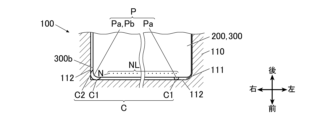
- FIG. 2 is a schematic diagram showing a point contact portion.
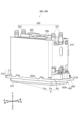
- FIG. 11 is a perspective view showing a droplet ejection device according to a second embodiment.
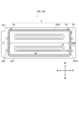
- FIG. 11 is a bottom view showing a droplet ejection device according to a second embodiment.
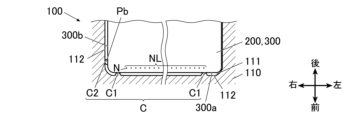
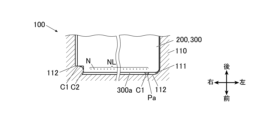
- 13A and 13B are schematic diagrams showing point contact parts according to other examples.
- 13A and 13B are schematic diagrams showing point contact parts according to other examples.
- 13A and 13B are schematic diagrams showing point contact parts according to other examples.
- 13A and 13B are schematic diagrams showing point contact parts according to other examples.
- 13A and 13B are schematic diagrams showing point contact parts according to other examples.
- 13A and 13B are schematic diagrams showing point contact parts according to other examples.
- 13A and 13B are schematic diagrams showing point contact parts according to other examples.
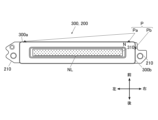
- 13 is a bottom view showing a positioning portion with another shape. FIG.
- the transport direction of the recording medium S in the inkjet recording device 10 is referred to as the front-rear direction.
- the direction perpendicular to the transport direction on the transport surface of the recording medium S is referred to as the left-right direction.
- the direction perpendicular to the front-rear and left-right directions (the ink ejection direction) is referred to as the up-down direction.
- the inkjet unit 100 and the droplet ejection device 200 (see FIG. 2), which will be described later, will also be explained in terms of directions based on the state in which they are attached to the inkjet recording device 10.
- FIG. 1 is a schematic perspective view showing an inkjet recording device 10 according to this embodiment.
- the inkjet recording device 10 includes a transport unit 11 and an inkjet unit 100.
- the transport unit 11 includes two transport rollers 11a and a transport belt 11b.
- the transport unit 11 transports the recording medium S in the front-rear direction.
- the transport roller 11a rotates about a rotation axis extending in the left-right direction in Fig. 1.
- the transport roller 11a also supports the inside of a ring-shaped transport belt 11b.
- a recording medium S is placed on the conveying surface of the conveyor belt 11b with the recording surface facing upward.
- the transport roller 11a rotates in response to the operation of a transport motor (not shown)
- the transport belt 11b moves in a circular motion in the front-rear direction, transporting the recording medium S in the front-rear direction.
- the conveying unit 11 is not limited to such a belt conveying type configuration.
- the transport unit 11 may be configured as a drum transport type having a transport drum that rotates in the transport direction with the recording medium S in close contact with its outer circumferential surface.
- the recording medium S is, for example, a sheet of paper cut to a certain size.
- the recording medium S is fed onto the conveyor belt 11b from a paper feeder (not shown). After an image or text is recorded on the recording medium S by the inkjet unit 100, the recording medium S is discharged to a predetermined paper discharge section.
- the recording medium S may be a long recording medium such as roll paper or continuous paper.
- the recording medium S may also be paper such as plain paper or coated paper, fabric, or sheet-like resin. In this way, various media capable of fixing the ink that has landed on the surface can be used as the recording medium S.
- a plurality of inkjet units 100 are arranged side by side from the upstream side to the downstream side in the transport direction of a recording medium S.
- Each inkjet unit 100 records images and characters by ejecting ink from each droplet ejection device 200 (see FIG. 2) onto the recording medium S transported by the transport unit 11.
- the inkjet unit 100 ejects ink from the droplet ejection device 200 at appropriate timing based on image data.
- FIG. 1 illustrates an example in which four inkjet units 100 are arranged, each corresponding to one of four colors of ink, namely, yellow (Y), magenta (M), cyan (C), and black (K), this is not limiting. That is, the number of inkjet units 100 included in the inkjet recording apparatus 10 may be three or less, or five or more. Also, a plurality of inkjet units 100 that eject ink of the same color may be arranged.
- FIG. 2 shows one inkjet unit 100 according to this embodiment.
- the inkjet unit 100 includes a mounting plate 110 , a fixing member 120 , and a droplet ejection device 200 .
- the mounting plate 110 is a thin plate having a substantially rectangular shape extending in the left-right direction, and the droplet ejection device 200 is mounted on the mounting plate 110 .
- the mounting plate 110 has a plurality of openings 111 formed therein, which are substantially rectangular through-holes.
- the opening 111 is a through hole that is the same as or slightly larger than the outer shape of the droplet ejection device 200 excluding the extension portion 210 when viewed from above.
- a plurality of openings 111 are provided in the attachment plate 110 in a staggered manner.
- the droplet ejection devices 200 When mounting the droplet ejection devices 200 on the mounting plate 110, first, the droplet ejection devices 200 are inserted into the respective openings 111. Then, the droplet ejection devices 200 are pressed to bring the positioning portions P into point contact with the inner periphery (contact surface 112) of the openings 111 when viewed from a direction perpendicular to the nozzle surface. In this way, the droplet ejection device 200 can be attached to the attachment plate 110 in a state where it is positioned with high accuracy.
- the location where the droplet ejection device 200 and the contact surface 112 come into point contact is referred to as a point contact portion C (see FIG. 6).
- the mounting plate 110 may be capable of mounting three or less, or five or more, droplet ejection devices 200.
- the multiple droplet ejection devices 200 are capable of covering the entire left-right area of the recording medium S. This is because, with this configuration, it becomes possible to form an image on the entire surface of the recording medium S without moving the inkjet unit 100 in the left-right direction.
- the fixing member 120 is a member that fixes the droplet ejection device 200 attached to the mounting plate 110 to the mounting plate 110 .
- the fixing member 120 applies a downward pressing force to the extension portion 210 , the lower surface of which abuts against the upper surface of the mounting plate 110 , thereby fixing the droplet ejection device 200 to the mounting plate 110 .
- the fixing member 120 is not limited in configuration as long as it is capable of fixing the droplet ejection device 200 to the mounting plate 110 by applying a downward pressing force to the extension portion 210.
- the fixing member 120 may be a separate member from the inkjet unit 100.
- the fixing member 120 is an elastic part consisting of a screw-shaped rigid part and an elastic body such as a spring, as shown in Fig. 3A.
- the fixing member 120 may also be an elastic part consisting of an elastic body such as a leaf spring, as shown in Fig. 3B.
- the fixing member 120 may also be an elastic part consisting of a clamp-shaped rigid part and an elastic body such as a spring, as shown in Fig. 3C.
- the fixing member 120 is composed only of a screw-shaped rigid portion, because if the droplet ejection device 200 is fixed by rotating a screw, the rotational torque based on the rotation may cause the aligned droplet ejection device 200 to become misaligned. Therefore, it is preferable that the fixing member 120 has an elastic portion made of an elastic body, and the droplet ejection device 200 is fixed to the mounting plate 110 by the elastic force of the elastic portion.
- the droplet ejection device 200 is a device that records images and characters on a recording medium S by ejecting ink droplets.
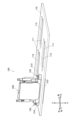
- Fig. 4 is a perspective view showing one droplet ejection device 200 according to the first embodiment
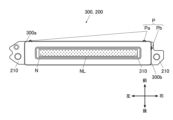
- Fig. 5 is a bottom view showing one droplet ejection device 200 according to the first embodiment.
- the droplet ejection device 200 in the inkjet recording apparatus 10 according to the first embodiment is an inkjet head 300 .
- the inkjet head 300 includes a nozzle plate 310, a first connector 320, a second connector 330, and a positioning portion P.
- the inkjet head 300 also includes a head chip (not shown) in which a drive mechanism for ejecting ink is formed.
- the nozzle plate 310 is a flat plate that is elongated in the left-right direction and disposed horizontally. As shown in FIG. 5, a plurality of nozzles N are formed on a nozzle surface, which is the lower surface of the nozzle plate 310.
- the nozzles N form, for example, four nozzle rows NL that are parallel to each other in the left-right direction at a uniform nozzle pitch (hereinafter, referred to as x).
- the four nozzle rows NL are arranged at regular intervals in the front-rear direction.
- the second nozzle row NL in the front-rear direction is offset leftward (or rightward) by x/2 from the first nozzle row NL.
- the third nozzle row NL is offset leftward (or rightward) by x/4 from the first nozzle row NL.
- the fourth nozzle row NL is offset leftward (or rightward) by x/2 from the third nozzle row NL.
- the four nozzle rows NL of the nozzle plate 310 are arranged so as to be shifted in sequence by x/4 to the left (or right), thereby achieving dot formation with a dot pitch of x/4.
- the number of nozzle rows NL in the nozzle plate 310 is not limited to four.
- the first connector 320 is a connection portion to a control board (not shown) of the inkjet recording apparatus 10 , which controls the ink ejection operation of the inkjet head 300 .
- Ink flow paths leading to the individual nozzles N of the nozzle plate 310 are formed in a head chip (not shown). Piezoelectric elements for ejecting ink from the nozzles N are individually provided in these ink flow paths. Wiring for applying a drive voltage to the individual piezoelectric elements is connected to a first connector 320 provided on the top of the inkjet head 300. When the inkjet recording apparatus 10 is operated, the first connector 320 is connected to a drive circuit on the control board via a cable and receives a drive signal from the drive circuit. When this occurs, the piezoelectric element is deformed and ink is ejected from the nozzle N.
- the second connector 330 is a connection portion to an ink tank (not shown) which is a liquid tank provided in the inkjet recording apparatus 10, and a waste liquid tank (not shown).
- the second connector 330 has an inlet 331 that supplies ink to the inkjet head 300 through a supply pipe connected to an ink tank.
- the second connector 330 also has an outlet 332 that discharges ink from the inkjet head 300 through a discharge pipe connected to a waste liquid tank. Both the inlet 331 and the outlet 332 are connected to a manifold (not shown) inside the inkjet head 300.
- the ink to be ejected from the nozzles N is stored. Furthermore, the ink that was not ejected from the nozzles N is returned to and stored in the waste liquid tank.
- the ink in the waste liquid tank is passed through a filter, for example, to remove foreign matter such as air bubbles and impurities, and then supplied to the ink tank.
- the inkjet head 300 is provided with an ink circulation mechanism, which can suppress changes in viscosity and separation of components of ink that is not ejected and is stored in the liquid tank.
- the second connector 330 may be provided on the top surface of the inkjet head 300, similar to the first connector 320.
- the inkjet head 300 also includes a heating unit (not shown) that heats the ink.
- the ink ejected from the nozzles N changes phase to a gel or sol state depending on the temperature, and hardens when irradiated with energy rays such as ultraviolet rays.
- the heat source of the heating unit is PZT (lead zirconate titanate) or a heater.
- the heating unit heats the ink to a temperature at which the ink becomes a sol under the control of the inkjet recording device 10.
- the inkjet head 300 then ejects the ink that has been heated and turned into a sol. When the ink in a sol state is ejected onto the recording medium S and allowed to cool naturally after impact, it quickly gels and solidifies.
- the positioning portion P is one of the protrusions that form the point contact portion C and that is provided on the droplet ejection device 200 .
- the positioning portion P positions the droplet ejection device 200 in the opening 111 when the droplet ejection device 200 is attached to the attachment plate 110 .
- the positioning portion P is provided, for example, at the lower end of the side surface of the inkjet head 300.
- the positioning portion P has, for example, an arc shape when viewed from above, and protrudes from the side surface of the inkjet head 300.
- the positioning portion P is provided on one surface (hereinafter, referred to as a first surface) 300a parallel to the nozzle row NL of the side surface of the inkjet head 300.
- the positioning portion P is also provided on one surface (hereinafter, referred to as a second surface) 300b different from the first surface 300a.
- the positioning portion P provided on the first surface 300a will be referred to as a first positioning portion Pa
- the positioning portion P provided on the second surface 300b will be referred to as a second positioning portion Pb.
- the first positioning portion Pa is provided for positioning the inkjet head 300 in the left-right direction. 5, the first positioning portion Pa is provided outside the longitudinal (left-right) ends of the nozzle row NL. This arrangement prevents a decrease in ejection uniformity caused by the transfer of heat from the nozzle N to the contact surface 112 via the first point contact portion C1 (see FIG. 6), which is the point contact portion C on the first surface 300a.
- the second positioning portion Pb is provided for positioning the inkjet head 300 in the front-rear direction. For the same reasons as for the first positioning portion Pa, it is desirable to provide the second positioning portion Pb in front of the front end nozzle row NL or behind the rear end nozzle row NL, but this is not limiting.
- the point contact portion C on the second surface 300b is referred to as a second point contact portion C2 (see FIG. 6).
- the positioning portion P is not limited to being provided on the inkjet head 300.
- the positioning portion P may be provided separately from the inkjet head 300, and the positioning portion P may be attached to a predetermined location on the side surface of the inkjet head 300.
- at least one positioning portion P may be provided in the droplet ejection device 200 .
- FIG. 6 shows a top cross-sectional view of one droplet ejection device 200 attached to one opening 111 of the inkjet unit 100 .
- the droplet ejection device 200 comes into point contact with the contact surface 112 of the mounting plate 110 to form a point contact portion C.
- the droplet ejection device 200 may come into surface contact with the contact surface 112.
- the positioning portion P and the contact surface 112 include manufacturing errors. Therefore, if the positioning portion P is in surface contact with the contact surface 112, positional deviation occurs according to the contact point.
- the droplet ejection device 200 and the mounting plate 110 are in point contact with each other to form the point contact portion C, as in this embodiment, there is only one contact point. Therefore, variation in the mounting position is minimized, and mounting accuracy is improved.
- the droplet ejection device 200 is an inkjet head 300.
- the droplet ejection device 200 includes at least one first positioning portion Pa and one second positioning portion Pb, and forms at least one point contact portion C on the first surface 300a and at least one point contact portion C on the second surface 300b.
- the first point contact portion C1 is provided outside the longitudinal end portion of the nozzle row NL. According to this configuration, the inkjet head 300 can be attached to the mounting plate 110 while being positioned with high accuracy in the left-right and front-rear directions.
- the inkjet recording device 10 equipped with a circulation mechanism for circulating the ink, a certain thermal uniformity is required for the ink. Therefore, it is preferable to reduce the temperature difference among the nozzles N by using the above configuration to suppress a drop in the temperature of the ink that was not ejected.
- the inkjet recording apparatus 10 that includes not only a circulation mechanism but also a heating unit for heating the ink, a higher degree of thermal uniformity is required for the ink. Therefore, it is more preferable to reduce the temperature difference of the nozzles N by the above configuration and suppress the drop in the temperature of the ink that was not ejected.
- the droplet discharge unit 100 also includes a fixed member 120 that includes an elastic portion that applies a downward pressing force by elastic force.
- a fixed member 120 that includes an elastic portion that applies a downward pressing force by elastic force.
- the droplet ejection device 200 can be fixed not only in the front-rear and left-right directions, but also in the up-down direction. Therefore, the droplet ejection device 200 is less likely to become misaligned. Furthermore, since the pressing force is applied by elastic force, positional deviation is unlikely to occur when the droplet ejection device 200 is fixed by the fixing member 120 .
- an inkjet recording apparatus 10 according to a second embodiment will be described in detail with reference to FIGS.
- the same components as those in the inkjet recording apparatus 10 according to the first embodiment are denoted by the same reference numerals, and the description thereof will be omitted.
- the droplet ejection device 200 is an inkjet head module 400 modularized by multiple inkjet heads (droplet ejection heads) 300.
- the positioning portion P is provided on a rib 422 of the inkjet head module 400, not on the inkjet head 300.
- the inkjet head module 400 includes a plurality of inkjet heads 300, a cover member 410, a mounting member 420, and a positioning portion P. In addition, as shown in FIG.
- an inkjet head module 400 including two inkjet heads 300 will be described as an example, but the present invention is not limited to this. That is, the inkjet head module 400 may be configured to include three or more inkjet heads 300. Further, as shown in FIG. 8, the following describes an example in which a plurality of inkjet heads 300 are arranged in a direction perpendicular to the nozzle row NL, but the present invention is not limited to this.
- the cover member 410 is attached to the mounting member 420 and/or the inkjet head 300 so as to cover the periphery of the inkjet head 300 except for the connection portion and the nozzle plate 310. This prevents misalignment caused by the user of the droplet ejection device 200 touching the inkjet head 300 and the associated deterioration in print quality.
- the cover member 410 is preferably made of a resin with a relatively low thermal expansion coefficient. This configuration can prevent the cover member 410 from bending when the inkjet head 300 generates heat.
- PI polyimide
- PPS polyphenylene sulfide
- LCP liquid crystal polymer
- PEEK polyether ether ketone
- the mounting member 420 is, for example, a flat plate having a generally rectangular shape when viewed from above, and integrates (modules) the multiple inkjet heads 300.
- the mounting member 420 includes an insertion portion 421 and a rib 422.
- the mounting member 420 is preferably made of a metal, particularly an aluminum alloy, but is not limited to this.
- the insertion portion 421 is a through hole provided in approximately the center of the mounting member 420, and in a top view, the width in the left-right direction is the same as or slightly larger than the width of the inkjet head 300. As shown in Fig. 8, the insertion portion 421 is approximately rectangular, the longitudinal direction of which is parallel to the left-right direction, and two inkjet heads 300 are inserted into the insertion portion 421. When the inkjet head 300 is inserted into the insertion portion 421, the inkjet head 300 is attached to the attachment member 420. At this time, the nozzle row NL provided in the nozzle plate 310 is aligned in the left-right direction.
- the rib 422 is a protrusion that protrudes downward from the lower surface of the mounting member 420 along the insertion portion 421 . Providing ribs 422 on the mounting member 420 improves rigidity and strength.
- the mist intrusion prevention member 430 is a member for preventing ink mist from entering through gaps in the inkjet head module 400. By attaching the mist intrusion prevention member 430, it is possible to prevent the ink mist that has entered through the gaps from accumulating and contaminating the inkjet head 300 or adhering to the recording medium S.
- the mist intrusion prevention member 430 is a generally rectangular flat plate whose width in the left-right direction is approximately the same as or slightly narrower than the insertion portion 421.
- the mist intrusion prevention member 430 is made of a synthetic resin sheet such as PET (polyethylene terephthalate), or a contractile material such as rubber or sponge.
- the mist intrusion prevention member 430 is attached in advance to the opposing surface of the inkjet head 300 and the inner surface or adjacent portion of the insertion portion 421. Then, after assembling the inkjet head module 400, the gaps between the inkjet heads 300 or between the mounting member 420 and the inkjet head 300 are filled with the mist intrusion prevention member 430. As a result, it is possible to prevent the intrusion of ink mist into the inkjet head 300.
- the mist intrusion prevention member 430 is made of a contractile material, so that even if the inkjet head 300 is pressed when the mist intrusion prevention member 430 fills the gap, the attachment position will not shift.
- mist intrusion prevention member 430 is not a required component of the inkjet head module 400 according to the second embodiment.
- the positioning portion P is provided on the rib 422 .
- a positioning portion P is provided on a first surface 422a, which is one surface parallel to the nozzle row NL, of the outer peripheral surface of the rib 422.
- a positioning portion P is provided on a second surface 422b, which is one surface different from the first surface 422a, of the outer peripheral surface of the rib 422.
- a first positioning portion Pa is provided on the first surface 422a such that a first point contact portion C1 is formed outside the longitudinal end of the nozzle row NL.
- the positioning portion P according to the second embodiment is provided so as not to protrude from the outer periphery of the mounting member 420. If the positioning portion P protrudes from the outer periphery of the mounting member 420, there is a risk of the positioning portion P being worn due to increased contact when the inkjet head module 400 is attached to the mounting plate 110.
- the droplet ejection device 200 is an inkjet head module 400 including a plurality of inkjet heads 300.
- the positioning portion P is provided on the rib 422 that protrudes downward along the insertion portion 421.
- the inkjet head module 400 can be attached to the mounting plate 110 in a state where it is positioned with high precision by the positioning portion P.
- the positioning portion P is provided so as not to protrude from the outer periphery of the mounting member 420 . According to this configuration, damage to the droplet ejection device 200 when it is attached to the inkjet recording device 10 can be suppressed.
- the inkjet head 300 according to the second embodiment with a protrusion similar to the positioning portion P of the inkjet head 300 according to the first embodiment. With this configuration, the inkjet head 300 can be attached in a state where it is positioned with high precision relative to the mounting member 420.
- the droplet ejection device 200 is preferably configured such that, when attached to the attachment plate 110 , the nozzle surface is positioned lower than the bottom surface of the attachment plate 110 . With this configuration, the nozzle surface and the recording medium S are brought closer together, so that variation in droplet ejection is reduced and drawing accuracy is improved.
- the droplet ejection device 200 is less likely to become displaced even when subjected to an external force, and stability is improved.
- the first surface 300a (422a) is a surface parallel to the nozzle row NL and has a larger area than the second surface 300b (422b). Therefore, if the first positioning portion Pa is provided so as to increase the distance therebetween, stability is improved when the nozzle row NL is attached to the attachment plate 110.
- the first positioning portion Pa it is preferable to provide the first positioning portion Pa so that an imaginary line connecting two or more first point contact portions C1 is parallel to the nozzle row NL. This is because, with this configuration, even if an external force is applied after the droplet ejection device 200 is attached to the attachment plate 110, positional deviation is unlikely to occur.
- the second positioning portion Pb is preferably provided closer to the first surface 300a (422a) than the center of the second surface 300b (422b) in the arrangement direction (front-rear direction) of the nozzle rows NL. This is because, with this configuration, even if the first surface 300a (422a) including the first positioning portion Pa is deformed by an external force, the amount of deviation of the first positioning portion Pa is reduced.
- the first point contact portion C1 is preferably formed by a contact surface 112 parallel to the nozzle row NL.
- the second point contact portion C2 which is the point contact portion C on the second surface 300b (422b)
- the positioning portion P is preferably provided on a linear portion, which is a flat surface, of the side portion of the droplet ejection device 200 . This is because if the positioning portion P is provided in a corner or recess of the droplet ejection device 200, the position at which it is formed becomes unstable during the manufacturing process of the droplet ejection device 200.
- a positioning portion P may be provided at a corner of the droplet ejection device 200.
- the protrusion at the corner is a first positioning portion Pa provided on the first surface 300a, and a second positioning portion Pb provided on the second surface 300b.
- the droplet ejection unit 100 may be configured to form a point contact C by providing a protrusion on the inner periphery of the opening 111.
- the droplet ejection unit 100 may be formed by a contact surface 112 in which the point contact portion C is not parallel or perpendicular to the nozzle row NL.
- the droplet ejection device 200 may be a droplet ejection unit 100 having a positioning portion P that is planar when viewed from above, and that forms a point contact portion C with a protrusion on the inner periphery of the opening 111.
- the droplet ejection unit 100 may have protrusions on the inner circumference of the opening 111 that form point contacts C with two surfaces of the droplet ejection device 200.
- the droplet ejection device 200 does not have to be configured to include both the first positioning portion Pa and the second positioning portion Pb.
- the droplet ejection device 200 has a first positioning portion Pa and a second positioning portion Pb, and that the point contact portion C is the contact portion between the protrusion and the contact surface 112, which is a flat portion. This is because it is easier to manufacture by providing the droplet ejection device 200 with a positioning protrusion and making the inner periphery of the opening 111 of the mounting plate 110 flat.
- the positioning portion P of the present invention may have any shape as long as it is in point contact with the contact surface 112, and is not limited to an arc shape when viewed from above. Therefore, for example, the positioning portion P may be triangular in top view as shown in FIG.
- all of the positioning portions P do not have to have the same shape, and may each have a different shape.
- the present invention is not limited to the inkjet recording device 10, but may be applied to various types of droplet ejection devices that eject droplets of liquid other than ink from the nozzles N.
- the present invention can be used in a droplet ejection head driving method, droplet ejection device, and program that do not reduce productivity even when new drive pulses are added.
- Inkjet recording device (droplet ejection system) 11 Transport unit 100 Inkjet unit (droplet ejection unit) 110: Mounting plate 111: Opening 112: Contact surface 120: Fixed member 200: Droplet ejection device 300: Inkjet head (droplet ejection head) 300a First surface 300b Second surface 400 Inkjet head module 420 Mounting member 421 Insertion portion 422 Rib 422a First surface 422b Second surface C Point contact portion C1 First point contact portion P Positioning portion Pa First positioning portion Pb Second positioning portion N Nozzle NL Nozzle row S Recording medium
Landscapes
- Engineering & Computer Science (AREA)
- Manufacturing & Machinery (AREA)
- Ink Jet (AREA)
Priority Applications (2)
| Application Number | Priority Date | Filing Date | Title |
|---|---|---|---|
| CN202380071764.7A CN120018952A (zh) | 2022-10-14 | 2023-09-22 | 液滴吐出单元、液滴吐出装置以及液滴吐出系统 |
| JP2024551364A JPWO2024080101A1 (https=) | 2022-10-14 | 2023-09-22 |
Applications Claiming Priority (2)
| Application Number | Priority Date | Filing Date | Title |
|---|---|---|---|
| JP2022-165340 | 2022-10-14 | ||
| JP2022165340 | 2022-10-14 |
Publications (1)
| Publication Number | Publication Date |
|---|---|
| WO2024080101A1 true WO2024080101A1 (ja) | 2024-04-18 |
Family
ID=90669123
Family Applications (1)
| Application Number | Title | Priority Date | Filing Date |
|---|---|---|---|
| PCT/JP2023/034423 Ceased WO2024080101A1 (ja) | 2022-10-14 | 2023-09-22 | 液滴吐出ユニット、液滴吐出装置及び液滴吐出システム |
Country Status (3)
| Country | Link |
|---|---|
| JP (1) | JPWO2024080101A1 (https=) |
| CN (1) | CN120018952A (https=) |
| WO (1) | WO2024080101A1 (https=) |
Citations (8)
| Publication number | Priority date | Publication date | Assignee | Title |
|---|---|---|---|---|
| JP2001162811A (ja) * | 1999-12-07 | 2001-06-19 | Seiko Epson Corp | インクジェット式記録ヘッドユニット及びその製造方法 |
| JP2006231802A (ja) * | 2005-02-28 | 2006-09-07 | Seiko Instruments Inc | ヘッド支持構造体、記録装置およびその製造方法 |
| JP2011218750A (ja) * | 2010-04-14 | 2011-11-04 | Seiko Epson Corp | 液体噴射ヘッドユニットの位置決め機構、液体噴射ヘッドユニット、液体噴射装置及び液体噴射ヘッドユニットの製造方法 |
| JP2012061719A (ja) * | 2010-09-16 | 2012-03-29 | Ricoh Co Ltd | 画像形成装置及び画像形成装置の製造方法 |
| JP2013010332A (ja) * | 2011-06-30 | 2013-01-17 | Kyocera Corp | 液体吐出ヘッド、およびそれを用いた液体吐出ヘッドブロックならびに記録装置 |
| JP2013059965A (ja) * | 2011-09-15 | 2013-04-04 | Ricoh Co Ltd | 液滴吐出ヘッドモジュールのアライメント調整方法及び液滴吐出装置 |
| WO2017109833A1 (ja) * | 2015-12-21 | 2017-06-29 | 富士通周辺機株式会社 | インクジェットヘッドアッセンブリ |
| US10710371B1 (en) * | 2019-02-11 | 2020-07-14 | Xerox Corporation | Inkjet printhead cap having latching system |
-
2023
- 2023-09-22 JP JP2024551364A patent/JPWO2024080101A1/ja active Pending
- 2023-09-22 CN CN202380071764.7A patent/CN120018952A/zh active Pending
- 2023-09-22 WO PCT/JP2023/034423 patent/WO2024080101A1/ja not_active Ceased
Patent Citations (8)
| Publication number | Priority date | Publication date | Assignee | Title |
|---|---|---|---|---|
| JP2001162811A (ja) * | 1999-12-07 | 2001-06-19 | Seiko Epson Corp | インクジェット式記録ヘッドユニット及びその製造方法 |
| JP2006231802A (ja) * | 2005-02-28 | 2006-09-07 | Seiko Instruments Inc | ヘッド支持構造体、記録装置およびその製造方法 |
| JP2011218750A (ja) * | 2010-04-14 | 2011-11-04 | Seiko Epson Corp | 液体噴射ヘッドユニットの位置決め機構、液体噴射ヘッドユニット、液体噴射装置及び液体噴射ヘッドユニットの製造方法 |
| JP2012061719A (ja) * | 2010-09-16 | 2012-03-29 | Ricoh Co Ltd | 画像形成装置及び画像形成装置の製造方法 |
| JP2013010332A (ja) * | 2011-06-30 | 2013-01-17 | Kyocera Corp | 液体吐出ヘッド、およびそれを用いた液体吐出ヘッドブロックならびに記録装置 |
| JP2013059965A (ja) * | 2011-09-15 | 2013-04-04 | Ricoh Co Ltd | 液滴吐出ヘッドモジュールのアライメント調整方法及び液滴吐出装置 |
| WO2017109833A1 (ja) * | 2015-12-21 | 2017-06-29 | 富士通周辺機株式会社 | インクジェットヘッドアッセンブリ |
| US10710371B1 (en) * | 2019-02-11 | 2020-07-14 | Xerox Corporation | Inkjet printhead cap having latching system |
Also Published As
| Publication number | Publication date |
|---|---|
| JPWO2024080101A1 (https=) | 2024-04-18 |
| CN120018952A (zh) | 2025-05-16 |
Similar Documents
| Publication | Publication Date | Title |
|---|---|---|
| JP5423019B2 (ja) | 液体吐出ヘッドユニット及び画像形成装置 | |
| KR100835030B1 (ko) | 잉크 제트 기록 헤드 및 이를 사용하는 잉크 제트 기록장치 | |
| JP5481446B2 (ja) | 液体吐出ヘッド及び液体吐出装置 | |
| JP2875915B2 (ja) | 記録装置 | |
| EP2487038B1 (en) | Liquid ejection apparatus | |
| JP5677702B2 (ja) | 液体吐出ヘッドユニット及び画像形成装置 | |
| US8342673B2 (en) | Printing apparatus | |
| KR20050083989A (ko) | 잉크젯 기록 장치 | |
| JP7670890B2 (ja) | 液体吐出装置および液体吐出装置の組み立て方法 | |
| US7690763B2 (en) | Color imaging apparatus configured to reduce bidirectional color difference | |
| WO2024080101A1 (ja) | 液滴吐出ユニット、液滴吐出装置及び液滴吐出システム | |
| JP2009214510A (ja) | 液体噴射ヘッド、及び、液体噴射装置 | |
| JP5751313B2 (ja) | 液体吐出ヘッドユニット及び画像形成装置 | |
| JP2025146131A (ja) | 液滴吐出ユニット、液滴吐出装置及び液滴吐出システム | |
| JP3471887B2 (ja) | 液体噴射ヘッド、該液体噴射ヘッドを有するヘッドカートリッジ及び液体噴射装置 | |
| JP3347588B2 (ja) | シート搬送装置及び記録装置 | |
| JP3428856B2 (ja) | インクジェット記録ヘッド及び該インクジェット記録ヘッドを搭載するインクジェット記録装置 | |
| JP2884544B2 (ja) | 記録装置 | |
| JP2023095000A (ja) | 液滴吐出ヘッドユニット、液滴吐出装置、液滴吐出ヘッドユニットの組み立て方法 | |
| JP2004106433A (ja) | インクジェット記録装置 | |
| JP2007152785A (ja) | インクジェット記録装置 | |
| JP7764439B2 (ja) | 液体吐出ヘッド及びその製造方法 | |
| JP6131524B2 (ja) | 液体吐出ヘッドの製造方法、液体吐出ヘッド、液体吐出ヘッドユニットおよび画像形成装置 | |
| US20260034790A1 (en) | Liquid supply member, liquid discharge head, and recording device | |
| JP2010201626A (ja) | 液体噴射装置 |
Legal Events
| Date | Code | Title | Description |
|---|---|---|---|
| 121 | Ep: the epo has been informed by wipo that ep was designated in this application |
Ref document number: 23877107 Country of ref document: EP Kind code of ref document: A1 |
|
| WWE | Wipo information: entry into national phase |
Ref document number: 2024551364 Country of ref document: JP |
|
| WWE | Wipo information: entry into national phase |
Ref document number: 202380071764.7 Country of ref document: CN |
|
| NENP | Non-entry into the national phase |
Ref country code: DE |
|
| WWP | Wipo information: published in national office |
Ref document number: 202380071764.7 Country of ref document: CN |
|
| 122 | Ep: pct application non-entry in european phase |
Ref document number: 23877107 Country of ref document: EP Kind code of ref document: A1 |