WO2024062561A1 - プローブカード用プローブ - Google Patents
プローブカード用プローブ Download PDFInfo
- Publication number
- WO2024062561A1 WO2024062561A1 PCT/JP2022/035190 JP2022035190W WO2024062561A1 WO 2024062561 A1 WO2024062561 A1 WO 2024062561A1 JP 2022035190 W JP2022035190 W JP 2022035190W WO 2024062561 A1 WO2024062561 A1 WO 2024062561A1
- Authority
- WO
- WIPO (PCT)
- Prior art keywords
- probe
- deformation
- metal layer
- probe card
- region
- Prior art date
- Legal status (The legal status is an assumption and is not a legal conclusion. Google has not performed a legal analysis and makes no representation as to the accuracy of the status listed.)
- Ceased
Links
Images







Classifications
-
- G—PHYSICS
- G01—MEASURING; TESTING
- G01R—MEASURING ELECTRIC VARIABLES; MEASURING MAGNETIC VARIABLES
- G01R1/00—Details of instruments or arrangements of the types included in groups G01R5/00 - G01R13/00 and G01R31/00
- G01R1/02—General constructional details
- G01R1/06—Measuring leads; Measuring probes
- G01R1/067—Measuring probes
- G01R1/073—Multiple probes
- G01R1/07307—Multiple probes with individual probe elements, e.g. needles, cantilever beams or bump contacts, fixed in relation to each other, e.g. bed of nails fixture or probe card
- G01R1/07342—Multiple probes with individual probe elements, e.g. needles, cantilever beams or bump contacts, fixed in relation to each other, e.g. bed of nails fixture or probe card the body of the probe being at an angle other than perpendicular to test object, e.g. probe card
-
- G—PHYSICS
- G01—MEASURING; TESTING
- G01R—MEASURING ELECTRIC VARIABLES; MEASURING MAGNETIC VARIABLES
- G01R1/00—Details of instruments or arrangements of the types included in groups G01R5/00 - G01R13/00 and G01R31/00
- G01R1/02—General constructional details
- G01R1/06—Measuring leads; Measuring probes
- G01R1/067—Measuring probes
- G01R1/06711—Probe needles; Cantilever beams; "Bump" contacts; Replaceable probe pins
- G01R1/06733—Geometry aspects
-
- G—PHYSICS
- G01—MEASURING; TESTING
- G01R—MEASURING ELECTRIC VARIABLES; MEASURING MAGNETIC VARIABLES
- G01R1/00—Details of instruments or arrangements of the types included in groups G01R5/00 - G01R13/00 and G01R31/00
- G01R1/02—General constructional details
- G01R1/06—Measuring leads; Measuring probes
- G01R1/067—Measuring probes
-
- G—PHYSICS
- G01—MEASURING; TESTING
- G01R—MEASURING ELECTRIC VARIABLES; MEASURING MAGNETIC VARIABLES
- G01R1/00—Details of instruments or arrangements of the types included in groups G01R5/00 - G01R13/00 and G01R31/00
- G01R1/02—General constructional details
- G01R1/06—Measuring leads; Measuring probes
- G01R1/067—Measuring probes
- G01R1/06711—Probe needles; Cantilever beams; "Bump" contacts; Replaceable probe pins
- G01R1/06716—Elastic
-
- G—PHYSICS
- G01—MEASURING; TESTING
- G01R—MEASURING ELECTRIC VARIABLES; MEASURING MAGNETIC VARIABLES
- G01R1/00—Details of instruments or arrangements of the types included in groups G01R5/00 - G01R13/00 and G01R31/00
- G01R1/02—General constructional details
- G01R1/06—Measuring leads; Measuring probes
- G01R1/067—Measuring probes
- G01R1/06711—Probe needles; Cantilever beams; "Bump" contacts; Replaceable probe pins
- G01R1/06755—Material aspects
- G01R1/06761—Material aspects related to layers
-
- G—PHYSICS
- G01—MEASURING; TESTING
- G01R—MEASURING ELECTRIC VARIABLES; MEASURING MAGNETIC VARIABLES
- G01R1/00—Details of instruments or arrangements of the types included in groups G01R5/00 - G01R13/00 and G01R31/00
- G01R1/02—General constructional details
- G01R1/06—Measuring leads; Measuring probes
- G01R1/067—Measuring probes
- G01R1/073—Multiple probes
- G01R1/07307—Multiple probes with individual probe elements, e.g. needles, cantilever beams or bump contacts, fixed in relation to each other, e.g. bed of nails fixture or probe card
- G01R1/07314—Multiple probes with individual probe elements, e.g. needles, cantilever beams or bump contacts, fixed in relation to each other, e.g. bed of nails fixture or probe card the body of the probe being perpendicular to test object, e.g. bed of nails or probe with bump contacts on a rigid support
Definitions
- This application relates to a probe for a probe card.
- Probe cards are used to test the operation of individual semiconductor devices formed on a wafer by bringing probes into contact with the electrode pads of semiconductor devices for power supply, signal input/output, and grounding. It is an electrical connection device.
- the probe is provided on the surface of the probe card, and is configured such that its tip is pressed against the electrode pad of the semiconductor device with a predetermined pressing force.
- the electrode pads of semiconductor devices are designed to be small, and the distance (pitch) between the electrode pads is designed to be small.
- probes need to be made smaller.
- the mechanical strength of the probe becomes weaker.
- Patent Document 1 proposes a configuration in which a multilayer metal sheet is used for the probe.
- the probe shown in Patent Document 1 has at least one multilayer structure including a superposition of a core and a first inner coating layer, and a material harder than the core completely covering the multilayer structure.
- a contact probe is disclosed that is fabricated and has an outer coating layer that completely covers the multilayer structure.
- Patent Document 1 in order to achieve good electrical contact and mechanical contact, a configuration in which multiple layers of different materials are stacked is preferable, but the cross-sectional thickness of the probe is reduced. There were limits to meeting this demand, and further breakthroughs were needed.
- the probe card In the inspection process using a probe card, in order to ensure contact with the electrode pad of a semiconductor device, after the probe has contacted the electrode pad, the probe card is brought closer to the semiconductor wafer (overdrive), so that the probe is brought closer to the semiconductor wafer. Pressing against the electrode pads of the device is performed. For this reason, the probe is required to have such strength that it will not be mechanically destroyed even if a contact pressure of a predetermined value or more is applied. In order to prevent the probe from being destroyed, it is necessary to prevent local stress concentration from occurring on the probe. In order to prevent this stress concentration from occurring, a probe with a surface as smooth and free from scratches as possible has been desired.
- This application discloses technology that solves the above-mentioned problems, and aims to provide a probe that, even when miniaturized, can contact the electrode pads of a semiconductor device with an appropriate needle pressure and is strong enough not to be broken even when a contact pressure above a certain value is applied.
- the probe for the probe card of the present application is able to withstand large stress by intentionally dispersing the locations where stress concentration occurs, rather than by preventing stress concentration from occurring (mechanical strength
- the purpose is to provide probes for probe cards (with high performance).
- the probe for a probe card disclosed in this application includes: A probe for a probe card, The probe has a reference surface of at least one of the two side surfaces perpendicular to the two surfaces perpendicular to the buckling direction of the probe, a plurality of deformation regions, which are recesses relative to the side surface, provided in two rows at intervals in the longitudinal direction of the probe; a zigzag-shaped frame region between the plurality of deformation regions in the two rows; The length of the skeleton region is longer than the length of the probe in the longitudinal direction.
- the locations where stress concentration occurs can be dispersed to provide a probe for a lobe card with high mechanical strength.
- FIG. 2 is a diagram schematically showing a state in which an electronic circuit is tested using the probe card according to the first embodiment.
- 1 is a perspective view of a probe according to Embodiment 1.
- FIG. FIG. 3 is a sectional view taken along line AA in FIG. 2, and is a sectional view perpendicular to the longitudinal direction of the probe.
- FIG. 3 is a diagram showing the positional relationship between deformation regions arranged in two rows according to the first embodiment.
- 7 is a cross-sectional view showing a modification of the probe according to the first embodiment.
- FIG. FIG. 7 is a cross-sectional view perpendicular to the longitudinal direction of the probe according to the second embodiment.
- FIG. 7 is a sectional view perpendicular to the longitudinal direction of a probe according to Embodiment 3; 7 is a sectional view showing a modification of the probe according to Embodiment 3.
- FIG. 13A to 13C are diagrams showing variations of the modification area according to the fourth embodiment.
- FIG. 7 is a diagram showing variations of deformation areas according to Embodiment 4;
- FIG. 7 is a diagram showing variations of deformation areas according to Embodiment 4;
- FIG. 12 is a diagram showing variations of deformation areas according to Embodiment 5;
- FIG. 12 is a diagram showing variations of deformation areas according to Embodiment 5;
- 13A to 13C are diagrams showing variations of the modification area according to the fifth embodiment.
- FIG. 12 is a diagram showing variations of deformation areas according to Embodiment 5;
- FIG. 1 is a diagram schematically showing a test state of an electronic circuit using a probe card 100.
- the upper side of the page in FIG. 1 will be referred to as "top” and the lower side of the page will be referred to as "bottom.” That is, when viewed from the probe card 100, the side to be inspected is the "lower" side.
- the left-right direction in the paper of FIG. 1 is defined as a buckling direction X
- the direction from the front to the back of the paper and the opposite direction thereof is defined as a direction Y perpendicular to the buckling direction X.
- the longitudinal direction of the probe 20 (vertical direction on the paper surface of FIG. 1) is defined as a longitudinal direction Z.
- the probe card 100 is a device used to test the electrical characteristics of an electronic circuit formed on a semiconductor wafer W.
- the probe card 100 includes a large number of probes 20 that are brought into contact with electrodes C on an electronic circuit formed on a semiconductor wafer W, respectively.
- the semiconductor wafer W is brought close to the probe card 100, the tip of the probe 20 is brought into contact with the electrode C on the electronic circuit, and a tester device (not shown) is connected to the wiring board 14 of the probe card 100 via the probe 20. This is done by making the tester connection electrode TC conductive.
- the probe card 100 includes a hollow frame 1, an upper guide 11 attached to the upper end of the frame 1, a lower guide 12 attached to the lower end of the frame 1, a fixing plate 13 for fixing the upper guide 11, and a wiring board 14. Equipped with. An intermediate guide may be further provided between the upper guide 11 and the lower guide 12.
- the upper guide 11 has a plurality of guide holes 11H penetrating in the vertical direction
- the lower guide 12 provided below the upper guide 11 also has a plurality of guide holes 12H penetrating in the vertical direction.
- Above the group of guide holes 11H provided in the upper guide 11 is an opening 13H provided in the fixed plate 13.
- a wiring board 14 is arranged on the upper surface of the fixed plate 13.
- the wiring board 14 includes, on its lower surface, a plurality of probe connection pads 14P that come into contact with the terminal portions 20t at the upper ends of the probes 20.
- the probe 20 is a vertical probe arranged perpendicularly to the object to be inspected (electronic circuit formed on the semiconductor wafer W).
- FIG. 2 is a perspective view of the probe 20.
- the left-right direction in FIG. 2 is the buckling direction X of the probe 20, that is, the direction in which the probe 20 is elastically deformed when the probe card 100 is overdriven.
- the probe 20 has an elongated shape. The central portion is curved, and the upper and lower portions extend vertically in a straight line.
- a contact portion 20c is provided at the lower end (one end) of the probe 20.
- a terminal portion 20t is formed at the upper end (other end).
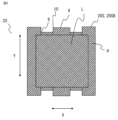
- FIG. 3 is a sectional view taken along the line AA in FIG. 2, and is a sectional view perpendicular to the longitudinal direction Z of the probe 20.
- the buckling direction X is the left-right direction in the paper of FIG.
- the probe 20 is made of two types of metals that are electrically conductive and have different resistivities.
- One is the inner metal (first metal) constituting the low resistance part L, which is made of a metal with low resistivity such as copper, gold, silver (Cu, Au, Ag).
- the low resistance portion L has high conductivity and functions to improve current withstand performance.
- the other is an outer metal such as palladium cobalt (PdCo) alloy, which has higher resistivity and lower conductivity than the low resistance part L, but has high mechanical strength and spring properties. (second metal).
- the high resistance portion H functions to maintain the mechanical strength of the probe 20.
- a plurality of deformation regions 8 and frame regions 9 are formed on side surfaces 20S perpendicular to two surfaces perpendicular to the buckling direction X of the high resistance portion H of the probe 20, respectively.
- the deformed region 8 refers to a region where the reference surface 20SB, which is the original plane of the probe card, is deformed and a depression is formed.
- the framework region 9 indicates a region that connects a plurality of deformation regions 8.
- the boundary between the deformation region 8 and the framework region 9 is represented as a ridgeline 10.
- FIGS. 2 and 3 show an example in which a plurality of pentagonal prism-shaped depressions are provided as the deformation region 8 on the reference surface 20SB, which is the original plane.
- the framework region 9 is a portion of the plane between the deformation regions 8.
- a plurality of pentagonal prism-shaped deformation regions 8 are provided in two rows along the longitudinal direction Z of the probe 20, and each row has a ridgeline 10 of the plurality of deformation regions 8 at both ends of the side surface 20S in the buckling direction X. On the sides, they are arranged so as to be lined up in the longitudinal direction.
- FIG. 4 is a side view of the probe 20, showing the positional relationship of the deformation regions 8 arranged in two rows.
- the two rows of deformation regions 8 are arranged such that their positions in the longitudinal direction Z of the probe 20 are staggered.
- the pentagonal prism shape of the deformation region is reversed in the buckling direction X.
- a broken line L1 connecting the right ends of the deformation regions 8 in the left row exists on the right side of the center line O in the buckling direction X of the side surface 20S
- a broken line L1 connecting the left ends of the deformation regions 8 in the right row L2 exists on the left side of the center line O in the buckling direction X of the side surface 20S.
- the side surface 20S of the high resistance portion H of the probe 20 has a shape in the longitudinal direction of the probe 20 on both sides of the buckling direction X, as shown in FIG.
- Side beams 20SB1 and 20SB2 extending in the Z direction are formed.
- a framework region 91 is formed which extends in the longitudinal direction Z in a zigzag shape between the deformation regions 8 arranged in two rows along the longitudinal direction Z.
- the length P1 of this frame region 91 is longer than the length P2 of the side beams 20SB1 and 20SB2, that is, the length P2 of the portion of the probe 20 in the longitudinal direction Z where the deformation region 8 is formed.
- the relationship between the stylus pressure and the overdrive amount is as follows.
- the probe 20 provided with is smaller.
- the maximum stress of the probe was determined based on the finite element method (FEM) for probe A without a depression (smooth surface) and probe 20 with a pentagonal prism-shaped depression.
- FEM finite element method
- the stress is concentrated on the ridge line 10 at the boundary between the deformation region 8 and the framework region 9 .
- the length of the framework region 91 is extended and the stress concentration points are dispersed. At the same time, the needle pressure of the probe 20 can be reduced.
- the probe 20 is manufactured using so-called MEMS (Micro Electro Mechanical Systems) technology (probe intermediate formation step).
- MEMS technology is a technology for creating fine three-dimensional structures using photolithography technology and sacrificial layer etching technology.
- Photolithography technology is a fine pattern processing technology using photoresist used in semiconductor manufacturing processes.
- sacrificial layer etching technology creates a three-dimensional structure by forming a lower layer called a sacrificial layer, forming the layers that make up the structure on top of it, and then removing only the sacrificial layer by etching. It's technology.
- metal ions in the electrolyte can be attached to the substrate surface by immersing a substrate as a cathode and a metal piece as an anode in an electrolyte and applying a voltage between the two electrodes.
- electroplating process is a wet process in which the substrate is immersed in an electrolytic solution, a drying process is performed after the plating process to obtain a probe intermediate. Further, after this drying process, the lower tip portion is polished by a polishing process (polishing process) to form the contact portion 20c.
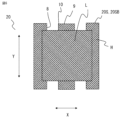
- FIG. 5 is a sectional view showing a modification of the probe 20.
- the thickness of the high resistance portion H on the side surface where the deformation region 8 is not provided may be smaller than that on the side surface 20S side where the deformation region 8 is provided. In this case, the electrical resistance of the probe can be lowered.
- the deformation region 8 in the high-resistance portion H that contributes to maintaining the mechanical strength of the probe 20, the length of the framework region 91 is extended and the stress is reduced. It is possible to reduce stylus pressure while dispersing concentrated areas. Moreover, the total length of the probe 20 can be made smaller with the same needle pressure. Note that the number of rows of deformation regions 8 may be three or more. Further, the deformation region 8 may be arranged only on one side surface 20S.
- Embodiment 2 The probe for a probe card according to the second embodiment will be described below, focusing on the differences from the first embodiment. In this embodiment, a modification of the modification area 8 will be described.
- FIG. 6 is a sectional view perpendicular to the longitudinal direction of the probe 20 according to the second embodiment.
- the buckling direction X is the left-right direction on the paper.
- This embodiment differs from Embodiment 1 in that the high-resistance portion H having spring properties is passed through to the low-resistance portion L having low electrical resistance.
- the deformation region 8 did not penetrate the high resistance portion H.
- the deformation region 8 passes through the high resistance portion H, and the low resistance portion L is visible from the side surface 20S of the probe 20.
- the frame region 91 can exhibit even more elasticity, so that the needle pressure can be further reduced.
- FIG. 7 is a sectional view perpendicular to the longitudinal direction of the probe according to the third embodiment.
- the deformation region 8 penetrates the high resistance portion H, similar to the second embodiment.
- an intermediate layer M third metal layer
- the deformation region 8 is not provided in the intermediate layer M.
- the exposed low resistance part L must be made of a material that does not melt during sacrificial layer etching, but an intermediate layer M that does not melt during sacrificial layer etching is provided to prevent the low resistance part L from melting.
- the material of the intermediate layer M can be a material with a low Young's modulus, such as Pd or Pt, which does not melt during etching of the sacrificial layer and which is less stressed against deformation, and can meet the required stylus force of the probe 20 and
- An intermediate layer M may be provided depending on the length.
- the range of choices of materials that can be used for the low resistance part L is increased, so that the resistance is lower than that of the second embodiment, and the elasticity is even higher than that of the first embodiment. It is possible to create a probe that can perform effectively.
- FIG. 8 is a sectional view showing a modification of the probe 20.
- the high resistance portion H may be provided only on the side surface 20S side where the deformation region 8 is provided.
- forming a metal layer in the Y direction using MEMS has the effect of reducing the number of steps.
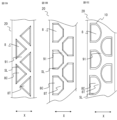
- FIG. 9A to 9C are diagrams showing variations of the deformation region 8.
- the triangular prism deformation regions 8 may be reversed so as to alternately protrude toward the center of the side surface 20S, and may be arranged in two rows along the longitudinal direction Z of the probe 20.
- a hexagonal prism-shaped deformation region 8 having two sides parallel to the buckling direction may be alternately reversed in the buckling direction X and arranged in two rows along the longitudinal direction Z of the probe 20.
- the tip of the deformation region protruding in the buckling direction X needs to be located beyond the center line O of the side surface 20S in the buckling direction. This produces the same effects as in the first embodiment.
- FIG. 10A, FIG. 10B, FIG. 10C, and FIG. 11 are diagrams showing variations of the deformation region 8.
- the deformation area 8 has a truncated triangular pyramid shape as shown in FIG. 10A, a pentagonal truncated pyramid shape as shown in FIG. However, it may have a semicylindrical shape smaller than the shape of the ridge line 10.
- the central portion 8C is a flat surface
- the peripheral portion surrounding the central portion 8C is an inclined surface SL that slopes so as to widen toward the side surface 20S.
- the strength of the framework region 91 is increased by gradually increasing the width of the framework region 91 toward the plane 8F.
- the probe for a probe card according to the fifth embodiment also has the same effects as those of the first to fourth embodiments.
- 100 probe card 1 frame, 10 ridgeline, 11 upper guide, 11H guide hole, 12 lower guide, 12H guide hole, 13 fixing plate, 13H opening, 14 wiring board, 14P probe connection pad, 20 probe, 20c contact part, 20SB1, 20SB2 side beam, 20m center, 20S side, 20SB reference surface, 20t terminal, 8 deformation area, 8T protrusion, 9, 91 framework area, C electrode, H high resistance part, L low resistance part, M middle Layer, O center line, TC tester connection electrode, W semiconductor wafer, P1, P2 length, 8C central part, SL slope, X buckling direction, Y direction perpendicular to buckling direction X, Z longitudinal direction.
Landscapes
- Physics & Mathematics (AREA)
- General Physics & Mathematics (AREA)
- Geometry (AREA)
- Measuring Leads Or Probes (AREA)
- Testing Or Measuring Of Semiconductors Or The Like (AREA)
Priority Applications (6)
| Application Number | Priority Date | Filing Date | Title |
|---|---|---|---|
| PCT/JP2022/035190 WO2024062561A1 (ja) | 2022-09-21 | 2022-09-21 | プローブカード用プローブ |
| CN202280100288.2A CN119895273A (zh) | 2022-09-21 | 2022-09-21 | 探针卡用探针 |
| JP2024547998A JP7853431B2 (ja) | 2022-09-21 | 2022-09-21 | プローブカード用プローブ |
| KR1020257008797A KR102874365B1 (ko) | 2022-09-21 | 2022-09-21 | 프로브 카드용 프로브 |
| US19/113,783 US20260104437A1 (en) | 2022-09-21 | 2022-09-21 | Probe for probe card |
| TW112134920A TWI880346B (zh) | 2022-09-21 | 2023-09-13 | 用於探針卡之探針 |
Applications Claiming Priority (1)
| Application Number | Priority Date | Filing Date | Title |
|---|---|---|---|
| PCT/JP2022/035190 WO2024062561A1 (ja) | 2022-09-21 | 2022-09-21 | プローブカード用プローブ |
Publications (1)
| Publication Number | Publication Date |
|---|---|
| WO2024062561A1 true WO2024062561A1 (ja) | 2024-03-28 |
Family
ID=90454047
Family Applications (1)
| Application Number | Title | Priority Date | Filing Date |
|---|---|---|---|
| PCT/JP2022/035190 Ceased WO2024062561A1 (ja) | 2022-09-21 | 2022-09-21 | プローブカード用プローブ |
Country Status (6)
| Country | Link |
|---|---|
| US (1) | US20260104437A1 (https=) |
| JP (1) | JP7853431B2 (https=) |
| KR (1) | KR102874365B1 (https=) |
| CN (1) | CN119895273A (https=) |
| TW (1) | TWI880346B (https=) |
| WO (1) | WO2024062561A1 (https=) |
Cited By (1)
| Publication number | Priority date | Publication date | Assignee | Title |
|---|---|---|---|---|
| WO2026007066A1 (zh) * | 2024-07-04 | 2026-01-08 | 普乐贝斯半导体(无锡)有限公司 | 探针及探针卡 |
Citations (4)
| Publication number | Priority date | Publication date | Assignee | Title |
|---|---|---|---|---|
| JPS6022668A (ja) * | 1983-05-03 | 1985-02-05 | ニツクスドルフ・コンプ−タ−・アクチエンゲゼルシヤフト | 導体盤試験のための試験装置用試験針 |
| JP2006511804A (ja) * | 2002-12-23 | 2006-04-06 | フォームファクター,インコーポレイテッド | 微小電子接触構造体 |
| WO2016156002A1 (en) * | 2015-03-31 | 2016-10-06 | Technoprobe S.P.A. | Contact probe and corresponding testing head with vertical probes, particularly for high frequency applications |
| WO2022196399A1 (ja) * | 2021-03-16 | 2022-09-22 | 日本電子材料株式会社 | プローブカード用プローブおよびその製造方法 |
Family Cites Families (4)
| Publication number | Priority date | Publication date | Assignee | Title |
|---|---|---|---|---|
| JP2012042330A (ja) | 2010-08-19 | 2012-03-01 | Micronics Japan Co Ltd | プローブカードの製造方法 |
| WO2014087906A1 (ja) * | 2012-12-04 | 2014-06-12 | 日本電子材料株式会社 | 電気的接触子 |
| JP7847658B2 (ja) * | 2022-09-21 | 2026-04-17 | 日本電子材料株式会社 | プローブカード用プローブ |
| EP4501108A1 (fr) * | 2023-08-01 | 2025-02-05 | Berkem Developpement | Systeme de detection d'insectes nuisibles et procede associe |
-
2022
- 2022-09-21 KR KR1020257008797A patent/KR102874365B1/ko active Active
- 2022-09-21 JP JP2024547998A patent/JP7853431B2/ja active Active
- 2022-09-21 US US19/113,783 patent/US20260104437A1/en active Pending
- 2022-09-21 WO PCT/JP2022/035190 patent/WO2024062561A1/ja not_active Ceased
- 2022-09-21 CN CN202280100288.2A patent/CN119895273A/zh active Pending
-
2023
- 2023-09-13 TW TW112134920A patent/TWI880346B/zh active
Patent Citations (4)
| Publication number | Priority date | Publication date | Assignee | Title |
|---|---|---|---|---|
| JPS6022668A (ja) * | 1983-05-03 | 1985-02-05 | ニツクスドルフ・コンプ−タ−・アクチエンゲゼルシヤフト | 導体盤試験のための試験装置用試験針 |
| JP2006511804A (ja) * | 2002-12-23 | 2006-04-06 | フォームファクター,インコーポレイテッド | 微小電子接触構造体 |
| WO2016156002A1 (en) * | 2015-03-31 | 2016-10-06 | Technoprobe S.P.A. | Contact probe and corresponding testing head with vertical probes, particularly for high frequency applications |
| WO2022196399A1 (ja) * | 2021-03-16 | 2022-09-22 | 日本電子材料株式会社 | プローブカード用プローブおよびその製造方法 |
Cited By (1)
| Publication number | Priority date | Publication date | Assignee | Title |
|---|---|---|---|---|
| WO2026007066A1 (zh) * | 2024-07-04 | 2026-01-08 | 普乐贝斯半导体(无锡)有限公司 | 探针及探针卡 |
Also Published As
| Publication number | Publication date |
|---|---|
| TWI880346B (zh) | 2025-04-11 |
| KR20250050103A (ko) | 2025-04-14 |
| CN119895273A (zh) | 2025-04-25 |
| US20260104437A1 (en) | 2026-04-16 |
| JPWO2024062561A1 (https=) | 2024-03-28 |
| TW202429091A (zh) | 2024-07-16 |
| KR102874365B1 (ko) | 2025-10-21 |
| JP7853431B2 (ja) | 2026-04-28 |
Similar Documents
| Publication | Publication Date | Title |
|---|---|---|
| JP5103566B2 (ja) | 電気接触子およびそれを備える検査冶具 | |
| JP3737683B2 (ja) | コンタクトシート | |
| TWI880346B (zh) | 用於探針卡之探針 | |
| TWI870956B (zh) | 探測針及探測卡 | |
| JP7825728B2 (ja) | プローブカード用カンチレバー型プローブ | |
| KR102954615B1 (ko) | 프로브 카드용 캔틸레버형 프로브 | |
| TWI866465B (zh) | 用於探針卡之探針 | |
| KR20030033206A (ko) | 초소형 프로브 구조체 | |
| TWI871764B (zh) | 用於探針卡之懸臂型探針及探針卡 | |
| JP7439338B1 (ja) | プローブ、プローブカード、およびプローブの製造方法 | |
| WO2025115082A1 (ja) | プローブおよびプローブカード | |
| JP2006010588A (ja) | コンタクトプローブおよびその製造方法 | |
| TWI920536B (zh) | 探針及電性連接裝置 | |
| WO2024232152A1 (ja) | プローブおよび電気的接続装置 | |
| KR20250156877A (ko) | 전기 전도성 접촉핀 및 이의 제조 방법 | |
| KR20250126586A (ko) | 미세 전극 회로 검사용 핀 | |
| JP2002082129A (ja) | コンタクトプローブ及びプローブ装置 | |
| JP2009300079A (ja) | コンタクトプローブ及びプローブカード |
Legal Events
| Date | Code | Title | Description |
|---|---|---|---|
| 121 | Ep: the epo has been informed by wipo that ep was designated in this application |
Ref document number: 22959525 Country of ref document: EP Kind code of ref document: A1 |
|
| WWE | Wipo information: entry into national phase |
Ref document number: 2024547998 Country of ref document: JP |
|
| ENP | Entry into the national phase |
Ref document number: 20257008797 Country of ref document: KR Kind code of ref document: A |
|
| WWE | Wipo information: entry into national phase |
Ref document number: 1020257008797 Country of ref document: KR |
|
| WWE | Wipo information: entry into national phase |
Ref document number: 202280100288.2 Country of ref document: CN |
|
| WWP | Wipo information: published in national office |
Ref document number: 1020257008797 Country of ref document: KR |
|
| NENP | Non-entry into the national phase |
Ref country code: DE |
|
| WWP | Wipo information: published in national office |
Ref document number: 202280100288.2 Country of ref document: CN |
|
| WWE | Wipo information: entry into national phase |
Ref document number: 11202501507T Country of ref document: SG |
|
| WWP | Wipo information: published in national office |
Ref document number: 11202501507T Country of ref document: SG |
|
| 122 | Ep: pct application non-entry in european phase |
Ref document number: 22959525 Country of ref document: EP Kind code of ref document: A1 |