WO2024053602A1 - 多孔質シート、組織接着膜、これらの止血剤もしくは癒着防止材としての使用、およびこれらの製造方法 - Google Patents
多孔質シート、組織接着膜、これらの止血剤もしくは癒着防止材としての使用、およびこれらの製造方法 Download PDFInfo
- Publication number
- WO2024053602A1 WO2024053602A1 PCT/JP2023/032230 JP2023032230W WO2024053602A1 WO 2024053602 A1 WO2024053602 A1 WO 2024053602A1 JP 2023032230 W JP2023032230 W JP 2023032230W WO 2024053602 A1 WO2024053602 A1 WO 2024053602A1
- Authority
- WO
- WIPO (PCT)
- Prior art keywords
- sheet
- gelatin
- porous sheet
- raw material
- porous
- Prior art date
- Legal status (The legal status is an assumption and is not a legal conclusion. Google has not performed a legal analysis and makes no representation as to the accuracy of the status listed.)
- Ceased
Links
Images




Classifications
-
- A—HUMAN NECESSITIES
- A61—MEDICAL OR VETERINARY SCIENCE; HYGIENE
- A61L—METHODS OR APPARATUS FOR STERILISING MATERIALS OR OBJECTS IN GENERAL; DISINFECTION, STERILISATION OR DEODORISATION OF AIR; CHEMICAL ASPECTS OF BANDAGES, DRESSINGS, ABSORBENT PADS OR SURGICAL ARTICLES; MATERIALS FOR BANDAGES, DRESSINGS, ABSORBENT PADS OR SURGICAL ARTICLES
- A61L24/00—Surgical adhesives or cements; Adhesives for colostomy devices
- A61L24/04—Surgical adhesives or cements; Adhesives for colostomy devices containing macromolecular materials
- A61L24/10—Polypeptides; Proteins
Definitions
- the present invention relates to a porous sheet, a tissue adhesive film, the use thereof as a hemostatic agent or an anti-adhesion material, and a method for producing the same.
- Tissue adhesive membranes are polymeric membranes that can adhere to biological tissues such as blood vessels and skin, and thereby prevent blood leakage during surgeries such as cardiovascular surgery, thereby improving surgical safety. can be increased.
- the present inventor has reported a non-porous tissue adhesive film formed by integrating gelatin and/or a hydrophobized gelatin derivative and crosslinked molecules (Patent Document 1).
- the present invention provides a porous sheet that has high biocompatibility and adhesive strength and can be applied to a tissue adhesive membrane, based on the above-mentioned technical level.
- a hydrophobized gelatin derivative in which a hydrocarbon group is introduced into gelatin which has the formula (1): [In formula (1), Gltn represents a gelatin residue, L represents a single bond or a divalent linking group, R1 is a hydrocarbon group having 1 to 20 carbon atoms, and R2 is a hydrogen atom or a carbon It is a hydrocarbon group of number 1 to 20]
- the porous sheet according to [1] wherein the porous sheet has a density of 0.01 g/cm 3 to 0.3 g/cm 3 .
- porous sheet according to any one of [1] to [13] for preparing a hemostatic agent, a sealant (occlusion material) or a dressing.
- the porous sheet according to any one of [1] to [13] can be used to cover tissues that need to be covered (for example, anastomoses such as nerves and tendons, tissues (pulmonary pleura, gastrointestinal anastomoses, oral cavity/periodontal tissues, etc.) A method of covering tissue to cover wounds caused by ).
- a method for hemostasis of tissue which comprises adhering the porous sheet according to any one of [1] to [13] to a tissue that requires or is expected to require hemostasis.
- the porous sheet according to any one of [1] to [13] compensates for the gap between the dura mater and the dura mater, the dura mater suture, or the gap between the dura mater forming material and the dura mater. how to.
- a tissue adhesive membrane comprising the porous sheet according to any one of [1] to [13].
- a hemostatic agent, sealant (closure material), or covering material comprising the porous sheet according to any one of [1] to [13].
- the basic compound is a compound whose pH in an aqueous solution of 0.05 mol/L to 0.5 mol/L is 7.5 to 10.
- the pH buffer is a mixture of phosphoric acid and sodium phosphate.
- the at least one sheet (I) comprises two sheets (I); Of the two sheets (I), one is laminated on one side of the sheet (II), and the other is laminated on the other side of the sheet (II), [23] to [33] ]
- [35] [23] A hemostatic agent, a sealant (closure material), or a covering material comprising the tissue adhesive film or laminate according to any one of [23] to [34].
- An anti-adhesion material comprising the tissue adhesive film or laminate according to any one of [23] to [34].
- tissue adhesive film or laminate according to any one of [23] to [34] for coating or covering tissue.
- tissue adhesive film or laminate according to any one of [22] to [34] for use as a material for preventing adhesion to tissue, or for preventing adhesion to tissue.
- tissue adhesive film or laminate according to any one of [23] to [34] for preparing a hemostatic agent, a sealant (occlusion material), or a tissue dressing.
- tissue adhesive film or laminate according to any one of [23] to [34] for preparing a tissue adhesion prevention material.
- [41] [23] A method for covering tissue, which comprises covering a tissue that requires covering with the tissue adhesive film or laminate according to any one of [34].
- the tissue adhesive film or laminate according to any one of [23] to [34] fills the gap between the dura mater and the dura mater, the dura mater suture, or the gap between the dura mater forming material and the dura mater. , how to fill in the gaps.
- a method for hemostasis of tissue which comprises adhering the tissue adhesive film or laminate according to any one of [23] to [34] to a tissue that requires or is expected to require hemostasis.
- a method for preventing tissue adhesion which comprises adhering the tissue adhesive film or laminate according to any one of [23] to [34] to a tissue whose adhesion to other tissues needs to be prevented.
- [45] The method for producing a porous sheet according to any one of [1] to [13], Mixing the hydrophobized gelatin derivative, the crosslinking agent, an acid, and a solvent to prepare a raw material solution (I) with a pH of 5 or less; freeze-drying the raw material liquid (I) to obtain the porous sheet;
- a method for producing a porous sheet comprising: [46] The method according to [45], wherein the concentration of the hydrophobized gelatin derivative in the raw material solution (I) is 1 w/v% to 20 w/v%.
- [47] [45] or [46] a method for producing a tissue adhesive membrane, comprising the step of producing a porous sheet.
- [48] Producing sheet (I), which is the porous sheet, by the method described in [45] or [46]; Producing a sheet (II) containing a crosslinked product of unhydrophobized gelatin; Laminating the sheet (I) and the sheet (II); A method for producing a tissue adhesive film, comprising: [49] The sheet (II), preparing a raw material solution (II) containing the unhydrophobized gelatin, a basic compound, and a solvent; Lyophilizing the raw material liquid (II) into a sheet form to form a precursor sheet; heating the precursor sheet to thermally crosslink the unhydrophobicized gelatin; The method according to [48], which is produced by. [50] The method according to [49], wherein the basic compound is a pH buffer. [51] The method according to [50], wherein the pH buffer is a mixture of phosphoric acid and sodium phosphate.
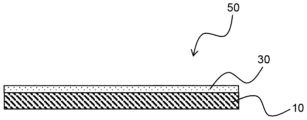
- FIG. 1 is a schematic cross-sectional view of a porous sheet according to a first embodiment.
- the photo on the left is the porous sheet before being attached to living tissue
- the photo on the right is the porous sheet being attached to living tissue.
- the schematic diagram on the left is a schematic diagram of the hydrophobized gelatin derivative and crosslinking agent existing in an unreacted state in the porous sheet before it is pasted on biological tissue
- the schematic diagram on the right is a diagram of the porous sheet pasted on biological tissue.
- FIG. 2 is a schematic diagram showing an example of a crosslinking reaction between a hydrophobized gelatin derivative and a crosslinking agent in a sheet. It is a flow chart showing a manufacturing method of a porous sheet of a 1st embodiment.
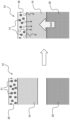
- FIG. 7 is a schematic cross-sectional view of the laminate of Modification 1 of the second embodiment, and is a diagram illustrating how the laminate is attached to living tissue. It is a cross-sectional schematic diagram of the laminated body of the modification 2 of 2nd Embodiment.
- “Gelatin” generally refers to a polymer whose triple helical structure is unraveled and denatured by treating natural or synthetic collagen with heat, acid, or alkali. "time” means “gelatin” that has not been subjected to “hydrophobization” treatment and has no alkyl group introduced. Therefore, “gelatin” is sometimes expressed as "ApGltn” or “GltnNH 2 " herein.
- hydrophobicization refers to introducing a hydrocarbon group into “gelatin”, more specifically, by bonding a hydrocarbon group to an amino group via a linking group or directly, A process that increases the hydrophobicity of gelatin.
- hydrophobicized gelatin derivative refers to the introduction of a hydrocarbon group into “gelatin”
- hydrophobicized gelatin derivative refers to the introduction of a hydrocarbon group into “gelatin”
- hydrophobicized gelatin derivative refers to the introduction of a hydrocarbon group into “gelatin”
- bonding of a hydrocarbon group to an amino group via a linking group or directly This refers to a derivative of "gelatin” with increased hydrophobicity, and is sometimes expressed as "GltnNH-L-CHR 1 R 2 ".
- the porous sheet 10 includes a hydrophobized gelatin derivative (second gelatin) in which a hydrocarbon group is introduced into raw material gelatin (first gelatin), and a crosslinking agent dispersed in the hydrophobized gelatin derivative.
- the crosslinking agent is dispersed in the hydrophobized gelatin derivative, and the crosslinking agent and the hydrophobized gelatin derivative are in a substantially unreacted state. be.
- Moisture is required for the crosslinking reaction (hardening reaction) between the hydrophobized gelatin derivative and the crosslinking agent, and the environment must be neutral to alkaline. Since living tissue (for example, the porcine aorta 20 shown in FIG. 1B) normally contains neutral water, the porous sheet 10 absorbs neutral water by being attached to the living tissue 20. to crosslink and adhere to living tissue 20.
- the crosslinking reaction typically involves a primary amino group possessed by a hydrophobized gelatin derivative and a crosslinkable group possessed by a crosslinking agent (typically an active ester group, etc.). ) is the reaction.
- the porous sheet 10 maintains the structure of the raw material gelatin, and therefore has high biocompatibility. Hydrophobic interactions occur between the porous sheet 10 and the living tissue 20 due to the hydrophobic groups, and the hydrophobic groups permeate into the living tissue 20 at a molecular level (anchoring). A physically strong bond is formed between the porous sheet 10 and the porous sheet 20, and the porous sheet 10 can be strongly adhered to the surface of the living tissue 20. In this way, the porous sheet 10 strongly adheres to the living tissue 20 just by pasting it. Furthermore, due to its porous structure, the porous sheet 10 has improved flexibility and/or flexibility compared to non-porous membranes, and can be bent to follow the surface shape of the living tissue 20.
- the porous sheet 10 is thought to be able to efficiently absorb moisture when attached to the biological tissue 20 and promote the curing reaction (crosslinking reaction) between the hydrophobized gelatin derivative and the crosslinking agent. .
- the details of the porous sheet 10 will be explained below.
- the hydrophobized gelatin derivative refers to a gelatin derivative in which a hydrocarbon group is introduced into raw material gelatin (first gelatin), and has a structure represented by the following formula (1).
- Gltn represents a gelatin residue
- L represents a single bond or a divalent linking group
- R 1 is a hydrocarbon group having 1 to 20 carbon atoms
- R 2 is a hydrogen atom or It is a hydrocarbon group having 1 to 20 carbon atoms.
- GltnNH- is a structure derived from the above-mentioned raw material gelatin. Therefore, raw gelatin is represented by GltnNH2 . Note that the details of the raw material gelatin will be described later.
- -CHR 1 R 2 is a hydrocarbon group introduced into the raw gelatin via L (single bond or divalent linking group).
- the divalent linking group for L is not particularly limited, but includes -C(O)-, -C(O)O-, -OC(O)-, -O-, -S-, -N(R)- (R represents a hydrogen atom or a monovalent organic group (preferably a hydrocarbon group having 1 to 20 carbon atoms)), an alkylene group (preferably an alkylene group having 2 to 10 carbon atoms), an alkenylene group (preferably (alkenylene group having 2 to 10 carbon atoms), and combinations thereof, among which -C(O)- is preferred.
- L is preferably a single bond or -C(O)-.
- -CHR 1 R 2 (hydrocarbon group) is preferably bonded to the ⁇ -amino group of raw material gelatin, and is bonded to the ⁇ -amino group of lysine (Lys) in raw material gelatin. More preferably, they are bonded.
- a so-called reductive amination reaction Examples include a method using an aldehyde or a ketone), a Schotten-Baumann reaction (a method using an acid chloride), and the like.
- the -NH- structure (secondary amino group) of formula (1) can be detected, for example, by a band around 3300 cm -1 in an FT-IR (Fourier transform infrared absorption) spectrum.
- FT-IR Fastier transform infrared absorption
- the hydrocarbon group having 1 to 20 carbon atoms for R 1 and R 2 is not particularly limited, and includes, for example, a chain hydrocarbon group having 1 to 20 carbon atoms, and a chain hydrocarbon group having 3 to 20 carbon atoms. Examples include alicyclic hydrocarbon groups, aromatic hydrocarbon groups having 6 to 14 carbon atoms, and groups combining these.
- R 2 When R 2 is 1 to 20 hydrocarbon groups, R 2 may be the same as or different from R 1 . Moreover, the hydrocarbon groups of R 1 and R 2 may be linear or branched.
- the chain hydrocarbon group having 1 to 20 carbon atoms is not particularly limited, but includes methyl group, ethyl group, propyl group, butyl group, pentyl group, hexyl group, octyl group (or caprylic group), nonyl group (or pelargonyl group), decyl group, dodecyl group (or lauryl group), and tetradecyl group (or myristyl group).
- Examples of the alicyclic hydrocarbon group having 3 to 20 carbon atoms include cyclopropyl group, cyclopentyl group, cyclohexyl group, adamantyl group, and norbornyl group.
- the aromatic hydrocarbon group having 6 to 14 carbon atoms includes, but is not particularly limited to, a phenyl group, a tolyl group, a naphthyl group, and the like.
- groups combining the above include, but are not particularly limited to, aralkyl groups having 6 to 12 carbon atoms such as a benzyl group, a phenethyl group, a naphthylmethyl group, and a naphthylethyl group.
- R 1 is a linear alkyl group and R 2 is a hydrogen atom.
- R 1 is preferably a straight chain alkyl group having 6 to 12 carbon atoms, more preferably a straight chain alkyl group having 8 to 10 carbon atoms.
- the hydrophobized gelatin derivative represented by formula (1) is preferably at least one selected from the group consisting of the following formulas (2) and (3), and more preferably the gelatin derivative represented by formula (2). preferable.
- Formula (2) is a case where L in formula (1) is a single bond, and the hydrocarbon group (-CHR 1 R 2 ) is attached to raw material gelatin via an imino bond (-NH-) which is a secondary amine. has been introduced into the gelatin residue Gltn.
- Formula (3) is a case where L in formula (1) is -C(O)-, and the hydrocarbon group (-CHR 1 R 2 ) is bonded to the gelatin of the raw material gelatin through the amide bond (-NHCO-). The residue Gltn has been introduced.
- formula (2) and formula (3) the meaning of each symbol is the same as in formula (1) already explained, and the preferred form is also the same.
- the hydrophobized gelatin derivative may be composed of only one type of hydrophobized gelatin derivative, or may be a mixture of two or more types of hydrophobized gelatin derivatives.
- the content of imino groups (-NH-CHR 1 R 2 ) to which alkyl groups are bonded in the hydrophobized gelatin derivative relative to the content of amino groups (-NH 2 ) in gelatin (raw material gelatin) before hydrophobization is defined as the "degree of submission” (hereinafter sometimes simply referred to as "DS").
- the hydrocarbon group introduction rate of the hydrophobized gelatin derivative is preferably, for example, 5 mol% to 50 mol%, 5 mol% to 20 mol%, or 5 mol% to 10 mol%, from the viewpoint of improving the adhesiveness of the porous sheet.
- the imino group/amino group (molar ratio) in the hydrophobized gelatin derivative may be 5/95 to 50/50, 5/95 to 20/80, or 5/95 to 10/90. If the hydrocarbon group introduction rate of the hydrophobized gelatin derivative is within the above range, it is easy to obtain a porous sheet 10 with high adhesiveness.
- hydrocarbon group introduction rate is determined from the value obtained by quantifying the number of amino groups in the raw material gelatin and the number of amino groups in the hydrophobized gelatin derivative by the 2,4,6-trinitrobenzenesulfonic acid method (TNBS method). It can be calculated using the following formula.
- Hydrocarbon group introduction rate of hydrophobized gelatin derivative (mol%) [Number of amino groups in raw material gelatin - Number of amino groups in hydrophobized gelatin derivative] / [Number of amino groups in raw gelatin] x 100
- the molecular weight of the hydrophobized gelatin derivative is not particularly limited, and is determined by the molecular weight of the raw material gelatin and the type and amount (number) of introduced hydrocarbon groups. Therefore, the possible range of the weight average molecular weight (Mw) of the hydrophobized gelatin derivative is almost the same as the possible range of the weight average molecular weight (Mw) of the raw material gelatin, which will be described later.
- hydrophobized gelatin derivatives described above may be commercially available products or may be self-synthesized products.
- Hydrophobized gelatin derivatives can also be synthesized by introducing hydrophobic groups (hydrocarbon groups) into the raw material gelatin (first gelatin) described below, for example, using the synthesis method disclosed in International Publication No. 2020/137903. good.
- the content regarding the method for synthesizing a hydrophobized gelatin derivative disclosed in WO 2020/137903 is incorporated herein by reference.
- the raw material gelatin may be obtained from naturally-derived collagen or synthetic collagen (including fermentation, genetic recombination, etc.).
- gelatin obtained from naturally derived or synthesized collagen may be subjected to some kind of treatment (excluding hydrophobic treatment).
- gelatin is obtained by treating naturally occurring collagen obtained from the skin, bones, tendons, etc. of mammals, birds, fish, etc. with acid or alkali (heat-extracted if necessary).
- alkali treatment of naturally-derived collagen is particularly preferable, since a porous sheet having better effects of the present invention can be obtained.
- naturally derived gelatin means gelatin obtained by heat, acid, or alkali treatment of naturally derived collagen; for example, the term “fish-derived gelatin” refers to It refers to gelatin obtained by heat, acid, or alkali treatment of collagen derived from collagen.
- gelatin that has undergone low endotoxin treatment and has a reduced endotoxin content Gelatin raw materials vary depending on the climate of the country of manufacture, the manufacturing environment, the animal of origin, the extraction method, the cleanliness of the equipment used, etc., but generally they contain 1,000 to 100,000 EU/g of endotoxin, and Gelatin that has undergone some type of endotoxin reduction treatment is called "low-endotoxin-treated gelatin.”
- “Low endotoxin treated gelatin” usually contains 5,000 EU/g or less endotoxin, preferably 1,000 EU/g or less, and more preferably 100 EU/g or less endotoxin. More preferably, it contains 10 EU/g or less of endotoxin.
- Such low-endotoxin-treated gelatin is not particularly limited and any known gelatin can be used, but examples thereof include those described in JP-A No. 2007-231225, the content of which is incorporated herein by reference. Incorporated.
- gelatin derived from mammals examples include gelatin derived from pigs and cows.
- Gelatin derived from fish is not particularly limited, but gelatin derived from cold water fish (cold water fish) such as salmon, trout, cod, walleye pollack, sea bream, tilapia, and tuna (hereinafter also referred to as "gelatin derived from cold water fish") may be used. ) is preferred.
- Gelatin derived from cold water fish can maintain fluidity without solidifying even at low temperatures.
- the crosslinking agent can be easily and uniformly dispersed even at low temperatures, and the porous sheet of this embodiment can be efficiently formed by freeze-drying (freeze-drying) described below. 10 can be manufactured. Furthermore, it also has the characteristic of easily absorbing moisture when applied to a living body.
- Cold-water fish-derived gelatin is a polymer in which two or more amino acids are linked in a linear chain, with 190 or less imino acids per 1000 constituent amino acids, more specifically 80 or less hydroxyproline ( Hydroxyproline) and has 110 or less prolines.
- the room temperature fluidity of gelatin derived from cold water fish is thought to be due to the fact that the number of hydroxyprolines is 80 or less or the number of prolines is 110 or less. If either condition is satisfied, the denaturation temperature will be approximately room temperature or lower, and room temperature fluidity will occur.
- the number of hydroxyprolines in Thai gelatin is 73, the number of prolines is 108, and the denaturation temperature is 302.5K.
- Tilapia gelatin has a hydroxyproline number of 82, a proline number of 110, and a denaturation temperature of 309K.
- porcine gelatin has a hydroxyproline number of 95, a proline number of 121, and a denaturation temperature of 316K.
- gelatin derived from cold water fish has a similar amino acid sequence to gelatin derived from animals, is easily decomposed by enzymes in living organisms, and has high biocompatibility.
- the molecular weight of the raw material gelatin is not particularly limited, but the weight average molecular weight (Mw) is preferably 5,000 to 100,000, more preferably 10,000 to 50,000, and even more preferably 20,000 to 40,000. .
- the weight average molecular weight means the weight average molecular weight calculated
- the raw material gelatin may be composed of only one type of gelatin, or may be a mixture of two or more types of gelatin.
- the crosslinking agent is typically a compound having at least two substituents (crosslinking groups) in one molecule that can react with the primary amino group of the hydrophobized gelatin derivative.
- the crosslinking group possessed by the crosslinking agent is not particularly limited, but active ester groups (activated ester group) is preferred. That is, as a crosslinking agent, a compound having at least two active ester groups in one molecule is preferable.
- Such crosslinking agents include polybasic acids activated with N-hydroxysuccinimide or N-hydroxysulfosuccinimide.
- genipin aldehyde compounds, acid anhydrides, maleimide compounds, dithiocarbonates, diisothiocyanates, and the like can be used as crosslinking agents.
- polybasic acids examples include tartaric acid, citric acid, malic acid, glutaric acid, glutamic acid, aspartic acid, oxaloacetic acid, cis-aconitic acid, 2-ketoglutaric acid, polytartaric acid, polycitric acid, polymalic acid, polyglutamic acid, and polyaspartic acid.
- carboxymethylated dextrin carboxymethylated dextran, carboxymethylated starch, carboxymethylated cellulose, carboxymethylated chitosan, and carboxymethylated pullulan.
- disuccinimidyl glutarate DSG
- disuccinimidyl suberate DSS
- disuccinimidyl tartrate DST
- polybasic acid esters of polyethylene glycol or polyethylene glycol ether in which at least one carboxyl group of the polybasic acid that has not reacted with polyethylene glycol has been converted into an active ester such as 4, 7, 10, 13 , 16-pentaoxanonadecanedioic acid di(N-succinimidyl), and polyethylene glycol di(succinimidyl succinate) (SS-PEG-SS) represented by the following formula:
- n is a number such that Mw is about 3,000 to 30,000, preferably 5,000 to 27,000, more preferably 15,000 to 25,000);
- aldehyde compounds include formyl group-introduced polysaccharides in which two or more formyl groups are introduced into one molecule, such as formyl group-introduced starch, formyl group-introduced dextran, formyl group-introduced dextrin, and formyl group-introduced hyaluronic acid. Can be mentioned.
- Examples of acid anhydrides include glutaric anhydride, maleic anhydride, and succinic anhydride.
- examples of the diisothiocyanate include hexamethylene diisothiocyanate and the like.
- activated polyethylene glycol polybasic acid esters and formyl group-introduced polysaccharides are preferred, and activated polyethylene glycol polybasic acid esters are more preferred.
- crosslinking agent explained above may be a commercially available product or may be synthesized by a known method. Further, the crosslinking agent may be composed of only one type of crosslinking agent, or may be a mixture of two or more types of crosslinking agents.
- the ratio of the crosslinkable groups of the crosslinking agent to the amino groups of the hydrophobized gelatin derivative is not particularly limited. From the viewpoint of efficiently promoting the crosslinking reaction, for example, it is preferable that the crosslinking group possessed by the crosslinking agent is 0.25 to 2 equivalents, with respect to 1 equivalent of the amino group possessed by the hydrophobized gelatin derivative. More preferably 3 equivalents to 1.5 equivalents, even more preferably 0.3 equivalents to 0.8 equivalents.
- the amino group and the crosslinkable group eg, active ester group
- the content of the hydrophobized gelatin derivative and the content of the crosslinking agent in the porous sheet 10 are not particularly limited, and may be adjusted as appropriate within a range that satisfies the above-mentioned preferred ratio of crosslinkable groups to amino groups, for example.
- the content of the hydrophobized gelatin derivative in the porous sheet may be, for example, 1 to 15% by mass, or 5 to 10% by mass, and the content of the crosslinking agent may be, for example, 1 to 10% by mass, or 2. It may be 5 to 7.5% by mass.
- the porous sheet 10 may be composed only of the hydrophobized gelatin derivative and the crosslinking agent, or may contain other components other than the hydrophobized gelatin derivative and the crosslinking agent within the range that achieves the effects of the present invention. .
- the total content of the hydrophobized gelatin derivative and the crosslinking agent in the porous sheet 10 may be 1% by mass or more, 10% by mass or more, 90% by mass or more, or 100% by mass.
- Components other than the hydrophobized gelatin derivative and the crosslinking agent are not particularly limited, but include, for example, solvents, buffering agents, colorants, preservatives, functional nanoparticles, and drugs (anticancer drugs, antithrombotic drugs, etc.). , antibacterial agents, growth factors, etc.).
- the density of the porous sheet 10 is not particularly limited, but may be, for example, 0.01 g/ cm 3 to 0.3 g/cm 3 or 0.02 g/cm 3 to 0.08 g/cm 3 .
- the density of the porous sheet 10 is preferably 0.02 g/cm 3 to 0.1 g/cm 3 , more preferably 0.05 g/cm 3 to 0.1 g/cm 3 , particularly preferably , 0.05g/cm 3 to 0.08g/cm 3 .
- the porous sheet can have sufficient voids, which can provide appropriate flexibility and/or flexibility, and further improve efficiency. It can absorb moisture and accelerate the curing reaction. Moreover, if the density is at least the lower limit of the above range, a sufficient amount of cured product (crosslinked product) can be obtained from the porous sheet, and strong adhesiveness can be exhibited to living tissue. Furthermore, the film strength is increased and handling properties are also improved. Note that the density of the porous sheet 10 can be adjusted by, for example, the gelatin concentration of the raw material liquid used in the porous sheet manufacturing method described below.
- the thickness of the porous sheet 10 is not particularly limited, but may be, for example, 0.1 mm or more, 0.5 mm or more, 1 mm or more, or 1.5 mm or more.
- a sufficient amount of cured product (crosslinked product) can be obtained from the porous sheet, and strong adhesiveness can be exhibited to living tissue. Furthermore, the film strength is increased and handling properties are also improved.
- the upper limit of the thickness of the porous sheet is not particularly limited, the practical range as a tissue adhesive film is, for example, 8 mm or less, or 5 mm or less.
- the thinner the thickness, the better the flexibility, and the better the processability when used with a tissue adhesive film for example. From the viewpoint of improving flexibility, the thickness of the porous sheet may be, for example, 2 mm or less, 1 mm or less, or 0.5 mm or less.
- the porous sheet 10 of this embodiment is a sheet containing an unreacted crosslinking agent dispersed in a hydrophobized gelatin derivative (see FIG. 1B); This means that most of the crosslinking agent contained in the sheet 10 is unreacted. Therefore, for example, a sheet made of a crosslinked hydrophobized gelatin derivative and containing a small amount of unreacted crosslinking agent is different from the porous sheet 10 of this embodiment.
- Most of the hydrophobized gelatin derivatives contained in the porous sheet of this embodiment are in an uncrosslinked state before use (for example, before adhesion to the living tissue 20), and after use (for example, before adhesion to the living tissue 20), , crosslinked with a crosslinking agent. For example, it is preferable that 60 mol% to 100 mol% or 80 mol% to 100 mol% of the total crosslinking agent contained in the porous sheet 10 of the present embodiment exist in an unreacted state.
- the manufacturing method of the porous sheet 10 is not particularly limited, it can be manufactured, for example, by a manufacturing method including steps S1 and S2 described below.
- the manufacturing method of this embodiment uses freeze-drying to efficiently obtain a sheet with a porous structure (porous sheet).
- Step S1 Preparation of raw material liquid (acidic)
- Step S2 Freeze-drying of raw material liquid.
- Process S1 First, an acidic raw material liquid (raw material liquid (I)) containing a hydrophobized gelatin derivative (second gelatin), a crosslinking agent, an acid, and a solvent is prepared (step S1 in FIG. 2).
- raw material liquid (I) raw material liquid (raw material liquid (I)) containing a hydrophobized gelatin derivative (second gelatin), a crosslinking agent, an acid, and a solvent is prepared (step S1 in FIG. 2).
- hydrophobized gelatin derivative examples include the embodiments described above regarding the porous sheet 10, and the preferred embodiments are also the same.
- a cold-water fish-derived gelatin derivative in which a hydrocarbon group is introduced into cold-water fish-derived gelatin (raw material gelatin) is more preferable.
- the crosslinking agent can be easily and uniformly dispersed even at low temperatures, and the porous sheet 10 can be obtained by freeze-drying (step S2) while maintaining this state.
- the concentration of the hydrophobized gelatin derivative in the raw material liquid is not particularly limited, but is, for example, 1 w/v% to 20 w/v%, 1.2 w/v% to 12 w/v%, or 2.5 w/v% to It may be set to 7.5 w/v%. If the concentration of the hydrophobized gelatin derivative in the raw material liquid is within the above range, a porous sheet 10 having a porosity within an appropriate range can be easily obtained.
- crosslinking agent examples include the forms described as a constituent of the porous sheet 10, and preferred forms are also the same.
- concentration of the crosslinking agent in the raw material liquid is not particularly limited, and may be adjusted as appropriate, for example, so as to satisfy the above-mentioned preferred ratio of crosslinkable groups to amino groups.
- concentration of the crosslinking agent in the raw material liquid may be, for example, 1 w/v% to 10 w/v%, or 2.5 w/v% to 7.5 w/v%.
- the preferable pH of the raw material liquid at room temperature (20° C.) is less than pH 7, less than pH 6, or less than pH 5, and the lower limit is not particularly limited, but is, for example, more than pH 1.
- the nucleophilicity of the amine is suppressed, and the hydrophobized gelatin derivative and the crosslinking agent can be mixed without reacting.
- freeze-drying in this state step S2
- a porous sheet 10 containing the crosslinking agent and the hydrophobized gelatin derivative in a substantially unreacted state is obtained.
- the type of acid is not particularly limited as long as the pH of the raw material liquid can be adjusted within the above range, but it may evaporate or sublimate during freeze-drying (step S2) and remain in the final product (porous sheet 10). Hydrochloric acid, acetic acid, etc. are preferable, and hydrochloric acid is more preferable from the viewpoint of being difficult to remove.
- One type of acid may be used alone, or two or more types may be used in combination. Further, the concentration of acid in the raw material liquid may be adjusted as appropriate so that the pH of the raw material liquid is within the above range.
- the solvent for the raw material liquid is not particularly limited as long as it can dissolve the hydrophobized gelatin derivative, crosslinking agent, and acid; for example, water (ion-exchanged water, distilled water, pure water), water-alcohol mixed solvent, water-acetone. Examples include mixed solvents, among which water is preferred.
- the raw material liquid may be composed only of a hydrophobized gelatin derivative, a crosslinking agent, an acid, and a solvent, or may contain other components other than these. Other components are the same as the other components (for example, drugs, functional nanoparticles, etc.) that the porous sheet 10 can contain, as described above. Further, the raw material liquid may contain, as another component, a porogen that can serve as a template for the pores of the porous structure.
- the porogen is preferably a sublimable solid such as ice microcrystals or t-butanol.
- the raw material liquid may be prepared by uniformly mixing a hydrophobized gelatin derivative, a crosslinking agent, an acid, a solvent, and other components as necessary using a conventionally known method.
- the prepared raw material liquid is freeze-dried to obtain the porous sheet 10 (step S2 in FIG. 2).
- the porous sheet 10 of the desired size can be obtained by pouring the raw material liquid into a container having the same volume as the porous sheet 10 of the desired size and evaporating the solvent (and acid) by freeze-drying.
- the freeze-drying method a conventionally known method may be used.
- the degree of vacuum during freeze-drying may be, for example, 100 mmTorr or less or 50 mmTorr or less
- the temperature during freeze-drying may be, for example, -80°C or less, or -10°C or less
- the freeze-drying time is, for example, 96 hours. It may be less than 48 hours or less than 48 hours. Note that prior to freeze-drying, so-called preliminary freezing may be performed.
- tissue adhesive film The porous sheet 10 of this embodiment has both high biocompatibility and adhesive strength, and thus can be used as a tissue adhesive film (tissue adhesive material) for use with living tissues. Since the porous sheet 10 has high flexibility and/or flexibility, it can also be used by being bent to follow the surface shape of living tissue.
- Tissue adhesive membranes include, for example, hemostatic materials to stop bleeding from biological tissues (blood vessels, etc.), anti-adhesion materials to prevent postoperative adhesions, and biological tissues (pulmonary pleura, gastrointestinal anastomoses, oral and periodontal tissues). Wound dressings for covering wounds caused by (etc.), etc.
- the porous sheet 10 also has excellent absorbency and biocompatibility, so that it can be used, for example, in the gap between the dura mater and the dura mater, at the dura mater suture area. Alternatively, it can also be used as a sealant (closing material) for filling the gap between the dura mater forming material and the dura mater.
- the tissue adhesive film may be planar or, for example, cylindrical. Since the porous sheet 10 has high flexibility and/or flexibility, it can be easily processed into a cylindrical shape.
- the cylindrical tissue adhesive membrane can be used, for example, to cover anastomoses such as nerves and tendons.
- the tissue adhesive film of this embodiment adheres to living tissue by pasting it on living tissue and leaving it.
- the standing time is the time required for the tissue adhesive film to absorb moisture in the tissue and crosslink, and may be set as appropriate depending on the proportion of the constituent materials in the tissue adhesive film. The time may be between 10 minutes and 10 minutes. Further, at this time, heating may be performed as long as it is 37° C. or less, or a weak alkaline aqueous solution such as a sodium bicarbonate aqueous solution may be applied.
- the laminate 50 includes the porous sheet 10 of the first embodiment (hereinafter sometimes referred to as "lower layer 10" or “sheet (I)”), and raw material gelatin (first gelatin) laminated thereon. ) (hereinafter sometimes referred to as "upper layer 30" or “sheet (II)”). That is, the lower layer 10 (sheet (I)) is laminated on one surface (on the lower surface) of the upper layer 30 (sheet (II)).
- the laminate 50 of this embodiment can be used, for example, as a tissue adhesive film.
- the laminate 50 is attached with the lower layer 10 side in contact with the living tissue.
- the lower layer 10 absorbs moisture by being attached to living tissue, crosslinks, and adheres to the tissue. Since the laminate 50 includes the porous sheet 10 (lower layer 10), it has the same effects as the first embodiment. That is, it has high biocompatibility and adhesive strength, and also has flexibility and/or flexibility.
- the layered structure makes it difficult for moisture to circulate to the upper layer 30, and the stickiness (adhesiveness) of the surface of the layered product 50 (upper layer 30) is suppressed. Therefore, for example, handling properties during surgery are improved. Further, since no hydrophobic group is introduced into the raw material gelatin of the upper layer 30, its adhesiveness to living tissue is low. Therefore, the surface (upper layer 30) of the laminate 50 attached to living tissue is difficult to adhere to other living tissues, and also functions as an anti-adhesion material. The details of the laminate 50 of this embodiment will be explained below.
- the lower layer 10 of the laminate 50 may have the same form as the porous sheet 10 of the first embodiment, and the preferred form is also the same.
- the density of the lower layer 10 of the laminate 50 may be the same as that of the porous sheet 10 of the first embodiment. Further, the density of the lower layer 10 is preferably 0.05g/cm 3 to 0.2g/cm 3 , more preferably 0.07g/cm 3 to 0.2g/cm 3 . When the density is below the above upper limit value, the laminate 50 can have sufficient voids, which can provide more appropriate flexibility and further reduce the hardening reaction between the hydrophobized gelatin derivative and the crosslinking agent. Can be promoted. Further, if the density is equal to or higher than the lower limit value, the water absorption rate when the laminate 50 is attached to living tissue becomes slow, making it more difficult for water to flow into the upper layer 30.
- the curing reaction progresses in the lower layer 10 before much water reaches the upper layer 30, allowing strong adhesion to living tissue.
- the laminate 50 exhibits strong adhesiveness even in an environment with a lot of moisture, such as in a living body where a large amount of blood, body fluids, etc. are present due to bleeding, etc., and the surface (upper layer 30) Stickiness (stickiness) is suppressed.
- handling properties are improved, and adhesion to other tissues and adhesion to rubber gloves during surgery is suppressed.
- the thickness of the lower layer 10 of the laminate 50 may be 0.1 mm or more, 0.5 mm or more, 1.5 mm or more, or 2 mm or more. If the thickness is greater than or equal to the above lower limit, the laminate will exhibit strong adhesion even in an environment with a lot of moisture, such as in a living body where there is a large amount of blood or body fluids due to bleeding, etc. The stickiness (adhesiveness) of the surface of 50 (upper layer 30) is suppressed, the handling properties are improved, and the adhesion prevention performance to other tissues is further enhanced. Further, the upper limit of the thickness of the lower layer 10 is not particularly limited, but the practical range as a tissue adhesive film is, for example, 8 mm or less, or 5 mm or less.
- the thickness of the lower layer 10 may be, for example, 2 mm or less, 1 mm or less, or 0.5 mm or less.
- the raw material gelatin for the upper layer 30 may be the same as the raw material gelatin of the first embodiment described above, and the preferred embodiments are also the same.
- the crosslinked product of raw material gelatin is not particularly limited, and may be a crosslinked product obtained by crosslinking raw material gelatin by any method, but it is preferably a thermally crosslinked product. According to thermal crosslinking, a crosslinked product of raw material gelatin can be obtained more easily, and it is safe because there is no generation of impurities derived from the crosslinking agent.
- the thermally crosslinked product for example, amino groups in the gelatin mixture react with other reactive groups (eg, carboxy groups, mercapto groups, etc.) to form a crosslinked structure.
- the upper layer 30 may be composed only of a crosslinked product of raw gelatin, or may contain other components other than the crosslinked product of raw gelatin as long as the effects of the present invention are achieved.
- the content of the crosslinked product of raw material gelatin in the upper layer 30 may be 100% by mass, 95% by mass or more, or 90% by mass or more.
- other components other than the crosslinked raw material gelatin include basic compounds described in Modification 1 below.
- Other components other than the basic compound are not particularly limited, but include, for example, pigments, photocatalysts, colorants, preservatives, inorganic nanoparticles (gold nanoparticles, iron oxide nanoparticles, calcium phosphate nanoparticles, etc.), and drugs. (anticancer drugs, antithrombotic drugs, antibacterial agents, growth factors, etc.), etc.
- Top layer 30 is preferably porous and/or thin.
- the flexibility and/or flexibility of the entire laminate 50 can be further enhanced.
- the density of the upper layer 30 is not particularly limited, and may be, for example, 0.01 g/cm 3 to 0.3 g/cm 3 . If the density is below the upper limit of the above range, more sufficient flexibility can be easily obtained. Moreover, if the density is at least the lower limit of the above range, the film strength will increase and the handling properties will also improve.
- the lower limit of the thickness of the upper layer 30 is not particularly limited, but is preferably, for example, 0.01 mm or more, or 0.1 mm or more. If the thickness is at least the above lower limit, handling properties will be further improved, and adhesion to other tissues and adhesion to rubber gloves during surgery will be suppressed. Further, the upper limit of the thickness of the upper layer 30 is not particularly limited, but from the viewpoint of improving flexibility, it is preferably, for example, 2 mm or less, 1 mm or less, or 0.5 mm or less.
- the ratio of the thickness of the lower layer 10 to the thickness of the upper layer 30 is not particularly limited, but may be, for example, 1 to 6 or 2 to 4. When the ratio is within the above range, handling properties are further improved, and adhesion prevention performance to other tissues is further enhanced.
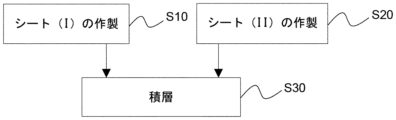
- the manufacturing method of the laminate 50 of this embodiment is not particularly limited, it can be manufactured, for example, by a manufacturing method including steps S10, S20, and S30 described below (see FIG. 7).
- Step S10 Preparation of lower layer 10 (sheet (I))
- Step S20 Preparation of upper layer 30 (sheet (II))
- Step S30 Lamination of lower layer 10 and upper layer 30.
- Step S10 The method for manufacturing the lower layer 10 (porous sheet (I)) is not particularly limited, but may be performed by a method similar to that for the porous sheet 10 described in the first embodiment, for example, a method including steps S1 and S2 shown in FIG. Can be manufactured.
- Step S20 The method for manufacturing the upper layer 30 (sheet (II) containing a crosslinked product of raw material gelatin) is not particularly limited, but may be manufactured by, for example, the method described below. First, a raw gelatin solution (raw material solution (II)) containing raw gelatin and a solvent is prepared. Next, the raw gelatin liquid is poured into a mold of a desired size, and the solvent is evaporated by freeze-drying to obtain a sheet (precursor sheet) of a desired size. The upper layer 30 is obtained by heating the sheet to thermally crosslink it.
- a raw gelatin solution raw material solution (II)
- solvent is evaporated by freeze-drying to obtain a sheet (precursor sheet) of a desired size.
- the upper layer 30 is obtained by heating the sheet to thermally crosslink it.
- Examples of the solvent for dissolving raw material gelatin include those similar to the solvent form of the raw material liquid in the first embodiment, and preferred forms are also the same.
- the concentration of raw gelatin in the raw gelatin solution is not particularly limited, and may be adjusted as appropriate depending on the desired porosity, density, etc. of the upper layer 30 to be manufactured.
- the raw gelatin concentration in the raw gelatin solution may be, for example, 1 w/v% to 20 w/v%.
- a conventionally known method may be used for the freeze-drying, and the preferable ranges of the degree of vacuum, temperature, and time during freeze-drying are the same as those for the freeze-drying in the first embodiment.
- the method for thermally crosslinking the raw material gelatin is not particularly limited, and conventionally known methods can be used.
- the heating temperature during thermal crosslinking is not particularly limited, but is preferably 80 to 200°C, more preferably 100 to 200°C.
- the heating time during thermal crosslinking is not particularly limited, but is preferably 0.1 to 20 hours, more preferably 1 to 10 hours.
- Step S30 The laminate 50 of this embodiment is obtained by stacking the manufactured lower layer 10 and upper layer 30 one on top of the other. When the laminate 50 is attached to living tissue, the lower layer 10 is crosslinked, thereby bonding the lower layer 10 and the upper layer 30 together.
- the upper layer (sheet (II)) 30 contains a basic compound 31.
- the basic compound 31 is a compound that exhibits basicity when it comes into contact with moisture. Except for containing the basic compound 31, the laminate 51 has the same configuration as the laminate 50 of the second embodiment described above. Regarding the configuration similar to that of the laminate 50, explanation in this modification will be omitted.
- the laminate 51 of this modification can be used, for example, as a tissue adhesive film, and has the same effects as the laminate 50. Furthermore, the laminate 51 has the following effects by containing the basic compound 31. As shown in FIG. 8, when the laminate 51 is applied to the biological tissue 20, the laminate 51 absorbs moisture from the biological tissue 20, and the basic compound 31 is eluted by the absorbed moisture. Thereby, the pH within the lower layer 10 increases more quickly, and the crosslinking reaction (hardening reaction) between the hydrophobized gelatin derivative and the crosslinking agent is promoted. That is, it is possible to shorten the time (adhesion time) from when the laminate 51 is attached to the living tissue 20 to when sufficient adhesive strength is obtained.
- the basic compound 31 is not particularly limited as long as it shows basicity when in contact with water, but for example, if the pH of an aqueous solution of 0.05 mol/L to 0.5 mol/L is 7.5 to 10, The compounds shown below are preferred, and the compounds whose pH in aqueous solution of 0.1 mol/L to 0.3 mol/L is 8.0 to 9.5 are more preferred. A compound having such characteristics can further shorten the adhesion time.
- the basic compound 31 is a pH buffering agent whose aqueous solution functions as a pH buffering solution. Examples of the pH buffer include a mixture of a weak acid and a salt of a weak acid, or a mixture of a weak base and a salt of a weak base.
- the pH within the lower layer 10 can be easily maintained within a desired range when the laminate 51 is attached to the biological tissue 20. Moreover, it is possible to suppress the pH of the lower layer 10 from rising too much, and damage to the living tissue 20 can be prevented.
- pH buffer examples include the components and active ingredients of the pH buffer listed below.
- Phosphate buffer a mixture of phosphoric acid and a phosphate salt (e.g. sodium phosphate)
- acetate buffer a mixture of acetic acid and an acetate salt (e.g. sodium acetate)
- citrate buffer a mixture of phosphoric acid and a phosphate salt (e.g. sodium acetate)
- citrate buffer a mixture of phosphoric acid and a phosphate salt (e.g. sodium acetate)
- citrate buffer a mixture of phosphoric acid and a phosphate salt (e.g.
- citrate phosphate buffer a mixture of citric acid and a phosphate (e.g., sodium phosphate)
- a borate buffer a mixture of citric acid and a phosphate (e.g., sodium phosphate)) acid and a borate (e.g., sodium borate)
- tartrate buffer a mixture of tartaric acid and a tartrate (e.g., sodium tartrate)
- succinate buffer a mixture of succinic acid and a succinate) (e.g., a mixture with sodium succinate), maleic acid (a mixture of maleic acid and a maleate salt (e.g., sodium maleate)), Tris-hydrochloric acid buffer (a mixture of tris-aminomethane and hydrochloric acid), carbonate buffer liquid (a mixture of carbonic acid and a carbonate (e.g.
- the ratio of each component in the pH buffer may be adjusted as appropriate depending on the desired pH. .
- Examples of the basic compound 31 other than the pH buffer include sodium hydroxide, potassium hydroxide, calcium hydroxide, magnesium hydroxide, zinc hydroxide, and the like. These basic compounds 31 may be one type of compound, or may be a mixture of two or more types of compounds.
- the content of the basic compound 31 in the upper layer 30 is not particularly limited, and may be adjusted as appropriate depending on the basicity strength of the basic compound 31.
- the content of the basic compound 31 in the upper layer 30 may be, for example, 0.1% to 20% by weight, or 0.3% to 10% by weight.
- the density and thickness of the upper layer 30 can be within the ranges described in the second embodiment. Further, when the upper layer 30 contains a basic compound, the higher the density and/or the thicker the upper layer 30, the greater the amount of the basic compound contained, so that the bonding time can be further shortened. Guessed. From the viewpoint of further shortening the bonding time, the density of the upper layer 30 may be, for example, 0.08 g/cm 3 to 0.3 g/cm 3 , and the thickness of the upper layer 30 may be, for example, 0.2 mm to 2 mm. .
- the method of manufacturing the laminate 51 of this modification is not particularly limited, and is similar to the laminate 50 of the second embodiment described above except for using the basic compound 31 in producing the upper layer 30, for example, as shown in FIG. It can be manufactured by a method including steps S10 to S30 shown below.
- the manufacturing process of the upper layer 30 (step S20 in FIG. 7) will be described below, and the description of the manufacturing process similar to that of the laminate 50 in this modification will be omitted.
- Step S20 First, a raw gelatin solution (raw material solution (II)) containing raw gelatin, a basic compound, and a solvent is prepared. Next, the raw gelatin liquid is poured into a mold of a desired size, and the solvent is evaporated by freeze-drying to obtain a sheet (precursor sheet) of a desired size. The upper layer 30 is obtained by heating the sheet to thermally crosslink it.
- raw gelatin solution raw material solution (II)
- the raw gelatin liquid is poured into a mold of a desired size, and the solvent is evaporated by freeze-drying to obtain a sheet (precursor sheet) of a desired size.
- the upper layer 30 is obtained by heating the sheet to thermally crosslink it.
- the basic compound examples include those similar to the basic compound 31 contained in the upper layer 30 described above, and preferred embodiments are also the same.
- the pH of the raw material liquid (II) becomes alkaline.
- the raw material liquid (II) preferably has a pH of 8 to 10, and preferably 8 to 9, for example.
- the mixture of the solvent (e.g., water) and the basic compound is the pH buffer
- the raw material solution (II) is a solution of raw gelatin dissolved in the pH buffer.
- the concentration of the pH buffer may be, for example, 0.05 mol/L to 0.5 mol/L.
- the concentration of the pH buffer is, for example, the concentration of a mixture of a weak acid and a salt of a weak acid, or the concentration of a mixture of a weak base and a salt of a weak base in the pH buffer.
- the upper layer 30 can be produced by performing step S20 in the same manner as in the second embodiment described above, except for using a basic compound.
- the laminate 52 of this modification has a three-layer structure including two sheets (I) 10 and a sheet (II) 30.
- One of the two sheets (I) 10 is laminated on one surface (on the bottom surface) of the sheet (II) 30, and the other is laminated on the other surface (on the top surface) of the sheet (II). Laminated.
- the sheet (I) and sheet (II) included in the laminate 52 may be the same as the sheet (I) and sheet (II) described in the second embodiment and modification example 1, respectively.
- the method for manufacturing the laminate 52 is not particularly limited, and the laminate 50 of the second embodiment and the laminate 51 of the first modification described above are the same as the laminate 50 of the second embodiment and the laminate 51 of the first modification except that three layers are laminated in the lamination step (step S30). Similarly, it can be manufactured by a method including steps S10 to S30 shown in FIG.
- the two sheets (I) 10 have the same effect as the porous sheet 10 of the first embodiment.
- the laminate 52 can be used, for example, as a double-sided adhesive tissue adhesive film, and furthermore, the sheet (II) 30 contains a basic compound as in Modification 1. In this case, the adhesion time for both sides of the sheet (I) can be reduced at the same time.
- nonanal (nonylaldehyde) is reacted with the amino group of raw material gelatin to form a Schiff base, and then the obtained Schiff base is reacted with a reducing agent.
- a hydrophobized gelatin derivative was obtained by reduction to a stable secondary amine.
- the obtained precipitate was washed with 250 mL of ethanol (1 hour x 3 times) to remove unreacted nonanal and 2-picoline borane. Thereafter, it was vacuum dried for 3 days to obtain C9-ApGltn in a yield of 90% by mass.
- the hydrocarbon group introduction rate (nonyl group introduction rate) DS degree of submission (hereinafter sometimes simply referred to as "DS") of C9-ApGltn is determined by the number of amino groups in the raw material gelatin and the hydrophobized gelatin derivative.
- the number of amino groups in the hydrophobized gelatin derivative was determined by the 2,4,6-trinitrobenzenesulfonic acid method (TNBS method), and from the obtained value, the content of amino groups (-NH 2 ) in the raw material gelatin was determined.
- hydrophobized gelatin derivative synthesized in this example may be referred to as 7.2C9-ApGltn or 7.2C9.
- a hydrophobized gelatin derivative liquid (liquid A) was prepared according to the following procedure.
- the synthesized 7.2C9-ApGltn was dissolved in a 0.1 mM HCl solution, and then the pH was adjusted to 4 using 1M HCl, and then purified water was added so that the concentration of 7.2C9-ApGltn was 15 w/v%.
- the mixture was diluted with water to obtain Solution A.
- a crosslinking agent liquid (liquid B) was prepared according to the following procedure.
- Liquids A and B were thoroughly mixed using a magnetic stirrer at 280 rpm for 30 seconds, and the pH was further adjusted to 4 with a 0.1N HCl solution to obtain a raw material liquid.
- the gelatin concentration of the obtained raw material liquid was 7.5 w/v%.
- a gelatin (7.2C9-ApGltn) concentration of 7.5% w/v was prepared in the same manner as in Example 1-1, and diluted with a 0.1mM HCl solution to give a gelatin concentration of 2.
- the obtained raw material liquid was freeze-dried in the same manner as in Experiment 1-1 to produce a porous sheet.
- Example 2-1 ⁇ Synthesis of hydrophobized gelatin derivative>
- a gelatin derivative (hereinafter appropriately referred to as "C8-ApGltn") in which an octyl group was introduced into raw material gelatin (Org-ApGltn) was used.
- the hydrophobized gelatin derivative is obtained by reacting an alkyl aldehyde (octanal, octyl aldehyde (manufactured by Tokyo Kasei Kogyo Co., Ltd.)) with the amino group of raw material gelatin to form a Schiff base in the same manner as in Example 1-1.
- the resulting Schiff base was reduced to a stable secondary amine using a reducing agent.
- Example 3-1 ⁇ Synthesis of hydrophobized gelatin derivative>
- a gelatin derivative (hereinafter appropriately referred to as "C10-ApGltn") in which a decyl group was introduced into raw material gelatin (Org-ApGltn) was used.
- the hydrophobized gelatin derivative is obtained by reacting an alkyl aldehyde (decanal, decyl aldehyde (manufactured by Tokyo Kasei Kogyo Co., Ltd.)) with the amino group of raw material gelatin to form a Schiff base in the same manner as in Example 1-1.
- the resulting Schiff base was reduced to a stable secondary amine using a reducing agent.
- the hydrophobized gelatin derivative synthesized in this example may be referred to as 9.3C10-ApGltn or 9.3C10.
- a raw material solution with a gelatin concentration of 7.5 w/v% was prepared by the same method as in Example 1-1, except that 9.3C10-ApGltn was used instead of 7.2C9-ApGltn, and the obtained raw material The liquid was freeze-dried to produce a porous sheet.
- Example 3-2 a raw material solution of gelatin (9.3C10-ApGltn) with a concentration of 7.5 w/v% was prepared in the same manner as in Example 3-1, and diluted with 0.1 mM HCl solution to prepare a gelatin derivative. A raw material solution having a concentration of 5 w/v% and a pH of 4 was obtained. The obtained raw material liquid was freeze-dried in the same manner as in Example 3-1 to produce a porous sheet.
- a hydrophobized gelatin derivative (9.3C10-ApGltn) having a concentration of 7.5 w/v% was prepared in the same manner as in Example 3-1, and it was diluted with a 0.1 mM HCl solution.
- the obtained raw material liquid was freeze-dried in the same manner as in Example 3-1 to produce
- the density (apparent density) of the porous sheet produced in each Example or Comparative Example was determined by dividing the weight of the porous sheet by the volume. Note that the volume of the porous sheet was determined from a silicone sheet mold (50 mm x 50 mm x depth: 2 mm).
- the density of the porous sheets prepared in Examples 1-1, 2-1, and 3-1 using a raw material solution with a gelatin concentration of 7.5 w/v% was approximately 0.075 g/ cm3 , and the gelatin concentration
- the density of the porous sheets prepared in Examples 1-2, 2-2, and 3-2 using 5 w/v% raw material liquid was approximately 0.05 g/ cm3 , and the gelatin concentration was 2.5 w/v%.
- the density of the porous sheets prepared in Examples 1-3, 2-3, and 3-3 using v% raw material liquids was about 0.025 g/cm 3 .
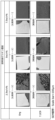
- the sheets produced in Examples 1-1 to 1-3 and Comparative Examples 1-1 to 1-3 were porous (porous sheets). Furthermore, as shown in FIG. 4, the porosity (density) of the porous sheet depends on the gelatin concentration (7.2C9-ApGltn concentration or Org-ApGltn concentration) of the raw material solution. The lower the gelatin concentration, the larger the percentage of voids in the porous sheet (lower density), and the higher the gelatin concentration, the smaller the percentage of voids in the porous sheet (higher density).
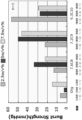
- sealing strength pressure strength
- porcine aorta as a base material.
- the porous sheet 10 prepared in each example or comparative example was placed so as to cover the central defect 20a (diameter 1 mm) of the porcine aorta 20 (diameter 35 mm), and was fixed by pressing lightly with tweezers. , and left to stand for 10 minutes.
- Comparative Example 1-3 in which the gelatin concentration of the raw material liquid was 2.5 w/v%, and Examples 2-3, 1-3, and 3-3 are compared.
- the porous sheet using the raw material gelatin Comparative Example 1-3
- the porous sheet using the hydrophobized gelatin derivative Examples 2-3, 1-3, and 3-3
- Peeling pressure pressure resistance
- the longer the introduced alkyl chain the higher the peeling pressure tended to be.
- hydrophobized gelatin derivatives are used compared to porous sheets (Org) using raw gelatin.
- the porous sheets that were used showed high peel pressure.
- Example 4-1 Comparative Example 2-1, Comparative Examples 2-2 to 4-3, Example 5-1, Comparative Example 3-1, Comparative Example 3-2, and Example 6- described below
- a laminate was produced in which a porous sheet of a hydrophobized gelatin derivative (lower layer, sheet (I)) and a porous sheet of raw material gelatin (upper layer, sheet (II)) were laminated.
- sheet (II) was colored with a dye (acid blue). Table 2 shows details of the sheets produced in each experiment.
- Example 4-1 First, as the sheet (I), a porous sheet of the hydrophobized gelatin derivative 9.3C10-ApGltn prepared in Experiment 3-1 (thickness 2 mm, gelatin concentration in the raw material solution (I) was 7.5 w/v% ) was prepared.
- a 5 w/v % aqueous solution (raw material solution (II)) of raw material gelatin (Org-ApGltn) was prepared and colored with acid blue (25 ⁇ g/mL).
- the prepared raw gelatin aqueous solution was cast into a silicone sheet mold (70 mm x 70 mm x depth: 0.5 mm).
- the sample was first freeze-dried at -30°C overnight. After freeze-drying, it was heated at 150° C. for 5 hours to thermally crosslink Org-ApGltn to obtain sheet (II).
- Sheet (II) was laminated on sheet (I) to obtain a laminate.
- the sheet (I) was a porous sheet of the hydrophobized gelatin derivative 9.3C10-ApGltn prepared in Example 3-3 (thickness: 2 mm, the concentration of the hydrophobized gelatin derivative in the raw material liquid was 2.5 w/v%). ) was prepared. Otherwise, a laminate consisting of sheets (I) and (II) was produced in the same manner as in Example 4-1.
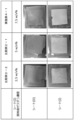
- FIG. 6 shows photographs of the laminates produced in Example 4-1, Comparative Example 2-1, and Comparative Example 2-2.
- the upper row is a photograph taken from the sheet (II) side
- the lower row is a photograph taken from the sheet (I) side.
- Example 5-1 A laminate consisting of sheets (I) and (II) was produced in the same manner as in Example 4-1, except that the thickness of sheet (I) was changed from 2 mm to 1 mm.
- Example 6-1 A laminate consisting of sheets (I) and (II) was produced in the same manner as in Example 4-1, except that the thickness of sheet (I) was changed from 2 mm to 1.5 mm.
- Example 6-2 Sheet (I) and ( A laminate consisting of II) was produced.
- Example 6-3 Sheet (I) and ( A laminate consisting of II) was produced.
- the laminate with a two-layer structure had lower adhesiveness than the porous sheet with a single-layer structure (Example 3-1). From this result, it was found that by laminating a porous sheet of raw material gelatin on a porous sheet of hydrophobized gelatin derivative to form a laminate, when the laminate is used as a biological tissue adhesive film, it is possible to adhere to other biological tissues. It can be expected to suppress adhesion to rubber gloves during surgery, etc.
- Example 5-1 and 6-1 to 6-3 were laminates that obtained good results in pressure resistance test 2, which will be described later.
- the adhesion of the laminates of Examples 5-1 and 6-1 to 6-3 was also lower than that of the single-layer porous sheet (Example 3-1).
- the laminate produced in each example was punched out using a dumbbell cutter to produce a circular evaluation sample with a diameter of 15 mm.
- a dumbbell cutter to produce a circular evaluation sample with a diameter of 15 mm.
- the central defect (diameter 1 mm) of the porcine aorta (diameter 35 mm) was covered.
- evaluation samples (laminates) of each Example and Comparative Example were placed thereon.
- the sheet (I) of the laminate was placed on the lower side (the side in contact with the porcine aorta).
- the evaluation sample on the porcine aorta was covered from above with a Unipack (made of polyethylene), a 50 g weight was placed on the Unipack, and the sample was left to stand for 10 minutes.
- the Unipack was peeled off from the evaluation sample, and the sealing strength (pressure strength) was measured in accordance with ASTM (F2392-04).
- the porcine aorta 20 carrying the evaluation sample 10 is fixed to a jig, and 37°C physiological saline is poured into the defect 20a covered with the evaluation sample 10 (laminate) at a flow rate of 2 mL/min.
- the pressure at which the evaluation sample 10 was peeled was measured.
- three sheets were prepared and the pressure resistance test was conducted three times. The results are shown in Table 2.
- the laminates containing the porous sheets (I) with relatively low raw material liquid gelatin concentrations produced in Comparative Examples 3-2, 2-2, 3-1, and 2-1 did not use Unipack.
- the laminate also peeled off from the porcine aorta, making it impossible to measure pressure resistance (evaluation result: N.D.). That is, these porous sheets could not provide sufficient adhesiveness. Therefore, the second and subsequent pressure tests were not conducted on the laminates of Comparative Examples 3-2, 2-2, 3-1, and 2-1.
- the laminate containing the porous sheet (I) having a relatively high raw material liquid gelatin concentration prepared in Examples 5-1, 4-1, and 6-1 to 6-3 was We were able to peel it off from the aorta and conduct a pressure test.
- Table 2 shows the highest compressive strength obtained for each laminate.
- the evaluation results (pressure resistance strength) of the same test conducted using a commercially available hemostatic agent are also shown in Table 2.
- the evaluation results of the laminates of Examples 5-1, 4-1, and 6-1 to 6-3 were better than the evaluation results of commercially available products, and it was confirmed that the laminates had adhesion and pressure resistance without any practical problems. It could be confirmed.
- Example 7-1 to 7-7, 8-1, and 9-1 described below a pH buffer was used during the production of sheet (II) to produce a laminate.
- Example 7-8 a laminate was produced under the same conditions as in Example 7-1, except that no pH buffer was used during production of sheet (II). Table 3 shows details of the laminates produced in each experiment.
- Example 7-1 ⁇ Synthesis of hydrophobized gelatin derivative> Experiment 1-1 except that decanoic anhydride was used as the hydrophobizing reagent and the amount of alkyl acid anhydride was adjusted so that the hydrocarbon group introduction rate (decanoyl group introduction rate) DS was 12 mol%.
- a hydrophobized gelatin derivative was synthesized using the same method as described above.
- the hydrophobized gelatin derivative synthesized in this experiment may be referred to as 12C10-ApGltn or 12C10.
- Sheet (II) was laminated on sheet (I) to obtain a laminate for this experiment.
- Example 7-4 A laminate for this experiment was produced in the same manner as in Example 7-1, except that the raw material solution (I) was prepared so that the gelatin concentration was 15 w/v% in producing the sheet (I).
- Example 7-5 A laminate for this experiment was produced in the same manner as in Example 7-1, except that the weight average molecular weight of the crosslinking agent (4S-PEG) used in the production of sheet (I) was 10,000.
- Example 7-6 A laminate for this experiment was produced in the same manner as in Example 7-2, except that the weight average molecular weight of the crosslinking agent (4S-PEG) used in the production of sheet (I) was 10,000.
- Example 7-7 A laminate for this experiment was produced in the same manner as in Example 7-3, except that the weight average molecular weight of the crosslinking agent (4S-PEG) used in the production of sheet (I) was 10,000.
- Example 7-8 A laminate was produced under the same conditions as in Example 7-1, except that a pH buffer was not used during the production of sheet (II) and pure water was used instead.
- Adhesion comparison test This test was conducted on the laminates prepared in Examples 7-1 to 7-8, 8-1, and 9-1, and on the laminates of Example 4-1, etc. An adhesion comparison test was conducted. The adhesion of the laminates of all the examples shown in Table 3 was lower than that of the single-layer porous sheet (Example 3-1). From this result, when these laminates are used as a living tissue adhesive film, it can be expected to suppress adhesion to other living tissues, suppress adhesion to rubber gloves during surgery, etc.
- the evaluation results of the laminates in all experiments except Examples 7-8 were better than the evaluation results of commercially available products, indicating that they had adhesion and pressure resistance without any practical problems. It could be confirmed.
- the sheet (II) was a basic compound (a mixture of phosphoric acid and sodium phosphate). Contains. This causes the pH within the sheet (I) to rise more quickly, promoting the crosslinking reaction (curing reaction) between the hydrophobized gelatin derivative and the crosslinking agent, and resulting in good evaluation results even if the adhesion time was shortened to 3 minutes. It is assumed that it was obtained.
- the laminate of Examples 7-8 in which no pH buffer was used in the production of sheet (II) i.e., the laminate containing no basic compound
- the laminate of Example 4-1, etc. in which no pH buffer was used to prepare the sheet (II) shown in Table 2, with the adhesion time shortened to 3 minutes.
- Sufficient adhesive strength could not be obtained with a short bonding time of 3 minutes, and similarly to Examples 7-8, the pressure resistance could not be measured (evaluation result: N.D.).
- the porous sheet of the present invention can be used as a tissue adhesive film used in vivo (for example, a hemostatic material, an anti-adhesion material), and has high adhesive strength and high biocompatibility. Therefore, the porous sheet of the present invention can be used in the surgical and internal medicine fields.
Landscapes
- Health & Medical Sciences (AREA)
- Surgery (AREA)
- Epidemiology (AREA)
- Life Sciences & Earth Sciences (AREA)
- Animal Behavior & Ethology (AREA)
- General Health & Medical Sciences (AREA)
- Public Health (AREA)
- Veterinary Medicine (AREA)
- Materials For Medical Uses (AREA)
Abstract
生体親和性、及び接着強度が共に高く、更に、可撓性及び/又は柔軟性(フレキシビリティ)を有する多孔質シートを提供する。 多孔質シートであって、第1ゼラチンに炭化水素基が導入されている第2ゼラチンと、第2ゼラチン中に分散されている未反応の架橋剤と、を含む。第2ゼラチンが下記式(1)で表される構造を含む。
Description
本発明は、多孔質シート、組織接着膜、これらの止血剤もしくは癒着防止材としての使用、およびこれらの製造方法に関する。
組織接着膜は、血管、皮膚等の生体組織に接着が可能な高分子膜であり、これにより、例えば、心臓血管外科等の手術の際に血液の漏出等を防止して、手術の安全性を高めることができる。これに関し、本発明者は、ゼラチン及び/又は疎水化ゼラチン誘導体と、架橋分子が集積してなる非多孔質の組織接着膜を報告している(特許文献1)。
本発明は、上記技術水準において、生体親和性、及び接着強度が高い、組織接着膜に応用可能な多孔質シートを提供する。
本発明者らは、上記課題を達成すべく鋭意検討した結果、以下の構成により上記課題を達成することができることを見出した。
[1]
ゼラチンに炭化水素基が導入されている疎水化ゼラチン誘導体であって、式(1):

[式(1)において、Gltnはゼラチンの残基を表し、Lは単結合、又は2価の連結基を表し、R1は炭素数1~20の炭化水素基であり、R2は水素原子又は炭素数1~20の炭化水素基である]
で表される構造を含む、疎水化ゼラチン誘導体と、
前記疎水化ゼラチン誘導体中に分散されている未反応の架橋剤と、
を含む、多孔質シート。
[2]
前記多孔質シートの密度が、0.01g/cm3~0.3g/cm3である、[1]に記載の多孔質シート。
[3]
前記少なくとも1つのシート(I)の密度が、0.05g/cm3~0.08g/cm3である、[2]に記載の組織接着膜。
[4]
Lは単結合、又は-C(O)-である、[1]~[3]のいずれかに記載の多孔質シート。
[5]
Lは単結合である、[4]に記載の多孔質シート。
[6]
R1は直鎖アルキル基であり、R2は水素原子である、[1]~[5]のいずれかに記載の多孔質シート。
[7]
R1は炭素数6~12の直鎖アルキル基である、[6]に記載の多孔質シート。
[8]
前記疎水化ゼラチン誘導体の炭化水素基導入率が、5mol%~50mol%である、[1]~[7]のいずれかに記載の多孔質シート。
[9]
前記疎水化ゼラチン誘導体の炭化水素基導入率が、5mol%~10mol%である、[8]に記載の多孔質シート。
[10]
前記ゼラチンが、冷水魚由来ゼラチンである、[1]~[9]のいずれかに記載の多孔質シート。
[11]
前記架橋剤が、少なくとも2つの架橋性基を有する化合物である、[1]~[10]のいずれかに記載の多孔質シート。
[12]
前記疎水化ゼラチン誘導体が有するアミノ基1当量に対して、前記架橋剤が有する前記架橋性基が0.25当量~2当量である、[11]に記載の多孔質シート。
[13]
厚さが、1mm以上である、[1]~[12]のいずれかに記載の多孔質シート。
[14]
組織接着材料として使用するための、[1]~[13]のいずれかに記載の多孔質シート。
[15]
止血剤、シーラント(閉鎖材)または被覆材として使用するための、[1]~[13]のいずれかに記載の多孔質シート。
[16]
組織接着材料を調製するための、[1]~[13]のいずれかに記載の多孔質シートの使用。
[17]
止血剤、シーラント(閉鎖材)または被覆材を調製するための、[1]~[13]のいずれかに記載の多孔質シートの使用。
[18]
[1]~[13]のいずれかに記載の多孔質シートで、被覆が必要な組織(例えば、神経や腱等の吻合部、組織(肺胸膜、消化管吻合部、口腔・歯周組織等)に生じた創傷)を覆う、組織を被覆する方法。
[19]
[1]~[13]のいずれかに記載の多孔質シートを、止血が必要もしくは必要と予想される組織に接着する、組織の止血方法。
[20]
[1]~[13]のいずれかに記載の多孔質シートで、硬膜と硬膜の隙間、硬膜縫合部、又は、硬膜形成材料と硬膜との隙間を補填する、隙間を補填する方法。
[21]
[1]~[13]のいずれかに記載の多孔質シートを含む、組織接着膜。
[22]
[1]~[13]のいずれかに記載の多孔質シートを含む、止血剤、シーラント(閉鎖材)または被覆材。
[23]
少なくとも1つの[1]~[13]のいずれかに記載の多孔質シートである、少なくとも1つのシート(I)と、
未疎水化ゼラチンの架橋物を含むシート(II)と、を含み、
前記少なくとも1つのシート(I)が、前記シート(II)の一方の面上に積層されている、組織接着膜。
[24]
少なくとも1つの[1]~[13]のいずれかに記載の多孔質シートである、少なくとも1つのシート(I)と、
未疎水化ゼラチンの架橋物を含むシート(II)と、を含み、
前記少なくとも1つのシート(I)が、前記シート(II)の一方の面上に積層されている、積層体。
[25]
組織接着材料として使用するための、[24]に記載の積層体。
[26]
前記シート(I)の密度が、0.07g/cm3以上である、[22]に記載の組織接着膜、または[24]もしくは[25]に記載の積層体。
[27]
前記未疎水化ゼラチンの架橋物が、未疎水化ゼラチンの熱架橋物である、[23]から[26]のいずれかに記載の組織接着膜、または積層体。
[28]
前記シート(II)が多孔質である、[23]~[27]のいずれかに記載の組織接着膜、または積層体。
[29]
前記シート(I)の密度が、0.07g/cm3~0.2g/cm3である、[23]~[28]のいずれかに記載の組織接着膜、または積層体。
[30]
前記シート(II)が、水分と接触すると塩基性を示す塩基性化合物を更に含有する、[23]~[29]のいずれかに記載の組織接着膜、または積層体。
[31]
前記塩基性化合物は、それの0.05mol/L~0.5mol/Lの水溶液のpHが7.5~10を示す化合物である、[30]に記載の組織接着膜、または積層体。
[32]
前記塩基性化合物がpH緩衝剤である、[30]又は[31]に記載の組織接着膜、または積層体。
[33]
前記pH緩衝剤が、リン酸と、リン酸ナトリウムとの混合物である、[32]に記載の組織接着膜、または積層体。
[34]
前記少なくとも1つのシート(I)は、2つのシート(I)を含み、
前記2つのシート(I)のうち、一方が前記シート(II)の一方の面上に積層され、他方が前記シート(II)の他方の面上に積層されている、[23]~[33]のいずれかに記載の組織接着膜、または積層体。
[35]
[23]~[34]のいずれかに記載の組織接着膜、または積層体を含む、止血剤、シーラント(閉鎖材)または被覆材。
[36]
[23]~[34]のいずれかに記載の組織接着膜、または積層体を含む、癒着防止材。
[37]
止血剤、シーラント(閉鎖材)または組織被覆材として使用するため、あるいは止血するための、硬膜と硬膜の隙間、硬膜縫合部、又は、硬膜形成材料と硬膜との隙間を補填するためのまたは組織を被覆するための[23]~[34]のいずれかに記載の組織接着膜、または積層体。
[38]
組織への癒着を防止する材料として使用するための、または組織への癒着を防止するための、[22]~[34]のいずれかに記載の組織接着膜、または積層体。
[39]
止血剤、シーラント(閉鎖材)または組織被覆材を調製するための、[23]~[34]のいずれかに記載の組織接着膜、または積層体の使用。
[40]
組織癒着防止材を調製するための、[23]~[34]のいずれかに記載の組織接着膜、または積層体の使用。
[41]
[23]~[34]のいずれかに記載の組織接着膜、または積層体で、被覆が必要な組織を被覆する、組織を被覆する方法。
[42]
[23]~[34]のいずれかに記載の組織接着膜、または積層体で、硬膜と硬膜の隙間、硬膜縫合部、又は、硬膜形成材料と硬膜との隙間を補填する、隙間を補填する方法。
[43]
[23]~[34]のいずれかに記載の組織接着膜、または積層体を、止血が必要もしくは必要と予想される組織に接着する、組織の止血方法。
[44]
[23]~[34]のいずれかに記載の組織接着膜、または積層体を、他の組織への癒着を防止する必要がある組織に接着する、組織の癒着を防止する方法。
[45]
[1]~[13]のいずれかに記載の多孔質シートの製造方法であって、
前記疎水化ゼラチン誘導体と、前記架橋剤と、酸と、溶媒とを混合して、pH5以下の原料液(I)を調製することと、
前記原料液(I)を凍結乾燥して前記多孔質シートを得ること、
とを含む多孔質シートの製造方法。
[46]
前記原料液(I)中の前記疎水化ゼラチン誘導体の濃度が、1w/v%~20w/v%である、[45]に記載の方法。
[47]
[45]又は[46]に記載の方法で、多孔質シートを製造する工程を含む、組織接着膜の製造方法。
[48]
[45]又は[46]に記載の方法により、前記多孔質シートであるシート(I)を製造することと、
未疎水化ゼラチンの架橋物を含むシート(II)を製造することと、
前記シート(I)と、前記シート(II)とを積層すること、
とを含む、組織接着膜の製造方法。
[49]
前記シート(II)を、
前記未疎水化ゼラチンと、塩基性化合物と、溶媒とを含む原料液(II)を調製することと、
前記原料液(II)をシート状に凍結乾燥して、前駆体シートを形成することと、
前記前駆体シートを加熱して前記未疎水化ゼラチンを熱架橋させること、
により製造する、[48]に記載の方法。
[50]
前記塩基性化合物が、pH緩衝剤である、[49]に記載の方法。
[51]
前記pH緩衝剤が、リン酸と、リン酸ナトリウムとの混合物である、[50]に記載の方法。
ゼラチンに炭化水素基が導入されている疎水化ゼラチン誘導体であって、式(1):
[式(1)において、Gltnはゼラチンの残基を表し、Lは単結合、又は2価の連結基を表し、R1は炭素数1~20の炭化水素基であり、R2は水素原子又は炭素数1~20の炭化水素基である]
で表される構造を含む、疎水化ゼラチン誘導体と、
前記疎水化ゼラチン誘導体中に分散されている未反応の架橋剤と、
を含む、多孔質シート。
[2]
前記多孔質シートの密度が、0.01g/cm3~0.3g/cm3である、[1]に記載の多孔質シート。
[3]
前記少なくとも1つのシート(I)の密度が、0.05g/cm3~0.08g/cm3である、[2]に記載の組織接着膜。
[4]
Lは単結合、又は-C(O)-である、[1]~[3]のいずれかに記載の多孔質シート。
[5]
Lは単結合である、[4]に記載の多孔質シート。
[6]
R1は直鎖アルキル基であり、R2は水素原子である、[1]~[5]のいずれかに記載の多孔質シート。
[7]
R1は炭素数6~12の直鎖アルキル基である、[6]に記載の多孔質シート。
[8]
前記疎水化ゼラチン誘導体の炭化水素基導入率が、5mol%~50mol%である、[1]~[7]のいずれかに記載の多孔質シート。
[9]
前記疎水化ゼラチン誘導体の炭化水素基導入率が、5mol%~10mol%である、[8]に記載の多孔質シート。
[10]
前記ゼラチンが、冷水魚由来ゼラチンである、[1]~[9]のいずれかに記載の多孔質シート。
[11]
前記架橋剤が、少なくとも2つの架橋性基を有する化合物である、[1]~[10]のいずれかに記載の多孔質シート。
[12]
前記疎水化ゼラチン誘導体が有するアミノ基1当量に対して、前記架橋剤が有する前記架橋性基が0.25当量~2当量である、[11]に記載の多孔質シート。
[13]
厚さが、1mm以上である、[1]~[12]のいずれかに記載の多孔質シート。
[14]
組織接着材料として使用するための、[1]~[13]のいずれかに記載の多孔質シート。
[15]
止血剤、シーラント(閉鎖材)または被覆材として使用するための、[1]~[13]のいずれかに記載の多孔質シート。
[16]
組織接着材料を調製するための、[1]~[13]のいずれかに記載の多孔質シートの使用。
[17]
止血剤、シーラント(閉鎖材)または被覆材を調製するための、[1]~[13]のいずれかに記載の多孔質シートの使用。
[18]
[1]~[13]のいずれかに記載の多孔質シートで、被覆が必要な組織(例えば、神経や腱等の吻合部、組織(肺胸膜、消化管吻合部、口腔・歯周組織等)に生じた創傷)を覆う、組織を被覆する方法。
[19]
[1]~[13]のいずれかに記載の多孔質シートを、止血が必要もしくは必要と予想される組織に接着する、組織の止血方法。
[20]
[1]~[13]のいずれかに記載の多孔質シートで、硬膜と硬膜の隙間、硬膜縫合部、又は、硬膜形成材料と硬膜との隙間を補填する、隙間を補填する方法。
[21]
[1]~[13]のいずれかに記載の多孔質シートを含む、組織接着膜。
[22]
[1]~[13]のいずれかに記載の多孔質シートを含む、止血剤、シーラント(閉鎖材)または被覆材。
[23]
少なくとも1つの[1]~[13]のいずれかに記載の多孔質シートである、少なくとも1つのシート(I)と、
未疎水化ゼラチンの架橋物を含むシート(II)と、を含み、
前記少なくとも1つのシート(I)が、前記シート(II)の一方の面上に積層されている、組織接着膜。
[24]
少なくとも1つの[1]~[13]のいずれかに記載の多孔質シートである、少なくとも1つのシート(I)と、
未疎水化ゼラチンの架橋物を含むシート(II)と、を含み、
前記少なくとも1つのシート(I)が、前記シート(II)の一方の面上に積層されている、積層体。
[25]
組織接着材料として使用するための、[24]に記載の積層体。
[26]
前記シート(I)の密度が、0.07g/cm3以上である、[22]に記載の組織接着膜、または[24]もしくは[25]に記載の積層体。
[27]
前記未疎水化ゼラチンの架橋物が、未疎水化ゼラチンの熱架橋物である、[23]から[26]のいずれかに記載の組織接着膜、または積層体。
[28]
前記シート(II)が多孔質である、[23]~[27]のいずれかに記載の組織接着膜、または積層体。
[29]
前記シート(I)の密度が、0.07g/cm3~0.2g/cm3である、[23]~[28]のいずれかに記載の組織接着膜、または積層体。
[30]
前記シート(II)が、水分と接触すると塩基性を示す塩基性化合物を更に含有する、[23]~[29]のいずれかに記載の組織接着膜、または積層体。
[31]
前記塩基性化合物は、それの0.05mol/L~0.5mol/Lの水溶液のpHが7.5~10を示す化合物である、[30]に記載の組織接着膜、または積層体。
[32]
前記塩基性化合物がpH緩衝剤である、[30]又は[31]に記載の組織接着膜、または積層体。
[33]
前記pH緩衝剤が、リン酸と、リン酸ナトリウムとの混合物である、[32]に記載の組織接着膜、または積層体。
[34]
前記少なくとも1つのシート(I)は、2つのシート(I)を含み、
前記2つのシート(I)のうち、一方が前記シート(II)の一方の面上に積層され、他方が前記シート(II)の他方の面上に積層されている、[23]~[33]のいずれかに記載の組織接着膜、または積層体。
[35]
[23]~[34]のいずれかに記載の組織接着膜、または積層体を含む、止血剤、シーラント(閉鎖材)または被覆材。
[36]
[23]~[34]のいずれかに記載の組織接着膜、または積層体を含む、癒着防止材。
[37]
止血剤、シーラント(閉鎖材)または組織被覆材として使用するため、あるいは止血するための、硬膜と硬膜の隙間、硬膜縫合部、又は、硬膜形成材料と硬膜との隙間を補填するためのまたは組織を被覆するための[23]~[34]のいずれかに記載の組織接着膜、または積層体。
[38]
組織への癒着を防止する材料として使用するための、または組織への癒着を防止するための、[22]~[34]のいずれかに記載の組織接着膜、または積層体。
[39]
止血剤、シーラント(閉鎖材)または組織被覆材を調製するための、[23]~[34]のいずれかに記載の組織接着膜、または積層体の使用。
[40]
組織癒着防止材を調製するための、[23]~[34]のいずれかに記載の組織接着膜、または積層体の使用。
[41]
[23]~[34]のいずれかに記載の組織接着膜、または積層体で、被覆が必要な組織を被覆する、組織を被覆する方法。
[42]
[23]~[34]のいずれかに記載の組織接着膜、または積層体で、硬膜と硬膜の隙間、硬膜縫合部、又は、硬膜形成材料と硬膜との隙間を補填する、隙間を補填する方法。
[43]
[23]~[34]のいずれかに記載の組織接着膜、または積層体を、止血が必要もしくは必要と予想される組織に接着する、組織の止血方法。
[44]
[23]~[34]のいずれかに記載の組織接着膜、または積層体を、他の組織への癒着を防止する必要がある組織に接着する、組織の癒着を防止する方法。
[45]
[1]~[13]のいずれかに記載の多孔質シートの製造方法であって、
前記疎水化ゼラチン誘導体と、前記架橋剤と、酸と、溶媒とを混合して、pH5以下の原料液(I)を調製することと、
前記原料液(I)を凍結乾燥して前記多孔質シートを得ること、
とを含む多孔質シートの製造方法。
[46]
前記原料液(I)中の前記疎水化ゼラチン誘導体の濃度が、1w/v%~20w/v%である、[45]に記載の方法。
[47]
[45]又は[46]に記載の方法で、多孔質シートを製造する工程を含む、組織接着膜の製造方法。
[48]
[45]又は[46]に記載の方法により、前記多孔質シートであるシート(I)を製造することと、
未疎水化ゼラチンの架橋物を含むシート(II)を製造することと、
前記シート(I)と、前記シート(II)とを積層すること、
とを含む、組織接着膜の製造方法。
[49]
前記シート(II)を、
前記未疎水化ゼラチンと、塩基性化合物と、溶媒とを含む原料液(II)を調製することと、
前記原料液(II)をシート状に凍結乾燥して、前駆体シートを形成することと、
前記前駆体シートを加熱して前記未疎水化ゼラチンを熱架橋させること、
により製造する、[48]に記載の方法。
[50]
前記塩基性化合物が、pH緩衝剤である、[49]に記載の方法。
[51]
前記pH緩衝剤が、リン酸と、リン酸ナトリウムとの混合物である、[50]に記載の方法。
以下、本発明について詳細に説明する。
以下に記載する構成要件の説明は、本発明の代表的な実施形態に基づいてなされることがあるが、本発明はそのような実施形態に制限されるものではない。
以下に記載する構成要件の説明は、本発明の代表的な実施形態に基づいてなされることがあるが、本発明はそのような実施形態に制限されるものではない。
[用語の定義]
本明細書において、「~」を用いて表される数値範囲は、「~」の前後に記載される数値を下限値及び上限値として含む範囲を意味する。
本明細書において、「~」を用いて表される数値範囲は、「~」の前後に記載される数値を下限値及び上限値として含む範囲を意味する。
「ゼラチン」とは、一般に、熱、酸、またはアルカリによって、天然または合成のコラーゲンを処理することによって3重らせん構造がほどけて変性した高分子を意味し、本明細書において単に「ゼラチン」という時は、「疎水化」処理がなされておらず、アルキル基が導入されていない「ゼラチン」を意味する。このため、本明細書において「ゼラチン」は、「ApGltn」または「GltnNH2」と表されることがある。文脈に応じて、「原料ゼラチン」、または「未疎水化ゼラチン」という用語が用いられるがこれらの用語は「ゼラチン」と同義である。「原料ゼラチン」は、「Org-ApGltn」又は「Org」と表されることがあり、「未疎水化ゼラチン」は「ApGltn」と表されることがある。
本明細書において「疎水化」とは、「ゼラチン」に炭化水素基を導入すること、より具体的には、アミノ基に連結基を介して、又は直接、炭化水素基を結合させることにより、「ゼラチン」の疎水性を増大する処理を言う。従って、本明細書において「疎水化ゼラチン誘導体」とは、「ゼラチン」に炭化水素基を導入すること、より具体的には、アミノ基に連結基を介して、又は直接、炭化水素基を結合させることにより、「ゼラチン」の疎水性を増大した「ゼラチン」の誘導体を意味し、「GltnNH-L-CHR1R2」と表されることがある。
本明細書において「疎水化」とは、「ゼラチン」に炭化水素基を導入すること、より具体的には、アミノ基に連結基を介して、又は直接、炭化水素基を結合させることにより、「ゼラチン」の疎水性を増大する処理を言う。従って、本明細書において「疎水化ゼラチン誘導体」とは、「ゼラチン」に炭化水素基を導入すること、より具体的には、アミノ基に連結基を介して、又は直接、炭化水素基を結合させることにより、「ゼラチン」の疎水性を増大した「ゼラチン」の誘導体を意味し、「GltnNH-L-CHR1R2」と表されることがある。
[第1実施形態]
<多孔質シート>
本実施形態では、図1A及び図1Bに示す多孔質シート10について説明する。多孔質シート10は、原料ゼラチン(第1ゼラチン)に炭化水素基が導入されている疎水化ゼラチン誘導体(第2ゼラチン)と、疎水化ゼラチン誘導体中に分散されている架橋剤とを含む。
<多孔質シート>
本実施形態では、図1A及び図1Bに示す多孔質シート10について説明する。多孔質シート10は、原料ゼラチン(第1ゼラチン)に炭化水素基が導入されている疎水化ゼラチン誘導体(第2ゼラチン)と、疎水化ゼラチン誘導体中に分散されている架橋剤とを含む。
図1Bの左側の模式図に示すように、多孔質シート10内において、架橋剤は疎水化ゼラチン誘導体中に分散されており、架橋剤と疎水化ゼラチン誘導体とは、実質的に未反応状態にある。疎水化ゼラチン誘導体と架橋剤が架橋反応(硬化反応)するためには水分が必要であり、且つ、中性~アルカリ性の環境下にある必要がある。生体組織(例えば、図1Bに示す、ブタ大動脈20)は、通常、中性の水分を含有しているため、多孔質シート10は、生体組織20に張り付けられることで中性の水分を吸収して架橋し、生体組織20に接着する。図1Bの右側の模式図に示すように、架橋反応は、典型的には疎水化ゼラチン誘導体が有する第1級アミノ基と、架橋剤が有する架橋性基(典型的には、活性エステル基等)との反応である。
多孔質シート10は、原料ゼラチンの構造を維持しているため、生体親和性が高い。そして、疎水性基により、多孔質シート10と生体組織20との間で疎水性相互作用が生じ、また、疎水性基が生体組織20に分子レベルで浸透すること(アンカーリング)により、生体組織20との間に物理的に強固な結合が形成され、多孔質シート10は生体組織20表面に強く接着できる。このように、多孔質シート10は、貼るだけで生体組織20に強く接着する。また、多孔質シート10は、多孔質という構造により、非多孔質の膜に比べ、可撓性及び/又は柔軟性(フレキシビリティ)が改善され、生体組織20の表面形状に追随させて撓ませることや、筒状にして、神経や腱等の吻合部を覆うことが可能になると期待される。更に、多孔質シート10は、多孔質という構造により、生体組織20に張り付けたとき、効率よく水分を吸収でき、疎水化ゼラチン誘導体と架橋剤との硬化反応(架橋反応)を促進できると考えられる。
以下に、多孔質シート10の詳細について説明する。
以下に、多孔質シート10の詳細について説明する。
疎水化ゼラチン誘導体(第2ゼラチン)は、上述の通り、原料ゼラチン(第1ゼラチン)に炭化水素基が導入されたゼラチン誘導体を意味し、下記式(1)で表される構造を有する。

式(1)において、Gltnはゼラチンの残基を表し、Lは単結合、又は2価の連結基を表し、R1は炭素数1~20の炭化水素基であり、R2は水素原子又は炭素数1~20の炭化水素基である。
式(1)において、GltnNH-は、上述した原料ゼラチン由来の構造である。したがって、原料ゼラチンは、GltnNH2で表される。尚、原料ゼラチンの詳細については後述する。-CHR1R2は、原料ゼラチンに導入された炭化水素基であり、L(単結合、又は2価の連結基)を介して原料ゼラチンに導入されている。
Lの2価の連結基としては特に制限されないが、-C(O)-、-C(O)O-、-OC(O)-、-O-、-S-、-N(R)-(Rは水素原子、又は1価の有機基(好ましくは炭素数1~20個の炭化水素基)を表す)、アルキレン基(好ましくは炭素数2~10のアルキレン基)、アルケニレン基(好ましくは炭素数2~10のアルケニレン基)、及びこれらの組み合わせ等が挙げられ、なかでも-C(O)-が好ましい。Lは、単結合、又は-C(O)-が好ましい。
式(1)において、-CHR1R2(炭化水素基)は、原料ゼラチンが有するε-アミノ基に結合したものであることが好ましく、原料ゼラチン中のリジン(Lys)のε-アミノ基に結合していることがより好ましい。アミノ基、好ましくはリジンのアミノ基に連結基を介して、又は介さずに(言い換えれば直接)、*-CHR1R2を結合させる方法としては、例えば、いわゆる還元(的)アミノ化反応(アルデヒド、又はケトンを用いる方法)、及びショッテン・バウマン(Schotten-Baumann)反応(酸クロライドを用いる方法)等を利用する方法が挙げられる。
式(1)の-NH-構造(2級アミノ基)は、例えばFT-IR(フーリエ変換赤外吸収)スペクトルにおいて3300cm-1付近のバンドにより検出することができる。
式(1)において、R1及びR2の炭素数1~20個の炭化水素基としては特に制限されず、例えば、炭素数1~20個の鎖状炭化水素基、炭素数3~20個の脂環式炭化水素基、炭素数6~14個の芳香族炭化水素基、及びこれらを組み合わせた基が挙げられる。
R2が1~20個の炭化水素基である場合、R2は、R1と同一でも異なってもよい。また、R1、及びR2の炭化水素基は直鎖であっても、分岐鎖であってもよい。
炭素数1~20個の鎖状炭化水素基としては、特に制限されないが、メチル基、エチル基、プロピル基、ブチル基、ペンチル基、ヘキシル基、オクチル基(又はカプリル基)、ノニル基(又はペラルゴルニル基)、デシル基、ドデジシル基(又はラウリル基)、及びテトラデシル基(又はミリスチル基)等が挙げられる。
炭素数3~20個の脂環式炭化水素基としては、例えば、シクロプロピル基、シクロペンチル基、シクロヘキシル基、アダマンチル基、及び、ノルボルニル基等が挙げられる。
炭素数6~14個の芳香族炭化水素基としては、特に制限されないが、フェニル基、トリル基、及びナフチル基等が挙げられる。
上記を組み合わせた基としては、特に制限されないが、例えば、ベンジル基、フェネチル基、ナフチルメチル基、及び、ナフチルエチル基等の炭素数6~12個のアラルキル基等が挙げられる。
多孔質シート10の接着性を高める観点から、R1は直鎖のアルキル基であり、且つR2が水素原子であることが好ましい。R1は炭素数6~12の直鎖アルキル基であることが好ましく、炭素数8~10の直鎖アルキル基であることがより好ましい。
式(1)で表される疎水化ゼラチン誘導体としては、以下の式(2)及び式(3)からなる群より選択される少なくとも1つが好ましく、式(2)で表されるゼラチン誘導体がより好ましい。


式(2)は、式(1)においてLが単結合の場合であり、炭化水素基(-CHR1R2)が、第2級アミンであるイミノ結合(-NH-)を介して原料ゼラチンのゼラチン残基Gltnに導入されている。式(3)は、式(1)においてLが-C(O)-の場合であり、炭化水素基(-CHR1R2)が、アミド結合(-NHCO-)を介して原料ゼラチンのゼラチン残基Gltnに導入されている。式(2)及び式(3)中、各記号の意味はすでに説明した式(1)と同様であり、好適形態も同様である。
疎水化ゼラチン誘導体は、1種類の疎水化ゼラチン誘導体のみから構成されてもよいし、2種類以上の疎水化ゼラチン誘導体の混合物であってもよい。
ここで、疎水化前のゼラチン(原料ゼラチン)中のアミノ基(-NH2)の含有量に対する、疎水化ゼラチン誘導体中におけるアルキル基が結合されたイミノ基(-NH-CHR1R2)の含有量のモル比を「炭化水素基導入率」(degree of substitution、以下、単に「DS」と記載する場合もある)と定義する。
疎水化ゼラチン誘導体の炭化水素基導入率は、多孔質シートの接着性を高める観点から、例えば、5mol%~50mol%、5mol%~20mol%、又は5mol%~10mol%が好ましい。換言すれば、疎水化ゼラチン誘導体における、イミノ基/アミノ基(モル比)は、5/95~50/50、5/95~20/80、又は5/95~10/90であってよい。疎水化ゼラチン誘導体の炭化水素基導入率が上記範囲内であれば、高い接着性を有する多孔質シート10を得られ易い。
なお、炭化水素基導入率は、原料ゼラチンのアミノ基数と、疎水化ゼラチン誘導体のアミノ基数を、2,4,6-トリニトロベンゼンスルホン酸法(TNBS法)によって定量し、得られた値から、以下の式により算出することができる。
疎水化ゼラチン誘導体の炭化水素基導入率(モル%)
=[原料ゼラチンのアミノ基数-疎水化ゼラチン誘導体のアミノ基数]
/[原料ゼラチンのアミノ基数]×100
疎水化ゼラチン誘導体の炭化水素基導入率(モル%)
=[原料ゼラチンのアミノ基数-疎水化ゼラチン誘導体のアミノ基数]
/[原料ゼラチンのアミノ基数]×100
疎水化ゼラチン誘導体の分子量は特に限定されず、原料ゼラチンの分子量と導入された炭化水素基の種類と量(数)によって決定される。したがって、疎水化ゼラチン誘導体の重量平均分子量(Mw)の取り得る範囲は、後述する原料ゼラチンの重量平均分子量(Mw)の取り得る範囲とほぼ同様である。
以上説明した疎水化ゼラチン誘導体は、市販品であってもよいし、自家合成品であってもよい。疎水化ゼラチン誘導体は、例えば、国際公開第2020/137903号に開示される合成方法により、以下に説明する原料ゼラチン(第1ゼラチン)に疎水基(炭化水素基)を導入して合成してもよい。国際公開第2020/137903号に開示される疎水化ゼラチン誘導体の合成方法に関する内容は、参照により本明細書に組み込まれる。
原料ゼラチン(第1ゼラチン)は、天然由来のコラーゲンから得られたものでもよいし、合成されたコラーゲン(発酵、及び遺伝子組換え等を含む)から得られたものでもよい。また、天然由来の若しくは合成されたコラーゲンから得られたゼラチンに何らかの処理(ただし、疎水化処理を除く)をしたものでもよい。好ましくは、ほ乳類、鳥類、及び魚類等の皮、骨、及び腱等から取得された天然由来のコラーゲンを酸又はアルカリで処理(必要に応じて加熱抽出された)して得られたゼラチンが挙げられ、中でも、より優れた本発明の効果を有する多孔質シートが得られる点で、天然由来のコラーゲンをアルカリ処理して得られるゼラチンが特に好ましい。なお、本明細書において「天然由来のゼラチン」という用語は、天然由来のコラーゲンを熱、酸、またはアルカリ処理して得られるゼラチンを意味し、例えば、「魚類由来のゼラチン」という用語は、魚類由来のコラーゲンを熱、酸、またはアルカリ処理して得られるゼラチンを意味する。
また、エンドトキシンの含有量が低減された低エンドトキシン化処理済みゼラチンを用いることが好ましい。
ゼラチン原料は、製造国の風土、製造環境、由来動物、抽出方法または使用器機の洗浄度等によって様々であるが、一般に、1,000~100,000EU/gのエンドトキシンを含有し、これに対して何らかのエンドトキシンを低減する処理を行ったゼラチンが、「低エンドトキシン化処理済みゼラチン」である。「低エンドトキシン化処理済みゼラチン」は、通常は、5,000EU/g以下のエンドトキシンを含有し、好ましくは1,000EU/g以下のエンドトキシンを含有し、より好ましくは100EU/g以下のエンドトキシンを含有し、さらに好ましくは、10EU/g以下のエンドトキシンを含有する。このような低エンドトキシン化処理済みゼラチンとしては特に制限されず、公知のものが使用できるが、例えば、特開2007-231225号公報に記載のものが挙げられ、この内容は参照により本明細書に組み込まれる。
ゼラチン原料は、製造国の風土、製造環境、由来動物、抽出方法または使用器機の洗浄度等によって様々であるが、一般に、1,000~100,000EU/gのエンドトキシンを含有し、これに対して何らかのエンドトキシンを低減する処理を行ったゼラチンが、「低エンドトキシン化処理済みゼラチン」である。「低エンドトキシン化処理済みゼラチン」は、通常は、5,000EU/g以下のエンドトキシンを含有し、好ましくは1,000EU/g以下のエンドトキシンを含有し、より好ましくは100EU/g以下のエンドトキシンを含有し、さらに好ましくは、10EU/g以下のエンドトキシンを含有する。このような低エンドトキシン化処理済みゼラチンとしては特に制限されず、公知のものが使用できるが、例えば、特開2007-231225号公報に記載のものが挙げられ、この内容は参照により本明細書に組み込まれる。
ほ乳類由来のゼラチンとしては、ブタ、及びウシ由来のゼラチンが挙げられる。魚類由来のゼラチンとしては、特に制限されないが、なかでも、サケ、マス、マダラ、スケトウダラ、タイ、ティラピア、及びマグロ等の冷水魚(冷水性魚類)由来のゼラチン(以下「冷水魚由来ゼラチン」ともいう。)が好ましい。冷水魚由来ゼラチンは低温でも固化せず流動性を保つことが可能である。このため、疎水化ゼラチン誘導体として冷水魚由来ゼラチンの疎水化誘導体を用いれば、低温でも架橋剤を容易に均一分散でき、後述する凍結乾燥(フリーズドライ)により効率良く、本実施形態の多孔質シート10を製造できる。更に、生体に貼付した際に、水分を吸収しやすいという特徴もある。
冷水魚由来ゼラチンは、2個以上のアミノ酸が直鎖状に連結された高分子であり、構成アミノ酸1000個当たり、190個以下のイミノ酸、より具体的には、80個以下のヒドロキシプロリン(Hydroxyproline)と、110個以下のプロリンを有している。冷水魚由来ゼラチンの常温流動性は、ヒドロキシプロリン(Hydroxyproline)の数が80個以下であること又はプロリンの数が110個以下であることに起因すると考えられる。いずれかの条件を満たせば、変性温度がほぼ室温以下となり、常温流動性が生じると考えられる。
タイゼラチンのヒドロキシプロリン数は73、プロリン数は108で変性温度(Denaturation temperature)は302.5Kである。ティラピアゼラチンのヒドロキシプロリン数は82、プロリン数は110で変性温度(Denaturation temperature)は309Kである。これらに対して、ブタゼラチンのヒドロキシプロリン数は95、プロリン数は121で変性温度(Denaturation temperature)は316Kである。
尚、冷水魚由来ゼラチンは、動物由来のゼラチンのアミノ酸配列と類似しており、生体内の酵素により容易に分解され、また生体親和性も高い。
原料ゼラチンの分子量としては特に制限されないが、重量平均分子量(Mw)として、5,000~100,000が好ましく、10,000~50,000がより好ましく、20,000~40,000が更に好ましい。なお、本明細書において重量平均分子量は、ゲル浸透クロマトグラフィー(GPC)により求めた重量平均分子量を意味する。
原料ゼラチンは、1種類のゼラチンのみから構成されてもよいし、2種類以上のゼラチンの混合物であってもよい。
架橋剤は、典型的には、疎水化ゼラチン誘導体が有する第1級アミノ基と反応し得る置換基(架橋性基)を1分子中に少なくとも2つ有する化合物である。
架橋剤が有する架橋性基としては特に制限されないが、疎水化ゼラチン誘導体の第1級アミノ基に対して、温和な条件で選択的に反応しやすい観点で、活性エステル基(活性化されたエステル基)が好ましい。すなわち、架橋剤としては、1分子中に活性エステル基を少なくとも2つ有する化合物が好ましい。このような架橋剤には、N-ヒドロキシスクシンイミド又はN-ヒドロキシスルホスクシンイミドで活性化された多塩基酸等がある。
上記以外にも、架橋剤としては、ゲニピン、アルデヒド化合物、酸無水物、マレイミド化合物、ジチオカーボネート、及び、ジイソチオシアネート等を使用できる。
多塩基酸としては、酒石酸、クエン酸、リンゴ酸、グルタル酸、グルタミン酸、アスパラギン酸、オキサロ酢酸、cis-アコニット酸、2-ケトグルタル酸、ポリ酒石酸、ポリクエン酸、ポリリンゴ酸、ポリグルタミン酸、ポリアスパラギン酸、カルボキシメチル化デキストリン、カルボキシメチル化デキストラン、カルボキシメチル化デンプン、カルボキシメチル化セルロース、カルボキシメチル化キトサン、及び、カルボキシメチル化プルラン等が挙げられる。
架橋剤としては、ジスクシンイミジルグルタレート(DSG)、ジスクシンイミジルスベレート(DSS)、ジスクシンイミジルタートレート(DST)等も使用できる。
また、ポリエチレングリコール、又は、ポリエチレングリコールエーテルの多塩基酸エステルで、多塩基酸の、ポリエチレングリコールと反応していないカルボキシル基の少なくとも1つが活性エステル化されたもの、例えば4,7,10,13,16-ペンタオキサノナデカン二酸ジ(N-スクシンイミジル)、及び、下記式で表されるポリエチレングリコールジ(スクシンイミジルスクシネート)(SS-PEG-SS):
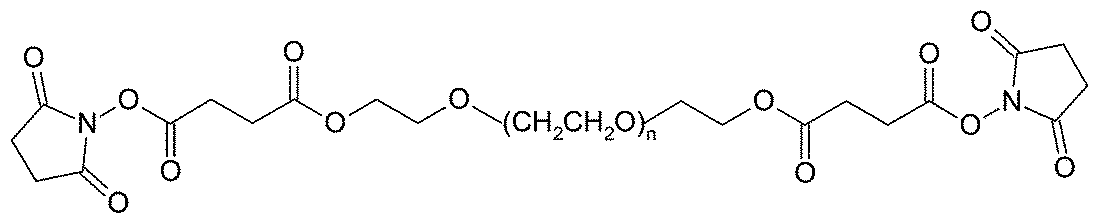
(nは数平均分子量が約20,000となる数);
更に、下記式で表されるペンタエリスリトール-ポリエチレングリコールエーテルテトラスクシンイミジルグルタレート(4S-PEG):
更に、下記式で表されるペンタエリスリトール-ポリエチレングリコールエーテルテトラスクシンイミジルグルタレート(4S-PEG):
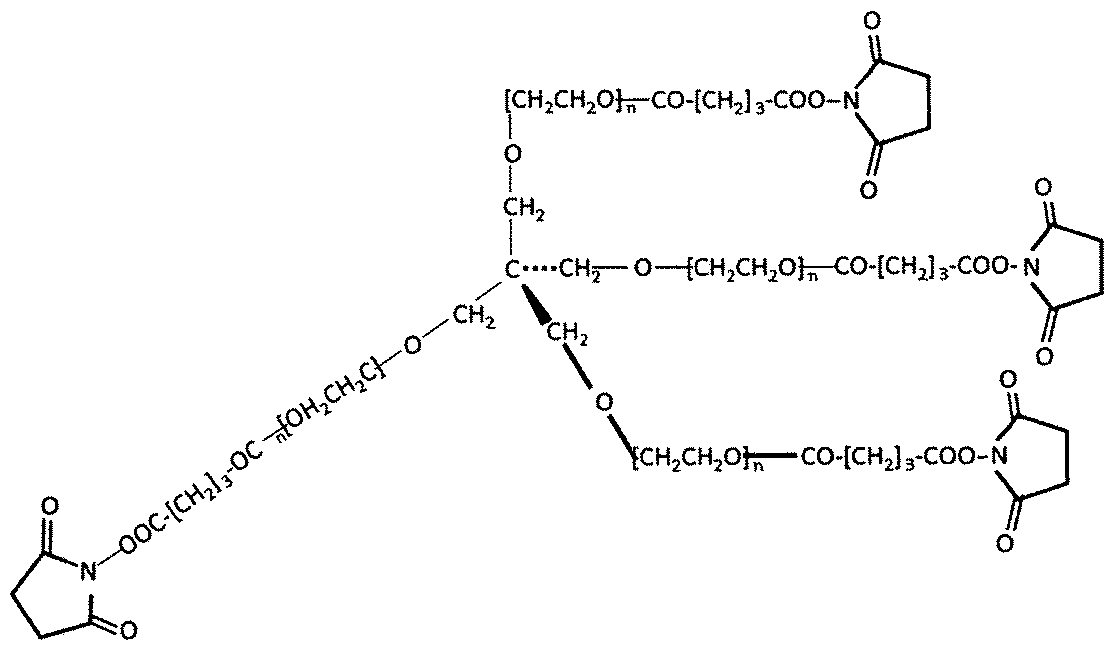
(nはMwが約3,000~30,000、好ましくは5,000~27,000、より好ましくは15,000~25,000となる数);が挙げられる。
アルデヒド化合物としては、1分子中に2つ以上のホルミル基が導入された、ホルミル基導入多糖類、例えばホルミル基導入デンプン、ホルミル基導入デキストラン、ホルミル基導入デキストリン、及び、ホルミル基導入ヒアルロン酸が挙げられる。
酸無水物としては、無水グルタル酸、無水マレイン酸、及び、無水コハク酸等が挙げられる。また、ジイソチオシアネートとしてはヘキサメチレンジイソチオシアネート等が挙げられる。
架橋剤としては、活性化ポリエチレングリコール多塩基酸エステル、及び、ホルミル基導入多糖類が好ましく、活性化ポリエチレングリコール多塩基酸エステルがより好ましい。
以上説明した架橋剤は、市販品を用いてもよいし、公知の方法により合成して得てもよい。また、架橋剤は、1種類の架橋剤のみから構成されてもよいし、2種類以上の架橋剤の混合物であってもよい。
多孔質シート10において、疎水化ゼラチン誘導体が有するアミノ基に対する、架橋剤の架橋性基の比率は、特に限定されない。効率よく架橋反応を促進する観点からは、例えば、疎水化ゼラチン誘導体が有するアミノ基1当量に対して、架橋剤が有する架橋性基が0.25当量~2当量であることが好ましく、0.3当量~1.5当量がより好まく、0.3当量~0.8当量であることが更により好ましい。アミノ基と、架橋性基(例えば、活性エステル基)とが上記割合であれば、疎水化ゼラチン誘導体を十分に架橋でき、多孔質シートの接着強度をより高められる。
多孔質シート10中における、疎水化ゼラチン誘導体の含有量、及び架橋剤の含有量は特に限定されず、例えば、上述のアミノ基に対する架橋性基の好ましい比率を満たす範囲で適宜調整してよい。多孔質シート中における、疎水化ゼラチン誘導体の含有量は、例えば、1~15質量%、又は5~10質量%としてよく、架橋剤の含有量は、例えば、1~10質量%、又は2.5~7.5質量%としてもよい。
多孔質シート10は、疎水化ゼラチン誘導体及び架橋剤のみから構成されてもよいし、本発明の効果を奏する範囲内において、疎水化ゼラチン誘導体及び架橋剤以外のその他の成分を含有してもよい。多孔質シート10における、疎水化ゼラチン誘導体及び架橋剤の合計含有量は、1質量%以上、10質量%以上、90質量%以上、又100質量%としてもよい。
疎水化ゼラチン誘導体及び架橋剤以外のその他の成分としては、特に制限されないが、例えば、溶媒、緩衝化剤、着色料、保存料、機能性ナノ粒子、及び薬剤(抗がん剤、抗血栓薬、抗菌剤、及び、成長因子等)等が挙げられる。
多孔質シート10は空隙を有するため、非多孔質のゼラチンシートと比較して密度(見かけ密度)が低い。多孔質シート10の密度は特に限定されないが、例えば、0.01g/cm3~0.3g/cm3、又は0.02g/cm3~0.08g/cm3であってよい。多孔質シート10の密度は、好ましくは、0.02g/cm3~0.1g/cm3であり、より好ましくは、0.05g/cm3~0.1g/cm3であり、特に好ましくは、0.05g/cm3~0.08g/cm3である。密度が上記範囲の上限値以下であれば、多孔質シートは、十分な空隙を有することができ、これにより適度な可撓性及び/又は柔軟性(フレキシビリティ)を得られ、更に、より効率的に水分を吸収して硬化反応を促進できる。また、密度が上記範囲の下限値以上であれば、多孔質シートは、十分な量の硬化物(架橋物)を得られ、生体組織に対して強い接着性を発揮できる。また、膜強度も高まり、ハンドリング性も向上する。尚、多孔質シート10の密度は、例えば、後述する多孔質シートの製造方法に用いる原料液のゼラチン濃度によって調整することができる。
多孔質シート10の厚さは特に限定されないが、例えば、0.1mm以上、0.5mm以上、1mm以上、又は、1.5mm以上としてもよい。厚さが上記下限値以上であれば、多孔質シートは、十分な量の硬化物(架橋物)を得られ、生体組織に対して強い接着性を発揮できる。また、膜強度も高まり、ハンドリング性も向上する。多孔質シートの厚さの上限値は特に限定されないが、組織接着膜としての実質的な範囲としては、例えば、8mm以下、又は5mm以下である。また、厚さが薄い程、柔軟性(フレキシビリティ)が向上し、例えば、組織接着膜と使用した場合の加工性が向上する。柔軟性向上の観点からは、例えば、多孔質シートの厚さは、2mm以下、1mm以下、又は、0.5mm以下としてもよい。
尚、上述のように、本実施形態の多孔質シート10は、疎水化ゼラチン誘導体中に分散されている未反応の架橋剤を含有するシートであるが(図1B参照)、これは、多孔質シート10に含まれる大部分の架橋剤が未反応であること意味する。したがって、例えば、架橋された疎水化ゼラチン誘導体からなるシートであって、少量の未反応の架橋剤を含有するシートは、本実施形態の多孔質シート10とは異なる。本実施形態の多孔質シートに含有される大部分の疎水化ゼラチン誘導体は、使用前(例えば、生体組織20と接着前)は未架橋状態にあり、使用(例えば、生体組織20と接着)により、架橋剤により架橋される。例えば、本実施形態の多孔質シート10に含有される全架橋剤のうち、60mol%~100mol%、又は、80mol%~100mol%が未反応の状態で存在することが好ましい。
[多孔質シートの製造方法]
多孔質シート10の製造方法は特に限定されないが、例えば、以下に説明する工程S1及びS2を含む製造方法により製造できる。本実施形態の製造方法は、凍結乾燥を用いることで、効率よく多孔構造のシート(多孔質シート)が得られる。
工程S1:原料液(酸性)の調製、及び
工程S2:原料液の凍結乾燥。
多孔質シート10の製造方法は特に限定されないが、例えば、以下に説明する工程S1及びS2を含む製造方法により製造できる。本実施形態の製造方法は、凍結乾燥を用いることで、効率よく多孔構造のシート(多孔質シート)が得られる。
工程S1:原料液(酸性)の調製、及び
工程S2:原料液の凍結乾燥。
工程S1:
まず、疎水化ゼラチン誘導体(第2ゼラチン)と、架橋剤と、酸と、溶媒とを含む、酸性の原料液(原料液(I))を調製する(図2の工程S1)。
まず、疎水化ゼラチン誘導体(第2ゼラチン)と、架橋剤と、酸と、溶媒とを含む、酸性の原料液(原料液(I))を調製する(図2の工程S1)。
疎水化ゼラチン誘導体としては、多孔質シート10に関して上述した実施形態が挙げられ、好適実施形態も同様である。中でも、疎水化ゼラチン誘導体としては、冷水魚由来ゼラチン(原料ゼラチン)に炭化水素基を導入した冷水魚由来ゼラチン誘導体がより好ましい。疎水化ゼラチン誘導体として冷水魚由来ゼラチン誘導体を用いれば、低温でも架橋剤を容易に均一分散でき、この状態を維持したまま、凍結乾燥して(工程S2)、多孔質シート10を得られる。
原料液中の疎水化ゼラチン誘導体の濃度は、特に限定されないが、例えば、1w/v%~20w/v%、1.2w/v%~12w/v%、又は、2.5w/v%~7.5w/v%としてもよい。原料液中の疎水化ゼラチン誘導体の濃度が、上記範囲であれば、適当な範囲の空隙率を有する多孔質シート10が得られ易い。
架橋剤としては、多孔質シート10の構成物として説明した形態が挙げられ、好適形態も同様である。原料液中の架橋剤の濃度は、特に限定されず、例えば、上述のアミノ基に対する架橋性基の好ましい比率を満たすように、適宜調整してよい。原料液中の架橋剤の濃度は、例えば、1w/v%~10w/v%、又は、2.5w/v%~7.5w/v%としてもよい。
酸は、原料液を酸性に調整するために添加する。原料液の室温(20℃)における好ましいpHは、pH7未満、pH6以下、又はpH5以下であり、下限値は特に限定されないが、例えば、pH1以上である。原料液を酸性とすることで、アミンの求核性を抑制し、疎水化ゼラチン誘導体と架橋剤とを反応させずに混合できる。この状態で、凍結乾燥する(工程S2)ことにより、架橋剤と疎水化ゼラチン誘導体とを実質的に未反応状態で含有する、多孔質シート10が得られる。
酸の種類は、原料液のpHを上記範囲内に調整可能であれば、特に限定されないが、凍結乾燥(工程S2)において蒸発、又は昇華し、最終製造物(多孔質シート10)中に残存し難いという観点から、塩酸、酢酸等が好ましく、塩酸がより好ましい。酸は、一種類を単独で用いてもよいし、2種類以上を混合して用いてもよい。また、原料液中の酸の濃度は、原料液のpHが上記範囲内となるように、適宜調整してよい。
原料液の溶媒は、疎水化ゼラチン誘導体、架橋剤、酸を溶解可能であれば特に限定されず、例えば、水(イオン交換水、蒸留水、純水)、水-アルコール混合溶媒、水-アセトン混合溶媒等が挙げられ、中でも水が好ましい。
原料液は、疎水化ゼラチン誘導体と、架橋剤と、酸と、溶媒のみから構成されてもよいし、これら以外のその他の成分を含有してもよい。その他の成分とは、既に説明した、多孔質シート10が含有可能なその他の成分(例えば、薬剤、機能性ナノ粒子等)と同様である。また、原料液は、その他の成分として、多孔構造の孔の鋳型となり得るポロゲンを含有してもよい。ポロゲンとしては、氷の微結晶、t-ブタノール等の昇華性のある固体が好ましい。
原料液は、疎水化ゼラチン誘導体、架橋剤、酸、溶媒、必要によりその他の成分を従来公知の方法を用いて、均一に混合することにより調製してよい。
工程S2:
次に、調製した原料液を凍結乾燥(フリーズドライ)し、多孔質シート10を得る(図2の工程S2)。例えば、所望の大きさの多孔質シート10と同じ容積を有する容器に原料液を注ぎ、凍結乾燥で溶媒(及び酸)を蒸発させることで、所望の大きさの多孔質シート10が得られる。凍結乾燥の方法は、従来公知の方法を用いてよい。凍結乾燥時の真空度は、例えば、100mmTorr以下、又は50mmTorr以下としてよく、凍結乾燥時の温度は、例えば、-80℃以下、又は-10℃以下としてよく、凍結乾燥時間は、例えば、96時間以下、又は48時間以下としてよい。なお、凍結乾燥に先立って、いわゆる予備凍結を実施してもよい。
次に、調製した原料液を凍結乾燥(フリーズドライ)し、多孔質シート10を得る(図2の工程S2)。例えば、所望の大きさの多孔質シート10と同じ容積を有する容器に原料液を注ぎ、凍結乾燥で溶媒(及び酸)を蒸発させることで、所望の大きさの多孔質シート10が得られる。凍結乾燥の方法は、従来公知の方法を用いてよい。凍結乾燥時の真空度は、例えば、100mmTorr以下、又は50mmTorr以下としてよく、凍結乾燥時の温度は、例えば、-80℃以下、又は-10℃以下としてよく、凍結乾燥時間は、例えば、96時間以下、又は48時間以下としてよい。なお、凍結乾燥に先立って、いわゆる予備凍結を実施してもよい。
[組織接着膜]
本実施形態の多孔質シート10は、生体親和性、及び接着強度が共に高いため、生体組織に対して用いる組織接着膜(組織接着材)として利用可能である。多孔質シート10は可撓性及び/又は柔軟性(フレキシビリティ)が高いため、生体組織の表面形状に追随させて撓ませて用いることもできる。組織接着膜としては、例えば、生体組織(血管等)からの出血を止める止血材、術後癒着を防止するための癒着防止材、生体組織(肺胸膜、消化管吻合部、口腔・歯周組織等)に生じた創傷を被覆するための創傷被覆材、等が挙げられる。
本実施形態の多孔質シート10は、生体親和性、及び接着強度が共に高いため、生体組織に対して用いる組織接着膜(組織接着材)として利用可能である。多孔質シート10は可撓性及び/又は柔軟性(フレキシビリティ)が高いため、生体組織の表面形状に追随させて撓ませて用いることもできる。組織接着膜としては、例えば、生体組織(血管等)からの出血を止める止血材、術後癒着を防止するための癒着防止材、生体組織(肺胸膜、消化管吻合部、口腔・歯周組織等)に生じた創傷を被覆するための創傷被覆材、等が挙げられる。
また、多孔質シート10は、優れた接着性に加えて、優れた吸収性、及び、生体適合性を併せ持つため、例えば、硬膜の縫合時に、硬膜と硬膜の隙間、硬膜縫合部、又は、硬膜形成材料と硬膜との隙間を補填等するためのシーラント(閉鎖材)としても使用できる。
また、組織接着膜は平面状であってもよいし、例えば、筒状であってもよい。多孔質シート10は可撓性及び/又は柔軟性(フレキシビリティ)が高いため、筒状に加工し易い。筒状の組織接着膜は、例えば、神経や腱等の吻合部を覆うように用いることが可能である。
本実施形態の組織接着膜は、生体組織に張り付け、放置することにより、生体組織に接着する。放置時間(接着時間)は、組織接着膜が組織内の水分を吸収して架橋するのに必要な時間であり、組織接着膜中の構成材料の割合によって適宜設定してよいが、例えば、1分~10分としてよい。また、この際、37℃以下であれば加熱してもよいし、また、炭酸水素ナトリウム水溶液等の弱アルカリ水溶液をかけてもよい。
[第2実施形態]
<積層体>
本実施形態では、図3に示す積層体50について説明する。積層体50は、第1実施形態の多孔質シート10(以下、「下層10」、又は「シート(I)」と記載する場合がある)と、その上に積層された原料ゼラチン(第1ゼラチン)の架橋物を含むシート30(以下、「上層30」又は、「シート(II)」と記載する場合がある)とを含む。即ち、下層10(シート(I))は、上層30(シート(II))の一方の面上(下面上)に積層されている。
<積層体>
本実施形態では、図3に示す積層体50について説明する。積層体50は、第1実施形態の多孔質シート10(以下、「下層10」、又は「シート(I)」と記載する場合がある)と、その上に積層された原料ゼラチン(第1ゼラチン)の架橋物を含むシート30(以下、「上層30」又は、「シート(II)」と記載する場合がある)とを含む。即ち、下層10(シート(I))は、上層30(シート(II))の一方の面上(下面上)に積層されている。
本実施形態の積層体50は、第1実施形態の多孔質シート10と同様に、例えば、組織接着膜として利用できる。その場合、積層体50は、下層10側を生体組織に接触させて張り付ける。下層10は、生体組織に張り付けられることで水分を吸収し、架橋して組織に接着する。積層体50は、多孔質シート10(下層10)を含むため、第1実施形態と同様の効果を奏する。即ち、生体親和性、及び接着強度が共に高く、更に、可撓性及び/又は柔軟性(フレキシビリティ)を有する。
更に、積層構造とすることで上層30に水分が回り難く、積層体50表面(上層30)のべた付き(粘着性)が抑制される。このため、例えば、手術中におけるハンドリング性が向上する。また、上層30の原料ゼラチンには疎水性基が導入されていないため、生体組織への接着性が低い。このため、生体組織に張り付けた積層体50は、その表面(上層30)が、その他の生体組織に接着し難く、癒着防止材としても機能する。
以下に、本実施形態の積層体50の詳細について説明する。
以下に、本実施形態の積層体50の詳細について説明する。
積層体50の下層10としては、第1実施形態の多孔質シート10の形態と同様のものが挙げられ、好適形態も同様である。
積層体50の下層10の密度は、第1実施形態の多孔質シート10と同様としてもよい。また、下層10の密度は、0.05g/cm3~0.2g/cm3であることが好ましく、0.07g/cm3~0.2g/cm3であることがより好ましい。密度が上記上限値以下であれば、積層体50は、十分な空隙を有することができ、これにより、より適度なフレキシビリティが得られ、また疎水化ゼラチン誘導体と架橋剤との硬化反応をより促進できる。また、密度が上記下限値以上であれば、積層体50を生体組織に張り付けたときの吸水速度が緩やかとなり、上層30に水分がより回り難い。このため、上層30に多くの水分が回る前に下層10では硬化反応が進み、生体組織に強く接着できる。これにより、例えば、周囲に水分が多い環境、例えば、出血等が生じて大量の血液、体液等が存在する生体内においても、積層体50は強い接着性を示すと共に、表面(上層30)のべた付き(粘着性)が抑制される。この結果、ハンドリング性が向上し、他の組織への癒着、及び手術時のゴム手袋への接着が抑制される。
積層体50の下層10の厚さは、0.1mm以上、0.5mm以上、1.5mm以上、又は2mm以上としてもよい。厚さが上記下限値以上であれば、例えば、周囲に水分が多い環境、例えば、出血等が生じて大量の血液、体液等が存在する生体内においても、強い接着性を示すと共に、積層体50表面(上層30)のべた付き(粘着性)が抑制され、ハンドリング性が向上し、他の組織への癒着防止性能もより高まる。また、下層10の厚さの上限値は特に限定されないが、組織接着膜としての実質的な範囲としては、例えば、8mm以下、又は5mm以下である。また、厚さが薄い程、柔軟性(フレキシビリティ)が向上し、例えば、組織接着膜と使用した場合の加工性が向上する。柔軟性向上の観点からは、例えば、下層10の厚さは、2mm以下、1mm以下、又は、0.5mm以下としてもよい。
上層30の原料ゼラチンとしては、上述した第1実施形態の原料ゼラチンの実施形態と同様のものが挙げられ、好適な実施形態も同様である。原料ゼラチンの架橋物は、特に限定されず、原料ゼラチンをどのような方法で架橋した架橋物であってもよいが、熱架橋物であることが好ましい。熱架橋によれば、より容易に原料ゼラチンの架橋物が得られ、架橋剤に由来する不純物の発生が無く安全である。熱架橋物では、例えば、ゼラチン混合物中のアミノ基とその他の反応性基(例えば、カルボキシ基、及びメルカプト基等)が反応し、架橋構造が形成される。
上層30は、原料ゼラチンの架橋物のみから構成されてもよいし、本発明の効果を奏する範囲で原料ゼラチンの架橋物以外のその他の成分を含有してもよい。上層30における、原料ゼラチンの架橋物の含有量は、100質量%、95質量%以上、又は90質量%以上であってもよい。原料ゼラチンの架橋物以外のその他の成分としては、例えば、後述する変形例1で説明する塩基性化合物が挙げられる。塩基性化合物以外の、その他の成分としては、特に制限されないが、例えば、色素、光触媒、着色料、保存料、無機ナノ粒子(金ナノ粒子、酸化鉄ナノ粒子、リン酸カルシウムナノ粒子等)、及び薬剤(抗がん剤、抗血栓薬、抗菌剤、及び、成長因子等)等が挙げられる。
上層30は、多孔性及び/又は薄膜であることが好ましい。上層30が多孔性及び/又は薄膜であると、積層体50全体の可撓性及び/又は柔軟性(フレキシビリティ)をより高められる。上層30が多孔性である場合、上層30の密度は、特に限定されないが、例えば、0.01g/cm3~0.3g/cm3であってもよい。密度が上記範囲の上限値以下であれば、より十分なフレキシビリティを得られ易い。また、密度が上記範囲の下限値以上であれば、膜強度も高まり、ハンドリング性も向上する。
上層30の厚さの下限値は、特に限定されないが、例えば、0.01mm以上、又は0.1mm以上が好ましい。厚さが上記下限値以上であれば、ハンドリング性がより向上し、他の組織への癒着、及び手術時のゴム手袋への接着が抑制される。また、上層30の厚さの上限値は、特に限定されないが、柔軟性(フレキシビリティ)向上の観点から、例えば、2mm以下、1mm以下、又は0.5mm以下が好ましい。
上層30の膜厚に対する、下層10の膜厚の比率は、特に限定されないが、例えば、1~6、又は2~4としてよい。該比率が上記範囲内であれば、ハンドリング性がより向上し、他の組織への癒着防止性能をより高められる。
<積層体の製造方法>
本実施形態の積層体50の製造方法は特に限定されないが、例えば、以下に説明する工程S10、S20及びS30を含む製造方法により製造できる(図7参照)。
工程S10:下層10(シート(I))の作製、
工程S20:上層30(シート(II))の作製、及び
工程S30:下層10と上層30との積層。
本実施形態の積層体50の製造方法は特に限定されないが、例えば、以下に説明する工程S10、S20及びS30を含む製造方法により製造できる(図7参照)。
工程S10:下層10(シート(I))の作製、
工程S20:上層30(シート(II))の作製、及び
工程S30:下層10と上層30との積層。
工程S10:
下層10(多孔質シート(I))の製造方法は、特に限定されないが、第1実施形態で説明した多孔質シート10と同様の方法、例えば、図2に示す工程S1及びS2を含む方法により製造できる。
下層10(多孔質シート(I))の製造方法は、特に限定されないが、第1実施形態で説明した多孔質シート10と同様の方法、例えば、図2に示す工程S1及びS2を含む方法により製造できる。
工程S20:
上層30(原料ゼラチンの架橋物を含むシート(II))の製造方法は、特に限定されないが、例えば、以下に説明する方法により製造してもよい。まず、原料ゼラチンと、溶媒とを含む原料ゼラチン液(原料液(II))を調製する。次に、原料ゼラチン液を所望の大きさの型に注ぎ、凍結乾燥で溶媒を蒸発させ、所望の大きさのシート(前駆体シート)を得る。シートを加熱して熱架橋することで、上層30が得られる。
上層30(原料ゼラチンの架橋物を含むシート(II))の製造方法は、特に限定されないが、例えば、以下に説明する方法により製造してもよい。まず、原料ゼラチンと、溶媒とを含む原料ゼラチン液(原料液(II))を調製する。次に、原料ゼラチン液を所望の大きさの型に注ぎ、凍結乾燥で溶媒を蒸発させ、所望の大きさのシート(前駆体シート)を得る。シートを加熱して熱架橋することで、上層30が得られる。
原料ゼラチンを溶解する溶媒としては、第1実施形態の原料液の溶媒の形態と同様のものが挙げられ、好適形態も同様である。原料ゼラチン溶液中の原料ゼラチン濃度は、特に限定されず、製造する上層30の所望の空隙率、密度等に応じて、適宜、調整してよい。原料ゼラチン溶液中の原料ゼラチン濃度は、例えば、1w/v%~20w/v%としてもよい。凍結乾燥の方法は、従来公知の方法を用いてよく、凍結乾燥時の真空度、温度、及び時間の好ましい範囲は、第1実施形態の凍結乾燥と同様である。
原料ゼラチンの熱架橋の方法としては特に制限されず、従来公知の方法が使用できる。熱架橋の際の加熱温度としては特に制限されないが、例えば、80~200℃が好ましく、100~200℃がより好ましい。熱架橋の際の加熱時間としては特に制限されないが、例えば、0.1~20時間が好ましく、1~10時間がより好ましい。
工程S30:
製造した下層10と、上層30とを重ね合わせて積層することにより、本実施形態の積層体50が得られる。積層体50を生体組織に張り付けたとき、下層10が架橋することで、下層10と上層30とが接着される。
製造した下層10と、上層30とを重ね合わせて積層することにより、本実施形態の積層体50が得られる。積層体50を生体組織に張り付けたとき、下層10が架橋することで、下層10と上層30とが接着される。
<変形例1、積層体51>
図8に示すように、本変形例の積層体51は、上層(シート(II))30が、塩基性化合物31を含有する。塩基性化合物31とは、水分と接触すると塩基性を示す化合物である。塩基性化合物31を含有すること以外は、積層体51は上述した第2実施形態の積層体50と同様の構成を有する。積層体50と同様の構成については、本変形例での説明を省略する。
図8に示すように、本変形例の積層体51は、上層(シート(II))30が、塩基性化合物31を含有する。塩基性化合物31とは、水分と接触すると塩基性を示す化合物である。塩基性化合物31を含有すること以外は、積層体51は上述した第2実施形態の積層体50と同様の構成を有する。積層体50と同様の構成については、本変形例での説明を省略する。
本変形例の積層体51は、第2実施形態の積層体50と同様に、例えば、組織接着膜として利用でき、積層体50と同様の効果を奏する。更に、積層体51は、塩基性化合物31を含有することで以下の効果を奏する。図8に示すように、積層体51を生体組織20に張り付けると、生体組織20の水分を積層体51が吸収し、吸収した水分により塩基性化合物31が溶出する。これにより、下層10内のpHがより早く上昇し、疎水化ゼラチン誘導体と架橋剤との架橋反応(硬化反応)が促進される。即ち、積層体51を生体組織20に張り付けてから十分な接着強度を得るまで時間(接着時間)を短縮することができる。
塩基性化合物31は、水分と接触して塩基性を示す化合物であれば特に限定されないが、例えば、それの0.05mol/L~0.5mol/Lの水溶液のpHが7.5~10を示す化合物が好ましく、0.1mol/L~0.3mol/Lの水溶液のpHが8.0~9.5を示す化合物がより好ましい。このような特性を有する化合物であれば、接着時間をより短縮できる。また、塩基性化合物31は、それの水溶液がpH緩衝液として機能する、pH緩衝剤であることが好ましい。pH緩衝剤としては、例えば、弱酸と、弱酸の塩との混合物、又は、弱塩基と、弱塩基の塩との混合物が挙げられる。pH緩衝剤を用いれば、積層体51を生体組織20に張り付けたとき、下層10内のpHを所望の範囲に維持し易い。また、下層10のpHが上昇し過ぎることを抑制でき、生体組織20へのダメージを防ぐことができる。
pH緩衝剤としては、例えば、以下に挙げるpH緩衝液の含有成分、有効成分が挙げられる。リン酸緩衝液(リン酸と、リン酸塩(例えば、リン酸ナトリウム)との混合物)、酢酸緩衝液(酢酸と、酢酸塩(例えば、酢酸ナトリウム)との混合物)、クエン酸緩衝液(クエン酸と、クエン酸塩(例えば、クエン酸ナトリウム)との混合物)、クエン酸リン酸緩衝液(クエン酸と、リン酸塩(例えば、リン酸ナトリウム)との混合物)、ホウ酸緩衝液(ホウ酸と、ホウ酸塩(例えば、ホウ酸ナトリウム)との混合物)、酒石酸緩衝液(酒石酸と、酒石酸塩(例えば、酒石酸ナトリウム)との混合物)、コハク酸緩衝液(コハク酸と、コハク酸塩(例えば、コハク酸ナトリウム)との混合物)、マレイン酸(マレイン酸と、マレイン酸塩(例えば、マレイン酸ナトリウム)との混合物)、Tris塩酸緩衝液(トリスアミノメタンと塩酸の混合物)、炭酸緩衝液(炭酸と、炭酸塩(例えば、炭酸ナトリウム)との混合物)。尚、pH緩衝剤における各成分の比率(例えば、弱酸と、弱酸の塩との比率、弱塩基と、弱塩基の塩との比率)は、所望するpHに応じて、適宜、調整してよい。
pH緩衝剤以外の塩基性化合物31としては、例えば、水酸化ナトリウム、水酸化カリウム、水酸化カルシウム、水酸化マグネシウム、水酸化亜鉛等が挙げられる。これらの塩基性化合物31は、1種類の化合物でもよいし、また、2種類以上の化合物の混合物であってもよい。
上層30における、塩基性化合物31の含有量は特に限定されず、塩基性化合物31の塩基性の強さに応じて適宜調整してよい。塩基性化合物31としてpH緩衝剤を用いる場合、上層30中における塩基性化合物31の含有量は、例えば、0.1重量%~20重量%、0.3重量%~10重量%としてよい。
上層30の密度、及び厚さは、第2実施形態で説明した範囲の密度、厚さとすることができる。また、上層30が塩基性化合物を含有する場合、上層30の密度が大きい程、及び/又は、厚さが厚い程、含有する塩基性化合物の量が多くなるため、接着時間をより短縮できると推測される。接着時間をより短縮する観点からは、上層30の密度は、例えば、0.08g/cm3~0.3g/cm3としてよく、上層30の膜厚は、例えば、0.2mm~2mmとしてよい。
<積層体51の製造方法>
本変形例の積層体51の製造方法は特に限定されず、上層30の作製において塩基性化合物31を用いること以外は、上述した第2実施形態の積層体50と同様に、例えば、図7に示す工程S10~S30を含む方法により製造できる。以下に、上層30の製造工程(図7の工程S20)について説明し、積層体50と同様の製造工程については、本変形例での説明を省略する。
本変形例の積層体51の製造方法は特に限定されず、上層30の作製において塩基性化合物31を用いること以外は、上述した第2実施形態の積層体50と同様に、例えば、図7に示す工程S10~S30を含む方法により製造できる。以下に、上層30の製造工程(図7の工程S20)について説明し、積層体50と同様の製造工程については、本変形例での説明を省略する。
工程S20:
まず、原料ゼラチンと、塩基性化合物と、溶媒と、を含む原料ゼラチン液(原料液(II))を調製する。次に、原料ゼラチン液を所望の大きさの型に注ぎ、凍結乾燥で溶媒を蒸発させ、所望の大きさのシート(前駆体シート)を得る。シートを加熱して熱架橋することで、上層30が得られる。
まず、原料ゼラチンと、塩基性化合物と、溶媒と、を含む原料ゼラチン液(原料液(II))を調製する。次に、原料ゼラチン液を所望の大きさの型に注ぎ、凍結乾燥で溶媒を蒸発させ、所望の大きさのシート(前駆体シート)を得る。シートを加熱して熱架橋することで、上層30が得られる。
塩基性化合物としては、上述した、上層30に含まれる塩基性化合物31と同様のものが挙げられ、好適態様も同様である。塩基性化合物を含有することで、原料液(II)のpHはアルカリ性を示す。得られる積層体51の接着時間をより短くする観点から、原料液(II)は、例えば、pH8~pH10が好ましく、pH8~pH9が好ましい。
塩基性化合物としてpH緩衝剤を用いた場合、溶媒(例えば、水)と塩基性化合物との混合物はpH緩衝液であり、原料液(II)は、pH緩衝液に原料ゼラチンが溶解した溶液である。pH緩衝液の濃度は、例えば、0.05mol/L~0.5mol/Lとしてよい。pH緩衝液の濃度とは、例えば、pH緩衝液中における、弱酸と、弱酸の塩との混合物の濃度、又は、弱塩基と、弱塩基の塩との混合物の濃度である。
塩基性化合物を用いること以外は、上述した第2実施形態と同様の方法により工程S20を実施し、上層30を作製できる。
<変形例2、積層体52>
図9に示すように、本変形例の積層体52は、2つのシート(I)10と、シート(II)30を含む、3層構造である。2つのシート(I)10のうち、一方が、シート(II)30の一方の面上(下面上)に積層されており、他方が、シート(II)の他方の面上(上面上)に積層されている。
図9に示すように、本変形例の積層体52は、2つのシート(I)10と、シート(II)30を含む、3層構造である。2つのシート(I)10のうち、一方が、シート(II)30の一方の面上(下面上)に積層されており、他方が、シート(II)の他方の面上(上面上)に積層されている。
積層体52に含まれる、シート(I)及びシート(II)、それぞれは、第2実施形態、及び変形例1で説明したシート(I)及びシート(II)と同様のものを用いてよく、好適形態も同様である。また、積層体52の製造方法は特に限定されず、積層工程(工程S30)において3層に積層すること以外は、上述した第2実施形態の積層体50、及び変形例1の積層体51と同様に、図7に示す工程S10~S30を含む方法により製造できる。
2つのシート(I)10は、第1実施形態の多孔質シート10と同様の効果を奏する。積層体52は、シート(I)10を両面に有することで、例えば、両面接着性の組織接着膜として利用でき、更に、シート(II)30が変形例1と同様に塩基性化合物を含有する場合は、両面のシート(I)の接着時間を同時に短縮することができる。
以上説明した実施形態、及び変形例は、互いに相手を排除しない限り、互いに組み合わせてもよい。
以下、本発明を実施例により説明するが、本発明はこれらに限定されるものではない。
<<多孔質シート(単層体)>>
以下に説明する実施例1-1~1-3、比較例1-1~1-3、実施例2-1~2-3、及び3-1~3-3では、疎水化ゼラチン誘導体の多孔質シート(シート(I)、単層体)を作製した。表1に、各実験で作製したシートの詳細について示す。
以下に説明する実施例1-1~1-3、比較例1-1~1-3、実施例2-1~2-3、及び3-1~3-3では、疎水化ゼラチン誘導体の多孔質シート(シート(I)、単層体)を作製した。表1に、各実験で作製したシートの詳細について示す。
[実施例1-1]
<疎水化ゼラチン誘導体の合成>
原料ゼラチンとして、スケトウダラ由来ゼラチン(新田ゼラチン株式会社製、重量平均分子量(Mw):84,000、アミノ基含有量:305μmol/g)(以下、適宜、「Org-ApGltn」又は「Org」と記載する)を用意し、Org-ApGltnにノニル基を導入して疎水化ゼラチン誘導体(以下、適宜、「C9-ApGltn」と記載する)を得た。具体的には、国際公開第2020/137903号に開示するように、ノナナール(ノニルアルデヒド)を原料ゼラチンのアミノ基と反応させ、シッフ塩基を形成させた後に、得られたシッフ塩基を還元剤によって安定な第2級アミンに還元して疎水化ゼラチン誘導体を得た。
10gのOrg-ApGltnを35mLの超純水に溶解し、55℃で攪拌しながら、Org-ApGltnのアミノ基量(305μmol/g)の0.1倍等量のノナナール(東京化成工業株式会社製、0.305mmol)をエタノール(純生化学株式会社製)に溶解した溶液を添加し、ノナナールとOrg-ApGltnのアミノ基間にイミン結合を形成させた。同温度で1時間撹拌した後、2-ピコリンボラン(純生化学株式会社製、0.4575mmol)をエタノールに溶解した溶液を加え、イミンを還元した。得られた混合溶液(Org-ApGltn濃度:20質量/体積%、水:エタノール=35:15mL)を55℃で17時間攪拌し反応を進行させた。その後、反応溶液(50mL)を500mLの冷エタノール(-7~4℃)に滴下し、C9-ApGltnを精製した。得られた沈殿物を250mLのエタノールで洗浄(1時間×3回)することで未反応のノナナール、及び2-ピコリンボランを除去した。その後、3日間真空乾燥し、C9-ApGltnを収率90質量%で得た。
得られたC9-ApGltnにノニル基が導入されていることは、フーリエ変換赤外分光法、及び1H-NMRによって確認できた。また、C9-ApGltnの炭化水素基導入率(ノニル基導入率)DS(degree of substitution)(以下、単に「DS」と記載する場合もある)を、原料ゼラチンのアミノ基数と、疎水化ゼラチン誘導体のアミノ基数を、2,4,6-トリニトロベンゼンスルホン酸法(TNBS法)によって定量し、得られた値から、原料ゼラチン中のアミノ基(-NH2)の含有量に対する、疎水化ゼラチン誘導体中におけるノニル基が結合されたイミノ基の含有量のモル比を算出して決定した。DSは、7.2mol%であった。以下、本実施例で合成した疎水化ゼラチン誘導体を7.2C9-ApGltn、又は、7.2C9と記載する場合がある。
<多孔質シートの作製>
(1)原料液の調製
まず、疎水化ゼラチン誘導体液(A液)を以下の手順で調製した。合成した7.2C9-ApGltnを0.1mMのHCl溶液に溶解し、次に1MのHClを用いてpH4に調整した後、7.2C9-ApGltnの濃度が15w/v%となるように純水でメスアップし、A液を得た。
(1)原料液の調製
まず、疎水化ゼラチン誘導体液(A液)を以下の手順で調製した。合成した7.2C9-ApGltnを0.1mMのHCl溶液に溶解し、次に1MのHClを用いてpH4に調整した後、7.2C9-ApGltnの濃度が15w/v%となるように純水でメスアップし、A液を得た。
次に、架橋剤液(B液)を以下の手順で調製した。架橋剤としては、ペンタエリスリトール-ポリエチレングリコールエーテル テトラスクシンイミジル グルタレート(4S-PEG、重量平均分子量20,000、日油製)を用いた。A液中の疎水化ゼラチン誘導体のアミノ基(-NH2基)1当量に対して、B液中の活性エステル基(N-ヒドロキシスクシンイミド基、NHS基)が0.5当量となるように(即ち、NHS/NH2=50mol%)4S-PEGを量り取り、A液と同量の0.1mMのHCl溶液に溶解して、B液を得た。
A液とB液を、マグネチックスターラーを用いて280rpmで30秒間、十分に混合し、更にpH=4となるように0.1NのHCl溶液で調整して原料液を得た。得られた原料液のゼラチン濃度は、7.5w/v%であった。
(2)原料液の凍結乾燥
まず、調製した原料液5mLをシリコーンシート型(50mm×50mm×深さ:2mm)に流し込み、上からシリコーンシート板を置いて原料液の厚さを固定した。卓上棚板式凍結乾燥機(SP Industries社製、AdVantage Pro、ADP+S)を用いて、まず、試料を-30℃で一晩凍結乾燥して多孔質シートを作製した。
まず、調製した原料液5mLをシリコーンシート型(50mm×50mm×深さ:2mm)に流し込み、上からシリコーンシート板を置いて原料液の厚さを固定した。卓上棚板式凍結乾燥機(SP Industries社製、AdVantage Pro、ADP+S)を用いて、まず、試料を-30℃で一晩凍結乾燥して多孔質シートを作製した。
[実施例1-2]
まず、実施例1-1と同様の方法でゼラチン(7.2C9-ApGltn)濃度7.5w/v%の原料液を調製し、それを0.1mMのHCl溶液で希釈して、ゼラチン濃度5w/v%、pH=4の原料液を得た。得られた原料液を実施例1-1と同様の方法により凍結乾燥して、多孔質シートを作製した。
まず、実施例1-1と同様の方法でゼラチン(7.2C9-ApGltn)濃度7.5w/v%の原料液を調製し、それを0.1mMのHCl溶液で希釈して、ゼラチン濃度5w/v%、pH=4の原料液を得た。得られた原料液を実施例1-1と同様の方法により凍結乾燥して、多孔質シートを作製した。
[実施例1-3]
まず、実施例1-1と同様の方法でゼラチン(7.2C9-ApGltn)濃度7.5w/v%の原料液を調製し、それを0.1mMのHCl溶液で希釈して、ゼラチン濃度2.5w/v%、pH=4の原料液を得た。得られた原料液を実験1-1と同様の方法により凍結乾燥して、多孔質シートを作製した。
まず、実施例1-1と同様の方法でゼラチン(7.2C9-ApGltn)濃度7.5w/v%の原料液を調製し、それを0.1mMのHCl溶液で希釈して、ゼラチン濃度2.5w/v%、pH=4の原料液を得た。得られた原料液を実験1-1と同様の方法により凍結乾燥して、多孔質シートを作製した。
[比較例1-1~1-3]
疎水化ゼラチン誘導体(7.2C9-ApGltn)に代えて、原料ゼラチン(Org-ApGltn)を用いたこと以外は、実施例1-1~1-3と同様の方法により多孔質シートを作製した。即ち、比較例1-1~1-3では、原料液のOrg-ApGltnの濃度は、それぞれ、7.5w/v%、5w/v%、および2.5w/v%であった。
疎水化ゼラチン誘導体(7.2C9-ApGltn)に代えて、原料ゼラチン(Org-ApGltn)を用いたこと以外は、実施例1-1~1-3と同様の方法により多孔質シートを作製した。即ち、比較例1-1~1-3では、原料液のOrg-ApGltnの濃度は、それぞれ、7.5w/v%、5w/v%、および2.5w/v%であった。
[実施例2-1]
<疎水化ゼラチン誘導体の合成>
疎水化ゼラチン誘導体として、原料ゼラチン(Org-ApGltn)にオクチル基が導入されたゼラチン誘導体(以下、適宜、「C8-ApGltn」と記載する)を用いた。疎水化ゼラチン誘導体は、実施例1-1と同様に、アルキルアルデヒド(オクタナール、オクチルアルデヒド(東京化成工業株式会社製))を原料ゼラチンのアミノ基と反応させ、シッフ塩基を形成させた後に、得られたシッフ塩基を還元剤によって安定な第2級アミンに還元して得た。
<疎水化ゼラチン誘導体の合成>
疎水化ゼラチン誘導体として、原料ゼラチン(Org-ApGltn)にオクチル基が導入されたゼラチン誘導体(以下、適宜、「C8-ApGltn」と記載する)を用いた。疎水化ゼラチン誘導体は、実施例1-1と同様に、アルキルアルデヒド(オクタナール、オクチルアルデヒド(東京化成工業株式会社製))を原料ゼラチンのアミノ基と反応させ、シッフ塩基を形成させた後に、得られたシッフ塩基を還元剤によって安定な第2級アミンに還元して得た。
得られたC8-ApGltnにオクチル基が導入されていることは、フーリエ変換赤外分光法、及び1H-NMRによって確認できた。また、C8-ApGltnの炭化水素基導入率(オクチル基導入率)DSを実施例1-1と同様の方法により算出した。DSは、7.6mol%であった。以下、本実施例で合成した疎水化ゼラチン誘導体を7.6C8-ApGltn、又は7.6C8と記載する場合がある。
<多孔質シートの作製>
7.2C9-ApGltnに代えて、7.6C8-ApGltnを用いた以外は、実施例1-1と同様の方法により、ゼラチン濃度7.5w/v%の原料液を調製し、得られた原料液を凍結乾燥して、多孔質シートを作製した。
7.2C9-ApGltnに代えて、7.6C8-ApGltnを用いた以外は、実施例1-1と同様の方法により、ゼラチン濃度7.5w/v%の原料液を調製し、得られた原料液を凍結乾燥して、多孔質シートを作製した。
[実施例2-2]
まず、実施例2-1と同様の方法でゼラチン濃度7.5w/v%の原料液を調製し、それを0.1mMのHCl溶液で希釈して、疎水化ゼラチン誘導体の濃度が5w/v%で、pH=4の原料液を得た。得られた原料液を実施例2-1と同様の方法により凍結乾燥して、多孔質シートを作製した。
まず、実施例2-1と同様の方法でゼラチン濃度7.5w/v%の原料液を調製し、それを0.1mMのHCl溶液で希釈して、疎水化ゼラチン誘導体の濃度が5w/v%で、pH=4の原料液を得た。得られた原料液を実施例2-1と同様の方法により凍結乾燥して、多孔質シートを作製した。
[実施例2-3]
まず、実施例2-1と同様の方法でゼラチン濃度7.5w/v%の原料液を調製し、それを0.1mMのHCl溶液で希釈して、疎水化ゼラチン誘導体の濃度が2.5w/v%で、pH=4の原料液を得た。得られた原料液を実施例2-1と同様の方法により凍結乾燥して、多孔質シートを作製した。
まず、実施例2-1と同様の方法でゼラチン濃度7.5w/v%の原料液を調製し、それを0.1mMのHCl溶液で希釈して、疎水化ゼラチン誘導体の濃度が2.5w/v%で、pH=4の原料液を得た。得られた原料液を実施例2-1と同様の方法により凍結乾燥して、多孔質シートを作製した。
[実施例3-1]
<疎水化ゼラチン誘導体の合成>
疎水化ゼラチン誘導体として、原料ゼラチン(Org-ApGltn)にデシル基が導入されたゼラチン誘導体(以下、適宜、「C10-ApGltn」と記載する)を用いた。疎水化ゼラチン誘導体は、実施例1-1と同様に、アルキルアルデヒド(デカナール、デシルアルデヒド(東京化成工業株式会社製))を原料ゼラチンのアミノ基と反応させ、シッフ塩基を形成させた後に、得られたシッフ塩基を還元剤によって安定な第2級アミンに還元して得た。
<疎水化ゼラチン誘導体の合成>
疎水化ゼラチン誘導体として、原料ゼラチン(Org-ApGltn)にデシル基が導入されたゼラチン誘導体(以下、適宜、「C10-ApGltn」と記載する)を用いた。疎水化ゼラチン誘導体は、実施例1-1と同様に、アルキルアルデヒド(デカナール、デシルアルデヒド(東京化成工業株式会社製))を原料ゼラチンのアミノ基と反応させ、シッフ塩基を形成させた後に、得られたシッフ塩基を還元剤によって安定な第2級アミンに還元して得た。
得られたC10-ApGltnにデシル基が導入されていることは、フーリエ変換赤外分光法、及び1H-NMRによって確認できた。また、C10-ApGltnの炭化水素基導入率(デシル基導入率)DSを実施例1-1と同様の方法により算出した。DSは、9.3mol%であった。以下、本実施例で合成した疎水化ゼラチン誘導体を9.3C10-ApGltn、又は9.3C10と記載する場合がある。
<多孔質シートの作製>
7.2C9-ApGltnに代えて、9.3C10-ApGltnを用いた以外は、実施例1-1と同様の方法により、ゼラチン濃度7.5w/v%の原料液を調製し、得られた原料液を凍結乾燥して、多孔質シートを作製した。
7.2C9-ApGltnに代えて、9.3C10-ApGltnを用いた以外は、実施例1-1と同様の方法により、ゼラチン濃度7.5w/v%の原料液を調製し、得られた原料液を凍結乾燥して、多孔質シートを作製した。
[実施例3-2]
まず、実施例3-1と同様の方法でゼラチン(9.3C10-ApGltn)濃度7.5w/v%の原料液を調製し、それを0.1mMのHCl溶液で希釈して、ゼラチン誘導体の濃度が5w/v%で、pH=4の原料液を得た。得られた原料液を実施例3-1と同様の方法により凍結乾燥して、多孔質シートを作製した。
まず、実施例3-1と同様の方法でゼラチン(9.3C10-ApGltn)濃度7.5w/v%の原料液を調製し、それを0.1mMのHCl溶液で希釈して、ゼラチン誘導体の濃度が5w/v%で、pH=4の原料液を得た。得られた原料液を実施例3-1と同様の方法により凍結乾燥して、多孔質シートを作製した。
[実施例3-3]
まず、実施例3-1と同様の方法で疎水化ゼラチン誘導体(9.3C10-ApGltn)の濃度が7.5w/v%の原料液を調製し、それを0.1mMのHCl溶液で希釈して、疎水化ゼラチン誘導体の濃度が2.5w/v%で、pH=4の原料液を得た。得られた原料液を実施例3-1と同様の方法により凍結乾燥して、多孔質シートを作製した。
まず、実施例3-1と同様の方法で疎水化ゼラチン誘導体(9.3C10-ApGltn)の濃度が7.5w/v%の原料液を調製し、それを0.1mMのHCl溶液で希釈して、疎水化ゼラチン誘導体の濃度が2.5w/v%で、pH=4の原料液を得た。得られた原料液を実施例3-1と同様の方法により凍結乾燥して、多孔質シートを作製した。
各実施例または比較例で作製した多孔質シートの密度(見かけ密度)を、多孔質シートの重量を体積で除して求めた。なお、多孔質シートの体積は、シリコーンシート型(50mm×50mm×深さ:2mm)から決定した。ゼラチン濃度7.5w/v%の原料液を用いた実施例1-1、2-1、及び3-1で作製した多孔質シートの密度は、約0.075g/cm3であり、ゼラチン濃度5w/v%の原料液を用いた実施例1-2、2-2、及び3-2で作製した多孔質シートの密度は、約0.05g/cm3であり、ゼラチン濃度2.5w/v%の原料液を用いた実施例1-3、2-3、及び3-3で作製した多孔質シートの密度は、約0.025g/cm3であった。
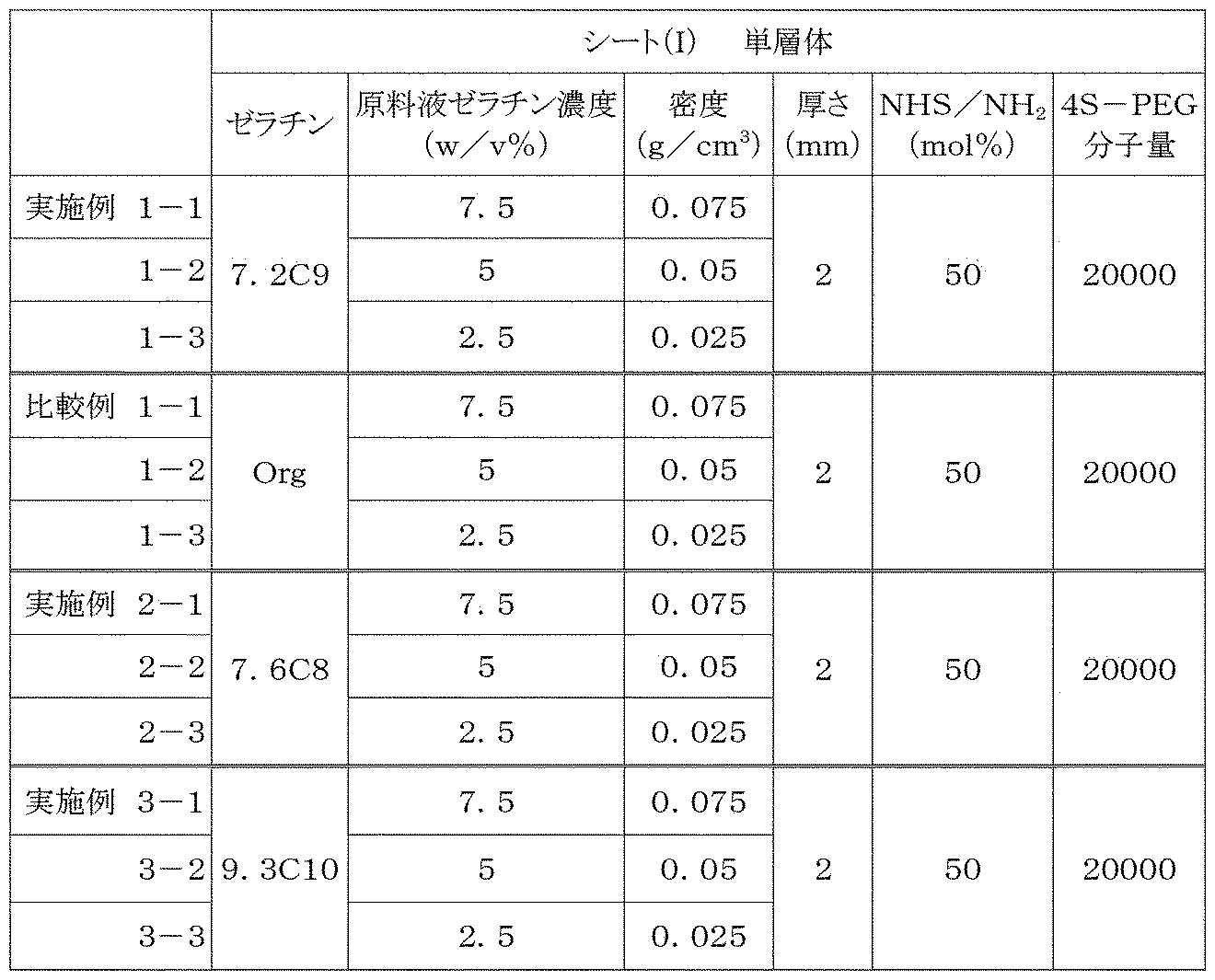
[評価]
(1)形状観察
実施例1-1~1-3及び比較例1-1~1-3で作製したシートの形状観察を目視と、走査型顕微鏡(SEM)観察により行った。図4に、各実施例および比較例で得られた多孔質シートの写真(左側)と、SEM像(右側)を示す。
(1)形状観察
実施例1-1~1-3及び比較例1-1~1-3で作製したシートの形状観察を目視と、走査型顕微鏡(SEM)観察により行った。図4に、各実施例および比較例で得られた多孔質シートの写真(左側)と、SEM像(右側)を示す。
実施例1-1~1-3及び比較例1-1~1-3で作製したシートは多孔質(多孔質シート)であることが確認できた。また、図4に示すように、多孔質シートの空隙率(密度)は、原料液のゼラチン濃度(7.2C9-ApGltn濃度、又は、Org-ApGltn濃度)に依存しており、原料液のゼラチン濃度が低い程、多孔質シートの空隙の割合が大きく(密度が低く)、ゼラチン濃度が高い程、多孔質シートの空隙の割合が小さかった(密度が高い)。
(2)耐圧強度試験1
実施例1-1~1-3、比較例1-1~1-3、実施例2-1~2-3、及び実施例3-1~3-3で作製した多孔質シートについて、以下に説明する耐圧試験を行った。
実施例1-1~1-3、比較例1-1~1-3、実施例2-1~2-3、及び実施例3-1~3-3で作製した多孔質シートについて、以下に説明する耐圧試験を行った。
ASTM(F2392-04)に従い、ブタ大動脈を基材として用い、シーリング強度(耐圧強度)を測定した。図5Aに示すように、ブタ大動脈20(直径35mm)の中央欠損部20a(直径1mm)を覆うように、各実施例または比較例で作製した多孔質シート10を乗せ、ピンセットで軽く押して固定し、10分間静置した。静置後、多孔質シート10を乗せたブタ大動脈20を治具に固定し、37℃の生理食塩水を流速2mL/分で、多孔質シート10に覆われた欠損部20aに向かって流し(図5Aに矢印で示す方向)、多孔質シート10が剥離したときの圧力の測定を行った。結果を図5Bに示す。本実験において、破裂圧力が高い程、耐圧強度が高く、多孔質シートの生体組織(ブタ大動脈)への接着性が高いことを意味する。
図5Bにおいて、まず、原料液のゼラチン濃度が2.5w/v%の比較例1-3、ならびに実施例2-3、1-3、及び3-3を比較する。原料ゼラチンを用いた多孔質シート(比較例1-3)と比較して、疎水化ゼラチン誘導体を用いた多孔質シート(実施例2-3、1-3、及び3-3)の方が、剥離圧力(耐圧強度)が高かった。そして、導入したアルキル鎖が長くなる程、剥離圧力が高くなる傾向を示した。
また、原料ゼラチン濃度が5w/v%の場合、及び原料ゼラチン濃度が7.5w/v%の場合も、原料ゼラチンを用いた多孔質シート(Org)と比較して、疎水化ゼラチン誘導体を用いた多孔質シートは、高い剥離圧力を示した。
また、原料ゼラチン濃度が5w/v%の場合、及び原料ゼラチン濃度が7.5w/v%の場合も、原料ゼラチンを用いた多孔質シート(Org)と比較して、疎水化ゼラチン誘導体を用いた多孔質シートは、高い剥離圧力を示した。
本試験(耐圧強度試験1)では、ブタ大動脈上は中性(pH=7~7.4)の湿潤状態にあり、その上の載置された多孔質シートは、毛細管現象により中性の水分を吸収し、架橋剤の活性エステル基(NHS基)と、ゼラチンのアミノ基(NH2)と架橋反応したと推測される。そして、疎水化ゼラチン誘導体を用いた多孔質シートは、Orgに導入された疎水性基により、多孔質シート-組織(ブタ大動脈)間で疎水性相互作用を形成し、組織表面に強く接着したと推測される(図1B参照)。
<<積層体>>
以下に説明する実施例4-1、比較例2-1、比較例2-2、~4-3、実施例5-1、比較例3-1、比較例3-2、及び実施例6-1~6-3では、疎水化ゼラチン誘導体の多孔質シート(下層、シート(I))と、原料ゼラチンの多孔質シート(上層、シート(II))とを積層させた積層体を作製した。シート(I)と(II)との区別を明確とするために、シート(II)を色素(アシッド・ブルー)で着色した。表2に、各実験で作製したシートの詳細について示す。
以下に説明する実施例4-1、比較例2-1、比較例2-2、~4-3、実施例5-1、比較例3-1、比較例3-2、及び実施例6-1~6-3では、疎水化ゼラチン誘導体の多孔質シート(下層、シート(I))と、原料ゼラチンの多孔質シート(上層、シート(II))とを積層させた積層体を作製した。シート(I)と(II)との区別を明確とするために、シート(II)を色素(アシッド・ブルー)で着色した。表2に、各実験で作製したシートの詳細について示す。
[実施例4-1]
まず、シート(I)として、実験3-1で作製した、疎水化ゼラチン誘導体9.3C10-ApGltnの多孔質シート(厚さ2mm、原料液(I)中のゼラチン濃度は7.5w/v%)を用意した。
まず、シート(I)として、実験3-1で作製した、疎水化ゼラチン誘導体9.3C10-ApGltnの多孔質シート(厚さ2mm、原料液(I)中のゼラチン濃度は7.5w/v%)を用意した。
次に、原料ゼラチン(Org-ApGltn)の5w/v%水溶液(原料液(II))を調製し、アシッド・ブルー(25μg/mL)により着色した。調製した原料ゼラチン水溶液をシリコーンシート型(70mm×70mm×深さ:0.5mm)にキャストした。実施例1-1等で使用したものと同じ凍結乾燥機を用いて、まず、試料を-30℃で一晩、凍結乾燥した。凍結乾燥後、150℃で5時間加熱し、Org-ApGltnを熱架橋させて、シート(II)を得た。
シート(I)の上に、シート(II)を積層して、積層体を得た。
[比較例2-1]
シート(I)として、実施例3-2で作製した、疎水化ゼラチン誘導体9.3C10-ApGltnの多孔質シート(厚さ2mm、原料液中の疎水化ゼラチン誘導体濃度は5w/v%)を用意した。それ以外は、実施例4-1と同様の方法により、シート(I)及び(II)からなる積層体を作製した。
シート(I)として、実施例3-2で作製した、疎水化ゼラチン誘導体9.3C10-ApGltnの多孔質シート(厚さ2mm、原料液中の疎水化ゼラチン誘導体濃度は5w/v%)を用意した。それ以外は、実施例4-1と同様の方法により、シート(I)及び(II)からなる積層体を作製した。
[比較例2-2]
シート(I)として、実施例3-3で作製した、疎水化ゼラチン誘導体9.3C10-ApGltnの多孔質シート(厚さ2mm、原料液中の疎水化ゼラチン誘導体の濃度は2.5w/v%)を用意した。それ以外は、実施例4-1と同様の方法により、シート(I)及び(II)からなる積層体を作製した。
シート(I)として、実施例3-3で作製した、疎水化ゼラチン誘導体9.3C10-ApGltnの多孔質シート(厚さ2mm、原料液中の疎水化ゼラチン誘導体の濃度は2.5w/v%)を用意した。それ以外は、実施例4-1と同様の方法により、シート(I)及び(II)からなる積層体を作製した。
実施例4-1、比較例2-1、および比較例2-2で作製した積層体の写真を図6に示す。上段がシート(II)側からの写真であり、下段がシート(I)側からの写真である。
[実施例5-1]
厚さを2mmから1mmに変更してシート(I)を作製したこと以外、実施例4-1と同様の方法により、シート(I)及び(II)からなる積層体を作製した。
厚さを2mmから1mmに変更してシート(I)を作製したこと以外、実施例4-1と同様の方法により、シート(I)及び(II)からなる積層体を作製した。
[比較例3-1]
厚さを2mmから1mmに変更してシート(I)を作製したこと以外、比較例2-1と同様の方法により、シート(I)及び(II)からなる積層体を作製した。
厚さを2mmから1mmに変更してシート(I)を作製したこと以外、比較例2-1と同様の方法により、シート(I)及び(II)からなる積層体を作製した。
[比較例3-2]
厚さを2mmから1mmに変更してシート(I)を作製したこと以外、比較例2-2と同様の方法により、シート(I)及び(II)からなる積層体を作製した。
厚さを2mmから1mmに変更してシート(I)を作製したこと以外、比較例2-2と同様の方法により、シート(I)及び(II)からなる積層体を作製した。
[実施例6-1]
厚さを2mmから1.5mmに変更してシート(I)を作製したこと以外、実施例4-1と同様の方法により、シート(I)及び(II)からなる積層体を作製した。
厚さを2mmから1.5mmに変更してシート(I)を作製したこと以外、実施例4-1と同様の方法により、シート(I)及び(II)からなる積層体を作製した。
[実施例6-2]
原料液(II)中のゼラチン濃度を5w/v%から10w/v%に変更してシート(II)を作製したこと以外、実施例6-1と同様の方法により、シート(I)及び(II)からなる積層体を作製した。
原料液(II)中のゼラチン濃度を5w/v%から10w/v%に変更してシート(II)を作製したこと以外、実施例6-1と同様の方法により、シート(I)及び(II)からなる積層体を作製した。
[実施例6-3]
原料液(II)中のゼラチン濃度を5w/v%から20w/v%に変更してシート(II)を作製したこと以外、実施例6-1と同様の方法により、シート(I)及び(II)からなる積層体を作製した。
原料液(II)中のゼラチン濃度を5w/v%から20w/v%に変更してシート(II)を作製したこと以外、実施例6-1と同様の方法により、シート(I)及び(II)からなる積層体を作製した。
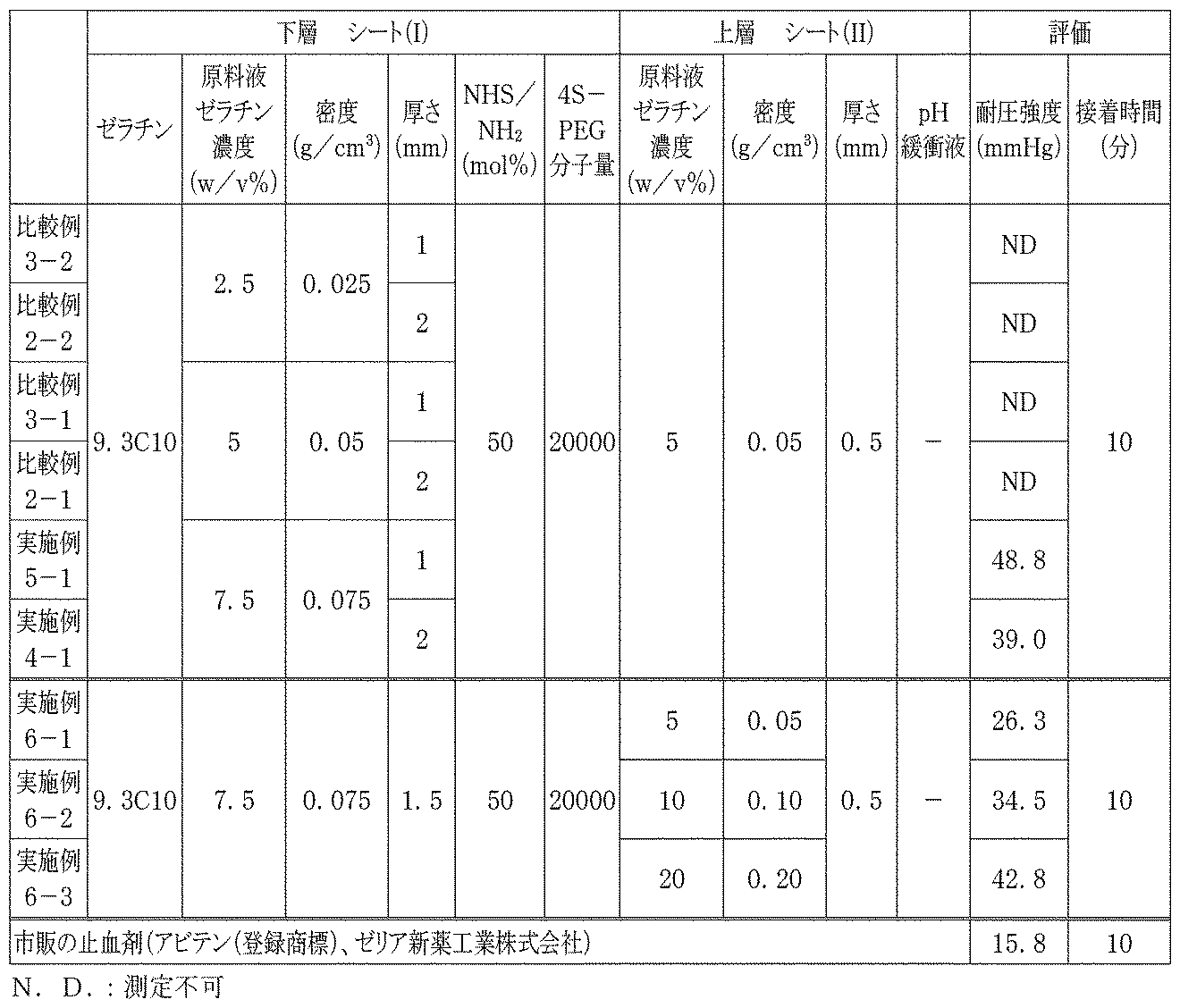
[評価]
(1)粘着性比較試験
実施例3-1で作製した多孔質シート(単層体)と、実施例4-1で作製した積層体を用いて本試験を行った。実施例4-1の積層体のシート(I)と、実施例3-1の多孔質シートとは同一の組成、構造を有する。まず、実施例3-1の多孔質シート、実施例4-1の積層体をそれぞれ、ブタ大動脈上に乗せ、ピンセットで軽く押して固定し、10分間静置した。このとき、積層体は、シート(I)を下側(ブタ大動脈と接触する側)とした。静置後、ブタ大動脈に接着した多孔質シート、及び積層体の表面(シート(II))を、ゴム手袋をした手で触って、粘着性を比較した。
(1)粘着性比較試験
実施例3-1で作製した多孔質シート(単層体)と、実施例4-1で作製した積層体を用いて本試験を行った。実施例4-1の積層体のシート(I)と、実施例3-1の多孔質シートとは同一の組成、構造を有する。まず、実施例3-1の多孔質シート、実施例4-1の積層体をそれぞれ、ブタ大動脈上に乗せ、ピンセットで軽く押して固定し、10分間静置した。このとき、積層体は、シート(I)を下側(ブタ大動脈と接触する側)とした。静置後、ブタ大動脈に接着した多孔質シート、及び積層体の表面(シート(II))を、ゴム手袋をした手で触って、粘着性を比較した。
本試験の結果、二層構造の積層体(実施例4-1)の方が、一層構造の多孔質シート(実施例3-1)よりも粘着性が低かった。この結果から、疎水化ゼラチン誘導体の多孔質シート上に、原料ゼラチンの多孔質シートを積層して積層体とすることで、該積層体を生体組織接着膜に用いた場合に、他の生体組織への癒着の抑制、及び手術時のゴム手袋への接着の抑制等が期待できる。
更に、実施例5-1、及び6-1~6-3で作製した積層体を用いて、本試験を行った。これらの実施例の積層体は、後述する耐圧強度試験2で良好な結果が得られた積層体である。実施例5-1、及び6-1~6-3の積層体の粘着性も、単層体の多孔質シート(実施例3-1)と比較して低かった。
(2)耐圧強度試験2
本試験では、出血等が生じて大量の血液、体液等が存在する生体内を想定し、生理食塩水中で、実施例4-1、比較例2-1、比較例2-2、実施例5-1、比較例3―1、比較例3-2、及び実施例6-1~6-3で作製した積層体を生体組織(ブタ大動脈)へ接着し、その後、接着性を耐圧強度試験により評価した。
本試験では、出血等が生じて大量の血液、体液等が存在する生体内を想定し、生理食塩水中で、実施例4-1、比較例2-1、比較例2-2、実施例5-1、比較例3―1、比較例3-2、及び実施例6-1~6-3で作製した積層体を生体組織(ブタ大動脈)へ接着し、その後、接着性を耐圧強度試験により評価した。
まず、各実施例で作製した積層体をダンベルカッターで打ち抜いて、直径15mmの円形の評価試料を作製した。次に、37℃に加温しているホットプレート上において、生理食塩水3mLを入れたシャーレ(直径35mm)の中で、ブタ大動脈(直径35mm)の中央欠損部(直径1mm)を覆うように、各実施例および比較例の評価試料(積層体)を乗せた。このとき、積層体のシート(I)を下側(ブタ大動脈と接触する側)とした。次に、ブタ大動脈上の評価試料を上からユニパック(ポリエチレン製)でカバーし、ユニパック上に50gの重りを乗せ、そのまま10分間静置した。
静置後、評価試料からユニパックを剥離し、ASTM(F2392-04)に従い、シーリング強度(耐圧強度)を測定した。図5Aに示すように、評価試料10を乗せたブタ大動脈20を治具に固定し、37℃の生理食塩水を流速2mL/分で評価試料10(積層体)に覆われた欠損部20aに向かって流し(図5Aに矢印で示す方向)、評価試料10が剥離したときの圧力の測定を行った。尚、各実験において、3枚のシートを用意して3回耐圧試験を行った。結果を表2に示す。
表2に示すように、比較例3-2、2-2、3-1及び2-1で作製した、原料液ゼラチン濃度が比較的低い多孔質シート(I)を含む積層体は、ユニパックを剥がす際、積層体もブタ大動脈から剥離してしまい、耐圧強度の測定ができなかった(評価結果:N.D.)。即ち、これらの多孔質シートでは、十分な接着性が得られなかった。このため、比較例3-2、2-2、3-1及び2-1の積層体では、2回目以降の耐圧試験は行わなかった。
一方、実施例5-1、4-1、及び6-1~6-3で作製した、原料液ゼラチン濃度が比較的高い多孔質シート(I)を含む積層体は、少なくとも2回は、ユニパックを大動脈から剥離して耐圧試験を行うことができた。表2には、各積層体で得られた最も高い耐圧強度を示す。参考に、市販品の止血剤を用いて行った同試験の評価結果(耐圧強度)も併せて表2に示す。実施例5-1、4-1、及び6-1~6-3の積層体の評価結果は市販品の評価結果より良好であり、実用上問題のない、接着性及び耐圧性を有することが確認できた。
上記試験結果の原因は、以下のように推測される。
本試験では、多孔質のシート(I)が、生理食塩水、及び組織中の水分を吸収することで、中性~弱アルカリ性となり疎水化タラゼラチンが組織に浸透すると共に、架橋剤による疎水化タラゼラチンの架橋反応が進んだと推測される。
このとき、原料液ゼラチン濃度が低い、実施例3-2、2-2、3-1及び2-1で作製した多孔質シート(I)は密度が低く空隙が多いため、周囲に大量の水分(生理食塩水)がある場合、急速に大量の水分を吸収してしまう。このため、下層のシート(I)が生体組織(ブタ大動脈)に十分に接着する前に、上層のシート(II)に水分が回り、これにより上層のシート(II)が粘着性を持ち、ユニパックを剥がす際、積層体ごとブタ大動脈から剥離したと考えられる。
一方で、原料液ゼラチン濃度が高い、実施例5-1、4-1、及び6-1~6-3で作製した多孔質シート(I)は密度が高く空隙が少ないため、周囲に大量の水分(生理食塩水、及び組織中の水分)がある場合でも、水分の吸収速度が比較的緩やかである。このため、上層のシート(II)に水分が回らず、且つ下層のシート(I)が生体組織(ブタ大動脈)に十分な強度で接着できたと考えられる。
<<積層体>>
以下に説明する実施例7-1~7-7、8-1、及び9-1では、シート(II)の作製時にpH緩衝液を使用して、積層体を作製した。また、比較のため、実施例7-8では、シート(II)の作製時にpH緩衝液を使用しないこと以外、実施例7-1と同一条件の積層体を作製した。表3に、各実験で作製した積層体の詳細について示す。
以下に説明する実施例7-1~7-7、8-1、及び9-1では、シート(II)の作製時にpH緩衝液を使用して、積層体を作製した。また、比較のため、実施例7-8では、シート(II)の作製時にpH緩衝液を使用しないこと以外、実施例7-1と同一条件の積層体を作製した。表3に、各実験で作製した積層体の詳細について示す。
[実施例7-1]
<疎水化ゼラチン誘導体の合成>
疎水化試薬としては、デカン酸無水物を用い、炭化水素基導入率(デカノイル基導入率)DSが12mol%となるように、アルキル酸無水物の使用量を調整した以外は、実験1-1と同様の方法により、疎水化ゼラチン誘導体を合成した。以下、本実験で合成した疎水化ゼラチン誘導体を12C10-ApGltn、又は、12C10と記載する場合がある。
<疎水化ゼラチン誘導体の合成>
疎水化試薬としては、デカン酸無水物を用い、炭化水素基導入率(デカノイル基導入率)DSが12mol%となるように、アルキル酸無水物の使用量を調整した以外は、実験1-1と同様の方法により、疎水化ゼラチン誘導体を合成した。以下、本実験で合成した疎水化ゼラチン誘導体を12C10-ApGltn、又は、12C10と記載する場合がある。
<シート(I)の作製>
疎水化ゼラチン誘導体として12C10-ApGltnを用いた以外は、実験1-1と同様の方法により、原料液(I)を調製した(ゼラチン濃度:7.5w/v%、NHS/NH2=50mol%)。また、厚さを0.5mmとした以外は、実験1-1と同様の方法により、調製した原料液を凍結乾燥して多孔質シート(シート(I))を作製した。
疎水化ゼラチン誘導体として12C10-ApGltnを用いた以外は、実験1-1と同様の方法により、原料液(I)を調製した(ゼラチン濃度:7.5w/v%、NHS/NH2=50mol%)。また、厚さを0.5mmとした以外は、実験1-1と同様の方法により、調製した原料液を凍結乾燥して多孔質シート(シート(I))を作製した。
<シート(II)の作製>
まず、100mLの純水に3.39gのリン酸水素二ナトリウム・12水和物と0.08gのリン酸二水素ナトリウムを溶解し、0.1mol/Lのリン酸緩衝液(pH8)を調製した。次に、リン酸緩衝液に原料ゼラチン(Org-ApGltn)を溶解して、10w/v%の原料液(II)を調製した。調製した原料液(II)をシリコーンシート型(70mm×70mm×深さ:0.5mm)にキャストした。実験1-1等で使用したものと同じ凍結乾燥機を用いて、まず、試料を-30℃で一晩凍結し、凍結乾燥を行った。凍結乾燥後、150℃で5時間加熱し、Org-ApGltnを熱架橋させて、シート(II)を得た。
まず、100mLの純水に3.39gのリン酸水素二ナトリウム・12水和物と0.08gのリン酸二水素ナトリウムを溶解し、0.1mol/Lのリン酸緩衝液(pH8)を調製した。次に、リン酸緩衝液に原料ゼラチン(Org-ApGltn)を溶解して、10w/v%の原料液(II)を調製した。調製した原料液(II)をシリコーンシート型(70mm×70mm×深さ:0.5mm)にキャストした。実験1-1等で使用したものと同じ凍結乾燥機を用いて、まず、試料を-30℃で一晩凍結し、凍結乾燥を行った。凍結乾燥後、150℃で5時間加熱し、Org-ApGltnを熱架橋させて、シート(II)を得た。
<積層体の作製>
シート(I)の上に、シート(II)を積層して、本実験の積層体を得た。
シート(I)の上に、シート(II)を積層して、本実験の積層体を得た。
[実施例7-2]
シート(I)の作製において、NHS/NH2=75mol%となるように原料液(I)を調製した以外は、実施例7-1と同様の方法により、本実験の積層体を作製した。
シート(I)の作製において、NHS/NH2=75mol%となるように原料液(I)を調製した以外は、実施例7-1と同様の方法により、本実験の積層体を作製した。
[実施例7-3]
シート(I)の作製において、NHS/NH2=100mol%となるように原料液(I)を調製した以外は、実施例7-1と同様の方法により、本実験の積層体を作製した。
シート(I)の作製において、NHS/NH2=100mol%となるように原料液(I)を調製した以外は、実施例7-1と同様の方法により、本実験の積層体を作製した。
[実施例7-4]
シート(I)の作製において、ゼラチン濃度を15w/v%となるように原料液(I)を調製した以外は、実施例7-1と同様の方法により、本実験の積層体を作製した。
シート(I)の作製において、ゼラチン濃度を15w/v%となるように原料液(I)を調製した以外は、実施例7-1と同様の方法により、本実験の積層体を作製した。
[実施例7-5]
シート(I)の作製において、使用する架橋剤(4S-PEG)の重量平均分子量を10,000とした以外は、実施例7-1と同様の方法により、本実験の積層体を作製した。
シート(I)の作製において、使用する架橋剤(4S-PEG)の重量平均分子量を10,000とした以外は、実施例7-1と同様の方法により、本実験の積層体を作製した。
[実施例7-6]
シート(I)の作製において、使用する架橋剤(4S-PEG)の重量平均分子量を10,000とした以外は、実施例7-2と同様の方法により、本実験の積層体を作製した。
シート(I)の作製において、使用する架橋剤(4S-PEG)の重量平均分子量を10,000とした以外は、実施例7-2と同様の方法により、本実験の積層体を作製した。
[実施例7-7]
シート(I)の作製において、使用する架橋剤(4S-PEG)の重量平均分子量を10,000とした以外は、実施例7-3と同様の方法により、本実験の積層体を作製した。
シート(I)の作製において、使用する架橋剤(4S-PEG)の重量平均分子量を10,000とした以外は、実施例7-3と同様の方法により、本実験の積層体を作製した。
[実施例7-8]
シート(II)の作製時にpH緩衝液を使用せず、それに代えて純水を使用した以外、実施例7-1と同一条件で積層体を作製した。
シート(II)の作製時にpH緩衝液を使用せず、それに代えて純水を使用した以外、実施例7-1と同一条件で積層体を作製した。
[実験8-1]
<疎水化ゼラチン誘導体の合成>
疎水化試薬としては、ラウリン酸無水物を用い、炭化水素基導入率(ラウリロイル基導入率)DSが9mol%となるように、アルキル酸無水物の使用量を調整した以外は、実験1-1と同様の方法により、疎水化ゼラチン誘導体を合成した。以下、本実験で合成した疎水化ゼラチン誘導体を9C12-ApGltn、又は、9C12と記載する場合がある。
<疎水化ゼラチン誘導体の合成>
疎水化試薬としては、ラウリン酸無水物を用い、炭化水素基導入率(ラウリロイル基導入率)DSが9mol%となるように、アルキル酸無水物の使用量を調整した以外は、実験1-1と同様の方法により、疎水化ゼラチン誘導体を合成した。以下、本実験で合成した疎水化ゼラチン誘導体を9C12-ApGltn、又は、9C12と記載する場合がある。
<積層体の作製>
シート(I)の作製において、疎水化ゼラチン誘導体9C12-ApGltnを用いた以外は、実施例7-1と同様の方法により、本実験の積層体を作製した。
シート(I)の作製において、疎水化ゼラチン誘導体9C12-ApGltnを用いた以外は、実施例7-1と同様の方法により、本実験の積層体を作製した。
[実験9-1]
<疎水化ゼラチン誘導体の合成>
疎水化試薬としては、オクタン酸無水物を用い、炭化水素基導入率(オクタノイル基導入率)DSが13mol%となるように、アルキル酸無水物の使用量を調整した以外は、実験1-1と同様の方法により、疎水化ゼラチン誘導体を合成した。以下、本実験で合成した疎水化ゼラチン誘導体を13C8-ApGltn、又は、13C8と記載する場合がある。
<疎水化ゼラチン誘導体の合成>
疎水化試薬としては、オクタン酸無水物を用い、炭化水素基導入率(オクタノイル基導入率)DSが13mol%となるように、アルキル酸無水物の使用量を調整した以外は、実験1-1と同様の方法により、疎水化ゼラチン誘導体を合成した。以下、本実験で合成した疎水化ゼラチン誘導体を13C8-ApGltn、又は、13C8と記載する場合がある。
<積層体の作製>
シート(I)の作製において、疎水化ゼラチン誘導体13C8-ApGltnを用いた以外は、実施例7-1と同様の方法により、本実験の積層体を作製した。
シート(I)の作製において、疎水化ゼラチン誘導体13C8-ApGltnを用いた以外は、実施例7-1と同様の方法により、本実験の積層体を作製した。
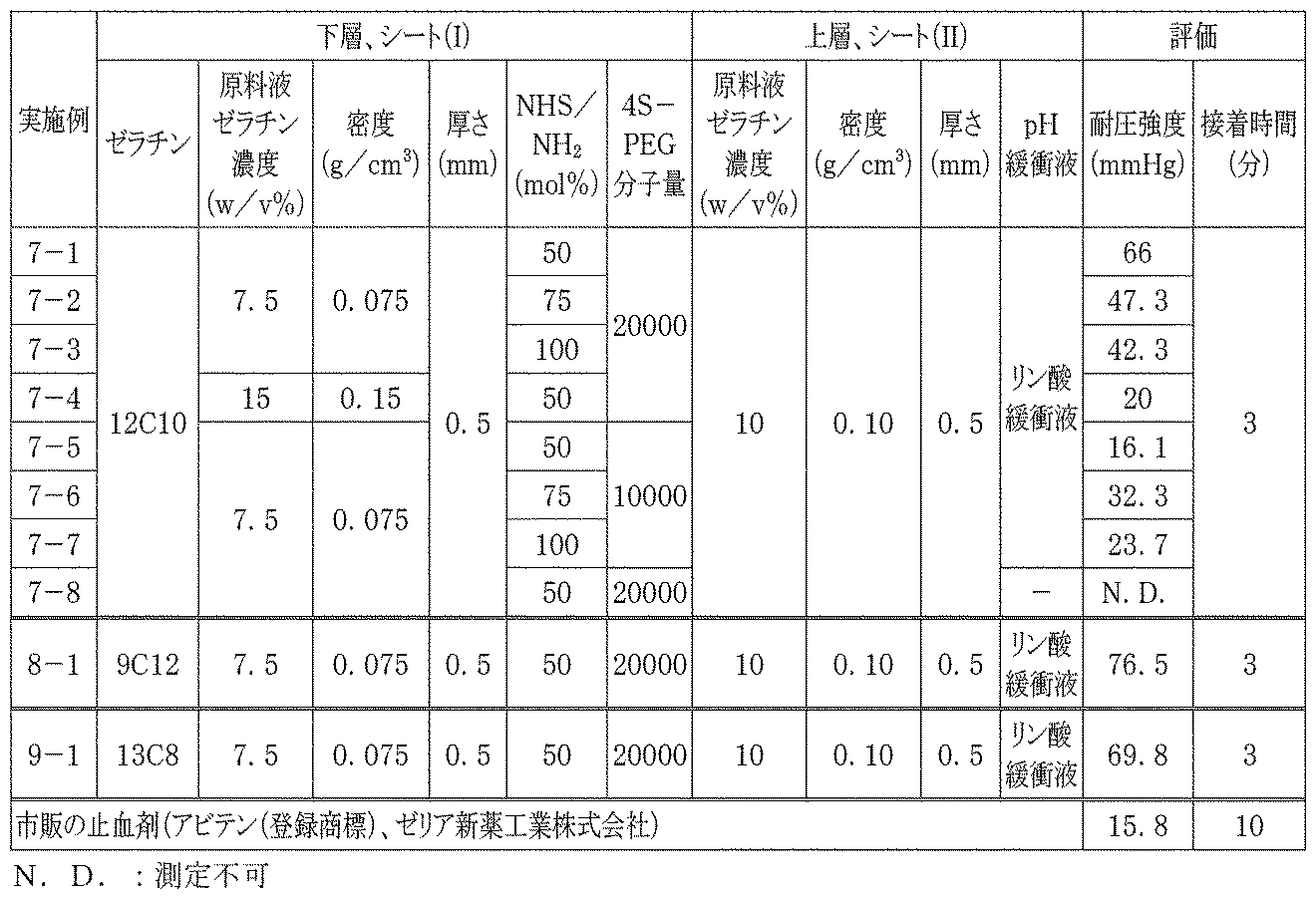
[評価]
(1)粘着性比較試験
実施例7-1~7-8、8-1、及び9-1で作製した積層体に対して、上述の実施例4-1等の積層体に対して行った粘着性比較試験を行った。表3に示す全ての実施例の積層体の粘着性は、単層体の多孔質シート(実施例3-1)と比較して低かった。この結果から、これらの積層体を生体組織接着膜に用いた場合に、他の生体組織への癒着の抑制、及び手術時のゴム手袋への接着の抑制等が期待できる。
(1)粘着性比較試験
実施例7-1~7-8、8-1、及び9-1で作製した積層体に対して、上述の実施例4-1等の積層体に対して行った粘着性比較試験を行った。表3に示す全ての実施例の積層体の粘着性は、単層体の多孔質シート(実施例3-1)と比較して低かった。この結果から、これらの積層体を生体組織接着膜に用いた場合に、他の生体組織への癒着の抑制、及び手術時のゴム手袋への接着の抑制等が期待できる。
(2)耐圧強度試験2
実施例7-1~7-8、8-1、及び9-1で作製した積層体に対して、上述の実施例4-1等の積層体に対して行った耐圧強度試験2を行った。本試験は、出血等が生じて大量の血液、体液等が存在する生体内を想定し、生理食塩水中で行う試験である。尚、実施例4-1等の積層体に対する試験では生体組織(ブタ大動脈)への接着時間を10分としたのに対し(表2参照)、実施例7-1等の積層体に対する試験では、同接着時間を3分に短縮した。結果を表3に示す。参考に、市販品の止血剤を用いて、接着時間を10分として行った同試験の評価結果(耐圧強度)も併せて表3に示す。
実施例7-1~7-8、8-1、及び9-1で作製した積層体に対して、上述の実施例4-1等の積層体に対して行った耐圧強度試験2を行った。本試験は、出血等が生じて大量の血液、体液等が存在する生体内を想定し、生理食塩水中で行う試験である。尚、実施例4-1等の積層体に対する試験では生体組織(ブタ大動脈)への接着時間を10分としたのに対し(表2参照)、実施例7-1等の積層体に対する試験では、同接着時間を3分に短縮した。結果を表3に示す。参考に、市販品の止血剤を用いて、接着時間を10分として行った同試験の評価結果(耐圧強度)も併せて表3に示す。
表3に示すように、実施例7-8を除く全ての実験の積層体の評価結果は、市販品の評価結果より良好であり、実用上問題のない、接着性及び耐圧性を有することが確認できた。実施例7-8を除く全ての実施例では、シート(II)の作製にpH緩衝液(pH8)を用いたため、シート(II)は塩基性化合物(リン酸と、リン酸ナトリウムとの混合物)を含有している。これにより、シート(I)内のpHがより早く上昇し、疎水化ゼラチン誘導体と架橋剤との架橋反応(硬化反応)が促進され、接着時間を3分に短縮しても良好な評価結果が得られたと推測される。
一方、シート(II)の作製にpH緩衝液を用いないかった実施例7-8の積層体(即ち、塩基性化合物を含有しない積層体)は、3分という短い接着時間では、十分な接着強度が得られず、耐圧強度の測定ができなかった(評価結果:N.D.)。尚、表2に示す、シート(II)の作製にpH緩衝液を用いないかった実施例4-1等の積層体に対して、接着時間を3分に短縮して同試験を行ったところ、3分という短い接着時間では十分な接着強度が得られず、実施例7-8と同様に、耐圧強度の測定ができなかった(評価結果:N.D.)。
本発明の多孔質シートは、生体内で使用される組織接着膜(例えば、止血材、癒着防止材)に利用可能であり、高い接着強度と共に、高い生体親和性を有する。このため、本発明の多孔質シートは、外科、内科領域への使用が可能である。
10 多孔質シート(シート(I))
20 生体組織(ブタ大動脈)
20a 欠損部
30 原料ゼラチンの架橋物を含むシート(シート(II))
31 塩基性化合物
50、51、52 積層体
20 生体組織(ブタ大動脈)
20a 欠損部
30 原料ゼラチンの架橋物を含むシート(シート(II))
31 塩基性化合物
50、51、52 積層体
Claims (30)
- 多孔質シートであって、
ゼラチンに炭化水素基が導入されている、下記式(1)

(式(1)において、Gltnはゼラチンの残基を表し、Lは単結合、又は2価の連結基を表し、R1は炭素数1~20の炭化水素基であり、R2は水素原子又は炭素数1~20の炭化水素基である。)
で表される構造を含む、疎水化ゼラチン誘導体と、
前記疎水化ゼラチン誘導体中に分散されている未反応の架橋剤と、
を含む、多孔質シート。 - 前記多孔質シートの密度が、0.01g/cm3~0.3g/cm3である、請求項1に記載の多孔質シート。
- Lは単結合、又は-C(O)-である、請求項1または2に記載の多孔質シート。
- Lは単結合である、請求項3に記載の多孔質シート。
- R1は直鎖アルキル基であり、R2は水素原子である、請求項1~4のいずれか一項に記載の多孔質シート。
- R1は炭素数6~12の直鎖アルキル基である、請求項5に記載の多孔質シート。
- 前記疎水化ゼラチン誘導体の炭化水素基導入率が、5mol%~50mol%である、請求項1~6のいずれか一項に記載の多孔質シート。
- 前記ゼラチンが、冷水魚由来ゼラチンである、請求項1~7のいずれか一項に記載の多孔質シート。
- 前記架橋剤が、少なくとも2つの架橋性基を有する化合物である、請求項1~8のいずれか一項に記載の多孔質シート。
- 前記疎水化ゼラチン誘導体が有するアミノ基1当量に対して、前記架橋剤が有する前記架橋性基が0.25当量~2当量である、請求項9に記載の多孔質シート。
- 厚さが、1mm以上である、請求項1~10のいずれか一項に記載の多孔質シート。
- 請求項1~11のいずれか一項に記載の多孔質シートを含む、組織接着膜。
- 請求項1~11のいずれか一項に記載の多孔質シートである、少なくとも1つのシート(I)と、
未疎水化ゼラチンの架橋物を含むシート(II)と、を含み、
前記少なくとも1つのシート(I)の密度が、0.07g/cm3以上であり、
前記少なくとも1つのシート(I)が、前記シート(II)の一方の面上に積層されている、組織接着膜。 - 前記未疎水化ゼラチンの架橋物が、前記未疎水化ゼラチンの熱架橋物である、請求項13に記載の組織接着膜。
- 前記シート(II)が多孔質である、請求項13又は14に記載の組織接着膜。
- 前記少なくとも1つのシート(I)の密度が、0.07g/cm3~0.2g/cm3である、請求項13~15のいずれか一項に記載の組織接着膜。
- 前記シート(II)が、水分と接触すると塩基性を示す塩基性化合物を更に含有する、請求項13~16のいずれか一項に記載の組織接着膜。
- 前記塩基性化合物は、それの0.05mol/L~0.5mol/Lの水溶液のpHが7.5~10を示す化合物である、請求項17に記載の組織接着膜。
- 前記塩基性化合物がpH緩衝剤である、請求項17又は18に記載の組織接着膜。
- 前記pH緩衝剤が、リン酸と、リン酸ナトリウムとの混合物である、請求項19に記載の組織接着膜。
- 前記少なくとも1つのシート(I)は、2つのシート(I)を含み、
前記2つのシート(I)のうち、一方が前記シート(II)の一方の面上に積層され、他方が前記シート(II)の他方の面上に積層されている、請求項13~20のいずれか一項に記載の組織接着膜。 - 止血剤として使用するための、請求項12~21のいずれか一項に記載の組織接着膜。
- 組織に接着した際に他の組織への癒着を防止するための、請求項12~21のいずれか一項に記載の組織接着膜。
- 請求項1~11のいずれか一項に記載の多孔質シートの製造方法であって、
前記未疎水化ゼラチンと、前記架橋剤と、酸と、溶媒とを含む、pH5以下の原料液(I)を調製することと、
前記原料液(I)をシート状で凍結乾燥して前記多孔質シートを得ること、
とを含む、方法。 - 前記原料液(I)中の前記未疎水化ゼラチンの濃度が、1w/v%~20w/v%である、請求項24に記載の方法。
- 請求項24又は25に記載の方法により多孔質シートを製造する工程を含む、組織接着膜の製造方法。
- 組織接着膜の製造方法であって、
請求項24又は25に記載の方法により、多孔質のシート(I)を製造することと、
未疎水化ゼラチンの架橋物を含むシート(II)を製造することと、
前記シート(I)と、前記シート(II)とを積層すること、
とを含む、組織接着膜の製造方法。 - 前記シート(II)を製造することは、
前記未疎水化ゼラチンと、塩基性化合物と、溶媒とを含む原料液(II)を調製することと、
前記原料液(II)をシート状に凍結乾燥して、前駆体シートを形成することと、
前記前駆体シートを加熱して前記未疎水化ゼラチンを熱架橋させて前記シート(II)を得ること、
とを含む、請求項27に記載の方法。 - 前記塩基性化合物が、pH緩衝剤である、請求項28に記載の方法。
- 前記pH緩衝剤が、リン酸と、リン酸ナトリウムとの混合物である、請求項29に記載の方法。
Priority Applications (1)
| Application Number | Priority Date | Filing Date | Title |
|---|---|---|---|
| JP2024545647A JPWO2024053602A1 (ja) | 2022-09-06 | 2023-09-04 |
Applications Claiming Priority (4)
| Application Number | Priority Date | Filing Date | Title |
|---|---|---|---|
| JP2022141561 | 2022-09-06 | ||
| JP2022-141561 | 2022-09-06 | ||
| JP2023-071912 | 2023-04-26 | ||
| JP2023071912 | 2023-04-26 |
Publications (1)
| Publication Number | Publication Date |
|---|---|
| WO2024053602A1 true WO2024053602A1 (ja) | 2024-03-14 |
Family
ID=90191160
Family Applications (1)
| Application Number | Title | Priority Date | Filing Date |
|---|---|---|---|
| PCT/JP2023/032230 Ceased WO2024053602A1 (ja) | 2022-09-06 | 2023-09-04 | 多孔質シート、組織接着膜、これらの止血剤もしくは癒着防止材としての使用、およびこれらの製造方法 |
Country Status (2)
| Country | Link |
|---|---|
| JP (1) | JPWO2024053602A1 (ja) |
| WO (1) | WO2024053602A1 (ja) |
Citations (7)
| Publication number | Priority date | Publication date | Assignee | Title |
|---|---|---|---|---|
| JPH05176983A (ja) * | 1991-12-26 | 1993-07-20 | Kanebo Ltd | 二層性蛋白質シート及びその製造方法 |
| JPH10113384A (ja) * | 1996-10-14 | 1998-05-06 | Yoshihiko Shimizu | 医用代替膜及びその製造方法 |
| JP2009515619A (ja) * | 2005-11-17 | 2009-04-16 | ゲリタ アクチェンゲゼルシャフト | 特に医療用途のための複合材料、及び材料の製造方法 |
| WO2012046759A1 (ja) * | 2010-10-05 | 2012-04-12 | 独立行政法人物質・材料研究機構 | 組織接着膜及びその製造方法 |
| JP2014005211A (ja) * | 2012-06-21 | 2014-01-16 | Kagoshima Univ | ゼラチンゲルの作製法 |
| WO2015076252A1 (ja) * | 2013-11-22 | 2015-05-28 | 独立行政法人物質・材料研究機構 | 組織接着性多孔質膜、その製造方法及び組織接着性多孔質膜テープ |
| US20200237957A1 (en) * | 2017-10-04 | 2020-07-30 | Bio-Change Ltd. | Cross-linked protein foams and methods of using thereof a polyvalent cellular scaffold |
Family Cites Families (3)
| Publication number | Priority date | Publication date | Assignee | Title |
|---|---|---|---|---|
| JP5594633B2 (ja) * | 2010-10-05 | 2014-09-24 | 独立行政法人物質・材料研究機構 | 2成分系組織接着剤及びその製造方法 |
| JPWO2014112208A1 (ja) * | 2013-01-18 | 2017-01-19 | 国立研究開発法人物質・材料研究機構 | 組織接着剤及びその製造方法 |
| TWI735073B (zh) * | 2018-11-07 | 2021-08-01 | 財團法人工業技術研究院 | 雙功效薄膜與其製備方法 |
-
2023
- 2023-09-04 JP JP2024545647A patent/JPWO2024053602A1/ja active Pending
- 2023-09-04 WO PCT/JP2023/032230 patent/WO2024053602A1/ja not_active Ceased
Patent Citations (7)
| Publication number | Priority date | Publication date | Assignee | Title |
|---|---|---|---|---|
| JPH05176983A (ja) * | 1991-12-26 | 1993-07-20 | Kanebo Ltd | 二層性蛋白質シート及びその製造方法 |
| JPH10113384A (ja) * | 1996-10-14 | 1998-05-06 | Yoshihiko Shimizu | 医用代替膜及びその製造方法 |
| JP2009515619A (ja) * | 2005-11-17 | 2009-04-16 | ゲリタ アクチェンゲゼルシャフト | 特に医療用途のための複合材料、及び材料の製造方法 |
| WO2012046759A1 (ja) * | 2010-10-05 | 2012-04-12 | 独立行政法人物質・材料研究機構 | 組織接着膜及びその製造方法 |
| JP2014005211A (ja) * | 2012-06-21 | 2014-01-16 | Kagoshima Univ | ゼラチンゲルの作製法 |
| WO2015076252A1 (ja) * | 2013-11-22 | 2015-05-28 | 独立行政法人物質・材料研究機構 | 組織接着性多孔質膜、その製造方法及び組織接着性多孔質膜テープ |
| US20200237957A1 (en) * | 2017-10-04 | 2020-07-30 | Bio-Change Ltd. | Cross-linked protein foams and methods of using thereof a polyvalent cellular scaffold |
Also Published As
| Publication number | Publication date |
|---|---|
| JPWO2024053602A1 (ja) | 2024-03-14 |
Similar Documents
| Publication | Publication Date | Title |
|---|---|---|
| JP5594633B2 (ja) | 2成分系組織接着剤及びその製造方法 | |
| Artzi et al. | Characterization of star adhesive sealants based on PEG/dextran hydrogels | |
| JP2023516335A (ja) | 止血被覆材及びその製造方法 | |
| JP5995128B1 (ja) | 外科用シーラント | |
| JP6120392B2 (ja) | 組織接着性多孔質膜、その製造方法及び組織接着性多孔質膜テープ | |
| Wang et al. | Nature‐Inspired Gelatin‐Based Adhesive Hydrogel: A Rapid and User‐Friendly Solution for Hemostatic Applications | |
| JP6367979B2 (ja) | 外科用シーラント | |
| EP2626087B1 (en) | Tissue adhesive film and method for producing same | |
| JP2008284256A (ja) | 組織接着フィルム | |
| CN116999605A (zh) | 具有强粘附力、抗菌性及可降解性的止血粉的制备方法 | |
| Ichimaru et al. | Prevention of pulmonary air leaks using a biodegradable tissue-adhesive fiber sheet based on Alaska pollock gelatin modified with decanyl groups | |
| JP5343279B2 (ja) | 新規接着材料、その製造及びその応用 | |
| JPWO2020137903A1 (ja) | 粉体、創傷被覆材、癒着防止材、止血材、及び紛体の製造方法 | |
| JP2019051189A (ja) | ゼラチン誘導体創傷被覆材 | |
| CN121731538A (zh) | 基于多酚的抗菌抗氧化糖肽水凝胶的制备方法及其应用 | |
| JP7802409B2 (ja) | 癒着防止材、及び癒着防止材の製造方法 | |
| CN118542966A (zh) | 一种组织粘合剂及其制备方法和应用 | |
| JP2023161851A (ja) | 接着剤、創傷被覆材、癒着防止材、止血材、シーラント、及び噴霧キット | |
| CN115068666B (zh) | 一种防粘连的止血水凝胶及其制备方法和应用 | |
| JP4669919B2 (ja) | 医療用組成物 | |
| EP4032558B1 (en) | Biological tissue adhesive sheet, biological tissue reinforcing material kit, and method for manufacturing biological tissue adhesive sheet | |
| JP2005046228A (ja) | マット及びそれを用いた医療品 | |
| Dutta et al. | Enzymatic Crosslinking of Polyelectrolyte Complexes Produces Strong, Reconstitutable Biomedical Adhesives | |
| WO2021261080A1 (ja) | 多孔体、封止材、穿刺部封止装置、止血シート、及び、多孔体の製造方法 | |
| Liu | Design of Robust Hydrogel Based on Mussel-Inspired Chemistry |
Legal Events
| Date | Code | Title | Description |
|---|---|---|---|
| 121 | Ep: the epo has been informed by wipo that ep was designated in this application |
Ref document number: 23863140 Country of ref document: EP Kind code of ref document: A1 |
|
| WWE | Wipo information: entry into national phase |
Ref document number: 2024545647 Country of ref document: JP |
|
| NENP | Non-entry into the national phase |
Ref country code: DE |
|
| 122 | Ep: pct application non-entry in european phase |
Ref document number: 23863140 Country of ref document: EP Kind code of ref document: A1 |