WO2024048112A1 - 排水処理方法及び排水処理装置 - Google Patents
排水処理方法及び排水処理装置 Download PDFInfo
- Publication number
- WO2024048112A1 WO2024048112A1 PCT/JP2023/026623 JP2023026623W WO2024048112A1 WO 2024048112 A1 WO2024048112 A1 WO 2024048112A1 JP 2023026623 W JP2023026623 W JP 2023026623W WO 2024048112 A1 WO2024048112 A1 WO 2024048112A1
- Authority
- WO
- WIPO (PCT)
- Prior art keywords
- concentration
- reaction tank
- raw water
- wastewater treatment
- amount
- Prior art date
- Legal status (The legal status is an assumption and is not a legal conclusion. Google has not performed a legal analysis and makes no representation as to the accuracy of the status listed.)
- Ceased
Links
Images


Classifications
-
- C—CHEMISTRY; METALLURGY
- C02—TREATMENT OF WATER, WASTE WATER, SEWAGE, OR SLUDGE
- C02F—TREATMENT OF WATER, WASTE WATER, SEWAGE, OR SLUDGE
- C02F3/00—Biological treatment of water, waste water, or sewage
- C02F3/006—Regulation methods for biological treatment
-
- C—CHEMISTRY; METALLURGY
- C02—TREATMENT OF WATER, WASTE WATER, SEWAGE, OR SLUDGE
- C02F—TREATMENT OF WATER, WASTE WATER, SEWAGE, OR SLUDGE
- C02F3/00—Biological treatment of water, waste water, or sewage
- C02F3/02—Aerobic processes
- C02F3/10—Packings; Fillings; Grids
- C02F3/105—Characterized by the chemical composition
- C02F3/108—Immobilising gels, polymers or the like
-
- C—CHEMISTRY; METALLURGY
- C02—TREATMENT OF WATER, WASTE WATER, SEWAGE, OR SLUDGE
- C02F—TREATMENT OF WATER, WASTE WATER, SEWAGE, OR SLUDGE
- C02F3/00—Biological treatment of water, waste water, or sewage
- C02F3/02—Aerobic processes
- C02F3/12—Activated sludge processes
-
- C—CHEMISTRY; METALLURGY
- C02—TREATMENT OF WATER, WASTE WATER, SEWAGE, OR SLUDGE
- C02F—TREATMENT OF WATER, WASTE WATER, SEWAGE, OR SLUDGE
- C02F2101/00—Nature of the contaminant
- C02F2101/30—Organic compounds
-
- C—CHEMISTRY; METALLURGY
- C02—TREATMENT OF WATER, WASTE WATER, SEWAGE, OR SLUDGE
- C02F—TREATMENT OF WATER, WASTE WATER, SEWAGE, OR SLUDGE
- C02F2103/00—Nature of the water, waste water, sewage or sludge to be treated
- C02F2103/34—Nature of the water, waste water, sewage or sludge to be treated from industrial activities not provided for in groups C02F2103/12 - C02F2103/32
- C02F2103/346—Nature of the water, waste water, sewage or sludge to be treated from industrial activities not provided for in groups C02F2103/12 - C02F2103/32 from semiconductor processing, e.g. waste water from polishing of wafers
-
- C—CHEMISTRY; METALLURGY
- C02—TREATMENT OF WATER, WASTE WATER, SEWAGE, OR SLUDGE
- C02F—TREATMENT OF WATER, WASTE WATER, SEWAGE, OR SLUDGE
- C02F2103/00—Nature of the water, waste water, sewage or sludge to be treated
- C02F2103/34—Nature of the water, waste water, sewage or sludge to be treated from industrial activities not provided for in groups C02F2103/12 - C02F2103/32
- C02F2103/40—Nature of the water, waste water, sewage or sludge to be treated from industrial activities not provided for in groups C02F2103/12 - C02F2103/32 from the manufacture or use of photosensitive materials
-
- C—CHEMISTRY; METALLURGY
- C02—TREATMENT OF WATER, WASTE WATER, SEWAGE, OR SLUDGE
- C02F—TREATMENT OF WATER, WASTE WATER, SEWAGE, OR SLUDGE
- C02F2209/00—Controlling or monitoring parameters in water treatment
- C02F2209/14—NH3-N
-
- C—CHEMISTRY; METALLURGY
- C02—TREATMENT OF WATER, WASTE WATER, SEWAGE, OR SLUDGE
- C02F—TREATMENT OF WATER, WASTE WATER, SEWAGE, OR SLUDGE
- C02F2209/00—Controlling or monitoring parameters in water treatment
- C02F2209/18—PO4-P
-
- C—CHEMISTRY; METALLURGY
- C02—TREATMENT OF WATER, WASTE WATER, SEWAGE, OR SLUDGE
- C02F—TREATMENT OF WATER, WASTE WATER, SEWAGE, OR SLUDGE
- C02F2209/00—Controlling or monitoring parameters in water treatment
- C02F2209/24—CO2
- C02F2209/245—CO2 in the gas phase
-
- C—CHEMISTRY; METALLURGY
- C02—TREATMENT OF WATER, WASTE WATER, SEWAGE, OR SLUDGE
- C02F—TREATMENT OF WATER, WASTE WATER, SEWAGE, OR SLUDGE
- C02F2209/00—Controlling or monitoring parameters in water treatment
- C02F2209/38—Gas flow rate
-
- C—CHEMISTRY; METALLURGY
- C02—TREATMENT OF WATER, WASTE WATER, SEWAGE, OR SLUDGE
- C02F—TREATMENT OF WATER, WASTE WATER, SEWAGE, OR SLUDGE
- C02F2209/00—Controlling or monitoring parameters in water treatment
- C02F2209/40—Liquid flow rate
-
- C—CHEMISTRY; METALLURGY
- C02—TREATMENT OF WATER, WASTE WATER, SEWAGE, OR SLUDGE
- C02F—TREATMENT OF WATER, WASTE WATER, SEWAGE, OR SLUDGE
- C02F2305/00—Use of specific compounds during water treatment
- C02F2305/06—Nutrients for stimulating the growth of microorganisms
-
- Y—GENERAL TAGGING OF NEW TECHNOLOGICAL DEVELOPMENTS; GENERAL TAGGING OF CROSS-SECTIONAL TECHNOLOGIES SPANNING OVER SEVERAL SECTIONS OF THE IPC; TECHNICAL SUBJECTS COVERED BY FORMER USPC CROSS-REFERENCE ART COLLECTIONS [XRACs] AND DIGESTS
- Y02—TECHNOLOGIES OR APPLICATIONS FOR MITIGATION OR ADAPTATION AGAINST CLIMATE CHANGE
- Y02W—CLIMATE CHANGE MITIGATION TECHNOLOGIES RELATED TO WASTEWATER TREATMENT OR WASTE MANAGEMENT
- Y02W10/00—Technologies for wastewater treatment
- Y02W10/10—Biological treatment of water, waste water, or sewage
Definitions
- the present invention relates to a wastewater treatment method and a wastewater treatment device for treating organic wastewater by biological treatment.
- Biological treatment using microorganisms is generally carried out as wastewater treatment for wastewater containing organic matter, that is, organic wastewater, before it is released into the environment.
- organic matter that is, organic wastewater
- Biological treatment in order to maintain high activity of decomposing organic matter by microorganisms, it is necessary to optimize environmental conditions such as water temperature and pH, and to add nutrients such as nitrogen, phosphorus, and trace metals.
- wastewater from factories is more likely to lack nutrients.
- wastewater from chemical factories and semiconductor manufacturing factories is particularly lacking in nutrients necessary for biological treatment.
- the amount of nutrients added to raw water which is organic wastewater, be proportional to the concentration of organic matter in the raw water.
- the organic matter concentration in raw water is expressed as the biochemical oxygen demand (BOD) concentration
- BOD biochemical oxygen demand
- N nitrogen
- P phosphorus
- BOD:N:P 100:5:1 on a mass basis.
- Patent Document 1 the correlation between TOC concentration and BOD concentration in raw water is obtained in advance, the TOC concentration of raw water is monitored with an online TOC concentration meter, and then this is converted into a BOD concentration value, It is disclosed that the amount of nitrogen and phosphorus added is controlled based on the obtained BOD concentration value.
- VOCs volatile organic compounds
- volatile organic compounds in water may migrate into the gas phase due to aeration, etc. Since volatile organic compounds are also air pollutants, it is necessary to reduce the amount of volatile organic compounds emitted into the atmosphere as much as possible, and if the amount of volatile organic compounds emitted is large, it is necessary to install an exhaust gas treatment device. When optimizing the amount of nutrients added in biological treatment, it is also necessary to consider reducing the amount of volatile organic compound emissions.
- Patent Document 2 discloses a technique for suppressing the amount of surplus sludge generated without reducing the BOD removal rate, by maintaining the soluble phosphorus concentration in the reaction tank at 0.5 mg/L or less, and It is disclosed that the soluble nitrogen concentration is controlled to be maintained at 3 mg/L or higher.
- An object of the present invention is to provide a wastewater treatment method and a wastewater treatment device that can stably determine the optimal amount of nutrients to be added to raw water, which is organic wastewater, in biological treatment of organic wastewater.
- a wastewater treatment method is a wastewater treatment method in which raw water, which is organic wastewater, is subjected to biological treatment in a reaction tank, the method comprising: removing at least volatile organic compounds from gases released from water in the reaction tank; and a control step to control the amount of the nutrient added to the raw water based on the measured concentration value obtained in the concentration measurement step.
- a wastewater treatment device includes a reaction tank that performs biological treatment of raw water that is organic wastewater, an addition means that adds nutrients to the raw water, and at least a volatilization unit in the gas released from the water in the reaction tank. and a control means for controlling the amount of the nutritional substance added by the addition means based on the concentration measurement value obtained by the concentration measurement means.
- the gas generated from the water in the reaction tank contains carbon dioxide, and by measuring the carbon dioxide concentration, the organic matter concentration in the raw water can be estimated. , the amount of nutritional substances added can be controlled according to the estimated organic matter concentration.
- the amount of added nutrients is controlled using only the carbon dioxide concentration as an indicator, the result is that the amount of nutrients added is Addition amount is insufficient.
- the concentration of volatile organic compounds contained in the gas generated from water in the reaction tank is measured, and the amount of nutritional substances added is controlled based on the concentration of volatile organic compounds. can be further optimized, and the amount of volatile organic compound emissions can be further reduced.
- the control here is such that, for example, if the concentration of the volatile organic compound increases, the amount of the nutrient added is increased, and if the concentration decreases, the amount of the nutrient added is decreased. If the concentration of volatile organic compounds in the gas generated from the water in the reaction tank remains constant for a while, the amount of nutrients added can be temporarily reduced by a certain amount, while the volatile organic compounds in the gas The amount of nutritional substances added can also be adjusted by checking whether the concentration of organic compounds increases.
- the amount of nutrients added may be controlled based only on the concentration of volatile organic compounds contained in the gas generated from water in the reaction tank, or the amount of nutrients added may be controlled based solely on the concentration of volatile organic compounds contained in the gas generated from water in the reaction tank, or The amount of nutritional substances added may be controlled by using the concentration of carbon dioxide contained in the gas generated from the water in the tank.
- concentration of organic matter in raw water based on the concentration of carbon dioxide contained in the gas generated from the water in the reaction tank, the followability deteriorates when there is a sudden change in the concentration in the raw water, that is, a change in load.
- the amount of addition may deviate from the optimum value.
- the concentration of volatile organic compounds contained in the gas generated from the water in the reaction tank increases depending on the flow rate of gas such as air supplied to the reaction tank. Also measure the flow rate of the gas being supplied to or leaving the reactor, as this can vary, and control the amount of nutrient addition based on both the measured concentration and the measured flow rate. You may. Diffusion is not performed in wastewater treatment using anaerobic microorganisms, that is, anaerobic treatment, but even in that case, the flow rate of the gas generated from the reaction tank is measured, and the flow rate is calculated based on both the measured concentration value and the measured flow rate value. The amount of nutritional substances added may be controlled by
- the volatile organic compounds contained in the gas generated from the water in the reaction tank may be volatile organic compounds contained in raw water, or volatile organic compounds produced as intermediate metabolites in biological treatment. It may also be an organic compound.
- Volatile organic compounds targeted by the present invention include, for example, alcohols such as methyl alcohol, ethyl alcohol, and isopropyl alcohol, ketones such as acetone, aromatics such as benzene, toluene, and xylene, and esters such as ethyl acetate. This includes organic acids such as butyric acid, propionic acid, and acetic acid, as well as organic chlorine compounds.
- Wastewater containing isopropyl alcohol is often discharged from semiconductor device manufacturing factories, etc., and when performing biological treatment of organic wastewater containing isopropyl alcohol, the concentration of isopropyl alcohol contained in the gas generated from the water in the reaction tank is The amount of nutritional substances added can be controlled based on. However, in the biological treatment of isopropyl alcohol, acetone is generated as an intermediate metabolite, and acetone is more volatile than isopropyl alcohol. It is easier to control the amount of addition. In addition, when the types of organic substances contained in organic wastewater are known, it is possible to detect volatile organic compounds without identifying the types of volatile organic compounds contained in the gas generated from the water in the reaction tank. It is possible to determine the total concentration and control the amount of nutritional substances added based on that concentration.
- Instrumental measurement methods include, for example, a method using a photo-ionization detector (PID), a method using a flame-ionization detector (FID), infrared absorption spectroscopy, and a polymer thin film.
- PID photo-ionization detector
- FID flame-ionization detector
- IER method interference amplified reflection method
- nutritional substances include substances necessary for the survival and proliferation of microorganisms, that is, nutrients such as nitrogen and phosphorus, and trace elements such as iron and manganese.
- nutrient substances also include substances that promote biological processing as cometabolites, although they are not essential for the survival and proliferation of microorganisms.
- organochlorine compounds such as trichlorethylene, which is also a volatile organic compound
- adding methane, phenol, etc. as cometabolites accelerates the decomposition of the organochlorine compounds through biological treatment. This is known, and the present invention can also be used to optimize the amount of such cometabolites added.
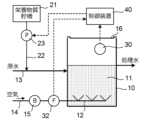
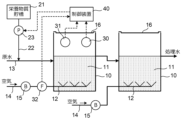
- FIG. 1 is a diagram showing a wastewater treatment device according to an embodiment. It is a figure showing the wastewater treatment device of another embodiment. It is a figure showing the wastewater treatment device of yet another embodiment. It is a figure showing the wastewater treatment device of yet another embodiment.
- the present invention relates to a technology that performs biological treatment using microorganisms on raw water, which is organic wastewater, to decompose and remove organic substances in the raw water.
- the organic wastewater to which the present invention is applicable is not particularly limited as long as it can be treated biologically, and examples include wastewater from public sewers, food factories, chemical factories, semiconductor manufacturing factories, and liquid crystal manufacturing factories. , wastewater discharged from various factories such as pulp and paper mills, and wastewater discharged from business establishments in other fields.
- wastewater from private factories tends to lack the nutrients necessary to maintain high decomposition activity of microorganisms used in biological treatment.
- wastewater from chemical factories, semiconductor manufacturing factories, and liquid crystal manufacturing factories is particularly lacking in nutritional substances.
- the present invention also covers wastewater to which an external organic source has been added when performing denitrification treatment by adding an external organic source such as methyl alcohol to inorganic nitrate wastewater (or inorganic nitrite wastewater) that does not contain organic matter. It is organic wastewater.
- the biological treatment in the present invention includes aerobic treatment, anaerobic treatment, denitrification treatment, etc., and these biological treatments include activated sludge method, membrane separation activated sludge method (MBR), biofilm treatment using fluidized bed or fixed bed. It is executed by the method or granule method.
- the BOD concentration or TOC concentration of the raw water is not directly measured, but rather the Measure the concentration of volatile organic compounds.
- the amount of nutrient substances added to the raw water is then controlled based on the measured concentration.
- the concentration of carbon dioxide in the gas released from the water in the reaction tank may be measured, and the amount of nutrient substances added to the raw water may be controlled based on the concentration of carbon dioxide.
- the organic matter concentration in the raw water for example, the BOD concentration value.
- the main control is to control the amount of nutrients added based on the calculated organic matter concentration, and when the volatile organic compound concentration increases, Control can be performed to increase the amount of nutritional substances added.
- the amount of nutrients added to the raw water may be controlled based on the measured concentration value and the measured flow rate, or the measured concentration value and the measured flow rate may be multiplied.
- the amount of nutrients added to the raw water may be controlled based on the calculated value.
- the quality of the water in the reaction tank for example, the pH, may be measured, and the amount of nutrients added to the raw water may be controlled based on the measured value of carbon dioxide concentration, measured value of flow rate, and measured value of water quality. .
- the water in the reaction tank is usually diffused or aerated by installing a blower to blow air into the reaction tank, so the flow rate of gas is The flow rate of air supplied from the blower to the reaction tank may be measured, or the total flow rate of gas discharged from the reaction tank may be measured.
- a screen is placed in the reaction tank to separate the carriers, and air is also blown in to clean the screen.
- the gas flow rate may be the sum of the air flow rate for screen cleaning. If the biological treatment is anaerobic treatment, the total flow rate of gas released from the reaction tank may be measured as the gas flow rate.
- FIG. 1 shows a wastewater treatment device according to one embodiment.
- the wastewater treatment apparatus shown in FIG. 1 includes a fluidized bed type reaction tank 10 that stores raw water, which is organic wastewater, and performs biological treatment of the raw water under aerobic conditions. Treated water in which organic matter has been decomposed and removed through biological treatment is discharged from the reaction tank 10 .
- the reaction tank 10 is filled with a carrier 11, and an aeration device 12 is provided at the bottom of the reaction tank 10 to blow air into the reaction tank 10 for supplying oxygen, that is, for aeration. .
- An inlet pipe 13 that supplies raw water to the reaction tank 10 is connected to the reaction tank 10 .
- a gas pipe 14 for supplying air to the air diffuser 12 is connected to the air diffuser 12, and the gas pipe 14 is provided with a blower 15 for air supply.
- the carrier 11 that can be used here include a plastic carrier, a sponge-like carrier, a gel-like carrier, and the like. Among these, it is preferable to use a sponge-like carrier from the viewpoint of cost and durability.
- a stirring device for stirring the carrier 11 may be provided in the reaction tank 10.
- the wastewater treatment device of this embodiment is provided with a nutrient storage tank 21 that stores a nutrient solution, that is, a nutrient solution, and the nutrient storage tank 21 and the inlet pipe 13 are connected via a nutrient solution pipe 22. .
- the nutrient solution piping 22 is provided with a pump 23 that supplies the nutrient solution.
- nutrients can be added to the raw water flowing through the inlet pipe 13 and supplied to the reaction tank 10, and the amount of nutrients added to the raw water can be controlled by controlling the pump 23.
- Nutrient substances can be broadly divided into nutrient salts containing nitrogen and phosphorus, and trace elements that are required in smaller amounts than nitrogen and phosphorus. Trace elements include alkali metals such as sodium, potassium, calcium and magnesium, metals such as iron, manganese and zinc, and the like.
- urea or ammonium salt can be used.
- phosphorus source phosphoric acid or phosphate salts can be used.
- the amount of nutrients added is controlled based on the concentration of volatile organic compounds contained in the gas released from the water in the reaction tank 10 by biological treatment. Therefore, the reaction tank 10 is provided with a VOC sensor 30 that detects the concentration of volatile organic compounds in the gas released from the water in the reaction tank 10. Assuming that the reaction tank 10 is covered with a lid 16, the VOC sensor 30 is installed in a gas phase part within the reaction tank 10, or in a pipe connected to this gas phase part. Since the VOC sensor 30 needs to avoid dew condensation, when installed inside a pipe, the pipe may be kept warm and a mist separator may be installed at a position immediately in front of the VOC sensor 30.
- the BOD volume load is 1.5 kg/L.
- hydrogen sulfide which would normally be generated under anaerobic conditions, is generated in the reaction tank 10. Since corrosive gas such as hydrogen sulfide may corrode the VOC sensor 30, it is necessary to remove the corrosive gas before performing measurement with the VOC sensor 30.
- a method for removing hydrogen sulfide for example, there is a method in which hydrogen sulfide is fixed as iron sulfide and removed by bringing the gas sent to the VOC sensor 30 into contact with iron oxide.
- the open part at the top of the reaction tank 10 should be made as small as possible, and cylindrical piping etc. should be inserted below the water surface.
- the VOC sensor 30 can be placed in the piping at a position above the water surface.
- an appropriate sensor can be selected depending on the type of volatile organic compound to be measured, and a sensor that measures the overall concentration of volatile organic compounds regardless of the type of volatile organic compound can also be used. .
- the gas pipe 14 is provided with an air flow meter 32 at a position between the blower 15 and the air diffuser 12 to measure the flow rate of air flowing therethrough. If the amount of air supplied by the blower 15 is constant or if the influence of fluctuations in the flow rate of diffused air is small, it is not necessary to provide the airflow meter 32, but the amount of added nutrients can be controlled more precisely. For this purpose, it is preferable to provide an air flow meter 32. Note that instead of providing the airflow meter 32 in the gas pipe 14 to measure the flow rate of air supplied to the reaction tank 10, the flow rate of gas released from the reaction tank 10 may be measured.
- an air flow meter 32 When measuring the flow rate of gas released from the reaction tank 10, when the reaction tank 10 is completely covered by the lid 16, a pipe connected to the inside of the reaction tank 10 is connected to discharge the gas to the outside. An air flow meter 32 may be installed. If the reaction tank 10 is an open system, in order to reduce the influence of outside air on the measurement results, the open part at the top of the reaction tank 10 should be made as small as possible, and cylindrical piping etc. should be inserted below the water surface. , an air flow meter 32 can be installed in the piping.
- the concentration of the volatile organic compound contained in the gas generated from the water in the reaction tank is measured, and the amount of the nutrient added is controlled based on the concentration of the volatile organic compound.
- the amount can be further optimized, and the amount of volatile organic compound emissions can be further reduced.
- This control is such that, for example, when the concentration of volatile organic compounds increases, the amount of nutrient substances added is increased, and when the concentration decreases, the amount of nutrient substances added is decreased.
- the amount of nutrients added may be temporarily reduced by a certain amount, and during that time the concentration of volatile organic compounds in the gas may be reduced.
- the amount of nutritional substances added can also be adjusted by checking whether the concentration of volatile organic compounds increases.
- Phosphorus and nitrogen in organic wastewater are taken in as nutrient sources for organisms in the reaction tank 10, so in biological treatment, organic wastewater is used as a phosphorus source to promote the growth of microorganisms and the decomposition of organic matter. It is added as a nutritional substance such as a nitrogen source.
- a nutritional substance such as a nitrogen source.
- Patent Document 2 when the concentration of soluble phosphorus in the water in the reaction tank 10 is high, the amount of surplus sludge generated due to the decomposition of organic matter increases. In order to reduce the amount of surplus sludge generated, it is preferable to maintain the soluble phosphorus concentration in the reaction tank 10 in a depleted state, specifically at 0.5 mg/L or less, and preferably at 0.1 mg/L or less. It is more preferable.
- the control device 40 when controlling the amount of the nutrient added, the control device 40 preferably determines the amount of the nutrient added so that the concentration of soluble phosphorus in the water in the reaction tank 10 is 0.5 mg/L or less. .
- FIG. 2 shows another embodiment of a wastewater treatment device.
- the wastewater treatment apparatus shown in FIG. 2 is the same as the wastewater treatment apparatus shown in FIG.
- the measurement results are also sent to the control device 40.
- the concentration of organic substances in raw water is estimated based on the carbon dioxide concentration measured by the carbon dioxide concentration sensor 31, and the amount of added nutrients is controlled based on this estimated value, and the amount of volatile organic substances Further increase or decrease the amount of nutritional substances added depending on the concentration.
- the carbon dioxide concentration sensor 31 for example, an optical type, an electrochemical type, or a semiconductor type can be used, but it is particularly preferable to use a sensor based on non-dispersive infrared absorption method (NDIR). Measurement of carbon dioxide concentration may be performed manually or online.
- NDIR non-dispersive infrared absorption method
- the carbon dioxide concentration sensor 31 is attached to the reaction tank 10 in the same manner as the VOC sensor 30.
- the carbon dioxide concentration sensor 31 also needs to be protected from condensation and corrosive gas, so when installing it inside piping, the piping should be kept warm, and a mist separator or corrosive A device for removing toxic gases may be installed.
- the amount of nutrient substances (i.e. nutrients and trace metals) added to raw water be proportional to the organic matter concentration, preferably the BOD concentration, in the raw water.
- the BOD concentration of the raw water is not measured using an online TOC concentration meter or the like, but instead the BOD concentration value of the raw water is determined from the carbon dioxide concentration in the gas released from the water in the reaction tank 10 by biological treatment.
- the amount of nutritional substances to be added is determined based on the calculated BOD concentration value.
- the volatile organic compound concentration measured by the carbon dioxide sensor 31 is taken as an input value (Xn)
- the BOD concentration of raw water corresponding to the input value (Xn) is taken as an output value (Yn)
- the model or relational expression
- the number of combinations obtained is, for example, from several tens to one hundred sets.
- the combination of the carbon dioxide concentration and the measured air volume is used as the input value (Xn), or the measured value of the carbon dioxide concentration is used as the input value (Xn).
- the input value (Xn) may be a value obtained by multiplying the value by the measured value of the air volume, that is, the multiplied value.
- the measured value of the carbon dioxide concentration measured by the carbon dioxide sensor 31 is input into the model, or the measured value of the carbon dioxide concentration measured by the carbon dioxide sensor 31 and the measured value of the carbon dioxide concentration measured by the air flow meter 32 are input into the model.
- the combination with the obtained airflow measurement value is input into the model, and based on the BOD concentration value output from the model as a result, the pump 23 is driven to determine whether or not nutrient substances are added to the raw water and the amount of addition. Control.
- the wastewater treatment device retains the created model and applies the carbon dioxide concentration value obtained by the carbon dioxide sensor 31 and the measured value obtained by the airflow meter 32 to the model.
- the control device 40 calculates the BOD concentration value of the raw water and controls the start/stop of the pump 23 and the flow rate based on the BOD concentration value.
- the BOD concentration is used to create the model, the created model itself uses the carbon dioxide concentration as input, or the measured value of carbon dioxide concentration and the measured value of airflow as input, and calculates the amount of added nutrients. It is thought that it outputs directly.
- the optimal amount of nutrients to be added can be calculated from the measured CO2 concentration or from the measured CO2 concentration and airflow without explicitly calculating the BOD concentration. can be determined.
- the optimum amount of nutrient substances to be added is determined based on the measured value of carbon dioxide concentration, and the addition of nutrient substances to raw water is controlled, and then volatile organic substances measured by the VOC sensor 30 are added.
- volatile organic substances measured by the VOC sensor 30 are added.
- the compound concentration increases, additional nutrients are added to the raw water, and when the increasing concentration of volatile organic compounds decreases, the additional nutrients added to the raw water are added. Decrease the amount added. This makes it possible to further optimize the amount of nutritional substances added and reduce the amount of volatile organic compounds released.
- a model that outputs the BOD concentration of raw water corresponding to an input value as an output value when an input value is input can be created using, for example, various regression analyses.
- creating a model through supervised learning using neural network technology improves the accuracy of controlling the amount of nutritional substances added.
- the volatile organic compound concentration obtained by the carbon dioxide sensor 31 may vary depending on the configuration and size of the reaction tank 10, the size of the gas phase in the reaction tank 10, the type of biological treatment, etc. Since the amount of air supplied to the reaction tank 10 also changes depending on the configuration and size of the reaction tank 10, the model may be set for each reaction tank 10.
- the relationship between the BOD concentration of raw water and the measured carbon dioxide concentration and air volume may vary depending on the type or source of raw water
- a model is prepared for each type or source of raw water, and It is also possible to select a model to be used for controlling the amount of nutritional substances added from among the prepared models depending on the type and source of the raw water.
- an online TOC concentration meter is a device that measures a small amount of sample water. It is equipped with a thin pipe to draw it into the air, so it is easily clogged and the measured values are unstable.
- the carbon dioxide sensor 31 performs measurement without contacting water, the stability of the measured values is very high.
- the gas flow rate can also be measured stably. Therefore, in the wastewater treatment apparatus of this embodiment, the optimum value of the amount of nutrient substances added to raw water can be stably determined without directly measuring the organic matter concentration in raw water.
- FIG. 3 shows yet another embodiment of a wastewater treatment device.
- the wastewater treatment apparatus shown in FIG. 3 is the wastewater treatment apparatus shown in FIG. It was designed so that The water quality items measured by the water quality measurement unit 33 include at least pH, and in addition to pH, water temperature and the like may also be measured.
- the model used in the wastewater treatment device of this embodiment is based on a combination of the volatile organic compound concentration, the carbon dioxide concentration measured by the carbon dioxide sensor 31, and the water quality (especially pH) value measured by the water quality measurement unit 33.
- the output value (Yn) is the BOD concentration of raw water corresponding to the input value (Xn), and is created in the same manner as described above.
- the pH value is preferably used.
- the measured value of the air volume obtained by the air flow meter 32 may be combined as input (Xn) if necessary.
- the control device 40 calculates the BOD concentration value of the raw water by applying the carbon dioxide concentration measured by the carbon dioxide concentration sensor 31 and the water quality (especially pH) value measured by the water quality measurement unit 33 to the model, and calculates the BOD concentration value of the raw water.
- the pump 23 is controlled based on the concentration value. If necessary, the control device 40 may calculate the BOD concentration value of the raw water by applying values to the air volume obtained by the air flow meter 32 to the model in addition to the values of the carbon dioxide concentration and water quality.
- the control device 40 controls the amount of nutritional substances to be added to increase.
- the pump 23 is controlled so that when the volatile organic compound concentration that has been rising falls, the amount of the additionally added nutrient substance is reduced.
- inorganic carbonic acid in water changes its form into free carbonic acid (CO 2 ), bicarbonate ion (HCO 3 ⁇ ), and carbonate ion (CO 3 2 ⁇ ) depending on the pH. Therefore, even if the organic matter concentration in the raw water is the same, the carbon dioxide concentration in the gas released from the water in the reaction tank 10 may change depending on the pH.
- the amount of nutrients added is controlled by taking into account the pH of the water in the reaction tank 10, so the amount of nutrients added can be optimized regardless of the pH of the raw water. .
- the solubility of carbon dioxide in water depends on the water temperature, and if the solubility of carbon dioxide changes, the concentration of carbon dioxide in the gas released from the water in the reaction tank 10 also changes. Therefore, if there is a change in water temperature in the reaction tank 10, the water quality measurement section 33 measures the water temperature in addition to the pH, and adds nutrients based on the water temperature as well as the volatile organic compound concentration, carbon dioxide concentration, and pH. The amount can also be controlled.
- FIG. 4 shows a wastewater treatment device that performs wastewater treatment by aerobic treatment similar to those shown in FIGS. 1 and 2, and in which a plurality of reaction tanks 10 are arranged in series, that is, in multiple stages. ing.
- the reaction tanks 10 are provided in multiple stages of two or more stages, the concentration of volatile organic compounds in the gas emitted from the reaction tank 10 at the frontmost stage is measured, and the concentration of volatile organic compounds in the gas emitted from the reaction tank is measured.
- the BOD concentration value of the raw water is calculated, and based on the BOD concentration value, the amount of nutrients added to the raw water supplied to the reaction tank can be controlled. Therefore, in the wastewater treatment apparatus shown in FIG. 4, the VOC sensor 30, carbon dioxide concentration sensor 31, and airflow meter 32 are provided only in the reaction tank 10 at the frontmost stage, and the nutrient solution from the nutrient storage tank 21 is It is added to the raw water in the inlet pipe 13 connected to the reaction tank 10.
- the control device 40 calculates the BOD concentration value of the raw water from the measured values of the carbon dioxide concentration sensor 31 and the airflow meter 32, and controls the pump 23 that feeds the nutrient solution based on the BOD concentration value. Further, the control device 40 controls the amount of additional nutritional substance added based on the measured value of the VOC sensor 30, similarly to the second embodiment and the third embodiment.
- the BOD concentration in the raw water was approximately 900 mg/L, the nitrogen (N) concentration in the raw water was 2 mg/L or less, and the phosphorus (P) concentration was 0.1 mg or less.
- the BOD volume load when performing biological treatment is about 2.8 kg/m 3 /day, the water temperature is about 20 ° C., and the dissolved oxygen (DO) concentration of water in the reaction tank is 2 mg/L or more,
- the pH of the water in the reaction tank was 7.0 to 7.5. Air was supplied to the reaction tank at a flow rate of 10 L/min for aeration.
- Nitrogen (N), phosphorus (P), and trace metals are added as nutrients to raw water, and when the amounts of nitrogen and phosphorus added are changed, the gas released from the water in the reaction tank 10 is The concentration of volatile organic compounds was measured. Since acetone is generated as an intermediate metabolite in the biological treatment of isopropyl alcohol, the concentration of isopropyl alcohol and acetone were measured in measuring the concentration of volatile organic compounds. Under any conditions, the isopropyl alcohol concentration was 10 ppm or less and was hardly detected. Under the conditions described here, when the inside of the reaction tank 10 is in a steady state, the soluble phosphorus component contained in the water in the reaction tank 10 is considered to be in the form of phosphoric acid.
- Example 1 When phosphorus was added to the volume of raw water in the reaction tank 10 at 10.6 mg/L and biological treatment was performed, the acetone concentration in the gas released from the water in the reaction tank 10 was 10 ppm. When the phosphoric acid concentration of the water in the reaction tank 10, that is, the treated water, was measured when the inside of the reaction tank 10 was in a steady state, the phosphoric acid concentration in phosphoric acid was 2.5 mg/L as P. Ta.
- Example 2 When 3.4 mg/L of phosphorus was added to the volume of raw water in the reaction tank 10 and biological treatment was performed, the acetone concentration in the gas released from the water in the reaction tank 10 was 50 ppm. The phosphoric acid concentration of the treated water in steady state was 0.02 mg/L as P.
- Example 3 When 4.5 mg/L of phosphorus was added to the volume of raw water in the reaction tank 10 and biological treatment was performed, the acetone concentration in the gas released from the water in the reaction tank 10 was 10 ppm. When the phosphoric acid concentration of the treated water was measured in a steady state, it was 0.02 mg/L as P. In Example 3, it is possible to keep the concentration of volatile organic compounds in the gas discharged from the water in the reaction tank 10 low and to reduce the concentration of soluble phosphorus in the treated water without adding excessive phosphorus. did it. Table 1 summarizes the relationship between the concentration of phosphorus added to raw water and the concentration of acetone measured as a volatile organic compound in Examples 1 to 3.
- acetone is produced as an intermediate metabolite, but from the above results, when the biological treatment is not completed, that is, when the treatment is defective, acetone accumulates in the reaction tank 10, which causes It was found that this can be detected as an increase in acetone concentration in the gas phase. As the concentration of phosphorus added increases, the concentration of acetone also decreases, so the concentration of volatile organic compounds such as acetone released from the water in the reaction tank 10 is measured, and if this concentration tends to increase, By increasing the amount of nitrogen and phosphorus added, and reducing the amount added if the concentration tends to decrease, the amount of nutritional substances added can be kept to the minimum necessary, in other words, the amount of addition can be optimized. I know that I can do it.
Landscapes
- Life Sciences & Earth Sciences (AREA)
- Chemical & Material Sciences (AREA)
- Hydrology & Water Resources (AREA)
- Biodiversity & Conservation Biology (AREA)
- Microbiology (AREA)
- Engineering & Computer Science (AREA)
- Environmental & Geological Engineering (AREA)
- Water Supply & Treatment (AREA)
- Organic Chemistry (AREA)
- General Chemical & Material Sciences (AREA)
- Chemical Kinetics & Catalysis (AREA)
- Health & Medical Sciences (AREA)
- Molecular Biology (AREA)
- Purification Treatments By Anaerobic Or Anaerobic And Aerobic Bacteria Or Animals (AREA)
- Activated Sludge Processes (AREA)
Abstract
Description
まず、各実施例について共通の試験条件について説明する。容積が19Lであり上部が蓋で覆われている図1に示す一段の反応槽を使用し、有機性排水である原水の好気処理による生物処理を行った。好気性微生物を疎水性ポリウレタン樹脂からなるスポンジ担体に担持し、このようなスポンジ担体を、反応槽の容積に対して嵩体積として30%で反応槽に充填した。反応槽における滞留時間を8時間とした。原水として、半導体製造工場から排出される有機性排水を模するものとして、イソプロピルアルコール含有排水を使用した。原水におけるBOD濃度は約900mg/Lであり、原水中の窒素(N)濃度は2mg/L以下であり、リン(P)濃度は0.1mg以下であった。生物処理を行うときのBOD容積負荷は約2.8kg/m3/日であり、水温は約20℃であり、反応槽内の水の溶存酸素(DO)濃度は2mg/L以上であり、反応槽内の水のpHは7.0~7.5であった。散気のために反応槽に対し、10L/分の流量で空気を供給した。
反応槽10内の原水の容積に対してリンを10.6mg/Lとなるように添加し、生物処理を行わせたところ、反応槽10内の水から放出される気体におけるアセトン濃度は10ppmであり、反応槽10内が定常状態となったときに反応槽10内の水、すなわち処理水のリン酸濃度を測定したところ、リン酸におけるリン換算値として、2.5mg/L as Pであった。
反応槽10内の原水の容積に対してリンを3.4mg/Lとなるように添加し、生物処理を行わせたところ、反応槽10内の水から放出される気体におけるアセトン濃度は50ppmであり、定常状態での処理水のリン酸濃度は0.02mg/L as Pであった。
反応槽10内の原水の容積に対してリンを4.5mg/Lとなるように添加し、生物処理を行わせたところ、反応槽10内の水から放出される気体におけるアセトン濃度は10ppmであり、定常状態での処理水のリン酸濃度を測定したところ、0.02mg/L as Pであった。実施例3では、リンの過剰添加を行わずに、反応槽10内の水から排出される気体中の揮発性有機化合物濃度を低く保ち、かつ、処理水中の溶解性リン濃度を低下させることができた。表1は、実施例1~3における、原水に対するリンの添加濃度と揮発性有機化合物として測定されたアセトン濃度との関係をまとめたものである。

11 担体
12 散気装置
13 入口配管
14 気体配管
15 ブロワ
16 蓋
21 栄養物質貯槽
22 栄養液配管
23 ポンプ
30 VOCセンサ
31 二酸化炭素濃度センサ
32 風量計
33 水質測定部
40 制御装置
Claims (10)
- 反応槽において有機性排水である原水に対して生物処理を行う排水処理方法であって、
前記反応槽内の水から放出される気体における少なくとも揮発性有機化合物の濃度を測定する濃度測定工程と、
前記濃度測定工程において得られた濃度の測定値に基づいて前記原水への栄養物質の添加量を制御する制御工程と、
を有する排水処理方法。 - 前記濃度測定工程において揮発性有機化合物の濃度に加えて、前記反応槽内の水から放出される気体における二酸化炭素濃度も測定する、請求項1に記載の排水処理方法。
- 前記反応槽に供給される気体または前記反応槽から放出される気体の流量を測定する流量測定工程をさらに有し、
前記制御工程において、前記濃度測定工程において得られた濃度の測定値に加えて前記流量測定工程で得られた流量の測定値を使用して、前記原水への前記栄養物質の添加量を制御する、請求項1または2に記載の排水処理方法。 - 前記濃度測定工程において濃度が測定される揮発性有機化合物は、原水中に含まれる揮発性有機化合物、及び前記生物処理において中間代謝物として生成される揮発性有機化合物との少なくとも一方である、請求項1または2に記載の排水処理方法。
- 前記生物処理において前記反応槽中の溶解性リン濃度を0.5mg/L以下に維持する、請求項1または2に記載の排水処理方法。
- 複数の前記反応槽が直列に設けられる場合に、最前段の反応槽に対して前記濃度測定工程を実施し、前記制御工程において前記最前段の反応槽に供給される前記原水または前記最前段の反応槽内の前記原水に添加される前記栄養物質の添加量を制御する、請求項1または2に記載の排水処理方法。
- 有機性排水である原水の生物処理を行う反応槽と、
前記原水に栄養物質を添加する添加手段と、
前記反応槽内の水から放出される気体における少なくとも揮発性有機化合物の濃度を測定する濃度測定手段と、
前記濃度測定手段で得られた濃度の測定値とに基づいて、前記添加手段による前記栄養物質の添加量を制御する制御手段と、
を有する排水処理装置。 - 前記濃度測定手段は、揮発性有機化合物の濃度に加えて、前記反応槽内の水から放出される気体における二酸化炭素濃度も測定する、請求項7に記載の排水処理装置。
- 前記制御手段は、前記反応槽中の溶解性リン濃度を0.5mg/L以下に維持するように制御を行なう、請求項7または8に記載の排水処理装置。
- 複数の前記反応槽が直列に設けられ、
前記添加手段は最前段の反応槽に供給される前記原水または前記最前段の反応槽内の前記原水に前記栄養物質を添加し、
前記濃度測定手段は前記最前段の反応槽に対して設けられている、請求項7または8に記載の排水処理装置。
Priority Applications (2)
| Application Number | Priority Date | Filing Date | Title |
|---|---|---|---|
| US19/105,457 US20260001793A1 (en) | 2022-09-01 | 2023-07-20 | Wastewater treatment method and wastewater treatment apparatus |
| CN202380062155.5A CN119731126A (zh) | 2022-09-01 | 2023-07-20 | 排水处理方法以及排水处理装置 |
Applications Claiming Priority (2)
| Application Number | Priority Date | Filing Date | Title |
|---|---|---|---|
| JP2022138926A JP2024034583A (ja) | 2022-09-01 | 2022-09-01 | 排水処理方法及び排水処理装置 |
| JP2022-138926 | 2022-09-01 |
Publications (1)
| Publication Number | Publication Date |
|---|---|
| WO2024048112A1 true WO2024048112A1 (ja) | 2024-03-07 |
Family
ID=90099555
Family Applications (1)
| Application Number | Title | Priority Date | Filing Date |
|---|---|---|---|
| PCT/JP2023/026623 Ceased WO2024048112A1 (ja) | 2022-09-01 | 2023-07-20 | 排水処理方法及び排水処理装置 |
Country Status (5)
| Country | Link |
|---|---|
| US (1) | US20260001793A1 (ja) |
| JP (1) | JP2024034583A (ja) |
| CN (1) | CN119731126A (ja) |
| TW (1) | TW202417383A (ja) |
| WO (1) | WO2024048112A1 (ja) |
Citations (3)
| Publication number | Priority date | Publication date | Assignee | Title |
|---|---|---|---|---|
| JP2001047079A (ja) * | 1999-08-05 | 2001-02-20 | Toray Ind Inc | 水処理方法および水処理装置 |
| KR20140087278A (ko) * | 2012-12-28 | 2014-07-09 | 울산대학교 산학협력단 | 하수 및 폐수 처리 과정에서 발생하는 이산화탄소를 이용한 탄산 알칼리제 제조 및 그 활용방법 |
| JP2022042384A (ja) * | 2020-09-02 | 2022-03-14 | オルガノ株式会社 | 有機性排水の処理方法及び有機性排水の処理装置 |
Family Cites Families (4)
| Publication number | Priority date | Publication date | Assignee | Title |
|---|---|---|---|---|
| JP4249002B2 (ja) * | 2003-12-03 | 2009-04-02 | 倉敷紡績株式会社 | 排水の処理装置及び方法 |
| JP2006320894A (ja) * | 2005-04-20 | 2006-11-30 | Research Institute Of Tsukuba Biotech Ltd | バイオマス処理システム |
| JP7279400B2 (ja) * | 2019-02-21 | 2023-05-23 | 株式会社大林組 | 嫌気性通水システム、通水嫌気バイオシステム |
| CN115968357B (zh) * | 2020-09-02 | 2025-06-27 | 奥加诺株式会社 | 有机性排水的处理方法以及有机性排水的处理装置 |
-
2022
- 2022-09-01 JP JP2022138926A patent/JP2024034583A/ja active Pending
-
2023
- 2023-07-20 WO PCT/JP2023/026623 patent/WO2024048112A1/ja not_active Ceased
- 2023-07-20 US US19/105,457 patent/US20260001793A1/en active Pending
- 2023-07-20 CN CN202380062155.5A patent/CN119731126A/zh active Pending
- 2023-08-25 TW TW112131988A patent/TW202417383A/zh unknown
Patent Citations (3)
| Publication number | Priority date | Publication date | Assignee | Title |
|---|---|---|---|---|
| JP2001047079A (ja) * | 1999-08-05 | 2001-02-20 | Toray Ind Inc | 水処理方法および水処理装置 |
| KR20140087278A (ko) * | 2012-12-28 | 2014-07-09 | 울산대학교 산학협력단 | 하수 및 폐수 처리 과정에서 발생하는 이산화탄소를 이용한 탄산 알칼리제 제조 및 그 활용방법 |
| JP2022042384A (ja) * | 2020-09-02 | 2022-03-14 | オルガノ株式会社 | 有機性排水の処理方法及び有機性排水の処理装置 |
Also Published As
| Publication number | Publication date |
|---|---|
| US20260001793A1 (en) | 2026-01-01 |
| TW202417383A (zh) | 2024-05-01 |
| CN119731126A (zh) | 2025-03-28 |
| JP2024034583A (ja) | 2024-03-13 |
Similar Documents
| Publication | Publication Date | Title |
|---|---|---|
| JP7621179B2 (ja) | 運転指標の算出方法及び算出装置、生物処理方法並びに生物処理装置 | |
| Desloover et al. | Floc-based sequential partial nitritation and anammox at full scale with contrasting N2O emissions | |
| Elad et al. | Exploring the effects of intermittent aeration on the performance of nitrifying membrane-aerated biofilm reactors | |
| JP4304453B2 (ja) | 窒素除去システムの運転制御装置 | |
| KR20140063454A (ko) | 폐수 처리 방법 및 폐수 처리 장치 | |
| KR102041326B1 (ko) | 하모니서치 알고리즘을 이용한 활성슬러지 공정의 산소공급량 제어 시스템 | |
| CN106573807B (zh) | 曝气风量计算装置以及水处理系统 | |
| JP7653309B2 (ja) | 排水処理方法及び排水処理装置 | |
| JP7621180B2 (ja) | 排水処理方法及び排水処理装置 | |
| JP2009165958A (ja) | 曝気槽の処理状況判断方法とそれを用いた排水処理の制御システム | |
| JP3301428B2 (ja) | 廃水処理試験方法 | |
| Gomes et al. | Nutrient removal and emission of nitrous oxide and methane by a sequencing batch reactor treating wastewater with and without landfill leachate | |
| JP5159140B2 (ja) | 有機性廃棄物の処理方法および装置 | |
| WO2024048112A1 (ja) | 排水処理方法及び排水処理装置 | |
| CN111032581B (zh) | 水处理控制系统 | |
| US20250346513A1 (en) | Wastewater treatment method and wastewater treatment apparatus | |
| CN115340173B (zh) | 运转指标的计算方法及装置、排水处理方法及装置 | |
| JP3585905B2 (ja) | 活性汚泥の活性および廃水の分解性の試験方法 | |
| JP7641055B1 (ja) | 液性判定システム及び液性判定方法 | |
| JPH09229923A (ja) | 汚濁負荷量計 | |
| JP2024168088A (ja) | 異常検知装置、異常検知方法、有機物含有水の処理装置、及び有機物含有水の処理方法 | |
| JP2016007577A (ja) | 汚泥転換率取得方法および測定装置 | |
| Mazurek | Nitrous oxide emissions from deammonification process under different operation conditions. | |
| JP3731249B2 (ja) | 生物処理装置 | |
| Sibler | Enhanced Microbial Activity and Energy Conservation through Pneumatic Mixing in Sludge Systems |
Legal Events
| Date | Code | Title | Description |
|---|---|---|---|
| 121 | Ep: the epo has been informed by wipo that ep was designated in this application |
Ref document number: 23859881 Country of ref document: EP Kind code of ref document: A1 |
|
| WWE | Wipo information: entry into national phase |
Ref document number: 202380062155.5 Country of ref document: CN |
|
| WWP | Wipo information: published in national office |
Ref document number: 202380062155.5 Country of ref document: CN |
|
| NENP | Non-entry into the national phase |
Ref country code: DE |
|
| 122 | Ep: pct application non-entry in european phase |
Ref document number: 23859881 Country of ref document: EP Kind code of ref document: A1 |