WO2024043115A1 - アモルファスシリカ粒子分散液及びその製造方法 - Google Patents
アモルファスシリカ粒子分散液及びその製造方法 Download PDFInfo
- Publication number
- WO2024043115A1 WO2024043115A1 PCT/JP2023/029224 JP2023029224W WO2024043115A1 WO 2024043115 A1 WO2024043115 A1 WO 2024043115A1 JP 2023029224 W JP2023029224 W JP 2023029224W WO 2024043115 A1 WO2024043115 A1 WO 2024043115A1
- Authority
- WO
- WIPO (PCT)
- Prior art keywords
- particle dispersion
- silica particle
- silica particles
- dispersion according
- producing
- Prior art date
- Legal status (The legal status is an assumption and is not a legal conclusion. Google has not performed a legal analysis and makes no representation as to the accuracy of the status listed.)
- Ceased
Links
Images


Classifications
-
- C—CHEMISTRY; METALLURGY
- C01—INORGANIC CHEMISTRY
- C01B—NON-METALLIC ELEMENTS; COMPOUNDS THEREOF; METALLOIDS OR COMPOUNDS THEREOF NOT COVERED BY SUBCLASS C01C
- C01B33/00—Silicon; Compounds thereof
- C01B33/113—Silicon oxides; Hydrates thereof
- C01B33/12—Silica; Hydrates thereof, e.g. lepidoic silicic acid
- C01B33/14—Colloidal silica, e.g. dispersions, gels, sols
- C01B33/141—Preparation of hydrosols or aqueous dispersions
-
- C—CHEMISTRY; METALLURGY
- C01—INORGANIC CHEMISTRY
- C01B—NON-METALLIC ELEMENTS; COMPOUNDS THEREOF; METALLOIDS OR COMPOUNDS THEREOF NOT COVERED BY SUBCLASS C01C
- C01B33/00—Silicon; Compounds thereof
- C01B33/113—Silicon oxides; Hydrates thereof
- C01B33/12—Silica; Hydrates thereof, e.g. lepidoic silicic acid
- C01B33/18—Preparation of finely divided silica neither in sol nor in gel form; After-treatment thereof
-
- C—CHEMISTRY; METALLURGY
- C09—DYES; PAINTS; POLISHES; NATURAL RESINS; ADHESIVES; COMPOSITIONS NOT OTHERWISE PROVIDED FOR; APPLICATIONS OF MATERIALS NOT OTHERWISE PROVIDED FOR
- C09C—TREATMENT OF INORGANIC MATERIALS, OTHER THAN FIBROUS FILLERS, TO ENHANCE THEIR PIGMENTING OR FILLING PROPERTIES ; PREPARATION OF CARBON BLACK ; PREPARATION OF INORGANIC MATERIALS WHICH ARE NO SINGLE CHEMICAL COMPOUNDS AND WHICH ARE MAINLY USED AS PIGMENTS OR FILLERS
- C09C1/00—Treatment of specific inorganic materials other than fibrous fillers; Preparation of carbon black
- C09C1/28—Compounds of silicon
-
- C—CHEMISTRY; METALLURGY
- C09—DYES; PAINTS; POLISHES; NATURAL RESINS; ADHESIVES; COMPOSITIONS NOT OTHERWISE PROVIDED FOR; APPLICATIONS OF MATERIALS NOT OTHERWISE PROVIDED FOR
- C09D—COATING COMPOSITIONS, e.g. PAINTS, VARNISHES OR LACQUERS; FILLING PASTES; CHEMICAL PAINT OR INK REMOVERS; INKS; CORRECTING FLUIDS; WOODSTAINS; PASTES OR SOLIDS FOR COLOURING OR PRINTING; USE OF MATERIALS THEREFOR
- C09D17/00—Pigment pastes, e.g. for mixing in paints
Definitions
- the present invention relates to novel discotic amorphous silica particles, a dispersion of discotic amorphous silica particles, and a method for producing the same. More specifically, it is obtained from nano-sized disk-shaped amorphous silica particles, which could not be produced conventionally, and from a complex of quaternary ammonium and silicic acid condensate formed in a hydrophilic solvent at alkaline pH.
- the present invention relates to a silica particle dispersion liquid and a method for producing the same.
- Si-O-Si siloxane bonds
- sica nanosheet also simply referred to as “silica particle” in the present invention
- it is composed of a single silica layer to several silica nanosheets. It consists of layers and has a thickness of about 0.1 nm to several nm. These silica nanosheets are used in gas barrier films.
- Non-Patent Document 1 One method for producing silica nanosheets is to synthesize layered crystals and then peel off the crystal layers.
- a method is disclosed in which a layered compound intercalated with decyltrimethylammonium ions is delaminated in a pentane solvent under ultrasonic irradiation (Non-Patent Document 1).
- Patent Document 1 a method is disclosed in which layered siloxene is synthesized by mixing monocalcium silicon dioxide and concentrated hydrochloric acid, and the mixture is mixed and stirred with dimethyl sulfoxide.
- Non-Patent Document 3 a method has been reported in which dioctadecyldimethylammonium chloride and tetraethoxysilane are reacted and hollow disk particles or solid disk particles are obtained by firing.
- the nanosheets produced by these methods have a thickness close to that of a single layer, the shape of the layer in the plane direction is irregular and nonuniform, and the particle size is larger than 1 ⁇ m, making it difficult to disperse. There was a problem with dispersion stability when it was made into a liquid. Further, even if the particle size is 1 ⁇ m or less, the thickness is several tens of nanometers, so there is a problem that a dispersion cannot be obtained. Furthermore, when creating a nanocomposite using such nanosheets with a resin or the like, there is a problem in that the nanosheets are difficult to disperse uniformly, and there is a risk that the expected gas barrier performance etc. will not be achieved.
- the object of the present invention is to provide discotic amorphous silica particles having excellent dispersibility that has not been achieved conventionally. Furthermore, it is possible to use a complex of quaternary ammonium and silicic acid formed in a hydrophilic solvent at an alkaline pH without going through a delamination process that makes it difficult to obtain uniform single-layer exfoliated particles.
- An object of the present invention is to provide a silica particle dispersion containing the disk-shaped amorphous silica particles, and a method for producing the same.
- the present inventors have conducted extensive studies to solve the above problems, and have found that by using a complex of quaternary ammonium and silicic acid formed in a hydrophilic solvent at alkaline pH, a specific size can be achieved. It has been discovered that disc-shaped amorphous silica particles can be obtained, and the present invention has been completed.
- the average diameter is 30 nm or more and 1000 nm or less, and the average thickness is 0.1 nm or more and 3 nm or less, Disc-shaped amorphous silica particles.
- the disk-shaped amorphous silica particles according to [1] which have a single-layer structure or a two-layer structure.
- substituents R 1 to R 4 represent mutually independent alkyl groups having 1 to 16 carbon atoms, and an anion;
- the amine is an amine represented by formula (2): [Chemical 2]
- the substituents R 5 to R 7 each independently represent an alkyl group having 1 to 5 carbon atoms, an alkoxy group having 1 to 5 carbon atoms, or a hydrogen atom
- the silica particle dispersion according to [5] wherein when the anion is generated from an aqueous inorganic base solution, the inorganic base is sodium hydroxide, potassium hydroxide, or ammonia.
- the quaternary ammonium is represented by formula (1), in which at least two of the substituents R 1 to R 4 represent an alkyl group having 8 to 16 carbon atoms, and the remaining substituents represent an alkyl group having 1 to 7 carbon atoms.
- a method for producing a silica particle dispersion comprising: [11] In formula (1), at least two of the substituents R 1 to R 4 represent an alkyl group having 8 to 16 carbon atoms, and the remaining substituents represent an alkyl group having 1 to 7 carbon atoms, [10] A method for producing a silica particle dispersion according to .
- Step (a) is an amine represented by formula (2): [C4] The method for producing a silica particle dispersion according to any one of [10] to [12], which comprises adjusting the pH to alkaline by adding at least one of an inorganic base or an inorganic base.
- step (a) When step (a) is to adjust the pH to alkaline by adding an amine represented by formula (2), the concentration of the amine in the mixed solution of step (a) is 0.1 mmol/L or more and 50 mmol/L.
- step (a) When step (a) is to adjust the pH to alkaline by adding an inorganic base, the inorganic base in step (a) is sodium hydroxide, potassium hydroxide, or ammonia, and the inorganic base in the mixed solution
- the method for producing a silica particle dispersion according to [13] wherein the concentration of is 0.1 mmol/L or more and 50 mmol/L or less.
- step (b) is performed by stirring at room temperature to 100°C.
- step (c) is performed using an organic acid or a mineral acid.
- step (c) is performed by ultrafiltration, dialysis, or cation exchange.
- silica particles contained in the silica particle dispersion according to any one of [3] to [9] or silica particles contained in the silica particle dispersion obtained by the production method according to any one of [10] to [20] A method for producing disc-shaped amorphous silica particles, the method comprising heating at 300°C or more and less than 1000°C.
- LB Langmuir-Blodgett
- [3'] Disc-shaped amorphous silica particles according to [1'] or [2'], Quaternary ammonium represented by formula (1): [Chemical formula 1'] In formula (1), substituents R 1 to R 4 represent mutually independent alkyl groups having 1 to 16 carbon atoms, and an anion; A silica particle dispersion containing. [4'] The silica particle dispersion according to [3'], wherein the concentration of the discotic amorphous silica particles is 0.01% by mass or more and 1.0% by mass or less in terms of SiO 2 concentration.
- the quaternary ammonium is represented by formula (1), in which at least two of the substituents R 1 to R 4 represent an alkyl group having 8 to 16 carbon atoms, and the remaining substituents represent an alkyl group having 1 to 7 carbon atoms.
- a method for producing a silica particle dispersion comprising: [11'] In formula (1), at least two of the substituents R 1 to R 4 represent an alkyl group having 8 to 16 carbon atoms, and the remaining substituents represent an alkyl group having 1 to 7 carbon atoms, [10] A method for producing a silica particle dispersion according to . [12'] The method for producing a silica particle dispersion according to [10'] or [11'], wherein the concentration of quaternary ammonium in the mixed solution in step (a) is 0.1 mmol/L or more and 30 mmol/L or less.
- Step (a) is an amine represented by formula (2): [C4'] The method for producing a silica particle dispersion according to any one of [10'] to [12'], which comprises adjusting the pH to alkaline by adding at least one of an inorganic base or an inorganic base. [14'] When step (a) is to adjust the pH to alkaline by adding an amine represented by formula (2), the concentration of the amine in the mixed solution of step (a) is 0.1 mmol/L or more and 50 mmol/L. The method for producing a silica particle dispersion according to [13'] below.
- step (a) is to adjust the pH to alkaline by adding an inorganic base
- the inorganic base in step (a) is sodium hydroxide, potassium hydroxide, or ammonia
- the inorganic base in the mixed solution The method for producing a silica particle dispersion according to [13'], wherein the concentration of is 0.1 mmol/L or more and 50 mmol/L or less.
- step (b) is performed by stirring at room temperature to 100°C.
- step (c) is performed using an organic acid or a mineral acid.
- step (c) is performed by ultrafiltration, dialysis, or cation exchange.
- a method for producing disc-shaped amorphous silica particles which includes a step of heating the silica particles contained at a temperature of 300°C or more and less than 1000°C.
- [22'] A coating film produced using the disk-shaped amorphous silica particles according to [1'] or [2'] or the silica particle dispersion according to any one of [3'] to [9'].
- [23'] A Langmuir-Blodgett (LB) membrane produced using the disk-shaped amorphous silica particles according to [1'] or [2'] or the silica particle dispersion according to any one of [3'] to [9'] .
- LB Langmuir-Blodgett
- a self-supporting membrane produced using the disc-shaped amorphous silica particles according to [1'] or [2'] or the silica particle dispersion according to any one of [3'] to [9'].
- [25'] A gas barrier film produced using the disk-shaped amorphous silica particles according to [1'] or [2'] or the silica particle dispersion according to any one of [3'] to
- the present invention uses a complex of quaternary ammonium and silicic acid formed in a hydrophilic solvent at an alkaline pH without exfoliation treatment of layered silicic acid, thereby achieving a diameter of 1 ⁇ m or less.
- Disc-shaped amorphous silica particles having an average thickness of 3 nm or less, a silica particle dispersion containing the disc-shaped amorphous silica particles, and a method for producing the same can be provided.
- the discoidal amorphous silica particles have high dispersion stability, they have the effect of being difficult to form sediment in the dispersion liquid.
- various films can be formed by producing a film-forming composition using the discotic amorphous silica particles or silica particle dispersion. Further, the amorphous silica particles contained in the dispersion can be used to provide a Langmuir-Blodgett (LB) film, a coated film, and a self-supporting film.
- LB Langmuir-Blodgett
- silica particles of the present invention The production process of silica particles of the present invention is shown. Dehydration condensation of silicic acid proceeds around structures (micelles, vesicles, etc.) formed by quaternary ammonium ions in a solvent, producing a complex of quaternary ammonium ions and silicic acid. Thereafter, silica particles are obtained by removing quaternary ammonium ions from the composite.
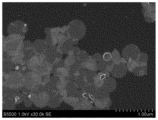
- a SEM image of silica particles produced in Example 1 is shown.
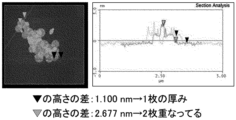
- the results of AFM analysis of the silica particles produced in Example 1 are shown.
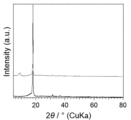
- the results of X-ray diffraction measurement of the silica particles produced in Example 1 are shown.
- FT-IR analysis results of silica particles produced in Example 1 are shown.
- the present invention The average diameter is 30 nm or more and 1000 nm or less, and the average thickness is 0.1 nm or more and 3 nm or less, They are disk-shaped amorphous silica particles.
- the present invention The average diameter is 100 nm or more and 1000 nm or less, and the average thickness is 0.1 nm or more and 3 nm or less, It may also be discoidal amorphous silica particles.
- the disk-shaped amorphous silica particles are flaky (plate-shaped) amorphous silica particles having a circular shape.
- the term "disc-shaped” refers to a shape in which the difference between the average major axis of the silica particles and the average width perpendicular to the longest major axis is small.
- particles whose ratio of average length to average width (average length/average width) is 0.7 or more and 1.3 or less are referred to as "disc-shaped particles.”
- the average major axis of the discoidal particles is referred to as the "average diameter.”
- the discoidal amorphous silica particles have an average diameter of 30 nm or more and 1000 nm or less, and an average thickness of 0.1 nm or more and 3 nm or less.
- the shape and average major axis of amorphous silica particles can be observed using a scanning electron microscope or a transmission electron microscope.
- the disc-shaped amorphous silica particles may have an average diameter of 100 nm or more and 1000 nm or less, and an average thickness of 0.1 nm or more and 3 nm or less.
- the shape and average major axis of amorphous silica particles can be observed using a scanning electron microscope or a transmission electron microscope.
- the average thickness of the amorphous silica particles can be observed using a scanning probe microscope or an atomic force microscope.
- a Langmuir-Blodgett (LB) film prepared as a base material by the Langmuir-Blodgett method can also be used for observation.
- disk-shaped amorphous silica particles Compared to rectangular silica nanosheets, disk-shaped amorphous silica particles have a uniform layer shape in the plane direction, so they have excellent dispersion stability in a dispersion liquid. Furthermore, since the influence of variations in the orientation of particles during film formation is small, a more uniform film can be expected to be formed. Furthermore, it is thought to be resistant to deformation when stress is applied.
- the discotic amorphous silica particles of the present invention have an average diameter of 30 nm or more and 1000 nm or less.
- the average diameter is 30 nm or more and 600 nm or less. More preferably, the average diameter is 30 nm or more and 300 nm or less.
- the size of the silica particles influences the dispersibility in the dispersion liquid, and when the average diameter of the discoidal amorphous silica particles is 1000 nm or less, the dispersibility is excellent.
- the discotic amorphous silica particles of the present invention may have an average diameter of 100 nm or more and 1000 nm or less.
- the average diameter may be 100 nm or more and 600 nm or less. More preferably, the average diameter may be 100 nm or more and 300 nm or less.
- the size of the silica particles influences the dispersibility in the dispersion liquid, and when the average diameter of the discoidal amorphous silica particles is 1000 nm or less, the dispersibility is excellent.
- the disk-shaped amorphous silica particles of the present invention have an average thickness of 0.1 nm or more and 3 nm or less.
- the average thickness is 0.1 nm or more and 2 nm or less.
- the average thickness of the silica particles influences the transparency and dispersibility of the dispersion liquid, and when the average thickness of the discoidal amorphous silica particles is 3 nm or less, the transparency and dispersibility of the dispersion liquid are excellent.
- the visibility of the film is excellent, so when used, for example, in a gas barrier film, it is possible to stack thin films of disk-shaped amorphous silica particles, resulting in a higher Demonstrates barrier function.
- the discotic amorphous silica particles of the present invention may have a single-layer structure or a two-layer structure.
- the reason why the disk-shaped amorphous silica particles have a single-layer structure or a double-layer structure is that the disk-shaped amorphous silica particles are sufficiently thin, and as described above, the dispersion liquid has excellent transparency and dispersibility, and can be formed.
- the membrane also has excellent functionality. Whether the disk-shaped amorphous silica particles have a single-layer structure or a two-layer structure can be confirmed by observation using a scanning probe microscope and an atomic force microscope.
- silica particle dispersion disk-shaped amorphous silica particles, Quaternary ammonium represented by formula (1):
- substituents R 1 to R 4 represent mutually independent alkyl groups having 1 to 16 carbon atoms, and an anion;
- the silica particles contained in the silica particle dispersion of the present invention are the aforementioned disk-shaped amorphous silica particles, and their size is such that the average diameter is 30 nm or more and 1000 nm or less, and the average thickness is 0.1 nm or more and 3 nm or less. It is.
- the silica particles contained in the silica particle dispersion of the present invention are the aforementioned disk-shaped amorphous silica particles, and their size is such that the average diameter is 100 nm or more and 1000 nm or less, and the average thickness is 0.1 nm or more and 3 nm or less. It may be.
- the concentration of the discotic amorphous silica particles contained in the silica particle dispersion of the present invention may be 0.01% by mass or more and 1.0% by mass or less in terms of SiO 2 concentration.
- the concentration in terms of SiO 2 can be calculated by a calcination method.
- the concentration of the discotic amorphous silica particles contained in the silica particle dispersion of the present invention may be 0.01% by mass or more and 5.0% by mass or less in terms of SiO 2 concentration.
- the concentration in terms of SiO 2 can be calculated by a calcination method.
- the concentration of the discotic amorphous silica particles contained in the silica particle dispersion of the present invention may be 0.01% by mass or more and 30.0% by mass or less in terms of SiO 2 .
- the concentration in terms of SiO 2 can be calculated by a calcination method.
- the silica particle dispersion of the present invention contains quaternary ammonium represented by formula (1).
- substituents R 1 to R 4 represent mutually independent alkyl groups having 1 to 16 carbon atoms.
- alkyl group examples include methyl group, ethyl group, propyl group, propyl group, butyl group, pentyl group, hexyl group, heptyl group, octyl group, nonyl group, decyl group, undecyl group, dodecyl group, tridecyl group, and tetradecyl group. group, pentadecyl group, and hexadecyl group.
- Substituents R 1 to R 4 may be the same or different.
- Examples of such quaternary ammonium include dioctyldimethylammonium ion, dioctyldiethylammonium ion, dioctyldipropylammonium ion, dioctyldibutylammonium ion, dioctyldipentylammonium ion, dioctyldihexylammonium ion, dioctyldiheptylammonium ion, dinonyldimethyl Ammonium ion, dinonyldiethylammonium ion, dinonyldipropylammonium ion, dinonyldibutylammonium ion, dinonyldipentylammonium ion, dinonyldihexylammonium ion, dinonyldiheptylammonium ion, dinonyldimethylammoni
- the quaternary ammonium in formula (1), at least two of the substituents R 1 to R 4 represent an alkyl group having 8 to 16 carbon atoms, and the remaining substituents are carbon atoms. It may also represent one to seven alkyl groups.
- the quaternary ammonium functions as a template in the process of producing discotic amorphous silica particles, and the quaternary ammonium allows discotic amorphous silica particles that can exhibit good dispersibility to be obtained.
- the concentration of the quaternary ammonium may be 0.1 mmol/L or more and 30 mmol/L or less. When the concentration of the quaternary ammonium is 0.1 mmol/L or more and 30 mmol/L or less, good dispersibility can be exhibited.
- the quaternary ammonium functions as a template in the process of producing disk-shaped amorphous silica particles, and a portion of the quaternary ammonium may be removed in the finally obtained dispersion. That is, the concentration of the quaternary ammonium may be preferably 0.1 mmol/L or more and 20 mmol/L or less, and more preferably 0.1 mmol/L or more and 10 mmol/L or less.
- the quaternary ammonium mentioned above can be derived from a halide.
- the halides include chlorides, bromides, iodides, and the like.
- the silica particle dispersion of the present invention contains an anion.
- the anion may originate from at least one of an aqueous amine solution or an aqueous inorganic base solution.
- the anion can generate hydroxide ions in the medium.
- carbonate ions and halogen ions may be included as anions in addition to hydroxide ions.
- halogen ions include chloride ions, bromide ions, and iodine ions.
- the amine when the anion originates from an aqueous amine solution, the amine may be an amine represented by formula (2).
- substituents R 5 to R 7 each independently represent an alkyl group having 1 to 5 carbon atoms, an alkoxy group having 1 to 5 carbon atoms, or a hydrogen atom.
- Examples of the above amines include tertiary amines, secondary amines, tertiary alkanolamines, secondary alkanolamines, and primary alkanolamines.
- tertiary amine examples include trimethylamine, triethylamine, tripropylamine, tributylamine, tripentylamine, dimethylethylamine, dimethylpropylamine, dimethylbutylamine, dimethylpentylamine, diethylmethylamine, diethylpropylamine, diethylbutylamine, Diethylpentylamine, dipropylmethylamine, dipropylethylamine, dipropylbutylamine, dipropylpentylamine, dibutylmethylamine, dibutylethylamine, dibutylpropylamine, dibutylpentylamine, dipentylmethylamine, dipentylethylamine, dipropylbutylamine, dipropyl Examples include pentylamine.
- Examples of the secondary amine include ethyl n-propylamine, ethyl isopropylamine, dipropylamine, diisopropylamine, ethylbutylamine, n-propylbutylamine, dibutylamine, ethylpentylamine, n-propylpentylamine, isopropylpentylamine, dipentyl Examples include amine, ethyloctylamine, i-propyloctylamine, butyloctylamine, dioctylamine, and the like.
- Examples of the above-mentioned primary amine include methylamine, ethylamine, n-propylamine, isopropylamine, butylamine, pentylamine, octylamine, and the like.
- examples of the above-mentioned tertiary alkanolamine include trimethanolamine, triethanolamine, tripropanolamine, tributanolamine, tripentanolamine, dimethylethanolamine, dimethylpropanolamine, dimethylbutanolamine, dimethylpentanol Amine, diethylmethanolamine, diethylpropanolamine, diethylbutanolamine, diethylpentanolamine, dipropylmethanolamine, dipropylethanolamine, dipropylbutanolamine, dipropylpentanolamine, dibutylmethanolamine, dibutylethanolamine, dibutylpropanol Examples include amine, dibutylpentanolamine, dipentylmethanolamine, dipentylethanolamine, dipropylbutanolamine, and dipropylpentanolamine.
- Examples of the secondary alkanolamine include dimethanolamine, diethanolamine, dipropanolamine, dibutanolamine, dipentanolamine, monomethanolamine, methylpropanolamine, methylbutanolamine, methylpentanolamine, Ethylmethanolamine, ethylpropanolamine, ethylbutanolamine, ethylpentanolamine, propylmethanolamine, propylethanolamine, propylbutanolamine, propylpentanolamine, butylmethanolamine, butylethanolamine, butylpropanolamine, butylpentanolamine , pentylmethanolamine, pentylethanolamine, propylbutanolamine, propylpentanolamine, and the like.
- Examples of the primary alkanolamine include methanolamine, ethanolamine, propanolamine, butanolamine, pentanolamine, pentanolamine, and the like.
- the inorganic base may be, for example, sodium hydroxide, potassium hydroxide, or ammonia.
- the amine aqueous solution or inorganic base aqueous solution is a solution using a liquid medium of water, an organic solvent, or a mixture thereof.
- organic solvent at least one or two or more selected from the group consisting of alcohols, ketones, ethers, esters, hydrocarbons, and nitrogen-containing organic compounds can be used.
- these organic solvents include alcohols such as methanol, ethanol, propanol, butanol, and isopropyl alcohol, ketones such as methyl ethyl ketone, methyl isobutyl ketone, and ⁇ -butyllactone, ethylene glycol monomethyl ether, propylene glycol monomethyl ether, and propylene.
- Ethers such as glycol monoethyl ether, esters such as ethyl acetate, butyl acetate, hydrocarbons such as toluene, xylene, n-pentane, n-hexane, cyclohexane, N,N-dimethylformamide, N-methylpyrrolidone, etc.
- Nitrogen-containing organic compounds and the like can be mentioned. These may be used alone or in combination of two or more.
- a method for producing a silica particle dispersion comprising:
- Step (a) is a step of mixing quaternary ammonium represented by formula (1) and a hydrophilic solvent at alkaline pH.
- the mixed solution obtained in step (a) is a solution containing quaternary ammonium.
- step (b) described below when silicic acid is added to the mixed solution, micelles etc. formed by quaternary ammonium as a surfactant are used as a template to self-organize silicic acid into a layered form. be able to.
- step (a) the quaternary ammonium is formed by formula (1) in which at least two of the substituents R 1 to R 4 represent an alkyl group having 8 to 16 carbon atoms, and the remaining substituents represent a carbon atom group. Those having an alkyl group of number 1 to 7 can be used. Quaternary ammonium functions as a template when self-organizing silicic acid into layers, and by adopting the above structure, the size of the silica particles contained in the silica particle dispersion finally obtained is appropriate. be able to.
- the concentration of quaternary ammonium in the mixed solution in step (a) can be 0.1 mmol/L or more and 30 mmol/L or less. By setting the concentration of quaternary ammonium within this range, the quaternary ammonium can function appropriately as a template when self-organizing silicic acid into layers, resulting in good dispersion in the final silica particle dispersion. can express sexuality.
- step (a) is performed at an alkaline pH
- the pH of the mixed solution may be adjusted to alkaline.
- the pH of the hydrophilic solvent may be made alkaline in advance, or the pH may be made alkaline at the same time when quaternary ammonium and the hydrophilic solvent are mixed; After mixing ammonium and a hydrophilic solvent, the pH of the mixed solution may be made alkaline.
- step (a) comprises an amine represented by formula (2): Alternatively, it may include adjusting the pH to alkaline by adding at least one kind of inorganic base.
- step (a) is to adjust the pH to alkaline by adding an amine represented by formula (2)
- concentration of the amine in the mixed solution of step (a) is 0.1 mmol/L or more and 50 mmol/L. It can be:
- step (a) is to adjust the pH to alkaline by adding an inorganic base
- the inorganic base in step (a) may be sodium hydroxide, potassium hydroxide, or ammonia;
- the concentration of the inorganic base can be set to 0.1 mmol/L or more and 50 mmol/L or less.
- the pH of the mixed solution in step (a) can be adjusted to alkaline.
- Step (b) is a step of adding silicic acid to the mixed solution obtained in step (a) and condensing the silicic acid in the mixed solution.
- the silicic acid is present as silicate ions in the mixed solution.
- a silicate ion is an ion represented by an anion of (SiO 4 )nH 2 O, which dissociates in an alkaline solution to produce Si—O 2 ⁇ .
- Silicate ions can be self-assembled into a layer using micelles and the like formed by quaternary ammonium in the mixed solution as a surfactant as a template.
- Silicate ions self-organized into layers form a sheet structure with a siloxane bond (Si--O--Si) as a skeleton by dehydration condensation.
- the silicic acid can be produced by a known method.
- a hydrolyzate of silicon alkoxide or an aqueous alkali silicate solution from which cations have been removed can be used.
- silicon alkoxide examples include tetraethoxysilane and tetramethoxysilane.
- silicic acid can be obtained by reacting tetraethoxysilane with water and hydrolyzing it by a known method.
- alkali silicate aqueous solution examples include a sodium silicate aqueous solution (water glass), a potassium silicate aqueous solution, a lithium silicate aqueous solution, and the like.
- aqueous sodium silicate solution an aqueous solution obtained by dissolving anhydrous sodium silicate in water obtained by a known method can be used.
- sodium silicate aqueous solution and H-type cation exchange resin can be brought into contact to remove sodium ions.
- the above-mentioned contact can be carried out in a batch system or a column system, and industrially, a method can be used in which an ion exchange tower is filled with a cation exchange resin and an aqueous alkali silicate solution is passed therethrough.
- the liquid passing rate is 1 to 30 in space velocity (L/hr), and the temperature can be 10 to 80°C.
- the cation exchange resin include a sulfonic acid type H-type strongly acidic cation exchange resin or a carboxylic acid type H-type weakly acidic cation exchange resin, and preferably a sulfonic acid type H-type weakly acidic cation exchange resin. can be adjusted to H-type and used.
- sulfonic acid type strongly acidic cation exchange resin examples include Amberlite (registered trademark) IR-120B manufactured by Organo Co., Ltd.
- aqueous alkali silicate solution can be a commercially available product, and can be obtained from, for example, Tokuyama Co., Ltd., Aichi Soso Kogyo Co., Ltd., Oriental Silica Corporation, etc.
- the orthosilicate ion (SiO 4 4- ) having a tetrahedral structure, but the orthosilicate ion may have a chain, ring, layer, or cage structure. It may be a three-dimensional condensed structure.
- the silicic acid is a hydrolyzate of tetraethoxysilane or a cation-removed product of an aqueous sodium silicate solution. That is, preferably, the silicon alkoxide is tetraethoxysilane. Further, preferably, the alkali silicate aqueous solution is a sodium silicate aqueous solution.
- step (b) can be performed by stirring the mixed solution at room temperature to 100°C.
- the stirring temperature may preferably be 40-80°C, more preferably 55-65°C.
- the stirring time may be from 3 to 12 hours, preferably from 4 to 8 hours.
- Step (c) is a step of adjusting the pH of the mixed solution to acidic and then removing the quaternary ammonium.
- the sheet structure with siloxane bonds (Si-O-Si) as a skeleton is exfoliated, and disc-shaped amorphous silica particles can be obtained, and silica particle dispersion containing disc-shaped amorphous silica particles can be obtained. liquid can be obtained.
- the pH of the mixed solution in step (c) can be adjusted using an organic acid or a mineral acid.
- Acidic pH is 1-7.
- the organic acid is not particularly limited as long as the pH can be adjusted to acidic, but carboxylic acids that dissolve in hydrophilic solvents are preferred.
- Examples of organic acids include formic acid, acetic acid, citric acid, and oxalic acid.
- Examples of mineral acids include hydrochloric acid, nitric acid, phosphoric acid, sulfuric acid, and boric acid.
- Examples of methods for removing quaternary ammonium in step (c) include ultrafiltration, dialysis, and cation exchange.
- the concentration of quaternary ammonium in the finally obtained silica particle dispersion is 0.1 mmol/L or more and 30 mmol/L or less, Preferably it is 0.1 mmol/L or more and 15 mmol/L or less, more preferably 0.1 mmol/L or more and 5 mmol/L or less.
- the present invention provides a method for producing discotic amorphous silica particles using the above-described silica particle dispersion or the silica particle dispersion obtained by the above-described production method.
- the present invention is a method for producing disc-shaped amorphous silica particles, which includes a step of heating silica particles contained in a silica particle dispersion at a temperature of 300°C or more and less than 1000°C.
- the silica particle dispersion after removing the solvent contained in the silica particle dispersion, it can be heated in an electric furnace or a firing furnace in a temperature range of 300°C or more and less than 1000°C.
- the temperature range may preferably be 300°C or more and less than 800°C, more preferably 300°C or more and less than 600°C.
- the solvent removal step can be performed by a known method such as an evaporation method.
- a composition for film formation, a coating film, a Langmuir-Blodgett (LB) film, a self-supporting film, a gas barrier film, etc. can be produced using discotic amorphous silica particles and a silica particle dispersion.
- These film-forming compositions, coating films, Langmuir-Blodgett (LB) films, self-supporting films, gas barrier films, etc. contain the aforementioned disc-shaped amorphous silica particles, so when the film is produced, it has excellent visibility. It can be expected to have properties (light transmittance) and prevent the permeation of arbitrary gases such as water vapor (gas barrier properties).
- a film-forming composition prepared using the discotic amorphous silica particles and the silica particle dispersion of the present invention comprises a group consisting of the discotic amorphous silica particles, a thermosetting resin, a thermoplastic resin, and an ultraviolet curing resin.
- This is a composition containing at least one resin selected from the following.
- acrylic resin acrylic resin, melamine resin, urethane resin, polyester resin, epoxy resin, phosphagen resin, etc. are used.
- the component ratio of the discotic amorphous silica particles and the resin in the film-forming composition is not particularly limited, but for example, the resin may be in a mass ratio of 25 to 400 parts by mass with respect to 100 parts by mass of the discotic amorphous silica particles. can be included.
- the film-forming composition can contain a curing catalyst (curing agent) to promote the curing reaction.
- a curing catalyst for example, at least one selected from the group consisting of amino acids, metal alkoxides, metal chelate compounds, organic acid metal salts, perchloric acids or salts thereof, acids or salts thereof, and metal chlorides. It is a type of curing catalyst.
- concentration of the total solid content in the film-forming composition can be, for example, 1.0% by mass to 50% by mass.
- the coating film produced using the discotic amorphous silica particles and silica particle dispersion of the present invention may be any film produced on a substrate using the discotic amorphous silica particles, and the coating film may be any coating film produced using the discotic amorphous silica particles and the silica particle dispersion.
- This is a coating film in which a forming composition is applied onto a substrate.
- Various base materials such as glass, plastic, silicon wafer, etc. are used as the base material.
- a method for coating the surface of the base material commonly used methods such as a dipping method, a spin method, and a spray method can be used. Among them, the dipping method and the spin method are particularly preferable from the viewpoint of surface area.
- the Langmuir-Blodgett (LB) film produced using the disc-shaped amorphous silica particles and the silica particle dispersion of the present invention is a Langmuir-Blodgett (LB) film produced using the disc-shaped amorphous silica particles of the present invention on a substrate by the Langmuir-Blodgett (LB) method. It may be a monomolecular film produced on a substrate by the Langmuir-Blodgett (LB) method using the dispersion liquid or the film-forming composition.
- a film produced by the Langmuir-Blodgett (LB) method is produced by, for example, dropping a silica dispersion containing disk-shaped amorphous silica particles onto a silicon wafer substrate and spin-coating it onto the silicon wafer at the same time as the solvent evaporates. It can be made.
- the self-supporting film produced using the discotic amorphous silica particles and silica particle dispersion of the present invention may be any film produced using the discotic amorphous silica particles, and the dispersion or the film-forming composition This is a self-supporting membrane made using materials.
- a self-supporting membrane refers to a membrane that can stand on its own without requiring a support material such as a base material.
- a film formed by applying the silica particle dispersion or film-forming composition to a base material, removing the solvent, and then performing a curing treatment can be produced by peeling the film from the base material.
- the discotic amorphous silica particles and silica particle dispersion of the present invention a film having excellent light transmittance and gas barrier properties as described above can be obtained. Therefore, the film can be used, for example, in products that require visibility and protection from water vapor, such as food wrap and cover tape for semiconductor electronic components.
- Example 1 Put 120 g of pure water in a 200 mL glass flask, and add 0.8 g of didodecyldimethylammonium bromide (manufactured by Tokyo Chemical Industry Co., Ltd., purity 98%) and 0.21 g of triethanolamine (manufactured by Fuji Film Wako Pure Chemical Industries, Ltd., purity 98%). In addition, the mixture was stirred for 1 hour while maintaining the temperature at 60° C. using a Shinflex to prepare a reaction solution.
- the obtained silica particle dispersion was diluted 300 times with ethanol, 10 ⁇ L was dropped onto a silicon wafer (manufactured by As One Corporation) using a dropper, the rotation speed was increased to 2000 rpm over 5 seconds, and spin coating was performed for 25 seconds. An observation sample was created. When the obtained sample was observed by SEM, disc-shaped silica particles were confirmed, and the average diameter was 500 nm. Furthermore, AFM analysis revealed that the average thickness of the silica particles was 1 nm (see FIGS. 2 and 3).
- silica particle laminated film 10 mL of the obtained silica particle dispersion was suction-filtered through a membrane filter (manufactured by Merck Co., Ltd., 0.1 ⁇ m diameter) to produce a silica particle laminated film on the filter.
- a membrane filter manufactured by Merck Co., Ltd., 0.1 ⁇ m diameter
- the obtained silica particle dispersion was heated and dried on a petri dish, and the FT-IR spectrum of the obtained white powder was measured. An absorption band originating from the stretching vibration of the Si--O--Si bond was confirmed near 1050 cm -1 (see FIG. 5).
- Example 2 A silica particle dispersion was prepared under the same conditions as in Example 1, except that the amount of tetraethoxysilane was changed to 0.6 g, which is 5 times that in Example 1.
- Example 2 SEM observation using the same procedure as in Example 1 confirmed that in addition to disc-shaped silica particles with a diameter of 500 nm as in Example 1, spherical particles with an average particle diameter of 20 nm were also produced as by-products. Further, AFM analysis showed that the average thickness of the silica particles was 1 nm.
- Example 3 Same conditions as Example 1 except that the amount of tetraethoxysilane was changed to 0.6 g, which is 5 times that of Example 1, and the amount of triethanolamine was changed to 0.84 g, which is 4 times that of Example 1. A silica particle dispersion was prepared.
- Example 2 SEM observation using the same procedure as in Example 1 confirmed disc-shaped silica particles, with an average diameter of 200 nm. Further, AFM analysis showed that the average thickness of the silica particles was 1 nm.
- Example 4 A silica particle dispersion was prepared under the same conditions as in Example 1, except that the amount of didodecyldimethylammonium bromide was changed to 0.016 g, which is 0.02 times that of Example 1.
- Example 2 SEM observation using the same procedure as in Example 1 confirmed disc-shaped silica particles, with an average diameter of 500 nm. Further, AFM analysis showed that the average thickness of the silica particles was 1 nm.
- Example 5 A silica particle dispersion was prepared under the same conditions as in Example 1, except that the amount of didodecyldimethylammonium bromide was changed to 1.2 g, which is 1.5 times that of Example 1.
- Example 2 SEM observation using the same procedure as in Example 1 confirmed disc-shaped silica particles, with an average diameter of 500 nm. Further, AFM analysis showed that the average thickness of the silica particles was 1 nm.
- Example 6 A silica particle dispersion was prepared under the same conditions as in Example 1, except that the amount of triethanolamine was changed to 0.84 g, which is 4 times that in Example 1.
- Example 7 Except that the amount of didodecyl dimethyl ammonium bromide was changed to 0.6 g, which is 0.75 times that of Example 1, and 0.35 g of didecyl dimethyl ammonium bromide (manufactured by Tokyo Chemical Industry Co., Ltd., purity 98%) was further added.
- a silica particle dispersion was prepared under the same conditions as in Example 1.
- Example 2 SEM observation using the same procedure as in Example 1 confirmed disc-shaped silica particles, with an average diameter of 150 nm. Further, AFM analysis showed that the average thickness of the silica particles was 1 nm.
- Example 8 Except that the amount of didodecyl dimethyl ammonium bromide was changed to 0.4 g, which is 0.5 times that of Example 1, and 0.18 g of didecyl dimethyl ammonium bromide (manufactured by Tokyo Chemical Industry Co., Ltd., purity 98%) was further added.
- a silica particle dispersion was prepared under the same conditions as in Example 1.
- Example 2 SEM observation using the same procedure as in Example 1 confirmed disc-shaped silica particles, with an average diameter of 50 nm. Further, AFM analysis showed that the average thickness of the silica particles was 1 nm.
- Example 9 1,700 g of pure water and 16 g of didodecyldimethylammonium bromide (manufactured by Tokyo Chemical Industry Co., Ltd., purity 98%) were placed in a 3L glass flask, and stirred for 1 hour while maintaining the liquid temperature at 80°C in an oil bath to prepare a reaction solution. .
- silicic acid aqueous solution (cations removed from an alkali silicate aqueous solution with an ion exchange resin, SiO 2 concentration is 3.4% by mass) and triethanolamine (Fujifilm Wako Pure Chemical Industries, Ltd.)
- a silicic acid solution was prepared by adding 4.2 g (manufactured by a company with a purity of 98%) and 700 g of pure water and stirring for 1 hour using a magnetic stirrer.
- the silicic acid solution was added dropwise to the reaction solution over 120 minutes while maintaining the liquid temperature at 80°C, and the mixture was further stirred in an oil bath for 6 hours while maintaining the liquid temperature at 80°C to form a dispersion of the silica particle-surfactant complex. was prepared.
- Example 2 SEM observation using the same procedure as in Example 1 confirmed disc-shaped silica particles, with an average diameter of 100 nm. Further, AFM analysis showed that the average thickness of the silica particles was 1 nm.
- Example 10 Put 2,400 g of pure water, 80 g of didodecyldimethylammonium bromide (manufactured by Tokyo Chemical Industry Co., Ltd., purity 98%) and 4.2 g of triethanolamine (manufactured by Fujifilm Wako Pure Chemical Industries, Ltd., purity 98%) in a 3L glass flask, and add oil. The mixture was stirred for 1 hour while maintaining the liquid temperature at 80°C in a bath to prepare a reaction solution.
- tetraethoxysilane manufactured by Kishida Chemical Co., Ltd., purity 99%
- a dispersion of the agent complex was prepared.
- a cleaning solution was prepared by mixing a 2M acetic acid aqueous solution and ethanol at a volume ratio of 1:1. After mixing 1 L of the cleaning liquid and 1 L of the dispersion liquid, the mixture was filtered under pressure using an ultrafiltration device (molecular weight cut off: 200,000, polyamide membrane filter).
- Example 2 SEM observation using the same procedure as in Example 1 confirmed disc-shaped silica particles, with an average diameter of 100 nm. Further, AFM analysis showed that the average thickness of the silica particles was 1 nm.
- Example 1 was carried out under the same conditions as in Example 1 except that triethanolamine was not added. When SEM observation was performed in the same manner as in Example 1, no disk-shaped silica particles were observed, and the particles were found to be aggregates of spherical silica.
- the discotic amorphous silica particles and silica particle dispersion of the present invention have a remarkable technical effect of excellent dispersibility, which could not be achieved with conventional silica nanosheets. Furthermore, when the discotic amorphous silica particles and the silica particle dispersion of the present invention are applied to a substrate, they form a thin film of discotic amorphous silica particles with a uniform thickness, and can be used for gas barrier films and the like. Therefore, the present invention has high applicability in various industrial fields that utilize silica particles, gas barrier films, etc., such as various manufacturing industries including the chemical industry, daily necessities industry, and food industry.
Landscapes
- Chemical & Material Sciences (AREA)
- Organic Chemistry (AREA)
- Inorganic Chemistry (AREA)
- Life Sciences & Earth Sciences (AREA)
- Engineering & Computer Science (AREA)
- Materials Engineering (AREA)
- Wood Science & Technology (AREA)
- Dispersion Chemistry (AREA)
- Silicon Compounds (AREA)
Abstract
優れた分散性を有する円盤状アモルファスシリカ粒子を提供することを目的とする。均一な単層剥離粒子を得るのが困難な層間剥離処理を介さずに、アルカリ性のpHにて、親水性溶媒中で形成した第4級アンモニウムとケイ酸との複合体を用いることで、円盤状アモルファスシリカ粒子を含むシリカ粒子分散液、及びその製造方法を提供することを目的とする。上記目的は下記シリカ粒子分散液により達成される: 平均直径が30nm以上1000nm以下であり、及び平均厚さが0.1nm以上3nm以下である、円盤状アモルファスシリカ粒子。円盤状アモルファスシリカ粒子、式(1)で表される第4級アンモニウム:式(1)中、置換基R1~R4は互いに独立した炭素原子数1~16のアルキル基を示す、及びアニオン、を含む、シリカ粒子分散液。
Description
本発明は、新規な円盤状アモルファスシリカ粒子及び円盤状アモルファスシリカ粒子の分散液、並びにその製造方法に関する。より具体的には、従来なし得なかったナノサイズの円盤状アモルファスシリカ粒子、及びアルカリ性のpHにて、親水性溶媒中で形成した第4級アンモニウムとケイ酸縮合物との複合体から得られたシリカ粒子分散液、並びにその製造方法に関する。
Si原子がシロキサン結合(Si-O-Si)を通じて平面構造を構築したシート状の構造体は「シリカナノシート」と呼ばれ(本発明において、単に「シリカ粒子」とも称する)、シリカ単層~数層からなり、厚さが0.1nm~数nm程度の厚みを有する。これらシリカナノシートはガスバリア膜に利用されている。
シリカナノシートの製造方法としては、層状結晶を合成後、結晶層間を剥離させる方法があり、具体的には、Na型オクトシリケートの層間に、第4級アンモニウムイオンとしてジデシルジメチルアンモニウムイオンや、ヘキサデシルトリメチルアンモニウムイオンをインターカレーションした層状化合物を、ペンタン溶剤中で超音波照射下に層間剥離を行う方法が開示されている(非特許文献1)。
また、二酸化ケイ素一カルシウムと濃塩酸とを混合して層状シロキセンを合成し、ジメチルスルホキシドと混合撹拌する方法が開示されている(特許文献1)。
これらの方法に対し、工程の簡略化等を目的として、ケイ酸を層状に配列させ、重縮合及び剥離により直接シリカナノシートを得る方法が研究されている。当該方法としては、セチルトリメチルアンモニウムブロミド及び非イオン性界面活性剤を用いて界面活性剤-シリカ層状複合体を合成し、これを利用してシリカナノシートを作製する方法が報告されている(特許文献2及び非特許文献2)。
また、ジオクタデシルジメチルアンモニウムクロリドとテトラエトキシシランを反応させて、焼成により中空ディスク粒子や中実ディスク粒子を得る方法が報告されている(非特許文献3)。
しかし、これらの方法で作製されたナノシートは、単層に近い厚さを有するものであっても、層の面方向の形状が不定形かつ不均一であり、粒子径が1μmより大きいため、分散液とした場合の分散安定性に課題があった。また、粒子径が1μm以下であっても、厚さが数十nmあるため分散液を得られないという課題があった。さらに、このようなナノシートを用いて樹脂等と複合化させたナノコンポジットを作製する場合、ナノシートが均一分散しにくいという課題があり、期待されるガスバリア性能等が発現しないおそれがあった。
Shimon Osada et al., "Exfoliation of Layered Octosilicate by Simple Cation Exchange with Didecyldimethylammonium Ions", Chemistry Letters, 2013, Vo.42, p.80-82
公益社団法人日本セラミックス協会 第34回秋季シンポジウム 講演予稿集 "界面活性剤-シリカ層状複合体からのアモルファスシリカナノシートの単層剥離"藤原康輔、山本瑛祐、小林亮、長田実
Shingo Machida et al., "Well-defined plate and hollow disk shaped particles of silica dialkyldimethylammonium hybrids", Journal of Colloid and Interface Science, 2014, Vol.420, p.66-69
本発明は上記の課題を解決するためになされたものである。すなわち、従来なし得なかった優れた分散性を有する円盤状アモルファスシリカ粒子を提供することを目的とする。さらには、均一な単層剥離粒子を得るのが困難な層間剥離処理を介さずに、アルカリ性のpHにて、親水性溶媒中で形成した第4級アンモニウムとケイ酸との複合体を用いることで、前記円盤状アモルファスシリカ粒子を含むシリカ粒子分散液、及びその製造方法を提供することを目的とする。
本発明者らは上記課題を解決すべく鋭意検討を重ねた結果、アルカリ性のpHにて、親水性溶媒中で形成した第4級アンモニウムとケイ酸との複合体を用いることで、特定のサイズの円盤状アモルファスシリカ粒子を得られることを見出し、本発明の完成に至った。
すなわち、以下に限定されないが、本発明及び諸態様は以下の[1]~[26]である。
[1]
平均直径が30nm以上1000nm以下であり、及び
平均厚さが0.1nm以上3nm以下である、
円盤状アモルファスシリカ粒子。
[2]
単層構造又は二層構造である、[1]に記載の円盤状アモルファスシリカ粒子。
[3]
[1]又は[2]に記載の円盤状アモルファスシリカ粒子、
式(1)で表される第4級アンモニウム:
[化1]
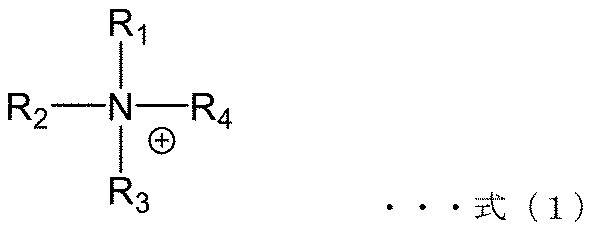
式(1)中、置換基R1~R4は互いに独立した炭素原子数1~16のアルキル基を示す、及び
アニオン、
を含む、シリカ粒子分散液。
[4]
前記円盤状アモルファスシリカ粒子の濃度が、SiO2換算濃度で0.01質量%以上30.0質量%以下である、請求項3に記載のシリカ粒子分散液。
[5]
前記アニオンが、アミン水性溶液又は無機塩基水性溶液の少なくともどちらか1種から生じる、[3]又は[4]に記載のシリカ粒子分散液。
[6]
前記アニオンがアミン水性溶液から生じる場合、アミンが、式(2)で表されるアミン:
[化2]

式(2)中、置換基R5~R7は互いに独立した炭素原子数1~5のアルキル基、炭素原子数1~5のアルコキシ基、又は水素原子を示す、
である、[5]に記載のシリカ粒子分散液。
[7]
前記アニオンが無機塩基水性溶液から生じる場合、無機塩基が、水酸化ナトリウム、水酸化カリウム、又はアンモニアである、[5]に記載のシリカ粒子分散液。
[8]
前記第4級アンモニウムが、式(1)中、置換基R1~R4のうち、少なくとも2つが炭素原子数8~16のアルキル基を示し、残りの置換基が炭素数1~7のアルキル基を示す、[3]~[7]のいずれかに記載のシリカ粒子分散液。
[9]
前記第4級アンモニウムの濃度が、0.1mmol/L以上30mmol/L以下である、[3]~[8]のいずれかに記載のシリカ粒子分散液。
[10]
工程(a):アルカリ性のpHにて、式(1)で表される第4級アンモニウム:

と親水性溶媒とを混合する工程、
工程(b):前記混合溶液中でケイ酸を縮合する工程、及び
工程(c):pHを酸性に調整後、前記第4級アンモニウムを除去する工程、
を含む、シリカ粒子分散液の製造方法。
[11]
式(1)中、置換基R1~R4のうち、少なくとも2つが炭素原子数8~16のアルキル基を示し、残りの置換基が炭素数1~7のアルキル基を示す、[10]に記載のシリカ粒子分散液の製造方法。
[12]
工程(a)の混合溶液中の第4級アンモニウムの濃度が0.1mmol/L以上30mmol/L以下である、[10]又は[11]に記載のシリカ粒子分散液の製造方法。
[13]
工程(a)が、式(2)で表されるアミン:
[化4]
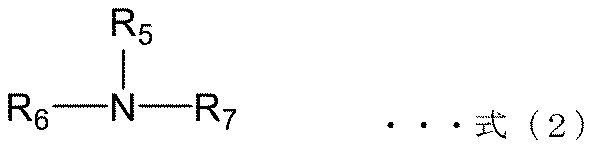
又は無機塩基の少なくともどちらか1種を添加してpHをアルカリ性に調整することを含む、[10]~[12]のいずれかに記載のシリカ粒子分散液の製造方法。
[14]
工程(a)が、式(2)で表されるアミンを添加してpHをアルカリ性に調整する場合、工程(a)の混合溶液中の前記アミンの濃度が0.1mmol/L以上50mmol/L以下である、[13]に記載のシリカ粒子分散液の製造方法。
[15]
工程(a)が、無機塩基を添加してpHをアルカリ性に調整する場合、工程(a)の前記無機塩基が、水酸化ナトリウム、水酸化カリウム、又はアンモニアであり、混合溶液中の前記無機塩基の濃度が0.1mmol/L以上50mmol/L以下である、[13]に記載のシリカ粒子分散液の製造方法。
[16]
工程(b)のケイ酸が、シリコンアルコキシドの加水分解物、又はケイ酸アルカリ水溶液の陽イオン除去物である、[10]~[15]のいずれかに記載のシリカ粒子分散液の製造方法。
[17]
前記ケイ酸が、テトラエトキシシランの加水分解物、又はケイ酸ナトリウム水溶液の陽イオン除去物である、[16]に記載のシリカ粒子分散液の製造方法。
[18]
工程(b)が、室温~100℃にて攪拌することにより行われる、[10]~[17]のいずれかに記載のシリカ粒子分散液の製造方法。
[19]
工程(c)におけるpHの調整が、有機酸又は鉱酸を用いて行われる、[10]~[18]のいずれかに記載のシリカ粒子分散液の製造方法。
[20]
工程(c)における前記第4級アンモニウムの除去が、限外ろ過、透析、陽イオン交換により行われる、[10]~[19]のいずれかに記載のシリカ粒子分散液の製造方法。
[21]
[3]~[9]のいずれかに記載のシリカ粒子分散液に含まれるシリカ粒子又は[10]~[20]のいずれかに記載の製造方法により得られるシリカ粒子分散液に含まれるシリカ粒子を、300℃以上1000℃未満で加熱する工程含む、円盤状アモルファスシリカ粒子の製造方法。
[22]
[1]若しくは[2]に記載の円盤状アモルファスシリカ粒子又は[3]~[9]のいずれかに記載のシリカ粒子分散液を用いて作製された膜形成用組成物。
[23]
[1]若しくは[2]に記載の円盤状アモルファスシリカ粒子又は[3]~[9]のいずれかに記載のシリカ粒子分散液を用いて作製された塗布膜。
[24]
[1]若しくは[2]に記載の円盤状アモルファスシリカ粒子又は[3]~[9]のいずれかに記載のシリカ粒子分散液を用いて作製されたLangmuir-Blodgett(LB)膜。
[25]
[1]若しくは[2]に記載の円盤状アモルファスシリカ粒子又は[3]~[9]のいずれかに記載のシリカ粒子分散液を用いて作製された自立膜。
[26]
[1]若しくは[2]に記載の円盤状アモルファスシリカ粒子又は[3]~[9]のいずれかに記載のシリカ粒子分散液を用いて作製されたガスバリア膜。
また、本発明及び諸態様は以下の[1’]~[25’]であってもよい。
[1’]
平均直径が100nm以上1000nm以下であり、及び
平均厚さが0.1nm以上3nm以下である、
円盤状アモルファスシリカ粒子。
[2’]
単層構造又は二層構造である、[1’]に記載の円盤状アモルファスシリカ粒子。
[3’]
[1’]又は[2’]に記載の円盤状アモルファスシリカ粒子、
式(1)で表される第4級アンモニウム:
[化1’]

式(1)中、置換基R1~R4は互いに独立した炭素原子数1~16のアルキル基を示す、及び
アニオン、
を含む、シリカ粒子分散液。
[4’]
前記円盤状アモルファスシリカ粒子の濃度が、SiO2換算濃度で0.01質量%以上1.0質量%以下である、[3’]に記載のシリカ粒子分散液。
[5’]
前記アニオンが、アミン水性溶液又は無機塩基水性溶液の少なくともどちらか1種から生じる、[3’]又は[4’]に記載のシリカ粒子分散液。
[6’]
前記アニオンがアミン水性溶液から生じる場合、アミンが、式(2)で表されるアミン:
[化2’]
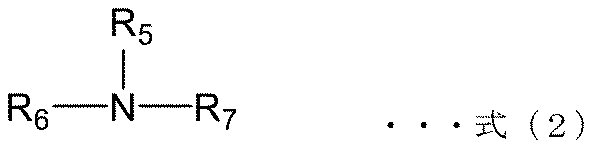
式(2)中、置換基R5~R7は互いに独立した炭素原子数1~5のアルキル基、炭素原子数1~5のアルコキシ基、又は水素原子を示す、
である、[5’]に記載のシリカ粒子分散液。
[7’]
前記アニオンが無機塩基水性溶液から生じる場合、無機塩基が、水酸化ナトリウム、水酸化カリウム、又はアンモニアである、[5’]に記載のシリカ粒子分散液。
[8’]
前記第4級アンモニウムが、式(1)中、置換基R1~R4のうち、少なくとも2つが炭素原子数8~16のアルキル基を示し、残りの置換基が炭素数1~7のアルキル基を示す、[3’]~[7’]のいずれかに記載のシリカ粒子分散液。
[9’]
前記第4級アンモニウムの濃度が、0.1mmol/L以上30mmol/L以下である、[3’]~[8’]のいずれかに記載のシリカ粒子分散液。
[10’]
工程(a):アルカリ性のpHにて、式(1)で表される第4級アンモニウム:
[化3’]

と親水性溶媒とを混合する工程、
工程(b):前記混合溶液中でケイ酸を縮合する工程、及び
工程(c):pHを酸性に調整後、前記第4級アンモニウムを除去する工程、
を含む、シリカ粒子分散液の製造方法。
[11’]
式(1)中、置換基R1~R4のうち、少なくとも2つが炭素原子数8~16のアルキル基を示し、残りの置換基が炭素数1~7のアルキル基を示す、[10]に記載のシリカ粒子分散液の製造方法。
[12’]
工程(a)の混合溶液中の第4級アンモニウムの濃度が0.1mmol/L以上30mmol/L以下である、[10’]又は[11’]に記載のシリカ粒子分散液の製造方法。
[13’]
工程(a)が、式(2)で表されるアミン:
[化4’]
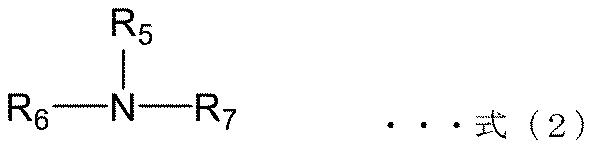
又は無機塩基の少なくともどちらか1種を添加してpHをアルカリ性に調整することを含む、[10’]~[12’]のいずれかに記載のシリカ粒子分散液の製造方法。
[14’]
工程(a)が、式(2)で表されるアミンを添加してpHをアルカリ性に調整する場合、工程(a)の混合溶液中の前記アミンの濃度が0.1mmol/L以上50mmol/L以下である、[13’]に記載のシリカ粒子分散液の製造方法。
[15’]
工程(a)が、無機塩基を添加してpHをアルカリ性に調整する場合、工程(a)の前記無機塩基が、水酸化ナトリウム、水酸化カリウム、又はアンモニアであり、混合溶液中の前記無機塩基の濃度が0.1mmol/L以上50mmol/L以下である、[13’]に記載のシリカ粒子分散液の製造方法。
[16’]
工程(b)のケイ酸が、シリコンアルコキシドの加水分解物、又はケイ酸アルカリ水溶液の陽イオンを除去したものである、[10’]~[15’]のいずれかに記載のシリカ粒子分散液の製造方法。
[17’]
工程(b)が、室温~100℃にて攪拌することにより行われる、[10’]~[16’]のいずれかに記載のシリカ粒子分散液の製造方法。
[18’]
工程(c)におけるpHの調整が、有機酸又は鉱酸を用いて行われる、[10’]~[17’]のいずれかに記載のシリカ粒子分散液の製造方法。
[19’]
工程(c)における前記第4級アンモニウムの除去が、限外ろ過、透析、陽イオン交換により行われる、[10’]~[18’]のいずれかに記載のシリカ粒子分散液の製造方法。
[20’]
[3’]~[9’]のいずれかに記載のシリカ粒子分散液に含まれるシリカ粒子又は[10’]~[19’]のいずれかに記載の製造方法により得られるシリカ粒子分散液に含まれるシリカ粒子を、300℃以上1000℃未満で加熱する工程含む、円盤状アモルファスシリカ粒子の製造方法。
[21’]
[1’]若しくは[2’]に記載の円盤状アモルファスシリカ粒子又は[3’]~[9’]のいずれかに記載のシリカ粒子分散液を用いて作製された膜形成用組成物。
[22’]
[1’]若しくは[2’]に記載の円盤状アモルファスシリカ粒子又は[3’]~[9’]のいずれかに記載のシリカ粒子分散液を用いて作製された塗布膜。
[23’]
[1’]若しくは[2’]に記載の円盤状アモルファスシリカ粒子又は[3’]~[9’]のいずれかに記載のシリカ粒子分散液を用いて作製されたLangmuir-Blodgett(LB)膜。
[24’]
[1’]若しくは[2’]に記載の円盤状アモルファスシリカ粒子又は[3’]~[9’]のいずれかに記載のシリカ粒子分散液を用いて作製された自立膜。
[25’]
[1’]若しくは[2’]に記載の円盤状アモルファスシリカ粒子又は[3’]~[9’]のいずれかに記載のシリカ粒子分散液を用いて作製されたガスバリア膜。
[1]
平均直径が30nm以上1000nm以下であり、及び
平均厚さが0.1nm以上3nm以下である、
円盤状アモルファスシリカ粒子。
[2]
単層構造又は二層構造である、[1]に記載の円盤状アモルファスシリカ粒子。
[3]
[1]又は[2]に記載の円盤状アモルファスシリカ粒子、
式(1)で表される第4級アンモニウム:
[化1]
式(1)中、置換基R1~R4は互いに独立した炭素原子数1~16のアルキル基を示す、及び
アニオン、
を含む、シリカ粒子分散液。
[4]
前記円盤状アモルファスシリカ粒子の濃度が、SiO2換算濃度で0.01質量%以上30.0質量%以下である、請求項3に記載のシリカ粒子分散液。
[5]
前記アニオンが、アミン水性溶液又は無機塩基水性溶液の少なくともどちらか1種から生じる、[3]又は[4]に記載のシリカ粒子分散液。
[6]
前記アニオンがアミン水性溶液から生じる場合、アミンが、式(2)で表されるアミン:
[化2]
式(2)中、置換基R5~R7は互いに独立した炭素原子数1~5のアルキル基、炭素原子数1~5のアルコキシ基、又は水素原子を示す、
である、[5]に記載のシリカ粒子分散液。
[7]
前記アニオンが無機塩基水性溶液から生じる場合、無機塩基が、水酸化ナトリウム、水酸化カリウム、又はアンモニアである、[5]に記載のシリカ粒子分散液。
[8]
前記第4級アンモニウムが、式(1)中、置換基R1~R4のうち、少なくとも2つが炭素原子数8~16のアルキル基を示し、残りの置換基が炭素数1~7のアルキル基を示す、[3]~[7]のいずれかに記載のシリカ粒子分散液。
[9]
前記第4級アンモニウムの濃度が、0.1mmol/L以上30mmol/L以下である、[3]~[8]のいずれかに記載のシリカ粒子分散液。
[10]
工程(a):アルカリ性のpHにて、式(1)で表される第4級アンモニウム:
と親水性溶媒とを混合する工程、
工程(b):前記混合溶液中でケイ酸を縮合する工程、及び
工程(c):pHを酸性に調整後、前記第4級アンモニウムを除去する工程、
を含む、シリカ粒子分散液の製造方法。
[11]
式(1)中、置換基R1~R4のうち、少なくとも2つが炭素原子数8~16のアルキル基を示し、残りの置換基が炭素数1~7のアルキル基を示す、[10]に記載のシリカ粒子分散液の製造方法。
[12]
工程(a)の混合溶液中の第4級アンモニウムの濃度が0.1mmol/L以上30mmol/L以下である、[10]又は[11]に記載のシリカ粒子分散液の製造方法。
[13]
工程(a)が、式(2)で表されるアミン:
[化4]
又は無機塩基の少なくともどちらか1種を添加してpHをアルカリ性に調整することを含む、[10]~[12]のいずれかに記載のシリカ粒子分散液の製造方法。
[14]
工程(a)が、式(2)で表されるアミンを添加してpHをアルカリ性に調整する場合、工程(a)の混合溶液中の前記アミンの濃度が0.1mmol/L以上50mmol/L以下である、[13]に記載のシリカ粒子分散液の製造方法。
[15]
工程(a)が、無機塩基を添加してpHをアルカリ性に調整する場合、工程(a)の前記無機塩基が、水酸化ナトリウム、水酸化カリウム、又はアンモニアであり、混合溶液中の前記無機塩基の濃度が0.1mmol/L以上50mmol/L以下である、[13]に記載のシリカ粒子分散液の製造方法。
[16]
工程(b)のケイ酸が、シリコンアルコキシドの加水分解物、又はケイ酸アルカリ水溶液の陽イオン除去物である、[10]~[15]のいずれかに記載のシリカ粒子分散液の製造方法。
[17]
前記ケイ酸が、テトラエトキシシランの加水分解物、又はケイ酸ナトリウム水溶液の陽イオン除去物である、[16]に記載のシリカ粒子分散液の製造方法。
[18]
工程(b)が、室温~100℃にて攪拌することにより行われる、[10]~[17]のいずれかに記載のシリカ粒子分散液の製造方法。
[19]
工程(c)におけるpHの調整が、有機酸又は鉱酸を用いて行われる、[10]~[18]のいずれかに記載のシリカ粒子分散液の製造方法。
[20]
工程(c)における前記第4級アンモニウムの除去が、限外ろ過、透析、陽イオン交換により行われる、[10]~[19]のいずれかに記載のシリカ粒子分散液の製造方法。
[21]
[3]~[9]のいずれかに記載のシリカ粒子分散液に含まれるシリカ粒子又は[10]~[20]のいずれかに記載の製造方法により得られるシリカ粒子分散液に含まれるシリカ粒子を、300℃以上1000℃未満で加熱する工程含む、円盤状アモルファスシリカ粒子の製造方法。
[22]
[1]若しくは[2]に記載の円盤状アモルファスシリカ粒子又は[3]~[9]のいずれかに記載のシリカ粒子分散液を用いて作製された膜形成用組成物。
[23]
[1]若しくは[2]に記載の円盤状アモルファスシリカ粒子又は[3]~[9]のいずれかに記載のシリカ粒子分散液を用いて作製された塗布膜。
[24]
[1]若しくは[2]に記載の円盤状アモルファスシリカ粒子又は[3]~[9]のいずれかに記載のシリカ粒子分散液を用いて作製されたLangmuir-Blodgett(LB)膜。
[25]
[1]若しくは[2]に記載の円盤状アモルファスシリカ粒子又は[3]~[9]のいずれかに記載のシリカ粒子分散液を用いて作製された自立膜。
[26]
[1]若しくは[2]に記載の円盤状アモルファスシリカ粒子又は[3]~[9]のいずれかに記載のシリカ粒子分散液を用いて作製されたガスバリア膜。
また、本発明及び諸態様は以下の[1’]~[25’]であってもよい。
[1’]
平均直径が100nm以上1000nm以下であり、及び
平均厚さが0.1nm以上3nm以下である、
円盤状アモルファスシリカ粒子。
[2’]
単層構造又は二層構造である、[1’]に記載の円盤状アモルファスシリカ粒子。
[3’]
[1’]又は[2’]に記載の円盤状アモルファスシリカ粒子、
式(1)で表される第4級アンモニウム:
[化1’]
式(1)中、置換基R1~R4は互いに独立した炭素原子数1~16のアルキル基を示す、及び
アニオン、
を含む、シリカ粒子分散液。
[4’]
前記円盤状アモルファスシリカ粒子の濃度が、SiO2換算濃度で0.01質量%以上1.0質量%以下である、[3’]に記載のシリカ粒子分散液。
[5’]
前記アニオンが、アミン水性溶液又は無機塩基水性溶液の少なくともどちらか1種から生じる、[3’]又は[4’]に記載のシリカ粒子分散液。
[6’]
前記アニオンがアミン水性溶液から生じる場合、アミンが、式(2)で表されるアミン:
[化2’]
式(2)中、置換基R5~R7は互いに独立した炭素原子数1~5のアルキル基、炭素原子数1~5のアルコキシ基、又は水素原子を示す、
である、[5’]に記載のシリカ粒子分散液。
[7’]
前記アニオンが無機塩基水性溶液から生じる場合、無機塩基が、水酸化ナトリウム、水酸化カリウム、又はアンモニアである、[5’]に記載のシリカ粒子分散液。
[8’]
前記第4級アンモニウムが、式(1)中、置換基R1~R4のうち、少なくとも2つが炭素原子数8~16のアルキル基を示し、残りの置換基が炭素数1~7のアルキル基を示す、[3’]~[7’]のいずれかに記載のシリカ粒子分散液。
[9’]
前記第4級アンモニウムの濃度が、0.1mmol/L以上30mmol/L以下である、[3’]~[8’]のいずれかに記載のシリカ粒子分散液。
[10’]
工程(a):アルカリ性のpHにて、式(1)で表される第4級アンモニウム:
[化3’]
と親水性溶媒とを混合する工程、
工程(b):前記混合溶液中でケイ酸を縮合する工程、及び
工程(c):pHを酸性に調整後、前記第4級アンモニウムを除去する工程、
を含む、シリカ粒子分散液の製造方法。
[11’]
式(1)中、置換基R1~R4のうち、少なくとも2つが炭素原子数8~16のアルキル基を示し、残りの置換基が炭素数1~7のアルキル基を示す、[10]に記載のシリカ粒子分散液の製造方法。
[12’]
工程(a)の混合溶液中の第4級アンモニウムの濃度が0.1mmol/L以上30mmol/L以下である、[10’]又は[11’]に記載のシリカ粒子分散液の製造方法。
[13’]
工程(a)が、式(2)で表されるアミン:
[化4’]
又は無機塩基の少なくともどちらか1種を添加してpHをアルカリ性に調整することを含む、[10’]~[12’]のいずれかに記載のシリカ粒子分散液の製造方法。
[14’]
工程(a)が、式(2)で表されるアミンを添加してpHをアルカリ性に調整する場合、工程(a)の混合溶液中の前記アミンの濃度が0.1mmol/L以上50mmol/L以下である、[13’]に記載のシリカ粒子分散液の製造方法。
[15’]
工程(a)が、無機塩基を添加してpHをアルカリ性に調整する場合、工程(a)の前記無機塩基が、水酸化ナトリウム、水酸化カリウム、又はアンモニアであり、混合溶液中の前記無機塩基の濃度が0.1mmol/L以上50mmol/L以下である、[13’]に記載のシリカ粒子分散液の製造方法。
[16’]
工程(b)のケイ酸が、シリコンアルコキシドの加水分解物、又はケイ酸アルカリ水溶液の陽イオンを除去したものである、[10’]~[15’]のいずれかに記載のシリカ粒子分散液の製造方法。
[17’]
工程(b)が、室温~100℃にて攪拌することにより行われる、[10’]~[16’]のいずれかに記載のシリカ粒子分散液の製造方法。
[18’]
工程(c)におけるpHの調整が、有機酸又は鉱酸を用いて行われる、[10’]~[17’]のいずれかに記載のシリカ粒子分散液の製造方法。
[19’]
工程(c)における前記第4級アンモニウムの除去が、限外ろ過、透析、陽イオン交換により行われる、[10’]~[18’]のいずれかに記載のシリカ粒子分散液の製造方法。
[20’]
[3’]~[9’]のいずれかに記載のシリカ粒子分散液に含まれるシリカ粒子又は[10’]~[19’]のいずれかに記載の製造方法により得られるシリカ粒子分散液に含まれるシリカ粒子を、300℃以上1000℃未満で加熱する工程含む、円盤状アモルファスシリカ粒子の製造方法。
[21’]
[1’]若しくは[2’]に記載の円盤状アモルファスシリカ粒子又は[3’]~[9’]のいずれかに記載のシリカ粒子分散液を用いて作製された膜形成用組成物。
[22’]
[1’]若しくは[2’]に記載の円盤状アモルファスシリカ粒子又は[3’]~[9’]のいずれかに記載のシリカ粒子分散液を用いて作製された塗布膜。
[23’]
[1’]若しくは[2’]に記載の円盤状アモルファスシリカ粒子又は[3’]~[9’]のいずれかに記載のシリカ粒子分散液を用いて作製されたLangmuir-Blodgett(LB)膜。
[24’]
[1’]若しくは[2’]に記載の円盤状アモルファスシリカ粒子又は[3’]~[9’]のいずれかに記載のシリカ粒子分散液を用いて作製された自立膜。
[25’]
[1’]若しくは[2’]に記載の円盤状アモルファスシリカ粒子又は[3’]~[9’]のいずれかに記載のシリカ粒子分散液を用いて作製されたガスバリア膜。
本発明は、層状ケイ酸の剥離処理を介さずに、アルカリ性のpHにて、親水性溶媒中で形成された第4級アンモニウムとケイ酸との複合体を用いることで、1μm以下の直径及び3nm以下の平均厚みを有する円盤状アモルファスシリカ粒子及び前記円盤状アモルファスシリカ粒子を含むシリカ粒子分散液、並びにその製造方法を提供することができる。また、当該円盤状アモルファスシリカ粒子は高い分散安定性を有するため、分散液において沈降物を生じにくいという効果を奏するものである。
さらに本発明では、前記円盤状アモルファスシリカ粒子又はシリカ粒子分散液を用いて膜形成用組成物を作製することで、種々の膜を形成することができる。また、該分散液に含まれるアモルファスシリカ粒子を用いてLangmuir-Blodgett(LB)膜、塗布膜、並びに自立膜を提供することができる。
本発明は、
平均直径が30nm以上1000nm以下であり、及び
平均厚さが0.1nm以上3nm以下である、
円盤状アモルファスシリカ粒子、である。
平均直径が30nm以上1000nm以下であり、及び
平均厚さが0.1nm以上3nm以下である、
円盤状アモルファスシリカ粒子、である。
本発明は、
平均直径が100nm以上1000nm以下であり、及び
平均厚さが0.1nm以上3nm以下である、
円盤状アモルファスシリカ粒子、であってもよい。
平均直径が100nm以上1000nm以下であり、及び
平均厚さが0.1nm以上3nm以下である、
円盤状アモルファスシリカ粒子、であってもよい。
前記円盤状アモルファスシリカ粒子は、円形の形状を有した薄片状(板状)の非晶質のシリカ粒子である。本発明において、円盤状とは、該シリカ粒子の平均長径と、一番長い長径と直交する平均幅の差が小さい形状のことを意味する。本発明において、平均長径と平均幅の長さの比(平均長径/平均幅)が、0.7以上1.3以下である粒子を「円盤状粒子」と呼ぶ。また、本発明において、円盤状粒子の平均長径のことを「平均直径」と呼ぶ。
当該円盤状アモルファスシリカ粒子は、平均直径が30nm以上1000nm以下であり、平均厚さが0.1nm以上3nm以下である。アモルファスシリカ粒子の形状及び平均長径は、走査型電子顕微鏡又は透過型電子顕微鏡により観察することができる。
当該円盤状アモルファスシリカ粒子は、平均直径が100nm以上1000nm以下であり、平均厚さが0.1nm以上3nm以下であってもよい。アモルファスシリカ粒子の形状及び平均長径は、走査型電子顕微鏡又は透過型電子顕微鏡により観察することができる。
また、アモルファスシリカ粒子の平均厚さは、走査型プローブ顕微鏡又は原子間力顕微鏡により観察することができる。この際、Langmuir-Blodgett法により基材に作製したLangmuir-Blodgett(LB)膜を観察に用いることもできる。
円盤状アモルファスシリカ粒子は、矩形のシリカナノシートに比べ、層の面方向の形状が均一であるため分散液中での分散安定性に優れる。また、膜の作成時において、粒子の向きのバラつきによる影響が小さいため、より均一な膜の作成が期待できる。さらには、応力を加えた際の変形に強いと考えられる。
本発明の円盤状アモルファスシリカ粒子は、平均直径が30nm以上1000nm以下である。好ましくは、平均直径が30nm以上600nm以下である。より好ましくは、平均直径が30nm以上300nm以下である。シリカ粒子の大きさは分散液中での分散性に影響するところ、円盤状アモルファスシリカ粒子の平均直径が1000nm以下であることで分散性に優れる。
本発明の円盤状アモルファスシリカ粒子は、平均直径が100nm以上1000nm以下であってもよい。好ましくは、平均直径が100nm以上600nm以下であってもよい。より好ましくは、平均直径が100nm以上300nm以下であってもよい。シリカ粒子の大きさは分散液中での分散性に影響するところ、円盤状アモルファスシリカ粒子の平均直径が1000nm以下であることで分散性に優れる。
本発明の円盤状アモルファスシリカ粒子は、平均厚さが0.1nm以上3nm以下である。好ましくは、平均厚さが0.1nm以上2nm以下である。シリカ粒子の平均厚さは分散液の透明性及び分散性に影響するところ、円盤状アモルファスシリカ粒子の平均厚さが3nm以下であることで分散液の透明性及び分散性に優れる。また、該分散液を用いて膜を形成した際、膜の視認性に優れることから、例えばガスバリア膜の用途で用いる場合、円盤状アモルファスシリカ粒子の薄膜を重ねることが可能であるため、より高いバリア機能を発揮する。
一態様において、本発明の円盤状アモルファスシリカ粒子は単層構造又は二層構造であってよい。円盤状アモルファスシリカ粒子が単層構造又は二層構造であることは、当該円盤状アモルファスシリカ粒子が十分な薄さを有するため、前述のとおり分散液の透明性及び分散性に優れ、形成される膜の機能面も優れる。円盤状アモルファスシリカ粒子が単層構造又は二層構造であることは、走査型プローブ顕微鏡及び原子間力顕微鏡により観察することで確認することができる。
本発明によれば、以下のシリカ粒子分散液が提供される。
円盤状アモルファスシリカ粒子、
式(1)で表される第4級アンモニウム:
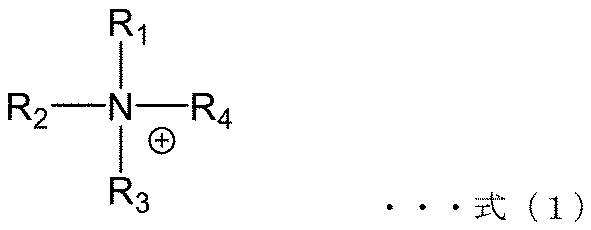
式(1)中、置換基R1~R4は互いに独立した炭素原子数1~16のアルキル基を示す、及び
アニオン、
を含む、シリカ粒子分散液。
円盤状アモルファスシリカ粒子、
式(1)で表される第4級アンモニウム:
式(1)中、置換基R1~R4は互いに独立した炭素原子数1~16のアルキル基を示す、及び
アニオン、
を含む、シリカ粒子分散液。
本発明のシリカ粒子分散液に含まれるシリカ粒子は、前述の円盤状アモルファスシリカ粒子であるところ、その大きさは、平均直径が30nm以上1000nm以下であり、平均厚さが0.1nm以上3nm以下である。
本発明のシリカ粒子分散液に含まれるシリカ粒子は、前述の円盤状アモルファスシリカ粒子であるところ、その大きさは、平均直径が100nm以上1000nm以下であり、平均厚さが0.1nm以上3nm以下であってもよい。
一態様において、本発明のシリカ粒子分散液に含まれる円盤状アモルファスシリカ粒子の濃度は、SiO2換算濃度で0.01質量%以上1.0質量%以下であってよい。SiO2換算の濃度は焼成法により算出することができる。
一態様において、本発明のシリカ粒子分散液に含まれる円盤状アモルファスシリカ粒子の濃度は、SiO2換算濃度で0.01質量%以上5.0質量%以下であってよい。SiO2換算の濃度は焼成法により算出することができる。
一態様において、本発明のシリカ粒子分散液に含まれる円盤状アモルファスシリカ粒子の濃度は、SiO2換算の濃度で0.01質量%以上30.0質量%以下であってよい。SiO2換算の濃度は焼成法により算出することができる。
本発明のシリカ粒子分散液には、式(1)で表される第4級アンモニウムが含まれる。

式(1)中、置換基R1~R4は互いに独立した炭素原子数1~16のアルキル基を示す。
式(1)中、置換基R1~R4は互いに独立した炭素原子数1~16のアルキル基を示す。
前記アルキル基としては、メチル基、エチル基、プロピル基、プロピル基、ブチル基、ペンチル基、へキシル基、ヘプチル基、オクチル基、ノニル基、デシル基、ウンデシル基、ドデシル基、トリデシル基、テトラデシル基、ペンタデシル基、ヘキサデシル基が挙げられる。置換基R1~R4は同一でもよく、異なってもよい。
このような第4級アンモニウムとしては、ジオクチルジメチルアンモニウムイオン、ジオクチルジエチルアンモニウムイオン、ジオクチルジプロピルアンモニウムイオン、ジオクチルジブチルアンモニウムイオン、ジオクチルジペンチルアンモニウムイオン、ジオクチルジヘキシルアンモニウムイオン、ジオクチルジヘプチルアンモニウムイオン、ジノニルジメチルアンモニウムイオン、ジノニルジエチルアンモニウムイオン、ジノニルジプロピルアンモニウムイオン、ジノニルジブチルアンモニウムイオン、ジノニルジペンチルアンモニウムイオン、ジノニルジヘキシルアンモニウムイオン、ジノニルジヘプチルアンモニウムイオン、ジノニルジメチルアンモニウムイオン、ジノニルジエチルアンモニウムイオン、ジノニルジプロピルアンモニウムイオン、ジノニルジブチルアンモニウムイオン、ジノニルジペンチルアンモニウムイオン、ジノニルジヘキシルアンモニウムイオン、ジノニルジヘプチルアンモニウムイオン、ジドデシルジメチルアンモニウムイオン等が挙げられる。
また、一態様において、前記第4級アンモニウムは、式(1)中、置換基R1~R4のうち、少なくとも2つが炭素原子数8~16のアルキル基を示し、残りの置換基が炭素数1~7のアルキル基を示してもよい。前記第4級アンモニウムは、円盤状アモルファスシリカ粒子の生成過程において鋳型として機能するところ、上記の第4級アンモニウムにより良好な分散性を発現できる円盤状アモルファスシリカ粒子を得ることができる。
一態様において、前記第4級アンモニウムの濃度は、0.1mmol/L以上30mmol/L以下であってよい。前記第4級アンモニウムの濃度が、0.1mmol/L以上30mmol/L以下であることで、良好な分散性を発現することができる。前記第4級アンモニウムは、円盤状アモルファスシリカ粒子の生成過程において鋳型として機能するところ、最終的に得られる分散液においては、前記第4級アンモニウムの一部が除去されてもよい。すなわち、前記第4級アンモニウムの濃度は、好ましくは0.1mmol/L以上20mmol/L以下であってよく、より好ましくは0.1mmol/L以上10mmol/L以下であってよい。
上記第4級アンモニウムはハロゲン化物を由来とするものを用いることができる。当該ハロゲン化物としては、例えば、塩化物、臭化物、ヨウ化物等が挙げられる。
本発明のシリカ粒子分散液には、アニオンが含まれる。
一態様において、前記アニオンが、アミン水性溶液又は無機塩基水性溶液の少なくともどちらか1種から生じるものであってよい。前記アニオンは、媒体中で水酸化イオンを生成することができる。
一態様において、前記アニオンが、アミン水性溶液又は無機塩基水性溶液の少なくともどちらか1種から生じるものであってよい。前記アニオンは、媒体中で水酸化イオンを生成することができる。
本発明においてはアニオンとして水酸化物イオン以外に、炭酸イオン、ハロゲンイオンを含んでいてもよい。ハロゲンイオンは、例えば、塩素イオン、臭素イオン、ヨウ素イオン等が挙げられる。
一態様において、前記アニオンがアミン水性溶液から生じる場合、アミンは、式(2)で表されるアミンであってもよい。

式(2)中、置換基R5~R7は互いに独立した炭素原子数1~5のアルキル基、炭素原子数1~5のアルコキシ基、又は水素原子を示す。
式(2)中、置換基R5~R7は互いに独立した炭素原子数1~5のアルキル基、炭素原子数1~5のアルコキシ基、又は水素原子を示す。
上記アミンとしては、第3級アミン、第2級アミン、第3級のアルカノールアミン、第2級のアルカノールアミン、及び第1級のアルカノールアミンが挙げられる。
上記第3級アミンとしては、例えば、トリメチルアミン、トリエチルアミン、トリプロピルアミン、トリブチルアミン、トリペンチルアミン、ジメチルエチルアミン、ジメチルプロピルアミン、ジメチルブチルアミン、ジメチルペンチルアミン、ジエチルメチルアミン、ジエチルプロピルアミン、ジエチルブチルアミン、ジエチルペンチルアミン、ジプロピルメチルアミン、ジプロピルエチルアミン、ジプロピルブチルアミン、ジプロピルペンチルアミン、ジブチルメチルアミン、ジブチルエチルアミン、ジブチルプロピルアミン、ジブチルペンチルアミン、ジペンチルメチルアミン、ジペンチルエチルアミン、ジプロピルブチルアミン、ジプロピルペンチルアミン等が挙げられる。
上記第2級アミンとしては、例えば、エチルnプロピルアミン、エチルイソプロピルアミン、ジプロピルアミン、ジイソプロピルアミン、エチルブチルアミン、nプロピルブチルアミン、ジブチルアミン、エチルペンチルアミン、nプロピルペンチルアミン、イソプロピルペンチルアミン、ジペンチルアミン、エチルオクチルアミン、iプロピルオクチルアミン、ブチルオクチルアミン、ジオクチルアミン等が挙げられる。
上記第1級アミンとしては、例えば、メチルアミン、エチルアミン、nプロピルアミン、イソプロピルアミン、ブチルアミン、ペンチルアミン、オクチルアミン等が挙げられる。
また、上記第3級のアルカノールアミンとしては、例えば、トリメタノールアミン、トリエタノールアミン、トリプロパノールアミン、トリブタノールアミン、トリペンタノールアミン、ジメチルエタノールアミン、ジメチルプロパノールアミン、ジメチルブタノールアミン、ジメチルペンタノールアミン、ジエチルメタノールアミン、ジエチルプロパノールアミン、ジエチルブタノールアミン、ジエチルペンタノールアミン、ジプロピルメタノールアミン、ジプロピルエタノールアミン、ジプロピルブタノールアミン、ジプロピルペンタノールアミン、ジブチルメタノールアミン、ジブチルエタノールアミン、ジブチルプロパノールアミン、ジブチルペンタノールアミン、ジペンチルメタノールアミン、ジペンチルエタノールアミン、ジプロピルブタノールアミン、ジプロピルペンタノールアミン等が挙げられる。
上記第2級のアルカノールアミンとしては、例えば、ジメタノールアミン、ジエタノールアミン、ジプロパノールアミン、ジブタノールアミン、ジペンタノールアミン、モノメタノールモノエタノールアミン、メチルプロパノールアミン、メチルブタノールアミン、メチルペンタノールアミン、エチルメタノールアミン、エチルプロパノールアミン、エチルブタノールアミン、エチルペンタノールアミン、プロピルメタノールアミン、プロピルエタノールアミン、プロピルブタノールアミン、プロピルペンタノールアミン、ブチルメタノールアミン、ブチルエタノールアミン、ブチルプロパノールアミン、ブチルペンタノールアミン、ペンチルメタノールアミン、ペンチルエタノールアミン、プロピルブタノールアミン、プロピルペンタノールアミン等が挙げられる。
上記第1級のアルカノールアミンとしては、例えば、メタノールアミン、エタノールアミン、プロパノールアミン、ブタノールアミン、ペンタノールアミン、ペンタノールアミン等が挙げられる。
前記アニオンが無機塩基水性溶液から生じる場合、無機塩基は、例えば、水酸化ナトリウム、水酸化カリウム、又はアンモニアであってよい。
本発明において、アミン水性溶液又は無機塩基水性溶液とは、水、有機溶媒、又はこれらの混合物の液体媒体を用いた溶液である。
前記有機溶媒は、アルコール類、ケトン類、エーテル類、エステル類、炭化水素類、及び含窒素有機化合物類からなる群から選ばれる少なくとも1種又は2種以上を用いることができる。これらの有機溶媒としては、例えば、メタノール、エタノール、プロパノール、ブタノール、イソプロピルアルコール等のアルコール類、メチルエチルケトン、メチルイソブチルケトン、γ-ブチルラクトン等のケトン類、エチレングリコールモノメチルエーテル、プロピレングリコールモノメチルエーテル、プロピレングリコールモノエチルエーテル等のエーテル類、酢酸エチル、酢酸ブチル等のエステル類、トルエン、キシレン、n-ペンタン、n-ヘキサン、シクロヘキサン等の炭化水素類、N,N-ジメチルホルムアミド、N-メチルピロリドン等の含窒素有機化合物類等を挙げることができる。これらは1種又は2種以上を組み合わせて用いてもよい。
また、本発明によれば、以下のシリカ粒子分散液の製造方法が提供される。
工程(a):アルカリ性のpHにて、式(1)で表される第4級アンモニウム:
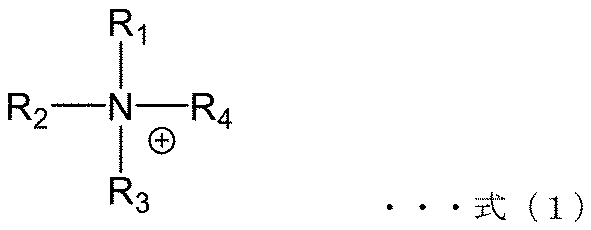
と親水性溶媒とを混合する工程、
工程(b):前記混合溶液中でケイ酸を縮合する工程、及び
工程(c):pHを酸性に調整後、前記第4級アンモニウムを除去する工程、
を含む、シリカ粒子分散液の製造方法。
工程(a):アルカリ性のpHにて、式(1)で表される第4級アンモニウム:
と親水性溶媒とを混合する工程、
工程(b):前記混合溶液中でケイ酸を縮合する工程、及び
工程(c):pHを酸性に調整後、前記第4級アンモニウムを除去する工程、
を含む、シリカ粒子分散液の製造方法。
工程(a)
工程(a)は、アルカリ性のpHにて、式(1)で表される第4級アンモニウムと親水性溶媒とを混合する工程である。工程(a)により得られた混合溶液は、第4級アンモニウムを含む溶液である。後述する工程(b)において、当該混合溶液にケイ酸を加えた際に、第4級アンモニウムが界面活性剤として形成するミセル等を鋳型として利用することで、ケイ酸を層状に自己組織化することができる。
工程(a)は、アルカリ性のpHにて、式(1)で表される第4級アンモニウムと親水性溶媒とを混合する工程である。工程(a)により得られた混合溶液は、第4級アンモニウムを含む溶液である。後述する工程(b)において、当該混合溶液にケイ酸を加えた際に、第4級アンモニウムが界面活性剤として形成するミセル等を鋳型として利用することで、ケイ酸を層状に自己組織化することができる。
工程(a)において、前記第4級アンモニウムは、式(1)中、置換基R1~R4のうち、少なくとも2つが炭素原子数8~16のアルキル基を示し、残りの置換基が炭素数1~7のアルキル基を示すものを用いることができる。第4級アンモニウムはケイ酸を層状に自己組織化する際の鋳型として機能するところ、前記構造をとることにより最終的に得られるシリカ粒子分散液に含まれるシリカ粒子のサイズを適切なものとすることができる。
また、工程(a)における混合溶液中の第4級アンモニウムの濃度は、0.1mmol/L以上30mmol/L以下とすることができる。第4級アンモニウムの濃度を当該範囲にすることにより、第4級アンモニウムはケイ酸を層状に自己組織化する際の鋳型として適切に機能し、最終的に得られるシリカ粒子分散液において良好な分散性を発現することができる。
また、工程(a)はアルカリ性のpHで行われるところ、混合溶液のpHをアルカリ性に調整してもよい。混合溶液のpHをアルカリ性とする場合、事前に親水性溶媒のpHをアルカリ性としてもよいし、第4級アンモニウムと親水性溶媒とを混合する際に同時にpHをアルカリ性としてもよいし、第4級アンモニウムと親水性溶媒とを混合後に混合溶液のpHをアルカリ性としてもよい。一態様において、工程(a)は、式(2)で表されるアミン:
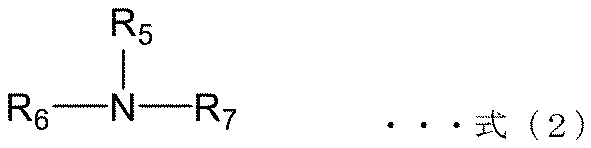
又は無機塩基の少なくともどちらか1種を添加してpHをアルカリ性に調整することを含んでもよい。
又は無機塩基の少なくともどちらか1種を添加してpHをアルカリ性に調整することを含んでもよい。
工程(a)が、式(2)で表されるアミンを添加してpHをアルカリ性に調整する場合、工程(a)の混合溶液中の前記アミンの濃度は0.1mmol/L以上50mmol/L以下にすることができる。
工程(a)が、無機塩基を添加してpHをアルカリ性に調整する場合、工程(a)の前記無機塩基は、水酸化ナトリウム、水酸化カリウム、又はアンモニアであってよく、混合溶液中の前記無機塩基の濃度が0.1mmol/L以上50mmol/L以下にすることができる。
前記アミン又は前記無機塩基の濃度を当該範囲とすることにより、工程(a)における混合溶液のpHをアルカリ性に調製することができる。
工程(b)
工程(b)は、工程(a)で得られた混合溶液にケイ酸を加え、混合溶液中でケイ酸を縮合する工程である。前記ケイ酸は混合溶液中でケイ酸イオンとして存在する。ケイ酸イオンは、(SiO4)nH2Oによるアニオンで示され、アルカリ溶液中で解離し、Si-O-を生じるイオンである。ケイ酸イオンは、混合溶液中の第4級アンモニウムが界面活性剤として形成するミセル等を鋳型として層状に自己組織化することができる。層状に自己組織化したケイ酸イオンは脱水縮合により、シロキサン結合(Si-O-Si)を骨格とするシート構造を形成する。
工程(b)は、工程(a)で得られた混合溶液にケイ酸を加え、混合溶液中でケイ酸を縮合する工程である。前記ケイ酸は混合溶液中でケイ酸イオンとして存在する。ケイ酸イオンは、(SiO4)nH2Oによるアニオンで示され、アルカリ溶液中で解離し、Si-O-を生じるイオンである。ケイ酸イオンは、混合溶液中の第4級アンモニウムが界面活性剤として形成するミセル等を鋳型として層状に自己組織化することができる。層状に自己組織化したケイ酸イオンは脱水縮合により、シロキサン結合(Si-O-Si)を骨格とするシート構造を形成する。
前記ケイ酸は公知の方法で製造することができる。前記ケイ酸としては、シリコンアルコキシドの加水分解物、又はケイ酸アルカリ水溶液の陽イオンを除去したものを用いることができる。
前記シリコンアルコキシドは、例えば、テトラエトキシシラン、テトラメトキシシラン等が挙げられる。テトラエトキシシランを用いる場合は、公知の方法により、テトラエトキシシランを水と反応させ、加水分解することでケイ酸を得ることができる。
前記ケイ酸アルカリ水溶液は、例えば、ケイ酸ナトリウム水溶液(水ガラス)、ケイ酸カリウム水溶液、ケイ酸リチウム水溶液等が挙げられる。ケイ酸ナトリウム水溶液を用いる場合は、公知の方法により得られた無水ケイ酸ナトリウムを水に溶解した水溶液を用いることができる。例えば、ケイ酸ナトリウム水溶液とH型陽イオン交換樹脂とを接触させ、ナトリウムイオンを除去することができる。前記接触はバッチ式やカラム式で行うことができ、工業的にはイオン交換塔に陽イオン交換樹脂を充填し、ケイ酸アルカリ水溶液を通液する方法を用いることができる。通液速度は空間速度(L/hr)で1~30であり、温度は10~80℃にて行うことができる。陽イオン交換樹脂は、例えば、スルホン酸型のH型強酸性陽イオン交換樹脂、又はカルボン酸型のH型弱酸性陽イオン交換樹脂が挙げられ、好ましくは、スルホン酸型強酸性陽イオン交換樹脂をH型に調整して用いることができる。
スルホン酸型の強酸性陽イオン交換樹脂は、例えば、オルガノ株式会社製、商品名アンバーライト(登録商標)IR-120Bが挙げられる。
また、前記ケイ酸アルカリ水溶液は市販品を用いることができ、例えば、株式会社トクヤマ、愛知珪曹工業株式会社、及びオリエンタルシリカコーポレーション等より入手することができる。
当該ケイ酸の構造や重合度に特に制限はなく、最も単純な構造ものは四面体構造を有するオルトケイ酸イオン(SiO4
4-)であるが、オルトケイ酸イオンが鎖状、環状、層状、かご状、3次元的に縮合した構造であってもよい。
前述のとおり、前記ケイ酸には種々の化合物を用いることができる。一態様において、前記ケイ酸は、テトラエトキシシランの加水分解物、又はケイ酸ナトリウム水溶液の陽イオン除去物である。すなわち、好ましくは、前記シリコンアルコキシドが、テトラエトキシシランである。また、好ましくは、前記ケイ酸アルカリ水溶液が、ケイ酸ナトリウム水溶液である。
一態様において、工程(b)は、室温~100℃にて混合溶液を攪拌することにより行うことができる。攪拌温度は好ましくは40~80℃であってよく、より好ましくは55~65℃であってよい。攪拌時間は3~12時間であってよく、好ましくは4~8時間であってよい。
工程(c)
工程(c)は、混合溶液のpHを酸性に調整後、前記第4級アンモニウムを除去する工程である。第4級アンモニウムを除去することにより、シロキサン結合(Si-O-Si)を骨格とするシート構造が剥離し、円盤状アモルファスシリカ粒子を得ることができ、円盤状アモルファスシリカ粒子を含むシリカ粒子分散液を得ることができる。
工程(c)は、混合溶液のpHを酸性に調整後、前記第4級アンモニウムを除去する工程である。第4級アンモニウムを除去することにより、シロキサン結合(Si-O-Si)を骨格とするシート構造が剥離し、円盤状アモルファスシリカ粒子を得ることができ、円盤状アモルファスシリカ粒子を含むシリカ粒子分散液を得ることができる。
工程(c)における混合溶液のpHの調整は、有機酸又は鉱酸を用いて行うことができる。酸性のpHは1~7である。前記有機酸はpHを酸性に調整できれば、特に制限されないが、親水性溶媒に溶解するカルボン酸が好ましい。有機酸としては、例えば、ギ酸、酢酸、クエン酸、シュウ酸等が挙げられる。鉱酸としては、例えば、塩酸、硝酸、リン酸、硫酸、ホウ酸等が挙げられる。
工程(c)における第4級アンモニウムの除去方法としては、例えば、限外ろ過、透析、陽イオン交換等が挙げられる。
工程(C)において混合溶液中の第4級アンモニウムが除去されるところ、最終的に得られるシリカ粒子分散液の第4級アンモニウムの濃度は、0.1mmol/L以上30mmol/L以下であり、好ましくは0.1mmol/L以上15mmol/L以下であり、より好ましくは0.1mmol/L以上5mmol/L以下である。
本発明は前述のシリカ粒子分散液又は前述の製造方法により得られたシリカ粒子分散液を用いた、円盤状アモルファスシリカ粒子の製造方法を提供する。本発明はシリカ粒子分散液に含まれるシリカ粒子を、300℃以上1000℃未満で加熱する工程を含む、円盤状アモルファスシリカ粒子の製造方法である。
当該製造方法において、シリカ粒子分散液に含まれる溶媒を除去した後、電気炉、又は焼成炉にて、300℃以上1000℃未満の温度範囲で加熱することができる。前記温度範囲は好ましくは300℃以上800℃未満であってよく、より好ましくは300℃以上600℃未満であってよい。前記溶媒の除去工程は、蒸発法等の公知の方法にて行うことができる。
本発明において、円盤状アモルファスシリカ粒子及びシリカ粒子分散液を用いて、膜生成用組成物、塗布膜、Langmuir-Blodgett(LB)膜、自立膜、及びガスバリア膜等を作製することができる。これらの膜形成用組成物、塗布膜、Langmuir-Blodgett(LB)膜、自立膜、及びガスバリア膜等は、前述の円盤状アモルファスシリカ粒子を含有するため、膜を作製した際に、優れた視認性(光透過性)を有するとともに、水蒸気等の任意の気体の透過を防ぐこと(ガスバリア性)が期待できる。
本発明の円盤状アモルファスシリカ粒子及びシリカ粒子分散液を用いて作製された膜形成用組成物は、当該円盤状アモルファスシリカ粒子と、熱硬化性樹脂、熱可塑性樹脂、及び紫外線硬化樹脂からなる群から選ばれる少なくとも1種の樹脂とを含む組成物である。
前記樹脂は、アクリル系樹脂、メラミン系樹脂、ウレタン系樹脂、ポリエステル樹脂、エポキシ樹脂、及びフォスファーゲン系樹脂等が用いられる。
前記膜形成用組成物における、円盤状アモルファスシリカ粒子と樹脂との成分割合は特に限定されないが、例えば、円盤状アモルファスシリカ粒子100質量部に対して、樹脂が25~400質量部の質量割合にて含むことができる。
さらに、当該膜形成用組成物には、硬化反応を促進するために硬化触媒(硬化剤)を含有させることができる。硬化触媒(硬化剤)としては、たとえば、アミノ酸類、金属アルコキシド、金属キレート化合物、有機酸金属塩、過塩素酸類又はその塩、酸類又はその塩、及び金属塩化物からなる群より選ばれる少なくとも1種の硬化触媒である。
なお、当該膜形成用組成物における、全固形分の濃度は、例えば、1.0質量%~50質量%とすることができる。
本発明の円盤状アモルファスシリカ粒子及びシリカ粒子分散液を用いて作製された塗布膜は、円盤状アモルファスシリカ粒子を用いて基板上に作製されたものであればよく、当該分散液、又は前記膜形成用組成物を基板上に塗布した塗布膜である。
基材はガラス、プラスチック、シリコンウェハー等からなる各種基材が用いられる。基材表面に塗布する方法としてはディッピング法、スピン法、スプレー法等の通常行われる方法が適用できる。中でも面積度の観点からディッピング法、スピン法が特に好ましい。
本発明の本発明の円盤状アモルファスシリカ粒子及びシリカ粒子分散液を用いて作製されたLangmuir-Blodgett(LB)膜は、円盤状アモルファスシリカ粒子を用いてLangmuir-Blodgett(LB)法により基板上に作製されたものであれば良く、当該分散液、又は前記膜形成用組成物を用いて、Langmuir-Blodgett(LB)法により基板上に作製された単分子の膜である。Langmuir-Blodgett(LB)法により作製された膜は、例えば、円盤状アモルファスシリカ粒子を含むシリカ分散液を、シリコンウェハー基板に滴下し、スピンコートさせることで、溶媒の揮発と同時にシリコンウェハー上に作製することができる。
本発明の円盤状アモルファスシリカ粒子及びシリカ粒子分散液を用いて作製された自立膜は、円盤状アモルファスシリカ粒子を用いて作製されたものであればよく、当該分散液、又は前記膜形成用組成物を用いて作製した自立膜である。
自立膜とは基材等の支持材を要さずに自立できる膜を指す。例えば、前記シリカ粒子分散液又は膜形成用組成物を基材に塗布し、溶媒を除去した後、硬化処理を行うことで形成した膜を、基材から剥離することで作製することができる。
本発明の円盤状アモルファスシリカ粒子及びシリカ粒子分散液によれば、前述のように優れた光透過性とガスバリア性を有する膜を得ることができる。したがって、当該膜は例えば、食品用ラップや半導体電子部品用カバーテープ等の視認性と水蒸気等からの保護が求められる製品に利用することが可能である。
以下、本発明を具体的に説明する。なお、本発明はいかなる意味においても、以下の実施例によって限定されるものではない。
(評価方法)
走査型電子顕微鏡(SEM)観察:HITACHI社製 装置名:S-5500を使用した。
原子間力顕微鏡(AFM)厚み測定:Digital Instruments社製 装置名:Nanoscope IIIを使用してタッピングモードで測定した。カンチレバー(探査針)はBRUKER社製の標準Si製プローブ(製品名:従来型汎用Tapping AFM用プローブNCHV)を使用した。
XRD測定:RIGAKU社製 装置名:Ultima IIIを使用して測定した。
FT-IRスペクトル分析:日本分光社製 装置名:FT/IR-6100を使用しKBr法で測定した。
固体NMR測定:JEOL社製 装置名: ECX-400を使用して測定した。
走査型電子顕微鏡(SEM)観察:HITACHI社製 装置名:S-5500を使用した。
原子間力顕微鏡(AFM)厚み測定:Digital Instruments社製 装置名:Nanoscope IIIを使用してタッピングモードで測定した。カンチレバー(探査針)はBRUKER社製の標準Si製プローブ(製品名:従来型汎用Tapping AFM用プローブNCHV)を使用した。
XRD測定:RIGAKU社製 装置名:Ultima IIIを使用して測定した。
FT-IRスペクトル分析:日本分光社製 装置名:FT/IR-6100を使用しKBr法で測定した。
固体NMR測定:JEOL社製 装置名: ECX-400を使用して測定した。
(実施例1)
200mLガラスフラスコに純水120gを入れ、ジドデシルジメチルアンモニウム臭化物(東京化成工業株式会社製 純度98%)0.8gとトリエタノールアミン(富士フイルム和光純薬株式会社製 純度98%)0.21gを加えて、シンフレックスで60℃を保持しながら1時間撹拌し、反応溶液を調製した。調製した反応溶液に、テトラエトキシシラン(キシダ化学株式会社製 純度99%)0.12gを60分かけて滴下して、さらにシンフレックスで液温60℃を保持しながら12時間撹拌し、シリカ粒子-界面活性剤複合体の分散液を調製した。
200mLガラスフラスコに純水120gを入れ、ジドデシルジメチルアンモニウム臭化物(東京化成工業株式会社製 純度98%)0.8gとトリエタノールアミン(富士フイルム和光純薬株式会社製 純度98%)0.21gを加えて、シンフレックスで60℃を保持しながら1時間撹拌し、反応溶液を調製した。調製した反応溶液に、テトラエトキシシラン(キシダ化学株式会社製 純度99%)0.12gを60分かけて滴下して、さらにシンフレックスで液温60℃を保持しながら12時間撹拌し、シリカ粒子-界面活性剤複合体の分散液を調製した。
調製した分散液20mLを透析セルロースチューブ(アズワン社製 製品名:ヴィスキングチューブ)に入れて、2M酢酸水溶液とエタノールを体積比1:1で混合した透析液250mLに室温で24時間浸漬した。透析液を新しいものに入れ替えて24時間浸漬する操作をさらに2回繰り返し、透析チューブ内の液が無色透明になるまで透析した。透析膜チューブ内の液を回収し、シリカ粒子分散液10mLを得た。SiO2濃度は0.03質量%であった。
得られたシリカ粒子分散液をエタノールで300倍に希釈し、シリコンウェハー(アズワン社製)にスポイトで10μL滴下し、5秒かけて回転数を2000rpmまで増大させ、25秒間スピンコートを実施して観察試料を作成した。得られた試料をSEM観察すると円盤状のシリカ粒子が確認でき、平均直径は500nmであった。また、AFM分析するとシリカ粒子の平均厚みは1nmであった(図2及び図3参照)。
得られたシリカ粒子分散液10mLをメンブレンフィルター(メルク株式会社製0.1μm口径)で吸引ろ過し、フィルター上にシリカ粒子積層膜を作製した。フィルターごとシリカ粒子積層膜のXRD測定を実施したところ、2θ=9.1°付近にシリカ粒子積層膜由来のピークを確認した(図4参照)。ブラッグの式よりd=0.98nmであることから積層膜を構成するシリカ粒子1枚分の厚みは約1nmであると推定した。
得られたシリカ粒子分散液をシャーレ上で加熱乾燥し、得られた白色粉末のFT-IRスペクトルを測定した。1050cm-1付近にSi-O-Si結合の伸縮振動に由来する吸収バンドを確認した(図5参照)。
(実施例2)
テトラエトキシシランの量を実施例1の5倍である0.6gに変更した以外は実施例1と同じ条件でシリカ粒子分散液を作製した。
テトラエトキシシランの量を実施例1の5倍である0.6gに変更した以外は実施例1と同じ条件でシリカ粒子分散液を作製した。
実施例1と同様の手順でSEM観察すると、実施例1と同様の直径500nmの円盤状シリカ粒子の他に、平均粒子径20nmの球状粒子も副生していることが確認できた。また、AFM分析するとシリカ粒子の平均厚みは1nmであった。
(実施例3)
テトラエトキシシランの量を実施例1の5倍である0.6gに変更し、トリエタノールアミンの量を実施例1の4倍である0.84gに変更した以外は実施例1と同じ条件でシリカ粒子分散液を作製した。
テトラエトキシシランの量を実施例1の5倍である0.6gに変更し、トリエタノールアミンの量を実施例1の4倍である0.84gに変更した以外は実施例1と同じ条件でシリカ粒子分散液を作製した。
実施例1と同様の手順でSEM観察すると円盤状のシリカ粒子が確認でき、平均直径は200nmであった。また、AFM分析するとシリカ粒子の平均厚みは1nmであった。
(実施例4)
ジドデシルジメチルアンモニウム臭化物の量を実施例1の0.02倍である0.016gに変更した以外は実施例1と同じ条件でシリカ粒子分散液を作製した。
ジドデシルジメチルアンモニウム臭化物の量を実施例1の0.02倍である0.016gに変更した以外は実施例1と同じ条件でシリカ粒子分散液を作製した。
実施例1と同様の手順でSEM観察すると円盤状のシリカ粒子が確認でき、平均直径は500nmであった。また、AFM分析するとシリカ粒子の平均厚みは1nmであった。
(実施例5)
ジドデシルジメチルアンモニウム臭化物の量を実施例1の1.5倍である1.2gに変更した以外は実施例1と同じ条件でシリカ粒子分散液を作製した。
ジドデシルジメチルアンモニウム臭化物の量を実施例1の1.5倍である1.2gに変更した以外は実施例1と同じ条件でシリカ粒子分散液を作製した。
実施例1と同様の手順でSEM観察すると円盤状のシリカ粒子が確認でき、平均直径は500nmであった。また、AFM分析するとシリカ粒子の平均厚みは1nmであった。
(実施例6)
トリエタノールアミンの量を実施例1の4倍である0.84gに変更した以外は実施例1と同じ条件でシリカ粒子分散液を作製した。
トリエタノールアミンの量を実施例1の4倍である0.84gに変更した以外は実施例1と同じ条件でシリカ粒子分散液を作製した。
(実施例7)
ジドデシルジメチルアンモニウム臭化物の量を実施例1の0.75倍である0.6gに変更し、ジデシルジメチルアンモニウム臭化物(東京化成工業株式会社製 純度98%)0.35gをさらに加えた以外は実施例1と同じ条件でシリカ粒子分散液を作製した。
ジドデシルジメチルアンモニウム臭化物の量を実施例1の0.75倍である0.6gに変更し、ジデシルジメチルアンモニウム臭化物(東京化成工業株式会社製 純度98%)0.35gをさらに加えた以外は実施例1と同じ条件でシリカ粒子分散液を作製した。
実施例1と同様の手順でSEM観察すると円盤状のシリカ粒子が確認でき、平均直径は150nmであった。また、AFM分析するとシリカ粒子の平均厚みは1nmであった。
(実施例8)
ジドデシルジメチルアンモニウム臭化物の量を実施例1の0.5倍である0.4gに変更し、ジデシルジメチルアンモニウム臭化物(東京化成工業株式会社製 純度98%)0.18gをさらに加えた以外は実施例1と同じ条件でシリカ粒子分散液を作製した。
ジドデシルジメチルアンモニウム臭化物の量を実施例1の0.5倍である0.4gに変更し、ジデシルジメチルアンモニウム臭化物(東京化成工業株式会社製 純度98%)0.18gをさらに加えた以外は実施例1と同じ条件でシリカ粒子分散液を作製した。
実施例1と同様の手順でSEM観察すると円盤状のシリカ粒子が確認でき、平均直径は50nmであった。また、AFM分析するとシリカ粒子の平均厚みは1nmであった。
(実施例9)
3Lガラスフラスコに純水1700gとジドデシルジメチルアンモニウム臭化物(東京化成工業株式会社製 純度98%)16gを入れて、オイルバスで液温80℃を保持しながら1時間撹拌し、反応溶液を調製した。1Lポリスチレン製容器に、活性ケイ酸水溶液(ケイ酸アルカリ水溶液からイオン交換樹脂で陽イオンを除去したもの SiO2濃度は3.4質量%)20.4gとトリエタノールアミン(富士フイルム和光純薬株式会社製 純度98%)4.2gと純水700gを入れて、マグネットスターラーで1時間撹拌してケイ酸溶液を調製した。液温80℃を保持しながら反応溶液にケイ酸溶液を120分で滴下して、さらにオイルバスで液温80℃を保持しながら6時間撹拌し、シリカ粒子-界面活性剤複合体の分散液を調製した。
3Lガラスフラスコに純水1700gとジドデシルジメチルアンモニウム臭化物(東京化成工業株式会社製 純度98%)16gを入れて、オイルバスで液温80℃を保持しながら1時間撹拌し、反応溶液を調製した。1Lポリスチレン製容器に、活性ケイ酸水溶液(ケイ酸アルカリ水溶液からイオン交換樹脂で陽イオンを除去したもの SiO2濃度は3.4質量%)20.4gとトリエタノールアミン(富士フイルム和光純薬株式会社製 純度98%)4.2gと純水700gを入れて、マグネットスターラーで1時間撹拌してケイ酸溶液を調製した。液温80℃を保持しながら反応溶液にケイ酸溶液を120分で滴下して、さらにオイルバスで液温80℃を保持しながら6時間撹拌し、シリカ粒子-界面活性剤複合体の分散液を調製した。
実施例1と同様の手順でSEM観察すると円盤状のシリカ粒子が確認でき、平均直径は100nmであった。また、AFM分析するとシリカ粒子の平均厚みは1nmであった。
(実施例10)
3Lガラスフラスコに純水2400gとジドデシルジメチルアンモニウム臭化物(東京化成工業株式会社製 純度98%)80gとトリエタノールアミン(富士フイルム和光純薬株式会社製 純度98%)4.2gを入れて、オイルバスで液温80℃を保持しながら1時間撹拌し、反応溶液を調製した。調製した反応溶液に、テトラエトキシシラン(キシダ化学株式会社製 純度99%)24gを60分で滴下して、さらにオイルバスで液温80℃を保持しながら6時間撹拌し、シリカ粒子-界面活性剤複合体の分散液を調製した。2M酢酸水溶液とエタノールを体積比1:1で混合して洗浄液を調製した。洗浄液1Lと分散液1Lを混合した後、限外ろ過装置(分画分子量20万、ポリアミド製メンブレンフィルター)で加圧ろ過した。ろ液が1Lに到達する毎に洗浄液1Lを追加する操作を5回繰り返した後に、さらに加圧ろ過を継続して濃縮した。濃縮液を回収し、シリカ粒子分散液90mLを得た。ろ過後に回収した分散液のSiO2濃度は3.2質量%であった。
3Lガラスフラスコに純水2400gとジドデシルジメチルアンモニウム臭化物(東京化成工業株式会社製 純度98%)80gとトリエタノールアミン(富士フイルム和光純薬株式会社製 純度98%)4.2gを入れて、オイルバスで液温80℃を保持しながら1時間撹拌し、反応溶液を調製した。調製した反応溶液に、テトラエトキシシラン(キシダ化学株式会社製 純度99%)24gを60分で滴下して、さらにオイルバスで液温80℃を保持しながら6時間撹拌し、シリカ粒子-界面活性剤複合体の分散液を調製した。2M酢酸水溶液とエタノールを体積比1:1で混合して洗浄液を調製した。洗浄液1Lと分散液1Lを混合した後、限外ろ過装置(分画分子量20万、ポリアミド製メンブレンフィルター)で加圧ろ過した。ろ液が1Lに到達する毎に洗浄液1Lを追加する操作を5回繰り返した後に、さらに加圧ろ過を継続して濃縮した。濃縮液を回収し、シリカ粒子分散液90mLを得た。ろ過後に回収した分散液のSiO2濃度は3.2質量%であった。
実施例1と同様の手順でSEM観察すると円盤状のシリカ粒子が確認でき、平均直径は100nmであった。また、AFM分析するとシリカ粒子の平均厚みは1nmであった。
(比較例1)
実施例1において、トリエタノールアミンを添加しなかった事以外は実施例1と同じ条件で実施した。実施例1と同様の手順でSEM観察すると円盤状のシリカ粒子は確認できず、球状シリカの凝集体であった。
実施例1において、トリエタノールアミンを添加しなかった事以外は実施例1と同じ条件で実施した。実施例1と同様の手順でSEM観察すると円盤状のシリカ粒子は確認できず、球状シリカの凝集体であった。
本発明の円盤状アモルファスシリカ粒子及びシリカ粒子分散液は、従来のシリカナノシートではなし得なかった優れた分散性という顕著な技術的効果を有する。また、本発明の円盤状アモルファスシリカ粒子及びシリカ粒子分散液は、基板に塗布した時に均一な膜厚の円盤状アモルファスシリカ粒子の薄膜となりガスバリア膜等に利用可能である。したがって、本発明はシリカ粒子又はガスバリア膜等を利用する、化学産業、日用品産業、食品産業をはじめとする各種製造業等の産業の各分野において高い利用可能性を有する。
Claims (26)
- 平均直径が30nm以上1000nm以下であり、及び
平均厚さが0.1nm以上3nm以下である、
円盤状アモルファスシリカ粒子。 - 単層構造又は二層構造である、請求項1に記載の円盤状アモルファスシリカ粒子。
- 請求項1又は2に記載の円盤状アモルファスシリカ粒子、
式(1)で表される第4級アンモニウム:

式(1)中、置換基R1~R4は互いに独立した炭素原子数1~16のアルキル基を示す、及び
アニオン、
を含む、シリカ粒子分散液。 - 前記円盤状アモルファスシリカ粒子の濃度が、SiO2換算濃度で0.01質量%以上30.0質量%以下である、請求項3に記載のシリカ粒子分散液。
- 前記アニオンが、アミン水性溶液又は無機塩基水性溶液の少なくともどちらか1種から生じる、請求項3又は4に記載のシリカ粒子分散液。
- 前記アニオンがアミン水性溶液から生じる場合、アミンが、式(2)で表されるアミン:
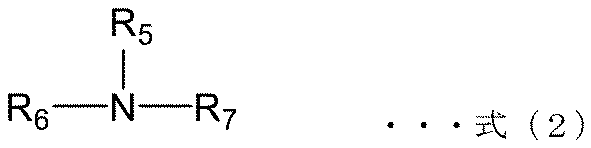
式(2)中、置換基R5~R7は互いに独立した炭素原子数1~5のアルキル基、炭素原子数1~5のアルコキシ基、又は水素原子を示す、
である、請求項5に記載のシリカ粒子分散液。 - 前記アニオンが無機塩基水性溶液から生じる場合、無機塩基が、水酸化ナトリウム、水酸化カリウム、又はアンモニアである、請求項5に記載のシリカ粒子分散液。
- 前記第4級アンモニウムが、式(1)中、置換基R1~R4のうち、少なくとも2つが炭素原子数8~16のアルキル基を示し、残りの置換基が炭素数1~7のアルキル基を示す、請求項3~7のいずれか一項に記載のシリカ粒子分散液。
- 前記第4級アンモニウムの濃度が、0.1mmol/L以上30mmol/L以下である、請求項3~8のいずれか一項に記載のシリカ粒子分散液。
- 工程(a):アルカリ性のpHにて、式(1)で表される第4級アンモニウム:

と親水性溶媒とを混合する工程、
工程(b):前記混合溶液中でケイ酸を縮合する工程、及び
工程(c):pHを酸性に調整後、前記第4級アンモニウムを除去する工程、
を含む、シリカ粒子分散液の製造方法。 - 式(1)中、置換基R1~R4のうち、少なくとも2つが炭素原子数8~16のアルキル基を示し、残りの置換基が炭素数1~7のアルキル基を示す、請求項10に記載のシリカ粒子分散液の製造方法。
- 工程(a)の混合溶液中の第4級アンモニウムの濃度が0.1mmol/L以上30mmol/L以下である、請求項10又は11に記載のシリカ粒子分散液の製造方法。
- 工程(a)が、式(2)で表されるアミン:

又は無機塩基の少なくともどちらか1種を添加してpHをアルカリ性に調整することを含む、請求項10~12のいずれか一項に記載のシリカ粒子分散液の製造方法。 - 工程(a)が、式(2)で表されるアミンを添加してpHをアルカリ性に調整する場合、工程(a)の混合溶液中の前記アミンの濃度が0.1mmol/L以上50mmol/L以下である、請求項13に記載のシリカ粒子分散液の製造方法。
- 工程(a)が、無機塩基を添加してpHをアルカリ性に調整する場合、工程(a)の前記無機塩基が、水酸化ナトリウム、水酸化カリウム、又はアンモニアであり、混合溶液中の前記無機塩基の濃度が0.1mmol/L以上50mmol/L以下である、請求項13に記載のシリカ粒子分散液の製造方法。
- 工程(b)のケイ酸が、シリコンアルコキシドの加水分解物、又はケイ酸アルカリ水溶液の陽イオン除去物である、請求項10~15のいずれか一項に記載のシリカ粒子分散液の製造方法。
- 前記ケイ酸が、テトラエトキシシランの加水分解物、又はケイ酸ナトリウム水溶液の陽イオン除去物である、請求項16に記載のシリカ粒子分散液の製造方法。
- 工程(b)が、室温~100℃にて攪拌することにより行われる、請求項10~17のいずれか一項に記載のシリカ粒子分散液の製造方法。
- 工程(c)におけるpHの調整が、有機酸又は鉱酸を用いて行われる、請求項10~18のいずれか一項に記載のシリカ粒子分散液の製造方法。
- 工程(c)における前記第4級アンモニウムの除去が、限外ろ過、透析、陽イオン交換により行われる、請求項10~19のいずれか一項に記載のシリカ粒子分散液の製造方法。
- 請求項3~9のいずれか一項に記載のシリカ粒子分散液に含まれるシリカ粒子又は請求項10~20のいずれか一項に記載の製造方法により得られるシリカ粒子分散液に含まれるシリカ粒子を、300℃以上1000℃未満で加熱する工程含む、円盤状アモルファスシリカ粒子の製造方法。
- 請求項1若しくは2に記載の円盤状アモルファスシリカ粒子又は請求項3~9のいずれか一項に記載のシリカ粒子分散液を用いて作製された膜形成用組成物。
- 請求項1若しくは2に記載の円盤状アモルファスシリカ粒子又は請求項3~9のいずれか一項に記載のシリカ粒子分散液を用いて作製された塗布膜。
- 請求項1若しくは2に記載の円盤状アモルファスシリカ粒子又は請求項3~9のいずれか一項に記載のシリカ粒子分散液を用いて作製されたLangmuir-Blodgett(LB)膜。
- 請求項1若しくは2に記載の円盤状アモルファスシリカ粒子又は請求項3~9のいずれか一項に記載のシリカ粒子分散液を用いて作製された自立膜。
- 請求項1若しくは2に記載の円盤状アモルファスシリカ粒子又は請求項3~9のいずれか一項に記載のシリカ粒子分散液を用いて作製されたガスバリア膜。
Priority Applications (1)
| Application Number | Priority Date | Filing Date | Title |
|---|---|---|---|
| JP2024542753A JPWO2024043115A1 (ja) | 2022-08-24 | 2023-08-10 |
Applications Claiming Priority (2)
| Application Number | Priority Date | Filing Date | Title |
|---|---|---|---|
| JP2022-133566 | 2022-08-24 | ||
| JP2022133566 | 2022-08-24 |
Publications (1)
| Publication Number | Publication Date |
|---|---|
| WO2024043115A1 true WO2024043115A1 (ja) | 2024-02-29 |
Family
ID=90013187
Family Applications (1)
| Application Number | Title | Priority Date | Filing Date |
|---|---|---|---|
| PCT/JP2023/029224 Ceased WO2024043115A1 (ja) | 2022-08-24 | 2023-08-10 | アモルファスシリカ粒子分散液及びその製造方法 |
Country Status (3)
| Country | Link |
|---|---|
| JP (1) | JPWO2024043115A1 (ja) |
| TW (1) | TW202426392A (ja) |
| WO (1) | WO2024043115A1 (ja) |
Citations (3)
| Publication number | Priority date | Publication date | Assignee | Title |
|---|---|---|---|---|
| JP2009149493A (ja) * | 2007-11-30 | 2009-07-09 | Jgc Catalysts & Chemicals Ltd | 非球状シリカゾル、その製造方法および研磨用組成物 |
| JP2010184856A (ja) * | 2009-01-15 | 2010-08-26 | Mizusawa Ind Chem Ltd | 非晶質シリカ |
| WO2013039212A1 (ja) * | 2011-09-16 | 2013-03-21 | 日産化学工業株式会社 | 精製された活性珪酸液及びシリカゾルの製造方法 |
-
2023
- 2023-08-10 JP JP2024542753A patent/JPWO2024043115A1/ja active Pending
- 2023-08-10 WO PCT/JP2023/029224 patent/WO2024043115A1/ja not_active Ceased
- 2023-08-18 TW TW112131083A patent/TW202426392A/zh unknown
Patent Citations (3)
| Publication number | Priority date | Publication date | Assignee | Title |
|---|---|---|---|---|
| JP2009149493A (ja) * | 2007-11-30 | 2009-07-09 | Jgc Catalysts & Chemicals Ltd | 非球状シリカゾル、その製造方法および研磨用組成物 |
| JP2010184856A (ja) * | 2009-01-15 | 2010-08-26 | Mizusawa Ind Chem Ltd | 非晶質シリカ |
| WO2013039212A1 (ja) * | 2011-09-16 | 2013-03-21 | 日産化学工業株式会社 | 精製された活性珪酸液及びシリカゾルの製造方法 |
Also Published As
| Publication number | Publication date |
|---|---|
| TW202426392A (zh) | 2024-07-01 |
| JPWO2024043115A1 (ja) | 2024-02-29 |
Similar Documents
| Publication | Publication Date | Title |
|---|---|---|
| Liu et al. | Fabrication of ultrathin single-layer 2D metal–organic framework nanosheets with excellent adsorption performance via a facile exfoliation approach | |
| Shakeri et al. | Polyoxometalate based thin film nanocomposite forward osmosis membrane: Superhydrophilic, anti-fouling, and high water permeable | |
| KR101790553B1 (ko) | 중공실리카 입자의 제조방법, 중공실리카 입자 및 그를 포함하는 조성물 및 단열 시트 | |
| Xu et al. | New insights into the microstructure-separation properties of organosilica membranes with ethane, ethylene, and acetylene bridges | |
| KR100549715B1 (ko) | 다공성실리카피막형성용도포액,도포된기재및단섬유실리카 | |
| TWI579048B (zh) | 保護性塗料組成物、經塗覆之基材及保護基材的方法(二) | |
| JP3073313B2 (ja) | 半導体装置およびその製造方法 | |
| US20110209413A1 (en) | Non-Spherical Silica Sol, Process for Producing the Same, and Composition for Polishing | |
| TW202112666A (zh) | 含螯合劑之水玻璃及二氧化矽凝膠之製造方法 | |
| JP3320440B2 (ja) | 被膜形成用塗布液およびその製造方法 | |
| JP6323861B2 (ja) | 表面修飾メソポーラスシリカナノ粒子の製造方法 | |
| JPH09507826A (ja) | 新規な高分子導電性アルミノ珪酸塩材料、該材料を含む要素及びその製造方法 | |
| JP5275562B2 (ja) | 粉末状のシリカコンポジット粒子及びその製造方法、シリカコンポジット粒子分散液、並びに樹脂組成物 | |
| TWI741116B (zh) | 二氧化矽粒子分散液及其製造方法 | |
| TW201945068A (zh) | 石墨烯氧化物薄膜保護性塗料 | |
| Birdsong et al. | Large-scale synthesis of 2D-silica (SiO x) nanosheets using graphene oxide (GO) as a template material | |
| Xu et al. | Scalable production of high-quality boron nitride nanosheets via a recyclable salt-templating method | |
| WO2024043115A1 (ja) | アモルファスシリカ粒子分散液及びその製造方法 | |
| Shu et al. | Formation of nanostructured zeolite particle surfaces via a halide/grignard route | |
| JP6410574B2 (ja) | 多孔質シリカの製造方法 | |
| WO2023145780A1 (ja) | 低誘電正接シリカゾル及び低誘電正接シリカゾルの製造方法 | |
| KR100846998B1 (ko) | 결정성 바륨티타네이트 나노입자를 함유한 고 유전율의무/유기 하이브리드 막의 제조방법 | |
| JP2018177634A (ja) | 無機ナノシート分散液およびその製造方法 | |
| TWI847573B (zh) | 層狀矽酸鹽之製造方法,及其於二氧化矽奈米片之製造等的應用 | |
| Brnardić et al. | Sol–gel functionalization of sodium TiO2 nanotubes and nanoribbons with aminosilane molecules |
Legal Events
| Date | Code | Title | Description |
|---|---|---|---|
| 121 | Ep: the epo has been informed by wipo that ep was designated in this application |
Ref document number: 23857228 Country of ref document: EP Kind code of ref document: A1 |
|
| WWE | Wipo information: entry into national phase |
Ref document number: 2024542753 Country of ref document: JP |
|
| NENP | Non-entry into the national phase |
Ref country code: DE |
|
| 122 | Ep: pct application non-entry in european phase |
Ref document number: 23857228 Country of ref document: EP Kind code of ref document: A1 |