WO2024042676A1 - 温度センサ - Google Patents
温度センサ Download PDFInfo
- Publication number
- WO2024042676A1 WO2024042676A1 PCT/JP2022/032042 JP2022032042W WO2024042676A1 WO 2024042676 A1 WO2024042676 A1 WO 2024042676A1 JP 2022032042 W JP2022032042 W JP 2022032042W WO 2024042676 A1 WO2024042676 A1 WO 2024042676A1
- Authority
- WO
- WIPO (PCT)
- Prior art keywords
- protector
- spring piece
- temperature sensor
- heat sensitive
- piece
- Prior art date
- Legal status (The legal status is an assumption and is not a legal conclusion. Google has not performed a legal analysis and makes no representation as to the accuracy of the status listed.)
- Ceased
Links
Images



Classifications
-
- G—PHYSICS
- G01—MEASURING; TESTING
- G01K—MEASURING TEMPERATURE; MEASURING QUANTITY OF HEAT; THERMALLY-SENSITIVE ELEMENTS NOT OTHERWISE PROVIDED FOR
- G01K1/00—Details of thermometers not specially adapted for particular types of thermometer
- G01K1/08—Protective devices, e.g. casings
-
- G—PHYSICS
- G01—MEASURING; TESTING
- G01K—MEASURING TEMPERATURE; MEASURING QUANTITY OF HEAT; THERMALLY-SENSITIVE ELEMENTS NOT OTHERWISE PROVIDED FOR
- G01K1/00—Details of thermometers not specially adapted for particular types of thermometer
- G01K1/14—Supports; Fastening devices; Arrangements for mounting thermometers in particular locations
-
- G—PHYSICS
- G01—MEASURING; TESTING
- G01K—MEASURING TEMPERATURE; MEASURING QUANTITY OF HEAT; THERMALLY-SENSITIVE ELEMENTS NOT OTHERWISE PROVIDED FOR
- G01K1/00—Details of thermometers not specially adapted for particular types of thermometer
- G01K1/14—Supports; Fastening devices; Arrangements for mounting thermometers in particular locations
- G01K1/143—Supports; Fastening devices; Arrangements for mounting thermometers in particular locations for measuring surface temperatures
-
- G—PHYSICS
- G01—MEASURING; TESTING
- G01K—MEASURING TEMPERATURE; MEASURING QUANTITY OF HEAT; THERMALLY-SENSITIVE ELEMENTS NOT OTHERWISE PROVIDED FOR
- G01K1/00—Details of thermometers not specially adapted for particular types of thermometer
- G01K1/14—Supports; Fastening devices; Arrangements for mounting thermometers in particular locations
- G01K1/146—Supports; Fastening devices; Arrangements for mounting thermometers in particular locations arrangements for moving thermometers to or from a measuring position
Definitions
- the present invention relates to a sensor that measures the temperature of an object to be measured while being pressed against the object using elastic force.
- Patent Document 1 and Patent Document 2 are known as temperature sensors that are pressed against a measurement target using elastic force.
- Patent Document 1 discloses a temperature sensor that is attached to a rectangular electric wire and detects the temperature of the electric wire.
- This temperature sensor includes a sensor holder, a sensor body held by the sensor holder, a heat sensitive body, and a lead wire electrically connected to the heat sensitive body, and a sensor body that is fixed to the sensor holder and is connected to the sensor body by elastic force.
- a clip that can be pressed toward the camera.
- Patent Document 2 in addition to the clip, a plurality of resin parts (sensor holder, wire holder, and pad) are used to attach the temperature sensor to the coil, so the number of parts is large.
- Patent Document 2 solves this problem. That is, Patent Document 2 includes a temperature sensor having a heat sensitive body and a metal bracket for attaching the temperature sensor to a coil.
- the bracket includes a bracket body that elastically clamps the coil, and a joint that is joined to the temperature sensor.
- the bracket main body has a clamping part that clamps the coil inside, and a heat collecting part that projects outside the clamping part and is thermally coupled to the temperature sensor.
- an object of the present invention is to provide a temperature sensor that is pressed against an object to be measured by an elastic force, and has a simpler structure and is easier to attach to the object to be measured.
- the temperature sensor of the present invention includes a sensor element that has a heat sensitive body that detects the temperature of an object to be measured, a protector that houses the heat sensitive body inside, and a sensor element that holds the protector and protects it toward the object to be measured.
- An elastic bracket that applies elastic force to the body.
- the elastic bracket in the present invention includes a first spring piece that holds the protector, a second spring piece that faces the first spring piece, and a connecting piece between the first spring piece and the second spring piece.
- the first spring piece includes a second surface facing the second spring piece and a first surface on the back side of the second surface, and the protector is provided on the first surface. held in contact.
- the first spring piece includes a second surface facing the second spring piece, and a first surface on the back side of the second surface, and the protector is provided on the second surface. held in contact.
- the protector of the present invention is preferably held by pressure bonding with a holding piece integrally formed with the first spring piece.
- the protector of the present invention preferably includes a holding part held by a holding piece and a heat sensitive part in which the heat sensitive body is sealed, and the holding part is thinner than the heat sensitive part.
- the protector is held in contact with the first surface, and the heat-sensitive portion is taller than the holding piece holding the holding portion with respect to the first surface.
- the protector includes a holding part held by a holding piece and a heat sensitive part in which the heat sensitive body is sealed.
- the heat-sensitive section includes a flat heat-sensitive surface that contacts the object to be measured, and a support surface that faces parallel to the heat-sensitive surface and is supported by the flat first spring piece.
- the present invention provides a temperature measurement structure that includes an object to be measured, a support body facing the object to be measured, and a temperature sensor mounted between the object to be measured and the support body.
- the temperature sensor includes a sensor element having a heat sensitive body that detects the temperature of the object to be measured, a protector that houses the heat sensitive body inside, and a U-shaped sensor element that holds the protector.
- a bracket having a compression spring The bracket in the present invention includes a first spring piece that applies an elastic force to the protector toward the object to be measured, and a second spring piece that is pressed against the support body by the elastic force.
- the temperature sensor of the present invention includes a U-shaped elastic bracket. Therefore, the temperature sensor has a particularly simple configuration of the elastic bracket. Furthermore, if there is an object to be measured and a support surface facing the object, for example, a lower wall surface, the temperature sensor can be mounted by simply inserting an elastic bracket into the measurement space between them. In other words, the temperature sensor is easy to attach to the object to be measured.
- the elastic bracket is provided as a single continuous member in which the connecting piece, the first spring piece, and the second spring piece are continuous by punching and bending a plate made of a metal material. Therefore, the temperature sensor is produced at low cost.
- the holding piece for fixing the protector is formed integrally with the first spring piece, so compared to using the holding piece as a separate member, the elastic bracket is superior in cost and workability in holding by pressure bonding.
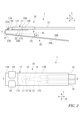
- FIG. 1 is a perspective view showing a temperature sensor according to a first embodiment.
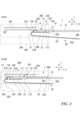
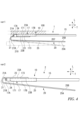
- FIG. 2 is a side view of the temperature sensor of the first embodiment and a plan view showing essential parts of the sensor element. It is a figure showing the process of attaching the temperature sensor of a 1st embodiment to a measurement object. It is a figure which shows the 1st modification (var1) and the 2nd modification (var2) of 1st Embodiment. It is a figure which shows the 3rd modification (var3), the 4th modification (var4), and the 5th modification (var5) of 1st Embodiment.
- FIG. 7 is a perspective view showing a temperature sensor according to a second embodiment and a diagram showing a process of mounting the temperature sensor on a measurement target.
- the temperature sensor 1 includes a sensor element 10 having a heat sensitive body 11 which is the main element for temperature measurement, and a sensor element 10 for holding the sensor element 10 and pressing the sensor element 10 against the object to be measured by elastic force. an elastic bracket 20.
- the object to be measured by the temperature sensor 1 includes, for example, a stator coil of an electric motor, a bus bar, etc. disclosed in Patent Documents 1 and 2, which have a flat detection surface against which the sensor element 10 is elastically pressed.
- the configurations of the sensor element 10 and the elastic bracket 20 will be explained in this order.
- the configuration of the sensor element 10 will be explained with reference to FIGS. 1 and 2.
- the sensor element 10 includes a heat sensitive body 11 that detects temperature, electrodes 12, 12 formed on each of two opposing surfaces of the heat sensitive body 11, and electrically connected to the heat sensitive body 11 via the electrodes 12, 12.
- a pair of lead wires 13, 13, and a sealing layer 16 covering the heat sensitive body 11 are provided.
- the sensor element 10 also includes an electrically insulating protector 17 that accommodates and seals the heat sensitive body 11 covered with the sealing layer 16 and a portion of the lead wires 13, 13 inside.
- the heat sensitive body 11 is made of a metal oxide or metal that has a property that its electrical resistance value changes with temperature changes.
- a thermistor (Thermally Sensitive Resistor) is suitably used, and typically an NTC thermistor (Negative Temperature Coefficient Thermistor) having a negative temperature coefficient is used.
- Platinum eg, Pt100; JIS-C1604 is preferably used as the metal.
- the electrode 12 electrically connects the heat sensitive body 11 and the lead wires 13, 13, and is preferably made of a noble metal such as gold or platinum.
- the lead wires 13, 13 are conductive wires that allow a constant current to flow through the heat sensitive element 11, and are made of a metal material with high electrical conductivity, typically copper.
- Dumet wire is preferably used for the lead wire 13.
- Dumet wire is a composite wire clad with an inner layer made of iron-nickel alloy and an outer layer made of copper.
- the sealing layer 16 is used as the sealing layer 16.
- Dumet wire is used for the lead wires 13, 13, the coefficient of linear expansion of the iron-nickel alloy is close to that of glass, so damage to the sealing layer 16 due to thermal expansion of the lead wires 13, 13 is prevented.
- Ru The lead wire 13 is an electric wire that allows a constant current to flow through the heat sensitive element 11. Further electric wires may be connected to the lead wire 13, which is an electric wire directly connected to the heat sensitive body 11, and the electric wires indirectly connected to the heat sensitive body 11 are referred to as connecting wires 15, 15.
- the sealing layer 16 is provided to surround and airtightly seal the heat sensitive body 11 to suppress chemical and physical changes in the heat sensitive body 11 .
- glass is preferably used as the sealing layer 16, depending on the environment in which the temperature sensor 1 is used, a resin material may be used, or the sealing layer 16 may be omitted.
- the protector 17 protects the heat sensitive body 11 and the lead wires 13, 13 from external forces such as external impacts, and contributes to electrical insulation between the heat sensitive body 11 and the object to be measured.
- the protector 17 is made of, for example, a fluororesin such as polytetrafluoroethylene (PTFE) or tetrafluoroethylene/perfluoroalkyl vinyl ether copolymer (PFA).
- PTFE polytetrafluoroethylene
- PFA tetrafluoroethylene/perfluoroalkyl vinyl ether copolymer
- the protector 17 can also be constructed using an appropriate resin material, regardless of whether it is a thermoplastic resin or a thermosetting resin.
- the protector 17 can be manufactured, for example, by injection molding into the cavity of a mold, with the heat sensitive body 11 covered with the sealing layer 16 placed in the cavity. If the protector 17 is made of a transparent resin, the appearance of the heat sensitive body 11 can be inspected by looking through the protector 17.
- the protector 17 of this embodiment has, for example, a substantially rectangular parallelepiped appearance.
- the protector 17 includes a holding portion 17A that is held by pressure bonding to the elastic bracket 20, and a heat sensitive portion 17B that seals the heat sensitive body 11 and the like.
- the holding part 17A and the heat sensitive part 17B have the same dimension in the width direction W, but different dimensions in the thickness direction T, and the holding part 17A has a thinner wall thickness.
- the side where the holding portion 17A of the protector 17 is provided is defined as the front (F), and the side from which the connecting wires 15, 15 are drawn out is defined as the rear (R). This definition has a relative meaning.
- a longitudinal direction L, a width direction W, and a thickness direction T are defined as shown in FIG. Since the holding part 17A is pressurized by the holding pieces 24, 24 of the elastic bracket 20, for example, the heat sensitive body 11, which may be damaged, is placed in the heat sensitive part 17B, avoiding the holding part 17A. Furthermore, the reason why the thickness of the holding part 17A is made thinner than that of the heat-sensitive part 17B is because the height of the heat-sensitive part 17B is made taller than the holding pieces 24, which press the holding part 17A. , 24 do not prevent the heat-sensitive section 17B from coming into contact with the measurement object 100. This point will be mentioned in the description of the elastic bracket 20 with illustrations.
- the protector 17 includes a first surface 171 and a second surface 173 that face each other. Both the first surface 171 and the second surface 173 are flat and parallel to each other.
- the temperature sensor 1 measures the temperature of the measurement target 100 (see FIG. 3), for example, an electric coil
- the first surface 171 of the heat sensitive section 17B can be said to be a heat sensitive surface that receives heat from the measurement object 100.
- the first surface 23A and the second surface 173 of the first spring piece 23 of the elastic bracket 20 that holds the protector 17 are in surface contact with each other.
- the first surface 171 is provided only on the heat sensitive section 17B, but the second surface 173 is provided continuously on the holding section 17A and the heat sensitive section 17B.
- the sensor element 10 is not limited to this embodiment, and the external shape of the protector 17 is not limited to a rectangular parallelepiped shape, but can be changed to a shape that matches the object to be measured.
- the protector may have a cylindrical shape that fits the concave arcuate surface.
- the protector 17 may have a polygonal shape that fits the concave polygonal surface.
- the second surface 173 is composed of an arcuate surface, and in the case of a polygonal protector, the second surface 173 is composed of a polygonal surface.
- the second surface 173, that is, the supporting surface must be composed of a flat surface that is parallel to the first surface 171, that is, the heat-sensitive surface. is preferred.
- the heat sensitive element 11 may be covered with a protective member such as a tube made of an insulating material.
- the protector 17 is not only made of one type of material, but may also be made of a plurality of laminated materials.
- the elastic bracket 20 has a function of pressing the protector 17 of the sensor element 10 against the object to be measured 100 with elastic force.
- the elastic bracket 20 is preferably constructed from a metal material, but the elastic bracket 20 can also be constructed from a resin material.
- the elastic bracket 20 basically includes a U-shaped compression plate spring, and is configured to hold the protector 17 on the compression plate spring.
- a compression spring is a spring that generates elastic force when subjected to a compressive load.
- the elastic bracket 20 is U-shaped and includes a connecting piece 21 having a first connecting piece 21A and a second connecting piece 21B.
- the elastic bracket 20 includes a first spring piece 23 that is connected to one first connection piece 21A of the connection pieces 21 and holds the protector 17, and a second spring piece 25 that is connected to the other second connection piece 21B of the connection pieces 21. and.
- the elastic bracket 20 is made by fabricating a material plate that integrally includes portions corresponding to the connection piece 21, the first spring piece 23, and the second spring piece 25 by metal plate press molding, and mechanically processing the material plate. It can be made by
- the first spring piece 23 and the second spring piece 25 are inclined and face each other at a predetermined angle of inclination ⁇ 1.
- the elastic bracket 20 receives a load such that the distance between the free ends of the first spring piece 23 and the second spring piece 25 becomes narrower, an elastic force is generated in the connecting piece 21.
- the elastic bracket 20 utilizes this elastic force to press the protector 17 against the object 100 to be measured, and also holds the temperature sensor 1 in a fixed position necessary for measuring the temperature of the object 100 to be measured.
- connection piece 21 When the elastic bracket 20 is made of a plate-shaped metal material, the connection piece 21 is formed by bending a flat plate made of the metal material. Examples of applicable metal materials include iron-based alloys, stainless steel, and phosphor bronze. Since the connection piece 21 is more susceptible to fatigue due to the use of the elastic bracket 20 as a spring than the first spring piece 23 and the second spring piece 25, it is preferable to consider the fatigue in the connection piece 21 when selecting the material. . Further, the thickness of the elastic bracket 20 is selected in consideration of the elastic force required of the elastic bracket 20 including the connection piece 21.
- the first spring piece 23 includes a first surface 23A and a second surface 23B, each of which is flat and parallel to each other.
- the protector 17 of the sensor element 10 is held by the first spring piece 23 while being placed on the first surface 23A via the second surface 173.
- the first spring piece 23 includes a pair of holding pieces 24, 24 for holding the protector 17.
- the holding pieces 24, 24 are provided on both sides of the first spring piece 23 in the width direction W, and near the first connecting piece 21A of the connecting piece 21.
- the protector 17 is placed on the first spring piece 23 such that the holding part 17A is disposed in the area corresponding to the holding pieces 24, 24, and by crimping the holding part 17A with the holding pieces 24, the first It is fixed to the spring piece 23 by crimping.
- the heat sensitive part 17B located rearward (R) of the holding part 17A fixed by the holding pieces 24, 24 is simply supported by the first spring piece 23 without being subjected to mechanical restraint.
- the first spring piece 23 does not support a part of the region in the longitudinal direction L of the protector 17, but it presses the protector 17 against the object to be measured 100 by elastic force in order to measure the temperature. Therefore, problems such as the sensor element 10 coming off from the holder 17 will not occur.
- L23 ⁇ L17 it is suitable that L23 ⁇ 1/2 ⁇ L17 to sufficiently press the protector 17 against the object to be measured 100. Furthermore, in the case of L23>L17, even if the first spring piece 23 is longer than necessary, it no longer contributes to pressing the protector 17 against the object to be measured 100, so it is preferable that L23 ⁇ L17.
- W23 ⁇ W17 or W23>W17 may be used.
- a fixing means called crimping was used to fix the protector 17 of the sensor element 10 to the first spring piece 23, the present invention is not limited to this.
- other fixing means such as fixing by fastening, fixing by adhesive, fixing by bundling, etc. can be adopted.
- fixing using the holding pieces 24, 24 does not require other members such as bolts as fastening means. Therefore, fixation by crimping can reduce the number of required members.
- crimping the holding pieces 24, 24, crimping has high reliability in mechanical restraint, and the sensor element 10 can be held for a long period of time.
- the second spring piece 25 presses the protector 17 held by the first spring piece 23 against the object to be measured 100 with elastic force by being abutted against, for example, a support surface provided opposite to the object to be measured 100 .
- the second spring piece 25 has an inclination angle ⁇ 1 ( ⁇ 1>0°) with respect to the first spring piece 23.
- the inclination angle ⁇ 1 refers to an angle formed with an imaginary line PL parallel to the first spring piece 23, as shown in FIG.
- the first spring piece 23 and the second spring piece 25 are parallel, so it is difficult to generate an elastic force to press the first spring piece 23 against the measurement object 100.
- the inclination angle ⁇ 1 increases, the generated elastic force increases, so it is preferable to increase the inclination angle ⁇ 1 within an allowable range.
- the elastic bracket 20 is placed.
- the dimension in the height direction (H) where an elastic force is generated is small, but the inclination angle ⁇ 1 is too large, the burden of inserting the elastic bracket 20 into the measurement space 207 becomes large, which impedes work efficiency. This is because the protection body 17 may be pressed against the measurement object 100 with an unnecessarily large load, and the protection body 17 may be damaged.
- the second spring piece 25 in the longitudinal direction L and the width direction W, as long as it fulfills its function.
- the temperature sensor 1 when the temperature sensor 1 is placed at a fixed position (hereinafter simply referred to as a fixed position) for measuring the temperature of the measurement target 100, the rear end of the second spring piece 25 is exposed to the outside. It has the required dimension in the longitudinal direction L.
- the width direction W as an example, a case where the second spring piece 25 is larger than the first spring piece 23 is illustrated.
- the measurement object 100 described here is supported by a holder 200.
- the holder 200 includes an upper wall 201 and a lower wall 202 spaced apart from the upper wall 201 in the vertical direction V.
- the upper wall 201 and the lower wall 202 each include an upper wall surface 203 and a lower wall surface 204.
- the measurement object 100 is fixed to the upper wall surface 203 of the upper wall 201, and the temperature sensor 1 is installed in the measurement space 207 between the measurement object 100 and the lower wall surface 204. Note that the dimensions of the measurement space 207 in the vertical direction V are determined so as to generate elastic force in the elastic bracket 20.
- the temperature sensor 1 is inserted into the measurement space 207 from the opening 205 of the holder 200 from the connection piece 21 side of the elastic bracket 20 (FIG. 3, step 1).
- the first surface 171 of the protector 17 supported by the first spring piece 23 of the elastic bracket 20 contacts the object to be measured 100 .
- the second spring piece 25 of the elastic bracket 20 hits the lower wall surface 204, and a compressive load is generated on the elastic bracket 20.
- the protector 17 In the temperature sensor 1 installed in the measurement space 207, the protector 17 is in contact with the object to be measured 100, while the holding pieces 24, 24 that press the holding part 17A are not in contact with the object to be measured 100. This is because, with respect to the first surface 23A, the protector 17 has a larger dimension in the height direction than the crimp pieces 24, 24, that is, is taller. This structure is realized by making the holding portion 17A of the protector 17 thinner than the heat-sensitive portion 17B.
- the temperature sensor 1 described above has the following effects.
- the temperature sensor 1 includes a U-shaped elastic bracket 20. Therefore, the structure of the elastic bracket 20 in the temperature sensor 1 is particularly simple. Furthermore, if there is the object to be measured 100 and a support surface facing the object 100, such as a lower wall surface 204, the temperature sensor 1 can be mounted by simply inserting the elastic bracket 20 into the measurement space 207 between them. In other words, the temperature sensor 1 can be easily attached to the measurement object 100.
- the elastic bracket 20 is provided as a single member in which the connecting piece 21, the first spring piece 23, and the second spring piece 25 are continuous by punching and bending a plate made of a metal material. Therefore, the temperature sensor 1 can be manufactured at low cost.
- the holding pieces 24, 24, which are responsible for fixing the protector 17, are formed integrally with the first spring piece 23, so compared to using them as separate members, the cost is reduced and holding by crimping is reduced. Excellent workability.
- the protector 17 since the protector 17 is supported by the first spring piece 23 on the side of the second surface 173 opposite to the first surface 171, the first surface 171 cannot be brought into direct contact with the object to be measured 100. I can do it. Therefore, according to the temperature sensor 1, it is possible to realize temperature measurement with excellent thermal responsiveness compared to using other members.
- FIGS. 4 and 5 Modification of the first embodiment: FIGS. 4 and 5
- a modification of the first embodiment will be described with reference to FIGS. 4 and 5.
- the temperature of the measurement target 100 provided in the holder 200 is measured, but as shown in FIG. If there is, the temperature of the measurement object 100 can be measured by the temperature sensor 1 (var1 in FIG. 4).
- the holding position of the elastic bracket 20 relative to the first spring piece 23 can be changed. That is, the temperature sensor 2 shown in FIG. 4 is the first spring piece 23, and the protector 17 is held on the second surface 23B facing the second spring piece 25 (FIG. 4 var2).
- the temperature sensor 2 most of the protector 17 and the heat sensitive body 11, which can be said to be the main part of the sensor element 10, are hidden between the first spring piece 23 and the second spring piece 25. Therefore, the temperature sensor 2 has high resistance to changes in the environment around the protector 17, such as temperature and atmosphere. Heat from the measurement object 100 is transmitted to the protector 17 and the heat sensitive element 11 via the first spring piece 23.
- the elastic bracket 20 is made of a metal material with high thermal conductivity, the thermal response is equivalent to when the protector 17 directly contacts the measurement object 100.
- the second spring piece 25 of the temperature sensor 3 is composed of two parts, a first part 251 and a second part 252, which are connected at a predetermined inclination angle ⁇ 2 (FIG. 5 var3). If the inclination angle ⁇ 2 is appropriately set, the second part 252 can be brought into surface contact with the locking surface when placed in a fixed position, so that the second part 252 can be brought into surface contact with the locking surface. The frictional force of the second portion 252 against the stop surface can be increased. Therefore, the temperature sensor 3 can prevent or reduce positional displacement in the measurement space 207.
- thermosensor 5 As a means for preventing or reducing positional deviation in the measurement space 207, as shown in FIG. It is also possible to attach a non-slip band 27 (Fig. 5 var4).
- the temperature sensor 5 shown in FIG. 5 can also be provided with a retaining claw 28 by bending the rear end of the second spring piece 25 (FIG. 5 var5).
- FIG. 6 a temperature sensor 6 according to a second embodiment will be described.
- the temperature sensor 6 is provided with a structure on the protector 17 to maintain it in a fixed position for temperature measurement.
- the temperature sensor 6 has the same configuration as the temperature sensor 1 according to the first embodiment except for this configuration. Therefore, the temperature sensor 6 will be explained below, focusing on matters related to the configuration.
- the temperature sensor 6 includes a locking protrusion 17C on the protector 17.
- the locking protrusion 17C is provided, for example, on the first surface 171 of the protector 17 at the rear end of the protector 17.
- the locking protrusion 17C is formed integrally with the protector 17 so as to protrude from the first surface 171 by a predetermined amount over the entire area of the protector 17 in the width direction W.
- a locking groove 206 into which the locking protrusion 17C fits is formed in the measurement object 100.
- the locking groove 206 preferably has a shape and dimensions into which the locking protrusion 17C fits without leaving any gaps.
- the temperature sensor 1 is inserted into the measurement space 207 from the opening 205 of the holder 200 from the side of the connection piece 21 of the elastic bracket 20 that supports the protector 17 having the locking protrusion 17C (FIG. 6, step 1). At this time, a compressive load is generated on the elastic bracket 20 similarly to the first embodiment.
- the elastic bracket 20 is further pushed toward the back of the measurement space 207, the elastic bracket 20 moves forward while the locking protrusion 17C is slid on the measurement object 100, although not shown.
- the elastic bracket 20 moves forward to the fixed position, the locking protrusion 17C fits into the locking groove 206 (FIG. 6, step 2), and the attachment of the temperature sensor 1 to the measurement object 100 is completed.
- a locking protrusion 17C formed integrally with the protector 17 fits into the locking groove 206, and the protector 17 is fixed to the elastic bracket 20 by crimping, for example. Therefore, even if a factor such as vibration occurs around the temperature sensor 1, the temperature sensor 1 remains in a fixed position, and the temperature of the object to be measured 100 can be stably measured.
- the locking protrusion 17C included in the temperature sensor 6 can be formed integrally with the protector 17, for example, by injection molding.
- a member corresponding to the locking protrusion 17C can be manufactured separately from the protector 17 and assembled to the elastic bracket 20, but it is better to form the locking protrusion 17C integrally to reduce manufacturing costs. In addition to being able to reduce the amount of damage, the labor of assembly work can be saved.
- the installation position of the locking protrusion 17C on the protector 17 is not limited to the rear end of the protector 17, but may be provided, for example, at the front end of the protector 17, or at any position between the front end and the rear end. You can also do that.
- the elastic bracket 20 may be provided with a structure that replaces the locking protrusion 17C.
- a locking protrusion may be provided to protrude from one or both sides of the first spring piece 23 in the width direction W. This locking protrusion can be formed integrally with the first spring piece 23.
- the locking protrusion 17C is provided on the side of the temperature sensor 6, and the locking groove 206 is provided on the side of the measurement target 100, but the present invention is not limited to this.
- a structure corresponding to the locking protrusion 17C may be provided on the measurement target object 100 side, and a structure corresponding to the locking groove 206 may be provided on the protector 17 side.
- the present embodiment can include a configuration between the temperature sensor 6 and the object to be measured 100 that suppresses displacement of the temperature sensor 6 with respect to the object to be measured 100.
Landscapes
- Physics & Mathematics (AREA)
- General Physics & Mathematics (AREA)
- Measuring Temperature Or Quantity Of Heat (AREA)
Priority Applications (5)
| Application Number | Priority Date | Filing Date | Title |
|---|---|---|---|
| US18/553,469 US20250076126A1 (en) | 2022-08-25 | 2022-08-25 | Temperature sensor |
| JP2023506268A JP7318151B1 (ja) | 2022-08-25 | 2022-08-25 | 温度センサ |
| PCT/JP2022/032042 WO2024042676A1 (ja) | 2022-08-25 | 2022-08-25 | 温度センサ |
| DE112022007699.2T DE112022007699T5 (de) | 2022-08-25 | 2022-08-25 | Temperatursensor |
| CN202280018112.2A CN117980710B (zh) | 2022-08-25 | 2022-08-25 | 温度传感器 |
Applications Claiming Priority (1)
| Application Number | Priority Date | Filing Date | Title |
|---|---|---|---|
| PCT/JP2022/032042 WO2024042676A1 (ja) | 2022-08-25 | 2022-08-25 | 温度センサ |
Publications (1)
| Publication Number | Publication Date |
|---|---|
| WO2024042676A1 true WO2024042676A1 (ja) | 2024-02-29 |
Family
ID=87469767
Family Applications (1)
| Application Number | Title | Priority Date | Filing Date |
|---|---|---|---|
| PCT/JP2022/032042 Ceased WO2024042676A1 (ja) | 2022-08-25 | 2022-08-25 | 温度センサ |
Country Status (5)
| Country | Link |
|---|---|
| US (1) | US20250076126A1 (https=) |
| JP (1) | JP7318151B1 (https=) |
| CN (1) | CN117980710B (https=) |
| DE (1) | DE112022007699T5 (https=) |
| WO (1) | WO2024042676A1 (https=) |
Families Citing this family (1)
| Publication number | Priority date | Publication date | Assignee | Title |
|---|---|---|---|---|
| JP2025147816A (ja) * | 2024-03-25 | 2025-10-07 | 三菱マテリアル株式会社 | 温度センサ |
Citations (2)
| Publication number | Priority date | Publication date | Assignee | Title |
|---|---|---|---|---|
| JPS59100227U (ja) * | 1982-09-17 | 1984-07-06 | 株式会社ボッシュオートモーティブ システム | 蒸発器用温度センサの保持具 |
| JPH03156331A (ja) * | 1989-08-21 | 1991-07-04 | Nkk Corp | 温度センサ |
Family Cites Families (7)
| Publication number | Priority date | Publication date | Assignee | Title |
|---|---|---|---|---|
| JP3622852B2 (ja) * | 2002-08-23 | 2005-02-23 | 三菱マテリアル株式会社 | サーミスタの製造方法 |
| JP2004239630A (ja) * | 2003-02-03 | 2004-08-26 | Optrex Corp | 温度センサの支持装置 |
| DE102006054026A1 (de) * | 2006-11-16 | 2008-05-21 | Leopold Kostal Gmbh & Co. Kg | Vorrichtung zur Ankopplung eines Temperatursensors an eine Kraftfahrzeugscheibe |
| EP2241870B1 (en) * | 2009-04-17 | 2015-09-02 | Sensirion AG | An assembly comprising a substrate and a sensor pressed against the substrate |
| JP2014178258A (ja) * | 2013-03-15 | 2014-09-25 | Honda Motor Co Ltd | センサブラケット及びセンサブラケットの取付方法 |
| KR102697338B1 (ko) * | 2018-11-19 | 2024-08-23 | 에스케이온 주식회사 | 온도센서유닛 및 이를 포함하는 배터리모듈 |
| JP6837623B1 (ja) * | 2020-11-06 | 2021-03-03 | 株式会社芝浦電子 | 温度センサ |
-
2022
- 2022-08-25 CN CN202280018112.2A patent/CN117980710B/zh active Active
- 2022-08-25 JP JP2023506268A patent/JP7318151B1/ja active Active
- 2022-08-25 DE DE112022007699.2T patent/DE112022007699T5/de active Pending
- 2022-08-25 WO PCT/JP2022/032042 patent/WO2024042676A1/ja not_active Ceased
- 2022-08-25 US US18/553,469 patent/US20250076126A1/en active Pending
Patent Citations (2)
| Publication number | Priority date | Publication date | Assignee | Title |
|---|---|---|---|---|
| JPS59100227U (ja) * | 1982-09-17 | 1984-07-06 | 株式会社ボッシュオートモーティブ システム | 蒸発器用温度センサの保持具 |
| JPH03156331A (ja) * | 1989-08-21 | 1991-07-04 | Nkk Corp | 温度センサ |
Also Published As
| Publication number | Publication date |
|---|---|
| US20250076126A1 (en) | 2025-03-06 |
| CN117980710B (zh) | 2025-04-04 |
| DE112022007699T5 (de) | 2025-06-12 |
| CN117980710A (zh) | 2024-05-03 |
| JP7318151B1 (ja) | 2023-07-31 |
| JPWO2024042676A1 (https=) | 2024-02-29 |
Similar Documents
| Publication | Publication Date | Title |
|---|---|---|
| JP6282791B1 (ja) | 温度センサ | |
| US11892358B2 (en) | Temperature detection device and assembly thereof | |
| JP6935042B1 (ja) | 温度センサおよび電動機 | |
| CN108885142B (zh) | 温度传感器 | |
| JP6488393B2 (ja) | コネクタ | |
| US8935843B2 (en) | Temperature sensor and method for its manufacture | |
| US10989608B2 (en) | Temperature sensor | |
| JPH04319634A (ja) | 温度センサ | |
| JP4832398B2 (ja) | 圧縮機 | |
| JP2019095355A (ja) | 温度センサ | |
| JP7318151B1 (ja) | 温度センサ | |
| JP7538367B2 (ja) | 温度センサ | |
| JP6916228B2 (ja) | 温度センサ | |
| US20160061865A1 (en) | Structure of mounting current sensor to battery cable | |
| JP7468320B2 (ja) | 温度センサ装置 | |
| JP2002168825A (ja) | センサの端子接続構造 | |
| JP2001074563A (ja) | 温度センサ | |
| JP6894767B2 (ja) | 中継端子モジュール | |
| JP7190609B1 (ja) | 温度センサ | |
| JP7361981B1 (ja) | 温度センサおよび回転電機 | |
| JPH0584854U (ja) | 酸素センサ | |
| JP2002168822A (ja) | センサの端子構造、ガスセンサおよび温度センサ | |
| JPH07260595A (ja) | サーミスタ温度検知器及びその製造方法 | |
| CN110312931A (zh) | 用于分析气体的传感器 |
Legal Events
| Date | Code | Title | Description |
|---|---|---|---|
| ENP | Entry into the national phase |
Ref document number: 2023506268 Country of ref document: JP Kind code of ref document: A |
|
| WWE | Wipo information: entry into national phase |
Ref document number: 202280018112.2 Country of ref document: CN |
|
| WWE | Wipo information: entry into national phase |
Ref document number: 18553469 Country of ref document: US |
|
| 121 | Ep: the epo has been informed by wipo that ep was designated in this application |
Ref document number: 22956503 Country of ref document: EP Kind code of ref document: A1 |
|
| WWP | Wipo information: published in national office |
Ref document number: 18553469 Country of ref document: US |
|
| WWE | Wipo information: entry into national phase |
Ref document number: 112022007699 Country of ref document: DE |
|
| WWG | Wipo information: grant in national office |
Ref document number: 202280018112.2 Country of ref document: CN |
|
| WWP | Wipo information: published in national office |
Ref document number: 112022007699 Country of ref document: DE |
|
| 122 | Ep: pct application non-entry in european phase |
Ref document number: 22956503 Country of ref document: EP Kind code of ref document: A1 |