WO2024038697A1 - 組成物、エッチング方法、及び積層体の製造方法 - Google Patents
組成物、エッチング方法、及び積層体の製造方法 Download PDFInfo
- Publication number
- WO2024038697A1 WO2024038697A1 PCT/JP2023/024870 JP2023024870W WO2024038697A1 WO 2024038697 A1 WO2024038697 A1 WO 2024038697A1 JP 2023024870 W JP2023024870 W JP 2023024870W WO 2024038697 A1 WO2024038697 A1 WO 2024038697A1
- Authority
- WO
- WIPO (PCT)
- Prior art keywords
- etching
- composition
- component
- acid
- mass
- Prior art date
- Legal status (The legal status is an assumption and is not a legal conclusion. Google has not performed a legal analysis and makes no representation as to the accuracy of the status listed.)
- Ceased
Links
Images
Classifications
-
- C—CHEMISTRY; METALLURGY
- C23—COATING METALLIC MATERIAL; COATING MATERIAL WITH METALLIC MATERIAL; CHEMICAL SURFACE TREATMENT; DIFFUSION TREATMENT OF METALLIC MATERIAL; COATING BY VACUUM EVAPORATION, BY SPUTTERING, BY ION IMPLANTATION OR BY CHEMICAL VAPOUR DEPOSITION, IN GENERAL; INHIBITING CORROSION OF METALLIC MATERIAL OR INCRUSTATION IN GENERAL
- C23F—NON-MECHANICAL REMOVAL OF METALLIC MATERIAL FROM SURFACE; INHIBITING CORROSION OF METALLIC MATERIAL OR INCRUSTATION IN GENERAL; MULTI-STEP PROCESSES FOR SURFACE TREATMENT OF METALLIC MATERIAL INVOLVING AT LEAST ONE PROCESS PROVIDED FOR IN CLASS C23 AND AT LEAST ONE PROCESS COVERED BY SUBCLASS C21D OR C22F OR CLASS C25
- C23F1/00—Etching metallic material by chemical means
- C23F1/10—Etching compositions
- C23F1/14—Aqueous compositions
- C23F1/16—Acidic compositions
- C23F1/18—Acidic compositions for etching copper or alloys thereof
-
- C—CHEMISTRY; METALLURGY
- C23—COATING METALLIC MATERIAL; COATING MATERIAL WITH METALLIC MATERIAL; CHEMICAL SURFACE TREATMENT; DIFFUSION TREATMENT OF METALLIC MATERIAL; COATING BY VACUUM EVAPORATION, BY SPUTTERING, BY ION IMPLANTATION OR BY CHEMICAL VAPOUR DEPOSITION, IN GENERAL; INHIBITING CORROSION OF METALLIC MATERIAL OR INCRUSTATION IN GENERAL
- C23F—NON-MECHANICAL REMOVAL OF METALLIC MATERIAL FROM SURFACE; INHIBITING CORROSION OF METALLIC MATERIAL OR INCRUSTATION IN GENERAL; MULTI-STEP PROCESSES FOR SURFACE TREATMENT OF METALLIC MATERIAL INVOLVING AT LEAST ONE PROCESS PROVIDED FOR IN CLASS C23 AND AT LEAST ONE PROCESS COVERED BY SUBCLASS C21D OR C22F OR CLASS C25
- C23F1/00—Etching metallic material by chemical means
- C23F1/10—Etching compositions
- C23F1/14—Aqueous compositions
- C23F1/16—Acidic compositions
- C23F1/26—Acidic compositions for etching refractory metals
-
- H—ELECTRICITY
- H05—ELECTRIC TECHNIQUES NOT OTHERWISE PROVIDED FOR
- H05K—PRINTED CIRCUITS; CASINGS OR CONSTRUCTIONAL DETAILS OF ELECTRIC APPARATUS; MANUFACTURE OF ASSEMBLAGES OF ELECTRICAL COMPONENTS
- H05K3/00—Apparatus or processes for manufacturing printed circuits
-
- H—ELECTRICITY
- H10—SEMICONDUCTOR DEVICES; ELECTRIC SOLID-STATE DEVICES NOT OTHERWISE PROVIDED FOR
- H10P—GENERIC PROCESSES OR APPARATUS FOR THE MANUFACTURE OR TREATMENT OF DEVICES COVERED BY CLASS H10
- H10P50/00—Etching of wafers, substrates or parts of devices
-
- H—ELECTRICITY
- H10—SEMICONDUCTOR DEVICES; ELECTRIC SOLID-STATE DEVICES NOT OTHERWISE PROVIDED FOR
- H10P—GENERIC PROCESSES OR APPARATUS FOR THE MANUFACTURE OR TREATMENT OF DEVICES COVERED BY CLASS H10
- H10P50/00—Etching of wafers, substrates or parts of devices
- H10P50/69—Etching of wafers, substrates or parts of devices using masks for semiconductor materials
- H10P50/691—Etching of wafers, substrates or parts of devices using masks for semiconductor materials for Group V materials or Group III-V materials
Definitions
- the present invention relates to a composition containing specific components, an etching method using the same, and a method for manufacturing a laminate.
- Wiring materials for display devices such as flat panel displays are sometimes made of multiple metal layers in order to meet performance requirements such as larger displays and higher resolution.
- Patent Document 1 discloses an etching solution containing hydrogen peroxide, glycine, phosphoric acid, and water as an etching solution for etching a laminated film of copper and molybdenum used for display wiring.
- Patent Document 2 discloses an etching solution containing citric acid, maleic acid, a copper ion supply source, and ammonia as an etching solution for etching a multilayer film containing copper and molybdenum.
- Patent Document 3 discloses an etching solution containing hydrogen peroxide, a specific acid, a specific alkali compound, and caffeine.
- the present invention has been made to solve these problems, and its object is to form fine patterns with excellent dimensional accuracy with high productivity while suppressing the generation of residues and etching unevenness.
- the objective is to provide a composition that allows Another object of the present invention is to provide an etching method and a method for manufacturing a laminate using the above composition.
- an etching method includes a step of etching a metal layer using the above composition.
- a method for manufacturing a laminate which includes a step of etching a metal layer using the above composition.
- the present invention it is possible to provide a composition useful for etching metal layers such as copper-based layers and molybdenum-based layers, which can form fine patterns with excellent dimensional accuracy. Further, according to the present invention, it is possible to provide an etching method and a method for manufacturing a laminate using the above composition.
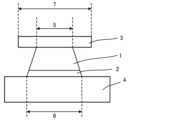
- FIG. 3 is a cross-sectional view schematically showing a test substrate after etching.
- a composition that is an embodiment of the present invention (hereinafter also simply referred to as “the present composition”) consists of (A) hydrogen peroxide (hereinafter also referred to as “component (A)”); (B) an organic acid (hereinafter also referred to as “component (A)”); (also referred to as “component (B)”); (C) at least one member selected from the group consisting of diethylaminoethanol, 1-amino-2-propanol, and N-methyldiethanolamine (hereinafter referred to as “component (C)”); It is an aqueous solution containing water as an essential component.
- component (A) hydrogen peroxide
- component (A) an organic acid
- component (C) at least one member selected from the group consisting of diethylaminoethanol, 1-amino-2-propanol, and N-methyldiethanolamine
- This composition is suitable as an etching liquid composition used for etching metal layers such as copper-based layers and molybdenum-based layers.
- the copper-based layer include copper alloys such as silver-copper alloys and aluminum-copper alloys; and layers containing copper.
- the molybdenum-based layer include molybdenum alloys such as titanium-molybdenum alloys, tungsten-molybdenum alloys, silicon-molybdenum alloys, and layers containing molybdenum.
- the present composition is suitable as an etching liquid composition used for etching metal layers including a layer containing copper and a layer containing molybdenum.
- the present composition is particularly suitable as an etching liquid composition used for etching a laminate (metal layer) including a layer containing copper and a layer containing molybdenum.
- “Etching” in this specification means a plastic shaping or surface processing technique that utilizes the corrosive action of chemicals or the like.
- Specific uses of the present composition include, for example, as a remover, a surface smoothing agent, a surface roughening agent, a pattern forming agent, and a cleaning solution for components adhered to a substrate in small amounts.
- the present composition can be suitably used as a removal agent since the removal rate of the copper-containing layer and the molybdenum-containing layer can be easily controlled.
- the present composition is used to form a finely shaped pattern having a three-dimensional structure, it is possible to obtain a pattern with a desired shape such as a rectangle, so it is suitable as a pattern forming agent. Can be used.
- the content of component (A) in the present composition is preferably 1 to 20% by mass, more preferably 2 to 16% by mass, particularly preferably 4 to 14% by mass, and 6% by mass. Most preferably ⁇ 12% by weight.
- this composition is used as an etching liquid composition, the content of component (A) can be adjusted as appropriate depending on the thickness, width, etc. of the object to be etched.
- lactic acid, malic acid, citric acid, malonic acid, succinic acid, tartaric acid, formic acid, acetic acid, propionic acid, butyric acid, caproic acid, oxalic acid, glycolic acid, mandelic acid, etc. may be used.
- malic acid, citric acid, malonic acid, and succinic acid are preferred, and citric acid is particularly preferred, since they can easily produce fine wiring patterns with good productivity while suppressing the occurrence of residues, etching unevenness, and undercuts. preferable.
- These organic acids can be used alone or in combination of two or more. Moreover, these organic acids may be hydrates.
- the content of component (B) in the present composition is such that when the present composition is used as an etching solution composition, fine wiring patterns can be manufactured with good productivity while suppressing the occurrence of residues, etching unevenness, and undercuts.
- it is preferably 1 to 20% by mass, more preferably 2 to 16% by mass, particularly preferably 4 to 14% by mass, and most preferably 6 to 12% by mass.
- the content of component (B) can be adjusted as appropriate depending on the thickness, width, etc. of the object to be etched.
- the mass ratio of component (B) to component (A) is such that it is easy to manufacture fine wiring patterns with high productivity while suppressing the occurrence of residues, etching unevenness, and undercuts.
- (A) is preferably from 0.1 to 10, more preferably from 0.2 to 5, particularly preferably from 0.5 to 2, and preferably from 0.7 to 1.4. Most preferred.
- Component (C) is at least one selected from the group consisting of diethylaminoethanol, 1-amino-2-propanol, and N-methyldiethanolamine.
- diethylaminoethanol and 1-amino-2-propanol are preferred, and diethylaminoethanol is particularly preferred, since it is easy to manufacture fine wiring patterns with good productivity while suppressing the occurrence of residues, etching unevenness, and undercuts.
- diethylaminoethanol and 1-amino-2-propanol are preferred, and diethylaminoethanol is particularly preferred, since it is easy to manufacture fine wiring patterns with good productivity while suppressing the occurrence of residues, etching unevenness, and undercuts.
- These compounds can be used alone or in combination of two or more.
- the content of component (C) in the present composition is such that when the present composition is used as an etching liquid composition, fine wiring patterns can be manufactured with good productivity while suppressing the occurrence of residues, etching unevenness, and undercuts.
- it is preferably 1 to 20% by mass, more preferably 2 to 16% by mass, particularly preferably 4 to 14% by mass, and most preferably 6 to 12% by mass.
- the content of component (C) can be adjusted as appropriate depending on the thickness, width, etc. of the object to be etched.
- the mass ratio of component (C) to the total of components (A) and (B) is such that fine wiring patterns can be manufactured with good productivity while suppressing the occurrence of residues, etching unevenness, and undercuts.
- the present composition further contains (D) a hydrogen peroxide stabilizer (hereinafter also referred to as "component (D)”), which is a component for stabilizing component (A).
- component (D) includes, for example, 2-butoxyethanol, phenylurea, phenolsulfonic acid, phenyl glycol, phenylethylene glycol, acetanilide, phenacetin, acetamidophenol, hydroxybenzoic acid, p-aminobenzoic acid, p-aminophenol, 3,5-diaminobenzoic acid, sulfanilic acid, aniline, N-methylaniline, 8-hydroxyquinoline, acetotoluide, diphenylamine, phenol, anisole, and the like can be used.
- 2-butoxyethanol and phenylurea are preferred because they have excellent hydrogen peroxide stability and can easily produce fine wiring patterns with good productivity while suppressing the occurrence of residues, etching unevenness, and undercuts. It is particularly preferred to use 2-butoxyethanol and phenylurea in combination. These compounds can be used alone or in combination of two or more.
- the content of component (D) in the present composition is such that when the present composition is used as an etching solution composition, fine wiring patterns can be manufactured with good productivity while suppressing the occurrence of residues, etching unevenness, and undercuts. Since it is easy to use, the amount is preferably 0.01 to 5% by mass, more preferably 0.1 to 3% by mass, particularly preferably 0.3 to 2% by mass, and 0.5 to 1% by mass. Most preferably it is % by weight.
- the content of component (D) can be adjusted as appropriate depending on the thickness, width, etc. of the object to be etched.
- the mass ratio of component (D) to component (A) is such that it is easy to manufacture fine wiring patterns with high productivity while suppressing the occurrence of residues, uneven etching, and undercuts.
- /(A) is preferably from 0.005 to 3, more preferably from 0.01 to 1, particularly preferably from 0.02 to 0.5, and from 0.05 to 0.2. Most preferably.
- This composition is an aqueous solution containing water as an essential component.
- water it is preferable to use water from which ionic substances and impurities have been removed, such as ion-exchanged water, pure water, and ultrapure water.
- the content of water in the composition may be about 50 to 99% by mass.
- the present composition can be suitably used as an etching solution composition (etching solution) for etching metal layers such as copper-based layers and molybdenum-based layers, an additive for metal electrolytic refining, an additive for plating solutions, etc. .
- etching solution composition for etching metal layers such as copper-based layers and molybdenum-based layers
- an additive for metal electrolytic refining for etching metal layers
- plating solutions etc.
- it is suitable as an etching liquid composition used for etching a metal layer.
- component (E) inorganic acid (hereinafter referred to as , (also referred to as “component (E)"), an azole compound (F) (hereinafter also referred to as “component (F)”), and well-known additives and solvents.
- component (E) for example, sulfuric acid, hydrochloric acid, nitric acid, phosphoric acid, hydrofluoric acid, etc. can be used.
- phosphoric acid is particularly preferred because it facilitates manufacturing fine wiring patterns with good productivity while suppressing the occurrence of residues, etching unevenness, and undercuts.
- These inorganic acids can be used alone or in combination of two or more.
- the content of component (E) in the present composition is such that when the present composition is used as an etching liquid composition, fine wiring patterns can be manufactured with good productivity while suppressing the occurrence of residues, etching unevenness, and undercuts. Since it is easy to use, it is preferably 0.01 to 5% by mass, more preferably 0.05 to 3% by mass, particularly preferably 0.1 to 2% by mass, and particularly preferably 0.2 to 1% by mass. Most preferably it is % by weight.
- the content of component (E) can be adjusted as appropriate depending on the thickness, width, etc. of the object to be etched.
- Component (F) includes, for example, 3-aminotriazole, 5-aminotetrazole, 1,2,3-triazole, 1,2,4-triazole, 5-phenyl-1,2,4-triazole, 5-aminotriazole, -1,2,4-triazole, benzotriazole, 1-methyl-benzotriazole, 5-methyltetrazole, 5-phenyltetrazole, and the like can be used.
- 3-aminotriazole and 5-aminotetrazole are preferred, and 3-aminotriazole is particularly preferred, since it is easy to manufacture fine wiring patterns with good productivity while suppressing the occurrence of residues, etching unevenness, and undercuts. .
- These azole compounds can be used alone or in combination of two or more.
- the content of component (F) in the present composition is such that when the present composition is used as an etching solution composition, fine wiring patterns can be manufactured with good productivity while suppressing the occurrence of residues, etching unevenness, and undercuts. Since it is easy to use, it is preferably 0.001 to 1% by mass, more preferably 0.003 to 0.5% by mass, particularly preferably 0.005 to 0.2% by mass, and Most preferably, it is between .01 and 0.1% by weight.
- the content of component (F) can be adjusted as appropriate depending on the thickness, width, etc. of the object to be etched.
- Additives include solubilizers for each component, pH adjusters, specific gravity adjusters, viscosity adjusters, wettability improvers, chelating agents, oxidizing agents (excluding hydrogen peroxide), reducing agents, surfactants, etc. can be mentioned.
- the content of the additive can be adjusted as appropriate depending on the thickness, width, etc. of the object to be etched.
- alcohol solvents examples include methanol, ethanol, diethylene glycol, isopropyl alcohol, and 2-ethylhexanol.
- ketone solvent examples include methyl acetate, ethyl acetate, and propyl acetate.
- ether solvent examples include dimethyl ether, diethyl ether, tetrahydrofuran, and methyl cellosolve. The content of the solvent can be adjusted as appropriate depending on the thickness, width, etc. of the object to be etched.
- An etching method that is an embodiment of the present invention includes a step of etching a metal layer using the present composition described above. Further, a method for manufacturing a laminate, which is an embodiment of the present invention, includes a step of etching a metal layer using the present composition described above. In both the etching method and the method for manufacturing a laminate of this embodiment, steps of well-known general etching methods can be employed, except for using the above-mentioned liquid composition.
- a layer containing copper (copper-based layer) and a layer containing molybdenum (molybdenum-based layer) are particularly suitable as the object to be etched.
- the copper-based layer include a layer containing a copper alloy such as a silver-copper alloy and an aluminum-copper alloy; and a layer containing copper.
- a layer containing copper is particularly suitable.
- the molybdenum-based layer include a layer containing a molybdenum alloy such as a titanium-molybdenum alloy, a tungsten-molybdenum alloy, and a silicon-molybdenum alloy; and a layer containing molybdenum.
- a layer containing molybdenum is particularly suitable.
- etching method for example, a dipping method, a spray method, etc. can be adopted. Etching conditions may also be adjusted as appropriate depending on the composition of the etching solution composition used and the etching method. Furthermore, various well-known methods such as a batch method, a flow method, and an auto-control method based on the oxidation-reduction potential, specific gravity, and acid concentration of the etchant may be employed.
- Etching conditions are not particularly limited and can be arbitrarily set depending on the shape and film thickness of the object to be etched.
- the etching temperature is preferably 10 to 60°C, more preferably 10 to 50°C, and particularly preferably 20 to 40°C. Since the temperature of the etching liquid composition may rise due to the heat of reaction, the temperature may be controlled by known means to maintain it within the above temperature range, if necessary.
- the etching time may be set to a time that allows the object to be etched to be sufficiently etched.
- the etching time may be about 10 to 300 seconds.
- the etching method and the method for manufacturing a laminate using the above composition it is possible to form a fine pattern with good productivity while suppressing the generation of residue and uneven etching. Therefore, in addition to display substrates and printed wiring boards, it can be suitably used for manufacturing various substrates that require fine pitches.
- the disclosure of this embodiment includes the following aspects.
- the content of the component (A) is 1 to 20% by mass
- the content of the component (B) is 1 to 20% by mass
- the content of the component (C) is 1 to 20% by mass.
- (E) The composition according to any one of [1] to [4], further containing an inorganic acid.
- the composition according to [6], wherein the metal layer includes a layer containing copper and a layer containing molybdenum.
- [10] [1] A method for producing a laminate comprising the step of etching a metal layer using the composition according to any one of [7]. [11] The method for manufacturing a laminate according to [10], wherein the metal layer includes a layer containing copper and a layer containing molybdenum.
- Citric acid b-2 Succinic acid b-3: Malonic acid
- component (C) c-4 to c-7 shown below were prepared as comparative components of component (C).
- c-4 Dimethylaminoethanol
- c-5 Dimethylaminomethylpropanol
- c-6 1-dimethylamino-2-propanol
- c-7 2-dibutylaminoethanol
- Example compositions 1 to 12 and Comparative Examples 1 to 4 Component (A), component (B), component (C) or its comparative component, component (D), component (E), component (F), and water are mixed so that the composition shown in Table 1 is obtained. , Example compositions 1 to 12 and Comparative example compositions 1 to 4 were obtained. Note that the remainder of these compositions is water.
- Just etching time means the time required for the width of the lower part of the thin wire in the cross section of the thin wire to reach 8 ⁇ m, which is calculated from the etching rate. Thereafter, the resist pattern was removed using a stripping solution to form a pattern (thin line).
- Comparative Evaluation Examples 2 and 3 although patterns could be formed, it was not possible to suppress the generation of residues and undercuts. Furthermore, in Comparative Evaluation Example 1, the occurrence of etching unevenness could not be suppressed. Furthermore, in Comparative Evaluation Example 4, no pattern could be formed. From the above, it was found that by etching a metal layer using the present composition, a pattern can be formed with good productivity while suppressing the occurrence of residues, etching unevenness, and undercuts.
Landscapes
- Chemical & Material Sciences (AREA)
- Engineering & Computer Science (AREA)
- Chemical Kinetics & Catalysis (AREA)
- General Chemical & Material Sciences (AREA)
- Materials Engineering (AREA)
- Mechanical Engineering (AREA)
- Metallurgy (AREA)
- Organic Chemistry (AREA)
- Manufacturing & Machinery (AREA)
- Microelectronics & Electronic Packaging (AREA)
- ing And Chemical Polishing (AREA)
- Laminated Bodies (AREA)
Abstract
寸法精度に優れた微細なパターンを残渣やエッチングムラの発生を抑制しつつ生産性良く形成することが可能な組成物、並びにこの組成物を用いたエッチング方法及び積層体の製造方法を提供する。(A)過酸化水素、(B)有機酸、(C)ジエチルアミノエタノール、1-アミノ-2-プロパノール、及びN-メチルジエタノールアミンからなる群より選択される少なくとも1種、並びに水を含有する組成物である。また、この組成物を用いて金属層をエッチングする工程を有するエッチング方法及び積層体の製造方法である。
Description
本発明は、特定の成分を含有する組成物、それを用いたエッチング方法及び積層体の製造方法に関する。
フラットパネルディスプレイ等に代表される表示デバイスの配線材料は、ディスプレイの大型化及び高解像度化といった要求性能を満たすために、複数の金属層からなる配線材料が用いられることがある。
例えば、特許文献1には、ディスプレイ配線に用いられる銅及びモリブデンの積層膜をエッチングするためのエッチング液として、過酸化水素、グリシン、リン酸、及び水を含有するエッチング液が開示されている。また、特許文献2には、銅及びモリブデンを含む多層膜をエッチングするエッチング液として、クエン酸、マレイン酸、銅イオン供給源、及びアンモニアを含有するエッチング液が開示されている。さらに、特許文献3には、過酸化水素、特定の酸、特定のアルカリ化合物、及びカフェインを含有するエッチング液が開示されている。
しかしながら、上記の特許文献で開示されたエッチング液では、所望の寸法精度を有する微細なパターンを形成することが困難である、生産性良くパターンを形成することが困難である、又は断線やショートの原因となる残渣やエッチングムラが発生しやすくなる、等の問題があった。
したがって、本発明はこれらの問題を解決するためになされたものであり、その課題とするところは、寸法精度に優れた微細なパターンを残渣やエッチングムラの発生を抑制しつつ生産性良く形成することが可能な組成物を提供することにある。また、本発明の課題とするところは、上記組成物を用いたエッチング方法及び積層体の製造方法を提供することにある。
本発明者らは、上記組成物を得るべく鋭意検討を重ねた結果、特定の成分を含有する組成物が上記問題を解決し得ることを見出し、本発明に至った。
すなわち、本発明によれば、(A)過酸化水素、(B)有機酸、(C)ジエチルアミノエタノール、1-アミノ-2-プロパノール、及びN-メチルジエタノールアミンからなる群より選択される少なくとも1種、並びに水を含有する組成物が提供される。
また、本発明によれば、上記の組成物を用いて金属層をエッチングする工程を有するエッチング方法が提供される。
さらに、本発明によれば、上記の組成物を用いて金属層をエッチングする工程を有する積層体の製造方法が提供される。
本発明によれば、寸法精度に優れた微細なパターンを形成することが可能な、銅系層やモリブデン系層などの金属層のエッチングに有用な組成物を提供することができる。また、本発明によれば、上記組成物を用いたエッチング方法及び積層体の製造方法を提供することができる。
以下、本発明の実施の形態について詳細に説明する。本発明の一実施形態である組成物(以下、単に「本組成物」とも記す)は、(A)過酸化水素(以下、「(A)成分」とも記す);(B)有機酸(以下、「(B)成分」とも記す);(C)ジエチルアミノエタノール、1-アミノ-2-プロパノール、及びN-メチルジエタノールアミンからなる群よりから選択される少なくとも1種(以下、「(C)成分」とも記す);並びに水を必須成分として含有する水溶液である。本組成物は、銅系層やモリブデン系層などの金属層をエッチングするために用いられるエッチング液組成物として好適である。銅系層としては、銀銅合金、アルミニウム銅合金等の銅合金;及び銅などを含む層を挙げることができる。モリブデン系層としては、チタンモリブデン合金、タングステンモリブデン合金、ケイ素モリブデン合金等のモリブデン合金;及びモリブデンなどを含む層を挙げることができる。なかでも、本組成物は、銅を含有する層及びモリブデンを含有する層を含む金属層をエッチングするために用いられるエッチング液組成物として好適である。また、本組成物は、銅を含有する層及びモリブデンを含有する層を含む積層体(金属層)をエッチングするために用いられるエッチング液組成物として特に好適である。
本明細書における「エッチング」とは、化学薬品等の腐食作用を利用した塑形又は表面加工の技法を意味する。本組成物の具体的な用途としては、例えば、除去剤、表面平滑化剤、表面粗化剤、パターン形成用薬剤、及び基体に微量付着した成分の洗浄液等を挙げることができる。本組成物は、銅を含有する層及びモリブデンを含有する層の除去速度を制御しやすいことから、除去剤として好適に用いることができる。また、本組成物は、3次元構造を有する微細な形状のパターンを形成する際に用いた場合に、矩形等の所望の形状のパターンを得ることができることから、パターン形成用薬剤としても好適に用いることができる。
本組成物中の(A)成分の含有量は、1~20質量%であることが好ましく、2~16質量%であることがさらに好ましく、4~14質量%であることが特に好ましく、6~12質量%であることが最も好ましい。本組成物をエッチング液組成物として用いる場合、(A)成分の含有量は、被エッチング物の厚さや幅等に応じて適宜調整することができる。
(B)成分としては、例えば、乳酸、リンゴ酸、クエン酸、マロン酸、コハク酸、酒石酸、ギ酸、酢酸、プロピオン酸、酪酸、カプロン酸、シュウ酸、グリコール酸、及びマンデル酸等を用いることができる。なかでも、残渣、エッチングムラ、及びアンダーカットの発生を抑制しながら生産性良く微細な配線パターンを製造しやすいことから、リンゴ酸、クエン酸、マロン酸、及びコハク酸が好ましく、クエン酸が特に好ましい。これらの有機酸は、一種単独又は二種以上を組み合わせて用いることができる。また、これらの有機酸は水和物であってもよい。
本組成物中の(B)成分の含有量は、本組成物をエッチング液組成物として用いる場合、残渣、エッチングムラ、及びアンダーカットの発生を抑制しながら生産性良く微細な配線パターンを製造しやすいことから、1~20質量%であることが好ましく、2~16質量%であることがさらに好ましく、4~14質量%であることが特に好ましく、6~12質量%であることが最も好ましい。(B)成分の含有量は、被エッチング物の厚さや幅等に応じて適宜調整することができる。
本組成物中、(A)成分に対する(B)成分の質量比率は、残渣、エッチングムラ及びアンダーカットの発生を抑制しながら生産性良く微細な配線パターンを製造しやすいことから、(B)/(A)=0.1~10であることが好ましく、0.2~5であることがさらに好ましく、0.5~2であることが特に好ましく、0.7~1.4であることが最も好ましい。
(C)成分は、ジエチルアミノエタノール、1-アミノ-2-プロパノール、及びN-メチルジエタノールアミンからなる群より選択される少なくとも1種である。なかでも、残渣、エッチングムラ、及びアンダーカットの発生を抑制しながら生産性良く微細な配線パターンを製造しやすいことから、ジエチルアミノエタノール及び1-アミノ-2-プロパノールが好ましく、ジエチルアミノエタノールが特に好ましい。これらの化合物は、一種単独又は二種以上を組み合わせて用いることができる。
本組成物中の(C)成分の含有量は、本組成物をエッチング液組成物として用いる場合、残渣、エッチングムラ、及びアンダーカットの発生を抑制しながら生産性良く微細な配線パターンを製造しやすいことから、1~20質量%であることが好ましく、2~16質量%であることがさらに好ましく、4~14質量%であることが特に好ましく、6~12質量%であることが最も好ましい。(C)成分の含有量は、被エッチング物の厚さや幅等に応じて適宜調整することができる。
本組成物中、(A)成分と(B)成分の合計に対する(C)成分の質量比率は、残渣、エッチングムラ、及びアンダーカットの発生を抑制しながら生産性良く微細な配線パターンを製造しやすいことから、(C)/((A)+(B))=0.01~5であることが好ましく、0.05~3であることがさらに好ましく、0.1~2であることが特に好ましく、0.3~1であることが最も好ましい。
本組成物は、(A)成分を安定化させるための成分である(D)過酸化水素安定剤(以下、「(D)成分」とも記す)をさらに含有することが好ましい。(D)成分としては、例えば、2-ブトキシエタノール、フェニル尿素、フェノールスルホン酸、フェニルグリコール、フェニルエチレングリコール、アセトアニリド、フェナセチン、アセトアミドフェノール、ヒドロキシ安息香酸、p-アミノ安息香酸、p-アミノフェノール、3,5-ジアミノ安息香酸、スルファニル酸、アニリン、N-メチルアニリン、8-ヒドロキシキノリン、アセトトルイド、ジフェニルアミン、フェノール、及びアニソール等を用いることができる。なかでも、過酸化水素の安定性に優れ、残渣、エッチングムラ、及びアンダーカットの発生を抑制しながら生産性良く微細な配線パターンを製造しやすいことから、2-ブトキシエタノール及びフェニル尿素が好ましく、2-ブトキシエタノール及びフェニル尿素を併用することが特に好ましい。これらの化合物は、一種単独又は二種以上を組み合わせて用いることができる。
本組成物中の(D)成分の含有量は、本組成物をエッチング液組成物として用いる場合、残渣、エッチングムラ、及びアンダーカットの発生を抑制しながら生産性良く微細な配線パターンを製造しやすいことから、0.01~5質量%であることが好ましく、0.1~3質量%であることがさらに好ましく、0.3~2質量%であることが特に好ましく、0.5~1質量%であることが最も好ましい。(D)成分の含有量は、被エッチング物の厚さや幅等に応じて適宜調整することができる。
本組成物中、(A)成分に対する(D)成分の質量比率は、残渣、エッチングムラ、及びアンダーカットの発生を抑制しながら生産性良く微細な配線パターンを製造しやすいことから、(D)/(A)=0.005~3であることが好ましく、0.01~1であることがさらに好ましく、0.02~0.5であることが特に好ましく、0.05~0.2であることが最も好ましい。
本組成物は、水を必須成分として含有する水溶液である。水としては、イオン交換水、純水、及び超純水等の、イオン性物質や不純物を除去した水を用いることが好ましい。本組成物中の水の含有量は、50~99質量%程度であればよい。
本組成物は、銅系層及びモリブデン系層等の金属層をエッチングするためのエッチング液組成物(エッチング液)、金属電解精錬用添加剤、めっき液用添加剤等として好適に用いることができる。なかでも、金属層をエッチングするために用いられるエッチング液組成物として好適である。
本組成物には、(A)成分、(B)成分、(C)成分、(D)成分、及び水以外の成分として、本発明の効果を損なわない範囲で、(E)無機酸(以下、「(E)成分」とも記す)、(F)アゾール化合物(以下、「(F)成分」とも記す)、及び周知の添加剤や溶剤を配合することができる。
(E)成分としては、例えば、硫酸、塩酸、硝酸、リン酸、及びフッ化水素酸等を用いることができる。なかでも、残渣、エッチングムラ、及びアンダーカットの発生を抑制しながら生産性良く微細な配線パターンを製造しやすいことから、リン酸が特に好ましい。これらの無機酸は、一種単独又は二種以上を組み合わせて用いることができる。
本組成物中の(E)成分の含有量は、本組成物をエッチング液組成物として用いる場合、残渣、エッチングムラ、及びアンダーカットの発生を抑制しながら生産性良く微細な配線パターンを製造しやすいことから、0.01~5質量%であることが好ましく、0.05~3質量%であることがさらに好ましく、0.1~2質量%であることが特に好ましく、0.2~1質量%であることが最も好ましい。(E)成分の含有量は、被エッチング物の厚さや幅等に応じて適宜調整することができる。
(F)成分としては、例えば、3-アミノトリアゾール、5-アミノテトラゾール、1,2,3-トリアゾール、1,2,4-トリアゾール、5-フェニル-1,2,4-トリアゾール、5-アミノ-1,2,4-トリアゾール、ベンゾトリアゾール、1-メチル-ベンゾトリアゾール、5-メチルテトラゾール、及び5-フェニルテトラゾール等を用いることができる。なかでも、残渣、エッチングムラ、及びアンダーカットの発生を抑制しながら生産性良く微細な配線パターンを製造しやすいことから、3-アミノトリアゾール及び5-アミノテトラゾールが好ましく、3-アミノトリアゾールが特に好ましい。これらのアゾール化合物は、一種単独又は二種以上を組み合わせて用いることができる。
本組成物中の(F)成分の含有量は、本組成物をエッチング液組成物として用いる場合、残渣、エッチングムラ、及びアンダーカットの発生を抑制しながら生産性良く微細な配線パターンを製造しやすいことから、0.001~1質量%であることが好ましく、0.003~0.5質量%であることがさらに好ましく、0.005~0.2質量%であることが特に好ましく、0.01~0.1質量%であることが最も好ましい。(F)成分の含有量は、被エッチング物の厚さや幅等に応じて適宜調整することができる。
添加剤としては、各成分の可溶化剤、pH調整剤、比重調整剤、粘度調整剤、濡れ性改善剤、キレート剤、酸化剤(過酸化水素を除く)、還元剤、及び界面活性剤等を挙げることができる。添加剤の含有量は、被エッチング物の厚さや幅等に応じて適宜調整することができる。
溶剤としては、アルコール系溶剤、ケトン系溶剤、及びエーテル系溶剤等を用いることができる。アルコール系溶剤としては、例えば、メタノール、エタノール、ジエチレングリコール、イソプロピルアルコール、及び2-エチルヘキサノール等を挙げることができる。ケトン系溶剤としては、例えば、酢酸メチル、酢酸エチル、及び酢酸プロピル等を挙げることができる。エーテル系溶剤としては、例えば、ジメチルエーテル、ジエチルエーテル、テトラヒドロフラン、及びメチルセロソルブ等を挙げることができる。溶剤の含有量は、被エッチング物の厚さや幅等に応じて適宜調整することができる。
本発明の一実施形態であるエッチング方法は、上記の本組成物を用いて金属層をエッチングする工程を有する。また、本発明の一実施形態である積層体の製造方法は、上記の本組成物を用いて金属層をエッチングする工程を有する。本実施形態のエッチング方法及び積層体の製造方法は、いずれも、上記の液組成物を用いること以外、周知一般のエッチング方法の工程を採用することができる。
被エッチング物としては、金属層のなかでも、銅を含有する層(銅系層)及びモリブデンを含有する層(モリブデン系層)が特に好適である。銅系層としては、銀銅合金、アルミニウム銅合金等の銅合金を含有する層;及び銅を含有する層;を挙げることができる。なかでも、銅を含有する層が特に好適である。モリブデン系層としては、チタンモリブデン合金、タングステンモリブデン合金、ケイ素モリブデン合金等のモリブデン合金を含有する層;及びモリブデンを含有する層;を挙げることができる。なかでも、モリブデンを含有する層が特に好適である。
具体的なエッチング方法としては、例えば、浸漬法やスプレー法等を採用することができる。エッチング条件についても、使用するエッチング液組成物の組成やエッチング方法に応じて適宜調整すればよい。さらに、バッチ式、フロー式、エッチャントの酸化還元電位や比重、酸濃度によるオートコントロール式等の周知の様々な方式を採用してもよい。
エッチング条件は特に限定されるものではなく、被エッチング物の形状や膜厚等に応じて任意に設定することができる。例えば、0.01~0.2MPaでエッチング液組成物を噴霧することが好ましく、0.01~0.1MPaで噴霧することがさらに好ましい。また、エッチング温度は10~60℃が好ましく、10~50℃がさらに好ましく、20~40℃が特に好ましい。エッチング液組成物の温度は反応熱により上昇することがあるので、必要に応じて、上記温度範囲内に維持されるように公知の手段により温度制御してもよい。エッチング時間は、被エッチング物を十分にエッチングすることができる時間とすればよい。例えば、膜厚10μm程度、線幅10μm程度、及び開口部10μm程度の被エッチング物を上記の温度範囲でエッチングする場合には、エッチング時間を10~300秒程度とすればよい。
上記の組成物を用いるエッチング方法及び積層体の製造方法によれば、残渣の発生やエッチングムラの発生を抑制しながら、生産性良く微細なパターンを形成することができる。このため、ディスプレイ用基板やプリント配線用基板の他、微細なピッチが要求される各種基板の製造に好適に使用することができる。
<その他>
本実施形態の開示には、以下の様態が含まれる。
[1]
(A)過酸化水素、
(B)有機酸、
(C)ジエチルアミノエタノール、1-アミノ-2-プロパノール、及びN-メチルジエタノールアミンからなる群より選択される少なくとも1種、並びに
水を含有する組成物。
[2]
(D)過酸化水素安定剤をさらに含有する[1]に記載の組成物。
[3]
前記(D)成分が、フェニル尿素及び2-ブトキシエタノールからなる群より選択される少なくとも1種である[2]に記載の組成物。
[4]
前記(A)成分の含有量が1~20質量%であり、前記(B)成分の含有量が1~20質量%であり、前記(C)成分の含有量が1~20質量%である[1]~[3]のいずれかに記載の組成物。
[5]
(E)無機酸をさらに含有する[1]~[4]のいずれかに記載の組成物。
[6]
金属層をエッチングするために用いられるエッチング液組成物である[1]~[5]のいずれかに記載の組成物。
[7]
前記金属層が、銅を含有する層及びモリブデンを含有する層を含む[6]に記載の組成物。
本実施形態の開示には、以下の様態が含まれる。
[1]
(A)過酸化水素、
(B)有機酸、
(C)ジエチルアミノエタノール、1-アミノ-2-プロパノール、及びN-メチルジエタノールアミンからなる群より選択される少なくとも1種、並びに
水を含有する組成物。
[2]
(D)過酸化水素安定剤をさらに含有する[1]に記載の組成物。
[3]
前記(D)成分が、フェニル尿素及び2-ブトキシエタノールからなる群より選択される少なくとも1種である[2]に記載の組成物。
[4]
前記(A)成分の含有量が1~20質量%であり、前記(B)成分の含有量が1~20質量%であり、前記(C)成分の含有量が1~20質量%である[1]~[3]のいずれかに記載の組成物。
[5]
(E)無機酸をさらに含有する[1]~[4]のいずれかに記載の組成物。
[6]
金属層をエッチングするために用いられるエッチング液組成物である[1]~[5]のいずれかに記載の組成物。
[7]
前記金属層が、銅を含有する層及びモリブデンを含有する層を含む[6]に記載の組成物。
[8]
[1]~[7]のいずれかに記載の組成物を用いて金属層をエッチングする工程を有するエッチング方法。
[9]
前記金属層が、銅を含有する層及びモリブデンを含有する層を含む[8]に記載のエッチング方法。
[1]~[7]のいずれかに記載の組成物を用いて金属層をエッチングする工程を有するエッチング方法。
[9]
前記金属層が、銅を含有する層及びモリブデンを含有する層を含む[8]に記載のエッチング方法。
[10]
[1]~[7]のいずれかに記載の組成物を用いて金属層をエッチングする工程を有する積層体の製造方法。
[11]
前記金属層が、銅を含有する層及びモリブデンを含有する層を含む[10]に記載の積層体の製造方法。
[1]~[7]のいずれかに記載の組成物を用いて金属層をエッチングする工程を有する積層体の製造方法。
[11]
前記金属層が、銅を含有する層及びモリブデンを含有する層を含む[10]に記載の積層体の製造方法。
以下、実施例及び比較例により本発明を詳細に説明するが、これらによって本発明が限定されるものではない。
実施例及び比較例で使用した(A)成分を以下に示す。
a-1:過酸化水素
実施例及び比較例で使用した(B)成分を以下に示す。
b-1:クエン酸
b-2:コハク酸
b-3:マロン酸
b-2:コハク酸
b-3:マロン酸
実施例及び比較例で使用した(C)成分を以下に示す。
c-1:ジエチルアミノエタノール
c-2:1-アミノ-2-プロパノール
c-3:N-メチルジエタノールアミン
c-2:1-アミノ-2-プロパノール
c-3:N-メチルジエタノールアミン
また、(C)成分の比較成分として、以下に示すc-4~c-7を用意した。
c-4:ジメチルアミノエタノール
c-5:ジメチルアミノメチルプロパノール
c-6:1-ジメチルアミノ-2-プロパノール
c-7:2-ジブチルアミノエタノール
c-5:ジメチルアミノメチルプロパノール
c-6:1-ジメチルアミノ-2-プロパノール
c-7:2-ジブチルアミノエタノール
実施例及び比較例で使用した(D)成分を以下に示す。
d-1:フェニル尿素
d-2:2-ブトキシエタノール
d-3:フェノールスルホン酸
d-2:2-ブトキシエタノール
d-3:フェノールスルホン酸
実施例及び比較例で使用した(E)成分を以下に示す。
e-1:リン酸
e-2:硫酸
e-2:硫酸
実施例及び比較例で使用した(F)成分を以下に示す。
f-1:3-アミノトリアゾール
f-2:5-アミノテトラゾール
f-2:5-アミノテトラゾール
<エッチング液組成物の調製>
(実施例1~12及び比較例1~4)
表1に示す組成となるように、(A)成分、(B)成分、(C)成分又はその比較成分、(D)成分、(E)成分、(F)成分、及び水を混合して、実施例組成物1~12及び比較例組成物1~4を得た。なお、これらの組成物の組成における残部は水である。
(実施例1~12及び比較例1~4)
表1に示す組成となるように、(A)成分、(B)成分、(C)成分又はその比較成分、(D)成分、(E)成分、(F)成分、及び水を混合して、実施例組成物1~12及び比較例組成物1~4を得た。なお、これらの組成物の組成における残部は水である。

<エッチング(パターン形成)>
(評価例1~12及び比較評価例1~4)
ガラス基体上に厚さ0.5μmの銅層及び厚さ0.02μmのモリブデン層を積層して配置した積層体を用意した。この積層体上に線幅10μm、開口部6μmのパターンのフォトレジストを形成して試験基板を作製した。作製した試験基板に対し、調製したエッチング液組成物を用いて、処理温度35℃、処理圧力0.05MPaの条件下で、ジャストエッチング時間スプレーするウェットエッチングを行った。ジャストエッチング時間とは、細線の断面における細線下部の幅が8μmになるまでの時間をエッチング速度から算出した時間を意味する。その後、剥離液を用いてレジストパターンを除去し、パターン(細線)を形成した。
(評価例1~12及び比較評価例1~4)
ガラス基体上に厚さ0.5μmの銅層及び厚さ0.02μmのモリブデン層を積層して配置した積層体を用意した。この積層体上に線幅10μm、開口部6μmのパターンのフォトレジストを形成して試験基板を作製した。作製した試験基板に対し、調製したエッチング液組成物を用いて、処理温度35℃、処理圧力0.05MPaの条件下で、ジャストエッチング時間スプレーするウェットエッチングを行った。ジャストエッチング時間とは、細線の断面における細線下部の幅が8μmになるまでの時間をエッチング速度から算出した時間を意味する。その後、剥離液を用いてレジストパターンを除去し、パターン(細線)を形成した。
<評価>
電界放出型走査電子顕微鏡(FE-SEM)を使用して、細線形成の有無、残渣の有無、エッチングムラの有無、及びアンダーカットについて確認した。エッチング後の試験基板を模式的に示す断面図を図1に示す。
電界放出型走査電子顕微鏡(FE-SEM)を使用して、細線形成の有無、残渣の有無、エッチングムラの有無、及びアンダーカットについて確認した。エッチング後の試験基板を模式的に示す断面図を図1に示す。
(1)細線形成の有無
細線が形成されている場合を「++」と評価し、細線が形成されていない場合を「--」と評価した。結果を表2に示す。
(2)残渣の有無
細線全体に占める、残渣を有する細線の割合が5%未満である場合を「++」、5%以上10%未満である場合を「+」、10%以上である場合を「--」と評価した。結果を表2に示す。
(3)エッチングムラの有無
細線全体に占める、エッチングムラの割合が5%未満である場合を「++」、5%以上10%未満である場合を「+」、10%以上である場合を「--」と評価した。結果を表2に示す。
(4)アンダーカットの評価
銅層の配線幅よりもモリブデン層の配線幅の方が長い場合を「++」、銅層の配線幅とモリブデン層の配線幅が同じ場合を「+」、銅層の配線幅よりもモリブデン層の配線幅が短い場合を「--」と評価した。結果を表2に示す。
細線が形成されている場合を「++」と評価し、細線が形成されていない場合を「--」と評価した。結果を表2に示す。
(2)残渣の有無
細線全体に占める、残渣を有する細線の割合が5%未満である場合を「++」、5%以上10%未満である場合を「+」、10%以上である場合を「--」と評価した。結果を表2に示す。
(3)エッチングムラの有無
細線全体に占める、エッチングムラの割合が5%未満である場合を「++」、5%以上10%未満である場合を「+」、10%以上である場合を「--」と評価した。結果を表2に示す。
(4)アンダーカットの評価
銅層の配線幅よりもモリブデン層の配線幅の方が長い場合を「++」、銅層の配線幅とモリブデン層の配線幅が同じ場合を「+」、銅層の配線幅よりもモリブデン層の配線幅が短い場合を「--」と評価した。結果を表2に示す。
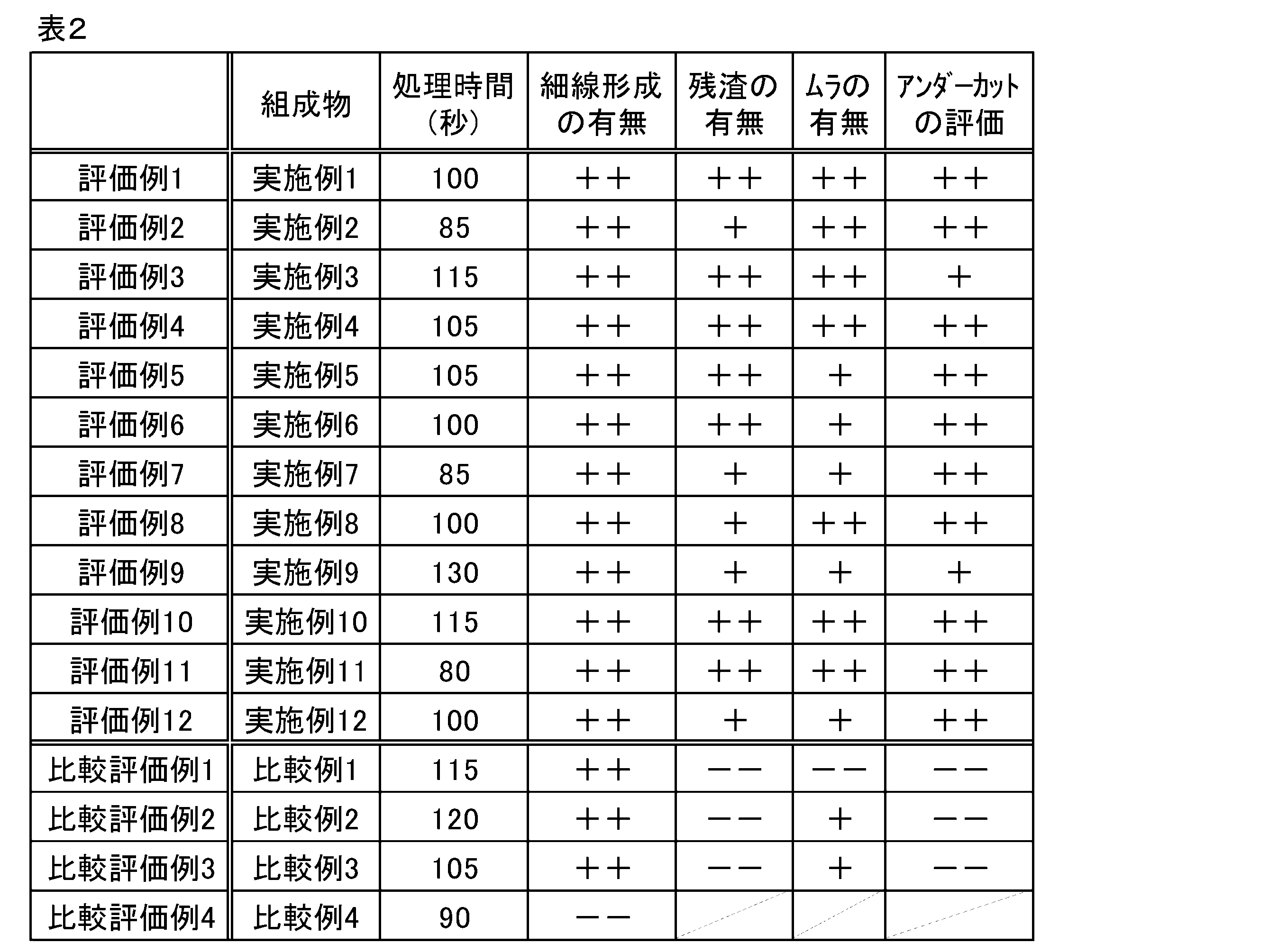
表2に示すように、評価例1~12では、残渣、エッチングムラ及びアンダーカットの発生を抑制しつつ生産性良くパターンを形成できたことが分かる。特に、評価例1、3~6、10、及び11では残渣の発生を特に抑制しつつ生産性良くパターンを形成できたこと、評価例1~4、8、10、及び11ではエッチングムラの発生を特に抑制しつつ生産性良くパターンを形成できたこと、評価例1、2、4~8、及び10~12ではアンダーカットの発生を特に抑制しつつ生産性良くパターンを形成できたことがそれぞれ分かる。
一方、比較評価例2及び3では、パターンを形成できたものの残渣及びアンダーカットの発生を抑制することはできなった。また、比較評価例1では、エッチングムラの発生も抑制できなかった。さらに、比較評価例4に至ってはパターンを形成することができなかった。以上より、本組成物を用いて金属層をエッチングすることで、残渣、エッチングムラ、及びアンダーカットの発生を抑制しつつ生産性良くパターンを形成できることが分かった。
1:銅層
2:モリブデン層
3:レジスト
4:ガラス基体
5:細線上部の幅
6:細線下部の幅
7:レジストの線幅
2:モリブデン層
3:レジスト
4:ガラス基体
5:細線上部の幅
6:細線下部の幅
7:レジストの線幅
Claims (11)
- (A)過酸化水素、
(B)有機酸、
(C)ジエチルアミノエタノール、1-アミノ-2-プロパノール、及びN-メチルジエタノールアミンからなる群より選択される少なくとも1種、並びに
水を含有する組成物。 - (D)過酸化水素安定剤をさらに含有する請求項1に記載の組成物。
- 前記(D)成分が、フェニル尿素及び2-ブトキシエタノールからなる群より選択される少なくとも1種である請求項2に記載の組成物。
- 前記(A)成分の含有量が1~20質量%であり、前記(B)成分の含有量が1~20質量%であり、前記(C)成分の含有量が1~20質量%である請求項1又は2に記載の組成物。
- (E)無機酸をさらに含有する請求項1又は2に記載の組成物。
- 金属層をエッチングするために用いられるエッチング液組成物である請求項1又は2に記載の組成物。
- 前記金属層が、銅を含有する層及びモリブデンを含有する層を含む請求項6に記載の組成物。
- 請求項6に記載の組成物を用いて金属層をエッチングする工程を有するエッチング方法。
- 前記金属層が、銅を含有する層及びモリブデンを含有する層を含む請求項8に記載のエッチング方法。
- 請求項6に記載の組成物を用いて金属層をエッチングする工程を有する積層体の製造方法。
- 前記金属層が、銅を含有する層及びモリブデンを含有する層を含む請求項10に記載の積層体の製造方法。
Applications Claiming Priority (2)
| Application Number | Priority Date | Filing Date | Title |
|---|---|---|---|
| JP2022131175 | 2022-08-19 | ||
| JP2022-131175 | 2022-08-19 |
Publications (1)
| Publication Number | Publication Date |
|---|---|
| WO2024038697A1 true WO2024038697A1 (ja) | 2024-02-22 |
Family
ID=89941422
Family Applications (1)
| Application Number | Title | Priority Date | Filing Date |
|---|---|---|---|
| PCT/JP2023/024870 Ceased WO2024038697A1 (ja) | 2022-08-19 | 2023-07-05 | 組成物、エッチング方法、及び積層体の製造方法 |
Country Status (2)
| Country | Link |
|---|---|
| TW (1) | TW202411472A (ja) |
| WO (1) | WO2024038697A1 (ja) |
Citations (6)
| Publication number | Priority date | Publication date | Assignee | Title |
|---|---|---|---|---|
| JP5051323B2 (ja) * | 2010-02-15 | 2012-10-17 | 三菱瓦斯化学株式会社 | 銅層及びモリブデン層を含む多層薄膜用エッチング液 |
| WO2016080383A1 (ja) * | 2014-11-18 | 2016-05-26 | 関東化學株式会社 | 銅、モリブデン金属積層膜エッチング液組成物、該組成物を用いたエッチング方法および該組成物の寿命を延ばす方法 |
| WO2016152091A1 (ja) * | 2015-03-20 | 2016-09-29 | パナソニックIpマネジメント株式会社 | 多層膜用エッチング液とエッチング濃縮液およびエッチング方法 |
| WO2018047210A1 (ja) * | 2016-09-09 | 2018-03-15 | パナソニックIpマネジメント株式会社 | 多層膜用エッチング液とエッチング濃縮液およびエッチング方法 |
| WO2019180915A1 (ja) * | 2018-03-23 | 2019-09-26 | パナソニックIpマネジメント株式会社 | 銅厚膜用エッチング液 |
| CN110396693A (zh) * | 2018-04-25 | 2019-11-01 | 达兴材料股份有限公司 | 蚀刻液组合物及利用其的蚀刻方法以及制造显示装置或含igzo半导体的方法 |
-
2023
- 2023-07-05 WO PCT/JP2023/024870 patent/WO2024038697A1/ja not_active Ceased
- 2023-07-21 TW TW112127248A patent/TW202411472A/zh unknown
Patent Citations (6)
| Publication number | Priority date | Publication date | Assignee | Title |
|---|---|---|---|---|
| JP5051323B2 (ja) * | 2010-02-15 | 2012-10-17 | 三菱瓦斯化学株式会社 | 銅層及びモリブデン層を含む多層薄膜用エッチング液 |
| WO2016080383A1 (ja) * | 2014-11-18 | 2016-05-26 | 関東化學株式会社 | 銅、モリブデン金属積層膜エッチング液組成物、該組成物を用いたエッチング方法および該組成物の寿命を延ばす方法 |
| WO2016152091A1 (ja) * | 2015-03-20 | 2016-09-29 | パナソニックIpマネジメント株式会社 | 多層膜用エッチング液とエッチング濃縮液およびエッチング方法 |
| WO2018047210A1 (ja) * | 2016-09-09 | 2018-03-15 | パナソニックIpマネジメント株式会社 | 多層膜用エッチング液とエッチング濃縮液およびエッチング方法 |
| WO2019180915A1 (ja) * | 2018-03-23 | 2019-09-26 | パナソニックIpマネジメント株式会社 | 銅厚膜用エッチング液 |
| CN110396693A (zh) * | 2018-04-25 | 2019-11-01 | 达兴材料股份有限公司 | 蚀刻液组合物及利用其的蚀刻方法以及制造显示装置或含igzo半导体的方法 |
Also Published As
| Publication number | Publication date |
|---|---|
| TW202411472A (zh) | 2024-03-16 |
Similar Documents
| Publication | Publication Date | Title |
|---|---|---|
| JP5685204B2 (ja) | 銅/チタン系多層薄膜用エッチング液 | |
| KR101017390B1 (ko) | 은을 주성분으로 하는 금속박막의 에칭액 조성물 | |
| CN102576170B (zh) | 制造用于液晶显示器的阵列基板的方法 | |
| CN102985596B (zh) | 用于包含铜层和钼层的多层结构膜的蚀刻液 | |
| CN103052907A (zh) | 用于制造液晶显示装置用阵列基板的方法 | |
| TW201518545A (zh) | 液晶顯示器用陣列基板的製造方法 | |
| TW201938843A (zh) | 不包含氟的蝕刻液組合物 | |
| JP2013509703A (ja) | エッチング液組成物 | |
| CN117604527A (zh) | 一种铜系金属膜蚀刻液组合物 | |
| KR101978019B1 (ko) | 구리계 금속막용 식각 조성물 | |
| CN110396693B (zh) | 蚀刻液组合物及利用其的蚀刻方法以及制造显示装置或含igzo半导体的方法 | |
| JP5839226B2 (ja) | レジスト残渣除去組成物 | |
| KR20100040010A (ko) | 저과산화수소형 구리 또는 구리 합금 막의 에칭제 | |
| JP6078394B2 (ja) | エッチング液組成物及びエッチング方法 | |
| KR20140013023A (ko) | 에칭액 | |
| KR20150024764A (ko) | 액정표시장치용 어레이 기판의 제조방법 | |
| WO2024038697A1 (ja) | 組成物、エッチング方法、及び積層体の製造方法 | |
| CN113046747B (zh) | 一种叠层金属和金属氧化物蚀刻液组合物及其使用方法 | |
| CN103107130B (zh) | 用于液晶显示器的阵列基板及其制造方法,蚀刻液组合物和形成金属配线的方法 | |
| KR20060063656A (ko) | 박리제 조성물 | |
| JP4941335B2 (ja) | エッチング液及びエッチング方法 | |
| JP6485587B1 (ja) | エッチング液 | |
| CN102471687A (zh) | 用于形成金属互连的刻蚀剂组合物 | |
| JP2018190889A (ja) | エッチング液組成物及びエッチング方法 | |
| JP2005206903A (ja) | エッチング液組成物 |
Legal Events
| Date | Code | Title | Description |
|---|---|---|---|
| 121 | Ep: the epo has been informed by wipo that ep was designated in this application |
Ref document number: 23854734 Country of ref document: EP Kind code of ref document: A1 |
|
| NENP | Non-entry into the national phase |
Ref country code: DE |
|
| 122 | Ep: pct application non-entry in european phase |
Ref document number: 23854734 Country of ref document: EP Kind code of ref document: A1 |
|
| NENP | Non-entry into the national phase |
Ref country code: JP |