WO2024029294A1 - アセチル化エンドウ澱粉 - Google Patents
アセチル化エンドウ澱粉 Download PDFInfo
- Publication number
- WO2024029294A1 WO2024029294A1 PCT/JP2023/025715 JP2023025715W WO2024029294A1 WO 2024029294 A1 WO2024029294 A1 WO 2024029294A1 JP 2023025715 W JP2023025715 W JP 2023025715W WO 2024029294 A1 WO2024029294 A1 WO 2024029294A1
- Authority
- WO
- WIPO (PCT)
- Prior art keywords
- mass
- fried
- pea starch
- acetylated
- starch
- Prior art date
- Legal status (The legal status is an assumption and is not a legal conclusion. Google has not performed a legal analysis and makes no representation as to the accuracy of the status listed.)
- Ceased
Links
Classifications
-
- A—HUMAN NECESSITIES
- A21—BAKING; EDIBLE DOUGHS
- A21D—TREATMENT OF FLOUR OR DOUGH FOR BAKING, e.g. BY ADDITION OF MATERIALS; BAKING; BAKERY PRODUCTS
- A21D13/00—Finished or partly finished bakery products
- A21D13/60—Deep-fried products, e.g. doughnuts
-
- A—HUMAN NECESSITIES
- A23—FOODS OR FOODSTUFFS; TREATMENT THEREOF, NOT COVERED BY OTHER CLASSES
- A23L—FOODS, FOODSTUFFS OR NON-ALCOHOLIC BEVERAGES, NOT OTHERWISE PROVIDED FOR; PREPARATION OR TREATMENT THEREOF
- A23L11/00—Pulses, i.e. fruits of leguminous plants, for production of food; Products from legumes; Preparation or treatment thereof
-
- A—HUMAN NECESSITIES
- A23—FOODS OR FOODSTUFFS; TREATMENT THEREOF, NOT COVERED BY OTHER CLASSES
- A23L—FOODS, FOODSTUFFS OR NON-ALCOHOLIC BEVERAGES, NOT OTHERWISE PROVIDED FOR; PREPARATION OR TREATMENT THEREOF
- A23L13/00—Meat products; Meat meal; Preparation or treatment thereof
-
- A—HUMAN NECESSITIES
- A23—FOODS OR FOODSTUFFS; TREATMENT THEREOF, NOT COVERED BY OTHER CLASSES
- A23L—FOODS, FOODSTUFFS OR NON-ALCOHOLIC BEVERAGES, NOT OTHERWISE PROVIDED FOR; PREPARATION OR TREATMENT THEREOF
- A23L35/00—Foods or foodstuffs not provided for in groups A23L5/00 - A23L33/00; Preparation or treatment thereof
-
- A—HUMAN NECESSITIES
- A23—FOODS OR FOODSTUFFS; TREATMENT THEREOF, NOT COVERED BY OTHER CLASSES
- A23L—FOODS, FOODSTUFFS OR NON-ALCOHOLIC BEVERAGES, NOT OTHERWISE PROVIDED FOR; PREPARATION OR TREATMENT THEREOF
- A23L7/00—Cereal-derived products; Malt products; Preparation or treatment thereof
- A23L7/10—Cereal-derived products
- A23L7/157—Farinaceous granules for dressing meat, fish or the like
Definitions
- the present invention relates to acetylated pea starch.
- Starch-based materials have been used to improve the texture of batters and the softness and moistness of fried foods.
- Materials using starch include those disclosed in Patent Documents 1 to 3.
- Patent Document 1 contains 20 to 80% by mass of wheat flour, 2 to 20% by mass of a powdered sugar composition, corn grits, egg white powder, and 3 to 20% by mass of glutinous seed starch and/or tapioca starch,
- the sugar composition is a coating composition for non-fried foods that contains 70 to 100% by mass of di- to hexasaccharide oligosaccharides, and when the coating composition is used, the presence of the coating can be felt and the coating composition It is said that a non-fried food with good texture and juicy ingredients can be obtained.
- Patent Document 2 contains flaky starch lumps, the starch lumps include pregelatinized starch, the thickness of the flaky starch lumps is 100 ⁇ m to 1000 ⁇ m, and the content of liquid components in the flaky starch lumps is A coating material for fried food is described in which the coating material has a coating content of less than 20%, and it is said that when the coating material for fried food is used, a fried food having a coating with a favorable appearance and a crispy, non-greasy, light texture is obtained. ing.
- Patent Document 3 describes a powder containing at least one specific starch selected from the group consisting of corn starch, wheat starch, potato starch, tapioca starch, mung bean starch, pea starch, rice starch, and modified starches thereof.
- a method for producing fried chicken is described, which includes a first step of coating ingredients with a granular composition, and a second step of leaving the ingredients coated with the powdery granular composition for 30 minutes or more. According to the method for producing fried foods, it is said that fried foods can be obtained because the hardness of the batter is improved.
- Patent Documents 1 to 3 mentioned above there is a problem in maintaining the texture of the fried food after storage when the fried food is manufactured and stored.
- the present inventors maintain the texture of fried foods using the acetylated pea starch as a coating material after storage by adjusting the acetyl group content within a specific range in the acetylated pea starch. It has been found that acetylated pea starch can be obtained.
- the present invention provides the following acetylated pea starch, a coating material, a fried food, a method for maintaining the texture of a fried food after storage, and a method for producing acetylated pea starch.
- RVA Rapid Visco Analyzer
- the fried food is fried chicken, fried bread, fried Tatsuta, fried chicken, chicken nuggets, pork cutlet, minced meat cutlet, chicken cutlet, cream croquette, potato croquette, pumpkin croquette, fried fish, fried shrimp, fried oysters, fried squid, and donuts.
- Acetylated Pea Starch The acetylated pea starch according to this embodiment has an acetyl group content of more than 1.6% by mass.
- Acetylated starch is starch in which hydrogen atoms such as hydroxyl groups of glucose in starch are substituted with acetyl groups and esterified.
- the acetyl group content refers to the content (mass%) of acetyl groups (CH 3 CO-) in starch in terms of dry matter.
- acetyl group content is determined from the Official Standards for Food Additives (Ministry of Health, Labor and Welfare, Consumer Affairs Agency) 9th edition (2018), Ingredient Standards/Storage Standards, "Acetylated Adipic Acid Crosslinked Starch,””Purity Test (2) Acetyl Groups 2. 5% or less”.
- the acetyl group content of the acetylated pea starch is more than 1.6% by mass, preferably 1.6% by mass, from the viewpoint of maintaining the texture of the batter and the softness and moistness of the seeds even after storage of fried (like) foods. .65% by mass or more, more preferably 1.7% by mass or more, even more preferably 1.75% by mass or more, even more preferably 1.8% by mass or more, even more preferably 1.9% by mass or more, especially preferably is 2.0% by mass or more, and preferably 2.5% by mass or less, more preferably 2.4% by mass or less, even more preferably 2.3% by mass or less.
- the upper limit of the acetyl group content of acetylated pea starch is preferably less than the range specified in the Official Food Additives Standard (Consumer Affairs Agency of the Ministry of Health, Labor and Welfare), 9th edition (2018), and is 2.5 It is more preferable that the amount is less than % by mass.
- the acetylated pea starch obtained in this embodiment can be suitably used for foods, and especially as a coating material for fried foods.
- the acetylated pea starch in this embodiment as a coating material, it is possible to obtain a fried (like) food with a good texture of the batter and seeds, and the obtained fried (like) food is preferably Even when stored at a temperature of ⁇ 85°C, deterioration during storage can be suppressed and good texture can be maintained even after storage.
- the term "texture” in the present invention specifically refers to the crispness of the batter of fried foods, the texture of the batter, the softness and moistness of the seeds, and the like.
- the term ⁇ batteryness'' refers to the difficulty of biting food when chewing, and the term ⁇ improved batteriness'' indicates that the difficulty in biting food is reduced and the food becomes crispy.
- Pea starch which is a raw material for acetylated pea starch, has the property of being less resistant to water absorption and swelling than starches derived from other raw materials (for example, rice starch and tapioca starch). Therefore, by using it in fried foods, etc., it is possible to obtain effects such as improving the texture of the batter.
- pea starch is susceptible to oxidation, and when food made with unprocessed pea starch is stored, it has disadvantages such as a crumbly texture during storage.
- acetylating such pea starch it is thought that it is possible to suppress the deterioration in texture due to aging while maintaining the original effect of improving the texture of pea starch.
- Peas which are the raw material for acetylated pea starch, belong to the genus Pisum. Among these, yellow peas are preferred from the viewpoint of maintaining the texture of fried foods after storage and being easily available.
- Pea starch is primarily produced as a byproduct after protein extraction from peas. There are no restrictions on the method for producing pea starch from peas, and any known method can be used as appropriate. Moreover, commercially available pea starch can also be used. Furthermore, from the viewpoint of maintaining the texture of the fried food after storage, the pea starch is preferably unprocessed pea starch.
- the amylose content of pea starch which is a raw material for acetylated pea starch, is preferably 30% by mass or more, more preferably 40% by mass or more, from the viewpoint of improving the texture of fried (like) foods after storage. Moreover, from the viewpoint of further suppressing aging of pea starch, the content is preferably 50% by mass or less, more preferably 45% by mass or less.
- a slurry with a dry matter weight concentration of 8% by mass of acetylated pea starch was prepared using a Rapid Visco Analyzer (RVA).
- RVA Rapid Visco Analyzer
- the lower limit of the temperature at which the viscosity starts to increase during heating to 95°C at a rate of 6°C/min is preferably 60.0°C or higher, more preferably 62.0°C or higher. , more preferably 64.0°C or higher, even more preferably 65.0°C or higher.
- the upper limit of the temperature at which the viscosity starts to increase is preferably 68.0°C or lower, more preferably 67.5°C or lower, even more preferably 67.0°C or lower, and even more preferably 66.5°C. It is as follows.
- the maximum viscosity during heating to 95°C is preferably 2000 cP or more, more preferably 2100 cP or more, and even more preferably 2150 cP or more, from the viewpoint of maintaining the preferable texture of the batter even after storage of the fried food. , even more preferably 2200 cP or more, and from the same viewpoint, 3000 cP or less, more preferably 2900 cP or less, even more preferably 2800 cP or less, even more preferably 2700 cP or less, even more preferably 2600 cP or less.
- the upper limit of the maximum viscosity during heating to 95°C is preferably 3500 cP or less, more preferably 3300 cP or less, and still more preferably 3100 cP, from the viewpoint of maintaining the preferable texture of the batter even after storage of the fried food. Below, it is still more preferably 2900 cP or less, even more preferably 2700 cP or less.
- the lowest viscosity of acetylated pea starch slurry after heating to 95°C, maintaining at 95°C for 5 minutes, and cooling to 25°C at 4.5°C/min is that of fried food.
- it is preferably 1280 cP or more, more preferably 1300 cP or more, even more preferably 1320 cP or more, even more preferably 1350 cP or more, and from the same viewpoint, 1800 cP or less. , more preferably 1700 cP or less, still more preferably 1600 cP or less, even more preferably 1500 cP or less, even more preferably 1400 cP or less.
- the lower limit of the minimum viscosity while heating the slurry of acetylated pea starch to 95°C, maintaining it at 95°C for 5 minutes, and cooling it to 25°C at a rate of 4.5°C/min is: From the viewpoint of maintaining the preferable texture of the batter even after storage of the fried food, it is preferably 1270 cP or more, still preferably 1280 cP or more, even more preferably 1290 cP or more, even more preferably 1300 cP or more, even more preferably 1320 cP. Above, still more preferably 1350 cP or more.
- the temperature at which the viscosity starts to rise during heating to 95°C, the maximum viscosity, and the method of measuring the viscosity when cooled to 25°C are as follows.
- Acetylated pea starch and water are mixed in a special aluminum container to prepare a slurry having a mass concentration of acetylated pea starch of 8% by mass in terms of dry matter.
- a dedicated paddle is placed in the aluminum container and set in a Rapid Visco Analyzer (RVA).
- RVA Rapid Visco Analyzer
- the temperature at which the viscosity begins to rise during heating at a rate of 6° C./min is defined as the gelatinization start temperature (° C.).
- (iii) Maintain at 95°C for 5 minutes, then cool to 25°C at 4.5°C/min.
- (iv) Read the highest viscosity (cP) during the process of heating from 25°C to 95°C and the lowest viscosity (cP) during the process of cooling to 25°C after reaching 95°C.
- the particle size of acetylated pea starch will be explained.
- the content of the under-sieve fraction (particles) of a 0.3 mm sieve in acetylated pea starch makes the acetylated pea starch easier to handle and improves the texture of fried foods after storage. From the viewpoint of maintenance, it is preferably 50% by mass or more, more preferably 60% by mass or more, and even more preferably 70% by mass or more, based on the entire acetylated pea starch. Further, from the same viewpoint, the content of the under-sieve fraction of a sieve with an opening of 0.3 mm in acetylated pea starch is preferably 100% by mass or less, more preferably It is 99% by mass or less.
- the acetylated pea starch of this embodiment is preferably for food use. Among these, it is more preferable to use it as a coating material for fried foods. As the coating material, it is preferable to use one selected from the group consisting of batter and flour.
- the acetylated pea starch of this embodiment as a coating material for fried food, the texture of the fried food can be maintained when the fried food is stored after being produced. The specific contents of the fried food will be described later.
- the method for producing acetylated pea starch of the present embodiment includes the steps of preparing a slurry of pea starch, and adding vinyl acetate monomer or acetic anhydride to the slurry to esterify it, that is, pea starch. It includes a step of acetylation.
- the slurry specifically contains pea starch and water as raw materials.
- the mass concentration of pea starch in the slurry should be, for example, 20% by mass or more, preferably 25% by mass or more, and more preferably 30% by mass or more, based on the entire slurry. be.
- the dry matter mass concentration of pea starch in the slurry is, for example, 50% by mass or less, more preferably 45% by mass or less, and even more preferably 40% by mass based on the entire slurry. The content is even more preferably 35% by mass or less.
- the dry matter mass concentration of pea starch in the slurry is calculated by subtracting the water mass calculated from the water concentration (mass%) in starch from the starch mass, and then adding the above starch mass and the water added at the time of slurry preparation. It can be determined by dividing the mass by the total mass and then multiplying by 100.
- vinyl acetate monomer or acetic anhydride can be used as the acetylating agent used for acetylation.
- Vinyl acetate monomer or acetic anhydride can be used regardless of type, purity, etc.
- the amount of vinyl acetate monomer or acetic anhydride to be added is determined based on the dry matter weight of pea starch from the viewpoint of keeping the acetyl group content of the acetylated pea starch in an appropriate range and ensuring sufficient acetylation.
- the amount is preferably 7 parts by mass or less, more preferably 6.8 parts by mass or less, still more preferably 6.7 parts by mass or less, even more preferably 6.6 parts by mass or less. be.
- the pH of the pea starch slurry during the acetylation reaction is preferably 8.5 or higher, more preferably 8.6 or higher, and even more preferably 8.5 or higher, from the viewpoint of sufficiently and reliably performing the acetylation. is 8.7 or more, even more preferably 8.8 or more, and from the viewpoint of suppressing excessive acetylation of pea starch and gelatinization of the slurry, preferably 9.3 or less, more preferably 9.2 or less , more preferably 9.1 or less, even more preferably 9.0 or less.
- the base may be added to the slurry continuously or intermittently.
- the base include metal hydroxides such as sodium hydroxide, potassium hydroxide, calcium hydroxide, and magnesium hydroxide.
- the base is preferably an alkali metal hydroxide, more preferably sodium hydroxide, and even more preferably at a concentration of 1% by mass or more and 5% by mass or less. It is an aqueous sodium hydroxide solution.
- maintaining the pH of the slurry means keeping the pH of the slurry during the acetylation reaction within a range of ⁇ 0.2 of the set value.
- the temperature of the slurry is preferably 10°C or higher, more preferably 15°C or higher, and even more preferably 20°C or higher. From the viewpoint of improving the production stability of pea starch, the temperature is preferably 60°C or lower, more preferably 50°C or lower, and still more preferably 45°C or lower.
- the predetermined time in the step of acetylating pea starch can be the time until the end of the acetylation reaction described above, but from the viewpoint of increasing the yield of acetylated pea starch, it is preferably 30 minutes or more, and more preferably is 40 minutes or more, more preferably 50 minutes or more. Moreover, from the viewpoint of increasing the production efficiency of acetylated pea starch, the time is preferably 120 minutes or less, more preferably 100 minutes or less, and even more preferably 80 minutes or less.
- the method for producing acetylated pea starch may further include, after the step of acetylating the pea starch, adding an acid to the slurry to adjust the pH to 7.0 or less to stop the acetylation reaction. good.
- the pH of the slurry is preferably 7.0 or less, more preferably 6.5 or less.
- the lower limit of the pH of the slurry in the step of stopping the acetylation reaction is preferably 3.5 or more, more preferably 4.5 or more, and still more preferably 5.5 or more, from the viewpoint of suppressing the decomposition of acetylated pea starch. It is 5 or more.
- acids to be used include inorganic acids such as hydrochloric acid, nitric acid, and sulfuric acid; organic acids such as acetic acid.
- the acid is preferably an inorganic acid, more preferably hydrochloric acid, and even more preferably hydrochloric acid with a concentration of 1% by mass or more and 5% by mass or less.
- a step of washing the acetylated pea starch in the slurry with water After the step of stopping the acetylation reaction, a step of washing the acetylated pea starch in the slurry with water, a step of dehydrating the acetylated pea starch, a step of filtering the acetylated pea starch, a step of drying the acetylated pea starch, and a step of drying the acetylated pea starch.
- One or more steps selected from the group consisting of a step of pulverizing the converted pea starch and a step of sieving the acetylated pea starch may be further performed.
- the acetylated pea starch after filtration may be dried at a temperature of 20° C. or higher and 150° C. or lower.
- the dressing material contains the acetylated pea starch in this embodiment described above.
- the dressing material in this embodiment may be used as it is, or may be used in combination with other ingredients.
- the property of the dressing material may be liquid or powdery.
- the coating material is preferably one selected from the group consisting of batter and flour.
- the batter includes the acetylated pea starch in this embodiment described above.
- the batter further contains water.
- the water content in the batter can be the remainder after excluding the content of components other than water contained in the batter.
- a liquid batter may be prepared by dispersing only acetylated pea starch in water, or a liquid batter may be prepared by adding other ingredients.
- the content of acetylated pea starch in the entire batter is preferably 5% by mass or more, more preferably 6% by mass, from the viewpoint of maintaining the texture of the fried food after storage and improving the handleability of the batter. It is at least 7% by mass, more preferably at least 7% by mass, even more preferably at least 8% by mass. From the same viewpoint, the content of acetylated pea starch in the entire batter is preferably 30% by mass or less, more preferably 25% by mass or less, even more preferably 20% by mass or less, even more preferably 15% by mass or less. .
- the entire batter refers to the total amount of batter including water.
- acetylated pea starch when acetylated pea starch is used in the batter, it is preferable to further include a thickening stabilizer such as xanthan gum, locust bean gum, or guar gum. Thereby, precipitation of acetylated pea starch can be suppressed and it can be more stably dispersed in the batter.
- a thickening stabilizer when using a thickening stabilizer in the batter, the content of the thickening stabilizer is preferably determined based on 100 parts by mass of the acetylated pea starch in the batter, from the viewpoint of improving the dispersibility of the acetylated pea starch.
- the amount is preferably 3 parts by mass or less, more preferably 2.5 parts by mass or less, and even more preferably 2.0 parts by mass or less.
- the dusting powder contains the acetylated pea starch in this embodiment described above.
- the content of acetylated pea starch in the entire dusting is preferably 50% by mass or more, more preferably 50% by mass or more, from the viewpoint of maintaining the texture of the fried (like) food after storage and improving the handling properties of the dusting. is 60% by mass or more, more preferably 70% by mass or more, even more preferably 80% by mass or more.
- the coating material may further contain components other than acetylated pea starch.
- Other ingredients include starches other than acetylated pea starch such as unprocessed starch (raw starch) and processed starch; grain flours such as wheat flour and rice flour; dried eggs such as whole egg powder; leavening agents such as baking powder; Examples include coating materials other than the above-mentioned coating materials; proteins such as gluten; powdered seasonings; colorants; emulsifiers and the like.
- the fried (like) food in this embodiment includes the coating material in this embodiment described above.
- the coating material may cover part of the seeds or may cover the entire seeds. Further, the coating material may be attached to a part of the seeds or may be attached to the entire seeds.
- the fried food of this embodiment can use at least one of the above-mentioned batter and flour as a coating material, and can also use both batter and flour.
- the seeds of the fried food in this embodiment are not limited, and seeds that are normally used for fried food can be used, such as meat such as chicken, pork, and beef, and processed meat products. and meat-like processed products; seafood such as shrimp, squid, oysters, scallops, horse mackerel, and cod; processed marine products such as seafood paste products; vegetables and their processed products such as potatoes, onions, pumpkins, green peppers, and shiitake mushrooms; chicken eggs and quail Eggs and processed products such as rice and corn; Beans such as soybeans and processed products thereof; Processed milk products such as cheese; Bread dough and donut dough; In cream croquettes Sauces such as white sauce and curry in curry bread; mashed vegetables in potato croquettes and pumpkin croquettes; and cheese.
- the seeds of the fried food in this embodiment include solid ingredients such as meat, seafood, vegetables, fruits, and pasta, or solid ingredients such as corn and green peas. It is also possible to simultaneously contain solid ingredients that are originally in the form of small pieces.
- Fried foods include fried chicken, fried bread, fried Tatsuta, fried chicken, chicken nuggets, pork cutlets, minced meat cutlets, chicken cutlets, cream croquettes, potato croquettes, pumpkin croquettes, fried fish, fried shrimp, fried oysters, fried squid, donuts, and tempura.
- it is one selected from the group consisting of:
- the method for producing fried foods includes the step of obtaining acetylated pea starch in the present embodiment described above; preparing a batter comprising acetylated pea starch; The process of attaching the coating material to the outside of the seeds; A process of obtaining a fried food by heating and cooking the seeds to which the batter has adhered; A process of storing fried food at a temperature of 20°C or higher and 85°C or lower, It may also include.
- step of attaching the batter material to the outside of the starter includes both the step of attaching the batter to the outside of the starter and the step of attaching flour to the outside of the starter, which step is the order of the steps? It's okay if it's ahead.
- step of attaching the batter may be performed multiple times, such as the first batter step and the second batter step.
- cooking examples include frying in edible oil, heating in an oiled frying pan, or on a griddle. Further, heating cooking may be performed by dry heat cooking in an oven or the like, microwave heating cooking (microwave cooking), steam cooking, superheated steam cooking, or the like.
- the frying temperature is preferably 160°C or higher, more preferably 165°C, from the viewpoint of improving the crispness and moistness of seeds during storage of fried foods. From the same viewpoint, the temperature is preferably 190°C or lower, more preferably 185°C or lower.
- fried food is obtained by coating seeds with a batter and then going through a heat treatment process such as pre-frying, a preservation process such as frozen storage, and a reheating process such as re-frying. You can.
- fried food is a fried food that has the taste and texture of fried food and is produced by baking or steam cooking with a small amount of oil without going through the process of frying (frying) in oil. It may also be a similar food (non-fried food). For fried foods obtained by these methods, it is more preferable to cover the seeds with a batter containing oil or to sprinkle the batter with oil.
- the resulting fried food is stored at or above room temperature.
- the storage temperature can be, for example, 20°C or higher and 85°C or lower. When the storage temperature is 40° C. or higher, it may be stored in a hot showcase or the like.
- Method for maintaining the texture of fried foods includes the steps of attaching the coating material of this embodiment to the outside of the seeds, and The method includes the steps of: heating and cooking the seeds to which the particles have adhered to obtain a fried food; and storing the fried food at a temperature of 20° C. or higher and 85° C. or lower.
- the clothing material of this embodiment please refer to 3. above. Since it is the same as that described for clothing materials, it will be omitted.
- the method for maintaining the texture of fried food according to the present embodiment, even when the fried food is cooked and then stored at a temperature of 20°C or higher and 85°C or lower, It is possible to suppress deterioration of texture during storage and maintain the texture of fried (like) foods after storage.
- ⁇ Pea starch PEA STARCH SOJOM2201 (YANTAI SHUANGTA FOOD CO., LTD. (Importer: Sojitz Foods Co., Ltd.)) Amylose content: 42% by mass
- ⁇ Tapioca starch In-house preparation of J-Oil Mills Co., Ltd.
- ⁇ Vinyl acetate monomer Manufactured by Fuji Film Wako Pure Chemical Industries, Ltd.
- acetyl group content of each example of acetylated starch was determined according to the Food Additives Official Standards (Ministry of Health, Labor and Welfare, Consumer Affairs Agency), 9th edition (2016), component specifications and storage standards "Acetylated Adipic Acid Cross-Linked Starch", and "Purity Test ( 2) 2.5% or less of acetyl groups", and measured according to the following measurement method.
- Table 1 shows the acetyl group content of each example.
- Acetyl group content (mass%) [(titration value B - titration value A) x normality of hydrochloric acid x 0.043 x 100] ⁇ mass of acetylated starch in terms of anhydride (g)
- fried chicken and curry bread were prepared and evaluated.
- the ingredients used for the fried chicken and curry bread are shown below.
- ⁇ Strong flour Camellia, manufactured by Nisshin Seifun Werna Co., Ltd.
- ⁇ Weak flour Super Violet, manufactured by Nisshin Seifun Welna Co., Ltd.
- ⁇ Cast sugar Caster sugar, manufactured by Mitsui Sugar Co., Ltd.
- ⁇ Salt Salt, manufactured by Salt Business Center, a public interest incorporated foundation
- Monosodium glutamate Ajinomoto (registered trademark), manufactured by Ajinomoto Co., Inc.
- ⁇ Soy sauce Koikuchi soy sauce, manufactured by Kikkoman Foods Co., Ltd.
- ⁇ White pepper White pepper, manufactured by Gavan Co., Ltd.
- ⁇ Skim milk powder Yotsuba Hokkaido skim milk powder, manufactured by Yotsuba Dairy Products Co., Ltd.
- ⁇ Shortening Fasier, manufactured by J-Oil Mills Co., Ltd.
- ⁇ Batter powder Kitchen King Juicy Karaage Powder, manufactured by Daisho Co., Ltd.
- ⁇ Semi-dry red Instant yeast red, manufactured by Nippon France Shoji Co., Ltd.
- ⁇ Xanthan gum Echo Gum, Sumitomo Pharma Food & Co., Ltd. Manufactured by Chemical Co., Ltd.
- Canola oil Super canola oil, manufactured by J-Oil Mills Co., Ltd.
- Raw bread crumbs Raw bread flour, manufactured by Kyoei Food Co., Ltd.
- a batter solution (a mixture of 50% by mass of batter flour and 50% by mass of cold water) was applied to the outside of the chicken thighs that had been dusted with flour, and then pre-fried for 3 minutes in canola oil heated to 170°C.
- Pre-fried chicken thighs were stored in a -50°C freezer for 16 hours and then in a -20°C freezer.
- Chicken thighs taken out of a -20°C freezer were fried for 3 minutes in canola oil heated to 175°C to obtain fried chicken.
- the obtained fried chicken was placed in a hotter set at 65° C. for 4 hours and then subjected to evaluation.
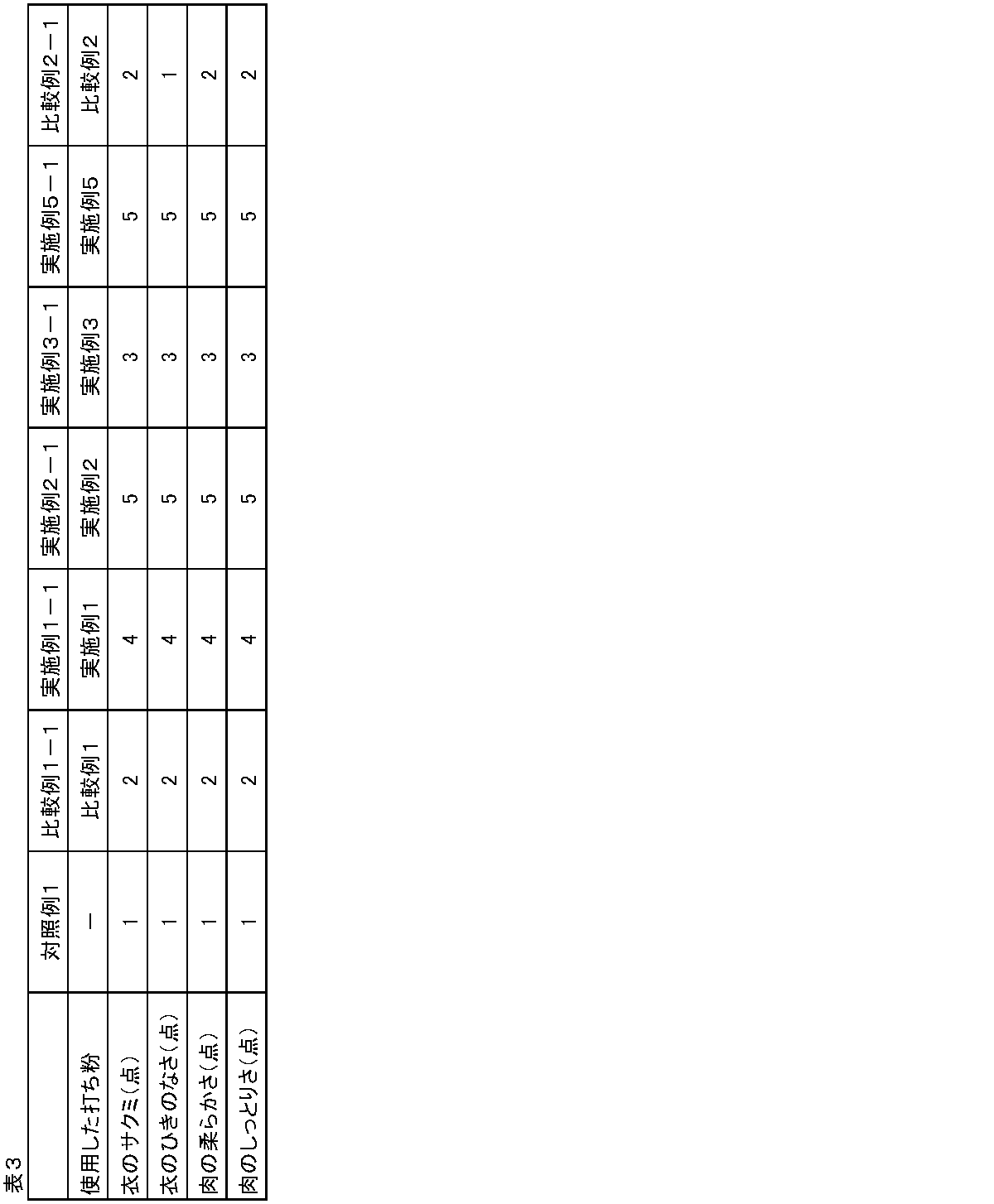
- the fried chicken obtained above was evaluated by three expert panelists based on the following evaluation criteria. The evaluation score was decided by a consensus, and a score of 3 or more was considered a passing grade. The results are shown in Table 3.
- Evaluation criteria (Clothing Sakumi) 5: Quite crunchy 4: Crunchy 3: Slightly crunchy 2: Not much crunchy 1: No crunchy at all (lack of texture) 5: Not ground at all 4: Hardly ground 3: Not very ground 2: Slightly ground 1: Ground (tenderness of meat) 5: Quite soft 4: Soft 3: Slightly soft 2: Slightly hard 1: Hard (moistness of meat) 5: Very good juiciness 4: Very good juiciness 3: Excellent juiciness 2: Slightly poor juiciness 1: Poor juiciness
- Examples 1-1, 2-1, 3-1, and 5-1 in which acetylated pea starch with an acetyl group content of more than 1.6% by mass was used as a coating material, had acetyl group content of more than 1.6% by mass.
- Comparative Example 1-1 in which acetylated pea starch with a content of less than 1.6% by mass was used as a coating material, the texture of the fried chicken after storage was good.
- Examples 1-1, 2-1, 3-1, and 5-1 are more effective in fried chicken than Comparative Example 2-1, which uses acetylated starch using tapioca starch as a raw material as a coating material. The texture after storage was good.
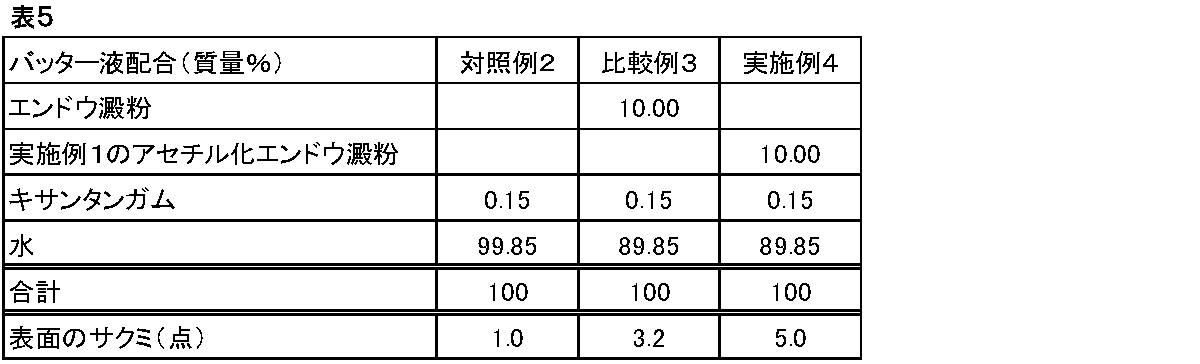
- Batter liquids for each example were prepared by mixing the materials according to the formulations shown in Table 5.
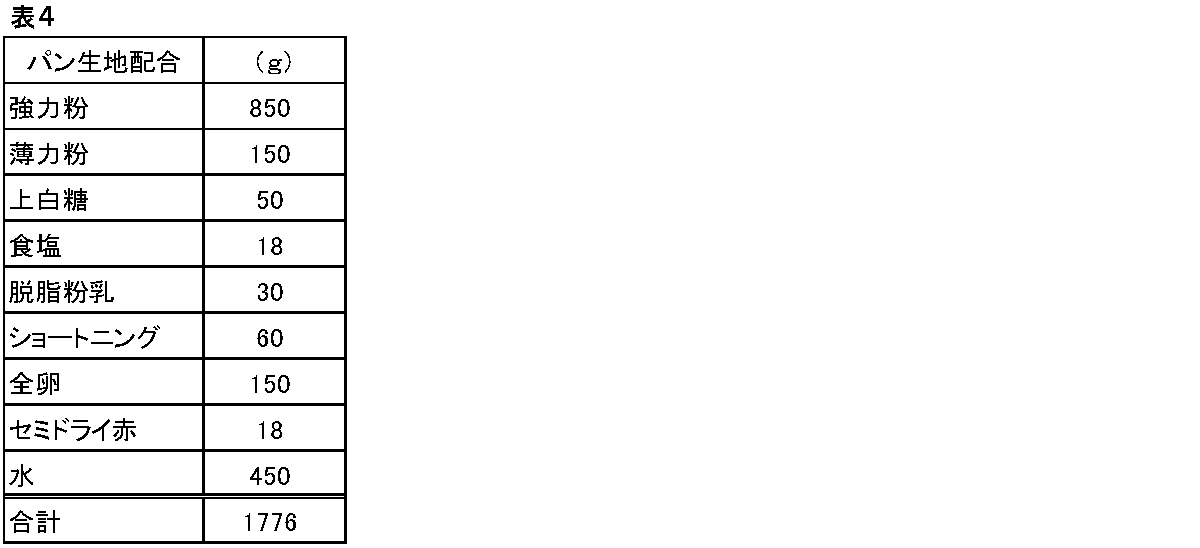
- (Manufacture of curry bread) (i) Put the ingredients for the bread dough according to the formulation shown in Table 4 into a mixer (Kanto mixer HPI-20M, manufactured by Kanto Mixer Industry Co., Ltd.), under the conditions of 2 minutes on low speed, 5 minutes on medium speed, and a kneading temperature of 27 ° C. Knead using a dough hook. (ii) The bread dough kneaded in (i) was subjected to primary fermentation for 30 minutes at a temperature of 27° C. and a relative humidity of 80% RH.
- the bread dough after primary fermentation was divided into 50 g portions.
- the bread dough from (iii) was left at 25°C for 15 minutes.
- 30 g of curry filling (Delica Filling RN Melty Sweet Onion Curry, manufactured by Thornton Holdings Co., Ltd.) was added to each of the bread doughs in (iv).
- the dough was battered with the batter liquid obtained above adjusted to 20°C.
- Fresh bread crumbs were attached to the dough after battering.
- the bread dough was subjected to secondary fermentation for 35 minutes at a temperature of 38° C. and a relative humidity of 50% RH.
- the curry bread obtained above was evaluated by six expert panelists based on the following evaluation criteria.
- the evaluation score was the average of the expert panelists' scores, and a score of 3.5 or higher was considered a pass.
- the results are shown in Table 5.
- (Evaluation criteria) (Surface texture) 5: Very crunchy 4: Crunchy 3: Slightly crunchy 2: Not much crunchy 1: No crunchy at all
- Example 4 in which acetylated pea starch with an acetyl group content of more than 1.6% by mass was used as a batter, was compared with Comparative Example 3, in which unprocessed pea starch was used as a batter.
- the texture of the curry bread after storage was good.
Landscapes
- Life Sciences & Earth Sciences (AREA)
- Engineering & Computer Science (AREA)
- Food Science & Technology (AREA)
- Health & Medical Sciences (AREA)
- Nutrition Science (AREA)
- Chemical & Material Sciences (AREA)
- Polymers & Plastics (AREA)
- Zoology (AREA)
- Agronomy & Crop Science (AREA)
- Botany (AREA)
- Grain Derivatives (AREA)
Abstract
Description
上記事情から、フライ(様)食品を製造後、保存する場合、フライ(様)食品の保存後の食感を維持することのできる素材の開発が望まれる。
[2] 前記アセチル化エンドウ澱粉の乾物換算質量濃度が8質量%であるスラリーをラピッドビスコアナライザー(Rapid Visco Analyzer:RVA)にて測定して得られる、95℃まで加熱した時の粘度が上昇し始める温度が、60.0℃以上68.0℃以下である、[1]に記載のアセチル化エンドウ澱粉。
[3] 食品用である、[1]または[2]に記載のアセチル化エンドウ澱粉。
[4] 衣材用である、[1]~[3]のいずれかに記載のアセチル化エンドウ澱粉。
[5] 目開き0.3mmの篩の篩下画分の含有量が、アセチル化エンドウ澱粉全体に対して50質量%以上100質量%以下である、[1]~[4]のいずれかに記載のアセチル化エンドウ澱粉。
[6] [1]~[5]のいずれかに記載のアセチル化エンドウ澱粉を含む、衣材。
[7] 当該衣材はバッターおよび打ち粉からなる群から選択される1種である、[6]に記載の衣材。
[8] [6]または[7]に記載の衣材を含む、フライ(様)食品。
[9] 当該フライ(様)食品が、唐揚げ、揚げパン、竜田揚げ、フライドチキン、チキンナゲット、豚カツ、メンチカツ、チキンカツ、クリームコロッケ、ポテトコロッケ、パンプキンコロッケ、フィッシュフライ、エビフライ、カキフライ、イカフライ、ドーナツ、天ぷらからなる群から選択される1種である、[8]に記載のフライ(様)食品。
[10] [6]または[7]に記載の衣材を種物の外側に付着させる工程と、
前記衣材が付着した前記種物を加熱調理してフライ(様)食品を得る工程と、
前記フライ(様)食品を20℃以上85℃以下の温度で保存する工程と、
を含む、フライ(様)食品の食感を維持する方法。
[11] エンドウ澱粉のスラリーを準備する工程と、
前記スラリーに酢酸ビニルモノマーまたは無水酢酸を添加してエステル化する工程と、を含み、
酢酸ビニルモノマーまたは無水酢酸を添加してエステル化する前記工程において、
前記酢酸ビニルモノマーまたは前記無水酢酸の添加量が、前記エンドウ澱粉の乾物換算質量100質量部に対して、4質量部以上7質量部以下である、[1]~[5]のいずれかに記載のアセチル化エンドウ澱粉の製造方法。
また、本明細書において、フライ食品およびフライ様食品をあわせて「フライ(様)食品」と呼ぶ。
本実施形態に係るアセチル化エンドウ澱粉は、アセチル基含有量が1.6質量%超である。
アセチル化澱粉とは、澱粉中のグルコースの有する水酸基等の水素原子が、アセチル基で置換され、エステル化されたものである。
アセチル基含有量とは、乾物換算の澱粉中のアセチル基(CH3CO-)の含有量(質量%)を表すものである。
アセチル基含有量は、食品添加物公定書(厚生労働省消費者庁)第9版(2018)、成分規格・保存基準、「アセチル化アジピン酸架橋デンプン」、「純度試験(2)アセチル基2.5%以下」に従って測定することができる。
また、アセチル化エンドウ澱粉のアセチル基含有量の上限は、食品添加物公定書(厚生労働省消費者庁)、第9版(2018)で定められている範囲以下とすることも好ましく、2.5質量%以下とすることがより好ましい。
また、本発明における「食感」とは、具体的には、フライ(様)食品の衣のサクミ、衣のひき、種物のやわらかさやしっとり感等を表すものとする。また、衣のひきとは、食品を噛んだ時に噛み切りにくい様子を表し、衣のひきが改善される、とは、噛み切りにくさが低減し、歯切れがよくなることを表す。
アセチル化エンドウ澱粉の原料となるエンドウ澱粉は、他の原料由来の澱粉(たとえばコメ澱粉やタピオカ澱粉)と比較して吸水しにくく、膨潤しにくいという性質がある。そのため、フライ(様)食品等に使用することにより、衣の食感を良好とする等の効果を得ることができる。
しかし、このようなエンドウ澱粉をアセチル化することで、もともとのエンドウ澱粉の有する食感を良好とする効果を維持しつつ、老化による食感の低下を抑えることができると考えられる。
エンドウ澱粉は、主にエンドウ豆からタンパク質を抽出した後の副産物として生成される。
エンドウ豆からエンドウ澱粉を製造する方法に制限はなく、適宜公知の方法が用いられる。またエンドウ澱粉は市販のものを用いることもできる。
また、エンドウ澱粉は、フライ(様)食品の保存後の食感を維持する観点から、好ましくは未加工のエンドウ澱粉である。
また、95℃まで加熱中の最高粘度の上限は、フライ(様)食品の保存後も、衣の好ましい食感を維持する観点から、好ましくは3500cP以下、より好ましくは3300cP以下、さらに好ましくは3100cP以下、さらにより好ましくは2900cP以下、よりいっそう好ましくは2700cP以下である。
また同様の観点から、アセチル化エンドウ澱粉のスラリーを、95℃まで加熱した後、95℃で5分間維持し、25℃まで4.5℃/分で冷却する間の、最低粘度の下限は、フライ(様)食品の保存後も、衣の好ましい食感を維持する観点から、好ましくは1270cP以上、よし好ましくは1280cP以上、さらに好ましくは1290cP以上、さらにより好ましくは1300cP以上、より一層好ましくは1320cP以上、さらにまた好ましくは1350cP以上である。
(i)専用のアルミニウム容器にアセチル化エンドウ澱粉と水とを混合し、アセチル化エンドウ澱粉の乾物換算質量濃度が8質量%のスラリーを調製する。
上記アルミニウム容器に専用のパドルを入れ、ラピッドビスコアナライザー(Rapid Visco Analyzer:RVA)にセットする。
(ii)160rpmでの撹拌下で粘度を測定しながら、40℃で1分間維持し、その後、40℃から95℃まで6℃/分の速度で加熱する。
6℃/分の速度で加熱中に粘度が上昇し始めた温度を糊化開始温度(℃)とする。
(iii)95℃で5分間維持した後、25℃まで4.5℃/分で冷却する。
(iv)25℃から95℃まで加熱する過程の最高粘度(cP)および、95℃に達してから25℃まで冷却する過程の最低粘度(cP)を読み取る。
アセチル化エンドウ澱粉中の目開き0.3mmの篩の篩下画分(粒子)の含有量は、アセチル化エンドウ澱粉の取り扱い性をより良好とし、フライ(様)食品の保存後の食感を維持する観点から、アセチル化エンドウ澱粉全体に対して、好ましくは50質量%以上であり、より好ましくは60質量%以上、さらに好ましくは70質量%以上である。また、同様の観点から、アセチル化エンドウ澱粉中の目開き0.3mmの篩の篩下画分の含有量は、アセチル化エンドウ澱粉全体に対して好ましくは100質量%以下であり、より好ましくは99質量%以下である。
本実施形態のアセチル化エンドウ澱粉は、食品用とすることが好ましい。中でも、フライ(様)食品の衣材として用いることがより好ましい。
衣材としては、バッターおよび打ち粉からなる群から選択される1種として用いることが好ましい。
本実施形態のアセチル化エンドウ澱粉をフライ(様)食品の衣材として用いることにより、フライ(様)食品の製造後、保存する場合、フライ(様)食品の食感を維持することができる。
フライ(様)食品の具体的な内容については、後述する。
本実施形態のアセチル化エンドウ澱粉の製造方法は、エンドウ澱粉のスラリーを準備する工程と、スラリーに酢酸ビニルモノマーまたは無水酢酸を添加してエステル化する、すなわちエンドウ澱粉をアセチル化する工程を含む。
スラリー中のエンドウ澱粉の乾物換算質量濃度は、アセチル化を効率よく、確実に行う観点から、スラリー全体に対してたとえば20質量%以上、好ましくは25質量%以上、より好ましくは30質量%以上である。また、アセチル化反応の安定性を高める観点から、スラリー中のエンドウ澱粉の乾物換算質量濃度は、スラリー全体に対してたとえば50質量%以下、より好ましくは45質量%以下、さらに好ましくは40質量%以下、さらにより好ましくは35質量%以下である。
ここで、スラリー中のエンドウ澱粉の乾物換算質量濃度は、澱粉質量から澱粉中の水分濃度(質量%)より算出される水分質量を引いた乾物質量を、上記澱粉質量とスラリー作製時に加えた水の質量とを足した全質量で割った後、100倍して求めることができる。
エンドウ澱粉をアセチル化する工程において、酢酸ビニルモノマーまたは無水酢酸の添加量は、アセチル化エンドウ澱粉のアセチル基含有量を適正な範囲とし、また充分にアセチル化させる観点から、エンドウ澱粉の乾物換算質量100質量部に対して、好ましくは4質量部以上、より好ましくは4.2質量部以上、さらに好ましくは4.5質量部以上、さらにより好ましくは4.8質量部以上であり、また、エンドウ澱粉の過度のアセチル化を抑制する点から、好ましくは7質量部以下、より好ましくは6.8質量部以下、さらに好ましくは6.7質量部以下、さらにより好ましくは6.6質量部以下である。
塩基の具体例として、水酸化ナトリウム、水酸化カリウム、水酸化カルシウム、水酸化マグネシウム等の金属水酸化物等が挙げられる。pHを前述した条件に安定的に維持する観点から、塩基は好ましくはアルカリ金属の水酸化物であり、より好ましくは水酸化ナトリウムであり、さらに好ましくは1質量%以上5質量%以下の濃度の水酸化ナトリウム水溶液である。
ここで、スラリーのpHを維持するとは、アセチル化反応中のスラリーpHを設定値±0.2の範囲内に収めることをいう。
使用する酸の具体例として、塩酸、硝酸、硫酸等の無機酸;酢酸等の有機酸等が挙げられる。酸化反応を確実に停止する観点から、酸は好ましくは無機酸であり、より好ましくは塩酸であり、さらに好ましくは1質量%以上5質量%以下の濃度の塩酸である。
このうち、アセチル化エンドウ澱粉を乾燥する工程においては、たとえば濾過後のアセチル化エンドウ澱粉を20℃以上150℃以下の温度で乾燥させてもよい。
なお、アセチル化エンドウ澱粉を乾燥する工程の後に、アセチル化エンドウ澱粉を篩う上記工程を行うことが好ましい。アセチル化エンドウ澱粉を篩う工程においては、JIS-Z8801-1規格の目開き0.3mmの篩を用い、目開き0.3mmの篩下画分を回収することが好ましい。
本実施形態において、衣材は、上述した本実施形態におけるアセチル化エンドウ澱粉を含む。
本実施形態における衣材は、そのまま用いてもよいし、さらに他の成分と組み合わせて用いてもよい。
また衣材の性状は、液状であっても、粉状であってもよい。
衣材はバッターおよび打ち粉からなる群から選択される1種であることが好ましい。
本実施形態において、バッターは、上述した本実施形態におけるアセチル化エンドウ澱粉を含む。
また、バッターは水をさらに含む。バッター中の水の含有量は、バッターに含まれる水以外の成分の含有量を除いた残部とすることができる。
バッターを作製する際には、アセチル化エンドウ澱粉のみを水に分散させて液状のバッターを作製してもよいし、他の成分も加えて液状のバッターを作製してもよい。
ここでバッター全体とは、水を含んだバッター全量を表す。
バッターに増粘安定剤を用いる場合の、増粘安定剤の含有量は、アセチル化エンドウ澱粉の分散性をより良好とする観点から、バッター中のアセチル化エンドウ澱粉100質量部に対して、好ましくは0質量部超、より好ましくは0.1質量部以上、さらに好ましくは0.3質量部以上、さらにより好ましくは0.8質量部以上、よりいっそう好ましくは1.2質量部以上であり、また同様の観点から、好ましくは3質量部以下、より好ましくは2.5質量部以下、さらに好ましくは2.0質量部以下である。
本実施形態において、打ち粉は、上述した本実施形態におけるアセチル化エンドウ澱粉を含む。
打ち粉全体におけるアセチル化エンドウ澱粉の含有量は、フライ(様)食品の保存後の食感を維持し、打ち粉の取扱い性をより良好とする観点から、好ましくは50質量%以上、より好ましくは60質量%以上、さらに好ましくは70質量%以上、さらにより好ましくは80質量%以上である。打ち粉全体におけるアセチル化エンドウ澱粉の含有量の上限に制限はないが、同様の観点から、たとえば、100質量%以下であり、好ましくは100質量%である。
また、衣材は、アセチル化エンドウ澱粉以外の成分をさらに含んでもよい。他の成分として、未加工澱粉(生澱粉)、加工澱粉等のアセチル化エンドウ澱粉以外の澱粉;小麦粉、米粉等の穀粉;全卵粉等の乾燥卵;ベーキングパウダー等の膨張剤;パン粉等の上述の衣材以外の衣材;グルテン等のタンパク質;粉末状の調味料;着色料;乳化剤等が挙げられる。
本実施形態におけるフライ(様)食品は、上述した本実施形態における衣材を含む。
フライ(様)食品において、衣材は、種物の一部を被覆していてもよいし、種物全体を被覆していてもよい。また、衣材は、種物の一部に付着していてもよいし、種物全体に付着していてもよい。
また、本実施形態のフライ(様)食品は、衣材として、前述したバッター、および打ち粉の少なくとも一方を用いることができ、バッターおよび打ち粉の両方を用いることもできる。
アセチル化エンドウ澱粉を含む衣材を準備する工程;
衣材を種物の外側に付着させる工程;
衣材が付着した種物を加熱調理することにより、フライ(様)食品を得る工程、
フライ(様)食品を20℃以上85℃以下の温度で保存する工程、
を含むものであってもよい。
これらの方法により得られるフライ様食品では、油脂を含む衣材で種物の被覆をすることや衣材に油脂をまぶすことがさらに好ましい。
保存温度としては、たとえば20℃以上85℃以下とすることができる。
保存温度が40℃以上である場合、ホットショーケース等で保存されてもよい。
本実施形態における、フライ(様)食品の食感を維持する方法は、本実施形態の衣材を種物の外側に付着させる工程と、衣材が付着した種物を加熱調理してフライ(様)食品を得る工程と、フライ(様)食品を20℃以上85℃以下の温度で保存する工程と、を含む。
本実施形態の衣材については、上述の3.衣材にて述べたものと同じであるため省略する。
また、本発明は前述の実施形態に限定されるものではなく、本発明の目的を達成できる範囲での変形、改良等は本発明に含まれるものである。
以下の例において、特に断りのない場合、配合の単位は質量部である。
・エンドウ澱粉:PEA STARCH SOJOM2201(YANTAI SHUANGTA FOOD CO., LTD(輸入者:双日食料株式会社))アミロース含量:42質量%
・タピオカ澱粉:株式会社J-オイルミルズの社内調製品
・酢酸ビニルモノマー:富士フィルム和光純薬株式会社製
(i)各例について、表1に記載の配合に従い、澱粉(水分12質量%含有)170質量部に、水269質量部を加えてスラリーとした。
(ii)上記スラリーに3質量%水酸化ナトリウム水溶液を加え、pHメーターを用いてpH8.9に調整した後、酢酸ビニルモノマーを表1の配合で加え、攪拌しながら、1時間アセチル化反応を行った。反応中は、pHメーターを用いて3質量%水酸化ナトリウム水溶液を加えながら、反応液のpHを8.9に維持した。また反応中は、スラリーの温度を31℃となるように維持した。
(iii)反応後、3質量%塩酸水溶液を加えて反応液のpHを6.0に中和した。
(iv)反応液を水洗後、ろ過して回収した澱粉を40~50℃にて乾燥させ、JIS-Z8801-1規格の目開き0.3mmの篩に通した篩下画分を回収し、各例のアセチル化澱粉を得た。
アセチル化澱粉中の、目開き0.3mmの篩下画分の含有量(質量%)を表1に示す。
各例のアセチル化澱粉のアセチル基含有量を、食品添加物公定書(厚生労働省消費者庁)第9版(2018)、成分規格・保存基準「アセチル化アジピン酸架橋デンプン」、「純度試験(2)アセチル基2.5%以下」に記載の方法に準じ、以下の測定方法に従って測定した。各例のアセチル基含有量を表1に示す。
(i)各例のアセチル化澱粉を水分計(研精工業社製、電磁水分計:型番MX50)を用いて、130℃で加熱乾燥させて水分測定し、得られた水分値から無水物質量を算出した。
(ii)無水物換算で5gのアセチル化澱粉に水50mLおよび数滴の1.0(w/v)%フェノールフタレインエタノール溶液を加え、均一になるまで攪拌した。
(iii)0.1N水酸化ナトリウム水溶液を液が赤色になるまで加えた後、0.45N水酸化ナトリウム水溶液25mLを加え、室温で30分間激しく撹拌した。
(iv)0.2N塩酸を用いて液の赤色が消失するまで滴定し、0.2N塩酸の使用量を滴定値A(mL)とした。
(v)ブランクとして25mLの0.45N水酸化ナトリウム水溶液を同様に0.2N塩酸にて液の赤色が消失するまで滴定し、0.2N塩酸の使用量を滴定値B(mL)とした。
(vi)アセチル基含有量(質量%)は以下の式より算定した。
式:アセチル基含有量(質量%)=[(滴定値B-滴定値A)×塩酸規定度×0.043×100]÷アセチル化澱粉無水物換算質量(g)
(i)専用のアルミニウム容器に各例の澱粉と水とを混合し、澱粉の乾物換算質量濃度が8質量%のスラリーを調製した。
上記アルミニウム容器に専用のパドルを入れ、ラピッドビスコアナライザー(Rapid Visco Analyzer:RVA、テルペン社製、型番:RVA-4800)にセットした。
(ii)160rpmでの撹拌下で粘度を測定しながら、40℃で1分間維持し、その後、40℃から95℃まで6℃/分の速度で加熱した。
6℃/分の速度で加熱中に粘度が上昇し始めた温度を糊化開始温度(℃)とした。
(iii)95℃で5分間維持した後、25℃まで4.5℃/分の速度で冷却した。
(iv)40℃から95℃まで加熱する過程の最高粘度(cP)および、95℃に達してから25℃まで冷却する過程の最低粘度(cP)を読み取った。
糊化開始温度(℃)、最高粘度(cP)および最低粘度(cP)を、表1に示す。

・強力粉:カメリヤ、株式会社日清製粉ウェルナ製
・薄力粉:スーパーバイオレット、株式会社日清製粉ウェルナ製
・上白糖:上白糖、三井製糖株式会社製
・食塩:食塩、公益財団法人 塩事業センター製
・グルタミン酸ナトリウム:味の素(登録商標)、味の素株式会社製
・醤油:こいくちしょうゆ、キッコーマン食品株式会社製
・白コショウ:ホワイトペッパー、株式会社ギャバン製
・脱脂粉乳:よつ葉北海道脱脂粉乳、よつ葉乳業株式会社製
・ショートニング:ファシエ、株式会社J-オイルミルズ製
・バッター粉:厨房王 ジューシー唐揚げ粉、株式会社ダイショー製
・セミドライ赤:インスタントイースト 赤、日仏商事株式会社製
・キサンタンガム:エコーガム、住友ファーマフード&ケミカル株式会社製
・キャノーラ油:スーパーキャノーラ油、株式会社J-オイルミルズ製
・生パン粉:生パン粉、共栄フード株式会社製
(ピックル液の作製)
表2に記載の配合に従い、材料をよく混合し、ピックル液を作成した。
(唐揚げの作製)
(i)タンブラー(VACONA社、ESK-60)に23~27g/個となるようカットした鶏もも肉100質量部および上記で作成したピックル液を30質量部加え、4℃、90分間、真空率80%でタンブリングを行った。
(ii)タンブリングした鶏もも肉に、各例のアセチル化澱粉3質量部を打ち粉として添加し、手で混ぜ合わせた(対照例1は打ち粉なし)。
(iii)打ち粉を付着させた鶏もも肉の外側にバッター液(バッター粉50質量%および冷水50質量%を混合したもの)を付着させてから170℃に加熱したキャノーラ油で3分間プリフライした。
(iv)プリフライした鶏もも肉を-50℃の冷凍庫で16時間保管後、-20℃の冷凍庫で保管した。
(v)-20℃の冷凍庫から取り出した鶏もも肉を175℃に加熱したキャノーラ油で3分間フライし、唐揚げを得た。
(vi)得られた唐揚げを65℃に設定したホッタ―に4時間入れた後、評価に供した。

(評価基準)
(衣のサクミ)
5:かなりサクミがある
4:サクミがある
3:ややサクミがある
2:あまりサクミなし
1:全くサクミなし
(衣のひきのなさ)
5:全くひきがない
4:ひきがほとんどない
3:ひきが少ない
2:ややひきがある
1:ひきがある
(肉の柔らかさ)
5:かなり柔らかい
4:柔らかい
3:やや柔らかい
2:やや硬い
1:硬い
(肉のしっとりさ)
5:非常にジューシーさに優れる
4:かなりジューシーさに優れる
3:ジューシーさに優れる
2:ややジューシーさに劣る
1:ジューシーさに劣る
(バッター液の作製)
表5の配合で材料を混合し、各例のバッター液を作製した。
(カレーパンの製造)
(i)表4の配合でパン生地の材料を、ミキサー(カントーミキサーHPI-20M、関東混合機工業株式会社製)に入れ、低速2分、中速5分、捏上温度27℃の条件で、ドウフックを使用して、混捏した。
(ii)(i)で混捏したパン生地を、温度:27℃、相対湿度:80%RH条件で30分1次発酵させた。
(iii)1次発酵後のパン生地を、50gずつに分割した。
(iv)(iii)のパン生地を25℃にて15分置いた。
(v)(iv)のパン生地にカレーフィリング(デリカフィリングRNとろっと甘口オニオンカレー、ソントンホールディングス株式会社製)を30gずつ包餡した。
(vi)包餡後生地を、上記で得られたバッター液を20℃に調整したものでバッターリングした。
(vii)バッターリング後パン生地に、生パン粉を付着させた。
(viii)生パン粉付着後パン生地を、温度:38℃、相対湿度:50%RH条件で、35分間二次発酵させた。
(ix)二次発酵後パン生地を、180℃に加熱したキャノーラ油で3分30秒間油ちょうし(片面2分、片面1分30秒)、カレーパンを得た。
(x)得られたカレーパンを、25℃で5時間30分保存した後、評価した。
(評価基準)
(表面のサクミ)
5:かなりサクミがある
4:サクミがある
3:ややサクミがある
2:あまりサクミなし
1:全くサクミなし
Claims (11)
- アセチル基含有量が1.6質量%超である、アセチル化エンドウ澱粉。
- 前記アセチル化エンドウ澱粉の乾物換算質量濃度が8質量%であるスラリーをラピッドビスコアナライザー(Rapid Visco Analyzer:RVA)にて測定して得られる、95℃まで加熱した時の粘度が上昇し始める温度が、60.0℃以上68.0℃以下である、請求項1に記載のアセチル化エンドウ澱粉。
- 食品用である、請求項1または2に記載のアセチル化エンドウ澱粉。
- 衣材用である、請求項1または2に記載のアセチル化エンドウ澱粉。
- 目開き0.3mmの篩の篩下画分の含有量が、アセチル化エンドウ澱粉全体に対して50質量%以上100質量%以下である、請求項1または2に記載のアセチル化エンドウ澱粉。
- 請求項1または2に記載のアセチル化エンドウ澱粉を含む、衣材。
- 当該衣材はバッターおよび打ち粉からなる群から選択される1種である、請求項6に記載の衣材。
- 請求項6に記載の衣材を含む、フライ(様)食品。
- 当該フライ(様)食品が、唐揚げ、揚げパン、竜田揚げ、フライドチキン、チキンナゲット、豚カツ、メンチカツ、チキンカツ、クリームコロッケ、ポテトコロッケ、パンプキンコロッケ、フィッシュフライ、エビフライ、カキフライ、イカフライ、ドーナツ、天ぷらからなる群から選択される1種である、請求項8に記載のフライ(様)食品。
- 請求項6に記載の衣材を種物の外側に付着させる工程と、
前記衣材が付着した前記種物を加熱調理してフライ(様)食品を得る工程と、
前記フライ(様)食品を20℃以上85℃以下の温度で保存する工程と、
を含む、フライ(様)食品の食感を維持する方法。 - エンドウ澱粉のスラリーを準備する工程と、
前記スラリーに酢酸ビニルモノマーまたは無水酢酸を添加してエステル化する工程と、を含み、
酢酸ビニルモノマーまたは無水酢酸を添加してエステル化する前記工程において、
前記酢酸ビニルモノマーまたは前記無水酢酸の添加量が、前記エンドウ澱粉の乾物換算質量100質量部に対して、4質量部以上7質量部以下である、請求項1または2に記載のアセチル化エンドウ澱粉の製造方法。
Priority Applications (1)
| Application Number | Priority Date | Filing Date | Title |
|---|---|---|---|
| JP2024538895A JPWO2024029294A1 (ja) | 2022-08-02 | 2023-07-12 |
Applications Claiming Priority (2)
| Application Number | Priority Date | Filing Date | Title |
|---|---|---|---|
| JP2022123107 | 2022-08-02 | ||
| JP2022-123107 | 2022-08-02 |
Publications (1)
| Publication Number | Publication Date |
|---|---|
| WO2024029294A1 true WO2024029294A1 (ja) | 2024-02-08 |
Family
ID=89849217
Family Applications (1)
| Application Number | Title | Priority Date | Filing Date |
|---|---|---|---|
| PCT/JP2023/025715 Ceased WO2024029294A1 (ja) | 2022-08-02 | 2023-07-12 | アセチル化エンドウ澱粉 |
Country Status (2)
| Country | Link |
|---|---|
| JP (1) | JPWO2024029294A1 (ja) |
| WO (1) | WO2024029294A1 (ja) |
Citations (3)
| Publication number | Priority date | Publication date | Assignee | Title |
|---|---|---|---|---|
| WO2011049076A1 (ja) * | 2009-10-19 | 2011-04-28 | 日澱化學株式会社 | 揚げ物用衣材 |
| WO2015162972A1 (ja) * | 2014-04-22 | 2015-10-29 | 株式会社J-オイルミルズ | フライ食品用衣材、これを用いた食品およびその製造方法 |
| WO2021052916A1 (en) * | 2019-09-18 | 2021-03-25 | Roquette Freres | High acetylated pea starch for instant noodles |
-
2023
- 2023-07-12 JP JP2024538895A patent/JPWO2024029294A1/ja active Pending
- 2023-07-12 WO PCT/JP2023/025715 patent/WO2024029294A1/ja not_active Ceased
Patent Citations (3)
| Publication number | Priority date | Publication date | Assignee | Title |
|---|---|---|---|---|
| WO2011049076A1 (ja) * | 2009-10-19 | 2011-04-28 | 日澱化學株式会社 | 揚げ物用衣材 |
| WO2015162972A1 (ja) * | 2014-04-22 | 2015-10-29 | 株式会社J-オイルミルズ | フライ食品用衣材、これを用いた食品およびその製造方法 |
| WO2021052916A1 (en) * | 2019-09-18 | 2021-03-25 | Roquette Freres | High acetylated pea starch for instant noodles |
Also Published As
| Publication number | Publication date |
|---|---|
| JPWO2024029294A1 (ja) | 2024-02-08 |
Similar Documents
| Publication | Publication Date | Title |
|---|---|---|
| JP6941602B2 (ja) | ブレッダー粉、これを用いたブレッダーミックス、衣材およびフライ(様)食品ならびにこれらの製造方法 | |
| EP2536299B1 (en) | Edible batter compositions and methods of preparing batter-coated foods using the same | |
| TWI887271B (zh) | 組成物 | |
| US20140087052A1 (en) | Oil- or fat-processed starch and method for producing same | |
| WO2020116299A1 (ja) | バッター用組成物 | |
| JPH07508170A (ja) | ゲル被覆食品の製造法 | |
| JP4281364B2 (ja) | 穀類加工食品の品質改良 | |
| JP7770400B2 (ja) | 加熱食品の製造方法 | |
| WO2024029294A1 (ja) | アセチル化エンドウ澱粉 | |
| JP7653367B2 (ja) | 畜肉様加工食品の製造方法 | |
| AU2019313959B2 (en) | Breadcrumb mix | |
| JPH104903A (ja) | 加熱調理用粉体 | |
| JP2017225361A (ja) | 焼成調理用パン粉付けノンフライ食品及びパン粉付けノンフライ焼成食品の製造方法 | |
| JPH0562A (ja) | だまブレツダー及びそれを用いたフライ用食品 | |
| CN115915966A (zh) | 油炸食品用混合料及油炸食品的制造方法 | |
| WO2021161783A1 (ja) | フライ食品用打ち粉、フライ食品の製造方法及びフライ食品のパンク抑制方法 | |
| JP7406493B2 (ja) | 衣付き食品の製造方法 | |
| JP4386363B2 (ja) | ヤマイモ含有てんぷら用バッター及びこれを使用したてんぷらの製造方法並びにてんぷら用バッターミックス | |
| JP7163314B2 (ja) | たこ焼き用ミックス | |
| JP7406494B2 (ja) | 揚げ物食品の製造方法 | |
| WO2022215557A1 (ja) | 打ち粉およびバッター用組成物 | |
| JP7140554B2 (ja) | 加熱調理用衣材 | |
| KR20240074063A (ko) | 냉동보관이 가능한 메밀 총떡 조성물 | |
| CA3213443A1 (en) | Modified starchy powder production method, fried food batter material, and fried food production method | |
| JP6948122B2 (ja) | 揚げ物用衣材 |
Legal Events
| Date | Code | Title | Description |
|---|---|---|---|
| 121 | Ep: the epo has been informed by wipo that ep was designated in this application |
Ref document number: 23849853 Country of ref document: EP Kind code of ref document: A1 |
|
| WWE | Wipo information: entry into national phase |
Ref document number: 2024538895 Country of ref document: JP |
|
| WWE | Wipo information: entry into national phase |
Ref document number: 11202500198X Country of ref document: SG |
|
| WWP | Wipo information: published in national office |
Ref document number: 11202500198X Country of ref document: SG |
|
| NENP | Non-entry into the national phase |
Ref country code: DE |
|
| 122 | Ep: pct application non-entry in european phase |
Ref document number: 23849853 Country of ref document: EP Kind code of ref document: A1 |