WO2024028983A1 - 電力変換装置 - Google Patents
電力変換装置 Download PDFInfo
- Publication number
- WO2024028983A1 WO2024028983A1 PCT/JP2022/029665 JP2022029665W WO2024028983A1 WO 2024028983 A1 WO2024028983 A1 WO 2024028983A1 JP 2022029665 W JP2022029665 W JP 2022029665W WO 2024028983 A1 WO2024028983 A1 WO 2024028983A1
- Authority
- WO
- WIPO (PCT)
- Prior art keywords
- voltage
- conversion device
- power conversion
- phase inverter
- phase inverters
- Prior art date
- Legal status (The legal status is an assumption and is not a legal conclusion. Google has not performed a legal analysis and makes no representation as to the accuracy of the status listed.)
- Ceased
Links
Images















Classifications
-
- H—ELECTRICITY
- H02—GENERATION; CONVERSION OR DISTRIBUTION OF ELECTRIC POWER
- H02M—APPARATUS FOR CONVERSION BETWEEN AC AND AC, BETWEEN AC AND DC, OR BETWEEN DC AND DC, AND FOR USE WITH MAINS OR SIMILAR POWER SUPPLY SYSTEMS; CONVERSION OF DC OR AC INPUT POWER INTO SURGE OUTPUT POWER; CONTROL OR REGULATION THEREOF
- H02M7/00—Conversion of AC power input into DC power output; Conversion of DC power input into AC power output
- H02M7/42—Conversion of DC power input into AC power output without possibility of reversal
- H02M7/44—Conversion of DC power input into AC power output without possibility of reversal by static converters
- H02M7/48—Conversion of DC power input into AC power output without possibility of reversal by static converters using discharge tubes with control electrode or semiconductor devices with control electrode
-
- H—ELECTRICITY
- H02—GENERATION; CONVERSION OR DISTRIBUTION OF ELECTRIC POWER
- H02M—APPARATUS FOR CONVERSION BETWEEN AC AND AC, BETWEEN AC AND DC, OR BETWEEN DC AND DC, AND FOR USE WITH MAINS OR SIMILAR POWER SUPPLY SYSTEMS; CONVERSION OF DC OR AC INPUT POWER INTO SURGE OUTPUT POWER; CONTROL OR REGULATION THEREOF
- H02M1/00—Details of apparatus for conversion
- H02M1/0067—Converter structures employing plural converter units, other than for parallel operation of the units on a single load
- H02M1/0074—Plural converter units whose inputs are connected in series
-
- H—ELECTRICITY
- H02—GENERATION; CONVERSION OR DISTRIBUTION OF ELECTRIC POWER
- H02M—APPARATUS FOR CONVERSION BETWEEN AC AND AC, BETWEEN AC AND DC, OR BETWEEN DC AND DC, AND FOR USE WITH MAINS OR SIMILAR POWER SUPPLY SYSTEMS; CONVERSION OF DC OR AC INPUT POWER INTO SURGE OUTPUT POWER; CONTROL OR REGULATION THEREOF
- H02M1/00—Details of apparatus for conversion
- H02M1/0083—Converters characterised by their input or output configuration
-
- H—ELECTRICITY
- H02—GENERATION; CONVERSION OR DISTRIBUTION OF ELECTRIC POWER
- H02M—APPARATUS FOR CONVERSION BETWEEN AC AND AC, BETWEEN AC AND DC, OR BETWEEN DC AND DC, AND FOR USE WITH MAINS OR SIMILAR POWER SUPPLY SYSTEMS; CONVERSION OF DC OR AC INPUT POWER INTO SURGE OUTPUT POWER; CONTROL OR REGULATION THEREOF
- H02M7/00—Conversion of AC power input into DC power output; Conversion of DC power input into AC power output
- H02M7/42—Conversion of DC power input into AC power output without possibility of reversal
- H02M7/44—Conversion of DC power input into AC power output without possibility of reversal by static converters
- H02M7/48—Conversion of DC power input into AC power output without possibility of reversal by static converters using discharge tubes with control electrode or semiconductor devices with control electrode
- H02M7/483—Converters with outputs that each can have more than two voltages levels
- H02M7/49—Combination of the output voltage waveforms of a plurality of converters
-
- H—ELECTRICITY
- H02—GENERATION; CONVERSION OR DISTRIBUTION OF ELECTRIC POWER
- H02M—APPARATUS FOR CONVERSION BETWEEN AC AND AC, BETWEEN AC AND DC, OR BETWEEN DC AND DC, AND FOR USE WITH MAINS OR SIMILAR POWER SUPPLY SYSTEMS; CONVERSION OF DC OR AC INPUT POWER INTO SURGE OUTPUT POWER; CONTROL OR REGULATION THEREOF
- H02M7/00—Conversion of AC power input into DC power output; Conversion of DC power input into AC power output
- H02M7/42—Conversion of DC power input into AC power output without possibility of reversal
- H02M7/44—Conversion of DC power input into AC power output without possibility of reversal by static converters
- H02M7/48—Conversion of DC power input into AC power output without possibility of reversal by static converters using discharge tubes with control electrode or semiconductor devices with control electrode
- H02M7/497—Conversion of DC power input into AC power output without possibility of reversal by static converters using discharge tubes with control electrode or semiconductor devices with control electrode sinusoidal output voltages being obtained by combination of several voltages being out of phase
-
- H—ELECTRICITY
- H02—GENERATION; CONVERSION OR DISTRIBUTION OF ELECTRIC POWER
- H02M—APPARATUS FOR CONVERSION BETWEEN AC AND AC, BETWEEN AC AND DC, OR BETWEEN DC AND DC, AND FOR USE WITH MAINS OR SIMILAR POWER SUPPLY SYSTEMS; CONVERSION OF DC OR AC INPUT POWER INTO SURGE OUTPUT POWER; CONTROL OR REGULATION THEREOF
- H02M7/00—Conversion of AC power input into DC power output; Conversion of DC power input into AC power output
- H02M7/42—Conversion of DC power input into AC power output without possibility of reversal
- H02M7/44—Conversion of DC power input into AC power output without possibility of reversal by static converters
- H02M7/48—Conversion of DC power input into AC power output without possibility of reversal by static converters using discharge tubes with control electrode or semiconductor devices with control electrode
- H02M7/501—Conversion of DC power input into AC power output without possibility of reversal by static converters using discharge tubes with control electrode or semiconductor devices with control electrode sinusoidal output voltages being obtained by the combination of several pulse-voltages having different amplitude and width
Definitions
- This application relates to a power conversion device.
- a gradation control type power converter As one type of power converter, a gradation control type power converter is known that can output a smooth AC waveform to a load without requiring a large-capacity output filter.
- a gradation control type power conversion device is configured by a plurality of single-phase inverters connected in series.
- the absolute value of the output voltage of each of the plurality of single-phase inverters is approximately 2 K times, so the single-phase inverter that outputs a large voltage is included. Therefore, the single-phase inverter with the highest output voltage becomes larger, and the heat radiator for suppressing the decrease in efficiency of the single-phase inverter also becomes larger. As a result, conventional power converters have problems of increased size and cost.
- the present application was made in order to solve the above-mentioned problems, and its purpose is to provide a power conversion device that can suppress increase in size and cost in a power conversion device having multiple single-phase inverters. shall be.
- the power conversion device of the present application includes three or more single-phase inverters that each convert DC power into AC power, and a control unit that controls the single-phase inverters.
- three or more single-phase inverters are connected in series, and if the absolute value of the output voltage of the single-phase inverter is taken as the voltage absolute value, the three or more single-phase inverters are connected in series.
- at least two first common single-phase inverters that output a first common voltage with the same absolute voltage value
- at least one single-phase inverter that outputs a voltage with a smaller absolute voltage value than the first common voltage.
- the control unit outputs the sum of the output voltages of the single-phase inverter to the load.
- the power conversion device of the present application includes at least two first common single-phase inverters in which three or more single-phase inverters output a first common voltage having the same absolute voltage value, and a voltage having a voltage absolute value smaller than the first common voltage. Since the power converter is configured to include at least one single-phase inverter that outputs , it is possible to suppress the increase in size and cost of the power conversion device.
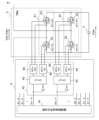
- FIG. 1 is a configuration diagram of a power conversion device according to Embodiment 1.
- FIG. FIG. 2 is a configuration diagram of a control unit and a single-phase inverter in the power conversion device according to Embodiment 1.
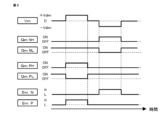
- FIG. FIG. 3 is an explanatory diagram showing an example of control of a single-phase inverter in the power conversion device according to the first embodiment.
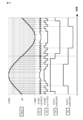
- FIG. 2 is an explanatory diagram showing the output voltage waveforms of four single-phase inverters and the overall output voltage waveform in the power conversion device according to the first embodiment.
- FIG. 3 is an explanatory diagram illustrating a combination of four single-phase inverters that realizes gradation level output in the power conversion device according to the first embodiment.
- FIG. 3 is an explanatory diagram showing the output voltage waveforms of four single-phase inverters and the overall output voltage waveform in the power converter device of the comparative example according to the first embodiment.
- FIG. 2 is an explanatory diagram illustrating a combination of four single-phase inverters that realizes gradation level output in a power conversion device of a comparative example according to Embodiment 1;
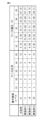
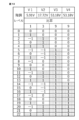
- FIG. 2 is an explanatory diagram showing a table of voltage configurations of the power conversion device according to Embodiment 1.
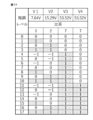
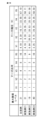
- FIG. FIG. 2 is an explanatory diagram showing a table of voltage configurations of the power conversion device according to Embodiment 1.
- FIG. 7 is an explanatory diagram showing the output voltage waveforms of four single-phase inverters and the overall output voltage waveform in the power conversion device according to the second embodiment.
- FIG. 7 is an explanatory diagram showing a combination of four single-phase inverters that realizes gradation level output in a power conversion device according to a second embodiment.
- FIG. 7 is an explanatory diagram showing the output voltage waveforms of four single-phase inverters and the overall output voltage waveform in the power conversion device according to the second embodiment.
- FIG. 7 is an explanatory diagram showing a combination of four single-phase inverters that realizes gradation level output in a power conversion device according to a second embodiment.
- FIG. 7 is an explanatory diagram showing a table of voltage configurations of a power conversion device according to a second embodiment.
- FIG. 7 is an explanatory diagram showing a table of voltage configurations of a power conversion device according to a second embodiment.
- FIG. 3 is a configuration diagram of a power conversion device according to a third embodiment.
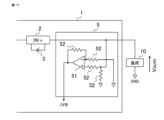
- FIG. 3 is a circuit diagram of an output detection section of a power conversion device according to a third embodiment.
- FIG. 3 is a circuit diagram of an output detection section of a power conversion device according to a third embodiment.
- FIG. 7 is a configuration diagram of a gradation control signal generation section of a power conversion device according to a third embodiment.
- FIG. 7 is an explanatory diagram showing a combination of four single-phase inverters that realizes output of gradation levels in a power conversion device according to Embodiment 3;
- FIG. 7 is an explanatory diagram showing output voltage waveforms of four single-phase inverters in the power conversion device according to Embodiment 3;
- FIG. 12 is an explanatory diagram showing a combination of four single-phase inverters that realizes grayscale level output in a power conversion device according to a fourth embodiment.
- 7 is a flowchart illustrating a control method in the power conversion device according to Embodiment 4.
- FIG. 7 is an explanatory diagram of switching distribution processing in the power conversion device according to Embodiment 4;
- FIG. 12 is an explanatory diagram showing a combination of four single-phase inverters that realizes grayscale level output in a power conversion device according to a fourth embodiment.
- FIG. 7 is an explanatory diagram of switching distribution processing in the power conversion device according to Embodiment 4;
- FIG. 3 is a configuration diagram of a power conversion device according to a fifth embodiment.
- FIG. 12 is an explanatory diagram showing a combination of four single-phase inverters that realizes grayscale level output in a power conversion device according to a fifth embodiment.
- FIG. 7 is an explanatory diagram showing a table of voltage configurations of a power conversion device according to a fifth embodiment.
- FIG. 7 is an explanatory diagram showing a table of voltage configurations of a power conversion device according to a fifth embodiment.
- FIG. 7 is an explanatory diagram showing a table of voltage configurations of a power conversion device according to a fifth embodiment.
- FIG. 12 is an explanatory diagram showing a combination of four single-phase inverters that realizes grayscale level output in a power conversion device according to a sixth embodiment.
- 12 is a flowchart showing a control method in a power conversion device according to Embodiment 6.
- FIG. 7 is an explanatory diagram of switching distribution processing in the power conversion device according to Embodiment 6;
- FIG. 12 is an explanatory diagram showing a combination of four single-phase inverters that realizes grayscale level output in a power conversion device according to a sixth embodiment.
- 7 is a configuration diagram of a power conversion device according to Embodiment 7.
- FIG. FIG. 7 is a configuration diagram of a gradation control signal generation section of a power conversion device according to a seventh embodiment.
- FIG. 12 is a flowchart showing a control method in a power conversion device according to Embodiment 7.
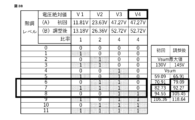
- FIG. 7 is an explanatory diagram of voltage adjustment of a DC power supply in a power conversion device according to a seventh embodiment.
- FIG. 7 is an explanatory diagram of voltage adjustment of a DC power supply in a power conversion device according to a seventh embodiment.
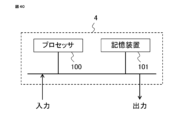
- FIG. 2 is a diagram showing a hardware configuration that implements a control unit of a power conversion device according to embodiments 1 to 7.
- FIG. 1 is a configuration diagram of a power conversion device according to Embodiment 1.
- three or more single-phase inverters 2 are connected in series.
- n single-phase inverters 2, INV1, INV2, INV3, . . . INVn-1, INVn are connected in series.
- n is a natural number.
- a DC power supply 3 is connected to each single-phase inverter 2 .
- Vdn be the output voltage of the DC power supply 3 connected to the single-phase inverter 2 of INVn.
- Each single-phase inverter 2 converts DC power supplied from a DC power supply 3 into gradation-controlled AC power.
- V1 is the absolute value of the voltage generated when the voltage is output from the single-phase inverter 2 of INV1
- V2 is the absolute value of the generated voltage when the voltage is output from the single-phase inverter 2 of INV2
- Vn the absolute value of the voltage generated when the single-phase inverter 2 outputs the voltage.
- a control unit 4 is connected to each single-phase inverter 2 .
- the control unit 4 controls each single-phase inverter 2, and also controls the power converter 1 to output the sum of the output voltages of each single-phase inverter 2 to the load 10 as the overall output voltage Vsum.
- the power conversion device 1 according to the present embodiment is capable of supporting a wide variety of types of loads 10, such as resistive loads, capacitive loads, inductive loads, and loads that are combinations thereof.
- the voltage absolute values of two single-phase inverters among the plurality of single-phase inverters 2 are set to the same first common voltage Vs1.
- the voltage absolute value Vn-1 of the single-phase inverter of INVn-1 and the voltage absolute value Vn of the single-phase inverter of INVn are set to the same Vs1.
- a single-phase inverter whose voltage absolute value is set to the first common voltage is referred to as a first common single-phase inverter.
- the first common voltage Vs1 is set to a value larger than the minimum value of the voltage absolute values V1, V2, V3, . . . Vn-2 of the other single-phase inverters.
- the two first common single-phase inverters can simultaneously output the first common voltage Vs1.
- FIG. 2 is a configuration diagram of a control unit and a single-phase inverter in the power conversion device of this embodiment.
- the single-phase inverter 2 of INVm is a full-bridge inverter having four switching elements 23 (QmNL, QmNH, QmPL, and QmPH).
- m is a natural number from 1 to n.
- This full-bridge inverter consists of one half-bridge inverter 21 made up of two switching elements QmNL and QmNH, and another half-bridge inverter 22 made up of two switching elements QmPL and QmPH. .
- the half-bridge inverters 21 and 22 are connected to a DC power supply 3 having an output voltage Vdm in which the direction indicated by the arrow in FIG. 2 is a positive voltage.
- a capacitor may be provided between the DC power supply 3 and the single-phase inverter 2 of INVm.
- the single-phase inverter 2 of INVm outputs a voltage whose absolute voltage value is Vm, and the direction indicated by the arrow in FIG. 2 is a positive voltage.
- Vm absolute voltage value
- Vdm output voltage
- the four switching elements 23 are shown as MOSFETs (Metal Oxide Semiconductor Field Effect Transistors).
- the switching element 23 may be a transistor, an IGBT (Insulated Gate Bipolar Transistor), or the like in addition to a MOSFET.
- one switching element 23 is composed of one component, but in order to ensure withstand voltage and current, one switching element 23 consists of a plurality of switching elements connected in series or in parallel. Alternatively, it may be configured with a mixed connection of series and parallel connections.
- a gate drive signal is input from the control unit 4 to the two half-bridge inverters 21 and 22 of the single-phase inverter 2 of INVm.
- the control section 4 includes a gradation control signal generation section 41 and a gate driver 42.
- the gradation control signal generation unit 41 generates gradation control signals SmN and SmP for controlling the gradation of the single-phase inverter 2 of INVm.
- the gradation control signals SmN and SmP are input to the gate driver 42.
- the gate driver 42 assigns dead times to the gradation control signals SmN and SmP using a dead time generating section 43 (DTmN and DTmP), respectively.
- the gate driver 42 outputs level-shifted gradation control signals from the gate drive signal output section 44 (GOmNL, GOmNH, GOmPL, and GOmPH) to the two half-bridge inverters 21 and 22 as gate drive signals.
- the gates of the two half-bridge inverters 21 and 22 are driven by gate drive signals.
- the control unit 4 shows a configuration in which one gate driver 42 drives two half-bridge inverters.
- the control unit 4 may include two gate drivers that drive one half-bridge inverter.
- the gradation control signal generation section 41 outputs one gradation control signal SmN and SmP for controlling each half-bridge inverter.
- the gradation control signal generation unit 41 generates gradation control signals SmN and SmP and a signal obtained by logically inverting them, and generates two gradation control signals for controlling each half-bridge inverter. may be output.
- the dead time generation section 43 (DTmN and DTmP) of the gate driver 42 is removed, and each gradation control signal is may be output.
- FIG. 3 is an explanatory diagram showing an example of control of the single-phase inverter of INVm in this embodiment.
- FIG. 3 shows changes in the on and off states of the four switching elements 23 (QmNL, QmNH, QmPL and QmPH) constituting the single-phase inverter of INVm with respect to the gradation control signals SmN and SmP, and the single-phase inverter of INVm. It shows changes in the output voltage Vm of the inverter. Note that in FIG. 3, each signal is shown with dead time omitted.
- the switching element QmNL on the low side of the half-bridge inverter is in the on state and the switching element QmPL is in the off state, and the high side of the half-bridge inverter
- the side switching element QmNH is in the off state and the switching element QmPH is in the on state. Therefore, the single-phase inverter enters a voltage output state, and the output voltage Vm becomes +Vdm (positive voltage).
- the switching element QmNL on the low side of the half-bridge inverter is in the off state and the switching element QmPL is in the on state, and the high side of the half-bridge inverter
- the side switching element QmNH is in the on state and the switching element QmPH is in the off state. Therefore, the single-phase inverter enters a voltage output state, and the output voltage Vm becomes -Vdm (negative voltage).
- the single-phase inverter shown in FIG. 2 has a configuration in which the polarity of the output voltage Vm can be switched and outputted.
- the configuration of the single-phase inverter is not limited to that shown in FIG. 2.
- the high-side switching element QmNH of the half-bridge inverter 21 in FIG. 2 is removed to be in an open state, and the drain and source terminals of the low-side switching element QmNL are
- a single-phase inverter may be configured with only the half-bridge inverter 22 by short-circuiting the inverter (QmNL may be removed).
- FIG. 4 shows the output voltage waveforms of four single-phase inverters that respectively output V1, V2, V3, and V4 when a sine wave is used as the output voltage instruction waveform in the power conversion device of this embodiment
- the step-by-step FIG. 3 is an explanatory diagram showing a waveform of a controlled overall output voltage Vsum.
- FIG. 5 is an explanatory diagram showing in a table the combinations of voltage absolute values V1, V2, V3, and V4 of four single-phase inverters that realize gray-level output in the power conversion device of this embodiment.
- the ratio of voltage absolute values V1, V2, V3, and V4 of the four single-phase inverters is 1:2:4:4.
- each single-phase inverter outputs a positive voltage when it receives an output instruction "1" while the waveform of the output voltage instruction is a positive voltage, and outputs an output instruction "1" when the waveform of the output voltage instruction is a negative voltage. If it receives a negative voltage, it outputs a negative voltage.
- FIG. 6 shows the output voltage waveforms and gradations of four single-phase inverters that output V1, V2, V3, and V4, respectively, when a sine wave is used as the output voltage instruction waveform in the power conversion device of the comparative example.
- FIG. 3 is an explanatory diagram showing a waveform of a controlled overall output voltage Vsum.
- FIG. 7 is an explanatory diagram showing in a table the combinations of voltage absolute values V1, V2, V3, and V4 of four single-phase inverters that realize gray-level output in the power conversion device of the comparative example.
- the ratio of the voltage absolute values V1, V2, V3, and V4 of the four single-phase inverters is 1:2:4:8.
- Two single-phase inverters Considering the breakdown voltage lineup of common MOSFET switching elements, the MOSFET switching elements of the single-phase inverter that outputs V3 and V4 must have a breakdown voltage of 60V or more. Regarding the single-phase inverter that outputs V2 (23.63V), which has the next highest voltage, in order to prevent the accuracy of the Vsum waveform from deteriorating due to differences in switching speed and delay characteristics, it is necessary to use the same MOSFET as the single-phase inverter that outputs V4. It is preferable to use a switching element. From the above, in the power conversion device of this embodiment, MOSFET switching elements having a withstand voltage of 60 V or more are required for the two single-phase inverters that output V3 and V4.
- the single-phase inverter with the highest voltage absolute value is the single-phase inverter that outputs V4 set to 69.33V. be. Therefore, in the power conversion device of the comparative example, the withstand voltage of the MOSFET switching element of the single-phase inverter that outputs V4 is insufficient at 60V, and considering the withstand voltage lineup of MOSFET switching elements, there is one with a withstand voltage of 80V. It becomes necessary.
- MOSFET switching elements having a withstand voltage of 80 V or more are required for the two single-phase inverters that output V3 and V4.
- V1 and V2 are low voltages
- the switching elements of the MOSFETs of the single-phase inverter that outputs V1 and V2 have a withstand voltage of 30V. It is also possible to use a low voltage MOSFET.
- the voltage of V3 of the power converter of this embodiment is 1.5 times higher than the voltage of V3 of the power converter of the comparative example. It is 36 times more.
- the number of switching times of the single-phase inverter that outputs V3 in one period of the sine wave that is the output voltage instruction waveform is 4 times in the power converter of this embodiment, whereas the power converter of the comparative example That's 12 times.
- the power converter of this embodiment reduces switching loss more than the power converter of the comparative example even for the switching elements of the single-phase inverter that outputs V3. I can do it.
- three or more single-phase inverters include at least two first common single-phase inverters that output first common voltages having the same absolute voltage value, and and at least one single-phase inverter that outputs a small absolute voltage value. Therefore, the power converter according to the present embodiment can use a MOSFET switching element having a lower breakdown voltage than the power converter according to the comparative example. Further, since the power converter of this embodiment can use a MOSFET switching element with a low breakdown voltage, the on-resistance is smaller than that of the power converter of the comparative example, so that conduction loss can be reduced. Furthermore, the power conversion device of this embodiment can also reduce switching loss more than the power conversion device of the comparative example.
- the power conversion device of this embodiment can be configured with a small single-phase inverter and a small radiator, so that it is possible to suppress the increase in size and cost of the power conversion device.
- the first common voltage is not the minimum value of the voltage absolute value of the single-phase inverter. This is because if the first common voltage is set to the minimum absolute value of the voltage of the single-phase inverter, the maximum voltage of the output of the single-phase inverter cannot be lowered unless the number of gradations is significantly reduced.
- the first common voltage is set to the maximum absolute voltage value of the single-phase inverter, so the power converter can be made larger and more expensive without significantly reducing the number of gradations. Cost increase can be suppressed.
- the power conversion device according to this embodiment is configured with four single-phase inverters.
- the power conversion device of this embodiment may be configured with three or more single-phase inverters.
- the characteristics of the power conversion device of this embodiment configured with three to five single-phase inverters will be described.
- we will also explain the characteristics of a power conversion device as a comparative example in which the absolute value of the output voltage of multiple single-phase inverters is approximately multiplied by 2 K (K 0, 1, 2, ). do.
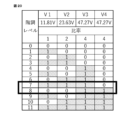
- FIG. 8 is an explanatory diagram showing a table of the voltage configuration of the power conversion device of this embodiment configured with three to five single-phase inverters.
- the table in FIG. 8 shows the voltage ratio of V1 to V5 and the voltage of V1 to V5.
- the voltages V1 to V5 are set so that the overall output voltage Vsum is ⁇ 130V.
- the power conversion device of Examples 1 to 8 is configured with five single-phase inverters
- the power conversion device of Example 9 is configured with three single-phase inverters.
- the power conversion device of Example 10 is composed of four single-phase inverters.
- the power conversion devices of Examples 1 to 10 are all configured to have a voltage ratio of 1 and 2, or a voltage ratio of 1 and 3.
- the maximum voltage of the single-phase inverter in the power conversion device of Examples 1 to 10 shown in FIG. 8 is smaller than the maximum voltage of the single-phase inverter in the power conversion device of the comparative example. Therefore, the power converters of Examples 1 to 10 can use MOSFET switching elements having a lower breakdown voltage than the power converters of the comparative example.
- Example 2 voltage outputs of different polarities may be required at the same time from a plurality of single-phase inverters in order to realize each gradation level.
- Example 2 a single-phase inverter that outputs V1 with a voltage absolute value ratio of 1 outputs a negative voltage, and a single-phase inverter that outputs V3 with a voltage absolute value ratio of 5 outputs a positive voltage.
- Example 7 the single-phase inverter that outputs V1 with a voltage absolute value ratio of 1 outputs a negative voltage, and the single-phase inverter that outputs V2 with a voltage absolute value ratio of 3 outputs a negative voltage.
- the power converters of Examples 1 to 10 shown in FIG. 8 can output AC power to the load in a range below the respective maximum gradation level.
- J be the ratio of the first common voltage to the minimum ratio 1 of voltage absolute values
- K be the sum of the ratios of voltage absolute values whose ratio is smaller than J.
- the power conversion device of this embodiment can avoid duplication of combinations for realizing output of each gradation level, and can be configured with a smaller number of single-phase inverters. Since a MOSFET switching element having a lower breakdown voltage than the power converter of the comparative example can be used, it is possible to suppress the increase in size and cost of the power converter. Note that this relationship between J and K also holds true in the power conversion device configured with three single-phase inverters of Example 9 and the power conversion device configured with four single-phase inverters of Example 10. . This relationship between J and K also holds true in a power conversion device configured with six or more single-phase inverters.
- the maximum output voltage of the single-phase inverter is used as the first common voltage.
- the first common voltage does not have to be the maximum output voltage of the single-phase inverter.
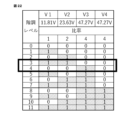
- FIG. 9 is an explanatory diagram showing a table of the voltage configuration of the power conversion device of this embodiment configured with five single-phase inverters.
- the table in FIG. 9 shows the voltage ratio of V1 to V5 and the voltage of V1 to V5.
- the voltages V1 to V5 are set so that the overall output voltage Vsum is ⁇ 130V.
- the first common voltage is not the maximum output voltage of the single-phase inverter.
- the maximum voltage of the single-phase inverter in the power conversion device of Examples 11 to 13 shown in FIG. 9 is smaller than the maximum voltage of the single-phase inverter in the power conversion device of the comparative example. Therefore, the power converters of Examples 11 to 13 can use MOSFET switching elements having a lower breakdown voltage than the power converters of the comparative example.
- the configuration of the power conversion device of this embodiment is similar to the configuration of the power conversion device shown in FIG. 1 of Embodiment 1.
- the output voltages of the plurality of single-phase inverters are different from those of the power converter of Embodiment 1. Note that, in order to make the explanation easier to understand, a power conversion device configured with four single-phase inverters will be exemplified and explained.
- FIG. 10 shows the output voltage waveforms of four single-phase inverters that respectively output V1, V2, V3, and V4 when a sine wave is used as the output voltage instruction waveform in the power conversion device of this embodiment
- the step-by-step FIG. 3 is an explanatory diagram showing a waveform of a controlled overall output voltage Vsum.
- FIG. 11 is an explanatory diagram showing in a table the combinations of voltage absolute values V1, V2, V3, and V4 of four single-phase inverters that realize gray-level output in the power conversion device of this embodiment.
- the ratio of voltage absolute values V1, V2, V3, and V4 of the four single-phase inverters is 1:2:7:7.
- V1 or "-1" indicates the state in which the four single-phase inverters have received output instructions for voltage absolute values V1, V2, V3, and V4, and "1" or "-1” indicates the state in which they have not received output instructions. It is written as "0".
- Each single-phase inverter outputs a positive voltage if it receives an output instruction "1" while the waveform of the output voltage instruction is positive voltage, and outputs a negative voltage if it receives an output instruction "-1". In addition, each single-phase inverter outputs a negative voltage if it receives an output instruction "1" while the output voltage instruction waveform is negative voltage, and outputs a positive voltage if it receives an output instruction "-1". .
- the ratio of the voltage absolute values V1, V2, V3, and V4 of the four single-phase inverters is 1:2:7:7.
- the ratio of the voltage absolute values V1, V2, V3, and V4 of the four single-phase inverters is 1:2:4:4.
- the maximum gradation level is 11.
- the power converter according to the present embodiment can realize more maximum gradation levels than the power converter according to the first embodiment.
- the maximum voltage of the single-phase inverter in the power conversion device of this embodiment is smaller than the maximum voltage of the single-phase inverter in the power conversion device of the comparative example shown in Embodiment 1. Therefore, the power converter of this embodiment can use a MOSFET switching element with lower breakdown voltage than the power converter of the comparative example, and can reduce conduction loss.
- the voltage of V3 of the power converter of this embodiment is 1.5 times lower than the voltage of V3 of the power converter of the comparative example. It is 54 times more.
- the number of switching times of the single-phase inverter that outputs V3 in one period of the sine wave that is the output voltage instruction waveform is 4 times in the power converter of this embodiment, whereas the power converter of the comparative example That's 12 times.
- the power converter of this embodiment reduces switching loss more than the power converter of the comparative example even for the switching elements of the single-phase inverter that outputs V3. I can do it.
- FIG. 12 shows the waveforms of the output voltages of four single-phase inverters that output V1, V2, V3, and V4, respectively, when a sine wave is used as the output voltage instruction waveform in the power conversion device of this embodiment
- FIG. 3 is an explanatory diagram showing a waveform of the overall output voltage Vsum that has undergone gradation control.
- FIG. 13 is an explanatory diagram showing in a table the combinations of voltage absolute values V1, V2, V3, and V4 of four single-phase inverters that realize gray-level output in the power conversion device of this embodiment.
- the ratio of voltage absolute values V1, V2, V3, and V4 of the four single-phase inverters is 1:3:9:9.
- the ratio of the voltage absolute values V1, V2, V3, and V4 of the four single-phase inverters is 1:3:9:9.
- the maximum gradation level is 22. Therefore, the power converter according to the present embodiment can realize more maximum gradation levels than the power converter according to the first embodiment.
- the maximum voltage of the single-phase inverter in the power conversion device of this embodiment is smaller than the maximum voltage of the single-phase inverter in the power conversion device of the comparative example shown in Embodiment 1. Therefore, the power converter of this embodiment can use a MOSFET switching element with lower breakdown voltage than the power converter of the comparative example, and can reduce conduction loss.
- the power conversion device according to this embodiment is configured with four single-phase inverters.
- the power conversion device of this embodiment may be configured with three or more single-phase inverters.
- the characteristics of the power conversion device of this embodiment configured with three to five single-phase inverters will be explained.
- we also explain the characteristics of a power conversion device as a comparative example in which the absolute value of the output voltage of multiple single-phase inverters is approximately multiplied by 2 K (K 0, 1, 2, ). do.
- FIG. 14 is an explanatory diagram showing a table of the voltage configuration of the power conversion device of this embodiment configured with three to five single-phase inverters.
- the table in FIG. 14 shows the voltage ratio of V1 to V5 and the voltage of V1 to V5.
- the voltages V1 to V5 are set so that the overall output voltage Vsum is ⁇ 130V.
- the power converters of Examples 14 to 18 are configured with five single-phase inverters, and the power converter of Example 19 is configured with three single-phase inverters.
- the power conversion device of Example 20 is composed of four single-phase inverters.
- the power conversion devices of Examples 14 to 20 are all configured such that the voltage ratios include 1 and 2, or the voltage ratios include 1 and 3.
- the maximum voltage of the single-phase inverter in the power converter of Examples 14 to 20 shown in FIG. 14 is smaller than the maximum voltage of the single-phase inverter in the power converter of the comparative example. Therefore, the power converters of Examples 11 to 20 can use MOSFET switching elements having a lower breakdown voltage than the power converters of the comparative example.
- the power conversion devices of Examples 11 to 20 can realize more maximum gradation levels than the power conversion device of Embodiment 1.
- the maximum voltage is 37.74V, which is about half of the maximum voltage of 67.1V in the comparative example.
- the power converter of Example 17 has the greatest effect of reducing MOSFET conduction loss and switching loss compared to the power converter of Comparative Example.
- the voltage that includes 1, 3, and 9 in the ratio of absolute voltage values and setting the voltage with a ratio of 9 as the first common voltage, it is possible to realize many gradation levels and to achieve a compact and low-cost device.
- a power conversion device can be obtained.
- the maximum output voltage of the single-phase inverter is used as the first common voltage.
- the first common voltage does not have to be the maximum output voltage of the single-phase inverter.
- FIG. 15 is an explanatory diagram showing a table of the voltage configuration of the power conversion device of this embodiment configured with five single-phase inverters.
- the table in FIG. 15 shows the voltage ratio of V1 to V5 and the voltage of V1 to V5.
- the voltages V1 to V5 are set so that the overall output voltage Vsum is ⁇ 130V.
- the first common voltage is not the maximum output voltage of the single-phase inverter.
- the maximum voltage of the single-phase inverter in the power conversion device of Examples 21 to 23 shown in FIG. 15 is smaller than the maximum voltage of the single-phase inverter in the power conversion device of the comparative example. Therefore, the power converters of Examples 21 to 23 can use MOSFET switching elements having a lower breakdown voltage than the power converters of the comparative example.
- the gray scale level of the overall output voltage Vsum is gray scale controlled in units of the minimum ratio 1 of the voltage absolute value. Note that the unit of the minimum ratio 1 of the voltage absolute value is expressed as one step for convenience.
- the power conversion device of Embodiment 3 performs PWM (Pulse Width Modulation) control on at least one single-phase inverter of the plurality of single-phase inverters, so that the gradation level of the overall output voltage Vsum is equivalently lower than one step. Performs gradation control in small units.
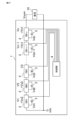
- FIG. 16 is a configuration diagram of the power conversion device according to this embodiment.
- the power conversion device of this embodiment has an output detection section 5 and an AD converter (Analog to Digital Converter) 6 added to the configuration of the power conversion device shown in FIG. 1 of the first embodiment.
- the output detection section 5 detects at least one of the voltage and current output to the load 10, and outputs a negative feedback signal.
- the negative feedback signal will be referred to as OFB (Output Feedback).
- the AD converter 6 converts the OFB output from the output detection section 5 into a digital negative feedback signal, and outputs this digital negative feedback signal to the control section 4 .
- the digitally converted negative feedback signal will be referred to as OFBadc.
- the AD converter 6 may be omitted.
- FIG. 17 is a circuit diagram of an output detection section that detects the voltage output to the load.
- Output detection section 5 is installed between single-phase inverter 2 and an output terminal to load 10.
- the output detection section 5 has a differential circuit including an operational amplifier 51 and a plurality of resistors 52.
- the output detection unit 5 detects a differential voltage from the voltage applied to the load and outputs OFB.
- FIG. 18 is a circuit diagram of an output detection section that detects the current flowing through the load.
- Output detection section 5 is installed between single-phase inverter 2 and an output terminal to load 10.
- the output detection section 5 includes a current detection resistor 53 connected in series to the load 10, and a differential circuit configured with an operational amplifier 51 and a plurality of resistors 52.
- the output detection unit 5 detects a differential voltage from the voltage across the current detection resistor 53 and outputs OFB.
- the current detection resistor 53 may be provided between the load 10 and the ground potential (GND).
- the output detection unit 5 of the power conversion device 1 of this embodiment includes at least one of the circuits shown in FIGS. 17 and 18.
- the output detection unit 5 detects both the voltage and current output to the load 10
- it may include both the circuits shown in FIGS. 17 and 18.
- the configuration of the output detection section shown in FIGS. 17 and 18 is an example, and other configurations may be used as long as the configuration can detect at least one of the voltage or current output to the load, such as a configuration using a transformer. There may be.
- FIG. 19 is a configuration diagram of the gradation control signal generation section of the power conversion device of this embodiment.
- the gradation control signal generation section 41 of this embodiment includes an output value instruction section 401, a first subtraction section 402, a compensation section 403, an output polarity determination section 404, an absolute value processing section 405, an integer processing section 406, 2 subtraction section 407, pulse width modulation section 408, addition section 409, and gradation control signal conversion section 410.
- the output value instruction section 401 outputs an output value instruction waveform Oref such as a sine wave, for example.
- the first subtraction unit 402 outputs a difference signal Osub obtained by subtracting the negative feedback signal OFBadc from the output value instruction waveform Oref.
- the compensator 403 outputs a compensated difference signal Ocmp that compensates the difference signal Osub using a proportional calculation, an integral calculation, a differential calculation, or the like.
- the output polarity determination unit 404 outputs an output polarity instruction signal Opol that determines the polarity of the overall output voltage Vsum, whether positive or negative, from the compensation difference signal Ocmp.
- the absolute value processing unit 405 outputs an absolute value signal Oabs obtained by converting the compensation difference signal Ocmp into an absolute value.
- the integer processing unit 406 outputs an integer signal Oint obtained by converting the absolute value signal Oabs into an integer value.
- the second subtraction unit 407 outputs a decimal value signal Odeci which is obtained by subtracting the integer signal Oint from the absolute value signal Oabs.
- the pulse width modulation section 408 performs pulse width modulation on the decimal value signal Odeci at a carrier frequency to generate a decimal part PWM signal dPMW, and outputs the decimal part PWM signal dPMW.
- the adder 409 outputs an output voltage control signal Ocnt obtained by adding the decimal part PWM signal dPMW to the integer signal Oint.
- the output value instruction waveform Oref is an output voltage instruction waveform when the target output to the load is a voltage waveform.
- the output value instruction waveform Oref is the output current instruction waveform.
- the output value instruction waveform Oref may be both an output voltage instruction waveform and an output current instruction waveform, or may be a power instruction waveform.
- FIG. 20 is an explanatory diagram showing, in a table, combinations of absolute voltage values V1, V2, V3, and V4 of four single-phase inverters that realize gradation level output in the power conversion device of this embodiment.
- the ratio of voltage absolute values V1, V2, V3, and V4 of the four single-phase inverters is 1:2:4:4.
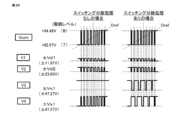
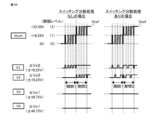
- the operation of the power conversion device when it is instructed to output a gradation level of the overall output voltage Vsum between 7 (+82.67V) and 8 (+94.48V) will be described.
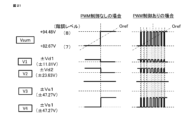
- FIG. 21 shows the output voltage waveforms of the four single-phase inverters when instructed to output a gradation level of the overall output voltage Vsum between 7 and 8. For comparison, output voltage waveforms are shown without PWM control and with PWM control.
- the overall output voltage Vsum in the case without PWM control, the overall output voltage Vsum cannot express the gradation between gradation levels 7 and 8, and in this voltage section, it changes in one step between gradation levels 7 and 8. do.
- the required number of single-phase inverters that simultaneously perform PWM control varies depending on the number of gradation levels indicated by the output value instruction waveform Oref.
- PWM control may be performed using only one single-phase inverter that outputs V1.
- the overall output voltage Vsum can be gradation-controlled with a voltage resolution that is equivalently smaller than one step.
- Embodiment 4 In a power conversion device in which PWM control is added to the gradation control described in Embodiment 3, at least two first common single-phase inverters among three or more single-phase inverters 2 have the same first common single-phase inverter voltage absolute value.
- the common voltage Vs1 is set.
- a power conversion device having two first common single-phase inverters will be described as an example.
- the number of switching times of PWM control of one first common single-phase inverter increases, and the number of switching times of PWM control of the other first common single-phase inverter increases. It may become less or may not switch.
- the power conversion device of the fourth embodiment controls the two first common single-phase inverters set to the first common voltage Vs1 so that the number of times of switching is approximately equal. Note that the configuration of the power conversion device of this embodiment is similar to the configuration of the power conversion device of Embodiment 3.
- FIG. 22 is an explanatory diagram showing, in a table, combinations of absolute voltage values V1, V2, V3, and V4 of four single-phase inverters that realize gradation level output in the power conversion device of this embodiment.
- the ratio of voltage absolute values V1, V2, V3, and V4 of the four single-phase inverters is 1:2:4:4.
- the gradation level of the overall output voltage Vsum is instructed to output a level between 3 and 4, only the single-phase inverter that outputs V3, which is the first common single-phase inverter, outputs, The single-phase inverter that outputs V4, which is the first common single-phase inverter, does not output. That is, only the single-phase inverter that outputs V3 performs a PWM-controlled switching operation, and the single-phase inverter that outputs V4 does not perform a PWM-controlled switching operation.
- the power conversion device of this embodiment controls the switching operation concentrated on one first common single-phase inverter to be distributed to the other first common single-phase inverter. Note that hereinafter, the process of distributing switching operations among the plurality of first common single-phase inverters will be referred to as switching distribution process.
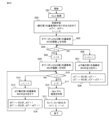
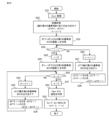
- FIG. 23 is a flowchart showing a control method in the power conversion device of this embodiment.
- FIG. 23 is a flowchart showing the operation when the gradation control signal converter 410 shown in FIG. 19 starts processing a unit period.
- the power conversion device is configured with r first common single-phase inverters.
- the gradation control signal converter 410 obtains the output voltage control signal Ocnt in step S01.
- the gradation control signal converter 410 sets an initial state in step S02.
- the gradation control signal conversion unit 410 sets the outputs of all the r first common single-phase inverters to OFF, sets the up control counter uCT of the first common single-phase inverters to 1, and sets the output of the first common single-phase inverters to 1.
- the down control counter dCT of the phase inverter is set to 1, and the parameters h and j are set to 0. Note that the setting of the initial state in step S02 is performed only when the processing of the first unit cycle is started, and the previous value is held in the next control cycle.
- step S03 the gradation control signal conversion unit 410 determines the number g of first common single-phase inverters whose outputs are switched from off to on based on the output voltage control signal Ocnt.
- the gradation control signal converter 410 determines whether h is equal to g in step S04. If it is determined in step S04 that h is equal to g (YES), the gradation control signal converter 410 proceeds to step S05 and sets h to 0. If it is determined in step S04 that h is not equal to g (NO), the gradation control signal converter 410 proceeds to step S06, adds 1 to h, and sets a new h.
- the gradation control signal converter 410 that has proceeded to step S06 turns on the output of the first common single-phase inverter of uCT number in step S07. Further, in step S08, the gradation control signal conversion unit 410 sets uCT to 1 when uCT is equal to r, and adds 1 to uCT when uCT is smaller than r to set a new uCT. . Next, the gradation control signal converter 410 returns to step S04.
- step S09 the gradation control signal conversion unit 410 that has proceeded to step S05 determines the number i of first common single-phase inverters whose outputs are switched from on to off based on the output voltage control signal Ocnt.
- the gradation control signal converter 410 determines whether i is equal to j in step S10. If it is determined in step S10 that i is equal to j (YES), the gradation control signal converter 410 proceeds to step S11 and sets j to 0. If it is determined in step S10 that i is not equal to j (NO), the gradation control signal conversion unit 410 proceeds to step S14, and adds 1 to j to set a new j.
- the gradation control signal converter 410 that has proceeded to step S14 turns off the output of the first common single-phase inverter of dCT number in step S15. Further, in step S16, the gradation control signal conversion unit 410 sets dCT to 1 when dCT is equal to r, and adds 1 to dCT when dCT is smaller than r to set a new dCT. . Next, the gradation control signal converter 410 returns to step S10.
- FIG. 24 is an explanatory diagram of switching distribution processing in a power conversion device configured with four single-phase inverters.
- FIG. 24 shows an example in which the overall output voltage Vsum is changed as a binary voltage pulse between gradation levels 3 and 4 in the power conversion device configured with the four single-phase inverters shown in FIG. 22. be. Note that FIG. 24 also shows a case where switching distribution processing is not performed.
- FIG. 24 when switching dispersion processing is not performed, the output of the first common single-phase inverter that outputs V3 changes with a cycle of the reciprocal of the carrier frequency, but the output of the first common single-phase inverter that outputs V4 The output of the single-phase inverter remains unchanged.
- the output voltage pulse of the first common single-phase inverter that outputs V3 is the same as the output voltage pulse of the first common single-phase inverter that outputs V3 and the first common single-phase inverter that outputs V4. It occurs alternately.
- the waveform of the total output voltage Vsum when the switching distribution process is performed is the same as the waveform of the total output voltage Vsum when the switching distribution process is not performed. That is, when switching the gradation level between 3 and 4 in the power conversion device of this embodiment, the switching operation that was biased toward the first common single-phase inverter that outputs V3 is performed by switching dispersion processing. It is evenly distributed to each of the first common single-phase inverters outputting V3 and V4.
- FIG. 25 is an explanatory diagram showing, in a table, combinations of absolute voltage values V1, V2, V3, and V4 of four single-phase inverters that realize gradation level output in the power conversion device of this embodiment.
- the ratio of voltage absolute values V1, V2, V3, and V4 of the four single-phase inverters is 1:2:4:4.
- FIG. 26 is an explanatory diagram of switching distribution processing in a power conversion device configured with four single-phase inverters.
- FIG. 26 is an example in which the overall output voltage Vsum is changed as a binary voltage pulse of gradation levels 7 and 8 in the power conversion device configured with the four single-phase inverters shown in FIG. 25. .
- FIG. 26 also shows a case where switching distribution processing is not performed.
- the output of the first common single-phase inverter that outputs V3 is constant and does not change, but the output of the first common single-phase inverter that outputs V4 changes at a period of the reciprocal of the carrier frequency.
- the voltage pulse outputted by the first common single-phase inverter that outputs V4 becomes a voltage pulse with a wider pulse width
- the voltage pulse outputted by the first common single-phase inverter that outputs V3 becomes a voltage pulse with a wider pulse width.
- the waveform of the total output voltage Vsum when the switching distribution process is performed is the same as the waveform of the total output voltage Vsum when the switching distribution process is not performed. That is, when switching the gradation level between 7 and 8 in the power conversion device of this embodiment, the switching operation that was biased toward the first common single-phase inverter that outputs V4 is performed by switching dispersion processing.
- each of the first common single-phase inverters is configured to include one or more switching elements
- the control section is configured to include two or more first common single-phase inverters.
- the output value instruction waveform Oref is a sine wave
- the switching distribution processing in this embodiment has been described using waveforms when applied to the power conversion device using PWM control described in Embodiment 3.
- the switching distribution processing in this embodiment can also be applied to a power conversion device that does not use PWM control.
- the switching dispersion processing of this embodiment can be applied.
- the effect of switching distribution processing has been explained using a power conversion device having two first common single-phase inverters.
- the switching distribution processing of this embodiment is applicable to a power conversion device having three or more first common single-phase inverters.
- the power converter according to the present embodiment can distribute the number of times of switching to a plurality of first common single-phase inverters, so that switching loss is not concentrated in one first common single-phase inverter. can be prevented.
- the power conversion device of this embodiment can use a small heat radiator, and can suppress increase in size and cost.
- FIG. 27 is a configuration diagram of a power conversion device according to Embodiment 5.
- the configuration of the power conversion device 1 of this embodiment is similar to the configuration of the power conversion device shown in FIG. 1 of the first embodiment.
- the absolute voltage values of two single-phase inverters 2 among four or more single-phase inverters 2 are set to the same first common voltage Vs1, and the voltages of two other single-phase inverters 2 are set to the same first common voltage Vs1.
- the voltage absolute values of the phase inverters are set to the same second common voltage Vs2.
- the first common voltage Vs1 is set to a value larger than the minimum value of each voltage absolute value V1, V2, V3, . . .
- Vn-2 of each single-phase inverter is set to a voltage smaller than the first common voltage Vs1.
- the voltage absolute value Vn-1 of the single-phase inverter of INVn-1 and the voltage absolute value Vn of the single-phase inverter of INVn are set to the same Vs1.
- the voltage absolute value V1 of the single-phase inverter of INV1 and the voltage absolute value V2 of the single-phase inverter of INV2 are set to the same Vs2.
- a single-phase inverter whose voltage absolute value is set to the first common voltage is referred to as a first common single-phase inverter
- a single-phase inverter whose voltage absolute value is set to the second common voltage is referred to as a second common single-phase inverter.
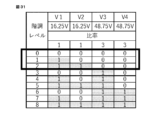
- FIG. 28 is an explanatory diagram showing, in a table, combinations of absolute voltage values V1, V2, V3, and V4 of four single-phase inverters that realize gradation level output in the power conversion device of this embodiment.
- the ratio of voltage absolute values V1, V2, V3, and V4 of the four single-phase inverters is 1:1:3:3.
- the output voltage of the single-phase inverter with the maximum absolute voltage value is 69.33V.
- the output voltage of the single-phase inverter with the maximum absolute voltage value is 48.75V. Therefore, the power converter of this embodiment, like the power converter of Embodiment 1, can use a MOSFET switching element having a lower breakdown voltage than the power converter of the comparative example. Further, the power converter of this embodiment, like the power converter of Embodiment 1, can reduce the switching loss of the single-phase inverter that outputs voltage absolute values V3 and V4.
- the power conversion device according to this embodiment is configured with four single-phase inverters.
- the power conversion device of this embodiment may be configured with four or more single-phase inverters.
- the characteristics of the power conversion device of this embodiment configured with five single-phase inverters will be explained.
- we also explain the characteristics of a power conversion device as a comparative example in which the absolute value of the output voltage of multiple single-phase inverters is approximately multiplied by 2 K (K 0, 1, 2, ). do.
- FIG. 29 is an explanatory diagram showing a table of the voltage configuration of the power conversion device of this embodiment configured with five single-phase inverters.
- the table in FIG. 29 shows the voltage ratio of V1 to V5 and the voltage of V1 to V5.
- the voltages V1 to V5 are set so that the overall output voltage Vsum is ⁇ 130V.
- the power converters of Examples 24 to 29 are configured with five single-phase inverters.
- the first common voltage is set to the maximum absolute voltage value
- the second common voltage is set to the minimum absolute voltage value.
- the maximum voltage of the single-phase inverter in the power converters of Examples 24 to 29 shown in FIG. 29 is smaller than the maximum voltage of the single-phase inverter in the power converter of the comparative example. Therefore, the power converters of Examples 24 to 29 can use MOSFET switching elements having a lower breakdown voltage than the power converters of the comparative example.
- J be the ratio of the first common voltage to the minimum ratio 1 of voltage absolute values
- K be the sum of the ratios of voltage absolute values whose ratio is smaller than J.
- J K+1.
- J 2K+1.
- the second common voltage is set to the minimum value of the absolute voltage value.
- the second common voltage does not need to be the minimum absolute voltage value.
- FIG. 30 is an explanatory diagram showing a table of the voltage configuration of the power conversion device of this embodiment configured with five single-phase inverters.
- the table in FIG. 30 shows the voltage ratio of V1 to V5 and the voltage of V1 to V5.
- the voltages V1 to V5 are set so that the overall output voltage Vsum is ⁇ 130V.
- the power converters of Examples 30 to 33 are configured with five single-phase inverters.
- the first common voltage is set to the maximum absolute voltage value
- the second common voltage is set to a voltage value that is not the minimum absolute voltage value. There is.
- the maximum voltage of the single-phase inverter in the power converters of Examples 30 to 33 shown in FIG. 30 is smaller than the maximum voltage of the single-phase inverter in the power converter of the comparative example. Therefore, the power converters of Examples 30 to 33 can use MOSFET switching elements having a lower breakdown voltage than the power converters of the comparative example.
- J be the ratio of the first common voltage to the minimum ratio 1 of voltage absolute values
- K be the sum of the ratios of voltage absolute values whose ratio is smaller than J.
- J K+1.
- J 2K+1.
- the power conversion device of the sixth embodiment is a power conversion device in which PWM control is added to the gradation control described in the third embodiment.
- the voltage absolute values are set to the same first common voltage Vs1, and the voltage absolute values of at least two second common single-phase inverters among the other single-phase inverters 2 are set to the same second common voltage Vs2. be.
- a power conversion device having two first common single-phase inverters and two second common single-phase inverters will be described as an example.
- the power conversion device depending on the output waveform of the overall output voltage Vsum, the number of switching times of PWM control of one second common single-phase inverter increases, and the number of switching times of PWM control of the other second common single-phase inverter increases. It may become less or may not switch. In this case, switching loss will be concentrated in one of the second common single-phase inverters.
- the power conversion device according to the present embodiment controls the two second common single-phase inverters set to the second common voltage Vs2 so that the number of times of switching is approximately equal.
- FIG. 31 is an explanatory diagram showing, in a table, combinations of absolute voltage values V1, V2, V3, and V4 of four single-phase inverters that realize gradation level output in the power conversion device of this embodiment.
- the ratio of voltage absolute values V1, V2, V3, and V4 of the four single-phase inverters is 1:1:3:3.
- the output state of the second common single-phase inverter outputs V1 and V2, respectively, as shown in FIG.
- the power conversion device of this embodiment controls the switching operation concentrated on one second common single-phase inverter to be distributed to the other second common single-phase inverter.
- FIG. 32 is a flowchart showing a control method in the power conversion device of this embodiment.
- FIG. 32 is a flowchart showing the operation when the gradation control signal conversion section 410 starts processing for a unit period.
- the power conversion device is configured with s second common single-phase inverters.
- the gradation control signal converter 410 obtains the output voltage control signal Ocnt in step S21.
- the gradation control signal converter 410 sets an initial state in step S22.
- the gradation control signal conversion unit 410 sets the outputs of all the s second common single-phase inverters to OFF, sets the up control counter uCT2 of the second common single-phase inverter to 1, and sets the second common single-phase inverter up control counter uCT2 to 1.
- a phase inverter down control counter dCT2 is set to 1, and parameters k and m are set to 0. Note that the setting of the initial state in step S22 is performed only when the processing of the first unit cycle is started, and the previous value is held in the next control cycle.
- step S23 the gradation control signal conversion unit 410 determines the number a of second common single-phase inverters whose outputs are switched from off to on based on the output voltage control signal Ocnt.
- the gradation control signal conversion unit 410 determines whether k is equal to a in step S24. If it is determined in step S24 that k is equal to a (YES), the gradation control signal converter 410 proceeds to step S25 and sets k to 0. If it is determined in step S24 that k is not equal to a (NO), the gradation control signal converter 410 proceeds to step S26, adds 1 to k, and sets a new k.
- the gradation control signal converter 410 that has proceeded to step S26 turns on the output of the second common single-phase inverter of uCT number 2 in step S27. Further, in step S28, the gradation control signal conversion unit 410 sets uCT2 to 1 when uCT2 is equal to s, and adds 1 to uCT2 when uCT2 is smaller than s to set a new uCT2. . Next, the gradation control signal converter 410 returns to step S24.
- step S29 the gradation control signal conversion unit 410 that has proceeded to step S25 determines the number b of the second common single-phase inverters whose outputs are switched from on to off based on the output voltage control signal Ocnt.
- the gradation control signal converter 410 determines whether m is equal to b in step S30. If it is determined in step S30 that m is equal to b (YES), the gradation control signal converter 410 proceeds to step S31 and sets m to 0. If it is determined in step S30 that m is not equal to b (NO), the gradation control signal converter 410 proceeds to step S34, adds 1 to m, and sets a new m.
- the gradation control signal converter 410 that has proceeded to step S34 turns off the output of the second common single-phase inverter of dCT number 2 in step S35. Furthermore, in step S36, the gradation control signal conversion unit 410 sets dCT2 to 1 when dCT2 is equal to s, and adds 1 to dCT2 when dCT2 is smaller than s to set a new dCT2. . Next, the gradation control signal converter 410 returns to step S30.
- the gradation control signal conversion unit 410 determines the polarity of the gradation control signal based on the output polarity instruction signal Opol in step S32.
- FIG. 33 is an explanatory diagram of switching distribution processing in a power conversion device configured with four single-phase inverters.
- FIG. 33 is an example of the case where the overall output voltage Vsum is changed from gradation level 0 to 2 in the power conversion device configured with the four single-phase inverters shown in FIG. 31.
- FIG. 33 an example is shown in which the gradation level is changed from 0 to 1 in period 1 and from 1 to 2 in period 2 as a binary voltage pulse. Note that FIG. 33 also shows a case where switching distribution processing is not performed.
- the output of the second common single-phase inverter that outputs V1 changes at a period that is the reciprocal of the carrier frequency, but it outputs V2.
- the second common single-phase inverter is not outputting.
- the output voltage pulse of the second common single-phase inverter that outputs V1 is different from that of the second common single-phase inverter that outputs V1 and the second common single-phase inverter that outputs V2. This occurs alternately between single-phase inverters and single-phase inverters.
- the waveform of the total output voltage Vsum when the switching distribution process is performed is the same as the waveform of the total output voltage Vsum when the switching distribution process is not performed. That is, when switching the gradation level between 0 and 1 in the power conversion device of this embodiment, the switching operation that was biased toward the second common single-phase inverter that outputs V1 is performed by performing switching distribution processing.
- the output of the second common single-phase inverter that outputs V1 is constant, and the output of the second common single-phase inverter that outputs V2 is constant.
- the output changes at a period that is the reciprocal of the carrier frequency.
- the voltage pulse output by the second common single-phase inverter that outputs V2 becomes a voltage pulse with a wider pulse width
- the voltage pulse output by the second common single-phase inverter that outputs V1 becomes a voltage pulse with a wider pulse width. This occurs alternately between the single-phase inverter and the second common single-phase inverter that outputs V2.
- the waveform of the total output voltage Vsum when the switching distribution process is performed is the same as the waveform of the total output voltage Vsum when the switching distribution process is not performed.
- the switching operation that was biased toward the second common single-phase inverter that outputs V2 is performed by switching dispersion processing. It is evenly distributed to each of the second common single-phase inverters outputting V1 and V2. In period 2, the number of times the single-phase inverter outputs V2 after the switching distribution process is switched is approximately half that before the switching distribution process. Therefore, it is possible to prevent switching loss from concentrating on one second common single-phase inverter.
- each of the second common single-phase inverters is configured to include one or more switching elements
- the control section is configured to control two or more of the second common single-phase inverters.
- the output value instruction waveform Oref is a sine wave
- the switching distribution processing in this embodiment has been described using waveforms when applied to the power conversion device using PWM control described in Embodiment 3.
- the switching distribution processing in this embodiment can also be applied to a power conversion device that does not use PWM control.
- the switching distribution processing of this embodiment can be applied.
- the effect of switching distribution processing has been explained using a power conversion device having two second common single-phase inverters.
- the switching distribution processing of this embodiment is applicable to a power conversion device having three or more second common single-phase inverters.
- a process for distributing the number of switching times of the second common single-phase inverter has been described when the gray scale level switches from 0 to 1 and when the gray scale level switches from 1 to 2.
- Such switching dispersion processing can also be applied to switching of other gradation levels. That is, when among the plurality of second common single-phase inverters, there is a second common single-phase inverter that requires a switching operation when switching the gradation level and a second common single-phase inverter that does not require a switching operation. Switching distributed processing can be applied to
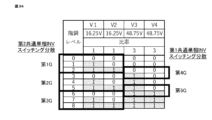
- FIG. 34 is an explanatory diagram showing, in a table, combinations of absolute voltage values V1, V2, V3, and V4 of four single-phase inverters that realize gradation level output in the power conversion device of this embodiment.
- the ratios of voltage absolute values V1, V2, V3, and V4 of the four single-phase inverters are similar to those in FIG. 31.
- the first group (first G) shown in FIG. 34 is used when the gradation level changes between 0 and 1 or when the gradation level changes between 1 and 2, as shown in FIG. 31 of this embodiment. In this case, switching distribution processing can be applied to the second common single-phase inverter.
- the second group (second G) shown in FIG. 34 is a case where the gradation level changes between 3 and 4 or a case where the gradation level changes between 4 and 5. In this second group, when the gradation level changes between 3 and 4, it is necessary to switch the output state of only the second common single-phase inverter that outputs V1.
- switching distribution processing can be applied to the second common single-phase inverter, similar to the first group. For the same reason, switching distribution processing can be applied to the second common single-phase inverter in the third group (3rd G) shown in FIG. 34 as well as in the first group.
- switching distribution processing can also be applied to the first common single-phase inverter.
- the fourth group (4th G) shown in FIG. 34 is a case where the gradation level changes between 2 and 3.
- the fifth group (5th G) shown in FIG. 34 is a case where the gradation level changes between 5 and 6.
- switching distribution processing is applied to at least one of the first common single-phase inverter and the second common single-phase inverter. This can prevent switching losses from concentrating on a specific single-phase inverter.
- Embodiment 7 In the gradation control signal generation section of the power converter shown in FIG. 19 of the third embodiment, depending on the waveform shape of the output value instruction waveform Oref output from the output value instruction section 401, Some may require more switching times. In the power conversion device of Embodiment 7, the number of times of switching of the switching element per unit time in at least one of the first common single-phase inverters is the minimum or Adjust the output voltage of the DC power supply of each single-phase inverter so that it is below the threshold value.
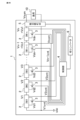
- FIG. 35 is a configuration diagram of a power conversion device according to this embodiment.
- FIG. 36 is a configuration diagram of the gradation control signal generation section of the power conversion device according to the present embodiment.
- the gradation control signal generation section 41 adds an output value instruction waveform Oref to the signal input to the gradation control signal conversion section 410 in the gradation control signal generation section shown in FIG. 19 of the third embodiment. has been added.
- the gradation control signal converter 410 sends DC voltage control signals V1cnt, V2cnt, ...Vncnt, which are target voltages of the output voltages Vd1, Vd2, ...Vdn, to the plurality of DC power supplies 3. Output each.
- FIG. 37 is a flowchart showing a control method in the power conversion device according to this embodiment.
- FIG. 37 is a flowchart showing the operation when the gradation control signal conversion section 410 starts processing for a unit period.
- the gradation control signal conversion unit 410 determines in step S41 whether the inputted output value instruction waveform Oref is the first time or whether there is an instruction to change the output value instruction waveform Oref. do. If it is determined in step S41 that the output value instruction waveform Oref is the first time, or if it is determined that there is a change instruction for the output value instruction waveform Oref (YES), the gradation control signal conversion unit 410 proceeds to step S42, Set to 0.
- step S43 the gradation control signal converter 410 determines the following five items based on the output value instruction waveform Oref.
- the first common single-phase inverter whose switching frequency is to be counted is selected.
- the selected single-phase inverter is referred to as a counting target inverter.
- Second determine the target switching number (tCT).
- the third step is to determine the direction of adjustment of the output voltage of the DC power supply.
- the direction in which the output voltage is adjusted refers to whether the voltage is increased or decreased.
- the number of adjustments (LMT) of the output voltage of the DC power supply is determined.
- the adjustment voltage resolution of the maximum value of the overall output voltage Vsum is determined.
- step S41 If it is determined in step S41 that the output value instruction waveform Oref is not the first time, or if it is determined that there is no change instruction for the output value instruction waveform Oref (NO), the gradation control signal converter 410 proceeds to step S44. .
- the gradation control signal converter 410 receives the output voltage control signal Ocnt in step S44.
- step S45 the gradation control signal conversion unit 410 measures the number of switching times (swCT) for one cycle of the output voltage waveform of the inverter to be counted selected in step S43.
- step S46 the gradation control signal conversion unit 410 determines whether swCT is less than or equal to tCT.
- step S46 If it is determined in step S46 that swCT is equal to or less than tCT (YES), the gradation control signal converter 410 proceeds to step S47.
- the gradation control signal converter 410 maintains the target voltage of the DC power supply in step S47.
- step S46 If it is determined in step S46 that swCT is larger than tCT (NO), the gradation control signal converter 410 proceeds to step S48.
- the gradation control signal converter 410 determines whether W is greater than or equal to LMT in step S48. If it is determined in step S48 that W is greater than or equal to LMT (YES), the gradation control signal converter 410 proceeds to step S47. If it is determined in step S48 that W is smaller than LMT (NO), the gradation control signal converter 410 proceeds to step S49, adds 1 to W, and sets it as a new W. Next, the gradation control signal converter 410 changes the target voltage of the DC power supply in step S50. Finally, in step S51, the gradation control signal converter 410 outputs DC voltage control signals V1cnt, V2cnt, . . . Vncnt, which are target voltages of the DC power supply.
- the gradation control signal converter 410 selects the first common single-phase inverter to be counted for the number of switching times, and the number of switching times of the selected first common single-phase inverter is the minimum or less than the threshold value.
- the output voltage of each DC power source can be adjusted while maintaining the ratio of the voltage absolute values of each single-phase inverter.
- FIG. 38 is an explanatory diagram of voltage adjustment of a DC power supply in a power conversion device configured with four single-phase inverters.
- the ratio of voltage absolute values V1, V2, V3, and V4 of the four single-phase inverters is 1:2:4:4. Therefore, the first common single-phase inverter is a single-phase inverter that outputs V3 and V4.
- the output value instruction waveform Oref is a sine wave, and the output voltage instruction waveform has a peak value of ⁇ 90V.
- the first common single-phase inverter to be counted for the number of switching times is only one single-phase inverter that outputs V4.
- the target number of times of switching of all the switching elements constituting the single-phase inverter that outputs V4 within one cycle of the aforementioned sine wave output value instruction waveform Oref is set to 0 times.
- the direction in which the output voltage of the DC power supply is adjusted is increased from the initial value.
- the number of times the output voltage of each DC power source is adjusted is 10 times. If the target number of switching times of 0 cannot be achieved within 10 adjustments, the voltage adjustment of each DC power source is finished and maintained at the value adjusted at the last time. Further, in the voltage adjustment of each DC power supply, the adjustment voltage resolution of the maximum value ((A) 130V for the first time) of the overall output voltage Vsum is 5V.
- FIG. 39 is an explanatory diagram of voltage adjustment of the DC power supply in the power conversion device of this embodiment.
- the sine wave output value instruction waveform Oref described above details of a portion instructing an output near +90V, which is the positive peak value, are illustrated.
- period 1 is the output period of a binary voltage pulse that can output an equivalent voltage of +90V for the overall output voltage Vsum.
- the binary gradation level described above is between 7 and 8.
- the aforementioned binary gradation level is between 6 and 7.
- the target number of switching times of all switching elements constituting the single-phase inverter that outputs V4 is set to 0 within one period of the sine wave output value instruction waveform Oref. Therefore, from the initial state (A) in FIG. 39, the output voltage of each DC power source is adjusted and controlled according to the flowchart shown in FIG. 37. As described above, in this embodiment, the number of times (LMT) of adjustment of the output voltage of each DC power source is 10 times.
- FIG. 39 shows a case where the target number of switching times of the single-phase inverter that outputs V4 reaches 0 while the control flow process shown in FIG. 37 is performed 10 times.
- the state in which the target number of switching times is achieved and maintained by adjusting the output voltage of each DC power source will be expressed as (B) post-adjustment.
- the first common single-phase inverter to be counted is a single-phase inverter that outputs V4, and the target is An example of setting the number of switching times is shown.
- the object to be counted may be the number of times of switching of some switching elements constituting the first common single-phase inverter.
- the number of output voltage pulses of the first common single-phase inverter to be counted may be set to the target number.
- first common single-phase inverter to be counted
- the output value indication waveform Oref such as a sine wave
- a plurality of first common single-phase inverters are counted.
- the total number of switching times of the inverter may be set as the target number of switching times.
- the voltage may be adjusted in the direction of decreasing according to the waveform of the output value instruction waveform Oref, or the voltage may be adjusted in the direction of decreasing the voltage of each DC power supply.
- the target number of switching times may be approached by changing the direction of voltage decrease and increase within the set number of adjustment times.
- the target number of switching times is set to the minimum value of 0 times is illustrated, but the target number of switching times may be set to be less than or equal to a threshold value, and the threshold value may be set to, for example, 3 times.
- each DC power source is adjusted based on the flowchart shown in FIG. 37. If the waveform of the output value instruction waveform Oref that is regularly and frequently output is determined, the control shown in FIG.
- the voltage of each DC power supply may be set in advance so that the voltage of each DC power supply is set in advance.
- the waveform example in the power conversion device using PWM control shown in Embodiment 3 was explained, it can also be applied to a power conversion device not using PWM control.
- the output value instruction waveform Oref is a ramp waveform with a DC offset such that the gradation level repeatedly switches between 7 and 8 in the above-mentioned (A) initial state
- this embodiment Voltage control of the DC power supply in the form of
- the power conversion device of this embodiment is configured such that the switching frequency of the target first common single-phase inverter is the minimum or The output voltage of the DC power source of each single-phase inverter can be adjusted so as to be equal to or less than the threshold value, or the output voltage of each DC power source can be set in advance. As a result, the switching loss of a single-phase inverter with a large output voltage is reduced, making it possible to provide a power conversion device that is more compact and lower in cost.
- control unit 4 includes a processor 100 and a storage device 101, as an example of hardware is shown in FIG.
- the storage device includes a volatile storage device such as a random access memory and a nonvolatile auxiliary storage device such as a flash memory. Further, an auxiliary storage device such as a hard disk may be provided instead of the flash memory.
- Processor 100 executes a program input from storage device 101. In this case, the program is input from the auxiliary storage device to the processor 100 via the volatile storage device.
- the processor 100 may output data such as calculation results to a volatile storage device of the storage device 101, or may store data in an auxiliary storage device via the volatile storage device.
- control unit 4 may be a digital controller such as an FPGA (Field Programmable Gate Array) or an MCU (Micro Controller Unit).
- control section 4 may have a configuration in which analog circuits and digital controllers are mixed, using analog circuits such as operational amplifiers and comparators for the first subtraction section 402 and the output polarity determination section 404.
- 1 Power converter 1 Power converter, 2 Single-phase inverter, 3 DC power supply, 4 Control unit, 5 Output detection unit, 6 AD converter, 10 Load, 21, 22 Half-bridge inverter, 23 Switching element, 41 Gradation control signal generation unit, 42 Gate driver, 43 dead time generation section, 44 gate drive signal output section, 51 operational amplifier, 52 resistor, 53 current detection resistor, 100 processor, 101 storage device, 401 output value instruction section, 402 first subtraction section, 403 compensation section, 404 Output polarity determination section, 405 Absolute value conversion processing section, 406 Integer conversion processing section, 407 Second subtraction section, 408 Pulse width modulation section, 409 Addition section, 410 Gradation control signal conversion section.
Landscapes
- Engineering & Computer Science (AREA)
- Power Engineering (AREA)
- Inverter Devices (AREA)
- Dc-Dc Converters (AREA)
- Control Of Ac Motors In General (AREA)
Priority Applications (6)
| Application Number | Priority Date | Filing Date | Title |
|---|---|---|---|
| JP2023521859A JP7329719B1 (ja) | 2022-08-02 | 2022-08-02 | 電力変換装置 |
| CN202280098733.6A CN119631292A (zh) | 2022-08-02 | 2022-08-02 | 电力转换装置 |
| PCT/JP2022/029665 WO2024028983A1 (ja) | 2022-08-02 | 2022-08-02 | 電力変換装置 |
| KR1020257001924A KR20250025726A (ko) | 2022-08-02 | 2022-08-02 | 전력 변환 장치 |
| JP2023109759A JP7558343B2 (ja) | 2022-08-02 | 2023-07-04 | 電力変換装置 |
| TW112127733A TWI845384B (zh) | 2022-08-02 | 2023-07-25 | 電力轉換裝置 |
Applications Claiming Priority (1)
| Application Number | Priority Date | Filing Date | Title |
|---|---|---|---|
| PCT/JP2022/029665 WO2024028983A1 (ja) | 2022-08-02 | 2022-08-02 | 電力変換装置 |
Publications (1)
| Publication Number | Publication Date |
|---|---|
| WO2024028983A1 true WO2024028983A1 (ja) | 2024-02-08 |
Family
ID=87568959
Family Applications (1)
| Application Number | Title | Priority Date | Filing Date |
|---|---|---|---|
| PCT/JP2022/029665 Ceased WO2024028983A1 (ja) | 2022-08-02 | 2022-08-02 | 電力変換装置 |
Country Status (5)
| Country | Link |
|---|---|
| JP (2) | JP7329719B1 (https=) |
| KR (1) | KR20250025726A (https=) |
| CN (1) | CN119631292A (https=) |
| TW (1) | TWI845384B (https=) |
| WO (1) | WO2024028983A1 (https=) |
Cited By (1)
| Publication number | Priority date | Publication date | Assignee | Title |
|---|---|---|---|---|
| WO2025224839A1 (ja) * | 2024-04-23 | 2025-10-30 | 三菱電機株式会社 | 電力変換装置 |
Families Citing this family (2)
| Publication number | Priority date | Publication date | Assignee | Title |
|---|---|---|---|---|
| JP7570579B1 (ja) * | 2024-04-23 | 2024-10-21 | 三菱電機株式会社 | 電力変換装置 |
| WO2026042153A1 (ja) * | 2024-08-20 | 2026-02-26 | 三菱電機株式会社 | 電力変換装置 |
Citations (6)
| Publication number | Priority date | Publication date | Assignee | Title |
|---|---|---|---|---|
| JP2004007941A (ja) * | 2002-04-05 | 2004-01-08 | Mitsubishi Electric Corp | 電力変換装置 |
| JP2011155786A (ja) * | 2010-01-28 | 2011-08-11 | Mitsubishi Electric Corp | 電力変換装置 |
| JP2012147559A (ja) * | 2011-01-12 | 2012-08-02 | Toshiba Corp | 半導体電力変換装置 |
| US20170163171A1 (en) * | 2015-12-03 | 2017-06-08 | Industry-Academic Cooperation Foundation, Yonsei University | Apparatus and method for controlling asymmetric modular multilevel converter |
| US20180131290A1 (en) * | 2015-05-13 | 2018-05-10 | Offshore Renewable Energy Catapult | Power converter |
| JP2019176708A (ja) * | 2018-03-29 | 2019-10-10 | 国立大学法人東北大学 | 電力変換装置、発電システム、負荷システム及び送配電システム |
Family Cites Families (8)
| Publication number | Priority date | Publication date | Assignee | Title |
|---|---|---|---|---|
| JPH1189242A (ja) * | 1997-09-08 | 1999-03-30 | Yaskawa Electric Corp | 電力変換装置 |
| JP4490309B2 (ja) * | 2005-02-25 | 2010-06-23 | 三菱電機株式会社 | 電力変換装置 |
| US7808125B1 (en) * | 2006-07-31 | 2010-10-05 | Sustainable Energy Technologies | Scheme for operation of step wave power converter |
| TWI375394B (en) * | 2008-10-03 | 2012-10-21 | Univ Nat Kaohsiung Marine | Three-phase/single-phase power conversion equipment |
| JP5835736B2 (ja) * | 2012-05-14 | 2015-12-24 | 三菱電機株式会社 | 電力変換装置 |
| CN105634309B (zh) * | 2014-11-06 | 2018-06-22 | 台达电子工业股份有限公司 | 一种用于逆变系统的控制方法及控制装置 |
| US9627961B1 (en) * | 2015-12-11 | 2017-04-18 | National Chung Shan Institute Of Science And Technology | Mixed power supply device with a merging network switch |
| CN111969878B (zh) * | 2020-06-23 | 2021-08-06 | 湖南大学 | 变换器、变换器的控制方法及装置 |
-
2022
- 2022-08-02 KR KR1020257001924A patent/KR20250025726A/ko active Pending
- 2022-08-02 CN CN202280098733.6A patent/CN119631292A/zh active Pending
- 2022-08-02 JP JP2023521859A patent/JP7329719B1/ja active Active
- 2022-08-02 WO PCT/JP2022/029665 patent/WO2024028983A1/ja not_active Ceased
-
2023
- 2023-07-04 JP JP2023109759A patent/JP7558343B2/ja active Active
- 2023-07-25 TW TW112127733A patent/TWI845384B/zh active
Patent Citations (6)
| Publication number | Priority date | Publication date | Assignee | Title |
|---|---|---|---|---|
| JP2004007941A (ja) * | 2002-04-05 | 2004-01-08 | Mitsubishi Electric Corp | 電力変換装置 |
| JP2011155786A (ja) * | 2010-01-28 | 2011-08-11 | Mitsubishi Electric Corp | 電力変換装置 |
| JP2012147559A (ja) * | 2011-01-12 | 2012-08-02 | Toshiba Corp | 半導体電力変換装置 |
| US20180131290A1 (en) * | 2015-05-13 | 2018-05-10 | Offshore Renewable Energy Catapult | Power converter |
| US20170163171A1 (en) * | 2015-12-03 | 2017-06-08 | Industry-Academic Cooperation Foundation, Yonsei University | Apparatus and method for controlling asymmetric modular multilevel converter |
| JP2019176708A (ja) * | 2018-03-29 | 2019-10-10 | 国立大学法人東北大学 | 電力変換装置、発電システム、負荷システム及び送配電システム |
Cited By (1)
| Publication number | Priority date | Publication date | Assignee | Title |
|---|---|---|---|---|
| WO2025224839A1 (ja) * | 2024-04-23 | 2025-10-30 | 三菱電機株式会社 | 電力変換装置 |
Also Published As
| Publication number | Publication date |
|---|---|
| JP2024021050A (ja) | 2024-02-15 |
| JP7558343B2 (ja) | 2024-09-30 |
| JP7329719B1 (ja) | 2023-08-18 |
| JPWO2024028983A1 (https=) | 2024-02-08 |
| TW202408145A (zh) | 2024-02-16 |
| CN119631292A (zh) | 2025-03-14 |
| KR20250025726A (ko) | 2025-02-24 |
| TWI845384B (zh) | 2024-06-11 |
Similar Documents
| Publication | Publication Date | Title |
|---|---|---|
| JP2024021050A (ja) | 電力変換装置 | |
| US6891342B2 (en) | Drive apparatus for PWM control of two inductive loads with reduced generation of electrical noise | |
| JP4742229B2 (ja) | 5レベルインバータとその駆動方法 | |
| JPH11220886A (ja) | マルチレベル形電力変換器 | |
| US9419542B2 (en) | Inverter device | |
| KR101803540B1 (ko) | 피에조 구동 회로 및 그 구동 방법 | |
| CN101411049A (zh) | 交错的软开关桥式功率变换器 | |
| WO2012001828A1 (ja) | Dc/dc電力変換装置 | |
| JP2009165222A (ja) | 電力変換装置 | |
| JPH08289561A (ja) | 電力変換装置 | |
| WO2011024351A1 (ja) | 電力変換装置、及びその制御方法 | |
| JP2018121473A (ja) | 電力変換装置 | |
| US7471532B1 (en) | Electric circuit, in particular for a medium-voltage power converter | |
| JP3203464B2 (ja) | 交流電力変換装置 | |
| US20220140748A1 (en) | Semiconductor device and inverter device | |
| KR20200064557A (ko) | 다중 위상을 갖는 3-레벨 dc-dc 컨버터 | |
| EP2309638A1 (en) | Multi-level switching converter | |
| JP6973286B2 (ja) | インバータ装置 | |
| JP4735188B2 (ja) | 電力変換装置 | |
| JP5043585B2 (ja) | 電力変換装置 | |
| WO2013001746A1 (ja) | インバータおよびそれを搭載した電力変換装置 | |
| JP2021168534A (ja) | 電力変換装置 | |
| WO2020152900A1 (ja) | 電力変換装置及びその制御方法 | |
| JP6242353B2 (ja) | 出力電圧反転型dcdcコンバータ | |
| JP7051600B2 (ja) | 多段変換器の制御装置 |
Legal Events
| Date | Code | Title | Description |
|---|---|---|---|
| ENP | Entry into the national phase |
Ref document number: 2023521859 Country of ref document: JP Kind code of ref document: A |
|
| 121 | Ep: the epo has been informed by wipo that ep was designated in this application |
Ref document number: 22953972 Country of ref document: EP Kind code of ref document: A1 |
|
| ENP | Entry into the national phase |
Ref document number: 20257001924 Country of ref document: KR Kind code of ref document: A |
|
| WWE | Wipo information: entry into national phase |
Ref document number: 1020257001924 Country of ref document: KR |
|
| WWE | Wipo information: entry into national phase |
Ref document number: 202280098733.6 Country of ref document: CN |
|
| WWP | Wipo information: published in national office |
Ref document number: 1020257001924 Country of ref document: KR |
|
| NENP | Non-entry into the national phase |
Ref country code: DE |
|
| WWP | Wipo information: published in national office |
Ref document number: 202280098733.6 Country of ref document: CN |
|
| 122 | Ep: pct application non-entry in european phase |
Ref document number: 22953972 Country of ref document: EP Kind code of ref document: A1 |