WO2024024972A1 - チョウザメ飼育方法、チョウザメ生産方法、並びにチョウザメ用固形飼料 - Google Patents
チョウザメ飼育方法、チョウザメ生産方法、並びにチョウザメ用固形飼料 Download PDFInfo
- Publication number
- WO2024024972A1 WO2024024972A1 PCT/JP2023/027864 JP2023027864W WO2024024972A1 WO 2024024972 A1 WO2024024972 A1 WO 2024024972A1 JP 2023027864 W JP2023027864 W JP 2023027864W WO 2024024972 A1 WO2024024972 A1 WO 2024024972A1
- Authority
- WO
- WIPO (PCT)
- Prior art keywords
- sturgeon
- genistein
- solid feed
- feed
- soybean
- Prior art date
- Legal status (The legal status is an assumption and is not a legal conclusion. Google has not performed a legal analysis and makes no representation as to the accuracy of the status listed.)
- Ceased
Links
Images
Classifications
-
- A—HUMAN NECESSITIES
- A01—AGRICULTURE; FORESTRY; ANIMAL HUSBANDRY; HUNTING; TRAPPING; FISHING
- A01K—ANIMAL HUSBANDRY; AVICULTURE; APICULTURE; PISCICULTURE; FISHING; REARING OR BREEDING ANIMALS, NOT OTHERWISE PROVIDED FOR; NEW BREEDS OF ANIMALS
- A01K61/00—Culture of aquatic animals
- A01K61/10—Culture of aquatic animals of fish
-
- A—HUMAN NECESSITIES
- A23—FOODS OR FOODSTUFFS; TREATMENT THEREOF, NOT COVERED BY OTHER CLASSES
- A23K—FODDER
- A23K10/00—Animal feeding-stuffs
- A23K10/30—Animal feeding-stuffs from material of plant origin, e.g. roots, seeds or hay; from material of fungal origin, e.g. mushrooms
-
- A—HUMAN NECESSITIES
- A23—FOODS OR FOODSTUFFS; TREATMENT THEREOF, NOT COVERED BY OTHER CLASSES
- A23K—FODDER
- A23K20/00—Accessory food factors for animal feeding-stuffs
- A23K20/10—Organic substances
- A23K20/116—Heterocyclic compounds
- A23K20/121—Heterocyclic compounds containing oxygen or sulfur as hetero atom
-
- A—HUMAN NECESSITIES
- A23—FOODS OR FOODSTUFFS; TREATMENT THEREOF, NOT COVERED BY OTHER CLASSES
- A23K—FODDER
- A23K50/00—Feeding-stuffs specially adapted for particular animals
- A23K50/80—Feeding-stuffs specially adapted for particular animals for aquatic animals, e.g. fish, crustaceans or molluscs
Definitions
- the present invention provides a method for raising sturgeon in which a solid feed containing soybean isoflavones containing genistein is mixed almost uniformly, a method for producing sturgeon including the same process, and a method for producing sturgeons in which a soybean isoflavones containing material containing genistein is mixed almost uniformly.
- a method for raising sturgeon in which a solid feed containing soybean isoflavones containing genistein is mixed almost uniformly
- a method for producing sturgeon including the same process and a method for producing sturgeons in which a soybean isoflavones containing material containing genistein is mixed almost uniformly.
- Sturgeon is a general term for teleost fish that belong to the order Sturgeon (scientific name ⁇ Acipenseriformes''), and is composed of two families: Sturgeon (scientific name ⁇ Polyodontidae'') and Helicopteridae (scientific name ⁇ Acipenseriformes'').
- Sturgeon scientific name ⁇ Polyodontidae''
- Helicopteridae scientificific name ⁇ Acipenseriformes''
- Most species have two pairs of barbels on the sides of their downward facing mouths, which they use to search for food on the bottom.
- sturgeon Known species of sturgeon include the giant sturgeon, Siberian sturgeon, Russian sturgeon, Sturgeon sturgeon, Mikado sturgeon, Daurian sturgeon, and Amur sturgeon.
- the giant sturgeon is found in the Caspian Sea and the Black Sea, and although it can reach up to 6 meters in length, it is long-lived and grows slowly, taking 15 to 20 years to reach sexual maturity.
- the Sturgeon is a relatively small sturgeon that inhabits the Eurasian continent, and its total length is usually around 40 cm, but it matures early, taking only 4 to 5 years to reach sexual maturity. Sturgeon were once distributed in Japan, but are now considered extinct.
- the Rikado sturgeon, Daurian sturgeon, and Amur sturgeon are northern sturgeon that come to Japan (Hokkaido).
- the Bestel species which is a hybrid of the Sturgeon and Sturgeon, is widely used for aquaculture.
- the Bestel variety is relatively early maturing, with an initial maturation period of 6 to 9 years.
- Salted sturgeon eggs are known as caviar, a luxury food ingredient. Generally, the larger the eggs, the higher the brand value of the caviar. Sturgeon eggs have large eggs and are known as caviar with the highest brand value. The Mikado sturgeon and Daurian sturgeon also have large eggs, while the Amur sturgeon has medium-sized eggs. On the other hand, although Sturgeon matures early, the size of its eggs is small. In addition, the Bestel breed, which is a hybrid breed, has medium-sized eggs even though it matures relatively early.
- Patent Document 1 describes a system for raising sturgeon that consists of a sturgeon fertilized egg, a translucent bag or container containing breeding water, a sturgeon breeding tank, a thermostat, a lighting device, and a transport container.
- a sturgeon breeding kit is described that is characterized by:
- soybean isoflavones will be explained below.
- Soybean isoflavones are a general term for flavonoid compounds with isoflavone as the basic skeleton, which are mainly contained in soybean germs.
- Soybean isoflavones are glycoside type (glycoside; structure covalently bonded to sugar), aglycone type (non-glycoside; structure in which the sugar moiety of glycoside is removed), acetylated form of glycoside, and It is classified into four types of malonylated glycosides. Three types of compounds are known in each category, and a total of 12 types of compounds are known as soy isoflavones.
- the three glycoside-type soybean isoflavones are genistin, daidzin, and glycitin, and their aglycone types (from which the sugar moiety has been removed) are genistein, daidzein, and glycitein, respectively.
- the composition and content of each compound varies depending on the type of raw soybean, etc., and the extraction, purification, and processing methods.
- Patent Document 2 describes a method for producing isoflavone compounds by extracting and concentrating soybean germ with a water-soluble organic solvent, removing lipophilic components with a hydrophobic organic solvent, concentrating again, purifying and drying.
- Patent Document 3 discloses a method for increasing the concentration of isoflavone aglycones, including a step of defatting soybeans hydrolyzed by fermentation using microorganisms with a non-polar solvent and extracting the dried defatted product with a polar solvent.
- Patent Document 4 describes a method for producing an isoflavone compound concentrate, in which the isoflavone compound is extracted from soy sauce lees or soy sauce oil using an organic solvent.
- Patent Document 5 discloses a method for separating high-purity genistein from an isoflavone mixture using a solvent
- Patent Document 6 discloses a method for separating high-purity genistein from an isoflavone mixture using a solvent.
- a method for obtaining a high isoflavone composition is described in Patent Document 7, in which a malonyl isoflavone glycoside solution obtained from an aqueous soybean extract is heated and/or treated with alkali to obtain an isoflavone glycoside solution, which is then treated with an acid.
- enzymatic treatment to produce isoflavone aglycones is disclosed.
- Soy isoflavones have a chemical structure similar to that of female hormones (estrogen), and are also called phytoestrogens. Soybean isoflavones, which are in the aglycone form, have estrogen-like effects and are said to be effective in preventing heart disease, menopausal disorders, osteoporosis, breast cancer, etc.
- Non-Patent Document 1 describes that when Russian sturgeon were fed 500 mg/kg feed of genistein from 100 days after hatching, 27 out of 30 became female.
- Patent No. 4377312 Japanese Patent Application Publication No. 11-263786 WO1999/025138 Japanese Patent Application Publication No. 5-170756 Japanese Patent Application Publication No. 7-173148 Japanese Patent Publication No. 2000-95792 Japanese Patent Application Publication No.
- an object of the present invention is to provide a means for mass-producing female sturgeon simply, inexpensively, and efficiently.
- the present invention provides a method for raising sturgeons in which they are fed a solid feed in which a soybean isoflavone-containing substance containing genistein is almost uniformly mixed, and a sturgeon is ingested in a solid feed in which a soybean isoflavone-containing substance containing genistein is substantially uniformly mixed in.
- a sturgeon production method including a process, a solid feed for sturgeon in which a soybean isoflavone-containing substance containing genistein is almost uniformly mixed, and the like.
- Approximately half of the genetically female sturgeon can be allowed to grow as they are by feeding them solid feed and raising them. Furthermore, by including a soybean isoflavone-containing substance containing genistein in the solid feed, it is possible to induce feminization of the remaining genetically male sturgeon, which is about half of the population. In other words, it is possible to raise almost all of the farmed individuals, which were genetically half male and half, as females or feminization-induced individuals. It becomes possible to efficiently produce individuals in which genetic males are induced to become feminized (the same applies hereinafter).
- the present invention uses solid feed mixed with soybean isoflavone-containing substances, it is possible to simultaneously rear many individuals over a long period of time and to induce feminization of many genetically male individuals easily and efficiently. It can be carried out. Thereby, female sturgeon can be mass-produced easily and efficiently.
- soybean isoflavone-containing material containing genistein is mixed into the solid feed rather than purified genistein, the solid feed can be produced relatively easily and at low cost. This makes it possible to easily and inexpensively mass-produce female sturgeon.
- genistein or soy isoflavones
- soy isoflavone-containing material containing genistein is mixed almost uniformly, so the solid feed containing soy isoflavones is not spread on the surface of the solid feed.
- soy isoflavones are almost uniformly mixed into solid feed, compared to cases where genistein (or soy isoflavones) is spread on the surface of solid feed, when the feed is submerged in water during feeding, Since the diffusion and loss of genistein can be minimized, it has the advantage of being able to efficiently supply genistein to sturgeon without wasting it.
- a soybean isoflavone-containing material obtained by hydrolyzing an ethanol extract of crushed soybean seeds with an aqueous acid solution and then drying the resulting product may be used.
- the raw material is ground soybean seeds themselves, the raw material can be easily and inexpensively procured.
- the step itself of hydrolyzing the ethanol extract of crushed soybean seeds with an aqueous acid solution can be performed using relatively simple equipment and procedures, and in the case of this step, large-scale preparation is also possible.
- glycoside-type soybean isoflavones can be easily, inexpensively, and efficiently converted into aglycone-type soybean isoflavones, and the proportion of aglycone-type soybean isoflavones can be significantly increased. . Therefore, it is possible to easily, inexpensively, and efficiently prepare large amounts of soybean isoflavone-containing products containing genistein, and thereby, solid feed containing genistein can be produced relatively easily and inexpensively. This makes it possible to mass-produce female sturgeon easily and inexpensively.
- the soy isoflavone-containing product obtained by this method contains aglycon-type soy isoflavones including genistein as the main component, and also contains other components such as proteins and carbohydrates without being completely removed.
- soybean isoflavone-containing composition genetic male sturgeon can be sufficiently and favorably cultivated without using highly purified isoflavone compositions as in the past. It can induce feminization and does not affect the sturgeon's preference for food, the nutritional quality of the food, or the growth of the sturgeon.
- soybean isoflavone-containing material obtained in the present invention is highly safe because it is basically all components originally contained in soybean seeds.
- this soybean isoflavone-containing material retains components such as proteins and carbohydrates, so it has a correspondingly high nutritional value. Therefore, by mixing this soybean isoflavone-containing material into the solid feed, not only soybean isoflavones including genistein but also other nutritional components can be mixed into the solid feed at the same time. This also has the advantage of increasing the nutrients in solid feed and promoting the growth of sturgeon.
- the solid feed sinks to the bottom of the water after feeding. Sturgeons eat food on the bottom of the water, so using a sinking solid feed will make it easier for sturgeons to find food, ensure proper feeding and supply of genistein, and prevent water deterioration due to uneaten food. .
- female sturgeon can be mass-produced easily, inexpensively, and efficiently.
- the present invention broadly encompasses solid feed and the like in which a soybean isoflavone-containing substance containing genistein is mixed substantially uniformly.
- the solid feed according to the present invention can be used for sturgeon (raising sturgeon, inducing feminization of sturgeon, producing sturgeon, etc.), but is not narrowly limited to this, and can be used as appropriate depending on the purpose and use. It may be used as solid feed for fish or solid feed for fish farming.
- a powder containing soybean isoflavones containing genistein can be obtained by hydrolyzing an ethanol extract of crushed soybean seeds with an aqueous acid solution and then drying the resulting product.
- a step of pulverizing soybean seeds (2) a step of extracting a soybean isoflavone-containing substance containing genistein from the pulverized product by ethanol extraction, and (3) the extract or its concentration.
- It can be prepared by a method that includes at least the steps of: (4) drying the hydrolyzate or its concentrate to obtain a powder of a soybean isoflavone-containing product containing genistein.
- the present invention is not narrowly limited, for example, by including other steps and means.
- the soybean seeds used as raw materials are not particularly limited, as long as they contain at least genistein, and a wide variety of known seeds can be used.
- the method of pulverizing soybean seeds is not particularly limited, as long as the soybean seeds are pulverized at least to the extent that ethanol extraction is easy, and a wide variety of known methods can be employed. Further, the soybean seeds used as the raw material may be subjected to removal of foreign substances, washing, drying, etc., as appropriate.
- Ethanol extraction is a process of extracting components including genistein and the like from crushed soybean seeds, and it is not particularly limited as long as the desired components can be extracted, and a wide range of known means can be employed. For example, by immersing crushed soybean seeds in ethanol under predetermined conditions to elute the target component, and then collecting the residual solid component, an ethanol solution in which the target component has been eluted can be obtained. Conditions for ethanol extraction are not particularly limited, and a wide variety of known means can be employed. Furthermore, ethanol extraction may be performed multiple times under predetermined conditions. The obtained ethanol extract may be concentrated by known means.
- glycoside-type soybean isoflavones By hydrolyzing an ethanol extract or its concentrate with an acid aqueous solution, glycoside-type soybean isoflavones can be easily, inexpensively, and efficiently converted into aglycone-type soybean isoflavones, and the proportion of aglycone-type soybean isoflavones can be greatly increased.
- the acid aqueous solution is not particularly limited as long as it can hydrolyze glycoside-type soybean isoflavones.
- an aqueous hydrochloric acid solution may be used.
- the obtained hydrolyzate may be subjected to, for example, aqueous ethanol extraction to extract and remove glycosides. Further, the obtained hydrolyzate (or glycoside removed product) may be concentrated by known means.
- the obtained hydrolyzate or its concentrate is dried by known means, for example, after purification washing and filtration.
- the dried product may be ground to produce a powder containing soybean isoflavones containing genistein.
- the genistein content in the solid feed is preferably 100 to 3,500 mg/kg of feed, more preferably 200 to 3,000 mg/kg of feed, and most preferably 300 to 2,500 mg/kg of feed. It is. If the amount exceeds 3,500mg per kg of feed, feminization may be induced excessively, causing abnormalities in egg yolk tissue, etc.Also, even when soybean isoflavones are mixed almost uniformly, they may cause fatigue and damage to the digestive system. It is possible to give
- soybean isoflavone-containing substances are mixed almost uniformly. This makes it possible to suppress the shedding, alteration, and deterioration of genistein, and even if feed is produced in large quantities at once, it can be stored for a long period of time. Furthermore, it is possible to minimize the diffusion and loss of genistein when feed is put into water during feeding.
- the method of substantially uniformly mixing the soybean isoflavone-containing material into the solid feed is not particularly limited, and a wide variety of known methods can be employed.
- a powdered soybean isoflavone-containing material may be added to the raw material of solid feed, stirred and pulverized with a mixer, and then compression molded into pellets, dried, and added with oil or fat.
- the solid feed according to the present invention is not particularly limited as long as the soybean isoflavone-containing material is mixed substantially uniformly and the shape is maintained, and a wide variety of known forms can be adopted.
- forms such as granules, crumbles, dry pellets, and extruder pellets
- forms such as semi-solid feed, hydrous feed, and unformed feed are also included in the solid feed according to the present invention.
- powdered soy isoflavones are added to the raw material of the solid feed, stirred and crushed with a mixer, and then pelletized using a granulator (extruder) under high temperature and high pressure.
- the solid feed When forming the solid feed into pellets, the solid feed may be manufactured so that it becomes sedimentary.
- the means for producing the sedimentary solid feed a wide variety of known means can be employed and there is no particular limitation.
- the use of sedimentary solid feed makes it easier for sturgeon to find food, allows for proper feeding, and prevents water from deteriorating due to leftover food.
- Components other than soybean isoflavones in the solid feed are not particularly limited, as long as they are preferred by the fish species to which they are applied and are suitable for the purpose and use, such as growth and growth, and a wide range of known components can be used.
- animal feed fish meal, krill meal, etc.
- grains wheat flour, starch, dextrin, processed soybeans, etc.
- vegetable oil meal soybean oil meal, corn gluten meal, etc.
- grains rice bran oil meal, etc.
- oils and fats Contains 40-60% crude protein, 2-15% crude fat, 1-8% crude fiber, 5-20% crude ash, 0.5-4.0% calcium, 0.5-4.0% phosphorus, etc.
- the composition may include.
- the fish meal in the feed a wide variety of known ones can be used, and it is not particularly limited, but for example, it may be a powder obtained by processing sardines, mackerel, herring, horse mackerel, etc.
- the fishmeal of other fish species may be used, or a mixture of fishmeal of a plurality of fish species may be used. It can be selected appropriately by considering the species of fish, the type of sturgeon, the growth condition, the cost, etc.
- vitamin A such as vitamin A, vitamin D3 , vitamin E , vitamin B1, vitamin B2 , vitamin B6 , vitamin B12 , vitamin C, vitamin K3 , pantothenic acid, nicotinic acid, biotin, folic acid, choline, inositol , ferrous fumarate, copper sulfate, zinc sulfate, manganese sulfate, cobalt sulfate, magnesium sulfate, calcium iodate, calcium phosphate, sodium dihydrogen phosphate, astaxanthin, BHT, ethoxyquin, yeast extract, betaine, kelp powder, green tea powder , licorice extract, marigold petal extract, lactic acid bacteria, butyric acid bacteria, digestive enzymes, dried vegetables, and other ingredients that enhance the growth efficiency of sturgeon may be appropriately contained.
- the present invention includes at least all of the sturgeon breeding methods in which the sturgeon ingests the solid feed described above. It also includes all sturgeon production methods that include at least the step of ingesting the solid feed described above, as well as methods of inducing feminization of genetic male sturgeons that include the step of ingesting the solid feed described above.
- the time to start feeding the solid feed described above is not particularly limited as long as it is a time when it is possible to induce feminization of genetic males by making the sturgeon ingest genistein.
- the period of feeding the solid feed described above is not particularly limited as long as it is a period in which genetic male sturgeon can be induced to become female by ingesting genistein.
- the feeding method and frequency are not particularly limited, as long as the feeding can be continued without interruption during the feeding period, and a wide range of known feeding methods can be adopted. For example, use a food timer to feed the fish 1 to 15 times per day, 3 to 7 days a week, at a daily feeding rate of 2 to 3% of the fish's body weight (for example, 210 mg to 7,200 mg per day). may be fed.
- the type of sturgeon that is the object of the present invention is not particularly limited as long as it belongs to the order Sturgeon (scientific name: "Acipenseri formes").
- the sturgeon according to the present invention includes Sturgeon sturgeon, Siberian sturgeon, Russian sturgeon, Sturgeon sturgeon, Mikado sturgeon, Daurian sturgeon, Amur sturgeon, and the like.
- the Bestel species matures relatively early and has medium-sized eggs, making it possible to mass-produce female sturgeon and caviar easily and efficiently. can.
- the sturgeon is any of the Rikado sturgeon, Daurian sturgeon, or Amur sturgeon, it is a species that comes to Japan (Hokkaido), and the size of the egg grain is medium to large, so it is also possible to There is a possibility that unique species can be easily and efficiently reproduced and even mass-produced.
- the sturgeon is a Siberian sturgeon, it matures relatively quickly and is relatively easy to raise and breed, so female sturgeon and caviar can be mass-produced easily and efficiently. Instead, it is possible to mass-produce original species of sturgeon that are in high demand.
- Example 1 an attempt was made to produce a solid feed in which soybean isoflavones containing genistein were almost uniformly mixed.
- a soybean isoflavone-containing product was produced from soybean seeds. After removing foreign matter from the soybean seeds, washing them, and drying them in the sun, the seeds were ground and sieved through an 8 mm mesh to obtain a generally uniform ground soybean seeds.
- the pulverized product was immersed in an ethanol solution at 70°C for 2 hours to extract the eluted components, and the extraction procedure was repeated four times to obtain an ethanol extract.
- the ethanol extract was placed in an evaporator, and the temperature inside the evaporator was adjusted to 60 to 65°C while the atmospheric pressure was lowered to 630 mmHg or less to evaporate ethanol and the like, thereby concentrating the ethanol extract.
- the concentrated ethanol extract was hydrolyzed by adding aqueous hydrochloric acid to a final concentration of 10% under conditions of 50 to 55°C, followed by aqueous ethanol extraction with 70% ethanol and passing through a 5 ⁇ m filter.
- the soybean isoflavone extract was placed in an evaporator, and while the temperature inside the evaporator was adjusted to 60 to 65°C, the atmospheric pressure was lowered to 630 mmHg or less to evaporate ethanol and other substances and concentrate.
- the obtained concentrated soy isoflavone extract is washed with pure water, filtered, vacuum dried at 80 to 90°C, and the dried product is crushed to obtain a soy isoflavone-containing powder with a weight of approximately 1/180 of the raw material (soybean seeds). was gotten.
- Analysis of the obtained soybean isoflavone-containing material revealed that more than 80% by weight of the powder components were soybean isoflavones, all of which were in the aglycone type. Furthermore, the amount of genistein contained in the obtained soybean isoflavone-containing material was 40% by weight.
- the energy content in 100g of the obtained soybean isoflavone content is 395kcal, protein 5.4g, fat 0.4g, soybean isoflavone and carbohydrate 92.4g, sodium 22mg, salt 0.1g (sodium conversion method), moisture 1.0g, ash 0.8g Met.
- the solid feed for sturgeon is formed into approximately spherical shapes, and the solid feed with genistein content of 500 mg/kg and 1,500 mg/kg is made into small diameter (approximately 1.5 mm) and medium diameter (approximately 1.5 mm) and medium diameter ( Three sizes were manufactured: approximately 2.0 mm) and large diameter (approximately 3.4 mm).
- Example 2 the genistein content of the solid feed produced in Example 1 was measured immediately after production and 6 months after production.
- Example 1 each solid feed with a genistein content of 500 mg/kg and 1,500 mg/kg, which was molded into a small diameter (about 1.5 mm) and a medium diameter (about 2.0 mm), was tested after 6 months from production. The genistein content was measured.
- the genistein content immediately after manufacture is 520 mg/kg for both small and medium diameter products with genistein adjusted to a low concentration (theoretical value: 500 mg/kg), and 520 mg/kg when genistein is adjusted to a high concentration.
- the adjusted value (theoretical value: 1,500 mg/kg) was 1,500 mg/kg. From this result, it was confirmed that no reduction in genistein content occurred during the manufacturing process, and that a solid feed containing the desired amount of genistein could be manufactured by the solid feed manufacturing method by incorporating soybean isoflavones.
- Example 3 the solid feed produced in Example 1 was fed to sturgeon to test whether genetic male sturgeon could be induced to become female.
- the gonad morphology was histologically observed, and the developmental stage of the gonads was determined.
- signs of ovarian lamina formation were observed in six genetic males in the group fed 500 mg/kg of genistein, with the exception of one individual that could not be observed.
- Feminization induction was suggested in 6 animals.
- the ovary formation process was observed in the other four individuals, except for one individual that could not be observed, and four of the five genetic males were observed. This suggested that feminization was induced.
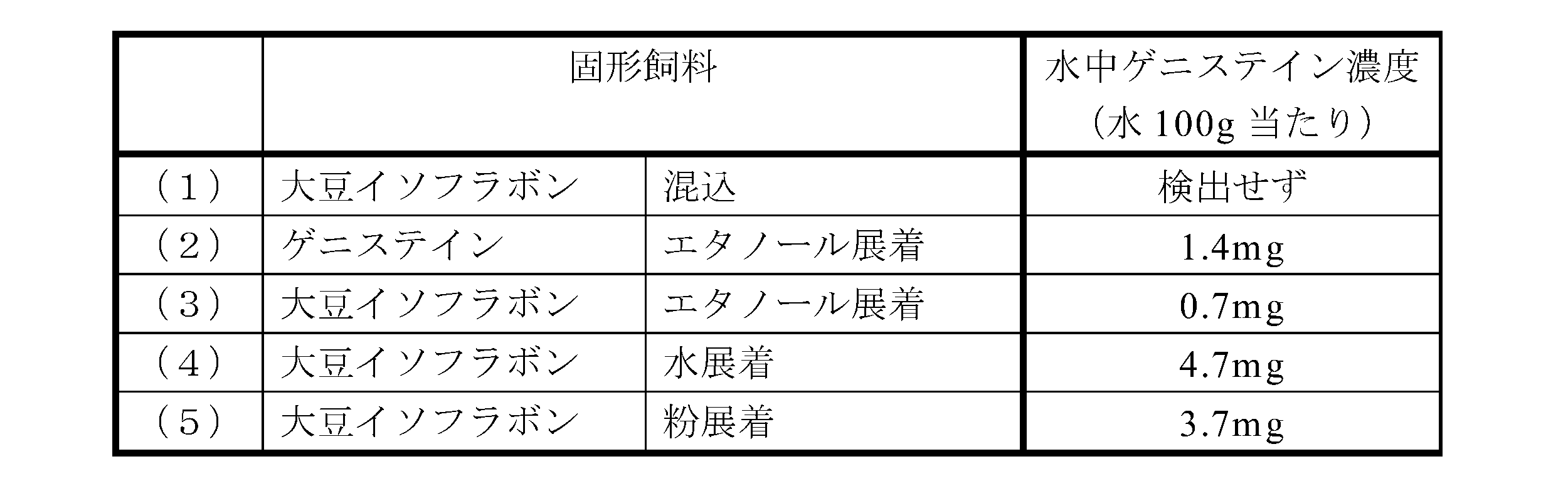
- Example 4 the dissolution of genistein into water in the solid feed produced in Example 1 was investigated.
- Example 1 As a solid feed, in addition to (1) the solid feed produced in Example 1 (a solid feed (mixed feed) in which soybean isoflavones containing genistein are almost uniformly mixed), (2) genistein was mixed with ethanol as a comparative example. (3) Solid feed in which the soybean isoflavone-containing material in Example 1 was spread with ethanol, (4) Solid feed in which the soybean isoflavone-containing material in Example 1 was spread in water, (5) Example 1 A solid feed containing soybean isoflavones was prepared. Both were prepared as small diameter (approximately 1.5 mm) feeds with the same ingredients except soy isoflavones or genistein, and the genistein content was 1,500 mg/kg.
- Example 5 changes over time in blood genistein levels of sturgeon fed the solid feed produced in Example 1 were verified.
- Example 1 solid feed (mixed feed) in which soybean isoflavones containing genistein were mixed almost uniformly
- soybean isoflavone-containing material in Example 1 was powdered.
- a spread solid feed (spread feed) was prepared.
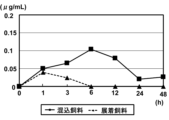
- Bestel sturgeon (average fish weight 321 g) were divided into two groups, one group received mixed feed, and the other group (comparative example) received spread feed, each containing 37.5 mg of soy isoflavones/kg fish weight.
- Feed a soy isoflavone mixed feed containing 0.375% soy isoflavone/feed to give a weight of 1% of the fish
- collect blood at a predetermined time after the complete meal collect 1, 3, 6, Blood samples were obtained after 12, 24, and 48 hours.
- blood samples were obtained from individuals fed a diet to which no soy isoflavones were added.
- Figure 1 is a graph showing the change over time in the amount of genistein in the blood when the solid feed produced in Example 1 was fed.
- the vertical axis represents the amount of genistein in the blood (unit: ⁇ g/mL)
- the line for "mixed feed” represents the amount of genistein in the blood when fed the solid feed produced in Example 1.
- the ⁇ spread feed'' line represents the change over time in the amount of genistein in the blood when the solid feed in which the soybean isoflavone-containing material was powder-spread in Example 1 was fed.
- Example 6 the solid feed produced in Example 1 (solid feed in which soybean isoflavones containing genistein were mixed almost uniformly (mixed feed)) and the solid feed prepared by powder-spreading the soybean isoflavone-containing material in Example 1 were prepared. The feminization inducing efficiency of feed (spread feed) for sturgeon was compared.
- Bestel sturgeon were fed a soybean isoflavone-mixed diet for about 6 months, 6 days a week, starting when the fish weighed approximately 6 to 7g, and then switched to a regular diet (feed that does not contain soybean isoflavones). The breeding was continued until the fish grew to a weight of approximately 300 g.
- the soybean isoflavone mixed feed contained the solid feed produced in Example 1 (mixed feed, small diameter (approximately 1.5 mm) and medium diameter (approximately 2.0 mm), genistein content 500 mg/kg), or as a comparative example, A solid feed prepared by spreading the soybean isoflavone-containing material in Example 1 (spread feed, small diameter (approximately 1.5 mm) and medium diameter (approximately 2.0 mm), genistein content 500 mg/kg) was used.
- genomic DNA was sequentially extracted from each fin in the same manner as in Example 3, and genetic sex was determined using the PCR method.
- the morphology of the gonads was histologically observed, and the sexes were determined based on the developmental stage of the gonads.
- Example 5 is a graph showing changes over time in blood genistein levels when the solid feed produced in Example 1 was fed in Example 5.
Landscapes
- Life Sciences & Earth Sciences (AREA)
- Polymers & Plastics (AREA)
- Chemical & Material Sciences (AREA)
- Zoology (AREA)
- Engineering & Computer Science (AREA)
- Animal Husbandry (AREA)
- Food Science & Technology (AREA)
- Environmental Sciences (AREA)
- Marine Sciences & Fisheries (AREA)
- Molecular Biology (AREA)
- Physiology (AREA)
- Mycology (AREA)
- Health & Medical Sciences (AREA)
- Insects & Arthropods (AREA)
- Botany (AREA)
- Birds (AREA)
- Biodiversity & Conservation Biology (AREA)
- Biotechnology (AREA)
- Feed For Specific Animals (AREA)
- Fodder In General (AREA)
Abstract
Description
本発明は、ゲニステインを含有した大豆イソフラボン含有物が略均一に混ぜ込まれた固形飼料などを広く包含する。
本発明は、少なくとも、上述の固形飼料を摂取させるチョウザメ飼育方法をすべて包含する。また、少なくとも、上述の固形飼料を摂取させる工程を含むチョウザメ生産方法、並びに上述の固形飼料を摂取させる工程を含む、遺伝的雄のチョウザメの雌化誘導方法などもすべて包含する。

Claims (7)
- ゲニステインを含有した大豆イソフラボン含有物が略均一に混ぜ込まれた固形飼料を摂取させるチョウザメ飼育方法。
- 前記固形飼料1kg当たりの前記ゲニステイン含有量が100~3,500mgである請求項1記載のチョウザメ飼育方法。
- 孵化後14~120日目の時期から2~10か月の期間に亘って摂取させる請求項2記載のチョウザメ飼育方法。
- 前記大豆イソフラボン含有物が、粉砕大豆種子のエタノール抽出物を酸水溶液で加水分解させた後乾燥させることによって得られた請求項1記載のチョウザメ飼育方法。
- 前記チョウザメが、ベステル種、ミカドチョウザメ、ダウリアチョウザメ、アムールチョウザメ、シベリアチョウザメのいずれかである請求項1記載のチョウザメ飼育方法。
- ゲニステインを含有した大豆イソフラボン含有物が略均一に混ぜ込まれた固形飼料を摂取させる工程を含むチョウザメ生産方法。
- ゲニステインを含有した大豆イソフラボン含有物が略均一に混ぜ込まれたチョウザメ用固形飼料。
Priority Applications (2)
| Application Number | Priority Date | Filing Date | Title |
|---|---|---|---|
| CN202380057232.8A CN119677407A (zh) | 2022-07-28 | 2023-07-28 | 鲟鱼饲养方法、鲟鱼生产方法及鲟鱼用固形饲料 |
| JP2024537281A JPWO2024024972A1 (ja) | 2022-07-28 | 2023-07-28 |
Applications Claiming Priority (2)
| Application Number | Priority Date | Filing Date | Title |
|---|---|---|---|
| JP2022-120560 | 2022-07-28 | ||
| JP2022120560 | 2022-07-28 |
Publications (1)
| Publication Number | Publication Date |
|---|---|
| WO2024024972A1 true WO2024024972A1 (ja) | 2024-02-01 |
Family
ID=89706764
Family Applications (1)
| Application Number | Title | Priority Date | Filing Date |
|---|---|---|---|
| PCT/JP2023/027864 Ceased WO2024024972A1 (ja) | 2022-07-28 | 2023-07-28 | チョウザメ飼育方法、チョウザメ生産方法、並びにチョウザメ用固形飼料 |
Country Status (3)
| Country | Link |
|---|---|
| JP (1) | JPWO2024024972A1 (ja) |
| CN (1) | CN119677407A (ja) |
| WO (1) | WO2024024972A1 (ja) |
Citations (2)
| Publication number | Priority date | Publication date | Assignee | Title |
|---|---|---|---|---|
| JP2007520192A (ja) * | 2003-10-31 | 2007-07-26 | レックスジーンバイオテック・カンパニー・リミテッド | イソフラボンを含む槐角抽出物の製造方法 |
| WO2022071589A1 (ja) * | 2020-10-02 | 2022-04-07 | 愛知県 | 食用養殖ウナギ |
Family Cites Families (3)
| Publication number | Priority date | Publication date | Assignee | Title |
|---|---|---|---|---|
| NO20052432L (no) * | 2005-05-20 | 2006-11-21 | Berge Biomed As | A feed composition and method for pigmenting |
| CN108464408A (zh) * | 2018-03-14 | 2018-08-31 | 福建省农业科学院农业质量标准与检测技术研究所 | 一种健康养殖用史氏鲟雌亲鱼软颗粒配合饲料及其制备方法 |
| CN111471775B (zh) * | 2019-01-24 | 2021-04-30 | 中国水产科学研究院长江水产研究所 | 用于鲟鱼性别鉴定的特异性dna片段ssm2及应用 |
-
2023
- 2023-07-28 CN CN202380057232.8A patent/CN119677407A/zh active Pending
- 2023-07-28 JP JP2024537281A patent/JPWO2024024972A1/ja active Pending
- 2023-07-28 WO PCT/JP2023/027864 patent/WO2024024972A1/ja not_active Ceased
Patent Citations (2)
| Publication number | Priority date | Publication date | Assignee | Title |
|---|---|---|---|---|
| JP2007520192A (ja) * | 2003-10-31 | 2007-07-26 | レックスジーンバイオテック・カンパニー・リミテッド | イソフラボンを含む槐角抽出物の製造方法 |
| WO2022071589A1 (ja) * | 2020-10-02 | 2022-04-07 | 愛知県 | 食用養殖ウナギ |
Non-Patent Citations (3)
| Title |
|---|
| ANONYMOUS: "First in Japan! Succeeded in making all female sturgeon using soy isoflavones Aiming for efficient caviar production using a safe method | Kindai University", 4 March 2022 (2022-03-04), XP093133070, Retrieved from the Internet <URL:https://digitalpr.jp/r/56498> * |
| FAJKOWSKA MAGDALENA; ADAMEK-URBAńSKA DOBROCHNA; OSTASZEWSKA TERESA; SZCZEPKOWSKI MIROSłAW; RZEPKOWSKA MAłGORZATA: "Effect of genistein, daidzein and coumestrol on sex-related genes expression in Russian sturgeon (Acipenser gueldenstaedtii)", AQUACULTURE, ELSEVIER, AMSTERDAM, NL, vol. 530, 27 August 2020 (2020-08-27), Amsterdam, NL , XP086308181, ISSN: 0044-8486, DOI: 10.1016/j.aquaculture.2020.735872 * |
| PELISSERO, C. ; BENNETAU, B. ; BABIN, P. ; LE MENN, F. ; DUNOGUES, J.: "The estrogenic activity of certain phytoestrogens in the siberian sturgeon Acipenser baeri", JOURNAL OF STEROID BIOCHEMISTRY & MOLECULAR BIOLOGY, ELSEVIER SCIENCE LTD., OXFORD., GB, vol. 38, no. 3, 1 March 1991 (1991-03-01), GB , pages 293 - 299, XP025687563, ISSN: 0960-0760, DOI: 10.1016/0960-0760(91)90100-J * |
Also Published As
| Publication number | Publication date |
|---|---|
| JPWO2024024972A1 (ja) | 2024-02-01 |
| CN119677407A (zh) | 2025-03-21 |
Similar Documents
| Publication | Publication Date | Title |
|---|---|---|
| Dallaire et al. | Effect of algal incorporation on growth, survival and carcass composition of rainbow trout (Oncorhynchus mykiss) fry | |
| KR102257872B1 (ko) | 부숙유기질비료의 살균, 탈취 및 부숙 촉진을 위한 사료 첨가제 및 이의 제조방법 | |
| CN101965927B (zh) | 一种斑马鱼鱼苗开口饲料 | |
| CN105614159A (zh) | 一种本地乌鳢全程使用的膨化配合饲料 | |
| KR20170091633A (ko) | 수산양식 사료에 사용하기 위한 사료 보충 물질 | |
| CN104206691A (zh) | 一种南美白对虾的饲料及其制备方法 | |
| JP4778792B2 (ja) | 動物プランクトン用飼料 | |
| US20250228268A1 (en) | Carotenoid-rich black soldier flies and feeding method and application thereof | |
| Momin et al. | Dietary Moringa oleifera leaves to male rainbow trout (Oncorhynchus mykiss) broodstock: effects on sperm quality and reproductive performance | |
| CA2910568C (en) | Method for improving mineral resorption in farmed fish and crustacean | |
| JPH0851937A (ja) | 養殖エビ用飼料及びエビの養殖法 | |
| JP6970992B2 (ja) | ウナギ雌化誘導方法、ウナギ飼育方法、ウナギ雌化剤、及び、ウナギ用飼料 | |
| KR101938942B1 (ko) | 어미해삼 육상관리를 위한 육성용 절편형 고체사료 조성물 및 제조방법 | |
| KR102333548B1 (ko) | 배스 추출물을 포함하는 동물용 사료 조성물 및 이의 제조방법 | |
| WO2024024972A1 (ja) | チョウザメ飼育方法、チョウザメ生産方法、並びにチョウザメ用固形飼料 | |
| ES2497492T3 (es) | Zigomicetos para alimento de peces | |
| Ramesh et al. | Evaluation of cost effective diet for giant freshwater prawn Macrobrachium rosenbergii (De Man, 1879) by total replacement of conventional feed ingredients | |
| EP3310189A2 (en) | Method for increasing the utilization of soybean protein by salmonid fish | |
| CN107348105B (zh) | 一种笋壳鱼浮性膨化配合饲料 | |
| KR102617364B1 (ko) | 아쿠아포닉스 기반의 농수산물 복합재배 시스템 | |
| CN116326685A (zh) | 一种具有载体功能的糖萜素类似物及其制备方法与在饲料中的应用 | |
| Sun et al. | Effects of different dietary protein sources on the growth performance, digestive capacity and amino acid profiles of largemouth bass (Micropterus salmoides) larvae | |
| JPH11313617A (ja) | アロエを用いた養魚用天然飼料及びこれを用いた養魚用飼料 | |
| KR102609440B1 (ko) | 동애등에, 아몬드피, 난각을 포함하는 가축용 배합사료 | |
| RU2825804C2 (ru) | Способ обогащения искусственного корма для молоди осетровых рыб микробным белком и жирными кислотами |
Legal Events
| Date | Code | Title | Description |
|---|---|---|---|
| 121 | Ep: the epo has been informed by wipo that ep was designated in this application |
Ref document number: 23846702 Country of ref document: EP Kind code of ref document: A1 |
|
| WWE | Wipo information: entry into national phase |
Ref document number: 202380057232.8 Country of ref document: CN |
|
| WWE | Wipo information: entry into national phase |
Ref document number: 2024537281 Country of ref document: JP |
|
| NENP | Non-entry into the national phase |
Ref country code: DE |
|
| WWP | Wipo information: published in national office |
Ref document number: 202380057232.8 Country of ref document: CN |
|
| 122 | Ep: pct application non-entry in european phase |
Ref document number: 23846702 Country of ref document: EP Kind code of ref document: A1 |