WO2023286686A1 - 無機基板と透明耐熱高分子フィルムの積層体 - Google Patents
無機基板と透明耐熱高分子フィルムの積層体 Download PDFInfo
- Publication number
- WO2023286686A1 WO2023286686A1 PCT/JP2022/026928 JP2022026928W WO2023286686A1 WO 2023286686 A1 WO2023286686 A1 WO 2023286686A1 JP 2022026928 W JP2022026928 W JP 2022026928W WO 2023286686 A1 WO2023286686 A1 WO 2023286686A1
- Authority
- WO
- WIPO (PCT)
- Prior art keywords
- polymer film
- laminate
- heat
- resistant polymer
- less
- Prior art date
- Legal status (The legal status is an assumption and is not a legal conclusion. Google has not performed a legal analysis and makes no representation as to the accuracy of the status listed.)
- Ceased
Links
Images
Classifications
-
- B—PERFORMING OPERATIONS; TRANSPORTING
- B32—LAYERED PRODUCTS
- B32B—LAYERED PRODUCTS, i.e. PRODUCTS BUILT-UP OF STRATA OF FLAT OR NON-FLAT, e.g. CELLULAR OR HONEYCOMB, FORM
- B32B7/00—Layered products characterised by the relation between layers; Layered products characterised by the relative orientation of features between layers, or by the relative values of a measurable parameter between layers, i.e. products comprising layers having different physical, chemical or physicochemical properties; Layered products characterised by the interconnection of layers
- B32B7/04—Interconnection of layers
- B32B7/06—Interconnection of layers permitting easy separation
-
- B—PERFORMING OPERATIONS; TRANSPORTING
- B32—LAYERED PRODUCTS
- B32B—LAYERED PRODUCTS, i.e. PRODUCTS BUILT-UP OF STRATA OF FLAT OR NON-FLAT, e.g. CELLULAR OR HONEYCOMB, FORM
- B32B7/00—Layered products characterised by the relation between layers; Layered products characterised by the relative orientation of features between layers, or by the relative values of a measurable parameter between layers, i.e. products comprising layers having different physical, chemical or physicochemical properties; Layered products characterised by the interconnection of layers
- B32B7/02—Physical, chemical or physicochemical properties
- B32B7/023—Optical properties
-
- B—PERFORMING OPERATIONS; TRANSPORTING
- B32—LAYERED PRODUCTS
- B32B—LAYERED PRODUCTS, i.e. PRODUCTS BUILT-UP OF STRATA OF FLAT OR NON-FLAT, e.g. CELLULAR OR HONEYCOMB, FORM
- B32B15/00—Layered products comprising a layer of metal
- B32B15/04—Layered products comprising a layer of metal comprising metal as the main or only constituent of a layer, which is next to another layer of the same or of a different material
- B32B15/08—Layered products comprising a layer of metal comprising metal as the main or only constituent of a layer, which is next to another layer of the same or of a different material of synthetic resin
-
- B—PERFORMING OPERATIONS; TRANSPORTING
- B32—LAYERED PRODUCTS
- B32B—LAYERED PRODUCTS, i.e. PRODUCTS BUILT-UP OF STRATA OF FLAT OR NON-FLAT, e.g. CELLULAR OR HONEYCOMB, FORM
- B32B15/00—Layered products comprising a layer of metal
- B32B15/04—Layered products comprising a layer of metal comprising metal as the main or only constituent of a layer, which is next to another layer of the same or of a different material
- B32B15/08—Layered products comprising a layer of metal comprising metal as the main or only constituent of a layer, which is next to another layer of the same or of a different material of synthetic resin
- B32B15/088—Layered products comprising a layer of metal comprising metal as the main or only constituent of a layer, which is next to another layer of the same or of a different material of synthetic resin comprising polyamides
-
- B—PERFORMING OPERATIONS; TRANSPORTING
- B32—LAYERED PRODUCTS
- B32B—LAYERED PRODUCTS, i.e. PRODUCTS BUILT-UP OF STRATA OF FLAT OR NON-FLAT, e.g. CELLULAR OR HONEYCOMB, FORM
- B32B15/00—Layered products comprising a layer of metal
- B32B15/18—Layered products comprising a layer of metal comprising iron or steel
-
- B—PERFORMING OPERATIONS; TRANSPORTING
- B32—LAYERED PRODUCTS
- B32B—LAYERED PRODUCTS, i.e. PRODUCTS BUILT-UP OF STRATA OF FLAT OR NON-FLAT, e.g. CELLULAR OR HONEYCOMB, FORM
- B32B15/00—Layered products comprising a layer of metal
- B32B15/20—Layered products comprising a layer of metal comprising aluminium or copper
-
- B—PERFORMING OPERATIONS; TRANSPORTING
- B32—LAYERED PRODUCTS
- B32B—LAYERED PRODUCTS, i.e. PRODUCTS BUILT-UP OF STRATA OF FLAT OR NON-FLAT, e.g. CELLULAR OR HONEYCOMB, FORM
- B32B17/00—Layered products essentially comprising sheet glass, or glass, slag, or like fibres
- B32B17/06—Layered products essentially comprising sheet glass, or glass, slag, or like fibres comprising glass as the main or only constituent of a layer, next to another layer of a specific material
- B32B17/10—Layered products essentially comprising sheet glass, or glass, slag, or like fibres comprising glass as the main or only constituent of a layer, next to another layer of a specific material of synthetic resin
-
- B—PERFORMING OPERATIONS; TRANSPORTING
- B32—LAYERED PRODUCTS
- B32B—LAYERED PRODUCTS, i.e. PRODUCTS BUILT-UP OF STRATA OF FLAT OR NON-FLAT, e.g. CELLULAR OR HONEYCOMB, FORM
- B32B17/00—Layered products essentially comprising sheet glass, or glass, slag, or like fibres
- B32B17/06—Layered products essentially comprising sheet glass, or glass, slag, or like fibres comprising glass as the main or only constituent of a layer, next to another layer of a specific material
- B32B17/10—Layered products essentially comprising sheet glass, or glass, slag, or like fibres comprising glass as the main or only constituent of a layer, next to another layer of a specific material of synthetic resin
- B32B17/10005—Layered products essentially comprising sheet glass, or glass, slag, or like fibres comprising glass as the main or only constituent of a layer, next to another layer of a specific material of synthetic resin laminated safety glass or glazing
- B32B17/1055—Layered products essentially comprising sheet glass, or glass, slag, or like fibres comprising glass as the main or only constituent of a layer, next to another layer of a specific material of synthetic resin laminated safety glass or glazing characterized by the resin layer, i.e. interlayer
-
- B—PERFORMING OPERATIONS; TRANSPORTING
- B32—LAYERED PRODUCTS
- B32B—LAYERED PRODUCTS, i.e. PRODUCTS BUILT-UP OF STRATA OF FLAT OR NON-FLAT, e.g. CELLULAR OR HONEYCOMB, FORM
- B32B27/00—Layered products comprising a layer of synthetic resin
- B32B27/06—Layered products comprising a layer of synthetic resin as the main or only constituent of a layer, which is next to another layer of the same or of a different material
- B32B27/08—Layered products comprising a layer of synthetic resin as the main or only constituent of a layer, which is next to another layer of the same or of a different material of synthetic resin
-
- B—PERFORMING OPERATIONS; TRANSPORTING
- B32—LAYERED PRODUCTS
- B32B—LAYERED PRODUCTS, i.e. PRODUCTS BUILT-UP OF STRATA OF FLAT OR NON-FLAT, e.g. CELLULAR OR HONEYCOMB, FORM
- B32B27/00—Layered products comprising a layer of synthetic resin
- B32B27/28—Layered products comprising a layer of synthetic resin comprising synthetic resins not wholly covered by any one of the sub-groups B32B27/30 - B32B27/42
- B32B27/281—Layered products comprising a layer of synthetic resin comprising synthetic resins not wholly covered by any one of the sub-groups B32B27/30 - B32B27/42 comprising polyimides
-
- B—PERFORMING OPERATIONS; TRANSPORTING
- B32—LAYERED PRODUCTS
- B32B—LAYERED PRODUCTS, i.e. PRODUCTS BUILT-UP OF STRATA OF FLAT OR NON-FLAT, e.g. CELLULAR OR HONEYCOMB, FORM
- B32B27/00—Layered products comprising a layer of synthetic resin
- B32B27/34—Layered products comprising a layer of synthetic resin comprising polyamides
-
- B—PERFORMING OPERATIONS; TRANSPORTING
- B32—LAYERED PRODUCTS
- B32B—LAYERED PRODUCTS, i.e. PRODUCTS BUILT-UP OF STRATA OF FLAT OR NON-FLAT, e.g. CELLULAR OR HONEYCOMB, FORM
- B32B9/00—Layered products comprising a layer of a particular substance not covered by groups B32B11/00 - B32B29/00
- B32B9/005—Layered products comprising a layer of a particular substance not covered by groups B32B11/00 - B32B29/00 comprising one layer of ceramic material, e.g. porcelain, ceramic tile
-
- B—PERFORMING OPERATIONS; TRANSPORTING
- B32—LAYERED PRODUCTS
- B32B—LAYERED PRODUCTS, i.e. PRODUCTS BUILT-UP OF STRATA OF FLAT OR NON-FLAT, e.g. CELLULAR OR HONEYCOMB, FORM
- B32B9/00—Layered products comprising a layer of a particular substance not covered by groups B32B11/00 - B32B29/00
- B32B9/04—Layered products comprising a layer of a particular substance not covered by groups B32B11/00 - B32B29/00 comprising such particular substance as the main or only constituent of a layer, which is next to another layer of the same or of a different material
- B32B9/045—Layered products comprising a layer of a particular substance not covered by groups B32B11/00 - B32B29/00 comprising such particular substance as the main or only constituent of a layer, which is next to another layer of the same or of a different material of synthetic resin
-
- C—CHEMISTRY; METALLURGY
- C08—ORGANIC MACROMOLECULAR COMPOUNDS; THEIR PREPARATION OR CHEMICAL WORKING-UP; COMPOSITIONS BASED THEREON
- C08G—MACROMOLECULAR COMPOUNDS OBTAINED OTHERWISE THAN BY REACTIONS ONLY INVOLVING UNSATURATED CARBON-TO-CARBON BONDS
- C08G73/00—Macromolecular compounds obtained by reactions forming a linkage containing nitrogen with or without oxygen or carbon in the main chain of the macromolecule, not provided for in groups C08G12/00 - C08G71/00
- C08G73/06—Polycondensates having nitrogen-containing heterocyclic rings in the main chain of the macromolecule
- C08G73/10—Polyimides; Polyester-imides; Polyamide-imides; Polyamide acids or similar polyimide precursors
- C08G73/1039—Polyimides; Polyester-imides; Polyamide-imides; Polyamide acids or similar polyimide precursors comprising halogen-containing substituents
-
- C—CHEMISTRY; METALLURGY
- C08—ORGANIC MACROMOLECULAR COMPOUNDS; THEIR PREPARATION OR CHEMICAL WORKING-UP; COMPOSITIONS BASED THEREON
- C08G—MACROMOLECULAR COMPOUNDS OBTAINED OTHERWISE THAN BY REACTIONS ONLY INVOLVING UNSATURATED CARBON-TO-CARBON BONDS
- C08G73/00—Macromolecular compounds obtained by reactions forming a linkage containing nitrogen with or without oxygen or carbon in the main chain of the macromolecule, not provided for in groups C08G12/00 - C08G71/00
- C08G73/06—Polycondensates having nitrogen-containing heterocyclic rings in the main chain of the macromolecule
- C08G73/10—Polyimides; Polyester-imides; Polyamide-imides; Polyamide acids or similar polyimide precursors
- C08G73/1042—Copolyimides derived from at least two different tetracarboxylic compounds or two different diamino compounds
-
- C—CHEMISTRY; METALLURGY
- C08—ORGANIC MACROMOLECULAR COMPOUNDS; THEIR PREPARATION OR CHEMICAL WORKING-UP; COMPOSITIONS BASED THEREON
- C08G—MACROMOLECULAR COMPOUNDS OBTAINED OTHERWISE THAN BY REACTIONS ONLY INVOLVING UNSATURATED CARBON-TO-CARBON BONDS
- C08G73/00—Macromolecular compounds obtained by reactions forming a linkage containing nitrogen with or without oxygen or carbon in the main chain of the macromolecule, not provided for in groups C08G12/00 - C08G71/00
- C08G73/06—Polycondensates having nitrogen-containing heterocyclic rings in the main chain of the macromolecule
- C08G73/10—Polyimides; Polyester-imides; Polyamide-imides; Polyamide acids or similar polyimide precursors
- C08G73/1046—Polyimides containing oxygen in the form of ether bonds in the main chain
- C08G73/1053—Polyimides containing oxygen in the form of ether bonds in the main chain with oxygen only in the tetracarboxylic moiety
-
- C—CHEMISTRY; METALLURGY
- C08—ORGANIC MACROMOLECULAR COMPOUNDS; THEIR PREPARATION OR CHEMICAL WORKING-UP; COMPOSITIONS BASED THEREON
- C08G—MACROMOLECULAR COMPOUNDS OBTAINED OTHERWISE THAN BY REACTIONS ONLY INVOLVING UNSATURATED CARBON-TO-CARBON BONDS
- C08G73/00—Macromolecular compounds obtained by reactions forming a linkage containing nitrogen with or without oxygen or carbon in the main chain of the macromolecule, not provided for in groups C08G12/00 - C08G71/00
- C08G73/06—Polycondensates having nitrogen-containing heterocyclic rings in the main chain of the macromolecule
- C08G73/10—Polyimides; Polyester-imides; Polyamide-imides; Polyamide acids or similar polyimide precursors
- C08G73/1057—Polyimides containing other atoms than carbon, hydrogen, nitrogen or oxygen in the main chain
- C08G73/1064—Polyimides containing other atoms than carbon, hydrogen, nitrogen or oxygen in the main chain containing sulfur
-
- C—CHEMISTRY; METALLURGY
- C08—ORGANIC MACROMOLECULAR COMPOUNDS; THEIR PREPARATION OR CHEMICAL WORKING-UP; COMPOSITIONS BASED THEREON
- C08G—MACROMOLECULAR COMPOUNDS OBTAINED OTHERWISE THAN BY REACTIONS ONLY INVOLVING UNSATURATED CARBON-TO-CARBON BONDS
- C08G73/00—Macromolecular compounds obtained by reactions forming a linkage containing nitrogen with or without oxygen or carbon in the main chain of the macromolecule, not provided for in groups C08G12/00 - C08G71/00
- C08G73/06—Polycondensates having nitrogen-containing heterocyclic rings in the main chain of the macromolecule
- C08G73/10—Polyimides; Polyester-imides; Polyamide-imides; Polyamide acids or similar polyimide precursors
- C08G73/1075—Partially aromatic polyimides
- C08G73/1078—Partially aromatic polyimides wholly aromatic in the diamino moiety
-
- H—ELECTRICITY
- H05—ELECTRIC TECHNIQUES NOT OTHERWISE PROVIDED FOR
- H05K—PRINTED CIRCUITS; CASINGS OR CONSTRUCTIONAL DETAILS OF ELECTRIC APPARATUS; MANUFACTURE OF ASSEMBLAGES OF ELECTRICAL COMPONENTS
- H05K1/00—Printed circuits
- H05K1/02—Details
- H05K1/03—Use of materials for the substrate
-
- H—ELECTRICITY
- H05—ELECTRIC TECHNIQUES NOT OTHERWISE PROVIDED FOR
- H05K—PRINTED CIRCUITS; CASINGS OR CONSTRUCTIONAL DETAILS OF ELECTRIC APPARATUS; MANUFACTURE OF ASSEMBLAGES OF ELECTRICAL COMPONENTS
- H05K1/00—Printed circuits
- H05K1/02—Details
- H05K1/03—Use of materials for the substrate
- H05K1/0313—Organic insulating material
- H05K1/0353—Organic insulating material consisting of two or more materials, e.g. two or more polymers, polymer + filler, + reinforcement
- H05K1/036—Multilayers with layers of different types
-
- B—PERFORMING OPERATIONS; TRANSPORTING
- B32—LAYERED PRODUCTS
- B32B—LAYERED PRODUCTS, i.e. PRODUCTS BUILT-UP OF STRATA OF FLAT OR NON-FLAT, e.g. CELLULAR OR HONEYCOMB, FORM
- B32B15/00—Layered products comprising a layer of metal
- B32B15/04—Layered products comprising a layer of metal comprising metal as the main or only constituent of a layer, which is next to another layer of the same or of a different material
- B32B15/043—Layered products comprising a layer of metal comprising metal as the main or only constituent of a layer, which is next to another layer of the same or of a different material of metal
-
- B—PERFORMING OPERATIONS; TRANSPORTING
- B32—LAYERED PRODUCTS
- B32B—LAYERED PRODUCTS, i.e. PRODUCTS BUILT-UP OF STRATA OF FLAT OR NON-FLAT, e.g. CELLULAR OR HONEYCOMB, FORM
- B32B2255/00—Coating on the layer surface
-
- B—PERFORMING OPERATIONS; TRANSPORTING
- B32—LAYERED PRODUCTS
- B32B—LAYERED PRODUCTS, i.e. PRODUCTS BUILT-UP OF STRATA OF FLAT OR NON-FLAT, e.g. CELLULAR OR HONEYCOMB, FORM
- B32B2255/00—Coating on the layer surface
- B32B2255/20—Inorganic coating
-
- B—PERFORMING OPERATIONS; TRANSPORTING
- B32—LAYERED PRODUCTS
- B32B—LAYERED PRODUCTS, i.e. PRODUCTS BUILT-UP OF STRATA OF FLAT OR NON-FLAT, e.g. CELLULAR OR HONEYCOMB, FORM
- B32B2307/00—Properties of the layers or laminate
- B32B2307/30—Properties of the layers or laminate having particular thermal properties
-
- B—PERFORMING OPERATIONS; TRANSPORTING
- B32—LAYERED PRODUCTS
- B32B—LAYERED PRODUCTS, i.e. PRODUCTS BUILT-UP OF STRATA OF FLAT OR NON-FLAT, e.g. CELLULAR OR HONEYCOMB, FORM
- B32B2307/00—Properties of the layers or laminate
- B32B2307/30—Properties of the layers or laminate having particular thermal properties
- B32B2307/306—Resistant to heat
-
- B—PERFORMING OPERATIONS; TRANSPORTING
- B32—LAYERED PRODUCTS
- B32B—LAYERED PRODUCTS, i.e. PRODUCTS BUILT-UP OF STRATA OF FLAT OR NON-FLAT, e.g. CELLULAR OR HONEYCOMB, FORM
- B32B2307/00—Properties of the layers or laminate
- B32B2307/40—Properties of the layers or laminate having particular optical properties
- B32B2307/412—Transparent
-
- B—PERFORMING OPERATIONS; TRANSPORTING
- B32—LAYERED PRODUCTS
- B32B—LAYERED PRODUCTS, i.e. PRODUCTS BUILT-UP OF STRATA OF FLAT OR NON-FLAT, e.g. CELLULAR OR HONEYCOMB, FORM
- B32B2307/00—Properties of the layers or laminate
- B32B2307/50—Properties of the layers or laminate having particular mechanical properties
- B32B2307/538—Roughness
-
- B—PERFORMING OPERATIONS; TRANSPORTING
- B32—LAYERED PRODUCTS
- B32B—LAYERED PRODUCTS, i.e. PRODUCTS BUILT-UP OF STRATA OF FLAT OR NON-FLAT, e.g. CELLULAR OR HONEYCOMB, FORM
- B32B2307/00—Properties of the layers or laminate
- B32B2307/50—Properties of the layers or laminate having particular mechanical properties
- B32B2307/54—Yield strength; Tensile strength
-
- B—PERFORMING OPERATIONS; TRANSPORTING
- B32—LAYERED PRODUCTS
- B32B—LAYERED PRODUCTS, i.e. PRODUCTS BUILT-UP OF STRATA OF FLAT OR NON-FLAT, e.g. CELLULAR OR HONEYCOMB, FORM
- B32B2307/00—Properties of the layers or laminate
- B32B2307/50—Properties of the layers or laminate having particular mechanical properties
- B32B2307/554—Wear resistance
-
- B—PERFORMING OPERATIONS; TRANSPORTING
- B32—LAYERED PRODUCTS
- B32B—LAYERED PRODUCTS, i.e. PRODUCTS BUILT-UP OF STRATA OF FLAT OR NON-FLAT, e.g. CELLULAR OR HONEYCOMB, FORM
- B32B2307/00—Properties of the layers or laminate
- B32B2307/70—Other properties
- B32B2307/732—Dimensional properties
- B32B2307/734—Dimensional stability
-
- B—PERFORMING OPERATIONS; TRANSPORTING
- B32—LAYERED PRODUCTS
- B32B—LAYERED PRODUCTS, i.e. PRODUCTS BUILT-UP OF STRATA OF FLAT OR NON-FLAT, e.g. CELLULAR OR HONEYCOMB, FORM
- B32B2307/00—Properties of the layers or laminate
- B32B2307/70—Other properties
- B32B2307/732—Dimensional properties
- B32B2307/734—Dimensional stability
- B32B2307/736—Shrinkable
-
- B—PERFORMING OPERATIONS; TRANSPORTING
- B32—LAYERED PRODUCTS
- B32B—LAYERED PRODUCTS, i.e. PRODUCTS BUILT-UP OF STRATA OF FLAT OR NON-FLAT, e.g. CELLULAR OR HONEYCOMB, FORM
- B32B2307/00—Properties of the layers or laminate
- B32B2307/70—Other properties
- B32B2307/732—Dimensional properties
- B32B2307/737—Dimensions, e.g. volume or area
- B32B2307/7375—Linear, e.g. length, distance or width
- B32B2307/7376—Thickness
-
- B—PERFORMING OPERATIONS; TRANSPORTING
- B32—LAYERED PRODUCTS
- B32B—LAYERED PRODUCTS, i.e. PRODUCTS BUILT-UP OF STRATA OF FLAT OR NON-FLAT, e.g. CELLULAR OR HONEYCOMB, FORM
- B32B2307/00—Properties of the layers or laminate
- B32B2307/70—Other properties
- B32B2307/748—Releasability
-
- B—PERFORMING OPERATIONS; TRANSPORTING
- B32—LAYERED PRODUCTS
- B32B—LAYERED PRODUCTS, i.e. PRODUCTS BUILT-UP OF STRATA OF FLAT OR NON-FLAT, e.g. CELLULAR OR HONEYCOMB, FORM
- B32B2377/00—Polyamides
-
- B—PERFORMING OPERATIONS; TRANSPORTING
- B32—LAYERED PRODUCTS
- B32B—LAYERED PRODUCTS, i.e. PRODUCTS BUILT-UP OF STRATA OF FLAT OR NON-FLAT, e.g. CELLULAR OR HONEYCOMB, FORM
- B32B2379/00—Other polymers having nitrogen, with or without oxygen or carbon only, in the main chain
- B32B2379/08—Polyimides
-
- B—PERFORMING OPERATIONS; TRANSPORTING
- B32—LAYERED PRODUCTS
- B32B—LAYERED PRODUCTS, i.e. PRODUCTS BUILT-UP OF STRATA OF FLAT OR NON-FLAT, e.g. CELLULAR OR HONEYCOMB, FORM
- B32B2457/00—Electrical equipment
-
- B—PERFORMING OPERATIONS; TRANSPORTING
- B32—LAYERED PRODUCTS
- B32B—LAYERED PRODUCTS, i.e. PRODUCTS BUILT-UP OF STRATA OF FLAT OR NON-FLAT, e.g. CELLULAR OR HONEYCOMB, FORM
- B32B2457/00—Electrical equipment
- B32B2457/08—PCBs, i.e. printed circuit boards
-
- B—PERFORMING OPERATIONS; TRANSPORTING
- B32—LAYERED PRODUCTS
- B32B—LAYERED PRODUCTS, i.e. PRODUCTS BUILT-UP OF STRATA OF FLAT OR NON-FLAT, e.g. CELLULAR OR HONEYCOMB, FORM
- B32B2457/00—Electrical equipment
- B32B2457/14—Semiconductor wafers
-
- B—PERFORMING OPERATIONS; TRANSPORTING
- B32—LAYERED PRODUCTS
- B32B—LAYERED PRODUCTS, i.e. PRODUCTS BUILT-UP OF STRATA OF FLAT OR NON-FLAT, e.g. CELLULAR OR HONEYCOMB, FORM
- B32B2457/00—Electrical equipment
- B32B2457/20—Displays, e.g. liquid crystal displays, plasma displays
-
- C—CHEMISTRY; METALLURGY
- C08—ORGANIC MACROMOLECULAR COMPOUNDS; THEIR PREPARATION OR CHEMICAL WORKING-UP; COMPOSITIONS BASED THEREON
- C08L—COMPOSITIONS OF MACROMOLECULAR COMPOUNDS
- C08L2201/00—Properties
- C08L2201/10—Transparent films; Clear coatings; Transparent materials
-
- H—ELECTRICITY
- H05—ELECTRIC TECHNIQUES NOT OTHERWISE PROVIDED FOR
- H05K—PRINTED CIRCUITS; CASINGS OR CONSTRUCTIONAL DETAILS OF ELECTRIC APPARATUS; MANUFACTURE OF ASSEMBLAGES OF ELECTRICAL COMPONENTS
- H05K1/00—Printed circuits
- H05K1/02—Details
- H05K1/03—Use of materials for the substrate
- H05K1/0306—Inorganic insulating substrates, e.g. ceramic, glass
-
- H—ELECTRICITY
- H05—ELECTRIC TECHNIQUES NOT OTHERWISE PROVIDED FOR
- H05K—PRINTED CIRCUITS; CASINGS OR CONSTRUCTIONAL DETAILS OF ELECTRIC APPARATUS; MANUFACTURE OF ASSEMBLAGES OF ELECTRICAL COMPONENTS
- H05K1/00—Printed circuits
- H05K1/02—Details
- H05K1/03—Use of materials for the substrate
- H05K1/0393—Flexible materials
Definitions
- the present invention relates to a laminate in which a heat-resistant polymer film such as polyimide resin is formed on an inorganic substrate.
- the laminate of the present invention is useful, for example, in manufacturing flexible devices and flexible wiring boards in which electronic elements are formed on the surface of a flexible substrate.
- polymer films such as polyimide (hereinafter also referred to simply as “polymer films") as substrate materials for manufacturing flexible electronic devices. Since polymer films such as polyimide films are produced in the form of long rolls, it is generally accepted that a roll-to-roll production line is ideal even in the production of flexible devices.
- many conventional electronic devices such as display devices, sensor arrays, touch screens, and printed wiring boards use hard rigid substrates such as glass substrates, semiconductor wafers, or glass fiber reinforced epoxy substrates. Manufacturing equipment is also configured on the premise of using such rigid substrates.
- a rigid inorganic substrate such as a glass substrate is used as a temporary support, and a polymer film is temporarily attached to the temporary support.
- a flexible electronic device manufacturing method is known in which the polymer film is subjected to electronic device processing, and then the polymer film having the electronic device formed thereon is peeled off from the temporary support.
- a rigid substrate such as a glass substrate is used as a temporary support
- a polymer solution or a polymer precursor solution is applied to the temporary support, and dried.
- a chemical reaction is caused to convert the precursor into a polymer film, thereby obtaining a laminate of the temporary support and the polymer film, and similarly forming an electronic device on the polymer film.
- Patent Document 2 Patent Document 2
- the laminate is often exposed to high temperatures.
- formation of functional elements such as polysilicon and oxide semiconductors requires a process in a temperature range of about 200.degree. C. to 600.degree.
- a temperature of about 200 to 300° C. may be applied to the film, and in order to heat and dehydrogenate the amorphous silicon to form low-temperature polysilicon, it is about 450 to 600° C. heating may be required. Therefore, the polymer film constituting the laminate is required to have heat resistance, but as a matter of fact, there are only a limited number of polymer films that can withstand such a high temperature range, and in many cases, polyimide is selected.
- a laminate in the form of a rigid temporary support and a polymer film layer that will eventually be peeled off and become the base material of a flexible electronic device will be superimposed. Since such a laminate can be handled as a rigid plate material, it can be handled in the same manner as a glass substrate in an apparatus for manufacturing liquid crystal displays, plasma displays, organic EL displays, etc. using conventional glass substrates.
- the laminate of heat-resistant polymer film and inorganic substrate is handled using robot forks and vacuum lifters for transporting glass in the display manufacturing process.
- the thickness of glass used for displays is as thin as 700 ⁇ m or less, and when it is transported using a robot fork or the like, the glass edge vibrates in the thickness direction due to the movement of the robot fork.
- the size of the laminate is large, specifically, when one side is 400 mm or more, the amplitude of the vibration becomes large. If the fluctuation range of this vibration is large, the laminate cannot be delivered smoothly between the robot forks, or when the laminate is lifted by the lift pins inside the equipment, the vibration of the laminate can cause the position to shift. I had a problem.
- the present invention is intended to solve the above problems, and an object of the present invention is to provide a laminate of a heat-resistant polymer film and an inorganic substrate in which the fluctuation width during handling is suppressed.
- the present inventors have found that the product of the elastic modulus and the thickness of a laminate of a heat-resistant polymer film and an inorganic substrate is within a certain range, so that the laminate can be The inventors have found that blurring can be suppressed, and have completed the present invention.
- the present invention includes the following configurations.
- the heat-resistant polymer film is a transparent heat-resistant polymer film
- the tensile elastic modulus E1 (GPa) and the thickness T1 ( ⁇ m) of the laminate are expressed by the formula (1) 25000 ⁇ E1 ⁇ T1 (1) and the storage elastic modulus E2 (GPa) and the thickness T1 ( ⁇ m) of the laminate at 280° C. are expressed by the formula (2) E2 ⁇ T1 ⁇ 52000 (2)
- the laminate of the present invention since there is little shake during handling, it is possible to suppress misalignment in the process of transferring the glass by machine and using lift pins.
- the present invention is effective in a system using a large-sized inorganic substrate in which the blurring width of the glass is large.
- the heat-resistant polymer film of the present invention is a transparent heat-resistant polymer film (hereinafter also simply referred to as polymer film).
- the heat-resistant polymer film include polyimide resins such as polyimide, polyamideimide, polyetherimide, and fluorinated polyimide (e.g., aromatic polyimide resin, alicyclic polyimide resin); polyamide; aromatic polyamide; films such as polyamideimide. can be exemplified.
- polyimide resins such as polyimide, polyamideimide, polyetherimide, and fluorinated polyimide (e.g., aromatic polyimide resin, alicyclic polyimide resin); polyamide; aromatic polyamide; films such as polyamideimide.
- the heat-resistant polymer film of the present invention preferably contains at least one selected from the group consisting of polyimide, polyamide and polyamideimide.
- a polyimide resin film (also referred to as a polyimide film or a transparent polyimide film), which is an example of the polymer film, will be described below.
- a polyimide resin film is prepared by applying a polyamic acid (polyimide precursor) solution obtained by reacting diamines and tetracarboxylic acids in a solvent to a support for producing a polyimide film and drying it to form a green film (hereinafter referred to as (also referred to as "polyamic acid film”), and further subjecting the green film to a high-temperature heat treatment on a polyimide film-producing support or in a state in which the green film is peeled off from the support to cause a dehydration ring-closing reaction.
- a polyamic acid polyimide precursor
- polyamic acid (polyimide precursor) solution includes, for example, spin coating, doctor blade, applicator, comma coater, screen printing method, slit coating, reverse coating, dip coating, curtain coating, slit die coating, etc.
- spin coating doctor blade, applicator, comma coater, screen printing method, slit coating, reverse coating, dip coating, curtain coating, slit die coating, etc.
- application of conventionally known solutions. means can be used as appropriate.
- the total light transmittance is 75% or more. It is more preferably 80% or more, still more preferably 85% or more, even more preferably 87% or more, and particularly preferably 88% or more.
- the upper limit of the total light transmittance of the transparent polyimide is not particularly limited, it is preferably 98% or less, more preferably 97% or less for use as a flexible electronic device.
- the colorless transparent polyimide in the present invention is preferably polyimide having a total light transmittance of 75% or more. The method for measuring the total light transmittance of the polymer film is according to the method described in Examples.
- Aromatic tetracarboxylic acids for obtaining highly colorless and transparent polyimide include 4,4′-(2,2-hexafluoroisopropylidene)diphthalic acid, 4,4′-oxydiphthalic acid, bis(1,3- dioxo-1,3-dihydro-2-benzofuran-5-carboxylic acid) 1,4-phenylene, bis(1,3-dioxo-1,3-dihydro-2-benzofuran-5-yl)benzene-1,4 -dicarboxylate, 4,4'-[4,4'-(3-oxo-1,3-dihydro-2-benzofuran-1,1-diyl)bis(benzene-1,4-diyloxy)]dibenzene- 1,2-dicarboxylic acid, 3,3′,4,4′-benzophenonetetracarboxylic acid, 4,4′-[(3-oxo-1,3-dihydro-2-benzo
- Aromatic tetracarboxylic acids may be used alone, or two or more of them may be used in combination.
- the amount of aromatic tetracarboxylic acids to be copolymerized is, for example, preferably 50% by mass or more, more preferably 60% by mass or more, and still more preferably 70% by mass of the total tetracarboxylic acids when heat resistance is emphasized. More preferably, it is 80% by mass or more, particularly preferably 90% by mass or more, and may be 100% by mass.
- Alicyclic tetracarboxylic acids include 1,2,3,4-cyclobutanetetracarboxylic acid, 1,2,3,4-cyclopentanetetracarboxylic acid, 1,2,3,4-cyclohexanetetracarboxylic acid, 1 , 2,4,5-cyclohexanetetracarboxylic acid, 3,3′,4,4′-bicyclohexyltetracarboxylic acid, bicyclo[2,2,1]heptane-2,3,5,6-tetracarboxylic acid, Bicyclo[2,2,2]octane-2,3,5,6-tetracarboxylic acid, bicyclo[2,2,2]oct-7-ene-2,3,5,6-tetracarboxylic acid, tetrahydroanthracene -2,3,6,7-tetracarboxylic acid, tetradecahydro-1,4:5,8:9,10-trimethanoanthracene-2,3,
- dianhydrides having two acid anhydride structures are preferred, particularly 1,2,3,4-cyclobutanetetracarboxylic dianhydride, 1,2,3,4-cyclohexanetetracarboxylic acid Acid dianhydride, 1,2,4,5-cyclohexanetetracarboxylic dianhydride is preferred, 1,2,3,4-cyclobutanetetracarboxylic dianhydride, 1,2,4,5-cyclohexanetetracarboxylic An acid dianhydride is more preferred, and 1,2,3,4-cyclobutanetetracarboxylic acid dianhydride is even more preferred. In addition, these may be used independently and may use 2 or more types together.
- the amount of alicyclic tetracarboxylic acids to be copolymerized is, for example, preferably 50% by mass or more, more preferably 60% by mass or more, and still more preferably 70% by mass of the total tetracarboxylic acids when importance is placed on transparency. % or more, more preferably 80% by mass or more, particularly preferably 90% by mass or more, and may be 100% by mass.
- Tricarboxylic acids include aromatic tricarboxylic acids such as trimellitic acid, 1,2,5-naphthalenetricarboxylic acid, diphenylether-3,3′,4′-tricarboxylic acid, and diphenylsulfone-3,3′,4′-tricarboxylic acid.
- acids or hydrogenated products of the above aromatic tricarboxylic acids such as hexahydrotrimellitic acid; Glycol bistrimellitate, and their monoanhydrides and esters.
- monoanhydrides having one acid anhydride structure are preferred, and trimellitic anhydride and hexahydrotrimellitic anhydride are particularly preferred. In addition, these may be used individually and may be used in combination.
- Dicarboxylic acids include aromatic dicarboxylic acids such as terephthalic acid, isophthalic acid, orthophthalic acid, naphthalenedicarboxylic acid, 4,4'-oxydibenzenecarboxylic acid, or the above aromatic dicarboxylic acids such as 1,6-cyclohexanedicarboxylic acid.
- aromatic dicarboxylic acids and hydrogenated products thereof are preferred, and terephthalic acid, 1,6-cyclohexanedicarboxylic acid, and 4,4'-oxydibenzenecarboxylic acid are particularly preferred.
- dicarboxylic acids may be used alone or in combination.
- Diamines or isocyanates for obtaining highly colorless and transparent polyimides are not particularly limited, and polyimide synthesis, polyamideimide synthesis, aromatic diamines, aliphatic diamines, and alicyclic diamines commonly used in polyamide synthesis. , aromatic diisocyanates, aliphatic diisocyanates, alicyclic diisocyanates, and the like can be used. From the viewpoint of heat resistance, aromatic diamines are preferred, and from the viewpoint of transparency, alicyclic diamines are preferred. In addition, the use of aromatic diamines having a benzoxazole structure makes it possible to exhibit high heat resistance, high elastic modulus, low thermal shrinkage, and low coefficient of linear expansion. Diamines and isocyanates may be used alone or in combination of two or more.
- aromatic diamines examples include 2,2′-dimethyl-4,4′-diaminobiphenyl, 1,4-bis[2-(4-aminophenyl)-2-propyl]benzene, 1,4-bis (4-amino-2-trifluoromethylphenoxy)benzene, 2,2′-ditrifluoromethyl-4,4′-diaminobiphenyl, 4,4′-bis(4-aminophenoxy)biphenyl, 4,4′- Bis(3-aminophenoxy)biphenyl, bis[4-(3-aminophenoxy)phenyl]ketone, bis[4-(3-aminophenoxy)phenyl]sulfide, bis[4-(3-aminophenoxy)phenyl]sulfone , 2,2-bis[4-(3-aminophenoxy)phenyl]propane, 2,2-bis[4-(3-aminophenoxy)phenyl]-1,1,1,3,3,
- some or all of the hydrogen atoms on the aromatic ring of the aromatic diamine may be substituted with a halogen atom, an alkyl or alkoxyl group having 1 to 3 carbon atoms, or a cyano group, and Some or all of the hydrogen atoms in the alkyl or alkoxyl groups of 1 to 3 may be substituted with halogen atoms.
- aromatic diamines having a benzoxazole structure are not particularly limited, and examples thereof include 5-amino-2-(p-aminophenyl)benzoxazole, 6-amino-2-(p-aminophenyl)benzoxazole, oxazole, 5-amino-2-(m-aminophenyl)benzoxazole, 6-amino-2-(m-aminophenyl)benzoxazole, 2,2′-p-phenylenebis(5-aminobenzoxazole), 2 , 2′-p-phenylenebis(6-aminobenzoxazole), 1-(5-aminobenzoxazolo)-4-(6-aminobenzoxazolo)benzene, 2,6-(4,4′-diamino diphenyl)benzo[1,2-d:5,4-d']bisoxazole, 2,6-(4,4'-diaminodiphenyl)benzo
- aromatic diamines may be used singly or in combination.
- Alicyclic diamines include, for example, 1,4-diaminocyclohexane, 1,4-diamino-2-methylcyclohexane, 1,4-diamino-2-ethylcyclohexane, 1,4-diamino-2-n-propyl cyclohexane, 1,4-diamino-2-isopropylcyclohexane, 1,4-diamino-2-n-butylcyclohexane, 1,4-diamino-2-isobutylcyclohexane, 1,4-diamino-2-sec-butylcyclohexane, 1,4-diamino-2-tert-butylcyclohexane, 4,4'-methylenebis(2,6-dimethylcyclohexylamine) and the like.
- 1,4-diaminocyclohexane and 1,4-diamino-2-methylcyclohexane are particularly preferred, and 1,4-diaminocyclohexane is more preferred.
- the alicyclic diamines may be used alone or in combination.
- Diisocyanates include, for example, diphenylmethane-2,4'-diisocyanate, 3,2'- or 3,3'- or 4,2'- or 4,3'- or 5,2'- or 5,3' - or 6,2'- or 6,3'-dimethyldiphenylmethane-2,4'-diisocyanate, 3,2'- or 3,3'- or 4,2'- or 4,3'- or 5,2 '- or 5,3'- or 6,2'- or 6,3'-diethyldiphenylmethane-2,4'-diisocyanate, 3,2'- or 3,3'- or 4,2'- or 4, 3'- or 5,2'- or 5,3'- or 6,2'- or 6,3'-dimethoxydiphenylmethane-2,4'-diisocyanate, diphenylmethane-4,4'-diisocyanate, diphenylmethane-3, 3'-diisocyanate,
- Diisocyanates may be used alone or in combination.
- the polymer film is preferably a polyimide film.
- the polymer film is a polyimide film, it has excellent heat resistance.
- the polymer film is a polyimide film, it can be suitably cut with an ultraviolet laser.
- the thickness of the polymer film is preferably 3 ⁇ m or more, more preferably 7 ⁇ m or more, still more preferably 14 ⁇ m or more, and still more preferably 20 ⁇ m or more.
- the upper limit of the thickness of the polymer film is not particularly limited, it is preferably 250 ⁇ m or less, more preferably 100 ⁇ m or less, and still more preferably 50 ⁇ m or less for use as a flexible electronic device.
- the average coefficient of linear expansion (CTE) of the polymer film between 30°C and 250°C is preferably 50 ppm/K or less. It is more preferably 45 ppm/K or less, still more preferably 40 ppm/K or less, even more preferably 30 ppm/K or less, and particularly preferably 20 ppm/K or less. Moreover, it is preferably -5 ppm/K or more, more preferably -3 ppm/K or more, and still more preferably 1 ppm/K or more.
- CTE is a factor representing reversible expansion and contraction with respect to temperature.
- the CTE of the polymer film refers to the average value of the CTE in the coating direction (MD direction) and the CTE in the width direction (TD direction) of the polymer solution or polymer precursor solution.
- the method for measuring the CTE of the polymer film is according to the method described in Examples.
- yellowness index (hereinafter also referred to as "yellow index” or “YI”) is preferably 10 or less, more preferably 7 or less, and still more preferably 5. or less, and more preferably 3 or less.
- the lower limit of the yellowness index of the transparent polyimide is not particularly limited, it is preferably 0.1 or more, more preferably 0.2 or more, and still more preferably 0.3 or more for use as a flexible electronic device. is.
- the method for measuring the YI of the polymer film is according to the method described in Examples.
- the haze is preferably 1.0 or less, more preferably 0.8 or less, still more preferably 0.5 or less, and still more preferably 0.3 or less.
- the lower limit is not particularly limited, industrially, there is no problem if it is 0.01 or more, and it may be 0.05 or more.
- the method for measuring the haze of the polymer film is according to the method described in Examples.
- the heat shrinkage rate of the polymer film between 23° C. and 500° C. is preferably ⁇ 0.9% or less, more preferably ⁇ 0.6%, and even more preferably ⁇ 0.2% or less. is.
- Thermal shrinkage is a factor representing irreversible expansion and contraction with respect to temperature.
- the method for measuring the heat shrinkage of the polymer film is according to the method described in Examples.
- the tensile breaking strength of the polymer film is preferably 60 MPa or more, more preferably 80 MPa or more, and still more preferably 100 MPa or more. Although the upper limit of the tensile strength at break is not particularly limited, it is practically less than about 1000 MPa. When the tensile strength at break is 60 MPa or more, it is possible to prevent the polymer film from breaking when peeled from the inorganic substrate.
- the tensile strength at break of the polymer film refers to the average value of the tensile strength at break in the machine direction (MD direction) and the tensile strength at break in the width direction (TD direction) of the polymer film.
- the tensile elongation at break of the polymer film is preferably 1% or more, more preferably 5% or more, and still more preferably 10% or more. When the tensile elongation at break is 1% or more, the handleability is excellent.
- the tensile elongation at break of the polymer film refers to the average value of the tensile elongation at break in the machine direction (MD direction) and the tensile elongation at break in the width direction (TD direction) of the polymer film.
- the tensile modulus of the polymer film is preferably 3.5 GPa or more, more preferably 4 GPa or more.
- the tensile elastic modulus is 3.5 GPa or more, the polymer film undergoes little elongation deformation when peeled from the inorganic substrate, and is excellent in handleability.
- the tensile modulus of elasticity of the polymer film is 3.5 GPa or more, it is possible to keep the fluctuation width of the laminate small during transportation and handling of the laminate with the inorganic substrate.
- the tensile modulus is preferably 9 GPa or less, more preferably 8.8 GPa or less, and even more preferably 8.5 GPa or less.
- the polymer film can be used as a flexible film. Further, when the tensile modulus of elasticity of the polymer film is 9 GPa or less, warping of the laminate after heating can be suppressed in the laminate of the inorganic substrate and the polymer film. Furthermore, when the tensile elastic modulus of the polymer film is 9 GPa or less, the storage elastic modulus of the polymer film at 280° C. is easily made 9 GPa or less.
- the storage elastic modulus of the polymer film at 280° C. is preferably 9 GPa or less, more preferably GPa or less, and still more preferably 6 GPa or less.
- the tensile modulus of the polymer film is more than 9 GPa, when the polymer film shrinks due to heat shrinkage, the polymer film exerts a large force to deform the inorganic substrate, so that the laminate may warp significantly.
- the storage elastic modulus at 280° C. is more than 9 GPa, the polymer film has a large force to deform the inorganic substrate. , warpage may increase.
- the tensile elastic modulus and storage elastic modulus of the polymer film refer to the average value of the tensile elastic modulus in the machine direction (MD direction) and the tensile elastic modulus in the width direction (TD direction) of the polymer film.
- the methods for measuring the tensile modulus and storage modulus of the polymer film are according to the methods described in Examples.
- the thickness unevenness of the polymer film is preferably 20% or less, more preferably 12% or less, still more preferably 7% or less, and particularly preferably 4% or less. If the thickness unevenness exceeds 20%, it tends to be difficult to apply to narrow areas.
- the polymer film is preferably obtained in the form of being wound up as a long polymer film with a width of 300 mm or more and a length of 10 m or more at the time of production. More preferred are those in the form of molecular films. When the polymer film is wound into a roll, it can be easily transported in the form of a rolled polymer film.
- a lubricant particles having a particle diameter of about 10 to 1000 nm is added or contained in the polymer film in an amount of about 0.03 to 3% by mass. Therefore, it is preferable to provide the surface of the polymer film with fine irregularities to ensure the slipperiness.
- the inorganic substrate may be a plate-shaped substrate that can be used as a substrate made of an inorganic substance.
- semiconductor wafers, and metal composites include laminates of these, those in which these are dispersed, and those in which these fibers are contained.
- the glass plate examples include quartz glass, high silicate glass (96% silica), soda lime glass, lead glass, aluminoborosilicate glass, borosilicate glass (Pyrex (registered trademark)), borosilicate glass (no alkali), Borosilicate glass (microsheet), aluminosilicate glass, etc. are included. Among these, those having a coefficient of linear expansion of 5 ppm/K or less are desirable. "EAGLE”, "AN100” manufactured by Asahi Glass Co., Ltd., “OA10, OA11G” manufactured by Nippon Electric Glass Co., Ltd., and "AF32” manufactured by SCHOTT are desirable.
- the semiconductor wafer examples include, but are not limited to, silicon wafer, germanium, silicon-germanium, gallium-arsenide, aluminum-gallium-indium, nitrogen-phosphorus-arsenic-antimony, SiC, InP (indium phosphide), InGaAs, GaInNAs, Wafers of LT, LN, ZnO (zinc oxide), CdTe (cadmium telluride), ZnSe (zinc selenide), and the like can be mentioned.
- the wafer preferably used is a silicon wafer, and particularly preferably a mirror-polished silicon wafer having a size of 8 inches or more.
- the metals include single element metals such as W, Mo, Pt, Fe, Ni, and Au, and alloys such as Inconel, Monel, Nimonic, carbon copper, Fe—Ni system Invar alloys, and Super Invar alloys.
- multi-layer metal plates obtained by adding other metal layers and ceramic layers are also included. In this case, if the overall coefficient of linear expansion (CTE) with the additional layer is low, Cu, Al, etc. may also be used for the main metal layer.
- the metal used for the additional metal layer is limited as long as it has properties such as strong adhesion to the transparent heat-resistant polymer film, no diffusion, good chemical resistance and heat resistance. Suitable examples include Cr, Ni, TiN, Mo-containing Cu, and the like, although they are not used.
- the ceramic plate in the present invention includes Al2O3 , Mullite, ALN, SiC, crystallized glass, Cordierite, Spodumene, Pb-BSG+ CaZrO3 + Al2O3 , Crystallized glass + Al2O3 , Crystallized Ca-BSG, BSG+Quartz, and BSG+Al. 2 O 3 , Pb-BSG+Al 2 O 3 , Glass-ceramic, Zerodur materials and other substrate ceramics.
- the planar portion of the inorganic substrate be sufficiently flat.
- the PV value of surface roughness is 50 nm or less, more preferably 20 nm or less, still more preferably 5 nm or less. If it is coarser than this, the peel strength between the polymer film layer and the inorganic substrate may be insufficient.
- the thickness of the inorganic substrate is not particularly limited, the thickness is preferably 10 mm or less, more preferably 3 mm or less, and even more preferably 1.3 mm or less from the viewpoint of handleability.
- the lower limit of the thickness is not particularly limited, it is preferably 0.07 mm or more, more preferably 0.15 mm or more, and still more preferably 0.3 mm or more. If it is too thin, it may be easily damaged and difficult to handle. On the other hand, if it is too thick, it may become heavy and difficult to handle.
- the tensile elastic modulus of the inorganic substrate is preferably 50 GPa or more, more preferably 60 GPa or more, and still more preferably 65 GPa or more. Also, the upper limit of the tensile modulus is 80 GPa, more preferably 78 GPa or less. When the tensile modulus of elasticity of the inorganic substrate is within the above range, the handleability is excellent.
- the laminate of the present invention is obtained by laminating the transparent heat-resistant polymer film and the inorganic substrate without substantially using an adhesive.
- the transparent heat-resistant polymer film has a laminated structure of two or more layers, the transparent heat-resistant polymer film in contact with the inorganic substrate and the transparent heat-resistant polymer film layer adjacent to the transparent heat-resistant polymer film layer without contacting the inorganic substrate. It preferably contains a polymer film layer.
- the shape of the laminate is not particularly limited, and may be square or rectangular. It is preferably rectangular with a long side length of 300 mm or more, more preferably 500 mm or more, and still more preferably 1000 mm or more. Although the upper limit is not particularly limited, industrially, 20,000 mm or less is sufficient, and 10,000 mm or less is acceptable.
- the size of the inorganic substrate is preferably such that when the inorganic substrate is rectangular, the diameter of the circumscribed circle is 400 mm or more.
- an inorganic substrate of this size it is possible to sufficiently obtain the effect of improving the handleability of the laminate, which is the effect of the present invention. It is more preferably 450 mm or more, and still more preferably 500 mm or more.
- the upper limit is not particularly limited, industrially, 1000 mm or less is sufficient, and 800 mm or less is acceptable.
- the tensile elastic modulus E1 and the thickness T1 of the laminate of the transparent heat-resistant polymer film and the inorganic substrate satisfy the formula (1).
- E1 ⁇ T1 is preferably 26,000 or more, more preferably 28,000 or more, even more preferably 30,000 or more, and particularly preferably 35,000 or more.
- the upper limit is not particularly limited, it is preferably 60,000 or less, more preferably 50,000 or less, and still more preferably 45,000 or less.
- E1 ⁇ T1 is within the above range, the amount of shaking of the inorganic substrate during handling of the laminate can be reduced.
- the unit of E1 is GPa and the unit of T1 is ⁇ m.
- the tensile modulus E1 of the laminate is preferably 40 GPa or more, more preferably 50 GPa or more, still more preferably 60 GPa or more, preferably 120 GPa or less, more preferably 100 GPa or less, and further It is preferably 80 GPa or less.
- the thickness T1 of the laminate is preferably 100 ⁇ m or more, more preferably 300 ⁇ m or more, still more preferably 500 ⁇ m or more, preferably 1000 ⁇ m or less, more preferably 800 ⁇ m or less, and further It is preferably 600 ⁇ m or less. Within the above range, it becomes easier to satisfy the formula (1).
- the method for measuring the tensile elastic modulus E1 and the thickness T1 of the laminate is according to the method described in Examples.
- the storage elastic modulus E2 and the thickness T1 at 280° C. of the laminate of the transparent heat-resistant polymer film and the inorganic substrate satisfy the formula (2).
- E2 ⁇ T1 is preferably 50,000 or less, more preferably 45,000 or less, even more preferably 42,000 or less, still more preferably 40,000 or less.
- the lower limit is not particularly limited, it is preferably 10,000 or more, more preferably 20,000 or more, and still more preferably 25,000 or more.
- the laminate can be prevented from warping during high-temperature heating.
- the unit of E2 is GPa and the unit of T1 is ⁇ m.
- the storage modulus of the laminate at 280° C. is preferably 30 GPa or more, more preferably 50 GPa or more, still more preferably 70 GPa or more, and preferably 120 GPa or less, more preferably 100 GPa or less. , and more preferably 80 GPa or less. Within the above range, the formula (2) is easily satisfied.
- the method for measuring the storage elastic modulus E2 of the laminate at 280°C is according to the method described in Examples.
- the laminate of the present invention satisfies the above formula (1) and the above formula (2) at the same time, so that the shake width of the inorganic substrate during handling of the laminate can be reduced, and the laminate warps when heated at high temperature. can be suppressed.
- the values of the formulas (1) and (2) can be controlled by selecting a transparent heat-resistant polymer film having an appropriate thickness and elastic modulus, or by adjusting the thickness of the inorganic substrate.
- the warpage of the laminate after heating the laminate of the transparent heat-resistant polymer film and the inorganic substrate at 280°C for 1 hour is 500 ⁇ m or less. After heating at 280° C. for 1 hour, that is, after the high temperature process, if the laminate has a warp of 500 ⁇ m or less, it is easy to handle with a lift pin or a robot fork. Moreover, it is less likely to interfere when there is coating with a coater in a post-process.
- the adhesive layer as used in the present invention means a layer containing less than 10% (less than 10% by mass) of Si (silicon) component by mass.
- the phrase “substantially not used (not interposed)” means that the thickness of the adhesive layer interposed between the inorganic substrate and the transparent heat-resistant polymer film is preferably 0.4 ⁇ m or less, more preferably 0.4 ⁇ m or less. It is 3 ⁇ m or less, more preferably 0.2 ⁇ m or less, particularly preferably 0.1 ⁇ m or less, and most preferably 0 ⁇ m.
- the laminate preferably has a layer of a silane coupling agent between the transparent heat-resistant polymer film and the inorganic substrate.
- the silane coupling agent refers to a compound containing 10% by mass or more of Si (silicon) component.
- Si silicon
- the silane coupling agent preferably contains a large amount of a silicon oxide component because it improves heat resistance, and particularly preferably has heat resistance at a temperature of about 400°C.
- the thickness of the silane coupling agent layer is preferably less than 0.2 ⁇ m.
- the range for use as a flexible electronic device is preferably 100 nm or less (0.1 ⁇ m or less), more preferably 50 nm or less, and even more preferably 10 nm. When normally produced, the thickness is about 0.10 ⁇ m or less. Also, in a process that requires as little silane coupling agent as possible, a thickness of 5 nm or less can be used. If the thickness is less than 1 nm, the peel strength may be lowered or there may be a portion where the adhesive is not adhered, so the thickness is preferably 1 nm or more.
- silane coupling agent in the present invention is not particularly limited, one having an amino group or an epoxy group is preferred.
- Specific examples of silane coupling agents include N-2-(aminoethyl)-3-aminopropylmethyldimethoxysilane, N-2-(aminoethyl)-3-aminopropyltrimethoxysilane, N-2-(amino ethyl)-3-aminopropyltriethoxysilane, 3-aminopropyltrimethoxysilane, 3-aminopropyltriethoxysilane, 3-triethoxysilyl-N-(1,3-dimethyl-butylidene)propylamine, 2- (3,4-epoxycyclohexyl)ethyltrimethoxysilane, 3-glycidoxypropyltrimethoxysilane, 3-glycidoxypropylmethyldiethoxysilane, 3-glycidoxypropyltriethoxy
- the adhesive strength between the transparent heat-resistant polymer film and the inorganic substrate is preferably 0.3 N/cm or less. This makes it very easy to separate the transparent heat-resistant polymer film from the inorganic substrate after forming a device on the transparent heat-resistant polymer film. Therefore, it is possible to manufacture a device connection body that can be mass-produced, thereby facilitating the manufacture of flexible electronic devices.
- the adhesive strength is preferably 0.25 N/cm or less, more preferably 0.2 N/cm or less, still more preferably 0.15 N/cm or less, and particularly preferably 0.1 N/cm or less. is. Moreover, it is preferable that it is 0.01 N/cm or more.
- the adhesion strength is the value of the laminate (initial adhesion strength) after bonding the transparent heat-resistant polymer film and the inorganic substrate together and heat-treating the laminate at 100° C. for 10 minutes in an air atmosphere. Further, it is preferable that the laminate after the initial adhesion strength measurement is further heat treated at 200° C. for 1 hour in a nitrogen atmosphere has an adhesion strength within the above range (adhesion strength after heat treatment at 200° C.).
- the laminate of the present invention can be produced, for example, by the following procedure.
- a laminate can be obtained by treating at least one surface of an inorganic substrate with a silane coupling agent in advance, superimposing the surface treated with the silane coupling agent and a transparent heat-resistant polymer film, and laminating the two by pressing.
- at least one surface of a transparent heat-resistant polymer film may be treated with a silane coupling agent in advance, the surface treated with the silane coupling agent may be superimposed on an inorganic substrate, and the two may be laminated under pressure to obtain a laminate.
- pressurizing methods include ordinary press or lamination in the atmosphere and press or lamination in a vacuum. 200 mm), lamination in air is preferred.
- a preferable pressure is 1 MPa to 20 MPa, more preferably 3 MPa to 10 MPa. If the pressure is high, the substrate may be damaged, and if the pressure is low, some parts may not adhere.
- the preferred temperature is 90° C. to 300° C., more preferably 100° C. to 250° C. If the temperature is high, the film may be damaged, and if the temperature is low, adhesion may be weak.
- the laminate of the present invention can also be produced by applying a precursor solution of a transparent heat-resistant polymer or a transparent heat-resistant polymer solution to an inorganic substrate, followed by heating.
- a flexible electronic device By using the laminate, a flexible electronic device can be easily manufactured using existing equipment and processes for manufacturing electronic devices. Specifically, a flexible electronic device can be produced by forming an electronic element or wiring (electronic device) on a transparent heat-resistant polymer film of a laminate, and peeling the transparent heat-resistant polymer film from the laminate. .
- the electronic device means an electronic circuit including a wiring board having a single-sided, double-sided, or multilayer structure responsible for electrical wiring, active elements such as transistors and diodes, and passive devices such as resistors, capacitors, inductors, etc.
- Sensor elements that sense pressure, temperature, light, humidity, etc., biosensor elements, light emitting elements, liquid crystal displays, electrophoretic displays, image display elements such as self-luminous displays, wireless and wired communication elements, computing elements, memory elements, Refers to MEMS elements, solar cells, thin film transistors, and the like.
- the transparent heat-resistant polymer film is peeled off from the inorganic substrate.
- Polyamic acid solution A1 was coated on the non-slip surface of polyethylene terephthalate film A4100 (manufactured by Toyobo Co., Ltd.) using a comma coater so that the final film thickness was adjusted to 25 ⁇ m. It was dried at 90-110°C for 10 minutes.
- the polyamic acid film that has acquired self-supporting properties is peeled off from the support, passed through a pin tenter having a pin sheet on which pins are arranged, and gripped by inserting the ends of the film into the pins so that the film does not break, and The sheet was conveyed while adjusting the distance between the pin sheets so as not to cause unnecessary slack, and heated under the conditions of 250° C. for 3 minutes, 300° C. for 3 minutes, and 370° C. for 6 minutes to advance the imidization reaction.
- the film was cooled to room temperature for 2 minutes, and portions of the film having poor flatness at both ends were cut off with a slitter and rolled up into a roll to obtain 500 m of polyimide film F1 having a width of 450 mm.
- a transparent heat-resistant polymer film F2 was obtained in the same manner as the transparent heat-resistant polymer film F1 except that the final film thickness was 15 ⁇ m.
- ODPA 4,4′-oxydiphthalic anhydride
- GBL gamma-butyrolactone
- Polyimide solution A2 was coated on the non-lubricating surface of polyethylene terephthalate film A4100 (manufactured by Toyobo Co., Ltd.) using a comma coater so that the final film thickness was adjusted to 25 ⁇ m.
- the polyethylene terephthalate A4100 film was passed through a hot air oven and wound up, at which time it was dried at 100° C. for 10 minutes.
- the polyamic acid film that has acquired self-supporting properties is peeled off from the support, passed through a pin tenter having a pin sheet on which pins are arranged, and gripped by inserting the ends of the film into the pins so that the film does not break, and The sheet was transported while adjusting the distance between the pin sheets so as not to cause unnecessary slack, and heated under the conditions of 200° C. for 3 minutes, 250° C. for 3 minutes, and 300° C. for 6 minutes to advance the imidization reaction.
- the film was cooled to room temperature for 2 minutes, and portions of the film with poor flatness at both ends were cut off with a slitter and rolled up into a roll to obtain 500 m of polyimide film F3 with a width of 450 mm.
- a transparent heat-resistant polymer film F4 was obtained in the same manner as the transparent heat-resistant polymer film F3, except that the final film thickness was changed to 15 ⁇ m.
- S1 to S3 Commercially available inorganic substrates S1 to S3 were used.
- T1 measurement> The thickness (T1) of the laminate was measured using a high-precision digimatic micrometer (manufactured by Mitutoyo Corporation, MDH-25M). Table 1 shows the results.
- ⁇ Tensile modulus of heat-resistant polymer film> The heat-resistant polymer films F1 to F8 were cut into strips of 100 mm ⁇ 10 mm each in the machine direction (MD direction) and the width direction (TD direction) to obtain test pieces. Using a tensile tester (manufactured by Shimadzu Corporation, Autograph model name AG-5000A), the tensile modulus was measured in each of the MD and TD directions under the conditions of a tensile speed of 50 mm/min and a distance between chucks of 40 mm. Table 1 shows the results.
- ⁇ Tensile elastic modulus (E1) of laminate> A test piece was obtained by cutting a laminate of an inorganic substrate and a heat-resistant polymer film into strips of 100 mm ⁇ 10 mm each in the direction of film flow using a glass cutter. Using a tensile tester (manufactured by Shimadzu Corporation, Autograph model name AG-5000A), the tensile modulus (E1) was measured in each of the MD direction and the TD direction under the conditions of a tensile speed of 50 mm / min and a distance between chucks of 40 mm. . Table 1 shows the results.
- ⁇ Storage elastic modulus (E2) of laminate at 280°C> The storage elastic modulus of the laminate was obtained by measuring the storage elastic modulus of the heat-resistant polymer film and the storage elastic modulus of the inorganic substrate, respectively, and calculating the following.
- Q800 manufactured by TA Instruments Co., Ltd. was used to measure the storage elastic modulus of the heat-resistant polymer film. Measurement was performed at 30°C to 400°C at an initial load of 0.02N, a frequency of 10Hz, a sample width of 5mm, a chuck distance of 20mm, and a rate of 5°C/min to measure the storage modulus at 280°C.
- the storage elastic modulus of the inorganic substrate was measured by itkDVA-225, and the storage elastic modulus (E2) of the laminate at 280° C. was calculated from the following formula.
- Storage modulus of laminate at 280°C (E2) ⁇ storage modulus of heat-resistant polymer film at 280°C x thickness of heat-resistant polymer film/(thickness of laminate) ⁇ + ⁇ storage elasticity of inorganic substrate at 280°C ratio ⁇ inorganic substrate thickness / (laminate thickness) ⁇
- CTE Linear expansion coefficient of heat-resistant polymer film
- the heat-resistant polymer films (polyimide films) F1 to F8 were measured for expansion ratio under the following conditions in the machine direction (MD direction) and the width direction (TD direction).
- the expansion/contraction rate/temperature was measured at intervals of 15° C. as above, and this measurement was performed up to 300° C., and the average value of all measured values was calculated as CTE.
- Table 1 shows the results.
- Total light transmittance The total light transmittance (TT) of the heat-resistant polymer film was measured using a Hazemeter (NDH5000, manufactured by Nippon Denshoku Co., Ltd.). A D65 lamp was used as the light source. In addition, the same measurement was performed 3 times and the arithmetic mean value was adopted. Table 1 shows the results.
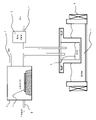
- FIG. 1 is a schematic diagram of an apparatus for applying a silane coupling agent to an inorganic substrate S1.
- An inorganic substrate S1 (cut into a size of 370 mm ⁇ 470 mm) was used.
- the inorganic substrate S1 was washed with pure water, dried, irradiated with a UV/O3 irradiator (SKR1102N-03 manufactured by LAN Technical Co., Ltd.) for 1 minute, and dried.
- UV/O3 irradiator SR1102N-03 manufactured by LAN Technical Co., Ltd.
- KBM903 was placed in a 1 L chemical solution tank, and the water bath outside was heated to 43°C. The emerging vapors were then sent into the chamber along with clean dry air.
- the gas flow rate was 25 L/min, and the substrate temperature was 24.degree.
- the clean dry air had a temperature of 23° C. and a humidity of 1.2% RH. Since the exhaust was connected to a negative pressure exhaust port, it was confirmed by a differential pressure gauge that the chamber had a negative pressure of about 10 Pa.
- a heat-resistant polymer film F1 (360 mm x 460 mm size) was laminated on the silane coupling agent layer to obtain a laminate.
- a laminator manufactured by MCK was used for lamination, and the lamination conditions were compressed air pressure: 0.6 MPa, temperature: 22° C., humidity: 55% RH, and lamination speed: 50 mm/sec.
- This F1/S1 laminate was heated at 110° C. for 10 minutes to obtain an inorganic substrate/heat-resistant polymer film laminate.
- Example 1 The same operation as in Example 1 was performed by changing the combination of the inorganic substrate and the heat-resistant polymer film. Table 1 shows the combinations. Since the polymer films of Comparative Examples 1 to 4 were colored, the total light transmittance, YI, haze and CTE were not measured.
- the 90° peel strength between the inorganic substrate and the heat-resistant polymer film was measured.
- the measurement conditions for the 90° initial peel strength are as follows. The film is peeled off at an angle of 90° to the inorganic substrate. Measurement is performed 5 times, and the average value is taken as the measured value. Measuring device; Autograph AG-IS manufactured by Shimadzu Corporation Measurement temperature; room temperature (25°C) Peeling speed; 100mm/min Atmosphere; atmospheric measurement sample width; 2.5 cm
Landscapes
- Chemical & Material Sciences (AREA)
- Engineering & Computer Science (AREA)
- Health & Medical Sciences (AREA)
- Chemical Kinetics & Catalysis (AREA)
- Medicinal Chemistry (AREA)
- Polymers & Plastics (AREA)
- Organic Chemistry (AREA)
- Ceramic Engineering (AREA)
- Microelectronics & Electronic Packaging (AREA)
- Macromolecular Compounds Obtained By Forming Nitrogen-Containing Linkages In General (AREA)
- Laminated Bodies (AREA)
Priority Applications (5)
| Application Number | Priority Date | Filing Date | Title |
|---|---|---|---|
| US18/553,972 US20240227373A1 (en) | 2021-07-16 | 2022-07-07 | Multilayer body of inorganic substrate and transparent heat-resistant polymer film |
| EP22842030.3A EP4371767A4 (en) | 2021-07-16 | 2022-07-07 | MULTILAYER BODY OF INORGANIC SUBSTRATE AND TRANSPARENT HEAT-RESISTANT POLYMER FILM |
| KR1020237034031A KR20240035938A (ko) | 2021-07-16 | 2022-07-07 | 무기 기판과 투명 내열 고분자 필름의 적층체 |
| CN202280048766.XA CN117677496A (zh) | 2021-07-16 | 2022-07-07 | 无机基板与透明耐热高分子膜的层叠体 |
| JP2023534756A JPWO2023286686A1 (https=) | 2021-07-16 | 2022-07-07 |
Applications Claiming Priority (2)
| Application Number | Priority Date | Filing Date | Title |
|---|---|---|---|
| JP2021117965 | 2021-07-16 | ||
| JP2021-117965 | 2021-07-16 |
Publications (1)
| Publication Number | Publication Date |
|---|---|
| WO2023286686A1 true WO2023286686A1 (ja) | 2023-01-19 |
Family
ID=84919323
Family Applications (1)
| Application Number | Title | Priority Date | Filing Date |
|---|---|---|---|
| PCT/JP2022/026928 Ceased WO2023286686A1 (ja) | 2021-07-16 | 2022-07-07 | 無機基板と透明耐熱高分子フィルムの積層体 |
Country Status (7)
| Country | Link |
|---|---|
| US (1) | US20240227373A1 (https=) |
| EP (1) | EP4371767A4 (https=) |
| JP (1) | JPWO2023286686A1 (https=) |
| KR (1) | KR20240035938A (https=) |
| CN (1) | CN117677496A (https=) |
| TW (1) | TW202321021A (https=) |
| WO (1) | WO2023286686A1 (https=) |
Cited By (1)
| Publication number | Priority date | Publication date | Assignee | Title |
|---|---|---|---|---|
| WO2025159023A1 (ja) * | 2024-01-25 | 2025-07-31 | 東洋紡株式会社 | 積層体、光電変換素子、および光電変換素子の製造方法 |
Citations (7)
| Publication number | Priority date | Publication date | Assignee | Title |
|---|---|---|---|---|
| JP5152104B2 (ja) | 2009-06-08 | 2013-02-27 | 東洋紡株式会社 | 積層体およびその製造方法 |
| WO2014119648A1 (ja) * | 2013-02-04 | 2014-08-07 | 東洋紡株式会社 | 積層体、積層体の製造方法、およびフレキシブル電子デバイスの製造方法 |
| JP5699606B2 (ja) | 2011-01-06 | 2015-04-15 | 東洋紡株式会社 | フィルムデバイス製造用ポリイミド前駆体溶液 |
| JP2015104843A (ja) * | 2013-11-29 | 2015-06-08 | 三星電子株式会社Samsung Electronics Co.,Ltd. | 積層体とその製造方法、及び該積層体を用いた電子デバイスの製造方法 |
| JP2019119126A (ja) * | 2018-01-04 | 2019-07-22 | 東洋紡株式会社 | 積層体、積層体の製造方法、フレキシブル電子デバイスの製造方法 |
| JP2020059169A (ja) * | 2018-10-05 | 2020-04-16 | 東洋紡株式会社 | 積層体、及び、積層体の製造方法 |
| JP2021062571A (ja) * | 2019-10-16 | 2021-04-22 | Agc株式会社 | 積層基板および剥離方法 |
Family Cites Families (5)
| Publication number | Priority date | Publication date | Assignee | Title |
|---|---|---|---|---|
| JPS5152104U (https=) | 1974-10-17 | 1976-04-20 | ||
| JPS5699606U (https=) | 1979-12-27 | 1981-08-06 | ||
| TW531547B (en) * | 1998-08-25 | 2003-05-11 | Kaneka Corp | Polyimide film and process for producing the same |
| CN102256785B (zh) * | 2008-12-19 | 2014-12-31 | 东洋纺织株式会社 | 层叠体及其制造方法、层叠体电路板 |
| JP5783443B2 (ja) * | 2011-03-14 | 2015-09-24 | 日本電気硝子株式会社 | ガラスロール及びガラスロールの製造方法 |
-
2022
- 2022-07-07 KR KR1020237034031A patent/KR20240035938A/ko active Pending
- 2022-07-07 US US18/553,972 patent/US20240227373A1/en not_active Abandoned
- 2022-07-07 CN CN202280048766.XA patent/CN117677496A/zh active Pending
- 2022-07-07 WO PCT/JP2022/026928 patent/WO2023286686A1/ja not_active Ceased
- 2022-07-07 EP EP22842030.3A patent/EP4371767A4/en not_active Withdrawn
- 2022-07-07 JP JP2023534756A patent/JPWO2023286686A1/ja active Pending
- 2022-07-08 TW TW111125667A patent/TW202321021A/zh unknown
Patent Citations (7)
| Publication number | Priority date | Publication date | Assignee | Title |
|---|---|---|---|---|
| JP5152104B2 (ja) | 2009-06-08 | 2013-02-27 | 東洋紡株式会社 | 積層体およびその製造方法 |
| JP5699606B2 (ja) | 2011-01-06 | 2015-04-15 | 東洋紡株式会社 | フィルムデバイス製造用ポリイミド前駆体溶液 |
| WO2014119648A1 (ja) * | 2013-02-04 | 2014-08-07 | 東洋紡株式会社 | 積層体、積層体の製造方法、およびフレキシブル電子デバイスの製造方法 |
| JP2015104843A (ja) * | 2013-11-29 | 2015-06-08 | 三星電子株式会社Samsung Electronics Co.,Ltd. | 積層体とその製造方法、及び該積層体を用いた電子デバイスの製造方法 |
| JP2019119126A (ja) * | 2018-01-04 | 2019-07-22 | 東洋紡株式会社 | 積層体、積層体の製造方法、フレキシブル電子デバイスの製造方法 |
| JP2020059169A (ja) * | 2018-10-05 | 2020-04-16 | 東洋紡株式会社 | 積層体、及び、積層体の製造方法 |
| JP2021062571A (ja) * | 2019-10-16 | 2021-04-22 | Agc株式会社 | 積層基板および剥離方法 |
Non-Patent Citations (1)
| Title |
|---|
| See also references of EP4371767A4 |
Cited By (1)
| Publication number | Priority date | Publication date | Assignee | Title |
|---|---|---|---|---|
| WO2025159023A1 (ja) * | 2024-01-25 | 2025-07-31 | 東洋紡株式会社 | 積層体、光電変換素子、および光電変換素子の製造方法 |
Also Published As
| Publication number | Publication date |
|---|---|
| JPWO2023286686A1 (https=) | 2023-01-19 |
| TW202321021A (zh) | 2023-06-01 |
| EP4371767A1 (en) | 2024-05-22 |
| KR20240035938A (ko) | 2024-03-19 |
| CN117677496A (zh) | 2024-03-08 |
| US20240227373A1 (en) | 2024-07-11 |
| EP4371767A4 (en) | 2025-05-28 |
Similar Documents
| Publication | Publication Date | Title |
|---|---|---|
| JP7722188B2 (ja) | 透明高耐熱フィルムを含む積層体 | |
| JP2025113284A (ja) | 無機基板とポリアミック酸硬化物の積層体 | |
| US20240227373A1 (en) | Multilayer body of inorganic substrate and transparent heat-resistant polymer film | |
| WO2023021899A1 (ja) | 透明高耐熱積層フィルム | |
| WO2022270325A1 (ja) | 積層体 | |
| US20230211584A1 (en) | Layered product including high temperature-resistant transparent film | |
| US20240227363A1 (en) | Laminate of inorganic substrate and heat-resistant polymer film | |
| JP7432126B2 (ja) | 積層体およびフレキシブルデバイス作製方法 | |
| US20230173800A1 (en) | Multilayer body comprising highly heat-resistant transparent film | |
| WO2022186002A1 (ja) | 保護フィルム付きの無機基板/高分子フィルム層の積層体、積層体のスタック、積層体の保管方法、および積層体の輸送方法 | |
| WO2023058408A1 (ja) | 保護フィルム剥離補助テープ付き積層体 |
Legal Events
| Date | Code | Title | Description |
|---|---|---|---|
| 121 | Ep: the epo has been informed by wipo that ep was designated in this application |
Ref document number: 22842030 Country of ref document: EP Kind code of ref document: A1 |
|
| ENP | Entry into the national phase |
Ref document number: 2023534756 Country of ref document: JP Kind code of ref document: A |
|
| WWE | Wipo information: entry into national phase |
Ref document number: 18553972 Country of ref document: US |
|
| WWE | Wipo information: entry into national phase |
Ref document number: 202280048766.X Country of ref document: CN |
|
| WWE | Wipo information: entry into national phase |
Ref document number: 2022842030 Country of ref document: EP |
|
| NENP | Non-entry into the national phase |
Ref country code: DE |
|
| ENP | Entry into the national phase |
Ref document number: 2022842030 Country of ref document: EP Effective date: 20240216 |
|
| WWW | Wipo information: withdrawn in national office |
Ref document number: 2022842030 Country of ref document: EP |